Article

Multi-Objective Optimization of In-Pit Crushing and Conveying Systems Considering Slope Stability: A Case Study of the Beskuduk Coal Mine

1
School of Mines, China University of Mining and Technology, Xuzhou 221000, China
2
Hami Hexiang Industry and Trade Co., Ltd., Hami 839000, China
3
State Key Laboratory of Intelligent Construction and Healthy Operation and Maintenance of Deep Underground Engineering, China University of Mining and Technology, Xuzhou 221116, China
*
Author to whom correspondence should be addressed.
Appl. Sci. 2026, 16(4), 1971; https://doi.org/10.3390/app16041971
Submission received: 15 January 2026 / Revised: 11 February 2026 / Accepted: 14 February 2026 / Published: 16 February 2026
(This article belongs to the Section Civil Engineering)

Abstract

Due to the occurrence of inclined coal seams and the formation of weak layers in the floor of the Beeskuduk open-pit coal mine, this study focuses on the multi-objective optimization of crusher station relocation and belt conveyor layout. In terms of research methodology, the relocation cost compensation method and the minimum cost method were used to establish a crusher station relocation model. The reduction method in FLAC3D was employed to conduct the numerical simulation, and a comprehensive three-dimensional evaluation framework based on “Technological feasibility, safety performance, and economic efficiency” was established. The Analytic Hierarchy Process (AHP) was employed to determine the weights of each indicator, and the multi-objective Pareto optimization was achieved by integrating the Technique for Order Preference by Similarity to Ideal Solution (TOPSIS). The results show that the optimal relocation step distance of the crushing station is 880 m and the optimal relocation site is at the +1120 level. For the belt conveyor, Scheme 2 is preferred, which involves elevating the conveyor from the +1115 level to the +1308 level. The safety and stability coefficient of Scheme 2 reaches 1.758, which is 8.3% and 1.4% higher than that of Scheme 1 and Scheme 3. Moreover, the TOPSIS closeness degree of Scheme 2 reaches 0.892, making it the Pareto optimal solution. This research provides a scientific framework for the optimization of the in-pit crushing and conveying (IPCC) system in open-pit mines under complex geological conditions, offering valuable insights for the efficient and safe mining of similar inclined coal seams in open-pit mines.

1. Introduction

Driven by the global pursuit of carbon neutrality, the development of open-pit coal mining technology toward high efficiency, safety, and low carbon has become a key research area in mining engineering [1]. The in-pit crushing and conveying (IPCC) technology, renowned for its energy efficiency and high throughput, has become the preferred technique for deep mining in large open-pit mines. The application of IPCC significantly reduces transportation costs and enhances production stability [2,3]. Under the strategic background of the westward shift of China’s energy center [4,5], the Beskuduk open-pit coal mine in Xinjiang exemplifies these difficulties, including the large inclination of coal seams, weak layers in the floor, and growing logistical and geotechnical risks (e.g., extended haulage distances and deteriorating slope stability). The current relocation parameters of the crushing station and the layout scheme of the belt conveyor in the existing IPCC system fail to align with the requirements for efficient and safe sequential mining, and targeted optimization research is urgently needed.
The transportation cost of deep open-pit mines accounts for 30% to 50% of the total operating cost [6,7]. The IPCC technology, through the collaborative mode of “single bucket-truck + semi-mobile crushing station-belt conveyor,” can effectively replace the traditional all-truck transportation. Its optimization core focuses on two key links: the relocation of the crushing station and the layout of the belt conveyor [8,9]. In existing research, crusher station relocation predominantly employs single-objective models, such as the cost compensation method and minimum cost method, without fully considering geological constraints and multi-stage dynamic programming [10,11]. The existing models mostly focus on technical and economic indicators, often ignoring slope stability and the adaptability of inclined coal seam terrain [12,13]. Regarding slope stability, current numerical simulations mainly concentrate on stability analysis under natural conditions [14,15,16]. Among them, the FLAC3D 6.0 software, combined with the strength reduction method, is widely used in stability analysis under complex geological conditions [17,18]. Xu et al. [19] proposed a numerical modeling method based on the equivalent jointed rock mass (EJRM) model and obtained the failure and motion laws at different stages through reverse analysis and inversion of mechanical parameters. Zhang et al. [20] analyzed the deformation and stability of open-pit mine slopes using the discrete element method (PFC2D) and the limit equilibrium method. However, the existing studies mostly adopt numerical simulation methods to investigate the migration laws and stability mechanisms of slope overburden under static load conditions [21,22]. It should be noted that the assessment of the coupling effect of system loads is still lacking.
There are still key research gaps for open-pit mines with inclined coal seams and developed weak layers: (1) The optimization of the relocation of crushing stations mostly adopts single-objective models and does not consider the dynamic constraints of the advancement of inclined coal seam stope. (2) In the designed schemes of belt conveyor layout, more emphasis is placed on technical and economic indicators, while the long-term coupling impact of system load and weak layer on slope stability is overlooked. (3) Most of the existing studies separately analyze technology parameters or slope stability, lacking an integrated optimization framework of crushing station relocation, conveyor layout, and slope safety.
Consequently, the innovations and specific contributions of this study are as follows: A multi-objective optimization model for the relocation of the crushing station considering slope safety and production continuity was established, overcoming the limitations of traditional single-objective models and enabling the dynamic coordination of relocation distance, position, and timing. A multidimensional evaluation system of “Technological feasibility, safety performance, and economic efficiency” was constructed, integrating the AHP and TOPSIS algorithms into the comparative selection of belt conveyor layouts. This system analyzes slope stability characteristics, economic viability, and technical feasibility under different semi-continuous equipment relocation schemes, achieving multidimensional Pareto optimization objectives for semi-continuous mining systems under complex geological conditions. The findings of this study address a key limitation in prior work.
This study can provide a technical framework for the efficient and safe mining of similar open-pit mines under complex conditions, advancing both the theoretical and practical aspects of IPCC system optimization.

2. Research Area Background and Methods

2.1. Overview of the Research Area

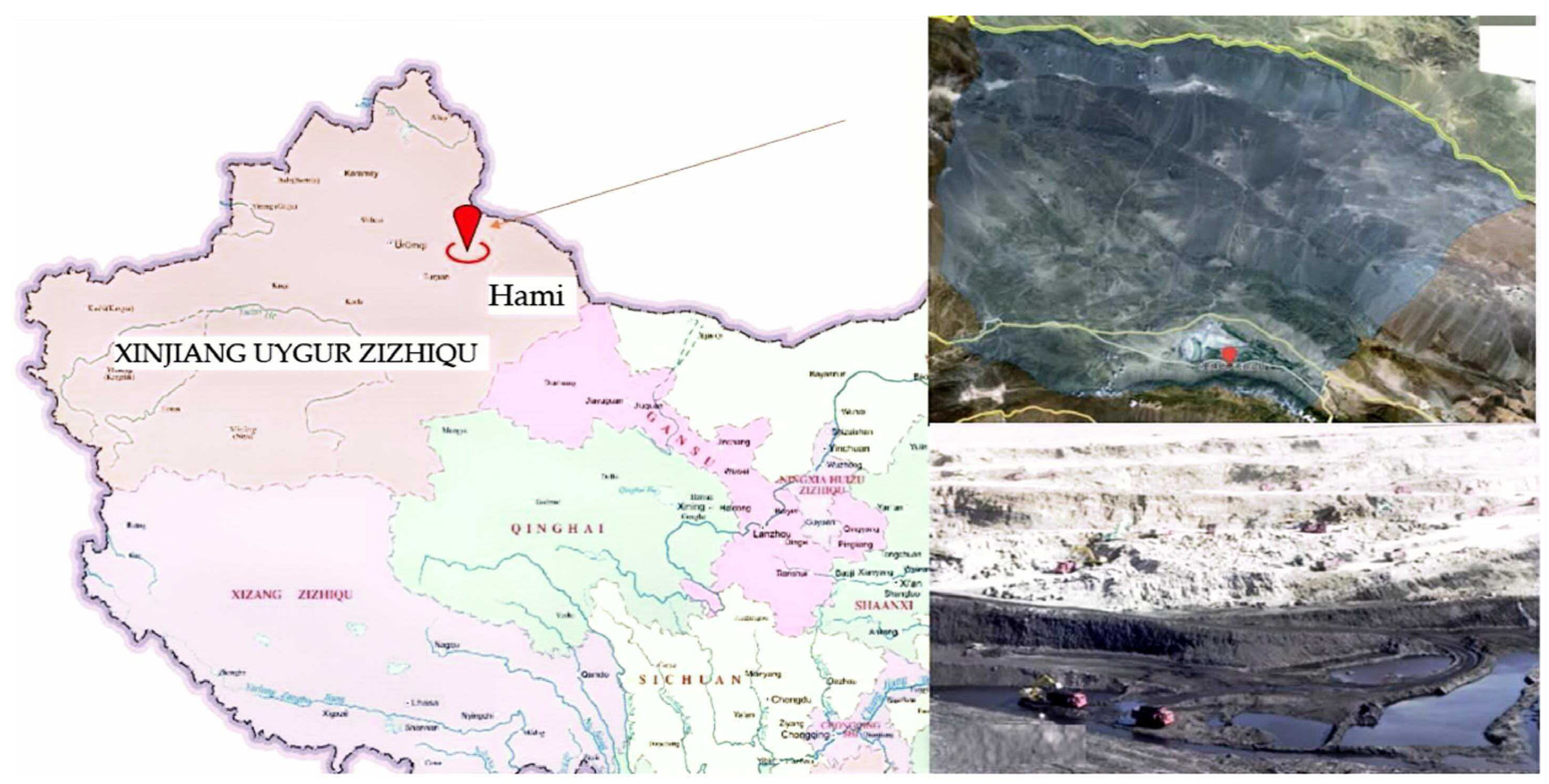
The Beskuduk open-pit coal mine is located 150 km northwest at 320° from Barkol County and administratively falls under the jurisdiction of Barkol County. The transportation within the mining area is convenient. The mining area is located in the Gobi Desert with a gentle terrain, allowing cars to travel freely. Figure 1 shows the transportation location. The mining area primarily contains Quaternary unconsolidated rocks, Tertiary Changjihe Formation, and Jurassic sedimentary clastic rocks. These rocks are highly susceptible to alterations such as weathering and water-induced softening, thereby posing landslide risks during deep mining operations.
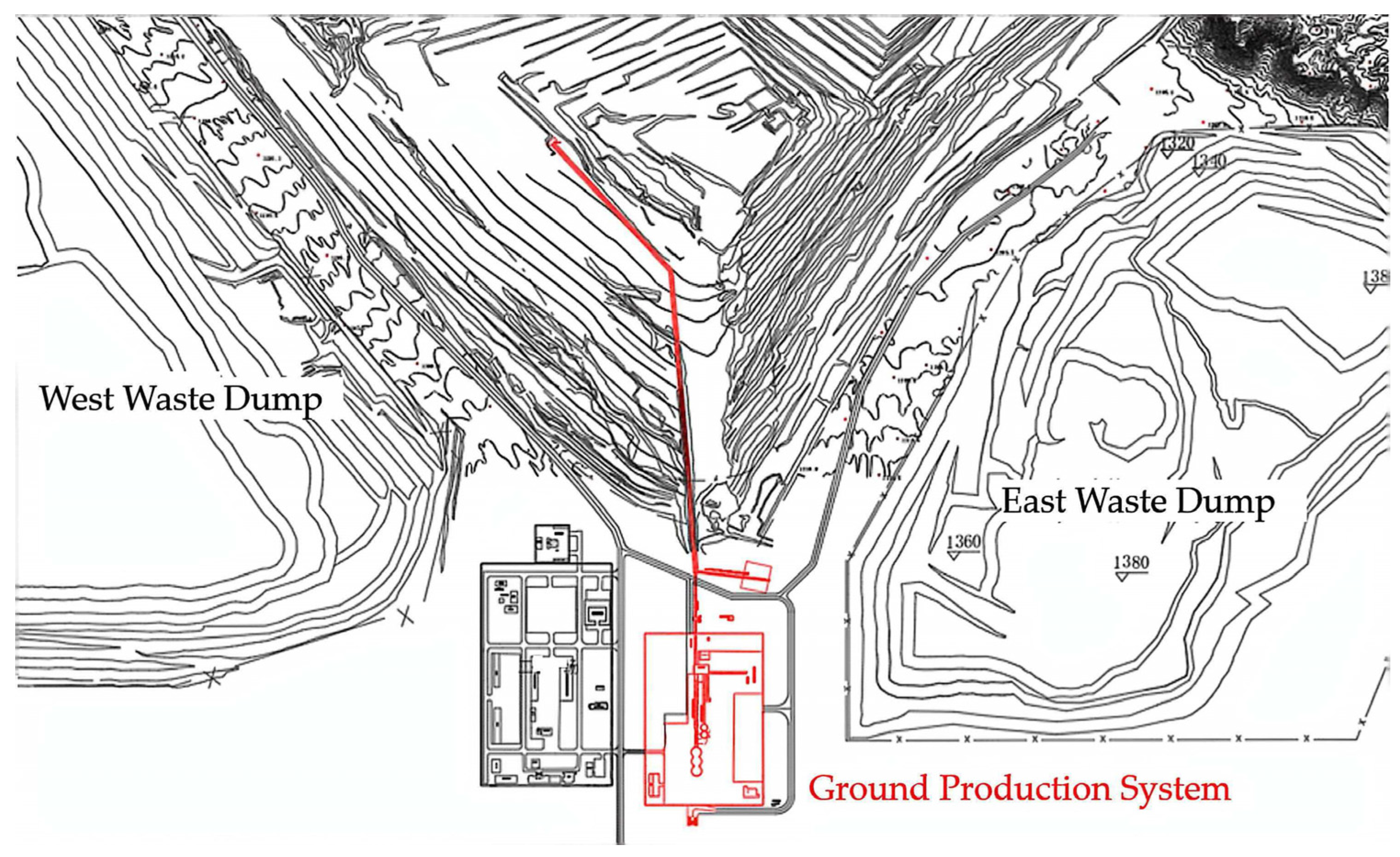
The annual production capacity of this mine was 3 million tons. The coal seam B2 was the main coal seam to be mined, with a pure coal thickness ranging from 10.52–54.55 m, averaging 26.71 m. The weak layer was located 2 m below the floor of coal seams. The inclination angle of the coal seam in the first mining area was generally between 10° and 25°, with some areas reaching 50°. At present, the IPCC method of “single bucket—truck + semi-mobile crushing station” is adopted for coal mining. Initially, the crushing station was set up on the ground at the entrance and exit of the coal transportation trench. The crushed raw coal was transported to the raw coal bunker by belt conveyor. As the depth of the mining and excavation site continuously decreased, the IPCC system needed to be periodically relocated. To date, the crushing station of this mine has been moved to the +1144 level. The belt conveyor has been installed from the surface to the transfer station, with a distance of 750 m; the belt conveyor transfer station has been installed with the crushing station, with a distance of 400 m. The belt conveyor is located on the floor of the exposed coal seam in the west highwall slope, and the semi-mobile crushing station is located in the west of the coal seam. Figure 2 shows the layout of the raw coal production system.
According to the initial mining area division and mining plan, the mine is currently mainly divided into the mining zones 1 and 2. The relocation of the crushing station is required when operations shift from mining zone 1 to mining zone 2. Since the coal seam floor is encountered on the west highwall, if the current position of the crushing station is adjusted to a transfer station, the belt conveyor will extend northward within the mining and excavation area. When laying the belt conveyor, the coal seam floor needs to be broken, which will damage the overall structure of the coal seam floor in the west highwall and the safety of the west slope. In conclusion, this study needs to fully address important issues, such as the increase in transportation distance caused by the deepening of the stope, the impact of weak layers on slope safety on the west highwall, and production interruption during the relocation period.

2.2. Research Methods

2.2.1. Relocating Method for the Crushing Station

Since the dip angle of the coal seam in the first mining area of the Beskuduk open-pit coal mine is generally between 10° and 25° (i.e., a gently inclined ore body) and the mine has been excavated to the coal seam floor, the relocation of the crushing station in this mine was simplified as a linear optimization problem in the horizontal direction [23]. By constructing a layout model of the crushing station under horizontal conditions, the relocation cost compensation method and the minimum cost method were used to calculate the optimal relocation step distance, and the final layout horizontal scheme was determined. Moreover, the existing study has verified that the change in cohesion of the weak layer under the coal seam floor due to time effects has no significant impact on the optimal relocation distance of the crushing station; thus, the time effect will not be considered in subsequent analyses.

2.2.2. Multidimensional Comprehensive Evaluation of Belt Conveyor Layout

In this study, an AHP-TOPSIS coupling algorithm was employed to achieve multi-objective quantitative optimization, proposing different schemes for crusher station relocation and belt conveyor layout. Based on a three-dimensional framework of “Technological feasibility, safety performance, and economic efficiency,” core indicators covering key dimensions were screened, such as implementation difficulty, long-term operational risks, and full life cycle costs. The slope safety verification was carried out by means of numerical simulation, and an optimal conveyor layout was determined through multidimensional comparative analysis based on various indicators, including the complexity of belt conveyor layout and conveyor cost.

3. Research on the Relocation and Optimization of the Crushing Station

3.1. Optimization Model for the Relocation of Crushing Station

The existing classic models for the relocation of crushing stations are mainly divided into three categories: horizontal relocation optimization model [23], vertical relocation optimization model [24], and end-side crushing station relocation optimization model.
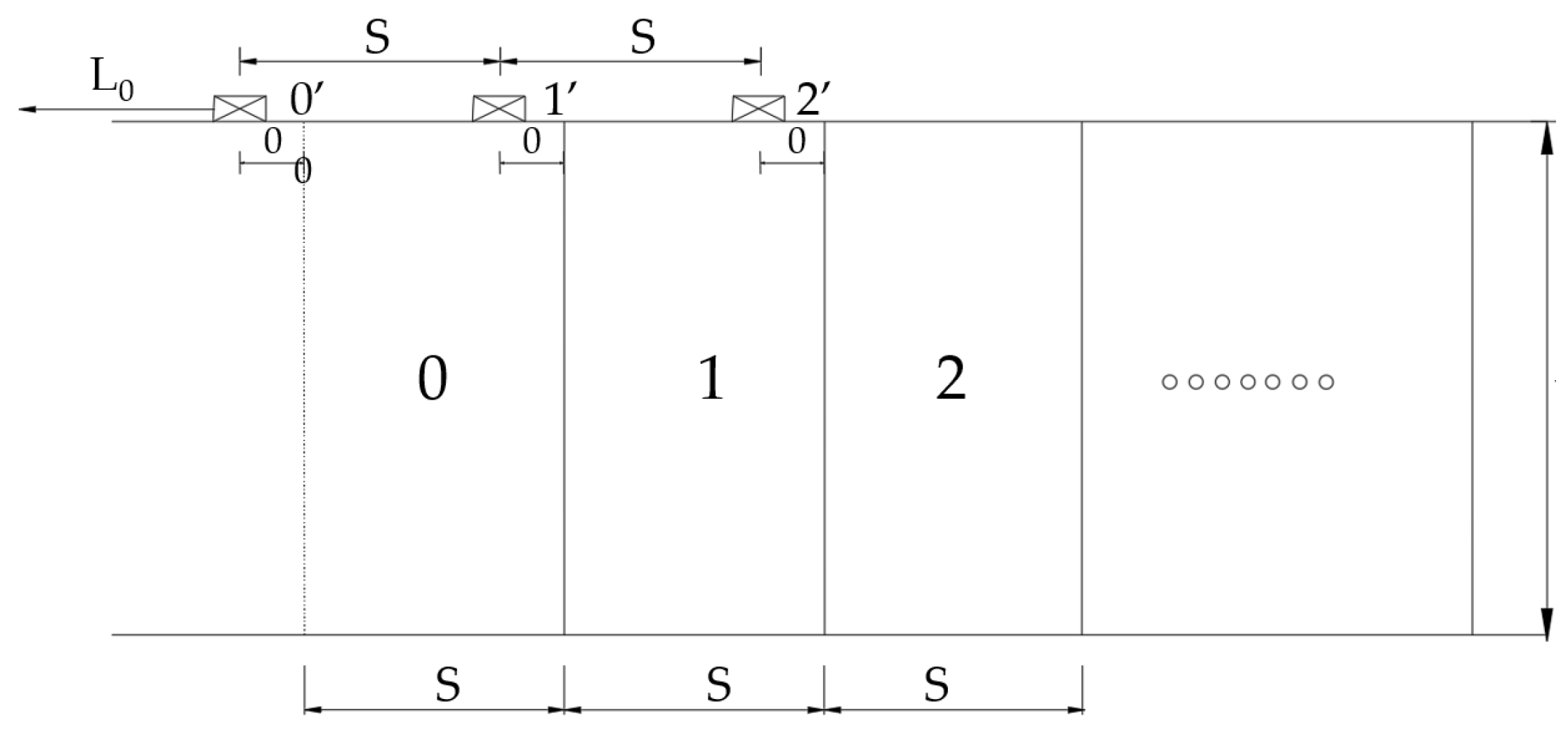
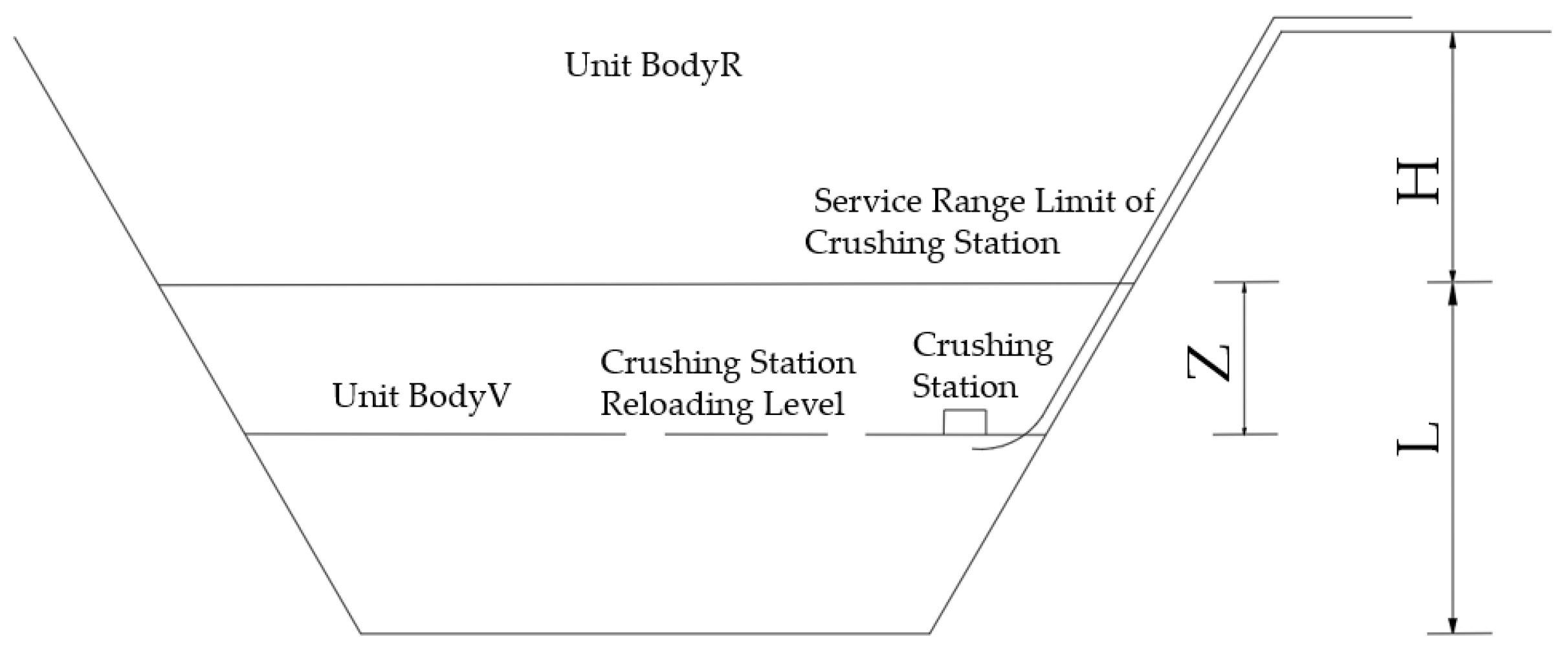
Figure 3 shows the classic model for the relocation of the crushing station proposed by Che [25]. In this model, the relocation of the crushing station is simplified to a linear optimization problem in the X direction. It is assumed that the step distance for the relocation of the crushing station is fixed and equal to the service length of the next section, which is applicable to the conditions of near-horizontal coal seams and a single crushing station. However, the height difference between the crushing station and the coal seam is not considered, and the actual transportation distance from the mining site to the crushing station and the round-trip situation are not taken into account during the analysis. The vertical relocation optimization model is applicable to open-pit mines where ore bodies are inclined [26]. In this model, the relocation of the crushing station is simplified into a linear optimization problem in the Z direction, as shown in Figure 4. However, the horizontal transportation of materials and the influence of internal discharge are ignored. In the first two optimization models, the influence of step division on the production system and the impact of the IPCC system on the production of the upper stripping step are not considered, especially the influence on the internal discharge of open-pit mines. In accordance with the production requirements of the open-pit mine, Chen [27] proposed an optimization model for the relocation of the end-side crushing station based on the different degrees of influence of the IPCC system layout on the upper stripping steps. Based on the natural geographical conditions and actual production status of the Beskuduk open-pit coal mine, the relocation of the crushing station of this mine can be simplified as a linear optimization problem in the X direction. Therefore, the horizontal relocation optimization model is selected. At present, the relocation cost compensation method and the unit cost minimization method are the commonly used methods for solving the horizontal relocation optimization model of crushing stations.

3.1.1. Relocation Cost Compensation Method

The relocation cost compensation method [28] is established on the premise that the overall transportation expenses of the system remain unchanged before and after the crushing station is moved. Specifically, within the service coverage range, the cost saved in transportation can compensate for the relocation of the crushing station and the extension of the belt conveyor, etc., thereby determining the relocation step distance and service length. The expression for the relocation step distance of the crushing station based on the relocation cost compensation method is as follows:
C q = C h + C y ,
C q = C j q + C q q = c j A i = 1 n M i + c q ( s + a + L g + l 2 ) i = 1 n M i
C h = C j h + C q h = c j ( A + s ) i = 1 n M i + c q a + L g + l 2 i = 1 n M i
C y = C j a + C J + C f = C j a + c o s + C f
Simplification results are obtained as Equation (5)
c q s i = 1 n M i = c j s i = 1 n M i + C j a + c o s + C f
where Cq is the transportation cost before the relocation of the crushing station, yuan; Ch is the transportation cost after the relocation of the crushing station, yuan; Cy is the relocation cost of the crushing station, yuan; Cjq is the transportation cost of belt conveyor for raw coal volume in the service area i before relocation, yuan; Cqq is the transportation cost of raw coal by vehicle in the service area i before relocation, yuan; cj is the unit cost of belt conveyor transportation, yuan/(m3·km); and A is the transportation distance of the belt conveyor before relocation, km. Mi is the raw coal quantity at the i-th level, m3; cq is the weighted average transportation unit cost of vehicles within the service area of the crushing station, yuan/(m3·km); s is the relocation distance of the crushing station, km; a is the distance from the crushing station to the working side, km; Lg is weighted average distance transported by vehicles on the work side, km; l is the length of the service range after the relocation of the crushing station, km; Cjh is the transportation cost of the belt conveyor for the raw coal volume in the service area i after relocation, yuan; Cqh is the transportation cost of raw coal by vehicles in the service area i after relocation, yuan; Cja is the foundation construction fee, demolition fee, installation fee, commissioning fee, and other costs for the relocation of the crushing station, yuan; CJ is the purchase, installation, and trial operation cost of belt conveyor, yuan; Cf represents other expenses at the time of relocation, including research fees for relocation plans and losses from temporary production suspension, yuan; and co is the unit extension cost of belt conveyor, yuan/km. The left side of this function represents the total transportation cost savings after relocation, while the right side denotes the total expenses for relocation and belt conveyor extension, embodying the core logic of “cost balance.” This ensures that the relocation investment can be recovered through transportation energy savings, thereby avoiding engineering cost waste.
Among them, i = 1 n M i can be transformed into functions with l
i = 1 n M i = 1000 γ L l i = 1 n h i
where γ is the bulk density of raw coal, t/m3; L is the length of the mining and excavation work line, m; and hi is the height of the i-th level of raw coal, m.
c q s i = 1 n M i = c j s i = 1 n M i + C j a + c o s + C f
After simplification, Equation (8) can be obtained.
l = C j a + c o s + C f 1000 γ s L i = 1 n h i c q c j
If the current service length ln−1 is available, then the relocation step distance sn is set as ln−1, and ln can be calculated by the above function. If ln−1 is unknown, sn−1 can be used to calculate it, and then sn and ln can be obtained. When the crushing station is utilized for the first time or has never been moved previously, the calculation of l0 does not include any relocation expenses or associated distances. In such cases, the costs involved are limited to installation and commissioning, additional miscellaneous expenses, as well as depreciation costs related to the acquisition of the crushing station and belt conveyor. In essence, when the service length before each relocation of the crushing station is determined, the relocation step distance of the entire crushing station can be obtained. The considerations for the initial service length and the following service lengths differ slightly throughout the entire relocation process of the crushing station
l 0 = C f + C N 1000 γ s L i = 1 n h i c q c j
where CN is the depreciation cost of the crushing station and belt conveyor, yuan.
C N = C G T N i = 1 n M i
where CG is the purchase cost of the crushing station and the belt conveyor, yuan; T is the service life of the crushing station and belt conveyor, yuan; and N is the annual production capacity of the crushing station, yuan.
After the simplification, Equation (11) can be obtained.
l 0 = C f 1000 γ s L i = 1 n h i c q c j + C G T N c q c j

3.1.2. Unit Cost Minimization Method

In the IPCC technology, transportation costs include road transportation costs, belt conveyor transportation costs, and crushing costs by crushers. The unit transportation cost of the system increases with the increase of the relocation step distance of the crushing station [29]. It can be concluded that the transportation cost of the IPCC system is
C z = C J + C Q + C P + C y + C N
where CZ is the total transportation cost of the service area of the crushing station, yuan; CQ is the cost of automobile transportation, yuan; and CP is the crushing cost of the crusher, yuan.
C J = c j A + s i = 1 n M i
C Q = c q a + L g + s 2 i = 1 n M i
After the integration, then
C z = c j A + s + c q a + L g + s 2 + c p + C G T N i = 1 n M i + C j a + c o s + C f
where cp is the unit crushing cost, yuan/m3.
When both sides of the equation are divided by i = 1 n M i then
C z = c j A + s + c q a + L g + s 2 + c p + C G T N + C j a + c o s + C f i = 1 n M i

3.1.3. Model Solution Method

When solving for the relocation step distance and service length of a certain crushing station, the relocation cost compensation method and the minimum cost method are respectively adopted. The parameters are substituted for the solution, and then the larger value is taken as the final result. The relocation distance of the crushing station is verified according to the advancement of the soil discharge working line. If
l max v v p l k > 0
then it is compliant with safety regulations; if it is less than 0, it indicates noncompliance with safety regulations. The relocation distance should be changed to
l = l k v v p
where lmax is the larger value obtained by the displacement cost compensation method and the minimum cost method; vp is the advancing speed of the soil discharge working line, m/a; and lk is the initial distance from the crushing station to the soil discharge step at the same horizontal position, m.

3.1.4. Quantification Model of Mining Interruption Loss

The total cost of crusher station relocation must include the mining interruption loss Cs as follows:
C s = Q × t × p × ( 1 η )
where Q is the daily production capacity, 10,000 t/d; t is the interruption duration (field-measured average: 3 d); p is the coal sales price, 320 yuan/t; and η is the capacity compensation coefficient (achieved through subsequent overtime production, η = 0.85).
Substituting the data yields CS = 1 × 104 × 3 × 320 × (1 − 0.85) = 144 million yuan. As outlined in Section 3.2.1, the total cost of crusher station relocation is 56.6992 million yuan. The mining interruption loss accounts for only 2.5% of the total cost. Given its low proportion and consistent interruption duration across all schemes, its impact on the decision-making for the optimal relocation step distance is negligible. Thus, the core conclusions of the model remain unchanged.

3.2. Calculation of Relocation Parameters

Based on the above optimization model and its solution method, the optimal relocation step distance is calculated by using the relocation cost compensation method and the minimum cost method. Since there is no internal drainage plan for the Beskuduk open-pit coal mine at present, the larger values of the calculation results of the two methods are taken as the solution result.

3.2.1. Calculation Results of the Relocation Cost Compensation Method

After simplifying Equation (5), the following function can be obtained:
( c q c j )     s M i = C j a + c o s + C f
After simplifying and organizing the relocation distance of the crushing station s, we obtain
s = C j a + C f c q M i c j M i c o
where Mi represents the material volume of the block section at the i-th level; M i represents the total block section volume; and M i can be expressed as a function of the relocation step distance S of the crushing station. Let l i H i be k; then M i = 1000 ks. Substituting these into Equation (21), we can obtain
1000 k ( c q c j ) s 2 c o s C j a C f = 0
Based on field production data, the total expenses for the relocation of the crushing station C j a is 5,669,922.24 yuan, including the dismantling, foundation construction, equipment relocation, installation and commissioning, etc. The additional costs incurred during the relocation of the crushing station C f , including the production suspension loss fees and management fees caused by open-pit mine production, are challenging to calculate. Given their minimal effect on determining the optimal relocation step distance, the influence of C f is neglected, and C f = 0 is taken. The unit price for belt conveyor transportation c j is 4.0 yuan/(m3·km). The average unit transportation cost for truck transportation within the service area of the crushing station c q is 8.076 yuan/(m3·km). The unit extension fee for the belt conveyor c o is 12,000 yuan/m, which is 12 million yuan/km. After measurement and calculation, if l i H i is 17,478.48 m2, then k = 17,478.48. By substituting it into Equation (22), we can obtain that s = 0.880 km.

3.2.2. Calculation Results of the Unit Cost Minimization Method

When the crushing station is relocated, the unit cost of the relocation expense allocated to the service block segment decreases as the relocation step distance of the crushing station increases.
Since M i = 1000 ks, Equation (16) can be simplified as follows:
C z = c j A + s + c q L g + a + s 2 + C j a + c 0 s + C f 1000 k s + c p
The first derivative of C z with respect to S is obtained, and C z = 0 is set.
s = C j a + C f 1000 k ( c j + 0.5 c q ) 1 / 2
Based on field production data, the total cost C j a for dismantling, foundation construction, equipment relocation and installation, and commissioning when the crushing station is moved to the new location amounts to 5,669,922.24 yuan. The additional costs incurred during the relocation of the crushing station C f , including the production suspension loss fees and management fees caused by open-pit mine production, are challenging to calculate. Given their minimal effect on determining the optimal relocation step distance, the influence of C f is neglected, and C f = 0 is taken. The unit transportation cost of the belt conveyor c j is 4.0 yuan/(m3·km), and the average unit transportation cost for trucks within the service range of the crushing station is 8.076 yuan/(m3·km). The unit extension cost of the belt conveyor c o is 12,000 yuan/m, or 12 million yuan/km. After measurement and calculation, l i H i is 17,478.48 m2, thus k = 17,478.48. By substituting it into Equation (24), s = 0.231 km is obtained.
By integrating the relocation cost compensation method and the unit cost minimization method, it is concluded that the minimum relocation step distance of the Beskuduk open-pit coal mine is 0.880 km.

3.3. Determination of the Relocation Scheme

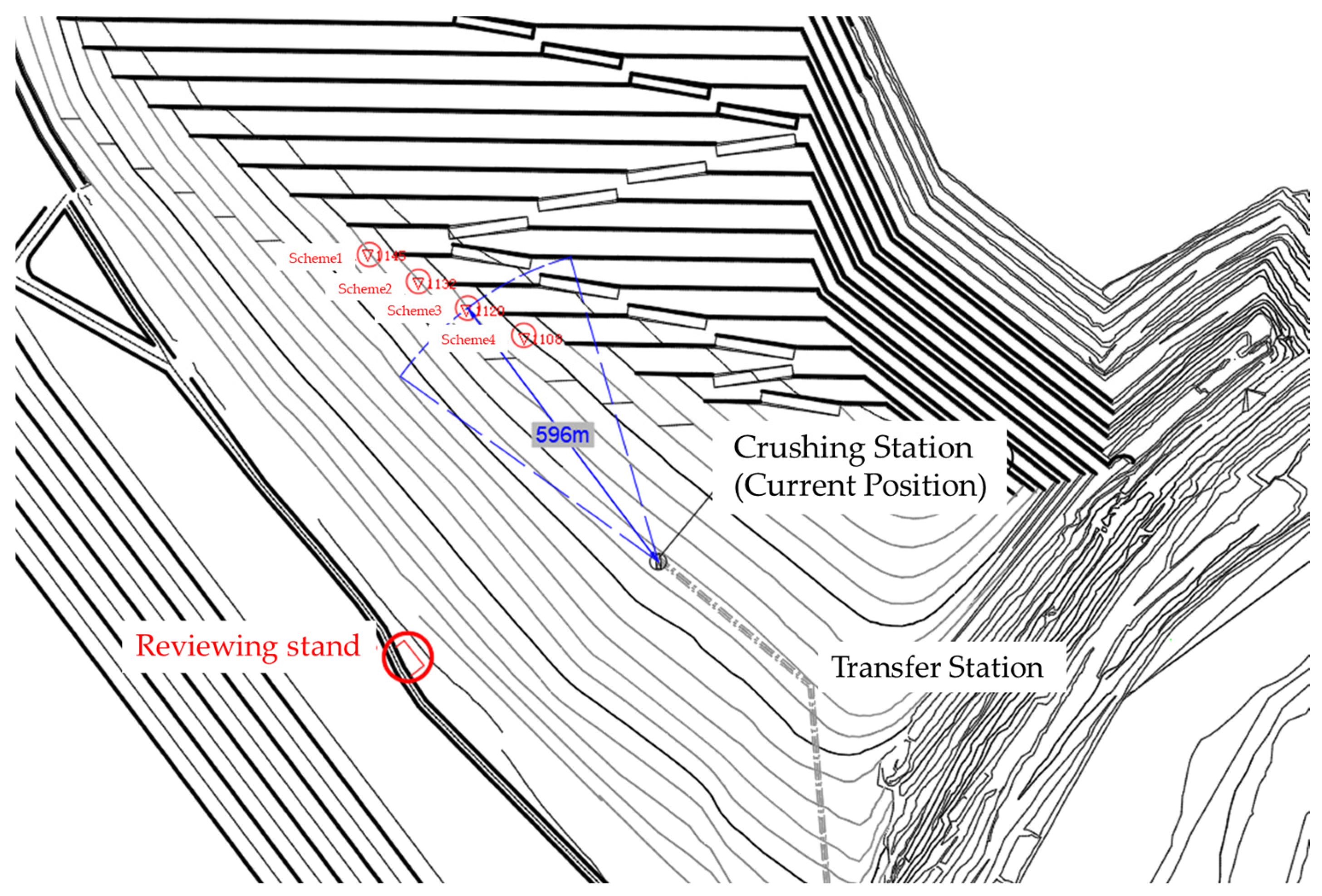
Since the influence of internal drainage is not considered for the relocation of the crushing station, the minimum relocation step distance of this mine is obtained as 0.880 km by integrating the relocation cost compensation method and the unit cost minimization method. As shown in Figure 5, four locations for the relocation of crushing stations are proposed. From top to bottom, they are at the levels of +1144, +1132, +1120, and +1108, respectively. Table 1, Table 2, Table 3 and Table 4 present the estimated transportation costs for the relocation of the crushing station to different horizontal levels over the next three years. Among them, the final cost of coal mining = the basic unit price of coal mining + the adjusted unit price of coal mining (transportation distance and lifting height). Based on a transport distance of 1500 m, for every 100 m increase or decrease, the unit coal cost is increased or decreased by 0.106 yuan/m3. Based on a coal mining lift height of 30 m, for every 10 m increase or decrease, the unit coal price increases or decreases by 0.088 yuan/m3.
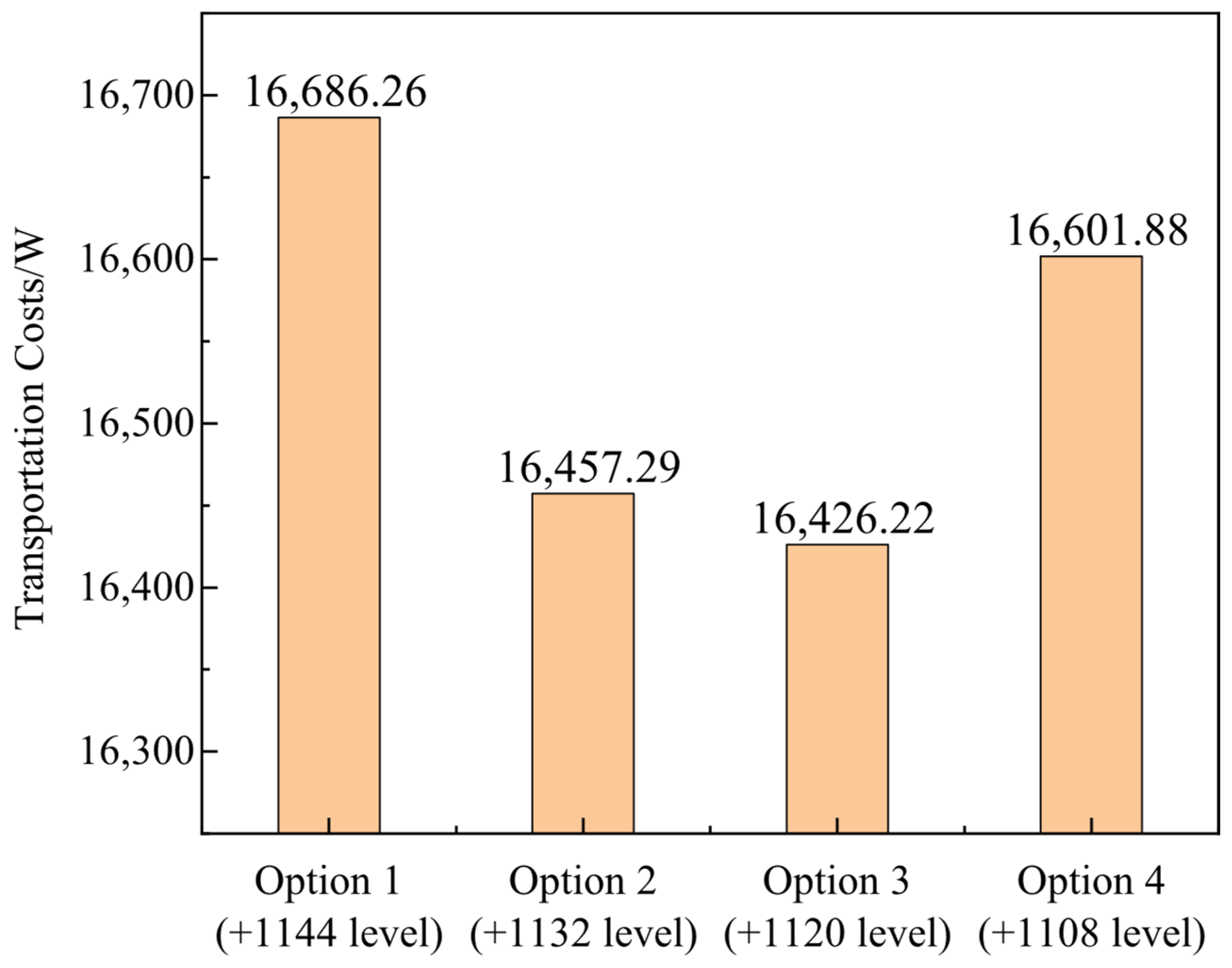
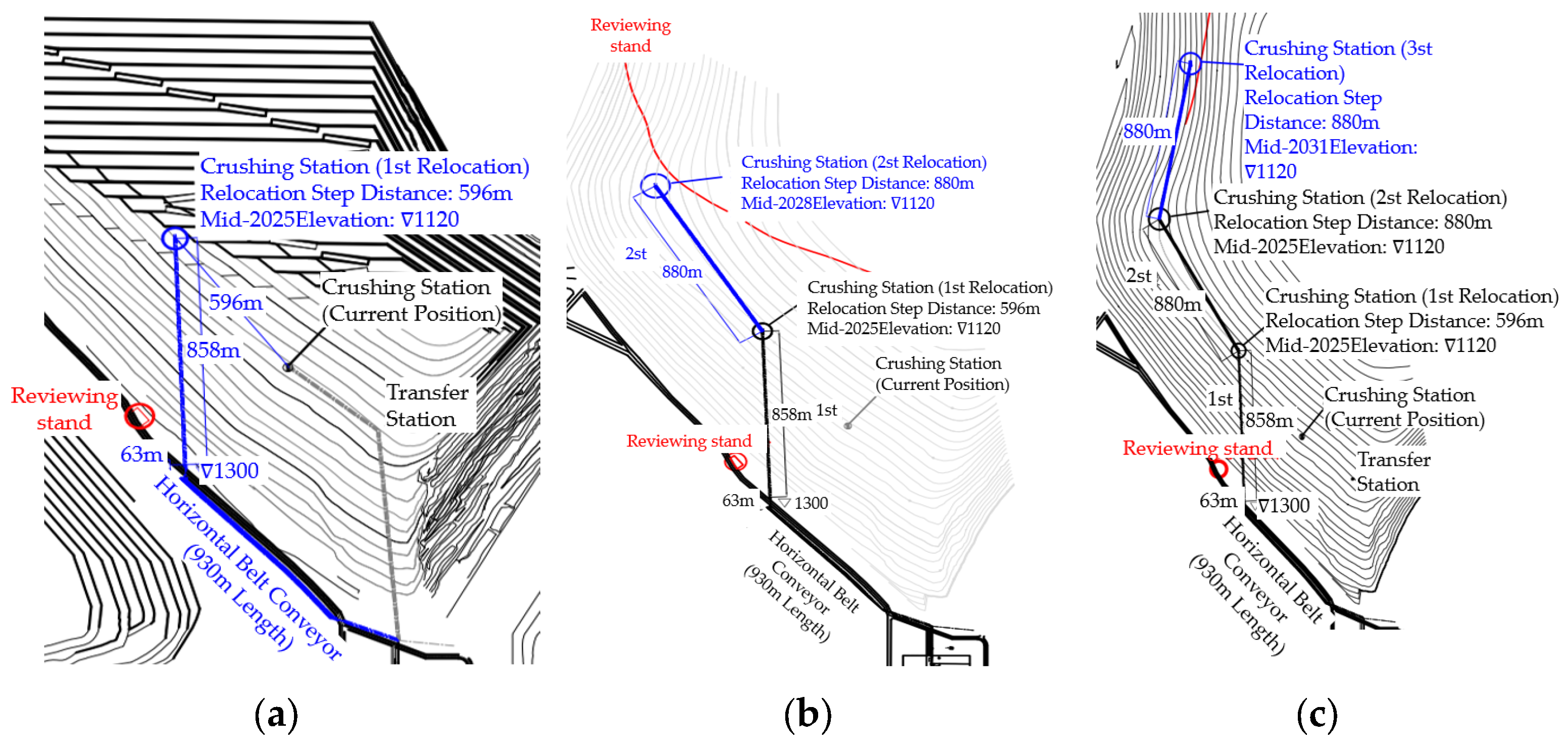
Figure 6 shows the transportation costs of different schemes. When the crushing station is moved to the +1120 level, the transportation cost of the coal mining block section is the lowest. Additionally, the safety hazards brought by heavy coal transport vehicles going downhill are reduced. Based on these advantages, Scheme 3 has been chosen: the crushing station will be transferred to the +1120 level in the year 2026. Therefore, the crushing station will be relocated 596 m to the northwest in 2026, and the service level will drop by 25 m. Based on the above calculation, the minimum relocation step distance is 0.880 km, and the relocation steps in 2028 and 2030 are expected to move forward by 880 m compared to the relocation step distance in 2026.

4. Comparison and Selection of Belt Conveyor Layout Schemes

4.1. Scheme Design

The horizontal mining was applied in mining zone 1 of the Beskuduk open-pit coal mine, and the original crushing station was arranged on the inclined coal floor on the west highwall. The internal layout of the stope features minimal conflict between belt conveyor routes and truck transport pathways, making it a highly efficient and favorable operational configuration for IPCC technology. Based on the relocation step distances of the crushing station in 2026, 2028, and 2030 obtained in Section 3, three layout schemes for the belt conveyor are proposed as shown in Table 5.

4.1.1. Plan One for Belt Conveyor Layout

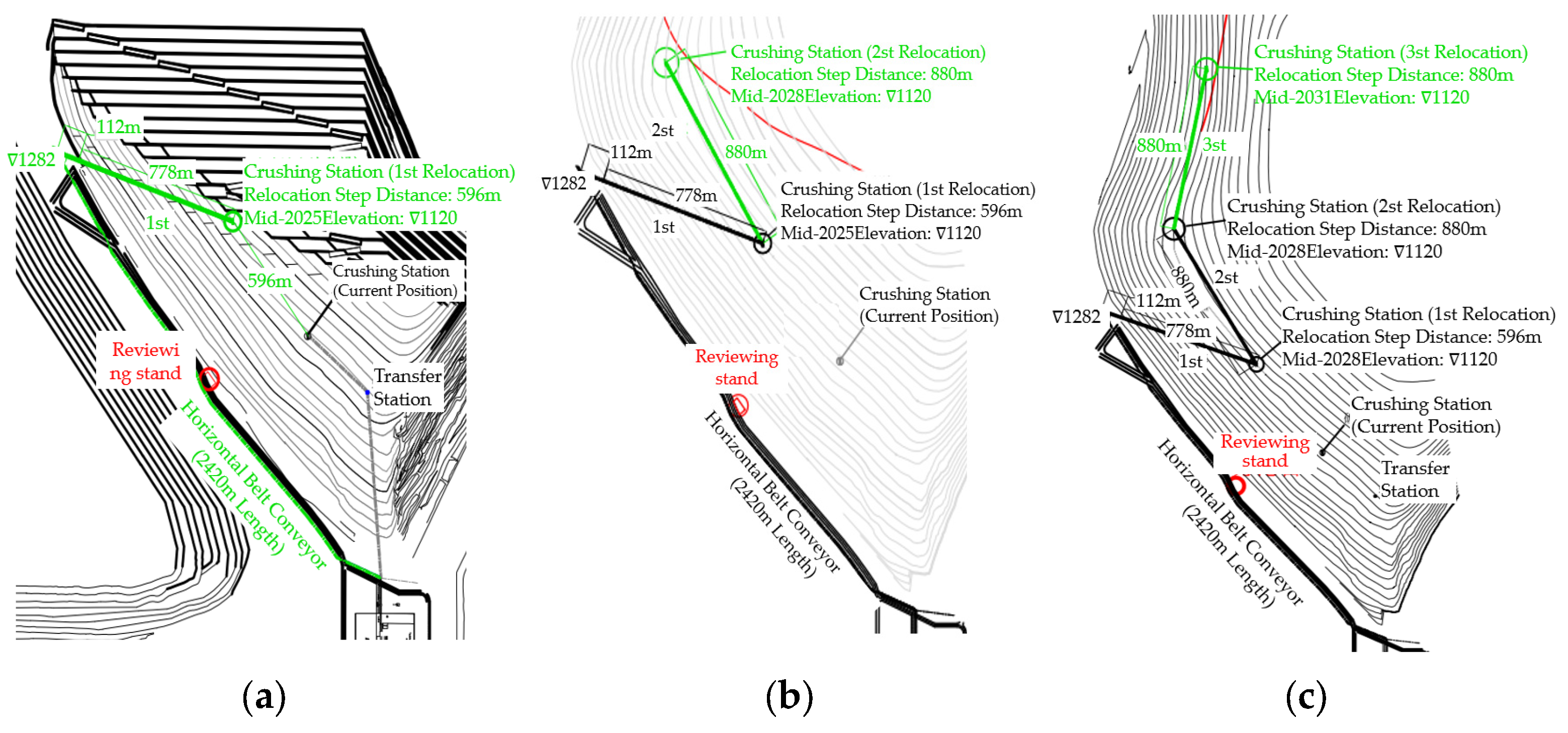
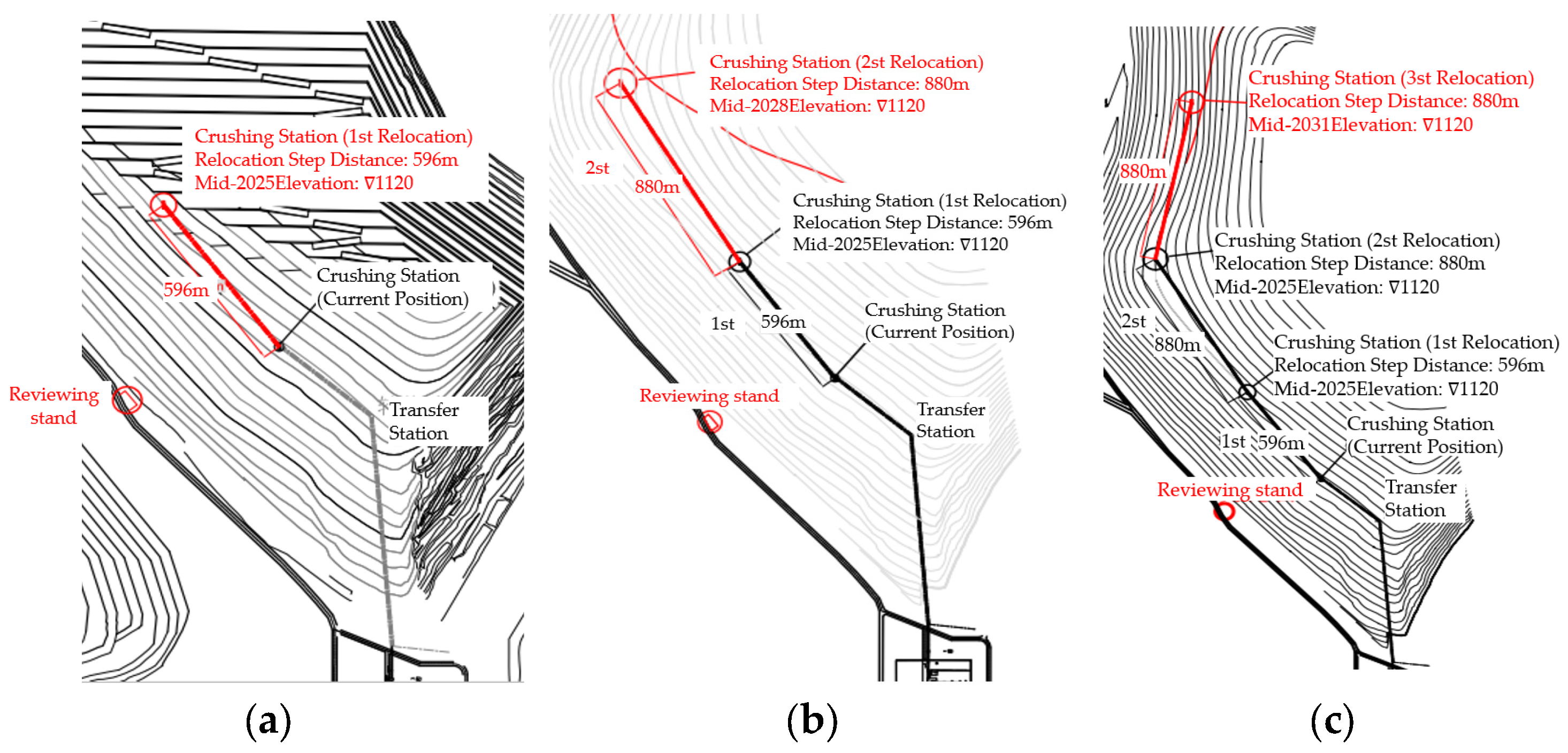
In 2026, a 596 m horizontal belt conveyor will be newly installed at the tail end by driving cement piles. In 2028, a new 880 m horizontal belt conveyor will be installed along the direction of advancement by driving cement piles. In 2030, a new 880 m horizontal belt conveyor will be installed along the direction of advancement by driving cement piles. Figure 7 shows the specific positions of belt conveyors at different stages.
As shown in Figure 7, during the period from 2026 to 2030, a total of three horizontal belt conveyors will be deployed, with a total length of 2356 m for the newly purchased belt conveyors. By 2030, a total of 3387 m of belt conveyors will be arranged in the mining area of the IPCC system.

4.1.2. Plan Two for Belt Conveyor Layout

In 2026, the belt conveyor will be lifted by driving cement piles: from the +1115 level to the +1308 level, with a lifting angle of 13° and a total length of 858 m. After being lifted to the surface, it will pass through a 63 m horizontal belt conveyor bridge to cross the road on the west highwall of the mining area. After crossing the belt conveyor bridge, the raw coal will be transported from the transfer point to the receiving position of the original surface transportation system by a 930 m horizontal belt conveyor. In 2028 and 2030, 880 m horizontal belt conveyors will be newly installed along the direction of advancement by driving cement piles, respectively. The specific layout location is shown in Figure 8.
From 2026 to 2030, a total of four belt conveyors will be deployed. The newly purchased belt conveyors will be 2580 m in length. By 2030, a total of 3611 m of belt conveyors will be arranged in the coal mining IPCC system within the mining site.

4.1.3. Plan Three for Belt Conveyor Layout

By 2026 (Phase 1), the belt conveyor will be upgraded from the +1115 level to the +1290 level, with an elevation angle of 13° and a total length of 778 m. After being lifted to the surface, it will pass through a 112 m horizontal belt conveyor bridge to cross the road on the west highwall of the mining area. After crossing the belt conveyor bridge, the raw coal will be transported from the transfer point to the receiving position of the original surface transportation system by a 2420 m horizontal belt conveyor. The original belt conveyor will be dismantled and used as a backup for the second and third stages. In 2028, the crushing station will be moved to a new position (as shown in the map), and a new 880 m horizontal belt conveyor will be installed along the advancement direction by driving cement piles. In 2030 (Phase 3), the crushing station will be moved to a new position (as shown in the figure), and a new 880 m horizontal belt conveyor will be installed along the advancement direction by driving cement piles. Figure 9 shows the specific layout position.
From 2026 to 2030, a total of four belt conveyors will be installed. The newly purchased belt conveyors will be 4039 m in length. By 2030, a total of 5070 m of belt conveyors will be arranged in the coal mining IPCC system within the mining site.
Based on the usage of conveyors under the aforementioned different scenarios, a comprehensive comparison was made among the belt conveyor layout schemes 1–3. The comparison results are shown in Table 6. It is known that the purchase unit price of the belt conveyor in the stope is 12,000 yuan/m, and the unit price of the surface belt conveyor is 8000 yuan/m.

4.2. Multidimensional Comparative Analysis

4.2.1. Research on Slope Stability Under Loads of the IPCC System

(1)
Numerical Model and Parameters
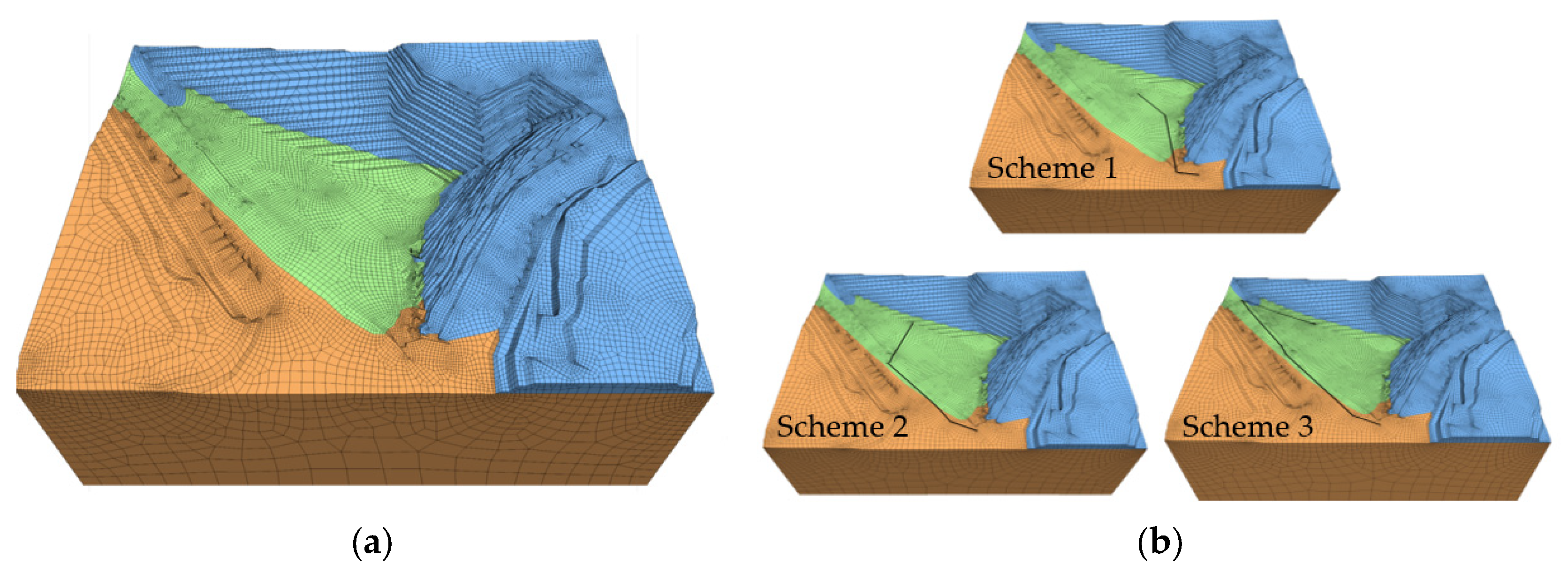
Based on the mining and stripping engineering drawings of the Beskuduk open-pit mine and the position of the coal seam floor in 2025, a three-dimensional mesh model was constructed using Rhino7 software and imported into FLAC3D to complete the construction of the three-dimensional geological model. Figure 10a shows the three-dimensional geological model of the Beskuduk open-pit mine. The model dimensions were 800 m in length, 600 m in width, and 300 m in height. The element size was set to 5 m × 5 m × 5 m (refined to 3 m × 3 m × 3 m in the weak layer area). The number of grid nodes was 128,640, and the number of elements was 115,920. The boundary conditions were defined as fixed displacement at the bottom, horizontal displacement constrained on all sides, and a free top surface. The Mohr–Coulomb constitutive model was employed, with the yield criterion based on shear stress. The damping coefficient was ignored. The weak layer was simulated using contact elements, with a normal stiffness of 10 GPa/m and a tangential stiffness of 5 GPa/m. Considering that the positions of the belt conveyors in the three schemes are different, a three-dimensional geological model under the static load influence of the belt conveyors is additionally established, as shown in Figure 10b.
In accordance with the Standard for Design of Slope Engineering of Open Pit Mine of Coal Industry (GB51289-2018), the calculation results from the 2023 Slope Stability Assessment Report and engineering practices from similar open-pit mines with inclined coal seams [30], the acceptable displacement thresholds for the project are defined as follows: general slope areas ≤ 30 mm and critical equipment areas such as belt conveyor layouts ≤ 40 mm. The safety threshold for the stability factor is set at ≥1.3. However, due to the developed weak layers in this mine, a stricter threshold of ≥1.5 is adopted. The entire slope can be divided into three lithologies for this analysis: mudstone, sandstone, and thermally altered rock. The corresponding physical and mechanical parameters for each lithology are listed in Table 7.
Parameter Description:
The data are based on the 2023 Supplementary Exploration Report (32 sets of borehole samples) from the Third Exploration Team of the Shandong Coalfield Geology Bureau, laboratory test results from the Shenyang Research Institute of China Coal Research Institute, and in situ back-analysis data from the 2025 Slope Stability Verification Report. The uncertainty of cohesion (c) is ±3.2 kPa (relative standard deviation 6.5%), and the uncertainty of the internal friction angle (φ) is ±1.8° (relative standard deviation 5.8%), based on statistics from 32 sets of parallel test data (confidence level 95%).
All parameter values were determined by integrating “test data + code-based reduction,” applying a 0.85 reduction factor to the original test data in accordance with the Technical Standard for Belt Conveyor Engineering (GB 50431-2020) [31], ensuring both safety and practical engineering applicability.
(2)
Selection and Basis of Conveyor Load Parameters
Based on the related standard [31] and field-measured parameters from the Beskuduk open-pit mine, the core calculation parameters are determined with laying conditions of the 13° inclination angle of the belt conveyor in Scheme 2, as shown in Table 8. The parameter values align with both engineering reality and industry standards.
During the operation of the belt conveyor, the total load acting on the slope is decomposed into two components along the normal (vertical) direction and the tangential (horizontal) direction of the slope. The vertical force component represents the dominant compressive stress load on the slope, while the horizontal force component includes shear loads such as friction and inertial forces. The total load is the vector sum of these two components, calculated as follows:
F N = q cos α
F H = q f + q a g + q k
F Z = F N 2 + F H 2
η N = F N F Z × 100 %
η H = F H F Z × 100 %
where FN is the vertical force component per unit length (kN/m), representing the effective load of static vertical force acting on the slope; FH is the horizontal force component per unit length (kN/m); qa/g represents the inertial force during the starting phase, and qk denotes the additional horizontal force from the support foundation, both of which are practical engineering correction terms; FZ is the total load per unit length (kN/m), calculated as the vector sum of the vertical and horizontal force components; ηN is the proportion of the vertical force component relative to the total load; and ηH is the proportion of the horizontal force component, satisfying ηN + ηH ≈ 100%.
Based on Equations (25)–(29) and the parameters in Table 8, the vertical/horizontal force components and their proportions were calculated step by step. The results align with practical engineering conditions, as shown in Table 9. Under pure theoretical calculation, the horizontal force component accounts for only 0.77%, while the vertical force component accounts for 99.71%, indicating that the conveyor load is dominated by vertical compressive stress, with negligible horizontal shear force.
The conveyor load includes the structure of the conveyor, the self-weight of the belt, and the rated raw coal load, with a total vertical static load q = 2.5 kN/m. The spacing of conveyor supports L is 2.0 m, and the ground contact area per support is 0.1 m2. Thus, the contact area per unit length is A = 0.1 m2/2.0 m = 0.05 m2/m. The average compressive strength is then calculated as p = q/A = 2.5 kN/m/0.05 m2/m = 50 kPa. Additionally, the static load of the belt conveyor can be simplified as a uniformly distributed pressure, with an allowable error range of ±10% [30]. Continuous monitoring of the existing +1144 level belt conveyor over 72 h showed load fluctuations between 47–53 kPa (variation amplitude ±6%), which is within the allowable error range of the standard. Therefore, the average compressive strength in the installation area is 50 kPa.
(3)
Simulation Results and Analysis
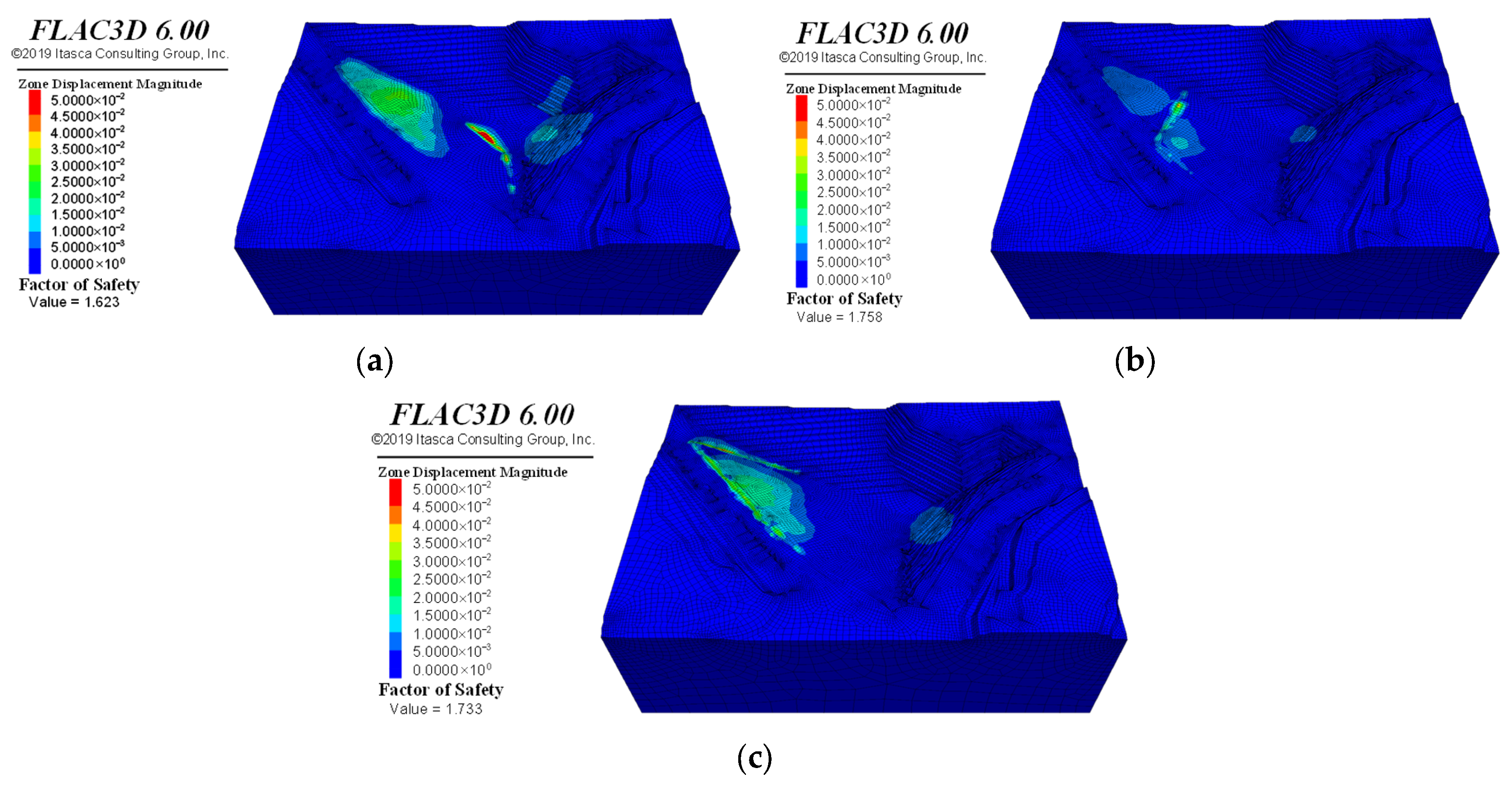
The geological model of the slope is calculated based on the strength reduction method. Figure 11 shows the slope stability calculation results and displacement cloud map of the different belt conveyor layouts.
As shown in Figure 11a, the belt conveyor will be arranged at the junction of the southern slope and the western slope, which is the current layout position of the belt conveyor in the Beskuduk open-pit mine. According to the results of numerical simulation, significant displacements can be induced in many areas, as shown in Figure 12. Due to the relatively weak lithology, the displacement of the slope in the coal seam floor in the west ranges from 10 mm to 30 mm. Due to the large slope angle, the displacement of the eastern rock slope ranges from 5 mm to 15 mm. The layout area of the 1145 horizontal belt conveyor is affected by the static load of the belt conveyor’s own weight, resulting in a significant displacement and subsidence. The maximum displacement exceeds 50 mm, far exceeding the acceptable threshold of 40 mm for critical equipment areas. There is no obvious displacement or deformation in the remaining areas.
Engineering Risk Analysis: During long-term operation, displacement beyond the threshold may lead to conveyor frame settlement and belt misalignment, increasing equipment maintenance costs (estimated annual maintenance costs may rise by over 30%). Additionally, as the area is adjacent to the western weak layer, continuous subsidence could trigger weak layer slippage, creating a chain risk of equipment failure and slope instability. This does not align with the long-term safety requirements for mine deepening. The three-dimensional slope stability factor of this conveyor layout scheme is 1.623, meeting the threshold of ≥1.5. However, the excessive displacement renders the risk uncontrollable.
As shown in Figure 11b, under this conveyor layout, deformation is concentrated in the western coal seam floor slope, with displacements ranging from 10 mm to 45 mm. The maximum displacement in the belt conveyor layout area is 38 mm, which is below the 40 mm (the threshold for critical equipment). Displacement in other areas is ≤30 mm, meeting the general threshold. Minor deformation at the eastern rock slope foot is less than 15 mm, indicating relative safety of this layout. The three-dimensional slope stability factor of this scheme is 1.758, significantly exceeding the threshold of 1.5, demonstrating excellent overall safety.
Engineering Risk Analysis: Displacement in critical areas remains within thresholds, making conveyor settlement and misalignment risks negligible (estimated annual maintenance costs can be controlled within 5% of the baseline). Displacement in the western weak layer area is uniform and controllable, with no local stress concentration. Long-term operation will not induce weak layer slippage due to system loads, meeting safety requirements for a 30-year mining cycle. Furthermore, the existing floor deformation zones are avoided in this scheme, further reducing the combined risk of mining disturbance and system load.
As shown in Figure 11c, deformation under this layout is concentrated in the western coal seam floor slope and the belt conveyor layout area, with displacements ranging from 10 mm to 45 mm. The maximum displacement in the critical area is 42 mm, slightly exceeding the 40 mm threshold. Minor deformation at the eastern rock slope toe is ≤15 mm, indicating relative safety of this scheme. The three-dimensional slope stability factor of this scheme is 1.733, meeting the ≥1.5 threshold. However, the deformation area is 20% larger compared to Scheme 2.
Engineering Risk Analysis: Slight exceedance of displacement thresholds in the conveyor area may lead to local frame settlement during long-term operation (requiring recalibration every three years, increasing additional engineering costs). The expanded deformation area increases the disturbance range of the weak layer. When mining advances to deeper stages (post-2030), this may combine with mining disturbances to trigger local slope collapse, necessitating additional monitoring points. While the risk is controllable, the economic feasibility is suboptimal.

4.2.2. Optimization Based on AHP-TOPSIS Coupling Algorithm

To address the limitations of traditional qualitative comparisons, an AHP-TOPSIS coupling algorithm is adopted to achieve multi-objective quantitative optimization. The specific process is as follows:
(1)
Construction of the Evaluation Indicator System
Based on the three-dimensional framework of “Technological feasibility, safety performance, and economic efficiency,” core indicators are screened, covering key dimensions, such as implementation difficulty, long-term operational risk, and full life cycle cost. Specific indicators and their attributes are listed in Table 10.
(2)
Determination of AHP Weights
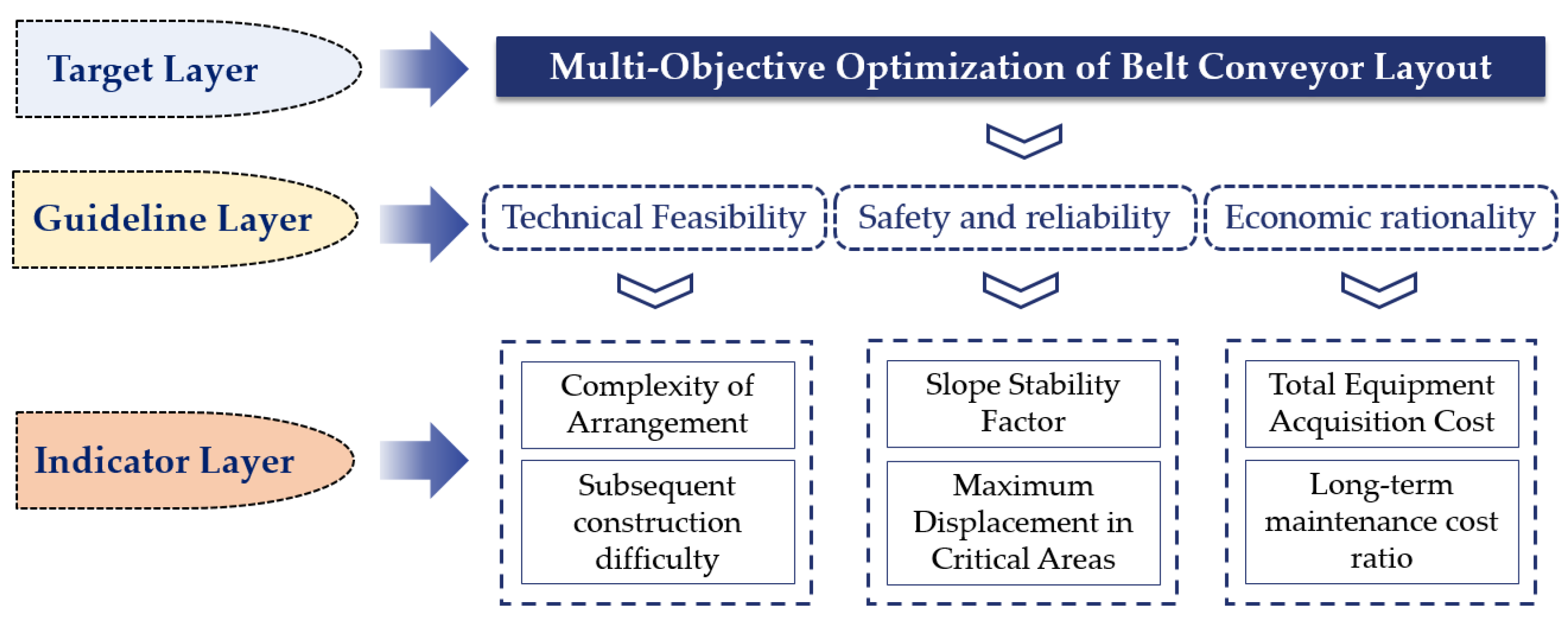
As shown in Figure 12, a hierarchical structure model is constructed, comprising the objective layer, criterion layer, and indicator layer. Six specific indicators are proposed in the technical, safety, and economic aspects. Based on the mine’s actual situation and production requirements, a 1–9 scale method is used for scoring, and the geometric mean is adopted to construct the judgment matrix. The consistency ratio (CR) is verified, and the matrix is considered valid when CR < 0.1. Finally, the eigenvalue method is employed to determine the weights of each indicator. The specific weight results are presented in Table 11.
(3)
TOPSIS Evaluation Process
First, the range method is adopted to eliminate dimensional effects. The normalization formulas for positive indicators and negative indicators are as follows:
x i j = x i j x j min / x j max x j min
x i j = x j max x i j / x j max x j min
Then, Equation (32) is used to construct a weighted normalized matrix, where w j represents the combined weights of the indicators.
x i j = x i j x j min / x j max x j min Z i j = w j × x i j
The positive and negative ideal solutions are determined using the following function:
Z + = max Z i j , Z = min Z i j
Finally, the relative closeness is calculated with the formula below:
C i = d i / d i + + d i
where d i + represents the Euclidean distance from alternative i to the positive ideal solution and d i denotes the distance to the negative ideal solution. A higher value of C i indicates a more favorable alternative.
(4)
Evaluation Results
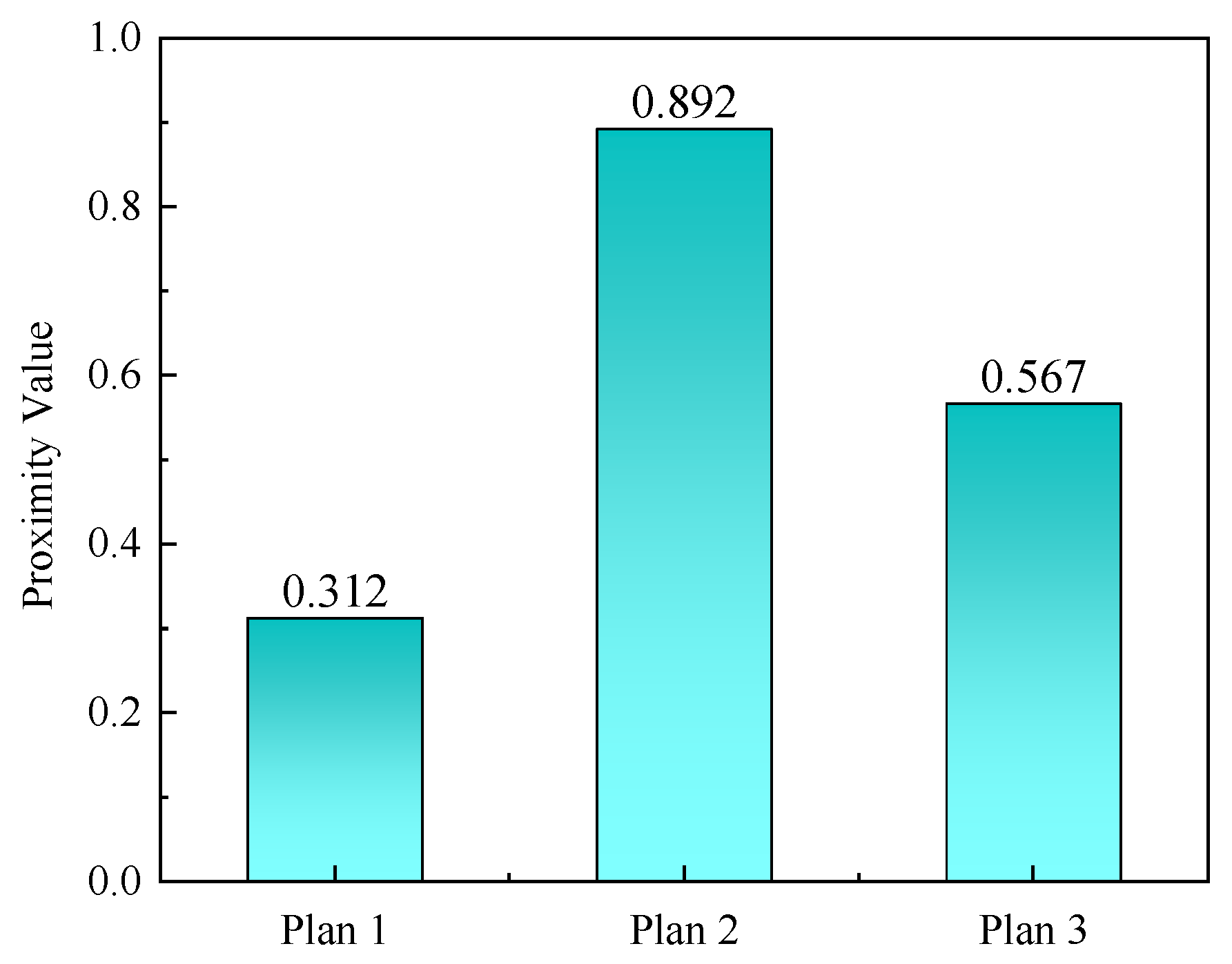
Using the aforementioned method and process, the technical, safety, and economic indicators of the different alternatives are substituted into the calculation. The resulting TOPSIS weighted normalized matrix and relative closeness values are summarized in Table 12, while the ranking of relative closeness for the different belt conveyor alternatives is illustrated in Figure 13.
Based on the multidimensional quantitative evaluation results of the aforementioned AHP-TOPSIS coupling algorithm, Scheme 2 exhibits the highest relative closeness of 0.892, making it the Pareto optimal solution. From a safety perspective, the slope stability factor is 1.758, and the maximum displacement in the critical area is 38 mm, which remains within the threshold. The combined weight contribution of safety indicators is 31.5%, representing the largest impact. Technically, although the initial infrastructure investment is relatively high, the subsequent construction difficulty is low, with a relative closeness of 0.382. The layout complexity is moderate, and no technical bottlenecks are identified. Economically, while the procurement cost is higher than that of Scheme 1, the long-term maintenance cost rate is the lowest, yielding significant life cycle cost advantages. In contrast, Scheme 1 has a relative closeness of only 0.312, and the displacement in the critical area exceeds the threshold (>50 mm), resulting in a safety indicator contribution of 0, leading to its exclusion. Scheme 3 achieves a relative closeness of 0.567. Although it offers higher technical flexibility, the procurement cost is the highest, and the displacement slightly exceeds the threshold, resulting in insufficient cost-effectiveness. In summary, Scheme 2 is identified as the optimal layout scheme.

5. Conclusions

This study conducts multi-objective optimization of the IPCC system for the Beskuduk open-pit coal mine, addressing the challenges posed by inclined coal seams and developed floor weak layers. Key findings and prospects are as follows:
A multi-objective optimization model for the relocation of crushing stations applicable to inclined coal seam open-pit mines was established. Through the coupling calculation of the relocation cost compensation method and the minimum cost method, the optimal relocation step distance was determined to be 880 m. This approach ensures alignment with the mining advancement speed while avoiding frequent relocation and a sharp increase in transport distance. Integrating considerations of transportation costs and safety risk assessment, the +1120 level was identified as the most suitable relocation site. This choice aligns with a three-phase relocation strategy scheduled from 2026 to 2030, effectively minimizing overall transport costs.
Three belt conveyor layout schemes were proposed; the optimal solution selected was the combination of “lifting + cross-road + horizontal conveying combination mode.” Under this condition, the compressed coal resources of the transportation trunk line can be released, and the deformation zone of the floor can be avoided; additionally, the results of FLAC3D numerical simulations confirm that slope safety stability coefficient reaches 1.758, and the displacement of the belt conveyor layout area is controlled within 15 to 35 mm, with no obvious surface subsidence, ensuring the production safety in the field.
The influence mechanism of system load and weak layer coupling under complex geological conditions was revealed: a weak layer located 2 m below the coal seam floor can lead to a maximum displacement of up to 55 mm for the layout scheme following the floor contour. In contrast, the layout of the conveyor belt from the surface down to the open-pit mine can effectively avoid disturbance from the weak layer, verifying the effectiveness of the slope protection concept of “avoiding the weak layer + optimizing the load distribution.”
This study did not account for the dynamic impact of future internal dumping plans on the crusher station relocation steps. Furthermore, the numerical simulation did not incorporate dynamic changes in geological parameters during the mining process (e.g., increased softening of the weak layer upon water contact). The model’s applicability is constrained by fixed assumptions. Future research could further incorporate internal dumping optimization objectives and develop dynamic adjustment models integrating real-time monitoring data, providing more comprehensive technical support for the efficient and safe mining of global open-pit mines with similar complex conditions.

Author Contributions

Conceptualization, F.M. and J.Z.; methodology, H.W.; software, F.M. and N.Z.; validation, X.L. and Q.C.; formal analysis, H.W. and F.M.; investigation, F.M.; writing—original draft preparation, H.W.; writing—review and editing, F.M. and J.Z.; visualization, H.W.; supervision, Q.C. All authors have read and agreed to the published version of the manuscript.

Funding

This research was funded by the Key R & D Program of Xinjiang Uygur Autonomous Region [grant number 2023B01009]; Central Universities Basic Research Operating Expenses Project [grant number 250225716].

Institutional Review Board Statement

Not applicable.

Informed Consent Statement

Not applicable.

Data Availability Statement

The original contributions presented in the study are included in the article; further inquiries can be directed to the corresponding author.

Acknowledgments

First and foremost, the authors would like to express their deepest gratitude to the Research Team for Ecological Mining and Mining Area Environmental Protection. We would also like to thank our colleagues and peers in the academic community for their guidance, feedback, and encouragement. Their input and suggestions have significantly improved the quality of this study. Finally, we would like to acknowledge the contributions of the reviewers, whose comments and suggestions helped us to refine the manuscript and present our findings more clearly. We are grateful for the support and cooperation of all those who have contributed to this study.

Conflicts of Interest

Author Fenghu Ma was employed by the company Hami Hexiang Industry and Trade Co., Ltd. The remaining authors declare that the research was conducted in the absence of any commercial or financial relationships that could be construed as a potential conflict of interest.

Correction Statement

This article has been republished with a minor correction to the existing affiliation information. This change does not affect the scientific content of the article.

References

  1. Li, M.; Zhu, F.; Kong, Z.; Chen, L.; Fan, F.; Wu, B.; Deng, J.; Guo, S. Study on Damage and Fracture Mechanism and Ontological Relationship of Rock Body in Deep Open Pit in Cold Area. Appl. Sci. 2025, 15, 10021. [Google Scholar] [CrossRef]
  2. Molina, E.; Martinon, P.; Ramírez, H. Optimal control approaches for open pit planning. Optim. Eng. 2023, 24, 2887–2909. [Google Scholar] [CrossRef]
  3. Liu, S.Q.; Kozan, E.; Corry, P.; Masoud, M.; Luo, K. A real-world mine excavators timetabling methodology in open-pit mining. Optim. Eng. 2023, 24, 1493–1535. [Google Scholar] [CrossRef]
  4. Ran, Q.C.; Liang, Y.P.; Zou, Q.L.; Zhang, B.C.; Li, R.F.; Chen, Z.H.; Ma, T.F.; Kong, F.J.; Liu, H. Characteristics of Mining-Induced Fractures Under Inclined Coal Seam Group Multiple Mining and Implications for Gas Migration. Nat. Resour. Res. 2023, 32, 1481–1501. [Google Scholar] [CrossRef]
  5. Cui, F.; Zong, C.; Lai, X.L.; Jia, C.; Luo, Z. Prediction of Coal Burst Location and Risk Level in Roadway Using XGBoost with Multi-element Microseismic Information and Its Application in Steeply Inclined Ultra-Thick Coal Seam. Rock Mech. Rock Eng. 2025, 58, 4023–4042. [Google Scholar] [CrossRef]
  6. Heydari, M.; Osanloo, M. A new model for the economic impact assessment of large-scale and deep open-pit mines. Int. J. Min. Reclam. Environ. 2024, 38, 1–26. [Google Scholar] [CrossRef]
  7. Zhao, H.; Wei, H.; Qin, B.; Du, H.; Shao, Z. Anti-Sliding Trenches to Enhance Slope Stability of Internal Dumps on Inclined Foundations in Open-Pit Coal Mines. Appl. Sci. 2025, 15, 10510. [Google Scholar] [CrossRef]
  8. Gao, P.B.; Ma, A.X.; Yan, X.H.; Chu, X.; Liu, X.Y.; Zhao, S.H. Digital twin-driven intelligent fault diagnosis technology for crushers. Meas. Sci. Technol. 2025, 36, 045015. [Google Scholar] [CrossRef]
  9. Francisco, C.S.; Li, M.; Li, B.; Deon, M.G. Study of Slope Stability of the Mining Wall in an Open-Pit Coal Mine by the Paste Cut-and-Backfill Method. Appl. Sci. 2024, 14, 6141. [Google Scholar] [CrossRef]
  10. Chen, Z.R.; Wang, G.Q.; Lei, Z.J.; Xue, D.M.; Liu, Z.B. Analysis of Crushing Performance of Toothed Double-Roll Crusher for Coal Particle Based on Discrete Element Method. Processes 2025, 13, 613. [Google Scholar] [CrossRef]
  11. Purhamadani, E.; Bagherpour, R.; Tudeshki, H. Energy consumption in open-pit mining operations relying on reduced energy consumption for haulage using in-pit crusher systems. J. Clean. Prod. 2021, 291, 125228. [Google Scholar] [CrossRef]
  12. Zhang, S.; Lu, C.W.; Jiang, S.; Shan, L.; Xiong, N.N. An Unmanned Intelligent Transportation Scheduling System for Open-Pit Mine Vehicles Based on 5G and Big Data. IEEE Access 2020, 8, 135524–135539. [Google Scholar] [CrossRef]
  13. Ivanovic, M.; Skataric, D. ICT Technologies in Optimization of Machines Movement at Open-Pit Coal Mine. Teh. Vjesn. 2019, 26, 1152–1158. [Google Scholar]
  14. Wu, H.S.; Chen, Y.L.; Lv, H.Y.; Xie, Q.H.; Chen, Y.G.; Gu, J. Stability analysis of rib pillars in highwall mining under dynamic and static loads in open-pit coal mine. Int. J. Coal Sci. Technol. 2022, 9, 38. [Google Scholar] [CrossRef]
  15. Li, G.H.; Yang, X.X.; Wang, D.; Wang, Y.T.; Yu, X.Y. Stability of inner dump slope under coal pillar support: Case study in an open-pit coal mine. Int. J. Coal Sci. Technol. 2022, 9, 25. [Google Scholar] [CrossRef]
  16. Zakir, U.; Garo, T.; Chemeda, Y.C.; Karuppannan, S.; Merdassa, S. Slope Stability Analysis of Dilbi Open-Pit Coal Mining Site Using Limit Equilibrium and Finite Element Methods, Jimma Zone, Southwestern Ethiopia. Adv. Civ. Eng. 2025, 2025, 6652696. [Google Scholar] [CrossRef]
  17. Ding, Q.L.; Peng, Y.Y.; Cheng, Z.; Wang, P. Numerical Simulation of Slope Stability during Underground Excavation Using the Lagrange Element Strength Reduction Method. Minerals 2022, 12, 1054. [Google Scholar] [CrossRef]
  18. Jia, L.; Wang, J.Q.; Fang, L.H.; Cui, Y.D.; Chen, J.B.; Cao, L.Z. Study on numerical simulation of groundwater flow field and slope stability in multi-aquifer open pit mine. Sci. Rep. 2024, 14, 31088. [Google Scholar] [CrossRef]
  19. Xu, N.X.; Zhang, J.Y.; Tian, H.; Mei, G.; Ge, Q. Discrete element modeling of strata and surface movement induced by mining under open-pit final slope. Int. J. Rock Mech. Min. Sci. 2016, 88, 61–76. [Google Scholar] [CrossRef]
  20. Moussa, A.; Wei, Z.; Ya, T.; Amartey, E.; Mvula, E.M. Comparison of Discrete element method and Finite element method of waste dump slope failure mechanism in Open Pit Mine. Acta. Montan. Slovaca 2023, 28, 721–732. [Google Scholar]
  21. Tian, Y.; Zhou, W.; Jiskani, I.M.; Cai, Q.X.; Li, Z.L.; Lu, X. Stability analysis of varying height waste dump in open-pit mine under particle size gradation and reconstruction effect of waste materials. Int. J. Min. Reclam. Environ. 2022, 36, 587–604. [Google Scholar] [CrossRef]
  22. Cui, F.P.; Xiong, C.; Wu, Q.; Zhou, Y.; Hou, C.H.; Fan, L.F.; Liu, M.; Xu, H.; Pan, X. Dynamic mechanism triggering the catastrophic Xinjing Landslide in Alxa, Inner Mongolia, China. Eng. Geol. 2025, 346, 107911. [Google Scholar] [CrossRef]
  23. Qi, H.T.; Hu, D.H.; Ma, L.; Hu, Y.; Chen, M.; Song, X.L.; Ma, C.G.; Wang, H.L. Research on optimization of relocation step distance of crushingstation in open-pit mine. Min. Process. Equip. 2025, 53, 28–32. [Google Scholar]
  24. Deng, H.J.; Li, C.; Zhang, L.B.; Zhang, X.L. Optimization of Shifting Step Distance of Ore Crushing Station in Jijiping Stope of Baima Iron Mine. Mod. Min. 2021, 37, 91–94. [Google Scholar]
  25. Ceng, W.G.; Che, Z.X.; Li, X.; Luo, Y. Analysis and Implementation of Surface MineSlope Stability Based on Bishop Method. J. Min. Saf. Eng. 2012, 29, 265–270. [Google Scholar]
  26. Zheng, H.G. Research on Combined System Optimization Under the Constraints of Complex Geological Structure and Multi-Rigid System. Ph.D. Thesis, China University of Mining and Technology, Xuzhou, China, 2021. [Google Scholar]
  27. Chen, S.Z.; Cai, Q.X.; Liu, F.M.; Shang, T. Single-bucket excavator overcast stripping technologyin narrow cut zone. J. Min. Saf. Eng. 2016, 33, 336–341. [Google Scholar]
  28. Yao, Y.; Wang, L.; Zhao, M.L.; Liu, G.W. Relocation of semi-fixed crushing station in open-pit coal mine. Coal Eng. 2023, 55, 30–35. [Google Scholar]
  29. Peng, W. Study on Application of Semi-Continuous Stripping Process in Heishan Open-pit Coal Mine. Ph.D. Thesis, China University of Mining and Technology, Xuzhou, China, 2024. [Google Scholar]
  30. GB/T GB50431-2018; Standard for Design of Slope Engineering of Open Pit Mine of Coal Industry. Ministry of Housing and Urban-Rural Development of the People’s Republic of China: Beijing, China, 2018.
  31. GB/T GB51289-2020; Technical Standard for Belt Conveyor Engineering. Ministry of Housing and Urban-Rural Development of the People’s Republic of China: Beijing, China, 2020.
Figure 1. Location map of Beskuduk open-pit coal mine.
Applsci 16 01971 g001
Figure 2. Layout of the raw coal production system.
Applsci 16 01971 g002
Figure 3. Model for relocating near-horizontal coal seam crushing stations.
Applsci 16 01971 g003
Figure 4. Model for relocating a sloping coal seam crushing station.
Applsci 16 01971 g004
Figure 5. Horizontal layout plan for crushing station positioning.
Applsci 16 01971 g005
Figure 6. Horizontal layout scheme freight calculation.
Applsci 16 01971 g006
Figure 7. Belt conveyor layout plan 1: (a) stage 1; (b) stage 2; (c) stage 3.
Applsci 16 01971 g007
Figure 8. Belt conveyor layout plan 2: (a) stage 1; (b) stage 2; (c) stage 3.
Applsci 16 01971 g008
Figure 9. Belt conveyor layout plan 3: (a) stage 1; (b) stage 2; (c) stage 3.
Applsci 16 01971 g009
Figure 10. Three-dimensional numerical model and different layout schemes: (a) three-dimensional numerical model of the Beskuduk open-pit mine; (b) different layout schemes for belt conveyors.
Applsci 16 01971 g010
Figure 11. Slope stability calculation results: (a) scheme 1; (b) scheme 2; (c) scheme 3.
Applsci 16 01971 g011
Figure 12. Hierarchical structure model for multi-objective evaluation.
Applsci 16 01971 g012
Figure 13. Ranking diagram of TOPSIS relative closeness for belt conveyor schemes.
Applsci 16 01971 g013
Table 1. Haulage cost to stages at +1144 m level.
Stage LocationTransportation Distance (km)Lifting Height (km)Material Volume
(10k m3)
Unit Price (Yuan)Haulage Cost (10k Yuan)
10363.32 10.888.57 10.89 964.80
10482.98 9.6103.35 10.78 1113.81
10602.62 8.4131.93 10.57 1394.51
10722.31 7.2153.52 10.40 1596.27
10841.97 6163.59 9.96 1629.33
10961.78 4.8162.28 9.92 1609.32
+11081.57 3.6152.15 9.49 1444.05
+11201.45 2.4146.51 9.09 1331.67
+11321.41 1.2138.11 8.68 1199.29
+11441.73 0126.45 7.17 906.72
11561.43 1.2117.05 8.54 999.75
11681.44 2.4107.63 9.19 989.42
11801.58 3.688.02 9.75 858.45
11921.83 4.863.29 10.25 648.87
Total16,686.26
Table 2. Haulage cost to stages at +1132 m level.
Stage LocationTransportation Distance (km)Lifting Height (km)Material Volume
(10k m3)
Unit Price (Yuan)Haulage Cost (10k Yuan)
10362.88 9.688.57 10.59 937.58
10482.57 8.4103.35 10.47 1082.04
10602.27 7.2131.93 10.27 1355.49
10722.00 6153.52 10.10 1549.98
10841.74 4.8163.59 9.66 1579.99
10961.58 3.6162.28 9.61 1560.19
+11081.44 2.4152.15 9.19 1397.99
+11201.39 1.2146.51 8.79 1287.49
+11321.72 0138.11 7.17 990.65
+11441.42 1.2126.45 8.58 1085.21
11561.46 2.4117.05 8.90 1041.46
11681.57 3.6107.63 9.55 1028.02
11801.80 4.888.02 10.11 889.62
11922.13 663.29 10.61 671.57
Total16,457.29
Table 3. Haulage cost to stages at +1120 m level.
Stage LocationTransportation Distance (km)Lifting Height (km)Material Volume
(10k m3)
Unit Price (Yuan)Haulage Cost (10k Yuan)
10362.11 8.488.57 9.44 919.34
10481.94 7.2103.35 9.33 1060.76
10601.74 6131.93 9.05 1313.44
10721.63 4.8153.52 8.95 1511.46
10841.53 3.6163.59 8.63 1552.32
10961.47 2.4162.28 8.62 1537.99
+11081.48 1.2152.15 8.24 1379.01
+11201.88 0146.51 6.53 1052.54
+11321.61 1.2138.11 7.35 1116.92
+11441.49 2.4126.45 8.34 1160.41
11561.52 3.6117.05 8.58 1104.12
11681.66 4.8107.63 9.16 1084.78
11802.04 688.02 10.25 930.16
11922.20 7.263.29 10.10 702.96
Total16,426.22
Table 4. Haulage cost to stages at +1108 m level.
Stage LocationTransportation Distance (km)Lifting Height (km)Material Volume
(10k m3)
Unit Price (Yuan)Haulage Cost (10k Yuan)
10361.59 7.288.57 8.33 885.83
10481.54 6.0 103.35 8.24 1021.64
10601.50 4.8131.93 8.08 1279.92
10721.50 3.6153.52 8.05 1483.52
10841.52 2.4 163.59 7.75 1522.34
10961.55 1.2 162.28 7.74 1507.92
+11082.03 0.0 152.15 5.96 1088.72
+11201.58 1.2 146.51 7.57 1331.57
+11321.51 2.4 138.11 7.78 1289.90
+11441.50 3.6 126.45 8.01 1215.00
11561.52 4.8 117.05 8.20 1152.32
11681.65 6.0 107.63 8.68 1121.67
11801.89 7.2 88.02 9.19 970.61
11922.19 8.463.29 9.62 730.92
Total16,601.88
Table 5. Belt conveyor layout plan.
PlanSpecific Plan
1The belt conveyor is not dismantled and is continuously extended in the direction of advancement from its current position.
2Remove the existing belt conveyor and install a new belt conveyor 1 to lift the coal from the bottom plate to the surface (southward); then, the horizontal belt conveyor 2 on the surface will transport the raw coal to the receiving point of the ground production system.
3Remove the existing belt conveyor and install a new belt conveyor 1 to lift the coal from the bottom plate to the surface (toward the northwest); then, the horizontal belt conveyor 2 on the surface will transport the raw coal to the receiving point of the ground production system.
Table 6. Technical-economic multidimensional analysis for belt conveyor systems.
PlanAdvantagesDisadvantagesTotal Equipment Acquisition Cost
/10,000 Yuan
1The original belt conveyor will not be dismantled; simple layoutThe floor of the current belt conveyor has met the production safety requirements after the previous treatment, but the layout plan and stability in the future stage are relatively poor.2827.2
2Releasing the compressed coal on the transportation trunk line; avoiding the deformation zone of governance; high safety indicators; simple subsequent construction; excellent economic effectIn 2026, the IPCC system needs to be adjusted, with a large amount of infrastructure construction and a long construction period.3096.0
3Horizontal belt conveyors are set up in advance; the belt conveyor is far from the viewing platform; releasing the compressed coal on the transportation trunk line; avoiding the current deformed area of the base plateZ-shaped round-trip transportation, additional freight charges4279
Table 7. Rock physical and mechanical parameters.
LithologyDensity
(g/cm3)
Cohesion (kPa)Internal Friction Angle (°)Elastic Modulus (MPa)Poisson’s Ratio
Mudstone2.44649.54531144.940.32
Sandstone2.57980.48738159.710.25
Burnt Rock2.01919.8051655.070.28
Table 8. Core parameters for calculating belt conveyor load components.
No.Parameter NameSymbolValueUnitParameter Source
1Conveyor Installation Lift Angleα13°(°)Field Measurement (Level +1115 ~ +1308)
2Total Vertical Static Load per Unit Lengthq2.5kN/mField Measurement (Including Conveyor Belt + Idler + Raw Coal)
3Comprehensive Coefficient of Running Resistancef0.02-Recommended Value in GB 50431-2020 Standard
4Maximum Acceleration During Start-up Phasea0.05m/s2Field Measured Value of Conveyor Operation in Open-pit Mines Industry
5Gravitational Accelerationg9.8m/s2Physical Constant
6Correction Coefficient of Additional Horizontal Forcek0.05-Engineering Experience Value (Bracket/Foundation Vibration)
7Calculated Value of cos13°cosα0.9744-Trigonometric Function
Calculation
8Calculated Value of sin13°sinα0.2250-Trigonometric Function Calculation
Table 9. Step-by-step calculation results of belt conveyor load components and their proportions.
No.Calculation ItemFormulaCalculation ResultUnitRemarks
1Vertical force component FNEquation (25)2.4360kN/mDominant normal load on slope
2Running friction forceqf0.0500kN/mMain component of horizontal force
3Inertial force during start-upqa/g0.0128kN/mNegligibly small
4Additional horizontal force (engineering)qk0.1250kN/mCorrection for support/foundation vibration
5Horizontal force component FHEquation (26)0.1878kN/mComprehensive tangential load (rounded to 0.1880)
6Total load FZEquation (27)2.4430kN/mVector sum of force components
7Proportion of vertical force ηNEquation (28)99.71%Dominates the total load
8Proportion of horizontal force ηHEquation (29)0.77%Engineering safety range: 3–5%
Table 10. Multi-objective evaluation indicator system and attributes.
Target LayerGuideline LayerIndicator LayerIndicator AttributesUnit
Multi-Objective Optimization of Belt Conveyor LayoutTechnical feasibilityComplexity of arrangementnegative/
Subsequent construction difficultynegative/
Safety and reliabilitySlope stability factorpositive/
Maximum displacement in critical areasnegativemm
Economic efficiencyTotal equipment acquisition costnegativew
Long-term maintenance cost rationegative%
Table 11. Multi-objective evaluation indicator system and attributes.
Guideline LayerCriterion WeightingIndicator LayerIndicator WeightingCombination WeightingCR Value
Technical feasibility0.220Complexity of arrangement0.6000.1320.073
Subsequent construction difficulty0.4000.088
Safety and reliability0.450Slope stability factor0.7000.3150.058
Maximum displacement in critical areas0.3000.135
Economic rationality0.33Total equipment acquisition cost0.750 0.248 0.061
Long-term maintenance cost ratio0.2500.082
Overall Consistency Test 0.064
Table 12. TOPSIS weighted normalized matrix and relative closeness results.
PlanComplexity of
Arrangement
Subsequent
Construction
Difficulty
Slope Stability FactorMaximum
Displacement
Acquisition CostLong-Term Maintenance Cost Ratio d i + d i C i Sort
198.91.623552470300.3470.160.3123
24.53.81.75838271450.1920.3580.8921
33.12.91.7334237627.50.2890.2370.5672
Disclaimer/Publisher’s Note: The statements, opinions and data contained in all publications are solely those of the individual author(s) and contributor(s) and not of MDPI and/or the editor(s). MDPI and/or the editor(s) disclaim responsibility for any injury to people or property resulting from any ideas, methods, instructions or products referred to in the content.