Article

From Scans to Steps: Elevating Stroke Rehabilitation with 3D-Printed Ankle-Foot Orthoses


1
CIPER, Faculdade de Motricidade Humana, Universidade de Lisboa, 1495-751 Cruz Quebrada-Dafundo, Portugal
2
CDRSP, Polytechnic University of Leiria, 2430-435 Marinha Grande, Portugal
3
National Program for Physical Activity Promotion, Directorate-General of Health, 1049-005 Lisbon, Portugal
4
Clínica Espregueira, FIFA Medical Centre of Excellence, 4350-415 Porto, Portugal
5
Escola Superior de Saúde, Polytechnic of Lisbon, 1990-096 Lisbon, Portugal
6
Centro de Medicina de Reabilitação da Região Centro—Rovisco Pais, 3064-908 Tocha, Portugal
*
Author to whom correspondence should be addressed.
Appl. Sci. 2026, 16(4), 1950; https://doi.org/10.3390/app16041950
Submission received: 16 January 2026 / Revised: 12 February 2026 / Accepted: 13 February 2026 / Published: 15 February 2026
(This article belongs to the Section Additive Manufacturing Technologies)

Abstract

Background: The integration of advanced 3D scanning and additive manufacturing technologies in stroke rehabilitation offers promising advancements in the design and production of ankle-foot orthoses. These technological innovations are progressively recognized for their potential to provide more precise and customized orthotic solutions for individuals with stroke-related impairments. Objectives: The primary aim of this study was to biomechanically test and validate the effectiveness of custom ankle-foot orthoses produced through additive manufacturing technology using data captured by a novel photogrammetric scanning system. The customized orthosis was compared with a standard prefabricated orthosis to assess their relative effectiveness in improving gait dynamics and patient satisfaction in stroke rehabilitation. Methods: Participants with equinovarus deformity, a common consequence of stroke, were fitted with custom ankle-foot orthoses, alongside conventional prefabricated orthoses. The study utilized the Qualisys® motion analysis system for comprehensive biomechanical gait analysis, and the QUEST questionnaire was employed to capture participant feedback on both types of orthoses. Detailed comparisons of gait dynamics were conducted using Statistical Parametric Mapping with each orthosis. Results: The study revealed notable kinematic and kinetic differences between the custom and prefabricated orthoses. The custom orthoses demonstrated superior performance in enhancing gait efficiency, symmetry, and safety. Patient feedback favored the customized orthoses over the prefabricated variants, with higher scores in comfort, fit, and overall effectiveness. Conclusions: This research underscores the effectiveness of custom orthoses produced through additive manufacturing technology for stroke rehabilitation. By offering a comprehensive evaluation of orthotic interventions and establishing a comparative framework, the study serves as a reference point for future research, advocating for a more personalized and evidence-based approach in orthotic design for improving the quality of life of stroke survivors.

1. Introduction

Rehabilitation plays a crucial role in helping individuals regain mobility and enhance their quality of life after debilitating health events, particularly in the context of stroke patients with significant motor impairments [1]. It has been demonstrated that the use of ankle-foot orthoses (AFOs) can profoundly improve walking patterns, offering stability and preventing equinovarus foot in stroke survivors [1,2]. Studies have evaluated the effects of AFOs on balance, walking, energy expenditure, and gait performance in stroke patients, demonstrating their potential therapeutic effect in the recovery phase [3,4,5,6,7,8,9]. Additionally, different AFO designs have been compared, highlighting their clinical efficacy in subjects with foot drop after stroke [10]. Case reports and feasibility studies have also explored novel AFO designs and their impact on gait changes in hemiplegic patients [11,12]. However, it is essential to consider the long-term usage and patient-specific customization of AFOs to ensure their acceptability and effectiveness in stroke rehabilitation [1,2].
Over time, the realm of rehabilitation has witnessed an evolution in the techniques and applications associated with AFOs. Traditionally, these orthoses were crafted through methods that relied extensively on the skills and expertise of orthotists-prosthetists. While these methods were functional, they sometimes fell short in terms of customization due to the limitations inherent in these processes. These traditional methods were time-consuming and occasionally resulted in discomfort for the patients [13]. Still, this handmade AFOs also had its advantages. One of the primary benefits is the in-depth understanding it provided of each patient’s specific requirements, ensuring a highly personalized and tailored approach to treatment. Furthermore, the materials used in crafting these orthoses are selected based on years of experience and consideration, ensuring that the final products are not only functional, but also long-lasting [14].
With technological advancements, the potential for achieving higher levels of precision and customization in AFO production has become increasingly greater. The manufacturing of AFOs has undergone significant transformations, particularly with the integration of additive manufacturing (AM) and cutting-edge 3D scanning technologies. Innovative techniques like Fused Deposition Modelling (FDM), Selective Laser Sintering (SLS), and Stereolithography (SLA) have marked a new era in orthotics production [15,16,17]. Each of these AM techniques brings its unique strengths, enabling diverse designs, versatile material options, and accelerated production cycles. Both SLA and SLS offer capabilities specifically tailored to meet the intricate demands of orthotic production [17,18,19]. For instance, the adaptability and cost-effectiveness of FDM have made it a preferred choice for various applications [20]. In addition to these technological advancements, the popularity of prefabricated orthoses has also increased significantly, as they offer a cost-effective and readily available solution [14,21]. These off-the-shelf options often result in cost savings; conversely, their design approach might not always provide the perfect fit for every individual, which can sometimes compromise both the comfort and the overall effectiveness of the device [22].
To address the need for customization in orthotics, 3D scanning technologies have emerged as revolutionary tools in the field. These technologies, adept at capturing the complex anatomical details necessary for creating personalized orthotics, have significantly altered the landscape of orthotic design and fabrication [23]. The spectrum of available 3D scanning techniques has broadened, encompassing not only laser scanners [24,25], but also structured light scanners [26,27], photogrammetry [28,29], and handheld optical scanners [30,31]. Each of these technologies offers unique advantages and contributes to an unprecedented level of accuracy in data capture. For instance, laser scanners provide high precision and are excellent for capturing complex geometries, making them ideal for detailed orthotic design. Structured light scanners, on the other hand, offer a balance between speed and accuracy, which is useful for quickly capturing the shape and size of a limb. Photogrammetry, utilizing photographic images from different angles, is beneficial for its versatility and ease of use, especially in remote or resource-limited settings. Handheld scanners add the convenience of portability and flexibility, enabling clinicians to perform scans in various clinical environments. This wide array of scanning options has made personalized orthotics more accessible and feasible for a diverse range of individuals [32,33]. These scanners have been instrumental in creating tailored orthoses that meet patient-specific needs, as evidenced in various case studies [34,35,36]. Their ability to accurately capture the unique contours of an individual’s anatomy ensures that the resulting orthoses are not just functionally superior, but also comfortable, thereby enhancing patient compliance and therapeutic outcomes [37]. Nevertheless, it is important to recognize that, while this method offers precision and customization, challenges remain in integrating this technology into existing clinical workflows and providing adequate training for medical professionals.
The potential of combining AM with 3D scanning for orthotic fabrication is incredibly exciting. The literature presents a range of perspectives on this integration; some studies enthusiastically highlight the benefits and practical applications of this synergy [24,38,39], while other research studies point to challenges, gaps, and inconsistencies in this field [34,40]. What becomes increasingly clear is the need for comprehensive evaluations and assessments. Unfortunately, a sizeable portion of the existing research lacks these assessments, sometimes leading to gaps in understanding any potential obstacles in real-world implementation. A closer look at the studies provides insights into how these technologies have real-world implications. Several studies have tested their AFOs only on healthy individuals [38,41,42] or used molds for digitization, bypassing direct scanning of the patient’s limb [43]. Others have limitations, such as lacking biomechanical analyses or qualitative assessments [41,44]. Despite these methodological variations and limitations, each study has merit and contributes valuable insights to the field of personalized orthoses using AM. These investigations, whether focusing on the intricacies of manufacturing techniques, the precision of 3D scanning methods, or the capabilities of these technologies in real-world clinical settings, have laid a crucial foundation for future research endeavors. The dynamic nature of this field is further highlighted by the diverse approaches in different studies. While some researchers prioritize exploring the capabilities of manufacturing techniques and 3D scanners, others concentrate on evaluating their applications in clinical scenarios [31]. Within the realm of manufacturing, ongoing discussions and research are centered around finding the most suitable materials for orthotic fabrication, balancing durability, flexibility, patient comfort, and cost-effectiveness. This challenge has led to various research projects searching for the best materials based on specific clinical requirements [28,40]. Despite their flaws, these studies pave the way for new discoveries and advancements, significantly contributing to a field that has the potential to aid millions worldwide with more effective and personalized orthotic solutions.
In contrast, when it comes to 3D scanning, a unique set of challenges and complexities arise. While the potential for accuracy is high, implementing these technologies in real-world scenarios can sometimes bring unexpected obstacles. Factors such as movement during scanning procedures [39], scanner resolution quality [34], and the software algorithms [27] used for data processing can significantly impact the quality of the orthotic products. Another crucial aspect to consider in this discussion is the perspectives of and feedback from patients, who are the end-users of these orthotic devices. The comfort, experiences, and adherence to treatment plans of patients are crucial in determining the success of any intervention. Several studies [13,14] have focused on this aspect by comparing feedback on traditional orthoses versus those produced using AM techniques. While most of the feedback has been positive, these studies also point out potential areas for improvement, particularly concerning the weight and aesthetic design of these devices [27,45].
Moreover, it is important to consider the implications associated with integrating 3D scanning and AM into orthotic fabrication processes. The initial investments in equipment, training, and infrastructure changes may be substantial. However, the potential long-term benefits, such as reduced production times, minimized material waste, and increased customization options, present a promising outlook for return on investment [13]. While it becomes clear that the field of rehabilitation is on the verge of a meaningful change, it comes with its share of challenges. Like any transition, incorporating AM and 3D scanning technologies into the orthotics field requires a comprehensive approach. This approach should cover aspects such as understanding capabilities, aligning with clinical needs, gathering patient feedback, considering economic implications, and ensuring long-term sustainability.
This study aimed to biomechanically test and validate the effectiveness of custom ankle-foot orthoses produced through additive manufacturing technology, using data captured by a novel photogrammetric scanning system. It sought to bridge the gap between traditional craftsmanship and modern technology, leveraging the precision of 3D scanning and the versatility of AM. In doing so, the study addressed the challenges of integrating these technologies into clinical practice, from ensuring high-quality scanning to generating a perfectly fitting AFO. While the primary focus was on biomechanical outcomes and patient feedback, a brief overview of the scanning system was also provided to contextualize the customization process. Ultimately, this research aimed to contribute to the transformative change in the field of rehabilitation, promising more effective, personalized orthotic solutions for millions worldwide.

2. Materials and Methods

This research expands on the development of a scanner and software system used to create 3D-printed AFOs for stroke survivors experiencing equinovarus deformity. Validating the entire system was necessary to ensure that its biomechanical performance was at least as effective as that of standard AFOs, while also enhancing patient satisfaction. Feedback from patients and clinical observations served as the primary indicators of success.

2.1. Participant Recruitment and Ethical Considerations

Approval for the study protocol was granted by the Health Ethics Committee of Centro de Medicina de Reabilitação da Região Centro—Rovisco Pais (Tocha, Portugal) in August 2022. All experiments and procedures were performed in accordance with the relevant guidelines and regulations. Additionally, all aspects of the research involving human participants were performed in accordance with the Declaration of Helsinki. In line with a request from the Health Ethics Committee, a specific document was created. The purpose of this document was to ensure that the participants gave their consent freely, with understanding. This document detailed the objectives of the research study and provided assurances that there would be no negative impact on the patient’s treatment and clinical follow-up should they choose to withdraw from the study. It also guaranteed the anonymity and confidentiality of all collected data, including photographs, results from the Quebec User Evaluation of Satisfaction with Assistive Technology (QUEST) [46], and biomechanical analysis data. Both the physician and the patient signed the consent form, validating their participation in the study. The research protocol was crafted in accordance with the SPIRIT (Standard Protocol Items: Recommendations for Interventional Trials) 2013 checklist, a recognized standard for reporting protocol studies [47]. Also, a research protocol was created for this study [48].
The participant selection criteria for this study were meticulously defined to ensure the inclusion of individuals whose profiles were optimally aligned with the objectives of the research. The study targeted a cohort of stroke survivors of both genders, within an age range of 18 to 75 years. The subjects in the study were required to exhibit signs of equinovarus foot caused by a stroke, impacting either the left or right lower extremity. A critical criterion for inclusion was subjects’ daily use of off-the-shelf AFOs as a component of their rehabilitation regimen. The concurrent use of auxiliary assistive devices such as tripods, crutches, or canes was not a disqualifying factor. Foremost among the inclusion criteria was the ability of participants to provide informed consent and demonstrate ambulatory capabilities, either independently or with the aid of the assistive devices. Exclusion criteria encompassed individuals presenting with coexisting neurological or orthopedic conditions impairing gait that could potentially obfuscate the study’s results. Additionally, candidates exhibiting active dermatological conditions in distal lower limbs or having severe communicative limitations that could impede consistent and effective participation were deemed ineligible. The recruitment phase was conducted at the Centro de Medicina de Reabilitação da Região Centro. Physicians undertook a rigorous examination of patient profiles to ascertain congruence with the predefined selection criteria. Ten eligible candidates (Table 1) were comprehensively briefed about the study’s objectives and methodology, followed by the dissemination of a detailed informed consent document. Ensuring adherence to ethical standards and the integrity of the data collection process, the enrolment of these participants proceeded after their provision of written informed consent.

2.2. AFO Fabrication Process

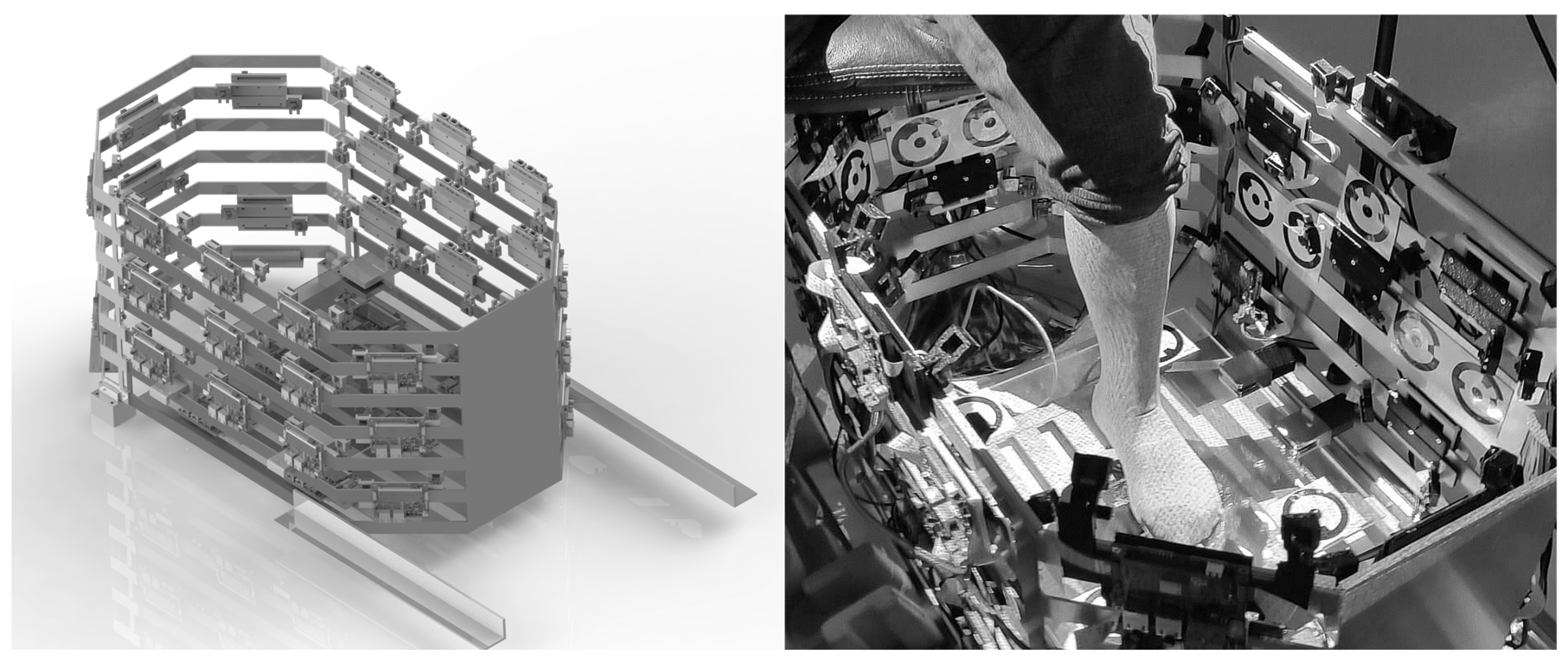
A novel photogrammetric 3D scanner [49] was employed for the precise capture of the surface topology of the hemiparetic lower limb. The custom photogrammetric scanner was designed to rapidly capture the full surface of the lower limb, including the plantar region of the foot. The system integrates 60 synchronized cameras distributed around the scanning volume, enabling high image overlap and complete anatomical coverage. Image acquisition is performed simultaneously, with a total capture time of approximately 2 s, thereby minimizing motion-related artefacts and improving patient comfort.
Scanner accuracy was assessed through comparative testing against a commercial high-precision scanner (Comet 5, Steinbichler Optotechnik GmbH, Neubeurn, Germany), using a plaster cast foot model. The mean deviation between the two systems ranged from −2.5 mm to +1.5 mm, with most deviations concentrated around zero, indicating a sub-millimetric average deviation. The patients were requested to wear loose-fitting track pants to allow easy access to the affected leg. To ensure a cleaner scan and reduce surface noise, like leg hair on the mesh, the patients used a stocking to achieve a more consistent model. The preparatory phase for positioning each patient in seated position within the scanning apparatus required approximately 2 minutes, with the actual data capture process concluding in less than 2 s (Figure 1). The newly developed scanner captures not only the surface of the patient’s leg, but also the entire foot, including the plantar aspect, ensuring comprehensive morphological customization.
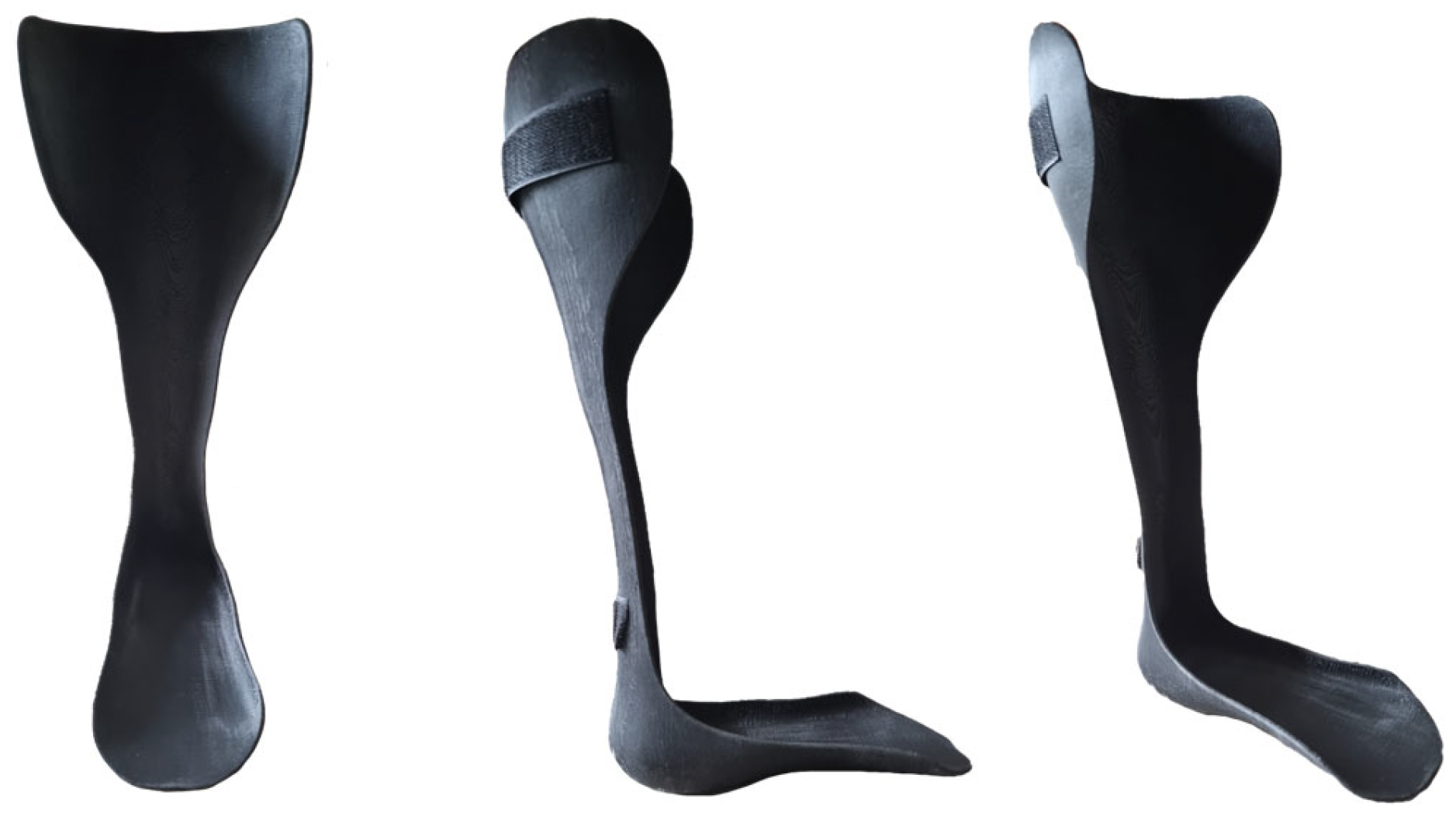
In the patient’s absence, the physiatrist used a custom-developed software workflow to design the AFO directly on the virtual reconstruction of the subject’s lower limb. The system integrates a web-based interface for data management and process control with dedicated design tools implemented in Rhinoceros® (Robert McNeel & Associates, Seattle, WA, USA) and Grasshopper® (Robert McNeel & Associates, Seattle, WA, USA), allowing anatomical alignment, definition of trim lines, adjustment of orthosis thickness, and positioning of fixation elements. A dedicated module implemented in Blender (Blender Foundation, Amsterdam, The Netherlands) was used for lower-limb postural correction, enabling angular adjustments in the sagittal and frontal planes and local mesh modifications to accommodate anatomical landmarks and potential pressure-sensitive areas. The decision to use Nylon 12 material for the AFOs was based on extensive mechanical testing of various materials [50], including acrylonitrile styrene acrylate (ASA), polycarbonate-acrylonitrile butadiene styrene (PC-ABS), polyethylene terephthalate glycol (PETG), thermoplastic polyurethane (TPU), polylactic acid (PLA), polycarbonate (PC), ULTEM 1010, and ULTEM 9085. The models for the AFOs were then printed using the FDM process, ensuring a uniform thickness of 3 mm across all printed orthoses (Figure 2). This thickness was selected based on mechanical tests conducted with various thicknesses, as well as the typical thicknesses found in off-the-shelf AFOs. The design of these AM custom AFOs was influenced by the Posterior Leaf Spring (PLS) model, tailored to gait requirements post-stroke, with the objective of mitigating excessive equinus or foot drop during the swing phase and augmenting push-off during stance [51]. The upper proximal portion was delimited to 5 cm below the fibular head and surrounding the posterior portion of the leg to form the upper band of the AFO, where a Velcro strap was fixed later. From this point downwards, the width of the posterior trim lines was narrowed onto the ankle without covering the medial and lateral malleoli. A medial arch was included in the orthosis to enhance medial plane control of the foot and ankle. These supports were also used to place Velcro straps at the ankle when needed. The trim lines for the foot plate were just behind the metatarsal heads. The AFOs were initially fitted to each subject, with fine tuning performed as necessary. This fine tuning included the use of a very fine sandpaper to smooth any sharp edges or vertices that could potentially cause discomfort or injure the patient. A period of time was allowed for AFO acclimatization. To avoid bias, standardized sport shoes in different sizes were available during the testing for each subject.

2.3. Biomechanical Assessment and Data Collection

Following the acclimatization period with the customized AFO (CO), subjects were instructed to walk along a 10 m corridor, completing a total of 10 repetitions. This process was conducted with both their regularly used standard AFO (off-the-shelf) (PO) and the new CO AFO. To ensure data quality and consistency, six representative gait cycles from each condition were selected for detailed analysis. Gait cycles were considered representative when they presented complete marker trajectories, absence of signal artefacts or marker dropouts, and temporal characteristics consistent with the subject’s mean gait pattern across trials.
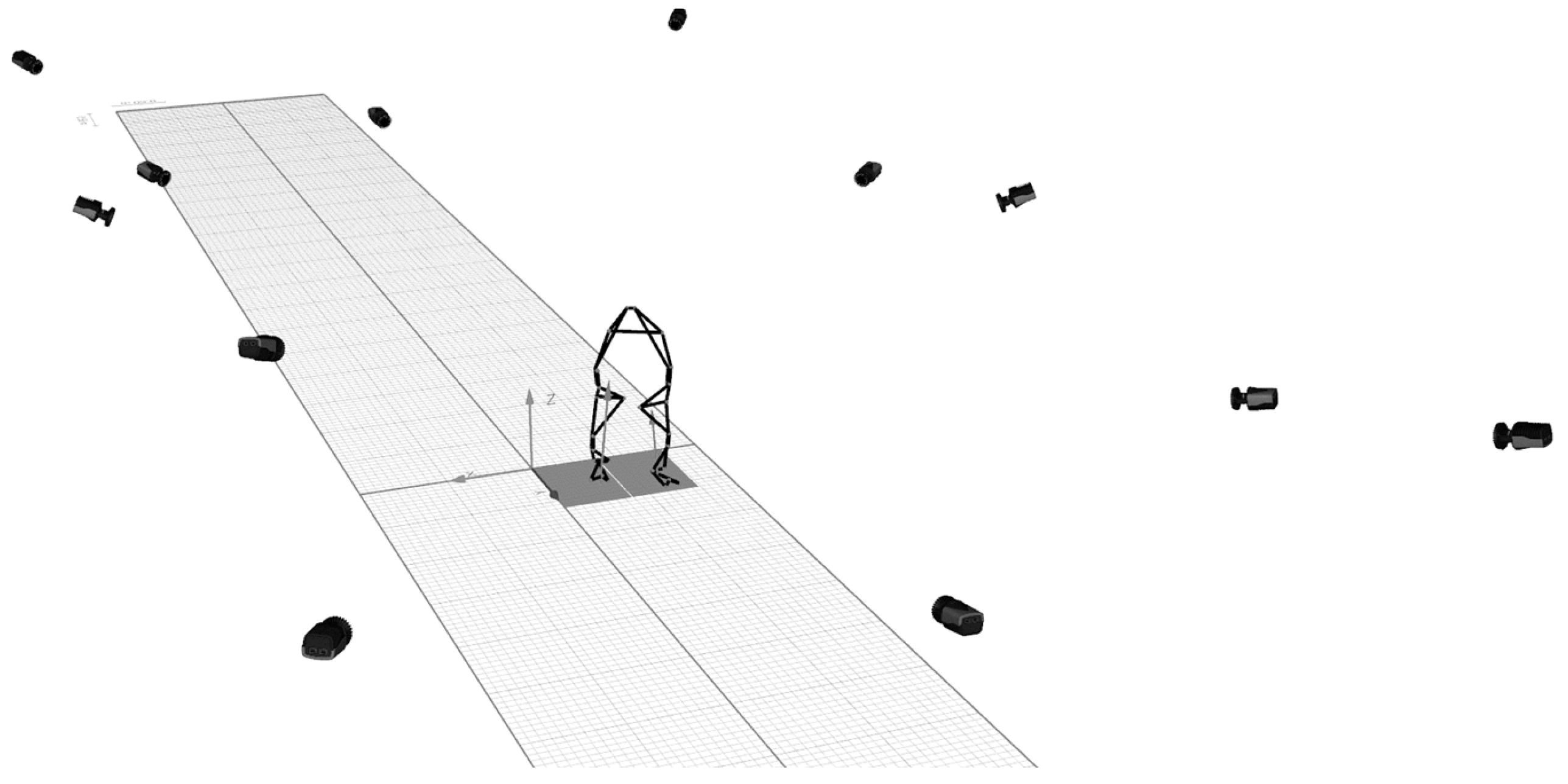
A Qualisys® motion analysis system (Qualisys AB, Gothenburg, Sweden) equipped with 12 high-speed Miqus M3 cameras (Frequency: 120-Hz) and two Bertec force platforms (FP4060-07, FP4060-10, Bertec, Columbus, OH, USA) was utilized to capture precise gait dynamics and movement data (Figure 3). Subjects were fitted with the CAST lower body marker set, which includes 36 reflective markers (10 mm diameter), following the protocol prescribed by Cappozzo et al. [52]. It is important to note that all markers were placed directly on the skin of the patients to accurately capture their movements, with the exception of the foot markers. For the feet, markers were placed on standardized sports shoes provided to the patients. These shoes, consistent in design but varying in size to fit each patient, were used to minimize variability in data collection related to different footwear. The patients’ lower limbs were digitally reconstructed in a 3D environment using Visual 3D software (C-Motion, Inc., Rockville, MD, USA) and the Project Automation Framework (PAF) from Qualisys®. The acquired data were processed using a Butterworth low-pass filter with a cutoff frequency of 10 Hz and segmented into phases of the gait cycle based on heel strike events.
For the kinematic data analysis, several parameters were extracted for future analysis, including Pelvic Anterior Tilt, Pelvic Up Obliquity, Pelvic Internal Rotation, Hip Flexion, Hip Adduction, Hip Internal Rotation, Knee Flexion, Knee Varus, Knee Internal Rotation, Ankle Dorsiflexion, Ankle Inversion, Foot Pitch, and Foot Internal Progression. Regarding the kinetic data, parameters such as Internal Hip Extensor Moment, Internal Hip Valgus Moment, Internal Knee Extensor Moment, Internal Knee Valgus Moment, Internal Ankle Plantarflexor Moment, and Internal Ankle Extensor Moment were selected. For spatiotemporal data, values including Speed, Stride Width, Stride Length, Cycle Time, Step Length, Step Time, Stance Time, Swing Time, Steps per Minute, Strides per Minute, and Double Limb Support were extracted. Additionally, Gait Profile Score (GPS) [53] values were also retrieved. These data were collected for both the affected and unaffected limbs, using both AFOs (PO vs CO).

2.4. Quality Assessment from Subjects

In this study, significant emphasis was placed on the subjective feedback from the subjects, in addition to the analysis of the biomechanical data. A structured questionnaire based on the QUEST was utilized to rate various parameters of both AFOs. Subjects rated Dimensions, Weight, Fit, Safety, Usability, Comfort, and Effectiveness on a scale from 1 to 5, where 1 represented ‘not satisfied at all’ and 5 signified ‘very satisfied’.

2.5. Statistical Analysis

Statistical analysis of the data for the normalized gait cycle (heel strike to heel strike) was conducted both individually for each subject and globally for all patients. For kinematic and kinetic data, graphical comparisons were made using the Statistical Parametric Mapping (SPM) method. The analysis utilized the SPM1D script and MatLab v2023b (MathWorks, Natick, MA, USA). SPM1D v0.4 allows identification of specific regions in the gait cycle where noticeable differences between conditions (PO and CO) occur, offering continuous evaluation over the entire cycle and highlighting subtle yet clinically important variations. Individual comparisons were made using paired t-tests for each subject’s legs (left leg PO vs. left leg CO and right leg PO vs. right leg CO). The global analysis involved two-sample t-tests for comparing the affected limb with the unaffected limb. All GPS data were collected and analyzed to observe mean differences between each set. A symmetry test and an intra-subject symmetry index were conducted to compare the left and right legs using Microsoft Excel (Microsoft Corporation, Redmond, WA, USA) to detect deviations of 50%. Intra-subject leg comparison tests under both PO and CO conditions involved normality tests followed by Wilcoxon tests for all variables, using GraphPad Prism 10.0.2 software (GraphPad Software, San Diego, CA, USA). For the global analysis, Mann-Whitney tests were performed.
For analysis of the quality assessment from subjects, all mean values were analyzed both individually and globally, incorporating all findings from the QUEST questionnaire.
Significant differences were recognized based on p-values, with a threshold of 95% indicating statistical significance.

3. Results

The Results section herein provides a comprehensive analysis of the gathered data, encompassing kinematic and kinetic parameters, spatiotemporal metrics, and patient satisfaction levels as measured by the QUEST. The global outcomes derived from these data sets are synthesized and presented in the main body of this paper. To facilitate thorough understanding and transparency, the individual results for each patient have been detailed in the Supplementary Materials.

3.1. Kinematics

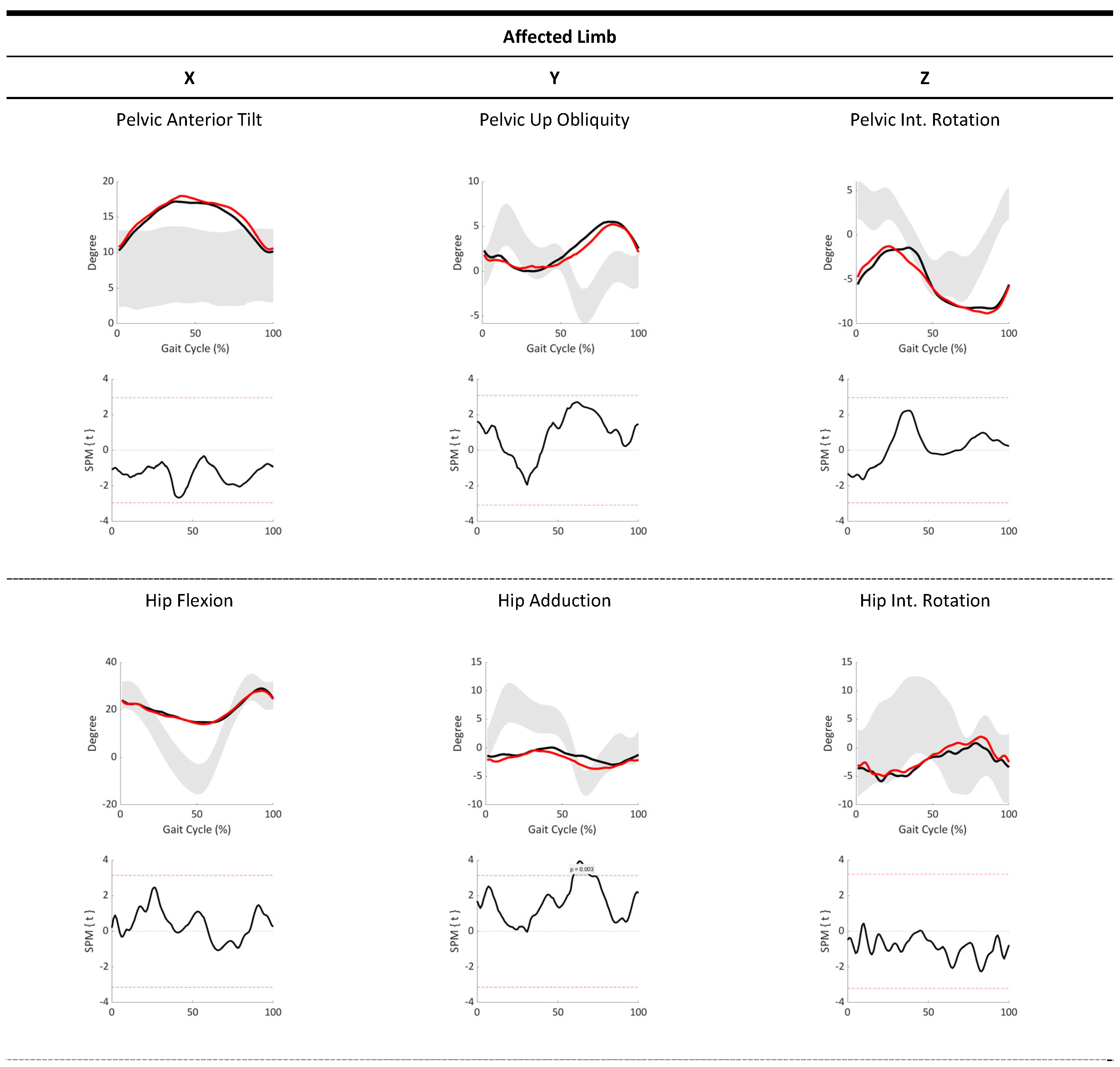
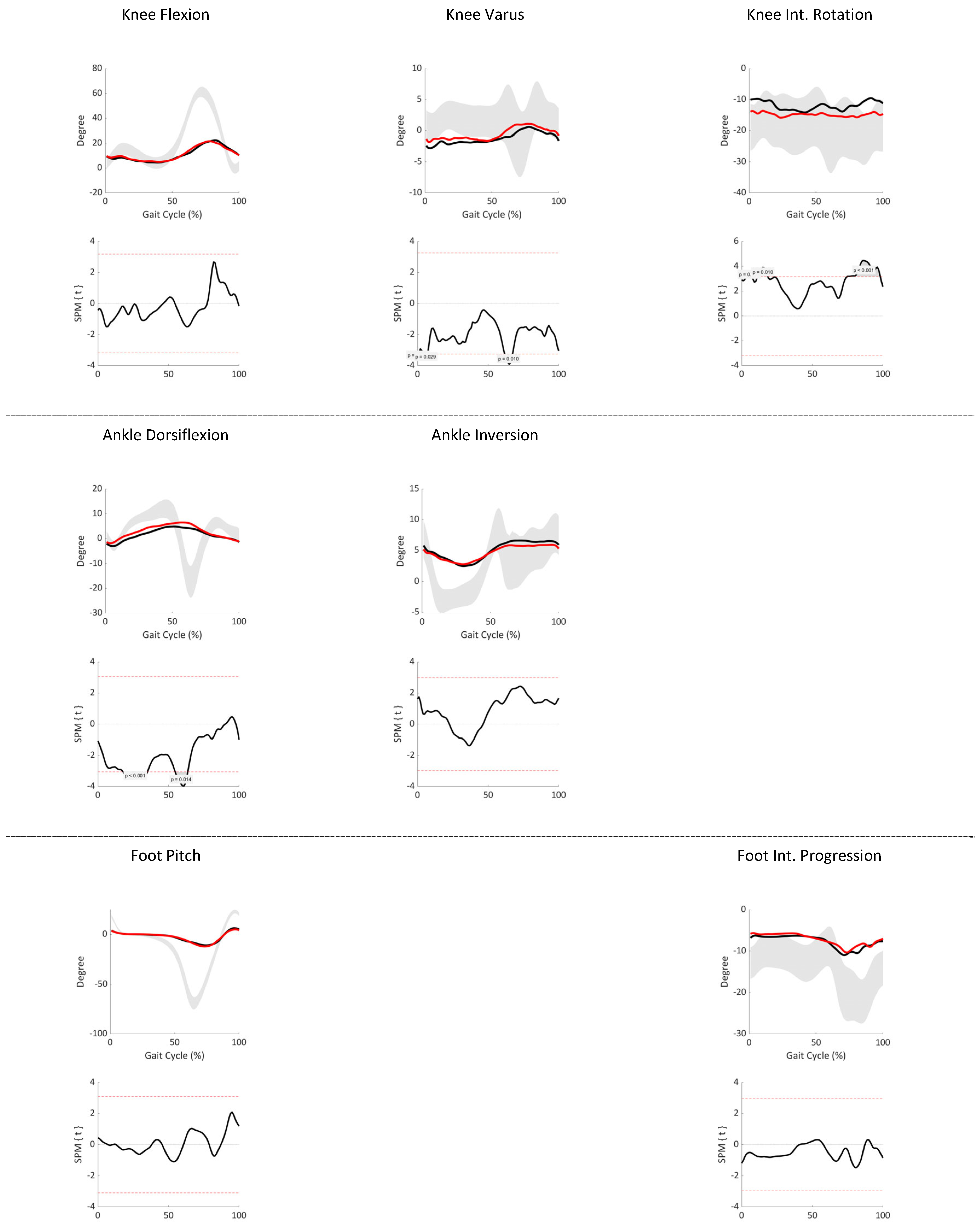
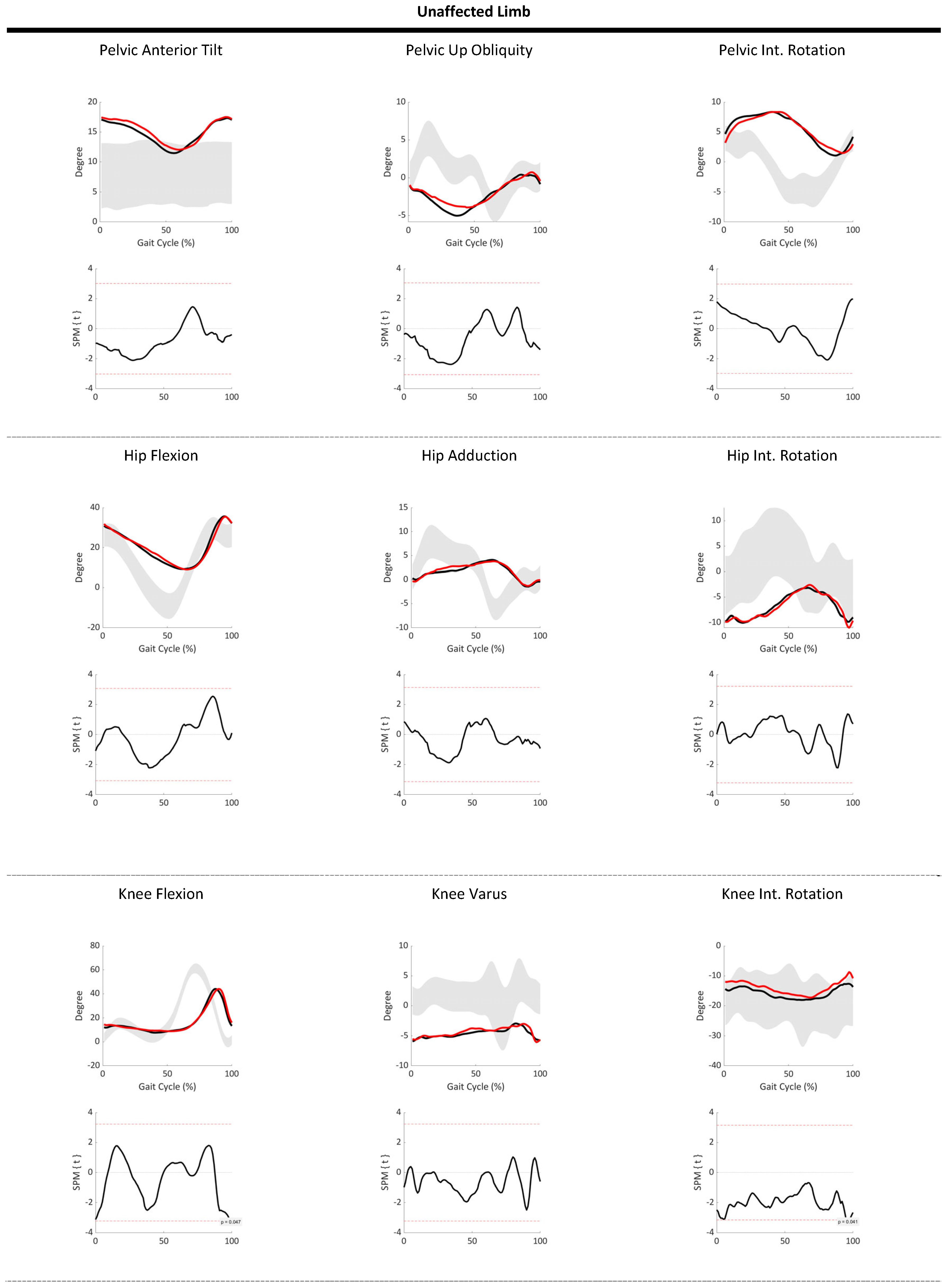
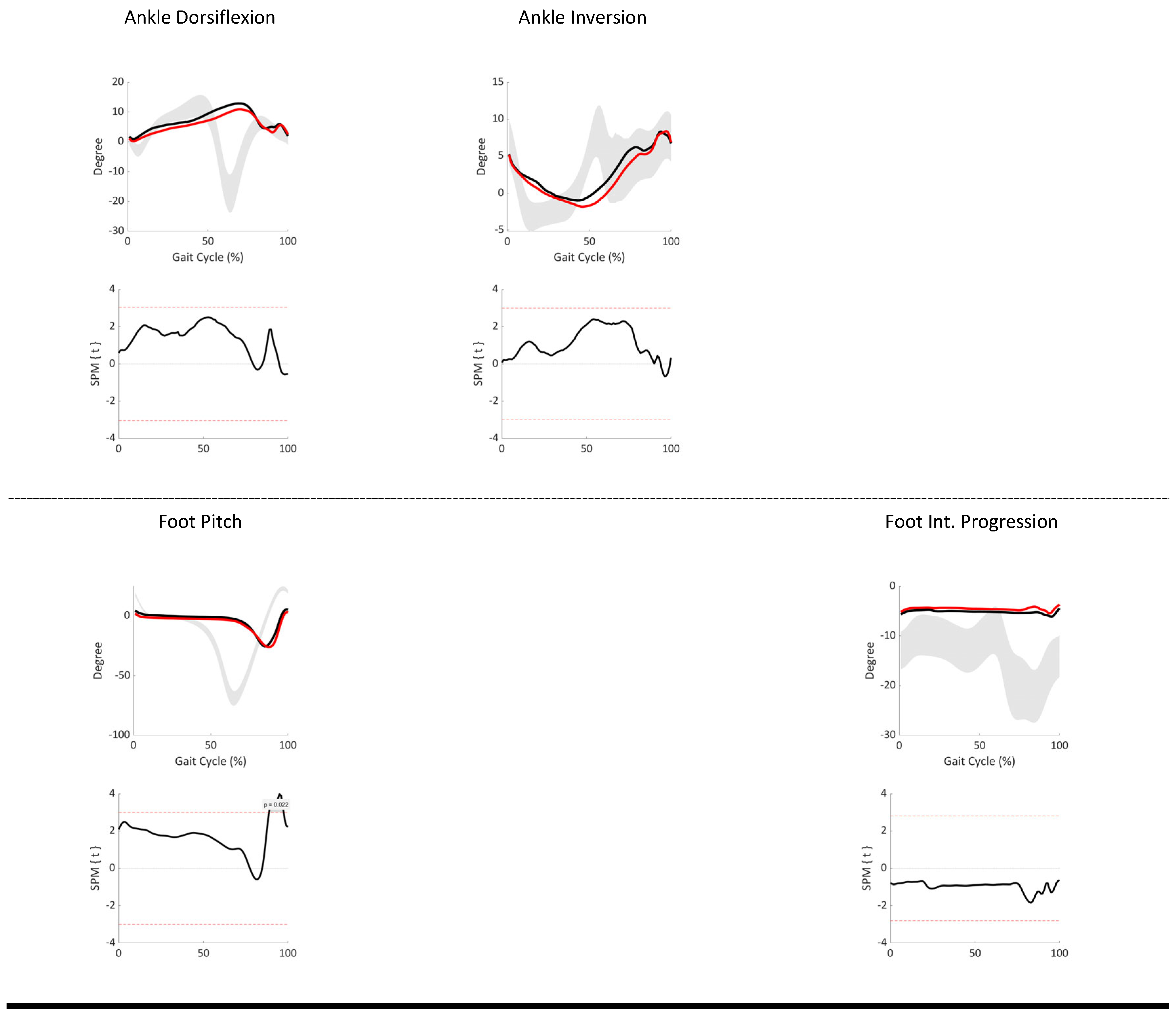
The graphs on the top display the means of normalized gait cycles, ranging from 0% to 100%, for all patients’ kinematics (Figure 4), comparing heel strike events between AFO CO (black line) and AFO PO (red line). The lightly shaded grey area provided by PAF software represents the normative data standard deviation for a healthy adult demographic. The graphs on the bottom show the SPM comparison between both means.

3.2. Kinetics

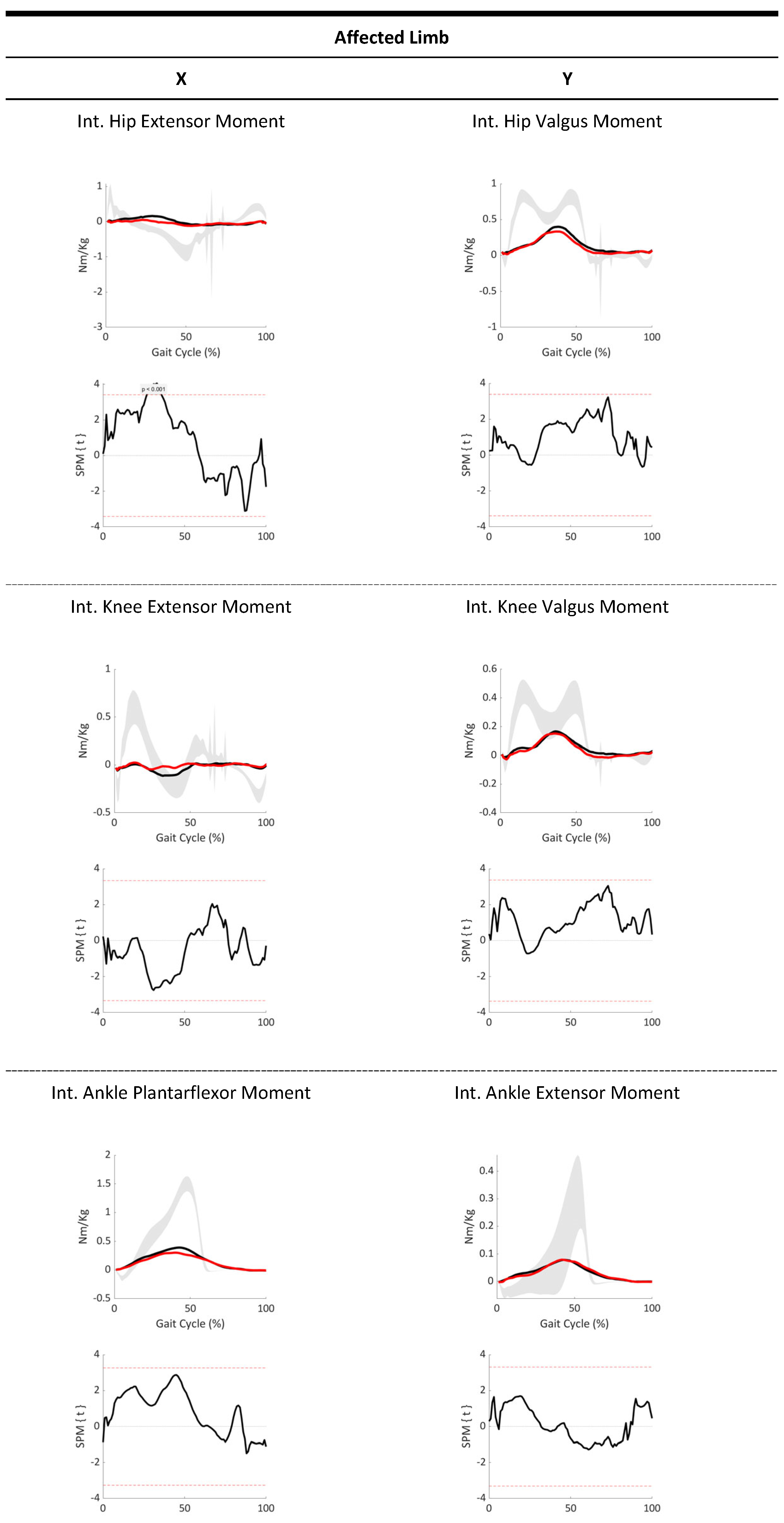
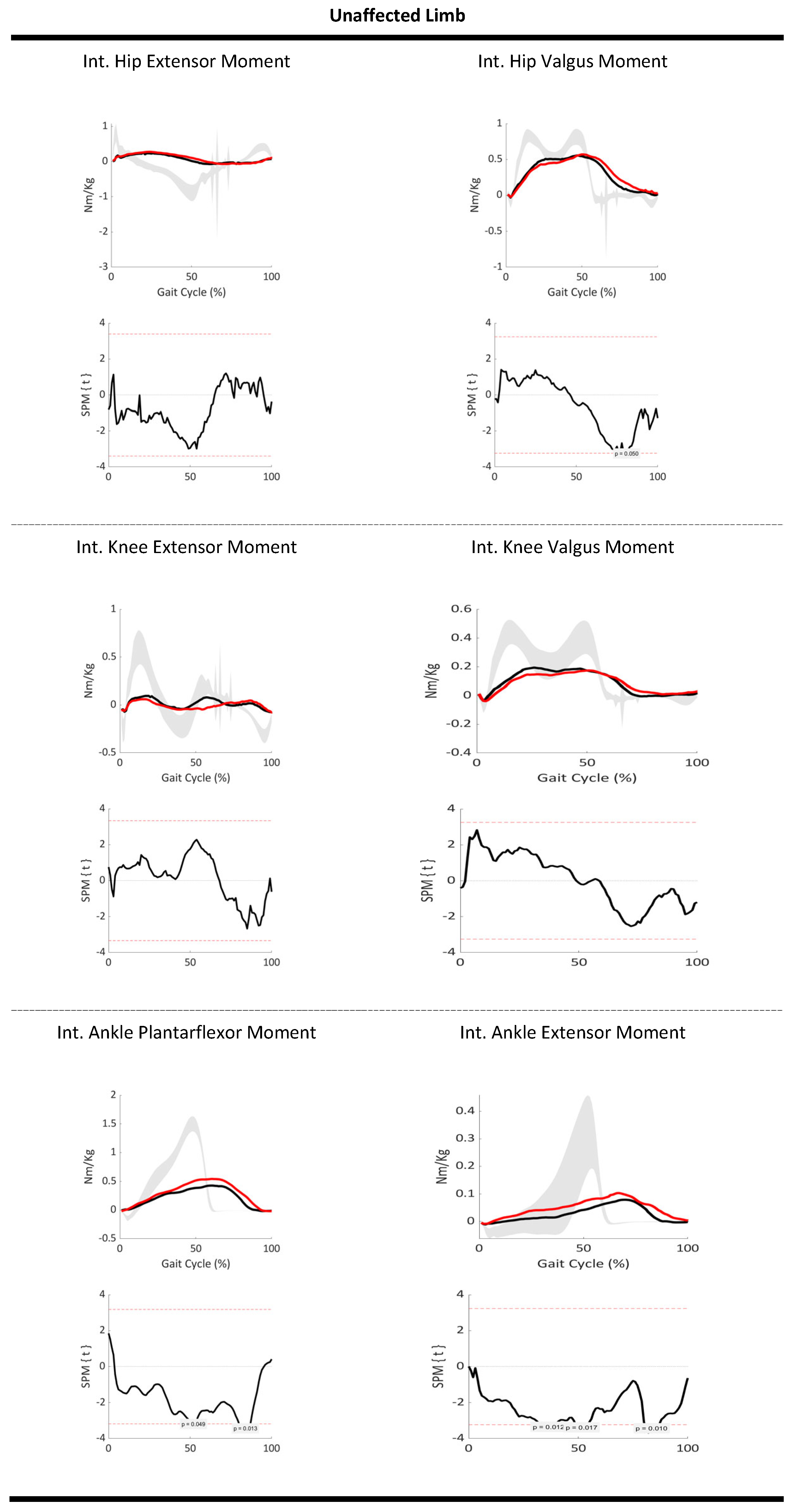
On the top, the graphics display the average kinetic profiles of normalized gait cycles from heel strike to heel strike (Figure 5), contrasting the kinetics of AFO PO (red line) with AFO CO (black line). The shaded grey region provided by PAF software delineates the standard deviation of the normative kinetic data for a healthy adult demographic. On the bottom, the graphics present the results of the Statistical Parametric Mapping (SPM) analysis comparing the two kinetic curves.

3.3. Spatiotemporal

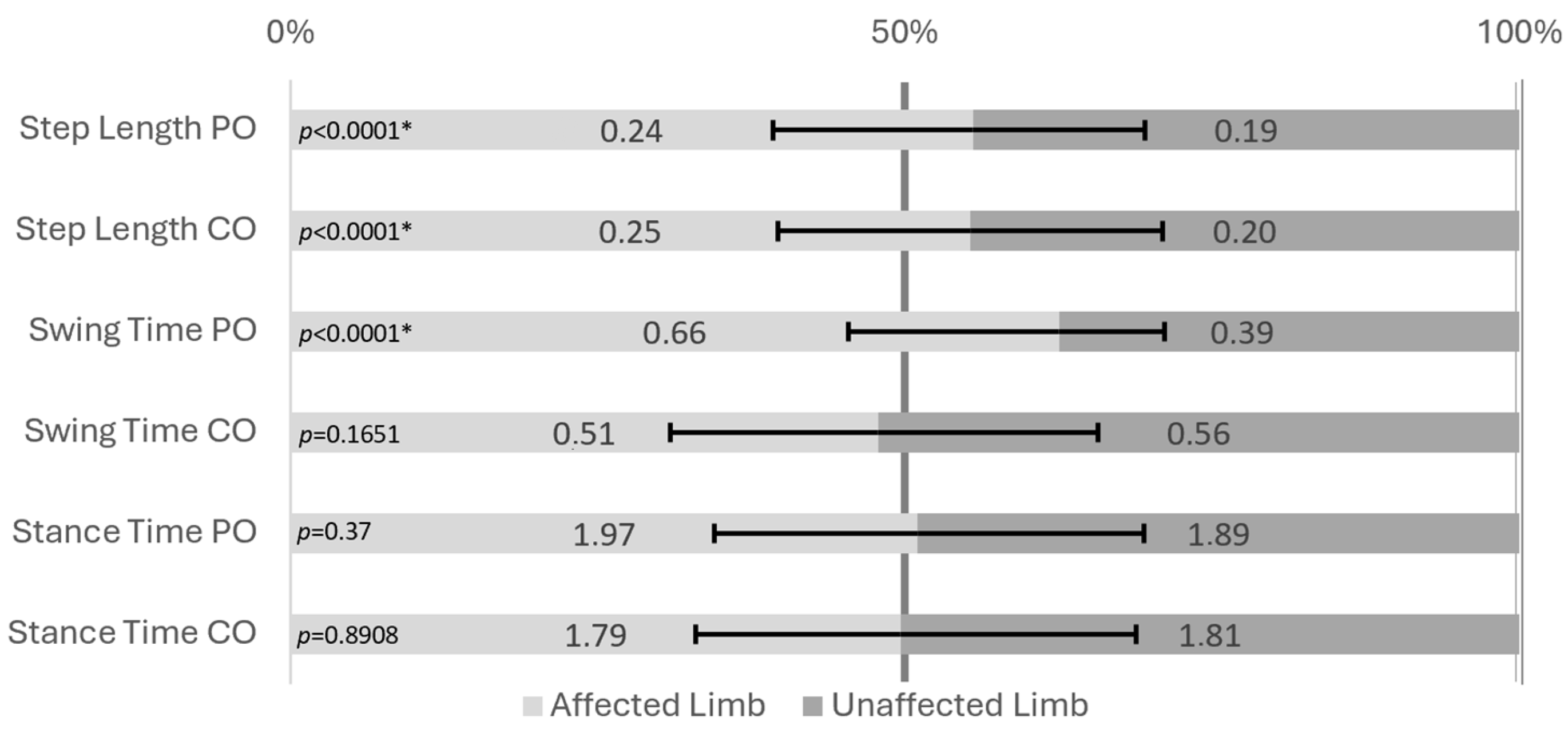
The forthcoming analysis presents a detailed examination of spatiotemporal gait parameters, which are essential to understanding locomotive efficiency and symmetry in human movement. Initially, the symmetry between affected and unaffected limbs was assessed (Figure 6), revealing compensatory strategies that may emerge due to gait alterations. Subsequently, Gait Symmetry Indices were analyzed (Table 2), providing a quantitative measure of bilateral coordination and identifying potential asymmetries. The breakdown of gait cycles further elucidates the timing and consistency of walking patterns, which are essential for recognizing deviations from typical gait (Table 3). Also, a comparative analysis between the affected and unaffected limbs for PO and CO was conducted (Table 4), delineating the influence of orthotic intervention on gait mechanics. These comparisons are pivotal for assessing the role of the orthosis in gait modification and its relevance to rehabilitative strategies.

3.4. Gait Profile Score

Table 5 presents the Gait Profile Score (GPS) results for all patients. The GPS is a recognized measure for assessing gait abnormalities and offers valuable insights into the effectiveness of various orthotic interventions. This table focuses on comparing the affected and unaffected limbs of patients by evaluating the median values of overall GPS scores. Additionally, it details individual values for each of the nine variables that constitute the GPS, for both affected and unaffected limbs under PO and CO conditions. These data provide a comprehensive understanding of the impact of each AFO type on specific gait aspects in both limb types. Furthermore, the table highlights the median differences between the AFO conditions, providing an analytical perspective of their comparative effectiveness.

3.5. QUEST

Table 6 displays the QUEST results for all patients. QUEST is an established tool for evaluating user satisfaction with assistive technologies, covering essential aspects such as dimension, weight, adjustment, safety, usage, comfort, and effectiveness. The table compares individual patient responses across all these variables. Additionally, the table provides average scores and standard deviations for each variable under PO and CO conditions.

4. Discussion

This study represents a significant step forward for neurorehabilitation, particularly in the development and application of AFOs for stroke survivors. This study, integrating 3D scanning and AM technologies, aimed to bridge the gap between traditional orthotic craftsmanship and prefabricated orthoses with modern precision-driven fabrication methods. This integration not only promised a higher level of customization, but also sought to enhance the functional effectiveness of AFOs. The implementation of a novel photogrammetric 3D scanner for capturing the intricate details of the hemiparetic lower limb was instrumental in achieving a high degree of precision in orthosis design. This precision was critical in addressing the unique anatomical and biomechanical needs of each participant, as reflected in their feedback and the biomechanical data collected. The customization process was further augmented by employing FDM with Nylon 12 material, ensuring uniformity and durability in the final AFO product. While the present findings indicate meaningful biomechanical improvements and high levels of user satisfaction with the customized AFOs, these results must be interpreted within the context of the study design. The number of participants was limited, and the cohort exhibited clinical heterogeneity in terms of age, time since stroke, and functional impairment. Such variability is inherent to post-stroke rehabilitation settings but restricts the extent to which the results can be generalized to the broader stroke population. For this reason, the present investigation should be understood primarily as a feasibility and proof-of-concept study, rather than a definitive clinical validation. According to our previous review [13] and Wojciechowski et al. [14], several studies have built their orthoses using Nylon 12 [16,18,40,44,54]. However, this study marks the first instance of employing Nylon 12 in conjunction with FDM technology, setting it apart from previous research. For instance, Liu et al. [40] utilized MJF technology, while other studies predominantly employed selective SLS. This distinction is crucial, as the manufacturing process can significantly influence the material properties of the final product. While it is feasible to draw parallels with studies that used the same material, the divergent fabrication techniques employed––FDM in this case versus MJF and SLS in others––can lead to variances in the mechanical and structural characteristics of the Nylon 12. These variations can affect everything from the AFO’s flexibility and durability to its comfort and fit. Therefore, while the use of Nylon 12 as a material remains a common thread, the application of different manufacturing technologies introduces a layer of complexity in direct comparisons. This emphasizes the importance of considering both material and fabrication method in assessing the efficacy and functionality of AFOs in clinical settings. Within this context, it is important to clarify that the present study did not aim to isolate the individual effects of orthosis geometry, material selection, or manufacturing technology. Instead, these elements were intentionally combined as part of an integrated solution reflecting a realistic clinical and production workflow. Consequently, the observed biomechanical and subjective outcomes should be interpreted as the result of the interaction among orthosis design, the mechanical properties of Nylon 12, and the characteristics of the FDM manufacturing process, rather than being attributed to a single factor in isolation.

4.1. Kinematic Data Analysis

The SPM1D method, a Python/MATLAB package, has been developed for introducing SPM to biomechanics for the analysis of time-varying human movement, particularly in gait analysis [55]. This method is particularly useful in gait analysis, as it allows for detailed examination of entire gait cycles, providing a comprehensive view of kinematic and kinetic patterns.
This study contributes significantly to the field of gait analysis in stroke rehabilitation by focusing on kinematic differences using SPM. Notably, to date, only two other studies have employed SPM in the analysis of gait in stroke patients. Wang et al. [56] aimed to validate a new 3D gait analysis system, concentrating on the ankle, knee, and hip joints in stroke patients, but solely under barefoot conditions. Cicarello et al. [57], meanwhile, focused on analyzing vertical and mediolateral center-of-mass displacement in barefoot stroke patients. Both these studies provided valuable insights but did not explore the effects of AFOs on gait dynamics. In contrast, the present study specifically examines the kinematic impacts of PO and CO in stroke patients. The SPM analysis conducted, a pioneering approach in this context, revealed some deviations in parts of the gait cycle when comparing PO and CO. These deviations were observed in areas such as the affected limb hip adduction, unaffected limb knee internal rotation, affected limb knee varus, affected limb knee internal rotation, affected limb ankle dorsiflexion, and unaffected limb foot pitch. These deviations offer new insights into how different AFOs can influence gait kinematics in stroke patients. For instance, variations in hip adduction and knee varus on the affected side may indicate how each AFO type affects lateral stability and limb alignment, which are crucial for effective and safe walking. Additionally, most studies have established that the use of AFOs typically results in an increase in dorsiflexion during the initial stages of the stance phase in stroke patients [58,59]. The findings of this study support these observations, showing improvements in ankle motion from initial contact to the three rockers of the foot, both with PO and CO. Notably, subject 5, who is detailed in the Supplementary Materials, demonstrated a significant statistical difference between the two types of AFOs on the affected side (p < 0.001), emphasizing the importance of AFO design and material in influencing gait. What makes the results for patient 5 even more intriguing is that this patient had gone the longest time since stroke and had always used a PO orthosis, so it is possible that they had developed specific gait mechanisms. Interestingly, upon using the CO orthosis for the first time, significant and promising results were immediately observed. This suggests that switching to the CO orthosis helped to counteract some of the less optimal gait patterns that had developed over time with consistent use of the PO orthosis. Supporting this, Kobayashi et al. [60] indicated that different AFO resistances at the ankle joints are particularly notable in the early stance phase. These findings suggest that differences in AFO design and material, which lead to variations in stiffness applied, can restrict the subject’s ankle motion in stance, impacting overall gait mechanics. Alterations in these areas can significantly impact balance and overall gait mechanics, particularly in stroke patients, where muscle control and coordination are often compromised. Similarly, differences in ankle dorsiflexion and foot pitch provide a window into how these orthoses modify foot–ground interactions.
It is commonly observed that stroke patients exhibit peak extension at initial contact and during the loading response, leading to increased gait difficulty due to the interruption of fluidity between sub-phases of gait. Yet, studies including Kobayashi et al. [60] indicate that AFOs can enhance either the initial or terminal stance phase. Notably, patient 8 (data in the Supplementary Materials) showed an improved sagittal knee pattern with the CO AFO, as the joint range of motion remained within the flexion spectrum, effectively eliminating certain extension peaks observed with the PO AFO. This was particularly significant (p = 0.016) in the stance phase but was evident throughout the entire gait cycle. Such improvements in knee angle at heel strike and facilitation of limb clearance during the swing phase are crucial for gait fluidity [61]. Previous studies have suggested that greater plantar flexion resistance can induce increased knee flexion in the early stance phase of gait [62], implying that the PO AFO may offer more flexibility than the CO AFO.
While only a few studies have directly investigated the impact of AFOs on hip kinematics, reviews of existing research, such as the one conducted by Tyson et al. [63], report no significant differences, especially in initial contact and peak hip extension during the stance phase. In contrast, this study observed improvements across all three hip planes on both the affected and unaffected sides in most subjects when using both types of AFOs. Remarkably, subject 5’s hip sagittal parameters (data in the Supplementary Materials) during the stance phase exhibited statistically significant changes, not only on the affected side, but predominantly on the unaffected side, with the CO AFO. It is conceivable that the enhancement in knee flexion at clearance facilitated by the CO AFO allowed for a decrease in hip abduction and ultimately reduced the hip flexion normally required to successfully swing between steps. These observations further demonstrate the intricate interplay between lower limb joint kinematics in stroke patients and the influence of AFO design. The kinematic changes observed with different AFO types highlight the need for personalized orthotic solutions in stroke rehabilitation to address individual biomechanical deviations and enhance overall gait quality.

4.2. Kinetic Data Analysis

In addition to the kinematic analysis, this study also delved into the kinetic aspects of gait in stroke patients using PO and CO. Notably, the use of statistical SPM for kinetic data analysis is a pioneering approach in this area, as, to date, no studies have employed SPM for kinetic gait analysis in stroke patients. One significant deviation was observed in the affected limb internal hip extensor moment between 27% and 36% of the gait cycle. This deviation suggests a variation in the hip’s capacity to generate or control force during the mid-stance phase of walking. In stroke patients, the hip moment plays a critical role in maintaining balance and stability [60]. Therefore, the observed variation indicates that the type of AFO can substantially influence the hip’s biomechanical function, affecting the patient’s stability and propulsion during the gait cycle. Further analysis revealed deviations in the unaffected limb internal ankle plantarflexor moment between 80% and 87% of the gait cycle. The variance in ankle moment on the unaffected side could be indicative of how each AFO type influences these compensatory strategies, impacting the overall balance and load distribution during walking. Additionally, a deviation was noted in the unaffected limb internal ankle extensor moment during the toe-off phase, between 80% and 87% of the gait cycle. A potential explanation for this difference lies in the normalization of gait with the use of CO AFO in the affected limb. The more normalized gait pattern with CO AFO leads to an earlier toe-off, around 75% of the gait cycle, compared to the toe-off occurring around 85% with PO. This suggests that CO AFO may contribute to a more efficient and natural gait pattern in the affected limb, which in turn influences the kinetic behavior of the unaffected limb during the toe-off phase.
Interestingly, only four studies have conducted kinetic analyses using AM-produced AFOs, none of which involved stroke patients [18,19,64,65]. Vasiliauskaite et al. [19], who explored the efficacy of AFO stiffness prescriptions in various patients, compared Nylon 12 AFOs produced via SLS with conventional polypropylene AFOs. They found peak AFO plantarflexion moments of 0.497 (0.171) and 0.587 (0.281) N.m/kg for conventional polypropylene and SLS AFOs, respectively, which are higher than those observed in this study for PO AFO-0.303 (0.215) and CO AFO-0.392 (0.189). While Vasiliauskaite’s study reported an 18% increase in moment between the two AFO types, this study observed a 29% increase. This difference may be attributed to the unique biomechanical and anatomical characteristics of stroke patients. Stroke-induced muscular and neural impairments can profoundly influence how the body interacts with orthotic devices, potentially leading to more significant changes in kinetic parameters when different AFO types are used. Harper et al. [64] performed a study involving thirteen active military personnel with unilateral lower extremity injuries, comparing various SLS-produced AFOs with Nylon 11 and different strut stiffnesses. Though a direct comparison is challenging due to different patient demographics and AFO materials, understanding how AFO stiffness influences joint moments in the hip, knee, and ankle, as investigated by Telfer et al. [18], is valuable. These studies observed that variations in AFO stiffness can significantly impact the ankle’s range of motion and the body’s support mechanics, highlighting the complex interplay between AFO design and gait biomechanics. Furthermore, Ranz et al. [65] delved into the influence of passive-dynamic ankle-foot orthosis bending axis location on gait performance in individuals with lower-limb impairments. Similar to Harper et al. [64] and Telfer et al. [18], the values found in Ranz’s study were higher than those in this research. Although a direct comparison is not feasible, the insights provided by the Ranz study are crucial. They observed that the bending axis condition influenced various aspects of gait in the first half of the stance, with participant preferences for bending axis conditions correlating strongly with peak joint moments and kinematics. This diversity in preferences, influenced by individual etiologies, underscores the need for personalized AFO prescriptions, a principle that is also central to this study.

4.3. Spatiotemporal Data Analysis

Gait parameters such as walking speed, stride width, stride length, cycle time, step length, and double limb support offer a quantitative measure of gait efficiency and fluidity. This study utilized these parameters to compare the effectiveness of custom and off-the-shelf AFOs in enhancing gait dynamics. Reductions in gait speed are a prevalent characteristic of stroke survivors experiencing hemiparesis. According to Verma et al. [66], average gait speeds in this population may vary from a slow 0.23 m/s to a relatively faster 0.73 m/s, reflecting a wide range of mobility impairments. Furthermore, Perry et al. [67] have demonstrated that gait speed is a critical marker in differentiating stroke patients based on the severity of their comorbid conditions. Specifically, those experiencing greater ambulatory challenges exhibited gait velocities between a markedly reduced 0.1 m/s and 0.23 m/s. This aligns with the findings of the current study, which focused on a sample primarily comprising hospital inpatients, none of whom could ambulate without the assistance of a walking aid or an AFO. Consequently, the observed gait speeds in these patients were generally lower compared to those reported in other studies [68,69]. In the present research, a statistically significant difference (p = 0.0485) was observed in gait speeds between different types of AFOs, with an average speed of 0.18 m/s recorded for patients using PO AFOs and 0.21 m/s for those using CO AFOs. This finding is particularly noteworthy in the context of existing literature, which offers mixed results. For instance, Chen et al. [70] did not report significant differences in gait speeds when comparing similar types of AFOs, while Gök et al. [71] observed a notable variation, with plastic AFOs yielding a gait speed of 0.37 m/s (p < 0.05) and metal AFOs resulting in a speed of 0.41 m/s (p < 0.05). It is evident that the design elements of AFOs, such as material composition, shaft construction, movement restriction at the ankle, and footplate length, can profoundly influence gait biomechanics [1]. In this study, the primary design and material of the PO AFOs differed significantly from those of the CO AFOs used. Although patients were accustomed to using their personal AFOs (PO) in daily activities, it is plausible that the mechanical properties of the CO AFO may have provided enhanced stability during the gait cycle, thereby contributing to the observed improvement in walking speed. While other spatiotemporal parameters such as stride length and double limb support time also showed trends towards improvement with the AM custom AFOs, these changes did not reach statistical significance in this study, unlike in other studies [1,11,16,17,18,72].
Assessment of symmetry and asymmetry in gait is crucial for understanding the effectiveness of orthotic interventions in stroke rehabilitation. In this study, symmetry tests, along with intra- and inter-subject symmetry indices, provided valuable insights into the bilateral balance achieved by patients. The analysis revealed notable improvements in symmetry when participants used the CO AFO. A more individualized analysis of each patient (detailed in the Supplementary Materials) reveals nuanced trends in response to the use of CO AFOs. In this individualized analysis, a trend towards increased walking speed was observed in 5 out of 10 patients when using the CO AFO, with only 2 experiencing a reduction. Regarding Stride Width, there was a tendency for a reduction in 5 of the 10 patients, with only 2 showing an increase. For Stride Length, an increase in step size was found in five patients, while a decrease was observed in three patients. Double Limb Support times showed mixed results, with an increase and decrease in three patients each, and no change in four patients. Cycle Time increased in five patients and decreased in two patients. These varied responses underscore the heterogeneity inherent in stroke patients [73]. The variability in gait adaptations among individuals can be attributed to several factors, including the extent and location of the brain injury, the duration since stroke onset, the pre-existing motor skills, the severity of motor impairments, and the degree of access to rehabilitation treatments [73,74]. Stroke impacts motor control and gait in diverse ways, leading to a wide range of compensatory mechanisms and recovery trajectories [75,76]. This heterogeneity highlights the complexity of stroke rehabilitation and the need for personalized treatment plans.
Concerning the mean step length symmetry of all patients, both PO and CO AFOs demonstrated similar patterns, with an increased step length for the affected limb. A significant improvement was observed in swing time symmetry when patients used the CO AFO, making the swing phase much more symmetrical, with negligible statistical differences between the affected and unaffected limbs (p = 0.1651). This indicates that the use of a CO AFO may contribute to a more balanced and coordinated gait, reducing the discrepancies in limb movement timing often seen in stroke patients. In terms of stance time symmetry, no significant differences were found between the PO and CO AFOs. Yet, with the CO AFO, the stance time achieved perfect symmetry, with a mean value of 50.00 ± 4.97. In contrast, Cha et al. [27] conducted tests on stance time symmetry and found differences between 3D-printed AFO vs conventional AFO, with favorable results for the 3D AFO, but they did not present the symmetry values between AFOs. Creylman et al. [16] found identical values for polypropylene AFO and SLS-AFO, yet there is an associated asymmetry for both of 62.1%. Normally, stroke patients tend to spend more time in contact with the ground with the unaffected limb, indicating extended weight transfer to the unaffected side to compensate for the weakness of the affected side [16]. Nevertheless, in this study, the use of both PO AFO and CO AFO demonstrated very good symmetry values, contributing significantly to a more physiological gait pattern in this group of patients.

4.4. Gait Profile Score Analysis

The GPS offers a comprehensive assessment of gait quality, encapsulating various aspects of movement into a single measure. In mathematical terms, the GPS represents the root mean square difference between the individual joint’s curve and the mean curve calculated for a reference population of unaffected individuals [77]. Originally developed to assess the gait of children with cerebral palsy [78,79,80,81], its application has significantly broadened in recent years. Contemporary studies have extended the use of GPS to evaluate populations with diverse conditions, notably including those with lower limb amputations [82], Parkinson’s disease [83], and multiple sclerosis [84]. This expansion reflects the GPS’s versatility and adaptability in various clinical scenarios. Moreover, some investigations have employed the GPS to assess mixed samples, encompassing adults with a range of orthopedic and neurological disorders [85] and children diagnosed with multiple clinical conditions [86]. This approach highlights the tool’s capability to provide valuable insights across a spectrum of gait abnormalities. Despite its expanding application, the use of GPS in assessing patients with stroke remains relatively unexplored. To date, and to the best of our knowledge, only four studies have focused on the application of GPS in stroke patients [77,87,88,89]. These studies represent a crucial step in understanding the gait characteristics and alterations in this patient population. However, all four of these studies have evaluated this metric with the stroke patient walking barefoot. Given the critical role that AFOs play in supporting gait rehabilitation in stroke patients, this lack of research represents a notable oversight. We extend the scope of existing research not only by analyzing the gait of stroke patients with the aid of AFOs, but also by comparing GPS outcomes when using a prefabricated AFO versus a custom-made AFO fabricated through AM. By comparing the GPS values for both the affected and unaffected limbs in participants wearing the PO and CO, it is possible to discern the specific impact of the personalized design on gait normalization. These results indicated an improvement in gait quality (GPS overall: PO-13.7 vs CO-12.8) when patients used the CO AFOs compared to the PO AFO models. This was particularly evident in the reduced deviation from the normative gait patterns, as the GPS values approached those of healthy adult gait standards. Such improvements are indicative of a more balanced and physiologically accurate walking pattern, which is crucial for reducing the risk of falls and enhancing mobility in stroke survivors. The closer alignment of GPS values with normative data under the CO condition highlights the effectiveness of personalized design in addressing gait abnormalities associated with post-stroke hemiparesis. When comparing the PO and CO results, both AFOs obtained lower values for the affected limb than reported by Devetak et al. [87] (13.9) but higher than those reported by Fukuchi and Duarte [88] (8.0), Bigoni et al. [77] (10.07), and Jarvis et al. [89] (9.4). This could be explained by the temporal differences between the date of analysis and date of stroke and the fact that the level of neurological impairment was only defined by CT scan or MRI [89]. In the reviewed studies, all except Devetak et al. [87] exhibit differences exceeding 1 year in terms of time since stroke. As time progresses, patients tend to stabilize their gait through rehabilitation, often resulting in a more homogeneous and normalized walking pattern. Ref. [87], with a time difference of 6.0 months, aligns more closely with the patient demographics of this study. Consequently, it can be inferred that the use of AFOs generally contributes to improvement of the patient’s gait. This is particularly evident with AFOs fabricated using AM, which appear to offer enhanced benefits in gait rehabilitation.

4.5. QUEST Analysis

In this study, the QUEST effectively delineated patient satisfaction regarding the custom and standard AFOs, particularly emphasizing comfort, fit, and efficacy. Notably, the weight of the orthoses emerged as the second-highest rated aspect in our study, surpassed only by dimensions. This significant score in the weight category is largely attributable to the strategic selection of Nylon 12 as the material for 3D printing, which, with its mere 3 mm thickness, contributed substantially to the orthoses’ lightweight attribute while maintaining essential durability. Moreover, the high scores in dimensions and comfort can be directly linked to the bespoke nature of the custom orthoses. The utilization of advanced 3D scanning technology ensured impeccable contouring to the patients’ limbs and foot soles, thereby eliminating unnecessary pressure points and achieving optimal fit. This precision in customization not only elevates user comfort, but also enhances the functional efficacy of the orthoses in facilitating mobility and ensuring gait stability. Comparative studies, such as those by Cha et al. [27] and Chae et al. [45], have similarly reported a preference for 3D-printed AFOs in terms of comfort and fit. Conversely, the study by Fu et al. [90], comparing standard hinged AFOs with those produced via AM, underscores the necessity for improvements in certain areas, particularly the orthoses’ weight. The lower score observed for weight in a study by Fu et al. [90] highlights the ongoing imperative to refine material selection and design in the AM of AFOs. Collectively, these findings underscore the critical role of patient-centered design in orthotic development, where customization and material choice are key to improving user experience. The integration of tools like the QUEST into clinical practice offers invaluable insights for healthcare professionals, allowing for a deeper understanding of patient needs and preferences. This understanding is crucial in guiding the selection and design of more effective and comfortable orthotic solutions in rehabilitation contexts.

4.6. Cost of Fabrication

While the results are promising, they also underscore the challenges associated with integrating new technologies into clinical practice. The initial costs of equipment and training, along with the need to adapt clinical workflows to accommodate these technologies, are significant considerations. Although the present study did not include long-term follow-up data, existing evidence suggests that personalized orthotic solutions may contribute to improved patient outcomes over time. In addition, reduced material waste and faster production times associated with digital fabrication workflows indicate a potential for a favorable return on investment. In the context of AFOs, the financial implications are particularly noteworthy. Traditional custom AFOs, tailored to each patient’s specific needs through a manual process, are often associated with higher production costs, largely due to labor-intensive fabrication workflows [13]. These custom devices, designed for a precise fit and maximum efficacy, reflect the extensive assessment, molding, and adjustments performed by prosthetic-orthotic professionals. On the other hand, prefabricated AFOs present a more economical option [91]. These mass-produced units, available in standard sizes, are significantly more affordable than custom AFOs, catering to less complex conditions or serving as temporary solutions. Nevertheless, they offer less customization. For instance, in creating CO AFOs using Nylon 12, the average material cost was determined to be 2.87 euros. It should be noted that this value reflects material consumption only and does not account for additional costs such as equipment acquisition, software licensing, operator training, or labor time. Therefore, the present cost estimation should be interpreted as a partial indicator rather than a comprehensive economic analysis. Despite these additional costs, the use of AM in AFO production has the potential to reduce material waste and shorten manufacturing time, which may contribute to improved efficiency in the long term [92], thereby offering a more sustainable and efficient approach in the long run.
Adopting these new technologies in clinical settings, therefore, represents a balance between initial investment and long-term gains. While a direct comparison with the costs of traditional handcrafted AFOs was beyond the scope of this study, and the upfront investments in equipment and training may be substantial, the advantages associated with additive manufacturing—particularly regarding personalized patient care, digital workflows, and resource efficiency—support its potential as a scalable and sustainable solution for orthotic fabrication. As the technology matures and becomes more integrated into clinical practice, it is expected that the costs will become more manageable, further enhancing its viability as a tool for orthotic fabrication.

5. Conclusions

This research marks a transformative step forward in the field of stroke rehabilitation, showcasing the extraordinary potential of integrating advanced 3D scanning and additive manufacturing technologies in the creation of ankle-foot orthoses. The application of a novel photogrammetric 3D scanner in the fabrication of custom orthoses with AM not only embodies the cutting edge of technological advancement, but also represents a significant leap in personalized patient care. By meticulously comparing these AM custom orthoses with standard prefabricated orthoses, this study offers unparalleled insight into biomechanical and qualitative differences, illuminating the profound impact of tailored orthotic solutions on stroke survivors’ gait dynamics and overall quality of life. We acknowledge that, while the insights derived from this study are meaningful, they are drawn from a relatively small sample size. A larger cohort would undoubtedly enhance the robustness of the findings and their applicability to a broader stroke survivor population. Furthermore, it is important to clarify that the absence of functional evaluation with patients walking barefoot was not an oversight but a necessary adaptation to the inherent limitations faced by this study population. Stroke patients often cannot walk without the support of an AFO, making such assessments unfeasible.
Despite these limitations, the present study provides practical evidence supporting the clinical feasibility and biomechanical relevance of personalized AFOs produced through photogrammetric 3D scanning and additive manufacturing. The results suggest that this integrated approach may contribute to improved gait mechanics and high levels of user satisfaction in stroke rehabilitation. These findings support the need for future studies with larger and more homogeneous samples to further validate and expand upon the observed outcomes.

Supplementary Materials

The following supporting information can be downloaded at: https://www.mdpi.com/article/10.3390/app16041950/s1.

Author Contributions

Conceptualization, R.S., P.M., D.R., I.C., N.A. and A.P.V.; methodology, R.S., P.M., D.R. and I.C.; validation, R.S., N.A. and A.P.V.; investigation, R.S., D.R. and I.C.; data curation, R.S. and D.R.; writing—original draft preparation, R.S. and P.M.; writing—review and editing, D.R., I.C. and A.P.V.; visualization, R.S.; supervision, A.P.V., N.A. and P.M.; project administration, A.P.V.; funding acquisition, R.S. All authors have read and agreed to the published version of the manuscript.

Funding

This work was funded by Portuguese national funds provided by Foundation for Science and Technology (FCT) (UIDB/05704/2020 and UIDP/05704/2020); CIPER–Interdisciplinary Center for the Study of Human Performance (UID/06349/2025) https://doi.org/10.54499/UID/06349/2025.

Institutional Review Board Statement

Approval for the study protocol was granted by the Health Ethics Committee of Centro de Medicina de Reabilitação da Região Centro—Rovisco Pais (Tocha, Portugal) in August 2022. All experiments and procedures were performed in accordance with the relevant guidelines and regulations. Additionally, all aspects of the research involving human participants were performed in accordance with the Declaration of Helsinki.

Informed Consent Statement

Informed consent was obtained from all subjects involved in the study.

Data Availability Statement

The data supporting the findings of this study are available from the corresponding author upon reasonable request.

Acknowledgments

The authors would like to acknowledge the support of the Portuguese Foundation for Science and Technology (FCT) through SFRH/BD/145292/2019, UIDB/04044/2020, UIDP/04044/2020, PAMI ROTEIRO /0328/2013 (CENTRO2020: N 22158), and PTDC/EMD-EMD/5804/2020 (https://doi.org/10.54499/PTDC/EMD-EMD/5804/2020) and the support of the National Innovation Agency (ANI) through the project ReinventO (POCI-01-0247-FEDER-040021) and Project: INOV.AM—Innovation in Additive Manufacturing (02-C05-i01.01-2022.PC644865234-00000004), funded by European Union—Next Generation EU, PRR—Plano de Recuperação e Resiliência.

Conflicts of Interest

The authors declare no conflicts of interest.

References

  1. Tyson, S.; Kent, R. Effects of an Ankle-Foot Orthosis on Balance and Walking After Stroke: A Systematic Review and Pooled Meta-Analysis. Arch. Phys. Med. Rehabil. 2013, 94, 1377–1385. [Google Scholar] [CrossRef]
  2. Wada, Y.; Otaka, Y.; Mukaino, M.; Tsujimoto, Y.; Shiroshita, A.; Kawate, N.; Taito, S. The Effect of Ankle-foot Orthosis on Ankle Kinematics in Individuals After Stroke: A Systematic Review and Meta-analysis. PM&R 2021, 14, 828–836. [Google Scholar] [CrossRef]
  3. Daryabor, A.; Yamamoto, S.; Orendurff, M.S.; Kobayashi, T. Effect of Types of Ankle-Foot Orthoses on Energy Expenditure Metrics During Walking in Individuals with Stroke: A Systematic Review. Disabil. Rehabil. 2020, 44, 166–176. [Google Scholar] [CrossRef]
  4. Doğan, A.; Mengüllüoğlu, M.; Özgirgin, N. Evaluation of the Effect of Ankle-Foot Orthosis Use on Balance and Mobility in Hemiparetic Stroke Patients. Disabil. Rehabil. 2011, 33, 1433–1439. [Google Scholar] [CrossRef]
  5. Kobayashi, T.; Orendurff, M.S.; Hunt, G.; Lincoln, L.; Gao, F.; LeCursi, N.; Foreman, K.B. An Articulated Ankle–Foot Orthosis with Adjustable Plantarflexion Resistance, Dorsiflexion Resistance and Alignment: A Pilot Study on Mechanical Properties and Effects on Stroke Hemiparetic Gait. Med. Eng. Phys. 2017, 44, 94–101. [Google Scholar] [CrossRef]
  6. Zarezadeh, R.; Arazpour, M.; Aminian, G. The Effect of Anterior Ankle-Foot Orthosis and Posterior Ankle-Foot Orthosis on Functional Ambulation in Stroke Patients. J. Rehabil. Assist. Technol. Eng. 2022, 9, 20556683221082451. [Google Scholar] [CrossRef]
  7. Maeda, N.; Kato, J.; Azuma, Y.; Okuyama, S.; Yonei, S.; Murakami, M.; Shimada, T. Energy Expenditure and Walking Ability in Stroke Patients: Their Improvement by Ankle-Foot Orthoses. Isokinet. Exerc. Sci. 2009, 17, 57–62. [Google Scholar] [CrossRef]
  8. Daryabor, A.; Yamamoto, S.; Motojima, N.; Tanaka, S. Therapeutic Effect of Gait Training with Two Types of Ankle-Foot Orthoses on the Gait of the Stroke Patients in the Recovery Phase. Turk. J. Phys. Med. Rehabil. 2022, 68, 175–183. [Google Scholar] [CrossRef]
  9. Lee, S.-H.; Choi, C.-M.; Lee, D.; Lee, S.-H.; Song, S.; Pyo, S.; Hong, S.; Lee, G. A Novel Hinged Ankle Foot Orthosis for Gait Performance in Chronic Hemiplegic Stroke Survivors: A Feasibility Study. Biomed. Eng. Lett. 2018, 8, 301–308. [Google Scholar] [CrossRef] [PubMed]
  10. Mohanty, R.K.; Behera, P.; Sahoo, P.K.; Das, S. Clinical Efficacy of Different Ankle Foot Orthosis Design in Subjects with Foot Drop After Stroke: A Review and Comparison. Eng. Sci. Int. J. 2020, 7, 57–63. [Google Scholar] [CrossRef]
  11. Daryabor, A.; Arazpour, M.; Aminian, G.; Baniasad, M.; Yamamoto, S. Design and Evaluation of an Articulated Ankle Foot Orthosis with Plantarflexion Resistance on the Gait: A Case Series of 2 Patients with Hemiplegia. J. Biomed. Phys. Eng. 2020, 10, 119–128. [Google Scholar] [CrossRef]
  12. Yamamoto, S. Gait Changes in a Hemiplegic Patient Using an Ankle-Foot Orthosis with an Oil Damper: A Case Report. Clin. Res. Foot Ankle 2014, 2, 8–13. [Google Scholar] [CrossRef]
  13. Silva, R.; Veloso, A.; Alves, N.; Fernandes, C.; Morouço, P. A Review of Additive Manufacturing Studies for Producing Customized Ankle-Foot Orthoses. Bioengineering 2022, 9, 249. [Google Scholar] [CrossRef]
  14. Wojciechowski, E.; Chang, A.Y.; Balassone, D.; Ford, J.; Cheng, T.L.; Little, D.; Menezes, M.P.; Hogan, S.; Burns, J. Feasibility of Designing, Manufacturing and Delivering 3D Printed Ankle-Foot Orthoses: A Systematic Review. J. Foot Ankle Res. 2019, 12, 11. [Google Scholar] [CrossRef]
  15. Choi, H.; Peters, K.M.; MacConnell, M.B.; Ly, K.K.; Eckert, E.S.; Steele, K.M. Impact of Ankle Foot Orthosis Stiffness on Achilles Tendon and Gastrocnemius Function during Unimpaired Gait. J. Biomech. 2017, 64, 145–152. [Google Scholar] [CrossRef]
  16. Creylman, V.; Muraru, L.; Pallari, J.; Vertommen, H.; Peeraer, L. Gait Assessment during the Initial Fitting of Customized Selective Laser Sintering Ankle Foot Orthoses in Subjects with Drop Foot. Prosthet. Orthot. Int. 2013, 37, 132–138. [Google Scholar] [CrossRef]
  17. Mavroidis, C.; Ranky, R.G.; Sivak, M.L.; Patritti, B.L.; DiPisa, J.; Caddle, A.; Gilhooly, K.; Govoni, L.; Sivak, S.; Lancia, M.; et al. Patient Specific Ankle-Foot Orthoses Using Rapid Prototyping. J. Neuroeng. Rehabil. 2011, 8, 1. [Google Scholar] [CrossRef] [PubMed]
  18. Telfer, S.; Pallari, J.; Munguia, J.; Dalgarno, K.; McGeough, M.; Woodburn, J. Embracing Additive Manufacture: Implications for Foot and Ankle Orthosis Design. BMC Musculoskelet. Disord. 2012, 13, 84. [Google Scholar] [CrossRef] [PubMed]
  19. Vasiliauskaite, E.; Ielapi, A.; De Beule, M.; Van Paepegem, W.; Deckers, J.P.; Vermandel, M.; Forward, M.; Plasschaert, F. A Study on the Efficacy of AFO Stiffness Prescriptions. Disabil. Rehabil. Assist. Technol. 2019, 16, 27–39. [Google Scholar] [CrossRef] [PubMed]
  20. Boparai, K.S.; Singh, R.; Singh, H. Development of Rapid Tooling Using Fused Deposition Modeling: A Review. Rapid Prototyp. J. 2016, 22, 281–299. [Google Scholar] [CrossRef]
  21. Böhm, H.; Dussa, C.U. Prefabricated Ankle-Foot Orthoses for Children with Cerebral Palsy to Overcome Spastic Drop-Foot: Does Orthotic Ankle Stiffness Matter? Prosthet. Orthot. Int. 2021, 45, 491–499. [Google Scholar] [CrossRef] [PubMed]
  22. Morrissey, D.; Cotchett, M.; J’Bari, A.S.; Prior, T.D.; Vicenzino, B.; Griffiths, I.B.; Rathleff, M.S.; Gülle, H.; Barton, C.J. Management of Plantar Heel Pain: A Best Practice Guide Synthesising Systematic Review with Expert Clinical Reasoning and Patient Values. Br. J. Sports Med. 2021, 55, 1106–1118. [Google Scholar] [CrossRef] [PubMed]
  23. Barrios-Muriel, J.; Romero-Sánchez, F.; Alonso-Sánchez, F.J.; Salgado, D.R. Advances in Orthotic and Prosthetic Manufacturing: A Technology Review. Materials 2020, 13, 295. [Google Scholar] [CrossRef]
  24. Parry, E.J.; Best, J.M.; Banks, C.E. Three-Dimensional (3D) Scanning and Additive Manufacturing (AM) Allows the Fabrication of Customised Crutch Grips. Mater. Today Commun. 2020, 25, 101225. [Google Scholar] [CrossRef]
  25. Roberts, A.; Wales, J.; Smith, H.; Sampson, C.J.; Jones, P.; James, M. A Randomised Controlled Trial of Laser Scanning and Casting for the Construction of Ankle–Foot Orthoses. Prosthet. Orthot. Int. 2016, 40, 253–261. [Google Scholar] [CrossRef]
  26. Ambu, R.; Oliveri, S.M.; Calì, M. Neck Orthosis Design for 3D Printing with User Enhanced Comfort Features. Int. J. Interact. Des. Manuf. 2023, 18, 6055–6068. [Google Scholar] [CrossRef]
  27. Cha, Y.H.; Lee, K.H.; Ryu, H.J.; Joo, I.W.; Seo, A.; Kim, D.H.; Kim, S.J. Ankle-Foot Orthosis Made by 3D Printing Technique and Automated Design Software. Appl. Bionics Biomech. 2017, 2017, 9610468. [Google Scholar] [CrossRef]
  28. Dal Maso, A.; Cosmi, F. 3D-Printed Ankle-Foot Orthosis: A Design Method. Mater. Today Proc. 2019, 12, 252–261. [Google Scholar] [CrossRef]
  29. Sabyrov, N.; Sotsial, Z.; Abilgaziyev, A.; Adair, D.; Ali, H. Design of a Flexible Neck Orthosis on Fused Deposition Modeling Printer for Rehabilitation on Regular Usage. Procedia Comput. Sci. 2021, 196, 226–234. [Google Scholar] [CrossRef]
  30. Roucoules, L.; Paredes, M.; Eynard, B.; Camo, P.M.; Rizzi, C. Advances on Mechanics, Design Engineering and Manufacturing III: Proceedings of the International Joint Conference on Mechanics, Design Engineering & Advanced Manufacturing, JCM 2020, June 2–4, 2020; Springer Nature: Berlin/Heidelberg, Germany, 2021; ISBN 3030705668. [Google Scholar]
  31. Ciobanu, O.; Ciobanu, G.; Rotariu, M. Photogrammetric Scanning Technique and Rapid Prototyping Used for Prostheses and Ortheses Fabrication. Appl. Mech. Mater. 2013, 371, 230–234. [Google Scholar] [CrossRef]
  32. Rogati, G.; Leardini, A.; Ortolani, M.; Caravaggi, P. Validation of a Novel Kinect-Based Device for 3D Scanning of the Foot Plantar Surface in Weight-Bearing. J. Foot Ankle Res. 2019, 12, 1–8. [Google Scholar] [CrossRef]
  33. Eder, M.; Brockmann, G.; Zimmermann, A.; Papadopoulos, M.A.; Schwenzer-Zimmerer, K.; Zeilhofer, H.F.; Sader, R.; Papadopulos, N.A.; Kovacs, L. Evaluation of Precision and Accuracy Assessment of Different 3-D Surface Imaging Systems for Biomedical Purposes. J. Digit. Imaging 2013, 26, 163–172. [Google Scholar] [CrossRef]
  34. Baronio, G.; Harran, S.; Signoroni, A. A Critical Analysis of a Hand Orthosis Reverse Engineering and 3D Printing Process. Appl. Bionics Biomech. 2016, 2016, 8347478. [Google Scholar] [CrossRef]
  35. Krajňáková, V.; Rajťúková, V.; Hudák, R.; Živčák, J. Application of the Artec Eva Scanner for Orthotics in Practice. Lékař Tech. Clin. Technol. 2020, 49, 92–96. [Google Scholar] [CrossRef]
  36. Ranaldo, D.; Zonta, F.; Florian, S.; Lazzaro, J. A Facile, Semi-Automatic Protocol for the Design and Production of 3D Printed, Anatomical Customized Orthopedic Casts for Forearm Fractures. J. Clin. Orthop. Trauma 2023, 42, 102206. [Google Scholar] [CrossRef]
  37. Chen, R.K.; Jin, Y.A.; Wensman, J.; Shih, A. Additive Manufacturing of Custom Orthoses and Prostheses—A Review. Addit. Manuf. 2016, 12, 77–89. [Google Scholar] [CrossRef]
  38. Belokar, R.M.; Banga, H.K.; Kumar, R. A Novel Approach for Ankle Foot Orthosis Developed by Three Dimensional Technologies. IOP Conf. Ser. Mater. Sci. Eng. 2017, 280, 2–7. [Google Scholar] [CrossRef]
  39. Grazioso, S.; Selvaggio, M.; Di Gironimo, G. Design and Development of a Novel Body Scanning System for Healthcare Applications. Int. J. Interact. Des. Manuf. 2018, 12, 611–620. [Google Scholar] [CrossRef]
  40. Liu, Z.; Zhang, P.; Yan, M.; Xie, Y.; Huang, G. Additive Manufacturing of Specific Ankle-Foot Orthoses for Persons after Stroke: A Preliminary Study Based on Gait Analysis Data. Math. Biosci. Eng. 2019, 16, 8134–8143. [Google Scholar] [CrossRef]
  41. Chen, R.K.; Chen, L.; Tai, B.L.; Wang, Y.; Shih, A.J.; Wensman, J. Additive Manufacturing of Personalized Ankle-Foot Orthosis. Trans. North Am. Manuf. Res. Inst. SME 2014, 42, 381–389. [Google Scholar]
  42. Lin, Y.-C.; Lin, K.-W.; Chen, C.-S. Evaluation of the Walking Performance between 3D-Printed and Traditional Fabricated Ankle-Foot Orthoses—A Prospective Study. Gait Posture 2017, 57, 366–367. [Google Scholar] [CrossRef]
  43. Pérez Pico, A.M.; Marcos Tejedor, F.; de Cáceres Orellana, L.C.; de Cáceres Orellana, P.; Mayordomo, R. Using Photogrammetry to Obtain 3D-Printed Positive Foot Casts Suitable for Fitting Thermoconformed Plantar Orthoses. Processes 2023, 11, 24. [Google Scholar] [CrossRef]
  44. Deckers, J.P.; Vermandel, M.; Geldhof, J.; Vasiliauskaite, E.; Forward, M.; Plasschaert, F. Development and Clinical Evaluation of Laser-Sintered Ankle Foot Orthoses. Plast. Rubber Compos. 2018, 47, 42–46. [Google Scholar] [CrossRef]
  45. Chae, D.-S.; Kim, D.-H.; Kang, K.-Y.; Kim, D.-Y.; Park, S.-W.; Park, S.-J.; Kim, J.-H. The Functional Effect of 3D-Printing Individualized Orthosis for Patients with Peripheral Nerve Injuries: Three Case Reports. Medicine 2020, 99, e19791. [Google Scholar] [CrossRef] [PubMed]
  46. Demers, L.; Weiss-Lambrou, R.; Demers, L.; Ska, B. Development of the Quebec User Evaluation of Satisfaction with Assistive Technology (QUEST). Assist. Technol. 1996, 8, 3–13. [Google Scholar] [CrossRef] [PubMed]
  47. Chan, A.-W.; Tetzlaff, J.M.; Altman, D.G.; Laupacis, A.; Gøtzsche, P.C.; Krleža-Jeric, K.; Hróbjartsson, A.; Mann, H.; Dickersin, K.; Berlin, J.A.; et al. SPIRIT 2013 Statement: Defining Standard Protocol Items for Clinical Trials. Ann. Intern. Med. 2013, 158, 200–207. [Google Scholar] [CrossRef]
  48. Silva, R. Innovative Design and Development of Personalized Ankle-Foot Orthoses for Stroke Survivors with Equinovarus Foot: A Feasibility and Comparative Trial Protocol. JMIR Res. Protoc. 2024, 13, e52365. [Google Scholar] [CrossRef]
  49. Silva, R.; Morouço, P.; Veloso, A. Desenvolvimento de Um Sistema One-Shot de Baixo Custo Para Aquisição de Modelos 3D. In Proceedings of the 8th Congresso Nacional de Biomecânica, Cancún, Mexico, 2–5 October 2019; pp. 239–240. [Google Scholar]
  50. Habiba, R.; Amaro, A.; Moura, C.; Silva, R.; Trindade, D.; Antão, A.; Martins, R.; Malça, C.; Branco, R. Impact Resistance of Additively Manufactured Polymeric Materials for Biomedical Applications. In Proceedings of the 10th Congress of the Portuguese Society of Biomechanics; Martins Amaro, A., Roseiro, L., Messias, A.L., Gomes, B., Almeida, H., António Castro, M., Neto, M.A., de Fátima Paulino, M., Maranha, V., Eds.; Springer Nature: Cham, Switzerland, 2023; pp. 333–341. [Google Scholar]
  51. Ounpuu, S.; Bell, K.J.; Davis, R.B., III; DeLuca, P.A. An Evaluation of the Posterior Leaf Spring Orthosis Using Joint Kinematics and Kinetics. J. Pediatr. Orthop. 1996, 16, 378–384. [Google Scholar] [CrossRef]
  52. Cappozzo, A.; Catani, F.; Della Croce, U.; Leardini, A. Position and Orientation in Space of Bones during Movement: Anatomical Frame Definition and Determination. Clin. Biomech. 1995, 10, 171–178. [Google Scholar] [CrossRef]
  53. Baker, R.J.; Leboeuf, F.Y.; Reay, J.; Sangeux, M. The Conventional Gait Model-Success and Limitations. In Handbook of Human Motion; Springer: Berlin/Heidelberg, Germany, 2018. [Google Scholar]
  54. Faustini, M.C.; Neptune, R.R.; Crawford, R.H.; Stanhope, S.J. Manufacture of Passive Dynamic Ankle-Foot Orthoses Using Selective Laser Sintering. IEEE Trans. Biomed. Eng. 2008, 55, 784–790. [Google Scholar] [CrossRef]
  55. Alhossary, A.A.; Pataky, T.; Ang, W.T.; Chua, K.S.G.; Donnelly, C.J. MovementRx: Versatile Clinical Movement Analysis Using Statistical Parametric Mapping. Sci. Rep. 2023, 13, 2414. [Google Scholar] [CrossRef]
  56. Wang, Y.; Tang, R.; Wang, H.; Yu, X.; Li, Y.; Wang, C.; Wang, L.; Qie, S. The Validity and Reliability of a New Intelligent Three-Dimensional Gait Analysis System in Healthy Subjects and Patients with Post-Stroke. Sensors 2022, 22, 9425. [Google Scholar] [CrossRef]
  57. Cicarello, N.D.S.; Bohrer, R.C.D.; Devetak, G.F.; Rodacki, A.L.F.; Loureiro, A.P.C.; Manffra, E.F. Control of Center of Mass during Gait of Stroke Patients: Statistical Parametric Mapping Analysis. Clin. Biomech. 2023, 107, 106005. [Google Scholar] [CrossRef]
  58. Kim, J.H.; Won, B.H. Kinematic on Ankle and Knee Joint of Post-Stroke Elderly Patients by Wearing Newly Elastic Band-Type Ankle–Foot Orthosis in Gait. Clin. Interv. Aging 2019, 14, 2097–2104. [Google Scholar] [CrossRef]
  59. Mulroy, S.J.; Eberly, V.J.; Gronely, J.K.; Weiss, W.; Newsam, C.J. Effect of AFO Design on Walking after Stroke: Impact of Ankle Plantar Flexion Contracture. Prosthet. Orthot. Int. 2010, 34, 277–292. [Google Scholar] [CrossRef]
  60. Kobayashi, T.; Orendurff, M.S.; Hunt, G.; Gao, F.; LeCursi, N.; Lincoln, L.S.; Foreman, K.B. The Effects of an Articulated Ankle-Foot Orthosis with Resistance-Adjustable Joints on Lower Limb Joint Kinematics and Kinetics during Gait in Individuals Post-Stroke. Clin. Biomech. 2018, 59, 47–55. [Google Scholar] [CrossRef] [PubMed]
  61. Esquenazi, A.; Ofluoglu, D.; Hirai, B.; Kim, S. The Effect of an Ankle-Foot Orthosis on Temporal Spatial Parameters and Asymmetry of Gait in Hemiparetic Patients. PM&R 2009, 1, 1014–1018. [Google Scholar]
  62. Yamamoto, S.; Tanaka, S.; Motojima, N. Comparison of Ankle–Foot Orthoses with Plantar Flexion Stop and Plantar Flexion Resistance in the Gait of Stroke Patients: A Randomized Controlled Trial. Prosthet. Orthot. Int. 2018, 42, 544–553. [Google Scholar] [CrossRef] [PubMed]
  63. Tyson, S.F.; Sadeghi-Demneh, E.; Nester, C.J. A Systematic Review and Meta-Analysis of the Effect of an Ankle-Foot Orthosis on Gait Biomechanics after Stroke. Clin. Rehabil. 2013, 27, 879–891. [Google Scholar] [CrossRef]
  64. Harper, N.G.; Esposito, E.R.; Wilken, J.M.; Neptune, R.R. The Influence of Ankle-Foot Orthosis Stiffness on Walking Performance in Individuals with Lower-Limb Impairments. Clin. Biomech. 2014, 29, 877–884. [Google Scholar] [CrossRef]
  65. Ranz, E.C.; Russell Esposito, E.; Wilken, J.M.; Neptune, R.R. The Influence of Passive-Dynamic Ankle-Foot Orthosis Bending Axis Location on Gait Performance in Individuals with Lower-Limb Impairments. Clin. Biomech. 2016, 37, 13–21. [Google Scholar] [CrossRef]
  66. Verma, R.; Arya, K.N.; Sharma, P.; Garg, R.K. Understanding Gait Control in Post-Stroke: Implications for Management. J. Bodyw. Mov. Ther. 2012, 16, 14–21. [Google Scholar] [CrossRef]
  67. Perry, J.; Garrett, M.; Gronley, J.K.; Mulroy, S.J. Classification of Walking Handicap in the Stroke Population. Stroke 1995, 26, 982–989. [Google Scholar] [CrossRef]
  68. Abe, H.; Michimata, A.; Sugawara, K.; Sugaya, N.; Izumi, S.-I. Improving Gait Stability in Stroke Hemiplegic Patients with a Plastic Ankle-Foot Orthosis. Tohoku J. Exp. Med. 2009, 218, 193–199. [Google Scholar] [CrossRef]
  69. Wang, R.-Y.; Yen, L.-L.; Lee, C.-C.; Lin, P.-Y.; Wang, M.-F.; Yang, Y.-R. Effects of an Ankle-Foot Orthosis on Balance Performance in Patients with Hemiparesis of Different Durations. Clin. Rehabil. 2005, 19, 37–44. [Google Scholar] [CrossRef]
  70. Chen, C.-C.; Hong, W.-H.; Wang, C.-M.; Chen, C.-K.; Wu, K.P.-H.; Kang, C.-F.; Tang, S.F. Kinematic Features of Rear-Foot Motion Using Anterior and Posterior Ankle-Foot Orthoses in Stroke Patients with Hemiplegic Gait. Arch. Phys. Med. Rehabil. 2010, 91, 1862–1868. [Google Scholar] [CrossRef] [PubMed]
  71. Gök, H.; Küçükdeveci, A.; Altinkaynak, H.; Yavuzer, G.; Ergin, S. Effects of Ankle-Foot Orthoses on Hemiparetic Gait. Clin. Rehabil. 2003, 17, 137–139. [Google Scholar] [CrossRef]
  72. Momosaki, R.; Abo, M.; Watanabe, S.; Kakuda, W.; Yamada, N.; Kinoshita, S. Effects of Ankle–Foot Orthoses on Functional Recovery After Stroke: A Propensity Score Analysis Based on Japan Rehabilitation Database. PLoS ONE 2015, 10, e0122688. [Google Scholar] [CrossRef] [PubMed]
  73. Alexander, L.D.; Black, S.E.; Patterson, K.K.; Gao, F.; Danells, C.; McIlroy, W.E. Association Between Gait Asymmetry and Brain Lesion Location in Stroke Patients. Stroke 2009, 40, 537–544. [Google Scholar] [CrossRef]
  74. Cruz, T.H.; Lewek, M.D.; Dhaher, Y.Y. Biomechanical Impairments and Gait Adaptations Post-Stroke: Multi-Factorial Associations. J. Biomech. 2009, 42, 1673–1677. [Google Scholar] [CrossRef] [PubMed]
  75. Lee, D.G.; Lee, G. Correlation Among Motor Function and Gait Velocity, and Explanatory Variable of Gait Velocity in Chronic Stroke Survivors. Phys. Ther. Rehabil. Sci. 2022, 11, 181–188. [Google Scholar] [CrossRef]
  76. Nam, Y.G.; Ko, M.J.; Bok, S.-K.; Paik, N.-J.; Lim, C.-Y.; Lee, J.; Kwon, B.S. Efficacy of Electromechanical-Assisted Gait Training on Clinical Walking Function and Gait Symmetry After Brain Injury of Stroke: A Randomized Controlled Trial. Sci. Rep. 2022, 12, 6880. [Google Scholar] [CrossRef] [PubMed]
  77. Bigoni, M.; Cimolin, V.; Vismara, L.; Tarantino, A.G.; Clerici, D.; Baudo, S.; Galli, M.; Mauro, A. Relationship between Gait Profile Score and Clinical Assessments of Gait in Post-Stroke Patients. J. Rehabil. Med. 2021, 53, 2768. [Google Scholar] [CrossRef]
  78. Baker, R.; McGinley, J.L.; Schwartz, M.H.; Beynon, S.; Rozumalski, A.; Graham, H.K.; Tirosh, O. The Gait Profile Score and Movement Analysis Profile. Gait Posture 2009, 30, 265–269. [Google Scholar] [CrossRef]
  79. Baker, R.; McGinley, J.L.; Schwartz, M.; Thomason, P.; Rodda, J.; Graham, H.K. The Minimal Clinically Important Difference for the Gait Profile Score. Gait Posture 2012, 35, 612–615. [Google Scholar] [CrossRef]
  80. Beynon, S.; McGinley, J.L.; Dobson, F.; Baker, R. Correlations of the Gait Profile Score and the Movement Analysis Profile Relative to Clinical Judgments. Gait Posture 2010, 32, 129–132. [Google Scholar] [CrossRef]
  81. Ricardo, D.; Raposo, M.R.; Veloso, A.; João, F. The Gait Profile Score to Assess the Effects of Ankle-Foot Orthoses in the Gait of Children with Cerebral Palsy. Gait Posture 2022, 97, S204–S205. [Google Scholar] [CrossRef]
  82. Kark, L.; Vickers, D.; McIntosh, A.; Simmons, A. Use of Gait Summary Measures with Lower Limb Amputees. Gait Posture 2012, 35, 238–243. [Google Scholar] [CrossRef]
  83. Speciali, D.S.; Oliveira, E.M.; Cardoso, J.R.; Correa, J.C.F.; Baker, R.; Lucareli, P.R.G. Gait Profile Score and Movement Analysis Profile in Patients with Parkinson’s Disease during Concurrent Cognitive Load. Braz. J. Phys. Ther. 2014, 18, 315–322. [Google Scholar] [CrossRef]
  84. Pau, M.; Coghe, G.; Atzeni, C.; Corona, F.; Pilloni, G.; Marrosu, M.G.; Cocco, E.; Galli, M. Novel Characterization of Gait Impairments in People with Multiple Sclerosis by Means of the Gait Profile Score. J. Neurol. Sci. 2014, 345, 159–163. [Google Scholar] [CrossRef] [PubMed]
  85. Schweizer, K.; Romkes, J.; Coslovsky, M.; Brunner, R. The Influence of Muscle Strength on the Gait Profile Score (GPS) across Different Patients. Gait Posture 2014, 39, 80–85. [Google Scholar] [CrossRef]
  86. McMulkin, M.L.; MacWilliams, B.A. Application of the Gillette Gait Index, Gait Deviation Index and Gait Profile Score to Multiple Clinical Pediatric Populations. Gait Posture 2015, 41, 608–612. [Google Scholar] [CrossRef]
  87. Devetak, G.F.; Martello, S.K.; de Almeida, J.C.; Correa, K.P.; Iucksch, D.D.; Manffra, E.F. Reliability and Minimum Detectable Change of the Gait Profile Score for Post-Stroke Patients. Gait Posture 2016, 49, 382–387. [Google Scholar] [CrossRef]
  88. Fukuchi, C.A.; Duarte, M. Gait Profile Score in Able-Bodied and Post-Stroke Individuals Adjusted for the Effect of Gait Speed. Gait Posture 2019, 69, 40–45. [Google Scholar] [CrossRef] [PubMed]
  89. Jarvis, H.L.; Brown, S.J.; Butterworth, C.; Jackson, K.; Clayton, A.; Walker, L.; Rees, N.; Price, M.; Groenevelt, R.; Reeves, N.D. The Gait Profile Score Characterises Walking Performance Impairments in Young Stroke Survivors. Gait Posture 2022, 91, 229–234. [Google Scholar] [CrossRef]
  90. Fu, J.C.M.; Chen, Y.J.; Li, C.F.; Hsiao, Y.H.; Chen, C.H. The Effect of Three Dimensional Printing Hinged Ankle Foot Orthosis for Equinovarus Control in Stroke Patients. Clin. Biomech. 2022, 94, 105622. [Google Scholar] [CrossRef] [PubMed]
  91. Choo, Y.J.; Lee, H.J. Commonly Used Types and Recent Development of Ankle-Foot Orthosis: A Narrative Review. Healthcare 2021, 9, 1046. [Google Scholar] [CrossRef] [PubMed]
  92. Kumar, M.S.K.; Banwait, S.S. Reducing Cost of Walking W Ith Fused Deposition Modelling Rendering Point Cloud Data. Int. J. Innov. Technol. Explor. Eng. 2020, 9, 983–986. [Google Scholar] [CrossRef]
Figure 1. On the left side—virtual image of the novel photogrammetric 3D Scanner. On the right side—left hemiparetic lower limb of a patient in the scanner.
Applsci 16 01950 g001
Figure 2. 3D-printed AFO in Nylon 12 material.
Applsci 16 01950 g002
Figure 3. Testing environment. Representation of the test environment, with twelve infrared highspeed cameras and two force platforms, during the gait cycle of the patient in the Qualisys Track Manager (v2023.3).
Applsci 16 01950 g003
Figure 4. Mean joint angles of all patients (top) and the respective SPM1D analysis (bottom) during the gait cycle, for the PO AFO (red line) and the CO AFO (black line). Grey shaded regions on the top show the normative data for the gait cycle of healthy patients, and grey shaded regions on the bottom indicate where differences were statistically significant.
Applsci 16 01950 g004aApplsci 16 01950 g004bApplsci 16 01950 g004cApplsci 16 01950 g004d
Figure 5. Mean moments of all patients (top) and the respective SPM1D analysis (bottom) during the gait cycle, for the PO AFO (red line) and the CO AFO (black line). Grey shaded regions on the top show the normative data for the gait cycle of healthy patients, and grey shaded regions on the bottom indicate where differences were statistically significant.
Applsci 16 01950 g005aApplsci 16 01950 g005b
Figure 6. Mean and standard deviation of Symmetry vs. Asymmetry for all patients for Step Length, Swing Time, and Stance Time for the affected limb (light grey) and unaffected limb (dark grey). The p values indicate if differences were statistically significant. * Statistically significant difference between the affected and unaffected limb (p < 0.05).
Applsci 16 01950 g006
Table 1. Demographic and clinical profile of stroke patients: a detailed overview of gender, age, physical characteristics, stroke type, affected side, orthotic preferences and time since stroke.
PatientGenderAge (Years)Height (cm)Weight (kg)DiagnosisTime Since Stroke (Months)Paretic SideFugl-Meyer Scale (Lower Extremity)Tinetti POMACurrent AFO Type
1F4816868.0Ischemic Stroke3Left6917PLS
2M6716969.3Ischemic Stroke5Left7824PLS
3M2617575.1Hemorrhagic Stroke5Left7421PLS
4M6516369.1Ischemic Stroke8Right5313Leaf Spring
5F5416677.3Hemorrhagic Stroke140Right6518PLS
6F5614778.0Hemorrhagic Stroke13Left6718Leaf Spring
7F3616563.7Ischemic Stroke5Right5824PLS
8M7018577.8Hemorrhagic Stroke5Left7320PLS
9M6416770.1Hemorrhagic Stroke5Right7120PLS
10M5416873.5Ischemic Stroke5Right7521PLS
F—Female; M—Male; PLS—Posterior Leaf Spring.
Table 2. Comparative analysis of gait symmetry indices: assessing step length, swing time, and stance time for PO and CO, normalized to 50%, in stroke patients.
ParametersPO
(Mean ± SD)
CO
(Mean ± SD)
p-Value
Symmetric Index
Step Length (%)
54.61 ± 13.5555.16 ± 12.070.7359
Symmetric Index
Swing Time (%)
62.11 ± 5.8048.09 ± 12.36<0.0001 *
Symmetric Index
Stance Time (%)
51.24 ± 5.1550.00 ± 4.970.2188
* Statistically significant difference between PO and CO (p < 0.05).
Table 3. Comparative analysis of gait parameters in stroke patients: PO and CO.
ParametersPO
(Mean ± SD)
CO
(Mean ± SD)
p-Value
Speed (m/s)0.18 ± 0.060.21 ± 0.070.0485 *
Stride Width (m)0.20 ± 0.040.20 ± 0.040.8681
Stride Length (m)0.44 ± 0.090.45 ± 0.100.6824
Double Limb Support (s)1.40 ± 0.641.32 ± 0.630.5174
Cycle Time (s)2.46 ± 0.722.43 ± 0.780.7586
* Statistically significant difference between PO and CO (p < 0.05).
Table 4. Detailed gait analysis comparing affected and unaffected limbs with PO and CO use in stroke patients: step length, time, stride, stance, swing, cycle time, and frequency.
ParametersAffected Limb PO
(Mean ± SD)
Affected Limb CO
(Mean ± SD)
p-ValueUnaffected Limb PO
(Mean ± SD)
Unaffected Limb CO
(Mean ± SD)
p-Value
Step Length (m)0.24 ± 0.070.25 ± 0.070.53790.19 ± 0.060.20 ± 0.070.9677
Step Time (s)1.51 ± 0.631.42 ± 0.620.33470.96 ± 0.230.97 ± 0.240.9677
Stride Length (m)0.43 ± 0.090.45 ± 0.110.35010.43 ± 0.090.44 ± 0.100.7998
Stance Time (s)1.79 ± 0.671.78 ± 0.710.97182.08 ± 0.671.99 ± 0.680.2801
Swing Time (s)0.66 ± 0.180.66 ± 0.170.74870.39 ± 0.090.40 ± 0.090.5998
Cycle Time (s)2.46 ± 0.752.42 ± 0.780.59272.45 ± 0.702.38 ± 0.780.4342
Steps/Minute47.53 ± 18.9449.73 ± 18.040.342667.46 ± 17.0665.30 ± 17.140.5413
Strides/Minute26.80 ± 9.0327.42 ± 8.360.520726.72 ± 8.6227.83 ± 9.260.4576
Table 5. Comprehensive GPS analysis of stroke patients, comparing affected and unaffected limbs with PO and CO: median and interquartile range with median differences.
PO
SubjectGlobal (Median)Affected Limb (Median)Unaffected Limb (Median)
GPS Affected LimbGPS Unaffected LimbGPS OverallPelvis TiltHip FlexionKnee FlexionAnkle DorsiflexionPelvis ObliquityHip AbductionPelvis RotationHip RotationFoot ProgressionPelvis TiltHip FlexionKnee FlexionAnkle DorsiflexionPelvis ObliquityHip AbductionPelvis RotationHip RotationFoot Progression
112.41315.56.111.919.29.23.4611.77.119.76.216.823.912.73.98.813.18.69
210.113.812.9818.116.68.42.73.48.48.335.310.317.915.43.25.68.8269.4
311.39.611.31.710.619.49.94.513.1910.512.41.87.92111.83.64.47.85.97.1
49.411.6119.712.116.310.3437.95.87.19.412.623.312.44.24.88.67.98.8
514.314.814.917.513.629.811.87.86.27.49.77.117.326.720.811.17.15.510.76.712.1
615.716.216.714.920.4218.5512.710.56.226.715.223.718.911.24.49.511.98.427.7
713.41113.34.410.931.4125.35.75.78.413.34.710.324.611.36.256.89.25.7
814.912.614.514.517.823.88.46.16.45.123.212.814.522.117.311.76.65.46.498.5
91114.714.11.513.721.99.736.17.17.912.71.512.129.86.42.94.88.618.720.2
109.412.111.64.98.720.36.76.33.73.711.75.55.59.728.69.56.46.56.26.710.2
Median11.912.813.77.112.920.79.54.86.17.78.412.65.912.422.211.54.35.58.68.59.2
IQR10.3–14.111.7–14.511.9–14.84.5–13.311.2–16.819.3–23.38.4–10.23.6–5.94.2–6.46.1–8.97.3–10.37.1–13.24.9–13.210.3–20.819.4–24.411.1–12.33.7–6.44.9–6.37.1–10.27.0–9.28.6–11.6
CO
SubjectGlobal (median)Affected Limb (median)Unaffected Limb (median)
GPS Affected LimbGPS Unaffected LimbGPS OverallPelvis TiltHip FlexionKnee FlexionAnkle DorsiflexionPelvis ObliquityHip AbductionPelvis RotationHip RotationFoot ProgressionPelvis TiltHip FlexionKnee FlexionAnkle DorsiflexionPelvis ObliquityHip AbductionPelvis RotationHip RotationFoot Progression
111.210.411.74.110.322.793.84.67.76.215.13.411.917.914.33.97.67.47.76.6
29.813.612.68.618.914.58.333.75.38.238.715.717.915.33.566.917.94.2
311.89.311.44.99.421.410.54.8138.513.910.13.89.118.613.4549.13.25.4
49.111.210.89.112.516.59.84.62.96.96.43.59.513.222.111.24.44.37.379.5
513.41313.611.712.627.315.110.18.110.35.8511.718.817.215.810.88.51368.5
615.414.916.111.417.122.88.648.67.85.730.311.62019.311.23.98.6108.925.6
712.711.212.949.929.911.65.15.55.75.713.14.111.124.411.25.757.110.45.8
813.61313.814.822.120.78.66.16.96.513.210.414.922.217.811.86.65.97.69.29.8
910.914.6141.413.42110.53.16.46.89.511.61.411.627.472.84.9822.718.9
109.711.911.65.2101912.85.74.34104.35.38.7289.55.966.48.69.3
Median11.512.512.86.912.621.210.24.76.06.97.310.37.012.619.011.54.76.07.58.88.9
IQR10.1–13.211.2–13.511.6–13.84.3–10.810.1–16.219.4–22.88.7–11.33.9–5.64.4–7.85.9–7.85.9–9.94.5–12.73.9–11.111.2–18.017.9–23.811.2–14.13.9–5.94.9–7.27.2–8.87.2–10.16.0–9.7
MEDIAN DIFFERENCE PO vs. CO
0.40.30.90.20.3−0.5−0.70.10.10.81.12.3−1.1−0.23.20−0.4−0.51.1−0.30.3
Table 6. Assessment of AFO Satisfaction: Comparison of User Experience with QUEST.
SubjectDimensionsWeightAdjustmentSafetyUsageComfortEffectiveness
POCOPOCOPOCOPOCOPOCOPOCOPOCO
135354545352545
233333333333433
335454355454555
445444455444444
544444344434333
645555555554433
7Unable to perform QUEST due to aphasia
824243434342425
955554553454543
1055555555555555
Mean3.674.563.894.444.004.114.334.333.894.333.564.333.674.00
SD0.890.650.940.650.630.830.770.770.700.770.910.630.890.89
1 = not satisfied, 2 = not very satisfied, 3 = more or less satisfied, 4 = quite satisfied, 5 = very satisfied.
Disclaimer/Publisher’s Note: The statements, opinions and data contained in all publications are solely those of the individual author(s) and contributor(s) and not of MDPI and/or the editor(s). MDPI and/or the editor(s) disclaim responsibility for any injury to people or property resulting from any ideas, methods, instructions or products referred to in the content.