The Effects of Integrating PBL Teaching Strategies with Two-Tier Mandala Thinking on Innovation Education


Abstract
1. Introduction
1.1. Research Background and Motivation
1.2. Research Purpose
- RQ1: Does the Two-Tier Mandala Thinking Method lead to significantly different creative learning effectiveness compared to conventional brainstorming?
- RQ2: Does the Two-Tier Mandala Thinking Method lead to significantly different creative self-efficacy compared to conventional brainstorming?
- RQ3: Does the Two-Tier Mandala Thinking Method lead to significantly different innovative behavior compared to conventional brainstorming?
2. Literature Review
2.1. Problem-Based Learning (PBL)
- The Origins and Significance of PBL Instruction
- Core Concepts of PBL Instruction
- I.
- Problem-Based Learning as the Core of Education:
- II.
- Conducted in Group Collaboration:
- III.
- Emphasizing Student-Centered Autonomous Learning:
- IV.
- Teachers as Facilitators and Environment Builders:
2.2. Mandala Thinking Method
- Origin and Definition
- Theoretical Basis of Divergent and Convergent Thinking
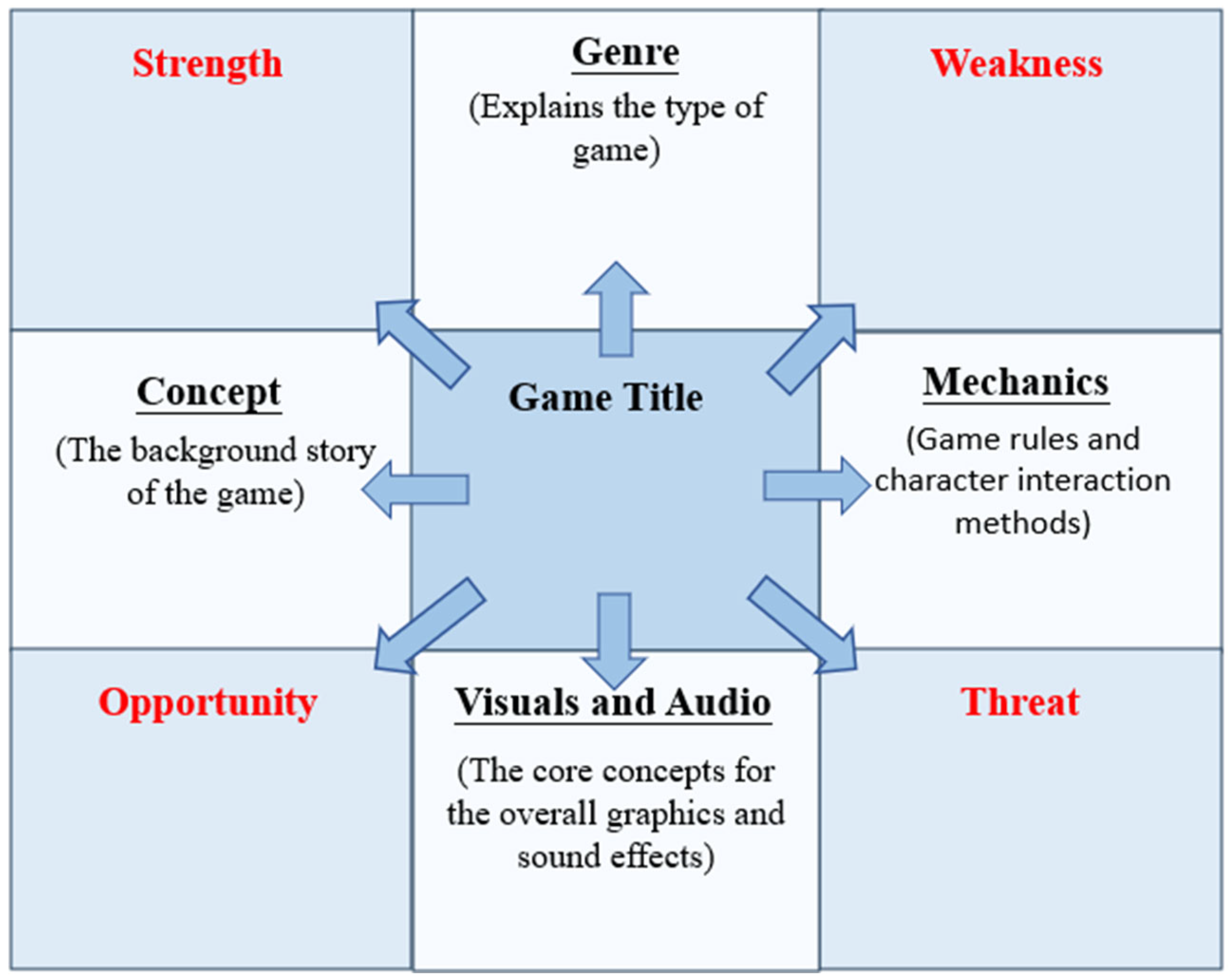
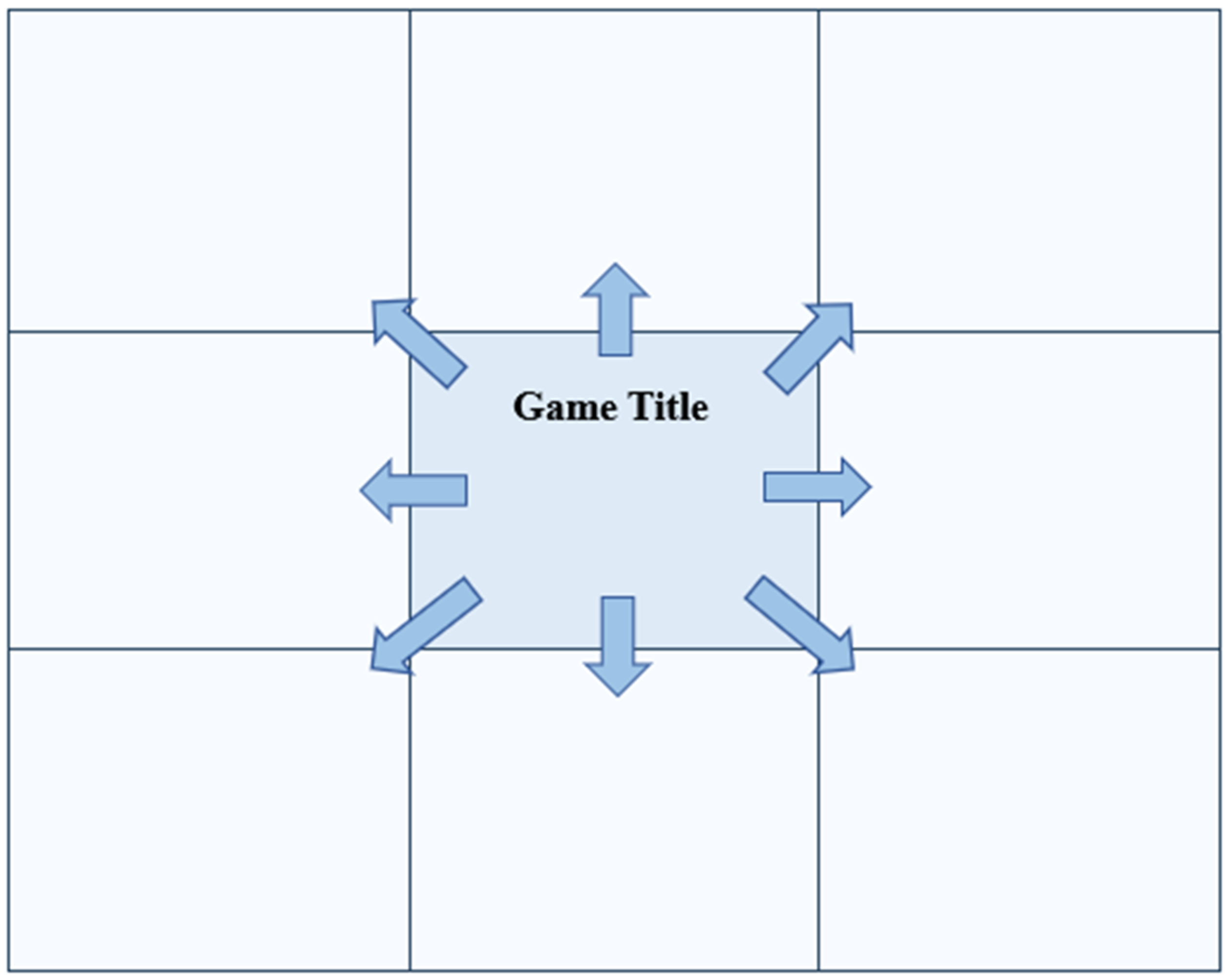
- Core Concepts and Thinking Patterns
- I.
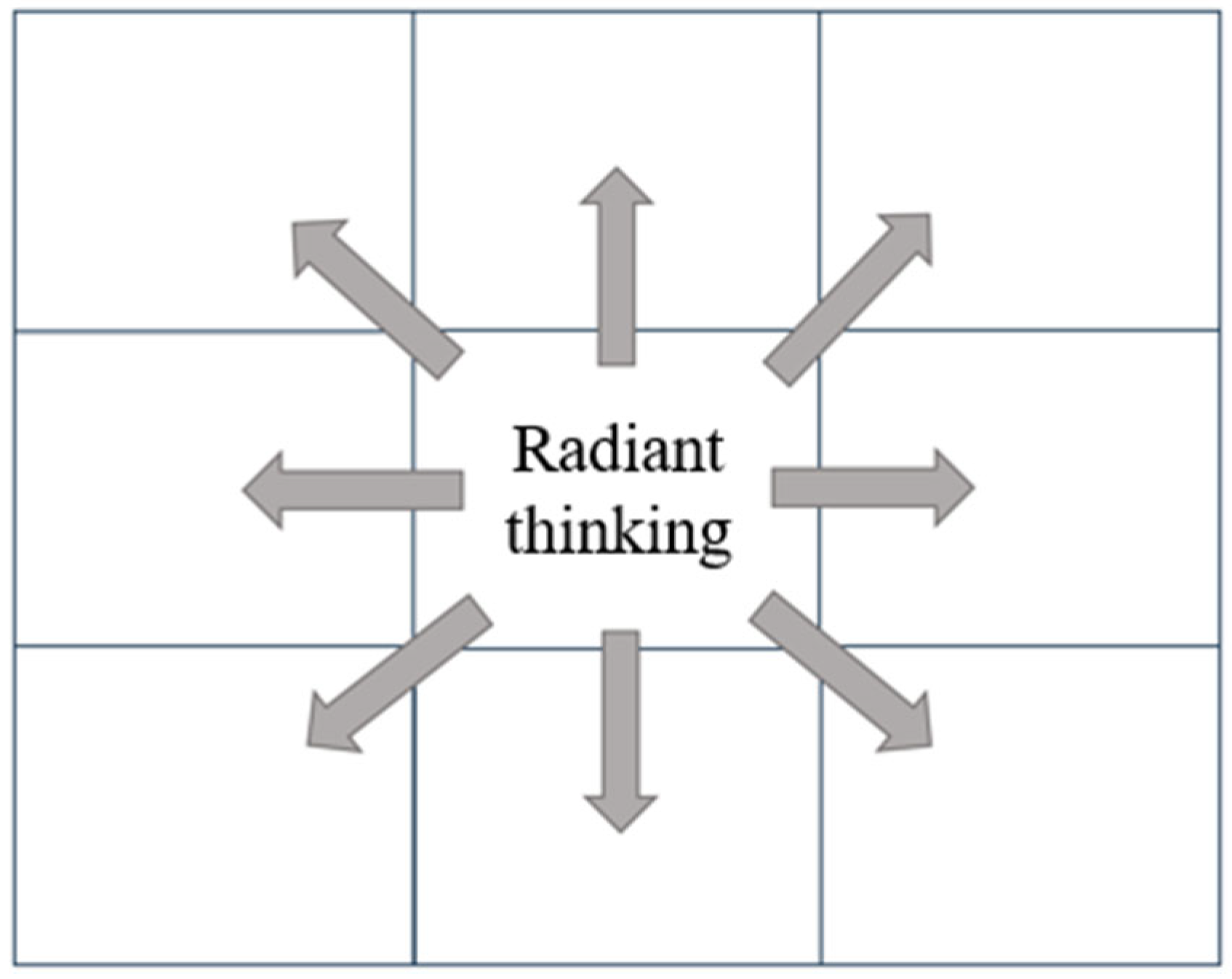
- Radiant Thinking:
- II.
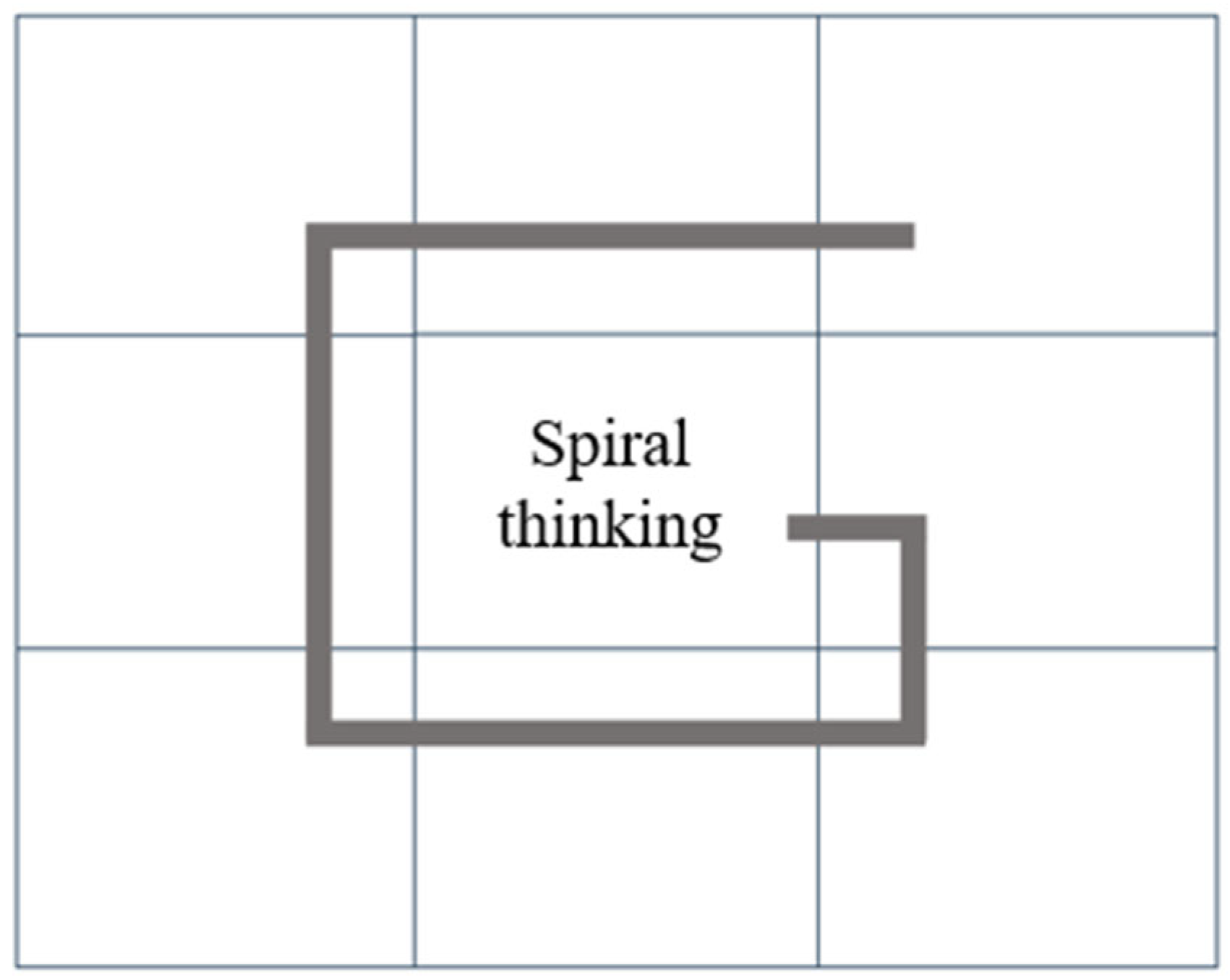
- Spiral Thinking:
2.3. Brainstorming
- Origins and Definition of Brainstorming
- Core Principles of Brainstorming
- 1.
- Delay Judgment:
- 2.
- Welcome Free Association:
- 3.
- Pursuit of Quantity:
- 4.
- Integration and Improvement:
2.4. Unity as a Conceptual Prototyping Tool
3. Research Methods
3.1. Research Structure
- I.
- Independent Variable:
- II.
- Dependent Variables:
- III.
- Control Variables:
3.2. Research Design
3.3. Experimental Design
3.3.1. Experimental Participants
3.3.2. Experimental Process
3.3.3. Research Tools
- Creative Learning Effectiveness Questionnaire:
- 2.
- Creative Self-Efficacy Questionnaire:
- 3.
- Innovation Behavior Questionnaire:
- 4.
- Interview Items:
3.4. Data Analysis
4. Results
4.1. Questionnaire Analysis
4.1.1. Creative Learning Outcomes
4.1.2. Creative Self-Efficacy
4.1.3. Innovation Behavior Questionnaire
4.1.4. Correlation Analysis of the Three Creative Dimensions
4.2. Interview Analysis
4.2.1. Steps for Analyzing Interview Data
- (1)
- Transcription
- (2)
- Interview Content Coding
- Open Coding: Break down interview content into initial concepts. At this stage, specifically flag any statements expressing emotions, subjective experiences, or cognitive judgments.
- Main Axis Coding: Using constant comparison, systematically compare the similarities and differences across the interviewees’ experiences to identify patterns and themes. Group initial concepts into abstract subcategories and explore relationships among these subcategories—such as conditions, phenomena, strategies, and outcomes. This stage aims to uncover the internal mechanisms within the creative process.
- (3)
- Core Theory Construction and Theme Development (Selective Coding)
4.2.2. Transcription of Interview Transcripts
4.2.3. Open Coding
4.2.4. Core Coding
- I.
- Thinking Structure and Guidance
- II.
- Creative Inspiration and Ideation
- III.
- Reflection, Review, and Refinement
- IV.
- Collaboration and Communication
- V.
- Creative Self-Efficacy and Confidence
4.2.5. Selective Coding
- The Mandala Thinking Method helped learners clarify direction and categorization, making their thought processes more structured and efficient.
- Learners generate more creative ideas, reducing mental blocks and anxiety.
- Enhanced creative self-efficacy increases learners’ confidence in accomplishing creative tasks.
- Mandala facilitated faster integration of team members’ ideas and smooth communication during consolidation.
- Works created using Mandala encouraged most students to share their creations with others willingly.
- The majority of students applied their creative ideas to designs and final products, demonstrating innovative behavior and practical skills.
5. Discussion
- RQ1: Differences in Creative Learning Outcomes
- RQ2: Differences in Creative Self-Efficacy
- RQ3: Differences in Innovative Behavior
6. Conclusions
6.1. Research Limitations
6.2. Future Research Directions
Author Contributions
Funding
Institutional Review Board Statement
Informed Consent Statement
Data Availability Statement
Conflicts of Interest
References
- Đorđević, B.; Milanović Zbiljić, S.; Radosavljević, M. Impact of digital skills on employability: Cross-sectional analysis. Economies 2025, 13, 196. [Google Scholar] [CrossRef]
- UCAN Project Office. 2024 UCAN application and exchange workshop. In Proceedings of the UCAN Application Exchange Workshop, Taipei, Taiwan, 26 August 2024; (In Chinese) Available online: https://ucan.moe.edu.tw/others/download.aspx (accessed on 29 February 2024).
- Thornhill-Miller, B.; Camarda, A.; Mercier, M.; Burkhardt, J.-M.; Morisseau, T.; Bourgeois-Bougrine, S.; Vinchon, F.; El Hayek, S.; Augereau-Landais, M.; Mourey, F.; et al. Creativity, critical thinking, communication, and collaboration: Assessment, certification, and promotion of 21st century skills for the future of work and education. J. Intell. 2023, 11, 54. [Google Scholar] [CrossRef]
- Karunarathne, W. Assessing creative thinking skills in higher education. Stud. High. Educ. 2024, 49, 157–177. [Google Scholar] [CrossRef]
- Mursid, R.; Saragih, A.H.; Hartono, R. The effect of the blended project-based learning model and creative thinking ability on engineering students’ learning outcomes. Int. J. Educ. Math. Sci. Technol. 2022, 10, 218–235. [Google Scholar] [CrossRef]
- Cheers Magazine. Survey of Taiwan’s Most Desirable University Graduates Among Employers. Cheers, 11 January 2024; (In Chinese). Available online: https://www.cheers.com.tw/article/article.action?id=5102772 (accessed on 11 January 2024).
- 104 Job Bank. University Brand Power—Ranking Across Ten Evaluation Indicators in Taiwan. 104 Job Bank, 29 February 2024; (In Chinese). Available online: https://nabi.104.com.tw/104article/152448 (accessed on 29 February 2024).
- Khadka, M.; Bhatta, K.D.; Adhikari, B.R. Higher-order thinking skills in e-learning contexts in higher education: A phenomenological study. Front. Educ. 2025, 10, 1618997. [Google Scholar] [CrossRef]
- Argyri, P.; Smyrnaiou, Z. Developing skills and attitudes for preparation future workforce: STEM education strategies. Eur. J. Educ. Pedagog. 2024, 5, 25–30. [Google Scholar] [CrossRef]
- Chang, T.-S.; Wang, H.-C.; Haynes, A.M.; Song, M.-M.; Lai, S.-Y.; Hsieh, S.-H. Enhancing student creativity through an interdisciplinary, project-oriented problem-based learning undergraduate curriculum. Think. Skills Creat. 2022, 46, 101173. [Google Scholar] [CrossRef]
- Mustamin, K.; Wahdah, W.; Intiardy, D.; Jumrah, A.M.; Pattiasina, P.J. The impact of project-based learning on students’ collaboration skills in secondary schools. Int. J. Educ. Res. Excell. 2024, 3, 992–998. [Google Scholar] [CrossRef]
- Kwon, H.; Lee, Y. A meta-analysis of STEM project-based learning on creativity. STEM Educ. 2025, 5, 275–290. [Google Scholar] [CrossRef]
- Chen, Y. Enhancing aesthetic and creative skills through innovative pedagogical approaches: Integrating mandala thinking and multisensory techniques in advanced dessert design. TQM J. 2025, in press. [Google Scholar] [CrossRef]
- Putri, I.G.A.P.; Quinton, H.W.; Selkrig, M. Reshaping teaching in higher education through a mandala of creative pedagogies. Teach. High. Educ. 2023, 28, 1251–1270. [Google Scholar] [CrossRef]
- Su, T.; Liu, J.; Meng, L.; Luo, Y.; Ke, Q.; Xie, L. The effectiveness of problem-based learning on critical thinking skills: A systematic review and meta-analysis. Front. Educ. 2025, 10, 1565556. [Google Scholar] [CrossRef]
- Tiara, T.; Istiqlallia, A.; Kantun, S. Collaboration and communication skills in problem-based learning in basic tax competencies. J. Pendidik. Ekon. 2024, 17, 23–34. [Google Scholar] [CrossRef]
- Santana, A.L.M.; de Deus Lopes, R. Using real-world problems and project-based learning for future skill development. In Creating the University of the Future; Ehlers, U.-D., Eigbrecht, L., Eds.; Springer: Cham, Switzerland, 2024; pp. 393–417. [Google Scholar] [CrossRef]
- Sulaiman, W.; Arifin, Z.I.; Subekti, H. The effectiveness of problem-based learning model with socio-scientific themes in improving critical thinking skills. SAR J. 2025, 8, 72–77. [Google Scholar] [CrossRef]
- Dolmans, D.H.J.M.; Loyens, S.M.M.; Marcq, H.; Gijbels, D. Deep and surface learning in problem-based learning: A review of the literature. Adv. Health Sci. Educ. 2016, 21, 1087–1112. [Google Scholar] [CrossRef] [PubMed]
- Xue, H.; Lu, Y.; Liu, L. Efficacy of problem-based learning in enhancing health education skills, self-directed learning, and critical thinking among nursing interns. BMC Med. Educ. 2025, 25, 936. [Google Scholar] [CrossRef] [PubMed]
- Kassab, S.E.; Hamdy, H.; Mamede, S.; Schmidt, H.G. Influence of tutor interventions and group process on medical students’ engagement in problem-based learning. Med. Educ. 2024, 58, 1315–1323. [Google Scholar] [CrossRef]
- Guilford, J.P. The Nature of Human Intelligence; McGraw-Hill: New York, NY, USA, 1967. [Google Scholar]
- Torrance, E.P. Torrance Tests of Creative Thinking: Norms–Technical Manual; Ginn: Lexington, MA, USA, 1974. [Google Scholar]
- Cropley, A. In praise of convergent thinking. Creat. Res. J. 2006, 18, 391–404. [Google Scholar] [CrossRef]
- Lee, K.-W. Effectiveness of gamification and selection of appropriate teaching methods of creativity: Students’ perspectives. Heliyon 2023, 9, e20420. [Google Scholar] [CrossRef]
- Clancy, S.M.; Murphy, L.R.; Daly, S.R.; Seifert, C.M. Iterative transformations for deeper exploration during concept generation. Int. J. Technol. Des. Educ. 2024, 34, 267–305. [Google Scholar] [CrossRef]
- Wang, X.M.; Wang, J.L.; Xu, S.Y.; Xu, S.J. Concept mapping in STEM education: A meta-analysis of its effects. Int. J. STEM Educ. 2025, 12, 30. [Google Scholar] [CrossRef]
- Wigert, B.G.; Murugavel, V.R.; Reiter-Palmon, R. The utility of divergent and convergent thinking in the problem construction process during creative problem-solving. Psychol. Aesthet. Creat. Arts 2022, 18, 858–868. [Google Scholar] [CrossRef]
- Farrokhnia, M.; Noroozi, O.; Baggen, Y.; Biemans, H. Sparking creativity in entrepreneurship courses: Investigating the effect of hybrid brainstorming sessions on business opportunity identification outcomes. In Proceedings of ICSES 2022; ISTES Organization: Antalya, Turkey, 2022; pp. 444–454. [Google Scholar]
- Gong, Z.; Lee, L.-H.; Soomro, S.A.; Nanjappan, V.; Georgiev, G.V. A systematic review of virtual brainstorming from the perspective of creativity: Affordances, framework, and outlook. Digit. Creat. 2022, 33, 96–127. [Google Scholar] [CrossRef]
- Paulus, P.B.; Baruah, J.; Kenworthy, J.B. Brainstorming: How to get the best ideas out of the group brain for organizational creativity. In Handbook of Organizational Creativity; Oxford University Press: Oxford, UK, 2023; pp. 373–389. [Google Scholar] [CrossRef]
- Henningsen, D.D.; Henningsen, M.L. Considering the rules of brainstorming in untrained idea-generating groups. Groupwork 2023, 30, 2. [Google Scholar] [CrossRef]
- Rippich, K. Report on No-/Low-Code Approaches to Computer Game Development for the AWARE Project; University of Glasgow: Glasgow, UK, 2023; Available online: https://eprints.gla.ac.uk/321255/ (accessed on 31 January 2026).
- Chen, C.-Y. Abbreviated Torrance Test for Adults (ATTA); Psychological Publishing Co.: Taipei, Taiwan, 2006. (In Chinese) [Google Scholar]
- Wang, M.-R. A Revision Study of the Williams Creativity Test. Master’s Thesis, National Changhua University of Education, Changhua, Taiwan, 1984. (In Chinese) [Google Scholar]
- Hsu, S.-C.; Chien, H.-H.; Tsai, T.-C. An Action Research on the Effects of Creative Activities on Students’ Creative Inspiration. Hsiuping J. Humanit. Soc. Sci. 2008, 11, 133–150. (In Chinese) [Google Scholar]
- Hung, S.-P.; Lin, S.-J. A Social Cognitive Model of Significant Other’s Feedback, Creative Self-efficacy, Internal Motivation and External Motivation on Creative Behavior: A Structure Equation Modeling Study. 2003. (In Chinese) Available online: https://ir.lib.nycu.edu.tw/handle/11536/61225 (accessed on 31 January 2026).
- Wu, J.-J. Innovation Behavior Scale; Unpublished instrument; National Chengchi University: Taipei, Taiwan, 1996. (In Chinese) [Google Scholar]
- Cheng, C.-J. A Study on the Relationships Among Learning Strategies, Creative Self-Efficacy, Innovative Behavior, and Creative Learning Effectiveness of Vocational College Students Enrolled in Creativity Courses. Ph.D. Dissertation, National Changhua University of Education, Changhua, Taiwan, 2011. (In Chinese) Available online: https://hdl.handle.net/11296/8562wm (accessed on 31 January 2026).
- Glaser, B.G.; Strauss, A.L. The Discovery of Grounded Theory: Strategies for Qualitative Research; Aldine: Chicago, IL, USA, 1967. [Google Scholar]
- Charmaz, K. Constructing Grounded Theory, 2nd ed.; SAGE Publications: Thousand Oaks, CA, USA, 2014. [Google Scholar]
- Gao, S.-C. Qualitative Research: Eighteen Lessons—A Revisiting Journey; Liwen Publishing: Taipei, Taiwan, 2008. (In Chinese) [Google Scholar]
- Ou, M.-H. A Sentiment Analysis Study on the Impact of News Headlines on Readers. Doctoral Dissertation, National Tainan University, Tainan, Taiwan, 2016. Available online: https://hdl.handle.net/11296/6u4k4x (accessed on 31 January 2026).
- Chang, S.-T.; Lu, T.-Y.; Chu, H.-C. Effects on Career-Undecided University Students through Mandala Creation. Int. J. Arts Educ. 2023, 21, 132–174. (In Chinese). Available online: https://tci.ncl.edu.tw/cgi-bin/gs32/gsweb.cgi?o=dnclresource&s=id=%22A2024000988%22.&searchmode=basic&tcihsspage=tcisearch_opt1_search (accessed on 31 January 2026).
- Braun, V.; Clarke, V. Using thematic analysis in psychology. Qual. Res. Psychol. 2006, 3, 77–101. [Google Scholar] [CrossRef]
- Childs, P.; Han, J.; Chen, L.; Jiang, P.; Wang, P.; Park, D.; Yin, Y.; Dieckmann, E.; Vilanova, I. The creativity diamond—A framework to aid creativity. J. Intell. 2022, 10, 73. [Google Scholar] [CrossRef]
- Calavia, M.B.; Blanco, T.; Casas, R. Fostering creativity as a problem-solving competence through design: Think–Create–Learn. Think. Ski. Creat. 2021, 39, 100761. [Google Scholar] [CrossRef]
- Henriksen, D.; Richardson, C.; Mehta, R. Design thinking: A creative approach to educational problems of practice. Think. Ski. Creat. 2017, 26, 140–153. [Google Scholar] [CrossRef]



| Group | N | Mean | Standard Deviation | Adjusted Mean | F | η2 |
|---|---|---|---|---|---|---|
| Experimental | 30 | 5.372 | 0.847 | 5.291 | 14.796 ** | 0.206 |
| Control | 30 | 4.813 | 0.447 | 4.895 |
| Group | N | Mean | Standard Deviation | Adjusted Mean | F | η2 |
|---|---|---|---|---|---|---|
| Experimental | 30 | 5.022 | 0.963 | 4.961 | 6.014 * | 0.095 |
| Control | 30 | 4.503 | 0.499 | 4.564 |
| Group | N | Mean | Standard Deviation | Adjusted Mean | F | η2 |
|---|---|---|---|---|---|---|
| Experimental | 30 | 5.238 | 0.859 | 5.159 | 4.827 * | 0.032 |
| Control | 30 | 4.705 | 0.638 | 4.74 |
| Group | 1 | 2 | 3 |
|---|---|---|---|
| 1. Creative Learning Outcomes | 1 | 0.827 ** | 0.802 ** |
| 2. Creative Self-Efficacy | 1 | 0.812 ** | |
| 3. Innovative Behavior | 1 |
| Pseudonym | Age | Gender | Interview Date | Group | Location |
|---|---|---|---|---|---|
| Participant A | 21 | Female | 26 May 2025 | Experimental Group | University Laboratory |
| Participant B | 22 | Female | 26 May 2025 | ||
| Participant C | 22 | Female | 26 May 2025 | ||
| Participant D | 21 | Female | 26 May 2025 | ||
| Participant E | 22 | Female | 27 May 2025 | ||
| Participant F | 22 | Female | 29 May 2025 | ||
| Participant G | 21 | Male | 29 May 2025 | ||
| Participant H | 21 | Male | 6 June 2025 |
| No. | Questions |
|---|---|
| 1 | During this project using the Two-Tier Mandala Method, some students showed a significant increase in their creative thinking scores. Did you find it easier to come up with inspiration during this creative task? Why or why not? |
| 2 | Regarding items like “I can think of different ways to handle things,” your score improved greatly. Which specific cell or direction in the Two-Tier Mandala helped you the most? Can you share the idea you had at that time? |
| 3 | In the questionnaire, you mentioned you are more confident in finding answers that others might not think of. Did the Mandala Method make you feel more confident during this creative task? |
| 4 | Is there a specific idea in your final work that made you think, “I am truly creative”? How did you come up with it? |
| 5 | During the design process, did you go back to review or modify your initial ideas? |
| 6 | Did the Mandala Method help you discover any problems or areas for improvement that you hadn’t initially considered? How did you adjust during that process? |
| 7 | Compared to previous class assignments, what felt different about adding the Mandala Method to this creative task? |
| 8 | While working on this task, was there a specific stage where you felt particularly engaged or thought, “This is actually quite fun”? |
| 9 | Did you try to actively share the creative ideas you came up with during this task with your classmates or teacher? What was the result? |
| 10 | If you wanted others to understand the creativity of this work, how would you introduce or promote it? |
| 11 | Overall, do you feel that using the Mandala Method in this creative task was helpful to you? Why? |
| 12 | Was there a specific moment during this task that left a deep impression on you or triggered an emotional response (e.g., excitement, feeling stuck, being inspired)? Please share. |
| Coding Meaning | ||
|---|---|---|
| Character One | Character Two | Character Three |
| Interviewee Number | Question Number | Response Segment |
| A~H | 01–12 | 1–5 |
| Code | Conversation Content | Coding Significance |
|---|---|---|
| A-01-01 |
| Confirms the appearance of inspiration; provides a thinking context and framework; guides expected outcomes. |
| Core Category | Primary Axial Coding | Basis for Classification & Logic |
|---|---|---|
| Creative Thinking Process |
| Focuses on initiating and organizing thoughts. The Mandala Method provides a “contextual framework” and “conceptual grid” that solves the problem of not knowing where to start, serving as cognitive preparation and orientation. |
| Focuses on generating and expanding ideas. Includes using “prompts” to generate unexpected items and using rhyming dictionaries or sudden creative flashes. This is the core generation phase. | |
| Creative Outcome Transformation |
| Focuses on quality control and turning ideas into feasible plans. Includes scaling down projects when encountering technical issues, discovering the need for SWOT analysis, and correcting overly complex designs. This is the iterative optimization phase. |
| Focuses on the execution mechanism of team ideas. Streamlines discussions for after-hours work, speeds up division of labor through “ordered processes,” and resolves disagreements by producing “compromise solutions”. | |
| Focuses on the final psychological outcome. When interviewees see their ideas become “creative realities” and feel “great” about finishing the whole project, this sense of achievement serves as an indicator of successful transformation. |
Disclaimer/Publisher’s Note: The statements, opinions and data contained in all publications are solely those of the individual author(s) and contributor(s) and not of MDPI and/or the editor(s). MDPI and/or the editor(s) disclaim responsibility for any injury to people or property resulting from any ideas, methods, instructions or products referred to in the content. |
© 2026 by the authors. Licensee MDPI, Basel, Switzerland. This article is an open access article distributed under the terms and conditions of the Creative Commons Attribution (CC BY) license.
Share and Cite
Kuo, Y.-C.; Lee, S.-Y. The Effects of Integrating PBL Teaching Strategies with Two-Tier Mandala Thinking on Innovation Education. Appl. Sci. 2026, 16, 1903. https://doi.org/10.3390/app16041903
Kuo Y-C, Lee S-Y. The Effects of Integrating PBL Teaching Strategies with Two-Tier Mandala Thinking on Innovation Education. Applied Sciences. 2026; 16(4):1903. https://doi.org/10.3390/app16041903
Chicago/Turabian StyleKuo, Yu-Chen, and Shih-Ying Lee. 2026. "The Effects of Integrating PBL Teaching Strategies with Two-Tier Mandala Thinking on Innovation Education" Applied Sciences 16, no. 4: 1903. https://doi.org/10.3390/app16041903
APA StyleKuo, Y.-C., & Lee, S.-Y. (2026). The Effects of Integrating PBL Teaching Strategies with Two-Tier Mandala Thinking on Innovation Education. Applied Sciences, 16(4), 1903. https://doi.org/10.3390/app16041903