Article

Biomechanical and Thermophysiological Effects of Electric Olive Harvesters: A Pilot Study Using Myotonometry and Infrared Thermography

1
Occupational Medicine, Department of Clinical and Experimental Medicine, University of Catania, Via Santa Sofia, 78, 95123 Catania, Italy
2
School of Medicine, Section of Anatomy, Histology and Movement Science, Department of Biomedical and Biotechnological Sciences, University of Catania, Via Santa Sofia, 78, 95123 Catania, Italy
3
Department of Medicine and Surgery, University of Enna “Kore”, 94100 Enna, Italy
4
Department of Occupational and Environmental Health, University of West Attica, 10563 Athens, Greece
5
Council for Agricultural Research and Economics (CREA), Research Centre for Engineering and Agro-Food Processing, Via Milano 43, 24047 Treviglio, Italy
6
Department of Occupational and Environmental Medicine, Riga Stradinš University, Dzirciema Street 16, LV-1007 Riga, Latvia
7
Department of Medical and Surgical Sciences, University of Foggia, 71122 Foggia, Italy
*
Authors to whom correspondence should be addressed.
These authors contributed equally to this work.
Appl. Sci. 2026, 16(4), 1882; https://doi.org/10.3390/app16041882
Submission received: 31 December 2025 / Revised: 7 February 2026 / Accepted: 11 February 2026 / Published: 13 February 2026

Abstract

Background: Mechanization in olive harvesting has improved productivity but introduced new ergonomic challenges, particularly related to vibration exposure and sustained overhead work. This study investigates the acute and short-term physiological effects of using an electric olive harvester through objective instrumental assessment. Methods: Ten healthy male volunteers performed a standardized 15-min simulated harvesting task using an electric olive harvester. Muscle tone, stiffness, and elasticity of bilateral deltoid, biceps, and triceps were assessed by myotonometry at baseline (T0), immediately post-task (T1), and after 2 h recovery (T2). Infrared thermography evaluated cervical, dorsal, and lumbar skin temperature at the same timepoints. Results: Significant, side-dependent alterations in myotonometric parameters were observed, with marked increases in tone and stiffness of dominant upper-limb muscles and asymmetric adaptations between limbs (p < 0.001, large effect sizes). Infrared thermography revealed significant post-task reductions in skin temperature across spinal regions, with a partial return toward baseline within the 2 h observation window (p < 0.01). These findings describe short-term, task-related thermoregulatory responses following sustained work. Conclusions: Even short-term use of electric olive harvesters induces measurable biomechanical and thermophysiological stress. The integrated use of myotonometry and infrared thermography provides a sensitive, field-adaptable framework for early ergonomic risk detection and prevention of work-related musculoskeletal disorders in agriculture.

1. Introduction

Agricultural practices have undergone profound transformations in recent years. The use of increasingly engineered equipment has enhanced work safety and productivity [1,2,3]. Specifically, in olive harvesting, the mechanization of processes has seen significant advancements, driven by the critical needs for increased efficiency, labor optimization, and reduced operational costs [4]. Traditional olive harvesting, encompassing manual techniques such as brucatura (hand-picking), bacchiatura (pole beating), pettinatura (raking), and scrollatura (shaking), was characterized by considerable physical exertion and prolonged operational times. These practices frequently exposed workers to sustained repetitive motions, awkward and static postures (e.g., prolonged bending or kneeling), and manual handling of loads, contributing to a high incidence of musculoskeletal strain and cumulative trauma disorders [5,6]. Studies have specifically highlighted risks such as tendinitis and significant discomfort in the lower back and upper limbs among olive farmers engaged in these traditional tasks [7]. However, the introduction of mechanized tools has also altered the nature of physical demands, shifting workloads from predominantly dynamic manual actions to sustained static postures and vibration exposure.
To mitigate these issues, electric olive harvesters (known in Italy as abbacchiatori) have become increasingly common. These tools, employing vibrational force to detach olives, significantly reduce gross manual effort and harvesting duration. However, this mechanization has not entirely eliminated ergonomic risks; instead, it has shifted the nature of the physical burden. Workers are now exposed to sustained overhead work, increased static loading on the shoulder and cervical regions, and prolonged exposure to hand–arm vibration (HAV) [8,9]. Research indicates that electric beaters can transmit high vibration levels, with daily exposures potentially exceeding recommended limits, and that the characteristic operator posture (arms held above shoulder level) can lead to upper-limb disorders distinct from, yet often compounded by, HAV-related pathologies [7]. Consequently, operators may develop work-related musculoskeletal disorders (WMSDs) affecting a wide range of hand, shoulder girdle, and neck muscles—including the deltoid, biceps, triceps, and paraspinal musculature—areas demanding more focused investigation within agricultural ergonomics [10,11].
Conventional observational tools such as RULA, REBA, or OCRA are widely utilized for ergonomic risk classification in field settings. While valuable for providing a general risk score, their application in diverse and dynamic agricultural environments can be challenging. These methods often provide limited physiological insight into actual muscle fatigue, vasomotor responses, or tissue recovery processes. While useful for global risk stratification, these methods provide limited insight into underlying physiological responses and may be difficult to apply consistently in dynamic agricultural environments [12].
Recent advances in instrumented ergonomic assessment, particularly myotonometry and infrared thermography (IRT), offer a paradigm shift by enabling the objective quantification of biomechanical and circulatory responses in a non-invasive, real-time, and field-adaptable manner [13,14,15].
Myotonometry provides objective data on muscle mechanical properties such as tone, stiffness, and elasticity [16]. Although it does not directly measure muscle fatigue, changes in these mechanical parameters following a fatiguing task are considered indirect indicators of fatigue-related alterations in muscle mechanical behavior, reflecting modifications in muscle tone and viscoelastic properties associated with the fatigued state [17].
Simultaneously, IRT records infrared radiation emitted from the body and reconstructs spatial distributions of superficial skin temperature [18]. While it does not directly assess inflammatory processes, these thermal patterns are influenced by factors such as cutaneous blood flow, vasomotor activity, and thermoregulation. Accordingly, localized temperature variations observed with IRT may reflect indirect physiological responses related to muscular exertion or strain, rather than serving as specific markers of inflammation [19]. These tools are increasingly recognized for their complementary value in occupational health surveillance, particularly in sectors such as agriculture, where traditional laboratory-based assessments are impractical. Their integrated application allows for the early identification of biomechanical overload—often before symptoms become chronic—and supports ergonomic task and tool redesign, thereby contributing to more effective preventive strategies for long-term health outcomes in the agricultural workforce [20,21].
Despite the growing adoption of mechanized tools, a gap persists in understanding the nuanced physiological responses of operators to specific devices such as electric olive harvesters, particularly when assessed using combined, objective techniques under real-world or simulated field conditions. Although myotonometry and infrared thermography have been individually applied in occupational and sports settings, their combined use to characterize acute workload and short-term recovery responses during mechanized agricultural tasks remains largely unexplored, particularly in relation to specific tools such as electric olive harvesters.
Therefore, the present pilot study aims to investigate the acute and subacute effects of using an electric olive harvester on selected upper-limb muscle groups and spinal soft tissue perfusion. By applying myotonometry and IRT imaging, we aim to quantify postural and vibrational stress responses and assess their resolution over time.
Based on the identified gap, this pilot study was designed to test the following hypotheses:
(I).
The use of an electric olive harvester would induce side-dependent changes in upper-limb muscle mechanical properties, with increased tone and stiffness predominantly in the dominant arm;
(II).
Spinal skin temperature would show measurable post-task changes consistent with task-related thermoregulatory responses following sustained work;
(III).
These biomechanical and thermophysiological responses would show only partial recovery within a 2 h observation window. Overall, this pilot study provides preliminary evidence supporting the use of integrated myotonometric and thermographic assessments to characterize biomechanical and thermophysiological responses to mechanized olive harvesting tasks.

2. Materials and Methods

2.1. Participants

This observational study was conducted in March 2024 on ten healthy adult male volunteers with no musculoskeletal disorders or recent upper limb injuries. The investigation was designed as a pilot observational study aimed at exploring the feasibility and sensitivity of combined myotonometric and thermographic assessments during a realistic agricultural task. Only male participants were included to reduce physiological variability related to well-documented sex-specific differences in muscle mechanical properties and skin temperature regulation, which could confound the interpretation of the results [22]. Participants provided informed consent and were briefed on the procedures. Before participation, demographic characteristics, anthropometric parameters (including body mass index), and lifestyle habits (smoking status, alcohol consumption, and physical activity) were collected for all participants by a physician specialized in Occupational Medicine. At baseline (T0, before the intervention) and at T1 post-intervention (within 10 min), systolic (SBP) and diastolic (DBP) blood pressure and heart rate were assessed in all participants.
Inclusion criteria were right-handedness and the absence of a history of neurological or vascular disorders. Exclusion criteria included the use of medications, recent musculoskeletal injuries, acute or chronic inflammatory conditions, and engagement in strenuous physical activity, alcohol consumption, or caffeine intake within 24 h prior to testing.
The study protocol adhered to the ethical principles of the Declaration of Helsinki and institutional guidelines. Data collection was approved by the Research Center in Motor Activities (CRAM), University of Catania (protocol no. CRAM-016-2020, 16 March 2020).

2.2. Study Design

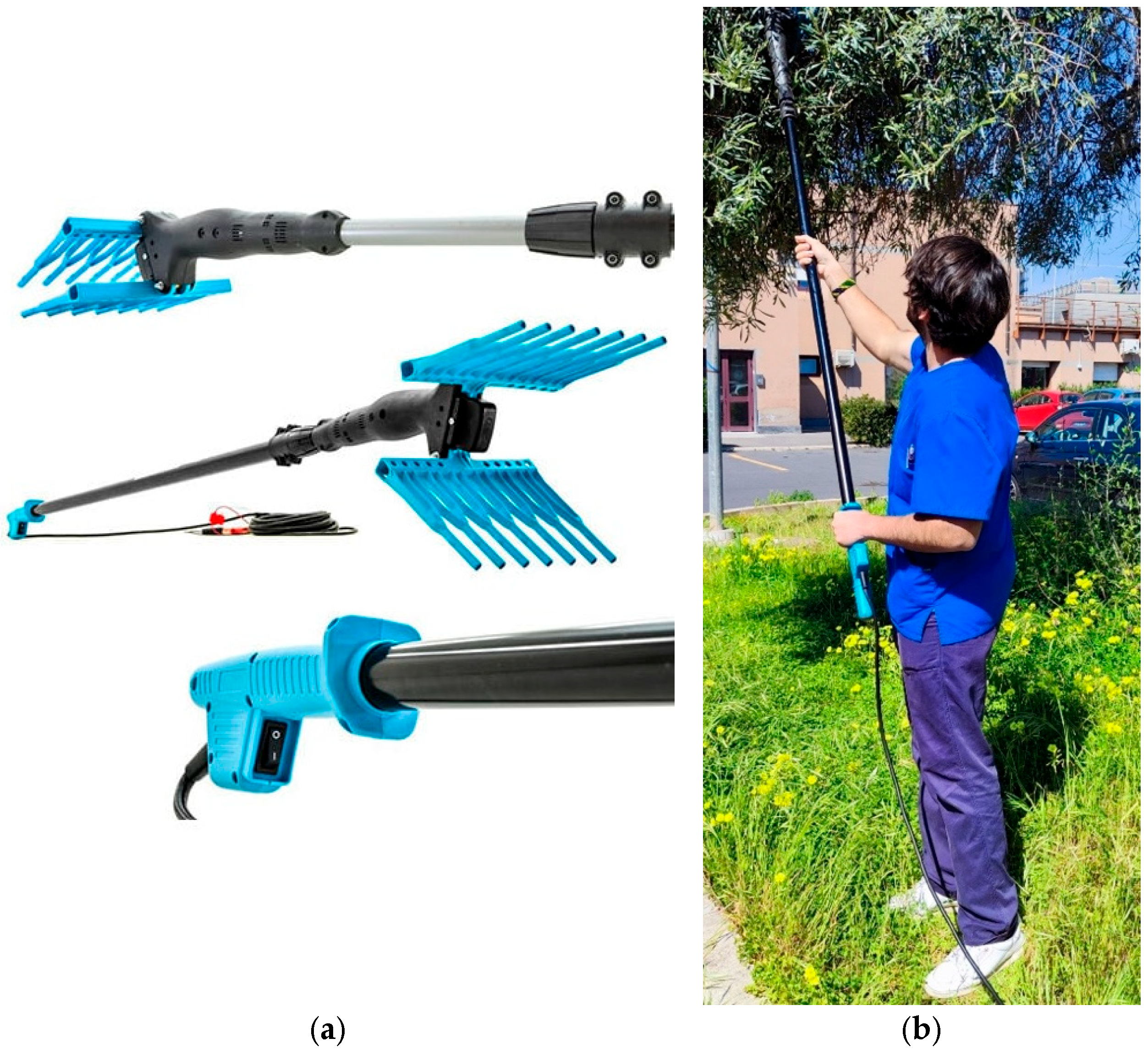
Participants operated an electric olive harvester (CILLI B-140; weight: 8.12 kg; adjustable length: 1.9–2.80 m; operating speed: 1000 rpm) under supervised and standardized conditions during a defined harvesting task consisting of a 15 min continuous active phase (Figure 1). All tasks were supervised by a researcher to ensure standardized execution. Participants were instructed to maintain a consistent working rhythm, avoiding pauses during the task, and to perform cyclic sweeping movements within the canopy at a self-selected but steady cadence representative of real field practice.
The harvesting simulation was conducted on olive branches positioned at a height of 1.8–2.4 m from the ground, corresponding to the typical productive zone of adult Olea europaea trees and consistent with agronomic guidelines for Sicilian cultivars, including Nocellara dell’Etna [23,24,25].
The task was designed to replicate real agricultural activity and involved prolonged arm elevation above shoulder level, sustained grip force, and repetitive movements. The working posture was characterized by sustained shoulder flexion and abduction angles of approximately 90–120°, elbow flexion of 60–90°, and continuous isometric contraction of the forearm flexor muscles. Cyclic sweeping movements of the tool within the canopy produced a vertical working excursion of approximately 1.5 m, with repeated transitions between overhead and semi-overhead postures.
Environmental conditions were controlled and monitored throughout the experimental session; ambient temperature was maintained between 22 and 24 °C, with relative humidity at approximately 50%.

2.3. Myotonometry

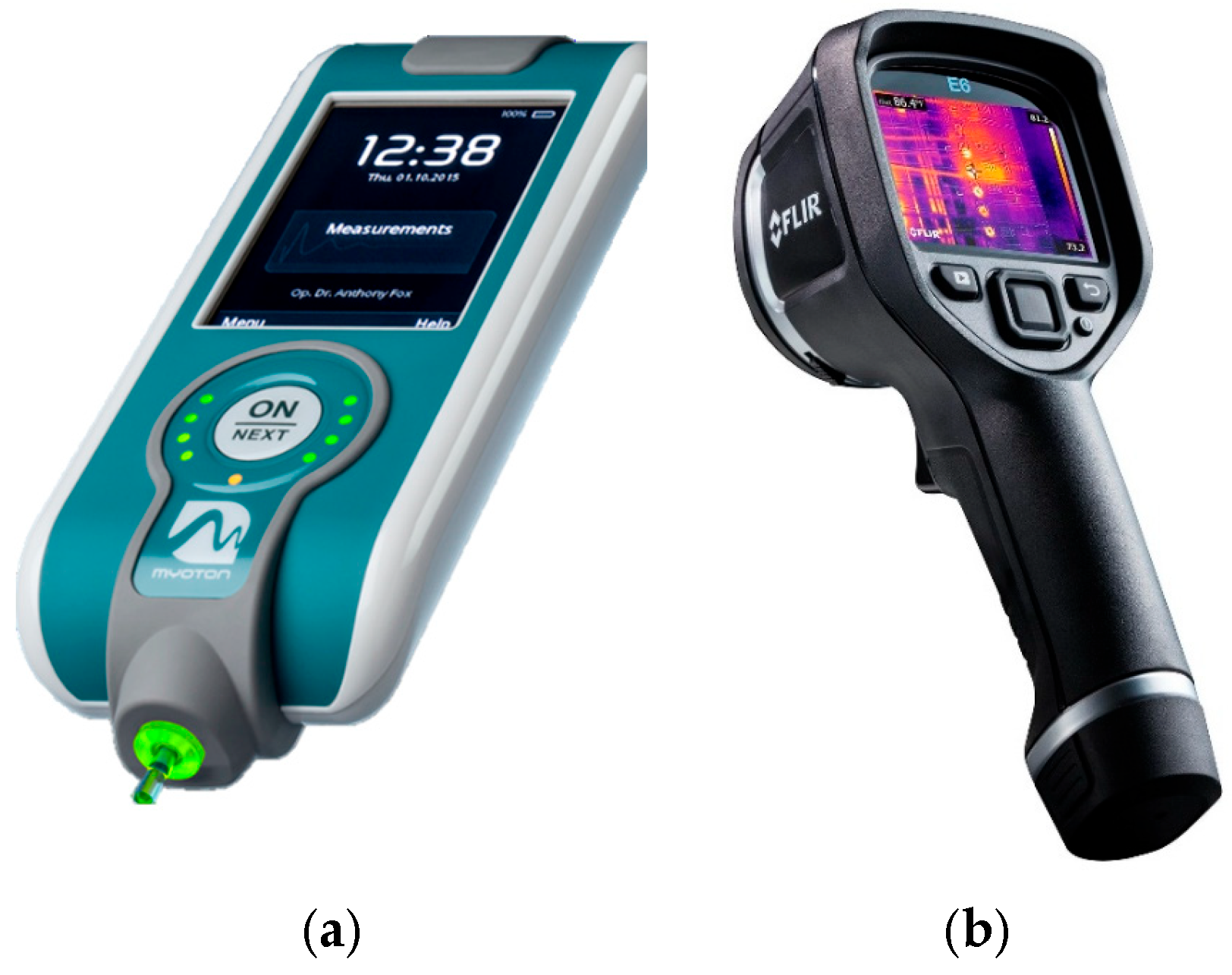
Myotonometric evaluation was performed using a handheld MyotonPRO® device (Myoton AS, Tallinn, Estonia) to assess biomechanical parameters of the bilateral deltoid, biceps brachii, and triceps brachii muscles, which were selected because they play a primary role in shoulder stabilization, arm elevation, and elbow control during prolonged overhead and repetitive upper-limb tasks, such as the operation of electric olive harvesters. All measurements were conducted in accordance with the manufacturer’s guidelines. Measurement sites were defined using standardized anatomical landmarks for each muscle: the deltoid was assessed at the midpoint between the acromion and the deltoid tuberosity, the biceps brachii at the midpoint of the muscle belly between the acromion and the antecubital fossa, and the triceps brachii at the midpoint between the acromion and the olecranon. Measurements were performed bilaterally. To ensure anatomical reproducibility across timepoints (T0, T1, and T2), all measurement locations were marked on the skin using a dermographic marker and maintained throughout the experimental session. Assessments were performed with participants seated, shoulders in a neutral position, elbows flexed at approximately 90°, forearms supported, and the tested limb fully relaxed. All measurements were collected by the same trained evaluator to minimize inter-operator variability. For each muscle, three consecutive measurements were obtained, and the mean value was retained for analysis. This standardized protocol, including fixed anatomical landmarks, consistent participant positioning, repeated measurements, and operator consistency, was adopted to reduce measurement error and enhance the reliability of the collected data (Figure 2a).

2.4. Infrared Thermography (IRT)

Thermal imaging of the cervical, dorsal, and lumbar spine regions was conducted using a FLIR E54 camera (Wilsonville, OR, USA), with a detector resolution of 320 × 240 pixels and thermal sensitivity < 0.04° C, was used for the IR images (Figure 2). The IR acquisitions were carried out according to the TISEM checklist to ensure the quality of thermal images and reduce bias [26]. The emissivity level was set at 0.98 in a room with a temperature of 20 ± 2 °C and humidity of 50%. Thermograms were acquired at each timepoint (T0, T1, T2), ensuring a 15-min acclimatization period for participants, no direct exposure to sunlight or air conditioning during assessments, and a consistent camera distance (1.2 m) and angle for all shots. Each thermogram was analyzed using FLIR Thermal Studio PRO software. Regions of interest were defined bilaterally over the cervical, dorsal, and lumbar areas. Image processing and region selection were performed in strict accordance with the practical guidelines proposed by Ammer and Ring to minimize potential sources of bias and enhance methodological consistency [25].

2.5. Statistical Analysis

Statistical analyses were performed using R software (version 4.3.3) and conducted separately for thermographic and myotonometric datasets. Data normality was assessed using the Shapiro–Wilk test. Temporal changes were quantified using difference scores defined as Δ01 = T0 − T1 and Δ12 = T1 − T2, with positive values indicating a decrease and negative values an increase over time. For normally distributed data, paired t-tests were used to compare consecutive timepoints, while one-sample t-tests assessed whether Δ values differed from zero (H0: mean(Δ) = 0). When normality assumptions were violated, Wilcoxon signed-rank tests were applied. Given the small sample size (n = 10) and multiple comparisons across variables and time intervals, p-values were adjusted for multiplicity using the Holm method; Benjamini–Hochberg false discovery rate (FDR) correction was additionally computed as a sensitivity analysis. Effect sizes were calculated as Cohen’s d for dependent samples for paired comparisons and as mean Δ divided by its standard deviation for one-sample tests. Effect sizes for paired comparisons were calculated using Cohen’s d for dependent samples, defined as the mean of the paired differences divided by the standard deviation of those differences. For one-sample tests on Δ variables, effect size was computed as the mean Δ divided by its standard deviation. Effect sizes were interpreted according to conventional thresholds (0.1 = small, 0.4 = medium, 0.8 = large) [27]. Results are reported as mean ± SD with 95% confidence intervals, and statistical significance was set at p < 0.05 after adjustment.

3. Results

The sample had a mean age of 32.4 ± 2.1 years and a mean Body Mass Index (BMI) of 23.8 ± 0.8 kg/m2. They occasionally engaged in sports activities. None of the participants were smokers, while nine out of ten reported occasional alcohol consumption. Cardiovascular parameters were within the normal range at baseline. At T0, mean SBP was 112 ± 3.2 mmHg, mean DBP 72 ± 4.8 mmHg, and heart rate 71 ± 8.1 bpm. After the task (T1), SBP, DBP, and heart rate increased significantly (SBP: 122 ± 4.4 mmHg; DBP: 79 ± 5.0 mmHg; heart rate: 83 ± 6.5 bpm; p < 0.01 for all comparisons), while remaining within the reference range.
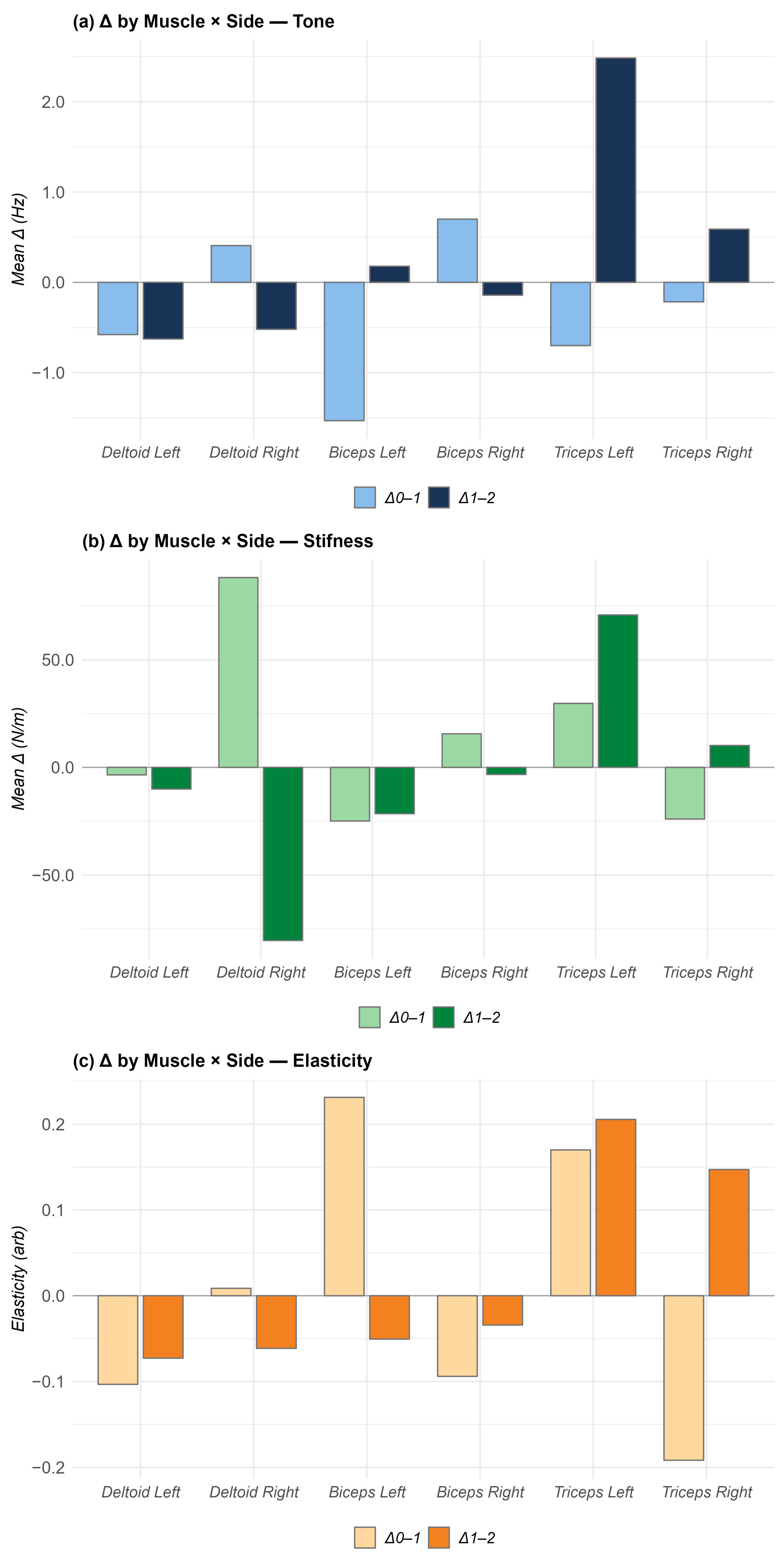
Myotonometric evaluation revealed clear side- and muscle-dependent variations in tone, stiffness, and elasticity following the mechanical harvesting task (see Table 1 and Figure 3). In the biceps, the dominant side showed a marked rise in both tone (Δ0–1 = +0.70 ± 0.46 Hz, p < 0.001, d = 1.14) and stiffness (Δ0–1 = +15.60 ± 8.10 N/m, p < 0.001, d = 1.07), followed by mild, non-significant decreases at follow-up. Elasticity decreased slightly (Δ0–1 = −0.09 ± 0.05, p < 0.001), suggesting transient muscle stiffening. Conversely, the non-dominant biceps showed the opposite pattern, with tone (Δ0–1 = −1.53 ± 0.83 Hz, p < 0.001, d = −1.16) and stiffness (Δ0–1 = −24.96 ± 17.59 N/m, p < 0.001) both decreasing, while elasticity significantly increased (Δ0–1 = +0.23 ± 0.13, p < 0.001, d = 1.51). These results highlight asymmetric responses between dominant and non-dominant arms.
In the deltoid, the right side showed moderate tone elevation (Δ0–1 = +0.41 ± 0.88 Hz, p = 0.047) and a strong rise in stiffness (Δ0–1 = +88.27 ± 75.03 N/m, p < 0.001, d = 1.02), both of which decreased significantly at follow-up (Δ1–2 = −0.52 ± 0.80 Hz, p = 0.007; Δ1–2 = −80.39 ± 91.00 N/m, p = 0.0006). On the left side, tone declined across both intervals (Δ0–1 = −0.58 ± 0.60 Hz, p < 0.001; Δ1–2 = −0.63 ± 0.90 Hz, p = 0.004), while stiffness changes were modest and non-significant. Elasticity decreased bilaterally, especially post-task (Δ0–1 = −0.10 ± 0.08, p < 0.001), with partial persistence at follow-up.
In the triceps, right-side elasticity showed an initial drop (Δ0–1 = −0.19 ± 0.09, p < 0.001, d = −2.18) followed by recovery (Δ1–2 = +0.15 ± 0.08, p < 0.001), while stiffness and tone exhibited smaller, non-significant variations. On the left side, elasticity increased across both phases (Δ0–1 = +0.17 ± 0.21, p = 0.002; Δ1–2 = +0.21 ± 0.20, p < 0.001), accompanied by progressive stiffness rises (Δ0–1 = +29.72 ± 42.31 N/m, p = 0.004; Δ1–2 = +70.87 ± 74.62 N/m, p < 0.001). Overall, the Δ-based analysis demonstrates significant short-term increases in tone and stiffness in dominant muscles, concurrent with greater elasticity in non-dominant counterparts, consistent with acute load-induced neuromuscular adaptations and partial recovery within two hours.
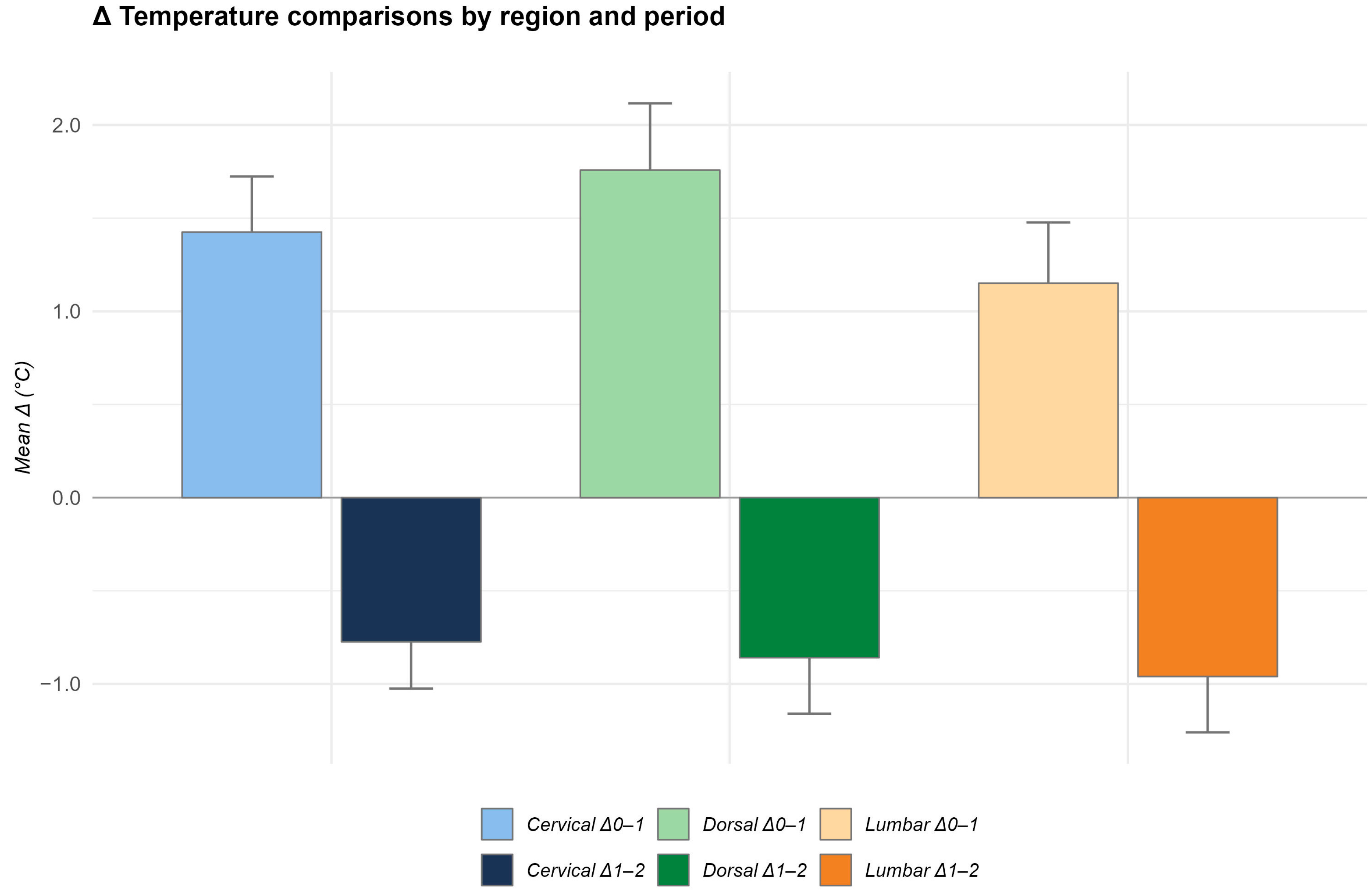
IRT revealed clear, region-specific variations in temperature differentials (Δ) across the cervical, dorsal, and lumbar areas following the mechanical harvesting task (see Table 2). Positive Δ0–1 values reflected an immediate post-task temperature drop, while negative Δ1–2 values indicated partial rewarming during recovery. Statistical analyses confirmed significant differences between intervals (Δ0–1 vs. Δ1–2), Table 2, and versus baseline (Δ vs. 0), with large effect sizes throughout. For the baseline comparison, in the cervical region, skin temperature decreased significantly immediately after the task (Δ0–1 = +1.43 ± 1.34 °C; t = 4.78; p < 0.001; d = 1.07) and showed partial recovery during the follow-up (Δ1–2 = −0.77 ± 1.12 °C; t = −3.09; p = 0.006; d = −0.69). In the dorsal region, the largest temperature change was observed, with an immediate post-task reduction (Δ0–1 = +1.76 ± 1.60 °C; t = 4.91; p <0.001; d = 1.10) followed by partial rewarming (Δ1–2 = −0.86 ± 1.35 °C; t = −2.86; p = 0.010; d = −0.64). In the lumbar region, a significant decrease was also found post-task (Δ0–1 = +1.15 ± 1.46 °C; t = 3.53; p = 0.002; d = 0.79), with partial return toward baseline (Δ1–2 = −0.96 ± 1.34 °C; t = −3.21; p = 0.005; d = −0.72). Overall, IRT data demonstrate marked post-task cooling followed by partial rewarming within two hours, with large effect sizes (|d| ≥ 0.7) across all regions. The largest temperature differentials were observed in the dorsal and lumbar regions (Figure 4).

4. Discussion

This study has shown the impact of mechanized olive harvesting on health, under conditions simulating realistic field use. The 15-min task duration was selected to represent a realistic continuous work bout commonly observed during olive harvesting activities. Through the integrated application of myotonometry and IRT, it was observed the muscle stress responses in a sample of healthy operators. The combined use of these objective instrumental techniques allowed for the detection of measurable short-term physiological responses that might not be captured by conventional observational ergonomic assessments.
The myotonometric data demonstrate that even a relatively short 15-min period of using an electric harvester leads to measurable changes in key biomechanical parameters of the upper limb muscles, notably stiffness, tone, and elasticity, with the biceps brachii showing distinct patterns. Specifically, the non-dominant (left) biceps brachii exhibited a post-task increase in elasticity accompanied by reductions in stiffness and tone, a pattern that persisted at the 2-h follow-up. This mechanical profile is consistent with a transient relaxation of the muscle, likely reflecting a supportive or stabilizing role of the non-dominant arm during tool handling rather than primary load bearing. Conversely, the dominant (right) biceps brachii showed decreased elasticity together with significant increases in stiffness and tone immediately post-task, consistent with acute load-induced mechanical stiffening associated with active tool manipulation. These findings should be interpreted within the broader ergonomic literature on electric harvesters. Prior studies using electromyography and vibration analysis describe task demands related to muscle activation patterns and hand–arm vibration exposure, respectively [7,9,10,11]. While these approaches capture different physiological domains than myotonometry, they provide contextual evidence that electric harvester operation entails asymmetric loading, sustained postures, and vibration exposure. In this sense, our myotonometric results offer complementary information on short-term changes in muscle mechanical behavior under similar task conditions, rather than direct confirmation of EMG- or vibration-based outcomes. Our study aligns with this biomechanical cascade, suggesting that the operational demands of the electric harvester are reflected in the neuromuscular tuning of the shoulder girdle and arm musculature.
Moreover, the trend toward bilateral asymmetry, particularly evident in the biceps brachii responses, reflects the non-symmetric load distribution typical of harvester use, where one arm primarily guides the tool’s motion while the contralateral arm takes on a stabilizing function. This asymmetry is a recognized risk factor for cumulative trauma disorders (CTDs), especially in seasonal workers with limited recovery opportunities [14,28].
Beyond the biceps, both the deltoid and triceps muscles demonstrated statistically significant short-term alterations in stiffness, tone, and elasticity, confirming that the functional overload associated with the harvester task involves multiple upper-limb muscle groups.
These findings represent observable post-task changes in skin temperature, reflecting non-specific thermoregulatory responses following static and sustained work. It is important to acknowledge that IRT does not directly assess biological processes; rather, it provides information on surface thermal patterns that may reflect measurable task-related physiological adaptations occurring in deeper tissues. In this context, increases in temperature observed after physical demand have been associated with enhanced local blood flow and metabolic activity, which are commonly involved in muscle recovery mechanisms such as immune cell recruitment and metabolite removal [29,30]. Therefore, the results of the present analysis are in agreement with previous findings suggesting that post-exercise muscle recovery is accompanied by localized increases in surface heat, likely driven by elevated perfusion and metabolic rate rather than by the direct measurement of regenerative processes [31]. The drop in skin surface temperature is likely the result of localized vasoconstriction, potentially due to static muscle contractions required to maintain posture and handle the tool, mechanical compression, and sympathetic nervous system activation. This pattern is consistent with literature suggesting that thermal asymmetries and temperature drops can reflect muscle tension and compensatory imbalances [10].
Our data indicate that even brief mechanical activity, such as the 15-min harvesting task, can create transient spinal stress signatures that warrant ergonomic attention. Importantly, the thermal measurements at the 2-h follow-up (T2) showed only a partial rebound in skin temperatures for all monitored spinal regions, with the dorsal region, for instance, remaining significantly cooler than its baseline state. This finding has direct relevance for occupational health management, suggesting that standard rest breaks may be insufficient for complete neuromuscular and vascular normalization after using such vibrating tools, potentially contributing to cumulative strain if exposure is repeated throughout a workday [29].
Traditional ergonomic assessments, such as RULA, REBA and OCRA, remain essential but are mainly observational and can be subjective, with limitations in assessing the dynamic and variable nature of agricultural activities [12,32,33]. In contrast, the combined use of myotonometry and IRT, as demonstrated in this study, represents a significant step towards quantitative, reproducible, and field-adaptable data on how the body physiologically responds to work. Urrejola-Contreras et al. (2024) previously highlighted that myotonometry could detect subtle changes in paraspinal tone and stiffness in machine operators, even without overt symptoms [34]. Our study builds on this by pairing myotonometry with IRT, allowing for a more holistic, multimodal profiling of physical stress. This approach not only enables the detection of early signs of biomechanical and thermophysiological strain but also offers a means for monitoring these responses over time.
This integrated instrumental methodology is particularly critical in agriculture, a sector where tasks are often seasonal, repetitive, and highly variable, and where workers frequently lack access to formal occupational health programs or continuous ergonomic surveillance [13,14]. The portability and non-invasive nature of these technologies could support the development of mobile ergonomic surveillance units, deployable during peak seasons to monitor worker fatigue, inform work-rest cycle design, guide tool redesign efforts, and ultimately contribute to the prevention of WMSDs [1,34].
The agricultural sector is undergoing rapid mechanization, but this technological evolution often outpaces the development and implementation of health-preserving work protocols [13]. There can be a mismatch between the design of new tools and the biomechanical and physiological realities of field work, risking the substitution of traditional labor-related disorders with new categories of “modern” occupational injuries [35].
The studies by Roggio et al. [1,10] have consistently argued for an interdisciplinary approach to prevent injury in vulnerable populations, encompassing diagnostics, training, organizational redesign, and supportive policy. These results support the feasibility of an integrated instrumental approach for exploring task-related physiological responses, which requires confirmation in larger studies including functional and clinical outcomes.
The insights gained from this study suggest several actionable strategies for improving worker health and safety in mechanized olive harvesting. These proposals align with the broader call for integrated ergonomic management in agriculture, addressing both mechanized and manual operations [13].
Study Limitations. The present results may help identify areas for further ergonomic investigation, such as task organization, tool characteristics, and recovery patterns, which should be addressed in future, adequately powered studies. As a pilot investigation, the sample size (n = 10) was relatively small, which may limit the generalizability of the findings to a broader population of agricultural workers. Additionally, the 15-min exposure duration, while sufficient to elicit measurable physiological responses, may not fully reflect the cumulative effects experienced during prolonged full-shift work. We also analyzed only one model of electric harvester (CILLI B-140), and results might differ with tools of varying weights, vibrational characteristics, or handle designs. Moreover, while the combination of myotonometry and IRT provided objective physiological data, we did not incorporate subjective measures of fatigue or perceived exertion (e.g., Borg CR-10 scale), which could have offered valuable correlational insights and a more comprehensive view of the worker’s experience.

5. Conclusions

This study demonstrates that the use of electric olive harvesters, even for short periods, can induce measurable biomechanical and thermophysiological stress in agricultural workers. Through the combined application of myotonometry and infrared thermography, we detected significant measurable task-related physiological adaptations in muscle stiffness, tone, and elasticity, along with significant reductions in spinal temperature, suggesting localized overload and transient vascular compromise. The evidence supports the hypothesis that this tool, while reducing overall workload, may introduce specific ergonomic risks [9,36]. The presence of bilateral asymmetry, partial return toward baseline after use, and regional changes in muscle mechanical behavior reinforce the conclusion that tool-based ergonomic assessment protocols are essential in agriculture. The results of this study may contribute to the implementation of appropriate risk assessments for agricultural workers and support the work of occupational physicians in health surveillance [2,3,37]. From a preventive perspective, these findings highlight the need for integrating ergonomic monitoring into routine occupational health surveillance programs, with the aim of identifying early functional alterations before the onset of clinically manifest musculoskeletal disorder. Furthermore, the use of portable, non-invasive technologies such as myotonometry and IRT can serve not only for early risk detection but also as decision-support tools for designing interventions, improving equipment, and optimizing work-rest cycles. Future research should focus on longitudinal study designs, larger worker populations, and the evaluation of targeted preventive interventions (e.g., ergonomic training, task rotation, and tool redesign) to define evidence-based thresholds for exposure and recovery in agricultural settings.

Author Contributions

Conceptualization, F.R., L.R. and E.R.; methodology, G.M., J.R. and R.C.; software, E.R. and V.F.; validation, J.R., E.V., G.D. and G.M.; formal analysis, F.R., A.S. and J.R.; investigation, F.V., R.C., E.V. and L.R.; resources, E.R.; data curation, F.V. and P.S.; writing—original draft preparation, P.S. and E.V.; writing—review and editing, G.M. and J.R.; visualization, F.R., E.V. and V.F.; supervision, G.D., and G.M.; project administration, E.V. and F.R. All authors have read and agreed to the published version of the manuscript.

Funding

This research received no external funding.

Institutional Review Board Statement

The study was conducted in accordance with the Declaration of Helsinki. The protocol adhered to the ethical standards of the Declaration of Helsinki and institutional guidelines. The data collection was approved by the Research Center in Motor Activities (CRAM), University of Catania (protocol n.: CRAM-016-2020, 16 March 2020).

Informed Consent Statement

Informed consent was obtained from all subjects involved in the study.

Data Availability Statement

The raw data supporting the conclusions of this article will be made available by the authors on request.

Acknowledgments

Our most sincere thanks go to Salvatore “Turi” Coco, for support in the technical section.

Conflicts of Interest

The authors declare no conflicts of interest.

References

  1. Roggio, F.; Petrigna, L.; Trovato, B.; Zanghì, M.; Sortino, M.; Vitale, E.; Rapisarda, L.; Testa, G.; Pavone, V.; Pavone, P.; et al. Thermography and rasterstereography as a combined infrared method to assess the posture of healthy individuals. Sci. Rep. 2023, 13, 4263. [Google Scholar] [CrossRef]
  2. Romano, E.; Bisaglia, C.; Calcante, A.; Oberti, R.; Zani, A.; Vinnikov, D.; Marconi, A.; Vitale, E.; Bracci, M.; Rapisarda, V. Assessment of comfort variation among different types of driving agricultural tractors: Traditional, satellite-assisted and semi-automatic. Int. J. Environ. Res. Public Health 2020, 17, 8836. [Google Scholar] [CrossRef] [PubMed]
  3. Romano, E.; Caruso, L.; Longo, D.; Vitale, E.; Schillaci, G.; Rapisarda, V. Investigation of hand forces applied to a pruning tool—Pilot study. Ann. Agric. Environ. Med. 2019, 26, 472–478. [Google Scholar] [CrossRef] [PubMed]
  4. Bernardi, B.; Falcone, G.; Stillitano, T.; Benalia, S.; Strano, A.; Bacenetti, J.; De Luca, A.I. Harvesting system sustainability in Mediterranean olive cultivation. Sci. Total Environ. 2018, 625, 1446–1458. [Google Scholar] [CrossRef] [PubMed]
  5. Proto, A.R.; Zimbalatti, G. Ergonomic evaluation of risk in olive harvesting tasks. J. Agric. Eng. 2015, 46, 83–91. [Google Scholar]
  6. Singh, S.; Arora, N. Ergonomic intervention in Indian agriculture: A study on women workers. Int. J. Ind. Ergon. 2010, 40, 560–565. [Google Scholar]
  7. Calvo, A.; Deboli, R.; Preti, C.; De Maria, A. Daily exposure to hand–arm vibration by different electric olive beaters. J. Agric. Eng. 2014, 45, 103–110. [Google Scholar] [CrossRef]
  8. Das, B. Work-related musculoskeletal disorders among Indian agricultural workers: Prevalence, causes, and interventions. J. Ergonom. Res. 2023, 15, 123–135. [Google Scholar]
  9. Cerruto, E.; Manetto, G. Vibration from electric hand-held harvesters for olives. Appl. Sci. 2022, 12, 1768. [Google Scholar] [CrossRef]
  10. Roggio, F.; Vitale, E.; Filetti, V.; Rapisarda, V.; Musumeci, G.; Romano, E. Ergonomic evaluation of young agricultural operators using hand-held equipment through electromyography and vibration analysis between the fingers. Saf. Health Work 2022, 13, 440–447. [Google Scholar] [CrossRef]
  11. Deboli, R.; Calvo, A.; Preti, C. Vibration and impulsivity analysis of hand-held olive beaters. Appl. Ergon. 2016, 55, 258–267. [Google Scholar] [CrossRef]
  12. Micheletti Cremasco, M.; Giustetto, A.; Caffaro, F.; Colantoni, A.; Cavallo, E.; Grigolato, S. Risk assessment for musculoskeletal disorders in forestry: A comparison between RULA and REBA in the manual feeding of a wood-chipper. Int. J. Environ. Res. Public Health 2019, 16, 793. [Google Scholar] [CrossRef] [PubMed]
  13. Benos, L.; Tsaopoulos, D.; Bochtis, D. A review on ergonomics in agriculture. Part II: Mechanized operations. Appl. Sci. 2020, 10, 3484. [Google Scholar] [CrossRef]
  14. Mucci, N.; Traversini, V.; Lulli, L.G.; Baldassarre, A.; Galea, R.P.; Arcangeli, G. Upper limb injuries in agriculture: A systematic review. Int. J. Environ. Res. Public Health 2020, 17, 4501. [Google Scholar] [CrossRef]
  15. Yu, Y.; Jain, B.; Anand, G.; Heidarian, M.; Lowe, A.; Kalra, A. Technologies for Non-Invasive Physiological Sensing: Advances, Challenges, and Opportunities. Sensors 2024, 24, 2929. [Google Scholar] [CrossRef]
  16. Shitova, E.S.; Malakhova, I.S.; Lemeshko, V.I. The possibility of using myotonometry to assess muscle fatigue in physical labor workers. Russ. J. Occup. Health Ind. Ecol. 2020, 60, 892–894. [Google Scholar] [CrossRef]
  17. Lettner, J.; Graventein, L.; Hakam, H.T.; Ramadanov, N.; Becker, R.; Prill, R. Assessment of muscle stiffness using the MyotonPro: Effects of fatigue on vastus lateralis and medialis muscles. J. Pers. Med. 2024, 14, 301. [Google Scholar] [CrossRef]
  18. Ammer, K.; Formenti, D. Does the type of skin temperature distribution matter? Thermol. Int. 2016, 26, 51–54. [Google Scholar]
  19. Liu, Q.; Li, M.; Wang, W.; Jin, S.; Piao, H.; Jiang, Y.; Li, N.; Yao, H. Infrared thermography in clinical practice: A literature review. Eur. J. Med. Res. 2025, 30, 33. [Google Scholar] [CrossRef]
  20. Mazloumi, A.; Kouhnavard, B. Investigation of observational ergonomic techniques for WMSD risk in farmers: A systematic review. J. Agromed. 2025, 30, 55–67. [Google Scholar] [CrossRef]
  21. Merino, G.; da Silva, L.; Mattos, D.; Guimarães, B.; Merino, E. Ergonomic evaluation of the musculoskeletal risks in a banana harvesting activity through qualitative and quantitative measures, with emphasis on motion capture (Xsens) and EMG. Int. J. Ind. Ergon. 2019, 69, 80–89. [Google Scholar] [CrossRef]
  22. Yanovich, R.; Ketko, I.; Charkoudian, N. Sex Differences in Human Thermoregulation: Relevance for 2020 and Beyond. Physiology 2020, 35, 177–184. [Google Scholar] [CrossRef] [PubMed]
  23. Crucitti, D.; Barone, S.; Navarro-Torre, S.; Quatrini, P.; Carimi, F.; Caruso, T.; Pacifico, D. Endophytic diversity in Sicilian olive trees: Identifying optimal conditions for a functional microbial collection. Microorganisms 2025, 13, 1502. [Google Scholar] [CrossRef] [PubMed]
  24. Massenti, R.; Ioppolo, A.; Carella, A.; Imperiale, V.; Lo Bianco, R.; Servili, M.; Selvaggini, R.; Caruso, T. Growth, yield and oil quality of adult pedestrian olive orchards grown at four different planting systems. Front. Plant Sci. 2024, 15, 1416548. [Google Scholar] [CrossRef]
  25. Ammer, K.; Ring, F. The Thermal Human Body: A Practical Guide to Thermal Imaging; Jenny Stanford Publishing: New York, NY, USA, 2019. [Google Scholar]
  26. Moreira, D.G.; Costello, J.T.; Brito, C.J.; Adamczyk, J.G.; Ammer, K.; Bach, A.J.E.; Costa, C.M.A.; Eglin, C.; Fernandes, A.A.; Fernández-Cuevas, I.; et al. Thermographic imaging in sports and exercise medicine: A Delphi study and consensus statement on the measurement of human skin temperature. J. Therm. Biol. 2017, 69, 155–162. [Google Scholar] [CrossRef]
  27. Zieliński, G. Effect Size Guidelines for Individual and Group Differences in Physiotherapy. Arch. Phys. Med. Rehabil. 2025, 106, 1844–1849. [Google Scholar] [CrossRef]
  28. Chaffin, D.B.; Andersson, G.B.J.; Martin, B.J. Occupational Biomechanics, 4th ed.; Wiley: New York, NY, USA, 2006. [Google Scholar]
  29. Fernandes, A.A.D.A.; Amorim, P.R.D.S.; Brito, C.J.; Sillero-Quintana, M.; Bouzas Marins, J.C. Regional skin temperature response to moderate aerobic exercise measured by infrared thermography. Asian J. Sports Med. 2016, 7, e29243. [Google Scholar] [CrossRef]
  30. Uchôa, P.; Matos, F.; Neves, E.B.; Saavedra, F.; Rosa, C.; Reis, V.M.; Vilaça-Alves, J. Evaluation of two different resistance training volumes on the skin surface temperature of the elbow flexors assessed by thermography. Infrared Phys. Technol. 2018, 93, 18–23. [Google Scholar] [CrossRef]
  31. Gatt, A.; Formosa, C.; Cassar, K.; Camilleri, K.P.; De Raffaele, C.; Mizzi, A.; Azzopardi, C.; Mizzi, S.; Falzon, O.; Cristina, S.; et al. Thermographic patterns of the upper and lower limbs: Baseline data. Int. J. Vasc. Med. 2015, 2015, 831369. [Google Scholar] [CrossRef]
  32. Gómez-Galán, M.; Pérez-Alonso, J.; Callejón-Ferre, Á.J.; López-Martínez, J. Musculoskeletal disorders: OWAS review. Ind. Health 2017, 55, 314–337. [Google Scholar] [CrossRef]
  33. Takala, E.-P.; Pehkonen, I.; Forsman, M.; Hansson, G.-Å.; Mathiassen, S.E.; Neumann, W.P.; Sjøgaard, G.; Veiersted, K.B.; Westgaard, R.H.; Winkel, J. Systematic evaluation of observational methods assessing biomechanical exposures at work. Scand. J. Work Environ. Health 2010, 36, 3–24. [Google Scholar] [CrossRef]
  34. Urrejola-Contreras, G.P.; Martínez, J.M.; Rodríguez-Bagó, M.; Ronda, E. Myotonometry in machinery operators and its relationship with postural ergonomic risk. Ann. Work Expo. Health 2024, 68, 605–616. [Google Scholar] [CrossRef]
  35. Barneo-Alcántara, M.; Díaz-Pérez, M.; Gómez-Galán, M.; Carreño-Ortega, Á.; Callejón-Ferre, Á.-J. Musculoskeletal disorders in agriculture: A review from Web of Science Core Collection. Agronomy 2021, 11, 2017. [Google Scholar] [CrossRef]
  36. Andrade, C. How to understand the 95% confidence interval around the relative risk, odds ratio, and hazard ratio: As simple as it gets. J. Clin. Psychiatry 2023, 84, 23f14933. [Google Scholar] [CrossRef]
  37. Porru, S.; Carta, A.; Arici, C.; Alessio, L. Health surveillance and occupational risk assessment: A preventive perspective. Int. J. Environ. Res. Public Health 2017, 14, 1231. [Google Scholar] [CrossRef]
Figure 1. Olive harvester (model: CILLI B-140) (a); operator using the electric olive harvester (b).
Applsci 16 01882 g001
Figure 2. MyotonPRO® device (a); FLIR E6-XT® thermographic camera (b).
Applsci 16 01882 g002
Figure 3. Myotonometric analyses of left and right muscles for tone (a), stiffness (b) and elasticity (c).
Applsci 16 01882 g003
Figure 4. Thermal delta differences between Δ0–1 and Δ1–2 for the cervical (blue) dorsal (green) and lumbar (orange) areas.
Applsci 16 01882 g004
Table 1. Myotonometric changes according to the specific muscles, sides and delta differences.
Muscle/SideMeasureΔ PeriodMean ΔSDCIp-Value +Cohen’s d ++
Biceps rightElasticityΔ0–1−0.0940.055[−0.12; −0.07]0.0001.07
Biceps rightElasticityΔ1–2−0.0340.09[−0.08; 0.01]0.030−0.44
Biceps rightStiffnessΔ0–115.68.1[11.91; 19.29]0.0001.07
Biceps rightStiffnessΔ1–2−3.3114.49[−9.91; 3.28]0.436−0.36
Biceps rightToneΔ0–10.70.46[0.49; 0.91]0.0011.14
Biceps rightToneΔ1–2−0.140.54[−0.39; 0.11]0.361−0.44
Biceps leftElasticityΔ0–10.2310.128[0.17; 0.29]0.0001.51
Biceps leftElasticityΔ1–2−0.0510.107[−0.10; 0.00]0.037−0.69
Biceps leftStiffnessΔ0–1−24.9617.59[−32.97; −16.95]0.000−1
Biceps leftStiffnessΔ1–2−21.5421.45[−31.31; −11.78]0.003−0.72
Biceps leftToneΔ0–1−1.530.83[−1.91; −1.15]0.000−1.16
Biceps leftToneΔ1–20.180.71[−0.14; 0.50]0.0140.3
Deltoid rightElasticityΔ0–10.0090.067[−0.02; 0.04]0.0530.1
Deltoid rightElasticityΔ1–2−0.0610.061[−0.09; −0.03]0.002−0.71
Deltoid rightStiffnessΔ0–188.2775.03[54.11; 122.42]0.0001.02
Deltoid rightStiffnessΔ1–2−80.3991[−121.82; −38.97]0.002−0.7
Deltoid rightToneΔ0–10.410.88[0.01; 0.81]0.0090.62
Deltoid rightToneΔ1–2−0.520.8[−0.89; −0.16]0.012−0.64
Deltoid leftElasticityΔ0–1−0.1030.081[−0.14; −0.07]0.000−0.7
Deltoid leftElasticityΔ1–2−0.0730.125[−0.13; −0.02]0.011−0.47
Deltoid leftStiffnessΔ0–1−3.513.87[−9.81; 2.82]0.539−0.11
Deltoid leftStiffnessΔ1–2−10.0731.4[−24.37; 4.22]0.143−0.2
Deltoid leftToneΔ0–1−0.580.6[−0.85; −0.30]0.001−1
Deltoid leftToneΔ1–2−0.630.9[−1.04; −0.22]0.011−0.7
Triceps rightElasticityΔ0–1−0.1920.086[−0.23; −0.15]0.000−2.18
Triceps rightElasticityΔ1–20.1470.079[0.11; 0.18]0.0001.8
Triceps rightStiffnessΔ0–1−24.0334.03[−39.53; −8.54]0.015−0.47
Triceps rightStiffnessΔ1–210.1762.7[−18.37; 38.71]0.7680.1
Triceps rightToneΔ0–1−0.221.04[−0.69; 0.26]0.201−0.2
Triceps rightToneΔ1–20.590.92[0.17; 1.01]0.0120.63
Triceps leftElasticityΔ0–10.170.213[0.07; 0.27]0.0030.65
Triceps leftElasticityΔ1–20.2060.199[0.12; 0.30]0.0020.8
Triceps leftStiffnessΔ0–129.7242.31[10.46; 48.98]0.0020.5
Triceps leftStiffnessΔ1–270.8774.62[36.91; 104.84]0.0020.8
Triceps leftToneΔ0–1−0.72.4[−1.79; 0.39]0.436−0.2
Triceps leftToneΔ1–22.482.71[1.25; 3.72]0.0020.63
+ according to t-test vs. 0, adjusted p-value according to FDR correction; ++ according to Cohen’s d z,c Δ0–1 = T0 − T1; Δ1–2 = T1 − T2. Positive Δ values indicate a decrease, negative values an increase.
Table 2. Infrared thermography changes according to back areas and delta differences.
RegionΔ PeriodMean ± SD (°C)CIp-Value +Effect Size ++
CervicalΔ0–1+1.43 ± 1.34[0.80; 2.05]0.00050.94
CervicalΔ1–2−0.77 ± 1.12[−1.30; −0.25]
DorsalΔ0–1+1.76 ± 1.60[1.01; 2.51]0.00041.01
DorsalΔ1–2−0.86 ± 1.35[−1.49; −0.23]
LumbarΔ0–1+1.15 ± 1.46[0.47; 1.83]0.00041.00
LumbarΔ1–2−0.96 ± 1.34[−1.59; −0.33]
+ according to t-test adjusted p-value according to FDR correction; ++ according to Cohen’s d.
Disclaimer/Publisher’s Note: The statements, opinions and data contained in all publications are solely those of the individual author(s) and contributor(s) and not of MDPI and/or the editor(s). MDPI and/or the editor(s) disclaim responsibility for any injury to people or property resulting from any ideas, methods, instructions or products referred to in the content.