Article

Dubins-CPSO: A Hybrid Static–Dynamic Method for Coordinated Trajectory Planning of Multiple UAVs

1
Beijing Electro-Mechanical Institute, Beijing 100074, China
2
Science and Technology on Complex System Control and Intelligent Agent Cooperation Laboratory, Beijing 100074, China
*
Author to whom correspondence should be addressed.
Appl. Sci. 2026, 16(4), 1880; https://doi.org/10.3390/app16041880
Submission received: 9 January 2026 / Revised: 11 February 2026 / Accepted: 11 February 2026 / Published: 13 February 2026

Abstract

For the problem of multi-UAV cooperative trajectory planning, this study proposes an integrated static–dynamic trajectory optimization method based on a Dubins-CPSO algorithm. An improved Dubins static path planning method utilizing virtual “Intermediate Points” is introduced, and the reference trajectory generated by this method is employed to design the fitness function for the CPSO algorithm. Within the CPSO-based dynamic optimization framework, real-time local trajectory adjustments are performed by incorporating the UAV’s current state and multi-dimensional physical constraints. This approach combines the high reliability and low command variation rate of conventional algorithms with the flexibility and strong disturbance robustness of intelligent algorithms, achieving complementary advantages. The result is a flight trajectory planning method that is more compatible with the physical mechanisms of the aircraft while possessing a degree of autonomy and intelligence. The simulation results demonstrate that the proposed algorithm can adapt to uncertain initial conditions in the studied scenarios. Furthermore, under interference, it exhibits superior real-time regulation capability compared with traditional algorithms alone and greater robustness and practicality than standalone intelligent algorithms. This provides a more implementable trajectory planning solution for UAVs with strict physical constraints in engineering applications.

1. Introduction

Trajectory planning for aircraft remains a prominent research focus in the aviation field. Traditional methods, such as the Dubins curve, have been widely adopted for their smoothness, stability, and practical reliability [1,2,3,4,5]. However, as operational environments grow more complex and demands for collaborative operation and anti-interference capabilities increase, greater flexibility and intelligence are required in trajectory optimization algorithms [6]. In this context, conventional one-off trajectory generation methods struggle to address these evolving challenges. Consequently, researchers have turned to more intelligent approaches, including deterministic algorithms for known environments (e.g., A* [7,8,9] and Dijkstra [10]), non-deterministic algorithms for dynamic environments (e.g., PSO (particle swarm optimization) [11,12,13] and RRT algorithms [14,15,16,17]), and artificial intelligence techniques [18,19]. These methods provide aircraft with enhanced autonomy, allowing adaptation to diverse complex constraints during flight.
Currently, most intelligent-algorithm-based flight trajectory optimization studies employ random-walk strategies for path searching and planning. Under such schemes, the aircraft’s immediate flight direction or route often becomes difficult to predict precisely, resulting in generated flight commands that may lack smoothness. As a consequence, existing research has largely focused on small unmanned aerial vehicles (UAVs), which operate at low altitudes and speeds and possess higher maneuverability. Furthermore, simulation validations in these studies are frequently conducted under relatively ideal conditions, with limited consideration for engineering practicality. For aircraft with higher speeds and for which frequent changes in flight command direction incur significant actuation costs, their onboard software and hardware systems may not support the implementation of such algorithms or could introduce instability risks during high-altitude flight. Hence, applying intelligent algorithms to these platforms calls for more reliable and practical solutions.
In scenarios involving stringent terminal/turning constraints and significant in-flight disturbances, such as wind fields, researchers have attempted to hybridize traditional and intelligent algorithms to compensate for the latter’s limitations in stability and reliability. For instance, Ref. [20] combines Dubins curves with simulated annealing to plan emergency landing trajectories. Ref. [21] proposes an improved RRT* algorithm incorporating Dubins curves to optimize unmanned vehicle paths, effectively reducing unnecessary curvature and enhancing practicality. Similarly, Ref. [22] introduces the Dubins method into RRT* to optimize the turning direction and radius for UAVs, yielding smoother and more feasible trajectories. Ref. [23] presents a hierarchical path-planning framework for fixed-wing UAVs, using Dubins trajectories as a reference and employing an improved vector-field-based method for trajectory tracking, thereby effectively handling model uncertainties and wind disturbances. Therefore, this study incorporates the proposed approach into multi-UAV cooperative trajectory planning, with the aim of integrating conventional methods with more intelligent algorithms. Specifically, smooth and practical reference trajectories generated by traditional approaches serve as guidance, while intelligent algorithms are employed to adjust the aircraft’s heading in real time. This enables local trajectory optimization that adheres to the dynamic constraints encountered during flight without significantly deviating from the reference trajectory.
We propose a Dubins-CPSO (Charged Particle Swarm Optimization)-based static-dynamic fusion method for cooperative trajectory optimization in this paper. Rather than discarding traditional planning results entirely, our method optimizes and refines the trajectory from both global and local perspectives. This ensures reliability, stability, and practicality while endowing the aircraft with a degree of intelligence and flexibility, thereby achieving a complementary integration of the strengths of traditional and intelligent algorithms.

2. Problem Description and Modeling

2.1. Problem Description

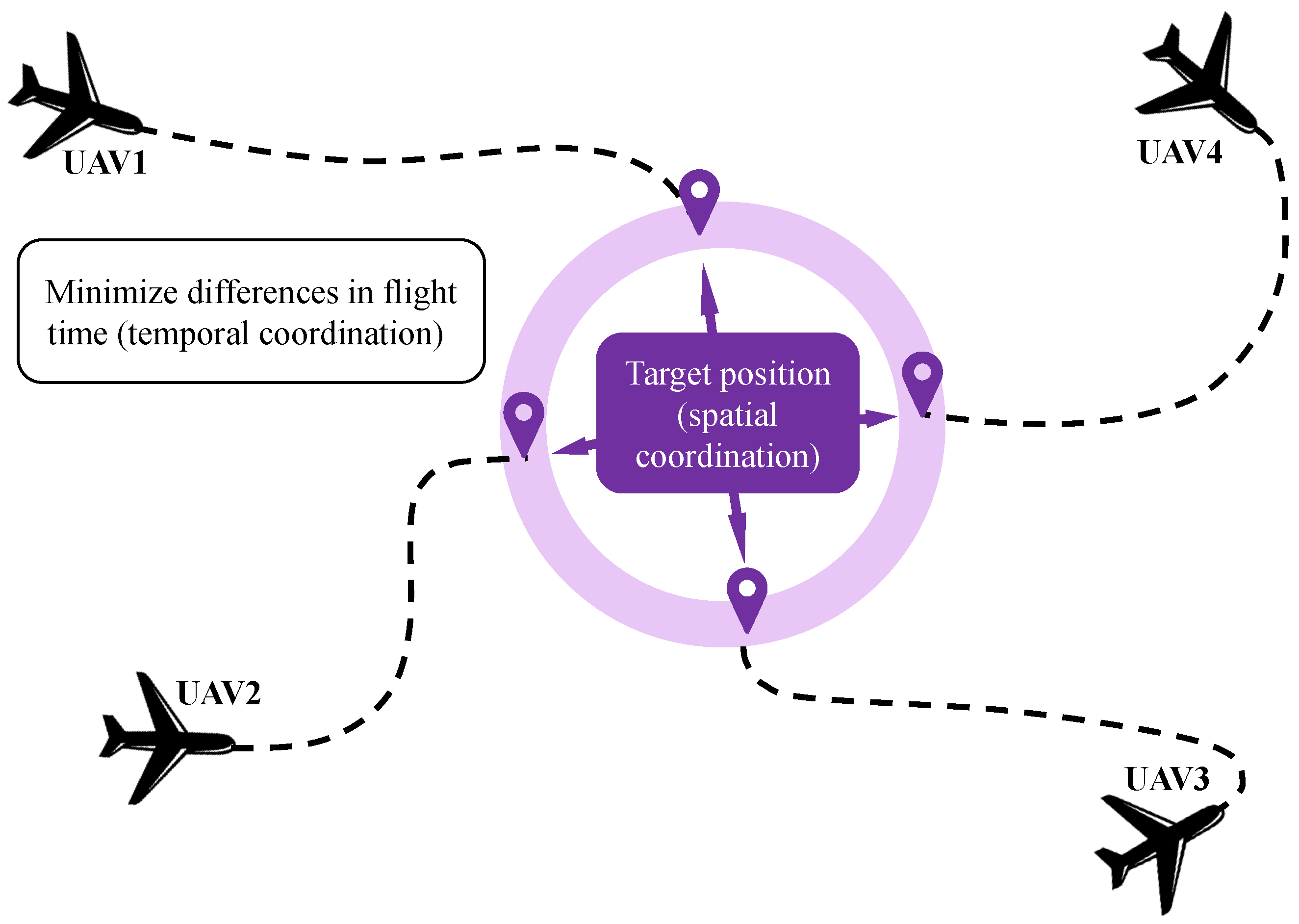
This paper addresses the cooperative trajectory optimization problem for four UAVs in level flight. The UAVs are required to depart from their initial positions and arrive simultaneously at designated target waypoints, with both temporal and spatial coordination taken into account. As shown in Figure 1, their terminal positions should be uniformly distributed within a specified area, and their headings must be oriented toward the center of that area. This configuration ensures coverage of the area with the minimum number of UAVs.
The algorithm must reduce the rate of change in overload commands to meet the demands of real-time flight control and practical hardware execution. Failure to ensure command smoothness would introduce substantial engineering difficulties in implementation. To address this, based on fixed-wing UAV performance and cooperative mission objectives, this paper formulates the following metrics: the time difference for reaching the target point should not exceed 5 s, and the heading deviation must be kept below 5 degrees.

2.2. 6-DOF Model of UAV

To ensure the verification process is as realistic as possible, this paper establishes a 6-DOF (six-degree-of-freedom) model for the flight vehicle.
In this paper, the ground coordinate system is defined as follows: with the fixed point O on the ground as the origin, the OX axis points north in the horizontal plane, the OY axis is vertically upward and perpendicular to the OX axis, and the OZ axis is determined according to the right-hand rule. Based on the kinematic and dynamic equations of the UAV, as well as the transformation relationships between angles, the 6-DOF model is as shown in Equation (1):
m d V d t = Pcos α cos β X mgsin θ m V d θ d t = P s i n α c o s γ V + c o s α s i n γ V s i n β + Ysin γ V Zsin γ V mgcos θ m Vcos θ d ψ V d t = P s i n α s i n γ V c o s α s i n β c o s γ V + Ysin γ V + Z c o s γ V J x d ω x d t + J z J y ω z ω y = M x J y d ω y d t + J x J z ω x ω z = M y J z d ω z d t + J y J x ω y ω x = M z d x d t = V c o s θ c o s ψ V d y d t = V s i n θ d z d t = V c o s θ s i n ψ V d ϑ d t = ω y s i n γ + ω z c o s γ d ψ d t = ω y c o s γ ω z s i n γ / c o s ϑ d γ d t = ω x t a n ϑ ω y c o s γ ω z s i n γ s i n β = c o s θ c o s γ sin ψ ψ V + s i n ϑ s i n γ c o s ψ ψ V s i n θ c o s ϑ s i n γ s i n α = c o s θ s i n ϑ c o s γ cos ψ ψ V s i n γ s i n ψ ψ V s i n θ c o s ϑ c o s γ } / c o s β s i n γ V = ( c o s α s i n β s i n ϑ s i n α s i n β c o s γ c o s ϑ + c o s β s i n γ c o s ϑ ) / c o s θ ,
where x , y , z represent the coordinate positions of the UAV; θ is the path inclination angle; ψ V is the path azimuth angle; ϑ is the pitch angle; ψ is the yaw angle; γ is the roll angle; ω x , ω y , ω z represent the components of the angular velocity of the UAV in the body-fixed coordinate system relative to the Earth; m is the mass of the UAV; d V / d t is the projection of the UAV’s acceleration along the tangent of the velocity vector; V d θ / d t is the projection of the UAV’s acceleration in the vertical plane along the normal to the velocity vector; m V c o s θ d ψ V / d t is the horizontal component of the UAV’s acceleration; P   i s t h e t h r u s t , w h i c h i s t a k e n a s a c o n s t a n t v a l u e i n t h i s s t u d y ; X is the drag force, calculated by the formula X = C x q S ( C x denotes the drag coefficient, q denotes dynamic pressure, S denotes the characteristic reference area of the UAV); Y is the lift force, calculated by the formula Y = C Y q S ( C Y denotes the lift coefficient); Z is the side force, calculated by the formula Z = C Z q S ( C Z denotes the side force coefficient); V is the speed of the UAV; α is the angle of attack; β is the sideslip angle; γ V is the velocity inclination angle; ψ V is the path azimuth angle; J x , J y , J z are the moments of inertia of the UAV about the body-fixed coordinate system axes; d ω x / d t , d ω y / d t , d ω z / d t are the components of the angular acceleration vector in the body-fixed coordinate system; and M x , M y , M z are the components of the torque due to external forces about the body-fixed coordinate system axes.
This paper focuses on long-range trajectory planning for unmanned aerial vehicles (UAVs) flying at a fixed altitude. Therefore, the UAV’s flight altitude remains constant during the process, allowing the equation to be simplified to Equation (2).
m d V d t = P c o s α c o s β X d θ d t = 0 m V d ψ V d t = P s i n α s i n γ V c o s α s i n β c o s γ V + Y s i n γ V + Z c o s γ V J x d ω x d t + J z J y ω z ω y = M x J y d ω y d t + J x J z ω x ω z = M y J z d ω z d t + J y J x ω y ω x = M z d x d t = V c o s θ c o s ψ V d y d t = 0 d z d t = V s i n ψ V d ϑ d t = ω y s i n γ + ω z c o s γ d ψ d t = ω y c o s γ ω z s i n γ / c o s ϑ d γ d t = ω x t a n ϑ ω y c o s γ ω z s i n γ s i n β = c o s γ sin ψ ψ V + s i n ϑ s i n γ c o s ψ ψ V s i n α = ( s i n ϑ c o s γ cos ψ ψ V s i n γ s i n ψ ψ V ) / c o s β s i n γ V = ( c o s α s i n β s i n ϑ s i n α s i n β c o s γ c o s ϑ + c o s β s i n γ c o s ϑ ) ,
Simulations in this study were conducted based on the simplified equations. The UAV parameters used in this study are listed in Appendix A.

3. Methods

3.1. Static Trajectory Planning Based on Dubins Curves

3.1.1. Introduction to Dubins Curves

Dubins curves are widely employed in trajectory planning due to their ability to generate smooth paths consisting of seamlessly connected arcs and straight segments, thereby avoiding abrupt turns or directional discontinuities. Such paths satisfy angular constraints and ensure engineering feasibility. In the context of this study, using the Dubins method for trajectory planning effectively enforces terminal heading constraints, thereby facilitating spatial coordination between multiple UAVs. Hence, this paper adopts the Dubins method to perform initial static trajectory planning, yielding a smooth reference path for the vehicle.
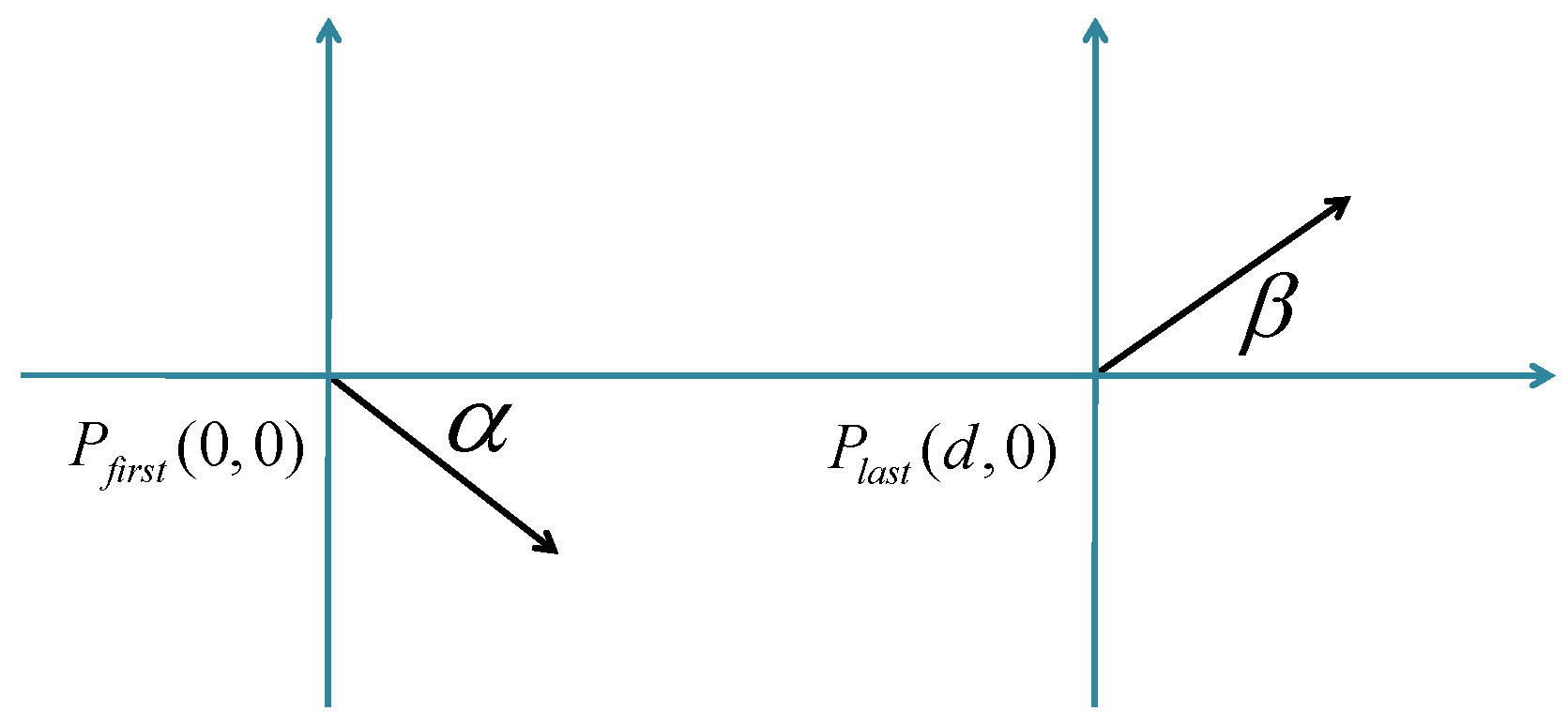
A Dubins path can be geometrically interpreted as the shortest smooth curve connecting two oriented points in the same plane, as illustrated in Figure 2. Let the line connecting the start point P f i r s t and the end point P l a s t define the x-axis. Any two points with arbitrary positions and orientations can be transformed into this coordinate system, where α and β denote the angles between the initial and terminal velocity directions, respectively, and the connecting line.
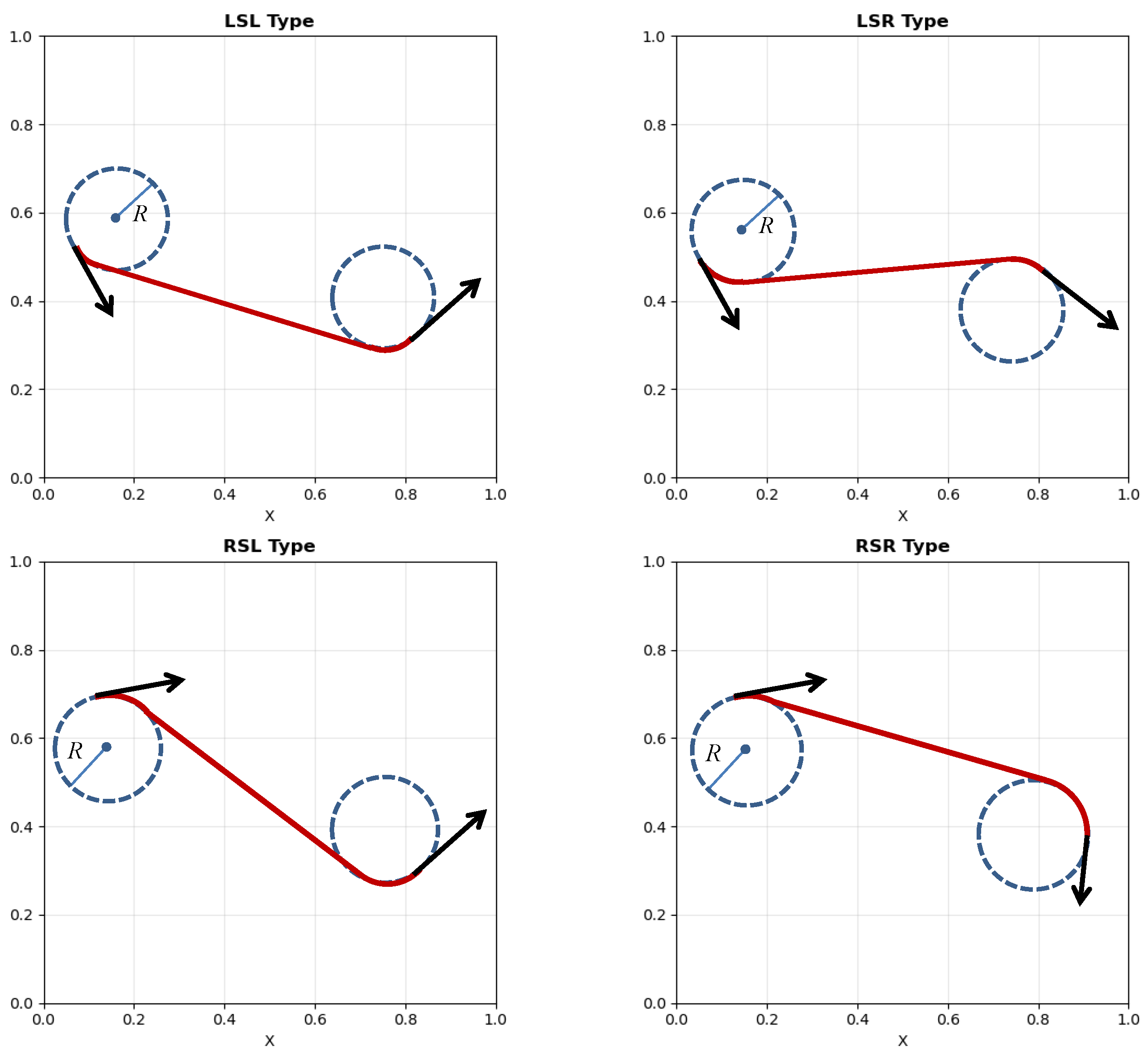
Dubins curves can be classified into various types based on their combination patterns. Among them, the LSL, LSR, RSL, and RSR curves are the most commonly used in engineering applications, which are denoted as follows:
  • “R” stands for a right turn, represented by a clockwise circular arc in the unit circle;
  • “L” stands for a left turn, represented by a counterclockwise circular arc in the unit circle;
  • “S” stands for straight-line motion, indicating a straight segment.
Figure 3 shows the four types of curves. The intermediate segments of these four curves are connected by straight lines, inherently resulting in shorter trajectories and time advantages. Therefore, this paper uses these four curves as the foundation for the static planning algorithm.
According to the study on Dubins curves in reference [24], based on the quadrants in which the heading angles of the start and end points lie, 16 combinations can be derived. The corresponding path type selection schemes are shown in Table 1.
The specific mathematical computation formulas for generating Dubins curves are provided in Appendix B.

3.1.2. Improved Dubins Route Planning Based on Virtual “Intermediate Points”

The terminal point is selected using a traversal-based search strategy grounded in Dubins curves. By identifying the set of positions that yields the minimum length variance from the Dubins paths given the initial positions and the target annular region, this method effectively reduces the complexity of subsequent trajectory optimization.
The properties of Dubins curves inherently satisfy the terminal heading constraints when the UAV arrives at the terminal position. However, they do not guarantee temporal coordination between multiple UAVs, necessitating further optimization. Considering that the turning radius of the arc segment significantly influences the total path length, iteratively adjusting the radius can effectively minimize differences in trajectory lengths across the four UAVs. Accordingly, the optimization model is formulated as shown in Equation (3):
m a x L = max L 1 R m i n , L 2 R m i n , L 3 R m i n , L 4 R m i n L 1 R 1 m a x L < L m a x L 2 R 2 m a x L < L m a x L 3 R 3 m a x L < L m a x L 4 R 4 m a x L < L m a x m i n z =   m i n ( R 1 + R 2 + R 3 + R 4 ) R m i n   < R i < R m a x           ( i = 1 , 2 , 3 , 4 ) ,
where L m R n represents the updated Dubins trajectory length of aircraft m under radius R n ; R m i n represents the minimum turning radius of the UAV and R m a x represents the maximum turning radius (in this study, R m i n = 2000   m and R m a x = 4000   m ); m i n z represents the objective function of the optimization, designed to minimize the trajectory deviation among UAVs with the shortest possible path length cost by appropriately selecting R n to achieve the optimization objective.
This method demonstrated satisfactory performance under specific initial conditions, effectively reducing the trajectory length variance. However, in certain cases, the arc segments generated by Dubins curve planning can be extremely short. Under such circumstances, increasing the turning radius does not substantially alter the overall path length, thereby hindering the achievement of required temporal coordination. To enhance the method’s adaptability to diverse initial and terminal states, this paper introduces an improved Dubins curve optimization approach incorporating a virtual “intermediate point,” building upon the original formulation.
Taking the curve formed by the starting point X d 1 , Z d 1 and the terminal point X f 1 , Z f 1 as an example, we define the virtual “intermediate point” X f 1 , Z f 1 as the midpoint of the current trajectory. The trajectory is divided into two segments of Dubins curves: from X d 1 , Z d 1 to X f 1 , Z f 1 and from X f 1 , Z f 1 to X f 1 , Z f 1 . The heading angle of the point X f 1 , Z f 1 is adjusted to modify the total trajectory length. The representative formulas are as follows:
l 1 = l X d 1 , Z d 1 , ψ d 1 , X f 1 , Z f 1 , ψ f 1 + l X f 1 , Z f 1 , ψ f 1 , X f 1 , Z f 1 , ψ f 1 l 2 = l X d 2 , Z d 2 , ψ d 2 , X f 2 , Z f 2 , ψ f 2 + l X f 2 , Z f 2 , ψ f 2 , X f 2 , Z f 2 , ψ f 2 l 3 = l X d 3 , Z d 3 , ψ d 3 , X f 3 , Z f 3 , ψ f 3 + l X f 3 , Z f 3 , ψ f 3 , X f 3 , Z f 3 , ψ f 3 l 4 = l X d 4 , Z d 4 , ψ d 4 , X f 4 , Z f 4 , ψ f 4 + l X f 4 , Z f 4 , ψ f 4 , X f 4 , Z f 4 , ψ f 4 M e a n l = l 1 + l 2 + l 3 + l 4 4 V a r l =   1 4 i = 1 4 ( l i M e a n l ) 2   ψ f 1 0 ° , 1 ° , , 359 ° ψ f 2 0 ° , 1 ° , , 359 ° ψ f 3 0 ° , 1 ° , , 359 ° ψ f 4 [ 0 ° , 1 ° , , 359 ° ] ,
m i n V a r l ,
where l 1 , l 2 , l 3 , and l 4 represent the total lengths of the optimized trajectories 1, 2, 3, and 4; the function l X d i , Y d i , ψ d i , X f i , Y f i , ψ f i denotes the trajectory length of UAV i from the starting point to the “intermediate point”, and l X f i , Y f i , ψ f i , X f i , Y f i , ψ f i denotes the trajectory length of UAV i from the intermediate point to the terminal point, with ψ f i representing the heading of UAV i at the intermediate point.

3.2. Dynamic Trajectory Iterative Optimization Based on CPSO

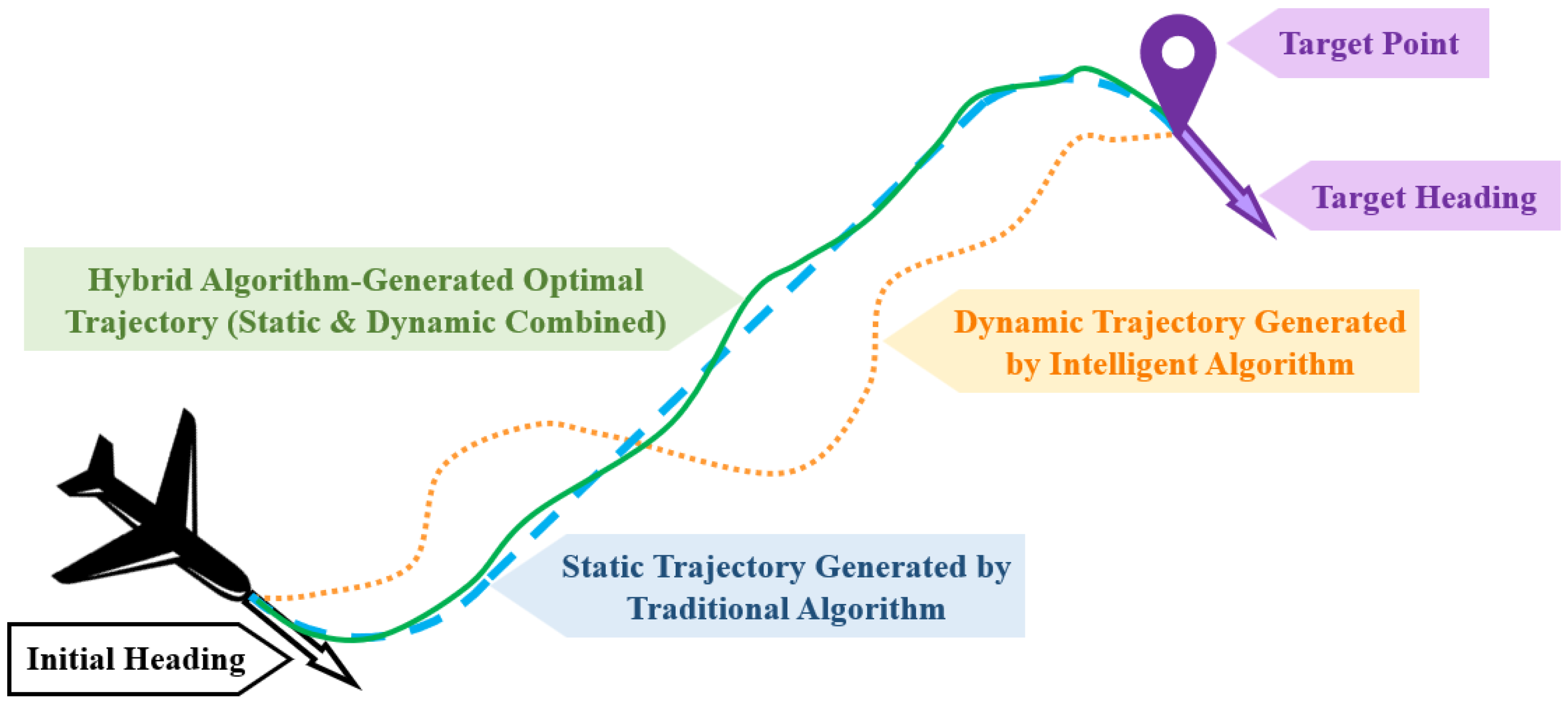
The static planning method described in Section 3.1 enables the UAV to obtain a stable and reliable flight path within an extremely short time. However, during actual flight, the UAV is inevitably subject to internal disturbances (e.g., actuator errors) and external disturbances (e.g., wind), which can cause the statically planned commands to deviate from ideal trajectory tracking and compromise the coordinated mission performance. To address this, a dynamic trajectory optimization method is introduced. As shown in Figure 4, during flight, at each time step, the UAV optimizes its forthcoming trajectory based on its current state. Unlike the optimization approaches commonly employed in existing research, the proposed method treats the static trajectory as a reference and designs the fitness function accordingly while incorporating multiple essential constraints. This allows for real-time dynamic local optimization of the UAV’s subsequent overload commands and velocity, thereby enhancing the tracking accuracy and robustness under disturbances.

3.2.1. Introduction to CPSO Algorithm

To overcome the limitations of the traditional PSO algorithm, researchers introduced chaotic theory into particle swarm optimization, proposing the Chaotic Particle Swarm Optimization (CPSO) algorithm. The introduction of chaotic theory primarily aims to enhance the algorithm’s global search capability and prevent the particle swarm from converging prematurely to local optima.
The core idea of CPSO is to introduce chaotic mapping into the traditional PSO algorithm to perturb the position or velocity of particles. The nonlinear characteristics of chaotic mapping enable particles to perform a more comprehensive search in the solution space, thereby improving the algorithm’s global optimization capability.
The core formula of CPSO is expressed as
x k + 1 = x k + v k + 1 + ξ · c h a o s ( x k ) ,
where ξ is the chaotic disturbance factor, controlling the extent to which chaotic mapping affects the particle’s position; c h a o s ( x k ) represents the disturbance of chaotic mapping on the particle’s position.
Commonly used chaotic mappings include the Logistic map, Lorenz map, and Rossler map. Among these, the Logistic map is one of the most commonly used chaotic mappings, with its mathematical expression being
x k + 1 = μ x k ( 1 x k ) ,
where μ is the control parameter. When μ = 4 , the Logistic map exhibits a fully chaotic state.
Compared with the traditional PSO algorithm, the introduction of chaotic search enables particles to escape from local optimal regions, enhancing the global search capability. Chaotic disturbances can accelerate the particle’s search process, improving the algorithm’s convergence speed. Additionally, CPSO demonstrates stronger adaptability in dynamic optimization problems, enabling it to quickly respond to environmental changes.
In trajectory dynamic optimization problems, the motion trajectory of UAVs often possesses high nonlinearity and uncertainty. The CPSO algorithm, with its powerful global search capability and fast convergence characteristics, can effectively meet requirements such as real-time performance and robustness. Therefore, this study is based on the CPSO algorithm.

3.2.2. Optimization Model

First, an optimization model is established. To enable the four UAVs to track the reference trajectory while achieving temporal coordination under wind disturbances, they must adjust their heading angles and regulate thrust for uniform velocity control. Accordingly, a multi-constraint, multi-objective optimization model is formulated for the current scenario. The chosen decision variables are the desired angular acceleration d ψ v / d t and the rate of change of velocity V ˙ , subject to the following constraints:
  • Load constraint
Considering the heading regulation capability of the UAVs, the maximum overload constraint is designed as follows:
n z n z m a x ,
n z = v g c o s θ d ψ v d t ,
  • Collision avoidance constraint
Considering the safety of the UAVs during the flight, collision avoidance constraints are imposed:
X i t + 1 X j t + 1 2 + Z i t + 1 Z j t + 1 2 > 50   m , i = 1 , 2 , 3 , 4 ;   j = 1 , 2 , 3 , 4
where X i t + 1 , Z i t + 1 and X j t + 1 , Z j t + 1 are the predicted positions of UAVs i and j at the next time step.
  • Velocity adjustment constraint
Considering the limited speed adjustment capability of the UAVs, it is necessary to consider the constraints on the adjustable range of speed:
V 0 · 80 % < V < V 0 · 120 % ,
where V 0 is the initial speed of the UAV.
Based on the fitness function designed for the reference trajectory, the UAV must adjust its overload command according to its current position to reach the next target waypoint. Accordingly, the fitness function f is formulated as follows:
X t + 1 = X t + t · X t ˙ Z t + 1 = Z t + t · Z t ˙ X t ˙ = V t c o s ψ v t + 1 Z t ˙ = V t s i n ψ v t + 1 ψ v t + 1 = ψ v t + t · ψ v ˙ d i s t a n t s t = X t + 1 X i + 1 2 + Z t + 1 Z i + 1 2 V v a r = 1 3 V t i V t + 1 = V t + t · V t ˙ V t = V t + 1 V v a r f ( t ) = 1 3 d i s t a n t s j t + 1 3 V j t , j = 1 , 2 , 3 , 4 ,
where f is the fitness function at the current moment, i is the waypoint closest to the current position along the path, d i s t a n t s j t is the distance of the four UAVs predicted to reach the next target waypoint at the next moment, and V j t is the difference between the predicted speed of the four UAVs at the next moment and the current average flight speed.
The fitness function is designed to confine the motion of the UAV within a defined range, while the constraint conditions prevent over-reliance on static planning, thereby enabling real-time autonomous adjustment. When the UAV experiences positional or velocity deviations, or when there is a risk of inter-vehicle collision, dynamic optimization allows it to correct deviations and avoid potential hazards. Simultaneously, by leveraging the reference trajectory, the method readily satisfies both temporal coordination and terminal heading angle requirements for spatial coordination.

4. Results

4.1. Simulation Conditions

To verify the effectiveness of the proposed algorithm in complex environments, disturbance factors are incorporated into the 6-DOF simulation to assess the robustness and practical applicability of the method. This paper considers the following two types of disturbances during flight:
  • Actuator Bias
Since the execution of overload commands by the actuators is not always perfectly accurate, potential deviations in the implementation process must be considered to evaluate the algorithm’s robustness. The algorithm is tested under actual overload deviations ranging from 0% to 5%.
  • Wind Speed
Wind speed significantly affects UAV flight, with its impact varying according to the UAV’s heading. This can lead to trajectory deviation and degrade the time-coordination performance. Therefore, random wind speeds of up to 10 m/s with varying directions are introduced to examine the algorithm’s disturbance rejection capability.
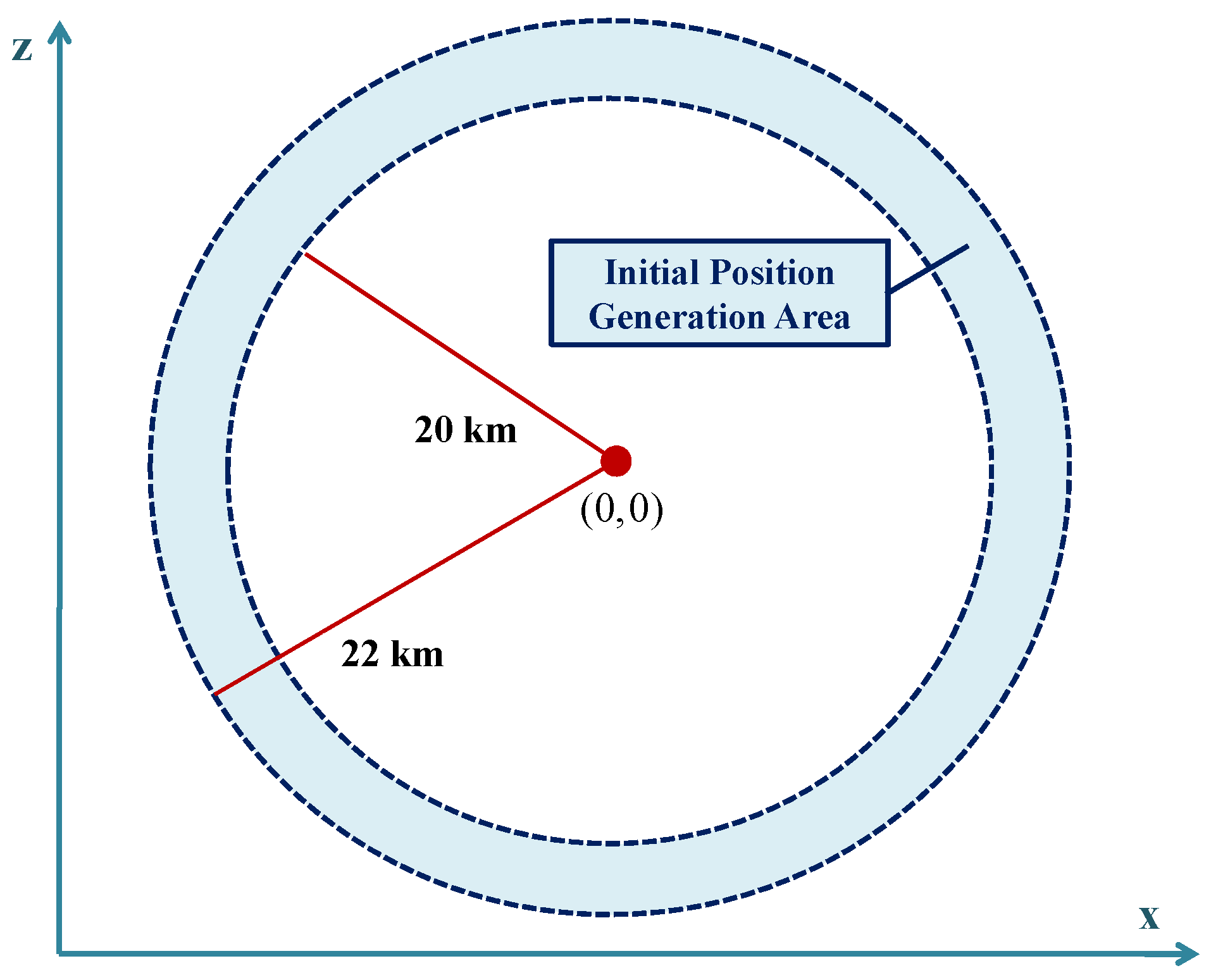
To evaluate the adaptability of the trajectory planning algorithm to random initial states, a Monte Carlo random simulation is conducted. The positions and initial heading angles (0° to 360°) of the four UAVs are randomly generated within a range of 20 km to 22 km around the coordinate system origin. The specific generation ranges are shown in Figure 5.

4.2. Simulation Results

4.2.1. Demonstration of Simulation Effects

The initial conditions of one simulation are as shown in Table 2.
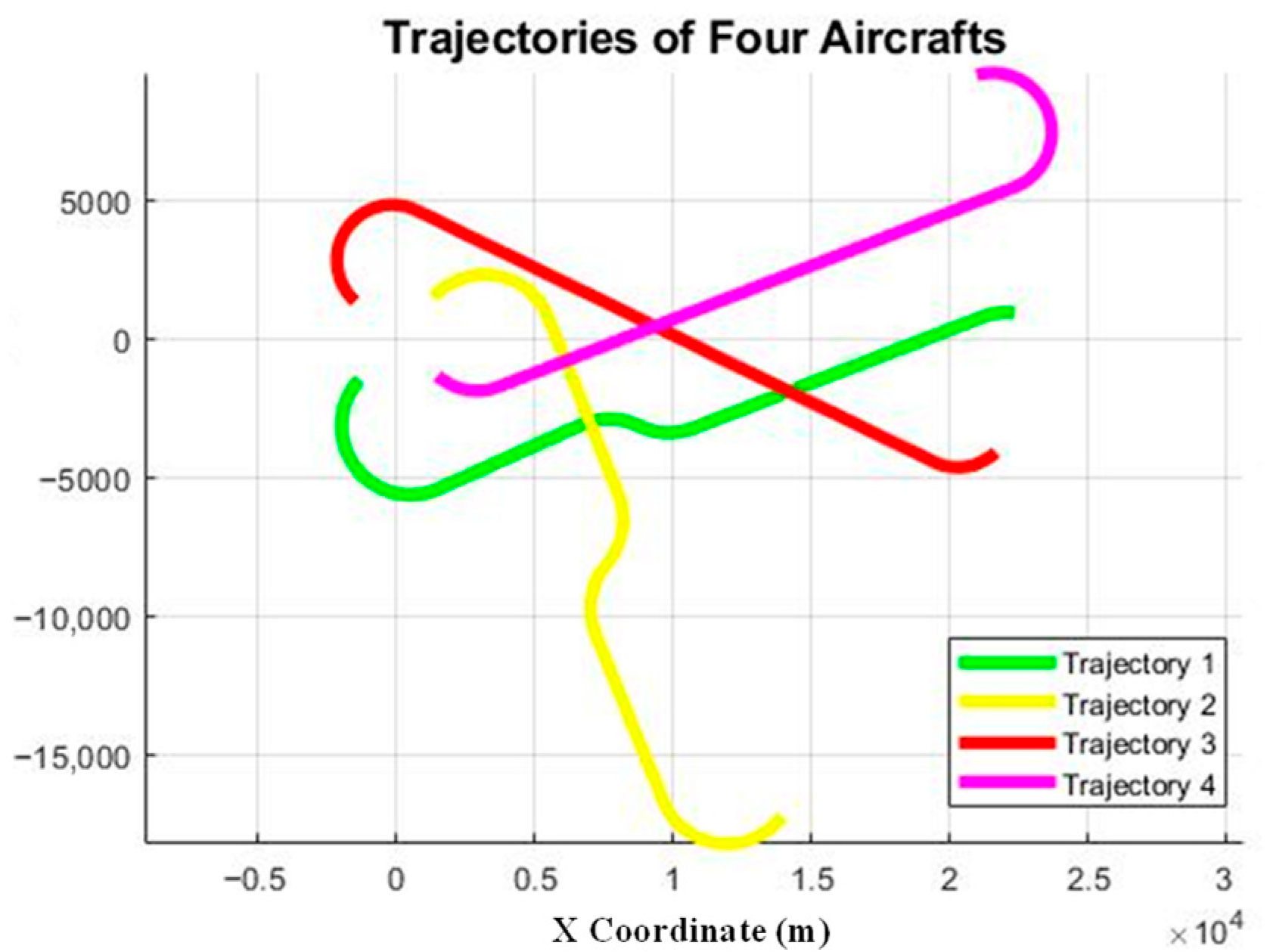
The trajectory optimization results are shown in Figure 6.
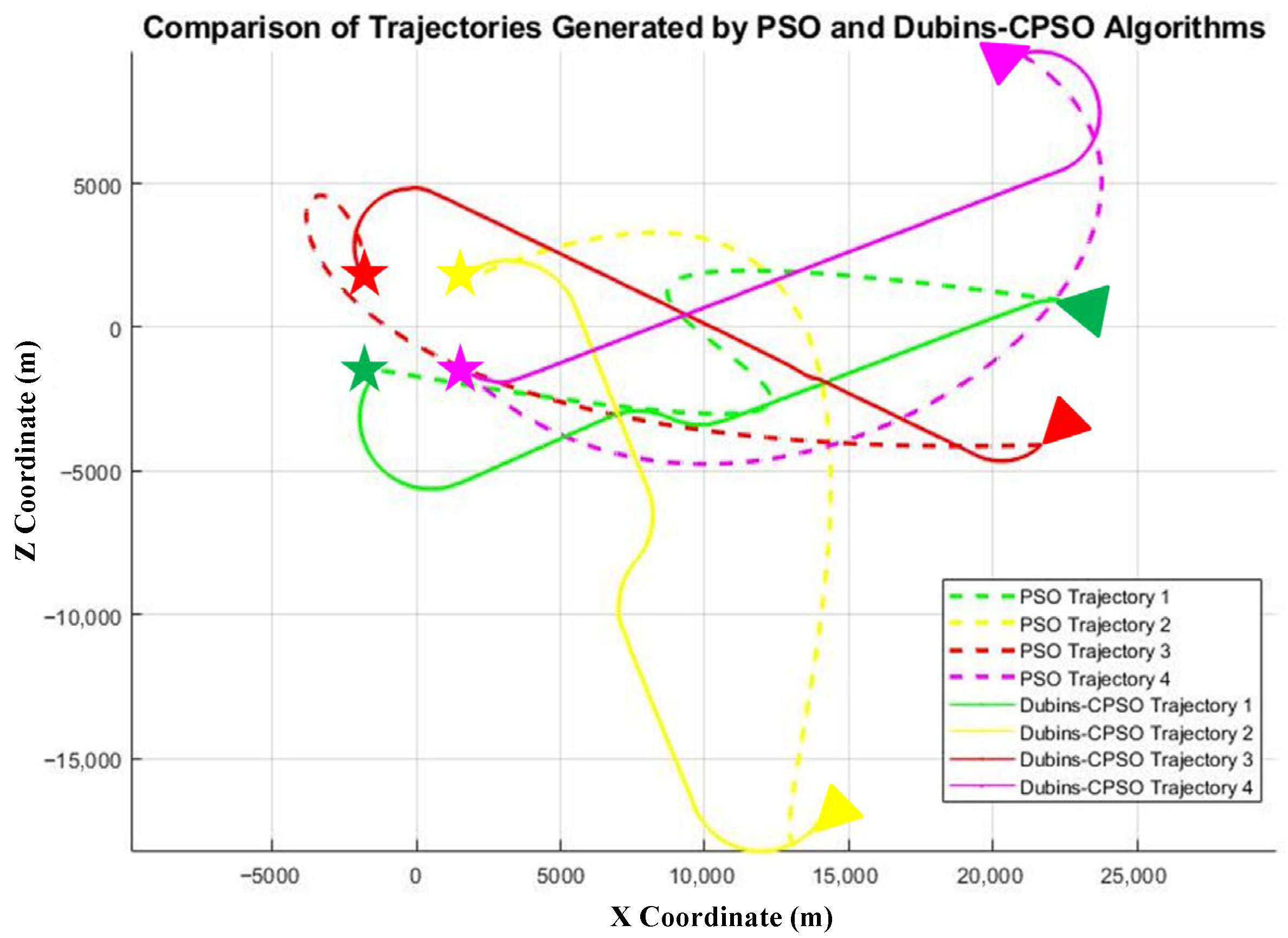
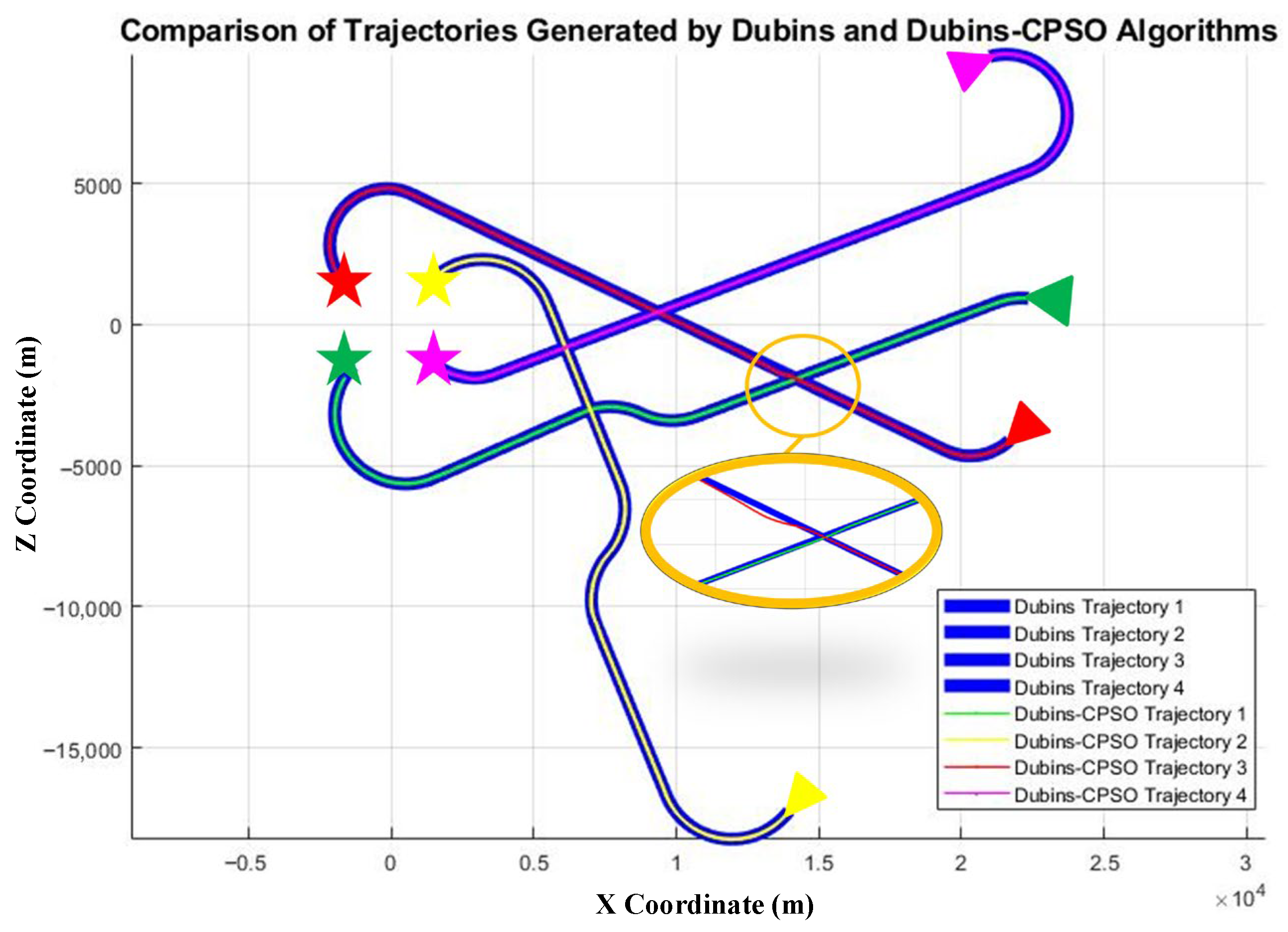
Based on the same initial conditions, we conducted both pure static Dubins method and pure dynamic PSO method trajectory planning and compared the flight effects based on 6-DOF simulations.
Figure 7 illustrates the flight trajectories under PSO-based dynamic programming and Dubins-CPSO planning. Through comparison, it is evident that our proposed method demonstrates more stable flight trajectories compared with intelligent algorithms based on random walk search paths. The incorporation of Dubins curves results in trajectories with smoother turning curves and longer straight segments, which are more friendly to UAV flight and also have greater potential for engineering implementation.
Figure 8 illustrates the flight trajectories under Dubins static planning and Dubins-CPSO planning. Through comparison, it can be observed that our designed algorithm prioritizes curved flight from the reference trajectory during path searching but also considers whether the time constraint conditions are satisfied during the flight. A specific region is marked with a circle in the figure, where the trajectories generated by the two algorithms show significant divergence. This is because the UAV performed collision avoidance optimization in this section, temporarily deviating from the reference trajectory. Moreover, at every moment during the flight, the CPSO algorithm dynamically adjusts based on its position and velocity, ensuring collaborative effects.
A comparison of the simulation results obtained by the three methods is summarized in Table 3.
By comparing the data, it becomes evident that the traditional static Dubins planning method can identify relatively shorter paths by leveraging its inherent curvature characteristics. Furthermore, its path computation approach provides a natural advantage in spatial coordination, enabling precise satisfaction of terminal position and heading angle constraints. However, the predefined nature of its commands limits its dynamic adjustment capability, making it prone to loss of temporal coordination under environmental disturbances. On the other hand, the PSO algorithm, a widely used heuristic method for dynamic optimization, performs well in time-optimal trajectory planning. As indicated by the table data, it effectively controls arrival time synchronization in dynamic environments. Nevertheless, its ability to meet heading-angle constraints is suboptimal, and the substantial command variations during flight may be unsuitable for the hardware limitations of many fixed-wing UAVs. In contrast, the Dubins-CPSO trajectory planning algorithm integrates the strengths of both methods, effectively balancing trajectory practicality with coordination performance. Additionally, the commands generated by this algorithm are more feasible to implement, thereby enhancing its value for engineering applications.

4.2.2. Results of Multiple Simulations

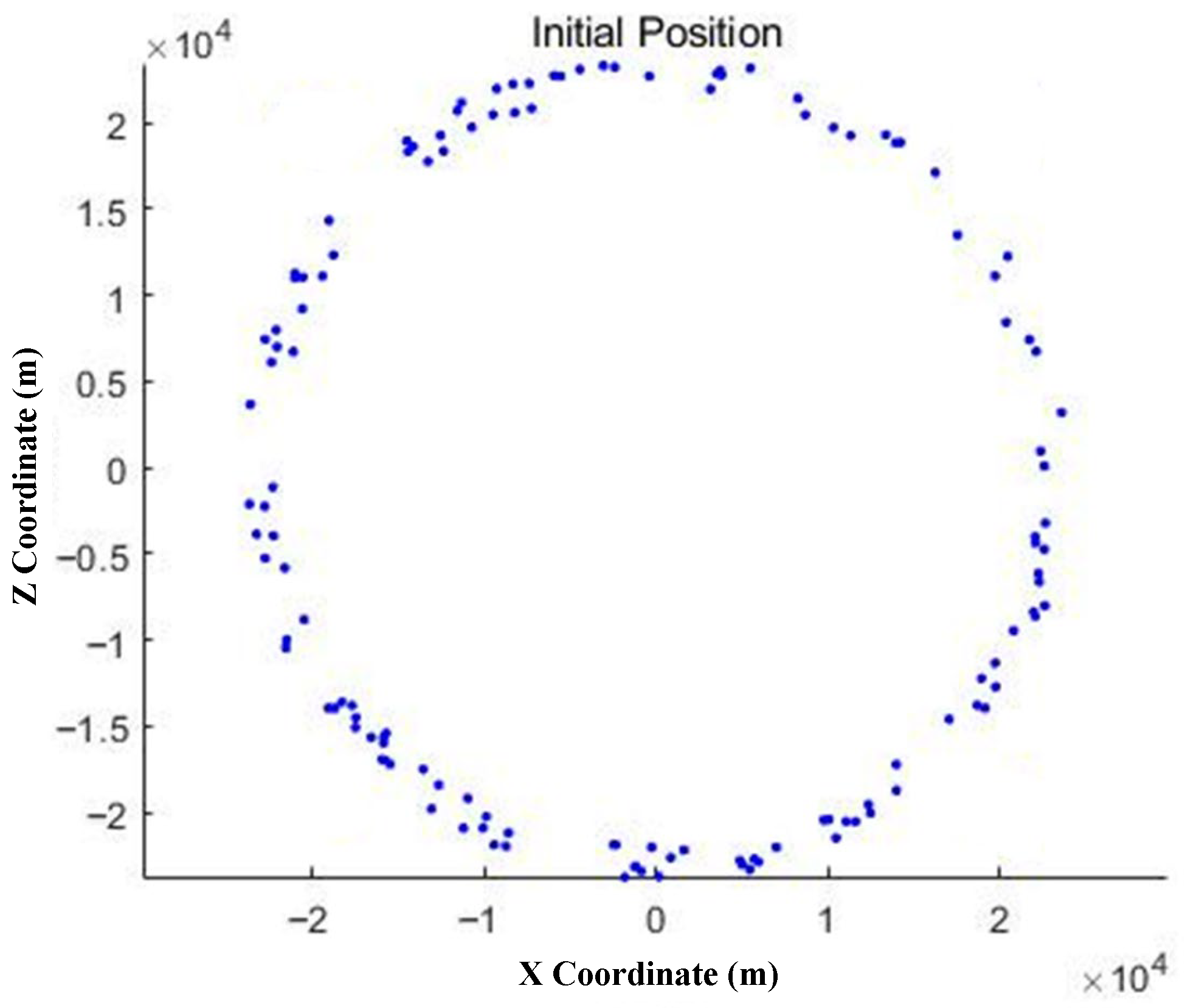
To evaluate the adaptability of the proposed method, 50 random simulations were performed. In these trials, the initial positions of the UAVs were distributed as shown in Figure 9.
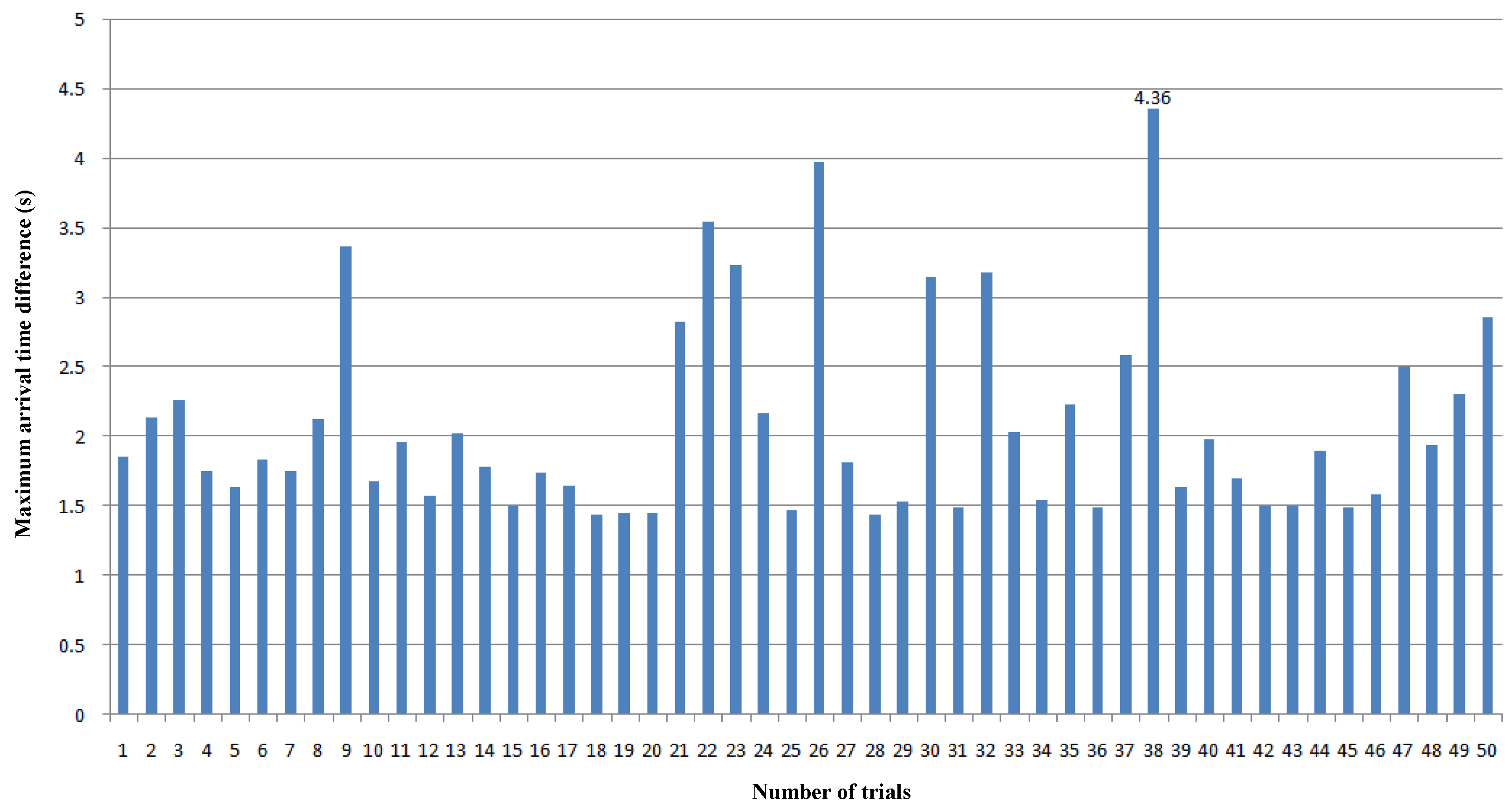
Statistics of the maximum time differences for four UAVs reaching the terminal point across 50 simulations are shown in Figure 10.
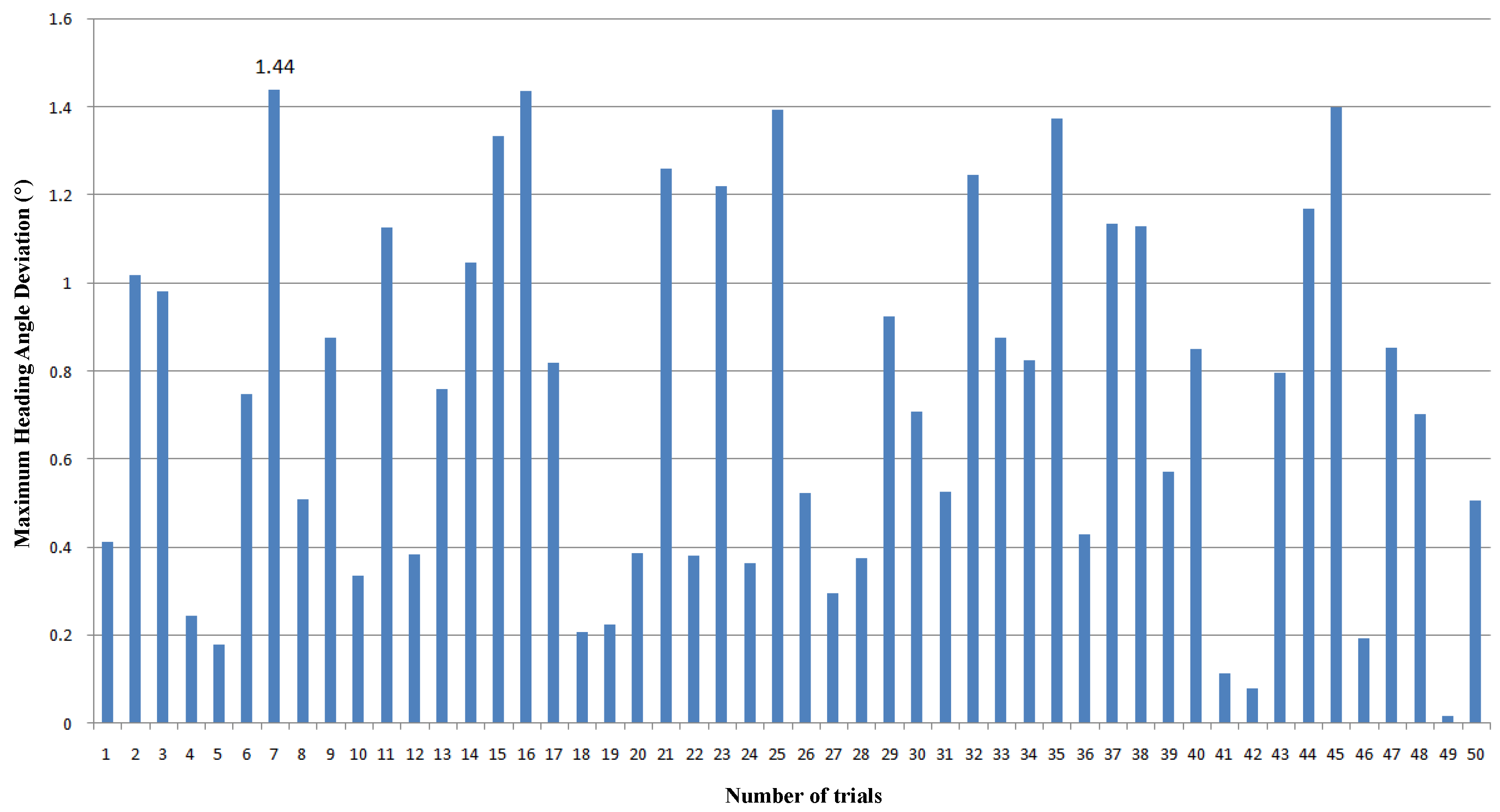
The maximum deviations of the heading angle from the ideal value for the four UAVs reaching the terminal point in 50 simulations are as shown in Figure 11.
The detailed results data of 50 simulations can be found in Appendix C.
The results demonstrate that the proposed method offers greater flexibility than pure static planning and stronger robustness than pure dynamic planning. Through 50 randomized trials, the algorithm is verified to ensure a maximum target arrival time difference of under 5 s and a heading angle deviation within 1.5° while adapting to random initial states and resisting certain levels of wind interference.

5. Conclusions

This research proposes a static–dynamic integrated trajectory-planning method for multi-UAV systems, which achieves spatiotemporal coordination by fusing improved Dubins-curve-based static planning with CPSO-driven dynamic optimization. By leveraging the complementary strengths of different approaches, this work provides a novel solution to multi-UAV cooperative trajectory planning, effectively balancing the inherent trade-off between flexibility and engineering practicality in existing intelligent algorithms; it offers a more implementable and robust trajectory-planning method for real multi-UAV missions where both precise coordination and real-time disturbance rejection are required.
In the future, we will continue to explore directions such as three-dimensional trajectory planning, the development of refined energy models, and the integration of intelligent optimization algorithms, aiming to advance multi-UAV cooperative trajectory planning technology toward greater efficiency and enhanced adaptability to complex dynamic environments. Furthermore, the simulations conducted in the current study primarily employ deterministic disturbances. To further strengthen engineering practicality, future work will introduce multiple types of stochastic disturbances to construct a simulation environment that more closely reflects real-world flight conditions. We will also investigate control methods with robust transient response capabilities under uncertain disturbances, such as finite-time/fixed-time convergence control techniques [25,26]. Subsequently, we will draw upon relevant theoretical frameworks to further improve algorithmic performance.

Author Contributions

Conceptualization, X.L. and Y.F.; methodology, X.L.; software, X.L.; validation, X.L.; formal analysis, X.L. and Y.F.; data curation, X.L.; writing—original draft preparation, X.L.; writing—review and editing, X.L., Y.F. and M.H.; visualization, X.L.; supervision, Y.F. and M.H.; project administration, Y.F. and M.H. All authors have read and agreed to the published version of the manuscript.

Funding

This research received no external funding.

Institutional Review Board Statement

Not applicable.

Informed Consent Statement

Not applicable.

Data Availability Statement

The datasets presented in this article are not readily available. Requests to access the datasets should be directed to the corresponding author.

Conflicts of Interest

The authors declare no conflicts of interest.

Abbreviations

The following abbreviations are used in this manuscript:
6-DOFSix degrees of freedom
UAVUnmanned aerial vehicle
CPSOCharged Particle Swarm Optimization

Appendix A

This paper is based on a typical fixed-wing UAV, with parameters as shown in Table A1.
Table A1. Parameters of the UAV.
ParameterValue
Thrust P (N)180
Mass m (kg)120
Characteristic area S (m2)0.1
If readers require access to more detailed UAV-related data (such as the aerodynamic parameter interpolation tables used in the simulations described in this paper), please contact the corresponding author.

Appendix B

The specific mathematical computation formulas for generating Dubins curves are as follows.
Based on the selected route type, the center positions of the turning circles at the start and end points are calculated. For the initial position ( X f i r s t , Y f i r s t ) , heading angle α, and turning radius R, the formulas for calculating the center positions for left and right turns are
X L f i r s t = X f i r s t + R × c o s ( α + π 2 )   Y L f i r s t = Y f i r s t + R × s i n ( α + π 2 )   X R f i r s t = X f i r s t + R × c o s ( α π 2 ) Y R f i r s t = Y f i r s t + R × s i n ( α π 2 )   ,
Similarly, for the final position ( X l a s t , Y l a s t ) and heading angle β, the center positions of the terminal turning circles are calculated using
X L l a s t = X l a s t + R × c o s ( β + π 2 )   Y L l a s t = Y l a s t + R × s i n ( β + π 2 )   X R l a s t = X l a s t R × c o s ( β + π 2 ) Y R l a s t = Y l a s t R × s i n ( β + π 2 ) ,
For the four types of paths, the endpoints of the straight-line segments are determined, and the LSR straight-line segment endpoint calculation formulas are derived as follows:
X S f i r s t = X f i r s t + R × cos σ q Y S f i r s t = Y f i r s t + R × sin σ q X S l a s t = X l a s t + R × cos π + σ q Y S l a s t = Y l a s t + R × sin π + σ q ,
Here, σ represents the inclination angle of the line connecting the centers, calculated using
σ = a r c t a n ( Y R l a s t Y L f i r s t X R l a s t X L f i r s t ) ,
q represents the angle between the tangent and the line connecting the centers, calculated using
q = a r c c o s ( 2 R ( Y R l a s t Y L f i r s t ) 2 + ( X R l a s t X L f i r s t ) 2 ) ,
Similarly, the formulas for calculating the endpoints of the RSL straight-line segments are derived:
X S f i r s t = X f i r s t + R × cos σ + q Y S f i r s t = Y f i r s t + R × sin σ + q X S l a s t = X l a s t + R × cos π + σ + q Y S l a s t = Y l a s t + R × sin π + σ + q ,
Similarly, the formulas for calculating the endpoints of the RSR straight-line segments are derived:
X S f i r s t = X f i r s t R × sin σ Y S f i r s t = Y f i r s t + R × cos σ X S l a s t = X l a s t R × sin σ Y S l a s t = Y l a s t + R × cos σ ,
Similarly, the formulas for calculating the endpoints of the LSL straight-line segments are derived:
X S f i r s t = X f i r s t + R × sin σ Y S f i r s t = Y f i r s t R × cos σ X S l a s t = X l a s t + R × sin σ Y S l a s t = Y l a s t R × cos σ ,
Once the aforementioned trajectory points are obtained, a Dubins path can be generated based on the initial and terminal positions, along with the heading angle information.

Appendix C

The summary of the results from 50 simulations is as shown in Table A2.
Table A2. Data record of simulation results.
NumberWind Speed
(m/s)
Wind Direction
( ° )
Maximum Change in Command OverloadUAV Arrival Time Difference (s)Maximum Deviation of Terminal Heading Angle  ( ° )
13.3349127.71940.4721.860.414
22.4054788.53050.4862.141.02
34.8701445.97920.3692.260.983
41.77602307.9010.4871.750.244
54.30372173.2490.4451.640.178
63.80932294.0030.3651.840.748
70.349284184.2570.3921.751.44
80.74205896.13330.4322.130.511
92.2444870.32560.4943.370.878
103.22169283.0160.4951.680.336
114.89624184.6970.3741.961.127
120.773644356.8140.4961.580.383
130.826289142.310.4942.020.759
142.107348.7170.4231.781.049
153.91583261.8340.471.51.336
161.67074145.3760.3711.741.439
172.92611359.9450.4131.650.821
182.91284292.3220.4871.440.208
194.01013305.4290.4691.450.224
202.8831486.90450.4941.450.386
212.63894272.4910.4482.831.261
224.10703333.0390.3553.550.381
231.98691249.0020.4773.241.221
240.741631.86130.492.170.365
252.08525.72440.4521.471.394
260.5271465.8980.4643.980.525
270.86169192.2890.4611.820.295
284.741667.55820.4091.440.377
291.54008301.6720.4481.530.924
304.723567.95250.3763.150.71
313.2385115.6590.4561.490.527
323.77804115.9420.3553.181.246
331.4117955.66940.3922.040.878
341.25477357.6160.3571.550.825
353.32301314.570.3652.231.376
363.45424225.8130.4741.490.429
374.0723924.08280.4542.591.136
383.86563125.7310.3984.361.131
391.48061107.4280.4931.640.571
403.02072357.6930.3551.980.852
411.891842.736580.4161.70.114
420.903195244.2450.4071.50.081
431.93564316.0970.4651.50.796
442.60643229.8520.4691.91.169
454.52361272.6120.3781.491.401
462.85745206.5490.4231.590.195
470.56917283.6210.4172.510.853
482.514119.96490.4471.940.704
493.8097885.80580.4562.310.018
504.53429288.4550.4632.860.506

References

  1. Dubins, L.E. On curves of minimal length with a constraint on average curvature and with prescribed initial and terminal positions and tangents. Am. J. Math. 1957, 79, 497–516. [Google Scholar] [CrossRef]
  2. Medeiros, A.C.; Urrutia, S. Discrete optimization methods to determine trajectories for Dubins’ vehicles. Electron. Notes Discret. Math. 2010, 36, 17–24. [Google Scholar] [CrossRef]
  3. De Palma, D.; Parlangeli, G. Classification Scheme for the Three-Point Dubins Problem. Machines 2024, 12, 659. [Google Scholar] [CrossRef]
  4. Zhou, X.; Zhu, K.; Liu, S.; Li, Z.; Zhang, W.; Du, K. Quality-guaranteed Dubins Path Planning for USV Based on Mixed-integer Piecewise-linear Programming for Addressing the Extended Minimum-time Intercept Problem. J. Mar. Sci. Appl. 2025, 25, 216–227. [Google Scholar] [CrossRef]
  5. Wang, L.; Huang, W.; Li, H.; Li, W.; Chen, J.; Wu, W. A Review of Collaborative Trajectory Planning for Multiple Unmanned Aerial Vehicles. Processes 2024, 12, 1272. [Google Scholar] [CrossRef]
  6. Wang, H.; Li, Q.; Cheng, N. Real-time path planning for low altitude flight based on A* algorithm and TF/TA algorithm. In Proceedings of the IEEE International Conference on Automation Science and Engineering, Seoul, Republic of Korea, 20–24 August 2012; IEEE: New York, NY, USA, 2012; pp. 837–842. [Google Scholar]
  7. Sun, X.; Cai, C.; Shen, X. A new cloud model based human-machine cooperative path planning method. J. Intell. Robot. Syst. 2015, 79, 3–19. [Google Scholar] [CrossRef]
  8. Xu, B.; Wang, G.; Yang, Z.; Bian, Y.; Wang, X.; Hu, M. Multi-Vehicle Collaborative Trajectory Planning in Unstructured Conflict Areas Based on V-Hybrid A*. IEEE Trans. Intell. Transp. Syst. 2024, 25, 12722–12735. [Google Scholar] [CrossRef]
  9. Cai, Y.; Xi, Q.; Xing, X.; Gui, H.; Liu, Q. Path Planning for UAV Tracking Target Based on Improved A-Star Algorithm. In Proceedings of the 2019 1st International Conference on Industrial Artificial Intelligence (IAI), Shenyang, China, 23–27 July 2019. [Google Scholar]
  10. Yin, G.; Zhou, S.; Mo, J.; Cao, M.; Kang, Y. Cooperative multi task allocation of UAV based on multi-objective particle swarm optimization. Comput. Mod. 2016, 18, 7–11. [Google Scholar]
  11. Wu, Y.; Deng, J.; Li, L.; Su, X.; Lin, L. A hybrid particle swarm optimization-gauss pseudo method for reentry trajectory optimization of hypersonic vehicle with navigation information model. Aerosp. Sci. Technol. 2021, 118, 107046. [Google Scholar] [CrossRef]
  12. Sheng, L.; Li, H.; Qi, Y.; Shi, M. Real Time Screening and Trajectory Optimization of UAVs in Cluster Based on Improved Particle Swarm Optimization Algorithm. IEEE Access 2023, 11, 81838–81851. [Google Scholar] [CrossRef]
  13. Yang, F.; Fang, X.; Gao, F.; Zhou, X.; Li, H.; Jin, H.; Song, Y. Obstacle avoidance path planning for UAV based on improved RRT algorithm. Discret. Dyn. Nat. Soc. 2022, 2022, 4544499. [Google Scholar] [CrossRef]
  14. Ren, X.; Tan, L.; Jiaqi, S.; Lian, X. Multi-target UAV path planning based on improved RRT algorithm. J. Phys. Conf. Ser. 2021, 1786, 012038. [Google Scholar] [CrossRef]
  15. Guo, J.; Xia, W.; Hu, X.; Ma, H. Feedback RRT* algorithm for UAV path planning in a hostile environment. Comput. Ind. Eng. 2022, 174, 108771. [Google Scholar] [CrossRef]
  16. Huang, J.; Sun, W. A method of feasible trajectory planning for UAV formation based on bi-directional fast search tree. Optik 2020, 221, 165213. [Google Scholar] [CrossRef]
  17. Zhou, L.; Leng, S.; Liu, Q.; Wang, Q. Intelligent UAV swarm cooperation for multiple targets tracking. IEEE Internet Things J. 2021, 9, 743–754. [Google Scholar] [CrossRef]
  18. Bo, J.; Ruokun, Q.; Yandong, L. Research on UAV aerial photography target detection based on deep learning Research review. Acta Aeronaut. Sci. 2021, 4, 137–151. [Google Scholar]
  19. Haghighi, H.; Delahaye, D.; Asadi, D. Performance-based emergency landing trajectory planning applying meta-heuristic and Dubins paths. Appl. Soft Comput. 2022, 117, 108453. [Google Scholar] [CrossRef]
  20. Wang, J.; Bi, C.; Liu, F.; Shan, J. Dubins-RRT* motion planning algorithm considering curvature-constrained path optimization. Expert Syst. Appl. 2026, 296, 128390. [Google Scholar] [CrossRef]
  21. Jung, Y.; Oh, B.-S. DC-RRT*: Dubins-Guided Curvature RRT* for 3D Path Planning of Unmanned Aerial Vehicles. IEEE Access 2025, 13, 148936–148948. [Google Scholar] [CrossRef]
  22. Wu, W.; Xu, J.; Gong, C.; Cui, N. Adaptive path following control for miniature unmanned aerial vehicle confined to three-dimensional Dubins path: From take-off to landing. ISA Trans. 2023, 143, 156–167. [Google Scholar] [CrossRef]
  23. Gupta Manyam, S.; Casbeer, D.W.; Von Moll, A.; Fuchs, Z. Shortest Dubins Paths to Intercept a Target Moving on a Circle. J. Guid. Control Dyn. 2022, 45, 2107–2120. [Google Scholar] [CrossRef]
  24. Yeol, J.W.; Ryu, Y.S.; Montalvo, M.A. Shortest trajectory planning of wheeled mobile robots with constraints. In Proceedings of the IEEE Proceedings in Networking, Sensing and Control, Tucson, AZ, USA, 19–22 March 2005; IEEE: New York, NY, USA, 2005; pp. 883–888. [Google Scholar]
  25. Xie, H.; Zheng, J.; Sun, Z.; Wang, H.; Chai, R. Finite-time tracking control for nonholonomic wheeled mobile robot using adaptive fast nonsingular terminal sliding mode. Nonlinear Dyn. 2022, 110, 1437–1453. [Google Scholar] [CrossRef]
  26. Moudoud, B.; Aissaoui, H.; Diany, M. Adaptive integral-type terminal sliding mode control: Application to trajectory tracking for mobile robot. Int. J. Adapt. Control Signal Process. 2022, 37, 603–616. [Google Scholar] [CrossRef]
Figure 1. Schematic diagram of spatiotemporal trajectory planning for multiple UAVs.
Applsci 16 01880 g001
Figure 2. A transformed coordinate system.
Applsci 16 01880 g002
Figure 3. Schematic diagrams of four types of curves.
Applsci 16 01880 g003
Figure 4. The schematic diagram of trajectory optimization approach based on static and dynamic integration.
Applsci 16 01880 g004
Figure 5. Determination of the generation area for the initial position of UAVs.
Applsci 16 01880 g005
Figure 6. Trajectory planning results based on Dubins-CPSO.
Applsci 16 01880 g006
Figure 7. Comparison of trajectories planned by PSO and Dubins-CPSO.
Applsci 16 01880 g007
Figure 8. Comparison of trajectories planned by Dubins and Dubins-CPSO.
Applsci 16 01880 g008
Figure 9. Distribution of initial positions for UAVs.
Applsci 16 01880 g009
Figure 10. Statistical chart of maximum time differences for UAVs reaching the terminal point across 50 simulations.
Applsci 16 01880 g010
Figure 11. Statistical chart of maximum heading angle deviations for UAVs reaching the terminal point across 50 simulations.
Applsci 16 01880 g011
Table 1. Path type selection schemes corresponding to 16 combinations.
Initial AngleTerminal AnglePath Type
First/Second QuadrantFirst/Second QuadrantRSL
First/Second QuadrantThird/Fourth QuadrantRSR
Third/Fourth QuadrantFirst/Second QuadrantLSL
Third/Fourth QuadrantThird/Fourth QuadrantLSR
Table 2. The initial parameter values for this simulation.
Simulation ParametersValues
Target location (m)(0.0, 0.0)
UAV 1 position (m)(22,348.5, 930.6)
UAV 1 heading angle (°)185.7
UAV 2 position (m)(13,951.5, −17,236.5)
UAV 2 heading angle (°)126.8
UAV 3 position (m)(21,679.9, −4101.7)
UAV 3 heading angle (°)136.5
UAV 4 position (m)(20,983.9, 9504.7)
UAV 4 heading angle (°)344.3
Wind speed (m/s)5.7
Wind direction (°)7.6
Simulation step (s)0.5
Minimum turning radius (m)1000
Maximum turning radius (m)3000
Number of particles in CPSO100
Number of evolutionary generations10
Crossover probability0.8
Mutation probability0.05
Maximum command overload
(absolute value)
1
Initial velocity (m/s)100
Safety distance between UAVs (m)500
Table 3. Comparison of simulation results data for three algorithms.
MethodMean Path Length (m)UAV Arrival Time Difference (s)Maximum Deviation of Terminal Heading AngleMaximum Change in Command Overload
Dubins28,924.5121.620.28
PSO33,217.60119.01.87
Dubins-CPSO29,066.11.51.900.4
Disclaimer/Publisher’s Note: The statements, opinions and data contained in all publications are solely those of the individual author(s) and contributor(s) and not of MDPI and/or the editor(s). MDPI and/or the editor(s) disclaim responsibility for any injury to people or property resulting from any ideas, methods, instructions or products referred to in the content.