Assessment of Carbon Emission Reduction Benefits of Infrastructure Systems in Urban Underground Space Development



Abstract
1. Introduction
2. Literature Review
2.1. CER of Urban Infrastructure System
2.2. CER of Urban Underground Space
3. Methods
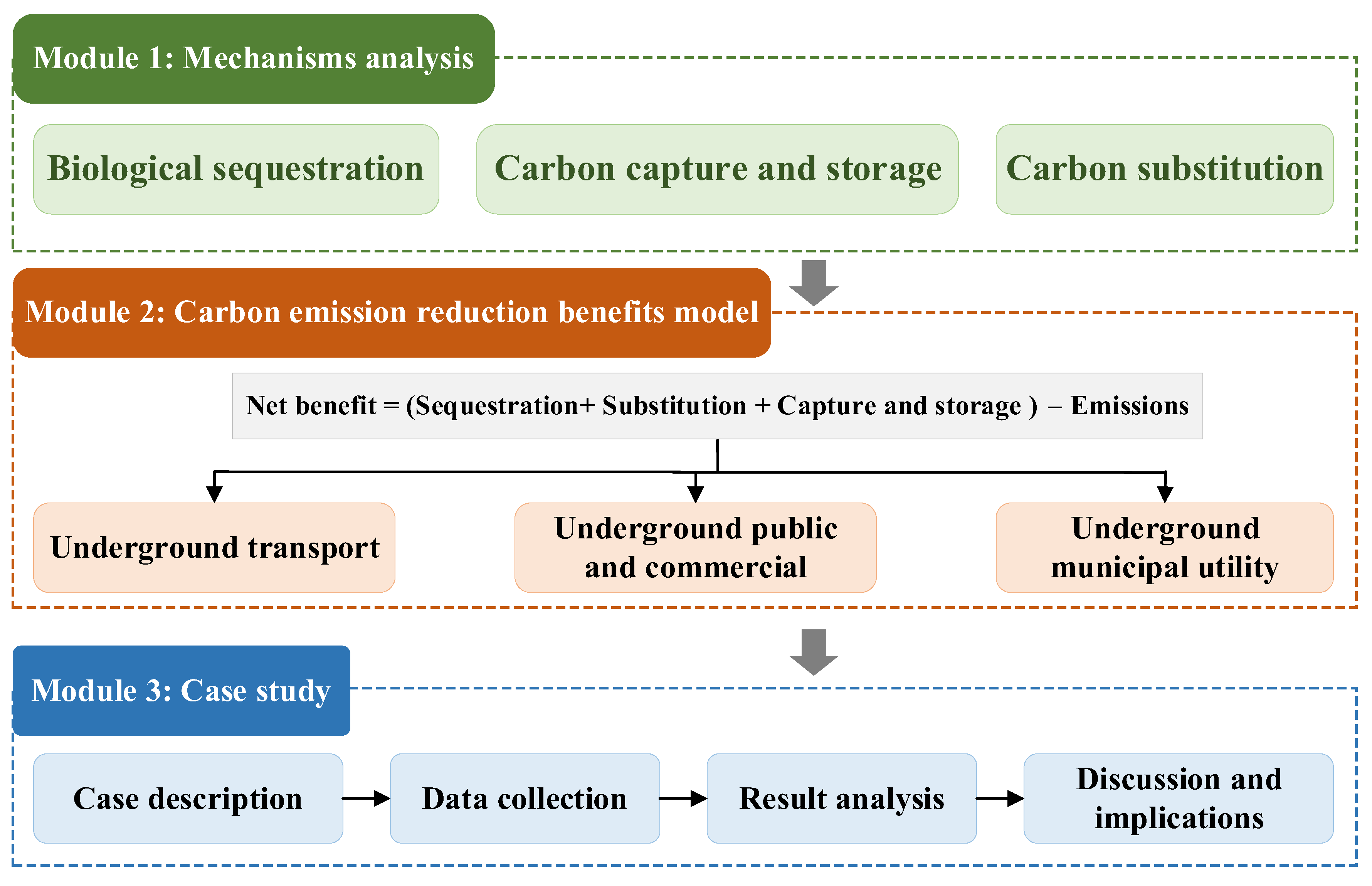
3.1. Research Framework
3.2. Assumptions and Accounting Rules
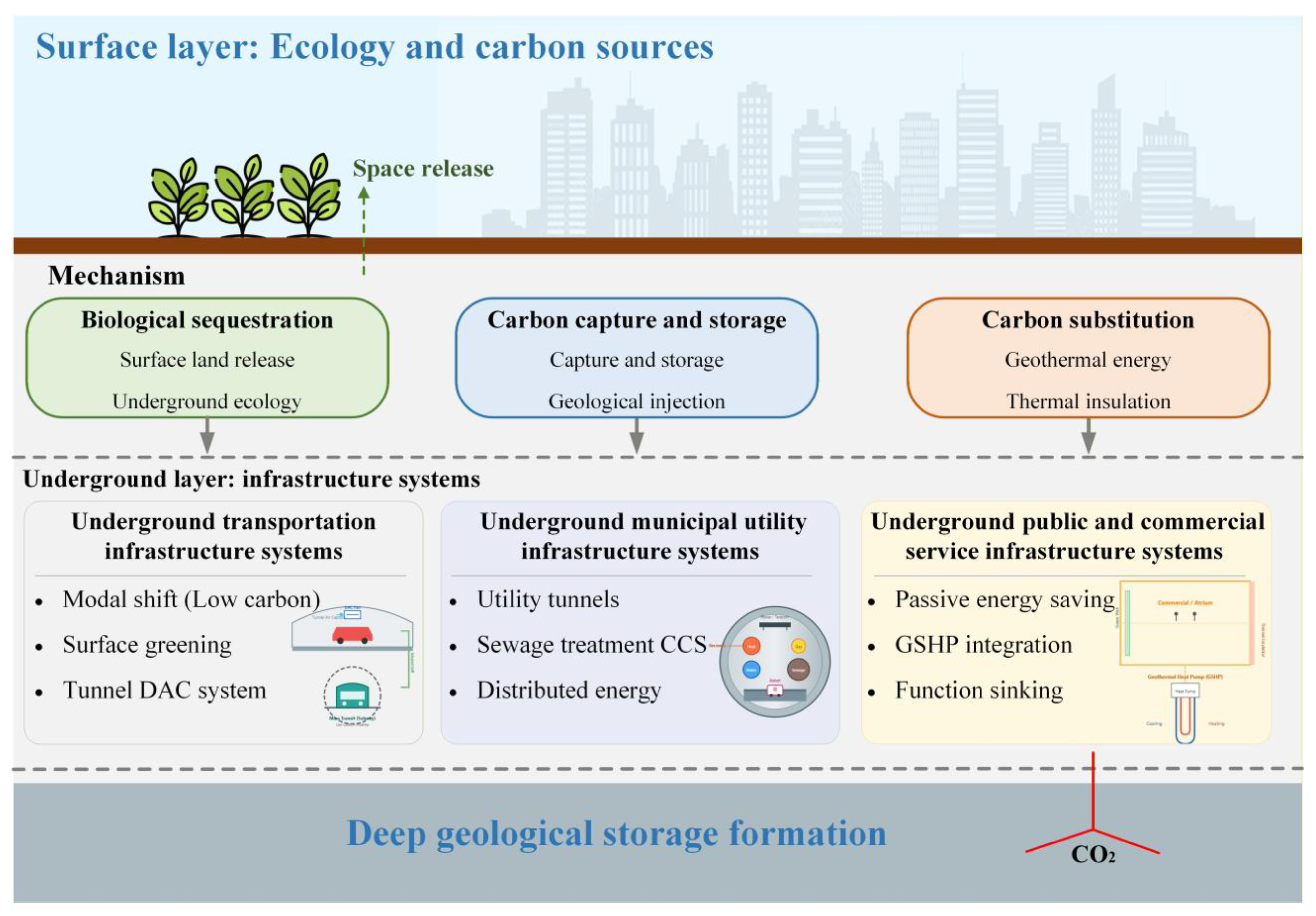
3.3. CER Mechanisms of Urban Underground Space
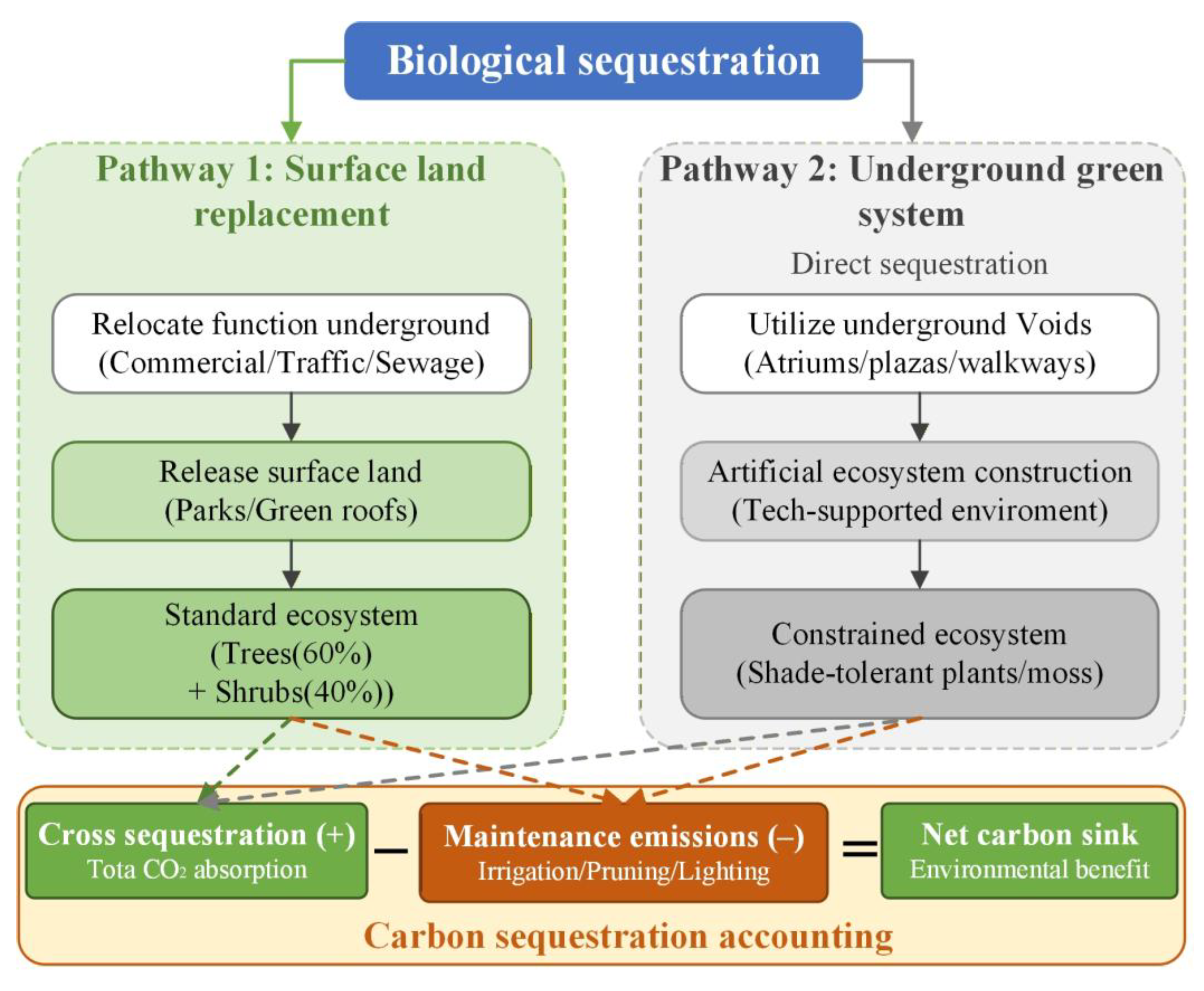
3.3.1. Biological Carbon Sequestration
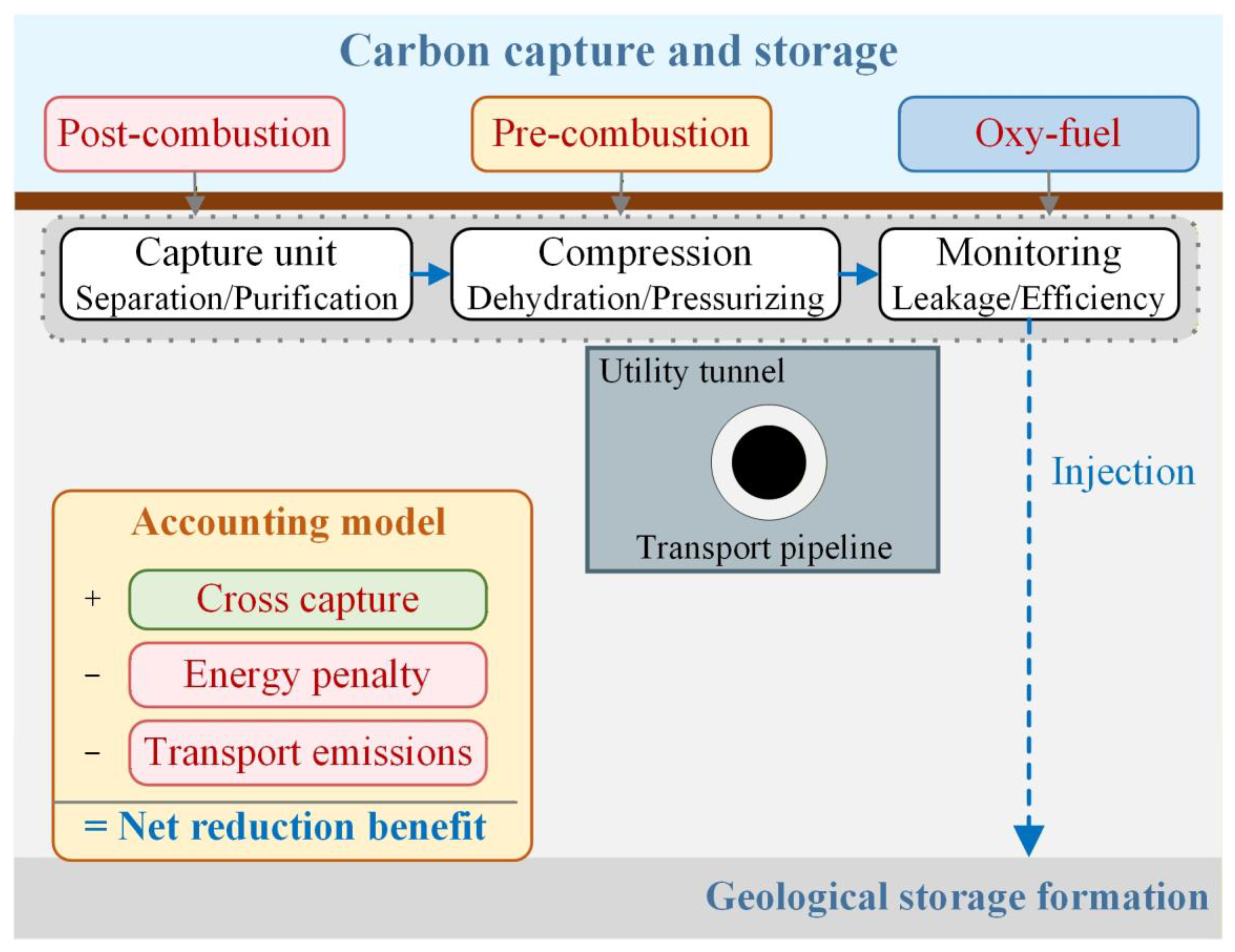
3.3.2. Carbon Capture and Storage
3.3.3. Carbon Substitution

| Symbol | Parameter | Value | Unit | Source |
|---|---|---|---|---|
| Air density | 1.29 | kg/m3 | [40] | |
| Electricity emission factor | 0.997 | kg CO2e/kWh | [25] | |
| Average energy consumption intensity of urban buildings | 1.51 | GJ/(m2·year) | [21] | |
| Lighting power density | 9 | W/m2 | [24] | |
| Specific heat capacity of air | 1 | kJ/(kg·°C) | [21] | |
| Urban green space ratio | 0.45 | / | [24] | |
| Energy consumption efficiency of motor vehicles | 0.050 | (L·person−1)/km | [24] | |
| Energy consumption efficiency of rail transit | 0.176 × 10⁶ | (J·person−1)/km | Survey | |
| Commuting distance | 10 | Km | Survey | |
| - | Operational energy-saving rate of underground buildings | 0.9 | / | [41] |
| - | Adoption rate of green building technologies | 0.6 | / | [25] |
| COP | Coefficient of performance | 3.8 | / | [25] |
| / | Carbon sink efficiency (Trees, Shrubs) | 3.18; 1.72 | kg CO2e/(m2·year) | [40] |
3.4. CER Benefits Assessment Model
3.4.1. CER Benefits Assessment Model of Underground Transportation Infrastructure Systems
3.4.2. CER Benefits Assessment Model of Underground Public and Commercial Infrastructure Systems
3.4.3. CER Benefits Assessment Model of Underground Municipal Utility Infrastructure Systems
4. Case Study
4.1. Case Description and Data Preparation
4.2. Result Analysis
4.2.1. Calculation of Underground Transportation Infrastructure Systems CER Benefits
- 1.
- Underground Rail Transit Infrastructure
- 2.
- Underground Parking and Tunnels Infrastructure
4.2.2. Calculation of Underground Public and Commercial Infrastructure Systems CER Benefits
4.2.3. Calculation of Underground Municipal Utility Infrastructure Systems CER Benefits
4.3. Discussion
4.3.1. Comparative Analysis of CER Benefits in Urban Underground Space
4.3.2. Sensitivity Analysis
4.3.3. Implications
- (1)
- Different types of systems should be matched with differentiated carbon reduction strategies. The study finds that the CER benefits of underground transportation systems mainly stem from travel substitution and building energy savings, indicating that the layout of metro stations should coordinate the efficiency of commuting substitution with the optimization of green building standards. Underground public and commercial service facilities exhibit high carbon reduction efficiency per unit area, supported by green building design and the integration of shallow geothermal energy, suggesting that in high-density urban areas, priority should be given to energy system retrofitting and the integration of green infrastructure. The CER benefits of municipal utility systems rely primarily on advanced technologies such as carbon capture, utilization, and storage, highlighting the practical necessity of utilizing underground space to support industrial carbon mitigation demonstration projects.
- (2)
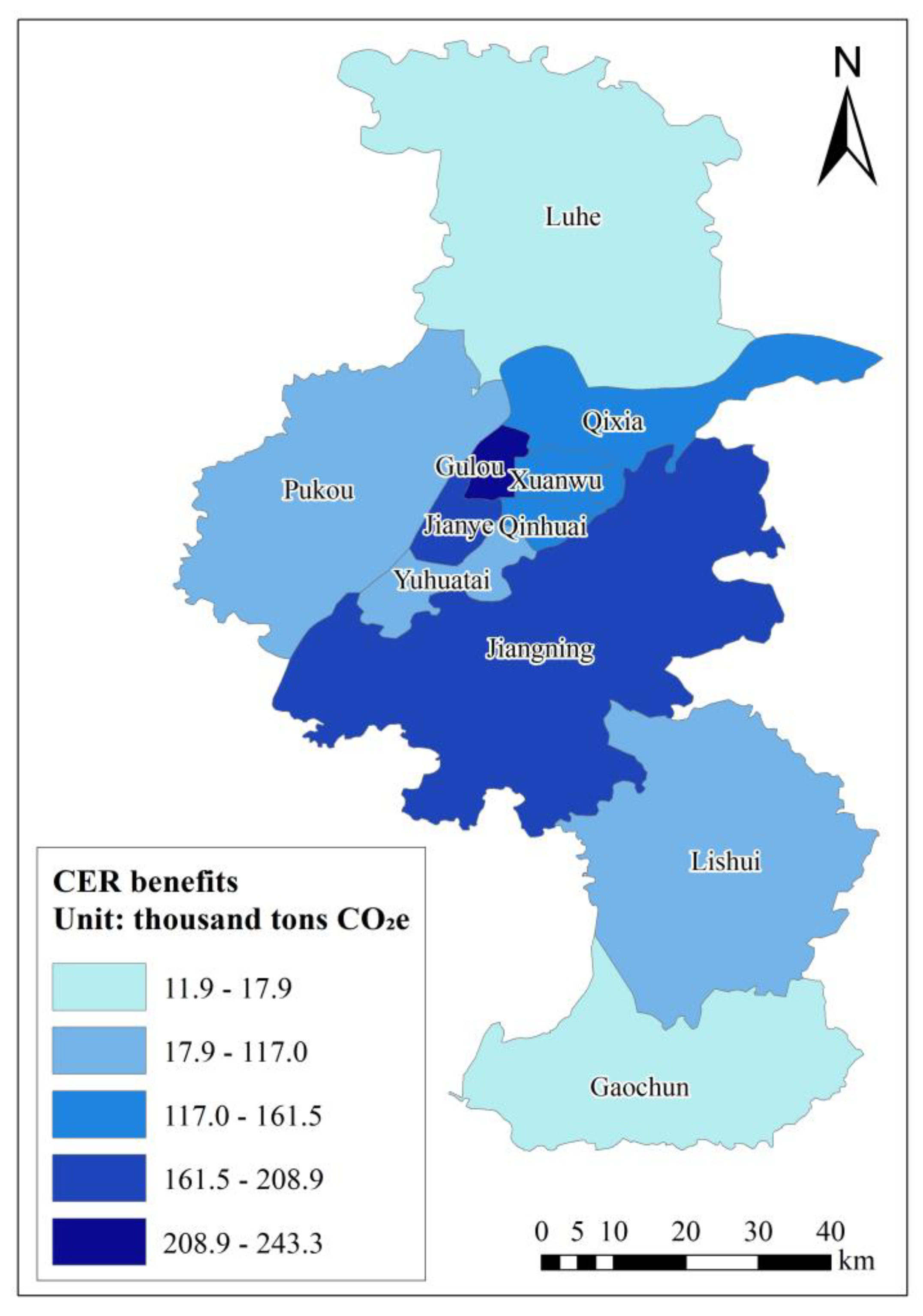
- The spatial differences in CER benefits across regions highlight the practical need to establish targeted mitigation pilot projects. Districts such as Gulou, Jianye, and Jiangning have already developed relatively comprehensive underground space systems, characterized by a high degree of infrastructure integration and strong functional complementarity. These areas represent priority locations for initiating pilot projects that integrate multiple carbon reduction mechanisms. Promoting a coordinated model of underground green development that links transportation, energy, and building systems in such regions can help explore synergistic pathways between policy mechanisms and engineering solutions.
- (3)
- The linkage between facility layout and carbon reduction potential reinforces the importance of integrated spatial planning. The results indicate that CER benefits are not only determined by the technical configuration of individual facilities but are also influenced by the coordination among facility types, spatial locations, and functional combinations. Therefore, it is necessary to strengthen the integration of underground development and carbon emission indicators within the overall urban land use planning. By optimizing site selection, functional zoning, and temporal sequencing, the systematic contribution of underground space to the urban carbon neutrality framework can be enhanced.
- (4)
- Despite the robustness of the reported results, several limitations should be acknowledged. First, construction-phase carbon emissions associated with underground infrastructure development are not fully captured, which may lead to an underestimation of lifecycle emissions. Second, the feasibility of underground space utilization and carbon capture and storage deployment depends on site-specific geological conditions, which may limit the transferability of results across cities. Third, the large-scale implementation of CCS in dense urban areas may be influenced by policy, regulatory, and economic factors in addition to technical feasibility.
- (5)
- The CCUS-related carbon emission reduction quantified in this study is based on a large-scale industrial project with stable operating conditions and concentrated emission sources. The resulting CER value therefore reflects the mitigation performance achievable under such representative project conditions, providing a concrete reference for the potential role of CCUS within urban underground space systems. Within the broader context of municipal utility infrastructures, differences in facility type, operational scale, and spatial setting influence the extent to which similar CCUS-based mitigation pathways can be applied. Facilities with continuous operation and relatively concentrated emissions are generally more compatible with CCUS integration, whereas other municipal systems may exhibit different technical suitability. At the city scale, these characteristics suggest that CCUS contributes to urban carbon mitigation through selected projects and locations, complementing other energy-saving- and substitution-based pathways. In this sense, CCUS represents an important component of the underground infrastructure mitigation portfolio, particularly for applications where site conditions and emission characteristics are favorable.
- (6)
- The proposed assessment framework is structured around mitigation pathways rather than city-specific configurations, which enables its application to other urban contexts. By adjusting baseline scenarios, local emission factors, and infrastructure characteristics, the framework can be adapted to cities with different stages of underground space development. Moreover, additional underground facility types, such as logistics systems, utility corridors, or mixed-use underground complexes, can be incorporated by mapping their functions to the same set of mitigation pathways, ensuring analytical consistency across cases.
5. Conclusions
Author Contributions
Funding
Data Availability Statement
Conflicts of Interest
Abbreviations
| CER | Carbon emission reduction |
| UUS | Urban underground space |
| CCS | Carbon capture and storage |
| CCUS | Carbon capture, utilization, and storage |
| CO2 | Carbon dioxide |
| CO2e | Carbon dioxide equivalent |
| COP | Coefficient of performance |
| LCA | Life cycle assessment |
| DAC | Direct air capture |
| GHG | Greenhouse gas |
| GSHP | Ground source heat pump |
| HVAC | Heating, ventilation, and air conditioning |
| IPCC | Intergovernmental Panel on Climate Change |
| IEA | International Energy Agency |
References
- Wei, W.; Zhang, X.; Zhou, L.; Xie, B.; Zhou, J.; Li, C. How does spatiotemporal variations and impact factors in CO2 emissions differ across cities in China? Investigation on grid scale and geographic detection method. J. Clean. Prod. 2021, 321, 128933. [Google Scholar] [CrossRef]
- Wang, J.; Gao, Y.; Zhu, Y.; Zhang, W.; Zhao, M.; Chen, F. Estimating carbon emission of industrial users by identifying multiple loads in advanced metering infrastructure. J. Clean. Prod. 2025, 520, 146056. [Google Scholar] [CrossRef]
- Li, K.; Wang, H.; Zhang, X.; Su, H.; Xu, J.; Hua, X. Assessing the divergent effects of green infrastructure landscape patterns on carbon emission and sequestration in 31 cities across China. Build. Environ. 2025, 280, 113110. [Google Scholar] [CrossRef]
- Bobylev, N.G.; Guo, D.; Benardos, A. Urban underground space use in a climate neutral city. In Expanding Underground-Knowledge and Passion to Make a Positive Impact on the World; CRC Press: Boca Raton, FL, USA, 2023; pp. 9–13. [Google Scholar]
- Zhao, X.; Ma, X.; Chen, B.; Shang, Y.; Song, M. Challenges toward carbon neutrality in China: Strategies and countermeasures. Resour. Conserv. Recycl. 2022, 176, 105959. [Google Scholar] [CrossRef]
- Chang, S.; Wang, J.; Zhang, F.; Niu, L.; Wang, Y. A study of the impacts of urban expansion on vegetation primary productivity levels in the Jing-Jin-Ji region, based on nighttime light data. J. Clean. Prod. 2020, 263, 121490. [Google Scholar] [CrossRef]
- Zhang, Y.; Chen, Y. Evolutionary game analysis of carbon emission reduction in transportation infrastructure construction under dual regulation. Heliyon 2024, 10, e38223. [Google Scholar] [CrossRef]
- Chen, X.; Xu, H.; Zhang, L.; Cao, H. Spatial functional division, infrastructure and carbon emissions: Evidence from China. Energy 2022, 256, 124551. [Google Scholar] [CrossRef]
- Karlsson, I.; Rootzén, J.; Johnsson, F. Reaching net-zero carbon emissions in construction supply chains–Analysis of a Swedish road construction project. Renew. Sustain. Energy Rev. 2020, 120, 109651. [Google Scholar] [CrossRef]
- Chou, J.S.; Yeh, K.-C. Life cycle carbon dioxide emissions simulation and environmental cost analysis for building construction. J. Clean. Prod. 2015, 101, 137–147. [Google Scholar] [CrossRef]
- Shen, Y.; Ling, J.; Li, X.; Li, H.; Feng, S.; Zhu, H. Holistic digital-twin-based framework to improve tunnel lighting environment: From methodology to application. Build. Environ. 2022, 224, 109562. [Google Scholar] [CrossRef]
- Qiao, Y.K.; Peng, F.-L.; Sabri, S.; Rajabifard, A. Low carbon effects of urban underground space. Sustain. Cities Soc. 2019, 45, 451–459. [Google Scholar] [CrossRef]
- Xia, H.; Lin, C.; Liu, X.; Liu, Z. Urban underground space capacity demand forecasting based on sustainable concept: A review. Energy Build. 2022, 255, 111656. [Google Scholar] [CrossRef]
- Jiao, T.; Peng, P.; Li, S.; Wu, W. Low-carbon efforts for underground space development in Singapore. Undergr. Space 2026, 26, 22–35. [Google Scholar] [CrossRef]
- Lin, D.; Broere, W.; Cui, J. Underground space utilization and new town development: Experiences, lessons and implications. Tunn. Undergr. Space Technol. 2022, 119, 104204. [Google Scholar] [CrossRef]
- Li, X.; Li, C.; Parriaux, A.; Wu, W.; Li, H.; Sun, L.; Liu, C. Multiple resources and their sustainable development in Urban Underground Space. Tunn. Undergr. Space Technol. 2016, 55, 59–66. [Google Scholar] [CrossRef]
- Debrock, S.; Van Acker, M.; Admiraal, H. Design recommendations for sustainable urban underground spaces. Tunn. Undergr. Space Technol. 2023, 140, 105332. [Google Scholar] [CrossRef]
- Zhang, L.; Long, R.; Chen, H. Carbon emission reduction potential of urban rail transit in China based on electricity consumption structure. Resour. Conserv. Recycl. 2019, 142, 113–121. [Google Scholar] [CrossRef]
- Qin, B.; Li, H.; Wang, Z.; Jiang, Y.; Lu, D.; Du, X.; Qian, Q. New framework of low-carbon city development of China: Underground space based integrated energy systems. Undergr. Space 2024, 14, 300–318. [Google Scholar] [CrossRef]
- Tapia, J.F.D.; Lee, J.Y.; Ooi, R.E.H.; Foo, D.C.; Tan, R.R. A review of optimization and decision-making models for the planning of CO2 capture, utilization and storage (CCUS) systems. Sustain. Prod. Consum. 2018, 13, 1–15. [Google Scholar] [CrossRef]
- Wei, L.; Guo, D.; Zha, J.; Bobylev, N.; Chen, Z.; Huang, S. Estimation of the ecological carbon sink potential of using urban underground Space: A case study in Chengdu City, China. Tunn. Undergr. Space Technol. 2024, 144, 105533. [Google Scholar] [CrossRef]
- Yi, M.; Chen, D.; Wu, T.; Tao, M.; Sheng, M.S.; Zhang, Y. Intelligence and carbon emissions: The impact of smart infrastructure on carbon emission intensity in cities of China. Sustain. Cities Soc. 2024, 112, 105602. [Google Scholar] [CrossRef]
- Mun, H.; Jung, J. Impact of compact city on carbon emission reduction based on urban size: A spatial analysis using satellite imagery. Sustain. Cities Soc. 2025, 126, 106326. [Google Scholar] [CrossRef]
- Du, Q.; Wan, Z.; Yang, M.; Wang, X.; Bai, L. Dynamic integrated simulation of carbon emission reduction potential in China’s building sector. Sustain. Cities Soc. 2024, 116, 105944. [Google Scholar] [CrossRef]
- Zhao, S.; Qu, X.; Zhao, X. The carbon emissions of prefabricated building in urban renewal: Assessment and emission reduction path. Energy Build. 2025, 341, 115830. [Google Scholar] [CrossRef]
- Chen, Q.; Xie, W.; Li, F.; Li, F. Assessing carbon emissions and decarbonization potential of urban cold chain transport sector: A case study in Hefei City. Sustain. Cities Soc. 2025, 135, 106983. [Google Scholar] [CrossRef]
- Zhou, K.; Feng, Z.; He, T.; Cao, Z.; Wang, X. A Hybrid LSTM–Agent-Based Modeling Framework for Forecasting Carbon Emissions in China’s Transport Sector. Energy 2025, 340, 133930. [Google Scholar] [CrossRef]
- Qin, J.; Ma, Y.; Wang, X.; Zhou, J.; Wen, H.; Wang, G.; Wei, B. Spatial and temporal evolution characteristics and influencing factors of carbon emissions in the whole life cycle of urban water system: Based on the perspective of 265 cities in China. J. Clean. Prod. 2025, 531, 146900. [Google Scholar] [CrossRef]
- Malekzadeh, M.; Smith, L.; Reuschke, D.; Farber, S.; Long, J. Urban mobility and carbon emissions: Decoding the influence of sociodemographic factors, trip-level built environment, and travel behaviour of workers in three UK cities. Cities 2025, 167, 106321. [Google Scholar] [CrossRef]
- Chen, X.; Shuai, C.; Wu, Y.; Zhang, Y. Analysis on the carbon emission peaks of China’s industrial, building, transport, and agricultural sectors. Sci. Total Environ. 2020, 709, 135768. [Google Scholar] [CrossRef]
- Brown, W.; MacAskill, K. Accounting and management of city carbon emissions: Trajectories towards advanced data use. Sustain. Cities Soc. 2025, 117, 106677. [Google Scholar] [CrossRef]
- Hu, W.; Dong, J.; Chen, Z.; Ren, R. Linking underground space development with sustainable urban futures: Research trends and knowledge framework. Tunn. Undergr. Space Technol. 2026, 168, 107227. [Google Scholar] [CrossRef]
- Zhou, K.; Leng, J.W. State-of-the-art research of performance-driven architectural design for low-carbon urban underground space: Systematic review and proposed design strategies. Renew. Sustain. Energy Rev. 2023, 182, 113411. [Google Scholar] [CrossRef]
- Wang, J.; Duan, H.; Chen, K.; Chan, I.Y.; Xue, F.; Zhang, N.; Zuo, J. Role of urban underground-space development in achieving carbon neutrality: A national-level analysis in China. Engineering 2025, 45, 212–221. [Google Scholar] [CrossRef]
- Wang, G.; Lu, D.; Ji, G.; Liang, X.; Lin, Q.; Lv, J.; Du, X. A lifecycle carbon emission evaluation model for urban underground highway tunnel facilities. Undergr. Space 2025, 24, 52–370. [Google Scholar] [CrossRef]
- Yang, G.; Tang, Y.; Li, L.; Zhang, L.; Fang, H.; Tao, Y. Measuring carbon reduction efficiency in urban underground space construction projects: An STS perspective. Ain Shams Eng. J. 2025, 16, 103638. [Google Scholar] [CrossRef]
- Bian, X.; Gao, Z.; Zhao, P.; Li, L. Quantitative analysis of low carbon effect of urban underground space in Xinjiekou district of Nanjing city, China. Tunn. Undergr. Space Technol. 2024, 143, 105502. [Google Scholar] [CrossRef]
- Ren, Y.; Shao, Y.; Xia, J.; Liu, A.; Lei, S. Synergistic optimization between green and low-carbon energy transition and reduction of pollution and carbon emissions in the Chengdu-Chongqing Economic Circle: Based on spatiotemporal evolution and spatial heterogeneity analysis. Energy 2025, 339, 139005. [Google Scholar] [CrossRef]
- China Geological Survey. Official Website. Beijing, China. 2025. Available online: https://www.cgs.gov.cn/ (accessed on 5 January 2026).
- Yan, Z.; Xia, X.; Zhang, S.; Zhu, D. Carbon emission reduction potential calculation method based on rapid selection of carbon emission factors and time series analysis. Int. J. Thermofluids 2025, 30, 101463. [Google Scholar] [CrossRef]
- Xu, T.; Fan, Y.; Wang, P.; Zhou, Y.; Li, Y.; Xie, J.; Wang, X.; Hu, J.; Lin, Y.; Wei, X.; et al. Carbon emission reduction model for sewage heat recovery and utilization in a northern Chinese city. Sustain. Cities Soc. 2024, 115, 105825. [Google Scholar] [CrossRef]


| Category | Number | Total Floor Area (m2) | Proportion (%) | Energy Consumption Intensity (GJ/(m2·year)) |
|---|---|---|---|---|
| Office | 56 | 366.86 | 61.5 | 1.43 |
| Shopping mall | 12 | 53.55 | 9.00 | 1.89 |
| Hotel | 19 | 103.51 | 17.4 | 1.73 |
| Hospital | 7 | 29.16 | 4.90 | 1.80 |
| Theater | 2 | 7.70 | 1.30 | 0.81 |
| Others | 4 | 35.68 | 6.00 | 1.00 |
| Total | 100 | 596.46 | 100 | 1.51 |
| Proportion of Geothermal in Renewable Energy | 20% | 40% | 60% |
|---|---|---|---|
| Total building floor area (104 m2) | 8470.9 | 8470.9 | 8470.9 |
| Share of renewable energy buildings | 17% | 17% | 17% |
| Geothermal-supplied building area (104 m2) | 288.0 | 576.0 | 864.0 |
| CO2 emission reduction (104 t) | 5.0 | 9.9 | 14.9 |
| Administrative District | Metro Line Length (×102 km) | Underground Parking Spaces (×102 unit) | Underground Parking Area (×102 m2) | Underground Tunnel Length (×102 km) |
|---|---|---|---|---|
| Gulou | 0.42 | 0.091 | 4.05 | 0.088 |
| Xuanwu | 0.35 | 0.046 | 2.35 | 0.095 |
| Qinhuai | 0.265 | 0.059 | 2.80 | 0.032 |
| Jianye | 0.385 | 0.132 | 6.30 | 0.072 |
| Jiangbei new area | 0.305 | 0.081 | 2.95 | 0.18 |
| Pu kou | 0.32 | 0.053 | 2.05 | 0.145 |
| Yuhuatai | 0.22. | 0.1 | 4.50 | 0.02 |
| Qixia | 0.28 | 0.147 | 6.35 | 0.065 |
| Lishui | 0.103 | 0.049 | 2.20 | 0.005 |
| Jiangning | 0.855 | 0.245 | 9.80 | 0.045 |
| Gaochun | 0.36 | 0.029 | 0.80 | 0 |
| Luhe | 0 | 0.051 | 1.60 | 0 |
| Total | 3.539 | 1.083 | 45.75 | 0.747 |
| Administrative District | Travel Substitution (×102 tCO2e/year) | Green Space Replacement Sink (×102 tCO2e/year) | Building Energy Savings (×102 tCO2e/year) | Geothermal Substitution (×102 tCO2e/year) | Ventilation and Lighting Emissions (×102 tCO2e/year) | Total (×102 tCO2e/year) |
|---|---|---|---|---|---|---|
| Gulou | 845 | 14.5 | 32.3 | 2.48 | 15.5 | 894.10 |
| Xuanwu | 661 | 11.3 | 25.3 | 1.94 | 12.2 | 699.30 |
| Qinhuai | 482 | 8.3 | 18.4 | 1.42 | 8.9 | 510.18 |
| Jianye | 960 | 16.4 | 36.7 | 2.82 | 17.7 | 1015.92 |
| Jiangbei new area | 963 | 16.5 | 36.8 | 2.83 | 17.7 | 1019.54 |
| Pu kou | 781 | 13.4 | 29.9 | 2.30 | 14.4 | 826.87 |
| Yuhuatai | 578 | 9.9 | 22.1 | 1.70 | 10.6 | 611.25 |
| Qixia | 910 | 15.6 | 34.8 | 2.68 | 16.7 | 963.25 |
| Lishui | 267 | 4.6 | 10.2 | 0.78 | 4.9 | 282.26 |
| Jiangning | 1533 | 26.2 | 58.6 | 4.51 | 28.2 | 1622.51 |
| Gaochun | 112 | 1.9 | 4.3 | 0.33 | 2.1 | 118.99 |
| Luhe | 170 | 2.9 | 6.5 | 0.50 | 3.1 | 179.38 |
| Total | 8272 | 141.4 | 316 | 24.29 | 152 | 8601.7 |
| Administrative District | Underground Commercial Development Area (×102 m2) | Underground Cultural and Sports Development Area (×102 m2) | Underground Medical Development Area (×102 m2) | Civil Air Defense Construction Area (×102 m2) |
|---|---|---|---|---|
| Gulou | 2650 | 190 | 560 | 650 |
| Xuanwu | 1080 | 240 | 130 | 950 |
| Qinhuai | 2250 | 68 | 210 | 720 |
| Jianye | 3900 | 72 | 15 | 1260 |
| Pukou | / | / | / | 150 |
| Yuhuatai | 1500 | 92 | 20 | 570 |
| Qixia | 920 | 148 | 50 | / |
| Lishui | / | / | / | 80 |
| Jiangning | / | / | / | 420 |
| Gaochun | / | / | / | / |
| Luhe | / | / | / | / |
| Total | 12,300 | 810 | 985 | 7800 |
| Administrative District | Carbon Sink from Green Space Replacement (×102 tCO2e/year) | Green Building Energy Savings and Geothermal Substitution (×102 tCO2e/year) | Lighting Carbon Emissions (×102 tCO2e/year) | Total (×102 tCO2e/year) |
|---|---|---|---|---|
| Gulou | 1.6496 | 1538 | 0.5856 | 1539.06 |
| Xuanwu | 1.0207 | 915 | 0.3623 | 915.66 |
| Qinhuai | 0.9007 | 84 | 0.3197 | 840.58 |
| Jianye | 0.9774 | 911 | 0.3469 | 911.63 |
| Pukou | 0.1787 | 167 | 0.0634 | 167.12 |
| Yuhuatai | 0.5355 | 499 | 0.1901 | 499.35 |
| Qixia | 0.4407 | 411 | 0.1564 | 411.28 |
| Lishui | 0.0953 | 888 | 0.0338 | 888.06 |
| Jiangning | 0.5003 | 466 | 0.1776 | 466.32 |
| Gaochun | / | / | / | / |
| Luhe | / | / | / | / |
| Total | 6.299 | 6635 | 2.236 | 6639 |
| Administrative District | Construction Scale of Underground Utility Tunnels (km) | Carbon Capture and Storage (×102 tCO2e/year) | ||
|---|---|---|---|---|
| Completed | Under Construction | Planned | ||
| Gulou | 19.5 | 3.5 | 9.0 | 103.93 |
| Xuanwu | / | / | / | / |
| Qinhuai | 31.0 | 5.5 | 15.0 | 167.26 |
| Jianye | 18.5 | 11.0 | 4.5 | 110.43 |
| Jiangbei new area | / | / | / | / |
| Pukou | 38.0 | 0.0 | 19.5 | 186.76 |
| Yuhuatai | 1.5 | 5.5 | 19.0 | 84.44 |
| Qixia | 4.0 | 0.0 | 40.0 | 142.91 |
| Lishui | 0.0 | 4.0 | 0.0 | 12.99 |
| Jiangning | 4.0 | 4.0 | 34.5 | 138.04 |
| Gaochun | 3.0 | 0.0 | 6.0 | 29.23 |
| Luhe | / | / | / | / |
| Total | 119.5 | 33.5 | 147.5 | 976 |
| Operational Energy Consumption Variation | S0 | S1 = −20% | S2 = −10% | S3 = +10% | S4 = +20% | |
|---|---|---|---|---|---|---|
| Underground transportation infrastructure | Building energy savings | 3.16 | 2.53 | 2.84 | 3.47 | 3.79 |
| Ventilation and lighting emissions | 1.52 | 1.22 | 1.37 | 1.67 | 1.82 | |
| Total | 86.02 | 85.69 | 85.85 | 86.18 | 86.34 | |
| Underground public and commercial infrastructure | Lighting carbon emissions | 0.022 | 0.018 | 0.020 | 0.025 | 0.027 |
| Total | 66.3906 | 66.3951 | 66.3929 | 66.3884 | 66.3862 | |
| Underground municipal utility infrastructure | Carbon capture and storage | 9.76 | 9.76 | 9.76 | 9.76 | 9.76 |
| Total | 162.17 | 161.85 | 162.00 | 162.33 | 162.49 | |
| COP Variation | S0 | S1 = −20% | S2 = −10% | S3 = +10% | S4 = +20% | |
|---|---|---|---|---|---|---|
| Underground transportation infrastructure | Geothermal substitution | 0.2429 | 0.1943 | 0.2186 | 0.2672 | 0.2915 |
| Total | 86.02 | 85.97 | 86.00 | 86.04 | 86.07 | |
| Underground public and commercial infrastructure | Geothermal substitution | 31.35 | 25.08 | 28.215 | 34.485 | 37.62 |
| Green building energy savings | 35 | 35 | 35 | 35 | 35 | |
| Total | 66.39 | 60.12 | 63.26 | 69.53 | 72.66 | |
| Underground municipal utility infrastructure | Carbon capture and storage | 9.76 | 9.76 | 9.76 | 9.76 | 9.76 |
| Total | 162.17 | 155.85 | 159.02 | 165.33 | 168.49 | |
| Electricity Emission Factor Variation | S0 | S1 = −20% | S2 = −10% | S3 = +10% | S4 = +20% | |
|---|---|---|---|---|---|---|
| Underground transportation infrastructure | Travel substitution | 82.72 | 66.18 | 74.45 | 90.99 | 99.26 |
| Building energy savings | 3.159 | 2.5272 | 2.8431 | 3.4749 | 3.7908 | |
| Geothermal substitution | 0.2429 | 0.1943 | 0.2186 | 0.2672 | 0.2915 | |
| Ventilation and lighting emissions | 1.52 | 1.216 | 1.368 | 1.672 | 1.824 | |
| Total | 86.02 | 69.10 | 77.56 | 94.48 | 102.94 | |
| Underground public and commercial infrastructure | Carbon sink from green space replacement | 66.35 | 53.08 | 59.715 | 72.985 | 79.62 |
| Lighting carbon emissions | 0.0224 | 0.0179 | 0.0201 | 0.0246 | 0.0268 | |
| Total | 66.39 | 53.13 | 59.76 | 73.02 | 79.66 | |
| Underground municipal utility infrastructure | Carbon capture and storage | 9.7600 | 9.7600 | 9.7600 | 9.7600 | 9.7600 |
| Total | 162.17 | 131.98 | 147.07 | 177.26 | 192.35 | |
Disclaimer/Publisher’s Note: The statements, opinions and data contained in all publications are solely those of the individual author(s) and contributor(s) and not of MDPI and/or the editor(s). MDPI and/or the editor(s) disclaim responsibility for any injury to people or property resulting from any ideas, methods, instructions or products referred to in the content. |
© 2026 by the authors. Licensee MDPI, Basel, Switzerland. This article is an open access article distributed under the terms and conditions of the Creative Commons Attribution (CC BY) license.
Share and Cite
Yang, J.; Liu, Q.; Shi, A.; Liu, Q.; Xu, N. Assessment of Carbon Emission Reduction Benefits of Infrastructure Systems in Urban Underground Space Development. Appl. Sci. 2026, 16, 1845. https://doi.org/10.3390/app16041845
Yang J, Liu Q, Shi A, Liu Q, Xu N. Assessment of Carbon Emission Reduction Benefits of Infrastructure Systems in Urban Underground Space Development. Applied Sciences. 2026; 16(4):1845. https://doi.org/10.3390/app16041845
Chicago/Turabian StyleYang, Jianping, Qing Liu, An Shi, Qing Liu, and Na Xu. 2026. "Assessment of Carbon Emission Reduction Benefits of Infrastructure Systems in Urban Underground Space Development" Applied Sciences 16, no. 4: 1845. https://doi.org/10.3390/app16041845
APA StyleYang, J., Liu, Q., Shi, A., Liu, Q., & Xu, N. (2026). Assessment of Carbon Emission Reduction Benefits of Infrastructure Systems in Urban Underground Space Development. Applied Sciences, 16(4), 1845. https://doi.org/10.3390/app16041845