Article

Asymmetry in Hamstring Strength Among Soccer Players During the Swing Eccentric Hamstring Exercise: Implications Across Playing Positions

by
Antonio Riego-Ruiz
1,
Carlos Ruiz-Garces
1,
Ignacio Chirosa-Ríos
1,*,
Guido Contreras-Diaz
2,
Pedro Delgado-Floody
3,
Maximiliano Torres-Banduc
4,
Waleska Reyes-Ferrada
1,5 and
Daniel Jerez-Mayorga
1,5
1
Department of Physical Education and Sports, Faculty of Sport Sciences, Sport and Health University Research Institute (iMUDS), University of Granada, 18011 Granada, Spain
2
Escuela de Kinesiología, Facultad de Ciencias de la Rehabilitación y Calidad de Vida, Universidad San Sebastián, Lago Panguipulli 1390, Puerto Montt 5501842, Chile
3
Department of Physical Education, Sport and Recreation, Universidad de La Frontera, Uruguay No. 1980, Temuco 4811230, Chile
4
Facultad de Ciencias de la Salud, Universidad de Las Américas, Viña del Mar 2520000, Chile
5
Exercise and Rehabilitation Sciences Institute, Faculty of Rehabilitation Sciences, Universidad Andres Bello, Santiago 7591538, Chile
*
Author to whom correspondence should be addressed.
Appl. Sci. 2026, 16(4), 1837; https://doi.org/10.3390/app16041837
Submission received: 12 December 2025 / Revised: 2 February 2026 / Accepted: 10 February 2026 / Published: 12 February 2026
(This article belongs to the Special Issue Sports Injuries: Prevention and Rehabilitation)

Abstract

Background: In soccer, the repeated execution of unilateral actions may lead to uneven limb development, promoting the occurrence of asymmetries. However, there is no consensus on the impact of these asymmetries on sports performance or the influence of playing position on their magnitude. Methods: A cross-sectional study was conducted with 33 male federated soccer players (age: 18.42 ± 4.24 years; body mass: 70.23 ± 8.74 kg; height: 1.76 ± 0.07 m; body mass index: 22.6 ± 2.7 kg/m2). Hamstring strength asymmetry between the dominant and non-dominant limbs was assessed using functional electromechanical dynamometer (FEMD) at eccentric velocities of 0.4, 0.8, and 1.2 m/s. Physical performance was evaluated through a 30 m sprint and countermovement jump (CMJ). Differences according to playing position were also analyzed. Results: Significant between-limb differences were found in strength, power, and impulse, with effect sizes increasing as testing velocity rose. No significant differences in asymmetry levels were observed across playing positions, and no correlations were found between hamstring asymmetry and physical performance outcomes. Conclusions: Although functional lower-limb asymmetries were identified in soccer players, these asymmetries did not directly influence performance nor vary across playing positions. The findings suggest that certain asymmetries may represent normal functional adaptations in soccer rather than pathological structural imbalances.

1. Introduction

Hamstring muscle injuries are among the most prevalent and burdensome injuries in professional soccer, accounting for approximately 12–15% of all injuries and up to 24% in recent competitive seasons [1,2]. The multifactorial etiology of these injuries includes high-speed running exposure, insufficient eccentric strength, fatigue, and inter-limb neuromuscular asymmetries [3,4,5]. Soccer is characterized by a complex interplay of high-intensity actions. While fundamental locomotor movements such as sprinting and deceleration involve alternating and integrated engagement of both limbs [6], specific key actions like kicking, cutting, and landing impose distinct mechanical demands on each leg [3,7,8]. the non-dominant leg often acts as a stabilizer to support the kinetic chain, while the dominant leg performs manipulative actions, while the dominant leg performs manipulative actions with high angular velocities [3,7,8]. Consequently, despite the bilateral nature of locomotion, this repetitive exposure to role-specific mechanical loading facilitates the development of functional inter-limb asymmetries in hamstring strength [9,10]. Eccentric hamstring strength plays a key role during the late swing phase of sprinting, where the hamstrings act eccentrically to decelerate knee extension and prepare for ground contact [11,12]. Reduced eccentric capacity has been associated with impaired sprint performance, lower explosive output, and increased injury risk [4,11,13,14]. Consequently, inter-limb strength asymmetries greater than 10–15% have traditionally been considered undesirable and potentially harmful for both performance and injury prevention [15,16,17]. Playing position may further modulate hamstring loading profiles, as defenders, midfielders, and forwards are exposed to different sprinting volumes, accelerations, and high-intensity actions during match play [5]. Despite this, the influence of playing position on hamstring strength asymmetry remains poorly understood, with inconsistent findings across studies [18,19]. The Nordic Hamstring Exercise (NHE) is recognized as the gold standard for assessing eccentric hamstring strength, demonstrating positive effects on injury prevention and sprint performance [4,5,12,13,14,20,21]. However, as an analytic movement performed with a neutral hip, its mechanical specificity regarding the dynamic hip-knee coupling observed during sprinting is limited [4,5,12,13,14,20,21]. Advances in functional electromechanical dynamometry now allow the assessment of more sport-specific tasks, such as the Swing Eccentric Hamstring Exercise (SEHE), which reproduces the hip–knee coordination and eccentric demands characteristic of the late swing phase of sprinting [22,23]. Based on the preceding rationale, the objectives of this study were to quantify inter-limb asymmetries during the SEHE and analyze their relationship with physical performance and playing positions. We hypothesized that: (i) significant inter-limb asymmetries in hamstring strength would be observed due to the specific demands of soccer; (ii) these asymmetries would vary according to playing position, reflecting role-specific mechanical loading; and (iii) greater asymmetry values would be negatively correlated with linear sprint and vertical jump performance.

2. Materials and Methods

2.1. Study Design

A cross-sectional study was conducted to analyze eccentric hamstring strength at three velocities (0.4, 0.8, and 1.2 m/s) and its relationship with sprint and jump performance in soccer players. Data collection was carried out between the 2021/22 and 2023/24 competitive seasons.

2.2. Participants

Thirty-three male federated soccer players from competitive levels ranging from División de Honor to 1ª Andaluza Cadete voluntarily participated (age: 18.42 ± 4.24 years; body mass: 70.23 ± 8.74 kg; height: 1.76 ± 0.07 m; body mass index: 22.6 ± 2.7 kg/m2, Countermovement Jump: 35.6 ± 5.06 cm; Sprint 30 m: 4.22 ± 0.19). Inclusion criteria were: (i) ≥5 years of competitive experience and (ii) absence of musculoskeletal injuries in the hip, knee, or thigh in the six months prior to testing. Exclusion criteria included: (i) any history of hamstring strain injury in the previous six months, (ii) current musculoskeletal pain affecting the lower limbs, and (iii) inability to complete all testing procedures. Players maintained their habitual training schedule (three 90 min sessions per week and one official match). All participants provided written informed consent. Limb dominance was defined as the participants’ preferred kicking leg, determined by asking which leg they would choose to kick a ball for maximum force/ability.

2.3. Procedures

Warm-up and familiarization. Players completed standardized warm-ups (light aerobic exercise, mobility, posterior chain activation) and two familiarization sessions before testing. Participants were asked to maintain their regular training schedules during the study but were advised to avoid vigorous activity for 24 h before testing. Their weekly routine included three 90 min training sessions and an official match on the weekend.
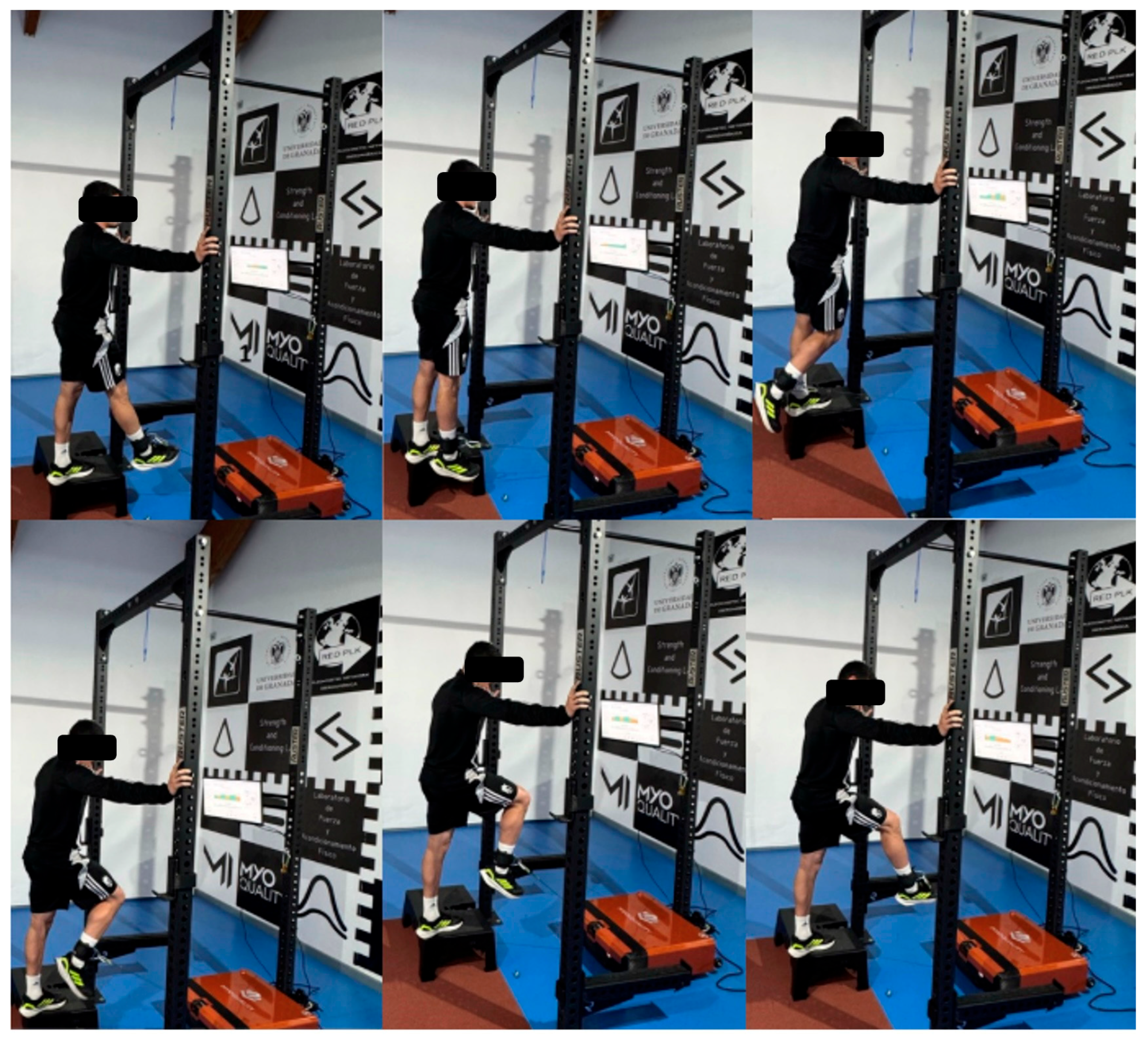
Swing Eccentric Hamstring Exercise (SEHE): The SEHE was performed using a functional electromechanical dynamometer (Myoquality M1, Myoquality Solutions, Granada, Spain), following the protocol of Sánchez-Sánchez et al. [22]. The reliability of SEHE-derived variables has been previously established, showing good-to-excellent test–retest reliability for peak force, power, and impulse across velocities in soccer players [22]. Players stood upright with the support foot placed on a box, while the test leg was attached to the dynamometer via an ankle strap. From an initial position of ~30° knee flexion (measured with a goniometer), participants executed a forward swing replicating the late-swing phase of sprinting (Figure 1). The concentric phase was standardized at 0.2 m/s, while the eccentric phase was assessed at 0.4, 0.8, and 1.2 m/s. Three sets of five repetitions were completed at each velocity, with 3 min passive recovery. Inter-limb asymmetry was calculated from peak eccentric force using the equation proposed by Coratella et al. [24].
Countermovement Jump (CMJ). Bilateral CMJ height was assessed on a contact platform (Chronojump®, Barcelona, Spain), a validated system for vertical jump evaluation [25].
Sprint Test. Linear sprint performance was measured over 30 m on synthetic turf using infrared timing gates (Chronojump®, Barcelona, Spain). Players performed three attempts with 3 min recovery; the best time was used for analysis. The jump and sprint assessments were conducted by a strength and conditioning specialist with experience in these measurements.

2.4. Statistical Analysis

An a priori power analysis was conducted using G*Power (version 3.1.9.7) to determine the minimum sample size required. Based on an alpha level of 0.05, a power of 0.80, and an expected effect size of (moderate-to-large, consistent with previous literature on eccentric hamstring assessments [4,5], a total sample of 36 participants was estimated. Due to the inherent challenges in recruiting professional cohorts, the final sample consisted of 33 players (91.6% of the target). While slightly below the a priori estimate, this sample size is comparable to or exceeds those of similar field-based studies in professional soccer [22,23,24] and proved sufficient to verify the main study hypothesis regarding inter-limb differences. Data are reported as mean ± standard deviation (SD). Normality was assessed using the Shapiro–Wilk test and sphericity with Mauchly’s test. Inter-limb comparisons across velocities were analyzed using repeated-measures ANOVA. When significant main effects were observed, post hoc pairwise comparisons were performed with Bonferroni corrections to control for Type I error rates. Effect sizes for ANOVA were reported as omega squared (w2) interpreted as small (0.01), medium (0.06), and large (>0.14) [26] Pearson’s correlation coefficients (r) were used to examine relationships between SEHE variables and performance outcomes (CMJ, sprint), with effect size thresholds interpreted as small (0.3), moderate (0.5), and strong (0.6) [27]. Analyses were performed using JASP software (v0.19.1).

2.5. Ethical Approval

Before participating, all participants were informed about the nature, aims, and potential risks of the experimental procedures and provided written informed consent. Informed consent was signed by the participant or, in the case of individuals under 18 years of age, by a legal guardian. The study followed the ethical standards of the Declaration of Helsinki and received ethical approval from the Human Research Ethics Committee of the University of Granada, Spain (4248/CEIH/2024).

3. Results

3.1. Inter-Limb Comparisons

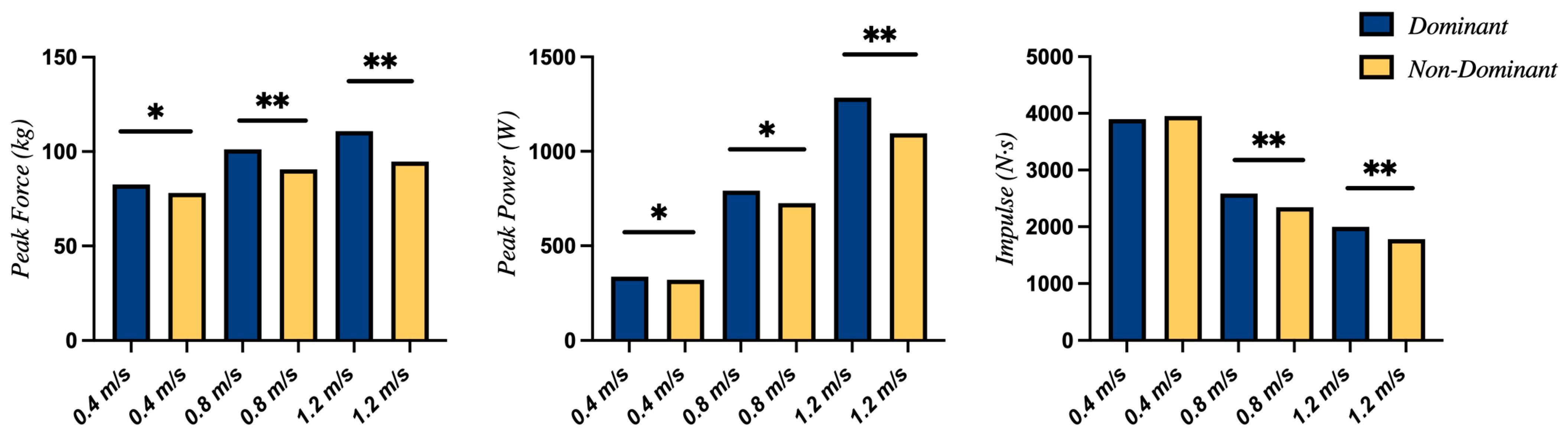
Significant differences were observed between dominant and non-dominant limbs in peak force, power, and impulse during the SEHE (Table 1). Effect sizes ranged from small-to-moderate (d = 0.31–0.51) at 0.4 m/s to predominantly moderate (d > 0.5) at higher velocities. The only non-significant difference was impulse at 0.4 m/s. Figure 2 illustrates these inter-limb differences across velocities.

3.2. Playing Position

No significant differences in force, power, or impulse were found between defenders, midfielders, and forwards at any testing velocity (Table 2), with effect sizes being negligible to small (ω2 < 0.06). Likewise, no positional differences were observed in inter-limb asymmetry indices (Table 3).

3.3. Relationship with Performance

No significant correlations were identified between hamstring strength asymmetry and physical performance outcomes (CMJ and 30 m sprint) at any velocity (Table 4). observed associations were negligible to weak (r < 0.3) across all variables.

4. Discussion

The main finding of this study was that soccer players exhibited significant inter-limb differences in eccentric hamstring strength, power, and impulse during the SEHE, and these differences became more pronounced as the testing velocity increased. These velocity-dependent differences suggest that faster eccentric phases amplify the mechanical demands placed on the hamstrings, suggesting that inter-limb differences may become more pronounced under higher mechanical demands. However, it is also important to consider that movement variability and measurement error tend to increase at higher isokinetic speeds. Therefore, while these values may indicate rate-dependent deficits, they should be interpreted with caution until confirmed by reliability studies at these specific angular velocities. However, no association was observed between asymmetry indices and physical performance (CMJ and sprint), and no positional differences were detected.
Our results confirm the presence of functional asymmetries in soccer players, consistent with previous evidence reporting inter-limb imbalances as a common feature in unilateral sports [3,7,28]. The magnitude of asymmetry observed in our sample (8–17%) aligns with traditional guidelines regarding asymmetry thresholds [15,16]. However, recent prospective evidence indicates that such asymmetry levels are common in healthy professional players and are not consistently associated with injury risk [29]. Thus, the observed values in our sample likely reflect physiological adaptations to training rather than clinical impairments [15,16]. Nevertheless, the absence of negative correlations with performance supports the hypothesis that certain asymmetries may represent functional adaptations to the mechanical demands of soccer rather than pathological deficits [7,28,30]. This interpretation is supported by recent computational models demonstrating that lower-limb asymmetry does not necessarily impair running efficiency or global locomotor performance [10]. Importantly, large-scale prospective studies in professional soccer have reported much wider ranges of normal asymmetry (e.g., −27% to +20% in hip strength and ROM), with no clinically significant associations to injury risk. These findings underscore that asymmetry must be contextualized within the mechanical characteristics of the test and the sport [29]. The findings reported by Kocak et al. show no association between eccentric hamstring strength or between-limb asymmetry at return-to-sport and the risk of re-injury in athletes. This reinforces the notion that asymmetry alone may have limited clinical utility in identifying athletes at higher injury risk [31]. Thus, the asymmetry magnitude alone may not be a valid indicator of functional impairment [7,28,30]. It is plausible that soccer players develop compensatory neuromuscular strategies that allow them to maintain sprint and jump performance despite measurable strength imbalances, particularly when assessed in sport-specific tasks such as the SEHE [18,19].
Contrary to some studies linking strength asymmetries with reduced sprint or jump performance [17], our findings suggest that these imbalances did not impair explosive capacity in our sample. Differences in testing methods may explain these discrepancies. Most previous research has used the NHE, which isolates knee flexion with limited hip involvement [4,12,13,14,20,21]. This makes the NHE mechanically distant from the late-swing mechanics of sprinting. In contrast, the SEHE reproduces the hip-knee coupling observed during the late swing phase, engaging the hamstrings in a lengthened, high-velocity eccentric action. Thus, while it lacks the ground reaction forces of sprinting, it offers a mechanically complementary assessment to the NHE by isolating the specific joint dynamics of the swing phase that fixed-hip exercises cannot capture [22,23]. This methodological difference may partially explain the lack of association with performance outcomes.
No positional differences were observed in strength, power, impulse, or asymmetry levels, suggesting that the development of inter-limb asymmetry is not substantially influenced by playing role. This contrasts with previous evidence linking sprint demands to increase hamstring load and injury risk in attacking players [5]. Our results suggest that accumulated training and match exposure may attenuate positional differences in mechanical loading across positions.
From an applied perspective, these results highlight several key considerations. First, inter-limb asymmetry should not be assumed to represent dysfunction; instead, it should be evaluated within the context of the specific task being measured. Second, sport-specific assessments such as the SEHE may offer a more ecologically valid approach to interpreting eccentric hamstring function compared with traditional field tests. Third, rather than applying universal asymmetry thresholds, practitioners should prioritize longitudinal, athlete-specific monitoring, in line with current recommendations emphasizing individualized asymmetry profiles.
This study has limitations. Its cross-sectional nature prevents causal inference or prediction of hamstring injury risk based on SEHE-derived asymmetries. The sample included athletes from various competitive levels, potentially increasing variability. Furthermore, performance evaluation relied only on sprint and CMJ tests; additional sport-specific metrics (e.g., changes in direction or repeated sprint ability) might provide further insights. Although the SEHE was designed to mimic the hip-flexion and knee-extension mechanics of the late swing phase, it is important to acknowledge that it does not fully reproduce the complex dynamic loads of maximal velocity sprinting. Unlike actual locomotion, the SEHE is performed under controlled isokinetic-like conditions with a stable, non-reactive support leg. Consequently, the test eliminates the ground reaction forces, higher angular velocities, and dynamic lumbopelvic control requirements inherent to high-speed running. Therefore, the SEHE should be interpreted as a mechanically specific proxy for isolated hamstring capacity rather than an ecologically perfect replication of the sprint action. Additionally, it is important to note that the physical performance assessments employed in this study (bilateral CMJ and linear sprint) are predominantly global measures involving both limbs simultaneously. While these tests are standard in professional soccer assessment batteries, their bilateral nature may allow the stronger limb to compensate for the weaker one, potentially masking the functional impact of hamstring asymmetry. This mismatch between a unilateral strength metric (SEHE) and global performance outcomes could explain the lack of significant correlations observed. Future research should incorporate unilateral functional tests, such as single-leg countermovement jumps or change-of-direction tasks, to better elucidate the direct transfer of hamstring asymmetry to sport-specific performance. Furthermore, although players were categorized by position, this study did not control for external load metrics (e.g., GPS-derived high-speed running distance or sprint volume) during the weeks prior to testing. Consequently, the influence of acute accumulated fatigue on the observed position-specific asymmetry profiles remains a confounding factor. Finally, the a priori power analysis relied on a moderate-to-large, expected effect size (r = 0.45). Consequently, interpretations regarding the lack of significant correlations or position-specific differences should be made with caution, as the study may have been underpowered to detect smaller, yet potentially meaningful, effects (Type II error).
Future research should examine whether SEHE-derived asymmetries predict hamstring injury prospectively, explore sex-specific and elite populations, and incorporate kinematic and workload indicators to better understand the functional meaning of inter-limb differences.

5. Conclusions

This study showed that competitive soccer players present significant inter-limb differences in eccentric hamstring strength, power, and impulse during the SEHE, with asymmetries becoming more pronounced as movement velocity increases. Despite these differences, asymmetry indices were not associated with sprint or jump performance, nor did they vary across playing positions. These findings suggest that inter-limb asymmetries measured through the SEHE may represent functional adaptations to soccer rather than an indicator of impaired performance. The use of a functional electromechanical dynamometer to assess hamstring strength in a sport-specific task provides an innovative approach that may complement traditional field tests. Future research should examine whether SEHE-derived asymmetries have relevance for injury prediction and examine their behavior across different competitive levels, sexes, and longitudinal training periods.

Author Contributions

Conceptualization, A.R.-R., I.C.-R. and D.J.-M.; methodology, A.R.-R. and I.C.-R.; software, W.R.-F. and A.R.-R.; validation, I.C.-R., D.J.-M. and G.C.-D.; formal analysis, A.R.-R. and C.R.-G.; investigation, A.R.-R., C.R.-G., G.C.-D., P.D.-F. and M.T.-B.; resources, I.C.-R. and D.J.-M.; data curation, C.R.-G., W.R.-F. and A.R.-R.; writing—original draft preparation, A.R.-R. and C.R.-G.; writing—review and editing, I.C.-R., D.J.-M., G.C.-D., P.D.-F., W.R.-F. and M.T.-B.; visualization, A.R.-R. and C.R.-G.; supervision, I.C.-R. and D.J.-M.; project administration, I.C.-R. All authors have read and agreed to the published version of the manuscript.

Funding

This research received no external funding.

Institutional Review Board Statement

The study was conducted in accordance with the Declaration of Helsinki and approved by the Ethics Committee of the University of Granada (protocol code: 4248/CEIH/2024).

Informed Consent Statement

Informed consent was obtained from all subjects involved in the study.

Data Availability Statement

The datasets generated and analyzed during the current study are available from the corresponding author on reasonable request.

Acknowledgments

This study forms part of the doctoral thesis of Antonio Riego-Ruiz, conducted within the Doctoral Program in Biomedicine at the University of Granada, Spain. The authors would like to thank the participating athletes and coaching staff for their collaboration and commitment during the study.

Conflicts of Interest

The authors declare no conflicts of interest.

References

  1. Ekstrand, J.; Hägglund, M.; Waldén, M. Epidemiology of Muscle Injuries in Professional Football (Soccer). Am. J. Sports Med. 2011, 39, 1226–1232. [Google Scholar] [CrossRef]
  2. Ekstrand, J.; Bengtsson, H.; Waldén, M.; Davison, M.; Khan, K.M.; Hägglund, M. Hamstring Injury Rates Have Increased during Recent Seasons and Now Constitute 24% of All Injuries in Men’s Professional Football: The UEFA Elite Club Injury Study from 2001/02 to 2021/22. Br. J. Sports Med. 2023, 57, 292–298. [Google Scholar] [CrossRef] [PubMed]
  3. Turner, A.N.; Stewart, P.F. Strength and Conditioning for Soccer Players. Strength Cond. J. 2014, 36, 1–13. [Google Scholar] [CrossRef]
  4. Nunes, H.; Fernandes, L.G.; Martins, P.N.; Ferreira, R.M. The Effects of Nordic Hamstring Exercise on Performance and Injury in the Lower Extremities: An Umbrella Review. Healthcare 2024, 12, 1462. [Google Scholar] [CrossRef] [PubMed]
  5. Green, B.; Bourne, M.N.; Van Dyk, N.; Pizzari, T. Recalibrating the Risk of Hamstring Strain Injury (HSI): A 2020 Systematic Review and Meta-Analysis of Risk Factors for Index and Recurrent Hamstring Strain Injury in Sport. Br. J. Sports Med. 2020, 54, 1081–1088. [Google Scholar] [CrossRef] [PubMed]
  6. Cartón-Llorente, A.; Cardiel-Sánchez, S.; Molina-Molina, A.; Ráfales-Perucha, A.; Rubio-Peirotén, A. Bilateral Asymmetry of Spatiotemporal Running Gait Parameters in U14 Athletes at Different Speeds. Sports 2024, 12, 117. [Google Scholar] [CrossRef]
  7. Afonso, J.; Peña, J.; Sá, M.; Virgile, A.; García-de-Alcaraz, A.; Bishop, C. Why Sports Should Embrace Bilateral Asymmetry: A Narrative Review. Symmetry 2022, 14, 1993. [Google Scholar] [CrossRef]
  8. Maly, T.; Hank, M.; Verbruggen, F.F.; Clarup, C.; Phillips, K.; Zahalka, F.; Mala, L.; Ford, K.R. Relationships of Lower Extremity and Trunk Asymmetries in Elite Soccer Players. Front. Physiol. 2024, 15, 1343090. [Google Scholar] [CrossRef]
  9. Hart, N.H.; Nimphius, S.; Weber, J.; Spiteri, T.; Rantalainen, T.; Dobbin, M.; Newton, R.U. Musculoskeletal Asymmetry in Football Athletes: A Product of Limb Function over Time. Med. Sci. Sports Exerc. 2016, 48, 1379–1387. [Google Scholar] [CrossRef]
  10. Mănescu, A.M.; Grigoroiu, C.; Smîdu, N.; Dinciu, C.C.; Mărgărit, I.R.; Iacobini, A.; Mănescu, D.C. Biomechanical Effects of Lower Limb Asymmetry During Running: An OpenSim Computational Study. Symmetry 2025, 17, 1348. [Google Scholar] [CrossRef]
  11. Douglas, J.; Pearson, S.; Ross, A.; McGuigan, M. Chronic Adaptations to Eccentric Training: A Systematic Review. Sports Med. 2017, 47, 917–941. [Google Scholar] [CrossRef]
  12. Bourne, M.N.; Timmins, R.G.; Opar, D.A.; Pizzari, T.; Ruddy, J.D.; Sims, C.; Williams, M.D.; Shield, A.J. An Evidence-Based Framework for Strengthening Exercises to Prevent Hamstring Injury. Sports Med. 2018, 48, 251–267. [Google Scholar] [CrossRef]
  13. Adıgüzel, N.S.; Koç, M.; Öztürk, B.; Engin, H.; Karaçam, A.; Canlı, U.; Orhan, B.E.; Aldhahi, M.I. The Effect of the Nordic Hamstring Curl Training Program on Athletic Performance in Young Football Players. Appl. Sci. 2024, 14, 10249. [Google Scholar] [CrossRef]
  14. Petersen, J.; Thorborg, K.; Nielsen, M.B.; Budtz-Jørgensen, E.; Hölmich, P. Preventive Effect of Eccentric Training on Acute Hamstring Injuries in Men’s Soccer: A Cluster-Randomized Controlled Trial. Am. J. Sports Med. 2011, 39, 2296–2303. [Google Scholar] [CrossRef] [PubMed]
  15. Bell, D.R.; Sanfilippo, J.L.; Binkley, N.; Heiderscheit, B.C. Lean Mass Asymmetry Influences Force and Power Asymmetry During Jumping in Collegiate Athletes. J. Strength Cond. Res. 2014, 28, 884–891. [Google Scholar] [CrossRef]
  16. Croisier, J.-L.; Crielaard, J.-M. Hamstring Muscle Tear with Recurrent Complaints: An Isokinetic Profile. Isokinet. Exerc. Sci. 2000, 8, 175–180. [Google Scholar] [CrossRef]
  17. Newton, R.U.; Gerber, A.; Nimphius, S.; Shim, J.K.; Doan, B.K.; Robertson, M.; Pearson, D.R.; Craig, B.W.; Häkkinen, K.; Kraemer, W.J. Determination of Functional Strength Imbalance of the Lower Extremities. J. Strength Cond. Res. 2006, 20, 971–977. [Google Scholar]
  18. Read, P.J.; McAuliffe, S.; Bishop, C.; Oliver, J.L.; Graham-Smith, P.; Farooq, M.A. Asymmetry Thresholds for Common Screening Tests and Their Effects on Jump Performance in Professional Soccer Players. J. Athl. Train. 2021, 56, 46–53. [Google Scholar] [CrossRef] [PubMed]
  19. Seganfredo Weber, F.; da Silva, B.G.C.; Radaelli, R.; Paiva, C.; Silveira Pinto, R. Avaliação Isocinética em Jogadores de Futebol Profissional e Comparação do Desempenho Entre as Diferentes Posições Ocupadas no Campo. Rev. Bras. Med. Esporte 2010, 16, 264–268. [Google Scholar][Green Version]
  20. Bautista, I.J.; Vicente-Mampel, J.; Baraja-Vegas, L.; Segarra, V.; Martín, F.; Van Hooren, B. The Effects of the Nordic Hamstring Exercise on Sprint Performance and Eccentric Knee Flexor Strength: A Systematic Review and Meta-Analysis of Intervention Studies among Team Sport Players. J. Sci. Med. Sport 2021, 24, 931–938. [Google Scholar] [CrossRef]
  21. Krommes, K.; Petersen, J.; Nielsen, M.B.; Aagaard, P.; Hölmich, P.; Thorborg, K. Sprint and Jump Performance in Elite Male Soccer Players Following a 10-Week Nordic Hamstring Exercise Protocol: A Randomised Pilot Study. BMC Res. Notes 2017, 10, 669. [Google Scholar] [CrossRef]
  22. Sánchez-Sánchez, A.J.; Chirosa-Ríos, L.J.; Chirosa-Ríos, I.J.; García-Vega, A.J.; Jerez-Mayorga, D. Test-Retest Reliability of a Functional Electromechanical Dynamometer on Swing Eccentric Hamstring Exercise Measures in Soccer Players. PeerJ 2021, 9, 11743. [Google Scholar] [CrossRef]
  23. Sánchez-Sánchez, A.J.; Chirosa-Ríos, L.J.; Chirosa-Ríos, I.J.; García-Vega, A.J.; Jerez-Mayorga, D. Relación del Swing Eccentric Hamstring Exercise con el Rendimiento del Salto y el Sprint en Jugadores de Fútbol. Relationship of the Swing Eccentric Hamstring Exercise to Jumping and Sprinting Performance in Soccer Players. Logía Educ. Física Deporte 2023, 3, 60–70. [Google Scholar]
  24. Coratella, G.; Beato, M.; Schena, F. Correlation between Quadriceps and Hamstrings Inter-Limb Strength Asymmetry with Change of Direction and Sprint in U21 Elite Soccer-Players. Hum. Mov. Sci. 2018, 59, 81–87. [Google Scholar] [CrossRef]
  25. Pueo, B.; Penichet-Tomas, A.; Jimenez-Olmedo, J.M. Reliability and Validity of the Chronojump Open-Source Jump Mat System. Biol. Sport 2020, 37, 255–259. [Google Scholar] [CrossRef]
  26. Chapman, S.J. Review of Discovering Statistics Using IBM SPSS Statistics, 4th Edition. J. Political Sci. Educ. 2018, 14, 145–147. [Google Scholar] [CrossRef]
  27. Zieliński, G. Effect Size Guidelines for Individual and Group Differences in Physiotherapy. Arch. Phys. Med. Rehabil. 2025, 106, 1844–1849. [Google Scholar] [CrossRef]
  28. Girard, O.; Brocherie, F.; Morin, J.B.; Millet, G.P. Lower Limb Mechanical Asymmetry during Repeated Treadmill Sprints. Hum. Mov. Sci. 2017, 52, 203–214. [Google Scholar] [CrossRef]
  29. Vigneswaran, A.; Serner, A.; Farooq, A.; Kipps, C.; Mosler, A.B. Is Limb Asymmetry an Intrinsic Risk Factor for Time-Loss Groin Injury in Professional Male Soccer Players? Phys. Ther. Sport 2025, 71, 53–60. [Google Scholar] [CrossRef] [PubMed]
  30. Radzak, K.N.; Putnam, A.M.; Tamura, K.; Hetzler, R.K.; Stickley, C.D. Asymmetry between Lower Limbs during Rested and Fatigued State Running Gait in Healthy Individuals. Gait Posture 2017, 51, 268–274. [Google Scholar] [CrossRef] [PubMed]
  31. Kocak, U.Z.; Stiffler-Joachim, M.R.; Heiderscheit, B.C. Comparison of Eccentric Hamstring Strength and Asymmetry at Return-to-Sport after Hamstring Strain Injury among Those Who Did and Did Not Re-Injure. Phys. Ther. Sport 2023, 59, 25–29. [Google Scholar] [CrossRef] [PubMed]
Figure 1. Swing Eccentric Hamstring Exercise (SEHE).
Applsci 16 01837 g001
Figure 2. Inter-limb differences (dominant vs. non-dominant) in peak force, peak power, and impulse across SEHE velocities (0.4, 0.8, 1.2 m/s). Significance Level p < 0.05 *; p < 0.001 **.
Applsci 16 01837 g002
Table 1. Differences in peak force, power, and impulse between dominant and non-dominant limbs during the SEHE at different velocities.
VariableDominant (Mean ± SD)Non-Dominant (Mean ± SD)p-ValueEffect Size (ω2)
Peak Force (kg)—0.4 m/s82.60 ± 30.4578.26 ± 30.790.011 *0.51 (Moderate)
Peak Power (W)—0.4 m/s337.23 ± 140.22320.53 ± 120.220.042 *0.41 (Small)
Impulse (N·s)—0.4 m/s3897.31 ± 1533.883952.46 ± 1583.880.1230.31 (Small)
Peak Force (kg)—0.8 m/s101.17 ± 33.7090.50 ± 26.84<0.001 **0.65 (Moderate)
Peak Power (W)—0.8 m/s792.42 ± 301.52726.07 ± 208.530.010 *0.50 (Moderate)
Impulse (N·s)—0.8 m/s2587.04 ± 949.542344.12 ± 758.73<0.001 **0.73 (Moderate)
Peak Force (kg)—1.2 m/s110.85 ± 28.4394.72 ± 28.43<0.001 **0.74 (Moderate)
Peak Power (W)—1.2 m/s1284.78 ± 370.141095.93 ± 301.71<0.001 **0.78 (Moderate)
Impulse (N·s)—1.2 m/s1997.55 ± 634.941782.86 ± 567.24<0.001 **0.98 (Large)
Significance Level p < 0.05 *; p < 0.001 **.
Table 2. Comparisons of force, power, and impulse between playing positions during the SEHE.
VariableDefenders n = 16
(Mean ± SD)
Midfielders n = 10
(Mean ± SD)
Forwards n = 7
(Mean ± SD)
p-ValueEffect Size (ω2)
Force (kg)—0.4 m/s78.76 ± 23.180.79 ± 33.193.90 ± 42.00.5480.000
Power (W)—0.4 m/s318.03 ± 92.09323.09 ± 130.38401.31 ± 157.100.2920.017
Impulse (N·s)—0.4 m/s4003.75 ± 1615.353166.75 ± 1723.104697.66 ± 1877.220.1950.042
Force (kg)—0.8 m/s99.06 ± 32.8593.17 ± 36.10117.43 ± 29.420.3270.010
Power (W)—0.8 m/s780.21 ± 246.58730.41 ± 280.22908.90 ± 224.400.3590.004
Impulse (N·s)—0.8 m/s2581.82 ± 989.112369.84 ± 1035.952909.26 ± 940.970.5520.000
Force (kg)—1.2 m/s111.65 ± 32.50101.28 ± 38.59122.69 ± 39.630.4860.000
Power (W)—1.2 m/s1298.07 ± 365.651182.03 ± 444.101401.19 ± 443.600.5480.000
Impulse (N·s)—1.2 m/s2029.51 ± 551.281807.61 ± 664.022195.85 ± 787.570.4590.000
Table 3. Inter-limb asymmetry (%) across playing positions.
VelocityDefenders n = 16
(Mean ± SD)
Midfielders n = 10
(Mean ± SD)
Forwards n = 7
(Mean ± SD)
p-ValueEffect Size (ω2)
0.4 m/s8.19 ± 7.180.29 ± 18.631.70 ± 8.640.2280.032
0.8 m/s8.84 ± 16.577.54 ± 14.099.66 ± 12.200.9570.000
1.2 m/s17.23 ± 11.559.16 ± 16.646.74 ± 25.530.3000.015
Table 4. Correlations between asymmetry indices and physical performance (CMJ and sprint).
VelocityAsymmetry vs. CMJ (r, p)Asymmetry vs. Sprint (r, p)
0.4 m/s−0.128; p = 0.478−0.007; p = 0.971
0.8 m/s0.103; p = 0.568−0.034; p = 0.851
1.2 m/s0.026; p = 0.885−0.159; p = 0.375
Disclaimer/Publisher’s Note: The statements, opinions and data contained in all publications are solely those of the individual author(s) and contributor(s) and not of MDPI and/or the editor(s). MDPI and/or the editor(s) disclaim responsibility for any injury to people or property resulting from any ideas, methods, instructions or products referred to in the content.