Article

Predictive Modeling of Massey Ferguson Tractor Performance Parameters Using Artificial Neural Network Methodology


by
Saleh M. Al-Sager
*,
Saad S. Almady
,
Waleed A. Almasoud
,
Saad A. Al-Hamed
,
Abdulrahman A. Al-Janobi
and
Abdulwahed M. Aboukarima
*
Department of Agricultural Engineering, College of Food and Agriculture Sciences, King Saud University, P.O. Box 2460, Riyadh 11451, Saudi Arabia
*
Authors to whom correspondence should be addressed.
Appl. Sci. 2026, 16(4), 1818; https://doi.org/10.3390/app16041818
Submission received: 25 January 2026 / Revised: 6 February 2026 / Accepted: 10 February 2026 / Published: 12 February 2026

Abstract

Predicting tractor performance factors accurately is crucial for enhancing energy efficiency and assisting with the choice of machinery in agricultural operations. Using the Nebraska Tractor Test Laboratory (NTTL) identical data, this study uses artificial neural network (ANN) modeling to forecast important performance metrics of a front wheel assist (FWA) Massey Ferguson tractor. A feed-forward ANN model was developed and validated using reported data from official tractor tests. Performance indicators, such as drawbar pull (kN), drawbar power (kW), hourly fuel consumption rate (kg/h), drawbar specific fuel consumption (kg/kW·h), and drawbar specific volumetric fuel efficiency (kW/kg·h), were utilized as outputs and certain operational factors, the tractor characteristics variables as well as other variables were used as inputs. Statistical measures, including the coefficient of determination and error metrics from training and testing datasets, were used to assess the model’s performance. The results showed that the ANN model produced excellent generalization capabilities and good prediction performance by correctly capturing the nonlinear correlations between inputs and tractor performance indicators. The suggested strategy performed better than traditional regression-based techniques documented in the literature, especially when operation variables and tractor characteristics varied. The results show that combining NTTL data with ANN techniques offers a dependable and affordable method for predicting tractor performance indicators and evaluating energy efficiency. This eliminates the need for extensive experimental procedures and promotes data-driven decision-making in agricultural machinery management.

1. Introduction

A vital component of farm mechanization, tractors are essential to raising agricultural productivity. Because they supply the energy required for various crop production operations, tractors are highly adaptable pieces of equipment with a wide range of applications in agriculture [1]. Conversely, prediction is essentially a forecast of future events [2]. According to Hanke and Reitsh [3], economic prediction is the examination of historical data to recognize its fundamental movements and patterns. The ability to predict can determine whether a plan succeeds or fails. Understanding the potential applications of tractor performance forecasts is a prerequisite for comprehending the significance of a reliable technique for generating them. Tractor performance is a significant factor in the overall cost of tractor ownership, and it should be considered in both timing and amount [1]. However, according to Almaliki et al. [4], modeling approaches are typically employed in farm mechanization activities to provide valuable information for changing tractor and implement parameters, which are crucial for farm machinery, operators, and manufacturers.
The use of data-driven methods in agricultural machinery performance analysis is expanding; however, current research frequently uses linear or semi-empirical models and offers scant attention to model generalization, multicollinearity, and validation methodologies. Furthermore, very few studies have used standardized test data to rigorously examine multi-output prediction of tractor performance indicators. Combining standardized tractor test data with a thoroughly verified multi-output Artificial Neural Network (ANN) framework that prioritizes generalization, robustness, and interpretability over predictive accuracy alone is what makes this work novel. Soft computing is one of the most widely used methods for modeling and predicting the behavior of nonlinear systems, such as tractor performance indicators. According to Almaliki et al. [4], soft computing technology is an interdisciplinary area of computational science research. Numerous methods, including statistics, machine learning tools such as ANNs, and fuzzy logic, are currently employed in soft computing for exploratory data analysis [5].
Complex input–output connections are increasingly being modeled using ANNs [6,7]. Neural networks’ primary benefit is their ability to learn from previously unknown information hidden in the data, though they cannot cite it explicitly. The ANN partially simulates how the human brain learns. Simple components working in tandem make up neural networks. Biologic nerve systems serve as the inspiration for these components [8]. Like in nature, the connections between the network’s components play a significant role in determining how well it functions. By varying the weights (connections) between elements, a neural network can be trained to perform a specific task. Furthermore, because ANNs are resilient to noise fluctuations, naturally noisy data do not appear to be an issue [1]. ANNs are a valuable tool for decision-making across a wide range of applications. This is because these networks aim to simulate the functions of the human brain. They are employed in fields that have historically relied on statistical prediction and classification. Learning straight from examples without attempting to guess the statistical parameters is one of the primary benefits of employing neural networks [1].
Accurate modelling can help manage farm machinery in a tractor–implement system. Despite the concerns regarding continuous increases in using machine learning techniques in studying tractor performance [9], there are no significant studies to forecast tractor performance parameters such as drawbar power, drawbar pull, hourly fuel consumption rate, specific fuel consumption, and specific volumetric fuel efficiency from characteristics of the tractor, engine parameters, and operation variables together using a method of machine learning techniques. Furthermore, due to the lack of a precise relationship between the operative and performance parameters, and given the high precision and speed of the ANN technique, it has attracted many followers today. Thus, in this research, we explore the potential of an ANN model in predicting tractor performance indicators based on 20 variables acquired from NTTL tractor test reports for a Massey Ferguson tractor, front wheel assist (FWA) type, as inputs and five indicators as outputs, defined as the drawbar pull (kN), drawbar power (kW), hourly fuel consumption rate (kg/h), drawbar specific fuel consumption (kg/kW∙h), and drawbar specific volumetric fuel efficiency (kW∙h/kg). It is believed that this study is the first of its kind and can therefore aid in formulating appropriate policies to manage the performance of mechanization units and achieve optimal performance.

Related Works

Few studies have particularly concentrated on predicting the performance parameters of Massey Ferguson tractors using NTTL data inside an ANN framework, despite the wide availability of Nebraska Tractor Test data and the shown efficacy of ANN methodologies. The majority of current research studies either uses ANN models on reported datasets without utilizing standardized tractor test outcomes or it examines NTTL data descriptively. In order to create prediction models for Massey Ferguson tractor performance indicators, there is still a glaring research gap in the integration of NTTL data with ANN modeling. In addition to showcasing the potential of an ANN model as trustworthy instruments for agricultural machinery analysis, filling this gap can improve decision-making for tractor selection, performance optimization, and energy efficiency evaluation.
Many researcher studies have concentrated on applying the ANN method or other techniques to extrapolate the prediction to the entire tractor–implement system because agricultural tractor performance is affected by multiple parameters [10,11,12,13,14,15,16,17]. Using reported data from NTTL test reports—which provide characteristics of various components such as tractor specifications, fuel characteristics, engine components, weather data during test days, cooling medium temperature parameters, etc.—the ANN method was used to predict performance indicators. To forecast some tractor performance indicators, other studies used reported data from NTTL test reports. For example, Özbayer and Güner [18] gathered information from 418 tractors that NTTL tested from 2004 to 2017. They made an effort to collect standard data on tractor weight, drawbar power, forward speed, engine speed, specific fuel consumption, and PTO power. Fuel consumption and drawbar power were quantitatively evaluated, employing both nonlinear and linear regression analysis. Fuel consumption as a function of engine speed, load situation, throttle setting, tractor frame type, tractor weight, PTO power, and drawbar power was predicted by Rahimi-Ajdadi and Abbaspour-Gilandeh [11] using NTTL data. They employed multiple regression and ANNs, with corresponding coefficients of determination of 0.973 and 0.986. Harris [19] forecasted tractor engine performance metrics, such as torque and fuel consumption, using NTTL data via prediction models with engine speed and throttle setting as predictor variables. Karwasra [1] used information from 141 tractor test reports conducted at the Central Farm Machinery Training & Testing Institute (India) between 1997 and 2013. Engine speed, atmospheric pressure, travel speed, number of friction plates, atmospheric temperature, wheel slip, rated engine speed, compression ratio, number of engine revolutions for one driving wheel revolution, wheelbase, reduction through final drive, maximum sustained pull, drawbar pull for ballasted and unballasted conditions, number of cylinders, stroke length, tractor mass for ballasted and unballasted condition, height of drawbar, engine capacity, cylinder bore, and fuel consumption were the 20 input variables. The output was drawbar power. The outcomes attained from different ANN feedforward neural network models. The best ANN model had two hidden layers with 35 neurons in the first hidden layer and 35 neurons in the second hidden layer with (20-35-35-1) structure. This model yielded the highest R2 (0.994) and, across all three phases, the lowest MSE values of 0.040, 1.284, and 1.549 for the training, testing, and validation steps, respectively.
As more information becomes available, ANNs can continuously improve performance predictions by adjusting to changing situations and learning from new data. As technology advances, ANNs can incorporate additional data sources into their forecasts, producing predictions that are increasingly precise and tailored. The agriculture industry’s ability to anticipate tractor performance indicators could be entirely transformed by ANNs. Farmers may increase productivity, optimize operations, and make well-informed decisions by utilizing ANNs. Accurately forecasting tractor performance indicators will save money, reduce its environmental impact, and increase productivity. It can be anticipated that ANNs will become increasingly important in shaping the direction of agriculture as technology advances [16]. In revisions guided by diverse scholars, different approaches have been employed to forecast tractor performance parameters such as fuel consumption rate, drawbar pull, drawbar power, specific fuel consumption, and fuel efficiency, ranging from statistical and analytical methods to new artificial intelligence procedures.

2. Materials and Methods

2.1. The Essential Tractor Performance Data

The official tractor testing facility in the USA is the Nebraska Tractor Test Laboratory (NTTL), which is located at the University of Nebraska, USA. All test results are published by the NTTL [20] as reported data. The tests are designed to gather data for evaluating the performance indicators of tractors from various models and makes. The summary test reports include characteristics about fuel, engine type, number of engine cylinders, rated engine speed, bore and stroke length of the cylinder of the engine, compression ratio of the engine, displacement of the engine, tractor chassis type, tractor wheelbase, information about tires and weight, height of drawbar, etc.
Every test is conducted under identical or comparable test conditions and protocols. Tractor tests are often performed to evaluate hydraulic lift capability, hydraulic system pressure and flow, drawbar performance, and PTO (power take-off) performance. When comparing the fuel consumption of tractors of various sizes, it is helpful to use the fuel consumption represented in kW∙h/kg. Because Massey Ferguson tractors are widely used on Saudi Arabian farms, especially for agricultural machinery tasks, they were chosen for the current study to collect the necessary data. Without defining any screening criteria, 30 test reports for this tractor type were examined, and pertinent performance data were obtained from the test report summary. Because the drawbar pulls, forward speed, and fuel consumption varied across tests, the 30 test reports evaluated yielded 353 data points.
Data were collected from 30 test reports conducted on a standard concrete track at NTTL for one tractor type, Massey Ferguson, with a front wheel assist (FWA) chassis. To analyze the database, descriptive statistics have been used in this investigation. Table 1 depicts statistical measures for tractor performance inputs and measured and calculated outputs in the collected dataset from test reports of the tested FWA Massey Ferguson tractors using NTTL data from 1997 to 2016.
Hourly fuel consumption (FC) in lit/h was converted to kg/h using fuel density (kg/lit) and drawbar power (DPP, kW), drawbar specific volumetric fuel efficiency (DSVFE), and drawbar specific fuel consumption (DSFC, k g / k W · h ) were determined as follows:
D P P ( k W ) = D r a w b a r   p u l l   ( k N ) × F S   ( k m h ) 3.6
D S F C   ( k g k W · h ) = F C   k g h D P P   ( k W )
D S V F E   ( k W · h / k g ) = D P P   ( k W ) F C   ( k g h )
where FS is forward speed (km/h), the lit/h was converted to kg/h using the fuel density (kg/lit), and drawbar power was determined as the product of forward speed and traction force (Equation (1)).

2.2. The Architecture of an Artificial Neural Network Model for Tractor Performance Indicator Prediction

An ANN is a technique used to solve complex problems that is based on the basic principles of how the human brain functions [21]. Neurons, connections, and training rules are the three primary components of an artificial neural network [22]. Furthermore, an ANN consists of three layers—the input layer, output layer, and hidden layer—each with interconnected neurons. Trials are used to determine the number of signals the hidden layer sends to the output layer after receiving signals from the input layer [23].
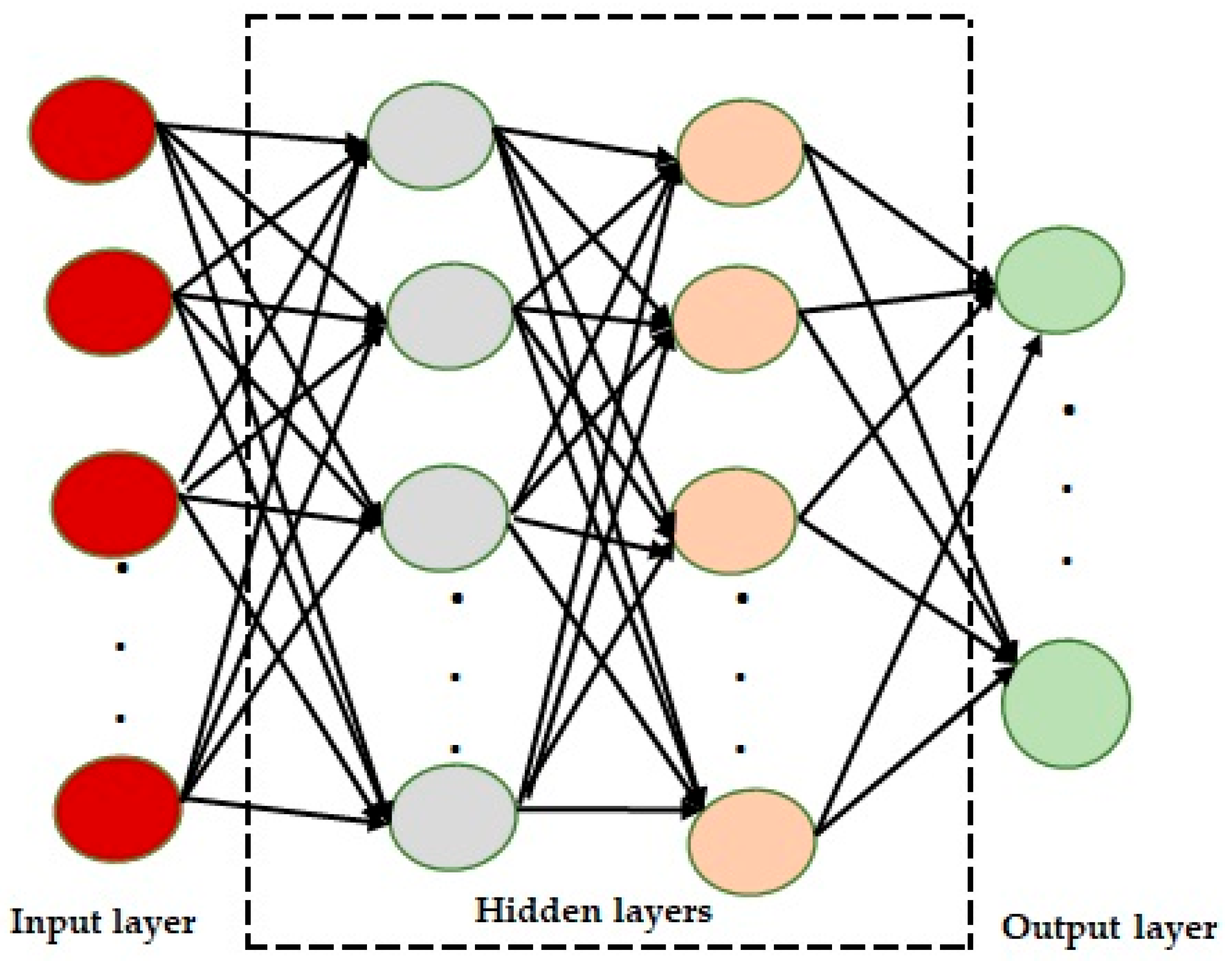
As shown in Figure 1, the training procedure is used in ANN models called multilayer perceptrons, which are composed of neurons arranged in several layers and connected to form a network with forward propagation [24]. The multilayer perceptron method addresses complications that are not linearly separable, a main limitation of the standard linear perceptron technique [24]. Hecht-Nielsen [25] demonstrated that any solution surface of practical importance could be modelled with just one hidden layer of neurons. This research evaluates a multilayer perceptron model that predicts the tractor’s five performance characteristics by varying the number of neurons in a single hidden layer.
ANNs can be employed to resolve problems that require hard-to-calculate input–output interactions and to approximate non-linear functions, as they are data-driven and distribution-free [26]. High projected accuracy, ease of handling missing data, resilience to noise, and efficiency in managing a variety of nonlinear, unknown interactions in the system are only a few benefits of using ANNs [26]. Because ANNs have higher estimation and prediction accuracy than multiple linear regression models, they are a more effective modeling tool for predicting soil compaction, shear stress, and tractor performance [11,27].
Using the Qnet v.2000 software (Vesta Services), Winnetka, IL 60093, USA [28], an ANN model with standard back-propagation was created for this study to predict tractor performance indicators. Three layers—an input layer, a hidden layer, and an output layer—generally define an ANN. Typically, the available data are split into two randomly selected subsets: 20% for testing and 80% for training. The Qnet v. 2000 was used in our study to randomly select 70 of 353 data points for the testing phase.
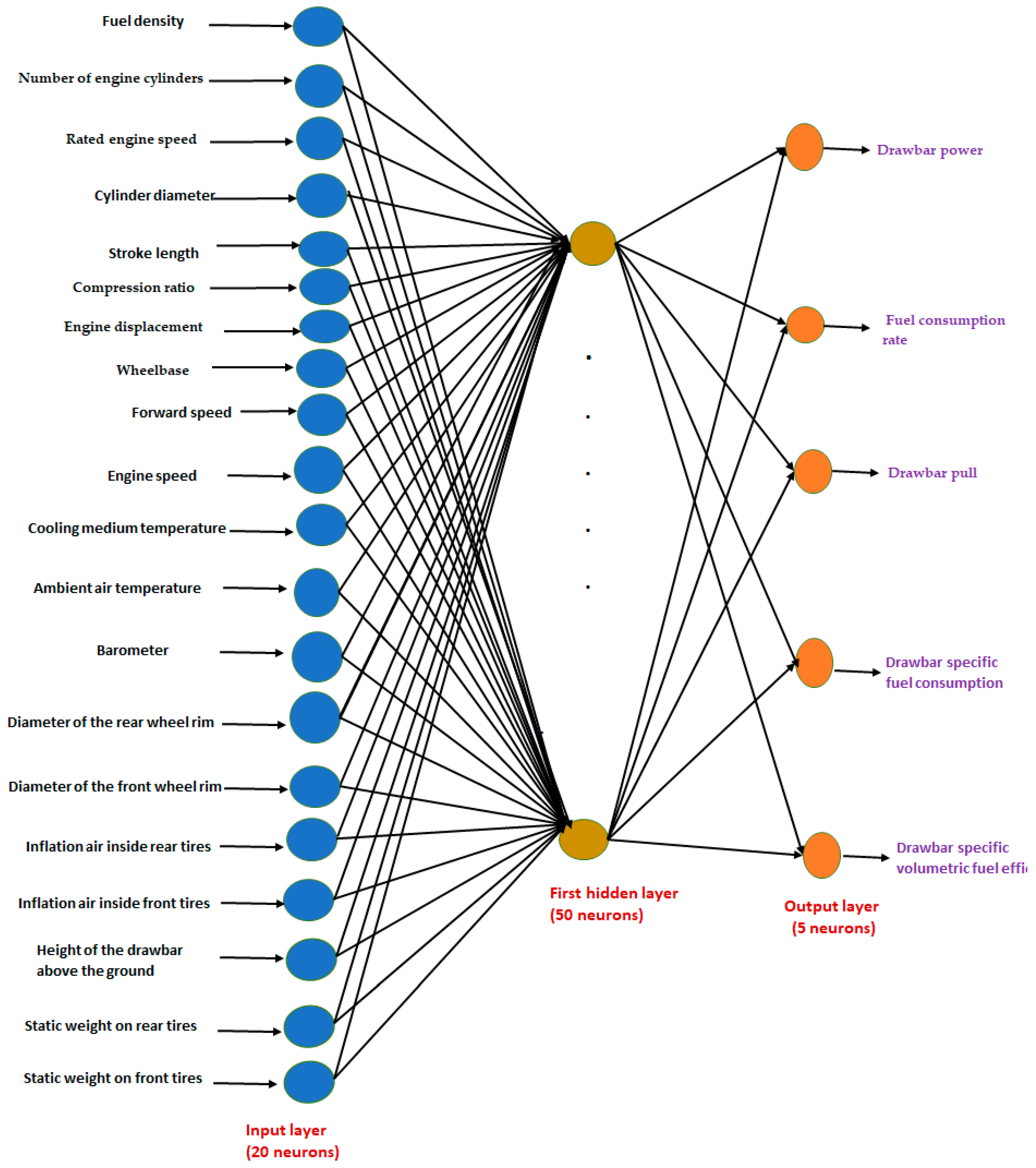
The number of neurons in the hidden layer of the ANN model in this study was selected using a trial-and-error approach because, in general, there is no set technique for determining the number of hidden layers of an ANN model or the number of neurons within them. By comparing the networks’ performance, the number of hidden layers and neurons in the hidden layer (or layers) was determined in this study. Additionally, tests were conducted on the sigmoid function between layers and on the hyperbolic tangent conversion functions. There are five outputs and twenty inputs in the established ANN model used in this study. These inputs included the following: number of engine cylinders, stroke length, fuel density, rated engine speed, cylinder diameter, static weight on front tires of the tractor, ambient air temperature, compression ratio of the engine, engine speed, tractor wheelbase, forward speed, engine displacement, inflation air inside the rear tires of the tractor, cooling medium temperature, diameter of the front wheel rim of the tractor, barometer, inflation air inside the front tires of the tractor, diameter of the rear wheel rim of the tractor, height of the drawbar of the tractor above the ground, and static weight on rear tires of the tractor.
Hourly fuel consumption rate (kg/h), drawbar specific fuel consumption (kg/kW·h), drawbar specific volumetric fuel efficiency (kW/kg·h), and drawbar pull (kN) were the outputs, which define the tractor performance indicators. To improve the accuracy, performance, and speed of the ANN, the inputs and target outputs were normalized or scaled linearly to 0.15–0.85 in this study using Qnet v. 2000 software [28] before the dataset was used for model construction. By scaling the input data into a predetermined range, normalization helps the network identify patterns without being influenced by the size of the inputs. When using sigmoid or tanh activation functions, the normalization range of 0.15–0.85 is historically and theoretically appropriate. During gradient descent, the network converges more quickly and steadily when the weights and biases are kept in a more ideal range by normalizing to a particular, smaller range [29].
To achieve optimal ANN performance, the main choices for applying the ANN with Qnet v. 2000 software [28] involve several steps [30]. The software normalized the data by reverse-scaling it after the predications were finished. There were no rules for determining the optimal architectural parameters for a feedforward ANN. The network’s ability to learn was evaluated by looking at the correlation values after training and performance testing. Using the trial-and-error method, the Qnet v.2000 software [28] in this study generated the ideal network with an ANN topology of (20-50-5) after 100,000 iterations (Figure 2).

2.3. Determining the Contribution Percentages of Each Input on Tractor Performance Indicators

To determine which inputs are necessary for tractor performance indicators modeling, a contribution percentage analysis was conducted. This method determines the change in output when an input variable is modified within a specified range. In the current study, which is based on Massey Ferguson tractor test reports from NTTL, USA, contribution percentages are a useful way to determine the influence of inputs on tractor performance indicators. It automatically determines all input parameters that influence the outputs of a trained feed-forward neural network. Understanding this relationship is essential for understanding how one variable’s performance parameters vary, and it helps inform updates to performance data when information is scarce. Much information about the relative importance of the components of an output can be obtained by analyzing percentage contributions [31]. Additionally, the contribution proportion of each input to the created ANN model may be determined using the input node interrogator option in the application Qnet v. 2000 software [28].

2.4. Determining the Accuracy of the ANN Model for the Prediction of Tractor Performance Indicators

The prediction accuracy was assessed on the training and test datasets using the error between the expected and observed values. Statistical measures, including R-squared (R2), mean absolute percentage error (MAPE), mean absolute error (MAE), and root mean square error (RMSE), were used to analyze the data. Collectively, they conducted a comprehensive assessment of the degree of agreement between the model predictions and the observed results. The Equations (4)–(6) can be used to determine MAPE, MAE, and RMSE [32,33], respectively.
M A P E = 100 × 1 N t t × q = 1 N t t P q P ^ q P q
M A E = q = 1 N t t P q P ^ q N t t
R M S E = q = 1 N t t P q P ^ q 2 N t t
where Pq is the observed value, P ^ q is the prediction value, and Ntt is the total number of data points in the test or training datasets. A decent prediction is made when the MAPE is between 10% and 20%, but the best forecast is made when the MAPE is less than 10%, according to Qazi et al. [34].

3. Results and Discussion

3.1. Correlation Analysis

A correlation analysis was performed using an Excel spreadsheet (version 2013) to evaluate multicollinearity among the 20 input variables prior to ANN modeling. However, because of their physical connection, a variety of engine construction parameters, such as engine displacement, stork length, cylinder diameter, and number of cylinders, may show substantial correlations. When two or more predictor variables in a statistical model have a linear relationship, this is referred to as collinearity. High levels of linear intercorrelation between explanatory variables in a multiple regression model are known as multicollinearity and may cause regression analyses to produce inaccurate conclusions [35]. One issue that might happen while using a multiple regression model is multicollinearity. Multicollinearity can also exist in the fields of machine learning and artificial intelligence in this era of large data [36]. According to [37], a bivariate correlation of 0.8 or 0.9 is commonly used as a cut-off to indicate a high correlation between two regressors. Highly collinear variables greater than 0.9 must be eliminated because multicollinearity is almost certainly a problem with correlation coefficients over 0.9 [38]. Repetitive variables were either eliminated based on correlation thresholds (|correlation coefficient| range 0.8–0.9) or kept in accordance with their physical significance in order to lessen the negative impact of multicollinearity on model stability and generalization. The pairwise correlation coefficient (r) in our analysis is less than 0.85, according to the correlation analysis (Table 2 and Table 3).

3.2. Data Analysis

The statistical measures in Table 1 indicate the mean, minimum, maximum, and standard deviation for all 20 input variables and five output variables in the database. The highest and lowest drawbar power values were 201.16 kW and 24.91 kW, respectively (Table 1), and the highest and lowest specific fuel consumption values were 0.47 and 0.24 kg/kW·h (Table 1), indicating that they are within the ranges generally developed by agricultural tractors [39]. Furthermore, fuel efficiency ranged from 2.14 kW/kg·h to 4.22 kW/kg·h (Table 1).

3.2.1. Drawbar Pull

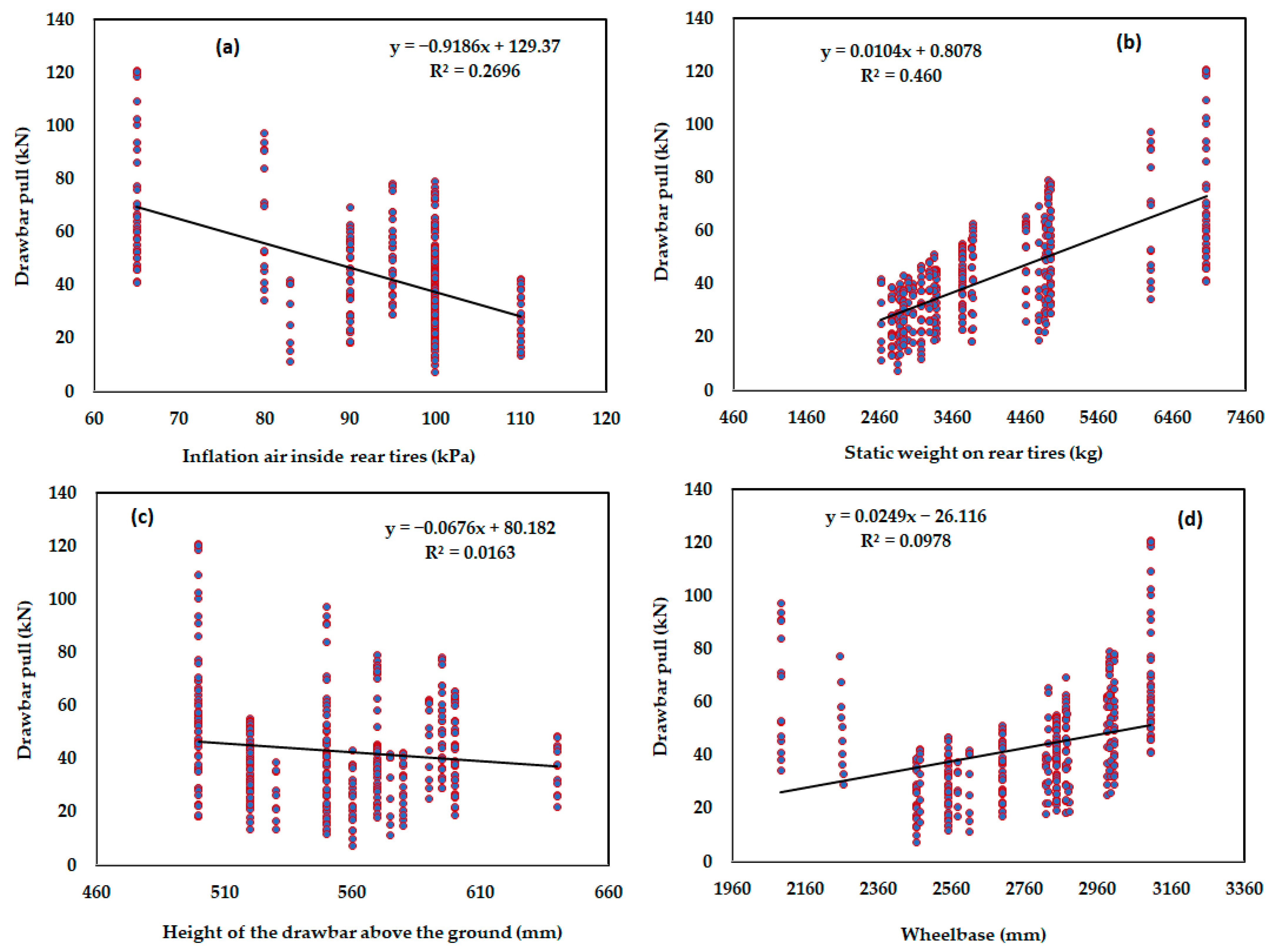
In the formed dataset, different input variables affect the drawbar pull. Some of these impacts are shown in Figure 3. The impact of inflation air inside the rear tires of a tractor was inversely proportional to the drawbar pull with a low coefficient of determination (R2 = 0.2696, Figure 3a). This pattern was noted in a prior study [40], which found that lower tire inflation on suitable tires can enhance drawbar characteristics. However, it does not always result in better drawbar characteristics. Additionally, it is well known that a tire’s best tractive performance can be achieved by adjusting its inflation pressure in accordance with the soil conditions it travels over [41]. Moreover, in the study by Serrano et al. [42], they reported that increasing tire pressure, especially by significant amounts, can reduce a tractor’s tractive efficiency. The lesser the inflation pressures, the more the force on the drawbar [43,44].
This study examines the impact of static weight on the rear tires of the tractor on the drawbar pull (Figure 3b). The relationship was positive, with a low coefficient of determination (R2 = 0.460). Increasing the static load on the rear axle improves tractive performance, but the vertical load applied to the tires depends on their properties [45]. As considered by Kumar et al. [46], raising the ballast loads on the axles tractors enhances their pulling facility. Additionally, tractor ballasting is essential to achieving ideal drawbar pull qualities, according to Adam et al. [47].
Additionally, this study examines the influence of tractor drawbar height above ground on drawbar pull (Figure 3c) using the collected dataset. The impact was inversely proportional to drawbar pull with a low coefficient of determination (R2 = 0.0163). This trend was reported by Şeflek et al. [39], who tested the effects of tractor drawbar height (520, 530, and 540 mm above the ground) on pulling force and discovered that the highest pulling force was produced by a drawbar height of 520 mm. Generally, the tractor’s rear wheels experience less load when the drawbar is lowered, but the front wheels experience more load. The tractor finds it more challenging to apply the necessary drawbar pull as a result [48].
To maintain steering capability during the test for tractors without rear axle steering, Formula (7) applies [49]:
P × H ≤ 0.8W × Z
where Z is the wheelbase in millimeters, W is the static load applied by the front wheels on the ground in newtons, H is the static height of the line of pull above the ground in millimeters, and P is the maximum drawbar pull in newtons.
The present study examines the effect of tractor wheelbase, ranging from 2093 mm to 3105 mm, on the drawbar pull (Figure 3d), utilizing the collected dataset. The impact was a positive drawbar pull effect, with a low coefficient of determination (R2 = 0.0978). Nonetheless, a tractor’s wheelbase and track width are essential design elements that affect its overall performance, stability, and traction. To design tractors that are suited for particular uses and effectively meet the demands of contemporary agriculture, manufacturers carefully take these criteria into account [50].

3.2.2. Drawbar Power

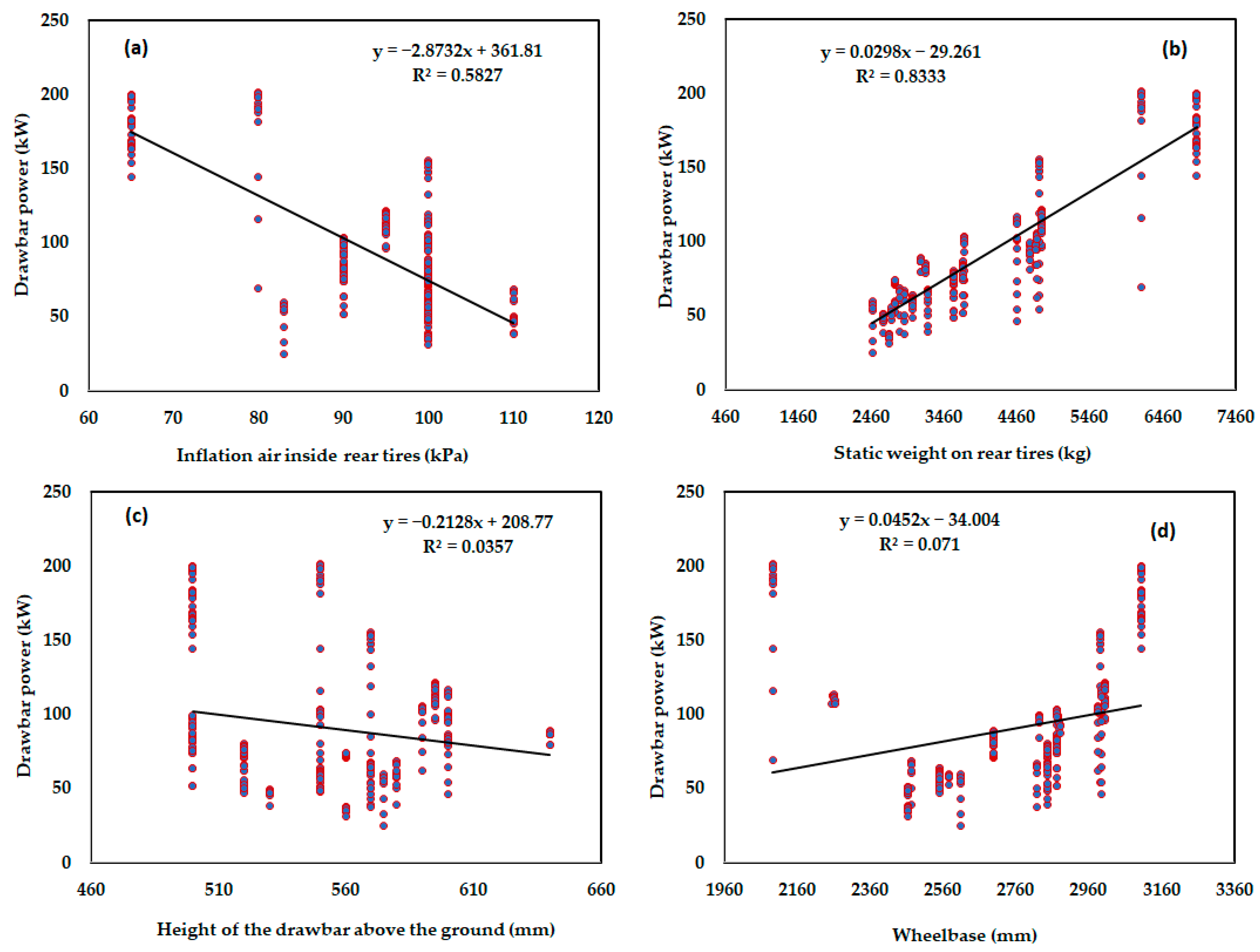
A linear model (Figure 4) was used to modify the behavior of the drawbar power at the drawbar on standard concrete track with different affecting variables, namely inflation air inside rear tires of the tractor (Figure 4a), static weight on rear tires of the tractor (Figure 4b), height of the drawbar of the tractor above the ground (Figure 4c), and tractor wheelbase (Figure 4d). The lower coefficient of determination (R2) may be attributed to a nonlinear relationship [51]. The inflation air inside the rear tires negatively affected drawbar power, with a moderate R2 of 0.5827, as shown in Figure 4a. Meanwhile, static weight on the rear tires had a positive effect on drawbar power, with an R2 of 0.8333, as shown in Figure 4b. Additionally, the height of the drawbar above the ground negatively affects drawbar power, with a lower R2 of 0.0357, as shown in Figure 4c. Furthermore, tractor wheelbase had a positive effect on drawbar power with a lower R2 of 0.071, as shown in Figure 4d.

3.2.3. Hourly Fuel Consumption

The feature that provides farmers with information to help them find proof of tractor maintenance and use optimization is fuel consumption data for agricultural tractors. Among the many tractor tire characteristics that affect operational effectiveness are tire type, inflation pressure, and ballasting [52]. In the formed dataset, different input variables affect hourly fuel consumption. Some of these impacts are shown in Figure 5.
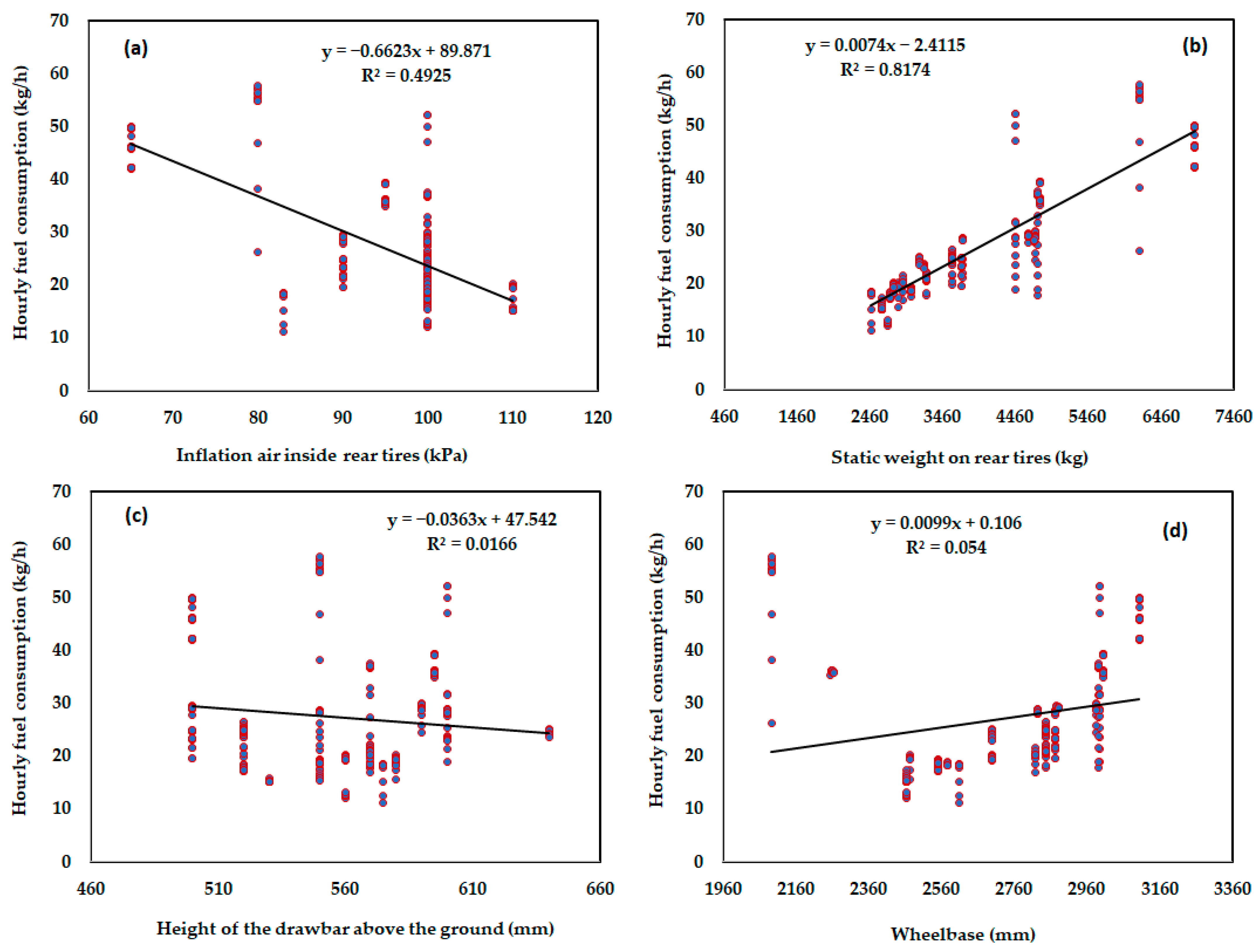
The impact of inflation air inside the rear tires of a tractor was inversely proportional to hourly fuel consumption, with a low coefficient of determination (R2 = 0.4925, Figure 5a). This pattern was noted in a prior study [53], which found that increasing tire inflation can lower fuel consumption. Additionally, Emmanuel [54] verified the impact of tire air pressure on fuel consumption. The test revealed that fuel consumption is more significantly influenced by tire pressure. According to the results, a pressure of 10 kPa used 5.3 liter of fuel per hour, whereas 40 kPa used just 3.5 liter per hour. Tire pressure directly affects fuel consumption during a tractor-plow operation. Research indicates that when tractor tire pressures drop below the recommended level, more fuel is used. This implies that a farmer will spend more on fuel when operating tractors with tire pressures below the recommended level [54]. Inflation pressure combinations in front and rear tires for a tractor that produced roughly 2% lead for the front driving wheels decreased the hourly fuel consumption by 2.5–3.0%, according to Čiplienė et al. [55]. As the tire’s contact with the road increases and the carcass structure deteriorates, lowering tire pressure below a specific threshold has a detrimental effect on tire life [56].
This study discovers the impact of static weight on rear tires of the tractor on the hourly fuel consumption (Figure 5b). The relationship was positive, with a high coefficient of determination (R2 = 0.8174). Increasing the static load on the rear axle increases the hourly fuel consumption, but the vertical load applied to the tires depends on their properties [45].
Additionally, this study discovers the influence of tractor drawbar height of the trator above ground on hourly fuel consumption (Figure 5c) using the collected dataset. The impact was an inverse effect on hourly fuel consumption, with a low coefficient of determination (R2 = 0.0166). Adjusting the drawbar height is crucial for reducing energy losses and improving operational effectiveness during field activities [39]. Furthermore, this study explores the impact of tractor wheelbase (2093–3105 mm) on hourly fuel consumption (Figure 5d) using the collected dataset. The impact was positive on hourly fuel consumption, with a low coefficient of determination (R2 = 0.054).

3.2.4. Drawbar Specific Fuel Consumption

The engine’s efficiency in converting fuel mass into mechanical energy is measured by the drawbar specific fuel consumption (DSFC, kg/kW.h); lower DSFC values indicate higher efficiency [56]. Lower drawbar specific fuel consumption occurred when a tractor operated on concrete and unplowed soil compared to plowed soil [57]. DSFC, measured and calculated during the trials, ranged between 0.519 and 1.237 L/kW·h when using a tractor with chisel plow for a forward speed range of 0.60, 0.95, 1.20 and 1.40 m/s and plowing depth rang of 15, 19.5, 23 and 26.5 cm and the mechanization unit was operated in a clay soil [58].
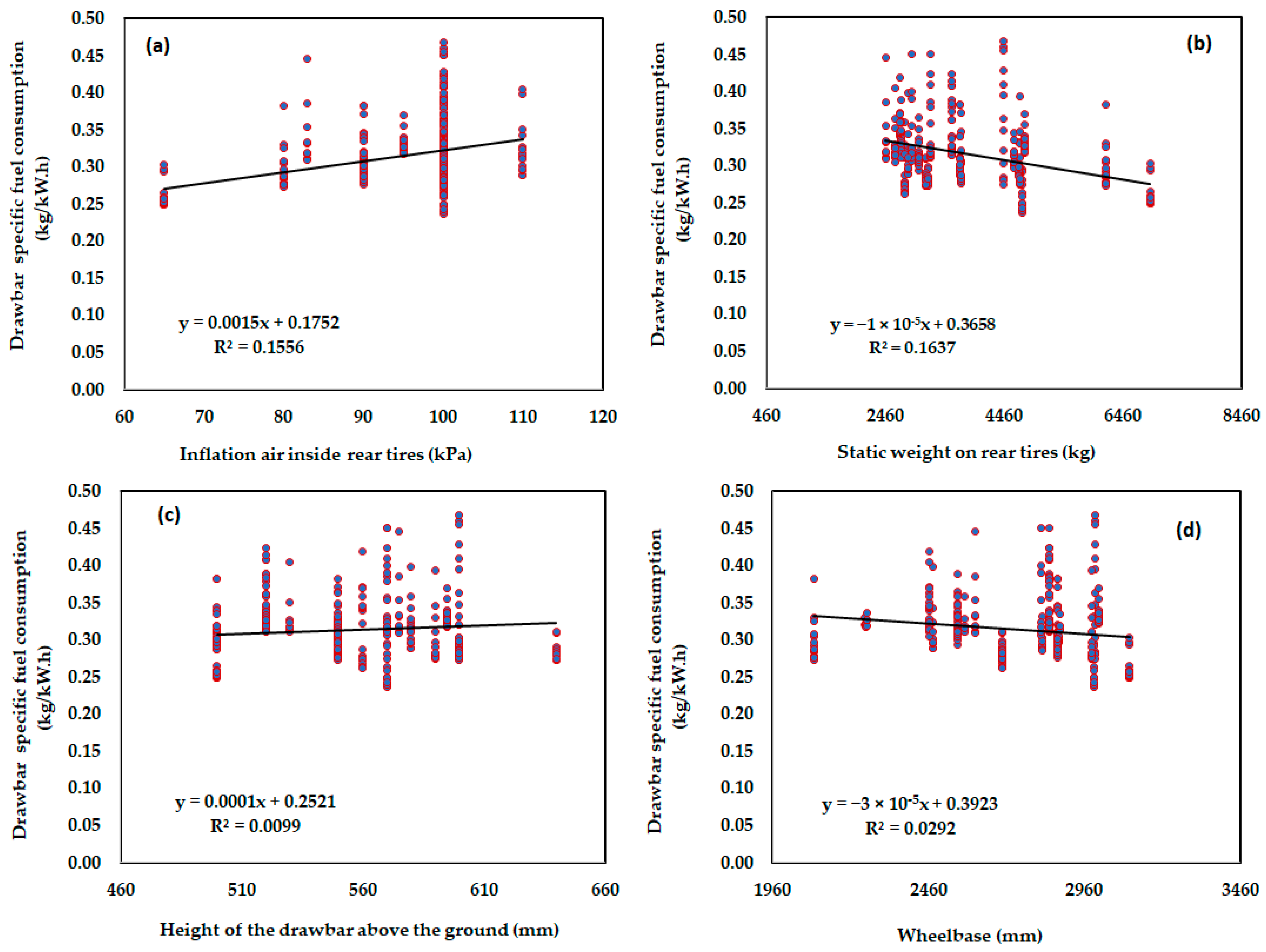
In Figure 6, within the inflation air inside rear tires of the tractor range (Figure 6a), the DSFC increases with a lower R2 of 0.1556. A lower R2 means that the relationship may be nonlinear. It is observed that DSFC increases with increasing internal pressure of the driving wheels [56]. The tire’s surface area in contact with the ground increased as tire pressure decreased. Accordingly, traction efficiency increased and specific fuel consumption decreased due to the higher grip force [56].
It is represented by Figure 6b, the DSFC decreases with the increase in static weight on rear tires of the tractor in the range of 2478 to 6930 kg, and the relation is weak with R2 of 0.1637 (Figure 6b). Usually, lower DSFC was achieved due to better wheel traction, resulting from higher drawbar power and lower hourly fuel consumption [59].
Tractor performance and efficiency are closely correlated with two important agricultural engineering parameters: the drawbar height above the ground and specific fuel consumption. During field operations, maximizing fuel efficiency and reducing energy losses requires proper drawbar height optimization [39]. In addition to increasing fuel efficiency and pulling capability, adjusting the tractor speed and drawbar height provides a workable framework for adopting sustainable farming methods. However, drawbar height modifications are crucial for reducing energy losses and increasing operational effectiveness during field operations [39]. As shown in Figure 6c, increasing the drawbar height above the ground increased DSFC, with a lower R2 of 0.0099. This trend was reported by Şeflek et al. [39], who conducted an experiment to determine the impact of tractor drawbar height (520, 530, and 540 mm above the ground) on specific fuel consumption, and they found that a drawbar height of 520 mm yielded the lowest specific fuel consumption of 267.03 g. kW/h and this was due to the fact that at the specific height (520 mm), the maximum drawbar power occurred. As shown in Figure 6d, increasing the tractor wheel base led to a decrease in DSFC with a lower R2 of 0.0292; however, the importance of tractor wheelbase is seen through Equation (7).

3.2.5. Drawbar Specific Volumetric Fuel Efficiency (DSVFE)

The ratio of the output power at the drawbar to the energy corresponding to the fuel used per unit of time is the overall power efficiency of a tractor’s accomplishment drawbar effort [60]. However, this is called the drawbar specific volumetric fuel efficiency in this study.
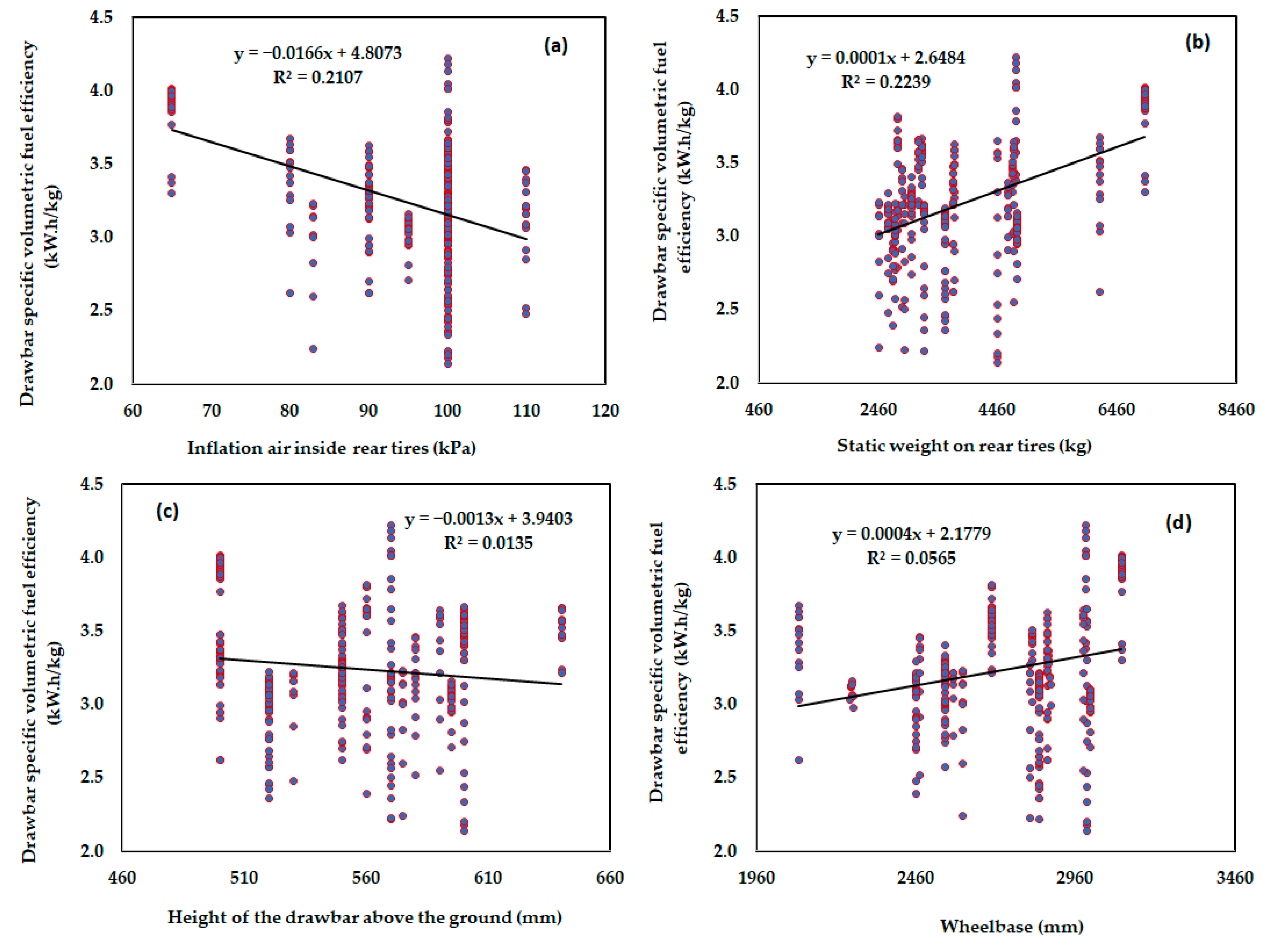
Tire pressure and ballasting affect tractor performance [61]. Therefore, it is crucial to examine potential factors that could enhance tractors’ tractive performance and, in turn, their power delivery efficiency. In the present study, the DSVFE range was 2.14 kW.h/kg to 4.22 kW·h/kg (Table 1). According to NTTL data, the typical range of specific volumetric fuel efficiency is 2.36 to 4.1 kW·h/lit, according to Grisso et al. [62]. Additionally, it is suggested that the specific volumetric fuel efficiency of a tractor-chisel plow as a mechanization unit can be described as the drawbar power (kW) divided by the fuel consumption rate (kg/h). In Figure 7, within the inflation air inside rear tires range (Figure 7a), the DSVFE increases with lower R2 of 0.2017. It is seen that DSFC decreases with the increase in the internal pressures of the driving wheels. Proper modifications of tire inflation pressure contributed to improving the fuel efficiency of tractors [42].
As represented by Figure 7b, the DSVFE increases with the increase in static weight on rear tires of the tractor in the range of 2478 to 6930 kg, and the relation is weak with an R2 of 0.2239 (Figure 7b). Usually, lower DSFC was achieved due to better wheel traction, resulting from higher drawbar power and lower hourly fuel consumption [59]. Furthermore, as shown in Figure 7c, increasing the drawbar height above the ground decreased DSVFE, with a lower R2 of 0.0135. Furthermore, as shown in Figure 7d, increasing the tractor wheelbase led to an increase in DSVFE, with a lower R2 of 0.0565. Such trends are connected to drawbar power and lower hourly fuel consumption.

3.3. Performance Analysis of the Developed Artificial Neural Network to Predict the Tractor Performance Indicators

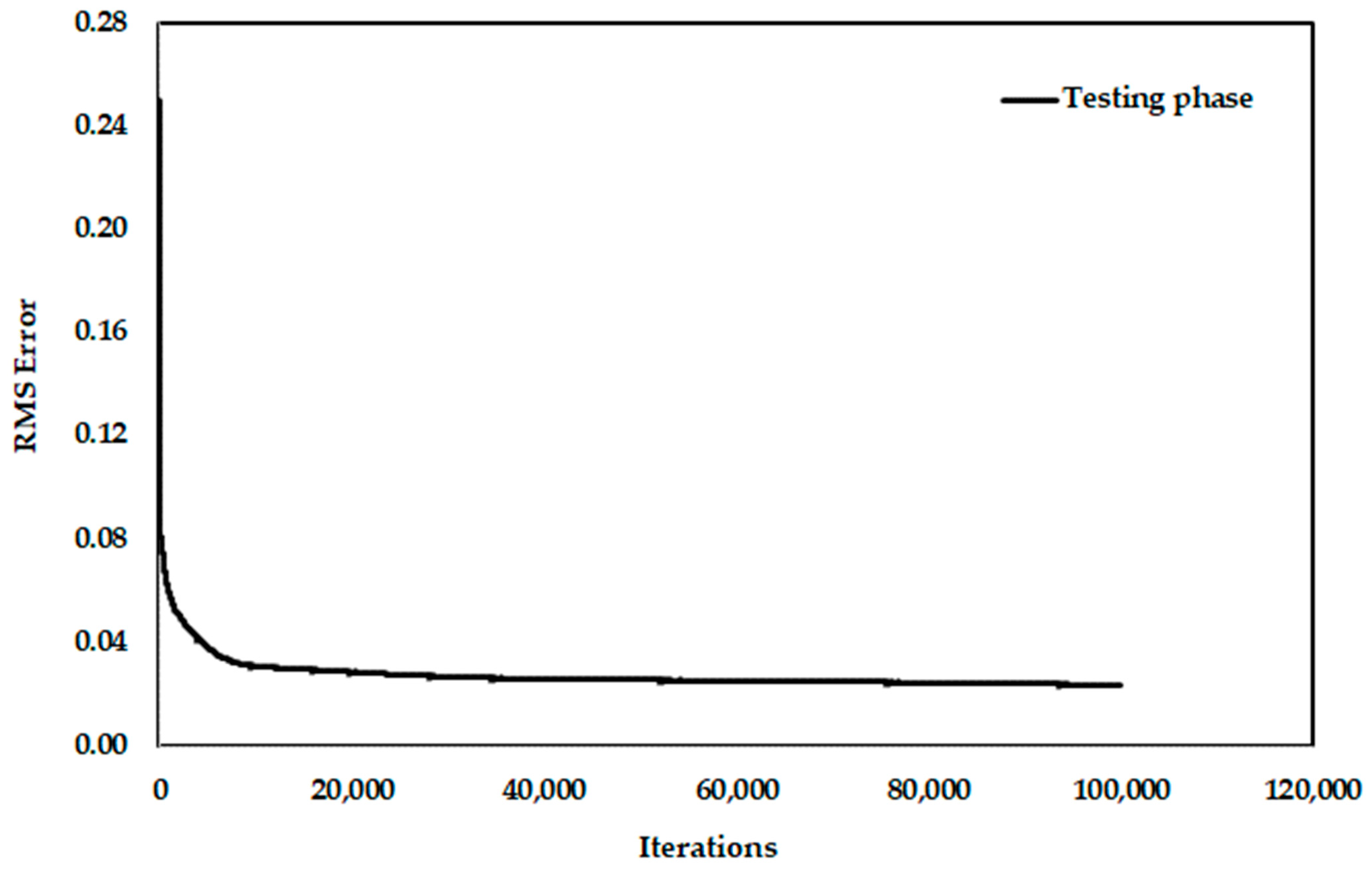
The Qnet v.2000 [28], software’s ANN approach was used to identify the optimal ANN model for predicting tractor performance indicators. Twenty independent variables comprised the ANN’s input layer. The trial-and-error method was used to analyze 50 nodes in the first hidden layer. In the output layer, five neurons were employed. The activation function for the hidden layer was a sigmoid. After 100,000 epochs (iterations), the optimal network was found with a learning rate of 0.002879 and a momentum factor of 0.8. It produced a testing error of 0.023628 and a training error of 0.017977.
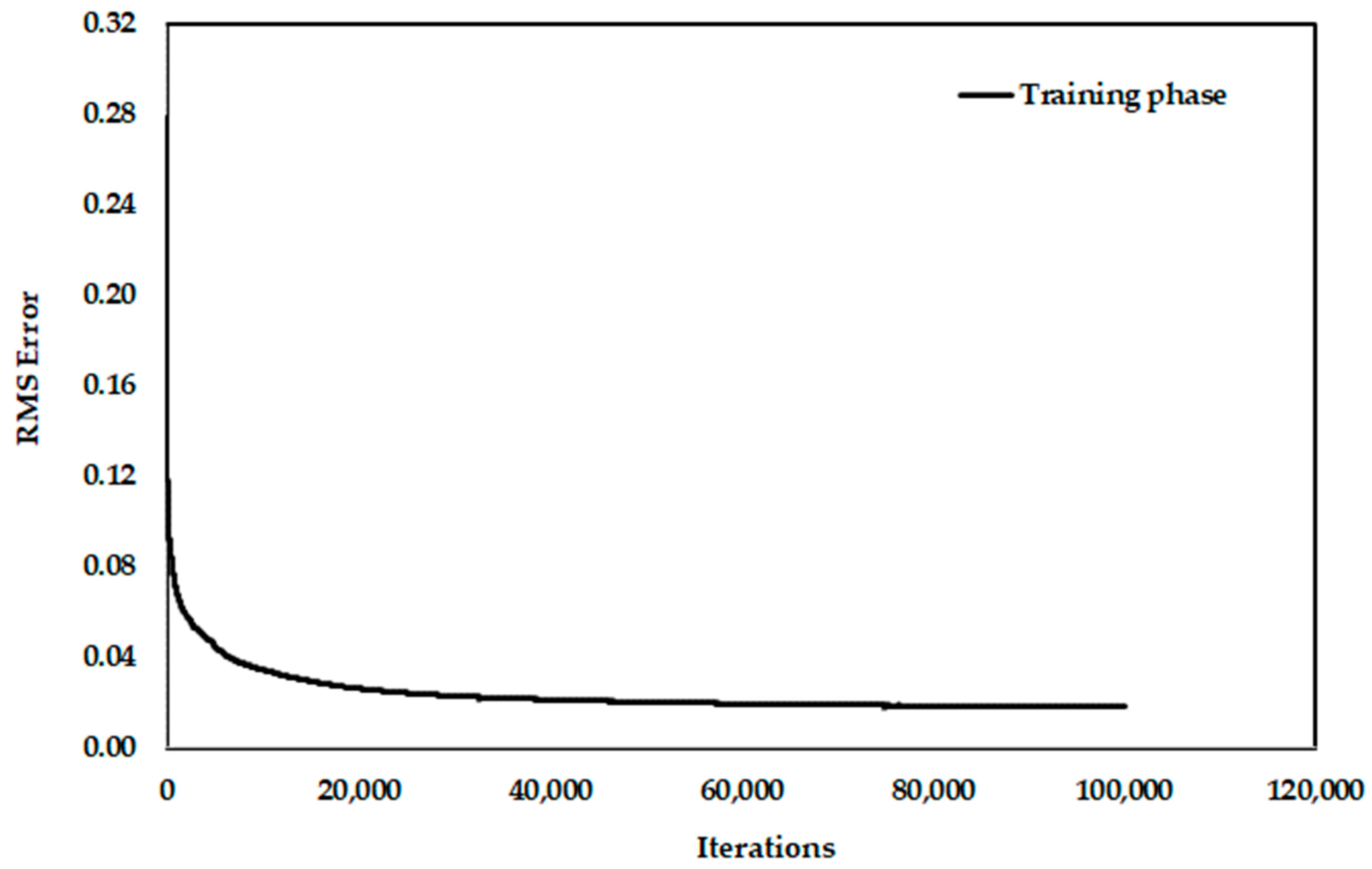
The learning curves throughout the training and testing phases are displayed in Figure 8 and Figure 9, respectively. The Figure 8 shows the performance curve of the neural network between RMS Error and number of iterations. The training stops at 100,000 epochs where the RMS Error is found to be lowest in training phase. Best training performance was found to have an RMS Error of 0.017977 at 100,000 epochs and the network is prepared to predict the output for the input values that have not been used for training. However, an ideal curve exhibits a steep initial reduction followed by a steady plateau, showing that the model is successfully learning patterns [63]. There are three types of learning curves: normal state, underfitting, and overfitting [63]. The training loss function values gradually decrease until they reach an acceptable low value (Figure 8) as well as the values of the testing loss function decrease over time, reaching acceptably low values (Figure 9).
There are legitimate worries about the model’s capacity for generalization, especially in light of artificial neural networks’ reliance on data. To improve and confirm the model’s ability to generalize outside of the training dataset, a number of strategies were used in this investigation. To ensure that model performance was assessed on unknown data, the available dataset was first split into training and testing subsets. The model did not experience overfitting and maintained consistent predictive behavior across various data partitions, as evidenced by the high agreement between the training and testing performance measures (e.g., coefficient of determination and error indices), as displayed in Table 4. Additionally, the loss curve, which showed a smooth and converging trend with little divergence between training and validation losses, was used to track the training process. Instead of knowing the training samples by heart, this behavior indicates that the learning process was well-regulated and that the network was able to capture the underlying nonlinear relationships. Additionally, the engineering significance and physical relevance of the input variables in tractor performance analysis were taken into consideration when choosing them, which naturally encourages generalization.
The values of R2, MAE, RMSE, and MAPE for the observed and predicted tractor performance indicators in Table 4 indicate a reasonable degree of error. This demonstrates that the created ANN model can accurately forecast unknown data. According to the literature [64], the prediction based on the MAPE has an acceptance level of 10%. Overall, the majority of models’ MAPE values stayed below 5%, suggesting a typically good degree of prediction accuracy [58]. Depending on the predicted variable, the MAPEs for the training and testing datasets were acceptable, ranging from 1.350% to 2.677% and 2.162% to 4.093%, respectively (Table 4).
The R2 during the training phase is approximately equivalent to 1 and falls between 0.967 to 0.995 (Table 4). As a result, the parameters chosen and the training data are enough for the performance prediction under investigation. The network comprehends the data and modifies weights to achieve the desired output; comparable results were reported by [11], [65], and [66]. The R2 range in the testing phase is 0.923–0.990 (Table 4), which is lower than the R2 range in the training phase. Given that these data are entirely novel for the developed ANN model, this fact can be explained [1]. We employed the chosen topology with the previously modified weights throughout the test phase. This step’s goals were to assess the trained network’s proficiency and test the network generalization property. As a result, data other than the training set were used to evaluate the network. The test phase shows that the established ANN model can predict the tractor performance indicators with new data, even though the training phase’s outcomes were generally superior.
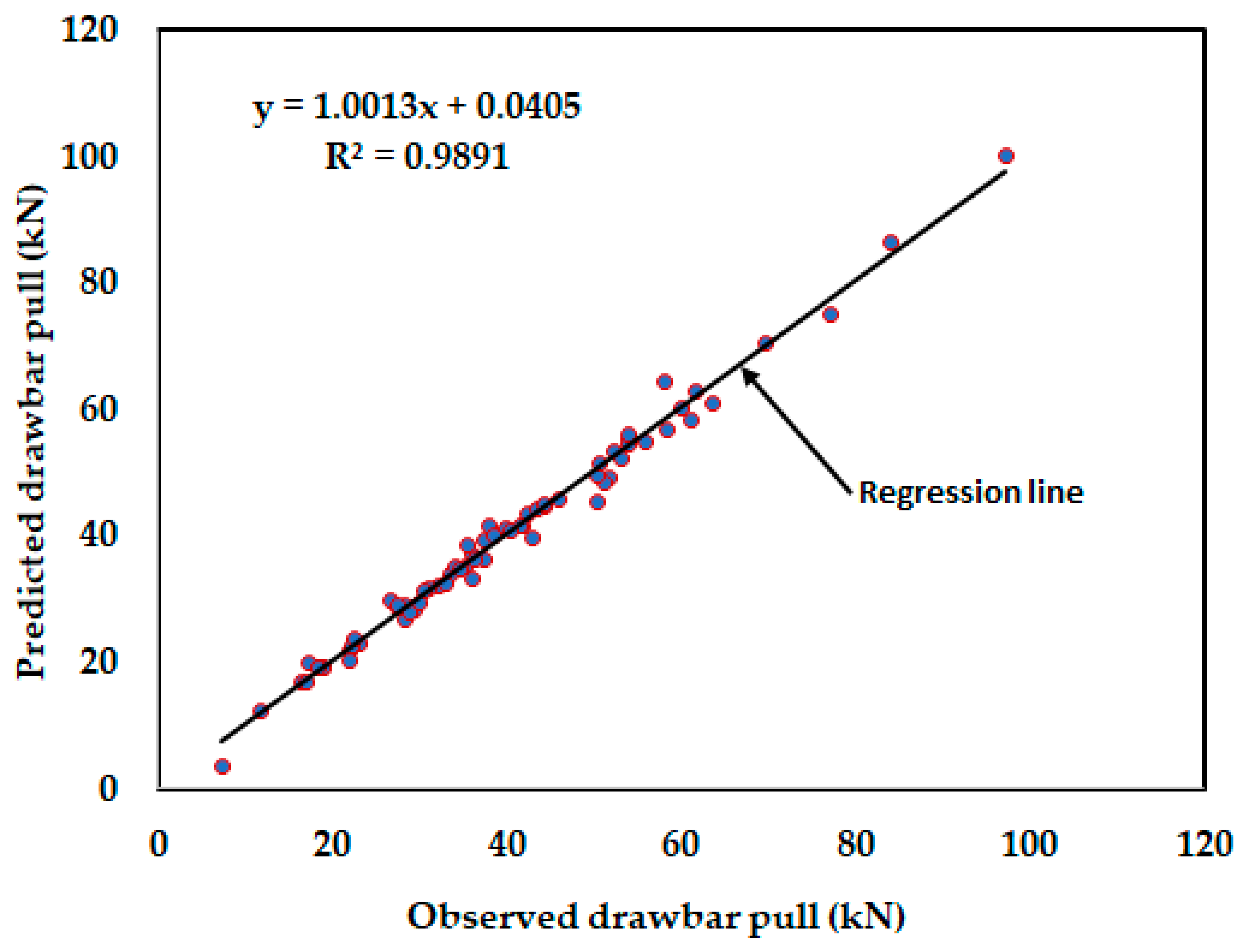
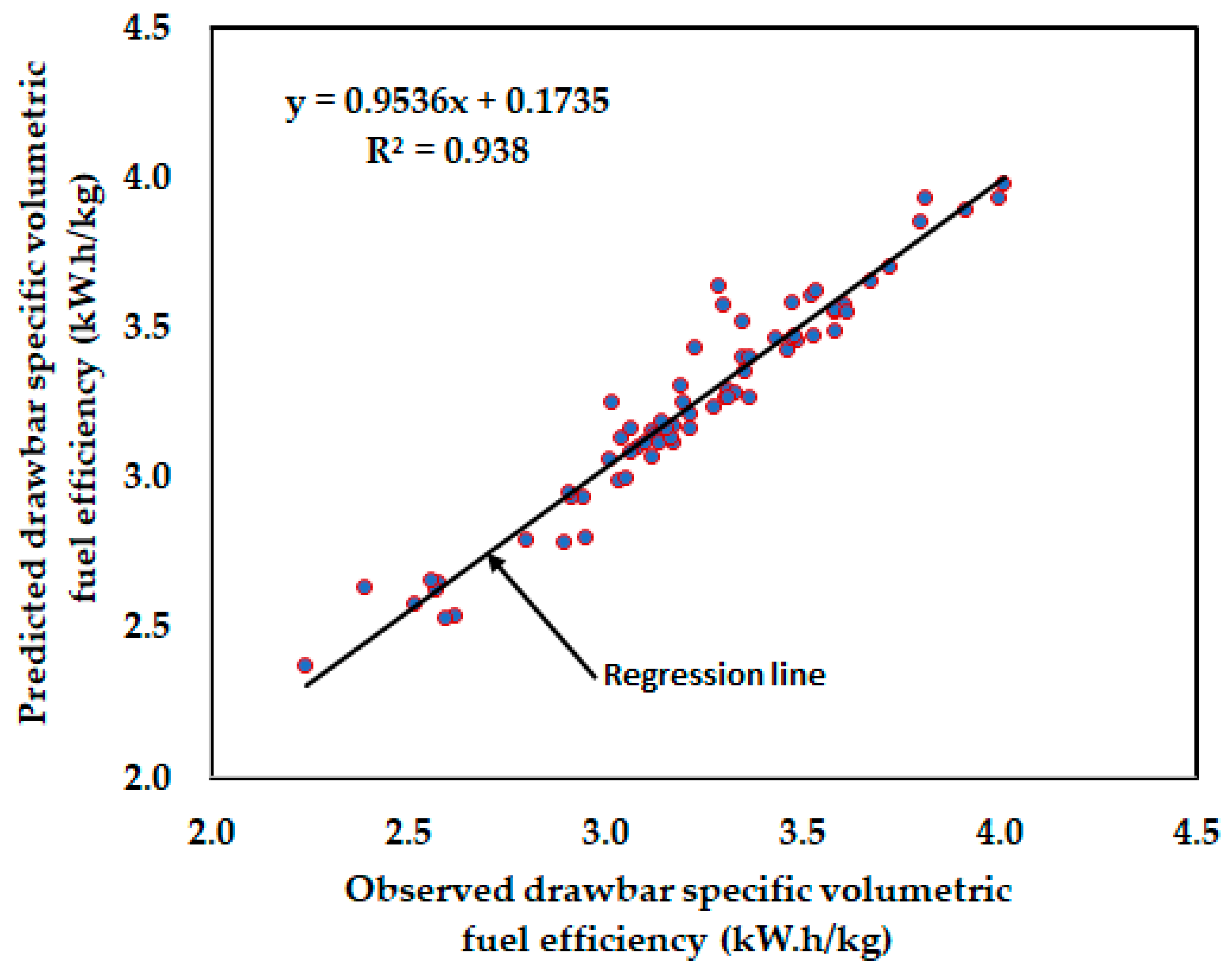
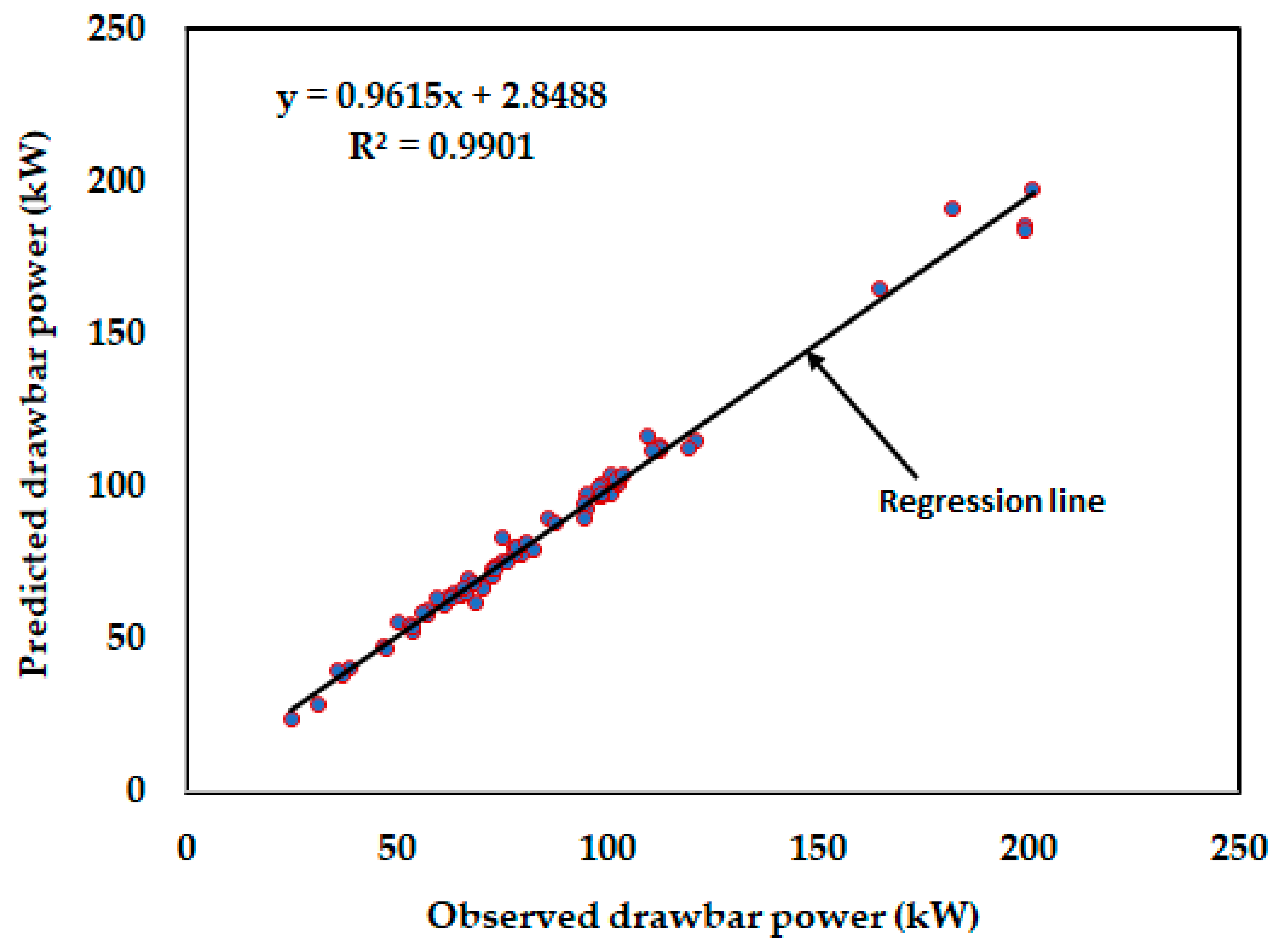
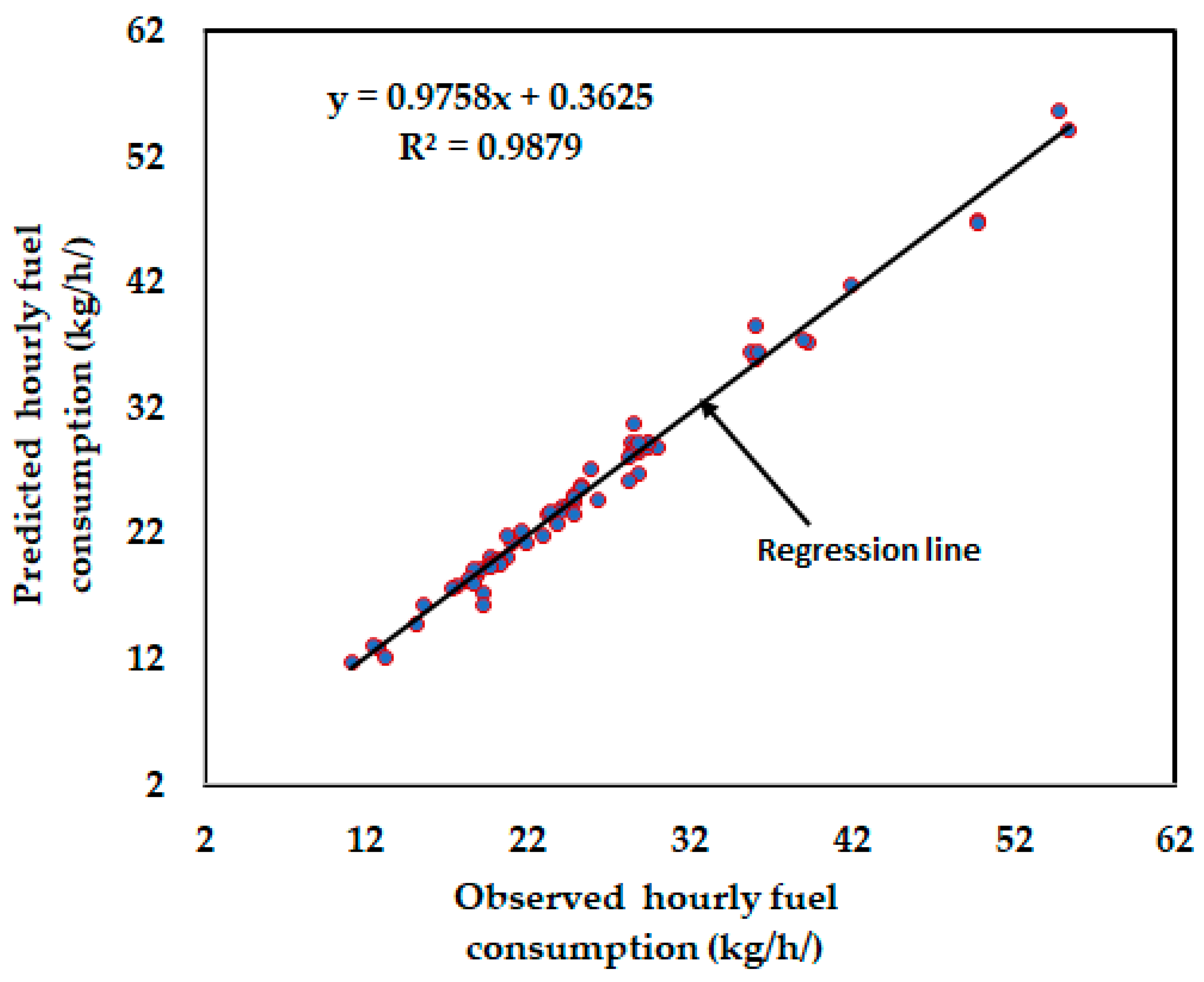
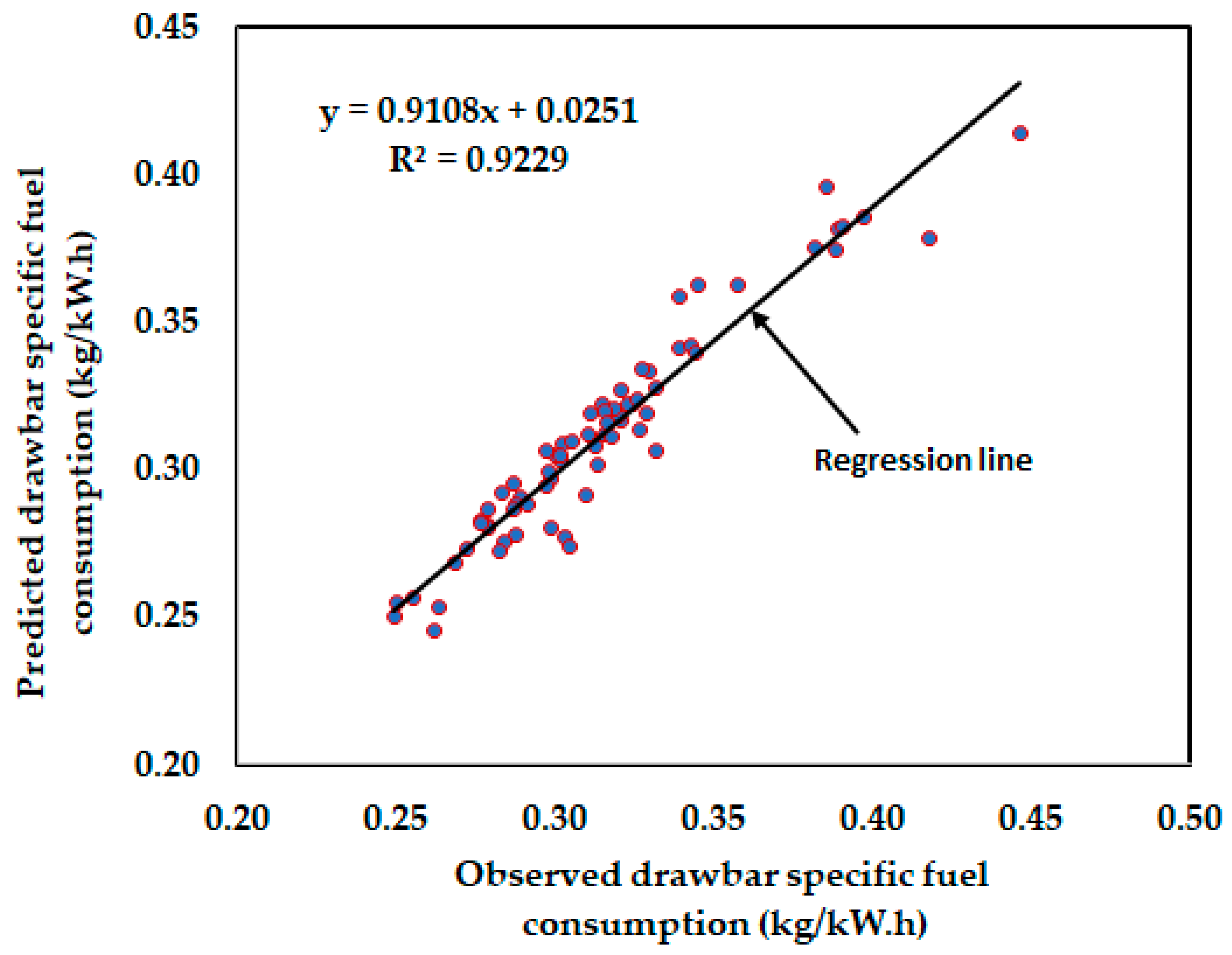
During the training and testing phases, the mean absolute errors (Table 4) varied across the indicators. Figure 10, Figure 11, Figure 12, Figure 13 and Figure 14 show the regression of the best ANN model for drawbar pull, drawbar power, hourly fuel consumption, drawbar specific fuel consumption, and drawbar specific volumetric fuel efficiency, respectively, during the test phase for the observed values against the ANN’s output values, demonstrating the network’s ability to learn the training dataset accurately. The coefficient of determination, or R2, for the data was determined to be in the range of 0.967 to 0.995 and 0.923 to 0.990 (Table 4), respectively, in the training and testing phases. Moreover, this result shows that the observed and estimated tractor performance indicators are appropriately associated.
The behavior of the built ANN model was nearly identical to that of ANN models used in earlier research on tractor performance indicators prediction, since the use of ANNs has become a ground breaking technique [1,4,10,11,15,67,68]. They all showed that ANN models could correctly forecast behavioral indicators for either a mechanization unit or a tractor on its own. The difficulty, therefore, lies in determining the best ANN model architecture for predicting a tractor’s or mechanization unit’s performance or operation indicators. Predicting tractor performance characteristics, such as drawbar power and fuel consumption, enables simulation and optimization of tractor performance, enabling the best possible configuration of various parameters and assisting manufacturers in making decisions regarding the design of new tractors [1]. The ANN generally offers better predicted accuracy, especially for nonlinear outputs, according to performance comparisons between it and several benchmark regressions models [11,69], utilizing identical data partitions and assessment criteria. Rahimi-Ajdadi and Abbaspour-Gilandeh’s study [11] used NTTL data. To characterize the factors investigated for predicting tractor fuel use, they used multiple regression and ANNs. In addition to comparing the performances of the developed ANN models using the Mean Square Error (MSE), Sum of Square Error (SSE), coefficient of determination (R2), and prediction accuracy (PA) scales, the results showed that the ANN offered comparatively better prediction accuracy (R2 = 0.938) in comparison to stepwise regression (R2 = 0.910). In this work, the lowest MSE and SSE values were found to be 0.001 and 0.010, respectively. The amount of one less than the prediction error is the prediction accuracy. Explanatory features, data size, and training algorithm can affect the prediction accuracy when using an ANN model. Karwasra et al. [68], for instance, employed twenty distinct input characteristics to predict drawbar performance. Tractor test reports provided the data that was used as input to train the ANN. An ANN with backpropagation was created. The trial-and-error technique was used to identify the best ANN structure, and the ANN with two hidden layers—each with 35 neurons—and the Levenberg–Marquardt training algorithm performed the best. This neural network’s mean square error (MSE) and coefficient of determination (R2) were 1.284 and 0.994, respectively.
The results show that the developed ANN model has high predictive performance (for example, each output has a high R2 value and a low root mean square error), indicating that ANN model can effectively capture the nonlinear relationship between the investigated inputs and tractor performance indicators. Therefore, using an ANN to derive the operation rule of performance criteria may be difficult for academics studying tractor operation, but it is important research for the future. Overall, this study is both interesting and of practical significance: by using the standardized tractor test data set to build a data-driven performance prediction model, it holds significant value for mechanical selection, energy efficiency assessment, and operation planning in agricultural engineering. The idea of using ANNs to learn the complex mapping relationships from test report variables to tractor performance indicators is very timely and has practical significance.
Tractor performance indicators can be estimated using the established ANN model without lengthy field or laboratory testing. The suggested method provides a dependable and affordable substitute for experimental testing by utilizing publicly accessible NTTL data. The developed ANN model can be used to estimate tractor performance indicators without the need for extensive field or laboratory testing. This has practical implications for tractor selection and matching with implements, optimization of operating conditions to reduce fuel consumption, and supporting manufacturers and researchers in performance analysis. By leveraging publicly available NTTL data, the proposed approach offers a cost-effective and reliable alternative to experimental testing.

3.4. Result of Determining the Contribution Percentages of Each Inputs on Tractor Performance Indicators

To assess the relative impact of input variables on the anticipated tractor performance indicators and to decipher the underlying behavior of the ANN model, a contribution percentages analysis was carried out. In the NTTL dataset, contribution percentages were evaluated using the input node interrogator in Qnet v.2000 [28].
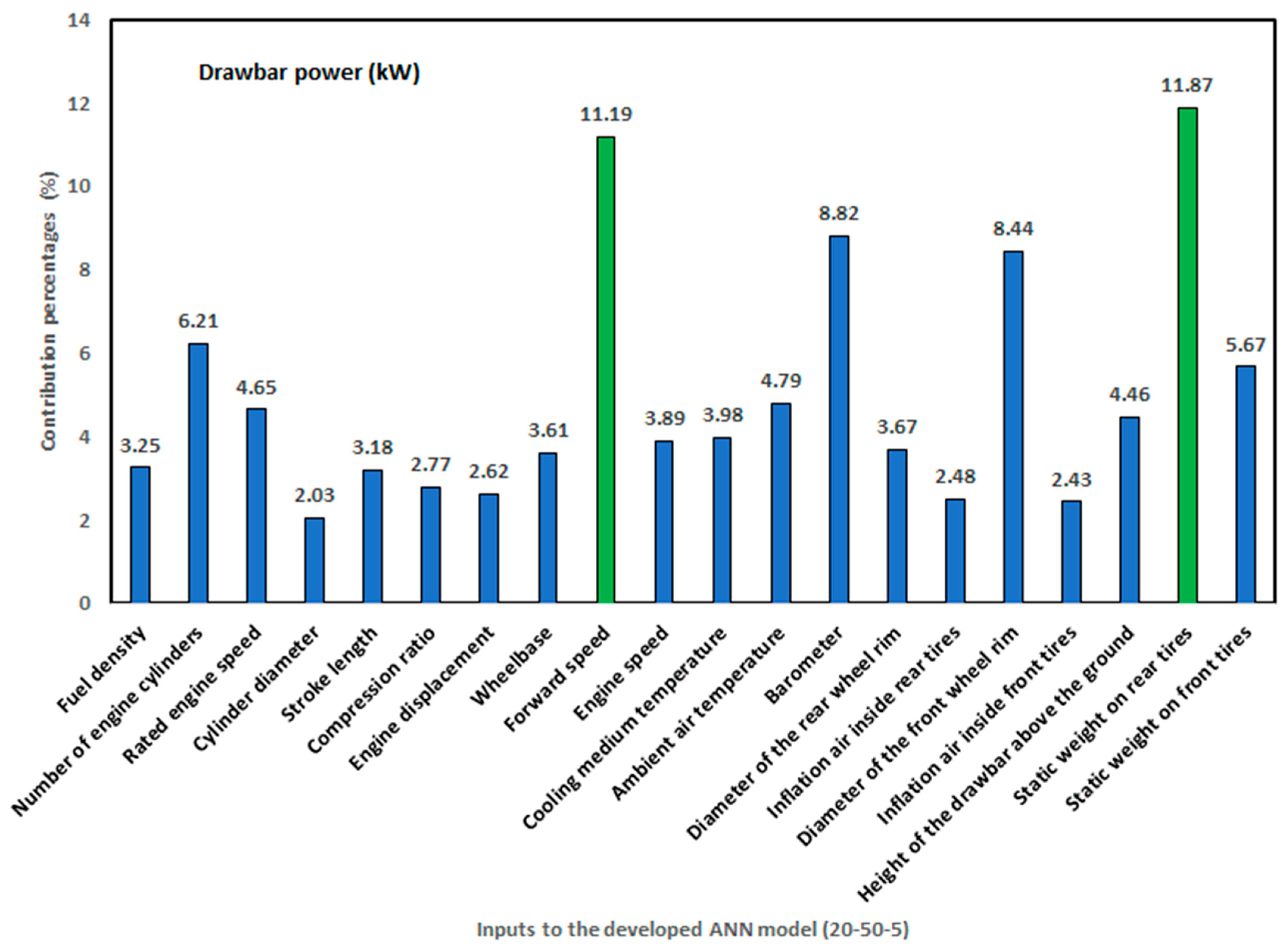
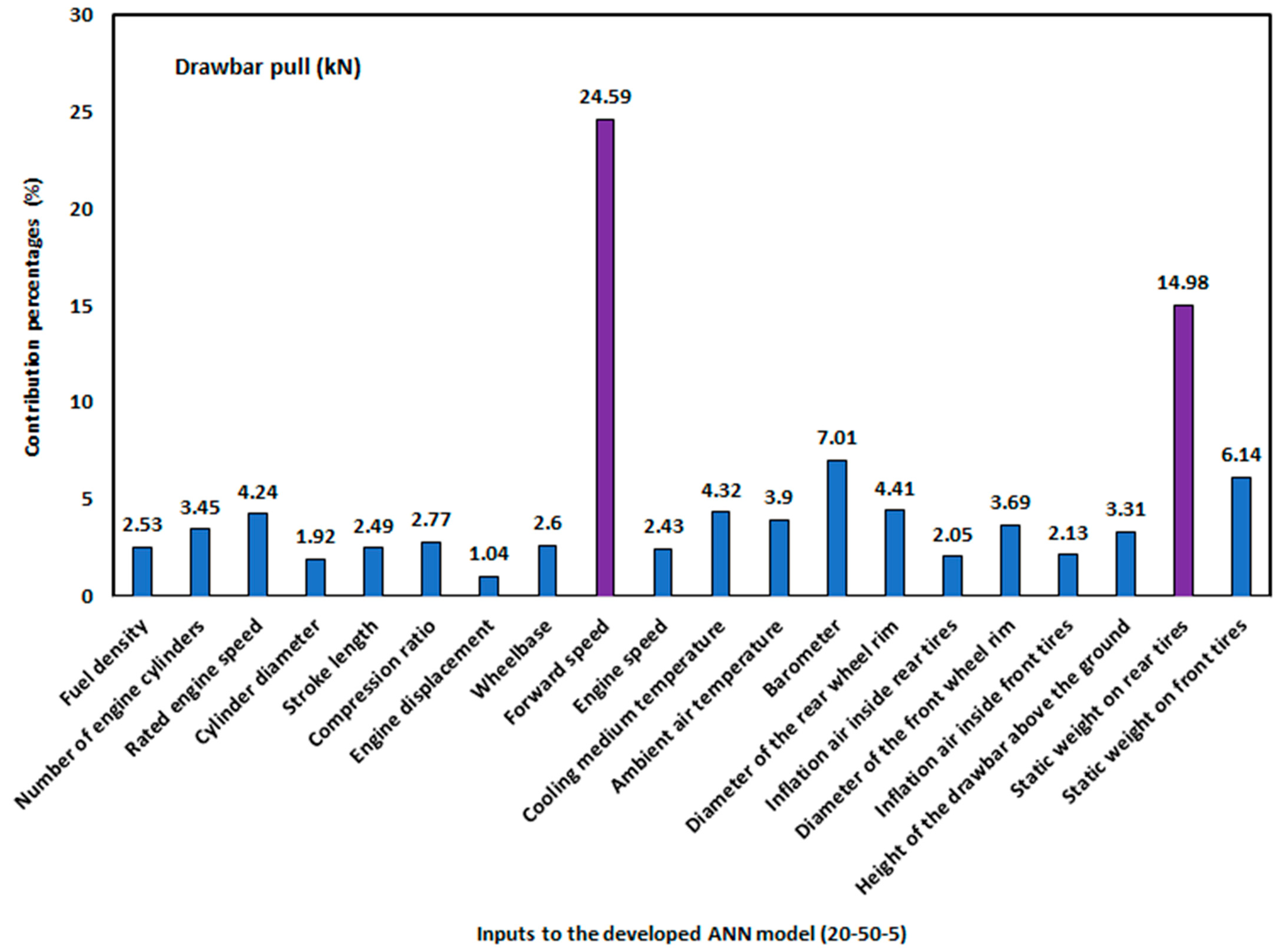
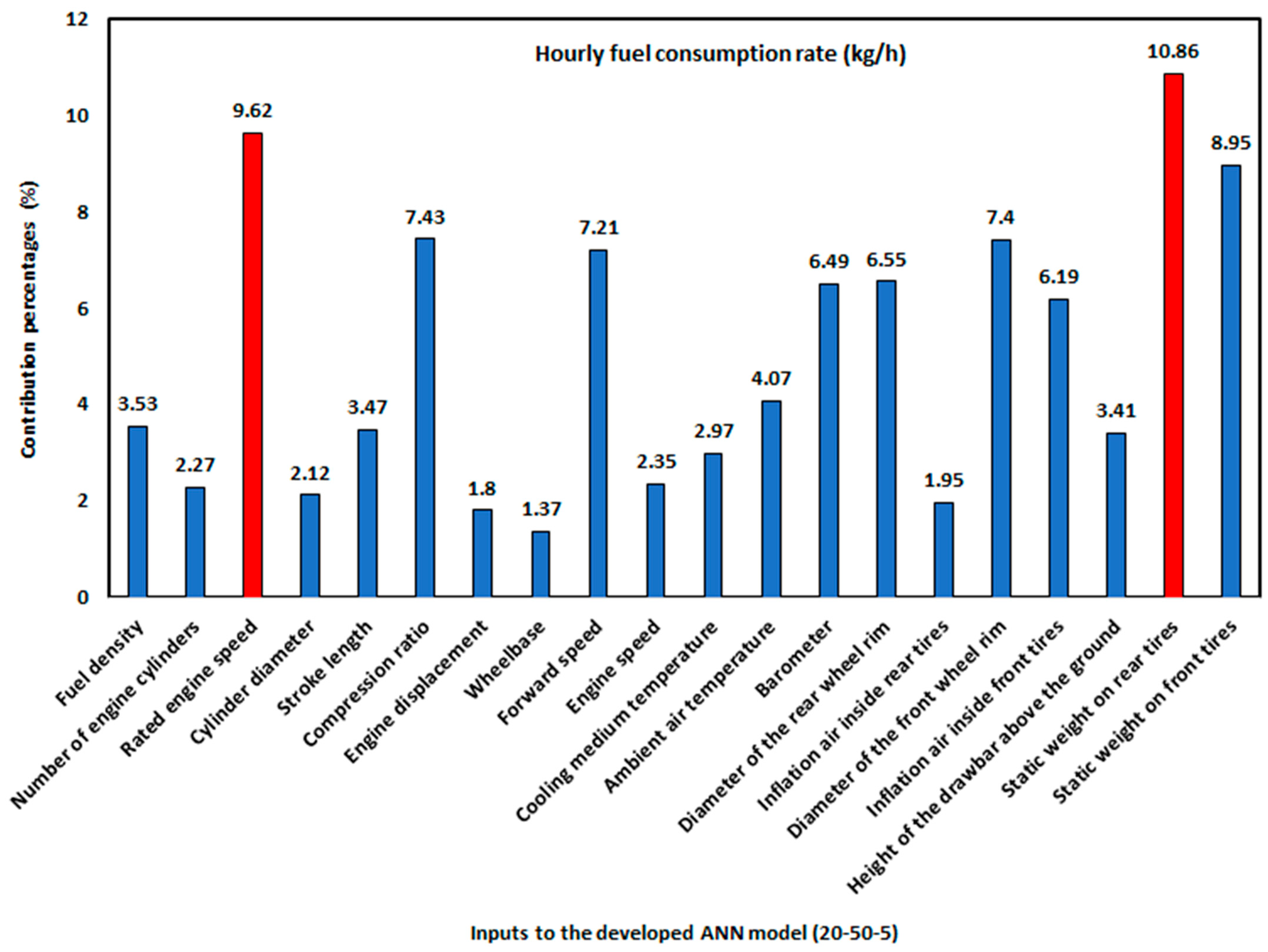
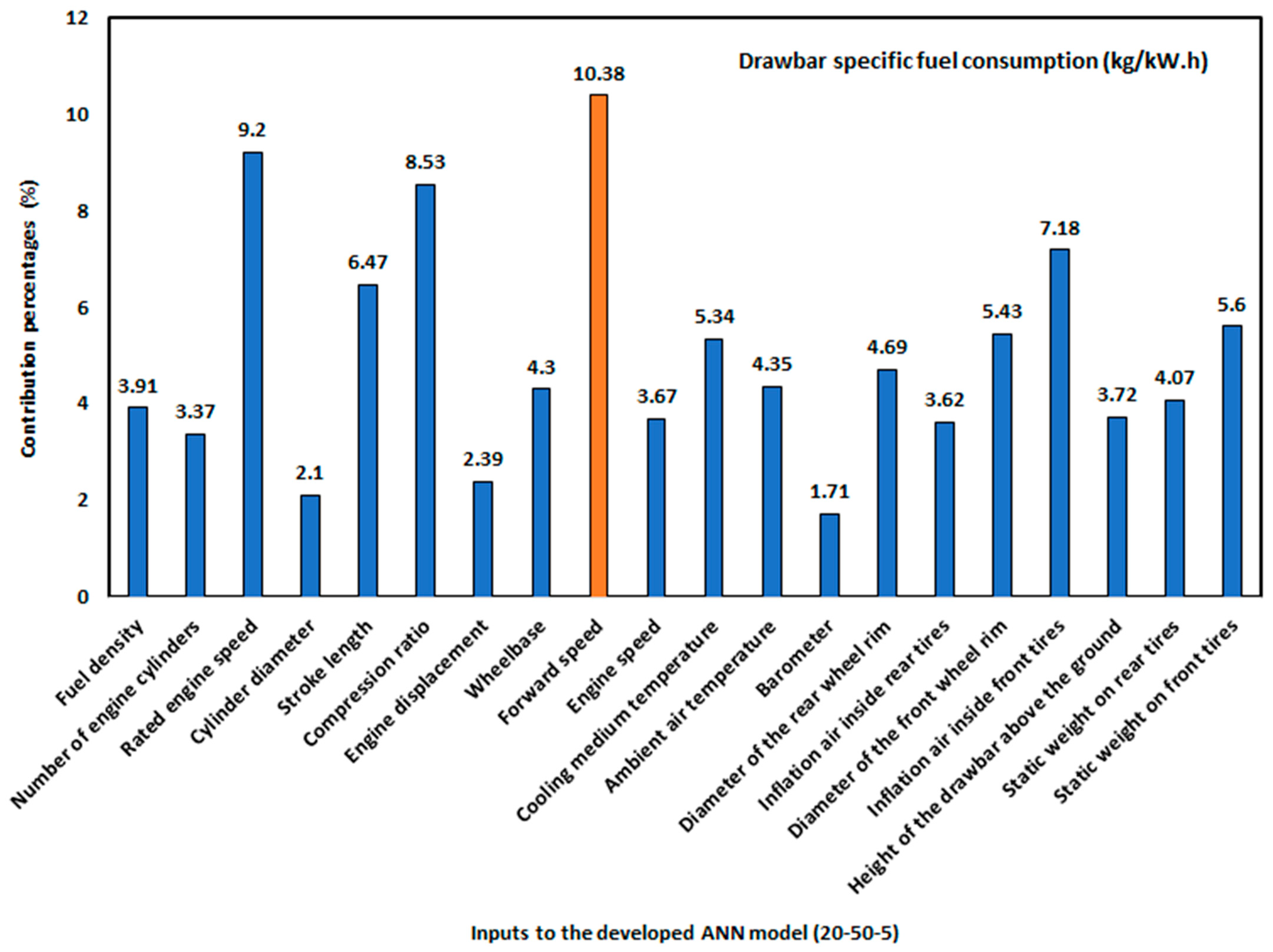
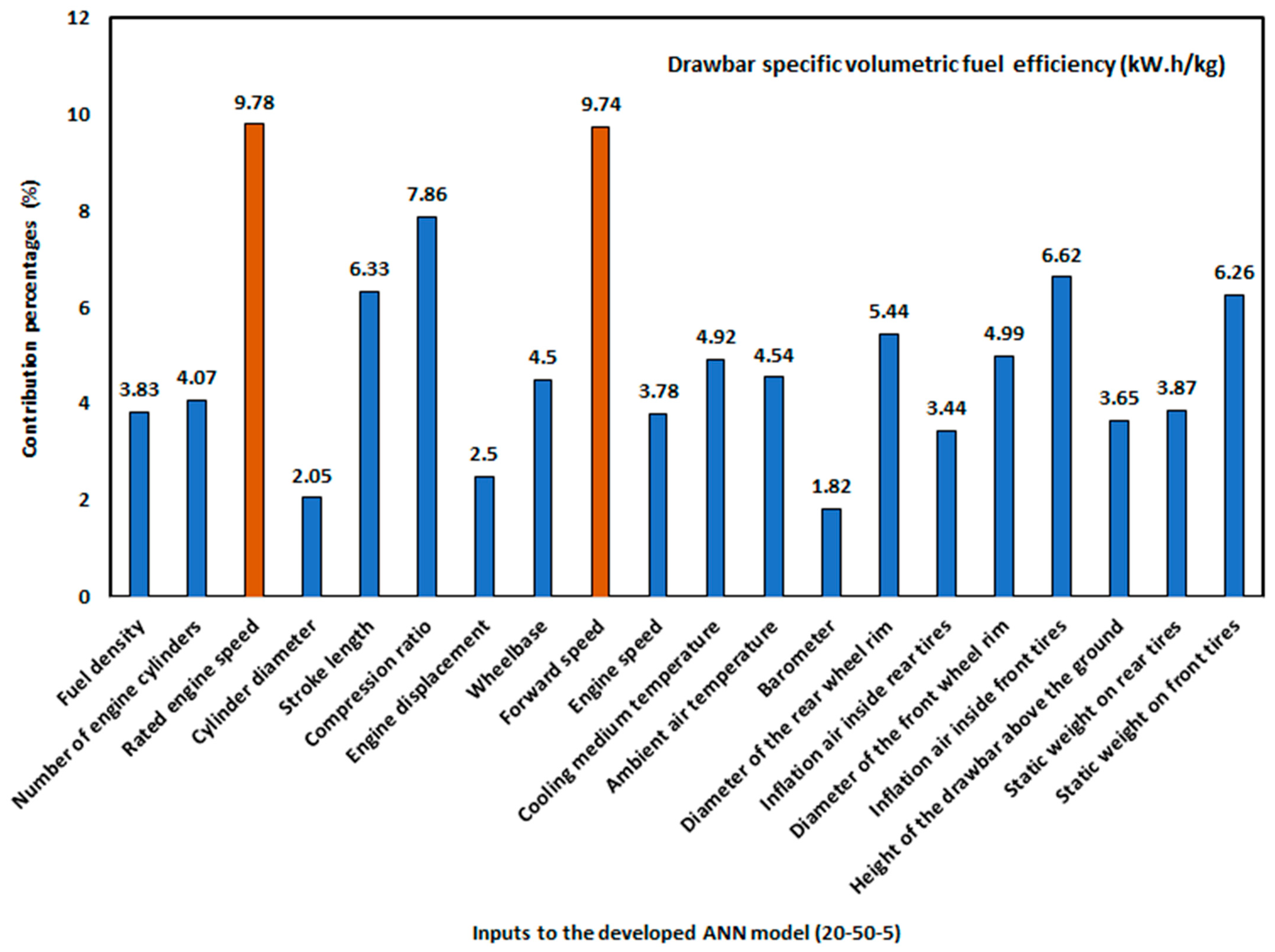
Figure 15, Figure 16, Figure 17, Figure 18 and Figure 19 depict the contribution percentages of input to the investigated outputs relationship of drawbar power, drawbar pull, hourly fuel consumption, drawbar specific fuel consumption, and drawbar specific volumetric fuel efficiency the developed ANN model for the prediction of tractor performance indicators using data from NTTL for the Massey Ferguson tractor. As a result, forward speed was contributed by different percentages on drawbar power, drawbar pull, hourly fuel consumption, drawbar specific fuel consumption, and drawbar specific volumetric fuel efficiency prediction by 11.19% (Figure 15), 24.59% (Figure 16), 7.21% (Figure 17), 10.38% (Figure 18), and 9.74% (Figure 19), respectively. So, selecting the optimum forward speed is of critical importance to save fuel and energy in soil tillage [58]. The sensitivity analysis showed that the majority of tractor performance indicators were most significantly influenced by forward speed. This result is in line with tractor performance theory and classical terramechanics and has physical significance. While speed-dependent soil–tire interactions have a significant impact on fuel consumption, traction efficiency, and slide behavior, drawbar power is directly proportional to forward speed. Similar findings have been extensively documented in analytical models and practical tractor tests, demonstrating that forward speed is a key operational factor influencing tractor performance [69,70,71,72,73].
Rated engine speed was the highest contribution for hourly fuel consumption by 9.62% (Figure 17) and by 9.78% (Figure 19) on drawbar specific volumetric fuel efficiency prediction. Static weight on the rear tires of the tractor was the highest contributor to drawbar power, drawbar pull, and hourly fuel consumption rate prediction, by 11.87% (Figure 15), 14.98% (Figure 16), and 10.86% (Figure 17), respectively. Thus, appropriate organization of the important input parameters, such as forward speed, inflation air pressure inside the tractor tire, static weight on rear tires of the tractor (ballasting), and engine speed, can aid in enhancing fuel consumption and drawbar power.
Overall, the contribution analysis shows that the ANN model did not develop misleading correlations but rather associations in line with basic tractor performance theory. Furthermore, the findings show that interpretable data-driven models may be trained using standardized NTTL data. The knowledge gathered from this analysis supports the use of the ANN as a decision-support tool for tractor performance indicators assessment and energy optimization and increases confidence in its predictive capacity.

4. Conclusions

This study used standardized tractor test data to propose an artificial neural network (ANN) architecture for forecasting several tractor performance indicators, such as drawbar pull, hourly fuel consumption rate, drawbar power, drawbar volumetric specific fuel efficiency, and drawbar specific fuel consumption. The suggested multi-output ANN model achieved good predicted behavior across all tractor performance indicators by successfully capturing the nonlinear interactions between investigated inputs and outputs. The required data were from tractor test reports collected from the Nebraska Tractor Test Laboratory (NTTL) in the USA, spanning the period from 1997 to 2016 for FWA Massey Ferguson tractors. A forward neural network model with twenty variables as inputs and one hidden layer with 50 neurons provided the best performance of the developed ANN architecture, which thus consisted of 20-50-5. This study’s findings demonstrated the superior performance of the ANN trained with the backpropagation algorithm and the sigmoid function. The following conclusion are summarized:
  • For drawbar pull, the testing dataset yielded a coefficient of determination (R2) of 0.989 and a root mean square error (RMSE) of 1.809 kN; for the hourly fuel consumption rate, the R2 was 0.988 and the RMSE was 1.059kg/h, R2 of 0.923 and RMSE of 0.011 kg/kW·h were found for drawbar specific fuel usage. For drawbar volumetric specific fuel efficiency, R2 of 0.938 and RMSE of 0.095 kW·h/kg were found; for drawbar power, R2 of 0.990 and RMSE of 3.796 kW were found.
  • The use of data from a single tractor manufacturer limits the proposed model’s applicability. To increase universality and practical relevance, future studies should expand the framework to incorporate soil–tool interaction factors and a larger variety of tractor models.
  • Within the ranges of the input variables examined, the developed ANN model might be a useful tool for planning the operating characteristics of a Massey Ferguson or other tractor types. However, in order to boost output and productivity, sustainable agriculture mostly depends on recently created technologies.

Author Contributions

Conceptualization, A.M.A., S.M.A.-S. and S.S.A.; Methodology, A.M.A., W.A.A. and S.A.A.-H.; Software, S.M.A.-S., S.S.A., W.A.A. and A.M.A.; Formal analysis, A.M.A. and W.A.A.; Investigation, S.M.A.-S.; Resources, S.M.A.-S. and W.A.A.; Data curation, A.M.A. and S.S.A.; Writing—original draft, S.M.A.-S., S.S.A., A.M.A., A.A.A.-J. and S.A.A.-H.; Writing—review and editing, S.M.A.-S., S.S.A., W.A.A., S.A.A.-H., A.A.A.-J. and A.M.A.; Supervision, S.M.A.-S.; Funding acquisition, S.M.A.-S. All authors have read and agreed to the published version of the manuscript.

Funding

This research was funded by Ongoing Research Funding Program, (ORF-2026-1224), King Saud University, Riyadh, Saudi Arabia.

Institutional Review Board Statement

Not applicable.

Informed Consent Statement

Not applicable.

Data Availability Statement

The original contributions presented in this study are included in the article. Further inquiries can be directed to the corresponding authors.

Acknowledgments

The authors would like to extend their sincere appreciation to the Ongoing Research Funding Program, (ORF-2026-1224), King Saud University, Riyadh, Saudi Arabia.

Conflicts of Interest

The authors declare no conflicts of interest.

References

  1. Karwasra, N. Application of Artificial Neural Network in Prediction of Tractor Performance. Master’s Thesis, Chaudhary Charan Singh Haryana Agricultural University, Hisar, India, 2014; 65p. Available online: https://krishikosh.egranth.ac.in/server/api/core/bitstreams/7c37f15b-a9e5-4b52-9df8-1640b1b4aef7/content (accessed on 20 January 2026).
  2. Makridakis, S.; Wheelwright, S.C. Forecasting Methods for Management; John Wiley and Sons: New York, NY, USA, 1989. [Google Scholar]
  3. Hanke, J.E.; Reitsh, A.G. Business Forecasting; Prentice-Hall: Englewood Cliffs, NJ, USA, 1995. [Google Scholar]
  4. Almaliki, S.; Alimardani, R.; Omid, M. Artificial neural network based modeling of tractor performance at different field conditions. Agric. Eng. Int. CIGR J. 2016, 18, 262–274. [Google Scholar]
  5. Carman, K. Prediction of soil compaction under pneumatic tires a using fuzzy logic approach. J. Terramechanics 2008, 45, 103–108. [Google Scholar] [CrossRef]
  6. Qamar, R.; Zardari, B.A. Artificial Neural Networks: An Overview. Mesopotamian J. Comput. Sci. 2023, 2023, 130–139. [Google Scholar] [CrossRef]
  7. Maren, A.J.; Harston, C.T.; Pap, R.M. Handbook of Neural Computing Applications; Academic Press: San Diego, CA, USA, 1990. [Google Scholar]
  8. Arriagada, J.; Olausson, P.; Selimovic, A. Artificial neural network simulator for SOFC performance prediction. J. Power Sources 2002, 112, 54–60. [Google Scholar] [CrossRef]
  9. Gong, S.-Y.; Baek, S.-M.; Baek, S.-Y.; Kim, Y.-J.; Kim, W.-S. Machine Learning-Based Estimation of Tractor Performance in Tillage Operations Using Soil Physical Properties. Agronomy 2025, 15, 2228. [Google Scholar] [CrossRef]
  10. Prakash, C.; Singh, L.P.; Gupta, A.; Singh, A. Prediction of hand-arm vibration among tractor operators in different soil tillage operations using artificial neural network-based model. Comput. Electron. Agric. 2025, 230, 109858. [Google Scholar] [CrossRef]
  11. Rahimi-Ajdadi, F.; Abbaspour-Gilandeh, Y. Artificial neural network and stepwise multiple range regression methods for prediction of tractor fuel consumption. Measurement 2011, 44, 2104–2111. [Google Scholar] [CrossRef]
  12. Çarman, K.; Taner, A. Prediction of tire tractive performance by using artificial neural networks. Math. Comput. Appl. 2012, 17, 182–192. [Google Scholar] [CrossRef]
  13. Taghavifar, H.; Mardani, A.; Karim-Maslak, H.; Kalbkhani, H. Artificial Neural Network estimation of wheel rolling resistance in clay loam soil. Appl. Soft Comput. 2013, 13, 3544–3551. [Google Scholar] [CrossRef]
  14. Safa, M.; Samarasinghe, S. Modelling fuel consumption in wheat production using artificial neural networks. Energy 2013, 49, 337–343. [Google Scholar] [CrossRef]
  15. Bietresato, M.; Calcante, A.; Mazzetto, F. A neural network approach for indirectly estimating farm tractors engine performances. Fuel 2015, 143, 144–154. [Google Scholar] [CrossRef]
  16. Chowdhury, M.; Kurmi, R.; Anand, R. Artificial Neural Network (ANN) Based Tractor Performance Prediction. Agric. Food E-Newsl. 2023, 5, 43139. [Google Scholar]
  17. Jalilnezhad, H.; Abbaspour-Gilandeh, Y.; Rasooli-Sharabiani, V.; Mardani, A.; Hernández-Hernández, J.L.; Montero-Valverde, J.A.; Hernández-Hernández, M. Use of a convolutional neural network for predicting fuel consumption of an agricultural tractor. Resources 2023, 12, 46. [Google Scholar] [CrossRef]
  18. Özbayer, M.M.; Güner, M. Comparison of performance characteristics of agricultural tractors. J. Agric. Fac. Gaziosmanpaşa Univ. 2022, 39, 6–18. [Google Scholar] [CrossRef]
  19. Harris, H.D. Prediction of tractor engine performance using OECD standard test data. J. Agric. Eng. Res. 1992, 53, 181–193. [Google Scholar] [CrossRef]
  20. Institute of Agriculture and Natural Resources, NEBRASKA TRACTOR TEST LABORATORY. Available online: https://tractortestlab.unl.edu/test-reports/ (accessed on 20 January 2025).
  21. Çalişkan, E.; Sevim, Y.A. Comparative study of artificial neural networks and multiple regression analysis for modeling skidding time. Appl. Ecol. Environ. Res. 2019, 17, 1741–1756. [Google Scholar] [CrossRef]
  22. Haykin, S. Neural Networks: A Comprehensive Foundation; Macmillan: New York, NY, USA, 1994. [Google Scholar]
  23. Rachmatullah, M.I.C.; Santoso, J.; Surendro, K. Determining the number of hidden layer and hidden neuron of neural network for wind speed prediction. PeerJ Comput. Sci. 2021, 7, e724. [Google Scholar] [CrossRef]
  24. Payán-Serrano, O.; Bojórquez, E.; Bojórquez, J.; Chávez, R.; Reyes-Salazar, A.; Barraza, M.; López-Barraza, A.; Rodríguez-Lozoya, H.; Corona, E. Prediction of Maximum Story Drift of MDOF Structures under Simulated Wind Loads Using Artificial Neural Networks. Appl. Sci. 2017, 7, 563. [Google Scholar] [CrossRef]
  25. Hecht-Nielsen, R. Neurocomputer Applications. In Neural Computers; Eckmiller, R., Malsburg, C., Eds.; Springer Study Edition; Springer: Berlin/Heidelberg, Germany, 1989; Volume 41. [Google Scholar] [CrossRef]
  26. Kaur, K. Artificial Neural Network Model to Forecast Energy Consumption in Wheat Production in India. J. Stat. Theory Appl. 2023, 22, 19–37. [Google Scholar] [CrossRef]
  27. Pentoś, K.; Mbah, J.T.; Pieczarka, K.; Niedbała, G.; Wojciechowski, T. Evaluation of Multiple Linear Regression and Machine Learning Approaches to Predict Soil Compaction and Shear Stress Based on Electrical Parameters. Appl. Sci. 2022, 12, 8791. [Google Scholar] [CrossRef]
  28. Vesta Services, Inc. Qnet Shareware, version 2000; Vesta Services, Inc.: Winnetka, IL, USA, 2000.
  29. Ahmadov, S. Normalization in Neural Networks and Managing Gradient Descent Challenges. Available online: https://medium.com/@senanahmedli89/normalization-in-neural-networks-and-managing-gradient-descent-challenges-34338628415f (accessed on 5 February 2026).
  30. Al-Sager, S.M.; Almady, S.S.; Almasoud, W.A.; Al-Janobi, A.A.; Marey, S.A.; Al-Hamed, S.A.; Aboukarima, A.M. The Evaluation and Development of a Prediction Artificial Neural Network Model for Specific Volumetric Fuel Efficiency (SVFE) of a Tractor–Chisel Plow System Based on Field Operation. Processes 2025, 13, 1811. [Google Scholar] [CrossRef]
  31. Bakas, I.; Kontoleon, K.J. Performance Evaluation of Artificial Neural Networks (ANN) Predicting Heat Transfer through Masonry Walls Exposed to Fire. Appl. Sci. 2021, 11, 11435. [Google Scholar] [CrossRef]
  32. Tsae, N.B.; Adachi, T.; Kawamura, Y. Application of artificial neural network for the prediction of copper ore grade. Minerals 2023, 13, 658. [Google Scholar] [CrossRef]
  33. Sammen, S.S.; Kisi, O.; Ehteram, M.; El-Shafie, A.; Al-Ansari, N.; Ghorbani, M.A.; Bhat, S.A.; Ahmed, A.N.; Shahid, S. Rainfall modeling using two different neural networks improved by metaheuristic algorithms. Environ. Sci. Eur. 2023, 35, 112. [Google Scholar] [CrossRef]
  34. Qazi, A.; Fayaz, H.; Wadi, A.; Raj, R.G.; Rahim, N.A.; Khan, W.A. The artificial neural network for solar radiation prediction and designing solar systems: A systematic literature review. J. Clean. Prod. 2015, 104, 1–12. [Google Scholar] [CrossRef]
  35. Kim, J.H. Multicollinearity and misleading statistical results. Korean J. Anesthesiol. 2019, 72, 558–569. [Google Scholar] [CrossRef]
  36. Chan, J.Y.-L.; Leow, S.M.H.; Bea, K.T.; Cheng, W.K.; Phoong, S.W.; Hong, Z.-W.; Chen, Y.-L. Mitigating the Multicollinearity Problem and Its Machine Learning Approach: A Review. Mathematics 2022, 10, 1283. [Google Scholar] [CrossRef]
  37. Mason, C.H.; Perreault, W.D., Jr. Collinearity, power, and interpretation of multiple regression analysis. J. Mark. Res. 1991, 28, 268–280. [Google Scholar] [CrossRef]
  38. Dohoo, R.; Ducrot, C.; Fourichon, C.; Donald, A.; Hurnik, D. An overview of techniques for dealing with large numbers of independent variables in epidemiologic studies. Prev. Vet. Med. 1997, 29, 221–239. [Google Scholar] [CrossRef] [PubMed]
  39. Şeflek, A.Y.; Orhan, N.; Özkan, M. The impact of tractor drawbar height on performance and optimization using response surface methodology. Sci. Rep. 2025, 15, 5370. [Google Scholar] [CrossRef] [PubMed]
  40. Šmerda, T.; Čupera, J. Tire inflation and its influence on drawbar characteristics and performance—Energetic indicators of a tractor set. J. Terramechanics 2010, 47, 395–400. [Google Scholar] [CrossRef]
  41. Atkari, V.T.; Arote, P.B.; Patil, S.B. Effect of different tire inflation pressures on drawbar performance of tractor in different gear setting. Int. J. Agric. Eng. 2013, 6, 580–585. [Google Scholar]
  42. Serrano, J.M.; Peça, J.O.; Silva, J.R.; Márquez, L. The effect of liquid ballast and tyre inflation pressure on tractor performance. Biosyst. Eng. 2009, 102, 51–62. [Google Scholar] [CrossRef]
  43. Charles, S.M. Effects of ballast and inflation pressure on tractor tire performance. Agric. Eng. 1984, 65, 11–13. [Google Scholar]
  44. Bashford, L.L.; Al-Hamed, S.; Janame, C. Effects of tire size and inflation pressure on tractive performance. Appl. Eng. Agric. 1993, 9, 343–348. [Google Scholar] [CrossRef]
  45. Fanigliulo, R.; Biocca, M.; Grilli, R.; Fornaciari, L.; Gallo, P.; Benigni, S.; Mattei, P.; Pochi, D. Assessment of the Performance of Agricultural Tires Using a Mobile Test Bench. Agriculture 2023, 13, 87. [Google Scholar] [CrossRef]
  46. Kumar, S.; Noori, M.T.; Pandey, K.P. Performance Characteristics of Mode of Ballast on Energy Efficiency Indices of Agricultural Tyre in Different Terrain Condition in Controlled Soil Bin Environment. Energy 2019, 182, 48–56. [Google Scholar] [CrossRef]
  47. Adam, P.; Lukáš, R.; Jiří, V. Drawbar Pull and Its Effect on the Weight Distribution of a Tractor. Acta Univ. Agric. Silvic. Mendel. Brun. 2017, 65, 145–150. [Google Scholar] [CrossRef]
  48. Yilmaz, G.; Çakırlar, U.; Anapa, H.; Akdemir, B. Comparison of Constant and Adjustable Drawbar for a Domestic Horticulture Tractor. J. Agric. Res. 2018, 3, 000150. [Google Scholar] [CrossRef]
  49. Agricultural Tractors—Test Procedures—Part 9: Power Tests for Drawbar. Available online: https://zakon.isu.net.ua/sites/default/files/normdocs/dstu_iso_789-9_2019.pdf (accessed on 20 January 2026).
  50. Understanding Wheelbase and Track Width in Tractors: What Are They & How They Work? Available online: https://tractornews.in/articles/understanding-wheelbase-and-track-width-in-tractors-what-are-they-how-they-work/ (accessed on 20 January 2026).
  51. Alves, B.G.X.; Correa, T.D.O.; Couto, R.F.; Delmond, J.G.; dos Reis, E.F. Modeling the performance of an agricultural tractor with radial and diagonal tires on a firm soil. Aust. J. Crop Sci. 2025, 19, 765–772. [Google Scholar] [CrossRef]
  52. Spagnolo, R.T.; Volpato, C.E.S.; Barbosa, J.A.; Palma, M.A.Z.; De Barros, M.M. Fuel Consumption of a Tractor in Function of Wear, of Ballasting and Tire Inflation Pressure. Eng. Agrícola 2012, 32, 131–139. [Google Scholar] [CrossRef][Green Version]
  53. Himoud, M.S. Effect inflation pressure of rear wheels and forward speed on fuel consumption in Anter 80 tractor. Misr J. Agric. Eng. 2009, 26, 686–694. [Google Scholar] [CrossRef]
  54. Emmanuel, D.-A. The Effect of Tire Pressure on Fuel Consumption During Tractor-Plough Operation. Bachelor’s Dissertation, Department of Agricultural Engineering, University of Ghana, Legon, Ghana, 2014. [Google Scholar]
  55. Čiplienė, A.; Gurevičius, P.; Janulevičius, A.; Damanauskas, V. Experimental validation of tyre inflation pressure model to reduce fuel consumption during soil tillage. Biosyst. Eng. 2019, 186, 45–59. [Google Scholar] [CrossRef]
  56. Küçüksarıyıldız, H.; Çarman, K.; Sabancı, K. Prediction of specific fuel consumption of 60 HP 2WD tractor using artificial neural networks. Int. J. Automot. Sci. Technol. 2021, 5, 436–444. [Google Scholar] [CrossRef]
  57. Nejad, M.G.; Davoodi, M.J.S.; Almasi, M. Evaluation and Comparison of Drawbar Specific Fuel Consumption and Specific Drawbar Energy of Two Type Tractors Having Same Power Rating. Sci. J. Agric. 2007, 29, 113–122, (Abstract in English). [Google Scholar]
  58. Çıtıl, E.; Çarman, K.; Atalay, M.F.; Ungureanu, N.; Vlăduț, N.V. Machine Learning-Based Modeling of Tractor Fuel and Energy Efficiency During Chisel Plough Tillage. Sustainability 2026, 18, 855. [Google Scholar] [CrossRef]
  59. Kmiecik, L.L.; Jasper, S.P.; Passos, M.L.; Neto, L.S.; Zimmermann, G.G.; Savi, D.; Parize, G.L. Agricultural tractor with different mass distributions between axles. Ciência Rural 2023, 53, e20210604. [Google Scholar] [CrossRef]
  60. Peça, J.O.; Serrano, J.M.; Pinheiro, A.; Carvalho, M.; Nunes, M.; Ribeiro, L.; Santos, F. Speed advice for power efficient drawbar work. J. Terramechanics 2010, 47, 55–61. [Google Scholar] [CrossRef]
  61. Bruno, F.; Luigi, F.; Giulia, P.; Valda, R. Influence of Ballast and Tyre Inflation Pressure on Traction Performance of Agricultural Tractors Evaluated in Trials on Concrete Track. AgriEngineering 2025, 7, 109. [Google Scholar] [CrossRef]
  62. Grisso, R.D.; Kocher, M.F.; Vaughan, D.H. Predicting tractor fuel consumption. Appl. Eng. Agric. 2004, 20, 553−561. [Google Scholar] [CrossRef]
  63. Barinov, R.; Gai, V.; Kuznetsov, G.; Golubenko, V. Automatic Evaluation of Neural Network Training Results. Computers 2023, 12, 26. [Google Scholar] [CrossRef]
  64. Siami-Irdemoosa, E.; Dindarloo, S.R. Prediction of Fuel Consumption of Mining Dump Trucks: A Neural Networks Approach. Appl. Energy 2015, 151, 77–84. [Google Scholar] [CrossRef]
  65. Emam, M.A. Prediction of agricultural tractor noise levels using artificial neural networks. Int. J. Curr. Res. 2012, 4, 170–176. [Google Scholar]
  66. Komleh, S.H.P.; Keyhani, A.; Sarkari, M.R.M.; Jafari, A. Predicting the relationship between grain-combine travel, cylinder speed and harvesting losses by applying artificial neural networks. Int. J. Appl. Sci. Eng. Res. 2012, 1, 405–414. [Google Scholar] [CrossRef]
  67. Borges, P.H.; Mendoza, Z.M.; Maia, J.; Bianchini, A.; Fernándes, H.C. Estimation of fuel consumption in agricultural mechanized operations using artificial neural networks. Eng. Agrícola 2017, 37, 136–147. [Google Scholar] [CrossRef][Green Version]
  68. Karwasra, N.; Kumar, A.; Kalra, A.; Mukesh, S.; Rani, V.; Sarita, S. Tractor Drawbar Performance Prediction Using Artificial Neural Network. J. Agric. Eng. 2018, 54, 1–9. [Google Scholar] [CrossRef]
  69. Niu, W.-J.; Feng, Z.-K.; Feng, B.-F.; Min, Y.-W.; Cheng, C.-T.; Zhou, J.-Z. Comparison of Multiple Linear Regression, Artificial Neural Network, Extreme Learning Machine, and Support Vector Machine in Deriving Operation Rule of Hydropower Reservoir. Water 2019, 11, 88. [Google Scholar] [CrossRef]
  70. Alhassan, E.A.; Olaoye, J.O.; Lukman, A.F.; Adekanye, T.A.; Abioye, O.M. Statistical modelling of a tractor tractive performance during ploughing operation on a tropical. Alfisol. Open Agric. 2024, 9, 20220282. [Google Scholar] [CrossRef]
  71. Macmillan, R.H. The Mechanics of Tractor—Implement Performance. Available online: https://scispace.com/pdf/the-mechanics-of-tractor-implement-performance-theory-and-a8hr4hc9bj.pdf (accessed on 5 February 2026).
  72. Suliman, A.H.; Babiker, H.A.A.A.; Omer, A.M.A.Y. Effect of Different Speeds on the Performance of Tractor with Ridger by Using Automatic Steering System Under Field Conditions. J. Agric. Sci. Eng. 2020, 6, 38–42. [Google Scholar]
  73. Nkakini, S.O.; Ekemube, R.A. Evaluation of the Effects of Tractor Forward Speed and Tillage Depth on Fuel Consumption during Ploughing Operation. J. Newviews Eng. Technol. (JNET) 2020, 2, 60–69. [Google Scholar]
Figure 1. Multilayer perceptron topology (forward propagation in a model of an artificial neural network).
Applsci 16 01818 g001
Figure 2. To predict five performance indicators of a tractor, the developed ANN topology comprised of a structure of 20-50-5.
Applsci 16 01818 g002
Figure 3. Effect of different input variables on drawbar pull in the formed dataset, (a) describes the relationship between inflation air inside the rear tires of the tractor and drawbar pull, (b) describes the relationship between static weight on the rear tires of the tractor and drawbar pull, (c) describes the relationship between height of the drawbar of the tractor above the ground and drawbar pull, and (d) describes the relationship between the wheelbase of the tractor and drawbar pull.
Applsci 16 01818 g003
Figure 4. Effect of different input variables on drawbar power in the formed dataset, (a) describes the relationship between inflation air inside the rear tires of the tractor and drawbar power, (b) describes the relationship between static weight on the rear tires of the tractor and drawbar power, (c) describes the relationship between height of the drawbar of the tractor above the ground and drawbar power, and (d) describes the relationship between the wheelbase of the tractor and drawbar power.
Applsci 16 01818 g004
Figure 5. Effect of different input variables on hourly fuel consumption in the formed dataset, (a) describes the relationship between inflation air inside the rear tires of the tractor and hourly fuel consumption, (b) describes the relationship between static weight on the rear tires of the tractor and hourly fuel consumption, (c) describes the relationship between height of the drawbar of the tractor above the ground and hourly fuel consumption, and (d) describes the relationship between the wheelbase of the tractor and hourly fuel consumption.
Applsci 16 01818 g005
Figure 6. Effect of different input variables on drawbar specific fuel consumption in the formed dataset, (a) describes the relationship between inflation air inside the rear tires of the tractor and drawbar specific fuel consumption, (b) describes the relationship between static weight on the rear tires of the tractor and drawbar specific fuel consumption, (c) describes the relationship between height of the drawbar of the tractor above the ground and drawbar specific fuel consumption, and (d) describes the relationship between the wheelbase of the tractor and drawbar specific fuel consumption.
Applsci 16 01818 g006
Figure 7. Effect of different input variables on drawbar specific volumetric fuel efficiency in the formed dataset, (a) describes the relationship between inflation air inside the rear tires of the tractor and drawbar specific volumetric fuel efficiency, (b) describes the relationship between static weight on the rear tires of the tractor and drawbar specific volumetric fuel efficiency, (c) describes the relationship between height of the drawbar of the tractor above the ground and drawbar specific volumetric fuel efficiency, and (d) describes the relationship between the wheelbase of the tractor and drawbar specific volumetric fuel efficiency.
Applsci 16 01818 g007
Figure 8. Learning curve throughout the training phase for the established ANN model (20-50-5).
Applsci 16 01818 g008
Figure 9. Learning curve throughout the testing phase for the established ANN model (20-50-5).
Applsci 16 01818 g009
Figure 10. The relationship between observed and predicted drawbar pull using testing dataset as well as regression line of the best ANN model.
Applsci 16 01818 g010
Figure 11. The relationship between observed and predicted drawbar power using testing dataset as well as regression line of the best ANN model.
Applsci 16 01818 g011
Figure 12. The relationship between observed and predicted hourly fuel consumption using testing dataset as well as regression line of the best ANN model.
Applsci 16 01818 g012
Figure 13. The relationship between observed and predicted drawbar-specific fuel consumption using testing dataset as well as regression line of the best ANN model.
Applsci 16 01818 g013
Figure 14. The relationship between observed and predicted drawbar specific volumetric fuel efficiency using testing dataset as well as regression line of the best ANN model.
Applsci 16 01818 g014
Figure 15. Contribution percentage values of inputs to the drawbar power relationship using the established ANN model, using data from NTTL for the Massey Ferguson tractor.
Applsci 16 01818 g015
Figure 16. Contribution percentage values of inputs to the drawbar pull relationship using the established ANN model, using data from NTTL for the Massey Ferguson tractor.
Applsci 16 01818 g016
Figure 17. Contribution percentage values of inputs to the hourly fuel consumption relationship using the established ANN model, using data from NTTL for the Massey Ferguson tractor.
Applsci 16 01818 g017
Figure 18. Contribution percentage values of inputs to drawbar specific fuel consumption relationship using the established ANN model, using data from NTTL for the Massey Ferguson tractor.
Applsci 16 01818 g018
Figure 19. Contribution percentage values of inputs to drawbar specific volumetric fuel efficiency relationship using the established ANN model, using data from NTTL for the Massey Ferguson tractor.
Applsci 16 01818 g019
Table 1. Statistical measures for tractor performance inputs and calculated outputs in the collected dataset from test reports of the tested FWA Massey Ferguson tractors from 1997 to 2016.
VariableUnitMinimumMaximumMeanStandard Deviation
Inputs
Number of engine cylinders (X2)(Dimensionless)4.006.005.57±0.82
Stroke length (X5)(mm)120.00145.00128.83±7.57
Fuel density (X1)(kg/lit)0.840.850.85±0.01
Rated engine speed (X3)(rpm)2100.002200.002180.74±39.49
Cylinder diameter (X4)(mm)100.00111.00104.66±4.32
Compression ratio (X6)Dimensionless)16.0019.3017.24±0.72
Engine displacement (X7)(ml)3990.008419.006221.41±1320.7
Wheelbase (X8)(mm)2093.003105.002759.88±251.33
Forward speed (X9)(km/h)2.1420.068.47±3.55
Engine speed (X10)(rpm)1793.002282.002023.35±138.99
Ambient air temperature (X12)(°C)0.0027.0016.71±6.95
Inflation air inside the rear tires (X15)(kPa)65.00110.0094.35±11.33
Cooling medium temperature (X11)(°C)64.0095.0085.21±4.24
Diameter of the front wheel rim (X16)(in)24.0034.0028.68±1.76
Barometer (X13)(kPa)95.73103.20100.90±1.52
Inflation air inside the front tires (X17)(kPa)60.00130.00102.40±15.53
Diameter of the rear wheel rim (X14)(in)34.0046.0040.07±3.26
Static weight on front tires (X20)(kg)1605.005090.002803.95±1038.5
Height of the drawbar above the ground (X18)(mm)500.00640.00554.77±37.86
Static weight on rear tires (X19)(kg)2478.006930.004022.88±1304.9
measured and calculated outputs
Fuel consumption (measured)(kg/h)11.1157.7127.38±10.69
Drawbar power (calculated) (kW)24.91201.1690.71±42.63
Drawbar pull (measured)(kN)7.30120.5742.70±20.04
Drawbar-specific volumetric fuel efficiency
(calculated)
(kW∙h/kg)2.144.223.24±0.41
Drawbar specific fuel consumption (calculated)(kg/kW∙h)0.240.470.31±0.04
Table 2. The pairwise correlation coefficient (r) among explanatory variables *.
X1X2X3X4X5X6X7X8X9
X11
X2−0.3551.000
X30.721−0.2561.000
X4−0.6260.187−0.4481.000
X5−0.3860.1840.0520.4121.000
X60.099−0.364−0.0640.154−0.2851.000
X7−0.6220.796−0.3360.6610.623−0.2821.000
X8−0.2180.5110.0410.1880.014−0.0650.4211.000
X9−0.1490.054−0.0770.1550.182−0.1680.161−0.0581.000
X100.310−0.0850.173−0.145−0.1670.073−0.170−0.204−0.422
X110.279−0.230−0.183−0.221−0.2800.040−0.335−0.4550.190
X120.152−0.0170.084−0.154−0.261−0.284−0.143−0.0130.081
X13−0.150−0.068−0.368−0.187−0.3330.200−0.231−0.162−0.077
X14−0.2880.4100.0640.6480.679−0.2130.7610.3690.137
X150.753−0.3710.188−0.587−0.7180.290−0.730−0.299−0.207
X16−0.2390.345−0.2690.5590.544−0.3060.6410.0210.159
X170.409−0.217−0.184−0.538−0.4480.100−0.513−0.614−0.093
X180.5040.0770.274−0.217−0.224−0.085−0.122−0.172−0.040
X19−0.5750.490−0.2090.7460.732−0.2440.7750.3810.198
X20−0.7160.526−0.4300.7830.720−0.1710.8090.3150.186
* X1, X2, X3, X4, X5, X6, X7, X8, X9, X10, X11, X12, X13, X14, X15, X16, X17, X18, X19, and X20 are defined in Table 1.
Table 3. The pairwise correlation coefficient (r) among explanatory variables *.
X10X11X12X13X14X15X16X17X18X19X20
X101.000
X110.1111.000
X120.1430.2181.000
X13−0.2820.088−0.3791.000
X140.031−0.3100.043−0.6301.000
X150.3040.4740.0720.194−0.5931.000
X16−0.0960.016−0.023−0.1550.698−0.3421.000
X170.2220.617−0.0220.475−0.6480.730−0.1111.000
X180.5160.299−0.094−0.1430.0270.4860.0350.3651.000
X19−0.217−0.386−0.111−0.2940.751−0.7970.735−0.646−0.2631.000
X20−0.265−0.308−0.172−0.1530.762−0.7950.740−0.538−0.3160.7541.000
* X10, X11, X12, X13, X14, X15, X16, X17, X18, X19, and X20 are defined in Table 1.
Table 4. RMSE, MAE, MAPE, and R2 between the observed and predicted values of tractor performance indicators using an ANN model of structure (20-50-5).
DatasetPerformance IndictorsUnitRMSEMAEMAPE (%)R2
TrainingDrawbar pull(kN)1.5401.0892.6770.994
Drawbar power(kW)3.1712.0092.1530.995
Hourly fuel consumption rate(kg/h)1.0860.6952.4150.990
Drawbar specific fuel consumption(kg/kW·h)0.0080.0041.3510.967
Drawbar-specific volumetric fuel efficiency(kW·h/kg)0.0690.0421.3500.973
TestingDrawbar pull(kN)1.8091.3334.0930.989
Drawbar power(kW)3.7962.4392.8650.990
Hourly fuel consumption rate(kg/h)1.0590.7432.9020.988
Drawbar specific fuel consumption(kg/kW·h)0.0110.0082.3920.923
Drawbar-specific volumetric fuel efficiency(kW·h/kg)0.0950.0672.1620.938
Disclaimer/Publisher’s Note: The statements, opinions and data contained in all publications are solely those of the individual author(s) and contributor(s) and not of MDPI and/or the editor(s). MDPI and/or the editor(s) disclaim responsibility for any injury to people or property resulting from any ideas, methods, instructions or products referred to in the content.