Digital Twins in Poultry Farming: Deconstructing the Evidence Gap Between Promise and Performance


Abstract
1. Introduction
1.1. Digital Twins: Aspiration and Ambiguity
1.2. The Disconnect: Claims Versus Evidence
1.3. Research Scope and Methodology
1.4. Integrated Analytical Framework: Interdependencies Among Evidence Gaps
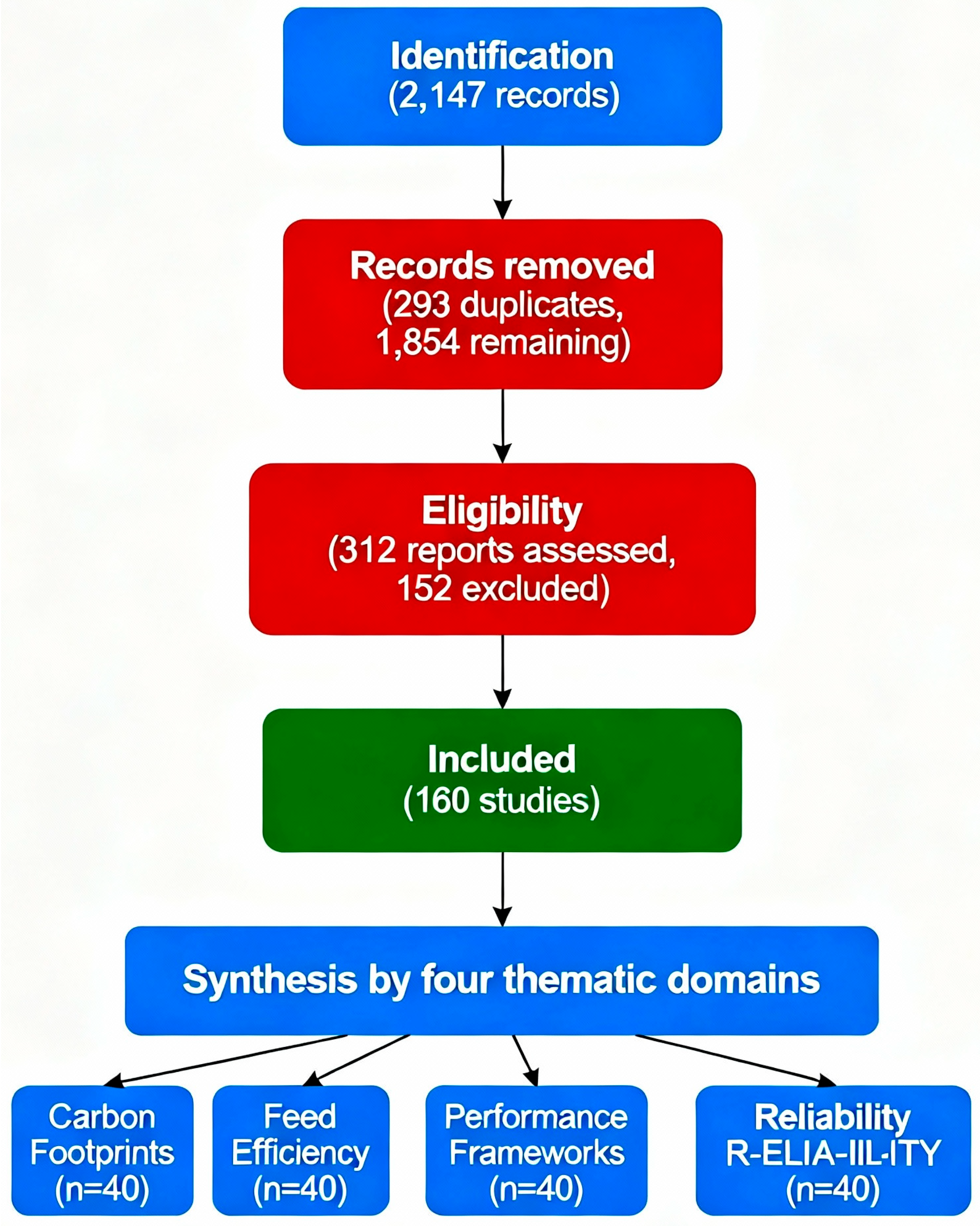
2. Systematic Review Methodology
2.1. Search Strategy
2.2. Inclusion and Exclusion Criteria
2.3. Screening and Study Selection
2.4. Data Extraction
2.5. Synthesis Approach
3. Results: Four Interlocking Evidence Gaps
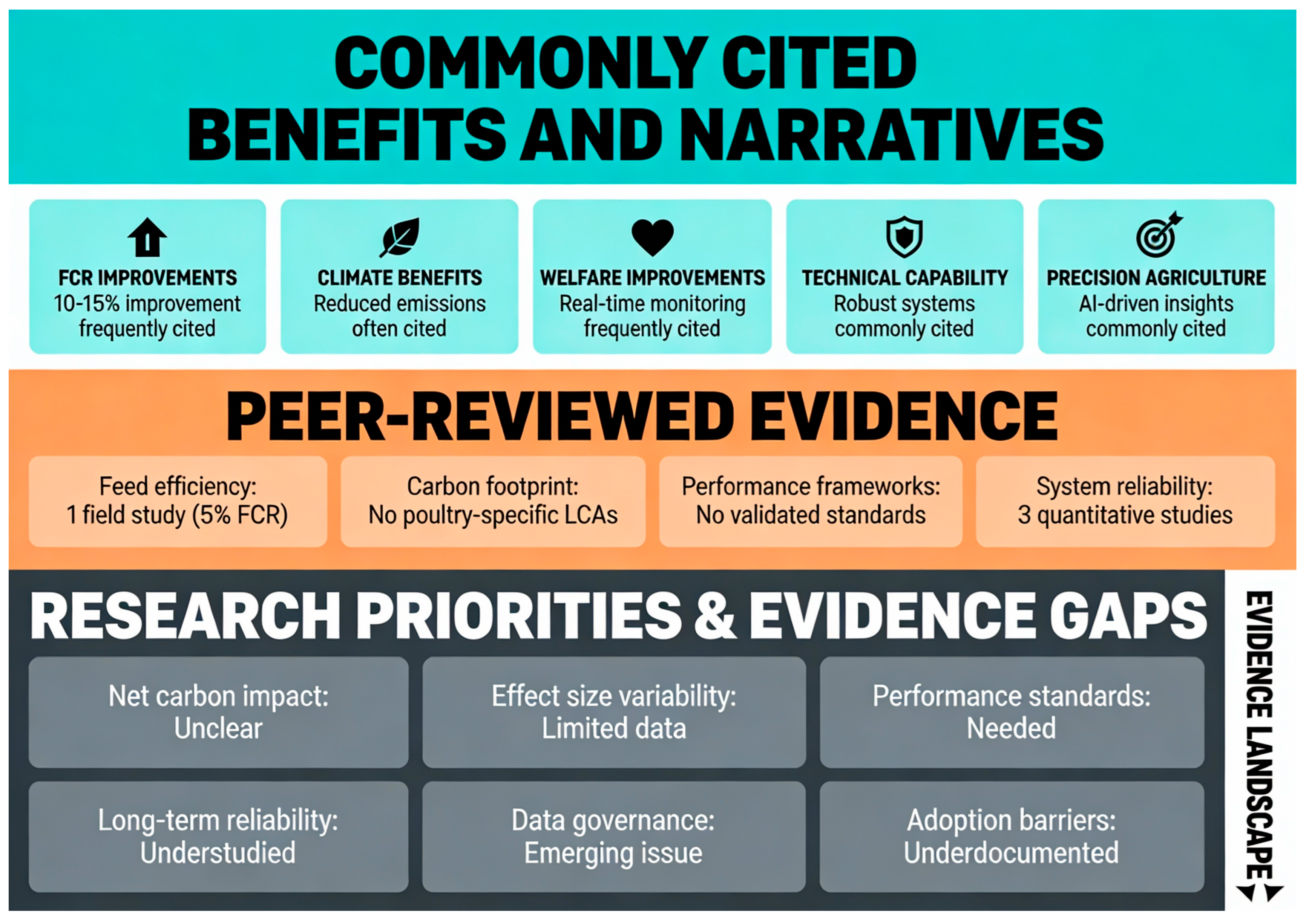
3.1. Carbon Footprints: A Complete Absence of Poultry-Specific Lifecycle Assessments
3.2. Feed Efficiency: The Single Five Percent Study
3.3. Performance Assessment Frameworks: Standardization Absent
3.4. Failure Rates and Abandonment: The Void
4. Discussion—Mapping the Evidence–Practice Chasm
4.1. Synthesis and Implications Across Four Domains
4.2. Structural Reasons for Persistent, Interdependent Gaps
4.3. Methodological Priorities for Future Work
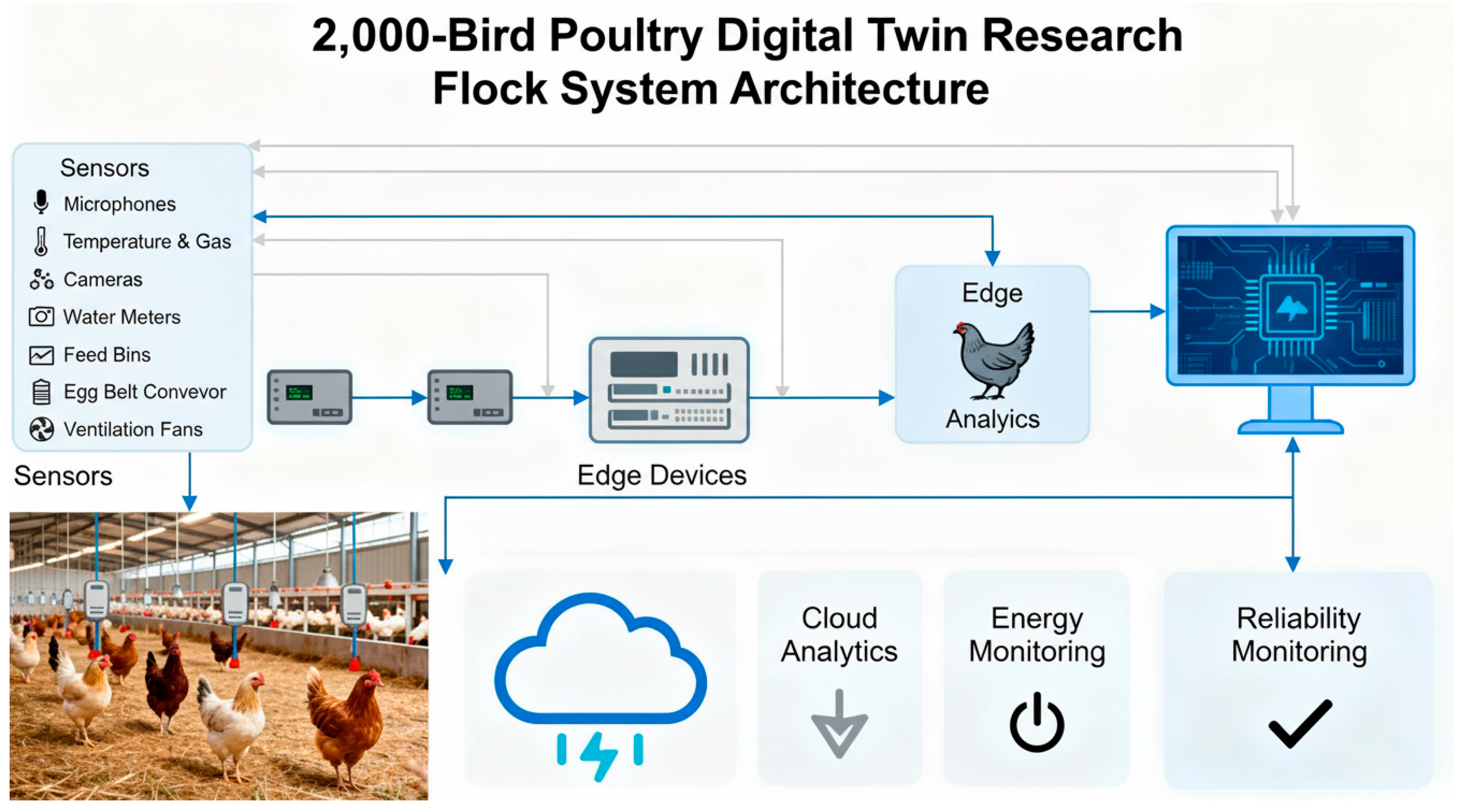
4.4. Small-Scale, Deeply Instrumented Deployments as Integrated Evidence Generators
5. Broader Implications: Toward Cross-Species Digital Twin Research
6. Conclusions
Funding
Institutional Review Board Statement
Informed Consent Statement
Data Availability Statement
Conflicts of Interest
References
- Neethirajan, S.; Kemp, B. Digital twins in livestock farming. Animals 2021, 11, 1008. [Google Scholar] [CrossRef]
- Rowe, E.; Dawkins, M.S.; Gebhardt-Henrich, S.G. A systematic review of precision livestock farming in the poultry sector: Is technology focused on improving bird welfare? Animals 2019, 9, 614. [Google Scholar] [CrossRef] [PubMed]
- Nasirahmadi, A.; Hensel, O. Toward the next generation of digitalization in agriculture based on the digital twin paradigm. Sensors 2022, 22, 498. [Google Scholar] [CrossRef]
- Klotz, D.F.; Ribeiro, R.; Enembreck, F.; Denardin, G.W.; Barbosa, M.A.; Casanova, D.; Teixeira, M. Estimating and tuning adaptive action plans for the control of smart interconnected poultry condominiums. Expert Syst. Appl. 2022, 187, 115876. [Google Scholar] [CrossRef]
- La Rocca, P.; Guennebaud, G.; Bugeau, A.; Ligozat, A.-L. Estimating the carbon footprint of digital agriculture deployment: A parametric bottom-up modeling approach. J. Ind. Ecol. 2024, 28, 1801–1815. [Google Scholar] [CrossRef]
- Fan, J.; Liu, C.; Xie, J.; Han, L.; Zhang, C.; Guo, D.; Niu, J.; Jin, H.; McConkey, B.G. Life cycle assessment of agricultural production: A mini review on methodology, application, and challenges. Int. J. Environ. Res. Public Health 2022, 19, 9817. [Google Scholar] [CrossRef] [PubMed]
- Ferko, E.; Bucaioni, A.; Pelliccione, P.; Behnam, M. Standardisation in digital twin architectures in manufacturing. In Proceedings of the IEEE 20th International Conference on Software Architecture (ICSA), L’Aquila, Italy, 13–17 March 2023; IEEE: Piscataway, NJ, USA; pp. 70–81. [Google Scholar] [CrossRef]
- Klotz, D.F.; Casanova, D.; Teixeira, M. Estimating and tuning adaptive action plans for the control of smart interconnected poultry houses. In Proceedings of the XIII Congresso Brasileiro de Agroinformática (SBIAGRO), Natal, Brazil, November 2021; SBC: São Paulo, Brazil; pp. 108–115.
- Elwakeel, A.E. A smart automatic control and monitoring system for environmental control in poultry houses integrated with an early warning system. Sci. Rep. 2025, 15, 31630. [Google Scholar] [CrossRef]
- Liu, Z.; Araghi, S.N.; Sarkar, A.; Karray, M.-H. Demystifying the digital twin buzzword: A novel generic evaluation model. IEEE Access 2023, 11, 87234–87256. [Google Scholar] [CrossRef]
- Essien, D.; Neethirajan, S. Multimodal AI systems for enhanced laying hen welfare assessment and productivity optimization. Smart Agric. Technol. 2025, 12, 101564. [Google Scholar] [CrossRef]
- Neethirajan, S. Digital phenotyping: A game changer for the broiler industry. Animals 2023, 13, 2585. [Google Scholar] [CrossRef]
- Selle, M.; Spieß, F.; Visscher, C.; Rautenschlein, S.; Jung, A.; Auerbach, M.; Hartung, J.; Sürie, C.; Distl, O. Real-time monitoring of animals and environment in broiler precision farming: How robust is the data quality? Sustainability 2023, 15, 15527. [Google Scholar] [CrossRef]
- Montalcini, C.M.; Voelkl, B.; Gómez, Y.; Gantner, M.; Toscano, M.J. Evaluation of an active low-frequency tracking system and data processing methods for livestock precision farming in the poultry sector. Sensors 2022, 22, 659. [Google Scholar] [CrossRef] [PubMed]
- Oliveira, F.; Pereira, P.; Dantas, J.; Araujo, J.; Maciel, P. Dependability evaluation of a smart poultry house: Addressing availability issues through edge, fog, and cloud computing. IEEE Trans. Ind. Inform. 2023, 20, 1304–1312. [Google Scholar] [CrossRef]
- Godinho, A.; Vicente, R.; Silva, S.; Coelho, P.J. Wireless environmental monitoring and control in poultry houses: A conceptual study. IoT 2025, 6, 32. [Google Scholar] [CrossRef]
- Yang, Y.-C.; Chiu, Y.-C.; Hong, C.-Y. Analysis of cost–benefit and CO2 emissions of a solar energy–intelligent poultry feeding system: Application of NPV and dynamic environmental input–output model. Int. J. Energy Econ. Policy 2020, 10, 178–184. [Google Scholar] [CrossRef]
- Park, S.-O.; Seo, K.-H. Digital livestock systems and probiotic mixtures improve growth performance of swine by enhancing immune function, cecal bacteria, short-chain fatty acids, and nutrient digestibility. Front. Vet. Sci. 2023, 10, 1126064. [Google Scholar] [CrossRef] [PubMed]
- Bumanis, N.; Arhipova, I.; Paura, L.; Vitols, G.; Jankovska, L. Data conceptual model for a smart poultry farm management system. Procedia Comput. Sci. 2022, 200, 517–526. [Google Scholar] [CrossRef]
- Fitriyanah, I.D.N.; Allam, F. The effect of fuzzy logic controller implementation on broiler chicken growth during the brooding period. In Proceedings of the 2023 International Conference on Advanced Mechatronics, Intelligent Manufacture and Industrial Automation (ICAMIMIA), Jakarta, Indonesia, 14–15 November 2023; IEEE: Piscataway, NJ, USA; pp. 1–5. [Google Scholar] [CrossRef]
- Park, S.-O.; Zammit, V.A. Effect of digital livestock systems on animal behavior and welfare, and fatty acid profiles of eggs in laying hens. J. Anim. Feed Sci. 2023, 32, 174–180. [Google Scholar] [CrossRef]
- Psarommatis, F.; May, G. A standardized approach for measuring the performance and flexibility of digital twins. Int. J. Prod. Res. 2023, 61, 6923–6938. [Google Scholar] [CrossRef]
- Metcalfe, B.; Boshuizen, H.C.; Bulens, J.; Koehorst, J.J. Digital twin maturity levels: A theoretical framework for defining capabilities and goals in the life and environmental sciences. F1000Research 2023, 12, 961. [Google Scholar] [CrossRef]
- Jia, Y.; Li, L.; Gao, L. Research on virtual collection methods of layer house temperature for the construction requirements of a digital twin system. Poult. Sci. 2025, 104, 104771. [Google Scholar] [CrossRef] [PubMed]
- ISO 14040:2006; Environmental Management—Life Cycle Assessment—Principles and Framework. ISO: Geneva, Switzerland, 2006.
- ISO 14044:2006; Environmental Management—Life Cycle Assessment—Requirements and Guidelines. ISO: Geneva, Switzerland, 2006.



| Domain | Sub-Theme | Core Research Question | Evidence Availability | Strongest Empirical Finding | Study Context | Methodological Limitations | Generalisability | Key Unresolved Issue | Priority for Future Work |
|---|---|---|---|---|---|---|---|---|---|
| Carbon footprint | Lifecycle assessment | Have Scope 1–3 lifecycle carbon footprints of poultry digital twin systems been quantified? | None in poultry; one related study in crops | 0.2–0.3 Mt CO2e per year from national deployment of crop-monitoring devices [5] | Digital agriculture devices in French crop systems | Non-poultry; partial boundaries; excludes cloud and networks | Conceptually relevant but numerically not transferable to poultry | Net carbon balance of poultry digital twin deployments is unknown | Conduct full Scope 1–3 LCAs of poultry digital infrastructures with carbon payback analysis |
| Carbon footprint | Farm-level emissions context | How carbon-intensive are conventional poultry houses without digital twins? | Moderate: several farm-level models | 383–524 t CO2e per broiler house per year, dominated by LPG heating [6] | Conventional broiler operations without digital infrastructure | Region-specific energy mix; simplified emission sources | Provides emission scale but not marginal impact of digital tech | How much digital twins can realistically reduce whole-farm GHG emissions | Run paired-farm comparisons with and without digital twins using harmonized carbon accounting |
| Carbon footprint | Renewable integration | How do smart energy systems interact with poultry emissions? | Limited: some solar/energy studies | ~1698 t CO2e over 30 years for solar-intelligent systems [7] | Solar-powered feeding infrastructure | Focus on solar hardware; excludes full twin stack | Shows green infrastructure has non-trivial embodied emissions | Interaction of twins, renewables, net emissions unclear | Integrate twin and energy system LCAs in joint optimization |
| Feed efficiency | Direct FCR improvement | Do digital twins improve FCR under commercial conditions? | Very limited: one primary study | FCR improved from 1.640 to 1.561 (~5%) [8] | Commercial broiler houses | Non-randomized; single cycle; limited stats | Suggestive but not robust | True distribution of effects unknown | Run randomized, multi-cycle trials across regions |
| Feed efficiency | Indirect performance metrics | Do digital systems improve metrics correlated with FCR? | Moderate | Growth, mortality, welfare improvements [9] | Brooding and layer systems | FCR absent or confounded | Benefits indirect, not quantified as FCR | How indirect gains map to FCR | Include FCR and cost metrics in trials |
| Performance frameworks | Generic DT frameworks | Are there established general DT frameworks? | Strong outside agriculture | Capability, cooperability, lifecycle frameworks [10] | Industrial DTs | Not applied to livestock | Untested in poultry | Adaptation needed | Translate and pilot frameworks in poultry |
| Performance frameworks | Poultry-specific proposals | Any poultry-specific indices? | Conceptual only | Domain Transfer Score, Data Reliability Index [11] | Conceptual welfare system | No field DTS/DRI values | Addresses generalisability in theory only | Behavior under real conditions unknown | Apply on multi-farm datasets |
| Performance frameworks | Measured dimensions | Which dimensions are measured? | Heterogeneous | Focus on accuracy; sparse economic, welfare metrics [12] | Poultry phenotyping | No holistic frameworks | Bias toward technical metrics | Need for integrated metrics | Require multi-domain reporting |
| Reliability | Data quality | How reliable are data streams? | Sparse | 40–50% discarded early; 10–20% after fix [13] | Broiler barns | Single system; research-managed | Heavy post-processing needed | Typical discard rates unknown | Standardize data quality reporting |
| Reliability | Tracking accuracy | How accurate is tracking? | One detailed study | 23% raw vs. 91–99% processed; strong zone effects [14] | Layer aviary | Short duration; one design | Highly layout-dependent | Performance across designs unknown | Cross-barn tracking studies |
| Reliability | System availability | How does architecture influence uptime? | Model-based | 34% downtime no redundancy; 9% with redundancy [15] | Dependability model | No field validation | Suggests redundancy helps | Field uptime distributions unknown | Publish real uptime logs |
| Reliability | Environmental stressors | Which environmental factors matter? | Fragmented | Path loss from cages; dust, ammonia degrade sensors [16] | Wireless sensors | Short-term; specific setups | Likely generalisable | Failure probabilities unclear | Link environment to failure logs |
| Reliability | Abandonment | How often are systems abandoned? | None | No empirical studies | None | Unknown adoption trajectories | Completely unmeasured | Drivers of discontinuation | Run adoption—abandonment studies |
| Cross-cutting | Research-commercial divide | How does study setting shape evidence? | Strong pattern | ~50% in research barns | Study classification | Ambiguous reporting | Research barns not representative | Translation to commercial | Prioritize commercial studies |
| Cross-cutting | Standardization | Are definitions consistent? | Weak | Terms used inconsistently | Terminology review | No ontology | Hampers synthesis | Agreement lacking | Develop reporting standards |
| Algorithmic Category | Method/Architecture | N Studies | % of Total | Primary Application | Validation Level |
|---|---|---|---|---|---|
| Machine Learning (Classical) | |||||
| Random forests | 18 | 11.3% | Behavior classification, mortality prediction | Lab/research only | |
| Support vector machines (SVM) | 12 | 7.5% | Disease detection, weight estimation | Research barns | |
| Gradient boosting (XGBoost, LightGBM) | 9 | 5.6% | Production outcome prediction | Research barns | |
| Decision trees | 8 | 5.0% | Simple classification tasks | Research only | |
| k-Nearest neighbors (k-NN) | 5 | 3.1% | Anomaly detection | Research only | |
| Deep Learning | |||||
| Convolutional neural networks (CNN) | 24 | 15.0% | Computer vision, behavior recognition | Lab/pilot scale | |
| Recurrent neural networks (RNN/LSTM) | 14 | 8.8% | Time-series prediction, temperature forecasting | Research/pilot | |
| Long short-term memory (LSTM) specifically | 8 | 5.0% | Sequential data (feed intake, growth curves) | Research barns | |
| Bidirectional LSTM (BiLSTM) | 3 | 1.9% | Temperature prediction, spatial interpolation | Research onlyapplsci-16-01317-Jan-18-2026.docx | |
| Transformers/attention mechanisms | 2 | 1.3% | Multimodal sensor fusion | Conceptual only | |
| Autoencoders | 4 | 2.5% | Anomaly detection, data compression | Research only | |
| Optimization Algorithms | |||||
| Genetic algorithms (GA) | 6 | 3.8% | Feed schedule optimization, climate control | One commercial trialapplsci-16-01317-Jan-18-2026.docx | |
| Particle swarm optimization (PSO) | 3 | 1.9% | Parameter tuning | Research only | |
| Simulated annealing | 2 | 1.3% | Resource allocation | Conceptual | |
| Fuzzy Systems | |||||
| Fuzzy logic controllers | 7 | 4.4% | Climate control, brooding automation | Pilot scaleapplsci-16-01317-Jan-18-2026.docx | |
| Adaptive neuro-fuzzy inference (ANFIS) | 3 | 1.9% | Decision support systems | Research only | |
| Physics-Based/Mechanistic Models | |||||
| Computational fluid dynamics (CFD) | 9 | 5.6% | Airflow, ventilation optimization | Simulation only | |
| Energy balance equations | 11 | 6.9% | Temperature modeling, heating/cooling | Validated in some studies | |
| Growth curve models (Gompertz, logistic) | 6 | 3.8% | Weight prediction | Commercial baseline | |
| Hybrid Approaches | |||||
| Physics-informed neural networks (PINN) | 2 | 1.3% | Temperature + biological modeling | Conceptual only | |
| ML + mechanistic constraints | 8 | 5.0% | Combining data-driven and rule-based | Research barns | |
| Statistical Methods | |||||
| Linear/multiple regression | 15 | 9.4% | Baseline comparisons | Commercial use | |
| ARIMA, exponential smoothing | 5 | 3.1% | Time-series forecasting | Research only | |
| Bayesian networks | 4 | 2.5% | Uncertainty quantification | Research only | |
| Agent-Based Models | |||||
| Individual-based bird simulation | 4 | 2.5% | Flock behavior emergence | Simulation only | |
| No Algorithmic Component | |||||
| Monitoring only (dashboards, alerts) | 42 | 26.3% | Data visualization, threshold alerts | Commercial deployment | |
| Conceptual/theoretical frameworks | 18 | 11.3% | No implementation | Not applicable |
| Study | Species/System | Technology Type | Outcome Category | Metric | Baseline/Comparator | Digital/Intervention Value | Effect Size | Timeframe/Duration | Major Limitation |
|---|---|---|---|---|---|---|---|---|---|
| [5] | Crop agriculture (non-poultry) | Digital monitoring devices (RFID, cameras, edge units) | Carbon footprint | Annual device emissions | No digital deployment | 0.2–0.3 Mt CO2e per year (France-wide) | Added emissions from digital deployment at national scale | Modeled over one year | Non-poultry; excludes cloud and network |
| [6] | Broiler houses | Conventional (no digital twin) | Carbon footprint | Farm-level GHG emissions | Standard LPG-heated house | 383–524 t CO2e per year | Baseline emissions without digital tech | Annualized model | No digital comparison |
| [17] | Poultry with solar feeding | Solar-intelligent feeding infrastructure | Carbon footprint | Lifetime emissions | Conventional energy supply | ~1697.85 t CO2e over 30 years | Embedded emissions of solar system | 30-year horizon | Does not include digital twin stack |
| [8] | Broilers | ML + genetic algorithm control | Feed efficiency | Feed conversion ratio | 1.64 | 1.561 | ~5% improvement; ~7.5 t feed saved | 40-day cycle | Non-randomized; single site |
| [9,18] | Broilers | Automated environmental control | Performance and welfare | FCR, mortality, welfare | Conventional control | Small FCR change; improved welfare | Marginal FCR differences | Few cycles | FCR not primary endpoint |
| [9,20] | Chicks/broilers | Fuzzy logic + IoT brooding | Energy and growth | Energy use; growth rate | On/off control | 16–40% less energy; better growth | Large relative savings | Brooding period | No FCR; small scale |
| [21] | Laying hens | Digital welfare monitoring | Welfare and product quality | Welfare; fatty acids | Standard monitoring | Improved welfare; altered profiles | Qualitative improvements | Short to medium duration | No FCR; limited context |
| [24] | Layers | BiLSTM virtual temperature collection | Technical accuracy | Prediction error | Dense sensor grid | 0.25 °C error | High spatial accuracy | Months | Single variable focus |
| [11] | Laying hens | Multimodal AI (conceptual) | Framework metrics | DTS; DRI | None | Conceptual only | N/A | N/A | No field validation |
| [12] | Broilers | Digital phenotyping | Monitoring and prediction | Accuracy; latency | Conventional observation | Higher temporal/behavioral resolution | Qualitative enhancement | Various deployments | No economic metrics |
| [13] | Broilers | Farmer Assistant System | Data quality | Discard rate | Early FAS | 40–50% discarded (early); 10–20% refined | Substantial improvement | 31-month deployment | Single system; research managed |
| [14] | Layers | Active LF tracking | Tracking accuracy | Transitions explained | Raw data | 23% raw; 91–99% processed | 4–5 ×improvement | Two months | Strong spatial variability |
| [15] | Poultry houses (modeled) | Cloud/edge/fog architecture | System availability | Annual downtime | No redundancy | 34.14% no redundancy; 9.176% with redundancy | ~4 ×uptime improvement | One year model | No empirical data |
| [16] | Layers | Wireless sensor network | Signal performance | Path loss (dB) | Free space model | +22.5–24.9 dB loss | Substantial attenuation | Measurement campaign | Frequency specific |
| [11] | Poultry (multiple) | Mixed PLF systems | Abandonment | Abandonment metrics | None | No data available | N/A | N/A | Complete evidence void |
Disclaimer/Publisher’s Note: The statements, opinions and data contained in all publications are solely those of the individual author(s) and contributor(s) and not of MDPI and/or the editor(s). MDPI and/or the editor(s) disclaim responsibility for any injury to people or property resulting from any ideas, methods, instructions or products referred to in the content. |
© 2026 by the author. Licensee MDPI, Basel, Switzerland. This article is an open access article distributed under the terms and conditions of the Creative Commons Attribution (CC BY) license.
Share and Cite
Neethirajan, S.R. Digital Twins in Poultry Farming: Deconstructing the Evidence Gap Between Promise and Performance. Appl. Sci. 2026, 16, 1317. https://doi.org/10.3390/app16031317
Neethirajan SR. Digital Twins in Poultry Farming: Deconstructing the Evidence Gap Between Promise and Performance. Applied Sciences. 2026; 16(3):1317. https://doi.org/10.3390/app16031317
Chicago/Turabian StyleNeethirajan, Suresh Raja. 2026. "Digital Twins in Poultry Farming: Deconstructing the Evidence Gap Between Promise and Performance" Applied Sciences 16, no. 3: 1317. https://doi.org/10.3390/app16031317
APA StyleNeethirajan, S. R. (2026). Digital Twins in Poultry Farming: Deconstructing the Evidence Gap Between Promise and Performance. Applied Sciences, 16(3), 1317. https://doi.org/10.3390/app16031317