Article

Design and Vibration Suppression Performance of a Coupled Isolation System for Marine Rotary Pump Units


National Key Laboratory on Ship Vibration & Noise, Naval University of Engineering, Wuhan 430033, China
*
Author to whom correspondence should be addressed.
Appl. Sci. 2026, 16(4), 1809; https://doi.org/10.3390/app16041809
Submission received: 8 January 2026 / Revised: 28 January 2026 / Accepted: 2 February 2026 / Published: 11 February 2026
(This article belongs to the Section Acoustics and Vibrations)

Abstract

To address the need for high-efficiency vibration isolation in marine rotary pump units, this paper proposes a coupled isolation system that integrates vibration isolators and flexible connectors, and systematically investigates its vibration suppression performance. By combining experimental parameterized modeling with full-scale test platform validation, an efficient analytical framework capable of accurately predicting the system’s broadband vibration isolation performance has been established. This framework provides a reference for engineering design that balances model reliability and practical applicability. The study first obtained the transfer complex stiffness of the isolators through mechanical impedance experiments and, combined with the stiffness parameters of the flexible connectors measured by an MTS (Mechanical Testing & Simulation) testing machine, established a nonlinear spring-damper equivalent model for the isolators and flexible connectors. A three-dimensional finite element model of the rotary pump unit coupled isolation system was developed using the explicit dynamics method, and the vibration transmission characteristics of the coupled isolation system under complex excitation from the rotary pump were analyzed using the vibration acceleration level difference between the “machine foot” and “foundation” as the evaluation index. To verify the reliability of the model, a full-scale rotary pump unit isolation test platform was constructed, and multi-condition vibration tests were conducted. The results show that the finite element model of the coupled isolation system can effectively predict the vibration response, with the overall vibration level error between numerical calculations and experiments within ±3 dB. Under various operating conditions involving changes in rotational speed and water pressure, the system demonstrates good broadband isolation performance, with the maximum vibration acceleration level difference reaching 29.32 dB. The flexible connectors further suppress lateral vibration transmission from the pump unit to external pipelines, working in synergy with the isolators to achieve multi-directional vibration isolation. This study provides design references with both modeling reliability and engineering applicability for vibration and noise reduction in marine pump units.

1. Introduction

In the maritime field, with the significant expansion of the global shipping industry and increasing demands for environmental comfort and ship safety, vibration and noise in ships have become critical concerns in design and operation. Excessive vibration not only accelerates fatigue damage in hull structures and jeopardizes the reliable operation of power equipment [1,2,3], but also compromises the health and comfort of crew members [4,5,6] and adversely affects marine life [7,8,9]. In the naval domain, the stealth, survivability, and operational effectiveness of vessels are closely linked to their acoustic signatures, making vibration and noise reduction technologies for warships a challenge of far greater strategic significance and urgency than for merchant vessels [10,11,12]. As a principal means of suppressing vibrational energy transmission, the advancement and innovation of vibration isolation technology are therefore critically important [13,14,15,16,17,18].
The development of vibration isolation technology for vessel machinery and equipment can be summarized into three main stages [19]: single-stage isolation technology, double-stage isolation technology, and floating raft isolation technology. As the foundational form of vibration isolation, single-stage isolation elastically connects machinery and equipment to the foundation through resilient elements, attenuating the vibration transmitted from the machinery to the foundation via the elasticity and damping of these elements [20]. Owing to its simple structure, compact size, and ease of installation, single-stage isolation systems are widely used for vibration isolation of power equipment on naval vessels [21]. Jazar et al. [22] analyzed the time-frequency characteristics of a linear single-degree-of-freedom isolator by minimizing a cost function based on the root mean square of absolute acceleration and relative displacement, thereby obtaining the optimal damping and stiffness values for the isolator in a single-stage isolation system. Li et al. [23] simplified the isolator into a spring assembly with three translational and three rotational degrees of freedom, analyzing the distribution of vibrational energy flow within the isolator under excitations from different directions, which provided a theoretical foundation for its engineering application.
Double-stage isolation technology, a typical representative of multi-stage isolation, evolved from single-stage isolation. It introduces an elastically supported intermediate mass on the basis of a single-stage system. While double-stage systems offer superior vibration isolation effectiveness in the medium-to-high frequency range compared to single-stage systems, the introduction of the intermediate raft means the vessel carries an additional non-functional mass load [24]. Lei et al. [25] proposed a composite vibration control system combining a double-stage isolation device with particle damper elements, which effectively suppressed severe vibration in a naval vessel’s heavy-duty compressor unit and achieved excellent isolation effectiveness. Addressing the difficulty of achieving optimal vibration isolation effectiveness with double-stage isolation devices. Cheng et al. [26] suggested that reducing the stiffness ratio between the upper and lower isolators and increasing the mass ratio between the intermediate raft and the machinery/equipment could lower the system’s resonance frequencies and narrow the gap between the two resonant peaks. Increasing the damping of the upper and lower isolators could effectively reduce the peak amplitudes at resonance frequencies, providing a theoretical basis for the design optimization of double-stage isolation systems for machinery and equipment.
Floating raft isolation technology represents a further development based on double-stage isolation. Its characteristic lies in separating multiple pieces of machinery and equipment and mounting them elastically on a common raft, which to some extent reduces the mass of the intermediate raft while ensuring operational stability of the equipment. Ren et al. [27] proposed applying a frequency response function-based subsructuring synthesis method to model floating raft isolation systems with connecting pipelines. These pipelines, serving as a secondary vibration transmission path, were found to significantly degrade the vibration isolation effectiveness of the floating raft system. Sun et al. [28] introduced a semi-active Dynamic Vibration Absorber (DVA) element into a floating raft isolation system. Numerical simulations demonstrated that the DVA could significantly enhance the isolation effectiveness of the floating raft system under multiple excitations.
In the process of deep well drilling for oil, natural gas, and geothermal resources, shell dampers convert the dynamic loads generated by the interaction between the drill bit and rock into potential energy through elastic deformation of the shell, while partially dissipating the input energy due to dry friction effects. The advantages of shell dampers include high specific energy capacity, compactness, relatively low mass, and the ability to adjust elastic damping characteristics [29,30]. Velychkovych et al. [31] proposed a novel shell damper design featuring an open shell, deformable filler, and helically cut cylindrical shell. The strength, stiffness, and damping characteristics of this new shell damper were investigated, with comparisons made between the new design and the prototype. This shell damper design will be applied to drilling shock absorbers in petroleum and geothermal industries, as well as in seismic structures. Building upon this, the adaptive operation of the original elastic element within the open cylindrical shell of drilling shock absorbers was analyzed to examine how varying cyclic asymmetry coefficients influence hysteresis loop formation and energy dissipation. Results confirmed the effectiveness of the adaptive approach in designing shell impact buffers capable of reliably withstanding emergency overloads [32].
Pipelines serve as the sole conduit for seawater transfer between the ocean and the vessel, and constitute the primary pathway for transmitting mechanical vibrations from rotary pumps and fluid pulsations to the hull. Since the mechanical vibration of onboard power equipment can be effectively attenuated by the aforementioned isolation technologies, the control of vibration and noise in the piping system becomes particularly critical [33]. Conventionally, muffler elements are installed inside pipelines [34,35], and external elastic supports—such as pipe clamps, hangers, and resilient mounts [36,37,38]—are employed to attenuate fluid-induced pulsations. However, mufflers may disrupt the internal flow field, while the addition of elastic supports not only complicates installation in the already confined spaces of naval vessels but can also create secondary vibration transmission paths [34]. Therefore, where technically feasible, the incorporation of flexible connectors has become the preferred engineering solution for mitigating vibration in piping systems. By leveraging their compliant physical properties, flexible connectors absorb and dissipate vibrational energy and alter the system’s impedance characteristics, thereby isolating and attenuating pipeline structural vibration [39]. Beyond vibration attenuation, flexible connectors also provide displacement compensation, accommodating large movements during equipment start-up and shutdown [40]. Chai et al. [41] applied the transfer matrix method to model pipeline components including straight pipes, bends, and flexible connectors. Through finite element analysis, their influence on the system’s vibrational response was clarified, offering practical guidance for integrating such low-noise components in engineering designs. Yang et al. [42] evaluated the vibration isolation effectiveness of three flexible hose types—double layer metal bellows (DLMB), rubber pipes (RP), and bellows coated rubber (BCR)—for seawater pumps, thereby providing a basis for selecting appropriate flexible piping solutions according to specific isolation requirements in practical applications.
However, in practical vessels, the application of double-stage and floating raft isolation systems is often constrained by the functional specificities of mechanical equipment, as well as limitations in compartment space and installation conditions. Zheng et al. [43] proposed a new constrained damping foundation and compared its vibration isolation performance with that of a rigid foundation and traditional rubber isolators. Their research indicates that varying the damping parameters can significantly reduce the vibration response of polymer injection platforms. Dal Bo et al. [44] demonstrated that for systems containing unbalanced rotating machinery such as spinning frames, assemblies of nonlinear springs and nonlinear dampers can effectively control vibration and force transmission across the entire operating speed range. Wang et al. [45] studied the influence of the dynamic stiffness of rubber isolators on the dynamics of seawater hydraulic piston pumps. They found that as the dynamic stiffness increases, the vibration level of the pump decreases, with the primary effect observed in the 0–20 Hz frequency range. To address the high-level tonal noise generated by large high-pressure centrifugal pumps equipped with braided steel connectors, Horesco et al. [46] proposed using flexible connectors as replacements, which significantly reduced airborne noise and panel vibration. Liu et al. [47] found that increasing the length of flexible rubber bellows in seawater pump piping systems improves vibration isolation. For water supply and drainage systems in high-rise buildings, Jinfeng et al. [48] showed that replacing stainless steel flexible connectors at pump inlets and outlets with double-sphere rubber flexible connectors can significantly isolate vibration transmission between the pump and the piping.
In summary, within the practical application context of shipboard rotary pump units, existing research still exhibits several notable limitations. First, a significant portion of studies focuses on idealized theoretical models or simplified test benches. The parameters of these models are often derived from theoretical assumptions or standard tests, lacking parameter inputs based on dynamic testing of full-scale real components. This results in insufficient predictive reliability of the models in actual complex engineering scenarios. Second, most existing studies address single-model configurations comprising either isolation devices or isolated equipment, i.e., isolated systems featuring only isolators or flexible connectors [20,24,49,50,51]. However, in actual pump systems, isolators and flexible connectors operate in series with strong dynamic coupling. Equipment vibration energy propagates through two parallel pathways: “isolator-to-base” and “flexible connector-to-piping-to-hull.” Neglecting this coupling effect prevents accurate assessment of the system’s actual vibration isolation performance. Furthermore, while many advanced isolation schemes demonstrate superior theoretical performance, they often fail to adequately account for the stringent spatial, weight, and layout constraints of vessels, casting doubt on their engineering applicability and practical benefits.
Therefore, to address the shortcomings identified in the existing research, a coupled vibration isolation system consisting of a series arrangement of isolators and flexible connectors was designed and defined as the subject of this study. Mechanical impedance tests and static/dynamic tests on an MTS (Mechanical Testing & Simulation) testing machine were conducted to obtain the dynamic parameters of real elastic components. These parameters were then used as inputs for subsequent finite element modeling to ensure the model’s physical fidelity. An explicit dynamic finite element model of this coupled isolation system was established to systematically analyze its broadband vibration transmission characteristics. A full-scale rotating pump assembly vibration test platform was constructed to conduct multi-condition vibration experiments, enabling dual verification of the model’s predictive accuracy and the system’s actual vibration isolation performance. The research findings provide theoretical foundations and engineering solutions for vibration reduction design in pump assemblies, combining model reliability with practical engineering applicability.

2. Materials and Methods

2.1. Modeling of the Coupled Isolation System

2.1.1. Physical Model of the Coupled Isolation System for the Rotary Pump Unit

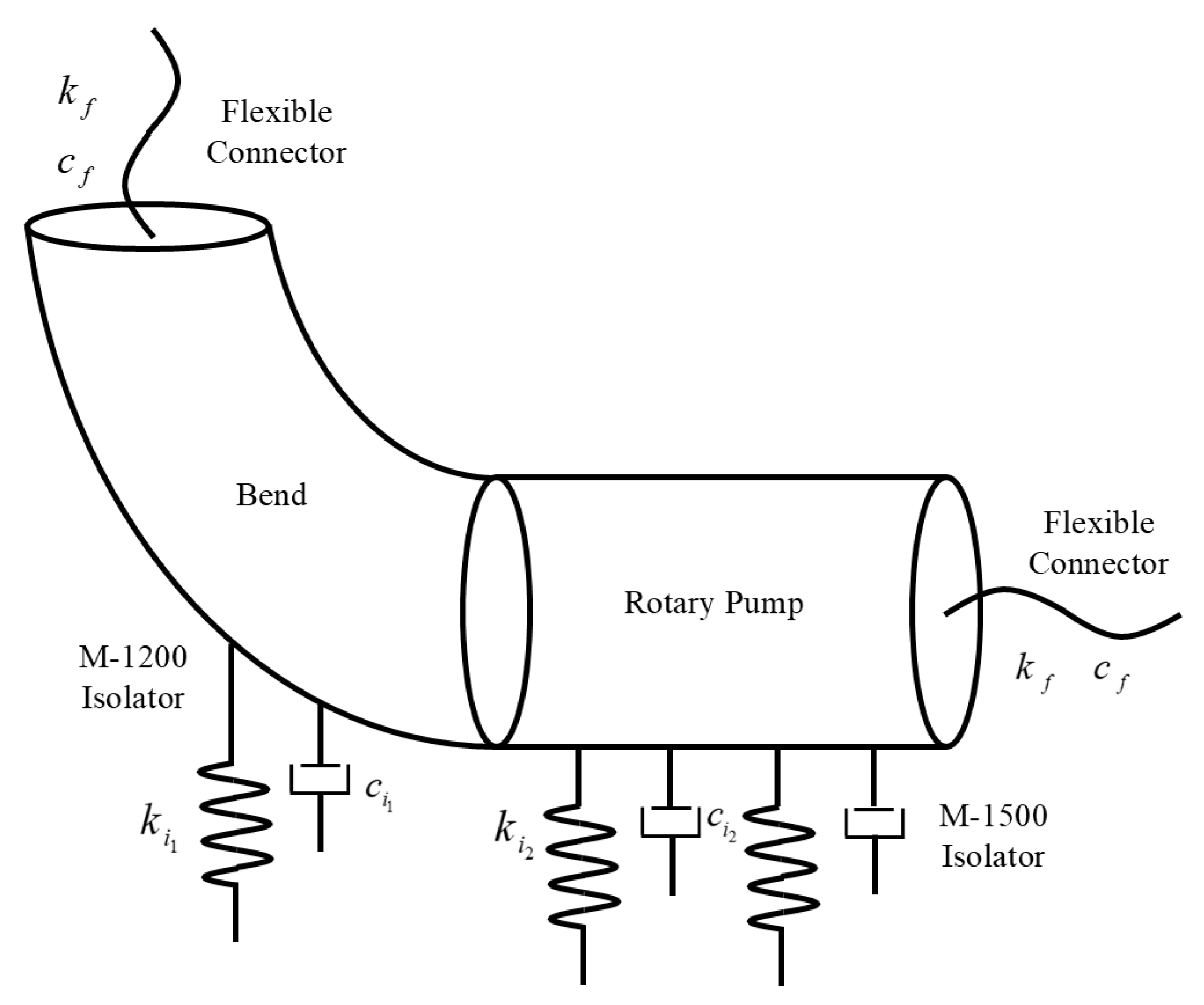
This paper investigates the coupled isolation system of a rotary pump unit onboard a vessel. The system mainly comprises a rotary pump, a bend pipe, vibration isolators, flexible connectors, and foundations. A physical model of the coupled isolation system with multiple elastic components is established, as illustrated in Figure 1. The rotary pump has a mass of 4800 kg and an inner diameter of 350 mm. Its casing incorporates internal support structures, including guide vanes. Connected directly to the pump outlet is a 90° bend section made of steel pipe with a nominal diameter of 325 mm, an outer diameter of 355 mm, and a wall thickness of 30 mm. Straight pipe segments with lengths of 425 mm and 378 mm are attached upstream and downstream of the bend, respectively. In the coupled isolation system, the rotary pump is mounted elastically to its foundation through four M-1500 polyurethane isolators, while the bend pipe is supported on its foundation by two M-1200 polyurethane isolators. “JYXR” (Manufacturer model, referring to a balanced metal-rubber flexible connector) type balanced flexible connectors are installed at the pump inlet and the bend outlet to provide elastic coupling to the external pipelines. In the figure, k i 1 and c i 1 represent the stiffness and damping coefficients of the M-1200 isolators, respectively; k i 2 and c i 2 denote the stiffness and damping coefficients of the M-1500 isolators, respectively; k f and c f indicate the stiffness and damping coefficients of the “JYXR” type balanced flexible connectors, respectively.

2.1.2. Model of Elastic Elements

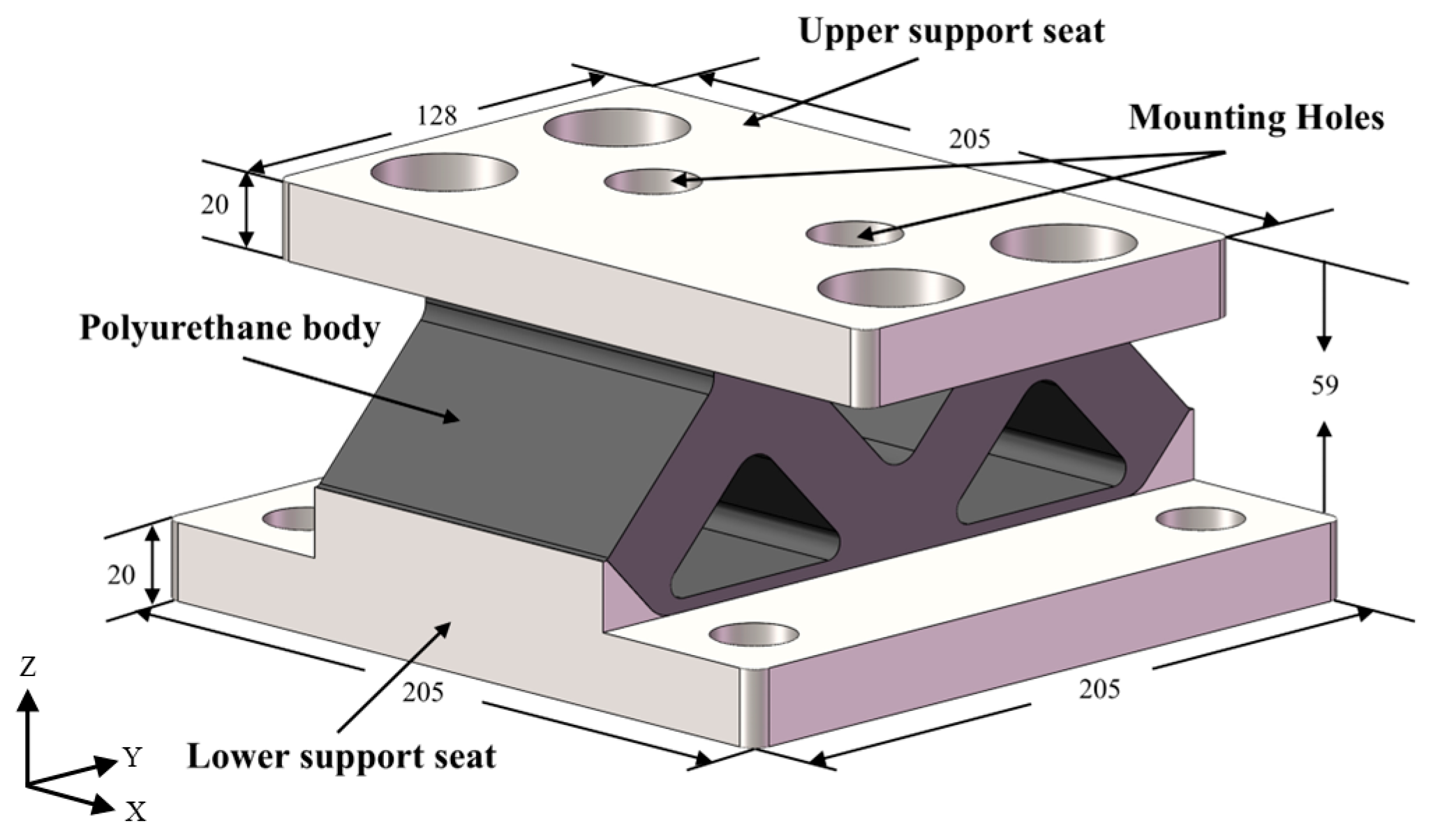
The system employs M-1200 and M-1500 specifications of vibration isolators as core isolation components. The “M-type” designation originates from the M-shaped cross-section design of the central polyurethane elastomer. The numerical model designations represent their rated vertical load capacities (1200 kg and 1500 kg). Taking the M-1200 isolator in Figure 2 as an example: the upper stainless steel support connects to the powered equipment, the central “M-shaped” polyurethane material isolates vibrations, and the lower stainless steel support connects to the base or foundation. Both upper and lower supports are made of 304 stainless steel. The core functional feature of this isolator lies in its integrated M-shaped elastomer structure. This design enables it to provide stable static support stiffness through elastomer compression in the vertical direction to bear equipment weight, while simultaneously delivering effective vibration isolation stiffness via the elastomer’s shear deformation in the lateral and longitudinal directions. This compact structure integrates multi-directional vibration isolation functionality, meeting the installation requirements for space-constrained ship compartments. The M-1500 model maintains identical external mounting interfaces and geometric profiles as the M-1200 model. By employing polyurethane material with higher modulus, it achieves increased rated load capacity. This exemplifies the engineering logic of performance grading within the same product series through material modification.
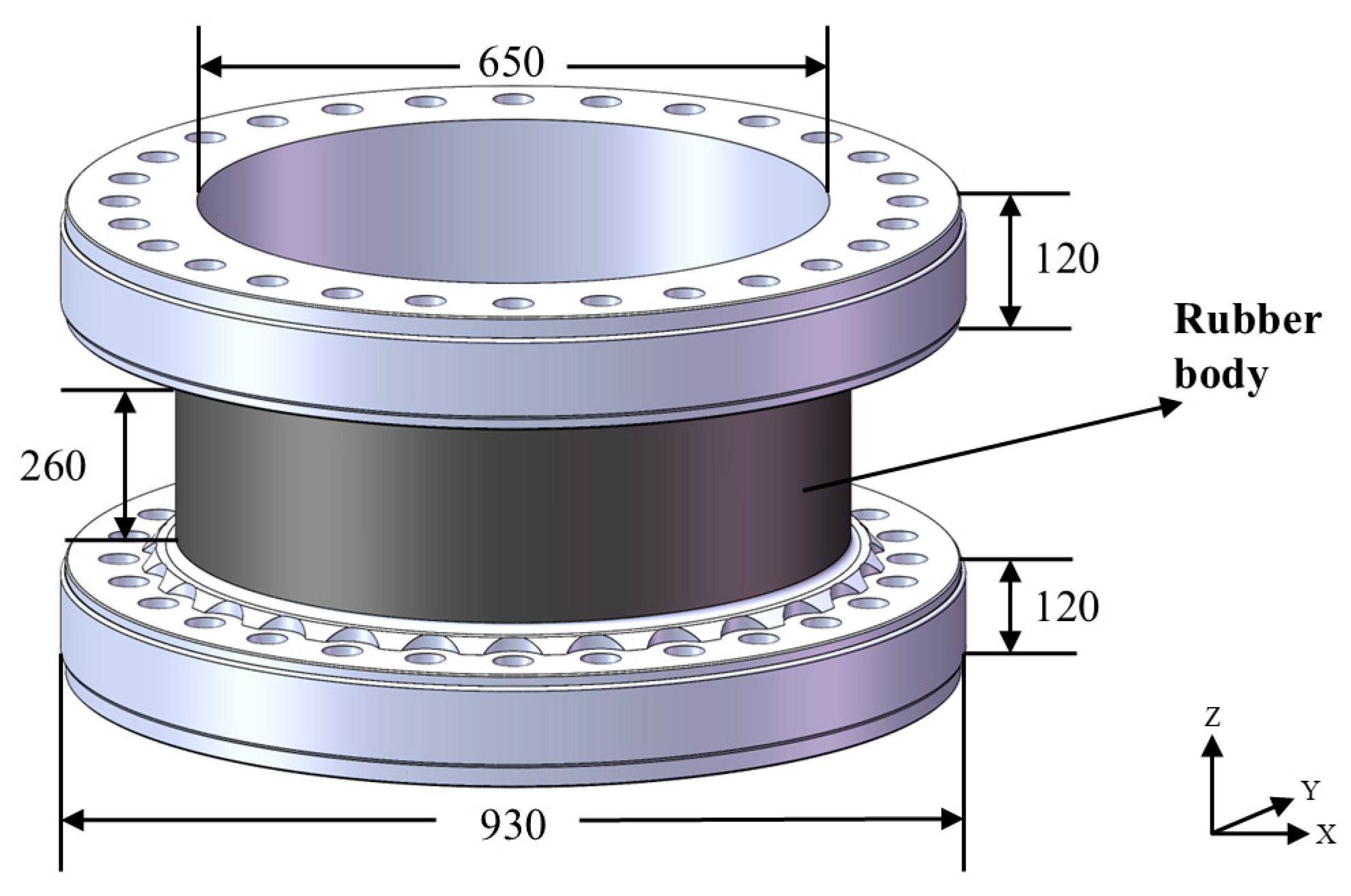
To meet the requirements for pipeline connection, displacement compensation, and high-frequency vibration isolation, the system employs JYXR balanced flexible connectors as critical connection components (Figure 3). Featuring a straight-pipe design, this component consists primarily of a rubber tube body reinforced internally with an aramid fiber cords skeleton, with triple-flange connection interfaces at both ends. The highly elastic rubber material provides essential multidirectional flexibility to compensate for pipeline displacement and isolate high-frequency vibrations. The embedded high-strength, high-modulus aramid fiber cords skeleton primarily bears internal working pressure, ensuring structural safety. One end employs a non-metallic sealing surface, while the other utilizes a tongue-and-groove sealing surface. This design delivers a reliable and installation-friendly sealing interface, guaranteeing long-term joint sealing under complex stress and displacement conditions.

2.2. Dynamic Characteristics Experiment of Elastic Elements

2.2.1. Dynamic Performance Experiment of Vibration Isolators

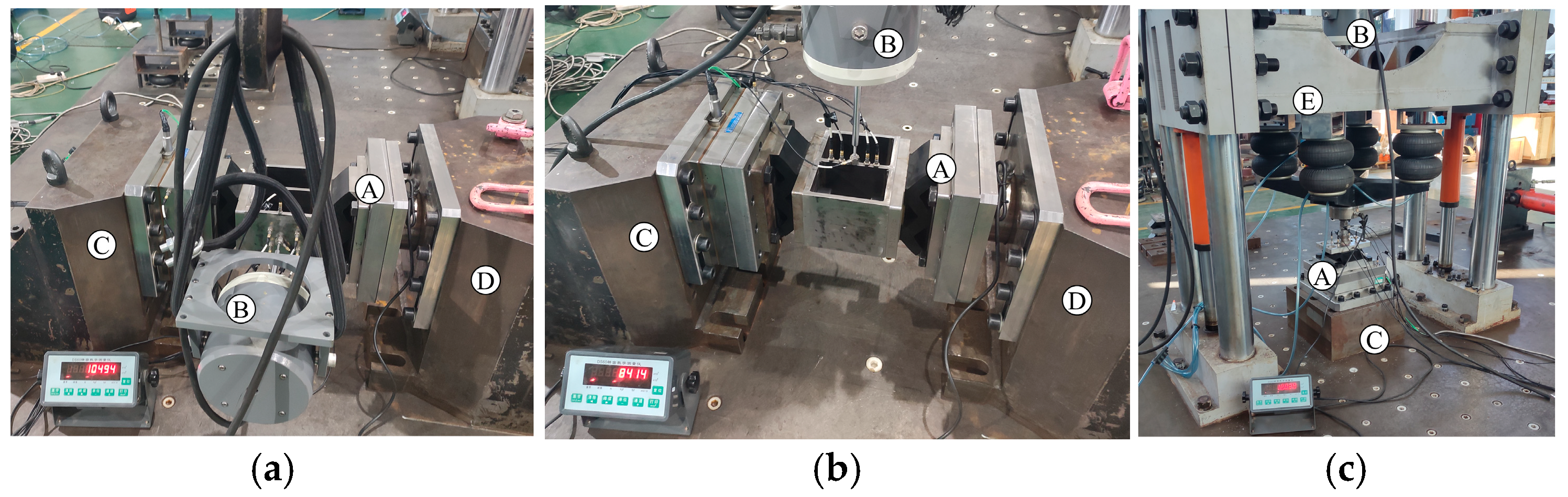
To characterize the vibration transmission properties of the M-1200 and M-1500 isolators and to obtain their dynamic stiffness and force transmissibility over a broad frequency range, a mechanical impedance experiment was performed on an impedance test platform. The platform, shown in Figure 4, includes a vertical loading device equipped with four air bag isolators. This device applies the necessary preload in the Z-direction during dynamic testing along that axis and serves to decouple the test isolator dynamically from the mounting frame. A separate horizontal loading device supplies the Z-direction preload when testing the isolator along the X and Y axes. The preload magnitude is set according to the actual service load and is displayed on a dedicated screen at the lower-left corner of the setup. Accordingly, the preloads employed in this study were 1200 kg (M-1200) and 1500 kg (M-1500). For dynamic tests in the X and Y directions, two isolators of identical model and batch are mounted input-face-to-input-face to suppress vibration in undesired directions. Their output ends are fixed to the horizontal loading device, which provides high rigidity and serves as a stable base in the non-load-bearing directions. Prior to dynamic testing, the isolators must be left at ambient temperature for 24 h. Three preload-unloading cycles are then performed along the test direction, with the peak load in each cycle held at 1.25 times the rated load for 30 s. The excitation system consists of an electromagnetic shaker, a signal generator, a power amplifier, and an elastic suspension frame. The shaker is mounted via the elastic suspension, and a slender thrust rod is inserted between the exciter’s top rod and the impedance head to ensure unidirectional excitation. The installation frequency of the excitation system was kept below 0.3 times the lower test-frequency limit (i.e., <3 Hz). To avoid frequency resonances within the experimental system, white noise was selected as the excitation signal, with a frequency range of 10 Hz to 1000 Hz. In accordance with the Nyquist sampling criterion, the sampling frequency of the data acquisition system should be no less than 2.56 times the upper test frequency. Therefore, a sampling frequency of 8192 Hz was chosen for the data acquisition system in this study.
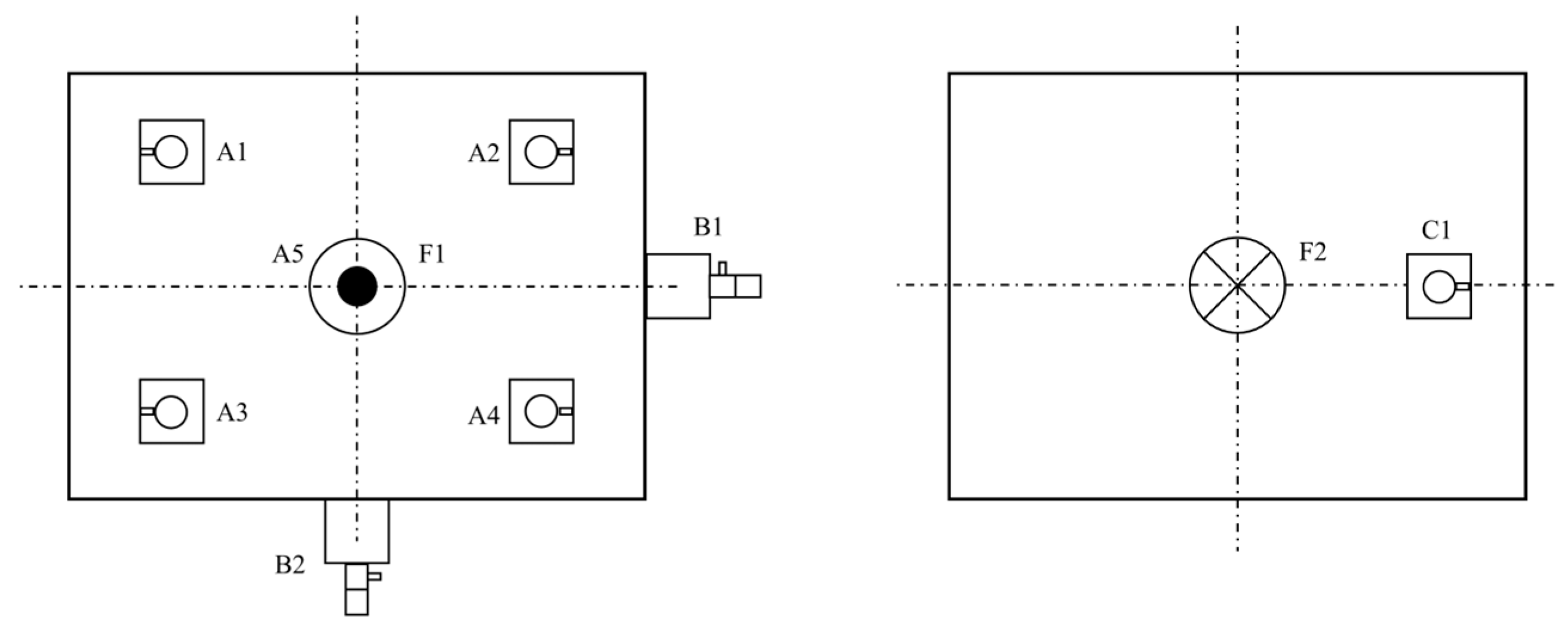
The specific arrangement of sensors at the input and output sides of the vibration isolator is illustrated in Figure 5. On the input side, an impedance head comprising a force sensor F1 and an acceleration sensor A5, along with four symmetrically positioned acceleration sensors A1–A4, was aligned with the excitation direction. Two monitoring acceleration sensors B1 and B2 were installed along the two orthogonal directions to the excitation direction. On the output side, a force-measuring plate F2 and a monitoring acceleration sensor C1 were arranged along the excitation direction. To ensure the accuracy of the dynamic experiment data, the acceleration value on the input side is taken as the average of the measurements from acceleration sensors A1–A4. After the experiment, the validity of the data was verified using the monitoring acceleration sensors. The data were considered valid only when both of the following conditions were simultaneously satisfied:
  • Unidirectionality: The vibration level in the excitation direction at the input side must greater than that in any orthogonal direction by at least 15 dB;
  • Blocking: The vibration level in the excitation direction at the input side must greater than the corresponding level at the output side by at least 20 dB;
Following the removal of trend from the test signal, the velocity signal is derived by integrating the acceleration signal, thereby yielding the results of the mechanical impedance test for the isolators.
The original purpose of the mechanical impedance method is to measure mechanical impedance, defined as the transfer function between velocity and force at the input and output ends. Through data processing, however, the dynamic characteristics of the isolator can also be obtained. These characteristics are expressed by the correlation between the excitation force and the vibration responses at the input and output ends. For unidirectional vibration of an isolator along a given axis, the relationship between the dynamic forces and the vibration velocities at its two ends can be described by Equation (1).
F 1 F 2 = Z 11 Z 12 Z 21 Z 22 q ˙ 1 q ˙ 2
In the equation, F 1 and F 2 represent the magnitudes of the dynamic forces at the input and output ends, respectively, with units of N . q ˙ 1 and q ˙ 2 denote the magnitudes of the vibration velocities at the input and output ends, respectively, with units of m / s . Z 11 and Z 22 are the magnitudes of the input mechanical impedances at the input and output ends, respectively, with units of N m / s , representing the relationship between the response at the excitation point and the external excitation. Z 21 and Z 12 are the magnitudes of the transfer mechanical impedances, with units of N m / s , representing the relationship between the response at the output end (fixed end) and the external excitation.
However, in vibration experiments, acceleration sensors are typically used to measure vibration signals. Therefore, the measured acceleration signals must be integrated in the frequency domain to derive the corresponding velocity signals. This process is expressed by Equation (2):
q ˙ 1 = q ¨ 1 j ω q ˙ 2 = q ¨ 2 j ω
By combining Equations (1)–(3), the mechanical impedance parameters of the vibration isolator can be determined.
Z 11 = F 1 q ˙ 1 q ˙ 2 = 0 , Z 12 = F 1 q ˙ 2 q ˙ 1 = 0 Z 21 = F 2 q ˙ 1 q ˙ 2 = 0 , Z 22 = F 2 q ˙ 2 q ˙ 1 = 0
From Equation (3), it can be seen that by blocking the output end of the vibration isolator, setting q ˙ 2 = 0 and using the input force signal along with the vibration acceleration signal, the input mechanical impedance Z 11 can be obtained. Similarly, by blocking the output end, setting q ˙ 2 = 0 and using the output force signal together with the input vibration acceleration signal, the transfer mechanical impedance Z 21 can be determined.
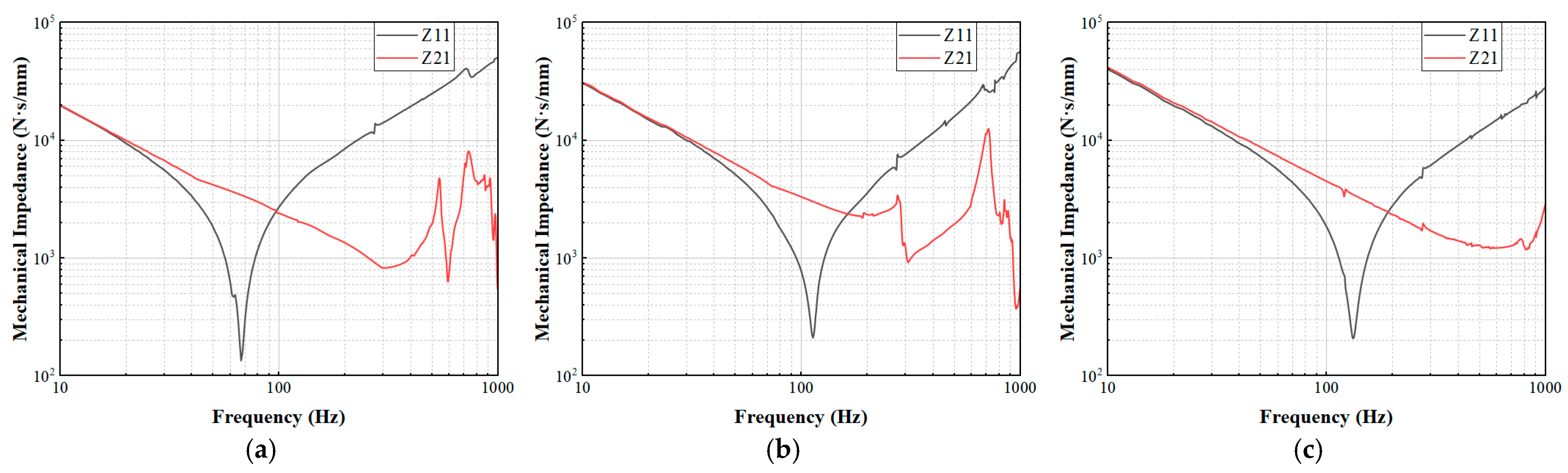
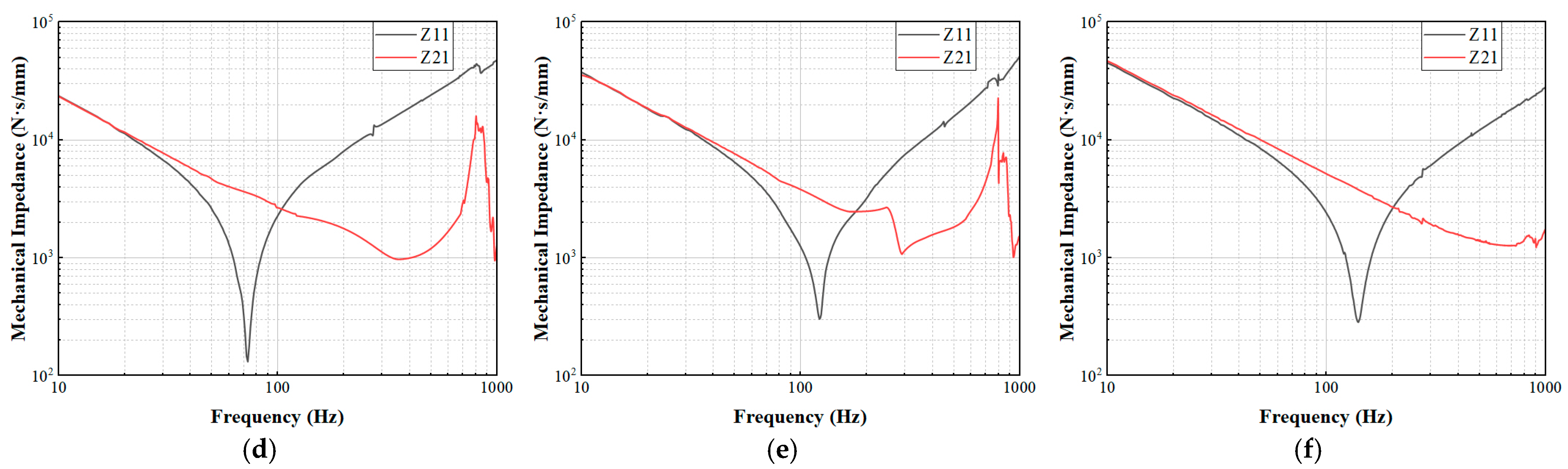
Typically, the ability of vibration isolators to cushion and attenuate vibration is most prominent in the vertical direction, i.e., the load-bearing direction, and the vertical component of the excitation force acting on the isolator usually dominates. Therefore, many studies primarily focus on the dynamic characteristics of isolators in the vertical (load-bearing) direction [52]. However, for analyzing the complex excitation characteristics and vibration transmission of rotary pumps, it is necessary to obtain the dynamic properties of the isolator along at least its three translational degrees of freedom. The input mechanical impedance and transfer mechanical impedance of the M-1200 and M-1500 isolators along these three translational degrees of freedom are shown in Figure 6.
The complex stiffness K of a vibration isolator is equal to the transfer displacement impedance, which is the ratio of the dynamic force at the output end to the displacement at the input end. The displacement response at the input end is derived by double integration of the acceleration response. Another important dynamic characteristic that measures the vibration isolation capability of an isolator is the force transmissibility T f , which represents the isolator’s ability to attenuate dynamic forces. It is defined as the ratio of the dynamic force at the output end to that at the input end, expressed in decibels, and can also be represented as the ratio of the transfer mechanical impedance to the input mechanical impedance:
K = j ω Z 21 T f = 20 log 10 Z 21 Z 11
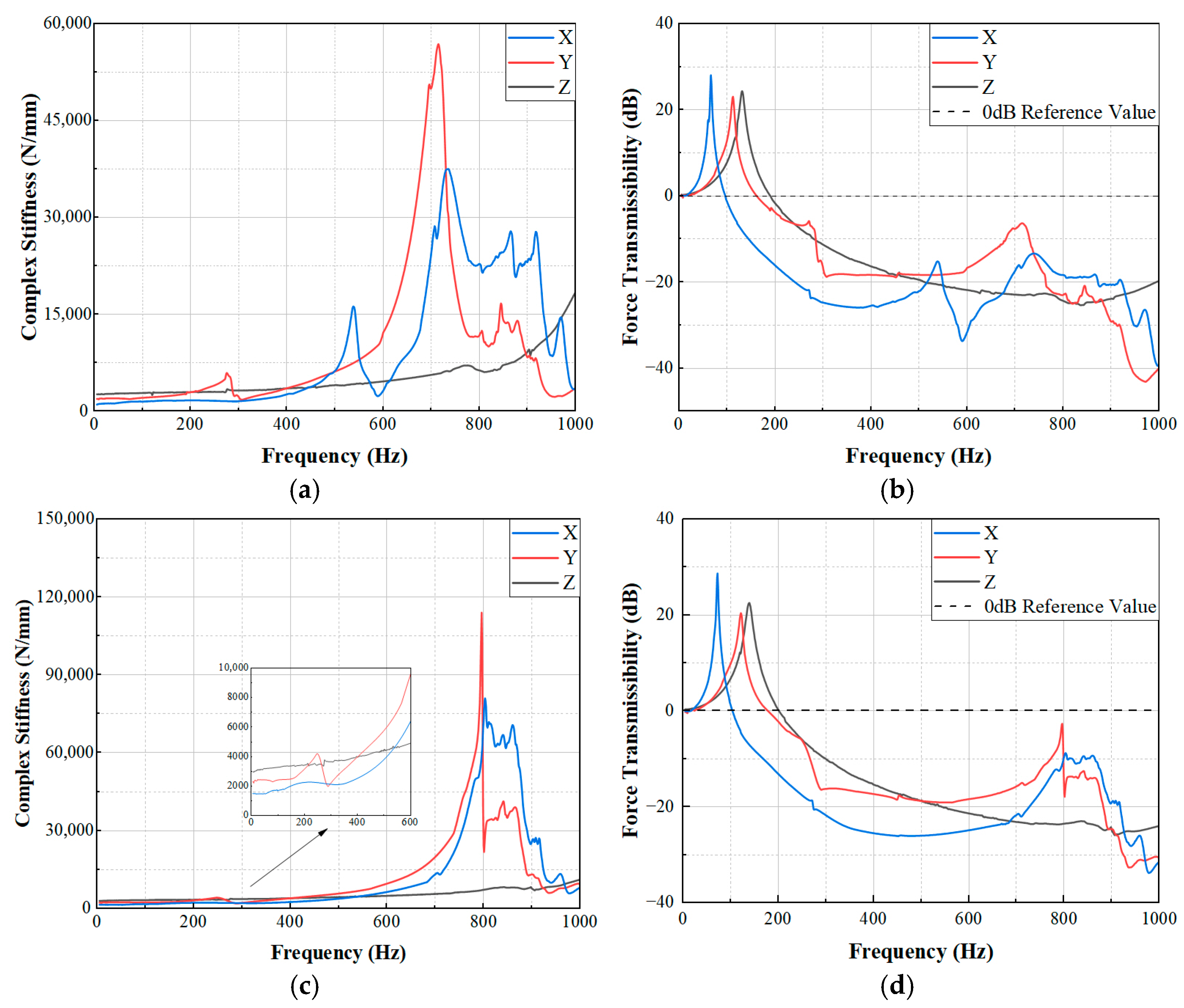
The experimental results for the transfer complex stiffness and force transmissibility of the M-1200 and M-1500 isolators in the three translational directions are shown in Figure 7. The transfer complex stiffness reflects the isolator’s overall ability to transmit vibration as a whole. Since the purpose of isolation is to reduce vibration transmission from the input point to the output point, the transfer complex stiffness is typically used as a key indicator to describe the dynamic performance of an isolator. From the perspective of force transmissibility, both the M-1200 and M-1500 isolators exhibit relatively poor isolation effectiveness in the low-frequency range across all tested directions, each presenting a vibration amplification region where the force transmissibility greater than 0 dB. This is a typical issue associated with passive isolators. At the frequency corresponding to the peak transfer complex stiffness, the force transmissibility shows only a localized increase and does not represent the highest value within that frequency band. For both isolator models, in frequency bands outside the vibration amplification region, the peak frequency of the transfer complex stiffness coincides with the peak frequency of the force transmissibility.

2.2.2. Performance Experiment of Flexible Connectors

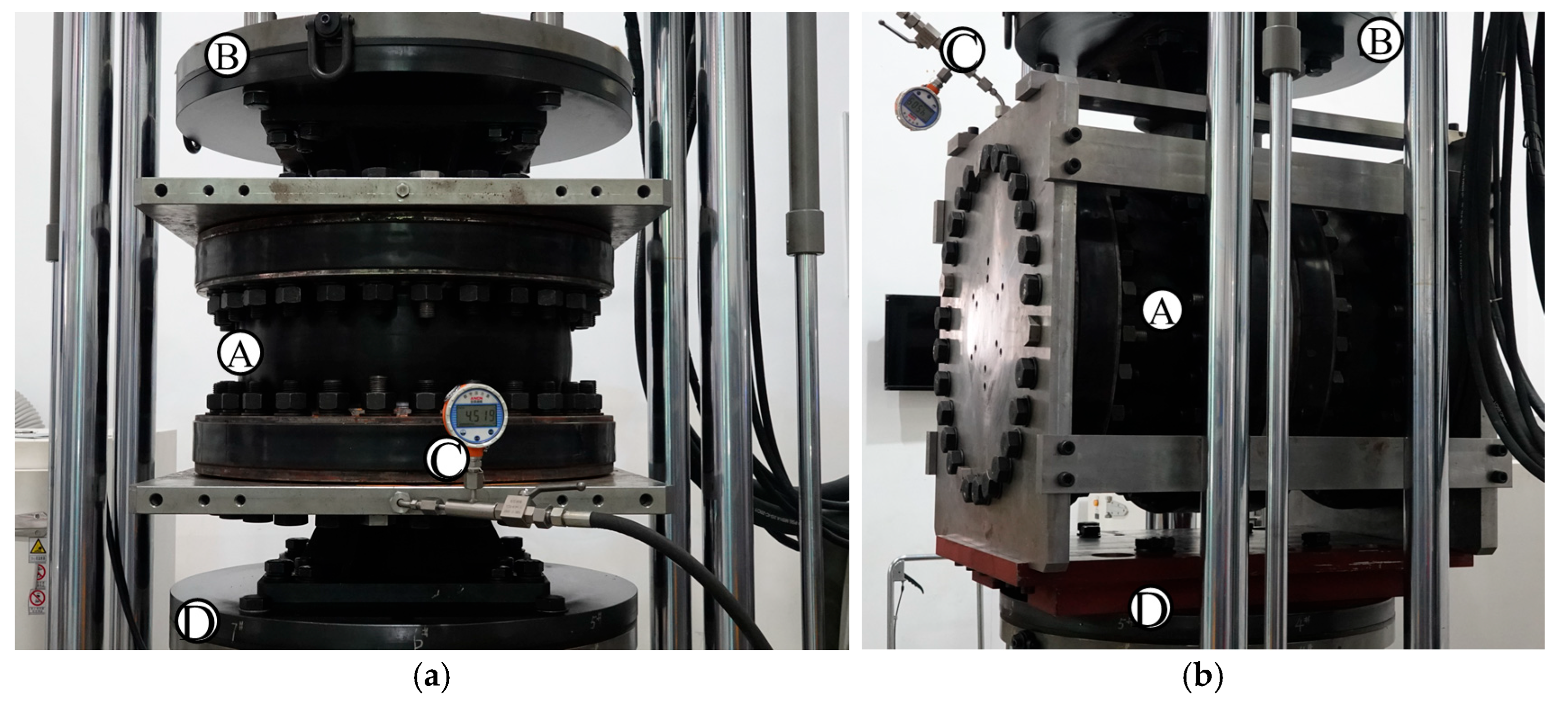
Owing to the large bore diameter of the flexible connector employed in the coupled vibration isolation system, coupled with their rubber body reinforced with aramid cord, their static and dynamic stiffness are significantly higher than those of the isolators. Constrained by the output capacity of the mechanical impedance platform excitation system, it is impossible to apply effective excitation to the flexible connector to complete impedance experiment. Consequently, its static and dynamic performance experiment was conducted on an MTS311.32S hydraulic servo testing machine (MTS Corporation, Eden Prairie, MN, USA). This machine features a dynamic load range of ±1200 KN, dynamic displacement of ±75 mm, and a maximum operating frequency of 20 Hz, meeting the testing requirements for high-stiffness elastic components. Prior to experiment, the flexible connector was mounted within a dedicated fixture and rigidly coupled between the servo-hydraulic actuator and base. For radial static and dynamic performance experiment, flexible connector of identical model and batch were paired at their rated height and fixed within the radial test fixture. The axial and radial static and dynamic experiments are shown in Figure 8.
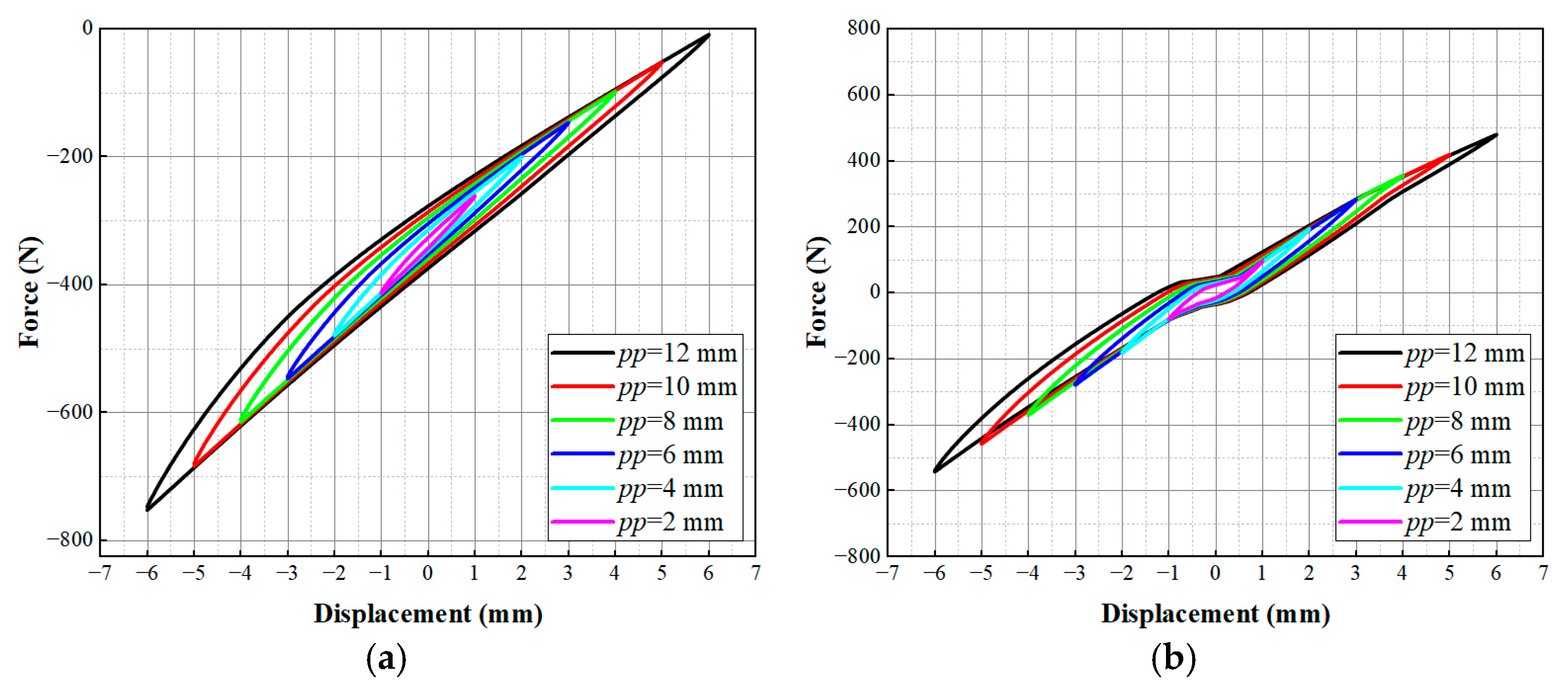
Prior to static performance experiment of the flexible connector, the load and displacement sensors on the testing machine shall first be zeroed. Subsequently, water shall be slowly introduced into the flexible connector until the internal pressure reaches the rated working pressure and remains stable. The experiment employs displacement control mode, applying axial and radial static compression/tension loads to the flexible connector. The displacement peak-to-peak ranged from 2 mm to 12 mm in steps of 2 mm, with a loading rate set at 0.1 mm/s. Three load-unload cycles were performed for each direction, with load and displacement data recorded synchronously at a sampling frequency of 4 Hz. Parameters relevant to the static stiffness experiment of the flexible connector are shown in Table 1.
To minimize reassembly and ensure consistent experiment conditions, dynamic stiffness experiments were conducted immediately after completing static stiffness experiments in the same direction, with the experiment specimen, equipment, and installation configuration remaining unchanged. The dynamic stiffness experiment applied sinusoidal displacement excitation to the flexible connector, with excitation frequencies incremented from 1 Hz to 8 Hz in 1 Hz steps. At each excitation frequency point, the excitation displacement amplitude was varied from 0.4 mm to 3.2 mm in steps of 0.4 mm. Parameters related to the dynamic stiffness experiment are shown in Table 2.
According to D’Alembert’s principle, in an elastic system, inertial forces, damping forces, and elastic forces are in equilibrium with external forces. During static performance experiment, inertial forces are zero, and applied forces are equal to elastic forces. Therefore, the applied force directly reflects the elastic recovery characteristics of the flexible connector. Prior to formal data recording, the flexible connector must undergo preloading: slowly loading it to a predetermined displacement load, then slowly unloading it to its initial state. This cycle is repeated twice to minimize the Mullins effect in the elastomer. Data from the loading segment of the third cycle is used to calculate the static stiffness of the flexible connector. The axial and radial displacement-load curves of the JYXR flexible connector under varying displacement loads are illustrated in Figure 9. Experiment results indicate that the axial static stiffness is markedly higher than the radial stiffness. Furthermore, the force-displacement relationships in both directions exhibit low nonlinearity, demonstrating that this flexible connector exhibits near-linear elastic behavior under static loading. It is noteworthy that the static stiffness of the flexible connector substantially exceeds that of isolators employed in coupled vibration isolation systems. This characteristic constitutes the primary reason for its inability to undergo effective dynamic experiment on conventional mechanical impedance platforms—excitation systems struggle to deliver sufficient excitation force to stimulate its vibrational response.
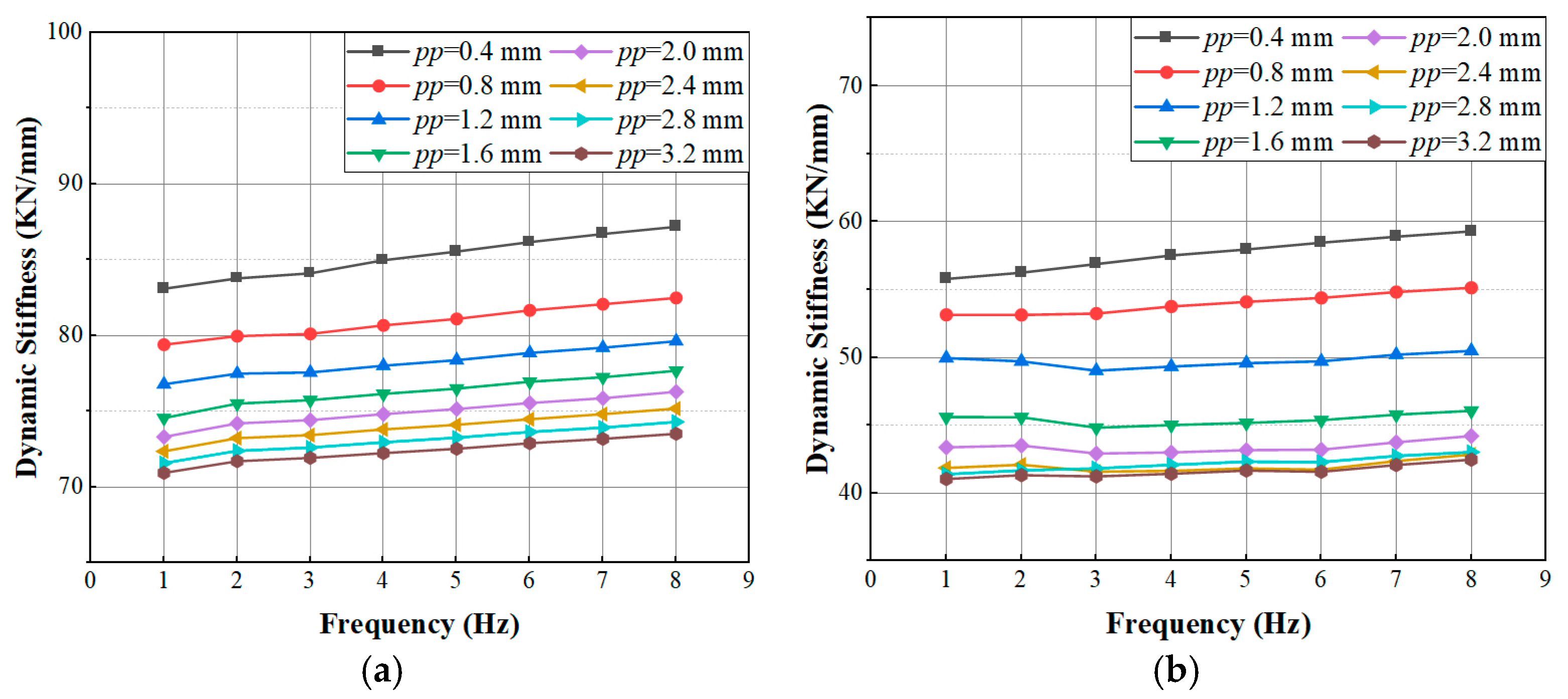
Due to the upper working frequency limit of 20 Hz for the MTS 311.32S testing machine employed, coupled with the difficulty in simultaneously achieving large-amplitude excitation at high frequencies, dynamic experiments were conducted within a limited frequency range. Experiment data were processed using the elliptical method, dynamic characteristics of JYXR flexible connector were shown in Figure 10. Results indicate: (1) The axial dynamic stiffness of the flexible connector is generally higher than its radial counterpart; (2) At identical excitation amplitudes, both axial and radial dynamic stiffness exhibited an increasing trend with rising frequency (1–8 Hz); (3) At constant frequency, dynamic stiffness in both directions decreased slightly with increasing excitation amplitude; (4) The degree of nonlinearity in both axial and radial dynamic stiffness was low, allowing this flexible connector to be approximated as a linear elastic element.
The JYXR flexible connector joint used in this research features a large diameter (350 mm) and an aramid cord reinforcement structure, resulting in exceptionally high axial and radial stiffness under operating pressure (approximately 7 × 10⁴ N/mm). Constrained by current technical limitations in high-frequency, large-displacement dynamic testing of such large-sized, high-stiffness elastic components, dynamic stiffness tests were conducted only within the low-frequency range. To evaluate the stiffness variation trend of this type of flexible connector across a broader frequency band, dynamic stiffness tests were performed on small-diameter specimens with identical reinforcement processes and material formulations using a mechanical impedance platform covering 10–1000 Hz. Results indicate that the dynamic stiffness of this flexible connector type exhibits excellent stability across a broad frequency range, with a minimal relative change rate in stiffness values (real part of complex stiffness) as frequency increases. Given these characteristics and considering the engineering reality that the stiffness base of flexible connectors (~104 N/mm) used in coupled isolation systems far exceeds that of isolators (~103 N/mm), minor frequency variations in stiffness have a negligible impact on overall system dynamics. Therefore, in the system-level vibration transmission analysis presented herein, approximating the dynamic stiffness of the flexible connector as a frequency-independent constant represents a reasonable and conservative engineering simplification. This approach effectively supports performance prediction and evaluation within the 10–1000 Hz frequency band.

2.3. Numerical Model of the Coupled Isolation System

To analyze the isolation effectiveness of the coupled isolation system with multiple elastic elements, this study employs the nonlinear finite element software ABAQUS 2024 to establish a numerical simulation model. The model incorporates the rotary pump, bend pipe, vibration isolators, flexible connectors, and the foundation. Among these, the rotary pump, bend pipe, and foundation were all modeled as solid objects in SolidWorks 2022 using their actual geometric dimensions. The isolators and flexible connectors are simplified as nonlinear connector elements consisting of springs and dampers connected in parallel. The two ends of each connector element are defined at the centroid of the corresponding mounting surface. These centroid points are then kinematically coupled to their respective physical mounting surfaces using coupling constraints, linking the motion of the surface to the point. The stiffness and damping coefficients of the connector elements are derived from the transfer complex stiffness obtained in the experiment. The specific conversion method is as follows: the real part of the transfer complex stiffness ( K * ) is converted into the stiffness of the spring ( k ), while the imaginary part divided by the corresponding circular frequency is converted into the damping coefficient of the damper ( c ). This relationship is expressed by the formula:
k = K s = r e a l ( K ) c = K l ω = i m a g ( K ) ω
In the equation, k represents the stiffness of the spring element, c denotes the damping coefficient of the damper element, and K refers to the complex stiffness of the M-1200 and M-1500 isolators, respectively. The terms r e a l and i m a g indicate the real and imaginary parts of the complex number, corresponding to the storage stiffness and loss stiffness, respectively. This transformation ensures that at this frequency point, the linear equivalent model matches the energy storage and dissipation characteristics of the experimentally measured isolator over a unit period. It should be noted that this set of parameters characterizes the dynamic behavior of the isolator under specific preload and test amplitude conditions. All simulations in this study are based on the parameter set identified within this linear excitation range, aiming to predict the system’s vibration response under corresponding normal operating conditions.
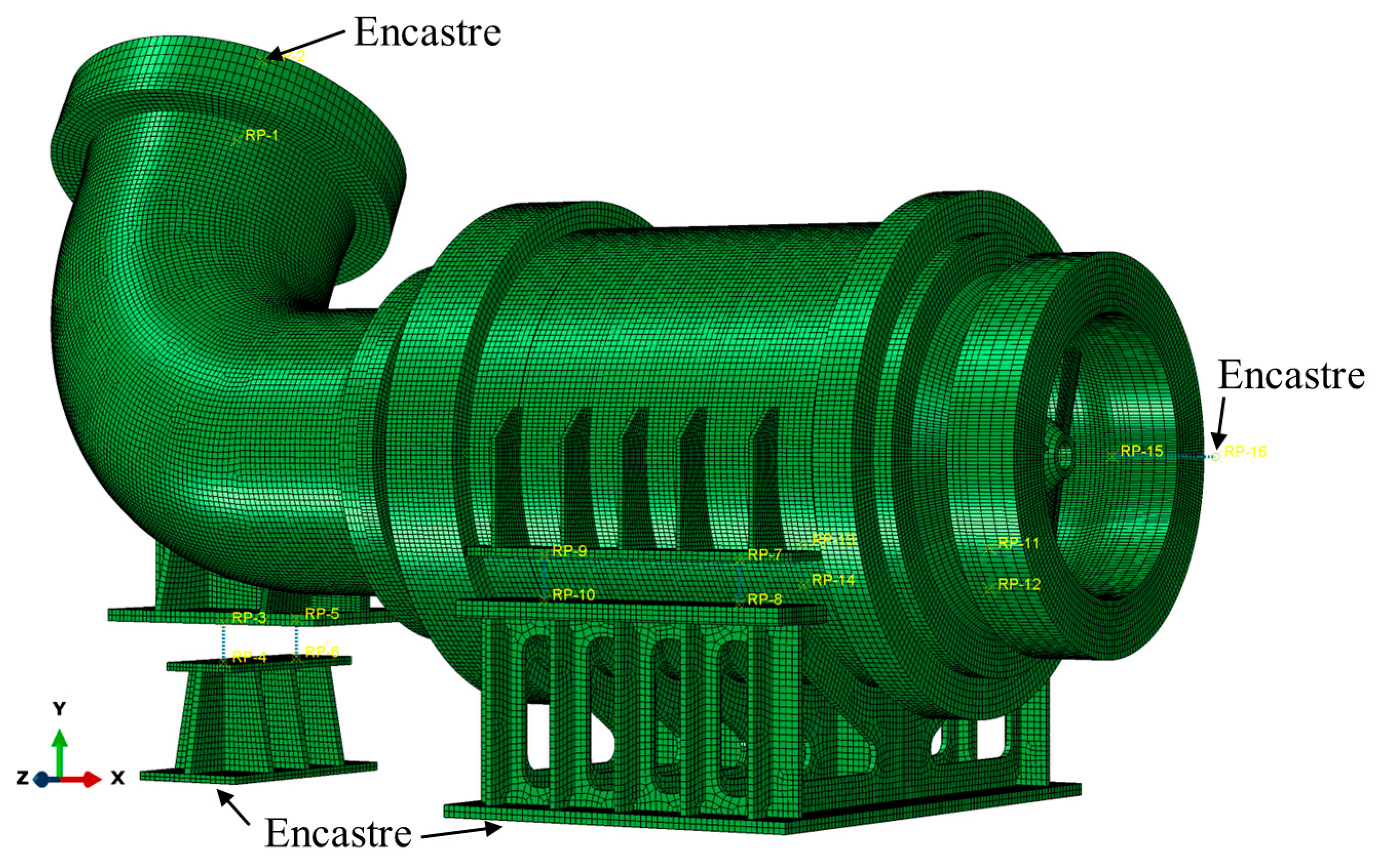
During operation, the loads acting on the rotary pump are simplified into a torque load and fluid-induced pressure loads. The torque is applied to the entire pump body, while the fluid loads are imposed as pressure on the inner surfaces of the rotary pump and the bend pipe. Given the transient nature of the excitation, an explicit dynamics approach is adopted to analyze the vibration characteristics of the coupled isolation system. To simulate the experimental boundary conditions, all six degrees of freedom are fixed at the bottom surface of the foundation and at the ends of the external pipelines connected to the flexible connectors. Before meshing, the geometry of the overall model is appropriately simplified: bolt holes used for connections on each component are removed; contact surfaces are tied with constraints to ensure consistency in displacement and force transmission; and all filets in the overall model are eliminated. After completing the geometric simplification, the entire pump unit model was fully meshed into hexahedral element regions using the HyperMesh 2021 meshing software. Hexahedral elements of type C3D8R—first-order, 8-node hexahedral elements—are used [53,54]. The total number of elements is 345,704. The meshing result of the numerical model is shown in Figure 11.

2.4. Vibration Experiment of the Coupled Isolation System

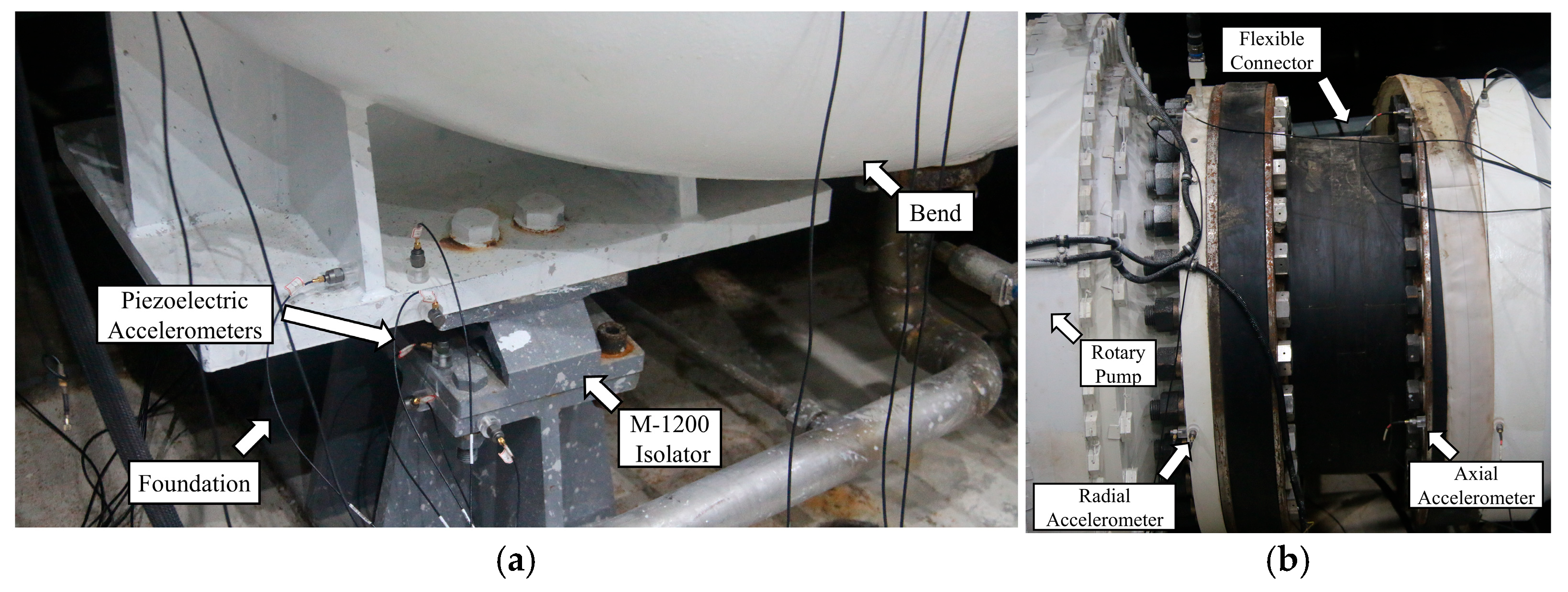
To validate the isolation performance of the coupled isolation system and the accuracy of the numerical calculation model, this study constructed an experimental platform for the coupled isolation system, as shown in Figure 12. Piezoelectric vibration acceleration sensors were employed to measure the vibration signals. Based on the installation configuration of the isolation devices, the side of the elastic elements closer to the rotary pump and bend pipe is termed the “machine foot” side, while the side farther from them is termed the “foundation” side. For the vibration isolators, measurement points on the “machine foot” side were positioned near the upper support seat of the isolator, and points on the “foundation” side were positioned near its lower support seat. Acceleration sensors were installed along three orthogonal directions at both the “machine foot” and “foundation” points for each isolator. For the flexible connectors, “machine foot” and “foundation” measurement points were established with sensors aligned along their axial and radial directions. A Bruel & Kjær (B&K) data acquisition system was used to synchronously collect vibration signals from all 44 measurement points, ensuring that all signals shared identical phase information. In accordance with the Nyquist sampling theorem, the sampling frequency must be at least 2.56 times greater than the upper limit of the analyzed frequency band. Therefore, a sampling frequency of 8192 Hz was set for this experiment. The coordinate system of the experimental model is aligned with that of the numerical model, with the X-axis defined as the transverse direction, the Y-axis as the vertical direction, and the Z-axis as the longitudinal direction (right-handed Cartesian coordinate system).

2.5. Data Processing and Analysis

In practical engineering applications, the average vibration acceleration level is typically used as the evaluation metric for isolation effectiveness. For the M-1500 isolators, the isolation effectiveness is assessed by averaging the vibration acceleration levels from the four measurement points in the same direction on the “machine foot” side of the pump and comparing it with the averaged acceleration from the four corresponding points on the “foundation” side. For the M-1200 isolators, the isolation effectiveness is evaluated by averaging the vibration acceleration levels from the two measurement points in the same direction on the “machine foot” side of the bend pipe and comparing it with the averaged acceleration from the two corresponding points on the “foundation” side. The vibration isolation effectiveness of the flexible connectors within the coupled system is represented by the difference in vibration acceleration levels between the “machine foot” and “foundation” sides, measured both radially and axially at the inlet and outlet connectors. Since both the numerical simulation results and the experimental data are obtained in the time domain, they are converted to the frequency domain via Fourier transform for comparison. This allows analysis of the variations in frequency-domain vibration acceleration responses between the numerical model of the coupled isolation system and the experimental tests. The analyzed frequency range is 10 Hz to 1000 Hz with a frequency interval of 5 Hz. The numerical and experimental data are processed as follows:
A i = 20 log 10 ( a i a 0 ) a a v g = i = 1 N a i 2 N , A a v g = 20 log 10 ( a a v g a 0 ) L T = 10 log 10 ( Δ f n s = 1 N s a a v g 2 ( f ) a 0 2 ) , f = n s · Δ f
In the equation, a i represents the vibration acceleration at the i measurement point ( i = 1 , 2 , , N ), N is the number of accelerometers arranged on the “machine foot” and “foundation” sides, and a 0 is the acceleration reference level, with a value of 1 × 10 6 m / s 2 . f denotes the analysis frequency, Δ f is the frequency step size, and n s is the number of steps. A i is the vibration acceleration level at the i measurement point. a a v g and A a v g represent the average acceleration and the average vibration acceleration level on the “machine foot” and “foundation” sides, respectively, while L T denotes the overall acceleration level.

3. Results and Discussion

3.1. Numerical and Experimental Validation of the Coupled Isolation System

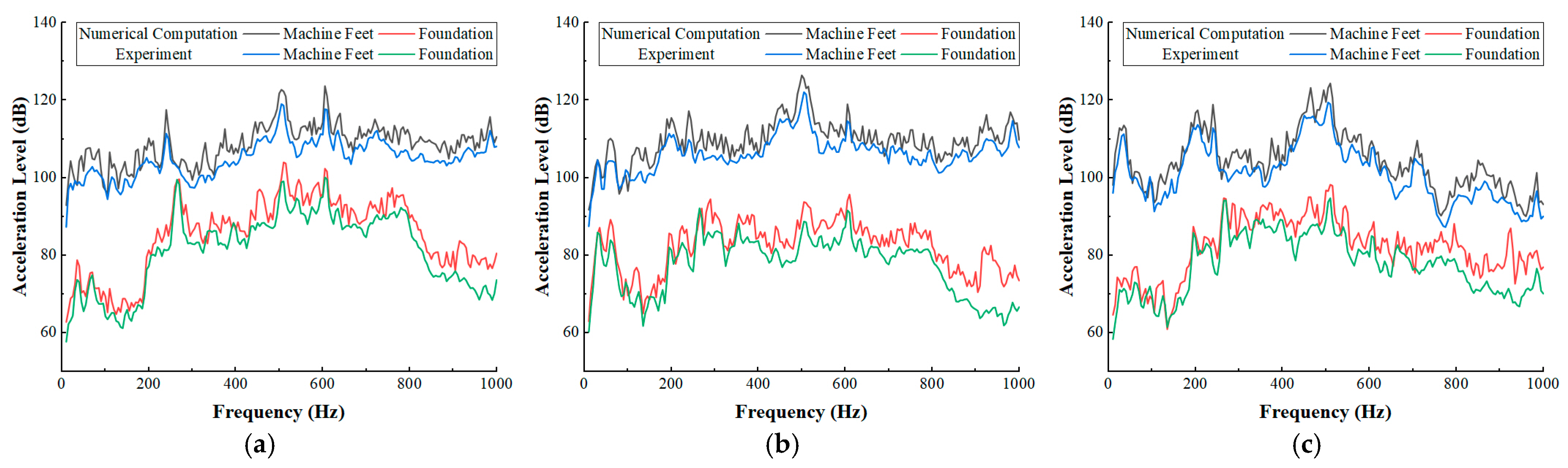
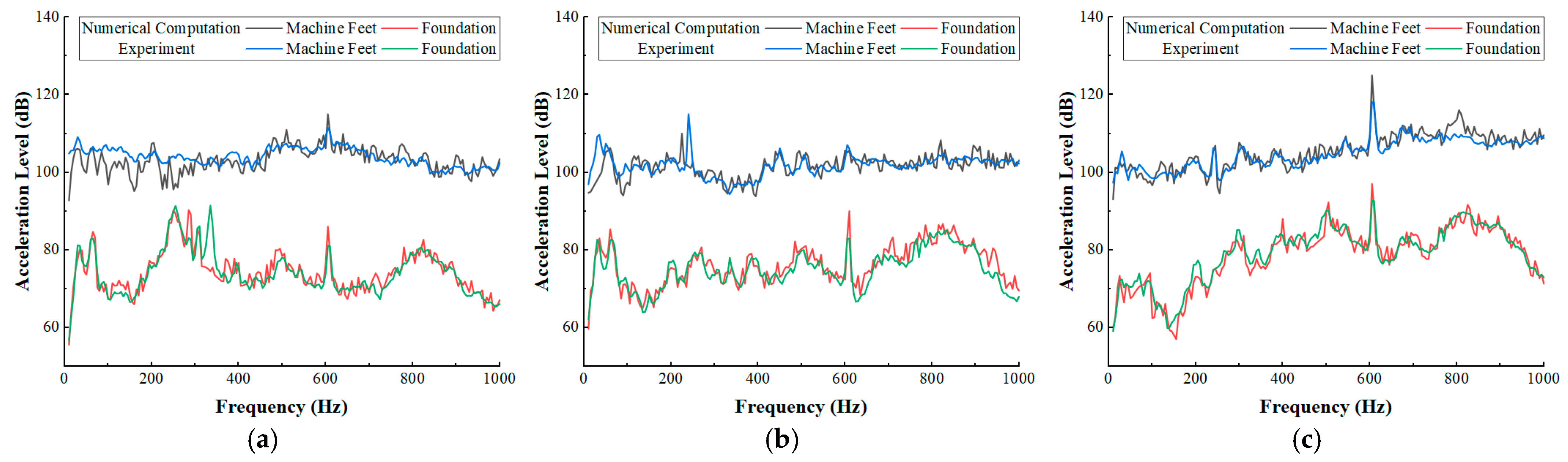
The frequency spectrum curves of acceleration vibration responses for the elastic elements, obtained through both numerical calculation and experimentation, are shown in Figure 13 and Figure 14. First, based on the experimental results, the following patterns are observed: (1) The coupled isolation system for the rotary pump unit, which considers both isolators and flexible connectors, demonstrates good isolation effectiveness across all directions within the 10–1000 Hz frequency band. (2) For the M-1200 isolator, the vertical isolation effectiveness in the low-frequency range below 200 Hz is poorer compared to the transverse and longitudinal directions. (3) In the lateral direction, the isolation effectiveness of the M-1500 isolator is significantly better than that of the M-1200 isolator. All three of these patterns are also reflected in the numerical calculation results.
The prediction errors of the coupled isolation system are presented in Table 3. In terms of the overall vibration acceleration level results, the total level errors at all measurement points in the coupled isolation system are within ±3 dB. This indicates that the numerical model is capable of effectively predicting the vibration response of the rotary pump unit’s coupled isolation system within the current frequency band.
In summary, the comparative analysis of Figure 13 and Figure 14 with Table 3 not only verifies that the coupled isolation system possesses excellent broadband vibration isolation performance but also confirms that the explicit dynamic model constructed based on experimental parameters demonstrates good predictive capability and engineering applicability.

3.2. Isolation Effectiveness Under Different Operating Conditions

To evaluate the vibration isolation performance of the coupled isolation system for the rotary pump unit under actual multi-condition operating scenarios, this paper designed operating conditions encompassing various combinations of water pressure and rotational speed based on its real-world operational environment and requirements. During ship operation, rotating pumps frequently require independent adjustment of their outlet water pressure or drive speed according to system demands, both being critical operational parameters influencing pump assembly vibration excitation. Specifically, speed regulation directly correlates with motor output torque, thereby altering mechanical vibration excitation; whereas water pressure variations primarily affect flow-induced vibration and pipeline loading. To comprehensively evaluate the vibration response characteristics of the coupled isolation system under changes in these two independent parameters, three typical operating conditions were established for testing, as detailed below:
Condition 1: Measure the isolation effectiveness of the coupled isolation system with the rotary pump operating under 20 m of water pressure and with the motor output torque at its rated value.
Condition 2: Measure the isolation effectiveness of the coupled isolation system with the rotary pump operating under 30 m of water pressure and with the motor output torque at 70% of its rated value.
Condition 3: Measure the isolation effectiveness of the coupled isolation system with the rotary pump operating under 30 m of water pressure and with the motor output torque at its rated value.
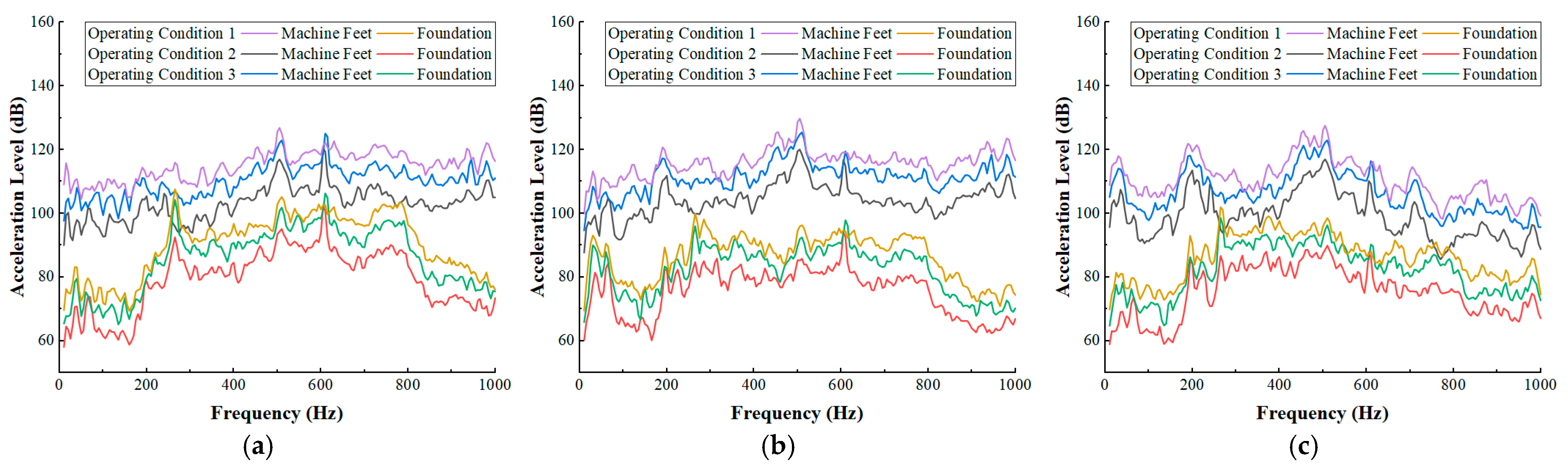
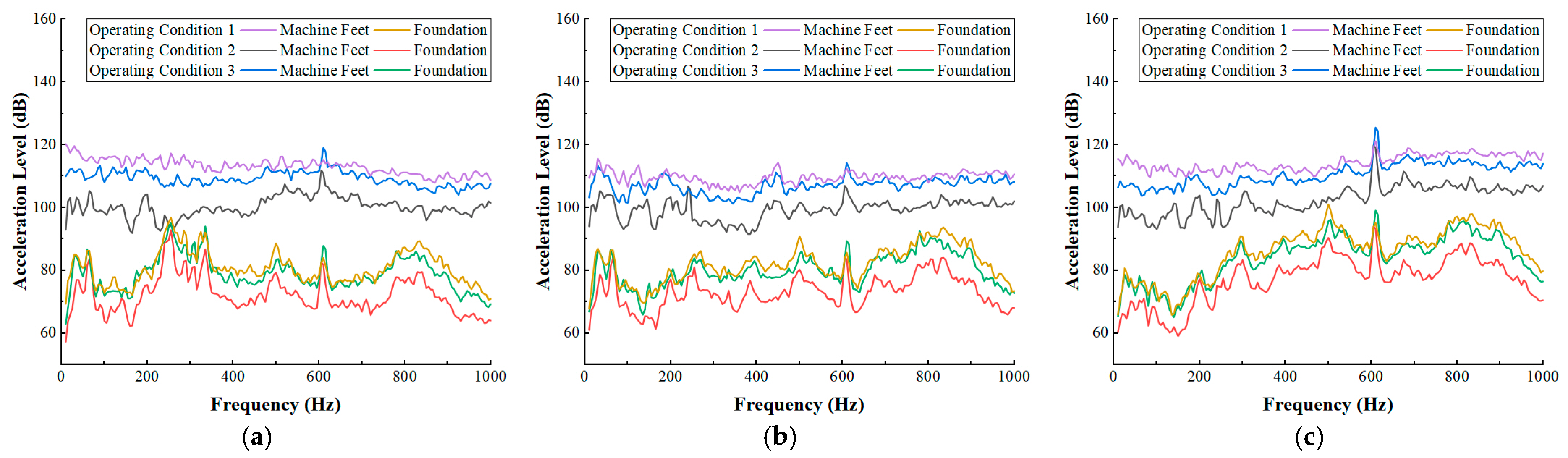
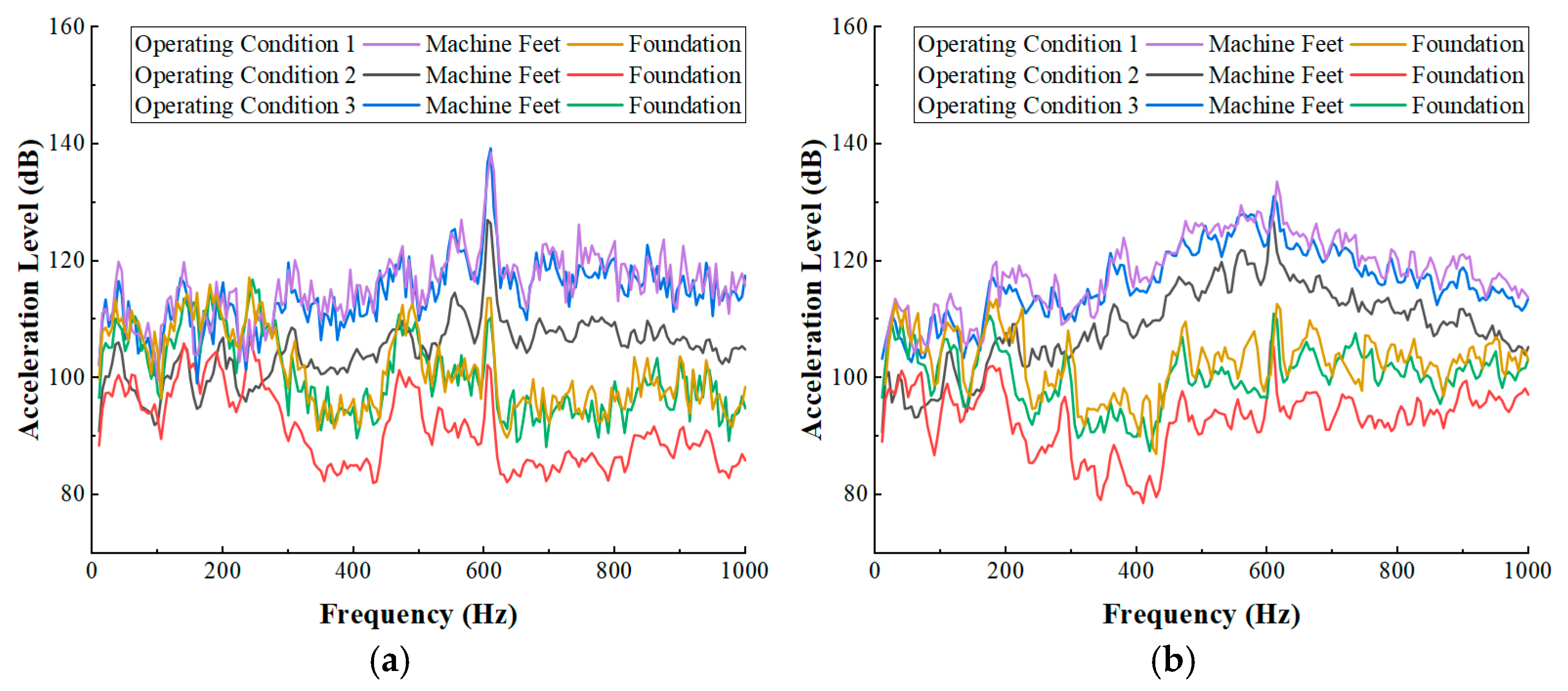
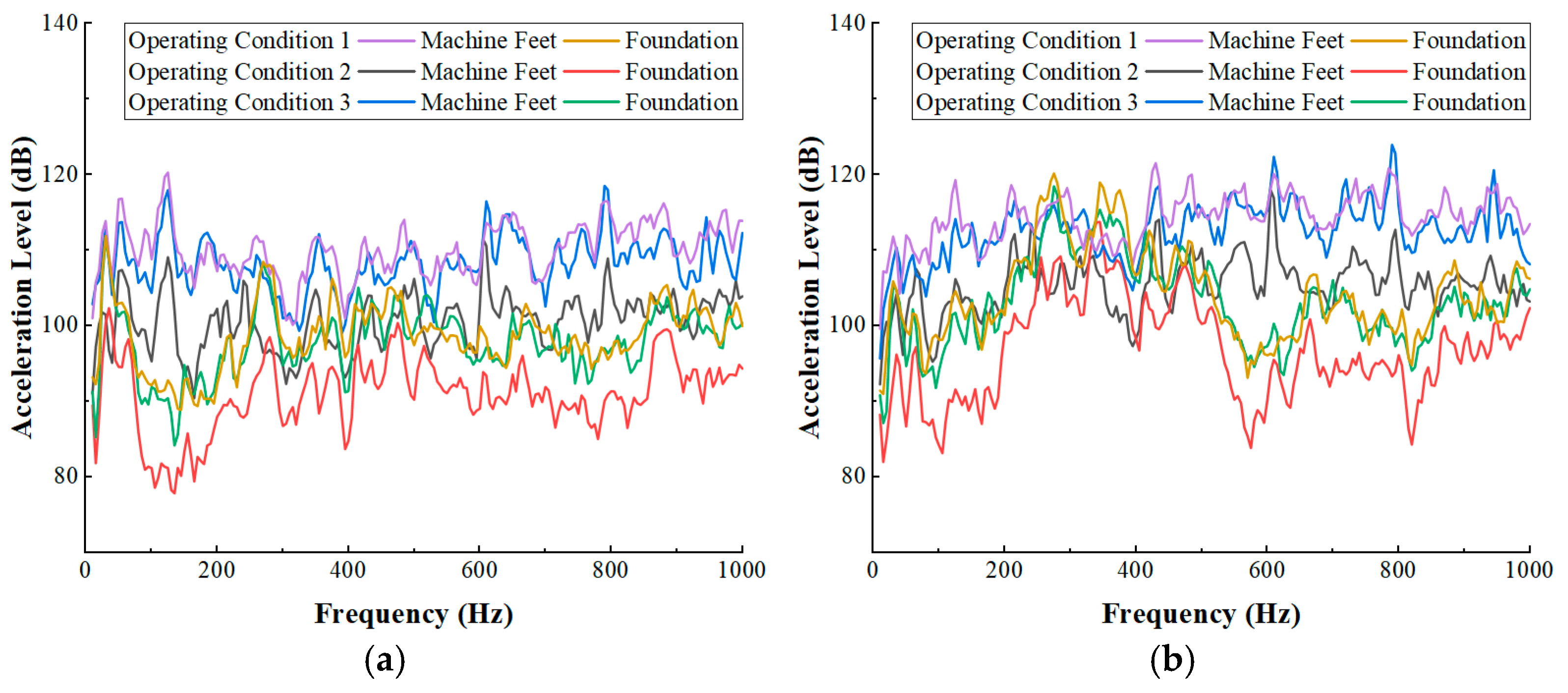
To analyze the vibration transmission characteristics of the coupled isolation system, this study uses the vibration acceleration level difference between the “machine feet” measurement point and the corresponding “foundation” measurement point as the evaluation index for isolation effectiveness. First, the analysis of vibration influences from different excitation sources indicates that variations in working water pressure produce no significant differences in the vibration responses measured at different locations of the rotary pump. Changes in pressure mainly induce static deformation of the rotary pump unit, with negligible influence on its dynamic operational response. In contrast, variations in motor output torque generate substantially more pronounced vibration. As the torque rises to its rated value, the vibration responses of both the rotary pump and the bend pipe increase correspondingly, confirming that excitation from the motor torque is the dominant source of vibration in the pump unit. Within the full frequency band of 10–1000 Hz, the coupled isolation system demonstrates good isolation effectiveness in all directions. Specifically, for the M-1200 isolator, its isolation effectiveness in the vertical direction is weaker than in the transverse and longitudinal directions in the low-frequency region below 200 Hz; whereas in the transverse direction, the isolation effectiveness of the M-1500 isolator is generally superior to that of the M-1200 type. For both isolator types, the differences in responses across directions are not significant in the frequency band above 200 Hz. The isolation trends of the flexible connectors are similar to those of the isolators, but their isolation effectiveness is weaker in the mid-to-low frequency range than at higher frequencies. The isolation effectiveness of the inlet flexible connector decreases somewhat below 250 Hz, while that of the outlet flexible connector is relatively weaker in the 250-500 Hz band. Both flexible connectors exhibit good isolation performance at higher frequencies. The comparisons of frequency-spectrum curves in Figure 15, Figure 16, Figure 17 and Figure 18 clearly illustrate the aforementioned patterns.
From the perspective of the overall vibration level, the coupled isolation system achieves effective vibration isolation under different operating conditions. Based on the frequency-domain responses, the overall vibration level within the 10–1000 Hz band for each measurement point was calculated using Equation (6), and the results are summarized in Table 4. The analysis reveals that:
  • The system achieves a maximum overall vibration acceleration level reduction of 29.32 dB and a minimum of 6.4 dB across all operating conditions. In the vertical direction under all conditions, the isolation effectiveness of the M-1200 isolator is significantly superior to that of the M-1500 type; in the transverse direction, the M-1500 type performs better; in the longitudinal direction, the difference is minimal. Unlike the transverse and longitudinal excitations generated by the rotary pump, the vibration of the bend pipe is primarily dominated by the internal fluid flow. Consequently, the M-1200 isolator provides better isolation in the vertical direction than in the other two directions, while the M-1500 isolator performs better in the transverse direction.
  • Although the stiffness of the flexible connectors is much greater than that of the isolators, they still contribute to vibration isolation within the coupled isolation system and provide displacement compensation for the rotary pump unit system. The axial isolation effectiveness of the inlet flexible connector is superior to its radial effectiveness, whereas the outlet flexible connector shows better radial isolation effectiveness. This is mainly because the inlet flexible connector is directly connected to the vibration source (the rotary pump), where the primary excitation originates from the motor torque, favoring axial isolation. The outlet flexible connector is connected via a bend pipe acting as a transition, where the primary excitation stems from the fluid within the bend, resulting in relatively better radial isolation compared to axial.
  • As the pump rotational speed (i.e., motor output torque) increases, the vibration response of the pump unit intensifies. Under these conditions, the isolation capability of the M-1200 isolator slightly decreases, while that of the M-1500 isolator improves, particularly more noticeably in the transverse direction. On the other hand, an increase in the working water pressure of the pump leads to a slight decrease in the isolation effectiveness of all isolators.
  • As the rotational speed increases, the axial isolation performance of the inlet flexible connector shows a weakening trend (though still superior to its radial isolation), while both the axial and radial isolation effects of the outlet flexible connector exhibit an enhancing trend.
  • Within the rotary pump unit system, both the M-1500 isolator and the inlet flexible connector, which are directly connected to the rotary pump, demonstrate good isolation effectiveness in the transverse direction. This indicates that the coupled isolation system can effectively attenuate transverse vibrations transmitted from the rotary pump to the external piping. Vibrations transmitted to the hull in the longitudinal and vertical directions are attenuated collectively by both the M-1200 and M-1500 isolators.

4. Conclusions

To investigate the vibration isolation performance of the coupled isolation system for the rotary pump, this study conducted numerical modeling and experimental validation. Dynamic performance tests were performed on the M-1200 and M-1500 isolators and the JYXR-type flexible connector used in the system to obtain their dynamic parameters, which were then equivalently modeled as nonlinear spring-damper units and incorporated into the numerical model. The numerical simulation results successfully predicted the vibration response of the coupled isolation system under complex excitations from the rotary pump and demonstrated effective vibration isolation. Based on this, the isolation performance of the coupled isolation system under different operating conditions of the rotary pump was further investigated, leading to the following conclusions:
  • The explicit dynamic finite element model, established using true dynamic parameters of elastic components obtained through mechanical impedance testing and MTS testing machines, effectively predicts the system’s vibration response across a broad frequency range of 10–1000 Hz. The overall vibration acceleration level error between numerical calculations and full-scale test results falls within ±3 dB, validating the model’s reliable engineering prediction accuracy.
  • Experimental results demonstrate that under various operating conditions involving changes in rotational speed and water pressure of the pump set, the coupled isolation system consistently exhibits excellent broadband vibration isolation performance. The system achieves a maximum vibration acceleration level reduction of 29.32 dB, effectively suppressing the transmission of pump set vibrations to the foundation and piping.
  • The introduction of flexible connector connections not only compensates for pipeline displacement but also synergistically complements the dynamic performance of polyurethane vibration isolators. Both full-scale testing and numerical simulations confirm that flexible connector connections effectively suppress lateral vibration transmission from pump units to external pipelines. Working in tandem with the isolators, they achieve multidirectional vibration isolation, thereby enhancing the overall system performance.
  • This study proposes a comprehensive, verifiable analytical framework for predicting system performance based on measured parameters of elastic components. Balancing model reliability with engineering practicality, this framework directly provides performance prediction and optimization guidance for vibration reduction design in marine pump units and other power equipment, while establishing a reliable foundation for subsequent in-depth analysis. Future work may explore parameter sensitivity analysis, energy flow analysis, and vibration transmission path analysis to broaden the application scope of this research and validate its universality.

Author Contributions

Conceptualization, F.C. and Y.Z.; methodology, F.C.; software, F.C.; validation, Z.Z.; formal analysis, F.C.; investigation, F.C.; resources, Y.Z.; data curation, F.C.; writing—original draft preparation, F.C.; writing—review and editing, Z.Z.; visualization, F.C.; supervision, Y.Z.; project administration, Y.Z.; funding acquisition, Y.Z. All authors have read and agreed to the published version of the manuscript.

Funding

This research received no external funding.

Institutional Review Board Statement

Not applicable.

Informed Consent Statement

Not applicable.

Data Availability Statement

The data presented in this study are available on request from the corresponding author. The data are not publicly available due to military attributes of our university.

Conflicts of Interest

The authors declare no conflicts of interest.

References

  1. Lin, T.R.; Pan, J.; O’Shea, P.J.; Mechefske, C.K. A study of vibration and vibration control of ship structures. Mar. Struct. 2009, 22, 730–743. [Google Scholar] [CrossRef]
  2. Vizentin, G.; Vukelic, G.; Murawski, L.; Recho, N.; Orovic, J. Marine propulsion system failures—A review. J. Mar. Sci. Eng. 2020, 8, 662. [Google Scholar] [CrossRef]
  3. Matta, L.M.; Szasz, G. Vibration and Fatigue Failures at Pipeline Facilities. In Proceedings of the International Pipeline Conference, Calgary, AB, Canada, 24–28 September 2018. [Google Scholar]
  4. Jensen, A.; Jepsen, J.R. Vibration on board and health effects. Int. Marit. Health 2014, 65, 58–60. [Google Scholar] [CrossRef] [PubMed][Green Version]
  5. Picu, L.; Picu, M.; Rusu, E. An investigation into the health risks associated with the noise and vibrations on board of a boat—A case study on the Danube River. J. Mar. Sci. Eng. 2019, 7, 258. [Google Scholar] [CrossRef]
  6. de Alwis, M.P.; Garme, K. Effect of occupational exposure to shock and vibration on health in high-performance marine craft occupants. Proc. Inst. Mech. Eng. Part M J. Eng. Marit. Environ. 2021, 235, 394–409. [Google Scholar] [CrossRef]
  7. Erbe, C.; Marley, S.A.; Schoeman, R.P.; Smith, J.N.; Trigg, L.E.; Embling, C.B. The Effects of Ship Noise on Marine Mammals—A Review. Front. Mar. Sci. 2019, 6, 606. [Google Scholar] [CrossRef]
  8. Park, M.-H.; Yeo, S.; Choi, J.-H.; Lee, W.-J. Review of noise and vibration reduction technologies in marine machinery: Operational insights and engineering experience. Appl. Ocean Res. 2024, 152, 104195. [Google Scholar] [CrossRef]
  9. Bart, A.; Clark, J.; Young, J.; Zohar, Y. Underwater ambient noise measurements in aquaculture systems: A survey. Aquac. Eng. 2001, 25, 99–110. [Google Scholar] [CrossRef]
  10. Moon, S.-J.; Kwak, J.-S.; Chung, J.-H.; Ji, Y.-J.; Yoon, J.-S.; Choi, S.-B.; Lee, H.-Y.; Jung, W.-J.; Ki, D.-J. A study on the hybrid mount against vibration and shock for naval ships. Shock Vib. 2010, 17, 269–283. [Google Scholar] [CrossRef]
  11. Sunde, E.; Irgens-Hansen, K.; Moen, B.E.; Gjestland, T.; Koefoed, V.F.; Oftedal, G.; Bråtveit, M. Noise and exposure of personnel aboard vessels in the Royal Norwegian Navy. Ann. Occup. Hyg. 2015, 59, 182–199. [Google Scholar]
  12. Han, H.S.; Lee, K.H.; Park, S.H. Naval-vessel on board equipment base to minimize structure-borne noise. J. Mech. Sci. Technol. 2016, 30, 5371–5379. [Google Scholar] [CrossRef]
  13. Yang, T.; Wu, L.; Li, X.; Zhu, M.; Brennan, M.J.; Liu, Z. Active vibration isolation of a diesel generator in a small marine vessel: An experimental study. Appl. Sci. 2020, 10, 3025. [Google Scholar] [CrossRef]
  14. Qiu, Y.; Xu, W.; Hu, Z.; Fu, J.; He, M. Review of lightweight vibration isolation technologies for marine power devices. Shock Vib. 2024, 2024, 1076935. [Google Scholar] [CrossRef]
  15. Park, Y.-I.; Kang, M.-S.; Kim, M.-H.; Choi, J.; Kim, J.-H. Experimental and numerical study on the shock characteristics of an electric switchboard with wire rope isolators in naval ships. Proc. Inst. Mech. Eng. Part M J. Eng. Marit. Environ. 2024, 238, 876–884. [Google Scholar] [CrossRef]
  16. Hu, J.; Lin, L.; Xia, Z. Research on Vibration Isolation Performance of Active Vibration Isolation System Base Structure for Marine Power Equipment. In Advanced and Emerging Marine Engineering Technologies; Wan, D., Ning, D., Tian, H., Eds.; Springer Nature: Singapore, 2026; pp. 551–558. [Google Scholar]
  17. Jiang, Y.; Duan, R.; Liu, P. Fuzzy Control of Floating Raft Active Vibration Isolation System under Narrowband Interference. Int. J. Acoust. Vib. 2020, 25, 556–565. [Google Scholar] [CrossRef]
  18. Lee, H.-Y.; Shin, S.-Y.; Chung, J.-H.; Kwak, J.-S.; Lew, J.-M. An Experimental Study on the Vibration of Rubber Mounts for Naval Shipboard Equipments. J. Soc. Nav. Archit. Korea 2009, 46, 165–170. [Google Scholar] [CrossRef]
  19. Feng, X.; Yan, L.; Chun, W. Review on vibration isolation technology. J. Phys. Conf. Ser. 2021, 1820, 012009. [Google Scholar] [CrossRef]
  20. Fang, Y.Y.; Zhang, G.H.; Li, Y.F.; Qi, P.Z. Design of vibration isolation device for ship power equipment and investigation on its dynamic properties. Appl. Mech. Mater. 2014, 496, 1129–1133. [Google Scholar] [CrossRef]
  21. Liu, Y.; Liu, J.; Pan, G.; Huang, Q.; Guo, L. Vibration analysis and isolator component design of the power system in an autonomous underwater glider. Int. J. Acoust. Vib. 2022, 27, 112–121. [Google Scholar] [CrossRef]
  22. Jazar, G.N.; Narimani, A.; Golnaraghi, M.; Swanson, D. Practical frequency and time optimal design of passive linear vibration isolation mounts. Veh. Syst. Dyn. 2003, 39, 437–466. [Google Scholar] [CrossRef]
  23. Li, W.; Lavrich, P. Prediction of power flows through machine vibration isolators. J. Sound Vib. 1999, 224, 757–774. [Google Scholar] [CrossRef]
  24. Dylejko, P.G.; MacGillivray, I.R.; Moore, S.M.; Skvortsov, A.T. The influence of internal resonances from machinery mounts on radiated noise from ships. IEEE J. Ocean. Eng. 2016, 42, 399–409. [Google Scholar] [CrossRef]
  25. Lei, X.; Wu, C.; Wu, H. A novel composite vibration control method using double-decked floating raft isolation system and particle damper. J. Vib. Control 2018, 24, 4407–4418. [Google Scholar] [CrossRef]
  26. Cheng, Z.; Cui, J.; Zhao, Y.; Jin, M.; Cui, J. Analysis of double-layer vibration isolation characteristics of ship power equipment. Vibroeng. Procedia 2022, 41, 22–27. [Google Scholar] [CrossRef]
  27. Ren, L.; Li, Y.; Huang, X.; Hua, H. Dynamic modeling and characteristic analysis of floating raft system with attached pipes. Shock Vib. 2017, 2017, 9135715. [Google Scholar] [CrossRef]
  28. Sun, H.; Zhang, K.; Zhang, P.; Chen, H. Application of dynamic vibration absorbers in floating raft system. Appl. Acoust. 2010, 71, 250–257. [Google Scholar] [CrossRef]
  29. Shatskyi, I.; Velychkovych, A. Analytical Model of Structural Damping in Friction Module of Shell Shock Absorber Connected to Spring. Shock Vib. 2023, 2023, 4140583. [Google Scholar] [CrossRef]
  30. Dutkiewicz, M.; Velychkovych, A.; Shatskyi, I.; Shopa, V. Efficient Model of the Interaction of Elastomeric Filler with an Open Shell and a Chrome-Plated Shaft in a Dry Friction Damper. Materials 2022, 15, 4671. [Google Scholar] [CrossRef]
  31. Velychkovych, A.; Mykhailiuk, V.; Andrusyak, A. Numerical Model for Studying the Properties of a New Friction Damper Developed Based on the Shell with a Helical Cut. Appl. Mech. 2025, 6, 1. [Google Scholar] [CrossRef]
  32. Velychkovych, A.; Mykhailiuk, V.; Andrusyak, A. Evaluation of the Adaptive Behavior of a Shell-Type Elastic Element of a Drilling Shock Absorber with Increasing External Load Amplitude. Vibration 2025, 8, 60. [Google Scholar] [CrossRef]
  33. Zhu, H.; Wu, J. A study on the vibration analysis of thick-walled, fluid-conveying pipelines with internal hydrostatic pressure. J. Mar. Sci. Eng. 2023, 11, 2338. [Google Scholar] [CrossRef]
  34. Sunarsih, S.; Nugroho, T.F.; Navyazka, M.Y. Noise reduction in ship engine room by optimisation of muffler design. Int. J. Mar. Eng. Innov. Res. 2020, 5, 224–233. [Google Scholar] [CrossRef]
  35. Liu, H.; Lin, J.; Hua, R.; Dong, L. Structural Optimization of a Muffler for a Marine Pumping System Based on Numerical Calculation. J. Mar. Sci. Eng. 2022, 10, 937. [Google Scholar] [CrossRef]
  36. Liu, G.; Li, Y. Vibration analysis of liquid-filled pipelines with elastic constraints. J. Sound Vib. 2011, 330, 3166–3181. [Google Scholar] [CrossRef]
  37. Fan, J.; Chang, X.; Chen, B.; Yang, Y.; Luo, Q.; Li, Y. Stability optimization of spinning FGM pipes conveying fluid via intermediate elastic supports. Ocean Eng. 2024, 292, 116368. [Google Scholar] [CrossRef]
  38. Chen, J.; Jin, R.; Gao, W.; Liu, C.; Zeng, Y.; Wang, J. Development of an inertia-driven resonant piezoelectric stack pump based on the flexible support structure. Smart Mater. Struct. 2024, 33, 075017. [Google Scholar] [CrossRef]
  39. Dai, Y.; Pang, L.; Chen, L.; Zhu, X.; Zhang, T. A New Multi-Body Dynamic Model of a Deep Ocean Mining Vehicle-Pipeline-Ship System and Simulation of Its Integrated Motion. J. Mech. Eng./Stroj. Vestn. 2016, 62, 757. [Google Scholar] [CrossRef]
  40. Malakhov, O.; Kiris, O.; Bondarenko, A.; Kozyryev, I.; Palagin, O.; Naydyonov, A. Evaluation of operational parameters for vessel’s flexible subsea pipelines. Eng. Rep. 2024, 6, e12991. [Google Scholar] [CrossRef]
  41. Chai, K.; Lou, J.; Zhu, S.; Feng, S. Research on Low-Noise Design of Typical Ship Pipeline Systems. Noise Vib. Control 2021, 41, 156–162. [Google Scholar]
  42. Yang, Y.; Pan, G.; Yin, S.; Yuan, Y. Experiment investigate on the effectiveness of flexible pipes to isolate sea-water pump generated vibration. Coatings 2020, 10, 43. [Google Scholar] [CrossRef]
  43. Zheng, Z.; Wang, S.; Song, X.; Wang, X. Vibration isolation performance of a constrained damping base for a high-pressure plunger pump. J. Mar. Sci. Eng. 2024, 12, 738. [Google Scholar] [CrossRef]
  44. Dal Bo, L.; Gardonio, P.; Battistella, N.; Turco, E. Non-linear isolator for vibration and force transmission control of unbalanced rotating machines. J. Vib. Eng. Technol. 2023, 11, 1741–1764. [Google Scholar] [CrossRef]
  45. Wang, H.; Cao, S.; Luo, X.; He, X.; Zhang, Z.; Zhu, Y. Study on the influence of rubber isolator’s dynamic stiffness on the dynamic behavior of seawater hydraulic piston pump. Ocean Eng. 2019, 182, 14–20. [Google Scholar] [CrossRef]
  46. Horesco, J.; Tyson, T.; Worrich, C. Acoustic Results of Application of Large Diameter Flexible Piping Connections on High Pressure Centrifugal Pumps. In Proceedings of the NOISE-CON 2020, New Orleans, LA, USA, 8–10 June 2020. [Google Scholar]
  47. Liu, Y.; Meng, H.B.; Lv, W.J. Experimental Research on Vibration Transmission and Isolation for Ship’s Seawater Piping System. Appl. Mech. Mater. 2012, 192, 68–72. [Google Scholar] [CrossRef]
  48. Rui, J.; Wang, L.; Lu, P. Summary of Research on Supporting Facilities and Structure Vibration and Noise Reduction of High-Rise Buildings. IOP Conf. Ser. Earth Environ. Sci. 2021, 791, 012023. [Google Scholar]
  49. Balaji, P.S.; Rahman, M.E.; Moussa, L.; Lau, H.H. Wire rope isolators for vibration isolation of equipment and structures—A review. IOP Conf. Ser. Mater. Sci. Eng. 2015, 78, 012001. [Google Scholar] [CrossRef]
  50. Yang, Y.; Pan, G.; Yin, S.; Yuan, Y.; Huang, Q. Verification of vibration isolation effectiveness of the underwater vehicle power plant. J. Mar. Sci. Eng. 2021, 9, 382. [Google Scholar] [CrossRef]
  51. Ma, Z.; Zhou, R.; Yang, Q. Recent advances in quasi-zero stiffness vibration isolation systems: An overview and future possibilities. Machines 2022, 10, 813. [Google Scholar] [CrossRef]
  52. Eskandary-Malayery, F.; Ilanko, S.; Mace, B.; Mochida, Y.; Pellicano, F. Experimental and numerical investigation of a vertical vibration isolator for seismic applications. Nonlinear Dyn. 2022, 109, 303–322. [Google Scholar] [CrossRef]
  53. Zhang, J.; Ma, Z.; Wang, X.; Zhang, L.; Wu, Q.; Li, M. Vibration control on coupled unit-plant structure of pumped storage power station during sudden load-up process. Mech. Syst. Signal Process. 2024, 212, 111333. [Google Scholar] [CrossRef]
  54. Liu, J.; Zhou, Q.; Wu, L.; Cai, L.-Q.; Yang, T.; Wang, Y.; Lu, T. The Design and Analysis of Active–Passive Hybrid Vibration Isolation Mounts Applied in Pump. Sci. Technol. Nucl. Install. 2025, 2025, 9959911. [Google Scholar] [CrossRef]
Figure 1. Physical model of coupled isolation system.
Applsci 16 01809 g001
Figure 2. The main dimensions and directions of the M-1200 isolator.
Applsci 16 01809 g002
Figure 3. The main dimensions and directions of the JYXR-type balanced flexible connector.
Applsci 16 01809 g003
Figure 4. Mechanical impedance test rig:(a) X direction. (b) Y direction. (c) Z direction. Bench components: A: Isolator under testing; B: Electromagnetic shaker; C: Rigid base; D: Horizontal loading mechanism; E: Vertical loading mechanism.
Applsci 16 01809 g004
Figure 5. Sensor arrangement at the input and output ends of the isolator.
Applsci 16 01809 g005
Figure 6. Mechanical impedance curves of isolators: (a) M-1200-X. (b) M-1200-Y. (c) M-1200-Z. (d) M-1500-X. (e) M-1500-Y. (f) M-1500-Z.
Applsci 16 01809 g006aApplsci 16 01809 g006b
Figure 7. Dynamic characteristics of isolators: (a) Complex stiffness of M-1200. (b) Force transmissibility of M-1200. (c) Complex stiffness of M-1500. (d) Force transmissibility of M-1500.
Applsci 16 01809 g007
Figure 8. MTS (Mechanical Testing & Simulation) testing system platform: (a) Axial direction. (b) Radial direction. Bench components: A: Flexible connector under testing; B: MTS311.32S hydraulic servo testing machine; C: Pressure gauge; D: Rigid base.
Applsci 16 01809 g008
Figure 9. Force-displacement curve of JYXR flexible connector: (a) Axial Direction. (b) Radial Direction.
Applsci 16 01809 g009
Figure 10. Dynamic characteristics of JYXR flexible connector: (a) Axial Direction. (b) Radial Direction.
Applsci 16 01809 g010
Figure 11. The model meshing results of coupled isolation system.
Applsci 16 01809 g011
Figure 12. Test model layout of coupled isolation system: (a) Isolator test layout. (b) Flexible connector test layout.
Applsci 16 01809 g012
Figure 13. Comparison and verification of acceleration response spectrum curve of M-1200 isolator: (a) Transverse Direction. (b) Vertical Direction. (c) Longitudinal Direction.
Applsci 16 01809 g013
Figure 14. Comparison and verification of acceleration response spectrum curve of M-1500 isolator: (a) Transverse Direction. (b) Vertical Direction. (c) Longitudinal Direction.
Applsci 16 01809 g014
Figure 15. Acceleration response spectrum curve of M-1200 isolator: (a) Transverse direction. (b) Vertical direction. (c) Longitudinal direction.
Applsci 16 01809 g015
Figure 16. Acceleration response spectrum curve of M-1500 isolator: (a) Transverse direction. (b) Vertical direction. (c) Longitudinal direction.
Applsci 16 01809 g016
Figure 17. Acceleration response spectrum curve of inlet flexible connector: (a) Radial direction. (b) Axial direction.
Applsci 16 01809 g017
Figure 18. Acceleration response spectrum curve of outlet flexible connector: (a) Radial direction. (b) Axial direction.
Applsci 16 01809 g018
Table 1. Test parameters for axial and radial static stiffness.
Test
Direction
Control ModeLoading Rate/(mm·s−1)Displacement Peak-to-Peak/mmStep Size/mmNumber of CyclesSampling
Rate/Hz
AxialDisplacement0.12–12234
RadialDisplacement0.12–12234
Table 2. Test parameters for axial and radial dynamic stiffness.
Test
Direction
Control ModeExcitation
Frequency/Hz
Step Size/HzExcitation
Amplitude/mm
Number of CyclesSampling Rate/Hz
AxialSinusoidal displacement waveform1–810.4, 0.8, 1.2, 1.6
2.0, 2.4, 2.8, 3.2
31024 points were recorded every 3 cycles
RadialSinusoidal displacement waveform1–810.4, 0.8, 1.2, 1.6
2.0, 2.4, 2.8, 3.2
31024 points were recorded every 3 cycles
Table 3. Prediction error of the isolation device through the full frequency band.
Elastic
Elements
Isolator LocationOverall Vibration Acceleration (dB)
Numerical ComputationExperimentPrediction
Error
M-1200XMachine feet141.81140.77−1.04
Foundation122.29121.61−0.68
YMachine feet143.02142.28−0.74
Foundation116.10114.78−1.32
ZMachine feet141.19140.18−1.01
Foundation117.35116.26−1.09
M-1500XMachine feet134.31134.670.36
Foundation108.40108.740.34
YMachine feet132.67132.44−0.23
Foundation 108.91107.58−1.33
ZMachine feet138.24136.67−1.57
Foundation113.21113.12−0.09
Table 4. Overall acceleration level of vibration isolation system through the full frequency band.
Elastic
Elements
Isolator LocationOverall Vibration Acceleration (dB)
Operating Condition 1Operating Condition 2Operating Condition 3
M-1200XMachine feet147.11139.70146.05
Foundation126.97119.89126.52
YMachine feet148.22140.77147.17
Foundation120.25113.16119.57
ZMachine feet145.79138.16144.63
Foundation121.09113.87120.39
M-1500XMachine feet143.81131.58140.07
Foundation114.49107.46112.76
YMachine feet139.94130.28137.58
Foundation115.01105.86112.76
ZMachine feet145.01135.49142.55
Foundation120.70111.76118.44
Inlet
flexible
connector
RadialMachine feet151.09139.81150.53
Foundation136.42125.99135.46
AxialMachine feet151.81143.93150.06
Foundation135.20125.45132.46
Outlet
flexible
connector
RadialMachine feet141.53132.09139.73
Foundation130.81123.20130.02
AxialMachine feet145.41137.02144.11
Foundation139.01131.80137.02
Disclaimer/Publisher’s Note: The statements, opinions and data contained in all publications are solely those of the individual author(s) and contributor(s) and not of MDPI and/or the editor(s). MDPI and/or the editor(s) disclaim responsibility for any injury to people or property resulting from any ideas, methods, instructions or products referred to in the content.