Article

Comparison of Surgical Outcomes and Recovery Process Following Milligan–Morgan Hemorrhoidectomy (MMH) and TST-Stapler Circular Stapled Hemorrhoidopexy (TS-CSH): A Retrospective Single-Centre Study


1
Department of General and Oncological Surgery, Medical University of Lodz, 92-213 Lodz, Poland
2
Department of Surgery, Hospital CUF Descobertas, 1998-018 Lisboa, Portugal
*
Author to whom correspondence should be addressed.
Appl. Sci. 2026, 16(4), 1765; https://doi.org/10.3390/app16041765
Submission received: 28 November 2025 / Revised: 3 February 2026 / Accepted: 4 February 2026 / Published: 11 February 2026
(This article belongs to the Section Biomedical Engineering)

Abstract

Background and Objectives: Circular stapled hemorrhoidopexy (CSH) is a surgical method to treat patients with hemorrhoidal disease. Compared to conventional hemorrhoidectomy, it is associated with reduced postoperative pain and a shorter recovery time, supporting a quicker return to daily activities. However, in populations treated using this technique performed with first-generation staplers, a higher recurrence rate was observed. Ongoing advancements in stapler technology appear to improve the surgical outcomes of CSH, maintaining its previous advantages. The aim of this study is to compare the surgical outcomes and recovery process between CSH performed with the new-generation TST-36 stapling device (TS-CSH) and the Milligan–Morgan hemorrhoidectomy (MMH). Materials and Methods: Medical records of 48 patients with grade III or higher hemorrhoids treated electively with MMH (n = 24) or TS-CSH (n = 24) between January 2023 and January 2025 were retrospectively reviewed. MMH patients were matched by age, sex, and perioperative risk (American Society of Anesthesiologists Physical Status Classification System, ASA-PS). Those with a history of previous hemorrhoid surgery, fewer than two columns excised, ASA-PS III or higher, patients who underwent urgent surgery, or declining participation were excluded. During the follow-up period, ranging from 3 to 28 months, in the outpatient clinic, patients’ medical records were updated regarding postoperative recovery time, pain (NRS), analgesic use, urinary retention, defecation difficulties, bleeding, complications, satisfaction, and symptom recurrence. Demographic and perioperative data were collected from electronic records. Results: The TS-CSH group experienced significantly lower pain scores at first defecation (p = 0.003), 24 h (p = 0.016), and 7 days postoperatively (p < 0.001). Additionally, time to full recovery was significantly shorter following TS-CSH compared to MMH (14.0 vs. 30.0 days, p < 0.001). No cases of fecal incontinence and anal stenosis were recorded. Three patients were identified as presenting symptoms of recurrence, all in the TS-CSH group; however, this finding did not reach the threshold of statistical significance. Conclusions: CSH performed with the new generation of stapling devices is minimally invasive, feasible, and a safe technique for treating grade III or IV hemorrhoids. TS-CSH should be considered as an alternative to conventional hemorrhoidectomy, associated with a trend toward lower pain and faster return to daily activities while maintaining a comparable satisfaction rate.

1. Introduction

Hemorrhoidal disease is a widespread proctological disorder that can present with a variety of symptoms, including bleeding, mucus discharge, mild fecal incontinence, sensation of prolapsing tissue, perianal skin irritation, and pain [1]. Due to the high prevalence of this disease in the general population, ranging from 4.5% to nearly 40%, and limitations of conservative treatment methods in advanced stages, numerous patients will require surgery [1,2,3]. Multiple available surgical techniques and continuously emerging modifications make the choice of a proper method challenging [4]. The Milligan–Morgan hemorrhoidectomy (MMH) technique, described in 1937 by Edward Milligan and Clifford Morgan, remains one of the most frequent in Europe [3,5], regarded as highly effective with a low recurrence rate. However, it is recognized as painful and may be associated with a prolonged time of return to daily activities [4]. In 1998, Longo presented a stapler-guided approach—circular stapled hemorrhoidopexy (CSH), which addressed the drawbacks of MMH [6]. Long-term observations following CSH using first-generation staplers showed this technique to be safe and feasible but associated with higher recurrence in comparison with conventional hemorrhoidectomy, which dampened the enthusiasm about this method [7,8].
Constant advancement in stapler constructions throughout recent years seems to enhance CSH outcomes [9]. The range of available stapler diameters enables patient-adjusted selection of the device and a larger volume of hemorrhoidal tissue dissection. Moreover, the design of stapler windows significantly facilitates precise tissue management. At our hospital, we introduced the CSH (TS-CSH) procedure performed with the TST-36 stapling device, striving to improve surgical outcomes and shorten recovery time. In light of limited evidence about this technique using the TST stapler in Europe, the aim of this paper was to compare the clinical outcomes, operative data, and outpatient follow-up details derived from electronic health records (EHRs) among the MMH and TS-CSH groups.

2. Materials and Methods

A total of 48 patients with grade III or higher hemorrhoids who needed surgical treatment and underwent elective TS-CSH or MMH (TS-CSH = 24, MMH = 24) at our centre from January 2023 to January 2025 were included. TS-CSH was recently introduced at our centre and performed by surgeons trained during international fellowships. Outcomes of TS-CSH were compared with MMH procedures performed at the same institution. Both procedures were carried out by consistent surgical teams and anesthesiologists, ensuring standardized management across all cases. The MMH group was matched according to sex, age, and perioperative risk (American Society of Anesthesiologists Physical Status Classification System, ASA-PS). Patients who presented with a history of previous hemorrhoid surgery, had less than 2 hemorrhoidal columns dissected with MMH, ASA-PS III or higher, underwent urgent surgery in case of active bleeding, or refused to participate in the study were excluded. None of the patients presented symptoms of coexisting anal fissure, anal fistula, or perianal abscess. The severity of the disease was classified into 4 grades in accordance with Goligher classification: Grade I—minor hemorrhoidal protrusions without prolapse; Grade II—hemorrhoidal prolapse that protrudes during defecation but reduces spontaneously; Grade III—prolapse of hemorrhoidal tissue that occurs during defecation but requires manual reduction; and Grade IV—prolapsed hemorrhoids that cannot be manually reduced [10]. During follow-up in outpatient clinic patient’s medical records were update regarding information about time to first defecation; urine retention; pain (at first defecation; 24 h after surgery; 7 days after surgery); analgesic requirements; bleeding episodes that required additional hemostatic intervention (7 days after surgery, 30 days after surgery); fecal incontinence; defecation difficulties; full recovery time; satisfaction; complications (symptoms of anal stenosis, rectovaginal fistula); recurrence of symptoms. Urinary retention was identified as a necessity of catheterization. Pain was assessed using the Numeric Rating Scale (NRS). The NRS was rated at 0 for the absence of pain and at 10 for the worst possible, unbearable pain [11]. Post-discharge analgesic requirements indicate whether patients took analgesics after discharge. This was determined by patients’ subjective perception of pain, which guided their decision to use analgesics. Defecation difficulties were defined as defecation ≤2 times per week, hard stools passed with straining, and a sensation of incomplete evacuation of stool. The satisfaction rate was measured on a three-point scale: satisfied, partially satisfied, and dissatisfied. The outpatient follow-up period in this study ranged from 3 to 28 months. The age, sex, surgical method, type of anesthesia, time of hospital stay, and outpatient follow-up details were retrospectively collected from the EHR.
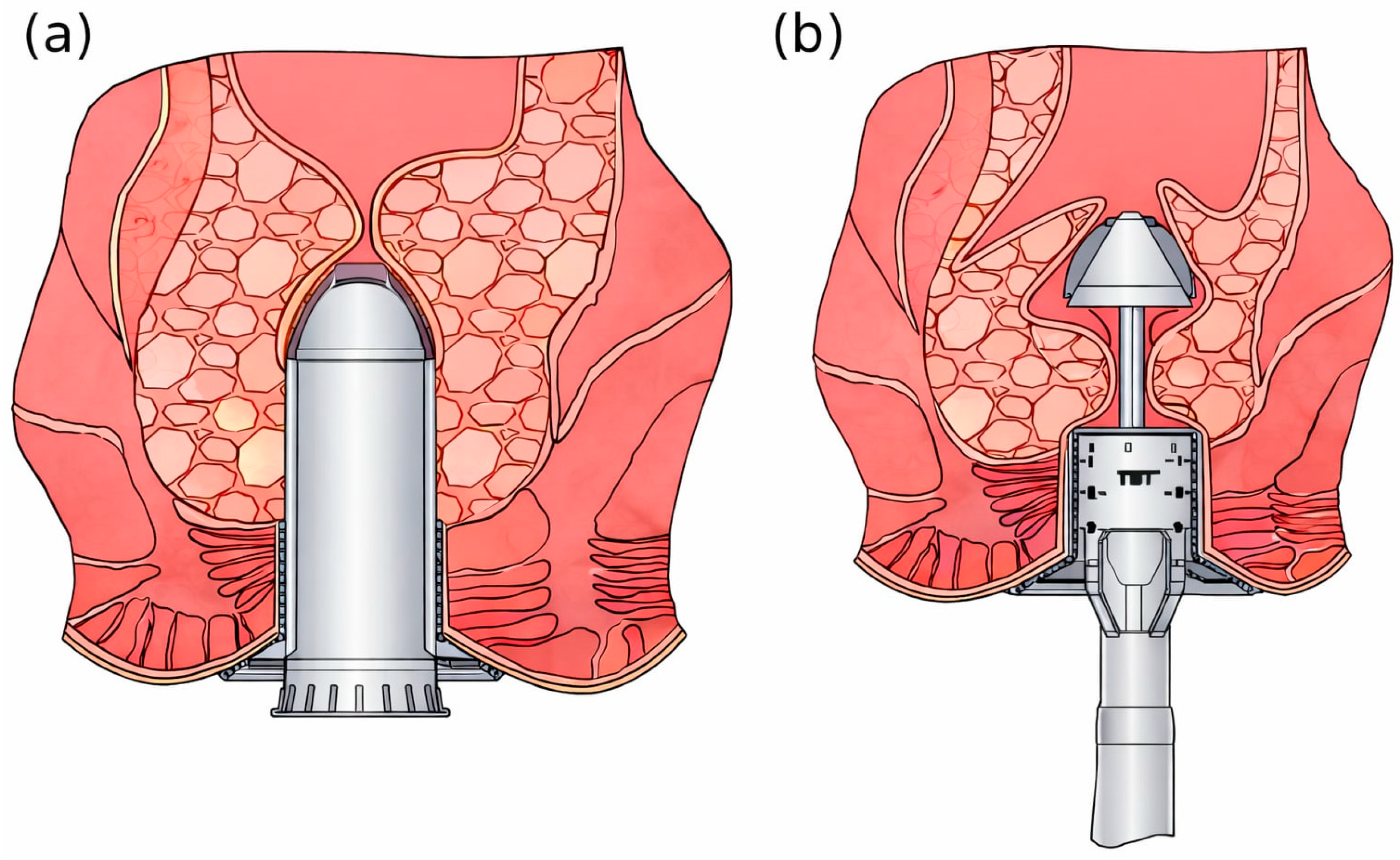
TS-CSH procedures were performed under “saddle block” type anesthesia (SBA; n = 21) or short-term total intravenous (TIVA; n = 3) anesthesia using the TST-36 stapling device (Touchstone International Medical Science Co., Ltd., Suzhou, China) with an anvil diameter of 36 mm delivering double-row titanium staple lines. The anus was fully expanded using a lubricated circular anal dilator (CAD) in a way that allowed pulling the protruding hemorrhoidal tissue. (Figure 1a) Then, the CAD was fixed at 4 points to the perianal skin using simple interrupted sutures. A continuous circumferential purse-string suture was performed on the mucosal and the submucosal layers, 2–3 cm above the dentate line. The circular stapler had been fully opened, and the anvil was inserted through the purse-suture line. A knot was made by pulling the purse-string suture so that the hemorrhoidal tissue entered the stapler, encircling the central part of the anvil. (Figure 1b) Then, the stapler was completely closed and, following 1 min of compression time, fired, after which the anvil was loosened and the stapler removed. In women, it is mandatory to investigate the posterior vaginal wall before firing the stapler. The specimen ring is checked. The perianal area and the surgical site were carefully reinvestigated. If the bleeding was present at the staple line, hemostasis was performed with extra conventional sutures and, if necessary, absorbable hemostatic gelatin sponge.
MMH procedures were performed under TIVA (n = 16) and SBA (n = 8). The anus was appropriately dilated, and the number and location of hemorrhoids were observed. Hemorrhoidal columns were clamped by Pean forceps vertically; the external hemorrhoids were dissected beginning from the edge of the perianal skin toward the dentate line, maintaining hemostasis with an electric cauterizer. The internal hemorrhoids were ligated, preserving 0.5–1.0 cm of intact mucosal bridges to minimize the risk of postoperative stenosis. Wounds were investigated carefully, and the hemostasis was ensured with an electric cauterizer and, if necessary, suturing and ligation were done. Anal packing with gelatin sponge was used only if required for adequate hemostasis. A sterile gauze dressing was applied to the perianal area.
The study was conducted as a retrospective analysis of existing medical records only. No additional diagnostic or therapeutic procedures were performed, no intervention was introduced, and no contact with patients occurred for the purposes of this research. Accordingly, the study does not meet the criteria of a medical experiment within the meaning of the Polish Act of 5 December 1996 on the professions of physician and dentist (Journal of Laws 2023, item 1516, as amended), which defines a medical experiment as an interventional procedure performed on a human subject. This legal interpretation was reviewed and confirmed by the Bioethics Committee of the Medical University of Łódź, which stated that the present study does not constitute a medical experiment and therefore does not require approval as an interventional study. All data were processed in compliance with applicable data protection and ethical standards.
Statistical analysis was performed using Statistica 13.3 (TIBCO Software Inc., Palo Alto, CA, USA). For continuous and ordinal variables, the normality of distribution was assessed using the Shapiro–Wilk test. Depending on whether the data followed a normal distribution, Student’s t-test was applied for normally distributed data, while the Mann–Whitney U test was used for data that deviated from a normal distribution. For categorical variables, Pearson’s chi-squared test (χ2) was employed to determine associations between groups. A p-value of less than 0.05 (p < 0.05) was considered statistically significant for all analyses. Data visualizations were prepared using GraphPad Prism 9 (GraphPad Software, San Diego, CA, USA).

3. Results

A total of 48 patients who underwent elective surgical treatment with either TS-CSH (n = 24) or MMH (n = 24) were included. The mean age was 57 ± 10.5 years in the MMH cohort and 51 ± 10.8 years in the TS-CSH cohort. Age difference between groups was not statistically significant (p = 0.054). Both cohorts presented an identical gender distribution, consisting of 12 females and 12 males. According to the Goligher classification, significantly more patients in the MMH group were diagnosed with grade IV hemorrhoids when compared to the TST group. (p = 0.009). (Table 1) Length of hospital stay was comparable: a mean of 3.0 ± 0.00 days for MMH and 3.1 ± 0.45 days for TS-CSH (p = 0.162).
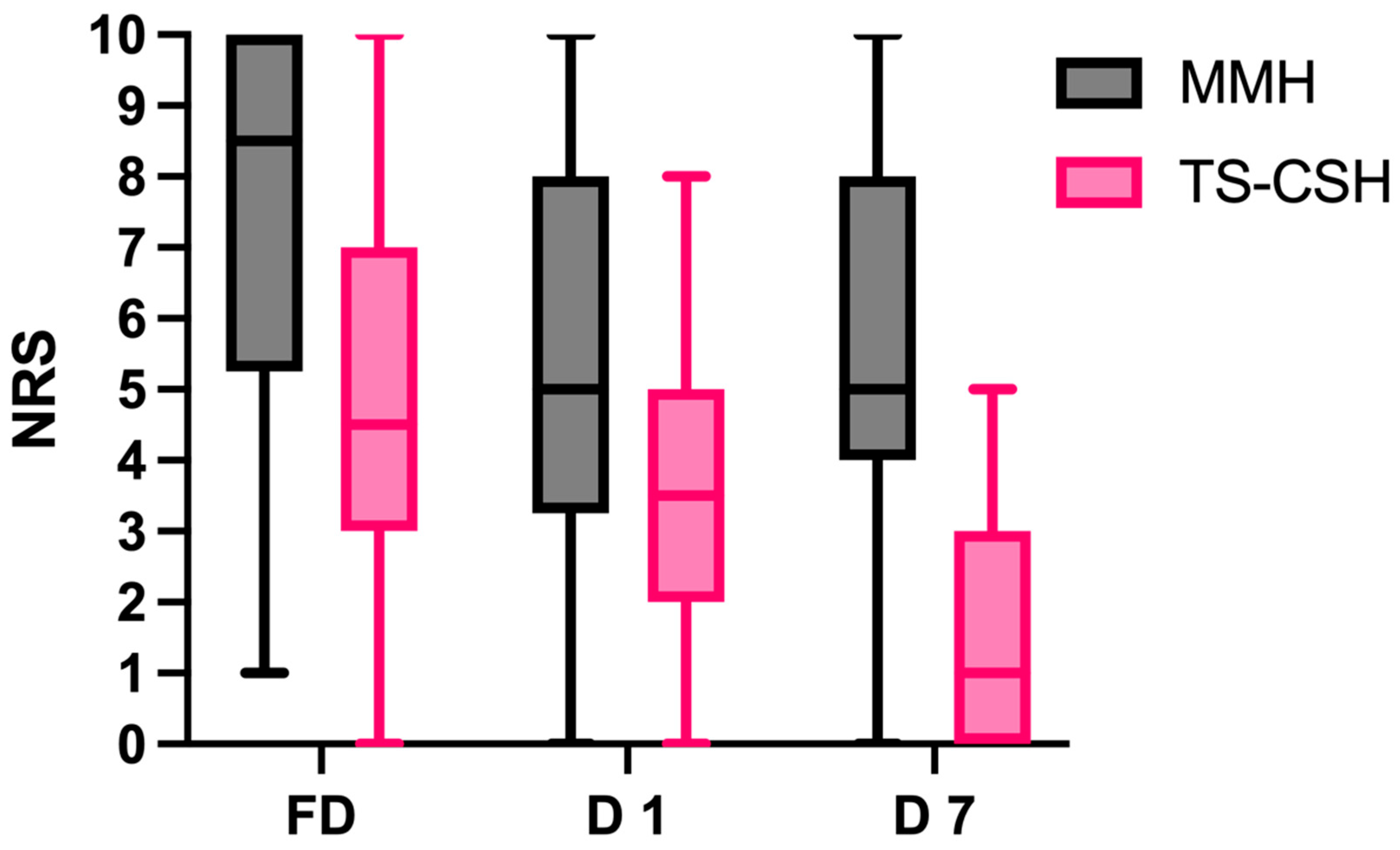
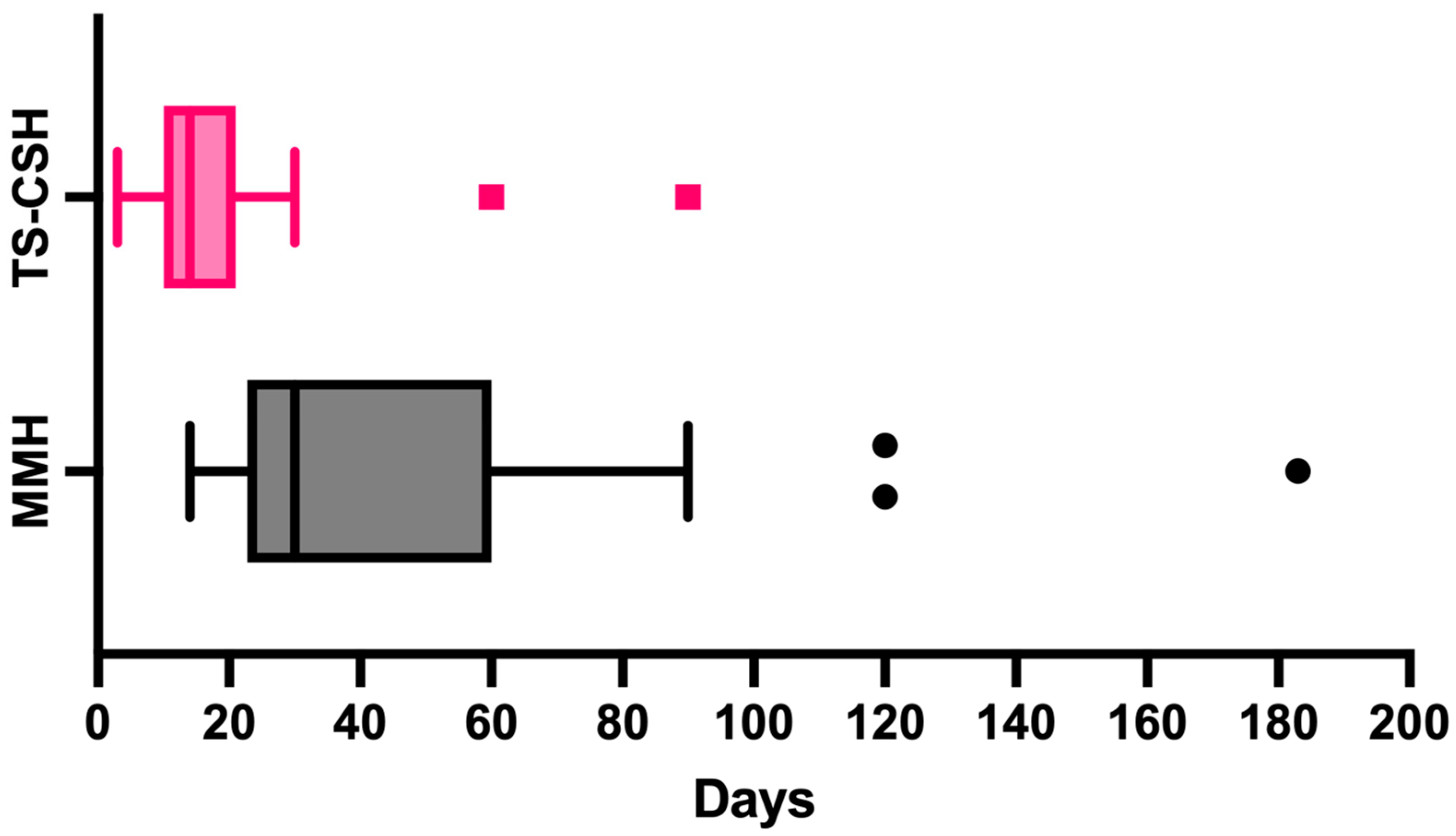
Pain score, according to the NRS, was significantly lower in the TS-CSH group, respectively at first defecation, 24 h, and 7 days postoperatively, when compared to the MMH group. (Figure 2; Table 2) Post-discharge analgesic therapy was required in 45.8% of patients after TST and 79.2% after MMH (p = 0.017). Full recovery time was shorter after TS-CSH—14.0 (IQR 10.0–21.0) days than after MMH—30.0 (IQR 22.8–60.0) days, yielding a statistically significant result (p < 0.001). (Figure 3; Table 2).
Time to first defecation was slightly shorter after TS-CSH (2.5 ± 0.66 days) in comparison to MMH (3.0 ± 0.81 days) and demonstrated statistical significance (p = 0.022). Bladder catheterization was necessary in three patients, all of whom underwent TS-CSH. However, this finding did not meet statistical significance (p = 0.074). In both groups, no bleeding episodes that required additional hemostatic intervention were observed within 30 days postoperatively. In one patient, an anal abscess was identified during postoperative outpatient follow-up after MMH and was successfully drained under transrectal ultrasound guidance. (p = 0.312) (Table 2).
After a minimum follow-up of 3 months, no cases of anal stenosis, rectovaginal fistula, or fecal incontinence were recorded. Ten patients (TS-CSH = 5; MMH = 5) reported defecation difficulties and were invited for additional physical follow-up. No structural pathologies in proctological examination were found. Three TS-CSH patients were classified as presenting symptoms of recurrence: one complained of recurrent bleeding—managed with Barron’s method banding—and two reported inadequate reduction in prolapse—one subsequently underwent a secondary MMH procedure, while the other has not received further treatment yet. The difference in the number of recurrences between the two groups was not statistically significant (p = 0.074). Satisfaction rate was similar in both groups. (Table 2).

4. Discussion

CSH, first described by Antonio Longo in 1998, marked a milestone in the surgical approach to treating hemorrhoidal disease [6]. CSH technique was a remedy for postoperative pain and relatively long time to full recovery related to conventional hemorrhoidectomy techniques such as MMH [12,13]. The advantages of stapled hemorrhoidopexy align with contemporary patient preferences, which emphasize pain reduction and a quick return to daily routines [14]. This study aimed to compare the outcomes of CSH using a new-generation stapler with those of conventional MMH. Our results indicate that TS-CSH is a surgical modality facilitating lower intensity of postoperative pain and shorter full recovery time.
The NRS scores reported by patients in our study were significantly lower in the TS-CSH group, not only during the first defecation but also at 24 h and 7 days after surgery. Furthermore, fewer patients in the TS-CSH group declared the need for post-discharge analgesic therapy (45.8% vs. 79.2%). Pooled results from a systematic review conducted by Singer et al. regarding early postoperative pain (defined as 0–14 days postoperatively) were consistent with our findings, demonstrating lower pain levels following CSH [13]. In our study, the stapled approach was also associated with a shorter full recovery time, in agreement with previously reported findings in the literature. In the same systematic review by Singer et al., the authors analyzed results of 12 trials, all of which reported a shorter recovery period after CSH. However, the threshold for statistical significance was reached in only 8 out of the 12. Singer et al. additionally underscored inherent bias in the assessment of recovery time, also present in our study, based on patients’ expectations, employment, and personal motivation [13].
Further trials, including those by Ammaturo et al. and Panarese et al., consistently reported reduced postoperative pain and shorter recovery time following stapled hemorrhoidectomy [15,16]. The study conducted by Ammaturo et al. employed a double-blinded randomized design, with randomization stratified according to initial symptom severity and bowel habits. Moreover, all patients in their study presented with grade III hemorrhoids, in contrast to our study, in which patients qualified for TS-CSH were compared with those undergoing MMH performed in parallel at our institution, without inclusion of disease grade as a matching criterion [15]. This methodological difference may suggest that lower pain levels observed in the TS-CSH group in our study could have been influenced by baseline disease severity, with a higher proportion of patients presenting grade IV hemorrhoids in the MMH group. Nevertheless, placement of the staple line above the dentate line, in an area lacking somatic pain innervation, together with preservation of the anoderm during the TS-CSH procedure, provides a plausible explanation for lower postoperative pain that appears to be independent of disease grade. A potential patient selection bias present in our study was also observed in a study by Panigrahi et al. Despite these limitations, their findings support the concept of lower postoperative pain following the stapled approach, irrespective of initial disease grade, as demonstrated by reduced pain levels in the cohort, including both grade III and IV hemorrhoids. Additionally, their study was subject to another potential selection bias, as patients influenced the choice of surgical technique. However, lower pain levels in the stapled hemorrhoidectomy were consistently reported [17].
What is more, differences in anesthesia type in our study may affect pain perception during the first postoperative hours. However, in the RCT by Schmittner et al., SBA, predominantly used in our TS-CSH cohort, reduced the need for additional analgesics within the first 24 h after surgery but was associated with higher peak pain levels in the same period when compared with TIVA [18]. Considering the pharmacokinetics of anesthetics commonly used for both SSB and TIVA, as well as their route of administration, the impact of anesthesia type on later pain assessment appears negligible.
Overall, our observations emphasize a consistent trend toward lower postoperative pain levels and shorter time to full recovery as key features of the stapled approach, maintained with the use of new-generation devices.
Secondary outcomes analysis revealed a slightly shorter time to first defecation in the TS-CSH group when compared to MMH. This finding is consistent with a systematic review carried out by Tjandra et al., encompassing seven RCTs, which reported faster functional recovery following stapled hemorrhoidopexy. In their analysis, return of bowel movements resumed within 24 h in over 57% of patients undergoing CSH in comparison to 32.5% of patients after conventional hemorrhoidectomy [19].
In our study, the need for bladder catheterization was more frequent following the stapled approach. Systematic review and meta-analysis by Jin et al. reported no statistically significant difference in the incidence of postoperative urinary retention (POUR), with a POUR frequency of 8.15% of 4652 patients undergoing conventional hemorrhoidectomy across 63 RCTs, compared to 8.7% of 2061 patients after CSH across 21 RCTs. Similar results were observed in non-RCT trials [20]. The cause of this observation in our study may be the result of differences in the type of anesthesia between the groups. The choice of anesthesia method, given the lack of clear recommendations for the TS-CSH or MMH procedures, was based on the anesthesiologist’s experience and institutional practice. In our study, the majority of patients undergoing TS-CSH received SBA, whereas in the MMH group, TIVA, a form of general anesthesia, was predominantly used. SBA is a specific type of spinal anesthesia that targets lower sacral spinal segments and has been associated with lower rates of POUR compared with conventional spinal analgesia (0.3–3.4% vs. 17.3%) [21]. Nevertheless, all cases of POUR observed in our study occurred in patients who received SBA. This trend is consistent with findings reported in previous studies. As summarized by Baldini et al., POUR is more frequently observed in patients undergoing spinal anesthesia than in those receiving general anesthesia, with reported retention rates of 23.0% and 17.2%, respectively [22].
Some of the previous studies have questioned the safety and effectiveness of CSH performed with the first generation of staplers. Due to the occurrence of complications and a higher recurrence rate in comparison with MMH.
Anal stenosis (AS) represents one of the most serious complications following surgical treatment of hemorrhoidal disease and has been a recurrent subject of CSH safety concerns. Khubchandani et al. highlighted this issue in their survey, reporting that 15.6% of surgeons who had ever performed CSH encountered anal stenosis as a postoperative complication [23]. It should be emphasized that after stapled surgery, narrowing of the anal canal is the result of staple line stenosis, as opposed to true anal stenosis that occurs following conventional techniques such as MMH. Despite having quite similar symptomatology, the treatment of these complications differs. However, for scientific purposes, in the majority of studies, both clinical situations are categorized as “anal stenosis”. Incidence of this type of complication ranges from 0 to 6% after conventional hemorrhoidectomy and 0–5% following CSH performed with first-generation staplers [24,25]. Moreover, Sturiale et al. noted that the first generation of stapling devices presented poorer anatomical and symptomatic outcomes, as well as higher complication rates [26]. Currently used staplers, such as the TST-36, offer a wider anvil (up to 36 mm) and windows that enhance visual control of the pursed mucosa—features that may contribute to reducing the risk of postoperative stricture. Only a few studies have evaluated the impact of newer devices on CSH outcomes. Sturiale et al. reported only a single case of stenosis among 59 patients treated with a high-volume TST device [27]. In our study, a similar device was used, and no cases of AS were observed among 24 patients who underwent TS-CSH. These findings provide additional evidence in support of the safety of this procedure and highlight the need for further studies.
Nevertheless, the development of stenosis after CSH may be associated with the circumferential nature of excision [28]. Analogously, for this reason, MMH in some cases is performed as a two-step surgery to enable the preservation of intact mucosal bridges between resected columns—a key strategy for reducing risk of postoperative stricture [29]. Studies from China and South Korea have suggested that mirroring this part of conventional hemorrhoidal excision in partial stapled hemorrhoidopexy (PSH) can further minimize the risk of stenosis [30,31]. The flexibility of new-generation stapling devices allows surgeons to perform PSH using the same stapler kit as in TS-CSH. PSH remains the subject of ongoing research, but it is a promising modification of SH for future application [32].
In women, rectovaginal fistula (RVF) represents a rare but procedure-specific complication of stapled hemorrhoidopexy. Based on Food and Drug Agency (FDA) reports, Pescatori et al. reported only two cases of RVF following procedures performed with PPH Stapler (an earlier-generation device), suggesting RVF is an occasional event with a relatively simple prevention strategy [33]. Careful intraoperative inspection of the posterior vaginal wall before stapler firing, as performed routinely during this study, appears to effectively prevent this complication [27,33].
Although satisfaction rates following both procedures were comparable, we identified three patients as presenting with symptoms of recurrence, all in the TS-CSH group, corresponding to an incidence of 12.5% in this cohort. The interpretation of this finding requires consideration of both historical and contemporary data on recurrence after CSH.
Early reports associated higher recurrence with the first-generation stapler, whose design limited the volume of excised tissue [26]. At that time, inclusion of deeper layers beyond the mucosa was considered by some surgeons as a technical mistake, raising concerns about complications. However, subsequent studies, such as that of Eberspacher et al., demonstrated that most resected specimens contained submucosal tissue and muscle fibres, suggesting that removal of larger tissue volumes is safe and may positively impact recurrence rates without increasing the risk of complications [34].
Indeed, Jin et al., across RCTs, reported recurrence rates of 7.81% for CSH and 4.88% for MMH. In non-RCTs, the recurrence rates were 11.44% and 5.33%, respectively, representing a gradual decline compared with previous systematic reviews, in which recurrence after CSH ranged approximately from 0 to 26% [20]. More recent data on high-volume staplers, similar to those used at our hospital, show a recurrence rate as low as 5.1% [27], whereas in cohorts that underwent CSH with first-generation staplers, such as in the study by Sturiale et al., self-reported recurrence reached nearly 41% [7]. Our findings are therefore more consistent with contemporary evidence, supporting improvement of CSH outcomes when a new-generation stapler was used.
The higher recurrence in the TS-CSH group compared to MMH in our study may not necessarily reflect an inherent limitation of the technique itself, but rather suboptimal patient selection. Proper patient qualification has been highlighted as a critical factor for favourable postoperative outcomes, including recurrence rates, as emphasized in the review by Ciesielski et al. [35]. TS-CSH primarily targets the internal hemorrhoidal plexus and may be less effective in advanced disease, particularly when external components predominate. Accurately assessing the contribution of the external component and determining the appropriate threshold for TS-CSH can often be clinically challenging, which may lead to patients being selected for TS-CSH despite potentially benefiting more from MMH in terms of recurrence risk. This limitation in preoperative assessment likely contributed to suboptimal patient qualification that may have occurred in this study. Moreover, the absence of a clear definition of recurrence remains an important source of bias across studies.
These observations highlight the importance of meticulous preoperative assessment in tailoring the surgical approach. Although the Goligher classification remains the most widely used system, it reduces complex anatomical situations to a single criterion of prolapse and its reducibility. As Dekker et al. noted, a single prolapsing hemorrhoid may be categorized at the same grade as a circumferential prolapse [36], which may partly explain the lack of standardized surgical recommendations. Both European and American guidelines agree on the general indication for surgery but do not advocate for one specific technique [37]. Within this context, TS-CSH appears particularly suitable in cases of circumferential prolapse [35], predominance of internal component, or when hemorrhoidal columns are localized closely to each other [9]. By enabling full circumferential resection, TS-CSH may additionally reduce the need for a second procedure, as is sometimes required with MMH. Extending the classification to include clearly defined criteria for the contribution of the internal or external hemorrhoidal plexus, as well as the circumferential nature of the prolapse or the distance between hemorrhoidal columns, could provide more explicit indications for each procedure, optimizing patient benefits and helping to prevent unnecessary recurrences.
However, several limitations of the study should be acknowledged. The relatively small sample size and variable observation time could have led to an underestimation of potential long-term complications. Patient selection in this study was subject to potential bias because disease severity was not included in the matching process. Differences in anesthesia methods between the TS-CSH and MMH groups may have influenced immediate postoperative pain perception, although their effect on longer-term pain outcomes appears to be negligible. Detailed information regarding the type and dosages of anesthetic and analgesic agents was not reliably obtainable. In addition, post-discharge analgesic use was based on the patient’s subjective pain perception without predefined criteria. Future research should validate these findings in larger-scale, prospective studies with standardized anesthetic care, structured post-discharge analgesic therapy, and a detailed follow-up period.

5. Conclusions

CSH performed with a new generation of staplers, such as the TST-36, is minimally invasive, feasible, and a safe technique for treating grade III or IV hemorrhoids, particularly when internal cushions are predominant. Nevertheless, comprehensive patient selection is essential to achieve successful results and avoid early recurrence of symptoms. TS-CSH should be considered as an alternative to conventional hemorrhoidectomy, associated with a trend toward lower pain and faster return to daily activities while maintaining a comparable satisfaction rate.

Author Contributions

Conceptualization, K.M., J.W. and J.A.; methodology, J.W., J.A. and K.M.; software, J.A. and J.W.; validation, J.W., J.A., A.S. and M.W.; formal analysis, J.W. and J.A.; investigation, J.W., J.A., A.S., K.M. and I.B.; resources, Ł.D., M.W. and C.L.; data curation, J.W., J.A. and A.S.; writing—original draft preparation, K.M., J.W., J.A. and A.S.; writing—review and editing, J.W., J.A. and A.S.; visualization, A.S.; supervision, Ł.D.; project administration, K.M. and J.W. All authors have read and agreed to the published version of the manuscript.

Funding

This research received no external funding.

Institutional Review Board Statement

Ethical review and approval were waived for this study due to the retrospective character of the study.

Informed Consent Statement

Informed consent was obtained from all subjects involved in the study.

Data Availability Statement

The original contributions presented in this study are included in the article. Further inquiries can be directed to the corresponding author.

Conflicts of Interest

The authors declare no conflicts of interest.

Abbreviations

The following abbreviations are used in this manuscript:
CSHcircular stapled hemorrhoidopexy
MMHMilligan–Morgan hemorrhoidectomy
TS-CSHTST-stapler circular stapled hemorrhoidopexy
ASA-PSAmerican Society of Anesthesiologists Physical Status Classification System
EHRselectronic health records
NRSNumeric Rating Scale (pain score)
CADcircular anal dilator
TIVAshort-term intravenous anesthesia
SBA“saddle block” type anesthesia

References

  1. Sun, Z.; Migaly, J. Review of Hemorrhoid Disease: Presentation and Management. Clin. Colon Rectal Surg. 2016, 29, 22–29. [Google Scholar] [CrossRef]
  2. Riss, S.; Weiser, F.A.; Schwameis, K.; Riss, T.; Mittlböck, M.; Steiner, G.; Stift, A. The Prevalence of Hemorrhoids in Adults. Int. J. Color. Dis. 2012, 27, 215–220. [Google Scholar] [CrossRef]
  3. Samalavicius, N.E.; Gupta, R.K.; Nunoo-Mensah, J.; Fortunato, R.; Lohsiriwat, V.; Khanal, B.; Kumar, A.; Sah, B.; Cerkauskaite, D.; Dulskas, A.; et al. Global Treatment of Haemorrhoids—A Worldwide Snapshot Audit. Color. Dis. 2024, 26, 1797–1804. [Google Scholar] [CrossRef]
  4. Ng, K.-S.; Holzgang, M.; Young, C. Still a Case of “No Pain, No Gain”? An Updated and Critical Review of the Pathogenesis, Diagnosis, and Management Options for Hemorrhoids in 2020. Ann. Coloproctol. 2020, 36, 133–147. [Google Scholar] [CrossRef]
  5. Milligan, E.T.C.; Naunton Morgan, C.; Jones, L.E.; Officer, R. Surgical Anatomy of the Anal Canal, and the Operative Treatment of Hæmorrhoids. Lancet 1937, 230, 1119–1124. [Google Scholar] [CrossRef]
  6. Longo, A. Treatment of Haemorrhoid Disease by Reduction in Mucosal and Haemorrhoidal Products with a Circular Stapling Device—New Procedure. In Proceedings of the 6th World Congress of Endoscopic Surgery, Rome, Italy, 31 May–6 June 1998. [Google Scholar]
  7. Sturiale, A.; Fabiani, B.; Menconi, C.; Cafaro, D.; Fusco, F.; Bellio, G.; Schiano di Visconte, M.; Naldini, G. Long-Term Results after Stapled Hemorrhoidopexy: A Survey Study with Mean Follow-Up of 12 Years. Tech. Coloproctol. 2018, 22, 689–696. [Google Scholar] [CrossRef]
  8. Lumb, K.J.; Colquhoun, P.H.D.; Malthaner, R.A.; Jayaraman, S. Stapled versus Conventional Surgery for Hemorrhoids. Cochrane Database Syst. Rev. 2006, 2006, CD005393. [Google Scholar] [CrossRef] [PubMed]
  9. Kim, J.-S.; Vashist, Y.K.; Thieltges, S.; Zehler, O.; Gawad, K.A.; Yekebas, E.F.; Izbicki, J.R.; Kutup, A. Stapled Hemorrhoidopexy versus Milligan-Morgan Hemorrhoidectomy in Circumferential Third-Degree Hemorrhoids: Long-Term Results of a Randomized Controlled Trial. J. Gastrointest. Surg. 2013, 17, 1292–1298. [Google Scholar] [CrossRef] [PubMed]
  10. Goligher, J.C. Haemorrhoids or Piles. In Surgery of the Anus, Rectum and Colon, 4th ed.; Baillière Tindall: London, UK, 1980; pp. 93–135. [Google Scholar]
  11. Karcioglu, O.; Topacoglu, H.; Dikme, O.; Dikme, O. A Systematic Review of the Pain Scales in Adults: Which to Use? Am. J. Emerg. Med. 2018, 36, 707–714. [Google Scholar] [CrossRef] [PubMed]
  12. Mehigan, B.J.; Monson, J.R.; Hartley, J.E. Stapling Procedure for Haemorrhoids versus Milligan-Morgan Haemorrhoidectomy: Randomised Controlled Trial. Lancet 2000, 355, 782–785. [Google Scholar] [CrossRef]
  13. Singer, M.; Abcarian, H. Stapled Hemorrhoidopexy: The Argument for Usage. Clin. Colon Rectal Surg. 2004, 17, 131–142. [Google Scholar] [CrossRef]
  14. Chen, P.-C.; Chen, C.-I. Exploring Factors Impacting Patient Decisions in Hemorrhoid Surgery: A Questionnaire Survey in Taiwan. Surg. Open Sci. 2024, 6, 214–221. [Google Scholar] [CrossRef]
  15. Ammaturo, C.; Tufano, A.; Spiniello, E.; Sodano, B.; Iervolino, E.M.; Brillantino, A.; Braccio, B. Stapled Haemorrhoidopexy vs. Milligan-Morgan Haemorrhoidectomy for Grade III Haemorrhoids: A Randomized Clinical Trial. G. Chir.-J. Ital. Surg. Assoc. 2012, 33, 346–351. [Google Scholar]
  16. Panarese, A.; Pironi, D.; Vendettuoli, M.; Pontone, S.; Arcieri, S.; Conversi, A.; Romani, A.M.; Filippini, A. Stapled and Conventional Milligan–Morgan Haemorrhoidectomy: Different Solutions for Different Targets. Int. J. Color. Dis. 2012, 27, 483–487. [Google Scholar] [CrossRef] [PubMed]
  17. Panigrahi, S.K.; Behera, C.R.; Mishra, S.; Kanungo, A. Stapled hemorrhoidopexy versus Milligan-Morgan haemorrhoidectomy: A paradigm shift in the management of 3rd and 4th degree hemorrhoids. Int. Surg. J. 2018, 5, 209–215. [Google Scholar] [CrossRef]
  18. Schmittner, M.D.; Schreiber, H.; Janke, A.; Weiss, C.; Blunk, J.; Bussen, D.G.; Luecke, T. Randomized clinical trial of perianal surgery performed under spinal saddle block versus total intravenous anaesthesia. Br. J. Surg. 2010, 97, 12–20. [Google Scholar] [CrossRef]
  19. Tjandra, J.J.; Chan, M.K.Y. Systematic Review on the Procedure for Prolapse and Hemorrhoids (Stapled Hemorrhoidopexy). Dis. Colon Rectum 2007, 50, 878–892. [Google Scholar] [CrossRef]
  20. Jin, J.Z.; Men, V.; Bahl, P.; Penneru, H.; Yang, R.; Shah, N.; Hill, A.G. The Prevalence of Incontinence after Excisional Hemorrhoidectomy and Stapled Hemorrhoidopexy: A Systematic Review and Meta-Analysis. Surgery 2025, 180, 109139. [Google Scholar] [CrossRef] [PubMed]
  21. Peterson, K.J.; Dyrud, P.; Johnson, C.; Blank, J.J.; Eastwood, D.C.; Butterfield, G.E.; Stekiel, T.A.; Peterson, C.Y.; Ludwig, K.A.; Ridolfi, T.J. Saddle Block Anesthetic Technique for Benign Outpatient Anorectal Surgery. Surgery 2022, 171, 615–620. [Google Scholar] [CrossRef]
  22. Baldini, G.; Bagry, H.; Aprikian, A.; Carli, F. Postoperative urinary retention: Anesthetic and perioperative considerations. Anesthesiology 2009, 110, 1139–1157. [Google Scholar] [CrossRef]
  23. Khubchandani, I.; Fealk, M.H.; Reed, J.F. Is there a post-PPH syndrome? Tech. Coloproctol. 2009, 13, 141–144. [Google Scholar] [CrossRef]
  24. Madoff, R.D.; Fleshman, J.W.; American Gastroenterological Association Clinical Practice Committee. American Gastroenterological Association Technical Review on the Diagnosis and Treatment of Hemorrhoids. Gastroenterology 2004, 126, 1463–1473. [Google Scholar] [CrossRef]
  25. Petersen, S.; Hellmich, G.; Schumann, D.; Schuster, A.; Ludwig, K. Early Rectal Stenosis Following Stapled Rectal Mucosectomy for Hemorrhoids. BMC Surg. 2004, 4, 6. [Google Scholar] [CrossRef]
  26. Sturiale, A.; Fabiani, B.; Menconi, C.; Cafaro, D.; Celedon Porzio, F.; Naldini, G. Stapled Surgery for Hemorrhoidal Prolapse: From the Beginning to Modern Times. Rev. Recent Clin. Trials 2021, 16, 39–53. [Google Scholar] [CrossRef]
  27. Sturiale, A.; Dowais, R.; Fabiani, B.; Menconi, C.; Celedon Porzio, F.; Coli, V.; Naldini, G. Long-Term Outcomes of High-Volume Stapled Hemorrhoidopexy to Treat Symptomatic Hemorrhoidal Disease. Ann. Coloproctol. 2023, 39, 11–16. [Google Scholar] [CrossRef]
  28. Lin, H.-C.; Ren, D.-L.; He, Q.-L.; Peng, H.; Xie, S.-K.; Su, D.; Wang, X.-X. Partial Stapled Hemorrhoidopexy versus Circular Stapled Hemorrhoidopexy for Grade III–IV Prolapsing Hemorrhoids: A Two-Year Prospective Controlled Study. Tech. Coloproctol. 2012, 16, 337–343. [Google Scholar] [CrossRef] [PubMed]
  29. Brisinda, G.; Vanella, S.; Cadeddu, F.; Marniga, G.; Mazzeo, P.; Brandara, F.; Maria, G. Surgical Treatment of Anal Stenosis. World J. Gastroenterol. 2009, 15, 1921–1928. [Google Scholar] [CrossRef] [PubMed]
  30. Zhang, G.; Liang, R.; Wang, J.; Ke, M.; Chen, Z.; Huang, J.; Shi, R. Network Meta-Analysis of Randomized Controlled Trials Comparing the Procedure for Prolapse and Hemorrhoids, Milligan-Morgan Hemorrhoidectomy and Tissue-Selecting Therapy Stapler in the Treatment of Grade III and IV Internal Hemorrhoids. Int. J. Surg. 2020, 74, 53–60. [Google Scholar] [CrossRef]
  31. Jeong, H.; Hwang, S.; Ryu, K.O.; Lim, J.; Kim, H.T.; Yu, H.M.; Yoon, J.; Lee, J.Y.; Kim, H.R.; Choi, Y.G. Early Experience with a Partial Stapled Hemorrhoidopexy for Treating Patients with Grades III–IV Prolapsing Hemorrhoids. Ann. Coloproctol. 2017, 33, 28–34. [Google Scholar] [CrossRef]
  32. Kang, S.I. Latest Research Trends on the Management of Hemorrhoids. J. Anus Rectum Colon 2025, 9, 179–191. [Google Scholar] [CrossRef] [PubMed]
  33. Pescatori, M.; Gagliardi, G. Postoperative Complications after Procedure for Prolapsed Hemorrhoids (PPH) and Stapled Transanal Rectal Resection (STARR) Procedures. Tech. Coloproctol. 2008, 12, 7–19. [Google Scholar] [CrossRef]
  34. Eberspacher, C.; Magliocca, F.M.; Pontone, S.; Mascagni, P.; Fralleone, L.; Gallo, G.; Mascagni, D. Stapled Hemorrhoidopexy: “Mucosectomy or Not Only Mucosectomy, This Is the Problem”. Front. Surg. 2021, 8, 655257. [Google Scholar] [CrossRef] [PubMed]
  35. Ciesielski, P.; Kołodziejczak, M. Stapled haemorrhoidopexy versus conventional haemorrhoidectomy–benefits and limitations. Nowa Med. 2023, 30, 113–119. [Google Scholar] [CrossRef]
  36. Dekker, L.; Han-Geurts, I.J.M.; Grossi, U.; Gallo, G.; Veldkamp, R. Is the Goligher Classification a Valid Tool in Clinical Practice and Research for Hemorrhoidal Disease? Tech. Coloproctol. 2022, 26, 387–392. [Google Scholar] [CrossRef] [PubMed]
  37. Ciesielski, P.; Kołodziejczak, M.; Kucharczyk, A.; Diuwe, P. Therapeutic standards for haemorrhoidal disease in Europe and the United States. Nowa Med. 2021, 28, 67–79. [Google Scholar] [CrossRef]
Figure 1. Schematic overview of the TS-CSH method: (a) circular anal dilator in situ; (b) TST stapler with purse-string suture 2–3 cm above the dentate line.
Applsci 16 01765 g001
Figure 2. NRS pain score: FD—at first defecation; D 1—24 h after surgery; D 7—7 days after surgery. Boxes represent the interquartile range (IQR, 25th–75th percentile) with the line indicating the median. Whiskers extend to the most extreme values within 1.5 × IQR from the quartiles.
Applsci 16 01765 g002
Figure 3. Full recovery time. Boxes represent the interquartile range (IQR, 25th–75th percentile) with the line indicating the median. Whiskers extend to the most extreme values within 1.5 × IQR from the quartiles; points outside this range are shown as outliers.
Applsci 16 01765 g003
Table 1. Demographic and clinical characteristics of patients.
TS-CSHMMHp Value
Patients; n2424-
Sex; male:female12:1212:12-
Average age (±SD)51 (±10.8)57 (±10.5)0.054
Goligher classification, nGrade III1780.009
Grade IV716
Hospital stay, days (±SD) 3.1 (±0.45)3.0 (±0.0)0.162
Type of anesthesia, nTIVA316-
SBA218
Table 2. Primary and key secondary results.
TS-CSHMMHp Value
Pain, NRS score
At first defecation, median (IQR)4.5 (3.0–7.0)8.5 (5.25–10.0)0.003
24 h postoperatively, median (IQR)3.5 (2.0–5.0)5.0 (3.25–8.0)0.016
7 days postoperatively, median (IQR)1.0 (0.0–3.0)5.0 (4.0–8.0)p < 0.001
Full recovery time; days: median (IQR)14.0 (10.0–21.0)30.0 (22.8–60.0)p < 0.001
Time to first defecation; days (±SD)2.50 (±0.66)3.00 (±0.81)0.022
Urinary retention *; n300.074
Analgetic requirements **; n (%)11 (45.8)19 (79.2)0.017
Fecal incontinence; n00-
Anal stenosis; n00-
Recurrence; n300.074
Satisfaction; n
Satisfied21220.837
Partially satisfied21
Dissatisfied11
* necessity of catheterization; ** whether analgesic treatment was required after discharge.
Disclaimer/Publisher’s Note: The statements, opinions and data contained in all publications are solely those of the individual author(s) and contributor(s) and not of MDPI and/or the editor(s). MDPI and/or the editor(s) disclaim responsibility for any injury to people or property resulting from any ideas, methods, instructions or products referred to in the content.