Article

Microplastics in Two Tropical Andean Lakes: Contrasting Human-Impacted and Minimally Disturbed Watersheds


by
Andrés Arévalo-Moreno
1,
Silvana Gallegos-Sánchez
2,
Kevin Valencia
3 and
Ibon Tobes
1,*
1
Centro de Investigación de la Biodiversidad y Cambio Climático (BioCamb), Facultad de Ciencias de Medio Ambiente, Universidad Tecnológica Indoamérica, Quito 170301, Ecuador
2
Ecoforensic CIC, Brighton, England BN1 1HW, UK
3
Fundación Museos de la Ciudad, Yaku Parque Museo del Agua, Quito 170407, Ecuador
*
Author to whom correspondence should be addressed.
Appl. Sci. 2026, 16(4), 1708; https://doi.org/10.3390/app16041708
Submission received: 25 December 2025 / Revised: 13 January 2026 / Accepted: 16 January 2026 / Published: 9 February 2026
(This article belongs to the Special Issue Analysis and Monitoring of Emerging Contaminants and Pollutants)

Abstract

Microplastics (MPs) are emerging contaminants in freshwater systems, yet their sources and transport pathways in tropical high-altitude lakes remain poorly understood. This study quantified and characterized MPs in two Andean lakes in Ecuador with contrasting watershed conditions: San Pablo (2672 m a.s.l.), influenced by agricultural and urban land use, and Caricocha (3724 m a.s.l.), a protected high-Andean lake. Sixteen samples per lake were collected during four field campaigns. MPs were identified using visual and morphological criteria, and classified by shape, color, and size. MP concentrations were higher in San Pablo (238 ± 32 MP m−3, mean ± SD) than in Caricocha (32 ± 10 MP m−3). Fibers dominated (87.3%), followed by fragments, while microspheres were detected only in Caricocha. MP concentrations showed positive correlations with urban-agricultural land use (ρ = 0.87, p < 0.0001) and negative correlations with natural vegetation cover (ρ = −0.87, p < 0.0001). Principal Component Analysis linked fiber abundance and small size classes (<500 µm) and anthropogenic land use, consistent with surface runoff and wastewater-associated pathways. In contrast, MPs in the protected lake may originate from long-range atmospheric deposition. These results indicate that watershed configuration and protection status shape MP inputs in high-Andean lakes.

1. Introduction

Microplastics (MPs) are now ubiquitous across ecosystems worldwide, and freshwater habitats are emerging as major sinks for these pollutants [1,2]. In lotic systems, microplastics are more commonly detected near the water surface due to continuous flow and turbulence, whereas in lentic waters, limited flow movement can facilitate their accumulation in deeper layers and bottom sediments [3]. In lakes, microplastics have been detected in all water columns in different forms, colors, and sizes (<5 mm) [4]. It is known that plastic debris now interferes with lake biogeochemical cycles and can be found in aquatic animal tissues [5].
Studies have shown that the most common pathways through which microplastics enter these ecosystems include surface runoff, in situ plastics degradation, wastewater discharge, and atmospheric deposition through precipitation [6]. Once introduced, microplastic particles can persist for extended periods in the aquatic environment for years due to their high resistance to degradation, leading to their continuous accumulation [7]. In this context, lentic ecosystems have been identified as potential sinks for microplastics, which can be temporary or permanent, depending on the residence time of the water [8].
In Ecuador, studies on the presence of microplastics have primarily focused on lotic ecosystems (rivers and streams). Despite growing evidence of MP contamination in rivers, knowledge about lentic systems remains scarce, even though lakes play a critical role in national and regional water supply and biodiversity. Research has documented microplastic pollution in the Pita, San Pedro, and Guayllabamba rivers, which are key freshwater sources for the Metropolitan District of Quito, highlighting the impact of urban wastewater discharges and solid waste mismanagement in densely populated areas [9]. Similarly, the Napo River, one of the main tributaries of the Amazon basin, has shown microplastic contamination in its sediments, particularly in Misahualli riparian areas, both important for their ecological and touristic functions [10]. In the coastal region, Capparelli et al. [11] reported the presence of microplastics in rivers and coastal waters of Esmeraldas Province, while Talbot et al. [12] documented similar findings in Guayas Province, highlighting the influence of industrial activities, port operations, and urban runoff on marine and estuarine environments.
Compared to rivers, lentic ecosystems have received far less attention regarding microplastic contamination. López et al. [13] documented the occurrence of microplastics in the La Segua wetland, located in the province of Manabí. This wetland, recognized as a RAMSAR site, is crucial for biodiversity conservation and serves as a natural filter for pollutants. Their study identified both fibers and fragments, suggesting that anthropogenic activities in nearby urban centers and agricultural zones contribute significantly to microplastic input.
There is a growing consensus that land use within watershed catchments plays a decisive role in the distribution and concentration of microplastics in aquatic systems [9,14]. Areas dominated by urban land cover tend to exhibit higher concentrations of microplastics due to the increased presence of diffuse sources such as contaminated stormwater runoff, domestic discharges, poor waste management, and intensive recreational activities [15,16,17]. In contrast, buffer zones with natural or semi-natural vegetation can act as biophysical barriers, reducing the transport of microplastics from terrestrial areas to water bodies and thereby improving the quality of aquatic ecosystems [18]. These relationships have been observed in both urban and rural contexts and are particularly relevant in high-mountain ecosystems, where topography, land use, and vegetation cover significantly influence the retention, degradation, and transport of microplastics [19,20]. However, meteorological factors such as rainfall, wind, and seasonality can also modulate MPs’ abundances. For example, in the high Andean mountains of Ecuador, microplastics have been observed in glaciers, transported by wind and deposited in surface snow [21].
Understanding how land-use patterns and hydrological context shape microplastic dynamics is essential for predicting the vulnerability of high-Andean freshwater systems, which are increasingly exposed to diffuse pollution. Given their distinct hydrological and geological characteristics, lakes may play a unique role in the transport and retention of microplastics [22]. In Ecuador, most lakes have undergone ecological transformations over recent decades due to increasing land-use change and human pressure, impacting their functionality and water quality [23,24].
Although there is growing evidence of MP pollution in tropical rivers, high-altitude lakes remain understudied, especially regarding the potential influence of land-based and atmospheric pathways. Therefore, this study aimed to quantify and compare microplastic concentrations and typology in the surface waters of two contrasting Andean lakes with different watershed areas, configurations, and degrees of human impact. These systems also differ markedly in size (San Pablo’s watershed is nearly fifteen times larger than Caricocha’s), providing an opportunity to examine how basin scale and hydrological connectivity, as described in the previous literature for these systems, may influence microplastic transport and retention. It was hypothesized that San Pablo Lake, which experiences greater anthropogenic pressure, would exhibit higher microplastic concentrations and a broader diversity of microplastic types based on morphological characteristics compared to the high-altitude, minimally disturbed Caricocha Lake. This study provides the first evidence of microplastic contamination in high-altitude Andean lakes in Ecuador, revealing marked contrasts between systems with varying levels of anthropogenic influence. The findings suggest that watershed configuration and the hydrological setting described for each system are consistent with key controls of microplastic abundance and typology, even in remote mountain environments.

2. Materials and Methods

2.1. Study Area

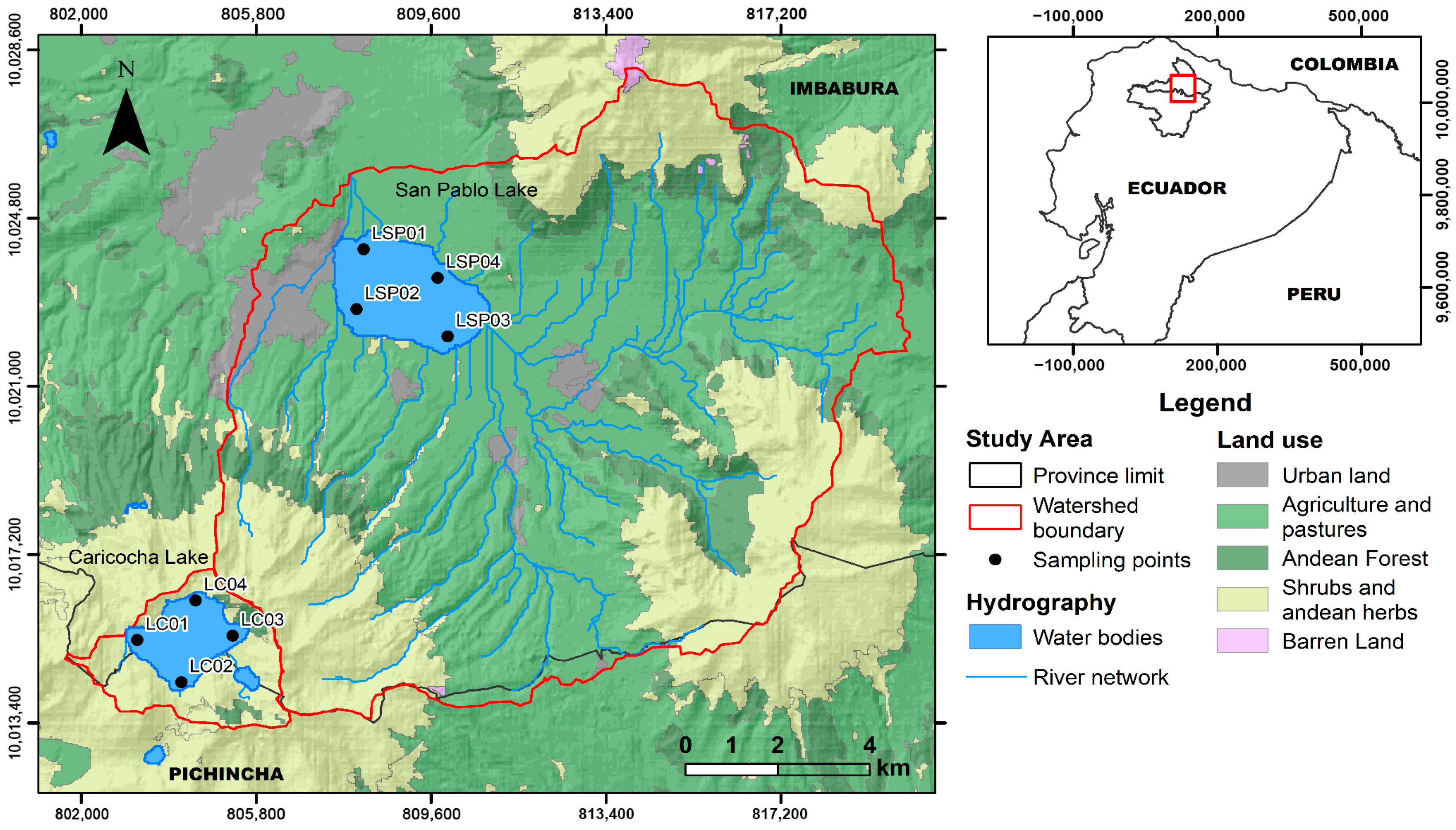
This study was conducted in two contrasting Andean lakes in northern Ecuador, San Pablo Lake (Imbakucha) and Caricocha Lake (Mojanda system), which represent two distinct models of human influence and watershed configuration (Figure 1). Both lakes are located in the inter-Andean region of the Ecuadorian highlands, separated by less than 30 km but differing markedly in size, geomorphology, land-use intensity, and degree of anthropogenic pressure (Table 1).
San Pablo Lake (Imbakucha; 0°12′55″ N, 78°14′16″ W; 2672 m a.s.l.) is the largest natural lake in Ecuador, covering approximately 6.7 km2 with a maximum depth of 35 m [25,26]. It lies at the foothills of the Imbabura volcano in a tectono-volcanic depression and drains through the Jatunyacu River toward the Mira Basin. Its watershed is densely populated and characterized by intensive agriculture, grazing, and expanding peri-urban settlements [24,27]. Along its shores, land conversion has reduced native vegetation to remnant patches of totora reeds (Schoenoplectus spp.), interspersed with eucalyptus and pine plantations. The lake receives untreated domestic effluents and stormwater runoff from nearby towns, as well as inputs from tourism and recreational activities, as documented by previous limnological and water quality studies in the San Pablo watershed [25,28]. These pressures have led to increased nutrient loading, sedimentation, and visible eutrophication symptoms [23]. San Pablo thus is a representative case of a human-impacted Andean lake, characterized by open hydrological connectivity, high population density in its catchment, and a strong dominance of anthropogenic land use over natural vegetation.
In contrast, Caricocha Lake (0°08′21″ N, 78°16′40″ W; 3724 m a.s.l.), also known as Laguna Grande de Mojanda, is located within the Mojanda-Fuya Fuya volcanic complex at the boundary between Imbabura and Pichincha provinces. It occupies the northern sector of an extinct volcanic caldera, forming a nearly closed basin with steep crater walls and minimal inflow, draining southward through the Mojanda River, which joins the Guayllabamba Basin, part of the Esmeraldas River system [26]. Caricocha is the largest of the Mojanda lake system (which also includes Huarmicocha and Yanacocha) covering about 0.3 km2 and reaching over 100 m depth. Its catchment is dominated by high-altitude páramo vegetation, including Calamagrostis, Espeletia, and cushion plants, with virtually no agricultural land or permanent settlements. Since 2021 it has been designated as a Water Protection Area (Área de Protección Hídrica Mojanda) by the Ministry of Environment, Water and Ecological Transition of Ecuador [29]. Anthropogenic activity is limited to low-intensity ecotourism (mainly hiking and recreation). The absence of wastewater, agriculture, or industry inputs makes Caricocha a minimally disturbed high-altitude reference system. San Pablo watershed (≈15,400 ha) is more than ten times larger than Caricocha (≈1030 ha), implying a far greater potential for land-derived inputs.

2.2. Sample Collection

Four nearshore sampling sites were established in each lake (n = 4 sites per lake) and georeferenced (Figure 1). Sampling points were located where accessibility and safety allowed, and corresponded to areas of lower depth representative of nearshore conditions. Nearshore sampling was selected to focus on land-water interface zones, which integrate direct terrestrial inputs and the redistribution and retention of atmospherically deposited particles driven by wind and surface hydrodynamics. Offshore sampling was not conducted due to logistical constraints inherent to high-altitude lake fieldwork; therefore, a shoreline-based design was used to ensure standardized and comparable sampling across both systems. Sites were spatially distributed in an approximately equidistant pattern around the lake perimeter to ensure an even spatial replication and shoreline coverage, capturing potential variation in microplastic inputs associated with different land-use sectors. The same sites were revisited during each monthly campaign.
At each site and campaign, one surface-water sample was collected by filtering a total of 100 L of surface water through a 45 µm mesh-size plankton net (Biologika®, Cundinamarca, Colombia) using a 25 L capacity stainless steel bucket (for successive scoops). The sample corresponded to the particulate material retained by the net (i.e., the concentrate collected in the net cod-end), which was transferred with filtered deionized water into pre-cleaned 250 mL glass bottles, sealed and preserved at 4 °C until processing. The filtration system consisted of a nylon net and metal components to minimize contamination from synthetic materials during sampling. Four monthly field campaigns were conducted between November 2021 and February 2022 (early rainy-season), yielding 16 samples per lake (4 sites × 4 campaigns) and 32 samples in total. All field equipment was rinsed with filtered deionized water before the first sample, between sites, and after each sampling to prevent cross-contamination.

2.3. Processing of Microplastic Samples

Samples were processed at the Universidad Tecnológica Indoamérica, in Quito, at the laboratories of the “Centro de Investigación de la Biodiversidad y Cambio Climático” (Biocamb), following the procedure modified from NOAA [30]. Digestion of organic matter was performed by wet oxidation with hydrogen peroxide (H2O2) in the presence of Fe (II). Separation by density was performed using NaCl through glass separatory funnels for a 24 h rest. The floating material was vacuum-filtered through glass microfiber filters (GF/F, 47 mm Ø, Whatman) of 0.45 µm pore size. The filters were then transferred to Petri dishes and dried at room temperature.
A Carl Zeiss Discovery.V8 stereomicroscope (Jena, Germany) with an AxionCam camera was used to observe the filters. ZEN Lite software (v. 3.11; 2022) was used to photograph and measure the length of the microplastic particles at 45× magnification. Objects exhibiting morphological characteristics commonly associated with plastic materials were identified as microplastics, defined as particles of uniform thickness and color that did not fragment or deform under gentle pressure with metal tweezers [31,32].
Microplastics were identified through strict morphological criteria according to Hidalgo-Ruz et al. [33] and classified by color (blue, green, red, transparent, and black), shape (fiber, fragment, and sphere), and size (50–500 µm, 500–1000 µm, 1000–2000 µm, 2000–3000 µm, and 3000–4000 µm). Microplastic abundance is expressed as the number of particles per cubic meter of water (MP m−3). Although polymer identification was not performed, this limitation does not compromise the comparative and spatial objectives of the study.

2.4. Quality Control

To prevent sample contamination during processing and analysis, the entire procedure was performed in a closed, windowless laboratory in a small space. To prevent cross-contamination, the facilities and work surfaces were meticulously cleaned before and after each sample handling. All materials and containers were rinsed with HPLC-grade water and then wrapped in aluminum foil. Eight method blanks were performed using 10 L of distilled water to assess potential contamination from air, work clothing, or water contaminants. No plastic particles were detected, indicating that contamination during the analysis was negligible.

2.5. GIS and Spatial Analysis

All spatial analyses were conducted using ArcGIS software (v. 10.8, ESRI). The watershed boundaries for the San Pablo and Caricocha systems were delineated using standard hydrological modeling tools. A Digital Elevation Model (DEM) from the ALOS PALSAR mission, with a spatial resolution of 30 m, served as the primary input [34]. The DEM was processed to fill sinks, and the Flow Direction and Watershed tools were subsequently applied, using the lake polygons as pour points. The resulting raster was converted to a vector polygon for cartographic representation.
Within these delineated watersheds, land use characterization was performed using the official “Mapa de Cobertura y Uso de la Tierra 2022” (Land Cover and Use Map 2022), provided by the Ministry of the Environment, Water and Ecological Transition of Ecuador [35]. This dataset has a spatial resolution of 30 m. The total area (ha) for six land use categories, Andean forest, Agriculture and pastures, Shrubs and Andean herbs, Urban land, Barren land, and Water bodies, was calculated using data from these sources. Land-use data were later integrated with microplastic metrics to explore potential relationships between watershed land-use composition and MP abundance.

2.6. Statistical Analysis

Overall differences between the two systems were assessed using data from four sampling campaigns, with site-level data aggregated to the lake scale by calculating, for each campaign, the mean concentration across the four sites (one lake-level value per campaign; n = 4 per lake). This aggregation was applied to emphasize lake-scale patterns and to avoid pseudoreplication of site-level observations within each lake. Prior to statistical analyses, data distribution and homoscedasticity were checked through Shapiro–Wilk and Levene tests. Since assumptions of normality and homogeneity were not met, non-parametric tests were selected, following general recommendations for ecological data [36]. A Kruskal–Wallis test was applied to compare microplastic concentrations (MP m−3) between the two lakes for each category: color, size, and shape.
To assess differences in the typologies of microplastics between lakes, contingency analyses were conducted for each categorical variable (shape, color, and size). Because some expected frequencies were below 5, Fisher’s exact tests were used to evaluate whether the proportional distribution of microplastic categories (shape, color, and size) differed significantly between lakes. When overall differences were detected, pairwise tests for equality of proportions were conducted to identify which specific categories contributed to those differences.
Effect sizes were expressed using Cramér’s V coefficients, and standardized residuals were inspected to determine the direction and strength of associations.
Spearman’s rank correlation analyses were conducted to examine the relationships between land use and microplastic abundance, comparing total and categorical MP concentrations (classified by shape, color, and size) with the proportion of each land-use type (agriculture, urban areas, natural vegetation, and water bodies) within the delineated watersheds. This procedure was performed to observe also highly correlated variables before proceeding with the PCA [37].
A Principal Component Analysis (PCA) was subsequently conducted to summarize patterns of variation in microplastic typology and watershed land-use structure between the two lakes. The PCA included as variables the mean concentrations of microplastics by shape (fiber, fragment, sphere), color (blue, red, black, transparent, green), and size classes (50–500 µm, 500–1000 µm, 1000–2000 µm, 2000–3000 µm, and 3000–4000 µm), together with land-use percentages for urban, agricultural, shrubland/herbaceous, and Andean forest, and water body categories.
The statistical analyses were conducted using R software (v. 4.5.0; R) [38], using the following packages: rstatix and FactoMineR [39,40].

3. Results

3.1. Microplastic Concentration and Spatial Variability

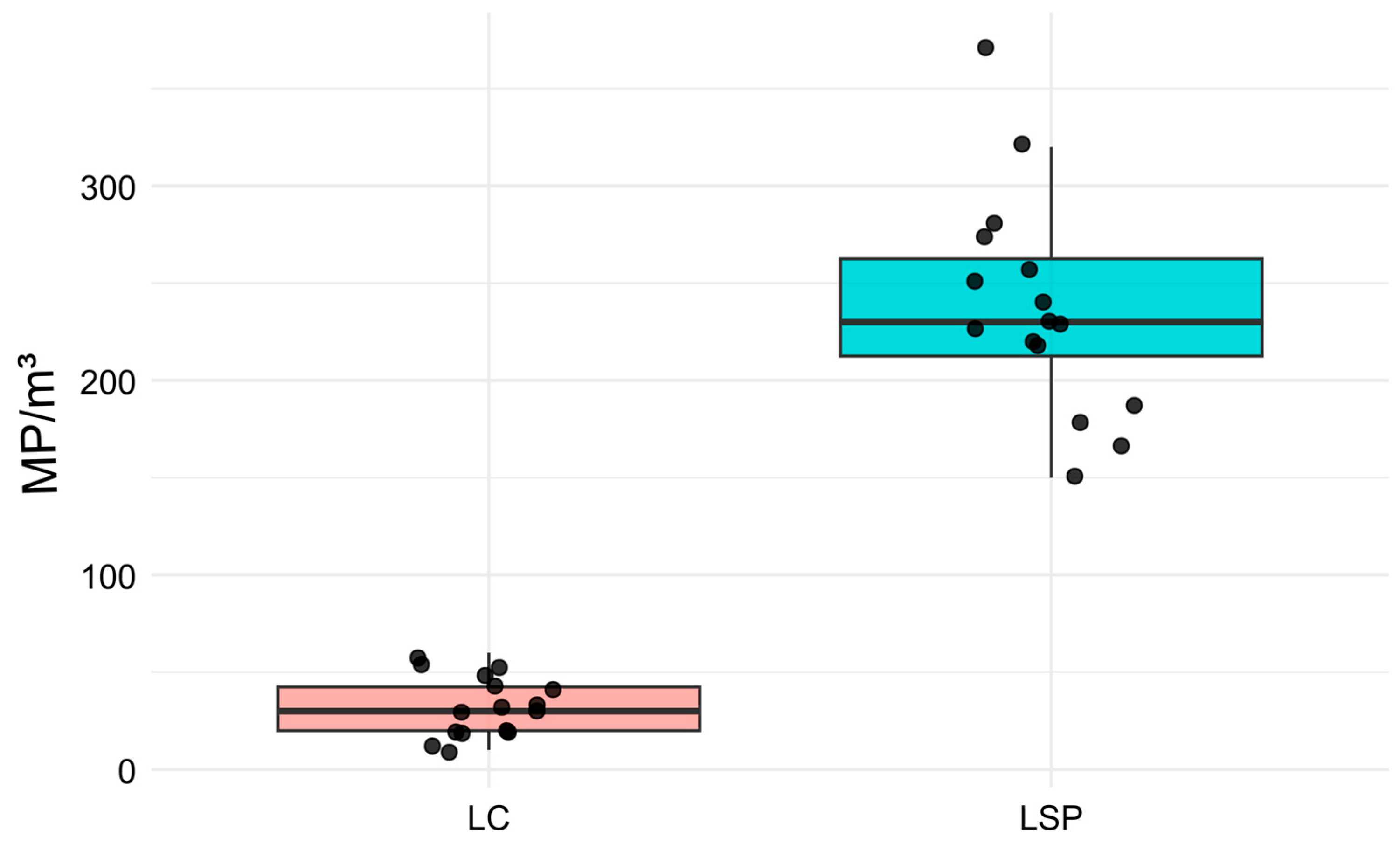
Microplastic concentrations differed markedly between the two Andean lakes based on 16 surface-water samples per system. In San Pablo Lake, concentrations ranged from 150 to 379 MP m−3 across sampling sites and dates, with a mean of 238 MP m−3 (Figure 2). In contrast, Caricocha Lake showed substantially lower concentrations, ranging from 10 to 60 MP m−3, with a mean of 32 MP m−3. These differences were statistically significant (Kruskal–Wallis χ2(1) = 24.67, p < 0.001).
There was a notable difference in microplastics concentrations according to form, color and size categories between lakes (p < 0.05). The microsphere shape and the red color category were the only types that did not differ between lakes (Table 2). Concentrations of the different types of microplastics were higher in San Pablo Lake.

3.2. Morphological Characteristics of Microplastics

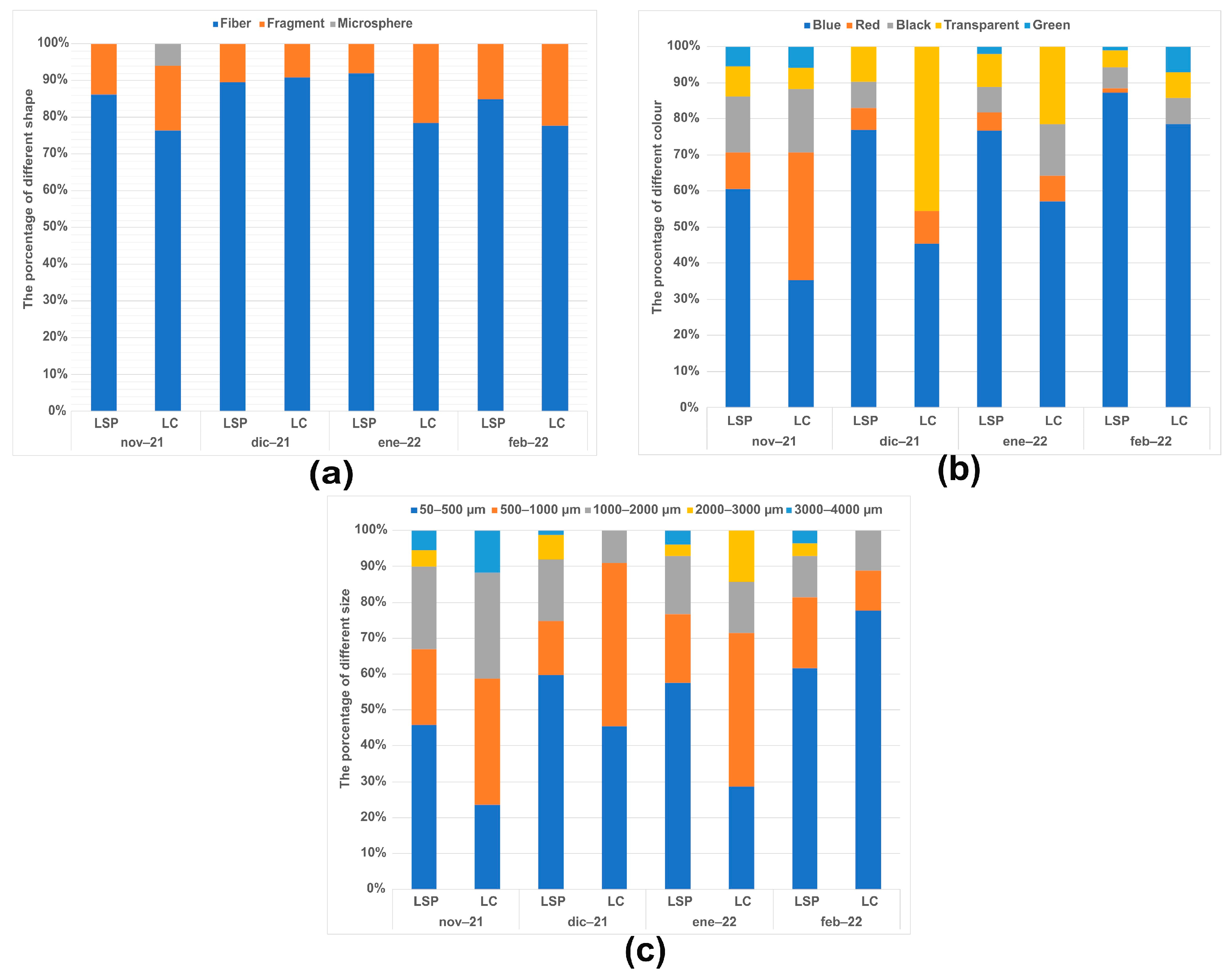
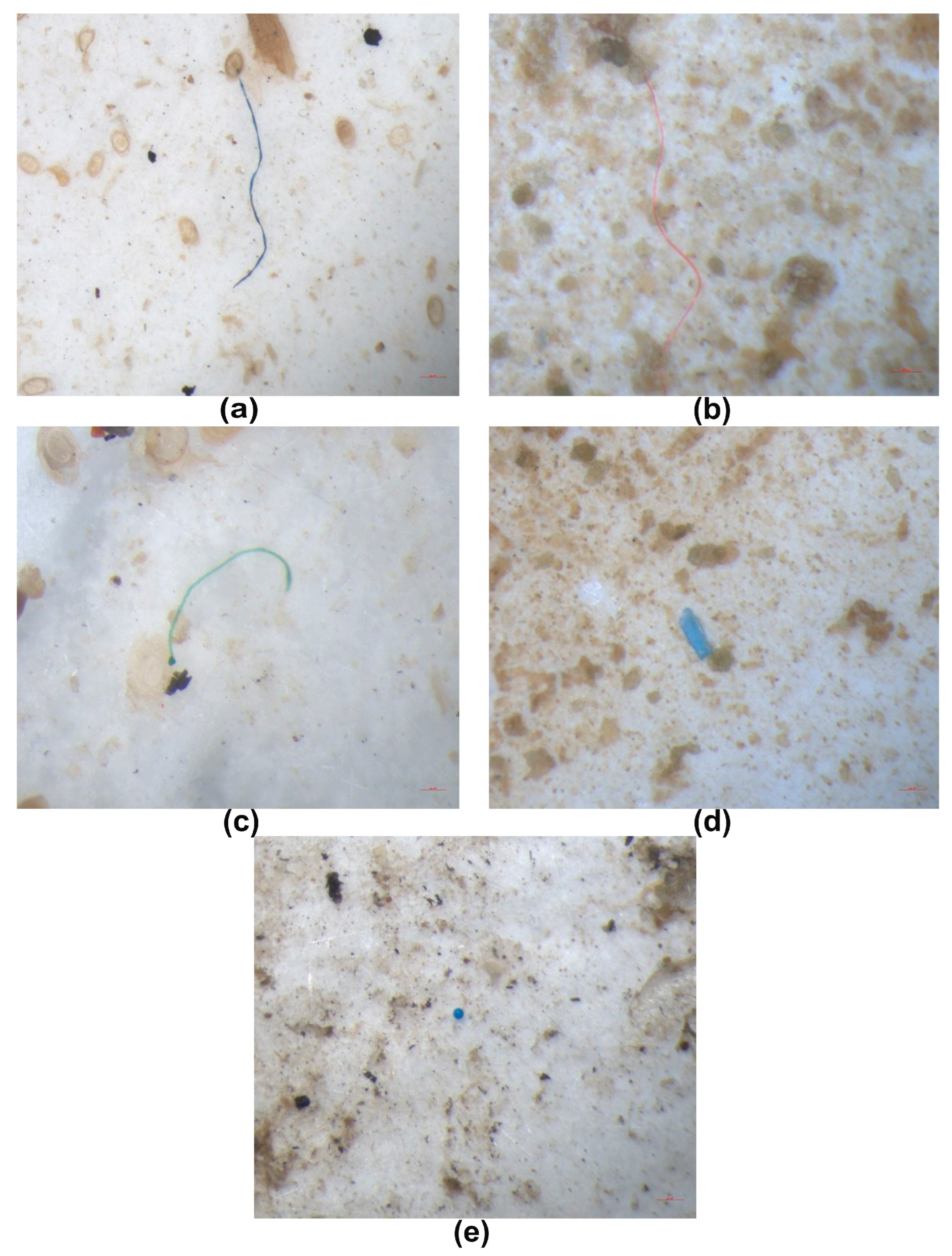
Microplastics were identified and classified according to their morphology: shape, color, and size (Figure 3 and Figure 4). In terms of shape, fiber-shaped microplastics were the dominant type in all sampling sites, with 87.27%, followed by fragments (12.50%) (Figure 3a). Microspheres were observed only in Caricocha Lake during November (0.23%). Statistical analyses confirmed a marginally significant difference in the distribution of shapes between lakes (Fisher’s exact test, p = 0.0498, Cramér’s V = 0.15), mainly associated with the presence of microspheres observed only in Caricocha.
Five colors of microplastics were identified as blue, red, black, transparent, and green (Figure 3b). Blue microplastics dominated the samples at all sampling sites, representing 71.76%, followed by black (9.49%), transparent (9.26%), and red (6.94%). Green microplastics were the least dominant with a proportion of 2.55%. The overall color distribution showed a near-significant difference between lakes (p = 0.0598, Cramér’s V = 0.18), with blue particles significantly more abundant in San Pablo (p = 0.0098) and transparent and red tones relatively more frequent in Caricocha.
Microplastics between 50 and 500 µm were the most abundant, with a proportion of 53.70%, followed by 500–1000 µm (20.83%) and 1000–2000 µm (17.36%). The ranges between 2000–3000 µm and 3000–4000 µm were the least abundant, with 4.40% and 3.70%, respectively (Figure 3c). Although size distributions did not differ significantly between lakes (p = 0.23, Cramér’s V = 0.14), both lakes were dominated by microplastics smaller than 500 µm, corresponding to size classes reported as potentially ingestible in previous studies. Caricocha exhibited a slightly higher proportion of medium-sized particles (500–1000 µm, p = 0.033), whereas San Pablo contained a higher proportion of small particles (<500 µm).

3.3. Principal Component Analysis (PCA) of Microplastics and Land Use

A Spearman correlation analysis was performed between microplastic and land-use variables in the delimited watersheds. The results showed strong positive correlations between total microplastic concentrations (MP m−3) and the proportion of agricultural and urban cover (ρ = 0.87, p < 0.0001), as well as a strong negative correlation between natural cover (ρ = −0.87, p < 0.0001). Similar patterns were observed in the fragment, fiber, blue, and size (500–1000 µm; 1000–2000 µm) (p < 0.0001), with positive correlation with agriculture and urban land, and strong negative correlation with natural land. Other types of MP concentrations showed moderate positive correlations (p < 0.0001) with the anthropogenic cover, while they have negative correlations with the natural cover. No significant correlations were observed between the proportions of urban, agriculture or natural use and microsphere and green microplastic fractions.
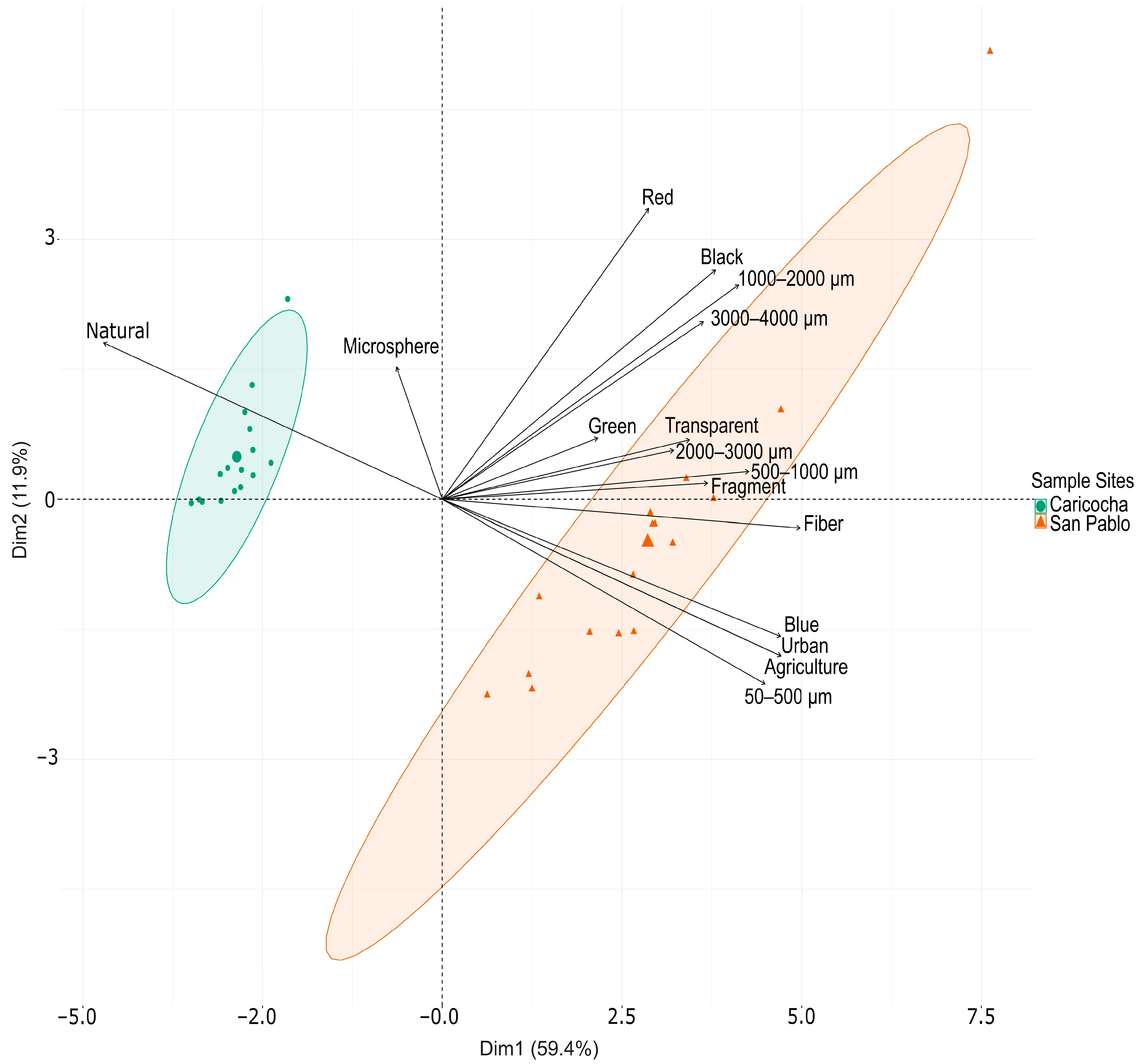
The principal component analysis (PCA) (Figure 5) showed that the first two components explained 72.96% of the total variance in the combined multivariate dataset (PC1: 61.06%; PC2: 11.90%). PC1 was primarily positively associated with agricultural and urban land use, with strong loadings from most microplastic categories, particularly fibers, blue particles, and smaller size classes (<500 µm), showing a strong association with anthropogenic land-use patterns, and negatively associated with natural land in the watershed and the presence of microspheres. PC2 was positively associated with the presence of red and black MPs, while it showed a negative association with blue and smallest microplastics.

4. Discussion

4.1. Study Scope, Limitations, and Novelty

This study presents a comparative assessment of microplastic abundance and morphological typology in two high-Andean lakes representing contrasting watershed configurations and degrees of anthropogenic pressure. The analysis was designed to identify lake-scale patterns associated with land use and hydrological setting, rather than to resolve polymer composition or precise source attribution. Such an approach is consistent with exploratory and baseline-oriented studies, where visual identification and morphological classification are commonly used to assess relative differences in contamination levels across systems and environmental gradients [2,33]. Consequently, results should be interpreted in terms of relative contrasts between systems, not as absolute estimates of polymer-specific microplastic loads.
Within this scope, the study provides novel baseline data for high-altitude Andean lakes, a region that remains markedly underrepresented in the global microplastics literature compared to lowland, coastal, and temperate freshwater environments [22]. The contrast between a densely impacted lake and a minimally disturbed, protected system highlights the influence of watershed configuration, land-use intensity, and hydrological isolation on microplastic contamination patterns, as reported in other freshwater and lake catchments worldwide [9,11,12,15,17]. These findings establish a reference framework for future studies incorporating polymer identification, atmospheric deposition pathways, and higher spatial and temporal resolution, particularly in remote and high-elevation regions where long-term data remain scarce [6,21].

4.2. Influence of Land Use and Hydrological Setting on Microplastic Concentrations

The markedly higher microplastic concentrations observed in San Pablo Lake are consistent with the higher anthropogenic pressure documented for this watershed over recent decades. Hydrological connectivity and specific input pathways (e.g., inflows, wastewater discharge, and atmospheric deposition) were not directly quantified in this study (e.g., no flow measurements, inflow/outflow sampling, or tracer-based assessments). Therefore, the mechanisms discussed below are inferred from watershed configuration and land-use patterns derived from GIS analyses, together with published limnological and hydrological descriptions for these systems. Although official land-use classifications indicate that much of the surrounding area is dominated by agricultural and livestock activities, rapid population growth has been accompanied by substantial urban development along the shoreline. Increased textile-related activities in the region are consistent with higher fiber inputs, as synthetic fibers have progressively replaced natural ones; this contribution is thus interpreted as consistent with wastewater-associated inputs from urban and industrial sources [28,41,42]. In addition, poor management of single-use plastics and uncontrolled recreational tourism may accelerate plastic degradation and potentially increase microplastic availability in surface waters [43].
The contrast between San Pablo and Caricocha is consistent with differences in hydrological connectivity and basin configuration. San Pablo is described as an open lake receiving multiple inflows and exhibiting connectivity through its outflow to the Ambi-Mira system. In contrast, Caricocha is described as having limited hydrological exchange, with only a single outlet stream and minimal surface inflows, draining to the Mojanda River within the Guayllabamba-Esmeraldas basin. This disparity may be further influenced by differences in basin size: San Pablo’s large catchment likely integrates runoff and pollutants from a broader anthropogenic landscape, while Caricocha’s small, semi-closed basin may limit external inputs.
In contrast, the low microplastic concentrations recorded in Caricocha Lake are consistent with its high-altitude location, protected status, reduced catchment size, and minimal local anthropogenic activity. Nevertheless, the presence of microplastics even in this remote system suggests the influence of atmospheric deposition, as low-density particles can be transported over long distances by wind and deposited through precipitation or surface runoff [21]. Similar variability in lake microplastic concentrations has been reported globally, ranging from very high values in urban-industrial regions of China (up to 4650 MP m−3 in Hong Lake) [42] to extremely low concentrations in remote Patagonian lakes (<2 MP m−3) [44]. The values observed in this study fall within the lower-middle range of this spectrum, reflecting both the relative isolation of high-Andean environments and the absence of direct wastewater discharges in Caricocha.

4.3. Dominance of Fibers and Morphological Characteristics of Microplastics

The predominance of fiber-shaped microplastics observed in both lakes is consistent with findings from freshwater and marine systems worldwide. In San Pablo Lake, fiber dominance likely reflects inputs from domestic wastewater, where laundering activities release fibers from clothing, as well as the use of springs and lake shores as open-air laundry areas, as documented through direct field observations during sampling campaigns [45,46]. In Caricocha Lake, the dominance of fibers may be associated with atmospheric transport, as fibers are easily suspended in the air and subsequently deposited via precipitation [47].
Fragments are most likely derived from the degradation of larger plastic debris, such as bottles or bags, commonly discarded in recreational areas [48]. Microspheres, detected only in Caricocha at very low concentrations, have been linked to personal care products and industrial sources in other studies [49]; however, given their very low occurrence here, they are interpreted cautiously and could reflect sporadic inputs or misclassification uncertainty. Due to their filamentous shape and low density, fibers can remain suspended and be transported efficiently in surface waters, which may increase their availability for ingestion by aquatic organisms.
The predominance of fibers over fragments and microspheres aligns with previous studies in freshwater systems such as the Vaal River in South Africa, where more than 80% of microplastics were identified as fibers and fragments [50], as well as rivers and coastal waters of northern Ecuador, where microspheres accounted for less than 4% of particles [11]. Similar patterns have been reported in open marine environments, including the South China Sea, where fibers and fragments represented up to 97.3% of surface microplastics [51]. This pattern is attributed to the high surface-to-volume ratio of fibers, which enhances buoyancy and persistence compared to denser fragments that are more prone to sinking [52].

4.4. Color and Size Patterns and Ecological Relevance

The predominance of blue microplastics observed in this study is consistent with reports from other freshwater and marine ecosystems, where blue particles are frequently the most abundant [11,51]. This pattern is often attributed to the release of dyed fibers from textiles, which enter aquatic systems through domestic wastewater and atmospheric deposition [46]. Colored microplastics generally originate from pigmented plastics and textiles, and particle color may influence ingestion by aquatic fauna: blue and black particles are more frequently ingested by fish, whereas transparent particles are more commonly consumed by birds [53,54,55].
Microplastics smaller than 500 µm dominated both lakes, suggesting high potential bioavailability to lower trophic levels. Similar size distributions have been reported in lakes worldwide, where particles <1 mm remain buoyant and are readily ingested by plankton, facilitating their transfer through aquatic food webs [56,57,58]. Size-dependent settling and hydrodynamic retention thus appear to be key processes controlling microplastic distribution in lentic systems.

4.5. Land-Use Controls, Ecological Implications, and Conservation Relevance

The strong correlations between microplastic concentrations and urban-agricultural land use, as well as the negative relationship with natural vegetation cover, are consistent with recent studies demonstrating the influence of land-use intensity on microplastic pollution in freshwater systems [59]. Human settlements near lake shorelines are linked to enhanced microplastic inputs through stormwater runoff, domestic discharges, laundry effluents, and poor solid waste management reported in comparable catchments [60]. The association between agricultural areas and microplastic fragments further suggests that soil erosion and irrigation drainage act as additional transport pathways, particularly in sloping terrains [61].
Beyond spatial patterns, the ecological implications of microplastic contamination in high-Andean lakes are of particular concern. Fine fibers (<500 µm) have been shown to be ingestible by zooplankton, benthic invertebrates, and fish, with reported effects on feeding behavior and promoting the transfer of contaminants along trophic levels [62]. These impacts may be of particular concern in Andean systems, where endemic and cold-adapted species may exhibit limited physiological tolerance. This conservation relevance is heightened given the presence of the critically endangered Andean catfish Astroblepus ubidiai [63], whose distribution is now restricted to a few isolated refuges, including the Imbakucha watershed and the Mojanda River basin [64,65]. Surface-feeding birds such as grebes and coots inhabiting San Pablo Lake could be considered potential receptors via ingestion pathways reported in other freshwater systems [66]. While this study does not evaluate biological exposure or effects, the detection of microplastics in these high-Andean systems underscores the importance of incorporating emerging pollutants into future ecological risk assessments.
From an ecosystem perspective, high-mountain lakes function as sentinels of environmental change due to their confined hydrological settings, low temperatures, and slow sedimentation rates, which promote the accumulation of persistent pollutants [5,6,8]. The strong contrast between the protected Mojanda basin and the anthropogenically impacted San Pablo watershed underscores the importance of legally designated Water Protection Areas as natural laboratories for assessing diffuse pollution in the Andes. Maintaining natural páramo vegetation and buffer zones is therefore essential to sustain water quality and enhance ecosystem resilience against microplastic inputs [18,67].

5. Conclusions

This study provides the first evidence of microplastic contamination in high-altitude Andean lakes of Ecuador and reveals pronounced contrasts between an anthropogenically impacted system (San Pablo) and a minimally disturbed lake (Caricocha). Microplastic concentrations were markedly higher in San Pablo than in Caricocha (range: 150–379 vs. 10–60 MP m−3; mean: 238 vs. 32 MP m−3), and this difference was statistically significant (Kruskal–Wallis χ2 = 24.67, p < 0.001). Across campaigns, total microplastics correlated strongly and positively with agricultural-urban cover (Spearman ρ = 0.87, p < 0.0001) and negatively with natural cover (ρ = −0.87, p < 0.0001), while PCA separated samples along a land-use gradient, with PC1 and PC2 explaining 72.96% of the variance (PC1: 61.06%; PC2: 11.90%). Differences in microplastic abundance and typology indicate that watershed configuration, particularly land-use intensity and catchment size, together with the hydrological setting described for each system, are consistent with key controls on contamination pathways and lake-scale accumulation patterns. Fiber-shaped microplastics dominated across all sites, indicating that wastewater-related inputs and atmospheric deposition are likely major contributors even in remote high-mountain environments. The strong contrast between impacted and protected watersheds highlights the key role of natural vegetation cover and buffer zones in mitigating diffuse microplastic pollution. These findings emphasize the urgent need for coordinated policies focused on wastewater treatment, land-use planning, and restoration of vegetated riparian buffers, and support the strengthening of regional monitoring networks across the tropical Andes to track long-term trends and inform evidence-based freshwater management.

Author Contributions

Material preparation, sample collection, and laboratory analysis were performed by A.A.-M. The first draft was written by A.A.-M. Editions were made by S.G.-S., I.T. and K.V. K.V. performed the spatial analysis. A.A.-M., I.T., S.G.-S., and K.V. participated in writing and revising the final article. All authors have read and agreed to the published version of the manuscript.

Funding

This study was funded by Universidad Tecnológica Indoamérica through the Project: “Etnobiología para la Conservación de la Diversidad Biocultural y la Gobernanza de Ecosistemas Acuáticos en Ecuador”. Funding number: INV-0001-003.

Data Availability Statement

All data generated during this study were uploaded in the digital repositories of BioCamb. Contact the first author to request information.

Acknowledgments

We acknowledge the staff at BioCamb for their valuable support and for providing access to laboratories and instrumentation.

Conflicts of Interest

Author Silvana Gallegos-Sánchez was employed by the company Ecoforensic CIC. The remaining authors declare that the research was conducted in the absence of any commercial or financial relationships that could be construed as a potential conflict of interest.

References

  1. Nava, V.; Dar, J.Y.; De Santis, V.; Fehlinger, L.; Pasqualini, J.; Adekolurejo, O.A.; Burri, B.; Cabrerizo, M.J.; Chonova, T.; Cour, M.; et al. Zooming in the plastisphere: The ecological interface for phytoplankton-plastic interactions in aquatic ecosystems. Biol. Rev. 2025, 100, 834–854. [Google Scholar] [CrossRef]
  2. Thompson, R.C.; Courtene-Jones, W.; Boucher, J.; Pahl, S.; Raubenheimer, K.; Koelmans, A.A. Twenty years of microplastic pollution research—What have we learned? Science 2024, 386, eadl2746. [Google Scholar] [CrossRef]
  3. Tien, C.J.; Wang, Z.X.; Chen, C.S. Microplastics in water, sediment and fish from the Fengshan River system: Relationship to aquatic factors and accumulation of polycyclic aromatic hydrocarbons by fish. Environ. Pollut. 2020, 265, 114962. [Google Scholar] [CrossRef] [PubMed]
  4. Chen, L.; Chang, N.; Qiu, T.; Wang, N.; Cui, Q.; Zhao, S.; Huang, F.; Chen, H.; Zeng, Y.; Dong, F.; et al. Meta-analysis of impacts of microplastics on plant heavy metal (loid) accumulation. Environ. Pollut. 2024, 348, 123787. [Google Scholar] [CrossRef] [PubMed]
  5. D’Avignon, G.; Gregory-Eaves, I.; Ricciardi, A. Microplastics in lakes and rivers: An issue of emerging significance to limnology. Environ. Rev. 2022, 30, 228–244. [Google Scholar] [CrossRef]
  6. Allen, S.; Allen, D.; Phoenix, V.R.; Le-Roux, G.; Durantez-Jiménez, P.; Simonneau, A.; Binet, S.; Galop, D. Atmospheric transport and deposition of microplastics in a remote mountain catchment. Nat. Geosci. 2019, 12, 339–344. [Google Scholar] [CrossRef]
  7. Issac, M.N.; Kandasubramanian, B. Effect of microplastics in water and aquatic systems. Environ. Sci. Pollut. Res. Int. 2021, 28, 19544–19562. [Google Scholar] [CrossRef]
  8. Dusaucy, J.; Gateuille, D.; Perrette, Y.; Naffrechoux, E. Microplastic pollution of worldwide lakes. Environ. Pollut. 2021, 284, 117075. [Google Scholar] [CrossRef]
  9. Donoso, J.M.; Rios-Touma, B. Microplastics in tropical Andean rivers: A perspective from a highly populated Ecuadorian basin without wastewater treatment. Heliyon 2020, 6, e04302. [Google Scholar] [CrossRef]
  10. Lucas-Solis, O.; Moulatlet, G.M.; Guamangallo, J.; Yacelga, N.; Villegas, L.; Galarza, E.; Rosero, B.; Zurita, B.; Sabando, L.; Cabrera, M.; et al. Preliminary assessment of plastic litter and microplastic contamination in freshwater depositional areas: The case study of Puerto Misahualli, Ecuadorian Amazonia. Bull. Environ. Contam. Toxicol. 2021, 107, 45–51. [Google Scholar] [CrossRef]
  11. Capparelli, M.V.; Molinero, J.; Moulatlet, G.M.; Barrado, M.; Prado-Alcívar, S.; Cabrera, M.; Gimiliani, G.; Ñacato, C.; Pinos-Velez, V.; Cipriani-Avila, I. Microplastics in rivers and coastal waters of the province of Esmeraldas, Ecuador. Mar. Pollut. Bull. 2021, 173, 113067. [Google Scholar] [CrossRef]
  12. Talbot, R.; Cárdenas-Calle, M.; Mair, J.M.; López, F.; Cárdenas, G.; Pernía, B.; Hart, M.G.J.; Uyaguari, M. Macroplastics and microplastics in intertidal sediment of Vinces and Los Tintos Rivers, Guayas Province, Ecuador. Microplastics 2022, 1, 651–668. [Google Scholar] [CrossRef]
  13. López, C.; Soto, L.M.; Acosta, V.; Santana-Piñeros, A.M.; Cruz-Quintana, Y.; Gomes-Barbosa, L.; Stamou, G.; Karpowicz, M.; Michaloudi, E.; Domínguez-Granda, L.; et al. A first step to assess suspended microplastics in a freshwater wetland from the coastal region of Ecuador. Front. Environ. Sci. 2023, 11, 1028970. [Google Scholar] [CrossRef]
  14. Schell, T.; Hurley, R.; Nizzetto, L.; Rico, A.; Vighi, M. Spatio-temporal distribution of microplastics in a Mediterranean river catchment: The importance of wastewater as an environmental pathway. J. Hazard. Mater. 2021, 420, 126481. [Google Scholar] [CrossRef]
  15. Kunz, A.; Schneider, F.; Anthony, N.; Lin, H.T. Microplastics in rivers along an urban-rural gradient in an urban agglomeration: Correlation with land use, potential sources and pathways. Environ. Pollut. 2023, 321, 121096. [Google Scholar] [CrossRef] [PubMed]
  16. Talbot, R.; Chang, H. Microplastics in freshwater: A global review of factors affecting spatial and temporal variations. Environ. Pollut. 2022, 292, 118393. [Google Scholar] [CrossRef] [PubMed]
  17. Zhang, L.; Li, X.; Li, Q.; Xia, X.; Zhang, H. The effects of land use types on microplastics in river water: A case study on the mainstream of the Wei River, China. Environ. Monit. Assess. 2024, 196, 349. [Google Scholar] [CrossRef]
  18. Cesarini, G.; Scalici, M. Riparian vegetation as a trap for plastic litter. Environ. Pollut. 2022, 292, 118410. [Google Scholar] [CrossRef] [PubMed]
  19. Feng, S.; Lu, H.; Yao, T.; Tang, M.; Yin, C. Analysis of microplastics in soils on the high-altitude area of the Tibetan Plateau: Multiple environmental factors. Sci. Total Environ. 2023, 857, 159399. [Google Scholar] [CrossRef]
  20. Parolini, M.; Perin, E.; De Felice, B.; Gazzotti, S.; Palazzi, A.; Conti, L.; Conterosito, E.; Rosio, E.; Bruno, F.; Gianotti, V.; et al. Altitudinal variation of microplastic abundance in lakeshore sediments from Italian lakes. Environ. Sci. Pollut. Res. Int. 2024, 31, 35864–35877. [Google Scholar] [CrossRef]
  21. Cabrera, M.; Moulatlet, G.M.; Valencia, B.G.; Maisincho, L.; Rodríguez-Barroso, R.; Albendín, G.; Sakali, A.; Lucas-Solis, O.; Conicelli, B.; Capparelli, M.V. Microplastics in a tropical Andean Glacier: A transportation process across the Amazon basin? Sci. Total Environ. 2022, 805, 150334. [Google Scholar] [CrossRef]
  22. Vélez-Terreros, P.Y.; Romero-Estévez, D.; Yánez-Jácome, G.S. Microplastics in Ecuador: A review of environmental and health-risk assessment challenges. Heliyon 2024, 10, e23232. [Google Scholar] [CrossRef] [PubMed]
  23. Arévalo, A.; Cadena, M.; Ontaneda, D. Diversidad de fitoplancton y estado trófico actual de un lago de alta montaña de la provincia de Imbabura, Ecuador. ACI Av. Cienc. Ing. 2025, 17, 1–17. [Google Scholar] [CrossRef]
  24. Terneus-Jácome, E. Vegetación acuática y estado trófico de las lagunas andinas de San Pablo y Yahuarcocha, provincia de Imbabura, Ecuador. REMCB Rev. Ecuat. Med. Cienc. Biol. 2017, 35, 121–131. [Google Scholar] [CrossRef]
  25. Gunkel, G. Limnology of an equatorial high mountain lake in Ecuador, Lago San Pablo. Limnologica 2000, 30, 113–120. [Google Scholar] [CrossRef]
  26. Riascos, L.; Geerts, A.N.; Oña, T.; Goethals, P.; Cevallos-Cevallos, J.; Vanden Berghe, W.; Volckaert, F.A.M.; Bonilla, J.; Muylaert, K.; Velarde, E.; et al. DNA-based monitoring of the alien invasive North American crayfish Procambarus clarkii in Andean lakes (Ecuador). Limnologica 2018, 70, 20–25. [Google Scholar] [CrossRef]
  27. Kiersch, B.; Mühleck, R.; Gunkel, G. Las macrófitas de algunos lagos alto-andinos del Ecuador y su bajo potencial como bioindicadores de eutrofización. Rev. Biol. Trop. 2004, 52, 829–837. [Google Scholar]
  28. Burneo, P.C.; Gunkel, G. Ecology of a high Andean stream, río Itambi, Otavalo, Ecuador. Limnologica 2003, 33, 29–43. [Google Scholar] [CrossRef]
  29. Ministerio del Ambiente, Agua y Transición Ecológica (MAATE). Ministerio del Ambiente, Agua y Transición Ecológica declara a Mojanda como Área de Protección Hídrica. Available online: https://gobernacionimbabura.gob.ec/mojanda-fue-declarada-como-area-de-proteccion-hidrica/ (accessed on 3 February 2025).
  30. Masura, J.; Baker, J.; Foster, G.; Arthur, C. Laboratory Methods for the Analysis of Microplastics in the Marine Environment: Recommendations for Quantifying Synthetic Particles in Waters and Sediments; Silver Spring: Maryland, MD, USA, 2015. [Google Scholar] [CrossRef]
  31. Bellas, J.; Martínez-Armental, J.; Martínez-Cámara, A.; Besada, V.; Martínez-Gómez, C. Ingestion of microplastics by demersal fish from the Spanish Atlantic and Mediterranean coasts. Mar. Pollut. Bull. 2016, 109, 55–60. [Google Scholar] [CrossRef]
  32. Lam, T.W.L.; Ho, H.T.; Ma, A.T.; Fok, L. Microplastic contamination of surface water-sourced tap water in Hong Kong—A preliminary study. Appl. Sci. 2020, 10, 3463. [Google Scholar] [CrossRef]
  33. Hidalgo-Ruz, V.; Gutow, L.; Thompson, R.C.; Thiel, M. Microplastics in the marine environment: A review of the methods used for identification and quantification. Environ. Sci. Technol. 2012, 46, 3060–3075. [Google Scholar] [CrossRef]
  34. Japan Aerospace Exploration Agency. ALOS World 3D-30m (AW3D30) Ver. 3.2. Available online: https://www.eorc.jaxa.jp/ALOS/en/dataset/aw3d30/ (accessed on 25 September 2025).
  35. Ministerio del Ambiente y Energía. Mapa Interactivo. Available online: http://ide.ambiente.gob.ec/mapainteractivo/ (accessed on 25 September 2025).
  36. Buckley, Y.M. Generalized linear models. In Ecological Statistics: Contemporary Theory and Application; Fox, G.A., Negrete-Yankelevich, S., Sosa, V.J., Eds.; Oxford University Press: Oxford, UK, 2015; pp. 131–148. [Google Scholar]
  37. Greenacre, M.; Groenen, P.J.; Hastie, T.; d’Enza, A.I.; Markos, A.; Tuzhilina, E. Principal component analysis. Nat. Rev. Methods Primers 2022, 2, 100. [Google Scholar] [CrossRef]
  38. R Core Team. R: A Language and Environment for Statistical Computing; R Foundation for Statistical Computing: Viena, Austria, 2024. [Google Scholar]
  39. Lê, S.; Josse, J.; Husson, F. FactoMineR: A Package for Multivariate Analysis. J. Stat. Softw. 2008, 25, 1–18. [Google Scholar] [CrossRef]
  40. Kassambara, A. Rstatix: Pipe-Friendly Framework for Basic Statistical Tests. R Package Version 0.6.0. 2020. Available online: https://CRAN.R-project.org/package=rstatix (accessed on 5 August 2025).
  41. Gunkel, G. Limnología de un Lago Tropical de Alta Montaña, en Ecuador: Características de los sedimentos y tasa de sedimentación. Rev. Biol. Trop. 2003, 51, 381–390. [Google Scholar] [PubMed]
  42. Wang, W.; Yuan, W.; Chen, Y.; Wang, J. Microplastics in surface waters of Dongting lake and Hong lake, China. Sci. Total Environ. 2018, 633, 539–545. [Google Scholar] [CrossRef] [PubMed]
  43. Basri, K.; Syaputra, E.M.; Handayani, S. Microplastic pollution in waters and its impact on health and environment in Indonesia: A Review. J. Public Health Trop. Coast. Reg. 2021, 4, 63–77. [Google Scholar] [CrossRef]
  44. Alfonso, M.B.; Scordo, F.; Seitz, C.; Mavo-Manstretta, G.M.; Ronda, A.C.; Arias, A.H.; Tomba, J.P.; Silva, L.I.; Perillo, G.M.E.; Piccolo, M.C. First evidence of microplastics in nine lakes 413 across Patagonia (South America). Sci. Total Environ. 2020, 733, 139385. [Google Scholar] [CrossRef]
  45. De Faria, E.; Girard, P.; Nardes, C.S.; Moreschi, A.; Christo, S.W.; Junior, A.L.F.; Costa, M.F. Microplastics pollution in the south American pantanal. Case Stud. Chem. Environ. Eng. 2021, 3, 100088. [Google Scholar] [CrossRef]
  46. Dris, R.; Gasperi, J.; Saad, M.; Mirande, C.; Tassin, B. Synthetic fibers in atmospheric fallout: A source of microplastics in the environment? Mar. Pollut. Bull. 2016, 104, 290–293. [Google Scholar] [CrossRef]
  47. Dris, R.; Gasperi, J.; Mirande, C.; Mandin, C.; Guerrouache, M.; Langlois, V.; Tassin, B. A first overview of textile fibers, including microplastics, in indoor and outdoor environments. Environ. Pollut. 2017, 221, 453–458. [Google Scholar] [CrossRef] [PubMed]
  48. Bertoldi, C.; Lara, L.Z.; Mizushima, F.A.D.L.; Martins, F.C.; Battisti, M.A.; Hinrichs, R.; Fernandes, A.N. First evidence of microplastic contamination in the freshwater of Lake Guaíba, Porto Alegre, Brazil. Sci. Total Environ. 2021, 759, 143503. [Google Scholar] [CrossRef]
  49. Susanti, N.K.Y.; Mardiastuti, A.; Wardiatno, Y. Microplastics and the impact of plastic on wildlife: A literature review. IOP Conf. Ser. Earth Environ. Sci. 2020, 528, 012013. [Google Scholar] [CrossRef]
  50. Ramaremisa, G.; Ndlovu, M.; Saad, D. Comparative assessment of microplastics in surface waters and sediments of the Vaal River, South Africa: Abundance, composition, and sources. Environ. Toxicol. Chem. 2022, 41, 3029–3040. [Google Scholar] [CrossRef]
  51. Yu, J.; Tang, D.; Wang, S.; He, L.; Pathira-Arachchilage, K.R.L. Spatial distribution and composition of surface microplastics in the southwestern South China Sea. Front. Mar. Sci. 2022, 9, 830318. [Google Scholar] [CrossRef]
  52. Guo, M. Microplastics in freshwater systems: Dynamic behaviour. Ecol. Indic. 2024, 161, 112043. [Google Scholar] [CrossRef]
  53. Rezania, S.; Park, J.; Din, M.F.M.; Taib, S.M.; Talaiekhozani, A.; Yadav, K.K.; Kamyab, H. Microplastics pollution in different aquatic environments and biota: A review of recent studies. Mar. Pollut. Bull. 2018, 133, 191–208. [Google Scholar] [CrossRef]
  54. Rios-Fuster, B.; Alomar, C.; Compa, M.; Guijarro, B.; Deudero, S. Anthropogenic particles ingestion in fish species from two areas of the western Mediterranean Sea. Mar. Pollut. Bull. 2019, 144, 325–333. [Google Scholar] [CrossRef]
  55. Ugwu, K.; Herrera, A.; Gómez, M. Microplastics in marine biota: A review. Mar. Pollut. Bull. 2021, 169, 112540. [Google Scholar] [CrossRef]
  56. Moore, C.J. Synthetic polymers in the marine environment: A rapidly increasing, long-term threat. Environ. Res. 2008, 108, 131–139. [Google Scholar] [CrossRef] [PubMed]
  57. Mao, R.; Hu, Y.; Zhang, S.; Wu, R.; Guo, X. Microplastics in the surface water of Wuliangsuhai Lake, northern China. Sci. Total Environ. 2020, 723, 137820. [Google Scholar] [CrossRef]
  58. Malygina, N.; Mitrofanova, E.; Kuryatnikova, N.; Biryukov, R.; Zolotov, D.; Pershin, D.; Chernykh, D. Microplastic pollution in the surface waters from plain and mountainous lakes in Siberia, Russia. Water 2021, 13, 2287. [Google Scholar] [CrossRef]
  59. Rajan, K.; Khudsar, F.A.; Kumar, R. Urbanization and population resources affect microplastic concentration in surface water of the River Ganga. J. Hazard. Mater. Adv. 2023, 11, 100342. [Google Scholar] [CrossRef]
  60. Gao, S.; Wu, Q.; Peng, M.; Zeng, J.; Jiang, T.; Ruan, Y.; Xu, L.; Guo, K. Rapid urbanization affects microplastic communities in lake sediments: A case study of Lake Aha in southwest China. J. Environ. Manag. 2023, 338, 117824. [Google Scholar] [CrossRef]
  61. Liu, W.; Hu, T.; Mao, Y.; Shi, M.; Cheng, C.; Zhang, J.; Qi, S.; Chen, W.; Xing, X. The mechanistic investigation of geochemical fractionation, bioavailability and release kinetic of heavy metals in contaminated soil of a typical copper-smelter. Environ. Pollut. 2022, 306, 119391. [Google Scholar] [CrossRef]
  62. Rochman, C.M.; Brookson, C.; Bikker, J.; Djuric, N.; Earn, A.; Bucci, K.; Athey, S.; Huntington, A.; McIlwraith, H.; Munno, K.; et al. Rethinking microplastics as a diverse contaminant suite. Environ. Toxicol. Chem. 2019, 38, 703–711. [Google Scholar] [CrossRef] [PubMed]
  63. The IUCN Red List of Threatened Species. Available online: https://www.iucnredlist.org/species/46862/66234973 (accessed on 12 October 2025).
  64. Vélez-Espino, L.A. Distribution and habitat suitability index model for the Andean catfish Astroblepus ubidiai (Pisces: Siluriformes) in Ecuador. Rev. Biol. Trop. 2006, 54, 623–638. [Google Scholar] [CrossRef] [PubMed]
  65. Mena-Valenzuela, P.; Valdiviezo-Rivera, J.; Mena-Olmedo, J.; Aguirre, W.E. The first observation of copulation in Andean catfish Astroblepus ubidiai (Siluriformes, Astroblepidae), in Lago San Pablo, Imbabura, Ecuador. J. Fish Biol. 2022, 101, 1348–1352. [Google Scholar] [CrossRef]
  66. Provencher, J.F.; Vermaire, J.C.; Avery-Gomm, S.; Braune, B.M.; Mallory, M.L. Garbage in guano? Microplastics found in faecal precursors of seabirds known to ingest plastics. Sci. Total Environ. 2020, 764, 142859. [Google Scholar] [CrossRef] [PubMed]
  67. Brueck, S.A.; Torres, B.D.M.; de Moraes, M.D.L.T. The Ecuadorian paramo in danger: What we know and what might be learned from northern wetlands. Glob. Ecol. Conserv. 2023, 47, e02639. [Google Scholar] [CrossRef]
Figure 1. Location map of San Pablo and Caricocha lakes in the northern Ecuadorian Andes. Watershed boundaries, sampling sites, and major land-use categories are shown. Provincial limits are shown in black, and watersheds are outlined in red.
Applsci 16 01708 g001
Figure 2. Boxplots of microplastic concentration (MP m−3) detected in surface waters of San Pablo Lake (LSP) and Caricocha Lake (LC). The central line represents the median microplastics concentration. The lines above and below the box are the highest and lowest scores, respectively. The first and third quartiles are represented in the box. Black dots represent individual samples.
Applsci 16 01708 g002
Figure 3. Typology of microplastics by (a) shape, (b) color, and (c) size categories in surface water of San Pablo Lake (LSP) and Caricocha Lake (LC). Each bar represents the mean proportion per sampling campaign, combining data from the four sampling sites in each lake.
Applsci 16 01708 g003
Figure 4. Photographs of microplastics under a stereomicroscope. (a) Blue fiber. (b) Red fiber. (c) Green fiber. (d) Blue fragment. (e) Blue microsphere. Scale 200 µm.
Applsci 16 01708 g004
Figure 5. PCA biplot of microplastic concentration in two Andean lakes related to their land uses. Green circles represent the microplastics samples in Caricocha Lake, and red triangles represent the microplastics samples in San Pablo Lake. Black arrows represent the concentration of microplastic variables (shape, color, and size) and land-use percentages within the watersheds.
Applsci 16 01708 g005
Table 1. Land use percentage and surface area cover for San Pablo and Caricocha Lake basins.
Land-Use CategorySan PabloCaricocha
(ha)(%)(ha)(%)
Andean forest1469.619.5167.46.53
Water body638.914.13333.1432.27
Shrub and Andean herbs 4234.1327.39631.9161.2
Agriculture and pastures8507.1255.04
Urban land577.153.73
Barren land28.980.19
Total area (ha)15,455.90 1032.45
Table 2. Mean microplastic concentrations (MP m−3) and relative proportions (%) by form, color, and size in San Pablo and Caricocha lakes. Kruskal–Wallis tests (χ2) were applied to compare microplastic concentrations between lakes. The standard error of the mean (S.E.) and corresponding p-values (p < 0.05) are shown.
San PabloCaricocha
TypeMP m−3%S.EMP m−3%S.Eχ2p-Value
Form
Fiber210.088.213.1725.681.53.2923.470.001
Fragment28.1211.84.855.625.621.5715.21<0.001
Microsphere0000.630.630.6310.310
Color
Blue175.073.57.9118.858.72.8723.570.001
Red13.805.84.735.0015.62.243.020.082
Black21.809.25.343.7511.71.559.160.002
Transparent18.347.72.876.2919.61.89.560.002
Green5.622.41.821.253.90.854.050.040
Size
50–500 µm132.5055.64.6112.538.82.6623.650.001
500–1000 µm45.018.95.2411.234.72.0219.620.01
1000–2000 µm41.2517.39.355.6217.41.5714.21<0.001
2000–3000 µm10.624.52.491.253.90.8510.670.001
3000–4000 µm8.753.72.021.253.90.8510.370.001
Significant p-values are in bold.
Disclaimer/Publisher’s Note: The statements, opinions and data contained in all publications are solely those of the individual author(s) and contributor(s) and not of MDPI and/or the editor(s). MDPI and/or the editor(s) disclaim responsibility for any injury to people or property resulting from any ideas, methods, instructions or products referred to in the content.