Full-Scale Industrial Application of Adipic Acid Enhanced Limestone Utilization in Wet Flue Gas Desulfurization Systems


Featured Application
Abstract
1. Introduction
- (i)
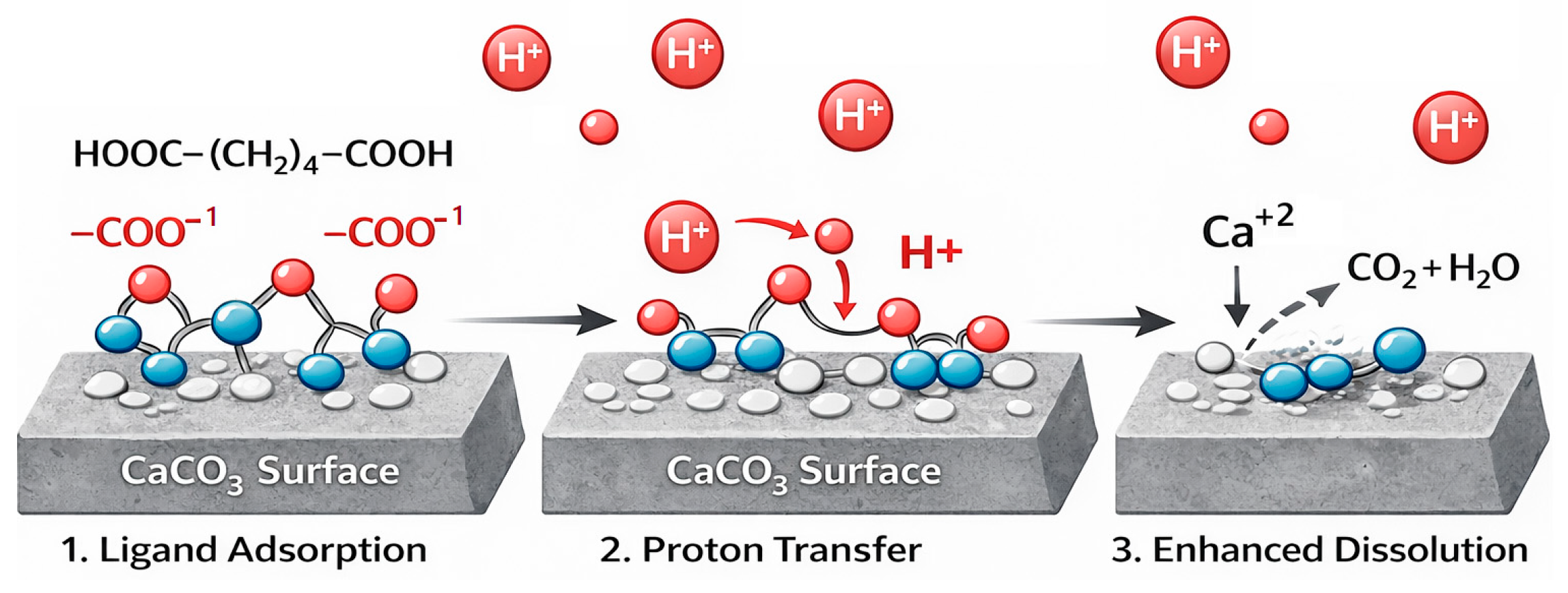
- Limestone dissolution kinetics, which are hindered under the mildly acidic pH range typical of WFGD and often become rate-controlling, necessitating excess CaCO3 feed, and can be explained with the ligand-assisted proton transfer mechanism.
- (ii)
- (iii)
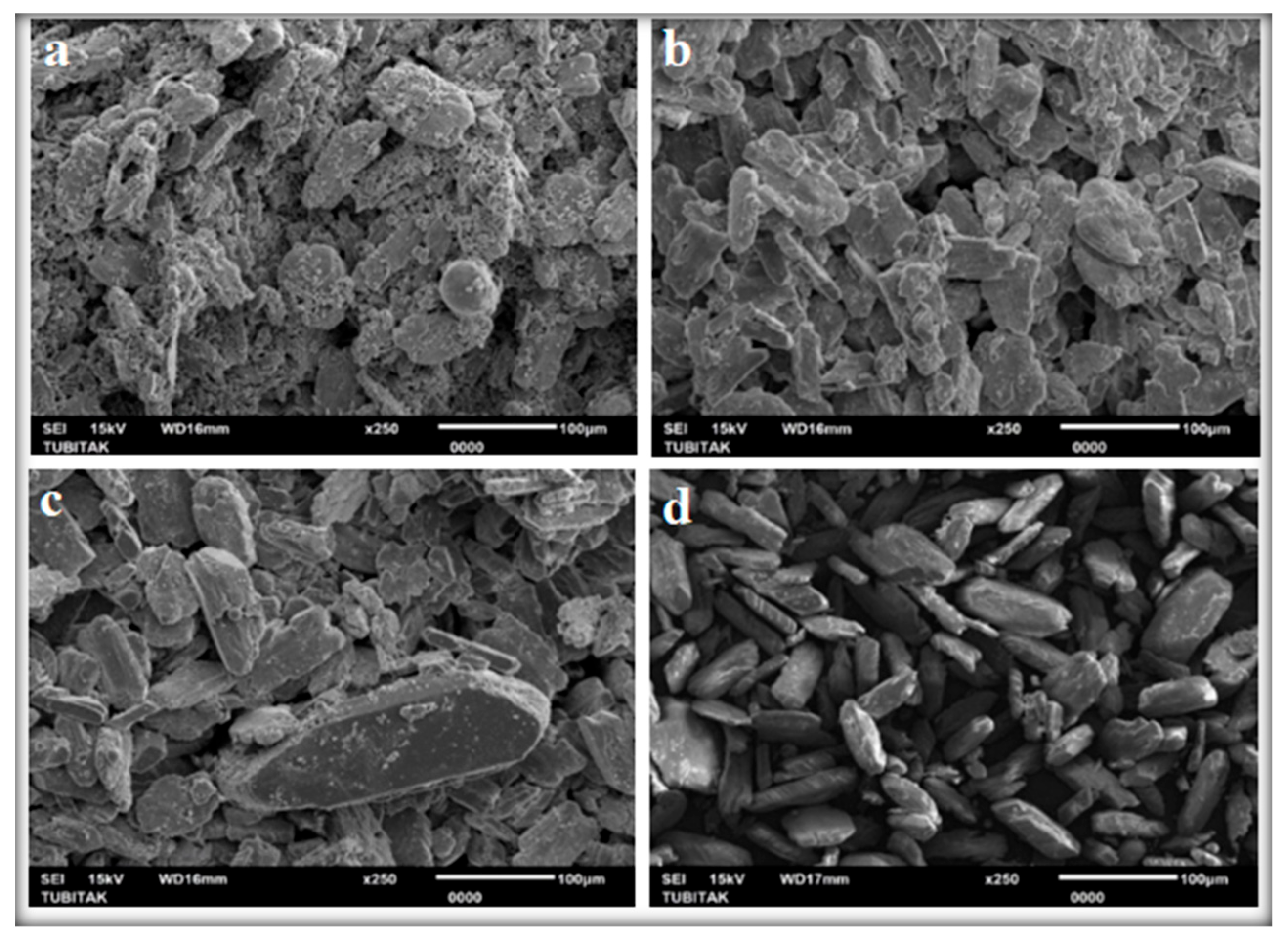
- Gypsum crystallization and crystal morphology, since poorly developed, needle- or flake-like CaSO4·2H2O crystals exhibit low filterability and high residual moisture, undermining by-product quality and increasing operating costs. Kinetic and reactor-scale investigations have demonstrated that particle size, limestone reactivity, and slurry chemistry significantly impact CaCO3 dissolution and SO2 uptake.
- (iv)
- Due to the practizcal constraints associated with the conventional limestone–gypsum process, recent studies have focused on using chemical additives, including organic dicarboxylic acids, in modern WFGD systems to enhance limestone dissolution, promote mass transfer, and regulate gypsum crystal formation [2,10,11,12,13,14].
2. Materials and Methods
2.1. Materials
2.2. Methods
2.2.1. Preparation of Limestone Slurry
2.2.2. Preparation of Adipic Acid Solution
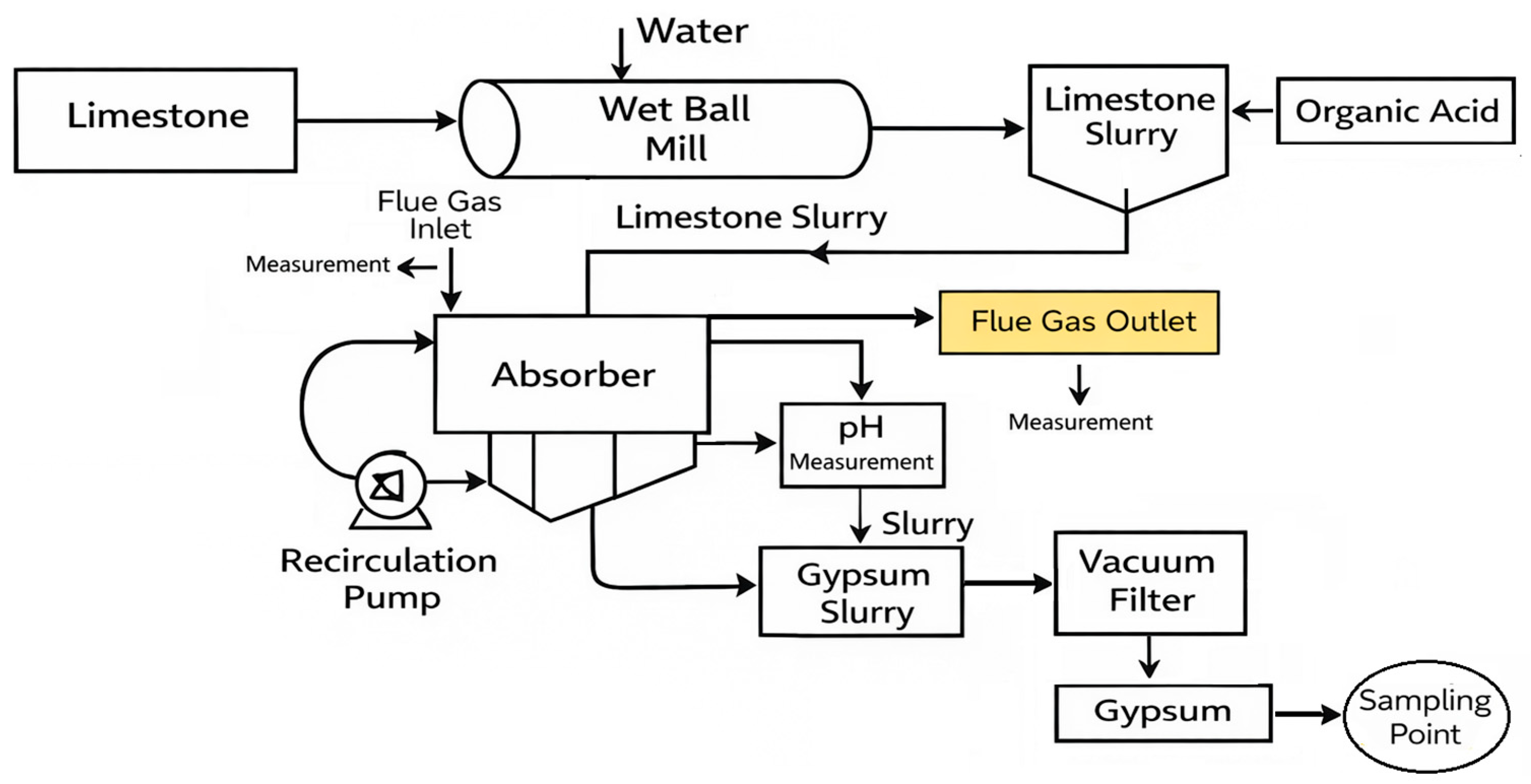
2.2.3. Wet Flue Gas Desulphurization (WFGD) Process
2.2.4. Characterization
3. Results
4. Discussion
5. Conclusions
Author Contributions
Funding
Informed Consent Statement
Data Availability Statement
Acknowledgments
Conflicts of Interest
Abbreviations
| ASTM | American Society for Testing and Materials |
| CaO | Calciumoxide |
| CaSO42H2O | Gypsum |
| CaCO3 | Limestone |
| CEMS | Continuous Emission Measurement System |
| DBA | Dicarbocyclic scif |
| FDG | Flue gas desulfurization |
| MgO | Magnesiumoxide |
| NDIR | Non-Dispersive Infrared |
| SEM | Scanning Electron Microscope |
| SO2 | Sulphurdioxide |
| SiO2 | Siliciumdioxide |
| Pka | Ionization Value |
| XRF | X-ray fluorescence spectroscopy |
| WFDG | Wet flue gas desulfurization |
References
- Sun, Y.; Yu, Q.; Qin, W.; Zhang, Y.; Xin, K.; Ai, J.; Chen, J. Characteristics and plausible formation mechanisms of secondary inorganic and organic aerosols in four seasons and during haze episodes in Beijing. Atmos. Res. 2025, 316, 107949. [Google Scholar] [CrossRef]
- Aakriti; Maiti, S.; Jain, N.; Malik, J. A comprehensive review of flue gas desulphurized gypsum: Production, properties, and applications. Constr. Build. Mater. 2023, 393, 131918. [Google Scholar] [CrossRef]
- Awasthi, M.K.; Amobonye, A.; Bhagwat, P.; Ashokkumar, V.; Gowd, S.C.; Dregulo, A.M.; Rajendran, K.; Flora, G.; Kumar, V.; Pillai, S.; et al. Biochemical engineering for elemental sulfur from flue gases through multi-enzymatic based approaches—A review. Sci. Total Environ. 2024, 914, 169857. [Google Scholar] [CrossRef]
- Elehinafe, F.B.; Aondoakaa, E.A.; Akinyemi, A.F.; Agboola, O.; Okedere, O.B. Separation processes for the treatment of industrial flue gases—Effective methods for global industrial air pollution control. Heliyon 2024, 10, e32428. [Google Scholar] [CrossRef]
- Zhao, J.; Wei, Q.; Wang, S.; Ren, X. Progress of ship exhaust gas control technology. Sci. Total Environ. 2021, 799, 149437. [Google Scholar] [CrossRef] [PubMed]
- Trojan, M.; Wielgus, S.; Taler, J.; Dzierwa, P.; Kaczmarski, K. Optimization of the operation of circulation pumps in the wet flue gas desulfurization system. Energy 2025, 325, 136209. [Google Scholar] [CrossRef]
- Huang, J.; Zeng, Z.; Hong, F.; Yang, Q.; Wu, F.; Peng, S. Sustainable Operation Strategy for Wet Flue Gas Desulfurization at a Coal-Fired Power Plant via an Improved Many-Objective Optimization. Sustainability 2024, 16, 8521. [Google Scholar] [CrossRef]
- Deo, B.; Muthan, B.; Cruise, T.L.A.; Mukherjee, T.; Allen, D.K.; Sanjaya, S.A. Flue gas desulfurization gypsum as a sustainable amendment for coal mine soil reclamation and camelina-based bioenergy crop production. J. Environ. Manag. 2025, 393, 127296. [Google Scholar] [CrossRef]
- Marques da Silva Moura, T.; Cavalcante Rocha, J. Sustainable Expansive Agent from FGD Gypsum and CAC Used to Mitigate Shrinkage in Alkali-Activated Mortars and Promote the Valorization of Industrial By-Products. Sustainability 2025, 17, 8617. [Google Scholar] [CrossRef]
- Song, W.; Fan, X.; Gan, M.; Ji, Z.; Sun, Z. A novel and clean utilization of flue gas desulfurization ash coupled with converter sludge to produce calcium ferrate. Chem. Eng. J. 2024, 498, 154919. [Google Scholar] [CrossRef]
- De Blasio, C.; Salierno, G.; Sinatra, D.; Cassanello, M. Modeling of limestone dissolution for flue gas desulfurization with novel implications. Energies 2020, 13, 6164. [Google Scholar] [CrossRef]
- Koralegedara, N.H.; Pinto, P.X.; Dionysiou, D.D.; Al-Abed, S.R. Recent advances in flue gas desulfurization gypsum processes and applications—A review. J. Environ. Manag. 2019, 251, 109572. [Google Scholar] [CrossRef]
- Hansen, B.B.; Kiil, S.; Johnsson, J.E. Investigation of the gypsum quality at three full-scale wet flue gas desulphurisation plants. Fuel 2011, 90, 2965–2973. [Google Scholar] [CrossRef]
- Ziegenheim, S.; Szabados, M.; Kónya, Z.; Kukovecz, Á.; Pálinkó, I.; Sipos, P. Manipulating the crystallization kinetics and morphology of gypsum, CaSO4·2H2O via addition of citrate at high levels of supersaturation and the effect of high salinity. Polyhedron 2021, 204, 115253. [Google Scholar] [CrossRef]
- Frandsen, J.B.W.; Kiil, S.; Johnsson, J.E. Optimisation of a wet FGD pilot plant using fine limestone and organic acids. Chem. Eng. Sci. 2001, 56, 3275–3287. [Google Scholar] [CrossRef]
- Liu, X.Z.; Chen, C.M.; Liu, S.T.; Tang, D.C. Effect of Additives on Wet Flue Gas Desulphurization. Adv. Mater. Res. 2012, 610–613, 2115–2119. [Google Scholar] [CrossRef]
- Buchardt, C.N.; Johnsson, J.E.; Kiil, S. Experimental investigation of the degradation rate of adipic acid in wet flue gas desulphurisation plants. Fuel 2006, 85, 725–735. [Google Scholar] [CrossRef]
- Jeong, J.E.; Cho, I.A.; Lee, C.Y. Desulfurization characteristics of limestone slurry with added organic acid. Fuel 2023, 336, 126859. [Google Scholar] [CrossRef]
- Xiang, J.; Zhang, Z.; Tian, L.; Zhao, Q.; Yang, H.; Zhang, X.; Shao, J.; Zhang, S.; Chen, H. Enhanced Wet Flue Gas Desulfurization Properties by Additives of Organic Acids, Organic Salts, Inorganic Salts, and Organic Amines. Energy Fuels 2020, 34, 14429–14438. [Google Scholar] [CrossRef]
- Mobley, J.D.; Chang, J.C.S. The Adipic Acid Enhanced Limestone Flue Gas Desulfurization Process. J. Air Pollut. Control Assoc. 1981, 31, 1249–1253. [Google Scholar] [CrossRef]
- Hu, D.; Feng, H.; Yao, A.; Jia, L.; Sun, W.; Gao, H.; Zhang, H. Design and optimization of the continuous emission monitoring system based on ejector. Results Eng. 2025, 28, 107023. [Google Scholar] [CrossRef]
- Vafaeezadeh, M.; Hashemi, M.M.; Shakourian-Fard, M. Design of silica supported task-specific ionic liquid catalyst system for oxidation of cyclohexene to adipic acid with 30% H2O2. Catal. Commun. 2012, 26, 54–57. [Google Scholar] [CrossRef]
- Shen, B.; Wang, Q.; Wang, Y.; Ye, X.; Lei, F.; Gong, X. Solubilities of adipic acid in acetic acid + water mixtures and acetic acid + cyclohexane mixtures. J. Chem. Eng. Data 2013, 58, 938–942. [Google Scholar] [CrossRef]
- Kim, I.T.; Ahn, K.H.; Jung, J.; Jeong, Y.; Shin, D.C.; Lee, Y.E. Removal of tar contents derived from lignocellulosic biomass gasification facilities using MgAl-LDH@clinoptilolite. Catalysts 2021, 11, 1111. [Google Scholar] [CrossRef]
- Lv, L. A formulation additive for simultaneously improving flue gas desulfurization efficiency and gypsum quality. Chem. Ind. Chem. Eng. Q. 2021, 27, 231–239. [Google Scholar] [CrossRef]
- Gao, W.; Liu, M.; Xin, H.; Zhao, Y.; Wang, C.; Yan, J. Control strategy optimization for wet flue gas desulfurization system during load cycling dynamic processes: Energy saving and environmental impact. Energy 2024, 303, 131909. [Google Scholar] [CrossRef]
- Masoomi, I.; Heidel, B.; Schmid, M.O.; Scheffknecht, G. Effect of additives on mercury partitioning in wet-limestone flue-gas desulfurization. Clean Energy 2020, 4, 132–141. [Google Scholar] [CrossRef]
- Heidel, B.; Hilber, M.; Scheffknecht, G. Impact of additives for enhanced sulfur dioxide removal on re-emissions of mercury in wet flue gas desulfurization. Appl. Energy 2014, 114, 485–491. [Google Scholar] [CrossRef]
- Hargrove, O.W.; Colley, J.D.; Glover, R.L.; Owen, M.L. Full-Scale Utility FGD System Adipic Acid Demonstration Program; Techinacal Report; The U.S. Environmental Protection Agency: Washington, DC, USA, 1983.
- Soud, H.N.; Takeshita, M. FGD Handbook; U.S. Department of Energy Office of Scientific and Technical Information: Oak Ridge, TN, USA, 1994.
- ASTM D3302; Standard Test Method for Total Moisture in Coal. American Society for Testing and Materials: West Conshohocken, PA, USA, 2023.
- ASTM D7582; Standard Test Methods for Proximate Analysis of Coal and Coke by Macro Thermogravimetric Analysis. American Society for Testing and Materials: West Conshohocken, PA, USA, 2009.
- ASTM-D5373; Standard Test Methods for Determination of Carbon, Hydrogen and Nitrogen in Analysis Samples of Coal and Carbon in Analysis Samples of Coal and Coke. American Society for Testing and Materials: West Conshohocken, PA, USA, 2021.
- ASTM D4239; Standard Test Method for Sulfur in the Analysis Sample of Coal and Coke Using High-Temperature Tube Furnace Combustion. American Society for Testing and Materials: West Conshohocken, PA, USA, 2021.
- ASTM D5865; Standard Test Method for Gross Calorific Value of Coal and Coke. American Society for Testing and Materials: West Conshohocken, PA, USA, 2019.
- Suren, S.; Sunsandee, N.; Stolcova, M.; Hronec, M.; Leepipatpiboon, N.; Pancharoen, U.; Kheawhom, S. Measurement on the solubility of adipic acid in various solvents at high temperature and its thermodynamics parameters. Fluid Phase Equilib. 2013, 360, 332–337. [Google Scholar] [CrossRef]
- EN 15267-1:2023; Air Quality Assessment of Air Quality Monitoring Equipment|Part 1: General Principles of Certification. European Standardization: Brussels, Belgium, 2023.
- Clarke, P.A.; Gerstle, R.W.; Henzel, D.S.; Mason, K.W.; Sabatini, S.R. The Adipic Acid Enhanced Flue Gas Desulfurization Process for Industrial Boilers; Final Report; The U.S. Environmental Protection Agency: Washington, DC, USA, 1982; Volume 1. Available online: https://www.osti.gov/biblio/6193759 (accessed on 3 February 2026).
- Ostroff, N.; Laslo, D. Use of adipic acid to enhance flue gas desulfurization. In Proceedings of the Annual Meetings of the Air Pollution Control Association (APCA), Atlanta, GA, USA, 1 January 1984; Volume 5. Available online: https://www.osti.gov/biblio/6028433 (accessed on 3 February 2026).
- Huo, X.; Guo, L.; Liu, R.; Tao, C.; Xi, B. Role of Additives: Modified Hemihydrate Phosphogypsum Morphology and Enhanced Filtration Performance of Wet-Process. ACS Omega 2023, 8, 47295–47303. [Google Scholar] [CrossRef]



| Country | Organization | Additives | Industrial Benefits |
|---|---|---|---|
| Germany | Utility-operated coal-fired power plants | Adipic acid, DBA (dicarboxylic acids) | Improved SO2 removal efficiency, enhanced limestone dissolution, reduced limestone consumption, improved absorber stability, and lower operating costs [20,29]. |
| Poland | Coal-fired power plants with limestone WFGD systems | Chemical additives (organic and inorganic) | Enhanced desulfurization efficiency and improved operational stability [30]. |
| Czech Republic | Lignite-fired power plants equipped with WFGD | Chemical additives in slurry systems | Improved pollutant removal efficiency under real operating conditions [30] |
| Parameter | Value | Dry Basis | Air Dry Basis |
|---|---|---|---|
| Total Moisture (%) | 15.71% | - | - |
| Residual Moisture (%) | - | - | 8.20 |
| Moisture Lost with Air-Drying (%) | - | - | - |
| Ash (%) | 11.15% | 13.22 | 12.14 |
| Volatile Matter (%) | 31.89% | 37.83 | 34.73 |
| Fixed Carbon (%) | 41.25% | 48.94 | 44.93 |
| Total Carbon (%) | 58.11% | 68.94 | 63.29 |
| Total Sulfur (%) | 0.47% | 0.56 | 0.51 |
| Hydrogen (%) | 5.84% | 4.84 | 5.36 |
| Hydrogen (Exclude Moisture) (%) | - | 4.08 | - |
| Nitrogen (%) | 1.29% | 1.53 | 1.40 |
| Gross Calorific Value (kcal/kg) | 5679 kcal/kg | 6737 | 6185 |
| Net Calorific Value (kcal/kg) | 5379 kcal/kg | 6490 | 5910 |
| Parameter | Value |
|---|---|
| Purity (m/m) | 99.89% |
| Crystalline | White crystalline powder |
| Colour (Pt-Co) | 1.47 |
| Melting Point (°C) | 152.5 |
| Water Content (m/m) | 0.09% |
| Nitric Acid Content (mg/kg) | 1.23 |
| Iron Content (mg/kg) | 0.16 |
| Ash Content (mg/kg) | 2.5 |
| Purity (m/m) | 99.89% |
| Crystalline | White crystalline powder |
| Colour (Pt-Co) | 1.47 |
| Melting Point (°C) | 152.5 |
| Parameter | Value |
|---|---|
| CaO (%) | 51.22 |
| MgO (%) | 3.00 |
| SiO2 (%) | 1.02 |
| Parameter | Initial | 500 ppm | 1000 ppm | 1500 ppm |
| Limestone Slurry Feeding Time | 00:15 | 22:00 | 21:57 | 21:55 |
| Limestone Slurry Feeding Time (min) | 12 | 17 | 10 | 18 |
| Removed SO2 tonnes/hour | 2.67 | 2.81 | 3.20 | 3.49 |
| SO2 Inlet Avg mg/Nm3 | 695 | 695 | 765 | 792 |
| SO2 Outlet Avg mg/Nm3 | 55 | 50 | 82 | 58 |
| R-SO2 1 | 4.81 | 4.48 | 4.44 | 4.00 |
| Limestone Consumption Reducing (%) | - | 6.85 | 8.35 | 9.92 |
| Scale & Additive | Reference | Findings | Support |
|---|---|---|---|
| Full-scale WFGD (Pilot/Industrial) & Adipic acid | Mobley & Chang (1981) [20] | Accelerated limestone dissolution by buffering effect Enhanced SO2 removal efficiency Reduced sorbent (limestone) consumption No adverse impact on byproduct (gypsum) quality | Reduced limestone consumption Improved overall process efficiency Consistent with the observed decrease in SO2 levels in the present study. |
| Full-scale WFGD (Industrial) & Adipic acid (~2200 ppm) | Clarke et al. (1982) [38] | SO2 removal efficiency increased from ~55% to >90% with adipic acid addition Stable industrial operation was maintained | Confirms safe application of adipic acid in full-scale WFGD systems Demonstrates significant performance enhancement |
| Full-scale WFGD (Industrial) & Adipic acid | Ostroff et al. (1983) [39] | Accelerates CaCO3 dissolution via a ligand-assisted proton transfer mechanism Occurs at the solid–liquid interface without changing the bulk slurry pH | Provides strong theoretical support for the ligand-assisted proton transfer mechanism proposed in Figure 3 of the present study |
| Laboratory Adipic acid and other organic acids | Liu et al. (2012) [16] | Enhanced CaCO3 dissolution with organic acid additives Increased SO2 absorption efficiency | Demonstrates consistency between laboratory-scale results and full-scale performance trends |
| Pilot/Laboratory & Adipic acid, citric acid, and organic acids | Lv (2021) [25] | Improved SO2 removal efficiency with organic additives Enhanced gypsum crystal morphology and filterability | Consistent with SEM observations of improved crystal integrity and reduced moisture content in the present study |
| Laboratory Modeling & Organic acids | Jeong et al. (2023) [18] | Organic acids significantly influence Ca2+ release during desulfurization Affect crystal growth behavior | Supports the conclusion that adipic acid regulates gypsum crystal growth Leads to the formation of larger and smoother gypsum crystals |
| Full-scale WFGD (Industrial) & Adipic acid | Present Study | Limestone consumption reduced by 6.9–9.9% Gypsum moisture content decreased from 22.4% to 9.2% SEM analyses revealed smoother, more compact, and “potato-like” gypsum crystal morphologies | SO2 removal efficiency, sorbent utilization, gypsum morphology, moisture content, and filtration performance were quantitatively evaluated together (Unlike previous studies) Comprehensive evaluation conducted in a full-scale WFGD system. |
Disclaimer/Publisher’s Note: The statements, opinions and data contained in all publications are solely those of the individual author(s) and contributor(s) and not of MDPI and/or the editor(s). MDPI and/or the editor(s) disclaim responsibility for any injury to people or property resulting from any ideas, methods, instructions or products referred to in the content. |
© 2026 by the authors. Licensee MDPI, Basel, Switzerland. This article is an open access article distributed under the terms and conditions of the Creative Commons Attribution (CC BY) license.
Share and Cite
Gördük, E.; Özkan, A. Full-Scale Industrial Application of Adipic Acid Enhanced Limestone Utilization in Wet Flue Gas Desulfurization Systems. Appl. Sci. 2026, 16, 1691. https://doi.org/10.3390/app16041691
Gördük E, Özkan A. Full-Scale Industrial Application of Adipic Acid Enhanced Limestone Utilization in Wet Flue Gas Desulfurization Systems. Applied Sciences. 2026; 16(4):1691. https://doi.org/10.3390/app16041691
Chicago/Turabian StyleGördük, Eyyüp, and Abdullah Özkan. 2026. "Full-Scale Industrial Application of Adipic Acid Enhanced Limestone Utilization in Wet Flue Gas Desulfurization Systems" Applied Sciences 16, no. 4: 1691. https://doi.org/10.3390/app16041691
APA StyleGördük, E., & Özkan, A. (2026). Full-Scale Industrial Application of Adipic Acid Enhanced Limestone Utilization in Wet Flue Gas Desulfurization Systems. Applied Sciences, 16(4), 1691. https://doi.org/10.3390/app16041691