Fair Classification Without Sensitive Attribute Labels via Dynamic Reweighting

Abstract
1. Introduction
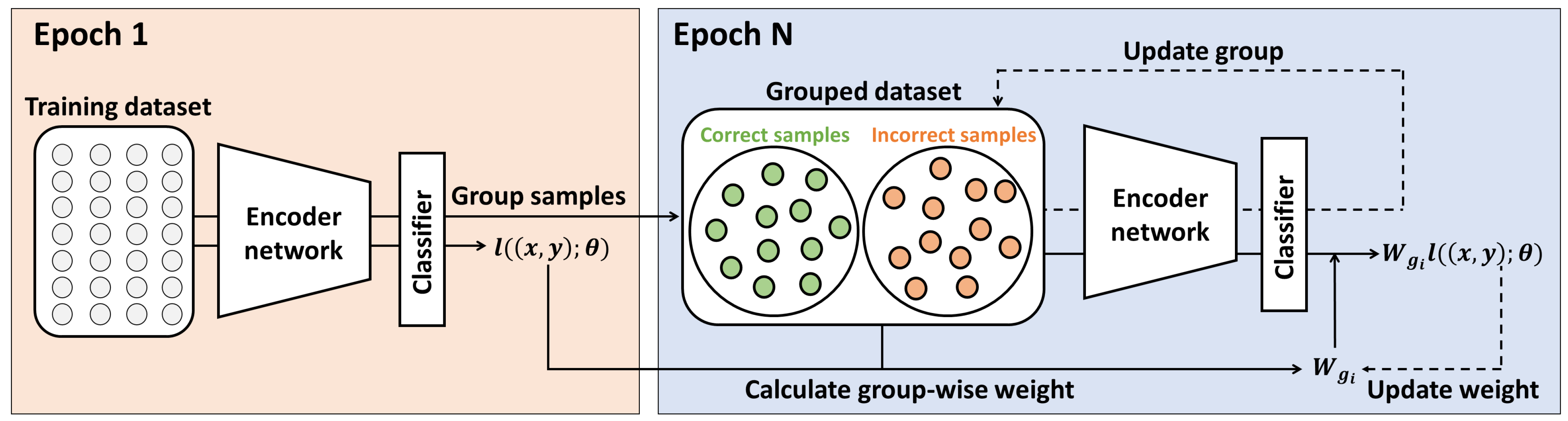
- We propose a novel method that dynamically groups data samples based on the current outputs and assigns more weights to the group with misclassified samples.
- Regardless of the choice of sensitive attributes, the proposed method gives more weights to underrepresented groups, resulting in enhancing fairness across unknown sensitive attributes.
- Without strong assumptions about sensitive attributes and auxiliary networks, our method significantly outperforms state-of-the-art methods on the benchmark datasets.
2. Related Work
2.1. Fairness-Aware Classification
2.2. Fairness/Debiasing Without Bias Supervision
3. Method
- Problem Definition. Consider a data sample x comprising a target attribute and unknown sensitive attributes . During the training of a classifier parameterized by to predict y, the model may capture biased features associated with sensitive attributes as a shortcut to minimize the average training loss. Our goal is to train a classifier that is invariant to the sensitive attribute , without access to sensitive attribute labels, as follows.Here, denotes the training data distribution and denotes the expectation over samples from . denotes the classification loss and denotes mutual information.
- Overall Framework. As illustrated in Figure 1, we design the overall framework using Bias Pseudo-Attribute (BPA) [27] as a baseline. The major difference between the two frameworks is that BPA calculates fixed weights for samples using clusters from the pre-trained classifier, whereas ours dynamically updates the sample weights based on the outputs of the current training model.
3.1. Strategy for Sample Grouping
3.2. Calculation of Group-Wise Weight
3.3. Algorithm for Overall Flow
| Algorithm 1 Overall Flow |
|
4. Experiments
4.1. Datasets
- CelebA contains about 200k face images with 40 facial attributes. Following the previous works [23,27,33], we set Male as the sensitive attribute for evaluation. Following the convention [27], among the remaining attributes, we exclude 5 o’clock Shadow, Bald, Rosy Cheeks, Sideburns, Goatee, Mustache, and Wearing Necktie, for which minority groups contain few or no samples.
- UTK Face includes about 20k face images where Gender, Race, and Age attributes are annotated. We set Gender as the target attribute and the others as the sensitive attributes. Following the previous work [23], we convert Race and Age into binary attributes and construct an imbalanced training set. Specifically, we construct three subsets according to the severity of data imbalance . Here, represents the ratio between the majority and minority groups, ranging from two to four with a step size of one. We construct the validation and test sets to be fully balanced.
- COMPAS includes about 7k samples with 11 attributes. Following the convention [42], we only utilize Caucasian and African-American samples and set Race and Sex as sensitive attributes.
- Cat and Dog has 40k images of dogs or cats. Following the previous method [22], we set species as the target attribute and color as the bias attribute. We construct a training set in which dogs and cats are correlated with white and black color, respectively, following the setup of the previous work [23]. The validation and test sets are fully balanced.
4.2. Evaluation Metrics
4.3. Comparison on COMPAS
- Comparison with Boosting. Boosting methods, such as Adaboost [58] and Gradient Boosting [59], have a similarity with ours in that they upweight misclassified samples during the training phase. However, there are significant differences. First, our method trains a single model by dynamically reweighting samples based on the outputs of the previous training stage while boosting methods iteratively train new weak learners with sample weights based on the outputs of previous learners. Second, the sample weights for each weak learner are not dynamically updated in boosting methods. Lastly, the methods for calculating weights are different from each other. We compare ours with the boosting approaches in Table 1. While boosting methods effectively improve classification accuracy over the baseline, they fail to enhance fairness.
4.4. Comparison on CelebA
4.5. Comparison on UTKFace
4.6. Exploring Assumptions for Sensitive Attributes
4.7. Effectiveness of Components
- BPA* is a modified version of BPA [27] that dynamically updates the clusters in the latent space of the debiased model with k-means clustering. In the first epoch, it generates clusters using k-means clustering in the latent space of the pre-trained model. In subsequent epochs, the clusters are updated with the same clustering method in the latent space of the current training model at each epoch. Based on the updated clusters, it utilizes the reweighting method such as BPA.
- Random randomly clusters samples for each epoch. For each batch, it clusters the input samples into two groups randomly. For each cluster, samples are differently weighted based on the average loss and size of the respective groups, as in our method.
- Loss sorts samples by loss and subsequently separates them into groups based on their ranking. At each epoch, it computes the training loss of all samples and separates them into two groups based on the loss, i.e., one group consists of samples with high loss, whereas the other group comprises samples with low loss. Specifically, we set the threshold to the median value of the loss and then assign weights to the samples in proportion to the average loss of the respective groups. If the groups are more finely separated, it converges toward Instance, as shown in Table 8.
- EO first composes clusters by k-means clustering similar to BPA. In subsequent epochs, multiple candidate groups are generated by permuting samples between the groups with a probability of . These candidate groups are evaluated in terms of equalized odds, and the groups with the largest equalized odds between them are selected. We then assign weights to the groups with our reweighting strategy.
- Instance computes the training loss for all samples using the current training model and assigns a weight to each sample in proportion to the loss. These weights are then normalized by the batch so that their sum equals one.
- is an ablative version of our method. In the first epoch, it clusters samples based on whether they are correctly classified or not (i.e., the proposed method). However, it does not update the clusters.

| 2 Groups | 4 Groups | 8 Groups | Instance | ||||
|---|---|---|---|---|---|---|---|
| BAcc. | EO | BAcc. | EO | BAcc. | EO | BAcc. | EO |
| 76.7 | 32.9 | 75.9 | 29.3 | 74.1 | 28.4 | 71.4 | 23.8 |
| Method | Updating | Attractive | Arched Eyebrows | ||||
|---|---|---|---|---|---|---|---|
| Balanced Accuracy | Equalized Odds | Std Dev. | Balanced Accuracy | Equalized Odds | Std Dev. | ||
| ResNet | ✗ | 76.7 | 25.6 | 15.5 | 70.8 | 33.8 | 27.0 |
| BPA | ✗ | 76.4 | 24.1 | 16.6 | 73.6 | 34.3 | 31.9 |
| BPA* | ✓ | 77.7 | 21.2 | 13.5 | 77.1 | 28.5 | 21.6 |
| Random | ✓ | 77.7 | 21.5 | 13.7 | 74.9 | 38.9 | 23.6 |
| Loss | ✓ | 78.0 | 18.2 | 10.5 | 76.7 | 32.9 | 23.2 |
| EO | ✓ | 77.0 | 22.0 | 13.2 | 75.7 | 34.6 | 27.1 |
| Instance | ✓ | 76.1 | 23.2 | 19.9 | 71.4 | 23.8 | 24.2 |
| ✗ | 77.4 | 23.6 | 14.2 | 74.4 | 38.2 | 22.2 | |
| Ours | ✓ | 75.5 | 6.4 | 9.3 | 75.9 | 15.3 | 20.5 |
| Method | Clean | 10% Noised | 20% Noised | |||
|---|---|---|---|---|---|---|
| BAcc. | EO | BAcc. | EO | BAcc. | EO | |
| Instance | 79.4 | 16.4 | 75.4 | 25.0 | 68.2 | 33.3 |
| Ours | 80.9 | 9.5 | 75.2 | 14.1 | 68.6 | 17.0 |
4.8. Fairness Improvement in Semi-Supervised Setting
4.9. Analysis on Cat and Dog
4.10. Implementation Details
5. Limitations and Future Work
6. Conclusions
Author Contributions
Funding
Institutional Review Board Statement
Informed Consent Statement
Data Availability Statement
Acknowledgments
Conflicts of Interest
References
- Russakovsky, O.; Deng, J.; Su, H.; Krause, J.; Satheesh, S.; Ma, S.; Huang, Z.; Karpathy, A.; Khosla, A.; Bernstein, M.; et al. ImageNet Large Scale Visual Recognition Challenge. Int. J. Comput. Vis. (IJCV) 2015, 115, 211–252. [Google Scholar] [CrossRef]
- Liu, Z.; Luo, P.; Wang, X.; Tang, X. Deep Learning Face Attributes in the Wild. In Proceedings of International Conference on Computer Vision (ICCV); IEEE: New York, NY, USA, 2015. [Google Scholar]
- He, K.; Zhang, X.; Ren, S.; Sun, J. Deep residual learning for image recognition. In Proceedings of the IEEE Conference on Computer Vision and Pattern Recognition; IEEE: New York, NY, USA, 2016; pp. 770–778. [Google Scholar]
- Karras, T.; Aila, T.; Laine, S.; Lehtinen, J. Progressive Growing of GANs for Improved Quality, Stability, and Variation. In Proceedings of the International Conference on Learning Representations, Vancouver, BC, Canada, 30 April–3 May 2018. [Google Scholar]
- Brandao, M. Age and gender bias in pedestrian detection algorithms. arXiv 2019, arXiv:1906.10490. [Google Scholar] [CrossRef]
- Kärkkäinen, K.; Joo, J. FairFace: Face Attribute Dataset for Balanced Race, Gender, and Age. arXiv 2019, arXiv:1908.04913. [Google Scholar] [CrossRef]
- Burns, K.; Hendricks, L.A.; Darrell, T.; Rohrbach, A. Women also Snowboard: Overcoming Bias in Captioning Models. In Proceedings of the European Conference on Computer Vision (ECCV); IEEE: New York, NY, USA, 2018. [Google Scholar]
- Angwin, J.; Larson, J.; Mattu, S.; Kirchner, L. Machine bias: There’s software used across the country to predict future criminals. And it’s biased against blacks. ProPublica, 23 May 2016. [Google Scholar]
- Dougherty, C. Google photos mistakenly labels black people gorillas. Twitter, 1 July 2015. [Google Scholar]
- Lomas, N. FaceApp apologizes for building a racist AI. TechCrunch, 25 April 2017. [Google Scholar]
- Dwork, C.; Hardt, M.; Pitassi, T.; Reingold, O.; Zemel, R. Fairness through Awareness. In ITCS ’12: Proceedings of the 3rd Innovations in Theoretical Computer Science Conference; ACM: New York, NY, USA, 2012; pp. 214–226. [Google Scholar] [CrossRef]
- Kusner, M.J.; Loftus, J.; Russell, C.; Silva, R. Counterfactual Fairness. In Proceedings of the Advances in Neural Information Processing Systems 30; Guyon, I., Luxburg, U.V., Bengio, S., Wallach, H., Fergus, R., Vishwanathan, S., Garnett, R., Eds.; Curran Associates, Inc.: Red Hook, NY, USA, 2017; pp. 4066–4076. [Google Scholar]
- Wang, T.; Zhao, J.; Yatskar, M.; Chang, K.W.; Ordonez, V. Balanced Datasets Are Not Enough: Estimating and Mitigating Gender Bias in Deep Image Representations. In 2019 IEEE/CVF International Conference on Computer Vision (ICCV); IEEE: New York, NY, USA, 2019; pp. 5309–5318. [Google Scholar]
- Wang, Z.; Qinami, K.; Karakozis, I.C.; Genova, K.; Nair, P.; Hata, K.; Russakovsky, O. Towards Fairness in Visual Recognition: Effective Strategies for Bias Mitigation. In Proceedings of the IEEE/CVF Conference on Computer Vision and Pattern Recognition (CVPR); IEEE: New York, NY, USA, 2020. [Google Scholar]
- Gong, S.; Liu, X.; Jain, A. Jointly De-biasing Face Recognition and Demographic Attribute Estimation. In Computer Vision—ECCV 2020; Springer: Berlin/Heidelberg, Germany, 2020. [Google Scholar]
- Hardt, M.; Price, E.; Srebro, N. Equality of Opportunity in Supervised Learning. In NIPS’16: Proceedings of the 30th International Conference on Neural Information Processing Systems; ACM: New York, NY, USA, 2016; pp. 3323–3331. [Google Scholar]
- Ramaswamy, V.V.; Kim, S.S.Y.; Russakovsky, O. Fair Attribute Classification Through Latent Space De-Biasing. In Proceedings of the IEEE/CVF Conference on Computer Vision and Pattern Recognition (CVPR); IEEE: New York, NY, USA, 2021; pp. 9301–9310. [Google Scholar]
- Sattigeri, P.; Hoffman, S.C.; Chenthamarakshan, V.; Varshney, K.R. Fairness GAN: Generating datasets with fairness properties using a generative adversarial network. IBM J. Res. Dev. 2019, 63, 3:1–3:9. [Google Scholar] [CrossRef]
- Xu, D.; Yuan, S.; Zhang, L.; Wu, X. FairGAN: Fairness-aware Generative Adversarial Networks. In 2018 IEEE International Conference on Big Data (Big Data); IEEE: New York, NY, USA, 2018; pp. 570–575. [Google Scholar] [CrossRef]
- Creager, E.; Madras, D.; Jacobsen, J.H.; Weis, M.; Swersky, K.; Pitassi, T.; Zemel, R. Flexibly Fair Representation Learning by Disentanglement. In Proceedings of the 36th International Conference on Machine Learning, Long Beach, CA, USA, 9–15 June 2019; Volume 97, pp. 1436–1445. [Google Scholar]
- Park, S.; Hwang, S.; Kim, D.; Byun, H. Learning Disentangled Representation for Fair Facial Attribute Classification via Fairness-awareunbiased Information Alignment. In Proceedings of the AAAI Conference on Artificial Intelligence, Virtual, 2–9 February 2021; Volume 35, pp. 2403–2411. [Google Scholar]
- Kim, B.; Kim, H.; Kim, K.; Kim, S.; Kim, J. Learning Not to Learn: Training Deep Neural Networks With Biased Data. In Proceedings of the The IEEE Conference on Computer Vision and Pattern Recognition (CVPR); IEEE: New York, NY, USA, 2019. [Google Scholar]
- Park, S.; Lee, J.; Lee, P.; Hwang, S.; Kim, D.; Byun, H. Fair Contrastive Learning for Facial Attribute Classification. In Proceedings of the IEEE/CVF Conference on Computer Vision and Pattern Recognition (CVPR); IEEE: New York, NY, USA, 2022; pp. 10389–10398. [Google Scholar]
- Sagawa, S.; Koh, P.W.; Hashimoto, T.B.; Liang, P. Distributionally Robust Neural Networks. In Proceedings of the International Conference on Learning Representations, Addis Ababa, Ethiopia, 30 April 2020. [Google Scholar]
- Kim, D.; Park, S.; Hwang, S.; Byun, H. Fair classification by loss balancing via fairness-aware batch sampling. Rev. Econ. Dyn. 2023, 518, 231–241. [Google Scholar] [CrossRef]
- Jung, S.W.; Chun, S.; Moon, T. Learning Fair Classifiers with Partially Annotated Group Labels. 2022 IEEE/CVF Conference on Computer Vision and Pattern Recognition (CVPR); IEEE: New York, NY, USA, 2022; pp. 10338–10347. [Google Scholar]
- Seo, S.; Lee, J.Y.; Han, B. Unsupervised Learning of Debiased Representations With Pseudo-Attributes. In Proceedings of the IEEE/CVF Conference on Computer Vision and Pattern Recognition (CVPR); IEEE: New York, NY, USA, 2022; pp. 16742–16751. [Google Scholar]
- Lin, T.Y.; Maire, M.; Belongie, S.; Hays, J.; Perona, P.; Ramanan, D.; Dollár, P.; Zitnick, C.L. Microsoft COCO: Common Objects in Context. In Proceedings of the Computer Vision—ECCV 2014; Fleet, D., Pajdla, T., Schiele, B., Tuytelaars, T., Eds.; Springer: Berlin/Heidelberg, Germany, 2014; pp. 740–755. [Google Scholar]
- Heilbron, F.C.; Escorcia, V.; Ghanem, B.; Niebles, J.C. ActivityNet: A large-scale video benchmark for human activity understanding. In Proceedings of the 2015 IEEE Conference on Computer Vision and Pattern Recognition (CVPR); IEEE: New York, NY, USA, 2015; pp. 961–970. [Google Scholar] [CrossRef]
- Wang, H.; He, Z.; Lipton, Z.L.; Xing, E.P. Learning Robust Representations by Projecting Superficial Statistics Out. In Proceedings of the International Conference on Learning Representations, New Orleans, LA, USA, 6–9 May 2019. [Google Scholar]
- Bahng, H.; Chun, S.; Yun, S.; Choo, J.; Oh, S.J. Learning De-biased Representations with Biased Representations. In Proceedings of the 37th International Conference on Machine Learning; PMLR: Cambridge, MA, USA, 2020. [Google Scholar]
- Hong, Y.; Yang, E. Unbiased Classification through Bias-Contrastive and Bias-Balanced Learning. In Proceedings of the Advances in Neural Information Processing Systems; Beygelzimer, A., Dauphin, Y., Liang, P., Vaughan, J.W., Eds.; Curran Associates, Inc.: Red Hook, NY, USA, 2021. [Google Scholar]
- Nam, J.; Cha, H.; Ahn, S.; Lee, J.; Shin, J. Learning from Failure: De-biasing Classifier from Biased Classifier. In Proceedings of the Advances in Neural Information Processing Systems; Larochelle, H., Ranzato, M., Hadsell, R., Balcan, M.F., Lin, H., Eds.; Curran Associates, Inc.: Red Hook, NY, USA, 2020; Volume 33, pp. 20673–20684. [Google Scholar]
- Lee, J.; Kim, E.; Lee, J.; Lee, J.; Choo, J. Learning Debiased Representation via Disentangled Feature Augmentation. In Proceedings of the Advances in Neural Information Processing Systems; Beygelzimer, A., Dauphin, Y., Liang, P., Vaughan, J.W., Eds.; Curran Associates, Inc.: Red Hook, NY, USA, 2021. [Google Scholar]
- Lim, J.; Kim, Y.; Kim, B.; Ahn, C.; Shin, J.; Yang, E.; Han, S. BiasAdv: Bias-Adversarial Augmentation for Model Debiasing. In Proceedings of the IEEE/CVF Conference on Computer Vision and Pattern Recognition (CVPR); IEEE: New York, NY, USA, 2023; pp. 3832–3841. [Google Scholar]
- Zhang, Y.K.; Wang, Q.W.; Zhan, D.C.; Ye, H.J. Learning Debiased Representations via Conditional Attribute Interpolation. In Proceedings of the IEEE/CVF Conference on Computer Vision and Pattern Recognition (CVPR); IEEE: New York, NY, USA, 2023; pp. 7599–7608. [Google Scholar]
- Grari, V.; Lamprier, S.; Detyniecki, M. Fairness without the Sensitive Attribute via Causal Variational Autoencoder. In Proceedings of the Thirty-First International Joint Conference on Artificial Intelligence, IJCAI-22, Vienna, Austria, 23–29 July 2022; Raedt, L.D., Ed.; IJCAI: Vienna, Austria, 2023; pp. 696–702. [Google Scholar] [CrossRef]
- Zhao, T.; Dai, E.; Shu, K.; Wang, S. Towards Fair Classifiers Without Sensitive Attributes: Exploring Biases in Related Features. In WSDM ’22: Proceedings of the Fifteenth ACM International Conference on Web Search and Data Mining; ACM: New York, NY, USA, 2022; pp. 1433–1442. [Google Scholar] [CrossRef]
- Hashimoto, T.; Srivastava, M.; Namkoong, H.; Liang, P. Fairness Without Demographics in Repeated Loss Minimization. In International Conference on Machine Learning; PMLR: Cambridge, MA, USA, 2018; pp. 1929–1938. [Google Scholar]
- Lahoti, P.; Beutel, A.; Chen, J.; Lee, K.; Prost, F.; Thain, N.; Wang, X.; Chi, E.H. Fairness without Demographics through Adversarially Reweighted Learning. In Advances in Neural Information Processing Systems; NIPS’20; Curran Associates, Inc.: Red Hook, NY, USA, 2020. [Google Scholar]
- Liu, E.Z.; Haghgoo, B.; Chen, A.S.; Raghunathan, A.; Koh, P.W.; Sagawa, S.; Liang, P.; Finn, C. Just Train Twice: Improving Group Robustness without Training Group Information. arXiv 2021, arXiv:2107.09044. [Google Scholar] [CrossRef]
- Chai, J.; Jang, T.; Wang, X. Fairness without Demographics through Knowledge Distillation. In Proceedings of the Advances in Neural Information Processing Systems; Curran Associates, Inc.: Red Hook, NY, USA, 2022. [Google Scholar]
- Chai, J.; Wang, X. Fairness with Adaptive Weights. In Proceedings of the 39th International Conference on Machine Learning; Chaudhuri, K., Jegelka, S., Song, L., Szepesvari, C., Niu, G., Sabato, S., Eds.; PMLR: Cambridge, MA, USA, 2022; Volume 162, pp. 2853–2866. [Google Scholar]
- Kamiran, F.; Calders, T. Data Pre-Processing Techniques for Classification without Discrimination. Knowl. Inf. Syst. 2011, 33, 1–33. [Google Scholar] [CrossRef]
- Zhang, Z.; Song, Y.; Qi, H. Age Progression/Regression by Conditional Adversarial Autoencoder. In Proceedings of the IEEE Conference on Computer Vision and Pattern Recognition (CVPR); IEEE: New York, NY, USA, 2017. [Google Scholar]
- Raff, E.; Sylvester, J. Gradient Reversal against Discrimination: A Fair Neural Network Learning Approach. In Proceedings of the 2018 IEEE 5th International Conference on Data Science and Advanced Analytics (DSAA); IEEE: New York, NY, USA, 2018; pp. 189–198. [Google Scholar] [CrossRef]
- Sarhan, M.H.; Navab, N.; Eslami, A.; Albarqouni, S. Fairness by Learning Orthogonal Disentangled Representations. In Proceedings of the Computer Vision—ECCV 2020—16th European Conference, Glasgow, UK, 23–28 August 2020; Volume 12374, pp. 746–761. [Google Scholar] [CrossRef]
- Zhang, B.H.; Lemoine, B.; Mitchell, M. Mitigating Unwanted Biases with Adversarial Learning. In AIES ’18: Proceedings of the Proceedings of the 2018 AAAI/ACM Conference on AI, Ethics, and Society; ACM: New York, NY, USA, 2018; pp. 335–340. [Google Scholar] [CrossRef]
- Wadsworth, C.; Vera, F.; Piech, C. Achieving fairness through adversarial learning: An application to recidivism prediction. arXiv 2018, arXiv:1807.00199. [Google Scholar] [CrossRef]
- Goodfellow, I.; Pouget-Abadie, J.; Mirza, M.; Xu, B.; Warde-Farley, D.; Ozair, S.; Courville, A.; Bengio, Y. Generative adversarial nets. In Advances in Neural Information Processing Systems; Curran Associates, Inc.: Red Hook, NY, USA, 2014; pp. 2672–2680. [Google Scholar]
- Lokhande, V.S.; Sohn, K.; Yoon, J.; Udell, M.; Lee, C.Y.; Pfister, T. Towards Group Robustness in the Presence of Partial Group Labels. In Proceedings of the ICML 2022: Workshop on Spurious Correlations, Invariance and Stability, Baltimore, MD, USA, 22 July 2022. [Google Scholar]
- Chai, J.; Wang, X. Self-Supervised Fair Representation Learning without Demographics. In Advances in Neural Information Processing Systems; Curran Associates, Inc.: Red Hook, NY, USA, 2022. [Google Scholar]
- Jang, T.; Wang, X. Difficulty-Based Sampling for Debiased Contrastive Representation Learning. In Proceedings of the IEEE/CVF Conference on Computer Vision and Pattern Recognition (CVPR); IEEE: New York, NY, USA, 2023; pp. 24039–24048. [Google Scholar]
- Islam, R.; Chen, H.; Cai, Y. Fairness without Demographics through Shared Latent Space-Based Debiasing. Proc. Aaai Conf. Artif. Intell. 2024, 38, 12717–12725. [Google Scholar] [CrossRef]
- Wang, X.; Li, J.; Tsang, I.W.; Ong, Y.S. Towards Harmless Rawlsian Fairness Regardless of Demographic Prior. In Advances in Neural Information Processing Systems; Globerson, A., Mackey, L., Belgrave, D., Fan, A., Paquet, U., Tomczak, J., Zhang, C., Eds.; Curran Associates, Inc.: Red Hook, NY, USA, 2024; Volume 37, pp. 80908–80935. [Google Scholar] [CrossRef]
- Luo, Y.; Li, Z.; Liu, Q.; Zhu, J. Fairness without Demographics through Learning Graph of Gradients. In Proceedings of the 31st ACM SIGKDD Conference on Knowledge Discovery and Data Mining, V.1, KDD 2025, Toronto, ON, Canada, 3–7 August 2025; pp. 918–926. [Google Scholar] [CrossRef]
- Lin, T.; Goyal, P.; Girshick, R.B.; He, K.; Dollár, P. Focal Loss for Dense Object Detection. arXiv 2017, arXiv:1708.02002. [Google Scholar] [CrossRef]
- Schwenk, H.; Bengio, Y. Training Methods for Adaptive Boosting of Neural Networks. In Advances in Neural Information Processing Systems; Jordan, M., Kearns, M., Solla, S., Eds.; MIT Press: Cambridge, MA, USA, 1997; Volume 10. [Google Scholar]
- Badirli, S.; Liu, X.; Xing, Z.; Bhowmik, A.; Doan, K.D.; Keerthi, S. Gradient Boosting Neural Networks: GrowNet. arXiv 2020, arXiv:2002.07971. [Google Scholar] [CrossRef]
- Kingma, D.P.; Ba, J. Adam: A Method for Stochastic Optimization. In Proceedings of the 3rd International Conference on Learning Representations, ICLR 2015, San Diego, CA, USA, 7–9 May 2015. [Google Scholar]


| Method | Accuracy (↑) | Equalized Odds (↓) |
|---|---|---|
| ResNet [3] * | 64.1 | 38.3 |
| Focal Loss [57] | 66.4 | 33.7 |
| Adaboost [58] | 65.6 | 31.3 |
| GrowNet [59] | 66.1 | 38.9 |
| DRO [39] * | 62.6 | 30.4 |
| ARL [40] * | 63.2 | 29.5 |
| FairRF [38] * | 63.3 | 25.7 |
| Chai, Jang, and Wang [42] * | 63.3 | 20.3 |
| Ours | 63.4 | 16.0 |
| Method | Accuracy (↑) | Equalized Odds (↓) |
|---|---|---|
| ResNet [3] * | 64.1 | 20.2 |
| Focal Loss [57] | 66.4 | 22.2 |
| Adaboost [58] | 65.1 | 26.3 |
| GrowNet [59] | 66.8 | 22.2 |
| DRO [39] * | 62.7 | 18.8 |
| ARL [40] * | 63.2 | 19.1 |
| FairRF [38] * | 63.3 | 18.7 |
| Chai, Jang, and Wang [42] * | 63.4 | 14.3 |
| Ours | 63.3 | 9.4 |
| Method | SA | All Results | EO ≥ 10 | EO ≥ 20 | ||||||
|---|---|---|---|---|---|---|---|---|---|---|
| BAcc. (↑) | EO (↓) | Std Dev. (↓) | BAcc. (↑) | EO (↓) | Std Dev. (↓) | BAcc. (↑) | EO (↓) | Std Dev. (↓) | ||
| ResNet | ✗ | 75.0 | 20.9 | 26.1 | 72.7 | 26.6 | 29.2 | 72.9 | 33.9 | 30.5 |
| Group DRO | ✓ | 81.5 | 4.5 | 4.6 | 79.6 | 4.9 | 5.2 | 78.0 | 6.1 | 6.8 |
| JTT | ✗ | 77.2 | 15.4 | 15.9 | 74.9 | 18.9 | 17.2 | 73.8 | 22.4 | 19.1 |
| LfF | ✗ | 78.1 | 17.8 | 15.4 | 76.1 | 20.1 | 17.1 | 74.7 | 22.8 | 18.9 |
| DFA | ✗ | 76.2 | 15.5 | 21.2 | 74.2 | 18.6 | 23.2 | 74.0 | 22.9 | 23.2 |
| BPA | ✗ | 79.9 | 16.7 | 13.7 | 78.2 | 20.3 | 15.3 | 76.7 | 23.6 | 17.3 |
| Ours | ✗ | 79.3 | 11.2 | 10.7 | 77.4 | 13.2 | 11.2 | 76.8 | 16.1 | 12.8 |
| Target Attribute | No Sensitive Labels | Sensitive Labels Required | |||||
|---|---|---|---|---|---|---|---|
| ResNet | LfF | DFA | BPA | Ours | JTT | Group DRO | |
| Arched Eyebrows | 70.8 | 64.0 | 75.9 | 73.6 | 75.9 | 72.7 | 74.9 |
| Bags Under Eyes | 73.1 | 72.3 | 69.4 | 75.6 | 72.5 | 61.1 | 75.5 |
| Bangs | 89.2 | 93.5 | 90.9 | 91.2 | 93.0 | 94.3 | 96.8 |
| Big Lips | 58.4 | 61.9 | 62.3 | 70.6 | 66.4 | 51.7 | 63.5 |
| Big Nose | 67.3 | 68.4 | 70.3 | 70.4 | 71.0 | 68.6 | 72.5 |
| Blond Hair | 79.2 | 87.6 | 84.1 | 83.5 | 86.8 | 85.6 | 91.1 |
| Blurry | 76.4 | 83.9 | 76.9 | 88.5 | 87.6 | 88.6 | 89.2 |
| Brown Hair | 75.4 | 86.3 | 82.1 | 82.5 | 84.0 | 83.9 | 84.0 |
| Bushy Eyebrows | 77.1 | 83.4 | 78.7 | 83.8 | 80.9 | 83.8 | 83.6 |
| Chubby | 64.1 | 75.4 | 66.0 | 76.9 | 70.3 | 81.4 | 81.6 |
| Double Chin | 64.2 | 75.7 | 65.7 | 83.0 | 83.7 | 84.1 | 84.7 |
| Gray Hair | 74.9 | 83.9 | 77.0 | 83.7 | 80.0 | 89.9 | 93.9 |
| Heavy Makeup | 71.8 | 71.4 | 74.8 | 77.9 | 75.4 | 71.3 | 75.6 |
| Narrow Eyes | 76.2 | 76.2 | 74.5 | 76.4 | 76.6 | 75.6 | 77.1 |
| No Beard | 72.1 | 77.0 | 73.4 | 71.5 | 77.0 | 78.0 | 81.8 |
| Oval Face | 62.4 | 60.1 | 62.9 | 64.1 | 62.1 | 62.6 | 64.6 |
| Pale Skin | 71.6 | 86.4 | 79.0 | 89.5 | 86.3 | 87.7 | 91.1 |
| Pointy Nose | 62.2 | 64.8 | 63.4 | 65.2 | 68.0 | 60.4 | 68.7 |
| Receding Hairline | 74.0 | 82.6 | 78.0 | 82.0 | 79.2 | 84.4 | 66.0 |
| Straight Hair | 68.6 | 65.9 | 64.3 | 73.7 | 72.0 | 73.1 | 76.0 |
| Wavy Hair | 75.7 | 73.1 | 76.5 | 78.8 | 75.7 | 69.5 | 81.0 |
| Wearing Hat | 87.9 | 93.1 | 92.2 | 89.8 | 89.9 | 98.0 | 97.5 |
| Wearing Earrings | 74.2 | 70.4 | 73.2 | 81.1 | 81.2 | 61.3 | 83.0 |
| Wearing Lipstick | 73.1 | 74.6 | 71.1 | 79.1 | 80.0 | 71.0 | 80.7 |
| Wearing Necklace | 53.5 | 62.4 | 56.2 | 65.7 | 56.6 | 52.0 | 66.3 |
| Young | 79.7 | 77.7 | 78.1 | 78.3 | 78.1 | 66.8 | 78.7 |
| Attractive | 76.8 | 76.4 | 75.3 | 76.5 | 75.5 | 72.9 | 78.0 |
| High Cheekbone | 83.6 | 84.5 | 82.8 | 84.3 | 83.1 | 75.5 | 83.6 |
| Black Hair | 87.2 | 86.8 | 85.9 | 83.5 | 86.8 | 84.0 | 87.6 |
| Mouth Slightly Open | 93.2 | 92.9 | 94.1 | 92.2 | 93.5 | 87.3 | 92.2 |
| Eyeglasses | 96.8 | 97.1 | 97.2 | 94.4 | 98.0 | 98.4 | 98.8 |
| Smiling | 90.6 | 90.8 | 91.1 | 90.4 | 92.3 | 89.4 | 90.4 |
| Average | 75.0 | 78.1 | 76.2 | 79.9 | 79.3 | 77.2 | 81.5 |
| Target Attribute | Equalized Odds (↓) | Std Dev. (↓) | ||||||||||||
|---|---|---|---|---|---|---|---|---|---|---|---|---|---|---|
| No Sensitive Labels | Sensitive Labels Required | No Sensitive Labels | Sensitive Labels Required | |||||||||||
| ResNet | LfF | DFA | BPA | Ours | JTT | Group DRO | ResNet | LfF | DFA | BPA | Ours | JTT | Group DRO | |
| Arched Eyebrows | 33.9 | 32.7 | 30.3 | 34.4 | 15.3 | 28.1 | 6.6 | 27.0 | 31.9 | 23.2 | 31.9 | 20.5 | 17.4 | 4.2 |
| Bags Under Eyes | 44.0 | 21.1 | 16.2 | 20.1 | 15.9 | 37.9 | 6.6 | 27.0 | 17.9 | 26.0 | 15.4 | 17.2 | 32.1 | 4.5 |
| Bangs | 2.4 | 3.7 | 7.6 | 4.4 | 2.3 | 2.7 | 6.3 | 10.7 | 2.4 | 7.0 | 8.8 | 1.6 | 3.2 | 3.7 |
| Big Lips | 11.7 | 38.9 | 13.2 | 16.0 | 13.8 | 20.9 | 9.8 | 46.2 | 27.4 | 41.0 | 12.0 | 10.7 | 45.0 | 14.6 |
| Big Nose | 23.8 | 18.6 | 23.2 | 33.8 | 17.9 | 20.5 | 2.3 | 30.8 | 13.5 | 15.8 | 20.7 | 10.9 | 27.3 | 2.5 |
| Blond Hair | 30.6 | 14.9 | 18.5 | 11.6 | 6.0 | 4.8 | 2.3 | 29.8 | 12.9 | 18.7 | 16.0 | 4.2 | 3.2 | 1.6 |
| Blurry | 6.7 | 6.7 | 4.9 | 5.6 | 5.4 | 4.7 | 3.2 | 25.0 | 6.1 | 23.2 | 8.3 | 7.3 | 4.0 | 2.6 |
| Brown Hair | 18.4 | 7.1 | 4.7 | 9.4 | 4.3 | 4.3 | 1.7 | 14.9 | 3.1 | 3.4 | 8.0 | 5.9 | 8.1 | 2.2 |
| Bushy Eyebrows | 23.5 | 6.9 | 14.8 | 9.7 | 5.7 | 7.9 | 3.1 | 25.9 | 5.8 | 20.4 | 5.7 | 3.6 | 12.7 | 2.3 |
| Chubby | 15.1 | 28.0 | 13.9 | 29.1 | 25.0 | 26.6 | 2.8 | 41.2 | 21.8 | 37.5 | 17.3 | 14.6 | 15.4 | 2.5 |
| Double Chin | 15.2 | 25.0 | 11.4 | 22.4 | 20.0 | 18.2 | 5.1 | 41.2 | 23.1 | 38.2 | 14.1 | 11.7 | 10.9 | 3.6 |
| Gray Hair | 13.1 | 16.9 | 16.1 | 11.2 | 6.5 | 13.7 | 3.8 | 29.9 | 17.9 | 27.5 | 20.3 | 8.3 | 8.0 | 2.9 |
| Heavy Makeup | 44.3 | 47.2 | 45.0 | 39.3 | 38.8 | 27.8 | 25.6 | 36.6 | 32.1 | 26.1 | 22.7 | 22.6 | 21.8 | 23.9 |
| Narrow Eyes | 27.1 | 3.6 | 4.8 | 3.4 | 3.9 | 7.5 | 1.9 | 32.0 | 2.2 | 26.2 | 9.5 | 6.6 | 19.9 | 2.0 |
| No Beard | 44.9 | 32.7 | 39.8 | 50.3 | 32.4 | 37.0 | 14.3 | 41.6 | 25.7 | 33.1 | 29.2 | 18.7 | 21.4 | 15.1 |
| Oval Face | 22.0 | 16.5 | 17.3 | 18.0 | 14.8 | 21.0 | 3.8 | 32.1 | 21.3 | 21.3 | 14.4 | 12.7 | 14.1 | 5.0 |
| Pale Skin | 15.0 | 8.9 | 2.9 | 3.8 | 3.8 | 9.4 | 0.8 | 33.5 | 12.3 | 21.1 | 8.2 | 12.6 | 5.6 | 0.6 |
| Pointy Nose | 22.5 | 24.7 | 21.2 | 29.0 | 10.5 | 33.4 | 2.7 | 36.3 | 32.1 | 31.8 | 23.3 | 9.7 | 33.3 | 5.4 |
| Receding Hairline | 45.0 | 16.5 | 12.2 | 13.9 | 13.3 | 14.8 | 3.6 | 27.9 | 11.2 | 22.1 | 13.4 | 20.4 | 8.7 | 4.3 |
| Straight Hair | 9.8 | 9.6 | 4.1 | 6.6 | 6.3 | 7.1 | 1.7 | 26.2 | 31.1 | 33.0 | 9.6 | 12.4 | 7.0 | 2.0 |
| Wavy Hair | 18.4 | 4.2 | 17.8 | 14.9 | 3.3 | 14.3 | 1.6 | 22.0 | 13.0 | 24.3 | 10.5 | 4.7 | 10.1 | 6.8 |
| Wearing Hat | 23.4 | 3.6 | 5.2 | 8.8 | 7.9 | 0.6 | 0.5 | 15.0 | 4.8 | 7.6 | 5.3 | 5.1 | 0.5 | 1.0 |
| Wearing Earrings | 43.2 | 39.9 | 34.4 | 22.6 | 18.1 | 38.6 | 4.6 | 31.3 | 26.8 | 20.7 | 13.4 | 11.9 | 31.5 | 2.7 |
| Wearing Lipstick | 47.4 | 41.3 | 38.2 | 36.6 | 25.7 | 33.7 | 8.0 | 33.7 | 27.2 | 32.9 | 22.4 | 15.5 | 23.8 | 10.7 |
| Wearing Necklace | 0.8 | 57.7 | 21.1 | 14.7 | 17.4 | 22.0 | 10.8 | 52.7 | 34.1 | 45.6 | 18.9 | 42.1 | 37.0 | 9.1 |
| Young | 17.5 | 17.4 | 17.0 | 18.1 | 3.7 | 23.4 | 1.3 | 16.1 | 10.2 | 17.7 | 12.2 | 6.9 | 19.1 | 1.9 |
| Attractive | 25.7 | 11.5 | 21.6 | 24.1 | 6.4 | 5.0 | 0.9 | 15.5 | 10.1 | 16.5 | 16.6 | 9.3 | 6.1 | 1.6 |
| High Cheekbone | 12.9 | 5.0 | 7.3 | 6.7 | 4.6 | 5.1 | 4.8 | 15.0 | 6.2 | 5.8 | 4.8 | 5.5 | 9.4 | 4.9 |
| Black Hair | 5.0 | 5.0 | 5.6 | 11.6 | 4.2 | 9.5 | 1.1 | 3.0 | 4.3 | 6.7 | 16.0 | 5.2 | 8.4 | 2.1 |
| Mouth Slightly Open | 2.0 | 1.9 | 0.9 | 0.6 | 2.3 | 0.5 | 0.2 | 2.9 | 1.6 | 1.2 | 2.9 | 1.5 | 8.0 | 0.1 |
| Eyeglasses | 1.3 | 3.0 | 2.0 | 3.4 | 1.3 | 1.3 | 0.8 | 3.6 | 2.0 | 2.6 | 2.6 | 0.9 | 0.8 | 0.6 |
| Smiling | 3.9 | 2.7 | 4.0 | 2.0 | 2.5 | 3.1 | 2.1 | 9.0 | 2.3 | 2.8 | 4.2 | 1.7 | 2.5 | 1.3 |
| Average | 20.9 | 17.8 | 15.5 | 16.7 | 11.2 | 15.4 | 4.5 | 26.1 | 15.4 | 21.2 | 13.7 | 10.7 | 15.9 | 4.6 |
| Method | Severity | Severity | Severity | ||||||
|---|---|---|---|---|---|---|---|---|---|
| BAcc. (↑) | EO (↓) | Std Dev. (↓) | BAcc. (↑) | EO (↓) | Std Dev. (↓) | BAcc. (↑) | EO (↓) | Std Dev. (↓) | |
| ResNet | 82.1 | 17.7 | 10.3 | 81.9 | 21.0 | 12.3 | 80.3 | 26.0 | 16.1 |
| LfF | 77.7 | 4.1 | 3.4 | 77.2 | 7.3 | 4.4 | 76.8 | 14.4 | 10.4 |
| DFA | 82.1 | 15.8 | 9.3 | 81.8 | 18.1 | 10.4 | 79.6 | 20.2 | 13.8 |
| BPA | 83.1 | 16.6 | 9.6 | 82.0 | 21.8 | 12.6 | 80.3 | 22.6 | 13.1 |
| Ours | 80.3 | 3.1 | 2.2 | 80.5 | 4.0 | 5.3 | 79.2 | 8.2 | 7.1 |
| Method | Severity | Severity | Severity | ||||||
|---|---|---|---|---|---|---|---|---|---|
| BAcc. (↑) | EO (↓) | Std Dev. (↓) | BAcc. (↑) | EO (↓) | Std Dev. (↓) | BAcc. (↑) | EO (↓) | Std Dev. (↓) | |
| ResNet | 81.8 | 10.1 | 6.1 | 81.6 | 15.2 | 9.2 | 79.3 | 21.2 | 12.4 |
| LfF | 81.8 | 4.8 | 2.9 | 81.6 | 9.2 | 6.6 | 80.5 | 12.9 | 9.8 |
| DFA | 81.7 | 6.6 | 10.0 | 81.8 | 12.8 | 10.3 | 81.0 | 13.3 | 10.1 |
| BPA | 81.9 | 6.5 | 3.9 | 81.8 | 10.2 | 10.7 | 80.6 | 11.5 | 8.7 |
| Ours | 82.4 | 4.5 | 3.3 | 82.6 | 5.7 | 3.9 | 80.9 | 9.5 | 5.5 |
| Method | Labeled Data | Balanced Accuracy | EO |
|---|---|---|---|
| Group DRO | 1 | 74.2 | 3.4 |
| Ours | 1/2 | 72.3 | 4.2 |
| 1/4 | 71.6 | 4.7 | |
| 1/10 | 71.4 | 5.0 | |
| 0 | 71.0 | 17.9 |
| Method | Balanced Accuracy | Equalized Odds | Std Dev. |
|---|---|---|---|
| ResNet | 79.9 | 20.7 | 17.7 |
| LfF | 81.6 | 14.0 | 8.4 |
| DFA | 86.8 | 13.4 | 7.8 |
| BPA | 87.7 | 10.7 | 7.9 |
| Ours | 85.9 | 5.7 | 7.6 |
Disclaimer/Publisher’s Note: The statements, opinions and data contained in all publications are solely those of the individual author(s) and contributor(s) and not of MDPI and/or the editor(s). MDPI and/or the editor(s) disclaim responsibility for any injury to people or property resulting from any ideas, methods, instructions or products referred to in the content. |
© 2026 by the authors. Licensee MDPI, Basel, Switzerland. This article is an open access article distributed under the terms and conditions of the Creative Commons Attribution (CC BY) license.
Share and Cite
Lee, P.; Park, S. Fair Classification Without Sensitive Attribute Labels via Dynamic Reweighting. Appl. Sci. 2026, 16, 1684. https://doi.org/10.3390/app16041684
Lee P, Park S. Fair Classification Without Sensitive Attribute Labels via Dynamic Reweighting. Applied Sciences. 2026; 16(4):1684. https://doi.org/10.3390/app16041684
Chicago/Turabian StyleLee, Pilhyeon, and Sungho Park. 2026. "Fair Classification Without Sensitive Attribute Labels via Dynamic Reweighting" Applied Sciences 16, no. 4: 1684. https://doi.org/10.3390/app16041684
APA StyleLee, P., & Park, S. (2026). Fair Classification Without Sensitive Attribute Labels via Dynamic Reweighting. Applied Sciences, 16(4), 1684. https://doi.org/10.3390/app16041684