Article

Interannual Variation in Key Quality Constituents in Shiqian Taicha Manufactured as Green and Black Tea (2021–2023)


1
Tea Research Institute, Guizhou Provincial Academy of Agricultural Sciences, Guiyang 550006, China
2
Guizhou Key Laboratory of Agricultural Microbiology, Guizhou Province Academy of Agricultural Science, Guiyang 550006, China
3
Zunyi Comprehensive Field Scientific Observation and Research Station of the Ministry of Agriculture and Rural Affairs, Zunyi 564100, China
*
Author to whom correspondence should be addressed.
Appl. Sci. 2026, 16(3), 1614; https://doi.org/10.3390/app16031614
Submission received: 14 January 2026 / Revised: 1 February 2026 / Accepted: 4 February 2026 / Published: 5 February 2026
(This article belongs to the Section Agricultural Science and Technology)

Abstract

Shiqian Taicha (Camellia sinensis) is a local tea cultivar originating from Shiqian County and Guizhou (China) that is suitable for both green and black tea. The year-on-year manufacturing conditions, which affect chemical quality, were elucidated through the analysis of 78 green tea and 38 black tea commercial batches manufactured in 2021–2023. The batches were manufactured by the same process, but these naturally varied in raw-leaf status and factory parameters. The moisture content, water-soluble extract, free amino acids, tea polyphenols, caffeine, gallic acid, total ash, total catechins and individual catechins were predicted using a calibrated near-infrared (NIR) spectroscopy model and membership function evaluation, which integrated multiple indices to produce an overall quality score for each year and tea type. The amino acids of green tea peaked in the year 2022, (with 4.55%) whereas the polyphenols (which refers to carbon-based molecules) was in the year 2021, (with 24.22%), and the total catechins was in the year 2021, (with 16.71%); due to these observations, the ratio of phenol-to-amino was high in the year 2021, with (10.09); while the year 2022 had a lower ratio with (3.41). Although there were fewer differences from region to region with black tea, 2022 was better in terms of moisture control, amino acids retention and composite score with a value of 0.585. The assessment of the membership function indicated that 2022 was the most ideal tea production year for green tea (0.506) as well as black tea (0.477), with 2021 tea (0.486) and 2023 tea (0.488) following next based on type. The data presents quantitatively stable fixation and moisture/fermentation management targets to improve Shiqian Taicha value and consistency.

1. Introduction

Tea (Camellia sinensis) is one of the most widely consumed non-alcoholic beverages worldwide and a major agricultural commodity in Asia and beyond [1,2,3]. Tea quality is determined by cultivar (genotype), environment, and processing, and is ultimately expressed through the concentrations of key non-volatile metabolites and their sensory attributes. Major contributors include flavan-3-ols (catechins and their gallates), caffeine and related methylxanthines, free amino acids (notably L-theanine), soluble sugars, organic acids, and aroma precursors, all of which undergo transformation during the manufacturing process [4,5,6,7]. Because these constituents underpin bitterness, astringency, umami, and sweetness, quantifying their dynamics provides a chemical basis for quality control and for explaining year-to-year differences perceived by producers and consumers [5,8,9,10,11,12].
Manufacturing determines both the direction and magnitude of compositional change. In non-fermented green teas, rapid heat fixation inactivates polyphenol oxidase and peroxidase, preventing catechin oxidation and preserving the fresh taste and ‘green’ aroma [10,11,12,13]. In contrast, black tea is produced through controlled withering, rolling, and enzyme-catalyzed oxidation (‘fermentation’), during which monomeric catechins are converted into theaflavins, thearubigins, and related polymers that drive infusion color, briskness, and mellowing of astringency [14,15,16,17]. Accordingly, industry quality indices are grounded in these transformations and can help match cultivar and process conditions [8,9,13,18,19]. For example, green tea suitability typically benefits from elevated amino acids with moderate polyphenols, whereas high-quality black tea requires efficient catechin conversion while maintaining an appropriate precursor pool.
Specialty teas often face substantial interannual variability in the raw-leaf metabolome, even within the same cultivar and growing area. Temperature, irradiance, rainfall, and episodic stresses influence carbon–nitrogen allocation and secondary metabolism, thereby shifting the levels of catechins, caffeine, and amino acids in harvested shoots [20,21,22,23,24]. Recent syntheses and regional studies show that seasonal and interannual variation can measurably alter antioxidant capacity and sensory-relevant catechins (e.g., EGCG), with consequences for processing behavior and final taste [25,26,27,28]. Characterizing interannual compositional drift has therefore become increasingly important for establishing robust quality specifications and for adapting processing parameters under climate variability [21,22].
Shiqian Taicha, a local tea population developed in Shiqian County, Guizhou Province (China), is gaining attention for its distinctive sensory profile and its suitability for producing multiple tea types. Recent germplasm characterization has reported high morphological and biochemical diversity, with wide ranges in total polyphenols, total catechins, caffeine, and amino acids, indicating substantial heterogeneity in raw material quality [29]. However, systematic datasets that compare processed Shiqian Taicha products across multiple years remain scarce. Quantifying interannual variation is necessary to distinguish intrinsic year effects from processing-driven effects and to provide an evidence base for year-adaptive manufacturing and objective quality grading.
Analytically, conventional wet chemistry and chromatographic methods remain definitive but are labor-intensive and poorly suited for rapid screening along the industrial chain. Near-infrared (NIR) spectroscopy coupled with chemometric calibration provides a non-destructive alternative for predicting tea polyphenols, caffeine, amino acids, and related quality indices, enabling high-throughput monitoring during processing [30,31,32]. In parallel, tea quality is inherently multi-attribute: indicators are correlated and should be interpreted jointly rather than in isolation. Fuzzy set-based membership function (MF) methods can normalize heterogeneous indicators and integrate them into an aggregate score in a transparent manner, and have been widely applied in multi-criteria decision-making and food quality evaluation [33,34].
Accordingly, this study investigates Shiqian Taicha manufactured as green and black tea across three production years (2021–2023) to (i) quantify core quality constituents (total polyphenols, total catechins, caffeine, free amino acids, and representative catechins), (ii) assess interannual differences and their processing implications, and (iii) integrate multi-index information using a membership function approach for objective grading. The results provide a basis for year-adaptive quality control of Shiqian Taicha and a methodological reference for regional teas facing increasing interannual variability in raw materials.

2. Materials and Methods

Fresh shoots of Shiqian Taicha were collected during the spring flush for three consecutive years (2021–2023) from the same commercial tea garden in Shiqian County, Guizhou Province, China. Sampling and batch definition followed GB/T 8302-2013 [35]. In total, 78 finished green tea batches (2021, n = 24; 2022, n = 23; 2023, n = 31) and 38 finished black tea batches (2021, n = 4; 2022, n = 11; 2023, n = 23) were obtained, with each sample representing an independent production lot. Plucking was standardized to one bud with one or two tender leaves; coarse, diseased, or mechanically damaged leaves were removed. Fresh shoots were transported to the factory in ventilated baskets shortly after plucking and processed according to standardized local procedures.
Near-infrared (NIR) spectroscopy provides a rapid, non-destructive approach for quantifying major quality constituents in finished tea, consistent with its established use for tea quality control. At the Guizhou Tea Research Institute, spectra were collected using a Thermo Scientific Antaris II Fourier-transform NIR (FT-NIR) spectrometer (Thermo Scientific, Waltham, MA, USA) equipped with an InGaAs detector and an integrating sphere in diffuse-reflectance mode (spectral range: 10,000–4000 cm−1; resolution: 8 cm−1; 64 scans). In our study, the chemical constituents (water-soluble extract, total free amino acids, caffeine, tea polyphenols, total catechins, gallic acid, total ash and major catechins) were predicted using the same FT-NIR instrument and the same PLS calibration models that were previously developed and validated on the same batch of tea samples and published by our team [36].
Data processing and statistical analyses were performed using Microsoft Excel and IBM SPSS 13.0 Statistics (IBM, Armonk, NY, USA). Results are presented as mean ± standard deviation for each year and tea type. Year effects were tested separately for green and black tea using one-way analysis of variance (ANOVA). Normality and homogeneity of variance were assessed prior to ANOVA; when assumptions were violated, appropriate data transformations were applied. Post hoc comparisons were conducted using Duncan’s multiple range test, with statistical significance set at p < 0.05.
To integrate multiple chemical indices into a single composite score, we applied a membership function (MF) evaluation based on fuzzy set theory [34,35]. Within each tea type, annual mean values of each index were normalized to a membership degree (D_i) between 0 and 1 using the observed minimum and maximum across 2021–2023. Indices for which higher values were considered favorable (water-soluble extract, free amino acids, tea polyphenols, caffeine, and total catechins) were treated as benefit-type variables, whereas indices for which lower values were desirable for quality or storage stability (moisture and total ash) were treated as cost-type variables. Gallic acid and TP/FAA were also treated as cost-type variables because higher values may be associated with harsher taste and an imbalanced flavor profile under the current processing conditions.
D_i = (X_i − X_min)/(X_max − X_min)
where X_i is the yearly mean of a given index, and X_min and X_max are the minimum and maximum values of that index within the same tea type across 2021–2023.
D_i = (X_max − X_i)/(X_max − X_min)
For each tea type and year, the overall membership value (D_mean) was calculated as the unweighted mean of all n indices (equal weights).
D _ mean = 1 n i = 1 n D _ i
The resulting D_mean values were used to rank the three production years for green and black tea, respectively.
For every sample, around 5 g of finished tea was placed in a quartz sample cup (≈4.8 cm diameter) and leveled. Spectra were gathered using the 10,000–4000 cm−1 wavenumber range at a suitable spectral resolution for regular compositional analysis (4–8 cm−1). Typically, 32 scans were co-averaged to improve the SNR. Each sample was scanned three times while gently mixed and then reloaded for each scan, and the averaged spectrum was used for prediction.
Using partial least squares regression (PLSR), the institute has established routine quantitative prediction models for moisture, water-soluble extract, total free amino acids, caffeine, tea polyphenols, total catechins, gallic acid, and total ash. Standard spectral pretreatments (e.g., scatter correction, derivatives, and smoothing) were used during model development to enhance robustness and reduce overfitting, consistent with common NIR chemometric practice [25]. Reference measurements for calibration and periodic verification were obtained using GB/T 8304-2013 (moisture), GB/T 8305-2013 (water extract), GB/T 8306-2013 (total ash), GB/T 8312-2013 (caffeine), GB/T 8314-2013 (free amino acids), and GB/T 8313-2018/ISO 14502-1:2005/ISO 14502-2:2005 (polyphenols and catechins) [37,38,39,40,41,42,43,44].
For the present study, the predicted concentrations were extracted for the statistical analysis. The phenol-to-amino acid ratio (TP/FAA) is the ratio of tea polyphenols and of free amino acids (both on a dry-matter basis), as an overall indicator of astringency-to-umami balance [32].
Production of green tea. Green tea was produced using the local standardized process of indoor withering, fixation (enzyme deactivation), rolling, and hot-air drying. The shoots were spread thinly and gradually withered in a mild draught until the turgor withered and the grassy notes softened. The fixation process was carried out on roller–fixation equipment, test drum, or pan-firing to cause rapid inactivation of polyphenol oxidase without scorching. The leaves were rolled for 8–12 min after which they were dried by stages in air at gradually decreasing temperatures until the product had reached the moisture specification for green tea (generally <6%, w/w) as determined by GB/T 8304-2013 [37].
Production of Black Tea. Black tea was made using the same raw material as green tea, using the traditional fully fermented route: withering, rolling, fermentation, and drying. As withering progressed, the leaves gradually lost one-third of their initial weight and developed a characteristic withered smell. Tissues were subjected to mechanical rolling to enhance contact between catechin substrates and oxidative enzymes. Fermentation was done inside a control chamber, and the leaves were made to show a coppery-red color and sweet malty aroma before drying. Drying was in two steps, namely high-temperature arrest and low-temperature finishing for stability during storage. Final moisture was usually <7% (w/w) [37].
After cooling to room temperature, finished teas were packed in aluminum foil bags and labeled by year and tea type. Samples were stored in a cool, dry, and dark environment. Before analysis, each sample was gently mixed to minimize within-bag heterogeneity.

3. Results

3.1. Moisture Content, Water-Soluble Extract, Gallic Acid and Total Ash

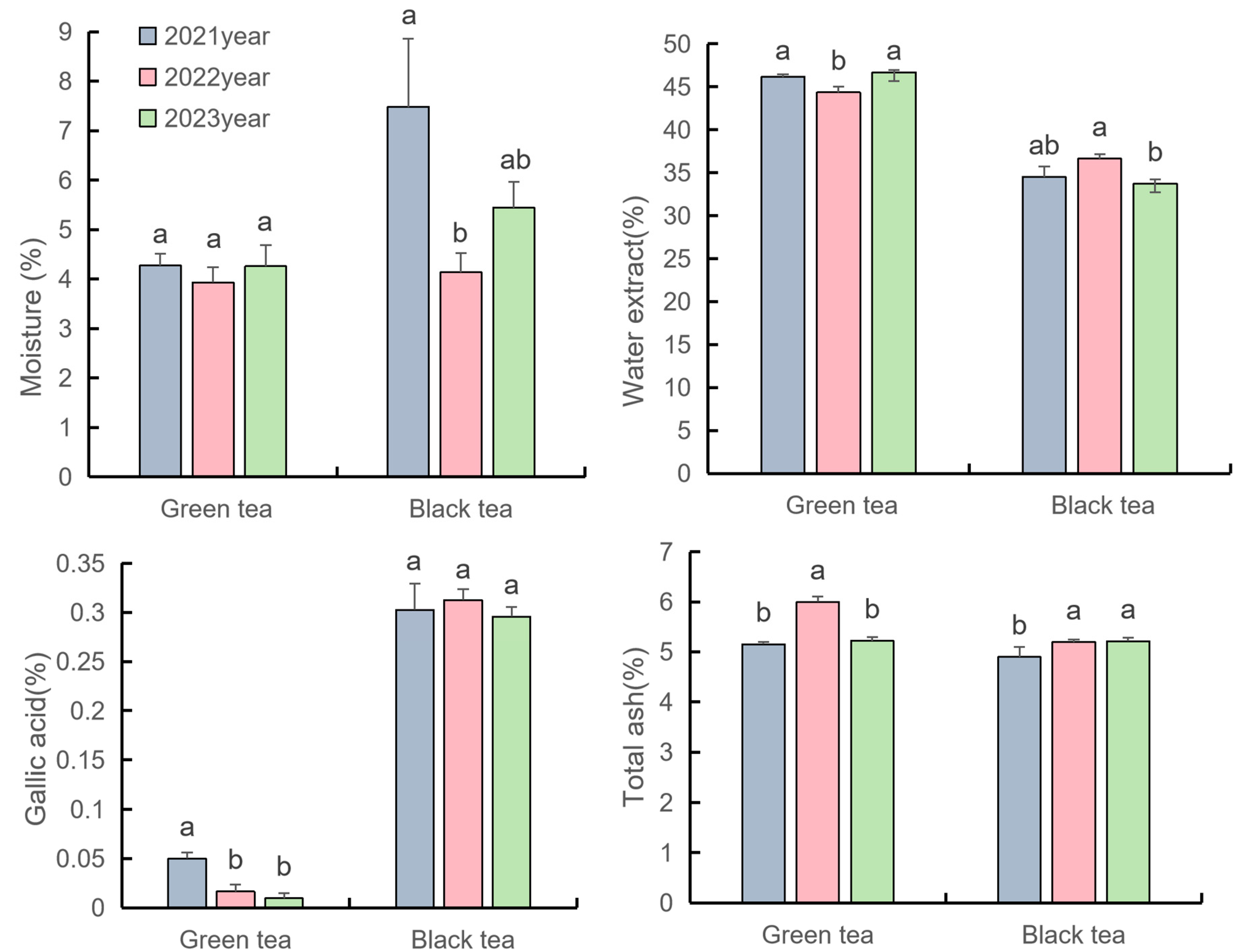
Moisture content was distinctly different in tea types and the year of production. In 2021–2023, the moisture content of green tea was maintained at ~4.0%, which did not vary significantly across years (p > 0.05). The mean moisture content of black tea by 2021 was 7.48%, which is above the upper recommended limit for finished tea (≈6%) from the literature. After process optimization, the moisture in black tea was found to be 4.13% in 2022. In 2023, the moisture content in black tea was found acceptable (5.44%), indicating drying could be controlled better from 2022 onwards (p < 0.05 vs. 2021).
Water-soluble extract (WSE) was primarily influenced by tea type rather than production year (Figure 1). Green tea consistently showed higher WSE (~45% dry basis) than black tea (~34%) (p < 0.05), while interannual variation within each tea type was small and not significant (p > 0.05). Thus, although the overall pool of soluble solids was stable, year-to-year changes were more evident in specific taste-active constituents.
Gallic acid levels were low in both tea types across the three years (Figure 1). Green tea typically contained ~0.2–0.3% gallic acid, whereas black tea was slightly higher (~0.3%), consistent with partial hydrolysis of gallated catechins during fermentation. Interannual differences were small, suggesting that, under the present processing regime, fermentation intensity did not strongly modulate gallic acid formation.
Total ash (an indicator of overall mineral content and product cleanliness) ranged within the typical commercial specification (4–8% dry weight) for all samples (Figure 1). Green tea ash content remained around 6–7%, with a modest but significant increase in 2022 (7.1%) compared with 2021 and 2023 (~6.5%) (p < 0.05). Black tea ash content ranged from 6 to 8% and peaked in 2022 (7.5%) relative to 2021 (6.2%) (p < 0.05). Although statistically detectable, these differences were small and none of the ash values suggested abnormal contamination.

3.2. Free Amino Acids, Tea Polyphenols, Caffeine and Phenol-to-Amino Ratio

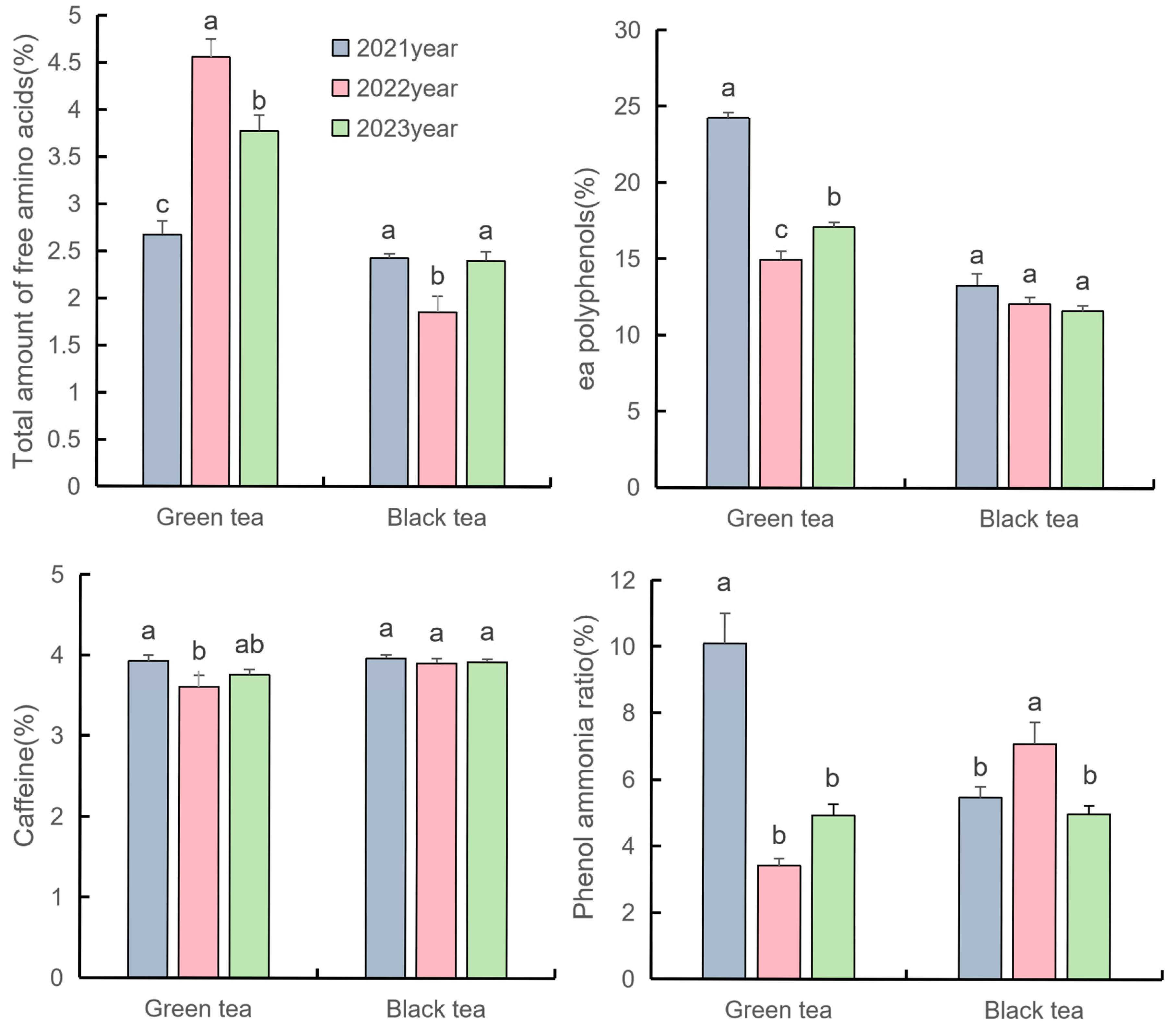
Free amino acid concentrations in green tea varied significantly among years (Figure 2). The 2022 batches (4.55%) contained significantly more free amino acids than those from 2021 (2.85%) and 2023 (3.77%) (p < 0.05), suggesting improved amino acid preservation in 2022, potentially due to better fixation and moisture control. In contrast, black tea had lower free amino acid contents and showed no significant interannual variation (~2.4%; p > 0.05), consistent with amino acid consumption and transformation during enzymatic oxidation.
Tea polyphenols showed an inverse pattern to amino acids in green tea (Figure 2). Polyphenol content was highest in 2021 (24.22%), decreased sharply in 2022 (14.94%), and partially recovered in 2023 (17.08%) (p < 0.05 for 2021 vs. 2022 and 2022 vs. 2023). Black tea contained significantly lower polyphenols and exhibited narrower interannual variation, reflecting oxidative conversion during fermentation.
Caffeine levels were relatively stable across tea types and years (Figure 2). Green tea contained ~4.0–4.2% caffeine and black tea ~3.8–4.0%, with no significant interannual differences (p > 0.05). These results suggest that the production year had a limited impact on caffeine retention in Shiqian Taicha.
The polyphenol-to-amino acid ratio (TP/FAA) captured year-to-year shifts in flavor balance more clearly than either constituent alone (Figure 2). In green tea, TP/FAA was highest in 2021 (10.09), consistent with high polyphenols and low amino acids and therefore greater astringency/bitterness potential. The ratio dropped to 3.41 in 2022, indicating a more balanced profile driven by higher amino acids and lower polyphenols, and increased to 4.92 in 2023. For black tea, TP/FAA varied within a narrower range (~5–7), with the highest value in 2022 (7.07).

3.3. Total Catechins and Catechin Composition

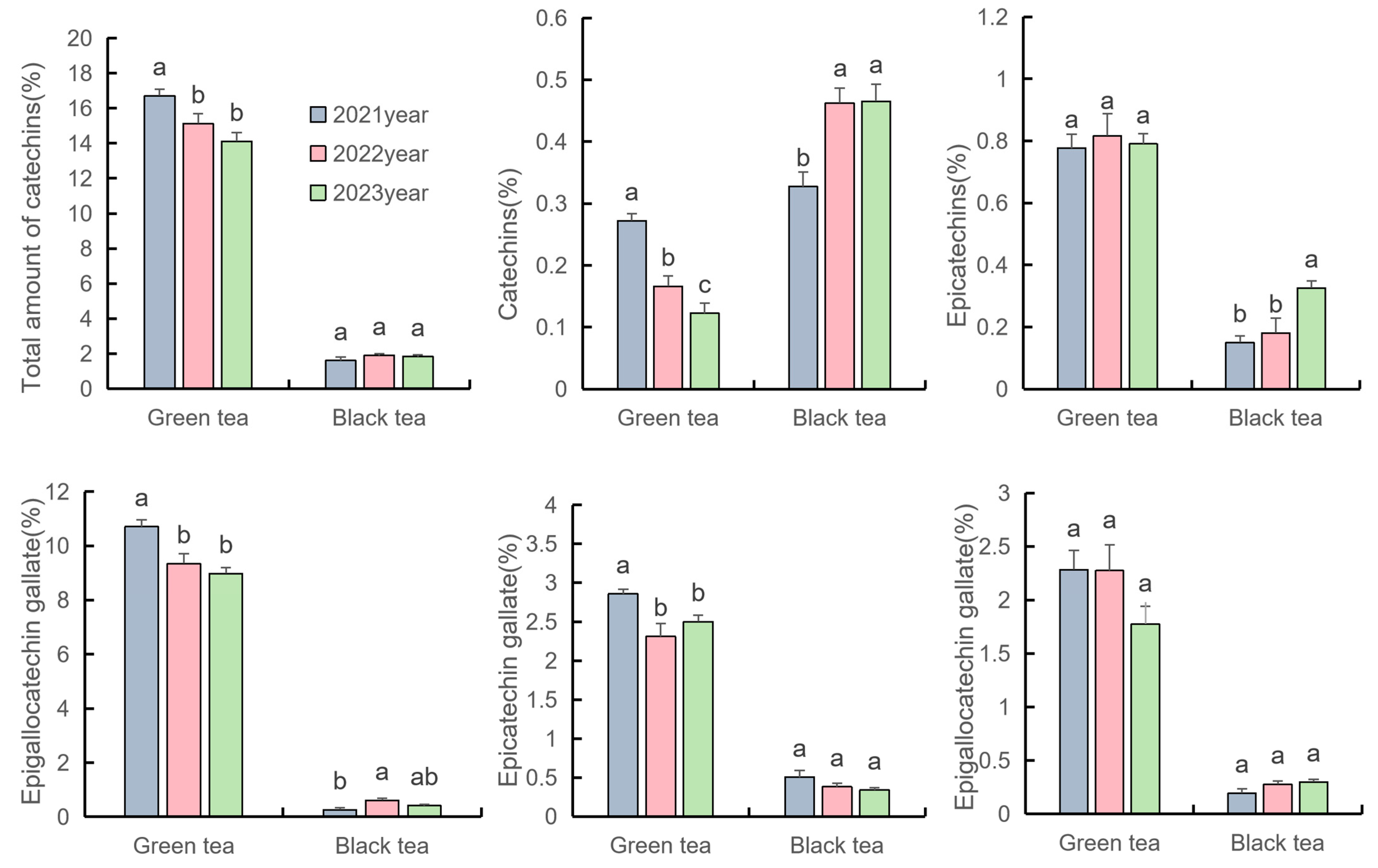
Tea type and production year significantly affected total catechins (Figure 3). As expected, catechin levels were higher in green tea. Total catechins peaked in 2021 (16.71%), then decreased to 15.03% in 2022 and 14.10% in 2023 (p < 0.05 for 2021 vs. 2022 and 2021 vs. 2023). In black tea, catechin contents were low and relatively stable, consistent with extensive oxidation of monomeric flavan-3-ols during fermentation.
Epigallocatechin gallate (EGCG) was the dominant catechin in green tea, accounting for >60% of total catechins (Figure 3). EGCG content was 10.09% in 2021, decreased to 8.78% in 2022, and increased to 9.57% in 2023, mirroring the trend in total catechins. Other monomeric catechins showed similar year-dependent patterns. For example, epicatechin (EC) and epigallocatechin (EGC) reached 0.8% and 2.3% in 2021, respectively, declined significantly in 2022, and partially recovered or stabilized in 2023. These patterns suggest that interannual differences in leaf maturity and fixation intensity influenced catechin retention.
Catechin (C) and epicatechin (EC) were each below 1% in all years, and epicatechin gallate (ECG) and epigallocatechin (EGC) were detected at trace levels (Figure 3). Overall, the catechin profile is consistent with effective enzymatic oxidation and polymerization of flavan-3-ols during black tea manufacture across 2021–2023.

3.4. Comprehensive Quality Evaluation

Membership function integration of multiple indicators provided a clear interannual ranking for each tea type. For green tea (Table 1), 2022 achieved the highest mean membership score (0.506), driven mainly by higher free amino acids together with acceptable moisture and moderate polyphenol/catechin levels. Although 2021 had the highest polyphenols and catechins, its higher TP/FAA ratio reduced the composite score, consistent with a less balanced taste profile.
For black tea (Table 2), mean membership scores were 0.585 (2022), 0.520 (2023), and 0.488 (2021), indicating 2022 as the best production year. The lower score in 2021 was mainly attributable to excessive moisture (Section 3.1) and lower amino acids, whereas improved moisture control in 2023 did not match the amino acid retention observed in 2022.
Overall, the composite assessment is consistent with the individual indices: 2022 was the most desirable production year for Shiqian Taicha, manufactured as both green and black tea. In contrast, 2021 and 2023 reflected stronger trade-offs between polyphenol ‘richness’ and amino acid-associated ‘freshness’.

4. Discussion

4.1. Interannual Variation in Basic Quality Traits and Storage Stability

Across the three production years, the basic physicochemical indices of Shiqian Taicha manufactured under routine factory conditions met standard expectations for quality and storage stability. Nevertheless, there remains scope for year-to-year optimization. In particular, tighter control of black tea end-point moisture is critical for storage safety and aroma retention; therefore, even relatively small interannual differences in moisture can translate into meaningful differences in shelf-life consistency.
Water-soluble extract (WSE) fluctuated within a narrow range, indicating that overall extractability remained stable. However, WSE is a composite measure and may mask sensory-relevant shifts in taste-active fractions (e.g., polyphenols, free amino acids, and soluble sugars) [45,46,47]. Consequently, stable WSE can coexist with pronounced year-to-year changes in flavor balance [48,49].
The total ash values for both tea types were within the expected range for clean, well-processed tea (Figure 1), suggesting that ash was not a major driver of quality variation in this dataset [47,50]. Therefore, the interannual differences captured by the composite assessment likely reflect variation in organic constituents and processing-related transformations rather than contamination or adulteration.
When end-point moisture and extract are controlled, interannual variation can occur due to changes in meteorological conditions, plucking windows and leaf maturity that together shape the starting metabolite pool and enzyme activities [13,29,46]. The quality of the Shiqian Taicha tea was evaluated according to the geographic indication specification, which showed flavorable components resulted from the raw-leaf chemistry of the specified region.

4.2. Balancing Polyphenols and Amino Acids: Implications for Flavor

The relationship between tea polyphenols (TP) and free amino acids (AA) is widely acknowledged to influence the perception of briskness/astringency against freshness/umami in tea infusion. In the case of green tea, where polyphenols will be mostly retained, and where a significant contribution to sweetness and savouriness comes from amino acids, the TP/AA ratio is a practical proxy for flavor harmony, rather than TP or AA considered alone.
Humidity and leaf water status can influence polyphenol outcomes mainly indirectly: high humidity and rainfall may increase shoot growth and dilute soluble solids, but they can also delay the achievement of uniform end-point moisture during fixation/drying, increasing the risk of partial oxidation and loss of ‘green’ aroma if enzyme inactivation is not sufficiently rapid. Moreover, higher total polyphenols are beneficial for antioxidant potential but are not always desirable for green tea sensory quality because polyphenols—especially gallated catechins—contribute strongly to bitterness and astringency and can mask delicate aroma notes. Therefore, quality control should target an appropriate TP–AA balance for the intended style rather than maximizing TP alone, and should be achieved through coordinated agronomic management (plucking standard, shading and nitrogen regime, irrigation scheduling) and adaptive processing (rapid and uniform fixation, and drying trajectories matched to leaf moisture at intake).
Interannual contrasts were pronounced in Shiqian Taicha green tea. Free amino acids peaked in 2022 (4.55%), while tea polyphenols (24.22%) and total catechins (16.71%) peaked in 2021. Accordingly, TP/AA shifted from an astringency-leaning profile in 2021 (10.09) to a more balanced profile in 2022 (3.41), consistent with the higher comprehensive score in 2022. These results indicate that ‘better’ quality does not necessarily mean maximally high polyphenols; rather, it reflects an appropriate coordination of TP and AA for the target tea style [2,43,44,46,51,52,53].
Within our three-year dataset, the best-performing year for green tea (2022) corresponded to a TP/FAA ratio of 3.41, whereas 2021 showed a much higher ratio (10.09) and a lower composite quality score. While an optimal TP/FAA target is product- and market-specific, these data suggest that maintaining TP/FAA within an empirical window of approximately 3–5 may help stabilize the flavor balance of Shiqian Taicha green tea under routine manufacturing conditions.
According to this study, the small change noticed in TP and AA on black tea is somewhat on expected lines because fermentation converts a large part of catechins into theaflavins, thearubigins and other oxidation products [54,55,56,57] that confer black tea briskness and color. Nonetheless, it is still important to maintain adequate levels of amino acids before fermentation (e.g., by avoiding over-withering and excessive heat stress), as amino acids contribute to sweetness and are also precursors for aroma formation during drying [14,15,46].
The TP/AA ratio provides a mechanistic picture explaining the ranking of membership functions. The chemistry of the top-ranked year (2022) had more balanced taste-active fractions, particularly genotype-specific in green tea, where TP/AA strongly regulates mouthfeel. This finding is consistent with the general sensory literature, where it has been shown that composite indices (TP/AA, catechin distribution, etc.) are better predictors of acceptability than thresholds for single components [7,47,58,59,60].

4.3. Catechin Profile, Gallic Acid Formation and Processing Conditions

Catechin composition also provides insight into how raw-leaf chemistry and processing jointly shape quality across years. Ester catechins (e.g., EGCG and ECG) and non-ester catechins (e.g., EGC and EC) contribute to bitterness/astringency and serve as primary substrates for enzymatic oxidation, while gallic acid (GA) may increase via hydrolysis of gallated catechins and thermal reactions during drying [45,46,49,61].
In tea (Camellia sinensis), the major phenolic contributors to bitterness/astringency are flavan-3-ols, particularly gallated catechins such as EGCG and ECG, together with caffeine; in contrast, free amino acids contribute to sweetness and can soften the mouthfeel. Accordingly, EGCG/ECG and TP/FAA are practical chemical markers for astringency, whereas FAA better reflects smoothness and ‘freshness’. For black tea, theaflavins and related pigments are additional key determinants of briskness and color, and we highlight them as priority targets for future work.
The reduction in the total level of catechins in 2022 relative to 2021 may reflect (i) real differences in the raw-leaf catechin pool due to seasonal and climatic signals, and/or (ii) slightly different processing that increased oxidative loss before full enzyme inactivation. The intensity of fixation is particularly important for green tea. Underheating, or uneven temperature, allows the action of polyphenol oxidases/peroxidases, while overheating can induce epimerization and degradation that also distorts the catechin profile.
Low and relatively stable catechin levels in black tea provide evidence for the conversion of catechins to theaflavins and higher molecular weight pigments during fermentation [16,49,50]. Year effects may be more apparent for these oxidation products than for residual catechins, as pigments contribute differently to brightness, briskness, and infusion color. Future work should quantify these pigment changes directly.
The behavior of GA from year to year serves as an additional marker that is sensitive to processes. Increases in GA and shifts in gallated catechins may indicate a stronger hydrolysis (or more severe thermal history during drying), which may increase harshness when unaccompanied by adequate AA and aroma development [46,48]. Consequently, keeping tabs on GA with catechins could empower processors to adjust their fixation or drying and, for black tea, fermentation termination.

4.4. Performance of Membership Function Evaluation and Comparison with Other Teas

Membership function evaluation is advantageous for tea quality assessment because it integrates multiple indices with different ‘better–worse’ directions into a single, interpretable score. This is particularly useful when quality attributes trade off (e.g., improved amino acids accompanied by reduced catechins), requiring multi-objective decisions [47].
Although most black tea constituents varied within a narrower range among years, membership function evaluation remains useful because it integrates multiple indicators with different ‘better–worse’ directions into one interpretable score. In addition, we now discuss alternative multi-criteria and multivariate approaches and clarify that the membership function approach was selected here because it is transparent, does not require large sample sizes for model training, and is straightforward to implement for routine multi-year monitoring.
The membership function ranking in the present dataset was consistent with chemistry; 2022 achieved the highest overall score for green tea (0.506) and for black tea (0.585), suggesting the most favorable compromise in taste-active constituents. The coherence of these results indicates that the weighting and normalization used are reasonable for Shiqian Taicha, as well as providing the opportunity to adjust weights using sensory/consumer data to better reflect market preference [47,51].
Coupling membership function assessment with near-infrared (NIR) prediction improves usability at an industrial scale. NIR enables rapid, non-destructive screening of batches and supports timely adjustment of processing parameters without extensive wet-chemistry analyses [19,52]. For regional specialty teas, this workflow links at-line measurement to in-process control and may help stabilize interannual quality.

4.5. Practical Implications, Limitations and Future Research

From a manufacturing perspective, the three-year comparison suggests two priorities for green tea. First, especially in seasons when leaves are softer or more hydrated, fixation should be controlled to inactivate enzymes rapidly and uniformly, preventing premature oxidation and preserving ‘green’ aroma [46]. Second, drying trajectories can be optimized to limit amino acid loss and avoid excessive thermal damage by targeting a TP/AA window that matches the desired sensory style, rather than maximizing TP alone [2,9].
For black tea, process management should focus on withering and fermentation. Withering affects cell permeability and the contact between substrates and enzymes, whereas fermentation time and temperature determine catechin conversion to theaflavins and related pigments that drive briskness and infusion color [8,15,16,50]. Standardizing these steps—supported by rapid compositional monitoring—should dampen interannual variation and improve grading consistency.
For large plantations and multi-site procurement, year-to-year quality stabilization requires a ‘field-to-factory’ decision workflow: (i) stratify raw-leaf sourcing by elevation/microclimate and plucking standard (bud + 1–2 leaves), (ii) monitor key field drivers (rainfall, temperature, shading, and nitrogen inputs) and align harvest windows to leaf maturity, (iii) apply rapid at-line screening (e.g., NIR-predicted TP and FAA) at intake to guide blending and to trigger adaptive fixation/withering settings, and (iv) standardize end-point moisture targets and drying/fermentation trajectories. Controlled cultivation practices (e.g., shading and irrigation) can help increase amino acid retention, but they must be balanced against disease risk and potential TP dilution; therefore, the practical goal is a stable TP/AA window rather than maximizing a single component.
Need for concerned limitations. The duration of the dataset exceeds three production years; longer time series connected to meteorological records would improve year effect attribution. Commercial batches were sampled rather than fully controlled pilot trials, leaving open the possibility of some unrecorded process heterogeneity. The assumed direction and weights of the membership function model need to be validated through sensory evaluation and consumer testing, even if the chemical indices are informative. In the end, it is critical that the models are validated in other seasons and factories.
Accordingly, future work should sample across further years and production sites, add on-target metabolomics (including black tea pigments and key volatiles), while joining chemistry to descriptive sensory analysis and consumer preference mapping [6,7,47]. An integrated framework that can facilitate both mechanistic understanding and practical decision rules for stabilizing year-to-year quality of Shiqian Taicha and other geographically indicated specialty teas.

5. Conclusions

In this study, we quantified interannual variation in major quality constituents of Shiqian Taicha manufactured as green and black tea across 2021–2023. For green tea, year effects were most evident in nitrogenous and phenolic fractions: 2022 showed substantially higher free amino acids and a more balanced TP/FAA profile, whereas 2021 had higher tea polyphenols and total catechins and thus a higher TP/FAA ratio. Black tea chemistry varied less among years; however, improved moisture control in 2022, together with better retention of taste-active components, produced the highest composite quality score. The combined use of near-infrared spectroscopy and membership function evaluation provides a practical framework for rapid, objective quality assessment by integrating multiple compositional indices into a single interpretable score. Based on these results, key control points include fixation and moisture management for green tea, and fermentation control together with moisture management for black tea. Because this study was limited to commercial batches and three production years, larger multi-year datasets with explicit records of meteorological conditions, leaf maturity, and manufacturing parameters are needed to separate their relative contributions. Future work should combine targeted metabolomics and sensory profiling with NIR-based prediction to develop robust quality markers and year-adaptive processing guidelines for Shiqian Taicha.

Author Contributions

Y.Z., writing—original draft and formal analysis; X.G., formal analysis and writing—review and editing; C.G., methodology, writing—review and editing, and funding acquisition. All authors have read and agreed to the published version of the manuscript.

Funding

This work was supported by the Guizhou provincial science and technology projects of China (Qiankehepingtai-CXPTXM [2025]015-3-2), Guizhou Key Laboratory of Agricultural Microbiology Construction Project (Qiankehepingtai [2025]029), and the Construction of Modern Agriculture (tea) Industry Technology System (CARS-19).

Institutional Review Board Statement

Not applicable.

Informed Consent Statement

Not applicable.

Data Availability Statement

The original contributions presented in this study are included in the article. Further inquiries can be directed to the corresponding author.

Conflicts of Interest

The authors declare that the research was conducted in the absence of any commercial or financial relationships that could be construed as a potential conflict of interest.

References

  1. Graham, H.N. Green tea composition, consumption, and polyphenol chemistry. Prev. Med. 1992, 21, 334–350. [Google Scholar] [CrossRef]
  2. Harbowy, M.E.; Balentine, D.A. Tea chemistry. Crit. Rev. Plant Sci. 1997, 16, 415–480. [Google Scholar] [CrossRef]
  3. Cabrera, C.; Artacho, R.; Giménez, R. Beneficial effects of green tea—A review. J. Am. Coll. Nutr. 2006, 25, 79–99. [Google Scholar] [CrossRef]
  4. Hilal, Y.; Engelhardt, U.H. Characterisation of white tea—Comparison to green and black tea. J. Consum. Prot. Food Saf. 2007, 2, 414–421. [Google Scholar] [CrossRef]
  5. Zhang, L.; Ho, C.-T.; Zhou, J.; Santos, J.S.; Armstrong, L.; Granato, D. Chemistry and biological activities of processed Camellia sinensis teas: A comprehensive review. Trends Food Sci. Technol. 2020, 101, 139–149. [Google Scholar] [CrossRef]
  6. Farag, M.A.; El-Ahmady, S.H.; Abou-Sir, M.; El-Seedi, H.R.; Wessjohann, L.A.; Dai, H.; Zou, X. Metabolomics in tea products; a compile of applications for enhancing agricultural traits and quality control analysis of Camellia sinensis. Food Chem. 2023, 404, 134628. [Google Scholar] [CrossRef]
  7. Wen, M.; Zhu, M.; Han, Z.; Ho, C.-T.; Granato, D.; Zhang, L. Comprehensive applications of metabolomics on tea science and technology: Opportunities, hurdles, and perspectives. Compr. Rev. Food Sci. Food Saf. 2023, 22, 4890–4924. [Google Scholar] [CrossRef] [PubMed]
  8. Scharbert, S.; Hofmann, T. Molecular definition of black tea taste by means of quantitative studies, taste reconstitution, and omission experiments. J. Agric. Food Chem. 2005, 53, 5377–5384. [Google Scholar] [CrossRef] [PubMed]
  9. Xu, Y.-Q.; Zhang, Y.-N.; Chen, J.-X.; Wang, F.; Du, Q.-Z.; Yin, J.-F. Quantitative analyses of the bitterness and astringency of catechins from green tea. Food Chem. 2018, 258, 16–24. [Google Scholar] [CrossRef]
  10. Narukawa, M.; Morita, K.; Hayashi, Y. L-Theanine elicits umami taste with inosine 5′-monophosphate. Biosci. Biotechnol. Biochem. 2008, 72, 3015–3017. [Google Scholar] [CrossRef] [PubMed]
  11. Kaneko, S.; Kumazawa, K.; Masuda, H.; Henze, A.; Hofmann, T. Molecular and sensory studies on the umami taste of Japanese green tea. J. Agric. Food Chem. 2006, 54, 2688–2694. [Google Scholar] [CrossRef]
  12. Lee, J.; Chambers, D.H. A lexicon for flavor descriptive analysis of green tea. J. Sens. Stud. 2007, 22, 256–272. [Google Scholar] [CrossRef]
  13. Jiang, H.; Yu, F.; Qin, L.; Zhang, N.; Cao, Q.; Schwab, W.; Li, D.; Song, C. Dynamic change in amino acids, catechins, alkaloids, and gallic acid in six types of tea processed from the same batch of fresh tea (Camellia sinensis L.) leaves. J. Food Compos. Anal. 2019, 77, 28–38. [Google Scholar] [CrossRef]
  14. Obanda, M.; Owuor, P.O.; Mang’oka, R. Changes in the chemical and sensory quality parameters of black tea due to variations of fermentation time and temperature. Food Chem. 2001, 75, 395–404. [Google Scholar] [CrossRef]
  15. Owuor, P.O.; Obanda, M. The effect of withering conditions on black tea quality. Food Chem. 2001, 72, 319–327. [Google Scholar] [CrossRef]
  16. Mahanta, P.K.; Baruah, H.K. Theaflavin pigment formation and polyphenol oxidase activity as criteria of fermentation in orthodox and CTC teas. J. Agric. Food Chem. 1992, 40, 860–863. [Google Scholar] [CrossRef]
  17. Feng, Z.; Zheng, P.; Zhang, L.; Li, Y.; Gao, H.; Zhang, L.; Ho, C.-T.; Wan, X. Tea aroma formation from six model manufacturing processes. Food Chem. 2019, 285, 347–354. [Google Scholar] [CrossRef]
  18. Guo, Z.; Barimah, A.O.; Yin, X.; Chen, Q.; Shi, J.; El-Seedi, H.R.; Zou, X. Intelligent evaluation of taste constituents and polyphenols-to-amino acids ratio in matcha tea powder using near infrared spectroscopy. Food Chem. 2021, 353, 129372. [Google Scholar] [CrossRef]
  19. Savitzky, A.; Golay, M.J.E. Smoothing and differentiation of data by simplified least squares procedures. Anal. Chem. 1964, 36, 1627–1639. [Google Scholar] [CrossRef]
  20. Stilo, F.; Bicchi, C.; Cordero, C.; Rubiolo, P.; Sgorbini, B.; Liberto, E. Seasonal and interannual variation of non-volatile and volatile components in tea (Camellia sinensis) leaves: A review. Molecules 2020, 25, 2447. [Google Scholar] [CrossRef]
  21. Wang, Y.; Ho, C.-T.; Huang, Q.; Jiang, Y.; Zhang, Y. Effects of temperature and light on quality-related metabolites of tea (Camellia sinensis) leaves: A review. Food Res. Int. 2022, 161, 111882. [Google Scholar] [CrossRef]
  22. Ahmed, S.; Griffin, T.S.; Kraner, D.; Schaffner, M.K.; Sharma, D.; Hazel, M.; Leitch, A.R.; Orians, C.M.; Han, W.; Stepp, J.R.; et al. Environmental factors variably impact tea secondary metabolites in the context of climate change. PLoS ONE 2014, 9, e109126. [Google Scholar] [CrossRef]
  23. Paiva, L.; Nunes, C.; Marques, G.; Oliveira, C.; Madureira, A.R.; Pintado, M. Influence of seasonal and yearly variation on phenolic profiles, caffeine, and antioxidant activities of green tea (Camellia sinensis (L.) Kuntze) from Azores. Appl. Sci. 2021, 11, 7439. [Google Scholar] [CrossRef]
  24. Wei, K.; Wang, L.-Y.; Zhou, J.; He, W.; Zeng, J.-M.; Jiang, Y.-W.; Cheng, H. Catechin contents in tea (Camellia sinensis) as affected by cultivar and environment and their relation to chlorophyll contents. Food Chem. 2011, 125, 44–48. [Google Scholar] [CrossRef]
  25. Ku, K.-M.; Choi, J.-N.; Kim, J.; Kim, J.K.; Yoo, L.G.; Lee, S.J.; Hong, Y.-S.; Lee, C.H. Metabolomics analysis reveals the compositional differences of shade grown tea (Camellia sinensis L.). J. Agric. Food Chem. 2010, 58, 418–426. [Google Scholar] [CrossRef]
  26. Lee, J.-E.; Lee, B.-J.; Chung, J.-O.; Hwang, J.-A.; Lee, S.-J.; Lee, C.-H.; Hong, Y.-S. Geographical and climatic dependencies of green tea (Camellia sinensis) metabolites: A 1H NMR-based metabolomics study. J. Agric. Food Chem. 2010, 58, 10582–10589. [Google Scholar] [CrossRef]
  27. Lee, J.-E.; Lee, B.-J.; Chung, J.-O.; Shin, H.-J.; Lee, S.-J.; Lee, C.-H.; Hong, Y.-S. 1H NMR-based metabolomic characterization during green tea (Camellia sinensis) fermentation. Food Res. Int. 2011, 44, 597–604. [Google Scholar] [CrossRef]
  28. Lee, J.-E.; Lee, B.-J.; Chung, J.-O.; Hwang, J.-A.; Lee, S.-J.; Lee, C.-H.; Hong, Y.-S. Metabolomic unveiling of a diverse range of green tea (Camellia sinensis) metabolites dependent on geography. Food Chem. 2015, 174, 452–459. [Google Scholar] [CrossRef]
  29. Lin, K.; Wang, A.; Li, Y.; Li, L.; Wei, J.; Zhou, F.; Zhao, D.; Yan, D. Exploring genetic variation and trait correlations in ‘Shiqian Taicha’ tea based on comprehensive analyses of morphological and biochemical diversity. Horticulturae 2024, 10, 1128. [Google Scholar] [CrossRef]
  30. Schulz, H.; Engelhardt, U.H.; Wegent, A.; Drews, H.H.; Lapczynski, S. Application of near-infrared reflectance spectroscopy to the determination of the quality parameters of tea. J. Agric. Food Chem. 1999, 47, 5064–5067. [Google Scholar] [CrossRef]
  31. Wang, J.; Zareef, M.; He, P.; Sun, H.; Chen, Q.; Li, H.; Ouyang, Q.; Guo, Z.; Zhang, Z.; Xu, D. Evaluation of matcha tea quality index using portable NIR spectroscopy coupled with chemometric algorithms. J. Sci. Food Agric. 2019, 99, 5019–5027. [Google Scholar] [CrossRef]
  32. Qin, O.; Li, W.; Bosoon, P.; Rui, K.; Chen, Q. Simultaneous quantification of chemical constituents in matcha with visible-near infrared hyperspectral imaging technology. Food Chem. 2021, 350, 129141. [Google Scholar] [CrossRef]
  33. Zadeh, L.A. Fuzzy sets. Inf. Control 1965, 8, 338–353. [Google Scholar] [CrossRef]
  34. Zimmermann, H.-J. Fuzzy Set Theory—And Its Applications, 4th ed.; Springer: Boston, MA, USA, 2001. [Google Scholar]
  35. GB/T 8302-2013; Tea—Sampling. China Agriculture Press: Beijing, China, 2013.
  36. Zhao, H.F.; Zhou, S.Z.; Wang, J.L.; Hu, H.J.; Cao, Y.; Jian, Y.Y.; Yang, T. Building the Rapid field Detection Model of Guizhou Tea Quality Based on Near Infrared Spectroscopy. J. Guizhou Tea 2022, 1, 37–42. (In Chinese) [Google Scholar]
  37. GB/T 8304-2013; Tea—Determination of Moisture Content. China Agriculture Press: Beijing, China, 2013.
  38. GB/T 8305-2013; Tea—Determination of Water Extracts Content. China Agriculture Press: Beijing, China, 2013.
  39. GB/T 8306-2013; Tea—Determination of Total Ash Content. China Agriculture Press: Beijing, China, 2013.
  40. GB/T 8312-2013; Tea—Determination of Caffeine Content. China Agriculture Press: Beijing, China, 2013.
  41. GB/T 8314-2013; Tea—Determination of Free Amino Acids Content. China Agriculture Press: Beijing, China, 2013.
  42. GB/T 8313-2018; Tea—Determination of Total Polyphenols and Catechins Content. Standards Press of China: Beijing, China, 2018.
  43. ISO 14502-1:2005; Determination of Substances Characteristic of Green and Black Tea—Part 1: Content of Total Polyphenols in Tea—Colorimetric Method Using Folin-Ciocalteu Reagent. ISO: Geneva, Switzerland, 2005.
  44. ISO 14502-2:2005; Determination of Substances Characteristic of Green and Black Tea—Part 2: Content of Catechins in Green Tea—Method Using High-Performance Liquid Chromatography. ISO: Geneva, Switzerland, 2005.
  45. Kapp, K.; Hakala, E.; Orav, A.; Pohjala, L.; Vuorela, P.; Püssa, T.; Vuorela, H.; Raal, A. Commercial peppermint (Mentha × piperita L.) teas: Antichlamydial effect and polyphenolic composition. Food Res. Int. 2013, 53, 608–618. [Google Scholar] [CrossRef]
  46. Debjani, C.; Das, S.; Das, H. Aggregation of Sensory Data Using Fuzzy Logic for Sensory Quality Evaluation of Food. J. Food Sci. Technol. 2013, 50, 1088–1096. [Google Scholar] [CrossRef]
  47. Zhu, Y.; Luo, Y.; Wang, P.; Zhao, M.; Li, L.; Hu, X.; Chen, F. Simultaneous determination of free amino acids in pu-erh tea and their changes during fermentation. Food Chem. 2016, 194, 643–649. [Google Scholar] [CrossRef]
  48. Wold, S.; Sjöström, M.; Eriksson, L. PLS-regression: A basic tool of chemometrics. Chemom. Intell. Lab. Syst. 2001, 58, 109–130. [Google Scholar] [CrossRef]
  49. Sanderson, G.W.; Co, H.; Gonzalez, J.G. Formation of black tea aroma. J. Agric. Food Chem. 1973, 21, 576–585. [Google Scholar] [CrossRef]
  50. Fu, H.H.; Li, J.X.; Qiu, Y.; Zhang, Y.P.; Han, J.; Huang, X.Y. Using a Fuzzy Analytic Hierarchy Process to Formulate an Effectual Tea Assessment System. Sustainability 2020, 12, 6131. [Google Scholar] [CrossRef]
  51. Kim, Y.; Goodner, K.L.; Park, J.-D.; Choi, J.; Talcott, S.T. Changes in secondary metabolites of green tea during fermentation by Aspergillus oryzae and its effect on antioxidant potential. Food Res. Int. 2013, 53, 670–677. [Google Scholar] [CrossRef]
  52. Fernández, P.L.; Martín, M.J.; González, A.G.; Pablos, F. HPLC determination of catechins and caffeine in tea. Differentiation of green, black and instant teas. Analyst 2000, 125, 421–425. [Google Scholar] [CrossRef] [PubMed]
  53. ISO 3103:2019; Tea—Preparation of Liquor for Use in Sensory Tests. International Organization for Standardization: Geneva, Switzerland, 2019.
  54. Crozier, A.; Jaganath, I.B.; Clifford, M.N. Dietary phenolics: Chemistry, bioavailability and effects on health. Nat. Prod. Rep. 2009, 26, 1001–1043. [Google Scholar] [CrossRef]
  55. Wei, Q.; Wolf-Hall, C.; Hall III, C.A. Application of Raisin Extracts as Preservatives in Liquid Bread and Bread Systems. J. Food Sci. 2009, 74, R47–R52. [Google Scholar] [CrossRef]
  56. Lambert, J.D.; Yang, C.S. Mechanisms of cancer prevention by tea constituents. J. Nutr. 2003, 133, 3262S–3267S. [Google Scholar] [CrossRef] [PubMed]
  57. Cai, H.; Zhong, Z.; Li, Z.; Zhang, X.; Fu, H.; Yang, B.; Zhang, L. Metabolomics in quality formation and characterisation of tea products: A review. Int. J. Food Sci. Technol. 2022, 57, 4001–4014. [Google Scholar] [CrossRef]
  58. Cao, Q.-Q.; Fu, Y.-Q.; Wang, J.-Q.; Zhang, L.; Wang, F.; Yin, J.-F.; Xu, Y.-Q. Sensory and chemical characteristics of Tieguanyin oolong tea after roasting. Food Chem. X 2021, 12, 100178. [Google Scholar] [CrossRef]
  59. Cao, L.; Guo, X.; Liu, G.; Song, Y.; Ho, C.-T.; Hou, R.; Zhang, L.; Wan, X. A comparative analysis for the volatile compounds of various Chinese dark teas using combinatory metabolomics and fungal solid-state fermentation. J. Food Drug Anal. 2018, 26, 112–123. [Google Scholar] [CrossRef]
  60. Chen, L.; Liu, F.; Yang, Y.; Tu, Z.; Lin, J.; Ye, Y.; Xu, P. Oxygen-enriched fermentation improves the taste of black tea by reducing the bitter and astringent metabolites. Food Res. Int. 2021, 148, 110613. [Google Scholar] [CrossRef]
  61. Li, X.; Dai, H.; Zhang, H.; Zou, X. Study on improving aroma quality of summer–autumn black tea by red-light irradiation during withering. LWT 2022, 154, 112597. [Google Scholar] [CrossRef]
Figure 1. Interannual variation (2021–2023) in moisture, water-soluble extract, gallic acid, and total ash contents of Shiqian Taicha processed as green tea and black tea. Note: Bars represent mean ± SD across commercial batches (green tea: 2021 n = 24, 2022 n = 23, 2023 n = 31; black tea: 2021 n = 4, 2022 n = 11, 2023 n = 23). Different lowercase letters indicate significant differences among years within the same tea type (one-way ANOVA with Duncan’s multiple range test, p < 0.05).
Applsci 16 01614 g001
Figure 2. Interannual variation (2021–2023) in total free amino acids, tea polyphenols, caffeine, and the polyphenol-to-amino acid ratio (P/A) of Shiqian Taicha processed as green tea and black tea. Note: Bars represent mean ± SD across batches (sample sizes as in Figure 1). Different lowercase letters indicate significant differences among years within the same tea type (one-way ANOVA with Duncan’s test, p < 0.05).
Applsci 16 01614 g002
Figure 3. Interannual variation (2021–2023) in total catechins and major catechin fractions of Shiqian Taicha processed as green tea and black tea (C, catechin; EC, epicatechin; EGC, epigallocatechin; ECG, epicatechin gallate; EGCG, epigallocatechin gallate; GC, gallocatechin). Note: Bars represent mean ± SD (sample sizes as in Figure 1). Different lowercase letters indicate significant differences among years within the same tea type (one-way ANOVA with Duncan’s test, p < 0.05).
Applsci 16 01614 g003
Table 1. The assessment of the membership function for Shiqian Taicha green tea (2021–2023).
YearMoistureWater ExtractGallic AcidTotal AshTotal Free Amino AcidsTea Polyphenols
20210.2320.6230.3970.6160.5530.514
20220.4390.7570.5470.2980.4610.702
20230.2100.5010.2940.5530.5390.399
YearCaffeinePhenol-to-amino ratioTotal catechinsCatechinEpicatechin (EC)Epigallocatechin gallate (EGCG)
20210.4670.2290.5300.4800.4760.462
20220.7440.3990.6440.3230.2730.528
20230.6020.2560.5990.4070.4300.539
YearEpicaltechin gallate (ECG)Epigallocatechin (EGC)Mean membership scoreRank
20210.4590.5920.4742
20220.7100.2610.5061
20230.4580.3870.4413
Table 2. The assessment of the membership function for Shiqian Taicha black tea (2021–2023).
YearMoistureWater ExtractGallic AcidTotal AshTotal Free Amino AcidsTea Polyphenols
20210.6470.4130.3860.4450.6180.499
20220.6370.6460.6360.5600.6410.719
20230.4360.6420.5590.4850.4640.646
YearCaffeinePhenol-to-amino ratioTotal catechinsCatechinEpicatechin (EC)Epigallocatechin gallate (EGCG)
20210.4250.5980.5170.4320.5000.407
20220.6460.3010.6260.4550.5490.539
20230.6450.3450.4660.5360.4800.525
YearEpicaltechin gallate (ECG)Epigallocatechin (EGC)Mean membership scoreRank
20210.5240.4170.4883
20220.7260.5120.5851
20230.5780.4770.5202
Disclaimer/Publisher’s Note: The statements, opinions and data contained in all publications are solely those of the individual author(s) and contributor(s) and not of MDPI and/or the editor(s). MDPI and/or the editor(s) disclaim responsibility for any injury to people or property resulting from any ideas, methods, instructions or products referred to in the content.