Article

Improvement of Refined Rapeseed Oil Thermal Resistance by Native Antioxidants Present in Rapeseed, Coriander, and Apricot Cold-Pressed Oils


1
Warsaw University of Life Sciences–SGGW, 166 Nowoursynowska Street, 02-787 Warsaw, Poland
2
Department of Food Biochemistry and Analysis, Poznań University of Life Sciences, Wojska Polskiego 31, 60-634 Poznań, Poland
3
Department of Food Technology of Plant Origin, Poznań University of Life Sciences, Wojska Polskiego 31, 60-634 Poznań, Poland
*
Authors to whom correspondence should be addressed.
Appl. Sci. 2026, 16(3), 1589; https://doi.org/10.3390/app16031589
Submission received: 30 November 2025 / Revised: 14 January 2026 / Accepted: 15 January 2026 / Published: 4 February 2026
(This article belongs to the Special Issue Antioxidant Compounds in Food Processing: Second Edition)

Abstract

The research aimed to evaluate the effect of high monounsaturated cold-pressed oil addition on the inhibition of refined rapeseed oil degradation during heating at frying temperature. Cold-pressed rapeseed, coriander seed, and apricot kernel oils were added in amounts of 5 and 25%. Refined rapeseed oil without additives and refined rapeseed oil supplemented with tert-butylhydroquinone (TBHQ) were negative and positive control samples, respectively. Blends were heated in a thin layer at 170 and 200 °C. Considering the increase in total polar compounds (TPCs) and oxidized triacylglycerol monomer (oxTAG) content, natural additives demonstrated protective properties and were more effective than the TBHQ additive, especially at 200 °C. The lowest increases in TPC and oxTAG were found in AO5% at 170 °C (10.17% and 1.40 mg/g oil, respectively) and in AO25% at 200 °C (5.71% and 47.53 mg/g oil, respectively). The presence of triacylglycerol (TAG) dimers was found only in samples heated at 200 °C, and the lowest was in the sample with 25% coriander oil. It can be concluded that the addition of cold-pressed oils limited the TAG oxidation process. The addition of 25% coriander oil was effective in inhibiting the TAG polymerization process, and it may be a powerful alternative to synthetic antioxidants in improving stabilization of frying oils.

1. Introduction

Vegetable oils are a rich source of bioactive substances such as tocochromanols and phytosterols [1,2,3,4], which may limit triacylglycerol (TAG) degradation during frying [5,6,7]. However, these substances are characterized by varied, often high lability under high temperature conditions used during thermal treatment [8,9]. Oils obtained from different raw materials differ in their stability under high temperature conditions depending on the fatty acid composition and bioactive substance content and composition [1,2,3,4]. In turn, the properties of individual types of bioactive substances depend mainly on their structure but also on the environmental factors, the occurrence of synergistic or antagonistic interactions, and other interactions with the matrix [10,11,12].
Frying is a common and easy method of preparing delicious food products, including meatballs, pancakes, and fried potatoes. Fried foods are appreciated by consumers for their unique taste, smell, golden color, and crunchiness. However, the high temperature of frying induces various chemical reactions in oils, mainly the degradation of TAG, such as oxidation, hydrolysis, polymerization, isomerization, and cyclization. It leads to the generation of undesirable, hazardous substances in the oil, including oxidized TAG monomers (oxTAGs), TAG polymers, epoxy fatty acids, volatile aldehydes, and cyclic fatty acids [13,14,15,16]. This may depend on many factors, including the type of oil used, the frying temperature, and the duration of the frying process [17,18,19,20]. Oil degradation products are transported into the food along with the oil. Lipid oxidation products may induce oxidative stress, leading to damage to DNA and cell membranes as well as activation of inflammatory pathways [21,22,23]. Consumption of food with a high level of oil degradation products may lead to the development of cancer, diabetes, obesity, coronary artery disease [24], Parkinson’s disease, Alzheimer’s disease, as well as anxiety and depression due to neuroinflammation [25] and other serious medical conditions [26]. Considering the above points, preventing oil degradation has become a highly relevant, significant, and pressing concern.
Synthetic antioxidants like tert-butylhydroquinone (TBHQ) may be used to delay the formation of degradative products during frying [27,28]. However, they are suspected to exhibit a negative impact on health [29,30,31]. This has led to growing interest in natural antioxidants, like the extracts of herbs, fruits, and seed cake [32,33,34]. Usually, natural extracts are based on polar solvents like ethanol, methanol, or water, and therefore, they have low solubility in oil, which hinders their practical application. An alternative approach could involve the use of nanoemulsion, encapsulated natural antioxidants, and complexing agents such as cyclodextrin, which trap bioactive compounds [35,36]. However, this is a technologically complicated method that is difficult to use on an industrial scale, requiring expensive, advanced equipment, and therefore, its practical application remains challenged. Cold-pressed oils are lipophilic substances that can be easily mixed with frying oils like refined rapeseed oil. They are sources of antioxidants, bioactive substances including tocochromanols, phytosterols, and phenolic compounds [37,38,39,40,41], which may show protective properties during oil heat treatment. Therefore blends of cold-pressed oils may exhibit better thermal stability than oils typically used for frying [42,43]. Interesting results were reported by Ramroudi et al. [44], who found that corn–sesame oil and sunflower–sesame oil blends had higher oxidative stability than base oils. This effect may be attributed to the synergistic activity of natural antioxidants in oils. However, an important issue is that inappropriate storage conditions of oil, including elevated ambient temperature, exposure to light, and access to oxygen, may induce and accelerate oil oxidation [45]. One of the main limitations in the practical application of oil blends is that their stability, properties, and benefits depend strongly on the oil composition, including fatty acid profile and antioxidant concentration, and therefore it requires comprehensive research.
It should be noted that blending oils with different fatty acid profiles may also affect the oxidative stability and nutritional properties of the resulting blends. Many cold-pressed oils are characterized by a high proportion of polyunsaturated fatty acids, which makes them more susceptible to oxidative processes [41,46,47]. On the other hand, it is commonly known that high saturated fatty acid (SFA) consumption is related to an increased risk of coronary heart disease [48,49]. Therefore, incorporating cold-pressed oils rich in monounsaturated fatty acids (MUFAs) allows the appropriate balance to be maintained in terms of the level of unsaturation and appears to be the most rational approach in frying applications.
However, the effect of the fatty acid profile in individual foods on human health is a more complex issue. It depends on various factors, including the ratio between individual fatty acids and their effect on the functions of the cardiovascular and immune systems. Therefore, several indicators are used to facilitate the evaluation and comparison of lipid nutritional quality among different foods. The proper proportion between n-6 and n-3 is important for maintaining homeostatic balance in the body. Excessive consumption of n-6 and insufficient n-3 can lead to a number of health problems, including inflammation, cancer, obesity, diabetes, and neurodegenerative diseases [50,51,52]. According to various sources, the n-6/n-3 ratio in a healthy, balanced diet ranges from 10:1 to 2:1, or even ~1 [50,53]. In contrast, the typical diet in industrialized, Western countries differs markedly from these guidelines, showing an n-6/n-3 ratio of about 20:1, while in South Asia the ratio may reach 50:1 [54]. A PUFA/SFA ratio above 0.45 is recommended by the British Department of Health [55] to reduce the adverse effects of elevated LDL levels. However, this index does not consider MUFAs, which have an important role in lipid balance. Santos-Silva et al. [56] proposed the use of a hypocholesterolemic/hypercholesterolemic (HH) ratio, a high value of which indicates a favorable effect on cholesterol metabolism. The atherogenicity index (AI) expresses the tendency for plaque accumulation and elevated cholesterol level in blood. In turn the thrombogenicity index (TI) reflects the potential for clot formation in blood vessels. Therefore, foods with low AI and TI values are desirable for minimizing coronary artery disease risk [57], and it is assumed that both should be below 1 [58]. High consumption of myristic and palmitic acids is considered to contribute to atherogenic and thrombogenic effects. However, lauric acid is associated with an atherogenic effect but does not affect thrombogenicity. Similarly, stearic acid exhibits pro-thrombogenic activity but is believed to be neutral regarding atherogenicity [59]. On the other hand, MUFAs and PUFAs are both associated with anti-atherogenic and anti-thrombogenic properties [60].
The aim of the study was to evaluate the possibility of limiting oxidation and TAG polymerization processes in refined rapeseed oil by adding highly monounsaturated cold-pressed oils, including rapeseed, coriander, and apricot oils, during heating at frying temperature.

2. Materials and Methods

2.1. Research Material

Refined rapeseed oil (Kujawski, Bunge Polska Sp. z o. o., Kruszwica, Poland) was purchased at a local grocery store. Cold-pressed rapeseed oils (Olini, Świebodzice, Poland), cold-pressed coriander seed oil (Efavit, Poznań, Poland), and cold-pressed apricot kernel oil (Olini, Świebodzice, Poland) were obtained directly from the local cold-pressed oil producers. Cold-pressed rapeseed oils, cold-pressed coriander seed oil, and cold-pressed apricot kernel oil were designated as RO, CO, and AO, respectively.

2.2. Blends Preparation

Refined rapeseed oil without additives (RefO) and refined rapeseed oil with the addition of 200 mg TBHQ/kg oil (rTBHQ) were negative and positive control samples, respectively. Six types of blends were prepared by blending refined rapeseed oil with cold-pressed rapeseed oil (RO5% and RO25%), cold-pressed coriander seed oil (CO5% and CO25%), and cold-pressed apricot kernel oil (AO5% and AO25%), each at a concentration of 5 and 25% (v/v). Blends were prepared in the dark glass bottles. Next, the bottles were sealed in a nitrogen atmosphere and mixed for 1 h at room temperature using an IKA KS 501 shaker (IKA Poland Sp. z o.o., Warszawa, Poland). Samples were left for 24 h in the dark at 4 °C before further procedures.

2.3. Heating Procedure

Each sample of blends and refined rapeseed oil was heated at two temperatures, 170 and 200 ± 10 °C. Heating was performed using MS-H-Pro (Scilogex, Rocky Hill, CT, USA) hotplates equipped with external temperature control in a fume hood with an air flow of 6 m3/min. A total of 50 mL of oil was heated in a thin layer, exposed to air, on a flat pan with a diameter of 20 cm in two repetitions for both temperatures. The ratio of surface area to air to oil volume was 6.30 cm−1. In the first stage, oils were heated for 7 min to reach 170 ± 10 °C or 9 min to 200 ± 10 °C. In the second stage, oils were heated for 10 min, maintaining a temperature of 170 ± 10 °C or 200 ± 10 °C. The actual oil temperature was continuously monitored using an electronic Testo mini surface thermometer (Testo SE & Co KGaA, Titisee-Neustadt, Germany) at three points on the pan. After cooling down, the oil samples were transferred to plastic containers, sealed in a nitrogen atmosphere, and stored in darkness at a temperature −30 °C until the analysis.

2.4. Fatty Acid Groups

Based on the fatty acid composition data from our previous research [61], the share of saturated (SFAs), monounsaturated (MUFAs), and polyunsaturated (PUFAs) fatty acids was calculated according to the following formulas:
S F A =   C 14 : 0 + C 16 : 0 + C 18 : 0 + C 20 : 0 + C 22 : 0 ,
MUFA = C16:1 + C18:1 + C20:1,
P U F A = C 18 : 2 + C 18 : 3 ,

2.5. Calculation of Iodine Value

Based on the fatty acid composition data from our previous research [61], the iodine value was determined according to the AOCS Official Method [62].

2.6. Indices of Lipid Nutritional Quality

The composition lipid nutritional quality indices were calculated using the fatty acid composition data from our previous research [61] according to formulas from Kmiecik et al. [63]. The PUFA/SFA ratio refers to balance between the polyunsaturated fatty acid sum and saturated fatty acid sum. The index of atherogenicity (IA), index of thrombogenicity (IT), and hypocholesterolemic/hypercholesterolemic (HH) ratio were determined as follows:
Index of Atherogenicity
I A = C 12 : 0 + 4 × C 14 : 0 + C 16 : 0 Σ M U F A + Σ P U F A
Index of Thrombogenicity
H H = C 14 : 0 + C 16 : 0 + C 18 : 0 0.5 × Σ   M U F A + 0.5 × Σ   n 6   P U F A + 3 × Σ   n 3   P U F A + Σ   n 3   P U F A Σ   n 6   P U F A
Hypocholesterolemic/Hypercholesterolemic (HH) Ratio
H H = C 18 : 1 + Σ P U F A C 12 : 0 + C 14 : 0 + C 16 : 0

2.7. Color Index Analysis

The color of the oils was determined according to the AOCS Official Method [64]. The oil sample (1 g) was dissolved in 2 mL of isooctane (≥99.5%, Chempur, Piekary Śląskie, Poland) and mixed on a vortex. The color was measured with a spectrophotometer at 490 nm. Isooctane was used as the blank.

2.8. Total Polar Compound Content Analysis

The content of total polar compounds (TPCs) in the oils was analyzed according to AOCS Official Method [65]. Firstly, the oil sample was weighed, dissolved in toluene (≥99.9%, Merck, Darmstadt, Germany), and introduced on top of silica gel columns. The nonpolar fraction was eluted with a mixture of hexane (≥99%, Merck) and diisopropyl ether (≥99%, Merck) (82:18, v/v), collected, and weighed after solvent removal. Next, the polar fraction was calculated based on the weight difference of the sample and the nonpolar fraction. The results were expressed as a percentage of the total content of the oil sample. The increase in TPC content after heating at 170 °C was calculated as the difference between the mean TPC content in the oil after heating at 170 °C and the mean TPC content in the unheated oil. The increase in TPC content after heating at 200 °C was calculated as the difference between the mean TPC content in the oil after heating at 200 °C and the mean TPC content in the unheated oil.

2.9. Oxidized TAG Monomer Content and TAG Polymer Content Analysis

Oxidized TAG monomer (oxTAG) content and TAG polymer content were determined according to Kmiecik et al. [66] in the polar fraction, which was eluted from silica gel columns after the nonpolar fraction. This process was carried out by high-performance size-exclusion chromatography (HPSEC) with an injection sample volume of 1 mL, column temperature of 30 °C, and detector temperature of 30 °C. Dichloromethane (≥99%, Merck) was the liquid phase with a flow rate of 1 mL/min. Analysis was performed using an Infinity 1290 HPLC system (Agilent Technologies, Santa Clara, CA, USA) coupled with an ELSD (Evaporative Light Scattering Detector) and two connected Phenogel columns (100 Å and 500 Å, 5 µ, 300 × 7.8 mm) (Phenomenex, Torrance, CA, USA). The increase in oxTAG content after heating at 170 °C was calculated as the difference between the mean oxTAG content in the oil after heating at 170 °C and the mean oxTAG content in the unheated oil. The increase in oxTAG content after heating at 200 °C was calculated as the difference between the mean oxTAG content in the oil after heating at 200 °C and the mean oxTAG content in the unheated oil.

2.10. Statistical Calculation

Frying oil processes were carried out in duplicate, and all analyses were performed in duplicate. The results for samples of unheated blends and cold-pressed oils are the average of two determinations ± standard deviation (SD). The results for heated samples are expressed as the means of four determinations ± standard deviation (SD). One-way analysis of variance (ANOVA) with Tukey’s multiple range tests (p < 0.05) and Pearson’s correlation analysis was conducted with Statistica 13.3 software. Moreover, the data were standardized and subjected to principal component analysis (PCA) by Statistica 13.3 software. Charts were prepared in Statistica 13.3 and MS Excel 2019.

3. Results and Discussion

3.1. Characteristics of Cold-Pressed Oils

MUFAs were the predominant fatty acids in cold-pressed oils and ranged from 82.92% (CO) to 66.81% (RO) (Table 1). The second-most abundant group in RO and AO was PUFAs, which constituted 25.86% in RO and 23.40% in AP. The share of PUFAs and SFAs in CO was comparable, amounting to 8.17% and 8.89%, respectively. The SFA share was the highest in CO but only 2.35% and 3.26% higher than in RO and AO, respectively. The calculated iodine value (CIV) ranked in the following descending order: 110.91 (RO), 101.67 (AO), and 85.73 (CO). The PUFA/SFA ratio ranged from 4.16 (AO) to 0.92 (CO). The n-6/n-3 ratio ranged from 1.83 (RO) to 355.73 (AO). CO exhibited the highest AI and TI values and the lowest hypocholesterolemic/hypercholesterolemic ratio. The total polar compounds (TPCs) and oxidized TAG monomers (oxTAGs) varied between 4.10 and 6.07% and between 40.29 and 56.77 mg/g oil, respectively.

3.2. Fatty Acid Groups and Calculated Iodine Value (CIV)

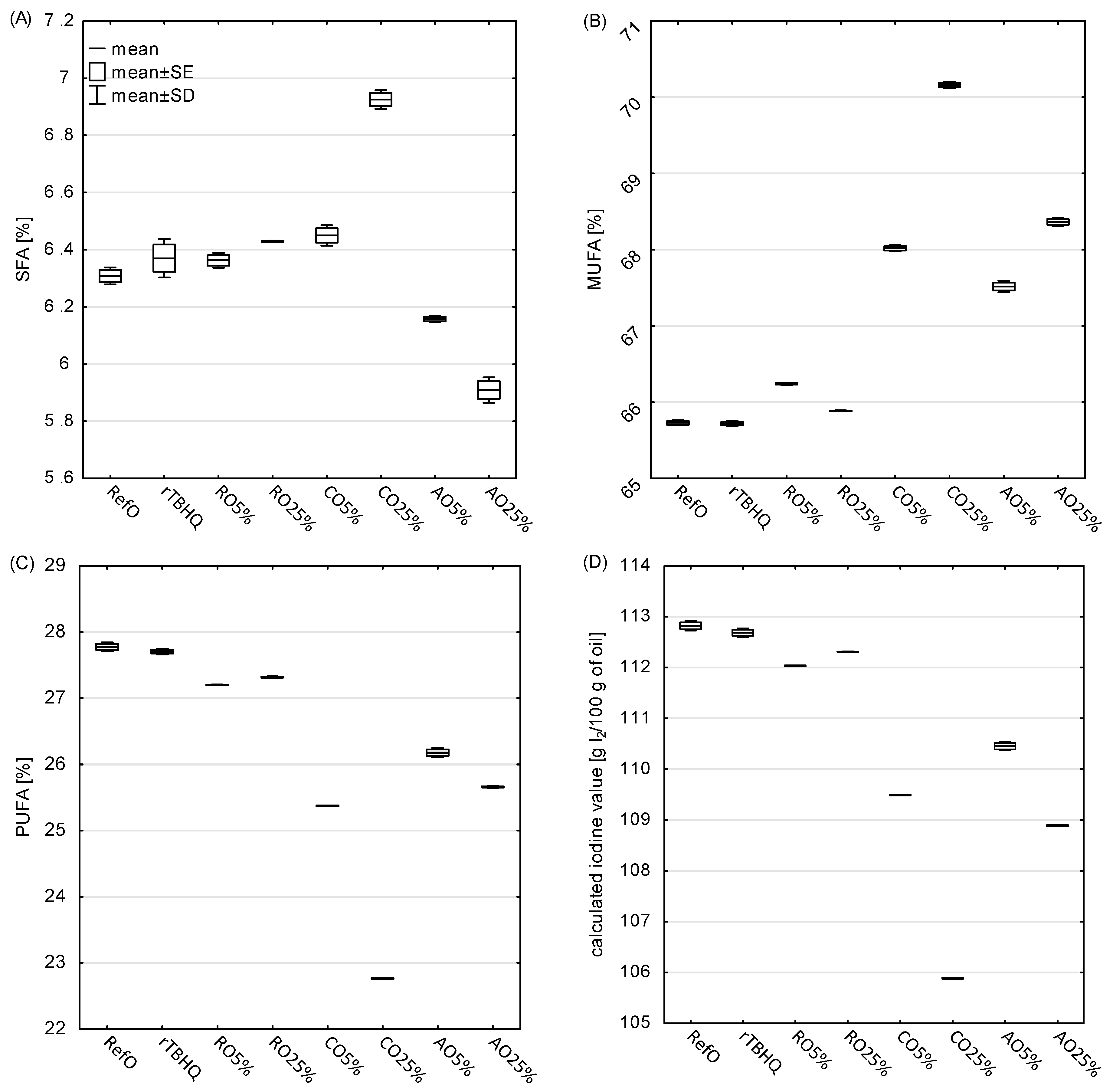
In unheated blends, MUFAs had the predominant share, with the highest value observed in CO25% (70.16%) and the lowest in rTBHQ (65.72%) (Figure 1). PUFAs were second among fatty acid groups and ranged from 22.76% (CO25%) to 27.78% (RefO). CO25% had the highest SFA share (6.93%), while AO25% had the lowest (5.91%). Concerning the CIV, it varied between 105.89 and 112.82, and it followed the PUFA share. The most pronounced effect of additives on the fatty acid group composition was observed in blends containing coriander oil, CO5% and CO25%, in which the MUFA share increased by 2.29% and 4.43%, respectively, and the PUFA share decreased by 2.40% and 5.01%, respectively. However, the change in the SFA share was minor and varied from 0.05% to 0.62%. Detailed data on fatty acid group CIVs are presented in Table S1 (Supplementary Materials).

3.3. Indices of Lipid Nutritional Quality

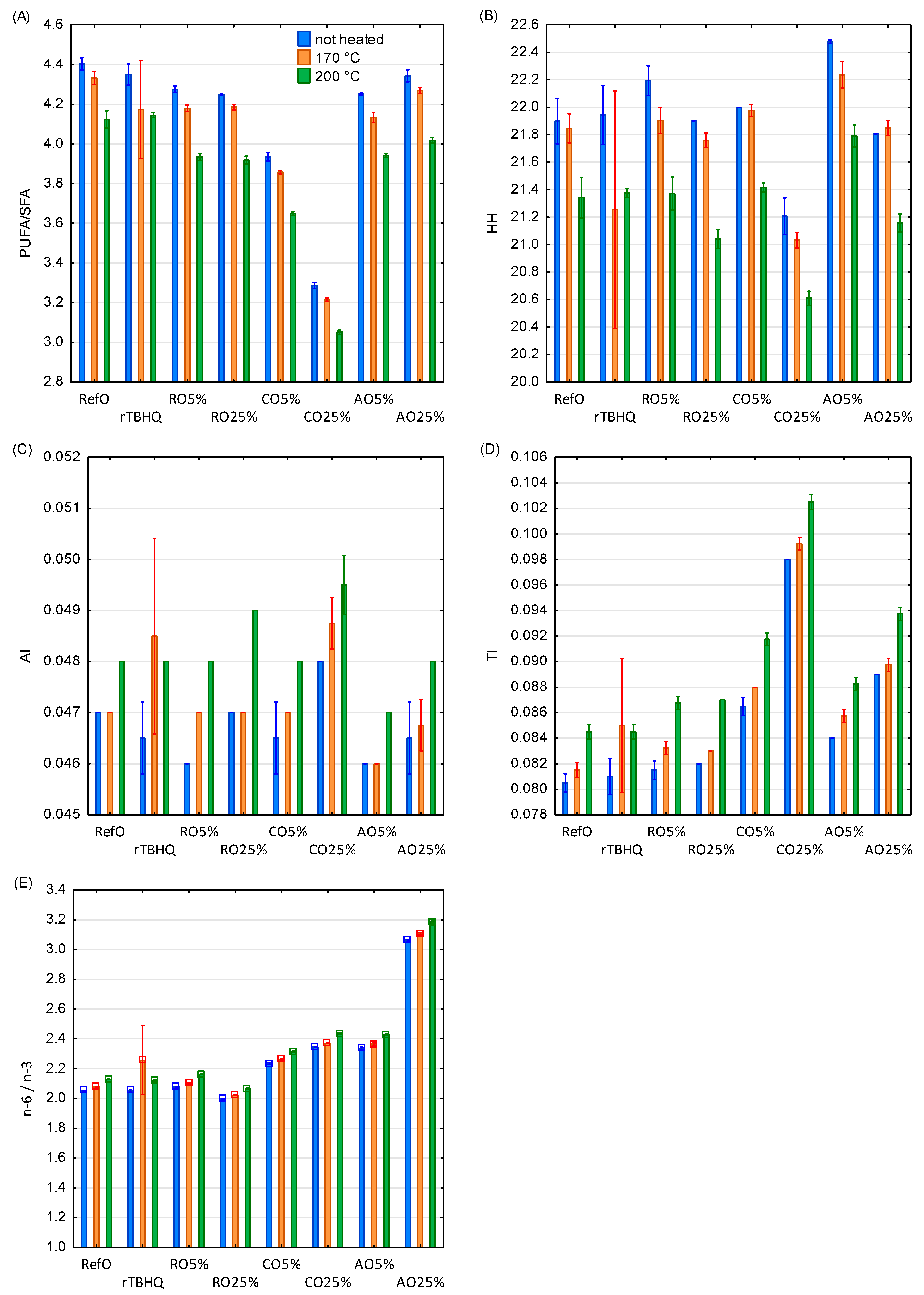
In unheated blends and control samples, the ranges of AI and TI values were narrow, ranging from 0.046 to 0.048 and from 0.081 to 0.098, respectively (Figure 2). However, PUFA/SFA and HH values showed greater variability. PUFA/SFA and HH had the lowest CO25% (3.29 and 21.21, respectively). RefO had the highest PUFA/SFA (4.40), and the AO5% blend was characterized by the highest HH ratio (22.48). Among tested additives, coriander oil had the greatest effect on the change in dietary indices. In CO25%, the TI value increased by 21.00% relative to RefO, whereas PUFA/SFA and HH values decreased by 25.35% and 3.16%, respectively. Among the blends, CO25% had the most atherogenic, thrombogenic, and hypercholesterolemic composition, resulting from an increase in the SFA share and a decline in the PUFA share, despite an increase in the MUFA share. However, in all samples AI, TI, and PUFA/SFA values were within globally accepted recommendations [55,58]. In CO25% AI and TI values were more than 20- and 10-fold lower than the maximum recommended value, respectively, and the PUFA/SFA level was more than 7-fold higher than the minimum recommended value. According to our knowledge, no specific recommendation exists for the HH ratio, but higher values are beneficial for maintaining a favorable blood lipid profile. Compared to the Cornicabra olive oil variety (6.61) [63], the white açaí oil variety (3.344) [67], and avocado oil (2.79) [68], the HH ratios for CO25% were more than 3-, 4-, and 7-fold lower, respectively.
In unheated samples, the lowest n-6/n-3 ratio was observed in RO25% (2.00), and it was 1/3 of the highest n-6/n-3 ratio in AO25% (3.06). Generally, all samples were close to each other. However, three groups could be distinguished. The first group, with an n-6/n-3 ratio between 2.00 and 2.05, included control samples (RefO and rTBHQ) and blends with cold-pressed rapeseed oil (RO5% and RO25%). The second group, with an n-6/n-3 ratio between 2.24 and 2.35, comprised blends of coriander oil (CO5% and CO25%) and one of blends of apricot oil (AO5%). In the last group there was only one blend with 25% apricot oil (AO25%), which was the most different from the others. It is worth noting that in all blends, the n-6/n-3 ratio was below the value indicated by the WHO and FAO [53].
With regard to heated blends, PUFA/SFA levels decreased at both temperatures, and the decrease was between 2.7- and 5.1-fold higher at 200 °C than at 170 °C. Similarly, an HH ratio drop was observed at both temperatures. Heating at 170 °C did not cause changes in AI except for rTBHQ, RO5%, and CO25%. At 200 °C a slight increase in AI was observed in all blends. Insight into TI showed a slight rise at both temperatures; at 200 °C it was 4- or 5-fold higher than at 170 °C. The TI value was the same at 170 and 200 °C only in rTBHQ. The results from this study are consistent with previous surveys [63,69], which showed that heating and frying caused a MUFA and PUFA decrease as well as an SFA increase, which lead to intense atherogenic, thrombogenic, and hypercholesterolemic effects. In all samples an increase in the n-6/n-3 ratio was noted after heating at both temperatures, but it had reached maximum by 0.2 and ranged from 6.28 to 10.01% of initial value. This was probably due to the greater susceptibility to degradation of α-linolenic acid than linoleic acid. Detailed data on lipid nutritional quality indices are presented in Table S2 (Supplementary Materials).

3.4. Color Index

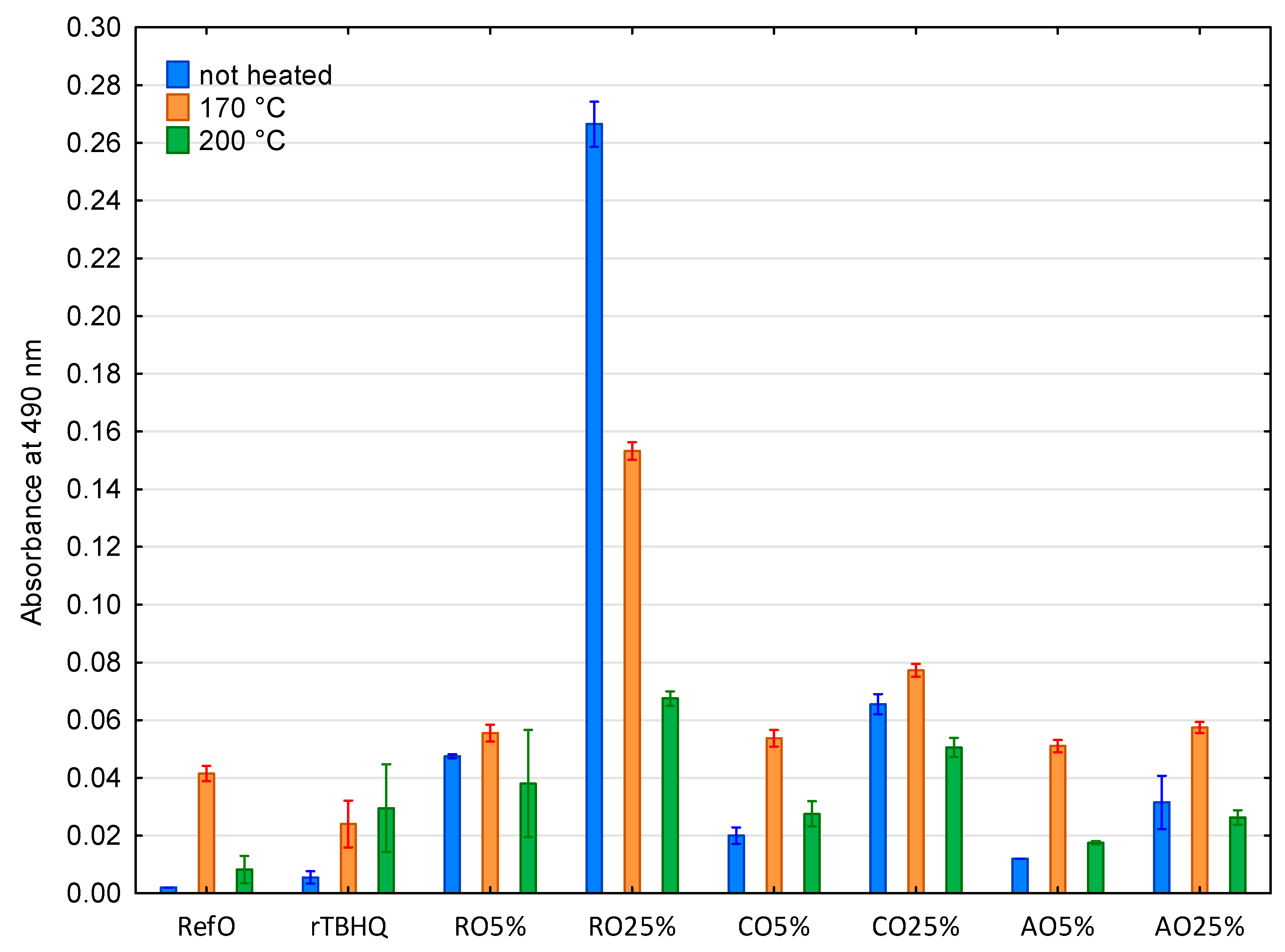
Color serves as a rapid indicator for assessing frying oil quality. As can be seen in Figure 3, among unheated samples, the highest color index was observed in RO25% (0.267), and it results from natural chlorophyll content in cold-pressed rapeseed oil, as reported in our previous study [61] for this bioactive compound amount in the same samples. In other blends, values were similar, ranging from 0.012 to 0.066. As expected, in control samples RefO and rTBHQ, it was at a very low level and amounted to 0.002 and 0.006, respectively. For all samples a similar tendency in the change in the color index under the influence of heating was observed. At 170 °C the color index increased in all blends, except for RO25%, which exhibited a decrease of over one-third of the initial value. The greatest change in the color index was observed in RefO samples, where this value increased by almost 20 times. The smallest increase in the color index was observed in RO5% and CO25% samples. The rise in the color index at 170 °C may be elucidated by the accumulation of colored TAG degradation products and indicates a progressive deterioration of the sample quality during heating. However, at 200 °C the color index was lower than at 170 °C and comparable to (CO5%, AO5%, and AO25%) or even lower (RO5%, RO25%, and CO25%) than for unheated blends. This decline likely resulted from chlorophyll decomposition. It is especially visible in the RO25% sample, in which the chlorophyll decomposition effect at 170 °C outweighed the colored TAG degradation product effect due to its high initial chlorophyll content in RO25%. Detailed data on the color index are presented in Table S3 (Supplementary Materials). The reduction in chlorophyll pigments after hot plate heating and microwave heating in mustard and olive oil was confirmed by visible spectra analysis performed by Khan et al. [70].
Other authors [71] examined color index changes during frying of distilled olive pomace oil with or without additives. They observed that the color index increase was higher in the sample without additives than in the sample with squalene but lower compared to the sample with mono- and diglyceride addition. Aladedunye and Przybylski [72] concluded that the darkening of oils during frying may be attributed to the formation of nonenzymatic browning compounds. However, the formation of some carotenoid oxidation products, polymerized tocotrienols, and polymerized acylglycerols may contribute to the higher UV absorbance. Also, nonvolatile decomposition products [NVDPs] and α-, β-unsaturated carbonyl compounds formed during oxidation and thermal decomposition of unsaturated fatty acids are considered as pigments responsibility for the oil darkening [73]. Lazarick [74] stated that the oil darkening may result from the production of the polypyrrolitic polymers and the short-chain aldehydes.

3.5. Total Polar Compounds (TPCs) and Oxidized TAG Monomer (oxTAG) Content

Total polar compounds (TPCs) represent non-volatile degradation products formed through oxidation and hydrolysis of TAG, which exhibit greater polarity than the unmodified TAG. They are among the most reliable and widely recognized indicators of frying fat quality worldwide. Many countries have established TPC content limits in frying oils, ranging from 24% to 30% [75,76].
The level of TPC did not exceed the recommended value in any samples. The refined rapeseed oil without additives (RefO) had the highest TPC content, both heated at 170 °C and 200 °C (7.78 and 12.34%, respectively) (Table 2). At 170 °C, the RefO sample differed significantly from all the others except the AO25% sample. However, at 200 °C only the RO5%, CO5%, and CO25% samples had significantly lower TPC content than the RefO sample. This indicates that heating at higher temperatures and the resulting more advanced degradation of oils made the samples more similar to each other. This is probably due to the progressive loss of bioactive compounds and is consistent with the correlation analysis and principal component analysis (PCA).
RefO sample also exhibited the highest increase in TPC content under heating conditions at both temperatures (5.47% at 170 °C and 10.03% at 200 °C). It indicates that the addition of cold-pressed oils significantly reduced oxidation during thermal treatment, although their protective effects varied. The AO5% sample exhibited the lowest TPC content (3.11%) and the smallest increase in this parameter (0.17%) at a temperature of 170 °C. Among samples heated at 200 °C, the lowest TPC level was found in the RO5% sample (8.45%), while its lowest increase was in the AO25% sample (by 5.71%).
Notably, rTBHQ samples were characterized by the second-highest increase in TPC, at both 170 °C and 200 °C (by 2.98 and 9.20%, respectively). This means that the additions of cold-pressed oils were more effective in reducing the TPC increase than the addition of the synthetic antioxidant TBHQ.
Oxidized TAG monomers (oxTAGs) are one of TPC fractions, generated by the addition of an extra oxygen atom to at least one unsaturated bond in one or more of the fatty acids chains, which results in the formation of oxygenated functional groups. Their molecular weight is close to the original, unmodified TAG [77]. The results of the analysis of oxTAG content in blends are presented in Table 3. The oxTAG content in unheated samples ranged from 18.20 to 43.28 mg/g of oil. Among the samples heated at 170 °C, the highest oxTAG content was noted in the RefO (75.84 mg/g of oil) and AO25% (61.84 mg/g of oil) samples. The RefO sample differed significantly from the others, except for the AO25% sample. The lowest oxTAG content was noted in the AO5% (29.04 mg/g of oil) and RO5% (34.80 mg/g of oil) samples. The remaining samples were characterized by a similar oxTAG in the range from 41.14 to 49.06 mg/g of oil. In the samples heated at 200 °C, the highest content of oxTAG was characteristic of the RefO sample (113.77 mg/g of oil), and it differed significantly from the RO5% sample with the lowest content of oxTAG (73.20 mg/g of oil) and two other samples CO5% and CO25%.
The results from this study indicate oil degradation during heating at frying temperature, which is significantly more advanced at 200 °C than at 170 °C. In the initial stages of lipid oxidation, primary oxidation products, which are lipid hydroperoxides, are formed. At high temperature they decompose to secondary oxidation products like aldehydes, ketones, and alcohols, which leads to the formation of TPC and oxTAG [78]. However, a smaller increase in TPC and oxTAG content in blends compared with control samples indicates that the addition of cold-pressed oils could be effective in limiting TAG oxidation. This may be attributed to the influence of the fatty acid profile because blends with coriander seed oil and apricot kernel oil showed a lower degree of unsaturation determined by the CIV compared to the other samples. These results are consistent with the data presented in previous studies [79,80,81]. It may be a result of the greater susceptibility of PUFAs to degradation under conditions of high temperature and contact with oxygen. However, this is only a partial explanation since the blends with cold-pressed rapeseed oil had a similar degree of unsaturation to refined rapeseed oil but also lower contents of TPC and oxTAG. Furthermore, the fatty acid profile does not explain the variability in the level of TPC and oxTAG between the individual blends with highly monounsaturated cold-pressed oils.
The observed variability may result from the action of bioactive compounds present in cold-pressed oils, such as tocopherols, which act as chain-breaking antioxidants, mainly by the hydrogen atom transfer (HAT) mechanism. It caused the first steps of TAG oxidation processes to be interrupted and radicals to be neutralized. Consequently, the formation of primary oxidation products as well as secondary oxidation products was slowed, which led to a lower level of TPC [82,83]. Moreover, the ratio of tocopherol homologs may be crucial for the thermal and oxidative stability of oil [84,85]. Our previous study [61] showed a significant tocopherol reduction after heating. It may be a result both of thermal degradation of tocopherols and their active consumption as antioxidants during oxidation. However, the results of correlation analysis and PCA indicate that the second mechanism is particularly important. Tocopherol degradation is strongly dependent on temperature. At lower temperature, in the range between 30 and 100 °C, this process occurs slowly, and several weeks or months are required to observe substantial depletion [86]. At medium temperature, in the range between 140 and 170 °C, degradation of tocopherols is markedly accelerated and occurs within hours [87]. At high temperatures, around 200 °C, which is typical for frying, almost total degradation of tocopherols may be observed after several minutes [61].
The inhibitory effect on lipid oxidation may also result from the influence of phenolic compounds, which occur in abundance in cold-pressed oils, according to many publications [88,89,90]. Numerous studies have shown that oils with a higher content of native or added phenolic compounds exhibited higher stability in accelerated aging tests [91,92] and during frying [32,66,93]. This is mainly related to the ability of phenolic compounds to quench free radicals by donating a hydrogen atom or an electron. It should be noted that the structure of phenolic compounds is of great importance, including the number and position of hydroxyl groups, the degree of methylation, the presence of other substituents, glycosylation, and the presence of a double bond between C2 and C3 (in the C ring of flavonoids) [94,95]. There is no data in the literature on the composition of phenolic compounds in coriander seed oil. However, their composition was examined in coriander seed extract [96]. Ten phenolic compounds were identified, and chlorogenic acid had the dominant share (490.56 μg/g of extract), followed by vanillic acid (273.23 μg/g of extract) and ferulic acid (239.21 μg/g of extract). The strong antioxidant properties [97] of ferulic and vanillic acids result from the presence of a hydroxyl group substituted in the para-position to the side chain with a conjugated double bond. This arrangement enables electron delocalization in the entire phenoxyl radical molecule, which has a beneficial effect on its stability and thus improves the antioxidant properties of the phenolic compound.
The antioxidant activity of our blends was described in our previous study [61]. The highest antioxidant activity measured by DPPH and ABTS was found in the rTBHQ sample. It was followed by blends with cold-pressed rapeseed oil, considering DPPH, and by blends with coriander and apricot oils regarding ABTS. The DPPH assay applies a radical dissolved only in organic media and therefore suits lipophilic systems, whereas the ABTS assay is used to determine scavenging ability in both hydrophilic and lipophilic antioxidant systems. Therefore, it may be assumed the protective effect of cold-pressed rapeseed oil results mainly from the activity of lipophilic antioxidants. In the case of coriander and apricot oils, it could be the effect of both hydrophilic and lipophilic antioxidant activity. In the publication by Ramadan et al. [98], 10 oils were examined regarding the antioxidant activity measured by the DPPH test. It was found that coriander oil was the most effective in quenching free radicals. According to the authors, the differences in the antioxidant properties of the oils may result from differences in the content and composition of polar bioactive components of the unsaponifiable fraction, differences in the structure of potential phenolic antioxidants in the oils, synergistic interactions between polar bioactive substances and other components of the oils, or differences in the kinetics of the antioxidant reactions occurring in the oils. All these factors may contribute to the radical quenching efficiency of the oils.
Another factor that may affect the inhibition of TAG oxidation in blends with coriander seed oil is the presence of essential oil in these samples. It has been proven [99] that the addition of coriander essential oil to sunflower oil reduces the formation of TPC and TAG polymers during deep frying. It was shown that coriander essential oil can be a rich source of phenolic antioxidants like eugenol and non-phenolic substances such as linalool, limonene, and γ-terpinene, which may also exhibit antioxidant properties [100].

3.6. Triacylglycerol (TAG) Polymer Content

Triacylglycerol (TAG) polymers are formed via a polymerization reaction by connecting two, three, or more TAG molecules, which are named dimers, trimers, and oligomers, respectively. They may be polar or non-polar, depending on the presence or absence oxidized functional groups. They have complex structures and are formed in more advanced stages of oil degradation. Their molecular weight is higher than the original, unmodified TAG. They are considered a good indicator of frying oil quality [77,101]. Some countries have established limits of TAG polymers, ranging between 10 and 16 g/100 g oil [75]. TAG polymers disturb technological processes by prolonging the frying process and increasing viscosity. They increase the fat content of the dish, which is adverse from a nutritional perspective. Moreover, consuming TAG polymers may have harmful effects on health due to damage to the intestinal mucosa and may contribute to cancer [102]. TAG dimers were the only polymer fraction detected in this study and only in the samples heated at 200 °C. The results of the analysis of TAG dimers in blends are presented in Table 4. The content of TAG dimers did not exceed the upper permissible limit, 16 g/100 g of oil in any sample, but was above the recommended lower permissible limit, 10 g/100 g of oil in three samples, namely, RefO, rTBHQ, and RO25%. However, there were no statistically significant differences between these three samples and the others, except for the CO25% sample with the lowest dimer content (6.11 mg/g oil). This was less than 59% of TAG dimer content in the RefO sample. It may be concluded that 25% coriander oil addition delayed TAG polymerization. Previous studies revealed that the use of antioxidants in frying oil may play an important role in mitigating the degradation of polymers and other degradation products during the frying process [13,103,104]. However, the effectiveness of antioxidants in preventing polymer formation may be influenced by factors such as the type of antioxidant, the frying temperature, and the duration of the frying process [13,103,104].
Harzalli et al. [105] observed that the addition of olive mill wastewater extract to refined sunflower oil reduces the formation of TAG polymers and aldehydes. Similarly, olive oil with the extract had lower levels of TAG polymers compared to refined sunflower oil. Surprisingly, olive oil without the extract showed lower content of TAG polymers and aldehydes than olive oil enriched by the extract. This indicates that substances naturally occurring in oils may be more effective in limiting thermal TAG degradation than exogenous additives. Additionally, they showed that the highest percentage of polyunsaturated fatty acids in refined oil was associated with a greater tendency to form polymeric compounds.
Other authors reported interesting results using 1H NMR and electron spin resonance techniques [106]. It was shown through 1H NMR spectra that heated palm oil had a higher percentage of the allyl acyl group and was more prone to the formation of non-polar dimeric TAG compared to refined palm kernel oil and refined coconut oil. In addition, electron spin resonance spectra indicated that alkyl radicals were more predominant than alkoxy radicals in heated palm oil. In contrast, refined palm kernel oil and refined coconut oil were predisposed to the generation of alkoxy radicals during thermal treatment. The authors explained that this discrepancy may be a result of differences in fatty acid composition.
Based on a study [107] of TAG polymer content in oxidized soybean oil at frying temperatures, it was suggested that ester bonds are primarily responsible for the polymerization of oils during frying. This polymerization process is evidenced by increased ester values and specific NMR signals.

3.7. Correlation Analysis

A significant, strong, negative correlation between total tocochromanols and TPC, as well as between total tocochromanols and oxTAG content (r = −0.7890 and −0.7915, respectively, p < 0.05), was found (Table 5). Interestingly, we found that plastochromanol-8 (PC-8) content showed the strongest significant negative correlation among tocochromanols with TPC and oxTAG content (r = −0.8173 and −0.8155, respectively, p < 0.05), despite the relatively low initial concentration. PC-8 has been proven to be an effective singlet oxygen scavenger both in vitro and in vivo, and it was more active than tocopherols in the inhibition of the peroxidation reaction [108]. γ-tocopherol also exhibited a very strong negative correlation with TPC and oxTAG (−0.8094 and −0.8058, respectively), which was stronger than that observed for α-tocopherol (−0.7237 and −0.7324, respectively) and the remaining tocopherol homologs. This finding indicates a significant role of γ-tocopherol in limiting oxidative processes occurring in the studied oils and suggests that its effect was more pronounced than that of α-tocopherol. It should be noted that both α-tocopherol and γ-tocopherol were the most abundant tocopherols present in the oils. The ABTS analysis results had a significant, negative correlation with TPC and oxTAG content (r = −0.7514 and −0.7552, respectively, p < 0.05), which was higher than the correlation of DPPH with TPC and with oxTAG content. The DPPH assay typically uses an organic solvent and therefore is appropriate for lipophilic systems, whereas the ABTS assay may be carried out both in hydrophilic and lipophilic systems [109]. The results may indicate a synergistic interaction between hydrophilic and hydrophobic antioxidants, which is in agreement with our previous study [61].

3.8. Principal Component Analysis (PCA)

PCA calculation was performed based on 21 variables, which are presented in the present and previous study [61]. The first four PCs were extracted with eigenvalues higher than 1 (Kaiser’s rule). Together, they explained over 90% of the total variance, and it was 48.84, 25.45, 9.94, and 6.34.
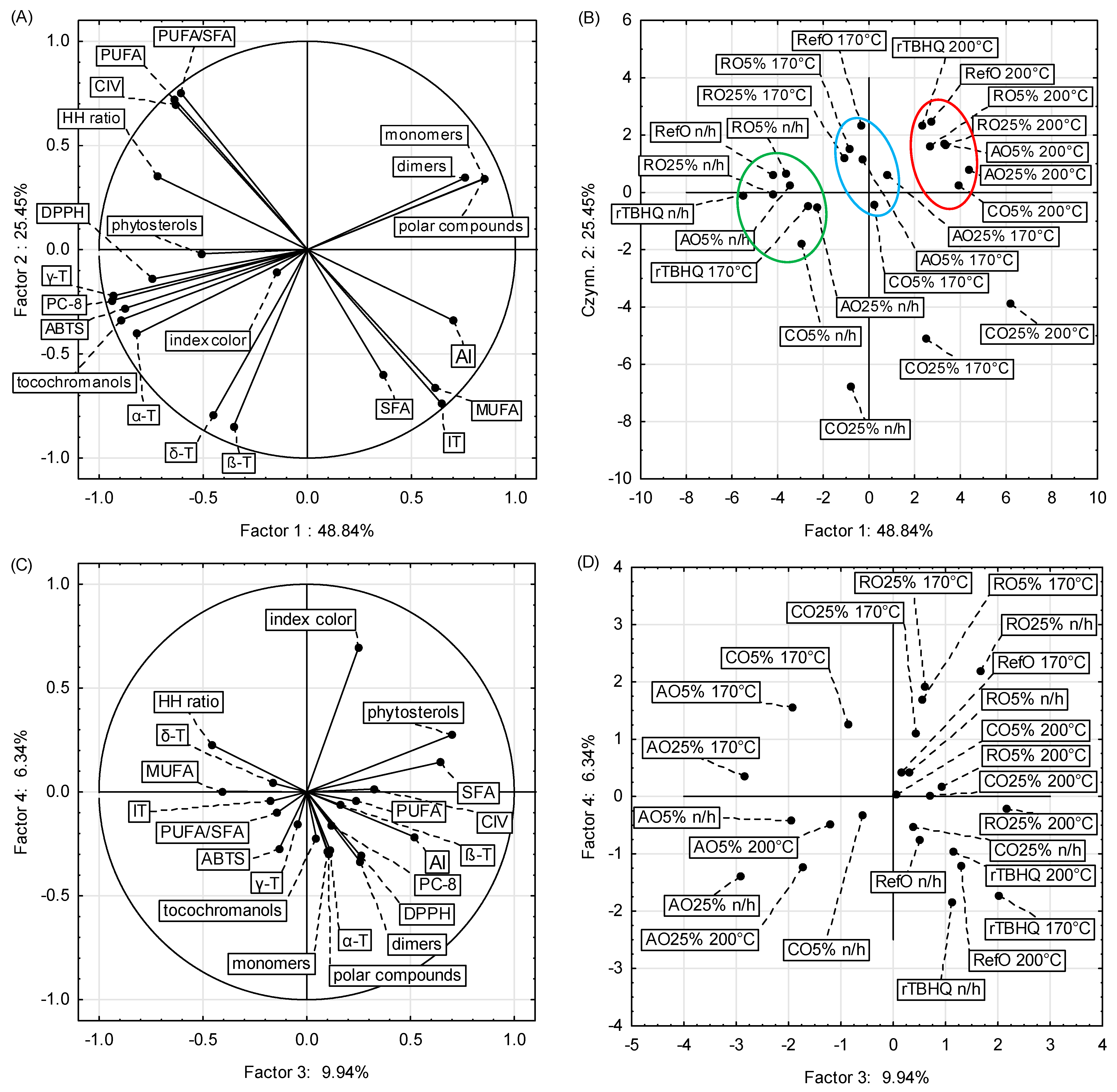
In Figure 4A, PC1 was positively correlated with polar compound content (0.8523), oxidized TAG monomer content (0.8495), and TAG dimer content (0.7578) and negatively correlated with PC-8 (−0.9364), γ-tocopherol (−0.9306), tocochromanols (−0.8932), ABTS (−0.8727), α-tocopherol (−0.8173), and DPPH (−0.7442). PC1 was ascribed to the x-axis, along which the samples (Figure 4B) were distributed from unheated (left side of the axis) through heated at 170 °C (mainly in the center), to heated at 200 °C (right side of the axis). It may be assumed that PC1 was related to the gradual oil deterioration during heating. PC2 was mainly characterized by the PUFA/SFA ratio (0.7500), PUFAs (0.7208), as well as β-tocopherol (−0.8475), δ-tocopherol (−0.7957), and TI (−0.7360). Figure 4B shows that the samples were distributed into three major clusters, which reflected differences in heat treatment. Cluster I (green color) contained unheated samples with the highest content of total tocopherols but the lowest of TPC, oxTAG, and TAG dimers. Cluster II (blue color) grouped samples heated at 170 °C. Cluster III (red color) comprised samples heated at 200 °C, with the most advanced deterioration, including lower content of minor compounds but higher content of degradation products. All clusters were located far from each other, which indicates that heating caused significant changes at both temperatures. CO25% blends unheated and heated at 170 and 200 °C were outliers, mainly due to differences in fatty acid composition. Surprisingly, rTBHQ heated at 170 °C was located among unheated samples, which indicates that the synthetic antioxidant was highly effective in reducing the degradation process. However, rTBHQ heated at 200 °C was placed together with other samples heated at 200 °C. This means that at higher temperature, the synthetic antioxidant lost its protective properties and was less effective than, for example, the additive CO25%.
PC3 and PC4, presented in Figure 4C,D, together explained 16.28% of the total variability of the results. In Figure 4C, most variables were clustered near the center of the plot. PC3 was mainly positively correlated with the phytosterol content (0.7020), whereas PC4 was mainly positively correlated with the color index (0.6970). Figure 4D shows that the samples located on the left side of the x-axis (PC3) were characterized by lower phytosterol content, and samples located on the top of the y-axis (PC4) were characterized by a higher color index.
The grouping of blends in the study was determined mainly by the level of degradation products and the content of tocochromanols, particularly γ-tocopherols and PC-8. The fatty acid profile and CIV were also important; however, in this study their impact was less pronounced, probably due to the similar proportions of MUFAs, PUFAs, and SFAs among the blends. The findings indicate that the blend formulation should account for not only the composition of fatty acids but also the content and selection of antioxidants like tochromanols.

4. Conclusions

The effect of refined rapeseed oil and cold-pressed oil blending on stability of oil at temperatures typical for frying was investigated (at 170 and 200 °C). High temperature was shown to promote oil degradation via oxidation and TAG polymerization, and it was more intense at 200 °C. The addition of cold-pressed oils limited the increase in the contents of TPC and oxTAG during heating at both temperatures and was more effective than TBHQ. This was particularly visible at 200 °C, where TBHQ lost much of its protective properties, while blends with cold-pressed oils still had much lower contents of TPC and oxTAG than refined rapeseed oil. Only the CO25% sample had a statistically significantly lower TAG dimer content than refined rapeseed oil and the control sample with TBHQ. These results showed that 25% coriander oil addition slowed the TAG polymerization process. It can be concluded that cold-pressed oils have great potential to replace synthetic antioxidants and to increase the thermal stability of frying oils. However, individual types of cold-pressed oils differ in their protective properties. Statistical analysis indicates that tocochromanols, especially PC-8 and γ-tocopherol, may effectively limit the thermal degradation of oils. An increase in the color index at 170 °C indicated accumulation of colored TAG degradation products and a deterioration of sample quality. Heating at 200 °C led to a decrease in the color index and was probably caused by chlorophyll degradation. Under the conditions of our study, parameters such as TPC and the content of tocochromanols appear to be useful indicators for evaluating of mixtures dedicated to high-temperature applications.
Blends of cold-pressed rapeseed and coriander oils can be used in home and catering settings to produce fried products with improved nutritional quality. The tested blends may be used in the fried snack industry, such as in chips, French fries, nuggets, or breaded products.
Study limitations include the single heating cycle and lack of sensory analysis. Future studies could focus on quantifying volatile off-flavors via GC-MS and sensory analysis of blends before and after heating. Future work could also evaluate blends during repeated and continuous frying, deep frying, and storage at room and refrigerator temperatures. Moreover, further research is required to understand the complex process of degradation of triacylglycerols and other oil components and the role of bioactive substances.

Supplementary Materials

The following supporting information can be downloaded at https://www.mdpi.com/article/10.3390/app16031589/s1, Table S1. Shares of saturated, monounsaturated, and polyunsaturated fatty acids and calculated iodine value in unheated and heated blends. Table S2. Indices of lipid nutritional quality in unheated and heated blends. Table S3. The color index in unheated and heated blends.

Author Contributions

Conceptualization, M.F. and D.K.; methodology, M.F., D.K., and A.S.; formal analysis, M.F. and D.K.; investigation, M.F., D.K., and A.S.; writing—original draft preparation, M.F.; visualization, M.F.; writing—review and editing, M.F. and D.K.; project administration, M.F.; supervision, D.K. All authors have read and agreed to the published version of the manuscript.

Funding

This research was funded by the National Science Center, Poland, grant no. 2019/35/N/NZ9/00767.

Data Availability Statement

The original contributions presented in this study are included in the article. Further inquiries can be directed to the corresponding authors.

Conflicts of Interest

The authors declare no conflicts of interest.

References

  1. Yang, R.; Zhang, L.; Li, P.; Yu, L.; Mao, J.; Wang, X.; Zhang, Q. A review of chemical composition and nutritional properties of minor vegetable oils in China. Trends Food Sci. Technol. 2018, 74, 26–32. [Google Scholar] [CrossRef]
  2. Gangopadhyay, N. Oils Extracted from Nuts and Grains. In Oil and Oilseed Processing; Lafarga, T., Bobo, G., Aguiló-Aguayo, I., Eds.; John Wiley & Sons Ltd.: Hoboken, NJ, USA, 2021; pp. 61–79. [Google Scholar]
  3. Liu, X.; Wang, S.; Masui, E.; Tamogami, S.; Chen, J.; Zhang, H. Model for prediction of the carbonyl value of frying oil from the initial composition. LWT 2020, 117, 108660. [Google Scholar] [CrossRef]
  4. Grajzer, M.; Prescha, A.; Korzonek, K.; Wojakowska, A.; Dziadas, M.; Kulma, A.; Grajeta, H. Characteristics of rose hip (Rosa canina L.) cold-pressed oil and its oxidative stability studied by the differential scanning calorimetry method. Food Chem. 2015, 188, 459–466. [Google Scholar] [CrossRef] [PubMed]
  5. Winkler, J.K.; Warner, K. The effect of phytosterol concentration on oxidative stability and thermal polymerization of heated oils. Eur. J. Lipid Sci. Technol. 2008, 110, 455–464. [Google Scholar] [CrossRef]
  6. Nyström, L.; Achrenius, T.; Lampi, A.M.; Moreau, R.A.; Piironen, V. A comparison of the antioxidant properties of steryl ferulates with tocopherol at high temperatures. Food Chem. 2007, 101, 947–954. [Google Scholar] [CrossRef]
  7. Barrera-Arellano, D.; Ruiz-Méndez, V.; Velasco, J.; Márquez-Ruiz, G.; Dobarganes, C. Loss of tocopherols and formation of degradation compounds at frying temperatures in oils differing in degree of unsaturation and natural antioxidant content. J. Sci. Food Agric. 2002, 82, 1696–1702. [Google Scholar] [CrossRef]
  8. Fedko, M.; Kmiecik, D.; Siger, A.; Majcher, M. The Stability of Refined Rapeseed Oil Fortified by Cold-Pressed and Essential Black Cumin Oils under a Heating Treatment. Molecules 2022, 27, 2461. [Google Scholar] [CrossRef]
  9. Kmiecik, D.; Fedko, M.; Siger, A.; Kowalczewski, P.Ł. Nutritional Quality and Oxidative Stability during Thermal Processing of Cold-Pressed Oil Blends with 5:1 Ratio of ω6/ω3 Fatty Acids. Foods 2022, 11, 1081. [Google Scholar] [CrossRef]
  10. Kancheva, V.D.; Angelova, S.E. Synergistic effects of antioxidant compositions during inhibited lipid autoxidation. In Lipid Peroxidation: Inhibition, Effects and Mechanisms; Nova Science Publishers Inc.: New York, NY, USA, 2017; pp. 49–81. ISBN 978-153610530-8, 978-153610506-3. [Google Scholar]
  11. Santos, S.C.; Fortes, G.A.C.; Camargo, L.T.F.M.; Camargo, A.J.; Ferri, P.H. Antioxidant effects of polyphenolic compounds and structure-activity relationship predicted by multivariate regression tree. LWT 2021, 137, 110366. [Google Scholar] [CrossRef]
  12. Manukyan, A. Secondary metabolites and their antioxidant capacity of Caucasian endemic thyme (Thymus transcaucasicus Ronn.) as affected by environmental stress. J. Appl. Res. Med. Aromat. Plants 2019, 13, 100209. [Google Scholar] [CrossRef]
  13. Romero, A.; Bastida, S.; Sánchez-Muniz, F.J. Cyclic fatty acid monomer formation in domestic frying of frozen foods in sunflower oil and high oleic acid sunflower oil without oil replenishment. Food Chem. Toxicol. 2006, 44, 1674–1681. [Google Scholar] [CrossRef] [PubMed]
  14. Xu, L.; Yang, F.; Li, X.; Zhao, C.; Jin, Q.; Huang, J.; Wang, X. Kinetics of forming polar compounds in frying oils under frying practice of fast food restaurants. LWT 2019, 115, 108307. [Google Scholar] [CrossRef]
  15. Huang, J.; Zhao, N.; Wang, L.; He, H.; Song, Z.; Xingguo, W. Effect of amino acids on the formation and distribution of volatile aldehydes in high oleic sunflower oil during frying. Food Res. Int. 2024, 192, 114749. [Google Scholar] [CrossRef]
  16. Wei, C.; Wang, X.; Ai, Y.; Zhang, S.; Zhang, X.; Zhou, Y.; Lu, S.; Gu, H.; Zhang, X.; Luo, X.; et al. Effect of oleic/linoleic acid ratio on simultaneous formation of epoxy fatty acids and polar compounds in deep frying oils. LWT 2023, 187, 115389. [Google Scholar] [CrossRef]
  17. Li, X.; Wu, G.; Yang, F.; Meng, L.; Huang, J.; Zhang, H.; Jin, Q.; Wang, X. Influence of fried food and oil type on the distribution of polar compounds in discarded oil during restaurant deep frying. Food Chem. 2019, 272, 12–17. [Google Scholar] [CrossRef]
  18. Cao, X.; Li, X.; Shu, N.; Tan, C.P.; Xu, Y.J.; Liu, Y. The Characteristics and Analysis of Polar Compounds in Deep-Frying Oil: A Mini Review. Food Anal. Methods 2022, 15, 2767–2776. [Google Scholar] [CrossRef]
  19. Al Amin, M.; Ali, M.A.; Alam, M.S.; Nahar, A.; Chew, S.C. Oxidative degradation of sunflower oil blended with roasted sesame oil during heating at frying temperature. Grain Oil Sci. Technol. 2023, 6, 34–42. [Google Scholar] [CrossRef]
  20. Liu, G.; Wu, Y.; Xu, X.; Xu, X.; Liang, L.; Zhang, J.; Wen, C.; Li, Y.; He, X.; Xu, X.; et al. The relationship between the deterioration of frying oil and the generation of hazards during frying. Food Addit. Contam.-Part A 2024, 41, 1554–1569. [Google Scholar] [CrossRef]
  21. Grootveld, M.; Percival, B.C.; Leenders, J.; Wilson, P.B. Potential adverse public health effects afforded by the ingestion of dietary lipid oxidation product toxins: Significance of fried food sources. Nutrients 2020, 12, 974. [Google Scholar] [CrossRef] [PubMed]
  22. Grootveld, M. Evidence-Based Challenges to the Continued Recommendation and Use of Peroxidatively-Susceptible Polyunsaturated Fatty Acid-Rich Culinary Oils for High-Temperature Frying Practises: Experimental Revelations Focused on Toxic Aldehydic Lipid Oxidation Products. Front. Nutr. 2022, 8, 711640. [Google Scholar] [CrossRef]
  23. Zhao, M.; Liu, Z.; Zhang, W.; Xia, G.; Li, C.; Rakariyatham, K.; Zhou, D. Advance in aldehydes derived from lipid oxidation: A review of the formation mechanism, attributable food thermal processing technology, analytical method and toxicological effect. Food Res. Int. 2025, 203, 115811. [Google Scholar] [CrossRef] [PubMed]
  24. Honerlaw, J.P.; Ho, Y.L.; Nguyen, X.M.T.; Cho, K.; Vassy, J.L.; Gagnon, D.R.; O’Donnell, C.J.; Gaziano, J.M.; Wilson, P.W.F.; Djousse, L. Fried food consumption and risk of coronary artery disease: The Million Veteran Program. Clin. Nutr. 2020, 39, 1203–1208. [Google Scholar] [CrossRef] [PubMed]
  25. Wang, A.; Wan, X.; Zhuang, P.; Jia, W.; Ao, Y.; Liu, X.; Tian, Y.; Zhu, L.; Huang, Y.; Yao, J.; et al. High fried food consumption impacts anxiety and depression due to lipid metabolism disturbance and neuroinflammation. Proc. Natl. Acad. Sci. USA 2023, 120, e2221097120. [Google Scholar] [CrossRef]
  26. Dangal, A.; Tahergorabi, R.; Acharya, D.R.; Timsina, P.; Rai, R.; Dahal, S.; Acharya, P.; Giuffrè, A.M. Review on deep-fat fried foods: Physical and chemical attributes, and consequences of high consumption. Eur. Food Res. Technol. 2024, 250, 1537–1550. [Google Scholar] [CrossRef]
  27. Zhao, X.; Wu, S.; Gong, G.; Li, G.; Zhuang, L. TBHQ and peanut skin inhibit accumulation of PAHs and oxygenated PAHs in peanuts during frying. Food Control 2017, 75, 99–107. [Google Scholar] [CrossRef]
  28. Liu, X.; Zhang, X.; Wu, Y.; Xu, X.; Xu, X.; Liang, L.; Zhang, J.; Wen, C.; Li, Y.; He, X.; et al. Inhibition of TBHQ and TPP on Four Categories of Food Safety Hazards in Fried Potatoes. Food Bioprocess Technol. 2025, 18, 519–533. [Google Scholar] [CrossRef]
  29. Xu, X.; Liu, A.; Hu, S.; Ares, I.; Martínez-Larrañaga, M.R.; Wang, X.; Martínez, M.; Anadón, A.; Martínez, M.A. Synthetic phenolic antioxidants: Metabolism, hazards and mechanism of action. Food Chem. 2021, 353, 129488. [Google Scholar] [CrossRef]
  30. Ren, J.; Li, Z.; Li, X.; Yang, L.; Bu, Z.; Wu, Y.; Li, Y.; Zhang, S.; Meng, X. Exploring the Mechanisms of the Antioxidants BHA, BHT, and TBHQ in Hepatotoxicity, Nephrotoxicity, and Neurotoxicity from the Perspective of Network Toxicology. Foods 2025, 14, 1095. [Google Scholar] [CrossRef]
  31. Khezerlou, A.; Akhlaghi, A.P.; Alizadeh, A.M.; Dehghan, P.; Maleki, P. Alarming impact of the excessive use of tert-butylhydroquinone in food products: A narrative review. Toxicol. Rep. 2022, 9, 1066–1075. [Google Scholar] [CrossRef]
  32. Wu, G.; Han, S.; Zhang, Y.; Liu, T.T.; Karrar, E.; Jin, Q.; Zhang, H.; Wang, X. Effect of phenolic extracts from Camellia oleifera seed cake on the formation of polar compounds, core aldehydes, and monoepoxy oleic acids during deep-fat frying. Food Chem. 2022, 372, 131143. [Google Scholar] [CrossRef]
  33. Li, P.; Yang, X.; Jun, W.; Huang, F.; Wang, Y.; Li, Y. Comparison between synthetic and rosemary-based antioxidants for the deep frying of French fries in refined soybean oils evaluated by chemical and non-destructive rapid methods. Food Chem. 2021, 335, 127638. [Google Scholar] [CrossRef] [PubMed]
  34. Manzoor, S.; Masoodi, F.A.; Rashid, R.; Dar, M.M. Improving oxidative stability of soyabean oil by apple pomace extract during deep frying of french fries. Food Biosci. 2022, 49, 101874. [Google Scholar] [CrossRef]
  35. Sharma, S.; Cheng, S.; Bhattacharya, B.; Chakkaravarthi, S. Efficacy of free and encapsulated natural antioxidants in oxidative stability of edible oil: Special emphasis on nanoemulsion-based encapsulation. Trends Food Sci. Technol. 2019, 91, 305–318. [Google Scholar] [CrossRef]
  36. Pérez-López, A.J.; Luis, N.-A.; González, S.L.-M.; Miguel, P.G.-S.; Ferrández, B.; Carbonell-Barrachina, Á.A. Acrylamide content in French fries prepared with vegetable oils enriched with β-cyclodextrin or β-cyclodextrin-carvacrol complexes. LWT 2021, 148, 111765. [Google Scholar] [CrossRef]
  37. Konopka, I.; Tańska, M.; Dąbrowski, G.; Ogrodowska, D.; Czaplicki, S. Edible Oils from Selected Unconventional Sources—A Comprehensive Review of Fatty Acid Composition and Phytochemicals Content. Appl. Sci. 2023, 13, 12829. [Google Scholar] [CrossRef]
  38. Rigano, F.; Vento, F.; Cafarella, C.; Trovato, E.; Trozzi, A.; Dugo, P.; Mondello, L. Determination of main lipids and volatile compounds in unconventional cold-pressed seed oils through chromatographic techniques. J. Food Sci. 2025, 90, e17661. [Google Scholar] [CrossRef]
  39. Grygier, A.; Chakradhari, S.; Rudzińska, M.; Wroniak, M.; Segliņa, D.; Patel, K.S.; Soliven, A.; Górnaś, P. Comparative analysis of lipophilic phytochemicals in seed oils of six aromatic plant species. Eur. Food Res. Technol. 2025, 251, 2993–3005. [Google Scholar] [CrossRef]
  40. Symoniuk, E.; Wroniak, M.; Napiórkowska, K.; Brzezińska, R.; Ratusz, K. Oxidative Stability and Antioxidant Activity of Selected Cold-Pressed Oils and Oils Mixtures. Foods 2022, 11, 1597. [Google Scholar] [CrossRef]
  41. Rabiej-Kozioł, D.; Momot-Ruppert, M.; Stawicka, B.; Szydłowska-Czerniak, A. Health Benefits, Antioxidant Activity, and Sensory Attributes of Selected Cold-Pressed Oils. Molecules 2023, 28, 5484. [Google Scholar] [CrossRef]
  42. Zou, M.; Chen, Y.; Hu, C.; He, D.; Gao, P. Physicochemical properties of rice bran blended oil in deep frying by principal component analysis. J. Food Sci. Technol. 2022, 59, 4187–4197. [Google Scholar] [CrossRef] [PubMed]
  43. Zhang, Y.; Fan, L.P. Thermal stability and frying performance of low-saturated blending vegetable oil. Food Ferment. Ind. 2019, 45, 75–81. [Google Scholar] [CrossRef]
  44. Ramroudi, F.; Yasini Ardakani, S.A.; Dehghani-Tafti, A.; Khalili Sadrabad, E. Investigation of the Physicochemical Properties of Vegetable Oils Blended with Sesame Oil and Their Oxidative Stability during Frying. Int. J. Food Sci. 2022, 2022, 3165512. [Google Scholar] [CrossRef] [PubMed]
  45. Wroniak, M.; Rękas, A. Nutritional value of cold-pressed rapeseed oil during long term storage as influenced by the type of packaging material, exposure to light & oxygen and storage temperature. J. Food Sci. Technol. 2016, 53, 1338–1347. [Google Scholar] [CrossRef]
  46. Dedebas, T.; Ekici, L.; Sagdic, O. Chemical characteristics and storage stabilities of different cold-pressed seed oils. J. Food Process. Preserv. 2021, 45, e15107. [Google Scholar] [CrossRef]
  47. Ali, R.F.M.; El-Anany, A.M. Physico-chemical characteristics, nutritional quality, and oxidative stability of cold-pressed chia seed oil, date palm seed oil, along with their binary mixtures. Cogent Food Agric. 2025, 11, 2466061. [Google Scholar] [CrossRef]
  48. Perna, M.; Hewlings, S. Saturated Fatty Acid Chain Length and Risk of Cardiovascular Disease: A Systematic Review. Nutrients 2023, 15, 30. [Google Scholar] [CrossRef]
  49. Li, Z.; Lei, H.; Jiang, H.; Fan, Y.; Shi, J.; Li, C.; Chen, F.; Mi, B.; Ma, M.; Lin, J.; et al. Saturated fatty acid biomarkers and risk of cardiometabolic diseases: A meta-analysis of prospective studies. Front. Nutr. 2022, 9, 963471. [Google Scholar] [CrossRef]
  50. Shetty, S.S.; Kumari, N.S.; Varadarajan, R. The ratio of omega-6/omega-3 fatty acid: Implications and application as a marker to diabetes. In Biomarkers in Diabetes; Patel, V.B., Preedy, V.R., Eds.; Springer International Publishing: London, UK, 2022; pp. 449–467. [Google Scholar]
  51. Kousparou, C.; Fyrilla, M.; Stephanou, A.; Patrikios, I. DHA/EPA (Omega-3) and LA/GLA (Omega-6) as Bioactive Molecules in Neurodegenerative Diseases. Int. J. Mol. Sci. 2023, 24, 10717. [Google Scholar] [CrossRef]
  52. Simopoulos, A.P. The importance of the ratio of omega-6/omega-3 essential fatty acids. Biomed. Pharmacother. 2002, 56, 365–379. [Google Scholar] [CrossRef]
  53. WHO and FAO Joint Consultation: Fats and Oils in Human Nutrition. Nutr. Rev. 1995, 53, 202–205. [CrossRef]
  54. Mariamenatu, A.H.; Abdu, E.M. Overconsumption of Omega-6 Polyunsaturated Fatty Acids (PUFAs) versus Deficiency of Omega-3 PUFAs in Modern-Day Diets: The Disturbing Factor for Their “Balanced Antagonistic Metabolic Functions” in the Human Body. J. Lipids 2021, 2021, 8848161. [Google Scholar] [CrossRef]
  55. British Department of Health. Nutritional Aspects of Cardiovascular Disease; Report on Health and Social Subjects. No. 46.; H.M. Stationery Office: London, UK, 1994.
  56. Santos-Silva, J.; Bessa, R.J.B.; Santos-Silva, F. Effect of genotype, feeding system and slaughter weight on the quality of light lambs. II. Fatty acid composition of meat. Livest. Prod. Sci. 2002, 77, 187–194. [Google Scholar] [CrossRef]
  57. Moussavi Javardi, M.S.; Madani, Z.; Movahedi, A.; Karandish, M.; Abbasi, B. The correlation between dietary fat quality indices and lipid profile with Atherogenic index of plasma in obese and non-obese volunteers: A cross-sectional descriptive-analytic case-control study. Lipids Health Dis. 2020, 19, 213. [Google Scholar] [CrossRef]
  58. Pleadin, J.; Lešić, T.; Krešić, G.; Barić, R.; Bogdanović, T.; Oraić, D.; Vulić, A.; Legac, A.; ZrnčIć, S. Nutritional quality of different fish species farmed in the Adriatic sea. Ital. J. Food Sci. 2017, 29, 537–549. [Google Scholar]
  59. Attia, Y.A.; Al-Harthi, M.A.; Korish, M.A.; Shiboob, M.M. Fatty acid and cholesterol profiles and hypocholesterolemic, atherogenic, and thrombogenic indices of table eggs in the retail market. Lipids Health Dis. 2015, 14, 136. [Google Scholar] [CrossRef]
  60. Suri, K.; Singh, B.; Kaur, A.; Yadav, M.P. Physicochemical characteristics, oxidative stability, pigments, fatty acid profile and antioxidant properties of co-pressed oil from blends of peanuts, flaxseed and black cumin seeds. Food Chem. Adv. 2023, 2, 100231. [Google Scholar] [CrossRef]
  61. Fedko, M.; Siger, A.; Szydłowska-Czerniak, A.; Rabiej-Kozioł, D.; Tymczewska, A.; Włodarczyk, K.; Kmiecik, D. The Effect of High-Temperature Heating on Amounts of Bioactive Compounds and Antiradical Properties of Refined Rapeseed Oil Blended with Rapeseed, Coriander and Apricot Cold-Pressed Oils. Foods 2024, 13, 2336. [Google Scholar] [CrossRef] [PubMed]
  62. AOCS Official Method Cd 1c-85. Calculated iodine value. In Official Methods and Recommended Practices of the American Oil Chemists’ Society; American Oil Chemists’ Society: Champaign, IL, USA, 2009.
  63. Kmiecik, D.; Fedko, M.; Małecka, J.; Siger, A.; Kowalczewski, P.Ł. Effect of Heating Temperature of High-Quality Arbequina, Picual, Manzanilla and Cornicabra Olive Oils on Changes in Nutritional Indices of Lipid, Tocopherol Content and Triacylglycerol Polymerization Process. Molecules 2023, 28, 4247. [Google Scholar] [CrossRef]
  64. AOCS Official Method Cc 13c-50. Color of fats and oils, Spectrophotometric method. In Official Methods and Recommended Practices of the American Oil Chemists’ Society; American Oil Chemists’ Society: Champaign, IL, USA, 2009.
  65. AOCS Official Method 982.27. Polar components in frying fats. In Official Methods and Recommended Practices of the American Oil Chemists’ Society; American Oil Chemists’ Society: Champaign, IL, USA, 1984. [Google Scholar]
  66. Kmiecik, D.; Gramza-Michałowska, A.; Korczak, J. Anti-polymerization activity of tea and fruits extracts during rapeseed oil heating. Food Chem. 2018, 239, 858–864. [Google Scholar] [CrossRef] [PubMed]
  67. Santos, O.V.; Lemos, Y.S.; da Conceição, L.R.V.; Teixeira-Costa, B.E. Lipids from the purple and white açaí (Euterpe oleracea Mart) varieties: Nutritional, functional, and physicochemical properties. Front. Nutr. 2024, 11, 1385877. [Google Scholar] [CrossRef] [PubMed]
  68. Krumreich, F.D.; Mendonça, C.R.B.; Borges, C.D.; Crizel-Cardozo, M.M.; dos Santos, M.A.Z.; Otero, D.M.; Zambiazi, R.C. Margarida avocado oil: Effect of processing on quality, bioactive compounds and fatty acid profile. Food Chem. Adv. 2024, 4, 100617. [Google Scholar] [CrossRef]
  69. Szabo, Z.; Marosvölgyi, T.; Szabo, E.; Koczka, V.; Verzar, Z.; Figler, M.; Decsi, T. Effects of Repeated Heating on Fatty Acid Composition of Plant-Based Cooking Oils. Foods 2022, 11, 192. [Google Scholar] [CrossRef]
  70. Ahmad, A.; Husain, A.; Mujeeb, M.; Khan, S.A.; Najmi, A.K.; Siddique, N.A.; Damanhouri, Z.A.; Anwar, F. A review on therapeutic potential of Nigella sativa: A miracle herb. Asian Pac. J. Trop. Biomed. 2013, 3, 337–352. [Google Scholar] [CrossRef] [PubMed]
  71. Sahin Ozkan, K.; Ketenoglu, O.; Yorulmaz, A.; Tekin, A. Utilization of molecular distillation for determining the effects of some minor compounds on the quality and frying stability of olive pomace oil. J. Food Sci. Technol. 2019, 56, 3449–3460. [Google Scholar] [CrossRef] [PubMed]
  72. Aladedunye, F.; Przybylski, R. Performance of palm olein and modified rapeseed, sunflower, and soybean oils in intermittent deep-frying. Eur. J. Lipid Sci. Technol. 2014, 116, 144–152. [Google Scholar] [CrossRef]
  73. Nayak, P.K.; Dash, U.; Rayaguru, K.; Krishnan, K.R. Physio-Chemical Changes During Repeated Frying of Cooked Oil: A Review. J. Food Biochem. 2016, 40, 371–390. [Google Scholar] [CrossRef]
  74. Lazarick, K. Cause of Color Component Formation in Oils During Frying. Doctoral Dissertation, University of Lethbridge, Lethbridge, AB, Canada, 2012. [Google Scholar]
  75. Li, X.; Wang, Z.; Xing, C.; Chen, Z.; Sun, W.; Sun, C.; Xu, G.; Wang, X. Feasibility of total polar compound and its five components to evaluate the deterioration of heated and fried oil: Aspect of regulations of various countries. LWT 2022, 171, 114153. [Google Scholar] [CrossRef]
  76. Ahmad Tarmizi, A.H.; Hishamuddin, E.; Abd Razak, R.A. Impartial assessment of oil degradation through partitioning of polar compounds in vegetable oils under simulated frying practice of fast food restaurants. Food Control 2019, 96, 445–455. [Google Scholar] [CrossRef]
  77. Abrante-Pascual, S.; Nieva-Echevarría, B.; Goicoechea-Oses, E. Vegetable Oils and Their Use for Frying: A Review of Their Compositional Differences and Degradation. Foods 2024, 13, 4186. [Google Scholar] [CrossRef]
  78. Bazina, N.; Ahmed, T.; Almdaaf, M.; Hallalah, H.; Jibia, S. Chemical Changes in Deep-Fat Frying: Reaction Mechanisms, Oil Degradation, and Health Implications. Food Sci. Nutr. 2025, 13, e70969. [Google Scholar] [CrossRef]
  79. Xu, T.T.; Li, J.; Fan, Y.W.; Zheng, T.W.; Deng, Z.Y. Comparison of Oxidative Stability among Edible Oils under Continuous Frying Conditions. Int. J. Food Prop. 2015, 18, 1478–1490. [Google Scholar] [CrossRef]
  80. Aladedunye, F.; Przybylski, R. Frying stability of high oleic sunflower oils as affected by composition of tocopherol isomers and linoleic acid content. Food Chem. 2013, 141, 2373–2378. [Google Scholar] [CrossRef]
  81. Chen, J.; Zhang, L.; Zhao, P.; Wang, J.; Li, Q.; Yu, X. Comparison of non-volatile degradation products formed from different vegetable oils during deep frying of French fries. Int. J. Food Sci. Technol. 2022, 57, 6763–6772. [Google Scholar] [CrossRef]
  82. Chen, B.; Mcclements, D.J.; Decker, E.A. Minor Components in Food Oils: A Critical Review of their Roles on Lipid Oxidation Chemistry in Bulk Oils and Emulsions. Crit. Rev. Food Sci. Nutr. 2011, 51, 901–916. [Google Scholar] [CrossRef] [PubMed]
  83. Poon, J.; Pratt, D.A. Recent Insights on Hydrogen Atom Transfer in the Inhibition of Hydrocarbon Autoxidation. Acc. Chem. Res. 2018, 51, 1996–2005. [Google Scholar] [CrossRef]
  84. Warner, K.; Moser, J. Frying stability of purified mid-oleic sunflower oil triacylglycerols with added pure tocopherols and tocopherol mixtures. J. Am. Oil Chem. Soc. 2009, 86, 1199–1207. [Google Scholar] [CrossRef]
  85. Athanasiadis, V.; Chatzimitakos, T.; Kalompatsios, D.; Palaiogiannis, D.; Makrygiannis, I.; Bozinou, E.; Lalas, S.I. Evaluation of the Efficacy and Synergistic Effect of α- and δ-Tocopherol as Natural Antioxidants in the Stabilization of Sunflower Oil and Olive Pomace Oil during Storage Conditions. Int. J. Mol. Sci. 2023, 24, 1113. [Google Scholar] [CrossRef]
  86. Bruscatto, M.H.; Pestana-bauer, V.R.; Otero, D.M.; Zambiazi, R.C. Effects of heating temperature on the tocopherol contents of chemically and physically refined rice bran oil. Grasas Aceites 2019, 70, e294. [Google Scholar]
  87. Kmiecik, D.; Fedko, M.; Siger, A.; Kulczyński, B. Degradation of tocopherol molecules and its impact on the polymerization of triacylglycerols during heat treatment of oil. Molecules 2019, 24, 4555. [Google Scholar] [CrossRef] [PubMed]
  88. Kostadinović Veličkovska, S.; Catalin Moţ, A.; Mitrev, S.; Gulaboski, R.; Brühl, L.; Mirhosseini, H.; Silaghi-Dumitrescu, R.; Matthäus, B. Bioactive compounds and “in vitro” antioxidant activity of some traditional and non-traditional cold-pressed edible oils from Macedonia. J. Food Sci. Technol. 2018, 55, 1614–1623. [Google Scholar] [CrossRef]
  89. Günç Ergönül, P.; Aksoylu Özbek, Z. Identification of bioactive compounds and total phenol contents of cold pressed oils from safflower and camelina seeds. J. Food Meas. Charact. 2018, 12, 2313–2323. [Google Scholar] [CrossRef]
  90. Rabadán, A.; Álvarez-Ortí, M.; Pardo, J.E.; Alvarruiz, A. Storage stability and composition changes of three cold-pressed nut oils under refrigeration and room temperature conditions. Food Chem. 2018, 259, 31–35. [Google Scholar] [CrossRef]
  91. Del Carlo, M.; Sacchetti, G.; Di Mattia, C.; Compagnone, D.; Mastrocola, D.; Liberatore, L.; Cichelli, A. Contribution of the phenolic fraction to the antioxidant activity and oxidative stability of olive oil. J. Agric. Food Chem. 2004, 52, 4072–4079. [Google Scholar] [CrossRef]
  92. Zhang, Y.Y.; Zhang, F.; Thakur, K.; Ci, A.T.; Wang, H.; Zhang, J.G.; Wei, Z.J. Effect of natural polyphenol on the oxidative stability of pecan oil. Food Chem. Toxicol. 2018, 119, 489–495. [Google Scholar] [CrossRef]
  93. Jiménez, P.; García, P.; Bustamante, A.; Barriga, A.; Robert, P. Thermal stability of oils added with avocado (Persea americana cv. Hass) or olive (Olea europaea cv. Arbequina) leaf extracts during the French potatoes frying. Food Chem. 2017, 221, 123–129. [Google Scholar] [CrossRef]
  94. Belščak-Cvitanović, A.; Durgo, K.; Huđek, A.; Bačun-Družina, V.; Komes, D. Overview of polyphenols and their properties. In Polyphenols: Properties, Recovery, And Applications; Woodhead Publishing: Cambridge, UK, 2018; ISBN 9780128135723. [Google Scholar]
  95. Vuolo, M.M.; Lima, V.S.; Maróstica Junior, M.R. Phenolic Compounds: Structure, Classification, and Antioxidant Power; Elsevier Inc.: Amsterdam, The Netherlands, 2018; ISBN 9780128147757. [Google Scholar]
  96. Palmieri, S.; Pellegrini, M.; Ricci, A.; Compagnone, D.; Lo Sterzo, C. Chemical composition and antioxidant activity of thyme, hemp and coriander extracts: A comparison study of maceration, soxhlet, UAE and RSLDE techniques. Foods 2020, 9, 1221. [Google Scholar] [CrossRef]
  97. Cirillo, G.; Parisi, O.I.; Restuccia, D.; Puoci, F.; Picci, N. Antioxidant activity of phenolic acids: Correlation with chemical structure and in vitro assays for their analytical determination. In Phenolic Acids: Composition, Applications and Health Benefits; Munné-Bosch, S., Ed.; Nova Science Publishers Inc.: New York, NY, USA, 2012; pp. 1–33. [Google Scholar]
  98. Ramadan, M.F.; Moersel, J.T. Screening of the antiradical action of vegetable oils. J. Food Compos. Anal. 2006, 19, 838–842. [Google Scholar] [CrossRef]
  99. Yang, H.; Wang, D.; Lu, X.; Wang, X.; Blasi, F. Eugenol, obtained from the bioassay-guided fractionation of Coriandrum sativum essential oil, displayed antioxidant effect in deep-frying procedure of sunflower oil and improved sensory properties of fried products, Caijiao. J. Essent. Oil Res. 2022, 34, 240–250. [Google Scholar] [CrossRef]
  100. Baschieri, A.; Ajvazi, M.D.; Tonfack, J.L.F.; Valgimigli, L.; Amorati, R. Explaining the antioxidant activity of some common non-phenolic components of essential oils. Food Chem. 2017, 232, 656–663. [Google Scholar] [CrossRef] [PubMed]
  101. Khor, Y.P.; Sim, B.I.; Abas, F.; Lai, O.M.; Wang, Y.; Nehdi, I.A.; Sbihi, H.M.; Gewik, M.M.; Tan, C.P. Influence of carbohydrate- and protein-based foods on the formation of polar lipid fraction during deep-frying. Food Control 2020, 107, 106781. [Google Scholar] [CrossRef]
  102. Dobarganes, C.; Márquez-Ruiz, G. Possible adverse effects of frying with vegetable oils. Br. J. Nutr. 2015, 113, S49–S57. [Google Scholar] [CrossRef]
  103. Ben Hammouda, I.; Márquez-Ruiz, G.; Holgado, F.; Freitas, F.; Da Silva, M.D.R.G.; Bouaziz, M. Comparative study of polymers and total polar compounds as indicators of refined oil degradation during frying. Eur. Food Res. Technol. 2019, 245, 967–976. [Google Scholar] [CrossRef]
  104. Zaghi, A.N.; Barbalho, S.M.; Guiguer, E.L.; Otoboni, A.M. Frying Process: From Conventional to Air Frying Technology. Food Rev. Int. 2019, 35, 763–777. [Google Scholar] [CrossRef]
  105. Harzalli, Z.; Willenberg, I.; Medfai, W.; Matthäus, B.; Mhamdi, R.; Oueslati, I. Potential use of the bioactive compounds of the olive mill wastewater: Monitoring the aldehydes, phenolic compounds, and polymerized triacylglycerols in sunflower and olive oil during frying. J. Food Process. Preserv. 2022, 46, e17006. [Google Scholar] [CrossRef]
  106. Li, X.; Li, J.; Wang, Y.; Liu, Y. Formation of Polar Compounds During Deep-frying—Determination by 1H NMR and ESR. Eur. J. Lipid Sci. Technol. 2020, 122, 1900363. [Google Scholar] [CrossRef]
  107. Hwang, H.S.; Ball, J.C.; Doll, K.M.; Anderson, J.E.; Vermillion, K. Investigation of polymers and alcohols produced in oxidized soybean oil at frying temperatures. Food Chem. 2020, 317, 126379. [Google Scholar] [CrossRef] [PubMed]
  108. Gruszka, J.; Nowicka, B.; Kruk, J. Inhibition of Lipid Peroxidation by Plastoquinol and Other Prenyllipids. In Photosynthesis Research for Food, Fuel and the Future. Advanced Topics in Science and Technology in China.; Kuang, T., Lu, C., Zhang, L., Eds.; Springer: Berlin/Heidelberg, Germany, 2013. [Google Scholar]
  109. Floegel, A.; Kim, D.O.; Chung, S.J.; Koo, S.I.; Chun, O.K. Comparison of ABTS/DPPH assays to measure antioxidant capacity in popular antioxidant-rich US foods. J. Food Compos. Anal. 2011, 24, 1043–1048. [Google Scholar] [CrossRef]
Figure 1. The shares of main fatty acid groups (A) saturated fatty acid (SFA); (B) monounsaturated fatty acid (MUFA); (C) polyunsaturated fatty acid (PUFA) and (D) calculated iodine value in oil blends. RefO—refined rapeseed oil; rTBHQ—refined rapeseed oil with the addition of tert-butylhydroquinone; RO5%—a blend of refined rapeseed oil and 5% cold-pressed rapeseed oil; RO25%—a blend of refined rapeseed oil and 25% cold-pressed rapeseed oil; CO5%—a blend of refined rapeseed oil and 5% cold-pressed coriander seed oil; CO25%—a blend of refined rapeseed oil and 25% cold-pressed coriander seed oil; AO5%—a blend of refined rapeseed oil and 5% cold-pressed apricot kernel oil; AO25%—a blend of refined rapeseed oil and 25% cold-pressed apricot kernel oil. SD—standard deviation; SE—standard error.
Applsci 16 01589 g001
Figure 2. The changes in (A) polyunsaturated and saturated fatty acid ratio (PUFA/SFA); (B) hypocholesterolemic/hypercholesterolemic ratio (HH); (C) atherogenicity index (AI); (D) thrombogenicity index (TI) (E) n-6 fatty acids to n-3 fatty acid ratio (n-6/n-3) in blends unheated and heated at 170 and 200 °C. RefO—refined rapeseed oil; rTBHQ—refined rapeseed oil with the addition of tert-butylhydroquinone; RO5%—a blend of refined rapeseed oil and 5% cold-pressed rapeseed oil; RO25%—a blend of refined rapeseed oil and 25% cold-pressed rapeseed oil; CO5%—a blend of refined rapeseed oil and 5% cold-pressed coriander seed oil; CO25%—a blend of refined rapeseed oil and 25% cold-pressed coriander seed oil; AO5%—a blend of refined rape-seed oil and 5% cold-pressed apricot kernel oil; AO25%—a blend of refined rapeseed oil and 25% cold-pressed apricot kernel oil.
Applsci 16 01589 g002
Figure 3. The color index in blends unheated and heated at 170 and 200 °C. RefO—refined rapeseed oil; rTBHQ—refined rapeseed oil with the addition of tert-butylhydroquinone; RO5%—a blend of refined rapeseed oil and 5% cold-pressed rapeseed oil; RO25%—a blend of refined rapeseed oil and 25% cold-pressed rapeseed oil; CO5%—a blend of refined rapeseed oil and 5% cold-pressed coriander seed oil; CO25%—a blend of refined rapeseed oil and 25% cold-pressed coriander seed oil; AO5%—a blend of refined rape-seed oil and 5% cold-pressed apricot kernel oil; AO25%—a blend of refined rapeseed oil and 25% cold-pressed apricot kernel oil.
Applsci 16 01589 g003
Figure 4. Score plots and loading plots for PC1 and PC2 (A,B) and PC3 and PC4 (C,D) from principal component analysis (PCA), illustrating the relationship between unheated (n/h) and heated at 170 and 200 °C samples. Green circles—Cluster I, blue circles—Cluster II, red circles—Cluster III.
Applsci 16 01589 g004
Table 1. Physicochemical parameters of cold-pressed oils.
ROCOAO
SFAs [%]6.54 ± 0.04 a8.89 ± 0.04 b5.63 ± 0.01 c
MUFAs [%]66.81 ± 0.04 a82.92 ± 0.07 b70.96 ± 0.01 c
PUFAs [%]25.86 ± 0.02 a8.17 ± 0.04 b23.40 ± 0.02 c
CIV [g I2/100 g of oil]110.91 ± 0.01 a85.73 ± 0.00 b101.67 ± 0.02 c
PUFA/SFA3.96 ± 0.02 a0.92 ± 0.00 b4.16 ± 0.01 c
n-6/n-31.83 ± 0.00 a23.82 ± 0.64 b355.73 ± 10.27 c
HH22.16 ± 0.08 a18.97 ± 0.00 b21.05 ± 0.05 c
AI0.046 ± 0.000 a0.054 ± 0.000 b0.048 ± 0.000 c
TI0.084 ± 0.000 a0.172 ± 0.001 b0.116 ± 0.000 c
color index 0.056 ± 0.002 a1.088 ± 0.002 b0.136 ± 0.001 c
total polar compounds [%]4.10 ± 1.07 a6.07 ± 0.62 a5.80 ± 0.49 a
oxidized TAG monomers [mg/g oil]40.29 ± 10.78 a56.77 ± 5.71 a56.47 ± 5.00 a
RO—cold-pressed rapeseed oil; CO—cold-pressed coriander seed oil; AO—cold-pressed apricot kernel oil. The values are the means of two determinations ± SDs. SFAs—saturated fatty acids; MUFAs—monounsaturated fatty acids; PUFA/SFA—polyunsaturated and saturated fatty acid ratio; CIV—calculated iodine value; HH—hypocholesterolemic/hypercholesterolemic ratio; AI—atherogenicity index; TI—thrombogenicity index. Means in the same row followed by different letters indicate significant differences (p < 0.05) between samples.
Table 2. The total polar compound content [%] in unheated and heated blends and its increase after heating.
Unheated170 °CIncrease in TPC
Content After
Heating at 170 °C
200 °CIncrease in TPC
Content After
Heating at 200 °C
RefO2.31 ± 0.11 aA7.78 ± 1.00 cB 5.4712.34 ± 1.19 cC 10.03
rTBHQ2.04 ± 0.57 aA5.02 ± 1.24 abB2.9811.24 ± 0.35 bcC 9.20
RO5%2.71 ± 0.21 aA3.61 ± 0.57 aA0.908.45 ± 0.83 aB 5.74
RO25%2.19 ± 0.67 aA4.17 ± 0.51 aA1.9810.60 ± 1.57 abcB 8.41
CO5%3.54 ± 1.21 aA4.96 ± 0.86 abA1.429.79 ± 1.25 abB 6.25
CO25%3.03 ± 1.71 aA4.77 ± 0.47 abA 1.749.37 ± 0.99 abB 6.34
AO5%2.94 ± 0.45 aA3.11 ± 0.47 aA 0.1711.07 ± 1.27 bcB 8.13
AO25%4.65 ± 0.04 aA6.54 ± 0.66 bcB1.8910.36 ± 0.73 abcC 5.71
RefO—refined rapeseed oil; rTBHQ—refined rapeseed oil with the addition of tert-butylhydroquinone; RO5%—a blend of refined rapeseed oil and 5% cold-pressed rapeseed oil; RO25%—a blend of refined rapeseed oil and 25% cold-pressed rapeseed oil; CO5%—a blend of refined rapeseed oil and 5% cold-pressed coriander seed oil; CO25%—a blend of refined rapeseed oil and 25% cold-pressed coriander seed oil; AO5%—a blend of refined rape-seed oil and 5% cold-pressed apricot kernel oil; AO25%—a blend of refined rapeseed oil and 25% cold-pressed apricot kernel oil. TPCs—total polar compounds. The values for samples of unheated blends are the means of two determinations ± SDs. Values for heated samples are the means of four determinations ± SDs. Means in the same column followed by different lowercase letters indicate significant differences (p < 0.05) between samples treated in the same conditions. Means in the same row followed by different capital letters indicate significant differences (p < 0.05) between samples at different treatment temperatures.
Table 3. The content of oxidized TAG monomers [mg/g oil] in unheated and heated blends and its increase after heating.
Unheated170 °CIncrease in oxTAG Content After
Heating at 170 °C
200 °CIncrease in oxTAG Content After
Heating at 200 °C
RefO20.87 ± 2.14 aA75.84 ± 10.31 cB54.97113.77 ± 9.53 cC92.90
rTBHQ18.20 ± 5.65 aA49.06 ± 12.29 abB30.8698.76 ± 4.06 bcC80.56
RO5%24.94 ± 1.51 aA34.80 ± 6.11 aA9.8673.20 ± 10.35 aB48.26
RO25%20.17 ± 6.38 aA41.14 ± 4.89 aA20.9791.92 ± 12.20 abcB71.75
CO5%31.66 ± 12.01 aA45.99 ± 10.02 abA14.3387.85 ± 11.49 abB56.19
CO25%28.61 ± 16.04 aA46.19 ± 4.99 abA17.5884.99 ± 9.80 abB56.38
AO5%27.64 ± 4.21 aA29.04 ± 4.61 aA1.40101.09 ± 14.49 bcB73.45
AO25%43.28 ± 0.27 aA61.84 ± 6.09 bcA18.5690.81 ± 9.42 abcB47.53
RefO—refined rapeseed oil; rTBHQ—refined rapeseed oil with the addition of tert-butylhydroquinone; RO5%—a blend of refined rapeseed oil and 5% cold-pressed rapeseed oil; RO25%—a blend of refined rapeseed oil and 25% cold-pressed rapeseed oil; CO5%—a blend of refined rapeseed oil and 5% cold-pressed coriander seed oil; CO25%—a blend of refined rapeseed oil and 25% cold-pressed coriander seed oil; AO5%—a blend of refined rape-seed oil and 5% cold-pressed apricot kernel oil; AO25%—a blend of refined rapeseed oil and 25% cold-pressed apricot kernel oil. oxTAG—oxidized TAG monomers. The values for samples of unheated blends are the means of two determinations ± SDs. Values for heated samples are the means of four determinations ± SDs. Means in the same column followed by different lowercase letters indicate significant differences (p < 0.05) between samples in the same conditions. Means in the same row followed by different capital letters indicate significant differences (p < 0.05) between samples at different treatment temperatures.
Table 4. The content of TAG dimers [mg/g oil] in unheated and heated blends.
Unheated170 °C200 °C
RefOn/dn/d10.51 ± 1.99 a
rTBHQn/dn/d10.44 ± 0.65 a
RO5%n/dn/d7.98 ± 0.37 ab
RO25%n/dn/d10.55 ± 2.91 a
CO5%n/dn/d7.24 ± 1.37 ab
CO25%n/dn/d6.11 ± 2.12 b
AO5%n/dn/d7.20 ± 0.83 ab
AO25%n/dn/d8.91 ± 2.43 ab
n/d—not detected; RefO—refined rapeseed oil; rTBHQ—refined rapeseed oil with the addition of tert-butylhydroquinone; RO5%—a blend of refined rapeseed oil and 5% cold-pressed rapeseed oil; RO25%—a blend of refined rapeseed oil and 25% cold-pressed rapeseed oil; CO5%—a blend of refined rapeseed oil and 5% cold-pressed coriander seed oil; CO25%—a blend of refined rapeseed oil and 25% cold-pressed coriander seed oil; AO5%—a blend of refined rape-seed oil and 5% cold-pressed apricot kernel oil; AO25%—a blend of refined rapeseed oil and 25% cold-pressed apricot kernel oil. The values for samples of unheated blends are the means of two determinations ± SDs. Values for heated samples are the means of four determinations ± SDs. Means in the same column followed by different letters indicate significant differences (p < 0.05) between samples.
Table 5. Pearson correlation coefficients (r) between minor compound content and antioxidant activity relative to the content of oil thermal degradation products.
TPCoxTAGDimers TAG
α-tocopherol−0.7237−0.7324−0.5748
β-tocopherol−0.5247−0.5191−0.4814
γ-tocopherol−0.8094−0.8058−0.7367
δ-tocopherol−0.6578−0.6416−0.7071
PC-8−0.8173−0.8155−0.7131
total tocochromanols−0.7890−0.7915−0.6744
total phytosterols−0.4557−0.4571−0.3046
DPPH−0.5893−0.5920−0.4809
ABTS−0.7514−0.7552−0.6503
Significance at p < 0.05.
Disclaimer/Publisher’s Note: The statements, opinions and data contained in all publications are solely those of the individual author(s) and contributor(s) and not of MDPI and/or the editor(s). MDPI and/or the editor(s) disclaim responsibility for any injury to people or property resulting from any ideas, methods, instructions or products referred to in the content.