1. Introduction
Recent advances in high-resolution three-dimensional topographic scanning technologies such as LiDAR and drones have enabled precise observation of spatiotemporal changes in river morphology, providing a foundation for quantitative analysis of the complex topographic characteristics of meandering channels. However, “precise morphological information” does not necessarily translate into “the dynamic state of the river” for physical understanding or practical river management. Meandering channels are governed by complex, superimposed hydraulic–geomorphic processes that are difficult to interpret through visual analysis alone. Since 3D data provides only static snapshots, it requires abstraction into physically meaningful indicators—specifically first-, second-, and third-order cross-sectional moments—to enable effective engineering judgment.
Cross-sectional indicators such as first-, second-, and third-order moments are “compressed records of processes.” The cross-sectional moment-based indicators are summary measures that temporally condense the results of hydraulic and geomorphic processes over extended periods. Spatially, they also condense cumulative geomorphic changes into a physically interpretable form. These indicators offer a practical alternative to high-cost, high-complexity long-term monitoring by diagnosing channel stability and predicting future behavior even with limited datasets. For example, first- and third-order cross-sectional moments reflect localized erosion patterns, while velocity-thalweg discrepancy can indirectly indicate secondary flow intensity and high-energy zones. Thus, this study establishes a moment-based indicator framework to bridge the gap between qualitative morphological observation and quantitative hydraulic interpretation.
Early research on river channel morphology focused on establishing empirical relationships between width, depth, and velocity based on the hydraulic geometry concept proposed by Leopold and Maddock [
1]. Subsequently, Williams [
2] validated Langbein’s [
3] minimum-variance theory by evaluating the theoretical validity and predictive capability of the theory based on the statistical variance of hydraulic exponents in hydraulic geometry relationships for width, depth, and mean velocity. While these studies made important contributions to explaining the average geometric characteristics of river cross-sections, they did not include internal asymmetry or local morphological changes associated with channel bends in their analysis.
Similarly, the width-to-depth ratio was proposed by Rosgen [
4,
5] as a representative morphological indicator for river stability assessment. However, this indicator is also defined primarily based on average cross-sectional characteristics and has structural limitations in adequately reflecting asymmetric features such as channel asymmetry, lateral erosion, and thalweg migration that occur in meandering channels. In other words, early and subsequent representative cross-sectional indicators have primarily evaluated river morphology based on average geometric characteristics and have been limited in interpreting the asymmetric structure inherent to meandering channels.
Meanwhile, research has also been conducted to directly quantify cross-sectional asymmetry, recognizing the limitations of these average cross-sectional indicators. Knighton [
6] proposed an asymmetry index using the difference in left and right cross-sectional areas to quantitatively express the symmetry and asymmetry of river cross-sections, and Xu et al. [
7] applied the asymmetry index to the lower Yellow River to analyze the relationship with water and sediment distribution. However, these studies focused primarily on expressing cross-sectional asymmetry with a single indicator and did not extend to linking analysis with higher-order characteristics of cross-sectional morphology or velocity structure.
A separate research stream has been formed regarding the hydraulic characteristics of meandering channels. Falcon [
8] and Falcon and Kennedy [
9] analyzed flow structure in curved channels theoretically and experimentally, while Zimmermann and Kennedy [
10], Odgaard [
11], and Odgaard and Kennedy [
12] investigated the interaction between transverse bed slope and velocity structure in channel bends. These studies remained focused on the identification of the physical mechanisms by which cross-sectional asymmetry occurs in bends, without quantifying morphological indicators. In Korea, research has also consistently explored methodologies for observing the velocity structure and bed morphology of meandering channels by integrating techniques such as ADCP and RTK-GPS [
13,
14]. However, these studies focused primarily on velocity structure or thalweg behavior itself and did not extend to quantitative integration analysis with cross-sectional morphological indicators.
Recently, Ko et al. [
15,
16] presented a methodology to quantify longitudinal change in the river bed based on cross-sectional area change using cross-sectional moments and geometric characteristic values from large river field measurement data. These studies demonstrated that cross-sectional moments are useful indicators for explaining river morphological changes, but the scope of analysis was mainly limited to longitudinal changes and statistical characteristics of cross-sectional morphology and lacked the integration of cross-sectional asymmetry, velocity structure, and channel curvature. Additionally, Dixon et al. [
17] analyzed planform changes at river confluences using remote sensing data, and Formann et al. [
18] presented techniques for evaluating morphodynamic changes in mountain gravel-bed rivers, but these studies also did not directly link moment characteristics of cross-sectional morphology with hydraulic variables.
In summary, existing research has analyzed average cross-sectional geometric characteristics, cross-sectional asymmetry, and velocity and thalweg structure in meandering sections from independent perspectives, and studies that integrate moment characteristics of cross-sectional morphology, asymmetric structure, velocity–thalweg relationships, and channel curvature as a unified system in meandering channels are relatively scarce. Furthermore, the third-order cross-sectional moment, which is important for identifying both the direction and intensity of cross-sectional asymmetry and quantitatively evaluating the preferential patterns of erosion in meandering channels, has rarely been addressed in existing research. Therefore, this study aims (1) to conduct integrated analysis of first-, second-, and third-order cross-sectional moments with velocity–thalweg dynamics, and channel curvature in meandering channels, (2) to establish a systematic interpretive framework for meandering channel cross-sectional characteristics, and (3) to enhance the practical applicability of hydraulic-geometric indicators to river management and design.
2. Methodology
2.1. Study Area
The Nakdong River Basin, located in the southeastern Korean Peninsula, is one of the four major river systems in South Korea. It drains an area of 23,384.21 km
2, representing 25.9% of the national territory, with a total channel length of 510.36 km [
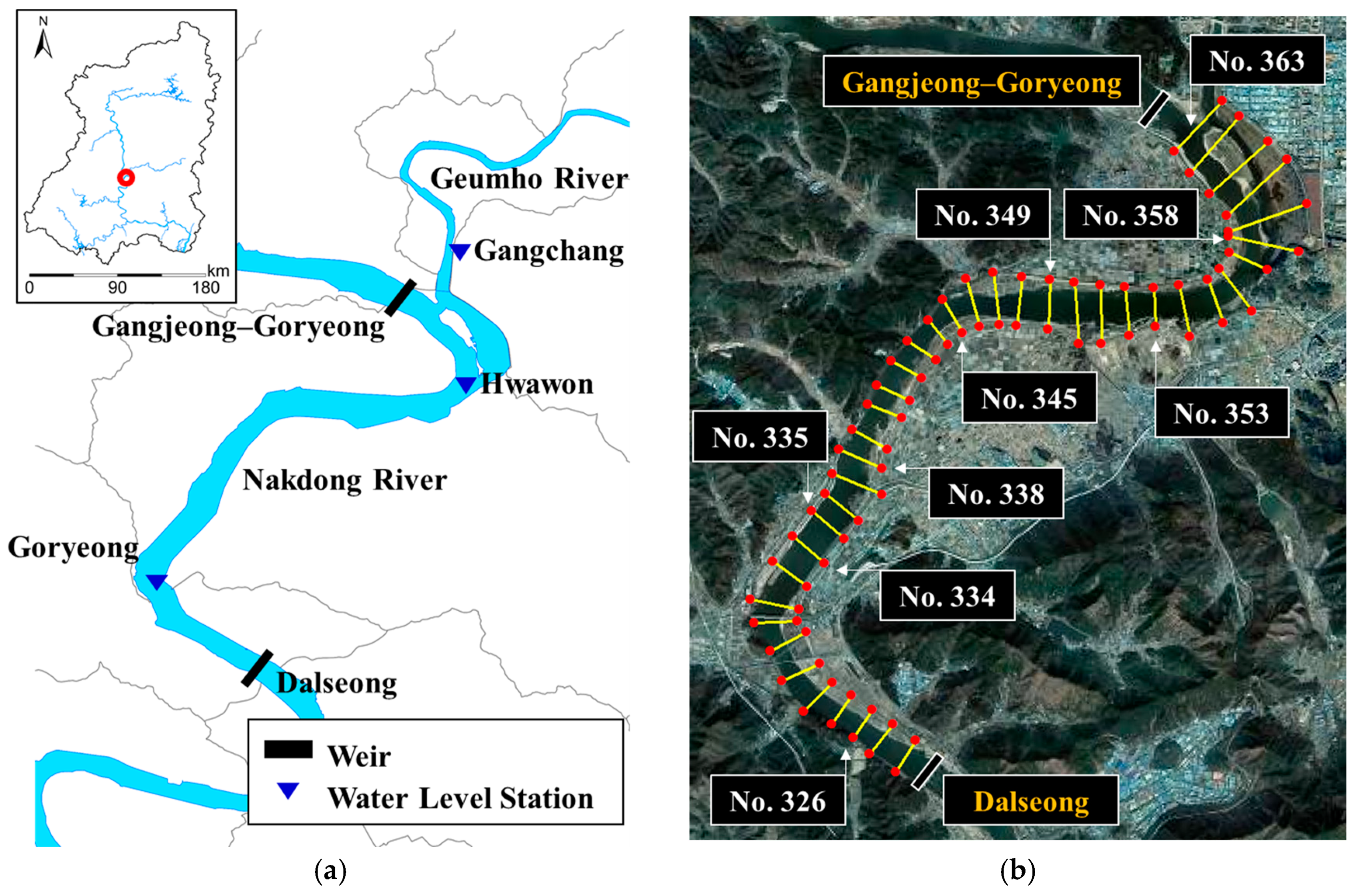
19]. The spatial scope of this study covers an approximately 20 km reach extending downstream from the Gangjeong–Goryeong Weir to the Dalseong Weir, as shown in
Figure 1a. The upstream portion of this reach includes the confluence with the Geumho River, while the overall reach is characterized by complex geomorphic features, including mid-channel bars, the Dalseong Wetland, and a sequence of three distinct channel bends. For the geometric evaluation, a total of 40 cross-sectional stations were established to match the official levee reference points defined by MOLIT [
20], as illustrated in
Figure 1b.
The study reach of the Nakdong River was selected due to its distinctive hydro-morphological and socio-environmental significance. First, this reach is characterized by highly developed meandering planforms, offering a suitable geomorphological setting to analyze the complex river dynamics and resulting cross-sectional variations driven by curvature. Second, as it flows adjacent to a major metropolitan area (Daegu), there is a high demand for water resources; however, the reach suffers from chronic sedimentation issues and flow stagnation in several sections. Establishing a quantitative management framework is crucial to ensuring a stable channel where sediment inflow and outflow are balanced, particularly to mitigate localized deposition. Furthermore, the hydro-morphological imbalances have been significantly exacerbated by the Four Major Rivers Restoration Project, where the installation of multiple weirs altered the natural flow regime and promoted sediment deposition in stagnant zones. Consequently, this reach necessitates rigorous post-project monitoring to assess systematic riverbed evolution. The proposed moment-based indicators serve as a robust tool to capture complex morphodynamic variations, bridging the gap between theoretical geomorphology and practical river maintenance.
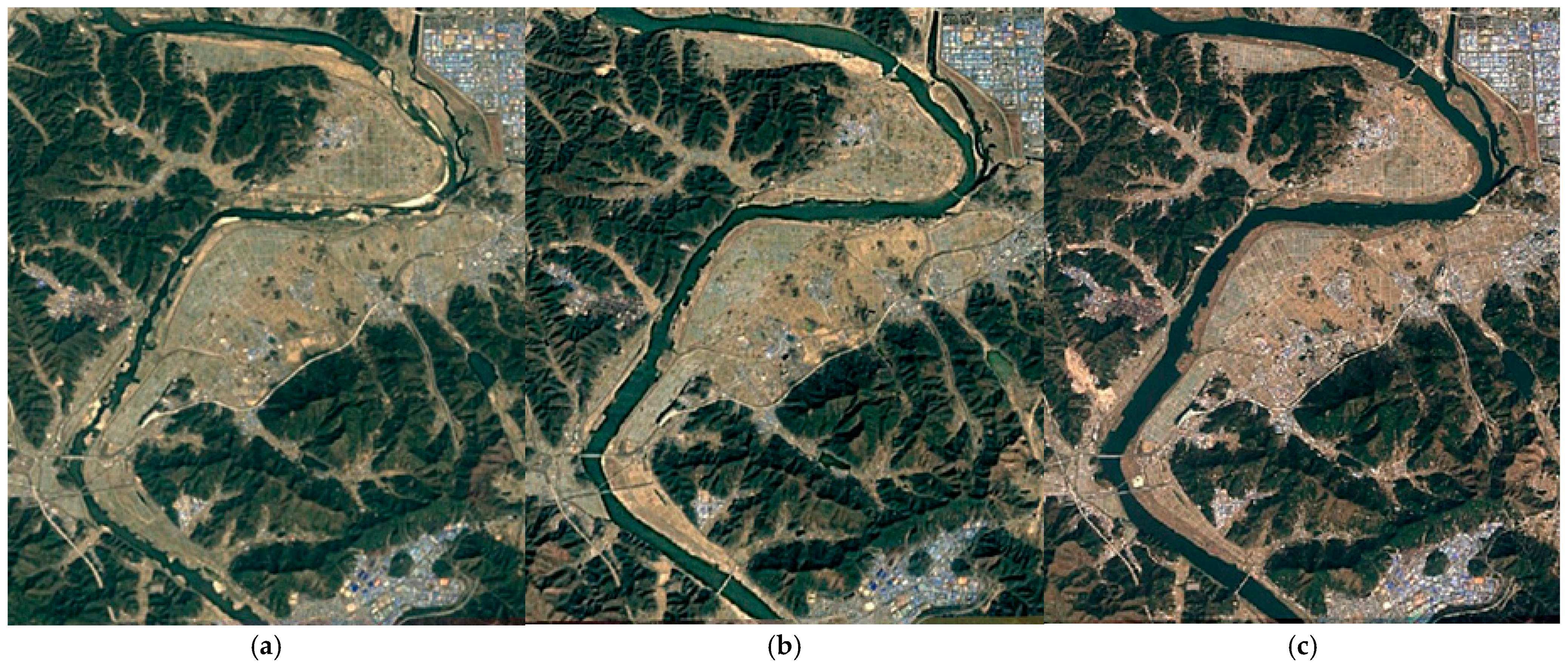
The study reach underwent dramatic morphological transformations due to the large-scale Four Major Rivers Restoration Project (2009–2012). Prior to the project, the reach exhibited complex hydraulic-geomorphic characteristics with extensively developed point bars and sand bars. However, post-project dredging and channelization standardized the low-flow channel, resulting in more uniform widths and depths. Specifically, large-scale dredging in the central channel expanded the low-flow width and increased depth uniformity, effectively removing existing bars and simplifying the cross-sectional geometry.
These anthropogenic changes are considered primary drivers for abrupt shifts in cross-sectional moment values and the alignment between velocity distribution and the thalweg. To analyze these variations, satellite imagery and field measurement data were collected and compared across three distinct phases (
Figure 2). This rapid morphological transition provides a suitable test case to verify the effectiveness of moment-based indicators in explaining both anthropogenic deformation and the subsequent natural stabilization processes of the river.
2.2. Data Acquisition
The topographic data utilized in this study were synthesized from multiple official records and high-precision field measurements. The 2009 data were obtained from the River Basic Plans [
21], and the 2012 data were sourced from the subsequent River Basic Plans [
19]. The 2017 dataset was acquired from the field measurement results of Ko et al. [
15].
Standard surveying for the establishment of a River Basic Plan typically comprises bathymetric, terrestrial, and wide-cross-sectional surveys. Bathymetric and terrestrial surveys are generally conducted at 20 m longitudinal intervals to calculate channel dredging volumes. Furthermore, wide-cross-sectional surveys are performed at 500 m intervals at the same levee stations used in previous plans to ensure high-precision monitoring of the river reach [
19]. However, for the 2012 topography and cross-sections [
19], the survey outcomes from the Four Major Rivers Restoration Project were utilized instead of newly commissioned standard surveys.
The 2017 cross-sectional topographic data were constructed through rigorous field surveys and systematic data processing [
15]. A Sontek M9 ADCP was utilized for bathymetric measurements, integrated with RTK-GPS positioning to derive bed elevations. To ensure data reliability, the ADCP was mounted on the side of the boat to minimize wave interference, and the survey was conducted at a constant low speed. In addition to the 40 cross-sectional stations, continuous bathymetric data were acquired between stations using a zigzag navigation pattern at 20–50 m intervals. The water surface elevation (WSE) was determined via on-site RTK-GPS measurements and cross-verified with real-time data from nearby gauging stations. Data processing was performed in a GIS environment. After spatially correcting the reference WSE to account for the longitudinal water level slope, bed elevations were calculated by subtracting the ADCP-measured depths from the corrected WSE. Since the raw data consisted of an irregular point distribution, a Triangulated Irregular Network (TIN)-based spatial interpolation was applied to generate a continuous bathymetric surface for the entire reach. The proposed procedure ensured the precision of the extracted topographic coordinates at the 40 predefined cross-sections, thereby enhancing the reliability of the subsequent morphological analysis.
2.3. Quantification of Cross-Sectional Indicators
In this study, core parameters and indicators were defined to interpret the hydraulic characteristics of the river in connection with the geometric features of its cross-sections. Specifically, the first-, second-, and third-order moments were selected as core indicators because the cross-sectional geometry of a river is a hydraulic manifestation of flow energy and direction. By quantifying the distribution of cross-sectional area through these moments, it is possible to infer the hydraulic characteristics and morphodynamic stability of the channel. Furthermore, these moment-based indicators offer a distinct advantage by providing intuitive physical insights such as the bias and concentration of distribution, which are difficult to capture using traditional bulk parameters (e.g., width, average depth, or area). These indicators were quantified based on field-measured bed topography and velocity data. The primary analysis indicators selected include the geometric moments of the cross-sections, centroids, width-to-depth (
W/
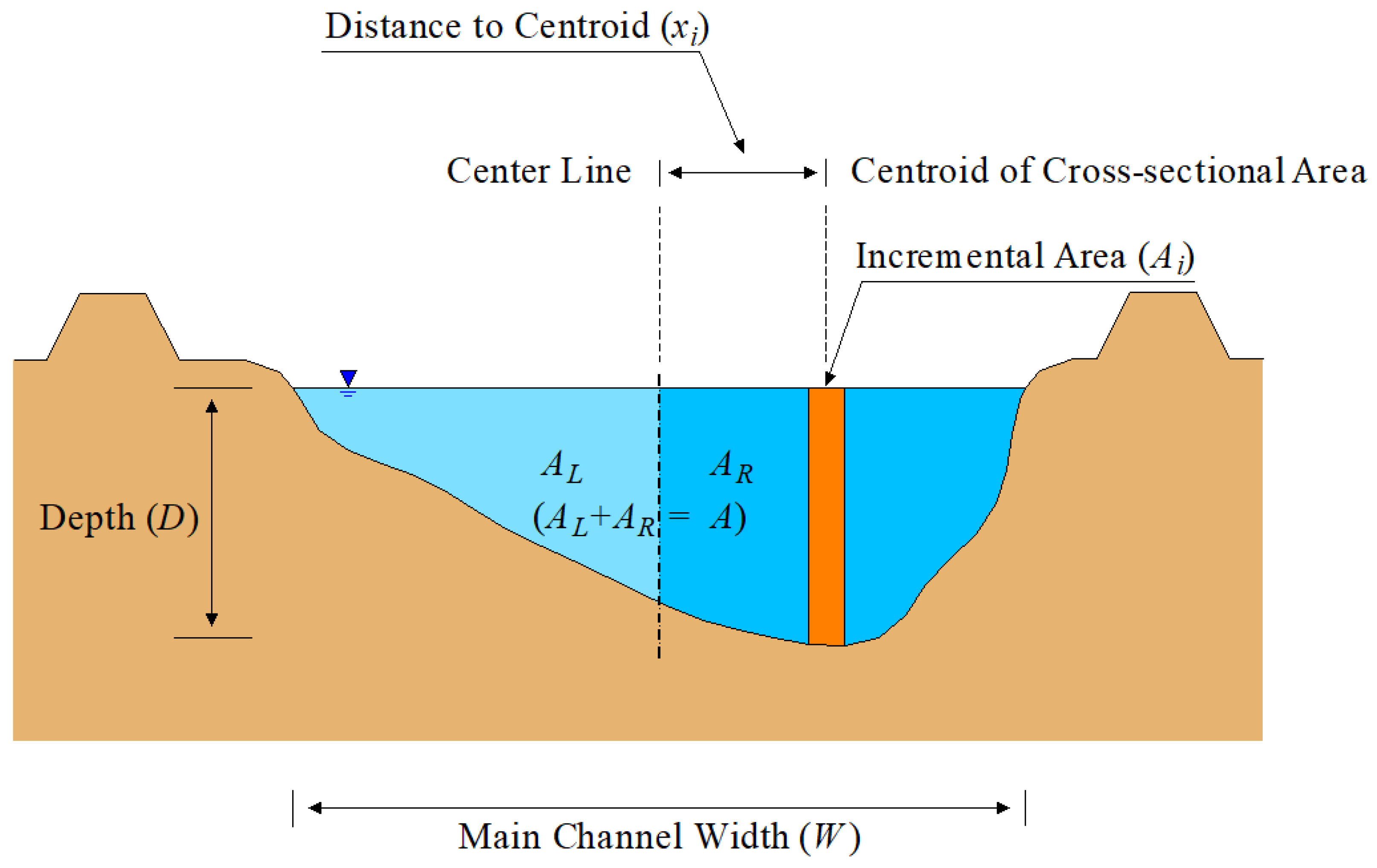
D) ratios, cross-sectional symmetry, velocity–thalweg alignment, and channel curvature. The centerline of the main channel was established as the reference axis (
x = 0) to provide a consistent baseline for quantifying the spatial bias and dispersion of the cross-sectional area. This setup allows for a clear statistical evaluation of how hydraulic energy and mass distribution deviate from the geometric center of the channel (
Figure 3). The specific calculation methods for each indicator are defined as follows.
2.3.1. Geometric Moments
To quantitatively characterize the spatial distribution of river cross-sectional morphology, geometric moments based on statistical moment theory were calculated. In this study, the main channel center was established as the reference axis (
x = 0) to effectively analyze the lateral eccentricity and asymmetry of the cross-sections. After discretizing the cross-section into infinitesimal units, the
n-th order moments were computed using each elemental area (
Aᵢ) and its corresponding lateral distance (
xᵢ) from the reference axis. The first-order moment (
M1), which defines the center of mass and the degree of eccentricity of the cross-section, is expressed as follows:
This indicator represents the relative position between the main channel center and the cross-sectional centroid, quantifying the degree of lateral imbalance in the channel morphology. An M1 value close to zero implies that the centroid of the cross-section coincides with the main channel center. In contrast, positive or negative values indicate a lateral shift in the sectional mass toward the right or left bank, respectively.
The formula for the second-order moment (
M2) is as follows. This indicator represents the degree of dispersion in the cross-sectional morphology and reflects the characteristics of channel curvature and width variations. A larger
M2 value indicates greater variability in the cross-section relative to the main channel center.
The formula for the third-order moment (
M3) is as follows. As an indicator that quantifies the asymmetry of the cross-section, it sensitively reflects the lateral imbalance relative to the main channel center. A positive value indicates a bias toward the right bank, while a negative value signifies a bias toward the left bank.
2.3.2. Width-to-Depth Ratio (W/D Ratio)
The Width-to-Depth (
W/
D) ratio is a representative indicator that simplifies the overall shape of a river cross-section, and it was calculated by dividing the water surface width (
W) by the maximum depth (
D).
A larger W/D ratio indicates a wide and shallow channel geometry, while a smaller ratio signifies a narrow and deep configuration. In this study, the W/D ratio of each cross-section was calculated to compare the morphological characteristics of different reaches.
2.3.3. Cross-Sectional Asymmetry Index
The asymmetry of the cross-section was quantified by comparing the areas of the left and right banks. The asymmetry index (
A*) was defined using the left bank area (
AL), right bank area (
AR), and total area (
A) as follows:
In this formulation, A* > 0 indicates that the right bank area is more dominant than the left, while A* < 0 signifies that the left bank area is dominant. An A* value close to zero indicates a near-symmetrical state. By omitting the absolute value, this index reflects not only the degree of imbalance but also the directional dominance of the sectional profile. This approach is particularly useful for interpreting differential erosion and deposition processes between the left and right banks of a river.
2.3.4. Relationship Between Thalweg and Streamwise Velocity
The thalweg was identified by connecting the points of maximum bed depth at each cross-section. Velocity data, measured using an ADCP (Sontek M9), were calculated based on coordinate components and projected into the streamwise direction, accounting for the orientation angle (
θ) of the cross-sectional survey line:
where
u and
v represent the velocity components in the east and north directions, respectively, and
θ is the orientation angle of the survey transect. By comparing the spatial alignment between the thalweg and the center of the streamwise velocity distribution (velocity core), the hydraulic and geomorphic characteristics of the river were evaluated simultaneously. A high degree of alignment between the thalweg and the velocity core indicates a stable flow regime. Conversely, a discrepancy between them was interpreted as a reflection of the influence of cross-sectional asymmetry, channel curvature, and localized flow resistance.
3. Results and Discussion
3.1. Moment-Based Morphological Indicators
3.1.1. Correlation Between First-Order Moment and Centroid
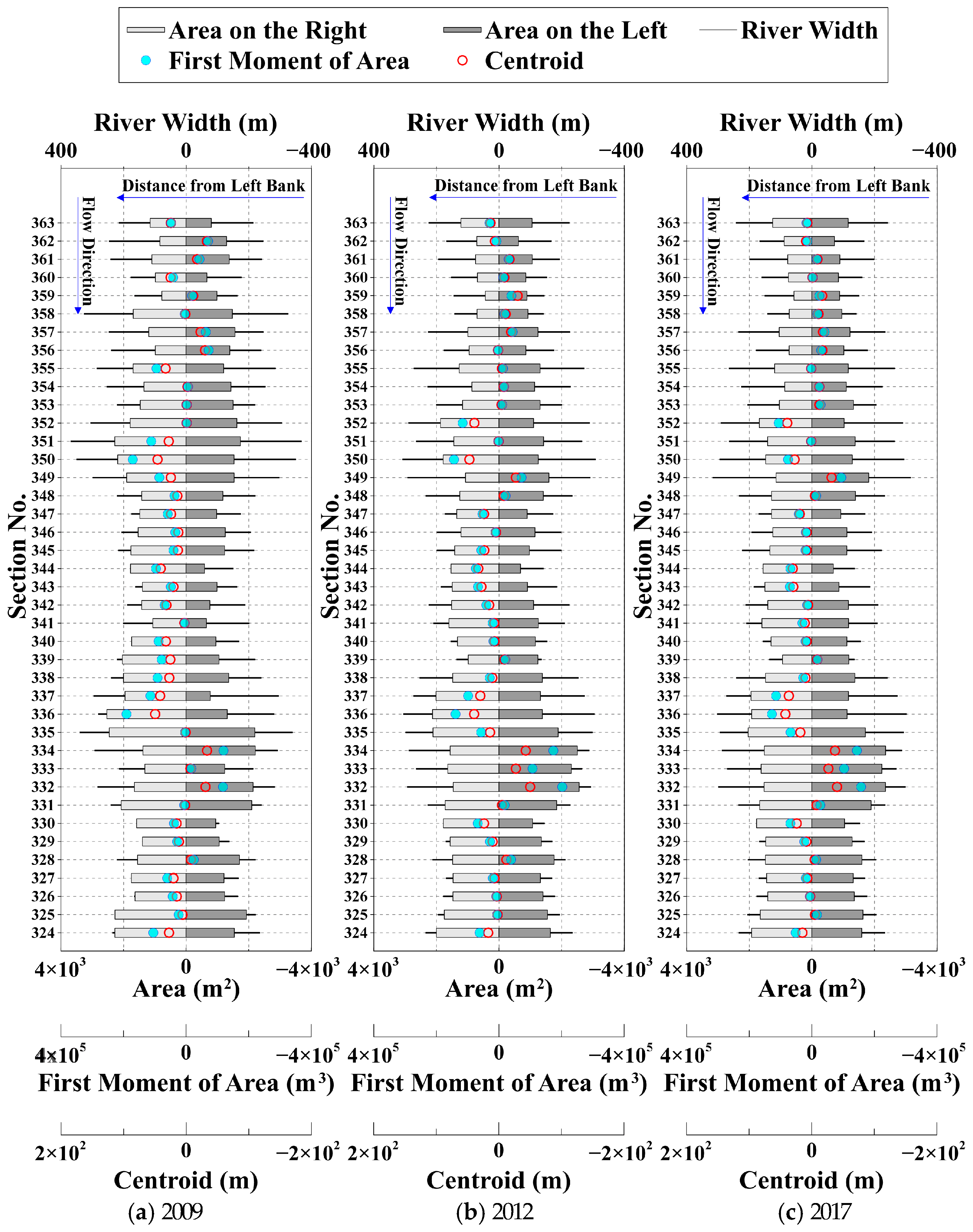
The first-order moment (M1) is an indicator used to determine the location of the center of mass (centroid) of an area, effectively quantifying the “lateral bias” of the cross-sectional morphology. Therefore, in this study, the location of the sectional center was identified and its validity was examined by comparing M1 with the actual sectional centroid. The analysis revealed that the spatial distribution of M1 across all surveyed sections (Section Nos. 324–363) showed a high degree of consistency with the location of the centroid.
As illustrated in
Figure 4, in reaches where the sectional area is skewed toward either the right or left bank, the
M1 values exhibit a distinct bias in the same direction, accurately replicating the movement of the centroid. Notably, in specific sections likely corresponding to river bends (e.g., the vicinity of Sections 331–335), both
M1 and the centroid deviated significantly from the reference centerline as the area imbalance increased. These findings demonstrate that the first-order moment is a highly valid indicator for identifying the geometric center of mass and the asymmetric morphological shifts in the channel.
3.1.2. Correlation Between Second-Order Moment and W/D Ratio
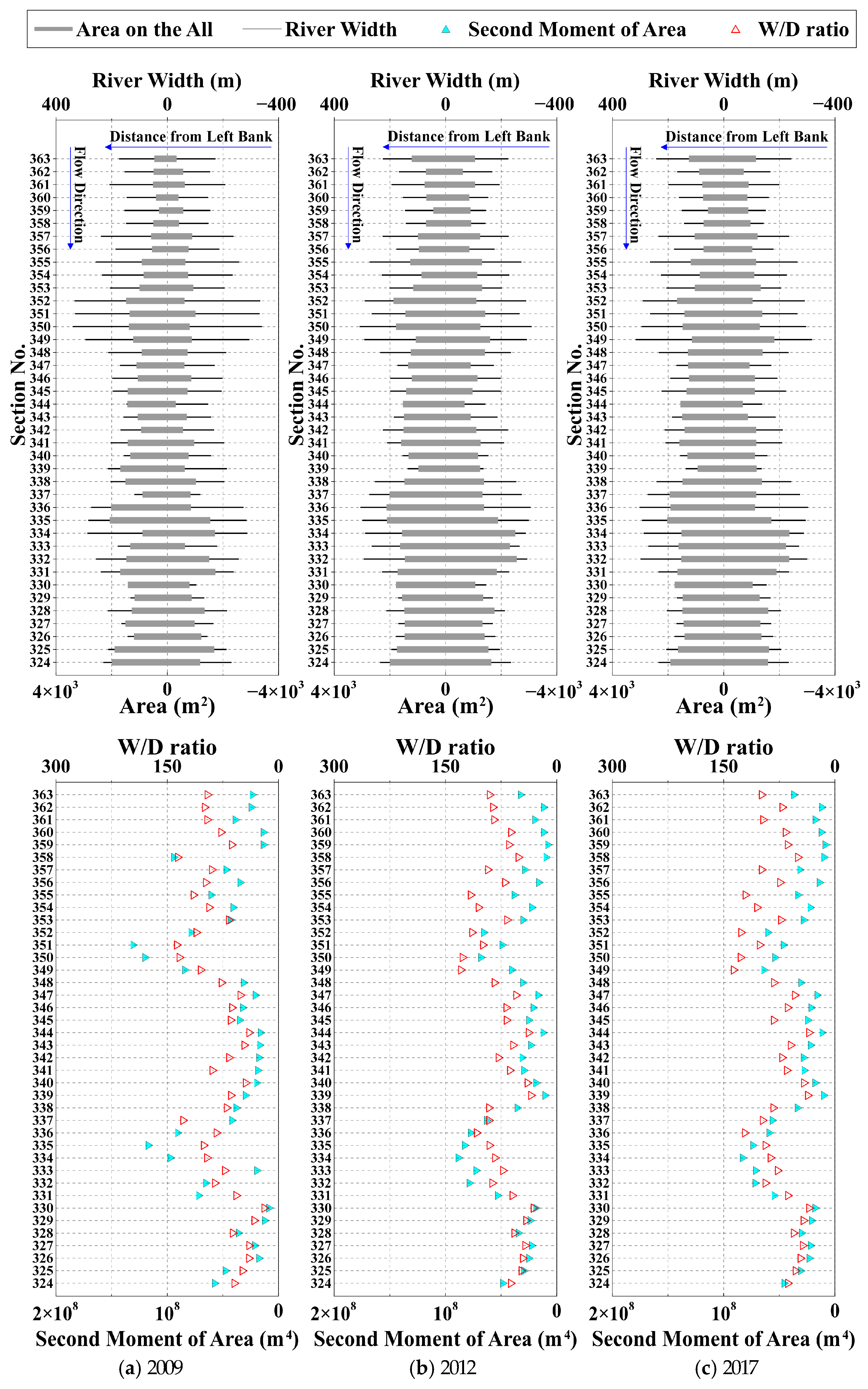
The second-order moment (M2) is an indicator that represents the degree of spatial dispersion of the cross-sectional area from the center. As a morphological characteristic indicator, it is useful for identifying the width-to-depth structure and analyzing long-term trends in channel widening or deepening. Furthermore, it indicates the hydraulic capacity of a section to distribute flow based on its shape. Specifically, a cross-section with a wide dispersion from the center of depth may suggest a vulnerability to unstable flow or lateral erosion under certain conditions.
The analysis showed that while
M2 and the
W/
D ratio are generally correlated, their trends diverged depending on the sectional geometry (
Figure 5). A similar trend between the two indicators occurs primarily in symmetrical and simple cross-sections. However, discrepancies were observed in the following cases: (1) Asymmetric sections (curvature, localized scour/deposition): In sections with asymmetric development,
M2 tends to increase significantly due to the lateral spread of area, whereas the
W/
D ratio may remain relatively similar. (2) Sections with large width and depth: Since the area is dispersed further from the center,
M2 increases sharply even if the
W/
D ratio remains constant. (3) Sectional profile changes (U-shape vs. V-shape): Even with a constant
W/
D ratio, a sharp V-shaped section exhibits a decrease in
M2 compared to a U-shaped section because the area is more concentrated near the center.
In conclusion, M2 proved to be a more precise indicator than the intuitive W/D ratio, as it captures the internal mass distribution and the hydraulic potential of the river cross-section.
3.1.3. Correlation Between Third-Order Moment and Asymmetry Index
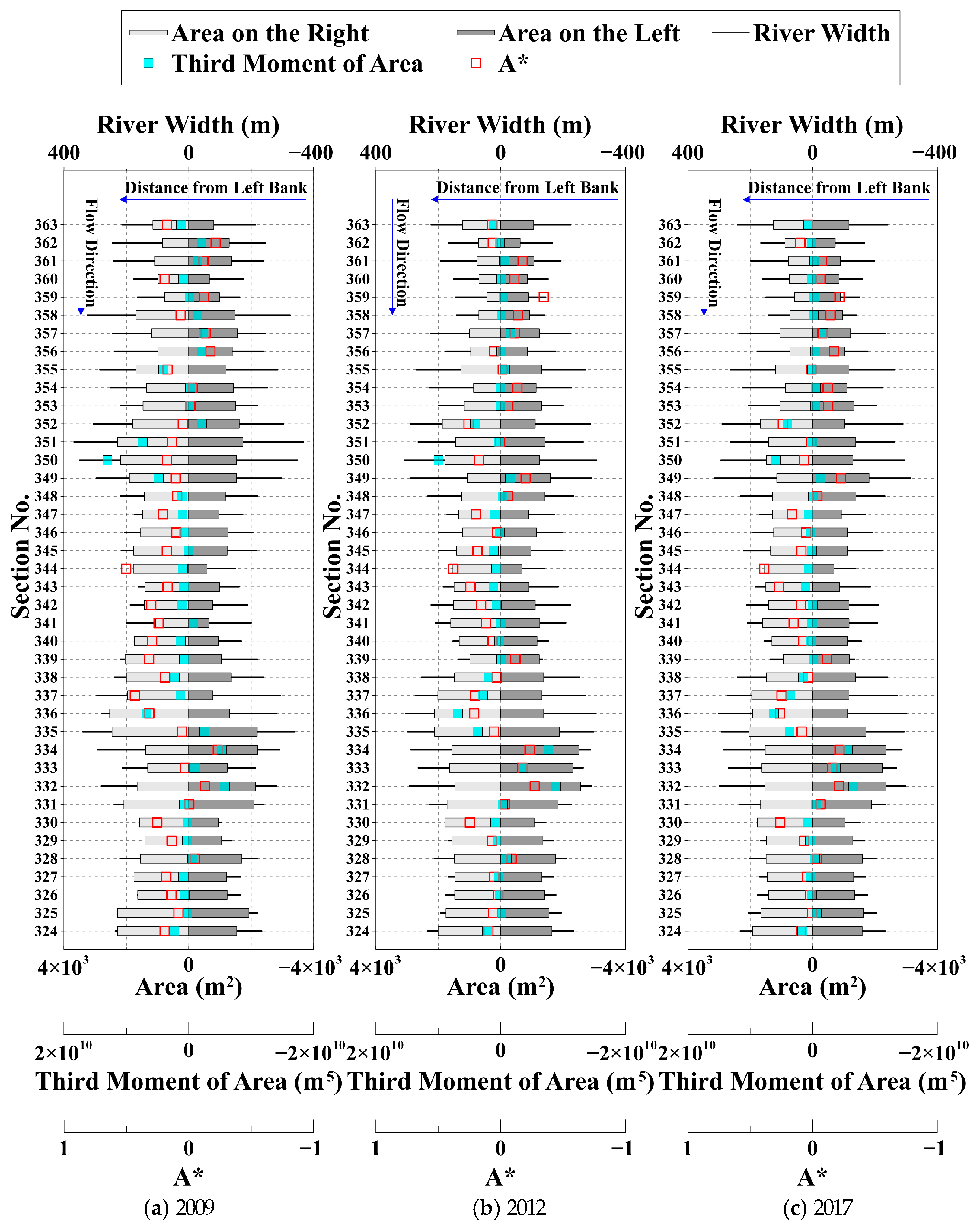
The third-order moment (
M3) is a high-order indicator that quantifies the asymmetry of a cross-section, sensitively reflecting the imbalance of mass distribution relative to the distance from the main channel center. In this study, the directionality and intensity of the asymmetric morphology were analyzed by comparing
M3 with the Asymmetry Index (
A*). The results, as shown in
Figure 6, demonstrate that the longitudinal distribution of
M3 and the behavior of
A* are almost perfectly aligned.
Because the third-order moment involves the cube of the distance (x3), it captures subtle topographical changes at the sectional fringes or imbalances caused by localized scour and deposition much more sensitively than the first- or second-order moments. Reaches where both M3 and A* exhibit positive values (e.g., Sections 331–335) indicate asymmetric sections where the right bank area is dominant. Conversely, negative values (e.g., vicinity of Section 350) signify a skewness toward the left bank.
Notably, as the absolute values of A* and M3 increase, the intensity of sectional asymmetry becomes more pronounced, making this a highly effective tool for diagnosing biased flow patterns and bed elevation changes in river bends. As such, it was confirmed that the third-order moment is a key indicator that transcends simple geometric description to quantitatively track the spatial bias of erosion and deposition processes.
Furthermore, the 3rd-order moment (M3) offers a significant advantage over the asymmetry index (A*) in detecting dynamic information on hydraulic and geomorphologic distribution that A* may overlook. While A* represents a static area ratio relative to the centerline, M3 incorporates a distance-based weight that reflects how the area distribution is positioned relative to the centroid. The M3 indicator provides superior explanatory power compared to A* in the following cases: (1) Cases with balanced left–right areas but heterogeneous mass distributions; for instance, even if A* is near zero due to equal sectional areas on both sides of the centerline, M3 can sensitively detect spatial biases, such as localized scouring or irregular deposition, by applying a distance-cubed weight to the mass distribution. (2) Cases with biased thalweg positions and bed slopes: Even when the bulk area balance is maintained, if the thalweg shifts significantly toward one bank creating a steep slope, M3 offers superior predictive power over A* by intuitively representing the focusing of hydraulic energy through the skewness of the mass distribution.
3.1.4. Characteristics of Bed Material and Flow Regime
To understand the morphological evolution of river cross-sections and the spatial variability of the moment-based indicators, bed material size distribution and hydrological characteristics were analyzed as boundary conditions. According to the median grain size (D50) distribution (
Table 1), most sections consist of sandy beds ranging from 0.1 to 0.8 mm. However, significantly coarser sediments were observed at specific locations, such as Section 329 (7.6 mm) and Section 347 (17.0 mm). Such localized increases in grain size indicate that the riverbed in these sections is either physically armored or possesses high hydraulic resistance, acting as a physical constraint that suppresses abrupt fluctuations in
M2 and
M3 or limits sectional development in specific directions.
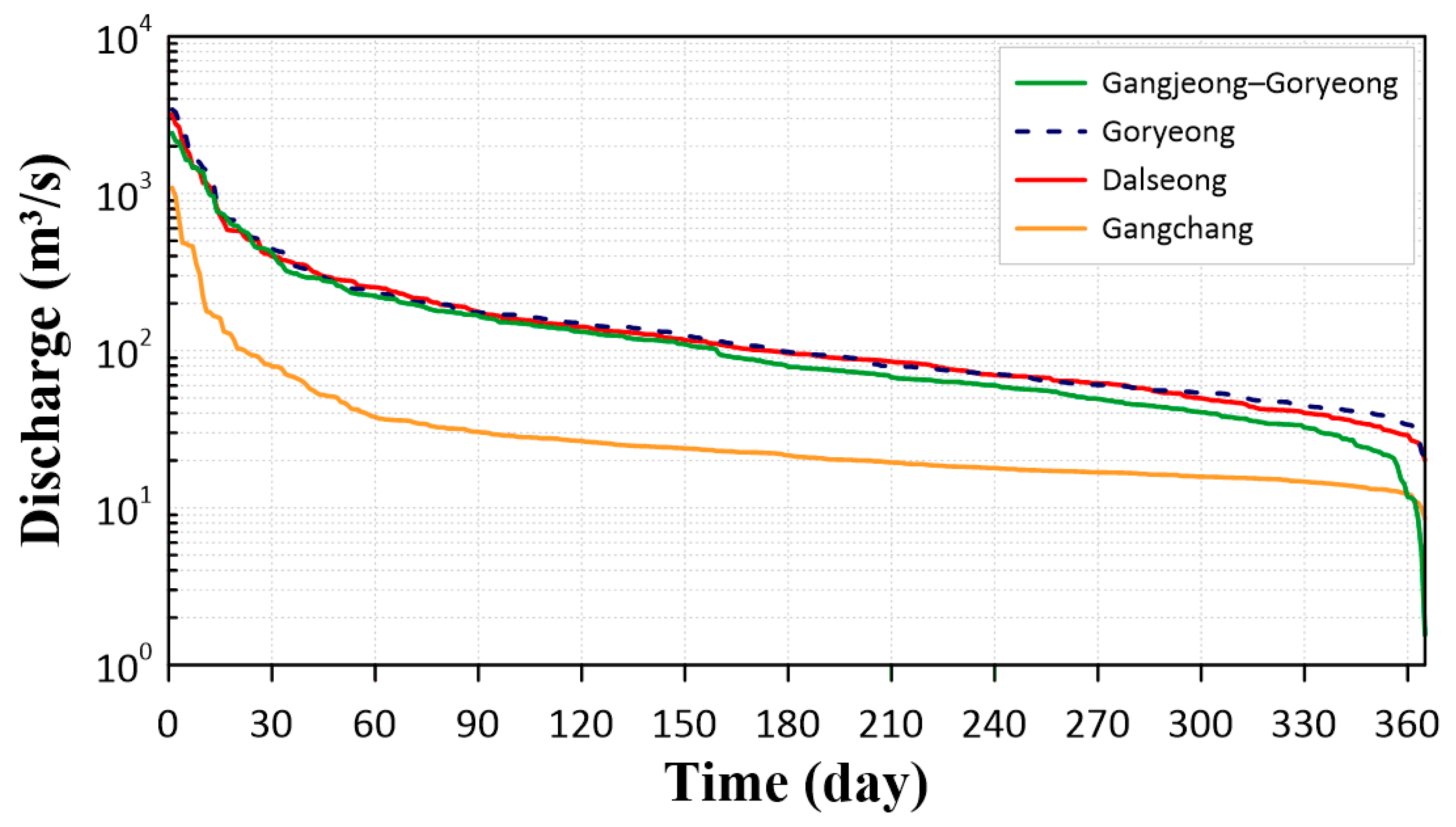
Furthermore, according to the 2018 flow data (
Table 2) and the flow duration curve (
Figure 7), the study reach maintains a stable water supply throughout the year, with an average discharge of approximately 175 to 207 m
3/s continuously exerting hydraulic forcing on the channel. The shape of the flow duration curve, in particular, demonstrates that the river possesses a dominant hydrological driver that induces channel widening (
M2) and thalweg migration (
M1,
M3) through constant flow energy, as well as seasonal flood variability. These bed material and hydrological characteristics support the conclusion that the geometric moment indicators are not merely numerical changes but the result of combined physical environments and hydrodynamic responses of the actual river.
3.2. Analysis of Hydro-Morphological Interactions
3.2.1. Spatial Alignment Between Velocity Core and Thalweg
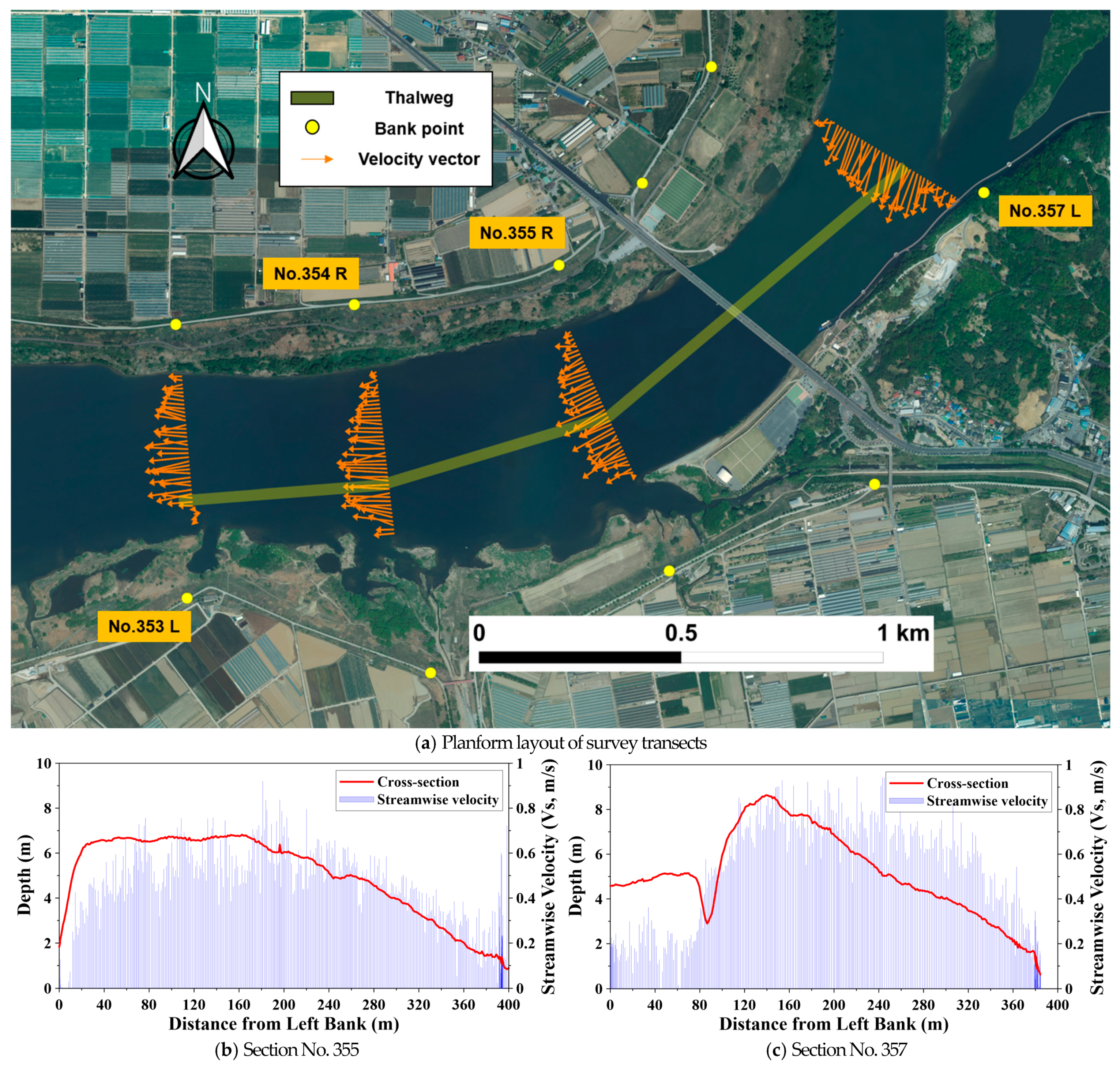
To understand the interaction between hydraulic energy distribution and riverbed morphology, the distribution of streamwise velocity (Vs) measured by ADCP was compared with the location of the thalweg. The comparison demonstrates how the concentration of flow energy dictates the spatial evolution of the bed profile. By analyzing the alignment between the velocity core and the thalweg, we can characterize the equilibrium state and the erosive potential across different stages of a continuous bend.
Section 357 is located at the apex of the bend where the curvature is fully developed. At this location, the inertial effect of the inflow is largely converted into centrifugal force, leading to a dominant secondary flow. As shown in the ADCP measurements (
Figure 8b), the maximum scour occurs at the outer bank, resulting in the thalweg being positioned at the outer edge. The velocity core and the thalweg exhibit a high degree of spatial alignment in this section, as the intensified secondary flow and high-velocity energy directly drive the downward scour, creating the maximum depth of approximately 8–9 m.
Section 355 is situated downstream of the bend center. In this reach, the geometric curvature effect begins to weaken, and the strength of the secondary flow gradually diminishes. However, due to residual inertia, the flow does not immediately return to a symmetrical straight-path distribution. The high-velocity core remains biased toward the outer bank rather than shifting back to the center (
Figure 8c). Compared to Section 357, Section 355 shows a slight discrepancy or a “lag” in the alignment between the velocity core and the thalweg, as the bed starts to transition while the flow momentum still carries the characteristics of the upstream bend.
The spatial alignment between the velocity core and the thalweg evolves dynamically as the flow progresses through the bend. At the bend apex (Section 357), the maximum flow energy and the deepest bed point coincide due to strong centrifugal forces. However, as the flow moves toward the exit of the bend (Section 355), a misalignment occurs because the hydraulic response (velocity shift) and the morphological response (bed change) happen at different rates. This hydro-morphological discrepancy acts as a primary driver for lateral migration and the unbalanced development of the channel profile, illustrating that the residual hydraulic energy continues to shape the topography even after the peak curvature has passed.
3.2.2. Relationship Between Sinuosity and Morphological Indicators
The planform sinuosity of a river is a primary factor determining the distribution of flow energy, inducing asymmetry in the hydraulic forcing exerted on the riverbed and banks. In this study, the survey reach was divided into three distinct reaches to calculate the sinuosity index (S) (
Table 3), and the influence of these planform geometries on the moment-based morphological indicators (
M1,
M2,
M3) was examined. Generally, a river is classified as a meandering river when its sinuosity is 1.5 or higher [
22]. The upstream reach of this study (Sections 350–363) exhibited distinct meandering characteristics with S = 1.67.
The analysis revealed that in the upstream reach with the highest sinuosity (Sections 350–363, S = 1.67), the fluctuations in the third-order moment (M3) and the Asymmetry Index (A*) were most pronounced. This is attributed to the localization of hydrodynamic loads driven by flow inertia and centrifugal force, suggesting that intense curvature promotes the development of sectional asymmetry. In contrast, in the reach with relatively lower sinuosity (Sections 339–349, S = 1.11), the deviation between the first-order moment and the centroid decreased, and the second-order moment (M2) remained highly consistent with the W/D ratio, indicating a more stable sectional geometry.
These findings demonstrate that the planform alignment of a river is a primary driver governing the statistical moment distribution of its cross-sectional geometry. Specifically, higher sinuosity leads to a greater imbalance in hydraulic forcing, which acts as a morphological process that distorts sectional dispersion (M2) and intensifies asymmetry (M3).
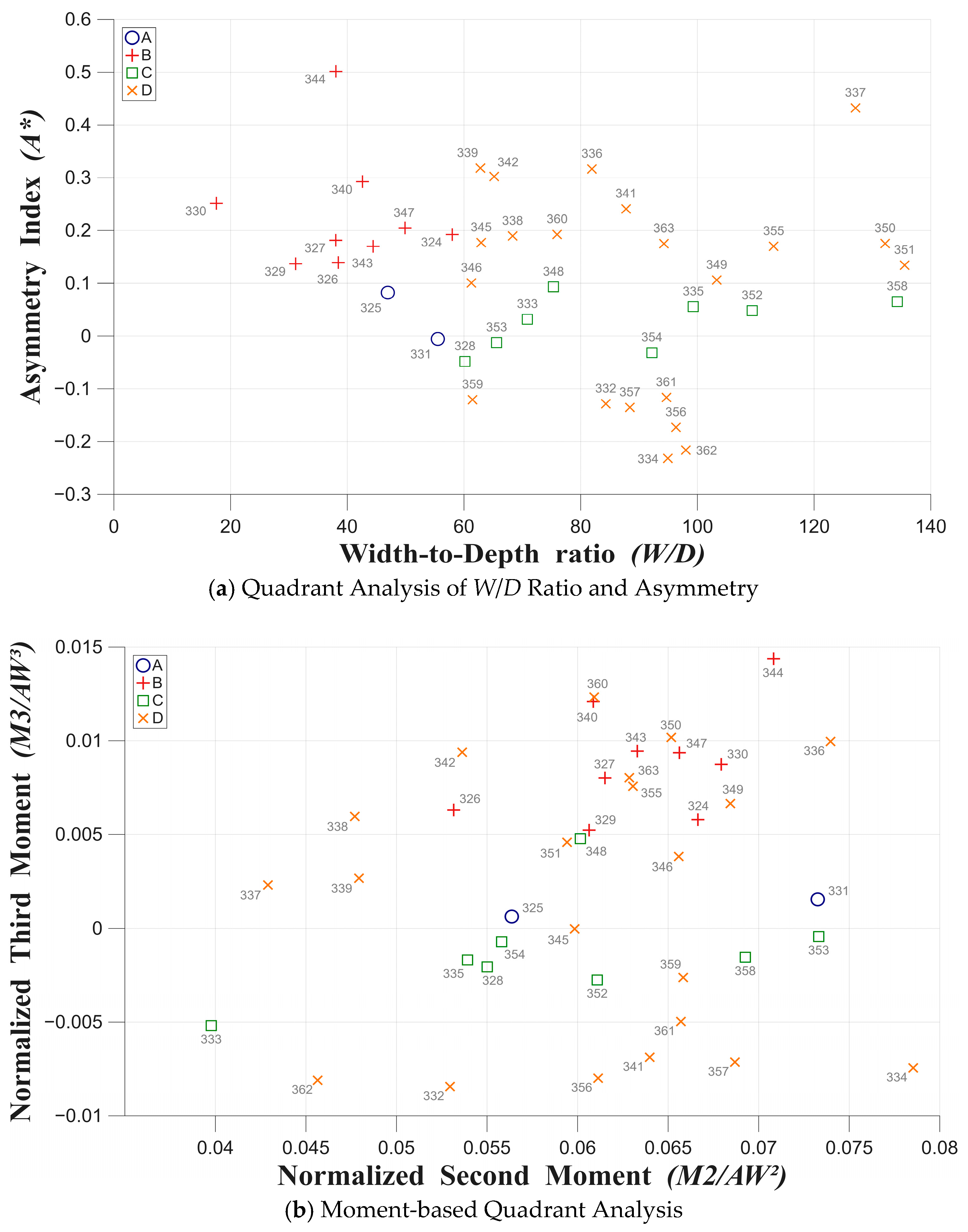
3.2.3. Quadrant Analysis of W/D Ratio and Asymmetry
Quadrant analysis was introduced to typify the geomorphological characteristics of the study reach and identify hydraulically vulnerable sections. By combining the width-to-depth ratio (
W/
D) and the asymmetry index (
A*), the quadrant analysis provides a comprehensive diagnosis of morphological stability and hydraulic behavior (
Figure 9a). In this study, thresholds of
W/
D = 60 and |
A*| = 0.1 were established for morphological classification on the basis of their physical and statistical significance. The
W/
D threshold of 60 was selected by synthesizing findings from previous literature. While several studies [
23] have observed that the morphological transition from meandering to braided patterns initiates at a
W/
D ratio of approximately 50, Leopold and Wolman [
22] and Azarang et al. [
24] proposed 60 as a more definitive criterion for braided rivers. Accordingly, this study adopted 60 to ensure a robust classification of unstable braided characteristics. Regarding the asymmetry index, |
A*| = 0.1 was defined as the threshold for significant asymmetry, referencing the physical implications established by Knighton [
6]. A value exceeding 0.1 indicates that the difference between the left and right sectional areas exceeds 10% of the total cross-sectional area. Such an imbalance can be considered geomorphically and hydraulically significant, as it typically results from thalweg migration and localized bank erosion. Furthermore, these literature-based thresholds were found to be highly consistent with the empirical data distribution, as the statistical cluster analysis clearly distinguished stable and vulnerable reaches at these specific boundary values (
Figure 9a).
The analysis revealed that a significant number of sections are distributed in regions where W/D > 60 and asymmetry is pronounced (top and bottom right quadrants). Specifically, sections with |A*| > 0.1 suggest a high probability of ongoing lateral erosion or bed scour due to the localization of hydraulic forcing on one bank, indicating a state of hydraulic instability. Conversely, sections within the range of |A*| < 0.1 (e.g., Sections 325) are interpreted as stable reaches that maintain a relatively symmetrical profile and a balanced flow distribution. Reaches with exceptionally high W/D and large asymmetry (e.g., vicinity of Sections 350) can be classified as vulnerable zones where rapid channel shifts may occur during floods due to shallow depths and biased flow patterns. In conclusion, this quadrant analysis transcends simple geometric classification, serving as a quantitative tool to identify “hydraulically unstable reaches” that require intensive monitoring for river management and maintenance.
In addition, the moment-based quadrant analysis (M2* vs. M3*) was performed (
Figure 9b). To facilitate this analysis, the proposed moment indicators were first normalized by the local cross-sectional area (A) and width (W) to derive dimensionless parameters, defined as
M1* =
M1/(
AW),
M2* =
M2/(
AW2), and
M3* =
M3/(
AW3), enabling a scale-independent comparison across different river reaches. The proposed quadrant analysis provides a more sensitive diagnostic layer, especially for sections where traditional bulk indicators might underestimate risks. While
W/
D or
A* only reflect aggregate cross-sectional properties, the moment-based indicators quantify how the area is distributed relative to the centerline, making them more responsive to high-risk morphological changes such as bank scouring. Theoretically,
M2* ranges from 1/24 (≈0.042) for triangular sections to 1/12 (≈0.083) for rectangular sections; in this study, a threshold of 0.06 was adopted to align with the morphological transition at
W/
D = 60. Similarly, while |
M3*| ≈ 0.005 corresponds to |
A*| = 0.1, a threshold of 0.007 was specifically selected to identify reaches where lateral area imbalance intensifies beyond 15%. For instance, Sections 344 and 330, despite having low
W/
D ratios (38.04 and 17.58, respectively) that typically suggest stability, exhibited
M2* > 0.06 and |
M3*| > 0.007. This suggests that even in narrow reaches, significant mass-distributional instability, skewed flow (i.e., flow oblique to the main stream axis), and localized scouring can occur. The commonality between sections exceeding both
M2* and |
M3*| thresholds (e.g., 357, 350, 347, 344, 336, 334, 330) is the intense concentration of hydraulic energy on a specific bank, typically observed at sharp meander bends or near the onset of channel braiding. This is because high values for both
M2* and |
M3*| simultaneously indicate wide dispersion and strong unidirectional bias of the sectional area. By identifying these “hidden vulnerable zones,” the moment-based quadrant analysis serves as an advanced proactive tool for pinpointing potential erosion hotspots in real-time monitoring.
4. Conclusions
This study employed geometric moment techniques to quantify the morphological evolution and hydraulic characteristics of river cross-sections, diagnosing dynamic channel stability by integrating planform sinuosity and flow conditions. Through a comprehensive analysis of the first-, second-, and third-order moments, Width-to-Depth (W/D) ratio, sectional asymmetry (A*), and the thalweg–velocity relationship, the following primary findings were obtained.
First, the moment-based approach precisely quantified irregular sectional variations that are difficult to capture using traditional W/D ratios or simple depth measurements, by utilizing the centroid deviation (M1), area dispersion (M2), and mass distribution bias (M3). Interpreting geometric changes from the perspective of mass distribution provides more valuable information for tracing the hydraulic drivers of morphological shifts.
Second, the sinuosity (S) analysis revealed that reaches with higher curvature (S ≥ 1.5) exhibited a sharp increase in the variability of the third-order moment and asymmetry indicators due to imbalances in hydraulic forcing. Specifically, by proving the horizontal separation between the velocity core and the thalweg in curved reaches, this study identified that planform complexity is a key mechanism intensifying geometric imbalance and hydraulic instability.
Third, the quadrant analysis of W/D and asymmetry categorized the morphological types of the entire reach and identified hydraulically vulnerable zones requiring intensive monitoring.
The 1st-, 2nd-, and 3rd-order moment-based indicators proposed in this study offer a distinct advantage by precisely capturing the spatial distribution of mass and energy, whereas traditional static geometric indicators (e.g., width, depth, and area) fail to adequately represent such spatial variability. Specifically, even in sections that appear stable according to bulk indices such as centroid position, W/D ratio, or asymmetry index (A*), the moment-based analysis allows for a more refined inference of latent instability factors, including localized erosion, steep slopes, and cross-sectional asymmetry. Such an approach enables a comprehensive diagnosis of the spatial bias of hydraulic energy and the degree of channel stability. Ultimately, these moment-based indicators are expected to contribute to the transition from a static to a dynamic indicator system for more effective and proactive river management.
Although the study area was strategically selected to evaluate indicator performance under distinct anthropogenic changes, the proposed framework is universally applicable beyond regulated reaches. The mathematical framework of the moment-based indicators is inherently geometry-independent, making it highly versatile for natural rivers with irregular morphologies. Unlike traditional parameters that represent cross-sections as simplified geometric abstractions, the moment-based indicators capture the statistical distribution of the cross-sectional area. This capability is essential for diagnosing complex features such as thalweg migration, irregular transverse bed profiles, and localized scouring or deposition patterns.
To enhance the applicability to field monitoring, the proposed moment indicators were normalized into dimensionless forms (M1/AW, M2/AW2, M3/AW3) using the local cross-sectional area (A) and width (W). This normalization enables a scale-independent assessment of river stability, where thresholds such as M2/(AW2) > 0.06 and |M3/(AW3)| > 0.007 can serve as early-warning signals of increasing channel instability. These moment indicators are not only applicable for post hoc analysis but also particularly effective in detecting the initial stages of centroid shifts and localized structural asymmetry. Consequently, these dimensionless indicators provide a robust framework for real-time monitoring, allowing for the early detection of geomorphic risks that are often obscured by traditional parameters.
In conclusion, the hydro-morphological indicators proposed in this study provide a systematic framework for the integrated diagnosis of river topography and flow trends beyond individual shape characterization. This analytical system is expected to serve as a scientific decision-making tool for future river management and restoration planning. Further research involving a wider range of river types and long-term monitoring data is required to refine the proposed dimensionless thresholds and validate their general applicability across diverse fluvial environments for practical engineering use.
Author Contributions
Conceptualization, J.O.; methodology, J.O.; formal analysis, J.O. and J.S.K.; investigation, J.O., J.S.K. and S.L.; resources, J.S.K. and S.L.; data curation, J.O., J.S.K. and S.L.; writing—original draft preparation, J.O.; writing—review and editing, J.O.; visualization, J.S.K.; supervision, J.O.; project administration, J.O.; funding acquisition, J.O.; validation, J.O., J.S.K. and S.L. All authors have read and agreed to the published version of the manuscript.
Funding
This research was supported by the Korea Environmental Industry & Technology Institute (KEITI) through the Project “Smart Web-based Data Platforms for Integrated Management of Water Quality and Flow Rate”, funded by the Korea Ministry of Climate, Energy and Environment (MCEE) (Project No. 2480000423, IRIS No. RS-2021-KE001623, K-IRIS No. 20260015-022).
Institutional Review Board Statement
Not applicable.
Informed Consent Statement
Not applicable.
Data Availability Statement
The data used in this study are available from multiple sources. Data for the years 2009 and 2012 are provided in references [
19,
21]. The measurement data for 2017 were provided by Changwon National University, while the raw data remain under the management of the Ministry of Land, Infrastructure, and Transport (MOLIT). The processed data generated during this study are included in this article. Further inquiries regarding the data or potential sharing agreements may be directed to the corresponding author.
Acknowledgments
This research was supported by the Korea Environmental Industry & Technology Institute (KEITI) through the Project “Smart Web-based Data Platforms for Integrated Management of Water Quality and Flow Rate”, funded by the Korea Ministry of Climate, Energy and Environment (MCEE) (Project No. 2480000423, IRIS No. RS-2021-KE001623, K-IRIS No. 20260015-022). The authors would also like to express their gratitude to Changwon National University for sharing the experimental data used in this study.
Conflicts of Interest
The authors declare no conflicts of interest.
References
- Leopold, L.B.; Maddock, T. The Hydraulic Geometry of Stream Channels and Some Physiographic Implications, Geological Survey Professional Paper 252; U.S. Government Printing Office: Washington, DC, USA, 1953; pp. 1–57.
- Williams, G.P. Bank-full discharge of rivers. Water Resour. Res. 1978, 14, 1141–1154. [Google Scholar] [CrossRef]
- Langbein, W.B. Geometry of river channels. J. Hydraul. Div. 1964, 90, 301–312. [Google Scholar] [CrossRef]
- Rosgen, D.L. A classification of natural rivers. Catena 1994, 22, 169–199. [Google Scholar] [CrossRef]
- Rosgen, D.L. A practical method of computing streambank erosion rate. In Proceedings of the Seventh Federal Interagency Sedimentation Conference, Reno, NV, USA, 25 March 2001. [Google Scholar]
- Knighton, A.D. Asymmetry of river channel cross-sections: Part I. Quantitative indices. Earth Surf. Process. Landf. 1981, 6, 581–588. [Google Scholar] [CrossRef]
- Xu, L.; Jiang, E.; Zhao, L.; Li, J.; Zhao, W.; Zhang, M. Research on the asymmetry of cross-sectional shape and water and sediment distribution in wandering channel. Water 2022, 14, 1214. [Google Scholar] [CrossRef]
- Falcon, M.A. Flow and Bed Topography in Alluvial Channel Bends. Ph.D. Dissertation, University of Iowa, Iowa City, IA, USA, 1979. [Google Scholar]
- Falcon, M.A.; Kennedy, J.F. Flow in alluvial-river curves. J. Fluid Mech. 1983, 133, 1–16. [Google Scholar] [CrossRef]
- Zimmermann, C.; Kennedy, J.F. Transverse bed slope in curved alluvial channels. J. Hydraul. Div. 1978, 104, 33–57. [Google Scholar] [CrossRef]
- Odgaard, A.J. Transverse bed slope in alluvial channel bends. J. Hydraul. Div. 1981, 107, 1677–1694. [Google Scholar] [CrossRef]
- Odgaard, A.J.; Kennedy, J.F. Analysis of Sacramento River Bend Flows, and Development of a New Method for Bank Protection; IIHR Report no. 241; Iowa Institute of Hydraulic Research: Iowa City, IA, USA, 1982; pp. 1–85. [Google Scholar]
- Lee, C.J.; Kim, W.; Kim, C.Y.; Kim, D.G. Measurement of velocity and discharge in natural streams with the electronic float system. KSCE J. Civ. Environ. Eng. Res. 2009, 29, 329–337. [Google Scholar] [CrossRef]
- Jeong, C. Development of Method for Acquisition of 3-Dimensional River Geographic Information Using R2V2 and UAV. J. Korean Soc. Hazard Mitig. 2014, 14, 269–275. [Google Scholar] [CrossRef][Green Version]
- Ko, J.S.; Kwak, S.; Lee, K.; Lyu, S. A study on morphological characteristics of large river channel based on bathymetry and near-river survey. J. Korea Water Resour. Assoc. 2019, 52, 163–172. [Google Scholar]
- Ko, J.S.; Lee, K.; Kwak, S.; Lyu, S. Analysis of bed change based on the geometric characteristics of channel cross-sections. J. Korea Water Resour. Assoc. 2020, 53, 1097–1107. [Google Scholar]
- Dixon, S.J.; Sambrook Smith, G.H.; Best, J.L.; Nicholas, A.P.; Bull, J.M.; Vardy, M.E.; Sarker, M.H.; Goodbred, S. The planform mobility of river channel confluences: Insights from analysis of remotely sensed imagery. Earth Sci. Rev. 2018, 176, 1–18. [Google Scholar] [CrossRef]
- Formann, E.; Habersack, H.M.; Schober, S. Morphodynamic river processes and techniques for assessment of channel evolution in Alpine gravel bed rivers. J. Geomorph. 2007, 90, 340–355. [Google Scholar] [CrossRef]
- Ministry of Land, Infrastructure, and Transport (MOLIT). Basic River Plans for the Nakdong River; MOLIT: Sejong City, Republic of Korea, 2013; pp. 1–299. Available online: https://mail.kict.re.kr/bigfileDownload/RHBMaTZFaTdjQi8rLy9RRjlyU25vRkRhMml0MFEvZ2wzMkJIVFpYTmhIa0l3RDZ3SW81RGpJY3dZNGNPcE5RMA==/ (accessed on 29 January 2026). (In Korean)
- Ministry of Land, Infrastructure, and Transport (MOLIT). Research Report on Monitoring and Manual Preparation for the Four Major Rivers Project (Riverbed Change); MOLIT: Sejong City, Republic of Korea, 2012; pp. 1–721. (In Korean)
- Ministry of Land, Infrastructure, and Transport (MOLIT). Basic River Plans for the Nakdong River; MOLIT: Sejong City, Republic of Korea, 2009; pp. 1–1390. Available online: https://mail.kict.re.kr/bigfileDownload/M2lxSVYxSWJlTUFNb2l2RkNoalFieEwyL3ZpdncxdGQ2YkFWcmZlbjBpb1pQaWxtaFJYVDJhNXBkeDViRUJUUg==/ (accessed on 29 January 2026). (In Korean)
- Leopold, L.B.; Wolman, M.G. River Channel Patterns: Braided, Meandering and Straight: Geological Survey Professional Paper 282B; U.S. Government Printing Office: Washington, DC, USA, 1957; pp. 1–85.
- Fredsøe, J. Meandering and braiding of rivers. J. Fluid Mech. 1978, 84, 609–624. [Google Scholar] [CrossRef]
- Azarang, F.; Shafaei Bejestan, M.; Jafari, G.; Karami, M. The application of global experiences in evaluation of mining zone: Case study the Zohreh River. J. Water Land Dev. 2019, 41, 19–30. [Google Scholar] [CrossRef]
| Disclaimer/Publisher’s Note: The statements, opinions and data contained in all publications are solely those of the individual author(s) and contributor(s) and not of MDPI and/or the editor(s). MDPI and/or the editor(s) disclaim responsibility for any injury to people or property resulting from any ideas, methods, instructions or products referred to in the content. |