Featured Application
This study provides molecular-level evidence that polyethylene terephthalate micro- and nano-plastics can act as carriers and stabilizers of airborne pollen allergens, potentially enhancing allergen persistence and immunogenicity in polluted atmospheric environments.
Abstract
Pollen allergy represents a growing public health concern, yet the role of microplastic pollution in modulating allergen behavior remains largely unresolved. In this study, we investigated interactions between polyethylene terephthalate (PET) microplastics (0.2–12 µm; predominantly 0.4–1 µm) and cedar pollen proteins, with emphasis on the major allergen Cry j 1. Surface charge characterization using the pH drift method revealed two apparent points of zero charge in the acidic (pH 3.0–3.8) and near-neutral (~7.5) regions, indicating surface chemical heterogeneity. Protein adsorption experiments conducted at physiological pH (7.4) showed concentration-dependent and saturable removal of proteins from solution with increasing PET mass and a 3.10-fold preferential enrichment of aromatic-rich protein fractions. Spectroscopic analyses revealed adsorption-induced but non-denaturing structural perturbations, including increased exposure of aromatic residues and partial β-sheet destabilization. Complementary all-atom molecular dynamics simulations showed rapid and stable Cry j 1 adsorption onto PET, anisotropic surface accommodation, modest increases in solvent accessibility, and subtle secondary structure rearrangements without global unfolding. Together, these findings indicate that PET microplastics can selectively bind and structurally modulate pollen allergens in ways that may influence allergen persistence and epitope presentation, with potential implications for IgE-mediated sensitization in polluted environments.
1. Introduction
Airborne pollen is one of the most prevalent natural aeroallergens and a major trigger of allergic rhinitis and asthma worldwide [1,2,3,4]. In Japan and other regions of East Asia, cedar pollen (Cryptomeria japonica) represents a dominant seasonal allergen, with Cry j 1 identified as a principal IgE-binding protein responsible for allergic sensitization [4,5]. Although pollen exposure alone can induce allergic responses, growing evidence indicates that atmospheric pollutants can modify allergen structure, stability, and immune recognition, thereby exacerbating allergic disease [6,7]. Microplastics (MPs) have recently emerged as ubiquitous airborne pollutants in both indoor and outdoor environments [8,9,10]. Atmospheric MPs originate primarily from synthetic textiles, packaging materials, tire abrasion, and plastic waste fragmentation, and their small size and low density facilitate suspension and inhalation into the respiratory tract [11]. Notably, MPs have been detected in lung tissues, raising concerns regarding their potential health impacts following chronic inhalation exposure [12,13]. Among common polymers, polyethylene terephthalate (PET) is a major contributor to airborne fibrous microplastics due to their extensive use in textiles, packaging foods, beverages, and household liquids and its susceptibility to mechanical abrasion and environmental aging [14,15]. Unlike gaseous pollutants, MPs provide solid surfaces with large specific surface areas capable of adsorbing biomolecules. Numerous studies have shown that MPs and nanoplastics readily interact with proteins to form surface-associated “protein coronas,” which define particle behavior and influence biological responses [16,17,18,19]. Protein adsorption onto plastic surfaces is a dynamic process that may induce conformational rearrangements, partial unfolding, and altered exposure of aromatic residues, thereby affecting protein stability and biological function [16,20]. However, most existing studies have focused on model proteins such as serum albumin or hemoglobin in aqueous systems, while molecular-level investigations involving airborne allergenic proteins remain limited [21,22,23,24]. Recent studies have begun to demonstrate that MPs can interact directly with allergenic proteins in the atmosphere. Microplastics have been shown to adhere to pollen walls and germination pores and to coexist with allergenic proteins in pollen samples [25,26]. Importantly, co-exposure studies revealed that MPs can adsorb pollen allergens such as Pla a 3 from Platanus acerifolia, with surface aging enhancing protein adsorption and the resulting protein coronas inducing increased oxidative stress, inflammation, and cytokine production in lung epithelial cells [1]. Similarly, exposure to MPs has been reported to exacerbate the allergenic potential of the house dust mite allergen Der p 1, highlighting the capacity of MPs to modify allergen behavior and immune responses [7]. These findings support the hypothesis that MPs may act as “allergen vectors,” enhancing allergen persistence and altering allergen structure and bioactivity. Despite these advances, direct experimental evidence elucidating how PET microplastics interact with cedar pollen allergens at the molecular level and how such interactions influence allergen conformation remains scarce. Moreover, complementary molecular simulations capable of resolving adsorption mechanisms and conformational dynamics are largely absent. In this study, we investigated the interaction between PET microplastics and cedar pollen protein extracts using a combined experimental and computational approach. Protein adsorption and conformational changes were characterized using steady-state intrinsic and synchronous fluorescence spectroscopy and Fourier-transform infrared (FTIR) spectroscopy with amide I band analysis. To elucidate the molecular basis underlying the experimental observations, all-atom molecular dynamics simulations were performed to examine the adsorption behavior and conformational dynamics of the major cedar pollen allergen Cry j 1 on a PET surface. This work provides molecular-level insight into a previously underexplored pathway by which airborne microplastics may modulate pollen allergen structure and potentially influence allergen persistence and immunogenicity in polluted environments.
2. Materials and Methods
2.1. Materials
Cedar pollen crude protein extract was prepared from Japanese cedar (Cryptomeria japonica) pollen collected during the 2023 pollination season. Polyethylene terephthalate (PET) microplastics used in this study were prepared from used PET beverage bottles. The bottles were thoroughly rinsed with Milli-Q water, air-dried, and mechanically ground using a high-speed grinder (WB-1, 700 W, Osaka Chemical, Osaka, Japan). The resulting fragments were sieved, and particles with a size ≤ 32 µm were collected and used for all experiments. Ultrapure Milli-Q water (Direct Q-3UV, Merck KGaA, Darmstadt, Germany) was used for all solution preparations. All chemicals and reagents were of analytical grade and used without further purification.
2.2. Characterization of PET Micro/Nanoplastics
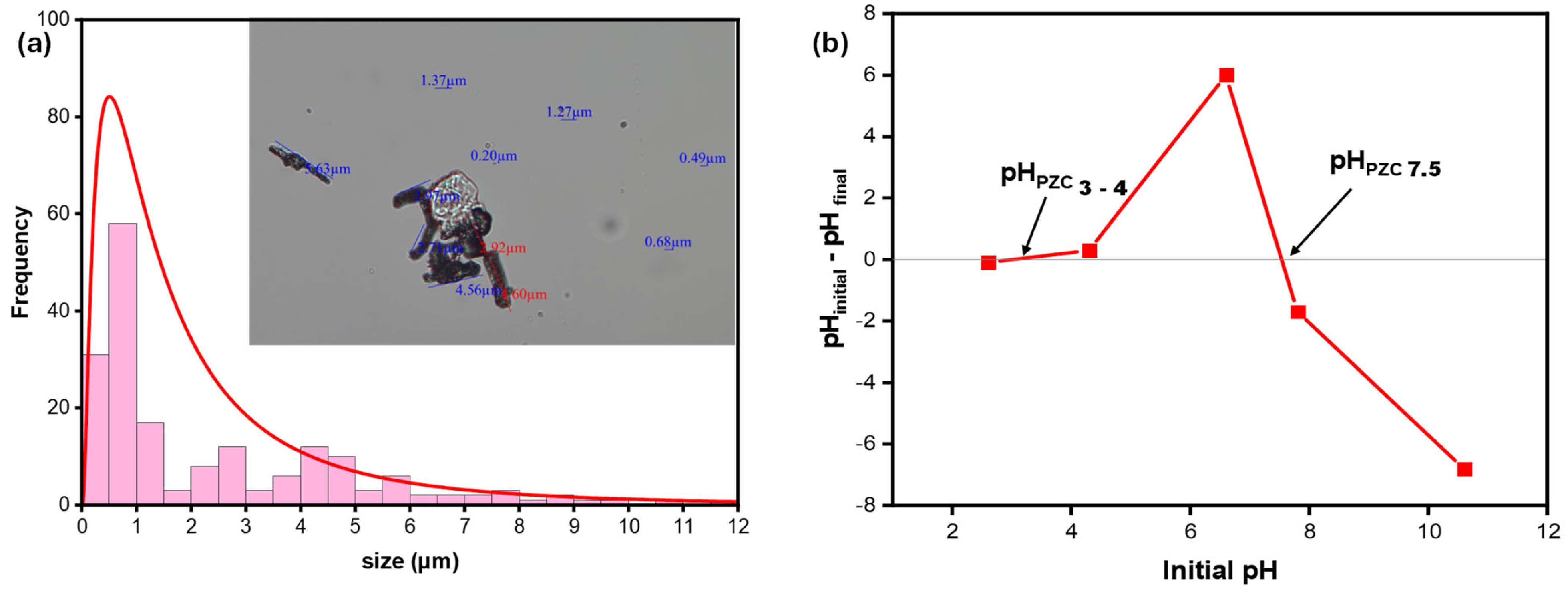
The size distribution and morphology of PET micro- and nanoplastics were examined using a fluorescent microscope (MX6300, Meiji Techno Co., Saitama, Japan) equipped with a 4K Moticam4000 microscope camera. The analysis was conducted under visible light at a micrometer scale with a 100× magnification. The captured fluorescent microscope images were further processed and analyzed for size and shape using Motic Image Plus 2.3S software. The point of zero charge (PZC) of PET microplastics was determined using a pH drift method. Briefly, 2 mg of PET particles were dispersed in 3 mL of aqueous solution containing one drop of 3.35 M KCl to maintain constant ionic strength. The initial pH was adjusted to values of 2.6, 4.3, 6.6, 7.8, and 10.6 using HCl or NaOH. Suspensions were gently mixed and allowed to equilibrate prior to measurement. The final pH was then measured, and the PZC was identified as the pH at which the difference between final and initial pH (ΔpH) approached zero (Figure 1b).
Figure 1.
(a) Particle size distribution of PET micro/nanoplastics; histogram of PET particle sizes measured from fluorescence microscopy images, showing a broad distribution from ~0.2 to 12 µm and a dominant population in the 0.4–1.0 µm size range. The inset image provides a representative fluorescence micrograph of PET particles, illustrating particle morphology and size heterogeneity relevant to surface-driven interactions. (b) Point of zero charge (PZC) of PET micro/nanoplastics. The PZC of PET particles showing two apparent points of zero charge occurring at pH (3.0–3.8) and near pH (~7.5). The presence of dual PZC values indicates surface charge heterogeneity, which is expected to influence particle aggregation and protein adsorption under environmentally relevant pH conditions.
2.3. Extraction and Characterization of Cedar Pollen Proteins
Cedar pollen grains were stored at −80 °C until use. Protein extraction was performed by suspending pollen grains in extraction buffer (pH 7.4) at a ratio of 1 g pollen per 20 mL buffer. The suspension was gently mixed and incubated at 4 °C for 16 h to allow protein solubilization while minimizing degradation. Following incubation, insoluble debris was removed by decantation, and the supernatant was concentrated using Amicon® centrifugal filter units (Merck KGaA, Darmstadt, Germany) by centrifugation at 14,000× g for 10 min. Solvent exchange was performed by washing the concentrate three times with phosphate-buffered saline (PBS). The final crude protein extract was recovered by reversing the microcentrifuge tube and centrifuging at 2000× g for 2 min. Protein concentration was determined using a bicinchoninic acid (BCA) assay according to the manufacturer’s protocol. For qualitative assessment, SDS–PAGE was performed using a 4–20% Tris–glycine gradient gel. Protein samples were denatured prior to electrophoresis and visualized by silver staining. Given the non-purified nature of the extract, SDS–PAGE was used solely to confirm protein presence and general electrophoretic profile. Detailed gel analysis is provided in the Supplementary Materials (Figure S1).
2.4. Protein–PET Adsorption Experiments
Batch adsorption experiments were conducted in triplicate at room temperature (25 ± 1 °C). PET microplastics were added to pollen protein extract (initial concentration: 275.92 µg/mL) at final PET concentrations ranging from 0 to 0.8 mg/mL in Sorenson buffer (10 mM, pH 7.4). Each reaction volume was 1 mL. Samples were incubated for 60 min with constant shaking at 200 rpm. Following incubation, suspensions were filtered through 0.22 µm low protein-binding membranes to remove PET particles. The filtrate (supernatant) was collected for subsequent protein quantification and spectroscopic analyses.
2.5. Protein Quantification and Adsorption Analysis
Total protein concentration was quantified using the BCA assay (Thermo Fisher Scientific Inc., Waltham, MA, USA) with bovine serum albumin as the calibration standard, and absorbance was measured at 570 nm. Aromatic residue depletion was assessed by UV–visible absorbance at 280 nm using a Beckman Coulter DU 640 UV–Vis spectrophotometer (Beckman Coulter Inc., Brea, CA, USA), where absorbance arises predominantly from tryptophan and tyrosine residues. PET-containing blanks were used to correct for scattering and background absorbance. Adsorption experiments were conducted in phosphate buffer (Sorenson buffer, pH 7.4) at room temperature with constant mixing for 1 h. The equilibrium protein concentration in the supernatant (Ce, µg·mL−1) was determined after removal of PET particles by centrifugation. The adsorbed amount of protein normalized to PET mass (Q, µg protein·mg−1 PET) was calculated as:
where C0 is the initial protein concentration (275.92 µg·mL−1), Ce is the equilibrium protein concentration after adsorption, and [PET] is the mass concentration of PET microplastics (mg·mL−1). % protein bound was calculated as follows:
Aromatic residue depletion was quantified using absorbance at 280 nm, where A0 and Ae denote the initial and equilibrium absorbance values, respectively. The percentage of aromatic signal bound was calculated as:
Plots of Q versus Ce are presented as classical adsorption isotherms. Due to the limited number of concentration points, these data were interpreted qualitatively and no adsorption model fitting was performed. The selectivity factor was calculated as described in Equation (3).
2.6. Fluorescence Spectroscopy
Fluorescence measurements were performed using a Shimadzu RF-5300 spectrofluorometer (RF-5300PC) (Shimadzu Corporation, Kyoto, Japan). Excitation and emission slit widths were set to 3 nm, with excitation at 295 nm and emission recorded from 305 to 420 nm. Prior to fluorescence acquisition, PET microplastics were removed by filtration through 0.22 µm low protein-binding membranes to minimize scattering artifacts. Importantly, all samples, including the protein-only control, were subjected to identical filtration and handling procedures. Initial protein concentration was identical across all samples, and fluorescence spectra were acquired under identical instrumental settings for all samples.
Fluorescence intensities were normalized using:
where represents the maximum emission intensity after PET exposure and corresponds to the filtered protein-only control.
Using the same slit settings, synchronous fluorescence spectra were recorded to probe residue-specific microenvironmental changes, using wavelength offsets of Δλ = 60 nm (tryptophan-selective; excitation at 260 nm and emission from 310 nm to 400 nm) and Δλ = 15 nm (tyrosine-selective; excitation at 250 nm and emission from 265 nm to 400 nm).
2.7. Fourier Transform Infrared (FTIR) Spectroscopy
FTIR spectroscopy was employed to investigate secondary structural changes in cedar pollen proteins upon interaction with polyethylene terephthalate (PET) microplastics. Spectra were collected using a Jasco FTIR-6100 (JASCO Corporation, Tokyo, Japan) spectrometer equipped with an ATR Pro One accessory. For each measurement, 20 µL of sample was deposited on the ATR crystal and air-dried to form a uniform thin film prior to analysis. Spectra were recorded over the range of 4000–400 cm−1 with a resolution of 2 cm−1, averaging 128 scans per spectrum. Three independent measurements were performed for the native protein extract and PET-exposed protein samples, each acquired under identical experimental conditions. Spectral processing included atmospheric compensation, vector normalization of the amide I region, Savitzky–Golay smoothing (9-point window, second-order polynomial), and asymmetric least squares baseline correction (λ = 1 × 10⁶, p = 0.001, 10 iterations). Secondary structure content was quantified by deconvolution of the amide I band (1600–1700 cm−1) using five Voigt profiles corresponding to β-sheet (low frequency), random coil, α-helix, β-turn, and β-sheet (high frequency) components [27]. Fitting was performed using the Levenberg–Marquardt algorithm with physically constrained parameters. Fit quality was assessed using coefficient of determination (R2 > 0.97), residual distribution analysis, and convergence criteria. Bootstrap resampling (200 iterations) was used to estimate uncertainties. Secondary structure contents are reported as mean ± standard deviation (SD) derived from the independent replicate measurements.
2.8. Molecular Dynamics Simulation
A PET 6-mer was first generated from the polymer builder module of CHARMM-GUI [28], and 180 molecules of the PET 6-mer polymer were randomly packed into a simulation box with initial dimensions of 12 × 12 × 15 nm3 using packmol [29]. The packed polymer was transferred to GROMACS [30], where the system was minimized using the steepest descent algorithm to remove steric clashes. To achieve an amorphous polymer configuration, thermal annealing was performed under the NVT ensemble by increasing the temperature from 300 K to 600 K and subsequently cooling back to 300 K over 1 ns, with temperature increments of 50 K. The annealed system was further equilibrated at 300 K for 1 ns under NVT conditions, followed by 9 ns of NPT equilibration to allow stabilization of the polymer density. The equilibrated PET slab exhibited an average density of 1.2499 ± 0.0067 g·cm−3, calculated from the instantaneous simulation box volume and polymer mass over the equilibrated trajectory, which is approximately 6% lower than the experimental density of amorphous PET (~1.33 g·cm−3). Structural validation of the PET slab using radial distribution function (RDF) analysis confirmed realistic polymer bonding, short-range interchain packing, and the absence of long-range order, consistent with an amorphous PET structure (Figure S1, Supplementary Materials). The structure of the major cedar pollen allergen Cry j 1 was obtained as the AlphaFold theoretical model (Cry j 1.0101) from the Structural Database of Allergenic Proteins (SDAP 2.0 [31] (Allergen ID: 1125; SwissProt entry: P18632). This model exhibits very high predictive confidence (pLDDT score = 94, pTM score = 0.85) and is based on the experimental X-ray template 1PXZ_A (80% sequence identity), ensuring its reliability for molecular simulation. (Figure S2, Supplementary Materials). Using the multicomponent assembler module of CHARMM-GUI [32], the protein was solvated, ionized and the CHARMM36 force field was applied consistently to both the protein and the PET components. The energy of the protein already solvated in a rectangular box with TIP3P water molecules and ionized to a physiological ionic strength of 0.15 M KCl was then minimized using the steepest descent algorithm in GROMACS. The protein was equilibrated for 1 ns under NVT conditions, followed by 1 ns under NPT conditions, followed by a 20 ns production simulation to characterize its intrinsic conformational stability in solution. For protein–PET interaction simulations, the solvated, ionized Cry j 1 protein was positioned approximately 3 nm above the PET slab surface, with the major epitope region oriented toward the polymer surface (Figure S2, Supplementary Materials). The simulation box dimensions were adjusted to accommodate the combined system while maintaining a minimum solvent padding of 2 nm in all directions. The combined system was energy minimized using the steepest descent algorithm. Equilibration was subsequently performed for 100 ps under NVT conditions and for 1 ns under NPT conditions. A 20 ns production simulation was then carried out to investigate protein adsorption and conformational dynamics at the PET interface. This 20 ns timescale was selected to capture the initial adsorption event, the formation of stable interfacial contacts, and the ensuing short-timescale structural perturbations that are directly comparable to the experimental spectroscopic observations. All simulations were performed using GROMACS, based on the CHARMM36 force field. Temperature was maintained at 300 K using the Nosé–Hoover thermostat, and pressure was controlled at 1 bar using the Parrinello–Rahman barostat. Long-range electrostatic interactions were treated using the particle mesh Ewald method, and all covalent bonds involving hydrogen atoms were constrained using the LINCS algorithm. Trajectory analyses included polymer density evaluation, radial distribution functions, hydrogen bond analysis, root mean square deviation, root mean square fluctuation, solvent-accessible surface area, and secondary structure evolution using the DSSP algorithm.
3. Results
3.1. Particle Size Distribution and Surface Charge Properties of PET Micro/Nanoplastics
The particle size distribution of PET micro/nanoplastics exhibited a broad size distribution below 32 µm, with a dominant population in the sub-micron to low-micron range (sub-micron range of 0.4–1.0 µm) (Figure 1a). This distribution reflects the heterogeneous fragmentation behavior of aged PET materials and excludes the deliberate generation of nanosized particles that could interfere with optical or spectrometric measurements. The inset fluorescence microscopy image in Figure 1a is a subset of the visual representation of the heterogeneous morphology and size variability of the PET particles used for subsequent adsorption experiments. The surface charge behavior of PET microplastics was assessed using the pH drift method (Figure 1b). Two apparent points of zero charge (PZC) were observed. The first PZC occurred in the acidic range at pH 3.0–3.8, while a second PZC was observed near neutral pH (~7.5). Between these pH regions, the PET particles exhibited pH-dependent variations in surface charge, indicating a non-uniform charge distribution across the particle surfaces, rather than a single, uniform population of ionizable sites. The presence of two PZC values suggests surface chemical heterogeneity, which may arise from the coexistence of different functional domains on the PET surface. Given the predominance of sub-micron particles in the sample, these surface charge characteristics are expected to be particularly influential in governing interfacial interactions under environmentally and biologically relevant conditions.
3.2. Extraction and Confirmation of Cedar Pollen Proteins
The extraction procedure yielded a soluble protein fraction from cedar pollen suitable for downstream biochemical analyses. Protein quantification by BCA assay confirmed successful recovery of pollen-derived proteins at concentrations sufficient for adsorption and electrophoretic analyses. The presence of cedar pollen proteins in the extracted samples was confirmed by SDS-PAGE analysis (Figure S3, supplementary information). The electrophoretic profile exhibited a heterogeneous banding pattern, characterized by diffuse protein signals spanning a broad molecular weight range. This profile is consistent with the use of a crude pollen extract, which contains a complex mixture of proteins rather than isolated components. Notably, protein bands and signal regions were observed in molecular weight ranges corresponding to previously reported sizes of the major cedar pollen allergens Cry j 1 and Cry j 2, although individual allergen bands were not resolved as discrete sharp bands. Detailed electrophoretic conditions, molecular weight markers, and qualitative band assignments are provided in the Supplementary Materials (Figure S3).
3.3. Protein Adsorption on PET Microplastics
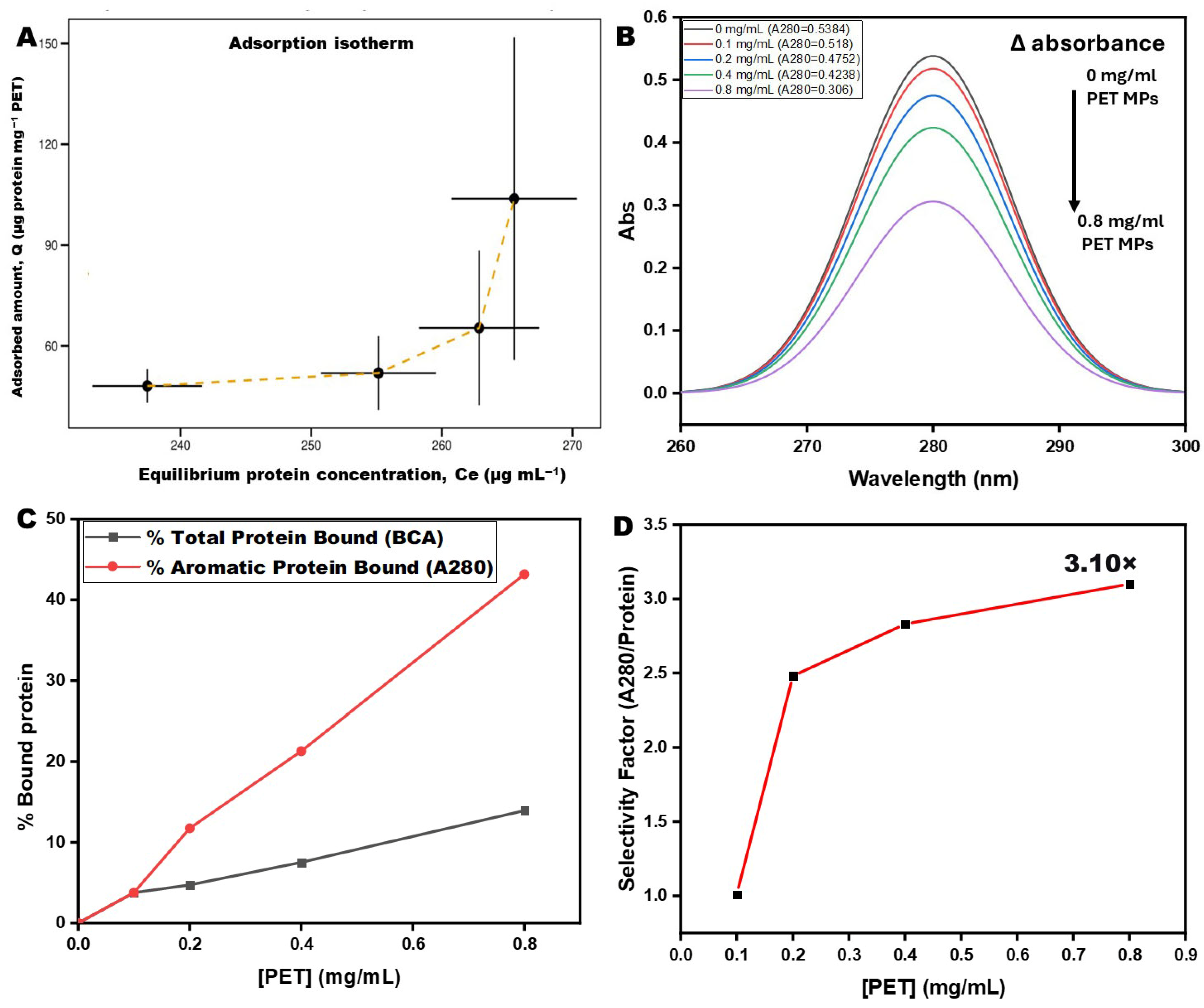
The adsorption of cedar pollen crude protein extract onto polyethylene terephthalate (PET) nano/microplastics (NMPs) was evaluated at pH 7.4 under constant mixing for 1 h. Increasing the PET concentration resulted in progressively greater removal of protein from solution, as quantified by both the BCA assay and UV absorbance at 280 nm (A280) (Table 1, Figure 2A–C). At the highest PET concentration examined (0.8 mg·mL−1), total protein binding reached 13.94%, whereas the A280 decreased by 43.16%, indicating strong depletion of aromatic residues from solution (Figure 2B,C). The ratio of aromatic signal depletion to total protein removal increased systematically with PET concentration, reaching a maximum selectivity of 3.10 (Figure 2C), demonstrating enrichment of aromatic-rich protein fractions on the PET surface. When the adsorbed amount of protein normalized to PET mass (Q) was plotted against the equilibrium protein concentration (Ce), the resulting adsorption isotherm exhibited a trend consistent with progressive saturation of surface interaction sites (Figure 2A). However, given the limited number of experimental points, the data were not fitted to adsorption models and are interpreted qualitatively.
Table 1.
Protein adsorption of PET microplastics.
Figure 2.
(A) Adsorption isotherm for total protein binding to PET microplastics. The isotherm was constructed by plotting the adsorbed amount normalized to PET mass (Q, µg protein mg−1 PET) against the equilibrium protein concentration (Ce, µg mL−1), obtained under conditions of fixed initial protein concentration and increasing PET loading. The dashed line represents a guide to the eye illustrating Langmuir-type saturable adsorption behavior; no formal isotherm fitting was performed due to the limited number of data points. (B) Aromatic protein adsorption quantified by UV absorbance at 280 nm (A280), reflecting depletion of aromatic amino acid–rich proteins from solution. (C) Comparative analysis of total protein adsorption measured by BCA assay and aromatic protein adsorption measured by A280, showing preferential removal of aromatic protein fractions with increasing PET concentration. (D) Selective enrichment of aromatic protein adsorption, expressed as the ratio of %A280 bound to %total protein bound, which increases monotonically with PET concentration and reaches a maximum of 3.10-fold at 0.8 mg mL−1 PET.
A280 adsorption was consistently higher than total protein adsorption (Figure 2C), and selectivity increased with PET concentration, rising from 1.01-fold at 0.1 mg/mL to 3.10-fold at 0.8 mg/mL (Figure 2D). This concentration-dependent selectivity indicates a strong affinity of aromatic-rich proteins for PET surfaces. Such preferential binding suggests that specific pollen proteins, potentially including the allergen Cry j1, which contains multiple aromatic residues, may interact strongly with PET MPs, with implications for allergen mobility in microplastic-polluted environments.
3.4. Fluorescence Spectroscopic Analysis of Cedar Pollen Proteins upon Interaction with PET Microplastics
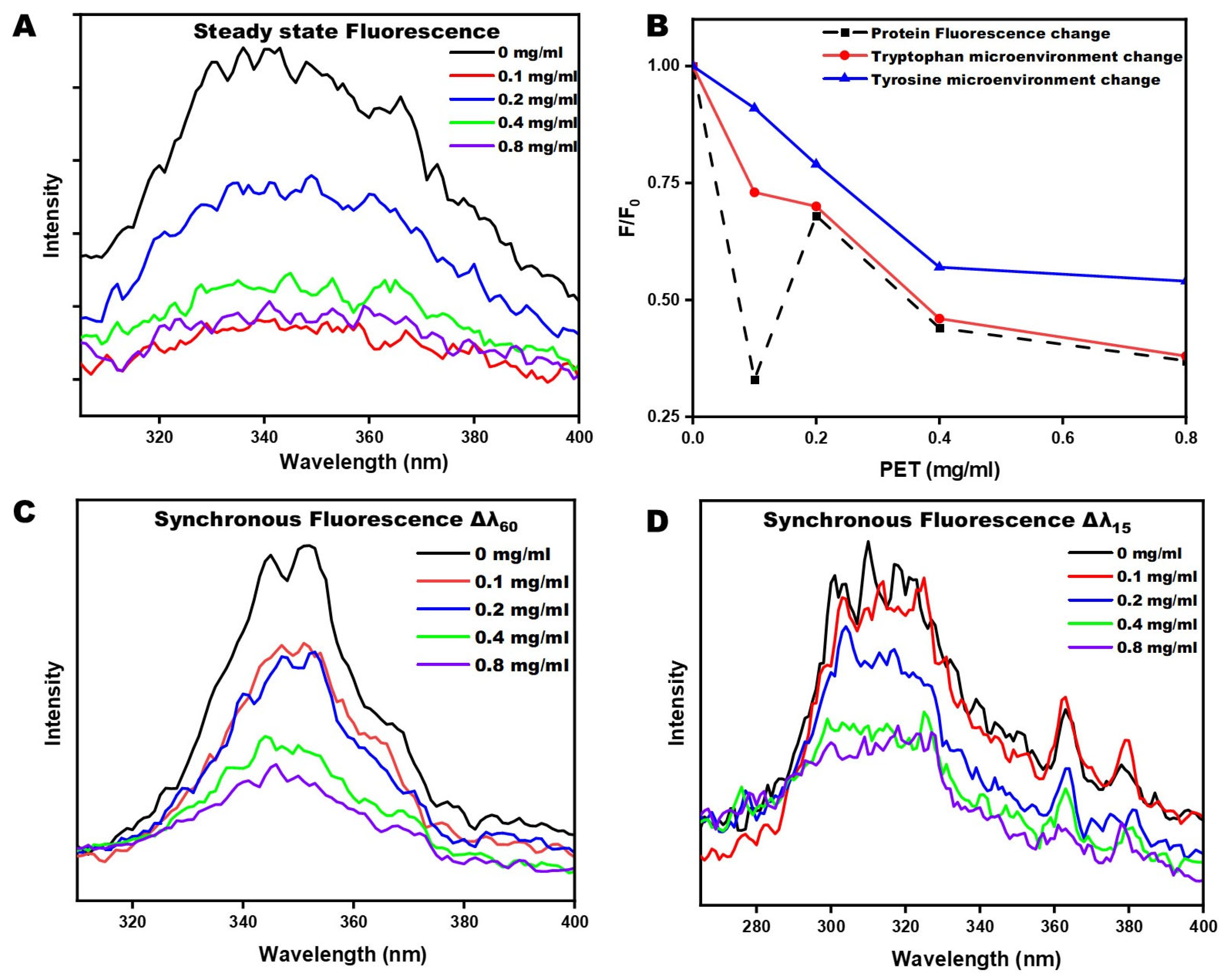
Fluorescence spectroscopy was employed to investigate PET-induced changes in the tertiary structure and local microenvironment of aromatic residues in cedar pollen proteins. Steady-state fluorescence spectra were recorded after removal of PET particles to eliminate scattering and particle-associated fluorescence contributions. As shown in Figure 3A, increasing PET concentrations resulted in a progressive decrease in fluorescence intensity. The conformational impact of this interaction was revealed by a significant shift in the emission maximum (Figure S5). While the native protein fluoresced at 336 nm, titration with PET induced a substantial red shift that reached a maximum of 349 nm at a PET concentration of 0.2 mg/mL. At higher PET concentrations, the emission wavelength stabilized, indicating saturation of the effect. This saturation behavior demonstrates that the red shift and, by extension, the increased solvent exposure of aromatic residues is a direct and saturable consequence of protein binding to the PET surface. The normalized fluorescence ratio (F/F0) decreased monotonically with PET concentration (Figure 3B), demonstrating a PET-dependent modulation of intrinsic protein fluorescence relative to the filtered control. Because all samples, including the protein-only control, underwent identical filtration and were measured under identical instrumental conditions, the observed trends are consistent with alterations in the microenvironment of intrinsic fluorophores rather than uniform changes in protein concentration. Synchronous fluorescence spectroscopy further resolved residue-specific responses. At Δλ = 60 nm, predominantly probing tryptophan residues, fluorescence intensity decreased markedly with increasing PET concentration (Figure 3C). In contrast, spectra recorded at Δλ = 15 nm, which preferentially reflect tyrosine residues, showed a comparatively smaller decrease in intensity (Figure 3D). The differential sensitivity suggests that regions containing tryptophan residues are more strongly affected by PET interaction. These findings are supported by molecular dynamics simulations, which revealed localized increases in solvent exposure for hydrophobic and aromatic residues upon adsorption of Cry j 1 onto the PET surface (Section 3.7).
Figure 3.
Fluorescence spectroscopic analysis of cedar pollen proteins upon interaction with PET microplastics. (A) Steady-state fluorescence emission spectra of cedar pollen proteins after exposure to increasing concentrations of PET microplastics, showing PET-dependent modulation of intrinsic protein fluorescence. (B) Normalized fluorescence intensity ratio (F/F0) plotted as a function of PET concentration, where F represents the maximum emission intensity after PET exposure and F0 corresponds to untreated protein, highlighting concentration-dependent fluorescence. (C) Synchronous fluorescence spectra recorded at Δλ = 60 nm, selectively probing tryptophan residues and revealing PET-induced changes in the microenvironment of buried aromatic residues. (D) Synchronous fluorescence spectra recorded at Δλ = 15 nm, selectively probing tyrosine residues and indicating alterations in surface-exposed aromatic environments upon PET interaction.
3.5. FTIR Analysis of PET-Induced Secondary Structural Changes in Cedar Pollen Proteins
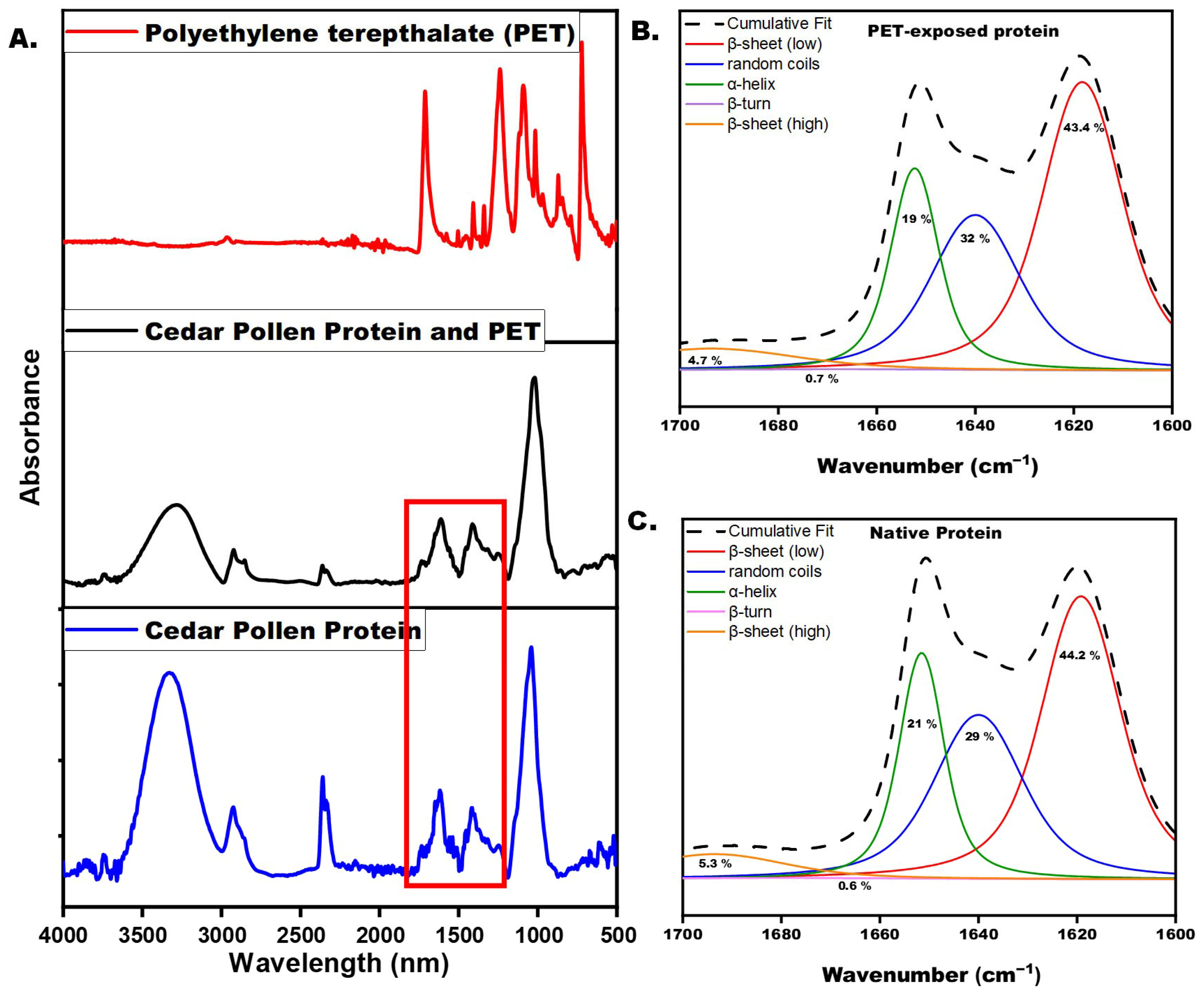
ATR-FTIR spectra of native and PET-exposed cedar pollen protein extracts exhibited characteristic amide I and amide II absorption bands, confirming preservation of the protein backbone following PET exposure (Figure 4A). Subtle but reproducible differences were observed in the amide I region (1600–1700 cm−1), suggesting adsorption-associated perturbations in secondary structure. Deconvolution of the amide I band revealed that both native and PET-exposed protein extracts were dominated by β-sheet structures, with contributions from low- and high-frequency β-sheet components, alongside α-helical and random coil structures (Figure 4B,C). Quantitative analysis based on independent replicate measurements (n = 3) showed that total β-sheet content remained broadly comparable between native (49.5 ± 1.7%) and PET-exposed proteins (48.2 ± 3.1%) (Table 2). However, PET exposure was associated with increased variability in secondary structure distribution, particularly reflected by an increase in random coil content and a modest reduction in α-helical contributions. Notably, the PET-exposed samples exhibited greater inter-replicate variability compared to the native protein extract, indicating increased structural heterogeneity upon interaction with the microplastic surface. These changes are consistent with localized conformational rearrangements rather than global unfolding, supporting a model of surface-driven protein adaptation upon PET adsorption.
Figure 4.
FTIR analysis of cedar pollen protein structural changes upon PET exposure: (A) full-range spectra comparison, (B) amide I deconvolution of PET-exposed protein, and (C) amide I deconvolution of native protein.
Table 2.
Summary of changes in the secondary structure of pollen protein and PET-exposed pollen protein.
3.6. Molecular Dynamics Simulation of Cry j 1 Adsorption on PET Surface
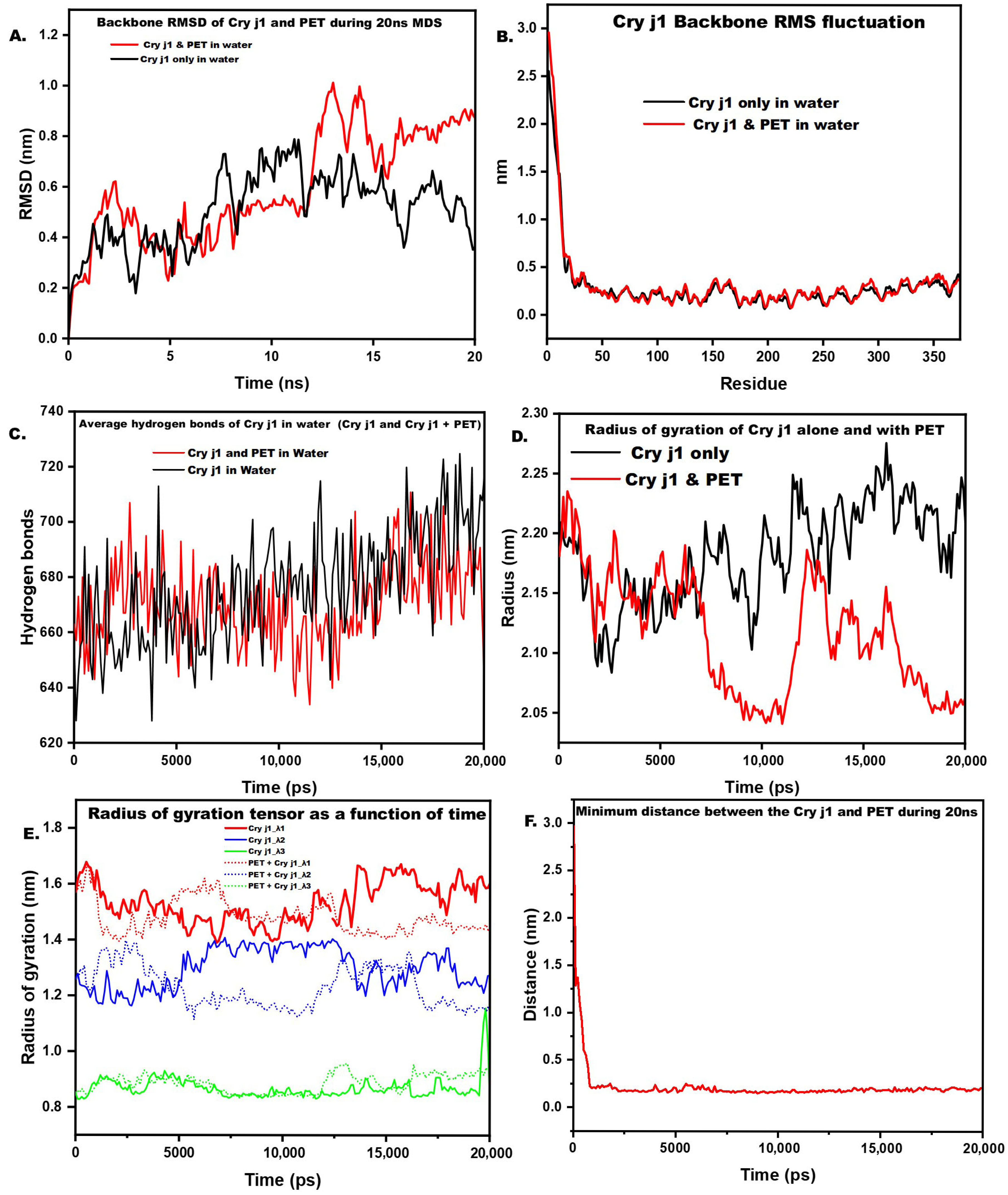
To investigate the molecular basis of pollen protein–PET interactions observed experimentally, all-atom molecular dynamics simulations were performed for Cry j 1 in solution and in the presence of an amorphous PET slab. Analysis of the protein–surface distance revealed that initial contact between Cry j 1 and the PET slab occurred at approximately 800 ps, after which the protein remained stably associated with the PET surface for the remainder of the simulation, indicating persistent adsorption (Figure 5F). Root-mean-square deviation (RMSD) analysis was used to monitor the global structural stability of Cry j 1 in aqueous solution and upon adsorption onto the amorphous PET surface (Figure 5A). Following initial surface contact, the PET-associated trajectory displayed a slightly elevated RMSD relative to the aqueous system during the later stages of the simulation; however, this difference is modest and falls within the expected variability of protein MD simulations. This behavior likely reflects altered motional constraints imposed by proximity to a solid PET interface rather than a global conformational transition. To assess residue-level flexibility, root-mean-square fluctuation (RMSF) profiles were calculated for both systems (Figure 5B). RMSF analysis revealed nearly identical residue-wise flexibility profiles for Cry j 1 in both systems (Figure 5B). In both cases, the N-terminal region (approximately residues 1–20) displayed high flexibility, whereas the remaining core of the protein (residues 21–374) remained relatively rigid. The close overlap of RMSF profiles indicates that PET association does not induce localized destabilization or enhanced flexibility of specific residues. Hydrogen bond analysis demonstrated a modest but consistent reduction in the total number of intramolecular hydrogen bonds upon PET adsorption (Figure 5C). Cry j 1 formed an average of 725 hydrogen bonds in aqueous solution, which decreased to approximately 711 hydrogen bonds when adsorbed onto the PET surface, corresponding to a ~2% reduction. Although the time-averaged number of hydrogen bonds was marginally lower for the PET-associated system, the difference was small and fell within the expected thermal noise of the simulation. Accordingly, hydrogen bond analysis is not interpreted as statistically significant evidence of structural disruption but is considered qualitatively consistent with subtle interfacial accommodation. To quantify changes in the compactness and shape of Cry j 1 upon adsorption onto the PET surface, the radius of gyration (Rg) and its tensor components were analyzed (Figure 5D,E). The radius of gyration reflects the distribution of atomic mass around the protein’s center of mass, where a lower Rg indicates a more compact, folded structure, while a higher Rg suggests a more expanded conformation. The free Cry j 1 protein exhibited the characteristic behavior of a stable globular protein, with Rg equilibrating and fluctuating around a constant mean value throughout the simulation. In contrast, the Cry j 1–PET system displayed a distinct adsorption-driven behavior. The protein remained relatively compact during the initial ~7000 ps, after which a gradual decrease in Rg was observed toward the end of the simulation. This reduction in Rg indicates a redistribution of mass toward the protein’s center rather than unfolding, suggesting adsorption-induced structural reorganization. To further resolve the nature of this conformational change, the radius of gyration tensor components (Rgx, Rgγ, and Rg𝓏) were examined. These components describe directional shape changes in the protein and revealed a pronounced anisotropic response upon PET binding. Compared to the free protein, the in-plane components (Rgx and Rgγ) increased relative to the out-of-plane component (Rg𝓏), indicating lateral spreading of Cry j 1 along the PET surface accompanied by compression normal to the surface. This anisotropic redistribution confirms that the observed Rg changes arise from geometric adaptation to a planar surface rather than isotropic unfolding or loss of structural integrity.
Figure 5.
Molecular dynamics analysis of Cry j 1 adsorption onto PET. (A) Root mean square deviation (RMSD) of PET alone and PET in complex with Cry j 1 during the simulation. (B) Root mean square fluctuation (RMSF) of Cry j 1 backbone atoms in the free and PET-bound states. (C) Time evolution of hydrogen bonds in the free Cry j 1 system and in the Cry j 1–PET complex. (D) Radius of gyration (Rg) of Cry j 1 in aqueous solution and upon adsorption onto the PET surface. (E) Radius of gyration tensor components (Rgx, Rgγ, Rg𝓏) illustrating anisotropic shape redistribution of Cry j 1 upon PET adsorption. (F) Minimum distance between Cry j 1 and the PET surface, indicating the onset of stable protein–surface contact.
3.7. Simulation of Changes in Secondary Structure and Solvent Accessibility upon PET Adsorption
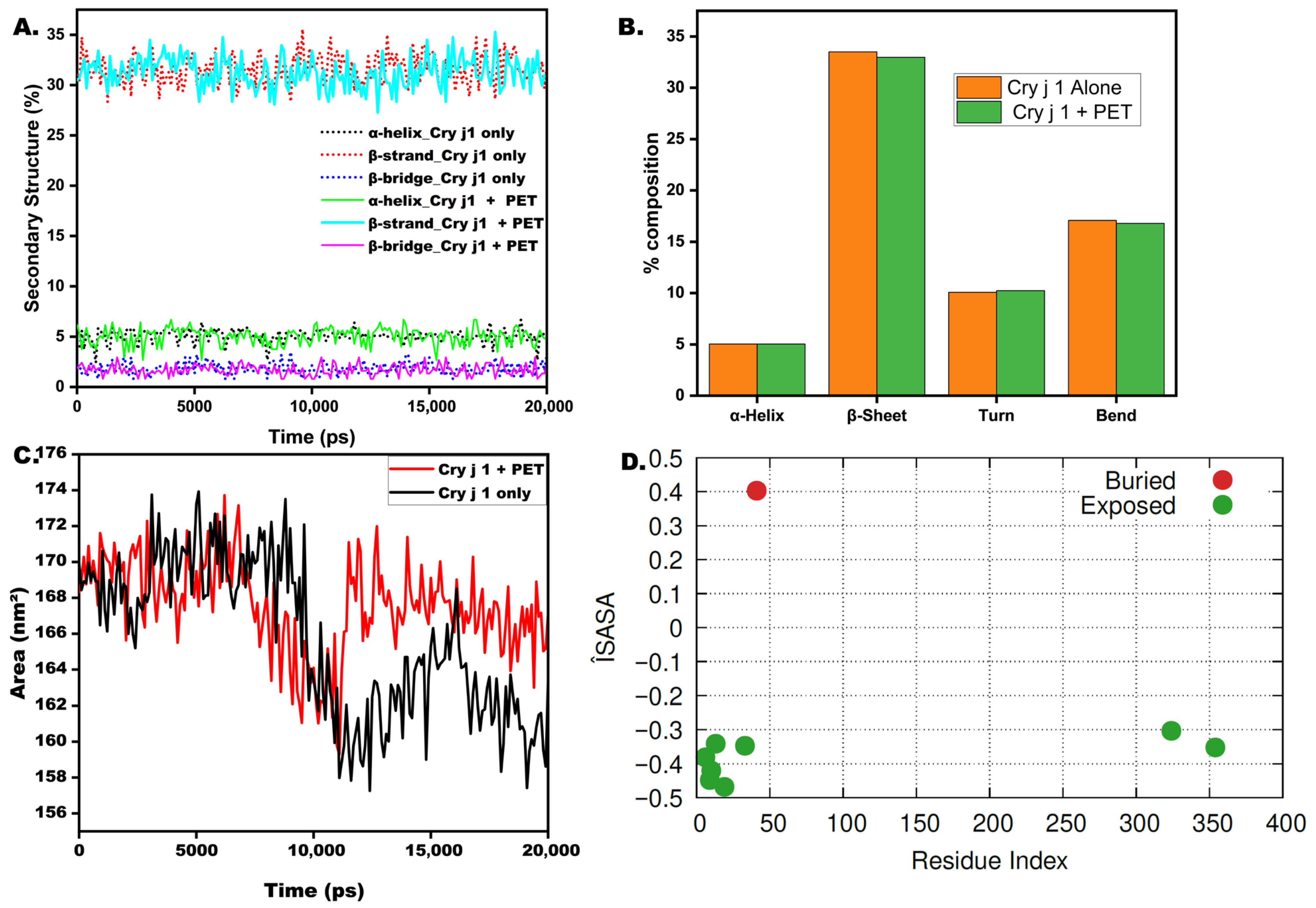
To further elucidate the conformational consequences of Cry j 1 adsorption onto the PET surface, secondary structure evolution and solvent accessibility were analyzed using the define secondary structure of proteins (DSSP) algorithm and solvent accessible surface area (SASA) metrics (Figure 6). DSSP analysis (Figure 6A) revealed that Cry j 1 largely preserved its global fold throughout the 20 ns simulation in both aqueous and PET-bound states, with minor variations among secondary structure elements. Quantitative comparison of secondary structure composition (Figure 6B) showed a minor reduction in ordered motifs upon PET interaction. Specifically, the total β-sheet content (β-strand + β-bridge) decreased from 33.50% in solution to 32.97% in the PET-bound system, while total α-helical content (α-helix + 310-helix) decreased marginally from 8.90% to 8.73%. However, these fluctuations remained within the range of intrinsic MD variability and did not indicate discrete structural transitions. These trends suggest localized surface-mediated adjustments rather than global secondary structure rearrangement. β-sheet regions are known to play a central role in the structural stability and immunogenic properties of pollen allergens. We hypothesize that the interaction with the hydrophobic PET surface likely disrupts inter-strand hydrogen bonding within surface-exposed β-sheets, which may lead to partial conversion into β-turns and bends. This interpretation aligns with the experimentally observed changes in amide I band components from FTIR deconvolution, indicating consistency between computational and spectroscopic findings. Solvent Accessible Surface Area (SASA) analysis further supported the conclusion that PET adsorption does not induce large-scale structural destabilization of Cry j 1. The total SASA profiles (Figure 6C) showed strong temporal overlap between free and PET-bound protein trajectories, with only a small increase in the average SASA upon adsorption. As summarized in Table 3, the mean global SASA increased from 165.74 ± 4.23 nm2 for free Cry j 1 to 167.58 ± 2.57 nm2 in the Cry j 1–PET complex, corresponding to a ΔSASA of +1.84 nm2 (~1.1%). This minor increase indicates that Cry j 1 remains largely compact, undergoing surface accommodation rather than unfolding. Residue-level SASA analysis (Figure 6D) identified a limited set of amino acids exhibiting pronounced changes in solvent exposure, defining a localized adsorption interface. Several residues displayed increased exposure in the PET-bound state, including Leu6, Val9, Ala10, Phe13, Cys19, Trp33, Gly324, and Ser354, suggesting partial lifting of these residues during surface interaction. Many of these residues are hydrophobic or aromatic, consistent with favorable interactions with the PET surface. In contrast, Cys41 showed a reduction in SASA, indicating burial or shielding upon adsorption, consistent with its potential role in anchoring the protein at the PET interface. Overall, the DSSP and SASA analyses collectively demonstrate that Cry j 1 adsorption onto PET showed preferential surface orientation and interfacial contact rather than unfolding or large-scale solvent exposure. These findings support a model in which PET acts as a stabilizing adsorption platform that selectively perturbs surface-exposed regions, particularly β-sheet-rich and hydrophobic domains, potentially modulating allergen surface presentation and biological reactivity without complete denaturation. The present simulation provides a mechanistic snapshot of the initial adsorption stage, successfully rationalizing the experimental observations. While this approach is validated by its consistency with the data, it does not capture longer-timescale dynamics. Future studies employing extended simulations or enhanced sampling would be valuable to map the complete conformational landscape of the adsorbed state.
Figure 6.
Secondary structure and solvent accessibility changes in Cry j 1 upon PET adsorption. (A) DSSP secondary structure evolution of Cry j 1 in aqueous solution and in the PET-bound state. (B) Percentage composition of major secondary structure elements (α-helix, β-sheet, turn, and bend) for free and PET-bound Cry j 1. (C) Time evolution of the total solvent accessible surface area (SASA) of Cry j 1 in the free and PET-bound systems. (D) Residue-level SASA differences between free Cry j 1 and the Cry j 1–PET complex, highlighting residues involved in localized adsorption and surface anchoring. These residues (Residue 6: Leu (L), Residue 9: Val (V), Residue 10: Ala (A), Residue 13: Phe (F), Residue 19: Cys (C), Residue 33: Trp (W), Resokidue 324: Gly (G), Residue 354: Ser (S)) show increased solvent exposure (residues with increased exposure (ΔSASA < 0) in the PET-bound state), suggesting reorientation or partial lifting from the protein core during adsorption. Residue 41: Cys (C) exhibited reduced SASA (buried (ΔSASA > 0)), consistent with direct surface anchoring or shielding at the protein–PET interface.
Table 3.
Global solvent accessible surface area (SASA) of Cry j 1 in free solution and in complex with PET. Average SASA values and standard deviations were calculated over the equilibrated portion of the molecular dynamics’ trajectories. ΔSASA represents the difference relative to the free Cry j 1 system.
4. Discussion
This study integrates physicochemical characterization of polyethylene terephthalate (PET) microplastics, adsorption experiments, spectroscopic analyses, and molecular dynamics (MD) simulations to elucidate the mechanisms governing the interaction between PET surfaces and cedar pollen proteins, with particular emphasis on the major allergen Cry j 1. By combining experimental and computational approaches, we provide a consistent, multiscale description of adsorption behavior, protein selectivity, and adsorption-induced conformational changes. PET particles used in this study spanned a size range from approximately 0.2 to 12 µm, with the majority distributed between 0.4 and 1 µm. This size regime is environmentally relevant, as submicron and low-micron microplastics exhibit high surface-area-to-volume ratios and prolonged suspension in air and aqueous environments, thereby increasing the probability of interaction with biological macromolecules [33,34]. Point-of-zero-charge (PZC) measurements revealed two charge transition regions pH (3.0–3.8 and ~7.5) [35,36,37], the dual PZC behavior observed for PET microplastics prepared from used bottles reflects the coexistence of chemically distinct surface functionalities generated during polymer processing, use, and mechanical fragmentation. Hydrolysis and oxidation of ester linkages at the PET surface can produce carboxylic acid groups (–COOH; pKa ≈ 3–4), which account for the acidic PZC observed at low pH. The second apparent PZC near neutral pH likely arises from weaker amphoteric or basic surface sites, including residual hydroxyl groups, ester-associated dipoles, and surface-active additives commonly present in commercial PET bottles (e.g., stabilizers, plasticizers, and trace catalyst residues). Mechanical grinding increases surface roughness and exposes these heterogeneous domains, enhancing their contribution to overall surface charge behavior. Importantly, although the sieved material contains sub-micron particles, no discrete nanosized fraction was intentionally generated. The absence of colloidal nanoparticles minimizes potential artifacts in spectroscopic measurements, while the high surface-area-to-volume ratio of the microplastics enhances adsorption-driven interactions under environmentally relevant pH conditions. Consequently, under near-neutral conditions relevant to the adsorption experiments, the net surface charge approaches zero, thereby reducing long-range electrostatic contributions. PET microplastics exhibit weak net surface charge, favoring adsorption mechanisms dominated by hydrophobic interactions and π–π stacking rather than long-range electrostatic attractions [38]. To provide a realistic molecular representation of PET for adsorption simulations, an amorphous PET slab was constructed using Packmol equilibrated through energy minimization and NPT dynamics. The polymer-only density during production was 1.2499 ± 0.0067 g·cm−3, remaining stable throughout the equilibrated trajectory. Although this value is approximately 6% lower than the experimental density of amorphous PET (~1.33 g·cm−3) [39,40], such deviations are common in finite-size polymer models and may arise from oligomer chain length, packing limitations, and annealing protocols. Importantly, the stability of the density indicates that the slab reached equilibrium, and the surface topography and local chemical environments relevant to adsorption were preserved. Consequently, while absolute adsorption energetics may be modestly affected by under-packing, the mechanistic insights derived from surface contact formation, adsorption orientation, and residue-level interactions are expected to be robust [39]. Radial distribution function (RDF) analysis further validated the structural realism of the PET slab. Sharp peaks corresponding to intramolecular aromatic C–C and C–O bond lengths confirmed the chemical integrity of the polymer chains, while secondary peaks at intermediate distances (0.6–0.8 nm) reflected short-range inter-chain packing characteristic of amorphous PET [41]. The convergence of all RDFs to unity beyond ~1.0 nm indicates the absence of long-range order, consistent with an amorphous polymer phase. These features collectively confirm that the simulated PET slab reproduces realistic local bonding, packing, and surface heterogeneity, providing a reliable platform for protein adsorption studies [41].
Experimentally, the adsorption of cedar pollen proteins onto PET microplastics exhibited Langmuir-type saturable behavior, consistent with the presence of finite surface interaction sites and the formation of an effective monolayer under the conditions studied. Although the isotherm was constructed by varying PET concentration at a fixed initial protein concentration, the resulting relationship between the adsorbed amount (Q) and the equilibrium protein concentration (Ce) reflects classical saturation behavior characteristic of protein adsorption onto hydrophobic polymer surfaces. Previous studies have shown that protein adsorption onto aromatic polymers such as polystyrene (PS) and polyethylene terephthalate (PET) often exhibits saturable behavior, with maximum adsorption capacities that depend strongly on polymer chemistry and protein identity. For example, ovalbumin adsorption onto PS has been reported to reach a maximum adsorption capacity of 26.75 mg·g−1 at pH 3, whereas adsorption onto PET under the same conditions was substantially lower (9.26 mg·g−1), highlighting the influence of polymer surface chemistry [42]. Similarly, trypsin adsorption onto PET has been described using Langmuir-type models with reported Qmax values of 4.16 mg·g−1 [39]. Rather than emphasizing absolute adsorption capacity, the present study focuses on compositional selectivity within a complex protein mixture. The observed 3.10-fold enrichment of aromatic residue depletion relative to total protein adsorption provides strong evidence for preferential binding of aromatic-rich protein fractions to PET microplastics. This selectivity increased systematically with PET concentration, indicating that adsorption is governed not solely by surface capacity but also by molecular affinity. Such behavior is consistent with the established role of hydrophobic and π–π interactions in protein adsorption onto aromatic polymer surfaces, arising from interactions between the terephthalate backbone of PET and aromatic amino acid side chains such as phenylalanine, tyrosine, and tryptophan [43]. Collectively, these findings align with prior reports on protein–plastic interactions while extending them to demonstrate that selective enrichment of aromatic motifs can be a defining feature of PET interactions with complex biological mixtures [43].
Fluorescence spectroscopy demonstrated that PET microplastics induce stable, adsorption-driven alterations in the tertiary structure of cedar pollen proteins. Steady-state fluorescence measurements showed a concentration-dependent decrease in emission intensity accompanied by a slight red shift, indicating effective quenching and increased solvent exposure of intrinsic aromatic residues. Because PET particles were removed prior to fluorescence acquisition, these effects cannot be attributed to light scattering but instead reflect persistent conformational rearrangements induced by protein–surface interactions. The progressive decrease in the normalized fluorescence ratio (F/F0) further supports gradual modification of the aromatic microenvironment upon PET exposure. Synchronous fluorescence spectroscopy revealed stronger perturbation of tryptophan residues relative to tyrosine residues, suggesting partial disruption or reorientation of hydrophobic core regions. This residue-specific sensitivity is consistent with molecular dynamics simulations, which revealed localized increases in solvent-accessible surface area for hydrophobic and aromatic residues following Cry j 1 adsorption, indicating selective exposure rather than global unfolding. FTIR spectroscopy further revealed PET-induced redistribution of secondary structure elements, as evidenced by changes in the amide I and amide II regions. Replicate-resolved amide I deconvolution showed that total β-sheet content remained largely conserved, while random coil content increased and α-helical contributions decreased modestly following PET exposure. Importantly, PET-associated samples exhibited increased structural heterogeneity, as reflected by higher variability across independent measurements. These findings indicate localized, surface-mediated conformational adaptation of the protein upon adsorption to PET microplastics, rather than irreversible denaturation. These experimental trends closely align with DSSP analysis from molecular dynamics simulations, which showed subtle β-sheet destabilization accompanied by compensatory increases in turns and bends at the protein–PET interface. Notably, these adsorption-induced structural changes differ fundamentally from thermal denaturation of Cry j 1, which promotes β-sheet aggregation and burial of IgE epitopes [44]. Similar fluorescence quenching behavior has been reported for polystyrene microplastic interactions with the house dust mite allergen Der p 1, suggesting that microplastic surfaces may act as general modulators of allergen structure across polymer types [7]. Together, the integrated spectroscopic and computational results indicate that PET microplastics induce localized, surface-driven conformational adaptation of Cry j 1 without irreversible unfolding.
Molecular dynamics simulations provide mechanistic insight into the experimentally observed effects of PET microplastics on Cry j 1 structure. Cry j 1 rapidly established stable contact with the amorphous PET surface within the first nanosecond and remained persistently adsorbed throughout the simulation, consistent with irreversible or quasi-irreversible adsorption behavior reported for proteins on hydrophobic polymer surfaces [45]. Importantly, PET association did not induce statistically significant global conformational changes or loss of structural integrity. Global and residue-level dynamical metrics collectively show that adsorption is accompanied by subtle, spatially localized interfacial adjustments rather than denaturation. RMSD fluctuations observed in the PET-associated system are best attributed to altered dynamical constraints imposed by the solid surface, as RMSF profiles demonstrate nearly identical residue-wise flexibility in both systems. The intrinsic flexibility of Cry j 1 remains dominated by the N-terminal region, while the protein core retains its rigidity, indicating that PET interaction does not promote localized destabilization. Secondary structure analysis revealed modest variations in β-sheet content accompanied by compensatory increases in turns and bends, while α-helical content was preserved. The variations in β-sheet content and intramolecular hydrogen bond counts remained within the natural variability of atomistic simulations and should not be interpreted as statistically significant structural transitions. Instead, these qualitative trends suggest minor reorganization at the protein–surface interface, consistent with partial accommodation of surface-exposed regions [46]. These computational findings closely mirror the FTIR-detected reduction in β-sheet content and increased conformational heterogeneity, strengthening the consistency between simulation and spectroscopy. Analysis of the radius of gyration and its tensor components revealed pronounced anisotropic deformation upon adsorption, characterized by lateral spreading along the PET surface and compression normal to it. Such behavior is widely observed for proteins adapting to planar hydrophobic interfaces and reflects surface accommodation rather than isotropic unfolding [46,47,48]. SASA analysis further corroborated this view, showing preserved global compactness alongside localized changes in residue exposure, particularly for hydrophobic and aromatic residues involved in surface contact. While the MD simulations alone do not provide quantitative evidence of large-scale conformational change, they offer mechanistic insight that complements the experimental observations. The localized redistribution of secondary structure elements and aromatic residue exposure observed in the simulations provides a direct molecular explanation for the FTIR-detected reduction in β-sheet contributions and the fluorescence quenching and red shifts observed experimentally, consistent with established links between aromatic residue exposure and intrinsic fluorescence modulation [7]. Together, the MD simulations support a model in which PET microplastics act as structured adsorption platforms that selectively perturb surface-exposed β-sheet-rich and aromatic regions of Cry j 1 through hydrophobic and π–π interactions. Rather than inducing denaturation, PET binding stabilizes a partially reorganized adsorbed state, providing a molecular basis for the persistent spectroscopic changes observed experimentally and suggesting a potential role for PET microplastics as active modulators of allergen structure and environmental persistence. It should be noted that the 20 ns simulation timescale captures early-stage adsorption and short-term interfacial adjustments but does not fully describe long-term equilibrium behavior. Future studies employing longer trajectories or enhanced sampling techniques would be valuable for resolving slower structural relaxation processes. Nonetheless, the present multi-scale evidence establishes that PET microplastics can selectively modulate the structural microenvironment of pollen allergens through hydrophobic and π–π interactions, providing a molecular basis for their persistent spectroscopic signatures and potential environmental relevance.
5. Conclusions
This study demonstrates that polyethylene terephthalate (PET) microplastics can stably adsorb cedar pollen allergens and subtly modulate their structural and interfacial properties without inducing global unfolding. Spectroscopic analyses revealed increased exposure of aromatic residues and partial perturbation of β-sheet-associated bands, consistent with surface-mediated accommodation rather than extensive denaturation. Molecular dynamics simulations support this interpretation, showing adsorption-driven surface accommodation, anisotropic spreading, modest increases in solvent accessibility, and altered hydrogen-bonding patterns, while residue-level flexibility remains largely unchanged. Collectively, these findings suggest that PET microplastics actively modulate allergen structure through surface interactions, rather than serve as inert carriers. From an environmental perspective, the strong and selective association between PET microplastics and pollen proteins suggests that microplastics may concentrate and transport allergens in air and aqueous systems. Immunologically, the observed conformational changes occur in structural regions relevant to allergen stability and surface presentation, implying potential consequences for allergen persistence and immune recognition. Together, these results highlight a molecular link between microplastic pollution and aeroallergen exposure.
Supplementary Materials
The following supporting information can be downloaded at: https://www.mdpi.com/article/10.3390/app16031577/s1, Figure S1: Radial distribution function (RDF) and density profiles of the amorphous PET system; Figure S2: Three-dimensional structure of the Cry j 1 allergen used for molecular dynamics simulations, Figure S3: SDS-PAGE analysis confirming extraction of cedar pollen proteins; Figure S4: Normalization of BCA and UV–visible absorbance signals for protein quantification; Figure S5: Fluorescence emission red shift of cedar pollen proteins following interaction with PET microplastics; Table S1: summarizes the major RDF peaks for each atom pair; Table S2: Calculated Binding Parameters; Table S3: Adsorbed Amount (Q) calculation. Reference [49] are cited in the supplementary materials.
Author Contributions
T.O.M.: conceptualization, methodology, data curation, formal analysis, software, validation, writing—original draft. Q.W.: supervision, funding acquisition, project administration, writing—review and editing. C.E.E.: writing—review and editing. M.S.: writing—review and editing. W.W.: writing—review and editing. M.S.R.: writing—review and editing. All authors have read and agreed to the published version of the manuscript.
Funding
This research was partially supported by the Grant-in-Aid for Scientific Research from the Japanese Ministry of Education, Culture, Sports, Science, and Technology (MEXT), including Special Funds for Innovative Area Research and Basic Research (Category B) (Grant Nos. 22H03747 [FY2022–FY2024], 24K20941 [FY2024–FY2026], and 25K03267 [FY2025–FY2029]).
Institutional Review Board Statement
Not applicable.
Informed Consent Statement
Not applicable.
Data Availability Statement
The data used in this research are included within the manuscript and Supplementary File; further information can be provided upon request.
Conflicts of Interest
The authors declare no conflicts of interest.
References
- Hou, G.; Hu, W.; Zhao, J.; Lu, J.; Zhang, W.; Liu, X.; Lu, S.; Shinichi, Y.; Ebere, E.C.; Wang, Q.; et al. Studies on Adsorption and Synergistic Biological Effects Induced by Microplastic Particles and the Platanus Pollen Allergenic Protein 3(Pla A3). Environ. Pollut. 2025, 373, 126149. [Google Scholar] [CrossRef] [PubMed]
- Zhou, S.; Wang, X.; Lu, S.; Yao, C.; Zhang, L.; Rao, L.; Liu, X.; Zhang, W.; Li, S.; Wang, W.; et al. Characterization of Allergenicity of Platanus Pollen Allergen a 3 (Pla a 3) after Exposure to NO2 and O3. Environ. Pollut. 2021, 278, 116913. [Google Scholar] [CrossRef] [PubMed]
- Smiljanic, K.; Apostolovic, D.; Trifunovic, S.; Ognjenovic, J.; Perusko, M.; Mihajlovic, L.; Burazer, L.; Van Hage, M.; Cirkovic Velickovic, T. Subpollen Particles Are Rich Carriers of Major Short Ragweed Allergens and NADH Dehydrogenases: Quantitative Proteomic and Allergomic Study. Clin. Exp. Allergy 2017, 47, 815–828. [Google Scholar] [CrossRef] [PubMed]
- Wang, Q.; Morita, J.; Gong, X.; Nakamura, S.; Suzuki, M.; Lu, S.; Sekiguchi, K.; Nakajima, T.; Nakajima, D.; Miwa, M. Characterization of the Physical Form of Allergenic Cry j 1 in the Urban Atmosphere and Determination of Cry j 1 Denaturation by Air Pollutants. Asian J. Atmospheric Environ. 2012, 6, 33–40. [Google Scholar] [CrossRef]
- Maduka, T.O.; Wang, Q.; Suzuki, M.; Enyoh, C.E.; Wang, W.; Md Rana, S. Hydrophobic Natural Deep Eutectic Solvents for Extraction of Bioactive Compounds: Multiscale Characterization, Quantum Simulations, and Molecular Interaction Studies with Cry j 1 and Amb a 1 Allergens. Separations 2025, 12, 214. [Google Scholar] [CrossRef]
- Li, Z.; Tian, J.; Yang, F. Tyrosine Nitration Enhances the Allergenic Potential of House Dust Mite Allergen Der p 2. Environ. Res. 2024, 252, 118826. [Google Scholar] [CrossRef]
- Wu, Y.; Yang, F. Co-Exposure to Microplastics Enhances the Allergenic Potentials of House Dust Mite Allergen Der p 1. Environ. Res. 2025, 277, 121613. [Google Scholar] [CrossRef]
- Wright, S.L.; Ulke, J.; Font, A.; Chan, K.L.A.; Kelly, F.J. Atmospheric Microplastic Deposition in an Urban Environment and an Evaluation of Transport. Environ. Int. 2020, 136, 105411. [Google Scholar] [CrossRef]
- Xi, B.; Wang, B.; Chen, M.; Lee, X.; Zhang, X.; Wang, S.; Yu, Z.; Wu, P. Environmental Behaviors and Degradation Methods of Microplastics in Different Environmental Media. Chemosphere 2022, 299, 134354. [Google Scholar] [CrossRef]
- Chen, G.; Feng, Q.; Wang, J. Mini-Review of Microplastics in the Atmosphere and Their Risks to Humans. Sci. Total Environ. 2020, 703, 135504. [Google Scholar] [CrossRef]
- Allen, S.; Allen, D.; Phoenix, V.R.; Le Roux, G.; Durántez Jiménez, P.; Simonneau, A.; Binet, S.; Galop, D. Atmospheric Transport and Deposition of Microplastics in a Remote Mountain Catchment. Nat. Geosci. 2019, 12, 339–344. [Google Scholar] [CrossRef]
- Amato-Lourenço, L.F.; Carvalho-Oliveira, R.; Júnior, G.R.; Dos Santos Galvão, L.; Ando, R.A.; Mauad, T. Presence of Airborne Microplastics in Human Lung Tissue. J. Hazard. Mater. 2021, 416, 126124. [Google Scholar] [CrossRef] [PubMed]
- Chen, Q.; Gao, J.; Yu, H.; Su, H.; Yang, Y.; Cao, Y.; Zhang, Q.; Ren, Y.; Hollert, H.; Shi, H.; et al. An Emerging Role of Microplastics in the Etiology of Lung Ground Glass Nodules. Environ. Sci. Eur. 2022, 34, 25. [Google Scholar] [CrossRef]
- He, W.; Liu, S.; Zhang, W.; Yi, K.; Zhang, C.; Pang, H.; Huang, D.; Huang, J.; Li, X. Recent Advances on Microplastic Aging: Identification, Mechanism, Influence Factors, and Additives Release. Sci. Total Environ. 2023, 889, 164035. [Google Scholar] [CrossRef] [PubMed]
- Cui, Q.; Yang, X.; Li, J.; Miao, Y.; Zhang, X. Microplastics Generation Behavior of Polypropylene Films with Different Crystalline Structures under UV Irradiation. Polym. Degrad. Stab. 2022, 199, 109916. [Google Scholar] [CrossRef]
- Yu, Y.; Luan, Y.; Dai, W. Time Evolution of Protein Corona Formed by Polystyrene Nanoplastics and Urease. Int. J. Biol. Macromol. 2022, 218, 72–81. [Google Scholar] [CrossRef]
- Kopac, T. Protein Corona, Understanding the Nanoparticle–Protein Interactions and Future Perspectives: A Critical Review. Int. J. Biol. Macromol. 2021, 169, 290–301. [Google Scholar] [CrossRef]
- Wheeler, K.E.; Chetwynd, A.J.; Fahy, K.M.; Hong, B.S.; Tochihuitl, J.A.; Foster, L.A.; Lynch, I. Environmental Dimensions of the Protein Corona. Nat. Nanotechnol. 2021, 16, 617–629. [Google Scholar] [CrossRef]
- Kurepa, J.; Shull, T.E.; Smalle, J.A. Metabolomic Analyses of the Bio-Corona Formed on TiO2 Nanoparticles Incubated with Plant Leaf Tissues. J. Nanobiotechnol. 2020, 18, 28. [Google Scholar] [CrossRef]
- Xiao, Q.; Zoulikha, M.; Qiu, M.; Teng, C.; Lin, C.; Li, X.; Sallam, M.A.; Xu, Q.; He, W. The Effects of Protein Corona on in Vivo Fate of Nanocarriers. Adv. Drug Deliv. Rev. 2022, 186, 114356. [Google Scholar] [CrossRef]
- Ju, P.; Zhang, Y.; Zheng, Y.; Gao, F.; Jiang, F.; Li, J.; Sun, C. Probing the Toxic Interactions between Polyvinyl Chloride Microplastics and Human Serum Albumin by Multispectroscopic Techniques. Sci. Total Environ. 2020, 734, 139219. [Google Scholar] [CrossRef] [PubMed]
- Wang, X.; Li, H.; Li, D.; He, Y.; Zhang, S.; Chen, J.; Xu, J. Unraveling the Binding Interaction between Polyvinyl Chloride Microplastics and Bovine Hemoglobin: Multi-Spectroscopic Studies. J. Mol. Struct. 2022, 1269, 133865. [Google Scholar] [CrossRef]
- Chi, Z.; Zhao, J.; You, H.; Wang, M. Study on the Mechanism of Interaction between Phthalate Acid Esters and Bovine Hemoglobin. J. Agric. Food Chem. 2016, 64, 6035–6041. [Google Scholar] [CrossRef] [PubMed]
- Poureshghi, F.; Ghandforoushan, P.; Safarnejad, A.; Soltani, S. Interaction of an Antiepileptic Drug, Lamotrigine with Human Serum Albumin (HSA): Application of Spectroscopic Techniques and Molecular Modeling Methods. J. Photochem. Photobiol. B 2017, 166, 187–192. [Google Scholar] [CrossRef]
- Wang, K.; Zhu, L.; Rao, L.; Zhao, L.; Wang, Y.; Wu, X.; Zheng, H.; Liao, X. Nano- and Micro-Polystyrene Plastics Disturb Gut Microbiota and Intestinal Immune System in Honeybee. Sci. Total Environ. 2022, 842, 156819. [Google Scholar] [CrossRef]
- Cortés-Corrales, L.; Flores, J.J.; Rosa, A.; Van Der Steen, J.J.M.; Vejsnæs, F.; Roessink, I.; Martínez-Bueno, M.J.; Fernández-Alba, A.R. Evaluation of Microplastic Pollution Using Bee Colonies: An Exploration of Various Sampling Methodologies. Environ. Pollut. 2024, 350, 124046. [Google Scholar] [CrossRef]
- Sadat, A.; Corradini, M.G.; Joye, I.J. Vibrational and Fluorescence Spectroscopy to Study Gluten and Zein Interactions in Complex Dough Systems. Curr. Res. Food Sci. 2022, 5, 479–490. [Google Scholar] [CrossRef]
- Choi, Y.K.; Park, S.-J.; Park, S.; Kim, S.; Kern, N.R.; Lee, J.; Im, W. CHARMM-GUI Polymer Builder for Modeling and Simulation of Synthetic Polymers. J. Chem. Theory Comput. 2021, 17, 2431–2443. [Google Scholar] [CrossRef]
- Martínez, L.; Andrade, R.; Birgin, E.G.; Martínez, J.M. P ACKMOL: A Package for Building Initial Configurations for Molecular Dynamics Simulations. J. Comput. Chem. 2009, 30, 2157–2164. [Google Scholar] [CrossRef]
- Abraham, M.; Alekseenko, A.; Andrews, B.; Basov, V.; Bauer, P.; Bird, H.; Briand, E.; Brown, A.; Doijade, M.; Fiorin, G.; et al. GROMACS 2025.0 Manual; Zenodo: Geneva, Switzerland, 2025. [Google Scholar] [CrossRef]
- Negi, S.S.; Schein, C.H.; Braun, W. The Updated Structural Database of Allergenic Proteins (SDAP 2.0) Provides 3D Models for Allergens and Incorporated Bioinformatics Tools. J. Allergy Clin. Immunol. Glob. 2023, 2, 100162. [Google Scholar] [CrossRef]
- Kern, N.R.; Lee, J.; Choi, Y.K.; Im, W. CHARMM-GUI Multicomponent Assembler for Modeling and Simulation of Complex Multicomponent Systems. Nat. Commun. 2024, 15, 5459. [Google Scholar] [CrossRef] [PubMed]
- Lee, S. Polymer- and Size-Dependent Toxicological Behavior of Environmentally Relevant Secondary Microplastics: A Comprehensive Review. Toxicol. Res. 2025. [Google Scholar] [CrossRef]
- Falakdin, P.; Lopez-Rosales, A.; Andrade, J.; Terzaghi, E.; Di Guardo, A.; Muniategui-Lorenzo, S. Comparison of Microplastic Type, Size, and Composition in Atmospheric and Foliage Samples in an Urban Scenario. Environ. Pollut. 2024, 349, 123911. [Google Scholar] [CrossRef] [PubMed]
- Frost, H.; Bond, T.; Sizmur, T.; Felipe-Sotelo, M. Sorption of Metal Ions onto PET-Derived Microplastic Fibres. Environ. Sci. Process. Impacts 2024, 26, 2309–2319. [Google Scholar] [CrossRef]
- Costa, T.B.O.; Santana, G.B.; Silva, E.M.; Conceição, K.G.A.; Diaz, G.Z.; Melo, D.Q.; França, A.M.M.; Do Nascimento, R.F.; Oliveira, A.G.; Santiago-Aguiar, R.S.; et al. Impact of UV-B Photoaging on Chlorpyrifos Adsorption by PET Microplastics: Insights from Experimental and DFT Analysis. ACS Omega 2024, 9, 46439–46446. [Google Scholar] [CrossRef]
- Wang, L.; Guo, C.; Qian, Q.; Lang, D.; Wu, R.; Abliz, S.; Wang, W.; Wang, J. Adsorption Behavior of UV Aged Microplastics on the Heavy Metals Pb(II) and Cu(II) in Aqueous Solutions. Chemosphere 2023, 313, 137439. [Google Scholar] [CrossRef]
- Hüffer, T.; Hofmann, T. Sorption of Non-Polar Organic Compounds by Micro-Sized Plastic Particles in Aqueous Solution. Environ. Pollut. 2016, 214, 194–201. [Google Scholar] [CrossRef]
- Lujic, T.; Gligorijevic, N.; Stanic-Vucinic, D.; Krstic Ristivojevic, M.; Mutic, T.; Wimmer, L.; Dailey, L.A.; Cirkovic Velickovic, T. Effects of Polypropylene and Polyethylene Terephthalate Microplastics on Trypsin Structure and Function. Int. J. Mol. Sci. 2025, 26, 5974. [Google Scholar] [CrossRef]
- Polêto, M.D.; Lemkul, J.A. Structural and Electronic Properties of Poly(Ethylene Terephthalate) (PET) from Polarizable Molecular Dynamics Simulations. Macromolecules 2025, 58, 403–414. [Google Scholar] [CrossRef]
- Longman, G.W.; Sheldon, R.P.; Wignall, G.D. Investigation of Short Range Ordering in Polymers by Means of Radial Distribution Functions Derived from X-Ray Diffraction: Part 2 Polyethylene Terephthalate. J. Mater. Sci. 1976, 11, 1339–1346. [Google Scholar] [CrossRef]
- Gligorijevic, N.; Lujic, T.; Mutic, T.; Vasovic, T.; De Guzman, M.K.; Acimovic, J.; Stanic-Vucinic, D.; Cirkovic Velickovic, T. Ovalbumin Interaction with Polystyrene and Polyethylene Terephthalate Microplastics Alters Its Structural Properties. Int. J. Biol. Macromol. 2024, 267, 131564. [Google Scholar] [CrossRef] [PubMed]
- Motalebizadeh, A.; Fardindoost, S.; Hoorfar, M. Peptide-Based Strategies for Detecting Microplastics in Aquatic Systems: A Review. Trends Environ. Anal. Chem. 2025, 46, e00265. [Google Scholar] [CrossRef]
- Aoki, R.; Saito, A.; Usui, M.; Azakami, H.; Kato, A. Reduction of Antigenicity of Cry j 1, a Major Allergen of Japanese Cedar Pollen, by Thermal Denaturation. J. Agric. Food Chem. 2009, 57, 4995–4999. [Google Scholar] [CrossRef]
- Dutta, P.; Roy, P.; Sengupta, N. Effects of External Perturbations on Protein Systems: A Microscopic View. ACS Omega 2022, 7, 44556–44572. [Google Scholar] [CrossRef]
- Wei, T.; Carignano, M.A.; Szleifer, I. Lysozyme Adsorption on Polyethylene Surfaces: Why Are Long Simulations Needed? Langmuir 2011, 27, 12074–12081. [Google Scholar] [CrossRef] [PubMed]
- Sahihi, M.; Fayon, P.; Nauton, L.; Goujon, F.; Devémy, J.; Dequidt, A.; Hauret, P.; Malfreyt, P. Probing Enzymatic PET Degradation: Molecular Dynamics Analysis of Cutinase Adsorption and Stability. J. Chem. Inf. Model. 2024, 64, 4112–4120. [Google Scholar] [CrossRef]
- Sahihi, M.; Faraudo, J. Molecular Dynamics Simulations of Adsorption of SARS-CoV-2 Spike Protein on Polystyrene Surface. J. Chem. Inf. Model. 2022, 62, 3814–3824. [Google Scholar] [CrossRef]
- Yasueda, H.; Yui, Y.; Shimizu, T.; Shida, T. Isolation and partial characterization of the major allergen from Japanese cedar (Cryptomeria japonica) pollen. J. Allergy Clin. Immunol. 1983, 71, 77–86. [Google Scholar] [CrossRef]
Disclaimer/Publisher’s Note: The statements, opinions and data contained in all publications are solely those of the individual author(s) and contributor(s) and not of MDPI and/or the editor(s). MDPI and/or the editor(s) disclaim responsibility for any injury to people or property resulting from any ideas, methods, instructions or products referred to in the content. |
© 2026 by the authors. Licensee MDPI, Basel, Switzerland. This article is an open access article distributed under the terms and conditions of the Creative Commons Attribution (CC BY) license.