Review

Toward Durable Infrastructure: A Review of Self-Healing Geopolymer Concrete for Sustainable Construction

School of Engineering, Deakin University, Geelong 3216, Australia
*
Author to whom correspondence should be addressed.
Appl. Sci. 2026, 16(3), 1571; https://doi.org/10.3390/app16031571
Submission received: 16 December 2025 / Revised: 29 January 2026 / Accepted: 3 February 2026 / Published: 4 February 2026
(This article belongs to the Special Issue Advanced Materials and Technologies in Pavement Engineering)

Featured Application

Self-healing geopolymer concrete includes its use in critical infrastructure such as bridges, tunnels, and marine structures, where durability and reduced maintenance are essential. It is also applied in high-performance pavements and industrial floors to minimise cracking and extend service life. Additionally, this material is valuable for sustainable construction projects, reducing carbon footprint by utilising industrial by-products and lowering repair costs over time.

Abstract

The manufacturing process of ordinary Portland cement (OPC) is highly resource-intensive and significantly contributes to global CO2 emissions, thereby exacerbating global warming. In this context, researchers are progressively adopting geopolymer concrete owing to its environmentally friendly production process. However, cracks in OPC and geopolymer concrete structures can substantially reduce their lifespan by exposing reinforcement to the external environment, resulting in concrete deterioration. To mitigate these issues, the self-healing capability of concrete presents an innovative solution to restore structural integrity and minimise maintenance costs. This research delineates various healing techniques and their efficacy for geopolymer concrete, including crystalline admixture, fibres, bacteria, and enzymes. This study primarily examines geopolymer compositions to assess the self-healing efficiency of different healing agents. As many healing agents, including crystalline admixtures and enzyme-based systems, were originally developed for OPC-based concrete and remain underexplored in geopolymers, parallel investigations on OPC systems are also conducted to enable a comparative understanding of the underlying healing mechanisms. The current state of research indicates that crystalline admixture was unable to facilitate crack healing within the geopolymer matrix unless an additional 10% Ca(OH)2 was incorporated into the binder. The inclusion of fibres embedded with healing agents markedly improved the healing efficiency, achieving a crack width of up to 800 µm when utilised with natural fibres and bacteria. The integration of an optimal quantity of various healing agents enhances the compressive, split tensile, and flexural strength of the concrete. The optimal dosages for the crystalline admixture ranged from 1% to 1.5% by weight of the binder, while the concentration of bacteria ranged from 105 to 107 cells/mL. Furthermore, this review delineates the practical applications and limitations of various healing agents. By integrating appropriate healing agents into geopolymer concrete, this research aims to advance a sustainable approach to durable infrastructure.

1. Introduction

Portland cement (PC) is widely used in construction but is also associated with significant environmental drawbacks [1,2,3,4]. The building sector is a crucial global industry, and its extensive use of ordinary Portland cement (OPC) significantly [5]. Therefore, it is increasingly essential to identify a sustainable alternative to OPC that can fulfil industry requirements while reducing its environmental impact. Geopolymers are increasingly recognised as a credible alternative to OPC, with extensive research conducted over the past few decades [6,7]. Recent studies indicate that geopolymer production emits approximately one-fifth the CO2 of Portland cement [8,9].
Furthermore, geopolymer demonstrates superior performance to OPC by exhibiting higher compressive strength [10,11], enhanced chemical resistance to acid attack and other reactions, and decreased permeability [12,13,14]. These attributes render it more resistant to water ingress and help prevent deterioration [15,16]. Furthermore, industrial byproducts used in geopolymer binders are often challenging to dispose of, as they are waste generated by various industrial activities. Consequently, integrating these byproducts into the production of geopolymers helps recycle significant quantities of industrial waste, thereby mitigating a major environmental problem [17].
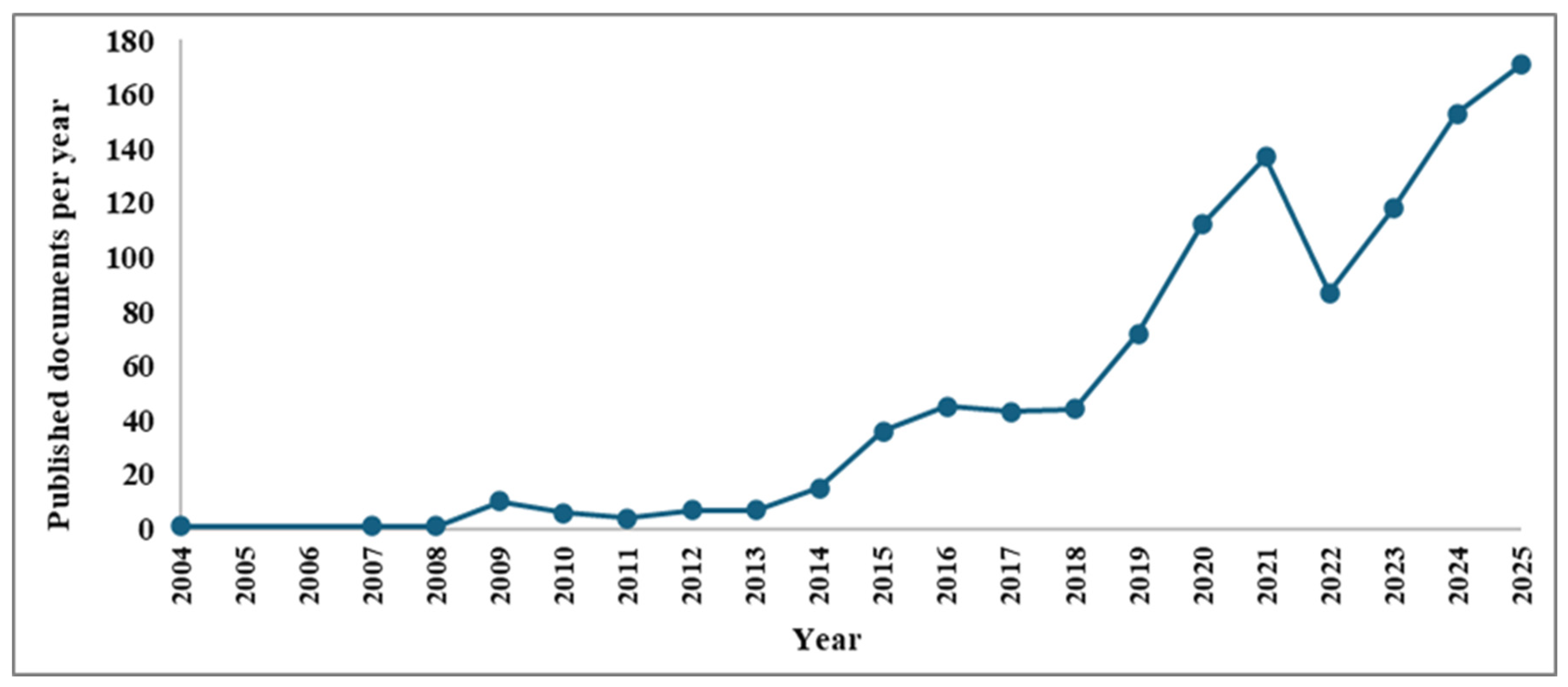
OPC-based concrete is prone to crack propagation owing to its low tensile strength, limited toughness, ductility, and its inherently brittle nature. Despite geopolymers being utilised as an alternative to OPC, they remain vulnerable to early-age cracking and void formation within internal structures, which adversely impact the structural integrity and durability [17,18]. The development of these cracks and voids facilitates the ingress of liquids and chemicals, which leads to the corrosion of the steel reinforcement. This process ultimately results in a decrease in the structural service life and structural failure [19,20]. Annually, a substantial global budget is allocated for the renovation of existing concrete structures. While concrete production is relatively cost-effective, the associated maintenance and repair costs can be considerably higher, often exceeding initial construction costs on a per-volume basis [21]. For specific construction projects, 20% of repairs deteriorate within five years, and 55% within ten years. Consequently, this approach is not sustainable [22]. Numerous repair techniques rely on non-renewable resources and generate waste, raising concerns about their environmental impacts [23]. Self-healing concrete has emerged as an innovative solution to these issues in recent years. Figure 1 illustrates the increasing trend in publications on self-healing concrete over recent years, compiled from the Scopus database. The trend shows a very slow growth in publications between 2004 and 2013, with fewer than 10 papers per year. A noticeable increase begins around 2014, reaching approximately 35 publications by 2015. From 2018 onward, the growth becomes more pronounced, with a sharp rise after 2019. The peak occurs in 2025 with nearly 170 publications, indicating a significant surge in research interest in recent years.
To enhance structural durability and reduce maintenance requirements, self-healing concrete is engineered to repair cracks without external intervention [24]. However, concrete self-healing may occur through two mechanisms: natural/autogenous and artificial/autonomous [25,26]. In OPC-based concrete, autogenous healing occurs through the hydration of unreacted cementitious materials. This process encompasses the sealing of cracks through the presence of solid materials within water, the swelling of C-A-S-H within the crack, and the crystallisation of CaCO3 [27]. Geopolymer composites, which do not contain OPC components, nonetheless possess healing mechanisms; however, these mechanisms are fundamentally distinct from those observed in cement-based composites. If residual fly ash or pozzolanic material persists and moisture infiltrates through cracks, additional geopolymerisation may occur, potentially sealing microcracks through the dissolution of aluminosilicates and the formation of a more extensive sodium aluminosilicate hydrate (N-A-S-H) gel [28]. However, there are certain limitations of this autogenous healing process. Firstly, this mechanism may be effective for small-scale cracks (<0.2 mm). The efficiency of this process diminished once the reactive material is consumed [29,30]. Consequently, in recent decades, researchers have shown considerable interest in developing artificial healing agents. Recently, the most popular autonomous healing method is bacteria-based healing. Certain bacteria can survive in concrete for up to 200 years in a dormant state. They may wake up and initiate metabolic reactions when sufficient oxygen and moisture penetrate cracks in the concrete. These metabolic reactions produce CaCO3, which heals the cracks [31]. Once the crack has healed, the bacteria enter a dormant state and may become active again when a future crack form [32]. However, there are certain limitations of this microbial-induced calcium carbonate precipitation (MICP), including high cost for large-scale construction projects and slow MICP process [33], uncertainty of bacterial survival and healing the cracks in the high pH and unfavourable environment inside the concrete [34], and potential risks from antibiotics such as polymyxin, difficidin, subtilin, and mycobacillin generated by microorganisms through MICP process [35]. Therefore, current research is also exploring alternative and sustainable approaches to heal cracks, such as enzyme-induced calcium carbonate precipitation (EICP) [36], crystal admixture [37], fibres [38], and encapsulation [39].
This research primarily examines geopolymer systems to assess the efficacy of various healing agents in promoting self-healing. Nonetheless, the self-healing properties of numerous healing agents incorporated into the geopolymer system remain an emerging field, with several agents, such as crystalline admixtures and enzyme-based healing, still lacking comprehensive exploration. In recent years, a number of review articles concerning self-healing have been published, predominantly concentrating on Portland cement (OPC)-based systems [33,40]; only a limited number have addressed the geopolymer system, with a primary focus on bacteria-based healing methods [41]. A recent review conducted by Luhar et al. [42] concentrated on the progression of the self-healing efficiency of various self-healing agents within the geopolymer system. However, this review did not provide a detailed mechanistic explanation of the various healing agents, such as crystalline admixtures and enzyme-based healing agents. Furthermore, most of these healing agents were primarily developed to examine the healing efficiencies in standard OPC-based systems; consequently, there is a deficiency in systematic reviews comparing the healing mechanisms between OPC and geopolymer systems. Therefore, this study presents a comparative investigation of OPC and geopolymer systems to facilitate an understanding of the underlying healing mechanisms. This study revealed that crystalline admix is most suited for the OPC-based system due to the presence of Ca(OH)2. However, this admix can also be promising in the geopolymer system with Ca-rich precursors, such as slag and providing externally hydrated lime. Other healing agents, such as enzyme-based systems, have not been explored in the geopolymer yet, but show good potential, as the geopolymer possesses a high pH for urease activity and can be more effective if Ca-rich precursors are used.

2. Various Techniques for Self-Healing of Concrete

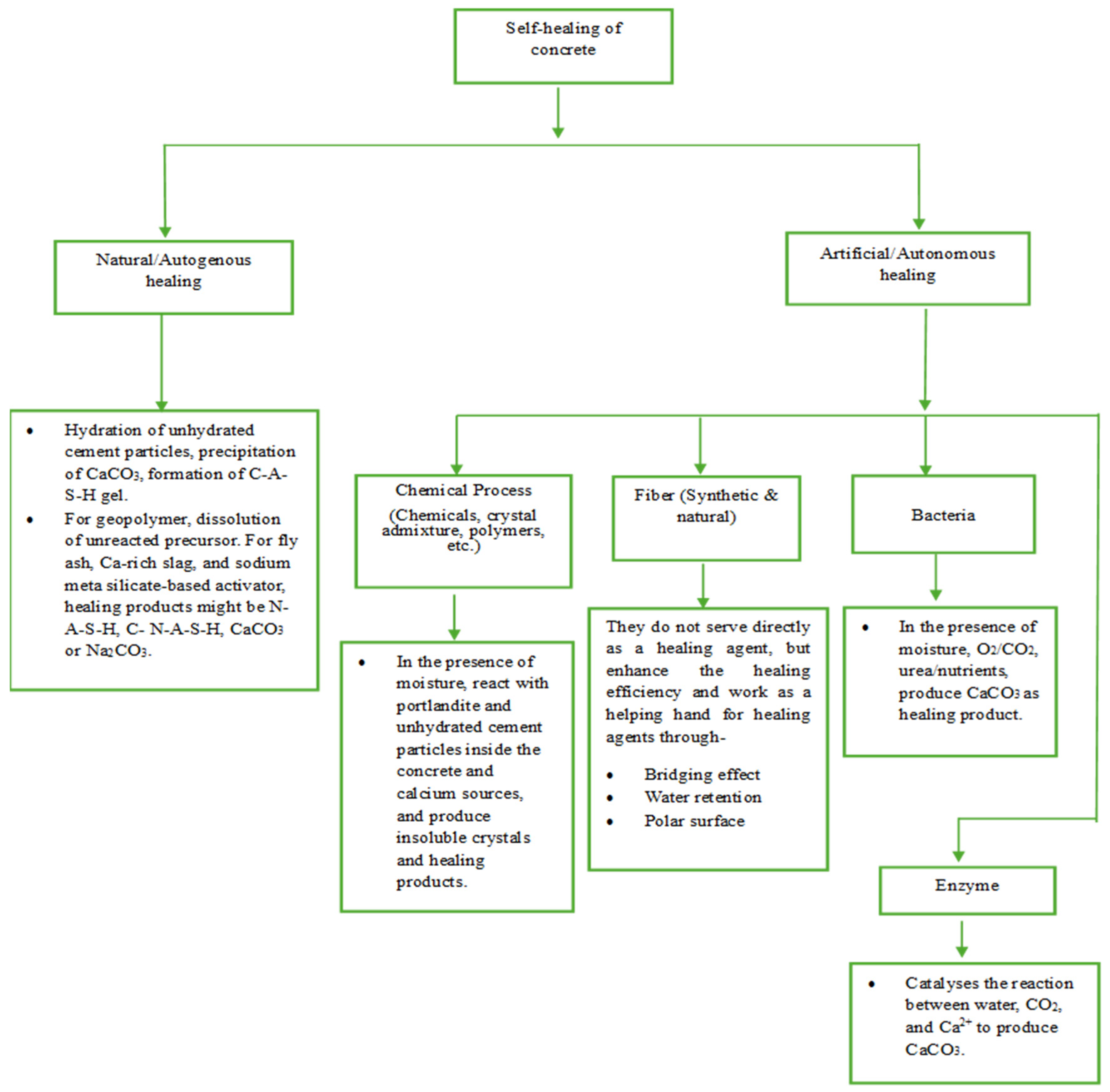
Self-healing in concrete refers to the material’s ability to repair internal fissures through various techniques that facilitate its self-repair. Figure 2 depicts the classification of self-healing techniques, including autogenous and autonomous healing. Autogenous healing refers to the intrinsic and natural ability of materials to seal and partially close cracks without the addition of external healing agents, primarily through continued hydration of unreacted cement particles/precursors and carbonation of calcium hydroxide in the presence of moisture [21]. This mechanism is generally limited to small crack widths and is strongly dependent on environmental conditions, particularly water availability. Autonomous healing constitutes a deliberately engineered self-healing mechanism whereby externally introduced healing agents are intentionally integrated into the concrete matrix. These agents are activated upon crack formation, without external intervention, to facilitate crack sealing and, in certain instances, enable partial or complete restoration of material performance [42].

2.1. Autogenous Healing

A key factor in autogenic self-healing is the hydration of unhydrated cement within the matrix. In traditional concrete, approximately 20–30% of cement particles remain unhydrated [21]. If concrete begins to crack, unhydrated cement particles react with water that enters the cracks. This reinitiates hydration, producing products that help fill the cracks. This natural self-repair process is called autogenous healing [43]. The autogenous healing process can occur in various ways:
(a)
Ca(OH)2 or CaCO3 precipitate, thereby obstructing the crack.
(b)
Hydration of unhydrated cement particles.
(c)
Impurities in water contribute to crack blocking.
(d)
Expansion/swelling of C-A-S-H or C-N-A-S-H gel for OPC or fly ash-slag-based geopolymer composites.
Among all natural healing mechanisms, the formation of CaCO3 and Ca(OH)2 is the most efficacious, and it occurs through the following processes:
H2O + CO2 → H2CO3
H2CO3 → H+ + HCO3
HCO3 → 2H+ + CO3
Ca2+ + CO3 → CaCO3
Ca2+ + HCO3 → CaCO3 + H+
Among all autogenous healing processes, the formation of CaCO3 and Ca(OH)2 is the most efficacious. In natural healing, the predominant precipitation of CaCO3 occurs at the surface of the crack [44]. Research indicates that self-healing mechanisms are effective in repairing small cracks ranging from 20 µm to 100 µm [45,46]. To enhance autogenous healing, researchers employed various techniques. Zhao et al. [45] introduced various curing conditions, including air, water, NaOH, and Ca(OH)2 solutions, to promote autogenous healing in fly ash and slag-based geopolymer composites. The results demonstrated that the self-healing capacity of the geopolymer in saturated Ca(OH)2 and 7% NaOH solutions was significantly greater than in air and water. To enhance concrete’s self-healing properties, supplementary cementitious materials such as fly ash, blast furnace slag, and anhydrite can be added. For instance, Concrete mixtures containing a high proportion of granulated blast furnace slag can effectively repair cracks narrower than 50 µm in width [47]. Utilising Na2CO3 solution for carbonation facilitates the repair of internal cracks within concrete [48]. Both anhydrites and Na2SO4 simultaneously enhance the concrete’s self-healing ability [49]. This form of healing can occur in any cementitious material when certain conditions are met, such as crack widths of 50 µm to 100 µm and the presence of water.
Limited studies have assessed the autogenous healing capabilities within geopolymer matrices and reported that cracks less than 50 µm can heal, contingent on environmental conditions and material properties. Guo et al. [50] observed that autogenous self-healing reduced the average crack width up 66% after 28 days of self-healing of fly ash-based geopolymers under water immersion conditions. Furthermore, the authors found that the self-healing phases are amorphous aluminosilicate phases (N (C)-A-S-H gel) and CaCO3. Similarly, Nguyễn et al. [51] identified the C-(N)-A-S-H gel as the principal self-healing phase in geopolymer composites consisting of fly ash, ground granulated blast furnace slag, and silica fume. Nevertheless, this investigation documented limited autogenous healing efficiency of these geopolymer compositions at 28 days under water-curing conditions. Cracks with widths less than 50 µm were healed entirely; however, those with widths ranging from 50 µm to 150 µm experienced only partial healing.
Inherent natural constraints limit autogenous healing in OPC-based concrete. Its effectiveness largely depends on the availability of unhydrated cement particles and Ca(OH)2, which hydrate and subsequently precipitate C-S-H gel and CaCO3 upon ingress of water and CO2 into cracks, thereby assisting in sealing them. Nevertheless, this process is highly dependent on adequate moisture, CO2 availability, and the presence of reactive cement phases. In practice, once a structure undergoes drying or carbonation, the number of unhydrated particles decreases significantly, leading to a rapid decline in healing efficacy. Furthermore, mechanical recovery remains limited, and existing standards primarily recognise autogenous healing in water-retaining structures, highlighting constraints for broader structural applications [52].
Conversely, composites derived from geopolymers, which are frequently produced from alkali-activated slag or fly ash, have their own limitations regarding autogenous healing. In the absence of inherent calcium, geopolymers rely on alternative mechanisms, such as continuous geopolymerisation, the formation of secondary N-A-S-H or C-A-S-H gels, and the precipitation of carbonates when calcium sources, such as slag or added Ca(OH)2, are reintroduced [53]. The majority of the binder is consumed during the initial curing process, leaving little unreacted material for subsequent reactions. Consequently, healing requires moist curing conditions, calcium, and proficient crack management. Geopolymers generally exhibit slower reaction rates and poorer crack-sealing than PC, and mechanical restoration is frequently only partial [42].
When comparing the two systems, OPC shows greater potential for autogenous healing within its limited crack range (<100 µm), primarily through hydration and carbonation. However, this effectiveness rapidly declines if moisture or reactive phases are depleted or absent. Meanwhile, geopolymers offer more sustainable alternatives with self-healing capabilities facilitated through geopolymer reactions and carbonate formation. However, these materials require carefully controlled conditions, particularly regarding calcium availability, moisture levels, and crack widths. Geopolymers generally exhibit slower, less complete healing than OPC. Both systems demonstrate limited recovery of mechanical strength, particularly as cracks enlarge. However, geopolymers offer greater flexibility owing to their chemical composition and can be enhanced with additives to ensure more reliable healing under controlled conditions.

2.2. Autonomous/Artificial Healing

Autonomous healing is a method in which external healing agents are incorporated into concrete to facilitate the repair of cracks. Researchers have employed various chemical and biological techniques to achieve self-healing properties in concrete [54]. The subsequent subsections focus on the existing literature regarding various healing agents and their effectiveness in repairing concrete cracks. Table 1 and the following section summarise the healing efficiency of both OPC and geopolymer systems incorporated with different healing agents.

2.2.1. Chemical Process

This method represents an autonomous healing procedure in which chemical compounds are applied to concrete cracks. The agents employed for chemical crack remediation, including crystalline admixtures and polymers, collaborate to generate specific end products [44]. These products comprise insoluble crystals and polymer networks that effectively seal the cracks.
Crystaline Admix
Crystalline admixtures (CAs), including silica-based, calcium-based, and alumina-based varieties, are commercially available additives that interact with moisture in freshly mixed concrete and with by-products of cement hydration. This interaction leads to the formation of insoluble crystals that facilitate crack repair. These crystals, utilised in commercial applications, consist of chemical elements such as silica, calcium, and other constituents commonly present in sand and cement alumina. These CAs, characterised by water reactivity and hydrophilicity, augment the density of calcium silicate hydrate (CSH), thereby forming a surface barrier that inhibits water ingress [40]. This interaction leads to the formation of insoluble crystals, which facilitate the natural repair of cracks and can repair cracks measuring between 0.2 and 0.4 mm [67]. Sisomphon et al. [44] conducted a study utilising a mixture containing 10% calcium sulfoaluminate-based expansive additive and 1.5% crystalline additive by weight of OPC to evaluate the self-healing capacity of OPC-based mortar. The results indicated that cracks measuring 0.1–0.4 mm were completely sealed, and water permeability was reduced to zero within 28 days. Hermawan et al. [56] conducted a study utilising a 1% commercial CA (Penetron) by mass of OPC to examine the healing efficiency of concrete. The Penetron admix contains a proprietary blend of active chemicals that react with moisture in fresh concrete and with the hydration by-products of cement. This reaction triggers a catalytic process that leads to the formation of non-soluble crystals throughout the concrete’s pores and capillaries. The exact formulation remains confidential by the manufacturer [56]. This study found that after 121 days of complete water immersion, the 0.4 mm crack width was fully repaired.
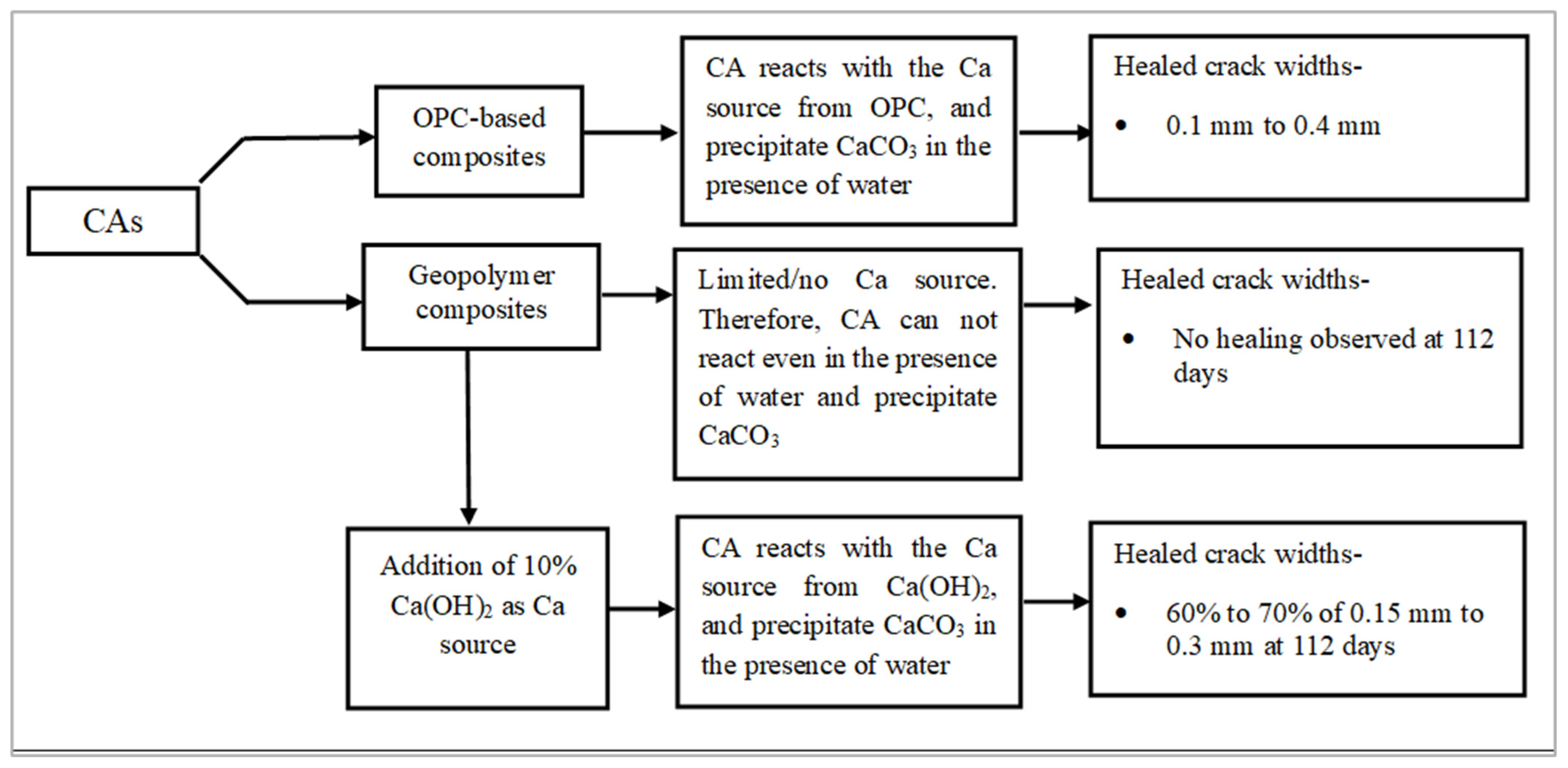
Although crystalline admixtures showed promising results in OPC-based concrete, limited research has investigated their healing efficiency in geopolymer composites. Zhang et al. [55] incorporated 7% powder Ca(OH)2 to observe the self-healing of slag-based geopolymer mortar by introducing cracks of varying ranges from 50 µm to 500 µm. After a 32-day curing period in deionised water at 20 °C, crack widths of 50–100 µm exhibited the highest healing capacity. Furthermore, the crack-healing efficiency decreased significantly as the crack width increased. The incorporation of CAs in geopolymer concrete has demonstrated measurable improvements in self-healing performance when combined with calcium sources. Borçato et al. [68] investigated metakaolin-based geopolymer pastes containing CAs and hydrated lime (HL) to assess crack closure efficiency over 112 days. Initial cracks were induced with widths ranging from 0.15 mm to 0.30 mm. Specimens without HL showed negligible healing due to the geopolymer matrices’ inherently low calcium content.
In contrast, mixes with 10% HL and CA achieved partial crack sealing, with up to 60–70% closure observed in cracks ≤ 0.20 mm, primarily through the precipitation of calcite and vaterite and the formation of C-A-S-H gel within the crack interface. Microstructural analysis confirmed that CA accelerated crystal growth in the presence of moisture, while HL provided essential Ca2+ ions for mineralisation. These findings indicate that CAs alone are insufficient for effective healing in geopolymers; however, their synergy with calcium-rich additives substantially improves healing efficiency and mechanical recovery, thereby suggesting a feasible pathway for the development of durable geopolymer composites suitable for aggressive environments.
Figure 3 represents the mechanisms and the comparison of the crack healing efficiency of CAs in the OPC and geopolymer-based composites. The effectiveness of CAs in OPC systems is primarily due to the presence of abundant Ca(OH)2 and unhydrated cement particles, which provide the necessary Ca2+ for the growth of crystalline structures within cracks. However, in geopolymer concrete, the performance of CA is significantly limited because the matrix is aluminosilicate-based and contains very small amounts of calcium. This calcium deficiency limits the formation of calcium-dependent crystalline products, thereby reducing the effectiveness of the healing process compared to OPC concrete. To overcome this limitation, the addition of unhydrated lime (Ca(OH)2) to geopolymer mixes has been shown to enhance the efficiency of CA. Lime acts as an additional source of calcium, enabling the formation of crystalline compounds such as CaCO3, similar to those in OPC systems, and improving crack-sealing capability. This approach demonstrates that calcium availability is a critical factor in the success of CA-based self-healing, and targeted supplementation can make CA more compatible with low-calcium binders such as geopolymers.
Polymers
In OPC systems, polymer healing agents, primarily superabsorbent polymers (SAPs), function through physical swelling to seal crack openings and provide internal curing water. This process promotes continued cement hydration and facilitates the formation of CaCO3 along crack surfaces. The integrated physical and chemical mechanism depends on the presence of calcium-rich hydrates, such as Ca(OH)2 and C-S-H, as well as on ambient moisture cycles [69]. Feiteira et al. [57] reported that incorporating a superabsorbent polymer into concrete can facilitate the healing of cracks up to 20 µm in width. Again, Chindasiriphan et al. [70] improved the healing performance of concrete by utilising superabsorbent materials and fly ash, successfully achieving satisfactory crack repair with a width of 0.25 mm within 28 days. Suleiman et al. [71] employed µCT and three-dimensional image analysis to quantify the recovery of crack volume in OPC mortars with SAP dosages ranging from 0.5% to 2% of the cement mass under various healing conditions. This study demonstrated that specimens containing 1% SAPs subjected to combined temperature and humidity fluctuations exhibited reduced self-healing capability, with a healing efficiency of approximately 6.58%. Conversely, when specimens experienced cyclic wetting-drying and water submersion, their healing efficiency increased to 19.11% and 26.32%, respectively, at the exact SAP dosage. Moreover, Snoeck et al. [72] reported that SAPs decreased permeability and sealed cracks up to approximately 130 µm during wet–dry cycles, through swelling and the consequent promotion of secondary hydration and CaCO3 precipitation near crack surfaces. Recent non-destructive ultrasonic assessments have demonstrated a recovery of up to 100% in ultrasonic velocity and approximately 50% crack closure (250–450 µm) in SAP concretes following wet–dry curing [73]. This underscores the potential of SAPs to restore transport properties, even if complete geometric closure is not attained.
Research on the self-healing capabilities of geopolymer concrete with polymers is in its preliminary stages, with fewer investigations than for OPC systems. Some of these studies report promising results, showing that polymer-based agents, such as elastomeric additives and encapsulated silicate compounds, significantly improve crack-sealing performance. These approaches offer healing mechanisms that do not depend on calcium, thus rendering them appropriate for low calcium geopolymer matrices. Rahman et al. [74] evaluated an elastomeric polymer additive known as “R additive” in fly ash–based geopolymer cement designed for oil-well applications. Results demonstrated that elevating the R additive content from 10% to 25% by weight resulted in a 116.67% increase in plastic viscosity, and the yield stress increased from 3.8 N/m2 to 12.3 N/m2. Importantly, the formulation containing 25 wt.% R additive effectively sealed pre-cracked cement sheaths under a pumping pressure of 100 psi and a flow rate of 4.8 barrels per minute, demonstrating its capacity for viscoelastic, pressure-driven crack closure even in macro-scale leakage scenarios. Another approach involves the utilisation of microcapsules infused with sodium silicate integrated within the geopolymer matrix. Ozen et al. [29] demonstrated that at 60 °C and below 100% relative humidity, these capsules attained approximately 91.6 ± 18.5% crack sealing, in addition to restoring mechanical strength and decreasing sorptivity. Characterisation employing XRD, FTIR, and SEM-EDX confirmed that amorphous aluminosilicate-based products, rather than calcium-based phases, were formed within the cracks. These polymer-based approaches effectively address the limitations of calcium-dependent healing in geopolymers, highlighting the adaptability and potential of polymers to enhance the integrity and longevity of alkali-activated concrete systems.
In summary, the self-healing mechanisms and their effectiveness in polymer-based cementitious systems vary between OPC and geopolymer concretes. In OPC, SAPs primarily function through swelling and facilitating internal curing, thereby supporting secondary hydration and the formation of CaCO3. Studies indicate crack closure from 20 µm to 0.25 mm, with healing efficiency enhanced by wet–dry cycles and water immersion, achieving up to 26% recovery and notable decreases in permeability. Research on geopolymer concrete is limited but demonstrates potential. Elastomeric polymers exhibit substantial rheological improvements and effectively seal macro-scale cracks under high-pressure conditions. Meanwhile, sodium silicate microcapsules achieved over 90% crack sealing and strength recovery by forming aluminosilicate gels. These findings suggest that polymer-based methods provide calcium-independent healing, rendering them suitable for low-calcium geopolymer matrices.

2.2.2. Fibres

Although fibres do not directly serve as healing agents, they can enhance healing efficiency by restricting crack propagation through bridging. Fibres may also function as water absorption sites, and certain fibres possess a high polar surface area to facilitate CaCO3 precipitation. Therefore, the presence of fibres in the concrete matrix provides additional benefits to healing agents. Fibres in self-healing concrete are primarily classified into two categories: natural and synthetic. Natural fibres, derived from botanical, animal, or mineral sources such as jute, coir, sisal, areca nut husk fibre (ANHF), and flax, primarily function by bridging cracks to restrict their width and by having a high polar surface, thereby supporting healing mechanisms [75,76]. Synthetic fibres, including polypropylene, polyethylene, polyester, and polyvinyl alcohol (PVA), not only limit crack propagation but can also actively enhance healing, especially PVA, by promoting precipitation of healing products like CaCO3 within cracks [77,78]. Therefore, fibres facilitate the reduction in crack width and aid the transport of healing agents through two primary mechanisms: (a) polar surface and water retention; (b) bridging effect. Thus, fibres can enhance the efficiency of both autogenous and autonomous healing in concrete. The following section will discuss each fibre category in detail, including their mechanisms and roles in self-healing.
Polar Surface and Water Retention Behaviour of Fibres
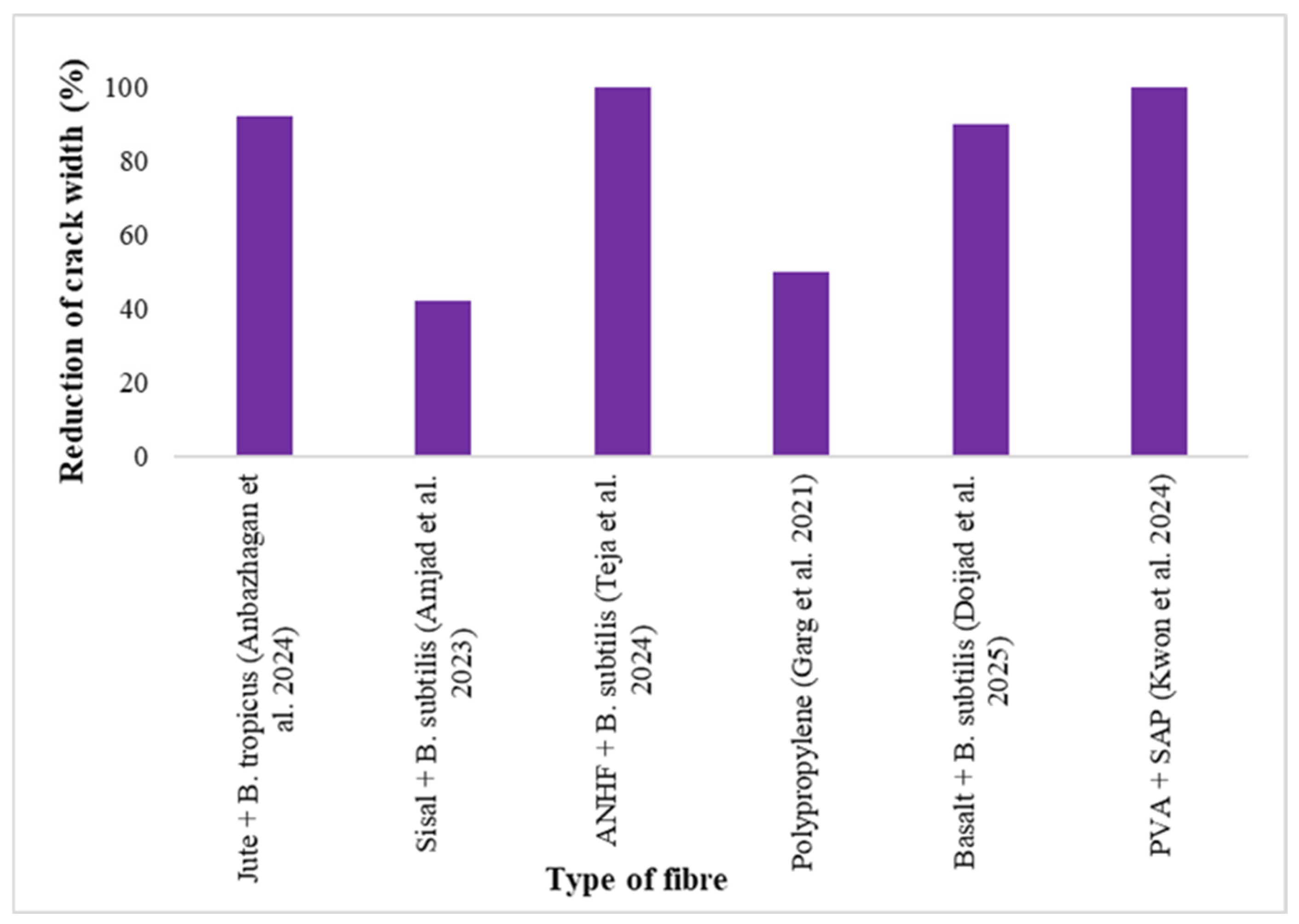
Natural fibres such as jute, coir, sisal, and areca nut husk fibre (ANHF) exhibit high polarity due to the presence of hydroxyl (-OH) and carboxyl (-COOH) groups within their cellulose and hemicellulose structures. This surface chemistry enhances water retention and attracts calcium ions, thereby forming localised nucleation sites for CaCO3 precipitation that serve to seal cracks [79]. For example, the combination of jute fibres with Bacillus tropicus in wet curing resulted in 88% strength recovery and 92% crack healing efficiency. In contrast, ANHF with B. subtilis fully sealed cracks up to 0.813 mm [58]. The incorporation of coir fibres into self-compacting OPC concrete (at 1% of cement weight) resulted in an approximate 12.8% increase in compressive strength, reduced cracking, and improved fracture patterns [80]. Sisal fibres infused with microbes repaired cracks up to 1.32 mm in length within 28 days, enhanced both tensile and compressive strengths, and facilitated significant CaCO3 deposition [81].
Synthetic fibres exhibit considerable variation in their polarity and capacity to facilitate healing. Polypropylene (PP) fibres are non-polar and predominantly assist in healing through mechanical crack bridging, which is effective for cracks lower than 0.5 mm [82]. Conversely, glass and basalt fibres possess moderate polarity and, when surface-treated, enhance bonding with the matrix. The utilisation of basalt fibres in conjunction with B. subtilis has achieved over 90% healing for cracks up to 0.4 mm [83]. Polyvinyl alcohol (PVA) fibres are distinguished among synthetic materials due to their abundant hydroxyl (-OH) groups, which confer a high level of polarity akin to that of natural fibres. In OPC mortars containing PVA and SAP, almost complete healing was observed in cracks measuring 300 µm [84]. When incorporated into geopolymer mortars at a dosage of 1.2% by volume, PVA markedly increased the yield stress and viscosity of the mixture, thereby demonstrating substantial crack-bridging capabilities [85,86]. Ziada et al. [87] investigated 3D-printed geopolymer mortars composed of fly ash and silica fume, reinforced with PVA fibres ranging from 0% to 1.5%, and treated with Sporosarcina pasteurii. Cracks observed during flexural testing at 28 days were sealed through CaCO3 deposition, resulting in a 36.2% enhancement in flexural strength and an 11.6% reduction in capillary water absorption relative to control specimens. The study conducted by Nishiwaki et al. [59] demonstrated that among various synthetic fibres, PVA displayed the highest potential for self-healing, attributable to its water retention capabilities and negatively charged polar surface. The key mechanism of PVA-induced CaCO3 precipitation is as follows:
  • Water retention: PVA fibres absorb and retain water from their surroundings.
  • Surface charge and ion attraction: PVA fibres have a negatively charged surface, which attracts positively charged Ca2+ ions from the surrounding concrete matrix.
  • Dissolution of CO2: CO2 from the environment dissolves in water and forms C O 3 2 through the following reactions:
CO2 + H2O → H2CO3 (carbonic acid)
H 2 CO 3     H + + H C O 3   H + + C O 3 2
  • CaCO3 precipitation: Ca2+ attracted to the fibre surface reacts with C O 3 2 to form CaCO3, which precipitates and fills the crack:
Ca 2 + + C O 3 2 CaCO 3
Bridging Effect of Fibres
Natural fibres such as jute, coir, sisal, and ANHF exhibit significant crack-bridging capabilities, attributable to their high aspect ratios and surface polarity. When jute fibres are utilised in conjunction with Bacillus tropicus during the wet-curing process, they achieve a crack healing efficiency of 92%, maintaining crack widths within the optimal range for autogenous healing [79]. The addition of coir fibres (1% by cement weight) to self-compacting concrete resulted in approximately a 12.8% increase in compressive strength and reduced crack formation [80]. Sisal fibres infused with Bacillus subtilis effectively healed cracks up to 0.48 mm during the initial cycle and 0.28 mm in the subsequent cycle, while also reducing plastic-shrinkage cracks by 56% [88]. When combined with B. subtilis, ANHF completely sealed cracks measuring 0.813 mm within 6 days [58].
Synthetic fibres exhibit different mechanisms in crack-healing processes. Polypropylene (PP) fibres, despite their non-polar nature, facilitate healing by mechanically bridging cracks and can support natural healing of cracks up to approximately 0.5 mm [89]. Basalt fibres with B. subtilis achieved over 90% remediation of 0.4 mm cracks through a synergistic combination of mechanical and microbial mechanisms [83]. Glass fibres enhance flexural strength and mitigate microcracks. In contrast, carbon fibres provide substantial tensile reinforcement but primarily arrest crack propagation, rather than facilitating chemical healing. PVA fibres are distinguished among synthetic fibres due to their polar -OH groups, which facilitate crack bridging, water retention, and ion attraction. A hybrid mortar incorporating PVA and SAP demonstrated near-complete healing of cracks measuring 300 µm [84]. In geopolymer systems, engineered geopolymer composites (EGC) reinforced with PVA fibres exhibited strain-hardening behaviour and effective microcrack control [90].
Overall, fibres with polar surfaces, including natural fibres and PVA, provide combined advantages by facilitating mechanical crack control and chemical healing. Conversely, non-polar synthetic fibres primarily serve as structural reinforcements. Figure 4 illustrates the efficiency of reducing crack widths ranging from 0.3 mm to 0.8 mm across various types of fibres with differing healing properties agents. Table 2 summarises the healing efficiency and self-healing effect of different types of fibre with/without healing agents.

2.2.3. Bacteria

Bacterial-based healing represents a practical approach for repairing cracks. Depending on the specific bacterial strain, elevated pH levels in concrete can maintain bacterial dormancy for up to 200 years [41]. Bio-self-healing concrete, also known as this biologically driven approach, involves adding particular strains of bacteria to the concrete mix. Bacteria belonging to the Bacillus genus can endure the harsh environment of concrete. They remain dormant until cracks form and water infiltrates the structure, triggering their activation. Once activated, they utilise nutrients to produce CaCO3, a form of MICP. This calcium carbonate precipitates within cracks, effectively sealing them and restoring concrete’s structural integrity [91]. Ureolysis and Oxidation-based Pathways are particularly significant among the various MICP mechanisms employed in concrete healing. The process of concrete healing mediated by MICP encompasses the following mechanisms.
MICP Through Ureolysis
Under the highly alkaline or acidic conditions prevalent in concrete, bacteria can survive, adapt, and even produce spores. These spores remain dormant and exhibit resistance to elevated temperatures, pressure, dehydration, and chemical influences. They can revert to a metabolically active state when water and nutrients become accessible [91]. Once activated, bacteria synthesise the urease enzyme, which facilitates the conversion of urea (CO(NH2)2) into carbonate ions (CO32−) and ammonium ions (NH4+) [92]. Initially, 1 mol of urea undergoes hydrolysis within the cell to produce 1 mol of ammonia and 1 mol of carbamate (Equation (9)). Equation (10) shows that the hydrolysis of carbamate inherently releases one mol of ammonia and carbonic acid. Equations (11) and (12) show that these products produce 1 mol of bicarbonate and 2 mol of ammonium and hydroxide ions. This overall process increases pH, shifts the bicarbonate equilibrium, and promotes the formation of carbonate ions (Equation (13)). The bacteria absorb cations such as Ca2+ from their environment due to the attraction exerted by their negatively charged cell walls. Equations (14) and (15) describe the reaction between Ca2+ and O32− ions, leading to the formation of CaCO3 on the cell surface, which serves as a nucleation site [92].
(CO(NH2)2) + H2O → NH2COOH + NH3
NH2COOH + H2O → NH3 + H2CO3
H 2 CO 3     H C O 3 + H +
2 NH 3 + 2 H 2 O     C N H 4 + + H +
H C O 3 + H + + 2 N H 4 + + 2 O H   C O 3 2 +   2 N H 4 + + 2 H 2 O
Ca2+ + Cell → Cell − Ca2+
Cell Ca 2 + + C O 3 2 Cell CaCO 3
MICP Through Oxidation
The MICP process via aerobic oxidation of organic compounds offers a promising non-ureate pathway for self-healing concrete. Initially, bacterial spores germinate upon exposure to favourable conditions such as moisture, oxygen, and nutrients (organic compounds such as Calcium lactate). These spores develop into active vegetative cells capable of performing metabolic functions. Once active, Calcium lactate (CaC6H10O6) is oxidised in the presence of O2 and produces CaCO3, CO2 and H2O (Equation (16)). Next, the process involves the hydration of CO2 to form carbonates. The released CO2 dissolves in water and reacts through hydration (Equation (17)). Bacterial metabolism increases the local pH, thereby shifting the equilibrium toward the formation of CO32− ion. In the final stage of calcite precipitation, calcium ions (Ca2+) derived from calcium lactate interact with CO32− ions to produce and precipitate solid CaCO3 (Equation (18)) [93].
CaC6H10O6 + 6O2 → CaCO3 + 5CO2 + 5H2O
CO 2 + H 2 O     H C O 3 + H +
Ca2+ + CO32− → CaCO3
Factors Influencing Bacterial Viability
A multitude of studies have investigated the impact of environmental and chemical factors, including pH, temperature, calcium availability, and curing conditions, on MICP performance and bacterial growth. In the context of pH, the urease enzyme’s capacity to catalyse urea hydrolysis is a pivotal factor in the formation of CaCO3 [94,95]. Similarly, temperature plays a vital role, influencing enzymatic reactions such as urease catalysis. The sensitivity of these reactions to temperature variations directly impacts the kinetics of calcium carbonate formation [96]. Additionally, the availability of calcium sources and curing conditions directly impacts the MICP process [97]. The following sections will illustrate the influences of pH, temperature, calcium sources and curing conditions on bacterial viability and MICP.
  • Impact of pH
pH levels critically influence bacterial survival, metabolic processes, and urease activity within concrete structures. The pore solution of concrete exhibits a highly alkaline pH of 12 to 13, attributable to Ca(OH)2, whereas the crack mouth generally exhibits a pH of 9 to 11 due to water ingress [98]. At very high pH levels (12–13), vegetative bacterial cells such as Sporosarcina pasteurii transition into spores, which can germinate back into active cells when environmental conditions become conducive, such as lower pH and increased nutrient availability [99]. Different species exhibit varying pH tolerance. Table 3 shows pH tolerance levels of various bacterial species [98,100,101,102,103]. S. pasteurii and B. halodurans are considered one of the leading species owing to its capacity to withstand a broad spectrum of pH levels [104].
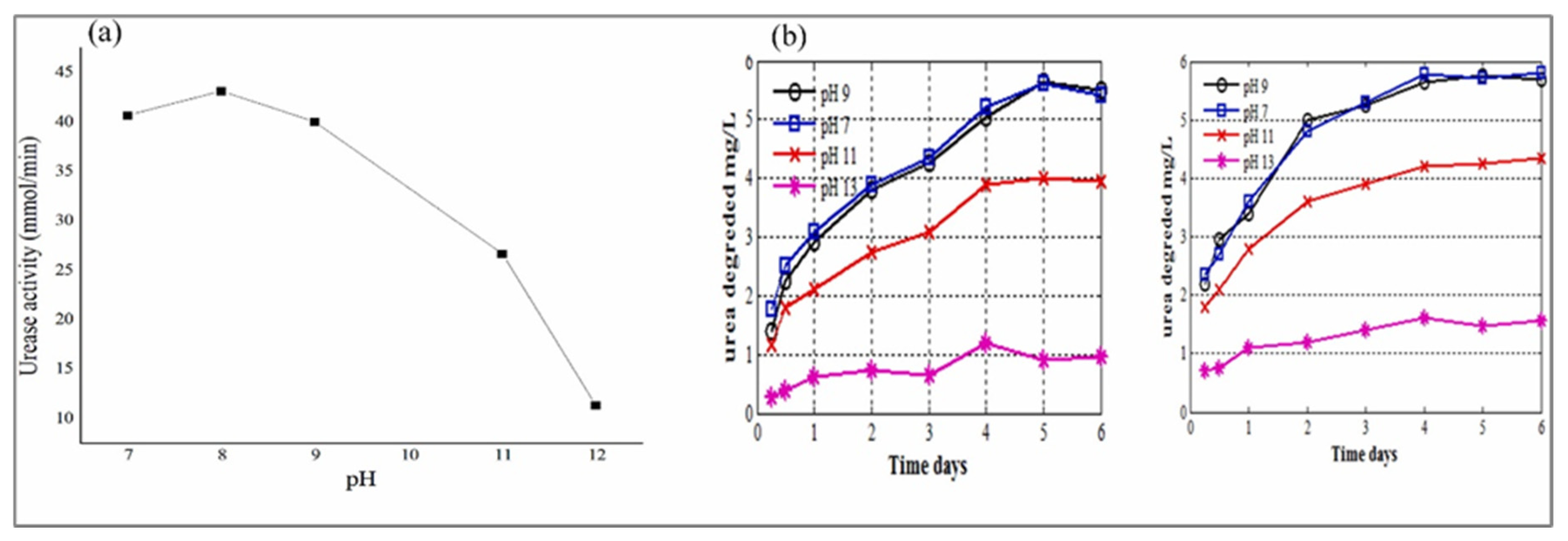
Furthermore, bacterial urea degradation is highly dependent on pH, as urease, the enzyme catalysing this process, exhibits optimal activity within a specific pH range. Most urease-producing bacteria exhibit maximum urea hydrolysis at neutral to slightly alkaline pH values (approximately pH 7 to 8), where the enzyme remains stable and operates efficiently. Urease activity diminishes sharply in highly acidic (below pH 4.5) or strongly alkaline environments, leading to a significant reduction in urea decomposition [105]. Figure 5a depicts the urease activity of Bacillus cereus across various pH levels of 7, 8, 9, 11, and 12. The maximum activity, recorded at 43.11 mmol/min, occurs at pH 8, with slightly lower activities of approximately 40.66 and 40 mmol/min observed at pH 7 and 9, respectively. As the pH rose to 11 and 12, urease activity further diminished to 26.66 and 11.33 mmol/min, respectively. Ureolysis intensified at a pH value below 11 [40]. Luhar and Gourav [106] observed that Bacillus sphaericus thrives over a pH range of 8 to 9. The results of urea hydrolysis by Lysinibacillus sphaericus and Sporosarcina pasteurii are depicted in Figure 5b. From the figure, it is conspicuous that Lysinibacillus sphaericus attained its maximum urease activity at pH 7 over a period of five days. Conversely, Sporosarcina pasteurii also exhibited its peak urea decomposition at pH 7.
  • Temperature
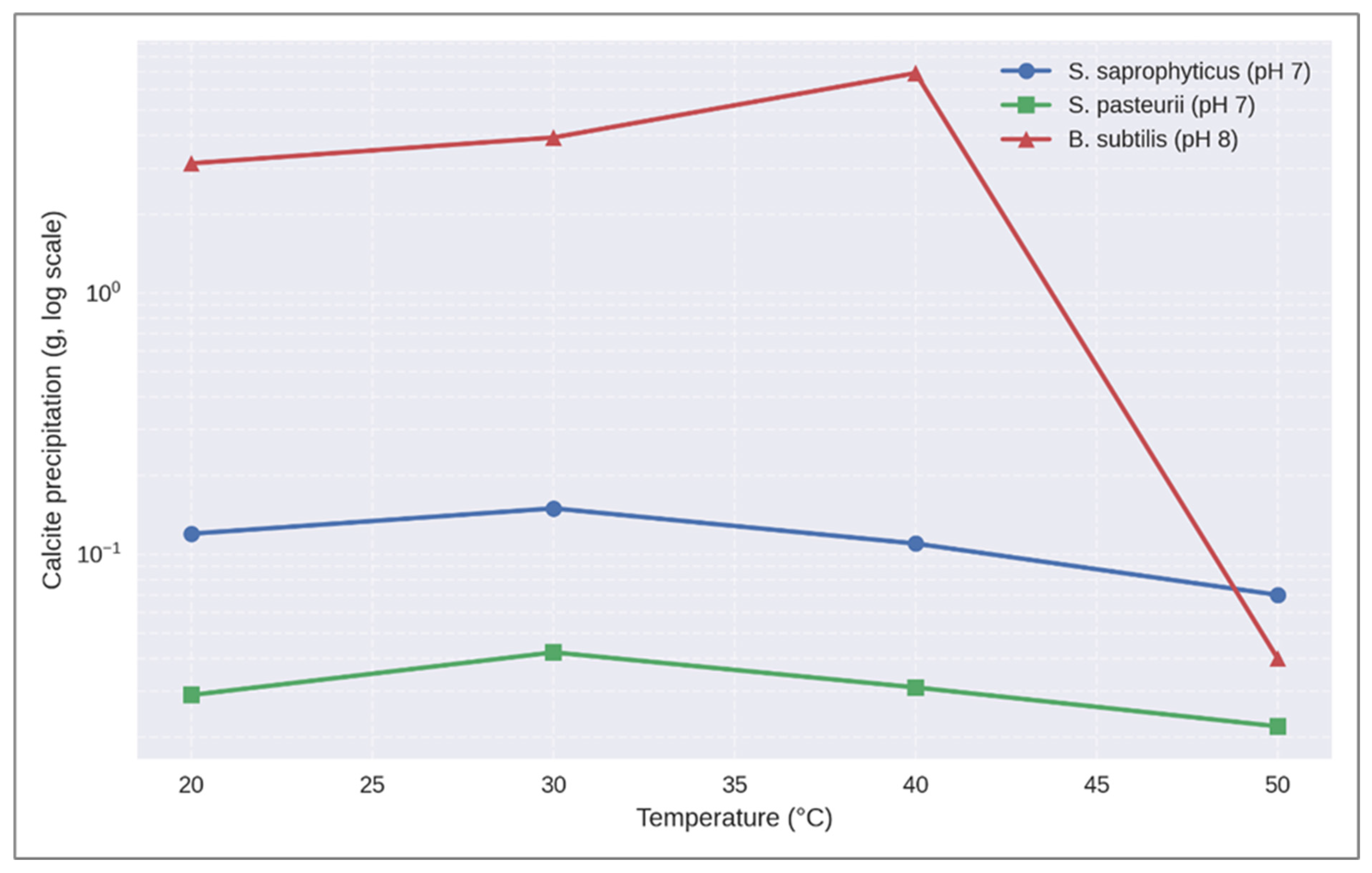
During curing, cement temperatures can reach 70 °C [107]. Temperature tolerance is essential for bacteria to survive within concrete, as elevated temperatures can suppress their proliferation [48]. B. sphaericus exhibits optimal growth at temperatures between 35 °C and 37 °C [67]. Conversely, B. subtilis can withstand significantly higher temperatures, reaching up to 70 °C. Reddy et al. [108] observed that strains of B. subtilis are capable of surviving within a temperature range of 30 °C to 70 °C. Huang et al. [109] documented bacterial proliferation at 10 °C, 28 °C, and 40 °C in a medium with a pH of 8. Wang et al. [101] noted that B. sphaericus demonstrated limited growth at 10 °C, with a 48 h lag phase. In contrast, at 28 °C, the lag phase was reduced to 12 h, indicating that temperature affects bacterial growth by altering the lag phase duration. According to Souza et al. [110], residual protease activity was observed across a range of temperatures, peaking between 40 °C and 50 °C. Even after 30 min at 80 °C, approximately 50% of the activity remained. Durga et al. [102] examined the effects of different temperatures (25–60 °C) on four bacterial strains: B. subtilis, B. licheniformis, B. cereus, and B. halodurans. Their findings indicated that B. subtilis demonstrated the most growth within the temperature range of 30 °C to 37 °C, B. licheniformis peaked at 37 °C, and B. cereus exhibited greater growth at 60 °C. B. cereus experienced a 10 h lag phase at 10 °C, compared to only 4 h at 28 °C and 40 °C. Figure 6 illustrates the influence of temperature and pH on calcite precipitation across various bacterial species. Both S. saprophyticus and S. pasteurii exhibited a similar trend: precipitation increased by approximately 25–45% from 20 °C to 30 °C, at pH 7, indicating optimal activity at moderate temperatures. Beyond 30 °C, the precipitation consistently diminished, with reductions of approximately 26–36% at 40 °C and 50 °C, indicating thermal inhibition at elevated temperatures [111]. In contrast, B. subtilis exhibited a dramatic response: calcite precipitation rose sharply between 20 °C and 40 °C, increasing by over 120% at 40 °C compared to 20 °C, highlighting strong temperature dependence under alkaline conditions. However, at 50 °C, precipitation dropped by more than 99%, indicating severe inhibition at elevated temperatures [95].
Furthermore, variations in the temperature resistance of the same bacterial species have been observed across different studies, possibly due to differences in the growing medium or environmental conditions [112]. Ramakrishna et al. [113] conducted an experiment suspending bacteria in three solutions: water, phosphate buffer, and urea-CaCl2 solution. They found that only bacteria in the urea-CaCl2 solution could induce calcite precipitation. For most Bacillus species, the optimal growth temperature is between 30 °C and 40 °C.
  • Calcium source
Microorganisms require a wide range of macronutrients, including carbon, potassium, oxygen, hydrogen, and calcium, as well as micronutrients such as nickel, copper, cobalt, and zinc, albeit in smaller quantities [114]. During in vitro bacterial cultivation, calcium is added to facilitate biomineralisation. The macro-nutrient requirement is generally satisfied by contaminants present in the curing water or the medium prepared for bacterial growth [115]. Most Ureolytic bacteria involved in concrete self-healing utilise Ca2 ions from the environment to precipitate CaCO3 [116]. Nevertheless, the presence of chloride ions in the nutrient medium has been shown to negatively affect structural durability. To address this issue, calcium sources such as calcium acetate, calcium lactate, and calcium nitrate may be utilised within the nutrient medium for bacterial cultivation [115].
In a study reported by Zheng et al. [117], B. alcalophilus spores were examined with two calcium sources: calcium nitrate (N-Ca) and calcium lactate (L-Ca). This study concluded that the organic calcium source, calcium lactate, in conjunction with bacterial spores, yielded a greater amount of white precipitate at the crack mouth than the inorganic calcium source, calcium nitrate. The inclusion of L-Ca appeared to enhance the bacteria’s mineral efficiency. The depth of healing measured 1.9 mm with N-Ca, whereas it extended to 4 mm with L-Ca. The study by Reddy et al. [118] observed that, in the presence of 0.05% calcium lactate and 105 cells/mL of bacteria, compressive strength increased at all ages. Nevertheless, an increase in the proportion of calcium lactate led to a reduction in compressive strength, attributable to excessive calcite precipitation on the surface. Optimal pore filling was observed at a 1% calcium lactate concentration. The study by Kawaguchi et al. [119] highlighted a difference in the crystal morphology of B. sphaericus mortar samples with and without a calcium source.
The literature suggests that a calcium source enhances the self-healing of cementitious materials by increasing the availability of carbonate and calcium ions within cracks. Nevertheless, the influence of various calcium sources on MICP has been less extensively investigated. Consequently, further research is required to optimise the concentration of calcium sources to enhance the bio-mineralisation process.
  • Curing conditions
Considering curing conditions is essential, as they can influence both crack-healing capacity and bacterial viability. Wu et al. [98] investigated bacterial samples under various conditions, including immersion in water, exposure to bacterial solutions, wet–dry cycles, wrapping samples with tin foil to expose the surface, and curing specimens at 20 °C with over 95% relative humidity. All curing techniques resulted in crack healing; notably, wet–dry cycle samples not only filled cracks with mineralised products but also formed a surface sediment layer. Feng et al. [120] examined specimens cured at 20 °C with at least 95% relative humidity, achieving complete crack healing within 28 days of incubation, provided that sufficient oxygen and carbon dioxide were supplied.
In a separate investigation, Hamza et al. [121] cultured bacterial samples containing B. subtilis under varying conditions. They documented cracks healing up to 300 µm, with only 5% healing observed in the partially saturated soil, 50% to 60% in the fully saturated soil, and approximately 65% to 70% in water. Souid et al. [122] observed that samples immersed in water exhibited the highest healing rate, with those cured in soil following closely during the 28-day incubation period. Wang et al. [116] immersed specimens in tap water for one hour daily and exposed them to humid air at 60% relative humidity for 11 h at 20 °C, resulting in complete healing despite only 2 h of water immersion per day. Xu et al. [123] cultivated bacterial specimens in a medium containing bacterial spores, yeast extract, and calcium sources, resulting in complete crack healing up to 400 µm in width within 28 days. In a separate investigation, Xu et al. [124] analysed sample subjected to wet and dry cycles, noting that crack healing extended up to 417 µm. Ahmad et al. [125] observed that ambient curing at approximately 30 °C and elevated humidity for 7 days facilitated complete geopolymerisation prior to bacterial MICP treatment. Wilson et al. [126] demonstrated that immersing specimens in a bacterial solution (Sporosarcina pasteurii, urea + CaCl2) at temperatures ranging from 25 °C to 30 °C, with periodic refreshment of the solution over approximately 14 days, effectively promotes calcium carbonate precipitation.
Crack Healing Through MICP
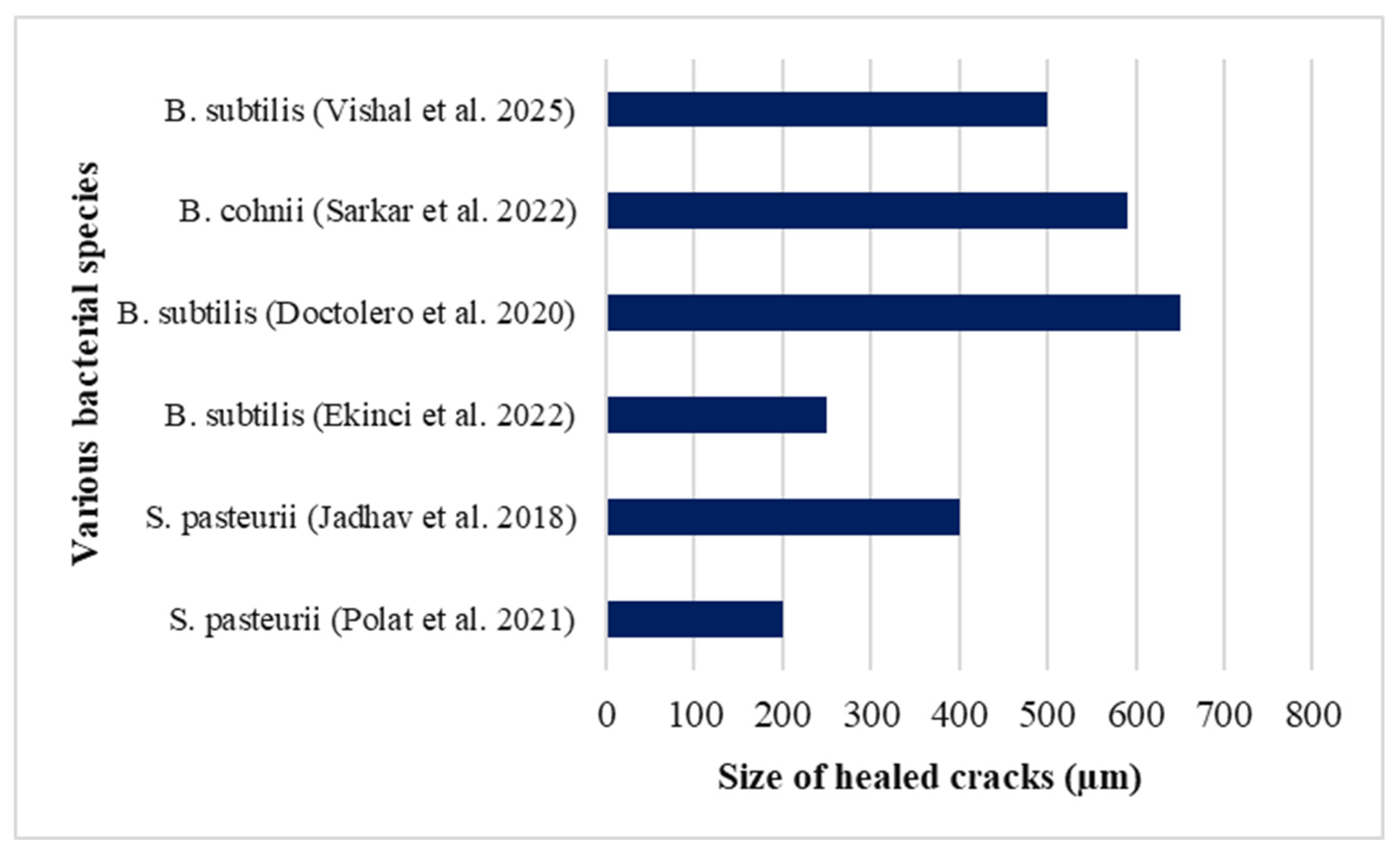
Although approximately 51,030 bacterial species exist on Earth, Bacillus is the most commonly used biological component in studies of self-healing agents. This preference stems from Bacillus’s familiar presence in soil and its ability to form spores under unfavourable conditions. Research demonstrates the remarkable healing efficiencies of various bacteria under favourable conditions. Chen et al. [127] demonstrated that lightweight aggregate concrete produced with Bacillus pasteurii can repair cracks up to 2 mm in width, contingent upon the presence of a high concentration of urea and calcium source. Other species, such as Bacillus subtilis, can repair crack widths up to 0.8 mm [128], Bacillus sphaericus 0.97 mm [129], Bacillus cohnii 0.5 mm [130], Sporosarcina pasteurii 0.4 mm [61].
Numerous studies have evaluated the healing efficiency of various bacterial species in geopolymer composites. Yılmazer Polat and Uysal [62] observed that specimens healed in a calcium-enhanced liquid medium experienced up to a 75% reduction in permeability, with cracks ≤ 100 µm sealed after 60 days. The healing products primarily consisted of CaCO3 and Ca(OH)2. Tanyildizi et al. [131] investigated the self-healing capabilities of MK-based geopolymer utilising S. pasteurii as a healing agent. The specimens were maintained at 60 °C for 24 h and subsequently subjected to various healing techniques, including injection, submersion, and spraying. Each method facilitated the precipitation of CaCO3 on the geopolymer surface, thereby effectively sealing cracks and reducing water ingress. Among these, the injection approach was found to be the most effective at achieving complete crack repair, relative to the submersion and spraying methods.
Polat [132] demonstrated that bacterial spores immobilised within expanded perlite aggregates remained viable under alkaline conditions, thereby enabling effective healing of cracks smaller than 200 µm. However, it should be noted that mechanical strength diminished due to the presence of weaker carbonate-forming phases. Other studies [133,134] have confirmed that the direct addition of S. pasteurii spores facilitates CaCO3 precipitation without the necessity of encapsulation. De Koster et al. [135] investigated bacterial granules coated with geopolymer, which effectively filled cracks with CaCO3 during both wet and air-curing processes. Polat et al. [136] reported that Bacillus subtilis effectively facilitated crack repair in MK-based geopolymer mortars through the precipitation of CaCO3, thereby enhancing their structural integrity. The specimens were cured for 48 h under diverse conditions: oven curing at 60 °C, hot-water curing at 60 °C, and ambient curing at 30 °C. All curing techniques successfully endorsed the self-healing mechanism. Ekinci et al. [63] investigated the self-healing properties of a GGBFS-based geopolymer paste incorporating Bacillus subtilis as a biological agent. The paste was activated with NaOH and Na2SiO3, and the specimens were cured under various conditions, including water, air, and a precipitation medium enriched with urea and yeast extract. The results demonstrated that compressive strength escalated, whereas apparent viscosity diminished as bacterial concentration and the bacteria-to-binder ratio increased, up to an optimal threshold. The peak enhancement in strength was observed at a concentration of 108 CFU/mL and a bacteria-to-binder ratio of 0.1.
Furthermore, curing within the precipitation medium significantly reduced water absorption by 12–14% for samples containing bacterial doses of 1–3%. Doctolero et al. [64] utilised Bacillus subtilis, Bacillus sphaericus, and Bacillus megaterium as bioagents in the development of Fly ash-based self-healing geopolymer. These microorganisms were directly incorporated into the geopolymers, which were subsequently placed in a precipitation medium for 14 days. Optical microscopy identified the presence of small mineral-like structures on the fractured surfaces of geopolymers containing Bacillus subtilis and Bacillus sphaericus. The maximum healed crack width was approximately 0.65 mm in geopolymers with co-cultures, compared to 0.35 mm in those with pure cultures, primarily due to CaCO3 formation. Figure 7 shows the healing efficiencies of various bacterial species reported by multiple studies.

2.2.4. Enzyme

EICP is a bio-inspired method for self-healing concrete that uses urease enzymes rather than live bacteria. These enzymes catalyse the hydrolysis of urea, resulting in the precipitation of CaCO3. Unlike microbial urea hydrolysis, this technique circumvents issues associated with bacterial survival in the challenging concrete environment. Recent studies [137,138] have identified several plant species as sources of urease enzyme, including cotton seeds (Gossypium hirsutum), jack beans (Canavalia ensiformis), soybean (Glycine max), melons, pumpkins, watermelons, squash, pigweed (Chenopodium album), and mulberry leaves (Morus alba). Urease is also present in human tissues, invertebrates, bacteria, and fungi such as Rhizopus oryzae, which accounts for approximately 40% of urease production. Current research emphasises extracting urease from plant leaves rather than seeds to avoid competition with food resources.
All plant-derived ureases exhibit similar structural sizes; however, their activities vary. These enzymes denature at temperatures above 70 °C, thereby contributing to shelf-life management. Jack bean urease demonstrated the highest activity, ranging from 2700 to 3500 U/g at 65 °C, rendering it the most appropriate source due to its efficiency and performance comparable to commercial urease in calcium carbonate precipitation. The enzyme derived from C. ensiformis has a molecular weight of 480 kDa and exhibits optimal activity at pH 6.0–7.0. When utilising jack bean urease in conjunction with CaCO3 as the calcium source, the highest unconfined compressive strength (UCS) achieved was 319 kPa at a strain rate of 1% per minute following drying. The choice of calcium source influences CaCO3 morphology, with CaCl2 favouring rhombohedral calcite. Temperature significantly affected urease activity: urease derived from watermelon seeds attained its maximum at 50 °C, whereas chickpea seed urease peaks at 40 °C, with both enzymes denaturing beyond these temperatures. Elevated urease activity accelerates CaCO3 precipitation and reduces Ca2+ concentrations in the solution. Additionally, increasing system temperature and curing duration enhanced UCS [139].
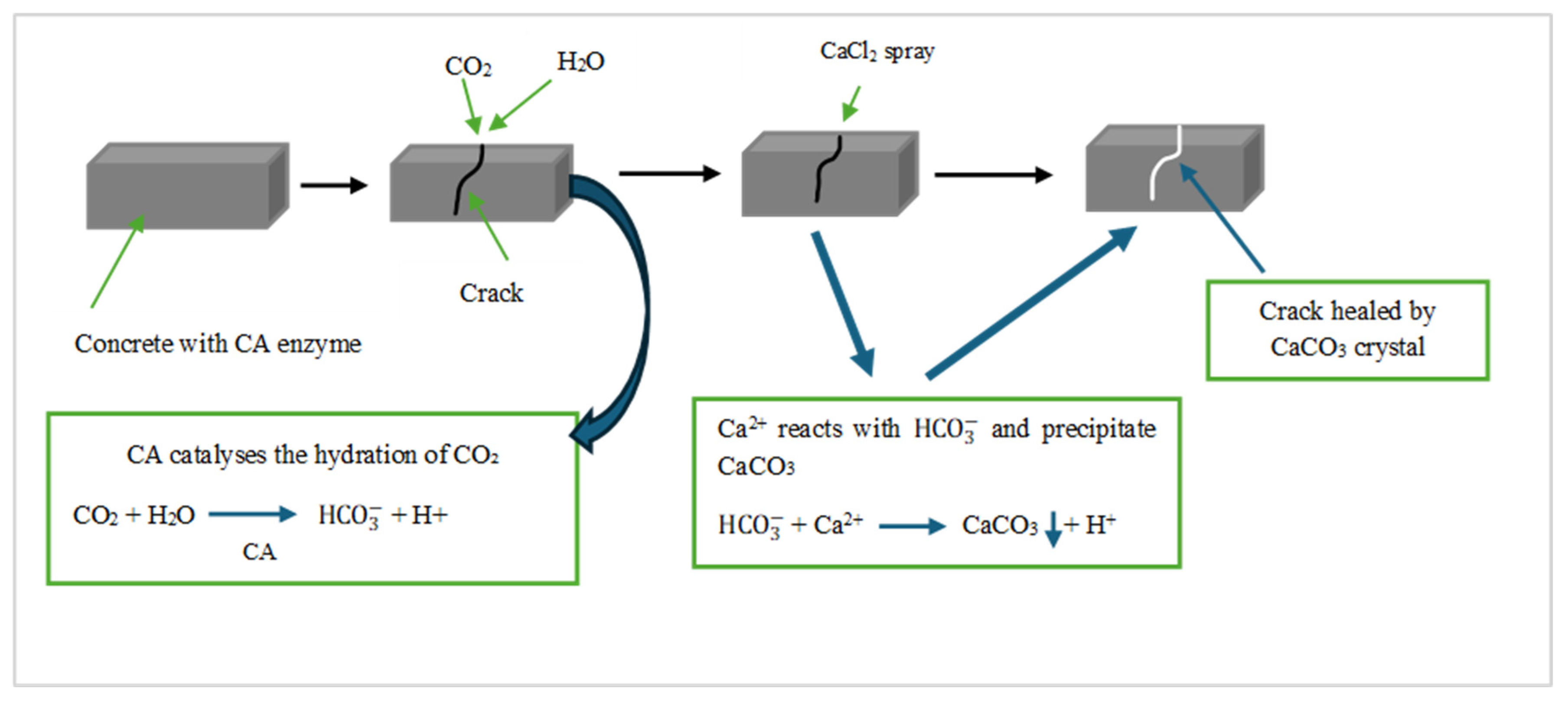
However, all these previous studies focused only on lab-based approaches and were mainly for geotechnical applications. None of these studies explored the application of self-healing of concrete structures as an alternative to MICP. A recent study by Rosewitz et al. [36] introduced Carbonic Anhydrase (CA) enzyme to precipitate CaCO3 in cementitious materials. In this investigation, CA was incorporated into the cement paste, which subsequently developed cracks after setting. Thereafter, the CaCl2 solution was applied to the fractured surface and exposed to CO2 and water. When subjected to water and CO2, the enzyme triggers rapid crystal growth, thereby facilitating autonomous repair. Unlike microbial techniques, EICP utilises trace quantities of CA to catalyse the reaction between Ca2+ and atmospheric CO2, resulting in CaCO3 crystals that seal cracks within concrete. Zhang et al. [140] demonstrated field-scale crack sealing in a hydropower dam tunnel utilising both MICP and EICP. Ureolysis facilitated an increase in pH, leading to calcium carbonate precipitation. The MICP process achieved a 93.75% precipitation efficiency with a mixture of vaterite and calcite, whereas EICP reached an 84.17% efficiency, predominantly forming calcite. Scanning electron microscopy (SEM) revealed clustered microbial deposits in contrast to the smoother, enzyme-driven infill, which resulted in a uniform sealing. Li et al. [141] introduced EICP into crack-affected OPC mortar and concrete, wherein urease catalysed Ureolysis to increase pH levels and precipitate CaCO3. SEM-XRD analysis confirmed the predominance of vaterite on crack surfaces, and the strength recovery approached 98% for 0.3 mm cracks, demonstrating a bridging mechanism that restored load transfer. Regarding geopolymer composites, existing evidence is predominantly inferential; reviews suggest that alkaline, silicate-rich pore solutions are capable of supporting carbonate-gel intergrowth when nucleation is facilitated. However, direct demonstrations of EICP in geopolymer systems with quantified healing efficiency remain limited [142]. A significant research gap persists in the direct application of EICP to geopolymer concretes, as most insights are derived from OPC systems. Systematic trials encompassing various geopolymer chemistries and curing regimes that measure both strength recovery and permeability reduction are notably lacking. Figure 8 shows the mechanism of EICP employed by Rosewitz et al. [36].
Indeed, both EICP and MICP are effective methodologies for synthesising CaCO3 and have been employed at the laboratory scale. Nevertheless, scaling these processes to an industrial level, particularly for MICP techniques, entails various challenges. These encompass the large-scale cultivation and preservation of bacteria, along with the necessity for specialised or controlled environmental conditions throughout the production process [139]. Overall, the direct introduction of bacteria into the MICP method may pose challenges, including contamination with other microorganisms, physical inconsistencies, issues with oxygen availability, and other potential complications and uncertainties [143]. Conversely, EICP offers several distinct advantages, including its independence from additional chemicals or nutrients, ease of incorporation into concrete, and its minimal short-term environmental impact. The primary limitation of this EICP is its gradual decline in enzyme activity over time, which renders it unsuitable for long-term structural crack repair applications. A recent study by Rosewitz et al. [36] demonstrated that their newly developed enzyme, based on Carbonic Anhydrase, remained effective after 7 months of inclusion in concrete and is projected to maintain efficacy for up to 1 year.

3. Effect of Various Healing Agents on Properties of Hardened Concrete

The properties of hardened concrete, encompassing compressive, split tensile, and flexural strengths, are vital in self-healing concrete, as they determine its load-bearing capacity and its ability to resist and autonomously repair cracks. Elevated compressive strength ensures that structures retain their integrity even after cracking by supporting applied loads [144]. Enhanced split tensile strength reduces the formation and size of microcracks, thereby inherently improving the efficacy of self-healing agents by facilitating the sealing of minor cracks [145]. Simultaneously, robust flexural strength is crucial for bending-dominated elements such as beams and slabs, as it helps limit crack widths on tension faces, thereby enhancing healing efficacy [66]. Additionally, strength recovery offers valuable insights into the performance of self-healing agents, supporting crystal growth and densification to restore structural integrity [66,144]. The following section presents recent research highlighting the effects of various healing agents on compressive, split tensile, and flexural strength.

3.1. Compressive Strength

Limited research has been conducted on the effect of incorporating chemicals and crystalline healing agents on compressive strength. Among these limited studies, it is evident that adding chemicals such as Ca(OH)2 and crystalline agents increases compressive strength to an optimal replacement level. However, beyond these levels, the compressive strength decreases. Zhang et al. [55] reported that incorporating more than 10% Ca(OH)2 by weight of the precursor significantly reduced the concrete’s long-term compressive strength. Other studies ([56,68]) incorporated crystalline admixtures into OPC and geopolymer systems, resulting in improved compressive strengths. Hermawan et al. [56] reported that incorporating 1.5% crystalline admixture (by weight of cement) into OPC-based concrete markedly enhanced healing efficiency and compressive strength (46.7%). Another study [68] demonstrated that incorporating 1% crystalline admixture into Metakaolin-based geopolymers notably increased the compressive strength. Furthermore, it enhanced healing efficiency and mechanical properties by adding 10% Ca(OH)2 with a crystalline admixture.
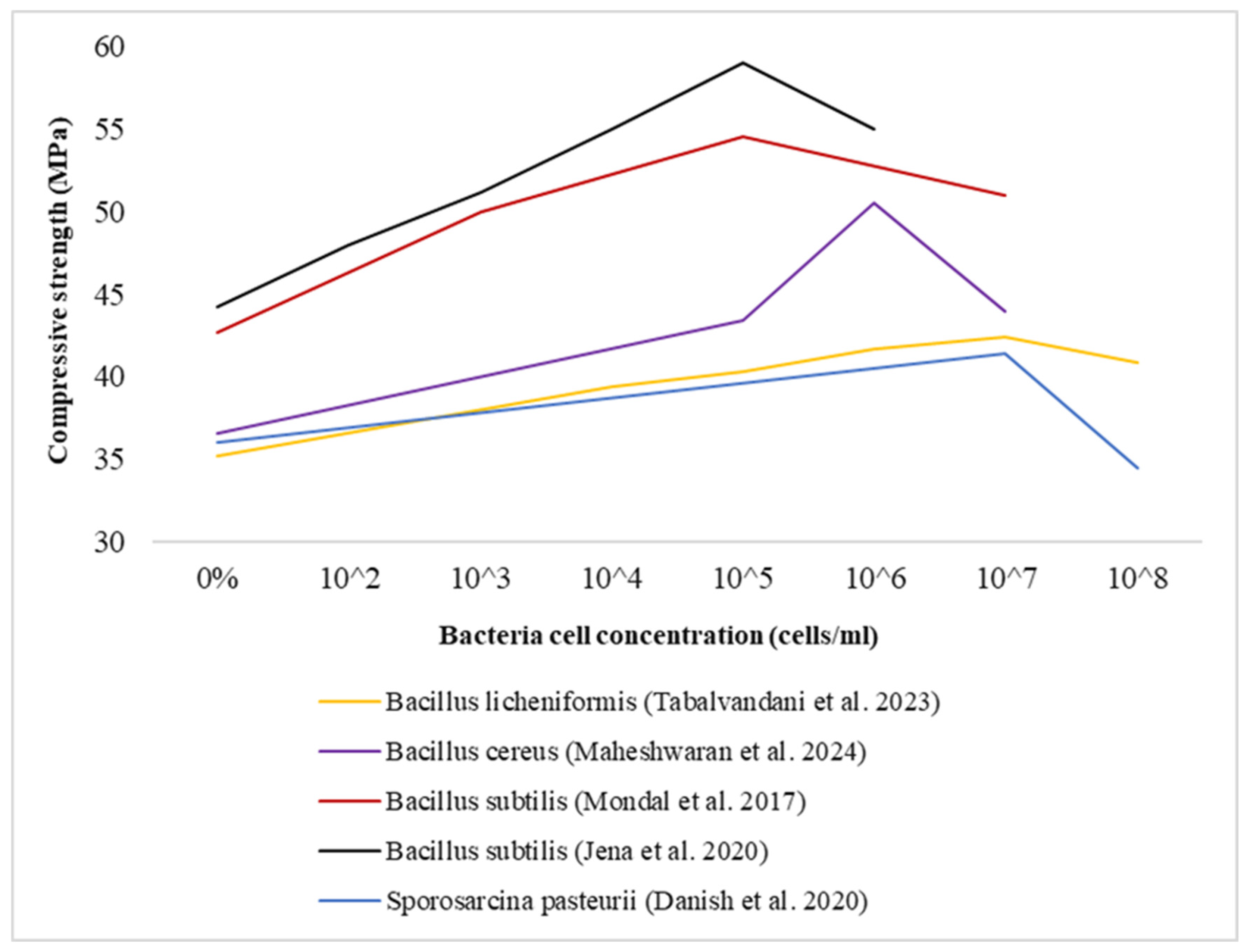
The integration of bacteria into concrete mixes has been extensively studied and shown to promote CaCO3 formation, thereby enhancing the compressive strength of the concrete matrix. B. megaterium, at an optimal cell concentration of 108 cells/mL, demonstrated the most significant enhancement in the compressive strength of concrete, with an improvement of 22.6% relative to control mixtures [146]. Similarly, B. pumilus at the same cell concentration increased compressive strength by 40%, with no appreciable benefit served at cell densities above 10^8 cells/mL [147]. This strength is presumably attributable to robust electrostatic attraction arising from the increased surface area and ultrafine dimensions of the iron oxide nanoparticles, which serve as fillers, thereby contributing to a denser microstructure. Moreover, a uniform distribution of bacteria is facilitated by the nano-sized immobilising medium [147]. In a separate study, the alkaliphilic spore-forming bacterium B. cohnii was incorporated into bio concrete at concentrations ranging from 105 to 1010 cells/mL. This supplementation resulted in an increase in compressive strength of up to 60% after 28 days, relative to the control mixture with a cell count of 108 cells/mL [148]. B. cereus and S. pasteurii enhanced the compressive strength of concrete in comparison to the control. At a concentration of 106 cells/mL, B. cereus and S. pasteurii yielded increases of 38.0% and 30.3%, respectively [21,149]. At an optimal concentration of 105 cells/mL, D. radiodurans, B. subtilis, and B. aerius exhibited the most significant enhancements in concrete compressive strength. D. radiodurans showed a 42.8% increase, while B. subtilis and B. aerius resulted in relatively lower increases of 32% and 22% in concrete compressive strength, respectively [20,150]. This difference can be attributed to the biomineralisation potential of D. radiodurans, which allows it to survive even under extreme conditions of higher pH and lower water content in concrete, reducing the need for specialised protective techniques [150]. In geopolymer composites, various bacterial strains showed the most significant increase in compressive strength at different cell concentrations. For instance, Polat et al. [62] found that the optimal cell concentration of Sporosarcina pasteurii in a metakaolin-based geopolymer was between 108 and 109 cells/mL, resulting in a 10.70% increase in compressive strength. Whereas Zhang et al. [151] reported that the concentration of Sporosarcina pasteurii within the GGBFS-based geopolymer matrix was determined to be 107 cells/mL as optimal.
In summary, it is essential to emphasise the importance of optimal bacterial concentration within the concrete mixture. Figure 9 depicts the relationship between various bacterial concentrations and variations in compressive strength. It is apparent that, in most cases, the optimal bacterial concentration is between 105 and 107 cells/mL. An excessive increase or decrease in cell concentration results in a diminution of compressive strength. Therefore, it is highly recommended to optimise cell concentration to achieve the maximum compressive strength.

3.2. Split Tensile Strength

Few studies have investigated the impact of including healing agents on split tensile strength. Currently, research predominantly focuses on bacteria. It was observed that B. subtilis, at a cell concentration of 6 × 10⁸ cells/mL and in conjunction with silica fibres, led to a 36.82% enhancement in splitting tensile strength after 28 days relative to the control mixture. This increase was attributable to the synergistic effect of fibres and biosynthesised CaCO3 [153]. Furthermore, the incorporation of immobilised bacteria resulted in surface modifications of the fibres, thereby establishing a robust interfacial bond and enhancing strength [154]. B. licheniformis was evaluated at various concentrations in concrete, ranging from 104 to 108 cells/mL. It resulted in a 32% increase in the splitting tensile strength of concrete after 28 days at a concentration of 107 cells/mL. This improvement was ascribed to CaCO3 precipitation on the surface and within pores, voids, and micro-cracks, thereby enhancing tensile strength [152]. It was observed that S. pasteurii exhibited a maximum increase of 36% at a concentration of 107 cells/mL, compared to the control mix [155]. The study investigated the impact of B. sphaericus on the splitting tensile strength of concrete at concentrations ranging from 100 to 107 cells/mL. A 32.3% increase is observed at a concentration of 105 cells/mL [156]. This enhancement in bacterial efficacy arises from their metabolic processes, which generate calcite as a by-product, thereby helping seal cracks and pores in concrete. In comparison, S. pasteurii exhibited increased strength in the geopolymer matrix at 105 cells/mL [151]. In summary, these studies suggest that the optimal cell concentration for improving the splitting tensile strength of concrete with B. subtilis and B. sphaericus is 105 cells/mL. Nevertheless, it is noteworthy that certain species of Bacillus, such as B. licheniformis, tend to decrease at a concentration of 108 cells/mL. Conversely, B. megaterium exhibits the highest splitting tensile strength in concrete at this level.

3.3. Flexural Strength

Researchers have conducted numerous studies to evaluate concrete’s self-healing capabilities, particularly regarding its flexural strength. CaCO3 precipitation fills voids, reducing porosity and yielding a more compact concrete matrix. These densification effects induced by the healing agent enhance the flexural strength [157]. A study investigated the effect of B. subtilis at 107 cells/mL, resulting in a 45.0% increase in concrete flexural strength. This improvement is attributed to the continuous production of calcium carbonate by the bacteria and the supply of organic nutrients, which collectively contribute to a denser internal matrix and improved structural integrity [158]. B. megaterium was evaluated across various cell concentrations, ranging from 106 to 5 × 10⁶ cells/mL, resulting in a notable 7.3% enhancement in the flexural strength of concrete at a concentration of 3 × 10⁶ cells/mL [159]. In contrast, when analysing S. sphaericus at concentrations ranging from 100 to 107 cells/mL, the maximum flexural strength of 48% was observed in concrete at 105 cells/mL. Similarly, S. pasteurii exhibited a notable 26.6% increase in flexural strength in the concrete at the same cell concentration. Conversely, Polat et al. reported that S. pasteurii increased the flexural strength of metakaolin-based geopolymer concrete by nearly 50% at cell concentrations ranging from 108 to 109 cells/mL. Another study reported that the optimal concentration of S. pasteurii in the slag-based geopolymer was 107 cells/mL, resulting in a 14.3% enhancement in flexural strength [151]
In summary, bacterial self-healing systems, a clear and critical contrast exists between OPC and geopolymer matrices, even when the same Ureolytic bacteria such as Sporosarcina pasteurii are employed. In OPC matrices, injecting Sporosarcina pasteurii at high bacterial doses, for example, around 2.9 × 10⁹ cfu/mL, has resulted in almost 100% surface crack closure for cracks up to about 0.5 mm within 28 days, with dense calcite precipitation confirmed by SEM observations [160]. In contrast, in metakaolin-based geopolymer systems, although Sporosarcina pasteurii spores remain viable when directly incorporated into the matrix, the healing response is more limited and conditional. Quantitatively, even when bacteria are injected directly into geopolymer cracks, the flexural strength recovery is typically around 30%, and effective healing is largely restricted to crack widths below approximately 0.3 mm, which is significantly lower than that commonly reported for OPC systems. These differences arise from the low intrinsic calcium content and highly alkaline, sodium-rich pore solution of geopolymers, which suppress sustained bacterial activity and limit the extent of calcium carbonate precipitation [133]. Table 4 illustrates the influence of various healing agents on the hardened properties of concrete.

4. Effect of Various Activator Systems of GPC on Healing Agents

Understanding the behaviour of activators in geopolymer systems is essential for explaining how different self-healing strategies function within alkali-activated matrices. Activators such as sodium hydroxide, sodium silicate and mixed silicate–hydroxide solutions govern precursor dissolution, the development of N-A-S-H and C-A-S-H gels, and the resulting microstructural evolution, which collectively shape the compatibility and effectiveness of healing agents, including crystalline admixtures, bacteria-based MICP, and enzyme-driven EICP. Because healing relies on ion availability, pH, and gel structure, the activator regime plays a decisive role in determining the type, stability, and extent of healing products formed. The following section will discuss how different activator systems influence healing mechanisms and performance across crystalline admixture, MICP, and EICP-based geopolymer self-healing technologies:

4.1. Crystalline Admixture

In alkali-activated and geopolymer matrices, hydrophilic crystalline admixtures serve as agents that reduce permeability by reacting with ions in the pore solution to generate insoluble crystalline deposits within cracks and capillaries. These deposits typically consist of densified C-S-H or C-A-S-H, accompanied by zeolitic sodium–calcium aluminosilicates and calcite, thereby enhancing the refinement of transport pathways and improving sealing performance during wet cycling [162]. Mechanistically, the efficiency of crystalline admixtures is influenced by the activation regime of the host geopolymer, as sodium silicate–rich or mixed NaOH-Na2SiO3 systems supply greater silicate availability and nucleation density, thereby facilitating the intergrowth of crystalline products with the primary N-A-S-H or N, C-A-S-H gels [163]. In systems activated by sodium silicate or composed of silicate-hydroxide mixtures, an elevated SiO2/Na2O ratio enhances the activity of soluble silicate within the pore solution. This promotes the formation of secondary gels at crack interfaces and supplies reactive silicate for intergrowth with crystalline admixture products, thereby expediting crack bridging [163]. Furthermore, when Ca is present in the precursor or pore solution, crystalline admixtures may co-precipitate C-A-S-H and zeolitic sodium-calcium aluminosilicates, which integrate into the N-A-S-H network. A recent study [164] on CDW-based geopolymer composites indicates that mixtures activated with NaOH and Na2SiO3 exhibited substantially greater healing capacity, effectively repairing microcracks up to approximately 460 µm through the formation of aluminosilicate phases, Na2CO3, and CaCO3. In contrast, single-activator systems (NaOH only) demonstrated inferior performance attributable to an inadequate silicate supply necessary for secondary geopolymerisation and crack infill growth.

4.2. MICP Process

In activations rich in sodium silicate or involving a mixture of NaOH and Na2SiO3, the pore solution exhibits a markedly high pH combined with increased dissolved silicate content. This condition accelerates the interfacial re-gelation of N-A-S-H or mixed N, C-A-S-H at crack faces and offers numerous nucleation sites for biogenic CaCO3. Consequently, this facilitates effective sealing during immersion or injection MICP treatments in metakaolin or slag-based geopolymers [42]. In contrast, during activations conducted solely with NaOH, the markedly high alkalinity promotes rapid urea hydrolysis and the formation of carbonate. However, the reduced silicate activity may constrain the degree of interfacial gel reformation. Consequently, the durability of crack closure is more dependent on the volume and morphology of the precipitated CaCO3 unless supplementary Ca2+ or silicate ions are introduced during the treatment process [41]. Additionally, in calcium-rich alkali-activated slag systems or Ca(OH)2-amended mixtures, the reaction products tend to favour C-A-S-H or mixed (N, C)-A-S-H gels. The abundant availability of Ca2+ in the pore solution effectively bypasses the mass-transfer step associated with MICP, thereby facilitating faster and more substantial CaCO3 precipitation once carbonate is generated through urease activity [41].
The comparative assessment of activation regimes for MICP-based healing indicates that the most effective sealing performance is achieved in systems activated with a mixture of NaOH and Na2CO3 combined with adequate Ca availability. This calcium can be supplied intrinsically through slag, externally via the addition of Ca(OH)2, or as part of the nutrient feed for MICP. In such matrices, soluble silicate facilitates interfacial gel regrowth, while Ca2+ ions enable the rapid formation of stable calcite infill, thereby resulting in a mechanically robust crack sealing.

4.3. EICP Process

Calcium-rich alkali-activated matrices (slag or Ca(OH)2-amended) supply a substantial amount of Ca2+ ions, thereby accelerating EICP and enhancing crack bridging, provided that urease activity is preserved within the highly alkaline, ion-rich pore solution [165]. Conversely, NaOH-activated geopolymers exhibit extremely high alkalinity, which accelerates urea hydrolysis. However, their reduced dissolved silicate content results in fewer interfacial nucleation and anchoring sites; therefore, durable EICP sealing frequently benefits from supplementary Ca2+ ions or specifically engineered nucleators [166]. The combination of NaOH and Na2CO3 activators maintains a high pH level while providing soluble silicate, thereby facilitating EICP-generated carbonates to integrate more efficiently with reforming N-A-S-H/C-A-S-H gels at crack walls and enhancing bonding stability [141].

5. Performance Indicators of Self-Healing

Assessing the effectiveness of self-healing in geopolymer systems necessitates the meticulous selection of performance indicators, as various healing mechanisms yield diverse physical and chemical outcomes. Research on crystalline admixtures, MICP, and EICP frequently depends on metrics such as crack width closure, strength recovery, permeability reduction and microstructure characterisation [167]. However, each indicator encapsulates only a portion of the healing process and may exhibit variable responses depending on the activator regime and the characteristics of the healing products. Consequently, the comparison of results across various studies presents challenges unless the strengths and limitations of each indicator are explicitly understood and contextualised within the chemical properties of the host geopolymer matrix. The subsequent section examines the comparative advantages, limitations, and applicability of these indicators in order to establish a clearer framework for assessing and contrasting the efficacy of different healing agents across a variety of geopolymer environments.

5.1. Crack Width Closure

This indicator offers a quick evaluation of early sealing kinetics and is advantageous for comparing environmental exposure conditions; however, it often overestimates actual healing, as internal crack continuity may remain even when surface sealing appears visually complete. Consequently, it is inadequate as a standalone indicator. Therefore, it must be complemented with at least one bulk-scale metric to prevent the misclassification of partially healed cracks [140].
For crystalline admix, MICP and EICP Crack-width closure is insufficient alone since visible sealing does not guarantee internal structural bonding [168].

5.2. Strength Recovery

This assessment combines the mechanical contribution of healing products across the fracture interface and the surrounding matrix, thereby significantly relevant to the structural performance. Nevertheless, its sensitivity to specimen geometry, pre-damage conditions, and baseline strength presents challenges for comparative study unless normalisation protocols are rigorously implemented. This metric is particularly indicative when mechanical recovery aligns with the mineralogical progression of healing products, as demonstrated in MICP and EICP crack repair studies [140,169].
For crystalline admix, strength recovery is not a suitable primary indicator, as increases often arise from ongoing hydration rather than genuine healing [170]. On the other hand, strength recovery is the most appropriate for the MICP and EICP processes due to Calcite precipitation, mechanical integration, and restoring load-transfer capacity [141,171].

5.3. Permeability or Sorptivity Reduction

This indicator directly reflects the restoration of transport resistance by quantifying the closure of connected microcracks and capillaries. This is particularly diagnostic for crystalline admixtures, which primarily function through pore-blocking and densification. Although the response may lag behind visible crack closure and is sensitive to surface conditioning and hydraulic gradients, permeability reduction, when corroborated with microstructural evidence, provides a robust indicator of enhanced functional durability [172].
Permeability or sorptivity reduction is the best suited for all types of healing approaches because these metrics directly reflect pore blocking and densification of the capillary network [173].

5.4. Phase and Microstructure Characterisation

Employing techniques such as SEM, EDS, XRD, or Raman spectroscopy offers mechanistic validation regarding the nature and stability of the healing products. These methods differentiate crystalline-admixture-derived C(S)H or zeolitic phases from bio-carbonate sequences. However, as these techniques examine only localised regions, their interpretations should be supplemented with bulk metrics to mitigate sampling bias [141].
SEM, EDS and XRD confirm crystalline products but require pairing with bulk tests due to their localised analysis scale [170].

6. Real-World Application of Self-Healing Technologies

The progress of self-healing methodologies for microorganisms has facilitated greater implementation of self-healing initiatives in the construction sector. Since 2015, numerous nations, including China, The Netherlands, Belgium, and the United Kingdom, have documented demonstration projects utilising this technology. These microbial concretes have been employed in structures such as tunnels, water channels, foundations and more [174,175,176]. A research initiative on self-healing materials involved the development of imitation retaining wall panels during the construction of the A465 Valley Highway. Bacillus pseudofirms spores and organic nutrients, specifically calcium acetate and yeast extract, were introduced into the aggregates under vacuum conditions before their integration into the concrete mixture. Subsequently, the panels were subjected to environmental conditions to evaluate the efficacy of the self-healing concrete within a real construction setting. After 6 months, noteworthy enhancements in their self-repair capabilities were documented [177]. Qian et al. [176] developed spray drying technology for large-scale production of spore powder and applied it in engineering buildings. This approach reduces construction duration and promotes the industrialisation of microbial self-healing techniques [178]. A study demonstrated that Bacillus spores and natural fibres effectively lined an irrigation canal in Ecuador’s Andean highlands, and after one year, no visible surface cracks appeared on the liner [174]. Multiple commercial healing products have been developed, primarily designed for compatibility with cementitious concrete structures. Basilisk, located in The Netherlands, has formulated healing products utilising bacterial spores (B. cohnii) encapsulated within polylactic acid. This healing agent has been employed in various construction projects, including the Purification Tank in Sapporo, Japan, in 2022; the Port of Rotterdam, The Netherlands, in 2017; and Het Loo Palace in Apeldoorn, The Netherlands, in 2019 [179]. Other self-healing commercial products [180] include Penetron admix, a crystalline admixture, and enzyme-based healing products developed by a USA-based company, Enzymatic [36]. Table 5 lists the practical implementation of various healing agents in real-world projects.

7. Sustainability and Life Cycle Assessment (LCA) of Various Healing Agents

Numerous self-healing agents, including crystalline admixtures, bacteria, and enzymes, are engineered to prolong the lifespan of concrete structures by restricting crack propagation, minimising the ingress of aggressive agents, and decreasing maintenance requirements. Given that these advantages can substantially impact long-term environmental performance, especially in applications where durability is critical, it is imperative to employ LCA framework. This framework should comprehensively evaluate not only cradle-to-gate impacts but also benefits during the use phase and end-of-life implications throughout the entire life cycle of concrete systems [182].
Crystalline admixtures possess a relatively low cradle-to-gate environmental footprint, given their nature as mineral-based additives integrated into standard concrete mixing processes without extensive manufacturing procedures. Their main contribution lies in improving durability through permeability reduction and ongoing hydration, allowing for modest yet dependable self-healing that can extend the service life of concrete by approximately 5–10 years by delaying chloride ingress and carbonation. Although they are ineffective for wide cracks, their minimal material requirements and cost-effectiveness contribute to favourable life-cycle costs and sustainability performance throughout the entire structural lifespan [183].
In bacteria-based self-healing systems, LCA outcomes are more intricate. Although life-cycle carbon dioxide emissions can be reduced by up to 20% when bacterial activity prolongs service life and decreases repair demand, corresponding to durability improvements of approximately 10–30 years, cradle-to-gate assessments frequently report higher embodied impacts due to nutrient supply, encapsulation, and carrier materials. These additional burdens, along with ammonia emissions resulting from Ureolysis, may reduce sustainability benefits if healing is not fully activated. Consequently, there is a need for selective application to optimise overall life-cycle performance [42].
Enzyme-based healing systems, employing urease or carbonic anhydrase, currently appear most promising from an LCA perspective due to their extremely low dosage requirements, often in the milligram per cubic meter range, which translates into minimal additional embodied impacts. Preliminary assessments and reviews suggest that enzymatic systems can contribute to crack sealing and carbonation-based healing while offering potential carbon dioxide sequestration benefits. The projected service life extensions are comparable to bacterial systems, on the order of 10–20 years, provided enzyme stability is maintained [140]. Importantly, advances in biotechnological enzyme production are rapidly decreasing costs, thereby enhancing the likelihood of favourable whole-life environmental outcomes.
Based on the LCA and sustainability assessment, rankings have been assigned to various healing agents from the most favourable to the least favourable (1 to 3), as presented in Table 6. From a life cycle perspective, crystalline admixtures are the most cost-effective and life cycle assessment-efficient solution. Enzyme-based systems present the greatest sustainability potential, while bacteria-based systems provide superior healing performance at a greater environmental and economic cost. Consequently, no single healing agent is universally optimal; the preferred solution depends on whether the design objective emphasises cost reduction, environmental sustainability, or maximum crack-healing capability.

8. Limitations of Healing Technologies

The employment of various healing agents has demonstrated promising enhancements in the serviceability and durability of structures. However, these self-healing agents and their applications in concrete also present certain limitations. The following section highlights the limitations of various healing agents:

8.1. Bacteria-Based Healing

Production cost: Incorporating bacteria and nutrients into the concrete mixture increases total production costs. This expense may present a significant obstacle, especially for large-scale projects or regions with constrained resource budgets.
Structural health: Furthermore, the time required for bacteria to initiate healing may not always coincide with the immediate need to repair cracks, potentially resulting in temporary weakening of the structure.
Environmental concern: It is essential to assess the long-term ecological impacts of introducing bacteria into concrete, particularly the potential for bacterial leaching or the release of metabolic by-products into the surrounding environment.
Uncertainty: Bacteria may not completely occupy all cracks, particularly larger or more intricate ones. Consequently, this can lead to partial healing, rendering specific regions vulnerable to further damage

8.2. Crystalline Admix

Crack width dependency: They can seal narrow cracks, typically up to 0.3–0.5 mm; however, wider cracks are generally left untreated because their healing efficacy diminishes with increasing crack size.
Incompatibility with geopolymer: The limited/no calcium source of alkali-activated geopolymer binders creates an unfavourable environment for crystal admix.
Project cost: Incorporating crystalline admix may increase production costs. Additionally, if it applies to cement-free geopolymer structures, there is an additional need for a calcium source, which may further increase the overall cost.

8.3. Enzyme-Based Healing

Environmental issue: The urea hydrolysis reaction yields ammonium, which can subsequently convert to ammonia and induce localised acidity, potentially compromising the integrity of the cementitious matrix if not adequately leached or buffered.
Handling: Concentrated enzyme and substrate solutions often exhibit elevated viscosity, which can hinder effective delivery, penetration depth, and uniform distribution within concrete structures.

9. Future Research Trends and Recommendations

The subsequent section delineates the research gap and proposes recommendations for future investigations to assess the viability of various self-healing agents within the construction industry, thereby fostering innovative research in this domain through the utilisation of existing research data and a literature review.
Improvement of bacterial strains: Genetic modification of bacterial strains might be a potent option to enhance their viability and enable them to survive and form successful crystals at high temperatures and high pH within concrete.
Commercial products: Although only a few commercial healing products are available, their effectiveness in healing OPC-based concrete is commendable. However, there are no commercial healing agents capable of repairing the geopolymer concrete.
Fracture mechanism: No research has yet been conducted to investigate the fracture mechanism of various healing agents with cement and geopolymer concrete. Therefore, further in-depth research is required to understand these mechanisms.
Durability analysis: Although this research did not evaluate the durability properties of concrete with various healing agents, existing studies lack sufficient data on these properties. Consequently, a comprehensive systematic review and further research are warranted.

10. Conclusions

This review article demonstrates the effectiveness and application of various self-healing techniques on OPC and geopolymer-based systems. Furthermore, emphasising current research on the self-healing efficiency of various healing agents in geopolymer concrete offers unique strategies for future sustainability by diminishing maintenance costs and OPC production. Analysing current research trends enabled the following conclusions:
Autogenous healing of concrete primarily depends on the unhydrated particles reacting further when water is present during crack occurrence. This phenomenon predominantly occurs in cement-based concrete, whereas in geopolymer, most of the calcium (if slag-based) reacts to form the geopolymer gel. Therefore, autogenous healing is considerably limited in geopolymer concrete.
Crystalline admix reacts with the portlandite and calcium sources in cement and forms crystals, primarily CaCO3, that heal cracks up to 400 µm wide. However, due to the limitations of the Ca source in the geopolymer, an additional Ca source needs to be supplied. The inclusion of 10% hydrated lime enhanced healing efficiency.
Natural fibres can facilitate crack widening through bridging effects and serve as nucleation sites for crystal growth by retaining water and attracting ions, owing to their polar surfaces.
Inclusion of bacteria, especially Bacillus, can heal cracks up to 500 µm in size by producing CaCO3 crystals. However, the inclusion of bacteria with fibres significantly enhances healing efficiency (around 800 µm) due to the combined effects of bacteria and fibres.
Enzyme-based healing shows promising potential; however, its effectiveness in the geopolymer system has not yet been thoroughly investigated. Furthermore, the recently developed commercially available product requires a CaCl2 spray as a calcium source. However, the impacts of free Cl on steel corrosion need to be addressed. Other healing agents, such as polymers, exhibit minimal healing efficiency (<100 µm), underscoring their suitability for structural healing.
The inclusion of various healing agents improves the hardened properties of concrete. However, before incorporating healing agents into concrete, it is essential to optimise the dosage, as an excessive dose may adversely affect hardened properties. For instance, incorporating Ca(OH)2 into geopolymer concrete at levels exceeding 10% reduces strength. The optimal concentration of various crystal admixtures ranges between 1% and 1.5% by weight of the total binder. The ideal bacterial concentration falls within the range of 105 to 107 cells/mL.

Author Contributions

Conceptualisation, M.T.I., B.K. and R.A.-A.; methodology, M.T.I., B.K. and R.A.-A.; validation, M.T.I., B.K. and R.A.-A.; formal analysis, M.T.I.; writing—original draft preparation, M.T.I.; writing—review and editing, B.K. and R.A.-A.; visualisation, M.T.I.; supervision, R.A.-A. and B.K.; project administration, R.A.-A. All authors have read and agreed to the published version of the manuscript.

Funding

This research received no external funding.

Institutional Review Board Statement

Not applicable.

Informed Consent Statement

Not applicable.

Data Availability Statement

Not applicable.

Conflicts of Interest

The authors declare no conflicts of interest.

References

  1. Paris, J.M.; Roessler, J.G.; Ferraro, C.C.; Deford, H.D.; Townsend, T.G. A review of waste products utilized as supplements to Portland cement in concrete. J. Clean. Prod. 2016, 121, 1–18. [Google Scholar] [CrossRef]
  2. Amran, M.; Al-Fakih, A.; Chu, S.H.; Fediuk, R.; Haruna, S.; Azevedo, A.; Vatin, N. Long-term durability properties of geopolymer concrete: An in-depth review. Case Stud. Constr. Mater. 2021, 15, e00661. [Google Scholar] [CrossRef]
  3. Nwankwo, C.O.; Bamigboye, G.O.; Davies, I.E.E.; Michaels, T.A. High volume Portland cement replacement: A review. Constr. Build. Mater. 2020, 260, 120445. [Google Scholar] [CrossRef]
  4. Islam, M.T.; Kafle, B.; Al-Ameri, R. Natural Clay in Geopolymer Concrete: A Sustainable Alternative Pozzolanic Material for Future Green Construction—A Comprehensive Review. Sustainability 2025, 17, 10180. [Google Scholar] [CrossRef]
  5. Wan-En, O.; Yun-Ming, L.; Cheng-Yong, H.; Ngee, H.L.; Al Bakri Abdullah, M.M.; Khalid, M.S.B.; Loong, F.K.; Shee-Ween, O.; Seng, T.P.; Jie, H.Y.; et al. Towards greener one-part geopolymers through solid sodium activators modification. J. Clean. Prod. 2022, 378, 134370. [Google Scholar] [CrossRef]
  6. Tahir, M.F.M.; Abdullah, M.M.A.B.; Rahim, S.Z.A.; Hasan, M.R.M.; Saafi, M.; Jaya, R.P.; Mohamed, R. Potential of industrial By-Products based geopolymer for rigid concrete pavement application. Constr. Build. Mater. 2022, 344, 128190. [Google Scholar] [CrossRef]
  7. Ross, J.H.; Genedy, M.; Juenger, M.C.G.; van Oort, E. Permeability recovery by self-healing of class F fly ash-based geopolymers. Cement 2022, 10, 100048. [Google Scholar] [CrossRef]
  8. Khan, M.Z.N.; Shaikh, F.U.A.; Hao, Y.; Hao, H. Synthesis of high strength ambient cured geopolymer composite by using low calcium fly ash. Constr. Build. Mater. 2016, 125, 809–820. [Google Scholar] [CrossRef]
  9. Habert, G.; De Lacaillerie, J.B.D.; Roussel, N. An environmental evaluation of geopolymer based concrete production: Reviewing current research trends. J. Clean. Prod. 2011, 19, 1229–1238. [Google Scholar] [CrossRef]
  10. Gultekin, A.; Ramyar, K. Effect of curing type on microstructure and compressive strength of geopolymer mortars. Ceram. Int. 2022, 48, 16156–16172. [Google Scholar] [CrossRef]
  11. Ng, C.; Alengaram, U.J.; Wong, L.S.; Mo, K.H.; Jumaat, M.Z.; Ramesh, S. A review on microstructural study and compressive strength of geopolymer mortar, paste and concrete. Constr. Build. Mater. 2018, 186, 550–576. [Google Scholar] [CrossRef]
  12. Kuri, J.C.; Sarker, P.K.; Shaikh, F.U.A. Sulphuric acid resistance of ground ferronickel slag blended fly ash geopolymer mortar. Constr. Build. Mater. 2021, 313, 125505. [Google Scholar] [CrossRef]
  13. Zhang, P.; Zheng, Y.; Wang, K.; Zhang, J. A review on properties of fresh and hardened geopolymer mortar. Compos. B Eng. 2018, 152, 79–95. [Google Scholar] [CrossRef]
  14. Zhuang, H.J.; Zhang, H.Y.; Xu, H. Resistance of geopolymer mortar to acid and chloride attacks. Procedia Eng. 2017, 210, 126–131. [Google Scholar] [CrossRef]
  15. Wong, C.L.; Mo, K.H.; Alengaram, U.J.; Yap, S.P. Mechanical strength and permeation properties of high calcium fly ash-based geopolymer containing recycled brick powder. J. Build. Eng. 2020, 32, 101655. [Google Scholar] [CrossRef]
  16. Ismail, I.; Bernal, S.A.; Provis, J.L.; Nicolas, R.S.; Brice, D.G.; Kilcullen, A.R.; Hamdan, S.; Van Deventer, J.S.J. Influence of fly ash on the water and chloride permeability of alkali-activated slag mortars and concretes. Constr. Build. Mater. 2013, 48, 1187–1201. [Google Scholar] [CrossRef]
  17. Islam, M.T.; Apurba, M.S.H. Effect of Inclusion of Recycled Waste Glass Powder in Geopolymer Concrete: A Review on Workability, Mechanical, Durability, and Micro-Structural Performance. Iran. J. Sci. Technol. Trans. Civ. Eng. 2025, 1–27. [Google Scholar] [CrossRef]
  18. Bayati, M.; Saadabadi, L.A. Efficiency of bacteria based self-healing method in alkali-activated slag (AAS) mortars. J. Build. Eng. 2021, 42, 102492. [Google Scholar] [CrossRef]
  19. Lee, B.J.; Hyun, J.H.; Kim, Y.Y.; Shin, K.J. Chloride permeability of damaged high-performance fiber-reinforced cement composite by repeated compressive loads. Materials 2014, 7, 5802–5815. [Google Scholar] [CrossRef]
  20. Jena, S.; Basa, B.; Panda, K.C.; Sahoo, N.K. Impact of Bacillus subtilis bacterium on the properties of concrete. Mater. Today Proc. 2020, 32, 651–656. [Google Scholar] [CrossRef]
  21. Danish, A.; Mosaberpanah, M.A.; Salim, M.U. Past and present techniques of self-healing in cementitious materials: A critical review on efficiency of implemented treatments. J. Mater. Res. Technol. 2020, 9, 6883–6899. [Google Scholar] [CrossRef]
  22. Al-Tabbaa, A.; Litina, C.; Giannaros, P.; Kanellopoulos, A.; Souza, L. First UK field application and performance of microcapsule-based self-healing concrete. Constr. Build. Mater. 2019, 208, 669–685. [Google Scholar] [CrossRef]
  23. Raza, A.; Khushnood, R.A. Digital image processing for precise evaluation of concrete crack repair using bio-inspired strategies. Constr. Build. Mater. 2022, 350, 128863. [Google Scholar] [CrossRef]
  24. Luhar, S.; Chaudhary, S.; Luhar, I. Development of rubberized geopolymer concrete: Strength and durability studies. Constr. Build. Mater. 2019, 204, 740–753. [Google Scholar] [CrossRef]
  25. Sinha, A.; Wang, Q.; Wei, J. Feasibility and compatibility of a biomass capsule system in self-healing concrete. Materials 2021, 14, 958. [Google Scholar] [CrossRef]
  26. Hearn, N. Self-sealing, autogenous healing and continued hydration: What is the difference? Mater. Struct. 1998, 31, 563–567. [Google Scholar] [CrossRef]
  27. Roig-Flores, M.; Moscato, S.; Serna, P.; Ferrara, L. Self-healing capability of concrete with crystalline admixtures in different environments. Constr. Build. Mater. 2015, 86, 1–11. [Google Scholar] [CrossRef]
  28. Kan, L.L.; Lv, J.W.; Duan, B.B.; Wu, M. Self-healing of Engineered Geopolymer Composites prepared by fly ash and metakaolin. Cem. Concr. Res. 2019, 125, 105895. [Google Scholar] [CrossRef]
  29. Ozen, M.Y.; Firdous, R.; Lehmann, C.; Stephan, D. Autonomous self-healing behavior of geopolymer pastes under varied curing environments. Constr. Build. Mater. 2024, 426, 136099. [Google Scholar] [CrossRef]
  30. Garces, J.I.T.; Dollente, I.J.; Beltran, A.B.; Tan, R.R.; Promentilla, M.A.B. Life cycle assessment of self-healing geopolymer concrete. Clean. Eng. Technol. 2021, 4, 100147. [Google Scholar] [CrossRef]
  31. Jonkers, H.M.; Thijssen, A.; Muyzer, G.; Copuroglu, O.; Schlangen, E. Application of bacteria as self-healing agent for the development of sustainable concrete. Ecol. Eng. 2010, 36, 230–235. [Google Scholar] [CrossRef]
  32. Bang, S.S.; Galinat, J.K.; Ramakrishnan, V. Calcite precipitation induced by polyurethane-immobilized Bacillus pasteurii. Enzyme Microb. Technol. 2001, 28, 404–409. [Google Scholar] [CrossRef] [PubMed]
  33. Elgendy, I.M.; Elkaliny, N.E.; Saleh, H.M.; Darwish, G.O.; Almostafa, M.M.; Metwally, K.; Yahya, G.; Mahmoud, Y.A.G. Bacteria-powered self-healing concrete: Breakthroughs, challenges, and future prospects. J. Ind. Microbiol. Biotechnol. 2025, 52, kuae051. [Google Scholar] [CrossRef]
  34. Sharma, S.N.; Prajapati, R.; Jaiswal, A.; Dehalwar, K. A Comparative Study of the Applications and Prospects of Self-healing Concrete/Biocrete and Self-Sensing Concrete. IOP Conf. Ser. Earth Environ. Sci. 2024, 1326, 012090. [Google Scholar] [CrossRef]
  35. Cho, I.; Yamanishi, S.; Cox, L.; Methé, B.A.; Zavadil, J.; Li, K.; Gao, Z.; Mahana, D.; Raju, K.; Teitler, I.; et al. Antibiotics in early life alter the murine colonic microbiome and adiposity. Nature 2012, 488, 621–626. [Google Scholar] [CrossRef]
  36. Rosewitz, J.A.; Wang, S.; Scarlata, S.F.; Rahbar, N. An enzymatic self-healing cementitious material. Appl. Mater. Today 2021, 23, 101035. [Google Scholar] [CrossRef]
  37. de Brito, J.; Kurda, R. The past and future of sustainable concrete: A critical review and new strategies on cement-based materials. J. Clean. Prod. 2021, 281, 123558. [Google Scholar] [CrossRef]
  38. El-Newihy, A.; Azarsa, P.; Gupta, R.; Biparva, A. Effect of polypropylene fibers on self-healing and dynamic modulus of elasticity recovery of fiber reinforced concrete. Fibers 2018, 6, 9. [Google Scholar] [CrossRef]
  39. Wu, M.; Johannesson, B.; Geiker, M. A review: Self-healing in cementitious materials and engineered cementitious composite as a self-healing material. Constr. Build. Mater. 2012, 28, 571–583. [Google Scholar] [CrossRef]
  40. Javeed, Y.; Goh, Y.; Mo, K.H.; Yap, S.P.; Leo, B.F. Microbial self-healing in concrete: A comprehensive exploration of bacterial viability, implementation techniques, and mechanical properties. J. Mater. Res. Technol. 2024, 29, 2376–2395. [Google Scholar] [CrossRef]
  41. Al-Fakih, A.; Mahamood, M.A.A.; Al-Osta, M.A.; Ahmad, S. Performance and efficiency of self-healing geopolymer technologies: A review. Constr. Build. Mater. 2023, 386, 131571. [Google Scholar] [CrossRef]
  42. Luhar, S.; Luhar, I.; Shaikh, F.U.A. Review on performance evaluation of autonomous healing of geopolymer composites. Infrastructures 2021, 6, 94. [Google Scholar] [CrossRef]
  43. Byoungsun, P.; Young, C.C. Investigating a new method to assess the self-healing performance of hardened cement pastes containing supplementary cementitious materials and crystalline admixtures. J. Mater. Res. Technol. 2019, 8, 6058–6073. [Google Scholar] [CrossRef]
  44. Sisomphon, K.; Copuroglu, O.; Koenders, E.A.B. Self-healing of surface cracks in mortars with expansive additive and crystalline additive. Cem. Concr. Compos. 2012, 34, 566–574. [Google Scholar] [CrossRef]
  45. Zhao, D.; Li, K.; Li, Y.; Chen, X.; Fan, J.; Zhu, J. Self-healing behaviour of fly ash/slag-based engineered geopolymer composites under external alkaline environments. Case Stud. Constr. Mater. 2024, 21, e03361. [Google Scholar] [CrossRef]
  46. Rao, P.P.; Asadi, S.S.; Krishna, M.R.; Babu, A.S.; Alla, S. An experimental investigation of bacteria impact on compressive strength of cement mortar and concrete. Mater. Today Proc. 2020, 43, 1949–1955. [Google Scholar] [CrossRef]
  47. Nguy, H.H.; Choi, J.I.; Park, S.E.; Cha, S.L.; Huh, J.; Lee, B.Y. Autogenous healing of high strength engineered cementitious composites (ECC) using calcium-containing binders. Constr. Build. Mater. 2020, 265, 120857. [Google Scholar] [CrossRef]
  48. Choudhary, A.; Onuaguluchi, O.; Banthia, N. Exogenous healing in concrete with pH-sustained internal carbonation. Cem. Concr. Compos. 2021, 123, 104173. [Google Scholar] [CrossRef]
  49. Choi, Y.C.; Park, B. Enhanced autogenous healing of ground granulated blast furnace slag blended cements and mortars. J. Mater. Res. Technol. 2019, 8, 3443–3452. [Google Scholar] [CrossRef]
  50. Guo, X.; Liu, X.; Yuan, S. Effects of initial damage on self-healing of fly ash-based engineered geopolymer composites (FA-EGC). J. Build. Eng. 2023, 74, 106901. [Google Scholar] [CrossRef]
  51. Nguy, H.H.; Nguy, P.H.; Lương, Q.H.; Meng, W.; Lee, B.Y. Mechanical and autogenous healing properties of high-strength and ultra-ductility engineered geopolymer composites reinforced by PE-PVA hybrid fibers. Cem. Concr. Compos. 2023, 142, 105155. [Google Scholar] [CrossRef]
  52. Lahmann, D.; Edvardsen, C.; Kessler, S. Autogenous self-healing of concrete: Experimental design and test methods-A review. Eng. Rep. 2023, 5, e12565. [Google Scholar] [CrossRef]
  53. Fernandez, C.A.; Correa, M.; Nguyen, M.T.; Rod, K.A.; Dai, G.L.; Cosimbescu, L.; Rousseau, R.; Glezakou, V.A. Progress and challenges in self-healing cementitious materials. J. Mater. Sci. 2021, 56, 201–230. [Google Scholar] [CrossRef]
  54. Liu, B.; Wu, M.; Du, W.; Jiang, L.; Li, H.; Wang, L.; Li, J.; Zuo, D.; Ding, Q. The Application of Self-Healing Microcapsule Technology in the Field of Cement-Based Materials: A Review and Prospect. Polymers 2023, 15, 2718. [Google Scholar] [CrossRef]
  55. Zhang, L.V.; Suleiman, A.R.; Nehdi, M.L. Crack Self-Healing in NaOH-Activated Slag-Based Composites Incorporating Calcium Hydroxide. J. Mater. Civ. Eng. 2021, 33, 04021012. [Google Scholar] [CrossRef]
  56. Hermawan, H.; Wiktor, V.; Serna, P.; Gruyaert, E. RILEM Bookseries International RILEM Conference on Synergising Expertise towards Sustainability and Robustness of Cement-based Materials and Concrete Structures. In International RILEM Conference on Synergising Expertise Towards Sustainability and Robustness of Cement-Based Materials and Concrete Structures; SynerCrete 2023, RILEM Bookseries; Springer: Berlin/Heidelberg, Germany, 2023. [Google Scholar] [CrossRef]
  57. Feiteira, J.; Gruyaert, E.; De Belie, N. Self-healing of moving cracks in concrete by means of encapsulated polymer precursors. Constr. Build. Mater. 2016, 102, 671–678. [Google Scholar] [CrossRef]
  58. Sai Teja, A.; Palanisamy, T.; Anoop, P.P.; Gopal, M. Bacillus subtilis Immobilised Areca Fibre Mortar for Robust Self-healing. In Proceedings of the International Conference on Structural Engineering and Construction Management, Chiang Mai, Thailand, 22–24 March 2024; Springer Nature: Cham, Switzerland, 2024; pp. 407–429. [Google Scholar]
  59. Nishiwaki, T.; Koda, M.; Yamada, M.; Mihashi, H.; Kikuta, T. Experimental study on self-healing capability of FRCC using different types of synthetic fibers. J. Adv. Concr. Technol. 2012, 10, 195–206. [Google Scholar] [CrossRef]
  60. Vishal, A.; Chepuri, A.; Chandana, N. Assessment of bacteria-based self-healing concrete through experimental investigations—A sustainable approach. J. Mater. Sci. Mater. Eng. 2025, 20, 15. [Google Scholar] [CrossRef]
  61. Chen, B.; Sun, W.; Sun, X.; Cui, C.; Lai, J.; Wang, Y.; Feng, J. Crack sealing evaluation of self-healing mortar with Sporosarcina pasteurii: Influence of bacterial concentration and air-entraining agent. Process Biochem. 2021, 107, 100–111. [Google Scholar] [CrossRef]
  62. Polat, B.Y.; Uysal, M. Bacterial crack healing in metakaolin based geopolymer mortars. J. Build. Eng. 2021, 39, 102291. [Google Scholar] [CrossRef]
  63. Ekinci, E.; Türkmen, İ.; Birhanli, E. Performance of self-healing geopolymer paste produced using Bacillus subtilis. Constr. Build. Mater. 2022, 325, 126837. [Google Scholar] [CrossRef]
  64. Doctolero, J.Z.S.; Beltran, A.B.; Uba, M.O.; Tigue, A.A.S.; Promentilla, M.A.B. Self-healing biogeopolymers using biochar-immobilized spores of pure-and co-cultures of bacteria. Minerals 2020, 10, 1114. [Google Scholar] [CrossRef]
  65. Sarkar, M.; Maiti, M.; Malik, M.A.; Xu, S. Evaluation of the crack-healing performance and durability of bacteria integrated alkali-activated fly ash composites. J. Build. Eng. 2022, 54, 104642. [Google Scholar] [CrossRef]
  66. Khan, M.B.E.; Shen, L.; Dias-da-Costa, D. Self-healing behaviour of bio-concrete in submerged and tidal marine environments. Constr. Build. Mater. 2021, 277, 122332. [Google Scholar] [CrossRef]
  67. Reddy, T.C.S.; Ravitheja, A. Macro mechanical properties of self healing concrete with crystalline admixture under different environments. Ain Shams Eng. J. 2019, 10, 23–32. [Google Scholar] [CrossRef]
  68. Borçato, A.G.; Medeiros-Junior, R.A. Self-healing in metakaolin-based geopolymers with crystalline admixture, expansive agent, and hydrated lime. Constr. Build. Mater. 2024, 418, 135391. [Google Scholar] [CrossRef]
  69. Sidiq, A.; Gravina, R.; Setunge, S.; Giustozzi, F. The effectiveness of Super Absorbent polymers and superplasticizer in self-healing of cementitious materials. Constr. Build. Mater. 2020, 253, 119175. [Google Scholar] [CrossRef]
  70. Chindasiriphan, P.; Yokota, H.; Pimpakan, P. Effect of fly ash and superabsorbent polymer on concrete self-healing ability. Constr. Build. Mater. 2020, 233, 116975. [Google Scholar] [CrossRef]
  71. Suleiman, A.R.; Zhang, L.V.; Nehdi, M.L. Quantifying crack self-healing in concrete with superabsorbent polymers under varying temperature and relative humidity. Sustainability 2021, 13, 13999. [Google Scholar] [CrossRef]
  72. Snoeck, D.; Van Tittelboom, K.; De Belie, N.; Steuperaert, S.; Dubruel, P. The use of superabsorbent polymers as a crack sealing and crack healing mechanism in cementitious materials. In Proceedings of the 3rd International Conference on Concrete Repair, Rehabilitation and Retrofitting, Cape Town, South Africa, 3–5 September 2012; pp. 152–157. [Google Scholar]
  73. Lefever, G. Improved Autogenous Healing of Concrete with Superabsorbent Polymers Evaluated Through Coupled and Air-Coupled Ultrasound. Buildings 2025, 15, 1691. [Google Scholar] [CrossRef]
  74. Siti, S.H.; Hamid, A.I.A.; Zulkarnain, N.N.; Yusof, M.A.M. Enhancing geopolymer cement self-healing property with elastomeric materials. Cogent Eng. 2024, 11, 2297488. [Google Scholar] [CrossRef]
  75. Asaduzzaman, S.M.; Islam, G.M.S. Using Jute Fiber to Improve Fresh and Hardened Properties of Concrete. J. Nat. Fibers 2023, 20, 2204452. [Google Scholar] [CrossRef]
  76. Ahmad, J.; Arbili, M.M.; Majdi, A.; Althoey, F.; Deifalla, A.F.; Rahmawati, C. Performance of concrete reinforced with jute fibers (natural fibers): A review. J. Eng. Fibers Fabr. 2022, 17, 15589250221121871. [Google Scholar] [CrossRef]
  77. Hassanin, A.; El-Nemr, A.; Shaaban, H.F.; Saidani, M.; Shaaban, I.G. Coupling Behavior of Autogenous and Autonomous Self-Healing Techniques for Durable Concrete. Int. J. Civ. Eng. 2024, 22, 925–948. [Google Scholar] [CrossRef]
  78. Choi, H.; Inoue, M.; Kwon, S.; Choi, H.; Lim, M. Effective crack control of concrete by self-healing of cementitious composites using synthetic fiber. Materials 2016, 9, 248. [Google Scholar] [CrossRef]
  79. Anbazhagan, R.; Arunachalam, S. Development of Bio-healing Fiber Composite Concrete at Different Curing Conditions. Arab. J. Sci. Eng. 2024, 49, 13395–13407. [Google Scholar] [CrossRef]
  80. Macmac, J.D.; Clemente, S.J.C.; Ongpeng, J.M.C. Coir Fiber in Reinforced Self-compacting Concrete. In Proceedings of the International Conference on Materials Engineering and Nanotechnology, Kuala Lumpur, Malaysia, 4–5 November 2023; Springer Nature: Singapore, 2023; pp. 205–2014. [Google Scholar]
  81. Guo, Y.; Xiang, K.; Wang, H.; Liu, X.; Ye, Q.; Wang, X. Experimental study on self-healing and mechanical properties of sisal fiber-loaded microbial concrete. Mater. Res. Express 2023, 10, 045701. [Google Scholar] [CrossRef]
  82. Garg, M.; Azarsa, P.; Gupta, R. Self-healing potential and post-cracking tensile behavior of polypropylene fiber-reinforced cementitious composites. J. Compos. Sci. 2021, 5, 122. [Google Scholar] [CrossRef]
  83. Doijad, V.V.; Katdare, A.D.; Patil, C.S. Crack Healing Performance of Basalt Fibre-Reinforced Concrete with Bacillus subtilis. Int. J. Environ. Sci. 2025, 11, 4. [Google Scholar] [CrossRef]
  84. Kwon, S.; Lee, S.; Kang, H.; Kim, M.K.; Her, S.; Bae, S.; Kim, D.J.; Moon, J. Performance of Self-healing Cementitious Mortar with PVA Fiber and SAP. Int. J. Concr. Struct. Mater. 2024, 18, 53. [Google Scholar] [CrossRef]
  85. Zhou, J.; Li, Z.; Liu, X.; Yang, X.; Lv, J. Mechanical Properties and Stress–Strain Relationship of PVA-Fiber-Reinforced Engineered Geopolymer Composite. Polymers 2024, 16, 1685. [Google Scholar] [CrossRef] [PubMed]
  86. Zhang, G.; Zhang, P.; Guo, J.; Hu, S. Effects of PVA fibers and nano-SiO2on rheological properties of geopolymer mortar. Nanotechnol. Rev. 2024, 13, 20240103. [Google Scholar] [CrossRef]
  87. Ziada, M.; Tanyildizi, H.; Seloglu, M.; Coskun, A. Bacteria-based crack healing of 3D printed PVA fiber reinforced geopolymer mortars. J. Build. Eng. 2024, 86, 108934. [Google Scholar] [CrossRef]
  88. Amjad, H.; Khushnood, R.A.; Memon, S.A. Biomimetic robust self-healing of Bacillus subtilis immobilized through sisal fiber for next-generation concrete infrastructure. Constr. Build. Mater. 2023, 368, 130299. [Google Scholar] [CrossRef]
  89. Liu, B.; Ye, H.; Jiang, J.; Shi, J.; Yalçınkaya, Ç.; Šavija, B. Assessment of self-healing behavior of polypropylene fiber-reinforced cement mortar with crystalline admixture: The effects of crack widths, cracking ages, and external conditions. J. Sustain. Cem. Based Mater. 2024, 13, 706–725. [Google Scholar] [CrossRef]
  90. Ohno, M.; Li, V.C. A feasibility study of strain hardening fiber reinforced fly ash-based geopolymer composites. Constr. Build. Mater. 2014, 57, 163–168. [Google Scholar] [CrossRef]
  91. Benjamin, B.; Zachariah, S.; Sudhakumar, J.; Suchithra, T. Bacterial consortium development and optimization for crack controlling cement mortar. J. Build. Eng. 2023, 77, 107501. [Google Scholar] [CrossRef]
  92. Hossain, M.R.; Sultana, R.; Patwary, M.M.; Khunga, N.; Sharma, P.; Shaker, S.J. Self-healing concrete for sustainable buildings. A review. Environ. Chem. Lett. 2022, 20, 1265–1273. [Google Scholar] [CrossRef]
  93. Danial, A.W.; Hasan, R.M.M.; Mahmoud, G.A.-E.; Abdel-Basset, R. Assessment of ecofriendly carbon capture using Bacillus subtilis induced calcium carbonate precipitation with focus on applications mechanisms and cost efficiency. Sci. Rep. 2025, 15, 21906. [Google Scholar] [CrossRef]
  94. Ojha, A.; Bandyopadhyay, T.K.; Das, D. Unveiling the role of microbial rease in ureolysis-induced calcium carbonate precipitation, Its mechanistic insights, and emerging applications. World J. Microbiol. Biotechnol. 2025, 41, 227. [Google Scholar] [CrossRef]
  95. Kim, G.; Kim, J.; Youn, H. Effect of temperature, pH, and reaction duration on microbially induced calcite precipitation. Appl. Sci. 2018, 8, 1277. [Google Scholar] [CrossRef]
  96. Erdmann, N.; Aldabbousi, K.; Strieth, D. Investigating the influential factors on microbially induced calcium carbonate precipitation: Effects of cell density, temperature, and calcium concentration. Discov. Appl. Sci. 2025, 7, 696. [Google Scholar] [CrossRef]
  97. Tao, H.; Jiang, P.; Qu, J.; Huang, Y. The impact of various calcium ion sources on the curing efficacy of MICP. Sci. Rep. 2025, 15, 9149. [Google Scholar] [CrossRef] [PubMed]
  98. Wu, M.; Hu, X.; Zhang, Q.; Xue, D.; Zhao, Y. Growth environment optimization for inducing bacterial mineralization and its application in concrete healing. Constr. Build. Mater. 2019, 209, 631–643. [Google Scholar] [CrossRef]
  99. Higgins, D.; Dworkin, J. Recent progress in Bacillus subtilis sporulation. FEMS Microbiol. Rev. 2012, 36, 131–148. [Google Scholar] [CrossRef] [PubMed]
  100. Gauvry, E.; Mathot, A.-G.; Couvert, O.; Leguérinel, I.; Coroller, L. Effects of temperature, pH and water activity on the growth and the sporulation abilities of Bacillus subtilis BSB1. Int. J. Food Microbiol. 2021, 337, 108915. [Google Scholar] [CrossRef]
  101. Wang, J.; Jonkers, H.M.; Boon, N.; De Belie, N. Bacillus sphaericus LMG 22257 is physiologically suitable for self-healing concrete. Appl. Microbiol. Biotechnol. 2017, 101, 5101–5114. [Google Scholar] [CrossRef]
  102. Durga, C.S.S.; Ruben, N.; Chand, M.S.R.; Indira, M.; Venkatesh, C. Comprehensive microbiological studies on screening bacteria for self-healing concrete. Materialia 2021, 15, 101051. [Google Scholar] [CrossRef]
  103. Su, Y.; Zheng, T.; Qian, C. Application potential of Bacillus megaterium encapsulated by low alkaline sulphoaluminate cement in self-healing concrete. Constr. Build. Mater. 2021, 273, 121740. [Google Scholar] [CrossRef]
  104. Wang, J.Y.; Soens, H.; Verstraete, W.; De Belie, N. Self-healing concrete by use of microencapsulated bacterial spores. Cem. Concr. Res. 2014, 56, 139–152. [Google Scholar] [CrossRef]
  105. Zheng, Y.; Wu, L.; Zhang, Q.; Hu, L.; Tian, Y.; Wang, M.; Zheng, H.; Zhang, Z. A constant pH molecular dynamics and experimental study on the effect of different pH on the structure of urease from Sporosarcina pasteurii. J. Mol. Model. 2025, 31, 164. [Google Scholar] [CrossRef] [PubMed]
  106. Luhar, S.; Gourav, S. A Review Paper on Self Healing Concrete. J. Civ. Eng. Res. 2015, 5, 53–58. [Google Scholar] [CrossRef]
  107. Gao, M.; Guo, J.; Cao, H.; Wang, H.; Xiong, X.; Krastev, R.; Nie, K.; Xu, H.; Liu, L. Immobilized bacteria with pH-response hydrogel for self-healing of concrete. J. Environ. Manage. 2020, 261, 110225. [Google Scholar] [CrossRef] [PubMed]
  108. Reddy, C.M.K.; Ramesh, B.; Macrin, D. Effect of crystalline admixtures, polymers and fibers on self healing concrete—A review. Mater. Today Proc. 2020, 33, 763–770. [Google Scholar] [CrossRef]
  109. Huang, H.; Ye, G.; Damidot, D. Effect of blast furnace slag on self-healing of microcracks in cementitious materials. Cem. Concr. Res. 2014, 60, 68–82. [Google Scholar] [CrossRef]
  110. Souza, L.; Souza, L.; Silva, F. Autogenous healing capability of natural curauá textile reinforced concrete. Procedia Eng. 2017, 200, 290–294. [Google Scholar] [CrossRef]
  111. Kien, T.T.; Thao, N.T.P.; Loan, L.Q.; Ngoc, T.T.M.; Nhung, V.T.T.; Dao, D.T.H.; Vinh, T.Q.; Dung, N.H. Effect of Culture Conditions on Bacteria-Induced Calcite Precipitation of Bacillus subtilis QN7 STRAIN. Tạp Chí Khoa Học Đại Học Công Thương 2024, 24, 3–11. [Google Scholar] [CrossRef]
  112. Achal, V.; Mukherjee, A.; Basu, P.C.; Reddy, M.S. Strain improvement of Sporosarcina pasteurii for enhanced urease and calcite production. J. Ind. Microbiol. Biotechnol. 2009, 36, 981–988. [Google Scholar] [CrossRef]
  113. Ramakrishnan, V.; Panchalan, R.K.; Bang, S.S. Improvement of Concrete Durability by Bacterial Mineral Precipitation. In Proceedings of the International Conference on Fracture (ICF11), Turin, Italy, 20–25 March 2005; p. 11. [Google Scholar]
  114. Berlanga, M.; Guerrero, R. Living together in biofilms: The microbial cell factory and its biotechnological implications. Microb. Cell Fact. 2016, 15, 165. [Google Scholar] [CrossRef]
  115. Al-Salloum, Y.; Hadi, S.; Abbas, H.; Almusallam, T.; Moslem, M.A. Bio-induction and bioremediation of cementitious composites using microbial mineral precipitation—A review. Constr. Build. Mater. 2017, 154, 857–876. [Google Scholar] [CrossRef]
  116. Wang, J.; Van Tittelboom, K.; De Belie, N.; Verstraete, W. Use of silica gel or polyurethane immobilized bacteria for self-healing concrete. Constr. Build. Mater. 2012, 26, 532–540. [Google Scholar] [CrossRef]
  117. Zheng, T.; Qian, C.; Su, Y. Influences of different calcium sources on the early age cracks of self-healing cementitious mortar. Biochem. Eng. J. 2021, 166, 107849. [Google Scholar] [CrossRef]
  118. Reddy, P.N.; Kavyateja, B.V. Experimental study on strength parameters of self repairing concrete. Ann. Chim. Sci. Mater. 2019, 43, 305–310. [Google Scholar] [CrossRef]
  119. Kawaguchi, T.; Decho, A.W. A laboratory investigation of cyanobacterial extracellular polymeric secretions (EPS) in influencing CaCO 3 polymorphism. J. Cryst. Growth 2002, 240, 230–235. [Google Scholar] [CrossRef]
  120. Feng, J.; Sun, W.; Wang, L.; Chen, L.; Xue, S.; Li, W. Terminal ballistic and static impactive loading on thick concrete target. Constr. Build. Mater. 2020, 251, 118899. [Google Scholar] [CrossRef]
  121. Hamza, O.; Esaker, M.; Elliott, D.; Souid, A. The effect of soil incubation on bio self-healing of cementitious mortar. Mater. Today Commun. 2020, 24, 100988. [Google Scholar] [CrossRef]
  122. Souid, A.; Esaker, M.; Elliott, D.; Hamza, O. Experimental data of bio self-healing concrete incubated in saturated natural soil. Data Brief 2019, 26, 104394. [Google Scholar] [CrossRef]
  123. Xu, J.; Chen, B.; Xie, T. Experimental and theoretical analysis of bubble departure behavior in narrow rectangular channel. Prog. Nucl. Energy 2014, 77, 1–10. [Google Scholar] [CrossRef]
  124. Xu, J.; Wang, X. Self-healing of concrete cracks by use of bacteria-containing low alkali cementitious material. Constr. Build. Mater. 2018, 167, 1–14. [Google Scholar] [CrossRef]
  125. Ahmad, I.; Shokouhian, M.; Jenkins, M.; McLemore, G.L. Factors influencing bacterial-based precipitation, assessment of crack inducing, durability and characterization methods: A comprehensive review. Innov. Infrastruct. Solut. 2025, 10, 107. [Google Scholar] [CrossRef]
  126. Wilson, U.N.; Abdullahi, A.S.; Adisa, M.A.; Odeyemi, S.O. Microbial induced calcite precipitation on macrostructural properties of concrete: A review. J. Infrastruct. Preserv. Resil. 2025, 6, 42. [Google Scholar] [CrossRef]
  127. Chen, H.-J.; Peng, C.-F.; Tang, C.-W.; Chen, Y.-T. Self-Healing Concrete by Biological Substrate. Materials 2019, 12, 4099. [Google Scholar] [CrossRef] [PubMed]
  128. Qian, C.; Ren, X.; Rui, Y.; Wang, K. Characteristics of bio-CaCO3 from microbial bio-mineralization with different bacteria species. Biochem. Eng. J. 2021, 176, 108180. [Google Scholar] [CrossRef]
  129. Reddy, P.V.Y.; Ramesh, B.; Kumar, L.P. Influence of bacteria in self healing of concrete—A review. Mater. Today Proc. 2020, 33, 4212–4218. [Google Scholar] [CrossRef]
  130. Ivaškė, A.; Gribniak, V.; Jakubovskis, R.; Urbonavičius, J. Bacterial Viability in Self-Healing Concrete: A Case Study of Non-Ureolytic Bacillus Species. Microorganisms 2023, 11, 2402. [Google Scholar] [CrossRef]
  131. Tanyildizi, H.; Ziada, M.; Uysal, M.; Güngör, N.D.; Coşkun, A. Comparison of bacteria-based self-healing methods in metakaolin geopolymer mortars. Case Stud. Constr. Mater. 2022, 16, e00895. [Google Scholar] [CrossRef]
  132. Polat, B.Y. Self healing of alkali active mortars with expanded perlite aggregate. Case Stud. Constr. Mater. 2022, 17, e01225. [Google Scholar] [CrossRef]
  133. Jadhav, U.U.; Lahoti, M.; Chen, Z.; Qiu, J.; Cao, B.; Yang, E.H. Viability of bacterial spores and crack healing in bacteria-containing geopolymer. Constr. Build. Mater. 2018, 169, 716–723. [Google Scholar] [CrossRef]
  134. Alshaaer, M. Synthesis and characterization of self-healing geopolymer composite. Constr. Build. Mater. 2020, 245, 118432. [Google Scholar] [CrossRef]
  135. De Koster, S.A.L.; Mors, R.M.; Nugteren, H.W.; Jonkers, H.M.; Meesters, G.M.H.; Van Ommen, J.R. Geopolymer coating of bacteria-containing granules for use in self-healing concrete. Procedia Eng. 2015, 102, 475–484. [Google Scholar] [CrossRef]
  136. Polat, B.Y.; Mucteba, U.; Volkan, K. A research for bacterial self-healing in metakaolin based geopolymer mortars. Sigma J. Eng. Nat. Sci. 2020, 3, 1401–1414. [Google Scholar]
  137. Dilrukshi, R.A.N.; Watanabe, J.; Kawasaki, S. Sand cementation test using plant-derived urease and calcium phosphate compound. Mater. Trans. 2015, 56, 1565–1572. [Google Scholar] [CrossRef]
  138. RAN, D.; Kawasaki, S. Effective Use of Plant-Derived Urease in the Field of Geoenvironmental/Geotechnical Engineering. J. Civ. Environ. Eng. 2016, 6, 207. [Google Scholar] [CrossRef]
  139. Dilrukshi, R.A.N.; Nakashima, K.; Kawasaki, S. Soil improvement using plant-derived urease-induced calcium carbonate precipitation. Soils Found. 2018, 58, 894–910. [Google Scholar] [CrossRef]
  140. Zhang, X.; Zhang, Y.; Luo, H.; Peng, B.; Zhang, Y.; Yao, J.; Jedrzejko, M.J. Experimental Study and Practical Application of Existing Crack Repair in Concrete Dam Tunnels Using MICP and EICP. Buildings 2025, 15, 3275. [Google Scholar] [CrossRef]
  141. Li, G.; Yan, D.; Liu, J.; Yang, P.; Zhang, J. Experimental Study on the Crack Concrete Repaired via Enzyme-Induced Calcium Carbonate Precipitation (EICP). Materials 2024, 17, 3205. [Google Scholar] [CrossRef]
  142. Zhang, J.; Jia, H.; Li, J.; Chen, X.; Wang, L.; Wang, S.; Liu, L. Bio-Gel Formation Through Enzyme-Induced Carbonate Precipitation for Dust Control in Yellow River Silt. Gels 2025, 11, 452. [Google Scholar] [CrossRef]
  143. Almajed, A.; Tirkolaei, H.K.; Kavazanjian, E. Baseline Investigation on Enzyme-Induced Calcium Carbonate Precipitation. J. Geotech. Geoenvironmental Eng. 2018, 144, 04018081. [Google Scholar] [CrossRef]
  144. Arpitha, D.J.; Chandrashekar, A.R.; Praveen, K. Studies on Performance and Micro Structural Characteristics of Self-healing Concrete. In Lecture Notes in Civil Engineering; Springer Science and Business Media Deutschland GmbH: Berlin/Heidelberg, Germany, 2024; pp. 187–200. [Google Scholar] [CrossRef]
  145. Bhuriya, P.; Sironiya, S.; Professor, A. Mechanical Assessment of Self-Healing Concrete Through Experimental Procedures: A Comprehensive Review and Meta-Analysis. Int. J. Orig. Recent Adv. Res. 2025, 2, 1–11. [Google Scholar]
  146. Nain, N.; Surabhi, R.; Yathish, N.V.; Krishnamurthy, V.; Deepa, T.; Tharannum, S. Enhancement in strength parameters of concrete by application of Bacillus bacteria. Constr. Build. Mater. 2019, 202, 904–908. [Google Scholar] [CrossRef]
  147. Akhtar, M.K.; Kanwal, M.; Khushnood, R.A.; Khan, M.B.E. Assessment of mechanical attributes and microstructural densification of self-healing recycled coarse aggregate concrete using various bacterial immobilizers. J. Build. Eng. 2023, 69, 106229. [Google Scholar] [CrossRef]
  148. Sarkar, M.; Maiti, M.; Xu, S.; Mandal, S. Bio-concrete: Unveiling self-healing properties beyond crack-sealing. J. Build. Eng. 2023, 74, 106888. [Google Scholar] [CrossRef]
  149. Maheswaran, S.; Dasuru, S.S.; Rama, A.; Murthy, C.; Bhuvaneshwari, B.; Kumar, V.R.; Palani, G.S.; Iyer, N.R.; Krishnamoorthy, S.; Sandhya, S. Strength improvement studies using new type wild strain Bacillus cereus on cement mortar. Curr. Sci. 2014, 106, 50–57. [Google Scholar]
  150. Mondal, S.; Ghosh, A. Microbial concrete as a sustainable option for infrastructural development in emerging economies. In Proceedings of the ASCE India Conference, New Delhi, India, 12–14 December 2017; American Society of Civil Engineers: Reston, VA, USA, 2017; pp. 413–423. [Google Scholar]
  151. Zhang, L.V.; Nehdi, M.L.; Suleiman, A.R.; Allaf, M.M.; Gan, M.; Marani, A.; Tuyan, M. Crack self-healing in bio-green concrete. Compos. Part B Eng. 2021, 227, 109397. [Google Scholar] [CrossRef]
  152. Tabalvandani, M.N.; Tajabadi-Ebrahimi, M.; Sarafraz, M.E.; Sepahi, A.A. Investigation of self-healing properties in concrete with Bacillus licheniformis isolated from agricultural soil. J. Build. Eng. 2023, 67, 106057. [Google Scholar] [CrossRef]
  153. Salehi, P.; Dabbagh, H.; Ashengroph, M. Effects of microbial strains on the mechanical and durability properties of lightweight concrete reinforced with polypropylene fiber. Constr. Build. Mater. 2022, 322, 126519. [Google Scholar] [CrossRef]
  154. Pommet, M.; Juntaro, J.; Heng, J.Y.Y.; Mantalaris, A.; Lee, A.F.; Wilson, K.; Kalinka, G.; Shaffer, M.S.P.; Bismarck, A. Surface modification of natural fibers using bacteria: Depositing bacterial cellulose onto natural fibers to create hierarchical fiber reinforced nanocomposites. Biomacromolecules 2008, 9, 1643–1651. [Google Scholar] [CrossRef]
  155. Mirshahmohammad, M.; Rahmani, H.; Maleki-Kakelar, M.; Bahari, A. Effect of sustained service loads on the self-healing and corrosion of bacterial concretes. Constr. Build. Mater. 2022, 322, 126423. [Google Scholar] [CrossRef]
  156. Priya, T.S.; Ramesh, N.; Agarwal, A.; Bhusnur, S.; Chaudhary, K. Strength and durability characteristics of concrete made by micronized biomass silica and Bacteria-Bacillus sphaericus. Constr. Build. Mater. 2019, 226, 827–838. [Google Scholar] [CrossRef]
  157. Kurda, R.; Salih, A.; Shakor, P.; Saleh, P.; Alyousef, R.; Ahmed, H.; Aslanif, F. Mix design of concrete: Advanced particle packing model by developing and combining multiple frameworks. Constr. Build. Mater. 2022, 320, 126218. [Google Scholar] [CrossRef]
  158. Khaliq, W.; Ehsan, M.B. Crack healing in concrete using various bio influenced self-healing techniques. Constr. Build. Mater. 2016, 102, 349–357. [Google Scholar] [CrossRef]
  159. Kalhori, H.; Bagherpour, R. Application of carbonate precipitating bacteria for improving properties and repairing cracks of shotcrete. Constr. Build. Mater. 2017, 148, 249–260. [Google Scholar] [CrossRef]
  160. Hamidah, M.S.; Hana, H.N.; Iqmal, K.M.G.; Kartini, K. Quantification of Bacteria Self-healing Efficiency on Concrete Cracks. In Proceedings of the International Conference on Sustainable Civil Engineering Structures and Construction Materials, Virtual, 8–9 December 2020; Springer Nature: Singapore, 2020; pp. 803–817. Available online: https://link.springer.com/bookseries/15087 (accessed on 1 December 2025).
  161. Andalib, R.; Majid, M.Z.A.; Hussin, M.W.; Ponraj, M.; Keyvanfar, A.; Mirza, J.; Lee, H.S. Optimum concentration of Bacillus megaterium for strengthening structural concrete. Constr. Build. Mater. 2016, 118, 180–193. [Google Scholar] [CrossRef]
  162. Zhang, Y.; Wang, R.; Ding, Z. Influence of Crystalline Admixtures and Their Synergetic Combinations with Other Constituents on Autonomous Healing in Cracked Concrete—A Review. Materials 2022, 15, 440. [Google Scholar] [CrossRef] [PubMed]
  163. Castillo, H.; Droguett, T.; Vesely, M.; Garrido, P.; Palma, S. Simple Compressive Strength Results of Sodium-Hydroxide-and Sodium-Silicate-Activated Copper Flotation Tailing Geopolymers. Appl. Sci. 2022, 12, 5876. [Google Scholar] [CrossRef]
  164. Ozel, B.F.; Gunal, M.F.; Ozcelikci, E.; Tuncer, M.; Yildirim, G.; Sahmaran, M.; Lachemi, M. Autogenous self-healing of construction and demolition waste-based Engineered Geopolymer Composites: Mechanical property characterization. Structures 2025, 80, 110128. [Google Scholar] [CrossRef]
  165. He, J.; Mao, X.; Zhou, Y.; Tang, Q. Cementation of Sand with Enzyme-Induced Carbonate Precipitation (EICP) Using Concrete-Extracted Calcium. Front. Phys. 2022, 9, 825356. [Google Scholar] [CrossRef]
  166. Ahenkorah, I.; Rahman, M.M.; Karim, M.R.; Beecham, S.; Saint, C. A Review of Enzyme Induced Carbonate Precipitation (EICP): The Role of Enzyme Kinetics. Sustain. Chem. 2021, 2, 92–114. [Google Scholar] [CrossRef]
  167. Wang, X.; Hu, W.; Chen, K.; Wang, W. Effects of Ion-Regulated Mechanisms on Calcite Precipitation in the Enzyme-Induced Carbonate Precipitation Treatment of Loess. Buildings 2025, 15, 3222. [Google Scholar] [CrossRef]
  168. Konstantinou, C.; Wang, Y. Unlocking the Potential of Microbially Induced Calcium Carbonate Precipitation (MICP) for Hydrological Applications: A Review of Opportunities, Challenges, and Environmental Considerations. Hydrology 2023, 10, 178. [Google Scholar] [CrossRef]
  169. Rajczakowska, M.; Habermehl-Cwirzen, K.; Hedlund, H.; Cwirzen, A. Self-Healing Potential of Geopolymer Concrete. Proceedings 2019, 34, 6. [Google Scholar] [CrossRef]
  170. Ammar, M.A.; Chegenizadeh, A.; Budihardjo, M.A.; Nikraz, H. The Effects of Crystalline Admixtures on Concrete Permeability and Compressive Strength: A Review. Buildings 2024, 14, 3000. [Google Scholar] [CrossRef]
  171. Castro-Alonso, M.J.; Montañez-Hernandez, L.E.; Sanchez-Muñoz, M.A.; Franco, M.R.M.; Narayanasamy, R.; Balagurusamy, N. Microbially induced calcium carbonate precipitation (MICP) and its potential in bioconcrete: Microbiological and molecular concepts. Front. Mater. 2019, 6, 126. [Google Scholar] [CrossRef]
  172. Arab, M.G.; Alsodi, R.; Almajed, A.; Yasuhara, H.; Zeiada, W.; Shahin, M.A. State-of-the-art review of enzyme-induced calcite precipitation (Eicp) for ground improvement: Applications and prospects. Geosciences 2021, 11, 492. [Google Scholar] [CrossRef]
  173. Antón, C.; Gurdián, H.; de Vera, G.; Climent, M.Á. Effect of a Crystalline Admixture on the Permeability Properties of Concrete and the Resistance to Corrosion of Embedded Steel. Appl. Sci. 2024, 14, 1731. [Google Scholar] [CrossRef]
  174. Van Mullem, T.; Gruyaert, E.; Caspeele, R.; De Belie, N. First large scale application with self-healing concrete in belgium: Analysis of the laboratory control tests. Materials 2020, 13, 997. [Google Scholar] [CrossRef]
  175. Jin, P.; Wang, R.; Su, Y.; Dong, H.; Wang, Q. Study on carbonation process of β-C2S under microbial enzymatic action. Constr. Build. Mater. 2019, 228, 117110. [Google Scholar] [CrossRef]
  176. Qian, C.; Zheng, T.; Zhang, X.; Su, Y. Application of microbial self-healing concrete: Case study. Constr. Build. Mater. 2021, 290, 123226. [Google Scholar] [CrossRef]
  177. Davies, R.J.P.; Mackay, D.A.; Whalen, M.A.; Smyth, A.K. Vegetation and seed banks of arid ephemeral gilgai wetlands subject to contrasting grazing regimes. J. Arid Environ. 2018, 154, 51–60. [Google Scholar] [CrossRef]
  178. Zhang, X.; Hong, H.; Wang, X.; Xie, Q.; Miao, L.; Zhang, L. Serum Gas6 contributes to clinical outcome after aneurysmal subarachnoid hemorrhage: A prospective cohort study. Clin. Chim. Acta 2022, 533, 96–103. [Google Scholar] [CrossRef]
  179. Basilisk Healing Agent, Basilisk Concrete, The Netherlands. Available online: https://www.basiliskconcrete.com/en/ (accessed on 25 November 2025).
  180. Penetron Admix, Penetron, Australia. Available online: https://penetron.com.au/ (accessed on 25 November 2025).
  181. Wiktor, V.; Jonkers, H.M. Bacteria-based concrete: From concept to market. Smart Mater. Struct. 2016, 25, 84006. [Google Scholar] [CrossRef]
  182. Guinée, J.B.; Heijungs, R.; Huppes, G.; de Haes, A.; Kleijn, R.; van der Voet, E.; Wegener, M.N. Life cycle assessment. In Handbook on Life Cycle Assessment: Operational Guide to the ISO Standards; Springer: Berlin/Heidelberg, Germany, 2002. [Google Scholar]
  183. Ghazy, A.H.; Emara, M.R.; Abdellah, A.M.; Attia, M.I.E. Self-healing concrete techniques and performance: A review. Res. Eng. Struct. Mater. 2024, 10, 363–387. [Google Scholar] [CrossRef]
Figure 1. Research trend of self-healing concrete in recent decades.
Applsci 16 01571 g001
Figure 2. Classification and techniques for concrete self-healing.
Applsci 16 01571 g002
Figure 3. Mechanism and crack healing efficiency of Crystalline admixtures in OPC and geopolymer-based composites [44,56,68].
Applsci 16 01571 g003
Figure 4. Crack width reduction efficiency of different types of fibres [58,79,83,84,89,90].
Applsci 16 01571 g004
Figure 5. Effect of pH on bacterial growth; (a) pH level vs. urease activity of Bacillus cereus [40], (b) pH level vs. urea degradation of Lysinibacillus sphaericus (left) and Sporosarcina pasteurii (right) [106].
Applsci 16 01571 g005
Figure 6. Effect of temperature and pH on Calcite precipitation of S. saprophyticus, S. pasteurii and B.subtilis [95,111].
Applsci 16 01571 g006
Figure 7. Crack healing efficiencies of different bacterial species [60,63,64,65,132,133].
Applsci 16 01571 g007
Figure 8. Mechanism of crack healing through EICP through Carbonic Anhydrase enzyme [36].
Applsci 16 01571 g008
Figure 9. Relationship between the bacterial cell density and corresponding compressive strength [20,21,149,150,152].
Applsci 16 01571 g009
Table 1. Healing efficiency of concrete with different types of healing agents.
Type of Healing AgentHealing Agent & DoseType of Cementitious CompositesCrack Healing Width (mm)/Efficiency (%)Healing ProductRemarksLimitationsRef.
ChemicalCa(OH)2
7% by weight of slag.
Slag and NaOH-based geopolymer paste0.05 to 0.10CaCO3The incorporation of Ca(OH)2 into the geopolymer system decreased porosity and refined pore size, leading to a denser and more compact microstructureVery low healing efficiency[55]
Commercial crystalline admix 1 and additive 210% expansive additive and 1.5% crystalline admix by weight of OPCOPC-based mortar0.10 to 0.40CaCO3Additives and admixtures increased Ca2+ release into the pore solution and CaCO3 precipitationCommercially available, mainly designed for OPC concrete[44]
Commercial crystalline admix 31% by weight of cementOPC-based concrete0.1 to 0.40CaCO3The admix reacted with portlandite and enhanced CaCO3 precipitationCompatible with OPC only[56]
Chemicalpolymer precursorOPC-based mortar0.02CaCO3 and
C-S-H.
The polymer absorbent enhanced healing efficiency and reduced capillary water uptake due to lower viscosity and swelling effectCompatible with OPC only[57]
Natural fibre
and bacteria
ANHF: 0.25%, 0.50%, 0.75% and 1%
Bacteria: Bacillus subtilis
OPC-based mortar0.813CaCO3Natural fibres act as bacterial carriers, keeping spores dormant yet ready to activate when cracks expose them to oxygen and moisture.A high alkali environment possesses risk for long-term bacterial survival[58]
Synthetic FibrePVA Fibre: 2%OPC and silica fume-based mortar0.3CaCO3The high polar surface of PVA significantly enhanced the CaCO3 precipitationVery low healing efficiency and Ca source required.[59]
Bacteria-based commercial product 44% by weight of cementOPC-based concrete0.1 to 0.40CaCO3The encapsulated bacteria were incubated in polylactic acid dissolved in the presence of portlandite, and then exposed to MICPCompatible with OPC systems only.[56]
BacteriaBacillus subtilis (105 and 106 cells/mL)OPC-based concrete0.5CaCO3The bacterial concentration of 105 cells/mL was optimal
for achieving greater concrete strength and healing efficiency
Careful selection of bacterial cell concentration is required.[60]
BacteriaSporosarcina pasteurii (2 × 10⁵, 2 × 10⁶ and 2 × 10⁷ cells/mL)OPC-based concrete0.4CaCO3The bacterial concentration of 2 × 10⁶ cells/mL was optimal
for achieving greater concrete strength and healing efficiency
Careful selection of bacterial cell concentration is required.[61]
BacteriaSporosarcina pasteurii (105 cells/mL)MK-based geopolymer0.2CaCO3The molar ratio of the alkaline activator affected bacterial activity. 12 mol NaOH delayed CaCO3 precipitation compared to 4 and 8 molLow Ca availability and high alkalinity in the GPC system affect its viability[62]
BacteriaBacillus subtilis (107 and 109 cells/mL)GBFS-based geopolymer0.25CaCO3A bacterial cell concentration of 107 cells/mL was sufficient to heal the cracksLow Ca availability and high alkalinity in the GPC system affect its viability[63]
BacteriaBacillus subtilis (0.30 to 0.40 g/mL)Fly ash-based geopolymer, bacteria immobilised in biochar0.65CaCO3Biochar-immobilised spores significantly enhanced healing efficiency.Encapsulation is required for bacterial viability[64]
BacteriaBacillus cohnii (106 cells/mL)Fly ash-based geopolymer0.59CaCO3After one year, active endospores are present inside the composite and are capable of mineralising CaCO3Careful selection of bacterial cell concentration is required.[65]
BacteriaHalobacillus halophilus
(6.86 × 10⁶ cell/mL)
OPC-based concrete0.46–0.72CaCO3Healing in freshwater seals cracks up to 0.46 mm, while healing in submerged marine conditions closes cracks up to 0.72 mmWorks better in marine conditions than in fresh water.[66]
EnzymeCarbonic Anhydrase
(100 µM)
OPC-based mortar3 × 1 mm elliptical flawCaCO3The crystal growth was faster and more efficient compared to MICPEnzymes may expire after several months or a year. [36]
Note: 1 Xypex Admix, Xypex Chemical Corporation, Canada; 2 Denka CSA#20, Denka Corporation, Japan; 3 Penetron admix, Penetron, Australia; 4 Basilisk healing agent, Basilisk Concrete, The Netherlands.
Table 2. Impact of varying fibre types on concrete’s self-healing behaviour.
Type of FibrePolar SurfaceSystem CompositionCrack Healing (mm)Role in Self-Healing% Vol. InclusionRef.
InitialAfter
JuteHigh (-OH, -COOH groups)Jute + B. tropicus (OPC-based composites)0.80.06Crack bridging + carrier for healing agents; promotes CaCO3 precipitation0.70[79]
SisalHigh (-OH, -COOH groups)Sisal + B. subtilis (OPC-based composites)0.480.28Crack bridging + carrier for healing agents; promotes CaCO3 precipitation3.0[88]
ANHFHigh (-OH, -COOH groups)ANHF + B. subtilis (OPC-based composites)0.80Excellent carrier for microbial agents; enables healing up to 0.8 mm0.75[58]
Polypropylene (PP)Very Low (non-polar)OPC-based composites0.50.25Crack bridging only; no chemical interaction0.3 (micro) and 0.6 (macro)[89]
BasaltLow–Moderate (silicate surface)Basalt + B. subtilis (OPC-based composites)0.40.04Mainly crack control; minimal chemical interaction unless coated0.5[83]
PVAHigh (-OH,
-COOH groups)
PVA + SAP (OPC-based composites)0.30Crack bridging + moisture retention; assists autogenous healing and CaCO3 precipitation-[84]
PVAHigh (-OH, -COOH groups)Geopolymer composites<0.10Crack bridging + moisture retention; assists autogenous healing and CaCO3 precipitation2.0[90]
Table 3. pH tolerance level of various bacterial species.
Bacterial StrainpH Survival RangeReference
B. subtilis4.8 to 9.2[100]
B. cereus7 to 12[98]
S. pasteurii11.6[101]
B. halodurans12[102]
B. megaterium7 to 12[103]
B. licheniformis7[102]
Table 4. Influence of various healing agents on the hardened performance of concrete.
Type of Healing AgentHealing Agent and BinderDose of Healing
Agent
Compressive Strength (MPa)Split Tensile Strength (MPa)Flexural Strength (MPa)Ref.
Increase (%)Decrease (%)Increase
(%)
Decrease
(%)
Increase
(%)
Decrease
(%)
Commercial crystalline admix 1crystalline admix by weight of OPC
(OPC-based mortar)
1.5%46.7-----[56]
crystalline admix + Ca(OH)2Metakaolin-based geopolymers with PP fibre1% of the solid binder6.9-----[68]
Bacteria-based commercial product 4of cement (OPC-based mortar)4% by weight of OPC51.7-----[56]
BacteriaBacillus licheniformis
(OPC-based concrete)
105
106
107
108
(cells/mL)
15
19
21
16
-26
29
32
26
---[152]
BacteriaBacillus cereus
(OPC-based concrete)
105
106
107
(cells/mL)
18.6
38
20
-----[149]
BacteriaBacillus subtilis
(OPC-based concrete)
103
105
107
(cells/mL)
17.2
27.5
19.4
-----[150]
BacteriaBacillus subtilis
(OPC-based concrete)
102
103
104
105
106
(cells/mL)
10.4
15.8
24.4
32
21.8
-4.8
8.06
12.9
14
6.7
-11.4
14.2
21.4
29.1
18.6
-[20]
BacteriaSporosarcina pasteurii
(OPC-based concrete)
107
108
(cells/mL)
14.8
4.2
----[21]
BacteriaBacillus sphaericus
(OPC-based concrete)
103
105
107
(cells/mL)
--20.5
32.3
26.4
-11.4
48.5
28.5
-[156]
BacteriaSporosarcina pasteurii
(Metakaolin-based geopolymers)
9 × 10⁸
(cells/mL)
----12.5-[131]
BacteriaSporosarcina pasteurii
(Metakaolin-based geopolymers)
108 to 109
(cells/mL)
10.70---50-[62]
BacteriaSporosarcina pasteurii
(GGBFS-based geopolymers)
107
(cells/mL)
-5.2-14.3-[151]
BacteriaBacillus megaterium
(OPC-based concrete)
106
2 × 10⁶
3 × 10⁶
4 × 10⁶
5 × 10⁶
(cells/mL)
4.3
7
9.3
4.3
2.7
---2.6
4.9
7.3
2.6
2.6
-[161]
BacteriaD. radiodurans
(OPC-based concrete)
103
105
107
(cells/mL)
18.1
42.8
38.8
-----[150]
1 Xypex Admix, Xypex Chemical Corporation, Canada; 4 Basilisk healing agent, Basilisk Concrete, The Netherlands.
Table 5. Real-world applications of various healing agents.
Self-Healing AgentsApplication to StructuresEffectsRef.
Anaerobic granular bacteria and mixed Ureolytic cultureRoof slab of drainage pipeThere were no signs of cracks[174]
Bacillus pseudofirms sporesRetaining wall panel, Highway projectA notable improvement in the panel’s self-healing capacity was observed after 6 months[177]
Bacteria spore powderMangdao River Ship LockNo water leakage was observed after 65 days; the cracks have fully healed[178]
Alkali-resistant bacterial sporesIrrigation canalAfter a year, the lining surface exhibited no visible signs of cracks[181]
Basilisk healing agentEvides buffer tankAll visible cracks healed[179]
Penetron admixHeritage North Wollongong luxury apartmentsNo cracks observed yet[180]
Table 6. Comparative ranking of healing agents.
Healing AgentLCA PerformanceEnvironmental SustainabilityCrack-Healing EfficiencyCost
Crystalline admixture1231
Enzyme-based system2122
Bacteria-based system3313
Disclaimer/Publisher’s Note: The statements, opinions and data contained in all publications are solely those of the individual author(s) and contributor(s) and not of MDPI and/or the editor(s). MDPI and/or the editor(s) disclaim responsibility for any injury to people or property resulting from any ideas, methods, instructions or products referred to in the content.