Systematic Review

A Systematic Review and Taxonomy of Machine Learning Methods for Process Optimization and Control in Laser Welding


1
Institute for Technologies and Management of Digital Transformation, University of Wuppertal, Gaussstr. 20, 42119 Wuppertal, Germany
2
Chair of Laser Application Technology, Ruhr University Bochum, Universitätsstr. 150, 44801 Bochum, Germany
*
Author to whom correspondence should be addressed.
Appl. Sci. 2026, 16(3), 1568; https://doi.org/10.3390/app16031568
Submission received: 19 January 2026 / Revised: 28 January 2026 / Accepted: 30 January 2026 / Published: 4 February 2026

Abstract

Laser welding is widely used in complex manufacturing processes and valued for its reliability, flexibility, and high energy density. However, achieving the desired weld quality requires the detection and, ideally, the prevention of defects. Besides other methods, machine learning (ML) has been integrated into laser welding with the primary goal of process optimization and quality improvement, for example, by enabling process adaptation before or during welding to reduce defects. This survey systematically reviews publications from 2015 to 2025 that integrate machine learning and deep learning methods into laser welding optimization or adaptation processes. An extensive analysis identifies which parts of the process and for what purposes ML methods are researched and implemented and how they are evaluated, as well as the sensors, lasers, and materials involved. Furthermore, the findings are analyzed and organized into taxonomies that define overarching meta-categories into which existing approaches can be classified and contextualized. The results reveal that various ML approaches are applied for tasks, such as surrogate modeling, process planning, direct control, and virtual sensing and monitoring. Although many different control parameters and optimization targets are considered, laser power and welding speed dominate as the most frequently adjusted parameters, while penetration depth and weld geometry-related properties are the most common optimization targets. Finally, the survey identifies major challenges, including the lack of benchmarking datasets, standardized evaluation protocols, and interpretable models.

1. Introduction

1.1. Introduction

Laser welding is a key technology in modern manufacturing, used in domains such as microwelding [1], glass welding [2], medical device manufacturing [3], battery production [4] and aerospace production [5]. It is valued for its reliability, flexibility, high precision, high energy density, and ability to process dissimilar materials [4,6,7,8]. However, the quality of the welding result is influenced by many process parameters, such as laser power and welding speed [7,8,9], which must be appropriately selected and configured. Therefore, process optimization is essential to ensure that the resulting weld possesses the desired properties, such as sufficient tensile strength [10] or hardness [11] and to minimize the occurrence of errors such as porosity [12] or undercut formation [13]. In order to achieve in-process optimization that is applicable in real time, the determination and extraction of status information is required, which can be achieved by implementing sensor systems such as pyrometers [14], photodiodes [15], or CMOS cameras [16].
As stated by [17], optimizing a process is challenging due to the high complexity of the welding procedure. Traditional approaches often rely on non-automated and time-consuming trial-and-error investigations of quality-determining factors, such as penetration, which cannot be easily measured [18]. Machine learning (ML) methods are well suited to overcome this challenge, as they can be used to extract process variables and predict quality measures [17,18,19,20,21].
Furthermore, ML methods are increasingly being researched and successfully applied in various domains and tasks that are of high relevance for process control, such as real-time object detection [22], out of distribution detection [23] and quality prediction [24]. For the application of ML for laser welding, existing review articles and surveys (see Section 3, especially Section 3.4) primarily focus on the monitoring functionality of ML, for example, by providing overviews of how machine learning approaches can be applied to monitor different variables or detect defects and the associated sensor setups that provide the data. These works are predominantly narrative in nature and include only limited or no discussion of optimization tasks [25,26,27,28,29,30].
However, beyond monitoring, numerous recent studies show that ML approaches are applied to various tasks, including the optimization of parameters in the process design phase (e.g., [11,13,31,32,33]) and dynamic process control (e.g., [15,34,35]). Furthermore, these ML-based optimization approaches are applied in a wide range of application contexts, such as initial weld position segmentation for medium-thickness plate welding [36], the reduction in distortion and cracking defects in AZ31B and 6061-T6 alloy welding [37], or adaptive control for marine high-strength steel welding [38].
Despite this diversity, the research field lacks a comprehensive and structured overview of optimization-oriented ML approaches and other non-monitoring tasks through which ML influences the welding process. In particular, no taxonomy-based guideline exists to systematically organize the tasks, purposes, and roles of ML in laser welding process optimization beyond narrative descriptions.
The goal of this survey is to address this gap by providing a systematic, data-driven review of current applications, practical model implementations, model purposes, performance evaluation methods, data and sensor usage, and the considered quality properties in laser welding optimization, as well as synthesizing these findings by deriving a taxonomy that provides a conceptual view of existing approaches. To this end, we conduct an extensive review of publications from the past ten years (2015–2025).

1.2. Research Questions

Derived from the aforementioned objects of investigation, this survey is organized around six core research questions that guide our review. Each research question is further refined, when necessary, by deriving follow-up questions that require extensive and detailed analysis.
Q1: In which application contexts have ML-based methods been used for process optimization?
Follow-up questions:
  • Which laser types, materials, and joint geometries are considered?
  • Which laser welding process variants are addressed?
Q2: What models are used to link process data with process adaptation or optimization?
Follow-up questions:
  • How are models trained (e.g., supervised, unsupervised, reinforcement learning)?
  • Which ML methods are used?
  • How is model performance evaluated (e.g., comparisons with baselines or benchmarks)?
Q3: What are the objectives of optimization, and which variables serve as control targets?
Follow-up questions:
  • According to which criteria is optimization measured (e.g., quality classes, specific weld characteristics)?
  • Which process parameters are adapted or controlled to achieve optimization goals (e.g., laser power, laser position)?
  • How do approaches differ between in-process and pre-process optimization?
Q4: What is the data basis for the ML model training?
Follow-up questions:
  • Which sensor types are employed (e.g., optical, acoustic, thermal, single-sensor, multi-sensor)?
  • Which data modalities are used (e.g., time series, vision-based data, multi-modal data)?
Q5: What challenges and research gaps can be identified?
Follow-up questions:
  • What systematic gaps or limitations exist in the current research (e.g., unaddressed tasks or insufficient standardization)?
  • Are there requirements of the identified tasks and applications that are not fulfilled?
Q6: What future work and research opportunities are suggested in the literature?
Follow-up questions:
  • What future research directions are suggested in the literature?
  • Are there specific applications or functionalities identified as important for further research?

1.3. Paper Outline

The paper is structured as follows. Section 2 provides fundamental background on laser welding and optimization, as well as a brief introduction to machine learning. Section 3 subsequently reviews the related work and categorizes existing studies within the context of current research. In Section 4, the methodology is presented. It follows the Preferred Reporting Items for Systematic Reviews and Meta-Analyses (PRISMA) guidelines and describes the exact steps taken to ensure transparency and reproducibility. Section 5 presents the results by systematically analyzing the evaluated aspects, including research trends and application contexts, model purpose identification and classification, implementation overviews, model evaluation methods, control parameters and optimization targets, and finally the employed sensors and data specifications. Section 6 concludes the paper by summarizing the results, discussing limitations, and outlining future research directions.

2. Fundamentals

Since this survey focuses on machine learning applications for laser welding process optimization, this section provides a brief overview of the essential fundamentals of laser welding, process optimization, and machine learning.

2.1. Laser Welding

Laser welding can be defined as an advanced joining technique that employs a laser as a high-power, high-energy-density heat source for material fusion [39]. The joining processes differ with respect to welding modes, materials, and joint geometries. The welding mode refers to the manner in which the laser interacts with the materials. There are two main modes: conduction or keyhole mode [40]. In conduction mode, the laser operates at a relatively low energy density, causing melting only at the surface of the material [41]. A special case of conduction mode is transmission welding, in which the laser beam passes through a transparent upper layer and is absorbed by a lower, absorbing layer, leading to localized melting and joining [42]. In contrast, keyhole mode involves a high energy density, resulting in deep penetration and the formation of a vapor cavity within the material [7,40].
Joined materials in laser welding can vary widely and include both similar and dissimilar material combinations. While laser welding is extensively applied to similar materials such as steels, aluminum alloys, and titanium alloys, it is also considered particularly advantageous for joining dissimilar materials, e.g., steel–copper, steel–aluminum, aluminum–copper, and steel–nickel. For such combinations, laser welding has been shown to achieve low electrical contact resistances and high joint strengths compared to alternative joining methods, especially in electrically functional joints [43].
Joint geometries describe the relative configuration and orientation of the workpieces being joined. Common joint types include lap joints, where the workpieces overlap, butt joints, where the workpieces are joined end to end in the same plane, T-joints, where one workpiece is joined perpendicular to another, and corner joints, where the workpieces meet at an edge or corner [39].

2.2. Process Optimization in Laser Welding

Optimization refers to the process of determining the design parameters that best satisfy a predefined objective function [44]. In the context of laser welding processes, optimization generally aims either to achieve desired numerical weld characteristics (e.g., weld width [45] or weld gap [46]) or to fulfill specific quality criteria, such as minimizing porosity defects [12,47,48], microstructural defects [12] or preventing undercut formation [13,49]. Laser welding process optimization remains a highly challenging task due to the complex non-linear correlations among process variables, variations in raw materials and process conditions, and the need to optimize multiple quality parameters simultaneously [50].
A common goal in process optimization is determining an initial set of ideal welding parameters. For this purpose, various methodologies can be considered, such as Design of Experiments (DoE), the Taguchi method, or FEA simulations [50]. Especially two methods are frequently used in the relevant publications of this survey’s scope: the Taguchi method [11,51,52,53] and multi-objective optimization [32,37,54], which will be briefly explained in the following:
Taguchi Method. The Taguchi method is an experimental design approach aimed at identifying the optimal process parameters with a minimal number of experiments. It distinguishes between controllable factors and noise factors, with the objective of making the process output robust so that noise factors have little influence on the resulting quality. To achieve this, the desired quality characteristic of the process is quantified using the signal-to-noise (S/N) ratio as a performance measure. Typically, the method involves two steps: first, the process is adjusted to maximize the S/N ratio for the desired quality output. Second, the control parameters are fine-tuned, without affecting the S/N ratio, to further improve performance [55].
Multi-Objective Optimization. When two or more conflicting objectives must be optimized simultaneously, such as welding heat input, welding speed, and angle [31], a set of possible trade-off solutions, known as the Pareto-optimal set, can be obtained [56]. This set forms the Pareto front, which represents all non-dominated solutions where no objective can be improved without degrading at least one other. The Pareto optimum is defined as a solution for which no feasible alternative achieves a better result in one objective without compromising another [56]. To identify such optimal solutions, evolutionary algorithms such as MOPSO and NSGA-II are commonly employed [13,31,32,56]. These algorithms use an evolutionary search process, guided by objective functions and decision variables, to efficiently explore the solution space and approximate the Pareto front [56].

2.3. Machine Learning and Deep Learning

2.3.1. Learning Paradigm

Machine learning methods can be trained in supervised, unsupervised, or reinforcement learning settings. In supervised learning, models are trained on labeled datasets, allowing them to learn mappings from input data to known target outputs. Unsupervised learning focuses on discovering patterns within unlabeled data, enabling the model to learn the intrinsic properties of the dataset [57]. Finally, reinforcement learning represents a distinct paradigm in which an agent learns an optimal policy for decision-making through interaction with a dynamic environment, guided by rewards or penalties [58]. Reinforcement learning methods can be categorized into value-based, policy-based, and actor–critic approaches. While value-based methods learn a value function to implicitly define the policy, policy-based methods learn the policy directly, and actor–critic methods combine both by jointly learning a policy and a value function [58].

2.3.2. Methods

Machine learning comprises a wide range of methods, including classical approaches such as support vector regression and tree-based models, as well as modern deep learning techniques. In recent years, deep learning methods based on artificial neural networks have gained significant popularity due to their ability to model complex nonlinear relationships, supported by the availability of large datasets and increased computational power [59].
Furthermore, utilizing these neural networks, specialized architectures have been developed for different data modalities. In the context of camera-based sensor systems, which are frequently used in defect detection [16,60,61], Convolutional Neural Networks (CNNs) have become the predominant approach, as they are specifically designed to process high-dimensional image data. However, specialized solutions have also been developed for other tasks, such as Generative Adversarial Networks (GANs) for generative tasks and autoencoders for representation learning [57].

3. Related Work

In the course of the literature review conducted for this survey, several other survey and review publications addressing related research questions were identified. In the following, we briefly describe these publications, contextualize their relevance within the development of the research field, and finally distinguish the present work based on its key contributions.

3.1. Classical Sensor System and Physical Modeling

Early surveys focused on sensor hardware and rule-based defect detection. For this purpose, classical sensor processing systems and the underlying physical phenomena are investigated, including classical techniques for image processing, laser seam detection, and feature extraction for weld profiling. In [29], a qualitatively summarized overview of various such profiling techniques for active vision systems is given, focusing on classical methods for image filtering, edge detection, subpixel detection, and rule-based models.
For quality assessment, the literature proposes methods that integrate various vision- and acoustics-based systems employing different types of sensors, for which a structured overview is provided in [6]. Additionally, different modeling approaches are discussed, and correlations between process parameters, measured weld characteristics, and geometrical features are presented.

3.2. Shift to Data-Driven Methodologies

With the increasing availability of computational power, the focus of research has shifted toward data-driven machine learning and deep learning approaches. Consequently, a growing number of publications provide overviews of the utilization of sensor data and an expanding variety of ML-based methods for quality monitoring. ML methods have now become a central element in the evaluation of the current process state. For example, in [27], a comprehensive overview is provided that maps different sensor systems and approaches, including machine learning and deep learning methods, which utilize sensor data for various monitoring objectives such as weld-seam tracking and feature prediction. Additionally, methods for closed-loop control are discussed. However, these are addressed only on a review and qualitative level. Furthermore, in [30], particular emphasis is placed on optical in-situ monitoring techniques, focusing on radiation-based sensors such as photodiodes, spectrometers, pyrometers, and high-speed cameras. The study discusses methods for processing sensor data using techniques such as Fourier analysis and principal component analysis (PCA), as well as the extraction of process features through both classical machine learning and deep learning approaches. A more recent and comprehensive overview of various optical monitoring systems for defect detection in different laser welding processes is provided by [62]. In this work, common welding defects and their formation mechanisms, as well as the applications of machine learning methods for data processing, are summarized and categorized. Furthermore, the types of defects that may occur are specified, along with their causes and corresponding preventive measures.

3.3. Specialized Research Focus

Recent publications also further specialize in specific subareas, such as particular laser welding techniques or alternative monitoring approaches, or on a narrower scope, for example, by considering only a specific kind of machine learning paradigm, such as Reinforcement Learning (RL).
A specific focus on deep-penetration laser welding is given by [28], which demonstrates how classical machine learning and modern deep learning approaches can be applied to critical tasks such as mechanical performance prediction, weld penetration estimation, and weld defect detection. Furthermore, the study analyzes the sensing challenges associated with laser deep-penetration welding and provides an overview of the data processing pipeline, including data acquisition methods, data types, and sensor systems used.
One promising approach to adaptively controlling processes using machine learning is through the application of RL. In [63], a review is provided on how process control and optimization can be implemented, including simulation-based offline training strategies, transfer learning, and online process control integration. However, the focus of this study is not limited to laser welding processes specifically, but on manufacturing processes in general.
In [64], a comprehensive conceptual review is provided on the use of the digital twin concept in practical manufacturing, offering an overview of key concepts such as simulation and cyber-physical models, as well as essential components including information modeling, industrial communication, and big data processing. For the welding of light metal blanks, particularly aluminum alloys, which tend to exhibit higher susceptibility to porosity and distortion defects, ref. [65] presents an overview of real-time monitoring based on computer-aided inspection using physics-based and CAI algorithms in combination with the digital twin concept.

3.4. Research Gap and Contribution

The current research field lacks a systematic taxonomy that describes how, where, and why machine learning methods are applied for process optimization. To clarify this gap, we analyzed the aforementioned surveys and reviews in Table 1 and categorized them according to the key contributions of this work. Specifically, the surveys were reviewed with respect to nine key aspects, namely whether they include contributions in the form of taxonomies for pre-process or in-process optimization methods, model-purpose or baseline taxonomies, statistical analyses of the literature, or descriptions of monitoring approaches and parameter or defect modeling.
In summary, we can conclude that our survey differs from existing research in several main aspects. A major distinction is its focus on defining taxonomies that describe where, how, and why machine learning methods are applied for laser welding optimization, as well as how evaluation is conducted. Additionally, greater emphasis is placed on quantitative statistical analysis rather than narrative description. Furthermore, as the main goal of this survey is to address the ML-specific research gap, in contrast to previous reviews that also cover non-ML methods [6,27,28,29,30,64,65], this work focuses exclusively on ML-based approaches. Regarding the digital twin concept, only approaches that are actively integrated into process optimization are included. Consequently, methodologies based on digital twin concepts are excluded, as they are primarily used for monitoring [27,64,65]. While previous reviews have commonly included descriptions of sensor setups [6,27,28,29,30,62,64], overviews of utilized sensor systems [6,27,28,29,30,62,64], and discussions on how quality assessment differs across process phases [6,27], the role of machine learning has predominantly been viewed as a tool for sensor data interpretation rather than as an active element of the welding process itself. While [28] characterizes the functional roles of machine learning for monitoring, a major distinction from the scope of this survey is that their functional specifications form a descriptive taxonomy within monitoring, for example, illustrating how ML models are applied for in-process sensing, signal interpretation, and defect detection. In contrast, this survey aims to establish an explicit categorical framework and overview that spans the entire process, clearly defining where, why, and how each method is applied and evaluated. In [63], similar to this work, an overview and taxonomy of optimization activities for real-time or online control are presented. However, the scope of that study is limited to general process applications and focuses specifically on reinforcement learning methodologies. In contrast, this work is not restricted to a particular machine learning paradigm and considers a broad range of ML approaches in combination with a specific focus on applicability to laser welding.
In summary, to answer the research questions stated in Section 1.2, it is necessary to extend the current monitoring-heavy perspective on ML towards a view of ML as an active process optimization component. In this context, this survey examines how, where, and why ML methods are integrated into laser welding to actively adjust and influence welding parameters, monitoring strategies, process variables, and final product quality. Consequently, the current state of research on the implementation and evaluation of machine learning methods in laser welding is systematically structured and quantitatively assessed. The goal is to provide a practical overview of which machine learning and deep learning methods are applied for specific purposes and how their performance can be evaluated, thereby mapping the diverse active roles that ML can assume beyond mere monitoring. Although, similar to previous publications, the employed sensor systems and parameter–defect relationships are also analyzed, this survey strictly limits the discussion to those systems utilized within active control or optimization frameworks.

4. Methodology

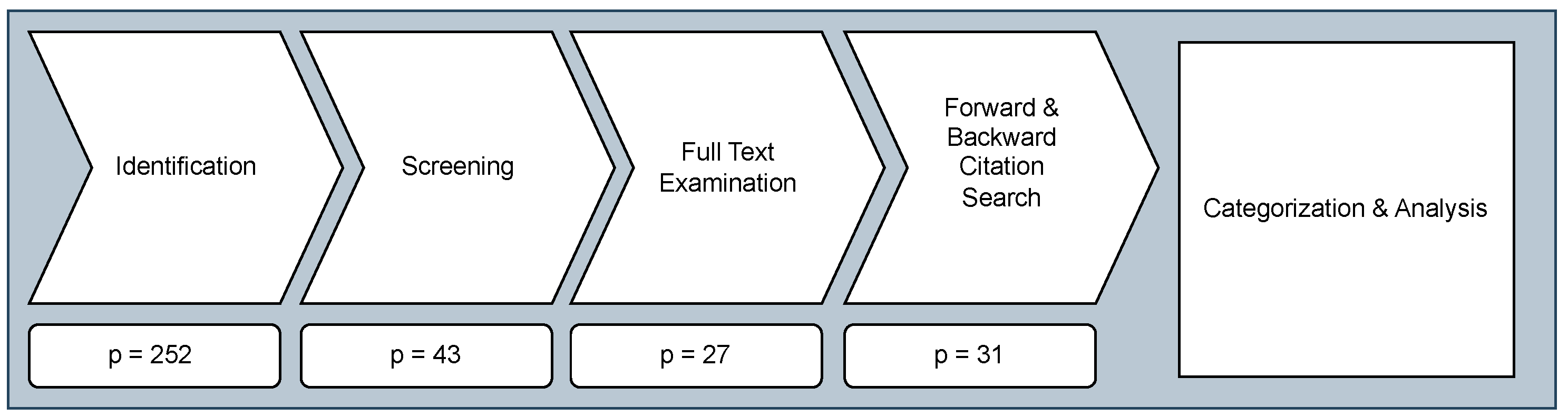
For this survey, a strict PRISMA-oriented methodology was followed, as illustrated in Figure 1. The individual steps of this methodology are described in this section.
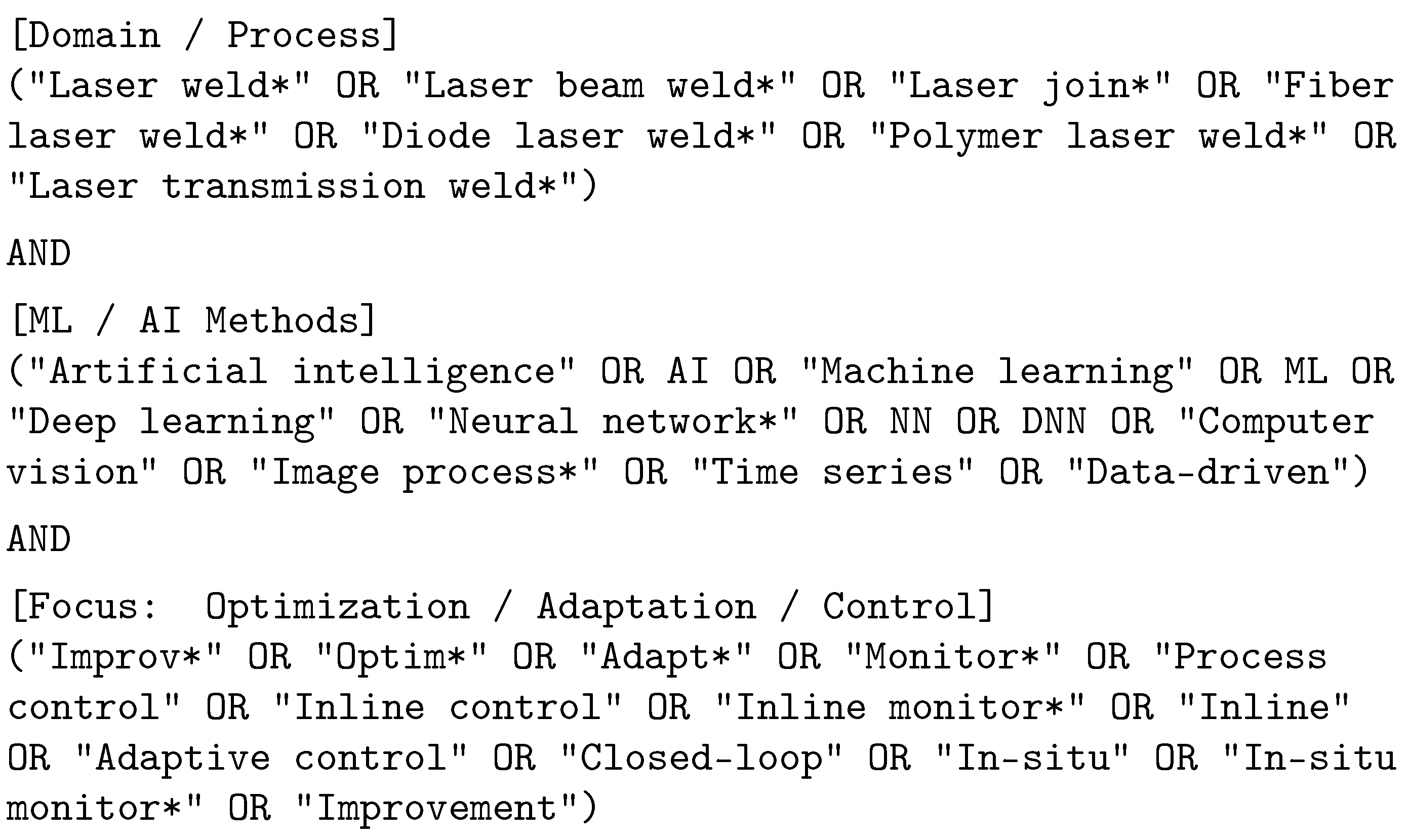
Identification. For the identification of relevant literature, keywords were defined to target the specific aspects relevant to this survey, derived from the research questions. Accordingly, publications were collected that (i) address the laser welding domain, (ii) utilize ML or AI methods, and (iii) focus on optimization, adaptation, monitoring, or control. This includes variations of different laser welding processes, combined with machine learning–related keywords, as well as terms representing active improvement, optimization, and control strategies. The resulting query, shown in Figure 2, was applied to the Web of Science and Scopus databases, yielding 153 publications from Scopus and 99 from Web of Science. Consequently, 252 publications were retrieved in total.
Screening. The screening step refers to the inspection of the title and abstract of the identified publications and the exclusion of those that do not fall within the scope of this paper. The scope was strictly limited to publications that propose methods integrating machine learning into an optimization or adaptation mechanism that influences the outcome of the welding process. As a result, 209 out of 252 publications were excluded, with the most frequent reason being a scope limited to monitoring. An overview of all exclusion criteria is provided in Table 2.
Full Text Examination. While a wide range of publications outside the scope of this survey could be excluded by screening titles and abstracts, 43 publications remained that could not be clearly evaluated without a full-text review or were likely to fall within the scope. These publications were reviewed in full text and further reduced by 16 to only those relevant according to the aforementioned criteria. The most common exclusion reason was an exclusive focus on monitoring or classification tasks with no direct connection to process adaption measures. In cases where ambiguity remained after re-evaluating the full text, the publication was flagged and discussed with at least one co-author, and the final decision was made by consensus. If categorization-relevant information was not explicitly reported, the study was retained if it met the inclusion criteria, but the corresponding attributes were marked as Unspecified to avoid speculative classification.
Forward and Backward Citation Search. To ensure that all relevant publications are included in the survey, even if they were not identified through the initial database queries, all retrieved publications were additionally analyzed for forward and backward citations. This means that it was examined whether the publications they cited (backward) or those that cited them (forward) could be relevant to this survey. As a result, the number of publications slightly increased by four after the final examination step. For reproducibility, the resulting final dataset, comprising 31 included studies, is summarized in Appendix A Table A1.
Categorization and Analysis. After completing the search and filtering process, the publications were analyzed and grouped, either in binary form or into predefined categories derived from the research questions. The categories are presented in Table 3, and where used as the foundation for enabling extensive statistical analysis.
Risk of Bias and Reporting Bias. In line with PRISMA guidelines, we considered potential sources of bias at both the review and study levels. No automated screening tools were used, all screening decisions were made manually. To reduce selection bias, the search strategy was discussed by multiple authors and designed to cover a broad range of synonymous terms and variations of relevant laser welding processes. Clear criteria for evaluating publications were established through group consensus. While screening, full-text examination, and categorization were performed by one author, a critical peer review was conducted by at least one co-author, to ensure the consistent application of the inclusion and exclusion criteria and the correct assignment to the aforementioned categories, thereby mitigating subjective bias in study selection and categorization. As this survey aims at mapping machine learning use-cases and taxonomies rather than aggregating quantitative results across studies, no standardized risk-of-bias tool was applied. However, limitations related to reporting bias and incomplete methodological reporting in primary studies remain possible (e.g., selective reporting of results or missing implementation details), and are considered when interpreting the findings.

5. Results

5.1. Trends and Application Context

In this section, we address research question Q1. Specifically, the trends and application context of existing methods are analyzed and decomposed into their relevant components for answering the questions regarding the utilization of different laser types, materials, joint geometries, and welding process variants.

5.1.1. Trend

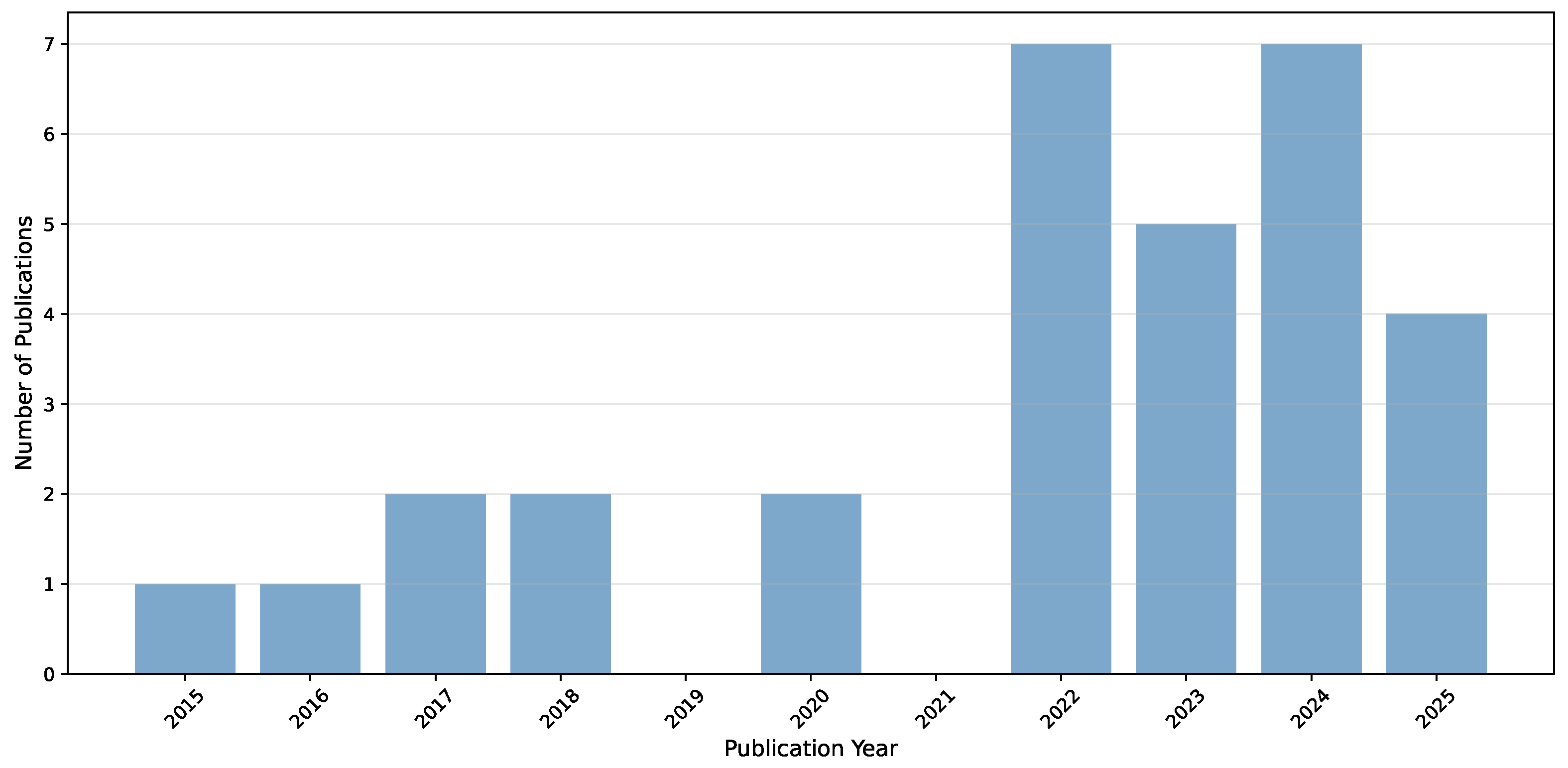
The publication years of the 31 relevant studies are shown in Figure 3. Overall, more than 70 percent of the relevant publications were published in the past three years, highlighting the growing interest in integrating machine learning methods into the laser welding optimization process. This trend aligns with the broader development of recent years, as machine learning, and particularly deep learning methods, are increasingly being researched and applied across various domains and tasks that are of high relevance for process monitoring (see Section 1.1).

5.1.2. Welding Process and Technical Components

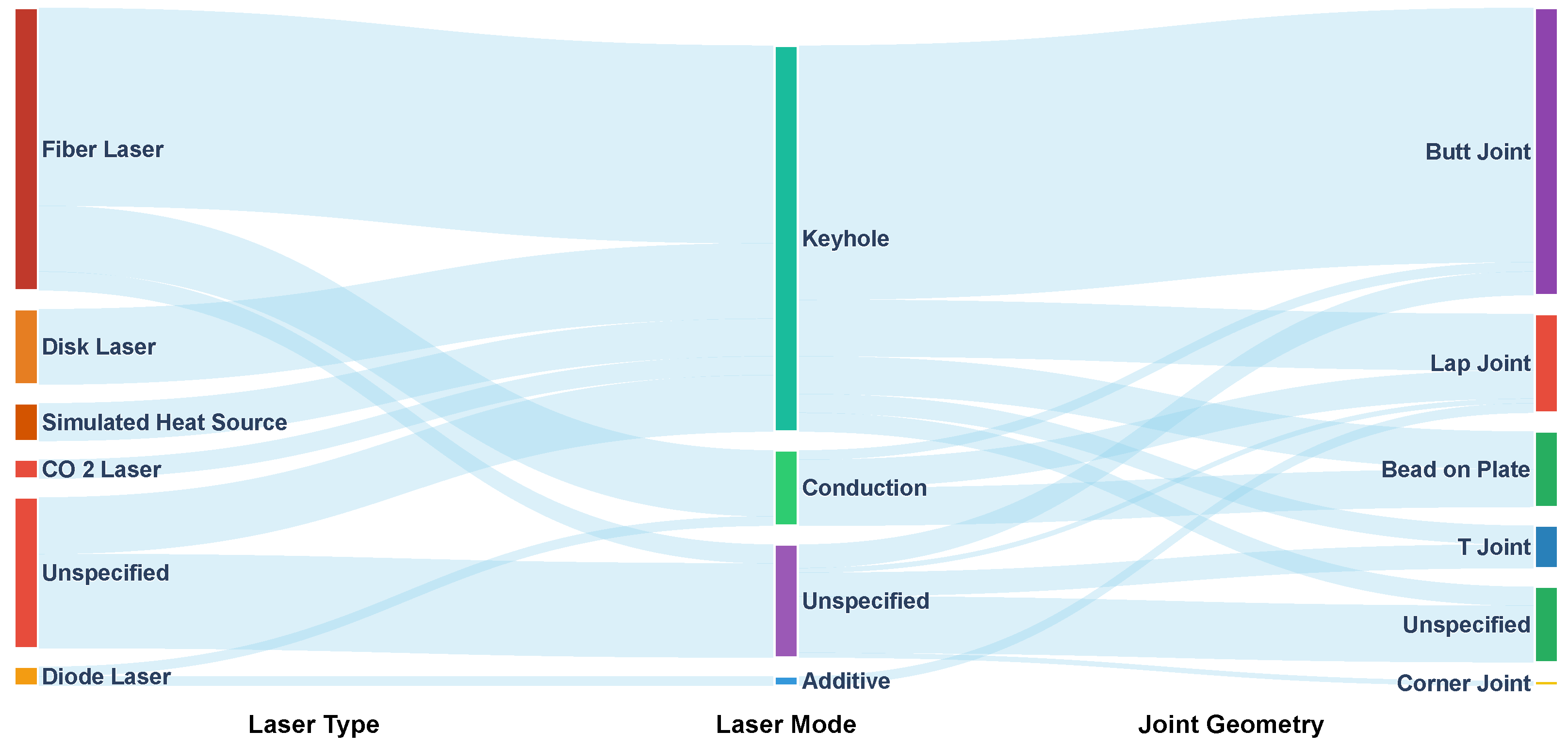
To identify the laser welding process variants addressed in the reviewed publications, an analysis of the relevant technical components was conducted. Specifically, the technical context of existing approaches was examined in terms of components such as the laser type, the laser mode used, the resulting joint geometry, and the materials involved. The results are visualized in Figure 4, showing that most existing publications focus on manufacturing butt joints using fiber lasers operated in keyhole mode. More precisely, among all publications, 48.4 percent used fiber lasers and 66.1 percent employed keyhole welding, and of these, 65.9 percent investigated welding in a butt-joint geometry. This dominance of fiber lasers can be explained by the various advantages they provide in comparison to other laser architectures, such as high mechanical stability, minimal maintenance requirements, low sensitivity to external disturbances, good fixed beam quality, and high compatibility [66]. Furthermore, the combination of keyhole welding and butt joints reflects common industrial applications, as it involves simple end-to-end welding of two components, for example, in the manufacturing of plates, pipes, or tubing [7]. In consequence, other laser types, modes, and configurations are less represented. Regarding the Unspecified label, it is important to note that several publications did not fully specify all technical aspects of the process, mostly because their approaches were applied in simulations [33,34,37,45,61], or were presented as conceptual studies without practical experiments [67,68].

5.1.3. Materials

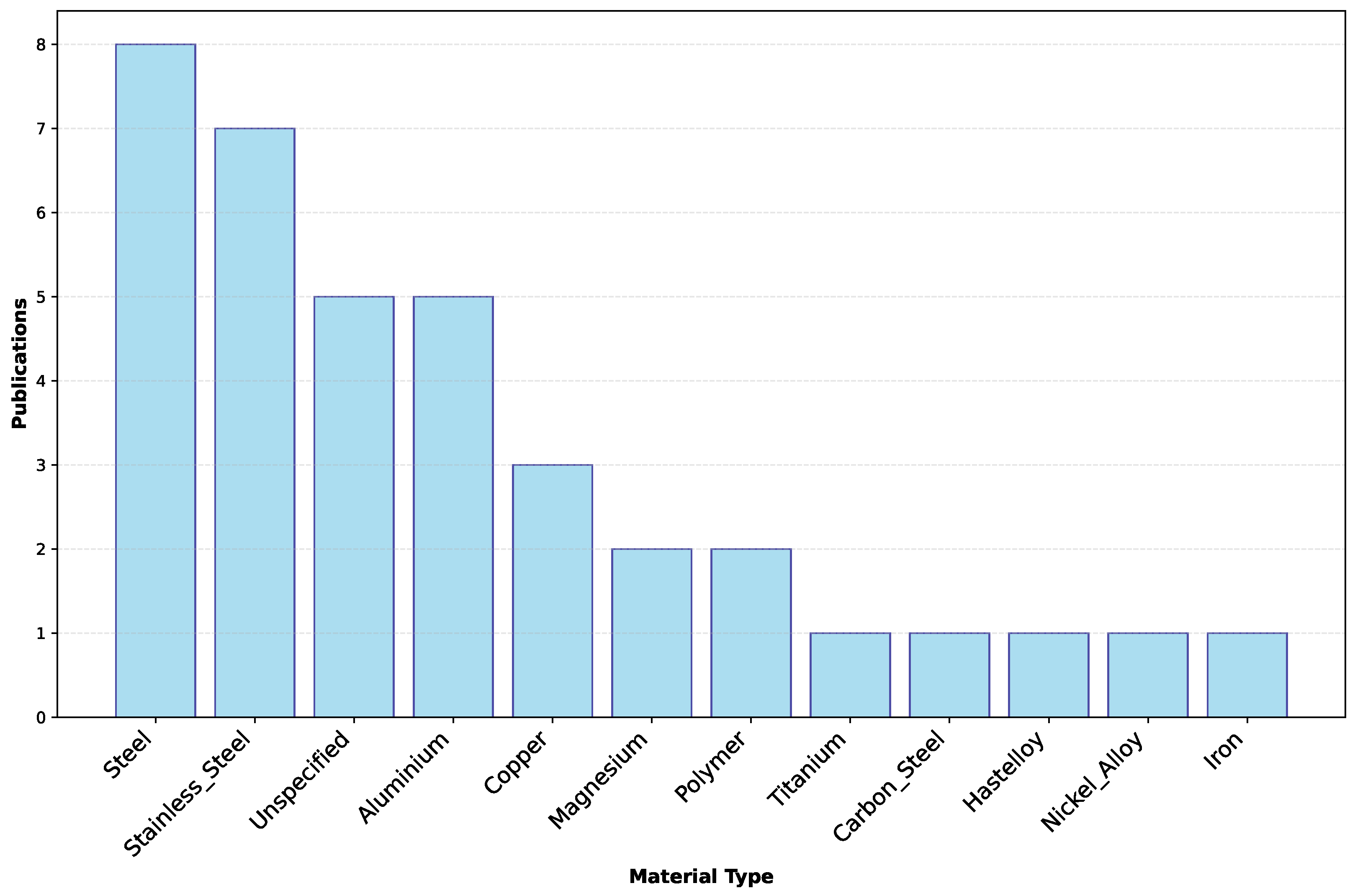
Figure 5 visualizes the frequency of materials considered in the publications. While most of the studies focus on welding either steel or aluminum, a smaller number also investigated materials such as copper, magnesium, or polymers or multiple materials [13,32,33,37,51,69]. As before, the label Unspecified was assigned to publications that did not specify the materials, either because they were purely simulation-based [45], conceptual [68], not material-dependent due to a focus on positional aspects of the laser [16,36], or simply omitted this information [35].
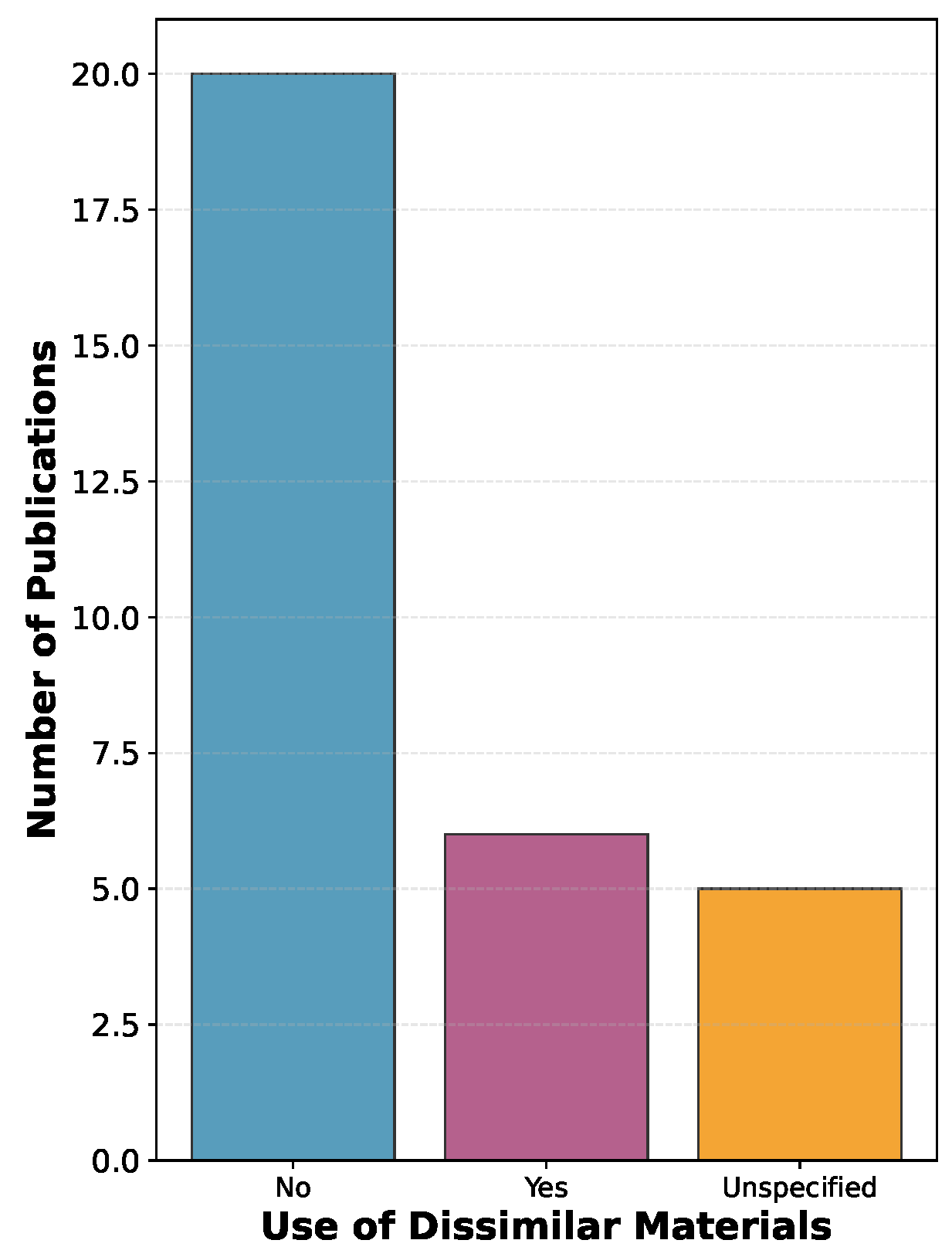
Another important aspect identified was whether the process involved welding similar or dissimilar materials. An overview is shown in Figure 6. While most studies focus on welding workpieces made of the same material, a smaller number investigate the welding of dissimilar materials [13,32,33,37,51,69], which has been reported to introduce additional challenges due to differences in thermal expansion coefficients, difficulties in heat treatment, and variations in electrochemical properties [9,51].

5.2. ML-Based Approaches for Process Optimization

In this section, we address research question Q2. To this end, we analyze and categorize the models used, their purpose within the process, the employed training strategies, and the applied evaluation procedures. Furthermore, we synthesize the findings across the different approaches by deriving a model-purpose taxonomy and proposing additional methodological categorizations.

5.2.1. Model Purpose Categorization

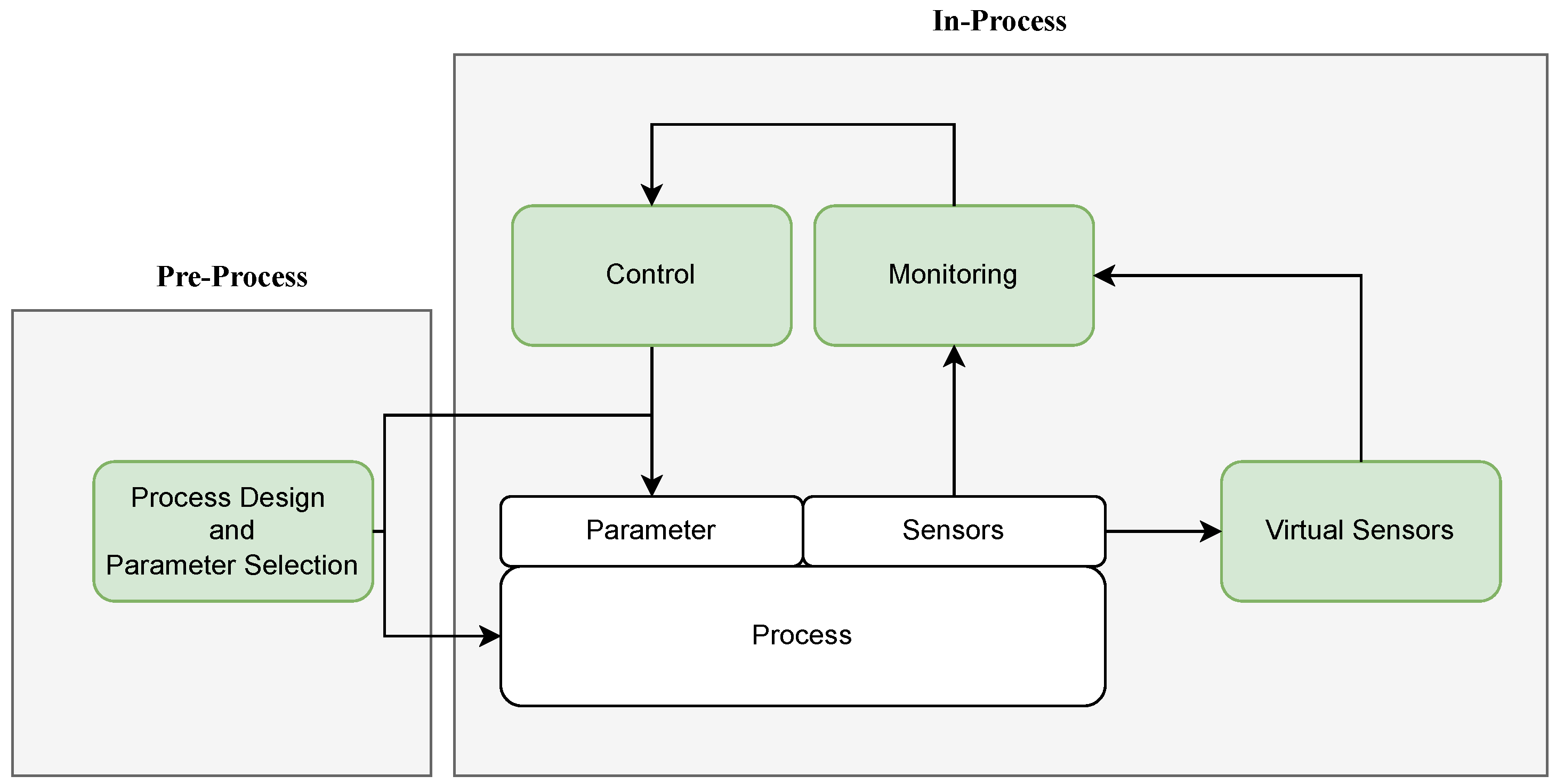
To introduce a taxonomy that encompasses the various applications identified in the literature, the different categories (see Figure 7) are first defined according to the general functions they provide and the phases and components of the process in which they are applied. Subsequently, each category is described in detail, clarifying which approaches are used to accomplish the respective tasks.
Machine learning methods can support the welding process in various ways. During the initial setup, optimal process parameters must be selected and key aspects must be planned. The literature discusses how these tasks can be automated and optimized using machine learning, for example, by positioning the laser [16,67] or by planning the weld seam trajectory [69]. Moreover, machine learning assists in this stage by modeling the experimental process itself, thus reducing the need for physical experiments [51,70,71,72].
During the welding process, machine learning is applied for process monitoring, as it enables the processing of complex sensor data and the learning of relationships between the monitored variables and quality-relevant features [45,46,60,73]. Furthermore, machine learning is used to estimate process variables that are not directly measurable [60,73]. In this role, it functions as a virtual sensor by approximating quantities that are difficult to measure, thereby enhancing process monitoring. Finally, machine learning methods are able to facilitate complex closed-loop control, for example, through reinforcement learning agents [15,34] or by directly predicting control parameters [38,53]. Subsequently, four distinct purpose categories were defined, and the publications were categorized accordingly, as shown in Table 4.
Categorical boundaries: The proposed four model-purpose categories were not defined by the employed machine learning technique itself, but by the model’s functional role within the laser welding optimization and control system. Specifically, ML methods either support decision-making before welding execution (Pre-Process Design), or are applied during welding execution as part of process observation and decision-making. In-process applications are further differentiated into three functional roles: (i) Monitoring, where model outputs primarily provide diagnostic or supervisory information about the process state or weld quality, (ii) Virtual Sensor, where models estimate latent or difficult-to-measure process variables in a sensor-like manner, and (iii) Direct Control, where ML outputs directly determine control actions or control parameters. Borderline cases were assigned based on the dominant operational dependency of the system on the ML component, ensuring mutual exclusivity across categories.
Process Design and Parameter Selection: All methods that are applied to optimize the process before it starts, are categorized into this group. This includes approaches that influence the setups, e.g., of initial positioning of the laser, as well as training surrogate models for optimization of parameters. One recent example of such a process-design-phase approach is [36]. In this work, a modified version of YOLOv8 is used to process depth-camera data of the weld area and to output segmentation masks of weld seam regions, which are then used by a robot to identify the initial position for the welding process.
Many other approaches focus on surrogate modeling for parameter selection. A surrogate model refers to a machine learning model that predicts properties of the resulting weld of the welding process (e.g., resulting tensile strength [70] or angular distortion [71]) based solely on the initial input parameters. It effectively serves as a virtual substitute for the physical process, allowing researchers to explore and optimize the parameters of the process without the need for expensive and time-consuming experiments or high-fidelity simulations. Such surrogate models enable efficient searches for optimal parameter combinations across large design spaces, for example, in combination with evolutionary multi-objective optimization algorithms such as MOPSO and NSGA-II [11,13,32,33,37,54], optimization methods such as Particle Swarm Optimization [10,31] or Bayesian optimization [72], as well as brute-force numerical searches [12]. In addition, surrogate models are used as decision-support tools for domain experts [74]. Additionally, the Taguchi method is employed to reduce the number of experiments required to collect data on different process input–output relationships [11,53].
It is important to distinguish the concept of a surrogate model from that of a digital twin. While surrogate models are typically lightweight approximations of an underlying physical process or simulation, a digital twin constitutes a digitized conceptual representation that remains coupled to its physical counterpart throughout operation as a data-driven replica [65]. Other applications in the process design phase refer to the application of machine learning methods for configuring aspects of the welding configuration that go beyond simple numerical parameters, such as determining the initial weld position [36], laser position [16,67], or planning the weld seam trajectory [69].
Direct Control: Refers to the use of machine learning methods that directly regulate one or more process parameters during the welding operation. This control is achieved either through a reinforcement learning agent [15,34,35,61,75] or by creating an ML-based adaptive controller that determines the control variable directly based on the current process state [38,53,73]. One of the earliest methods for realizing an ML-based adaptive controller was presented in [53], where a neural network was implemented to predict the required laser power and feed rate based on monitored data from a laser vision sensor. The inputs included the current gap size and groove geometry, as well as the desired bead width and bead reinforcement. Furthermore, in [38], this approach was adapted for low-latency control by replacing the neural network with a pre-processed lookup table containing a wide range of input–output combinations from the ML method, enabling direct inference of the required laser power and feed rate. A more recent example is [73], which proposes a control approach that adjusts the welding speed based on a heat input gap predicted by a neural network.
Monitoring: If a model is not employed as the primary controller but is instead used to track or interpret process variables directly alongside a secondary control component in an informative, descriptive, or diagnostic manner, it is classified as a monitoring approach. For instance, a model may deliver real-time predictions of the penetration state [60] or predict the resulting quality label based on the current state [61]. A simple-to-implement solution for keyhole welding, which was identified as the most common laser mode (see Section 5.1.2), is the hybrid approach presented in [60]. In this approach, a camera directly monitors the keyhole region, and a CNN is used to classify the current process state according to different penetration classes, such as excessive penetration or partial penetration. These classes are then passed to a PID controller for laser power adjustment. In this way, sufficient but not excessively deep laser penetration can be achieved. However, the authors note that different materials and laser systems may influence the applicability of this method and underline the necessity of future work to improve its generalizability.
Virtual Sensor: A virtual sensor is a monitoring and estimation approach whose objective is to infer process variables that are relevant for control but cannot be measured directly, or only with difficulty. For example, virtual sensors have been proposed for tasks such as estimating the required corrective contact force between workpieces [46], the penetration depth [73], or the weld width [45]. These estimated variables are directly used as inputs to the control system. The most recent approach for implementing such a virtual sensor in a laser welding process is presented in [46] for the welding of thin metal sheets. During the welding process, the two sheets must be pressed together. However, thermally induced sheet movement can lead to the formation of joint gaps, necessitating adaptive repositioning of the workpieces. To infer the corrective contact force required for gap mitigation, an unobservable quantity that cannot be measured directly, the current joint gap evolution and the process time are provided as inputs to a temporal convolutional neural network (TCN). The TCN predicts the actuator force required in the subsequent time step, which is then used by the controller to adjust the actuators accordingly.

5.2.2. Optimization Methodologies

As mentioned in the previous section, many pre-process as well as in-process methods are hybrid in nature, meaning that they do not directly, or at least not exclusively, optimize the process on their own, but rather in combination with a secondary component or algorithm. While these optimization methodologies are not the primary focus of this work, all identified secondary components are summarized in Table 5, together with representative publications for further reference.

5.2.3. Model Overview

After defining the categories, the next step was to analyze the relationships between the machine learning methods actually used, as summarized in Table 6, their functional roles, and the welding process.
In Table 6, an overview of all machine learning methods used in the literature is provided, together with references to the corresponding publications. The work by [67] is not included in this overview, as it is a conceptual contribution that does not specify a concrete method implementation. We observed that many publications employ simple, classical neural network architectures or slight variations thereof, followed by CNN-based approaches and classical machine learning methods. However, this distribution of methodologies can be slightly misleading, as the choice of models differs depending on the process phase and the purpose of the model.
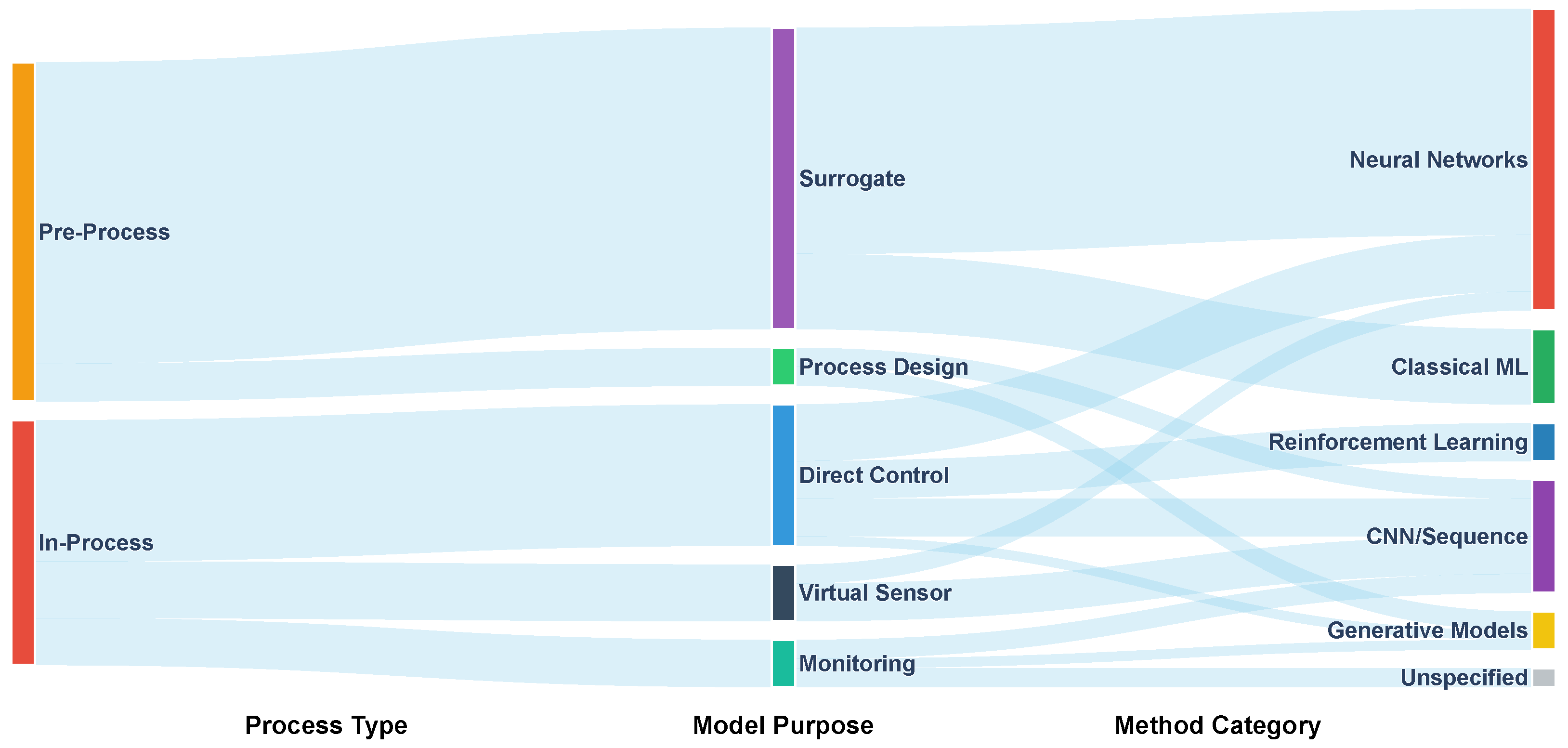
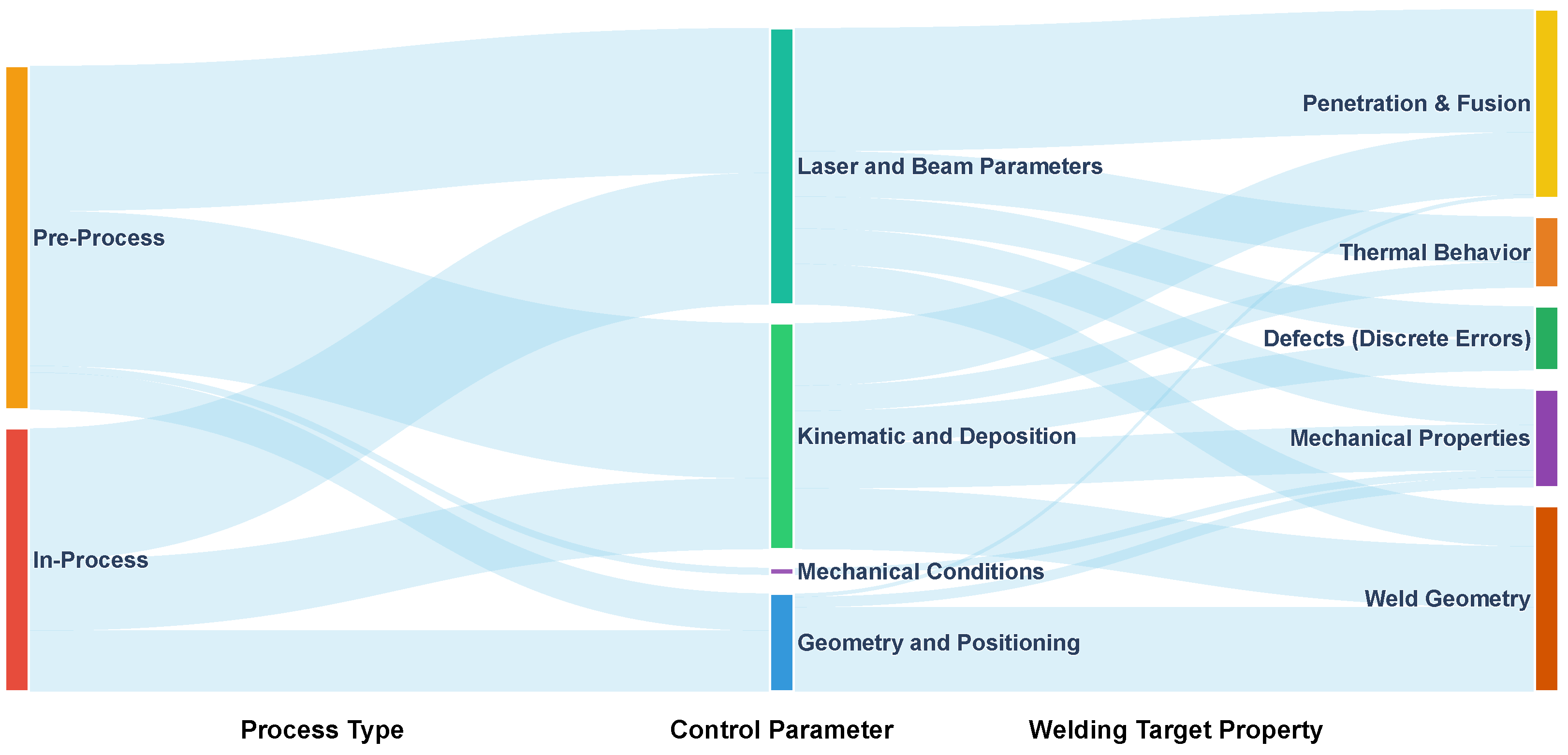
To obtain a more comprehensive understanding of this aspect, as well as the actual role and function of the models, a further contextualization of the implemented approaches within the overall process and purpose categories is required. To this end, the methodologies employed in the reviewed publications were mapped according to the proposed taxonomy, specifying whether a machine learning method is used as a surrogate model, a process planning tool, a direct controller, a monitoring component, or a virtual sensor. These interdependencies are illustrated in the overview shown in Figure 8.
When examining the relationship between process type, model purpose, and method category, several insights can be derived. First, a major distinction can be observed between model implementations in pre-process and in-process optimization approaches. While 88.9 percent of publications in pre-process optimization focus on surrogate modeling, with only a few cases addressing other process-planning tasks. In-process methods exhibit a more balanced distribution of implementations, with 57.7 percent focusing on direct control, 19.2 percent on monitoring, and 23.1 percent specializing in virtual sensing.
For implementing surrogates, classical neural networks or traditional machine learning models are primarily used, since the underlying data does not consist of complex sensor signals but of static inputs, such as process parameters and corresponding process results as outputs [10,11,12,13,31,32,33,37,51,52,54,68,70,71,72,74]. In contrast, the methods applied in in-process optimization are more diverse due to differing tasks and sensor data: alongside classical neural networks, several approaches employ reinforcement learning, convolutional neural networks (CNNs), sequence-based models, or generative methods.

5.2.4. Model Evaluation

For both training and evaluation, machine learning models require a reference against which their performance can be assessed. However, due to the diverse objectives and application scenarios addressed in the literature, no unified evaluation protocol is consistently applied. Consequently, it remains unclear whether a common experimental evaluation strategy exists across studies.
To address this, we analyze the experimental comparison strategies employed in the reviewed publications, focusing on how correct model behavior is validated within the respective experimental setups. Based on this analysis, four overarching evaluation strategies are identified, grouping publications according to their evaluation methodology. These categories, differentiated by process stage, together with the corresponding references, are summarized in Table 7.
Methodological Comparison: Refers to the use of multiple approaches that are compared against each other to solve the task. For example, this may involve comparing a neural network–based method with classical techniques such as Support Vector Machines or regression models [10,73], or evaluating improvements between a baseline version of an approach and its extended or enhanced variant [34,36]. A special case arises when the method is not related to the welding process or adaption itself, but instead pertains to other tasks that have no direct connection to optimization or adaptation. For example, in a camera-based process monitoring application, an ML-based feature extractor was compared with a classical feature extractor [61].
No Comparison: A substantial number of studies do not report an explicit comparison against alternative methods or reference strategies. Instead, these works primarily demonstrate feasibility by training a model on labeled data or unsupervised for pattern recognition and presenting qualitative or task-specific results. This evaluation strategy is often observed in studies addressing highly specialized or novel tasks, such as high-energy region detection [16], penetration state classification [60], or weld trajectory planning [69]. Additional examples include approaches evaluated exclusively in simulation [45], conceptual or system-level studies without quantitative evaluation [67,68], comparisons limited to untrained or trivial reference models [35], or cases where the evaluation procedure is only partially described [51].
Experimental Reference: The most common evaluation approach for process surrogate modeling is a direct comparison with actual experimental results, which already provide the ground truth for training the model. In this setting, the model is evaluated according to how closely its predictions match the real process outcomes when performing a welding operation. This represents the most frequently used validation protocol in pre-process surrogate modeling approaches.
Simulation Reference: Identically to experiments, simulations were also used as a source for generating ground truth labels. Especially since one of the major goals of surrogate modeling is to evade cost-intensive experiments and simulations, the focus for surrogate modeling is comparison with simulation data, which provides comparable functionality and therefore can serve as a key performance reference for evaluating the model.
Fixed Parameter Comparison: Refers to the comparison between an approach that dynamically adjusts its parameters and a strategy in which the parameters remain constant, for example, when parameters are selected solely based on preliminary experiments [53], or hand-engineered optimal constant power strategies [15].
Benchmark datasets and baseline comparison: Across the reviewed literature, no standardized, openly available benchmark datasets or generally accepted baseline comparison protocols could be identified. While a minimal reference for surrogate modeling may be understood as achieving predictive performance comparable to high-fidelity simulations, such criteria are rarely formulated explicitly. Moreover, to the best of our knowledge, no established methodologies exist that enable systematic comparison of optimization or control performance across different studies. As a result, reported results remain largely study-specific and are often limited to standard evaluation procedures. Future research should address this limitation by improving data standardization and comparability, e.g., by reporting minimal dataset specifications such as sample counts, train/validation/test split strategies, parameter ranges, sensor modalities, and sampling rates, and, where feasible, publishing datasets or at least providing aggregated benchmark subsets. Furthermore, studies should always include comparisons of widely applicable physics-agnostic baseline models, ranging from trivial reference predictors (e.g., mean/majority baselines) to conventional ML baselines (e.g., Random Forest or Support Vector Regression). Finally, evaluation should explicitly distinguish different objective dimensions, including model prediction performance (e.g., MAE/RMSE or F1-score), control stability (e.g., overshoot, settling time, constraint violations), and welding quality improvement (e.g., defect rate reduction or penetration deviation). Consequently, a three-level evaluation scheme can be established that systematically assesses the effectiveness of a proposed approach.

5.3. Control Parameters and Optimization Targets

In this section, we address research question Q3. Specifically, we specify the optimization objectives, as well as the control parameters, and introduce a taxonomy that contextualizes the relationships between these variables and the process phase.
It is important to note that this description follows a system-level perspective of the reviewed approaches, aiming to clarify the overarching goals with respect to weld quality and process control. As such, it does not directly correspond to the input–output definitions of the underlying machine learning models. Depending on the specific task that models are applied to (see Section 5.2.1) and the learning paradigm, both optimization targets and control targets may appear as prediction outputs. In consequence, the following taxonomy is formulated at the system level perspective.

5.3.1. Optimization Target Categories

In the existing approaches, a broad range of weld features has been used as optimization targets, as summarized in Table 8. To determine which specific weld properties each approach aims to optimize, all reported targets were grouped into overarching optimization categories. These categories distinguish whether the targets represent discrete errors to be avoided (Defects), relate to mechanical properties of the weld (Mechanical Properties), concern penetration and fusion (Penetration/Fusion), involve thermal characteristics (Thermal Behavior), or describe geometrical aspects (Weld Geometry). Similarly, control parameters are categorized based on their physical role in influencing the welding outcome, distinguishing beam-related energy input, kinematic and material deposition effects, geometric positioning, and mechanical boundary conditions. This level of abstraction is chosen to reflect the dominant control dimensions available in practical laser welding systems, rather than application-specific parameterizations. As a result, it enables consistent comparison across heterogeneous studies addressing both optimization and control tasks.

5.3.2. Control Parameters

A control parameter refers to a variable or aspect of the process that is adjusted to optimize a target property. All control parameters reported in the literature, along with references to the corresponding publications, are summarized in Table 9. To obtain a more comprehensive taxonomy on the different types of parameters, all control parameters were categorized according to their physical role in the laser welding process, distinguishing beam-related energy input, kinematic and material deposition effects, geometric positioning, and mechanical boundary conditions. While, regardless of the categorical distribution, the parameters welding speed and laser power are clearly the most commonly used in many studies, the question arises as to how these control parameters relate to the aforementioned optimization targets and the overall process context. To explore this relationship, an overview is provided in Figure 9.
From a process-context perspective, it can be observed that both in-process and pre-process approaches employ control parameters from all categories, with no clear or consistent tendencies emerging. This suggests that, in contrast to methodological implementation, there is no clear differentiation with respect to the process phase or the physical aspect being influenced to achieve a given optimization goal.
A similar pattern is evident when considering the optimization targets. Despite apparent dependencies, for example, a tendency for parameters from Geometry and Positioning to be predominantly used for objectives related to weld geometry, no specific control parameter can be clearly associated with achieving a particular optimization goal. The only consistent tendency observed is the equally frequent use of parameters from the Laser and Beam and Kinematic and Deposition categories, most notably laser power and welding speed, which are relevant across all optimization objectives.

5.4. Sensors and Data

In this section, we address research question Q4. This includes specifying the employed sensor types and data modalities that are used as input to the model and, therefore, essential for training machine learning models.

5.4.1. Process Parameter Input Data

For pre-process and in-process methods, but especially for pre-process approaches, process parameters are among the most common input attributes. In particular, for pre-process optimization, process parameters are widely used as static inputs for learning input–output correlations for constructing surrogate models. Consequently, the majority of pre-process applications rely primarily on process parameters as model inputs [10,11,12,13,31,32,33,37,51,52,54,71,72,74].
However, process parameters are also employed in in-process scenarios (e.g., [34,45]). In contrast to pre-process approaches, these parameters are not used as static inputs but instead serve as variables for active modification, as their optimum configuration needs to be found. Consequently, dynamic sensor data, characterized by high heterogeneity depending on the sensor type, is predominantly used as the primary input for training models for in-process application. This heterogeneity is analyzed and further decomposed into the different data domains relevant to ML in the following section.

5.4.2. Sensor Data

The sensor setups utilized in the reviewed publications differ in hardware and data types. As shown in Table 10, the monitoring approaches are largely scattered across different sensor types but are homogeneous, typically relying on sensors of the same type [15,16,35,38,46,60,73]. However, heterogeneous approaches that employ sensors of different types are also used [61,75]. Two publications do not specify the sensor setup, either because their work is conceptual [67] or their approach is applied only in simulation [34,45].
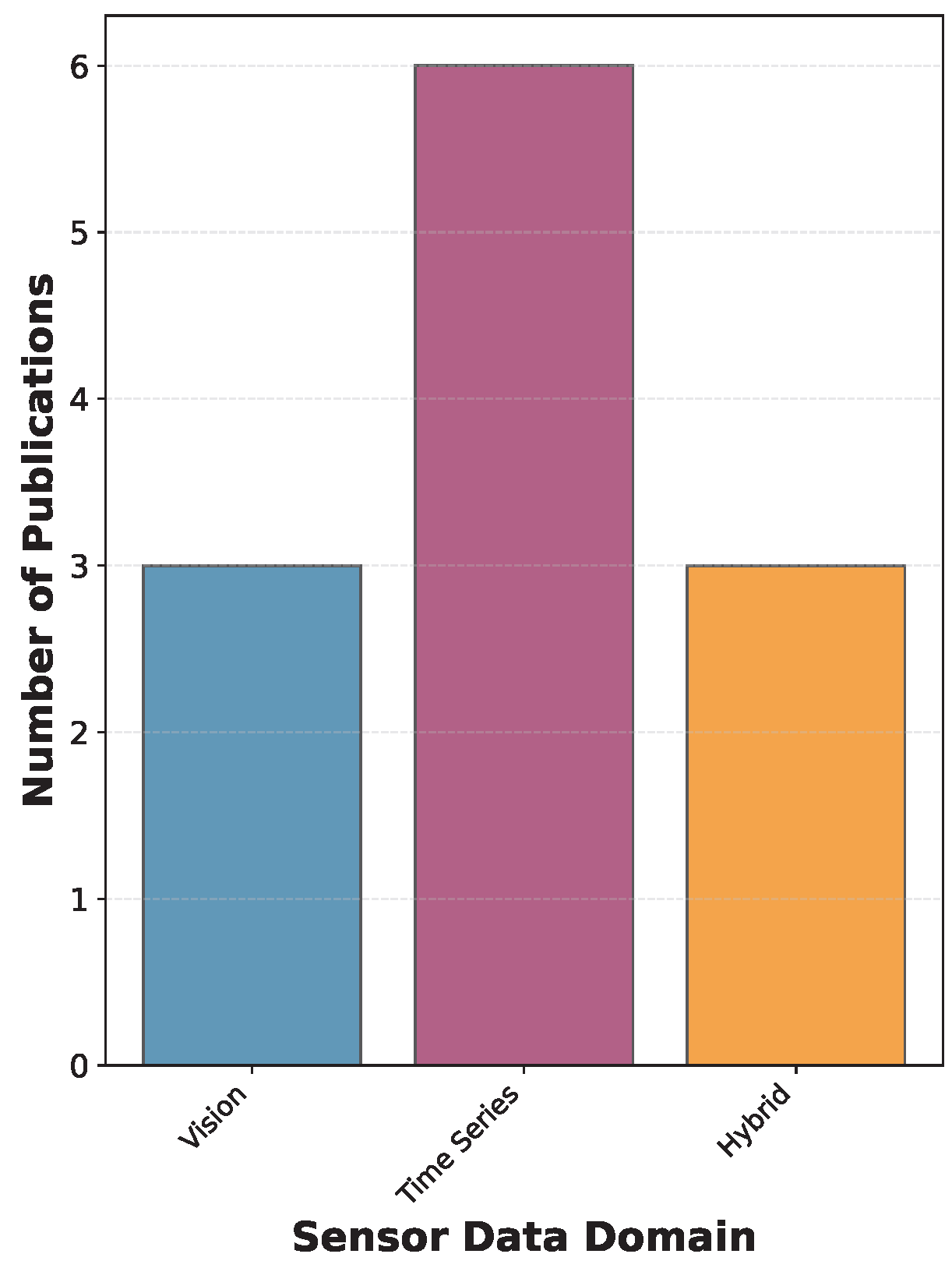
Referring to the data domain of the sensors, which is of particular importance for the implementation of data-driven models, the sensors were categorized according to whether they provide the system with vision data (i.e., direct images captured by CCD, CMOS, or other camera types) or time-series data, meaning sensors that produce time-dependent signals without spatial reference (e.g., acoustic emission sensors, inductive probes, and photodiodes). Additionally, a hybrid category was introduced for sensors that deliver data containing both temporal and spatial components (e.g., optical coherence tomography (OCT), laser vision (LVS), and laser triangulation (LTS)). The resulting statistics over the analyzed publications are shown in Figure 10. It can be observed that most methods rely solely on time-series data. However, the combination of hybrid and vision-based data is nearly equally represented, indicating that publications in general do not show a clear tendency to prefer a particular type of sensor data.

6. Discussion

In this survey, we performed a systematic literature analysis and synthesized the findings using a structured categorization framework. Specifically, the reviewed publications were classified according to derived taxonomies covering aspects such as application context, model purpose, evaluation strategy, and optimization targets, enabling a consistent cross-study comparison. Based on this structured synthesis, the research questions can be comprehensively addressed.
Q1: In which application contexts have ML-based methods been used for process optimization? (see Section 5.1)
To date, existing approaches have predominantly been applied to using fiber lasers (48.4 percent) in keyhole welding processes (66.1 percent), for the welding of butt joints. However, 19.4 percent of studies have also investigated lap joints, while 9.7 percent focus on T-joints. Only 12.9 percent of publications address conduction-mode welding, and only a few consider other laser types. The materials used are similarly dominated by a single group, steel and stainless steel, followed by a smaller number of studies employing aluminum and copper or dissimilar materials. This dominance of fiber-laser keyhole welding studies also suggests limited transferability: ML models trained on keyhole-specific process signatures (e.g., keyhole dynamics, plume or spatter behavior) may not directly generalize to other welding modes, where process physics and sensor observability differ. Therefore, the transferability of methods developed for fiber-laser keyhole welding should be investigated further. Specifically, future work could assess the feasibility of transfer learning and model reuse to adapt trained models across different process variants, materials, and joint geometries, thereby reducing annotation effort and mitigating the challenges associated with small dataset sizes.
Q2: What models are used to link process data with process adaptation or optimization? (see Section 5.2.3)
Existing approaches can be categorized according to their implementation and model purpose. With respect to model purpose, approaches can be differentiated based on whether they are applied in-process or pre-process, and whether they are used for process planning, surrogate modeling, direct control, monitoring, or as a virtual sensor. Since pre-process and in-process methods differ in several aspects, this question will be addressed separately for each category.
Pre-Process: For pre-process optimization, the majority of models are variations of classical neural networks or traditional machine learning methods, typically trained in a supervised learning setting. The only exception is the use of generative models for planning purposes (see Section 5.2).
Regarding evaluation, since most pre-process optimization approaches employ machine learning models as surrogates for the actual process, the real process or its simulation is usually used as the baseline for comparison. The standardized procedure typically involves conducting a limited number of experiments or simulations to generate a small dataset, which is then used to train the machine learning model. After training, optimization algorithms can leverage the trained model to search for the optimal parameterization.
In-Process: The approaches used for in-process optimization differ from those applied in pre-process optimization in several respects. Firstly, the model objectives can vary; they may serve purposes such as process monitoring, direct control, or virtual sensing. Secondly, most architectures are CNN-based, and in the case of direct control, a larger proportion of methods are trained using reinforcement learning to learn a control policy rather than through supervised learning. In contrast to pre-process methods, many in-process optimization approaches are highly specialized and lack standardized baselines, making standardization on a universal baseline and benchmarking-oriented level very difficult.
Q3: What are the objectives of optimization, and which variables serve as control targets? (see Section 5.3)
Overall, the optimization targets used in the reviewed studies can be categorized into five groups: defects, mechanical properties, penetration-related characteristics, thermal behavior, and weld geometry. However, most approaches focus on characteristics associated with either weld geometry or laser penetration.
Regarding control parameters, they can be categorized into laser beam parameters, kinematic and deposition parameters, mechanical conditions, and geometry- and positioning-related parameters. Laser power and welding speed are most commonly adjusted, with little distinction between whether the optimization occurs in-process or pre-process. Nevertheless, there is a high degree of heterogeneity in the chosen control parameters, and no clear trend indicating that specific parameters are consistently used to target particular optimization objectives for the resulting weld. Consequently, pre-process and in-process methods do not exhibit distinct tendencies in their selection of control parameters.
Q4: What is the data basis for the ML model training? (see Section 5.4)
The existing approaches do not show a definitive tendency regarding the type of sensor used. Most studies employ a single-sensor setup. While a significant number of approaches use photodiode or camera systems, other sensor types are also utilized, such as inductive probes, laser triangulation, or acoustic emission sensors. Only a few approaches employ heterogeneous sensor setups.
Consequently, no particular data domain dominates the field, as an equal number of publications use time-series data, vision data, or a combination of both as input. However, an exception can be observed in the training of surrogate modeling approaches for pre-process optimization, where datasets are constructed from experimental or simulation-based data and typically contain static input–output relationships between process parameters and the resulting weld properties.
Q5: What challenges and research gaps can be identified?
Benchmarking and Standardization
For machine learning, it is particularly important to reproduce and compare approaches for evaluating a model’s effectiveness. However, as discussed in Section 5.2.4, existing research on the application of machine learning for laser welding optimization suffers from the lack of benchmarking datasets. Furthermore, since most publications do not make their datasets publicly available (see Section 5.2.4), this limits their reproducibility. Consequently, even methods applied in similar contexts cannot be directly compared with each other. Future research should therefore ensure that both code and data are published to enable reproducibility and fair comparison, including the development of uniform evaluation metrics and standardized quality requirements.
Interpretability:
Interpretability is becoming increasingly important, as it provides explanations for model predictions and strengthens end users’ trust in the application. However, only one publication has addressed interpretability in the context of laser welding process optimization. In [10], the influence of process parameters on the resulting seam width and height is analyzed using Shapley additive explanations applied to a multi-task neural network. Nevertheless, interpretability could play a crucial role in enabling practical applications and fostering a deeper understanding of the relevance of different process factors. In particular, explainability techniques could help identify which sensors, features, or time steps are most influential for specific quality targets, thereby reducing measurement effort and associated costs. For example, since many reviewed approaches use datasets including process parameters as inputs, readily applicable feature attribution techniques such as SHAP [76] or LIME [77] could be employed. For in-process applications, data modalities frequently include not only process parameters but also sensor inputs such as image-based monitoring; in this context, gradient-based explanation techniques such as Grad-CAM [78] can be used to highlight regions of the input images that drive model predictions. Alternatively, physics-informed ML methods, such as Physics-Informed Neural Networks (PINNs) [79], may offer a promising direction to improve interpretability and enforce physically plausible model behavior. Moreover, explanations of decisions made by in-process control methods could support human operators in validating and understanding the system’s actions.
Inline Defect Correction:
Another aspect that has not yet been adequately addressed is the use of deep learning methods not only for process adaptation but also for inline defect correction when the adaptation mechanism is insufficient. Such methods could enable appropriate countermeasures that go beyond parameter adjustments during the ongoing process. In this way, the system could intervene dynamically to prevent and correct quality issues.
Limitations and Practical Constraints of RL–Based Control:
While RL methods show promising results in research settings, their application in industrial environments is currently constrained by several well-known factors. The reasons for that include non-stationary process conditions, as most RL-algorithm implicitly assume stationary environments, the reliance on exploratory interactions that may lead to unsafe actions in physical systems, the need for explicit integration of safety constraints into the learning process, and strict real-time requirements arising from computational complexity and sensing or actuation latency [80].
Q6: What future work and research opportunities are suggested in the literature?
The reviewed studies suggest several possible next steps to further advance AI-driven process optimization. To ensure the relevance and timeliness of the proposed future research directions, the discussion is limited to studies published within the last two years and is focused on in-process control.
Exploring Application Capabilities:
In [46], the authors highlight further research opportunities related to the method’s capabilities, particularly by investigating its applicability to different joint configurations, welding parameters, and materials.
Fully Integrated Systems:
Another research direction discussed in [67] emphasizes the need to develop fully integrated quality assurance systems. Such systems should cover the entire chain, from initial recording of the welding situation and evaluation of the results to the integration of cloud and edge architectures, and include additional interconnected components capable of re-welding insufficient joints.
Latency Reduction and Multi-Parametric Control:
Since effective control relies on rapid system response, latency must be minimized. In [73], the authors emphasize the importance of investigating methods to reduce control delays and exploring the implementation of multi-parametric control strategies.

7. Summary and Outlook

In this work, the application of machine learning methods for optimizing laser welding processes was systematically analyzed. The survey examined which model types and implementations are used, the underlying sensor systems and data foundations, the applied baseline strategies, and the control parameters and optimization targets employed to achieve process improvements. Several application purposes were identified, including monitoring, direct control, process planning, virtual sensing, and surrogate modeling, which were evaluated either against fixed-parameter strategies, other machine learning implementations, or experimental and simulation-based outcomes. Laser power and welding speed were found to be the most commonly optimized control parameters, while weld geometry and penetration-related characteristics emerged as the predominant quality targets. Nevertheless, several challenges remain, such as the lack of benchmarking datasets, limited interpretability of models, and the relatively small number of studies focusing specifically on machine learning based optimization of laser welding processes. Nevertheless, the literature demonstrates substantial potential for the application of machine learning in laser welding optimization, as promising results have been reported for addressing challenges such as material variability [15], autonomous control in industrial applications [35], and first steps toward more interpretable welding processes [10].

Author Contributions

Conceptualization, J.V.; methodology, J.V.; formal analysis, J.V.; investigation, J.V.; data curation, J.V.; writing—original draft preparation, J.V.; writing—review and editing, H.T., T.M., and C.E.; visualization, J.V.; supervision, T.M.; project administration, H.T.; funding acquisition, H.T., C.E., and J.V. All authors have read and agreed to the published version of the manuscript.

Funding

The project on which this publication is based was funded by the European Union under grant number EFRE-20800908. Responsibility for the contents of this publication rests with the author.

Data Availability Statement

No new data were created or analyzed in this study. Data sharing is not applicable to this article.

Conflicts of Interest

The authors declare no conflicts of interest.

Abbreviations

The following abbreviations are used in this manuscript:
MLMachine Learning
DLDeep Learning
NNNeural Network
DNNDeep Neural Network
CNNConvolutional Neural Network
DCNNDeep Convolutional Neural Network
DBNDeep Belief Network
MTNNMulti-Task Neural Network
GA-NNGenetic Algorithm–Neural Network
AE/AutoencoderAuto-Encoder
TCNTemporal Convolutional Network
YOLO/BOT-YOLOv8You Only Look Once
GLMGeneralized Linear Model
GPRGaussian Process Regression
SVMSupport Vector Machine
SVRSupport Vector Regression
CTClassification Tree
RLReinforcement Learning
SACSoft Actor-Critic
AESAcoustic Emission Sensor
LVSLaser Vision Sensor
LTSLaser Triangulation Sensor
IPInductive Probe

Appendix A

Table A1. Final dataset of included studies (n = 31).
IDTitleYearCite
1The Application of Deep Learning and Image Processing Technology in Laser Positioning2018[16]
2Study on penetration depth in laser welding: A process information database-based control strategy and OCT measuring verification2024[73]
3Reinforcement Learning on Reconfigurable Hardware: Overcoming Material Variability in Laser Material Processing2025[15]
4Power Control during Remote Laser Welding Using a Convolutional Neural Network2020[60]
5Nonlinear Identification and Control of Laser Welding Based on RBF Neural Networks2022[45]
6Deep learning-driven active sheet positioning using linear actuators in laser beam butt welding of thin steel sheets2025[46]
7Approach for the Development of an Adaptive Vacuum Laser Welding Process for Hairpin Stators Using Supervised Learning2023[67]
8Adaptive control for laser welding with filler wire of marine high-strength steel with tight butt joints for large structures2018[38]
9Adaptive Laser Welding Control: A Reinforcement Learning Approach2020[75]
10Weld Seam Trajectory Planning Using Generative Adversarial Networks2022[69]
11Erratum to: Process modeling and parameter optimization using radial basis function neural network and genetic algorithm for laser welding of dissimilar materials2015[51]
12Prediction of Laser-TIG Weld Profile Based on Neural network and Intelligent Detection2022[70]
13Optimization of Butt-joint laser welding parameters for elimination of angular distortion using High-fidelity simulations and Machine learning2023[71]
14Optimisation of laser welding of deep drawing steel for automotive applications by Machine Learning: A comparison of different techniques2023[72]
15Numerical simulation and optimization in pulsed Nd: YAG laser welding of Hastelloy C-276 through Taguchi method and artificial neural network2017[52]
16Multi-objective optimization of T-shaped bilateral laser welding parameters based on NSGA-II and MOPSO2024[31]
17Multi-objective modeling and optimization of dissimilar laser welding by integrating an artificial intelligence predictive model with NSGA-II algorithm2024[32]
18Minimization of defects generation in laser welding process of steel alloy for automotive application2022[12]
19Laser Beam Welding Parametric Optimization for AZ31B and 6061-T6 Alloys: Residual Stress and Temperature Analysis Using a CCD, GA and ANN2024[37]
20Interpretable multi-task neural network modeling and particle swarm optimization of process parameters in laser welding2024[10]
21Expert system-supported optimization of laser welding of additively manufactured thermoplastic components2022[74]
22Experimental studies and optimization of process parameters in laser welding of stainless steel 304 H2022[11]
23Enhancing the efficiency of laser beam welding: multi-objective parametric optimization of dissimilar materials using finite element analysis2024[33]
24Enhancement of joint quality for laser welded dissimilar material cell-to-busbar joints using meta model-based multi-objective optimization2024[13]
25Adaptive filling modeling of butt joints using genetic algorithm and neural network for laser welding with filler wire2017[53]
26A Framework to Optimize Laser Welding Process by Machine Learning in a SME Environment2023[68]
27A Deep Learning-based Data-driven Approach for Modeling and Optimization of Laser Transmission Welding of Polypropylene2025[54]
28Reinforcement Learning for Laser Welding Speed Control Minimizing Bead Width Error2023[34]
29BoT-YOLOv8: a highly accurate and stable initial weld position segmentation method for medium-thickness plate2025[36]
30Smart closed-loop control of laser welding using reinforcement learning2022[35]
31Intelligent laser welding through representation, prediction, and control learning: An architecture with deep neural networks and reinforcement learning2016[61]

References

  1. Xu, J.; Jiang, Q.; Yang, J.; Cui, J.; Zhao, Y.; Zheng, M.; Oliveira, J.P.; Zeng, Z.; Pan, R.; Chen, S. A Review on Ultrafast Laser Microwelding of Transparent Materials and Transparent Material–Metals. Metals 2023, 13, 876. [Google Scholar] [CrossRef]
  2. Kahle, M.; Nodop, D. Glass welding with ultra-short laser pulses and long focal lengths A process model. Procedia CIRP 2022, 111, 617–620. [Google Scholar] [CrossRef]
  3. Neukum, J. Laser-Based Polymer Welding in Medical Device Manufacturing: The Combination of Pyrometer, Galvo Scanners and Diode Laser Systems Optimizes Welding Results. Laser Tech. J. 2009, 6, 37–40. [Google Scholar] [CrossRef]
  4. Feng, J.; Zhang, P.; Yan, H.; Shi, H.; Lu, Q.; Liu, Z.; Wu, D.; Sun, T.; Li, R.; Wang, Q. Application of Laser Welding in Electric Vehicle Battery Manufacturing: A Review. Coatings 2023, 13, 1313. [Google Scholar] [CrossRef]
  5. Chang, B.; Yuan, Z.; Pu, H.; Li, H.; Cheng, H.; Du, D.; Shan, J. Study of Gravity Effects on Titanium Laser Welding in the Vertical Position. Materials 2017, 10, 1031. [Google Scholar] [CrossRef]
  6. Stavridis, J.; Papacharalampopoulos, A.; Stavropoulos, P. Quality assessment in laser welding: A critical review. Int. J. Adv. Manuf. Technol. 2018, 94, 1825–1847. [Google Scholar] [CrossRef]
  7. Klimpel, A. Review and Analysis of Modern Laser Beam Welding Processes. Materials 2024, 17, 4657. [Google Scholar] [CrossRef]
  8. Kuryntsev, S. A Review: Laser Welding of Dissimilar Materials (Al/Fe, Al/Ti, Al/Cu)—Methods and Techniques, Microstructure and Properties. Materials 2021, 15, 122. [Google Scholar] [CrossRef]
  9. Ryabov, V. Welding of Dissimilar Metals; National Academy of Sciences of Ukraine: Kyiv, Ukraine, 2003. [Google Scholar]
  10. Ma, S.; Chen, Z.; Zhang, D.; Du, Y.; Zhang, X.; Liu, Q. Interpretable multi-task neural network modeling and particle swarm optimization of process parameters in laser welding. Knowl.-Based Syst. 2024, 300, 112116. [Google Scholar] [CrossRef]
  11. Selvaperumal, S.; Thangaraju, D.B.K. Experimental studies and optimization of process parameters in laser welding of stainless steel 304 H. Proc. Inst. Mech. Eng. Part E J. Process Mech. Eng. 2024, 238, 171–179. [Google Scholar] [CrossRef]
  12. Maculotti, G.; Genta, G.; Verna, E.; Bonù, S.; Bonù, L.; Cagliero, R.; Galetto, M. Minimization of defects generation in laser welding process of steel alloy for automotive application. Procedia CIRP 2022, 115, 48–53. [Google Scholar] [CrossRef]
  13. Andersson Lassila, A.; Andersson, T.; Ghasemi, R.; Lönn, D. Enhancement of joint quality for laser welded dissimilar material cell-to-busbar joints using meta model-based multi-objective optimization. J. Adv. Join. Process. 2024, 10, 100261. [Google Scholar] [CrossRef]
  14. Xiao, X.; Liu, X.; Cheng, M.; Song, L. Towards monitoring laser welding process via a coaxial pyrometer. J. Mater. Process. Technol. 2020, 277, 116409. [Google Scholar] [CrossRef]
  15. Masinelli, G.; Rajani, C.; Hoffmann, P.; Wasmer, K.; Atienza, D. Reinforcement Learning on Reconfigurable Hardware: Overcoming Material Variability in Laser Material Processing. arXiv 2025, arXiv:2501.19102. [Google Scholar] [CrossRef]
  16. Lin, C.S.; Huang, Y.C.; Chen, S.H.; Hsu, Y.L.; Lin, Y.C. The Application of Deep Learning and Image Processing Technology in Laser Positioning. Appl. Sci. 2018, 8, 1542. [Google Scholar] [CrossRef]
  17. Shevchik, S.; Le-Quang, T.; Meylan, B.; Farahani, F.V.; Olbinado, M.P.; Rack, A.; Masinelli, G.; Leinenbach, C.; Wasmer, K. Supervised deep learning for real-time quality monitoring of laser welding with X-ray radiographic guidance. Sci. Rep. 2020, 10, 3389. [Google Scholar] [CrossRef]
  18. Yu, R.; Cao, Y.; Chen, H.; Ye, Q.; Zhang, Y. Deep learning based real-time and in-situ monitoring of weld penetration: Where we are and what are needed revolutionary solutions? J. Manuf. Process. 2023, 93, 15–46. [Google Scholar] [CrossRef]
  19. Tercan, H.; Meisen, T. Machine learning and deep learning based predictive quality in manufacturing: A systematic review. J. Intell. Manuf. 2022, 33, 1879–1905. [Google Scholar] [CrossRef]
  20. Hahn, Y.; Maack, R.; Buchholz, G.; Purrio, M.; Angerhausen, M.; Tercan, H.; Meisen, T. Towards a Deep Learning-based Online Quality Prediction System for Welding Processes. Procedia CIRP 2023, 120, 1047–1052. [Google Scholar] [CrossRef]
  21. Chianese, G.; Franciosa, P.; Sun, T.; Ceglarek, D.; Patalano, S. Using photodiodes and supervised machine learning for automatic classification of weld defects in laser welding of thin foils copper-to-steel battery tabs. J. Laser Appl. 2022, 34, 042040. [Google Scholar] [CrossRef]
  22. Redmon, J.; Divvala, S.; Girshick, R.; Farhadi, A. You Only Look Once: Unified, Real-Time Object Detection. arXiv 2015, arXiv:1506.02640. [Google Scholar] [CrossRef]
  23. Hahn, Y.; Voets, J.; Koenigsfeld, A.; Tercan, H.; Meisen, T. Out of Distribution Detection for Efficient Continual Learning in Quality Prediction for Arc Welding. arXiv 2025, arXiv:2508.16832. [Google Scholar] [CrossRef]
  24. Hahn, Y.; Maack, R.; Tercan, H.; Meisen, T.; Purrio, M.; Buchholz, G.; Angerhausen, M. Quality Prediction in Arc Welding: Leveraging Transformer Models and Discrete Representations from Vector Quantised-VAE. In Proceedings of the 33rd ACM International Conference on Information and Knowledge Management, CIKM ’24, Boise, ID, USA, 21–25 October 2024; Association for Computing Machinery: New York, NY, USA, 2024; pp. 4522–4529. [Google Scholar] [CrossRef]
  25. Wang, P.E.; Ghassemi-Armaki, H.; Pour, M.; Zhao, X.; Ma, J.; Sattari, K.; Carlson, B. Applicable and generalizable machine learning for intelligent welding in automotive manufacturing. Weld. World 2025, 69, 1349–1384. [Google Scholar] [CrossRef]
  26. Lee, J.; Hwang, H.; Jeong, T.; Kim, D.; Ahn, J.; Lee, G.; Lee, S.H. Review on Welding Process Monitoring Based on Deep Learning using Time-Series Data. J. Weld. Join. 2024, 42, 333–344. [Google Scholar] [CrossRef]
  27. Cai, W.; Wang, J.; Jiang, P.; Cao, L.; Mi, G.; Zhou, Q. Application of sensing techniques and artificial intelligence-based methods to laser welding real-time monitoring: A critical review of recent literature. J. Manuf. Syst. 2020, 57, 1–18. [Google Scholar] [CrossRef]
  28. Lu, R.; Lou, M.; Xia, Y.; Huang, S.; Li, Z.; Lyu, T.; Wu, Y.; Li, Y. Machine learning-based in-process monitoring for laser deep penetration welding: A survey. Eng. Appl. Artif. Intell. 2024, 137, 109059. [Google Scholar] [CrossRef]
  29. Muhammad, J.; Altun, H.; Abo-Serie, E. Welding seam profiling techniques based on active vision sensing for intelligent robotic welding. Int. J. Adv. Manuf. Technol. 2017, 88, 127–145. [Google Scholar] [CrossRef]
  30. Wu, D.; Zhang, P.; Yu, Z.; Gao, Y.; Zhang, H.; Chen, H.; Chen, S.; Tian, Y. Progress and perspectives of in-situ optical monitoring in laser beam welding: Sensing, characterization and modeling. J. Manuf. Process. 2022, 75, 767–791. [Google Scholar] [CrossRef]
  31. Tan, Y.; Zhu, G.; Tian, F.; Zhao, Z.; Chai, B. Multi-objective optimization of T-shaped bilateral laser welding parameters based on NSGA-II and MOPSO. J. Mater. Sci. 2024, 59, 9547–9573. [Google Scholar] [CrossRef]
  32. Aghaei, H.; Larki, H.A.; Taqizadeh, M.; Aoudia, M.; Aich, W.; Lioua, K.; Razavi Dehkordi, M.H. Multi- objective modeling and optimization of dissimilar laser welding by integrating an artificial intelligence predictive model with NSGA-II algorithm. Mater. Today Commun. 2024, 40, 109765. [Google Scholar] [CrossRef]
  33. Efa, D.A. Enhancing the efficiency of laser beam welding: Multi-objective parametric optimization of dissimilar materials using finite element analysis. Int. J. Adv. Manuf. Technol. 2024, 133, 4525–4541. [Google Scholar] [CrossRef]
  34. Kaneko, T.; Minamoto, G.; Hirose, Y.; Sakai, T. Reinforcement Learning for Laser Welding Speed Control Minimizing Bead Width Error. In Proceedings of the 2023 IEEE International Conference on Robotics and Automation (ICRA), London, UK, 29 May–2 June 2023; pp. 12275–12281. [Google Scholar] [CrossRef]
  35. Quang, T.L.; Meylan, B.; Masinelli, G.; Saeidi, F.; Shevchik, S.A.; Farahani, F.V.; Wasmer, K. Smart closed-loop control of laser welding using reinforcement learning. Procedia CIRP 2022, 111, 479–483. [Google Scholar] [CrossRef]
  36. Liu, Z.; Li, J.; Zhang, S.; Qin, L.; Shi, C.; Liu, N. BoT-YOLOv8: A highly accurate and stable initial weld position segmentation method for medium-thickness plate. Int. J. Adv. Manuf. Technol. 2025, 137, 3813–3831. [Google Scholar] [CrossRef]
  37. Efa, D.A. Laser Beam Welding Parametric Optimization for AZ31B and 6061-T6 Alloys: Residual Stress and Temperature Analysis Using a CCD, GA and ANN. Opt. Laser Technol. 2024, 175, 110837. [Google Scholar] [CrossRef]
  38. Zhang, K.; Li, D.; Gui, H.; Li, Z. Adaptive control for laser welding with filler wire of marine high strength steel with tight butt joints for large structures. J. Manuf. Process. 2018, 36, 434–441. [Google Scholar] [CrossRef]
  39. Katayama, S. Handbook of Laser Welding Technologies; Woodhead Publishing Limited: London, UK, 2013. [Google Scholar] [CrossRef]
  40. Svenungsson, J.; Choquet, I.; Kaplan, A.F. Laser Welding Process—A Review of Keyhole Welding Modeling. Phys. Procedia 2015, 78, 182–191. [Google Scholar] [CrossRef]
  41. Qi, T.; Zhu, H.; Zhang, H.; Yin, J.; Ke, L.; Zeng, X. Selective laser melting of Al7050 powder: Melting mode transition and comparison of the characteristics between the keyhole and conduction mode. Mater. Des. 2017, 135, 257–266. [Google Scholar] [CrossRef]
  42. Wu, J.; Lu, S.; Wang, H.; Wang, Y.; Xia, F.; Jin-Wang, n. A review on laser transmission welding of thermoplastics. Int. J. Adv. Manuf. Technol. 2021, 116, 2093–2109. [Google Scholar] [CrossRef]
  43. Sadeghian, A.; Iqbal, N. A review on dissimilar laser welding of steel-copper, steel-aluminum, aluminum-copper, and steel-nickel for electric vehicle battery manufacturing. Opt. Laser Technol. 2022, 146, 107595. [Google Scholar] [CrossRef]
  44. Beyer, H.G.; Sendhoff, B. Robust optimization–a comprehensive survey. Comput. Methods Appl. Mech. Eng. 2007, 196, 3190–3218. [Google Scholar] [CrossRef]
  45. Wei, H.; Zhao, H.; Shi, X.; Liang, S. Nonlinear identification and control of laser welding based on RBF neural networks. Comput. Syst. Sci. Eng. 2022, 41, 51–65. [Google Scholar] [CrossRef]
  46. Walther, D.; Schmidt, L.; Raeth, T.; Schricker, K.; Bergmann, J.P.; Sattler, K.U.; Maeder, P. Deep learning-driven active sheet positioning using linear actuators in laser beam butt welding of thin steel sheets. J. Adv. Join. Process. 2025, 11, 100303. [Google Scholar] [CrossRef]
  47. Liu, J.; Xu, B.; Feng, Y.; Chen, P.; Yan, C.; Li, Z.; Yang, K.; She, K.; Huang, Y. Study on Porosity Defect Detection in Narrow Gap Laser Welding Based on Spectral Diagnosis. Materials 2023, 16, 4989. [Google Scholar] [CrossRef] [PubMed]
  48. Kim, S.H.; Kim, J.D.; Jun, H.U.; Cheon, J.Y.; Yun, S.; Kim, Y.; Ji, C. A Review on Effects of Weld Porosity in Laser-Arc Hybrid Welding for Aluminum Alloys. J. Weld. Join. 2023, 41, 358–366. [Google Scholar] [CrossRef]
  49. Pakmanesh, M.; Shamanian, M. Optimization of pulsed laser welding process parameters in order to attain minimum underfill and undercut defects in thin 316L stainless steel foils. Opt. Laser Technol. 2018, 99, 30–38. [Google Scholar] [CrossRef]
  50. Dhas, J.E.R.; Dhas, S.J.H. A Review on Optimization of Welding Process. Procedia Eng. 2012, 38, 544–554. [Google Scholar] [CrossRef]
  51. Ai, Y.; Shao, X.; Jiang, P.; Li, P.; Liu, Y.; Yue, C. Process modeling and parameter optimization using radial basis function neural network and genetic algorithm for laser welding of dissimilar materials. Appl. Phys. A Mater. Sci. Process. 2015, 121, 1317–1318, Erratum in Appl. Phys. A Mater. Sci. Process. 2015, 121, 555–569. [Google Scholar] [CrossRef]
  52. Bagchi, A.; Saravanan, S.; Kumar, G.S.; Murugan, G.; Raghukandan, K. Numerical simulation and optimization in pulsed Nd: YAG laser welding of Hastelloy C-276 through Taguchi method and artificial neural network. Optik 2017, 146, 80–89. [Google Scholar] [CrossRef]
  53. Zhang, K.; Chen, Y.; Zheng, J.; Huang, J.; Tang, X. Adaptive filling modeling of butt joints using genetic algorithm and neural network for laser welding with filler wire. J. Manuf. Process. 2017, 30, 553–561. [Google Scholar] [CrossRef]
  54. Anwer, G.; Acherjee, B. A Deep Learning-Based Data-Driven Approach For Modeling and Optimization of Laser Transmission Welding of Polypropylene. Int. J. Ind. Eng. Theory Appl. Pract. 2025, 32, 355–381. [Google Scholar] [CrossRef]
  55. Mitra, A. The Taguchi method. WIREs Comput. Stat. 2011, 3, 472–480. [Google Scholar] [CrossRef]
  56. Coello Coello, C. Evolutionary multi-objective optimization: A historical view of the field. IEEE Comput. Intell. Mag. 2006, 1, 28–36. [Google Scholar] [CrossRef]
  57. Bengio, Y.; Goodfellow, I.; Courville, A. Deep Learning; MIT Press: Cambridge, MA, USA, 2017; Volume 1. [Google Scholar]
  58. Sutton, R.S.; Barto, A.G. Reinforcement Learning: An Introduction; MIT Press: Cambridge, MA, USA, 1998; Volume 1. [Google Scholar]
  59. Han, S.H.; Kim, K.W.; Kim, S.; Youn, Y.C. Artificial Neural Network: Understanding the Basic Concepts without Mathematics. Dement. Neurocogn. Disord. 2018, 17, 83. [Google Scholar] [CrossRef] [PubMed]
  60. Božič, A.; Kos, M.; Jezeršek, M. Power Control during Remote Laser Welding Using a Convolutional Neural Network. Sensors 2020, 20, 6658. [Google Scholar] [CrossRef]
  61. Günther, J.; Pilarski, P.M.; Helfrich, G.; Shen, H.; Diepold, K. Intelligent laser welding through representation, prediction, and control learning: An architecture with deep neural networks and reinforcement learning. Mechatronics 2016, 34, 1–11. [Google Scholar] [CrossRef]
  62. Huang, Y.W.; Gao, X.D.; Gao, P.P.; Ma, B.; Zhang, Y.X. Laser welding monitoring techniques based on optical diagnosis and artificial intelligence: A review. Adv. Manuf. 2025, 13, 337–361. [Google Scholar] [CrossRef]
  63. Faria, R.D.R.; Capron, B.D.O.; Secchi, A.R.; De Souza, M.B. Where Reinforcement Learning Meets Process Control: Review and Guidelines. Processes 2022, 10, 2311. [Google Scholar] [CrossRef]
  64. Lu, Y.; Liu, C.; Wang, K.I.K.; Huang, H.; Xu, X. Digital Twin-driven smart manufacturing: Connotation, reference model, applications and research issues. Robot. Comput.-Integr. Manuf. 2020, 61, 101837. [Google Scholar] [CrossRef]
  65. Aminzadeh, A.; Sattarpanah Karganroudi, S.; Meiabadi, M.S.; Mohan, D.G.; Ba, K. A Survey of Process Monitoring Using Computer-Aided Inspection in Laser-Welded Blanks of Light Metals Based on the Digital Twins Concept. Quantum Beam Sci. 2022, 6, 19. [Google Scholar] [CrossRef]
  66. Kobtsev, S. Fibre Lasers: Promising Solutions. Photonics 2025, 12, 200. [Google Scholar] [CrossRef]
  67. Kampker, A.; Brans, F.; Heimes, H.H.; Bajah, Y.; Dorn, B.N.; Gerhards, B.O. Approach for the Development for an Adaptive Vacuum Laser Welding Process for Hairpin Stators Using Supervised Learning. In Proceedings of the 2023 13th International Electric Drives Production Conference (EDPC), Regensburg, Germany, 29–30 November 2023. [Google Scholar] [CrossRef]
  68. Piat, J.R.; Dafflon, B.; Bentaha, M.L.; Gerphagnon, Y.; Moalla, N. A Framework to Optimize Laser Welding Process by Machine Learning in a SME Environment. In IFIP International Conference on Product Lifecycle Management; IFIP Advances in Information and Communication Technology; Springer Nature: Cham, Switzerland, 2023; Volume 667, pp. 431–439. [Google Scholar] [CrossRef]
  69. Kick, M.K.; Kuermeier, A.; Stadter, C.; Zaeh, M.F. Weld Seam Trajectory Planning Using Generative Adversarial Networks. In Towards Sustainable Customization: Bridging Smart Products and Manufacturing Systems; Lecture Notes in Mechanical Engineering; Springer: Cham, Switzerland, 2022; pp. 407–414. [Google Scholar] [CrossRef]
  70. Huang, H.; Han, L.; Liu, L.; Sun, J. Prediction of Laser-TIG Weld Profile Based on Neural Network and Intelligent Detection. In Proceedings of the 2022 4th International Conference on Artificial Intelligence and Advanced Manufacturing (AIAM), Hamburg, Germany, 7–9 October 2022; pp. 261–265. [Google Scholar] [CrossRef]
  71. Chuang, T.C.; Lo, Y.L.; Tran, H.C.; Tsai, Y.A.; Chen, C.Y.; Chiu, C.P. Optimization of Butt-joint laser welding parameters for elimination of angular distortion using High-fidelity simulations and Machine learning. Opt. Laser Technol. 2023, 167, 109566. [Google Scholar] [CrossRef]
  72. Maculotti, G.; Genta, G.; Galetto, M. Optimisation of laser welding of deep drawing steel for automotive applications by Machine Learning: A comparison of different techniques. Qual. Reliab. Eng. Int. 2024, 40, 202–219. [Google Scholar] [CrossRef]
  73. Ma, D.; Zhang, Y.; Shu, L.; Luo, Z.; Jiang, P.; Wang, H. Study on penetration depth in laser welding: A process information database-based control strategy and OCT measuring verification. Adv. Eng. Inform. 2024, 62, 102825. [Google Scholar] [CrossRef]
  74. Kuklik, J.; Mente, T.; Wippo, V.; Jaeschke, P.; Kaierle, S.; Overmeyer, L.H. Expert system-supported optimization of laser welding of additively manufactured thermoplastic components. Procedia CIRP 2022, 111, 470–474. [Google Scholar] [CrossRef]
  75. Masinelli, G.; Le-Quang, T.; Zanoli, S.; Wasmer, K.; Shevchik, S.A. Adaptive Laser Welding Control: A Reinforcement Learning Approach. IEEE Access 2020, 8, 103803–103814. [Google Scholar] [CrossRef]
  76. Lundberg, S.; Lee, S.I. A Unified Approach to Interpreting Model Predictions. arXiv 2017, arXiv:1705.07874. [Google Scholar] [CrossRef]
  77. Ribeiro, M.T.; Singh, S.; Guestrin, C. “Why Should I Trust You?”: Explaining the Predictions of Any Classifier. arXiv 2016, arXiv:1602.04938. [Google Scholar] [CrossRef]
  78. Selvaraju, R.R.; Cogswell, M.; Das, A.; Vedantam, R.; Parikh, D.; Batra, D. Grad-CAM: Visual Explanations from Deep Networks via Gradient-Based Localization. Int. J. Comput. Vis. 2019, 128, 336–359. [Google Scholar] [CrossRef]
  79. Raissi, M.; Perdikaris, P.; Karniadakis, G. Physics-informed neural networks: A deep learning framework for solving forward and inverse problems involving nonlinear partial differential equations. J. Comput. Phys. 2019, 378, 686–707. [Google Scholar] [CrossRef]
  80. Dulac-Arnold, G.; Levine, N.; Mankowitz, D.J.; Li, J.; Paduraru, C.; Gowal, S.; Hester, T. Challenges of real-world reinforcement learning: Definitions, benchmarks and analysis. Mach. Learn. 2021, 110, 2419–2468. [Google Scholar] [CrossRef]
Figure 1. Methodology for finding, filtering, and categorizing publications. The number of publications p that were initially identified by querying multiple databases is reduced through stepwise filtering based on title, abstract, and full-text screening.
Applsci 16 01568 g001
Figure 2. Keyword string used for the systematic literature search. The asterisk (*) denotes a wildcard used to include multiple word variants.
Applsci 16 01568 g002
Figure 3. Distribution of Publications over the last 10 years.
Applsci 16 01568 g003
Figure 4. Process the context of the analyzed publications. The diagram illustrates what laser types, welding geometries, and laser modes are combined in the welding process of the reviewed studies.
Applsci 16 01568 g004
Figure 5. Materials used in the welding processes.
Applsci 16 01568 g005
Figure 6. Welding of dissimilar materials.
Applsci 16 01568 g006
Figure 7. Four purpose categories (highlighted in green) for machine learning applications throughout the welding process.
Applsci 16 01568 g007
Figure 8. Alluvial plot illustrating the relationship between the welding process category, the purpose of the applied machine learning method, and the specific method type. Note: To avoid duplicate assignments, monitoring approaches that employ virtual sensors are classified exclusively as virtual sensor approaches and are therefore not included in the monitoring category.
Applsci 16 01568 g008
Figure 9. Relationship between control parameters and target property.
Applsci 16 01568 g009
Figure 10. Data Foundation Distribution.
Applsci 16 01568 g010
Table 1. Evaluation of the existing literature and research gaps on key contributions. Legend: Monitoring (MON)—Description of different monitoring methods. ML-Purpose Taxonomy (MPT)—Structures or systematic categories that contextualize where, how, and why methods should be applied. All Welding Modes (AWM)—All laser welding modes included. Sensor System Mapping (SSM)—The data processing pipeline and its sensors are summarized. Pre-Process Optimization Taxonomy (PPT)—A taxonomy defining where, how, and why pre-process optimization is performed. In-Process Optimization Taxonomy (IPT)—A taxonomy defining where, how, and why in-process optimization is performed. Baseline Taxonomy (BT)—A taxonomy defining how model performance is evaluated. Parameter–Defect Modeling (PDM)—The relationship between parameter modifications and resulting process outcomes, such as defects or other properties, is analyzed. Statistical Meta-Analysis (SMA)—A non-narrative, systematic, data-driven aggregation or statistical evaluation of existing studies is performed.
ReferenceMONMPTAWMSSMPPTIPTBTPDMSMA
 [29]X XX
 [6]X XX X
 [27]X XX X
 [30]X XX X
 [28]XXXX XXX
 [62]X XX X
 [63] XX
 [64]X XXX
 [65]X XX X
OursXXXXXXXXX
Table 2. Exclusion criteria applied in this survey.
CriterionDescription
No ML methodNo machine learning method applied (e.g., only optimization algorithms or heuristics without learning a predictive function).
Monitoring onlyInline application limited to detection or monitoring without integration of optimization or adaptation.
Older than 2015Published more than 10 years ago.
Not laser weldingNo laser welding technique applied
PaywallBehind a paywall (not freely accessible).
LanguageNot available in English language.
Table 3. Overview of the categorization scheme used for literature annotation.
Category GroupCategories
MetadataTitle, Publication Year
Welding ProcessAdditive Welding, Laser Conduction Welding, Laser Keyhole Welding, Welding Geometry, Laser Type, Material
Study TypeConceptual Paper, Experimentally Applied, Simulation Only
ProcessPre-Process, In-Process
Sensor ModalitiesOCT, Acoustic Emission, Laser Vision Sensor, Triangulation, Inductive Probe, Photodiode, CCD/CMOS/IR/Depth Camera, Image-Based
ML-ApproachDeep Learning Method, Method Category (Supervised, Unsupervised, Reinforcement, Hybrid), Model Output (Image, Numerical, Segmentation, Class), Interpretability, Virtual Sensor
MethodologyWelding Target Property, Control Aspect, Baseline, Evaluation on Benchmark, Code Available
Table 4. Overview: Purpose of machine learning methods in the literature.
PurposePublications
Process Design[36,69]
Surrogate[10,11,12,13,31,32,33,37,51,52,54,68,70,71,72,74]
Direct Control[15,34,35,38,53,61,73,75],
Monitoring[45,46,60,61,67]
Virtual Sensor[45,46,60]
Table 5. Optimization and control strategies applied in pre-process and in-process laser welding studies.
Optimization/Control TypeRepresentative Publications
Pre-process
MOPSO and NSGA-II[11,13,32,33,37,54]
Particle Swarm Optimization (PSO)[10,31]
Bayesian Optimization[72]
Brute-force numerical search[12]
In-process
PID controller[45,46,60]
Reinforcement learning agent[61]
Programmable logic controller (PLC)[67]
Table 6. Summary of employed ML approaches in the context of process optimization.
CategoryMethods
Classical ML Generalized Linear Model ([12,72])
Gaussian Process Regression ([72])
Support Vector Machine ([72])
Support Vector Regression ([32,68,72])
Classification Tree ([72])
Neural Networks NN ([15,38,45,51,70,73])
Multiple NN ([13])
MTNN ([10])
GA-NN ([53])
DBN ([73])
Convolutional Networks CNN ([35,60])
DCNN ([75])
TCN ([46])
CNN (BOT-YOLOv8) ([36])
Generative Models GAN ([69])
Auto-encoder ([61])
Reinforcement Learning Q-Learning ([35])
Actor-Critic ([61])
Soft Actor-Critic ([15,34])
Table 7. Experimental evaluation strategies used in pre-process and in-process studies.
CategoryRepresentative Publications
Pre-process
Methodological[36]
No Comparison[68,69]
Experiments[11,12,13,31,32,51,54,70,71,72,74]
Simulation[33,37,52]
In-process
Fixed Parameter[15,53]
Methodological[10,34,46,61,73]
No Comparison[16,35,38,45,60,67,75]
Table 8. Overview of optimization targets and categorization.
CategoryOptimization Targets
Defects (Discrete Errors) Porosity Defect ([12])
Microstructural Defect ([12])
Undercut Formation ([13])
Bead Width Error ([34])
Mechanical Properties Tensile Strength ([10,70])
Weld Strength ([54])
Angular Distortion ([71])
Residual Stress ([33,37])
Maximum Web Plate Deformation ([31])
Maximum Bottom Plate Deformation ([31])
Tensile Force ([74])
Hardness ([11])
Maximum Residual Stress ([33])
Penetration & Fusion Penetration Depth ([10,12,51,60,61,68,70,71,72,73,75])
Stable Conduction Mode Penetration ([15])
Weld Depth ([68])
Thermal Behavior Thermal Stability ([35])
Peak Temperature ([33,52])
Maximum Temperature ([33])
Material Temperature ([10])
In-Process Average Temperature ([13])
HAZ Width ([71])
Solid Cooling Rate ([71])
Weld Geometry Welding Precision ([16,36])
Weld Width ([45,54])
Weld Gap ([46,67])
Bead Width ([11,38,53])
Bead Reinforcement ([38,53])
Weld Seam Geometry ([69])
Weld Seam Width ([51,70])
Weld Seam Height ([51])
Residual Height ([70])
Aspect Ratio ([52])
Seam Width ([68])
Joint Depth ([13])
Interface Width ([13])
Table 9. Categorization of control parameters used for optimization and control in laser welding literature.
CategoryControl Parameters
Laser and Beam Parameters Laser Power ([10,11,12,13,31,32,33,34,35,36,38,45,51,52,53,54,60,61,68,70,71,72,74,75])
Laser Power Density ([37])
Pulse Energy ([52])
Spot Size ([10])
Focal Position ([32,71])
Focal Distance ([12])
Defocus Distance ([68])
Defocus Amount ([72])
Focus Offset ([37])
Wobbling Frequency ([13])
Kinematic and Deposition Welding Speed ([10,12,15,31,32,33,34,35,37,38,52,71,72])
Wire Feed Rate ([38,53])
Feed Rate ([13])
Scanning Speed ([68])
Welding Heat Input ([31])
Geometry and Positioning Laser Position ([16,67])
Welding Angle ([31])
Workpiece Position ([46])
Weld Seam Trajectory ([69])
Gap ([32])
Mechanical Conditions Clamping Pressure ([33])
Table 10. Identified Sensor Types for In-Process Monitoring: Optical Coherence Tomography (OCT), Acoustic Emission Sensor (AE), Laser Vision Sensor (LVS), Laser Triangulation Sensor (LTS), Inductive Probe (IP), Photodiode, CCD Camera, CMOS Camera. An “X” indicates that the corresponding paper addresses the sensor type.
PublicationOCTAELVSLTSIPPhotodiodeCCDCMOSOther
 [16] X
 [73]X
 [15] X
 [60] X
 [45]
 [46] X
 [67]
 [38] X
 [75] X X
 [53] X
 [34]
 [61] X X
 [35] X
Disclaimer/Publisher’s Note: The statements, opinions and data contained in all publications are solely those of the individual author(s) and contributor(s) and not of MDPI and/or the editor(s). MDPI and/or the editor(s) disclaim responsibility for any injury to people or property resulting from any ideas, methods, instructions or products referred to in the content.