


Abstract
The present study investigated the cultivation of Pleurotus columbinus on alternative substrates derived from spent mushroom substrate combined with spent coffee grounds or wheat straw, with or without supplementation with wheat bran and soybean flour, in comparison to conventional wheat straw. All substrates were evaluated for their effects on the nutritional composition, amino acid profile, lipid, carbohydrate contents and bioactive compounds of the harvested carposomes. Protein content ranged from 15.6 to 21.4% w/w. Methionine was identified as the first limiting amino acid and the essential amino acid index was up to 60.9%. Carbohydrate content exceeded 63.3% w/w in all samples, with glucose identified as the major monosaccharide. Lipid content was low (1.7–3.4% w/w), with polyunsaturated fatty acids predominating. Ash content ranged from 5.7 to 6.3% w/w and the energy value varied between 36.2 and 37.1 kcal/100 g f.w. Bioactive compounds, including β-glucans (35.9–44.4% w/w) and ergosterol (3.3–4.7 mg/g d.w.), along with their metabolites, were successfully quantified. Non-supplemented substrates enhanced β-glucan levels; most of them were further isolated, whereas lovastatin was not detected in any sample. Overall, P. columbinus cultivated on alternative substrates exhibited improved nutritional quality and higher bioactive compound content compared to conventional cultivation, demonstrating the potential of agro-industrial by-products as sustainable substrates for high-value mushroom production.
1. Introduction
Edible mushrooms of the genus Pleurotus are increasingly gaining attention for their high nutritional value, therapeutic potential, and environmental sustainability [1,2]. Pleurotus mushrooms are recognized as valuable functional foods, being rich in proteins, carbohydrates, unsaturated fatty acids, vitamins, and bioactive compounds. Amino acids, the fundamental components of proteins, can be categorized into several groups, including essential and non-essential amino acids, flavor-related amino acids (such as umami, sweet, and bitter types) and medicinal amino acids [3]. Essential amino acids cannot be synthesized by the human body and must therefore be obtained through diet; consequently, their content and composition play a key role in determining the nutritional quality of food proteins. Interestingly, mushrooms exhibit a high-quality protein profile, since they include all amino acids essential for human nutrition, making them a viable alternative source instead of animal protein [4,5]. Moreover, the high-molecular-weight carbohydrates found in mushrooms, mainly polysaccharides and particularly β-glucans, have been reported to exhibit various biological activities, including antitumor, antiviral, anti-obesity, antidiabetic, immunomodulatory and wound-healing effects [6,7,8]. Although Pleurotus mushrooms are low in energy, sodium, and fat, they contain essential polyunsaturated fatty acids (PUFAs), such as linoleic acid, which typically represent their major lipid components. PUFAs possess a remarkable ability to modulate inflammatory processes and have been associated with a reduced risk of cardiovascular disease, as well as with the lowering of oxidative stress, blood pressure, triglyceride levels, and arthritis symptoms [9,10]. Ergosterol, the main sterol present in fungi and especially abundant in Pleurotus mushrooms, is of great interest because it can be converted into vitamin D2 upon exposure to UV light, thereby enhancing the health-promoting properties of mushroom-based foods [11,12,13]. Furthermore, lovastatin, a secondary metabolite produced by certain fungal species, functions to lower total cholesterol and LDL levels, reducing the risk of cardiovascular disease [14,15].
Beyond species-specific qualities, the composition and bioactive profile of mushrooms are significantly influenced by the cultivation substrate [4,16,17]. Agricultural and industrial residues have emerged as sustainable alternatives to traditional substrates, promoting circular economy practices while maintaining or even enhancing mushroom quality [18,19,20]. Spent mushroom substrate is the most abundant by-product of the mushroom industry (three to five kilograms of this lignocellulosic by-product is generated per kilogram of fresh mushrooms) [21] and spent coffee grounds are the solid residues derived after coffee beverage preparation [22]. These two are promising by-products that can be valorized in mushroom cultivation through solid-state fermentation. Supplementing these substrates with protein-rich additives like soybean flour, wheat bran and chicken manure has been shown to improve yield and nutrient content [23,24], although the economic and environmental benefits of non-supplemented substrates are also being increasingly acknowledged [16,25].
Among Pleurotus spp., P. columbinus is a lesser-studied species. It is commonly referred to as the blue oyster mushroom and is recognized for its appealing color and distinctive, poultry-like flavor [26]. However, its nutritional properties have been relatively underexplored. Some studies have investigated the potential of various lignocellulosic by-products, such as grass weeds, tree leaves, faba bean straw, rice straw, wheat straw, sugarcane bagasse, chopped office paper, cardboard, sawdust, and plant fibers, to support satisfactory P. columbinus yields [24,27]. In our previous study, the feasibility of cultivating P. columbinus on spent mushroom substrate was examined, either alone or supplemented with agro-industrial residues, including spent coffee grounds, faba bean harvest residues, pistachio cells, and wheat straw [25]. However, limited information is available regarding the composition of commercial P. columbinus carposomes or those grown on different agro-wastes, and no data exist on how the substrate affects the carposome’s content of bioactive compounds and its functional properties. Given the limited data available on P. columbinus, comprehensive studies on its nutritional composition are both timely and essential.
This study was carried out to estimate the nutritional profile of P. columbinus cultivated on various alternative substrates, like spent mushroom substrate blends with spent coffee grounds or wheat straw, with and without supplementation. A wide array of nutritional parameters was analyzed, including macronutrient content (protein, lipids, carbohydrates, ash), amino acid, fatty acid and monosaccharide profiles, sterol composition (ergosterol and its metabolites), lovastatin content and polysaccharides, such as total and β-glucans. Furthermore, β-glucans were also (the first in the literature) to assess their potential for further functional applications.
2. Materials and Methods
2.1. P. columbinus Cultivation
P. columbinus, strain AMRL 198, preserved in the culture collection of the Laboratory of Edible Fungi/Institute of Technology of Agricultural Products/Hellenic Agricultural Organization-Dimitra (Lykovryssi, Greece), was used in the present study. 3–5% w/w (on a fresh weight basis) of P. columbinus grain spawn [20] was used for the inoculation of 2 kg polypropylene-autoclavable bags after having been sterilized twice (T = 121 ± 1 °C, 1 h, 1.1 atm). Four different cultivation substrates were tested. Spent mushroom substrate (SMS) was supplemented with spent coffee grounds (SCG) or wheat straw (WS), with supplements of wheat bran (WB) and soybean flour (SF) (60 SMS: 20 SCG/WS: 15 WB: 5 SF) or without them (70 SMS: 30 SCG/WS) (on a dry substrate weight basis). The control substrate consists of WS, the primary cultivation substrate for growing Pleurotus mushrooms commercially, with supplements (80 WS: 15 WB: 5 SF). Also, 1% w/w calcium carbonate (CaCO3; SDS, Peypin, Bouches-du-Rhône, France) was added to each substrate to reach a neutral pH value. SMS and SCG were derived from the large-scale cultivation of P. ostreatus mushrooms conducted by the agricultural industry, Manitus S.A., Paiania, Attica, Greece, and a local coffee shop, Lycovryssi, Attica, respectively. The WS originated from the region of Thessaly, while the WB and SF came from the region of Aetolia-Acarnania. Incubation of bags took place at T = 26 ± 1 °C in the dark (ENTERLAB, mod. GROW-1300 h, Terrassa, Spain) and lasted from 17 to 23 days. During fructification, four holes of 2 cm diameter were opened in each bag, carposomes were harvested from the first two flushes and the conditions were regulated as follows: T = 18 ± 1 °C, relative air humidity at 90 ± 2% and illumination under cool white light, 12 h/day with fluorescent lamps. At the end of the fructification period, the harvested carposomes were frozen (T = −20 ± 1 °C), dried (in a Heto LyoLab 3000 freeze-dryer, Heto-Holten Als, Lillerod, Denmark) and ground (in a Janke and Kunkel, IKA-WERK, analytical mill, Staufen, Germany) to a fine powder for further analysis.
2.2. Nutritional Compounds Analyses
Various nutritional parameters were measured in the current research. The crude protein content of P. columbinus carposomes was calculated based on their nitrogen content, as determined by the Kjeldahl method [28]. Nitrogen was converted into protein using the conversion factor 4.38 instead of 6.25 [29] because mushrooms regularly contain high amounts of non-protein nitrogen compounds, such as chitin [30].
The amino acid content of carposomes was confirmed after acidic hydrolysis of the proteins [31]. In brief, an appropriate amount of ground carposomes containing approximately 50 mg of crude protein and 5 mL of 6 M HCl containing 0.1% phenol were placed into hydrolysis tubes and sparged with nitrogen before sealing. The samples were placed in an oven at T = 110 ± 1 °C, 24 h. Then, 0.41 mL of 6 M NaOH, 0.4 mL of 0.1 M HCl, and 50 μL of 10 mM norvaline were added to 0.4 mL of the hydrolysate in Eppendorf tubes. Using a syringe, a small amount was taken, filtered through a 0.22 μm PVDF membrane, and placed in HPLC vials. The online derivatization reaction was performed according to the Application Note 5991-5571EN (Agilent Technologies, Santa Clara, CA, USA) [32], with some modifications. 10 µL of a borate buffer (Agilent, Santa Clara, CA, USA) was mixed with 4 µL of an amino acid standard solution or sample following the addition of derivatizing agents: 2 µL of OPA reagent (Agilent, Basel, Switzerland) and 2 µL of FMOC (Agilent, Basel, Switzerland). After mixing for 1 min, 62 µL of injection diluent (mobile phase A containing 0.4% H3PO4) was added and 10 µL of the mixture was injected. Chromatographic separation of the derivatized amino acids was carried out on a Perkin Elmer Flexar HPLC system equipped with an online degasser, a quaternary pump, an autosampler, a column oven, and a photodiode array detector. Separation was performed on an AdvanceBio AAA, 4.6 × 100 mm, 2.7 um (Agilent, Basel, Switzerland) set at T = 40 ± 1 °C. Mobile phase A had a pH of 8.2 and contained 10 mM Na2HPO4, 10 mM Na2B4O7 and 5 mM NaN3. Mobile phase B contained acetonitrile/methanol/water (45:45:10, v/v/v). The gradient elution used was as follows: 0 min: 2% B; 16.4 min: 57% B; 21.5 min: 100% B. The initial condition was reached in 0.1 min, and the column was equilibrated for 3 min. The flow rate was held constant at 1.2 mL/min. The signal was measured at 338 and 262 nm. Amino acid standards were prepared in 0.1 M HCl and calibration curves were constructed (90–900 pmol/µL) using norvaline as the internal standard. The results were expressed as mg of amino acid per g of dry matter.
Total lipids were extracted from the lyophilized carposomes by a chloroform/methanol (2:1, v/v) mixture and determined gravimetrically [33,34]. For fatty acid determination, a GC in a Varian CP-3800 chromatograph was equipped with a flame ionization detector (Agilent Technologies, Santa Clara, CA, USA) containing an Agilent J&W Scientific DB23 capillary column (model n.123-2332, 30.0 m × 0.32 mm, film thickness 0.25 µm). Helium gas was used as a carrier gas with a column flow rate of 2 mL/min. The setup conditions were as follows: the initial oven temperature was set at T = 150 ± 1 °C, held for 18 min, subsequently ramped to T = 185 ± 1 °C at a rate of 5 °C/min and held for 2 min. Then, the oven temperature was raised to T = 210 ± 1 °C at a flow rate of 5 °C/min, held for 2 min, and increased to T = 240 ± 1 °C at 10 °C/min. The injector and flame ionization detector temperatures were set at T = 260 ± 1 °C and T = 270 ± 1 °C, respectively [34,35]. Individual fatty acid methyl esters were identified by comparing their retention times with external standard (Supelco 37 Component Fatty Acid Methyl Esters Mix, CRM47885, Merck KGaA, Darmstadt, Germany) retention times. The amounts of individual fatty acid methyl esters identified were expressed as a percentage of the total fatty acid areas in chromatograms.
The ash contents of the carposomes were quantified using a previously validated methodology [36].
Total carbohydrates (% w/w) of dried carposomes were determined with the difference method, using the following formula: 100 − (protein + fat + moisture + ash). Also, the composition of monosaccharides was performed by HPLC analysis. The extracts were prepared as described by Diamantopoulou et al. [37] and the filtered aliquots of the samples were analyzed by a Waters Association 600E apparatus with a 30.0 cm × 7.8 mm column Aminex HPX-87H (Bio-Rad, Hercules, CA, USA). The mobile phase used was 0.005 M H2SO4 with a flow rate of 0.8 mL/min and the column temperature was T = 65.0 ± 0.5 °C. Individual simple sugars and sugar alcohols were detected by an RI detector (differential refractometer 410-Waters). The energy value of 100 g of fresh carposomes was estimated by adding the percentages of proteins and carbohydrates, each multiplied by a factor of 4 (kcal/g) and the total lipids multiplied by a factor of 9 (kcal/g) [38].
2.3. Bioactive Compounds Determination
Ergosterol content of carposomes was estimated according to Sapozhnikova et al. [12]. Briefly, 200 mg of each lyophilized carposome was spiked with cholesterol (10 mg/mL, internal standard), then saponified with 5 mL of 6 M NaOH in ethanol and 7.5 mL of 5% diethyl ether in ethanol, and heated in a water bath at T = 60 ± 1 °C for 90 min. After the saponification period, 15 mL of distilled water was added to the reaction mixture. The aqueous reaction mixture was extracted first with 20 mL of hexane, then with 20 mL of diethyl ether. The combined organic layers were collected and washed twice; each wash comprised 10 mL of 0.5 M aqueous KOH solution, followed by 10 mL of 5% w/v aqueous NaCl solution. The cleaned organic phase was dried over anhydrous Na2SO4, then filtered through filter paper and evaporated to dryness under a stream of nitrogen. In dried extracts, 100 μL of hexane and 200 μL of BSTFA (Sigma-Aldrich®, St. Louis, MO, USA) were added [39]. The mixture was heated for 1 h at T = 80 ± 1 °C, after which the composition of the mixture was analyzed on a GC instrument. GC-FID and GC/MS analyses were carried out with an Agilent 7890A apparatus (Santa Clara, CA, USA) equipped with an auto injection system (Agilent 7683B Series, Santa Clara, CA, USA), an inert 5975C XL EI/CI mass-selective detector (MSD) (Santa Clara, CA, USA) and a flame ionization detector (FID) (Santa Clara, CA, USA). Chromatographic separation was achieved on an HP-5 MS fused-silica capillary column (30 m × 0.25 mm i.d., film thickness 0.25 µm) (Santa Clara, CA, USA).
The lovastatin content of carposomes was evaluated as described by Yu et al. [40]. Samples were prepared by shaking 500 mg of lyophilized carposome with 5 mL of acetonitrile and 500 µL of stock standard solution of simvastatin, the internal standard (100 mg/L), at 250 rpm for 2 h. The obtained suspension was filtered through a nylon membrane filter (0.45 µm) and diluted with the mobile phase 10 times. Stock standard solutions of lovastatin and simvastatin were prepared in methanol. For the preparation of the calibration curve, these solutions were diluted with the mobile phase to obtain lovastatin concentrations in the range from 0.001 to 10 mg/L, while simvastatin concentration was fixed (1 mg/L). The concentration of lovastatin was determined using an LC-MS/MS method. The analysis was performed on a UHPLC chromatograph ACELLA (Thermo Fisher Scientific Inc., Madison, WI, USA), coupled to a triple quadrupole mass spectrometer TSQ Quantum Access MAX with heated electrospray ionization (HESI) interface. The column was ZORBAX Extend-C18 (150 mm × 4.6 mm, 5 μm particle size). The mobile phase was methanol/2 µM sodium-acetate solution/formic acid = 85:15:0.1, v/v/v; the flow rate was 0.9 mL/min, the column temperature was set to T = 25 ± 0.5 °C, and the injection volume was 10 μL. Lovastatin and simvastatin were detected and quantified in positive HESI mode (m/z = 427.20 − 324.93 and m/z = 441.00 − 324.93, respectively).
The content of total and α-glucans of P. columbinus carposomes was assessed using a Yeast Beta-Glucan assay kit (Megazyme, Wicklow, Ireland). Following the manufacturer’s instructions, β-glucan content was determined by subtracting the content of α-glucans from the total content of glucans. P. columbinus carposomes with the highest amount of β-glucans were further subjected to isolation according to Wang and Zhang [41], with some modifications. Briefly, 20 g of carposomes was immersed in 0.9% NaCl solution at T = 70 ± 2 °C for 24 h, centrifuged (6000 rpm, 10 min) to remove the water-soluble polysaccharides, and the residue was extracted with 1 M NaOH at T = 40 ± 1 °C for 48 h. The supernatant was then neutralized by 1 M CH3COOH and it was precipitated with ethanol (1:3) at T = 4 ± 0.1 °C to get a more purified sample. Finally, the β-glucans were isolated by centrifugation, dried (in a Heto LyoLab 3000 freeze-dryer, Heto-Holten Als, Lillerod, Denmark) and ground (in a Janke and Kunkel, IKA-WERK, analytical mill, Staufen im Breisgau, Germany) to a fine powder, after which the β-glucan content was measured again using the kit.
2.4. Statistical Analysis
Results are presented as the mean ± standard deviation from a minimum of three biological replicates, with each replicate corresponding to a separate cultivation batch. Analysis of variance was followed by Duncan’s t-test at the 5% level of probability for assessing differences between means (Statgraphics Centurion XVII, version 17).
3. Results and Discussion
3.1. Nutrient Composition of P. columbinus Carposomes
The results revealed that P. columbinus protein content was 15.6–21.4% w/w, depending on the cultivation substrate (Table 1). The supplemented alternative substrates, SMS-SCG-SUP and SMS-WS-SUP, improved P. columbinus protein content compared to the control. Otherwise, lower protein content was detected in carposomes grown on non-supplemented substrates (SMS-SCG and SMS-WS). Those lower protein contents are probably due to the absence of SF, the extra nitrogen source in supplemented cultivation substrates, as nitrogen is a vital component of amino acids [16,23]. Our findings are close to those of previous studies. P. columbinus protein content was 15.70–23.71% w/w when grown on untreated organic wastes: chopped office papers, cardboard, sawdust and plant fibers [24] and 14.33–21.11% w/w, cultivated on rice straw supplemented with prickly pear peel or rice husk [17]. Similarly, Irshad et al. [42] reported that the protein content of P. columbinus was 22.15% w/w. Also, the average crude protein content of P. columbinus was 25.54 ± 6.59% d.w. when it was cultivated on 100% WS and 75% WS-25% brewery-spent grains [43]. Overall, the bioconversion of agro-industrial residues through cultivation of P. columbinus offers the opportunity to utilize renewable resources in the production of edible, inexpensive and protein-rich food, ideal for vegetarians.
Table 1.
Chemical composition (% w/w d.w.) and energy values (kcal/100 g f.w.) of P. columbinus carposomes produced at solid-state fermentation on supplemented or non-supplemented substrates in polypropylene bags. Values are expressed as means ± standard error of means.
Edible mushrooms are recognized as a valuable carbohydrate source [44]. The absence of supplements in cultivation substrates seemed to enhance the carbohydrate content of the produced mushrooms (Table 1). Nonetheless, all substrates facilitated carbohydrate production exceeding 63.3% w/w. Previous studies have reported lower carbohydrate contents (28.5–43.0% w/w) in P. columbinus mushrooms produced on different substrates [24,45]. On the contrary, Irshad et al. [42] reported 65.66% w/w carbohydrate content for P. columbinus, similar to the results of the present research. Regarding carbohydrate composition, glucose was the only monosaccharide identified in all carposomes. The substantial carbohydrate content of P. columbinus carposomes, mainly consisting of readily metabolizable glucose, supports their role as a high-quality energy source of importance in human nutrition.
Regarding the lipid content, which is generally low in Pleurotus spp., its values ranged from 1.7 to 3.4% w/w (Table 1). It was observed that the supplementation of substrates with WB and SF (SMS-SCG-SUP and SMS-WS-SUP) led to a reduction in lipid content compared to the corresponding substrates without supplements (SMS-SCG and SMS-WS). Also, the highest lipid production occurred in P. columbinus carposomes derived from the control substrate. Melanouri et al. [46] have also reported the positive impact of WS on the lipid content of P. ostreatus. Furthermore, the present results for P. columbinus lipid content are similar to other studies (1.45–2.39% w/w) [17,42]. Lipids are vital biomolecules that serve important functions as both structural and functional elements of cell membranes, and they also support digestion and provide metabolic energy [47]. However, unlike mushrooms, excessive consumption of lipids can lead to an increased risk of chronic conditions such as obesity, diabetes, cardiovascular diseases, atherosclerosis and hypertension. Therefore, lipids are necessary for human well-being and should be included in the everyday diet in moderate amounts.
Non-significant differences were detected in the ash content of P. columbinus grown on the alternative substrates (5.7–6.1% w/w), whereas the highest content was detected in P. columbinus grown on the control substrate (6.3% w/w) (Table 1). The ash content values of the present study are similar to those reported in previous studies for P. columbinus [42,45].
The energy content of P. columbinus cultivated on different substrates ranged from 36.2 to 37.1 kcal/100 g f.w. (Table 1). The lowest energy value was recorded for the mushrooms grown on the control substrate, while the highest was found in P. columbinus grown on SMS-SCG-SUP. Those results align with the values reported by Irshad et al. [42] (394.30 kcal/100 g, d.w.). In conclusion, the low caloric value of P. columbinus across all substrates supports its potential as a healthy, low-energy food contributing to balanced and sustainable human nutrition.
3.2. Amino Acid Composition
The total amino acid (AA) content of P. columbinus grown on different substrates ranged from 191.4 to 251.6 mg/g d.w. (Table 2). The highest concentration was recorded in carposomes cultivated on SMS-SCG-SUP, following a pattern similar to that of the protein content (Table 1). The AA composition was influenced by the cultivation substrate, with the exception of Lys, Gly, Hyp and Pro, which showed no statistically significant differences among substrates. It is noteworthy that all essential amino acids (EAAs) were identified in all carposomes. Their proportion exceeded 50% of the total AA composition in all carposomes evaluated. Across all samples, Arg and Lys were the most abundant EAAs, whereas Glu and Asp dominated among the non-EAAs. This increases the value of mushrooms and would be a great alternative for many health-conscious consumers. Also, Bach et al. [30] detected that Glu and Asp were the most abundant AAs in Agaricus spp., Flammulina velutipes, Lentinula edodes and Pleurotus spp. As previously documented for P. columbinus cultivated on substrates of rice straw alone or in combination with prickly pear peels or rice husk, Glu and Phe dominated among the non-EAAs and EAAs, respectively, whereas the EAA Trp was not detected at all [17]. Similarly, Elhusseiny et al. [48] reported that Glu was the major AA for P. columbinus, whereas Trp was not detected. Furthermore, Effiong et al. [49] studied the AA profile of P. ostreatus and reported that it contained only 5 essential AAs; Asp and Lys were the highest non-EAA and EAA, respectively.
Table 2.
Amino acid (AA) composition (mg/g d.w.) of the protein of P. columbinus carposomes produced at solid-state fermentation on supplemented or non-supplemented substrates in polypropylene bags. Values are expressed as means ± standard error of means.
The nutritional value of food proteins is primarily influenced by both the content and balance of EAAs. In order to evaluate the protein quality of P. columbinus, the amino acid score (AAS) and the essential amino acid index (EAAI) (Table 3) were determined according to Vieira et al. [50] and Li et al. [51], using whole egg protein as the reference standard. The AA with the lowest AAS value was considered the first-limiting AA. As presented in Table 3, the highest AASs were observed for Thr, Lys, Leu, Ile and Val, indicating that these AAs meet or exceed the ideal protein standard proposed by the FAO/WHO/UNU [52]. Conversely, Met was identified as the first-limiting AA in P. columbinus cultivated on all substrates.
Table 3.
Amino acid score (%) and essential amino acid index (EAAI, %) of P. columbinus carposomes produced at solid-state fermentation on supplemented or non-supplemented substrates in polypropylene bags. Values are expressed as means ± standard error of means.
According to the literature [51], EAAI values between 86 and 95% are indicative of high-quality protein, while values between 75 and 86% correspond to moderate-quality protein. In the present study, the EAAI values ranged from 60.9 to 71.5%, which can be attributed to the limited contents of Met and Trp. During acid hydrolysis, Met is susceptible to oxidation, forming methionine sulfoxide and methionine sulfone if oxygen is not fully removed from the hydrolysis tube [53]. Similarly, Trp can be degraded during acid hydrolysis, particularly in samples containing more than 5% carbohydrates. It is important to mention that EAAI was higher in all alternative substrates than in the control one. The total AA content of P. pulmonarius mushrooms grown on three forestry wastes (honeysuckle, poplar, and pine rattan) ranged from 24.03 to 29.71 g/100 g d.w. and EAAI values were up to 0.8, while the first-limiting AA was Ile [4]. Otherwise, the EAAI values (86.3–99.5%) for two strains of P. ostreatus grown on barley and oat straw and WS were higher than those of the present study, and the first-limiting AA was Met [5].
3.3. Lipid Profile
About 16 various fatty acids were identified during analysis in P. columbinus samples. Palmitic acid (16:0), oleic acid (18:1) and linolenic acid (18:2) were the most abundant saturated (SFA), monounsaturated (MUFA) and polyunsaturated (PUFA) fatty acids, respectively (Table 4). PUFAs were the major fatty acid class detected, followed by SFAs and MUFAs in all P. columbinus carposomes, regardless of the cultivation substrate. Irshad et al. [42] have also reported that linoleic acid was found to be the most abundant fatty acid in P. columbinus carposomes, while the content of SFAs and MUFAs was higher and the content of PUFAs was lower than the present results. Therefore, the alternative substrates were effective for mushroom cultivation, as they not only lowered the lipid content of P. columbinus carposomes but also maintained a lipid profile high in PUFAs. The elevated levels of PUFAs in mushrooms are important, as they contribute to raising HDL (“good” cholesterol) and lowering LDL (“bad” cholesterol) levels [54]. Additionally, linoleic acid serves as a precursor to 1-octen-3-ol, the main aromatic compound in many fungi that enhances the characteristic mushroom flavor [55].
Table 4.
Major fatty acid composition (% w/w) of total lipids, ergosterol and its metabolites (µg/g d.w.) content of P. columbinus carposomes produced at solid-state fermentation on supplemented or non-supplemented substrates in polypropylene bags. Values are expressed as means ± standard error of means.
3.4. Ergosterol, Its Metabolites and Lovastatin Content
Ergosterol was present in all carposomes (3.3–4.7 mg/g d.w.), whereas the presence of its metabolites (3ß,22E)-ergosta-7,22-dien-3-alpha-ol (0.1–0.2 mg/g d.w.), 3β-(Trimethylsiloxy)-5ξ-ergost-7-ene (0.1–0.2 mg/g d.w.) was influenced by the substrate (Table 4). In all cases, ergosterol dominated, and its highest amount was detected in carposomes cultivated on the control substrate. (3ß,22E)-ergosta-7,22-dien-3-alpha-ol was not detected in P. columbinus carposomes grown on SMS-SCG, whereas there were no ergosterol metabolites in SMS-WS-SUP. Previous studies reported that the concentration of ergosterol was 104–187 mg/100 g d.w. in P. ostreatus and P. eryngii [56], 2.9–4.5 mg/g d.w. in oyster mushrooms [12], 4.9 mg/g d.w. in the commercial strain of P. ostreatus [57] and 2915.93–3498.43 mg/kg in P. pulmonarius [4]. The high ergosterol content in P. columbinus carposomes makes them promising candidates for developing vitamin D2-enriched products following UV irradiation treatment [13].
Regarding lovastatin content, no peak corresponding to the retention time of lovastatin was detected in the extract. This result means that P. columbinus did not produce any lovastatin, or the amount of lovastatin in the extracts was below the limit of quantification, 0.1 µg of lovastatin/g d.w. Lin et al. [58] reported that the lovastatin content of P. columbinus was 6.57 mg/kg d.w. In the same study, lovastatin content in P. ostreatus was found to be 22.19 mg/kg d.w., whereas Lam and Okello [59] did not detect any lovastatin in P. ostreatus mushrooms. As a secondary metabolite produced by fungi, including Pleurotus species, the presence and concentration of lovastatin can be influenced by several factors, such as temperature, oxygen availability, pH, fungal strain, duration of incubation, substrate composition, as well as the extraction and detection methods used [58,59,60].
3.5. Glucan Content and Isolation
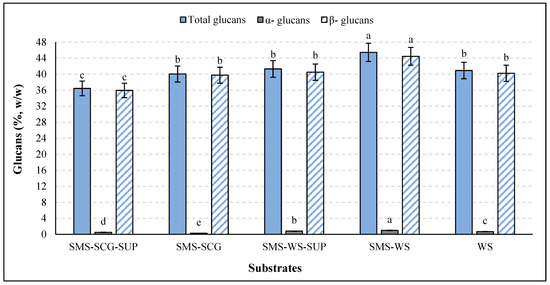
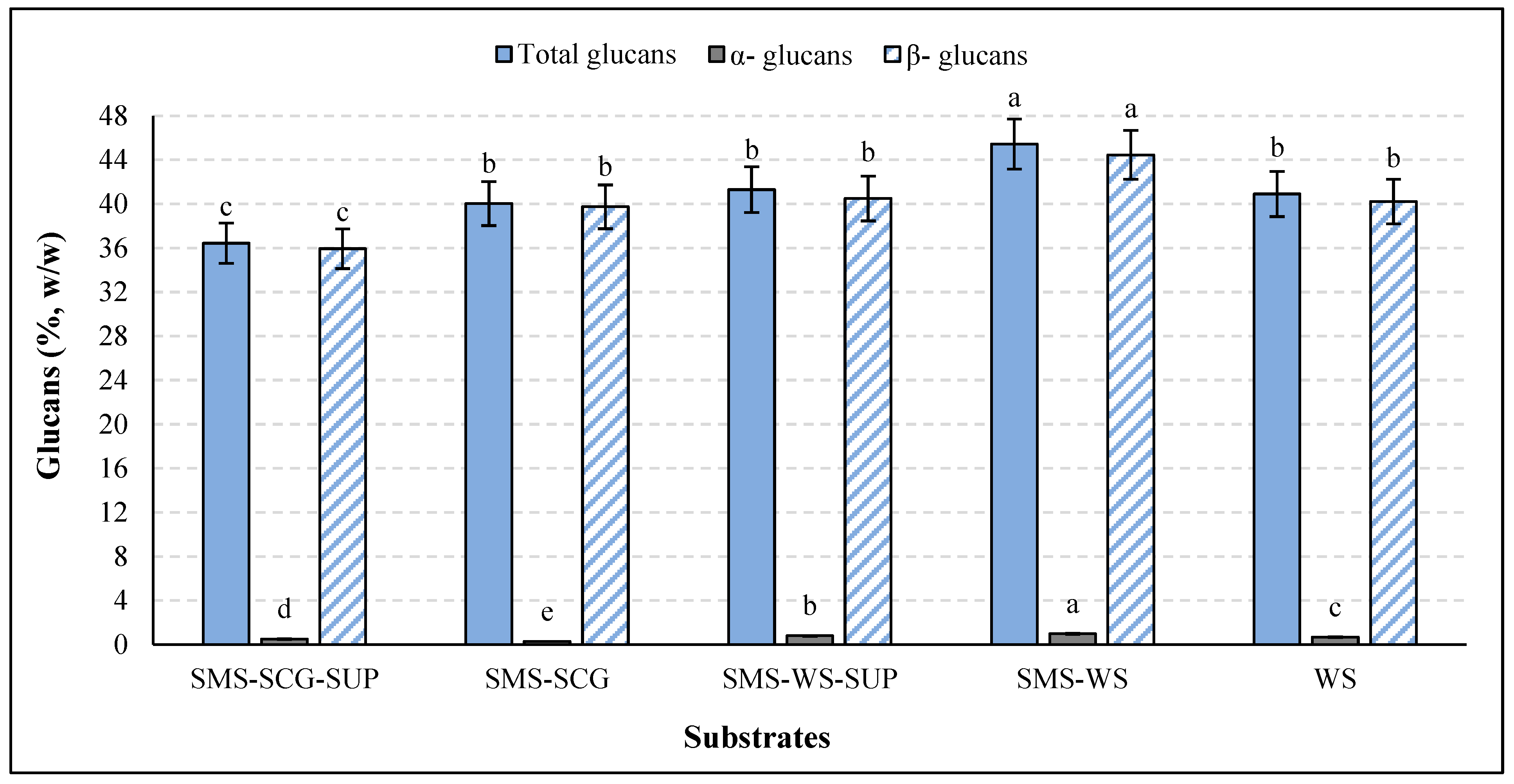
The total glucan content in carposomes cultivated on various substrates ranged from 36.4 to 45.4% w/w (Figure 1). Notably, β-glucans were the dominant type, comprising between 35.9 and 44.4%, while α-glucans remained below 1% w/w. The non-supplemented substrates led to higher total and β-glucans content than the corresponding supplemented ones. The highest levels of both total and β-glucans were observed in P. columbinus carposomes cultivated on SMS-WS, so those carposomes were subjected to β-glucan isolation. The extraction yield of β-glucans from P. columbinus cultivated on SMS-WS substrate was 28.2 ± 1.1%, based on the β-glucan content of the starting material (44.4% w/w). After lyophilization, 5 g of extract were obtained from 20 g of dried biomass, containing 50.0 ± 0.7% w/w β-glucans, indicating a moderate recovery yield accompanied by a slight increase in purity. Notably, the calculation of β-glucan isolation yield offers a novel and informative approach for evaluating extraction efficiency and purity enhancement in P. columbinus.
Figure 1.
Total glucan, α- and β-glucan content (% w/w d.w.) of P. columbinus carposomes produced at solid-state fermentation on supplemented (SMS-SCG-SUP, SMS-WS-SUP) or non-supplemented (SMS-SCG, SMS-WS) substrates in polypropylene bags consisted of spent mushroom substrate (SMS), spent coffee grounds (SCG) and wheat straw (WS). Values are expressed as means ± standard error of means. Lack of letters in common indicates statistically significant differences (Duncan’s t-test, <0.05) among different substrates.
Several studies have reported on the content of glucans in various Pleurotus species grown on different substrates, except for P. columbinus. For example, P. ostreatus, P. eryngii, and P. nebrodensis cultivated on WS, grape marc plus WS and olive mill waste plus olive leaves showed total glucan content ranging from 15.53 to 61.40% w/w, with β-glucans being a significant fraction (14.62–51.36% w/w) [61]. In addition, the total glucan, β- and α-content of harvested P. sajor-caju carposomes were 34.50, 32.47, and 2.04% w/w, respectively [62]. In another study, a wide range of total glucan content (19.41–44.20% w/w) was detected in P. ostreatus and P. eryngii stipes cultivated on different substrates of SMS and agricultural residues; the percentage of β-glucans was predominant (18.07–42.14% w/w), while α-glucan content was lower than 4% w/w [63]. Therefore, the present study is indeed one of the first in the literature demonstrating the quantification of total α- and β-glucans and β-glucan isolation in P. columbinus species. Those significant percentages of β-glucans found in P. columbinus carposomes have great importance in human health as they are bioactive compounds, known for their health-promoting effects, such as protection against infections, anti-tumor properties, antioxidant activity and their ability to lower blood cholesterol levels [7,44,64]. Thus, the isolated β-glucans from mushrooms could be incorporated as functional bioactive ingredients into various food products, such as cheese [65], crackers [66], and yogurts [67], not only to enhance their nutritional value but also to improve their textural properties.
Mushrooms are highly efficient at absorbing nitrogen and minerals from their substrate. Adding nitrogen-rich supplements, like spent mushroom substrate, spent coffee grounds, or wheat straw, with wheat bran and soybean flour, as in the present study, provides more nitrogen-containing compounds [23]. These substrates provide essential raw materials for protein synthesis and amino acid accumulation (direct nitrogen absorption and synthesis of complex proteins), resulting in improved nutritional profiles (higher protein/amino acid content) at the cost of polysaccharide yield. Conversely, non-supplemented substrates, usually with a high fiber-to-total carbohydrate ratio, promote cell wall structural density, which may maximize β-glucan production by optimizing nutrient ratios (specifically low nitrogen) that trigger stress-induced metabolic pathways, leading fungi to allocate resources toward polysaccharide synthesis rather than rapid growth [25]. Depending on the metabolite that is desired, a farmer could choose to use supplemented or non-supplemented substrates for mushroom cultivation; non-supplemented for higher β-glucans or supplemented for higher protein/amino acid production.
4. Conclusions
This study highlights the high nutritional value of P. columbinus, an insufficiently studied mushroom and is one of the first studies to determine and isolate glucans from P. columbinus carposomes. P. columbinus was efficiently cultivated on alternative substrates, such as SMS blends with SCG and WS, with (SMS-SCG-SUP, SMS-WS-SUP) or without (SMS-SCG, SMS-WS) supplementation. Substrate composition significantly influenced the nutritional value and bioactive compound profile of the carposomes. Non-supplemented substrates promoted higher carbohydrate contents and elevated levels of β-glucans, emphasizing their potential functional benefits. In contrast, supplemented substrates enhanced protein content and amino acid (AA) profiles, with EAAs accounting for more than 50% of total AA across all carposomes. Hence, P. columbinus carposomes may serve as a favorable protein source with a suitable proportion of AAs. Lipid profiles remained favorable across substrates, with PUFAs predominating, while energy content was consistent. The highest ergosterol concentration was observed in carposomes derived from control substrates, though notable levels were also detected in those cultivated on alternative substrates. Lovastatin concentration was under the limit of quantification regardless of the cultivation substrate. These findings indicate that agro-industrial residues can serve as sustainable and nutritionally valuable substrates for P. columbinus cultivation. The present work underlines the relevance of exploring and introducing novel edible mushroom species to consumers, both to broaden nutritional choices and to enhance the sustainability of food production systems.
Author Contributions
M.D.: methodology, data curation, writing of original draft; C.G.: supervision, writing—review; M.P.: methodology, writing—review; G.K.: methodology, writing—review; V.D.: methodology, writing—review; S.P.: resources; P.D.: conceptualization, methodology, supervision, writing—review. All authors have read and agreed to the published version of the manuscript.
Funding
This research was funded by Hellenic Foundation for Research and Innovation (HFRI) grant number 11166.
Institutional Review Board Statement
Not applicable.
Informed Consent Statement
Not applicable.
Data Availability Statement
All data presented in this paper are original for this study. The data used to support the findings of this study are available from the corresponding author upon request.
Acknowledgments
This work was supported by an Erasmus+ study mobility, which provided a grant to the first author, at the University of Belgrade.
Conflicts of Interest
The authors declare no conflicts of interest.
References
- Barzee, T.J.; Cao, L.; Pan, Z.; Zhang, R. Fungi for future foods. J. Future Foods 2021, 1, 25–37. [Google Scholar] [CrossRef] [Scilit]
- Lesa, K.N.; Khandaker, M.U.; Mohammad Rashed Iqbal, F.; Sharma, R.; Islam, F.; Mitra, S.; Emran, T.B. Nutritional value, medicinal importance and health-promoting effects of dietary mushroom (Pleurotus ostreatus). J. Food Qual. 2022, 2022, 2454180. [Google Scholar] [CrossRef] [Scilit]
- Luo, X.L.; Zhang, S.S.; Yan, M.; Zhang, W.; Sun, D. Protein and amino acid analysis and nutritional value evaluation of eight cultivation edible fungi in yunnan province. Food Ind. 2021, 42, 328–332. [Google Scholar] [CrossRef] [Scilit]
- Wang, Q.; Meng, L.; Wang, X.; Zhao, W.; Shi, X.; Wang, W.; Li, Z.; Wang, L. The yield, nutritional value, umami components and mineral contents of the first-flush and second-flush Pleurotus pulmonarius mushrooms grown on three forestry wastes. Food Chem. 2022, 397, 133714. [Google Scholar] [CrossRef] [Scilit] [PubMed]
- Gardeli, C.; Mela, N.; Dedousi, M.; Kandyliari, A.; Kaparakou, E.; Diamantopoulou, P.; Pappas, C.; Mallouchos, A. The influence of substrate and strain on protein quality of Pleurotus ostreatus. Appl. Sci. 2024, 14, 4040. [Google Scholar] [CrossRef] [Scilit]
- Chiozzi, V.; Eliopoulos, C.; Markou, G.; Arapoglou, D.; Agriopoulou, S.; El Enshasy, H.A.; Varzakas, T. Biotechnological addition of β-glucans from cereals, mushrooms and yeasts in foods and animal feed. Processes 2021, 9, 1889. [Google Scholar] [CrossRef] [Scilit]
- Sharma, A.; Sharma, A.; Tripathi, A. Biological activities of Pleurotus spp. polysaccharides: A review. J. Food Biochem. 2021, 45, e13748. [Google Scholar] [CrossRef] [Scilit]
- Vasilakis, G.; Marka, S.; Ntzouvaras, A.; Zografaki, M.-E.; Kyriakopoulou, E.; Kalliampakou, K.I.; Bekiaris, G.; Korakidis, E.; Papageorgiou, N.; Christofi, S. Wound healing, antioxidant and antiviral properties of bioactive polysaccharides of microalgae strains isolated from Greek coastal lagoons. Mar. Drugs 2025, 23, 77. [Google Scholar] [CrossRef] [Scilit]
- Nagy, K.; Tiuca, I.-D. Importance of fatty acids in physiopathology of human body. In Fatty Acids; IntechOpen: London, UK, 2017. [Google Scholar]
- Balić, A.; Vlašić, D.; Žužul, K.; Marinović, B.; Bukvić Mokos, Z. Omega-3 versus omega-6 polyunsaturated fatty acids in the prevention and treatment of inflammatory skin diseases. Int. J. Mol. Sci. 2020, 21, 741. [Google Scholar] [CrossRef] [Scilit]
- Jasinghe, V.J.; Perera, C.O.; Sablani, S.S. Kinetics of the conversion of ergosterol in edible mushrooms. J. Food Eng. 2007, 79, 864–869. [Google Scholar] [CrossRef] [Scilit]
- Sapozhnikova, Y.; Byrdwell, W.C.; Lobato, A.; Romig, B. Effects of UV-B radiation levels on concentrations of phytosterols, ergothioneine and polyphenolic compounds in mushroom powders used as dietary supplements. J. Agric. Food Chem. 2014, 62, 3034–3042. [Google Scholar] [CrossRef] [Scilit]
- Bajzát, J.; Misz, A.; Rácz, J.; Vágvölgyi, M.; Csutorás, C.; Vágvölgyi, C. Development of a HPLC method for the analysis of ergosterol and UV-enriched vitamin D2 in mushroom powders. Appl. Sci. 2025, 15, 4058. [Google Scholar] [CrossRef] [Scilit]
- Kała, K.; Kryczyk-Poprawa, A.; Rzewińska, A.; Muszyńska, B. Fruiting bodies of selected edible mushrooms as a potential source of lovastatin. Eur. Food Res. Technol. 2020, 246, 713–722. [Google Scholar] [CrossRef] [Scilit]
- Seenivasan, A.; Subhagar, S.; Aravindan, R.; Viruthagiri, T. Microbial production and biomedical applications of lovastatin. Indian J. Pharm. Sci. 2008, 70, 701. [Google Scholar] [CrossRef]
- Diamantis, I.; Dedousi, M.; Melanouri, E.-M.; Dalaka, E.; Antonopoulou, P.; Adelfopoulou, A.; Papanikolaou, S.; Politis, I.; Theodorou, G.; Diamantopoulou, P. Impact of spent mushroom substrate combined with hydroponic leafy vegetable roots on Pleurotus citrinopileatus productivity and fruit bodies biological properties. Microorganisms 2024, 12, 1807. [Google Scholar] [CrossRef] [Scilit]
- EL-Sayed, S.S.; Anwar, D.A.; Hassan, H.A. Comparison between peels of prickly pear and rice husk as additives to rice straw substrate for oyster mushroom (Pleurotus columbinus) production. Sci. J. Agric. Sci. 2023, 5, 19–37. [Google Scholar] [CrossRef] [Scilit]
- Royse, D.J.; Baars, J.; Tan, Q. Current overview of mushroom production in the world. In Edible and Medicinal Mushrooms; Wiley: Hoboken, NJ, USA, 2017; pp. 5–13. [Google Scholar] [CrossRef] [Scilit]
- Doroški, A.; Klaus, A.; Režek Jambrak, A.; Djekic, I. Food waste originated material as an alternative substrate used for the cultivation of oyster mushroom (Pleurotus ostreatus): A review. Sustainability 2022, 14, 12509. [Google Scholar] [CrossRef] [Scilit]
- Philippoussis, A.; Zervakis, G.; Diamantopoulou, P. Bioconversion of agricultural lignocellulosic wastes through the cultivation of the edible mushrooms Agrocybe aegerita, Volvariella volvacea and Pleurotus spp. World J. Microbiol. Biotechnol. 2001, 17, 191–200. [Google Scholar] [CrossRef] [Scilit]
- Zisopoulos, F.K.; Ramírez, H.A.B.; van der Goot, A.J.; Boom, R.M. A resource efficiency assessment of the industrial mushroom production chain: The influence of data variability. J. Clean. Prod. 2016, 126, 394–408. [Google Scholar] [CrossRef] [Scilit]
- Carrasco-Cabrera, C.P.; Bell, T.L.; Kertesz, M.A. Caffeine metabolism during cultivation of oyster mushroom (Pleurotus ostreatus) with spent coffee grounds. Appl. Microbiol. Biotechnol. 2019, 103, 5831–5841. [Google Scholar] [CrossRef] [Scilit]
- Hoa, H.T.; Wang, C.-L.; Wang, C.-H. The Effects of different substrates on the growth, yield and nutritional composition of two oyster mushrooms (Pleurotus ostreatus and Pleurotus cystidiosus). Mycobiology 2015, 43, 423–434. [Google Scholar] [CrossRef] [Scilit] [PubMed]
- Mandeel, Q.A.; Al-Laith, A.A.; Mohamed, S.A. Cultivation of oyster mushrooms (Pleurotus spp.) on various lignocellulosic wastes. World J. Microbiol. Biotechnol. 2005, 21, 601–607. [Google Scholar] [CrossRef] [Scilit]
- Dedousi, M.; Gardeli, C.; Papanikolaou, S.; Diamantopoulou, P. Combined Effect of spent mushroom substrate and agro-industrial residues on Pleurotus columbinus production and intra-cellular polysaccharide synthesis. BioTech 2025, 14, 34. [Google Scholar] [CrossRef] [Scilit]
- King Blue Oyster Mushrooms. Available online: https://perma.cc/R75R-EZSJ (accessed on 22 January 2026).
- Mohamed, M.F.; Nassef, D.M.; Kotb, A.M.A.M.; Waly, E.A. Earliness, biological efficiency and basidiocarp yield of Pleurotus ostreatus and P. columbinus oyster mushrooms in response to different sole and mixed substrates. Assiut J. Agric. Sci. 2012, 43, 113–136. [Google Scholar] [CrossRef] [Scilit]
- Association of Official Analytical Chemists. Official Methods of Analysis; Association of Official Analytical Chemists: Arlington, TX, USA, 2005. [Google Scholar]
- Kalač, P. Chemical composition and nutritional value of european species of wild growing mushrooms: A review. Food Chem. 2009, 113, 9–16. [Google Scholar] [CrossRef] [Scilit]
- Bach, F.; Helm, C.V.; Bellettini, M.B.; Maciel, G.M.; Haminiuk, C.W.I. Edible Mushrooms: A potential source of essential amino acids, glucans and minerals. Int. J. Food Sci. Technol. 2017, 52, 2382–2392. [Google Scholar] [CrossRef] [Scilit]
- Dai, Z.; Wu, Z.; Jia, S.; Wu, G. Analysis of amino acid composition in proteins of animal tissues and foods as pre-column o-phthaldialdehyde derivatives by HPLC with fluorescence detection. J. Chromatogr. B 2014, 964, 116–127. [Google Scholar] [CrossRef] [Scilit] [PubMed]
- Agilent Technologies. Automated Amino Acid Analysis Using an Agilent Poroshell HPH-C18 Column; Agilent Technologies: Santa Clara, CA, USA, 2017. [Google Scholar]
- Folch, J.; Lees, M.; Sloane Stanley, G.H. A simple method for the isolation and purification of total lipids from animal tissues. J. Biol. Chem. 1957, 226, 497–509. [Google Scholar] [CrossRef] [Scilit] [PubMed]
- Sarantou, S.; Stoforos, N.G.; Kalantzi, O.; Papanikolaou, S. Biotechnological valorization of biodiesel-derived glycerol: Trials with the non-conventional yeasts Yarrowia lipolytica and Rhodosporidium sp. Carbon Resour. Convers. 2021, 4, 61–75. [Google Scholar] [CrossRef] [Scilit]
- Fakas, S.; Papanikolaou, S.; Galiotou-Panayotou, M.; Komaitis, M.; Aggelis, G. Organic nitrogen of tomato waste hydrolysate enhances glucose uptake and lipid accumulation in Cunninghamella echinulata. J. Appl. Microbiol. 2008, 105, 1062–1070. [Google Scholar] [CrossRef] [Scilit]
- Sekino, N.; Jiang, Z. Fuel and material utilization of a waste Shiitake (Lentinula edodes) Mushroom bed derived from hardwood chips i: Characteristics of calorific value in terms of elemental composition and ash content. J. Wood Sci. 2021, 67, 1. [Google Scholar] [CrossRef] [Scilit]
- Diamantopoulou, P.; Papanikolaou, S.; Komaitis, M.; Aggelis, G.; Philippoussis, A. Patterns of major metabolites biosynthesis by different mushroom fungi grown on glucose-based submerged cultures. Bioprocess Biosyst. Eng. 2014, 37, 1385–1400. [Google Scholar] [CrossRef] [Scilit] [PubMed]
- Ooi, D.-J.; Iqbal, S.; Ismail, M. Proximate composition, nutritional attributes and mineral composition of Peperomia pellucida L. (Ketumpangan Air) grown in Malaysia. Molecules 2012, 17, 11139–11145. [Google Scholar] [CrossRef] [Scilit]
- Sigma-Aldrich Corporation. Technical Literature for Derivatization Reagents; Sigma-Aldrich Corporation: St. Louis, MO, USA, 2018. [Google Scholar]
- Yu, X.Y.; Song, M.; Hang, T.H.; Wen, A.W. Analysis of lovastatin in human plasma by liquid chromatography coupled with tandem mass spectrometry. Acta Chromatogr. 2008, 20, 399–410. [Google Scholar] [CrossRef] [Scilit]
- Wang, J.; Zhang, L. Structure and chain conformation of five water-soluble derivatives of a β-d-glucan isolated from Ganoderma lucidum. Carbohydr. Res. 2009, 344, 105–112. [Google Scholar] [CrossRef] [Scilit]
- Irshad, A.; Tahir, A.; Sharif, S.; Khalid, A.; Ali, S.; Naz, A.; Sadia, H.; Ameen, A. Determination of nutritional and biochemical composition of selected Pleurotus spps. BioMed Res. Int. 2023, 1, 8150909. [Google Scholar] [CrossRef] [Scilit]
- Rusu, I.-C.; Pascariu, O.-E.; Popa, A.; Diguță, C.-F.; Apostol, L.; Nicolcioiu, M.-B.; Zăgrean, A.V.; Israel-Roming, F. The influence of substrate composition on nutritional content and biological activity of some Pleurotus mushrooms extracts. Agriculture 2025, 15, 791. [Google Scholar] [CrossRef] [Scilit]
- Raman, J.; Jang, K.-Y.; Oh, Y.-L.; Oh, M.; Im, J.-H.; Lakshmanan, H.; Sabaratnam, V. Cultivation and nutritional value of prominent Pleurotus spp.: An overview. Mycobiology 2021, 49, 1–14. [Google Scholar] [CrossRef] [Scilit]
- Hassan, A.I.; Ghoneim, M.A.; Mahmoud, M.G.; Asker, M.S. Assessment role of total phenols and flavonoids extracted from Pleurotus columbinus mushroom on the premature ovarian failure induced by chemotherapy in rats. J. Genet. Eng. Biotechnol. 2021, 19, 182. [Google Scholar] [CrossRef] [Scilit]
- Melanouri, E.-M.; Diamantis, I.; Dedousi, M.; Dalaka, E.; Antonopoulou, P.; Papanikolaou, S.; Politis, I.; Theodorou, G.; Diamantopoulou, P. Pleurotus ostreatus: Nutritional enhancement and antioxidant activity improvement through cultivation on spent mushroom substrate and roots of leafy vegetables. Fermentation 2025, 11, 20. [Google Scholar] [CrossRef] [Scilit]
- Das, A.K.; Asif, M.D.; Hasan, G.A. A Comparative study of fatty acid compositions of three cultivated edible mushroom species of Bangladesh. J. Agric. Food Res. 2023, 12, 100620. [Google Scholar] [CrossRef] [Scilit]
- Elhusseiny, S.M.; El-Mahdy, T.S.; Awad, M.F.; Elleboudy, N.S.; Farag, M.M.; Aboshanab, K.M.; Yassien, M.A. Antiviral, cytotoxic and antioxidant activities of three edible agaricomycetes mushrooms: Pleurotus columbinus, Pleurotus sajor-caju and Agaricus bisporus. J. Fungi 2021, 7, 645. [Google Scholar] [CrossRef] [Scilit]
- Effiong, M.E.; Umeokwochi, C.P.; Afolabi, I.S.; Chinedu, S.N. Assessing the nutritional quality of Pleurotus ostreatus (oyster mushroom). Front. Nutr. 2024, 10, 1279208. [Google Scholar] [CrossRef] [Scilit]
- Vieira, E.F.; Soares, C.; Machado, S.; Correia, M.; Ramalhosa, M.J.; Oliva-Teles, M.T.; Carvalho, A.P.; Domingues, V.F.; Antunes, F.; Oliveira, T.A.C. Seaweeds from the Portuguese coast as a source of proteinaceous material: Total and free amino acid composition profile. Food Chem. 2018, 269, 264–275. [Google Scholar] [CrossRef] [Scilit]
- Li, Z.; Hong, T.; Shen, G.; Gu, Y.; Guo, Y.; Han, J. Amino acid profiles and nutritional evaluation of fresh sweet–waxy corn from three different regions of China. Nutrients 2022, 14, 3887. [Google Scholar] [CrossRef] [Scilit]
- Weltgesundheitsorganisation; FAO; Vereinte Nationen (Eds.) Protein and Amino Acid Requirements in Human Nutrition: Report of a Joint WHO/FAO/UNU Expert Consultation; WHO: Geneva, Switzerland, 2007. [Google Scholar]
- Rutherfurd, S.M.; Gilani, G.S. Amino acid analysis. Curr. Protoc. Protein Sci. 2009, 58, 11.9.1–11.9.37. [Google Scholar] [CrossRef] [Scilit]
- Yilmaz, N.; Solmaz, M.; Türkekul, İ.; Elmastaş, M. Fatty acid composition in some wild edible mushrooms growing in the middle Black Sea region of Turkey. Food Chem. 2006, 99, 168–174. [Google Scholar] [CrossRef] [Scilit]
- Günç Ergönül, P.; Akata, I.; Kalyoncu, F.; Ergönül, B. Fatty acid compositions of six wild edible mushroom species. Sci. World J. 2013, 2013, 163964. [Google Scholar] [CrossRef] [Scilit] [PubMed]
- Barreira, J.C.; Oliveira, M.B.P.; Ferreira, I.C. Development of a novel methodology for the analysis of ergosterol in mushrooms. Food Anal. Methods 2014, 7, 217–223. [Google Scholar] [CrossRef] [Scilit]
- Nzekoue, F.K.; Sun, Y.; Caprioli, G.; Vittori, S.; Sagratini, G. Effect of the ultrasound-assisted extraction parameters on the determination of ergosterol and vitamin D2 in Agaricus bisporus, A. bisporus Portobello and Pleurotus ostreatus mushrooms. J. Food Compos. Anal. 2022, 109, 104476. [Google Scholar] [CrossRef] [Scilit]
- Lin, S.-Y.; Chen, Y.-K.; Yu, H.-T.; Barseghyan, G.S.; Asatiani, M.D.; Wasser, S.P.; Mau, J.-L. Comparative study of contents of several bioactive components in fruiting bodies and mycelia of culinary-medicinal mushrooms. Int. J. Med. Mushrooms 2013, 15, 315–323. [Google Scholar] [CrossRef] [Scilit] [PubMed]
- Lam, Y.S.; Okello, E.J. Determination of lovastatin, β-glucan, total polyphenols and antioxidant activity in raw and processed oyster culinary-medicinal mushroom, Pleurotus ostreatus (higher basidiomycetes). Int. J. Med. Mushrooms 2015, 17, 117–128. [Google Scholar] [CrossRef] [Scilit]
- Tsiantas, K.; Tsiaka, T.; Koutrotsios, G.; Siapi, E.; Zervakis, G.I.; Kalogeropoulos, N.; Zoumpoulakis, P. On the identification and quantification of ergothioneine and lovastatin in various mushroom species: Assets and challenges of different analytical approaches. Molecules 2021, 26, 1832. [Google Scholar] [CrossRef] [Scilit]
- Bekiaris, G.; Tagkouli, D.; Koutrotsios, G.; Kalogeropoulos, N.; Zervakis, G.I. Pleurotus mushrooms content in glucans and ergosterol assessed by ATR-FTIR Spectroscopy and multivariate analysis. Foods 2020, 9, 535. [Google Scholar] [CrossRef] [Scilit]
- Sakdasri, W.; Arnutpongchai, P.; Phonsavat, S.; Sawangkeaw, R. Response surface optimization of crude polysaccharides from grey oyster mushroom (Pleurotus sajor-caju (Fr.) Singer) using pressurized hot water extraction. Biol. Life Sci. Forum 2021, 6, 32. [Google Scholar] [CrossRef] [Scilit]
- Dedousi, M.; Melanouri, E.M.; Diamantis, I.; Papanikolaou, S.; Diamantopoulou, P. Biochemical, functional and antioxidant potential of higher fungi cultivated on agro-industrial residues. Part II: Cultures on mixtures of spent mushroom substrates and mushroom cropping by-products. Resour. Chem. Mater. 2024, 3, 175–187. [Google Scholar] [CrossRef] [Scilit]
- Maheshwari, G.; Sowrirajan, S.; Joseph, B. β-Glucan, a dietary fiber in effective prevention of lifestyle diseases–An insight. Bioact. Carbohydr. Diet. Fibre 2019, 19, 100187. [Google Scholar] [CrossRef] [Scilit]
- Kondyli, E.; Pappa, E.C.; Kremmyda, A.; Arapoglou, D.; Metafa, M.; Eliopoulos, C.; Israilides, C. Manufacture of reduced fat white-brined cheese with the addition of β-glucans biobased polysaccharides as textural properties improvements. Polymers 2020, 12, 2647. [Google Scholar] [CrossRef] [Scilit]
- Demir, H. Purification of β-glucan of oyster mushroom (Pleurotus pulmonarius) and its application in model food. Agric. Sci. 2023, 14, 1732–1750. [Google Scholar] [CrossRef]
- Jabłońska-Ryś, E. Fortifying yogurt with edible mushrooms: Bioactive compounds and product properties. Appl. Sci. 2025, 15, 12949. [Google Scholar] [CrossRef] [Scilit]

Disclaimer/Publisher’s Note: The statements, opinions and data contained in all publications are solely those of the individual author(s) and contributor(s) and not of MDPI and/or the editor(s). MDPI and/or the editor(s) disclaim responsibility for any injury to people or property resulting from any ideas, methods, instructions or products referred to in the content. |
© 2026 by the authors. Licensee MDPI, Basel, Switzerland. This article is an open access article distributed under the terms and conditions of the Creative Commons Attribution (CC BY) license.