Article

Ultrasound-Assisted Extraction of Carotenoids from Carrot Pomace: Process Optimization and Application Potential


by
Oana Emilia Constantin
1,
Genica Florina Oncica
1,
Florina Stoica
2,
Roxana Nicoleta Rațu
1,3,
Nicoleta Stănciuc
1,
Marija Banožić
4,
Nada Ćujić Nikolić
5,
Claudia Mureșan
6 and
Gabriela Râpeanu
1,*
1
Department of Food Science, Food Engineering, Biotechnology and Aquaculture, Faculty of Food Science and Engineering, Dunărea de Jos University of Galati, 800201 Galați, Romania
2
Department of Pedotechnics, Faculty of Agriculture, “Ion Ionescu de la Brad” University of Life Sciences, 3 Mihail Sadoveanu Alley, 700489 Iasi, Romania
3
Department of Food Technologies, Faculty of Agriculture, “Ion Ionescu de la Brad” University of Life Sciences, 3 Mihail Sadoveanu Alley, 700489 Iasi, Romania
4
Faculty of Agriculture and Food Technology, University of Mostar, Biskupa Čule bb, 88000 Mostar, Bosnia and Herzegovina
5
Institute for Medicinal Plants Research “Dr. Josif Pančić”, Tadeuša Košćuška 1, 11000 Belgrade, Serbia
6
Faculty of Food Engineering, Tourism, and Environmental Protection, Aurel Vlaicu University of Arad, 2 Elena Dragoi Street, 310330 Arad, Romania
*
Author to whom correspondence should be addressed.
Appl. Sci. 2026, 16(3), 1472; https://doi.org/10.3390/app16031472
Submission received: 30 December 2025 / Revised: 20 January 2026 / Accepted: 30 January 2026 / Published: 2 February 2026

Abstract

Carrots, scientifically referred to as Daucus carota L., are widely recognized as one of the most consumed vegetables, frequently utilized in culinary applications and juice manufacturing, both commercially and domestically. This results in significant amounts of waste, primarily from the pomace. Carrot pomace represents a promising low-cost raw material for the production of value-added ingredients for the food and feed industries. The extraction of total carotenoids (TC) and the evaluation of antioxidant activity (AA) were optimized in this study by employing environmentally friendly methods, including ultrasonication. The Central Composite Design (CCD) was utilized in order to establish a response surface approach for the purpose of evaluating the impacts of extraction duration, temperature, and the ratio of material to solvent on the recovery of TC and AA. Under optimal conditions, the TC content was 38.20 mg/g of dry weight, with an antioxidant capacity of 1522.02 μmol TE/g DW, as determined by the ABTS assay. According to the findings, the optimal parameters for extraction were a temperature of 58.9 °C, a solvent mixture ratio of 20.35 mL/g, and a duration of 51 min. The proposed ultrasound-assisted process provides a sustainable and scalable approach for carrot pomace valorization, contributing to the development of circular and resource-efficient agro-industrial processing.

1. Introduction

The food sector generates a significant volume of waste and by-products on a global scale. The use of food waste and by-products to generate bioactive natural compounds contributes to reducing environmental impact and supporting the circular economy [1]. Process waste and byproducts from the food industry can provide natural bioactive components better than poultry, beef, and dairy products [2]. The use of fruit and vegetable waste can increase the supply of natural bioactive substances, which are in high demand among consumers, and holds considerable potential for various applications within the food industry.
Carrots (Daucus carota L.) are a widely farmed species of the Apiaceae family, harvested annually for consumption. Carrots are cultivated worldwide, with major production concentrated in regions such as East Asia, South Asia, Europe, and North America, including countries such as China, India, and the United States [3,4].
Carrots and carrot pomace are rich sources of carotenoids, which are mainly represented by two major classes: carotenes (such as β-carotene, α-carotene, and lycopene) and xanthophylls (such as lutein and zeaxanthin). Moreover, carotenoids are recognized for their ability to neutralize free radicals and protect organs from photooxidation [5,6]. Among these, β-carotene is the predominant carotenoid and is of particular interest to the food industry and nutraceutical industries due to its provitamin A activity, due to its benefits, such as improved immunity, antioxidant properties, cancer protection, and reduced risk of cardiovascular diseases by regulating cholesterol levels [7,8], strong antioxidant capacity, and widespread use as a natural colorant [9]. Lycopene is also attracting increasing attention for its high antioxidant potential and application in functional foods and nutraceutical formulations.
The preparation of carrots before utilization results in substantial waste, including peels and pomace. These wastes are typically utilized for animal feed or disposed of in landfills. On the other hand, lutein, α-carotene, and β-carotene, being among the numerous carotenoids found in carrot pomace, it is crucial to develop an effective extraction technology for the efficient utilization of carotenoids from carrot pomace [3]. Over the past several years, businesses and researchers have been working toward the goal of implementing environmentally friendly extraction methods for food waste and by-products in order to achieve sustainable environmental policies [10].
Extensive research has identified multiple methods for extracting bioactive compounds from carrot pomace using various extraction processes. Sabio et al. [11], Corbu et al. [12], and Saini and Keum [13] emphasize the importance of using appropriate procedures for extracting carotenoids from complex matrices, such as those in vegetables. The best method for extracting polar and non-polar carotenoids simultaneously is acetone/hexane or acetone/ethanol/hexane, according to the authors. Traditional solvent extraction of carotenoids uses organic solvents such as hexane, acetone, methanol, and ethanol, and their combinations [14]. The choice of solvent depends on the polarity of carotenoids. Polar and nonpolar carotenoids are extracted using hexane, ethanol, and acetone.
Ultrasound-assisted extraction (UAE) is recognized as a highly effective method for extracting bioactive compounds from plant sources, attributed to its efficiency and the prevalent use of ultrasonic equipment [15]. Research indicates that the use of UAE for carotenoid extraction can improve yield, decrease solvent usage, and reduce extraction duration compared to traditional solvent extraction methods. UAE enhances mass transfer via acoustic cavitation, disrupting plant cell walls and promoting solvent penetration. In carrot pomace, where carotenoids are entrapped within cellular structures, these effects can facilitate their release and improve extraction efficiency. On this basis, the present study investigates whether controlled ultrasound conditions can be optimized to maximize carotenoid recovery and associated antioxidant activity from carrot pomace [13]. Moreover the application of UAE has resulted in increased extraction yields of carotenoids, such as lycopene and β-carotene, from plant sources, utilizing less time, lower temperatures, and diminished solvent volumes compared to traditional extraction methods [16,17].
Process optimization is crucial for enhancing yield and increasing the efficacy of extracts derived from UAE, hence reducing material and solvent waste [18]. The Response Surface Methodology (RSM) is a powerful statistical optimization instrument used across various domains, including agriculture, biology, and chemistry. This method facilitates the identification of optimal outcomes with significant precision and efficiency, frequently requiring a small number of rounds. RSM is extensively utilized to organize experiments, construct models, articulate response values, assess the impact of numerous variables, and demonstrate optimal conditions. RSM enables the representation of interactions among multiple elements with minimal data, facilitating the construction of intuitive models that yield optimal results efficiently [19,20,21].
Although carrot pomace has been widely investigated as a source of bioactive compounds, most previous studies have focused on either carotenoid yield or antioxidant activity, often examining isolated extraction parameters or comparing techniques without systematic multivariate optimization. In particular, there is a lack of studies that integrate ultrasound-assisted extraction with response surface methodology to simultaneously optimize carotenoid recovery and antioxidant functionality from carrot pomace within an applied valorization perspective. This gap limits the technological relevance and transferability of existing findings, highlighting the need for an integrated approach that supports the development of sustainable, value-added processing strategies for this agro-industrial by-product. This study examined how ultrasound-assisted extraction, along with temperature, duration, and solvent mixture ratio, affected the antioxidant potential of carrot pomace and the recovery of total carotenoids. RSM and CCD were used to improve carrot pomace extraction and increase carotenoid content and antioxidant activity. These findings highlight the significance of using carrot waste in order to extract bioactive compounds and increase crop value.

2. Materials and Methods

2.1. Reagents and Chemicals

Petroleum ether, acetonitrile, ethyl acetate, n-hexane, acetone, methanol, ethanol, [2,20 azinobis (3-ethylbenzothiazoline-6-sulfonic acid) diammonium salt] (ABTS), (±)-6-hydroxy-2,5,7,8-tetramethylchromane-2-carboxylic acid (Trolox) were obtained from Sigma Aldrich Steinheim (Darmstadt, Germany). All other reagents used in the experiments were of analytical grade.

2.2. Carrot Pomace Preparation

Carrots (Daucus carota subsp. sativus, cv. Nantes) were purchased from a local producer in the southeastern region of Romania. The carrots were thoroughly washed and cleaned, then processed using a centrifugal juicer (Bosch MES3500, BSH Hausgeräte GmbH, Munich, Germany) to separate the liquid phase (carrot juice) from the solid residue. The recovered solid fraction (carrot pomace) was collected, homogenized, and used as the by-product of interest. The carrot pomace was kept in plastic bags at −20 °C before freeze-drying. For 48 h, carrot pomace was freeze-dried at −42 °C at 0.10 mBar pressure. A 9.0% moisture content freeze-dryer (CHRIST Alpha 1-4 LD plus, Martin Christ Gefriertrocknungsanlagen GmbH, Osterode am Harz, Germany) was used. Once pulverized in a mill for 50 s, carrot pomace had a mean particle diameter of 450 μm. Subsequently, it was preserved at ambient temperature in a sealed glass container until extraction analysis was conducted.

2.3. Ultrasound-Assisted Extraction

Initial investigations were conducted on several solvents to determine the optimal temperature, time, and sample-to-solvent mixture ratios using ultrasound-assisted extraction [22]. Five solvents were utilized: 70% ethanol, methanol, acetone, n-hexane, and a 3:1 (v/v) mixture of n-hexane and acetone. The sample-to-solvent mixture ratio was 1 g/10 mL, and the experiment was conducted at a temperature of 40 °C for 40 min. One gram of carrot pomace powder was placed in individual 100 mL jacketed vessels for each solvent, in triplicate, and 10 mL of solvent was added to the ultrasonic bath (Smart MRC LLC, Holon, Israel). Preliminary investigations indicated that the n-hexane/acetone mixture yielded the highest concentration of carotenoids compared to other solvents employed. This result is consistent with the predominantly non-polar nature of carotenoids and the ability of mixed-polarity solvents to improve solubilization and matrix penetration. The solvent-to-solid ratio was further investigated as an independent variable in the RSM design.
Phytochemicals were extracted from carrot pomace powder using the ultrasound-assisted extraction method, as described by Sabahi et al. [23], with slight modifications. Briefly, 1.0 g of carrot pomace powder was mixed with 10 mL of a n-hexane/acetone solvent mixture (3:1, v/v) in a jacketed glass vessel. Ultrasound treatment was performed in an ultrasonic bath (Smart MRC LLC, Holon, Israel) at 40 kHz and 40 °C for 40 min. After sonication, the mixture was centrifuged at 6000 rpm for 10 min at 8 °C, and the supernatant was collected. The solid residue was re-extracted several times with fresh solvent (10 mL) until discoloration was observed, and the combined supernatants were pooled. The extracts were then concentrated under reduced pressure using a vacuum concentrator (Christ AVC 2–18, Osterode am Harz, Germany) at 40 °C to remove the solvent. The concentrated extracts were used for the determination of total carotenoid content and antioxidant activity.

2.4. Determination of the TC Contents

Spectrophotometric analysis was conducted to quantify the TC concentrations of the extract, as outlined by Nistor et al. [24], with minor changes. To sum up, 100 mg/mL of extract (0.2 mL) was mixed with the petroleum ether and then poured in a UV glass cuvette. A Libra S22 UV-VIS spectrophotometer (Biochrom, Cambridge, UK) was used to measure the absorption of TC at λ = 450 nm. The results were given as mg/g of dry weight (DW).

2.5. Determination of the Antioxidant Activity (AA)

To evaluate the antioxidant capacity of a bioactive compound or extract, it is generally essential to conduct multiple antioxidant assays. A single chemical or a collection of compounds may exhibit differing values for antioxidative efficacy across various assays [25]. Our prior experiments on carrot pomace revealed that carotenoid extracts exhibit considerable ABTS radical scavenging activity, which correlates with the overall carotenoid content in the extract [26]. Consequently, the ABTS radical scavenging activity was selected to exemplify the antioxidant activity of carotenoid extracts derived from carrot pomace in this investigation.
A method utilizing the ABTS+ radical was employed, as described by Xu et al. [27]. ABTS+ was generated by mixing equal amounts of 7 mM ABTS stock solution with 2.45 mM K2S2O8. The combination rested in the dark for 16 h before use. To attain an absorbance value of 0.700 ± 0.02 at 734 nm, 1 mL of ABTS+ solution was diluted with 35 mL of ethanol. Next, 1.8 mL of ABTS+ and 0.2 mL of extract were allowed to react for 2 h in the dark and detected at 734 nm. The extract’s antioxidant activity was measured in μmol Trolox equivalent (TE)/g DW using a calibration curve.

2.6. High-Performance Liquid Chromatography (HPLC) Analysis of the Carrot Pomace Extract

A Thermo Finnigan Surveyor HPLC system, equipped with a DAD UV-visible detector (Thermo Scientific, San Jose, CA, USA), was used to obtain the chromatographic profile of the extract, utilizing Xcalibur 2.0.7 software. The carotenoid components in the carrot extract were analyzed at 450 nm using a Lichrosorb RP-18 (Merck KGaA, Darmstadt, Germany) (5 μm) Hibar RT 125–4 column, following the methods developed by Oncică et al. [26]. The mobile phase consisted of solvent A (90% acetonitrile) and solvent B (100% ethyl acetate), with a flow rate of 1.0 mL/min. The gradient program was as follows: 0–16 min, 15% B; 16–54 min, linear increase from 15% to 62% B; 54–56 min, 62% B; 56–60 min, decrease from 62% to 15% B; and 60–70 min, 15% B for column re-equilibration. The injection volume was 10 μL. The primary carotenoids were identified and quantified using a calibration curve based on standards (β -carotene) and retention time data from scientific literature.

2.7. Experimental Design

In order to evaluate the antioxidant activity and experimentally optimize the total carotenoid content of the carrot pomace extract, the Central Composite Design (CCD) procedure was implemented. A central composite design of five elements, three central points, and twenty experimental trials was implemented in an experimental factorial model. Table 1 displays the original and coded variants of the variables investigated in the experimental plan, as well as their maximum and minimum values. Additionally, the CCD develops a quadratic model for response variables.
The response variables of the examined independent factors were predicted using a second-order polynomial model, as indicated in Equation (1) below:
R   =   b 0 + i n b i   · x i + i = 1 n b i i · x i i 2 + b i j · x i · x j d
where R is the predicted response, b 0 is a constant term, b i , b i i , and b i j are the regression coefficients, x i , x i i   and x j d are the independent variables analyzed, n is the number of processing factors.

2.8. Statistical Analysis

The experimental model was analyzed using Design-Expert (v. 12) (Stat-Ease, Inc., Minneapolis, MN, USA). Results were analyzed in triplicate and shown as mean ± standard deviation.

3. Results and Discussion

3.1. HPLC Analysis for Carotenoid Compounds

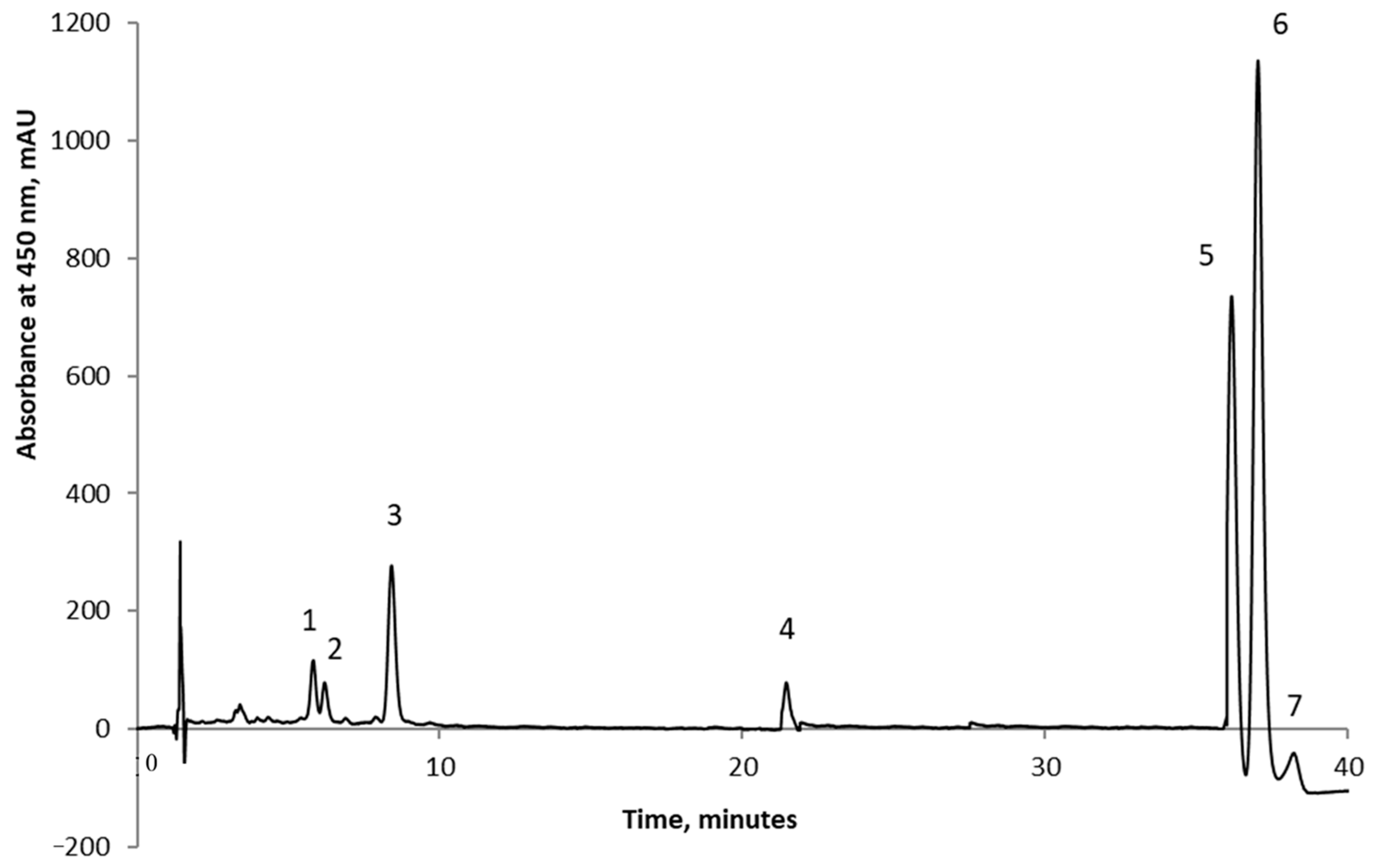
The carrot carotenoid profile was characterized through a chromatographic investigation that utilized the HPLC technique. HPLC was used in this study as a qualitative, confirmatory tool to establish the carotenoid profile of carrot pomace extracts and to support the spectrophotometric determination of total carotenoids. The chromatogram (Figure 1) confirms the presence of lutein, zeaxanthin, α-carotene, and β-carotene based on retention behavior. Therefore, the reported assignments, particularly for minor peaks, are provisional and should not be interpreted as definitive structural confirmation. Future work employing DAD spectral matching and/or LC–MS analysis will be necessary to unequivocally confirm the identity of individual carotenoids. The extraction was carried out under control conditions at 58.9 °C for 51 min, using a solvent volume of 20.35 mL, prior to HPLC analysis; these parameters were selected based on the experimental design, as they yielded the highest total carotenoid content.
The sample’s chromatographic profile, as illustrated in Figure 1, revealed numerous peaks identified at 450 nm. Nevertheless, four significant compounds were identified and separated after extraction: lutein (peak 1), zeaxanthin (peak 2), α-carotene (peak 5), and β-carotene (peak 6) were the primary compounds identified. The retention periods and literature data suggest that the other chemicals in the chromatogram are isomers and derivatives of the main carotenoids, mainly carotene. A similar profile was reported in our previous study using the same matrix, which extracted carotenoids from carrot powder in an ultrasonic bath for 45 min at 30 °C, with an ultrasonic power of 200 W and a frequency of 40 kHz [28]. Turcsi et al. [29] conducted a systematic comparison of various carotenoids across different reverse-phase columns, revealing a consistent pattern: xanthophylls with increased polar functional groups (such as hydroxyl and epoxide) elute earlier, while hydrocarbon carotenes elute later, with α-carotene eluting slightly before β-carotene; the stationary phase influences the elution behavior of lycopene. Moreover, according to Rodriguez-Amaya and Kimura [30], lutein and zeaxanthin elute together first, followed by β-cryptoxanthin, and then α- and β-carotene.

3.2. Fitting the Response Surface Models

The central composite design (CCD) matrix and corresponding experimental responses for total carotenoid content (TC) and antioxidant activity (AA) are presented in Table 2. The design allowed simultaneous evaluation of the individual and interactive effects of temperature (A), extraction time (B), and solvent-to-solid ratio (C) on carotenoid recovery and antioxidant performance. The wide variation observed in both TC and AA values across the experimental runs indicates a strong dependence of extraction efficiency on the investigated parameters.
Analysis of variance revealed that temperature and solvent-to-solid ratio were the most influential factors affecting TC, while AA was significantly influenced by both temperature and extraction time (p < 0.05). In addition, significant interaction effects were observed, particularly between temperature and solvent mixture ratio, demonstrating that the effect of one variable depends on the level of the other. These interactions confirm the necessity of multivariate optimization rather than single factor approaches.

3.3. Influence of the Extraction Parameters on TC

Molecules like carotenoids and polyphenols exhibit considerable biological activity and augment the value of our extract; therefore, it was essential to detect them spectrophotometrically to gain an initial comprehension of the composition of the extract. Carotenoids, the precursor to vitamin A, reduce cancer, cardiovascular disease, and age-related macular degeneration [31].
Comprehensive information regarding the assays performed at each of the 20 design points is included in Table 1. Table 1 illustrates the variation in overall carotenoid concentration across several factors, ranging from 10.28 to 38.42 mg/g DW. Regression equations obtained from the ANOVA analysis were used to estimate TC values from carrot pomace, accounting for variables of the extraction process. Table 3 presents the statistical parameters and coefficients for each model, indicating an adequate fit for the derived models.
The F-value of 1377.49 for TC, obtained from carrot pomaces, indicates statistical significance. The results indicate that model terms are significant when the computed p-values are less than 0.0500. Specifically, A, B, C, AB, AC, BC, A2, B2, and C2 are significant model terms. Values exceeding 0.1000 suggest that the model terms lack significance. The Lack of Fit F-value of 1.47 indicates that the Lack of Fit is not significant when compared to the pure error. The Predicted R2 of 0.9957 aligns closely with the Adjusted R2 of 0.9985, with a difference of less than 0.2.
Response 1 (TC) = +37.97 + 3.07A + 4.42B + 2.50C + 4.03AB − 2.40AC + 0.9201BC − 7.38A2 − 4.83B2 − 6.64C2
Equation (2) shows the connection between the TC (Response 1) and coded variables, which can help anticipate effects at certain factor levels.
The regression equation’s b coefficients showed that temperature (A), extraction time (B), and solvent mixture ratio (C) increased carotenoid concentration most significantly. Temperature and extraction time (AB) and time and solvent mixture ratio (BC) positively influenced carrot pomace TC extraction, as shown in Equation (2). Additional significantly unfavorable effects on TC concentration were identified in the interaction between temperature and solvent mixture ratio (AC) and a quadratic term of extraction time (B2), solvent mixture ratio (C2), and temperature (A2).
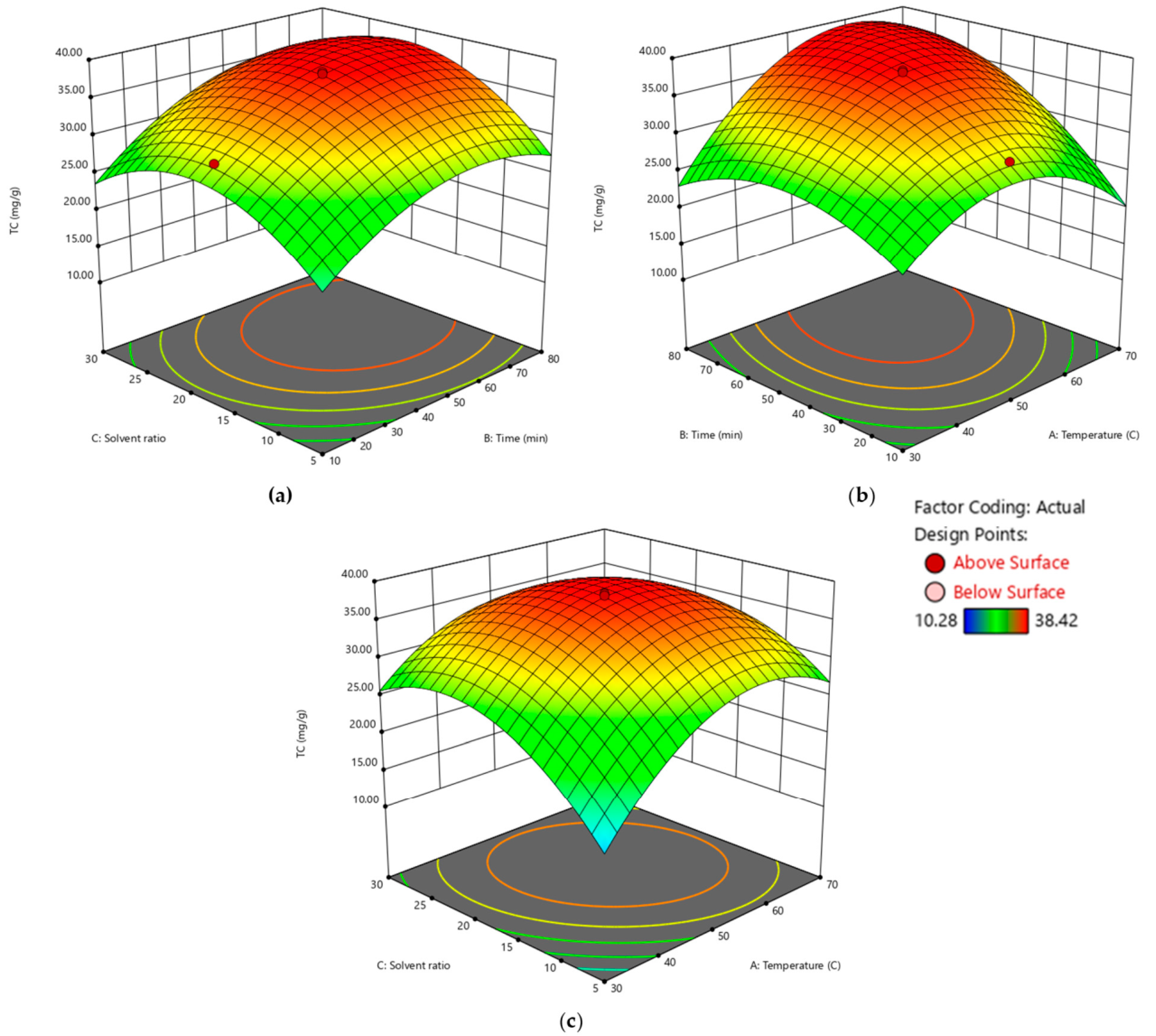
Three-dimensional response plots were utilized to assess the relationship between independent and dependent variables. Analysis of Figure 2 demonstrated a synergistic effect of the independent variables (temperature, time, and solvent mixture ratio) on the TC content of the carrot pomace extract. The three-dimensional response illustrates the impact of the selected parameters on the TC of the extract.
The response surface plots in Figure 2 indicate significant interaction effects among extraction parameters that reflect underlying mechanisms of carotenoid release and stability. Specifically, the synergistic interaction between temperature and solvent composition highlights how moderate temperature increases can enhance solvent diffusivity and carotenoid solubility, whereas excessively high temperatures accelerate thermal degradation of labile carotenoids, reducing total recovery. This dual effect is consistent with reported observations that optimal extraction of carotenoids often requires balancing enhanced mass transfer with compound stability, and that solvent polarity must be matched to the largely non-polar nature of carotenoid structures to maximize yield [13].
Figure 2a illustrates the effect of solvent mixture ratio and extraction time on carotenoid content. The plot exhibits a distinct maximum at the center, indicating that an optimal solvent mixture ratio and extraction time yield the highest carotenoid content (TC). Inadequate extraction times or inappropriate solvent mixture ratios reduce extraction efficiency. The extraction temperature and duration are the principal parameters impacting TC extraction, as illustrated in Figure 2b. The greatest TC value was achieved after approximately 45 min of extraction at 50 °C. Furthermore, optimal TC yield can be achieved at reduced temperatures and diminished liquid-to-material ratios (Figure 2c). Furthermore, as depicted in Figure 2a, an extended extraction duration (80 min) and a minimal solvent mixture ratio (5 mL) resulted in a reduced TC value.
Comparable RSM-based optimization studies have demonstrated that extraction efficiency is influenced equally by variables such as temperature, time, and solvent system, with significant curvature and interaction effects observed in carotenoid recovery models [32]. These findings align with the trends observed in the present work and underscore the utility of multivariate optimization to identify conditions that maximize total carotenoid recovery.
The maximum concentration of TC (38.42 mg/g DW) is associated with extracts obtained at 50 °C for 45 min using a solvent mixture ratio of 17.5 mL/g (Table 1). Consequently, carotenoid extraction yields may improve with lower temperatures and shorter times, and the extracts can be readily integrated into biological systems. The production of carotenoids depends on temperature. Thus, the best extraction temperature for rapid extraction must be carefully determined to optimize yields while maintaining thermolabile carotenoids [13]. The optimization of extraction parameters for maximum carotenoid recovery from Brassica napus L. involved a temperature of 49.6 °C, ultrasonic power of 252.9 W, a liquid-to-material ratio of 41.4 mL/g, and a duration of 48.5 min, as determined by RSM [33]. The application of an optimized ultrasonic intensity range is essential for maximizing carotenoid output in the UAE. Exceeding the optimal range, elevated ultrasonic intensity may result in the generation and accumulation of hydroxyl (OH) and hydrogen (H) radicals during cavitation, potentially causing substantial damage to antioxidant molecules, including carotenoids [34].
Umair et al. [35] examined the ultrasound-assisted extraction of carotenoids from carrot pomace of Daucus carota L., purchased from the local market of Nanjing, China, and optimized the process through response surface methodology. The results demonstrated that optimal conditions for ultrasound-assisted extraction (20 kHz frequency and 70% amplitude) were achieved with a duration of 17 min, a temperature of 32 °C, and an ethanol concentration of 51%, yielding a total carotenoid content of 31.82 ± 0.55 µg/g DM.
Kaur et al. [36] investigated various organic solvents for extracting carotenoids from carrot waste (Daucus carota L., Florida and Enterprise varieties), including acetone, hexane, ethyl acetate, ethanol, and their combinations. The hexane-ethanol (50% v/v) combination temperature: 50 °C, extraction time: 5 min and solid-to-solvent mixture ratio: 1:40 (w/v) yielded the best results, ranging from 980 to 1728 μg/g DW.
Sabahi et al. [23] extracted bioactives from Daucus carota pomace obtained from juice shops (Mashhad, Iran), after oven-drying at 45 °C, milling and sieving to 500 µm. UAE optimization showed that 70% ethanol, 250 W ultrasonic power and 10 min extraction maximized recovery, achieving a TCC yield of 12.20 μg/g DW during pilot studies.
Lau et al. [37] conducted a study examining various drying techniques, including dehumidification drying, hot-air drying, freeze-drying, vacuum drying, and microwave drying on carrot peel (Daucus carota L.) extraction, using an ultrasound-assisted protocol (100 W, 30 min, 25 °C). The TCC determination results, using a 2:1:1 v/v/v hexane:acetone: ethanol mixture, varied from 2060 to 2900 μg/g DW, with the freeze-drying technique being the most advantageous. The authors attribute the notably elevated carotenoid levels in their study to the carrot variety; additionally, they propose that the choice of extraction solvents may play a more critical role.
Aubert et al. [38] extracted Dordogne and Maestro “Nantes” carrots using a hexane:acetone:ethanol solvent system (2:1:2 v/v/v). The authors examined the upper, middle, and lower sections of the carrot peels. The highest β carotene content was found in the carrot peels, ranging from 2.2–8.6 mg/100 g FW, respectively.
The fluctuations in carotenoid concentrations in carrots can be affected by multiple factors, including extraction conditions (solvents and solid-to-solvent mixture ratios), plant type, harvesting season and location, and storage conditions [39].

3.4. Influence of the Extraction Parameters on AA

In the present study, antioxidant activity was evaluated using the ABTS assay, which was selected due to its applicability to both hydrophilic and lipophilic antioxidant compounds. This characteristic makes the method particularly suitable for carotenoid-rich extracts, such as those obtained from carrot pomace. Moreover, the ABTS assay is known for its high sensitivity and reproducibility, enabling reliable comparisons of antioxidant responses across different ultrasound-assisted extraction conditions. Nevertheless, antioxidant capacity is a complex, multi-mechanistic phenomenon that cannot be fully described by a single analytical method. Therefore, although ABTS provided relevant information for process optimization, the inclusion of complementary assays (e.g., DPPH, FRAP, ORAC) in future studies would enable a more comprehensive evaluation of the antioxidant potential of carrot pomace extracts.
The ABTS radical cation is frequently used to assess the overall antioxidant activity of individual chemicals and complex combinations from various sources, including bodily fluids, foods, beverages, and plant extracts. This study assessed the scavenging capacity of carrot extract on the ABTS free radical, with findings displayed in Table 1. The evaluated antioxidant activity values of the carrot pomace extract ranged from 502.49 to 1506.23 µmol TE/g DW (Table 1). ANOVA analysis of the antioxidant activity values of the carrot pomace extract led to the establishment of regression equations based on the extraction environment variables (Table 2).
The model’s F-value of 189.56 for the AA parameter and p-values below 0.0500 show statistical significance. Key model terms are A, B, C, AB, A2, B2, and C2. Values above 0.1000 indicate model terms are insignificant.
With a determination coefficient of R2 = 0.9910, the regression model that was applied for the ABTS free radical-scavenging potential was able to demonstrate its effectiveness, suggesting that the model explains only 0.01% of the variation in antioxidant activity. The Predicted R2 of 0.9750 aligns closely with the Adjusted R2 of 0.9858, with a difference of less than 0.2. Lack of Fit F-value of 2.62 suggests that it is not significant compared to pure error. Equation (3) models the association between coded unit variables and antioxidant activity (Response 2).
Response 2 (AA) = +1492.85 + 86.80A + 41.01B + 143.70C + 158.86AB − 170.30A2 − 302.10B2 − 173.47C2
The equation in coded factors can predict the reaction at certain factor values. The regression equation’s b coefficients revealed that the temperature (A), extraction time (B), and solvent mixture ratio (C) all have a positive impact on the antioxidant activity. The interactions between temperature and time (AB) significantly enhance AA. The interactions among quadratic temperature (A2), quadratic time (B2), and quadratic solvent mixture ratio (C2) were found to significantly negatively affect the antioxidant activity of the carrot pomace extract.
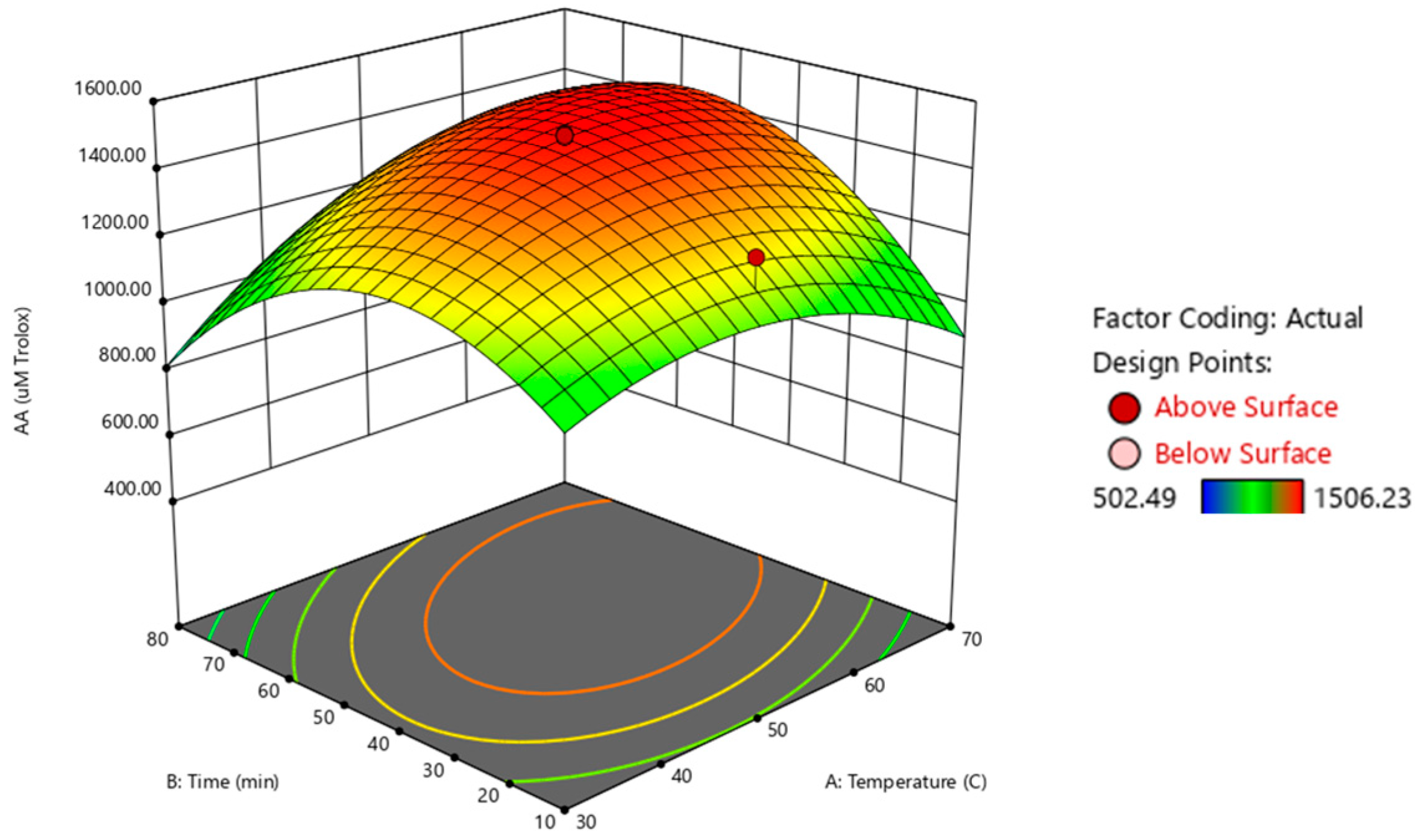
Figure 3 shows three-dimensional response surface plots of two variables interacting while keeping the other variables constant for antioxidant activity. The three-dimensional response surface shows how selected factors affect the extract’s antioxidant activity. In Figure 3, the slant of the surface graph reflects the degree to which the two-factor interaction has an impact on the response value. On the other hand, a gentle slope suggests that the effect is less substantial [40].
The influence of ultrasound conditions and solvent mixture ratio on antioxidant activity can be mechanistically attributed to their effects on carotenoid release and molecular accessibility. Ultrasound enhances extraction through acoustic cavitation, which disrupts carrot pomace cell walls, reduces particle size, and intensifies mass transfer, thereby promoting the liberation of intracellular carotenoids into the solvent phase [41]. Increased carotenoid availability improves the capacity of the extract to donate electrons or hydrogen atoms to ABTS•+ radicals.
The optimum obtained at moderate temperature and extraction time reflects a balance between ultrasound-enhanced mass transfer and carotenoid stability. While increasing temperature and sonication promotes cell wall disruption, solvent penetration, and carotenoid release, excessive thermal input and prolonged exposure accelerate oxidative degradation of these highly unsaturated pigments. Under more severe conditions, these degradation processes counteract extraction efficiency, leading to reduced antioxidant activity. Thus, the identified moderate conditions represent a compromise where carotenoid liberation is maximized while chemical deterioration remains limited.
Che et al. [42] optimize the conditions for ultrasound-assisted extraction of polyphenols, enhancing both the yield of polyphenols and the antioxidant activity of Phyllanthi Fructus extracts. By increasing the liquid-to-solid ratio and ethanol volume percent, the extracts’ ABTS+ scavenging activity was enhanced. The ideal extraction parameters for maximizing ABTS+ scavenging capacity (2.131 mmol/g) included a liquid-to-solid ratio of 22.856:1, an ethanol concentration of 60%, and an ultrasonic temperature of 52.939 °C.
Under optimal conditions (150 min, 35 °C), the total carotenoid content was 137.44 μg β-carotene equivalents per gram DW, and the antioxidant capacity was 63.48 μmol ascorbic acid equivalents per gram DW, as determined by the DPPH assay [43].

3.5. Optimization and Validation of the Extraction Parameters

Ultrasonication is a sustainable method that offers several benefits, including shortened extraction times, reduced energy and power usage, minimized heat degradation of bioactive components, and the production of high-quality extracts [10]. Optimizing recovery requires solvent type and content since polyphenols, carotenoids, and antioxidant compounds’ solubility and polarity affect their efficacy [44]. The extraction temperature is a critical factor to consider, as polyphenols, along with other bioactive and antioxidant compounds, are thermolabile. Their optimal recovery temperature is from 50 to 80 °C [45]. The impact of extraction time requires examination, as both brief and extended extraction durations have been shown to have a beneficial influence on yield [46].
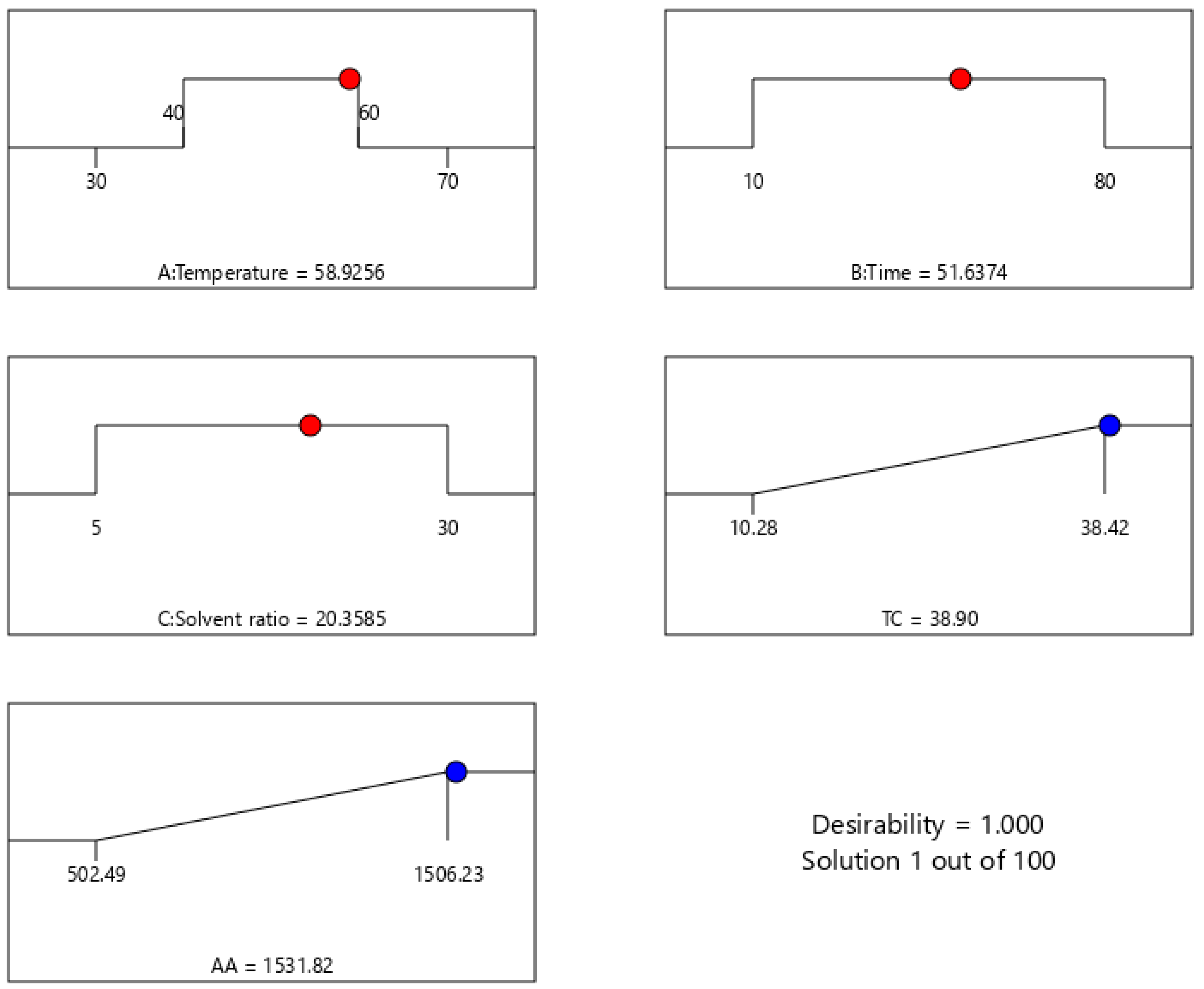
The model identified the optimal parameters by maximizing response desirability, thereby validating the model equation (Figure 4, Table 4). A designated point shown on the ramp graphs signifies the optimal level for the variable being examined. The value of desirability ranges from zero, which exceeds the limits, to a value near 1. The program starts at a random point and targets the steepest possible gradient to optimize the function [47]. With a desirability score of 0.985, it can be concluded that all selected requirements were reasonable (Figure 4). A solvent mixture ratio of 20.35 mL/g, a temperature of 58.9 °C, and an extraction time of 51 min were found to be the optimal conditions for achieving the highest possible levels of carotenoid extraction efficiency and antioxidant activity.
Although a close agreement between predicted and experimental values was obtained, minor deviations are inherent to response surface models applied to biological matrices and ultrasound-assisted processes. Such discrepancies may originate from experimental noise, raw material heterogeneity, particle size distribution, local non-uniformity of cavitation intensity, and analytical uncertainty, all of which can influence mass transfer and carotenoid stability. From a statistical perspective, these effects are reflected in the residual variability around the fitted quadratic model. The non-significant lack-of-fit and satisfactory validation at the optimum confirm the adequacy and robustness of the model within the investigated factor space. However, as RSM models are empirical and valid strictly within the defined experimental domain, extrapolation to non-ideal or scaled-up conditions (e.g., different reactors, energy densities, or feedstock variability) may introduce additional uncertainty and require further model refinement or re-optimization.
The model predicted the highest concentrations of carotenoids and level of antioxidant activity to be 38.90 mg/g DW and 1531.82 µmol TE/g DW, respectively. The experimental results concurrently exhibited reactions consistent with the model’s predictions, specifically 38.20 mg/g DW and 1522.02 µmol TE/g DW (Table 4). The experimental results indicated rapid reactions to the model’s predictions. The strong correlation among these data validated that the expected responses of the models accurately represented the observed optimization; therefore, the models are replicable. This work demonstrates that RSM is a practical approach for optimizing sonication operating conditions to enhance carotenoid extraction from carrot pomace, thereby maximizing carotenoid concentration.
Carotenoids’ conjugated double bonds can quench free radicals and contribute to electron transfer-based antioxidant reactions, which may explain the observed ABTS radical scavenging activity. Purified carotenoids show detectable ABTS activity that rises with carotenoid concentration under similar test conditions, demonstrating a functional relationship between carotenoid content and radical scavenging ability [48]. However, the overall ABTS response in complex extracts also integrates the effects of other antioxidants (e.g., phenolics), consistent with reports that lipophilic and hydrophilic antioxidants collectively determine ABTS capacity in plant matrices [49]. In this investigation, samples with higher total carotenoid levels showed increased ABTS activity, supporting previous findings and demonstrating that carotenoids’ extraction efficiency enhances functional antioxidant efficacy.
The carotenoid yield of 269 mg/100 g D.W. and antioxidant capacity of 822 µM TE/100 g D.W. were confirmed as elevated values in a Gac peel extract obtained after extraction at 50 °C and 250 W of ultrasound power for 76 min [50].

4. Conclusions

This research investigated the valorization of carrot pomace as a sustainable source of functional carotenoids using ultrasound-assisted extraction integrated with response surface methodology. While optimal conditions were identified, the significance of these results extends beyond parameter optimization. The combined enhancement of total carotenoid recovery and ABTS antioxidant performance demonstrates that UAE can be tuned not only to intensify mass transfer, but also to preserve and promote the functional integrity of carotenoid fractions. The recovery of extracts enriched in carotenoid compounds with high radical-scavenging activity indicates that controlled ultrasonic processing enables the selective release of nutritionally and technologically relevant pigments from a complex plant by-product matrix.
From an applied science perspective, these findings support a shift from yield-driven extraction strategies toward performance-oriented process design, where extraction conditions are selected to balance matrix disruption, pigment stability, and functional activity. The observed efficiency under moderate conditions further suggests that UAE can achieve high-value recovery with reduced thermal severity, aligning process intensification with energy and solvent minimization. Consequently, the proposed approach provides a transferable framework for designing carotenoid-oriented recovery processes from agri-food residues, facilitating the development of carotenoid-rich functional ingredients, natural colorants, or nutraceutical intermediates, and reinforcing the role of ultrasound-assisted technologies in circular bioeconomy implementation.
The developed RSM models are statistically adequate, but limited to the studied range, and may not fully capture the complexity of ultrasound cavitation, solvent–matrix interactions, or simultaneous carotenoid extraction and degradation. Conducted only at the laboratory scale with a focus on total carotenoids and overall antioxidant activity, the study did not address compound-specific kinetics or scalability, limiting its immediate industrial relevance.
Future research should expand the experimental design to include more process variables, compound-level carotenoid profiling, and evaluation of stability and kinetics. Pilot-scale validation, process robustness, energy efficiency, and downstream formulation assessments are critical for transferring optimized conditions to industry and leveraging carrot pomace value.

Author Contributions

Conceptualization, R.N.R., F.S., O.E.C. and G.R.; methodology, F.S., G.F.O. and O.E.C.; software, O.E.C. and C.M.; validation, O.E.C. and N.S.; formal analysis, G.F.O. and F.S.; investigation, R.N.R., C.M. and F.S.; resources, R.N.R. and N.Ć.N.; data curation G.R., M.B. and N.S.; writing—original draft preparation F.S., O.E.C. and R.N.R.; writing—review and editing, G.R. and N.S.; visualization, N.S.; supervision, M.B., N.Ć.N. and G.R. All authors have read and agreed to the published version of the manuscript.

Funding

This research received no external funding.

Institutional Review Board Statement

Not applicable.

Informed Consent Statement

Not applicable.

Data Availability Statement

The data supporting this study’s findings are available from the corresponding author (G.R.) upon reasonable request.

Acknowledgments

The Integrated Center for Research, Expertise, and Technological Transfer in the Food Industry is acknowledged for providing technical support.

Conflicts of Interest

The authors declare no conflicts of interest.

References

  1. Sorrenti, V.; Burò, I.; Consoli, V.; Vanella, L. Recent Advances in Health Benefits of Bioactive Compounds from Food Wastes and By-Products: Biochemical Aspects. Int. J. Mol. Sci. 2023, 24, 2019. [Google Scholar] [CrossRef] [Scilit]
  2. Sharma, M.; Hussain, S.; Shalima, T.; Aav, R.; Bhat, R. Valorization of Seabuckthorn Pomace to Obtain Bioactive Carotenoids: An Innovative Approach of Using Green Extraction Techniques (Ultrasonic and Microwave-Assisted Extractions) Synergized with Green Solvents (Edible Oils). Ind. Crops Prod. 2022, 175, 114257. [Google Scholar] [CrossRef] [Scilit]
  3. Hiranvarachat, B.; Devahastin, S. Enhancement of Microwave-Assisted Extraction via Intermittent Radiation: Extraction of Carotenoids from Carrot Peels. J. Food Eng. 2014, 126, 17–26. [Google Scholar] [CrossRef] [Scilit]
  4. Sharma, K.D.; Karki, S.; Thakur, N.S.; Attri, S. Chemical Composition, Functional Properties and Processing of Carrot—A Review. J. Food Sci. Technol. 2012, 49, 22–32. [Google Scholar] [CrossRef] [Scilit]
  5. Sharma, M.; Usmani, Z.; Gupta, V.K.; Bhat, R. Valorization of Fruits and Vegetable Wastes and By-Products to Produce Natural Pigments. Crit. Rev. Biotechnol. 2021, 41, 535–563. [Google Scholar] [CrossRef] [Scilit]
  6. Bhimjiyani, V.H.; Borugadda, V.B.; Naik, S.; Dalai, A.K. Enrichment of Flaxseed (Linum Usitatissimum) Oil with Carotenoids of Sea Buckthorn Pomace via Ultrasound-Assisted Extraction Technique. Curr. Res. Food Sci. 2021, 4, 478–488. [Google Scholar] [CrossRef] [Scilit]
  7. Rammuni, M.N.; Ariyadasa, T.U.; Nimarshana, P.H.V.; Attalage, R.A. Comparative Assessment on the Extraction of Carotenoids from Microalgal Sources: Astaxanthin from H. Pluvialis and β-Carotene from D. Salina. Food Chem. 2019, 277, 128–134. [Google Scholar] [CrossRef] [Scilit] [PubMed]
  8. Nirmal, N.P.; Khanashyam, A.C.; Mundanat, A.S.; Shah, K.; Babu, K.S.; Thorakkattu, P.; Al-Asmari, F.; Pandiselvam, R. Valorization of Fruit Waste for Bioactive Compounds and Their Applications in the Food Industry. Foods 2023, 12, 556. [Google Scholar] [CrossRef] [Scilit] [PubMed]
  9. Singh, M.N.; Srivastava, R.; Yadav, D.I. Study of Different Varietis of Carrot and Its Benefits for Human Health: A Review. J. Pharmacogn. Phytochem. 2021, 10, 1293–1299. [Google Scholar] [CrossRef] [Scilit]
  10. Mantiniotou, M.M.; Bujor, B.-C.; Athanasiadis, V.; Chatzimitakos, T.; Kalompatsios, D.-R.; Kotsou, K.; Bozinou, E.; Lalas, S. Response Surface Methodology-Aided Optimization of Bioactive Compound Extraction from Apple Peels Through Pulsed Electric Field Pretreatment and Ultrasonication. Eng 2024, 5, 2886–2901. [Google Scholar] [CrossRef] [Scilit]
  11. Sabio, E.; Lozano, M.; Montero de Espinosa, V.; Mendes, R.L.; Pereira, A.P.; Palavra, A.F.; Coelho, J.A. Lycopene and β-Carotene Extraction from Tomato Processing Waste Using Supercritical CO2. Ind. Eng. Chem. Res. 2003, 42, 6641–6646. [Google Scholar] [CrossRef] [Scilit]
  12. Corbu, A.R.; Rotaru, A.; Nour, V. Edible Vegetable Oils Enriched with Carotenoids Extracted from By-Products of Sea Buckthorn (Hippophae Rhamnoides Ssp. Sinensis): The Investigation of Some Characteristic Properties, Oxidative Stability and the Effect on Thermal Behaviour. J. Therm. Anal. Calorim. 2020, 142, 735–747. [Google Scholar] [CrossRef] [Scilit]
  13. Saini, R.K.; Keum, Y.-S. Carotenoid Extraction Methods: A Review of Recent Developments. Food Chem. 2018, 240, 90–103. [Google Scholar] [CrossRef] [Scilit] [PubMed]
  14. Galanakis, C.M. Emerging Technologies for the Production of Nutraceuticals from Agricultural By-Products: A Viewpoint of Opportunities and Challenges. Food Bioprod. Process. 2013, 91, 575–579. [Google Scholar] [CrossRef] [Scilit]
  15. Wani, S.A.; Bishnoi, S.; Kumar, P. Ultrasound and Microwave Assisted Extraction of Diosgenin from Fenugreek Seed and Fenugreek-Supplemented Cookies. Food Meas. 2016, 10, 527–532. [Google Scholar] [CrossRef] [Scilit]
  16. Kumcuoglu, S.; Yilmaz, T.; Tavman, S. Ultrasound Assisted Extraction of Lycopene from Tomato Processing Wastes. J. Food Sci. Technol. 2014, 51, 4102–4107. [Google Scholar] [CrossRef] [Scilit]
  17. Ordóñez-Santos, L.E.; Pinzón-Zarate, L.X.; González-Salcedo, L.O. Optimization of Ultrasonic-Assisted Extraction of Total Carotenoids from Peach Palm Fruit (Bactris Gasipaes) by-Products with Sunflower Oil Using Response Surface Methodology. Ultrason. Sonochemistry 2015, 27, 560–566. [Google Scholar] [CrossRef] [Scilit]
  18. Ji, D.; Wang, Q.; Lu, T.; Ma, H.; Chen, X. The Effects of Ultrasonication on the Phytochemicals, Antioxidant, and Polyphenol Oxidase and Peroxidase Activities in Coffee Leaves. Food Chem. 2022, 373, 131480. [Google Scholar] [CrossRef] [Scilit]
  19. Cano-Lamadrid, M.; Martínez-Zamora, L.; Mozafari, L.; Bueso, M.C.; Kessler, M.; Artés-Hernández, F. Response Surface Methodology to Optimize the Extraction of Carotenoids from Horticultural By-Products—A Systematic Review. Foods 2023, 12, 4456. [Google Scholar] [CrossRef] [Scilit]
  20. Wang, W.; Liu, X.; Wang, L.; Song, G.; Jiang, W.; Mu, L.; Li, J. Ficus Carica Polysaccharide Extraction via Ultrasound-Assisted Technique: Structure Characterization, Antioxidant, Hypoglycemic and Immunomodulatory Activities. Ultrason. Sonochemistry 2023, 101, 106680. [Google Scholar] [CrossRef] [Scilit]
  21. Yang, W.; Huang, G. Preparation and Analysis of Polysaccharide from Solanum Tuberdsm. Ultrason. Sonochemistry 2023, 98, 106520. [Google Scholar] [CrossRef] [Scilit]
  22. Jabbar, S.; Abid, M.; Wu, T.; Hashim, M.M.; Saeeduddin, M.; Hu, B.; Lei, S.; Zeng, X. Ultrasound-Assisted Extraction of Bioactive Compounds and Antioxidants from Carrot Pomace: A Response Surface Approach. J. Food Process. Preserv. 2015, 39, 1878–1888. [Google Scholar] [CrossRef] [Scilit]
  23. Sabahi, S.; Abbasi, A.; Mortazavi, S.A. Phenolic Components from Carrot (Daucus Carota L.) Pomace: Optimizing the Extraction and Assessing Its Potential Antioxidant and Antimicrobial Activities. Heliyon 2024, 10, e36971. [Google Scholar] [CrossRef] [Scilit]
  24. Nistor, O.V.; Mocanu, G.D.; Andronoiu, D.G.; Barbu, V.V.; Ceclu, L. A Complex Characterization of Pumpkin and Quince Purees Obtained by a Combination of Freezing and Conventional Cooking. Foods 2022, 11, 2038. [Google Scholar] [CrossRef] [Scilit]
  25. Castro-Vargas, H.I.; Rodríguez-Varela, L.I.; Ferreira, S.R.S.; Parada-Alfonso, F. Extraction of Phenolic Fraction from Guava Seeds (Psidium Guajava L.) Using Supercritical Carbon Dioxide and Co-Solvents. J. Supercrit. Fluids 2010, 51, 319–324. [Google Scholar] [CrossRef] [Scilit]
  26. Oncică, F.-G.; Stoica, F.; Constantin, O.E.; Turturică, M.; Aprodu, I.; Ratu, R.N.; Andronoiu, D.G.; Stănciuc, N.; Râpeanu, G. Development of Value-Added Muffins Using Carrot Pomace Powder as a Natural Pigment. Ann. Univ. Dunarea De Jos Galati. Fascicle VI—Food Technol. 2024, 48, 192–210. [Google Scholar] [CrossRef] [Scilit]
  27. Xu, Y.-Q.; Yu, P.; Zhou, W. Combined Effect of pH and Temperature on the Stability and Antioxidant Capacity of Epigallocatechin Gallate (EGCG) in Aqueous System. J. Food Eng. 2019, 250, 46–54. [Google Scholar] [CrossRef] [Scilit]
  28. Rațu, R.N.; Oncică, G.-F.; Stoica, F.; Constantin, O.E.; Stănciuc, N.; Aprodu, I.; Andronoiu, D.G.; Banožić, M.; Ćujić Nikolić, N.; Râpeanu, G. Value-Added Carp Roe Salad Supplemented with Orange Carrot Pomace Powder. Foods 2025, 14, 3606. [Google Scholar] [CrossRef] [Scilit]
  29. Turcsi, E.; Nagy, V.; Deli, J. Study on the Elution Order of Carotenoids on Endcapped C18 and C30 Reverse Silica Stationary Phases. A Review of the Database. J. Food Compos. Anal. 2016, 47, 101–112. [Google Scholar] [CrossRef] [Scilit]
  30. Rodriguez-Amaya, D.B.; Kimura, M. HarvestPlus Handbook for Carotenoid Analysis; International Food Policy Research Institute (IFPRI): Washington, DC, USA, 2004. [Google Scholar]
  31. Arathi, B.P.; Sowmya, P.R.-R.; Vijay, K.; Baskaran, V.; Lakshminarayana, R. Metabolomics of Carotenoids: The Challenges and Prospects—A Review. Trends Food Sci. Technol. 2015, 45, 105–117. [Google Scholar] [CrossRef] [Scilit]
  32. Gunathilake, K.D.P.P.; Ranaweera, K.K.D.S.; Rupasinghe, H.P.V. Response Surface Optimization for Recovery of Polyphenols and Carotenoids from Leaves of Centella Asiatica Using an Ethanol-based Solvent System. Food Sci. Nutr. 2019, 7, 528–536. [Google Scholar] [CrossRef] [Scilit]
  33. Teng, H.; Choi, Y.H. Optimization of Ultrasonic-Assisted Extraction of Bioactive Alkaloid Compounds from Rhizoma Coptidis (Coptis Chinensis Franch.) Using Response Surface Methodology. Food Chem. 2014, 142, 299–305. [Google Scholar] [CrossRef] [Scilit] [PubMed]
  34. Pingret, D.; Fabiano-Tixier, A.-S.; Chemat, F. Degradation during Application of Ultrasound in Food Processing: A Review. Food Control 2013, 31, 593–606. [Google Scholar] [CrossRef] [Scilit]
  35. Umair, M.; Jabbar, S.; Nasiru, M.M.; Lu, Z.; Zhang, J.; Abid, M.; Murtaza, M.A.; Kieliszek, M.; Zhao, L. Ultrasound-Assisted Extraction of Carotenoids from Carrot Pomace and Their Optimization through Response Surface Methodology. Molecules 2021, 26, 6763. [Google Scholar] [CrossRef] [Scilit] [PubMed]
  36. Kaur, P.; Subramanian, J.; Singh, A. Green Extraction of Bioactive Components from Carrot Industry Waste and Evaluation of Spent Residue as an Energy Source. Sci. Rep. 2022, 12, 16607. [Google Scholar] [CrossRef] [Scilit]
  37. Lau, W.K.; Chuyen, H.V.; Vuong, Q.V. Physical Properties, Carotenoids and Antioxidant Capacity of Carrot (Daucus Carota L.) Peel as Influenced by Different Drying Treatments. Int. J. Food Eng. 2018, 14, 20170042. [Google Scholar] [CrossRef] [Scilit]
  38. Aubert, C.; Bruaut, M.; Chalot, G. Spatial Distribution of Sugars, Organic Acids, Vitamin C, Carotenoids, Tocopherols, 6-Methoxymellein, Polyacetylenic Compounds, Polyphenols and Terpenes in Two Orange Nantes Type Carrots (Daucus Carota L.). J. Food Compos. Anal. 2022, 108, 104421. [Google Scholar] [CrossRef] [Scilit]
  39. Dianursanti, A.R.; Siregar, A.; Maeda, Y.; Yoshino, T.; Tanaka, T. The Effects of Solvents and Solid-to-Solvent Ratios on Ultrasound-Assisted Extraction of Carotenoids from Chlorella Vulgaris. IJTech—Int. J. Technol. 2020, 11, 941–950. [Google Scholar] [CrossRef] [Scilit]
  40. Yang, J.; Li, N.; Wang, C.; Chang, T.; Jiang, H. Ultrasound-Homogenization-Assisted Extraction of Polyphenols from Coconut Mesocarp: Optimization Study. Ultrason. Sonochemistry 2021, 78, 105739. [Google Scholar] [CrossRef] [Scilit]
  41. Tiwari, B.K. Ultrasound: A Clean, Green Extraction Technology. TrAC Trends Anal. Chem. 2015, 71, 100–109. [Google Scholar] [CrossRef] [Scilit]
  42. Che, H.; Zhang, R.; Wang, X.; Yu, H.; Shi, X.; Yi, J.; Li, J.; Qi, Q.; Dong, R.; Li, Q. Ultrasound-Assisted Extraction of Polyphenols from Phyllanthi Fructus: Comprehensive Insights from Extraction Optimization and Antioxidant Activity. Ultrason. Sonochemistry 2024, 111, 107083. [Google Scholar] [CrossRef] [Scilit]
  43. Mantiniotou, M.; Athanasiadis, V.; Kalompatsios, D.; Lalas, S.I. Optimization of Carotenoids and Other Antioxidant Compounds Extraction from Carrot Peels Using Response Surface Methodology. Biomass 2025, 5, 3. [Google Scholar] [CrossRef] [Scilit]
  44. Dirar, A.I.; Alsaadi, D.H.M.; Wada, M.; Mohamed, M.A.; Watanabe, T.; Devkota, H.P. Effects of Extraction Solvents on Total Phenolic and Flavonoid Contents and Biological Activities of Extracts from Sudanese Medicinal Plants. S. Afr. J. Bot. 2019, 120, 261–267. [Google Scholar] [CrossRef] [Scilit]
  45. Siddiqui, S.A.; Ali Redha, A.; Salauddin, M.; Harahap, I.A.; Rupasinghe, H.P.V. Factors Affecting the Extraction of (Poly)Phenols from Natural Resources Using Deep Eutectic Solvents Combined with Ultrasound-Assisted Extraction. Crit. Rev. Anal. Chem. 2025, 55, 139–160. [Google Scholar] [CrossRef] [Scilit]
  46. Athanasiadis, V.; Chatzimitakos, T.; Makrygiannis, I.; Kalompatsios, D.; Bozinou, E.; Lalas, S.I. Antioxidant-Rich Extracts from Lemon Verbena (Aloysia Citrodora L.) Leaves through Response Surface Methodology. Oxygen 2024, 4, 1–19. [Google Scholar] [CrossRef] [Scilit]
  47. De, B.; Bhandari, K.; Katakam, P.; Goswami, T.K. Development of a Standardized Combined Plant Extract Containing Nutraceutical Formulation Ameliorating Metabolic Syndrome Components. SN Appl. Sci. 2019, 1, 1484. [Google Scholar] [CrossRef] [Scilit]
  48. Hacke, A.C.M.; Litke, Q.; Sestric, R.; Hardy, B.; Kuss, S.; Liu, S.; Levin, D.; Sorensen, J.L. Insights into the Antioxidant Activity of Carotenoid Standards, Microalgal, and Yeast Extracts via Spectroscopic and Electrochemical Methods. Food Chem. 2025, 495, 146338. [Google Scholar] [CrossRef] [Scilit] [PubMed]
  49. Adamczuk, N.; Krauze-Baranowska, M.; Milewska, M.; Kimel, K.; Migas, P. Determination of Carotenoids and Their Antioxidant Activity in Fruits of Selected Species from the Genus Rubus and Their Cultivars and Hybrids from Poland Versus Other Regions of the World. Antioxidants 2025, 14, 1438. [Google Scholar] [CrossRef] [Scilit]
  50. Chuyen, H.V.; Roach, P.D.; Golding, J.B.; Parks, S.E.; Nguyen, M.H. Ultrasound-Assisted Extraction of GAC Peel: An Optimization of Extraction Conditions for Recovering Carotenoids and Antioxidant Capacity. Processes 2020, 8, 8. [Google Scholar] [CrossRef] [Scilit]
Figure 1. The chromatographic profile of the carrot extract at 450 nm: lutein (1); zeaxanthin (2); not identified (3); not identified (4); α-carotene (5); β-carotene (6); not identified (7).
Applsci 16 01472 g001
Figure 2. 3D surface plots screening the variables’ effect on TC (A) extraction yield. (a): time–solvent mixture ratio; (b): temperature–time; (c): temperature–solvent mixture ratio.
Applsci 16 01472 g002
Figure 3. 3D surface plot screening the temperature–time effect on AA.
Applsci 16 01472 g003
Figure 4. Optimization desirability ramps.
Applsci 16 01472 g004
Table 1. Range of values for the factors investigated and encoded values.
CodeIndependent VariablesUnitsCoded Low (−1) Coded High (+1)MinimumMaximum
ATemperature°C307016.3683.64
BTimemin108010.00103.86
CSolvent ratiomL/g5303.5238.52
Table 2. Matrix of experimental design (real values) with responses in terms of TC and AA.
RunFactor 1
A: Temperature (°C)
Factor 2
B: Time (min)
Factor 3
C: Solvent Ratio (mL/g)
Response 1
TC (mg/g DW)
Response 2
AA (µmol/g DW)
170103012.96837.19
2504517.538.421506.23
330803022.11799.47
43010511.58712.16
57080529.561012.88
683.644517.522.351140.60
750453.5227.331085.09
830103019.40999.66
9504517.538.171436.81
1050103.8617.532.08681.80
117010514.40613.92
12504538.5223.641256.80
135013.8617.530.551307.21
14504517.537.601501.74
1570803031.471299.22
16504517.537.901505.04
17504517.537.591497.12
183080510.28502.49
1916.364517.512.27881.34
20504517.537.561462.30
Table 3. ANOVA for the reduced quadratic model for TC and AA.
TCAA
SourceSSdfMSF-Valuep-ValueSourceSSdfMSF-Valuep-Value
Model1969.909218.881377.49<0.0001Model2.126 × 10673.037 × 105189.56<0.0001 a
A-Temperature128.941128.94811.47<0.0001A-Temperature1.029 × 10511.029 × 10564.22<0.0001
B-Time198.711198.711250.57<0.0001B-Time17,122.47117,122.4710.690.0067
C-Solvent ratio69.49169.49437.32<0.0001C-Solvent ratio2.296 × 10512.296 × 105143.30<0.0001
AB130.151130.15819.06<0.0001AB2.019 × 10512.019 × 105125.99<0.0001
AC45.97145.97289.30<0.0001AC-----
BC6.7716.7742.63<0.0001BC-----
A2796.601796.605013.33<0.0001A24.242 × 10514.242 × 105264.74<0.0001
B2200.471200.471261.64<0.0001B27.844 × 10517.844 × 105489.52<0.0001
C2410.501410.502583.44<0.0001C22.806 × 10512.806 × 105175.11<0.0001
Residual1.59100.1589 Residual19,227.83121602.32
Lack of Fit0.945350.18911.470.3418bLack of Fit15,110.4972158.642.620.1531 b
Pure Error0.643750.1287 Pure Error4117.345823.47
Cor Total1971.4919 Cor Total2.145 × 10619
Sum of Squares—SS; Mean Square—MS; a Significant; b Not significant.
Table 4. Validation of the mathematical model.
Dependent VariablePredicted Value Experimental Value
TC (mg/g DW)38.9038.20
AA (µmol TE/g DW)1531.821522.02
Disclaimer/Publisher’s Note: The statements, opinions and data contained in all publications are solely those of the individual author(s) and contributor(s) and not of MDPI and/or the editor(s). MDPI and/or the editor(s) disclaim responsibility for any injury to people or property resulting from any ideas, methods, instructions or products referred to in the content.