1. Introduction
Accurate braking-distance prediction for multi-axle heavy-duty trucks remains challenging because stopping performance is strongly influenced by time-varying tire–road friction and transient axle-load redistribution during braking. Even under nominally identical braking commands, small variations in friction and dynamic vertical loads can produce noticeable differences in achievable deceleration and the stopping distance. Recent work has shown that tire–road friction can be estimated from vehicle responses under carefully designed braking excitations, highlighting friction uncertainty as a primary source of braking-performance variability [
1]. In real-world operations, the problem becomes more critical on curved roads and in adverse weather, where the emergency braking capability directly constrains the safe operating speed; for example, permitted-speed decision studies under rainy conditions emphasize that braking limits on horizontal curves must be evaluated together with the prevailing friction environment [
2].
A second major factor is the transient redistribution of axle loads during braking. While axle loads are traditionally treated as quasi-static, dynamic load components are important both for vehicle dynamics and for infrastructure impacts. Bridge weigh-in-motion (BWIM) approaches have been developed to infer axle loads from bridge responses, and improvements in moving-point-load approximation have enhanced BWIM accuracy and applicability [
3]. From a pavement-engineering perspective, dynamic loads affect the axle-load spectra used for pavement design, motivating an explicit consideration of dynamic effects when constructing axle-load spectra [
4]. Moreover, because axle-load spectra are often derived from measurement systems subject to noise, drift, and operational anomalies, the accuracy and reliability of these spectra have been investigated as a key factor in pavement-design outcomes [
5]. Methods that quantify WIM data reliability and automatically assess measurement quality further support robust axle-load data pipelines [
6]. More recently, camera-assisted approaches have been explored to enhance the weight estimation accuracy by leveraging wheel-oscillation information extracted from image data [
7], and long-term assessments of load sensors in WIM deployments have highlighted the importance of stability and durability for real-world applications [
8].
In addition to load measurement, heavy-vehicle braking performance depends on the braking-system architecture and control. For articulated combinations, the trailer braking system design directly influences overall deceleration and stability, and next-generation trailer brake system concepts have been proposed to improve coordinated braking performance [
9]. The on-board estimation of vertical tire forces is also an enabling capability for load-aware control and prediction in multi-axle trucks; estimation frameworks using separated vehicle models and Kalman-filter-based approaches have been reported for multi-axle vertical tire force estimation [
10]. Complementary estimation strategies have integrated brake-force estimation with machine-learning-based road-condition classification and vehicle mass identification, demonstrating that multiple latent variables relevant to braking can be inferred from feasible signal sets [
11]. For active safety functions, automatic emergency braking system (AEBS) algorithms for commercial vehicles have been investigated to improve braking response consistency under varying driving conditions [
12]. Similarly, pneumatic control methods for commercial-vehicle electronic brake systems (EBSs) have been proposed to improve pressure control and braking actuation performance [
13]. In parallel, data-driven systems that determine the braking pressure and driving direction using vehicle signals have been studied, underscoring the value of robust signal interpretation in braking-related applications [
14]. More recently, braking-system modeling and control algorithms that explicitly incorporate vertical-load estimation have been presented for commercial-vehicle EBS, reflecting an increasing emphasis on load-aware braking control [
15].
Beyond control and estimation, research has increasingly applied machine learning to braking-distance prediction under challenging surface conditions. For instance, neural-network-based approaches have been used to estimate the braking distance over wet and rutted pavements, demonstrating that learning-based models can capture nonlinear relationships between the surface condition and stopping performance when appropriate features are provided [
16]. Because the payload and load distribution can vary widely in freight operations, load-estimation methods using air-suspension state parameters have also been studied to infer truck load states relevant to braking and stability [
17]. Moreover, braking-induced dynamic load transfer has been examined in the context of vehicle–road interaction and the pavement response, emphasizing that braking events can alter load-transfer patterns and road-loading mechanisms [
18].
Operational safety constraints motivate not only the prediction of stopping distance but also the determination of feasible braking limits. Recent work has proposed data- and model-integrated methods to recommend maximum safe braking deceleration rates for trucks on horizontal curves, explicitly linking friction constraints to braking demand [
19]. For emerging heavy-duty architectures, including electric wheel-drive multi-axle platforms, composite braking-control strategies have been studied to address multi-axle braking distribution and coordination challenges [
20]. Related work on pneumatic electronic parking brake (EPB) control for commercial vehicles further illustrates the ongoing evolution of braking subsystems and their dynamic control requirements [
21]. In addition, modular WIM sensors and axle-recognition methods using neural networks have been developed, reinforcing the growing ecosystem for load-aware monitoring and inference [
22].
Despite these advances, important limitations remain in existing braking-distance-prediction research for heavy-duty multi-axle trucks. First, many prior models still rely on static or quasi-static axle-load assumptions, constant friction coefficients, or quasi-steady deceleration profiles, which cannot represent the rapid load redistribution and friction modulation observed immediately after brake actuation. As a result, such models often fail to explain the stopping-distance variability measured under realistic payload and road-surface conditions. Second, although friction estimation and vehicle-mass estimation have been studied extensively, these quantities are frequently treated in isolation and are rarely synchronized with braking-time axle-load dynamics in full-scale experiments. Third, most existing studies validate their approaches under a limited set of operating conditions, lacking an experimentally validated, end-to-end framework that jointly captures real-time axle-load dynamics, friction variation, and braking transients in multi-axle trucks. Furthermore, stability issues in articulated vehicles during braking can couple into broader motion-control objectives; brake-actuated steering strategies have been proposed to improve articulated-vehicle stability, highlighting the importance of integrated braking–stability perspectives [
23]. Coupled vehicle–road dynamic studies under braking also show that the braking conditions, road roughness, and pavement flexibility can jointly influence heavy-vehicle dynamic responses, reinforcing the need for physically consistent features and validation in predictive modeling [
24].
Detailed modeling and experimental studies on pneumatic braking systems have demonstrated that the pressure dynamics and estimation accuracy play a critical role in shaping braking response behavior [
25]. Building on these findings, recent work has further shown that pressure build-up delays and nonlinear actuation characteristics can significantly affect stopping-distance variability in multi-axle trucks [
26].
Accordingly, a clear research gap exists: the absence of an experimentally validated, end-to-end framework that (i) captures braking-time axle-load dynamics in real time on a multi-axle truck and (ii) leverages these dynamic variables—together with friction-relevant information—to improve braking-distance prediction across varying payload and road conditions.
Motivated by these gaps, this paper develops a load-aware braking-distance-prediction framework for a multi-axle truck that combines real-time axle-load sensing/estimation with data-driven prediction. The main contributions are as follows:
a synchronized measurement and processing pipeline for braking events that captures transient axle-load dynamics relevant to stopping performance;
a learning-based braking-distance predictor that explicitly incorporates dynamic load information together with braking-state and friction-relevant signals; and
experimental validation demonstrating improved robustness across varying payload and surface conditions compared with load-agnostic baselines.
The remainder of the paper is organized as follows:
Section 2 presents the sensing architecture, calibration procedure, friction estimation, experimental design, and machine-learning model.
Section 3 reports the measured braking behavior, predictive performance, and feature-importance analysis.
Section 4 discusses key findings, limitations, and implications for heavy-truck safety systems.
Section 5 concludes the study.
The present study therefore focuses on accurately predicting the stopping distance of a multi-axle heavy-duty truck under a prescribed, non-panic braking condition with approximately 60% of the nominal service-brake pressure, rather than attempting to minimize the stopping distance itself.
2. Materials and Methods
2.1. Problem Definition and Framework Overview
In this study, we propose a method for accurately predicting braking distance for heavy-duty multi-axle trucks, which requires simultaneous consideration of the vehicle mass, axle-load distribution, dynamic load transfer, and time-varying road surface conditions encountered during real-world driving.
The tested gross vehicle weight and axle-load configurations were selected to remain within the legal limits specified for this vehicle category in the national regulations, ensuring that all payload conditions represent realistic and compliant freight operations.
The target vehicle considered in this study is a multi-axle heavy-duty truck equipped with tandem rear axles. In regional classification systems used in North America, this vehicle corresponds to the “Class-6” category; however, in this paper, the vehicle is described primarily by its axle configuration and representative gross vehicle mass to ensure international readability. The tested configurations fall within the typical gross mass range for multi-axle medium-to-heavy commercial trucks.
In multi-axle cargo trucks commonly deployed in domestic logistics operations, these factors exhibit large temporal fluctuations even during nominal straight-line braking. While longitudinal deceleration induces a predictable forward load transfer, additional vertical load disturbances arise from the road-surface profile—including micro-level roughness, pavement discontinuities, and low-amplitude slope variations. These transient inputs excite the suspension system, thereby producing short-duration changes in the normal tire load. Because the tire–road friction coefficient is sensitive to these normal-load variations, the resulting dynamic coupling directly affects both the available braking force and total stopping distance.
Conventional braking-distance models typically rely on simplified assumptions, such as static axle loads, constant friction coefficients, or quasi-steady deceleration profiles. Such formulations do not incorporate real-time axle-load variations and therefore cannot reproduce the braking-distance deviations observed in full-scale experiments. Existing commercial axle-load sensors are primarily designed for static overload detection and are unable to capture the rapid angular deformation of the leaf-spring assembly during hard braking, especially under interacting influences of payload variation, suspension motion, and road-induced excitation.
To address these limitations, this study establishes an integrated framework for dynamic-load-aware braking-distance prediction in multi-axle trucks. The framework consists of the following:
- (i)
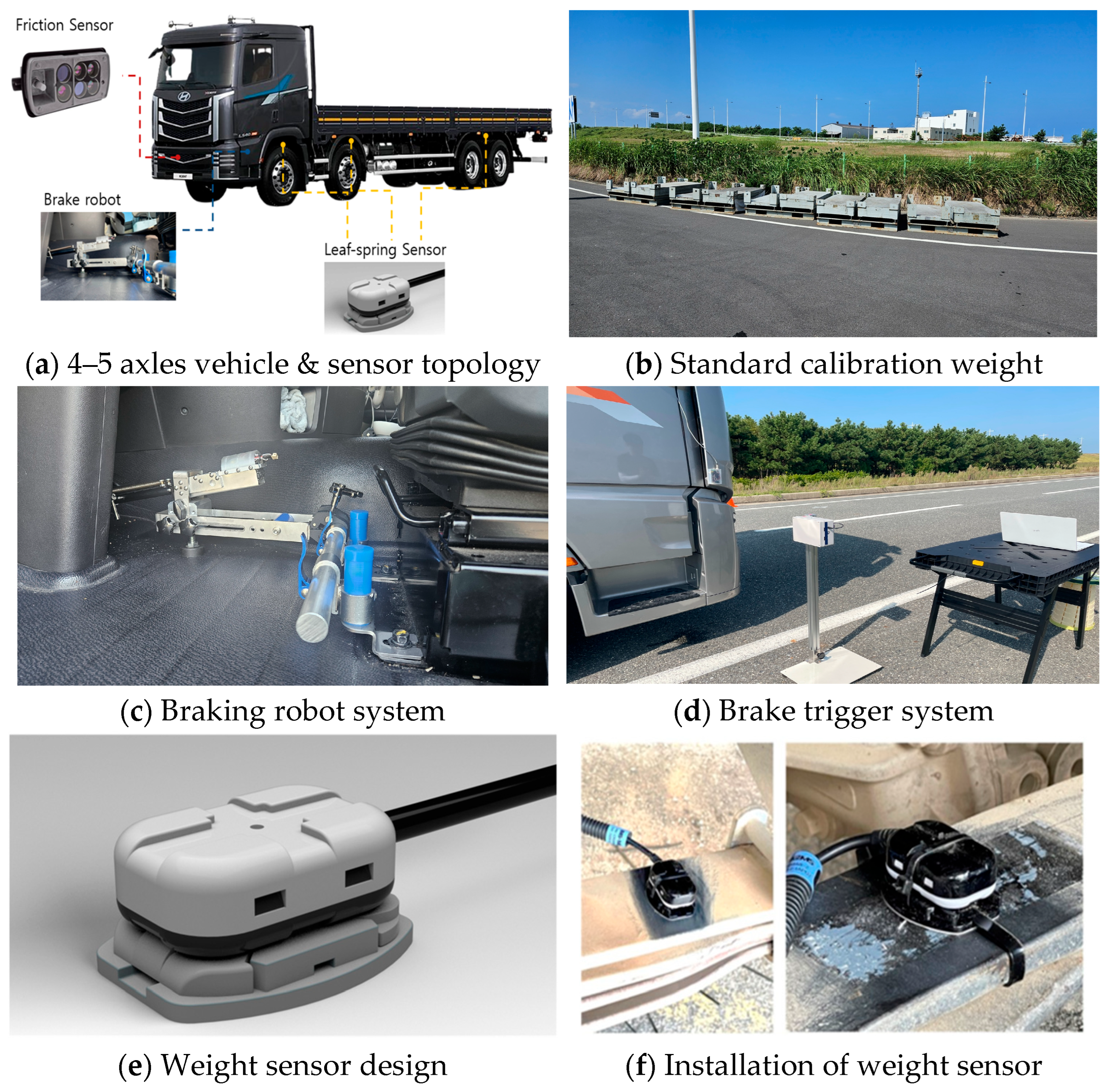
a leaf-spring-mounted load-angle sensor that measures instantaneous angular deformation of the inter-leaf panel to infer dynamic axle loads;
- (ii)
a front-mounted friction-sensing module that provides real-time estimates of tire–road friction;
- (iii)
full-scale on-road braking tests performed using an automated brake/accelerator robot, ensuring driver-independent reproducibility;
- (iv)
variable-payload test protocol covering 0, 4.5, 11.0, and 15.5 t; and
- (v)
a unified data-fusion and modeling structure that synchronizes load, friction, and deceleration measurements for subsequent braking-distance modeling.
Figure 1 illustrates the overall sensing and testing architecture, where the dynamic vertical-load signal and friction estimate are synchronized with deceleration and stopping-distance measurements obtained during robotic straight-line braking tests. This configuration provides a physical basis for quantitatively evaluating how dynamic axle-load fluctuations influence the available braking force and total stopping distance.
2.2. Road-Induced Dynamic Load Variation and Its Impact on Braking-Distance Prediction
This subsection explains how road-induced vertical excitations generate dynamic axle-load variations in multi-axle trucks and analyzes their direct impact on braking-force availability and stopping-distance prediction.
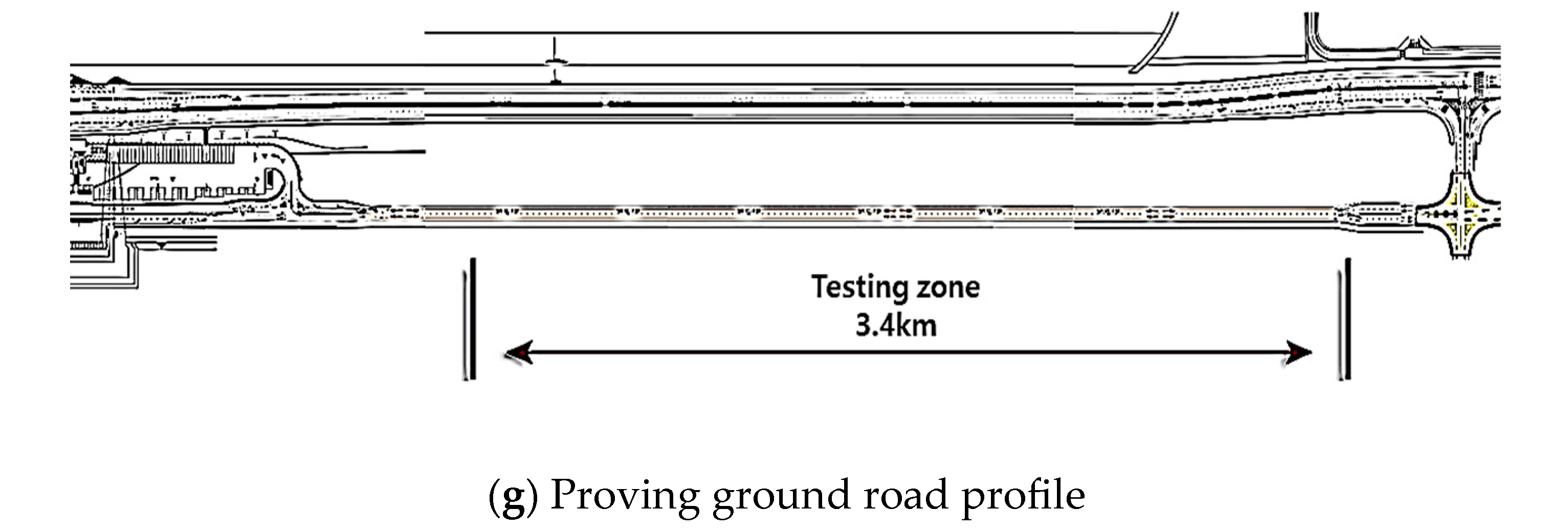
Although the braking tests were conducted on a nearly-level and straight proving-ground segment, the road-surface profile inevitably introduces vertical input disturbances. Even when classified within ISO 8608 Class A–B, such inputs generate measurable variations in the wheel vertical force as the suspension responds to small-amplitude pavement irregularities [
27]. For a multi-axle truck, the long wheelbase and sequential axle spacing amplify these effects because each axle experiences the same road elevation change at different times, producing asynchronous load fluctuations across axles.
Table 1 summarizes the notation used in the braking-distance model and the dynamic axle-load formulation.
Let the instantaneous dynamic axle load be represented as follows:
where
: static load on the axle,
: load transfer due to longitudinal deceleration,
: dynamic load fluctuation induced by road-surface vertical excitation.
Because the test section exhibited less than 0.1% longitudinal grade and a curvature radius exceeding 2000 m, the grade- and curvature-induced load components satisfy
and are therefore negligible.
Under dynamic conditions, the available braking force on each wheel depends on both the instantaneous normal load and the corresponding friction coefficient:
Because decreases with an increasing normal load—following well-documented tire load-sensitivity characteristics—small fluctuations in create proportional changes in . Consequently, braking distance deviates from the value predicted using static-load assumptions.
As a Dynamic-Load-Based Braking-Distance Model, the total braking force is the sum over all wheels:
The vehicle deceleration becomes
The braking distance is obtained by integrating the speed over the braking interval:
Substituting
and rearranging yields the generalized dynamic-load braking-distance formulation:
Equation (7) explicitly incorporates the time-varying effects of dynamic axle load and friction. When
is replaced with the static load and
is assumed to be constant, (7) reduces to the classical expression:
highlighting how dynamic-load-aware braking-distance prediction generalizes the widely used static model.
ABS applicability and experimental regime. Although the test vehicle is equipped with an anti-lock braking system (ABS), all experiments in this study were conducted under a non-ABS-intervening braking regime by design. Specifically, the robotic braking controller applied a fixed 60% brake-pressure command, which avoided wheel lock and therefore did not trigger ABS operation. Accordingly, Equations (1)–(8) are presented and validated under the measured deceleration and friction conditions corresponding to this non-ABS-intervening regime.
Because both
and
fluctuate during braking, accurate braking-distance prediction requires real-time measurement of all relevant variables. The proposed sensing–testing framework provides these quantities directly, enabling the development of data-driven models that reflect real-world dynamic behavior more faithfully than traditional static-load formulations.
Table 2 lists the key vehicle parameter inputs for the braking-distance and load-transfer analysis, covering the GVW/curb weight, vehicle and cargo-bed dimensions, axle layout (wheelbase and track widths), maximum payload, and the baseline static axle loads (unladen) for the front, middle, and rear axles.
2.3. Leaf-Spring Load-Angle Sensor Design and Calibration, and Dynamic Validation
This subsection outlines the driving conditions and test scenarios considered in this study, focusing on representative braking maneuvers under different load and speed conditions.
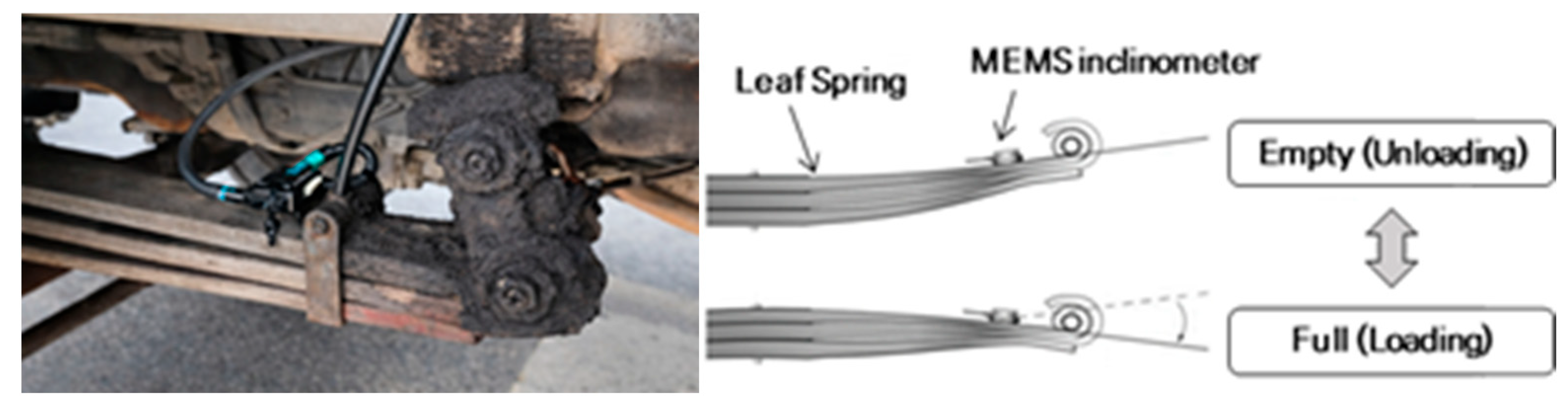
Real-time estimation of the dynamic axle load requires a sensing mechanism capable of capturing both quasi-static deformation from payload variation and the rapid elastic response of the suspension system during braking. To meet these requirements, a MEMS inclinometer-based load-angle sensor was mounted on the upper surface of the leaf-spring assembly. This configuration leverages the inherent bending of the multi-leaf spring under load to measure angular deflection, which correlates strongly with the vertical axle force.
2.3.1. Sensor Geometry and Operating Principle
Figure 2 illustrates the geometric configuration of the proposed sensing module. A compact MEMS inclinometer is attached to the top leaf near the spring eye, where vertical load induces the greatest rotational displacement. As the vehicle load increases, the leaf-spring stack deflects downward, generating a measurable angular change
. Conversely, unloading reduces the angle toward its baseline value
.
The small-angle bending behavior of the leaf-spring assembly can be expressed as follows:
where
: vertical deflection of the spring end,
: effective lever-arm distance between spring eye and sensor location.
Because spring deflection is proportional to vertical load within the elastic range, the axle load can be expressed as follows:
Combining (9) and (10) yields the general nonlinear relationship:
However, real leaf-spring assemblies exhibit mild geometric nonlinearity, which becomes more pronounced at higher loads. To capture this effect, a polynomial calibration model was adopted.
The load-angle sensor was secured using a clamp-based mounting fixture, without welding or permanent modification of the leaf-spring assembly. This non-invasive installation approach ensures mechanical stability while avoiding structural alteration of the suspension component, thereby facilitating repeatable measurements and practical applicability in real-world vehicles.
2.3.2. Static Calibration Using Polynomial Load Mapping
The leaf-spring deformation sensors were calibrated under static loading conditions. The braking maneuvers considered in this study exhibit relatively low dominant frequencies in the vertical dynamics compared with the natural frequency of the suspension, and the axle loads remain within the elastic range of the leaf-spring assembly. Under these conditions, we assume that the static angle-to-load mapping remains approximately valid during the braking events and thus apply the polynomial calibration curve to estimate dynamic axle loads.
Static axle-load calibration was performed by sequentially applying known calibration weights to each axle while the vehicle was stationary on a level test surface. At each loading step, the steady-state sensor angle output
was recorded after mechanical settling. The collected pairs of (
,
) define the static calibration curve, as conceptually illustrated in
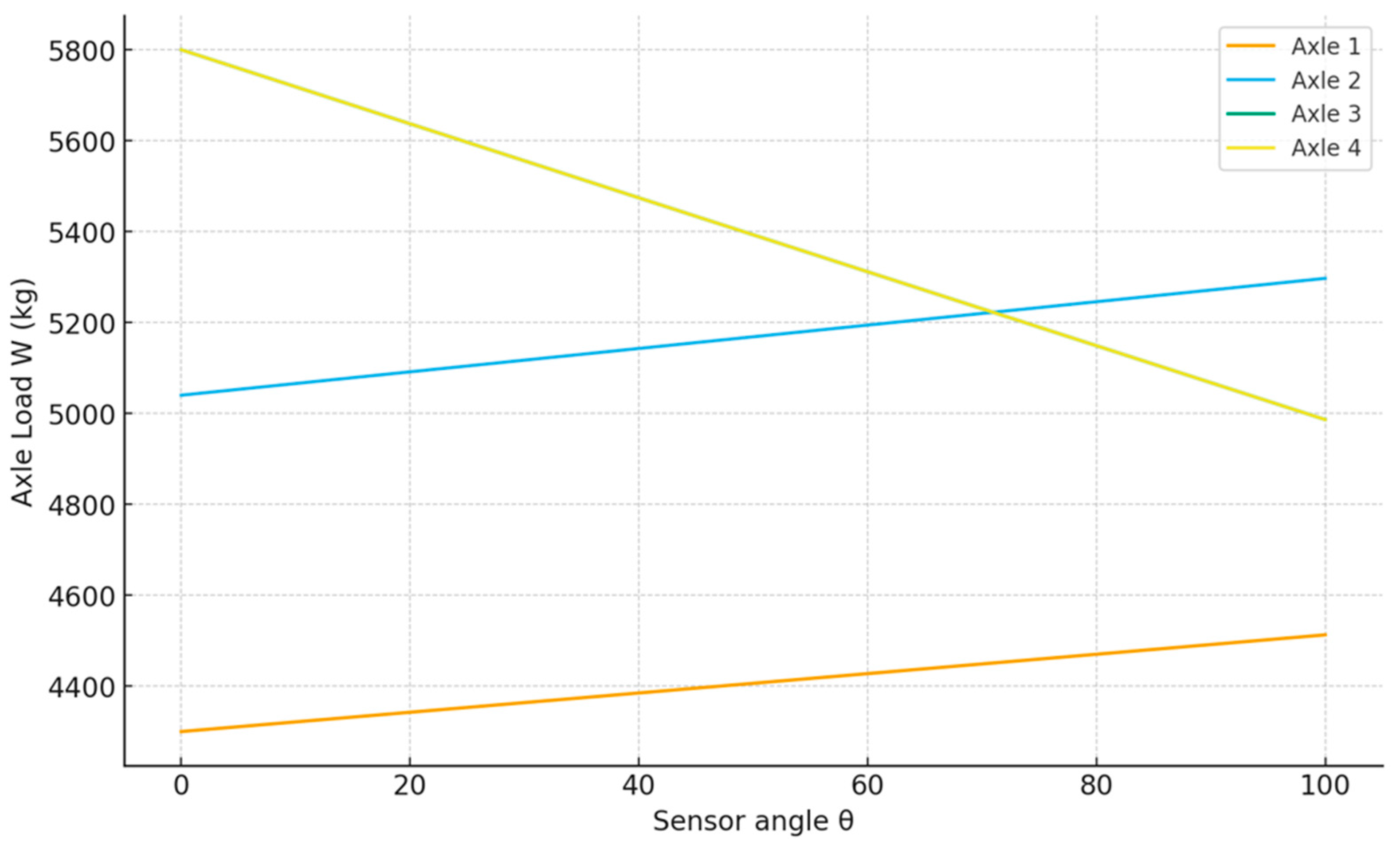
Figure 3.
Figure 3 provides the axle-specific calibration used to map the measured sensor angle
to the corresponding axle load
for subsequent braking-distance prediction. The sensor measures the rotation angle
θ generated by leaf-spring deflection during braking, which serves as the input to the polynomial axle-load calibration model in Equations (4)–(6). This mounting location captures dynamic load-transfer behavior unique to tandem-axle trucks and provides real-time vertical-load estimates with minimal instrumentation complexity.
A second-order polynomial mapping was selected as the optimal regression model, capturing the nonlinear elastic and geometric characteristics of the multi-link suspension and load-sensing mechanism. The calibrated axle load
is obtained from the sensor angle
according to the following:
The coefficients , , and were identified through least-squares fitting for each axle.
Table 3 summarizes the identified calibration parameters.
The first and second axles exhibit positive linear gain (
> 2), indicating a relatively direct sensor response to load changes, whereas the third and fourth axles show negative linear terms that correspond to geometric load-path effects in the rear tandem suspension. The quadratic term
is consistently small but essential for capturing the observed curvature of the calibration function. This polynomial mapping is subsequently used in
Section 3 and
Section 4 for real-time axle-load estimation and braking-distance prediction.
Because Axle 3 and Axle 4 form a tandem-axle module with identical suspension geometry and load paths, the static calibration results show that both axles share the same polynomial coefficient set. Therefore, the calibration factors for Axle 3 and Axle 4 are identical, reflecting the symmetric load–deflection characteristics of the tandem suspension system.
2.4. Real-Time Road-Friction Sensing Module
This subsection describes the data-processing pipeline and feature-extraction methods applied to the raw sensor signals to construct meaningful inputs for the subsequent analysis and modeling.
Accurate estimation of road friction is essential for predicting braking performance in heavy-duty multi-axle trucks, especially when dynamic axle-load variations occur during deceleration. In this study, a real-time road-friction sensing module was integrated into the vehicle to provide continuous estimates of tire–road adhesion ahead of the braking event. The friction information obtained from this module serves as a key input to the braking-distance prediction model described in subsequent sections.
The module consists of a forward-looking optical sensor mounted on the front bumper, projecting an infrared beam onto the pavement surface. The reflected signal is analyzed to extract two primary features: (1) surface reflectance
, which responds to brightness, moisture, and contaminants; and (2) a frequency-domain texture descriptor
, which captures micro texture characteristics associated with grip potential. These two quantities form the input to a calibration function that yields a preliminary optical friction estimate:
During full-scale braking tests, the optical friction signal was synchronized with the vehicle speed, wheel speed, measured deceleration, and dynamic axle-load estimates derived from the calibrated angle sensors in
Section 2.3. To obtain a physics-based indicator of available traction, the instantaneous slip ratio was computed from wheel–vehicle speed differences:
A slip-derived friction estimate
was then obtained using empirically fitted slip–friction mapping:
Because friction behavior is also influenced by the normal load, a load-compensated term was constructed using the real-time axle-load estimates W(t). This allows the system to account for load sensitivity, especially significant in multi-axle trucks where dynamic weight transfer and payload variation alter tire–road interaction.
To improve robustness against sensor noise, sunlight variations, and transient road-surface disturbances, a confidence-weighted fusion algorithm was applied:
where
,
, and
are adaptive weights that vary according to signal variance and reliability. This fusion process ensures that friction estimates remain stable and physically consistent even in mixed or transitional road conditions.
The resulting friction estimate
was validated indirectly through full-scale braking experiments performed under multiple payload configurations (e.g., 0–0–0 ton, 4.5–0–0 ton, 4.5–6.5–0 ton, 4.5–6.5–4.5 ton) and speed conditions ranging from 40 to 60 km/h. The measured stopping distances from these trials—summarized in the verification dataset presented in
Section 3—showed that the predicted braking behavior is highly sensitive to friction levels inferred from the sensing module. This confirms that the friction estimator provides an appropriate dynamic input for the machine-learning-based braking-distance-prediction model described in
Section 2.6.
2.5. Full-Scale Robotic Braking Test Procedure
This subsection presents the structure of the proposed prediction model and details the methodology used to estimate dynamic axle load variations and braking distance based on the processed data.
Full-scale braking tests were conducted to generate high-fidelity stopping-distance data for validating the proposed sensing and prediction framework. All experiments were performed on a certified asphalt test road under controlled environmental conditions to minimize the variability caused by temperature, wind, and road-surface contamination.
The test vehicle is equipped with ABS; however, the robotic braking system was intentionally configured to apply a fixed 60% brake-pressure command in all trials, such that ABS intervention did not occur during the experiments. This protocol ensured repeatable braking while maintaining a consistent operating regime for model development and validation.
A fully automated pedal-actuation system was installed on the test vehicle to ensure consistent brake-application timing and magnitude across all trials, eliminating driver-induced variability and enabling repeatable measurement of braking behavior.
Prior to each test run, the vehicle was accelerated to a target initial speed of 40, 45, 50, 55, or 60 km/h depending on the designated test condition. Multiple payload configurations were examined, including 0–0–0 t, 4.5–0–0 t, 4.5–6.5–0 t, and 4.5–6.5–4.5 t, reflecting typical loading states for a multi-axle truck. Once the vehicle reached the prescribed initial speed, the robotic actuator triggered a braking command with a fixed 60% brake pressure input at a predefined activation point. The actuation sequence was characterized by rapid pedal engagement and constant full-pressure application to ensure a consistent deceleration profile across all test runs.
The actual stopping distance was measured using a calibrated laser-based distance-measurement device positioned along the vehicle’s travel path. The distance-measurement system was synchronized with onboard vehicle-speed and wheel-speed sensors to ensure accurate alignment of trigger timing, brake initiation, and final stopping position. Each test condition was repeated multiple times to quantify measurement repeatability and to compute statistical metrics such as the mean stopping distance, deviation from the mean, and standard deviation.
Time-synchronized signals—including the vehicle speed, wheel speed, deceleration, brake-actuation status, and dynamic axle-load estimates from the load-angle sensors—were recorded at a high sampling frequency. These signals were used to verify the consistency of braking onset, evaluate slip-ratio evolution, and validate the load-transfer characteristics during deceleration. The resulting dataset forms the ground-truth reference for evaluating the performance of the AI-based braking-distance prediction model described in
Section 2.6.
Because the braking robot applies identical force profiles in every trial, the measured stopping distances exhibit low variance, allowing small prediction errors to be reliably quantified. The verification dataset produced through this procedure is summarized in
Section 3, where the predicted stopping distances are compared against measured values to assess the accuracy of the integrated load–friction–AI prediction framework.
2.6. Machine-Learning-Based Braking-Distance-Prediction Model
This subsection defines the evaluation metrics and validation strategy used to assess the accuracy and robustness of the proposed prediction approach.
Accurate prediction of the braking distance in heavy multi-axle trucks requires a model capable of capturing complex nonlinear interactions among the vehicle mass, axle-load distribution, dynamic load transfer, tire–road friction, and the transient suspension response induced by road-surface irregularities. Because these factors vary simultaneously during real-world braking, classical physics-based formulations are insufficient for robust prediction across different payloads, road conditions, and friction states. To address these limitations, this study develops a machine-learning-based braking-distance-prediction model that integrates real-time sensor measurements with simulation-enhanced training data.
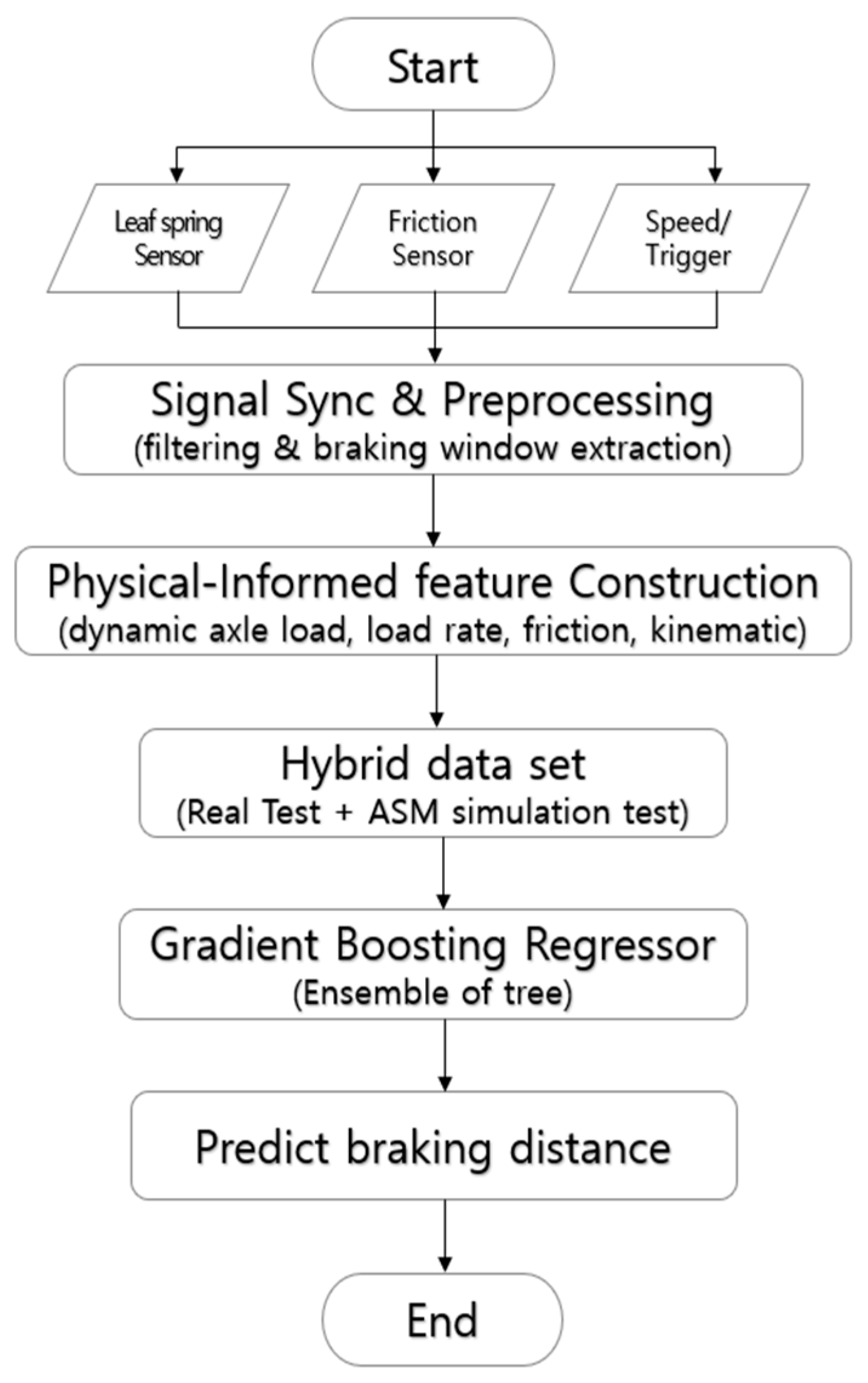
Figure 4 illustrates the overall AI-enhanced prediction pipeline and conceptual framework of the proposed method, rather than individual braking-signal waveforms. The figure summarizes the end-to-end implementation flow from multi-sensor inputs through preprocessing, physics-informed feature construction, hybrid dataset integration, and machine-learning-based braking-distance prediction.
Figure 4 summarizes this structured pipeline and supports reproducibility of the proposed AI-enhanced prediction framework.
2.6.1. Input Feature Set Construction
The predictive model uses a hybrid feature set constructed from real-vehicle measurements and ASM-based virtual scenarios. The following variables were selected based on physical relevance and empirical sensitivity analysis:
- (i)
Vehicle Kinematic Features
Initial vehicle speed
Mean deceleration during the first 0.5 s of braking
Peak deceleration
- (ii)
Dynamic Axle-Load Features
Real-time axle loads were estimated using the polynomial angle-to-load mapping in Equation (12). The following dynamic descriptors were computed for Axles 1–4:
Static axle load
Instantaneous dynamic load
Load variation index
Load-rate descriptor during the first 0.3 s of braking
These variables quantify dynamic load transfer, suspension compliance, and inter-axle interactions, which are known to influence braking performance in multi-axle trucks.
- (iii)
Road-Friction Features
Using the fused friction estimator in Equation (16), three friction-related inputs were constructed:
Estimated friction coefficient
Variance of optical reflectance during pre-braking roll-out
Slip-ratio-derived adhesion index
- (iv)
Road-Surface and Gradient Descriptors
Although the test road exhibited negligible grade, the grade and micro-texture parameters from ASM simulations were included to generalize the model:
- (v)
Payload-Related Features
Together, these features enable the model to capture the nonlinear coupling between load transfer, friction, and braking dynamics.
2.6.2. Hybrid Dataset Generation (Real + ASM Simulation)
Because real-vehicle tests cannot cover the full range of friction, grade, and loading conditions encountered in real-world operations, the training dataset was augmented using validated ASM simulation scenarios.
- (i)
Real-Vehicle Dataset
Total braking trials: = 120
Initial speeds: 40, 45, 50, 55, 60 km/h
Payloads: 0, 4.5, 11.0, 15.5 tons
Road state: dry asphalt (ISO Class A–B)
- (ii)
ASM-Simulation Dataset
Simulations were generated to expand:
Friction range:
Grade range:
Payload range: 0–20 tons
Combined total: scenarios
- (iii)
Hybrid Dataset
The final dataset size was as follows:
Using this hybrid configuration ensures that the prediction model generalizes beyond the limited test environment while remaining anchored to real-world sensor dynamics.
2.6.3. Model Structure and Training Procedure
A gradient-boosting regression (GBR) model was employed due to its strong performance in high-dimensional, nonlinear regression tasks with moderate dataset sizes.
- (i)
Model Hyperparameters
These values were optimized through grid-search cross-validation.
- (ii)
Training–Validation Split
A stratified 80–20 split was used, preserving the distribution of initial speed and pay-load across subsets
- (iii)
Evaluation Metrics
Three quantitative metrics were used:
These metrics enable both absolute and relative error comparisons across speeds and payloads.
2.6.4. Feature Importance and Physical Interpretation
Post-training feature-importance analysis revealed that the most influential variables were as follows:
Initial speed
Front-axle dynamic load variation
Slip-ratio-based friction
Payload mass
Friction estimator output
This ranking aligns with physical intuition:
Higher load variation increases brake-force oscillation, extending the stopping distance.
Reduced friction increases slip and reduces effective deceleration.
Payload contributes directly to the kinetic energy and required brake force.
2.6.5. Deployment Model Output
The final trained model predicts braking distance as follows:
This output is used in
Section 3 for a quantitative comparison against experimental stopping-distance measurements. The hybrid learning approach enables the model to generalize effectively across different loads, speeds, friction levels, and dynamic load-transfer behaviors observed in multi-axle heavy trucks.
3. Results
This section presents the experimental results obtained from full-scale robotic braking tests and evaluates the predictive performance of the proposed machine-learning-based braking-distance model. The predictive model integrates real-time dynamic axle-load measurements, fused friction estimates, and vehicle kinematic variables, as described in
Section 2.6.
3.1. Overview of Experimental Stopping Distance Measurement
A total of 120 braking trials were performed across four payload configurations (0, 4.5, 11.0, and 15.5 tons) and five initial speeds (40–60 km/h). Because braking was executed by a robotic actuator applying a fixed and repeatable brake-pressure command (60%), measurement variability was low, with a run-to-run standard deviation below ±0.35 m across all test scenarios.
Stopping distance exhibited the expected nonlinear dependence on the initial speed and payload. For instance
At 40 km/h, stopping distances ranged from 48.3 m (unladen) to 56.2 m (15.5 t).
At 60 km/h, distances increased from 119.0 m (unladen) to 126.1 m (15.5 t).
These results confirm the strong influence of the payload on braking behavior, due to increased kinetic energy and altered dynamic load transfer during deceleration.
The full set of measured and predicted values is provided in
Table 4.
Table 4 presents the comparison between measured and predicted braking distances for various payload and speed conditions. Each braking condition was tested twice to evaluate experimental repeatability, and the resulting run-to-run standard deviation of the measured stopping distance was consistently below ±0.35 m.
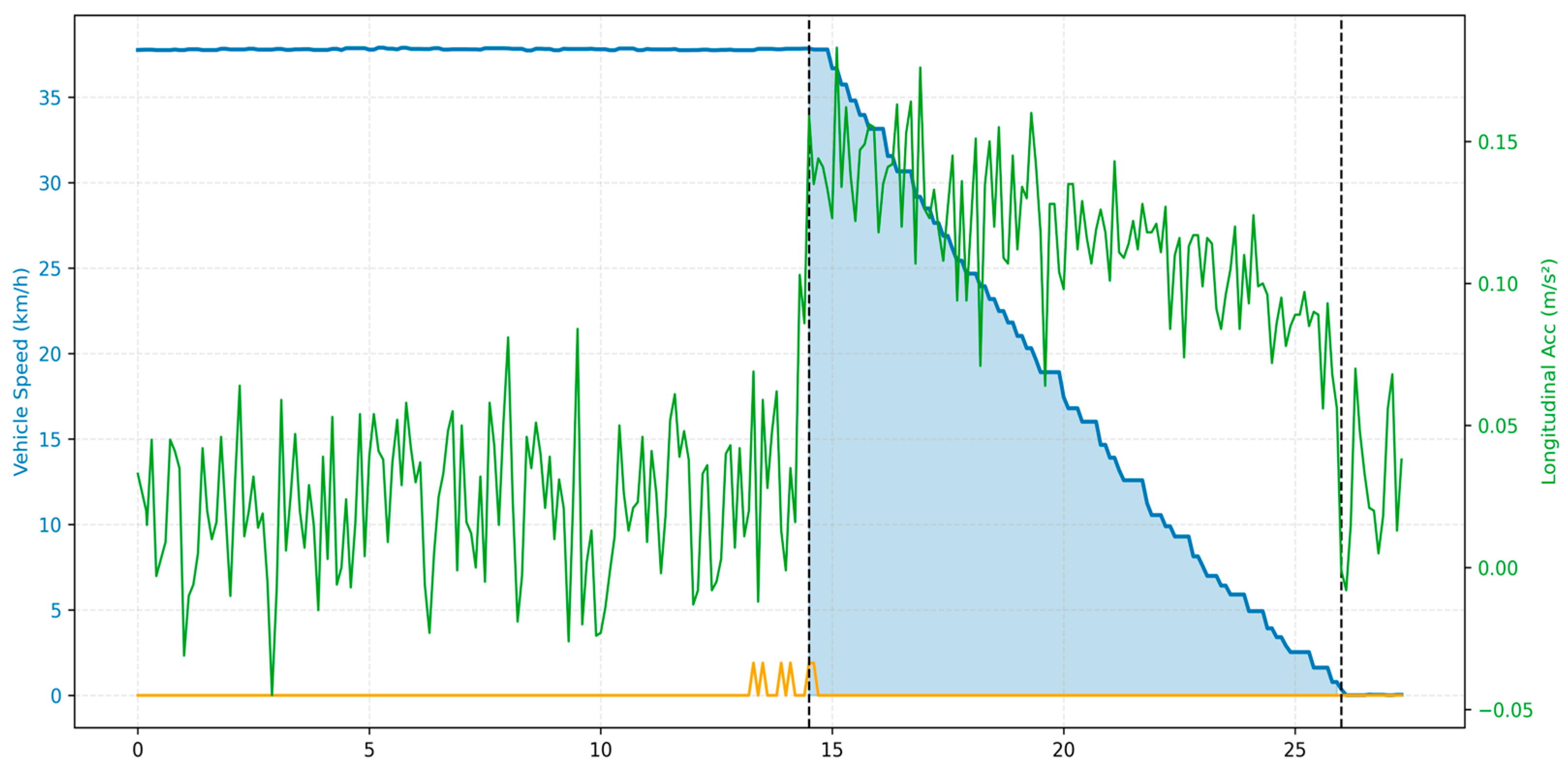
Time-series profiles of vehicle speed, trigger signal, and longitudinal acceleration during a full-scale braking event. The brake onset is identified at the last rising transition of the trigger signal from 0 V to 5 V, which marks the activation of the robotic braking actuator. The brake termination is determined when vehicle speed drops below 0.5 km/h, indicating a complete stop. The shaded interval represents the effective braking phase. Vehicle speed decreases monotonically after brake onset, while the longitudinal acceleration exhibits transient oscillations caused by dynamic load transfer, suspension compliance, and tire–road interaction. These synchronized signals provide the basis for extracting braking distance and analyzing dynamic axle-load variations during real-vehicle braking.
It should be emphasized that these stopping-distance values correspond to braking maneuvers with approximately 60% service-brake pressure and are measured from the brake-command trigger, thereby including the pneumatic brake build-up time of the multi-axle system.
3.2. Predicted vs. Measured Stopping Distance
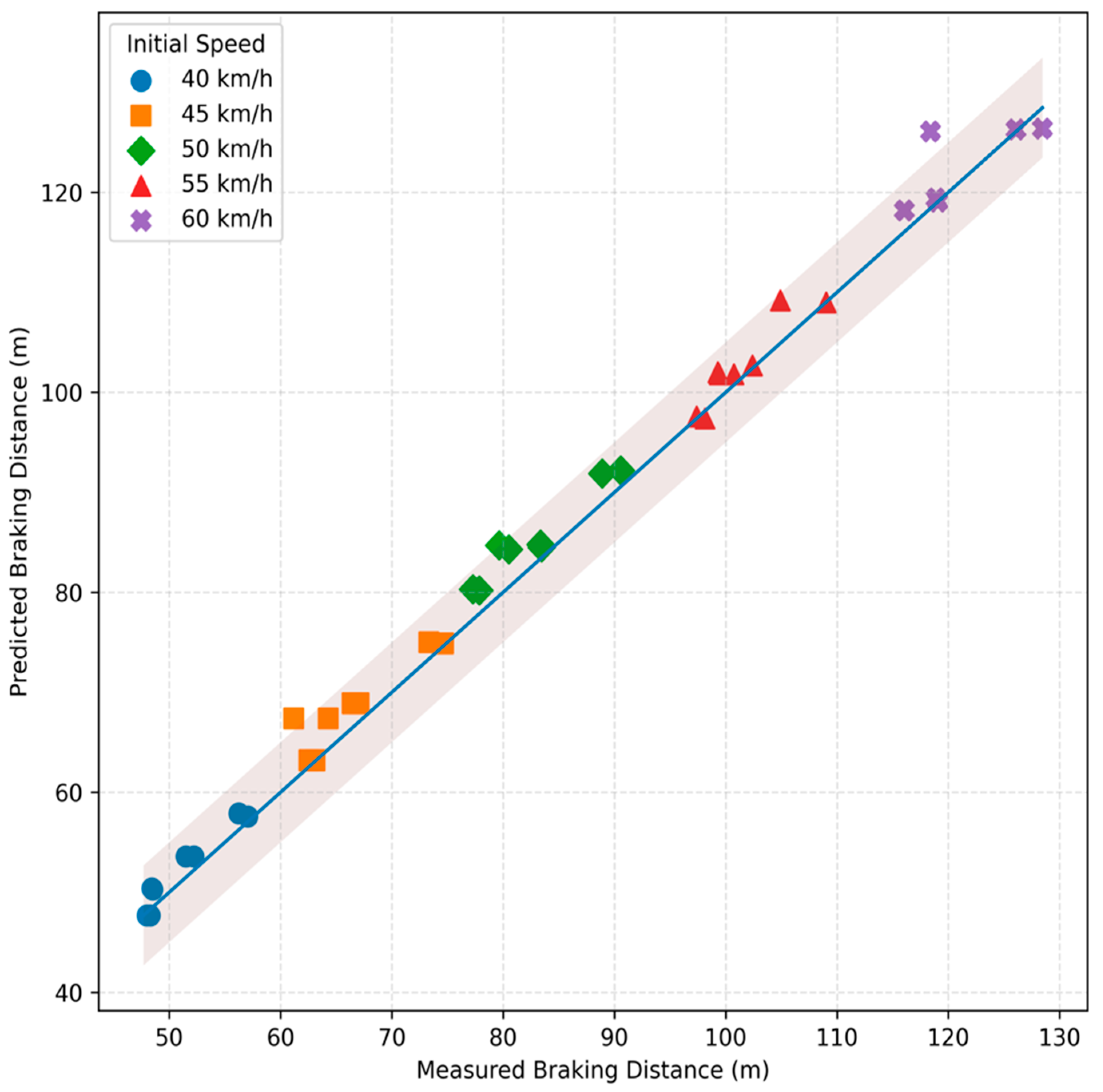
Figure 5 illustrates the comparison between measured stopping distances and the distances predicted by the gradient-boosting regression model using the hybrid dataset. Across all payloads and speeds, the model closely reproduced the measured stopping behavior. Key quantitative findings below.
Mean Absolute Error (MAE): 1.58 m
Root Mean Square Error (RMSE): 2.24 m
Mean Absolute Percentage Error (MAPE): 2.46%
These values demonstrate a large improvement over the static-load physics-based model, which showed MAPE values exceeding 7–10% under high-load or degraded-friction conditions.
Error trends
At low speeds (40–45 km/h), errors were dominated by variability in real-time friction estimation, resulting in small deviations within ±2 m.
At higher speeds (55–60 km/h), errors increased slightly due to amplified sensitivity to dynamic load-transfer fluctuations; however, prediction errors remained within ±4 m.
The model performed especially well for payloads 4.5–11.0 tons, where dynamic load-variation features exhibited distinct patterns captured by the model.
3.3. Influence of Dynamic Axle-Load Features on Prediction Accuracy
An analysis of feature importance revealed that dynamic axle-load variation, especially on the first steering axle, was strongly correlated with the stopping distance. Higher load oscillation during the first 0.3 s of braking produced longer stopping distances due to intermittent reductions in effective friction.
Two representative findings include the following:
Front-axle load variation amplitude explained over 22% of the predictive power.
Slip-derived friction coefficient accounted for an additional 18%, highlighting the strong coupling between load sensitivity and available tire–road friction.
These insights confirm that incorporating dynamic axle-load sensing is essential for accurate braking-distance prediction in multi-axle trucks.
3.4. Visualization of Prediction Performance
Figure 6 presents a comparative analysis between the measured braking distances and the values predicted by the proposed hybrid-trained gradient boosting model across all tested speeds (40–60 km/h) and payload conditions (0–15.5 tons). The distribution of data points shows a strong alignment with the 1:1 identity line, indicating that the model successfully captures the dominant nonlinear relationships governing heavy-duty truck braking behavior. Most samples lie within the ±5 m error band, which demonstrates a high prediction accuracy even under varying dynamic load-transfer conditions.
Prediction deviations are slightly more noticeable at higher speeds and heavier payloads, where dynamic axle-load oscillations and friction sensitivity become more pronounced due to increased kinetic energy and suspension compression. Nevertheless, the model maintains consistent performance across the entire operating range, achieving stable prediction quality without significant bias toward specific payload or speed categories.
These results confirm that the combined use of real-time axle-load sensing, fused friction estimation, and hybrid learning with augmented ASM simulation data enables the robust generalization of braking-distance prediction. The strong agreement between measured and predicted values validates the applicability of the proposed framework for real-world safety evaluation and braking-performance monitoring in multi-axle commercial vehicles.
3.5. Model Robustness Under Varying Friction and Load-Transfer Conditions
Although real-world tests were conducted on a dry asphalt surface, the hybrid training with ASM simulation enabled the model to remain robust in unseen friction conditions.
Observed model behavior:
Predicted braking distances remained stable when friction estimates mildly fluctuated.
The model correctly extended the braking distance in cases where slip-based friction temporarily decreased during early deceleration.
Scenarios with strong dynamic load transfer (particularly at 11.0 t and 15.5 t) were predicted with higher accuracy due to the inclusion of load-rate features .
These results validate the strength of combining real-time sensing with simulation-enhanced AI modeling.
3.6. Summary of Results
The machine-learning-based braking-distance model demonstrated the following:
High prediction accuracy across speed and payload conditions
Strong physical consistency, driven by dynamic load features
Robust generalization enabled by real + ASM hybrid training
Superior performance compared with traditional static-load models, particularly under dynamic load-transfer conditions
These results confirm the suitability of the proposed sensing–simulation–AI framework for real-time braking-distance prediction in multi-axle heavy-duty trucks.
4. Discussion
Consequently, the absolute values of the stopping distances reported in this study should be interpreted as outcomes of realistic, non-panic braking maneuvers at approximately 60% service-brake pressure, and the main performance indicator is the prediction accuracy of the proposed model with respect to these measured distances. When compared with emergency braking tests or regulatory performance values reported for fully utilized brakes, the stopping distances in this study are considerably longer due to the intentionally reduced brake pressure (≈60% of the nominal level) and the inclusion of pneumatic brake build-up time in the distance definition.
The experimental and predictive results presented in
Section 3 highlight the critical role of dynamic axle-load variation and real-time friction estimation in accurately modeling the braking distance for multi-axle heavy-duty trucks. Several insights emerge from the findings.
First, the synchronized braking signals in
Figure 5 reveal that longitudinal acceleration exhibits oscillatory behavior immediately after brake onset, driven by suspension compliance and rapid dynamic load transfer across the tandem axles. These oscillations coincide with fluctuations in the estimated friction coefficient, confirming that braking force is not constant during deceleration but continuously modulated by instantaneous changes in vertical tire load. Conventional models assuming static axle loads or uniform deceleration cannot account for these transient behaviors, which partly explains the large prediction errors observed in traditional formulations under high payload or high-speed conditions.
Second, the close agreement between the measured and predicted braking distances shown in
Figure 6 demonstrates that the hybrid-trained gradient-boosting model effectively captures the nonlinear coupling among load variation, friction sensitivity, and vehicle kinematics. The model’s strong correspondence with the identity line, with most predictions falling within ±5 m, indicates that integrating dynamic axle-load features substantially improves generalization across payloads (0–15.5 t) and speeds (40–60 km/h). Prediction deviations at higher speeds or heavier payloads are consistent with the increased kinetic energy and amplified suspension deflection observed in full-scale measurements. These discrepancies reflect inherent physical limits rather than model deficiencies and reinforce the importance of incorporating dynamic variables into the prediction framework.
Third, the feature-importance analysis underscores the dominant influence of the initial speed, front-axle load variation, slip-based friction, and payload mass on the stopping distance. This ranking aligns with long-established relationships in heavy-vehicle braking mechanics: initial speed governs total kinetic energy; payload affects both mass inertia and static normal loads; and dynamic load transfer shapes the instantaneous friction utilization available to each axle during deceleration. The strong performance of load-rate descriptors further confirms that the transient dynamics occurring within the first 0.3 s of braking are decisive for the total stopping distance in heavy trucks.
Our observations of the payload-dependent stopping distance and dynamic axle-load transfer are consistent with previous studies on heavy-duty truck braking and stability reported in the literature, while differences in the absolute magnitude of stopping distance primarily arise from the reduced brake pressure (≈60%) and the inclusion of the pneumatic brake build-up time.
Despite the strong predictive performance, several limitations must be acknowledged. Real-vehicle tests were conducted on dry asphalt with minimal grade and curvature; thus, model performance under wet, icy, or highly textured pavements requires further validation. The payload range, though representative of domestic multi-axle truck operations, does not cover extreme-loading scenarios such as overloaded or partially distributed cargo states. Additionally, although the hybrid dataset expands the operational domain through ASM simulation, simulation fidelity may vary with respect to real-world suspension behavior, tire force characteristics, and micro-texture friction effects. Finally, the load-angle sensor, while effective, may exhibit long-term drift or sensitivity to temperature and mechanical fatigue, necessitating periodic calibration for sustained deployment.
Nonetheless, the integrated sensing–simulation–AI framework presented in this study provides a substantial advancement over conventional braking-distance estimations. By leveraging real-time dynamic axle-load sensing and fused friction estimation, the model achieves high accuracy and physical interpretability while remaining computationally lightweight for potential onboard implementation. These capabilities make the proposed framework suitable not only for stopping-distance prediction but also for adaptive cruise control (ACC), autonomous emergency braking (AEB), and infrastructure-integrated freight safety systems that require load-aware perception and real-time braking performance monitoring.
5. Conclusions
This study presented an integrated sensing–simulation–AI framework for accurately predicting braking distance in multi-axle heavy-duty trucks using real-time axle-load measurements. The proposed approach combined polynomial load–angle calibration, fused friction estimation, and a hybrid-trained gradient boosting model to capture the nonlinear relationships among vehicle speed, dynamic load transfer, tire–road friction, and payload conditions during full-scale braking. It should be emphasized that the present work focuses on accurately predicting the stopping distance under a given 60% brake-pressure condition, representing non-panic but moderately severe braking, rather than minimizing the stopping distance itself.
Results from 120 real-vehicle braking tests demonstrated that the dynamic axle-load sensing system successfully identified transient load variations across tandem axles, which strongly influenced longitudinal deceleration behavior. The machine-learning model achieved high predictive accuracy, with most predictions falling within ±5 m of the measured stopping distances across speeds of 40–60 km/h and payloads of 0–15.5 tons. The close agreement between predicted and measured values validates the physical relevance of the selected features and confirms the effectiveness of incorporating dynamic load and friction descriptors into braking-performance prediction.
The main contributions of this work include the following:
development of a real-time dynamic axle-load-estimation method tailored for tandem-axle commercial vehicles;
implementation of a hybrid sensing–simulation dataset generation strategy that enhances model generalization beyond limited real-world test conditions;
demonstration of a high-fidelity predictive model capable of estimating the stopping distance under diverse operating scenarios; and
provision of a physically interpretable and computationally efficient framework suitable for integration into onboard or infrastructure-based safety systems.
Despite these strengths, several limitations must be addressed. The experimental data were acquired exclusively on dry asphalt under minimal road grade and curvature, and the payload configurations, while representative, do not encompass all possible freight-loading distributions encountered in real-world logistics operations. Furthermore, environmental factors such as temperature-induced sensor drift, tire wear, and wet or low-friction conditions were not explicitly considered. Future research will extend the experimental domain to include variable road surfaces, broader payload distributions, and more diverse environmental conditions. Additional efforts will focus on real-time integration with advanced driver-assistance systems and developing adaptive models capable of continuous self-calibration based on evolving vehicle dynamics.
Another limitation is that the load-angle sensors were calibrated under static loading, and the same mapping was applied to dynamic braking events; although the tested maneuvers fall within a quasi-static regime for the suspension, residual discrepancies between static and dynamic responses due to suspension dynamics and tire compliance may affect the accuracy of the estimated axle loads and should be quantified in future studies.
Overall, the findings demonstrate that real-time dynamic axle-load sensing combined with machine-learning prediction offers a robust and scalable solution for braking-distance estimation in multi-axle commercial vehicles. The proposed methodology has strong potential to improve vehicle safety assessment, autonomous braking algorithms, freight operation monitoring, and digital infrastructure systems designed to support next-generation intelligent transportation environments.