1. Introduction
Magnesium and its alloys have attracted considerable attention as next-generation biodegradable materials for orthopedic and dental implant applications due to their favorable mechanical properties similar to natural bone and complete in vivo degradation without requiring secondary surgical removal [
1,
2,
3]. However, the excessively rapid degradation rate of magnesium in physiological environments, accompanied by hydrogen gas evolution, localized pH elevation, and premature loss of mechanical integrity, remains a critical barrier to clinical translation. Therefore, the development of surface modification techniques that can appropriately control the initial degradation rate while enhancing biological functionality is essential.
Both alloy design and surface coating technologies have been investigated to improve the corrosion resistance of magnesium and its alloys. Although the addition of alloying elements such as aluminum, zinc, and calcium demonstrates a certain degree of corrosion resistance improvement, the types of applicable elements are limited from a biocompatibility perspective, and their effects remain insufficient as fundamental solutions [
4,
5,
6]. In contrast, surface coating techniques can effectively enhance the chemical stability of surfaces while maintaining the intrinsic mechanical properties of the substrate, offering advantages in terms of economic feasibility and practicality [
7,
8]. Currently utilized surface coating methods for magnesium and its alloys include dip coating [
9], micro-arc oxidation [
10], spin coating [
11], electroless plating [
12], ion implantation [
13], and sol–gel [
14], among others. Particularly, dip coating and spin coating are widely adopted for polymer-based coating fabrication due to their simplicity and accessibility.
Natural polymer-based coatings have been actively investigated to simultaneously achieve degradation control and enhanced cell affinity for magnesium implants [
1]. Alginate (ALG), an anionic polysaccharide extracted from brown algae, possesses excellent biocompatibility and can form hydrogel structures through crosslinking with divalent cations [
15,
16,
17,
18]. Chitosan (CS), a cationic polymer obtained through deacetylation of chitin, exhibits antibacterial activity and tissue adhesive properties [
19]. Layer-by-Layer (LbL) coating systems utilizing electrostatic interactions between alginate and chitosan have been proposed as promising strategies for corrosion protection of magnesium implants. However, when alginate/chitosan composite coatings are directly applied to magnesium surfaces, interfacial crack formation and insufficient adhesion strength resulting from the high chemical reactivity of magnesium limit long-term implant stability.
Polydopamine (PDA) has emerged as a promising strategy to address these interfacial adhesion challenges. PDA is a biomimetic material inspired by mussel adhesive proteins that can spontaneously form uniform nanoscale thin films on virtually any solid substrate through self-polymerization of dopamine [
20,
21,
22,
23]. PDA contains various reactive functional groups including catechol, amine, and imine moieties, enabling strong coordination and covalent bonding with metal surfaces while simultaneously promoting chemical interactions with overlying polymer layers, thus functioning as an excellent intermediate layer material. Indeed, numerous studies have reported that the introduction of PDA intermediate layers on pure magnesium surfaces significantly improves the interfacial adhesion strength and corrosion resistance of polymer coatings [
24]. Therefore, in this study, a PDA intermediate layer was introduced to reinforce the interfacial adhesion between magnesium and the alginate/chitosan composite coating.
Meanwhile, the incorporation of bioactive drugs into implant surface coating systems can confer bone regeneration-promoting effects in addition to corrosion protection functionality. Dexamethasone is a synthetic glucocorticoid drug that, under appropriate concentration ranges and culture conditions, can promote osteoblast differentiation and upregulate the expression of bone formation-related genes such as alkaline phosphatase (ALP) and osteocalcin [
25,
26,
27,
28,
29]. Furthermore, dexamethasone has been combined with various biomaterials including alginate, chitosan, silica, hydroxyapatite, PLGA, and collagen to fabricate hydrogels, films, nanoparticles, and microspheres for extensive applications in tissue engineering and drug delivery systems, where it has been reported to enhance cell proliferation, exhibit osteoinductive potential, and enable sustained drug release depending on the specific formulation and experimental conditions.
In this study, we aimed to develop a multifunctional surface modification strategy that addresses the key limitations of magnesium implants through an integrated approach. A PDA intermediate layer was introduced to enhance the interfacial adhesion between magnesium and polymer coatings, and an alginate/chitosan multilayer structure was applied for improved corrosion resistance along with dexamethasone loading for localized osteogenic drug delivery. This combination represents a comprehensive solution that simultaneously achieves improved adhesion, controlled degradation, and enhanced bioactivity. The surface characteristics, corrosion resistance, and cytocompatibility of the developed composite coating system were evaluated.
3. Results
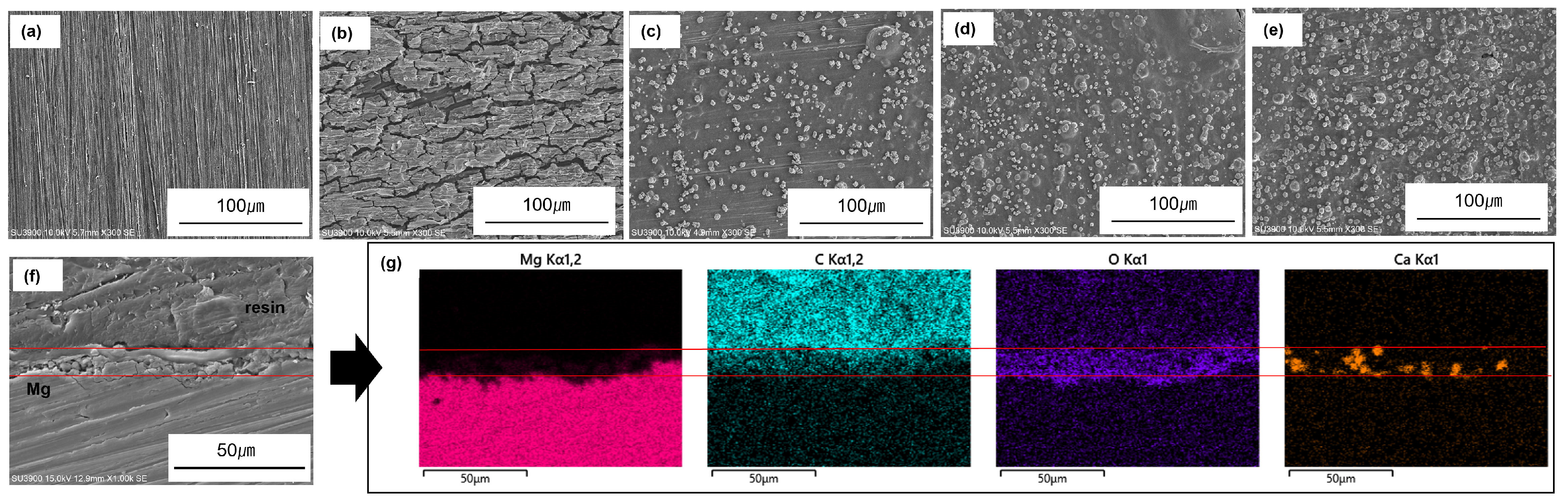
The surface morphology and cross-sectional structure of pure magnesium and various coated samples were observed using scanning electron microscopy (SEM), and the results are presented in
Figure 1.
Figure 1a shows the surface of pure magnesium (PM) before coating treatment, while
Figure 1b displays the surface morphology after polydopamine (PDA) treatment alone. Distinct cracks were observed on the PDA-treated surface, exhibiting a relatively irregular surface structure (
Figure 1b).
In contrast, uniform coating layers were confirmed on the surfaces of PSC, PDASC, and PDASC-Dex specimens, where alginate and chitosan were deposited using the layer-by-layer (LbL) method (
Figure 1c–e). The surfaces of these specimens were uniformly covered with rounded granular structures, and the cracks observed on the PDA-only treated surface were not present. This suggests that the polyelectrolyte multilayer coating was homogeneously formed on the substrate surface.
Cross-sectional analysis of the PDASC specimen revealed that the coating layer was formed as a continuous layer with a thickness of approximately 12 μm (
Figure 1f). Furthermore, energy dispersive X-ray spectroscopy (EDS) elemental mapping analysis of the PDASC cross-section (
Figure 1g) showed concentrated distribution of carbon (C), oxygen (O), and calcium (Ca) elements in the coating layer region. This supports that the coating layer was formed through crosslinking between alginate and chitosan polymer chains and calcium ions.
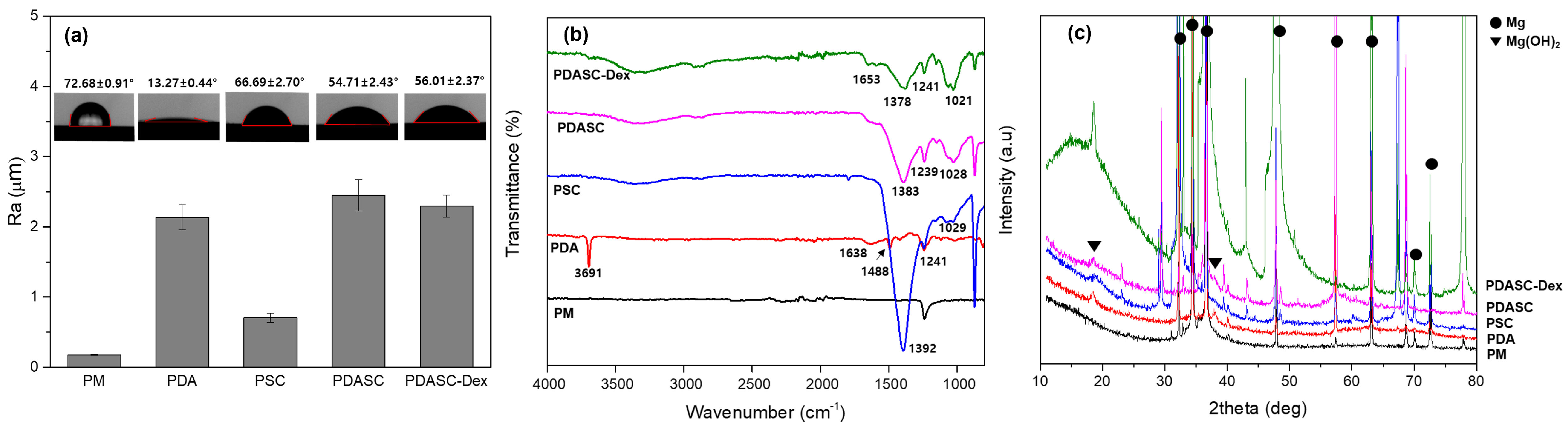
The changes in surface roughness, wettability, chemical bonding, and crystal structure of magnesium specimens before and after coating are summarized in
Figure 2.
To quantitatively evaluate changes in magnesium surface properties before and after coating, surface roughness (Ra) and contact angle were measured, and the results are shown in
Figure 2a. Compared to pure magnesium (PM), specimens with PDA and alginate/chitosan coatings showed an overall increasing trend in surface roughness. Contact angle measurements revealed that PM had a contact angle of 72.68 ± 0.91°. The PDA-only treated specimen showed a sharp decrease in contact angle to 13.27 ± 0.44°, confirming significantly enhanced hydrophilicity. The PSC specimen exhibited 66.69 ± 2.70°, similar to pure magnesium, while PDASC and PDASC-Dex specimens containing PDA as a base layer showed reduced contact angles of 54.71 ± 2.43° and 56.01 ± 2.37°, respectively, compared to the PM surface. These results suggest that the high hydrophilicity of the PDA layer is partially retained even after polyelectrolyte multilayer structure formation, improving overall surface wettability.
FT-IR analysis was performed to confirm the chemical composition and functional groups of the coating layers, and the results are shown in
Figure 2b. No distinct peaks were observed in untreated PM, indicating the absence of characteristic chemical functional groups on the surface. The spectrum of the PDA-coated surface showed a peak near 3691 cm
−1 attributed to hydroxyl (OH) stretching vibration, and the peak observed at 1488 cm
−1 was interpreted as originating from aromatic ring and N-H bending vibrations. Additionally, the peak near 1241 cm
−1 corresponds to the amide III band, indicating successful polydopamine coating and imine group introduction on the surface.
The FT-IR spectra of PSC, PDASC, and PDASC-Dex specimens commonly showed a strong peak near 1390 cm−1 corresponding to symmetric stretching vibration of carboxyl groups (COO−), which is attributed to alginate chains. The peak near 1200 cm−1 can be considered as an overlap of chitosan-derived amide III band and C-O-C/C-O stretching vibrations. Notably, PDASC and PDASC-Dex specimens showed an additional amide I band near 1620 cm−1, suggesting that closer interactions including amide bonds were formed between the PDA base layer and polyelectrolyte multilayer coating.
XRD analysis was performed to confirm the crystal structure of magnesium substrates and coated specimens, and the results are shown in
Figure 2c. Only characteristic peaks corresponding to magnesium (Mg) were observed in PM. In PDA and PDASC specimens that underwent NaOH pretreatment, additional peaks corresponding to magnesium hydroxide (Mg(OH)
2) appeared along with Mg peaks, confirming the formation of a Mg(OH)
2 conversion layer on the surface. In contrast, Mg(OH)
2-related peaks were not clearly observed in PSC specimens without NaOH treatment. In PDASC-Dex specimens with dexamethasone, Mg and Mg(OH)
2 peaks were observed similar to other specimens, while new diffraction peaks additionally appeared in the low-angle region. These peaks were not observed in PDASC specimens and likely correspond to partially crystalline dexamethasone (Dex) domains within the alginate-chitosan matrix, evidenced by their broad profiles indicating low crystallinity. Crystallographic indexing (hkl) was challenging due to peak overlap with Mg(OH)
2 and the amorphous polymer background [
32], and the absence of hydrated dexamethasone peaks suggests that dexamethasone exists predominantly in anhydrous or semi-crystalline form.
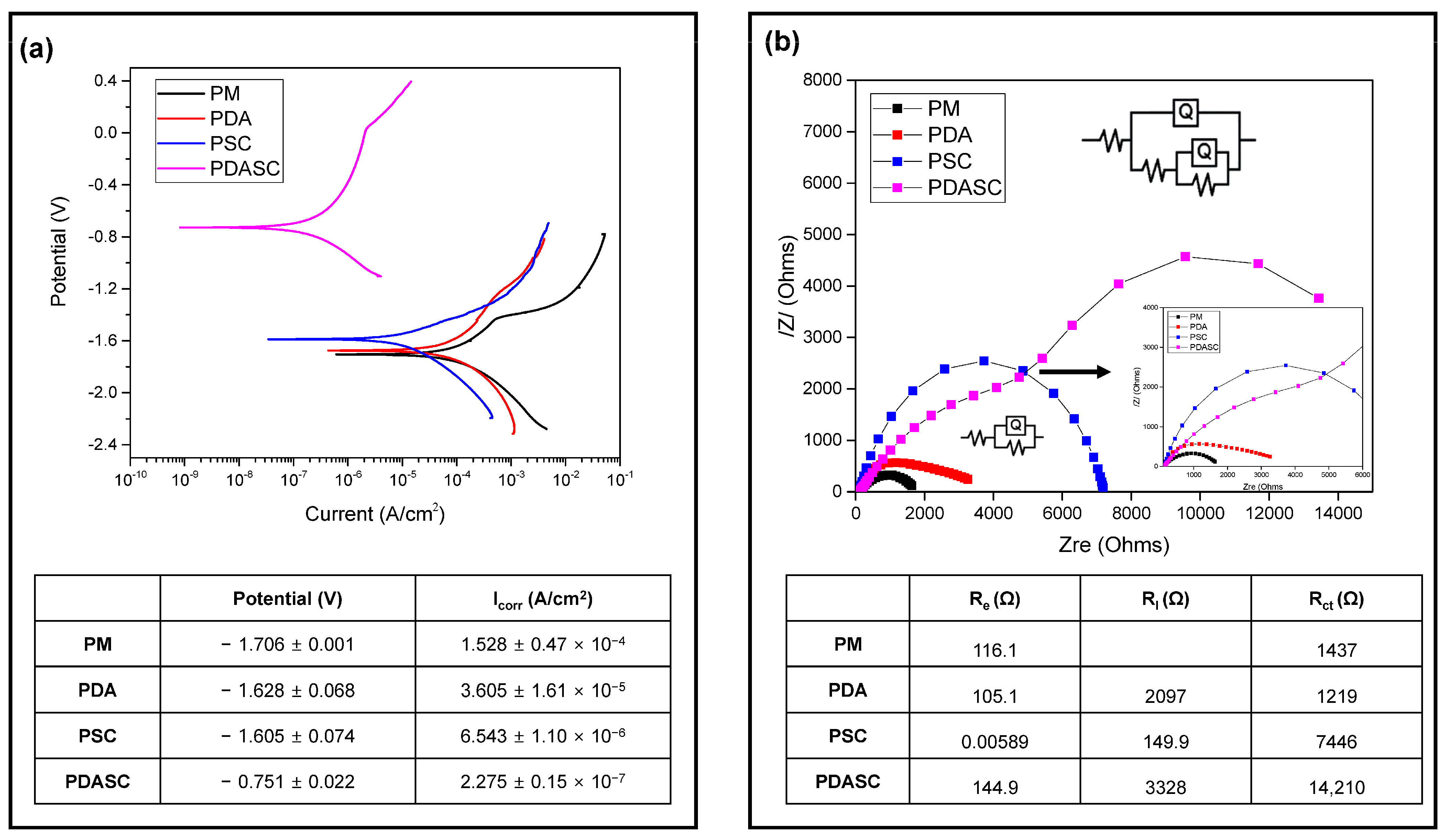
To quantitatively evaluate the corrosion inhibition effect of the coating layers, potentiodynamic polarization experiments and electrochemical impedance spectroscopy (EIS) measurements were performed in Hanks’ solution, and the results are presented in
Figure 3.
Figure 3a shows the potentiodynamic polarization curves of each specimen. The corrosion potential (E_corr) was measured as −1.706 ± 0.001 V, −1.628 ± 0.068 V, −1.605 ± 0.074 V, and −0.7514 ± 0.022 V for PM, PDA, PSC, and PDASC specimens, respectively. The corrosion current density (i_corr) showed the highest value of 1.528 ± 0.47 × 10
−4 A/cm
2 in PM specimens, and sequentially decreased to 3.605 ± 1.61 × 10
−5 A/cm
2, 6.543 ± 1.10 × 10
−6 A/cm
2, and 2.275 ± 0.15 × 10
−7 A/cm
2 in PDA, PSC, and PDASC specimens, respectively. Compared to pure magnesium, all surface-treated specimens showed a positive shift in corrosion potential and a significant decrease in corrosion current density. Particularly, the PDASC group, which had polymer coating applied after PDA treatment, exhibited a substantial increase in corrosion potential and a marked decrease in corrosion current density, confirming excellent electrochemical corrosion resistance.
Figure 3b shows the Nyquist plots of electrochemical impedance spectra measured under the same conditions. The impedance response of PM specimens was fitted with an R(QR) equivalent circuit consisting of solution resistance (R_s) and a single time constant, indicating that a single charge transfer process is dominant at the electrolyte/metal interface. In contrast, PDA, PSC, and PDASC specimens were fitted with an R(Q(R(QR))) model reflecting more complex interfacial structures, indicating the existence of two different time constants at the electrolyte/coating layer interface and coating layer/substrate interface. In the Nyquist plot, the small semicircle in the high-frequency region reflects the coating resistance and capacitive behavior corresponding to the coating layer and electrolyte within its pores, while the large semicircle in the low-frequency region represents corrosion reactions related to charge transfer resistance at the magnesium substrate.
The impedance magnitude (|Z|) and semicircle diameter increased in the order of PM < PDA < PSC < PDASC, with the PDASC specimen showing the largest semicircle and highest low-frequency impedance values. This indicates that the PDA base layer and alginate/chitosan multilayer coating effectively block electrolyte penetration and significantly impede the charge transfer pathway between substrate and solution, markedly reducing the corrosion reaction rate.
The PSC specimen also showed larger semicircles and higher impedance compared to PM and PDA, supporting the protective effect of polyelectrolyte coating, and these EIS results are consistent with the decreasing trend of corrosion current density observed in potentiodynamic polarization.
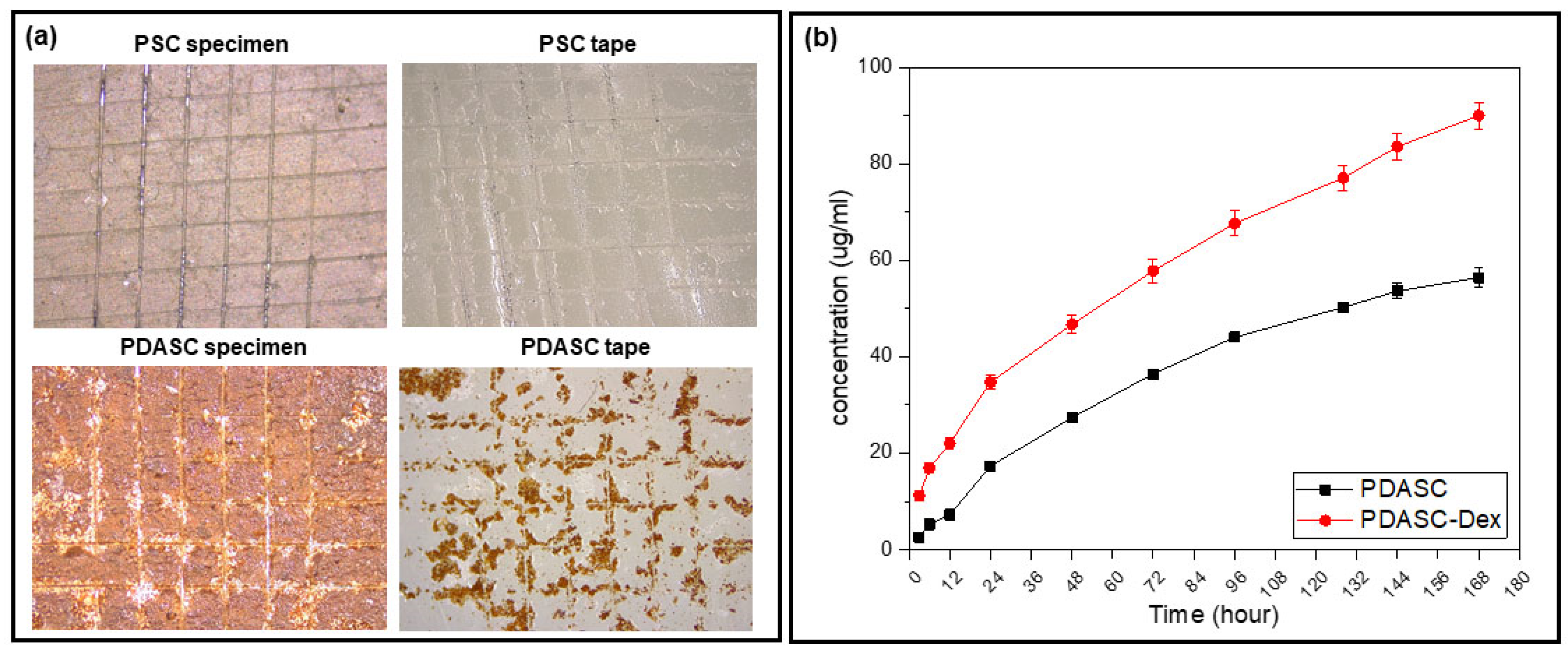
Figure 4a shows the results of comparing the adhesion properties of PSC and PDASC coating layers through tape peel testing. For the PSC specimen, the surface appeared clean after tape removal, with the polymer coating entirely transferred onto the tape. In contrast, the PDASC specimen retained the polymer coating on the magnesium surface, and a considerably smaller amount of polymer was observed on the tape compared to PSC. These results confirm that the polyelectrolyte multilayer coating incorporating a PDA base layer provides superior adhesion to the substrate.
Figure 4b presents the results of evaluating the release behavior of dexamethasone over time from PDASC-Dex specimens using UV–Vis spectroscopy. The cumulative release amount calculated from absorbance of solutions collected at regular time intervals showed a gradually increasing pattern over time, suggesting that the alginate/chitosan multilayer structure achieves sustained and controlled release of dexamethasone from PDASC-Dex specimens.
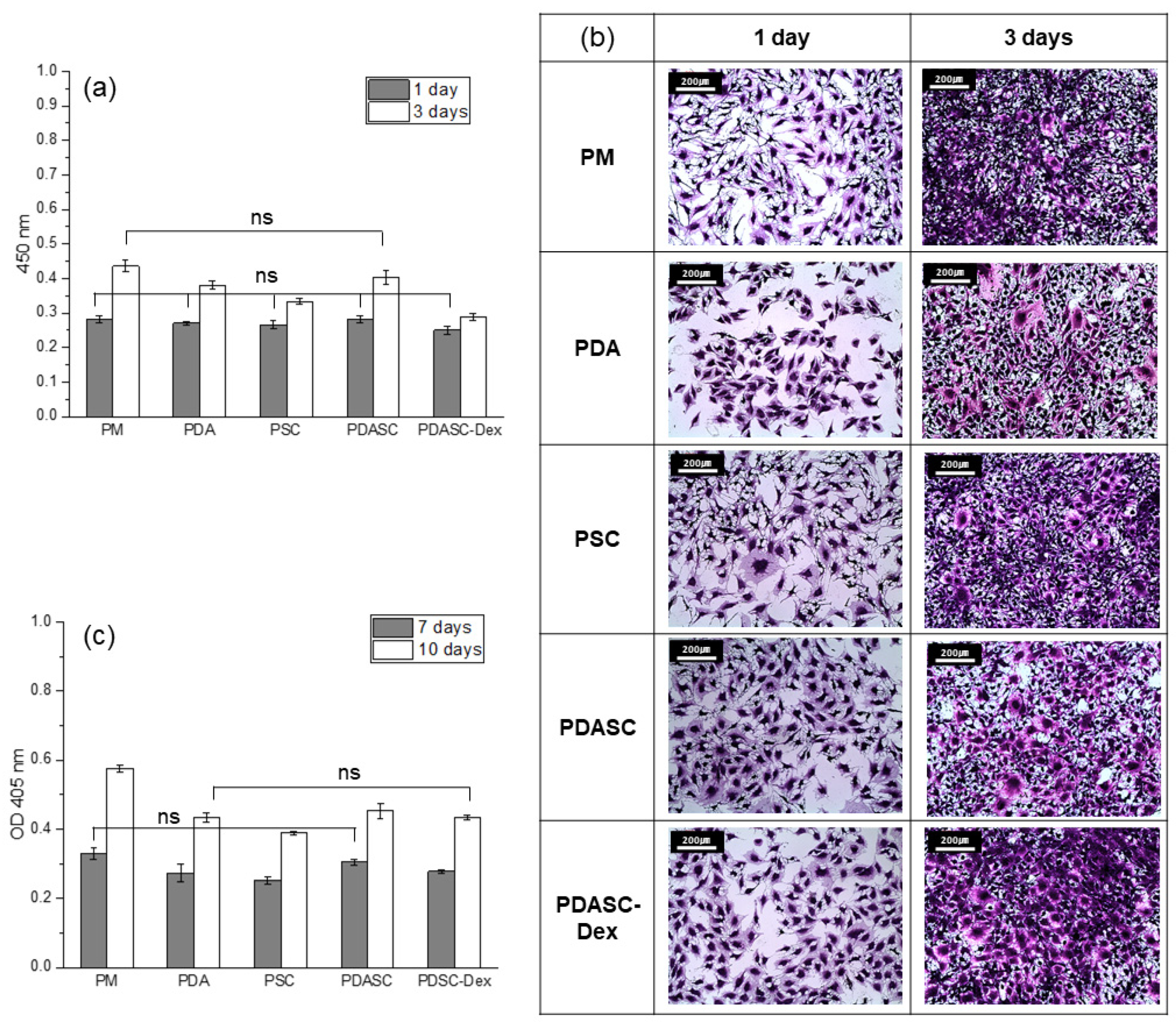
Cell proliferation was evaluated by WST assay after culturing MC3T3-E1 cells in extract media obtained from each specimen for 1 and 3 days, and the results are shown in
Figure 5a. On day 1, cell proliferation was at similar levels across all groups, with no statistically significant differences observed between groups (
p > 0.05). On day 3, absorbance increased in all groups compared to day 1, confirming time-dependent cell proliferation. Among them, the highest cell proliferation was observed in PM, and among surface-treated specimens, the PDASC group showed a relatively higher cell proliferation trend.
Figure 5b shows the morphology of MC3T3-E1 cells stained with crystal violet after 1 and 3 days of culture under the same extract media conditions. On day 1, cells were observed to be well-attached to the surface and spread in spindle or polygonal shapes in all groups. On day 3, cell density increased overall in all groups, with cells connecting to each other and forming denser cell layers.
ALP activity was measured after culturing MC3T3-E1 cells in extract media from each specimen for 7 and 10 days, and the results are presented in
Figure 5c. On day 7, relatively high absorbance (OD) values were observed in PM and PDASC groups, indicating greater induction of ALP activity in the early differentiation stage. On day 10, ALP activity showed an increasing trend compared to day 7 in all groups, with PM showing the highest OD value, and PDASC showing the highest ALP activity among surface-treated specimens. These results indicate that all specimens support MC3T3-E1 cell survival and differentiation in the magnesium extraction environment, and among them, the PDASC group showed cell proliferation and differentiation capability among the surface-treated magnesium groups.
4. Discussion
Magnesium and its alloys have been extensively studied as orthopedic implant materials due to their excellent mechanical properties and biodegradable characteristics. Magnesium has density and strength similar to natural bone, and offers the advantage of degrading in vivo, eliminating the need for secondary surgery to remove the implant [
33,
34]. However, the clinical application of magnesium is limited due to its rapid corrosion and the consequent rapid deterioration of mechanical properties, as well as the difficulty in controlling the timing of degradation in physiological environments [
33,
35]. Surface modification of magnesium to overcome these drawbacks is the most effective method for controlling corrosion and enhancing bioactivity [
36,
37].
In this study, polydopamine (PDA) and alginate/chitosan -based polyelectrolyte multilayer structures were utilized to simultaneously improve the corrosion resistance, cytocompatibility, and drug delivery functionality of magnesium surfaces. The PDA/SA-CS multilayer coating system proposed in this study represents an integrated surface modification strategy to overcome the excessively rapid corrosion rate of magnesium and the associated problems of alkalization and hydrogen gas evolution.
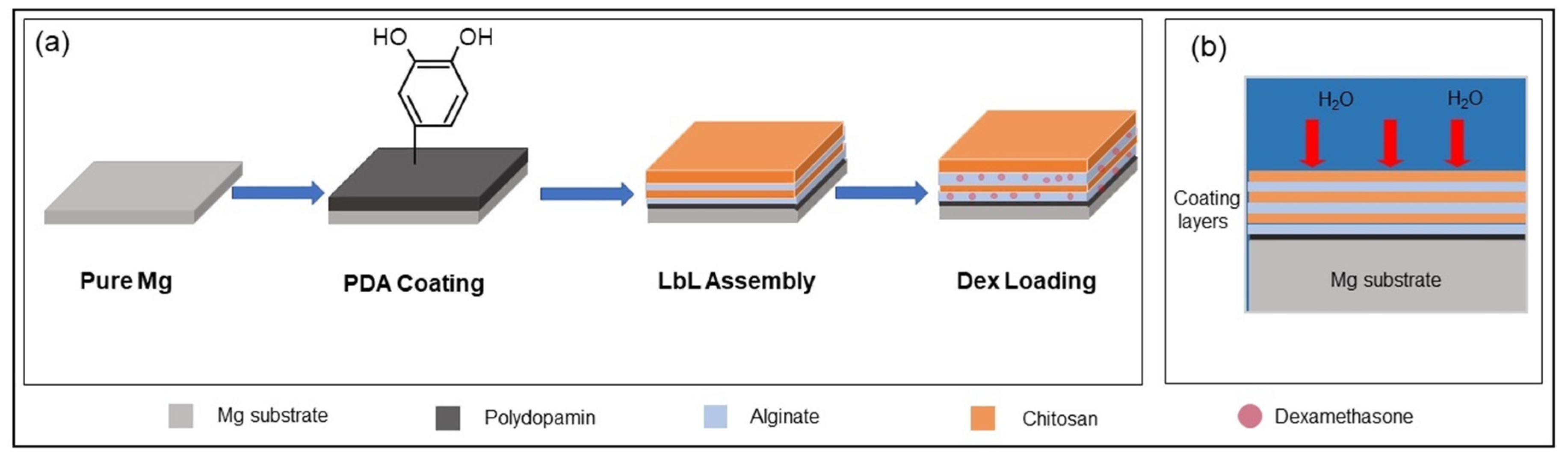
Figure 6 presents a schematic illustration of the developed coating system.
Figure 6a shows the LbL fabrication process on pure magnesium, where a PDA intermediate layer was formed through self-polymerization of dopamine, followed by alginate and chitosan coating. Finally, dexamethasone was incorporated into the alginate layers during the coating process to impart drug delivery functionality.
Figure 6b illustrates that the multilayer coating provides a barrier effect against electrolyte penetration in physiological environments, preventing water molecules from reaching the magnesium substrate.
SEM and EDS analysis revealed that the PDA-only coating exhibited a non-uniform cracked structure, whereas the PSC, PDASC, and PDASC-Dex specimens, prepared by layer-by-layer deposition of alginate/chitosan, displayed homogeneous coating layers with rounded granular structures continuously covering the entire substrate surface (
Figure 1). The cross-sectional analysis of PDASC showed a continuous layer approximately 12 μm thick with concentrated distributions of carbon, oxygen, and calcium, suggesting the formation of a dense polyelectrolyte network through crosslinking between alginate/chitosan chains and calcium ions. FT-IR analysis confirmed the presence of both PDA-characteristic amide and aromatic peaks, as well as the carboxylate (COO
−) bands of SA and amide bands derived from CS (
Figure 2b), supporting the chemical immobilization of alginate/chitosan multilayers onto the Mg(OH)
2/PDA underlayer. These findings are consistent with the interfacial bonding mechanisms reported in previous studies on PDA-based multilayer coatings [
38].
XRD analysis revealed that only the Mg phase was observed in the pure magnesium specimen, whereas the PDA, PDASC, and PDASC-Dex specimens subjected to NaOH pretreatment exhibited additional Mg(OH)
2 peaks alongside the Mg peaks, confirming the formation of a conversion layer on the surface through alkaline treatment (
Figure 2c). In contrast, the PSC specimen without NaOH treatment showed no distinct Mg(OH)
2-related peaks, suggesting that the formation of the conversion layer plays a critical role in the interfacial stability of the PDA underlayer and subsequent polyelectrolyte coatings [
39]. The emergence of new low-angle diffraction peaks in PDASC-Dex confirms partial crystallization of Dex within the multilayer coating [
40], consistent with prior reports on Dex-alginate composites where drug loading induces semi-crystalline phases [
32]. The broad peak profiles reflect the low crystallinity of the alginate-chitosan matrix, which favors sustained release over burst effects (
Figure 4b).
This semi-crystalline/amorphous Dex form likely enhances bioavailability by enabling controlled dissolution in physiological media, unlike fully crystalline forms that may delay initial release [
41].
Electrochemical evaluation revealed that all coated specimens exhibited a positive shift in corrosion potential (E_corr) and a decrease in corrosion current density (i_corr) compared to pure magnesium, confirming that the coating layers effectively reduced the corrosion rate of magnesium (
Figure 3a). Notably, the PDASC specimen showed the greatest increase in E_corr (−0.7514 ± 0.022 V) and the maximum reduction in i_corr (2.275 ± 0.15 × 10
−7 A/cm
2), indicating that the composite structure consisting of the Mg(OH)
2 conversion layer, PDA, and alginate/chitosan multilayers functions as a protective barrier that inhibits electrolyte penetration and strongly impedes charge transfer at the substrate/solution interface. EIS analysis showed that the PM specimen was represented by a single time constant R(QR) equivalent circuit, whereas the coated specimens were best fitted with an R(Q(R(QR))) model, suggesting the presence of distinct charge transfer processes at the electrolyte/coating layer interface and the coating layer/substrate interface (
Figure 3b). The progressive increase in impedance magnitude (|Z|) and semicircle diameter in the order of PM < PDA < PSC < PDASC demonstrates that the combination of alginate/chitosan multilayer coating with the PDA underlayer provides superior corrosion resistance compared to the polyelectrolyte single coating alone [
39,
42].
In the adhesion evaluation, the PDASC specimen exhibited less coating delamination after tape peel testing compared to PSC, which is attributed to the PDA underlayer enhancing the interfacial adhesion between the magnesium substrate and the alginate/chitosan multilayers (
Figure 4a). PDA forms strong bonds with metal surfaces through its catechol and amine groups, while simultaneously forming amide bonds and hydrogen bonds with the alginate/chitosan multilayers, thereby improving the mechanical stability of the entire coating system. These results are consistent with previous reports demonstrating that the introduction of an adhesive layer in polyelectrolyte membranes enhances membrane strength and durability [
43,
44].
The dexamethasone release test from PDASC-Dex specimens demonstrated that cumulative release gradually increased over time, confirming successful sustained release of dexamethasone from the alginate/chitosan multilayer coating (
Figure 4b). However, in this study, distilled water (pH ~ 7) was used as the release medium to evaluate fundamental drug elution kinetics from the coating matrix. This simplifies physiological conditions (e.g., lacking HBSS/α-MEM buffering salts and proteins), and the release rate may be overestimated due to the absence of ionic interactions. The sustained Dex release in distilled water (
Figure 4b) confirms coating functionality; however, physiological media (e.g., HBSS) may alter release kinetics via salt/protein binding.
In cell experiments, MC3T3-E1 cells were cultured in extraction media from each specimen, and WST analysis on day 1 showed no statistically significant differences among all groups, confirming favorable initial cell viability regardless of coating status (
Figure 5a). On day 3, absorbance increased in all groups, confirming time-dependent cell proliferation, with PM showing the highest values. This can be interpreted as Mg
2+ released from PM under daily medium exchange conditions acting within a concentration range that promotes osteoblast proliferation and metabolic activity in the several mM range, as reported in the literature, rather than accumulating to toxic levels [
45,
46]. Among coated specimens, relatively higher proliferation tendency was observed in PDASC, suggesting that it provides a balanced extraction environment that supports cell proliferation while suppressing excessive corrosion.
ALP activity measurements showed an increasing trend in ALP values at both day 7 and day 10, confirming that the magnesium extraction environment generally supports MC3T3-E1 osteoblast differentiation (
Figure 5c). On day 7, relatively high ALP activity was observed in PM and PDASC, and on day 10, ALP increased overall with PM showing the highest level, and PDASC showing the highest value among surface-treated specimens. This is consistent with reports that appropriate concentrations of Mg
2+ can promote osteogenic differentiation by upregulating ALP and bone formation-related markers, and it is considered that PDASC coating in particular provides an ionic environment centered on Mg
2+ and Ca
2+ that is favorable for promoting differentiation while suppressing excessive corrosion [
45,
47]. Notably, PDASC-Dex did not exhibit significantly higher ALP activity compared to PDASC, despite the incorporation of dexamethasone. Literature reports effective Dex concentrations for MC3T3-E1 ALP induction range from 10 to 100 nM [
25,
48,
49], with optimal at 50 nM [
50]. Despite the sustained Dex release results (
Figure 4b), the Dex concentration was likely insufficient for additional osteogenic induction due to daily medium refresh and extract dilution. Mg
2+ and Ca
2+ from coating primarily drove ALP upregulation [
45,
47]. This can be attributed to the extraction media methodology employed in this study, where the gradually released dexamethasone may not have accumulated to concentrations sufficient to elicit additional osteogenic effects beyond those provided by Mg
2+ ions. Direct cell culture on specimen surfaces in future studies would better elucidate the localized drug delivery effects of the dexamethasone-loaded coating system.
While pure Mg was in this study, this PDA-mediated LbL coating strategy can also be applied to orthopedic Mg alloys with superior mechanical properties (e.g., AZ31, WE43). The universal adhesion properties of PDA and the polyelectrolyte barrier structure are expected to provide comparable levels of corrosion resistance, as demonstrated in previous studies on polymer-coated alloys.
5. Conclusions
In this study, a polydopamine (PDA) intermediate layer and alginate/chitosan multilayer coating were fabricated on pure magnesium, and dexamethasone was incorporated to simultaneously improve corrosion resistance and bioactivity. Uniform and dense multilayer coatings were formed on PSC, PDASC, and PDASC-Dex specimens, whereas PDA-only surfaces exhibited surface cracking, indicating that the alginate/chitosan multilayer effectively covered and stabilized the PDA-treated substrate.
Electrochemical analysis revealed that PDASC specimens exhibited an increased corrosion potential and a decreased corrosion current density compared to pure magnesium, demonstrating the best corrosion resistance among all groups. In addition, PDASC specimens showed superior adhesion to the magnesium substrate compared to PSC in tape adhesion testing, confirming that the PDA intermediate layer effectively enhances interfacial bonding between the metal substrate and the alginate/chitosan multilayer coating.
Dexamethasone-loaded PDASC-Dex specimens showed a gradual and sustained release profile of dexamethasone from the alginate/chitosan multilayer, verifying that the coating system can function as a localized drug delivery platform on magnesium implant surfaces. All specimens supported favorable MC3T3-E1 cell viability and osteogenic differentiation, and the PDASC group exhibited the highest ALP activity among the coated samples. Although dexamethasone is known to promote osteoblast differentiation at appropriate concentrations, the enhancement of ALP activity in the PDASC-Dex group was limited compared to PDASC alone. This is likely because the released dexamethasone did not reach sufficient concentrations under the extraction media conditions due to dilution effects and release kinetics. These results suggest that the ionic environment dominated by Mg2+ and Ca2+ released from the coated substrates played a predominant role in regulating osteogenic responses.
Taken together, these findings indicate that the PDA/alginate/chitosan multilayer coating system is an effective surface modification strategy for magnesium, achieving corrosion control, improved interfacial adhesion, sustained drug release, and promotion of osteoblast differentiation, while dexamethasone loading offers additional potential for bone regeneration support under optimized conditions.
While this study successfully demonstrated the multifunctional benefits of the PDA/alginate-chitosan-dexamethasone coating system through comprehensive in vitro characterization, several limitations should be acknowledged. The evaluation was conducted exclusively using extract media rather than direct cell culture on specimen surfaces, potentially underestimating localized drug delivery effects and cell-material interactions. Additionally, the absence of in vivo animal studies limits direct translation to physiological implant performance, and long-term mechanical integrity under simulated physiological loading was not assessed.
Future studies will address these gaps by conducting direct cell seeding experiments on coated implants to better evaluate osteoinduction and drug elution under realistic 3D culture conditions. Furthermore, comprehensive mechanical testing, including fatigue and compression under physiological loads, along with drug release kinetics in HBSS/α-MEM, will be performed to establish clinical applicability of this coating.