Tocotrienol Dominance in Celastraceae Family Species’ Seeds: Phylogenetic Patterns



Abstract
1. Introduction
2. Materials and Methods
2.1. Reagents
2.2. Plant Material
2.3. Tocochromanol Extraction
2.3.1. Saponification
2.3.2. Ultrasound-Assisted Extraction in Ethanol (UAEE)
2.3.3. Method Validation
2.4. Tocochromanol Determination by Reversed-Phase Liquid Chromatography with Fluorescent Detection (RPLC-FLD)
2.5. Statistical Analysis
3. Results and Discussion
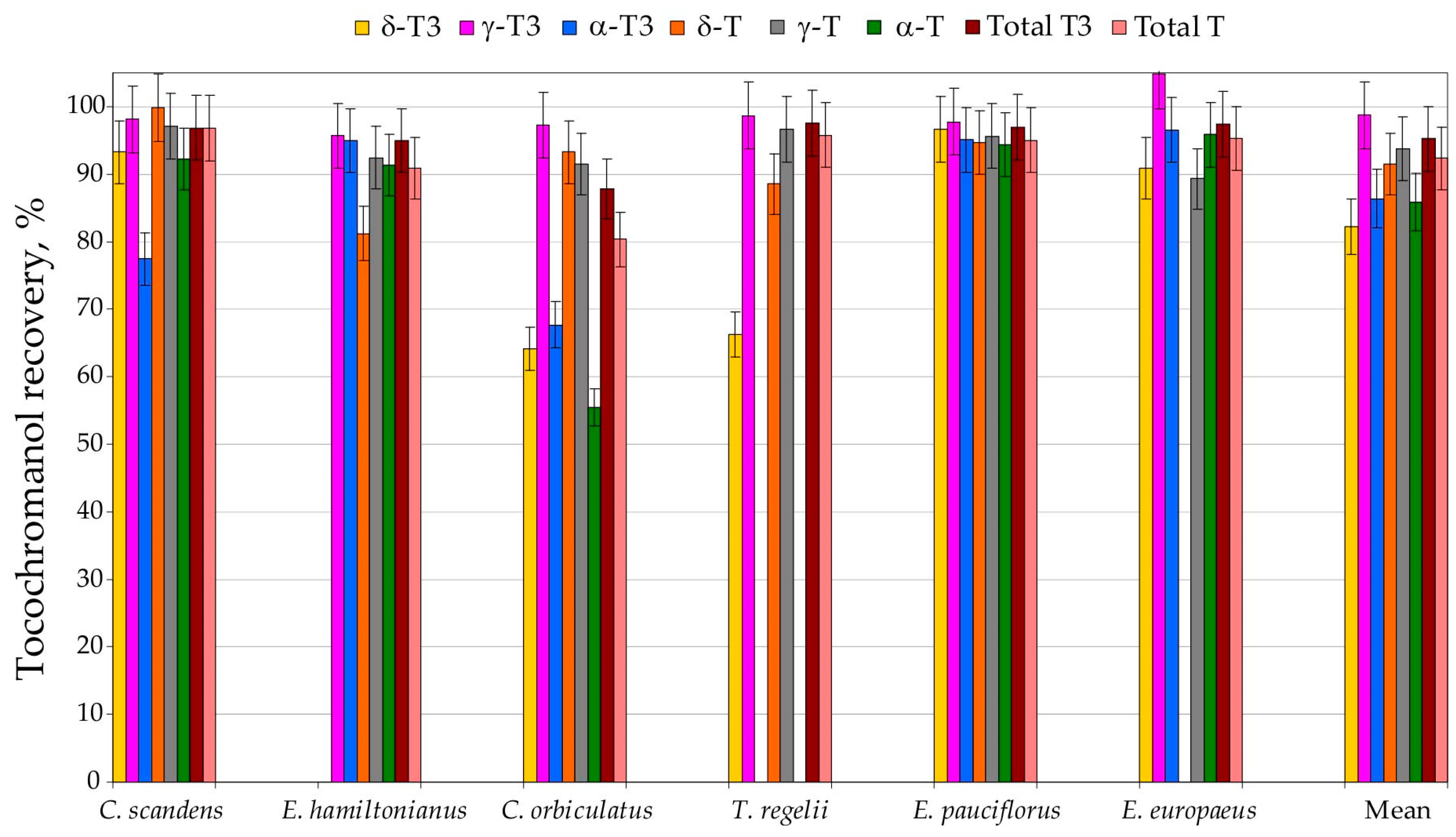
3.1. Saponification and UAEE Recovery and Measurement Repeatability
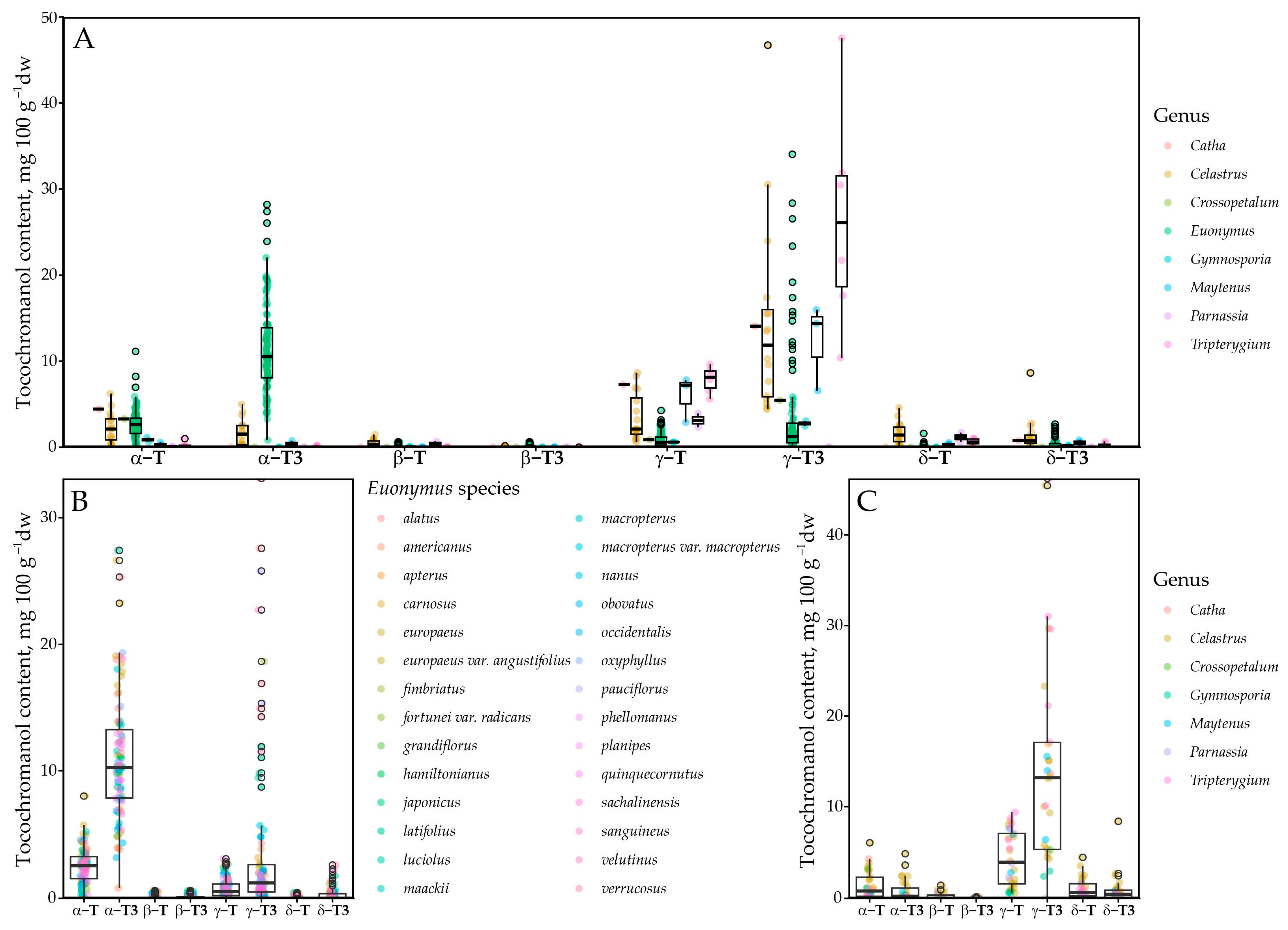
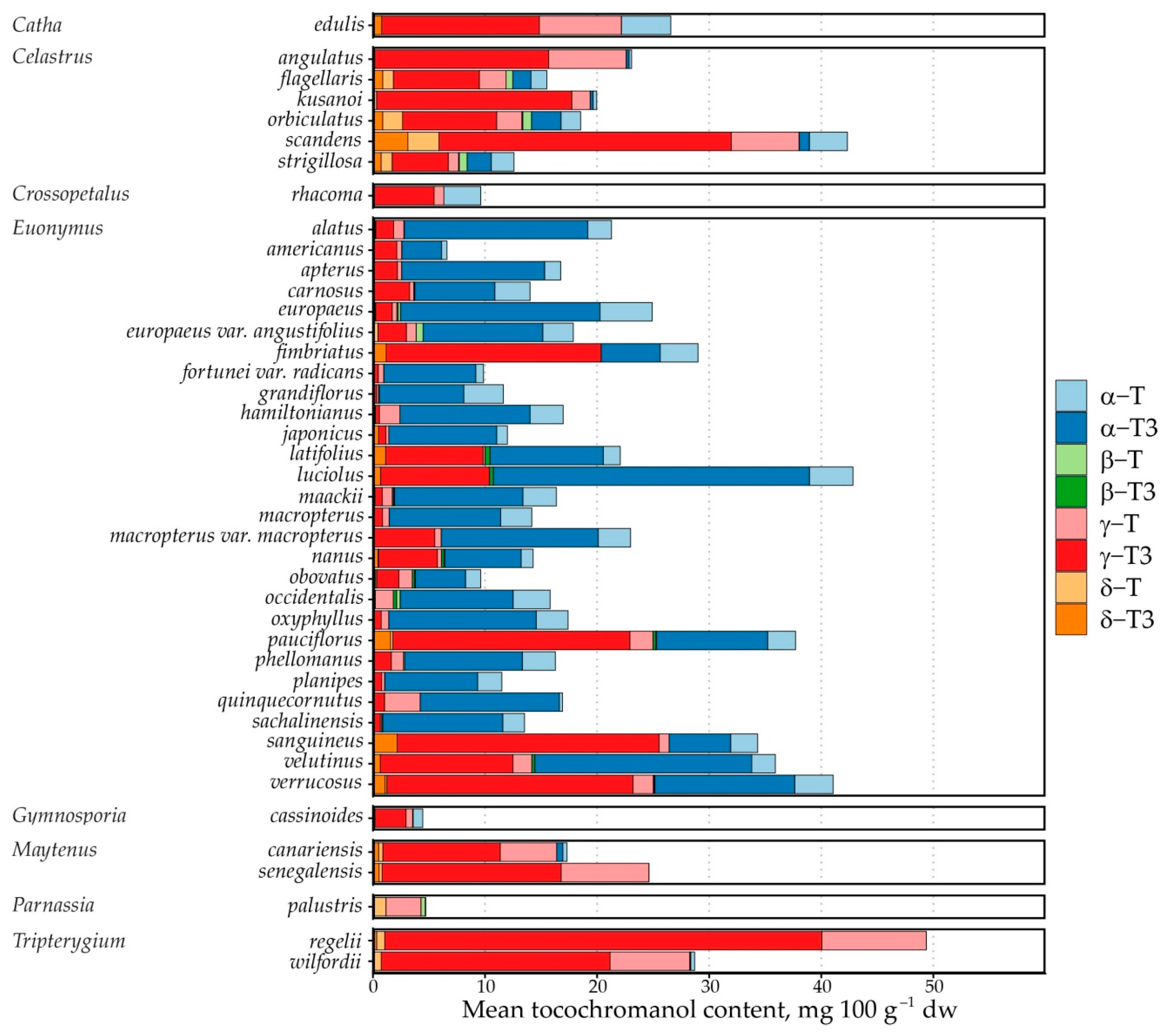
3.2. Tocochromanol Profile
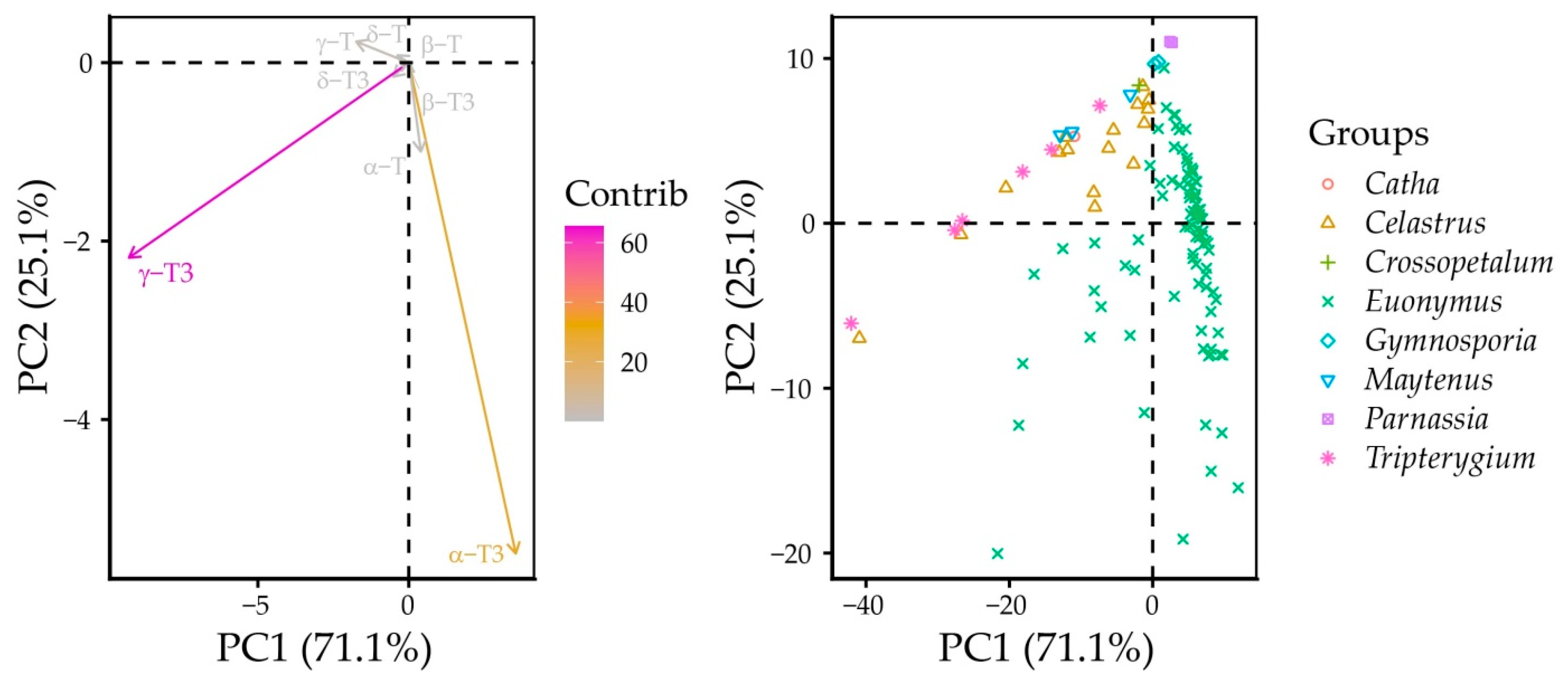
3.3. Tocochromanol Composition as Shaped by Phylogeny
4. Conclusions
Supplementary Materials
Author Contributions
Funding
Institutional Review Board Statement
Informed Consent Statement
Data Availability Statement
Acknowledgments
Conflicts of Interest
Abbreviations
References
- Royal Botanic Gardens, Kew. Celastraceae. Available online: https://powo.science.kew.org/taxon/urn:lsid:ipni.org:names:30000478-2 (accessed on 30 December 2025).
- Christenhusz, M.J.; Byng, J.W. The number of known plants species in the world and its annual increase. Phytotaxa 2016, 261, 201–217. [Google Scholar] [CrossRef] [Scilit]
- Van Wyk, B.E. A review of commercially important African medicinal plants. J. Ethnopharmacol. 2015, 176, 118–134. [Google Scholar] [CrossRef] [Scilit] [PubMed]
- Mekuria, W. Public discourse on Khat (Catha edulis) production in Ethiopia. J. Agric. Ext. Rural Dev. 2018, 10, 192–201. [Google Scholar]
- Su, P.; Gao, L.; Tong, Y.; Guan, H.; Liu, S.; Zhang, Y.; Zhao, Y.; Wang, J.; Hu, T.; Tu, L. Analysis of the role of geranylgeranyl diphosphate synthase 8 from Tripterygium wilfordii in diterpenoids biosynthesis. Plant Sci. 2019, 285, 184–192. [Google Scholar] [CrossRef] [Scilit] [PubMed]
- Murthy, H.N.; Joseph, K.S.; Madiwal, A.; Rajan, G.D.; Badiger, M.; Kolkar, L.; Hiremath, R.; Shirugumbi, M. Chemical composition and fatty acid profile of Khat (Catha edulis) seed oil. J. Am. Oil Chem. Soc. 2016, 93, 405–409. [Google Scholar] [CrossRef] [Scilit]
- Rana, V.S.; Das, M. Fatty acid and non-fatty acid components of the seed oil of Celastrus paniculatus willd. Int. J. Fruit Sci. 2017, 17, 407–414. [Google Scholar] [CrossRef] [Scilit]
- Ramadan, M.F.; Kinni, S.G.; Rajanna, L.N.; Seetharam, Y.N.; Seshagiri, M.; Mörsel, J.-T. Fatty acids, bioactive lipids and radical scavenging activity of Celastrus paniculatus Willd. seed oil. Sci. Hortic. 2009, 123, 104–109. [Google Scholar] [CrossRef] [Scilit]
- Munir, M.; Ahmad, M.; Waseem, A.; Zafar, M.; Saeed, M.; Wakeel, A.; Nazish, M.; Sultana, S. Scanning electron microscopy leads to identification of novel nonedible oil seeds as energy crops. Microsc. Res. Tech. 2019, 82, 1165–1173. [Google Scholar] [CrossRef] [Scilit]
- Sidorov, R.A.; Pchelkin, V.P.; Zhukov, A.V.; Tsydendambaev, V.D. Positional-species composition of diacylglycerol acetates from mature euonymus seeds. Chem. Biodivers. 2016, 13, 789–797. [Google Scholar] [CrossRef] [Scilit]
- Sidorov, R.A.; Zhukov, A.V.; Pchelkin, V.P.; Vereshchagin, A.G.; Tsydendambaev, V.D. Content and fatty acid composition of neutral acylglycerols in Euonymus fruits. J. Am. Oil Chem. Soc. 2014, 91, 805–814. [Google Scholar] [CrossRef] [Scilit]
- Sidorov, R.A.; Pchelkin, V.P.; Zhukov, A.V.; Vereshchagin, A.G.; Tsydendambaev, V.D. Positional-species composition of triacylglycerols from the arils of mature Euonymus fruits. J. Am. Oil Chem. Soc. 2014, 91, 2053–2063. [Google Scholar] [CrossRef] [Scilit]
- Liu, J.-Z.; Cui, Q.; Kang, Y.-F.; Meng, Y.; Gao, M.-Z.; Efferth, T.; Fu, Y.-J. Euonymus maackii Rupr. Seed oil as a new potential non-edible feedstock for biodiesel. Renew. Energy 2019, 133, 261–267. [Google Scholar] [CrossRef] [Scilit]
- Benni, S.D.; Munnolli, R.S.; Katagi, K.S.; Kadam, N.S. Mussel shells as sustainable catalyst: Synthesis of liquid fuel from non edible seeds of Bauhinia malabarica and Gymnosporia montana. Curr. Res. Green Sustain. Chem. 2021, 4, 100124. [Google Scholar] [CrossRef] [Scilit]
- Ginocchio, R.; Muñoz-Carvajal, E.; Velásquez, P.; Giordano, A.; Montenegro, G.; Colque-Perez, G.; Sáez-Navarrete, C. Mayten tree seed oil: Nutritional value evaluation according to antioxidant capacity and bioactive properties. Foods 2021, 10, 729. [Google Scholar] [CrossRef] [Scilit]
- Azzi, A. Tocopherols, tocotrienols and tocomonoenols: Many similar molecules but only one vitamin E. Redox Biol. 2019, 26, 101259. [Google Scholar] [CrossRef] [Scilit] [PubMed]
- Karmowski, J.; Hintze, V.; Kschonsek, J.; Killenberg, M.; Böhm, V. Antioxidant activities of tocopherols/tocotrienols and lipophilic antioxidant capacity of wheat, vegetable oils, milk and milk cream by using photochemiluminescence. Food Chem. 2015, 175, 593–600. [Google Scholar] [CrossRef] [Scilit] [PubMed]
- Yoshida, Y.; Saito, Y.; Jones, L.S.; Shigeri, Y. Chemical reactivities and physical effects in comparison between tocopherols and tocotrienols: Physiological significance and prospects as antioxidants. J. Biosci. Bioeng. 2007, 104, 439–445. [Google Scholar] [CrossRef] [Scilit]
- Siles, L.; Cela, J.; Munné-Bosch, S. Vitamin E analyses in seeds reveal a dominant presence of tocotrienols over tocopherols in the Arecaceae family. Phytochemistry 2013, 95, 207–214. [Google Scholar] [CrossRef] [Scilit] [PubMed]
- Siger, A.; Górnaś, P. Free tocopherols and tocotrienols in 82 plant species’ oil: Chemotaxonomic relation as demonstrated by PCA and HCA. Food Res. Int. 2023, 164, 112386. [Google Scholar]
- Horvath, G.; Wessjohann, L.; Bigirimana, J.; Jansen, M.; Guisez, Y.; Caubergs, R.; Horemans, N. Differential distribution of tocopherols and tocotrienols in photosynthetic and non-photosynthetic tissues. Phytochemistry 2006, 67, 1185–1195. [Google Scholar] [CrossRef] [Scilit]
- Bagci, E. Fatty acids and tocochromanol patterns of some Turkish Apiaceae (Umbelliferae) plants; a chemotaxonomic approach. Acta Bot. Gallica 2007, 154, 143–151. [Google Scholar] [CrossRef] [Scilit]
- Ivanov, S.A.; Aitzetmüller, K. Untersuchungen über die tocopherol-und tocotrienolzusammensetzung der samenöle einiger vertreter der familie Apiaceae. Lipid/Fett 1995, 97, 24–29. [Google Scholar] [CrossRef] [Scilit]
- Górnaś, P. Domination of tocotrienols over tocopherols in seed oils of sixteen species belonging to the Apiaceae family. J. Food Compos. Anal. 2025, 142, 107535. [Google Scholar] [CrossRef] [Scilit]
- Zeutsop, J.F.; Zébazé, J.N.; Nono, R.N.; Frese, M.; Chouna, J.R.; Lenta, B.N.; Nkeng-Efouet-Alango, P.; Sewald, N. Antioxidant and cytotoxicity activities of δ-tocotrienol from the seeds of Allophylus africanus. Nat. Prod. Res. 2021, 36, 4655–4665. [Google Scholar] [CrossRef] [Scilit]
- Sangsopha, W.; Schevenels, F.T.; Lekphrom, R.; Kanokmedhakul, S. A new tocotrienol from the roots and branches of Allophylus cobbe (L.) Raeusch (Sapindaceae). Nat. Prod. Res. 2020, 34, 988–994. [Google Scholar] [CrossRef] [Scilit]
- Wie, M.; Sung, J.; Choi, Y.; Kim, Y.; Jeong, H.S.; Lee, J. Tocopherols and tocotrienols in grape seeds from 14 cultivars grown in Korea. Eur. J. Lipid Sci. Technol. 2009, 111, 1255–1258. [Google Scholar] [CrossRef] [Scilit]
- Lazdiņa, D.; Mišina, I.; Dukurs, K.; Górnaś, P. Seed tocochromanol-based chemotaxonomy of Euroasian grapevine (Vitaceae) species. J. Food Compos. Anal. 2026, 150, 108893. [Google Scholar] [CrossRef] [Scilit]
- Yang, B.; Ahotupa, M.; Määttä, P.; Kallio, H. Composition and antioxidative activities of supercritical CO2-extracted oils from seeds and soft parts of northern berries. Food Res. Int. 2011, 44, 2009–2017. [Google Scholar] [CrossRef] [Scilit]
- Górnaś, P.; Lazdiņa, D.; Mišina, I.; Sipeniece, E.; Segliņa, D. Cranberry (Vaccinium macrocarpon Aiton) seeds: An exceptional source of tocotrienols. Sci. Hortic. 2024, 331, 113107. [Google Scholar] [CrossRef] [Scilit]
- Górnaś, P.; Siger, A.; Czubinski, J.; Dwiecki, K.; Segliņa, D.; Nogala-Kalucka, M. An alternative RP-HPLC method for the separation and determination of tocopherol and tocotrienol homologues as butter authenticity markers: A comparative study between two European countries. Eur. J. Lipid Sci. Technol. 2014, 116, 895–903. [Google Scholar] [CrossRef] [Scilit]
- Górnaś, P.; Baškirovs, G.; Siger, A. Free and esterified tocopherols, tocotrienols and other extractable and non-extractable tocochromanol-related molecules: Compendium of knowledge, future perspectives and recommendations for chromatographic techniques, tools, and approaches used for tocochromanol determination. Molecules 2022, 27, 6560. [Google Scholar] [PubMed]
- Górnaś, P.; Mišina, I.; Waśkiewicz, A.; Perkons, I.; Pugajeva, I.; Segliņa, D. Simultaneous extraction of tocochromanols and flavan-3-ols from the grape seeds: Analytical and industrial aspects. Food Chem. 2025, 462, 140913. [Google Scholar] [CrossRef] [Scilit]
- Krauß, S.; Darwisch, V.; Vetter, W. Occurrence of tocopheryl fatty acid esters in vegetables and their non-digestibility by artificial digestion juices. Sci. Rep. 2018, 8, 7657. [Google Scholar] [CrossRef] [Scilit]
- Britz, S.J.; Kremer, D.F. Warm temperatures or drought during seed maturation increase free α-tocopherol in seeds of soybean (Glycine max [L.] Merr.). J. Agric. Food Chem. 2002, 50, 6058–6063. [Google Scholar] [CrossRef] [Scilit]
- Siger, A.; Michalak, M.; Bąkowska, E.; Dwiecki, K.; Nogala-Kałucka, M.; Grześ, B.; Piasecka-Kwiatkowska, D. The effect of the genotype-environment interaction on the concentration of carotenoids, tocochromanol, and phenolic compounds in seeds of Lupinus angustifolius breeding lines. J. Food Compos. Anal. 2023, 123, 105511. [Google Scholar] [CrossRef] [Scilit]
- Siger, A.; Michalak, M.; Lembicz, J.; Nogala-Kałucka, M.; Cegielska-Taras, T.; Szała, L. Genotype× environment interaction on tocochromanol and plastochromanol-8 content in seeds of doubled haploids obtained from F1 hybrid black× yellow seeds of winter oilseed rape (Brassica napus L.). J. Sci. Food Agric. 2018, 98, 3263–3270. [Google Scholar] [CrossRef] [Scilit]
- Goffman, F.D.; Möllers, C. Changes in tocopherol and plastochromanol-8 contents in seeds and oil of oilseed rape (Brassica napus L.) during storage as influenced by temperature and air oxygen. J. Agric. Food Chem. 2000, 48, 1605–1609. [Google Scholar] [CrossRef] [Scilit]
- Ziegler, V.; Vanier, N.L.; Ferreira, C.D.; Paraginski, R.T.; Monks, J.L.F.; Elias, M.C. Changes in the bioactive compounds content of soybean as a function of grain moisture content and temperature during long-term storage. J. Food Sci. 2016, 81, H762–H768. [Google Scholar] [CrossRef] [Scilit] [PubMed]
- Liu, Q.; Dai, J.; Chen, J.; Liu, Z.; Lin, Y.; Qiu, G.; Gao, X.; Zhang, R.; Zhu, S. Comparative analysis the chloroplast genomes of Celastrus (Celastraceae) species: Provide insights into molecular evolution, species identification and phylogenetic relationships. Phytomedicine 2024, 131, 155770. [Google Scholar] [CrossRef] [Scilit]
- Mu, X.-Y.; Zhao, L.-C.; Zhang, Z.-X. Phylogeny of Celastrus L. (Celastraceae) inferred from two nuclear and three plastid markers. J. Plant Res. 2012, 125, 619–630. [Google Scholar] [CrossRef] [Scilit] [PubMed]
- Simmons, M.P.; Savolainen, V.; Clevinger, C.C.; Archer, R.H.; Davis, J.I. Phylogeny of the Celastraceae inferred from 26S nuclear ribosomal DNA, phytochrome B, rbcL, atpB, and morphology. Mol. Phylogenetics Evol. 2001, 19, 353–366. [Google Scholar] [CrossRef] [Scilit] [PubMed]
- Xia, M.-Z.; Li, Y.; Zhang, F.-Q.; Yu, J.-Y.; Khan, G.; Chi, X.-F.; Xu, H.; Chen, S.-L. Reassessment of the phylogeny and systematics of Chinese Parnassia (Celastraceae): A thorough investigation using whole plastomes and nuclear ribosomal DNA. Front. Plant Sci. 2022, 13, 855944. [Google Scholar] [CrossRef] [Scilit] [PubMed]



| Genus | Species | δ-T3 | β-T3 | γ-T3 | α-T3 | δ-T | β-T | γ-T | α-T | Total |
|---|---|---|---|---|---|---|---|---|---|---|
| Catha | edulis (n = 1) | 0.78 | ND | 14.07 | ND | ND | ND | 7.30 | 4.43 | 26.58 |
| Celastrus | angulatus (n = 1) | ND | ND | 15.53 | 0.25 | 0.16 | 0.01 | 6.90 | 0.22 | 23.07 |
| flagellaris (n = 2) | 0.87 ± 0.58 | ND | 7.67 ± 3.70 | 1.63 ± 1.27 | 0.95 ± 0.82 | 0.59 ± 0.48 | 2.40 ± 2.54 | 1.42 ± 1.44 | 15.52 ± 10.83 | |
| kusanoi (n = 1) | ND | ND | 17.41 | 0.25 | 0.33 | ND | 1.65 | 0.34 | 19.98 | |
| orbiculatus (n = 4) | 0.87 ± 0.65 | 0.07 ± 0.06 | 8.39 ± 3.98 | 2.64 ± 1.65 | 1.77 ± 0.92 | 0.78 ± 0.47 | 2.26 ± 0.66 | 1.75 ± 1.22 | 18.52 ± 8.65 | |
| scandens (n = 5) | 3.12 ± 3.22 | ND | 26.08 ± 13.38 | 0.92 ± 1.57 | 2.78 ± 1.44 | ND | 6.04 ± 3.03 | 3.40 ± 1.92 | 42.33 ± 17.49 | |
| strigillosa (n = 2) | 0.72 ± 0.40 | 0.06 ± 0.01 | 5.00 ± 0.83 | 2.15 ± 0.49 | 0.99 ± 0.44 | 0.70 ± 0.35 | 0.93 ± 0.18 | 2.04 ± 1.48 | 12.59 ± 2.12 | |
| Crossopetalum | rhacoma (n = 1) | ND | ND | 5.45 | ND | ND | ND | 0.88 | 3.29 | 9.62 |
| Euonymus | alatus (n = 7) | 0.18 ± 0.20 | 0.03 ± 0.05 | 1.68 ± 1.47 | 15.86 ± 5.54 | 0.03 ± 0.07 | ND | 0.84 ± 0.35 | 2.01 ± 0.62 | 20.63 ± 7.39 |
| americanus (n = 5) | 0.07 ± 0.12 | ND | 2.06 ± 1.08 | 3.55 ± 1.58 | ND | ND | 0.44 ± 0.29 | 0.49 ± 0.63 | 6.61 ± 2.13 | |
| carnosus (n = 1) | ND | 0.02 | 3.28 | 7.15 | ND | 0.06 | 0.37 | 3.15 | 14.03 | |
| cornutus (n = 1) | ND | ND | 1.03 | 12.43 | ND | ND | 3.17 | 0.27 | 16.90 | |
| europaeus (n = 12) | 0.19 ± 0.24 | 0.10 ± 0.18 | 1.57 ± 0.86 | 17.21 ± 5.19 | 0.07 ± 0.14 | 0.25 ± 0.28 | 0.45 ± 0.42 | 4.50 ± 1.49 | 24.33 ± 6.35 | |
| fimbriatus (n = 1) | 1.18 | ND | 19.18 | 5.28 | ND | ND | ND | 3.37 | 29.01 | |
| fortunei (n = 1) | ND | ND | 0.48 | 8.22 | ND | ND | 0.48 | 0.70 | 9.88 | |
| grandiflorus (n = 2) | ND | ND | 0.27 ± 0.14 | 7.54 ± 3.58 | 0.05 ± 0.01 | 0.06 ± 0.01 | 0.18 ± 0.17 | 3.54 ± 1.40 | 11.64 ± 5.03 | |
| hamiltonianus (n = 5) | ND | ND | 0.36 ± 0.23 | 11.62 ± 1.44 | 0.21 ± 0.19 | ND | 1.83 ± 0.96 | 2.95 ± 0.99 | 16.97 ± 2.13 | |
| japonicus (n = 2) | 0.50 ± 0.21 | ND | 0.65 ± 0.81 | 9.64 ± 0.96 | ND | ND | 0.26 ± 0.37 | 0.95 ± 0.36 | 12.00 ± 1.97 | |
| latifolius (n = 5) | 1.12 ± 0.70 | 0.44 ± 0.26 | 8.70 ± 4.55 | 10.13 ± 2.71 | ND | ND | 0.17 ± 0.21 | 1.50 ± 1.17 | 22.05 ± 7.54 | |
| luciolus (n = 1) | 0.68 | 0.35 | 9.71 | 28.20 | ND | ND | ND | 3.89 | 42.83 | |
| maackii (n = 6) | 0.04 ± 0.06 | 0.11 ± 0.16 | 0.65 ± 0.65 | 11.46 ± 3.70 | 0.13 ± 0.13 | 0.09 ± 0.10 | 0.89 ± 0.78 | 2.99 ± 1.53 | 16.37 ± 5.71 | |
| macropterus (n = 5) | ND | ND | 1.78 ± 2.27 | 10.77 ± 3.51 | ND | ND | 0.59 ± 0.79 | 2.80 ± 0.36 | 15.94 ± 4.62 | |
| maximowiczianus (n = 4) | ND | 0.15 ± 0.09 | 0.56 ± 0.28 | 10.59 ± 2.17 | 0.04 ± 0.02 | ND | 0.25 ± 0.27 | 1.60 ± 0.10 | 13.19 ± 1.97 | |
| nanus (n = 3) | 0.45 ± 0.08 | 0.24 ± 0.05 | 5.24 ± 0.53 | 6.82 ± 1.21 | 0.05 ± 0.04 | 0.05 ± 0.04 | 0.37 ± 0.14 | 1.08 ± 0.17 | 14.29 ± 0.56 | |
| obovatus (n = 3) | 0.23 ± 0.18 | 0.21 ± 0.14 | 1.96 ± 0.54 | 4.48 ± 1.23 | 0.11 ± 0.06 | 0.05 ± 0.03 | 1.20 ± 0.07 | 1.35 ± 1.14 | 9.61 ± 1.69 | |
| occidentalis (n = 3) | ND | 0.30 ± 0.16 | 0.10 ± 0.04 | 10.07 ± 1.18 | 0.11 ± 0.09 | 0.32 ± 0.15 | 1.60 ± 0.64 | 3.31 ± 1.46 | 15.80 ± 3.22 | |
| oxyphyllus (n = 4) | ND | ND | 0.74 ± 0.52 | 13.16 ± 5.57 | ND | ND | 0.66 ± 0.47 | 2.85 ± 1.36 | 17.41 ± 5.77 | |
| pauciflorus (n = 2) | 1.57 ± 1.12 | 0.26 ± 0.11 | 21.15 ± 7.62 | 9.93 ± 0.42 | 0.20 ± 0.01 | 0.05 ± 0.07 | 2.05 ± 0.80 | 2.48 ± 0.16 | 37.71 ± 9.85 | |
| phellomanus (n = 6) | 0.04 ± 0.09 | ND | 1.55 ± 0.45 | 10.51 ± 2.56 | 0.04 ± 0.11 | 0.10 ± 0.24 | 1.09 ± 0.39 | 2.96 ± 0.49 | 16.28 ± 3.52 | |
| planipes (n = 2) | ND | ND | 0.78 ± 0.16 | 8.31 ± 1.68 | ND | ND | 0.25 ± 0.05 | 2.16 ± 0.20 | 11.51 ± 1.68 | |
| sachalinensis (n = 4) | ND | 0.02 ± 0.04 | 0.69 ± 0.20 | 10.84 ± 3.08 | 0.01 ± 0.02 | 0.01 ± 0.02 | 0.01 ± 0.03 | 2.28 ± 0.82 | 13.86 ± 3.95 | |
| sanguineus (n = 1) | 2.16 | ND | 23.36 | 5.49 | ND | ND | 0.89 | 2.41 | 34.31 | |
| velutinus (n = 1) | 0.65 | 0.25 | 11.84 | 19.37 | ND | ND | 1.68 | 2.10 | 35.89 | |
| verrucosus (n = 5) | 1.08 ± 1.01 | 0.05 ± 0.07 | 21.96 ± 8.73 | 12.49 ± 4.64 | 0.16 ± 0.12 | 0.08 ± 0.09 | 1.81 ± 1.02 | 3.43 ± 0.76 | 41.06 ± 15.01 | |
| Gymnosporia | cassinoides (n = 2) | 0.18 ± 0.08 | ND | 2.76 ± 0.41 | ND | ND | 0.04 ± 0.06 | 0.59 ± 0.04 | 0.87 ± 0.34 | 4.45 ± 0.13 |
| Maytenus | canariensis (n = 2) | 0.51 ± 0.46 | ND | 10.48 ± 5.51 | 0.54 ± 0.30 | 0.37 ± 0.22 | ND | 5.03 ± 3.03 | 0.39 ± 0.25 | 17.32 ± 8.68 |
| senegalensis (n = 1) | 0.55 | ND | 15.97 | ND | 0.27 | ND | 7.82 | ND | 24.61 | |
| Parnassia | palustris (n = 2) | ND | ND | ND | ND | 1.15 ± 0.76 | 0.39 ± 0.42 | 3.12 ± 1.12 | 0.05 ± 0.07 | 4.72 ± 2.38 |
| Tripterygium | regelii (n = 2) | 0.33 ± 0.47 | ND | 39.00 ± 12.08 | ND | 0.71 ± 0.45 | ND | 9.32 ± 0.45 | ND | 49.37 ± 10.71 |
| wilfordii (n = 4) | 0.13 ± 0.19 | ND | 20.41 ± 8.98 | 0.09 ± 0.11 | 0.61 ± 0.34 | ND | 7.10 ± 1.26 | 0.36 ± 0.43 | 28.71 ± 9.96 |
Disclaimer/Publisher’s Note: The statements, opinions and data contained in all publications are solely those of the individual author(s) and contributor(s) and not of MDPI and/or the editor(s). MDPI and/or the editor(s) disclaim responsibility for any injury to people or property resulting from any ideas, methods, instructions or products referred to in the content. |
© 2026 by the authors. Licensee MDPI, Basel, Switzerland. This article is an open access article distributed under the terms and conditions of the Creative Commons Attribution (CC BY) license.
Share and Cite
Lazdiņa, D.; Mišina, I.; Dukurs, K.; Górnaś, P. Tocotrienol Dominance in Celastraceae Family Species’ Seeds: Phylogenetic Patterns. Appl. Sci. 2026, 16, 1521. https://doi.org/10.3390/app16031521
Lazdiņa D, Mišina I, Dukurs K, Górnaś P. Tocotrienol Dominance in Celastraceae Family Species’ Seeds: Phylogenetic Patterns. Applied Sciences. 2026; 16(3):1521. https://doi.org/10.3390/app16031521
Chicago/Turabian StyleLazdiņa, Danija, Inga Mišina, Krists Dukurs, and Paweł Górnaś. 2026. "Tocotrienol Dominance in Celastraceae Family Species’ Seeds: Phylogenetic Patterns" Applied Sciences 16, no. 3: 1521. https://doi.org/10.3390/app16031521
APA StyleLazdiņa, D., Mišina, I., Dukurs, K., & Górnaś, P. (2026). Tocotrienol Dominance in Celastraceae Family Species’ Seeds: Phylogenetic Patterns. Applied Sciences, 16(3), 1521. https://doi.org/10.3390/app16031521