Article

Slotted Charge Blasting Technology: A Review of Mechanisms, Applications, and Future Directions

1
Faculty of Land Resources Engineering, Kunming University of Science and Technology, Kunming 650093, China
2
Advanced Blasting Technology Engineering Research Center of Yunnan Provincial Department of Education, Kunming 650093, China
3
Yunnan Diqing Non-Ferrous Metals Co., Ltd., Shangri-La 674400, China
4
School of Resources and Safety Engineering, University of Science and Technology Beijing, Beijing 100083, China
*
Author to whom correspondence should be addressed.
These authors contributed equally to this work.
Appl. Sci. 2026, 16(3), 1510; https://doi.org/10.3390/app16031510
Submission received: 11 December 2025 / Revised: 22 January 2026 / Accepted: 29 January 2026 / Published: 2 February 2026

Abstract

The drilling and blasting method remains fundamental to mining and tunneling projects, prized for its simplicity and economy. However, conventional techniques are increasingly challenged by modern safety and environmental standards, particularly in complex geological settings. Slotted charge blasting technology addresses these limitations by offering exceptional control over fracture propagation and damage. This paper provides a comprehensive review of the field, synthesizing global research on its theoretical foundations, advanced diagnostic methodologies, key performance parameters, and engineering applications. We critically analyze the current challenges facing the technology, particularly in weak rock conditions, where extensive plastic deformation and rapid energy dissipation often compromise directional control, and identify promising trends for its future development. Specifically, the integration of intelligent adaptive control and additive manufacturing is highlighted as a key direction. By mapping out a clear trajectory for future research, this work provides a scientific basis to advance the efficacy and safety of slotted charge blasting in demanding engineering environments.

1. Introduction

The development and utilization of underground space are intrinsically linked to daily life, national economic development, and defense security. For underground rock mass excavation, the primary methods are mechanical excavation and the drilling and blasting (D&B) method. The D&B method is particularly dominant due to its operational simplicity, strong project adaptability, and cost-effectiveness, proving especially economical for medium-to-hard rock masses with a Protodyakonov coefficient (f) greater than 6 [1]. Consequently, it remains the predominant technology in the excavation of traffic tunnels, mine roadways, hydraulic tunnels, and military protective passages. However, conventional D&B techniques are increasingly unable to meet modern engineering demands. Field data indicate that conventional smooth blasting often results in significant contour deviations. In typical drill-and-blast operations within jointed or medium-quality rock masses, overbreak frequently exceeds 150–200 mm. Similarly, the Excavation Damage Zone extends 0.5 to 2.0 m into the surrounding rock, though this range varies significantly depending on the rock mass integrity (e.g., RQD) and in situ stress levels. Furthermore, the uncontrolled release of explosive energy leads to low Half-Cast Factors, typically below 50% in standard operations lacking precision electronic timing, which fails to satisfy the escalating requirements for precise excavation profiles and the stability of the surrounding rock [2].
Achieving precise control over fracture initiation, crack propagation, and the final contour is a primary focus of modern research. Directional fracture control blasting, utilizing slotted charges, offers a viable solution to this challenge. Within this broad category, the specific technique utilizing slotted casings is referred to in this paper as “Slotted Charge Blasting.” It should be noted that this technique appears in the literature under various synonyms, such as “slit charge blasting” or “cutting seam cartridge blasting.” However, for the sake of clarity and consistency, the term “Slotted Charge Blasting” is used exclusively throughout this manuscript. Currently, this technology has transitioned from experimental trials to standardized industrial application. It has been officially incorporated into industry norms, such as the Specification for Smooth Blasting Engineering Technical Design (T/CSEB 0015-2024 [3]) issued by the China Society of Explosive Blasting. Consequently, it serves as a standard procedure for perimeter control in thousands of kilometers of roadway excavation within the coal mining and transportation tunnel sectors annually [4]. Fourney et al. [5] were among the first to propose controlled fracture blasting, discovering the excellent directional performance of slotted charges and thus paving the way for further research in this field. The fundamental principle of slotted charge blasting involves using slots on a charge tube to concentrate the distribution of explosive stress waves and guide the quasi-static pressure of detonation gases. This creates a targeted wedge effect on the surrounding medium, initiating and directing fracture growth along the predefined slot orientations [6,7,8]. As a key method within directional fracture control, slotted charge blasting offers significant advantages over conventional techniques. It allows for larger borehole spacing, reducing explosive consumption and drilling costs. Crucially, it mitigates rock mass damage. This enhances the stability of the surrounding rock, effectively minimizing over-break and under-break phenomena.
The theoretical feasibility of this technology is well-established. It is supported by comprehensive global studies covering theoretical models, numerical simulations, and experimental applications. Foundational research in the West laid the groundwork for this field; for instance, Fourney and Dally [5] pioneered the use of fracture mechanics in blasting, while Uenishi [9] and Shukla [10] provided critical insights into the interaction between stress waves and cracks. Building upon these international foundations, significant advancements were made in China, driven by the massive demand for underground infrastructure. Notably, the research group led by Professor Yang Renshu conducted comprehensive studies that serve as a key benchmark in modern engineering applications [11,12]. Their team performed dynamic caustics experiments that yielded significant theoretical insights and successfully applied the technique to smooth blasting in rock roadways, achieving excellent results [13,14,15,16,17]. The application of slotted charges in smooth blasting is advantageous due to its simple fabrication and practical on-site operability. To elucidate the underlying mechanisms and influencing factors of this technology, this paper presents a comprehensive review of the relevant literature, discusses its current challenges, and proposes directions for future research.

2. Theoretical Fundamentals and Mechanisms

2.1. Historical Development and Basic Principles

Slotted charge blasting is a directional control technique designed to precisely guide rock fracturing by modifying the distribution of the explosive load. The core component is a cylindrical casing (tube) with pre-formed slots of specific shape, length, and orientation, placed around the main explosive column. This design leverages the casing to concentrate explosive energy at the slot openings while simultaneously shielding the borehole wall in other directions [18]. Consequently, the blast-induced stress concentration and shear stress differential at the slot locations cause preferential initiation and propagation of fractures along the desired plane [19,20].
The genesis of this technology dates back to the 1970s. Pioneering work by Fourney et al. [5] involved encasing a conventional charge in a slotted pipe, creating the first axial slotted charge configuration. Their experiments, using materials like polymethyl methacrylate (PMMA) and granite, demonstrated that the confinement provided by the tube created a distinct stress concentration along the slot axis, successfully generating a primary fracture plane. Following this, research in China began in the 1980s, leading to a more refined understanding of the process, which is now generally conceptualized as a multi-stage dynamic interaction between the explosive, the casing, and the rock mass.

2.2. Mechanism of Shock Wave and Gas Expansion

The prevailing theory of rock fragmentation by slotted charge blasting posits a combined action of explosive stress waves and the subsequent quasi-static pressure of detonation gases [21,22,23]. Unlike conventional blasting, the presence of the slotted casing alters the energy release path. The process can be systematically divided into three primary stages [24,25]:
  • Stage 1: Detonation and Shock Wave Generation. The process begins with the detonation of the explosive. The external casing provides initial confinement, which can increase the detonation velocity compared to an unconfined charge. This generates a high-intensity shock wave within the borehole [26].
  • Stage 2: Initial Cracking and Tube Interaction. The shock wave impinges on the slotted pipe. Due to the impedance mismatch, the wave is reflected by the solid tube wall but transmits through the slots. This creates a focused “jetting” action of the shock wave at the slot openings. This term refers to the concentrated release of energy that directs fracture propagation along the desired path. Consequently, a network of directional micro-cracks is induced in the rock while the wall in non-slotted directions remains protected.
  • Stage 3: Gas-driven Fracture Propagation. The high-pressure detonation gases rapidly flow into the pre-formed directional cracks. The slotted pipe, deforming under extreme pressure, acts as a guide, channeling the gas wedge into the main fractures. This sustained quasi-static pressure drives the continuous propagation of the dominant cracks, while gas pressurization in other directions is suppressed.
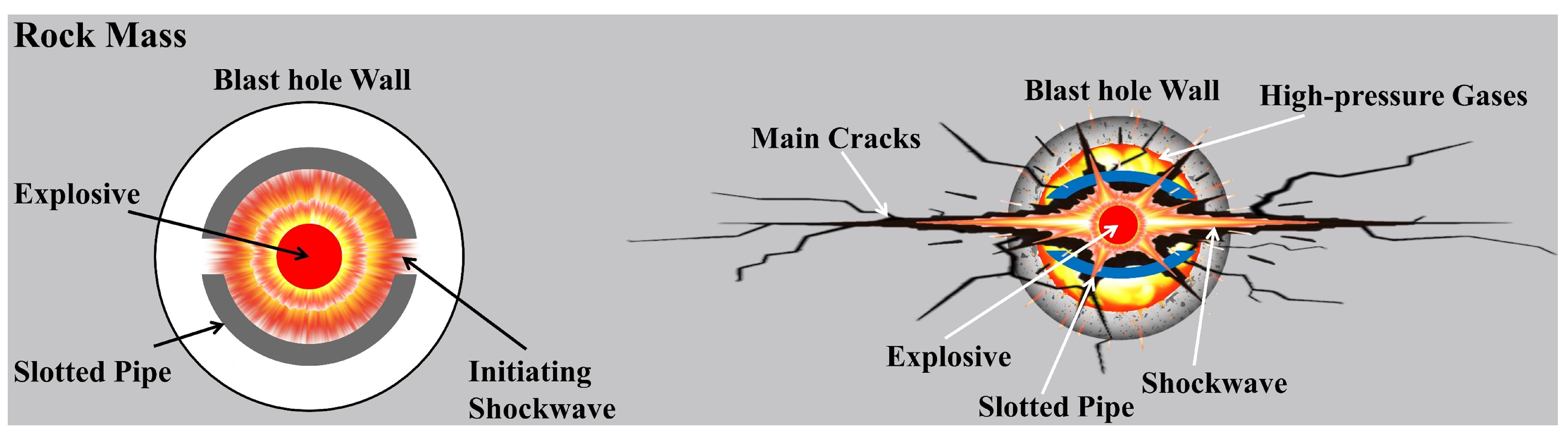
A schematic diagram illustrating this process and the concentration of explosive loading is shown in Figure 1. As depicted, the structural integrity of the tube is intentionally compromised at the slots. Visualizing the interaction, one can observe that the casing acts as a physical barrier. In the non-slotted directions, it absorbs and reflects the initial shock wave, thereby ’shielding’ the borehole wall. Conversely, at the slot openings, the lack of confinement creates a path of least resistance, forcing the detonation energy to form a concentrated ’blade’ of pressure. This channeling effect concentrates the energy density at the slots, applying a highly localized load onto the borehole wall.
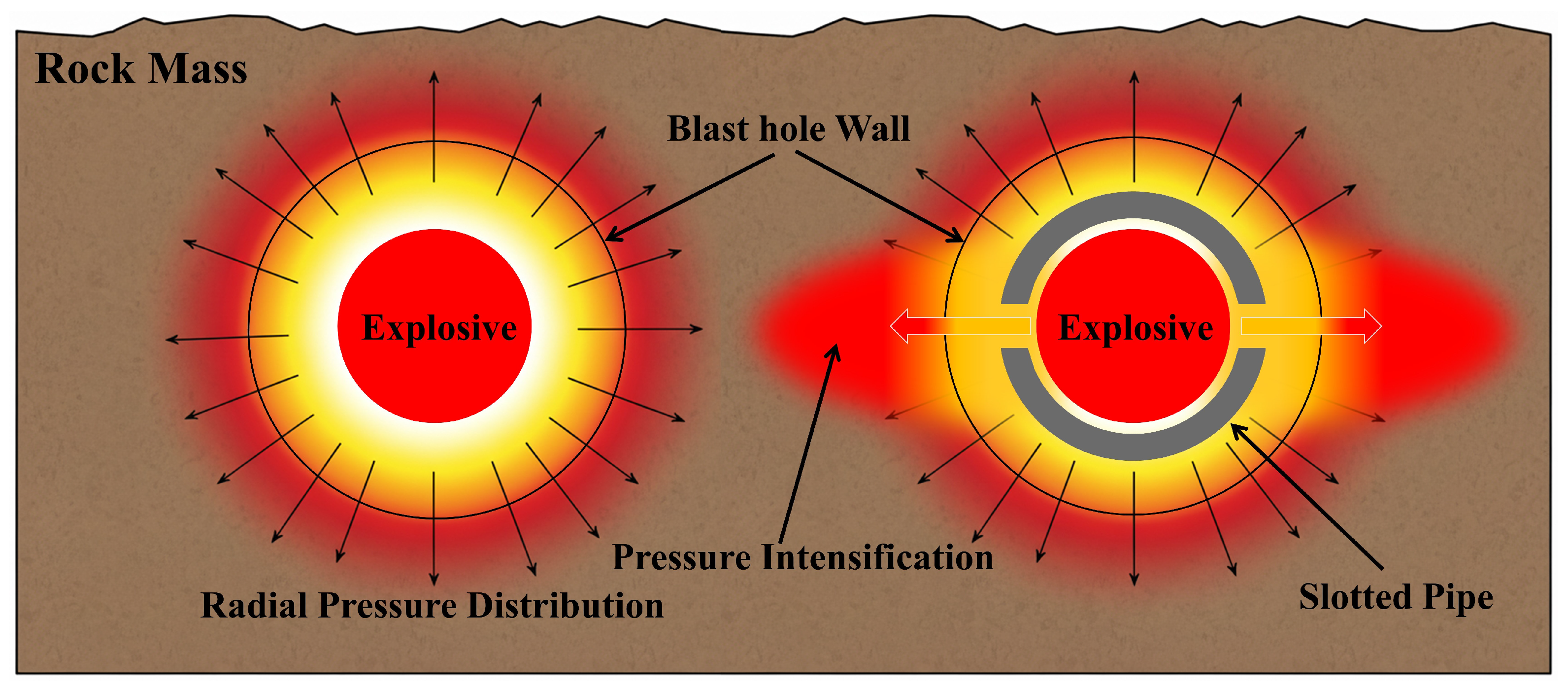
This energy-focusing mechanism is further illustrated in Figure 2, which contrasts the borehole pressure distribution of a conventional charge with that of a slotted charge; while the conventional charge (Left) exhibits a uniform, radial expansion that crushes the rock equally in all directions, the slotted charge (Right) modifies this field into a distinct anisotropic pattern. The pressure distribution resembles a ’butterfly’ shape, effectively maximizing the stress intensity factor at the designated fracture tips while keeping the stress in other directions below the rock’s compressive strength. The confinement provided by the tube is critical; it mitigates lateral energy dissipation and maximizes the work done effectively for fracture initiation.
It is worth noting that this mechanism of directional energy control is not unique to slotted charges but is part of a broader class of geometric blast control methods. Recent studies by Ishchenko et al. [27,28] on variable cross-sectional charges and the role of compensatory well diameters have provided valuable insights into similar physical processes. Their work demonstrates that by manipulating the charge geometry or introducing adjacent voids (compensatory cavities), the blast wave interaction and energy redistribution can be precisely managed to shape the crushed zone and fracture network in hard rock. Although their specific configurations differ from slotted casings, the fundamental principle aligns with the mechanism discussed here: utilizing geometric discontinuities to guide energy flow and stress concentration, thereby proving that these principles are universally applicable across different blasting technologies.
According to fracture mechanics, for this gas-driven propagation to continue, the pressure condition expressed in Equation (1) must be satisfied. Specifically, the pressure of the detonation gases on the borehole wall, P, must be sufficient to overcome the rock’s resistance to fracture [29]:
P > K I C F π ( r b + a 0 )
where K I C is the fracture toughness of the rock. F is a dimensionless correction factor. a 0 is the initial length of cracks induced by the stress wave. r b is the radius of the borehole. As the explosive energy dissipates and the fractures extend, the gas pressure within the borehole decreases. When the pressure drops to a critical level defined by Equation (2), the blast-induced fractures will cease to propagate (i.e., crack arrest occurs) [30]:
P < K I C F π ( r b + a 0 )
It is important to note that the criteria described in Equations (1) and (2) are derived based on the principles of Linear Elastic Fracture Mechanics. Consequently, they assume the rock mass behaves primarily as a quasi-brittle material. This assumption holds true for most hard, competent rocks, where the plastic zone at the crack tip is negligible. However, for soft or weak rocks often encountered in complex geological conditions, the applicability of these simplified equations is limited. In such ductile media, a significant portion of the gas energy is dissipated through plastic deformation rather than crack extension. Therefore, while Equations (1) and (2) provide the fundamental necessary conditions for gas-driven fracturing, accurate prediction in soft rock requires corrections using elastic–plastic fracture mechanics or damage mechanics models to account for the energy dissipation in the plastic zone.
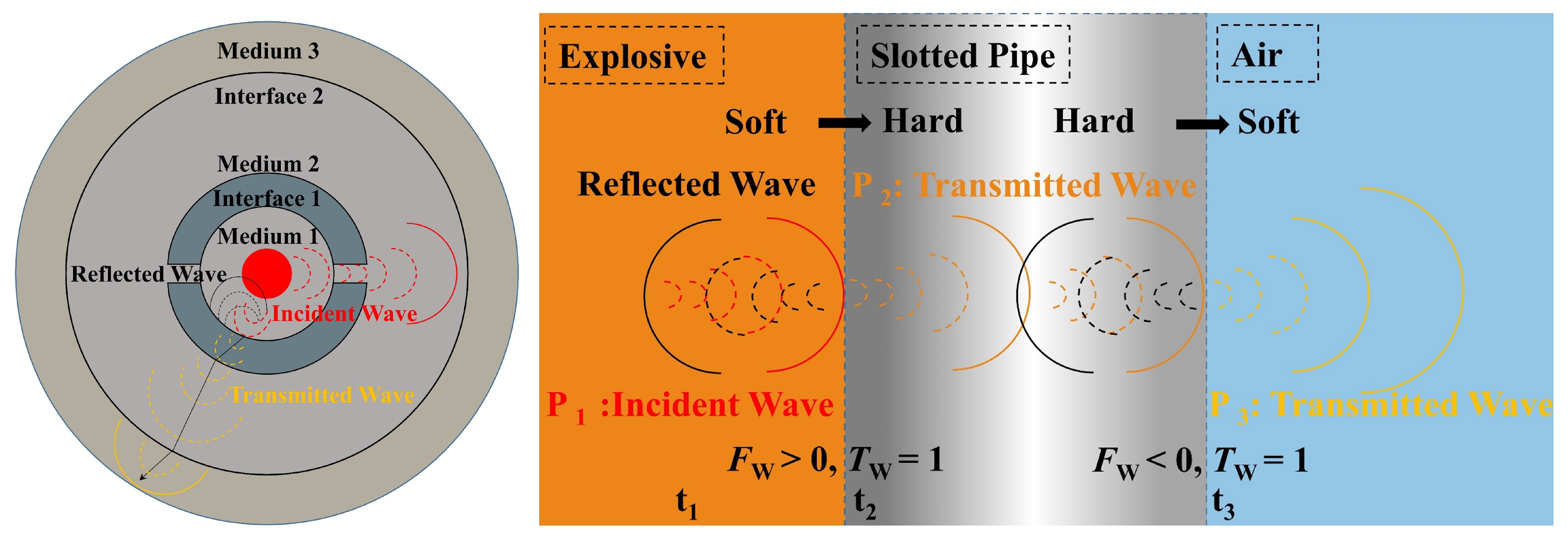
Based on the theory of shock wave propagation, a shock wave will undergo reflection and transmission when it encounters an interface between media with different wave impedances. Applying this principle to a slotted charge, the shock wave encounters interfaces between three media with distinct wave impedances: the explosive products, the slotted pipe material, and the air within the slot. Therefore, as the shock wave propagates, it first reflects and transmits at the inner wall of the tube. A portion of the wave then passes through the tube material and eventually impacts the borehole wall, where it undergoes a second set of reflections and transmissions [31]. As illustrated in Figure 3, when a shock wave strikes the tube interface, part of the wave is reflected (reflected wave), and part is transmitted through the tube material as a transmitted wave [32].
To investigate the reflection and transmission phenomena at the tube interface, we consider the simplified case of normal incidence. When an incident wave traveling from Medium 1 strikes the interface with Medium 2, the intensities of the reflected and transmitted waves are primarily determined by the differing wave impedances of the two media [33]. The wave impedance of a material is calculated as the product of its density ( ρ ) and its longitudinal wave velocity (C). According to Newton’s Third Law, the conditions for continuity of particle velocity (v) and stress ( σ ) at the interface must be satisfied [34]:
v T = v I + v R σ T = σ I + σ R
where the subscripts I, R, and T denote the incident, reflected, and transmitted waves, respectively. Based on the conservation relations across a shock front, Equation (3) can be expressed in terms of wave impedance:
σ T ( ρ m C 1 ) 2 = σ I ( ρ m C 1 ) 1 σ R ( ρ m C 1 ) 1 σ T = σ I + σ R
Solving the system of equations yields:
σ R = F w σ I v R = F w v 1
σ T = T w σ I v T = n T w v 1
n = ( ( ρ m C 1 ) 1 / ( ρ m C 1 ) 2 ) F w = ( 1 n ) / ( 1 + n ) T w = 2 / ( 1 + n )
where F w is the reflection coefficient for stress. T w is the transmission coefficient for stress. n is the ratio of wave impedances between the two media ( n = ρ 2 C 2 / ρ 1 C 1 ).
To deeply understand the interaction between the explosive, the casing, and the rock, it is essential to analyze the reflection and transmission of stress waves at the interfaces. The relationship between the reflection coefficient ( F w ) and transmission coefficient ( T w ) is given by [31,35]:
T w = 1 + F w
Evidently, the transmission coefficient T w is always positive, indicating that the transmitted stress wave remains in phase with (i.e., has the same sign as) the incident stress wave. However, its amplitude is governed by the impedance ratio n. Two primary scenarios exist at the interface during normal incidence:
  • Scenario 1: From Lower to Higher Impedance (“Soft” to “Hard”). When a stress wave propagates from a medium with lower impedance to one with higher impedance ( n > 1 ), the reflection coefficient F w is positive (reflection is in phase). In this case, the transmission coefficient T w is greater than 1, resulting in an amplification of the transmitted stress wave ( σ T > σ I ). This typically occurs when the detonation wave impacts the inner wall of a steel casing.
  • Scenario 2: From Higher to Lower Impedance (“Hard” to “Soft”). Conversely, when the wave travels from a higher-impedance medium to a lower-impedance one ( n < 1 ), F w is negative (reflection is out of phase). The stress wave is attenuated, with T w < 1 , meaning the amplitude of the transmitted stress is lower than that of the incident stress ( σ T < σ I ). This occurs when the wave transmits from the casing into the slot (air) or directly into softer rock.
To synthesize this theoretical analysis with practical engineering choices, the relationship between casing material properties, wave impedance interactions, and the resulting blasting effects is summarized in Table 1. This comparison elucidates why materials with moderate impedance, such as PVC, are often preferred over high-impedance metals for balancing energy focusing with rock protection.
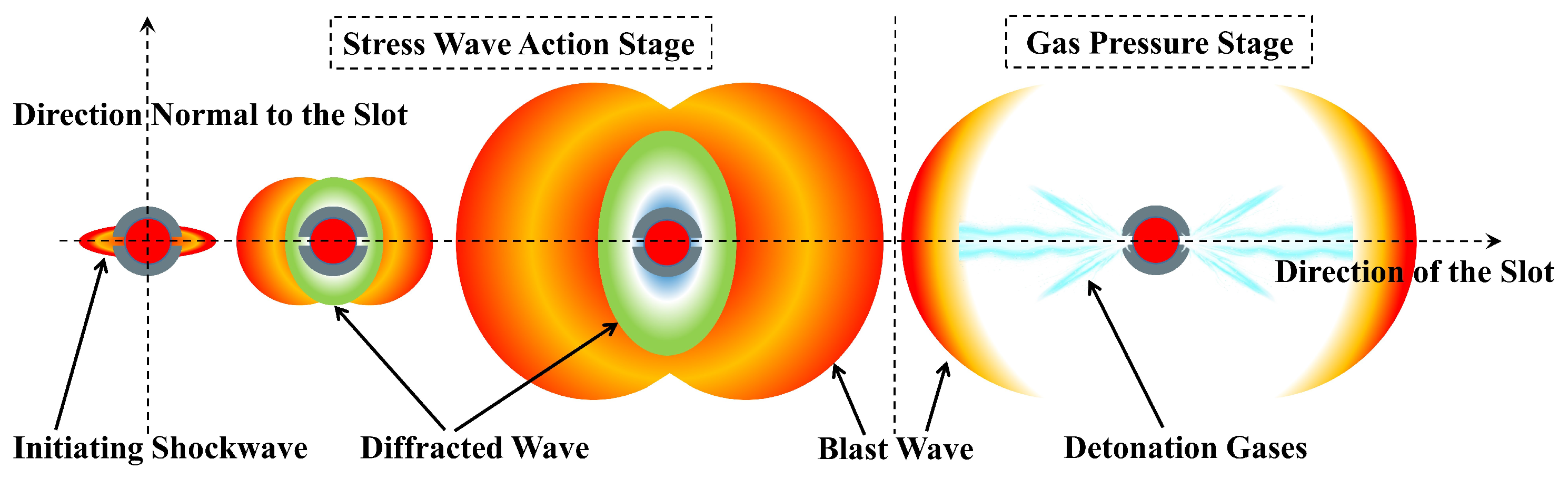
Beyond impedance matching, the directional energy-focusing (or shaped-charge) effect is a defining characteristic of this technology. This effect stems from the slotted pipe’s ability to guide both the initial shock wave and the subsequent detonation gases toward the slot openings. A physical model illustrating this process is presented in Figure 4.
As depicted in Figure 4, upon detonation, the initial shock wave preferentially propagates in the directions of the slots. As the wavefront advances, it diffracts around the outer surface of the tube. This diffraction leads to the collision of shock waves emanating from adjacent slot edges, forming a Mach stem that trails the primary shock front. Observations reveal that the diffracted wavefronts lag behind the primary shock wave in the slotted direction, and their intensity is significantly lower. The overall shape of this diffracted wave pattern resembles an “American football” or “rugby ball” profile [36].
Crucially, the presence of the slotted pipe ensures that the blast-induced shock wave not only emerges first but also maintains its highest intensity along the predefined slot axes. Following this initial impact, the high-pressure detonation gases expand to a maximum volume within the tube. Upon reaching this limit, the gas expansion momentarily stagnates and then re-pressurizes due to the confinement of the solid tube walls. This pressurized gas is then channeled and expelled at high velocity through the slots. This directed expulsion, often described as a “jetting” action, creates a linear, “I”-shaped loading pattern along the slot axes, thereby efficiently accelerating the propagation of the dominant fractures.

2.3. Crack Initiation and Propagation Mechanics

Leveraging principles from explosive and fracture mechanics, this section analyzes the conditions required for initial crack formation during the detonation of a slotted charge. Let p 2 be the pressure on the borehole wall in the slotted direction and p 1 be the pressure in the non-slotted direction. This pressure differential generates a shear stress, τ . According to the Mohr-Coulomb failure criterion, for a shear crack to initiate at the borehole wall, the following condition must be met [37]:
τ = S s d = σ tan ϕ + C
where S s d is the dynamic shear strength of the rock. C is the rock cohesion. ϕ is the angle of internal friction. Alternatively, failure can occur through tensile fracturing. Tensile failure will invariably initiate in the slotted direction, where the stress is highest. This mode of failure occurs when the maximum tangential tensile stress, σ θ , exceeds the rock’s dynamic uniaxial tensile strength, S t d . The tangential stress is related to the borehole wall pressure (p) by the following expression:
σ θ = p μ / ( 1 μ )
We can establish the minimum borehole pressures (p) required to initiate directional tensile and shear fractures, respectively:
p > S t d ( 1 μ ) p > ( C τ ) ( 1 μ ) / ( μ tan ϕ )
It is important to note that while Equation (11) presents these as distinct analytical thresholds, the actual rock failure process is rarely binary. In real blasting scenarios, tensile and shear mechanisms often coexist (mixed-mode failure). For slotted charges, the design intention is to ensure that the tensile threshold is exceeded first at the slot tip, making tensile failure the dominant mechanism for fracture initiation. However, shear failure inevitably occurs simultaneously, particularly in the formation of the borehole crushing zone or during the complex interaction of reflected waves. Therefore, to generate well-defined initial directional cracks, the blast pressure must be engineered to prioritize the tensile mode along the slot axis while minimizing the shear envelope in non-target directions. However, it must be noted that the Mohr–Coulomb criterion (Equation (9)) describes only the threshold for failure initiation. It is insufficient to represent the subsequent post-peak degradation and unstable propagation phases. As demonstrated in recent advances in rock fracture mechanics [38], once the fracture initiates, the shear strength is not constant. Instead, a slip-weakening law governs the propagation stage, where the shear strength decreases progressively from its peak value to a residual level with accumulated slip. Incorporating this degradation mechanism is essential for accurately predicting the extent of the crushed zone and the transition from shear damage to tensile extension in numerical models. Numerous theoretical models exist for calculating the length of these initial cracks. A widely adopted empirical formula is given by [30]:
a 0 = r b μ p ( 1 μ ) S u l 1

3. Advanced Research Methodologies

3.1. Advanced Diagnostic Techniques for Fracture Dynamics

Experimental research has been instrumental in elucidating the complex dynamics of slotted charge blasting. However, due to the transient, microsecond-scale nature of explosions, conventional mechanical sensors often fall short. To visualize and quantify these rapid phenomena, researchers have employed sophisticated optical techniques using transparent model materials (e.g., PMMA).
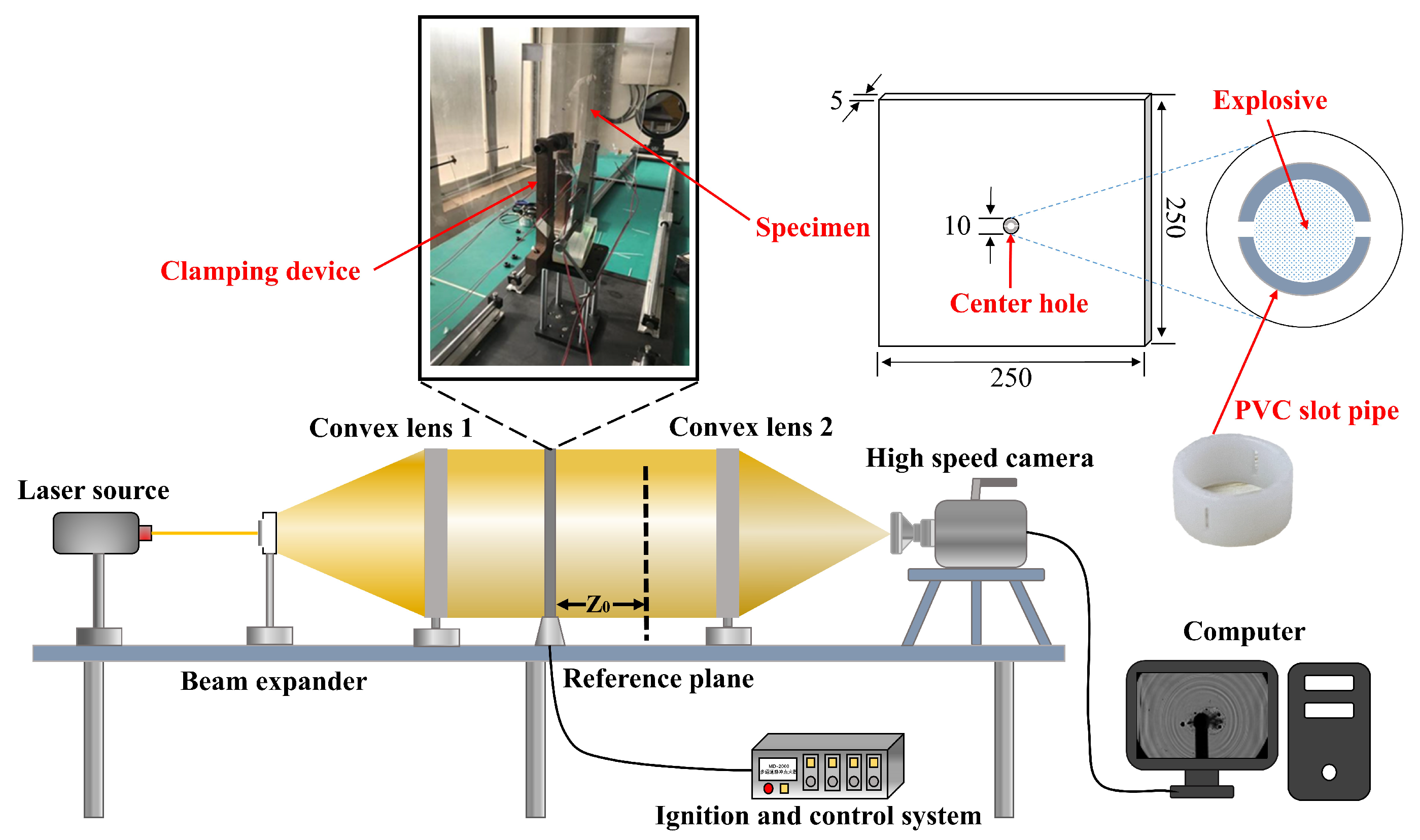
The dynamic caustics method, in particular, has been widely used to analyze crack propagation under explosive loading [39,40,41]. This technique transforms stress concentration gradients into shadow spots, allowing for the direct calculation of fracture parameters. For instance, Yue et al. [42] utilized this method to capture the interaction between stress waves and propagating cracks, successfully estimating the dynamic stress field at the crack tip. Similarly, Qiu et al. [43,44,45] extensively applied caustics to investigate crack extension mechanisms under various stress wave incidence angles and to evaluate the transient effects of reflected waves. Their work established the dynamic Stress Intensity Factor (SIF) as a key quantitative parameter for characterizing directional fracture behavior. The typical configuration of a digital laser dynamic caustics system is illustrated in Figure 5.
Complementing this, dynamic photoelasticity has been utilized to visualize full-field stress distributions, such as Mach cones and Rayleigh wave tails generated by blast-induced stress waves, and their interaction with pre-existing flaws [47,48]. These high-fidelity diagnostic tools have provided invaluable insights, allowing researchers to verify theoretical mechanisms that are impossible to observe in opaque rock masses.
However, it is crucial to acknowledge the inherent limitations of these optical methods when extrapolating results to field engineering. First, the material constraint is significant: methods like caustics and photoelasticity require transparent surrogates (e.g., PMMA, polycarbonate), which are homogeneous and isotropic. They cannot replicate the micro-structure, pre-existing fissures, and heterogeneity of natural rock, potentially oversimplifying the fracture path. Second, these experiments typically operate under 2D plane stress conditions; while effective for visualizing stress wave propagation, they fail to capture the complex three-dimensional interaction between the explosion gas wedge and the borehole wall found in real-world scenarios. Therefore, these experimental results serve as idealized theoretical verifications rather than direct replicas of field blasting.

3.2. Numerical Simulation Approaches

Numerical simulation has emerged as a powerful tool to complement experimental limitations, providing detailed insights into the blast process—particularly inside the borehole and the crushed zone—that are difficult to measure directly due to extreme temperatures and pressures [49,50,51].
Among the various computational methods, the coupled Smoothed Particle Hydrodynamics-Finite Element Method (SPH-FEM) has proven particularly effective. This hybrid approach leverages the meshless nature of SPH to model the high-distortion expansion of detonation products without mesh entanglement, while using FEM to accurately calculate the far-field rock deformation. For instance, Cheng et al. [52] utilized this method in AUTODYN to model the intricate interaction between expanding detonation products and the surrounding rock damage evolution. To ensure the fidelity of these simulations, a rigorous modeling protocol is typically observed in the literature. Regarding model selection, the high-pressure behavior of the explosive is almost universally governed by the Jones-Wilkins-Lee (JWL) Equation of State, which accurately describes the adiabatic expansion of detonation gases. For the rock medium, simple elastic models are insufficient; instead, advanced constitutive models such as the RHT (Riedel–Hiermaier–Thoma) or HJC (Holmquist–Johnson–Cook) damage models are employed. These models are essential for capturing strain-rate dependency, shear hardening, and the accumulation of damage under dynamic loading. Regarding boundary conditions, “Transmitting” or “Non-reflecting” boundaries are applied to the model edges to prevent artificial stress wave reflections, thereby simulating an infinite rock mass. Furthermore, parameter calibration is a critical step; input parameters for the rock model are typically calibrated against standard static (UCS) and dynamic (Split Hopkinson Pressure Bar) laboratory tests to ensure the simulation matches the physical material response. Similarly, Shen et al. [32,53] employed simulations to analyze shockwave interactions and gas dynamics, specifically focusing on the deformation behavior of the slotted casing itself during the detonation phase.
To ensure the reliability of these computational models, the studies reviewed herein adopt rigorous validation protocols, typically comparing simulation results against physical experiments. A critical analysis of the literature reveals three distinct validation strategies: (1) Morphological Agreement: Yue et al. [42] and Yang et al. [54] validated their models by directly overlaying simulated Von Mises stress nephograms onto optical “shadow spots” obtained from dynamic caustics experiments, confirming the accurate reproduction of the “butterfly” stress field. (2) Kinematic Consistency: For quantitative verification, Qiu et al. [44] and Cheng et al. [52] compared the time-history curves of simulated Crack Propagation Velocities and dynamic Stress Intensity Factors with experimental measurements, reporting error margins within 5–10%. (3) Fracture Geometry: The final failure pattern serves as the ultimate check. Ding et al. [55] and Shen et al. [32] utilized the final crack length and the deflection angle (pinch angle) as primary validation metrics. As demonstrated in the subsequent parametric analysis (Section 4.2), the simulated crack trajectories align closely with these experimental geometric data, confirming the model’s predictive accuracy for fracture pathing [46,56].
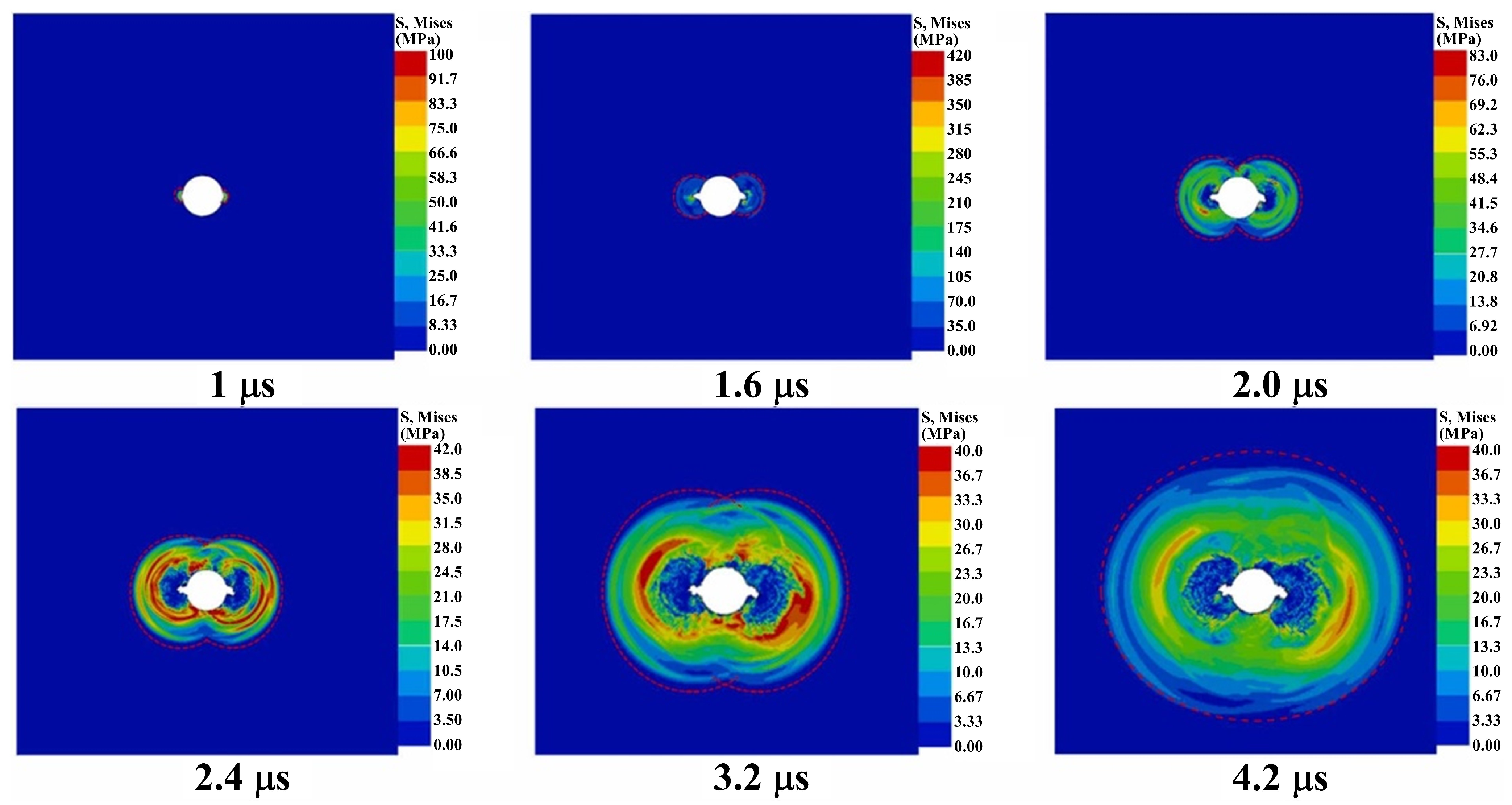
Furthermore, numerical models have been pivotal in analyzing complex geological conditions. Simulations have successfully validated experimental findings regarding high in situ stress, demonstrating that aligning the slot with the maximum principal stress direction significantly enhances directional fracture propagation [57,58,59]. Other studies have extended this to deep rock mass environments, confirming the protective effect of slotted charges under high confinement [60,61,62,63,64]. The ability of these models to accurately predict the directional stress concentration—as vividly depicted in the Von Mises stress nephogram in Figure 6—makes them an indispensable component of modern research into blasting mechanics [65,66,67].

4. Key Influencing Factors and Optimization

The efficacy of slotted charge blasting is governed by a complex interplay of design parameters. Extensive research has isolated specific variables that are critical for achieving precise directional fracture control. Based on the literature reviewed, the blasting outcome is primarily determined by four key factors: (1) the material properties of the slotted casing; (2) the slot geometry, particularly the slot width; (3) the radial decoupling ratio between the charge and the borehole wall; and (4) the overall charge structure and layout. Detailed optimization of these parameters is essential for maximizing the energy-focusing effect while minimizing collateral damage to the surrounding rock mass.

4.1. Effect of Slotted Pipe Material

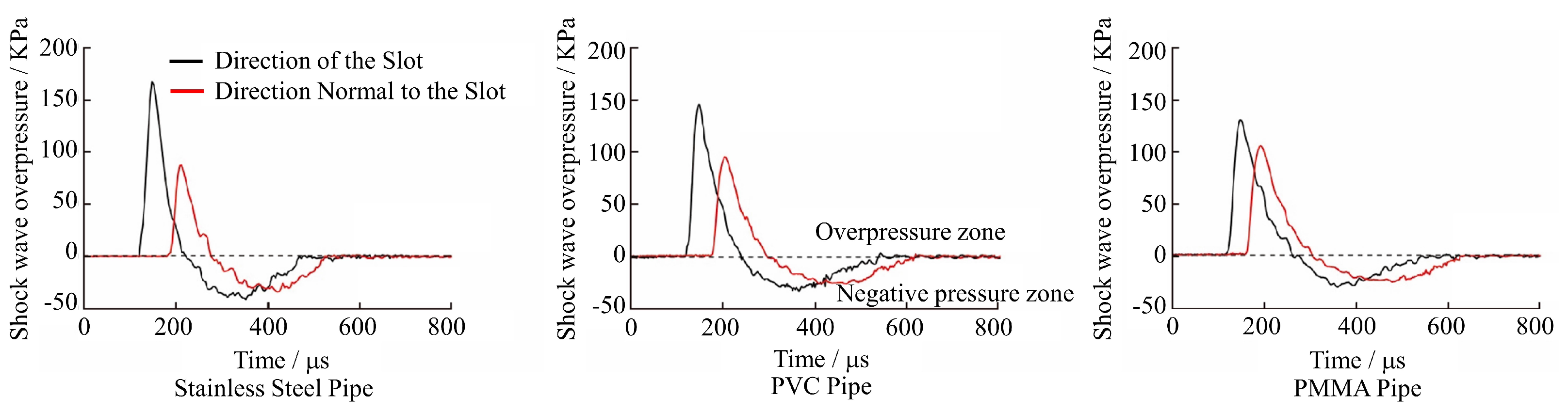
Numerous researchers have investigated the influence of the slotted pipe’s material on the effectiveness of directional fracture control, employing laboratory experiments and physical model tests [68,69]. The selection of an appropriate material involves a critical trade-off, which is intrinsically linked to the shock wave dynamics (an example overpressure curve is shown in Figure 7) and the confinement effect.
From a mechanism perspective, the material composition of the tube significantly influences the detonation velocity (VOD) of the encapsulated explosive. A casing with higher strength and acoustic impedance provides stronger confinement, reducing the radial expansion of detonation products and thereby maintaining a higher pressure within the reaction zone. This relationship is quantified in Table 2, which summarizes experimental results for various explosives confined within tubes made of different materials.
The data in Table 2 reveal a clear trend: for a cylindrical charge with constant dimensions, the confinement provided by the outer casing enhances the explosive’s detonation velocity. Furthermore, this effect is proportional to the material strength. Iron pipes consistently yield the highest VOD (approx. 3800 m/s), followed by PVC, with weaker Paper pipes resulting in the lowest velocities.
This high VOD in stronger materials translates to a more intense initial shock wave. For instance, Yang et al. [70] utilized high-speed schlieren imaging to confirm that the energy-focusing capability follows the order: stainless steel > PVC > PMMA. However, while steel maximizes energy transfer, it also poses a risk of crushing the borehole wall due to excessive peak pressure. Conversely, if the tube’s strength is too low (e.g., paper), it fails prematurely, destroying the guidance channel before the directional fracture can initiate.
Therefore, practical engineering requires balancing performance (high VOD and focusing) with cost and wall protection. In non-slotted directions, ductile materials like PVC are advantageous because they deform to absorb excess blast energy, effectively “cushioning” the rock. Consequently, considering the balance of directional performance and cost, PVC is often the preferred choice for standard field applications. However, a balanced assessment requires identifying the critical limitations of both materials. The use of PVC becomes fundamentally unjustified—even under standard environmental conditions—when excavating extremely hard, high-impedance rock (e.g., granite with f > 12). In such cases, the impedance mismatch and the shock-absorbing nature of PVC can excessively attenuate the transmitted wave, causing the borehole pressure to fall below the high tensile strength required for crack initiation. Here, the “soft protection” becomes a liability, leading to misfires or underdeveloped fractures. Conversely, while steel casings resolve the initiation problem in hard rock, their downsides extend beyond higher material costs. Operationally, steel casings introduce significant safety hazards regarding shrapnel generation, which poses risks to personnel and can cause severe damage to downstream mucking and crushing equipment. Furthermore, the logistical burden of transporting heavy steel pipes in confined underground spaces restricts their utility to specialized, high-value excavations. Therefore, the selection is not binary but functional: PVC is optimal for wall preservation in medium rock, while steel is necessary for maximum fracturing power in extremely hard rock.

4.2. Slot Geometry and Width

Building on the fundamental understanding of fracture mechanics, recent research has focused on optimizing blasting performance by investigating key design parameters. Early studies explored the influence of pre-slotted borehole geometry (cutting slots directly into the rock), with Li et al. [71] noting the highly symmetric propagation of stress waves from such slots, and Ding et al. [72] discovering that cutout curvature affects crack initiation time.
However, given that fabricating precisely slotted boreholes in the field is often impractical, research and application have largely shifted to the more versatile slotted charge units (slotted casings). The selection of an appropriate slot width involves a critical trade-off between two primary objectives: (1) The explosive load directed through the slots must be sufficient to initiate and guide a primary fracture at the borehole wall; and (2) The blast-induced load in the non-slotted directions must remain below the rock’s dynamic tensile strength to prevent collateral damage.
Mechanistically, the slot width directly influences the formation of the initial guidance fractures. An overly narrow slot acts as a choke, diminishing the direct energy transfer to the borehole wall. Conversely, an overly wide slot disperses the energy over a larger area, leading to a loss of the “jetting” effect and potentially causing multiple, misaligned fractures to form.
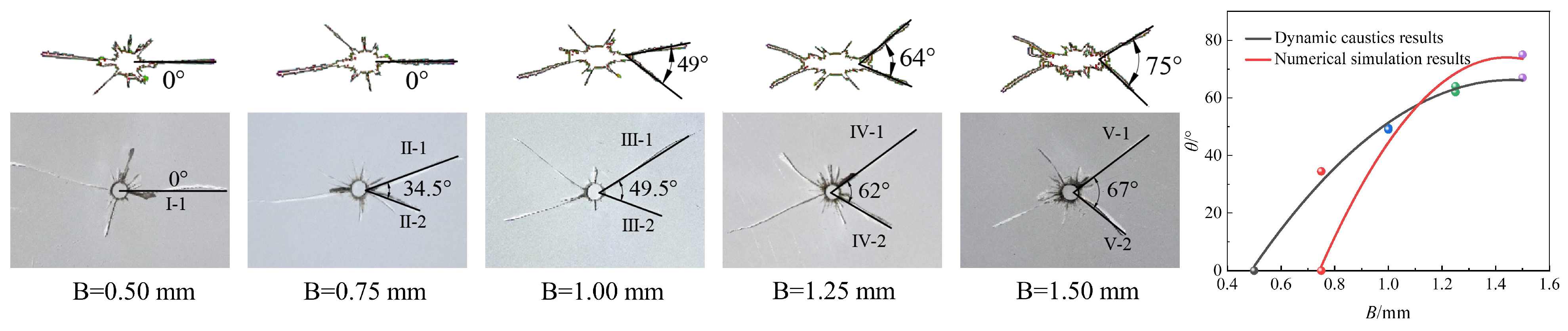
This relationship is quantified by the angle θ between the two primary blast-induced cracks, which is a direct function of the slot width B. Figure 8 illustrates this relationship, plotting data from both dynamic caustics experiments and numerical simulations. As observed in the figure, when the slot width exceeds 0.5 mm, two distinct main cracks form, propagating outwards at an angle rather than along a single coherent line. This angle increases sharply for widths between 0.5 mm and 1.0 mm. For widths from 1.0 mm to 1.5 mm, the rate of increase diminishes, and the curve begins to plateau. This trend aligns well with the theoretical relationship described by Equation (13), which models the crack angle as an arctangent function of the slot width. However, applying these values requires considering the scaling effect. The data shown in Figure 8 (0.5–1.5 mm) are derived from laboratory models where the borehole diameter is typically small (e.g., 6–10 mm). To translate these findings to field engineering, the Geometric Similarity Principle must be applied. Since standard industrial boreholes for tunneling typically range from 42 mm to 50 mm in diameter, the slot width must be scaled proportionally to maintain the effective ratio of ‘slot width to borehole perimeter.’ Consequently, extrapolating from the optimal laboratory ratios, field experience has shown that a slot width in the range of 3–5 mm generally yields the longest crack propagation and the most effective directional control in standard engineering applications [46].
θ = 2 arctan B 2 r b [ μ p ( 1 μ ) S t d 1 ]

4.3. Radial Decoupling Ratio

In coupled charging scenarios (where the explosive fills the entire borehole), both conventional and slotted-charge blasting tend to create a network of random radial cracks around the borehole wall, often resulting in excessive crushing rather than the desired controlled splitting. Therefore, employing an appropriate radial decoupling ratio (the ratio of the borehole diameter to the charge diameter) is essential. This parameter is critical because it governs two key blast mechanics: (1) the peak magnitude of the stress wave impacting the borehole wall, and (2) the duration over which the quasi-static pressure from the detonation gases acts.
Test results have confirmed that the decoupling ratio is a dominant factor in guiding crack propagation. However, the “optimal” value is not a fixed constant but depends heavily on the rock’s dynamic strength and wave impedance. For instance, Li et al. [6] found an optimal ratio of 1.42 in concrete model tests (simulating medium-strength rock), which resulted in two primary cracks propagating in a nearly straight line (close to 180 ° apart) and reaching a maximum length of 15.5 cm. Similarly, Wang [73] identified an optimal ratio of 1.67 for hard rock conditions. Crucially, a general engineering rule applies: the optimal decoupling ratio is inversely related to the rock’s compressive strength. Harder, competent rocks require a lower ratio (a smaller air gap, e.g., 1.2–1.4) to ensure the peak pressure exceeds the high tensile strength for initiation. Conversely, soft or fractured rocks require a higher ratio (e.g., >1.6) to excessively attenuate the shock wave, thereby preventing the formation of an enlarged crushed zone that would stifle directional crack growth. In contrast, deviations from this optimal range—whether too large (e.g., 1.71) or too small (e.g., 1.28)—resulted in fractures that deviated significantly from the intended path or were stunted by secondary cracking.
The underlying mechanism involves a delicate balance between shock wave intensity and gas expansion. An optimized decoupling ratio orchestrates the following effects [74,75]:
1.
Shock Wave Attenuation: The air gap reduces the initial peak stress on the borehole wall, preventing the formation of a chaotic crushed zone. This allows the slotted pipe’s structural “jetting effect” to initiate cracks cleanly without interference from random micro-damage.
2.
Gas Action Enhancement: It extends the action time of the quasi-static gases, allowing them to effectively penetrate and extend the fractures in the slotted direction.
By optimally channeling energy, the fracture extension in the desired direction is maximized. Based on the principle of energy conservation, this focused energy transfer naturally suppresses crack formation in the non-slotted directions.

4.4. Charge Configuration and Structural Layout

Beyond the geometry of a single slot, the overall charge configuration defined by the slot count, spatial arrangement, and charge diameter is a critical determinant of the final blasting outcome.
A critical evaluation of current research reveals distinct performance boundaries for different configurations: Radial Slot Count: While multi-slot designs (e.g., 3 or 4 slots) have been explored [56], they often show diminishing returns for directional control. Increasing the slot count distributes the gas pressure more evenly, which dilutes the stress concentration factor at any single tip. Consequently, while multi-slot charges create a complex fracture network suitable for rock mass pre-conditioning (fragmentation), they are generally less effective than the standard symmetric dual-slot (180°) configuration for precise smooth blasting and splitting. Axial Arrangement: In contrast, optimizing the configuration along the borehole axis shows significant promise. Ding et al. [55] discovered that continuous slotted charging can lead to excessive damage at the collar. Therefore, axially discontinuous slotted charges or designs with variable slot lengths are identified as a promising direction for future research. These configurations allow for “precision management” of the stress field along the tunnel depth, preventing energy waste and collar damage.
The diameter of the charge itself is another critical structural parameter. Yang et al. [76] confirmed that varying the charge diameter influences the three-stage fracture process (initiation, propagation, and arrest). Complementing this, earlier micro-scale investigations by Yang et al. [54] utilized dynamic caustics and fracture surface analysis to reveal that optimized charge structures can alter the microscopic failure characteristics of the rock, ensuring that tensile failure dominates along the desired path.

5. Engineering Applications

The practical benefits of slotted charge blasting have been successfully demonstrated in various engineering projects. Yang et al. [77] applied this technology to smooth-wall blasting in hard rock excavation, achieving improved hole utilization, larger hole spacing, and reduced explosive consumption, thereby enhancing overall energy efficiency. Similarly, Song et al. [78] validated its superiority over conventional blasting in tunnel excavation, confirming its feasibility and effectiveness in achieving a superior final rock contour. The technology’s advantages—simplicity, cost-effectiveness, and high adaptability compared to slotted holes or conventional shaped charges—have led to its widespread adoption [79,80], especially in smooth-wall and pre-split blasting [81,82,83,84]. A significant practical advantage is that effective performance can be achieved with non-metallic, fire-retardant materials like PVC, which do not produce incandescent particles, making the technology suitable for use in gassy underground coal mines.
Despite these advances, a review of the literature reveals a significant gap: research has overwhelmingly focused on axially slotted charges used for perimeter control. Investigations into other configurations, such as circumferential slotted charges for applications like cutting or chambering, remain scarce. This narrow focus limits a comprehensive understanding of slotted charge mechanics and hinders the technology’s broader engineering application and potential for innovation.

6. Challenges and Future Directions

Slotted charge blasting remains a highly economical and effective excavation method for underground engineering, offering superior directional control compared to conventional techniques. However, despite its widespread adoption in smooth-wall and pre-split blasting, the technology faces significant hurdles, particularly as mining depths increase and geological conditions become more complex. To advance this field, future research must address the following critical challenges and pursue these promising directions:

6.1. Deepening Theory for Complex Geological Conditions

Current theoretical models are largely derived from competent rock mechanics and often fail to predict behavior in weak, fractured rock masses or under high in situ stress conditions typical of deep mining. The interaction mechanism in these complex environments remains poorly understood [85,86,87]. To bridge this gap, future research must pivot from ideal linear elastic models to damage mechanics models that account for anisotropy and in situ stress. Specifically, a dedicated theoretical framework for “Soft-Rock Directional Fracturing” needs to be established. This involves elucidating how the slotted casing interacts with plastic zones in weak rock to prevent borehole collapse while still guiding fractures.
Crucially, this theoretical deepening must address a fundamental “Mechanism Transition” in non-ideal rock masses. In hard, brittle rock, directional fracturing is undeniably initiated by the stress wave diffraction (energy focusing) at the slot tip. However, in weak or highly fractured rock, the borehole wall enters a plastic or crushed state almost instantly, rapidly attenuating the stress wave. Under these conditions, we postulate that the governing mechanism shifts from “wave-induced anisotropy” to “gas-driven redistribution.” The slotted casing effectively loses its role as a wave reflector but retains its critical function as a mechanical shield, forcing the high-pressure gas to act only on the pre-damaged zone at the slots while protecting the non-slotted wall. For weak rock, optimizing the slot width and increasing the decoupling ratio becomes more critical than the acoustic impedance of the casing material. Future research must quantify this transition point to guide engineering design in complex geology.

6.2. Standardization of Design Parameters

The selection of critical variables—such as charge diameter, slot width, decoupling ratio, and spacing—currently relies heavily on empirical experience. This lack of standardization often leads to sub-optimal blasting results or safety hazards like misfires and rock bursts. To overcome these issues, there is an urgent need to transition from empirical judgment to quantitative design. Future efforts should integrate large-scale numerical simulations with field trials to quantify the coupled effects of these parameters. The ultimate goal is to establish a standardized “Look-up Table” or design code for slotted charges that engineers can reference based on specific rock properties.

6.3. Advanced Diagnostics and Mechanism Verification

The transient nature of the “shockwave–gas” interaction occurs on a microsecond scale, making it difficult to capture with current experimental techniques. This lack of high-fidelity data hinders the precise understanding of the energy-focusing mechanism. Consequently, future research should focus on the development of next-generation diagnostic tools. Techniques such as ultra-high-speed photography combined with Digital Image Correlation (DIC), and internal borehole pressure sensors, are required to visualize the “jetting” action. Furthermore, validating the “hydro-blasting” effect of water-filled slotted cartridges requires rigorous field testing to confirm its environmental benefits, such as dust suppression, alongside its fracturing efficiency.

6.4. Innovation in Manufacturing and Intelligent Control

Current slotted charges are typically mass-produced with fixed slot geometries, such as standard PVC pipes with pre-cut slots, which lacks the necessary flexibility to adapt to changing geological conditions encountered within a single tunnel. Addressing this limitation represents a promising, albeit currently conceptual, frontier. Future research should explore the integration of Intelligent Manufacturing with Measurement-While-Drilling (MWD) technology, with the vision of moving away from generic, mass-produced pipes toward “site-specific” designs. However, realizing this requires overcoming significant engineering hurdles. Specifically, research must focus on: (1) material adaptation, involving the development of rapid-curing, low-cost polymers that can withstand the dynamic shock of blasting; and (2) production efficiency, ensuring that additive manufacturing (3D printing) speeds can match the rapid cycles of tunnel excavation. If these bottlenecks are resolved, the capability to customize casing wall thickness and slot width based on real-time rock strength data would represent a paradigm shift from “passive application” to “active adaptive control” in slotted charge blasting.

7. Conclusions

This paper provides a comprehensive review of slotted charge blasting technology, synthesizing global research on its underlying mechanisms, key performance factors, and engineering applications. The following conclusions can be drawn:
(1)
The technology relies on a dual-mechanism of “energy focusing” in the slotted direction and “soft protection” in the non-slotted direction. Recent advances in diagnostic tools, particularly dynamic caustics and SPH-FEM coupling, have been instrumental in visualizing these transient shockwave–gas interactions, providing the theoretical basis for precise control.
(2)
Operational success depends on the rigorous optimization of design parameters. The review indicates that while high-strength materials (like steel) maximize energy focusing, ductile materials (like PVC) offer the optimal balance between directional performance, cost-effectiveness, and wall protection. Although direct cost comparisons depend on specific project conditions, the technology’s economic advantage is primarily derived from indirect savings—specifically by minimizing overbreak and reducing the need for secondary support.
(3)
While slotted charge blasting is currently the dominant method for perimeter control, its future evolution lies in the transition from empirical design to Intelligent Adaptive Control. The integration of real-time monitoring with Additive Manufacturing represents a critical technological breakthrough. Specifically, this convergence enables a “Closed-Loop” workflow: MWD systems acquire real-time rock strength data during drilling, AI algorithms instantly calculate the optimal slot geometry for that specific geology, and on-site 3D printers fabricate customized casings immediately. The prospective impact of this innovation is profound. It promises to transform blasting from a discrete, manual operation into a fully digitized, automated process, allowing for “borehole-specific” precision that eliminates the uncertainty caused by rock heterogeneity.
Despite these advancements, the field faces fundamental scientific questions that remain unresolved. First, the precise quantitative partition of energy between the initial shock wave diffraction and the subsequent gas wedge expansion within the slot structure is still debated; establishing a unified constitutive model to decouple these contributions is a critical next step. Second, the “competition mechanism” between artificially guided cracks and natural geologic discontinuities is not fully understood. Specifically, determining the critical criteria under which a directional fracture can successfully traverse a natural joint, rather than being arrested or diverted by it, remains a priority for research in deep, fractured rock mechanics.

Author Contributions

X.Z.: Conceptualization, Methodology, Data extraction, Formal analysis, Writing—original draft, Visualization. S.Y.: Methodology, Validation, Writing—review and editing. G.L.: Conceptualization, Validation, Resources, Writing—review and editing. Y.Y.: Investigation, Data curation, Writing—review and editing. J.W.: Conceptualization, Supervision, Project administration, Writing—review and editing. X.L.: Supervision, Funding acquisition. All authors have read and agreed to the published version of the manuscript.

Funding

Funding information National Natural Science Foundation of China: Grant Nos. 42467023; Higher Education Institutions’ Scientific & Technological Project for Priority Industries of Yunnan Province: FWCY-QYCT2024010; Higher Education Institutions’ Scientific & Technological Project for Priority Industries of Yunnan Province: FWCY-BSPY2024053.

Institutional Review Board Statement

Not applicable.

Informed Consent Statement

Not applicable.

Data Availability Statement

No new data were generated or analyzed in support of this research. All data discussed in this review are available from the original publications cited in the reference list.

Acknowledgments

The authors gratefully acknowledge the foundational research conducted by the many scientists and scholars whose work is cited in this review. We stand on the shoulders of these giants, and this article would not have been possible without their contributions to the field. We also thank the editors and anonymous reviewers for their insightful comments.

Conflicts of Interest

Author Guangquan Li was employed by the company Yunnan Diqing Non-Ferrous Metals Co., Ltd. The remaining authors declare that the research was conducted in the absence of any commercial or financial relationships that could be construed as a potential conflict of interest.

References

  1. Shu, Y.; Shao, P.; Dong, C.; Cao, Z.; Yi, X. Influence of Rock Strength on the Propagation of Slotted Cartridge Blasting-Induced Directional Cracks. Adv. Civ. Eng. 2019, 2019, 5752189. [Google Scholar] [CrossRef]
  2. Yan, S.; Jian, X.; Li, X.; Feng, X.; Li, G. Optimization of blasting for high-efficiency and low-damage drivage of large-section production drifts in block caving. Sci. Rep. 2025, 16, 2320. [Google Scholar] [CrossRef] [PubMed]
  3. T/CSEB 0015-2024; Specification for Smooth Blasting Engineering Technical Design. China Standards Press: Beijing, China, 2024.
  4. Liao, T.; Pu, C.; Wang, J.; Jiang, R.; Yang, X.; Chen, X. Model Experiment and Analysis of Wedge-Shaped Cutting Blasting with Cutting Seam Cartridge in Rock Tunnel. Met. Mine 2015, 464, 40–44. [Google Scholar]
  5. Fourney, W.; Dally, J.; Holloway, D. Controlled blasting with ligamented charge holders. Int. J. Rock Mech. Min. Sci. Geomech. Abstr. 1978, 15, 121–129. [Google Scholar] [CrossRef]
  6. Li, X.; Fang, C.; Wang, J. Effect of charge coefficient on directional fracture of slotted charge. J. Vib. Control 2023, 29, 4831–4840. [Google Scholar] [CrossRef]
  7. Wang, W.; Zhang, J.; Liu, A. Study on eccentric uncoupled blasting effect of cutting seam pipe. Coatings 2021, 11, 104. [Google Scholar] [CrossRef]
  8. Yue, Z.; Zhang, S.; Qiu, P.; Li, Z.; Yuan, K. Influence of charge structures on the slotted cartridge blasting effect. J. Vib. Shock 2018, 37, 27–34. [Google Scholar]
  9. Uenishi, K.; Rossmanith, H. Optical methods in fault dynamics. Opt. Lasers Eng. 2003, 40, 325–339. [Google Scholar] [CrossRef]
  10. Shukla, A.; Jain, N.; Chona, R. A review of dynamic fracture studies in functionally graded materials. Strain 2007, 43, 76–95. [Google Scholar] [CrossRef]
  11. Yang, R.; Zuo, J.; Yang, G. An experimental study on slotted cartridge directional controlled blasting. J. Vib. Shock 2018, 37, 24–29. [Google Scholar]
  12. Yang, R.; Che, Y.; Feng, D.; Wang, Q. Tests for blasting vibration reduction technique with presplitting blasting of a slotted cartridge. J. Vib. Shock 2014, 33, 7–14. [Google Scholar]
  13. Yang, R.; Ding, C.; Yang, L.; Chen, C. Model experiment on dynamic behavior of jointed rock mass under blasting at high-stress conditions. Tunn. Undergr. Space Technol. 2018, 74, 145–152. [Google Scholar] [CrossRef]
  14. Liu, W.; Yao, X.; Yang, R.; Yue, Z. Multi-crack propagation in PMMA plates under dynamic out-of-plane impact. Opt. Lasers Eng. 2020, 124, 105849. [Google Scholar] [CrossRef]
  15. Yang, L.Y.; Ding, C.X. Fracture mechanism due to blast-imposed loading under high static stress conditions. Int. J. Rock Mech. Min. Sci. 2018, 107, 150–158. [Google Scholar] [CrossRef]
  16. Yang, R.; Wang, Y.; Ding, C. Laboratory study of wave propagation due to explosion in a jointed medium. Int. J. Rock Mech. Min. Sci. 2016, 81, 70–78. [Google Scholar] [CrossRef]
  17. Xiao, C.; Yang, R.; Li, Q.; Zheng, C.; Kang, Y.; Li, Y. Experiment on blasting damage and dynamic caustics of jointed medium. Eng. Fract. Mech. 2022, 259, 108143. [Google Scholar] [CrossRef]
  18. Chen, S.; Fu, X.; Chen, Z.; Lin, H. Numerical Simulation Analysis of Slotted Cartridge Blasting Based on LS-DYNA. Coal Technol. 2018, 37, 62–64. [Google Scholar]
  19. Pu, C.; Guo, X.; Zhang, Z.; Xiao, Z. Mechanism Analysis of Cutting Seam Cartridge Blasting. Blasting 2006, 23, 33–35. [Google Scholar]
  20. Xie, H.; Ruan, H.; Wu, L.; Zhao, Z.; Yu, H.; Wu, X. Compound slit-charge mechanism analysis and millisecond blasting experiment. J. China Coal Soc. 2010, 35, 68–71. [Google Scholar]
  21. Yang, R.; Gao, X.; Chen, C.; Zuo, J. Experimental study on blast wave propagation mechanisms of split-tube charge holders. J. China Coal Soc. 2014, 39, 1434–1440. [Google Scholar]
  22. Zuo, J.; Yang, R.; Min, G.; Yang, Y.; Ma, X. Studies on directional breaking controlled theory of slotted cartridge blasting for rock. Arab. J. Geosci. 2021, 14, 1928. [Google Scholar] [CrossRef]
  23. Liu, K.; Guo, D.; Zhang, J.; Kang, X. The dynamic caustics test on the growth law of fractures in tunnel surrounding under explosive load. J. Min. Sci. 2021, 57, 749–758. [Google Scholar] [CrossRef]
  24. Yue, Z.; Zhang, S.; Qiu, P.; Song, Y.; Lu, Y.; Sun, Y. Mechanism of explosive crack propagation with slotted cartridge millisecond blasting. J. China Coal Soc. 2018, 43, 638–645. [Google Scholar]
  25. Yue, Z.; Tian, S.; Chen, Z. Influence of the interval between holes on crack propagation in slit charge blasting. Chin. J. Rock Mech. Eng. 2018, 37, 2460–2467. [Google Scholar]
  26. Wang, Y.; Yu, B.; Kong, J.; Wang, M. The Spatial and Temporal Distribution of Rock Breaking Effect of Explosion Stress Wave of Slotted Cartridge. Am. J. Mech. Ind. Eng. 2019, 4, 76–85. [Google Scholar] [CrossRef]
  27. Ishchenko, O.; Novikov, L.; Ponomarenko, I.; Konoval, V.; Kinasz, R.; Ishchenko, K. Blast wave interaction during explosive detonation in a variable cross-sectional charge. Min. Miner. Depos. 2024, 8, 60–70. [Google Scholar] [CrossRef]
  28. Ishchenko, O.; Novikov, L.; Ponomarenko, I.; Konoval, V.; Kinasz, R.; Ishchenko, K. Influence of a compensatory well diameter on the efficiency of cut cavity shaping in hard rock formations. Min. Miner. Depos. 2025, 19, 13–15. [Google Scholar] [CrossRef]
  29. Wang, Q.; Yang, L.; Chao, Y.J.; Yang, R. Dynamic fracture criterion-fracture path of cracks emigrating from two circular blastholes. Theor. Appl. Fract. Mech. 2022, 118, 103233. [Google Scholar] [CrossRef]
  30. Yang, L.; Wang, Q.; Xu, L.; Yang, R.; Chao, Y.J. Fracture path of cracks emigrating from two circular holes under blasting load. Theor. Appl. Fract. Mech. 2020, 108, 102559. [Google Scholar] [CrossRef]
  31. Liu, C.; Lu, Y.; Xia, B.; Yu, P. Directional fracturing by slotting-blasting-caused stress wave form changes. Int. J. Impact Eng. 2019, 129, 141–151. [Google Scholar] [CrossRef]
  32. Shen, T.; Luo, N.; Xiang, J.; Gao, X. Numerical simulation on explosion mechanism of split-tube charge holders. Explos. Shock Waves 2018, 38, 1172–1180. [Google Scholar]
  33. Zhang, S.; Yue, Z.; Qiu, P.; Song, Y.; Yuan, K. The Effect of Buffer Medium on Fracture Mechanical Behavior of Slotted Cartridge Blasting. Sci. Technol. Eng. 2018, 18, 54–60. [Google Scholar]
  34. Wang, Y.; Li, S.; Geng, Y.; Xie, P. Directional fracture mechanism and surrounding rock damage characteristics of slotted cartridge blasting. Chin. J. Eng. 2023, 45, 521–532. [Google Scholar]
  35. Wu, B.; Xu, S.; Meng, G.; Cai, J.; Wei, H.; Li, H.; Zhang, J. Study on dynamic evolution law of blasting cracks in elliptical bipolar linear shaped charge blasting. Shock Vib. 2021, 2021, 5272878. [Google Scholar] [CrossRef]
  36. Gao, X.; Chen, C. Experimental and simulation study on blast wave effect of split-tube charge holder. Eng. Blasting 2018, 24, 20–25. [Google Scholar]
  37. Luo, Y.; Shen, Z. Study on the Directional Fracture Controlled Blasting with Slit Charge in Rock. J. Vib. Shock 2006, 25, 155–158. [Google Scholar]
  38. Li, Y. Spatial Distribution of Strain Energy Changes Due to Mining-induced Fault Coseismic Slip: Insights from a Rockburst at the Yuejin Coal Mine, China. Rock Mech. Rock Eng. 2025, 58, 1693–1706. [Google Scholar] [CrossRef]
  39. Yuan, Y.; Zhang, Q.; Sheng, C.; Zhang, Z. Theoretical model of caustics method for the interfacial cracks. Eng. Fract. Mech. 2020, 233, 107006. [Google Scholar] [CrossRef]
  40. Yang, R.; Xu, P.; Yue, Z.; Chen, C. Dynamic fracture analysis of crack–defect interaction for mode I running crack using digital dynamic caustics method. Eng. Fract. Mech. 2016, 161, 63–75. [Google Scholar] [CrossRef]
  41. Yue, Z.; Song, Y.; Yang, R.; Yu, Q. Comparison of caustics and the strain gage method for measuring mode I stress intensity factor of PMMA material. Polym. Test. 2017, 59, 10–19. [Google Scholar] [CrossRef]
  42. Yue, Z.; Qiu, P.; Yang, R.; Zhang, S.; Yuan, K.; Li, Z. Stress analysis of the interaction of a running crack and blasting waves by caustics method. Eng. Fract. Mech. 2017, 184, 339–351. [Google Scholar] [CrossRef]
  43. Qiu, P.; Yue, Z.; Yang, R.; Ju, Y. Modified mixed-mode caustics interpretation to study a running crack subjected to obliquely incident blast stress waves. Int. J. Impact Eng. 2021, 150, 103821. [Google Scholar] [CrossRef]
  44. Qiu, P.; Yue, Z.; Yang, R.; Li, J. Effects of vertical and horizontal reflected blast stress waves on running cracks by caustics method. Eng. Fract. Mech. 2019, 212, 164–179. [Google Scholar] [CrossRef]
  45. Qiu, P.; Yue, Z.; Yang, R. Mode I stress intensity factors measurements in PMMA by caustics method: A comparison between low and high loading rate conditions. Polym. Test. 2019, 76, 273–285. [Google Scholar] [CrossRef]
  46. Li, X.; Yan, S.; Wang, J.; Li, Q. Influence of Slot Width in Cartridge on Crack Propagation and Energy Concentration Under Explosion Load: Influence of Slot Width in Cartridge on Crack Propagation. Rock Mech. Rock Eng. 2025, 58, 1707–1721. [Google Scholar] [CrossRef]
  47. Yue, Z.; Qiu, P.; Yang, R.; Yang, G. Experimental study on a Mach cone and trailing Rayleigh waves in a stress wave chasing running crack problem. Theor. Appl. Fract. Mech. 2019, 104, 102371. [Google Scholar] [CrossRef]
  48. Chen, C.; Yang, R.; Xu, P.; Ding, C. Experimental study on the interaction between oblique incident blast stress wave and static crack by dynamic photoelasticity. Opt. Lasers Eng. 2022, 148, 106764. [Google Scholar] [CrossRef]
  49. Zhang, H.; Li, T.; Wu, S.; Zhang, X.; Gao, W.; Shi, Q. A study of innovative cut blasting for rock roadway excavation based on numerical simulation and field tests. Tunn. Undergr. Space Technol. 2022, 119, 104233. [Google Scholar] [CrossRef]
  50. Kuang, Z.; Liu, Z. Study on the mesh size determination method of blast wave numerical simulation with strong applicability. Heliyon 2023, 9, e13714. [Google Scholar] [CrossRef]
  51. Meng, N.; Chen, Y.; Bai, J.; Wang, X.; Wu, W.; Wu, B. Numerical simulation of directional fracturing by shaped charge blasting. Energy Sci. Eng. 2020, 8, 1824–1839. [Google Scholar] [CrossRef]
  52. Cheng, B.; Wang, H.; Zong, Q. Numerical Simulation on Blasting Mechanism of Slotted Cartridge Based on Coupled SPH-FEM Algorithm. Chin. J. Energetic Mater. 2019, 28, 300–307. [Google Scholar]
  53. Shen, T.; Luo, N.; Qi, F.; Liang, H.; Yang, W.; Ma, Z. Numerical simulation and optimization of smooth blastingin rock roadway with split-tube charge holder. J. Min. Saf. Eng. 2020, 37, 674. [Google Scholar]
  54. Yang, R.; Wang, Y. Experimental study of dynamic fracture effect of blasting crack in slotted cartridge decoupling charge blasting. Chin. J. Rock Mech. Eng. 2013, 32, 1337–1343. [Google Scholar]
  55. Ding, C.; Yang, R.; Xiao, C.; Chen, J.; Wang, D.; Gong, M.; Feng, C. Directional fracture behavior and stress evolution process of the multi-slit charge blasting. Soil Dyn. Earthq. Eng. 2022, 152, 107037. [Google Scholar] [CrossRef]
  56. Kang, Y.; Li, Y.; Xiao, C.; Li, C.; Zuo, J.; Zhao, Z. Fractal damage and crack propagation of PMMA in multiple slit charge blasting. Mater. Today Commun. 2022, 31, 103249. [Google Scholar] [CrossRef]
  57. Yue, Z.; Tian, S.; Zhang, S.; Zong, L.; Xu, S. Expanding law of cracks formed by slotted cartridge blastunder unidirectional confining pressure. J. Vib. Shock 2019, 38, 186–195. [Google Scholar]
  58. Wei, C.; Zhu, W.; Bai, Y.; Niu, L. Numerical simulation on cutting seam cartridge blastingunder different in situ stress conditions. Explos. Shock Waves 2016, 36, 161–169. [Google Scholar]
  59. Yang, R.; Ding, C.; Li, Y.; Yang, L.; Zhao, Y. Crack propagation behavior in slit charge blasting under high static stress conditions. Int. J. Rock Mech. Min. Sci. 2019, 119, 117–123. [Google Scholar] [CrossRef]
  60. Fu, S.; Liu, Z.; Qiu, J.; Yang, S.; An, G.; Qiao, G.; Zhang, X. Study on the evolution of rock damage and blasting characteristics of deep tunnelsplitting and drilling with explosives. Chin. J. Eng. 2025, 47, 1191–1206. [Google Scholar]
  61. Yang, L.; Yang, R.; Qu, G.; Zhang, Y. Caustic study on blast-induced wing crack behaviors in dynamic–static superimposed stress field. Int. J. Min. Sci. Technol. 2014, 24, 417–423. [Google Scholar] [CrossRef]
  62. Ding, C.; Yang, R.; Yang, L. Experimental results of blast-induced cracking fractal characteristics and propagation behavior in deep rock mass. Int. J. Rock Mech. Min. Sci. 2021, 142, 104772. [Google Scholar] [CrossRef]
  63. Yang, L.; Huang, C.; Bao, S.; Zhang, L. Model experimental study on controlled blasting of slit charge in deep rock mass. Soil Dyn. Earthq. Eng. 2020, 138, 106318. [Google Scholar] [CrossRef]
  64. Zhang, J.; Liu, Z.; Fu, S.; Qiao, G. Damage of Rock Mass by Double-Hole Blasting with Slit Charge and Development of Stress Wave under High In Situ Stress. Shock Vib. 2022, 2022, 6967057. [Google Scholar] [CrossRef]
  65. Wang, Y.; Yang, R.; Zhao, G. Influence of empty hole on crack running in PMMA plate under dynamic loading. Polym. Test. 2017, 58, 70–85. [Google Scholar] [CrossRef]
  66. Li, Q.; Xu, W.; Wang, K.; Gao, Z.; Huo, S.; Huang, C. Study on the mechanical behavior of crack propagation effect at the end of defect under explosive load. Int. J. Rock Mech. Min. Sci. 2021, 138, 104624. [Google Scholar] [CrossRef]
  67. Xu, P.; Yang, R.; Guo, Y.; Chen, C.; Yang, Y.; Zuo, J. Investigation of the interaction mechanism of two dynamic propagating cracks under blast loading. Eng. Fract. Mech. 2022, 259, 108112. [Google Scholar] [CrossRef]
  68. Xiao, Z.; Lu, M.; Lu, Y.; Zhang, Z.; Qiu, Y. Dynamic photoelasticity experimental study on influence of slit’s width on slit charge’s blast effect. J. Pla Univ. Sci. Technol. 2006, 7, 371–375. [Google Scholar]
  69. Dai, J.; Wang, D.; Xiong, G.; Wang, S.; Yang, Y. Determination of slot width in a slotted pipe for directional split blasting. Nonferrous Met. 2004, 56, 110–113. [Google Scholar]
  70. Yang, R.; Zuo, J.; Li, Y.; Zhao, Y.; Kang, Y. Experimental study of slotted cartridge explosion shock wave propagation characteristic with different cutting seam pipe material. J. China Univ. Ming Technol. 2019, 48, 229–235. [Google Scholar]
  71. Li, Y.; Huang, C.; Liu, L.; Chen, X.; Zhao, Q. Experimental and numerical investigation on the explosive characteristics of slotted cartridges under different slotted structures. Rock Mech. Rock Eng. 2021, 54, 6173–6189. [Google Scholar] [CrossRef]
  72. Ding, C.; Yang, R.; Xiao, C.; Zhao, Y.; Wang, Y.; Chen, C. Influence of the notch curvature on the impact fracture of the three-point bending beam. Eng. Fract. Mech. 2021, 241, 107419. [Google Scholar] [CrossRef]
  73. Wang, Y. Study of the dynamic fracture effect using slotted cartridge decoupling charge blasting. Int. J. Rock Mech. Min. Sci. 2017, 96, 34–46. [Google Scholar] [CrossRef]
  74. Tian, X.; Wang, Z.; Chen, H.; Wan, Z.; Guan, S.; Wang, J. Effect of Uncoupling Coefficient on the Expansion and Fractal Characteristics of Bursting Cracks of Slit Packs. Nonferrous Met. Eng. 2024, 14, 130–137. [Google Scholar] [CrossRef]
  75. Shi, G.; Xiao, C.; Zheng, C.; Kang, Y.; Wang, H.; Xu, B. Fractal research on blasting damage of slotted cartridge decoupling charge blasting. China Min. Mag. 2020, 29, 105–109. [Google Scholar]
  76. Yang, Z.; Shuai, Y.; Kang, Y.; Zhan, S.; Li, Y. Study on fracture behavior of PMMA materials under the action of shaped charge with different diameters. Mater. Today Commun. 2023, 34, 105319. [Google Scholar] [CrossRef]
  77. Yang, R.; Zhang, Z.; Yang, L.; Guo, Y. Cumulative Blasting Experiment Study of Slotted Cartridge Based on Hard-Rock Rapid Driving Technology. Chin. J. Rock Mech. Eng. 2013, 32, 317–323. [Google Scholar]
  78. Song, J.; Wang, Y.; Gao, X.; Yang, G.; Yue, Z. The mechanism of directional fracture controlled blasting and its application. J. Min. Sci. Technol. 2016, 1, 16–28. [Google Scholar]
  79. Renshu, Y.; Yanbing, W.; Huajun, X.; Maoyuan, W. Dynamic behavior analysis of perforated crack propagation in two-hole blasting. Procedia Earth Planet. Sci. 2012, 5, 254–261. [Google Scholar] [CrossRef]
  80. Ma, J.; Wang, X.; Li, X.; Wang, J. Experimental Study on Dynamic Mechanical Characteristics and Damage Fractal Law of Crack in Decoupled Charge Scratch Blasting. Acta Armamentarii 2023, 44, 3676–3686. [Google Scholar]
  81. Yu, Y.; Yu, L.; Fan, L.; Xu, F.; Zhou, G. Application Study of Directional Fracture Controlled Blasting Technology in Roadway Excavation. BLASTING 2022, 39, 61–67. [Google Scholar]
  82. Yin, Z.; Song, J.; Hu, S.; Gao, Q. Research on deep hole pre-splitting loosening blasting technology of hard roof cutting seam charge pack. J. Min. Sci. 2021, 6, 696–702. [Google Scholar]
  83. Qiao, G.; Liu, Z.; Gao, K.; Zhou, Y.; Fu, S. Experimental study on the control of mine pressure and gas governance in thick and hard roof by pre-blasting of slotted cartridge. J. China Univ. Min. Technol. 2024, 53, 334–345. [Google Scholar]
  84. Tian, Y.; Zhang, Y.; Jin, S.; Luo, Y.; Wan, S. Study on the application of slotted cartridge in open air controlled blasting. China Min. Mag. 2021, 30, 171–175. [Google Scholar]
  85. Ding, C.; Yang, R.; Chen, C.; Ma, X.; Kang, Y.; Zhao, Y. Experimental study of the interaction of directional crack and open joint in slit charge blasting. Chin. J. Eng. 2021, 43, 894–902. [Google Scholar]
  86. Zhu, B.; Li, X.; Xu, J.; Zhao, P. Characterization of Damage to Adjacent Backfill by Blasting of Slit Packets. Chin. J. High Press. Phys. 2025, in press. [Google Scholar] [CrossRef]
  87. Xu, P.; Chen, C.; Guo, Y.; Zhu, R.; Zhao, Z.; Luo, S. Experimental study on crack propagation of slit charge blasting in media with vertical bedding plane. J. Min. Sci. Technol. 2019, 4, 498–505. [Google Scholar]
Figure 1. Schematic illustration of the slotted charge blasting mechanism. The diagram depicts the dual-action process: (1) The “Energy Focusing” effect, where high-pressure gas and shock waves are channeled through the slots to initiate directional fractures; and (2) The “Mechanical Shielding” effect, where the solid casing wall protects the surrounding rock from direct shock impact, preventing random damage.
Applsci 16 01510 g001
Figure 2. Comparison of borehole wall pressure distribution patterns. (Left) Conventional coupled charge producing an isotropic, high-intensity shock ring leading to random crushing. (Right) Slotted charge generating a highly anisotropic “butterfly-shaped” stress field, where energy is maximized along the fracture plane and significantly attenuated in the non-slotted directions.
Applsci 16 01510 g002
Figure 3. Schematic of shock wave propagation in the slotted and non-slotted directions.
Applsci 16 01510 g003
Figure 4. Physical model of the stress wave and detonation gas action process for a slotted charge.
Applsci 16 01510 g004
Figure 5. System configuration and specimen geometry in the digital laser dynamic caustics test [46]. (unit: mm).
Applsci 16 01510 g005
Figure 6. Von Mises stress nephogram during initial crack formation [56].
Applsci 16 01510 g006
Figure 7. Curves of explosion shock wave overpressure [70].
Applsci 16 01510 g007
Figure 8. Comparison curves of experimental and simulated main crack pinch angles with the trend of slit width [46]. The colored markers on the graph correspond to the specific experimental and simulated cases shown in the thumbnail images above the plot.
Applsci 16 01510 g008
Table 1. Summary of wave impedance interactions and practical blasting effects for different slotted casing materials.
Casing MaterialImpedance Characteristic ( Z casing vs. Z exp )Wave Interaction (Theoretical)Practical Blasting EffectApplication Scenario
Steel/IronHigh Impedance ( n 1 ) (“Hard” Interface)Strong Reflection ( F w > 0 ): High-pressure wave reflects back into the charge. High Transmission: Efficiently transfers peak shock to the rock.Maximized Energy Focusing: Generates strongest jetting effect. Risk: High potential for crushing the borehole wall; high vibration.Deep mining in extremely hard rock where max fracture length is required.
PVC/PlasticModerate Impedance ( n 1 ) (“Matched” Interface)Moderate Reflection: Sufficient to maintain detonation pressure. Absorption: Deforms to absorb excess shock energy.Balanced Performance: Good directional control with “Soft Protection” (cushioning) for the borehole wall.Most Common: Smooth blasting in tunnels; medium-to-hard rock.
Paper/CardboardLow Impedance ( n < 1 ) (“Soft” Interface)Weak/Negative Reflection: Minimal confinement. Premature Failure: Casing ruptures before jetting forms.Poor Directionality: Fails to guide the gas wedge effectively; behaves like a standard coupled charge.Not recommended for directional fracturing.
Slot (Air Gap)Zero Impedance ( n 0 ) (Free Surface)Total Negative Reflection ( F w 1 ): Converts compression wave to tensile wave.Shielding Effect: Prevents shock transmission to the wall in non-slotted directions.The core mechanism for protecting the non-target zone.
Table 2. The effect of different slotted pipe materials on the detonation velocity of explosives.
Type of ExplosiveDensity/g· cm 3 Detonation Velocity/m· s 1
PVC PipePaper PipeIron Pipe
ANFO *0.9–1360031003800
Modified ANFO0.9–1350833053770
Emulsion Explosive0.9–1370033813812
* ANFO: Ammonium Nitrate Fuel Oil.
Disclaimer/Publisher’s Note: The statements, opinions and data contained in all publications are solely those of the individual author(s) and contributor(s) and not of MDPI and/or the editor(s). MDPI and/or the editor(s) disclaim responsibility for any injury to people or property resulting from any ideas, methods, instructions or products referred to in the content.