Article

Statistical Characteristics and Calculation Methods of Reinforcement Ratio in Overall Structures and Substructures of Hydropower Plant Buildings

1
PowerChina Northwest Engineering Corporation Limited, Xi’an 710065, China
2
School of Civil Engineering, Xi’an University of Architecture and Technology, Xi’an 710055, China
3
Shaanxi Key Laboratory of Geotechnical and Underground Space Engineering, Xi’an University of Architecture and Technology, Xi’an 710055, China
*
Author to whom correspondence should be addressed.
Appl. Sci. 2026, 16(5), 2411; https://doi.org/10.3390/app16052411
Submission received: 28 January 2026 / Revised: 15 February 2026 / Accepted: 18 February 2026 / Published: 2 March 2026

Abstract

Accurately estimating the steel reinforcement volume in hydropower plant structures requires a clear understanding of the statistical patterns of reinforcement ratios. Based on engineering data from 11 completed hydropower plant buildings, this study employs mathematical statistical methods to systematically analyze the reinforcement ratios of the overall plant structure and its sub-structures (main and auxiliary buildings). The results indicate significant differences in reinforcement ratios among substructures, which exhibit weak correlations with one another. In contrast, the overall plant reinforcement ratio demonstrates clear statistical regularity, following a normal distribution (mean 78 kg/m3, standard deviation 13 kg/m3). The study further identifies the concrete proportion in main and auxiliary buildings, plant type, and hydraulic turbine type as key influencing factors. Based on these findings, a practical formula for estimating the overall reinforcement ratio was developed. Validation demonstrated that this formula yields estimation errors below 5% in most cases. This study not only reveals the statistical distribution patterns of reinforcement ratios but also establishes a theory-based estimation formula that addresses the limitations of existing empirical methods. The proposed approach provides a unified reference framework for preliminary design, filling the gap in systematic statistical analysis of reinforcement ratios in hydropower plant buildings.

1. Introduction

In the field of construction engineering, the reinforcement ratio, also often referred to as the steel content, is defined as the weight of the designed reinforcement per unit volume of concrete, typically expressed in “kg/m3”. This indicator is a key parameter for estimating the steel reinforcement quantity of a building and provides an essential basis for the preparation of project budgets and resource planning [1,2]. In water conservancy and hydropower projects, especially in the preliminary design stages such as planning, pre-feasibility studies, and feasibility studies of large and complex structures like power plant buildings, since detailed design drawings have not been completed, the steel reinforcement quantity is often calculated by assuming a reasonable reinforcement ratio and combining the estimated total concrete volume [3,4]. Therefore, the scientificity and reliability of the reinforcement ratio value directly affect the accuracy of the preliminary investment estimate of the project. Relying on unverified empirical data may lead to significant estimation errors, potentially resulting in cost overruns or structural safety risks, which may in turn cause out-of-control investment or potential structural safety hazards. Therefore, conducting research on the statistical laws of the reinforcement ratio based on a large amount of actual project data has important theoretical value and practical significance for improving the scientific and refined level of hydropower project cost management [5,6,7,8].
Currently, the treatment of steel reinforcement quantity in the international engineering measurement and design system shows the characteristics of pursuing precise calculation in the construction drawing stage and relies on empirical estimation in the early design stage. For example, the Standard Method of Measurement of Building Works (SMM) promulgated by the Royal Institution of Chartered Surveyors (RICS) in the UK is one of the international general measurement standards, and its steel reinforcement quantity measurement strictly depends on detailed completed design drawings [9]. The core of the British concrete structure design code (such as BS 8110 [10]) and the MasterFormat system generally followed in the US is the bearing capacity design and list measurement based on a complete design [11]. This underscores the need for a reliable and universally applicable benchmark for estimating reinforcement ratios in early design stages. Recent international research has increasingly focused on addressing this early-stage estimation gap through data-driven methodologies and uncertainty quantification. For instance, a 2025 study published in Buildings proposes a hybrid analytical and data-driven framework specifically designed to support early-stage design under uncertainty, which directly aligns with the challenge of estimating parameters like the reinforcement ratio when detailed drawings are unavailable [12]. For instance, in China, systematic research on the reinforcement ratio of hydropower station buildings is still insufficient. Although Xie Wei et al. (1996) carried out pioneering work, their research samples were limited and they failed to deeply reveal the statistical correlation and distribution law between the overall plant and its sub-structures [13]. In recent years, although statistical methods (such as regression analysis and normality test) have become increasingly mature and the application of technologies such as PKPM-BIM and machine learning in engineering material optimization has also emerged [14,15,16,17,18,19,20,21,22,23], there remains a notable gap in fundamental statistical research on reinforcement ratios. Specifically, two fundamental questions have yet to be adequately addressed in the existing literature: First, what is the quantitative statistical relationship between the overall reinforcement ratio of a hydropower plant building and the reinforcement ratios of its constituent sub-buildings (e.g., main plant, auxiliary plant, installation room)? Second, what probability distribution best characterizes the overall reinforcement ratio data? The clarification of these fundamental issues constitutes the key prerequisite for constructing a theoretically grounded estimation model and filling the current research and practice gaps.
This study is based on the completed concrete and steel reinforcement quantity data of 11 built large and medium-sized hydropower plant buildings, and uses rigorous mathematical statistics methods to conduct research on this topic. First, the statistical characteristics and correlation between the overall reinforcement ratio of the building and the reinforcement ratios of each sub-item, such as the main plant, auxiliary plant, and installation room, are quantitatively analyzed. Second, methods such as the Shapiro–Wilk test are used to conduct strict statistical tests on the distribution form of the key data series (particularly the overall reinforcement ratio) [24,25,26,27] and clarify its distribution law. Finally, on the basis of the above statistical law analysis, a calculation formula is constructed for the overall reinforcement ratio of hydropower plant buildings that is applicable to the early design stage and has a theoretical basis. In contrast to earlier statistical methods that reported only mean values, this study provides a comprehensive statistical characterization through distribution fitting, uncertainty quantification, and sensitivity analysis. The proposed formula integrates multiple influencing factors and provides explicit numerical intervals based on the 2σ criterion, representing a significant advancement over single empirical rules.
It should be noted that this study does not aim to develop a universal predictive model, but rather to establish a statistically grounded reference framework for reinforcement ratio estimation in hydropower plant buildings. The proposed formula is intended to support early-stage decision-making under data-scarce conditions, and its applicability beyond the studied sample should be validated with additional project data.

2. Methods and Data

2.1. Research Methods

This study is based on a systematic statistical analysis method to analyze the reinforcement ratio data of hydropower plant buildings. First, due to the wide range of reinforcement ratio values, class interval grouping was adopted. [13]. The reinforcement ratio values are divided into equal class intervals to explore the distribution law. The specific steps include: sorting the data; calculating the group midpoints based on the number of groups (K) preliminarily determined using full-range Formula (1) and empirical Formula (2), and the integer multiple class limits determined after adjustment, in combination with the actual engineering needs; and then compiling statistical charts based on this information.
R = S m a x S m i n
K = 1 + 3.322 l o g N
Second, the weighted arithmetic mean was calculated to describe the central tendency of the data; the weighted arithmetic mean in the comprehensive index method is used for calculation. The weighted arithmetic mean value is obtained using Formula (3), and its value reflects the general level of the reinforcement ratio [11]. To evaluate the degree of dispersion of the data, the weighted standard deviation and the coefficient of variation are calculated for analysis [26]. The larger the standard deviation, the greater the difference between the sample values, and the weaker the representativeness of the mean [11].
x ¯ = x 1 f 1 + x 2 f 2 + x 3 f 3 + + x n f n f 1 + f 2 + f 3 + + f n
To further explore whether the data follows a specific theoretical distribution, specifically the normal distribution, this study uses the Shapiro–Wilk test method to conduct a normality test on the key data series. Unlike the Kolmogorov–Smirnov test, which is more suitable for large samples, the Shapiro–Wilk test exhibits higher statistical power and greater ability to detect abnormal distributions in datasets with limited observations. It is particularly well-suited for small samples (n < 30) [23]. This test is in the form of analysis of variance for a complete sample, based on the regression principle of order statistics [21], and the test statistic W is calculated through Formulas (4) and (5) to judge whether the data is from a normally distributed population [17,18].
S = a k x ( n + 1 k ) x ( k )
W = S 2 / n m 2 , n m 2 = ( x i x ¯ ) 2
Due to the limited sample size (ntotal = 11), a formal sensitivity analysis (e.g., bootstrap resampling) was not performed. Instead, the robustness of statistical findings was assessed through the coefficient of variation (CV) and the 2σ criterion, which provide indications of data dispersion and stability. The CV values for most substructures (10–30%) suggest moderate variability and acceptable representativeness of the mean values.

2.2. Data Sources and Characteristics

The data used in this study originate from 10 hydropower projects completed since 2007, including a total of 11 plant units. These projects are located in eight countries across Southeast Asia, South America, and Africa, and include both expansion and new construction. The basic data are all taken from the completion drawings, design reports, and engineering quantity calculation books of each project, and information such as plant type, design specifications, seismic parameters, structural dimensions, installed capacity, unit type, the concrete strength grades of each part, and reinforcing steel design quantities is systematically collected.
These projects show significant differences in design, specifically in the following aspects: plant types include back-dam-type, shore-side-type, underground-type, and semi-underground-type; the design specifications involve Chinese, American and British standards; in terms of materials, the concrete strength grades range from C20 to C40, and the yield strength of steel bars is mainly 335 MPa and 420 MPa; the peak acceleration of ground motion for seismic design parameters ranges between 0.01 g and 0.2 g; the types of water turbine types include mixed-flow, impulse, and axial-flow propeller designs. The above diversities result in a considerable variability in the reinforcement ratio data. The overall reinforcement ratio of the hydropower plant ranges between 57 kg/m3 and 107 kg/m3, and the reinforcement ratio ranges of each sub-part (such as the main plant, auxiliary plant, installation room, tailwater channel, and switch station) also show corresponding changes, as shown in Table 1.
Although the dataset comprises 11 plant units from 10 projects—which are representative of typical large and medium-sized hydropower plants—the sample size remains relatively small for robust statistical inference. As such, the results of normality tests and sensitivity analyses should be interpreted as indicative rather than definitive.
Data processing in this study used the following procedures: (1) Missing substructures (indicated by ‘/’ in Table 1) were treated as absent components and excluded from substructure-specific analyses; the overall plant reinforcement ratio was calculated using only the existing substructures for each project. (2) No data normalization was applied, as the analysis uses original units (kg/m3) to maintain engineering interpretability. (3) Outlier detection was performed using the 3σ criterion; no extreme outliers requiring exclusion were identified. (4) For substructures with small sample sizes (e.g., tailrace channel, ntail = 7), statistical results are reported with explicit caveats regarding representativeness.

3. Statistical Characteristics of Reinforcement Ratio

3.1. Distribution Pattern of Reinforcement Ratio in Overall Structure and Substructures

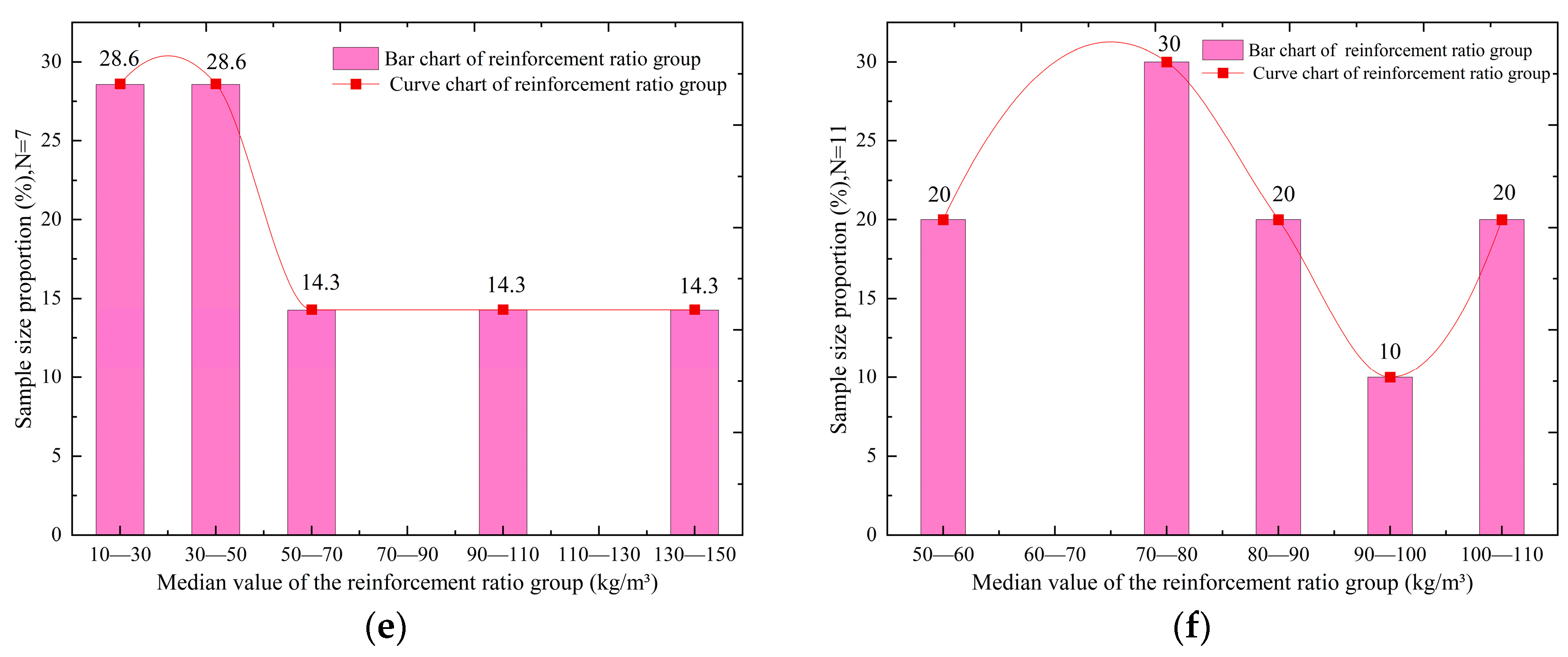
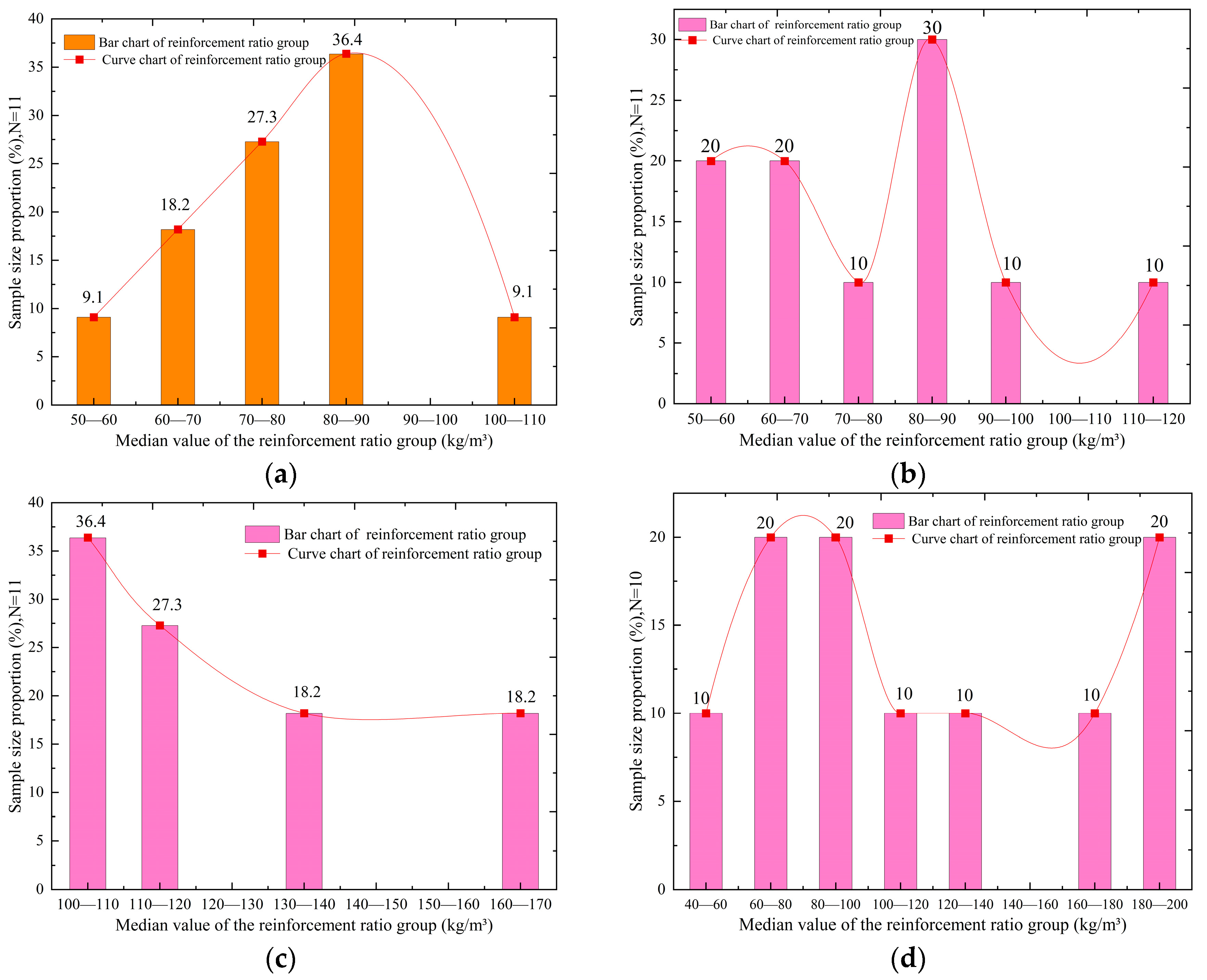
The reinforcement ratio data are grouped by class intervals, and the distribution patterns for the overall plant and its substructures are presented in Figure 1a–f. These figures only display the frequency distribution of the data and do not perform theoretical distribution fitting. As illustrated, the distribution shapes vary considerably. For example, the overall plant and tailwater channel exhibit a bell-shaped pattern, the auxiliary plant shows an approximate J-shape, and the installation room shows a U-shape. In contrast, the main plant and switch station display no clear pattern. Among these, the overall plant reinforcement ratios are the most concentrated, with the 85 kg/m3 interval accounting for 36.4% of the samples.
The bell-shaped distribution of the overall plant building can be quantitatively evaluated by skewness and kurtosis indices [15]. If the shape of the bell-shaped data distribution is symmetric, the skewness index shown in Formula (6) can be used for quantitative analysis.
S k = 1 n 1 i = 1 n x i x ¯ 3 / s 3
Using Formula (6), skewness (Sk) is calculated to be 3. For quantitatively analyzing the steepness degree of the bell-shaped data distribution compared with the standard normal distribution, the kurtosis index in Formula (7) can be used.
K u = 1 n 1 i = 1 n x i x ¯ 4 / s 4 3
Using Formula (7), the kurtosis (Ku) is calculated to be −3. According to the empirical criteria of skewness and kurtosis (absolute skewness < 3, absolute kurtosis < 10) [19], it can be preliminarily determined that the overall reinforcement ratio of plant buildings follows a normal distribution. This conclusion is further verified by the Shapiro–Wilk test for the 11 overall reinforcement ratio samples of the project plants collected, as shown in Table 2.
The calculated results are: S = 40.1; nm2 = 650; W = 2.40. With a significance level of α = 0.05 and considering ntotal = 11, the P-quantile of the test statistic W is determined to be 0.85. Since W > P, the null hypothesis is not rejected at the significance level α = 0.05; that is, the distribution pattern of the overall reinforcement ratio of the hydropower plant satisfies the normal distribution law.
Similarly, the W statistics for the main building, auxiliary building, installation room, tailrace channel, and switch station are 1.75, 0.93, 12.50, 1.13, and 1.79, respectively—all exceeding their respective p-percentile values of 0.85, 0.85, 0.842, 0.818, and 0.85. The tests on each sub-structure show that the distribution pattern of the reinforcement ratio also satisfies the normal distribution law.

3.2. Dispersion of Reinforcement Ratio and Engineering Values

The weighted average values, standard deviations, and coefficients of variation in the reinforcement ratio for each research object are presented in Table 3. Among the weighted averages, the auxiliary plant exhibits the highest reinforcement ratio (123 kg/m3). This is primarily because it consists of thin-walled elements (e.g., slabs, beams, and columns) that consume less concrete but require denser reinforcement. The tailrace channel has the lowest reinforcement ratio (40 kg/m3), because its design is often controlled by anti-floating stability and is mostly reinforced according to the minimum reinforcement ratio. The overall reinforcement ratio (78 kg/m3) is closest to that of the main plant (75 kg/m3), reflecting the dominant concrete volume of the main plant and its decisive influence on the overall value.
Meanwhile, based on the standard deviations and coefficients of variation in the reinforcement ratios presented in the table, except for the tailrace channel, where the coefficient of variation is as high as 92% due to sample characteristics, the CV values of the other objects are all between 10% and 30%, indicating that the data dispersion degree is moderate and its weighted average value has good representativeness.
To quantify the uncertainty associated with the estimated means, 95% confidence intervals were calculated using t-distribution [15]. For the overall plant reinforcement ratio (mean = 78 kg/m3, s = 13 kg/m3, n = 11, the 95% confidence interval is 78 ± 8.7 kg/m3, i.e., [69.3, 86.7 kg/m3]. This interval indicates the range within which the true population mean is expected to lie with 95% confidence. Confidence intervals for substructures are provided in Table 3.
According to the empirical criterion [16], the overall reinforcement ratio of plant buildings follows a normal distribution N (78, 132), and its statistical value range can be determined based on the empirical criterion. Considering engineering practicality, the 2σ criterion (covering approximately 95.45% of the samples) is adopted to determine the reasonable representative interval of the reinforcement ratio of the overall plant building as 52 to 104 kg/m3. While ensuring sufficient representativeness, this range avoids the limitations of the σ criterion (65 to 91 kg/m3) and the excessive discreteness of the 3σ criterion (39 to 117 kg/m3).

3.3. Analysis of Factors Affecting the Overall Reinforcement Ratio of the Plant Buildings

Combined with the structural characteristics of the plant building, its concrete reinforcement can be mainly divided into two categories: one is mass concrete (such as the main unit foundation, spiral casing, and tailrace pipe sections, etc.), which is usually reinforced according to the minimum reinforcement ratio; the other is structural concrete (such as portal columns, slabs, beams, etc.), whose reinforcement is mainly determined according to the stress calculation. The reinforcement ratio of the plant building is affected by many factors, such as its structural composition, the proportion of concrete volume in each part, and the type of plant building. Meanwhile, the factor analysis in this study primarily relies on mean comparisons and trend identification—a method well-suited to the exploratory nature of the research and limited sample size—while more advanced multivariate approaches would be preferable with larger datasets. Multiple regression analysis can quantify the relative contributions of each factor while controlling for confounding variables, while factorial analysis of variance can test for interaction effects. However, with only 11 samples and multiple categorical variables, such analyses risk insufficient degrees of freedom and overfitting. Therefore, the current approach focuses on identifying sensitive factors through systematic comparisons, laying the groundwork for multivariate modeling when more data becomes available in the future. These influencing factors will be analyzed individually below to identify the sensitive factors.

3.3.1. Analysis of the Structural Composition of Plant Buildings

The basic components of the plant building project include the main plant building, the auxiliary plant building, installation room, tailrace channel, and switch station. Plant buildings in different types of power stations have different structural compositions. As can be seen from Table 1, when some sub-structures are missing in the overall reinforcement ratio of different hydropower station plant buildings, the change law of the reinforcement ratio of the plant building project will not show a one-way change. For example, the reinforcement ratio value of the KGLHP2 power station plant building project is the smallest when the tailrace channel structure is missing, while the reinforcement ratio value of the JHPPP power station plant building project is the largest when the tailrace channel structure is missing. Therefore, the reinforcement ratio of plant buildings is not sensitive to structural composition.

3.3.2. Analysis of the Concrete Proportion in Each Structural Component

From the perspective of the structural design composition of the plant buildings, the main plant building is mainly made of mass concrete, and the concrete volume has the largest proportion in the overall concrete consumption of the plant building; the auxiliary plant building is mainly structural concrete, and the proportion of concrete volume in the overall concrete consumption of this plant building is relatively small, with the other sub-buildings falling somewhere between the two. The concrete volume proportions for each project are summarized in Table A1 in Appendix A.
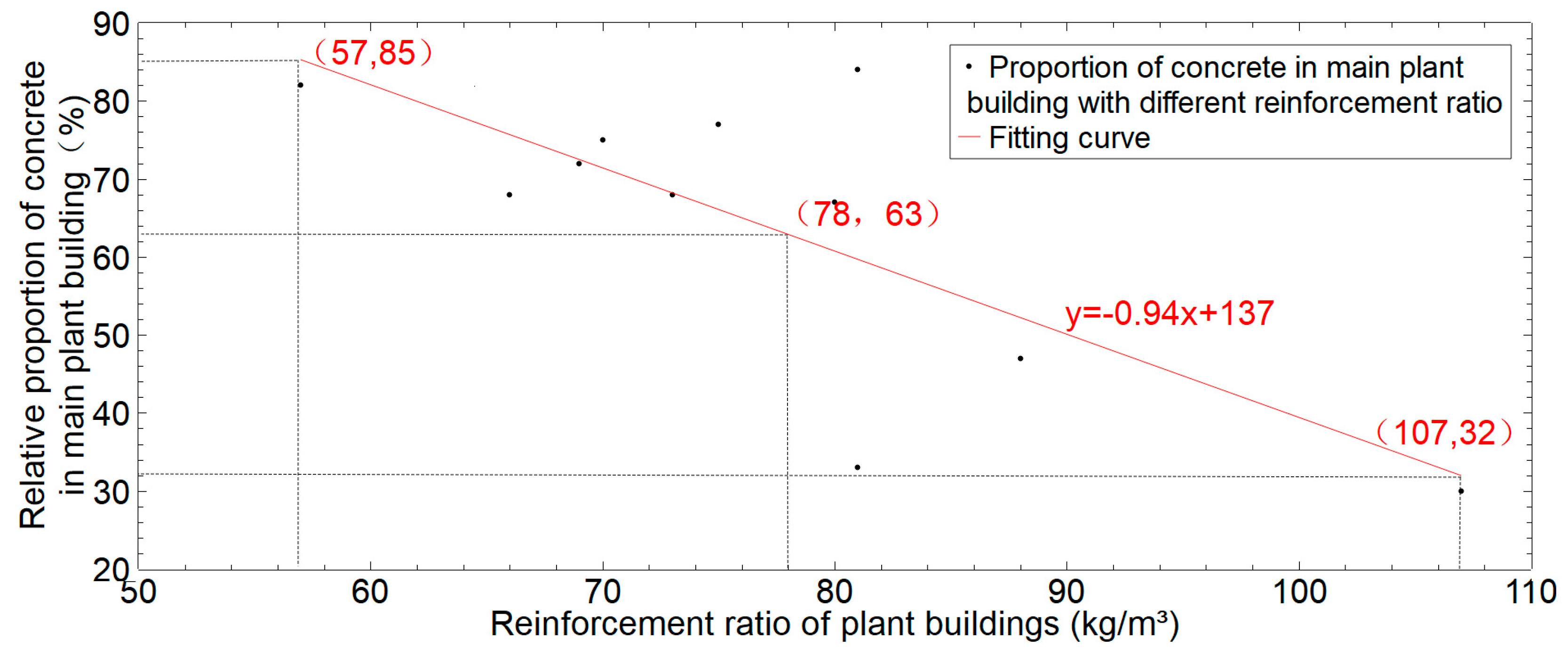
The relationship between the relative proportion of concrete in the main plant building and the weighted average of the overall reinforcement ratio of the plant building is shown in Figure 2.
As can be seen from Figure 2, after linear fitting, the relationship between the overall reinforcement ratio of the plant building and the relative proportion of concrete in the main plant building is y = −0.94x + 137, where x is the relative proportion of concrete in the main plant building, in %, and “y” is the reinforcement ratio of the overall plant building (in kg/m3). When the relative proportion of concrete in the main plant reaches 63%, the overall reinforcement ratio of the plant reaches its average value. When the reinforcement ratio reaches its maximum, the relative proportion of concrete in the main plant is 32%. When the reinforcement ratio takes the minimum value, the relative proportion of concrete in the main plant building is 85%. Therefore, the overall reinforcement ratio of the plant is related to the relative proportion of concrete in the main plant building. Combining the characteristics of the reinforcement ratio of the main plant building, which is relatively close to that of the overall plant building in Table 1, it can be seen that this influencing factor is relatively sensitive.

3.3.3. Analysis of Plant Building Type

The average steel reinforcement ratios of the overall plant building corresponding to different plant building types are shown in Table 4.
Among the plant building samples, there are six shore-side type plants, three underground-type plants, and two back-dam type plants. The average reinforcement ratios of shore-side type and underground-type plants are 10% and 25% larger than those of the back-dam plants, respectively, showing a relatively large gap. Therefore, different types of plant buildings have a significant impact on the reinforcement ratio and are relatively sensitive.

3.3.4. Analysis of Hydraulic Turbine Types

The average reinforcement ratios of the overall plant buildings corresponding to different turbine types are shown in Table 5.
Among the sample facilities, there are seven plant buildings with mix-flow turbines, two plant buildings designed with impulse type turbines, and two plant buildings designed with axial-flow turbines. The reinforcement ratios of the plant buildings corresponding to mix-flow turbines and impulse turbines are approximately 7% and 18% higher than that of axial-flow turbines, respectively, showing a significant gap. Therefore, the type of turbine used has a significant and sensitive impact on the overall reinforcement ratio of the plant building.

3.3.5. Other Factors

In addition to the above factors, this study also analyzed other potential influencing factors, such as design specifications, concrete strength grades, design seismic parameters, and single-unit capacity. The analysis results show that none of these factors demonstrated clear or regular effects in the existing samples.
First, examine the influence of design specifications. As shown in Table 6, the average overall reinforcement ratios of plant buildings designed using Chinese specifications and American specifications are 79 kg/m3 and 77 kg/m3, respectively. The difference between the two is only 2.6%, indicating a minor difference.
Next, we analyze the influence of concrete strength grades. From the data in Table 7, for plant building samples that mainly use C25 and C30 grades, the average reinforcement ratios are very close, at 76 kg/m3 and 77 kg/m3 respectively, and both are slightly higher than that of the samples mainly using C20 grade (81 kg/m3), without showing a clear grade-change trend.
Furthermore, the influence of the design seismic parameters is also insignificant. As shown in Table 8, within the broad parameter range of 0.01 g to 0.2 g, the overall reinforcement ratio of the plant building does not show a consistent pattern of increase or decrease with increasing seismic parameters, and the data points are relatively discrete.
Finally, the analysis of the single-unit capacity (Table 9) also shows that there is no obvious pattern in the average reinforcement ratio of plant buildings with different single-unit capacities within the wide range from 6 MW to 180 MW.
Concurrently, to statistically substantiate the exclusion of the aforementioned factors, one-way ANOVA was applied to categorical variables (design codes, concrete strength grades), while correlation analysis was employed for continuous variables (seismic parameters, unit volume). The results are as follows: design code (Chinese vs. American): F (1, 9) = 0.12, p = 0.74; concrete strength grade (C20, C25, C30): F (2, 8) = 0.43, p = 0.66; seismic parameter: Pearson r = 0.08, p = 0.82; unit capacity: Pearson r = −0.15, p = 0.66
All p-values exceed 0.05, indicating no statistically significant association with the overall reinforcement ratio. These results support the exclusion of these factors from the proposed formula.
In summary, through multi-factor analysis, it was determined that the proportion of concrete in the main and auxiliary plant buildings, the plant building type, and the type of hydraulic turbine are the three core sensitive factors influencing the overall reinforcement ratio of the building.

4. Calculation Methods of Steel Content Rate

4.1. Formula for Calculating Overall Reinforcement Ratio of Plant Buildings

As shown in Section 3, the overall reinforcement ratio of the plant building follows a normal distribution. According to the 2σ criterion, the value range is 52–104 kg/m3, the average value is 78 kg/m3, and a standard deviation is 13. Based on the average value, standard deviation, and the characteristics of the normal distribution curve, the distribution function of the overall reinforcement ratio of the plant can be established, as shown in Formula (8):
F ( x ) = x 0.031 e x 78 ) 2 338 d x
In the formula: F(x) is the distribution function of the overall reinforcement ratio of the plant building; x is probability, with −∞ < x < ∞.
Formula (8) reflects the distribution law of the reinforcement ratio, but it cannot be used to calculate the values for different projects. Therefore, based on the above analysis, a practical estimation formula considering the three sensitive factors is constructed.
p t = p p p h + Q
Q = a ( Δ c p c p 0 )
Δ C p = C p 1 1.7 C p 2
In the formula, Pt is the estimated reinforcement ratio (kg/m3), ranging from 52 to 104. Pp is the benchmark value of the plant type (76 for shore-side, 69 for black-dam, and 86 for underground type). Ph is the benchmark value of the turbine type (77 for mixed-flow, 85 for impulse, and 72 for axial-flow). Q is the change in the reinforcement ratio of the main factory building (kg/m3). a corresponds to the reinforcement ratio of the concrete unit proportion of the main factory building, set at 0.82 kg/m3. ΔCp is the relative proportion of concrete in the main plant building(%). Cp1 and Cp2 are the concrete volume proportions of the main and auxiliary buildings, respectively (%). Cp0 is the benchmark proportion (63%).
The coefficients in the proposed formula were obtained via multiple linear regression analysis, employing three identified sensitivity factors as predictor variables. The regression model formula is as follows:
p t = β 0 + β 1 · p p + β 2 · p h + β 3 · Δ c p + ε
where Pp and Ph are treated as effect-coded categorical variables, and ΔCp (relative concrete proportion) is treated as a continuous variable. The regression analysis yielded an R2 value of 0.76 (adjusted R2 = 0.68), with the following coefficient estimates: β0 = 78.2 (intercept term), β1 = [−2.1, 8.3] (factory-type categorical term), β2 = [−5.8, 7.2] (machine type categorical term), β3 = −0.94. These estimates align closely with the empirically calibrated values in Equations (9)–(11), confirming the statistical validity of the formula.
The proposed formula was validated using 11 sample projects. A detailed comparison between actual and calculated values is provided in Table A2 in Appendix A. As shown in the table, the calculation errors for most projects lie within ±10%, indicating reasonable engineering applicability. However, several cases (e.g., PHG, BHP) exhibit errors exceeding 20%. These discrepancies may stem from unmodeled factors such as local design practices, detailing rules, or construction variations that are not captured by the three sensitive factors. Therefore, the formula is best-suited to order-of-magnitude estimation in pre-feasibility studies rather than precise budgeting. Its primary value lies in providing a consistent and theory-informed benchmark, not in replacing detailed design-stage calculations. Future refinements could incorporate additional variables or adopt a probabilistic approach to account for uncertainty.
For example, in a shore-side type plant employing a mixed-flow turbine, the concrete proportions in the main and auxiliary plant buildings are 80% and 5%, respectively. After calculations, ΔCp = 71.5%, Q = 0.68 kg/m3; then, the overall reinforcement ratio is Pt = 78 kg/m3, and the result is reasonable. However, due to limitations in data availability, external validation through independent projects outside the calibrated dataset is not feasible. Therefore, users are advised to exercise caution when applying the formula to projects whose characteristics differ significantly from those demonstrated in this study.

4.2. Reinforcement Ratio Values for Each Sub-Structure

The recommended reinforcement ratios for each sub-structure are based on sample means, with their representative ranges determined using the 2σ criterion, as shown in Table 10.
As can be seen from Table 10, due to the extremely large data discreteness of the tailrace channel (CV = 92%), the sample mean is not representative, and its reinforcement ratio is usually controlled by the minimum reinforcement ratio specified in the code (such as approximately 16 kg/m3 in Chinese specifications and approximately 24 kg/m3 in American specifications). For the remaining parts, values can be taken within the recommended range, considering the specific shape and structural characteristics of the project.

4.3. Comparison with Existing Estimation Methods and Data-Driven Approaches

The proposed formula is compared with two conventional approaches: (1) the simple empirical mean (78 kg/m3) and (2) the empirical rule based on the Chinese design experience (70–85 kg/m3, mid-point 77.5 kg/m3). Using the 11 sample projects as a reference, the proposed formula achieved an RMSE of 9.61 kg/m3 and an MAPE of 8.27%, outperforming both the simple mean (RMSE = 12.1 kg/m3, MAPE = 11.7%) and the empirical rule (RMSE = 13.5 kg/m3, MAPE = 13.1%), with error reductions of 30–38%. Unlike fixed-value approaches, the formula captures variations across plant configurations, providing project-specific estimates.
While transparent and interpretable, the formula does not capture potential nonlinear interactions among influencing factors. Recent studies have explored data-driven methods such as multiple regression, machine learning, and hybrid surrogate modeling for early-stage engineering cost estimation (e.g., Zhang et al. [27]; Marcello Fulgione [12]). These approaches can leverage larger datasets to improve prediction accuracy and adaptability. However, they require extensive data for training and validation, which may not be available in the preliminary design phase of hydropower projects. The formula presented here can serve as a baseline or reference framework against which more complex models can be benchmarked. Future work could integrate the identified sensitive factors into a hybrid model that combines domain knowledge with data-driven calibration.

5. Conclusions and Future Work

This study systematically analyzes the statistical characteristics of reinforcement ratios in hydropower plant buildings based on 11 completed projects, leading to the following conclusions and design guidance:
(1)
Distribution characteristics: The overall reinforcement ratio approximately follows a normal distribution (mean 78 kg/m3, standard deviation 13 kg/m3, 95% CI [69, 87 kg/m3]). For preliminary design, a baseline value of 78 kg/m3 can be adopted, with the 2σ range (52–104 kg/m3) providing a reasonable uncertainty interval for early-stage estimation.
(2)
Substructure reference values: Recommended reinforcement ratios of substructures are: main plant 75 kg/m3, auxiliary plant 123 kg/m3, installation room 100 kg/m3, and switch station 79 kg/m3. These values can guide initial quantity take-offs when detailed substructure information is unavailable.
(3)
Key influencing factors: The proportion of main-to-auxiliary plant concrete, plant type, and turbine type are the most sensitive factors. Designers should pay particular attention to these factors: underground plants typically require 25% higher reinforcement than back-dam type plants, and impulse turbines require 18% higher reinforcement than axial-flow turbines.
(4)
Practical estimation: The proposed formula provides project-specific estimates that reduce prediction error by 30–38% compared to simple empirical rules. It is recommended for order-of-magnitude estimation in pre-feasibility and feasibility studies, complementing rather than replacing detailed design calculations.
The applicability of the findings and proposed formula is subject to the following limitations: (1) Geographic Scope—the dataset spans projects in multiple regions designed primarily to Chinese and American standards; validation with local data is recommended for other regions or design codes. (2) Project Scale—the sample includes medium to large hydropower plants (6–180 MW unit capacity); applicability to projects outside this range is uncertain. (3) Structural Typology—the findings are specific to conventional hydropower plant buildings and may not apply to other hydraulic structures (e.g., dams, spillways) or novel plant designs.
Future research should aim to expand the dataset to include more projects from diverse geographical regions and design codes, enabling more robust statistical analysis and the development of data-driven models. Incorporating advanced techniques such as machine learning could help capture complex interactions and improve prediction accuracy.

Author Contributions

X.H.: Conceptualization, writing and editing; C.H.: Conceptualization, review and supervision, resources, funding acquisition; N.L.: Methodology, investigation supervision and data curation; Z.X.: Review and editing, visualization, figures. All authors have read and agreed to the published version of the manuscript.

Funding

We would like to express our gratitude to the anonymous reviewers for their constructive comments. This research was supported by the Open Research Fund Program of State Key Laboratory of Eco-hydraulics in Northwest Arid Region (No. 2022KFKT-8).

Institutional Review Board Statement

Not applicable.

Informed Consent Statement

Not applicable.

Data Availability Statement

The data presented in this study are available from the corresponding author upon reasonable request.

Conflicts of Interest

Authors Xin He and Chunyou Hao were employed by the company PowerChina Northwest Engineering Corporation Limited. The remaining authors declare that the research was conducted in the absence of any commercial or financial relationships that could be construed as a potential conflict of interest.

Appendix A

Table A1. Concrete volume of main and auxiliary plant buildings as a percentage of total concrete volume for each project.
ProjectKGL
HP2
ITHPPKGL
HP1
KNBESTHPPHGKSEPBHPNHPHDJHPPP
Weighted average reinforcement ratio of the overall plant building
(kg/m3)
57696670737580818188107
Concrete proportion in main plant building (%)87.680.174.088.373.085.37089.840.252.443.9
Concrete proportion in auxiliary buildings (%)3.14.53.67.73.24.92.03.64.13.28.0
Relative proportion of concrete in the main plant building8268727568776784334730
Note: Relative concrete proportion of main plant building = Concrete proportion of main plant building × (average reinforcement ratio of main plant building/average reinforcement ratio of auxiliary plant building) − Concrete proportion in auxiliary buildings.
Table A2. Calculated value of reinforcement ratio and error.
ItemST
HP
KN
BE
KS
EP
HDKGL
HP1
KGL
HP2
PHGBHPJHP
PP
ITH
PP
NHP
Actual Average reinforcement ratio (kg/m3)73708088695775811076681
Average Calculated reinforcement ratio (kg/m3)73727991675855611057393
Percentage Error (%)02.9−1.33.4−2.91.8−26.7−24.7−1.910.614.8
Absolute Error (kg/m3)02132120202712
Mean Error (%)−2.18
Mean Absolute Error (kg/m3)6.36
Mean Absolute Percentage Error (%)8.27
Root Mean Square Error (kg/m3)9.61
Note: Percentage error = (average calculated reinforcement ratio − actual average reinforcement ratio)/actual average reinforcement ratio.

References

  1. Tan, Z.X. Research on Steel Content in Building Structures. Build. Sci. 2007, 9, 44–47. [Google Scholar] [CrossRef]
  2. Li, C.; Feng, W.Q.; Wu, Z. Economic Interpretation and Common Misunderstandings of Steel Content in Construction Projects. Constr. Econ. 2015, 36, 88–90. [Google Scholar] [CrossRef]
  3. National Energy Administration. Calculation Regulations for Designed Quantities of Hydropower Projects, 2010th ed.; China Electric Power Press: Beijing, China, 2014. [Google Scholar]
  4. SL 328-2005; Calculation Regulations for Designed Quantities of Water Conservancy and Hydropower Projects. China Water & Power Press: Beijing, China, 2005.
  5. Song, S.H. Discussion on Adjustment Method of Steel Reinforcement Content in Concrete Works of Thermal Power Plants. Eng. Cost Manag. 2014, 2, 37–38. [Google Scholar]
  6. Tang, A.Q.; Zhou, J. Discussion on Estimation Method of Steel Reinforcement Content in Utility Tunnels. Eng. Cost Manag. 2022, 4, 49–55. [Google Scholar] [CrossRef]
  7. Zhu, F.J. Overall Stability Analysis and Quantity Calculation of Hydropower House. Water Power 1995, 2, 1–3. [Google Scholar]
  8. Zhu, J.P. A Concise Estimation Method for Quantities of Hydraulic Complex. Water Power 1958, 4, 20–27. [Google Scholar]
  9. The Royal Institution of Chartered Surveyors. Standard Method of Measurement of Building Works; Eyre & Spottiswoode: Margate, UK, 1988; ISBN 0854063609(RICS). [Google Scholar]
  10. BS 8110:1997; Structural Use of Concrete. British Standards Institution: London, UK, 1997.
  11. Gulledg, C.E. Master Format 2004, Assessment 2007. Constr. Specif. 2007, 60, 16–17. [Google Scholar]
  12. Fulgione, M.; Palladino, S.; Esposito, L.; Sarfarazi, S.; Modano, M. A Multi-Stage Framework Combining Experimental Testing, Numerical Calibration, and AI Surrogates for Composite Panel Characterization. Buildings 2025, 15, 3900. [Google Scholar] [CrossRef]
  13. Xie, W.; Cheng, X.W. Investigation and Statistical Analysis of Reinforcement Ratio of Reinforced Concrete Structural Members in Hydropower House. J. N. China Univ. Water Resour. Electr. Power 1996, 3, 1–4. [Google Scholar] [CrossRef]
  14. Ruan, H.W. Statistics, 2nd ed.; Peking University Press: Beijing, China, 2014. [Google Scholar]
  15. Wang, S.F.; Li, J.L.; Chang, M. Applied Statistics, 3rd ed.; Peking University Press: Beijing, China, 2017. [Google Scholar]
  16. Ott, R.L.; Longnecker, M. An Introduction to Statistical Methods and Data Analysis, 5th ed.; Zhang, Z.Z.; Wang, J.W.; Wang, Q., Translators; Science Press: Beijing, China, 2003. [Google Scholar]
  17. GB/T 4882-2001; Statistical Treatment and Interpretation of Data—Normality Test. Standards Press of China: Beijing, China, 2001.
  18. Liang, X.J. Normality Test; China Statistics Press: Beijing, China, 1997. [Google Scholar]
  19. Kline, R. Principles and Practice of Structural Equation Modelling, 3rd ed.; The Guilford Press: New York, NY, USA, 2011. [Google Scholar]
  20. Xue, J.Y.; Yan, C.; Meng, F.M.; Ning, P. Research on Optimization and Visualized Construction of Building Steel Reinforcement Consumption Based on BIM. J. North Univ. China (Nat. Sci. Ed.) 2020, 41, 60–65. [Google Scholar]
  21. Shapiro, S.S.; Wilk, M.B. An Analysis of Variance Test for Normality (Complete Samples). Biometrika 1965, 52, 591–611. [Google Scholar] [CrossRef]
  22. Chen, M. Application of BIM Technology in Hydropower House Design. Heilongjiang Hydraul. Sci. Technol. 2017, 45, 120–122. [Google Scholar] [CrossRef]
  23. Zhang, R.L. Application of Statistical Analysis in Engineering Cost Management. Henan Build. Mater. 2018, 6, 202–203. [Google Scholar] [CrossRef]
  24. Wei, J. The adoption of repeated measurement of variance analysis and Shapiro-Wilk test. Front. Med. 2022, 16, 659–660. [Google Scholar] [CrossRef] [PubMed]
  25. Wu, L.J.; Gao, X.; Xia, Y.F. Randomness and time-varying characteristics of chloride ion transport in existing harbor concrete structures. Constr. Build. Mater. 2024, 412, 134839. [Google Scholar] [CrossRef]
  26. Yang, D.Q.; Yan, C.W.; Zhang, J.; Liu, S.; Li, J. Chloride threshold value and initial corrosion time of steel bars in concrete exposed to saline soil environments. Constr. Build. Mater. 2021, 267, 120979. [Google Scholar] [CrossRef]
  27. Zhang, Y.X.; Minchin, R.E.; Flood, I.; Ries, R.J. Preliminary Cost Estimation of Highway Projects Using Statistical Learning Methods. J. Constr. Eng. Manag. 2023, 149, 04023026. [Google Scholar] [CrossRef]
Figure 1. Distribution of reinforcement ratio in: (a) overall plant buildings, (b) main plant buildings, (c) auxiliary plant buildings, (d) installation rooms, (e) tailwater channels, and (f) switching stations.
Applsci 16 02411 g001aApplsci 16 02411 g001b
Figure 2. Relationship between the relative proportion of concrete in the main plant building and the overall reinforcement ratio of the plant building.
Applsci 16 02411 g002
Table 1. Reinforcement ratio of overall structures and substructures of different hydropower project buildings.
ProjectsOverall PlantMain PlantAuxiliary PlantInstallation RoomTailwater ChannelSwitch Station
STHP73821164314155
KNBE7068130//86
KSEP8072161129/87
HD88981341685573
KGLHP16665116741976
KGLHP25751107110/76
PHG7547104824448
BHP81801681802355
JHPPP10711510798/97
ITHPP695711919439101
NHP81821026396102
Note: The “/” in the table indicates that this building is not present in this project.
Table 2. Shapiro–Wilk test calculation sheet for overall plant building.
kX(k)X(n+1−k)X(n+1−k)X(k)a(k)a(k)[X(n+1−k)X(k)] ( X i     X ¯ ) 2
157107500.560128.005400
26688220.33157.293121
36981120.2262.71264
47081110.14291.571949
5738070.06950.486516
Table 3. Statistical parameters and recommended reinforcement ratio ranges for substructures of hydropower plant buildings.
Analysis ObjectOverall PlantMain PlantAuxiliary PlantInstallation RoomTailrace ChannelSwitching Station
Weighted Average (kg/m3)78741241146078
Standard Deviation (kg/m3)131922524419
CV Value (%)172315239223
95% confidence interval[69.3, 86.7][61.3, 87.2][109.1, 138.9][76.7, 151.5][18.7, 100.5][65.1, 90.1]
Value Range (kg/m3)52~10441~10985~16154~146/43~115
Note: The “/” in the table indicates that this building is not present in this project.
Table 4. Average reinforcement ratio by plant building type.
Building TypeShore-Side Type PlantBack-Dam
Type Plant
Underground Plant
Average Reinforcement Content (kg/m3)766986
Table 5. Average reinforcement ratio by hydraulic turbine type.
Turbine TypeMix-FlowImpulse TypeAxial-Flow
Average Reinforcement Content (kg/m3)778572
Table 6. Average reinforcement ratio by specification type.
Code TypeChinese SpecificationAmerican Specification
Average Reinforcement Ratio (kg/m3)7977
Table 7. Average reinforcement ratios corresponding to different concrete strengths.
Concrete Strength GradeC20C25C30
Average Reinforcement Ratio (kg/m3)817677
Table 8. Average reinforcement ratios corresponding to different design seismic parameters.
Design Seismic Parameter (g)0.010.040.070.10.130.180.2
Average Reinforcement Ratio (kg/m3)818081736971107
Table 9. Average reinforcement ratios corresponding to different unit capacities.
Unit Capacity64346.7556082133.3150180
Average Fiber Content (kg/m3)5781751077973816670
Table 10. Reinforcement ratio range for various sub-structures within plant buildings.
ObjectMain Plan BuildingAuxiliary Plant BuildingInstallation RoomTailrace ChannelSwitching Station
Average Reinforcement Ratio (kg/m3)75123100/79
Value Range (kg/m3)41~10985~16154~146/43~115
Note: The “/” in the table indicates that this building is not present in this project.
Disclaimer/Publisher’s Note: The statements, opinions and data contained in all publications are solely those of the individual author(s) and contributor(s) and not of MDPI and/or the editor(s). MDPI and/or the editor(s) disclaim responsibility for any injury to people or property resulting from any ideas, methods, instructions or products referred to in the content.