Analysis of Underwater Single-Photon LiDAR Signals: A Comprehensive Study on Multi-Parameter Coupling Effects

 , ,
, ,  and
and
Featured Application
Abstract
1. Introduction
2. System and Methods
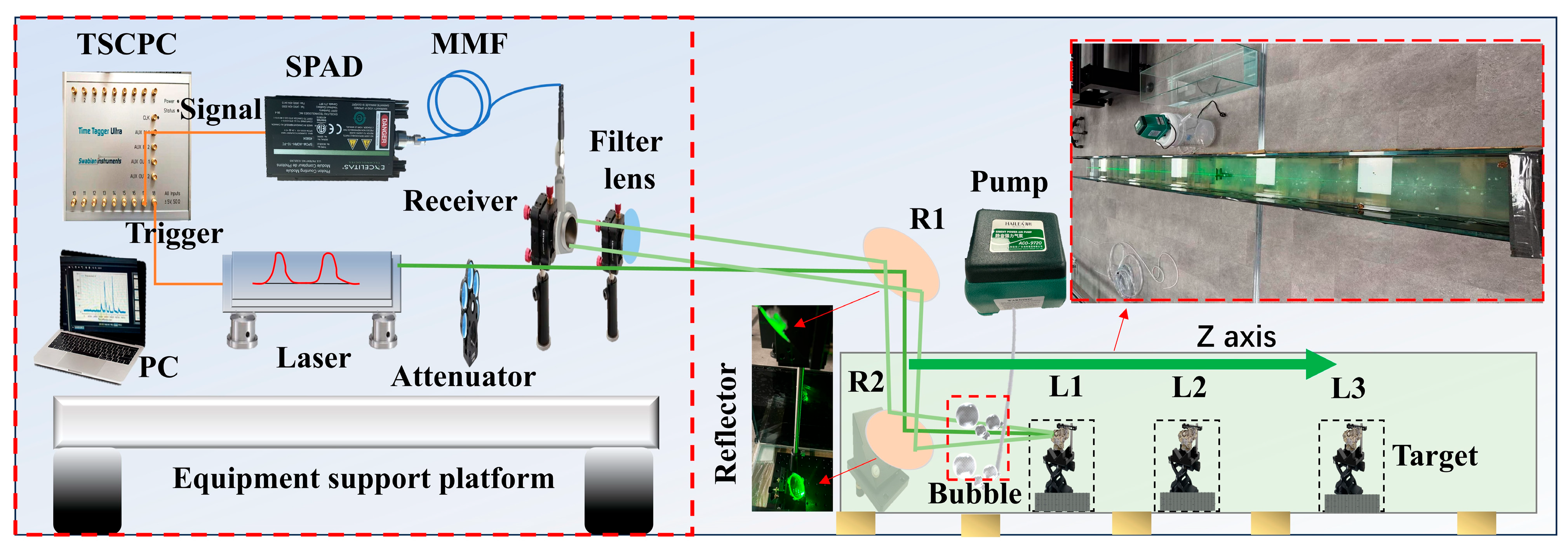
2.1. System Configuration
2.2. Underwater LiDAR Equation
2.3. Reflectance Retrieval Method
2.4. Ranging Error Estimation
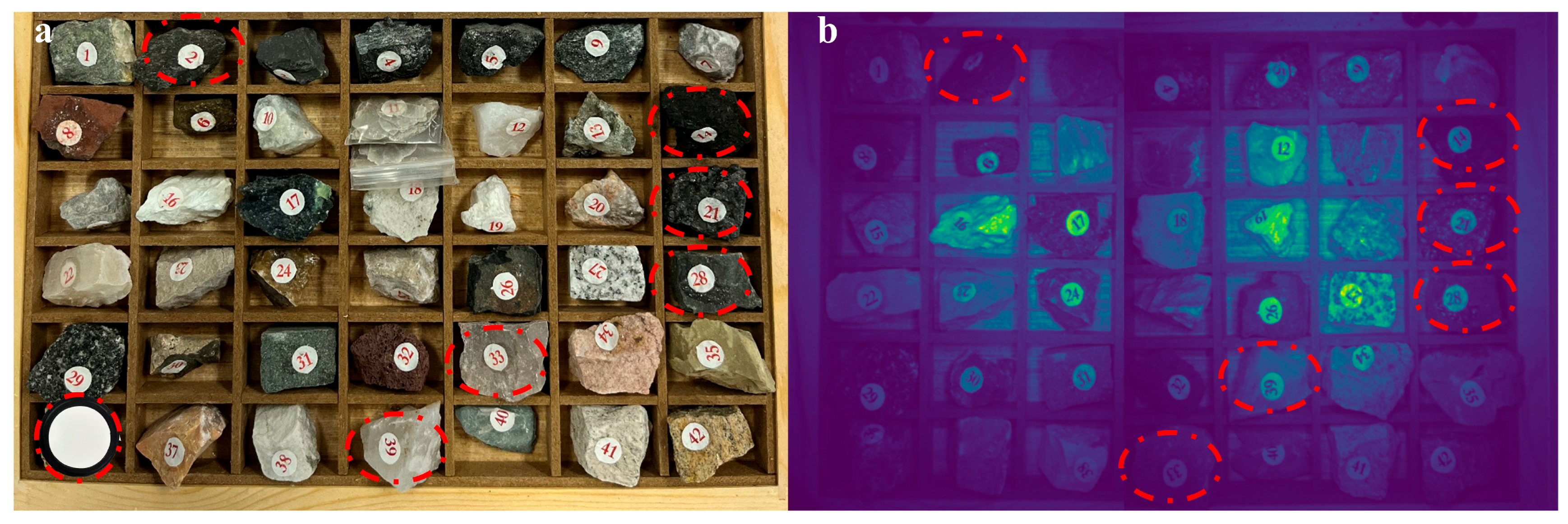
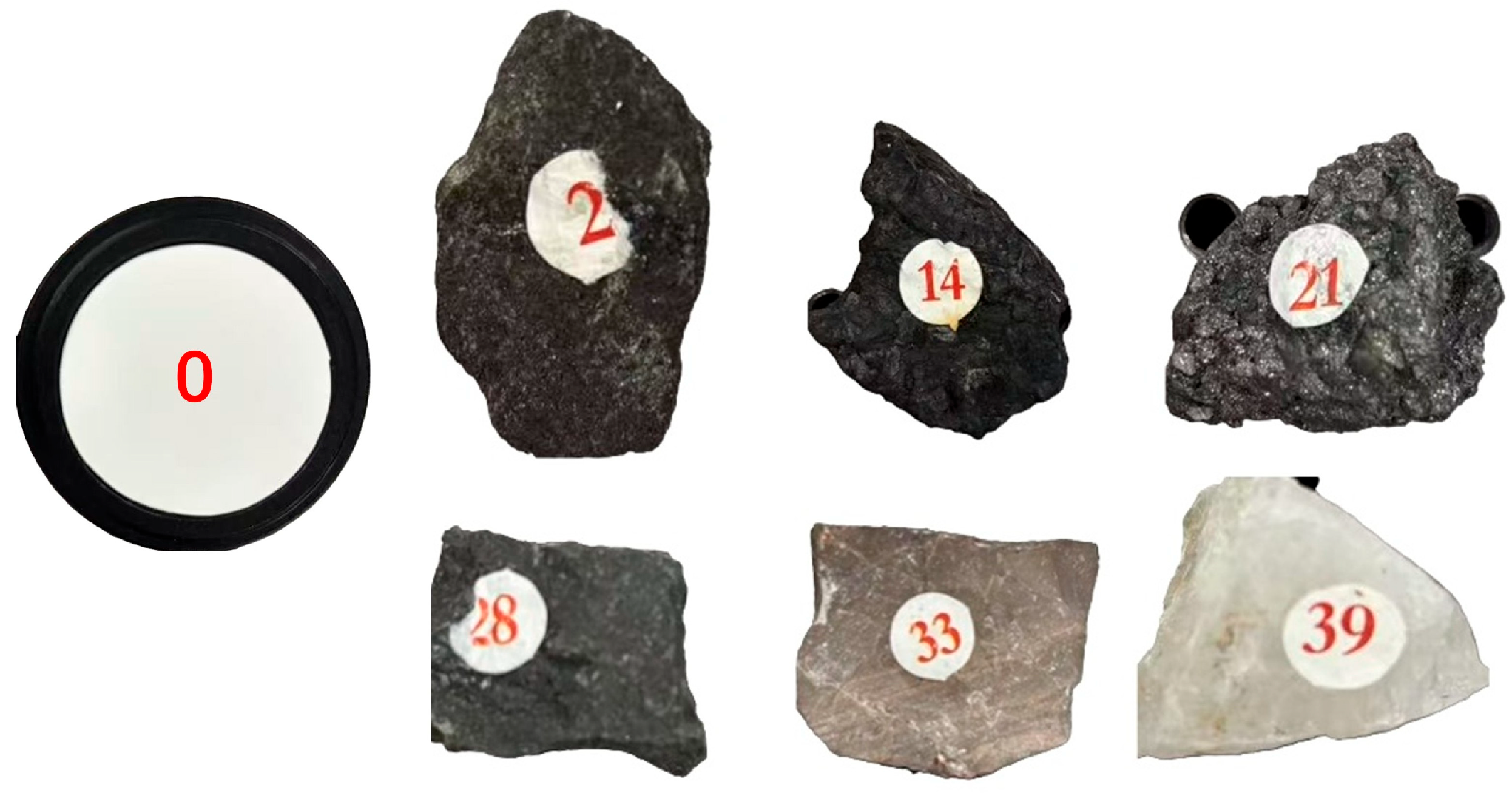
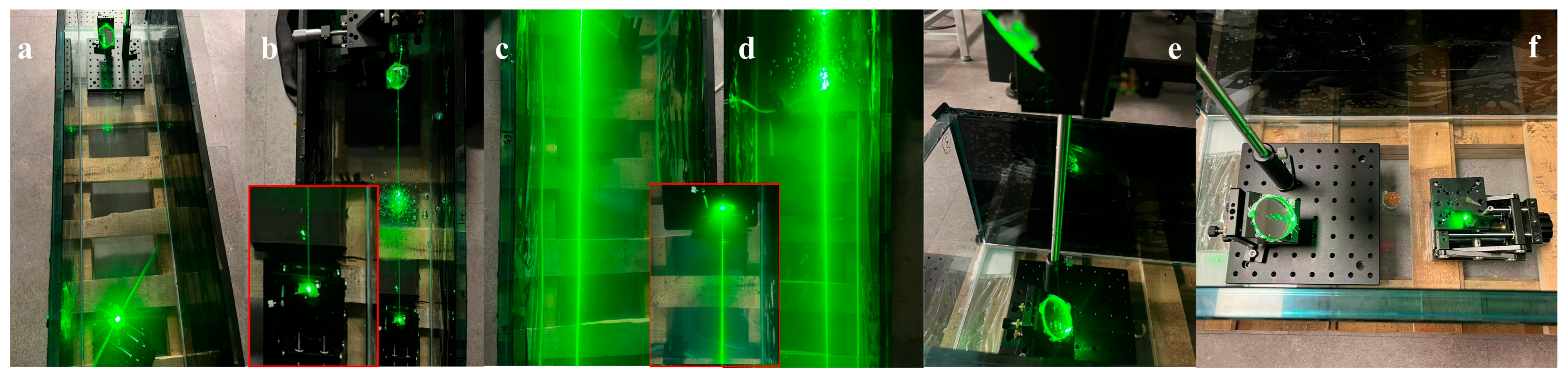
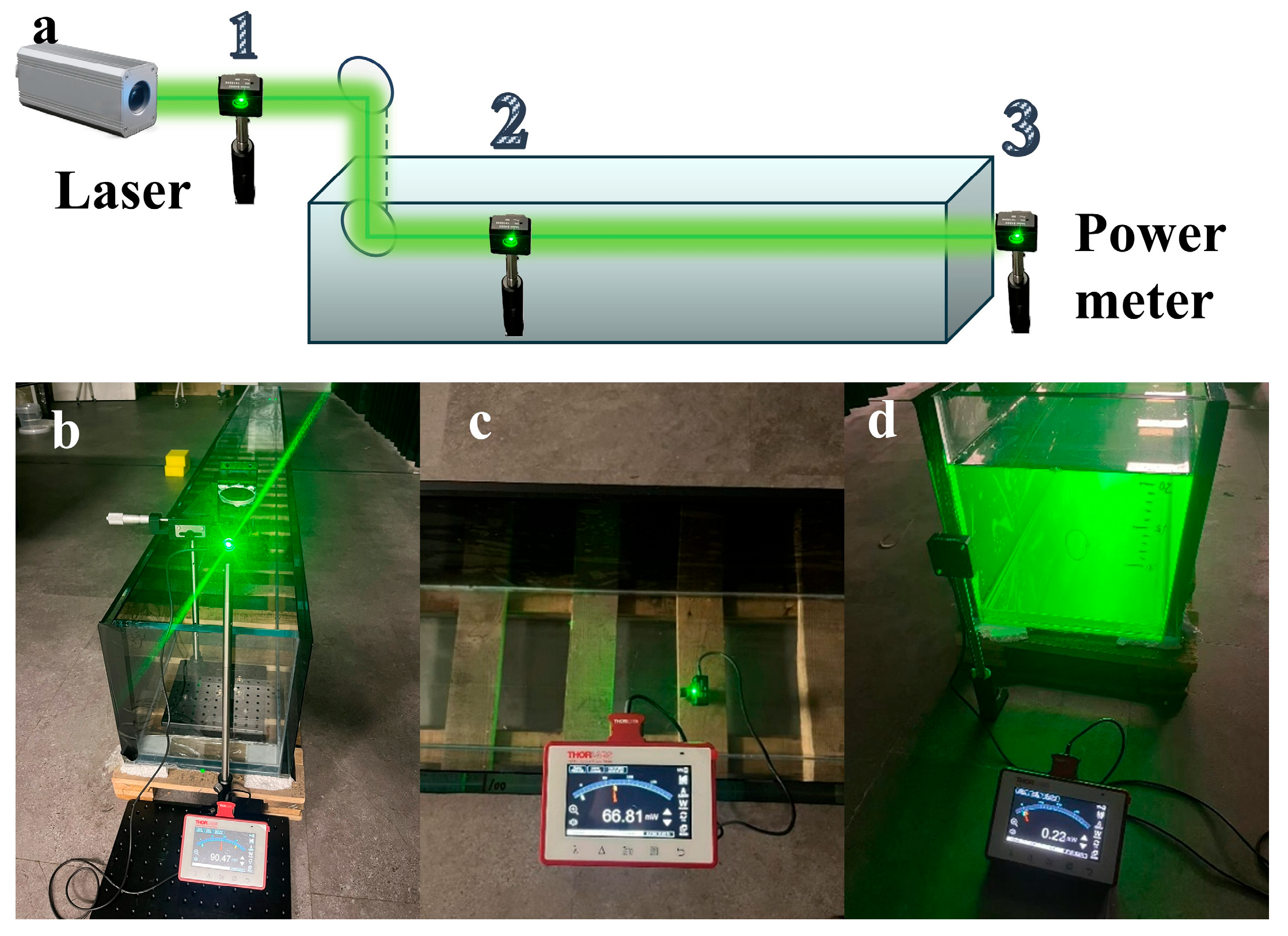
3. Experimental Setup
4. Experiment Analysis
4.1. Measurement of Water Attenuation Coefficients
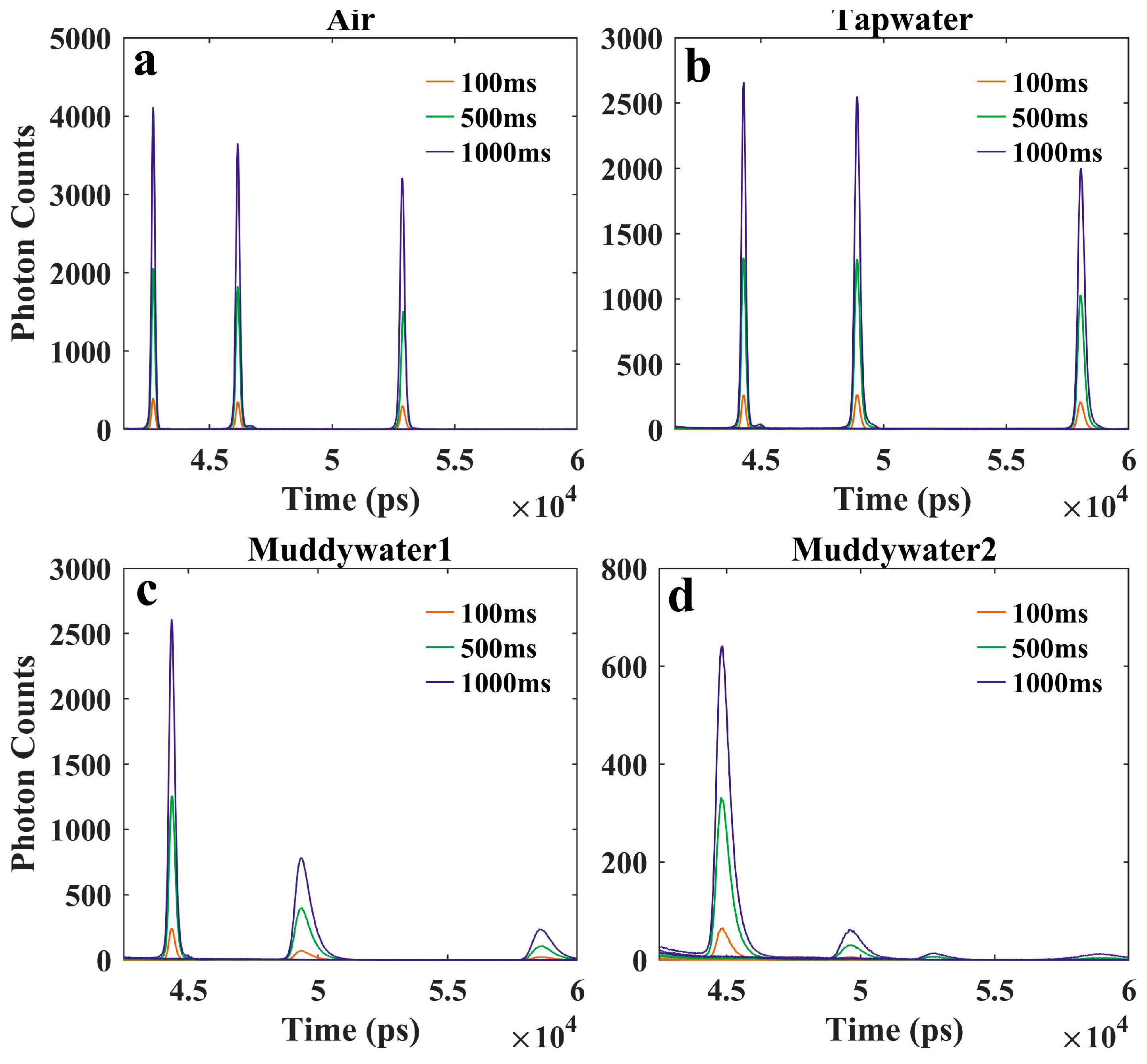
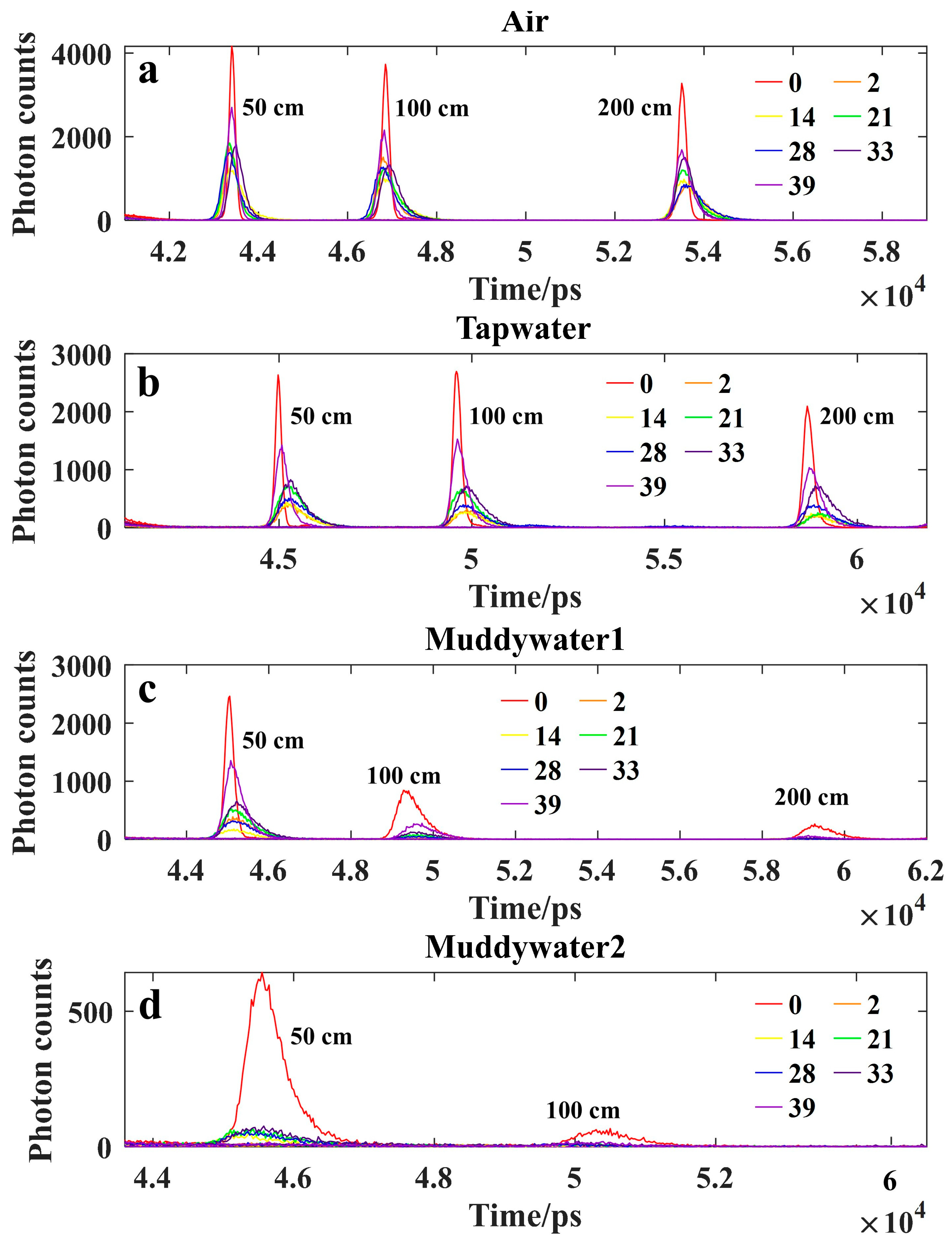
4.2. Photon Histogram Signal Characteristics
- (1)
- Turbidity effect: Signal strength decreases with increasing AL.
- (2)
- Integration time effect: Longer integration significantly improves the SNR, especially in highly turbid conditions. For example, the 50 cm peak in Figure 7d increases from 60 counts (100 ms) to 600 counts (1000 ms).
- (3)
- Backscattering interference: In highly turbid environments, near-field backscatter dominates and masks the true target return.
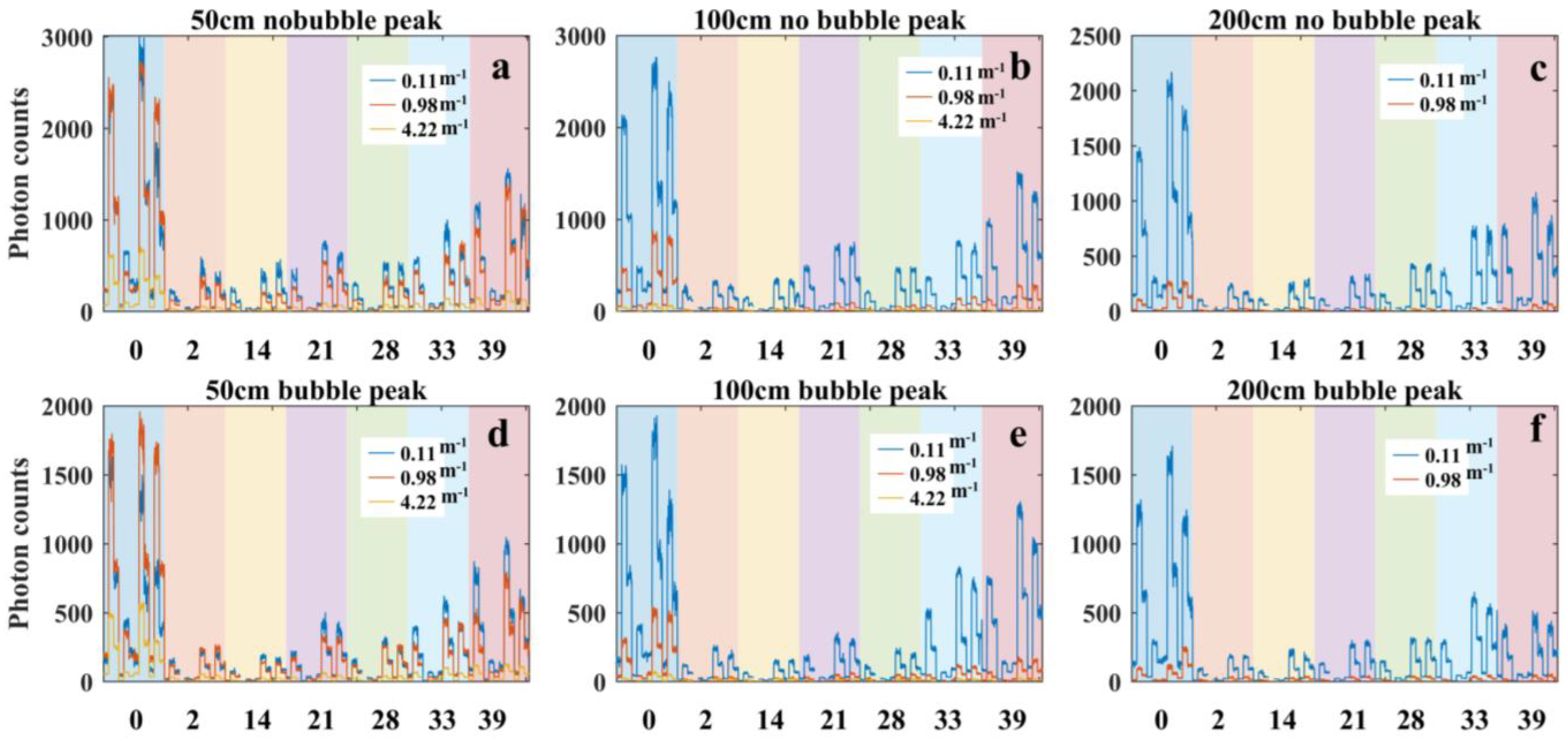
4.3. Statistical Distribution and Bubble Influence
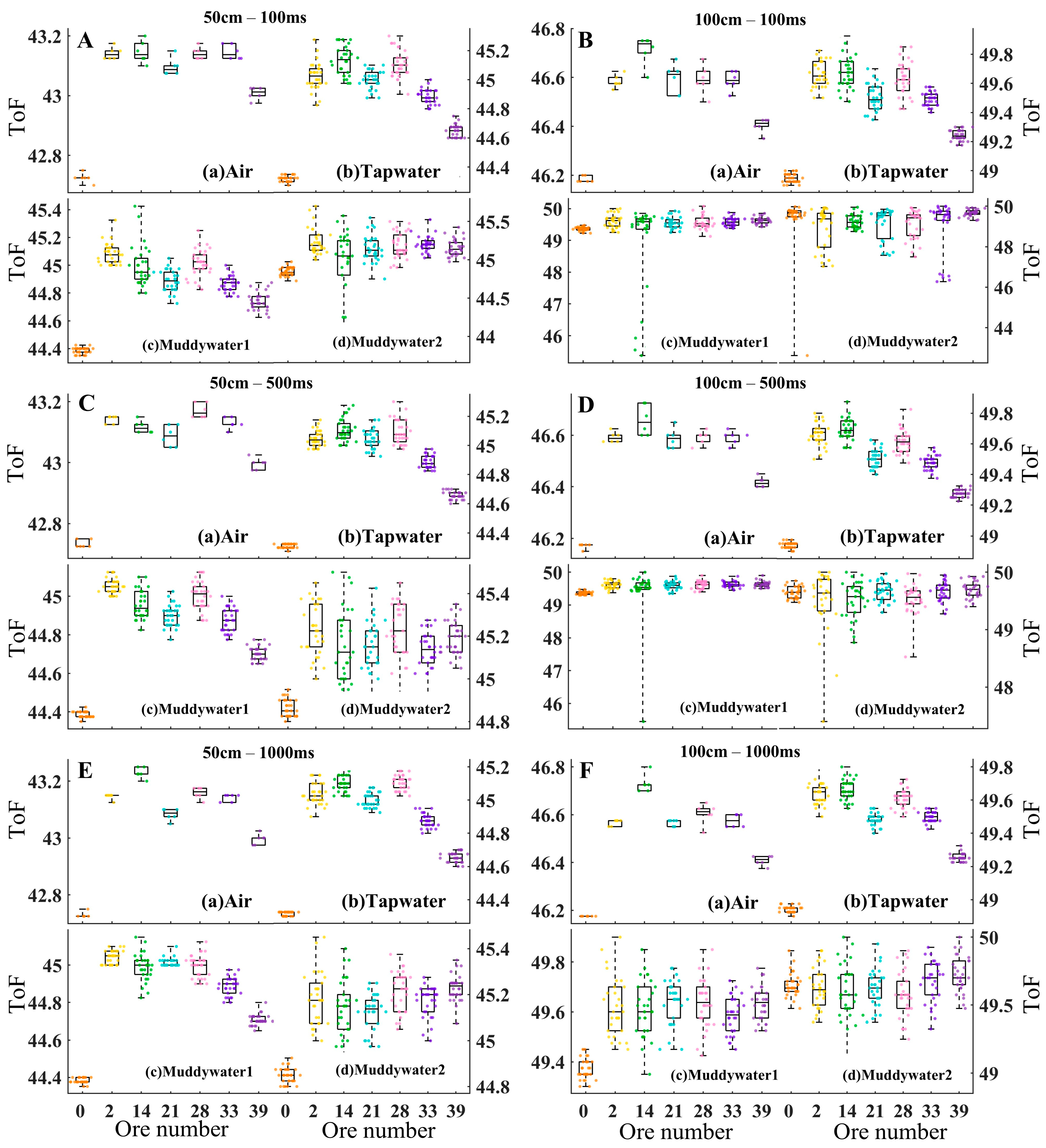
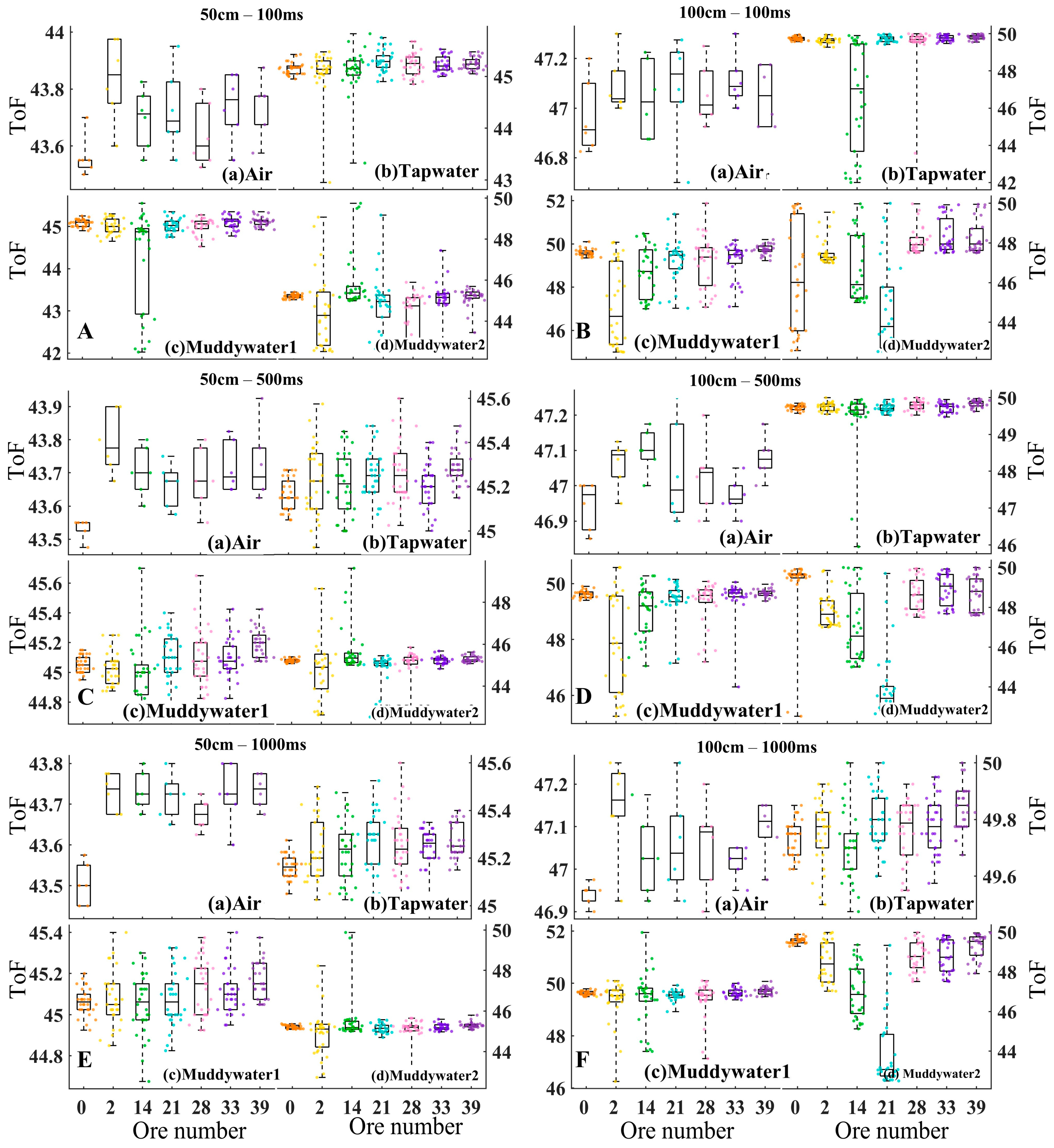
4.4. Ranging Error Analysis
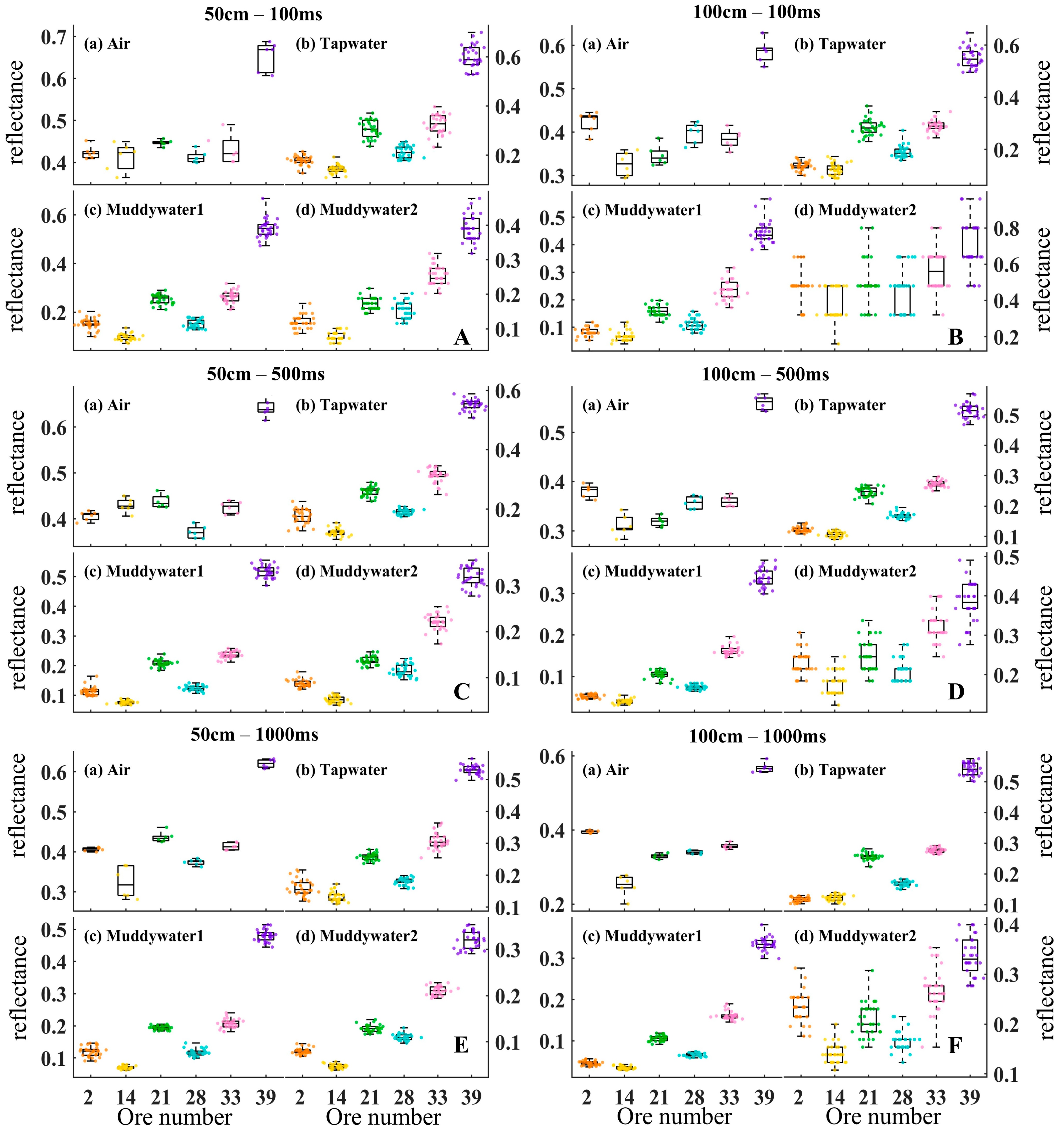
4.5. System Reflectance Inversion
- (1)
- Attenuation coefficient (c): Uncertainty stems from power meter precision (±2%) and path length measurement (±0.5 cm), already considered in the calibrated c = 0.11 ± 0.01 m−1 (Tapwater) to 4.22 ± 0.05 m−1 (Muddywater2).
- (2)
- Reflectance inversion: Uncertainty includes photon-count noise and multispectral calibration error, clarified as ±0.02–0.04 for all targets.
- (3)
- Ranging SD: Uncertainty from TCSPC time-base stability and environmental vibration, noted as ±0.002–0.005 ns.
5. Conclusions
Author Contributions
Funding
Data Availability Statement
Conflicts of Interest
Abbreviations
| SD | standard deviation |
| SPL | Single-photon LiDAR |
| SPAD | Single-photon avalanche diode |
| FOV | Field of view |
| TOF | Time to flight |
| MMF | Multimode fiber |
| IQR | Interquartile range |
| SNR | Signal-to-noise ratio |
| TCSPC | Time-correlated single-photon counting |
| AUV | Autonomous underwater vehicle |
| BRDF | Bidirectional Reflectance Distribution Function |
References
- Shangguan, M.; Yang, Z.; Lin, Z.; Liao, Z.; Guo, Y.; Liu, C. Remote sensing oil in water with an all-fiber underwater single-photon Raman lidar. Appl. Opt. 2023, 62, 5301–5305. [Google Scholar] [CrossRef] [PubMed]
- Shangguan, M.; Weng, Z.; Lin, Z.; Lee, Z.; Yang, Z.; Sun, J.; Wu, T.; Zhang, Y.; Wen, C. Day and night continuous high-resolution shallow-water depth detection with single-photon underwater lidar. Opt. Express 2023, 31, 43950–43962. [Google Scholar] [CrossRef]
- Hoque, S.; Abdullah, M.A.; Alayed, M.; Elamien, M.; Deen, M.J. Silicon-Based Single Photon Avalanche Diode Technologies: Structures, Performance, and Challenges. IEEE Electron Devices Rev. 2025, 2, 69–97. [Google Scholar] [CrossRef]
- Durini, D.; Paschen, U.; Schwinger, A.; Spickermann, A. 11-Silicon based single-photon avalanche diode (SPAD) technology for low-light and high-speed applications. Photodetectors 2016, 345–371. [Google Scholar] [CrossRef]
- Deng, Y.; Liu, J.; Xiao, H.; Shu, S.; Wang, S.; Zhang, B. Developments in Atmospheric Remote Sensing Lidar Based on Single-Photon Detection. Laser Optoelectron. Prog. 2025, 62, 1000002. [Google Scholar] [CrossRef]
- Churnside, J.H.; Shaw, J.A. Lidar remote sensing of the aquatic environment: Invited. Appl. Opt. 2020, 59, C92–C99. [Google Scholar] [CrossRef]
- Pashayev, A.M.; Allahverdiyev, K.R.; Tagiyev, B.G.; Sadikhov, I.Z. Light induced fluorescence LIDAR developed and employed at the National Aviation Academy of Azerbaijan. In 19th International Conference and School on Quantum Electronics: Laser Physics and Applications; SPIE: Bellingham, WA, USA, 2017; Volume 10226, p. 102260W. [Google Scholar] [CrossRef]
- Shangguan, M.; Xia, H.; Wang, C.; Qiu, J.; Shentu, G.; Zhang, Q.; Dou, X.; Pan, J.-W. All-fiber upconversion high spectral resolution wind lidar using a Fabry-Perot interferometer. Opt. Express 2016, 24, 19322–19336. [Google Scholar] [CrossRef]
- Shangguan, M.; Xia, H.; Wang, C.; Qiu, J.; Lin, S.; Dou, X.; Zhang, Q.; Pan, J.-W. Dual-frequency Doppler lidar for wind detection with a superconducting nanowire single-photon detector. Opt. Lett. 2017, 42, 3541–3544. [Google Scholar] [CrossRef]
- Yu, C.; Shangguan, M.; Xia, H.; Zhang, J.; Dou, X.; Pan, J.W. Fully integrated free-running InGaAs/InP single-photon detector for accurate lidar applications. Opt. Express 2017, 25, 14611–14620. [Google Scholar] [CrossRef]
- Bai, J.; Gao, S.; Niu, Z.; Zhang, C.; Bi, K.; Sun, G.; Huang, Y. A Novel Algorithm for Leaf Incidence Angle Effect Correction of Hyperspectral LiDAR. IEEE Trans. Geosci. Remote Sens. 2021, 60, 1–9. [Google Scholar] [CrossRef]
- Xia, H.; Shangguan, M.; Shentu, G.; Wang, C.; Qiu, J.; Zheng, M.; Xie, X.; Dou, X.; Zhang, Q.; Pan, J.-W. Brillouin optical time-domain reflectometry using up-conversion single-photon detector. Opt. Commun. 2016, 381, 37–42. [Google Scholar] [CrossRef]
- Shangguan, M.; Wang, C.; Xia, H.; Shentu, G.; Dou, X.; Zhang, Q.; Pan, J.-W. Brillouin optical time domain reflectometry for fast detection of dynamic strain incorporating double-edge technique. Opt. Commun. 2017, 398, 95–100. [Google Scholar] [CrossRef]
- Belmekki, M.A.A.; Leach, J.; Tobin, R.; Buller, G.S.; McLaughlin, S.; Halimi, A. 3D target detection and spectral classification for single-photon LiDAR data. Opt. Express 2023, 31, 23729–23745. [Google Scholar] [CrossRef]
- Maccarone, A.; McCarthy, A.; Ren, X.; Warburton, R.E.; Wallace, A.M.; Moffat, J.; Petillot, Y.; Buller, G.S. Underwater depth imaging using time-correlated single-photon counting. Opt. Express 2015, 23, 33911–33926. [Google Scholar] [CrossRef]
- Maccarone, A.; Della Rocca, F.M.; McCarthy, A.; Henderson, R.; Buller, G.S. Three-dimensional imaging of stationary and moving targets in turbid underwater environments using a single-photon detector array. Opt. Express 2019, 27, 28437–28456. [Google Scholar] [CrossRef] [PubMed]
- Shen, X.; Kong, W.; Chen, P.; Chen, T.; Huang, G.; Shu, R. A shipborne photon-counting lidar for depth-resolved ocean observation. Remote Sens. 2022, 14, 3351. [Google Scholar] [CrossRef]
- Shangguan, M.; Liao, Z.; Guo, Y.; Lee, Z. Sensing the profile of particulate beam attenuation coefficient through a single-photon oceanic Raman lidar. Opt. Express 2023, 31, 25398–25414. [Google Scholar] [CrossRef] [PubMed]
- Wang, J.; Hao, W.; Chen, S.; Zhang, Z.; Xu, W.; Xie, M.; Zhu, W.; Su, X. Underwater single photon 3D imaging with millimeter depth accuracy and reduced blind range. Opt. Express 2023, 31, 30588–30603. [Google Scholar] [CrossRef]
- Zhou, Y.; Chen, Y.; Zhao, H.; Jamet, C.; Dionisi, D.; Chami, M.; Di Girolamo, P.; Churnside, J.H.; Malinka, A.; Zhao, H.; et al. Shipborne oceanic high-spectral-resolution lidar for accurate estimation of seawater depth-resolved optical properties. Light Sci. Appl. 2022, 11, 261. [Google Scholar] [CrossRef]
- Shangguan, M.; Guo, Y.; Liao, Z. Shipborne single-photon fluorescence oceanic lidar: Instrumentation and inversion. Opt. Express 2024, 32, 10204–10218. [Google Scholar] [CrossRef]
- Maccarone, A.; Drummond, K.; McCarthy, A.; Steinlehner, U.K.; Tachella, J.; Garcia, D.A.; Pawlikowska, A.; Lamb, R.A.; Henderson, R.K.; McLaughlin, S.; et al. Submerged single-photon LiDAR imaging sensor used for real-time 3D scene reconstruction in scattering underwater environments. Opt. Express 2023, 31, 16690–16708. [Google Scholar] [CrossRef]
- Halimi, A.; Maccarone, A.; McCarthy, A.; McLaughlin, S.; Buller, G.S. Object Depth Profile and Reflectivity Restoration From Sparse Single-Photon Data Acquired in Underwater Environments. IEEE Trans. Comput. Imaging 2017, 3, 472–484. [Google Scholar] [CrossRef]
- Wang, J.; Hao, W.; Chen, S.; Xie, M.; Li, X.; Shi, H.; Feng, X.; Su, X. Underwater Single-Photon Profiling Under Turbulence and High Attenuation Environment. IEEE Geosci. Remote Sens. Lett. 2024, 21, 1–5. [Google Scholar] [CrossRef]
- Deng, R.; He, Y.; Qin, Y.; Chen, Q.; Chen, L. Measuring pure water absorption coefficient in the near-infrared spectrum (900–2500 nm). J. Remote Sens. 2012, 16, 192–206. [Google Scholar] [CrossRef]
- Laux, A.; Billmers, R.; Mullen, L.; Concannon, B.; Davis, J.; Prentice, J.; Contarino, V. The a, b, c s of oceanographic lidar predictions: A significant step toward closing the loop between theory and experiment. J. Mod. Opt. 2002, 49, 439–451. [Google Scholar] [CrossRef]



| Device | Parameter | Value |
|---|---|---|
| laser | Wavelength | 532 nm |
| Pulse duration | 1 ns | |
| Pulse energy | 2 μJ | |
| Pulse repetition rate | 45 kHz | |
| Radius of laser beam | 2 mm | |
| Divergence angle | 0.5 mrad | |
| Receiver | Focal length | 50.8 mm |
| Mode-field diameter of the MMF | 105 μm | |
| Effective aperture | 22.4 mm | |
| Bandwidth of the filter | 5 nm | |
| Center wavelength | 532 nm | |
| SPAD | Detection efficiency | 65% |
| Dark count rate | 100 cps | |
| Dead time | 20 ns | |
| Bin width | 8 ps | |
| Ranging Precision | 50 ps (Air)/ 100–200 ps (Underwater) |
| Parameter | Symbol | Value |
|---|---|---|
| Target | Num.0 | Reflective plate |
| Num.2 | Manganese ore | |
| Num.14 | Coal | |
| Num.21 | Graphite | |
| Num.28 | Basalt | |
| Num.33 | Limestone | |
| Num.39 | Quartzite | |
| Laser energy Configuration | Channel 1 | 10% |
| Channel 2 | 1% | |
| Channel 3 | 50% | |
| Channel 4 | 100% | |
| Integration Time | T1 | 100 ms |
| T2 | 500 ms | |
| T3 | 1000 ms | |
| Distance | L1 | 50 cm |
| L2 | 100 cm | |
| L3 | 200 cm | |
| Attenuation | C1 | 0.11 m−1 |
| C2 | 0.98 m−1 | |
| C3 | 4.22 m−1 |
| Laser Energy | Time | Distance | C1 | C2 | C3 |
|---|---|---|---|---|---|
| Channel 1 | 100 ms | 50 cm | 44.72 ± 0.041 ns | 44.70 ± 0.039 ns | 45.16 ± 0.094 ns |
| 100 cm | 49.31 ± 0.052 ns | 49.57 ± 0.090 ns | 49.63 ± 0.185 ns | ||
| 500 ms | 50 cm | 44.72 ± 0.028 ns | 44.66 ± 0.041 ns | 45.12 ± 0.057 ns | |
| 100 cm | 49.28 ± 0.033 ns | 49.61 ± 0.068 ns | 49.68 ± 0.119 ns | ||
| 1000 ms | 50 cm | 44.71 ± 0.021 ns | 44.66 ± 0.025 ns | 45.15 ± 0.048 ns | |
| 100 cm | 49.28 ± 0.028 ns | 49.60 ± 0.060 ns | 49.67 ± 0.109 ns | ||
| Channel 2 | 100 ms | 50 cm | 45.15 ± 0.114 ns | 45.09 ± 0.087 ns | 45.22 ± 0.106 ns |
| 100 cm | 49.74 ± 0.101 ns | 49.60 ± 0.167 ns | 46.30 ± 2.701 ns | ||
| 500 ms | 50 cm | 45.16 ± 0.070 ns | 45.05 ± 0.056 ns | 45.22 ± 0.085 ns | |
| 100 cm | 49.74 ± 0.067 ns | 49.62 ± 0.124 ns | 49.16 ± 1.785 ns | ||
| 1000 ms | 50 cm | 45.16 ± 0.049 ns | 45.06 ± 0.065 ns | 45.23 ± 0.087 ns | |
| 100 cm | 49.73 ± 0.062 ns | 49.64 ± 0.077 ns | 49.56 ± 0.148 ns | ||
| Channel 3 | 100 ms | 50 cm | 44.32 ± 0.020 ns | 44.39 ± 0.021 ns | 44.85 ± 0.056 ns |
| 100 cm | 48.95 ± 0.031 ns | 49.36 ± 0.059 ns | 49.41 ± 1.291 ns | ||
| 500 ms | 50 cm | 44.31 ± 0.014 ns | 44.39 ± 0.015 ns | 44.86 ± 0.040 ns | |
| 100 cm | 48.94 ± 0.019 ns | 49.36 ± 0.046 ns | 49.65 ± 0.102 ns | ||
| 1000 ms | 50 cm | 44.32 ± 0.011 ns | 44.38 ± 0.014 ns | 44.85 ± 0.033 ns | |
| 100 cm | 48.94 ± 0.018 ns | 49.37 ± 0.040 ns | 49.65 ± 0.087 ns | ||
| Channel 4 | 100 ms | 50 cm | 44.14 ± 0.015 ns | 44.23 ± 0.025 ns | 44.72 ± 0.058 ns |
| 100 cm | 48.80 ± 0.031 ns | 49.23 ± 0.051 ns | 49.57 ± 0.135 ns | ||
| 500 ms | 50 cm | 44.14 ± 0.012 ns | 44.21 ± 0.019 ns | 44.71 ± 0.029 ns | |
| 100 cm | 48.79 ± 0.014 ns | 49.21 ± 0.034 ns | 49.63 ± 0.151 ns | ||
| 1000 ms | 50 cm | 44.15 ± 0.008 ns | 44.23 ± 0.010 ns | 44.71 ± 0.025 ns | |
| 100 cm | 48.80 ± 0.010 ns | 49.22 ± 0.028 ns | 49.63 ± 0.101 ns |
Disclaimer/Publisher’s Note: The statements, opinions and data contained in all publications are solely those of the individual author(s) and contributor(s) and not of MDPI and/or the editor(s). MDPI and/or the editor(s) disclaim responsibility for any injury to people or property resulting from any ideas, methods, instructions or products referred to in the content. |
© 2026 by the authors. Licensee MDPI, Basel, Switzerland. This article is an open access article distributed under the terms and conditions of the Creative Commons Attribution (CC BY) license.
Share and Cite
Wang, C.; Liu, S.; Zhu, S.; Yang, W.; Hu, C.; Chen, Y.; Li, C.; Wang, J. Analysis of Underwater Single-Photon LiDAR Signals: A Comprehensive Study on Multi-Parameter Coupling Effects. Appl. Sci. 2026, 16, 1508. https://doi.org/10.3390/app16031508
Wang C, Liu S, Zhu S, Yang W, Hu C, Chen Y, Li C, Wang J. Analysis of Underwater Single-Photon LiDAR Signals: A Comprehensive Study on Multi-Parameter Coupling Effects. Applied Sciences. 2026; 16(3):1508. https://doi.org/10.3390/app16031508
Chicago/Turabian StyleWang, Ceyuan, Shijie Liu, Shouzheng Zhu, Wenhang Yang, Chenhui Hu, Yuwei Chen, Chunlai Li, and Jianyu Wang. 2026. "Analysis of Underwater Single-Photon LiDAR Signals: A Comprehensive Study on Multi-Parameter Coupling Effects" Applied Sciences 16, no. 3: 1508. https://doi.org/10.3390/app16031508
APA StyleWang, C., Liu, S., Zhu, S., Yang, W., Hu, C., Chen, Y., Li, C., & Wang, J. (2026). Analysis of Underwater Single-Photon LiDAR Signals: A Comprehensive Study on Multi-Parameter Coupling Effects. Applied Sciences, 16(3), 1508. https://doi.org/10.3390/app16031508