Classification and Recognition of Ultra-High-Frequency Partial Discharge Signals in Transformers Based on AHAFN


Abstract
1. Introduction
- (1)
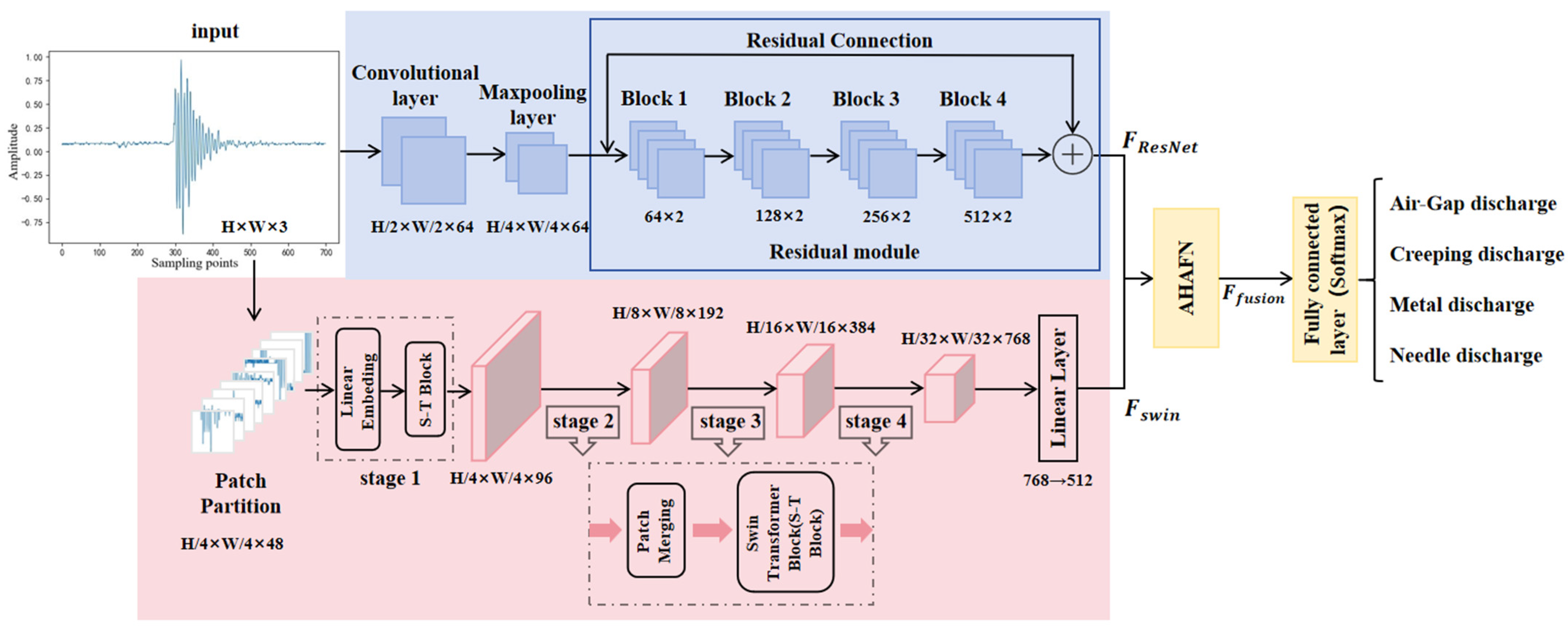
- Rather than proposing a completely new backbone architecture, this work investigates a problem-oriented dual-stream learning paradigm tailored to partial discharge pattern recognition, where local texture characteristics and global contextual dependencies are jointly modeled.
- (2)
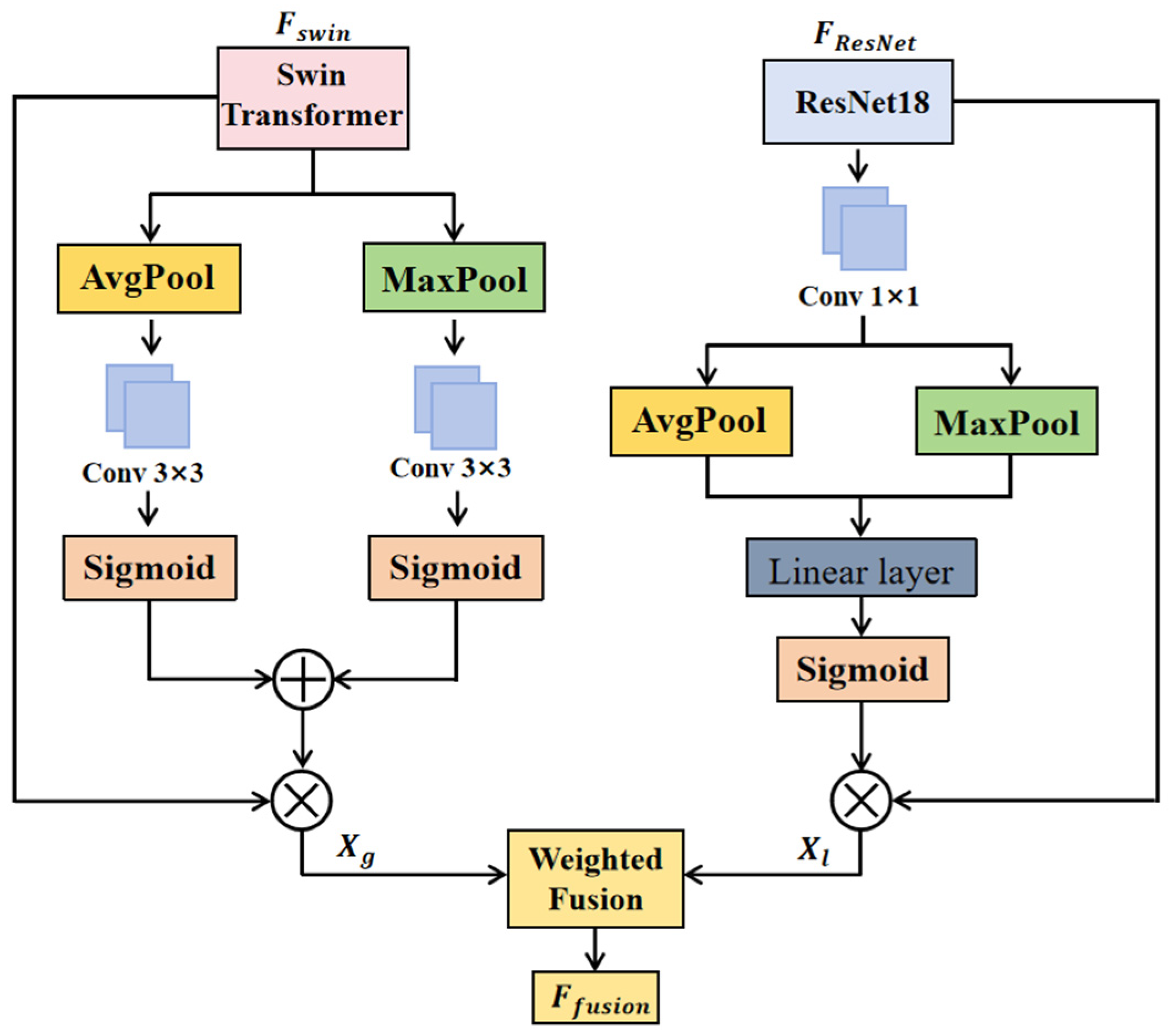
- An AHAFN is designed to dynamically balance and recalibrate local and global features, which differs from existing attention-based fusion methods that rely on fixed or single-scale attention mechanisms. It addresses the feature heterogeneity between CNN-extracted local representations and transformer-extracted global representations.
- (3)
- Extensive comparative and ablation experiments are conducted to critically analyze the effectiveness and limitations of dual-stream attention-based models, providing deeper insights into their applicability for UHF partial discharge recognition tasks.
2. Materials and Methods
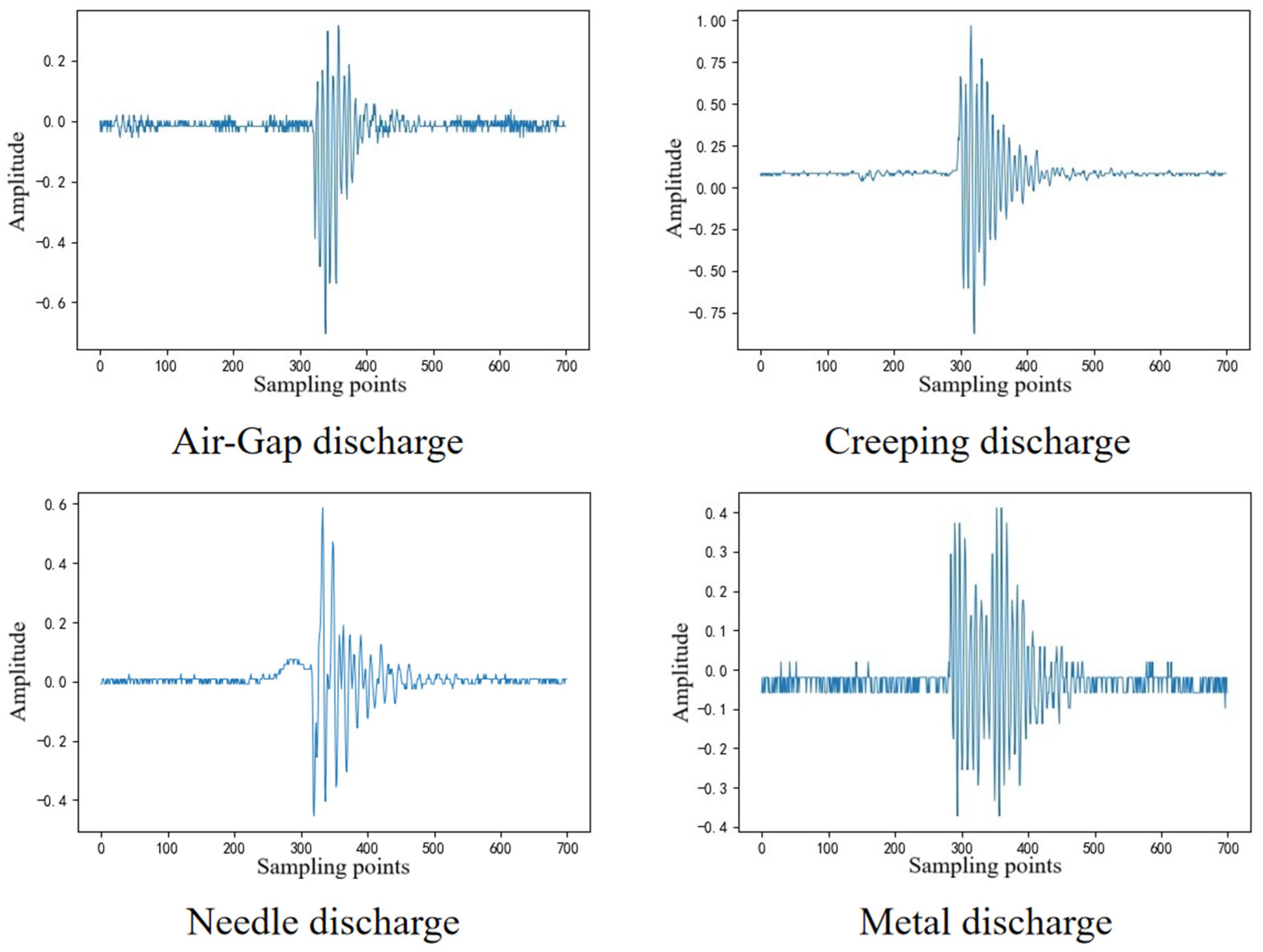
2.1. Characteristic Analysis of Partial Discharge Ultra-High-Frequency Signal
2.2. AHAFN Method
2.2.1. The ResNet Module
2.2.2. The Swin Module
2.2.3. The AHAFN Module
2.2.4. Algorithm Evaluation Indicators
3. Results
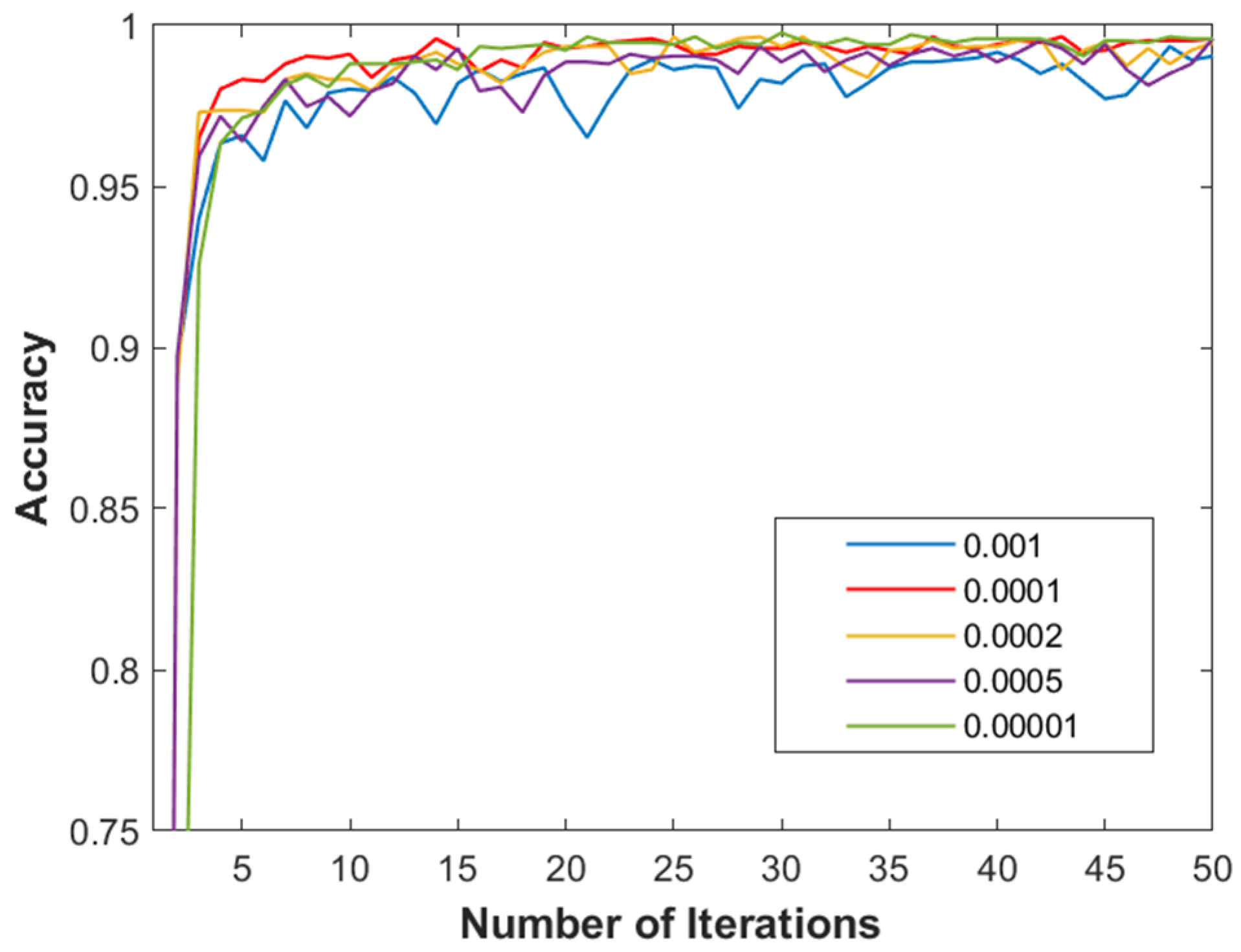
3.1. Experimental Details
3.2. Ablation Experiment
3.3. Comparative Experiment
3.3.1. Compared to a Single Network
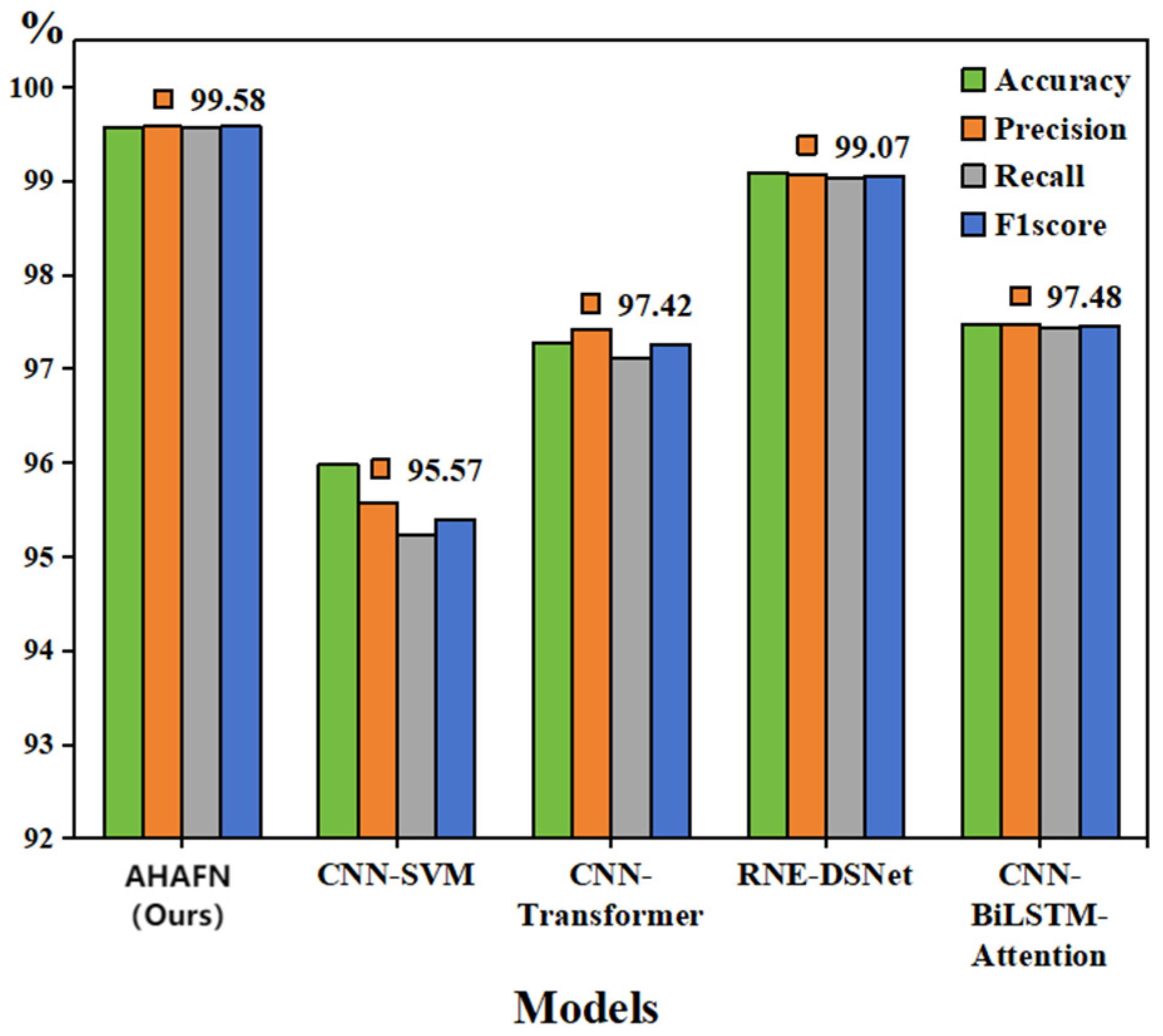
3.3.2. Compared to Other Dual-Stream Networks
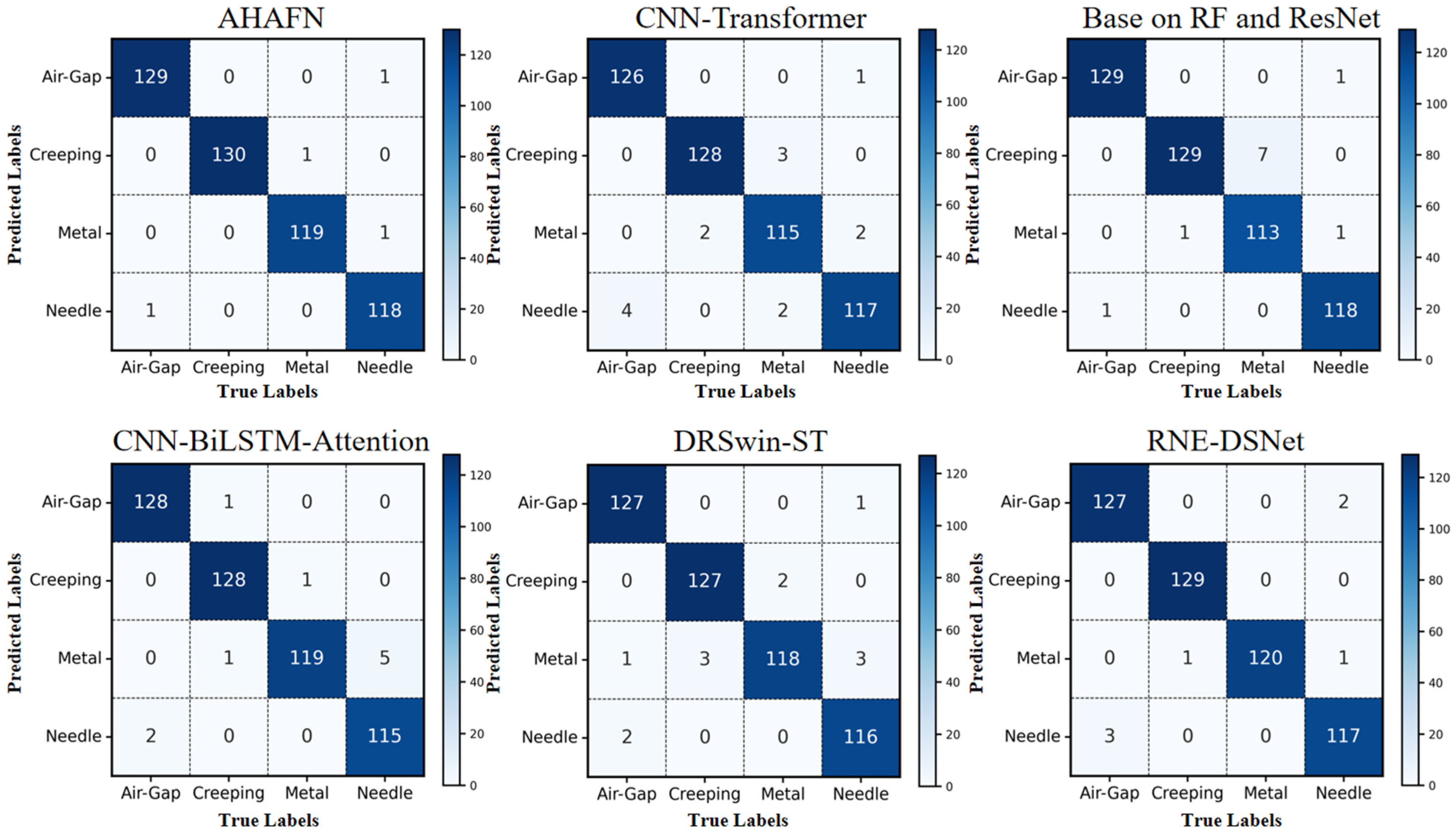
3.3.3. Two-Dimensional Confusion Matrix
4. Conclusions
Author Contributions
Funding
Institutional Review Board Statement
Informed Consent Statement
Data Availability Statement
Conflicts of Interest
Abbreviations
| AHAFN | Adaptive Hybrid Attention Fusion Network |
| PD | Partial discharge |
| UHF | Ultra-high-frequency |
References
- Zhou, X.; Wu, X.; Ding, P.; Li, X.; He, N.; Zhang, G.; Zhang, X. Research on transformer partial discharge UHF pattern recognition based on CNN–LSTM. Energies 2020, 13, 61. [Google Scholar] [CrossRef] [Scilit]
- Mondal, M.; Kumbhar, B.G.; Kulkarni, V.S. Localization of partial discharges inside a transformer winding using a ladder network constructed from terminal measurements. IEEE Trans. Power Deliv. 2018, 33, 1035–1043. [Google Scholar] [CrossRef] [Scilit]
- Jan, T.S.; Afzal, R.; Khan, Z.A. Transformer failures: Causes and impact. In Proceedings of the International Conference on Data Mining, Civil and Mechanical Engineering (ICDMCME 2015), Bali, Indonesia, 1–2 February 2015; USAID Funded Center for Advance Studies in Energy at NUST (CAS-EN): Islamabad, Pakistan; pp. 50–53. [Google Scholar]
- Klein, L.; Seidl, D.; Fulneček, J.; Prokop, L.; Mišák, S.; Dvorský, J. Antenna contactless partial discharge detection in covered conductors using ensemble stacking neural networks. Expert Syst. Appl. 2023, 213, 118910. [Google Scholar] [CrossRef] [Scilit]
- Darabad, V.P.; Vakilian, M.; Phung, B.T.; Blackburn, T.R. An efficient diagnosis method for data mining on single PD pulses of transformer insulation defect models. IEEE Trans. Dielectr. Electr. Insul. 2013, 20, 2061–2072. [Google Scholar] [CrossRef] [Scilit]
- Qin, C.; Zhu, X.; Zhu, P.; Lin, W.; Liu, L.; Che, C.; Liang, H.; Hua, H. Partial Discharge Signal Pattern Recognition of Composite Insulation Defects in Cross-Linked Polyethylene Cables. Sensors 2024, 24, 3460. [Google Scholar] [CrossRef] [Scilit]
- Mirjalili, S.; Gandomi, A.H.; Mirjalili, S.Z.; Saremi, S.; Faris, H.; Mirjalili, S.M. Salp swarm algorithm: A bio-inspired optimizer. Adv. Eng. Softw. 2017, 114, 163–191. [Google Scholar] [CrossRef] [Scilit]
- Yang, X.S.; Deb, S.; Fong, S.; Heidari, A.A.; Mirjalili, S. Metaheuristic algorithms in artificial intelligence. Neural Comput. Appl. 2021, 33, 843–852. [Google Scholar]
- Gulski, E.; Kreuger, F.H. Computer-aided recognition of discharge sources. IEEE Trans. Dielectr. Electr. Insul. 1992, 27, 82–92. [Google Scholar] [CrossRef] [Scilit]
- Khan, Y.; Refaat, S.S.; Abu-Rub, H. Machine learning approaches for partial discharge diagnosis: A review. IEEE Access 2020, 8, 208800–208816. [Google Scholar]
- Khodaveisi, F.; Karami, H.; Karimpour, M.Z.; Rubinstein, M.; Rachidi, F. Partial discharge localization in power transformer tanks using machine learning methods. Sci. Rep. 2024, 14, 11785. [Google Scholar] [CrossRef] [Scilit]
- Karthikeyan, B.; Gopal, S. Partial discharge pattern recognition using wavelet transform and neural networks. IEEE Trans. Dielectr. Electr. Insul. 2005, 12, 570–579. [Google Scholar]
- Simonyan, K.; Zisserman, A. Two-stream convolutional networks for action recognition in videos. Adv. Neural Inf. Process. Syst. 2014, 27, 568–576. [Google Scholar]
- Tang, J.; Zhou, J.; Sheng, G.; Jiang, X. Partial discharge pattern recognition using deep convolutional neural networks. IEEE Trans. Dielectr. Electr. Insul. 2018, 25, 1476–1484. [Google Scholar]
- Adam, B.; Tenbohlen, S. Classification of multiple PD sources by signal features and LSTM networks. In Proceedings of the IEEE International Conference on High Voltage Engineering and Application (ICHVE), Athens, Greece, 10–13 September 2018; pp. 1–4. [Google Scholar]
- Cavallini, A.; Montanari, G.C. Effect of different stress conditions on partial discharge activity. IEEE Trans. Dielectr. Electr. Insul. 2001, 8, 971–979. [Google Scholar]
- Zhao, Z.; Liu, H.; Wang, Y.; Li, C.; Zhang, X.; Tang, J. Convolutional neural network based feature learning for partial discharge pattern recognition. IEEE Access 2019, 7, 47904–47913. [Google Scholar]
- Wang, J.; Li, Y.; Zheng, H.; Zhang, G.; Zhang, L.; Zhang, L.J. Partial discharge identification based on CNN–LSTM hybrid neural network. Electr. Power Syst. Res. 2020, 189, 106635. [Google Scholar]
- Feichtenhofer, C.; Pinz, A.; Zisserman, A. Convolutional two-stream network fusion for video action recognition. arXiv 2016, arXiv:1604.06573. [Google Scholar] [CrossRef] [Scilit]
- Qiao, H.; Liu, S.; Xu, Q.; Liu, S.; Yang, W. Two-stream convolutional neural network for video action recognition. KSII Trans. Internet Inf. Syst. 2021, 15, 3668–3684. [Google Scholar] [CrossRef] [Scilit]
- Tran, A.; Cheong, L.F. Two-stream flow-guided convolutional attention networks for action recognition. arXiv 2017, arXiv:1708.09268. [Google Scholar]
- Paul, A.; De, D.; Chatterjee, P.; Das, S. Two-stream convolutional network with multi-level feature fusion for categorization of human action from videos. In Pattern Recognition and Machine Intelligence; Springer: Cham, Switzerland, 2017; pp. 758–765. [Google Scholar]
- Zhu, Y.; Lan, Z.; Newsam, S.; Hauptmann, A.G. Hidden two-stream convolutional networks for action recognition. arXiv 2017, arXiv:1704.00389. [Google Scholar]
- Zaman, W.; Siddique, F.M.; Ullah, S.; Saleem, F.; Kim, J.-M. Hybrid deep learning model for fault diagnosis in centrifugal pumps: A comparative study of VGG16, ResNet50, and wavelet coherence analysis. Machines 2024, 12, 905. [Google Scholar] [CrossRef] [Scilit]
- Zhou, T.; Yao, D.; Yang, J.; Meng, C.; Li, A.; Li, X. DRSwin-ST: An intelligent fault diagnosis framework based on dynamic threshold noise reduction and sparse transformer with shifted windows. Reliab. Eng. Syst. Saf. 2024, 250, 110327. [Google Scholar] [CrossRef] [Scilit]
- Liang, X.M.; An, J.M.; Cao, X.H.; Zeng, K.; Wang, F.B.; Liu, H.F. Classification of sintering flame combustion state based on a CNN–Transformer dual-stream network. Appl. Opt. 2023, 44, 1030–1036. [Google Scholar]
- Zhou, T.; Liu, F.; Ye, X.; Guo, Y.; Niu, Y.; Lu, H. RNE-DSNet: A re-parameterization neighborhood enhancement-based dual-stream network for CT image recognition. Eng. Sci. Technol. Int. J. 2024, 56, 101760. [Google Scholar] [CrossRef] [Scilit]
- Fu, Z.; Wang, Y.; Zhou, L.; Li, K.; Rao, H. Partial discharge recognition of transformers based on data augmentation and CNN–BiLSTM–attention mechanism. Electronics 2025, 14, 193. [Google Scholar] [CrossRef] [Scilit]




| Partial Discharge Types | Number |
|---|---|
| Air-Gap discharge | 1526 |
| Creeping discharge | 1420 |
| Metal discharge | 872 |
| Needle discharge | 842 |
| total | 4660 |
| Type | Configuration Parameters | Type | Configuration Parameters |
|---|---|---|---|
| Conv1 | 7 × 7, Stride = 2 | Patch_Size | 4 × 4 |
| Max Pooling | 3 × 3, Stride = 2 | Window_Size | 7 × 7 |
| Block 1 | 3 × 3, 64 × 2 | Embed_Dim | 96 |
| Block 2 | 3 × 3, 128 × 2 | Depths | [2, 2, 6, 2] |
| Block 3 | 3 × 3, 256 × 2 | Heads | [3, 6, 12, 24] |
| Block 4 | 3 × 3, 512 × 2 | MLP_Ratio | 4 |
| GAP | 7 × 7 | Weight_Decay | 0.05 |
| Block | BasicBlock | Input | RGB (224 × 224) |
| inplanes | 64 | optimizer | Adam |
| Accuracy (%) | Precision (%) | Recall (%) | F1 Score | Loss (%) | |
|---|---|---|---|---|---|
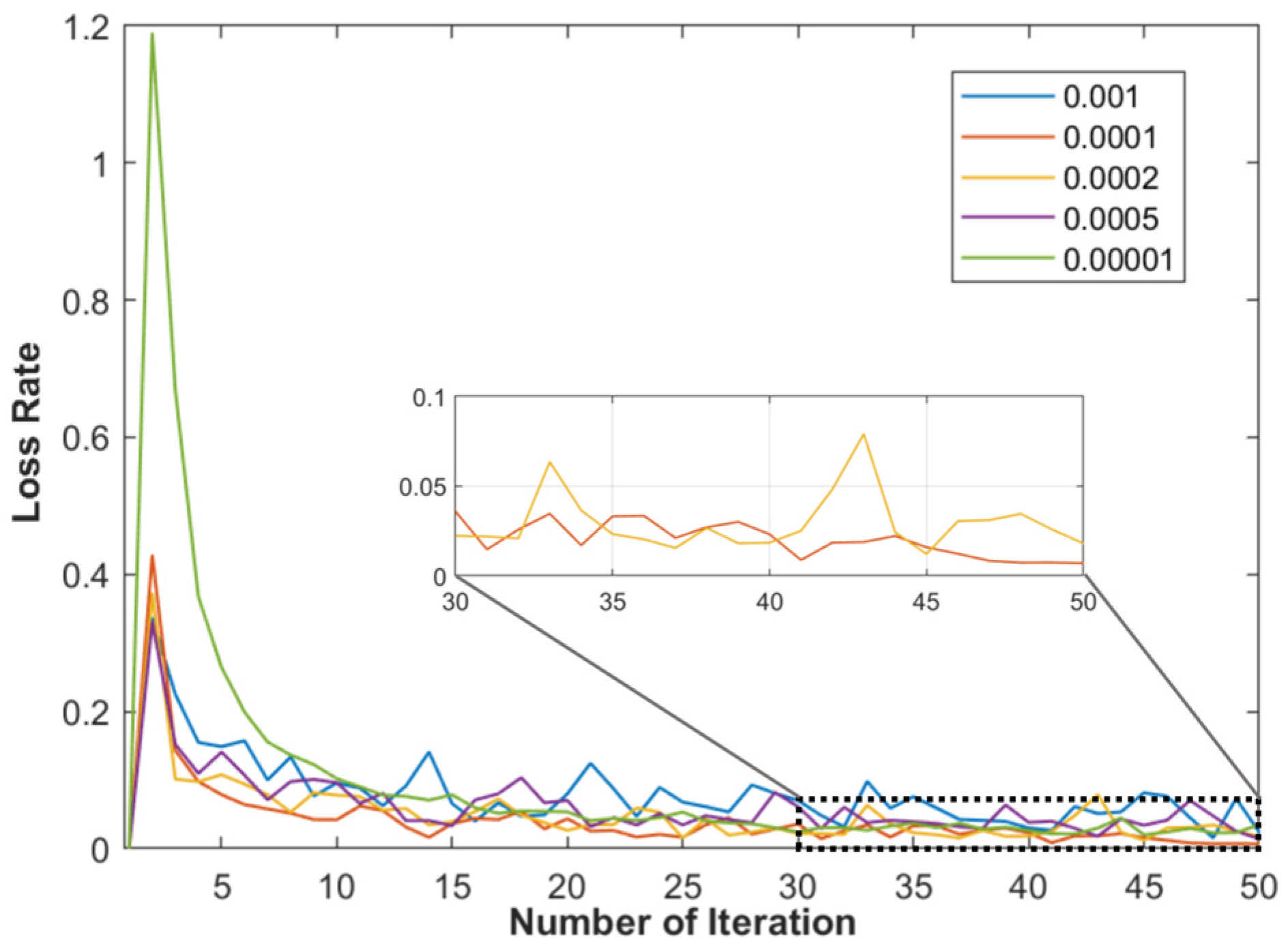
| 0.001 | 99.21 | 99.18 | 99.20 | 0.9920 | 2.88 |
| 0.0001 | 99.57 | 99.58 | 99.57 | 0.9958 | 0.73 |
| 0.0002 | 99.57 | 99.56 | 99.57 | 0.9956 | 0.93 |
| 0.0005 | 99.28 | 99.30 | 99.27 | 0.9928 | 1.23 |
| 0.00001 | 99.57 | 99.52 | 99.57 | 0.9954 | 2.67 |
| PD Type | FUS-C/% | AVG-F/% | SENet/% | CBAM/% | AHAFN (Ours)/% | |||||
|---|---|---|---|---|---|---|---|---|---|---|
| Rate | Average | Rate | Average | Rate | Average | Rate | Average | Rate | Average | |
| Air-Gap | 95.96 | 95.78 | 96.57 | 96.69 | 97.15 | 97.22 | 98.21 | 98.02 | 99.72 | 99.57 |
| Creeping | 95.76 | 96.78 | 97.23 | 97.90 | 99.47 | |||||
| Metal | 95.59 | 96.70 | 97.01 | 97.88 | 99.40 | |||||
| Needle | 95.68 | 96.75 | 97.55 | 98.02 | 99.64 | |||||
| Models | Train Accuracy (%) | Precision (%) | F1 Score |
|---|---|---|---|
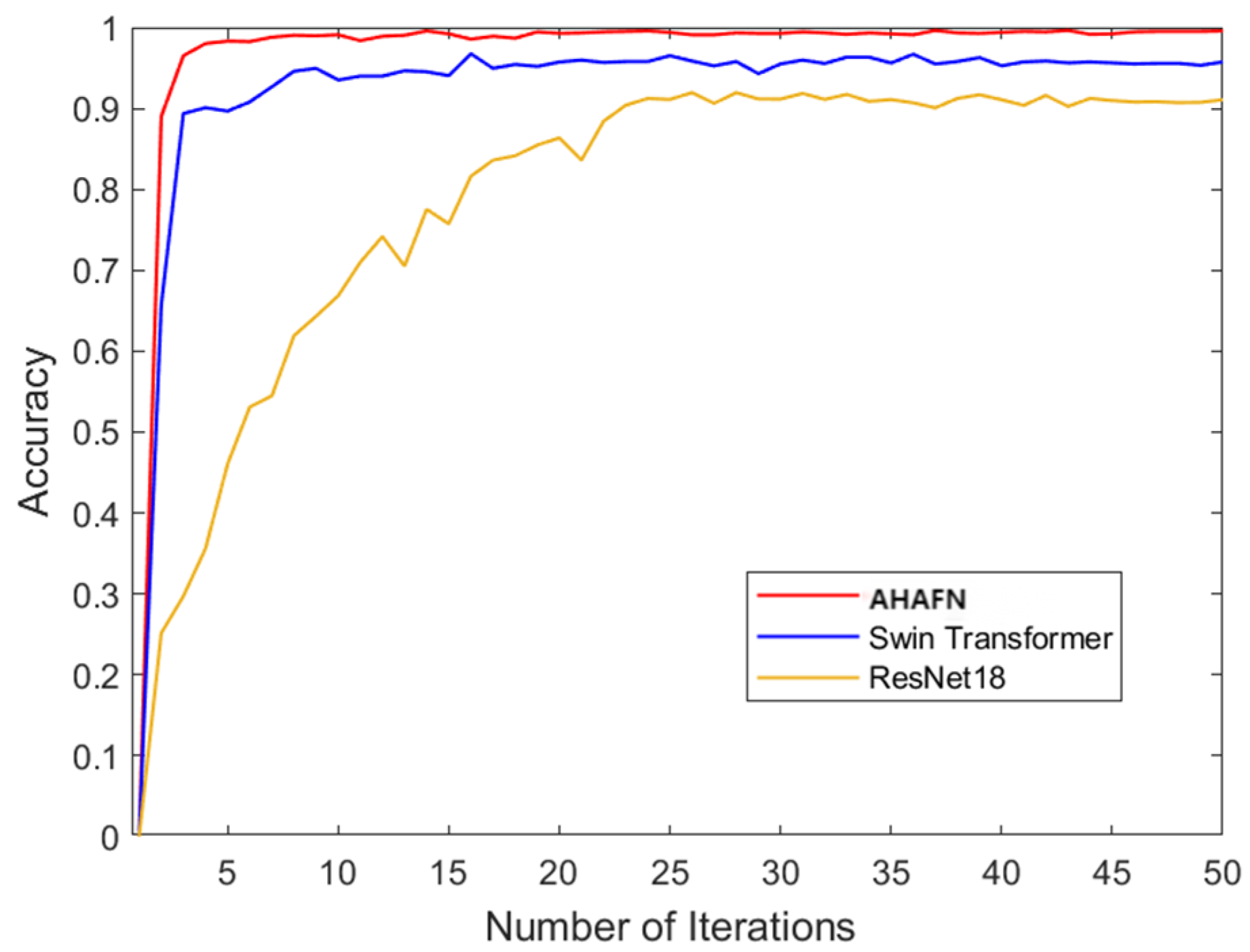
| ResNet18 | 91.21 | 90.53 | 0.9047 |
| Swin Transformer | 95.98 | 94.54 | 0.9421 |
| AHAFN (Ours) | 99.57 | 99.58 | 0.9958 |
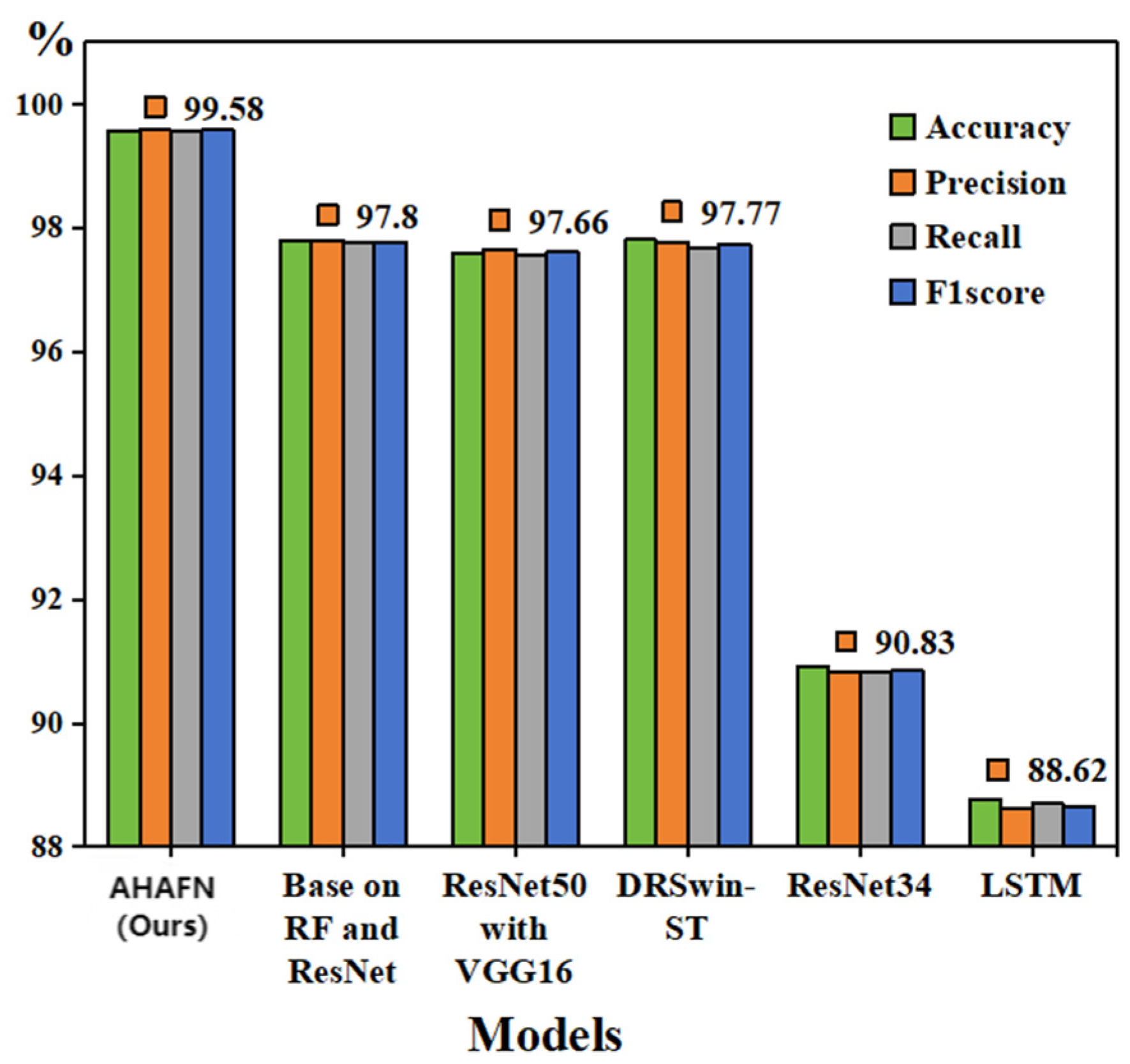
| Models | Accuracy (%) | Precision (%) | Recall (%) | F1 Score | FLOPs (G) |
|---|---|---|---|---|---|
| AHAFN (Ours) | 99.57 | 99.58 | 99.57 | 0.9958 | 6.3 |
| Base on RF and ResNet | 97.80 | 97.80 | 97.75 | 0.9777 | 1.8 |
| ResNet50 with VGG16 | 97.59 | 97.66 | 97.56 | 0.9761 | 19.6 |
| DRSwin-ST | 97.81 | 97.77 | 97.69 | 0.9773 | 6.4 |
| ResNet34 [18] | 90.91 | 90.83 | 90.82 | 0.9085 | 3.7 |
| LSTM [15] | 88.78 | 88.62 | 88.70 | 0.8866 | 0.4 |
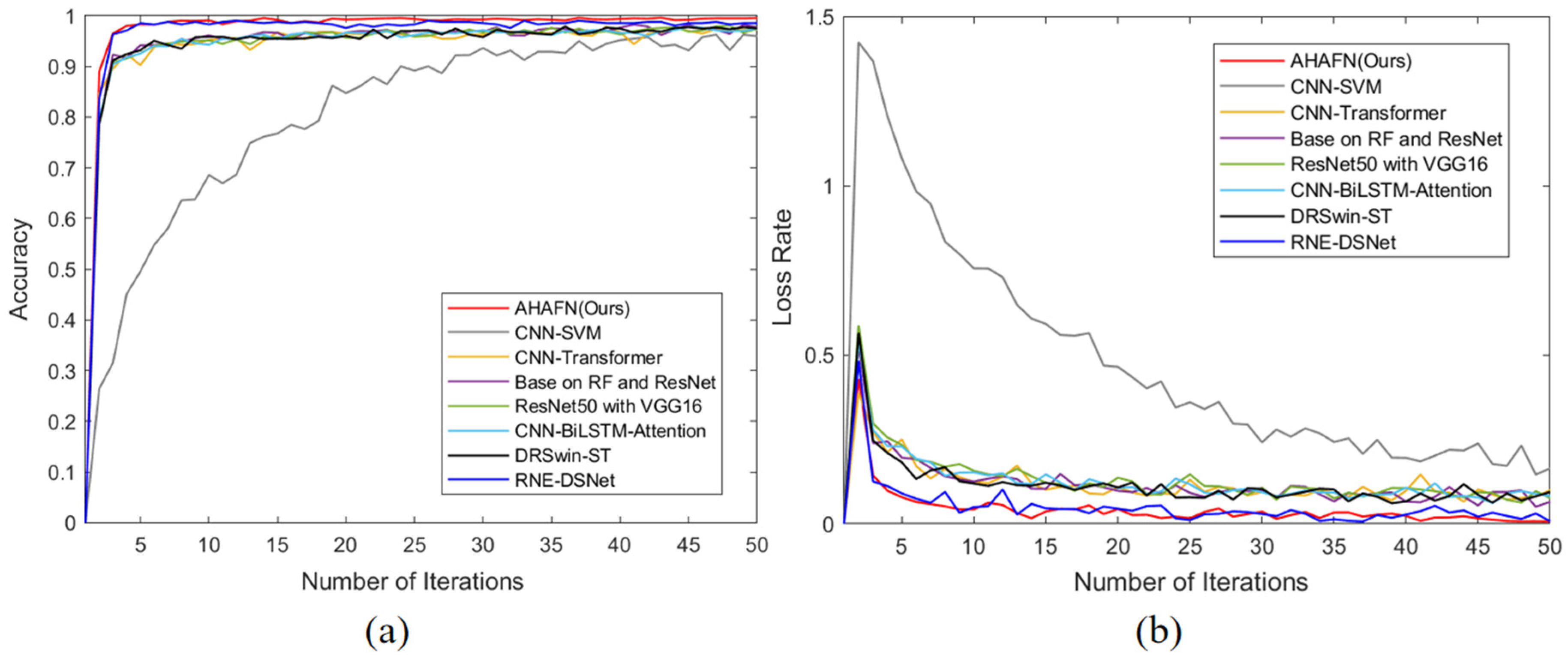
| Models | Accuracy (%) | Precision (%) | Recall (%) | F1 Score | FLOPs (G) |
|---|---|---|---|---|---|
| AHAFN(Ours) | 99.57 ± 0.08 | 99.58 | 99.57 | 0.9958 | 6.3 |
| CNN-SVM | 95.98 | 95.57 | 95.23 | 0.9540 | 1.82 |
| CNN-Transformer | 97.28 | 97.42 | 97.11 | 0.9726 | 7.52 |
| RNE-DSNet | 99.09 | 99.07 | 99.03 | 0.9905 | 4.34 |
| CNN-BiLSTM-Attention | 97.48 | 97.48 | 97.44 | 0.9746 | 4.04 |
Disclaimer/Publisher’s Note: The statements, opinions and data contained in all publications are solely those of the individual author(s) and contributor(s) and not of MDPI and/or the editor(s). MDPI and/or the editor(s) disclaim responsibility for any injury to people or property resulting from any ideas, methods, instructions or products referred to in the content. |
© 2026 by the authors. Licensee MDPI, Basel, Switzerland. This article is an open access article distributed under the terms and conditions of the Creative Commons Attribution (CC BY) license.
Share and Cite
Zhang, Y.; Yan, T. Classification and Recognition of Ultra-High-Frequency Partial Discharge Signals in Transformers Based on AHAFN. Appl. Sci. 2026, 16, 1479. https://doi.org/10.3390/app16031479
Zhang Y, Yan T. Classification and Recognition of Ultra-High-Frequency Partial Discharge Signals in Transformers Based on AHAFN. Applied Sciences. 2026; 16(3):1479. https://doi.org/10.3390/app16031479
Chicago/Turabian StyleZhang, Yishu, and Tianfeng Yan. 2026. "Classification and Recognition of Ultra-High-Frequency Partial Discharge Signals in Transformers Based on AHAFN" Applied Sciences 16, no. 3: 1479. https://doi.org/10.3390/app16031479
APA StyleZhang, Y., & Yan, T. (2026). Classification and Recognition of Ultra-High-Frequency Partial Discharge Signals in Transformers Based on AHAFN. Applied Sciences, 16(3), 1479. https://doi.org/10.3390/app16031479