Article

Tonal Mode Detection Based on the Triple Composite Signature of Fifths

1
Faculty of Automatic Control, Electronics and Computer Science, Silesian University of Technology, 44-100 Gliwice, Poland
2
Faculty of Management, University of Economics in Katowice, 40-287 Katowice, Poland
*
Author to whom correspondence should be addressed.
Appl. Sci. 2026, 16(3), 1409; https://doi.org/10.3390/app16031409
Submission received: 5 January 2026 / Revised: 26 January 2026 / Accepted: 28 January 2026 / Published: 30 January 2026
(This article belongs to the Special Issue Information Retrieval: From Theory to Applications)

Abstract

In this article, a novel algorithm for tonal mode classification utilizing the signature of fifths is presented. The proposed method is an extension of previously developed algorithms used for determining the key and key signature within the Western tonal system. The core idea of the algorithm is to analyze the entire piece as well as its most important excerpts, namely, the beginning and the end. The analysis of these three samples (beginning, end, and entire piece) involves the calculation of their corresponding signatures of fifths, which constitute two-dimensional sets of vectors inscribed in the circle of fifths. The length of each vector comprising the signature of fifths corresponds to the multiplicity of notes associated with a particular pitch class, while its direction is related to the position of that pitch class with respect to the circle of fifths. Based on the obtained signatures of fifths, the so-called Triple Composite Signature of Fifths is created, for which both the main directed axis and the major/minor mode axis are determined. Tonal mode is then established heuristically, based on the values of angles between the characteristic vectors of each sample’s signature of fifths and the major/minor mode axis of the Triple Composite Signature of Fifths. The process of tonal mode classification involves defining a tonal mode indicator, which assumes the values of 1 for major and −1 for minor tonality. To evaluate the effectiveness of the developed algorithm, a series of experiments was carried out using datasets of works from the Romantic period by F. Chopin and F. Schubert, as well as piano compositions from various eras. The results confirmed the high effectiveness of the proposed method in identifying tonal mode.

1. Introduction

Automatic determination of a musical piece’s tonality is one of the fundamental problems in contemporary computer music analysis [1,2,3,4,5]. This problem constitutes an essential element of research on tonality representation and modeling [1,3,6] and is also closely related to harmonic progression analysis and tracking their evolution throughout the piece [7,8,9,10,11]. Accurate tonality determination is also significant for numerous other tasks in music processing, such as automatic genre classification [12,13], composer style identification, and emotional expression analysis of musical works [14,15,16,17]. Therefore, the development of effective tonal mode detection methods represents an important step toward a more advanced understanding of musical structure and perception in music data mining systems.
Tonality models, inherently based on frequency relationships between sounds, have long constituted an important element of research on musical structure. These relationships are often expressed using visual representations, ranging from various two-dimensional maps [18,19] to more complex spiral-structured models [6,20,21]. One of the first theorists to propose a geometric method for describing tonal relationships was Leonhard Euler. His Tonnetz (harmonic network) illustrated the interconnections between tones forming major and minor chords, based on regular intervallic relationships—primarily fifths as well as major and minor thirds. These relationships also became the foundation for later concepts of spatial tonal models, including various spiral tonality models [6,19].
With the development of analytical methods, the description of tonality began to be extended to spaces with a greater number of dimensions. The literature features both two-dimensional and three-dimensional models, as well as more complex multidimensional representations, such as the six-dimensional tonal centroid space (6D tonal centroid space) [3] or even multilevel tonal interval space encompassing up to twelve dimensions [1]. All these models, regardless of their degree of complexity, share a common goal: mapping relationships between notes, chords, and local tonalities by assigning them positions within geometric structures, on maps, spirals, network nodes, or matrices. This approach forms the basis for a wide range of applications: from automatic chord and tonality recognition, through harmonic function analysis, to computer-assisted composition [22,23,24,25,26,27,28,29,30].
In recent years, there has been dynamic development of methods that combine classical tonality models with machine learning and artificial intelligence techniques. Solutions utilizing artificial intelligence methods for analyzing tonal relationships and recognizing harmonic structures in musical works have been increasingly proposed [31,32,33,34,35,36,37]. These approaches open new possibilities in automatic music analysis, interpretation, and classification. An important research direction in tonal analysis is given by methods based on tonal profiles [38,39,40,41,42]. These approaches use statistical models representing the distribution of pitch class occurrences characteristic to individual tonalities. In the classical approach, the tonality determination procedure consists of calculating the correlation coefficient between the analyzed musical fragment and a set of 24 tonal profiles—covering twelve major and twelve minor tonalities—and then selecting the tonality with the highest match.
Over the years, numerous variants of tonal profiles have been developed [31,40,41,42,43,44,45,46] differing both in their construction methods and data sources. Some of them were developed based on experimental research in cognitive psychology [40,41], while others result from statistical and probabilistic analyses conducted on large musical corpora [43,44,46]. In recent years, models constructed using artificial intelligence and machine learning techniques have also emerged, enabling automatic learning of profiles based on acoustic and harmonic features of musical recordings [45]. The advantage of algorithms based on tonal profiles is their relatively low computational complexity, making them efficient for practical applications, especially when analyzing large music datasets in real time. It is worth noting that there are even simpler tonality detection algorithms, developed for hardware implementations or resource-constrained systems [47]. The basis of these simplified solutions is the use of relationships between tonalities mapped in the structure of the circle of fifths.
One of the key issues in tonal analysis from the perspective of emotion detection or genre classification is simple tonal mode classification [48,49]. Pieces in major tonality are typically characterized by a cheerful, happy mood, while those in minor tonality exhibit a sad or melancholic character. Tonal relationships presented in the circle of fifths have become the basis for numerous studies utilizing the signature of fifths [47]. Experience gained from using the signature of fifths for determining a key signature and key [39,47], as well as results from works dedicated to visualizing its variability with the trajectories of fifths [50,51], led to the discovery of relationships between the distribution of points comprising the trajectory of fifths and the tonal mode of a piece [49]. The first experiments described in [50] already demonstrated statistically significant differences in the positioning of the trajectory of fifths for major and minor pieces, although without indicating a classification method. The results presented in [49] confirmed a strong dependence of the trajectory of fifths point distribution on the piece’s tonal mode. However, all experiments conducted to date assumed knowledge of the analyzed pieces’ tonalities. The method for determining a piece’s tonality based on the distribution of the points comprising the trajectory of fifths is not yet known, making it difficult to utilize these observations for simple tonal mode classification. Determining tonality based solely on the trajectory of fifths appears to be a rather challenging problem. The obtained results thus became an inspiration for seeking connections between the structure of the signature of fifths and the tonal mode of pieces. In the case of the signature of fifths, efficient tonality determination algorithms are known [39,47], which creates the opportunity to develop a computationally efficient tonal mode determination algorithm without the need to determine the piece’s tonality. In the work [47], a simple and quite effective method for determining a piece’s tonality was proposed through analysis of the relationship between the direction of the main axis of the signature of fifths and the major/minor mode axis, which became an inspiration for seeking connections between the structure of the signature of fifths and the tonal mode of the piece.
The purpose of this article is to present an original algorithm for determining the tonal mode of pieces described in symbolic form. The essence of the presented method lies in utilizing the Triple Composite Signature of Fifths, which is a combination of three signatures of fifths associated with the beginning, end, and entire piece. The heuristic method for tonal mode determination presented in the article allows for conclusions to be drawn based on the angle values between the characteristic vectors of the component signatures of fifths determined for the beginning, end, and entire piece, and the direction of the major/minor mode axis of the Triple Composite Signature of Fifths. The article proposes an inference method that utilizes these angle values, and its effectiveness was confirmed through numerous experiments conducted on several datasets of pieces composed in various tonalities. The key novel element of the proposed solution is an algorithmic method for tonal mode determination that is deeply rooted in music theory and expert knowledge, yet relatively simple from a computational perspective. Notably, the proposed algorithm performs tonal mode classification independently of tonic (key) estimation. This key-independent approach improves its generality and computational efficiency while preserving a strong grounding in music theory. Subsequent sections of the article contain basic theoretical information regarding the signature of fifths (Section 2). This background is essential for explaining the essence of the proposed tonal mode recognition method. A detailed description of the algorithm for determining tonal mode based on three component signatures of fifths forming the Triple Composite Signature of Fifths is presented in Section 2.2. Section 3 contains the results and discussion of the conducted experiments. The article concludes with a summary indicating possible directions for future work.

2. Materials and Methods

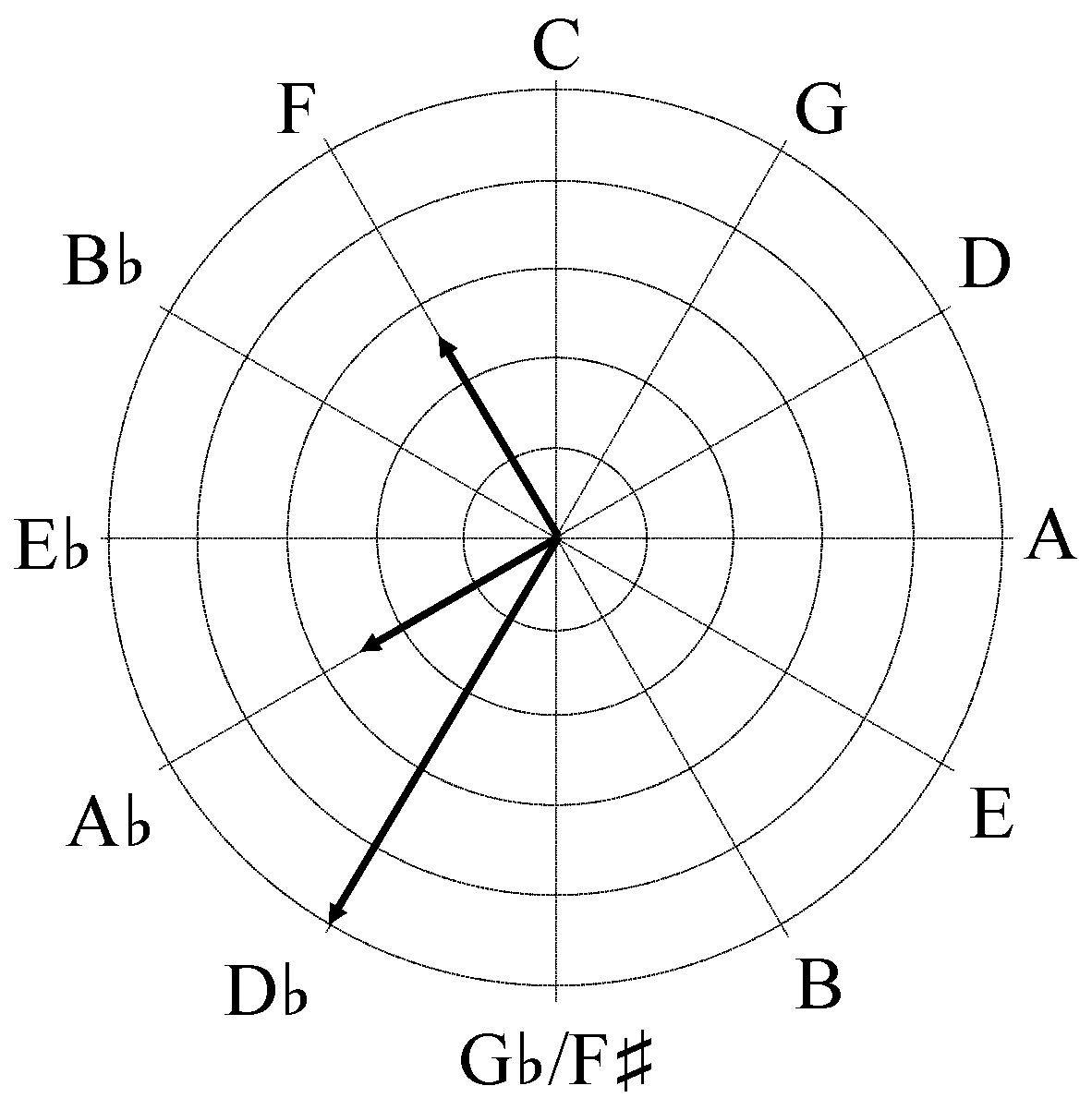
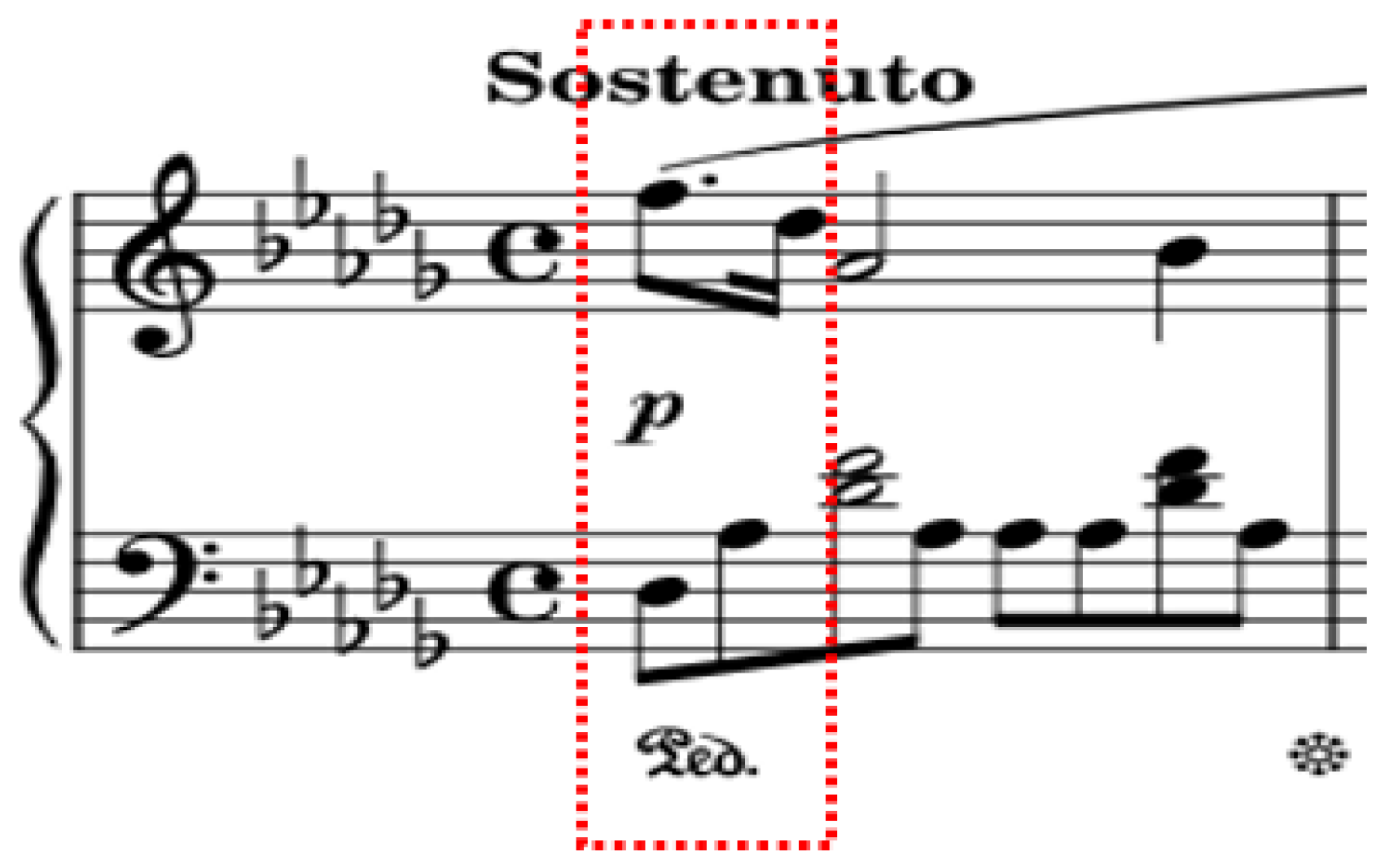
A musical piece can be treated as a sequence of notes ordered in time, within which successive time windows (e.g., quarter-note windows) can be distinguished. For each such window, a signature of fifths can be created [47]. Let us consider the first quarter-note window of F. Chopin’s Prelude Op. 28, No. 15, highlighted with a red frame in Figure 1. This window contains 4 notes: d , f2, a , and d 2. Ignoring note durations, we obtain the normalized multiplicities of notes associated with individual pitch classes, which determine the lengths of the vectors forming the signature of fifths [39]: D = 1 , A = F = 0.5 The signature of fifths corresponding to the considered window is presented in Figure 2.
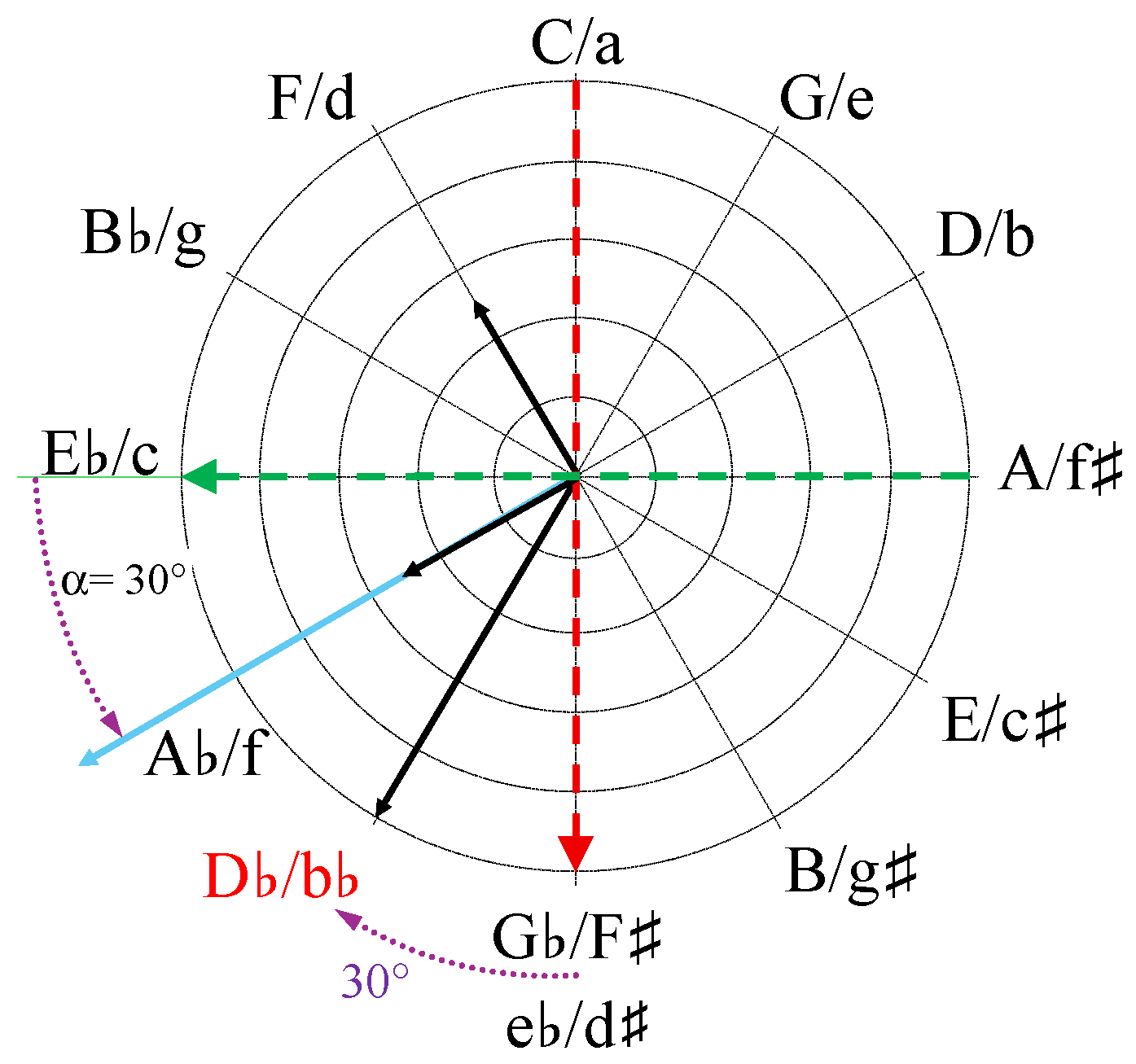
In this case, the main directed axis of the signature of fifths (MDASF) is the C→G/F♯ axis. For this axis, the difference between the sums of the lengths of the vectors located on its right and left sides (when looking in the direction of the axis) reaches a maximum [39]. Determining the direction of such an axis constitutes a key element of the algorithms for recognizing the key signature [47] and the key [39,47] developed and presented in earlier publications. The tonality of the piece associated with the signature of fifths is one of the two relative keys located on the perimeter of the circle of fifths, positioned 30° clockwise relative to the key indicated by MDASF, i.e., D or b♭, highlighted in red in Figure 3.
The selection of one tonality can be performed using various methods described among others in [39,47]. The essence of the computationally simplest tonality determination algorithm boils down to calculating the sign of the angle between the tonal mode axis (TMA) and the characteristic vector of the signature of fifths (CVSF), which results from summing the vectors forming the signature of fifths [47]. For the signature under consideration, the direction of the CVSF coincides with the direction of vector A , and its length is 1.37. In this situation, the value of α is equal to 30°, and thus, the recognized tonality of the piece is D major [47].
Tonality recognition is not a trivial problem, particularly when the composer has used unusual endings, beginnings of pieces, or numerous non-obvious tonal modulations. For example, in the prelude under consideration, there is an extensive middle section in a different tonality, C♯ minor. This raises the question of what basis should be used for algorithmically determining a piece’s tonality. Expert evaluation typically relies on analyzing the harmonic structure of the beginning, end, and then the entire piece. It would be beneficial if algorithmic evaluation emulated the expert approach and drew final conclusions based on data similar to that used by experts.

2.1. A New Approach to Recognizing the Tonal Mode

The tonal mode assessment algorithm presented in this article utilizes the Triple Composite Signature of Fifths (TCSF), which fuses three signatures of fifths associated with the beginning, end, and entire piece; that is, the corresponding signature vectors are summed. The proposed tonal mode classification extends the highly effective tonal mode differentiation method presented in [51], which analyzes the distribution of points comprising the trajectory of fifths. It turns out that a similar approach can be based on analyzing appropriately constructed signatures of fifths. This approach constitutes an inference method integrated with the TCSF creation process, providing a very effective way of recognizing tonal mode.
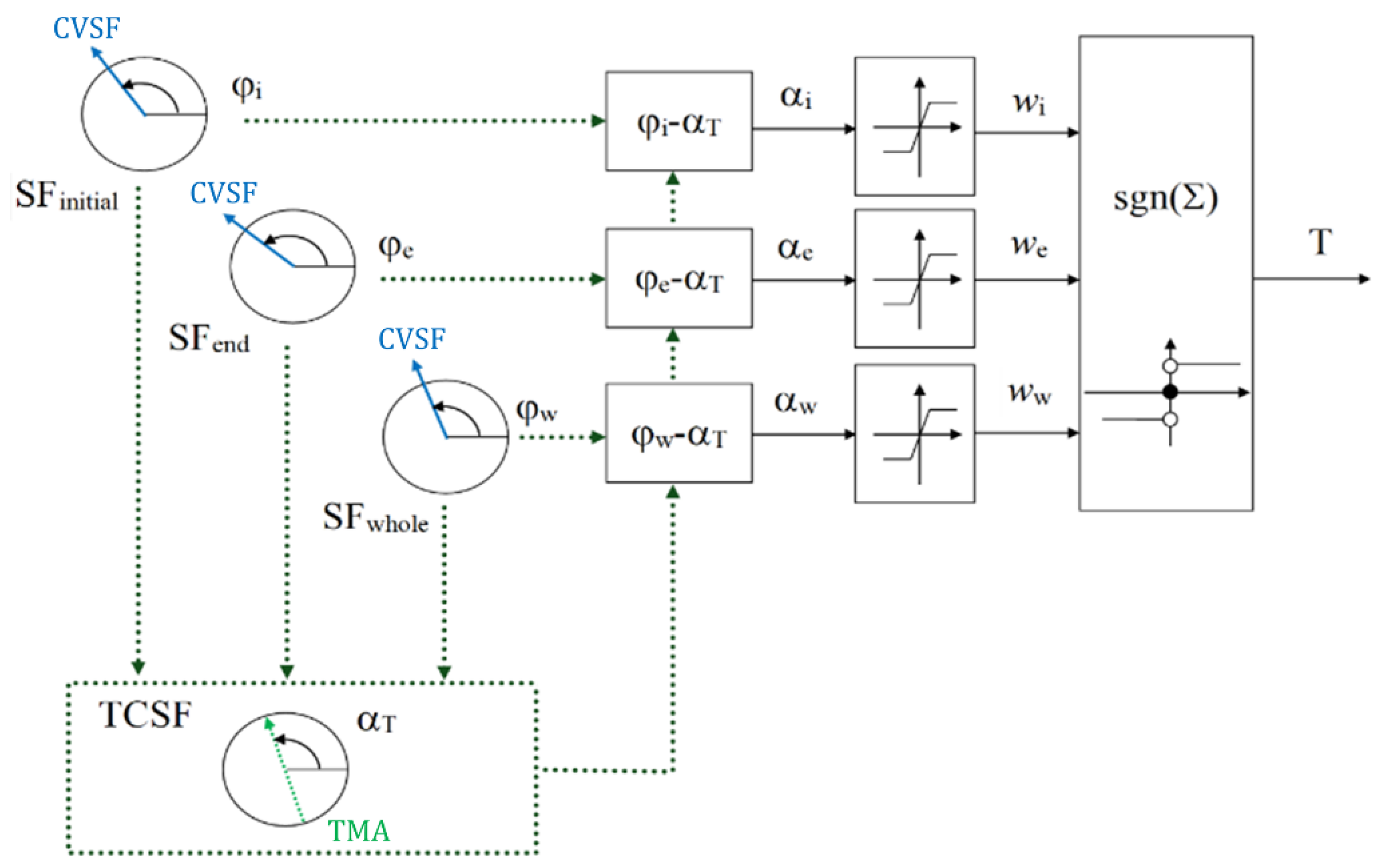
The block diagram of the proposed tonal mode determination method is presented in Figure 4.
The tonal mode determination process begins with calculating the signatures of fifths for the beginning (SFinital), end (SFend), and entire piece (SFwhole). For the analysis of the beginning and end, the signature is created for the shortest possible fragment that allows for determining the direction of the main directed axis (MDASF) of the signature of fifths. This approach ensures maximum efficiency in tonality determination based on the signature of fifths [47]. For each signature, the CVSF is determined, which allows for calculating the angles between the x-axis and the direction of this vector, i.e., φi, φe, and φw. After determining the lengths of the component vectors of the signatures of fifths defined for the beginning, end, and entire piece, it becomes possible to create the Triple Composite Signature of Fifths. For the obtained Triple Composite Signature of Fifths, the major/minor tonal mode axis is determined, which is perpendicular to the main directed axis [49]. This allows for calculating the angle αT between the x-axis and the major/minor mode axis. Knowing the angle values φi, φe, φw, and αT, it becomes possible to determine the angles αi, αe, and αw, which serve as input data for the inference block. The inference block consists of a limiter block and a block for examining the sign of the sum of indicators wi, we, and ww. As a result of the inference process, the value of the tonal mode indicator T is determined according to Equation (1).
T = s g n ( w i + w e + w w )
If the tonal indicator T assumes the value −1, the conclusion is drawn that we are dealing with a minor mode. The value 1 indicates a major mode. The value 0 does not allow for identifying a specific tonal mode, which occurs extremely rarely.
A more detailed explanation is required for the method of determining the values wi, we, and ww based on the angle values αi, αe, and αw. All coefficients w i , w e , and w w are determined using the following general Formula (2):
w = 1 f o r   α < 30 ° 2 60 ° α f o r   30 ° α 30 ° 1 f o r   α > 30 °
For example, to calculate the value of w i , one assumes that, in this formula, w =   w i and α =   α i .
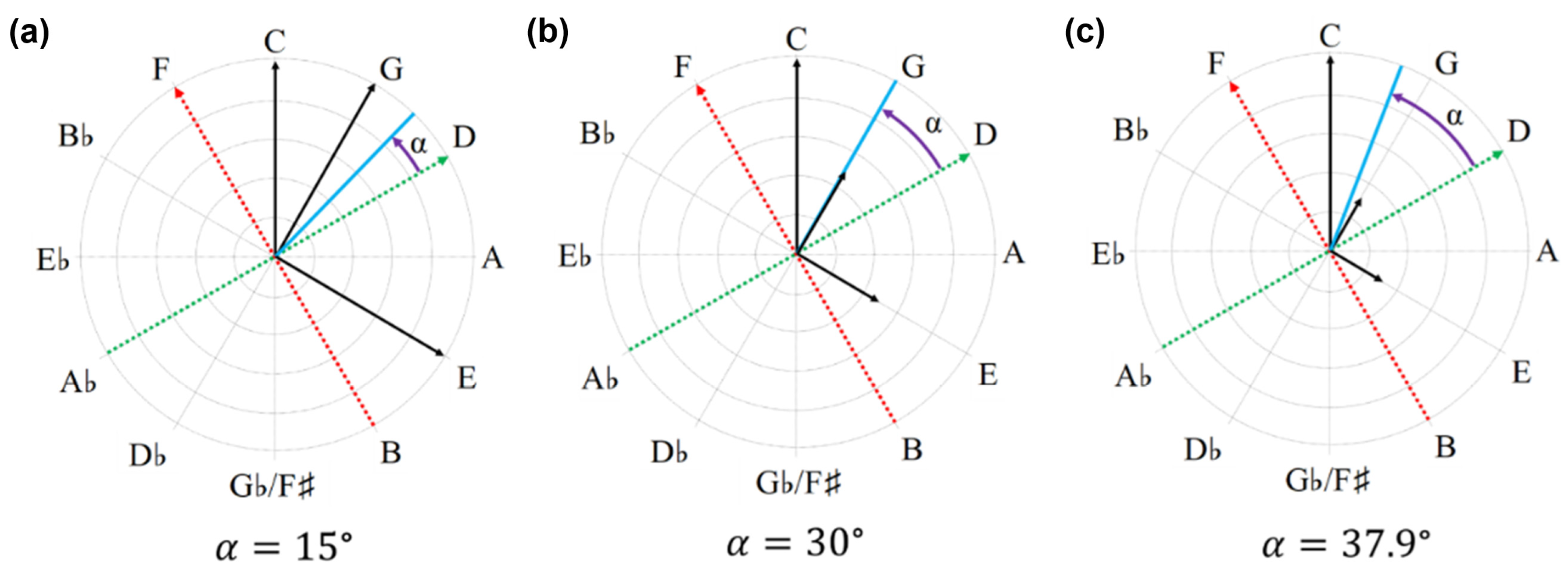
To justify this heuristic approach, let us consider the signature of fifths for the tonic C-major chord (C-E-G), when the note C is doubled (Figure 5b) or tripled (Figure 5c).
In the case of a chord containing only 3 notes (C-E-G), the angle value α = φ − αT is 15° (Figure 5a). Doubling the note C, which increases confidence that we are dealing with C-major tonality, results in an increase in the angle value α to 30° (Figure 5b). Adding another C note leads to shortening of the E and G vectors, which consequently further increases the angle value α to 37.9° (Figure 5c). A larger angle value increases confidence that the signature corresponds to a piece sample in C-major tonality.
In light of the above, according to Equation (2), it was assumed that the coefficient w, reflecting the confidence of indicating the appropriate mode, is linearly dependent on the angle value α within the range from −30° to 30°, and outside this range it takes the value −1 or +1, unequivocally indicating minor or major mode, respectively. Values between −1 and 1 indicate varying degrees of confidence in the tonal mode classification. The proposed inference method, shown through this elementary example, is the result of numerous experiments and observations of angle values with respect to the specificity of signatures of fifths associated with various fragments of pieces or harmonic functions.

2.2. Algorithm for Determining Tonal Mode Based on Three Component Signatures Forming the Triple Composite Signature of Fifths

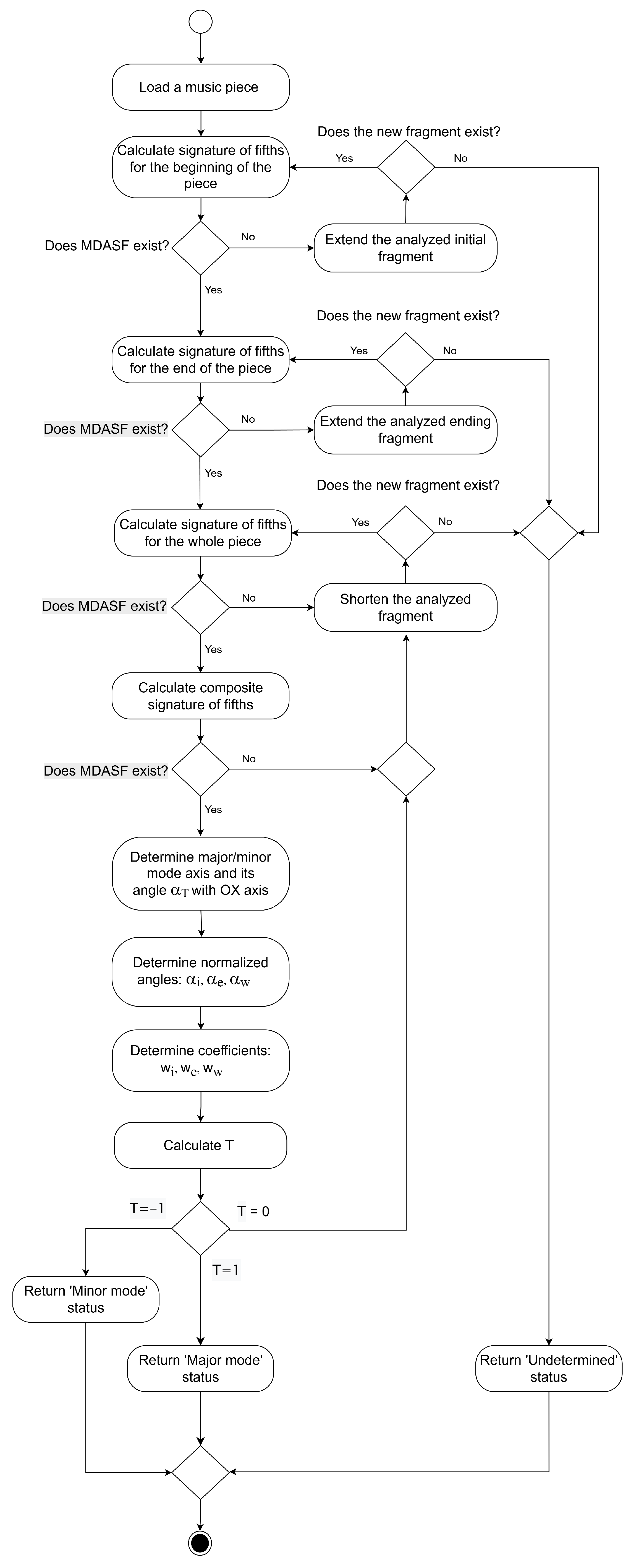
The heuristic method for determining the tonal mode of a piece, presented and justified in the previous section, forms the basis of the algorithm shown in Figure 6, consisting of the following basic steps:
  • Determine the signatures of fifths for the entire piece, the beginning, and the end. For the beginning and end, use the minimum number of initial or final notes, consistent with the chosen window resolution, that allows for determination of the main directed axis of the signature of fifths (MDASF). The lengths of vectors comprising the signature are computed from the multiplicities of notes associated with individual pitch classes [39].
  • Determine characteristic vectors for the obtained signatures of fifths (CVSFs) and their corresponding angles φi, φe, and φw [47].
  • Determine the Triple Composite Signature of Fifths by summing the component vectors of individual signatures, i.e., the signature associated with the entire piece, the signature associated with the beginning of the piece, and the signature associated with the end of the piece, with a final stage of normalizing the lengths of the component vectors relative to the longest vector.
  • Determine the main directed axis of the Triple Composite Signature of Fifths and then establish the orientation of TMA and determine its angle with the x-axis (αT), according to the algorithm described in [47].
  • Determine the values of angles αi, αe, and αw, according to the relationships αi = φi − αT, αe = φe − αT, and αw = φw − αT. Then, normalize the angle values αi, αe, and αw to the range [−180°, 180°].
  • Calculate the coefficients wi, we, and ww using (2).
  • Calculate the indicator T using (1). Then, based on its value, determine the mode as follows:
    • If T = 1, the mode is major;
    • If T = −1, the mode is minor;
    • If T = 0, no decision is made.
It is worth emphasizing that the algorithm proposed in this study is designed for tonal mode detection within the Western tonal system. The essence of the algorithm is illustrated by the example below.
Example:
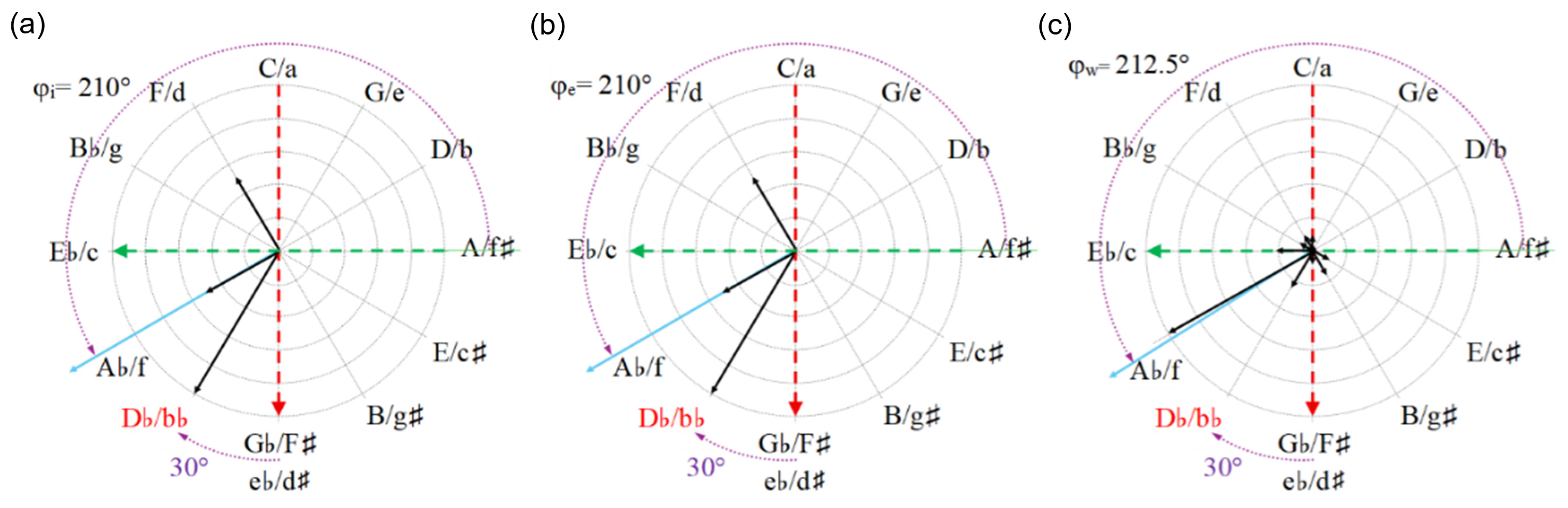
Let us consider the tonal mode determination for Frédéric Chopin’s Prelude Op. 28, No. 15, in D major. The signatures of fifths obtained for the first quarter-note analysis window, the last window, and the entire piece are shown in Figure 7. For each signature, MDASF (red), TMA (green), and CVSF (blue) are indicated. The signatures of fifths for the first and last windows are identical. Notably, for the signature determined for the entire prelude, the note A occurs most frequently; this does not alter the directions of the axes, even though the extensive middle section of the prelude is in C♯ minor. This results from the dominance of A /G♯ in two sections (Figure 7b). These notes correspond to the falling “raindrops” that give the work its nickname (the “Raindrop” Prelude). Importantly, the dominance of this pitch—written as A at the beginning and end and as G♯ in the middle—did not prevent correct mode determination using the algorithm based on the signature of fifths.
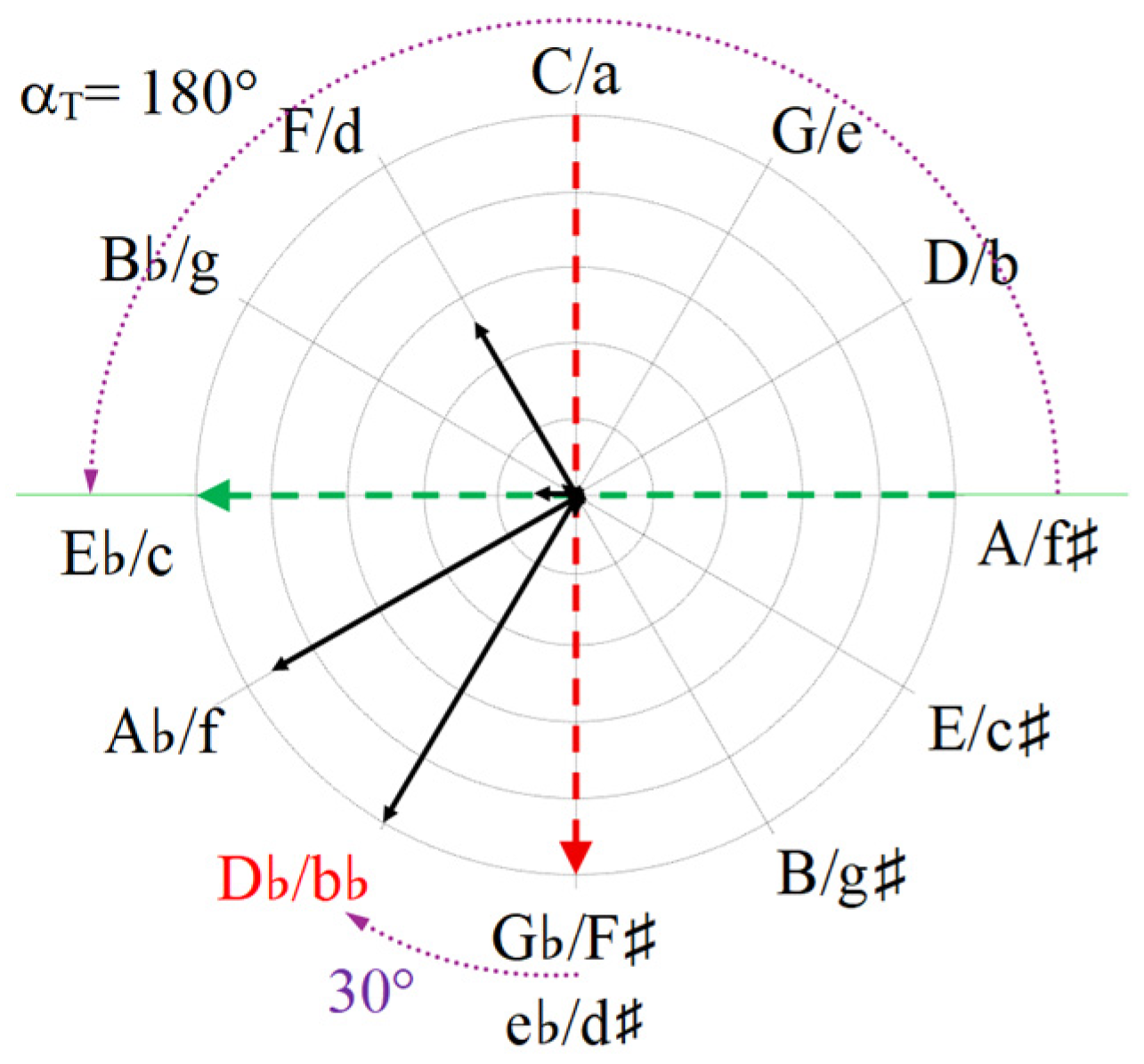
Considering the multiplicities of notes associated with particular pitch classes, which are reflected in the lengths of the component vectors forming the signatures of fifths shown in Figure 7, it is possible to construct the Triple Composite Signature of Fifths (algorithm step 3), presented in Figure 8.
After establishing the direction of the main directed axis of the Triple Composite Signature of Fifths, it is possible to determine the direction of the TMA and the value of the angle αT, which equals 180° (algorithm step 4). Knowing the values of the angles φi, φe, φw, and αT, it is then possible to determine the angles between the characteristic vectors and the major/minor mode axis of the TCSF: αi = 30°, αe = 30°, and αw = 32.5°. In this case, wi = we = ww = 1, which unequivocally indicates major mode.

3. Experiments and Discussion

To verify the effectiveness of the proposed tonal mode determination algorithm, a series of experiments was conducted using several diverse musical datasets. The following were analyzed: the 24 Preludes, Op. 28, by Frédéric Chopin; the Winterreise cycle comprising 24 songs by Franz Schubert [52]; and piano works from the Saarland Music Data: MIDI-Audio Piano Music Dataset [53]. All compositions were represented in symbolic format (MIDI files), which enabled precise analysis of the musical structure of the pieces.
The set of Preludes, Op. 28, by F. Chopin constitutes ideal test material, as it encompasses all possible tonalities arranged according to the circle of fifths. The pieces appear in alternating order—major, minor, major, minor—beginning with tonalities without key signatures (C major, A minor), and then proceeding through tonalities with an increasing number of sharps and, subsequently, a decreasing number of flats (G major, E minor; D major, B minor, …, B♭ major, G minor, F major, D minor). This made it possible to test the algorithm’s effectiveness across the full spectrum of tonalities. Franz Schubert’s Winterreise cycle constitutes an interesting research case due to its unusual modulations and passages maintained in tonalities different from the opening or closing key. This type of material allows for evaluation of how the algorithm handles music with complex harmonic structure and frequent key changes within a single composition. The Saarland Music Data, in turn, encompasses recordings and symbolic representations of piano works from different epochs and styles, including works by J.S. Bach, L. van Beethoven, J. Haydn, W.A. Mozart, F. Chopin, F. Liszt, B. Bartók, S. Rachmaninoff, A. Scriabin, and M. Ravel, among others. Piano Sonata Sz. 80 by Béla Bartók was excluded from the experiments, as it uses the piano in a strongly percussive manner, which hinders unambiguous tonal analysis and limits reliable comparison with other tonal works.
Table 1 presents the results of experiments conducted for F. Chopin’s preludes dataset. The columns contain the following data: prelude number; angular values (in degrees) φi, φe, φw, αT, αi, αe, and αw; coefficient values wi, we, and ww; the sum of the coefficient values ∑w; the value of the tonal mode indicator T; and the resulting tonal mode classification decision.
In most cases, the tonal mode classification result was unambiguous. This occurred in 18 cases (79.2% of the analyzed preludes) and was characterized by all component major/minor mode indicators (wi, we, and ww) having identical signs—either positive or negative—indicating detection of the same tonal mode from analysis of the beginning, end, and entire piece. For twelve preludes (50%), at least one indicator value was clipped by the limiter to 1 or −1. In most cases, this resulted from a clearly tonal (major or minor) ending. For example, in Prelude No. 7, tripling of the tonic note A in the final A-major chord caused the coefficient we to be clipped to 1, corresponding to the obtained angle αe = 37.9°. Similarly, in Prelude No. 21, tripling of the tonic note B♭ and doubling of the fifth F in the final chord emphasized the major character of the ending and led to an angle value of αe = 36.2°. Comparable situations caused by repetition of tonic notes occur in Preludes No. 9 and 11.
Exceeding the clipping threshold (−30° or 30°) was also observed when analyzing beginnings of preludes. For example, in Prelude No. 4, the angle αi = −34.5° reflects the distinctly minor character of the opening, manifested by dominance of the fifth over the root and third of the E-minor chord. However, clipping is not always caused by a clearly major/minor character of the analyzed fragment. In Prelude No. 16, clipping of wi to −1 does not reflect a clearly minor opening; rather, it results from an unusual opening (a diminished chord followed by a major chord), which deviates the CVSF from the TMA by αi = −76.5°. This indicates detection of an atypical opening, which is not directly related to the piece’s tonality, yet it did not lead to incorrect tonal mode classification.
It is worth noting that in two preludes (No. 2 and No. 18), the algorithm based on the Triple Composite Signature of Fifths produced an incorrectly oriented major/minor mode axis, yet it still indicated the correct tonal mode of the piece. For Prelude No. 2—whose key is often misidentified by tonality determination algorithms [39]—the correct tonal mode decision can be attributed to the distinctly minor character of the prelude as a whole. This caused the estimated TMA to rotate by 30° toward the minor direction [47], but the resulting indicator still led to the correct classification. For Prelude No. 18, despite its highly atonal character, the correct decision follows from the unambiguously minor ending of the piece.
The same experiments were conducted for Franz Schubert’s song cycle Winterreise. The results are presented in Table 2.
As in the case of F. Chopin’s preludes, for the majority of F. Schubert’s songs, the tonal mode classification result was not subject to doubt. For 18 songs (75%), all component tonal mode indicators (wi, we, and ww) had the same sign. As in the case of F. Chopin’s preludes, for 50% of the pieces, the value of at least one indicator was clipped by the limiter to the value of 1 or −1. In most cases, this is the effect of a tonally “strong” ending emphasized by repetition of the tonic note (songs No. 16, 19, and 21). Sometimes this is the effect of a surprising ending that unexpectedly concludes in a different key. For example, the maximum angle value αe = 71.9° observed for song No. 11 results from the ending of the song written in A major with a tonic chord in the relative key of A minor. The consequence of such an ending is a significant increase in the angle value between the CVSF associated with the song’s ending and the x-axis. The proposed multi-criteria inference allowed for making the correct decision indicating the proper major tonal mode of the song. Similar observations result from analysis of the song beginnings. Exceeding the clipping threshold of the indicators at the established level is the result of a clearly emphasized tonal mode resulting from repetition of the tonic note (song No. 13) or an unusual beginning containing additional chromatic signs (song No. 18).
It should be noted that for three songs (Nos. 9, 18, and 22), despite incorrect detection of the TMA orientation based on the Triple Composite Signature of Fifths, the final classification result was correct. This outcome reflects the algorithm’s multi-criteria decision-making approach, which integrates multiple analytical features. In one case (song No. 8), however, the algorithm did not produce the correct result. This song comprises 37 measures in G minor and 32 in G major. Moreover, it begins with a sequence of notes indicating G major (a natural sign on the note B) and concludes with a G-major chord featuring a tripled tonic. It is therefore unsurprising that the algorithm identified the major mode—just as many key-determination algorithms do—consistently classifying the piece as being in G major [52].
The third analyzed dataset consisted of piano pieces from various periods and styles, forming the Saarland Music Data collection [53]. It contains many works for which key determination is particularly challenging [54]. The results of the experiments are presented in Table 3.
For the pieces from the Saarland Music Data collection, the correctly identified tonal mode for 31 works (66%) was unambiguous, i.e., all partial indicators (wi, we, and ww) had the same sign. For 18 works (58%), the indicators not only shared the same sign but also included at least one value constrained by the clipping thresholds defined in relation (2). In some cases, this clipping behavior results from a distinctly tonal beginning and ending of the piece (e.g., F. Chopin, Nocturne Op. 48, No. 1, in C minor—Table 3, row 30), whereas in others it reflects a feature of the algorithm that favors minor endings in the relative key, which is observed in some of Bach’s works (e.g., BWV 849-01 and BWV 875-01).
It is worth emphasizing cases in which the algorithm correctly identifies the tonal mode even when the orientation of the TMA is incorrectly estimated. An incorrect axis orientation was determined for nine pieces (19%), and the corresponding angle values αT are highlighted in red.
Only three of these nine cases (33.3%) showed that the incorrect axis orientation led to an incorrect identification of the tonal mode (Table 3, rows 2, 12, and 36).
In some instances, the correct tonal mode classification may result from an atypical ending of a minor piece with a major chord, as observed, for example, in J. Brahms’s Sonata in F minor, which concludes with a distinctly major F-major chord (Table 3, row 16). The values in this case indicate that the tonal mode classification is determined primarily by the ending indicator we, which dominates wi and ww; the latter take small values due to the incorrect estimation of the major/minor axis orientation.
Considering the overall results in Table 3, the tonal mode was incorrectly identified for seven pieces (14.9%). Of these, in four cases (8.5% of all pieces), the error stems from incorrect determination of TMA orientation. Comparing the 85% mode classification accuracy obtained for the Saarland Music Data pieces with the key-determination results for the same dataset reported in [54], the achieved results should be considered highly competitive.

4. Conclusions

The algorithm presented in this article represents a novel approach to tonal mode determination based on the signature of fifths as a representation of a musical piece. The core idea of the proposed method is to determine tonal mode by analyzing signatures of fifths computed for three regions that are crucial for mode identification: the beginning, the ending, and the entire composition. In addition, we examine a Triple Composite Signature of Fifths, formed by combining these three signatures.
The proposed solution is based on observations of numerous signatures of fifths and their use in key-identification algorithms [47,50]. Another important point of reference is research on tonal mode determination based on the distribution of points comprising the trajectory of fifths [49]. The concept combines theoretical and musicological foundations, derived from an expert-based approach, with a relatively simple and efficient computational algorithm that uses an original music representation.
Experiments demonstrate strong performance, suggesting that automatic tonal mode recognition using this approach can provide a valuable feature for differentiating and classifying musical styles. The major/minor indicator obtained by quantifying the signature of fifths extends the set of features applicable in music classification algorithms [55]. A potential improvement to the proposed algorithm would be to adaptively select the analysis resolution. In future work, the method will be extended to the analysis of audio (WAV) files; for this representation, we will evaluate whether the classification algorithm maintains comparable accuracy, enabling broader applications in automatic music analysis and categorization.

Author Contributions

Conceptualization, D.K., T.Ł. and Z.K.; methodology, T.Ł. and D.K.; software, T.Ł. and D.K.; validation, T.Ł., D.K. and Z.K.; formal analysis, D.K. and T.Ł.; investigation, T.Ł. and D.K.; resources, T.Ł. and D.K.; data curation, T.Ł. and D.K.; writing—original draft preparation, T.Ł. and D.K.; writing—review and editing, T.Ł., D.K. and Z.K.; visualization, T.Ł. and D.K.; supervision, T.Ł. and D.K.; project administration, T.Ł. and D.K. All authors have read and agreed to the published version of the manuscript.

Funding

This research received no external funding.

Institutional Review Board Statement

Not applicable.

Informed Consent Statement

Not applicable.

Data Availability Statement

The original contributions presented in the study are included in the article, further inquiries can be directed to the corresponding author.

Conflicts of Interest

The authors declare no conflicts of interest.

References

  1. Bernardes, G.; Cocharro, D.; Caetano, M.; Guedes, C.; Davies, M.E.P. A Multi-Level Tonal Interval Space for Modelling Pitch Relatedness and Musical Dissonance. J. New Music Res. 2016, 45, 281–294. [Google Scholar] [CrossRef]
  2. Bernardes, G.; Davies, M.; Guedes, C. Automatic musical key estimation with mode bias. In Proceedings of the International Conference on Acoustics Speech and Signal Processing (ICASSP), New Orleans, LA, USA, 5–9 March 2017; pp. 316–320. [Google Scholar]
  3. Harte, C.; Sandler, M.; Gasser, M. Detecting harmonic change in musical audio. In Proceedings of the Special 1st ACM Workshop on Audio and Music Computing Multimedia, Santa Barbara, CA, USA, 27 October 2006; pp. 21–26. [Google Scholar]
  4. Quinn, I.; White, C. Corpus-derived key profiles are not transpositionally equivalent. Music Percept. 2017, 34, 531–540. [Google Scholar] [CrossRef]
  5. Toiviainen, P.; Krumhansl, C.L. Measuring and modeling real-time responses to music: The dynamics of tonality induction. Perception 2003, 32, 741–766. [Google Scholar] [CrossRef] [PubMed]
  6. Chew, E. Towards a Mathematical Model of Tonality. Ph.D. Thesis, Massachusetts Institute of Technology, Cambridge, CA, USA, 2000. [Google Scholar]
  7. Chen, T.-P.; Su, L. Functional harmony recognition of symbolic music data with multi-task recurrent neural networks. In Proceedings of the 19th ISMIR Conference, Paris, France, 23–27 September 2018; pp. 90–97. [Google Scholar]
  8. Jacoby, N.; Tishby, N.; Tymoczko, D. An information theoretic approach to chord categorization and functional harmony. J. New Music Res. 2015, 44, 219–244. [Google Scholar] [CrossRef]
  9. Hori, T.; Nakamura, K.; Sagayama, S. Music chord recognition from audio data using bidirectional encoder-decoder LSTMs. In Proceedings of the Asia-Pacific Signal and Information Processing Association Annual Summit and Conference (APSIPA ASC), Kuala Lumpur, Malaysia, 12–15 December 2017; pp. 1312–1315. [Google Scholar]
  10. Ntalampiras, S. A novel holistic modeling approach for generalized sound recognition. IEEE Signal Process. Lett. 2013, 20, 185–188. [Google Scholar] [CrossRef]
  11. Peiszer, E.; Lidy, T.; Rauber, A. Automatic audio segmentation: Segment boundary and structure detection in popular music. In Proceedings of the International Workshop on Learning the Semantics of Audio Signals, Paris, France, 21 June 2008; pp. 45–59. [Google Scholar]
  12. Anglade, A.; Benetos, E.; Mauch, M.; Dixon, S. Improving Music Genre Classification Using Automatically Induced Harmony Rules. J. New Music Res. 2010, 39, 349–361. [Google Scholar] [CrossRef]
  13. Perez-Sanchio, C.; Rizo, D.; Inesta, J.M.; Ramirez, R. Genre classification of music by tonal harmony. Intell. Data Anal. 2010, 14, 533–545. [Google Scholar] [CrossRef]
  14. Chapin, H.; Jantzen, K.; Kelso, J.S.; Steinberg, F.; Large, E. Dynamic Emotional and Neural Responses to Music Depend on Performance Expression and Listener Experience. PLoS ONE 2020, 5, e13812. [Google Scholar] [CrossRef] [PubMed]
  15. Grekow, J. Musical performance analysis in terms of emotions it evokes. J. Intell. Inf. Syst. 2018, 51, 415–437. [Google Scholar] [CrossRef]
  16. Roig, C.; Tard, L.J.; Barbancho, I.; Barbancho, A.M. Automatic melody composition based on a probabilistic model of music style and harmonic rules. Knowl.-Based Syst. 2014, 71, 419–434. [Google Scholar] [CrossRef]
  17. Yang, S.; Reed, C.; Chew, E.; Barthet, M. Examining emotion perception agreement in live music performance. IEEE Trans. Affect. Comput. 2021, 14, 1442–1460. [Google Scholar] [CrossRef]
  18. Longuet-Higgins, H.C. Letter to a musical friend. Music Rev. 1962, 23, 244. [Google Scholar]
  19. Longuet-Higgins, H.C. Second letter to a musical friend. Music Rev. 1962, 23, 280. [Google Scholar]
  20. Shepard, R. Geometrical approximations to the structure of musical pitch. Psychol. Rev. 1982, 89, 305–333. [Google Scholar] [CrossRef]
  21. Chew, E. Out of the Grid and Into the Spiral: Geometric Interpretations of and Comparisons with the Spiral-Array Model. Comput. Musicol. 2008, 15, 51–72. [Google Scholar]
  22. Boulanger-Lewandowski, N.; Bengio, Y.; Vincent, P. Audio chord recognition with recurrent neural networks. In Proceedings of the 14th International Conference on Music Information Retrieval (ISMIR), Curitiba, Brazil, 4–8 November 2013; pp. 335–340. [Google Scholar]
  23. Huang, C.-Z.A.; Duvenaud, D.; Gajos, K.Z. Chordripple: Recommending chords to help novice composers go beyond the ordinary. In Proceedings of the 21st International Conference on Intelligent User Interfaces, Sonoma, CA, USA, 7–10 March 2016; pp. 241–250. [Google Scholar]
  24. Sabathé, R.; Coutinho, E.; Schuller, B. Deep recurrent music writer: Memory-enhanced variational autoencoder-based musical score composition and an objective measure. In Proceedings of the Neural Networks, 2017 International Joint Conference on Neural Networks, Anchorage, AK, USA, 14–19 May 2017; pp. 3467–3474. [Google Scholar]
  25. Mauch, M.; Dixon, S. Approximate note transcription for the improved identification of difficult chords. In Proceedings of the 11th International Society for Music Information Retrieval Conference, Utrecht, The Netherlands, 9–13 August 2010; pp. 135–140. [Google Scholar]
  26. Osmalskyj, J.; Embrechts, J.-J.; Piérard, S.; Van Droogenbroeck, M. Neural networks for musical chords recognition. In Proceedings of the Actes des Journées d’Informatique Musicale (JIM 2012), Mons, Belgium, 9–11 May 2012; pp. 39–46. [Google Scholar]
  27. Sigtia, S.; Boulanger-Lewandowski, N.; Dixon, S. Audio chord recognition with a hybrid recurrent neural network. In Proceedings of the 16th International Society for Music Information Retrieval Conference, Malaga, Spain, 26–30 October 2015; pp. 127–133. [Google Scholar]
  28. Chuan, C.-H.; Chew, E. Polyphonic Audio Key Finding Using the Spiral Array CEG Algorithm. In Proceedings of the IEEE International Conference on Multimedia and Expo, ICME 2005, Amsterdam, The Netherlands, 6 July 2005; IEEE: Piscataway, NJ, USA, 2005; pp. 21–24. [Google Scholar]
  29. Chuan, C.-H.; Chew, E. Audio Key Finding: Considerations in System Design and Case Studies on Chopin’s 24 Preludes. EURASIP J. Adv. Audio Signal Process. 2007, 2007, 056561. [Google Scholar] [CrossRef]
  30. Raphael, C.; Stoddard, J. Functional harmonic analysis using probabilistic models. Comput. Music J. 2014, 28, 45–52. [Google Scholar] [CrossRef]
  31. Dawson, M. Connectionist Representations of Tonal Music: Discovering Musical Patterns by Interpreting Artificial Neural Networks; AU Press, Athabasca University: Athabasca, AB, Canada, 2018. [Google Scholar]
  32. Deng, J.; Kwok, Y.-K. Large vocabulary automatic chord estimation using deep neural nets: Design framework, system variations and limitations. arXiv 2017, arXiv:1709.07153. [Google Scholar] [CrossRef]
  33. Korzeniowski, F.; Widmer, G. End-to-end musical key estimation using a convolutional neural network. In Proceedings of the 25th European Signal Processing Conference (EUSIPCO), Kos, Greece, 28 August–2 September 2017; pp. 966–970. [Google Scholar]
  34. Masada, K.; Bunescu, R. Chord recognition in symbolic music using semi-markov conditional random fields. In Proceedings of the 18th International Society for Music Information Retrieval Conference, Suzhou, China, 23–27 October 2017; pp. 23–27. [Google Scholar]
  35. McFee, B.; Bello, J.P. Structured training for large-vocabulary chord recognition. In Proceedings of the 18th International Conference on Music Information Retrieval (ISMIR), Suzhou, China, 23–27 October 2017; pp. 188–194. [Google Scholar]
  36. Wu, Y.; Li, W. Music Chord Recognition Based on Midi-Trained Deep Feature and BLSTM-CRF Hybrid Decoding. In Proceedings of the International Conference on Acoustics, Speech and Signal Processing (ICASSP), Calgary, AB, Canada, 15–20 April 2018; pp. 376–380. [Google Scholar]
  37. Zhou, X.-H.; Lerch, A. Chord Detection Using Deep Learning. In Proceedings of the SIMIR 2015, Malaga, Spain, 26–30 October 2015; pp. 52–58. [Google Scholar]
  38. Herremans, D.; Chew, E. MorpheuS: Generating structured music with constrained patterns and tension. IEEE Trans. Affect. Comput. 2019, 10, 520–523. [Google Scholar] [CrossRef]
  39. Kania, D.; Kania, P. A key-finding algorithm based on music signature. Arch. Acoust. 2019, 44, 447–457. [Google Scholar] [CrossRef]
  40. Krumhansl, C.L.; Kessler, E.J. Tracing the dynamic changes in perceived tonal organization in a spatial representation of musical keys. Psychol. Rev. 1982, 89, 334–368. [Google Scholar] [CrossRef]
  41. Krumhansl, C.L. Cognitive Foundations of Musical Pitch; Oxford University Press: New York, NY, USA, 1990; pp. 77–110. [Google Scholar]
  42. Temperley, D.; Marvin, E. Pitch-Class Distribution and Key Identification. Music Percept. 2008, 25, 193–212. [Google Scholar] [CrossRef]
  43. Temperley, D. Bayesian models of musical structure and cognition. Music. Sci. 2004, 8, 175–205. [Google Scholar] [CrossRef]
  44. Aarden, B.J. Dynamic Melodic Expectancy. Ph.D. Thesis, The Ohio State University, Columbus, OH, USA, 2003. [Google Scholar]
  45. Albrecht, J.; Shanahan, D. The Use of Large Corpora to Train a New Type of Key-Finding Algorithm: An Improved Treatment of the Minor Mode. Music Percept. Interdiscip. J. 2013, 31, 59–67. [Google Scholar] [CrossRef]
  46. Bellmann, H. About the determination of key of a musical excerpt. In International Symposium on Computer Music Modeling and Retrieval (CMMR 2006); Springer: Berlin/Heidelberg, Germany, 2006; pp. 76–91. [Google Scholar]
  47. Kania, P.; Kania, D.; Łukaszewicz, T. A Real-Time Key-Finding Algorithm Based on the Signature of Fifths. Arch. Acoust. 2024, 49, 491–505. [Google Scholar] [CrossRef]
  48. Duan, Z.; Lu, L.; Zhang, C. Audio tonality mode classification without tonic annotations. In Proceedings of the IEEE International Conference on Multimedia and Expo, Hannover, Germany, 23 June–26 April 2008; pp. 1361–1364. [Google Scholar]
  49. Łukaszewicz, T.; Kania, D. Trajectory of fifths in tonal mode detection. IEEE Access 2025, 13, 113763–113772. [Google Scholar] [CrossRef]
  50. Kania, D.; Kania, P.; Łukaszewicz, T. Trajectory of fifths in music data mining. IEEE Access 2021, 9, 8751–8761. [Google Scholar] [CrossRef]
  51. Łukaszewicz, T.; Kania, D. A Music Classification Approach Based on the Trajectory of Fifths. IEEE Access 2022, 10, 73494–73502. [Google Scholar] [CrossRef]
  52. Schubert Winterreise Dataset. 2020. Available online: https://zenodo.org/record/4122060#.YvY4YXZByUk (accessed on 1 October 2025).
  53. Müller, M.; Konz, V.; Arifi-Müller, V.; Bogler, W.; Zeitler, J.; Group Semantic Audio Processing. Saarland Music Data: MIDI-Audio Piano Music (v2) [Data set]. In Proceedings of the 12th International Conference on Music Information Retrieval (ISMIR), Miami, FL, USA, 10–14 November 2024; Zenodo: Geneva, Switzerland, 2024. [Google Scholar] [CrossRef]
  54. Łukaszewicz, T.; Kania, D. Automatic Key Detection in Audio Recordings Using the Signature of Fifths. IEEE Access 2025, 13, 160149–160157. [Google Scholar] [CrossRef]
  55. Łukaszewicz, T.; Kania, D. Trajectory of Fifths Based on Chroma Subbands Extraction—A New Approach to Music Representation, Analysis, and Classification. IEEE Trans. Pattern Anal. Mach. Intell. 2024, 40, 2157–2169. [Google Scholar] [CrossRef]
Figure 1. First measure of F. Chopin’s Prelude Op. 28, No. 15.
Applsci 16 01409 g001
Figure 2. The signature of fifths corresponding to the first quarter-note window of F. Chopin’s Prelude Op. 28, No. 15.
Applsci 16 01409 g002
Figure 3. Basic elements of the signature of fifths used in the tonal analysis process: MDASF (red), TMA (green), and CVSF (blue).
Applsci 16 01409 g003
Figure 4. Symbolic representation of the algorithm for determining the piece’s tonal indicator (T).
Applsci 16 01409 g004
Figure 5. Example of the signatures of fifths obtained for the C-major chord: (a) C-E-G, (b) 2 × C-E-G, and (c) 3 × C-E-G.
Applsci 16 01409 g005
Figure 6. Algorithm for determining tonal mode based on the Triple Composite Signature of Fifths.
Applsci 16 01409 g006
Figure 7. Signatures of fifths for F. Chopin’s Prelude Op. 28, No. 15: (a) beginning, (b) end, and (c) entire piece.
Applsci 16 01409 g007
Figure 8. Triple Composite Signature of Fifths determined for F. Chopin’s Prelude Op. 28, No. 15.
Applsci 16 01409 g008
Table 1. Results of experiments conducted for F. Chopin’s Preludes, where φi—the angle between the CVSF determined for the beginning of the piece and the x-axis; φe—the angle between the CVSF determined for the end of the piece and the x-axis; φw—the angle between the CVSF determined for the entire piece and the x-axis; αT—the angle between the major/minor tonal mode axis of the Triple Composite Signature of Fifths and the x-axis; αi = φi − αT, αe = φe − αT, and αw = φw − αT; wi, we, and ww—the coefficients (major/minor mode indicators) determined for the beginning, end, and entire piece, respectively; and T—the tonal mode indicator.
Noφi [°]φe [°]φw [°]αT [°]αi [°]αe [°]αw [°]wiwewwwTMode
126.16041.430−3.93011.4−0.13010.3801.2491major
200−0.6000−0.100−0.002−0.002−1minor
316.823.813.0016.823.813.00.5600.7930.4351.7881major
4−34.5−24.1−12.80−34.5−24.1−12.8−1−0.804−0.426−2.231−1minor
5−12.1−7.9−16.9−3017.922.113.10.5960.7360.4371.7701major
6−50.1−60−34.0−30−20.1−30−4.0−0.670−1−0.133−1.803−1minor
7−37.7−22.1−42.6−6022.337.917.40.74410.5802.3231major
8−72.6−90−104.2−60−12.6−30−44.2−0.421−1−1−2.421−1minor
9−66.2−49.6−56.4−9023.840.433.60.793112.7931major
10−111.7−124.1−118.4−90−21.7−34.1−28.4−0.725−1−0.947−2.671−1minor
11−113.8−82.1−108.8−1206.237.911.20.20710.3741.5811major
12−142.6−152.4−119.0−120−22.5−32.41.0−0.752−10.034−1.718−1minor
13−141.2−158.8−139.9−1508.8−8.810.20.293−0.2930.3390.3391major
14−165−181.0−152.7−150−15−31.0−2.7−0.500−1−0.090−1.590−1minor
15210210212.5180303032.511131major
16103.5157.4171.3180−76.5−22.6−8.7−1−0.754−0.291−2.045−1minor
17170.1170.1187.015020.120.137.00.6700.67012.3401major
18101.1120119.5120−18.90−0.5−0.6300−0.018−0.648−1minor
19132.9143.8144.712012.923.824.70.4290.7930.8222.0441major
20909097.4120−30−30−22.6−1−1−0.754−2.754−1minor
2195.1126.2153.6905.136.263.60.170112.1701major
2264.060101.090−26.0−3011.0−0.867−10.367−1.500−1minor
237581.268.4601521.28.40.5000.7070.2811.4881major
2439.949.734.260−20.1−10.4−25.8−0.670−0.346−0.861−1.877−1minor
Table 2. Results of experiments conducted for Franz Schubert’s song cycle Winterreise (24 songs), where φi—the angle between the CVSF determined for the beginning of the piece and the x-axis; φe—the angle between the CVSF determined for the end of the piece and the x-axis; φw—the angle between the CVSF determined for the entire piece and the x-axis; αT—the angle between the major/minor tonal mode axis of the Triple Composite Signature of Fifths and the x-axis; αi = φi − αT, αe = φe − αT, and αw = φw − αT; wi, we, and ww—the coefficients (major/minor mode indicators) determined for the beginning, end, and entire piece, respectively; and T—the tonal mode indicator.
Noφi [°]φe [°]φw [°]αT [°]αi [°]αe [°]αw [°]wiwewwwTMode
1453034.060−15−30−26.0−0.5−1−0.866−2.366−1minor
215346.31.930−15−43.7−28.1−0.5−1−0.935−2.435−1minor
360120161.9150−90−3011.9−3−10.396−3.604−1minor
49090106.6120−30−30−13.4−1−1−0.447−2.447−1minor
5264.1300288.5270−5.93018.5−0.19610.6161.4201major
6334.3339.9338.7360−25.7−20.1−21.3−0.856−0.670−0.709−2.235−1minor
7339.9330290.7360−20.1−30−69.3−0.670−1−1−2.670−1minor
828.537.928.0028.537.928.00.95110.9332.8841major
9281.4300302.9300−18.602.9−0.62000.097−0.523−1minor
1010590107.2120−15−30−12.8−0.5−1−0.428−1.928−1minor
11312.611.9342.430012.671.942.40.421112.4211major
12309.9309.9331.9330−20.1−20.11.9−0.670−0.6700.064−1.277−1minor
13162.6139.1160.912042.619.140.910.63712.6371major
1497.497.485.8120−22.6−22.6−34.2−0.754−0.754−1−2.509−1minor
1591.898.996.0120−28.2−21.1−24.0−0.940−0.702−0.799−2.441−1minor
16148.5157.9153.312028.537.933.30.951112.9511major
17338.8360359.73308.83029.70.29310.9902.2831major
18−9.937.450.430−39.97.420.4−10.2460.680−0.075−1minor
19330337.9315.73003037.915.7110.5222.5221major
2072.269.958.990−17.8−20.1−31.1−0.592−0.670−1−2.262−1minor
2162.496.290.2602.436.230.20.079112.0791major
2243.26028.760−16.80−31.3−0.5600−1−1.560−1minor
23330330322.3300303022.3110.7452.7451major
241.10−12.130−28.9−30−42.1−0.963−1−1−2.963−1minor
Table 3. Results of experiments conducted on the Saarland Music Data collection of piano works from various periods. φi—the angle between the CVSF determined for the beginning of the piece and the x-axis; φe—the angle between the CVSF determined for the end of the piece and the x-axis; φw—the angle between the CVSF determined for the entire piece and the x-axis; αT—the angle between the major/minor tonal mode axis of the Triple Composite Signature of Fifths and the x-axis; αi = φi − αT, αe = φe − αT, and αw = φw − αT; wi, we, and ww—the coefficients (major/minor mode indicators) determined for the beginning, end, and entire piece, respectively; and T—the tonal mode indicator.
File Nameφi [°]φe [°]φw [°]αT [°]αi [°]αe [°]αw [°]wiwewwwTMode
1Bach_BWV849-01_001_20090916-SMD255.0200.1241.2270−15.0−69.9−28.8−0.500−1−0.962−2.462−1minor
2Bach_BWV849-02_001_20090916-SMD216.2188.4251.72106.2−21.641.70.207−0.72010.4871major
3Bach_BWV871-01_002_20090916-SMD110.499.9118.1120−9.6−20.1−1.9−0.319−0.670−0.063−1.052−1minor
4Bach_BWV871-02_002_20090916-SMD120.095.998.51200.0−24.1−21.50−0.804−0.716−1.520−1minor
5Bach_BWV875-01_002_20090916-SMD16.80.035.360−43.2−60.0−24.7−1−1−0.822−2.822−1minor
6Bach_BWV875-02_002_20090916-SMD62.716.038.2602.7−44.0−21.80.091−1−0.727−1.636−1minor
7Bach_BWV888-01_008_20110315-SMD325.9315.0310.830025.915.010.80.8630.5000.3601.7231major
8Bach_BWV888-02_008_20110315-SMD300.0330.0289.13000.030.0−10.901−0.3620.6381major
9Beethoven_Op027No1-01_003_20090916-SMD130.074.16112.712010.0−45.8−7.30.333−1−0.243−0.910−1minor
10Beethoven_Op027No1-02_003_20090916-SMD187.9223.2163.915037.973.213.9110.4632.4631major
11Beethoven_Op027No1-03_003_20090916-SMD127.4143.8138.81207.423.818.80.2460.7930.6251.6641major
12Beethoven_Op031No2-01_002_20090916-SMD291.2306.2−30−38.860.036.2−11111major
13Beethoven_Op031No2-02_002_20090916-SMD126.2109.1107.29036.219.117.210.6370.5722.2091major
14Beethoven_Op031No2-03_002_20090916-SMD35.939.931.460−24.1−20.1−28.6−0.802−0.670−0.953−2.426−1minor
15Beethoven_WoO080_001_20081107-SMD53.699.969.990−36.49.9−20.1−10.330−0.672−1.342−1minor
16Brahms_Op005-01_002_20110315-SMD128.469.9138.11208.4−50.118.10.282−10.604−0.114−1minor
17Brahms_Op010No1_003_20090916-SMD23.84536.060−36.2−15.0−24.0−1−0.500−0.800−2.300−1minor
18Brahms_Op010No2_003_20090916-SMD289.1345312.3330−40.915.0−17.7−10.500−0.589−1.089−1minor
19Chopin_Op010-03_007_20100611-SMD300310.9283.927030.040.913.9110.4642.4641major
20Chopin_Op010-04_007_20100611-SMD222.1242.1243.0240−17.92.13.0−0.5960.0690.099−0.4281major
21Chopin_Op026No1_003_20100611-SMD319.5241.7221.027049.5−28.3−49.01−0.943−1−0.943−1minor
22Chopin_Op026No2_005_20100611-SMD173.8194.5191.8210−36.2−15.5−18.2−1−0.517−0.607−2.123−1minor
23Chopin_Op028-01_003_20100611-SMD41.34542.63011.315.012.60.3770.5000.4181.2951major
24Chopin_Op028-03_003_20100611-SMD22.11512.5022.115.012.50.7360.5000.4161.6521major
25Chopin_Op028-04_003_20100611-SMD317.4337.4345.4360−42.6−22.6−14.6−1−0.754−0.486−2.241−1minor
26Chopin_Op028-11_003_20100611-SMD256.8270251.824016.830.011.80.56010.3921.9531major
27Chopin_Op028-15_006_20100611-SMD180210211.51800.030.031.50112.0001major
28Chopin_Op028-17_005_20100611-SMD170.1170.1187.715020.120.137.70.6700.67012.3401major
29Chopin_Op029_004_20100611-SMD132.8151.8145.4150−17.21.8−4.6−0.5750.060−0.154−0.668−1minor
30Chopin_Op048No1_007_20100611-SMD79.69084.9120−40.4−30.0−35.1−1−1−1−3.000−1minor
31Chopin_Op066_006_20100611-SMD227.7210223.118047.730.043.11113.0001major
32Haydn_Hob017No4_003_20090916-SMD6056.652.73030.026.622.710.8860.7562.6421major
33Haydn_HobXVINo52-01_008_20110315-SMD135143.8118.512015.023.8−1.50.5000.793−0.0511.2421major
34Haydn_HobXVINo52-02_008_20110315-SMD300300305.427030.030.035.41113.0001major
35Haydn_HobXVINo52-03_008_20110315-SMD98.6143.8133.7120−21.423.813.7−0.7120.7930.4560.5371major
36Liszt_AnnesDePelerinage-LectureDante_002_20090916-SMD183.07.9343.6330−147.037.913.6−110.4550.4551major
37Liszt_KonzertetuedeNo2LaLeggierezza_003_20090916-SMD27090176.8330−60.0120.0−153.2−11−1−1.000−1minor
38Liszt_VariationenBachmotivWeinenKlagenSorgenZagen_001_20090916-SMD171.275119.515021.2−75.0−30.50.707−1−1−1.293−1minor
39Mozart_KV265_006_20110315-SMD75.76046.53045.730.016.511.0000.5512.5511major
40Mozart_KV398_002_20110315-SMD9097.974.56030.037.914.5110.4852.4851major
41Rachmaninoff_Op036-01_007_20110315-SMD168.1142.4163.3180−11.9−37.6−16.7−0.398−1−0.558−1.956−1minor
42Rachmaninoff_Op036-02_007_20110315-SMD303.385.9344.130−86.755.9−45.9−11−1−1.000−1minor
43Rachmaninoff_Op036-03_007_20110315-SMD121.3114.9112.79031.324.922.710.8300.7572.5871major
44Rachmaninov_Op039No1_002_20090916-SMD140.6110.0114.7150−9.4−40.0−35.3−0.313−1−1−2.313−1minor
45Ravel_JeuxDEau_008_20110315-SMD251.8248.3265.5270−18.2−21.7−4.5−0.607−0.725−0.152−1.483−1minor
46Ravel_ValsesNoblesEtSentimentales_003_20090916-SMD44.333.9339.2044.333.9−20.811−0.6931.3071major
47Skryabin_Op008No8_003_20090916-SMD171.2180176.715021.230.026.70.70710.8912.5981major
Disclaimer/Publisher’s Note: The statements, opinions and data contained in all publications are solely those of the individual author(s) and contributor(s) and not of MDPI and/or the editor(s). MDPI and/or the editor(s) disclaim responsibility for any injury to people or property resulting from any ideas, methods, instructions or products referred to in the content.