Article

Assessing Relationships Between Land Cover and Summer Local Climates in the Abisko Region, Northern Sweden


1
Géosciences Environnement Toulouse (GET), Centre National de la Recherche Scientifique (CNRS), UMR5563, 31400 Toulouse, France
2
Abisko Scientific Research Station, Swedish Polar Research Secretariat, SE-981 07 Abisko, Sweden
3
University of Toulouse, CNES, CNRS, INRAE, IRD, CESBIO, 31400 Toulouse, France
*
Author to whom correspondence should be addressed.
Appl. Sci. 2026, 16(3), 1376; https://doi.org/10.3390/app16031376
Submission received: 24 December 2025 / Revised: 20 January 2026 / Accepted: 26 January 2026 / Published: 29 January 2026
(This article belongs to the Section Earth Sciences)

Abstract

Climate warming impacts arctic and subarctic lands, subjecting it to a generalized rise in soil temperature and causing changes in the surface cover. Land cover is a key control parameter for soil hydrothermal states, and its study by satellite imagery is necessary for monitoring boreal surface changes over time at large scales. Understanding the links between land cover and environmental conditions is also crucial to anticipate the impacts of atmospheric changes on continental surfaces. Sentinel-1 and Sentinel-2 data combined with a field campaign in July 2024 were used to produce a 10 m spatial resolution land cover map in the Abisko region, northern Sweden, covering 2180 km2 and including three watersheds with an overall accuracy exceeding 94%. In parallel, temperature and precipitation fields were statistically downscaled at 100 m spatial resolution using topography, ordinary kriging based on weather stations and reanalysis. The relationships between surface areas and average summer temperature–precipitation clusters reveal that the vegetation distribution closely reflects the recent atmospheric conditions with the treeline following the 10.2 °C July–August isotherm in the considered area. This study provides a spatial basis for investigating the complex atmosphere–surface interactions and for assessing the sensitivity of boreal landscapes to ongoing climate warming.

1. Introduction

Due to global warming and Arctic amplification [1,2,3], at the origin of a temperature increase about 3.8 times higher than the global average since 1979 [4,5], arctic and subarctic areas are subject to radical changes: snow cover disturbances [4,6,7,8], plant diversification [9,10,11,12,13,14], variations in soil–microbiome assemblies [15], permafrost thaw [16,17], hydrological changes and thermokarstification [18,19,20]. In this setting, the vegetation cover plays a major role in the surface, soil heat and water balance in such a way that the difference between two different vegetation types can be of the same order of magnitude as the difference between glacial and vegetated soil [21]. Likewise, the presence of vegetation affects soil albedo and surface water fluxes [22], and it also interacts with snow cover [23,24,25]. Thus, there is a need for precise and reliable land cover maps whether used as surface state indicators or as input data in predictive models [26].
In order to meet this need, satellite imagery provides data coverage of large continental areas at varying levels of temporal and spatial resolutions [27], including the polar regions [28] to monitor the polar climate [4], ice caps [29,30,31], sea ice [32], snow cover [28,33], lakes [34], permafrost [26,35] and vegetation [36,37,38,39]. In these environments subject to heavy cloud cover [28,40,41], particularly in summer when average monthly cloud cover can be as high as 85% [42], microwave remote sensing, such as synthetic aperture radar (SAR), is of primary interest [26,43,44]. Additionally, the development of machine learning methods for studying land cover means that large volumes of data can be processed efficiently [45] with a high-quality training dataset required [46]. These algorithms are widely used for image processing and supervised classification tasks. Random forest is one of the most widely used, efficient and reliable of these algorithms [47,48].
On the other hand, the vegetation itself is controlled by climatic conditions. The Arctic appears to be subject to global greening [49], leading to an increase in vegetation, mainly shrubs, expansion toward high latitudes and altitudes [9,12,13,50,51,52]. Experiments and observations have suggested that air temperature is the main driving force of these changes ahead of precipitation and soil water content [9,12,51]. This air warming could stimulate the advance of the forest in northern Fennoscandia and parts of the Russian Arctic on about one half of the tundra areas [53]. Thus, these interactions between the surface and climate change are leading to a redefinition of northern landscapes, such as the case of “borealization” of the tundra [54]. Understanding how weather and climate conditions affect the distribution of surface land cover ensures better anticipation and understanding of the changes underway.
Nowadays, pan-Arctic land cover maps, such as the Circumpolar Arctic Vegetation Map (CAVM) [39] and, more recently, a circumarctic land cover map at a high spatial resolution of up to 10 m [55] have been produced. While these products are essential for global-scale studies, their generalist aspect can limit their ability to reproduce finer variations, particularly with regard to locally specific vegetation types, with the same robustness as regionally calibrated approaches. Furthermore, although some land cover classifications have been carried out in the Abisko region using, for instance, aerial color and infrared imagery, airborne laser scanning, LiDAR and Sentinel-2 [56,57,58,59], few studies have combined SAR and optical imagery to produce high-resolution land cover maps over entire watersheds and have investigated their relationships with micro-climatic and topographical drivers. Hence, there is a need to explore the local relationships between surface cover and its interactions with its environment.
The purpose of this study is to describe precisely the land cover characteristics of the Abisko region, in Arctic Sweden, through three watersheds—Abiskojokka, Miellajokka and Stordalen—and to associate them to local morpho-climatic conditions. This work is restricted to the July–August period to ensure a minimal snow and ice cover [60], and to correspond to the peak growing season in the area [61,62]. A new land cover map based on Sentinel-1 (S1) and Sentinel-2 (S2) data was produced at 10 m spatial resolution using a Random Forest classifier, resulting in a comprehensive surface map, because radar images are unaffected by clouds or topographic shadows. In a second step, 100 m spatial resolution air temperature (T) and precipitation (P) average maps were derived from reanalysis using regional topography, ordinary kriging based on local meteorological stations and a K-means clustering algorithm. The treeline, which is a good spatial marker of ground vegetation distribution, was delineated through the use of a logistic fitting method, and its relations with T and P were explored. Topographic influences were examined, and a second Random Forest was trained based on the T, P, slope and northness to explore the sensitivity of the vegetation to environmental conditions and support the analysis.

2. Materials and Methods

2.1. Study Area, Survey Dataset and In Situ Measurements

The region of interest (ROI) for which the maps are derived (Figure 1A)—a ~2180 km2 area—consists of three contiguous catchments, Abiskojokka, Miellajokka and Stordalen [57,63,64]. The two lasts are positioned around ten kilometers east of the town of Abisko (68.35° N, 18.83° E), Sweden. The catchments are located on an area of discontinuous permafrost [65]. The vegetation consists of shrub species (Betula nana, Vaccinium myrtillus, Salix, Empetrum nigrum). There are also numerous trees (Betula pubescens ssp. tortuosa), taller shrubs (Salix glauca, Salix lanata) and diverse wetlands (dominated by Sphagnum spp.) and lakes [59]. Abiskojokka is the largest watershed studied here, with an area of 565.3 km2, it covers a valley surrounded by mountains, notable lakes like Ábeskojávri or Čuonjájávri, as well as the beginning of the well-known hiking track Kungsleden, “King’s path”. Miellajokka covers an area of 51.5 km2, from the characteristic mountain Nissončorru in the south to Lake Torneträsk in the north, with altitudes ranging from 383 m to 1731 m [56,63]. The Stordalen site covers 16 km2 to the northeast of Miellajokka with an altitude ranging from 380 m to 770 m [57,66].
According to Köppen–Geiger Climate Classification, the whole region is located in a Dfc-subarctic climate area, characterized by a cold and moist climate with long winters [60,67], inside the Scandinavian mountain birch forest and grasslands [68,69]. The territory is crossed by the road linking Abisko to Kiruna and the Iron Ore line linking Narvik (Norway) to Riksgränsen (Sweden). The sampling area (Figure 1B) covers ~487 km2 with altitudes ranging from 370 m to 1964 m [66].
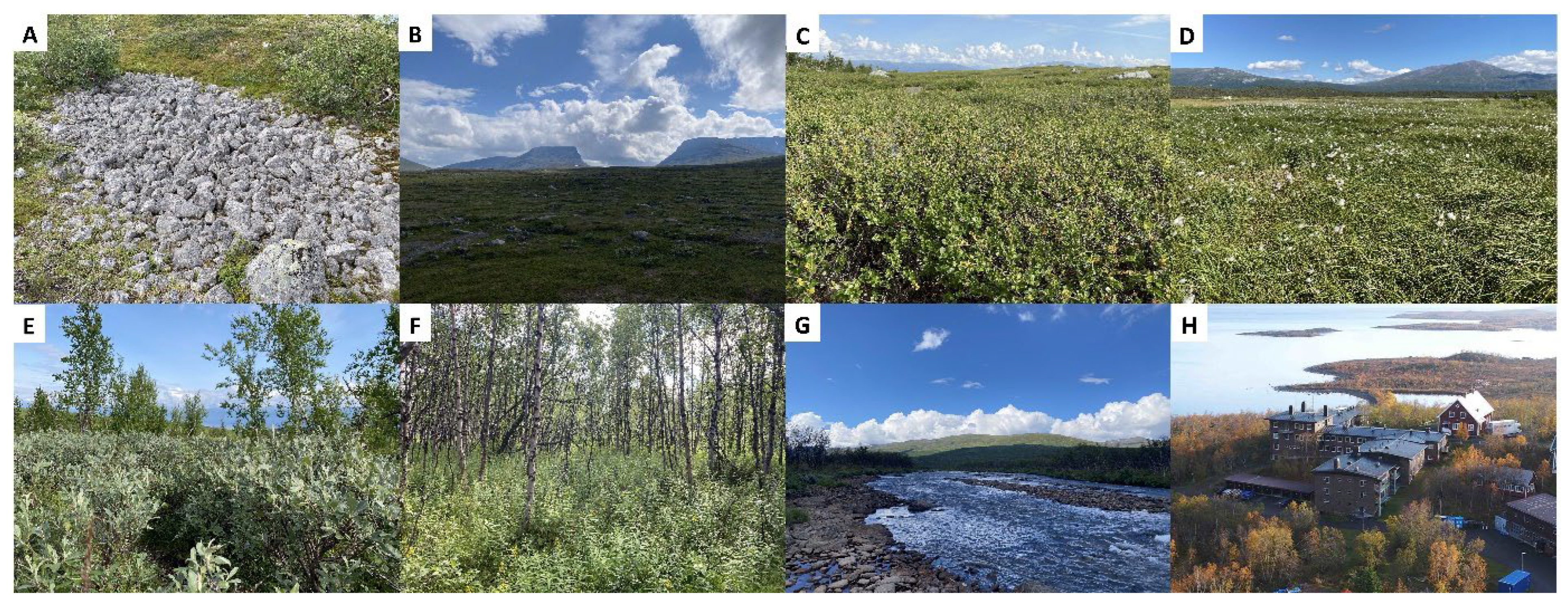
The ground truth dataset is the result of a field mission carried out from 15 to 24 July 2024 across parts of the Abiskojokka, Miellajokka and Stordalen catchments, in collaboration with the Abisko Scientific Research Station (Figure 1). Polygons representing ground observation were generated in Qfield (https://qfield.org/) using two Samsung Galaxy Tab S6 Lite tablets (Samsung Electronics, Seoul, South Korea) and located thanks to GPS, GLONASS, Beidou and Galileo navigation systems. Land cover characteristics were collected during walking transects visual interpretation. As shown in Figure 2, eight classes were defined: Rock, Dry Heath, Mesic Heath, Wetland, Alpine Willow, Mountain Birch, Water and (human) Infrastructure, following the classes of [56] according to [59]. Three more classes have been defined as masks and are not part of the machine learning process: Snow, Shadows and Clouds.
The dataset consists of 966 georeferenced polygons, each of them associated with a land use class (Table 1), covering a total surface of 5.8 km2. No snow patches were encountered, and only the highest peaks were slightly covered. Some photo-interpreted areas were subsequently added by analyzing true-color S2 images.
For the climatic analysis, air temperature (T) and precipitation (P) data from eight meteorological stations located within the study area were used (Table 2). Datasets were obtained from the Swedish Meteorological and Hydrological Institute (SMHI, https://opendata.smhi.se (accessed on 15 October 2025)) and from the Swedish Infrastructure for Ecosystem Science (SITES, https://data.fieldsites.se/portal (accessed on 15 October 2025)).

2.2. Remote Sensing, Topographic and Reanalysis Data

Four kinds of spatial data were used: Sentinel-1 and Sentinel-2 satellite data, the digital elevation model ArcticDEM, and the reanalysis Nordic Gridded Climate Dataset.
Sentinel-1 is a platform orbiting at an elevation of 693 km and carrying a SAR (C-SAR) with a 12.3 m long antenna. Its orbital repetition cycle is 12 days. C-SAR operates in dual VV/VH or HH/HV polarization. The products used for this work are VV/VH images derived from the Interferometric Wave (IW) acquisition mode, consisting of a 250 km swath at Level-1 and in Ground Range Detected (GRD) format. The resolution is 20 m × 22 m (high-resolution mode). The C-band (5.4 GHz) in which C-SAR operates enables the surface to be studied with little penetration of vegetation. The absolute location accuracy is 7 m. Seven images covering the study area (Appendix A), both ascending and descending orbits, were retrieved from the GEODES platform of the Centre National d’Études Spatiales (CNES) between 3 July and 17 August 2024.
Sentinel-2 is a mission comprising two twin visible/near-infrared multispectral imaging satellites, 180° out of phase and orbiting at an altitude of 786 km. Their swath is 290 km wide. The multispectral instrument (MSI) comprises thirteen spectral sensors with different spatial resolutions (10, 20 and 60 m) and vertical viewing. One image from the 33WXR tiles acquired on 15 July 2024 with less than 2% of cloud cover and no atmospheric correction (Level-1C) was downloaded (Appendix A).
ArcticDEM [66] is a digital surface model (DSM) of the entire Arctic (above 60° N), which was projected in the Sea Ice Polar Stereographic North system. The data were generated using stereo imagery from a combination of the Worldview-1,2,3 satellites and a collaboration with the University of Illinois, the US-NGA and the Polar Geospatial Centre. The images have a horizontal resolution of 2 m and a vertical resolution of less than 0.5 m. For the purposes of this work, 41 tiles in GeoTiff format were downloaded. Slope and aspect products were derived at the same spatial resolution using QGIS.
Air 2 m above ground temperature (°C/K) and precipitation (mm) are obtained from the Nordic Gridded Climate Dataset (NGCD), which is a 1 km spatial resolution reanalysis dataset covering Finland, Sweden and Norway since 1961 from in situ measurements provided by the National Meteorological and Hydrological Services of each of the above-mentioned countries [70,71]. Each gridded map, made available to users by applying a deterministic interpolation approach (Type 1), from 1 July to 31 August for each year between 2015 and 2024 were used.

2.3. Land Cover Classification

2.3.1. Classification of Remote Sensing Images

S1Tiling (v1.0.0) [72] was used to generate time series of calibrated, ortho-rectified and filtered Sentinel-1 images. The process is based on the SAR ortho-rectification application from the Orfeo Tool Box [73], and the resulting images are registered to Sentinel-2 L2 optical geographic reference grid. To reduce speckle while maintaining the native spatial resolution of radar images, a multitemporal filter [74] based on Quegan’s method [75] was applied. Thus, seven projected images (VV and VH) were created over the 33WXR S2 tiles.
In order to remove any false or vacant spectral signature due to the topography, we used a method inspired by the concept of ray tracing [76] and approaches to this issue [77]. Each pixel is characterized by a zenith angle θ and an azimuth angle β , depending on the satellite (S1) or sun position (S2), retrieved from the image metadata. For S1, β is set according to the orbital trajectory under consideration, i.e., descending (~104°) and ascending (~258°). Let x be the ground projected distance between the target pixel and another pixel between the target and the satellite nadir position; then, we define h ( x ,   θ ) , the relative altitude of the ray using the equation below:
h x , θ = x / t a n ( θ )
For each point in the image, every pixel between it and the source is tested according to its relative height A r . If h < A r , the target pixel is inside a topographical shadow. For radar, all the pixels in the images used are merged after this process using the mean of the values, and pixels in shadows are excluded from the calculation. The image thus obtained takes into account several points of view of the same scene and is therefore richer in information. Other minor contrast corrections are applied (Appendix B).
Sentinel-2 Level-1C images were corrected from atmospheric effects with the Sen2Cor Process [78] based on the default settings [79,80]. The cloud masking algorithm Clouds2Mask [81], based on a deep-learning library trained on multiple large global datasets, was applied using the default settings. A simple snow detection based on a Normalized Difference Snow Index (NDSI) threshold set to 0.41 [82,83] was performed. Snow is considered a “near-class” because it is much more temporary.
For the classification task, a set of 78 S1 features and 18 S2 features has been defined (Appendix C). The features are grouped into categories: polarimetry, colorimetry, texture, geometry and structure. Polarimetry uses the VV and VH polarimetric amplitudes. Color describes the value of pixels in different colorimetric bases as well as the distribution of these colors around them. Texture [84] aims to transcribe the statistical distribution of the image grain in value space. Geometry looks for recurring patterns in the local environment. The value of each feature was cleaned up from extremes and then normalized using minimum and maximum values, after which missing values were replaced by the median. A feature selection was applied in order to reduce the number of features with a procedure of relevance-redundancy selection [85] (Appendix C).
A Random Forest (RF) classifier was carried out [86]. The RF, as defined by [87], is an ensemblistic learning algorithm composed of a large set of decision trees. It is particularly well suited to multiclass classification, large datasets and small training sets [88,89]. In order to increase the model’s performance, the hyperparameters were tuned [90,91] using a Random Search algorithm with a hundred random combinations and evaluated with an accuracy-score criterion on cross-validation (Appendix D). Only 80% of polygons are used as training data with a stratified split; the remaining 20% is used for a fully independent randomized testing step. In order to improve the predictive qualities of the classification, ten iterations were carried out with training of several models.
Post-classification spatial smoothing was performed for all classifications based on a 3 × 3 contextual sliding window [92] using the window’s center-distance-weighted probability maps given by the RF. The combination of S1 and S2 (S1 and S2) was computed from the S2-based product and corrected for pixels classified as cloud, the cloud’s shadow or the topographical shadow with S1-based product. The proportion α of radar data origin in the final synergistic classification was used to compute the final confusion matrix and associated scores. The S1 and S2 confusion matrix has been defined as the sum of both S1 and S2 weighted by α and 1 α , respectively.

2.3.2. Quality Assessment of the Land Cover

Table 3 shows global metric scores and the sensitivity or recall (class detection capacity), accuracy (result relevance rate) and Critical Success Index (CSI) scores for each class. These scores are defined for a class i in Equation (2), where TP is True Positive, FN is False Negative and FP is False Positive:
S e n s i t i v i t y i : T P i T P i + F N i   |   P r e c i s i o n i : T P i T P i + F P i   |   C S I i : T P i T P i + F N i + F P i
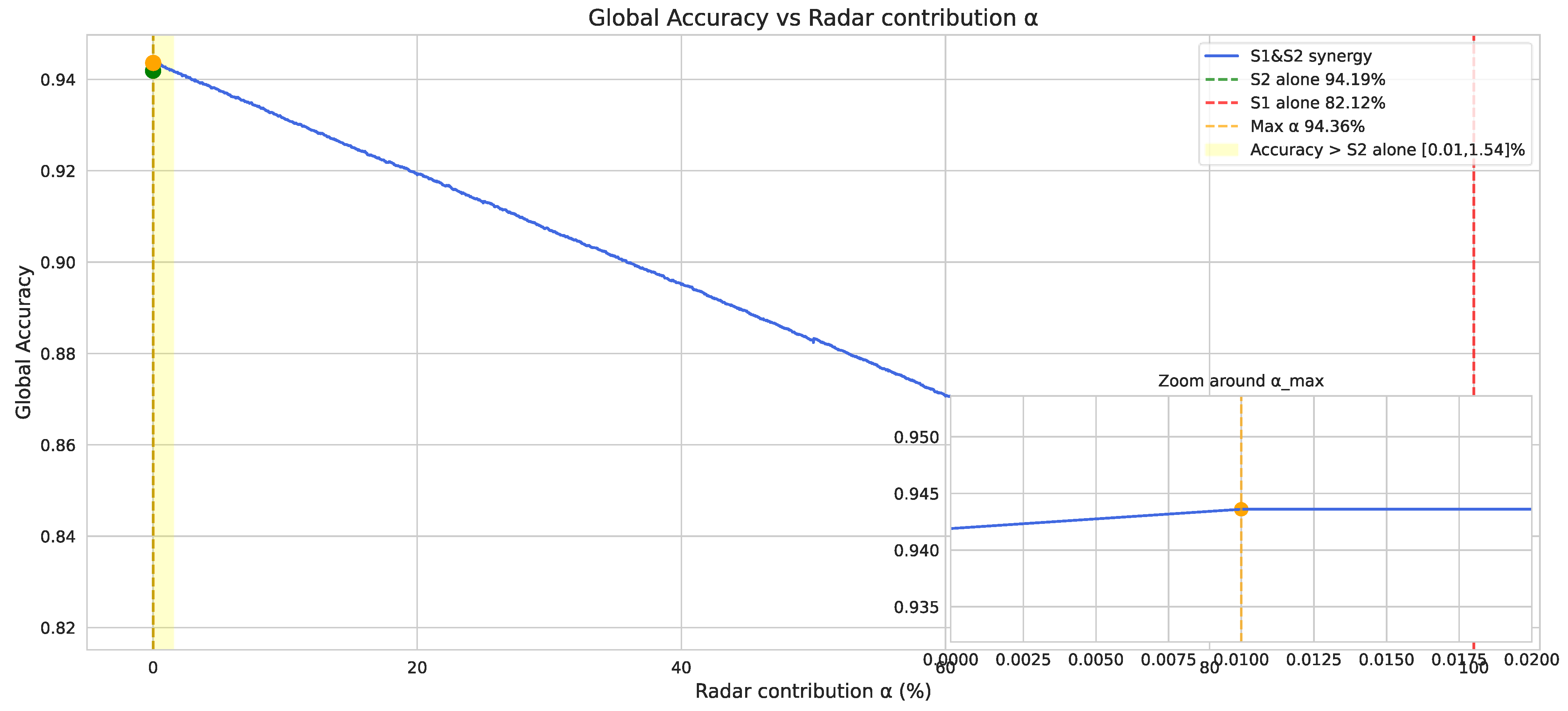
Thus, for S2 (resp. S1), the Overall Accuracy is 94.19% (resp. 82.12%), the Balanced Accuracy is 77.00% (resp. 44.05%) and the weighted F1-score is 93.80% (resp. 79.52%). The S1 and S2 Overall Accuracy is 94.33%, the Balanced Accuracy is 77.13% and the weighted F1-score is 93.91%. More generally, an analysis of the proportion of radar-derived data contributing to the synergistic classification shows that the Overall Accuracy is greater than S2-alone classification for α in [0.01%, 1.54%], and it is a maximum of 94.36% for α near 0.01% (Appendix D). Here, α = 0.80% over the whole region of interest.
The Water and Rock classes have very high scores. Concerning vegetation, Mountain Birches and Dry Heaths show very high CSI scores too with 83.31% and 85.20%, respectively. Globally, scores are lower for other vegetation classes, excepting the high precision for alpine willows. The lowest scores (particularly sensitivity and CSI) are for the Mesic Heath class, which is very poorly detected. The overall quality test of the classification is summarized by the confusion matrix (Table 4). This latter shows that rocks are mainly confused with dry heaths, which also seem to be confused with mountain birches. The Mountain Birch class presents also a lot of confusion, as shown by the numerous false positive cases with other vegetation classes, leading it to be the second lowest precision.

2.4. Meteorological Parameters Maps

2.4.1. Downscaling of Coarse Reanalysis

To produce fine-scale daily summer air temperature (T) and precipitation (P) maps from coarse-resolution datasets, we applied a statistical downscaling approach using a kriging interpolation of residuals with external drift (KED) [93,94] and a kriging interpolation of residuals (KR) [95], respectively. This method was implemented for each July–August date from 2019 to 2023 using observation from local meteorological stations (Table 2), corresponding to a maximized time period for data availability. Coarse-resolution temperature maps, T c o a r s e and P c o a r s e , were first reprojected and resampled by bilinear interpolation onto a 100 m ArcticDEM grid. As T is a continuous field varying with altitude [96,97], a linear regression was fitted to T c o a r s e at 1000 m resolution such as
T c o a r s e   a D E M 1000 + b     &     T c o a r s e a l t = a D E M 100 + b
For each date, the daily mean for T- or cumulative for p-values were extracted, and the residuals are computed as
T c o r r = T o b s T c o a r s e a l t     &     P c o r r = P o b s P c o a r s e
Residuals were spatially interpolated using ordinary kriging with a spherical variogram model as R k r i g e d . This interpolation accounts for the spatial autocorrelation structure of the residuals, allowing for spatially coherent local adjustments. The final downscaled field T f i n e was obtained as
T f i n e = T c o a r s e a l t + R T k r i g e d   &     P f i n e = P c o a r s e + R P k r i g e d
Model performance was assessed using a leave-out cross-validation by randomly selecting one to three independent station and evaluated with mean error (ME), root mean square error (RMSE), and coefficient of determination (R2). Each average map was subsequently debiased using the mean error (ME) and testing using a leave-one-out cross-validation procedure.
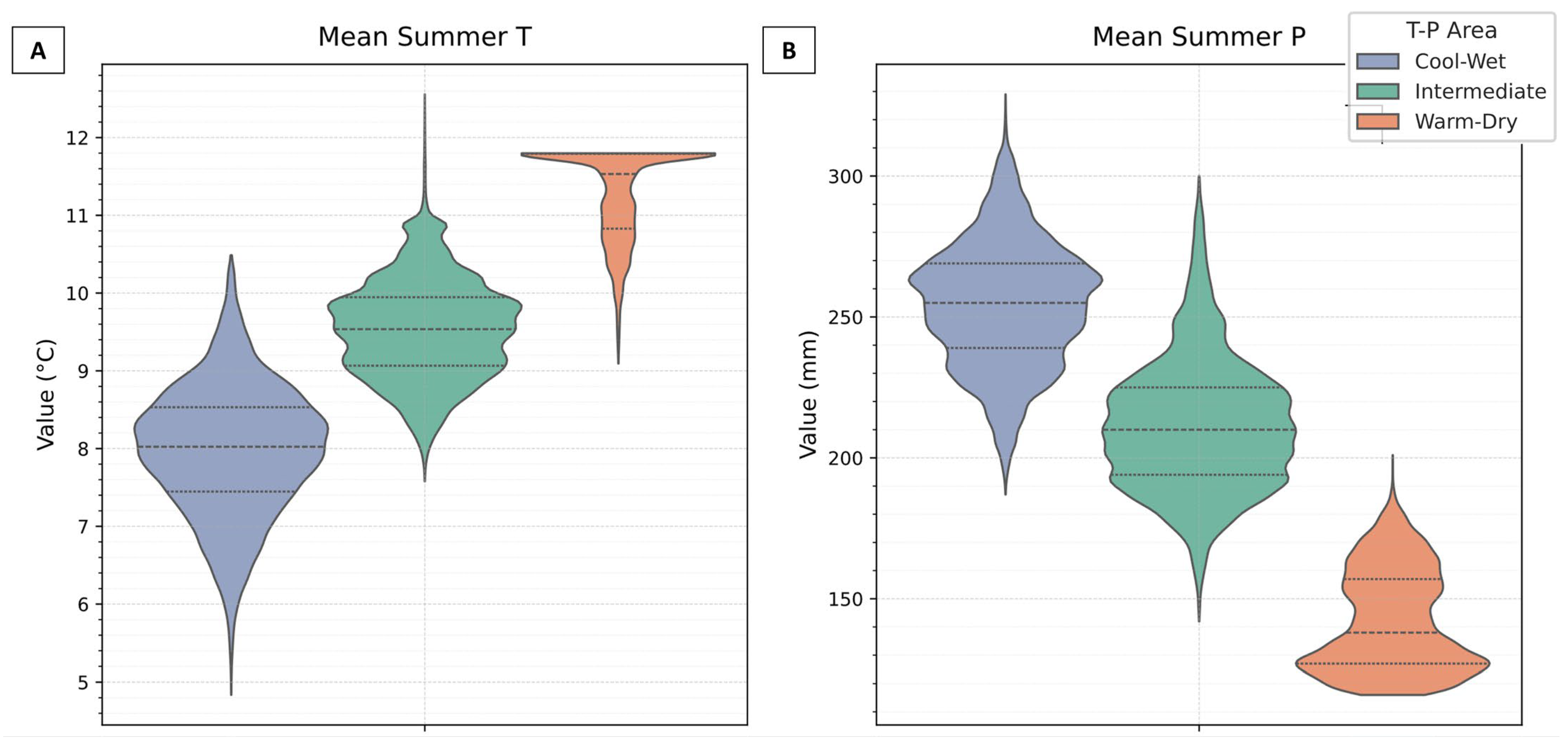
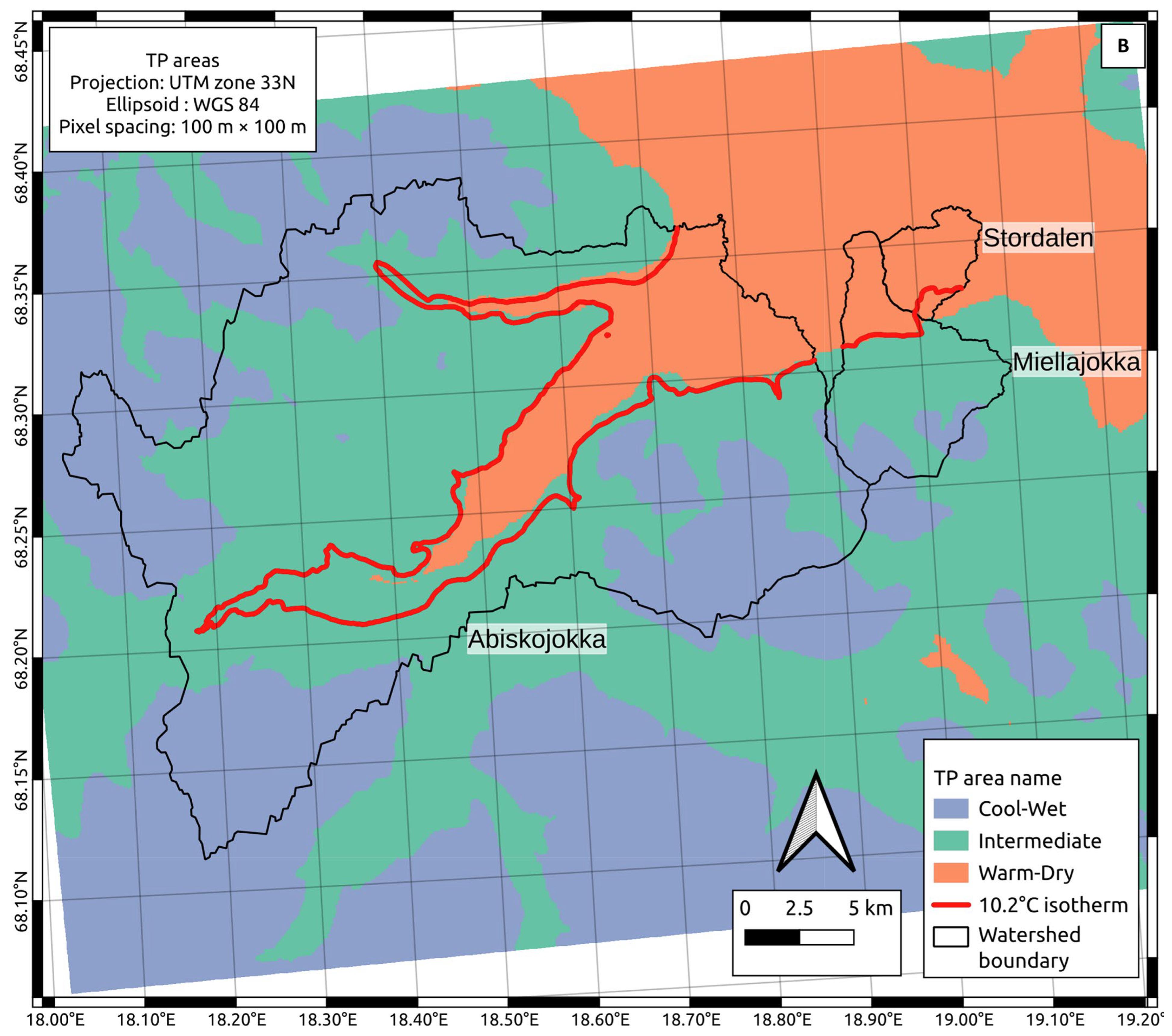
To characterize the spatial variability of T-P conditions, a K-means clustering algorithm (K = 3) was applied using the debiased T and P maps as inputs. The number of clusters was selected empirically to balance interpretability and intra-cluster variability, yielding three distinct climatic regimes—Cool–Wet, Warm–Dry, and an intermediate class—that capture the dominant thermal and hydrological gradients across the region. The distribution of temperature and rainfall is shown in Figure 3. The Cool–Wet cluster presents an average temperature of 7.9 °C, and rainfall is centered around a main mode of 260 mm of cumulative rainfall each summer with a global average of 254.3 mm. Warm–Dry is defined with temperatures ranging from 9.8 °C to 11.8 °C and with a global average of 11.3 °C, while precipitation indicates an average of 142.2 mm. This typology is completed by the presence of a third T-P area, Intermediate, which is characterized by a T and P distribution centered around the median and with respective average values of 9.5 °C and 211.6 mm.

2.4.2. Quality Assessment of T and P

Table 5 (A) displays the performance assessment of the spatial interpolation methods (bilinear interpolation, simple kriging of residuals and kriging with external drift) at 100 m resolution for the daily-based downscaled T and P. The simple kriging method shows a higher absolute accuracy for both T and P compared to the simple interpolation method with a large decrease in unbiased RMSE. Also, the R2 correlation values with observations are better than the ones obtained by interpolation, but the increase is slightly lower for T than for P. The KER method shows an improvement in all metrics for T only, particularly for the unbiased RMSE. For P, the KED method decreases the correlation score of results. Table 5 (B) presents the results of average temperatures and cumulative summer precipitations for the period 2019–2023 based on KED and KR methods for T and P, respectively. Both T and P long-term maps exhibit high-quality scores.

2.5. Delineate the Treeline and Birch Distribution

As the conceptual definition of the treeline varies in the literature [53,98], we adopted an operational approach, defining the treeline as a boundary between the mountain birch and the heaths classes. The distribution of trees was modeled as a logistic function, linking the elevation or temperature to birch presence, which is consistent with previous studies [99]:
P x = 1 1 + exp β 0 + β 1 x
Coefficients β 0 and β 1 are calculated from the LogisticRegression module of Scikit-Learn [100] trained on ArctiDEM or Temperature fields and the land cover classification upsampled to 100 m spatial resolution. The treeline line limit x T L is defined as the altitude or temperature at the predicted probability of birch occurrence declines below 0.25, representing a transition from a forested to a heath-dominated region:
x T L = ln 0.25 0.75 β 0 / β 1
Uncertainty was estimated from a 50-iterations Monte Carlo process combining a bootstrap resampling of trees and classification-error propagation based on a replacement of pixels according to their misclassifications scores (i.e., 1-CSI—Equation (2)): 0.167 for birches and 0.058 for all other classes. The final estimate treeline is reported as the mean ± std across simulations. The slope (S), T and P cross-effects on the birch distribution are studied through another logistic regression, which is here presented for T-S:
P x = 1 1 + exp β 0 + β 1 T + β 2 S + β 3 T . S
Secondly, the classification map was resampled to 100 m spatial resolution using a land cover majority condition and a second model. The optimized RF classifier was trained with the average T and P, slope and northness (cosine of aspect) maps as predictors to study the climatic control. The analysis focused on the main vegetated areas surrounding the treeline. The dataset was randomly split into 80% training/20% testing subsets with stratified sampling. The same method was applied with both T and P alone.

3. Results

3.1. Land Cover Spatial Patterns and Their Morpho-Climatic Characteristics

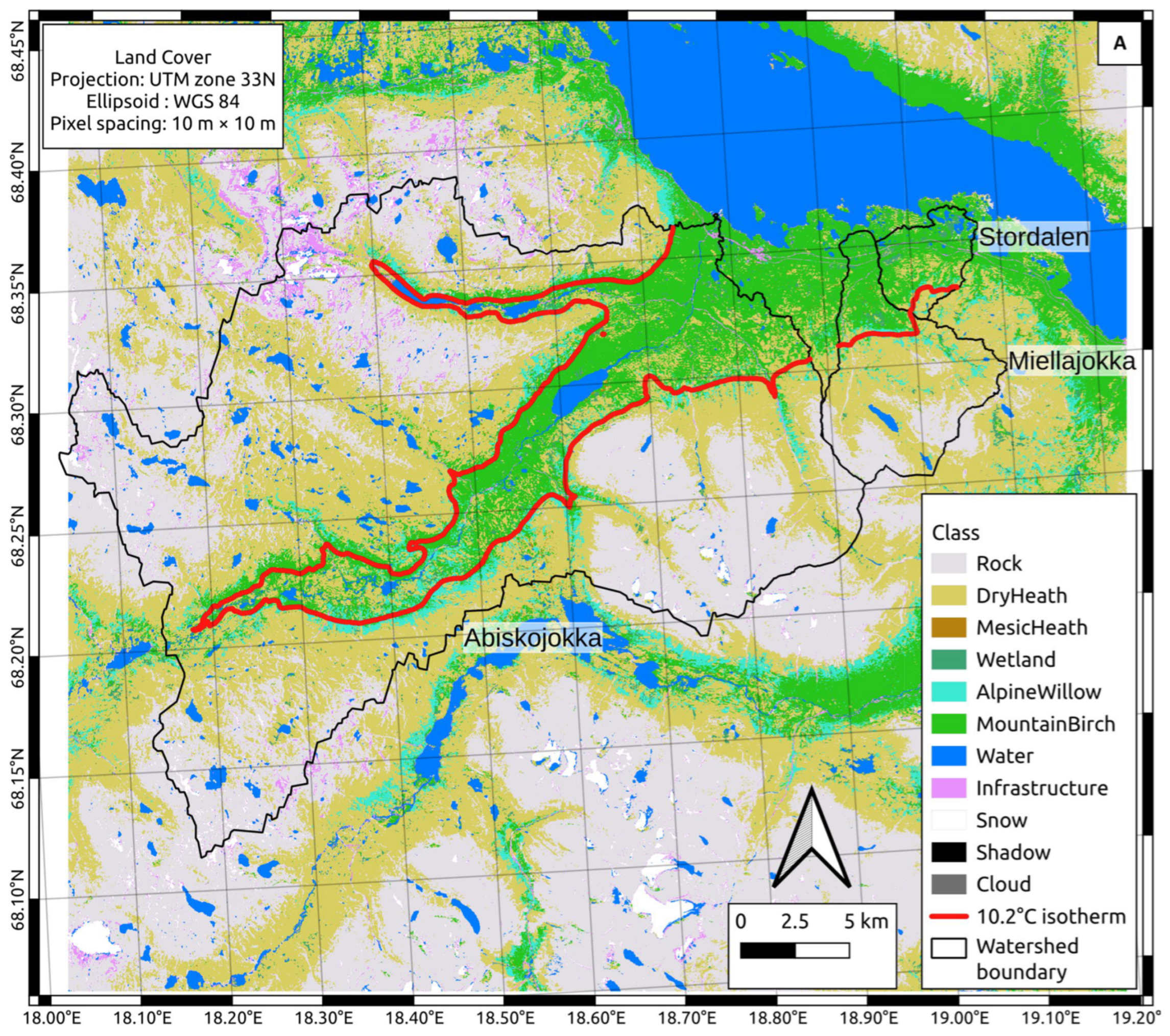
Figure 4 shows the land cover (A) and the T-P areas (B) in the studied region, while Table 6 summarizes the morpho-climatic characteristics of the eight environmental classes. The railway line and the main road are clearly visible in the upper third of the Miellajokka and Stordalen catchments. The global landscape is characterized by very specific ecological patterns, following the altitudinal gradient: a birch-dominated area first, with some wetland clusters, as in the Stordalen Mire (68.36° N, 19.05° E), a low-vegetation tundra zone and a bare/rocky soil at the highest altitudes. Ecological indices summarize the sampling area as an intermediate heterogeneous landscape (Shannon index = 1.57, Evenness = 0.68, Simpson diversity index = 0.74) with a partial equilibrium among classes and a clear dominance of certain types (rocks, dry heaths and birches).
The Rock class is the most extensive non-vegetative category, representing 33.1% of the total area. Some misclassifications are evident, including abnormally large infrastructure-like polygons mapped in high elevated rocky terrains in the northwestern mountains. The highest actual occupation class is the Rock class (1233.0 ± 171.3 m), originating mainly from the mountainous regions. The region’s famous lakes (Ábeskojávri and Čuonjájávri) are well represented, and numerous smaller lakes are scattered throughout the landscape—many at high altitude in topographical basins. The water altitudinal distribution is the most widespread with 876.1 ± 249.2 m. Some snow patches are detected in high elevation areas in the southern part of the map, most of which are associated with small water ponds. Rocky areas and snow-covered surfaces have the highest average slopes, with 16.2 ± 10.4° and 18.3 ± 7.7°, respectively, while the lowest values (2.2 ± 5.2°) correspond to water areas.
The vegetation is dominated by Dry Heath (38.4%), which is followed by Mountain Birch (15.2%). Three classes are very poorly represented: Mesic Heath (0.3%), Wetland (1.7%) and Alpine Willow (4.2%). Willows seems to be distributed near streams and ponds at moderately high altitudes and also at the forefront of the Mountain Birch treeline. Abiskojokka forms a green corridor at the bottom of the valley due to the predominance of Mountain Birch along the watercourse leading to Lake Ábeskojávri. On the other hand, Miellajokka has a relatively similar structure with birch forest dominating in the north at low altitudes and then transitioning to tundra and rocky areas as it rises towards Lake Čuonjájávri. In terms of altitude, there are two major ecological levels: Mountain Birch at low altitude (mean at 621.4 ± 134.1 m) and Dry Heath at higher altitude (mean at 938.0 ± 161.2 m). The Mesic Heath and Wetland classes are distributed between approximately 400 m and 1100 m altitude. Vegetation classes have average slopes between 5.4° (Wetland) and 12.1° (Dry Heath). The northeastern quarter bordering Lake Torneträsk, a well-known peat bog area, has a fairly high concentration of the Wetland class, at the foot of the slopes, in the flat areas. Temperature and precipitation distributions follow opposite altitudinal zonation patterns. The lowest average temperature and highest precipitation correspond to bare soil (8.1 ± 0.7 °C and 228.0 ± 23.8 mm), whereas birch trees show the opposite pattern (10.7 ± 0.6 °C and 166.5 ± 21.3 mm).
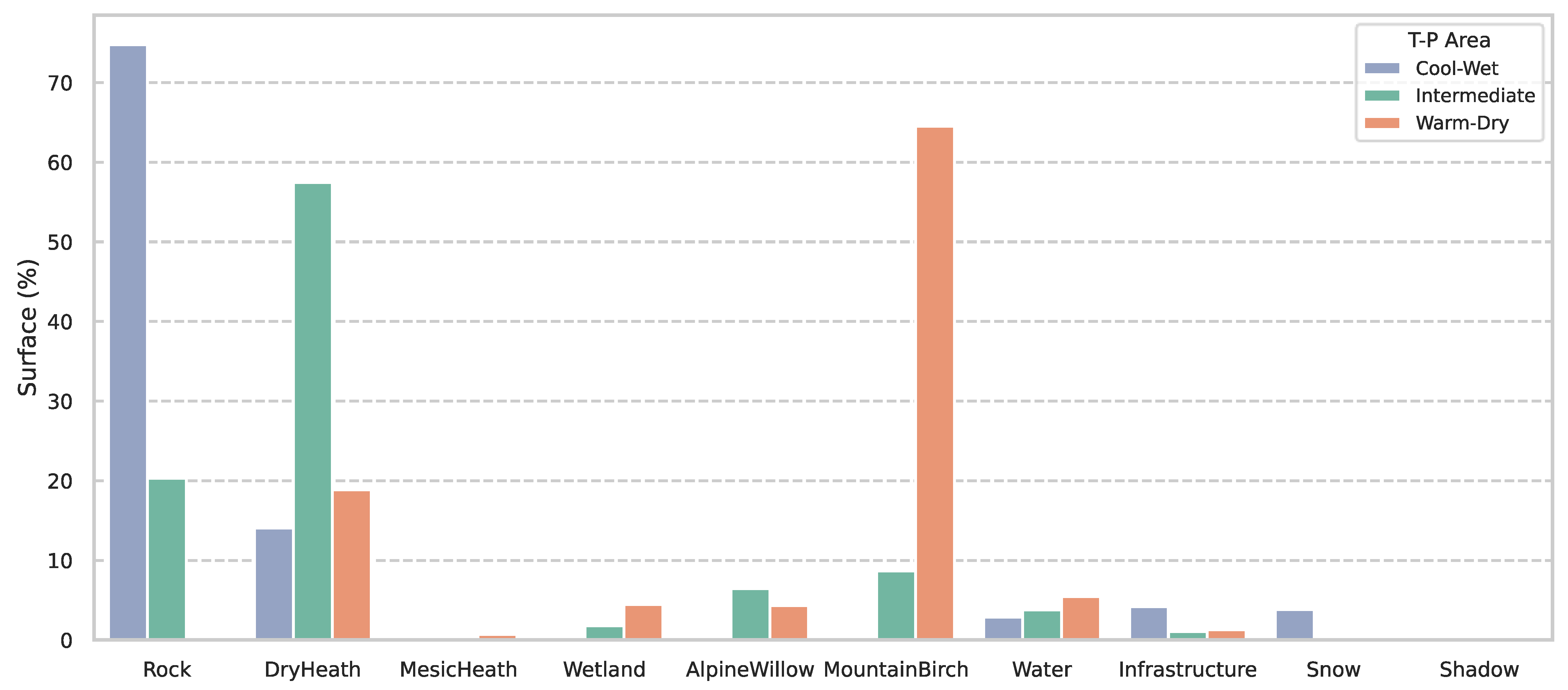
The spatial distribution of the summer T-P areas across the three catchments (Figure 4B) follows more or less the local topography, according to the interpolation method used for T. The precipitation pattern seems also to follow this altitudinal gradient. Cool–Wet is found at high altitudes, in the mountainous areas bordering the Abiskojokka basin and south of Miellajokka. Warm–Dry is located in the valley bottoms, north of Miellajokka and over the entire Stordalen area, which has a relatively uniform, flat topography at low altitude. Note the presence of an intermediate area corridor in the high-altitude valley floor of Čuonjávággi (68.27° N, 18.96° E) and the existence of a Warm–Dry zone anomaly above the 10.2 °C isotherm line in the south part of Stordalen. The same climatic–ecological pattern is observed all over the area with the warm regions associated with the vegetated classes and the cold regions dominated by the bare soils. This distribution of the land cover according to the three T-P areas is summarized in Figure 5.
Rock is virtually absent from the Warm–Dry region, whereas Mountain Birch is absent from the Cool–Wet zone. Dry Heath is slightly more prevalent in Warm–Dry than in Cool–Wet areas (~18% and ~13%, respectively). As expected, snow occurs exclusively in the coldest regions. Trends for the remaining land cover classes are less distinct: water surfaces occur in roughly similar proportions across all T–P clusters, and the apparent presence of infrastructure in cold regions results from misclassification in the highlands.

3.2. The Mountain Birch Forest Distribution

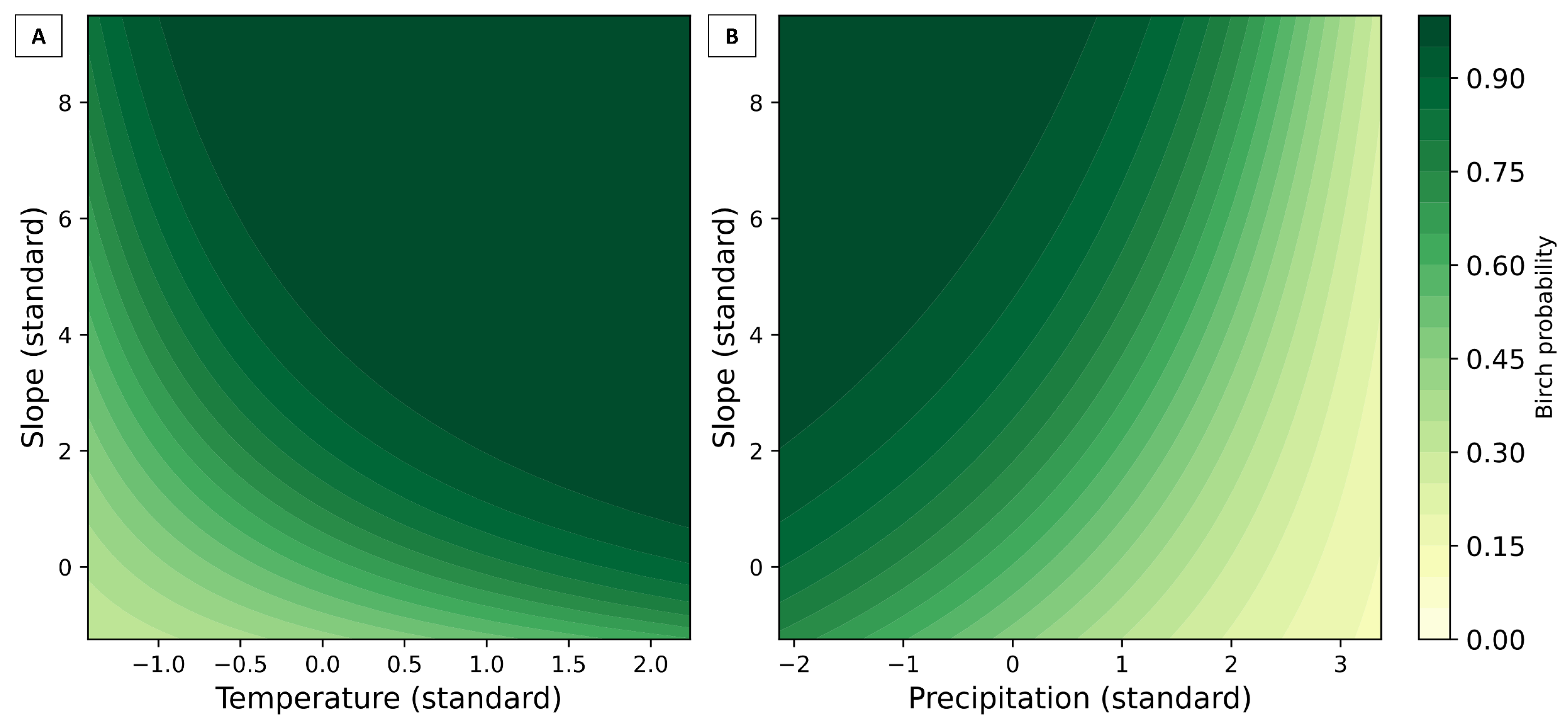
The treeline is located at 745.2 ± 0.06 m across the entire study area, specifically 752.3 ± 0.5 m for Abiskojokka and 703.28 ± 0.5 m for Miellajokka. The thermal approach places this limit at the 10.2 °C isotherm with very little variation from one watershed to another. In contrast, precipitation is more variable across the areas around the treeline with 190.9 mm for Abiskojokka and 167.4 mm for Miellajokka. Above the 10.2 °C isotherm, logistic regression linking slope and precipitation shows that the probability of birch occurrence decreases with increasing P, and this decline is even stronger on gentler slopes, as indicated by the interaction coefficient of −0.1. Conversely, temperature increases the likelihood of birch establishment, and this positive effect is amplified on steeper slopes, as reflected by the interaction coefficient of +0.5. Overall, slope is consistently associated with a higher probability of birch presence (Appendix E).
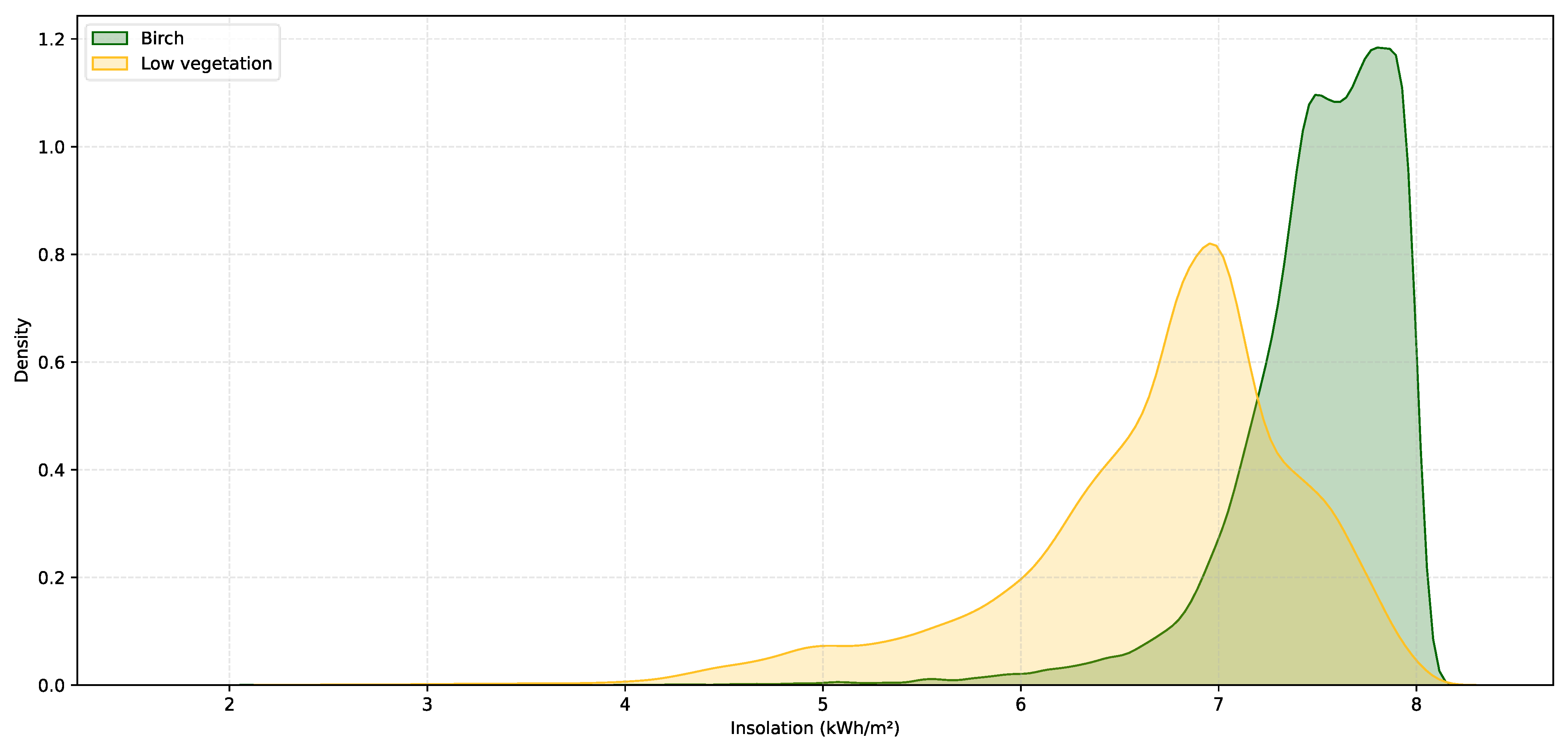
Local birch-canopy anomalies are nonetheless observed. For instance, over some east–west oriented valleys, while the south-facing slope is largely covered by forest from the valley floor up to the 10.2 °C isotherm, the north-facing slope can be almost completely devoid of birch trees and dominated by dry heaths and some alpine willow patches. Using the Potential Incoming Solar Radiation module of SAGA-GIS on a representative case in northern Abiskojokka, the cumulative incident solar radiation for July–August was estimated at 7.5 kWh·m−2 for the south-facing slope and 6.7 kWh·m−2 for the north-facing slope. Additional unforested patches, including areas with dead birch, were identified through visual interpretation of true-color satellite imagery. Several of these patches occur in zones characterized by high precipitation and low slope, which is consistent with the patterns described in the previous paragraph (Appendix E).
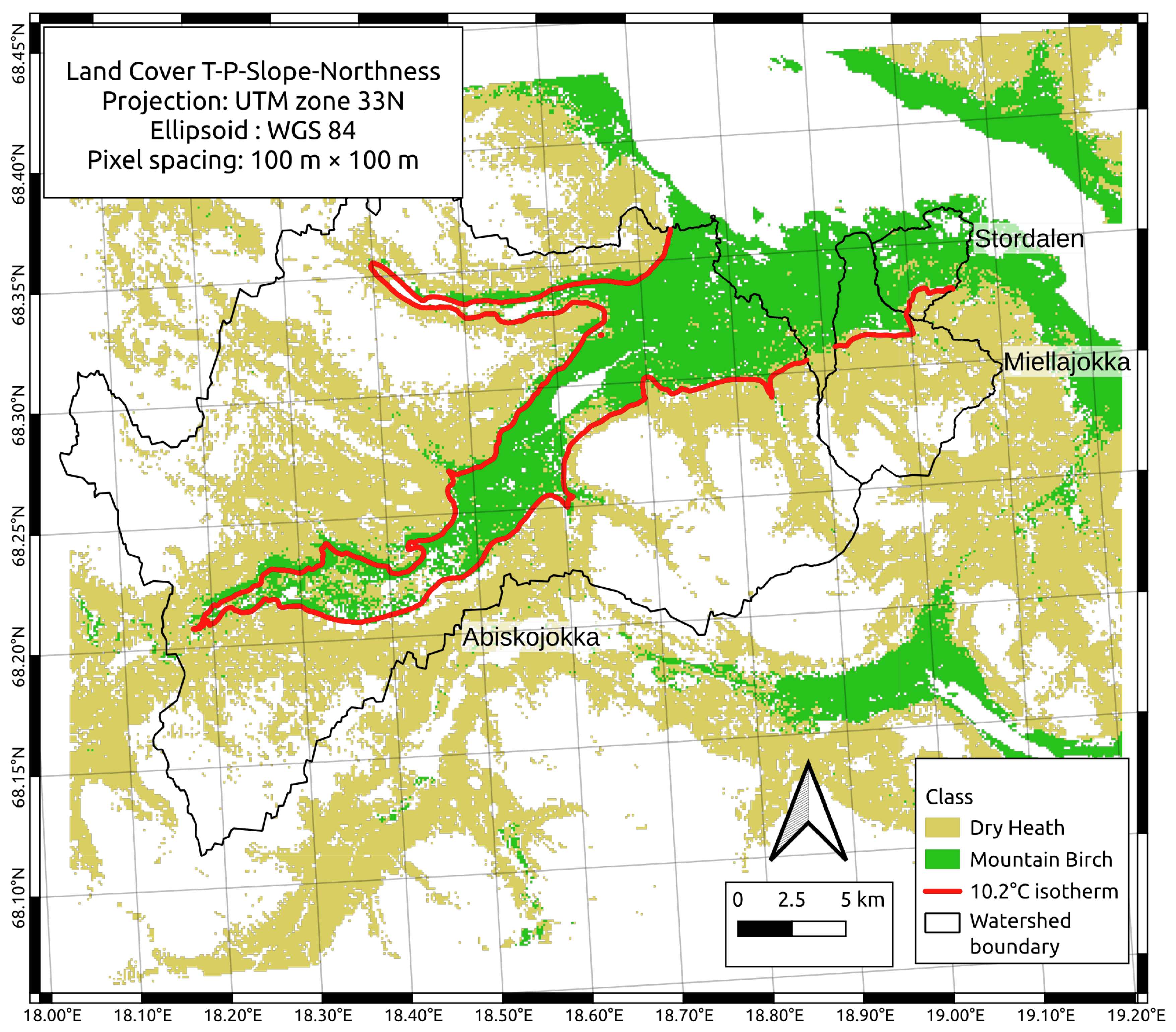
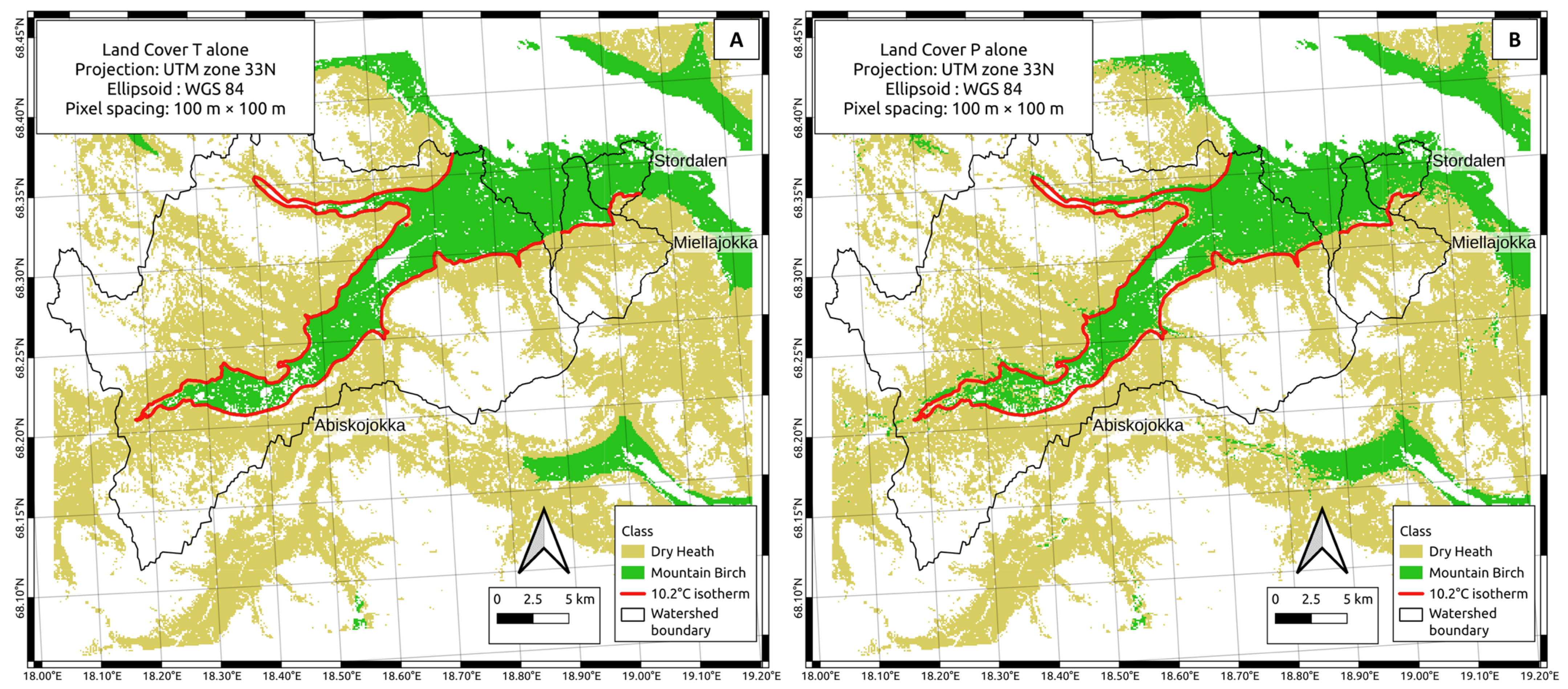
The T-P-Slope-Northness-based binary classification (Figure 6) from the second trained RF presents a global accuracy of 91.7% and a precision (resp. sensitivity) of 0.95 (resp. 0.94) for Dry Heath and 0.84 (resp. 0.85) for Mountain Birch. The feature importance analysis reveals that the air temperature contributed 54.9% of the model’s explanatory power, while the precipitation accounted for 28.7%. The birch probability increases significantly around the 9.3 °C isotherm, exceeding 0.5 at 10.0 °C. The overall distribution of birch trees is similar to that obtained with the first map of the region. The 10.2 °C isotherm is respected and clearly delineates the altitudinal limit of tree presence. Structural anomalies associated with P and topography are found—e.g., north-facing slope effects—but not all, as the effects of soil type are not implemented. The classification based on T and P alone leads to a satisfactory result (accuracy of 89.4%) but with a more uniform birch distribution. The T-autonomous classification also produces a similar distribution of birch trees, but without anomalies, while the P-autonomous version is unable to reproduce a satisfactory map, excepting some above-treeline anomalies (Appendix F).

4. Discussion

4.1. Technical Analysis and Limitations of Products

4.1.1. Land Cover Mapping

The results demonstrate the effectiveness of combining radar and optical data, combined with a robust machine learning process, to produce high-quality land cover maps. Given that Sentinel-1 data are available regardless of lighting and cloud cover conditions, they provide a valuable complement to Sentinel-2 images for long-term and/or a high temporal resolution monitoring of land cover changes. The synergy between optical and radar data enhances the reliability of land cover classification, while radar data help compensate for the topographical shadows and cloudy pixels present in optical images, and they even improved the land cover quality. This apparent paradox arises from the non-linear nature of the quality metrics computed from the combined confusion matrix. When merging both sources, errors are not simply averaged but can compensate for each other across classes. For instance, radar data provide a slightly higher precision for water areas, which reduces omission errors in this class without strongly affecting other categories. As a result, the overall accuracy and F1-score of the S1 and S2 product slightly increases even if the global performance of S1 taken alone remains lower.
Some misclassification errors are nevertheless observed. Several pixels have been labeled as Mountain Birch in areas where this vegetation type is not typically present (personal communication). Most of these are false positives, some resulting from confusion with alpine willows whose foliage may appear similar in satellite imagery. It is also possible that the Mountain Birch class itself exhibits substantial within-class variability or co-occurs with other vegetation types within the same pixel, which could further contribute to misclassification. A poorly dense foliage could explain confusions with the heath-dominated zones. Similarly, the Mesic Heath class is frequently confused with Dry Heath, which is likely because the height of low vegetation cannot be accurately resolved from the available imagery. In addition to its limited spatial extent in the study area, there are considerably more Dry Heath training samples than Mesic Heath, which may have biased the RF Classifier toward the former. Field-based distinctions between these vegetation types are also subject to uncertainty, which may explain further confusion with Dry Heath—especially given that this class sometimes exhibits radiometric characteristics similar to rocky terrain. Finally, wetland detection is challenging either because vegetation can grow sufficiently tall to obscure water-saturated soils or because the wetland class encompasses a high diversity of plant communities, increasing the within-class variability.
The case presented here is quite exceptional in that there were no clouds over the study area on 15 July 2024. Under cloudy conditions, S1 becomes the primary data source, but several limitations may arise. First, the C-band used by C-SAR can partially penetrate vegetation depending on leaf density [101], meaning that some low-stature plant communities may be difficult to distinguish. Moreover, the backscatter coefficient is strongly influenced by vegetation and soil moisture with higher water content increasing backscatter values [102]. Very small landscape features may also remain undetected at this spatial resolution. Higher-resolution SAR systems have already been used for similar purposes, including C-band RadarSat-2 [103], X-band TerraSAR-X [104] with resolutions down to 2.1 m × 2.3 m resolution, and L-band with ALOS-PALSAR [105,106] with resolutions of around 10 m × 10 m. Incorporating Single Look Complex (SLC) imagery could further improve classification, as many polarimetric variables—requiring all four polarization channels and phase information—offer enhanced discriminatory power [38,103,107,108,109].

4.1.2. Meteorological Mapping

Large-scale meteorological products for temperature and precipitation rarely provide spatial resolutions finer than 1 km. In this study, we downscaled these products by a factor of ten. The moderately high density of meteorological stations around Abisko made such downscaling feasible, although the temporal coverage of many stations is limited. With the notable exception of the Abisko station—which has operated continuously since 1913—several datasets originate from relatively short measurement campaigns (e.g., Miellajohka, Nuolja). A spatial resolution of 100 m was selected as an optimal compromise between accuracy, local representativeness, and the risk of overfitting. Incorporating in situ data to compute kriging residuals for T and P substantially improves the quality of the downscaled products. However, the spatial distribution of meteorological stations is uneven across the study area, with most located in the southern portion of the catchments, which may introduce subtle, non-visible biases in the interpolated fields. The scores also exhibit significant daily variability, which could be improved.
Average maps of T and cumulative P derived from the interpolated daily products show high R2 values, reflecting the smoothing of short-term variability through temporal averaging. Incorporating DEM data improves the mean air temperature fields by capturing the elevation-dependent lapse rate. Although precipitation exhibits a similar elevation-related pattern, applying a simple linear regression does not substantially enhance the quality of the final P product. A non-linear approach or the integration of additional terrain variables such as slope or aspect may help overcome this limitation. Moreover, the use of debiased products—obtained by subtracting the mean error (ME)—reduces systematic biases and increases the reliability of the resulting maps.

4.2. Ecological Analysis of the Abisko Region in Morpho-Climatic Context

The land cover map captures the main ecological structures and topographic controls of the Abisko landscape. The moderate diversity indices (Shannon index of 1.6 and Simpson index of 0.7) further characterize this area as a heterogeneous but partially balanced subarctic mosaic, which is typical of mountain ecotones where tundra, birch forest and rocky surfaces coexist. Water bodies are the most well-detected landscape features, including small high-altitude ponds corresponding presumably to late snowmelt accumulation zones. Patches of snow are indeed also regularly detected around these flooded areas. The lowest slope values in the classification correspond either to permanent lake surfaces, to topographic depressions temporarily flooded during snowmelt or even to places with wetlands related to a tendency of rainfall accumulation, leading to soil saturation such as, for instance, in the Stordalen Mire (68.36° N, 19.05° E). Thus, the heterogeneous distribution of wetlands suggests local topographic and hydrological influences rather than purely climatic drivers or misclassifications. Conversely, the highest slopes are associated with heaths or rocky areas, reflecting their transitional nature, at the boundary between stable vegetated surfaces and steep, sparsely vegetated terrain and often linked to areas of significant runoff.
The resulting land cover classification highlights a clear ecological zonation along the altitudinal gradient, which is consistent with previous descriptions of the Abisko region [110,111]. The dominance of Mountain Birch at low elevations and Dry Heath at higher altitudes reflects the strong thermal and edaphic control over vegetation distribution. Local average T–P conditions are closely linked to specific vegetation cover types, and in general, warmer climates support taller dominant plant species. At broader scales, plant diversity typically declines with increasing altitude, mirroring gradients in temperature and precipitation [112]. Note also that willows are often found just above the birch forest areas, suggesting that they are the first line of plant colonization toward higher altitudes.
The presence of clear altitudinal patterns in plant communities is well established in the literature and has been widely discussed [112,113,114]. The treeline is thus defined as the ecological limit beyond which trees are no longer able to develop due to environmental conditions. Our results show a treeline at around 745.2 m asl, which is consistent with the ranges found by several other studies in the region (650–750 m asl. for [115] and between 600 and 800 m asl. for [116]). The air temperature–precipitation analysis indicates that the treeline seems to be limited by the thermal conditions of the atmosphere at the 10.2 °C July–August isotherm more than the elevation itself. Indeed, even if Abiskojokka and Miellajokka show distinct elevations and conditions of precipitations, the treeline stands along the same air temperature boundary. This assertion is reinforced by the results of the coarser classification based on topographic and climatic variables, which demonstrates the prevalent importance of air temperature in relation to the presence of birch trees.
Obviously, the coarser land cover does not fit perfectly the satellite-based one, and local anomalies are not all well represented, and they are even less so without topographical parameters. If summer air temperature is recognized to be the main controlling driver of the treeline [99], monitoring over time and estimating the progress of the birch limit cannot be accomplished based on T-P parameters alone, as local factors such as topography play a contrasting role depending on the regions studied [117]. Thus, slope has been shown to play a secondary role in the importance of temperature and rainfall on the probability of birch occurrence. Areas with moderate to heavy rainfall are even less favorable to tree establishment when the topography is flat. This phenomenon may be due to the fact that these environments are conducive to water stagnation, leading to soil water saturation.
Another case, found over the region, can be linked to the fact that plant growth is also constrained by the orientation of the slope (northness), which modulates the incident radiation as shown in northern Abiskojokka by the difference of 0.81 kWh·m−2 in summer insolation between two slopes of the same valley. Other types of treeless areas throughout the landscape could be linked to periglacial features as solifluction landforms [118,119] or cryoturbated soils which contribute to reduce the above-ground biomass [120]. Additional factors as such as soil properties [121,122], wind stress [123], reindeer grazing [124], or even defoliation from insect outbreaks [125,126] might also impact the resulting tree distribution, but these fields are beyond the scope of this study.
Finally, the treeline itself has multiple definitions [53,98], and its delineation may vary depending on the criteria used. To ensure broad applicability—especially in the context of climate change—this conceptualization of the treeline should be tested and adapted across different environmental settings. It is also important to note that this distribution of mountain birch based on recent climate (five years) is only intended to highlight the ecological niche compatible with forest colonization. The establishment of birches in a tundra zone cannot instantly follow local climate variations on such short timescales. Nevertheless, the 10 °C isotherm of the warmest month, the “Köppen Line”, is well known to be the Arctic limit of the forest and, in the Abisko region, it has been shown that the treeline was closely related to the 10 °C July isotherm limit [127]. This leads us to believe that the distribution in 2024 is close to equilibrium with the climatic conditions of 2019–2023 presented here.

4.3. Global Change Implications and Environmental Feedbacks

The close relationship observed between different land use classes and local climatic conditions provides strong evidence of the potential impact of Arctic amplification on ecosystems and biodiversity. Based on spatial associations, which do not imply a direct quantification of temporal ecosystem change, we can discuss potential implications.
Previous studies have shown that the local treeline has shifted upward over the past century in response to climate warming, as illustrated through a transition from krummholz forms to erect trees of intermediate size [128]. In parallel, a significant increase in shrubs has been detected on tundra plots next to Abisko over recent three decades [111]. On a larger scale, this greening is neither uniform nor temporally stable, and some regions are subject to browning events, as it has been shown for the Scandinavian Arctic [125].
Since vegetation type is an important factor in understanding energy balances in Arctic regions [21], complex and heterogeneous impacts of global warming on the subsoil have been highlighted depending on the different plant communities of the tundra [129,130], the boreal forest [131], or simply the surface vegetation density [132]. Vegetation is therefore an important mediator of soil temperature and water content [133], particularly in Arctic and alpine environments such as the Abisko region [134]. In this context, considering the importance of land cover for soil thermal regime, accurate land cover monitoring is of paramount importance for the study of climate warming-induced changes in the Arctic and subarctic regions [135,136,137], as well as permafrost systems, which have warmed by an average of 0.29 ± 0.12 °C over the period 2007–2016 [138], including in subarctic Sweden [139,140].
In Abisko, the distribution of surface cover in high-latitude ecosystems is also closely linked to carbon fluxes [57]. Also, permafrost lands store almost 1500 gigatons of carbon, representing around twice the current atmospheric carbon stock [18,141], the release of which into the atmosphere in the form of CO2 and CH4 is triggered by rising temperatures [142]. Surface dynamics, particularly those of vegetation, thus impact not only the surface carbon cycle but also the volatility of underground stocks. However, counter-mechanisms exist, and if the carbon cycle is altered by the widespread warming of the tundra, increasing vegetation cover could act as a net sink for additional emissions [143].
These changes also affect ecosystem interactions. In particular, the availability and accessibility of food resources, as lichen, for reindeer grazing are also constrained by the structure of the surface and the climatic conditions [144]. A treeline rise could spatially constrain the tundra pastures necessary for local livestock farming practices. This consideration could be taken into account in the management of livestock farming practices coupled with other measures such as the management of the forests themselves [145].
Nevertheless, this shrub colonization is limited by numerous non-climatic factors, such as the availability of nutrients—particularly nitrogen [146]—semi-domesticated reindeer husbandry practices [147] or even topography, which can stabilize any advance of the treeline [148]. Ecosystem responses to warming, such as greening, are varied in nature and generally do not consist of the forest colonizing the tundra but rather specific adaptations depending on the species [149]. Global phenomena such as widespread greening cannot always account for all local variations, and the mechanisms at play are not yet fully understood [150].

5. Conclusions

We produced a new 10 m spatial resolution land cover map for a 2180 km2 region near Abisko, Arctic Sweden, using synergistic Sentinel-1 and Sentinel-2 data and an optimized Random Forest classifier trained on field samples from July 2024. The resulting map shows high reliability (Global Accuracy > 94%, F1-score > 93%). We also downscaled temperature and precipitation fields for July–August (2019–2023) by combining Nordic Gridded Climate Dataset reanalysis, ArcticDEM, and local meteorological stations, yielding accurate 100 m spatial resolution climatic surfaces (R2 is equal to 0.95 for T and to 0.96 for P). K-means clustering of these products identified three distinct summer climate regimes: Cool–Wet, Intermediate, and Warm–Dry. Topographic factors, particularly elevation and slope, influence vegetation patterns and the occurrence of water-saturated soils. However, summer climatic conditions exert the strongest control on land cover: warmer and drier areas consistently support greater vegetation cover. This climatic gradient is especially visible in the position of the treeline, which broadly follows the recent 10.2 °C July–August isotherm. Local deviations from this pattern likely reflect soil moisture, solar exposure, substrate properties, or other environmental constraints.
This paper demonstrates an efficient approach that integrates high-resolution open-access radar and optical satellite imagery with model outputs and field observations to generate robust land cover maps and relate them to local climatic conditions. The method remains effective under cloud cover and variable illumination, offering strong potential for repeated ecological monitoring and for assessing how surface properties respond to environmental change. This approach enables several key applications. The treeline as the birch forest distribution can be monitored through time to assess their sensitivity to shifting summer climate conditions. The strong link between vegetation type, soil temperature and soil moisture allows the land cover products to serve as proxies for spatial and temporal patterns of soil physical properties. In addition, the high accuracy of water-body detection makes it possible to relate pond dynamics to changing temperature–precipitation regimes. Altogether, the framework provides a scalable basis for long-term environmental monitoring and for analyzing interactions between climate, vegetation, and soils in subarctic landscapes.

Author Contributions

Conceptualization, R.C., Y.A. and L.O.; methodology, R.C. and Y.A.; software, R.C., Y.A., D.R. and A.B.; validation, All Authors; formal analysis, R.C. and Y.A.; investigation, R.C.; resources, L.O. and E.L.; data curation, R.C., Y.A. and D.R.; writing—original draft preparation, R.C.; writing—review and editing, All Authors; visualization, R.C.; supervision, L.O., D.R. and O.S.P.; project administration, L.O.; funding acquisition, L.O. All authors have read and agreed to the published version of the manuscript.

Funding

This research has been funded by the French National Research Agency ANR (grant no ANR-19 CE46-0003-01) and benefited from access to the supercomputers of CALMIP (project p12166). O.S. Pokrovsky was partially support by project PEACE of PEPR FairCarboN ANR-22-PEXF-0011.

Institutional Review Board Statement

Not applicable.

Informed Consent Statement

Not applicable.

Data Availability Statement

The raw data supporting the conclusions of this article will be made available by the authors on request.

Acknowledgments

We would like to thank CNES for making satellite data available through the PEPS platform (now GEODES since October 2024—https://geodes.cnes.fr (accessed on 15 October 2025)). This paper has also been made possible by data provided by the Swedish Infrastructure for Ecosystem Science (SITES) and the Swedish Meteorological and Hydrological Institute (SMHI). ArcticDEM tiles were downloaded at https://data.pgc.umn.edu/elev/dem/setsm/ArcticDEM/mosaic/v4.1/2m (accessed on 15 October 2025).

Conflicts of Interest

The authors declare no conflicts of interest.

Appendix A

Table A1 lists the satellite images used to process the land cover classification.
Table A1. Images from Sentinel-1 and Sentinel-2 used for this study.
Image NameOrbit
S1A_IW_GRDH_1SDV_20240703T051307_20240703T051332_054592_06A51D_3B74Descending
S1A_IW_GRDH_1SDV_20240715T051307_20240715T051332_054767_06AB2A_4F96Descending
S1A_IW_GRDH_1SDV_20240724T160730_20240724T160755_054905_06AFFA_1AECAscending
S1A_IW_GRDH_1SDV_20240727T051307_20240727T051332_054942_06B141_4671Descending
S1A_IW_GRDH_1SDV_20240805T160730_20240805T160755_055080_06B602_8FBBAscending
S1A_IW_GRDH_1SDV_20240808T051307_20240808T051332_055117_06B755_8BA1Descending
S1A_IW_GRDH_1SDV_20240817T160730_20240817T160755_055255_06BC64_52E1Ascending
S2A_MSIL1C_20240715T104021_N0510_R008_T33WXR_20240715T142048-
S1Tiling (v1.0.0) [72] was developed within the CNES radar service to generate time series of calibrated, ortho-rectified and filtered Sentinel-1 images on any lands on the Earth. The process is based on the SAR ortho-rectification application from the Orfeo Tool Box (OTB, CNES) [73]. The resulting images are registered to Sentinel-2 L2 optical images, using the same MGRS geographic reference grid. After the merging process and orthorectification, the normalized backscatter coefficient is calculated according to [151,152].
σ 0 = D N 2 A d n 2 K sin L I A

Appendix B

The descriptive capabilities of the images are enhanced by converting each polarization into a color channel of the RGB system. This pseudo-color conversion is inspired by the work of [153]. The motivation for such a conversion is twofold: (1) an efficient combination of polarization information for a spatial description of the arrangement of pixels and (2) a large panel of possible colorimetric bases (HSV, HSL, Y’CbCr). These pseudo-colors are defined as
R = σ V V 0       ,       G = ( σ V V 0 + σ V H 0 ) / 2     ,       B = σ V H 0
Each color is then quantized using 256 values between 0 and 1, whose range is determined by the minimum authorized value, −30 dB in order to remove only-noise values, and an arbitrary value (here 2 dB) slightly higher than the theoretical value of 0 dB to contain little glint effects, which are persistent in the mountains.
The low light intensity of radar images is an obstacle to the detection of surface features. Studies have highlighted the benefits of increasing the contrast for machine learning [154,155], both in visible light [156] and radar [157,158]. This improvement in visual quality is necessary for the definition of local descriptors around each pixel. Here, we have developed an original three-stage contrast enhancement method:
(1)
Empirical colorimetric stretching of the RGB channel such that:
R s t r = S t r e t c h 220 ( R ,   24 ,   184 ) G s t r = S t r e t c h 220 ( G ,   13 ,   143 ) B s t r = S t r e t c h 220 ( B ,   5 ,   38 )
With R ,   G   a n d   B , the pixel intensity for each color band quantified in 0 ,   255 and the stretching function S t r e t c h 220 is defined as
S t r e t c h 220 : 0 ,   255 a , b x x s t r   w i t h   C a r d a , b = 220
(2)
Application of an empirical contrast factor F is defined as
F = ( 131 128 ) / ( 127 130 ) R c o n t = F R s t r 127 + 127 G c o n t = F G s t r 127 + 127 B c o n t = F B s t r 127 + 127 R c o n t   o r   G c o n t   o r   B c o n t   s e t s   t o   0   i f < 0
(3)
Local gamma correction ( γ = 0.85 ) of the luminosity, inspired by the work of [159] and based on brightness, L , such as
L g a m m a = L γ

Appendix C

We list the 78 (resp. 18) features used for S1 (resp. S2) classification in Table A2. The features are grouped into different categories (polarimetry, colorimetry, texture and geometry) and types (pixel-based and window-based).
Table A2. List of the Sentinel-1 78 features (red) and Sentinel-2 18 features (blue).
Feature NameParameterTypeReferences
Polarimetry
VV and VH MagnitudesSig1, Sig2, Sig1dB, Sig2dBPixel-based[160]
VV and VH SpecklesSpeck1, Speck2Pixel-based[161]
Magnitude Ratio Rapp   ( S i g 1 / S i g 2 ) Pixel-based[160]
Range Range   ( S i g 1 S i g 2 ) Pixel-based[160]
Kennaugh ElementsK0, K1Pixel-based[104,160]
Co-pol PurityMCPixel-based[162]
Pseudo-Scattering TypeThetaPixel-based[162]
Pseudo-Scattering EntropyHentPixel-based[162]
Radar Vegetation IndexRVI, RVIdBPixel-based[163]
Co/cross Polarimetric Range EPL _ vv ,   EPL _ vh   S i g p i x S i g m i n / ( S i g m a x S i g m i n ) Window-based-
Colorimetry
Hue, Saturation, ValueHue_pix, Sat_pix, Val_pixPixel-based[153,164]
Luma, Blue Chroma and Red ChromaY_pix, Cb_pix, Cr_pix, Y_varPixel-based/Window-based[153]
LightnessLight_pixPixel-based-
Pseudo-Green and its Local VariationPV_pix, PV_varPixel-based/Window-based-
Luma/Hue RatioRcolPixel-based-
Color Layout Descriptor AdaptedCLDWindow-basedAdapted from [153,165,166]
Color NameCNPixel-basedAdapted from [167]
Color Consistency RateTCCWindow-basedAdapted from [168]
Texture
Second Angular MomentAsmWindow-based[104,169,170]
Textural EnergyEnerWindow-based[170,171]
ContrastContWindow-based[104,169,170,171]
CorrelationCorrWindow-based[170,171]
Spatial MeansMoy_v, Moy_hWindow-based[104,170]
VarianceVarWindow-based[104,170]
SkewnessSkewWindow-based[170,171]
KurtosisKurtWindow-based[172]
Hyper-Asymmetry (5th-Order Moment)HysymWindow-based[172]
Hyper-Tailedness (6th-Order Moment)HytailWindow-based[172]
Textural EntropyEntrWindow-based[104,169,170,171]
HomogeneityHomoWindow-based[104,169,170,171]
DissimilarityDissWindow-based[104,170,171]
Inverse Difference MomentIDFWindow-based[170,173]
Information MeasurementInfoWindow-based[170]
Laws DescriptorsEER, SSR, RRR, WWR, LER, LRR, LSR, LWRWindow-based[174]
Geometry
Spatial Frequencies (Fast Fourier Transform)Fr_max, Fr_min, Fr_moy, Fr_medWindow-based-
Fourier Farthest Point SignatureFpdWindow-based[175]
SoliditySoliWindow-based[176]
CircularityCircWindow-based[176]
EccentricityExceWindow-based[176]
ElongationElonWindow-based[176]
CompacityCompaWindow-based[176]
CurlCurlWindow-based[176]
ConvexityCnvxWindow-based[176]
Aspect RatioAsraWindow-based[176]
ContinuityContiWindow-based[176]
Zernike Moments 1 to 8Zern_1, …, Zern_8Window-based[177,178]
Local Structure DescriptorLocStructWindow-basedAdapted from [179]
S2 indices
MSI BandsB02, B03, B04, B05, B06, B08, B11, B12Pixel-based-
BrightBrigPixel-based[180]
NDVINDVIPixel-based[180]
NDWINDWIPixel-based[180]
NDIINDIIPixel-based[180]
TCARITCARIPixel-based[180]
LCILCIPixel-based[180]
BRIBRIPixel-based[180]
MSBIMSBIPixel-based[180]
OSAVIOSAVIPixel-based[180]
SLAVISLAVIPixel-based[180]
Mutual Information (MI) measures the amount of information that one random variable shares with another [181,182]. MI is null if and only if the two variables are statistically independent and is insensitive to the size of the data [183]. Formally, the MI index between two variables X (continue) and Y (discrete) is defined as
M I X , Y = i = 1 p x , y i . log p x , y i p x . p y i d x
Variable X is a feature and has continuous values when Y represents the target ensemble (classes of the land cover training dataset, which have discrete values). Filtering is performed on features by using a procedure of relevance–redundancy selection as described in [85]. This method is based on the “max-relevance and max-redundance criterion”, mRMR, such as
m R M R ( X i , Y ) = arg max X i F F M I X i , Y 1 k X j F M I X i , X j
The features retained after the mRMR process are summarized in Table A3.
Table A3. Features selected after the mRMR process, sorted by mean decrease in impurity significance for the Random Forest classifier.
Sentinel-1 FeaturesSignificance (%)Sentinel-2 FeaturesSignificance (%)
Zern_115.58B1112.08
Zern_214.70B1210.89
Sig2dB12.71NDWI7.78
Sig1dB7.94B046.95
Zern_77.78NDVI6.48
CLD_Cb6.52OSAVI5.83
Zern_45.88Bright5.76
Zern_85.22LCI5.43
G_pix4.47B085.09
IDF3.45SLAVI4.85
Homo3.32B024.62
Info3.30B054.23
Diss2.99TCARI3.83
Entr1.52B8A3.50
Ener1.34MSBI3.44
Asm1.16B033.26
Moy_v1.10B063.11
Moy_h1.04B072.87

Appendix D

Table A4 shows the hyperparameter values obtained after Random Search optimization for the best Random Forest model.
Table A4. Best Random Forest hyperparameters after a Random Search optimization process for Sentinel-1 and Sentinel-2 data.
NameS1 ValuesS2 Values
CriterionEntropyEntropy
Estimators450850
Max Features84
Max Depth10090
Min Sample split25
Min Sample leaf11
Bootstrap (set)TrueTrue
Class Weight (set)Balanced subsampleBalanced subsample
Table A5 shows the proportion of each class in the final land cover maps for the sampling area. Table A6 presents the global metrics for different kinds of merged-vegetation classifications. Table A7 displays quality metrics for both Sentinel-1 and Sentinel-2-based classification maps. Finally, Figure A1 displays the contribution of radar data for the global accuracy of the synergistic classification.
Table A5. Surface extent of classes for S1&S2, Sentinel-1 and Sentinel-2 over the sampling area.
Class NameExtent S1 and S2 (%)Extent S1 (%)Extent S2 (%)Extent S2-S1 (%)
Rock20.4015.8020.314.51
Dry Heath34.7737.2834.57−2.71
Mesic Heath0.390.020.390.37
Wetland2.030.052.041.99
Alpine Willow4.370.304.374.07
Mountain Birch21.8932.0421.78−10.26
Water14.9914.3214.980.66
Infrastructure0.810.190.810.62
Snow0.35N/A0.350.35
Shadow0.000.000.400.40
Cloud0.00N/A0.00N/A
Table A6. Global quality metrics (Overall Accuracy, Balanced Accuracy and weighted F1-score) for different class-diversity classifications: normal, birches and willows against heaths and wetlands and all vegetation classes merged.
A—Map TypesS1 and S2 (%)S1 (%)S2 (%)
Normal94.3377.1393.9182.1244.0579.5294.1977.0093.80
B and W vs. H and Wet95.3695.3595.3285.9067.8385.6095.3695.3595.32
All vegetation merged99.5998.6599.5994.8469.0694.2599.5998.6599.59
Figure A1. Global accuracy depending of the radar proportion α in the synergistic land cover classification map.
Applsci 16 01376 g0a1
Table A7. Evaluation metrics per class (Sensibility, Precision and Critical Succes Index) for S1 and S2-derived classifications, respectively.
Class NameS1-Sensi. (%)S1-Preci. (%)S1-CSI (%)S2-Sensi. (%)S2-Preci. (%)S2-CSI (%)
Rock77.0397.3075.4099.4198.5297.95
Dry Heath73.3170.3856.0388.6295.4084.98
Mesic Heath0.000.000.001.706.061.34
Wetland0.2133.330.2160.1091.2956.83
Alpine Willow6.6858.826.3772.3396.4470.45
Mountain Birch95.4366.1064.0398.1084.5183.15
Water99.7499.9899.7899.9599.9399.88
Infrastructure0.000.000.0095.7694.9691.13

Appendix E

Figure A2 shows the birch probability depending on the slope and temperature or precipitation.
Figure A2. (A) Temperature and (B) precipitation interactions with the slope for predicting the birch probability.
Applsci 16 01376 g0a2
Other factors have been studied such as the impact of the slope orientation. Here, the Potential Incoming Solar Radiation module of SAGA-GIS is used to compute the solar incoming insolation over an east–west oriented valley in northern Abiskojokka. Figure A3 shows the distribution of the summer cumulative insolation values for the two main classes (birch forest and alpine tundra) located on the valley’s slopes. The forest presents higher values than the alpine tundra, which is correlated with its prevalence over the south-facing slope.
Figure A3. Solar cumulative incoming insolation from the 1st of July to the 31st of August over an east–west-oriented valley.
Applsci 16 01376 g0a3

Appendix F

Figure A4 displays the land cover classification maps based on temperature and precipitation fields, respectively. The global accuracy scores of different combinations of morphoclimatic features are shown in Table A8.
Figure A4. Land cover classifications from temperature (A) and precipitation (B) fields.
Applsci 16 01376 g0a4
Table A8. Global accuracy scores on test sets for the different climate/topographic-based classifications at 100 m spatial resolution.
TypeT, P, Slope and NorthnessT & PT, Slope and NorthnessT aloneP alone
Global Accuracy Score0.9170.8940.8860.8710.837

References

  1. England, M.R.; Eisenman, I.; Lutsko, N.J.; Wagner, T.J.W. The Recent Emergence of Arctic Amplification. Geophys. Res. Lett. 2021, 48, e2021GL094086. [Google Scholar] [CrossRef]
  2. Pithan, F.; Mauritsen, T. Arctic Amplification Dominated by Temperature Feedbacks in Contemporary Climate Models. Nat. Geosci. 2014, 7, 181–184. [Google Scholar] [CrossRef]
  3. Previdi, M.; Janoski, T.P.; Chiodo, G.; Smith, K.L.; Polvani, L.M. Arctic Amplification: A Rapid Response to Radiative Forcing. Geophys. Res. Lett. 2020, 47, e2020GL089933. [Google Scholar] [CrossRef]
  4. Comiso, J.C.; Hall, D.K. Climate Trends in the Arctic as Observed from Space. WIREs Clim. Change 2014, 5, 389–409. [Google Scholar] [CrossRef]
  5. Rantanen, M.; Karpechko, A.Y.; Lipponen, A.; Nordling, K.; Hyvärinen, O.; Ruosteenoja, K.; Vihma, T.; Laaksonen, A. The Arctic Has Warmed Nearly Four Times Faster than the Globe since 1979. Commun. Earth Environ. 2022, 3, 168. [Google Scholar] [CrossRef]
  6. Derksen, C.; Brown, R. Spring Snow Cover Extent Reductions in the 2008-2012 Period Exceeding Climate Model Projections: Spring Snow Cover Extent Reductions. Geophys. Res. Lett. 2012, 39, L19504. [Google Scholar] [CrossRef]
  7. Brown, R.D.; Robinson, D.A. Northern Hemisphere Spring Snow Cover Variability and Change over 1922–2010 Including an Assessment of Uncertainty. Cryosphere 2011, 5, 219–229. [Google Scholar] [CrossRef]
  8. Déry, S.J.; Brown, R.D. Recent Northern Hemisphere Snow Cover Extent Trends and Implications for the Snow-Albedo Feedback. Geophys. Res. Lett. 2007, 34, L22504. [Google Scholar] [CrossRef]
  9. Büntgen, U.; Hellmann, L.; Tegel, W.; Normand, S.; Myers-Smith, I.; Kirdyanov, A.V.; Nievergelt, D.; Schweingruber, F.H. Temperature-Induced Recruitment Pulses of Arctic Dwarf Shrub Communities. J. Ecol. 2015, 103, 489–501. [Google Scholar] [CrossRef]
  10. Kropp, H.; Loranty, M.M.; Natali, S.M.; Kholodov, A.L.; Rocha, A.V.; Myers-Smith, I.; Abbot, B.W.; Abermann, J.; Blanc-Betes, E.; Blok, D.; et al. Shallow Soils Are Warmer under Trees and Tall Shrubs across Arctic and Boreal Ecosystems. Environ. Res. Lett. 2021, 16, 015001. [Google Scholar] [CrossRef]
  11. Lu, X.; Liang, E.; Babst, F.; Camarero, J.J.; Büntgen, U. Warming-Induced Tipping Points of Arctic and Alpine Shrub Recruitment. Proc. Natl. Acad. Sci. USA 2022, 119, e2118120119. [Google Scholar] [CrossRef]
  12. Martin, A.C.; Jeffers, E.S.; Petrokofsky, G.; Myers-Smith, I.; Macias-Fauria, M. Shrub Growth and Expansion in the Arctic Tundra: An Assessment of Controlling Factors Using an Evidence-Based Approach. Environ. Res. Lett. 2017, 12, 085007. [Google Scholar] [CrossRef]
  13. Heijmans, M.M.P.D.; Magnússon, R.Í.; Lara, M.J.; Frost, G.V.; Myers-Smith, I.H.; van Huissteden, J.; Jorgenson, M.T.; Fedorov, A.N.; Epstein, H.E.; Lawrence, D.M.; et al. Tundra Vegetation Change and Impacts on Permafrost. Nat. Rev. Earth Environ. 2022, 3, 68–84. [Google Scholar] [CrossRef]
  14. Phoenix, G.K.; Treharne, R. Arctic Greening and Browning: Challenges and a Cascade of Complexities. Glob. Change Biol. 2022, 28, 3481–3483. [Google Scholar] [CrossRef]
  15. Ernakovich, J.G.; Barbato, R.A.; Rich, V.I.; Schädel, C.; Hewitt, R.E.; Doherty, S.J.; Whalen, E.D.; Abbott, B.W.; Barta, J.; Biasi, C.; et al. Microbiome Assembly in Thawing Permafrost and Its Feedbacks to Climate. Glob. Change Biol. 2022, 28, 5007–5026. [Google Scholar] [CrossRef] [PubMed]
  16. Intergovernmental Panel on Climate Change (IPCC). The Ocean and Cryosphere in a Changing Climate: Special Report of the Intergovernmental Panel on Climate Change, 1st ed.; Cambridge University Press: Cambridge, UK, 2022; ISBN 978-1-009-15796-4. [Google Scholar]
  17. Chadburn, S.E.; Burke, E.J.; Cox, P.M.; Friedlingstein, P.; Hugelius, G.; Westermann, S. An Observation-Based Constraint on Permafrost Loss as a Function of Global Warming. Nat. Clim. Change 2017, 7, 340–344. [Google Scholar] [CrossRef]
  18. Walvoord, M.A.; Kurylyk, B.L. Hydrologic Impacts of Thawing Permafrost—A Review. Vadose Zone J. 2016, 15, 1–20. [Google Scholar] [CrossRef]
  19. Nitzbon, J.; Westermann, S.; Langer, M.; Martin, L.C.P.; Strauss, J.; Laboor, S.; Boike, J. Fast Response of Cold Ice-Rich Permafrost in Northeast Siberia to a Warming Climate. Nat. Commun. 2020, 11, 2201. [Google Scholar] [CrossRef]
  20. Liljedahl, A.K.; Boike, J.; Daanen, R.P.; Fedorov, A.N.; Frost, G.V.; Grosse, G.; Hinzman, L.D.; Iijma, Y.; Jorgenson, J.C.; Matveyeva, N.; et al. Pan-Arctic Ice-Wedge Degradation in Warming Permafrost and Its Influence on Tundra Hydrology. Nat. Geosci. 2016, 9, 312–318. [Google Scholar] [CrossRef]
  21. Oehri, J.; Schaepman-Strub, G.; Kim, J.-S.; Grysko, R.; Kropp, H.; Grünberg, I.; Zemlianskii, V.; Sonnentag, O.; Euskirchen, E.S.; Reji Chacko, M.; et al. Vegetation Type Is an Important Predictor of the Arctic Summer Land Surface Energy Budget. Nat. Commun. 2022, 13, 6379. [Google Scholar] [CrossRef]
  22. Cazaurang, S.; Marcoux, M.; Pokrovsky, O.S.; Loiko, S.V.; Lim, A.G.; Audry, S.; Shirokova, L.S.; Orgogozo, L. Numerical Assessment of Morphological and Hydraulic Properties of Moss, Lichen and Peat from a Permafrost Peatland. Hydrol. Earth Syst. Sci. 2023, 27, 431–451. [Google Scholar] [CrossRef]
  23. Sturm, M.; Holmgren, J.; McFadden, J.P.; Liston, G.E.; Chapin, F.S.; Racine, C.H. Snow–Shrub Interactions in Arctic Tundra: A Hypothesis with Climatic Implications. J. Clim. 2001, 14, 336–344. [Google Scholar] [CrossRef]
  24. Von Oppen, J.; Assmann, J.J.; Bjorkman, A.D.; Treier, U.A.; Elberling, B.; Nabe-Nielsen, J.; Normand, S. Cross-scale Regulation of Seasonal Microclimate by Vegetation and Snow in the Arctic Tundra. Glob. Change Biol. 2022, 28, 7296–7312. [Google Scholar] [CrossRef] [PubMed]
  25. Domine, F.; Fourteau, K.; Picard, G.; Lackner, G.; Sarrazin, D.; Poirier, M. Permafrost Cooled in Winter by Thermal Bridging through Snow-Covered Shrub Branches. Nat. Geosci. 2022, 15, 554–560. [Google Scholar] [CrossRef]
  26. Bartsch, A.; Höfler, A.; Kroisleitner, C.; Trofaier, A. Land Cover Mapping in Northern High Latitude Permafrost Regions with Satellite Data: Achievements and Remaining Challenges. Remote Sens. 2016, 8, 979. [Google Scholar] [CrossRef]
  27. Gilić, F.; Gašparović, M.; Baučić, M. Current State and Challenges in Producing Large-Scale Land Cover Maps: Review Based on Recent Land Cover Products. Geocarto Int. 2023, 38, 2242693. [Google Scholar] [CrossRef]
  28. Duncan, B.N.; Ott, L.E.; Abshire, J.B.; Brucker, L.; Carroll, M.L.; Carton, J.; Comiso, J.C.; Dinnat, E.P.; Forbes, B.C.; Gonsamo, A.; et al. Space-Based Observations for Understanding Changes in the Arctic-Boreal Zone. Rev. Geophys. 2020, 58, e2019RG000652. [Google Scholar] [CrossRef]
  29. Hansen, K.; Truffer, M.; Aschwanden, A.; Mankoff, K.; Bevis, M.; Humbert, A.; Broeke, M.R.; Noël, B.; Bjørk, A.; Colgan, W.; et al. Estimating Ice Discharge at Greenland’s Three Largest Outlet Glaciers Using Local Bedrock Uplift. Geophys. Res. Lett. 2021, 48, e2021GL094252. [Google Scholar] [CrossRef]
  30. Khan, S.A.; Colgan, W.; Neumann, T.A.; Van Den Broeke, M.R.; Brunt, K.M.; Noël, B.; Bamber, J.L.; Hassan, J.; Bjørk, A.A. Accelerating Ice Loss from Peripheral Glaciers in North Greenland. Geophys. Res. Lett. 2022, 49, e2022GL098915. [Google Scholar] [CrossRef]
  31. Solgaard, A.M.; Simonsen, S.B.; Grinsted, A.; Mottram, R.; Karlsson, N.B.; Hansen, K.; Kusk, A.; Sørensen, L.S. Hagen Bræ: A Surging Glacier in North Greenland—35 Years of Observations. Geophys. Res. Lett. 2020, 47, e2019GL085802. [Google Scholar] [CrossRef]
  32. Sandven, S.; Spreen, G.; Heygster, G.; Girard-Ardhuin, F.; Farrell, S.L.; Dierking, W.; Allard, R.A. Sea Ice Remote Sensing—Recent Developments in Methods and Climate Data Sets. Surv. Geophys. 2023, 4, 1653–1689. [Google Scholar] [CrossRef]
  33. Buchelt, S.; Skov, K.; Rasmussen, K.K.; Ullmann, T. Sentinel-1 Time Series for Mapping Snow Cover Depletion and Timing of Snowmelt in Arctic Periglacial Environments: Case Study from Zackenberg and Kobbefjord, Greenland. Cryosphere 2022, 16, 625–646. [Google Scholar] [CrossRef]
  34. Hughes-Allen, L.; Bouchard, F.; Séjourné, A.; Fougeron, G.; Léger, E. Automated Identification of Thermokarst Lakes Using Machine Learning in the Ice-Rich Permafrost Landscape of Central Yakutia (Eastern Siberia). Remote Sens. 2023, 15, 1226. [Google Scholar] [CrossRef]
  35. Bartsch, A.; Strozzi, T.; Nitze, I. Permafrost Monitoring from Space. Surv. Geophys. 2023, 44, 1579–1613. [Google Scholar] [CrossRef]
  36. Aslami, F.; Hopkinson, C.; Chasmer, L.; Mahoney, C.; Peters, D.L. Using Bi-Temporal Lidar to Evaluate Canopy Structure and Ecotone Influence on Landsat Vegetation Index Trends Within a Boreal Wetland Complex. Appl. Sci. 2025, 15, 4653. [Google Scholar] [CrossRef]
  37. Beamish, A.; Raynolds, M.K.; Epstein, H.; Frost, G.V.; Macander, M.J.; Bergstedt, H.; Bartsch, A.; Kruse, S.; Miles, V.; Tanis, C.M.; et al. Recent Trends and Remaining Challenges for Optical Remote Sensing of Arctic Tundra Vegetation: A Review and Outlook. Remote Sens. Environ. 2020, 246, 111872. [Google Scholar] [CrossRef]
  38. Ullmann, T.; Schmitt, A.; Roth, A.; Duffe, J.; Dech, S.; Hubberten, H.-W.; Baumhauer, R. Land Cover Characterization and Classification of Arctic Tundra Environments by Means of Polarized Synthetic Aperture X- and C-Band Radar (PolSAR) and Landsat 8 Multispectral Imagery — Richards Island, Canada. Remote Sens. 2014, 6, 8565–8593. [Google Scholar] [CrossRef]
  39. Walker, D.A.; Raynolds, M.K.; Daniëls, F.J.A.; Einarsson, E.; Elvebakk, A.; Gould, W.A.; Katenin, A.E.; Kholod, S.S.; Markon, C.J.; Melnikov, E.S.; et al. The Circumpolar Arctic Vegetation Map. J. Veg. Sci. 2005, 16, 267–282. [Google Scholar] [CrossRef]
  40. Chernokulsky, A.; Esau, I. Cloud Cover and Cloud Types in the Eurasian Arctic in 1936–2012. Int. J. Climatol. 2019, 39, 5771–5790. [Google Scholar] [CrossRef]
  41. Sviashchennikov, P.; Drugorub, A. Long-Term Trends in Total Cloud Cover in the Arctic Based on Surface Observations in 1985–2020. BOGPGS 2022, 22, 33–43. [Google Scholar] [CrossRef]
  42. Kay, J.E.; L’Ecuyer, T.; Chepfer, H.; Loeb, N.; Morrison, A.; Cesana, G. Recent Advances in Arctic Cloud and Climate Research. Curr. Clim. Change Rep. 2016, 2, 159–169. [Google Scholar] [CrossRef]
  43. Inglada, J.; Nicolas, J.-M.; Tupin, F. Imagerie de Télédétection; IC2; Hermès Science Publications-Lavoisier: Paris, France, 2014; ISBN 978-2-7462-4580-8. [Google Scholar]
  44. López-Martínez, C.; Pottier, E. Basic Principles of SAR Polarimetry. In Polarimetric Synthetic Aperture Radar; Hajnsek, I., Desnos, Y.-L., Eds.; Remote Sensing and Digital Image Processing; Springer International Publishing: Cham, Switzerland, 2021; Volume 25, pp. 1–58. ISBN 978-3-030-56502-2. [Google Scholar]
  45. Talukdar, S.; Singha, P.; Mahato, S.; Pal, S.; Liou, Y.-A.; Rahman, A. Land-Use Land-Cover Classification by Machine Learning Classifiers for Satellite Observations—A Review. Remote Sens. 2020, 12, 1135. [Google Scholar] [CrossRef]
  46. Ardohain, C.; Fei, S. The Impacts of Training Data Spatial Resolution on Deep Learning in Remote Sensing. Sci. Remote Sens. 2025, 11, 100185. [Google Scholar] [CrossRef]
  47. Gislason, P.O.; Benediktsson, J.A.; Sveinsson, J.R. Random Forests for Land Cover Classification. Pattern Recognit. Lett. 2006, 27, 294–300. [Google Scholar] [CrossRef]
  48. Belgiu, M.; Drăguţ, L. Random Forest in Remote Sensing: A Review of Applications and Future Directions. ISPRS J. Photogramm. Remote Sens. 2016, 114, 24–31. [Google Scholar] [CrossRef]
  49. Frost, G.V.; Bhatt, U.S.; Macander, M.J.; Epstein, H.E.; Raynolds, M.K.; Waigl, C.F.; Walker, D.A. Eyes of the World on a Warmer, Less Frozen, and Greener Arctic. Glob. Change Biol. 2023, 29, 4453–4455. [Google Scholar] [CrossRef]
  50. Elmendorf, S.C.; Henry, G.H.R.; Hollister, R.D.; Björk, R.G.; Boulanger-Lapointe, N.; Cooper, E.J.; Cornelissen, J.H.C.; Day, T.A.; Dorrepaal, E.; Elumeeva, T.G.; et al. Plot-Scale Evidence of Tundra Vegetation Change and Links to Recent Summer Warming. Nat. Clim. Change 2012, 2, 453–457. [Google Scholar] [CrossRef]
  51. Myers-Smith, I.H.; Elmendorf, S.C.; Beck, P.S.A.; Wilmking, M.; Hallinger, M.; Blok, D.; Tape, K.D.; Rayback, S.A.; Macias-Fauria, M.; Forbes, B.C.; et al. Climate Sensitivity of Shrub Growth across the Tundra Biome. Nat. Clim. Change 2015, 5, 887–891. [Google Scholar] [CrossRef]
  52. Myers-Smith, I.H.; Forbes, B.C.; Wilmking, M.; Hallinger, M.; Lantz, T.; Blok, D.; Tape, K.D.; Macias-Fauria, M.; Sass-Klaassen, U.; Lévesque, E.; et al. Shrub Expansion in Tundra Ecosystems: Dynamics, Impacts and Research Priorities. Environ. Res. Lett. 2011, 6, 045509. [Google Scholar] [CrossRef]
  53. Callaghan, T.V.; Werkman, B.R.; Crawford, R.M.M. The Tundra-Taiga Interface and Its Dynamics: Concepts and Applications. Ambio 2002, 12, 6–14. Available online: https://www.jstor.org/stable/25094570 (accessed on 15 October 2025).
  54. Verdonen, M.; Barrio, I.C.; Barbero-Palacios, L.; López-Blanco, E.; Speed, J.D.M.; Defourneaux, M.; García Criado, M.; Moullec, M.L.; Mellard, J.P.; Salazar, A.; et al. Borealization of Tundra Ecosystems with Climate and Land-Use Change. Environ. Res. Lett. 2026, 21, 013002. [Google Scholar] [CrossRef]
  55. Bartsch, A.; Efimova, A.; Widhalm, B.; Muri, X.; Von Baeckmann, C.; Bergstedt, H.; Ermokhina, K.; Hugelius, G.; Heim, B.; Leibman, M. Circumarctic Land Cover Diversity Considering Wetness Gradients. Hydrol. Earth Syst. Sci. 2024, 28, 2421–2481. [Google Scholar] [CrossRef]
  56. Auda, Y.; Lundin, E.J.; Gustafsson, J.; Pokrovsky, O.S.; Cazaurang, S.; Orgogozo, L. A New Land Cover Map of Two Watersheds under Long-Term Environmental Monitoring in the Swedish Arctic Using Sentinel-2 Data. Water 2023, 15, 3311. [Google Scholar] [CrossRef]
  57. Lundin, E.J.; Klaminder, J.; Giesler, R.; Persson, A.; Olefeldt, D.; Heliasz, M.; Christensen, T.R.; Karlsson, J. Is the Subarctic Landscape Still a Carbon Sink? Evidence from a Detailed Catchment Balance: A Subarctic Catchment Carbon Balance. Geophys. Res. Lett. 2016, 43, 1988–1995. [Google Scholar] [CrossRef]
  58. Malmer, N.; Johansson, T.; Olsrud, M.; Christensen, T.R. Vegetation, Climatic Changes and Net Carbon Sequestration in a North-Scandinavian Subarctic Mire over 30 Years. Glob. Change Biol. 2005, 11, 1895–1909. [Google Scholar] [CrossRef]
  59. Reese, H.; Nyström, M.; Nordkvist, K.; Olsson, H. Combining Airborne Laser Scanning Data and Optical Satellite Data for Classification of Alpine Vegetation. Int. J. Appl. Earth Obs. Geoinf. 2014, 27, 81–90. [Google Scholar] [CrossRef]
  60. Johansson, C.; Pohjola, V.A.; Jonasson, C.; Callaghan, T.V. Multi-Decadal Changes in Snow Characteristics in Sub-Arctic Sweden. AMBIO 2011, 40, 566–574. [Google Scholar] [CrossRef]
  61. Andrews, C.; Dick, J.; Jonasson, C.; Callaghan, T. Assessment of Biological and Environmental Phenology at a Landscape Level from 30 Years of Fixed-Date Repeat Photography in Northern Sweden. AMBIO 2011, 40, 600–609. [Google Scholar] [CrossRef]
  62. Michelsen, A.; Rinnan, R.; Jonasson, S. Two Decades of Experimental Manipulations of Heaths and Forest Understory in the Subarctic. AMBIO 2012, 41, 218–230. [Google Scholar] [CrossRef]
  63. Giesler, R.; Lyon, S.W.; Mörth, C.-M.; Karlsson, J.; Karlsson, E.M.; Jantze, E.J.; Destouni, G.; Humborg, C. Catchment-Scale Dissolved Carbon Concentrations and Export Estimates across Six Subarctic Streams in Northern Sweden. Biogeosciences 2014, 11, 525–537. [Google Scholar] [CrossRef]
  64. Lyon, S.W.; Ploum, S.W.; van der Velde, Y.; Rocher-Ros, G.; Mörth, C.-M.; Giesler, R. Lessons Learned from Monitoring the Stable Water Isotopic Variability in Precipitation and Streamflow across a Snow-Dominated Subarctic Catchment. Arct. Antarct. Alp. Res. 2018, 50, e1454778. [Google Scholar] [CrossRef]
  65. Obu, J.; Westermann, S.; Bartsch, A.; Berdnikov, N.; Christiansen, H.H.; Dashtseren, A.; Delaloye, R.; Elberling, B.; Etzelmüller, B.; Kholodov, A.; et al. Northern Hemisphere Permafrost Map Based on TTOP Modelling for 2000–2016 at 1 Km2 Scale. Earth-Sci. Rev. 2019, 193, 299–316. [Google Scholar] [CrossRef]
  66. Morin, P.; Porter, C.; Cloutier, M.; Howat, I.; Noh, M.-J.; Willis, M.; Bates, B.; Willamson, C.; Peterman, K. ArcticDEM.; A Publically Available, High Resolution Elevation Model of the Arctic. In Proceedings of the EGU General Assembly 2016, Vienna, Austria, 17–22 April 2016. [Google Scholar]
  67. Beck, H.E.; Zimmermann, N.E.; McVicar, T.R.; Vergopolan, N.; Berg, A.; Wood, E.F. Present and Future Köppen-Geiger Climate Classification Maps at 1-Km Resolution. Sci. Data 2018, 5, 180214. [Google Scholar] [CrossRef] [PubMed]
  68. Loidi, J.; Navarro-Sánchez, G.; Vynokurov, D. Climatic Definitions of the World’s Terrestrial Biomes. VCS 2022, 3, 231–271. [Google Scholar] [CrossRef]
  69. Wielgolaski, F.E. History and Environment of the Nordic Mountain Birch. In Plant Ecology, Herbivory, and Human Impact in Nordic Mountain Birch Forests; Caldwell, M.M., Heldmaier, G., Jackson, R.B., Lange, O.L., Mooney, H.A., Schulze, E.-D., Sommer, U., Wielgolaski, F.E., Karlsson, P.S., Neuvonen, S., et al., Eds.; Ecological Studies; Springer: Berlin/Heidelberg, Germany, 2005; Volume 180, pp. 3–18. ISBN 978-3-540-22909-4. [Google Scholar]
  70. Copernicus Climate Change Service. Nordic Gridded Temperature and Precipitation Data from 1971 to Present Derived from In-Situ Observations 2021. Available online: https://cds.climate.copernicus.eu/datasets/insitu-gridded-observations-nordic?tab=overview (accessed on 1 September 2025).
  71. Førland, E.J.; Hanssen-Bauer, I.; Jónsson, T.; Kern-Hansen, C.; Nordli, P.Ø.; Tveito, O.E.; Laursen, E.V. Twentieth-Century Variations in Temperature and Precipitation in the Nordic Arctic. Polar Rec. 2002, 38, 203–210. [Google Scholar] [CrossRef]
  72. Koleck, T.; Hermitte, L. S1Tiling. 2020. Available online: https://gitlab.orfeo-toolbox.org/s1-tiling/s1tiling (accessed on 20 July 2023).
  73. Grizonnet, M.; Michel, J.; Poughon, V.; Inglada, J.; Savinaud, M.; Cresson, R. Orfeo ToolBox: Open Source Processing of Remote Sensing Images. Open Geospat. Data Softw. Stand. 2017, 2, 15. [Google Scholar] [CrossRef]
  74. Meraoumia, I.; Dalsasso, E.; Denis, L.; Tupin, F. Fast Strategies for Multi-Temporal Speckle Reduction of Sentinel-1 GRD Images. In Proceedings of the IGARSS 2022–2022 IEEE International Geoscience and Remote Sensing Symposium, Kuala Lumpur, Malaysia, 17 July 2022; pp. 687–690. [Google Scholar]
  75. Quegan, S.; Jiong, J.Y. Filtering of Multichannel SAR Images. IEEE Trans. Geosci. Remote Sens. 2001, 39, 2373–2379. [Google Scholar] [CrossRef]
  76. Schmitt, A.; Müller, H.; Leister, W. Ray Tracing Algorithms—Theory and Practice. In Theoretical Foundations of Computer Graphics and CAD; Earnshaw, R.A., Ed.; Springer: Berlin/Heidelberg, Germany, 1988; pp. 997–1030. ISBN 978-3-642-83541-4. [Google Scholar]
  77. Prasath, V.B.S.; Haddad, O. Radar Shadow Detection in Synthetic Aperture Radar Images Using Digital Elevation Model and Projections. J. Appl. Remote Sens. 2014, 8, 1. [Google Scholar] [CrossRef]
  78. Main-Knorn, M.; Pflug, B.; Louis, J.; Debaecker, V.; Müller-Wilm, U.; Gascon, F. Sen2Cor for Sentinel-2. In Proceedings of the Image and Signal Processing for Remote Sensing XXIII; Bruzzone, L., Bovolo, F., Benediktsson, J.A., Eds.; SPIE: Warsaw, Poland, 2017; p. 3. [Google Scholar]
  79. Martins, V.; Barbosa, C.; De Carvalho, L.; Jorge, D.; Lobo, F.; Novo, E. Assessment of Atmospheric Correction Methods for Sentinel-2 MSI Images Applied to Amazon Floodplain Lakes. Remote Sens. 2017, 9, 322. [Google Scholar] [CrossRef]
  80. Müller-Wilm, U.; Louis, J.; Richter, R.; Gascon, F.; Niezette, M. Sentinel-2 Level 2A Prototype Processor: Architecture, Algorithms and First Results. In Proceedings of the ESA Living Planet Symposium 2013, Edinburgh, UK, 9–13 September 2013. [Google Scholar]
  81. Wright, N.; Duncan, J.M.A.; Callow, J.N.; Thompson, S.E.; George, R.J. CloudS2Mask: A Novel Deep Learning Approach for Improved Cloud and Cloud Shadow Masking in Sentinel-2 Imagery. Remote Sens. Environ. 2024, 306, 114122. [Google Scholar] [CrossRef]
  82. Dozier, J. Spectral Signature of Alpine Snow Cover from the Landsat Thematic Mapper. Remote Sens. Environ. 1989, 28, 9–22. [Google Scholar] [CrossRef]
  83. Gascoin, S.; Grizonnet, M.; Bouchet, M.; Salgues, G.; Hagolle, O. Theia Snow Collection: High-Resolution Operational Snow Cover Maps from Sentinel-2 and Landsat-8 Data. Earth Syst. Sci. Data 2019, 11, 493–514. [Google Scholar] [CrossRef]
  84. Fekri-Ershad, S.; Armi, L. Texture Image Analysis and Texture Classification Methods—A Review. arXiv 2019, arXiv:1904.06554. [Google Scholar]
  85. Peng, H.; Long, F.; Ding, C. Feature Selection Based on Mutual Information Criteria of Max-Dependency, Max-Relevance, and Min-Redundancy. IEEE Trans. Pattern Anal. Mach. Intell. 2005, 27, 1226–1238. [Google Scholar] [CrossRef]
  86. Pedregosa, F.; Varoquaux, G.; Gramfort, A.; Michel, V.; Thirion, B.; Grisel, O.; Blondel, M.; Prettenhofer, P.; Weiss, R.; Dubourg, V.; et al. Scikit-Learn: Machine Learning in Python. J. Mach. Learn. Res. 2011, 12, 2825–2830. [Google Scholar]
  87. Breiman, L. Random Forests. Mach. Learn. 2001, 45, 5–32. [Google Scholar] [CrossRef]
  88. Luan, J.; Zhang, C.; Xu, B.; Xue, Y.; Ren, Y. The Predictive Performances of Random Forest Models with Limited Sample Size and Different Species Traits. Fish. Res. 2020, 227, 105534. [Google Scholar] [CrossRef]
  89. Ham, J.; Chen, Y.; Crawford, M.M.; Ghosh, J. Investigation of the Random Forest Framework for Classification of Hyperspectral Data. IEEE Trans. Geosci. Remote Sens. 2005, 43, 492–501. [Google Scholar] [CrossRef]
  90. Liashchynskyi, P.; Liashchynskyi, P. Grid Search, Random Search, Genetic Algorithm: A Big Comparison for NAS. arXiv 2019, arXiv:1912.06059. [Google Scholar] [CrossRef]
  91. Wu, J.; Chen, X.-Y.; Zhang, H.; Xiong, L.-D.; Lei, H.; Deng, S.-H. Hyperparameter Optimization for Machine Learning Models Based on Bayesian Optimization. J. Electron. Sci. Technol. 2019, 17, 26–40. [Google Scholar]
  92. Townsend, F.E. The Enhancement of Computer Classifications by Logical Smoothing. Photogramm. Eng. 1986, 52, 213–221. [Google Scholar]
  93. Hengl, T.; Heuvelink, G.B.M.; Rossiter, D.G. About Regression-Kriging: From Equations to Case Studies. Comput. Geosci. 2007, 33, 1301–1315. [Google Scholar] [CrossRef]
  94. Hudson, G.; Wackernagel, H. Mapping Temperature Using Kriging with External Drift: Theory and an Example from Scotland. Int. J. Climatol. 1994, 14, 77–91. [Google Scholar] [CrossRef]
  95. Oliver, M.A.; Webster, R. Kriging: A Method of Interpolation for Geographical Information Systems. Int. J. Geogr. Inf. Syst. 1990, 4, 313–332. [Google Scholar] [CrossRef]
  96. Navarro-Serrano, F.; López-Moreno, J.I.; Azorin-Molina, C.; Alonso-González, E.; Aznarez-Balta, M.; Buisán, S.T.; Revuelto, J. Elevation Effects on Air Temperature in a Topographically Complex Mountain Valley in the Spanish Pyrenees. Atmosphere 2020, 11, 656. [Google Scholar] [CrossRef]
  97. Yang, Z.; Hanna, E.; Callaghan, T.V. Modelling Surface-air-temperature Variation over Complex Terrain around Abisko, Swedish Lapland: Uncertainties of Measurements and Models at Different Scales. Geogr. Ann. Ser. A Phys. Geogr. 2011, 93, 89–112. [Google Scholar] [CrossRef]
  98. Richardson, A.D.; Friedland, A.J. A Review of the Theories to Explain Arctic and Alpine Treelines Around the World. J. Sustain. For. 2009, 28, 218–242. [Google Scholar] [CrossRef]
  99. Harsch, M.A.; Hulme, P.E.; McGlone, M.S.; Duncan, R.P. Are Treelines Advancing? A Global Meta-analysis of Treeline Response to Climate Warming. Ecol. Lett. 2009, 12, 1040–1049. [Google Scholar] [CrossRef]
  100. Van Der Walt, S.; Schönberger, J.L.; Nunez-Iglesias, J.; Boulogne, F.; Warner, J.D.; Yager, N.; Gouillart, E.; Yu, T. Scikit-Image: Image Processing in Python. PeerJ 2014, 2, e453. [Google Scholar] [CrossRef]
  101. El Hajj, M.; Baghdadi, N.; Bazzi, H.; Zribi, M. Penetration Analysis of SAR Signals in the C and L Bands for Wheat, Maize, and Grasslands. Remote Sens. 2018, 11, 31. [Google Scholar] [CrossRef]
  102. Van Emmerik, T.; Steele-Dunne, S.C.; Judge, J.; Van De Giesen, N. Impact of Diurnal Variation in Vegetation Water Content on Radar Backscatter from Maize During Water Stress. IEEE Trans. Geosci. Remote Sens. 2015, 53, 3855–3869. [Google Scholar] [CrossRef]
  103. Duguay, Y.; Bernier, M.; Lévesque, E.; Domine, F. Land Cover Classification in SubArctic Regions Using Fully Polarimetric RADARSAT-2 Data. Remote Sens. 2016, 8, 697. [Google Scholar] [CrossRef]
  104. A’Campo, W.; Bartsch, A.; Roth, A.; Wendleder, A.; Martin, V.S.; Durstewitz, L.; Lodi, R.; Wagner, J.; Hugelius, G. Arctic Tundra Land Cover Classification on the Beaufort Coast Using the Kennaugh Element Framework on Dual-Polarimetric TerraSAR-X Imagery. Remote Sens. 2021, 13, 4780. [Google Scholar] [CrossRef]
  105. Jhonnerie, R.; Siregar, V.P.; Nababan, B.; Prasetyo, L.B.; Wouthuyzen, S. Random Forest Classification for Mangrove Land Cover Mapping Using Landsat 5 TM and Alos Palsar Imageries. Procedia Environ. Sci. 2015, 24, 215–221. [Google Scholar] [CrossRef]
  106. Deus, D. Integration of ALOS PALSAR and Landsat Data for Land Cover and Forest Mapping in Northern Tanzania. Land 2016, 5, 43. [Google Scholar] [CrossRef]
  107. Banks, S.; Ullmann, T.; Roth, A.; Schmitt, A.; Dech, S.; King, D. Classification of Arctic Coastal Land Covers with Polarimetric SAR Data. In Proceedings of the 2013 IEEE Radar Conference (RadarCon13), Ottawa, ON, Canada, 29 April–3 May 2013; pp. 1–6. [Google Scholar]
  108. Banks, S.N.; King, D.J.; Merzouki, A.; Duffe, J. Characterizing Scattering Behaviour and Assessing Potential for Classification of Arctic Shore and Near-Shore Land Covers with Fine Quad-Pol RADARSAT-2 Data. Can. J. Remote Sens. 2014, 40, 291–314. [Google Scholar] [CrossRef]
  109. Ullmann, T.; Banks, S.N.; Schmitt, A.; Jagdhuber, T. Scattering Characteristics of X-, C- and L-Band PolSAR Data Examined for the Tundra Environment of the Tuktoyaktuk Peninsula, Canada. Appl. Sci. 2017, 7, 595. [Google Scholar] [CrossRef]
  110. Jonasson, C.; Sonesson, M.; Christensen, T.R.; Callaghan, T.V. Environmental Monitoring and Research in the Abisko Area—An Overview. AMBIO 2012, 41, 178–186. [Google Scholar] [CrossRef]
  111. Rundqvist, S.; Hedenås, H.; Sandström, A.; Emanuelsson, U.; Eriksson, H.; Jonasson, C.; Callaghan, T.V. Tree and Shrub Expansion Over the Past 34 Years at the Tree-Line Near Abisko, Sweden. AMBIO 2011, 40, 683–692. [Google Scholar] [CrossRef]
  112. McCain, C.M.; Grytnes, J. Elevational Gradients in Species Richness. In Encyclopedia of Life Sciences; Wiley: New York, NY, USA, 2010; ISBN 978-0-470-01617-6. [Google Scholar]
  113. Whittaker, R.H. Vegetation of the Siskiyou Mountains, Oregon and California. Ecol. Monogr. 1960, 30, 279–338. [Google Scholar] [CrossRef]
  114. Måsviken, J.; Dalerum, F.; Cousins, S.A.O. Contrasting Altitudinal Variation of Alpine Plant Communities along the Swedish Mountains. Ecol. Evol. 2020, 10, 4838–4853. [Google Scholar] [CrossRef]
  115. Körner, C. A Re-Assessment of High Elevation Treeline Positions and Their Explanation. Oecologia 1998, 115, 445–459. [Google Scholar] [CrossRef]
  116. Callaghan, T.V.; Jonasson, C.; Thierfelder, T.; Yang, Z.; Hedenås, H.; Johansson, M.; Molau, U.; Van Bogaert, R.; Michelsen, A.; Olofsson, J.; et al. Ecosystem Change and Stability over Multiple Decades in the Swedish Subarctic: Complex Processes and Multiple Drivers. Philos. Trans. R. Soc. B 2013, 368, 20120488. [Google Scholar] [CrossRef] [PubMed]
  117. Holtmeier, F.K.; Broll, G.E. Treeline Advance—Driving Processes and Adverse Factors. Landsc. Online 2007, 1, 1–33. [Google Scholar] [CrossRef]
  118. Ridefelt, H.; Etzelmüller, B.; Boelhouwers, J. Spatial Analysis of Solifluction Landforms and Process Rates in the Abisko Mountains, Northern Sweden. Permafr. Periglac. 2010, 21, 241–255. [Google Scholar] [CrossRef]
  119. Ridefelt, H.; Boelhouwers, J. Observations on Regional Variation in Solifluction Landform Morphology and Environment in the Abisko Region, Northern Sweden. Permafr. Periglac. Process. 2006, 17, 253–266. [Google Scholar] [CrossRef]
  120. Aalto, J.; Niittynen, P.; Riihimäki, H.; Luoto, M. Cryogenic Land Surface Processes Shape Vegetation Biomass Patterns in Northern European Tundra. Commun. Earth Environ. 2021, 2, 222. [Google Scholar] [CrossRef]
  121. Darmody, R.G.; Thorn, C.E.; Schlyter, P.; Dixon, J.C. Relationship of Vegetation Distribution to Soil Properties in Kärkevagge, Swedish Lapland. Arct. Antarct. Alp. Res. 2004, 36, 21–32. Available online: https://www.tandfonline.com/doi/full/10.1657/1523-0430%282004%29036%5B0021%3AROVDTS%5D2.0.CO%3B2#abstract (accessed on 15 October 2025). [CrossRef]
  122. Friedrich-Karl, H.; Gabriele, B. Soils at the Altitudinal and Northern Treeline: European Alps, Northern Europe, Rocky Mountains—A Review. Insights Res. 2018, 2, 67–83. [Google Scholar] [CrossRef]
  123. Momberg, M.; Hedding, D.W.; Luoto, M.; Le Roux, P.C. Exposing Wind Stress as a Driver of Fine-scale Variation in Plant Communities. J. Ecol. 2021, 109, 2121–2136. [Google Scholar] [CrossRef]
  124. Skarin, A.; Verdonen, M.; Kumpula, T.; Macias-Fauria, M.; Alam, M.; Kerby, J.; Forbes, B.C. Reindeer Use of Low Arctic Tundra Correlates with Landscape Structure. Environ. Res. Lett. 2020, 15, 115012. [Google Scholar] [CrossRef]
  125. Bjerke, J.W.; Rune Karlsen, S.; Arild Høgda, K.; Malnes, E.; Jepsen, J.U.; Lovibond, S.; Vikhamar-Schuler, D.; Tømmervik, H. Record-Low Primary Productivity and High Plant Damage in the Nordic Arctic Region in 2012 Caused by Multiple Weather Events and Pest Outbreaks. Environ. Res. Lett. 2014, 9, 084006. [Google Scholar] [CrossRef]
  126. Young, A.B.; Cairns, D.M.; Lafon, C.W.; Moen, J. Geometrid Moth Outbreaks and Their Climatic Relations in Northern Sweden. Arct. Antarct. Alp. Res. 2014, 46, 659–668. [Google Scholar] [CrossRef]
  127. Wehberg, J.; Thannheiser, D.; Meier, K.-D. Vegetation of the Mountain Birch Forest in Northern Fennoscandia. In Plant Ecology, Herbivory, and Human Impact in Nordic Mountain Birch Forests; Caldwell, M.M., Heldmaier, G., Jackson, R.B., Lange, O.L., Mooney, H.A., Schulze, E.-D., Sommer, U., Wielgolaski, F.E., Karlsson, P.S., Neuvonen, S., et al., Eds.; Ecological Studies; Springer: Berlin/Heidelberg, Germany, 2005; Volume 180, pp. 35–52. ISBN 978-3-540-22909-4. [Google Scholar]
  128. Kullman, L. A Review of Abisko Case Study: Recent and Past Trees and Climates at the Arctic/Alpine Margin in Swedish Lapland. In Challenging Issues on Environment and Earth Science Vol. 2; Turkmen, D.M., Ed.; Book Publisher International (a part of SCIENCEDOMAIN International): London, UK, 2021; pp. 1–25. ISBN 978-93-90768-63-9. [Google Scholar]
  129. Alatalo, J.M.; Jägerbrand, A.K.; Juhanson, J.; Michelsen, A.; Ľuptáčik, P. Impacts of Twenty Years of Experimental Warming on Soil Carbon, Nitrogen, Moisture and Soil Mites across Alpine/Subarctic Tundra Communities. Sci. Rep. 2017, 7, 44489. [Google Scholar] [CrossRef] [PubMed]
  130. Migała, K.; Wojtuń, B.; Szymański, W.; Muskała, P. Soil Moisture and Temperature Variation under Different Types of Tundra Vegetation during the Growing Season: A Case Study from the Fuglebekken Catchment, SW Spitsbergen. CATENA 2014, 116, 10–18. [Google Scholar] [CrossRef]
  131. Jungqvist, G.; Oni, S.K.; Teutschbein, C.; Futter, M.N. Effect of Climate Change on Soil Temperature in Swedish Boreal Forests. PLoS ONE 2014, 9, e93957. [Google Scholar] [CrossRef]
  132. Song, Y.; Zhou, D.; Zhang, H.; Li, G.; Jin, Y.; Li, Q. Effects of Vegetation Height and Density on Soil Temperature Variations. Chin. Sci. Bull. 2013, 58, 907–912. [Google Scholar] [CrossRef]
  133. Ni, J.; Cheng, Y.; Wang, Q.; Ng, C.W.W.; Garg, A. Effects of Vegetation on Soil Temperature and Water Content: Field Monitoring and Numerical Modelling. J. Hydrol. 2019, 571, 494–502. [Google Scholar] [CrossRef]
  134. Aalto, J.; Le Roux, P.C.; Luoto, M. Vegetation Mediates Soil Temperature and Moisture in Arctic-Alpine Environments. Arct. Antarct. Alp. Res. 2013, 45, 429–439. [Google Scholar] [CrossRef]
  135. Orgogozo, L.; Xavier, T.; Oulbani, H.; Grenier, C. Permafrost Modelling with OpenFOAM®: New Advancements of the permaFoam Solver. Comput. Phys. Commun. 2023, 282, 108541. [Google Scholar] [CrossRef]
  136. Orgogozo, L.; Prokushkin, A.S.; Pokrovsky, O.S.; Grenier, C.; Quintard, M.; Viers, J.; Audry, S. Water and Energy Transfer Modeling in a Permafrost-dominated, Forested Catchment of Central Siberia: The Key Role of Rooting Depth. Permafr. Periglac. Process. 2019, 30, 75–89. [Google Scholar] [CrossRef]
  137. Orgogozo, L.; Renon, N.; Soulaine, C.; Hénon, F.; Tomer, S.K.; Labat, D.; Pokrovsky, O.S.; Sekhar, M.; Ababou, R.; Quintard, M. An Open Source Massively Parallel Solver for Richards Equation: Mechanistic Modelling of Water Fluxes at the Watershed Scale. Comput. Phys. Commun. 2014, 185, 3358–3371. [Google Scholar] [CrossRef]
  138. Biskaborn, B.K.; Smith, S.L.; Noetzli, J.; Matthes, H.; Vieira, G.; Streletskiy, D.A.; Schoeneich, P.; Romanovsky, V.E.; Lewkowicz, A.G.; Abramov, A.; et al. Permafrost Is Warming at a Global Scale. Nat. Commun. 2019, 10, 264. [Google Scholar] [CrossRef] [PubMed]
  139. Johansson, M.; Åkerman, J.; Jonasson, C.; Christensen, T.; Callaghan, T.V. Increasing Permafrost Temperatures in Subarctic Sweden. In Ninth International Conference on Permafrost; Institute of Northern Engineering, University of Alaska Fairbanks: Fairbanks, AK, USA, 2008; pp. 851–856. [Google Scholar]
  140. Johansson, M.; Åkerman, J.; Keuper, F.; Christensen, T.R.; Lantuit, H.; Callaghan, T.V. Past and Present Permafrost Temperatures in the Abisko Area: Redrilling of Boreholes. AMBIO 2011, 40, 558–565. [Google Scholar] [CrossRef]
  141. Hugelius, G.; Strauss, J.; Zubrzycki, S.; Harden, J.W.; Schuur, E.A.G.; Ping, C.-L.; Schirrmeister, L.; Grosse, G.; Michaelson, G.J.; Koven, C.D.; et al. Estimated Stocks of Circumpolar Permafrost Carbon with Quantified Uncertainty Ranges and Identified Data Gaps. Biogeosciences 2014, 11, 6573–6593. [Google Scholar] [CrossRef]
  142. Schuur, E.A.G.; McGuire, A.D.; Schädel, C.; Grosse, G.; Harden, J.W.; Hayes, D.J.; Hugelius, G.; Koven, C.D.; Kuhry, P.; Lawrence, D.M.; et al. Climate Change and the Permafrost Carbon Feedback. Nature 2015, 520, 171–179. [Google Scholar] [CrossRef]
  143. Yazbeck, T.; Bohrer, G.; Sonnentag, O.; Qu, B.; Detto, M.; Hould-Gosselin, G.; Graveline, V.; Alcock, H.; Lecavalier, B.; Marsh, P.; et al. Shrub Expansion Can Counteract Carbon Losses from Warming Tundra. JGR Biogeosci. 2025, 130, e2024JG008721. [Google Scholar] [CrossRef]
  144. Heggberget, T.M.; Gaare, E.; Ball, J.P. Reindeer (Rangifer Tarandus) and Climate Change: Importance of Winter Forage. Rangifer 2002, 22, 13. [Google Scholar] [CrossRef]
  145. Eggers, J.; Roos, U.; Lind, T.; Sandström, P. Adapted Forest Management to Improve the Potential for Reindeer Husbandry in Northern Sweden. AMBIO 2024, 53, 46–62. [Google Scholar] [CrossRef]
  146. Gustafson, A.; Miller, P.A.; Björk, R.G.; Olin, S.; Smith, B. Nitrogen Restricts Future Sub-Arctic Treeline Advance in an Individual-Based Dynamic Vegetation Model. Biogeosciences 2021, 18, 6329–6347. [Google Scholar] [CrossRef]
  147. Hagenberg, L.W.C.; Horstkotte, T.; Pijcke, F.; Abderhalden, B.L.; Olofsson, J.; Siewert, M.B. Semi-Domesticated Reindeer Inhibit the Recruitment and Expansion of Mountain Birch at the Fennoscandian Treeline. Ecosystems 2025, 28, 75. [Google Scholar] [CrossRef]
  148. Holmgren, B.; Tjus, M. Summer Air Temperatures and Tree Line Dynamics at Abisko. Ecol. Bull. 1996, 45, 159–169. [Google Scholar]
  149. Scharn, R.; Negri, I.S.; Sundqvist, M.K.; Løkken, J.O.; Bacon, C.D.; Antonelli, A.; Hofgaard, A.; Nilsson, R.H.; Björk, R.G. Limited Decadal Growth of Mountain Birch Saplings Has Minor Impact on Surrounding Tundra Vegetation. Ecol. Evol. 2022, 12, e9028. [Google Scholar] [CrossRef] [PubMed]
  150. Callaghan, T.V.; Cazzolla Gatti, R.; Phoenix, G. The Need to Understand the Stability of Arctic Vegetation during Rapid Climate Change: An Assessment of Imbalance in the Literature. AMBIO 2022, 51, 1034–1044. [Google Scholar] [CrossRef]
  151. Miranda, N.; Meadows, P.J. Radiometric Calibration of S-1 Level-1 Products Generated by the S-1 IPF 2015. Technical Note, ESA-EOPG-CSCOP-TN-0002. Available online: https://sentinels.copernicus.eu/documents/247904/685163/S1-Radiometric-Calibration-V1.0.pdf (accessed on 25 July 2023).
  152. Bauer-Marschallinger, B.; Cao, S.; Navacchi, C.; Freeman, V.; Reuß, F.; Geudtner, D.; Rommen, B.; Vega, F.C.; Snoeij, P.; Attema, E.; et al. The Normalised Sentinel-1 Global Backscatter Model, Mapping Earth’s Land Surface with C-Band Microwaves. Sci. Data 2021, 8, 277. [Google Scholar] [CrossRef]
  153. Uhlmann, S.; Kiranyaz, S. Classification of Dual- and Single Polarized SAR Images by Incorporating Visual Features. ISPRS J. Photogramm. Remote Sens. 2014, 90, 10–22. [Google Scholar] [CrossRef]
  154. Guo, J.; Ma, J.; García-Fernández, Á.F.; Zhang, Y.; Liang, H. A Survey on Image Enhancement for Low-Light Images. Heliyon 2023, 9, e14558. [Google Scholar] [CrossRef]
  155. Wang, W.; Wu, X.; Yuan, X.; Gao, Z. An Experiment-Based Review of Low-Light Image Enhancement Methods. IEEE Access 2020, 8, 87884–87917. [Google Scholar] [CrossRef]
  156. Wang, T.; Kim, G.T.; Kim, M.; Jang, J. Contrast Enhancement-Based Preprocessing Process to Improve Deep Learning Object Task Performance and Results. Appl. Sci. 2023, 13, 10760. [Google Scholar] [CrossRef]
  157. Yang, D.; Du, L.; Liu, H.; Ni, W. Novel Polarimetric Contrast Enhancement Method Based on Minimal Clutter to Signal Ratio Subspace. IEEE Trans. Geosci. Remote Sens. 2019, 57, 8570–8583. [Google Scholar] [CrossRef]
  158. Hammer, H.; Kuny, S.; Thiele, A. Enhancing Coherence Images for Coherent Change Detection: An Example on Vehicle Tracks in Airborne SAR Images. Remote Sens. 2021, 13, 5010. [Google Scholar] [CrossRef]
  159. Apostolopoulos, G.A.; Dermatas, E.D. Local Adaptive Contrast Enchancement in Digital Images. In Proceedings of the 3rd International ICST Conference on Mobile Multimedia Communications; ICST: Nafpaktos, Greece, 2007. [Google Scholar]
  160. Schmitt, A.; Wendleder, A.; Hinz, S. The Kennaugh Element Framework for Multi-Scale, Multi-Polarized, Multi-Temporal and Multi-Frequency SAR Image Preparation. ISPRS J. Photogramm. Remote Sens. 2015, 102, 122–139. [Google Scholar] [CrossRef]
  161. Esch, T.; Schenk, A.; Ullmann, T.; Thiel, M.; Roth, A.; Dech, S. Characterization of Land Cover Types in TerraSAR-X Images by Combined Analysis of Speckle Statistics and Intensity Information. IEEE Trans. Geosci. Remote Sens. 2011, 49, 1911–1925. [Google Scholar] [CrossRef]
  162. Bhogapurapu, N.; Dey, S.; Bhattacharya, A.; Mandal, D.; Lopez-Sanchez, J.M.; McNairn, H.; López-Martínez, C.; Rao, Y.S. Dual-Polarimetric Descriptors from Sentinel-1 GRD SAR Data for Crop Growth Assessment. ISPRS J. Photogramm. Remote Sens. 2021, 178, 20–35. [Google Scholar] [CrossRef]
  163. Kumar, S.D.; Rao, S.S.; Sharma, J.R. Radar Vegetation Index as an Alternative to NDVI for Monitoring of Soyabean and Cotton. In Proceedings of the XXXIII INCA International Congress (Indian Cartographer), Jodhpur, India, 19–21 September 2013. [Google Scholar]
  164. Poveda Tableueroa, J.; Robles Bykbaev, V. Image Retrieval Based on the Combination of RGB and HSV’s Histograms and Colour Layout Descriptor. Ingenius 2012, 7, 3–10. [Google Scholar] [CrossRef][Green Version]
  165. Laencina, S. Color Based Image Classification and Description. Master’s Thesis, Universitat Politecnica de Catalunya, Barcelona, Spain, 2009. [Google Scholar]
  166. Manjunath, B.S.; Ohm, J.-R.; Vasudevan, V.V.; Yamada, A. Color and Texture Descriptors. IEEE Trans. Circuits Syst. Video Technol. 2001, 11, 703–715. [Google Scholar] [CrossRef]
  167. Shahbaz Khan, F.; Anwer, R.M.; Van De Weijer, J.; Bagdanov, A.D.; Vanrell, M.; Lopez, A.M. Color Attributes for Object Detection. In Proceedings of the 2012 IEEE Conference on Computer Vision and Pattern Recognition, Providence, RI, USA, 16–21 June 2012; pp. 3306–3313. [Google Scholar]
  168. Moslehi, M.; Barros, F.P.J. Using Color Coherence Vectors to Evaluate the Performance of Hydrologic Data Assimilation. Water Resour. Res. 2019, 55, 1717–1729. [Google Scholar] [CrossRef]
  169. O’Byrne, M.; Ghosh, B.; Pakrashi, V.; Schoefs, F. Texture Analysis Based Detection and Classification of Surface Features on Ageing Infrastructure Elements. In Proceedings of the BCRI 2012 Bridge & Concrete Research in Ireland, Dublin, Ireland, 6–7 September 2012. [Google Scholar]
  170. Haralick, R.M.; Shanmugam, K.; Dinstein, I. Textural Features for Image Classification. IEEE Trans. Syst. Man. Cybern. 1973, SMC-3, 610–621. [Google Scholar] [CrossRef]
  171. Aborisade, D.O.; Ojo, J.A.; Amole, A.O.; Durodola, A.O. Comparative Analysis of Textural Features Derived from GLCM for Ultrasound Liver Image Classification. IJCTT 2014, 11, 239–244. [Google Scholar] [CrossRef]
  172. Wirth, M. Texture Analysis; Purdue University: West Lafayette, IN, USA, 2004. [Google Scholar]
  173. Mohanaiah, P.; Sathyanarayana, P.; GuruKumar, L. Image Texture Feature Extraction Using GLCM Approach. Int. J. Sci. Res. Publ. 2013, 3, 1–5. [Google Scholar]
  174. Laws, K.I. Rapid Texture Identification. In Image Processing for Missile Guidance; Wiener, T.F., Ed.; SPIE: San Diego, CA, USA, 1980; pp. 376–381. [Google Scholar]
  175. El-ghazal, A.; Basir, O.; Belkasim, S. A New Shape Signature for Fourier Descriptors. In Proceedings of the 2007 IEEE International Conference on Image Processing, San Antonio, TX, USA, 16 September–19 October 2007; pp. I-161–I-164. [Google Scholar]
  176. Wirth, M. Shape Analysis & Measurement; Purdue University: West Lafayette, IN, USA, 2004. [Google Scholar]
  177. Vorobyov, M. Shape Classification Using Zernike Moments. iCamp at University of California Irvine, 5 August 2011. Available online: https://api.semanticscholar.org/CorpusID:2316828 (accessed on 1 September 2023).
  178. Górniak, A.; Skubalska-Rafajłowicz, E. Object Classification Using Sequences of Zernike Moments. In Computer Information Systems and Industrial Management; Saeed, K., Homenda, W., Chaki, R., Eds.; Lecture Notes in Computer Science; Springer International Publishing: Cham, Switzerland, 2017; Volume 10244, pp. 99–109. ISBN 978-3-319-59104-9. [Google Scholar]
  179. Zeng, Z. A Novel Local Structure Descriptor for Color Image Retrieval. Information 2016, 7, 9. [Google Scholar] [CrossRef]
  180. Sonobe, R.; Yamaya, Y.; Tani, H.; Wang, X.; Kobayashi, N.; Mochizuki, K. Crop Classification from Sentinel-2-Derived Vegetation Indices Using Ensemble Learning. J. Appl. Remote Sens. 2018, 12, 1. [Google Scholar] [CrossRef]
  181. Cover, T.M.; Thomas, J.A. Elements of Information Theory, 2nd ed.; Wiley-Interscience: Hoboken, NJ, USA, 2006; ISBN 978-0-471-74881-6. [Google Scholar]
  182. Vergara, J.R.; Estévez, P.A. A Review of Feature Selection Methods Based on Mutual Information. Neural Comput. Appl. 2014, 24, 175–186. [Google Scholar] [CrossRef]
  183. Ross, B.C. Mutual Information between Discrete and Continuous Data Sets. PLoS ONE 2014, 9, e87357. [Google Scholar] [CrossRef]
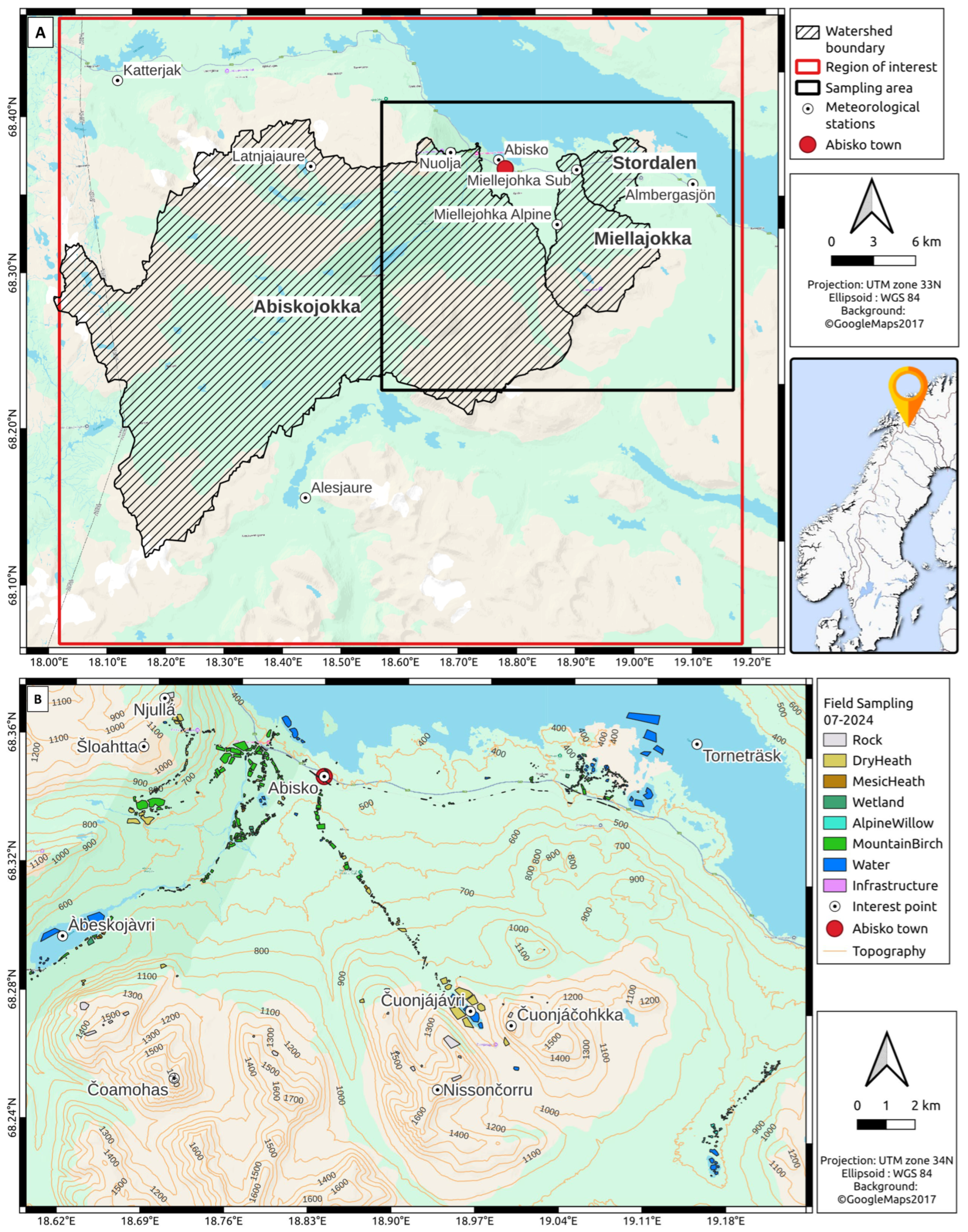
Figure 1. (A) Region of interest and location of the meteorological data samplers. (B) Sampling area and polygons of the survey dataset. The background map is provided for visual reference only.
Applsci 16 01376 g001
Figure 2. Pictures from the study field in July 2024. Rock (A), Dry Heath (B), Mesic Heath (C), Wetland (D), Alpine Willow (E), Mountain Birch (F), Water (G) and Infrastructure (H).
Applsci 16 01376 g002
Figure 3. Distribution of average (A) temperature and (B) precipitation among the three T-P areas.
Applsci 16 01376 g003
Figure 4. Land cover (A) and associated T-P areas (B) for the three studied catchments (Abiskojokka, Miellajokka and Stordalen). The 10.2 °C isotherm is indicated by a red line.
Applsci 16 01376 g004aApplsci 16 01376 g004b
Figure 5. Distribution of each class among the T-P areas for all three watersheds.
Applsci 16 01376 g005
Figure 6. Land cover classification using T, P, slope and northness maps as features. The 10.2 °C isotherm is indicated by a red line.
Applsci 16 01376 g006
Table 1. Land cover classes and associated polygons/surfaces of the field mission dataset. Star (*) indicates presence of photo-interpreted pixels. 1 pixel is equals to a surface of 100 m2.
Class NamePolygonsSurface (km2)Class NamePolygonsSurface (km2)
Rock108 *0.54Alpine Willow1060.15
Dry Heath1641.26Mountain Birch2301.73
Mesic Heath740.16Water87 *1.68
Wetland1290.23Infrastructure68 *0.08
Table 2. Meteorological stations and their data (accessed on 15 October 2025).
Station NameAltitude (m asl.)Latitude (°N)Longitude (°E)TPFromTo
Abisko a38868.355518.821119132024
Alesjaure b75068.146518.453720132020
Almbergasjön a38068.331919.154220172024
Katterjak51468.420218.168020082024
Latnjajaure a98268.358518.495120182024
Miellejohka Alpine a68568.311718.915220192023
Miellejohka Subalpine a38368.346018.9550 20192024
Nuolja a70268.362118.738720192023
Table 3. Quality of the land cover classifications with evaluation metrics per class (Sensibility, Precision and Critical Succes Index). Snow, shadow and cloud are not represented.
Class NameSensitivity (%)Precision (%)CSI (%)
Rock99.5098.6198.12
Dry Heath88.7195.5685.20
Mesic Heath0.903.330.70
Wetland60.1792.4357.35
Alpine Willow72.9797.3071.52
Mountain Birch98.2684.5683.31
Water99.9899.5099.93
Infrastructure96.5697.4094.12
Table 4. Confusion matrix of S1 and S2 classifications. Snow, shadow and cloud not included.
True labelsPredicted Labels
Class NameRockDry HeathMesic HeathWetlandAlpine WillowMountain BirchWaterInfrastruct.
Rock21965000501
Dry Heath2722782710622000
Mesic Heath0151509300
Wetland0270281015720
Alpine Willow015032166200
Mountain Birch044250294001
Water00000042351
Infrastruct.4000000112
Table 5. Comparison of daily-based interpolation methods for meteorological parameters, ±std. among dates (A) and average maps over the 2019–2023 time period (B) at 100 m spatial resolution.
(A) Daily ParametersME|BiasRMSER2Unbiased RMSE
T (°C)—Interpolation−1.42 ± 15.852.76 ± 15.690.62 ± 0.250.77 ± 0.27
T (°C)—KR−0.01 ± 0.660.89 ± 0.400.73 ± 0.300.62 ± 0.35
T (°C)—KED0.05 ± 0.590.72 ± 0.400.78 ± 0.300.49 ± 0.29
P (mm)—Interpolation1.44 ± 5.693.76 ± 5.400.34 ± 0.331.95 ± 2.22
P (mm)—KR0.64 ± 2.221.95 ± 2.530.61 ± 0.371.31 ± 1.78
P (mm)—KED0.05 ± 2.471.82 ± 2.840.45 ± 0.371.13 ± 2.01
(B) Average mapsME|BiasRMSER2Unbiased RMSE
T (°C)0.010.260.950.26
P (mm)−26.5028.220.969.71
Table 6. Extent and mean ± std morpho-climatic characteristics for the eight environmental classes.
Class NameExtent (%)Altitude (m)Slope (°)T (°C)P (mm)
Rock33.141233.03 ± 171.2716.24 ± 10.418.13 ± 0.73228.04 ± 23.76
Dry Heath38.39937.99 ± 161.2312.13 ± 8.979.38 ± 0.69204.63 ± 24.04
Mesic Heath0.28719.35 ± 135.358.79 ± 6.2610.31 ± 0.58179.11 ± 18.87
Wetland1.75724.57 ± 202.705.38 ± 6.9510.29 ± 0.86182.10 ± 30.37
Alpine Willow4.19777.64 ± 92.0113.03 ± 8.3110.06 ± 0.39191.35 ± 17.43
Mountain Birch15.22621.36 ± 134.109.76 ± 7.4210.73 ± 0.57166.55 ± 21.32
Water3.78876.13 ± 249.172.23 ± 5.259.64 ± 1.06205.89 ± 35.03
Snow1.231319.24 ± 128.8518.29 ± 7.697.76 ± 0.55246.83 ± 22.39
TOTAL|AVERAGE97.98901.16 ± 159.3310.73 ± 7.669.54 ± 0.68200.56 ± 24.15
Disclaimer/Publisher’s Note: The statements, opinions and data contained in all publications are solely those of the individual author(s) and contributor(s) and not of MDPI and/or the editor(s). MDPI and/or the editor(s) disclaim responsibility for any injury to people or property resulting from any ideas, methods, instructions or products referred to in the content.