Article

CIR-SSM: A Cross and Inter Resolution State-Space Model for Underwater Image Enhancement

1
School of Automation and Electrical Engineering, Shenyang Ligong University, Shenyang 110159, China
2
School of Information Science and Engineering, Shenyang Ligong University, Shenyang 110159, China
*
Author to whom correspondence should be addressed.
Appl. Sci. 2026, 16(3), 1297; https://doi.org/10.3390/app16031297
Submission received: 10 December 2025 / Revised: 20 January 2026 / Accepted: 24 January 2026 / Published: 27 January 2026
(This article belongs to the Special Issue Computational Imaging: Algorithms, Technologies, and Applications)

Abstract

Underwater images often suffer from strong color casts, low contrast, and blurred textures. It is observed that low resolution can provide globally correct color, so low-resolution priors can guide high-resolution correction. While many recent methods combine Transformer and CNN components, Mamba offers an efficient alternative for global dependency modeling. Motivated by these insights, this paper proposes a cross- and inter-resolution state-space model for underwater image enhancement (CIR-SSM). The method consists of three sub-networks at full, 1/2, and 1/4 resolutions, each stacking color–texture Mamba modules. Each module includes a color Mamba block, a texture Mamba block, and a color–texture fusion Mamba block. The color Mamba block injects low-resolution color priors into the state-space trajectory to steer global color reconstruction in the high-resolution branch. In parallel, the texture Mamba block operates at the native resolution to capture fine-grained structural dependencies for texture restoration. The fusion Mamba block adaptively merges the enhanced color and texture representations within the state-space framework to produce the restored image. Comprehensive quantitative assessments on both the UIEB and SQUID benchmarks show that the proposed framework achieves the highest evaluated scores, outperforming several representative state-of-the-art methods.

1. Introduction

1.1. Background

As an important source of marine visual information, underwater images support a broad spectrum of ocean-engineering applications, ranging from resource exploration and autonomous target search to unmanned underwater vehicle navigation [1]. Yet, the aquatic medium imposes fundamental physical constraints: wavelength-dependent absorption and particle scattering lead to attenuation, spectral shifts, and backscattering during light propagation, yielding images plagued by color casts, haze, and severely reduced contrast [2,3,4,5,6,7]. These degradations obscure critical visual cues and, consequently, reduce the accuracy of downstream tasks such as object detection and habitat monitoring [8]. Delivering reliable visual perception in the ocean, therefore, hinges on effective underwater image enhancement, a challenge that has become increasingly urgent with the rapid deployment of underwater robotics and distributed sensor networks [9]. In recent years, the demand for high-quality underwater visual data has surged, driven by the expansion of marine economies and the pressing need for sustainable ocean utilization. Autonomous underwater vehicles (AUVs) and remotely operated vehicles (ROVs) now routinely perform complex missions such as pipeline inspection, coral-reef mapping, and archaeological surveying, all of which rely heavily on clear and informative imagery [10]. However, the optical properties of water, which has ten times stronger attenuation than of air, combined with suspended organic and inorganic particles, create a medium that is inherently hostile to conventional imaging systems [11,12,13,14]. Consequently, underwater image enhancement has evolved from a post-processing luxury into an indispensable preprocessing module that bridges the gap between raw, degraded captures and reliable automated analysis, motivating a sustained research effort across the computer vision and ocean-engineering communities.

1.2. Related Work

Underwater image enhancement (UIE) and restoration (UIR) are currently pursued along two complementary tracks [15,16]. Traditional techniques [17,18,19,20] build on physics-based or statistical priors: they either invert an underwater image formation model to recover the latent clear scene, or manipulate luminance, color, and contrast with handcrafted rules such as color constancy and contrast stretching. These strategies work well when the water type, depth, and illumination exactly match the assumed priors, yet their fixed assumptions collapse in large-scale data sets where turbidity, spectrum shift, and backscattering vary from pixel to pixel. Learning-based approaches [21,22,23] discard explicit modeling and instead let deep networks discover a degraded-to-clear mapping. Convolutional architectures supply abundant local representation, while recent hybrids add a Transformer branch for long-range context [24].

1.2.1. Traditional Prior-Based UIE Methods

Non-physics-based underwater image enhancement techniques improve visual quality by directly manipulating pixel values without resorting to an explicit image-formation model. Representative approaches include histogram equalization and Retinex-based enhancement. Zhang et al. [25] introduce a method that compensates for attenuated color channels while preserving details, employing an iterative dual-histogram thresholding scheme and a Rayleigh-distributed constrained histogram to boost both global and local contrast. Qiang et al. [26] present a multi-channel adaptive fusion algorithm that couples contrast-limited adaptive histogram equalization with a local-entropy-constrained gray-world assumption, aggregating complementary information from individual channels to yield the final result. Zhuang et al. [27] design a Bayesian Retinex model that imposes multi-step gradient priors on reflectance and illumination, facilitating accurate underwater restoration. Building on this work, Zhuang et al. [28] develop a hyper-Laplacian reflectance prior formulated with 1/2-norm penalties on first- and second-order gradients, promoting sparsity and completeness in reflectance estimates so that salient structures are sharpened and natural colors are revived. Zhou et al. [29] remap pixel distributions and embed the result into a multi-priority Retinex variational framework. A pre-compensation step prevents new color artifacts during color correction, while a coupling-aware constraint refines the remapping curve to enhance contrast. Domain-specific priors and penalty terms tailored to underwater characteristics are integrated into the variational model to suppress noise in the estimated reflectance. Although non-physics methods are computationally simple, their disregard for underwater imaging physics often introduces noise, artifacts, over-enhancement, or under-enhancement.

1.2.2. Learning-Based UIE Approaches

In recent years, deep convolutional neural networks (CNNs) have propelled rapid advances in image enhancement. This momentum has carried into underwater imagery, where deep-learning-based solutions now deliver strong performance. Existing underwater enhancement networks can be broadly grouped into two categories: CNN-based architectures [30,31], and generative adversarial networks (GANs) [32,33], each prioritizing different aspects of quality and realism.
Fusion-based methods integrate preliminary results produced by physics-inspired operators through learnable combination weights. Ancuti et al. [34] employed a feature pyramid to blend white-balanced and channel-compensated images, whereas Li et al. [35] proposed Water-Net, a CNN that fuses white balancing, gamma correction, and histogram equalization to accommodate typical underwater degradations.
GANs have also been widely adopted for underwater enhancement. Li et al. [35] introduced WaterGAN, which embeds an image-formation model within an adversarial framework to generate high-resolution outputs. To better capture multi-scale distortions, Guo et al. [36] developed Dense-GAN, a densely connected multi-scale generator that learns feature-domain distributions. Fabbri et al. [37] presented UGAN, whose U-shaped generator extracts and reconstructs features via down- and up-sampling layers strengthened by skip connections. Addressing detail blur, Islam et al. [38] formulated enhancement as an image-to-image translation task and proposed FUnIE-GAN, a fast network that learns a non-linear mapping between distorted and sharp underwater frames. PUGAN [39] proposes a physical model-guided generative adversarial network for underwater image enhancement. It introduces a parameter estimation sub-network to predict the coefficients required for inverting the underwater image-formation model and leverages the resulting color-enhanced image as auxiliary guidance to refine restoration.
The advent of Mamba [40,41], however, shows that state-space models can capture global dependencies more efficiently than self-attention, opening the possibility of a unified, lightweight backbone. Considering the challenges of non-uniform degradation, WaterMamba [42] tackles spatial–channel degradation with SCOSS blocks that merge coordinate-aware scanning and a multi-scale feed-forward net. O-mamba [43] arranges an O-shaped dual branch to capture spatial and cross-channel cues simultaneously via the global receptive field of state-space models. PixMamba [44] couples a patch-level EMNet for coarse reconstruction with a pixel-level PixNet for fine-grained consistency, preserving global context at low cost. Despite these architectural advances, most existing networks still regard every image as a sample from a single degradation distribution and apply the same generic mapping. They lack an internal mechanism that disentangles color cast from texture blur, and therefore cannot adapt their behavior to the specific mixture of artifacts present in a given input. This paper argues that the next leap in performance requires not only a more efficient global model, but also a content-aware enhancement strategy that selectively revises color while preserving or even sharpening fine texture details.

1.3. Contributions

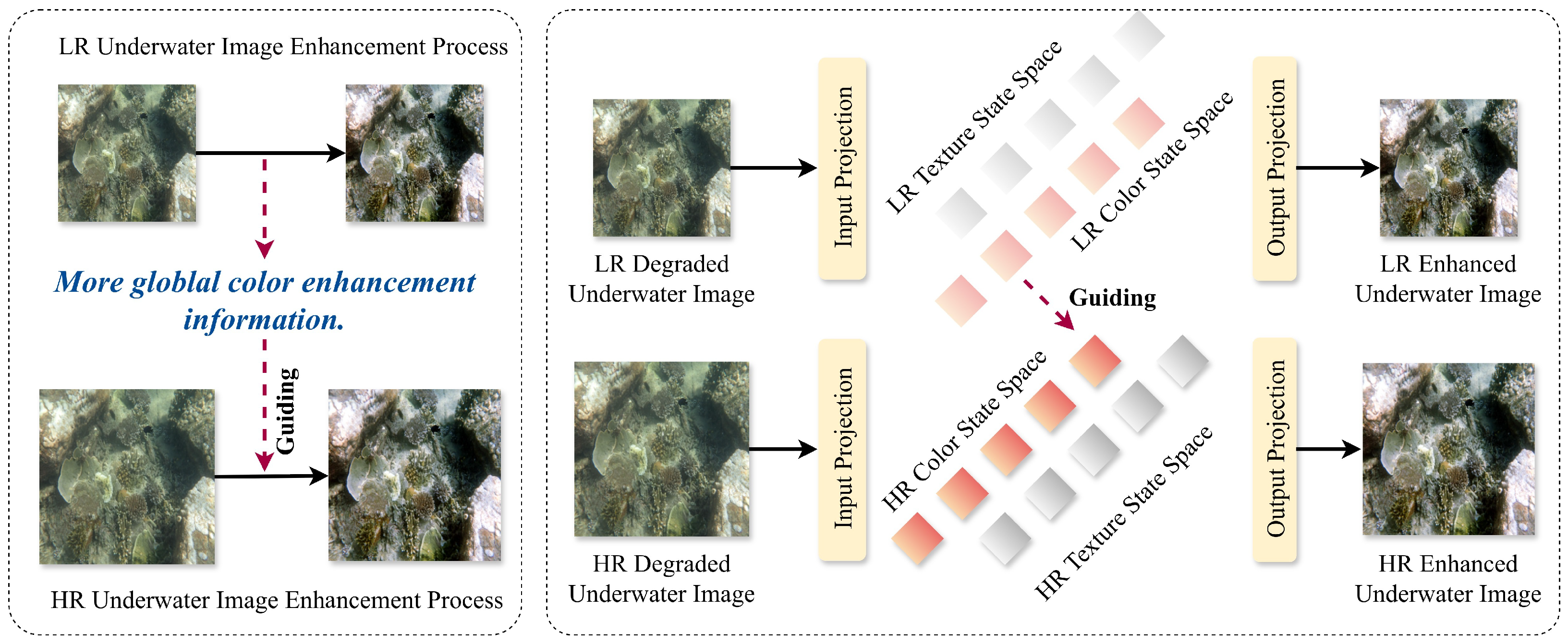
To address these limitations, this paper proposes the cross and inter-resolution state space model for underwater image enhancement (CIR-SSM). The approach employs Mamba-based sub-networks operating at multiple resolutions to propagate color information across scales, enabling high-fidelity color recovery while simultaneously restoring fine texture details. As illustrated in Figure 1, the proposed investigation of degraded underwater imagery reveals that enhancement performed at low resolution already produces a globally consistent color correction. By leveraging the color priors embedded within the low-resolution (LR) network, it can effectively guide the global color adjustment of the corresponding high-resolution (HR) branch, ensuring accurate and visually pleasing results. The proposed algorithm deploys three coupled sub-networks at full, 1/2, and 1/4 resolution. Each sub-network is built from a sequence of color–texture Mamba modules; every module contains a color Mamba block, a texture Mamba block, and a fusion Mamba block. The color Mamba block embeds low-resolution color priors into the state-space path, guiding the high-resolution branch toward globally consistent color reconstruction and thus enabling cross-scale color enhancement. Operating at the native scale, the texture Mamba block captures fine structural dependencies, reinforcing texture recovery. The fusion Mamba block then adaptively combines the two refined representations within the same state-space formulation to produce the final restored image. The main contributions of this work are summarized below:
1. A cross-resolution color-prior and texture-restoration network built upon state-space models is proposed for underwater image enhancement. Leveraging global color information from the LR enhancement branch and fine-grained texture cues at the native resolution, the framework achieves high-fidelity color recovery together with detail-preserving texture restoration.
2. Within the color Mamba block, the LR-extracted global color-correction prior is injected into the state-space trajectory to guide the HR branch toward more accurate color enhancement, thereby improving color fidelity in the final HR output.
3. The texture Mamba block refines texture features at their native resolution. By combining global receptive-field dynamics with local detail modeling, resolution-specific texture information is restored, and the enhanced texture cues are implicitly propagated to the subsequent HR stage.
4. A dedicated fusion stage integrates the refined color and texture streams via a color–texture Mamba block, forming a unified representation and producing visually natural reconstructions with reduced artifacts.
Experiments on multiple benchmark datasets demonstrate that the proposed method consistently improves PSNR, SSIM, UCIQE, and UIQM, and reduces LPIPS, compared with state-of-the-art techniques, validating its effectiveness for the UIE task.

2. Materials and Methods

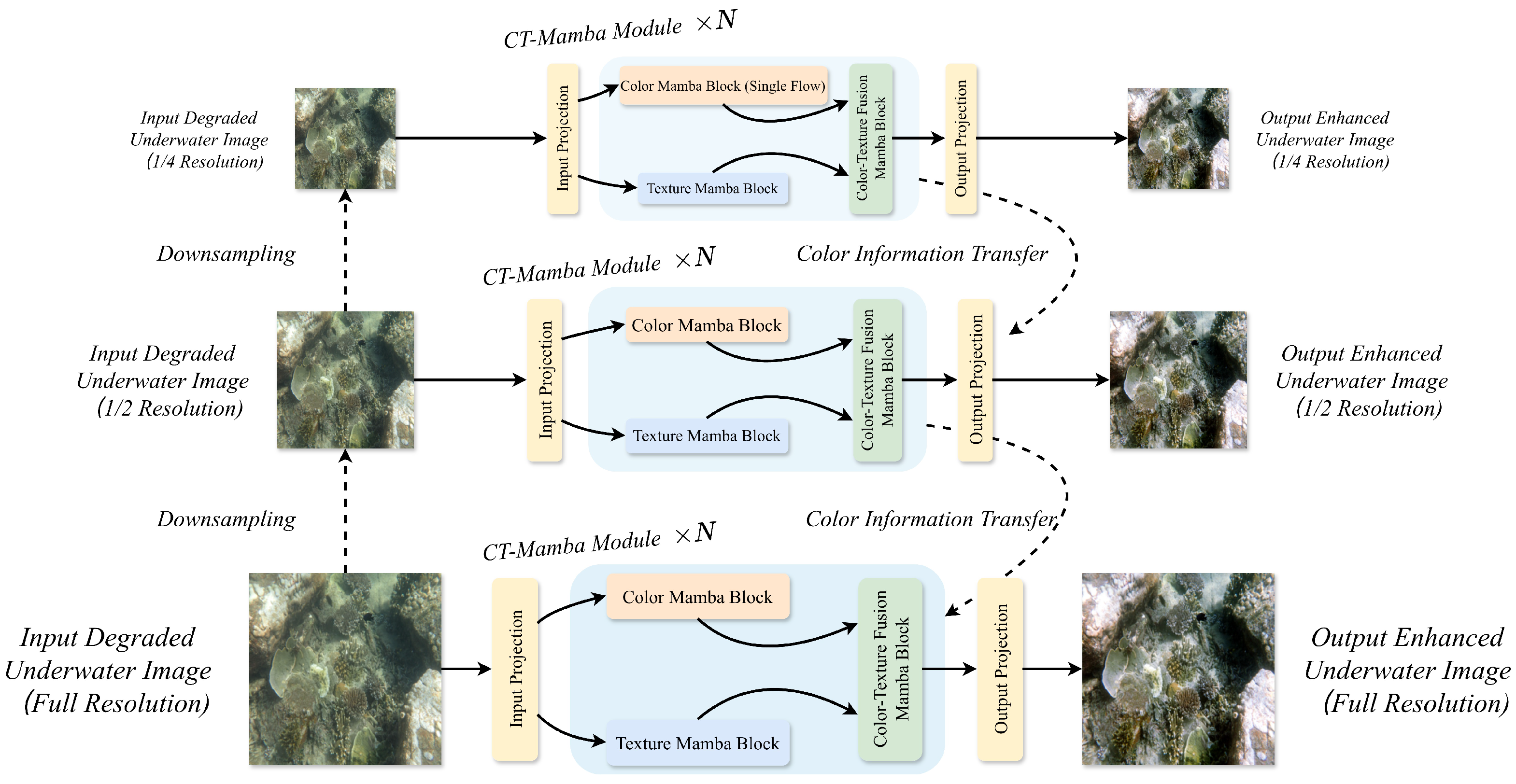
Figure 2 illustrates the CIR-SSM framework, which deploys three sub-networks at full, half, and quarter resolution. Every sub-network is a stack of color–texture Mamba (CT-Mamba) modules, each containing a color Mamba block, a texture Mamba block, and a fusion Mamba block. The color Mamba block embeds low-resolution color priors into the state-space trajectory and uses them to steer global color reconstruction in the higher-resolution branch, enabling cross-scale color enhancement. At the same time, the texture Mamba block works at the native resolution to capture fine structural dependencies, reinforcing texture restoration. Finally, the fusion Mamba block adaptively combines the two refined representations within the state-space formulation and produces the fully restored image.

2.1. Color Mamba Block

State-space models have been widely adopted for computer vision and image processing, with S4 and Mamba as prominent examples [45]. Both rely on a linear time-invariant system that transforms a one-dimensional input sequence x ( t ) R into an output sequence y ( t ) R via an implicit latent state h ( t ) R N . This transformation is governed by a linear ordinary differential equation:
h ( t ) = a h ( t ) + b x ( t )
y ( t ) = c h ( t )
where matrix a R N × N defines the state evolution, and vectors b R N × 1 , c R N × 1 project the input into the state and the state into the output, respectively. To handle discrete visual data I, the continuous system is converted to a discrete counterpart by introducing a learnable step size Δ . Then, applying the zero-order hold principle yields the discretized matrices as follows:
a = exp ( Δ a )
b = ( Δ a ) 1 ( exp ( Δ a ) I ) · Δ b
Once discretized, the SSM can be evaluated in two equivalent forms: linear recursion for autonomic step-by-step updates, or global convolution for parallel computation over the entire sequence. Both formulations are given through a structured convolution kernel k:
h t = a ¯ h t 1 + b ¯ x t
y t = c h t
k ¯ = c b ¯ , c a b ¯ , , c a ¯ t b ¯ ,
y = x k ¯
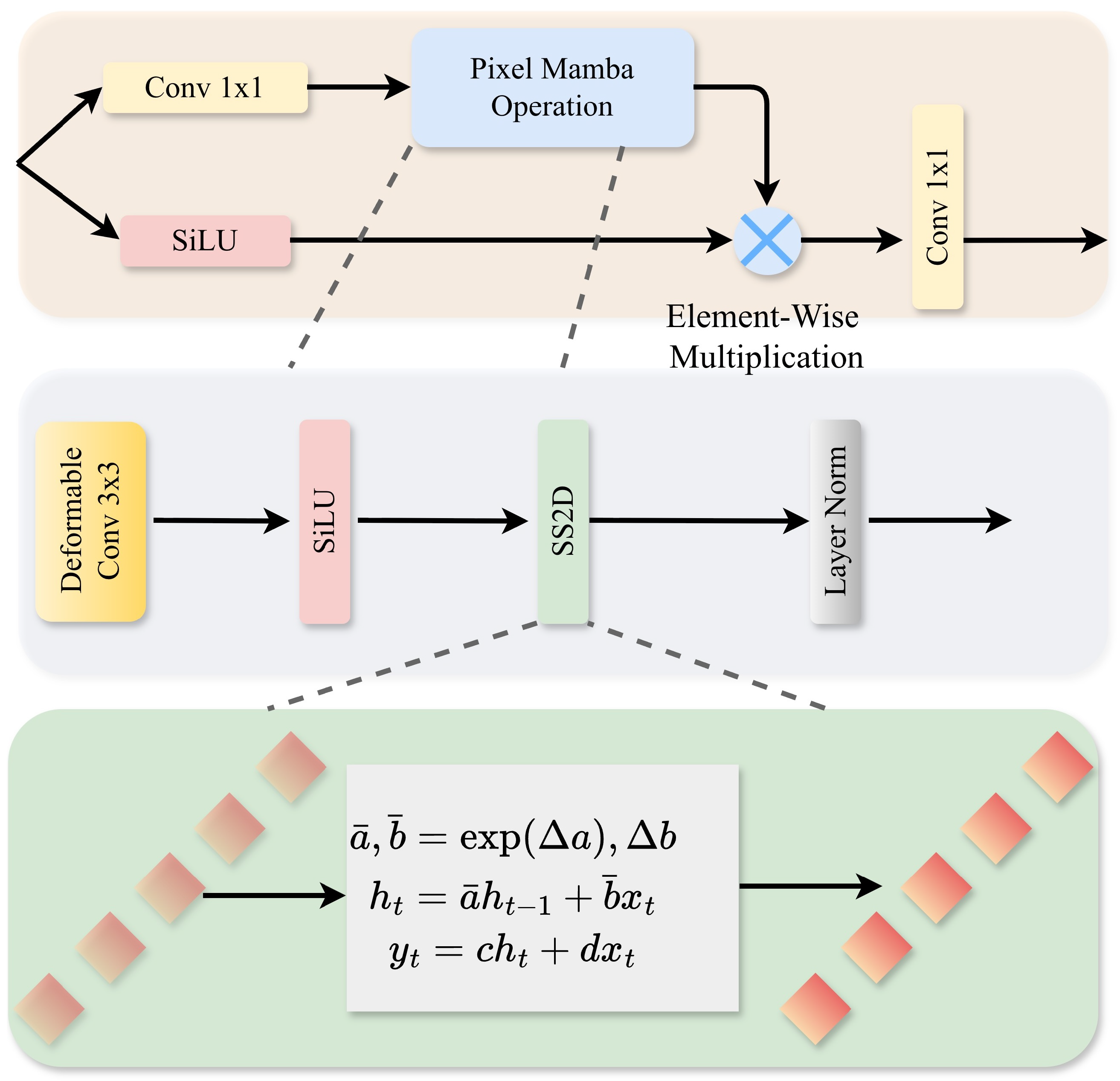
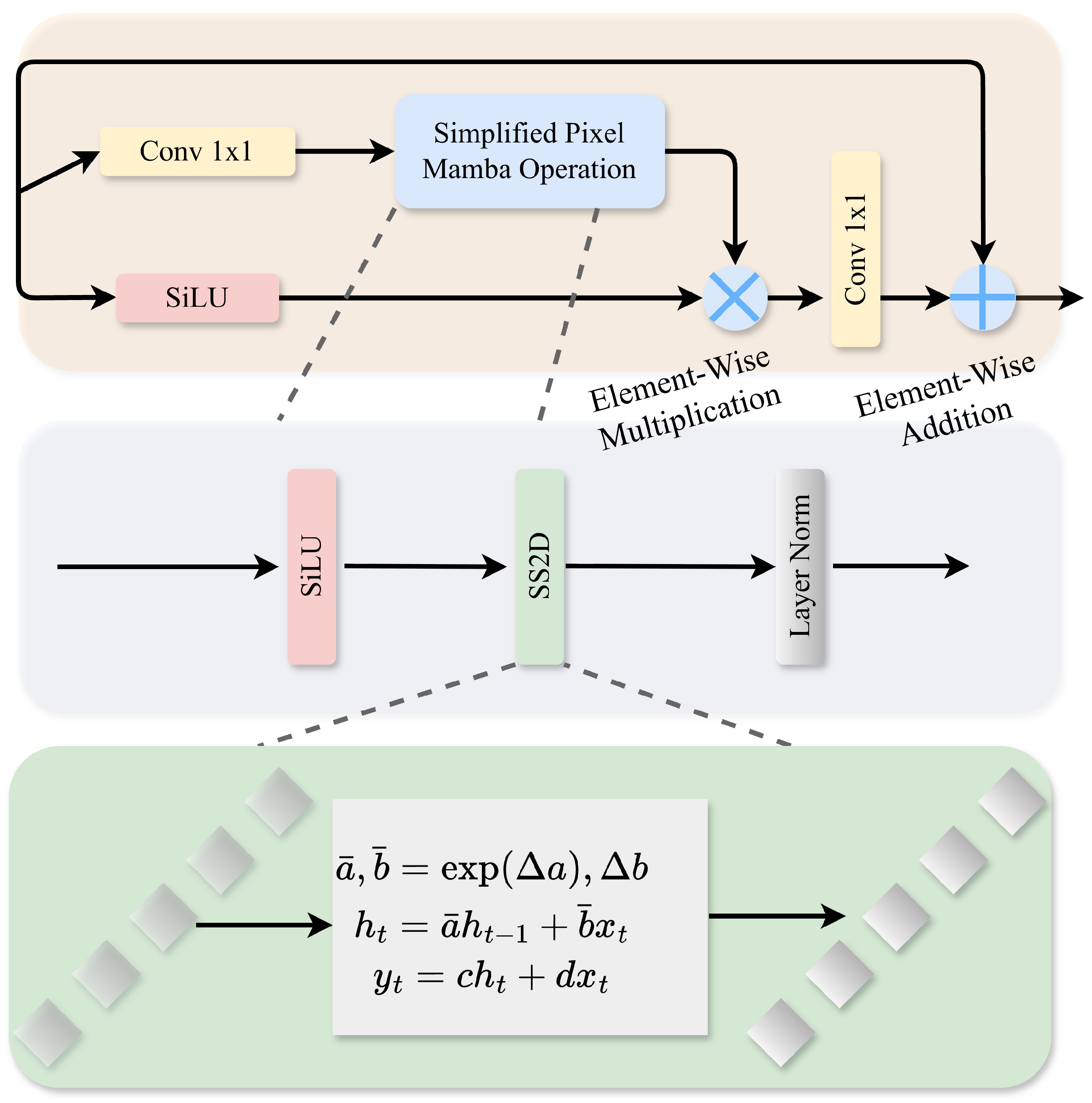
The proposed color Mamba block uses the SS2D that was modified from the SSM. Figure 3 illustrates the single-flow color Mamba block that serves as the core of the CT-Mamba module in the quarter-resolution sub-network. The input is split into two paths. In the first path a SiLU activation is applied. The second path first employs 1 × 1 convolution for obtaining the refined color features. Then, it employs a deformable 3 × 3 convolution to enlarge the receptive field, followed by SS2D extraction to capture long-range dependencies, and is normalized with layer normalization in the Pixel Mamba operation. The two pathwise outputs are merged through element-wise multiplication and forwarded to a 1 × 1 convolution layer to produce the final feature map of the block as expressed below:
X 1 = SiLU ( X )
X 2 = L N ( SS2D ( SiLU ( Deformable-Conv 3 × 3 ( Conv 1 × 1 ( X ) ) ) ) )
X out = Conv 1 × 1 X 1 X 2
where the details extraction process in the SS2D can be summarized as follows:
a ¯ , b ¯ = exp ( Δ a ) , Δ b
h t = a ¯ h t 1 + b ¯ x t
y t = c h t + d x t
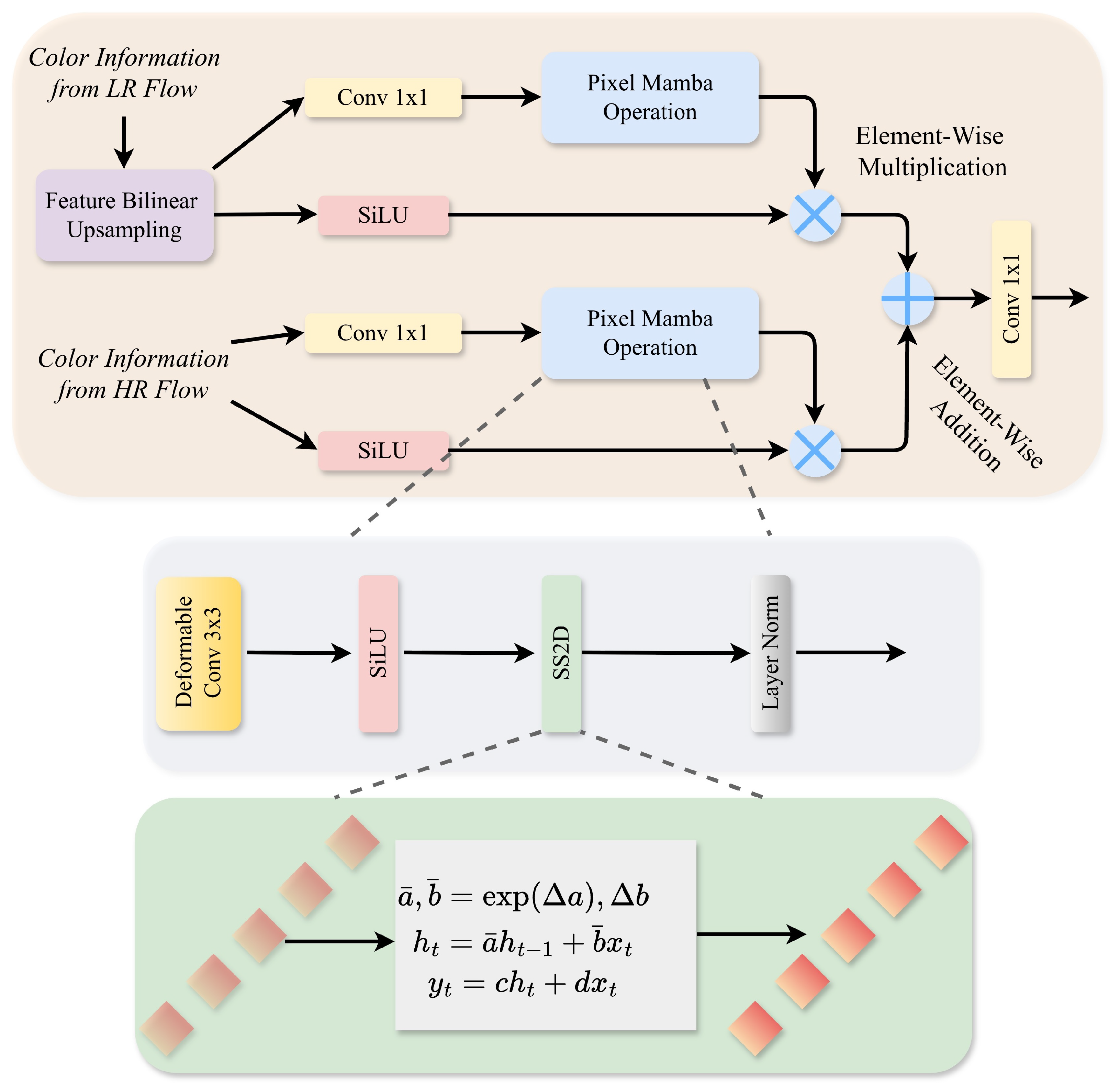
For the 1/2 and full-resolution sub-networks, the proposed method aims to transfer global color information acquired at LR to guide HR restoration. To this end, a dual-flow color Mamba block is introduced to import LR information and injected into the HR state-space trajectory, thereby steering the color correction process at the finer scales. Figure 4 illustrates the dual-flow color Mamba. Like the single-flow color Mamba block, this paper uses the same network structure to obtain the final feature maps of the LR and HR flows, denoted as X out L R and X out H R . Then, a 1 × 1 convolution layer is added to fuse these two outputs:
X 1 L R = SiLU ( B i l i n e a r ( X L R ) ) , X 1 H R = SiLU ( X H R )
X 2 L R = L N ( SS2D ( SiLU ( Deformable-Conv 3 × 3 ( Conv 1 × 1 ( B i l i n e a r ( X L R ) ) ) ) ) )
X 2 H R = L N ( SS2D ( SiLU ( Deformable-Conv 3 × 3 ( Conv 1 × 1 ( X H R ) ) ) ) )
X out = Conv 1 × 1 X 1 L R X 2 L R + X 1 H R X 2 H R
where the B i l i n e a r indicates the feature bilinear upsampling, which is used to match the spatial dimensions of the LR feature to those of the HR feature. By combining the single-flow color Mamba block with its dual-flow counterpart, color enhancement is achieved at all resolutions: the single-flow design is applied at 1 / 4 resolution, whereas the dual-flow design is adopted at 1 / 2 and full resolutions, ensuring consistent chromatic improvement across all scales.

2.2. Texture Mamba Block

To mitigate texture deterioration in underwater imagery, a Mamba block for texture enhancement is introduced, as depicted in Figure 5. Given that texture information is distributed differently across resolutions and that low-resolution texture cues are insufficient to guide a high-resolution network, the proposed texture Mamba block is restricted to operate and restore features only at its corresponding resolution. A simplified Pixel Mamba operation is used to obtain the final feature map X out t e x . The input is split into two paths. In the first path a SiLU activation is applied. The second path first refines the color features via a 1 × 1 convolution, then applies SS2D to capture long-range dependencies and normalizes the result with layer normalization. The two path-wise outputs are fused by element-wise multiplication, forwarded through another 1 × 1 convolution to generate a residual map, and finally added back to the input features:
X 1 t e x = SiLU ( X )
X 2 t e x = L N ( SS2D ( SiLU ( Conv 1 × 1 ( X ) ) ) )
X out t e x = Conv 1 × 1 X 1 t e x X 2 t e x + X

2.3. Color–Texture Fusion Mamba Block

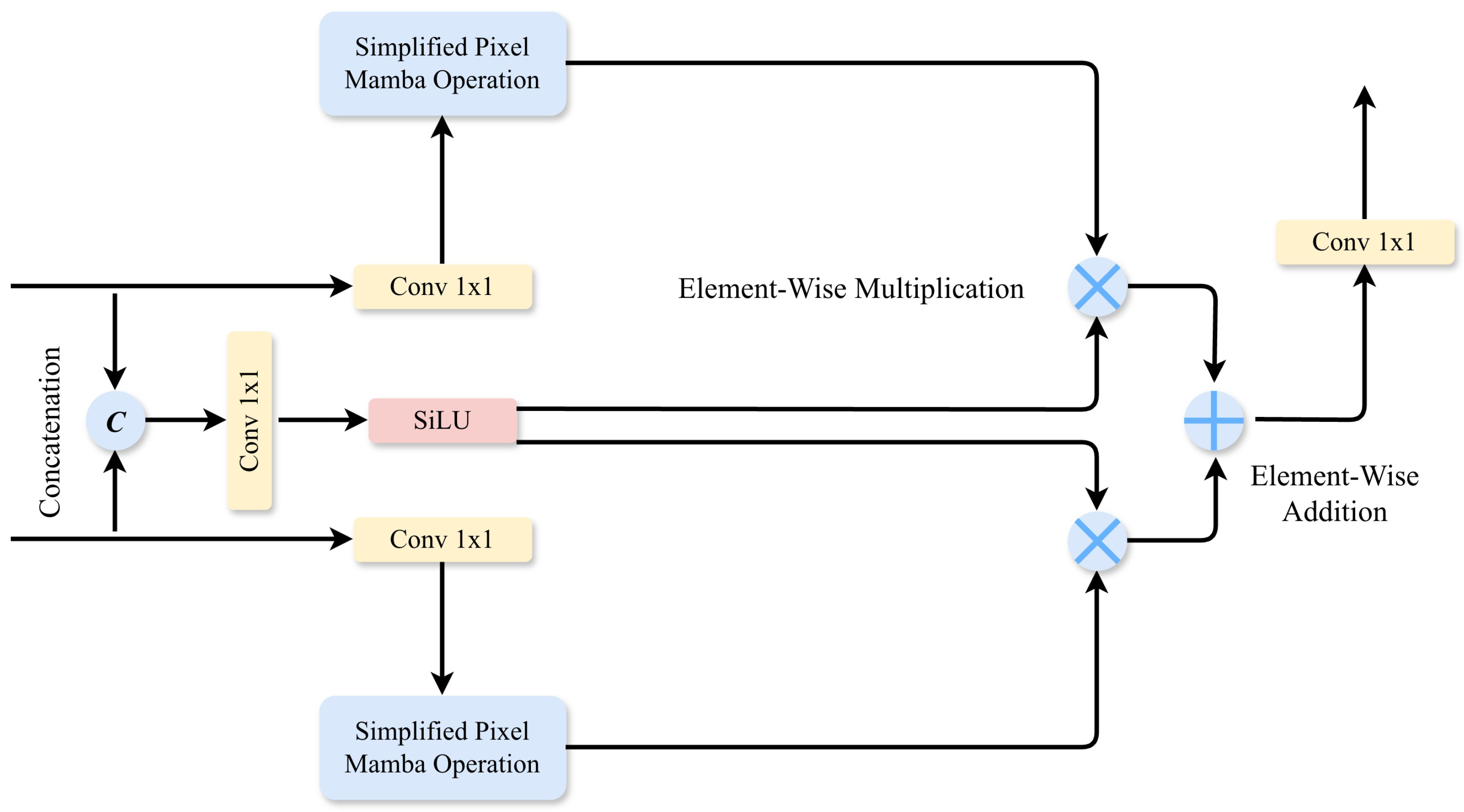
With the color-correction and texture-enhancement features extracted, the color–texture Mamba fusion block jointly aggregates them to generate the final clear underwater image. The overall architecture of the color–texture Mamba fusion block is illustrated in Figure 6. Exploiting the readily available color and texture representations, the heavy cross-modal fusion head is replaced with a simplified Pixel Mamba operator that adaptively generates fusion weights, enabling efficient feature blending while maintaining accuracy. The color and texture features are first concatenated C and followed by a 1 × 1 convolution and SiLU function to generate the basic fusion results:
X 1 b a s i c = SiLU ( Conv 1 × 1 ( C ( X out , X out t e x ) ) ) .
Then, two paths are employed to generate color and texture weights, using a 1 × 1 convolution and a simplified Pixel Mamba operation, respectively:
W 1 c o l o r = L N ( SS2D ( SiLU ( Conv 1 × 1 ( X out ) ) ) )
W 1 t e x = L N ( SS2D ( SiLU ( Conv 1 × 1 ( X out t e x ) ) ) )
Finally, the two adaptive weights, together with a 1 × 1 convolution layer, are used to obtain the final features F with corrected color and refined textures:
F = Conv 1 × 1 ( W 1 c o l o r X out + W 1 t e x X out t e x )
The CIR-SSM network is trained with a composite objective that combines two complementary terms: an L1 loss and a perceptual loss.

2.4. Loss Function

L1 Loss: The first term penalises the pixel-wise discrepancy:
L 1 = 1 N i = 1 N R ^ i U i 1
where N denotes the batch size, R ^ i denotes the restored image and U i the corresponding ground-truth.
Perceptual Loss: To mitigate the over-smoothing tendency induced by the L1 term, a perceptual loss [38] is adopted and computed in the feature space of a pre-trained VGG-19 network. Let ϕ j ( · ) denote the feature map extracted from the j-th ReLU layer of VGG-19. The loss is formulated as follows:
L VGG = 1 C j H j W j i = 1 N ϕ j ( R ^ i ) ϕ j ( U i ) 2
where C j × H j × W j is the dimensionality of the selected feature map.
Total Loss: The final training objective is a weighted combination of the two losses:
L Total = λ 1 L 1 + λ 2 L VGG
where the empirical weights are set to λ 1 = 1 and λ 2 = 0.02 .

3. Experimental Results and Analysis

3.1. Datasets

The public Underwater Image Enhancement Benchmark (UIEB) [21] (Underwater Image Enhancement Benchmark (UIEB): https://li-chongyi.github.io/proj_benchmark.html, (accessed on 20 July 2025)) is used as the primary dataset for training and testing. UIEB consists of 950 real-world underwater image pairs collected under diverse illumination conditions, water qualities, color biases, and depths, where each degraded image is accompanied by a human-selected reference. The dataset covers a broad range of scenarios, including green- and blue-dominant scenes, low-contrast images, and heavily hazy cases. A total of 700 images were used for training, and the remaining 250 were reserved for testing. For cross-dataset evaluation, the trained model was also evaluated on the SQUID benchmark [46] (SQUID benchmark: https://csms.haifa.ac.il/profiles/tTreibitz/datasets/ambient_forwardlooking/index.html, (accessed on 20 July 2025)), which contains 57 underwater scenes. Although the network is trained only on UIEB, it still maintains strong and consistent performance on SQUID, suggesting good generalization ability.

3.2. Experimental Settings

All experiments are conducted on a workstation equipped with an NVIDIA RTX 4090 GPU. The network is optimized with the Adam optimizer [47] ( β 1 = 0.9 , β 2 = 0.999 ) for 200 epochs using a batch size of 16. The learning rate is initialized to 3 × 10 4 and decayed by a factor of 2 every 40 epochs. During training and testing, each image is resized to 256 × 256 patches. The number of color–texture Mamba (CT-Mamba) modules is set to 12. Full-reference metrics are adopted to evaluate pixel fidelity and structural quality:
  • PSNR [48] quantifies pixel-level fidelity between the reference image and the images enhanced by different algorithms;
  • SSIM [49] measures luminance, contrast and structural preservation;
  • LPIPS [50] computes perceptual distance in a deep feature space.
No-reference metrics specific to underwater imagery are also reported:
  • UIQM [51] integrates sharpness, colorfulness, and contrast to evaluate overall underwater visual quality;
  • UCIQE [52] concentrates on chromatic fidelity and clarity in underwater environments.
Higher PSNR, SSIM, UIQM, and UCIQE values reflect better image quality, whereas lower LPIPS values indicate stronger perceptual similarity.

3.3. Compared Methods

CIR-SSM is compared with seven representative underwater enhancement methods spanning both traditional and learning-based paradigms. Classic model-based methods include HLRP [28], IBLA [53], and ROP+ [54], all of which rely on handcrafted priors and offer clear physical interpretability. Data-driven approaches are represented by the CNN-based pipelines Water-Net [21] and Ucolor [55], the Transformer-assisted U-shaped model that fuses multiple color-space priors, and the contrastive learning framework HCLR-Net [56]. This combination of baselines provides a broad and challenging reference set against which to assess the benefits of CIR-SSM.

3.4. Qualitative Evaluation

The UIEB dataset provides a wide range of challenging underwater scenes and is used to directly compare CIR-SSM with both traditional and deep-learning-based methods. In practice, a 200-image subset is constructed and denoted as the UIEB-200 test set for visual comparisons and quantitative analysis; this subset is also reused in the ablation experiments so that objective scores and subjective impressions remain comparable. To further examine robustness, additional visual and numerical results are reported on the SQUID dataset.
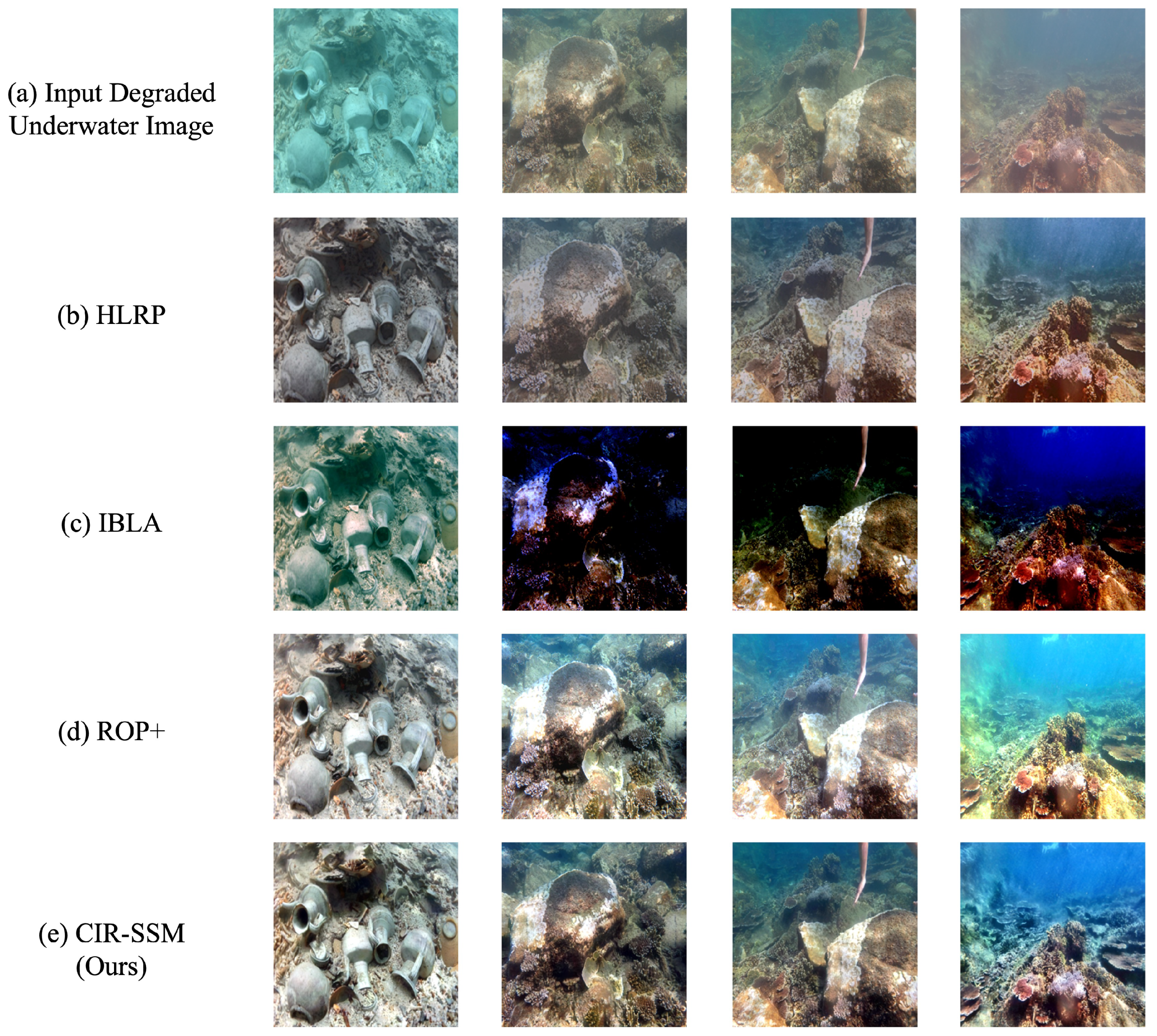
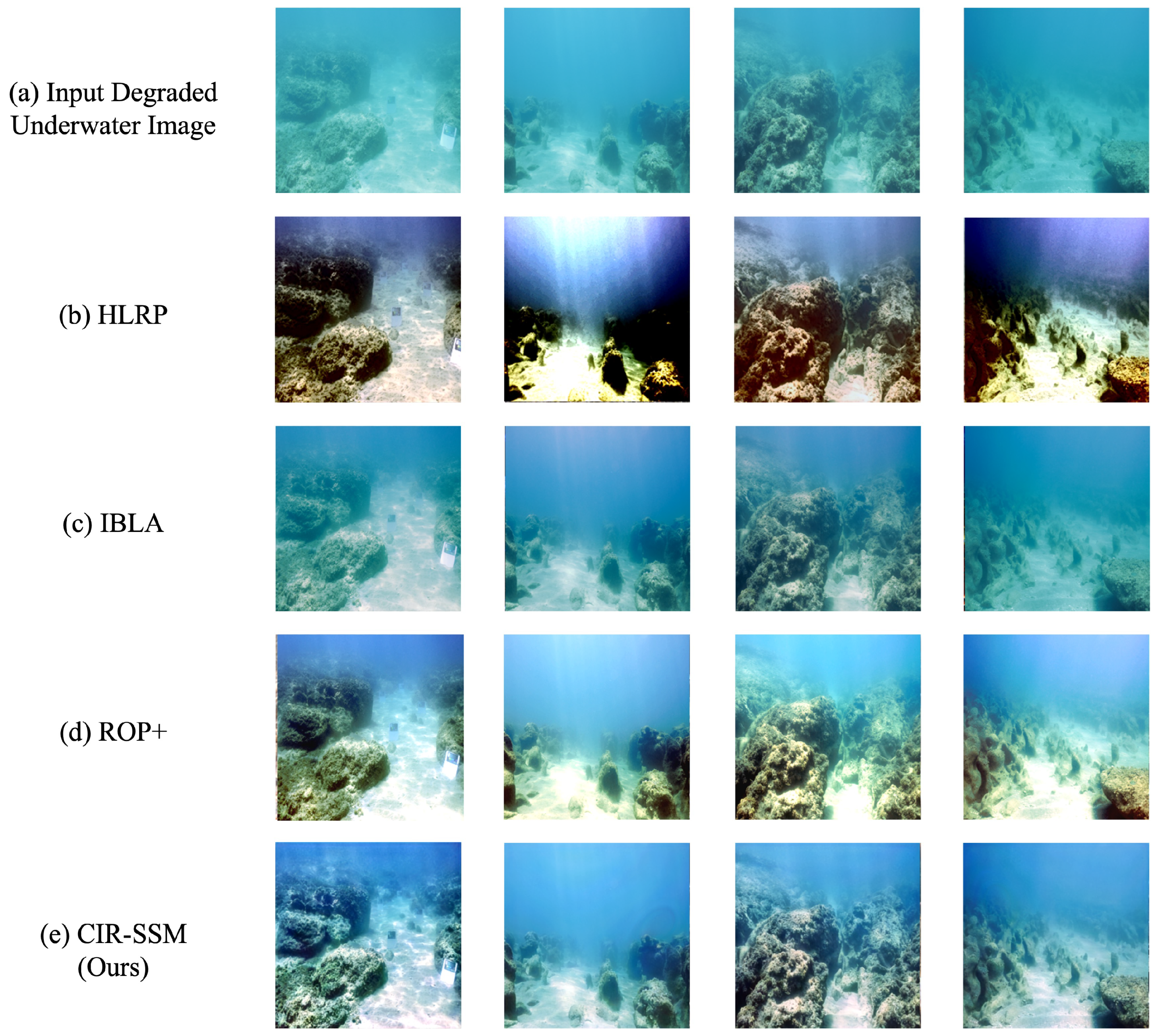
Figure 7 and Figure 8 present a comprehensive visual comparison of the UIEB-200 and SQUID test sets with the traditional methods, and the overall results demonstrate that the proposed CIR-SSM yields visually improved results compared with both traditional algorithms and recent data-driven methods. HLRP successfully removes dense haze, yet the resulting image suffers from noticeably low brightness and contrast. IBLA produces uneven color distribution, reduced luminance, and localized over-exposure. ROP+ yields a brighter image, but thin haze remains, and the contrast is slightly lower than that achieved by the proposed method. Consequently, CIR-SSM delivers images with higher brightness and contrast, well-balanced color distribution, and superior visual quality, confirming its significant advantage over conventional methods.
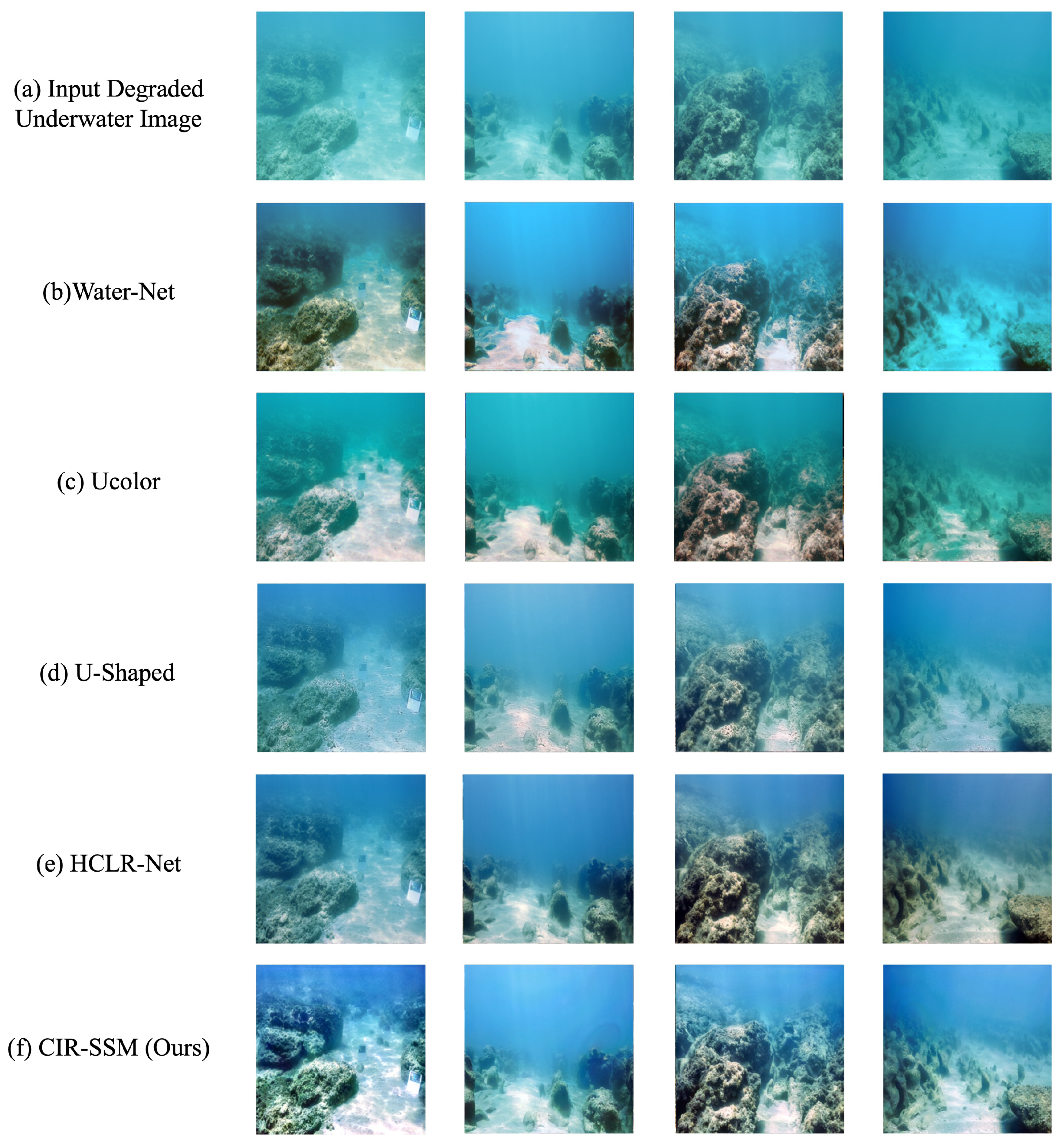
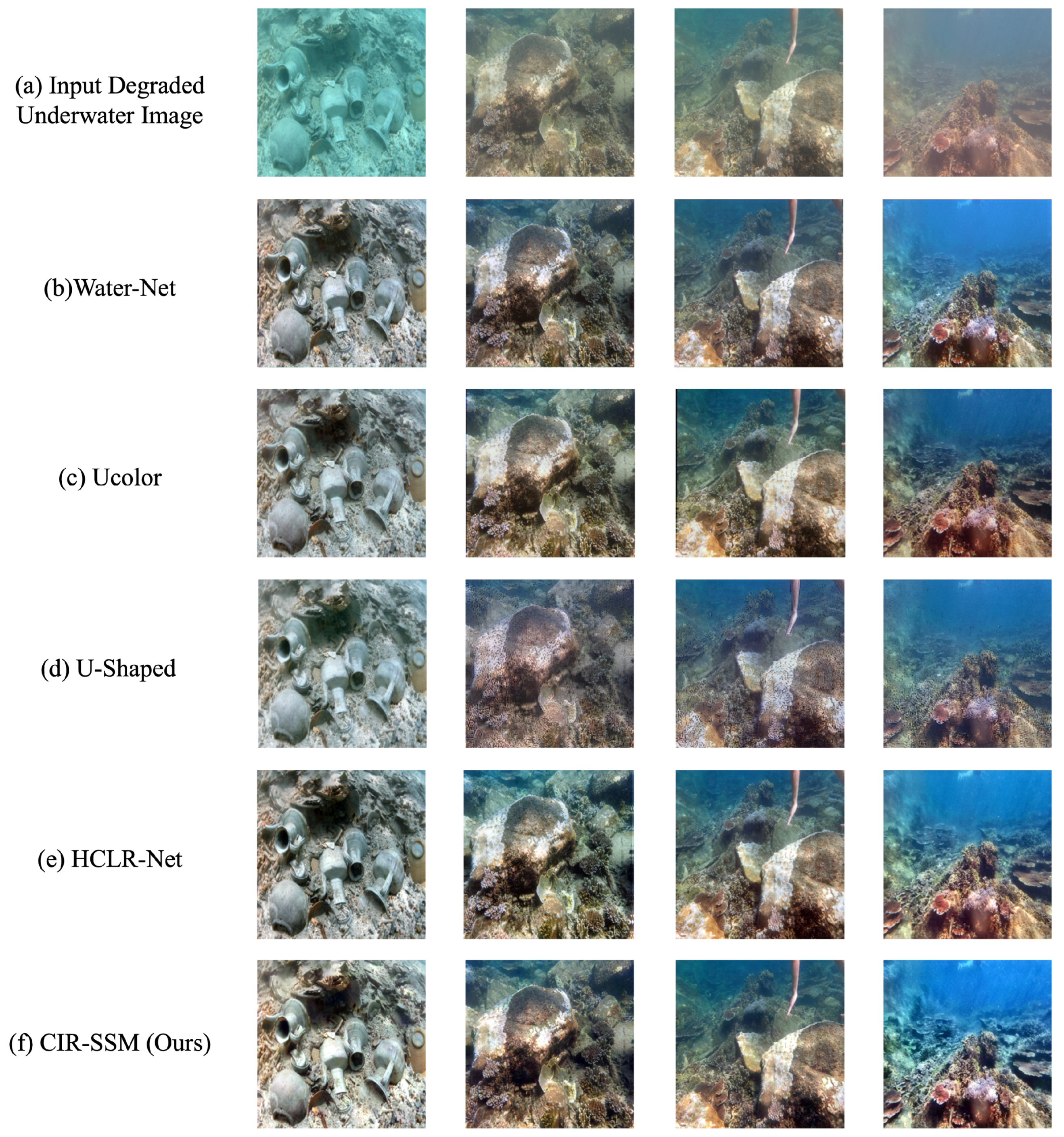
Figure 9 and Figure 10 provide a visual comparison of both the UIEB-200 and SQUID test sets between the proposed CIR-SSM and several deep-learning-based competitors. Overall, the proposed method maintains a clear visual advantage. Specifically, Water-Net produces pleasant colors yet suffers from low brightness and contrast, together with noticeable noise. Ucolor yields natural brightness, color, and contrast, but a thin haze remains, obscuring fine details. U-Shaped introduces severe noise in some regions and local color distortion. HCLR-Net and CIR-SSM both recover clear images; however, the results produced by the proposed approach appear more vivid and visually appealing. Consequently, CIR-SSM demonstrates significant superiority over both traditional and learning-based alternatives, delivering consistently superior visual quality.

3.5. Quantitative Evaluation

Table 1 and Table 2 report the quantitative results on the UIEB-200 and SQUID test sets, respectively. CIR-SSM attains the highest PSNR and SSIM values and the lowest LPIPS scores on both benchmarks, indicating clear gains over all traditional and learning-based baselines. Although some conventional methods obtain slightly higher UCIQE and UIQM scores, their outputs often appear desaturated, blurry, and noisy, which is consistent with their inferior PSNR/SSIM and larger LPIPS. Among the data-driven approaches, CIR-SSM also achieves competitive values in UCIQE and UIQM, showing that it better restores luminance, contrast, and color balance. Overall, these metrics demonstrate that CIR-SSM has distinct advantages across all objective quality indicators. As shown in Table 2, although CIR-SSM does not have the fewest parameters, it offers markedly lower computational cost and faster runtime than competing methods, demonstrating superior efficiency without sacrificing performance.

3.6. Ablation Study

To quantify the individual contribution of each stage and sub-module in the CIR-SSM pipeline, a systematic ablation study is conducted. All experiments were conducted on the UIEB-200 test set using both qualitative visual inspection and quantitative metrics.
Ablation experiments were organized along two axes: (1) varying the number of modules; (2) removing individual components. The quantitative results and visual comparisons for the module-count axis are summarized in Table 3, Table 4 and Figure 11, while the component-level ablations are reported in Table 5, Table 6 and Figure 12. Here, “w/o” denotes “without”.
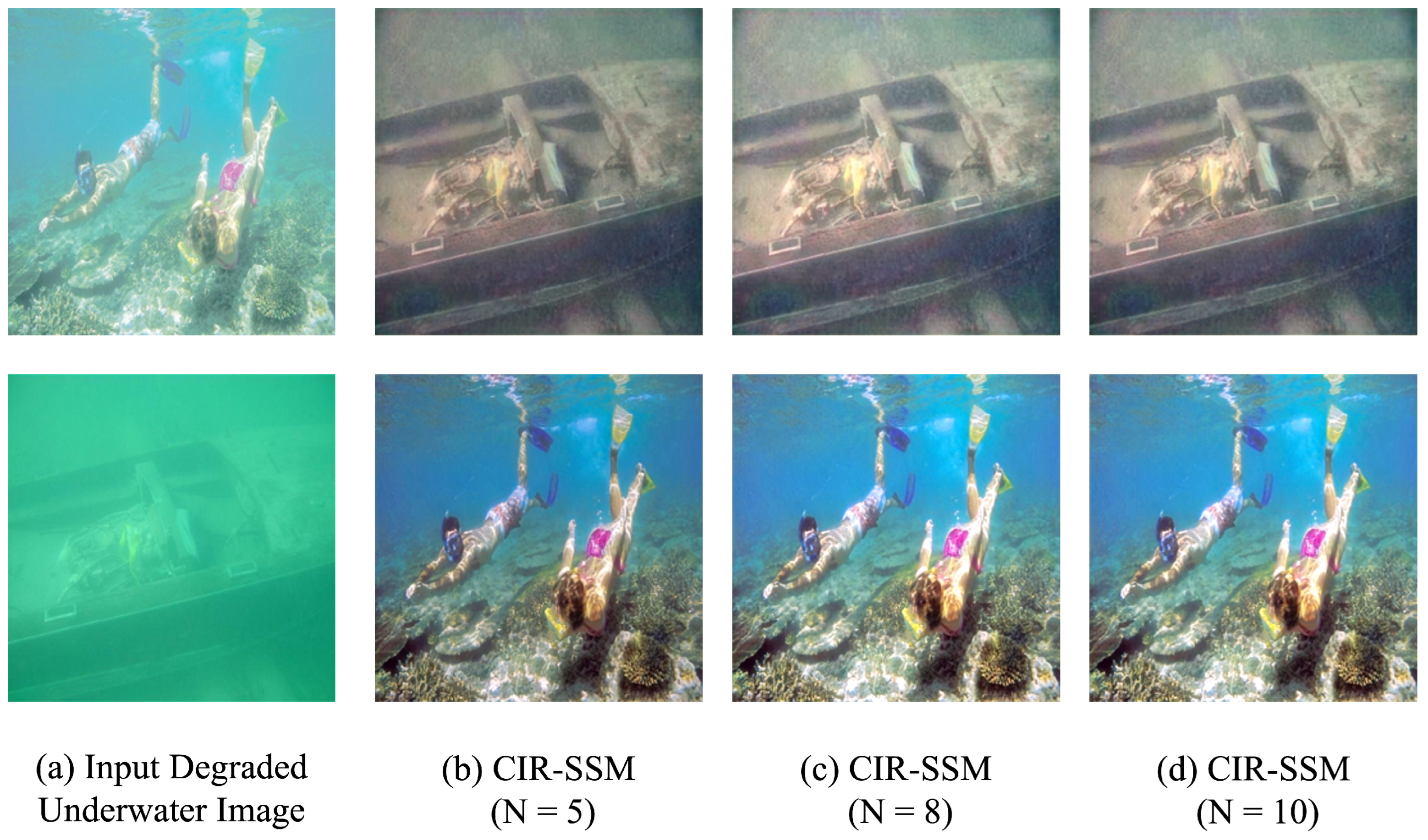
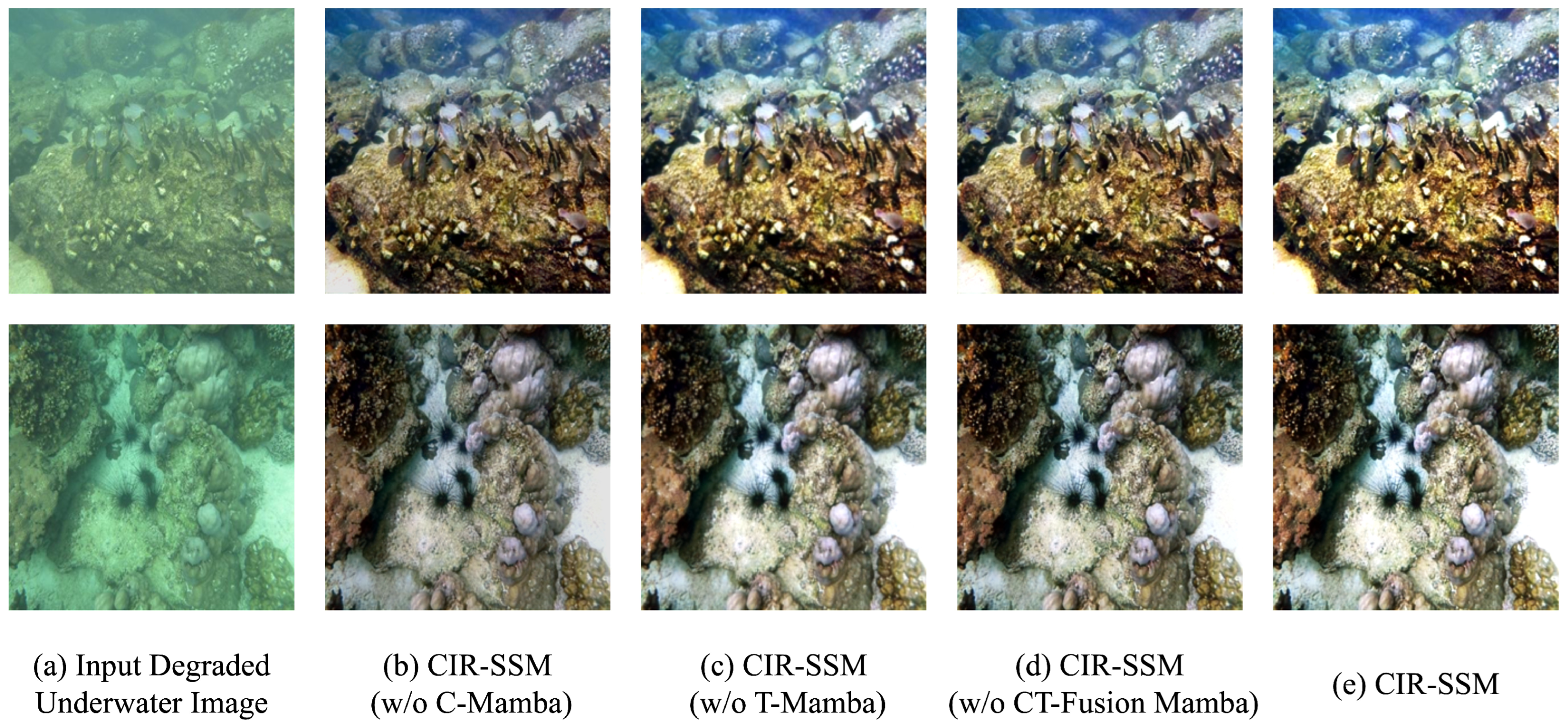
As illustrated in Table 3, Table 4 and Figure 11, increasing the number of color–texture Mamba (CT Mamba) modules consistently improves enhancement quality, yielding more vivid color reproduction and superior overall results. However, once the number of modules N exceeds 8, the incremental gain becomes marginal and the performance gradually saturates. Consequently, this paper sets N = 12 as a pragmatic compromise, trading a minor further improvement for a more favorable parameter-to-performance ratio. Moreover, as demonstrated in Table 5, Table 6 and Figure 12, removing the color Mamba block leads to a noticeable degradation in color fidelity, whereas excising the texture Mamba block results in a pronounced loss of fine-grained texture details. When the color–texture Mamba Fusion block is ablated, the integration of color and texture becomes sub-optimal, and conspicuous drops in local brightness and contrast appear. These observations collectively confirm the essential contribution of each proposed block to the overall enhancement performance.

4. Discussion

This study finds that low-resolution enhancement can often preserve global color tendencies in severely degraded underwater images. Building on this observation, CIR-SSM injects low-resolution color priors into the state-space trajectory of the high-resolution branch to guide global hue restoration, while a parallel full-resolution path focuses on preserving fine textures. By decoupling color and texture into complementary yet interacting state-space streams, the framework balances global color correction with local detail recovery. Computational efficiency is assessed using standard metrics such as parameter count, FLOPs, and inference runtime to clarify the trade-off between restoration quality and computational cost. A current limitation is that training and evaluation mainly rely on public datasets; performance under extremely degraded real-world conditions has not been fully validated. Future work will explore feasible data acquisition in real underwater environments to supplement existing datasets for subsequent retraining and evaluation.

5. Conclusions

This work proposes the Cross and Inter Resolution State-Space Model (CIR-SSM), a novel architecture designed to bridge the gap between global structural consistency and fine-grained local fidelity in image enhancement tasks. By integrating multi-resolution processing within a unified state-space framework, the model achieves high performance while maintaining parameter efficiency. Extensive experiments conducted on multiple benchmark datasets demonstrate that CIR-SSM performs competitively against both traditional and learning-based state-of-the-art methods across widely adopted quality metrics such as PSNR, SSIM, and UIQM. In most cases, it achieves the highest reported scores, underscoring its robustness and generalization capability. Ablation study results systematically validate the effectiveness of each proposed component: the color Mamba block, which preserves chromatic integrity; the texture Mamba block, responsible for enhancing structural details; and the color–texture fusion Mamba block, which optimally combines both types of information. These findings suggest that state-space models offer a viable and efficient alternative to prevailing Transformer–CNN hybrids for underwater image enhancement. Future work will extend the cross-resolution state-space paradigm to other degraded imaging domains, such as hazy, low-light, or medical images, and will explore hardware-friendly implementations to facilitate real-time subsea deployment in autonomous underwater vehicles and robotic systems.

Author Contributions

F.L. and N.Y. jointly developed the study concept and designed the methodology. They also assembled and curated the datasets. F.L., N.Y. and H.W. conducted the analyses and interpreted the results. F.L., N.Y. and H.W. drafted the initial manuscript. All authors have read and agreed to the published version of the manuscript.

Funding

This work was partly supported by the Basic Research Project of Higher Education Institutions of the Educational Department of Liaoning Province under Grant No. JYTMS20230212.

Institutional Review Board Statement

Not applicable.

Informed Consent Statement

Not applicable.

Data Availability Statement

The datasets used for this study are publicly available. The UIEB dataset can be accessed through the following link: https://li-chongyi.github.io/proj_benchmark.html (accessed on 20 July 2025), and the SQUID dataset is available at https://csms.haifa.ac.il/profiles/tTreibitz/datasets/ambient_forwardlooking/index.html (accessed on 20 July 2025).

Conflicts of Interest

The authors declare no conflicts of interest.

References

  1. González-García, J.; Gómez-Espinosa, A.; Cuan-Urquizo, E.; García-Valdovinos, L.G.; Salgado-Jiménez, T.; Escobedo Cabello, J.A. Autonomous underwater vehicles: Localization, navigation, and communication for collaborative missions. Appl. Sci. 2020, 10, 1256. [Google Scholar] [CrossRef] [Scilit]
  2. Schettini, R.; Corchs, S. Underwater image processing: State of the art of restoration and image enhancement methods. EURASIP J. Adv. Signal Process. 2010, 2010, 746052. [Google Scholar] [CrossRef] [Scilit]
  3. Moghimi, M.K.; Mohanna, F. Real-time underwater image enhancement: A systematic review. J. Real-Time Image Process. 2021, 18, 1509–1525. [Google Scholar] [CrossRef] [Scilit]
  4. Raveendran, S.; Patil, M.D.; Birajdar, G.K. Underwater image enhancement: A comprehensive review, recent trends, challenges and applications. Artif. Intell. Rev. 2021, 54, 5413–5467. [Google Scholar] [CrossRef] [Scilit]
  5. Schechner, Y.Y.; Karpel, N. Recovery of underwater visibility and structure by polarization analysis. IEEE J. Ocean. Eng. 2006, 30, 570–587. [Google Scholar] [CrossRef] [Scilit]
  6. Du, R.; Li, W.; Chen, S.; Li, C.; Zhang, Y. Unpaired underwater image enhancement based on cyclegan. Information 2021, 13, 1. [Google Scholar] [CrossRef] [Scilit]
  7. Iqbal, K.; Salam, R.A.; Osman, A.; Talib, A.Z. Underwater image enhancement using an integrated colour model. IAENG Int. J. Comput. Sci. 2007, 34, 239. [Google Scholar]
  8. Fan, B.; Chen, W.; Cong, Y.; Tian, J. Dual refinement underwater object detection network. In Proceedings of the European Conference on Computer Vision 2020—16th European Conference, Glasgow, UK, 23–28 August 2020; Springer: Berlin/Heidelberg, Germany, 2020; pp. 275–291. [Google Scholar]
  9. Li, X.; Martínez, J.F.; Rubio, G. Towards a hybrid approach to context reasoning for underwater robots. Appl. Sci. 2017, 7, 183. [Google Scholar] [CrossRef] [Scilit]
  10. Gong, T.; Zhang, M.; Zhou, Y.; Bai, H. Underwater image enhancement based on color feature fusion. Electronics 2023, 12, 4999. [Google Scholar] [CrossRef] [Scilit]
  11. Yuan, X.; Guo, L.; Luo, C.; Zhou, X.; Yu, C. A survey of target detection and recognition methods in underwater turbid areas. Appl. Sci. 2022, 12, 4898. [Google Scholar] [CrossRef] [Scilit]
  12. Chen, D.; Huang, B.; Kang, F. A review of detection technologies for underwater cracks on concrete dam surfaces. Appl. Sci. 2023, 13, 3564. [Google Scholar] [CrossRef] [Scilit]
  13. Zhang, J.; Su, H.; Zhang, T.; Tian, H.; Fan, B. Multi-Scale Fusion Underwater Image Enhancement Based on HSV Color Space Equalization. Sensors 2025, 25, 2850. [Google Scholar] [CrossRef] [Scilit]
  14. Zheng, M.; Luo, W. Underwater image enhancement using improved CNN based defogging. Electronics 2022, 11, 150. [Google Scholar] [CrossRef] [Scilit]
  15. Hou, G.; Li, N.; Zhuang, P.; Li, K.; Sun, H.; Li, C. Non-uniform illumination underwater image restoration via illumination channel sparsity prior. IEEE Trans. Circuits Syst. Video Technol. 2023, 34, 799–814. [Google Scholar] [CrossRef] [Scilit]
  16. Liu, X.; Lin, S.; Chi, K.; Tao, Z.; Zhao, Y. Boths: Super lightweight network-enabled underwater image enhancement. IEEE Geosci. Remote Sens. Lett. 2022, 20, 1500405. [Google Scholar] [CrossRef] [Scilit]
  17. Liang, Z.; Ding, X.; Wang, Y.; Yan, X.; Fu, X. GUDCP: Generalization of underwater dark channel prior for underwater image restoration. IEEE Trans. Circuits Syst. Video Technol. 2021, 32, 4879–4884. [Google Scholar] [CrossRef] [Scilit]
  18. He, K.; Sun, J.; Tang, X. Single image haze removal using dark channel prior. IEEE Trans. Pattern Anal. Mach. Intell. 2010, 33, 2341–2353. [Google Scholar] [CrossRef] [Scilit] [PubMed]
  19. Zheng, Z.; Huang, X.; Wang, L. Underwater low-light enhancement network based on bright channel prior and attention mechanism. PLoS ONE 2023, 18, e0281093. [Google Scholar] [CrossRef] [Scilit]
  20. Li, C.Y.; Guo, J.C.; Cong, R.M.; Pang, Y.W.; Wang, B. Underwater image enhancement by dehazing with minimum information loss and histogram distribution prior. IEEE Trans. Image Process. 2016, 25, 5664–5677. [Google Scholar] [CrossRef] [Scilit]
  21. Li, C.; Guo, C.; Ren, W.; Cong, R.; Hou, J.; Kwong, S.; Tao, D. An underwater image enhancement benchmark dataset and beyond. IEEE Trans. Image Process. 2019, 29, 4376–4389. [Google Scholar] [CrossRef] [Scilit]
  22. Liu, X.; Zhao, Y.; Chi, K.; Zhang, Z.; Chen, Y.; Jia, W. Towards Individual Tone Preference in Underwater Image Enhancement. IEEE Trans. Geosci. Remote Sens. 2024, 62, 4212211. [Google Scholar] [CrossRef] [Scilit]
  23. Tang, Y.; Liu, X.; Zhang, Z.; Lin, S. Adaptive underwater image enhancement guided by generalized imaging components. IEEE Signal Process. Lett. 2023, 30, 1772–1776. [Google Scholar] [CrossRef] [Scilit]
  24. Peng, L.; Zhu, C.; Bian, L. U-shape transformer for underwater image enhancement. IEEE Trans. Image Process. 2023, 32, 3066–3079. [Google Scholar] [CrossRef] [Scilit]
  25. Zhang, W.; Wang, Y.; Li, C. Underwater image enhancement by attenuated color channel correction and detail preserved contrast enhancement. IEEE J. Ocean. Eng. 2022, 47, 718–735. [Google Scholar] [CrossRef] [Scilit]
  26. Qiang, H.; Zhong, Y.; Zhu, Y.; Zhong, X.; Xiao, Q.; Dian, S. Underwater image enhancement based on multichannel adaptive compensation. IEEE Trans. Instrum. Meas. 2024, 73, 5014810. [Google Scholar] [CrossRef] [Scilit]
  27. Zhuang, P.; Li, C.; Wu, J. Bayesian retinex underwater image enhancement. Eng. Appl. Artif. Intell. 2021, 101, 104171. [Google Scholar] [CrossRef] [Scilit]
  28. Zhuang, P.; Wu, J.; Porikli, F.; Li, C. Underwater image enhancement with hyper-laplacian reflectance priors. IEEE Trans. Image Process. 2022, 31, 5442–5455. [Google Scholar] [CrossRef] [Scilit] [PubMed]
  29. Zhou, J.; Wang, S.; Lin, Z.; Jiang, Q.; Sohel, F. A pixel distribution remapping and multi-prior retinex variational model for underwater image enhancement. IEEE Trans. Multimed. 2024, 26, 7838–7849. [Google Scholar] [CrossRef] [Scilit]
  30. Lu, J.; Li, N.; Zhang, S.; Yu, Z.; Zheng, H.; Zheng, B. Multi-scale adversarial network for underwater image restoration. Opt. Laser Technol. 2019, 110, 105–113. [Google Scholar] [CrossRef] [Scilit]
  31. Qi, Q.; Li, K.; Zheng, H.; Gao, X.; Hou, G.; Sun, K. SGUIE-Net: Semantic attention guided underwater image enhancement with multi-scale perception. IEEE Trans. Image Process. 2022, 31, 6816–6830. [Google Scholar] [CrossRef] [Scilit]
  32. Erdemir, E.; Tung, T.Y.; Dragotti, P.L.; Gündüz, D. Generative joint source-channel coding for semantic image transmission. IEEE J. Sel. Areas Commun. 2023, 41, 2645–2657. [Google Scholar] [CrossRef] [Scilit]
  33. Liu, X.; Lin, S.; Tao, Z. Learning multiscale pipeline gated fusion for underwater image enhancement. Multimed. Tools Appl. 2023, 82, 32281–32304. [Google Scholar] [CrossRef] [Scilit]
  34. Ancuti, C.; Ancuti, C.O.; Haber, T.; Bekaert, P. Enhancing underwater images and videos by fusion. In Proceedings of the 2012 IEEE Conference on Computer Vision and Pattern Recognition, Providence, RI, USA, 16–21 June 2012; IEEE: Piscataway, NJ, USA, 2012; pp. 81–88. [Google Scholar]
  35. Li, J.; Skinner, K.A.; Eustice, R.M.; Johnson-Roberson, M. WaterGAN: Unsupervised generative network to enable real-time color correction of monocular underwater images. IEEE Robot. Autom. Lett. 2017, 3, 387–394. [Google Scholar] [CrossRef] [Scilit]
  36. Guo, Y.; Li, H.; Zhuang, P. Underwater image enhancement using a multiscale dense generative adversarial network. IEEE J. Ocean. Eng. 2019, 45, 862–870. [Google Scholar] [CrossRef] [Scilit]
  37. Fabbri, C.; Islam, M.J.; Sattar, J. Enhancing underwater imagery using generative adversarial networks. In Proceedings of the 2018 IEEE International Conference on Robotics and Automation (ICRA), Brisbane, Australia, 21–25 May 2018; IEEE: Piscataway, NJ, USA, 2018; pp. 7159–7165. [Google Scholar]
  38. Islam, M.J.; Xia, Y.; Sattar, J. Fast underwater image enhancement for improved visual perception. IEEE Robot. Autom. Lett. 2020, 5, 3227–3234. [Google Scholar] [CrossRef] [Scilit]
  39. Cong, R.; Yang, W.; Zhang, W.; Li, C.; Guo, C.L.; Huang, Q.; Kwong, S. Pugan: Physical model-guided underwater image enhancement using gan with dual-discriminators. IEEE Trans. Image Process. 2023, 32, 4472–4485. [Google Scholar] [CrossRef] [Scilit]
  40. Xie, X.; Cui, Y.; Tan, T.; Zheng, X.; Yu, Z. Fusionmamba: Dynamic feature enhancement for multimodal image fusion with mamba. Vis. Intell. 2024, 2, 37. [Google Scholar] [CrossRef] [Scilit]
  41. Guo, H.; Li, J.; Dai, T.; Ouyang, Z.; Ren, X.; Xia, S.T. Mambair: A simple baseline for image restoration with state-space model. In Proceedings of the European Conference on Computer Vision 2024—18th European Conference, Milan, Italy, 29 September–4 October 2024; Springer: Berlin/Heidelberg, Germany, 2024; pp. 222–241. [Google Scholar]
  42. Guan, M.; Xu, H.; Jiang, G.; Yu, M.; Chen, Y.; Luo, T.; Song, Y. WaterMamba: Visual state space model for underwater image enhancement. arXiv 2024, arXiv:2405.08419. [Google Scholar] [CrossRef] [Scilit]
  43. Dong, C.; Zhao, C.; Cai, W.; Yang, B.; Guo, Y. O-mamba: O-shape state-space model for underwater image enhancement. In Proceedings of the Chinese Conference on Pattern Recognition and Computer Vision (PRCV), Shanghai, China, 15–18 October 2025; Springer: Berlin/Heidelberg, Germany, 2025; pp. 168–182. [Google Scholar]
  44. Lin, W.T.; Lin, Y.X.; Chen, J.W.; Hua, K.L. PixMamba: Leveraging state space models in a dual-level architecture for underwater image enhancement. In Proceedings of the 17th Asian Conference on Computer Vision, Hanoi, Vietnam, 8–12 December 2024; pp. 3622–3637. [Google Scholar]
  45. Gu, A.; Goel, K.; Ré, C. Efficiently modeling long sequences with structured state spaces. arXiv 2021, arXiv:2111.00396. [Google Scholar]
  46. Berman, D.; Treibitz, T.; Avidan, S. Diving into haze-lines: Color restoration of underwater images. In Proceedings of the British Machine Vision Conference (BMVC) 2017, London, UK, 4–7 September 2017; Volume 1, p. 2. [Google Scholar]
  47. Zhang, Z. Improved adam optimizer for deep neural networks. In Proceedings of the 2018 IEEE/ACM 26th International Symposium on Quality of Service (IWQoS), Banff, AB, Canada, 4–6 June 2018; IEEE: Piscataway, NJ, USA, 2018; pp. 1–2. [Google Scholar]
  48. Tanchenko, A. Visual-PSNR measure of image quality. J. Vis. Commun. Image Represent. 2014, 25, 874–878. [Google Scholar] [CrossRef] [Scilit]
  49. Hore, A.; Ziou, D. Image quality metrics: PSNR vs. SSIM. In Proceedings of the 2010 20th International Conference on Pattern Recognition, Istanbul, Turkey, 23–26 August 2010; IEEE: Piscataway, NJ, USA, 2010; pp. 2366–2369. [Google Scholar]
  50. Ding, K.; Ma, K.; Wang, S.; Simoncelli, E.P. Image quality assessment: Unifying structure and texture similarity. IEEE Trans. Pattern Anal. Mach. Intell. 2020, 44, 2567–2581. [Google Scholar] [CrossRef] [Scilit]
  51. Panetta, K.; Gao, C.; Agaian, S. Human-visual-system-inspired underwater image quality measures. IEEE J. Ocean. Eng. 2015, 41, 541–551. [Google Scholar] [CrossRef] [Scilit]
  52. Yang, M.; Sowmya, A. An underwater color image quality evaluation metric. IEEE Trans. Image Process. 2015, 24, 6062–6071. [Google Scholar] [CrossRef] [Scilit] [PubMed]
  53. Peng, Y.T.; Cosman, P.C. Underwater image restoration based on image blurriness and light absorption. IEEE Trans. Image Process. 2017, 26, 1579–1594. [Google Scholar] [CrossRef] [Scilit]
  54. Liu, J.; Liu, R.W.; Sun, J.; Zeng, T. Rank-one prior: Real-time scene recovery. IEEE Trans. Pattern Anal. Mach. Intell. 2022, 45, 8845–8860. [Google Scholar] [CrossRef] [Scilit] [PubMed]
  55. Li, C.; Anwar, S.; Hou, J.; Cong, R.; Guo, C.; Ren, W. Underwater image enhancement via medium transmission-guided multi-color space embedding. IEEE Trans. Image Process. 2021, 30, 4985–5000. [Google Scholar] [CrossRef] [Scilit]
  56. Zhou, J.; Sun, J.; Li, C.; Jiang, Q.; Zhou, M.; Lam, K.M.; Zhang, W.; Fu, X. HCLR-Net: Hybrid contrastive learning regularization with locally randomized perturbation for underwater image enhancement. Int. J. Comput. Vis. 2024, 132, 4132–4156. [Google Scholar] [CrossRef] [Scilit]
Figure 1. Motivation behind the proposed method.
Applsci 16 01297 g001
Figure 2. Overview of the proposed cross and inter resolution state-space model (CIR-SSM), which consists of sub-networks in three resolutions (full resolution, 1/2 resolution, and 1/4 resolution).
Applsci 16 01297 g002
Figure 3. Demonstration of the single flow color Mamba block. The deformable Conv 3 × 3 and Conv 1 × 1 represent the deformable 3 × 3 and 1 × 1 convolutions, respectively. SiLU and SS2D denote the activation function and 2D selective scan.
Applsci 16 01297 g003
Figure 4. Demonstration of the dual flow color Mamba block. The deformable Conv 3 × 3 and Conv 1 × 1 represent the deformable 3 × 3 and 1 × 1 convolutions, respectively. SiLU and SS2D denote the activation function and 2D selective scan.
Applsci 16 01297 g004
Figure 5. Demonstration of the texture Mamba block. The Conv 1 × 1 represent the 1 × 1 convolution. SiLU and SS2D denote the activation function and 2D selective scan.
Applsci 16 01297 g005
Figure 6. Illustration of the proposed color–texture Mamba fusion block. The Conv 1 × 1 represents the 1 × 1 convolution. SiLU and SS2D denote the activation function and 2D selective scan.
Applsci 16 01297 g006
Figure 7. Visual comparison on the UIEB-200 test set between CIR-SSM and three traditional methods, HLRP, IBLA, and ROP+.
Applsci 16 01297 g007
Figure 8. Visual comparison on the SQUID test set between CIR-SSM and three traditional methods, HLRP, IBLA, and ROP+.
Applsci 16 01297 g008
Figure 9. Visual comparison on the UIEB-200 test set between CIR-SSM and four learning-based methods, Water-Net, Ucolor, U-shaped, and HCLR-Net.
Applsci 16 01297 g009
Figure 10. Visual comparison on the SQUID test set between CIR-SSM and four learning-based methods, Water-Net, Ucolor, U-shaped, and HCLR-Net.
Applsci 16 01297 g010
Figure 11. Visual comparisons for the module-number ablation study on the UIEB-200 test set.
Applsci 16 01297 g011
Figure 12. Visual comparison for the component ablation study on the UIEB-200 test set.
Applsci 16 01297 g012
Table 1. Quantitative results on the UIEB-200 test set using PSNR (dB), SSIM, UCIQE, UIQM, and LPIPS.
MethodMetrics
PSNRSSIMUCIQEUIQMLPIPS
HLRP15.950.30490.55821.0960.3715
IBLA20.940.77490.57461.0720.2268
ROP+19.670.82460.58011.0550.2819
Water-Net24.540.91650.59101.1130.1784
Ucolor25.620.93590.55931.0210.1525
U-Shaped25.890.93960.53521.0380.1314
HCLR-Net26.540.94140.57911.0450.1117
CIR-SSM26.750.94880.58121.0820.1023
Table 2. UCIQE and UIQM scores, along with parameters (M), FLOPs (G), and runtime (s), measured on the SQUID test set.
MethodMetrics
UCIQEUIQMParametersFLOPsRuntime
HLRP0.50170.983--1.327
IBLA0.55810.993--8.240
ROP+0.57081.103--0.095
Water-Net0.56410.9911.101938.000.133
Ucolor0.50130.906148.802806.100.587
U-Shaped0.56870.97266.20420.500.077
HCLR-Net0.57971.0374.89402.100.053
CIR-SSM0.58051.07630.52195.170.028
Table 3. Ablation on the module count N on the UIEB-200 test set: restoration performance in terms of PSNR (dB), SSIM, UCIQE, UIQM, and LPIPS.
MethodMetrics
PSNRSSIMUCIQEUIQMLPIPS
N = 525.960.93780.57111.0130.1206
N = 826.420.93990.57441.0450.1103
N = 1026.580.94220.57911.0710.1061
CIR-SSM26.750.94880.58121.0820.1023
Table 4. Ablation on the module count N on the UIEB-200 test set: model complexity and efficiency in terms of parameters (M), FLOPs (G), and inference runtime (s).
MethodMetrics
ParametersFLOPsRuntime
N = 517.7678.130.018
N = 822.14138.110.021
N = 1027.33165.740.024
CIR-SSM30.52195.170.028
Table 5. Evaluations of component ablation study on the UIEB-200 test set indicated by the PSNR (dB), SSIM, UCIQE, UIQM, and LPIPS metrics.
MethodMetrics
PSNRSSIMUCIQEUIQMLPIPS
w/o color Mamba block25.920.93110.57031.0240.1108
w/o texture Mamba block26.590.93870.57621.0670.1079
w/o color–texture Mamba fusion block26.720.94330.57991.0770.1036
CIR-SSM26.750.94880.58121.0820.1023
Table 6. Evaluations of component ablation study on the UIEB-200 test set indicated by parameters (M), FLOPs (G), and runtime (s).
MethodMetrics
ParametersFLOPsRuntime
w/o color Mamba block23.98161.370.020
w/o texture Mamba block25.72171.210.022
w/o color–texture Mamba fusion block27.18177.670.025
CIR-SSM30.52195.170.028
Disclaimer/Publisher’s Note: The statements, opinions and data contained in all publications are solely those of the individual author(s) and contributor(s) and not of MDPI and/or the editor(s). MDPI and/or the editor(s) disclaim responsibility for any injury to people or property resulting from any ideas, methods, instructions or products referred to in the content.