Article

Study on Key Parameters of Roof Cutting and Surrounding Rock Control Technology for Gob-Side Entry Retaining in Fully Mechanized Top Coal Caving Mining of Thick Coal Seams

School of Mines, China University of Mining & Technology, Xuzhou 221116, China
*
Authors to whom correspondence should be addressed.
Appl. Sci. 2026, 16(3), 1293; https://doi.org/10.3390/app16031293
Submission received: 12 December 2025 / Revised: 12 January 2026 / Accepted: 14 January 2026 / Published: 27 January 2026
(This article belongs to the Topic Advances in Mining and Geotechnical Engineering)

Abstract

In thick coal seam conditions, the surrounding rock deformation in the longwall mining faces’ along-the-goal roadway is severe, and the support strength struggles to meet roadway retention requirements. A coordinated control strategy, termed “pressure-relief and support,” is proposed, which includes an “Optimization of Roof Cutting in Surrounding Rock Structure, Reinforcement of surrounding rock support, high-strength temporary support, and roadside gangue-blocking support.” A numerical model for roof-cutting pressure relief in thick-seam caving mining gob-side entries was established to simulate various roof-cutting heights and angles. This model analyzes the evolution patterns of stress and displacement under different cutting parameters to identify optimal values. The study presents a coordinated “pressure-relief and support” control scheme for gob-side entries in thick-seam caving mining, with its feasibility validated through numerical simulation analysis and field industrial tests. The findings demonstrate that the selection of the roof-cutting height and angle exerts a significant influence on the deformation behavior of the retained roadway roof. By severing the roof strata, this technique disrupts the load-transfer path from the goaf to the entry, thereby mitigating the adverse effects of overlying strata fracturing and facilitating more effective ground control. As a result, roof-cutting and pressure relief substantially reduce the stress imposed on the supporting structures. The coordinated “pressure-relief & support” control strategy employed in gob-side entry retaining for thick-seam longwall top-coal caving faces notably improves the surrounding rock stress regime and effectively restrains roadway convergence.

1. Introduction

Coal is the primary energy resource in China and is classified as a non-renewable resource. With continuous mining activities, coal reserves are depleting at an alarming rate. Therefore, enhancing coal recovery rates is essential for achieving sustainable development. Traditional mining methods that involve retaining coal pillars result in significant leftover coal resources and low recovery rates. Additionally, the stress concentration beneath coal pillars adversely affects the mining of lower seams and the support of roadways. The gob-side entry retaining technique is a crucial method for achieving pillarless mining [1,2,3]. This technique involves retaining the extraction roadway of the current working face through effective support technology during coal seam extraction, allowing it to be utilized as an extraction roadway for adjacent working faces or for other purposes [4,5]. The gob-side entry retaining (GER) layout in longwall mining offers several substantial advantages: (1) it eliminates the need for protective coal pillars, thereby enhancing overall resource recovery; (2) it reduces roadway excavation requirements and alleviates the tension in mining succession; (3) in multi-seam mining, it prevents dynamic hazards such as stress concentration or rock bursts caused by the retention of coal pillars; (4) it provides gas control spaces for both the current seam and adjacent seams, effectively resolving gas accumulation issues in upper corners and optimizing the working environment of roadways [6,7,8]. For fully mechanized top-coal caving faces, the gob-side entry retaining technology is a crucial solution for Y-type ventilation, addressing gas accumulation and exceedance in high-yield, high-efficiency working faces. This technology facilitates reciprocating mining, eliminates isolated working faces, and enhances coal recovery rates [9,10,11].
The gob-side entry retaining technology, established through anchor or support settings during roadway excavation, auxiliary support within the roadway during mining, and various types of filling walls, is currently the most widely applied method in the field [12,13,14,15]. However, regardless of the filling wall retention methods—such as backfill type [15,16,17,18], block type, or pier-column type—these approaches all face challenges related to complex construction processes and low levels of mechanization. Consequently, they result in low efficiency, high labor demands, and slow progress. These limitations hinder the ability to meet the rapid advancement requirements of coal mining faces and impede large-scale adoption. In contrast, roof-cutting pressure-relief technology represents a promising pillarless approach to gob-side entry retaining, offering a more active and controllable solution for ground management [19,20,21]. Its distinctive feature lies in eliminating the need for artificial filling materials and further removing the conventional filling walls in gob-side entry retaining. By simply applying pressure relief and roof lowering to the roof strata, it utilizes mining pressure and the bulking characteristics of rock masses to achieve pillarless mining. Currently, non-pillar mining technology, utilizing gob-side entry formed by roof cutting and pressure relief, has been widely applied under conditions of thin to medium-thick coal seams [22,23]. However, research and application of this technology in fully mechanized caving faces under thick coal seam conditions remain relatively limited.
In thick coal seam mining, roadways are strategically arranged along the bottom of the seam to create top-coal roadways, or along the top of the seam to establish bottom-coal roadways. When employing the gob-side entry retaining method with top coal left, the low-strength top coal is prone to fracturing. Under conditions of thick seams, mining-induced disturbances intensify, and the time required for goaf filling is extended, necessitating stricter requirements for roof and roadside support during gob-side entry retaining. The pressure-relief gob-side entry retaining technique utilizes pre-splitting cutting technology to sever the physical and mechanical connection between the roadway roof and the working face roof. During the support phase, this technique transforms the roadway roof from a long cantilever beam structure into a short cantilever beam structure [24,25]. This technique reduces the support pressure on the roof, optimizes the stress environment for supporting the roadway roof, and presents a novel approach to addressing the challenging support issues in top-coal roadways [26,27,28]. However, there is a scarcity of literature and field practice, both domestically and internationally, regarding gob-side entry retaining with top-coal caving in fully mechanized caving faces. Consequently, the corresponding theories and technologies for surrounding rock control remain underdeveloped. This study combines theoretical analysis, numerical modeling, and field monitoring under actual mining conditions to investigate the stress redistribution and displacement evolution of surrounding rock in gob-side entry retaining using the roof-cutting pressure-relief method in fully mechanized top-coal caving faces. It proposes principles and solutions for surrounding rock control and conducts field engineering practice along with ground pressure monitoring, thereby providing innovative methods and approaches for managing surrounding rock deformation under similar conditions.

2. Evolution Characteristics of Surrounding Rock Structure

2.1. Project Overview

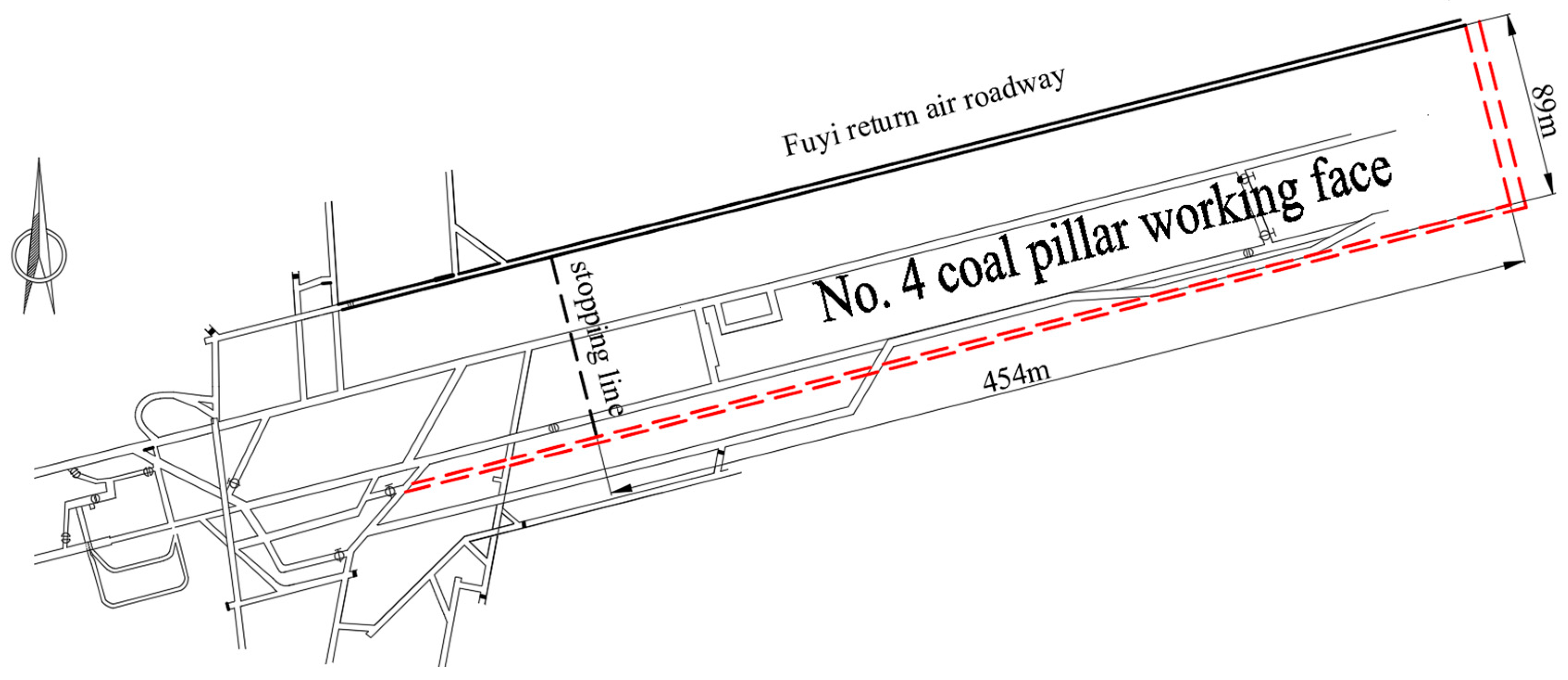
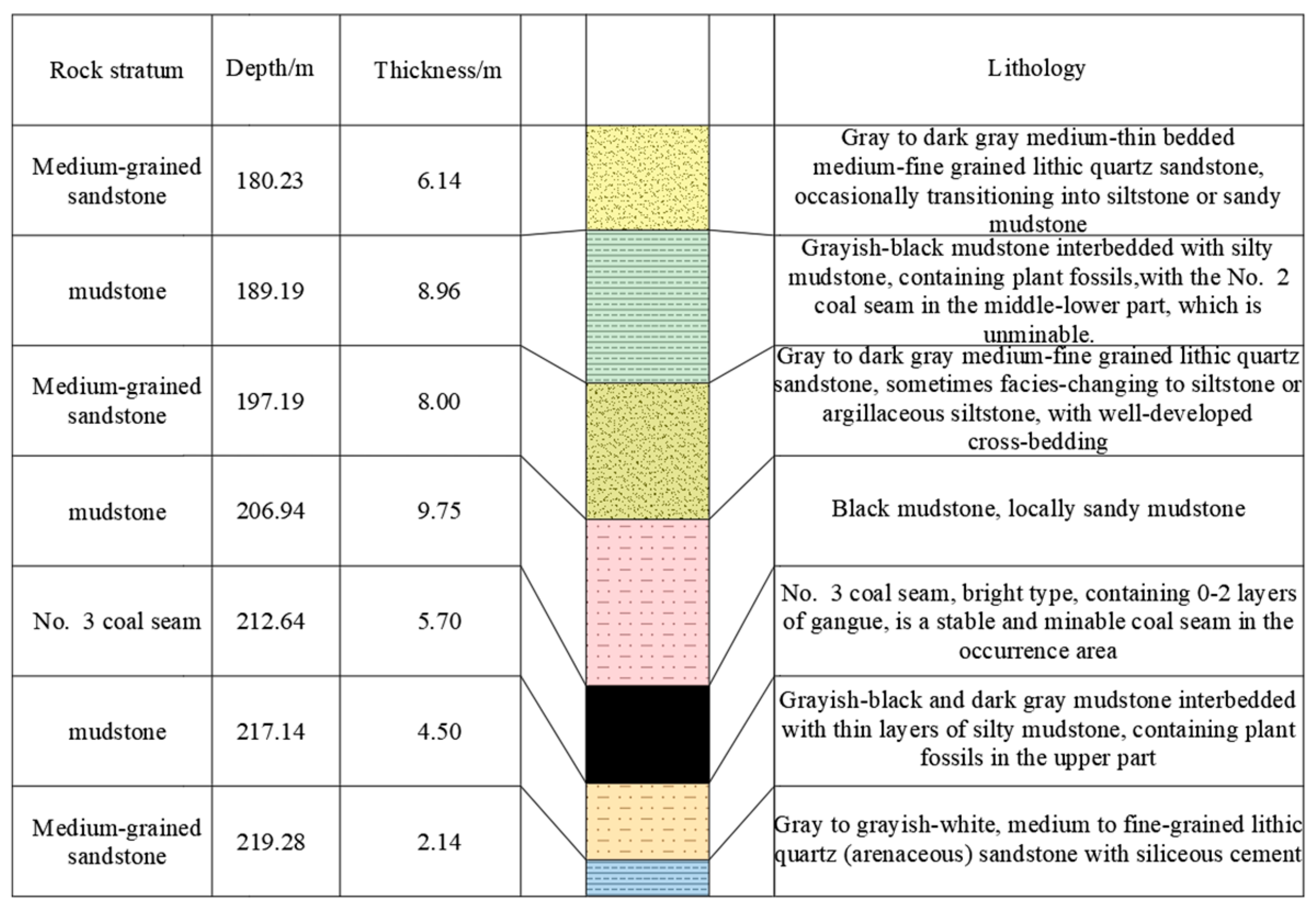
The Shanxi Lanhua Group JuShan Coal Mine is situated approximately 18 km northeast of Jincheng City, adjacent to Sanjiadian Village in Bagong Town, Zezhou County, and is administratively part of Bagong Town, Zezhou County. The mine currently employs the fully mechanized top-coal caving method to extract the No. 3 coal seam. It is classified as a low-gas mine with a medium hydrogeological type and exhibits a non-spontaneous combustion tendency. The resources of the No. 3 coal seam are nearly depleted, and future operations will be limited to the recovery and withdrawal of coal pillars from the No. 1, No. 2, No. 3, and No. 4 working faces, with no further development planned. The No. 4 coal pillar measures 89 m in width, 454 m in length, and encompasses a recoverable area of 40,406 m2. The coal seam has a thickness of 5.83 m and is extracted by the fully mechanized top-coal caving method, with roof strata managed by full caving. The Fuyi return air roadway is positioned on the northern side of the No. 4 coal pillar working face. The layout of the No. 4 coal pillar working face is illustrated in Figure 1, while Figure 2 presents the comprehensive histogram of the roof and floor of the No. 3 coal seam.

2.2. Analysis of Surrounding Rock Structure Evolution Process in Gob-Side Entry Retaining with Roof Cutting and Pressure Relief

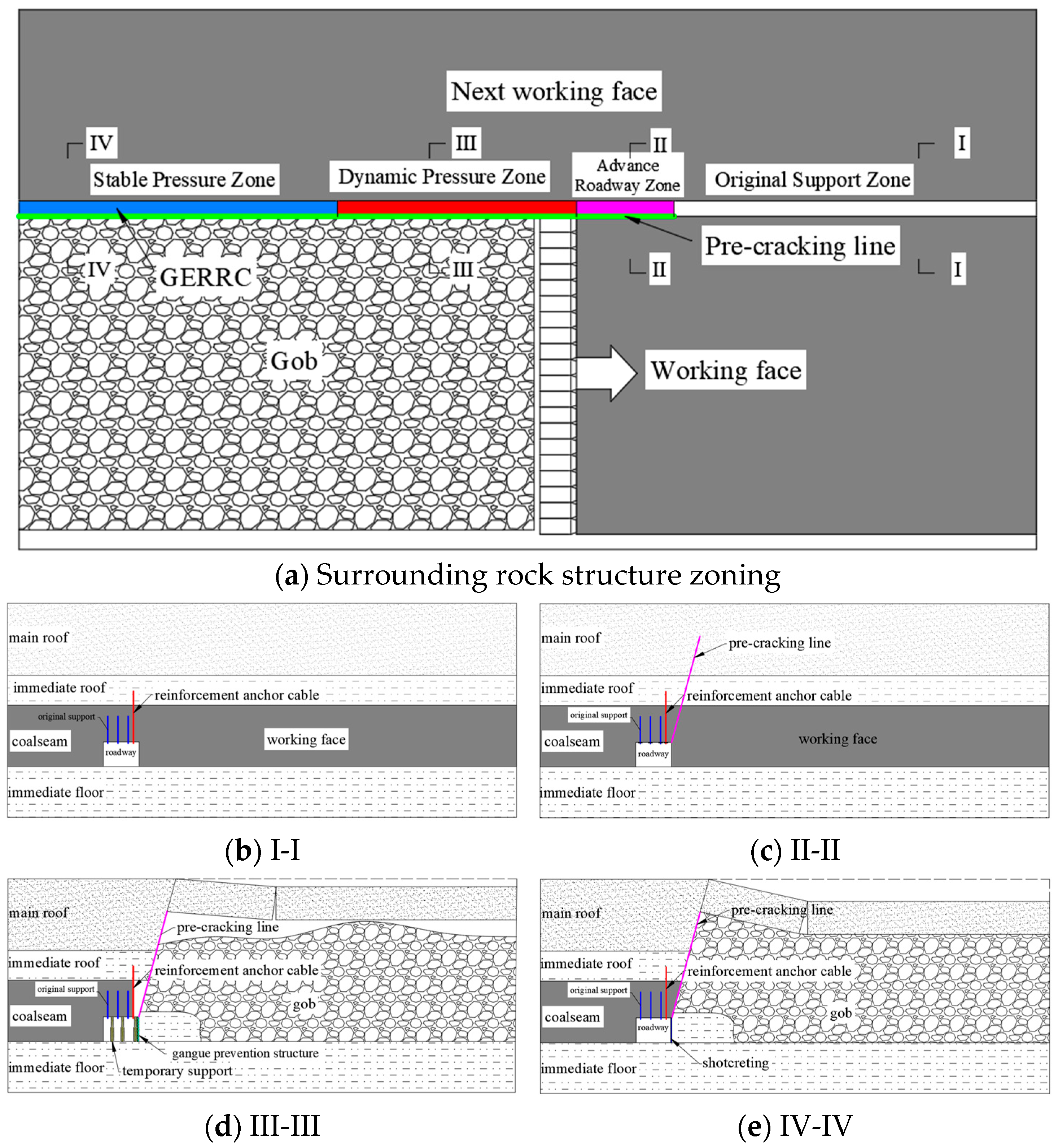
During the process of gob-side entry retention through roof cutting and pressure relief, the surrounding rock of the roadway experiences various structural configurations as the working face progresses. From the initial stage to the completion of entry retention, it demonstrates distinct phased activity characteristics. Based on the construction technology and the changes in the roof structure state, the entire process of gob-side entry retention via roof cutting and pressure relief in fully mechanized top-coal caving faces can be categorized into four zones: the original support zone, the advanced support zone, the dynamic pressure zone of the formed roadway section, and the stable pressure zone of the formed roadway section, as illustrated in Figure 3a.
Original Support Zone: As illustrated in Figure 3b, this support zone has not undergone pre-splitting cuts on the roof, allowing the overlying strata to retain their original integrity from the roadway excavation period, with no fractures present. In this condition, both ends of the roadway roof are fixedly supported, creating a structure that is essentially symmetrically distributed along the roadway cross-section, assuming that factors such as coal seam inclination and tectonic stress are disregarded. This zone has not yet been subjected to the advanced abutment pressure resulting from panel mining, leading to minimal deformation of the roadway, which remains in its most stable phase. In line with the gob-side entry retaining (GER) construction sequence, this section requires reinforced roof support.
Advance Roadway Zone: As illustrated in Figure 3c, following the execution of pre-splitting blasting on the roof to establish a cut, the physical connection between the roadway roof and the goaf roof within the cut range is disrupted, thereby weakening the constraints between both sides of the cut. At this stage, the roof structure can be mechanically modeled as a beam fixed at one end (the current longwall face side) and simply supported at the other (the adjacent future face side), in terms of both structural continuity and stress distribution. During this phase, a portion of the load has already been transferred to the subsequent working face. However, as the working face has yet to advance beyond this point and the cut line is oriented towards the current working face, the coal body provides an inclined support to the roof, resulting in negligible subsidence deformation of the roof. Throughout the coal face mining process, the roadway roof is subjected not only to the dead weight load of the overlying strata but also to the influences of both abutment pressure and mining-induced pressure. Consequently, it is imperative to provide support for the roadway roof within a specified range ahead of the working face to counteract the effects of advanced mining pressure.
Dynamic Pressure Zone in the Retained Entry: As illustrated in Figure 3d, with the advancement of the working face, the roof within the cutting range can be conceptualized as a short cantilever beam structure, fixed at one end (the solid coal side) and suspended at the other (the goaf side). Due to the significant mining height of the fully mechanized top-coal caving face, the collapsed rocks do not rapidly fill the goaf to form an effective roadside support structure. During the rotation and deformation of the main roof, vertical stress and additional horizontal rotational stress are generated on the entry support. As the working face continues to advance, the collapse and subsidence of the main roof progressively extend to the upper strata. Behind the working face, the retained entry experiences further dynamic loads from the collapse of the upper roof and continuous deformation caused by bending and subsidence. In this region, the roof strata of the goaf remain in constant motion. Therefore, controlling the surrounding rock in the dynamic pressure zone of the roadway formation section is crucial for ensuring roadway stability. To mitigate roadway roof subsidence, temporary supports are typically installed within the roadway.
Stable Pressure Zone in the Retained Entry: As shown in Figure 3e, with face advance, the caved waste in the goaf gradually consolidates and fills the void, thereby effectively supporting the overlying main roof and forming a stable pressure zone in the retained roadway. The movement of the upper main roof strata gradually stabilizes, ultimately reaching a steady state. The roof within the cutting range can be conceptualized as a simply supported beam structure, with one end supported by the solid coal of the adjacent working face and the other end supported by the goaf gangue. In accordance with the gob-side entry retaining construction process, temporary supports within this roadway section are removed, and shotcrete reinforcement is applied to seal the goaf, thereby preventing the spontaneous combustion of residual coal and isolating gas emissions.
In summary, the roof within the Original Support Zone of the roadway can be conceptualized as a simply supported beam, with both ends resting on coal walls. Due to the effects of mining-induced dynamic pressure, enhanced support for the roadway is necessary to withstand this pressure. Conversely, the roof in the Dynamic Pressure Zone can be modeled as a cantilever beam, with one end supported by coal and the other end unsupported, which experiences substantial subsidence as a result of overlying strata movement and waste rock caving. This condition necessitates maximum support resistance for the roadway. Finally, the roof in the Stable Pressure Zone can be regarded as a simply supported beam with one end supported by coal and the other by compacted waste rock. In this zone, the effects of mining-induced dynamic pressure have largely dissipated, thereby allowing for a reduction in roadway support resistance, as stability is maintained by the coal walls and the bulked waste rock.

3. Determination of Key Roof-Cutting Parameters

The parameters of roof-cutting height and roof-cutting angle play a crucial role in achieving effective pressure relief for gob-side entry retaining. An appropriate roof-cutting height ensures that the fragmented and bulked gangue from the collapsed roof within the specified cutting height effectively fills and supports the overlying strata, thereby limiting their deformation. A suitable roof-cutting angle guarantees that the roof strata within the cutting range can rotate and collapse smoothly, thereby reducing the lateral compressive thrust on the roadway roof. To investigate the influence of pre-splitting roof cutting on the surrounding rock structure and stress, this chapter employs theoretical analysis and numerical simulation to systematically explore how variations in roof-cutting parameters affect the collapse of surrounding rock structures and the stress environment in the dynamic pressure zone of the entry. Furthermore, it identifies the key rational parameters for roof cutting.

3.1. Theoretical Analysis

3.1.1. Theoretical Analysis of Roof Cutting Height

The cutting height refers to the maximum vertical distance from the roadway roof plane to the upward-developed fracture seam created by pre-splitting the coal seam roof through blasting technology. By optimizing the cutting height, the lateral cantilever of the roof is effectively truncated, enabling the strata within this zone to cave and completely fill the goaf. This process provides effective support for the overlying strata, thereby optimizing the roof structure of the retained roadway and minimizing disturbances caused by the rotation and subsidence of the roof strata on the retained roadway. Consequently, the stress environment of the gob-side entry is notably improved, substantially enhancing surrounding rock stability.
Pre-splitting blasting must penetrate the main roof; therefore, the blast holes should be arranged to extend at least to the upper boundary of the main roof, namely:
H Q Σ h + h
In the formula: HQ is the roof-cutting height, m; ∑h is the thickness of the immediate roof strata, m; h is the thickness of the main roof strata, m. According to the actual geological conditions, the roof-cutting height HQ should be 17.75 m in this case.
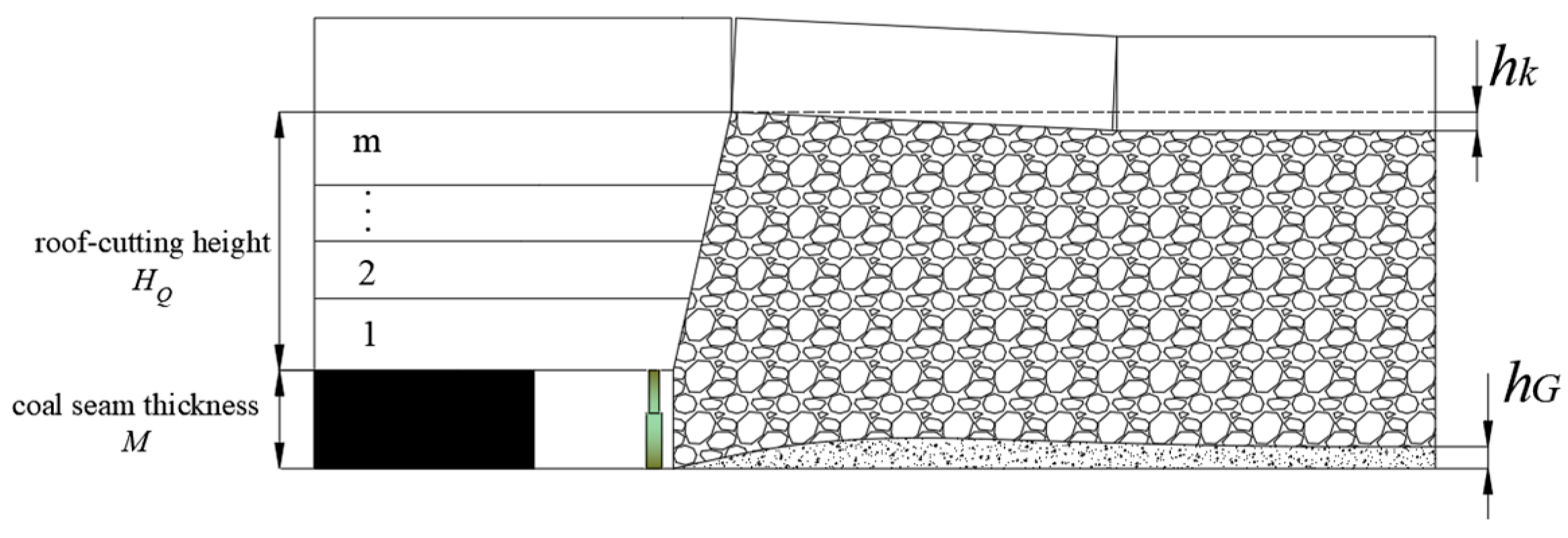
When the immediate roof collapses after the basic roof is cut off and the caved waste rock still cannot fully fill the goaf, the overlying strata retain movement space and thus exert pressure on the retained roadway roof, necessitating further consideration of the cutting height. By leveraging the characteristic of rock fragmentation and bulking post-cutting, the collapsed strata within the cutting range can be designed to fully occupy the goaf, thereby providing effective support to the overlying strata and mitigating the impact of upper roof rotation and subsidence on the gob-side entry retention. As illustrated in Figure 4, let us assume there are m layers of strata within the cutting height, sequentially numbered from bottom to top as 1, 2, 3, …, m; the following relationship must be satisfied.
Δ = ( H 1 + H 2 + + H m ) + M ( K 1 H 1 + K 2 H 2 + + K m H m ) h k h G = i = 1 m H i + M K p i = 1 m H i h k h G = 0
among which:
K p = K 1 H 1 + K 2 H 2 + K m H m i = 1 m H i
Therefore, the cutting height is:
H Q = i = 1 m H i = M h k h G K p 1
In the formula: HQ is the roof-cutting height, m; M is the coal seam thickness, m; K1, K2, …, Km are the bulking factors of the first, second, …, m-th rock layers, respectively; H1, H2, …, Hm are the thicknesses of the first, second, …, m-th rock layers, m; Kp is the average bulking factor of rock layers, typically ranging from 1.3 to 1.5; hk is the roof subsidence, m; hG is the floor heave, m. Without considering floor heave and roof subsidence, taking Kp as 1.3 and the average coal seam thickness as 5.7 m, substituting into Equation (4) yields a calculated roof-cutting height HQ of 19 m.
In summary, the roof-cutting height should be set to the larger value derived from the two scenarios. Consequently, the theoretically analyzed roof-cutting height is determined to be 19 m.

3.1.2. Theoretical Analysis of Roof-Cutting Angle

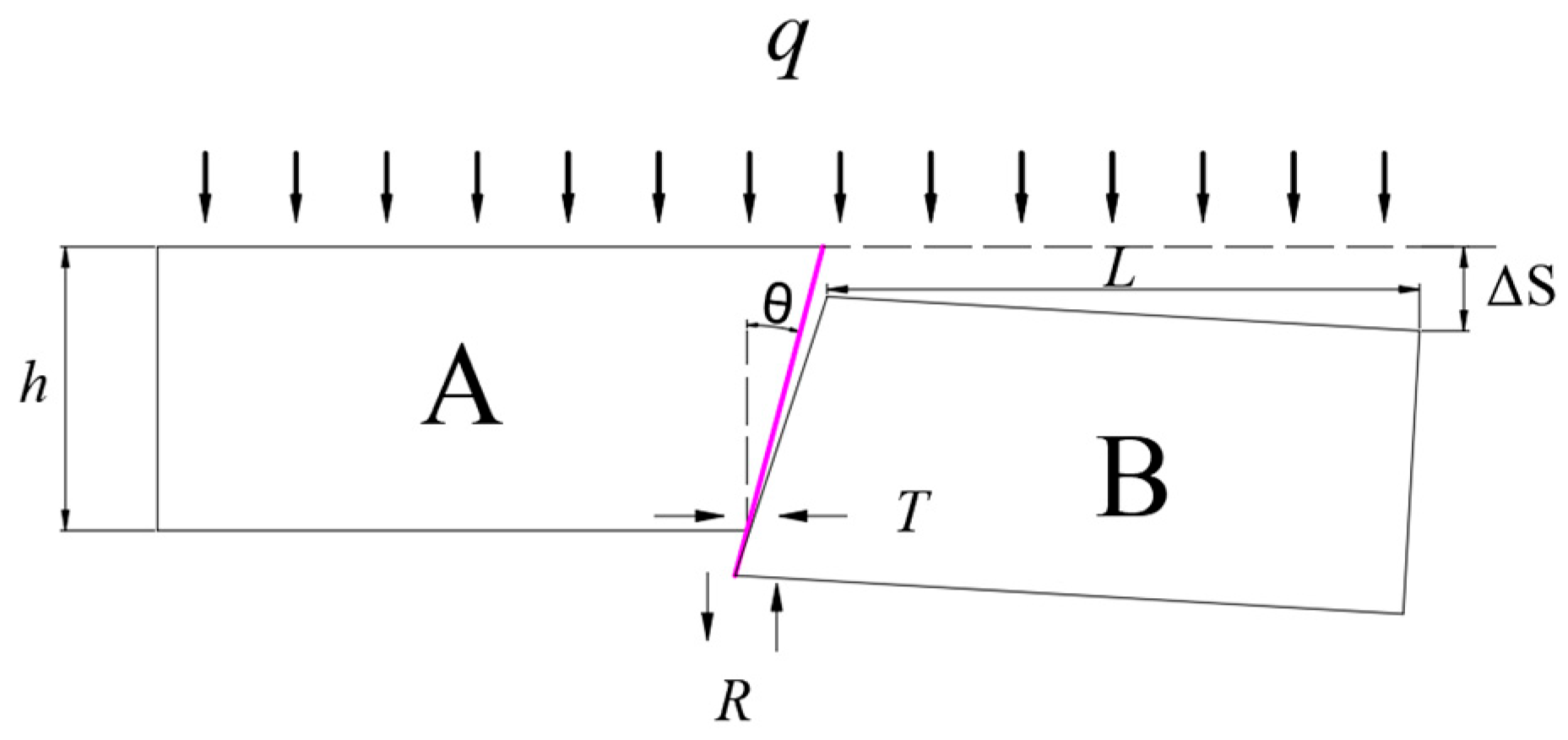
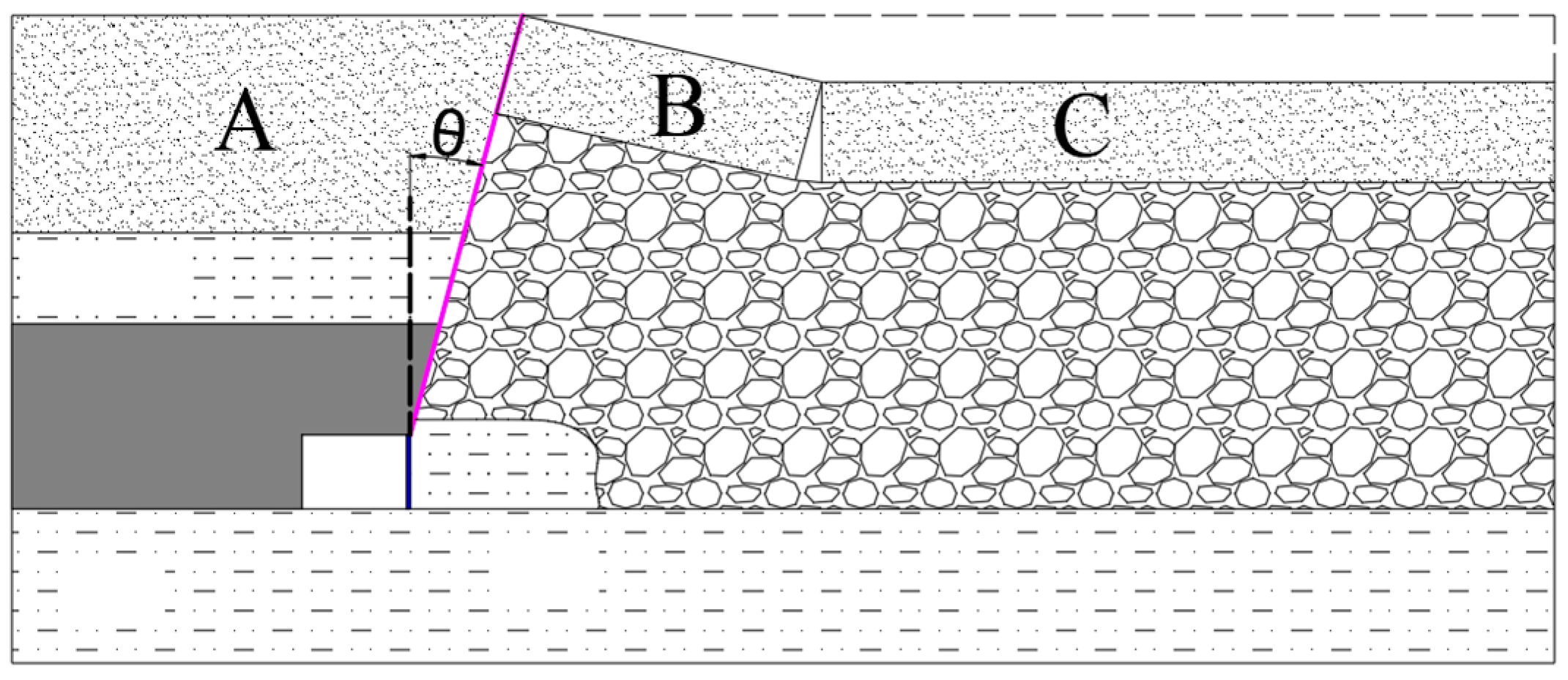
The roof-cutting angle is defined as the angle between the presplitting plane and the vertical direction, as shown in Figure 5. Given the low inherent strength of the immediate roof and its further degradation due to mining-induced damage, the roof-cutting angle has only a minor influence on the caving behavior of the immediate roof strata. However, when the roof-cutting height encompasses the main roof strata, an inappropriate roof-cutting angle may hinder the smooth caving of the goaf roof. The rock blocks outside the presplitting plane will remain in contact with the lateral roof, exerting pressure on it. This situation leads to insufficient pressure relief, which severely affects the stability of the surrounding rock and the quality of roadway formation in the gob-side entry retaining.
According to extensive previous research, as the working face advances continuously, the main roof fractures into rock blocks upon reaching its ultimate span. Due to horizontal compressive forces, these fractured blocks interlock to form a stable voussoir beam structure. When the main roof at the end breaks into an arc-shaped triangular block, it similarly forms a three-hinged arch equilibrium structure. At this stage, even though the main roof has fractured, the mutual constraint among the voussoir beams forms a stable articulated structure that continues to transfer loads to the lateral coal-rock mass, thereby influencing the stability of the gob-side entry. In roof-cutting pressure relief for gob-side entry retaining, the cutting plane acts as the articulation interface between key blocks A and B. Only when key block B undergoes sliding instability along this plane can the main roof strata cave smoothly, thereby effectively interrupting the stress transfer path.
According to the voussoir beam theory and the S-R stability principle of surrounding rock structures, when the fracture plane of the main roof stratum is considered to form a specific angle θ with the vertical plane, the force relationship at the point of rock block occlusion is illustrated in Figure 6. The condition for the sliding instability of the rock block in this scenario is as follows:
( T cos θ R sin θ ) tan φ R cos θ + T sin θ
Simplify the above equation:
T sin ( φ θ ) R cos ( φ θ ) R T tan ( φ θ ) θ φ arctan R T
among which:
T = q L 2 2 ( h Δ s )
R = q L
In the formula, T represents the horizontal thrust acting on the rock block (in kN), R denotes the shear force acting on the rock block (in kN), q indicates the load intensity of the main roof (in kN/m), L signifies the length of the main roof rock block B (in m), h refers to the thickness of the main roof (in m), Δs represents the subsidence of rock block B (in m), φ is the friction angle between rock blocks (in degrees), and θ denotes the roof-cutting angle (in degrees).
By substituting Equation (7) and Equation (8) into Equation (6), respectively, we obtain:
θ φ arctan 2 ( h Δ s ) L
As expressed in Equation (9), the stability of the voussoir beam (three-hinged arch) structure is governed by multiple parameters: main roof thickness, fractured block length, roof-cutting angle, and the internal friction angle of the rock strata. When the roof-cutting angle (θ) equals the friction angle (φ), the block structure becomes susceptible to sliding instability, irrespective of the magnitude of the horizontal thrust (T). Consequently, when θ equals φ, the three-hinged arch rock block structure fails to achieve equilibrium, allowing the main roof rock block to smoothly slide along the cutting surface, thereby forming the roadway side. This process disrupts the force transmission path from the lateral block to the retained roadway roof, resulting in full pressure relief and favorable roadway formation outcomes. However, an increase in the roof-cutting angle indirectly leads to a longer lateral cantilever length of the roof, which poses challenges for the maintenance of the gob-side entry retaining. Therefore, while facilitating the smooth collapse of the main roof rock block, it is imperative to minimize the roof-cutting angle as much as possible.
In summary, the roof-cutting angle should take the minimum value that satisfies Equation (9), namely:
θ = φ arctan 2 ( h Δ s ) L
Based on the on-site geological conditions, substituting φ = 32°, L = 15.3 m, Δs = 2.13 m, and h = 5.20 m in Equation (10) yields a cutting angle of approximately 10° [29].

3.2. Numerical Simulation Analysis

To further determine the optimal roof-cutting height and angle, numerical simulations were conducted based on the aforementioned theoretical analysis results. These simulations aimed to analyze the vertical stress and surrounding rock deformation of gob-side entry retaining with roof cutting and pressure relief under varying roof-cutting heights and angles. The control variable method was employed during the simulation process. For instance, while examining the influence of roof-cutting height on the surrounding rock structure and stress, other variables (such as roof-cutting angle and intensity) were held constant. Similar approaches were applied to other roof-cutting parameters. By integrating the results from both the numerical simulations and theoretical analysis, the optimal roof-cutting height and angle were ultimately established.

3.2.1. Numerical Model Establishment

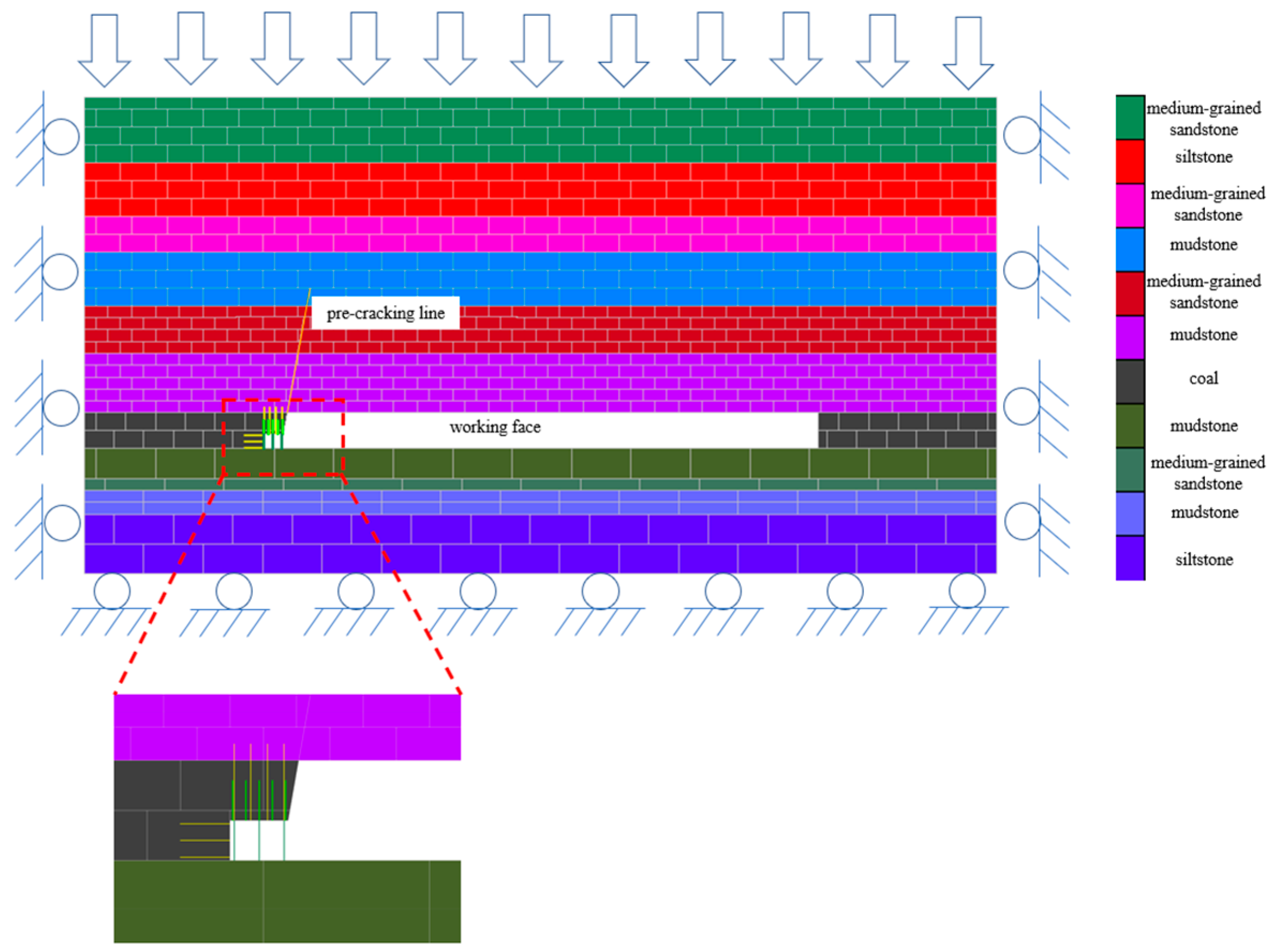
Based on the geological conditions of the 4# coal pillar working face in JuShan Coal Mine, a numerical simulation model measuring 150 m in length and 80 m in height was established using UDEC7.0 software. The model was stratigraphically divided in accordance with actual geological conditions. The lower boundary and both lateral boundaries were designated as displacement boundary conditions, while the upper boundary was assigned as a stress boundary condition equivalent to the load from the overlying strata. The effects of roof-cutting height and angle were simulated by adjusting the parameters of the cutting line. The numerical model is illustrated in Figure 7 below.
The simulation process consists of the following steps: ① Establish a geometric model based on the research object and perform meshing; ② Assign physical and mechanical parameters to each rock stratum and joint, followed by calculating to obtain the initial stress field; ③ Excavate the roadway, followed by implementing roadway support and roof cutting treatment; ④ Gradually excavate the working face until computational equilibrium is achieved, after which the calculation results are outputted and post-processing is performed.
Since the tensile strength of geomaterials is significantly lower than their compressive strength, a Mohr–Coulomb elastoplastic constitutive model incorporating tension cutoff was adopted for the deformable blocks in this simulation. To realistically represent discontinuities in actual rock masses, a joint constitutive model was implemented. UDEC provides several joint models, among which the joint contact–Coulomb slip model offers a linear representation of joint stiffness and yield limits, explicitly accounting for mechanical properties such as joint elastic stiffness, friction, cohesion, tensile strength, and dilation. This model provides a clear framework for analyzing stress–deformation response and is widely used in underground excavation analyses. Therefore, the joint contact–Coulomb slip model was selected for the present simulation.
Rockbolts and cables were simulated using the built-in rockbolt and cable structural elements in UDEC software, while the roadway support was modeled with the support structural element. Roof cutting was simulated by adjusting the mechanical parameters of the joints.
The determination of mechanical parameters in the simulation utilized the displacement back analysis method. By iteratively adjusting the parameters in the simulation, the numerical results of surrounding rock deformation were ultimately aligned with the field-measured deformation. The calculated physical and mechanical parameters of the coal-rock mass and support structure are presented in Table 1, Table 2, Table 3 and Table 4 below.

3.2.2. Analysis of Roof-Cutting Height Effect

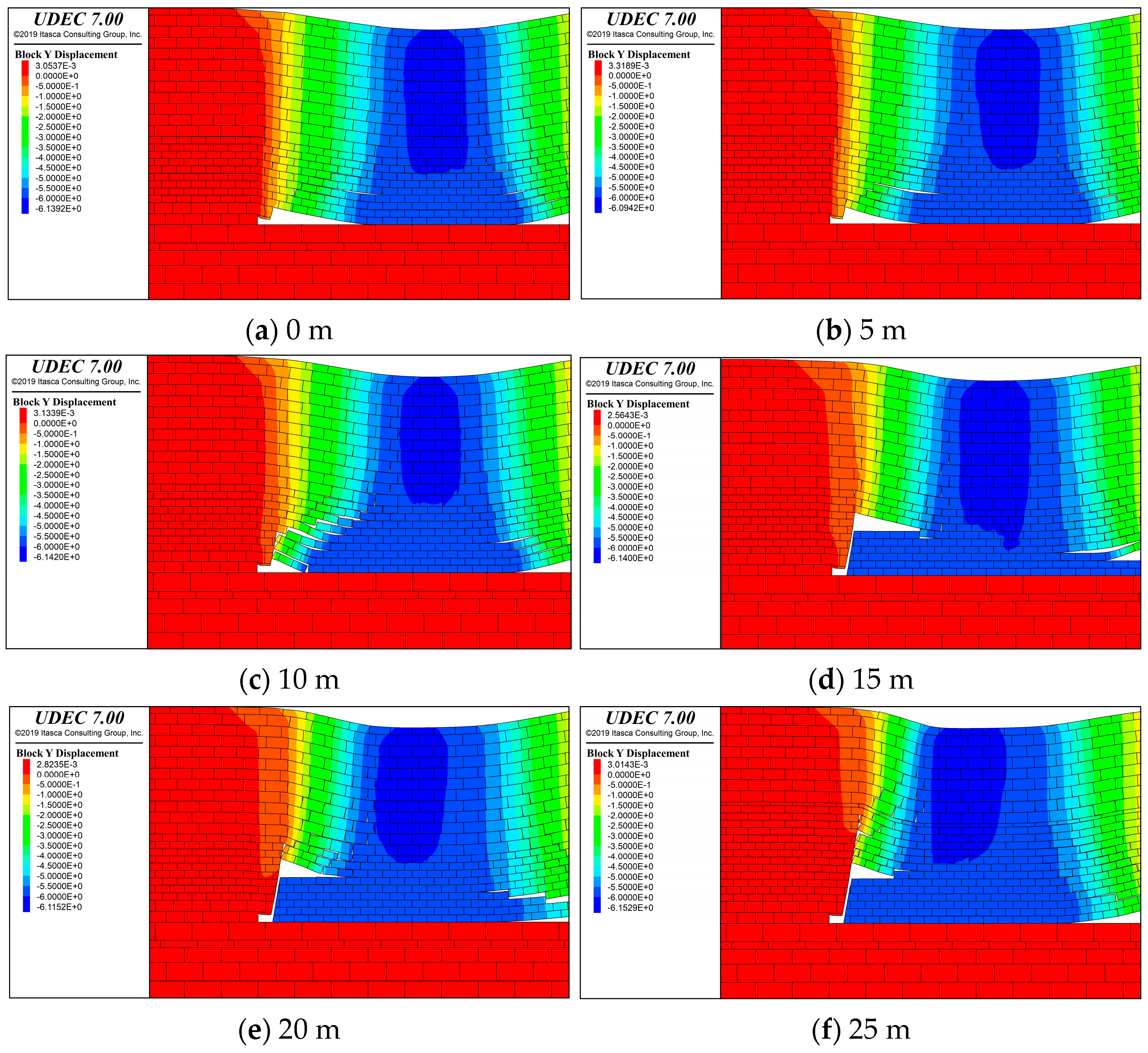
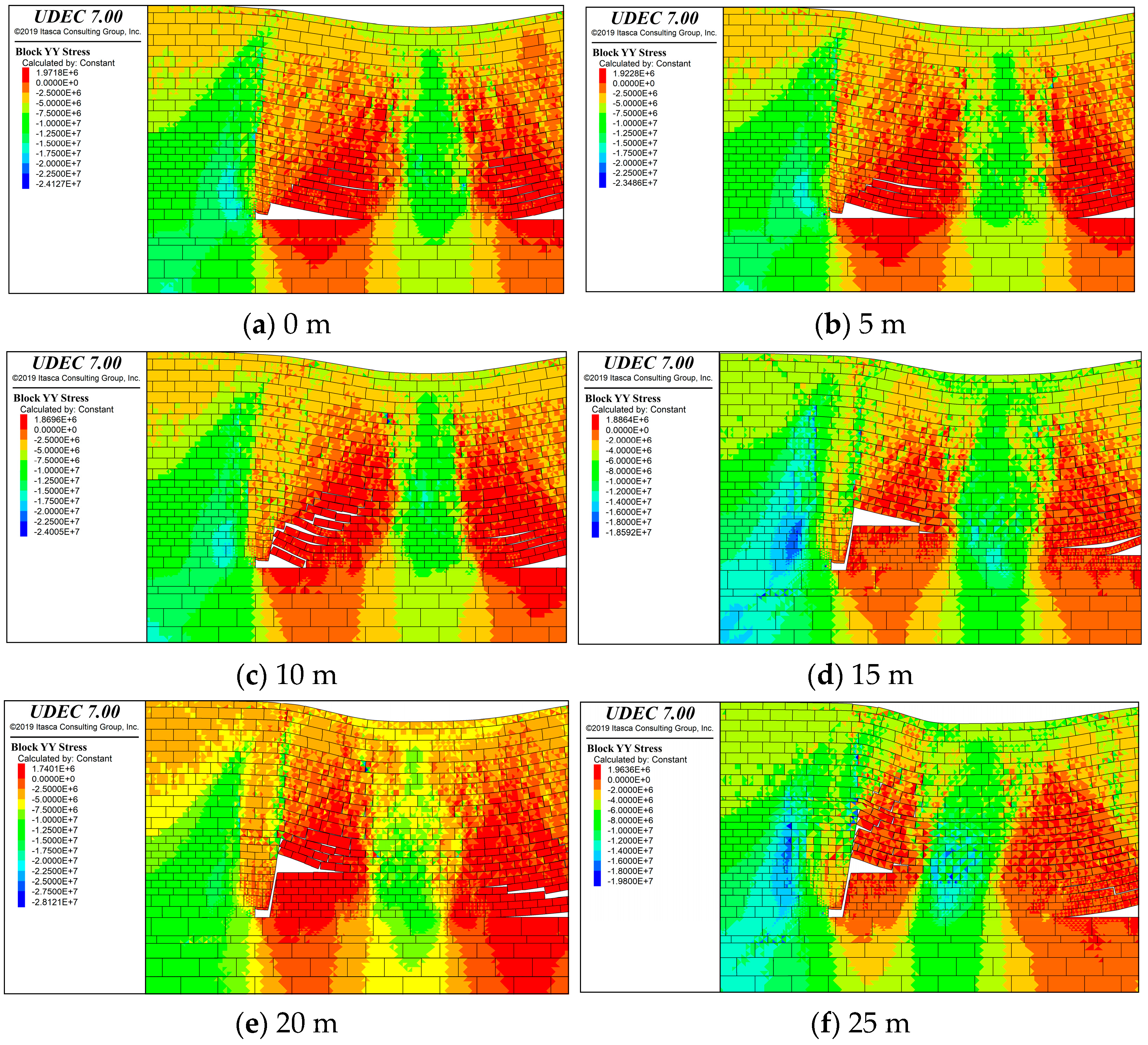
In the simulation analysis of roof-cutting height, other parameters remain unchanged, maintaining the same support form and a consistent roof-cutting angle of 10° inclined toward the goaf. The roof-cutting intensity is identical, ensuring that the interface parameters between the roadway roof and the goaf roof are preserved. Based on the theoretical analysis results regarding roof-cutting height, the simulation employs roof-cutting heights of 0 m (no cutting), 10 m, 15 m, 20 m, and 25 m, respectively. The vertical displacement of the surrounding rock and the distribution of vertical stress fields under varying roof-cutting heights are analyzed to provide a basis for determining the optimal roof-cutting height.
(1) Analysis of the Influence of Roof Cutting Height on Surrounding Rock Deformation
As shown in Figure 8a–f, with the gradual increase in roof-cutting height, the roadway roof displacement decreases correspondingly, while the caving pattern of the overlying strata in the goaf evolves progressively. When no roof cutting is applied (cutting height = 0 m), the overlying strata remain continuous. After face excavation, these strata undergo integrated bending and caving, resulting in substantial roof subsidence and forming a large lateral unsupported roof span above the goaf. At roof-cutting heights of 5 m and 10 m, the pre-split fractures reduce roadway roof subsidence, and the lateral unsupported roof span in the goaf progressively diminishes. However, due to the limited roof-cutting height, the main overlying roof is not entirely severed, which hinders the complete collapse of the overlying strata and poses risks to roadway stability. At a roof-cutting height of 15 m, the goaf roof can effectively collapse along the cutting plane, forming a stable support structure adjacent to the roadway that efficiently bears the weight of the overlying strata. This approach reduces the deformation of surrounding rocks and alleviates stress concentration in coal pillars, thereby enhancing the control of roadway surrounding rock deformation. However, a significant unfilled space persists above the collapsed strata at this height, suggesting that the roof-cutting height remains inadequate. Increasing the roof-cutting height to 20 m leads to a more complete collapse of the overlying strata and further diminishes the extent of the unfilled space. When the roof-cutting height is raised to 25 m, although the collapse range of the overlying strata increases, the extent of unfilled space remains nearly unchanged. This indicates that further increases in roof-cutting height at this stage have minimal effects on the control of roadway surrounding rock, while excessively high roof-cutting heights may conversely introduce construction challenges.
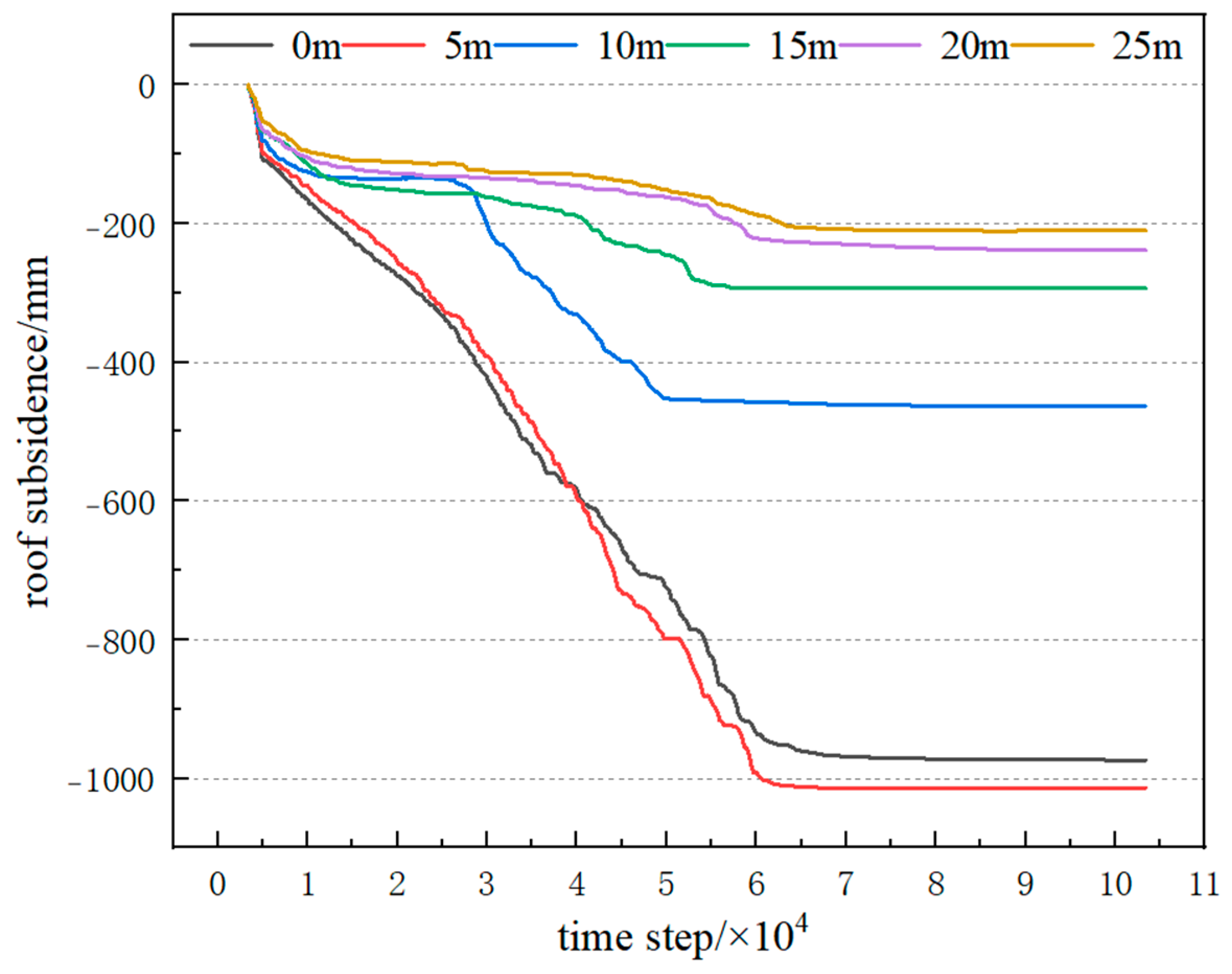
To better compare the influence of different roof-cutting heights on roadway surrounding rock deformation, monitoring points were placed on the roadway roof in the model to record subsidence during the simulation. The results of this monitoring are presented in Figure 9 below.
As illustrated in Figure 9, the roof subsidence measures approximately 974 mm when no cutting is performed (i.e., at a cutting height of 0 m). When the cutting height is increased to 5 m, the roof subsidence rises slightly to 1013 mm compared to the no-cutting scenario. At a cutting height of 10 m, the roof subsidence decreases to 463 mm, reflecting a 52.5% reduction relative to the no-cutting condition. With a cutting height of 15 m, the subsidence further decreases to 294 mm, indicating a 69.8% reduction. At a cutting height of 20 m, the subsidence is recorded at 238 mm, demonstrating a 75.6% decrease. Finally, when the cutting height reaches 25 m, the roof subsidence drops to 210 mm, achieving a 78.4% reduction compared to the no-cutting scenario. As shown in Figure 8, with increasing roof cutting height, the roof above the goaf collapses more completely. This interrupts the stress transfer process through the roof and forms a supporting structure alongside the roadway to maintain its stability, thereby progressively reducing the subsidence of the roadway roof. However, at a roof cutting height of 5 m, the roof integrity remains partially intact. At this height, the roof above the goaf does not exhibit the full collapse and subsidence seen at 10 m or greater. Instead, it functions as a load-bearing structure for the overlying strata. Simultaneously, compared to a roof cutting height of 0 m, its load-bearing capacity is reduced, leading to increased roof subsidence. That is why the 5 m increases, but the rest decreases. This trend suggests that as the cutting height continues to increase, the rate of decline in roof subsidence becomes progressively slower. Further increasing the cutting height demonstrates an insignificant effect on controlling the roof subsidence of the roadway. The slope of the curve indicates that before the roof subsidence stabilizes, its rate exhibits a continuously decreasing trend as the cutting height transitions from non-cutting to cutting. Specifically, a greater cutting height results in a slower rate of roof subsidence. From an engineering perspective, the difference in roof subsidence between a cutting height of 20 m (238 mm) and 25 m (210 mm) is negligible. Additionally, increasing the cutting height incurs further construction work. Therefore, considering on-site construction conditions, a cutting height of 20 m is the more suitable choice.
(2) Analysis of the Influence of Roof Cutting Height on Surrounding Rock Stress
As shown in Figure 10a–f, when the roof-cutting height is insufficient (e.g., 0 m and 5 m), the roof above the roadway remains largely continuous, failing to fully interrupt the stress transfer path. Under these conditions, the roadway is subjected to additional stresses induced by the rotation and subsidence of the overlying strata. At a roof-cutting height of 10 m, the key strata are not completely severed, resulting in incomplete caving. Consequently, the stress transfer path remains partially connected, and the surrounding rock is affected by both the additional stresses from overlying strata movement and the frictional resistance of the inadequately caved rock layers. When the cutting height is increased to 15 m, 20 m, and 25 m, the key strata in the goaf can collapse effectively along the cutting plane, thereby fully severing the stress transfer path. This leads to the formation of a stable support structure next to the roadway, which effectively bears the short cantilever beam created by roof cutting. As a result, deformation and stress concentration in the surrounding rock are reduced, enabling better control of roadway convergence.
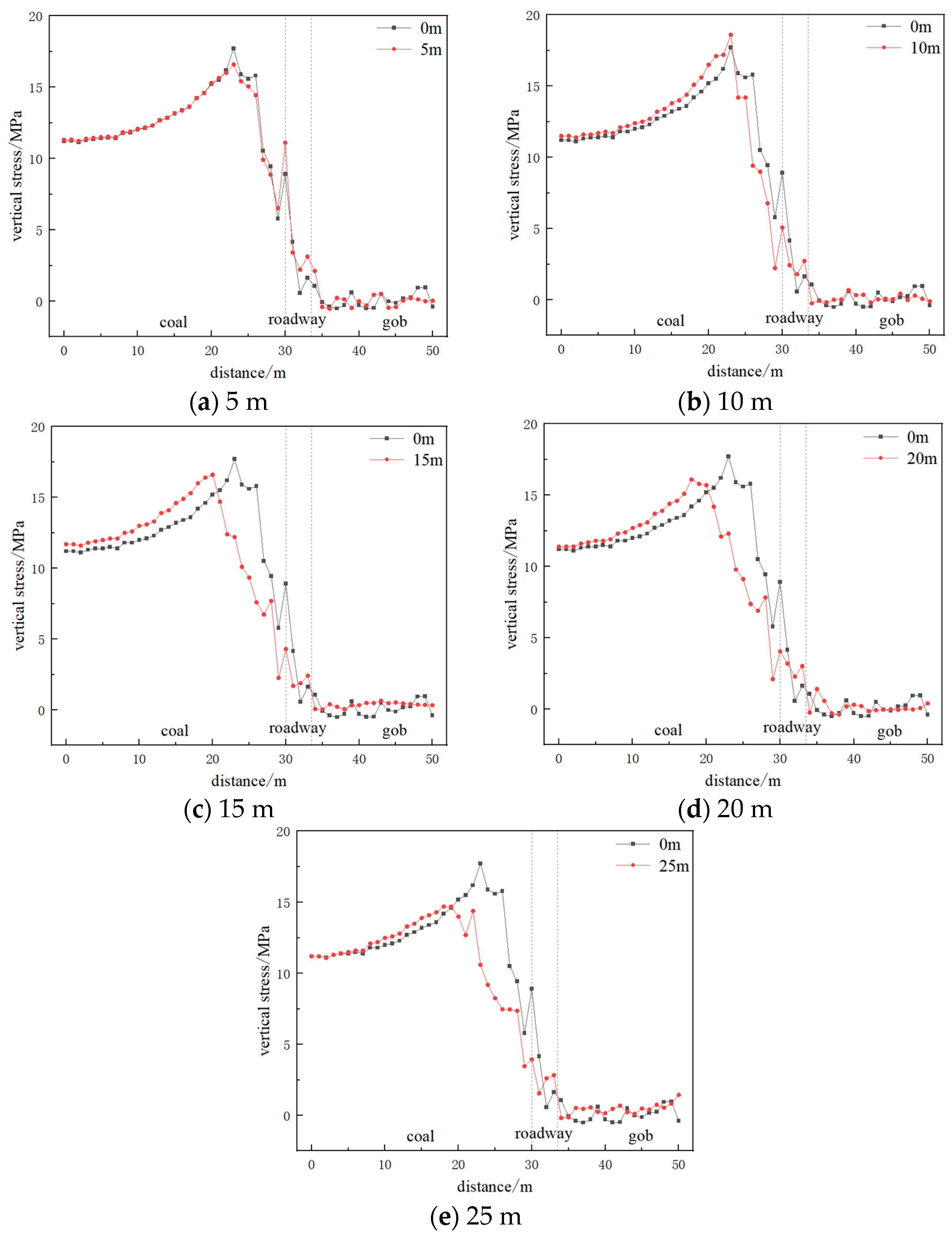
As shown in Figure 11a–e, the stress distribution curves remain nearly identical as the roof-cutting height increases from 0 m to 5 m. However, at a cutting height of 10 m, the peak stress on the solid coal side slightly increases compared to the uncut case, while the vertical stress in the roadway roof decreases. As the cutting height is further raised from 15 m to 25 m, the peak stress on the solid coal side declines progressively from 16.5 MPa to 16.0 MPa and finally to 14.7 MPa, demonstrating a clear reduction trend. The position of the peak stress point shifts leftward from 22 m to 20 m, while the vertical stress in the roadway roof remains largely unchanged. Overall, when the roof-cutting height is insufficient (e.g., 5 m and 10 m), the stress distribution pattern of the overlying strata shows little variation compared to the non-roof-cutting scenario, and the pressure relief effect is not evident. In contrast, when the cutting heights are 15 m and 20 m, the stress in the overlying strata decreases significantly, and the cutting effectively mitigates the lateral abutment pressure caused by roof subsidence in the goaf. Beyond this point, further increases in cutting height yield minimal changes in the stress of the overlying strata. Therefore, based on the roof stress distribution under different cutting heights, a cutting height of 20 m is recommended.

3.2.3. Analysis of Roof-Cutting Angle Effect

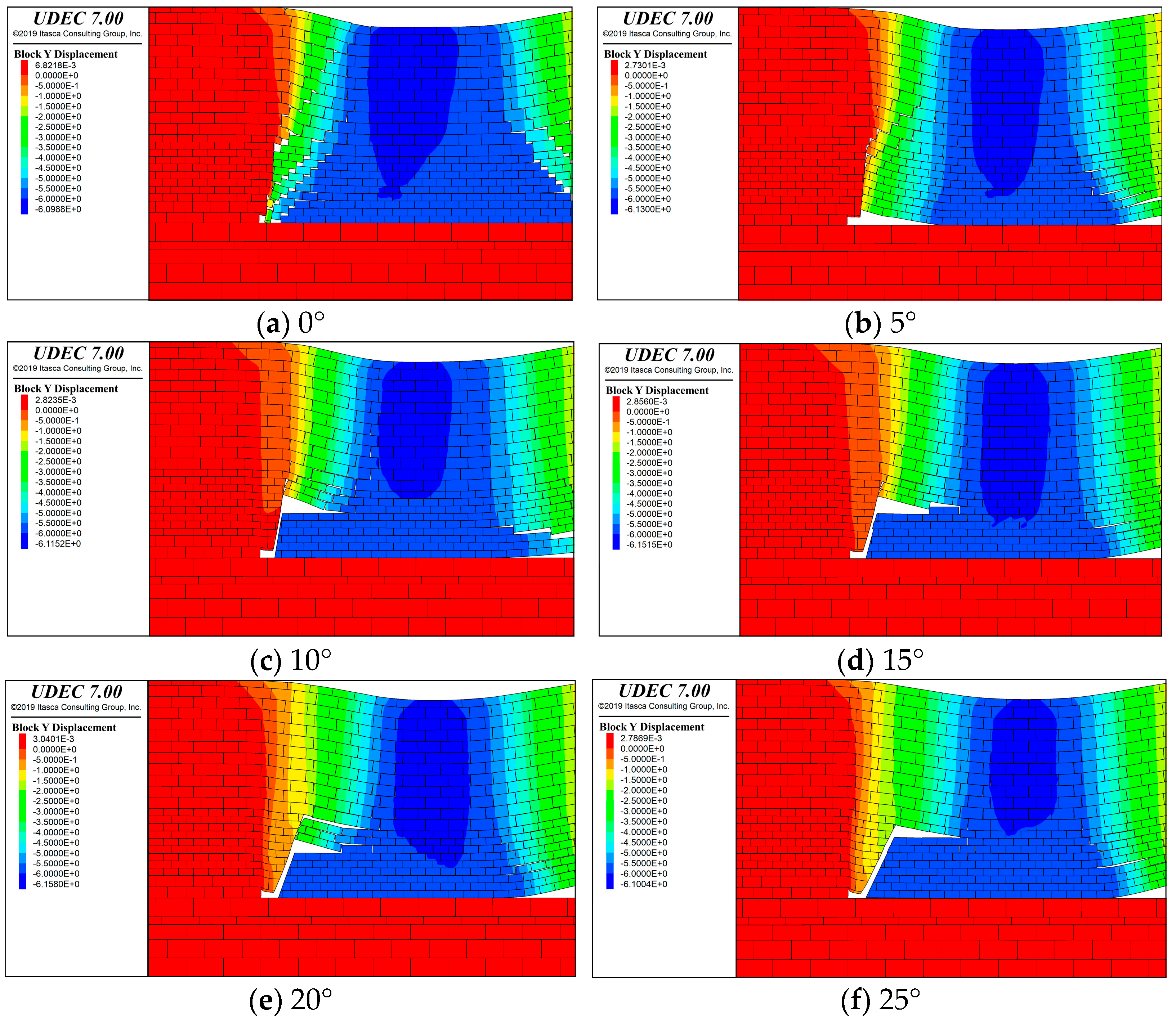
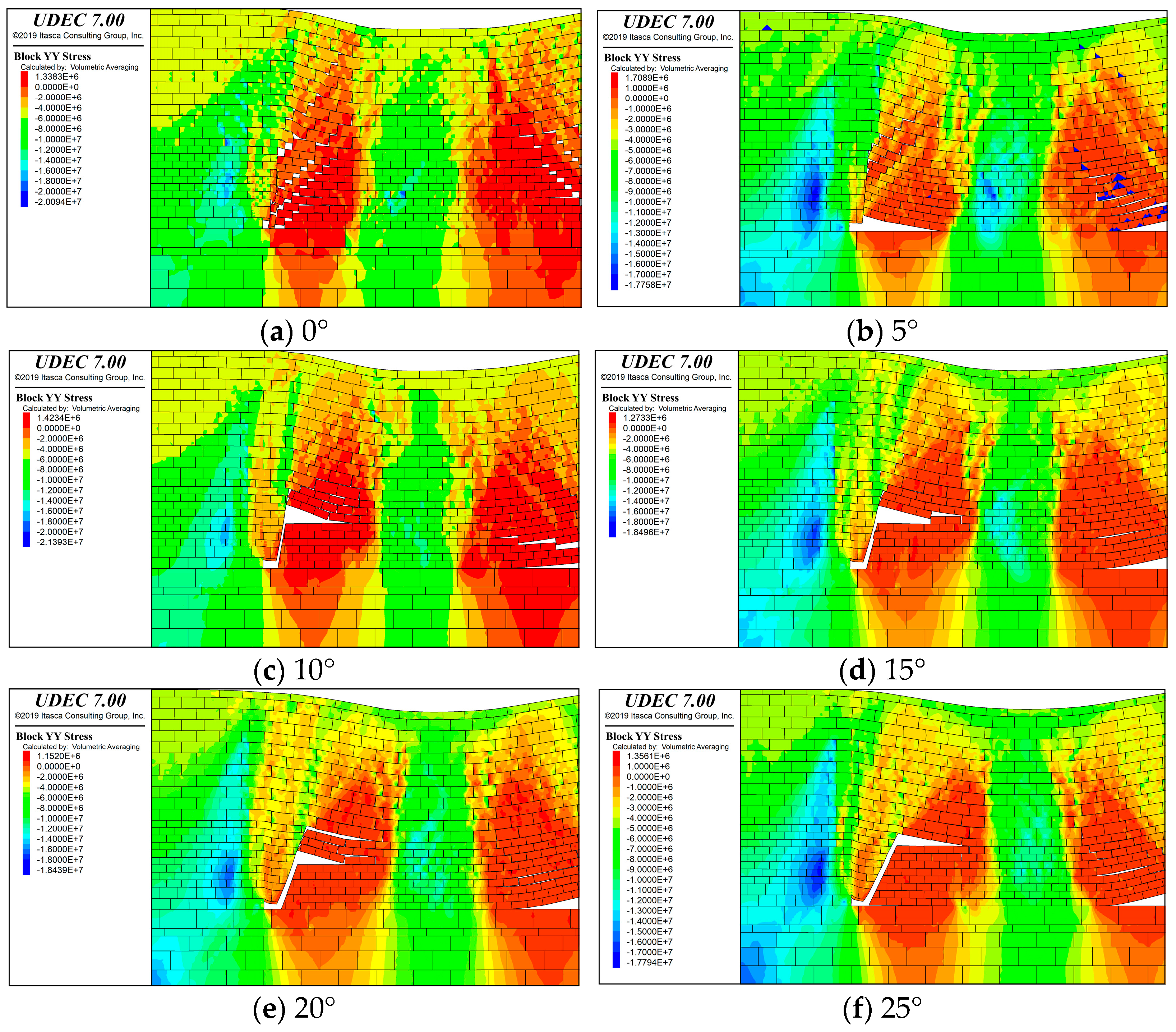
To reduce the influence of goaf roof caving on the roadway roof and to improve the load-bearing support provided by the caved debris to the short cantilever beam formed by roof cutting, the cutting plane is typically inclined toward the goaf side at a specific angle. Based on theoretical analyses of roof-cutting angles, simulations were performed for five different cutting angles: 0°, 5°, 10°, 15°, 20°, and 25°. The results of these simulations are presented in the figure.
(1) The influence of roof-cutting angle on surrounding rock deformation
As shown in Figure 12a–f, when the roof-cutting angle is 0° (i.e., the cutting plane is perpendicular to the roadway roof), the caving of the goaf roof induces shear-slip failure in the roadway roof, leading to pronounced roadway deformation. Concurrently, once the goaf roof strata stabilize post-collapse, the fallen gangue provides only vertical support to the goaf roof strata, failing to offer inclined support to the short cantilever beam structure of the roadway roof. This lack of support diminishes the stability of the retained roadway to some extent. Conversely, at a roof-cutting angle of 5°, the combined effects of frictional resistance along the cutting surface and the horizontal articulation of roof rock blocks prevent the goaf roof from fully contacting the floor. This condition leads to increased lateral support pressure on the roadway, which is detrimental to roadway stability. When the roof-cutting angle is set at 10°, the pre-splitting cut effectively severs the connection between the goaf roof and the roadway roof after the working face is mined. The strata of the goaf roof collapse promptly, forming a short cantilever beam structure above the roadway. Given that the roof-cutting angle is inclined toward the goaf side, the collapsed gangue in the goaf exerts a certain oblique supporting effect on the short cantilever beam structure above the roadway. This mechanism effectively reduces the lateral support resistance of the roadway while enhancing its stability. As the roof-cutting angles increase to 15°, 20°, and 25°, the angle becomes increasingly conducive to the collapse and subsidence of the overlying strata in the goaf. However, this also results in an increased length of the short cantilever beam above the retained roadway. Under the combined effects of mining-induced disturbances and lateral abutment pressure, the deformation of the roadway roof intensifies, which is detrimental to both coal pillar support and roadway stability.
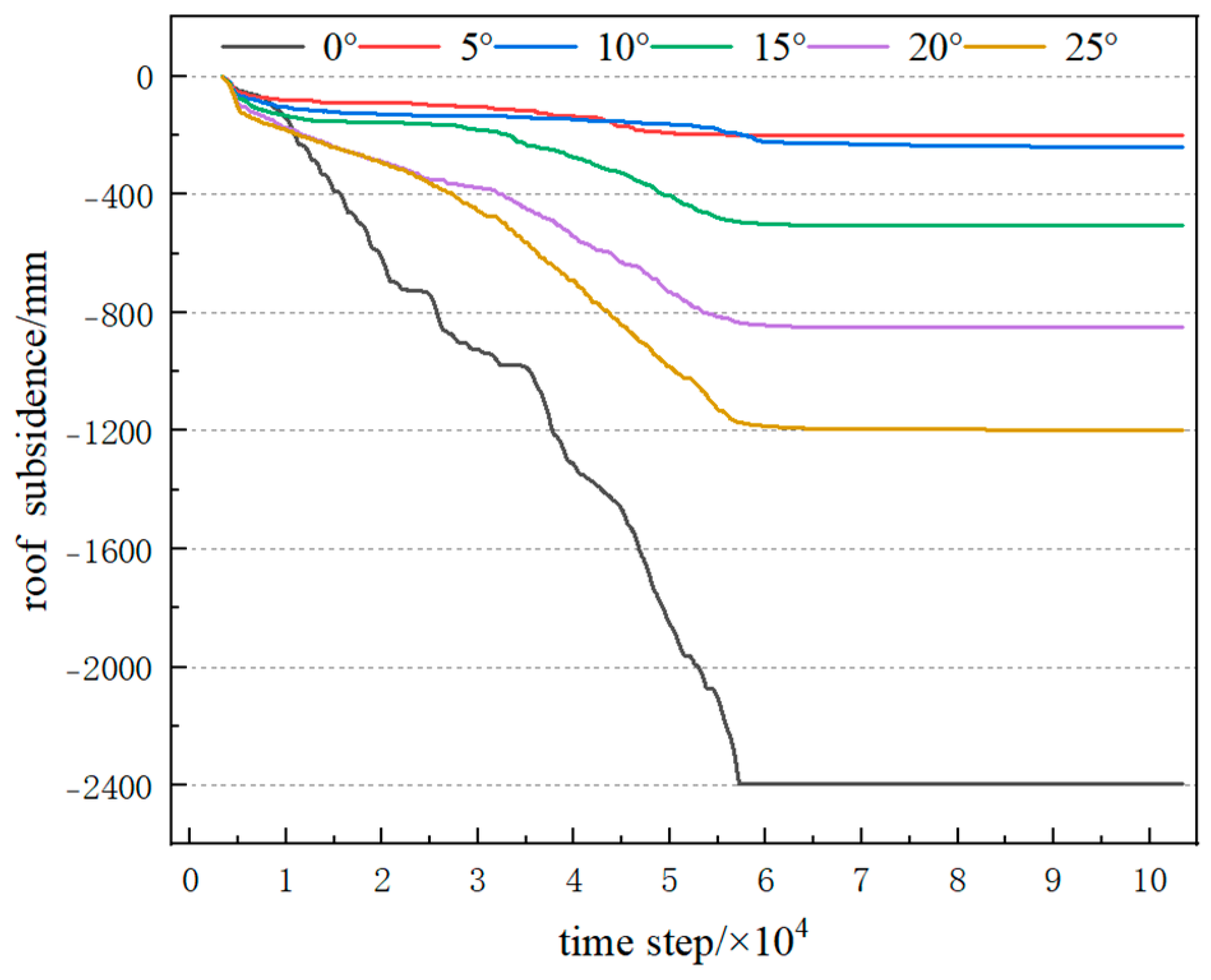
To facilitate a more intuitive comparison of the influence of varying roof-cutting angles on the deformation of surrounding rock in roadways, monitoring points were strategically positioned on the roadway roof to record subsidence throughout the model calculation process. The results of this monitoring are presented in Figure 13 below.
As shown in Figure 13, maximum roof subsidence reaches 2400 mm at a roof-cutting angle of 0°. The displacement contour plot indicates that under this geometry, the roof caves and contacts the floor, resulting in severe roadway closure. When the roof-cutting angle is increased to 5°, roof subsidence decreases significantly to 199 mm relative to the 0° case. However, the displacement cloud diagram shows that the goaf roof does not completely collapse, which compromises roadway stability. At a roof-cutting angle of 10°, roof subsidence slightly increases to 238 mm relative to the 5° condition. The displacement cloud diagram further illustrates that the goaf roof collapses entirely and makes contact with the floor, creating a roadside support structure that ensures high roadway stability. As the roof-cutting angle increased from 15° and 20° to 25°, the corresponding roof subsidence escalated from 505 mm and 851 mm to 1199 mm. This trend indicates that further increasing the roof-cutting angle adversely affects roadway roof control. Combined with displacement cloud diagrams, it can be observed that as the roof-cutting angle increases, the length of the cantilever beam in the lateral roof of the roadway gradually extends, leading to increased pressure on the roadway roof and, consequently, greater roof subsidence. From an engineering practice perspective, when the roof-cutting angle was set at 5°, the roof subsidence measured 199 mm, while at 10°, it was 238 mm. The difference between these two values is not significant, as both meet the requirements for roadway retention. However, from the standpoint of surrounding rock stability, a roof-cutting angle of 10° is more reasonable. Based on the geological conditions of this mine, a cutting angle of 10° is selected to minimize roof subsidence.
(2) The influence of roof-cutting angle on surrounding rock stress
As shown in Figure 14a–f, progressive increases in the roof-cutting angle lead to pronounced differences in stress transfer across the cutting plane and in the stress state of the resulting short cantilever beam. At relatively small roof-cutting angles (0°, 5°, and 10°), the cantilever beam formed is short, and the load imposed on it by the overlying strata remains limited. Consequently, this results in negligible rotation and subsidence of the cantilever beam. However, for roof-cutting angles that are too small, such as 0° and 5°, the substantial frictional resistance between the cutting seams hinders the complete collapse of the goaf roof, preventing it from reaching the floor. This situation subjects the roadway roof to the pulling force generated by the subsidence of the goaf roof. In contrast, when the roof-cutting angle is increased to 10°, the connection between the goaf roof and the roadway roof is effectively severed, thereby obstructing the stress transfer between the two structures.
As the roof-cutting angles increase to 15°, 20°, and 25°, the caving effect of the goaf roof strata becomes increasingly pronounced. However, with the enlargement of the roof-cutting angle, the length of the short cantilever beam formed by the roof cutting progressively extends. This extension results in heightened pressure from the overlying strata on the short cantilever beam, consequently leading to a significant intensification of the rotational subsidence of the cantilever beam.
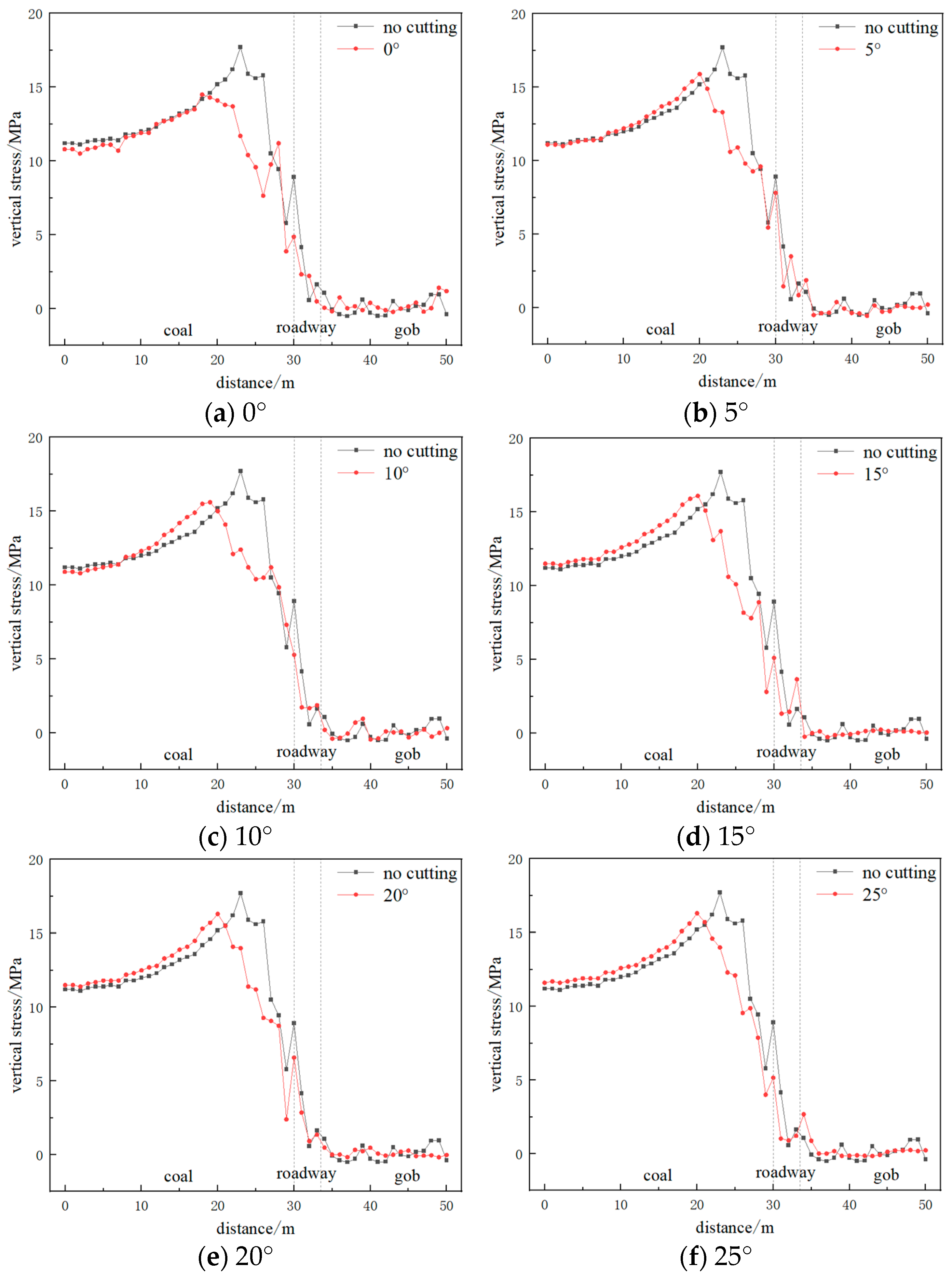
As shown in Figure 15a–f, when the goaf-side roof is not cut, the coal pillar side is subjected to a high-stress concentration due to the overhanging roof structure, with a vertical stress peak of 17.7 MPa. Under vertical roof cutting (cutting angle = 0°), the vertical stress peak on the solid coal side is 14.5 MPa, representing a reduction of 3.2 MPa compared to the uncut case. This demonstrates that cutting the goaf-side roof substantially alleviates the load transferred to the solid coal side. At a cutting angle of 5°, the vertical stress peaks on both the solid coal side and the coal pillar side reach 15.9 MPa, an increase of 1.4 MPa relative to the 0° cutting scheme. When the cutting angle is raised to 10°, the stress peak on the solid coal rib decreases to 15.6 MPa, which is 0.3 MPa lower than that under the 5° scheme.
As the cutting angle is further increased to 15°, 20°, and 25°, the lengthening roof cantilever leads to a progressive rise in the load carried by both roadway ribs. The corresponding vertical stress peaks on the solid coal rib are 16.1 MPa, 16.3 MPa, and 16.3 MPa, reflecting increases of 0.5 MPa, 0.7 MPa, and 0.7 MPa, respectively, compared to the 10° scheme.
The analysis reveals that the roof-cutting angle significantly affects the vertical stress distribution along the roadway ribs by influencing both the sliding behavior of the caved rock in the goaf and its subsequent packing effect. When the roof-cutting angle is less than 10°, the frictional resistance along the cutting plane exceeds the driving force for sliding, preventing the goaf roof from caving smoothly along the presplit line. This results in heightened stress concentration on the roadway ribs. At a roof-cutting angle of 10°, the fractured rock mass collapses effectively along the presplit plane, filling the goaf more completely. This weakens inter-layer stress transfer and alleviates stress concentration on both the solid coal rib and the coal pillar. However, when the roof-cutting angle exceeds 10°, the increased angle extends the lateral cantilever length of the roadway roof, raising the load borne by the coal pillar and thus undermining the desired stress relief in the surrounding rock.
In summary, to optimize the structural configuration and stress regime of the roadway surrounding rock, a roof-cutting height of 20 m combined with a roof-cutting angle of 10° is recommended.

4. Surrounding Rock Control Scheme and Effect Analysis

4.1. Principles and Schemes of Surrounding Rock Control

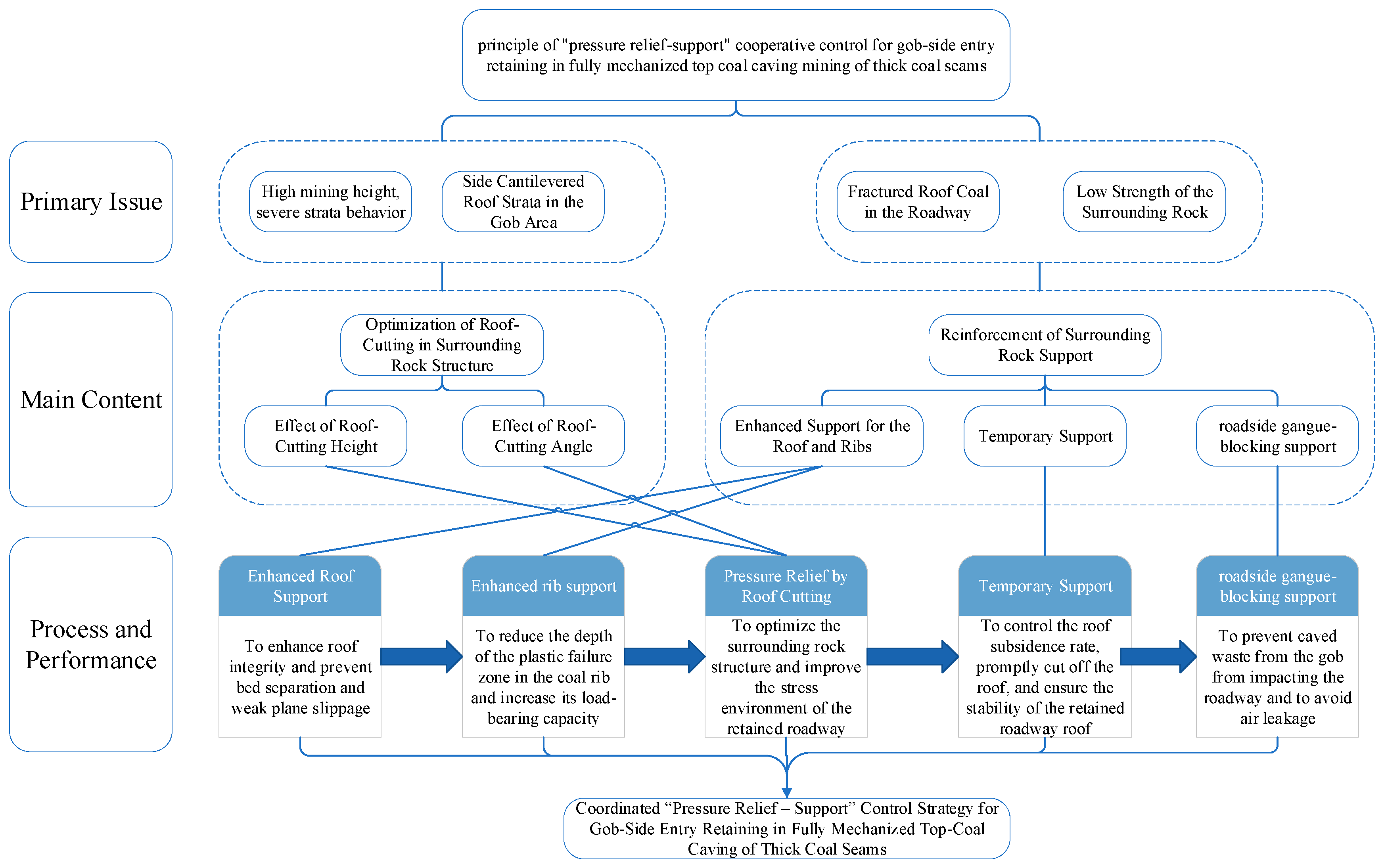
Under the conditions of gob-side entry retaining (GER) in fully mechanized top-coal caving (FMTC) of thick coal seams, the thick top coal is prone to roof separation, while its fragmented nature increases the difficulty of roof support. Meanwhile, the large mining height of the FMTC face provides greater space for roof movement, raising the load on key strata and imposing stricter requirements on ground control. Therefore, in GER within thick coal seams using FMTC, the primary factors governing roadway surrounding rock deformation are roof separation, fragmented coal deformation, and lateral roof structure. High-capacity roof support combined with internal reinforcement can effectively strengthen the roof and control separation and convergence rates. Presplitting and cutting the roof ahead of the working face can actively modify the lateral roof structure and improve the stress environment of the retained entry, thereby forming a coordinated “pressure-relief & support” control system. The working principle of this synergistic control approach for GER in thick-seam FMTC is illustrated in Figure 16.
(1) Optimization of Roof Cutting in Surrounding Rock Structure
During the mining process of gob-side entry retaining without roadside packing in fully mechanized top coal caving faces with thick coal seams, the large mining height significantly influences the roof of the goaf. The collapse and fracturing of the main roof develop gradually from lower to higher positions. However, the delayed collapse and fracturing of the main roof’s lateral structure on the goaf side not only impede timely goaf filling, thereby forming an unfavorable long cantilever beam structure that affects the surrounding rock stress of the retained entry, but also subject the entry to continuous deformation due to the rotational subsidence force from the high-level roof. This situation poses considerable challenges to the stability control of the entire roadway surrounding rock. The timely collapse and fracturing of the hard and high-level roof in the goaf are crucial for improving the stress environment of the retained entry, controlling surrounding rock deformation, and enhancing the success rate of entry retaining. Therefore, proactive optimization of roof cutting is necessary to improve the surrounding rock structure.
(2) Reinforcement of surrounding rock support
In the context of gob-side entry retaining through roof cutting and pressure relief in fully mechanized top-coal caving faces, the roadway configuration consists of top coal situated above, a coal body on one side, and collapsed gangue on the opposite side. Based on the technology of gob-side entry retaining via roof cutting and pressure relief, the primary support systems for the roadway can be categorized into three types: reinforced support for the roof and sides, temporary support within the roadway, and gangue-blocking support adjacent to the roadway.
The subsidence of the goaf roof and the lateral abutment pressure acting on the coal mass in the roadway ribs not only exacerbate the deformation and extrusion of the coal ribs, reducing the load-bearing capacity of the shallow coal mass, but also expand the plastic zone of the coal ribs, increase the failure depth of the coal ribs, and affect the stability and overall subsidence of the top coal in the fully mechanized top coal caving gob-side entry retaining. The resulting increase in plastic deformation raises the resistance that the temporary support must overcome, thereby challenging its stability. The roof of the retained entry, consisting of fractured coal, is susceptible to bed separation and weak-plane slippage, which can lead to support failure. Moreover, the support resistance inside the roadway is not fully transferred to the roof, making it difficult to establish effective roof support. Therefore, implementing appropriate reinforcement for both the coal rib and the roof of the retained roadway is essential. These measures enhance the load-bearing capacity of the rib, reduce roof subsidence, supply necessary roof support and shear resistance, lower the demand on temporary support, prevent bed separation and slippage along weak planes in the roof coal, and ensure overall support system stability.
The temporary support in the roadway should provide sufficient initial resistance and high stiffness during the early stages of gob-side entry retaining to prevent separation between the immediate roof, main roof, and coal roof during rotational deformation, while also reducing the rate of roof subsidence. Additionally, high-strength temporary support can facilitate roof cutting by promptly severing the coal roof and immediate roof on the goaf side. The temporary support structure for gob-side entry retaining must exhibit high compressibility to accommodate the significant deformations of surrounding rocks. Consequently, the roadway temporary support is required to demonstrate high strength, high stiffness, and high compressibility.
As the working face advances, the roof strata in the goaf gradually collapse; however, this caving process exhibits a time-dependent effect, demonstrating a dynamic evolution characterized by the stages of “caving → compaction → stabilization.” During the caving stage, the gangue exerts an impact force on the roadside gangue-blocking structure, while the compaction stage is primarily defined by lateral compression. In thin to medium-thick coal seams, I-beams are commonly employed as rib-supporting structures, and their supporting performance meets the requirements for gob-side entry retention. However, with an increase in mining height, the gangue in the goaf demonstrates unconventional impact and compression characteristics, resulting in significant rib spalling and substantial deformations within the crushed zone. Traditional gangue-blocking structures experience extensive bending failures, highlighting the need for roadside structures that possess both impact resistance and bending capacity.
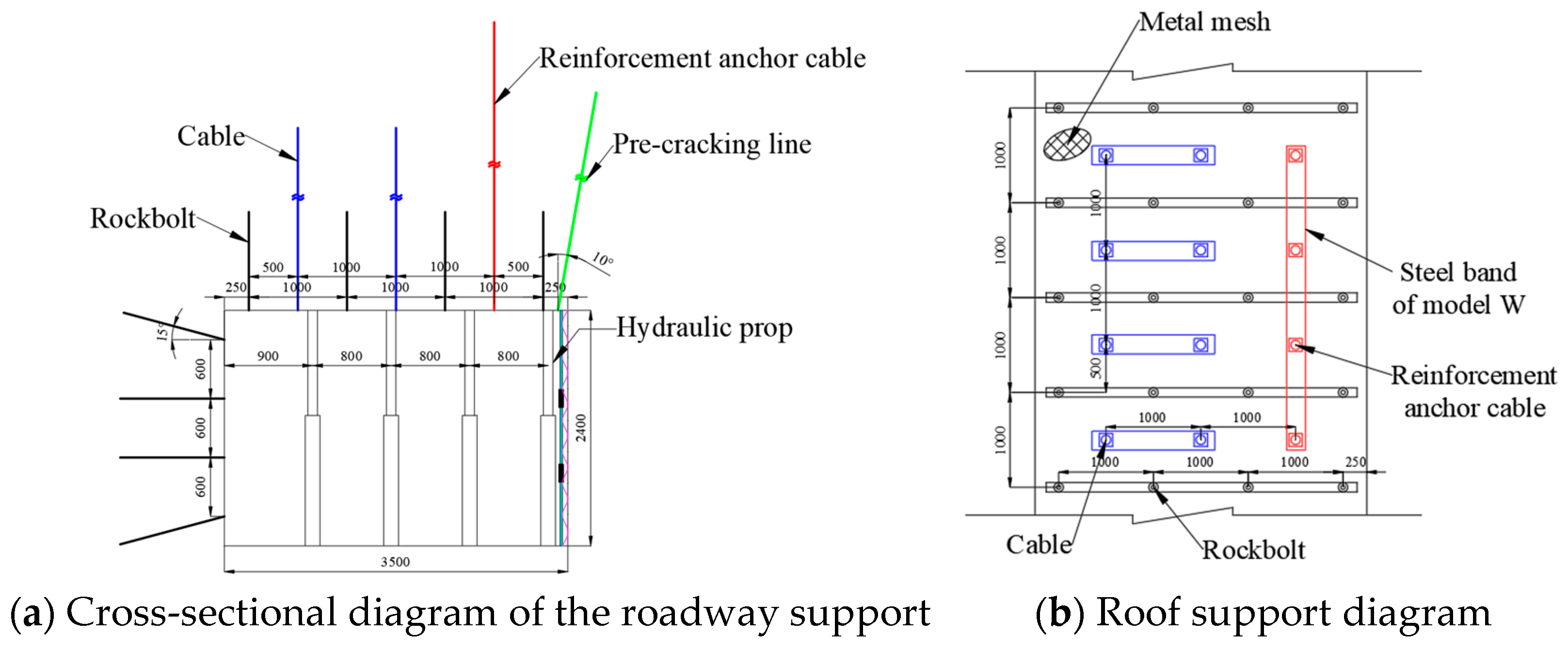
Based on the aforementioned principles, a specific support scheme for gob-side entry retaining in fully mechanized top coal caving mining of thick coal seams is proposed, as illustrated in Figure 17 below.
The roof support system utilizes anchor mesh cables and W steel straps to ensure the integrity of the roadway roof. The bolt dimensions are Φ22 mm × 2400 mm, with a spacing of 1000 mm × 1000 mm, and these bolts are oriented perpendicular to the roof. The cable spacing is also 1000 mm × 1000 mm. Conventional cables measuring Φ21.8 mm × 6300 mm are deployed near the coal side and along the roadway centerline. In contrast, constant-resistance large-deformation cables, measuring Φ21.8 mm × 10,000 mm, are utilized near the cutting side. These cables possess a constant resistance value of approximately 35 t and are complemented by W steel straps to enhance roof protection. The rib bolts are Φ18 mm × 2400 mm, spaced at 600 mm × 1000 mm. The bolts on the upper and lower sides are installed with an outward inclination of 15°, while the remaining bolts are positioned perpendicular to the roadway rib.
For temporary support in the lagging section of the working face, π-type beams and single hydraulic props are employed to create a support structure characterized by ‘one beam with three props’ along with single-point props. The spacing between the single props is set at 1000 mm, with an inter-prop spacing of 800 mm. Once the roadway stabilizes, only the single hydraulic props on the goaf side are retained.
On the side near the cut, metal mesh is utilized in conjunction with U-shaped steel and single hydraulic props to provide support for roadside gangue blocking. The spacing between the U-shaped steel and the single hydraulic props is uniformly set at 500 mm. In the event of severe leakage on-site, multiple layers of steel mesh or wire mesh can be installed to enhance the supporting effect of gangue blocking. Additionally, shotcreting reinforcement can be applied to prevent goaf gas from infiltrating the roadway.

4.2. Simulation Analysis of Surrounding Rock Control Scheme

To investigate the effectiveness of gob-side entry retention through roof cutting and pressure relief in the fully mechanized top-coal caving face described above, a numerical model was established. This study compared the stress, deformation, and support structure forces of the surrounding rock in the roadway under two conditions: non-cutting with support only versus cutting with support. The synergistic control effects of roof cutting, pressure relief, and roadway support were analyzed.
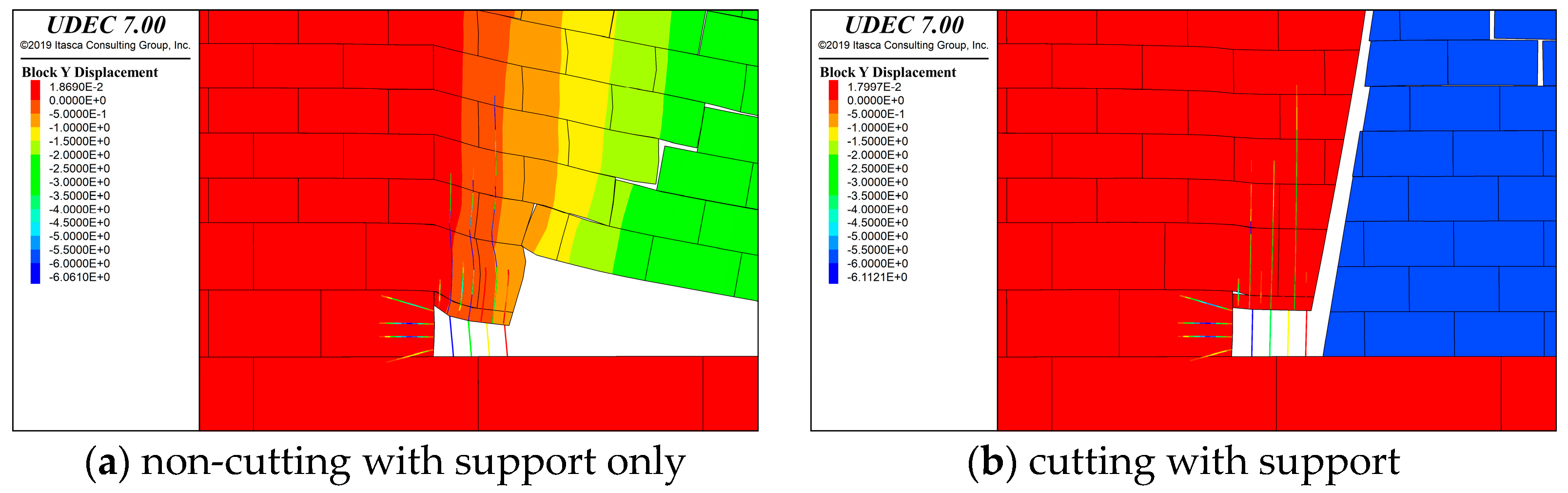
(1) Comparative analysis of vertical displacement in roadways.
A comparison of Figure 18a,b reveals that the roadway deformation following roof cutting is significantly less than that observed without roof cutting. When pressure relief through roof cutting is not executed, the physical connection between the roadway roof and the goaf roof remains intact. As the roof above the goaf rotates and subsides, the roadway roof also undergoes deformation, ultimately resulting in severe roadway deformation. In contrast, after roof-cutting for pressure relief, this physical connection is interrupted. The roof above the goaf slides and caves along the cutting plane, effectively filling the void. Consequently, the roadway roof behaves as a short cantilever beam, while the collapsed goaf roof exerts a certain oblique supporting effect on the roadway roof, aiding in the maintenance of roadway stability. Therefore, the optimized cutting of the surrounding rock structure is a crucial measure for controlling the surrounding rock in gob-side entry retaining of fully mechanized caving faces. Sole reliance on reinforced roadway support is insufficient for maintaining roadway stability. Only a synergistic approach, termed “pressure-relief and support,” which combines roof cutting for pressure relief with reinforced roadway support, can effectively control the deformation of the roadway surrounding rock.
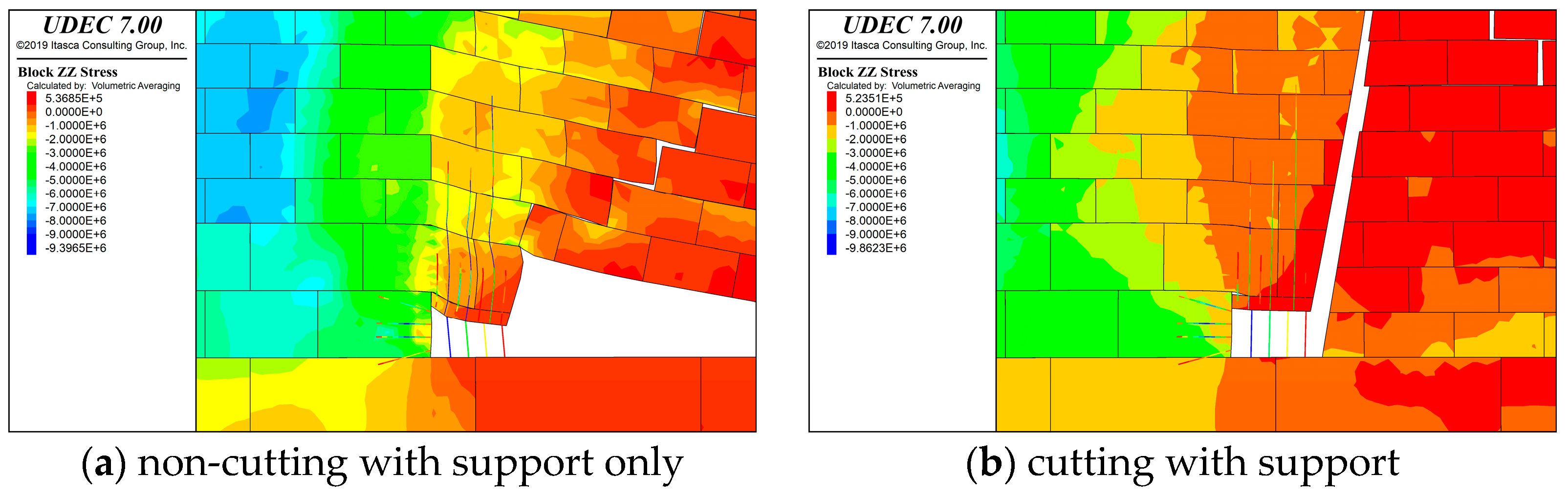
(2) Comparative Analysis of Vertical Stress in Roadways
By comparing Figure 19a,b, it is evident that the roof cutting and pressure relief technique disrupts the stress transfer process between the goaf roof and the roadway roof. This technique optimizes the stress environment of the surrounding rock and maintains the roadway in a relatively low-stress condition, which is advantageous for controlling the surrounding rock of the roadway.
(3) Load-bearing and failure conditions of the support structure
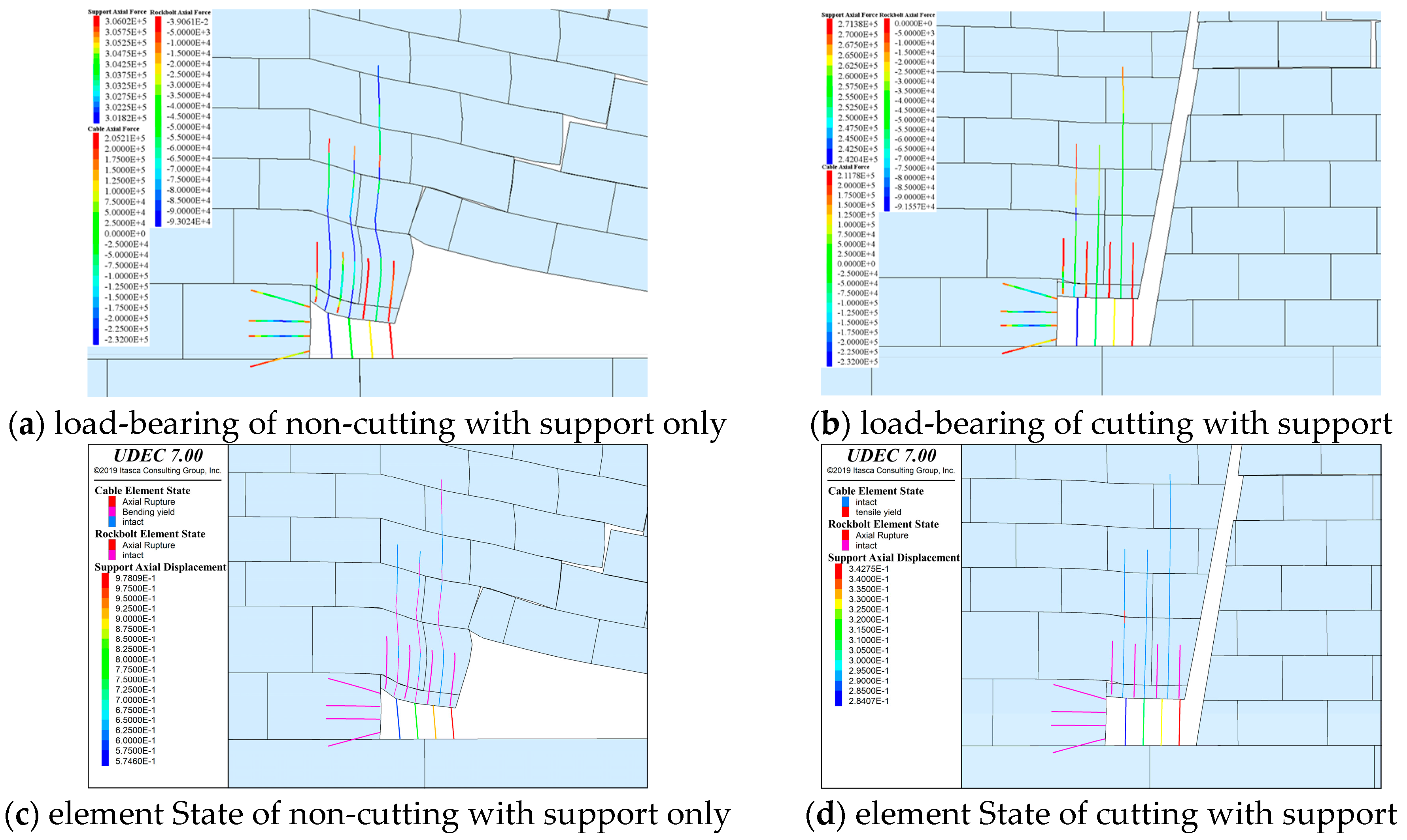
A comparison between Figure 20a,b shows that, without roof cutting, the axial force on the support structural unit is approximately 300 kN, whereas with roof cutting, the force is reduced to between 240 kN and 270 kN. In both scenarios, the peak axial force on the cable structural unit remains at 232 kN. Notably, the length of cable structural units experiencing peak axial force is significantly shorter with roof cutting compared to without. Figure 20c,d illustrate the deformation and failure characteristics of each support structural element. This observation demonstrates that pressure relief through roof cutting effectively reduces the load on the roadway support structure, thereby preventing support failure due to excessive stress.

4.3. Mine Pressure Monitoring and Application Effect Analysis

The purpose of ground-pressure monitoring is to analyze data collected during mining, understand the spatial-temporal distribution of deformation and stress in the roadway surrounding rock, and provide a scientific basis for subsequent adjustments to the support scheme in gob-side entry retaining. During gob-side entry retaining, ground-pressure monitoring primarily includes roadway surface displacement monitoring, anchor cable force monitoring, and single prop pressure monitoring.
(1) Roadway surface displacement monitoring
Mining activities significantly affect the surrounding rock of the roadway, leading to deformation as the working face advances. The deformation conditions of the surrounding rock during coal mining and after roadway retention can be effectively analyzed through observational data on roadway surface displacement.
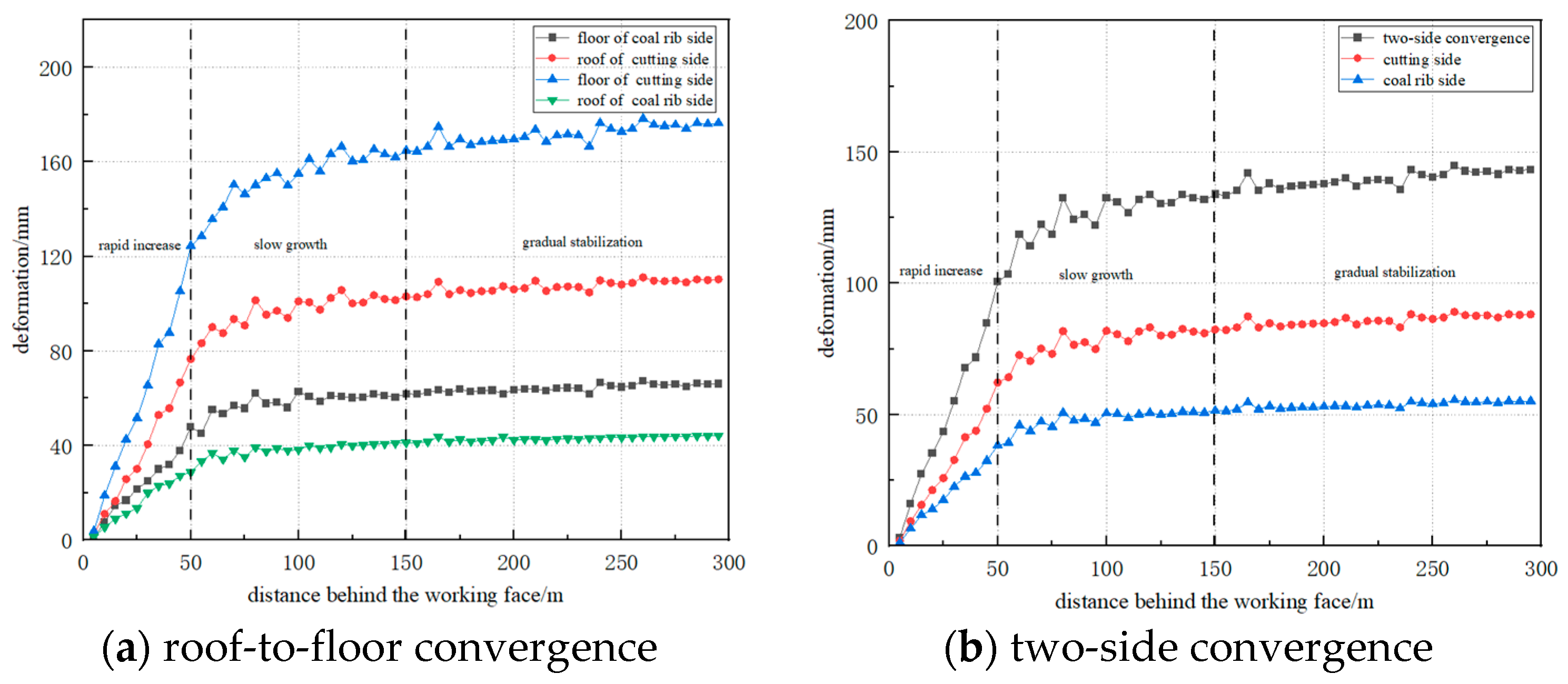
As illustrated in Figure 21a, several observations can be made: (1) During the gob-side entry retaining process, influenced by the mining activities at the working face, the roof-to-floor convergence of the roadway primarily undergoes three stages: rapid increase, slow increase, and gradual stabilization. (2) In the gob-side entry retained by roof cutting and pressure relief, the roof-to-floor convergence on the cutting side is greater than that on the solid coal side. Throughout the entire retaining process, the roof subsidence on the cutting side measures approximately 110 mm, while the floor heave is about 176 mm. In contrast, on the solid coal side, the roof subsidence is around 44 mm, and the floor heave is approximately 66 mm, demonstrating a distinct asymmetric deformation characteristic. The region within 50 m behind the working face represents the rapid growth stage, where the rates of roof and floor deformation peak. The interval from 50 m to 150 m behind the working face constitutes the slow increase stage, characterized by a relatively slower deformation rate of the roof and floor, primarily due to the supporting effect of collapsed gangue, which reduces the rotational subsidence of the rock strata. Beyond 150 m behind the working face lies the stable deformation stage, during which roof and floor deformation tends to stabilize, allowing for the gradual removal of temporary supports.
As shown in Figure 21b, the deformation trends of the roadway ribs are generally consistent with those of the roof and floor. The convergence on the coal rib side is significantly less than that on the slit side. After lagging behind the working face by 150 m, the rib deformations begin to stabilize. Ultimately, the convergence of the slit-side rib reaches 88 mm, whereas the coal rib measures 55 mm.
(2) Anchor cable force monitoring
The stress state of the anchor cables reflects real-time changes in the roadway roof and monitors whether the cable capacity is adequate, enabling adjustments to cable support density. To track anchor-cable stress deformation during face advance, load cells are installed on the constant-resistance large-deformation (CRLD) anchor cables.
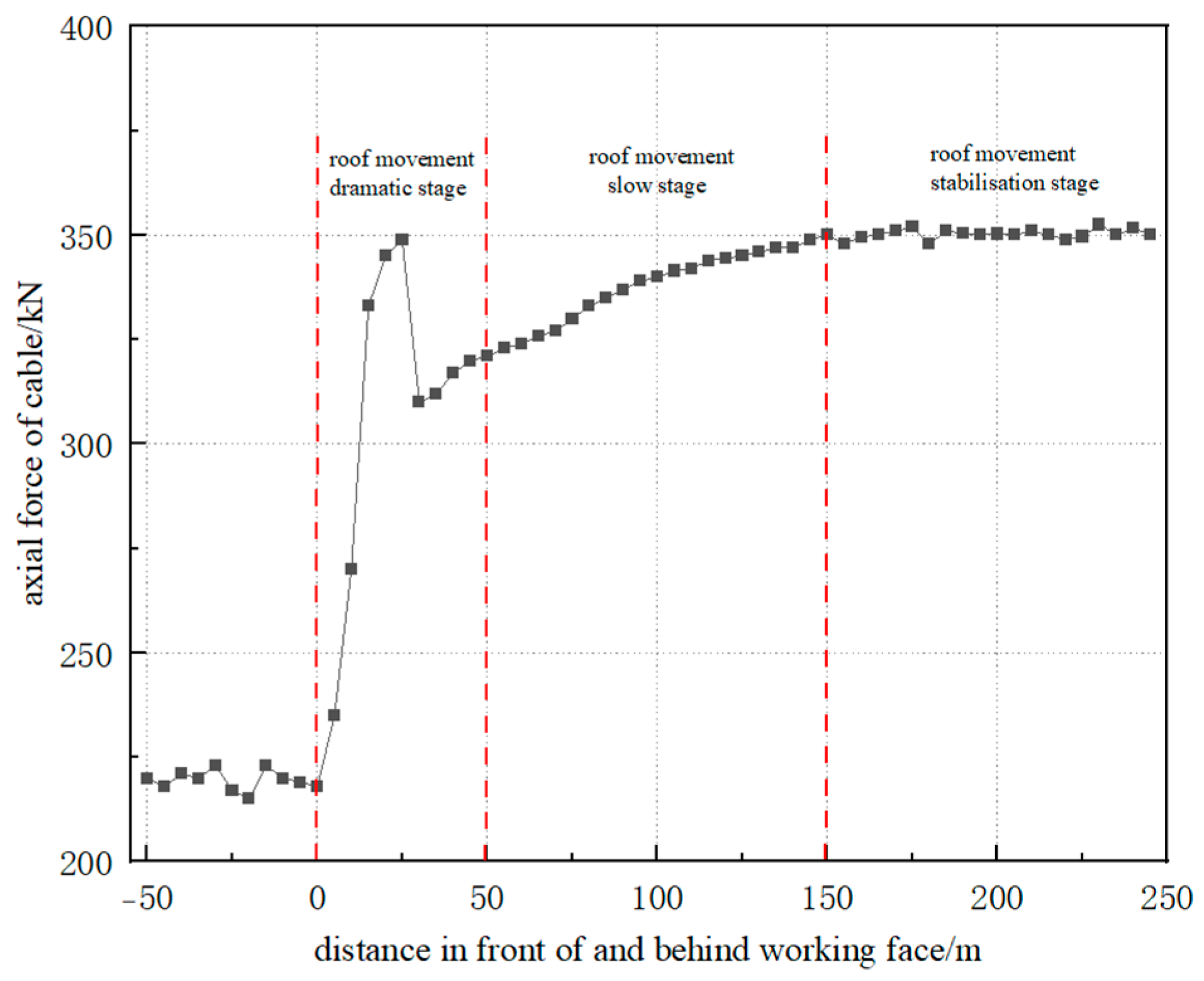
As illustrated in Figure 22, the stress on the anchor cables in the advance section of the working face is minimal. However, within the range of 0 to 50 m behind the working face, the stress on the anchor cables exhibits significant fluctuations due to mining-induced effects and the periodic impacts of fractures in the main roof. In the range of 60 to 130 m behind the working face, as the rotational deformation of the rock strata diminishes, the stress on the anchor cables experiences a slight increase, albeit at a gradually decreasing rate. Beyond 150 m behind the working face, the stress on the anchor cables stabilizes at approximately 350 kN.
(3) Hydraulic prop pressure monitoring
The single hydraulic prop not only provides roof support during gob-side entry retaining but also reflects roof pressure variations to some extent. By installing a pressure monitor on the single hydraulic prop to observe changes in roof pressure, reinforcement measures can be promptly implemented in areas of excessive pressure, ensuring safe and stable gob-side entry retaining operations.
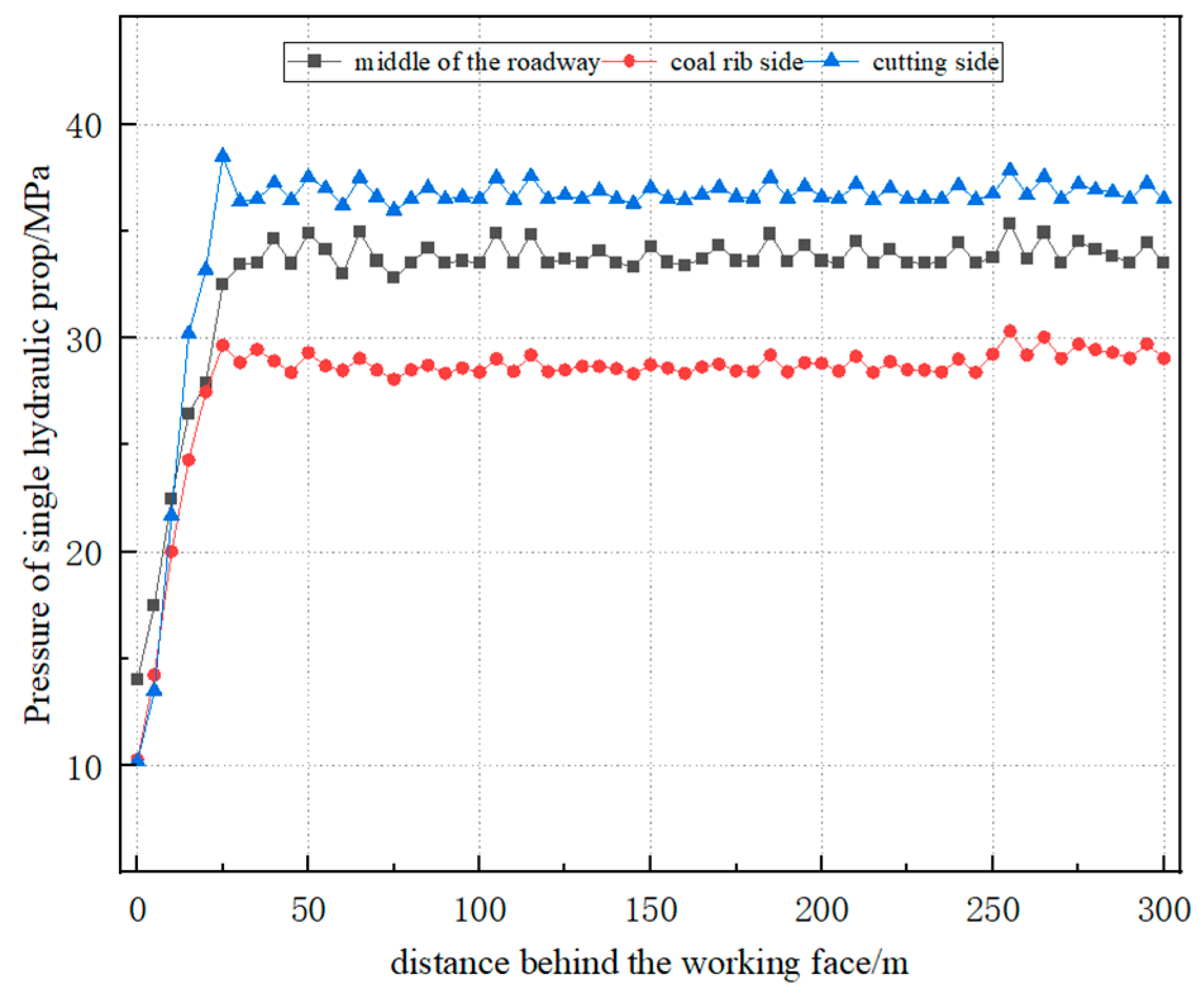
As illustrated in Figure 23, the pressure exerted by individual props at various positions within the same cross-section demonstrates significant variation. The descending order of pressure is as follows: slit-side prop (36.2 MPa), roadway-center prop (33.8 MPa), and coal-side prop (29.8 MPa). The data reveal that the prop pressure experiences a rapid increase within the first 30 m behind the working face, subsequently stabilizing with minor fluctuations around this stable value. These later fluctuations in pressure are primarily attributed to periodic impacts from roof fractures.

5. Main Conclusions

Based on the engineering background of JuShan Coal Mine, this study investigates the surrounding rock control scheme for the cutting and retaining of roadways in thick coal seams at fully mechanized top coal caving faces. Through theoretical analysis, numerical simulations, and field tests, the study draws the following conclusions. It should be specifically noted that the key parameters in this paper, such as the roof cutting height and angle, are determined based on the specific geological conditions of the mine in question. Consequently, they cannot be directly applied to other geological or technical conditions. And a block-and-beam diagram is used to explain the mechanism, and the absolute stress/strain values in the calculation should be interpreted as orders of magnitude for a specific scenario, sensitive to the selected contacts and the goaf model. Monitoring serves as an engineering confirmation of operability and the identification of zones of influence beyond the working face, but does not provide rigorous verification of the mechanism.
(1) A numerical simulation was performed to analyze gob-side entry retaining with roof cutting in a fully mechanized top-coal caving face, investigating the influence of key roof-cutting parameters on entry stability. The simulation results indicate that when the roof cutting height is set at 20 m and the cutting angle is 10°, the roof strata tend to collapse and subside along the cutting plane. The collapsed gangue effectively fills the goaf area, thereby providing adequate support to the overlying strata and significantly improving the stress environment of the surrounding rocks in the roadway.
(2) A simulation analysis was conducted on the surrounding-rock control scheme for gob-side entry retaining using roof-cutting and pressure-relief in fully mechanized top-coal caving faces. The results indicate that relying solely on reinforced support within the roadway is insufficient for effectively controlling the deformation of surrounding rock. Furthermore, this approach leads to excessive stress on the support structure, making it prone to failure. Therefore, roof cutting and pressure relief are essential measures for gob-side entry retaining in thick coal seams, as they optimize the surrounding rock structure and enhance the stress environment. Under the combined effect of roof cutting, pressure relief, and reinforced roadway support, the deformation of surrounding rock can be effectively managed.
(3) Field monitoring data show that, under a well-designed surrounding-rock control scheme, the influence of abutment pressure is most pronounced within 50 m behind the working face, where roadway deformation rates accelerate rapidly and stresses on anchor cables and single props increase sharply. The dynamic pressure influence moderates within the range of 50 to 150 m behind the working face, where the rate of roadway deformation decreases. Beyond 150 m, the roadway deformation tends to stabilize, and the stress on anchor cables and single props also reaches stable values. At this stage, both the roof-to-floor convergence and rib-to-rib convergence remain within controllable limits, thereby allowing for the normal use of the roadway.

Author Contributions

Conceptualization, M.Z.; Methodology, M.Z.; Software, Y.Z.; Validation, Y.Z. and S.J.; Formal analysis, C.L.; Investigation, Y.Z.; Resources, C.L.; Data curation, H.X.; Writing—original draft, M.Z.; Writing—review & editing, C.L.; Visualization, M.S.; Project administration, H.X. and S.J. All authors have read and agreed to the published version of the manuscript.

Funding

This research received no external funding.

Institutional Review Board Statement

Not applicable.

Informed Consent Statement

Not applicable.

Data Availability Statement

The original contributions presented in the study are included in the article, further inquiries can be directed to the corresponding author.

Conflicts of Interest

The authors declare no conflict of interest.

References

  1. He, M.C.; Gao, Y.B.; Yang, J.; Gong, W.L. An Innovative Approach for Gob-Side Entry Retaining in Thick Coal Seam Longwall Mining. Energies 2017, 10, 1785. [Google Scholar] [CrossRef]
  2. Huang, B.X.; Liu, J.W.; Zhang, Q. The reasonable breaking location of overhanging hard roof for directional hydraulic fracturing to control strong strata behaviors of gob-side entry. Int. J. Rock Mech. Min. Sci. 2018, 103, 1–11. [Google Scholar] [CrossRef]
  3. Zhang, Z.Z.; Bai, J.B.; Chen, Y.; Yan, S. An innovative approach for gob-side entry retaining in highly gassy fully-mechanized longwall top-coal caving. Int. J. Rock Mech. Min. Sci. 2015, 80, 1–11. [Google Scholar] [CrossRef]
  4. Chai, Y.J.; Wang, M.; Meng, L.; Wang, C.L.; Liang, Z.Z.; Yang, Y.K.; Liu, J.M. Influence of roof cutting depth on stability of gob side entry in thick coal seams with a bulky limestone roof. Sci. Rep. 2025, 15, 31267. [Google Scholar] [CrossRef]
  5. Fu, Q.; Yang, J.; Liu, Y.X.; Zhang, C.J.; Gao, Y.B.; Gao, H.N.; Ma, Q. Research on location optimization and application of the gob-side entry retaining by roof cutting in close-distance coal seams. Sci. Rep. 2025, 15, 42661. [Google Scholar] [CrossRef]
  6. Han, Y.; Wang, C.X.; Zhang, F.Y.; Yan, Z.J. Methane migration patterns in the goaf of a Y-type ventilated working face with gob-side entry. Sci. Rep. 2025, 15, 33151. [Google Scholar] [CrossRef]
  7. Li, X.J.; Mu, B.B.; Li, H.Z.; Yuan, R.F. Research on Grouted Steel Pipe Supports Roof Cutting and Gob-Side Entry Retaining Support Technology for Fully-Mechanized Caving Face. Energy Sci. Eng. 2025, 13, 3824–3839. [Google Scholar] [CrossRef]
  8. Meng, N.K.; Yu, R.; Wang, M.; Shen, W.L.; Yang, Z.B.; Wang, X.Y.; Li, Z.X.; Chen, Z.Q. An Innovative Approach to Composite Load-bearing for Gob-side Entry Retaining in Deep Mines by Roof Cutting: A Case Study. Min. Metall. Explor. 2025, 42, 3547–3567. [Google Scholar] [CrossRef]
  9. Qi, J.C.; Gao, Y.B.; Peng, Z.J.; He, M.C.; Guo, S. A New Type of Non-Explosive Directional Pre-Splitting and Roof-Cutting Method for Gob-Side Entry Retaining Without Coal Pillars. Min. Metall. Explor. 2025, 42, 1575–1595. [Google Scholar] [CrossRef]
  10. Wang, H.; Guo, J.Q. Research on the Deformation and Failure Mechanism of Flexible Formwork Walls in Gob-Side-Entry Retaining of Ultra-Long Isolated Mining Faces and Pressure Relief-Control Technology via Roof Cutting. Appl. Sci. 2025, 15, 5833. [Google Scholar] [CrossRef]
  11. Yue, N.F.; Wang, L.; Guo, J.; Liu, Y.; Chen, C.M.; Gao, B. A Study on Dangerous Areas for Coal Spontaneous Combustion in Composite Goafs in Goaf-Side Entry Retaining in the Lower Layer of an Extra-Thick Coal Seam. Fire 2025, 8, 298. [Google Scholar] [CrossRef]
  12. Zhang, D.; Zhu, Q.C.; Bai, J.B.; Wang, R.; Zhang, Z.Z.; Fu, H.; Liu, S.G.; Yan, S.; Guo, Y.H.; Tian, Z.J.; et al. Theory and simulation investigations on stability control of gob-side entry retaining with coal pillar-backfill body system. Int. J. Min. Sci. Technol. 2025, 35, 1399–1417. [Google Scholar] [CrossRef]
  13. Zhang, D.P.; Song, D.M.; Zhang, L.P.; Luo, B. Mechanical Behavior and Stress Mechanism of Roof Cutting Gob-Side Entry Retaining in Medium-Thick Coal Seams. Processes 2025, 13, 2649. [Google Scholar] [CrossRef]
  14. Zhao, L.L.; Han, Y.F.; Li, X.F.; Wang, S.; Jing, G.; Yu, Z.J. Research and application on the “multi-layer” filling body with foamed expansion filling material for gob-side entry retaining gateway. Sci. Rep. 2025, 15, 36943. [Google Scholar] [CrossRef]
  15. Zhao, X.Q.; Bai, J.B.; Fu, H.; Wang, G.Y.; Wang, X.Y.; Liu, S.G.; Wang, R.; Liu, H.Y. Optimising gangue-containing backfill strength in gob-side entry retaining: From particle distribution morphology to release parameters. Case Stud. Constr. Mater. 2025, 23, e05338. [Google Scholar] [CrossRef]
  16. Chen, D.C.; Wang, X.Y.; Wu, S.; Zhang, F.T.; Fan, Z.Z.; Wang, X.D.; Li, M.L. Study on stability mechanism and control techniques of surrounding rock in gob-side entry retaining with flexible formwork concrete wall. J. Cent. South Univ. 2023, 30, 2966–2982. [Google Scholar] [CrossRef]
  17. Wang, Y.W.; Zhao, Z.Q.; Zhang, W.B.; Wei, X.X.; Hui, Z.L. Deformation mechanism and control technology of gob-side entry retaining with roadside backfilling: A numerical analysis and field investigation. Geomech. Geophys. Geo-Energy Geo-Resour. 2024, 10, 175. [Google Scholar] [CrossRef]
  18. Xu, C.T.; Wang, X.Y.; Chen, D.C.; Wang, G.H.; Niu, Z.P.; Lu, H.X. Study on the Stability and Control of Gob-Side Entry Retaining in Paste Backfill Working Face. Appl. Sci. 2025, 15, 528. [Google Scholar] [CrossRef]
  19. Fan, D.Y.; Liu, X.S.; Tan, Y.L.; Yan, L.; Song, S.L.; Ning, J.G. An innovative approach for gob-side entry retaining in deep coal mines: A case study. Energy Sci. Eng. 2019, 7, 2321–2335. [Google Scholar] [CrossRef]
  20. Hu, J.Z.; He, M.C.; Wang, J.; Ma, Z.M.; Wang, Y.J.; Zhang, X.Y. Key Parameters of Roof Cutting of Gob-Side Entry Retaining in a Deep Inclined Thick Coal Seam with Hard Roof. Energies 2019, 12, 934. [Google Scholar] [CrossRef]
  21. Liu, H.; Dai, J.; Jiang, J.Q.; Wang, P.; Yang, J.Q. Analysis of Overburden Structure and Pressure-Relief Effect of Hard Roof Blasting and Cutting. Adv. Civ. Eng. 2019, 2019, 1354652. [Google Scholar] [CrossRef]
  22. Ma, X.G.; He, M.C.; Wang, J.; Gao, Y.B.; Zhu, D.Y.; Liu, Y.X. Mine Strata Pressure Characteristics and Mechanisms in Gob-Side Entry Retention by Roof Cutting under Medium-Thick Coal Seam and Compound Roof Conditions. Energies 2018, 11, 2539. [Google Scholar] [CrossRef]
  23. Yan, S.; Liu, T.X.; Bai, J.B.; Wu, W.D. Key Parameters of Gob-Side Entry Retaining in A Gassy and Thin Coal Seam with Hard Roof. Processes 2018, 6, 51. [Google Scholar] [CrossRef]
  24. Ma, Z.M.; Wang, J.; He, M.C.; Gao, Y.B.; Hu, J.Z.; Wang, Q. Key Technologies and Application Test of an Innovative Noncoal Pillar Mining Approach: A Case Study. Energies 2018, 11, 2853. [Google Scholar] [CrossRef]
  25. Sun, X.M.; Liu, Y.Y.; Wang, J.W.; Li, J.B.; Sun, S.J.; Cui, X.B. Study on Three-Dimensional Stress Field of Gob-Side Entry Retaining by Roof Cutting without Pillar under Near-Group Coal Seam Mining. Processes 2019, 7, 552. [Google Scholar] [CrossRef]
  26. Wang, Q.; He, M.C.; Yang, J.; Gao, H.K.; Jiang, B.; Yu, H.C. Study of a no-pillar mining technique with automatically formed gob-side entry retaining for longwall mining in coal mines. Int. J. Rock Mech. Min. Sci. 2018, 110, 1–8. [Google Scholar] [CrossRef]
  27. Wang, Y.J.; Gao, Y.B.; Wang, E.Y.; He, M.C.; Yang, J. Roof Deformation Characteristics and Preventive Techniques Using a Novel Non-Pillar Mining Method of Gob-Side Entry Retaining by Roof Cutting. Energies 2018, 11, 627. [Google Scholar] [CrossRef]
  28. Wang, Y.J.; Wang, Q.; Tian, X.C.; Wang, H.S.; Yang, J.; He, M.C. Stress and deformation evolution characteristics of gob-side entry retained by roof cutting and pressure relief. Tunn. Undergr. Space Technol. 2022, 123, 104419. [Google Scholar] [CrossRef]
  29. Wang, W.; Sun, H.; Li, J.; Wang, E. Mechanism and technology of pressure relief by roof cutting for gob-side entry retention with small coal pillars in thick hard roof. Results Eng. 2025, 28, 108393. [Google Scholar] [CrossRef]
Figure 1. Working face layout diagram.
Applsci 16 01293 g001
Figure 2. Column diagram of No. 3 coal seam in JuShan Coal Mine.
Applsci 16 01293 g002
Figure 3. Evolution process of surrounding rock structure.
Applsci 16 01293 g003
Figure 4. Schematic diagram of roof-cutting height.
Applsci 16 01293 g004
Figure 5. Diagram of Roof-Cutting Angle.
Applsci 16 01293 g005
Figure 6. Stress analysis of key blocks.
Applsci 16 01293 g006
Figure 7. Numerical calculation model.
Applsci 16 01293 g007
Figure 8. Vertical displacement cloud diagrams at different roof-cutting heights.
Applsci 16 01293 g008
Figure 9. Roof subsidence of roadway under different roof-cutting heights.
Applsci 16 01293 g009
Figure 10. Vertical stress contour maps at different roof-cutting heights.
Applsci 16 01293 g010
Figure 11. Vertical stress distribution curves of roof under different roof-cutting heights.
Applsci 16 01293 g011
Figure 12. Vertical displacement cloud diagrams under different roof cutting angles.
Applsci 16 01293 g012
Figure 13. Roof subsidence of roadway under different roof-cutting angle.
Applsci 16 01293 g013
Figure 14. Vertical stress contour under different roof-cutting angles.
Applsci 16 01293 g014
Figure 15. Vertical stress distribution curves of roof with different cutting angles.
Applsci 16 01293 g015
Figure 16. The principle of “pressure relief-support” cooperative control.
Applsci 16 01293 g016
Figure 17. Roadway support layout diagram.
Applsci 16 01293 g017
Figure 18. Comparison of vertical displacement in roadway.
Applsci 16 01293 g018
Figure 19. Comparison of vertical stress in roadway.
Applsci 16 01293 g019
Figure 20. Load-bearing and failure conditions of the support structure.
Applsci 16 01293 g020
Figure 21. Surface displacement monitoring curve of roadway.
Applsci 16 01293 g021
Figure 22. Anchor cable axial force curve.
Applsci 16 01293 g022
Figure 23. Pressure variation curve of single prop hydraulic support.
Applsci 16 01293 g023
Table 1. Physical and mechanical parameters of coal-rock mass.
Rock StratumDensity (kg/m3)Bulk Modulus (GPa)Shear Modulus (GPa)Cohesion (MPa)Friction (°)Tensile Strength (MPa)
medium-grained sandstone27003.32.54371.2
siltstone261010.88.132.75381.84
medium-grained sandstone27005.124.732.45402
mudstone261012.210.792.5423.6
medium-grained sandstone270010.88.133.75381.84
mudstone26109.977.351.2320.58
coal14004.921.25220.5
mudstone27005.976.012.06401.13
medium-grained sandstone26102113.53.2421.29
mudstone26102.562.362.16360.75
siltstone270063.51.2300.6
Table 2. Material properties of rock bolt structural element.
NameValueNameValue
material-steeldensity/kg·m−37.5 × 103material-groutcoupling-stiffness-shear/N·m−22.0 × 107
Young’s modulus/GPa200coupling-stiffness-normal/N·m−21 × 1010
yield-tension/N2.25 × 105coupling-cohesion-normal/N·m−12 × 106
cross-sectional-area/m23.8 × 10−4coupling-friction-normal/°45
Perimeter/m0.07coupling-cohesion-shear/N·m−11.0 × 105
Moi/m42 × 10−8
Table 3. Material properties of cable structural element.
NameValueNameValue
material-steeldensity/kg·m−37.5 × 103material-groutgrout-stiffness/N·m−21 × 1010
Young’s modulus/GPa200
yield-tension/N2.32 × 105
cross-sectional-area/m23.7 × 10−4grout-strength/N·m−11 × 1010
yield-compression/N1 × 1010
rupture-tension-strain1 × 1030
Table 4. Force-displacement relationship of Support Members.
axial displacement/m00.10.32.0
axial force/N01 × 1053 × 1053 × 105
Disclaimer/Publisher’s Note: The statements, opinions and data contained in all publications are solely those of the individual author(s) and contributor(s) and not of MDPI and/or the editor(s). MDPI and/or the editor(s) disclaim responsibility for any injury to people or property resulting from any ideas, methods, instructions or products referred to in the content.