Parameter Inversion of Probability Integral Model Based on GA–BFGS Hybrid Algorithm

Abstract
1. Introduction
2. Theoretical Foundation and Algorithm Framework
2.1. Probability Integral Model
2.2. Principle of the BFGS Algorithm
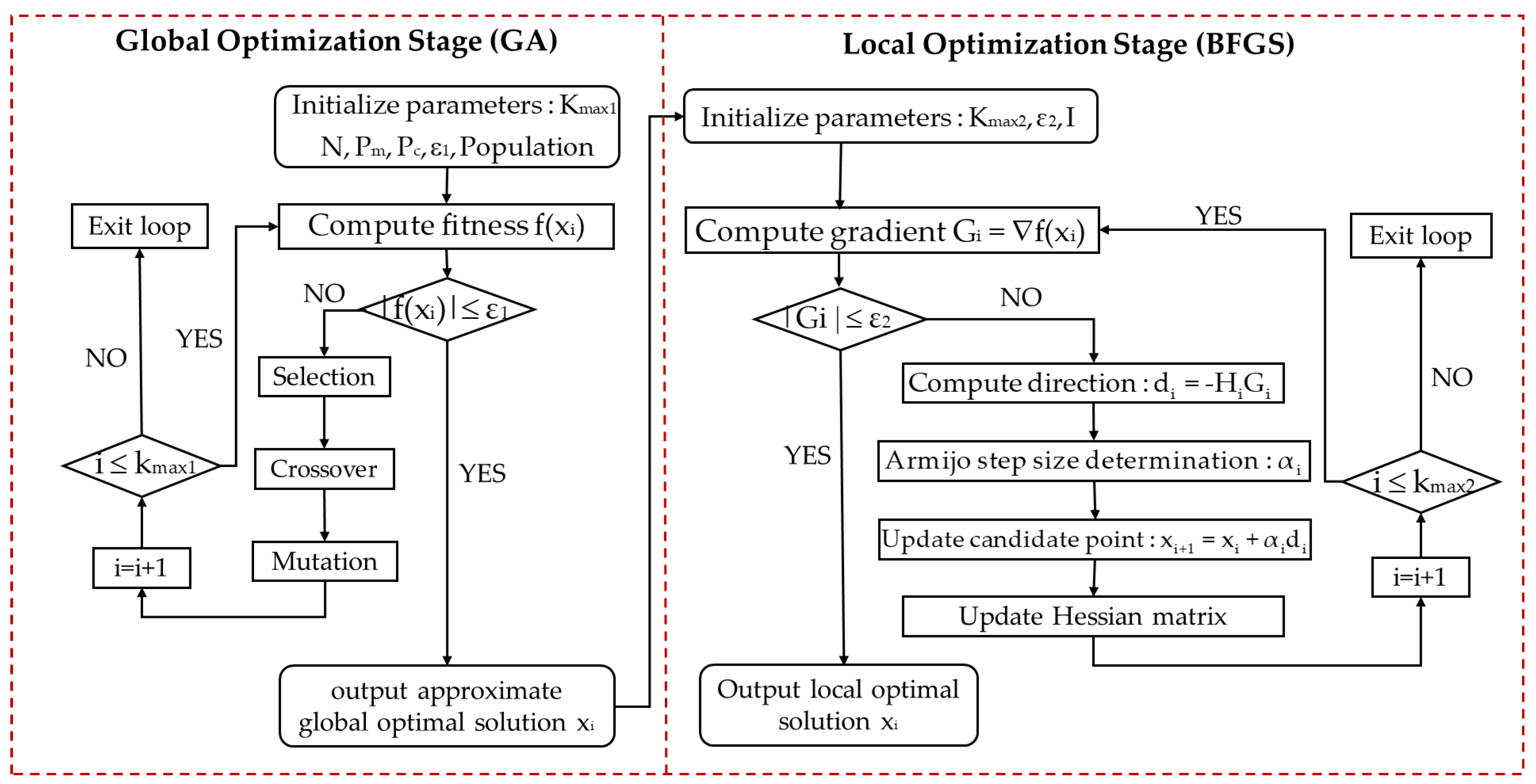
2.3. Basic Steps of GA–BFGS Hybrid Algorithm for Parameter Inversion
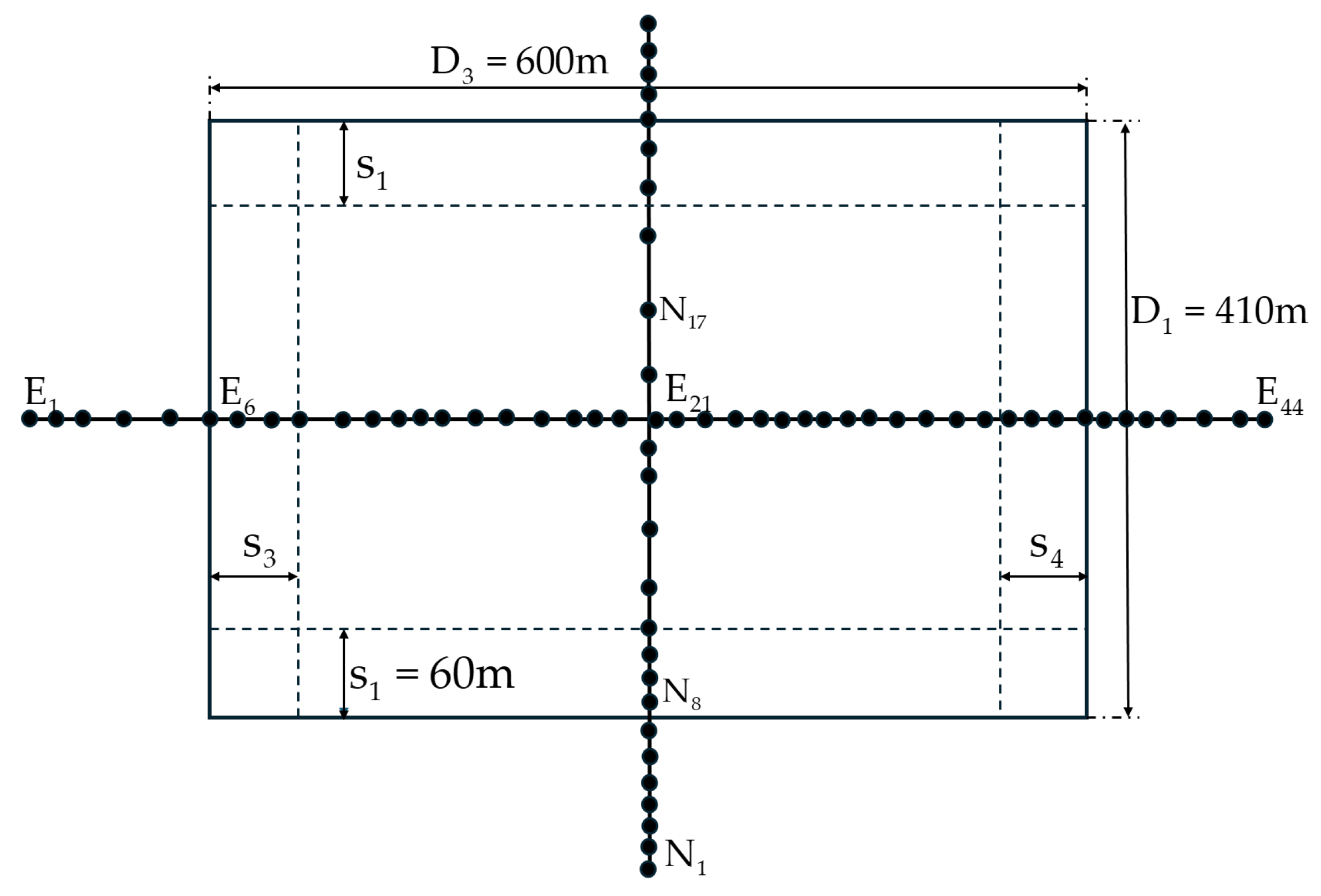
3. Simulation Experiment
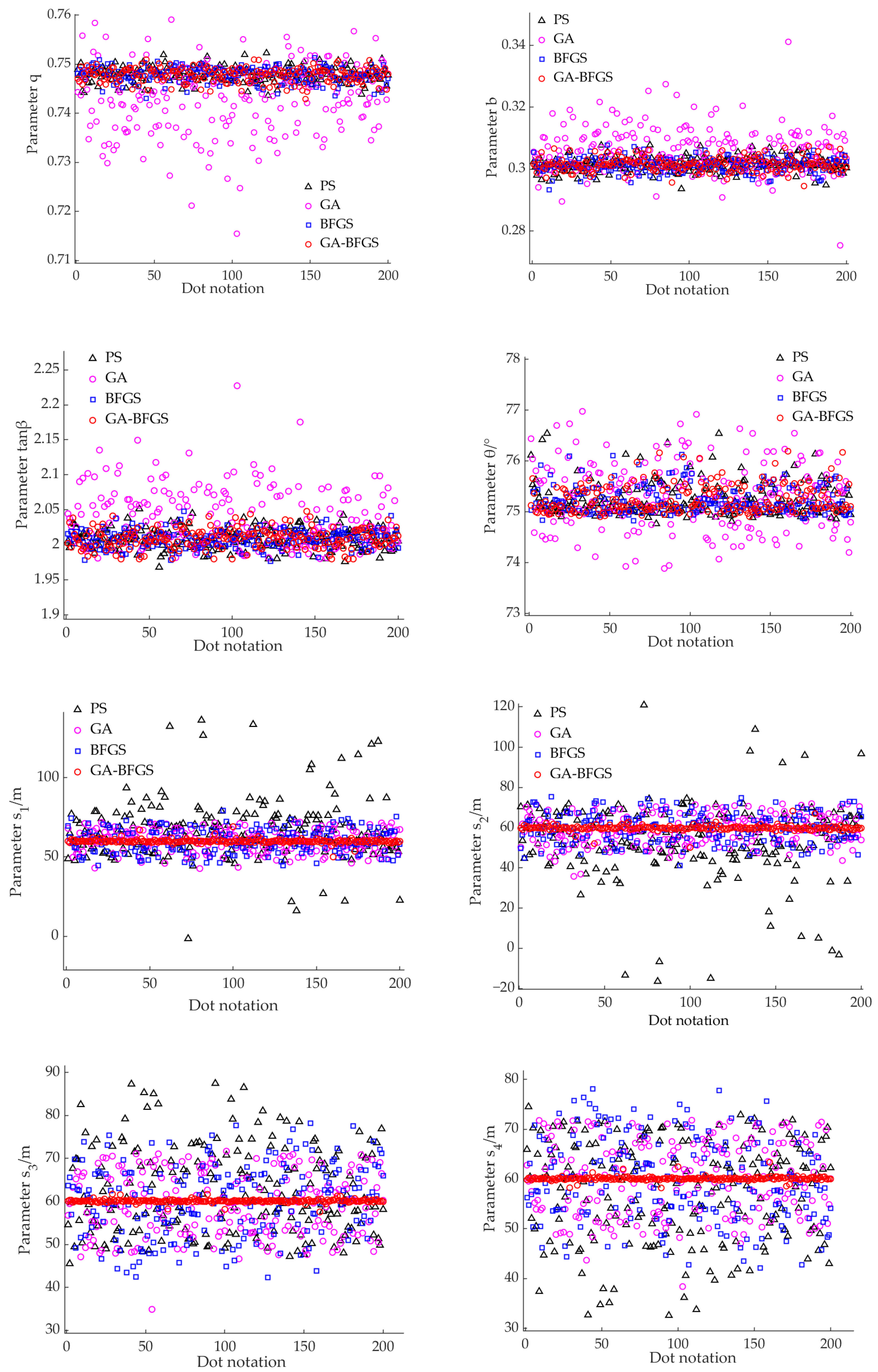
3.1. Impact of Random Errors on Parameter Inversion
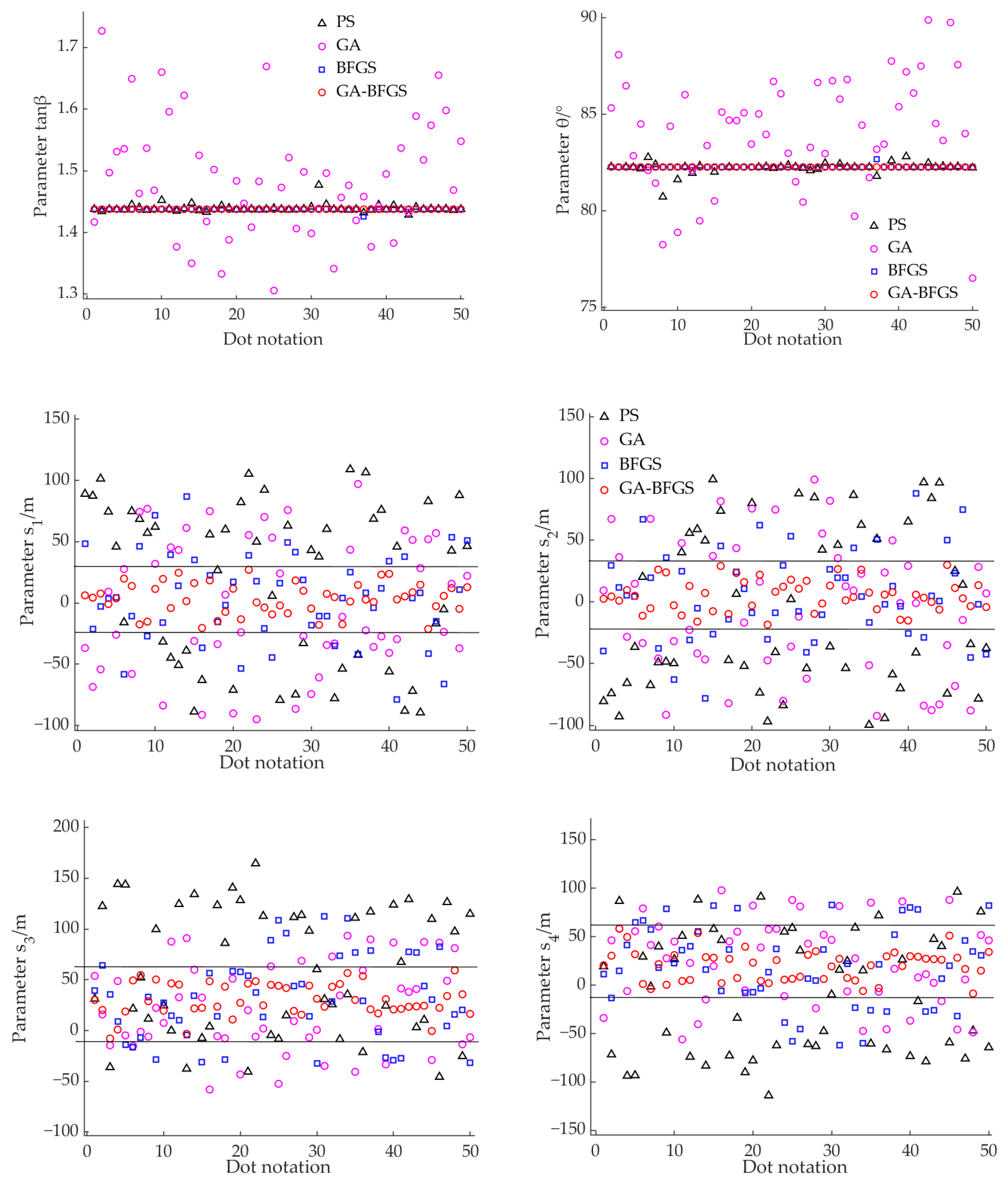
3.2. Impact of Gross Errors on Parameter Inversion
4. Engineering Case Study and Result Analysis
4.1. Overview of the Study Area
4.2. Stability Analysis of the GA–BFGS Algorithm
4.3. Accuracy Analysis of the GA–BFGS Algorithm
- (1)
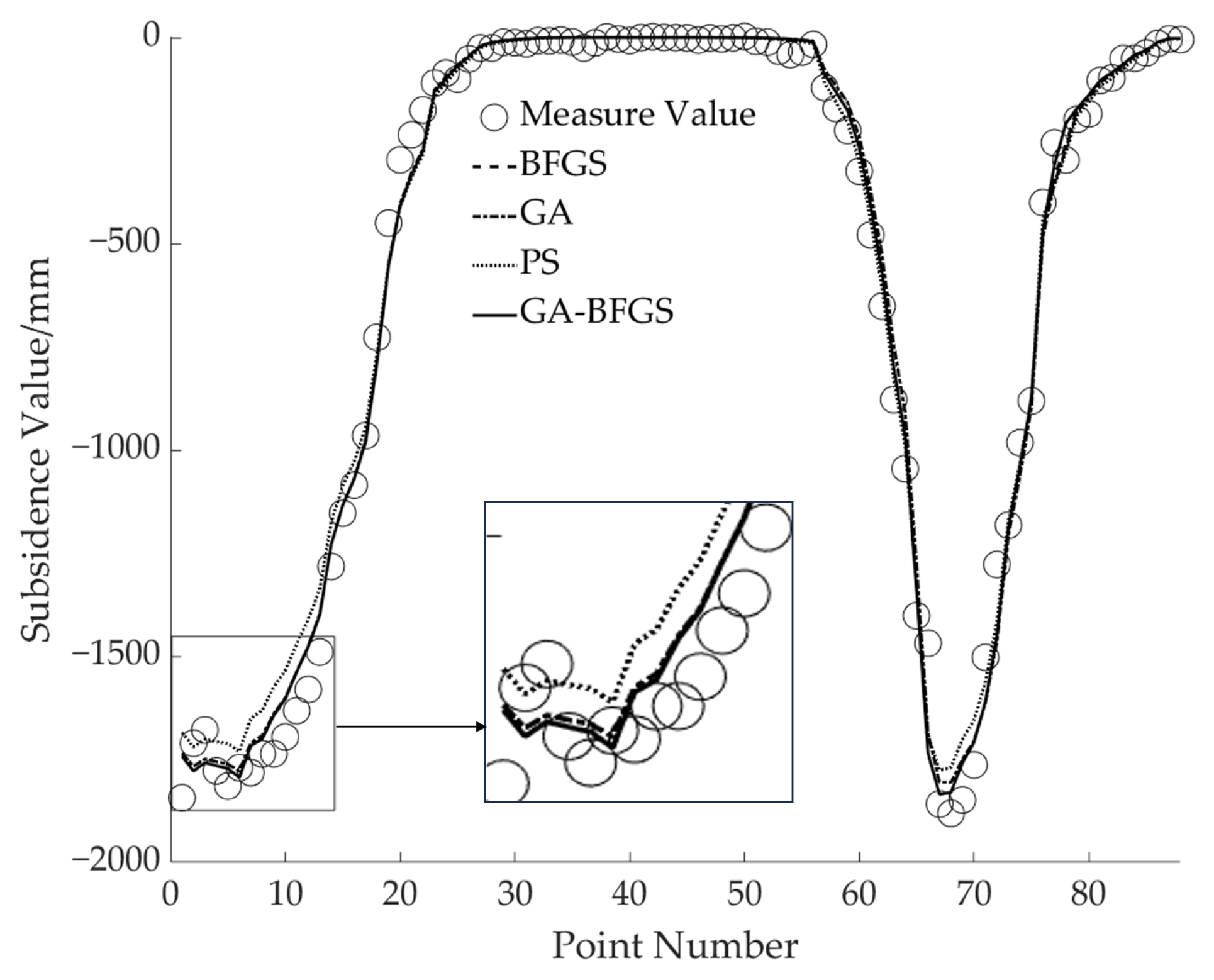
- Both GA–BFGS and BFGS algorithms achieved the best fitting performance. Their predicted subsidence curves closely match the measured data, with accuracy surpassing that of PS and standalone GA. Errors are minimal near the edges of the subsidence basin but increase near the basin center.
- (2)
- Central-region errors are primarily attributed to inherent limitations of the probability integral model. Despite high overall accuracy, the model systematically underestimates subsidence in the central area, highlighting a limitation in fully capturing the basin’s deformation characteristics.
- (3)
- Although the inversion algorithms perform effectively, improving prediction accuracy ultimately depends on enhancing the model structure. The GA–BFGS algorithm demonstrates high stability and reliability; however, introducing more accurate surface deformation models is necessary to reduce systematic errors and improve both parameter inversion and predictive performance.

5. Conclusions
- (1)
- The hybrid GA–BFGS algorithm effectively inverts the parameters of the probability integral model and mitigates large errors and instability observed in the inversion of inflection point offsets with other algorithms (PS, GA, BFGS). Under ideal conditions without model error, inverted parameters closely match actual values.
- (2)
- Simulation results indicate that GA–BFGS achieves higher accuracy in parameter inversion than PS, GA, or BFGS, maintaining robust estimation even in the presence of noise. In engineering applications, predicted subsidence curves from GA–BFGS align more closely with measured data, confirming its practical effectiveness.
- (3)
- Compared with simulation experiments, the advantages of GA–BFGS in engineering applications are somewhat reduced, particularly in areas with significant surface deformation. This reduction indicates that the probability integral model itself has inherent limitations. Therefore, improving parameter inversion methods alone is insufficient; refining the model structure is essential to enhance deformation pattern prediction and overall accuracy.
Author Contributions
Funding
Institutional Review Board Statement
Informed Consent Statement
Data Availability Statement
Acknowledgments
Conflicts of Interest
Appendix A
Appendix A.1. Partial Derivatives of the Objective Function
References
- Ding, X.; Li, P.; Kang, X.; Wang, M.; Zhang, T.; Hao, D. A mining subsidence calculation method integrating the probability integral method and SBAS-InSAR. J. Min. Sci. Technol. 2025, 10, 48–56. [Google Scholar] [CrossRef]
- International Energy Agency. Coal Mid-Year Update: July 2024. Available online: https://www.iea.org/reports/coal-mid-year-update-july-2024 (accessed on 15 July 2024).
- Cai, Y.; Jin, Y.; Wang, Z.; Chen, T.; Wang, Y.; Kong, W.; Xiao, W.; Li, X.; Lian, X.; Hu, H. A Review of Monitoring, Calculation, and Simulation Methods for Ground Subsidence Induced by Coal Mining. Int. J. Coal Sci. Technol. 2023, 10, 32. [Google Scholar] [CrossRef]
- Guo, Q.; Yu, Q.; Zheng, M.; Luo, J. Influence of survey line layout and missing measurement points on the inversion of mining subsidence prediction parameters. Coal Geol. Explor. 2024, 52, 57–68. [Google Scholar] [CrossRef]
- Qiao, B.; Guo, Q.; Luo, J.; Yu, Q.; Wan, Z. Parameter inversion of the probability integral method based on an improved snake optimization algorithm. Met. Mine 2024, in press. [Google Scholar]
- Chi, F.; Liu, G.; Tao, Q.; Xiao, Y. Monitoring and analysis of subsidence in Yuncheng coal mine using combined SBAS-InSAR and probability integral model. Prog. Geophys. 2025, 40, 484–494. [Google Scholar] [CrossRef]
- Lv, W.; Huang, H.; Chi, S.; Han, B. Neural network optimization algorithm for probability integral prediction parameters. Sci. Surv. Mapp. 2019, 44, 35–41. [Google Scholar]
- Li, J.; Wang, L.; Zhu, S.; Teng, C.; Jiang, K. Research on parameter inversion of the probability integral method model based on the wolf pack algorithm. China Min. Mag. 2020, 29, 102–109. [Google Scholar] [CrossRef]
- Li, J.; Wang, L.; Jiang, K.; Teng, C. Parameter inversion of the probability integral method model based on an improved wolf pack algorithm. J. Min. Strat. Control Eng. 2021, 3, 79–86. [Google Scholar] [CrossRef]
- Chen, X.; Yu, X.; Chi, S.; Wang, T.; Chen, W. Parameter inversion of the probability integral method based on a multi-population genetic algorithm. Saf. Coal Mines 2020, 51, 50–54+60. [Google Scholar]
- Chai, H.; Xu, M.; Guan, P.; Ding, Y.; Xu, H.; Zhao, Y. Research on Mining Subsidence Prediction Parameter Inversion Based on Improved Modular Vector Method. Appl. Sci. 2023, 13, 13272. [Google Scholar] [CrossRef]
- Teng, C.; Wang, L.; Wei, P.; Li, J.; Jiang, K.; Zhu, S. Parameter inversion of probability integral model based on shuffled frog leaping algorithm. J. Min. Strat. Control Eng. 2020, 2, 106–112. [Google Scholar] [CrossRef]
- Yang, J. Research on Parameter Inversion Methods in the Probability Integral Model. Master’s Thesis, Anhui University of Science and Technology, Huainan, China, 2019. [Google Scholar]
- Yang, J.; Liu, C.; Wang, B. Parameter inversion of the probability integral model based on the BFGS algorithm. J. China Coal Soc. 2019, 44, 3058–3068. [Google Scholar] [CrossRef]
- Yang, B.; Xing, Y.; Liu, F.; Lu, Y. An improved L-BFGS method for a class of nonconvex unconstrained optimization problems. J. Rocket Force Univ. Eng. 2024, 38, 67–72. [Google Scholar]
- Wang, Y.; Ouyang, C.; Lv, L.; Yuan, G. Analysis of a New BFGS Algorithm and Conjugate Gradient Algorithms and Their Applications in Image Restoration and Machine Learning. Appl. Numer. Math. 2025, 210, 199–221. [Google Scholar] [CrossRef]
- Deng, X.; Yuan, G.; Yang, Y. A Stochastic Inertial Limited Memory BFGS Algorithm Based on the Mathematical Model of Rural Pipeline Network and Its Application in Machine Learning. J. Phys. Conf. Ser. 2024, 2890, 012001. [Google Scholar] [CrossRef]
- Shah, A.; ur Rehman, M.; Sabi’u, J.; Sohaib, M.; Furati, K.M. A New Scaled BFGS Method for Convex Constraints Monotone Systems: Applications in Motion Control. Results Appl. Math. 2025, 25, 100531. [Google Scholar] [CrossRef]
- Yang, H.Q.; Zhang, L. Bayesian Back Analysis of Unsaturated Hydraulic Parameters for Rainfall-Induced Slope Failure: A Review. Earth-Sci. Rev. 2024, 251, 104714. [Google Scholar] [CrossRef]
- Houmadi, Y.; Benmoussa, M.Y.C.; Cherifi, W.N.E.H.; Rahal, D.D. Probabilistic Analysis of Consolidation Problems Using Subset Simulation. Comput. Geotech. 2020, 124, 103612. [Google Scholar] [CrossRef]
- Li, X.; Zhao, W.; Dong, X. A New CG Algorithm Based on a Scaled Memoryless BFGS Update with Adaptive Search Strategy, and Its Application to Large-Scale Unconstrained Optimization Problems. J. Comput. Appl. Math. 2021, 398, 113670. [Google Scholar] [CrossRef]
- Zohre, A.; Saman, B.-K.; Saeide, G. An Augmented Memoryless BFGS Method Based on a Modified Secant Equation with Application to Compressed Sensing. Appl. Numer. Math. 2021, 167, 187–201. [Google Scholar] [CrossRef]




| Parameter Inversion | 0 mm | 20 mm | ||||||
|---|---|---|---|---|---|---|---|---|
| PS | GA | BFGS | GA–BFGS | PS | GA | BFGS | GA–BFGS | |
| MAD(|q − q0|) | 0.000 | 0.005 | 0.000 | 0.000 | 0.000 | 0.006 | 0.000 | 0.000 |
| RE(q)/% | 0.00 | 0.68 | 0.00 | 0.00 | 0.02 | 0.82 | 0.02 | 0.01 |
| MAD(|b − b0|) | 0.000 | 0.004 | 0.000 | 0.000 | 0.000 | 0.004 | 0.000 | 0.000 |
| RE(b)/% | 0.00 | 1.29 | 0.00 | 0.00 | 0.06 | 1.19 | 0.06 | 0.06 |
| MAD(|tanβ − tanβ0|) | 0.000 | 0.031 | 0.000 | 0.000 | 0.001 | 0.025 | 0.001 | 0.001 |
| ER(Tanβ)/% | 0.00 | 1.57 | 0.00 | 0.00 | 0.05 | 1.24 | 0.05 | 0.05 |
| MAD(|θ − θ0|)/° | 1.802 | 0.294 | 0.000 | 0.000 | 0.022 | 0.324 | 0.023 | 0.025 |
| RE(θ)/% | 2.40 | 0.39 | 0.00 | 0.00 | 0.03 | 0.43 | 0.03 | 0.03 |
| MAD(|s1 − s10|)/m | 17.132 | 6.434 | 6.515 | 0.028 | 16.562 | 6.314 | 6.378 | 0.069 |
| RE(s1)/% | 28.55 | 10.72 | 10.86 | 0.05 | 27.60 | 10.52 | 10.63 | 0.12 |
| MAD(|s2 − s20|)/m | 17.145 | 6.362 | 6.510 | 0.028 | 16.584 | 6.095 | 6.360 | 0.070 |
| RE(s2)/% | 28.58 | 10.60 | 10.85 | 0.05 | 27.64 | 10.16 | 10.60 | 0.12 |
| MAD(|s3 − s30|)/m | 8.547 | 5.928 | 6.652 | 0.009 | 7.320 | 5.857 | 6.752 | 0.026 |
| RE(s3)/% | 14.25 | 9.88 | 11.09 | 0.02 | 12.20 | 9.76 | 11.25 | 0.04 |
| MAD(|s4 − s40|)/m | 8.540 | 5.747 | 6.651 | 0.009 | 7.320 | 5.967 | 6.743 | 0.025 |
| RE(s4)/% | 14.23 | 9.58 | 11.09 | 0.02 | 12.20 | 9.95 | 11.24 | 0.04 |
| UWSD/m | 13.54 | 6.12 | 6.58 | 0.02 | 11.94 | 5.98 | 6.56 | 0.05 |
| Parameter Inversion | PS | GA | BFGS | GA–BFGS |
|---|---|---|---|---|
| MAD(|q − q0|) | 0.002 | 0.008 | 0.002 | 0.002 |
| RE(q)/% | 0.28 | 1.03 | 0.28 | 0.28 |
| MAD(|b − b0|) | 0.002 | 0.007 | 0.002 | 0.002 |
| RE(b)/% | 0.68 | 2.29 | 0.73 | 0.61 |
| MAD(|tanβ − tanβ0|) | 0.012 | 0.041 | 0.014 | 0.013 |
| ER(Tanβ)/% | 0.60 | 0.60 | 0.70 | 0.63 |
| MAD(|θ − θ0|)/° | 0.254 | 0.677 | 0.261 | 0.267 |
| RE(θ)/% | 0.34 | 0.90 | 0.35 | 0.36 |
| MAD(|s1 − s10|)/m | 19.291 | 7.158 | 6.760 | 0.705 |
| RE(s1)/% | 32.15 | 11.93 | 11.27 | 1.17 |
| MAD(|s2 − s20|)/m | 19.186 | 6.731 | 6.918 | 0.716 |
| RE(s2)/% | 31.98 | 11.22 | 11.53 | 1.19 |
| MAD(|s3 − s30|)/m | 7.761 | 6.045 | 6.470 | 0.250 |
| RE(s3)/% | 12.93 | 10.08 | 10.78 | 0.42 |
| MAD(|s4 − s40|)/m | 7.758 | 6.123 | 6.487 | 0.264 |
| RE(s4)/% | 12.93 | 10.21 | 10.81 | 0.44 |
| UWSD/m | 14.43 | 6.56 | 6.66 | 0.52 |
| Method | q | b | tanβ | θ/° | s1/m | s2/m | s3/m | s4/m |
|---|---|---|---|---|---|---|---|---|
| PS | 1.37 | 0.40 | 1.38 | 81.98 | 42.84 | −29.32 | 41.39 | 9.40 |
| GA | 1.24 | 0.42 | 1.46 | 83.50 | −8.05 | 1.61 | 25.33 | 24.22 |
| BFGS | 1.34 | 0.41 | 1.44 | 82.27 | 5.71 | 2.94 | 22.43 | 28.19 |
| GA–BFGS | 1.34 | 0.41 | 1.44 | 82.27 | 6.58 | 2.06 | 24.78 | 25.849 |
Disclaimer/Publisher’s Note: The statements, opinions and data contained in all publications are solely those of the individual author(s) and contributor(s) and not of MDPI and/or the editor(s). MDPI and/or the editor(s) disclaim responsibility for any injury to people or property resulting from any ideas, methods, instructions or products referred to in the content. |
© 2026 by the authors. Licensee MDPI, Basel, Switzerland. This article is an open access article distributed under the terms and conditions of the Creative Commons Attribution (CC BY) license.
Share and Cite
Hao, T.; Jinling, D.; Jingyu, Y.; Jia, X.; Mingfei, Z. Parameter Inversion of Probability Integral Model Based on GA–BFGS Hybrid Algorithm. Appl. Sci. 2026, 16, 1291. https://doi.org/10.3390/app16031291
Hao T, Jinling D, Jingyu Y, Jia X, Mingfei Z. Parameter Inversion of Probability Integral Model Based on GA–BFGS Hybrid Algorithm. Applied Sciences. 2026; 16(3):1291. https://doi.org/10.3390/app16031291
Chicago/Turabian StyleHao, Tan, Duan Jinling, Yang Jingyu, Xu Jia, and Zhu Mingfei. 2026. "Parameter Inversion of Probability Integral Model Based on GA–BFGS Hybrid Algorithm" Applied Sciences 16, no. 3: 1291. https://doi.org/10.3390/app16031291
APA StyleHao, T., Jinling, D., Jingyu, Y., Jia, X., & Mingfei, Z. (2026). Parameter Inversion of Probability Integral Model Based on GA–BFGS Hybrid Algorithm. Applied Sciences, 16(3), 1291. https://doi.org/10.3390/app16031291