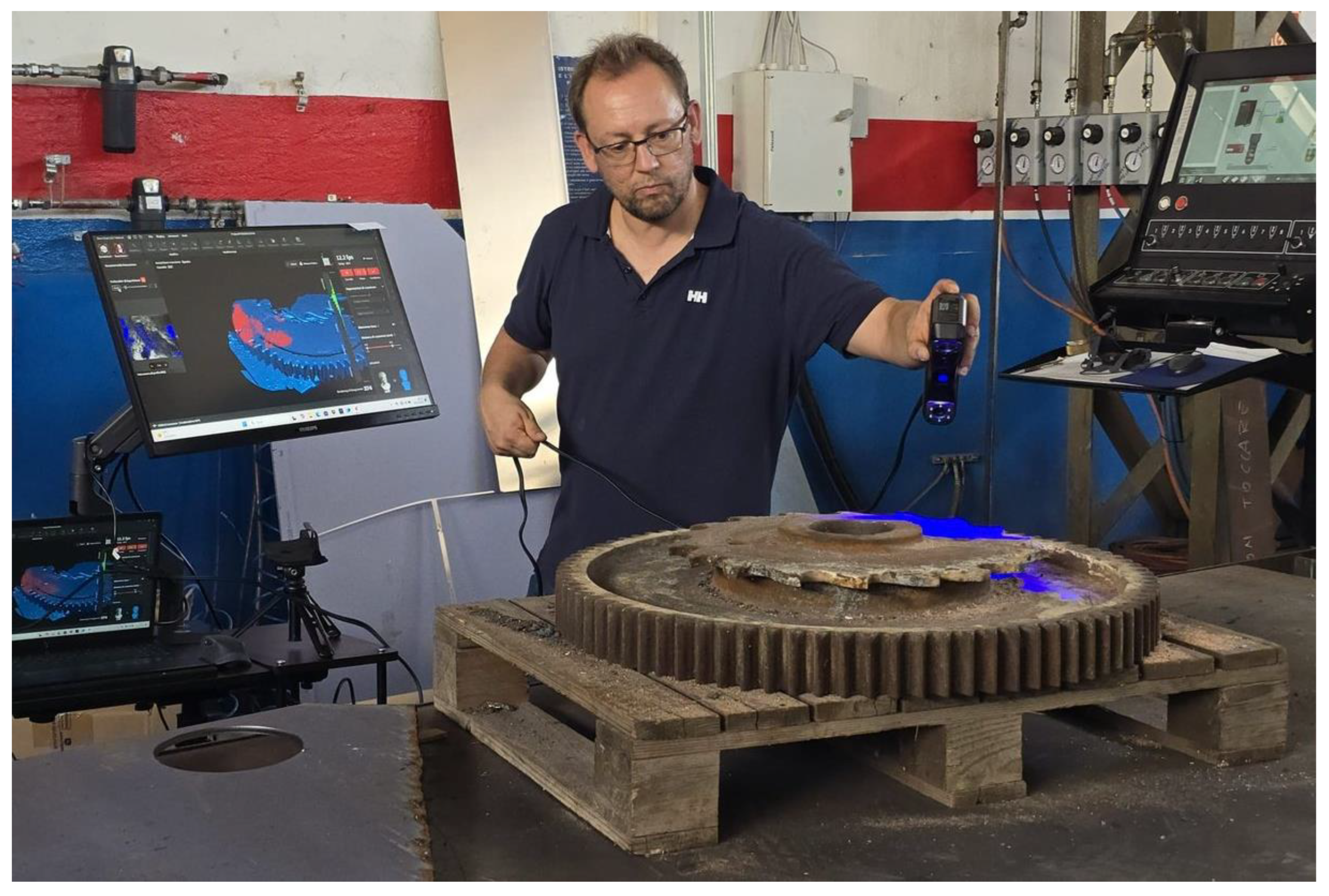
A Review on Reverse Engineering for Sustainable Metal Manufacturing: From 3D Scans to Simulation-Ready Models



Featured Application
Abstract
1. Introduction
2. Data Acquisition and Geometric Uncertainty in Reverse Engineering for Metal Manufacturing
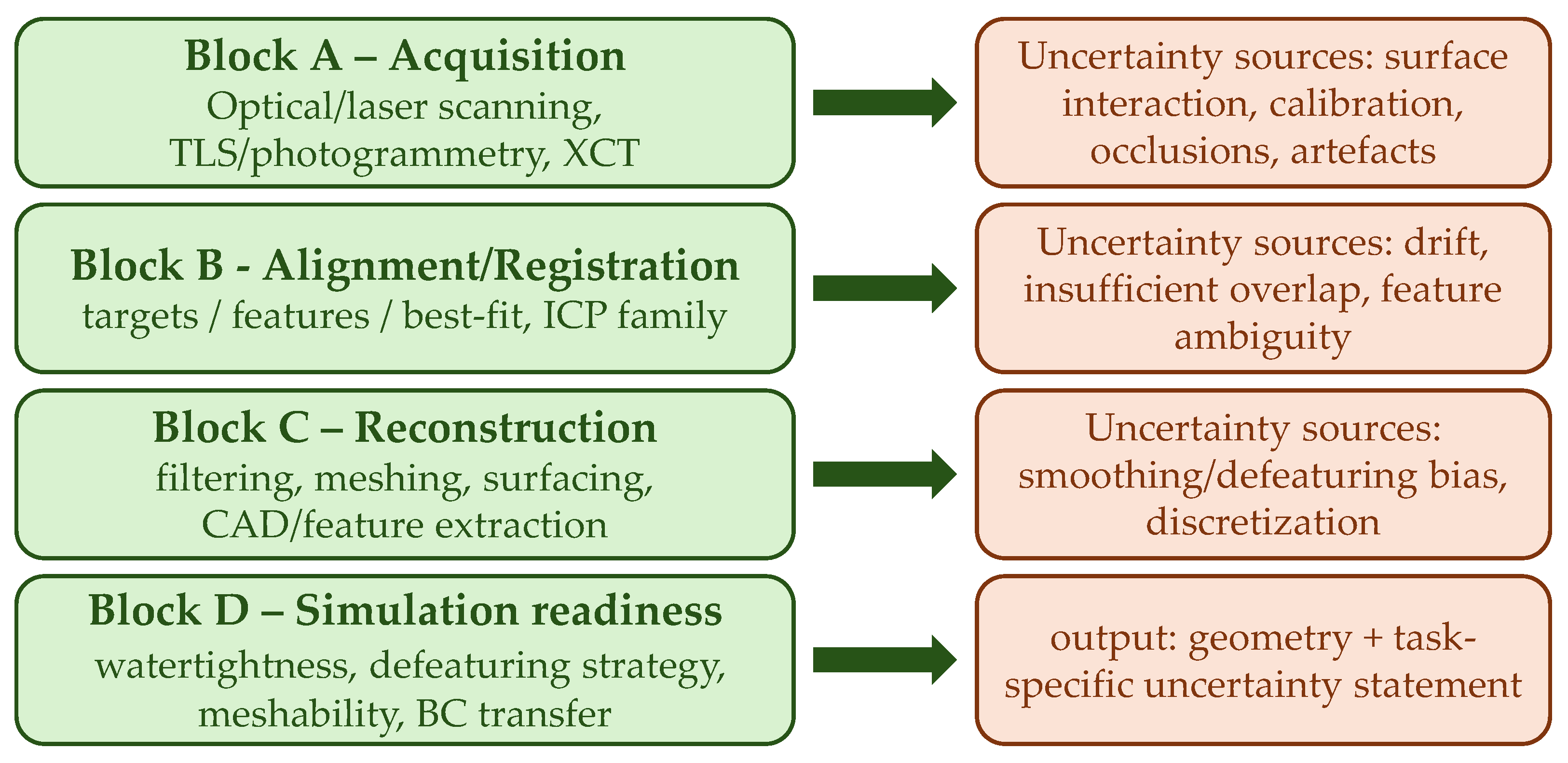
2.1. Main Sources of Geometric Uncertainty in Scan-Based RE
2.2. Optical 3D Scanning of Metals: Structured Light and Laser Triangulation
2.3. Large-Scale Metal Assets: Terrestrial Laser Scanning, Photogrammetry, and View Planning
2.4. Industrial X-Ray Computed Tomography (XCT): Internal Geometry and “Surface Determination”
2.5. Representative Industrial Systems (Illustrative Examples)
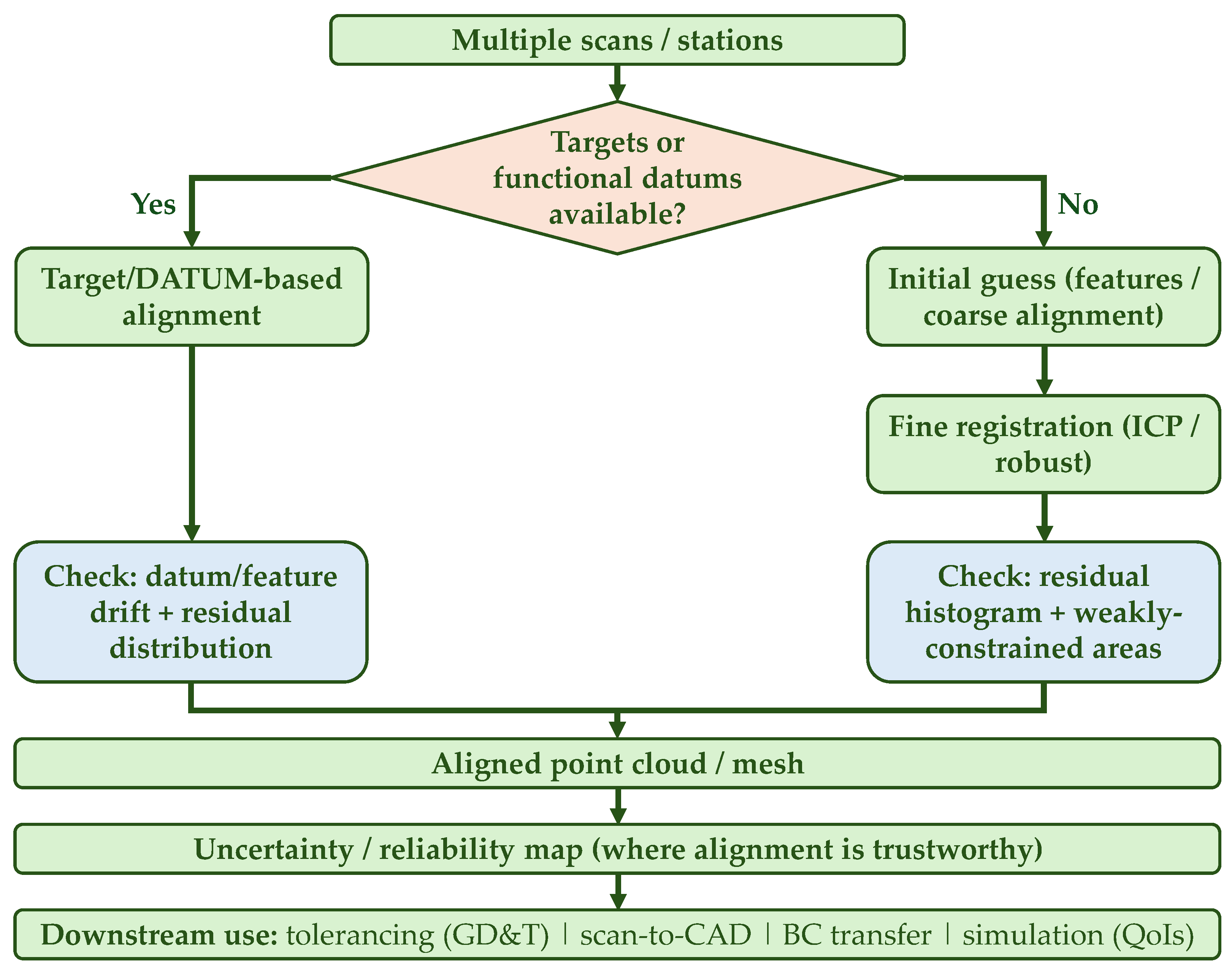
2.6. Registration and Alignment: Turning Multiple Scans into Coherent Geometry
2.7. Task-Specific Uncertainty: Making Scan Data Usable for Tolerancing and Simulation Readiness
2.8. Brief Note on Sustainability
3. From Scan Data to Simulation-Ready Digital Models: Processing, Reconstruction, and Structural Sensitivity
3.1. Registration and Metrology-Aware Point Sets
3.2. From Points to Mesh: Normals, Watertightness, and Repair
3.3. Segmentation and Surface Extraction as “Stress-Relevant” Decisions
3.4. Surface Fitting and NURBS Reconstruction: Tolerances That Matter
3.5. Feature and CAD Reconstruction Pathways: From Meshes to Parametric Solids
3.6. Preparing “Simulation-Ready” Models: Defeaturing, Idealization, and Error Control
4. Scan-to-Simulation Practices: Meshing, Defeaturing, Boundary Conditions, and Uncertainty Propagation
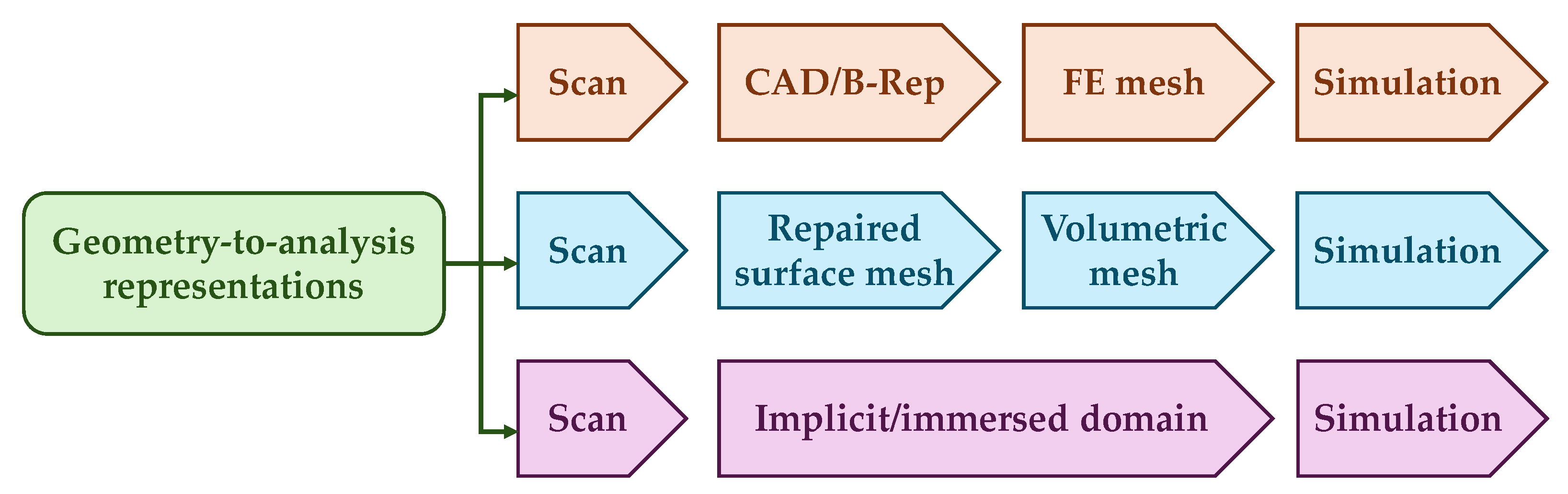
4.1. Geometry-to-Analysis Representations: CAD-Based, Mesh-Based, and “Implicit/Immersed” Options
4.2. FE Mesh Generation on Scan-Derived or Reconstructed Geometries (Including Defective CAD)
4.3. Defeaturing and Idealization for Simulation: Controlling Analysis Error Rather than “Removing Detail”
4.4. Boundary-Condition Transfer: From Fixtures/Tests/CAD to the FE Model
4.5. Uncertainty Propagation: From Geometric Variability to Mechanical Response Variability
- Simulation uncertainty conditioned on geometry (mesh sensitivity, BC uncertainty, material variability, and solver/model-form uncertainty).
- Perturbation/sensitivity analysis (fast, but may miss nonlinearity);
- Monte Carlo with geometric variants (robust, but costly);
- Surrogate models (efficient after training, but require careful validation).
4.6. Model Updating and Response-Driven Refinement (Closing the Loop)
5. RE-Enabled Manufacturing Decisions: Repair and Remanufacturing Chains for Metals
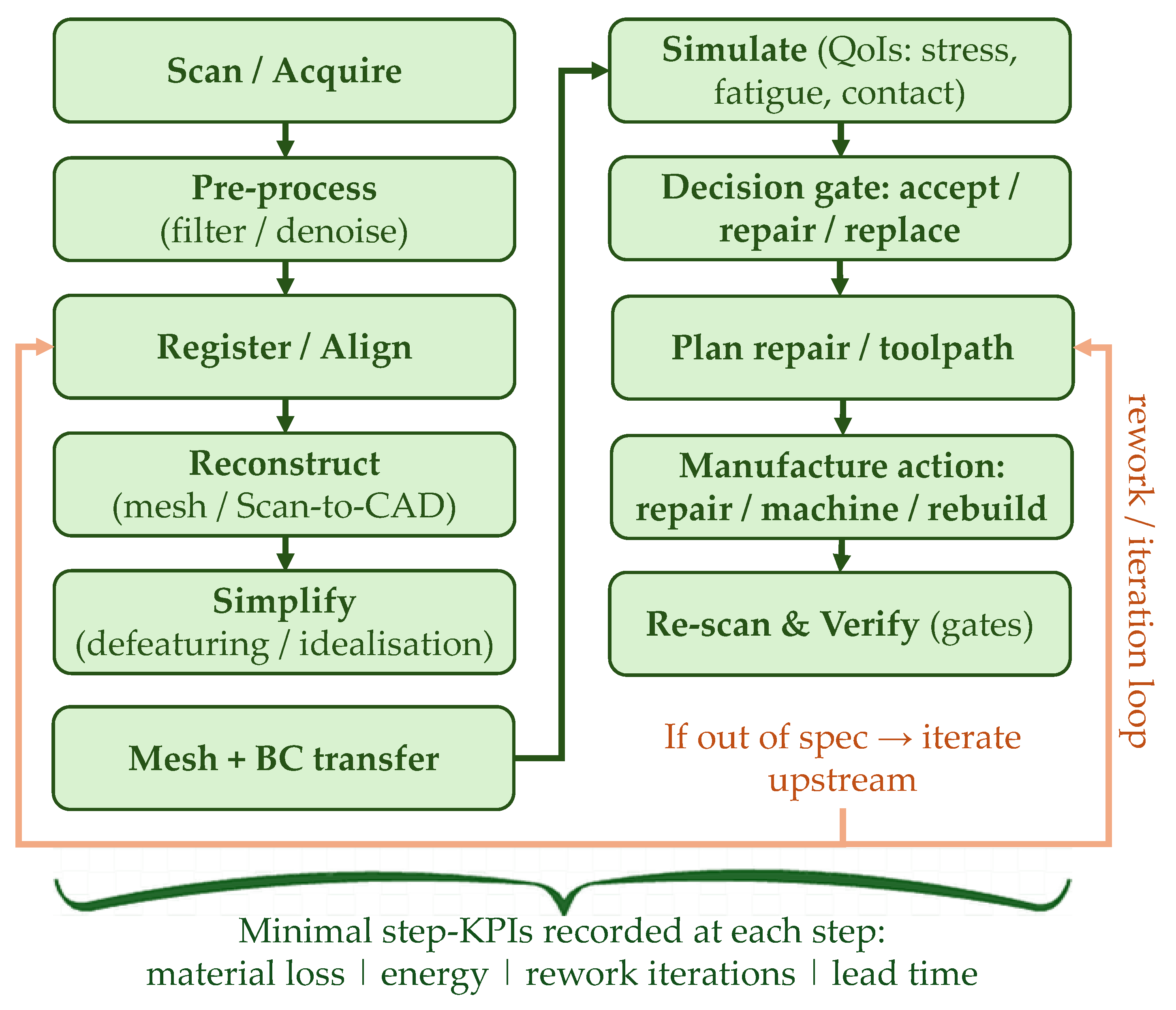
5.1. From Geometry to Decisions: The Repair/Remanufacturing “Gate Model”
5.2. Damage Assessment and Repair-Volume Definition: Extracting the “Patch” That Manufacturing Can Execute
5.3. Repair Route Selection for Metals: What Each Process Needs from RE
5.4. Planning and Sequencing in Hybrid Additive–Subtractive Remanufacturing
5.5. Verification, Monitoring, and Qualification Loops: Closing the Digital Thread
5.6. Brief Note: Where the Remanufacturing Decision Is Executed (Networks and “Repair-As-a-Service”)
6. Sustainability and Reporting Framework for the Scan–Model–Simulate–Manufacture Chain
6.1. Compact Framing: Sustainability as a Two-Scenario Question (Repair/Remanufacture vs. Replacement)
6.2. Where Sustainability “Moves the Needle” in RE Workflows
- Avoiding rework loops and scrap through metrologically defensible inputs: poorly reported acquisition/reconstruction choices often trigger re-scans, repeated cleanup, or late discovery of mismatches—each iteration adding time, energy, and potentially scrap.
- Using simulation to prevent over-processing and over-repair: S2S is sustainability-relevant when it reduces conservative repair volumes, heat treatments, or machining allowances while still meeting mechanical requirements; integrated LCA/LCC perspectives are increasingly used to formalize this trade space.
6.3. A Minimal Inventory and KPI Set for the Scan–Model–Simulate–Manufacture Chain

| Chain Step | Sustainability Lever (Mechanism) | What to Measure (Inventory Items) | Practical KPIs (Examples) | Typical Data Sources | Notes/Pitfalls | Ref. |
|---|---|---|---|---|---|---|
| Scan (acquisition + planning) | Reduce re-scans and downstream scrap by task-driven scan planning and traceable settings (coverage, incidence, fixturing). | Number of scans/stations; scan time; energy of scanner/robot; auxiliary materials (e.g., spray coating mass); travel/logistics if on-site. | kWh per acquired part; # acquisition iterations; coating mass (g); % coverage on functional interfaces. | Machine power logs; robot cycle logs; scan reports; operator logs; travel distance. | Coatings can shift dimensions; report thickness assumptions. Energy is often small vs. repair, but iterations dominate. | |
| Model (reconstruction + CAD editing) | Avoid over-processing (smoothing/repair/defeature) that triggers redesign loops; keep raw-to-processed traceability. | CPU/GPU time (optional); number of reconstruction iterations; parameter settings (filters, tolerances); manual editing time. | Wall-time per iteration; # reworking loops; tolerance settings (mm) tied to task. | Software logs; version control; engineering change logs. | Computation footprint is usually secondary, but the ‘iteration count’ is a strong proxy for waste and delay. | [123] |
| Simulate (mesh + BCs + uncertainty) | Use simulation to choose a repair scope that meets requirements the first time; quantify sensitivity to geometry/BCs to prevent over-conservatism. | Meshing time; solver runs; surrogate/model order reductions; uncertainty bands on QoIs (stress, life, stiffness). | # solver iterations; uncertainty band width (%); probability of meeting spec. | CAE logs; solver reports; DoE/sensitivity analyses; validation tests. | Poor BC transfer can dominate errors, causing reworking. Capture BC assumptions explicitly. | [10,124] |
| Manufacture/repair (process route) | Maximize lifetime extension per unit impact by selecting the right repair route and minimizing deposited/removed material. | Energy and gas consumption; feedstock mass; shielding gas; consumables; pre/post-machining; heat treatments; scrap rates. | kg CO2e per repaired part; material yield (%); deposited mass (g); kWh per repair. | Machine power meters; process monitoring; material certificates; LCI databases; supplier data. | Electricity mix and feedstock production often dominate impacts; include transport if material is sourced remotely. | [105,106,113] |
| Verify + release (inspection + documentation) | Prevent hidden defects and premature failures; verification avoids future scrap and downtime. | Inspection time; energy; consumables; reworking fraction; pass/fail statistics. | % first-pass yield; # reworking loops; inspection time (min). | Metrology logs; NDT reports; quality systems. | Verification needs to align with failure mode; avoid ‘inspection for its own sake’ by defining acceptance criteria early. | [115] |
| Cross-cutting: baseline and lifetime extension | Compare repair/remanufacturing against a clear reference scenario (replace with new) using a consistent functional unit. | Functional unit; system boundaries; lifetime extension; allocation rules; impact method; electricity mix. | Δ kg CO2e vs. replacement; CO2e per year of additional service; cost per year (optional). | LCA goal/scope; process chain inventory; supplier and grid data; cost accounting (if LCC). | Results are sensitive to assumed lifetime, utilization, and electricity mix—report them explicitly. | [107] |
6.4. Practical Reporting Checklist for Decision-Grade Claims (Reproducibility + Sustainability)
7. Open Challenges and Research Directions for Robust, Automatable, and Sustainable RE in Metal Manufacturing
7.1. Metrology-Grade Benchmarks and Traceable Ground Truth (Still the Main Bottleneck)
7.2. Registration That Is Robust and Quantified (Not Only “Best-Fit”)
7.3. Feature Preservation Under Noise, Incomplete Coverage, and Repair Operations
7.4. From Scan-to-CAD to Editable CAD: Semantics, Constraints, and Manufacturing Intent
7.5. Defect Detection and Segmentation That Generalizes Across Metals, Finishes, and Processes
7.6. Scan-to-Simulation Trust: Boundary Condition Transfer and Uncertainty Propagation to QoIs
7.7. Multi-Scale Modeling: Coupling Macroscopic Geometry Defects with Microstructure-Sensitive Properties in Repair Zones
7.8. Interoperability and the Digital Thread: Preventing Information Loss from Scan to Manufacturing Action
7.9. Qualification of AI-Assisted RE Pipelines and Closed-Loop Remanufacturing
8. Conclusions
Author Contributions
Funding
Institutional Review Board Statement
Informed Consent Statement
Data Availability Statement
Acknowledgments
Conflicts of Interest
References
- Debnath, B.; Pourfarash, Z.; Ghorpade, B.; Raman, S. Integrating Reverse Engineering for Digital Model Reconstruction and Remanufacturing of Mechanical Components: A Systematic Review. Metrology 2025, 5, 66. [Google Scholar] [CrossRef]
- Buonamici, F.; Carfagni, M.; Furferi, R.; Governi, L.; Lapini, A.; Volpe, Y. Reverse Engineering Modeling Methods and Tools: A Survey. Comput. Aided. Des. Appl. 2018, 15, 443–464. [Google Scholar] [CrossRef]
- Motavalli, S. Review of Reverse Engineering Approaches. Comput. Ind. Eng. 1998, 35, 25–28. [Google Scholar] [CrossRef]
- Kruth, J.P.; Bartscher, M.; Carmignato, S.; Schmitt, R.; De Chiffre, L.; Weckenmann, A. Computed Tomography for Dimensional Metrology. CIRP Ann. 2011, 60, 821–842. [Google Scholar] [CrossRef]
- De Chiffre, L.; Carmignato, S.; Kruth, J.-P.; Schmitt, R.; Weckenmann, A. Industrial Applications of Computed Tomography. CIRP Ann. 2014, 63, 655–677. [Google Scholar] [CrossRef]
- Villarraga-Gómez, H.; Herazo, E.L.; Smith, S.T. X-Ray Computed Tomography: From Medical Imaging to Dimensional Metrology. Precis. Eng. 2019, 60, 544–569. [Google Scholar] [CrossRef]
- Wilson, J.M.; Piya, C.; Shin, Y.C.; Zhao, F.; Ramani, K. Remanufacturing of Turbine Blades by Laser Direct Deposition with Its Energy and Environmental Impact Analysis. J. Clean. Prod. 2014, 80, 170–178. [Google Scholar] [CrossRef]
- Priarone, P.C.; Campatelli, G.; Catalano, A.R.; Baffa, F. Life-Cycle Energy and Carbon Saving Potential of Wire Arc Additive Manufacturing for the Repair of Mold Inserts. CIRP J. Manuf. Sci. Technol. 2021, 35, 943–958. [Google Scholar] [CrossRef]
- Thompson, A.; Maskery, I.; Leach, R.K. X-Ray Computed Tomography for Additive Manufacturing: A Review. Meas. Sci. Technol. 2016, 27, 072001. [Google Scholar] [CrossRef]
- Kanishka, K.; Acherjee, B. A Systematic Review of Additive Manufacturing-Based Remanufacturing Techniques for Component Repair and Restoration. J. Manuf. Process. 2023, 89, 220–283. [Google Scholar] [CrossRef]
- Saboori, A.; Aversa, A.; Marchese, G.; Biamino, S.; Lombardi, M.; Fino, P. Application of Directed Energy Deposition-Based Additive Manufacturing in Repair. Appl. Sci. 2019, 9, 3316. [Google Scholar] [CrossRef]
- Piscopo, G.; Iuliano, L. Current Research and Industrial Application of Laser Powder Directed Energy Deposition. Int. J. Adv. Manuf. Technol. 2022, 119, 6893–6917. [Google Scholar] [CrossRef]
- Várady, T.; Martin, R.R.; Cox, J. Reverse Engineering of Geometric Models—An Introduction. Comput.-Aided Des. 1997, 29, 255–268. [Google Scholar] [CrossRef]
- Archenti, A.; Gao, W.; Donmez, A.; Savio, E.; Irino, N. Integrated Metrology for Advanced Manufacturing. CIRP Ann. 2024, 73, 639–665. [Google Scholar] [CrossRef]
- Guerra, M.G.; De Chiffre, L.; Lavecchia, F.; Galantucci, L.M. Use of Miniature Step Gauges to Assess the Performance of 3D Optical Scanners and to Evaluate the Accuracy of a Novel Additive Manufacture Process. Sensors 2020, 20, 738. [Google Scholar] [CrossRef] [PubMed]
- Lifton, J.J. Evaluating the Standard Uncertainty Due to the Voxel Size in Dimensional Computed Tomography. Precis. Eng. 2023, 79, 245–250. [Google Scholar] [CrossRef]
- Muralikrishnan, B. Performance Evaluation of Terrestrial Laser Scanners—A Review. Meas. Sci. Technol. 2021, 32, 072001. [Google Scholar] [CrossRef] [PubMed]
- Sepahi-Boroujeni, S.; Khameneifar, F. Digital Twin-Enabled Error and Uncertainty Mapping for 3D Scanning. Precis. Eng. 2024, 88, 527–539. [Google Scholar] [CrossRef]
- Jacobs, L.; Dvorak, J.; Cornelius, A.; Zameroski, R.; No, T.; Schmitz, T. Structured Light Scanning Artifact-Based Performance Study. Manuf. Lett. 2023, 35, 873–882. [Google Scholar] [CrossRef]
- Javaid, M.; Haleem, A.; Pratap Singh, R.; Suman, R. Industrial Perspectives of 3D Scanning: Features, Roles and It’s Analytical Applications. Sens. Int. 2021, 2, 100114. [Google Scholar] [CrossRef]
- Catalucci, S.; Thompson, A.; Piano, S.; Branson, D.T.; Leach, R. Optical Metrology for Digital Manufacturing: A Review. Int. J. Adv. Manuf. Technol. 2022, 120, 4271–4290. [Google Scholar] [CrossRef]
- Meana, V.; Zapico, P.; Cuesta, E.; Giganto, S.; Martinez-Pellitero, S. Laser Triangulation Sensors Performance in Scanning Different Materials and Finishes. Sensors 2024, 24, 2410. [Google Scholar] [CrossRef]
- Catalucci, S.; Koutecký, T.; Senin, N.; Piano, S. Investigation on the Effects of the Application of a Sublimating Matte Coating in Optical Coordinate Measurement of Additively Manufactured Parts. Int. J. Adv. Manuf. Technol. 2025, 140, 2749–2775. [Google Scholar] [CrossRef]
- Palousek, D.; Omasta, M.; Koutny, D.; Bednar, J.; Koutecky, T.; Dokoupil, F. Effect of Matte Coating on 3D Optical Measurement Accuracy. Opt. Mater. 2015, 40, 1–9. [Google Scholar] [CrossRef]
- Bonin, R.; Khameneifar, F.; Mayer, J.R.R. Evaluation of the Metrological Performance of a Handheld 3D Laser Scanner Using a Pseudo-3D Ball-Lattice Artifact. Sensors 2021, 21, 2137. [Google Scholar] [CrossRef] [PubMed]
- Giganto, S.; Martínez-Pellitero, S.; Meana, V.; Cuesta, E.; Barreiro, J. Influence of Point Cloud Filtering on Optical Inspection of Additive Manufactured Metal Parts. Precis. Eng. 2024, 90, 12–20. [Google Scholar] [CrossRef]
- Pajerová, N.; Koptiš, M. Shape Functions to Scanner Comparison. Int. J. Adv. Manuf. Technol. 2024, 132, 3889–3902. [Google Scholar] [CrossRef]
- Antolin-Urbaneja, J.C.; Pacheco Goñi, R.; Alberdi Olaizola, N.; Luengo Pizarro, A.I. Robotized 3D Scanning and Alignment Method for Dimensional Qualification of Big Parts Printed by Material Extrusion. Robotics 2024, 13, 175. [Google Scholar] [CrossRef]
- Geiger, K.; Sauerbier, C.; Montavon, B.; Schmitt, R.H. Model Based View Planning for the Robot-Guided Automation of Optical 3D Digitization Based on a Variable Mesh Resolution Processing Approach. Proc. Inst. Mech. Eng. B J. Eng. Manuf. 2023, 237, 2137–2149. [Google Scholar] [CrossRef]
- Cuypers, W.; Van Gestel, N.; Voet, A.; Kruth, J.-P.; Mingneau, J.; Bleys, P. Optical Measurement Techniques for Mobile and Large-Scale Dimensional Metrology. Opt. Lasers Eng. 2009, 47, 292–300. [Google Scholar] [CrossRef]
- Schmitt, R.H.; Peterek, M.; Morse, E.; Knapp, W.; Galetto, M.; Härtig, F.; Goch, G.; Hughes, B.; Forbes, A.; Estler, W.T. Advances in Large-Scale Metrology—Review and Future Trends. CIRP Ann. 2016, 65, 643–665. [Google Scholar] [CrossRef]
- Trombini, M.; Maculotti, G.; Maisano, D.A.; Pagani, A.; Franceschini, F. Scaling Photogrammetry: A Comparative Evaluation and Metrological Assessment across Small- and Meso-Scale Domains. Precis. Eng. 2025, 92, 124–140. [Google Scholar] [CrossRef]
- Peuzin-Jubert, M.; Polette, A.; Nozais, D.; Mari, J.-L.; Pernot, J.-P. Survey on the View Planning Problem for Reverse Engineering and Automated Control Applications. Comput.-Aided Des. 2021, 141, 103094. [Google Scholar] [CrossRef]
- Lee, I.D.; Seo, J.H.; Yoo, B. Autonomous View Planning Methods for 3D Scanning. Autom. Constr. 2024, 160, 105291. [Google Scholar] [CrossRef]
- Wang, L.; Wang, Z.; Kendall, P.; Gumma, K.; Turner, A.; Ratchev, S. Digital-Twin Deep Dynamic Camera Position Optimisation for the V-STARS Photogrammetry System Based on 3D Reconstruction. Int. J. Prod. Res. 2024, 62, 3932–3951. [Google Scholar] [CrossRef]
- Carmignato, S. Accuracy of Industrial Computed Tomography Measurements: Experimental Results from an International Comparison. CIRP Ann. 2012, 61, 491–494. [Google Scholar] [CrossRef]
- Yang, X.; Sun, W.; Giusca, C.L. An Automated Surface Determination Approach for Computed Tomography. NDT E Int. 2022, 131, 102697. [Google Scholar] [CrossRef]
- Yagüe-Fabra, J.A.; Ontiveros, S.; Jiménez, R.; Chitchian, S.; Tosello, G.; Carmignato, S. A 3D Edge Detection Technique for Surface Extraction in Computed Tomography for Dimensional Metrology Applications. CIRP Ann. 2013, 62, 531–534. [Google Scholar] [CrossRef]
- Jiménez-Pacheco, R.; Ontiveros, S.; Yagüe-Fabra, J.A. A Surface Extraction Analysis in a Multi-Material Test Part for Computed Tomography in Metrology Applications. Procedia Manuf. 2017, 13, 487–494. [Google Scholar] [CrossRef]
- Ontiveros, S.; Jiménez, R.; Yagüe-Fabra, J.A.; Torralba, M. Analysis of Surface Extraction Methods Based on Gradient Operators for Computed Tomography in Metrology Applications. Materials 2018, 11, 1461. [Google Scholar] [CrossRef]
- Kowaluk, T.; Wozniak, A. A New Threshold Selection Method for X-Ray Computed Tomography for Dimensional Metrology. Precis. Eng. 2017, 50, 449–454. [Google Scholar] [CrossRef]
- Lifton, J.J.; Liu, T. Evaluation of the Standard Measurement Uncertainty Due to the ISO50 Surface Determination Method for Dimensional Computed Tomography. Precis. Eng. 2020, 61, 82–92. [Google Scholar] [CrossRef]
- Stolfi, A.; Thompson, M.K.; Carli, L.; De Chiffre, L. Quantifying the Contribution of Post-Processing in Computed Tomography Measurement Uncertainty. Procedia CIRP 2016, 43, 297–302. [Google Scholar] [CrossRef]
- Dewulf, W.; Tan, Y.; Kiekens, K. Sense and Non-Sense of Beam Hardening Correction in CT Metrology. CIRP Ann. 2012, 61, 495–498. [Google Scholar] [CrossRef]
- Yang, X.; Sun, W.; Giusca, C.L. Surface Determination Algorithm for Accurate XCT Bidirectional Length Measurements. Precis. Eng. 2024, 85, 40–47. [Google Scholar] [CrossRef]
- Pirillo, F.; Shao, H.; Petrò, S.; Moroni, G. A Surface Determination Technique for Dimensional and Geometrical Analysis in Industrial X-Ray Computed Tomography. Nanomanuf. Metrol. 2024, 7, 20. [Google Scholar] [CrossRef]
- Moroni, G.; Petrò, S. Design for X-Ray Computed Tomography. Procedia CIRP 2019, 84, 173–178. [Google Scholar] [CrossRef]
- Villarraga-Gómez, H.; Amirkhanov, A.; Heinzl, C.; Smith, S.T. Assessing the Effect of Sample Orientation on Dimensional X-Ray Computed Tomography through Experimental and Simulated Data. Measurement 2021, 178, 109343. [Google Scholar] [CrossRef]
- Carmignato, S.; Aloisi, V.; Medeossi, F.; Zanini, F.; Savio, E. Influence of Surface Roughness on Computed Tomography Dimensional Measurements. CIRP Ann. 2017, 66, 499–502. [Google Scholar] [CrossRef]
- Hermanek, P.; Carmignato, S. Porosity Measurements by X-Ray Computed Tomography: Accuracy Evaluation Using a Calibrated Object. Precis. Eng. 2017, 49, 377–387. [Google Scholar] [CrossRef]
- Bellens, S.; Guerrero, P.; Vandewalle, P.; Dewulf, W. Machine Learning in Industrial X-Ray Computed Tomography—A Review. CIRP J. Manuf. Sci. Technol. 2024, 51, 324–341. [Google Scholar] [CrossRef]
- Besl, P.J.; McKay, N.D. Method for Registration of 3-D Shapes; Schenker, P.S., Ed.; SPIE: Bellingham, WA, USA, 1992; pp. 586–606. [Google Scholar]
- Chen, Y.; Medioni, G. Object Modeling by Registration of Multiple Range Images. In Proceedings of the 1991 IEEE International Conference on Robotics and Automation, Nice, France, 12–14 May 1992; IEEE Computer Society Press: Los Alamitos, CA, USA, 1992; pp. 2724–2729. [Google Scholar]
- Lyu, M.; Yang, J.; Qi, Z.; Xu, R.; Liu, J. Rigid Pairwise 3D Point Cloud Registration: A Survey. Pattern Recognit. 2024, 151, 110408. [Google Scholar] [CrossRef]
- Marek, J.; Chmelař, P. Survey of Point Cloud Registration Methods and New Statistical Approach. Mathematics 2023, 11, 3564. [Google Scholar] [CrossRef]
- Wilhelm, R.G.; Hocken, R.; Schwenke, H. Task Specific Uncertainty in Coordinate Measurement. CIRP Ann. 2001, 50, 553–563. [Google Scholar] [CrossRef]
- Vlaeyen, M.; Haitjema, H.; Dewulf, W. Digital Twin of an Optical Measurement System. Sensors 2021, 21, 6638. [Google Scholar] [CrossRef]
- Vlaeyen, M.; Haitjema, H.; Dewulf, W. Virtual Task-Specific Measurement Uncertainty Determination for Laser Scanning. Precis. Eng. 2023, 80, 208–228. [Google Scholar] [CrossRef]
- Tam, G.K.L.; Cheng, Z.-Q.; Lai, Y.-K.; Langbein, F.C.; Liu, Y.; Marshall, D.; Martin, R.R.; Sun, X.-F.; Rosin, P.L. Registration of 3D Point Clouds and Meshes: A Survey from Rigid to Nonrigid. IEEE Trans. Vis. Comput. Graph. 2013, 19, 1199–1217. [Google Scholar] [CrossRef] [PubMed]
- Liu, Y.; Zhang, C.; Dong, X.; Ning, J. Point Cloud-Based Deep Learning in Industrial Production: A Survey. ACM Comput. Surv. 2025, 57, 1–36. [Google Scholar] [CrossRef]
- Kazhdan, M.; Bolitho, M.; Hoppe, H. Poisson Surface Reconstruction; The Eurographics Association: Eindhoven, The Netherlands, 2006. [Google Scholar]
- Huang, Z.; Wen, Y.; Wang, Z.; Ren, J.; Jia, K. Surface Reconstruction From Point Clouds: A Survey and a Benchmark. IEEE Trans. Pattern Anal. Mach. Intell. 2024, 46, 9727–9748. [Google Scholar] [CrossRef]
- Garland, M.; Heckbert, P.S. Surface Simplification Using Quadric Error Metrics. In Proceedings of the 24th Annual Conference on Computer Graphics and Interactive Techniques—SIGGRAPH ’97, Los Angeles, CA, USA, 3–8 August 1997; ACM Press: New York, NY, USA, 1997; pp. 209–216. [Google Scholar]
- Chong, C.S.; Senthil Kumar, A.; Lee, H.P. Automatic Mesh-Healing Technique for Model Repair and Finite Element Model Generation. Finite Elem. Anal. Des. 2007, 43, 1109–1119. [Google Scholar] [CrossRef]
- Wen, H.; He, G.; Xu, R.; Chen, S.; Xin, S.; Shu, Z.; Komura, T.; Feng, J.; Wang, W.; Tu, C. Feature-Preserving Mesh Repair via Restricted Power Diagram. In Proceedings of the Special Interest Group on Computer Graphics and Interactive Techniques Conference Conference Papers, Vancouver, BC, Canada, 10–14 August 2025; ACM: New York, NY, USA, 2025; pp. 1–11. [Google Scholar]
- Li, M.; Gao, S.; Martin, R.R. Estimating the Effects of Removing Negative Features on Engineering Analysis. Comput.-Aided Des. 2011, 43, 1402–1412. [Google Scholar] [CrossRef]
- Vieira, M.; Shimada, K. Surface Mesh Segmentation and Smooth Surface Extraction through Region Growing. Comput. Aided Geom. Des. 2005, 22, 771–792. [Google Scholar] [CrossRef]
- Romanengo, C.; Raffo, A.; Biasotti, S.; Falcidieno, B. Recognizing Geometric Primitives in 3D Point Clouds of Mechanical CAD Objects. Comput.-Aided Des. 2023, 157, 103479. [Google Scholar] [CrossRef]
- Fugacci, U.; Romanengo, C.; Falcidieno, B.; Biasotti, S. Reconstruction and Preservation of Feature Curves in 3D Point Cloud Processing. Comput.-Aided Des. 2024, 167, 103649. [Google Scholar] [CrossRef]
- Zhang, Z.; Zhao, M.; Shen, Z.; Wang, Y.; Jia, X.; Yan, D.-M. Interactive Reverse Engineering of CAD Models. Comput. Aided Geom. Des. 2024, 111, 102339. [Google Scholar] [CrossRef]
- Dan, J.; Lancheng, W. An Algorithm of NURBS Surface Fitting for Reverse Engineering. Int. J. Adv. Manuf. Technol. 2006, 31, 92–97. [Google Scholar] [CrossRef]
- Cai, S.; Ye, Y.; Cao, J.; Chen, Z. FACE: Feature-Preserving CAD Model Surface Reconstruction. Graph. Models 2024, 136, 101230. [Google Scholar] [CrossRef]
- Benkő, P.; Martin, R.R.; Várady, T. Algorithms for Reverse Engineering Boundary Representation Models. Comput.-Aided Des. 2001, 33, 839–851. [Google Scholar] [CrossRef]
- Fisher, R.B. Applying Knowledge to Reverse Engineering Problems. Comput.-Aided Des. 2004, 36, 501–510. [Google Scholar] [CrossRef]
- Bénière, R.; Subsol, G.; Gesquière, G.; Le Breton, F.; Puech, W. A Comprehensive Process of Reverse Engineering from 3D Meshes to CAD Models. Comput.-Aided Des. 2013, 45, 1382–1393. [Google Scholar] [CrossRef]
- Kruth, J.-P.; Kerstens, A. Reverse Engineering Modelling of Free-Form Surfaces from Point Clouds Subject to Boundary Conditions. J. Mater. Process. Technol. 1998, 76, 120–127. [Google Scholar] [CrossRef]
- Lin, R.; Ji, Y.; Ding, W.; Wu, T.; Zhu, Y.; Jiang, M. A Survey on Deep Learning in 3D CAD Reconstruction. Appl. Sci. 2025, 15, 6681. [Google Scholar] [CrossRef]
- Zhang, C.; Polette, A.; Pinquié, R.; Carasi, G.; De Charnace, H.; Pernot, J.-P. ECAD-Net: Editable Parametric CAD Models Reconstruction from Dumb B-Rep Models Using Deep Neural Networks. Comput.-Aided Des. 2025, 178, 103806. [Google Scholar] [CrossRef]
- Thakur, A.; Banerjee, A.G.; Gupta, S.K. A Survey of CAD Model Simplification Techniques for Physics-Based Simulation Applications. Comput.-Aided Des. 2009, 41, 65–80. [Google Scholar] [CrossRef]
- Tang, J.; Gao, S.; Li, M. Evaluating Defeaturing-Induced Impact on Model Analysis. Math. Comput. Model. 2013, 57, 413–424. [Google Scholar] [CrossRef]
- González-Lluch, C.; Company, P.; Contero, M.; Camba, J.D.; Plumed, R. A Survey on 3D CAD Model Quality Assurance and Testing Tools. Comput.-Aided Des. 2017, 83, 64–79. [Google Scholar] [CrossRef]
- Yang, X.; Yu, F.; Zhou, Y.; Zhou, P.; Zhao, G.Z.; Guan, Z.Q. A Method of Surface Mesh Generation for Industrial CAD Models by Constructing Conforming Discrete Representation. Comput.-Aided Des. 2025, 188, 103914. [Google Scholar] [CrossRef]
- Buffa, A.; Chanon, O.; Vázquez, R. Analysis-Aware Defeaturing: Problem Setting and a Posteriori Estimation. Math. Models Methods Appl. Sci. 2022, 32, 359–402. [Google Scholar] [CrossRef]
- Hinz, J.; Chanon, O.; Arrigoni, A.; Buffa, A. A Shape Derivative Approach to Domain Simplification. Comput.-Aided Des. 2024, 167, 103636. [Google Scholar] [CrossRef]
- Chen, B.; Starman, B.; Halilovič, M.; Berglund, L.A.; Coppieters, S. Finite Element Model Updating for Material Model Calibration: A Review and Guide to Practice. Arch. Comput. Methods Eng. 2025, 32, 2035–2112. [Google Scholar] [CrossRef]
- Gothivarekar, S.; Brains, S.; Raeymaekers, B.; Talemi, R. Integrated Fatigue Evaluation of As-Built WAAM Steel Through Experimental Testing and Finite Element Simulation. Appl. Sci. 2025, 15, 10936. [Google Scholar] [CrossRef]
- Zhang, Z.; Wang, X.; Wang, L.; Xia, X. Surface Defect Detection Method for Discarded Mechanical Parts under Heavy Rust Coverage. Sci. Rep. 2024, 14, 7963. [Google Scholar] [CrossRef] [PubMed]
- Zheng, Y.; Qureshi, A.J.; Ahmad, R. Algorithm for Remanufacturing of Damaged Parts with Hybrid 3D Printing and Machining Process. Manuf. Lett. 2018, 15, 38–41. [Google Scholar] [CrossRef]
- Friebe, S.; Denkena, B.; Wichmann, M. Fully Automated Tool Path Planning for Turbine Blade Repair. Procedia CIRP 2023, 120, 9–14. [Google Scholar] [CrossRef]
- Du, X.; Shen, Y.; Zhao, W.; Chen, J.; Liu, R.; Wei, Y. Wire Arc Additive Manufacturing from the Perspective of Remanufacturing: A Review of Data Processing. J. Manuf. Process. 2023, 107, 385–410. [Google Scholar] [CrossRef]
- Ghanadi, N.; Pasebani, S. A Review on Wire-Laser Directed Energy Deposition: Parameter Control, Process Stability, and Future Research Paths. J. Manuf. Mater. Process. 2024, 8, 84. [Google Scholar] [CrossRef]
- Wang, D.; Liu, Z.; Deng, G.; Zhou, X.; Li, S.; Wang, H.; Yang, Y.; Han, C. A Laser Powder Bed Fusion–Based Methodology for Repairing Damaged Nickel-Based Turbine Blades: Investigation of Interfacial Characteristics and Hot Isostatic Pressing Treatment. Mater. Charact. 2024, 212, 113948. [Google Scholar] [CrossRef]
- Ye, L.; Xue, H.; Li, Z.; Zhou, Y.; Chen, G.; Xu, F.; Melentiev, R.; Newman, S.; Yu, N. Review of Online Quality Control for Laser Directed Energy Deposition (LDED) Additive Manufacturing. Int. J. Extrem. Manuf. 2025, 7, 062005. [Google Scholar] [CrossRef]
- Singh, S.; Kumar, C.; Sah, S.K. Review on Laser Powder-Based Directed Energy Deposition for Fabricating Functionally Graded Materials: Microstructure, Mechanical Behavior, and Defect Analysis. J. Laser Appl. 2025, 37, 041202. [Google Scholar] [CrossRef]
- Chen, C.; Zhang, M.; Liu, H.; Yang, Q. Gas Turbine Blade Failures Repaired Using Laser Metal Additive Remanufacturing. Materials 2025, 18, 5590. [Google Scholar] [CrossRef] [PubMed]
- Zhou, X.; Pei, Z.; Liu, Z.; Yang, L.; Yin, Y.; He, Y.; Wu, Q.; Nie, Y. Multiscale Simulation of Laser-Based Direct Energy Deposition (DED-LB/M) Using Powder Feedstock for Surface Repair of Aluminum Alloy. Materials 2024, 17, 3559. [Google Scholar] [CrossRef]
- Ghungrad, S.; Molossi, M.; Amico, C.; Cigolini, R.; Haghighi, A. Towards Cloud Remanufacturing: Economic Feasibility of Hybrid Additive Manufacturing-Enabled Metal Component Repair. Ann. Oper. Res. 2025, 1–33. [Google Scholar] [CrossRef]
- Zheng, Y.; Liu, J.; Ahmad, R. A Cost-Driven Process Planning Method for Hybrid Additive–Subtractive Remanufacturing. J. Manuf. Syst. 2020, 55, 248–263. [Google Scholar] [CrossRef]
- Li, L.; Haghighi, A.; Yang, Y. A Novel 6-Axis Hybrid Additive-Subtractive Manufacturing Process: Design and Case Studies. J. Manuf. Process. 2018, 33, 150–160. [Google Scholar] [CrossRef]
- Al-Musaibeli, H.; Ahmad, R. A Path Planning Method for Surface Damage Repair Using a Robot-Assisted Laser Cladding Process. Int. J. Adv. Manuf. Technol. 2022, 122, 1259–1279. [Google Scholar] [CrossRef]
- Imam, H.Z.; Al-Musaibeli, H.; Zheng, Y.; Martinez, P.; Ahmad, R. Vision-Based Spatial Damage Localization Method for Autonomous Robotic Laser Cladding Repair Processes. Robot. Comput. Integr. Manuf. 2023, 80, 102452. [Google Scholar] [CrossRef]
- Wang, J.; Zhang, B.; Tang, H.; Wei, X.; Hao, W.; Wang, J. Development of Integrated Automatic System of Laser Cladding for Repairing of Polycrystalline Diamond Compact Bits. Electronics 2023, 12, 900. [Google Scholar] [CrossRef]
- Wang, J.; Mo, Z.; Wang, J.; Pan, W. Application of Three-Dimensional (3D) Hand–Eye Calibration of Industrial Robot in Laser Cladding Repair for Drilling Bit. Mech. Sci. 2025, 16, 181–194. [Google Scholar] [CrossRef]
- Touzé, S.; Navarro Valero, C.; Rückert, G.; Hascoët, J.-Y. Closed-Loop Control of a Directed Energy Deposition Process for Repair Applications. Prog. Addit. Manuf. 2025, 10, 4843–4859. [Google Scholar] [CrossRef]
- Wurst, J.; Ganter, N.V.; Ehlers, T.; Schneider, J.A.; Lachmayer, R. Assessment of the Ecological Impact of Metal Additive Repair and Refurbishment Using Powder Bed Fusion by Laser Beam Based on a Multiple Case Study. J. Clean. Prod. 2023, 423, 138630. [Google Scholar] [CrossRef]
- Saai, A.; Hepo-oja, L.; Müller, V.; Puukko, P.; Klötzer-Freese, C.; Wagner, F.; Azrague, K. Comparative Life Cycle Assessments of Greenhouse Gas Emissions Associated with Directed Energy Deposition Repairing and Sand-Casting Replacement of a Ship Propeller. Prog. Addit. Manuf. 2025, 10, 11781–11799. [Google Scholar] [CrossRef]
- Jerome, A.; Ljunggren, M.; Mathieux, F.; Bobba, S.; Ardente, F. Product Lifetime Approaches in Life Cycle Assessments of Circular Economy. Int. J. Life Cycle Assess. 2025, 1–16. [Google Scholar] [CrossRef]
- ISO 14955-1:2017; Machine Tools—Environmental Evaluation of Machine Tools—Part 1: Design Methodology for Energy-Efficient Machine Tools. ISO: Geneva, Switzerland, 2017.
- ISO 14955-2:2018; Machine Tools—Environmental Evaluation of Machine Tools—Part 2: Methods for Measuring Energy Supplied to Machine Tools and Machine Tool Components. ISO: Geneva, Switzerland, 2018.
- ISO 14040:2006; Environmental Management—Life Cycle Assessment—Principles and Framework. ISO: Geneva, Switzerland, 2006.
- ISO 14044:2006; Environmental Management—Life Cycle Assessment—Requirements and Guidelines. ISO: Geneva, Switzerland, 2006.
- European Commission; Joint Research Centre; Institute for Environment and Sustainability: International Reference Life Cycle Data System (ILCD). ILCD Handbook: Specific Guide for Life Cycle Inventory (LCI) Data Sets; Publications Office of the European Union: Luxembourg, 2010; ISBN 9789279190933.
- Ehmsen, S.; Yi, L.; Glatt, M.; Linke, B.S.; Aurich, J.C. Reusable Unit Process Life Cycle Inventory for Manufacturing: High Speed Laser Directed Energy Deposition. Prod. Eng. 2023, 17, 715–731. [Google Scholar] [CrossRef]
- Qi, K.; Yang, Z.; Zhang, Y.; Li, G.; Li, K.; Yao, X.; Jiang, L. Magnetic Field-Assisted Laser Cladding of FeCoCrNiAl High-Entropy Alloy Coatings on Invar Steel Substrate. JOM 2025, 1–16. [Google Scholar] [CrossRef]
- Liu, M.; Cai, Y.; Duan, C.; Li, G. Key Techniques in Parts Repair and Remanufacturing Based on Laser Cladding: A Review. J. Manuf. Process. 2024, 132, 994–1014. [Google Scholar] [CrossRef]
- Hu, S.; Liu, F.; He, Y.; Hu, T. An On-Line Approach for Energy Efficiency Monitoring of Machine Tools. J. Clean. Prod. 2012, 27, 133–140. [Google Scholar] [CrossRef]
- Baumers, M.; Tuck, C.; Bourell, D.L.; Sreenivasan, R.; Hague, R. Sustainability of Additive Manufacturing: Measuring the Energy Consumption of the Laser Sintering Process. Proc. Inst. Mech. Eng. B J. Eng. Manuf. 2011, 225, 2228–2239. [Google Scholar] [CrossRef]
- Ravisankar, B.; Jaeger, E.; Meißner, M.; Wirtz, A.; Wiederkehr, P.; Rehtanz, C. Investigation of Electrical Power Consumption of an Additive Process Chain and Empirical Modelling as Feature Selection for Machine Learning Algorithms. Procedia CIRP 2021, 99, 358–363. [Google Scholar] [CrossRef]
- Khan, K.N.; Ou, Z.; Hirki, M.; Nurminen, J.K.; Niemi, T. How Much Power Does Your Server Consume? Estimating Wall Socket Power Using RAPL Measurements. Comput. Sci. Res. Dev. 2016, 31, 207–214. [Google Scholar] [CrossRef]
- García-Martín, E.; Rodrigues, C.F.; Riley, G.; Grahn, H. Estimation of Energy Consumption in Machine Learning. J. Parallel Distrib. Comput. 2019, 134, 75–88. [Google Scholar] [CrossRef]
- Yang, Z.; Adamek, K.; Armour, W. Accurate and Convenient Energy Measurements for GPUs: A Detailed Study of NVIDIA GPU’s Built-In Power Sensor. In Proceedings of the SC24: International Conference for High Performance Computing, Networking, Storage and Analysis, Atlanta, GA, USA, 17–22 November 2024; IEEE: New York, NY, USA, 2024; pp. 1–17. [Google Scholar]
- ISO 22400-2:2014; Automation Systems and Integration—Key Performance Indicators (KPIs) for Manufacturing Operations Management Part 2: Definitions and Descriptions. ISO: Geneva, Switzerland, 2014.
- Kaniappan Chinnathai, M.; Alkan, B. A Digital Life-Cycle Management Framework for Sustainable Smart Manufacturing in Energy Intensive Industries. J. Clean. Prod. 2023, 419, 138259. [Google Scholar] [CrossRef]
- Favi, C.; Murgese, L.; Villazzi, N.; Gallozzi, S.; Mandolini, M.; Marconi, M. Integrating Life Cycle Engineering into Design for Additive Manufacturing: A Review. J. Manuf. Syst. 2025, 82, 599–631. [Google Scholar] [CrossRef]
- Kokare, S.; Oliveira, J.P.; Godina, R. Life Cycle Assessment of Additive Manufacturing Processes: A Review. J. Manuf. Syst. 2023, 68, 536–559. [Google Scholar] [CrossRef]
- Kortaberria, G.; Mutilba, U.; Gomez, S.; Ahmed, B. Three-Dimensional Point Cloud Task-Specific Uncertainty Assessment Based on ISO 15530-3 and ISO 15530-4 Technical Specifications and Model-Based Definition Strategy. Metrology 2022, 2, 394–413. [Google Scholar] [CrossRef]
- Zhang, S.; Guan, Z.; Jiang, H.; Ning, T.; Wang, X.; Tan, P. Brep2Seq: A Dataset and Hierarchical Deep Learning Network for Reconstruction and Generation of Computer-Aided Design Models. J. Comput. Des. Eng. 2023, 11, 110–134. [Google Scholar] [CrossRef]
- Lee, J.; Yeo, C.; Cheon, S.-U.; Park, J.H.; Mun, D. BRepGAT: Graph Neural Network to Segment Machining Feature Faces in a B-Rep Model. J. Comput. Des. Eng. 2023, 10, 2384–2400. [Google Scholar] [CrossRef]
- Rani, A.; Ortiz-Arroyo, D.; Durdevic, P. Advancements in Point Cloud-Based 3D Defect Classification and Segmentation for Industrial Systems: A Comprehensive Survey. Inf. Fusion 2024, 112, 102575. [Google Scholar] [CrossRef]
- Mei, R.-S.; Conway, C.H.; Bimrose, M.V.; King, W.P.; Shao, C. Deep Learning of 3D Point Clouds for Detecting Geometric Defects in Gears. Manuf. Lett. 2024, 41, 1324–1333. [Google Scholar] [CrossRef]
- Roth, M.; Rezaei Aderiani, A.; Morse, E.; Wärmefjord, K.; Söderberg, R. Closing Gaps in the Digital Thread with the Quality Information Framework (QIF) Standard for a Seamless Geometry Assurance Process. Comput.-Aided Des. 2025, 182, 103860. [Google Scholar] [CrossRef]
- Zhou, Y.; Lin, Q.; Shao, H.; Wang, C.; Li, X.; Hong, J. Stress-Based Optimization of Assembly Surface Mechanical Properties Oriented to Stress-Uniform Assembly. Precis. Eng. 2023, 82, 350–359. [Google Scholar] [CrossRef]
- Markl, M.; Körner, C. Multiscale Modeling of Powder Bed–Based Additive Manufacturing. Annu. Rev. Mater. Res. 2016, 46, 93–123. [Google Scholar] [CrossRef]
- Yan, W.; Lian, Y.; Yu, C.; Kafka, O.L.; Liu, Z.; Liu, W.K.; Wagner, G.J. An Integrated Process–Structure–Property Modeling Framework for Additive Manufacturing. Comput. Methods Appl. Mech. Eng. 2018, 339, 184–204. [Google Scholar] [CrossRef]
- Li, C.; Liu, J.F.; Fang, X.Y.; Guo, Y.B. Efficient Predictive Model of Part Distortion and Residual Stress in Selective Laser Melting. Addit. Manuf. 2017, 17, 157–168. [Google Scholar] [CrossRef]
- Wolff, S.; Lee, T.; Faierson, E.; Ehmann, K.; Cao, J. Anisotropic Properties of Directed Energy Deposition (DED)-Processed Ti–6Al–4V. J. Manuf. Process. 2016, 24, 397–405. [Google Scholar] [CrossRef]
- Kistler, N.A.; Corbin, D.J.; Nassar, A.R.; Reutzel, E.W.; Beese, A.M. Effect of Processing Conditions on the Microstructure, Porosity, and Mechanical Properties of Ti-6Al-4V Repair Fabricated by Directed Energy Deposition. J. Mater. Process. Technol. 2019, 264, 172–181. [Google Scholar] [CrossRef]
- Sanaei, N.; Fatemi, A. Defect-Based Fatigue Life Prediction of L-PBF Additive Manufactured Metals. Eng. Fract. Mech. 2021, 244, 107541. [Google Scholar] [CrossRef]
- Levine, L.; Lane, B.; Becker, C.; Belak, J.; Carson, R.; Deisenroth, D.; Glaessgen, E.; Gnaupel-Herold, T.; Gorelik, M.; Greene, G.; et al. Outcomes and Conclusions from the 2022 AM Bench Measurements, Challenge Problems, Modeling Submissions, and Conference. Integr. Mater. Manuf. Innov. 2024, 13, 598–621. [Google Scholar] [CrossRef]
- Qvale, P.; Njaastad, E.B. Automated Toolpath Planning with 3D Implementation of a Parabolic Weld Bead Deposition Model for Wire Arc Additive Manufacturing Repair. Int. J. Adv. Manuf. Technol. 2024, 134, 297–308. [Google Scholar] [CrossRef]
- Jędrych, M.; Gorzkiewicz, D.; Deja, M.; Chodnicki, M. Application of 3D Scanning and Computer Simulation Techniques to Assess the Shape Accuracy of Welded Components. Int. J. Adv. Manuf. Technol. 2025, 138, 127–135. [Google Scholar] [CrossRef]
- Wang, P.; Yang, W.-A.; You, Y. A Hybrid Learning Framework for Manufacturing Feature Recognition Using Graph Neural Networks. J. Manuf. Process. 2023, 85, 387–404. [Google Scholar] [CrossRef]
- Wu, H.; Lei, R.; Peng, Y.; Gao, L. AAGNet: A Graph Neural Network towards Multi-Task Machining Feature Recognition. Robot. Comput. Integr. Manuf. 2024, 86, 102661. [Google Scholar] [CrossRef]



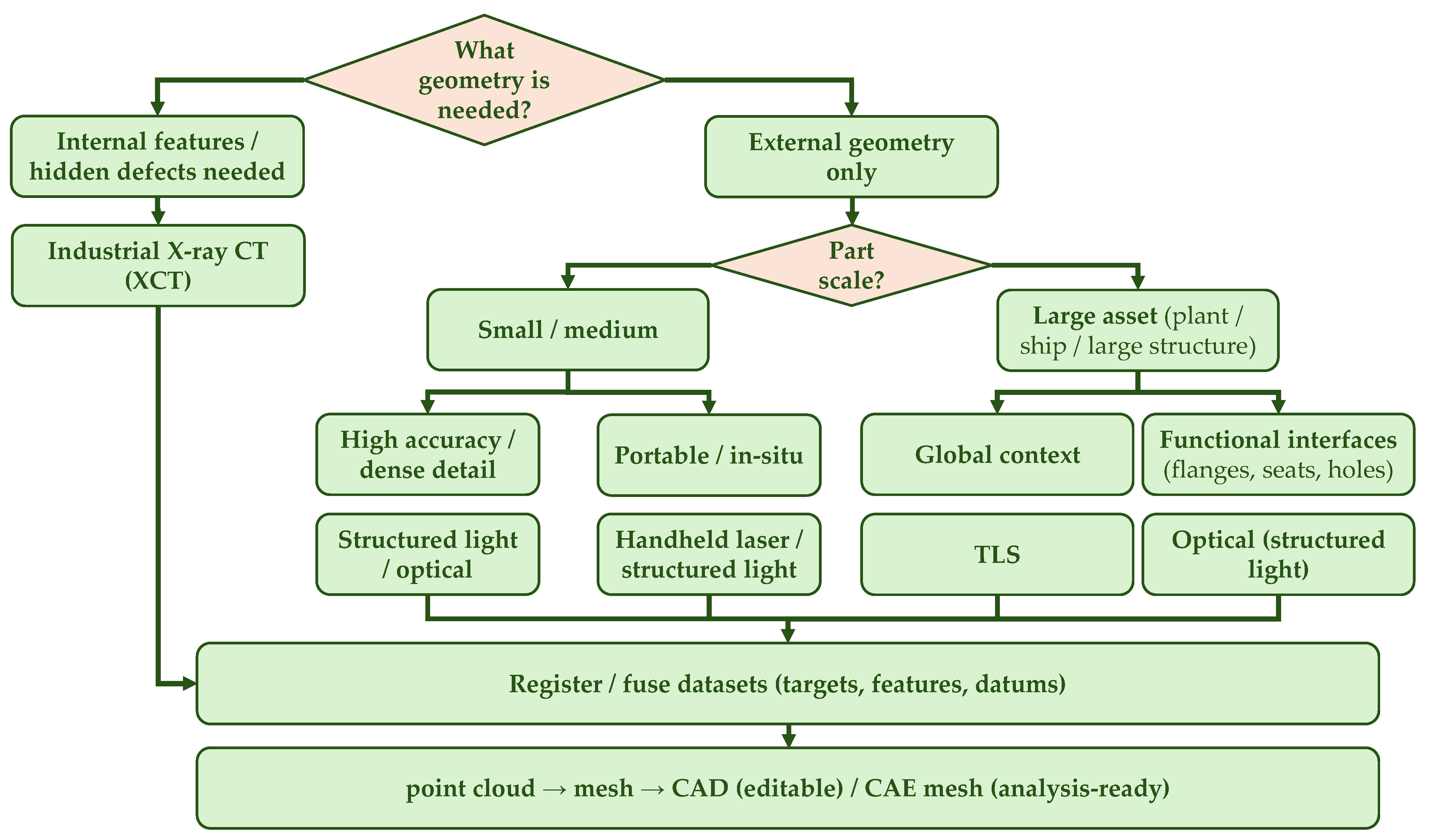
| Acquisition Modality | Typical Use in Metal Manufacturing | Strengths | Dominant Geometric Uncertainty Sources | Best Choice (Rule of Thumb) |
|---|---|---|---|---|
| Structured light/laser triangulation | Fast digitization; external geometry; fixtures; worn surfaces | High point density; short cycle time; portable/near-line options | Surface reflectivity/specular highlights; surface condition; calibration; angle-of-incidence effects; occlusions | External surfaces + fast turnaround; when internal features are not required |
| Handheld optical scanning | Maintenance; in situ digitization; remanufacturing; field inspection | Portability; accessibility; rapid capture in constrained environments | Operator dependency; inconsistent coverage; registration drift; surface-condition sensitivity | Field/maintenance scenarios; fast “as-is” capture with local validation artifacts |
| Terrestrial laser scanning (TLS)/photogrammetry | Large assets; assemblies; plant/ship structures; retrofit and fit-up | Scalability; large volumes; efficient global shape capture | Range/angle effects; environmental stability; multi-station registration error; occlusions | Large structures; combine with local high-accuracy scans for critical interfaces |
| X-ray computed tomography (XCT) | Internal channels; hidden features; complex AM parts; volumetric inspection | Internal + external geometry; non-destructive volumetric insight | Beam hardening/scatter; voxel size; reconstruction artifacts; surface determination/segmentation bias | When internal geometry governs function/repair decisions; when destructive inspection is not acceptable |
| Step | Minimum Information to Report (Manufacturing-Oriented) | Why It Matters |
|---|---|---|
| Surface condition | Material; finish (machined/shot-blasted/polished); coatings/sprays used | Surface–sensor interaction drives bias/noise (especially on metals) |
| Acquisition setup | Modality; key settings; standoff; fixturing; coverage strategy | Supports reproducibility and comparability across studies and setups |
| View planning | Number of views/stations; overlap rationale; occlusion handling | Coverage and registration stability determine local fidelity |
| Registration | Method (targets/features/best-fit); acceptance criteria; drift checks | Controls compounded alignment error and interface fidelity |
| Reconstruction | Filtering; decimation; meshing; surfacing; defeaturing rules | Reconstruction choices can shift stress-critical features |
| XCT specifics (if used) | Voltage/energy class; voxel size; artifact mitigation; segmentation method | XCT “surface determination” is a major uncertainty driver |
| Uncertainty statement | Task-specific uncertainty or proxy (feature-level if possible) | Turns scan data into decision-grade geometry for tolerancing/CAE |
| Validation | Comparison vs. reference (CMM, gauge, artifact) or repeatability checks | Prevents overconfidence and supports simulation readiness claims |
| Step/Choice (Point → Mesh → CAD) | What Changes in the Model | Why It Matters for Structural Predictions | Typical Control Parameter | Ref. |
|---|---|---|---|---|
| Registration strategy (datum vs. targetless; multi-view) | Global pose; small systematic shifts; axis/feature alignment | Misalignment can bias thickness/axes → stiffness and stress errors; affects BC transfer | ICP settings; overlap; datum constraints; target layout | [52] |
| Outlier removal/denoising | Removes sparse extremes and high-frequency variation | Can erase sharp edges/small grooves mistaken as noise; can shift filets | Neighborhood size; statistical thresholds; filter type | |
| Normal estimation | Orientation field for reconstruction and smoothing behavior | Drives edge fidelity and reconstruction stability; affects local curvature | kNN radius; robust normal filters; smoothing strength | |
| Surface reconstruction (e.g., Poisson) | Mesh topology and smoothness; hole closure tendencies | Smoothness prior can attenuate sharp/stress-critical features and small radii | Octree depth; regularization; screening/point weights | [61] |
| Hole filling/gap closure | Watertightness; local geometry inference | Filling may remove vents/holes that are load paths or stress raisers; may alter stiffness | Max hole size; curvature-based fill rules; patch constraints | |
| Mesh healing | Repairs topology and geometry defects (gaps, overlaps, self-intersections) | Enables meshing but can “invent” geometry if tolerances are loose; may distort interfaces | Healing tolerance; intersection resolution rules; sliver-face removal | [64] |
| Mesh simplification/decimation | Reduces triangles; redistributes error; smooths small detail | Changes radii/filets → alters stress concentration and fatigue hotspots | Error metric bounds; feature-preservation flags | [63] |
| Simplification (defeaturing and idealization) | Suppresses small features; changes topology | Reduces solve cost but introduces analysis error that should be bounded/estimated | Feature-size threshold; defeaturing rules; error control metric | [66] |
| Pathway | Output | Strengths | Limits (Simulation View) | Ref. |
|---|---|---|---|---|
| Surface-driven (segmentation → NURBS patches) | NURBS surfaces/stitched B-Rep | Good for freeform; controllable fitting tolerance | Patch boundaries may not coincide with functional features; continuity issues can affect stress | [67,71] |
| Feature-driven (primitives + blends + topology) | Feature-aware CAD | Preserves design intent; easier edits and downstream CAM | Harder on worn/as-built geometry; depends on robust segmentation and tolerance models | [13,73] |
| Knowledge-based reconstruction | Parametric CAD with constraints | Better functional consistency; supports standard feature libraries | Requires domain knowledge; not purely data-driven; may be difficult to automate | [74] |
| Mesh-to-CAD workflow (industrial pipeline) | CAD-ready geometry from mesh | Practical end-to-end procedures; fits industrial toolchains | Quality depends strongly on preprocessing and mesh repair; risk of over-smoothing | [75,76] |
| Simulation-oriented simplification | Analysis model (idealized CAD/mesh) | Reduces meshing and solve cost; easier parametric studies | Must quantify or bound analysis error; defeaturing can remove hotspots | [66,79,80] |
| Scan-to-Simulation Step | Typical Inputs | Key Methods/Choices | Main Failure Modes (Mechanics View) | Ref. |
|---|---|---|---|---|
| (1) Geometry ingestion | Point cloud/mesh/B-Rep; optional XCT volume | Choose analysis representation: direct mesh, reconstructed CAD, or immersed/implicit domain | Loss of stress-critical radii; inconsistent topology; non-physical smoothing | [62,75] |
| (2) FE mesh generation | CAD/mesh (possibly defective), feature tags, target element size | Tetra meshing; hex-dominant; adaptive sizing near filets/holes; defect-tolerant meshing | Slivers/inverted elements; mesh leakage through gaps; unresolved thickness | [82] |
| (3) Simplification (defeaturing and idealization) | CAD or reconstructed B-Rep; feature list; analysis objectives | Suppress small holes/filets; mid-surface extraction; idealize contacts | Removal of fatigue hotspots; biased stiffness; altered contact stresses | [83,84] |
| (4) Material assignment | Nominal alloy data; local hardness/HT state; AM/repair zones if any | Piecewise material zones; anisotropy when needed; calibration via model updating | Wrong local stiffness/strength in repair/HT zones; over/under-predicted safety factors | [85] |
| (5) Boundary condition (BC) transfer | Test/fixture definition; measured displacements/forces; scanned contact interfaces | Map BCs from CAD/test to FE mesh; infer constraints; contact modeling | Non-physical constraints; load path errors; unrealistic stress patterns | [80] |
| (6) Validation and iteration | Measured strains, deflections, or DIC; inspection metrics | Compare predicted vs. measured response; update geometry/BCs; uncertainty statements | Overfitting; missing model-form error; non-reproducible pipelines | [85] |
| Problem | Practical Approaches | Pros/Limitations | What to Report (Minimum) | Ref. |
|---|---|---|---|---|
| BC transfer between non-matching models | Nearest-neighbor/projection; RBF mapping; mortar methods; constraint equations | Fast but may distort near edges; robust methods need careful parameterization | Mapping method; smoothing/regularization; validation check vs. measurements | |
| BC inference from measurements | Inverse methods; FEM model updating; regularized optimization | Can identify hidden constraints; sensitive to noise/model error | Measurement type (DIC/strain/displacement); cost function; regularization | [85] |
| Geometric uncertainty propagation | Perturbation/sensitivity; Monte Carlo with shape variants; surrogate models | MC is robust but costly; sensitivity may miss nonlinearity; surrogates need training | Uncertainty source model; number of samples; convergence criteria | |
| Mesh/repair uncertainty | Compare multiple reconstruction/repair parameter sets; feature-level tolerances | Captures processing variability; needs systematic experiment design | Parameter ranges; acceptance thresholds; effect on hotspot stress | [65] |
| As-built surface-driven fatigue hotspots | Use scanned topography as geometry input; local refinement | Captures real roughness; needs careful filtering/scale separation | Scan resolution; filtering cutoffs; notch definition; fatigue metric | [86] |
| Decision Gate (Where RE Enables a Choice) | Digital Inputs (RE + Data) | Key Engineering Criterion | Typical Metrics | Dominant Uncertainty Sources | Ref. |
|---|---|---|---|---|---|
| Repair vs. replace/scrap | Initial inspection + 3D scan or CMM; optional XCT for internal damage; damage map vs. nominal CAD | Is the remaining life/strength recoverable within allowable limits? | Damage volume; min remaining wall thickness; crack length; allowable stock for machining; tolerance band for functional interfaces | Scan completeness (occlusion); registration drift; defect detectability; surface extraction (XCT) if used | [10,87] |
| Repair-volume definition (additive vs. subtractive patch) | Alignment of damaged geometry to nominal; extraction of deviation field; segmentation of repair region | Repair patch must remove damaged material while minimizing heat-affected risk and preserving datum features | Repair volume; patch boundary curvature continuity; datum distance-to-damage; minimum radius retained | Registration bias near weak constraints; smoothing/meshing choices; patch boundary sensitivity | [88,89] |
| Process-route selection (LC/DED/WAAM/LPBF vs. hybrid ASM) | Damage class + access; required accuracy; deposition accessibility; material compatibility; optional process simulation | Route must meet geometry + property targets with acceptable risk (cracking/porosity/distortion) | Achievable bead size; heat input class; post-machining allowance; deposition rate; minimum feature size | Thermal history variability; material dilution; geometry-to-toolpath fidelity; monitoring coverage | [90,91,92] |
| Toolpath planning and collision/pose feasibility | Reconstructed surface + local normals; reachability and collision checks; scan-derived thickness maps for finishing | Feasible paths that control bead overlap and avoid overbuild on constrained regions | Local deposition angle; standoff variation; overlap ratio; reachable orientation window; expected overbuild | Local normal noise; surface reconstruction bias; robot/cell calibration | [89,90] |
| Parameter-window selection and stability control | Geometry-informed heat accumulation risk; in situ monitoring signals (melt pool/height/IR) | Stable deposition without lack-of-fusion, cracks, or excessive distortion | Linear/areal energy density; layer height error; melt pool size; interpass temperature | Emissivity variation; sensor line-of-sight; powder/wire feed fluctuations | [91,93,94] |
| Post-processing and qualification (machining, HIP/HT, re-inspection) | As-built scan/CT for verification; simulation/inspection plan; mechanical testing strategy | Return-to-service acceptance on geometry + microstructure/property + defect limits | Final dimensional deviation; porosity/crack thresholds; hardness/UTS; residual stress indicators | Metrology of freeform repaired regions; CT surface determination; sampling representativeness | [92,95,96] |
| Network/make-or-buy (central hub vs. distributed repair) | Digital thread portability (scan + CAD + process plan); accuracy target; logistics/capacity data | Cost–quality–lead-time trade-off for where repair is executed | Accuracy threshold; transportation cost; capital amortization; turnaround time | Provider capability variance; data interoperability; calibration equivalence | [97,98] |
| Repair Route | Typical Metal Components | What RE Must Provide | Process-Model/Monitoring Interface | Post-Processing and Verification | Key Risks | Ref. |
|---|---|---|---|---|---|---|
| Laser cladding/powder DED (LP-DED/DED-LB/M) | Turbine blades, molds, rails, high-value housings; local wear and edge rebuild | Accurate repair volume + boundary; surface normals; access map; machining allowance envelope | Thermo-mechanical simulation for distortion/residual stress; online QC for melt pool/height/defects | Finish machining; heat treatment/HIP when needed; re-scan + targeted NDT/CT | Cracking (Ni alloys), porosity, dilution, distortion; overbuild in constrained regions | [93,94,96] |
| Wire-laser DED (W-LDED) | Near-net rebuild on steel/Ti; repair where powder handling is undesirable | Continuous pathable boundaries; stable standoff/orientation planning; bead stacking strategy | Height/melt-pool control; temperature monitoring; sensitivity to travel direction and thermal history | Machining for tolerance; re-scan for surface form; metallography for dilution/bond quality | Geometry drift from heat accumulation; bead waviness; sensitivity to path planning | [91,93] |
| Wire Arc Additive Manufacturing for remanufacturing (WAAR/WAAM-based) | Large structures and heavy components; thick-section rebuild; shipbuilding/mining parts | Global registration across large parts; collision-free posture planning; adaptive slicing/toolpath | Heat accumulation control; bead geometry prediction; in-process sensing, where possible | Subtractive cleanup/machining; re-scan of functional interfaces; mechanical testing as needed | High heat input → distortion; coarse microstructure; limited resolution for small features | [90] |
| LPBF-based repair/rebuild (PBF) | Small-to-medium high-value parts; complex local rebuild; superalloy feature restoration | High-fidelity repaired region definition; support strategy constraints; interface preparation geometry | Build simulation for residual stress/distortion; defect mitigation via post-treatment planning | HIP/HT; re-CT (porosity) + re-scan (geometry); microstructure at interface | Porosity/cracking; interface metallurgical compatibility; anisotropy and HAZ | [92] |
| Hybrid additive–subtractive remanufacturing (ASM/in-cell scan–build–machine) | Precision repair with tight tolerances; turbine blades/blisks; complex tooling | Datum strategy; additive/subtractive patch segmentation; scan-to-machine coordinate consistency | Cost/sequence optimization; verification scans between steps; simulation for removal/addition order | Integrated finishing; intermediate inspection; final metrology vs. tolerance requirements | Error stack-up across steps; fixturing repeatability; data handoff between software modules | [97,98,99] |
| Reporting Block | Minimum Items to Report (Practical Checklist) | Why It Matters for Sustainability/Decision-Grade Claims | Examples/Notes |
|---|---|---|---|
| Goal and functional unit | Define the decision question (e.g., repair vs. replace); functional unit (e.g., 1 component meeting spec); reference scenario; assumed lifetime extension. | Without a baseline and functional unit, sustainability claims are not comparable and can be misleading. | Consider reporting ‘CO2e per additional service-year’ when lifetime extension is the key benefit [107]. |
| System boundary and allocation | Specify included stages (scan, modeling, simulation, repair, post-processing, verification, transport); allocation rules for shared equipment; electricity mix. | Boundaries and electricity mix can flip conclusions for energy-intensive routes. | State the grid mix (country/region and year) and whether renewable sourcing is contractual [106]. |
| Acquisition (scan) | Sensor type; calibration status; surface prep/coating type and assumed thickness; view planning rationale; number of views/stations; scan time. | Iteration count and surface prep can dominate time/cost and bias geometry; clear reporting supports reproducibility. | If a coating is used, report whether thickness compensation was applied and how. |
| Registration and reconstruction | Registration strategy (targets vs. targetless); acceptance criteria; filtering/denoising settings; reconstruction tolerance; versioning (raw vs. processed). | These choices control geometry fidelity and the number of reworking loops; they also determine what is ‘structural truth’ later. | A ‘raw-to-processed’ archive supports traceability when validation fails. |
| Simulation (scan-to-simulation) | Meshing strategy; element type/size; defeaturing rules with thresholds; BC transfer method; material model assumptions; QoIs and uncertainty/sensitivity method. | Avoids over-claiming: mechanical outputs should be tied to model assumptions and their uncertainty. | Report which features were removed and why (QoI-based). |
| Repair/manufacturing route | Process route (e.g., L-DED, WAAM repair, laser cladding + machining); feedstock type; deposited/removed mass; energy and gas; key parameters; yields/scrap. | This is typically the dominant contributor to impacts; reporting enables meaningful LCA/LCC and comparison across routes. | UPLCI-style inventories can help structure data [113]. |
| Verification and acceptance | Inspection/NDT method; acceptance criteria; pass/fail and reworking rates; dimensional verification on functional interfaces; documentation for release. | Verification closes the loop: it links sustainability to reliability (avoiding premature scrap and downtime). | Report first-pass yield and major reworking causes if available. |
| Impact reporting (if quantified) | Impact method (e.g., GWP100); inventory sources/databases; uncertainty ranges; scenario analysis (electricity mix, transport, lifetime). | Small differences may not be meaningful without uncertainty; scenario analysis improves robustness. | For additive repair, material/feedstock often dominates: report powder/wire provenance [105]. |
| Transparency and data reuse | Provide a minimal dataset summary (energy, material, time) and metadata sufficient for reuse; declare software versions. | Facilitates meta-analysis and makes the review ‘citable’ as a reporting reference. | Digital life-cycle management concepts support consistent data capture across the chain [123]. |
| Challenge/Bottleneck | Why It Matters (Metal Manufacturing) | Research Direction | Evaluation Metrics/Reporting | Ref. |
|---|---|---|---|---|
| Metrology-grade benchmarks and traceable ground truth for industrial RE | Without traceable reference geometry and GD and T ground truth, it is hard to compare pipelines, quantify bias (e.g., edges/filets), or certify scan-to-model results. | Create benchmark parts + datasets with calibrated reference (CMM/CT), multi-sensor scans, and feature-level annotations (GD and T, radii, wall thickness). Publish protocols for repeatability and uncertainty budgets. | Feature-level deviation (GD and T), edge/filet radius error, thickness error, repeatability (σ), uncertainty budget, pass/fail consistency vs. tolerance. | [60,126] |
| Robust, quantified registration in cluttered shop-floor conditions | Small misalignments shift hole axes and filet positions, biasing interface fits and fatigue hotspots; errors are non-uniform and task-dependent. | Registration with explicit uncertainty models, outlier-robust alignment, and feature-/datum-aware objectives aligned with manufacturing intent (datums, functional interfaces). | Residual distributions (not only RMSE), datum/feature drift, uncertainty bounds, robustness to occlusion/surface finish changes, and runtime per scan. | [55] |
| Automation that preserves sharp features under noise and incomplete coverage | Edges, chamfers, and small radii control stress concentration and assembly fit; overly smooth reconstructions hide critical detail. | Feature-preserving reconstruction/repair with controllable priors; hybrid geometric + learning methods that explicitly preserve feature curves and primitives. | Edge/curve recall, radius preservation error, Hausdorff distance near features, topology validity, and downstream meshing success rate. | [65,78] |
| From scans/meshes to editable CAD (B-rep/parametric) suitable for manufacturing changes | Repair and redesign require constraint-aware CAD edits (holes, bosses, blends) rather than static meshes; current pipelines often stop at “watertight mesh”. | Semantic reconstruction that outputs B-rep/feature graphs, supports constraints, and provides confidence measures for recovered features. | Editability tests (feature constraints), B-rep validity, feature recognition accuracy, tolerance consistency after edits, and CAD regeneration success. | [77,127,128] |
| Defect detection/segmentation that generalizes across metals, finishes, and processes | Automated decisions (accept/repair/remanufacture) require reliable defect localization on reflective/rough surfaces and complex weld/AM geometries. | Domain-general defect models with physics-informed priors; combine point clouds with process/thermal history and uncertainty-aware thresholds. | Detection F1/IoU, false-alarm cost, sensitivity to surface condition, calibration of confidence, and cross-site generalization tests. | [129,130] |
| Boundary-condition and load-path transfer from scan/CAD to simulation models | Simulation-ready models require correct contacts, constraints, preload, and datum definitions; mis-specified BCs can dominate mechanical error. | BC inference using feature semantics + assembly context; standardized mapping from MBD/PMI to CAE; and automated contact detection with verification checks. | BC consistency checks, contact completeness, QoI sensitivity to BC perturbations, and traceable mapping from datums/PMI to CAE entities. | [126,131] |
| Propagation of geometric uncertainty to quantities of interest (QoIs) | Geometry uncertainty is spatially heterogeneous; QoIs (fatigue hotspot stress, contact pressure) are highly non-linear and locally sensitive. | Uncertainty-aware scan-to-simulation (UQ) with local sensitivity maps; link measurement uncertainty to probabilistic response envelopes. | QoI error bounds vs. experiments, local sensitivity maps, uncertainty propagation method, validation cases, and computational cost. | [126,132] |
| Multi-scale modeling for repaired components (macro geometry defects ↔ microstructure-sensitive/anisotropic repair zones) | Service-life predictions for repaired parts depend on both scan-captured macroscopic deviations (distortion/warpage, local shape errors) and heterogeneous, often anisotropic material behavior in AM/DED repair deposits. Assuming homogeneous/isotropic properties can mispredict fatigue hotspots, crack initiation sites, and durability, undermining acceptance decisions for high-value components. | Adopt process–structure–property/ICME-type workflows that: (i) transfer scan-derived geometry and distortion/residual-stress fields into the structural model; (ii) infer repair-zone quality descriptors from process history and/or characterization (porosity/LoF indicators, texture proxies); (iii) assign spatially varying (possibly anisotropic) constitutive and fatigue models; and (iv) propagate uncertainty across scales with validation against benchmark-quality datasets. | Report the defect-to-property mapping assumptions, spatial resolution of property fields, and calibration datasets; quantify sensitivity of fatigue-relevant QoIs to anisotropy/defect parameters; compare predicted vs. measured distortion/residual stress and (where available) microstructure descriptors; report QoI errors (e.g., life, crack-initiation location) and uncertainty-bound coverage. | [133,134,135,136,137,138,139] |
| Interoperability in the digital thread (scan ↔ CAD/PMI ↔ CAE ↔ manufacturing) | RE outputs often break when moving across tools; loss of datums/PMI and versioning undermines traceability and automation. | Adopt and extend exchange frameworks (e.g., QIF/MBD) for point clouds, feature semantics, and uncertainty; develop test suites for interoperability. | Information loss audits (datums/PMI), round-trip integrity tests, provenance tracking, and audit logs for revisions and decisions. | [60,131] |
| Qualification and certification of AI-assisted RE pipelines | High-value components (aerospace/energy) need auditable evidence that AI decisions are reliable under shift; black-box outputs are hard to certify. | Hybrid verification (rules + learning), calibration of model confidence, and standardized test protocols for domain shift and failure modes. | Calibration error, out-of-distribution detection, traceable failure cases, robustness under shift, and human-in-the-loop intervention rate. | [1,129] |
| RE-driven repair planning and closed-loop remanufacturing | Repair chains need consistent geometry capture, damage volume extraction, toolpath planning, and verification—often across multiple iterations. | Closed-loop scan–plan–deposit-inspect with simulation-assisted planning; quantify how scan uncertainty propagates to repair bead/thermal distortion and final geometry. | Repair volume extraction error, toolpath feasibility, as-repaired deviation, re-scan iteration count, and process time and scrap avoided. | [1,140,141] |
| Benchmark Task | Inputs → Outputs | What to Publish (Minimum) | Primary Metrics | Ref. |
|---|---|---|---|---|
| Acquisition planning and coverage | Part + constraints → viewpoint/trajectory plan + coverage map | CAD of benchmark part; scan poses/trajectory; environmental conditions; coating thickness policy; raw + processed scans | Coverage %, incidence-angle distribution, time/cycle time, repeatability (σ) across runs | [60,126] |
| Registration (target-based and target-less) | Partial scans → aligned point cloud/mesh + uncertainty map | Datum/target definitions; overlap %; residual distributions; acceptance thresholds; raw vs. filtered alignment results | Feature drift, residual histograms, robustness to occlusion/outliers, runtime | [55] |
| Feature extraction and manufacturing feature recognition | Point cloud/mesh/B-rep → primitives/features + confidence | Feature labels (holes, pockets, blends); tolerance classes; confusion matrices; failure cases | Precision/recall per feature; topology validity; editability success | [142,143] |
| B-rep/editable CAD reconstruction | Point cloud/mesh → B-rep/parametric CAD + constraints | Neutral CAD (STEP) + constraints; reconstruction logs; regeneration tests in CAD; validity checks | B-rep validity, constraint satisfaction, deviation at functional interfaces, CAD regeneration rate | [78,127,128] |
| Mesh repair and feature-preserving simplification | Noisy mesh → watertight mesh + feature curves | Healing thresholds; hole-filling policies; before/after mesh statistics; feature-curve preservation measures | Watertightness, topology defects removed, edge preservation error, meshing success | [65,78] |
| Defect detection and segmentation for repair decisions | Scan/mesh + context → defect regions + severity | Ground-truth defect labels; surface condition; false-alarm cost model; cross-site tests | IoU/F1, false-positive cost, calibration, generalization under surface/process shift | [129,130] |
| Scan-to-simulation uncertainty propagation | Geometry + uncertainty → QoI distribution (stress, fatigue, contact) | Uncertainty model; QoIs and load cases; experimental validation; sensitivity maps | QoI error bounds, sensitivity localization, computational cost, and reproducibility | [126,132] |
| Multi-scale repair zone modeling and service-life prediction (macro defects + microstructure/anisotropy) | Inputs: scan-derived geometry (and deviation map), identified critical regions, repair process history (toolpath/parameters), and/or targeted microstructure data (e.g., CT porosity, EBSD texture). Output: structural model with spatially varying (potentially anisotropic) repair-zone properties and predicted fatigue-relevant QoIs (life, hotspot location, crack-growth metrics) with uncertainty bounds. | Aligned scan + reference geometry; deviation/distortion map and (if available) residual-stress/deflection ground truth; repair process history (or equivalent metadata); repair-zone characterization (porosity/LoF proxies, texture/microstructure descriptors) and coupon-level mechanical data; simulation inputs (material field definition) + scripts for reproducibility. | QoI error vs. experiments (life/hotspot/crack initiation); sensitivity of QoIs to anisotropy/defect parameters; agreement on distortion/residual stress where available; uncertainty-bound coverage; computational cost (time/mesh size) at stated accuracy. | [134,136,137,138,139] |
| Digital thread exchange (scan–CAD/PMI–CAE–manufacturing) | Model versions → exchanged artifacts with provenance | Exchange format versions; datums/PMI retention checks; audit trail of revisions | Round-trip integrity, info-loss score, traceability completeness | [60,131] |
| Closed-loop repair chain (scan-plan-deposit-inspect) | Damaged part → repaired part + verification report | Damage definition; repair volume extraction; toolpaths; in-process data; post-repair metrology and acceptance criteria | As-repaired deviation, iteration count, process time, reworking rate | [140,141] |
Disclaimer/Publisher’s Note: The statements, opinions and data contained in all publications are solely those of the individual author(s) and contributor(s) and not of MDPI and/or the editor(s). MDPI and/or the editor(s) disclaim responsibility for any injury to people or property resulting from any ideas, methods, instructions or products referred to in the content. |
© 2026 by the authors. Licensee MDPI, Basel, Switzerland. This article is an open access article distributed under the terms and conditions of the Creative Commons Attribution (CC BY) license.
Share and Cite
Abdalla, E.; Panfiglio, S.; Parisi, M.; Di Bella, G. A Review on Reverse Engineering for Sustainable Metal Manufacturing: From 3D Scans to Simulation-Ready Models. Appl. Sci. 2026, 16, 1229. https://doi.org/10.3390/app16031229
Abdalla E, Panfiglio S, Parisi M, Di Bella G. A Review on Reverse Engineering for Sustainable Metal Manufacturing: From 3D Scans to Simulation-Ready Models. Applied Sciences. 2026; 16(3):1229. https://doi.org/10.3390/app16031229
Chicago/Turabian StyleAbdalla, Elnaeem, Simone Panfiglio, Mariasofia Parisi, and Guido Di Bella. 2026. "A Review on Reverse Engineering for Sustainable Metal Manufacturing: From 3D Scans to Simulation-Ready Models" Applied Sciences 16, no. 3: 1229. https://doi.org/10.3390/app16031229
APA StyleAbdalla, E., Panfiglio, S., Parisi, M., & Di Bella, G. (2026). A Review on Reverse Engineering for Sustainable Metal Manufacturing: From 3D Scans to Simulation-Ready Models. Applied Sciences, 16(3), 1229. https://doi.org/10.3390/app16031229