


Abstract
This study addresses a key limitation in meso-scale discrete element modeling (DEM) of ultra-high performance concrete (UHPC). Most existing DEM frameworks rely on extensive macroscopic calibration and do not provide a clear, transferable pathway to derive contact law parameters from measurable micro-scale properties, limiting reproducibility and physical interpretability. To bridge this gap, we develop and validate a micro-indentation-informed, poromechanics-consistent calibration framework that links UHPC phase-level micromechanical measurements to a flat-joint DEM contact model for predicting uniaxial compression, direct tension, and flexural response. Elastic moduli and Poisson’s ratios of the constituent phases are obtained from micro-indentation and homogenization relations, while cohesion (c) and friction angle (α) are inferred through a statistical treatment of the indentation modulus and hardness distributions. The tensile strength limit (σₜ) is identified by matching the simulated flexural stress–strain peak and post-peak trends using a parametric set of (c, α, σₜ) combinations. The resulting DEM model reproduces the measured UHPC responses with strong agreement, capturing (i) compressive stress–strain response, (ii) flexural stress–strain response, and (iii) tensile stress–strain response, while also recovering the experimentally observed failure modes and damage localization patterns. These results demonstrate that physically grounded micro-scale measurements can be systematically upscaled to meso-scale DEM parameters, providing a more efficient and interpretable route for simulating UHPC and other porous cementitious composites from indentation-based inputs.
1. Introduction
Ultra-high performance concrete (UHPC) comprises a special class of cementitious composites that are designed to demonstrate extremely high mechanical properties and enhanced durability. Compressive strengths in excess of 120 to 150 MPa are generally reported for UHPC mixtures, depending on the composition and methods of processing [1,2,3]. When reinforced with high volumes of steel fibers (in the order of 2–3% by volume), these composites exhibit very high tensile strengths and ductility [4], making them useful for many high-end structural applications [5,6,7]. The use of UHPCs for bridge decks, deck-level connections between highly stressed modular precast components, and repair and strengthening of bridge elements have been documented [8,9,10,11,12]. Steel–UHPC lightweight composite deck systems are also suggested as a potential and efficient alternative to orthotropic steel decks or conventional steel–concrete deck systems [11,12]. The enhanced ductility of the material also makes UHPC appropriate for impact resistance and blast protection applications [13]. Several proprietary mixture designs for UHPC are available; however, the expensive nature of these mixtures has resulted in many formulations being developed with a combination of conventional and high-performance cement replacement materials and mineral and chemical admixtures to satisfy the rigorous rheological and mechanical property requirements of UHPC [14,15,16]. Hybrid UHPC–conventional concrete systems are also reported to achieve the desired characteristics [17].
Studies on the mechanical behavior of plain and fiber-reinforced UHPCs in compression, tension, bending, and shear UHPC (e.g., [18,19]) are aimed at developing design guidelines for UHPC structural members. Many of these studies focus on extensive experimentation, varying different parameters, to generate the constitutive response of the material. For conventional concretes, there are several approaches to capture the meso-scale response of the material, including continuum finite element models [20,21,22] and discrete models that consider concrete as an assembly of particles [23,24]. Such meso-scale models are very useful because they can be used to comprehensively study the underlying mechanisms governing the response of the material to loading that influences macroscopic behavior, as well as local phenomena leading to fracture and failure. Such models can also be advantageously employed to study the effect of constituent materials, e.g., aggregates and the matrix, their type and volume, matrix porosity, etc. [25,26,27], leading to better design of materials.
Discrete element modeling (DEM) is used in this paper to describe the response of plain (non-fiber-reinforced) UHPC in compression and flexure to predict the macro-scale response of the material. DEM has been used in several concrete-related problems, both to describe the early-age rheological properties of concrete [28,29,30,31] as well as to describe the later-age mechanical properties [26,32,33,34,35]. In DEM, discrete particles interact with each other during translational and rotational motions through contact laws and Newton’s second law of motion using an explicit time-stepping scheme. In other words, complex global constitutive relationships are replaced by simpler local contact laws. However, high computational costs and extensive need for experimental calibration are hurdles that still remain to be overcome. Here, we use two different UHPC mixtures developed from local ingredients and reported in detail in [14,36]. The fundamental micro-scale parameters required to calibrate the DEM models are obtained through micro-indentation experiments that provide the indentation modulus and hardness. The indentation-related micro-scale parameters are used in conjunction with flexural experiments carried out on UHPC beams to refine the set of parameters for prediction of compressive and tensile stress–strain relationships of UHPCs. It is shown that judicious use of these parameters along with a refined DEM micro-scale model can predict the constitutive response of UHPC under axial loading. The relationships between the micro-scale DEM parameters of relevance and easily measurable properties of UHPC pertaining to its matrix and composition are expected to enable the use of such meso-scale models in developing material designs for desired performance, as well as predicting the material properties of interest.
2. Experimental Program
The experiments carried out on UHPC mixtures to provide the input parameters to the DEM model, as well as to validate the model, are reported first.
2.1. Materials and Mixtures
The materials used in this study include a Type I/II ordinary Portland cement (OPC) conforming to ASTM C 150 (median particle size d50 of 11.2 μm), Class F fly ash (F) conforming to ASTM C 618 (d50 of 17.9 μm), limestone powder (L) conforming to ASTM C 568 (two different d50 of 1.5 µm and 3.0 µm), and microsilica (M) conforming to ASTM C 1240 (d50 << 1.0 µm). Limestone powder was used to ensure improved particle packing, which is imperative for UHPC, while microsilica facilitates improved packing and enhanced reactivity. A polycarboxylate ether (PCE)-based high-range water reducer (HRWR) with a solids content of 43% was used to ensure workability at the very low w/p used (<0.20 for all of the UHPC mixtures in this study). The chemical composition and physical characteristics are presented in Table 1.
Table 1.
Physical and chemical composition of the powders used in this study.
Two UHPC binders, a ternary and a quaternary blend, were adopted in this study based on our earlier published work [37]. The ternary binder contained 20% microsilica and 30% limestone (both mass-based) replacing cement, for an overall cement replacement level of 50%, and the quaternary binder contained 17.5% fly ash, 7.5% silica fume, and 5% limestone (all mass-based) replacing OPC, for an overall cement replacement level of 30%. The former is denoted as M20L30 and the latter as F17.5M7.5L5, with the subscript numbers representing the content of cement replacement materials by mass. Coarse aggregate with a nominal maximum size of 6.3 mm and fine aggregate with a median size of 0.4 mm were used in the UHPC mixtures. The binder blends reported above were chosen based on their particle packing and rheology, as detailed in [37], whereas the proportions of coarse and fine aggregates of different sizes were arrived at using an optimization study based on the compressible packing model described in [14]. The water-to-binder ratio (mass-based) used was 0.19, and the dosage of HRWR was 1.25% (solids content by mass of cement). Table 2 shows the mixture proportions used. The concrete mixtures are composed of 65% by volume of paste and 35% by volume of aggregates. Both paste and concrete mixtures were prepared. Pastes for micro-indentation tests were mixed in accordance with ASTM C 1738 [38] using an M7000 high-speed shear mixer (Cement Test Equipment, Tulsa, OK, USA). The following mixing sequence was used: (i) all water and HRWR were added to the mixer, (ii) the blended dry powders were then added as the mixer was run at 4000 rpm for approximately 30 s, (iii) the mixer was then run at 12,000 rpm for 30 s, (iv) the paste was allowed to rest for two minutes, and (v) final mixing of the paste was carried out at 12,000 rpm for 90 s. The pastes were cast in cylindrical tubes, demolded after 24 h, and stored under moisture for 90 days before the tests.
Table 2.
Mixture proportions for concretes evaluated in this study.
The UHPC mixtures were prepared using a Croker RP100XD rotating pan mixer (Winget Ltd., Bolton, UK) with a capacity of 0.28 m3. The mixer consists of two shearing paddles, which are held in place, while the pan containing the concrete rotates at a pre-defined speed of 74 rpm. This mixing arrangement simulates the mixing of concrete in a truck mixer. Washed and cleaned aggregates were first mixed along with a pre-determined amount of mixing water required to bring them to a saturated surface-dry condition. Powders were incrementally introduced into the mixture in decreasing order of fineness (microsilica, limestone, cement, and fly ash, in that order). This helps ensure adequate shearing of powders and restricts any agglomerations that might occur otherwise. Every successive powder addition was followed by a mixing time of approximately 3–4 min. A mixture of water and HRWR was introduced in one-third increments and mixed for 5 min after every addition. UHPC cylinders (75 mm diameter and 150 mm long), and beams (100 mm × 100 mm × 457 mm) were cast and stored in a moist chamber at >98% RH and 23 ± 2 °C until the time of testing after removal from the molds at 24 h.
2.2. Test Methods
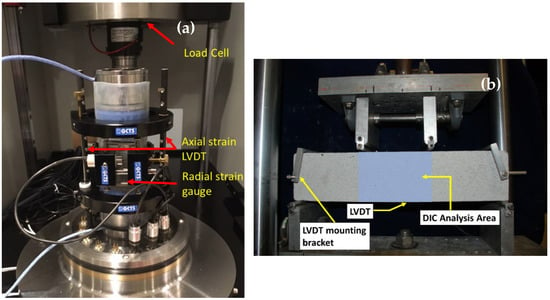
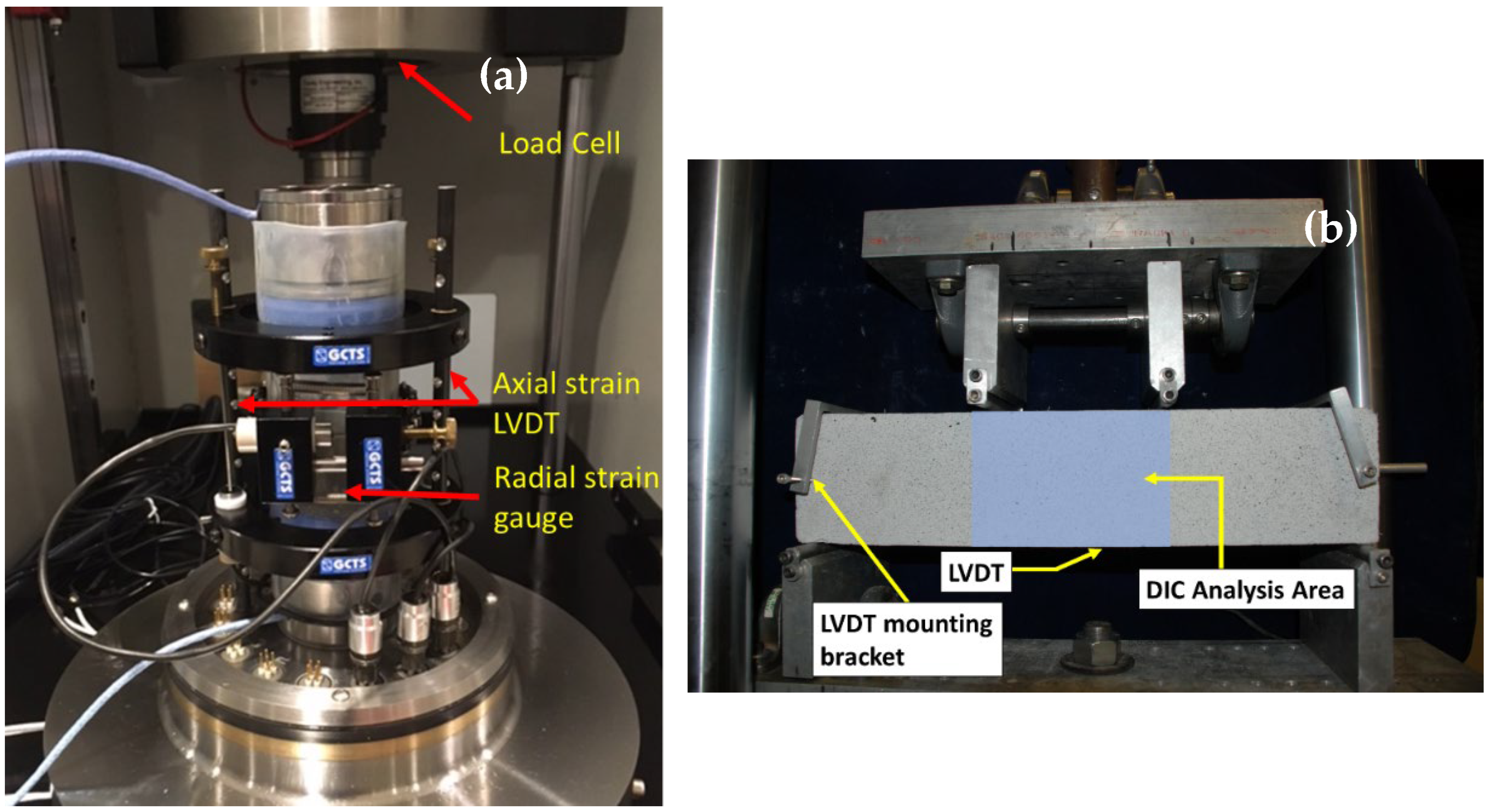
2.2.1. Compression and Flexural Response
The constitutive response of the UHPC cylinders under uniaxial compression was determined on 50 mm diameter × 100 mm long cylinders cored from 75 mm diameter × 150 mm long cylinders (Figure 1a), as the larger specimens exceeded the load capacity of the instrument because of the high strength of the material. Three cylinders were tested for each of the UHPC mixtures. The ends of the specimens were ground to a surface roughness of less than 200 µm using successively finer grits to ensure smooth load transfer between the loading head of the test machine and the specimen surface. The stress–strain response was determined using a 450 kN load frame. Two axial strain gages and one circumferential displacement gage were attached to the sample prior to testing. The axial strain was calculated from the average output of two axial strain gages. The testing procedure involved three phases: (a) a load-controlled mode up to a normal stress of 1 MPa, (b) an axial strain-controlled mode at a rate of 0.025% axial strain/min from a stress of 1 MPa to 30 MPa, and (c) a radial strain-controlled mode at a rate of −0.01% radial strain/min until a radial strain of 1.5% or failure. Complete details regarding the test procedure are reported elsewhere [36].
Figure 1.
Experimental setup for (a) determination of stress–strain response in compression and (b) load–deflection response under four-point bending.
The flexural load–deflection response was measured using a four-point test setup on UHPC beams with a span of 405 mm (Figure 1b). Six beams were tested for each UHPC mixture. The mid-span deflection was measured using an LVDT attached to the center of the beam, and the full-field displacement field was mapped on the surface of the beam using digital image correlation. The test age of the compression as well as flexure samples was 90 days.
All experimental measurements (compression, flexure, and micro-indentation) were conducted at 90 days rather than the conventional 28-day age to ensure that the UHPC mixtures could be reasonably treated as fully hydrated. This was particularly important because the binder system contains fly ash and limestone, which exhibit delayed hydration and continued strength development in low water-to-binder UHPC environments. Testing at 90 days minimizes the influence of ongoing hydration on the measured mechanical response, improves repeatability, and better supports the modeling assumption of the material behaving as a homogeneous effective medium for the micromechanics-based calculations and subsequent DEM parameter derivation.
2.2.2. Micro-Indentation
Micro-indentation was carried out on 90-day-old UHP binder samples. At the age of testing, specimens were removed from the sealed containers and cut into 12.5 mm thick disks using a diamond saw. The disks were polished manually on a Buehler EcoMetTM250 polisher (Buehler, Lake Bluff, IL, USA) at a speed of 400 rpm. The grinding protocol began by using coarse alumina pads of grit sizes varying from 58.3 μm (P280) to 15 μm (P1200). Further polishing was performed using fine alumina pads with particle sizes of 9, 3, and 1 μm to obtain a smooth and reflective surface suitable for micro-indentation [39]. The samples were ultra-sonicated in iso-propyl alcohol at each stage of polishing to remove any excess debris from the surface.
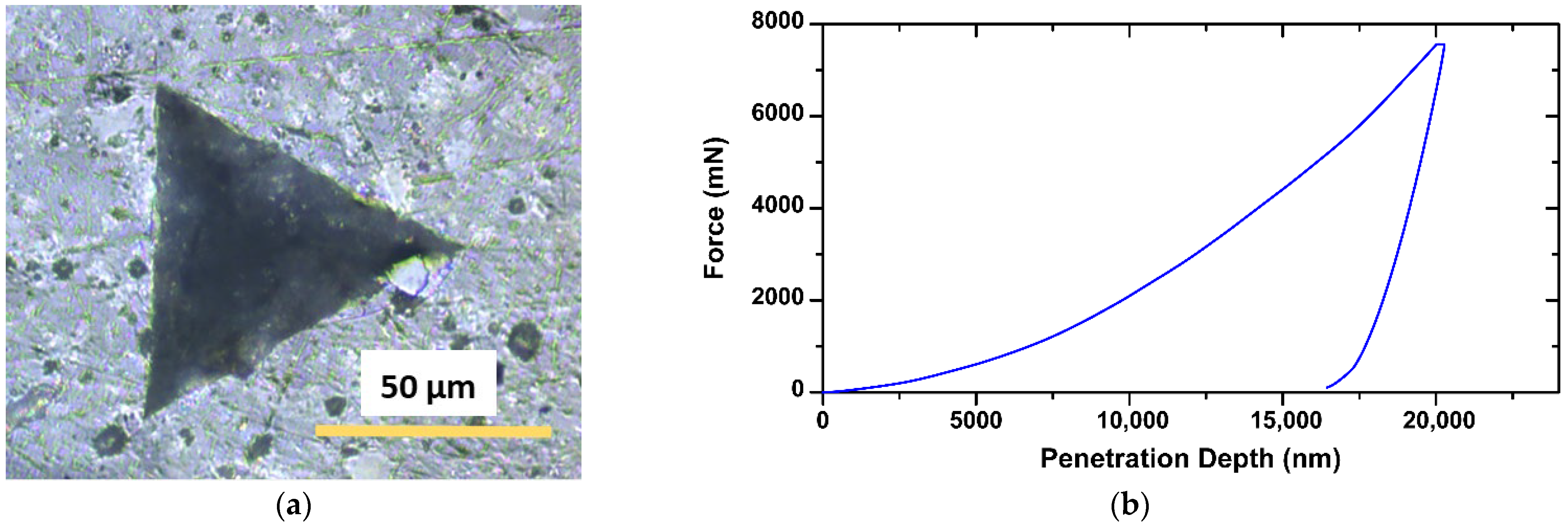
Micro-indentation was carried out on the disk samples using an Anton Paar Micro Combi Tester (MCT) with a Berkovich indenter (Anton Paar GmbH, Torrance, CA, USA). The load cell in the instrument was set to 30 N. A force-controlled loading protocol limited to a max penetration depth (hmax) of 20 μm was implemented. Previous studies have shown that the interaction volume for the material response is three to five times the contact depth for a Berkovich indenter [40]. Therefore, selecting a penetration depth of 20 μm ensures homogeneity of material response within the paste, i.e., all of the paste’s features are considered to be smaller than 60–100 μm. This satisfies the scale separability condition:
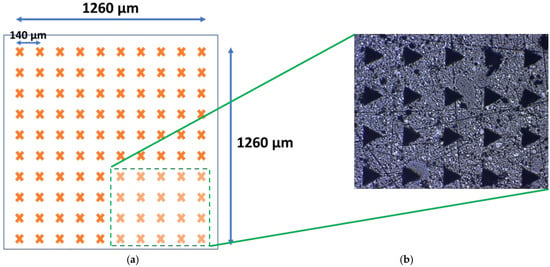
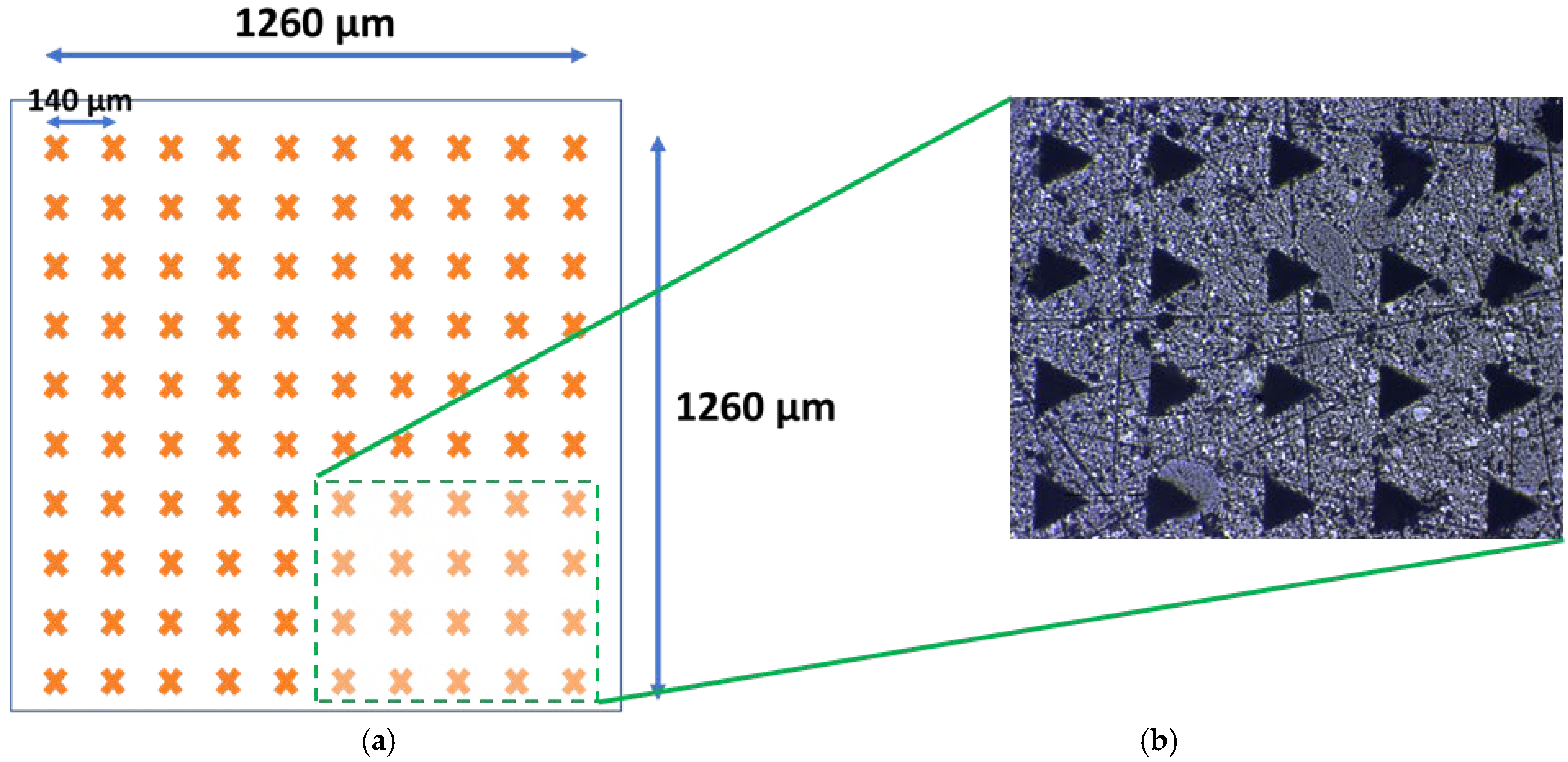
Such a penetration depth also ensures that the activation volume is larger than any observable capillary porosity in the medium, which confirms that all indents can be treated as homogenized responses. A square grid of size of 1.26 mm × 1.26 mm (Figure 2a) was selected on the paste sample to obtain a 10 × 10 grid with a spacing of 140 microns between consecutive indents. The grid spacing was selected as approximately seven times the maximum penetration depth to avoid any interference between adjacent indents. An optical image of the indents is shown in Figure 2b.
Figure 2.
(a) Schematic of indentation grid on the sample surface and (b) an optical image of the indented surface.
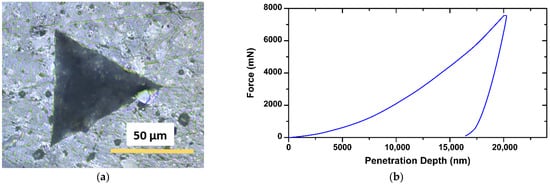
For every indent, the loading and unloading rates were specified to be 7.5 μm/min and 10 μm/min, respectively, with a dwell time of 3 s at the point where maximum depth was attained. The pause duration after rapid loading was small enough to avoid any creep effects and, at the same time, allows the material to stabilize before the unloading stage begins. The force and indenter displacement data were acquired at a frequency of 15 Hz. A sample indent and force–penetration depth response is shown in Figure 3.
Figure 3.
(a) Indent impression on a UHP binder surface and (b) typical force versus penetration depth response.
The unloading part of the force–displacement plot obtained from each indent is fitted using a power law expression [41] using a built-in software package, which is used to determine the unloading stiffness (S) at 98% of the peak load. The indentation parameters, hardness (H), and indentation modulus (M) are obtained as shown in Equations (1) and (2) [41,42].
Here, is the reduced modulus and is given by , and and are the Young’s modulus and Poisson’s ratio of the indenter used.
Here, Pmax is the peak load and Ac is the projected contact area, which is a function of the indenter geometry and the contact depth. For a Berkovich indenter, Ac is given as a function of the contact depth (hc) as
3. Experimental Results
3.1. Constitutive Response in Compression and Flexure
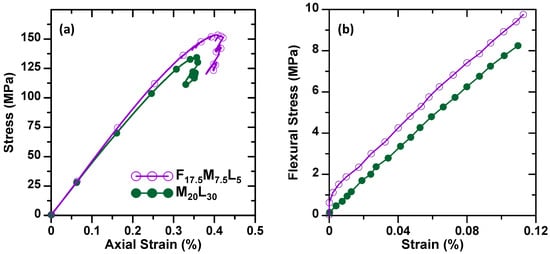
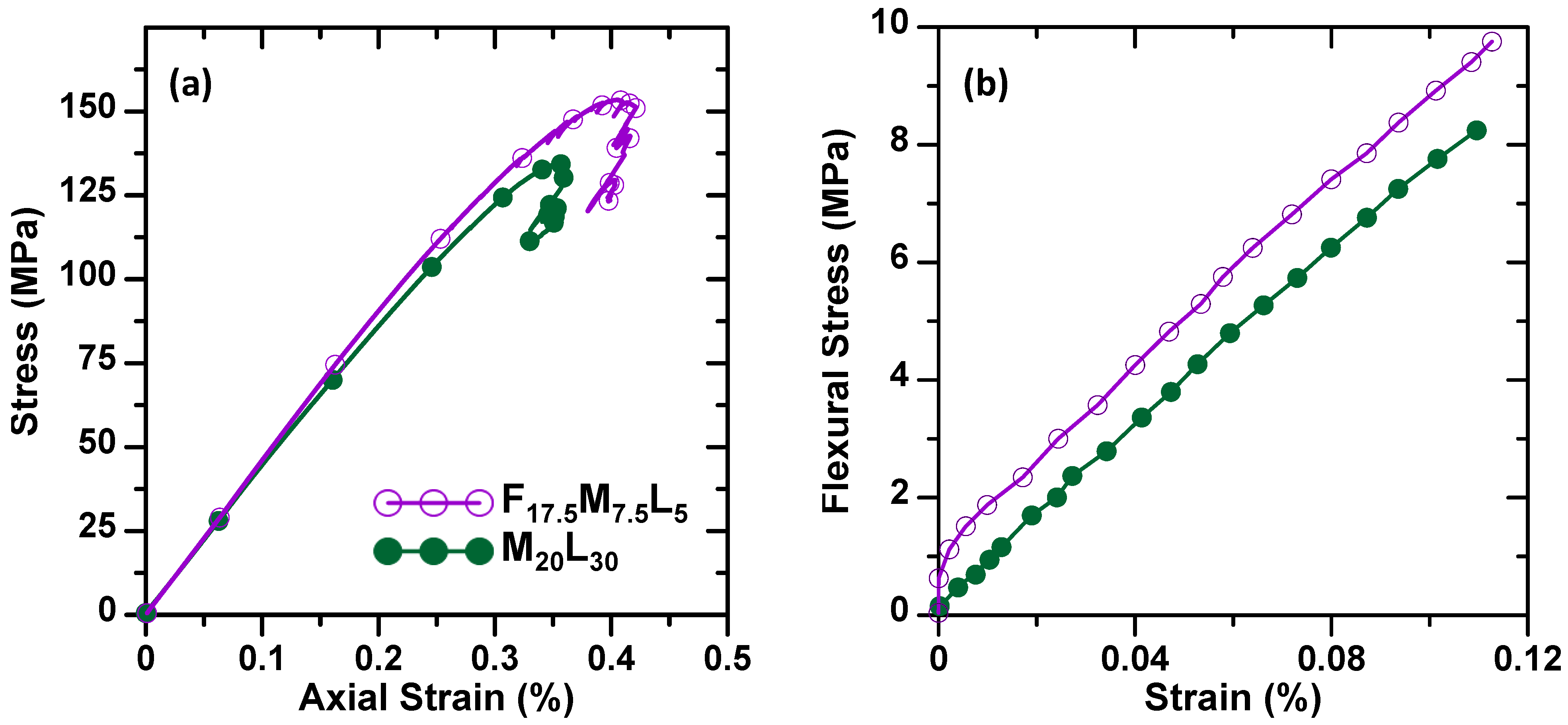
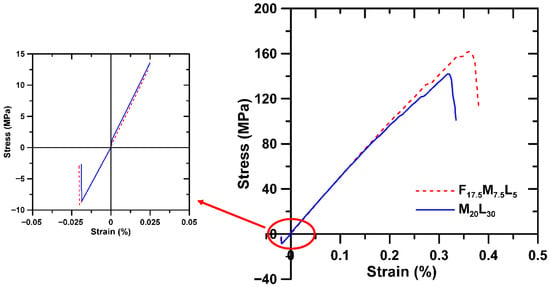
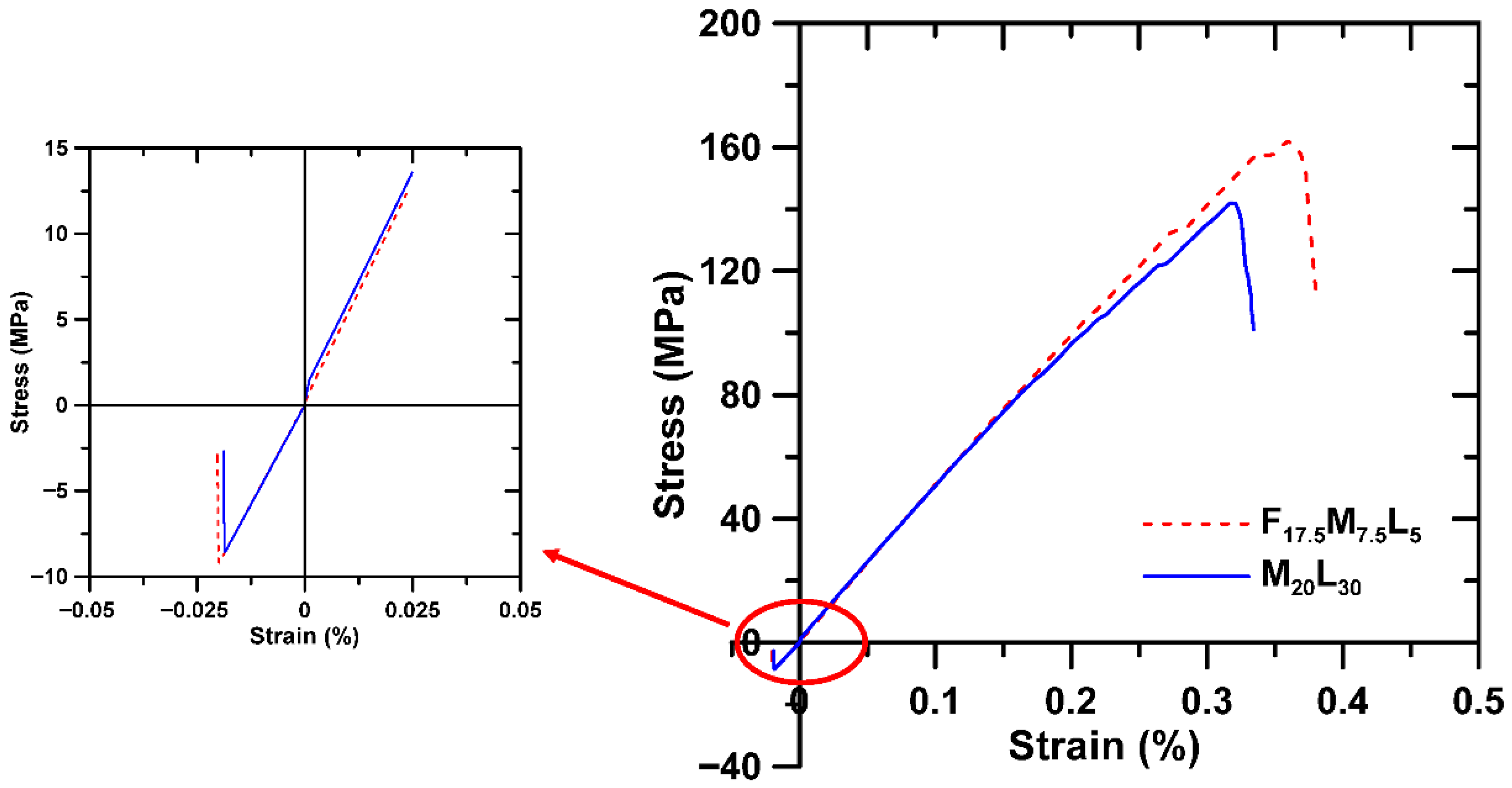
Three 50 mm diameter × 100 mm long cylinders were tested in compression for both of the UHPC mixtures, and representative stress–strain responses are shown in Figure 4a. The compressive strength of the UHPC samples ranges from 140 MPa for the M20L30 sample to 155 MPa for the F17.5M7.5L5 sample [36]. The failure strains for both of the UHPC samples lie between 0.30% and 0.45%. The elastic modulus of the M20L30 sample is found to be 43.10 GPa, and that of the F17.5M7.5L5 sample is found to be 47.53 GPa [36].
Figure 4.
(a) Compression stress–strain response of UHPC cylinders and (b) flexural stress–strain response of UHPC beams. The symbols are to guide the eye. Representative data are shown here.
The flexural responses of the UHPC mixtures are shown in Figure 4b. Six beams were tested for each UHPC mixture, and representative results are shown below [36]. It should be noted that the load–deflection response of the specimens is a function of the beam geometry and has been converted to a stress–strain response to ensure geometry-independent comparison of results. From Figure 4b, it is deduced that the flexural strength of the M20L30 mixture is around 8 MPa and that of the F17.5M7.5L5 mixture is around 10 MPa. The flexural tests for the plain UHPC beams were not carried out in a displacement-controlled mode because the intention was to determine only the peak stress for non-fiber-reinforced mixtures.
3.2. Micromechanical Properties
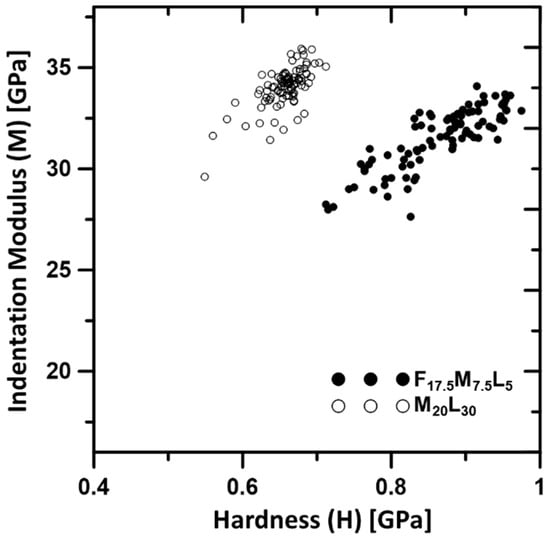
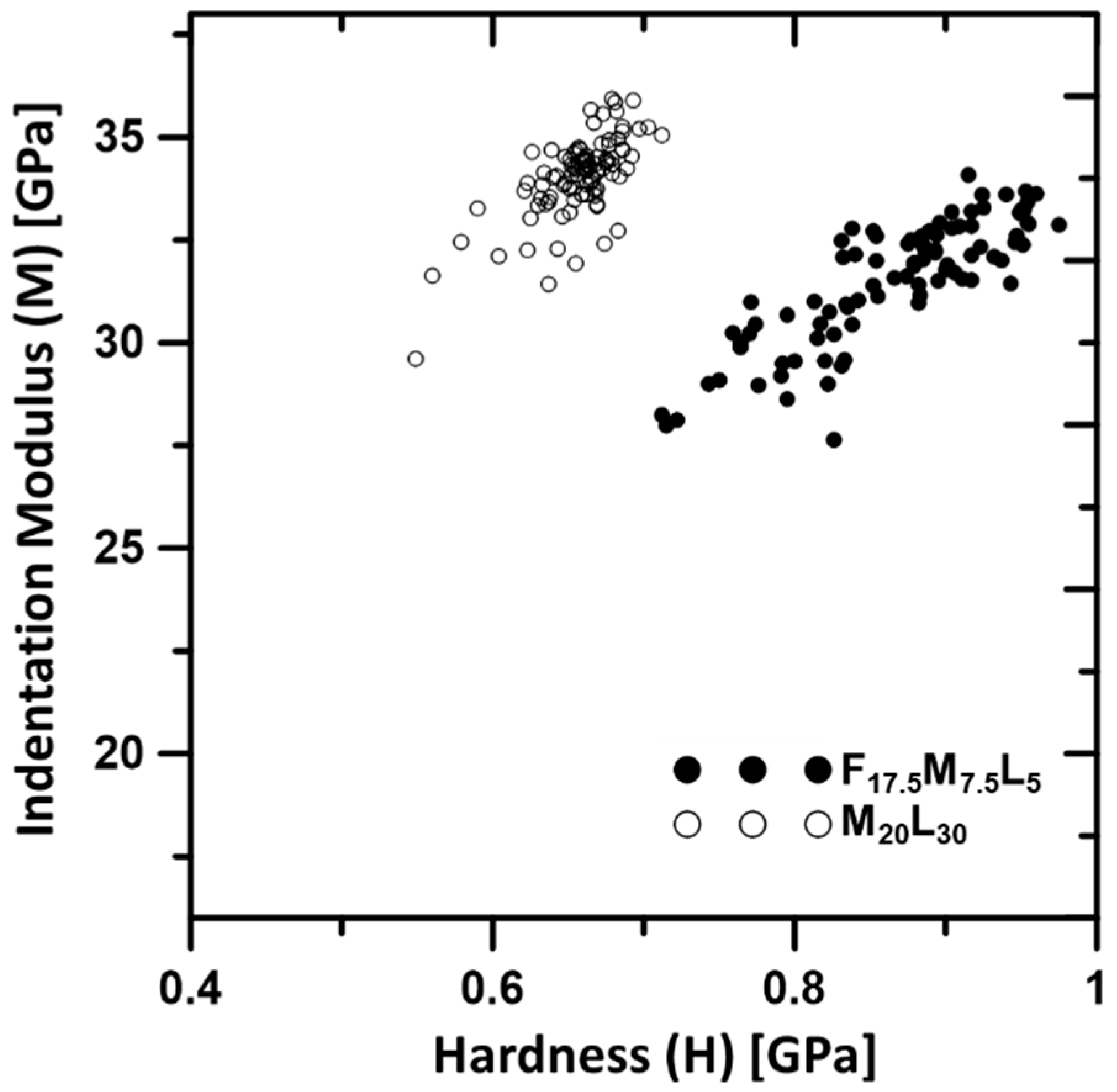
The indentation response of the UHPC pastes was determined by post-processing the force–penetration depth data for the 100 indents performed on each of the UHPC samples. Approximately 5% of the plots were discarded from the final analysis of each of the pastes as they exhibited a sudden jump during either the loading or the unloading portion, indicating micro-cracks or collapsing pores at the indentation location. The indentation modulus (M) and hardness (H) were obtained as explained using Equations (1) and (2) and are shown in Figure 5.
Figure 5.
Indentation modulus–hardness relationship of the UHP paste samples after 90 days of hydration.
A summary of the indentation results is shown in Table 3. It is noted that the standard deviations for both the hardness as well as the indentation modulus lie within roughly 5–10% of their mean values. Note that because micro-indentation is carried out, these values correspond to that of the homogenized paste and not of the specific hydration products and unhydrated phases. The mechanical response of individual hydrated phases in these UHP pastes has been elucidated in [43]. The F17.5M7.5L5 paste has a higher hardness than the M20L30 paste, which can be explained by the higher amounts of cement (with a non-negligible fraction unhydrated because of the low w/b) in the former, where the cement replacement level is only 30%, compared to 50% for the M20L30 paste. The indentation moduli of both of the pastes are quite similar. The influence of different source materials and hydration products on the hardness and stiffness of the UHP pastes is explained in detail in [43]. The paste indentation moduli values were coupled with the elastic modulus of aggregate (obtained as ~70 GPa) and implemented in multi-level homogenization schemes (e.g., Mori–Tanaka, double inclusion) [43] to obtain composite elastic moduli similar to those determined from compression tests, as reported earlier.
Table 3.
Hardness and modulus results from micro-indentation testing of UHPC paste samples.
4. Discrete Element Method (DEM) Simulations
The discrete element method (DEM), originally developed by Cundall and Strack [44] to study the mechanical properties of rocks, has been extended to simulate the meso-scale mechanical response of cementitious materials [45,46]. By computing the individual motion and inter-particle contacts of a sufficient number of particles (the basic element used in DEM), DEM can microscopically simulate the macro-scale response. As described earlier, the use of DEM in modeling the constitutive behavior of concrete has been well-reported [23,27,47,48]. It has been shown that connecting the discrete particles using springs, dampers, etc. enables adequate description of the body and helps appropriately represent the fracture behavior and damage evolution (e.g., crack initiation and propagation) in concrete [49,50]. This paper simulates the meso-mechanical response of UHPC using the commercial software Particle Flow Code 2D (PFC2D 6.0). Rounded particles are adopted in 2D in this study to simulate the behavior of UHPC in flexure, compression, and tension. Particle shapes representing real aggregates have been developed and implemented in DEM by aggregating circular particles [23], but this method is not adopted in this work to minimize computational costs. PFC2D solves the equations of motion for a system of particles using explicit time–domain integration [51]. Details of the model, determination of model parameters from micro-indentation experiments, and model implementation are discussed in the forthcoming sections.
4.1. Contact Model
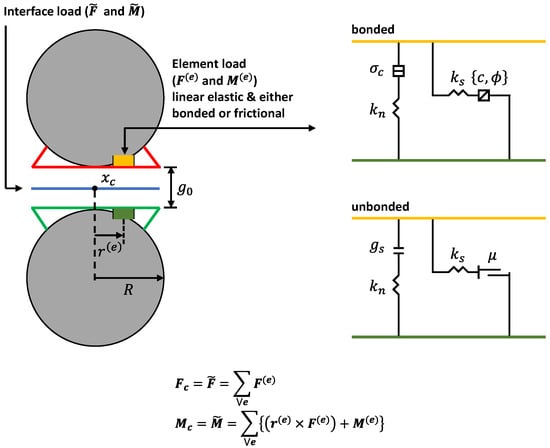
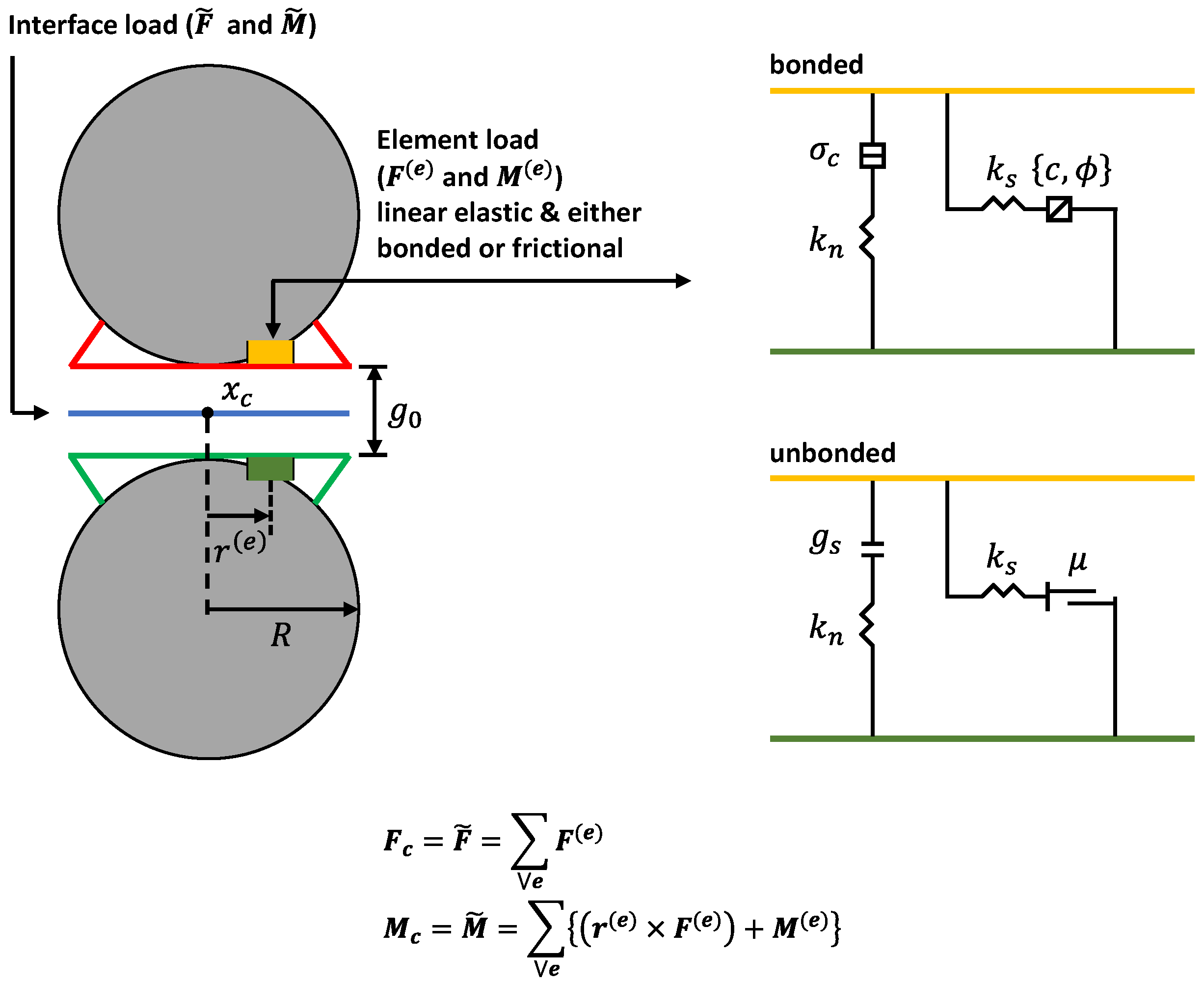
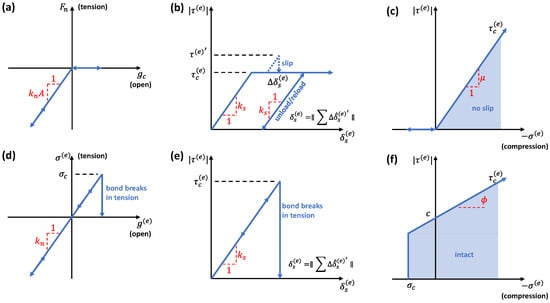
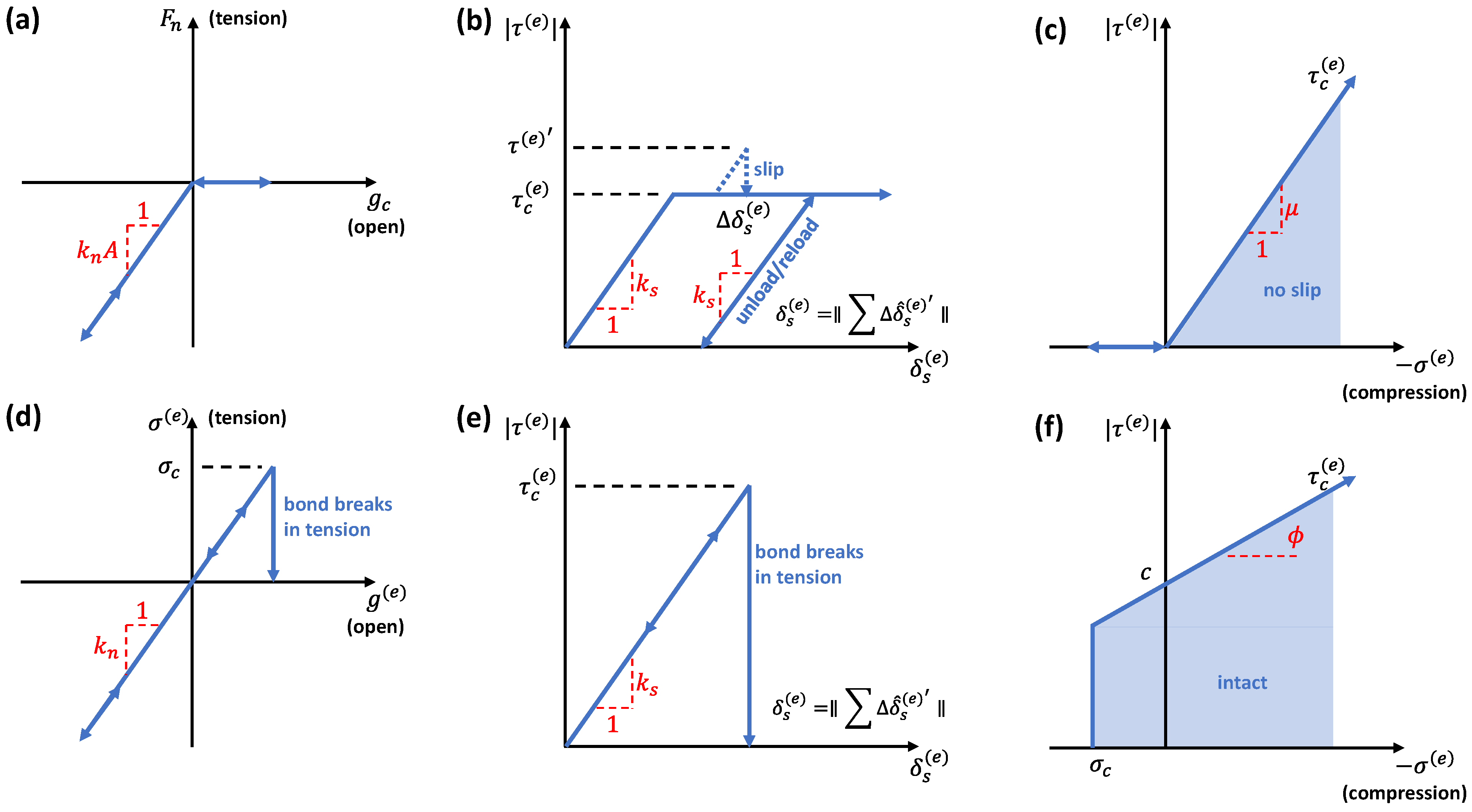
The standard bonded-particle model (BPM) has been utilized in rock and soil mechanics to simulate macro-scale properties and has been adopted in DEM modeling of concrete due to its simplicity and low computational cost [52]. However, over the years, this model was deemed inadequate to accurately determine the compression and tension response for heterogeneous materials. It has been pointed out that the presence of a parallel bond and spherical (or circular) particles in the model leads to an unrealistically low uniaxial compressive strength-to-tensile strength ratio, an excessively low friction angle, and a linear strength envelope [53]. A recently developed flat-joint model [54,55,56], which is available as a built-in contact model in the PFC2D package, was therefore adopted in this study to describe the inter-particle contact characteristics. While in the linear models available in PFC2D, point-to-point contact between particles is considered, the flat-joint model divides the contact interface into several elements. This model provides the macroscopic behavior of a finite-size, linear elastic, and either a bonded or frictional interface that may sustain partial damage [57]. The inter-particle contact interface is discretized into the desired number of elements, and the contact forces, as well as the bonding states (either bonded or unbonded), are determined individually for every element. The contact law schematically shown in Figure 6 is used to calculate the force carried by a single element. The behavior of a bonded element is linear elastic until the bond breaks (as seen in Figure 7d–f), when it becomes unbonded, while the behavior of an unbonded element is linear elastic and frictional, with slip accommodated by imposing a Coulomb limit on the shear force. The force carried by each individual element is then summed at the centroid of the inter-particle contact interface to update the interaction status of in-contact particles.
Figure 6.
The flat-joint inter-particle contact model used in DEM simulations.
Figure 7.
Contact laws used in DEM simulations [51]: (a) unbonded normal contact, (b) unbonded tangential contact, (c) unbonded slip envelope, (d) bonded normal contact, (e) bonded tangential contact, and (f) bonded failure envelope.
For every contact element with bonded status, the normal force is expressed as
Here, is the area of the element and is the normal stress acting on the element, which can be calculated as
is the normal contact stiffness and is the contact distance. When the element sustains tension and the tensile strength limit () is exceeded (), the bond breaks, and all existing contact forces are set to zero (as seen in Figure 7a). The shear force is calculated incrementally as
Here, is the shear stiffness and is the incremental tangential displacement. The shear stress ( is then calculated as
If the shear stress exceeds the strength (), where c is the cohesive strength and is the friction angle, the bond breaks in shear (as seen in Figure 7b), and the shear behavior follows the Mohr–Coulomb failure criterion as
Here, is the friction coefficient. The entire failure envelope described by the contact law before debonding is shown in Figure 7c. A detailed description of the flat-joint model can be found in [57].
4.2. DEM Implementation
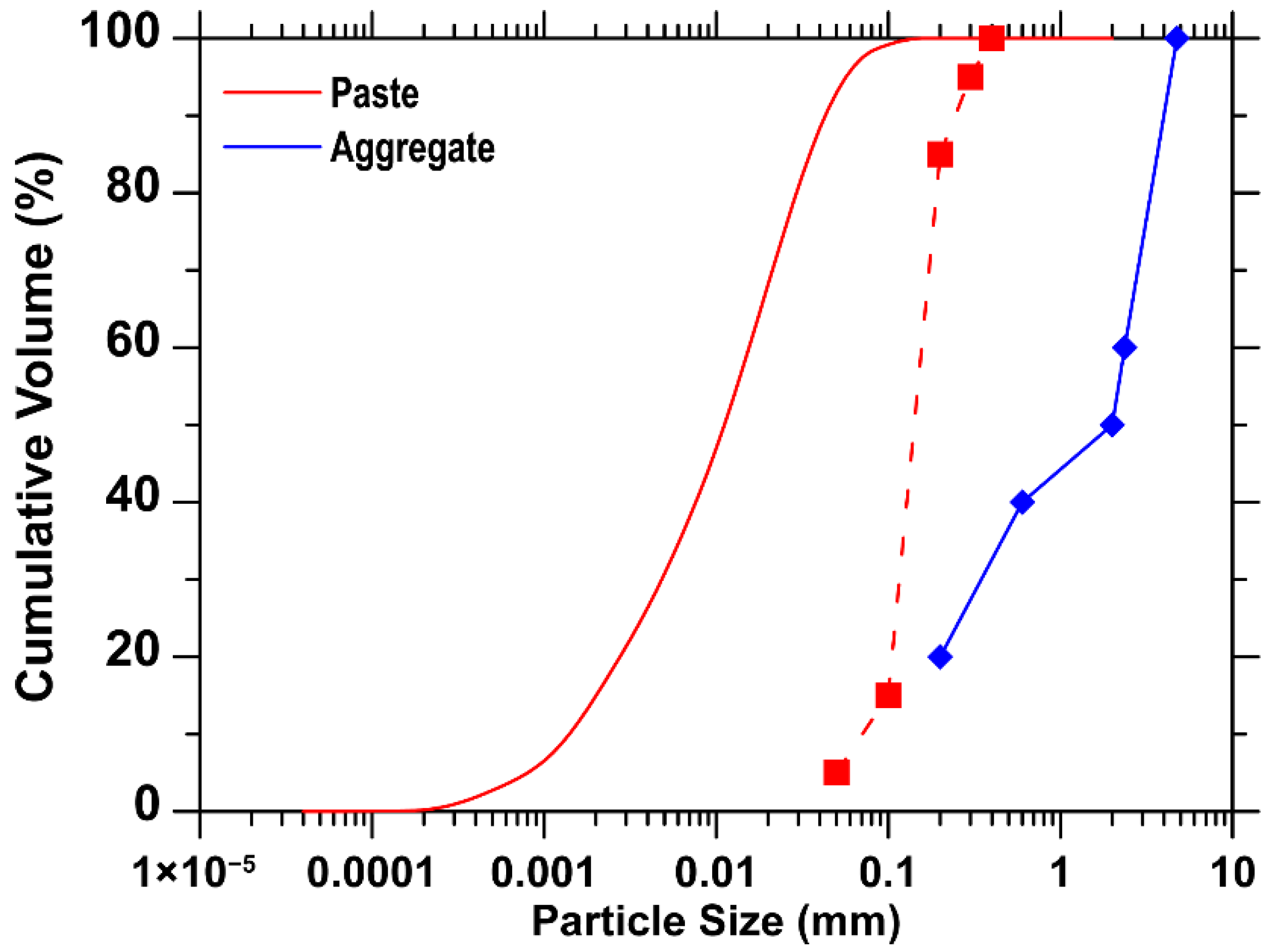
Considering the obvious property difference between paste and aggregate, two-phase particle packing was used to represent the paste and aggregate phases. The volume fraction of each phase was same as that used in the experiment (65% by volume of paste and 35% by volume of aggregate). The solid lines in Figure 8 show the experimental particle size distribution (PSD) for both the paste components and the aggregates. The idealized PSD of the paste used here is an approximation, as DEM relies on particle–particle interactions, although, in reality, the paste is not a collection of “particles” at the scale considered (at the level of C-S-H or CH, cement paste can be considered as particles, but that is not the scale interrogated here). A significant size difference can be noticed where the aggregate particle size is more than two orders of magnitude larger than that of the paste. Such a particle size difference results in the need for a very large number of particles in the representative DEM model, prohibitively increasing the computational cost. For example, a 20 mm × 40 mm numerical specimen will contain more than six million particles in this case, which is infeasible. Thus, while maintaining the PSD for aggregates the same as that in the experimental program, an enlarged PSD for paste (or its constituents) is required to effectively reduce the number of particles to a manageable limit. With the designed numerical PSD (the dotted line in Figure 8), a 20 mm × 40 mm numerical specimen was constructed using approximately 25,000 particles. Such numerical approximations have generally been shown to preserve the physics of the problem [58,59]. In general, past work has reported that the particle sizes are not significantly influential as long as the aspect ratio is preserved [60,61], and a PSD that is 100 times larger than the actual one has been used to simulate sand–gravel mixtures [62]. Thus, the synthetic PSD shown in Figure 8 (dotted line) is used for the paste in all of the DEM simulations reported in this paper. Another point to note is that while there are two types of particles corresponding to the paste and the aggregates, the paste–aggregate, paste–paste, and aggregate–aggregate interactions are considered to be the same. While this is an approximation, it can be justified as follows: in low aggregate volume mixtures, such as UHPC, the aggregate–aggregate interactions are very limited. The paste–paste and paste–aggregate interactions dominate, but the contact responses are primarily dictated by the properties of the paste. Hence, an approach that relies on micromechanical aspects of paste to determine the parameters of the contact law is reasonable. It should be noted that among the six parameters, the friction coefficient (), the tensile strength (), the cohesive strength (), and the friction angle for bonded shear behavior () shall remain the same for all contacts under such an assumption, while the normal and shear stiffness ( and ) vary among paste–paste, paste–aggregate, and aggregate–aggregate contacts based on the elastic modulus and particle size of the particles in contact.
Figure 8.
Experimental (solid lines) PSD for cement paste constituents and aggregates and the numerically designed PSD (dashed line) for the constituents of the paste phase.
4.3. DEM Model Parameters and Simulations
As shown earlier, six parameters are required for the contact model to describe the inter-particle contact behavior: the normal and shear stiffness ( and ), the friction coefficient () for unbonded shear behavior, the tensile strength (), the cohesive strength (), and the friction angle for bonded shear behavior (). Among all of the six parameters, the normal and shear stiffnesses can be related to the particle’s elastic modulus () and Poisson’s ratio () [57], which are easily obtained from experiments. Because the global behavior of concrete is determined by the bonded inter-particle contacts, it is rational to ignore the friction coefficient. In addition, particle density is set to be the same as the density of the materials (paste or aggregates). A local damping coefficient is required to dissipate the excessive kinetic energy during simulation. A very small value of the damping coefficient causes extremely large excessive kinetic energy and influences the accuracy of the simulation. Preliminary simulations found that a value of 0.1 for the damping coefficient is adequate, which has also been reported elsewhere [24]. These parameters are shown in Table 4.
Table 4.
Parameters used in DEM simulations.
4.3.1. Obtaining Cohesion and Friction Angle from Micro-Indentation Results
The three remaining key parameters in the DEM formulation required to derive the constitutive response of UHPC using the flat-joint model under compression, flexure, or tension are the cohesive strength or cohesion (c), the friction angle (α), and the tensile strength limit (). These parameters are functions of the internal microstructure of the material. “c” and “α” can be deduced from a detailed statistical analysis of the hardness and indentation modulus data described earlier in this paper using an algorithm described in [63,64,65]. Assuming isotropic material behavior, the Young’s modulus (E) of the material can be calculated as
Here, Er is the reduced modulus determined from the experiment (denoted as the indentation modulus, M), Ei is the Young’s modulus of the indenter, ν is the Poisson’s ratio of the paste, and νi is the Poisson’s ratio of the indenter. The Poisson’s ratio of the UHPC samples was obtained from the compression stress–strain tests as 0.22. The paste’s Poisson’s ratio was back-calculated using a simple rule of mixtures approach, and the value was close to 0.20 for both the F17.5M7.5L5 and M20L30 pastes.
A detailed analysis was carried out by Cheng and Cheng [66] and later Cariou et al. [64] using the Buckingham Pi theorem to derive dimensionless expressions for hardness and indentation modulus values for a porous composite. In their derivation, Cariou et al. [64] assumed that the hardness and modulus values obtained as outputs from the indentation curve (“P” vs. “h”) are representative of the properties of the porous composite at every point of indentation, which are tied to the properties of the solid phase as well as the pore morphology. Although the model did not assume a multi-phase porous material, the applicability of the model in the current study can be justified based on the large interaction volume being studied. It can be reasonably assumed that in a fully hydrated UHPC (as is the case in this study), the large interaction volume is a representative volume, which consists of a sufficient amount of all phases of the solid, such that the mechanical response can be interpreted as belonging to a single solid phase, along with the pores. Assuming the UHPC to be a granular material with a cohesive–frictional solid phase, the solid phase is composed of particles with particle hardness hs, particle stiffness ms, and friction coefficient α and locally packed with a packing density η (η = 1 − φ, where φ is the porosity). Equations (10) and (11) show the relationships for the modulus and hardness measured at the nth indent [64]. Here, Cs is the stiffness matrix of the material, η0 is the solid percolation threshold, and θ is the cone angle of the indenter.
For a Berkovich indenter, θ = 65.35°. Assuming isotropic material behavior, Cs is reduced to E. The percolation threshold η0 can vary between zero and one depending on the pore–solid morphology of the composite material. The linear self-consistent scheme applicable to granular materials of high packing density provides the value for η0 as ½ [64,67]. Applying these known values, a simplified equation, as shown below, is obtained:
The particle hardness (hs) in the above equation is a function of the cohesion (cs) and friction angle (α). In other words, hs is defined as the hardness of an ideal composite with zero porosity (). For a Drucker–Prager solid, Cariou et al. [64] and Bobko et al. [65] simulated the indentation response for different packing densities of clay (a cohesive–frictional solid) and obtained a polynomial fitting function to relate material hardness and its cohesion and friction angle, as shown in Equation (13).
The values of the fitting parameters (A, B, C, and D) can be found in [65]. While these constants consider the assumption of monophase grains and porosity, in reality, multiple phases are present in the system being studied. However, as described earlier, the large interaction volume consideration enables the use of the same fitting parameters, considering the solid phase to consist of one effective phase. Using these constants, the value of particle hardness can be determined, given the value of friction and cohesion.
Because the percolation threshold is known (η0 = ½), the function on the right-hand side of Equation (12) becomes a function of the friction angle and packing density. It can be written as a summation of two dimensionless functions, and , where the first part is independent of the friction coefficient α.
Bobko et al. fitted the two functions and to the simulations of indentation response in their study [65] to obtain polynomial expressions in terms of α and η. The polynomial expression for hardness (H) in Equation (12) can be obtained by substituting Equations (13) and (14).
Now, for a linear isotropic material, the indentation modulus assumes the same value as that of the plane stress elastic modulus (Equation (15)). Here, K and G correspond to the bulk modulus and shear modulus of the indented material.
The expressions for K and G are formulated for a porous composite in terms of bulk and shear properties of the solid phase and the packing density using microporomechanics theory [68]. Finally, the expression for the dimensionless function in Equation (10) is derived under the self-consistent scheme (η0 = ½) as
Now, knowing the values of H and M at each of the “N” number of indents, we have 2N equations to solve for N + 4 unknowns (N packing densities + ηi, ms, cs, α), a highly over-determined problem. An inverse analysis is carried out using a MATLAB 2019b program to arrive at the unknown values using a minimization algorithm coupling both H and M values [65]. Because the minimization function is not convex, the algorithm gives several allowable values for the unknown parameters from which the ideal set of values must be derived by applying certain constraints. The cohesion values for both of the pastes extracted based on the above-described process vary between 100 and 200 MPa, while the friction angle varies between 23° and 27° for the F17.5M7.5L5 and 10° and 20° for the M20L30 systems. In past work, cohesion values for LD C-S-H and HD C-S-H in conventional cement pastes have been arrived at as 50 MPa and 100 MPa, respectively [69], and thus it is not surprising that the cohesion for UHPC mixtures lies between 100 and 200 MPa. The homogenized response includes, in addition to the C-S-H phases, the unreacted clinker and other starting materials (microsilica, fly ash, limestone). The relationship between α and micromechanical features of porous solids, such as rock and concrete, are rather complex. Porosity and the degree of cementation (cohesion) determine the friction angle, and it has been shown that even for the same porosity, a ±10° scatter in friction angle is not unexpected [70].
4.3.2. Identifying c–α Combinations and Determining the Tensile Strength by Simulating Flexure
As mentioned earlier, a number of solutions for cohesion and friction angle are obtained from the microporomechanics model using results from the micro-indentation experiments. An optimal combination of cohesion and friction angle would be the one that can represent the macro-scale properties of the material with high confidence. Another key parameter that governs the constitutive meso-scale response of the material is the tensile strength, σt. In order to determine the appropriate values of these three parameters, one would need to use a certain c–α combination from the many choices as obtained from the dimensional analysis, along with a value of tensile strength. We explore simulating the flexural response of beams made using both of the materials under four-point loading to determine these parameters. Because c and α are interdependent, choosing one will automatically fix the value of the other. The different c–α combinations chosen from the minimization algorithm were chosen such that the c values spanned the entire range between 100 and 200 MPa. We used five different c–α combinations for each of the mixtures, together with four tensile strength values (ranging between 5 and 20 MPa; the higher range was chosen because the mixtures belong to UHPC), resulting in 20 unique simulations each for the flexural response for F17.5M7.5L5 and M20L30 beams. Tensile strengths in the range of 8–20 MPa have been reported for UHPC [71,72], thus justifying the tensile strength values used in the simulations.
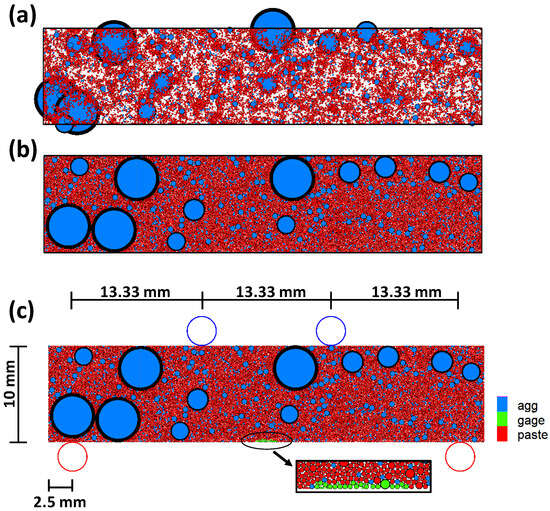
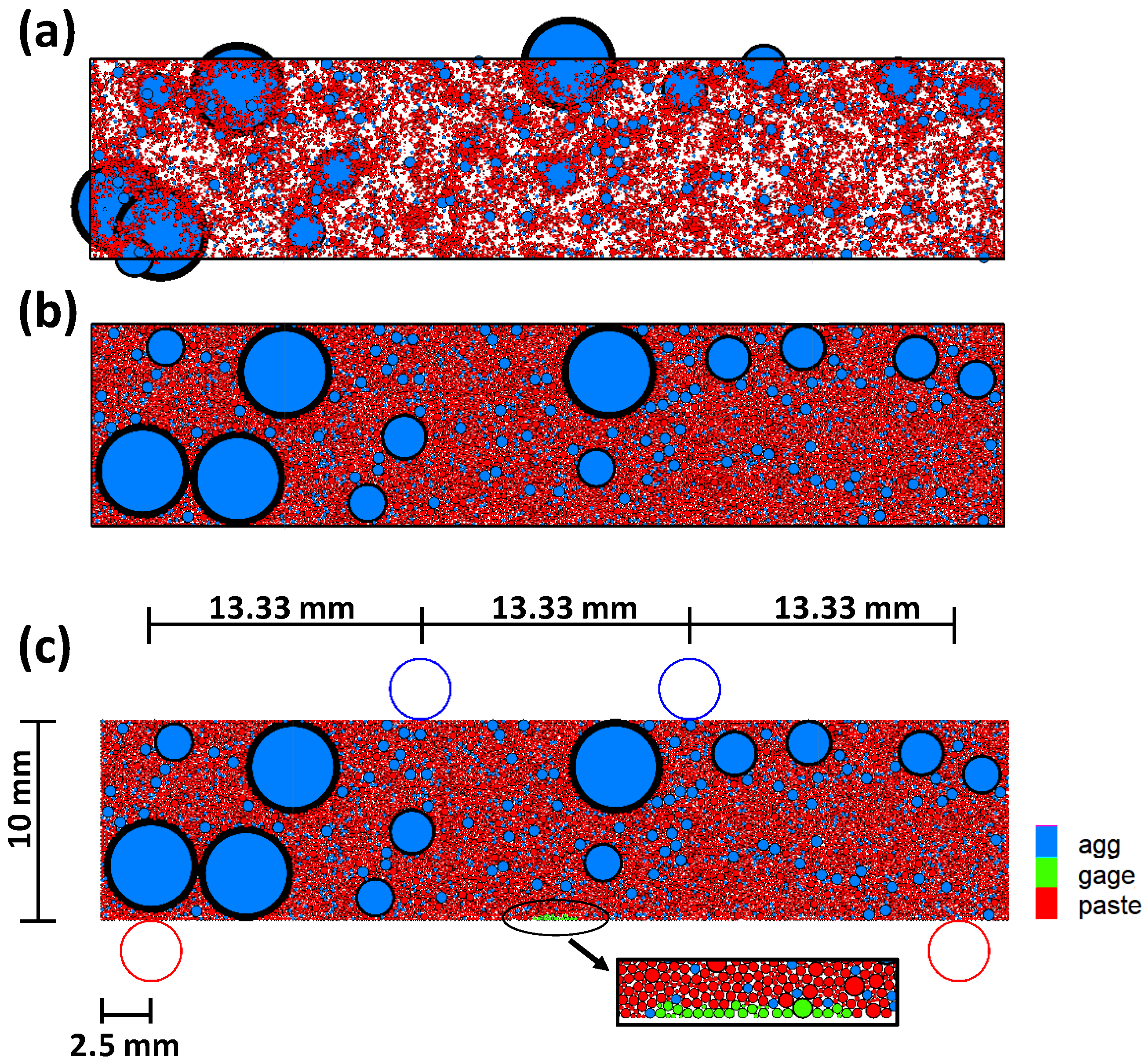
To simulate the flexural response of UHPC, 2D numerical specimens with a length of 45 mm and a thickness of 10 mm were used to represent the experimental beam (405 mm length × 100 mm depth × 100 mm width). Numerical PSDs shown in Figure 8 were used to distribute the maximum number of particles into the geometry under gravity-free conditions with significant overlap (as illustrated in Figure 9a). Four rigid boundary walls were created along the specimen outline to restrict the movement of particles within the specimen’s geometry. A simple linear contact model [57] and a high damping coefficient (0.5) were assigned to the generated particles to quickly eliminate inter-particle overlap, and particle packing was solved automatically until a balanced state, which is defined here as the ratio of the averaged unbalanced forces over the averaged contact forces throughout the system, and set to 1.0 × 10⁻⁵, as seen in Figure 9b. After preparing the particle packing, the flat-joint model with input parameters listed in Table 4 was assigned to all of the existing inter-particle contacts, and the model was solved automatically again until a balanced state was reached (Figure 9b).
Figure 9.
Schematic showing (a) initially distributed particle packing with significant particle overlaps, (b) particle packing restricted by rigid boundaries after attaining the balanced state, and (c) the prepared numerical specimen before flexural loading.
The rigid boundary walls were then deleted, and four circular, rigid walls were created to represent the physical supports and the load punches. The circular rigid supports are located at the bottom of the numerical specimen, 2.5 mm away from the edge of the beam. The load punches were placed on top of the beam to form a four-point loading condition, just as in the experiment. The numerical specimen was then allowed to settle under gravity to establish stable contact with supports. An automatic solver was used here again until a balanced state was reached. The prepared numerical specimen before the loading stage is shown in Figure 9c. A constant velocity of 5 mm/s was assigned to the top load punches to apply flexure loading to the numerical specimen. Contact force sustained by punch walls was recorded, and a small number of particles located in the bottom mid-span section of the specimen were used as a gage to record the deflection during the simulation (see the magnified region in Figure 9c).
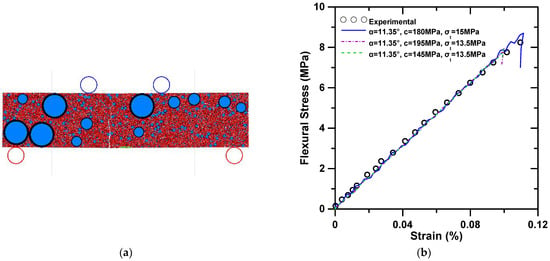
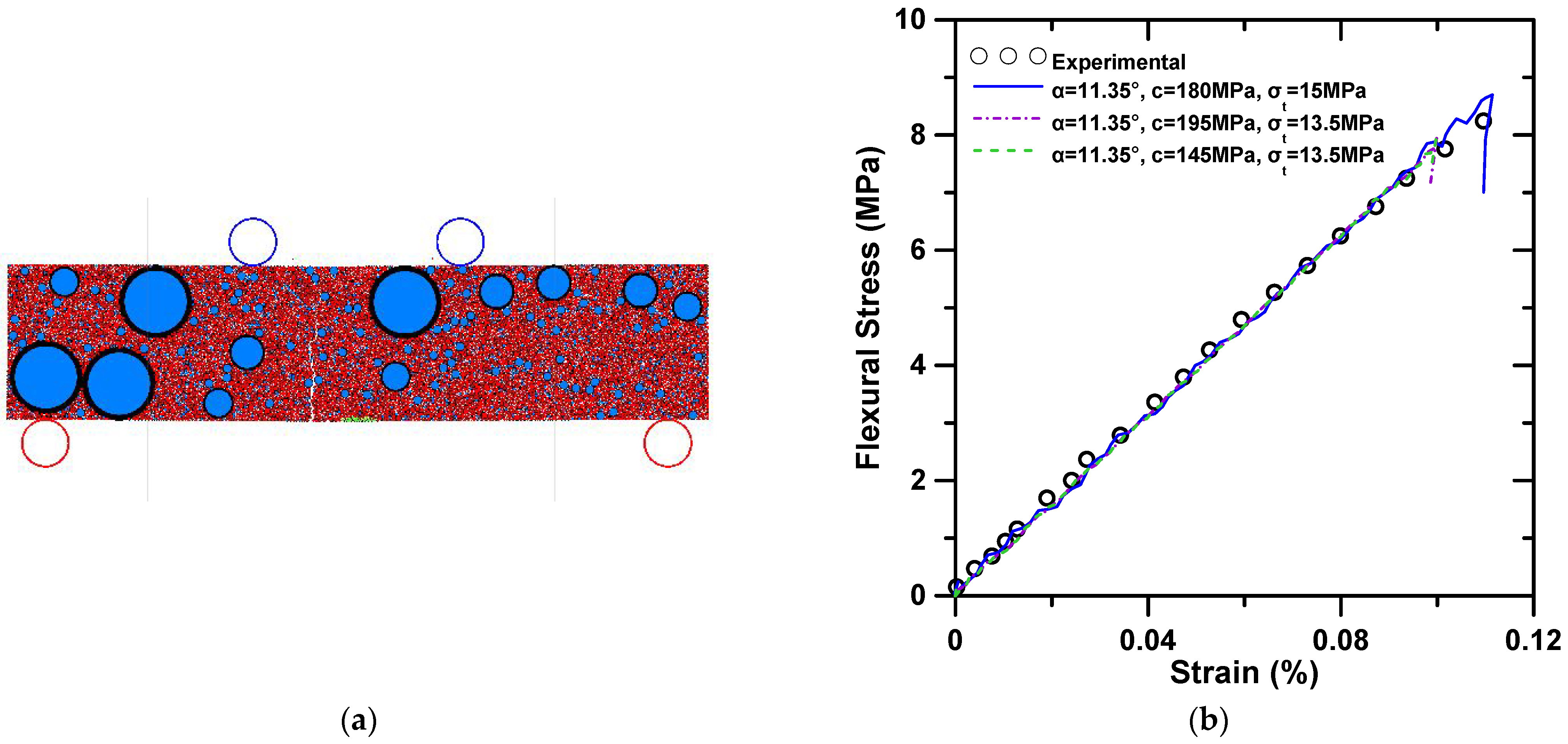
Because both F17.5M7.5L5 and M20L30 beams have the same aggregate and paste volume fractions, the same particle packing was used to simulate the mechanical behavior of both mixtures. Figure 10a shows the simulated beam at failure, with a crack propagating near the mid-span of the beam. The stress–strain response from the simulations, indicating the peak loads and the corresponding peak strains for three different combinations of α and σt, are shown in Figure 10b. Because it was found from several simulations that for a chosen α, the cohesion (c) did not significantly influence the pre-peak response (it is more influential in dictating the post-peak response; see the following section), the value of c is kept constant in these simulations. Note that only the combinations that provided results that are close to the experimental data are shown here. It is found that the peak stress and strain values are independent of the chosen cohesion values in the range evaluated (between 145 MPa and 195 MPa for the M20L30 mixture and similar for the F17.5M7.5L5 mixture, as well). This is because the failure mode in flexure is primarily dominated by the behavior of tensile contacts between grains. During flexure tests, the tensile contact stress increases quickly to exceed the tensile bond strength, which leads to breaking of those tensile bonds. The chosen tensile strength influences the peak stress and strain, as expected. For the M20L30 specimen shown in Figure 10b, a tensile strength of 15 MPa was found to accurately describe the flexural response for the chosen cohesion values in the 145–195 MPa range. Because the values of σt were varied between 5 and 20 MPa for the simulations at intervals of 5 MPa, for the F17.5M7.5L5 mixture, a slightly more refined tensile strength value needed to be chosen, which was obtained as 16.5 MPa. The tensile strength thus determined is considered to be an intrinsic material property of the mixtures under consideration and is used in further compression and tension simulations to extract the constitutive behavior.
Figure 10.
(a) A four-point bending test conducted on an M20L30 UHPC until failure (notice the crack near the center of the specimen at failure) and (b) simulated flexural stress–strain responses (dashed line) against experimental results (hollow symbols) of M20L30 UHPC.
4.3.3. DEM Simulations of Compressive Response
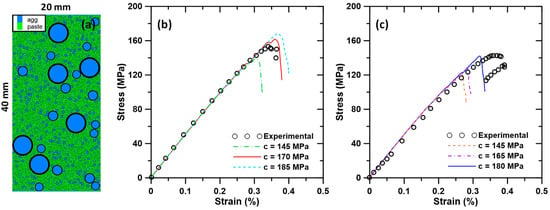
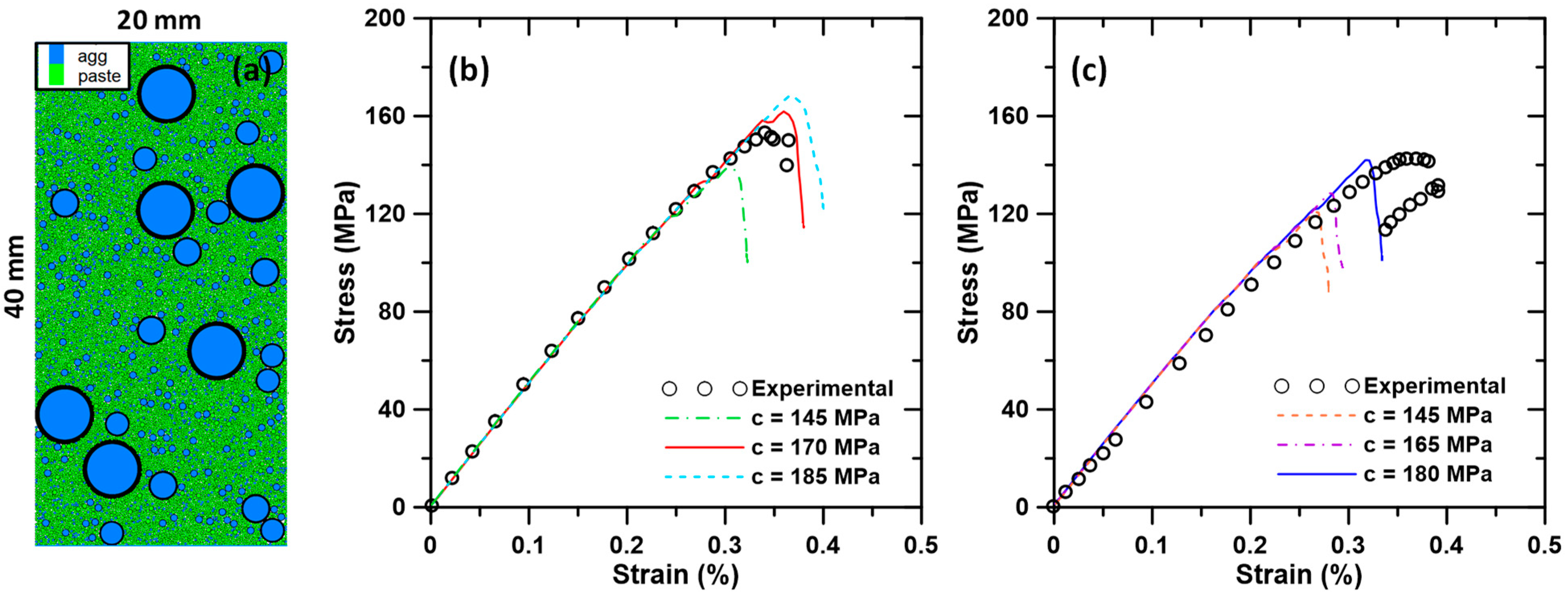
After establishing unique values for tensile strength σt, from the flexural simulations, the c–α values can be further refined by simulating the compression behavior of the mixtures for several c–α combinations (within the range identified in the flexural simulations, where the flexural response was rather independent of c–α, as shown in Figure 10b) and comparing them with the experimental results. A particle packing procedure identical to the one detailed in the previous section was used here to develop the geometry of the numerical model for uniaxial compression simulation. The prepared specimen and its geometry are shown in Figure 11a. Top and bottom walls with zero friction were attached to the specimen, and a constant velocity of 10 mm/s towards the center of the specimen was assigned to top and bottom walls to simulate the axial strain-controlled uniaxial compression. The solver was controlled by a user-defined function to terminate the simulation when the post-peak stress reached 70% of the peak stress.
Figure 11.
(a) Schematic showing the numerical specimen for uniaxial compression and simulated and experimental stress–strain response for (b) F17.5M7.5L5 specimen and (c) M20L30 specimen.
Figure 11b,c compare the axial stress–strain response of the F17.5M7.5L5 and M20L30 specimens with those obtained from the DEM simulations for chosen c–α combinations within the earlier selected range, along with the tensile strengths shown above. For simplicity, the legends only show cohesion values. It is seen that every c–α combination gives a unique stress–strain response—here, the peak stress and strain values are dependent on the cohesion. This can be explained based on the fact that the compressive strength of granular materials is highly dependent on the cohesive bond strength [73]. The compressive strength also depends on the bond cohesion-to-tensile strength ratio in the flat-joint model used [53]; however, fixing the tensile strength based on flexural simulations described earlier was found to result in the compressive strength manifesting as a function of cohesion alone here. A tensile strength of 16.5 MPa, along with a cohesion of 170 MPa and a corresponding friction angle of 24.39°, are found to satisfactorily predict the flexural response of the F17.5M7.5L5 mixture. The values of c, α, and σt were 180 MPa, 11.35°, and 15.0 MPa, respectively, for the M20L30mixture, even though the simulations do not accurately capture the peak strain in this case. We presume this to be because of two reasons: (i) the dependence on the bond cohesion-to-tensile strength ratio and (ii) differences in the experimental and simulation conditions. First, c and σt were determined by simulating different mechanisms, with flexure for tensile strength and axial compression for cohesion; further iterative refinement of the parameter selection process may be warranted for more accurate results when adopting this approach. Also, while c–α pairs were determined based on the micromechanics model, it is known that the friction angle is more influential in determining the post-peak behavior [53]. Because the post-peak behavior is not simulated here—primarily because the non-fiber-reinforced UHPCs exhibit a dominantly brittle behavior—the α values are of less significance for these simulations. That likely is the reason for very disparate values of α for both of the mixtures—the cohesion value that best represents the simulations is likely highly weighted in this case, irrespective of the friction angle. Moreover, the compression experiments were carried out under axial strain-controlled mode until a stress of 30 MPa and thereafter at a radial strain-controlled mode as described in the experimental section and in [36]. In the DEM simulations, axial strain control was used because of the complexity of implementation of a feedback loop to determine the velocity of the boundary walls for the radial–strain controlled case. Axial strain-controlled experiments that continue into the post-peak region and simulations that also account for the post-peak response are expected to aid in improved simulations.
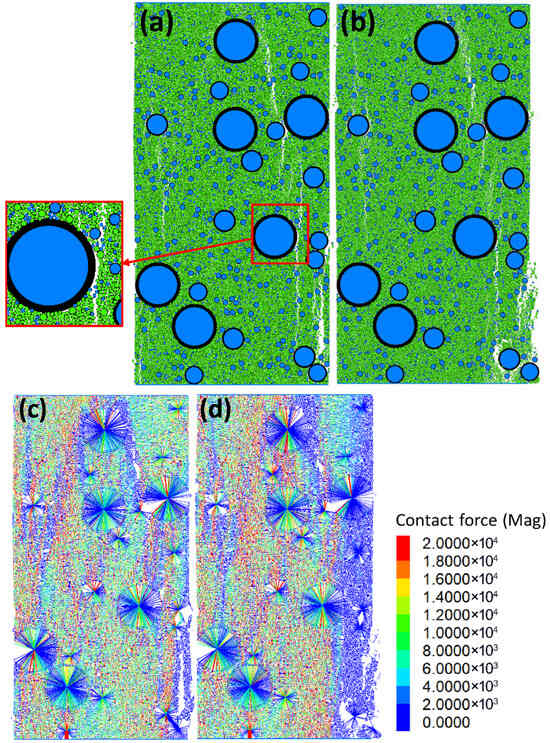
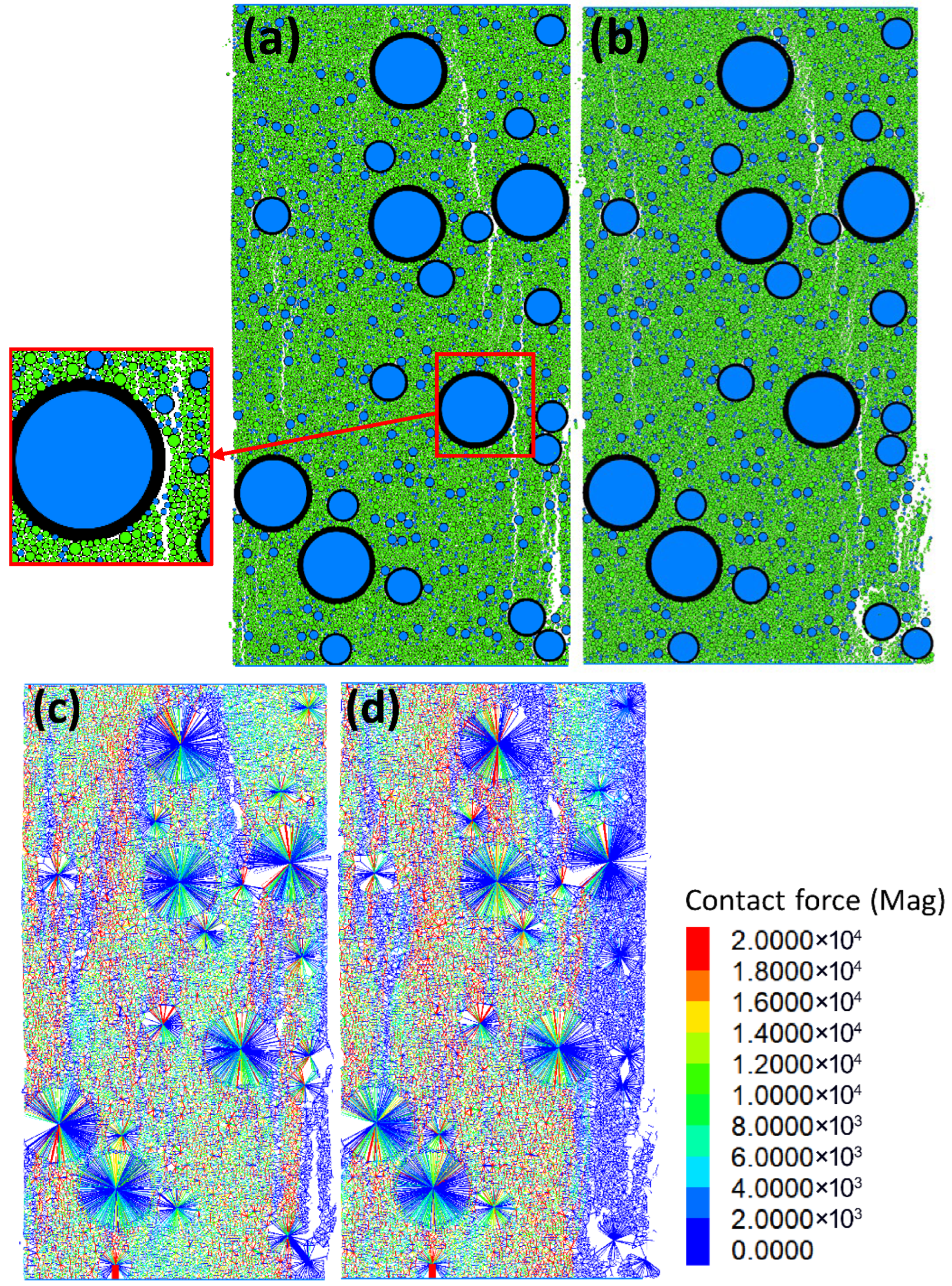
Figure 12 shows the numerical specimens at the end of the uniaxial compression simulations and the corresponding inter-particle contact force networks. The force network helps to visualize the regions of stress concentrations within the matrix and understand the mechanisms that govern the failure of the specimen. Multiple splitting cracks can be observed for both the F17.5M7.5L5 and M20L30 specimens, resulting from the high packing density of the UHPC mixtures. It is also noticed that the DEM model successfully captures the inter-phase (aggregate–paste) debonding during crack propagation (magnified region in Figure 12a). It is observed from Figure 12c,d that the specimens lose the ability to transfer an externally applied load along the edges (crushing along the edges was also noticed in the experiments), and the remaining force is concentrated towards the center of the specimen, which is relatively undamaged.
Figure 12.
Numerical specimens after uniaxial compression simulation for (a) F17.5M7.5L5 specimen and (b) M20L30 specimen and contact force network at the end of the compression simulation for (c) F17.5M7.5L5 specimen and (d) M20L30 specimen.
4.3.4. DEM Prediction of Response Under Tension
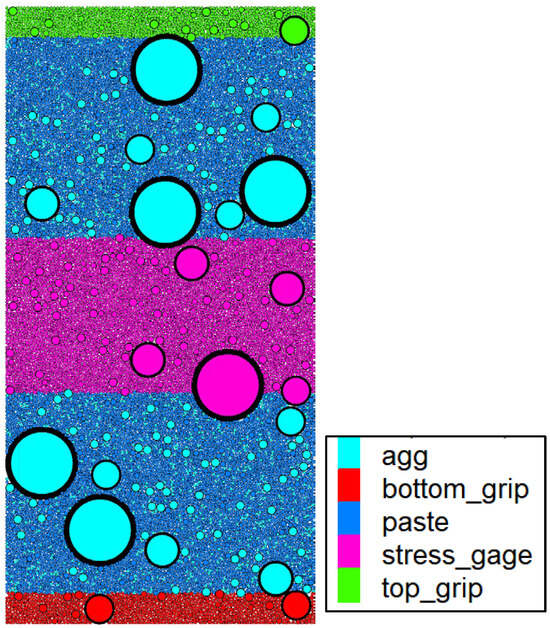
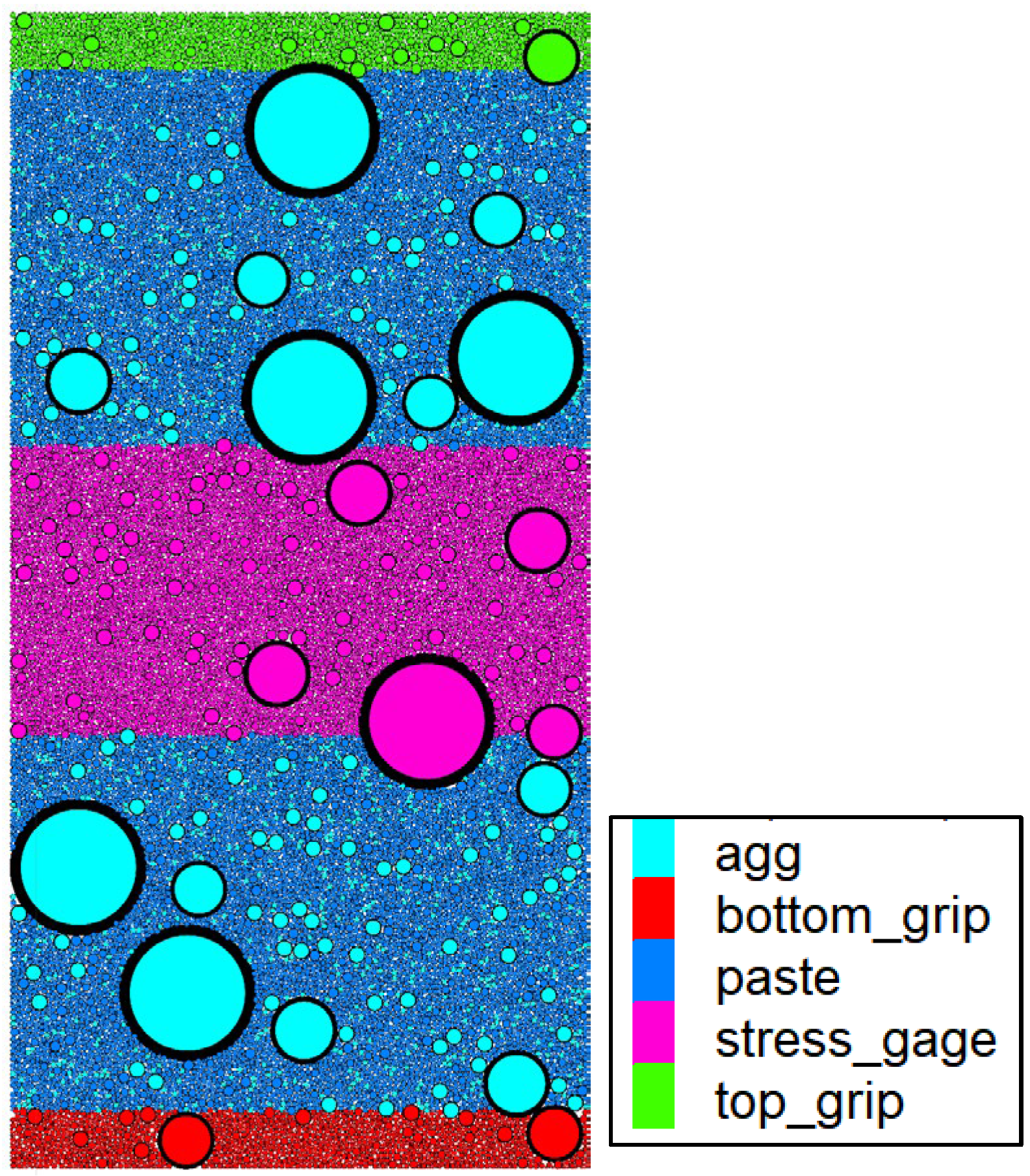
The calibrated DEM model described earlier is also used to predict the mechanical response of UHPC under uniaxial tensile loading. The numerical specimen is constructed in a manner similar to that for uniaxial compression, with a few modifications. All rigid walls are removed from the model, and the specimen is separated into different sections for simulation control and data collection. As shown in Figure 13, the top and bottom sections with a thickness of 5% of the specimen height were used to apply the tensile load. All of the particles within these sections were assigned a constant velocity of 10 mm/s to simulate the axial strain-controlled tension test. The section located at the center of the specimen was used to calculate the axial stress and axial strain during the simulations. All of the inter-particle contact stresses in the central section were used to determine the average axial stress. The average displacement of the particles located in the top and bottom edges of the central section was used to calculate the axial strain.
Figure 13.
Numerical specimen for the tension test showing the different sections.
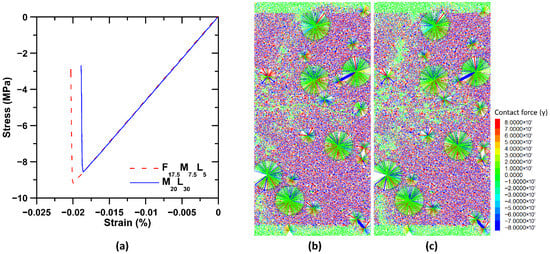
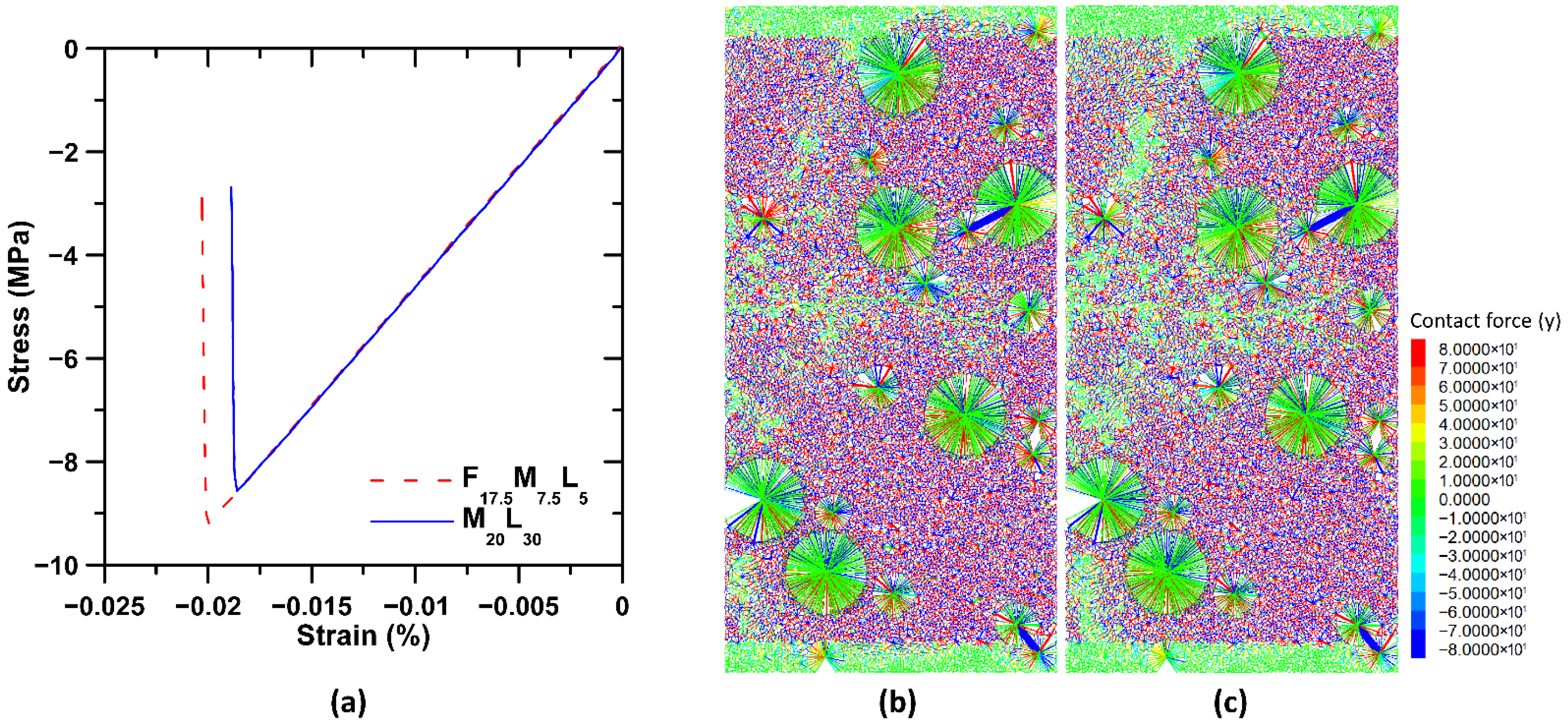
Figure 14a shows the predicted axial stress–strain response of the F17.5M7.5L5 and M20L30 specimens. A peak tensile stress of 9.19 MPa with a peak strain of 0.0199% are predicted for the F17.5M7.5L5 specimen, while a peak stress of 8.56 MPa with a peak strain of 0.0186% are predicted for the M20L30 specimen. (We currently do not have experimental tensile strengths of these UHPC mixtures; however, the values obtained from simulations are in line with those reported for similar UHPCs [71,72,74]). Figure 14b,c show the y-component of the inter-particle contact force network at the end of the simulations for both of the specimens. Tensile failure is found to propagate through the center of the specimen with the major crack perpendicular to the direction of the application of the load, consistent with tension failure of concrete observed in the laboratory, validating that the DEM simulations adequately capture the failure mechanisms. Some crack branching is also observed in these specimens, which is a result of the dense particle packing in these mixtures. Finally, Figure 15 combines both the simulated compression and tension responses of the UHPC mixtures evaluated here.
Figure 14.
(a) Simulated tensile stress–strain response of F17.5M7.5L5 and M20L30 specimens and (b,c) contact forces network at the end of tension simulation for F17.5M7.5L5 and M20L30 specimens, respectively.
Figure 15.
Simulated stress–strain response for the UHPC specimens under uniaxial loading.
5. Summary and Conclusions
This paper has discussed discrete element method (DEM)-based simulations of the axial and flexural response of two different non-fiber-reinforced ultra-high performance concrete (UHPC) mixtures. UHPC mixtures containing 30–50% cement replacement materials (by mass) and demonstrating 90-day compressive strengths of 130–150 MPa and flexural strengths of 8–10 MPa were proportioned. The compressive and flexural stress–strain response of the UHPCs were also experimentally determined. To extract the micro-scale mechanical properties of the binder phase of the UHPCs required for the simulations, micro-indentation experiments were carried out through which the indentation moduli and hardness at several indents were recorded. The indentation moduli and hardness of the binders varied between 32 and 35 GPa and 0.65 and 0.9 GPa, respectively.
The macro-scale response of UHPCs in flexure, compression, and tension were simulated using the micro-scale properties. The DEM model employed in the simulations was a flat-joint model, available as a built-in contact model in the commercial PFC2D package. Two-phase particle packing was used to represent the paste and aggregate phases, maintaining volume fractions of the phases identical to those in the experiments but with different size distributions required to manage the computational effort while preserving the physics of the problem. Among the key parameters required to implement the flat-joint DEM model, the difficult ones to obtain are the cohesion (c) and friction angle (α), which were extracted from a microporomechanics-based analysis of the micro-indentation results. This was accomplished by considering that the indentation curve at any point is a function of a single homogenized solid phase and the pore space influenced by that indent. The resultant over-determined problem was solved using inverse analysis, obtaining a range of cohesion and friction angle values. To determine the appropriate tensile strength (σt) values for the different binders, different c–α combinations with assumed tensile strength values (ranging from 5 MPa to 20 MPa) were used to simulate the flexural responses of UHPC beams. The match with experimental stress–strain responses was used to determine the combinations of (c, α, σt) for a given mixture. The simulated beam failed in a manner similar to that in the experiments. These parameters were used in simulating uniaxial compression and tension of UHPC cylindrical specimens using DEM. The peak stress and strains were relatively unaffected by cohesion values within a range of 145–185 MPa in the flexural simulations, whereas in the compression simulations, higher values of cohesion resulted in higher peak stresses and strains, as expected. Because post-peak behavior was not simulated in this work, the friction angle does not seem to influence the results significantly. It needs to be noted that more accurate determination of friction angles is required to simulate the post-peak response. The simulated specimens fail in a manner similar to the experimental specimens in compression and tension, validating that the DEM simulations adequately capture the failure mechanisms. The results and simulations reported here have shown that micro-scale mechanical properties and parameters extracted from the micro-scale response can be used to accurately predict the constitutive response of concrete materials, including UHPCs. Knowledge of parameters that are influential in this response provides indications of the underlying mechanisms and, consequently, can be employed to choose materials to ensure desired performance.
While the presented DEM model reproduces the experimental behavior of UHPC, it remains subject to inherent modeling uncertainties, including material parameter estimation, initialization strategy, and calibration choices [75,76]. Such uncertainty should be borne in mind when interpreting the predictive capability of the model and will be addressed in future studies. Additionally, the study presented focuses on developing a clear, transferable pathway to derive contact law parameters for a meso-scale DEM model from measurable micro-scale properties, and thus it is not intended to directly represent full-scale structural elements or to imply scale-independent structural behavior. The effort needed to address the size effect from meso-scale to structural scale is beyond the scope of the present study and will be addressed in future studies.
Author Contributions
Conceptualization, P.Y. and A.A.; Methodology, A.A.; Software, P.Y.; Validation, A.A.; Formal analysis, P.Y. and A.A.; Writing—original draft, A.A.; Writing—review & editing, N.N.; Supervision, C.G.H., B.M. and N.N.; Project administration, N.N. All authors have read and agreed to the published version of the manuscript.
Funding
This research was funded by Arizona Department of Transportation (ADOT; Grant No: SPR 745) and the National Science Foundation (NSF; CMMI 1727445; OISE 2020095).
Institutional Review Board Statement
Not Applicable.
Informed Consent Statement
Not Applicable.
Data Availability Statement
The data supporting the findings of this study are available from the corresponding author upon reasonable request. The data are not publicly available due to the large size of simulation files and proprietary nature of the computational models and input parameters, which are part of ongoing research and not yet finalized for open distribution.
Acknowledgments
The authors sincerely acknowledge the Arizona Department of Transportation (ADOT; Grant No: SPR 745) and the National Science Foundation (NSF; CMMI 1727445; OISE 2020095) for their partial support for this research. The materials used for this study were provided by BASF Corporation, Salt River Materials Group, Burgess Pigments, and Omya A.G. and are acknowledged. The contents of this paper reflect the views of the authors, who are responsible for the facts and accuracy of the data presented herein, and do not necessarily reflect the views and policies of the funding agency, nor do the contents constitute a standard, specification, or a regulation.
Conflicts of Interest
Author Pu Yang is employed by the company Stantec Consultants. Author Aashay Arora is employed by the company EnKoat Inc. The remaining authors declare that the research was conducted in the absence of any commercial or financial relationships that could be construed as a potential conflict of interest.
References
- Yoo, D.-Y.; Banthia, N. Mechanical properties of ultra-high-performance fiber-reinforced concrete: A review. Cem. Concr. Compos. 2016, 73, 267–280. [Google Scholar] [CrossRef] [Scilit]
- Graybeal, B. FHWA TECHNOTE: Ultra High Performance Concrete; FHWA Publication No: FHWA-HRT-11-038; Federal Highway Administration: Washington, DC, USA, 2011. [Google Scholar]
- Wille, K.; Naaman, A.E.; Parra-Montesinos, G.J. Ultra-High Performance Concrete with Compressive Strength Exceeding 150 MPa (22 ksi): A Simpler Way. Mater. J. 2011, 108, 46–54. [Google Scholar]
- Gesoglu, M.; Güneyisi, E.; Muhyaddin, G.F.; Asaad, D.S. Strain hardening ultra-high performance fiber reinforced cementitious composites: Effect of fiber type and concentration. Compos. Part B Eng. 2016, 103, 74–83. [Google Scholar] [CrossRef] [Scilit]
- Ghasemi, S.; Zohrevand, P.; Mirmiran, A.; Xiao, Y.; Mackie, K. A super lightweight UHPC-HSS deck panel for movable bridges. Eng. Struct. 2016, 113, 186–193. [Google Scholar] [CrossRef] [Scilit]
- Honarvar, E.; Sritharan, S.; Rouse, J.M.; Aaleti, S. Bridge Decks with Precast UHPC Waffle Panels: A Field Evaluation and Design Optimization. J. Bridge Eng. 2016, 21, 04015030. [Google Scholar] [CrossRef] [Scilit]
- Maya, L.F.; Graybeal, B. Experimental study of strand splice connections in UHPC for continuous precast prestressed concrete bridges. Eng. Struct. 2017, 133, 81–90. [Google Scholar] [CrossRef] [Scilit]
- Saleem, M.A.; Mirmiran, A.; Xia, J.; Mackie, K. Ultra-High-Performance Concrete Bridge Deck Reinforced with High-Strength Steel. Aci. Struct. J. 2011, 108, 601–609. [Google Scholar]
- Graybeal, B.A. Fatigue Response in Bridge Deck Connection Composed of Field-Cast Ultra-High-Performance Concrete. Transp. Res. Rec. 2011, 2251, 93–100. [Google Scholar] [CrossRef] [Scilit]
- Zhu, Y.; Zhang, Y.; Hussein, H.H.; Chen, G. Flexural strengthening of reinforced concrete beams or slabs using ultra-high performance concrete (UHPC): A state of the art review. Eng. Struct. 2020, 205, 110035. [Google Scholar] [CrossRef] [Scilit]
- Zhang, X.; Li, X.; Liu, R.; Hao, C.; Cao, Z. Dynamic properties of a steel–UHPC composite deck with large U-ribs: Experimental measurement and numerical analysis. Eng. Struct. 2020, 213, 110569. [Google Scholar] [CrossRef] [Scilit]
- Wang, Y.; Shao, X.; Chen, J.; Cao, J.; Deng, S. UHPC-based strengthening technique for orthotropic steel decks with significant fatigue cracking issues. J. Constr. Steel Res. 2021, 176, 106393. [Google Scholar] [CrossRef] [Scilit]
- Yi, N.-H.; Kim, J.-H.J.; Han, T.-S.; Cho, Y.-G.; Lee, J.H. Blast-resistant characteristics of ultra-high strength concrete and reactive powder concrete. Constr. Build. Mater. 2012, 28, 694–707. [Google Scholar] [CrossRef] [Scilit]
- Arora, A.; Almujaddidi, A.; Kianmofrad, F.; Mobasher, B.; Neithalath, N. Material design of economical ultra-high performance concrete (UHPC) and evaluation of their properties. Cem. Concr. Compos. 2019, 104, 103346. [Google Scholar] [CrossRef] [Scilit]
- Wang, C.; Yang, C.; Liu, F.; Wan, C.; Pu, X. Preparation of Ultra-High Performance Concrete with common technology and materials. Cem. Concr. Compos. 2012, 34, 538–544. [Google Scholar] [CrossRef] [Scilit]
- Wille, K.; Boisvert-Cotulio, C. Material efficiency in the design of ultra-high performance concrete. Constr. Build. Mater. 2015, 86, 33–43. [Google Scholar] [CrossRef] [Scilit]
- Kadhim, M.M.A.; Jawdhari, A.; Peiris, A. Development of hybrid UHPC-NC beams: A numerical study. Eng. Struct. 2021, 233, 111893. [Google Scholar] [CrossRef] [Scilit]
- Fang, Z.; Jiang, H.; Xiao, J.; Dong, X.; Shao, T. Shear performance of UHPC-filled pocket connection between precast UHPC girders and full-depth precast concrete slabs. Structures 2021, 29, 328–338. [Google Scholar] [CrossRef] [Scilit]
- Nasrin, S.; Ibrahim, A. Flexural response of Ultra-High-Performance Concrete (UHPC) hybrid bridge deck connections made with local materials. Constr. Build. Mater. 2021, 270, 121451. [Google Scholar] [CrossRef] [Scilit]
- Shahbeyk, S.; Hosseini, M.; Yaghoobi, M. Mesoscale finite element prediction of concrete failure. Comput. Mater. Sci. 2011, 50, 1973–1990. [Google Scholar] [CrossRef] [Scilit]
- Tejchman, J.; Bobiński, J. Continuous and Discontinuous Modelling of Fracture in Concrete Using FEM; Springer Science & Business Media: Berlin/Heidelberg, Germany, 2012. [Google Scholar]
- Kim, S.-M.; Al-Rub, R.K.A. Meso-scale computational modeling of the plastic-damage response of cementitious composites. Cem. Concr. Res. 2011, 41, 339–358. [Google Scholar] [CrossRef] [Scilit]
- Skarżyński, Ł.; Nitka, M.; Tejchman, J. Modelling of concrete fracture at aggregate level using FEM and DEM based on X-ray μCT images of internal structure. Eng. Fract. Mech. 2015, 147, 13–35. [Google Scholar] [CrossRef] [Scilit]
- Nitka, M.; Tejchman, J. Modelling of concrete behaviour in uniaxial compression and tension with DEM. Granul. Matter. 2015, 17, 145–164. [Google Scholar] [CrossRef] [Scilit]
- Xie, C.; Yuan, L.; Zhao, M.; Jia, Y. Study on failure mechanism of porous concrete based on acoustic emission and discrete element method. Constr. Build. Mater. 2020, 235, 117409. [Google Scholar] [CrossRef] [Scilit]
- Sinaie, S.; Ngo, T.D.; Nguyen, V.P. A discrete element model of concrete for cyclic loading. Comput. Struct. 2018, 196, 173–185. [Google Scholar] [CrossRef] [Scilit]
- Tran, V.T.; Donzé, F.-V.; Marin, P. A discrete element model of concrete under high triaxial loading. Cem. Concr. Compos. 2011, 33, 936–948. [Google Scholar] [CrossRef] [Scilit]
- Tan, Y.; Cao, G.; Zhang, H.; Wang, J.; Deng, R.; Xiao, X.; Wu, B. Study on the Thixotropy of the Fresh Concrete Using DEM. Procedia Eng. 2015, 102, 1944–1950. [Google Scholar] [CrossRef] [Scilit]
- Cui, W.; Yan, W.; Song, H.; Wu, X. DEM simulation of SCC flow in L-Box set-up: Influence of coarse aggregate shape on SCC flowability. Cem. Concr. Compos. 2020, 109, 103558. [Google Scholar] [CrossRef] [Scilit]
- Zhan, Y.; Gong, J.; Huang, Y.; Shi, C.; Zuo, Z.; Chen, Y. Numerical Study on Concrete Pumping Behavior via Local Flow Simulation with Discrete Element Method. Materials 2019, 12, 1415. [Google Scholar] [CrossRef] [Scilit]
- Mechtcherine, V.; Gram, A.; Krenzer, K.; Schwabe, J.-H.; Shyshko, S.; Roussel, N. Simulation of fresh concrete flow using Discrete Element Method (DEM): Theory and applications. Mater. Struct. 2014, 47, 615–630. [Google Scholar] [CrossRef] [Scilit]
- Wang, P.; Gao, N.; Ji, K.; Stewart, L.; Arson, C. DEM analysis on the role of aggregates on concrete strength. Comput. Geotech. 2020, 119, 103290. [Google Scholar] [CrossRef] [Scilit]
- Nguyen, T.T.; Bui, H.H.; Ngo, T.D.; Nguyen, G.D. Experimental and numerical investigation of influence of air-voids on the compressive behaviour of foamed concrete. Mater. Des. 2017, 130, 103–119. [Google Scholar] [CrossRef] [Scilit]
- Sinaie, S. Application of the discrete element method for the simulation of size effects in concrete samples. Int. J. Solids Struct. 2017, 108, 244–253. [Google Scholar] [CrossRef] [Scilit]
- Azevedo, N.M.; Lemos, J.V. Hybrid discrete element/finite element method for fracture analysis. Comput. Methods Appl. Mech. Eng. 2006, 195, 4579–4593. [Google Scholar] [CrossRef] [Scilit]
- Arora, A.; Yao, Y.; Mobasher, B.; Neithalath, N. Fundamental insights into the compressive and flexural response of binder- and aggregate-optimized ultra-high performance concrete (UHPC). Cem. Concr. Compos. 2019, 98, 1–13. [Google Scholar] [CrossRef] [Scilit]
- Arora, A.; Aguayo, M.; Hansen, H.; Castro, C.; Federspiel, E.; Mobasher, B.; Neithalath, N. Microstructural packing- and rheology-based binder selection and characterization for Ultra-high Performance Concrete (UHPC). Cem. Concr. Res. 2018, 103, 179–190. [Google Scholar] [CrossRef] [Scilit]
- C1738/C1738M-18; Standard Practice for High-Shear Mixing of Hydraulic Cement Pastes. ASTM International: West Conshohocken, PA, USA, 2018.
- Hoover, C.G.; Ulm, F.-J. Experimental chemo-mechanics of early-age fracture properties of cement paste. Cem. Concr. Res. 2015, 75, 42–52. [Google Scholar] [CrossRef] [Scilit]
- Ulm, F.-J.; Vandamme, M.; Jennings, H.M.; Vanzo, J.; Bentivegna, M.; Krakowiak, K.J.; Constantinides, G.; Bobko, C.P.; Van Vliet, K.J. Does microstructure matter for statistical nanoindentation techniques? Cem. Concr. Compos. 2010, 32, 92–99. [Google Scholar] [CrossRef] [Scilit]
- Oliver, W.C.; Pharr, G.M. An improved technique for determining hardness and elastic modulus using load and displacement sensing indentation experiments. J. Mater. Res. 1992, 7, 1564–1583. [Google Scholar] [CrossRef] [Scilit]
- Oliver, W.C.; Pharr, G.M. Measurement of hardness and elastic modulus by instrumented indentation: Advances in understanding and refinements to methodology. J. Mater. Res. 2004, 19, 3–20. [Google Scholar] [CrossRef]
- Ford, E.; Arora, A.; Mobasher, B.; Hoover, C.G.; Neithalath, N. Elucidating the nano-mechanical behavior of multi-component binders for ultra-high performance concrete. Constr. Build. Mater. 2020, 243, 118214. [Google Scholar] [CrossRef] [Scilit]
- Cundall, P.A.; Strack, O.D.L. A discrete numerical model for granular assemblies. Géotechnique 1979, 29, 47–65. [Google Scholar] [CrossRef] [Scilit]
- Donzé, F.V.; Richefeu, V.; Magnier, S.-A. Advances in discrete element method applied to soil, rock and concrete mechanics. Electron. J. Geotech. Eng. 2009, 8, 44. [Google Scholar]
- Camborde, F.; Mariotti, C.; Donzé, F.V. Numerical study of rock and concrete behaviour by discrete element modelling. Comput. Geotech. 2000, 27, 225–247. [Google Scholar] [CrossRef] [Scilit]
- Nagai, K.; Matsumoto, K. Static and Fatigue Failure Simulation of Concrete Material by Discrete Analysis; FraMCoS-7; Korea Concrete Institute: Seoul, Republic of Korea, 2010. [Google Scholar]
- Tan, X.; Li, W.; Zhao, M.; Tam, V.W. Numerical discrete-element method investigation on failure process of recycled aggregate concrete. J. Mater. Civ. Eng. 2019, 31, 04018353. [Google Scholar] [CrossRef] [Scilit]
- Nitka, M.; Tejchman, J. Meso-mechanical modelling of damage in concrete using discrete element method with porous ITZs of defined width around aggregates. Eng. Fract. Mech. 2020, 231, 107029. [Google Scholar] [CrossRef] [Scilit]
- Suchorzewski, J.; Tejchman, J.; Nitka, M. Discrete element method simulations of fracture in concrete under uniaxial compression based on its real internal structure. Int. J. Damage Mech. 2018, 27, 578–607. [Google Scholar] [CrossRef] [Scilit]
- I.C.G. Inc. PFC—Particle Flow Code, Ver. 6.0; I.C.G. Inc.: Minneapolis, MA, USA, 2018. [Google Scholar]
- Ren, J.; Tian, Z.; Bu, J. Simulating tensile and compressive failure process of concrete with a user-defined bonded-particle model. Int. J. Concr. Struct. Mater. 2018, 12, 56. [Google Scholar] [CrossRef] [Scilit]
- Wu, S.; Xu, X. A Study of Three Intrinsic Problems of the Classic Discrete Element Method Using Flat-Joint Model. Rock Mech. Rock Eng. 2016, 49, 1813–1830. [Google Scholar] [CrossRef] [Scilit]
- Potyondy, D.O. PFC2D Flat-Joint Contact Model; Itasca Consulting Group Inc. Minneap: St. Paul, MN, USA, 2012. [Google Scholar]
- Potyondy, D.O. PFC3D Flat Joint Contact Model Version 1; Itasca Consulting Group Minneapolis: St. Paul, MN, USA, 2013. [Google Scholar]
- Bahaaddini, M.; Sheikhpourkhani, A.M.; Mansouri, H. Flat-joint model to reproduce the mechanical behaviour of intact rocks. Eur. J. Environ. Civ. Eng. 2019, 25, 1427–1448. [Google Scholar] [CrossRef] [Scilit]
- Cundall, P.A. PFC User Manual; Itasca Consulting Group Inc. Mineapolis: St. Paul, MN, USA, 2004. [Google Scholar]
- Hentz, S.; Daudeville, L.; Donzé, F.V. Identification and Validation of a Discrete Element Model for Concrete. J. Eng. Mech. 2004, 130, 709–719. [Google Scholar] [CrossRef] [Scilit]
- Gabrieli, F.; Cola, S.; Calvetti, F. Use of an up-scaled DEM model for analysing the behaviour of a shallow foundation on a model slope. Geomech. Geoengin. Int. J. 2009, 4, 109–122. [Google Scholar] [CrossRef] [Scilit]
- Belheine, N.; Plassiard, J.-P.; Donzé, F.-V.; Darve, F.; Seridi, A. Numerical simulation of drained triaxial test using 3D discrete element modeling. Comput. Geotech. 2009, 36, 320–331. [Google Scholar] [CrossRef] [Scilit]
- Nasato, D.S.; Goniva, C.; Pirker, S.; Kloss, C. Coarse Graining for Large-scale DEM Simulations of Particle Flow—An Investigation on Contact and Cohesion Models. Procedia Eng. 2015, 102, 1484–1490. [Google Scholar] [CrossRef] [Scilit]
- Kumara, J.; Hayano, K.; Shigekuni, Y.; Sasaki, K. Physical and mechanical properties of sand-gravel mixtures evaluated from DEM simulation and laboratory triaxial test. Int. J. Geomate 2013, 4, 546–551. [Google Scholar]
- Sorelli, L.; Constantinides, G.; Ulm, F.-J.; Toutlemonde, F. The nano-mechanical signature of ultra high performance concrete by statistical nanoindentation techniques. Cem. Concr. Res. 2008, 38, 1447–1456. [Google Scholar] [CrossRef] [Scilit]
- Cariou, S.; Ulm, F.-J.; Dormieux, L. Hardness–packing density scaling relations for cohesive-frictional porous materials. J. Mech. Phys. Solids 2008, 56, 924–952. [Google Scholar] [CrossRef] [Scilit]
- Bobko, C.P.; Gathier, B.; Ortega, J.A.; Ulm, F.-J.; Borges, L.; Abousleiman, Y.N. The nanogranular origin of friction and cohesion in shale—A strength homogenization approach to interpretation of nanoindentation results. Int. J. Numer. Anal. Methods Geomech. 2011, 35, 1854–1876. [Google Scholar] [CrossRef] [Scilit]
- Cheng, Y.-T.; Cheng, C.-M. Scaling, dimensional analysis, and indentation measurements. Mater. Sci. Eng. R Rep. 2004, 44, 91–149. [Google Scholar] [CrossRef] [Scilit]
- Onoda, G.Y.; Liniger, E.G. Random loose packings of uniform spheres and the dilatancy onset. Phys. Rev. Lett. 1990, 64, 2727. [Google Scholar] [CrossRef] [Scilit]
- Constantinides, G.; Ulm, F.-J. The nanogranular nature of C–S–H. J. Mech. Phys. Solids 2007, 55, 64–90. [Google Scholar] [CrossRef] [Scilit]
- Sarris, E.; Constantinides, G. Finite element modeling of nanoindentation on C–S–H: Effect of pile-up and contact friction. Cem. Concr. Compos. 2013, 36, 78–84. [Google Scholar] [CrossRef] [Scilit]
- Chang, C.; Zoback, M.D.; Khaksar, A. Empirical relations between rock strength and physical properties in sedimentary rocks. J. Pet. Sci. Eng. 2006, 51, 223–237. [Google Scholar] [CrossRef] [Scilit]
- Shafieifar, M.; Farzad, M.; Azizinamini, A. Experimental and numerical study on mechanical properties of Ultra High Performance Concrete (UHPC). Constr. Build. Mater. 2017, 156, 402–411. [Google Scholar] [CrossRef] [Scilit]
- Kusumawardaningsih, Y.; Fehling, E.; Ismail, M.; Aboubakr, A.A.M. Tensile Strength Behavior of UHPC and UHPFRC. Procedia Eng. 2015, 125, 1081–1086. [Google Scholar] [CrossRef] [Scilit]
- Palkovic, S.D.; Büyüköztürk, O. Multiscale Modeling of Cohesive-Frictional Strength Properties in Cementitious Materials. In Handbook of Materials Modeling: Applications: Current and Emerging Materials; Springer: Berlin/Heidelberg, Germany, 2020; pp. 1687–1710. [Google Scholar]
- Pansuk, W.; Sato, H.; Sato, Y.; Shionaga, R. Tensile behaviors and fiber orientation of UHPC. In Ultra High Performance Concrete: (UHPC); Proceedings of the Second International Symposium on Ultra High Performance Concrete, Kassel, Germany, 5–7 March 2008; Germany Kassel University Press: Kassel, Germany, 2008; pp. 161–168. [Google Scholar]
- Habib, A.; Yildirim, U. Simplified modeling of rubberized concrete properties using multivariable regression analysis. Mater. Construcción 2022, 72, e289. [Google Scholar] [CrossRef] [Scilit]
- Habib, A.; Yildirim, U. Distribution of strong input energy in base-isolated structures with complex nonlinearity: A parametric assessment. Multidiscip. Model. Mater. Struct. 2023, 19, 324–340. [Google Scholar] [CrossRef] [Scilit]

Disclaimer/Publisher’s Note: The statements, opinions and data contained in all publications are solely those of the individual author(s) and contributor(s) and not of MDPI and/or the editor(s). MDPI and/or the editor(s) disclaim responsibility for any injury to people or property resulting from any ideas, methods, instructions or products referred to in the content. |
© 2026 by the authors. Licensee MDPI, Basel, Switzerland. This article is an open access article distributed under the terms and conditions of the Creative Commons Attribution (CC BY) license.