A Principal Component Analysis Framework for Evaluating Mining-Induced Risk: A Case Study of a Chilean Underground Mine


Abstract
1. Introduction
2. Materials and Methods
2.1. Filtering
2.2. Correlation and Normalization
2.3. Principal Component Analysis (PCA) Applied to Mining-Induced Data
3. Results
3.1. Seismic Risk Zones Definition
3.2. Spatio-Temporal Analysis
4. Discussion
- (i)
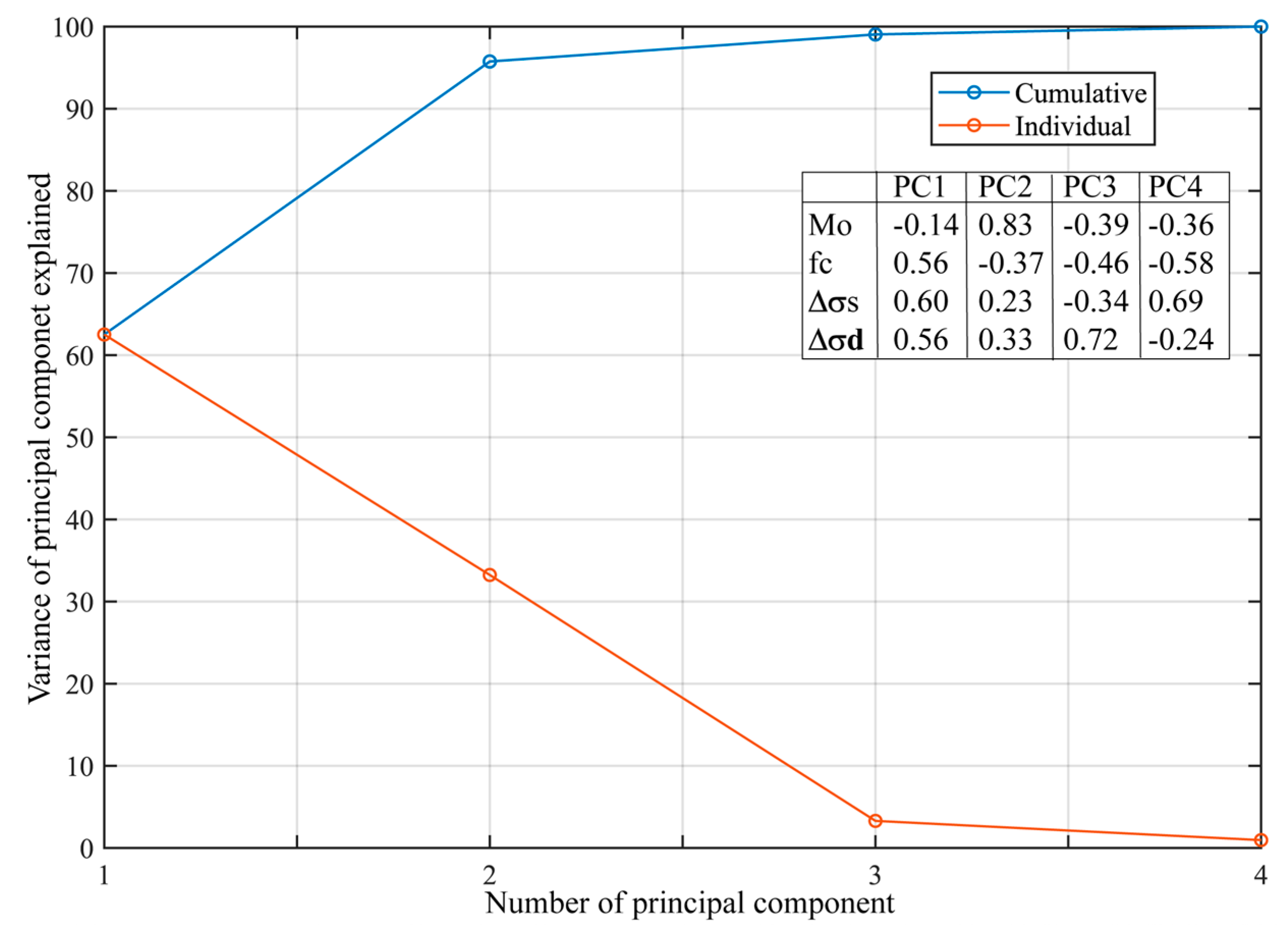
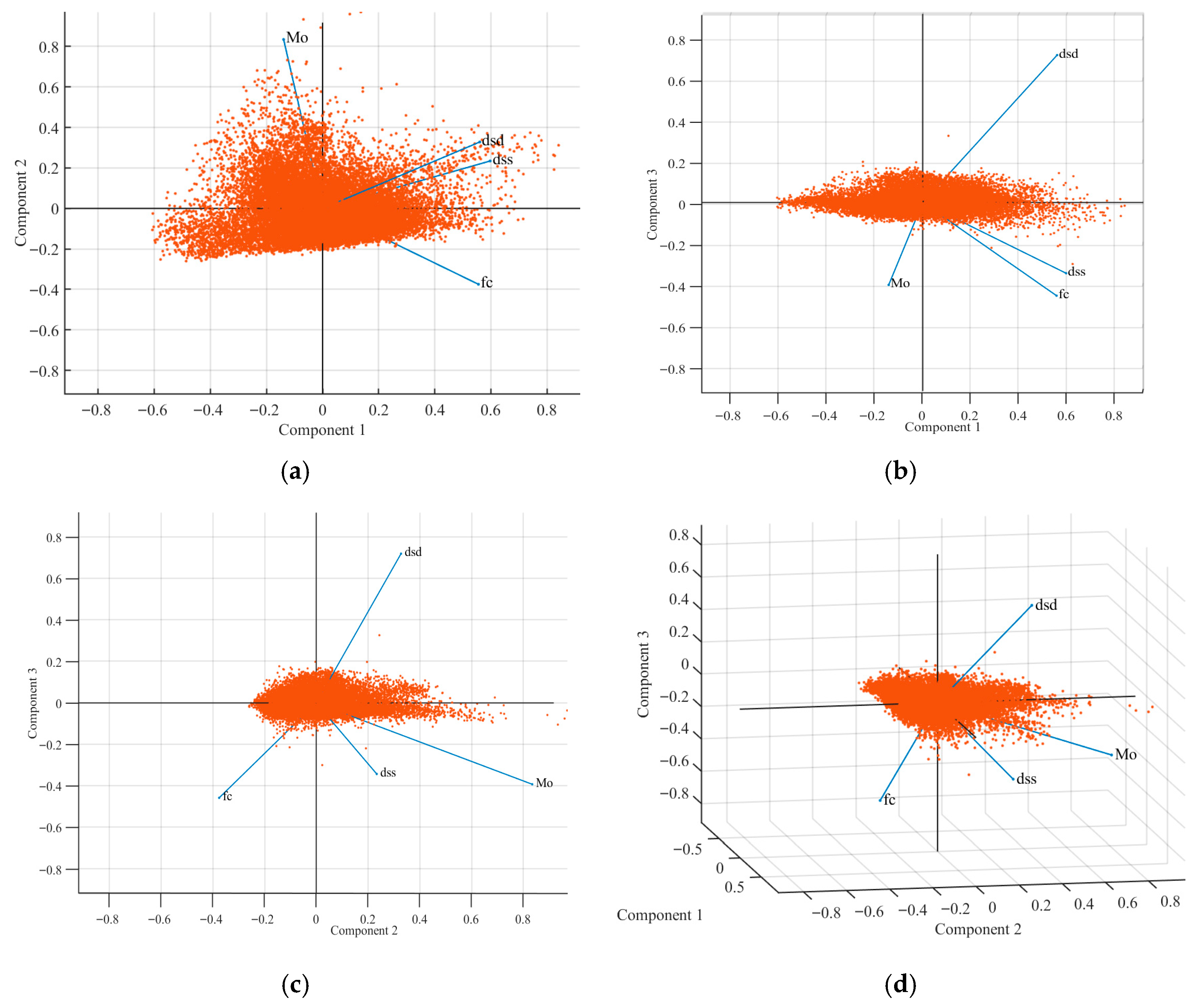
- The sign indeterminacy inherent to PCA, which captures both shared variance and contrasting patterns between correlated variables. Consequently, the opposite orientations reflect how PCA defines the direction of maximum variance within the stress domain rather than a physical contradiction between the parameters.
- (ii)
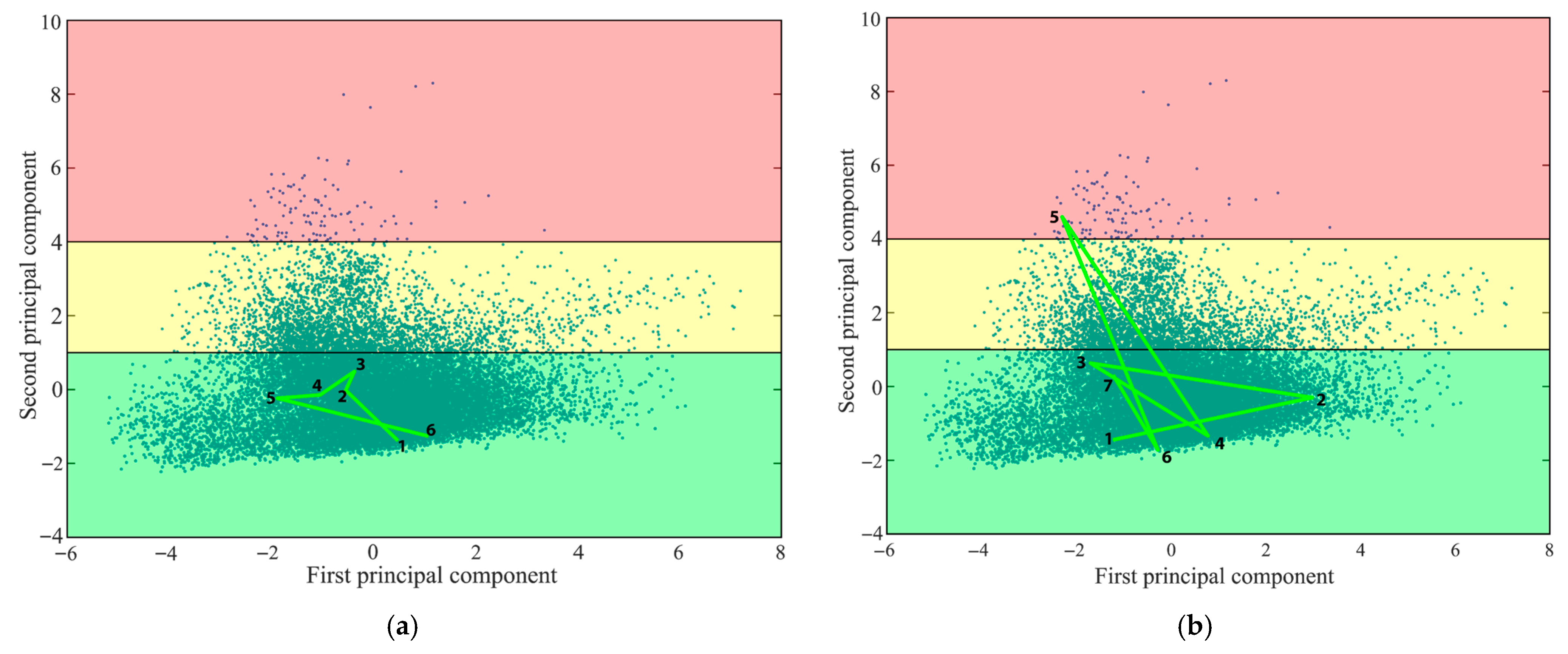
- Even considering that both stresses increase systematically with PC1 score (Supplementary Materials), the opposite loadings between Δσs and Δσd indicate that PC1 also captures the relative contrasts between both stresses. PC1 values also show events with higher dynamic stress drops relative to the static stress drop, and events where the static stress drop is dominant. This relates to the two rupture modes found in the PC1 score analyses (Supplementary Materials), where energetic, high-frequency events -rockburst- and low-frequency, less impulsive background seismicity were identified.
5. Conclusions
Supplementary Materials
Author Contributions
Funding
Institutional Review Board Statement
Informed Consent Statement
Data Availability Statement
Conflicts of Interest
References
- Dou, L.; Chen, T.; Gong, S.; He, H.; Zhang, S. Rockburst hazard determination by using computed tomography technology in deep workface. Saf. Sci. 2012, 50, 736–740. [Google Scholar] [CrossRef]
- Zhou, J.; Zhang, Y.; Li, C.; He, H.; Li, X. Rockburst prediction and prevention in underground space excavation. Undergr. Space 2024, 14, 70–98. [Google Scholar] [CrossRef]
- Heal, D.; Potvin, Y.; Hudyma, M. Evaluating rockburst damage potential in underground mining (ARMA/USRMS 06-1020). In Proceedings of the 41st U.S. Symposium on Rock Mechanics (USRMS): Golden Rocks 2006—50 Years of Rock Mechanics: Landmarks and Future Challenges; American Rock Mechanics Association: Tucson, Arizona, 2006. [Google Scholar]
- Cortés, N.; Hekmatnejad, A.; Pan, P.; Mohtarami, E.; Pena, A.; Taheri, A.; González, C. Empirical approaches for rock burst prediction: A comprehensive review and application to the new level of El Teniente Mine, Chile. Heliyon 2024, 10, e26515. [Google Scholar] [CrossRef] [PubMed] [PubMed Central]
- Masethe, R.; Wienand, G.; Adoko, A.C.; Zvarivadza, T. Rockburst Damage Characterization in a South African Gold Mine Subjected to High Horizontal Stresses. In Proceedings of the 58th U.S. Rock Mechanics/Geomechanics Symposium, Golden, CO, USA, 23–26 June 2024. [Google Scholar] [CrossRef]
- Patyńska, R. The consequences of the rock burst hazard in the Silesian rock mass. Arch. Min. Sci. 2009, 54, 207–222. [Google Scholar]
- Patyńska, R. Rockburst parameters causing mining disasters in Polish hard coal mines. E3S Web Conf. 2018, 24, 03005. [Google Scholar] [CrossRef]
- Codelco Collapse Was Likely Caused by Mining Rather Than Nature. Available online: https://www.mining.com/web/codelco-collapse-was-likely-caused-by-mining-rather-than-nature/ (accessed on 2 December 2025).
- Del Rio, J.I.; Fernandez, P.; Castillo, E.; Orellana, L.F. Assesing Climate Change Risk in the Mining Industry: A Case Study in the Copper Industry in the Antofagasta Region, Chile. Commodities 2023, 2, 246–260. [Google Scholar] [CrossRef]
- Cook, N.G.W. Seismicity associated with mining. Eng. Geol. 1976, 10, 99–122. [Google Scholar] [CrossRef]
- Mendecki, A.J. (Ed.) Seismic Monitoring in Mines; Chapman & Hall: Boca Raton, FL, USA, 1997. [Google Scholar]
- Larsson, K. Seismicity in Mines: A Review (Report); Swedish Rock Engineering Research Foundation: Stockholm, Sweden, 2004. [Google Scholar]
- Gutenberg, B.; Richter, C.F. Frequency of earthquakes in California. Bull. Seismol. Soc. Am. 1944, 34, 185–188. [Google Scholar] [CrossRef]
- Aki, K. Maximum likelihood estimate of b in the formula log N = a − bM and its confidence limits. Bull. Earthq. Res. Inst. 1965, 43, 237–239. [Google Scholar]
- Utsu, T. A method for determining the value of b in a formula log n = a − bM showing the magnitude frequency relation for earthquakes. Geophys. Bull. Hokkaido Univ. 1965, 13, 99–103. [Google Scholar]
- Scholz, C.H. The Mechanics of Earthquakes and Faulting, 3rd ed.; Cambridge University Press: Cambridge, UK, 2018. [Google Scholar] [CrossRef]
- Lasocki, S. Probabilistic Analysis of Seismic Hazard Posed by Mining Induced Events. In RaSiM6: Proceedings of the Sixth International Symposium on Rockburst and Seismicity in Mines Proceedings; Potvin, Y., Hudyma, M., Eds.; Australian Centre for Geomechanics: Perth, Australia, 2005; pp. 151–156. [Google Scholar] [CrossRef]
- Wesseloo, J. The Spatial Assessment of the Current Seismic Hazard State for Hard Rock Underground Mines. Rock Mech. Rock Eng. 2018, 51, 1839–1862. [Google Scholar] [CrossRef]
- Gibowicz, S.J.; Lasocki, S. Seismicity induced by mining: Ten years later. Adv. Geophys. 2001, 44, 39–181. [Google Scholar] [CrossRef]
- Ansari, A.; Noorzad, A.; Zafarani, H. Clustering analysis of the seismic catalog of Iran. Comput. Geosci. 2009, 35, 475–486. [Google Scholar] [CrossRef]
- Cai, M. Rockburst risk control and mitigation in deep mining. Deep. Resour. Eng. 2024, 1, 100019. [Google Scholar] [CrossRef]
- Heng, A.; Zhang, S.; Tan, A.C.; Mathew, J. Rotating machinery prognostics: State of the art, challenges and opportunities. Mech. Syst. Signal Process. 2009, 23, 724–739. [Google Scholar] [CrossRef]
- Vallejos, J.A.; McKinnon, S.D. Guidelines for development of re-entry protocols in seismically active mines. In Proceedings of the 42nd US Rock Mechanics Symposium, San Francisco, CA, USA, 29 June–2 July 2008. [Google Scholar]
- Estay, R. Metodología Para la Evaluación del Desempeño de Indicadores Sísmicos en Sismicidad Inducida Por la Minería. Master’s Thesis, Universidad de Chile, Santiago, Chile, 2014. (In Spanish) [Google Scholar]
- Estay, R.; Pavez-Orrego, C. An induced seismicity indicator using accumulated microearthquakes’ frictional’s energy. Mining 2025, 5, 27. [Google Scholar] [CrossRef]
- Derras, B.; Bard, P.Y.; Cotton, F. Towards fully data driven ground-motion prediction models for Europe. Bull. Earthq. Eng. 2014, 12, 495–516. [Google Scholar] [CrossRef]
- Reyes, J.; Morales-Esteban, A.; Martínez-Álvarez, F. Neural networks to predict earthquakes in Chile. Appl. Soft Comput. 2013, 13, 1314–1328. [Google Scholar] [CrossRef]
- Dhanya, J.; Raghukanth, S.T.G. Ground motion prediction model using artificial neural network. Pure Appl. Geophys. 2018, 175, 1035–1064. [Google Scholar] [CrossRef]
- Vallejos Massa, J.A.; McKinnon, S.D. Logistic regression and neural network classification of seismic records. Int. J. Rock Mech. Min. Sci. 2013, 62, 86–95. [Google Scholar] [CrossRef]
- Wu, T.; Liu, Z.; Yan, S. Detection and monitoring of mining-induced seismicity based on machine learning and template matching: A case study from Dongchuan Copper Mine, China. Sensors 2024, 24, 7312. [Google Scholar] [CrossRef] [PubMed]
- Pu, Y.; Apel, D.B.; Liu, V.; Mitri, H. Machine learning methods for rockburst prediction: State-of-the-art review. Int. J. Min. Sci. Technol. 2019, 29, 565–570. [Google Scholar] [CrossRef]
- Jiang, W.; Wang, C.; Zou, J.; Zhang, S. Application of Deep Learning in Fault Diagnosis of Rotating Machinery. Processes 2021, 9, 919. [Google Scholar] [CrossRef]
- Widodo, A.; Yang, B.-S. Support vector machine in machine condition monitoring and fault diagnosis. Mech. Syst. Signal Process. 2007, 21, 2560–2574. [Google Scholar] [CrossRef]
- Pearson, K. On lines and planes of closest fit to systems of points in space. Philos. Mag. 1901, 2, 559–572. [Google Scholar] [CrossRef]
- Jolliffe, I.T. Principal Component Analysis, 2nd ed.; Springer: Berlin/Heidelberg, Germany, 2002. [Google Scholar]
- Paolucci, E.; Lunedei, E.; Albarello, D. Application of the principal component analysis (PCA) to HVSR data aimed at the seismic characterization of earthquake prone areas. Geophys. J. Int. 2017, 211, 650–662. [Google Scholar] [CrossRef]
- Bressan, G.; Barnaba, C.; Peresan, A.; Rossi, G. Anatomy of seismicity clustering from parametric space-time analysis. Phys. Earth Planet. Inter. 2021, 320, 106787. [Google Scholar] [CrossRef]
- Sellers, E.J.; Kataka, M.O.; Linzer, L.M. Source parameters of acoustic emission events and scaling with mining-induced seismicity. J. Geophys. Res. Solid Earth 2003, 108, 2418. [Google Scholar] [CrossRef]
- Yin, X.; Liu, Q.; Lei, J.; Pan, Y.; Huang, X.; Lei, Y. Hybrid deep learning-based identification of microseismic events in TBM tunnelling. Measurement 2024, 238, 115381. [Google Scholar] [CrossRef]
- Hanks, T.C.; Kanamori, H. A moment magnitude scale. J. Geophys. Res. 1979, 84, 2348–2350. [Google Scholar] [CrossRef]
- Wiemer, S.; Wyss, M. Minimum magnitude of completeness in earthquake catalogs: Examples from Alaska, the western United States, and Japan. Bull. Seismol. Soc. Am. 2000, 90, 859–869. [Google Scholar] [CrossRef]
- Woessner, J.; Wiemer, S. Assessing the quality of earthquake catalogues: Estimating the magnitude of completeness and its uncertainty. Bull. Seismol. Soc. Am. 2005, 95, 684–698. [Google Scholar] [CrossRef]
- Leptokaropoulos, K.M.; Adamaki, A.K.; Roberts, R.G.; Gkarlaouni, C.G.; Paradisopoulou, P.M. Impact of magnitude uncertainties on seismic catalogue properties. Geophys. J. Int. 2018, 213, 940–951. [Google Scholar] [CrossRef]
- Wang, C.; Cao, A.; Jia, B.; Li, H.; Yue, Y. New approaches to assess seismic monitoring quality in underground mines: Data completeness and source location accuracy. Appl. Sci. 2025, 15, 11559. [Google Scholar] [CrossRef]
- Gibowicz, S.J.; Lasocki, S. Seismicity induced by mining: Recent research. Adv. Geophys. 2009, 51, 1–53. [Google Scholar]
- Hudyma, M. Applied mine seismology concepts and techniques. In Technical Notes for ENGR 5356–Mine Seismic Monitoring Systems 2010; Laurentian University: Sudbury, ON, Canada, 2010. [Google Scholar]
- Brune, J.N. Tectonic stress and the spectra of seismic shear waves from earthquakes. J. Geophys. Res. 1970, 75, 4997–5009. [Google Scholar] [CrossRef]
- Mizrahi, L.; Nandan, S.; Wiemer, S. The effect of declustering on the size distribution of mainshocks. Seism. Res. Lett. 2021, 92, 2333–2342. [Google Scholar] [CrossRef]
- Galina, N.A.; Bykova, V.V.; Vakarchuk, R.N.; Tatevosian, R.E. Effect of earthquake catalog declustering on seismic hazard assessment. Seism. Instrum. 2019, 55, 59–69. [Google Scholar] [CrossRef]



| Minimum | Maximum | Average | Std. Dev. | Unit | |
|---|---|---|---|---|---|
| Moment (Mo) | 2.7 × 10⁵ | 5.1 × 10¹¹ | 3.3 × 10⁸ | 4.5 × 10⁹ | Nm |
| Energy (E) | 0.0 | 1.9 × 10⁶ | 164.7 | 1.2 × 10⁴ | J |
| Moment P (MoP) | 5.9 × 10⁴ | 8.8 × 10¹¹ | 5.0 × 10⁸ | 6.8 × 10⁹ | Nm |
| Energy P (Ep) | 0.0 | 1.9 × 10⁵ | 28.6 | 1.6 × 10³ | J |
| Moment S (MoS) | 1.3 × 10⁵ | 5.2 × 10¹¹ | 2.5 × 10⁸ | 3.7 × 10⁹ | Nm |
| Energy S (Es) | 0.0 | 1.7 × 10⁶ | 136.2 | 1.1 × 10⁴ | J |
| Corner frequency (fc) | 10.5 | 2520.0 | 126.3 | 1.3 × 10² | Hz |
| Static stress drop (Δσs) | 4.7 | 7.9 × 10⁶ | 2.7 × 10⁴ | 1.4 × 10⁵ | Pa |
| Dynamic stress drop (Δσd) | 82.4 | 3.0 × 10⁷ | 6.1 × 10⁴ | 3.7 × 10⁵ | Pa |
| Moment deviation (ΔM) | 0.0 | 3.4 × 10¹¹ | 2.2 × 10⁸ | 1.0 × 10¹⁰ | Nm |
| Energy deviation (ΔE) | 0.0 | 9.5 × 10⁵ | 103.8 | 6.9 × 10³ | J |
| Corner frequency S (fcS) | 10.5 | 2520.0 | 126.3 | 1.3 × 10² | Hz |
| Mo | E | MoP | Ep | MoS | Es | fc | Δσs | Δσd | ΔM | ΔE | fcS | |
|---|---|---|---|---|---|---|---|---|---|---|---|---|
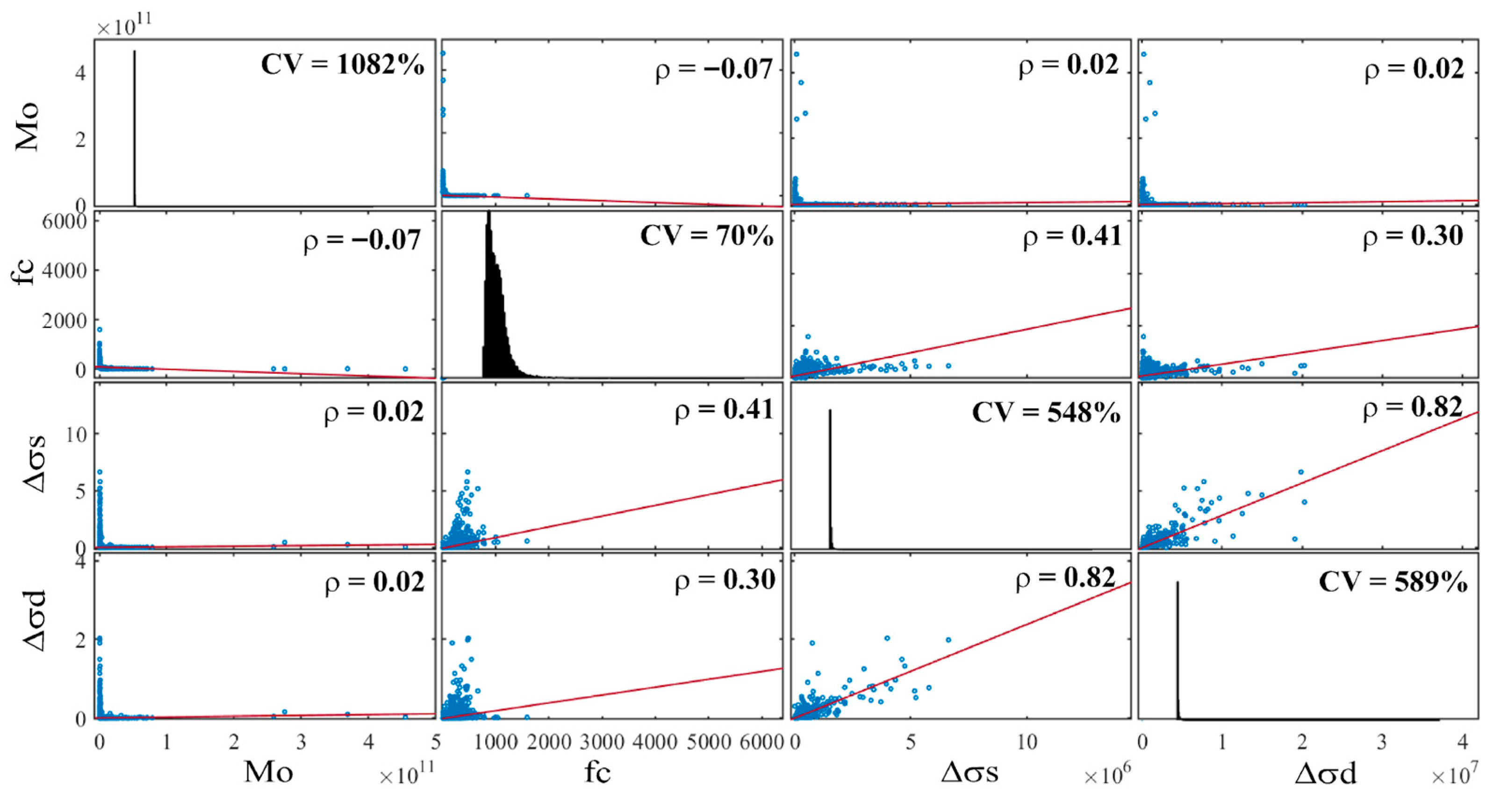
| Mo | 1 | 0.79 | 0.96 | 0.89 | 0.98 | 0.73 | −0.07 | 0.02 | 0.02 | 0.95 | 0.77 | −0.07 |
| E | 1 | 0.61 | 0.75 | 0.89 | 0.99 | −0.01 | 0.05 | 0.05 | 0.66 | 1 | −0.01 | |
| MoP | 1 | 0.84 | 0.88 | 0.53 | −0.10 | 0.01 | 0.02 | 0.98 | 0.57 | −0.07 | ||
| Ep | 1 | 0.88 | 0.67 | −0.01 | 0.08 | 0.07 | 0.80 | 0.74 | −0.01 | |||
| MoS | 1 | 0.84 | −0.07 | 0.02 | 0.02 | 0.89 | 0.87 | −0.07 | ||||
| Es | 1 | −0.01 | 0.04 | 0.04 | 0.60 | 0.99 | −0.01 | |||||
| fc | 1 | 0.41 | 0.30 | −0.06 | −0.01 | 1 | ||||||
| Δσs | 1 | 0.82 | 0.01 | 0.05 | 0.41 | |||||||
| Δσd | 1 | 0.02 | 0.05 | 0.30 | ||||||||
| ΔM | 1 | 0.62 | −0.06 | |||||||||
| ΔE | 1 | −0.01 | ||||||||||
| fcS | 1 |
Disclaimer/Publisher’s Note: The statements, opinions and data contained in all publications are solely those of the individual author(s) and contributor(s) and not of MDPI and/or the editor(s). MDPI and/or the editor(s) disclaim responsibility for any injury to people or property resulting from any ideas, methods, instructions or products referred to in the content. |
© 2026 by the authors. Licensee MDPI, Basel, Switzerland. This article is an open access article distributed under the terms and conditions of the Creative Commons Attribution (CC BY) license.
Share and Cite
Muñoz, F.; Estay, R.; Pavez-Orrego, C.; Nelis, G. A Principal Component Analysis Framework for Evaluating Mining-Induced Risk: A Case Study of a Chilean Underground Mine. Appl. Sci. 2026, 16, 1211. https://doi.org/10.3390/app16031211
Muñoz F, Estay R, Pavez-Orrego C, Nelis G. A Principal Component Analysis Framework for Evaluating Mining-Induced Risk: A Case Study of a Chilean Underground Mine. Applied Sciences. 2026; 16(3):1211. https://doi.org/10.3390/app16031211
Chicago/Turabian StyleMuñoz, Felipe, Rodrigo Estay, Claudia Pavez-Orrego, and Gonzalo Nelis. 2026. "A Principal Component Analysis Framework for Evaluating Mining-Induced Risk: A Case Study of a Chilean Underground Mine" Applied Sciences 16, no. 3: 1211. https://doi.org/10.3390/app16031211
APA StyleMuñoz, F., Estay, R., Pavez-Orrego, C., & Nelis, G. (2026). A Principal Component Analysis Framework for Evaluating Mining-Induced Risk: A Case Study of a Chilean Underground Mine. Applied Sciences, 16(3), 1211. https://doi.org/10.3390/app16031211