Article

Low-Carbon Autoclaved Alkali-Activated Blast Furnace Slag Concrete: Microstructure and Mechanical Properties


1
Department of Sustainable Construction, Centro Tecnológico de la Construcción, 30500 Molina de Segura, Spain
2
Department of Low-Carbon Concrete (Europe), CRH Innovation Centre (ICSC), 1083 HL Amsterdam, The Netherlands
3
Metal-Processing, Furniture, Wood, and Packaging Technology Institute, Parque Tecnológico-Calle Benjamín Franklin, 13, 46980 Paterna, Spain
4
Department of Mineralogy and Petrology, Faculty of Sciences, University of Granada, Avda. Fuentenueva s/n, 18002 Granada, Spain
*
Author to whom correspondence should be addressed.
Appl. Sci. 2026, 16(3), 1178; https://doi.org/10.3390/app16031178
Submission received: 3 December 2025 / Revised: 15 January 2026 / Accepted: 22 January 2026 / Published: 23 January 2026

Abstract

This paper presents a microstructural, mineralogical, and mechanical study of low-carbon autoclaved concrete (AC), achieved by partially or fully replacing ordinary Portland cement (OPC) with ground-granulated blast furnace slag (BFS) and substituting lime with calcium carbide slag (CCS). Fourteen mixes were produced and evaluated in the green state and after autoclaving. Quantitative X-ray diffraction (XRD) using the Rietveld method, density, compressive strength, and life cycle assessment (LCA) were conducted. Results show that mixes containing BFS achieve green strengths equal to or higher than the OPC reference, ensuring integrity during autoclaving. Using BFS with an adequate calcium supply promotes the formation of pre-autoclave portlandite, which in turn favors tobermorite development and yields post-autoclave strengths comparable to the OPC reference. Partial lime replacement with CCS (50%) maintains mineralogy and strength, whereas excessive CCS may reduce available portlandite and lower strength. Life-cycle assessment indicates that raw material supply dominates emissions and that removing OPC cuts total CO2 by 44% without compromising mechanical performance. These findings demonstrate the feasibility of OPC-lean/OPC-free, lime-optimized autoclaved concretes with substantially lower embodied impacts.

1. Introduction

The consequences of global warming, such as extreme floods, droughts, storms, hurricanes, sea level rise, etc., are becoming increasingly frequent worldwide. The primary causes of global warming are greenhouse gas emissions (GHG), particularly CO2 and methane (CH4). These gases are mainly released through the burning of fossil fuels, deforestation, and land use changes driven by urbanization and extensive agriculture [1].
In the construction sector, cement and concrete manufacturing are the largest contributors to CO2 emissions within this industry. The environmental impact of concrete production has become a growing concern, pushing governments worldwide to make significant efforts to reduce the carbon footprint of ordinary Portland cement (OPC) materials [2].
Against this background of decarbonization efforts in cement and concrete, one material drawing sustained attention is autoclaved aerated concrete (AAC). AAC is a factory-produced, cellular concrete that combines very low density with good thermal insulation and adequate mechanical performance for building use. It is typically delivered as blocks or other precast units for walls, floors, and roof elements [3].
AAC mixtures typically include OPC, lime, a sulfate source (gypsum or anhydrite), silica sand, and a small amount of aluminum powder. In the highly alkaline slurry, aluminum releases hydrogen, foaming the fresh paste and generating a uniform pore system. The green elements are then autoclaved—exposed to saturated steam at elevated temperature and pressure—which develops strength, dimensional stability, and durability. Under these hydrothermal conditions, calcium hydroxide reacts with silica to form CSH, which subsequently reorganizes into crystalline tobermorite. Tobermorite becomes the dominant binding phase and the primary source of mechanical strength in AAC [3,4,5,6].
In line with the broader push to conserve natural resources, recent work on AAC has pivoted toward substituting conventional raw materials, especially the siliceous fraction. Instead of relying on quarried silica sand, numerous studies have trialed alternative silica-bearing feeds, either as partial or full replacements. Reported options include zeolite, copper tailings, coal bottom ash, fly ash, rice husk ash, and recycled glass, among others, with the common objective of sustaining the hydrothermal formation of the principal binding phases during autoclaving [6,7,8,9,10,11].
By contrast, far fewer investigations have focused directly on cement and lime in AAC mixtures, even though reducing these constituents would likely yield greater environmental benefits. Cement and lime supply the Ca necessary to generate strength-giving crystalline products, such as tobermorite. Nonetheless, recent studies have explored ground granulated blast furnace slag (BFS), fly ash, calcium carbide slag (CCS), and alkali-activated binders as routes to reduce or even eliminate OPC and lime in the mixtures [6,11,12,13,14,15,16].
A promising alternative to OPC to achieve significant emissions savings is alkaline-activated materials (AAMs). AAMs are produced by activating precursors rich in silica, calcium, and alumina, typically containing a partial amorphous phase, using an alkaline solution. Among the most common alkaline activators for BFS blends are sodium silicate (Na2SiO3), potassium hydroxide (KOH), potassium silicate (K2SiO3), sodium hydroxide (NaOH), and calcium hydroxide (Ca(OH)2) [17,18]. Given these requirements, a wide range of materials exhibit adequate reactivity to serve as a binder, either on its own or combined with other constituents in blended systems. One of the main environmental benefits of AAMs is the opportunity to valorize by-products from different industrial sectors. A substantial body of evidence shows that AAMs can achieve performance comparable to, and sometimes higher than, conventional Portland cement-based concrete, both in construction and in precast applications such as light posts, blocks for building, paving elements, or oil well cementing [19,20].
It is important to highlight that these alkaline cements are characterized by a low heat of hydration, high early-age mechanical strength, quick strength development, and good durability against various chemical attacks (e.g., chlorides, sulphates, acid environments). Furthermore, their manufacturing process consumes significantly less energy compared to Portland cement production [21,22].
Regarding precursors, studies have shown that both natural minerals, such as clays, and industrial by-products, such as BFS, can be used [23]. The hydration products of alkali-activated BFS are strongly influenced by the slag’s chemical and mineralogical composition, as well as by the pH value [24]. During alkali activation of BFS, calcium silicate hydrate (CSH) gel, as well as calcium aluminosilicate hydrate (CASH) gel, are mainly formed as amorphous phases [25,26,27]. Crystalline phases, such as ettringite (Ett, Ca6Al2(SO4)3(OH)12·26(H2O)) and phases of the aluminate ferrite monosubstituted (AFm) family, are also identified among the hydration products [28]. These phases play a crucial role in the mechanical performance of these industrial by-products [1], which are known to show high mechanical strength and good durability in corrosive environments [29,30].
Hydrothermal curing of alkaline-activated blends is a recent, energy-efficient technology increasingly used to produce alternative building materials compared to conventional concrete. Mixtures composed of alkali-activated aluminosilicates, additional calcium and silica sources, calcium sulphates, and industrial waste can undergo autoclaving treatment after pre-curing at room temperature or low temperature (50–70 °C). During this process, the hydrated phases formed through alkaline hydration, especially CSH and CASH gels, can recrystallize into high crystalline CSH as tobermorite, zeolite, analcime, and others [31].
Despite the advances summarized above, systematic investigations into substituting cement and lime in AAC remain limited [12,14]. AACs exhibit significant differences compared to conventional concretes, as they use very high water-to-solid ratios (0.7–0.8), and, to achieve the minimum required mechanical strength, a substantial amount of tobermorite must be formed [3]. A recent study demonstrated that AAC mixtures can be produced by fully replacing OPC with BFS while still meeting the minimum strength requirements for these products [14]. This study addresses the development of low-carbon autoclaved concrete (AC) in which ordinary Portland cement and lime are partially or fully replaced with calcium carbide slag and ground-granulated blast furnace slag. The influences on the microstructure, physico-mechanical properties and life cycle assessment (LCA) were studied.

2. Materials and Methods

2.1. Materials

Different blends were prepared using lime, sand, OPC, gypsum, green autoclaved aerated concrete cutting waste (GAAC-CW), two different kinds of BFS (BFS C+I, BFS J), and CCS as raw materials. The chemical composition for each raw material was determined by X-Ray Fluorescence (XRF) using an S8 Tiger Bruker wavelength-dispersive spectrometer (Billerica, MA, USA). The results are shown in Table 1.
OPC (type II 52.5R) from the Heidelberg Materials plant (Craiova, Romania) was used with a Blaine fineness of 5390 cm2/g and contained 10 wt% limestone filler. The lime was a CL90-Q product (EN 459-2) supplied by Carmeuse (Louvain-la-Neuve, Belgium), with a T60 reactivity of 8 min 47 s and 94.88% CaO. A recycled internal by-product from AAC manufacture at CRH (Craiova, Romania), GAAC-CW was used as an additional raw input. The calcium sulfate source was synthetic gypsum obtained from the Termocentrala 2 coal-fired power plant (Craiova, Romania). The natural sand has a median particle size D50 = 52.6 μm and a Blaine fineness of 3931 cm2/g. Its mineralogy was dominated by quartz (72.7%), with albite (16.7%) and microcline (7.2%) as secondary phases, plus minor crystalline components.
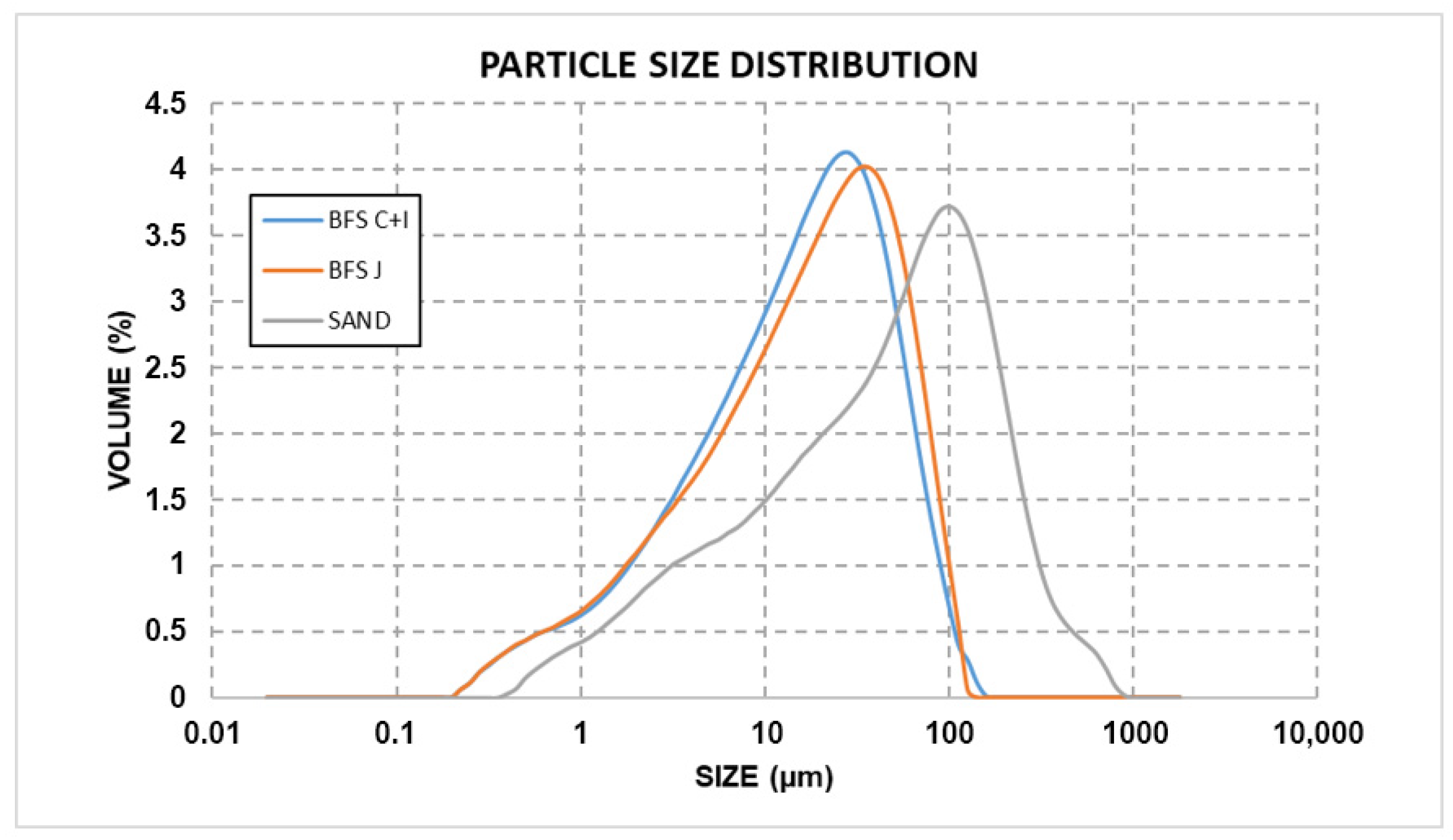
In order to reduce the OPC content, two BFS were incorporated (BFS J and BFS C+I). BFS J (Cementos de Levante SL, Murcia, Spain) was ground to 3950 cm2/g and had higher Al2O3 and CaO contents than BFS C+I. BFS C+I, supplied by Cementos La Cruz SL (Abanilla, Spain), was milled to a Blaine fineness of 3900 cm2/g. Figure 1 shows the particle size distribution of the BFS used and the sand. The ( M g O + C a O ) / ( S i O 2 + A l 2 O 3 ) ratio was 1.03 for BFS C+I and 1.14 for BFS J; higher values of this parameter are generally linked to faster setting under alkaline activation. Lastly, CCS, a by-product from acetylene (C2H2) production using calcium carbide, was used to lower the lime content by providing an alternative calcium source. This material was supplied by Air Liquide (Zaragoza, Spain).
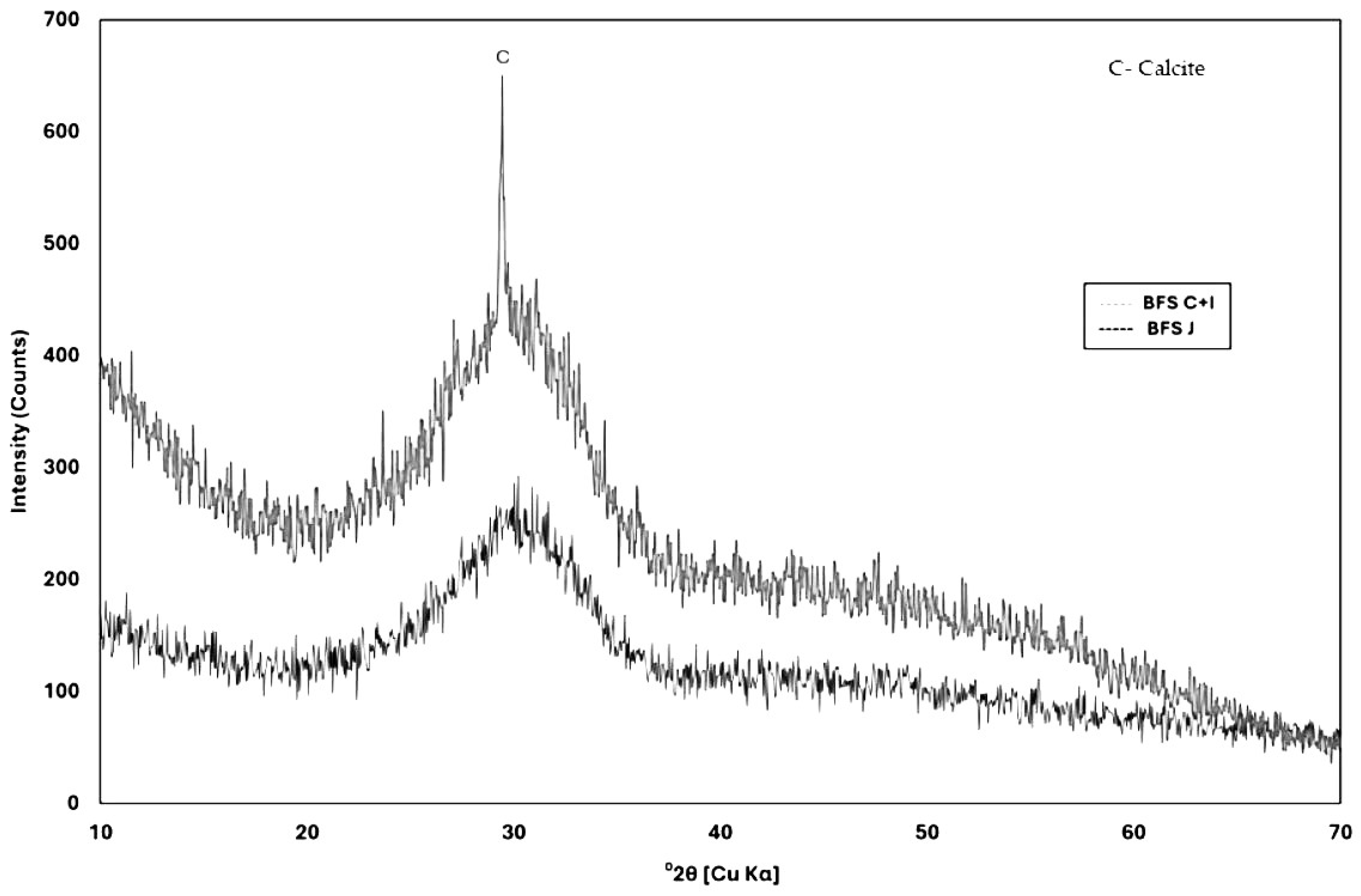
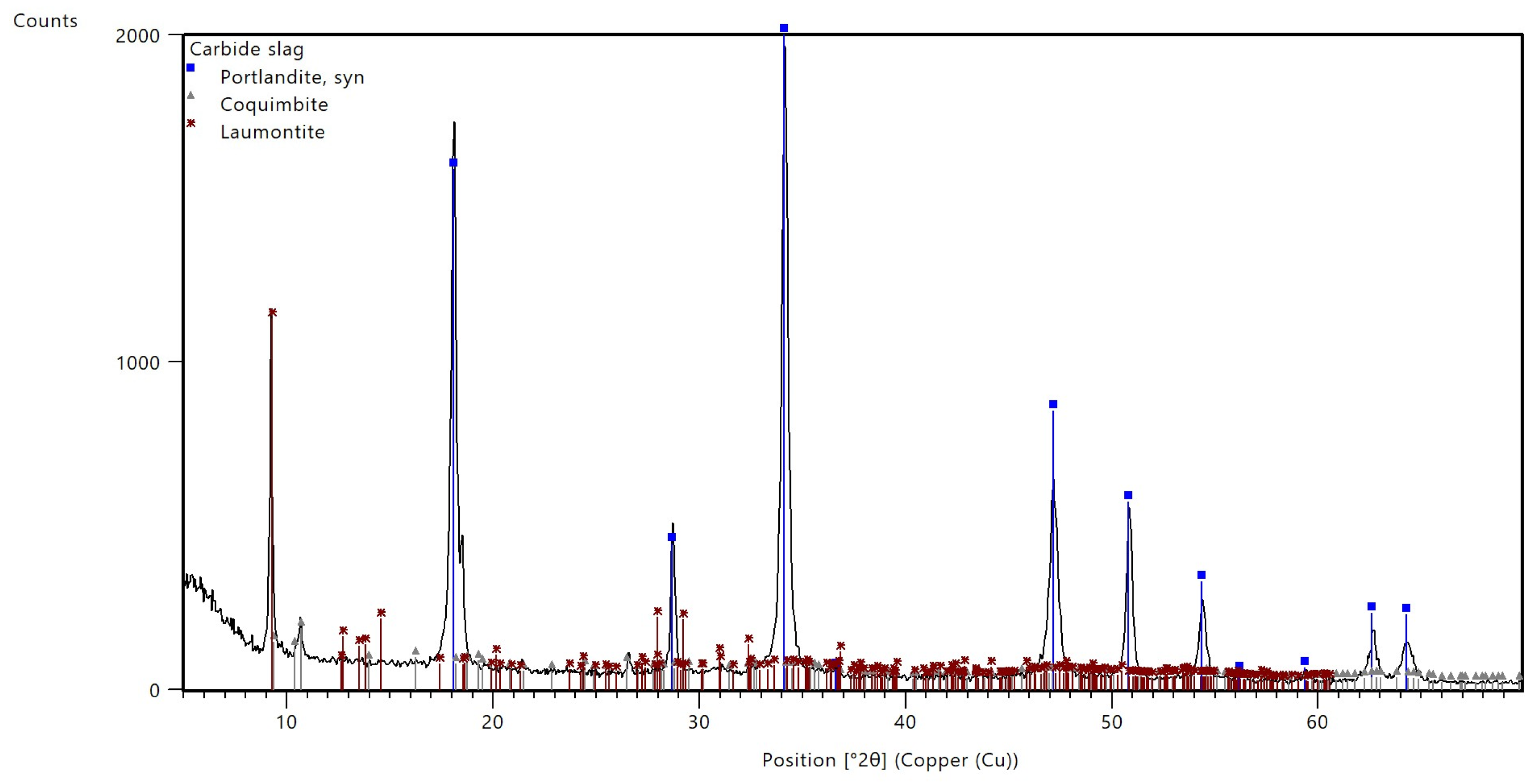
The mineralogy of CCS and BFS was determined by X-ray diffraction (XRD), using a high-power X-ray diffractometer, Bruker D8 Advance by Bruker Corporation (Billerica, MA, USA). BFS’ X-ray diffraction patterns consisted only of a broad hump centered at 30° 2ϴ, with a unique reflection peak of calcite (CaCO3) at 29.5° 2ϴ in BSF C+I, being the majority of BFS samples amorphous (Figure 2). In the case of CCS, portlandite (Ca(OH)2) is the major crystalline phase found in this industrial by-product, followed by laumontite (CaAl2Si4O12·4(H2O)) and minor amounts of coquimbite (Fe3+2(SO4)3·9(H2O)) (Figure 3).

2.2. Sample Preparation

Fourteen mixtures containing sand, lime, gypsum, OPC, BFS (J or C+I), CCS, GAAC-CW, and tap water were prepared by a concrete mixer to achieve a slurry. The series comprised: (i) a reference mix of AAC without foaming agent (AC Control); (ii) two mixes in which 50% of OPC was replaced by BFS (AC2, AC3; using BFS J or BFS C+I); (iii) two mixes with OPC fully replaced by BFS (AC4, AC5; using BFS J or BFS C+I); (iv) three mixes with OPC fully replaced by BFS and varying lime contents (AC10, AC11, AC12; using BFS J or BFS C+I); (v) two mixes in which OPC was fully removed and replaced using BFS J at 50% of the binder, with varying lime contents (AC13, AC14); and (vi) four mixes in which lime was partially or fully replaced with CCS at different replacement levels (AC6, AC7, AC8, AC9). The water-to-solid ratio in all mixes was 0.86. The mixes containing only BFS had BFS-to-lime mass ratios ranging from 76:24 to 47:53, although in this system lime was not used solely to activate the BFS, but also to ensure a sufficient amount of free portlandite prior to the hydrothermal treatment, in order to promote tobermorite formation from the siliceous sand. For proper alkaline activation of BFS, BFS-to-lime mass ratios of 80:20 or 70:30 are sufficient [32,33]. The composition of all these mixtures is shown in Table 2.
Mixing and curing were conducted as previously described in [14]. The raw materials and the concrete mixer tools (metallic bowl and blade) were all pre-heated 24 h before mixing. After mixing, the slurry was poured into standard stainless steel prim molds for concrete and pre-cured at 56 °C and 85% RH for 40 min in a temperature and humidity-controlled climate chamber. After this period, the temperature was increased to 68 °C, and the pre-curing stage continued for an additional 24 h. The mold was previously conditioned in the climate chamber under the same conditions as the pre-curing process. After pre-curing, three prismatic samples of 4 × 4 × 16 cm were obtained from each mold. These samples were then hydrothermally hardened in a laboratory vertical autoclave under saturated steam pressure at 190 °C and 12 bar. The hydrothermal cycle included an initial heating ramp lasting 40–50 min, followed by a dwell time of 5.5 h at 12 bars, and a cooling ramp for 1 h. Afterwards, the samples were removed from the autoclave and dried at 70 °C for 24 h prior to testing.

2.3. Characterization

The density and compressive strength of the samples after pre-curing and autoclaving were determined according to UNE EN 771-4 [34] and UNE EN 772-1 [35] standards, respectively. All specimens (except AC6, AC8, and AC9) were also analyzed using a θ-θ Bragg–Brentano X-ray diffractometer (PANalytical X’Pert PRO, Malvern, UK, Cu Kα radiation, 45 kV and 40 mA) equipped with a real-time multiple-band detector (RTMS) (X’Celerator by Panalytical, Malvern, UK). Data acquisition was performed through continuous scanning in the range of 3–70° 2θ, with virtual scans in steps of 0.02° 2θ. The X-ray diffraction patterns were interpreted using PANalytical’s X’Pert HighScore Plus 3.0 software and version 2.1 of Bruker’s DiffracPlus TOPAS software, allowing for the qualitative reconstruction of the mineral profiles by comparing them with the PDF databases of the International Center for Diffraction Data (ICDD). Crystalline and amorphous phase contents were quantified using the Rietveld method, using an internal standard (ZnO 20 wt.%) added to the powdered samples.
Lastly, LCA was performed for the mixes showing the best mechanical performance (AC6, AC7, AC11, AC12, AC13, AC14) and for the reference mix AC Control to quantify the associated environmental impacts. The analysis was carried out with Air.e v3.19.0.7 (Solid Forest S.L.) using the ecoinvent v3.11 database and following ISO 14040 [36]. The functional unit was 1 m3 of manufactured AC blocks. The LCA was delimited using a cradle-to-gate scope, covering all operations from raw material supply up to the end of the manufacturing stage. Specifically, it comprises: (i) raw material extraction and processing, including extraction, transport, and any required pre-treatment of inputs for AC block production; and (ii) manufacturing, accounting for resources consumed on site (e.g., electricity). The construction, use, maintenance, demolition, and end-of-life stages were excluded, since the objective was to assess only the environmental profile of the production phase. For waste-derived inputs, distinct initial burdens were assumed: CCS was considered burden-free, while BFS was assigned 5% of its associated impacts. Average European transport distances from suppliers to the product plant were also taken into account.

3. Results and Discussion

3.1. Mineralogical Analysis

Fourteen mixtures were produced: one reference mix (AC Control); two with 50% of OPC replaced by BFS (AC2, AC3); seven with OPC fully replaced by BFS, using varying lime and BFS contents (AC4, AC5, AC10, AC11, AC12, AC13, AC14); and four in which lime was partially or fully replaced with CCS (AC6, AC7, AC8, AC9).
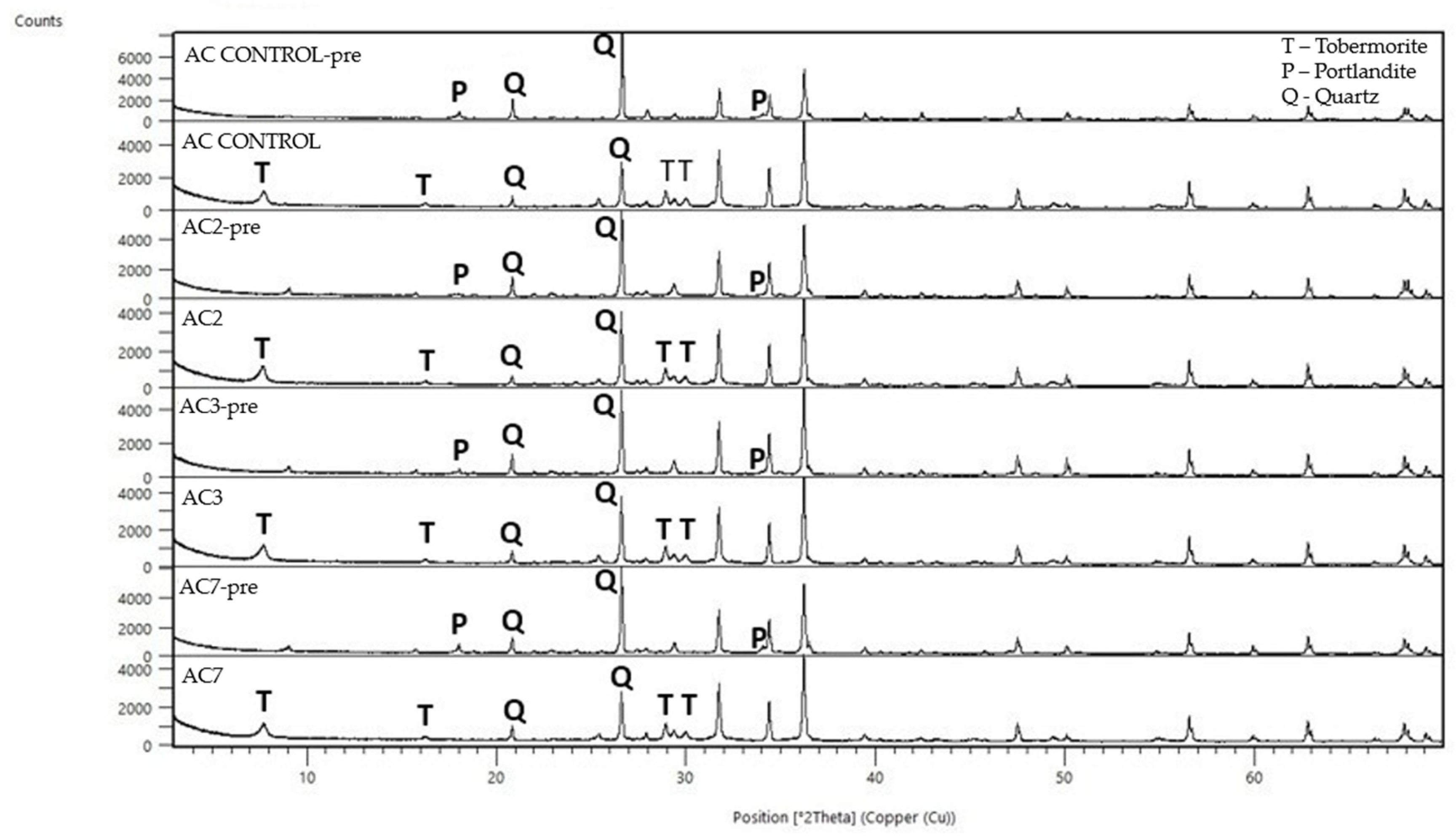
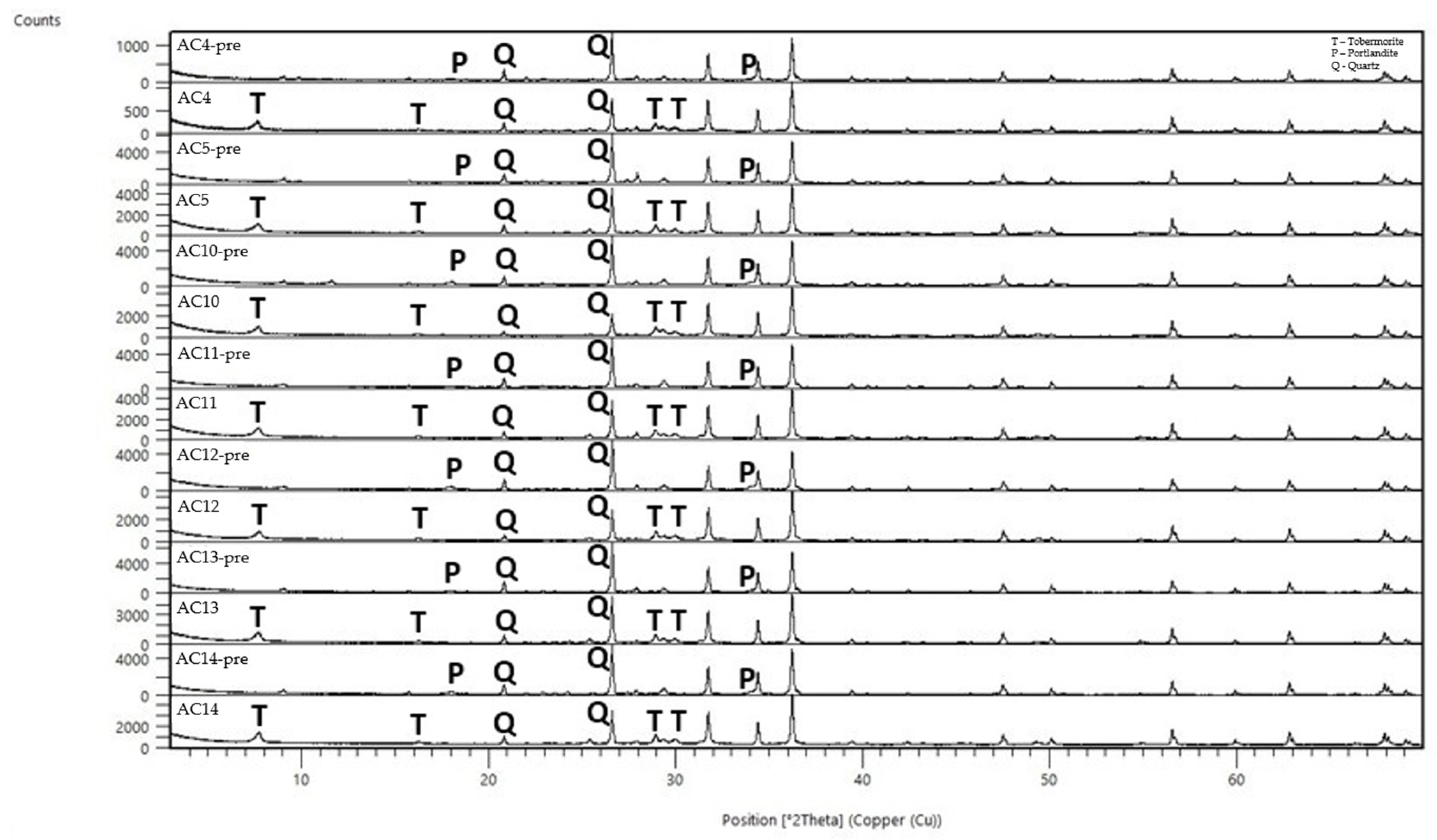
The mineralogical study was carried out to observe differences among pre-cured (AC-pre) and autoclaved (AC) samples. Figure 4 and Figure 5 plot the XRD patterns of pre-cured and autoclaved samples, whilst Table 3 gives the mineral phases content as well as the total amorphous content of pre-cured and autoclaved samples. In AAC and in AC, mechanical strength is governed primarily by tobermorite [3,4,6]. Under hydrothermal autoclave conditions, tobermorite is produced by the Ca(OH)2 amorphous silica reaction or by the conversion of amorphous CSH, with a Ca/Si ratio in the range between 0.8 and 1 [37,38,39]. This crystallization step densifies and stiffens the binding network, transforming initially disordered CSH into a more compact and stable structure and, in turn, enhancing the mechanical strength [37].
All specimens exhibit the following common phases: portlandite (Ca(OH)2), calcite (CaCO3), quartz (SiO2), albite-type plagioclase (NaAlSi3O8), microcline feldspar (KAlSi3O8), gypsum (CaSO4·2H2O), wollastonite (CaSiO3), and akermanite (Ca2MgSi2O7). They also contain a substantial fraction of amorphous phases, meaning phases that lack long-range crystal order. On the other hand, during the hydrothermal treatment at elevated temperature and pressure, the following newly formed phases were identified: coesite (SiO2), a high-pressure polymorph of quartz; anhydrite (CaSO4), a sulfate that originates from the loss of the two water molecules of gypsum; and crystalline CSH or 11 Å tobermorite (Ca5Si6O16(OH)2·nH2O), although the presence of other types of tobermorite cannot be ruled out.
Under hydrothermal treatment, the ettringite that may form during pre-curing becomes thermodynamically unstable, releasing Al back to the pore solution [40]. This aluminum is then redistributed into phases such as melilite, (Ca,Na)2(Al,Mg)(Si,Al)2O7). This aluminate, like akermanite, can form through reactions among the oxides CaO, SiO2, MgO, and Al2O3, which constitute BFS and are also present in the GAAC-CW. In addition, another fraction of aluminum can be redistributed into CASH gels, which contribute to the amorphous fraction quantified after autoclaving.
For both the reference mix (AC Control) and the mix with CCS replacing 50% of lime (AC7), the formation of tobermorite from portlandite and quartz, as well as the transformation of CSH gels, is evident. In AC Control-pre, 9.08% portlandite, 28.81% quartz, and 39.81% of amorphous phases are partially consumed, decreasing to 0.10% portlandite, 16.52% quartz and 16.56% amorphous phases, with tobermorite forming. In AC7-pre, 6.60% portlandite, 26.65% quartz, and 39.27% amorphous phases are also partially consumed, decreasing to 0.18%, 16.00%, and 20.00%, respectively, after the hydrothermal process. This trend is also visible in the diffractograms of AC Control and AC7, where the portlandite and quartz peaks observed after pre-curing diminish, and tobermorite peaks appear following the hydrothermal treatment (Figure 4).
The use of CCS (AC7) did not lead to significant mineralogical differences compared to the AC Control mix. In the precured specimens, the initial calcite content was slightly higher than in the reference mix AC Control-pre (7.25 vs. 4.45). Calcite may derive from sources such as the cement’s limestone filler or the GAAC-CW, yet these are present equally in both mixtures. Therefore, the observed difference in calcite is attributable to the CCS itself. This also resulted in a reduction in free Portlandite in the CCS-containing specimen (AC7-pre). In addition, an increase in ettringite content was detected, attributable to the sulfur and aluminum supplied by CCS (Table 1).
Lastly, the impact of the OPC replacement level was investigated using two BFS types (J and C+I). In general, employing BFS for partial or total substitution of OPC led in the pre-cured state to a higher calcite content than in the reference mix AC Control, likely due to calcite present in the BFS. For the BFS mixes without additional lime (AC2, AC3, AC4, AC5), a reduction in portlandite was observed in the pre-cured specimens relative to the AC Control. Consequently, after hydrothermal treatment, these mixes exhibited less tobermorite and a significant increase in amorphous phases, mainly attributable to the lack of portlandite and to the formation of amorphous CSH that does not crystallize due to an imbalanced Ca/Si ratio [39,41]. Lime has three primary roles: the alkaline activation of BFS, adjustment of the Ca/Si ratio, and providing sufficient portlandite for tobermorite formation. By incorporating additional lime and adjusting the BFS content according to the BFS type used (J or C+I), tobermorite contents comparable to the reference mix (AC Control) are obtained (AC11, AC12, AC14), along with a reduction in the amorphous phase content. In another study [12], in which BFS was used to replace OPC in AAC mixtures, the authors also observed that tobermorite was the main binding phase formed. In these mixtures, sodium carbonate was used as an additional alkaline activator together with lime. However, no changes were observed in the main reaction products, which remained dominated by tobermorite. In contrast, a separate study in which pastes of alkali-activated slag–fly ash–metakaolin cementitious materials were subjected to hydrothermal treatment, the main mineral phases formed were zeolite NaP1, analcime, and aluminosilicate gel, while a tobermorite phase also appeared but did not constitute the dominant phase [31]. This highlights the differences between the phases generated in AAC mixtures and those reported in other studies [31,42].

3.2. Density and Compressive Strength After Pre-Curing
The density and the compressive strength of the samples after pre-curing were determined (Table 4).
The compressive strength achieved before hydrothermal treatment is a key parameter, as sufficient pre-autoclave strength is needed to maintain structural integrity during autoclaving. The compressive strength of the CCS-containing mixes ranges from 0.29 to 0.33 MPa, which is comparable to the reference mix AC Control (0.32 MPa). This is because the strength prior to hydrothermal treatment is governed predominantly by OPC hydration. Consequently, replacing lime with CCS does not affect the strength measured after pre-curing.
Figure 5. X-ray diffraction pattern of AC4, AC5, AC10, AC11, AC12, AC13, and AC14 samples before and after hydrothermal process. T (Tobermorite), P (Portlandite), Q (Quartz).
Applsci 16 01178 g005
The use of BFS has also been evaluated. All mixtures incorporating BFS exhibit compressive strengths after pre-curing that are equal to or higher than those of the reference mix AC Control. Therefore, specimens can be produced with BFS replacing cement while still ensuring their integrity during hydrothermal treatment.
The two BFS types exhibited different behaviors. For BFS C+I, the compressive strength results are similar to the reference. In contrast, mixes with BFS J show significantly higher values; for example, AC4 reaches 1.6 MPa, compared with 0.32 MPa for the reference mix. The contrasting behavior of the two slags is consistent with the higher basicity index of BFS J, expressed as ( M g O + C a O ) / ( S i O 2 + A l 2 O 3 ) = 1.14 versus 1.03 for BFS C+I. This chemistry promotes higher initial reactivity and a faster set under alkali activation, producing mixtures that harden more rapidly at early ages. In alkali-activated BFS systems, setting is largely controlled by calcium availability: rapid release and accumulation of Ca2+ drive the early precipitation of Ca-rich aluminosilicate hydrates, thereby accelerating the initial setting [43,44]. Increasing CaO content tends to boost reactivity, whereas higher SiO2 and Al2O3 contents moderate early reactions and delay setting [43,45].
Finally, the density was determined. No significant differences in density were observed across the mixes, as the replacement materials have densities comparable to the replaced constituents.

3.3. Density and Compressive Strength After Autoclaving

The density and compressive strength after autoclaving of the studied mixes (Table 2) were evaluated as a function of: (1) the replacement of lime by CCS (Figure 6); (2) the influence of replacement rate of OPC by BFS, the kind and amount of BFS, and the amount of lime (Figure 7 and Figure 8). The obtained values of compressive strength and density for all the mixes are shown in Table 4.
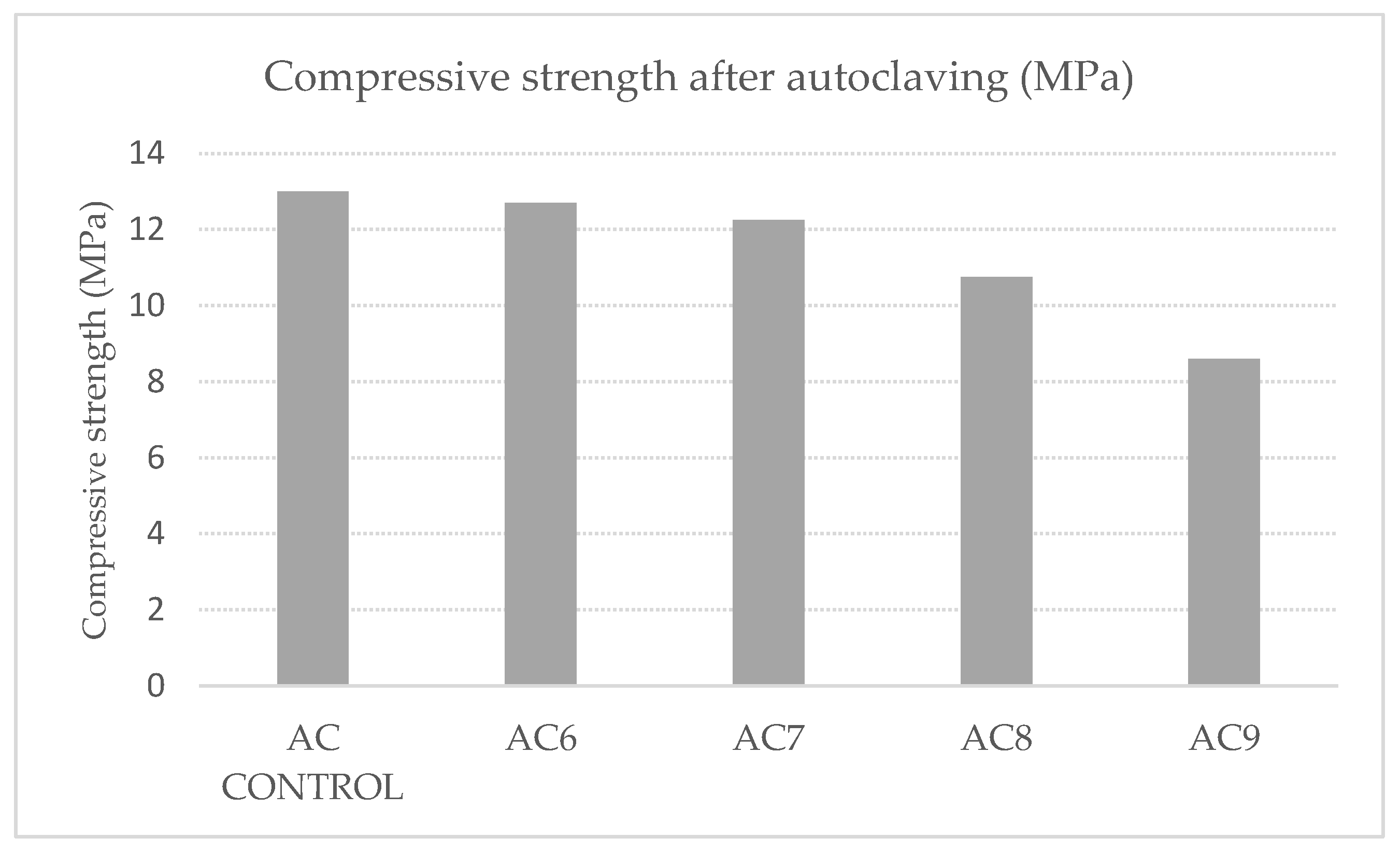
Figure 6 presents the compressive strength results for the reference mix (AC Control) and for four mixes in which lime was replaced with CCS at 25%, 50%, 75%, and 100% (AC6, AC7, AC8, AC9). An excessive increase in CCS content does not contribute positively to strength development, in agreement with previous studies [13,16]. Samples containing 25% and 50% of CCS (AC6 and AC7) show compressive strength values close to the reference (AC Control sample), which contains only pure CaO. Whereas in the AC9 sample prepared from CCS as a lime source, the compressive strength falls drastically. This behavior may be attributed to the lower CaO content in CCS compared to the lime used (87% vs. 94.88%), which could reduce the amount of portlandite available prior to hydrothermal treatment. As a result, it is possible that tobermorite formation is reduced, which could adversely affect the final compressive strength. The greater the CCS content, the stronger the negative effect.
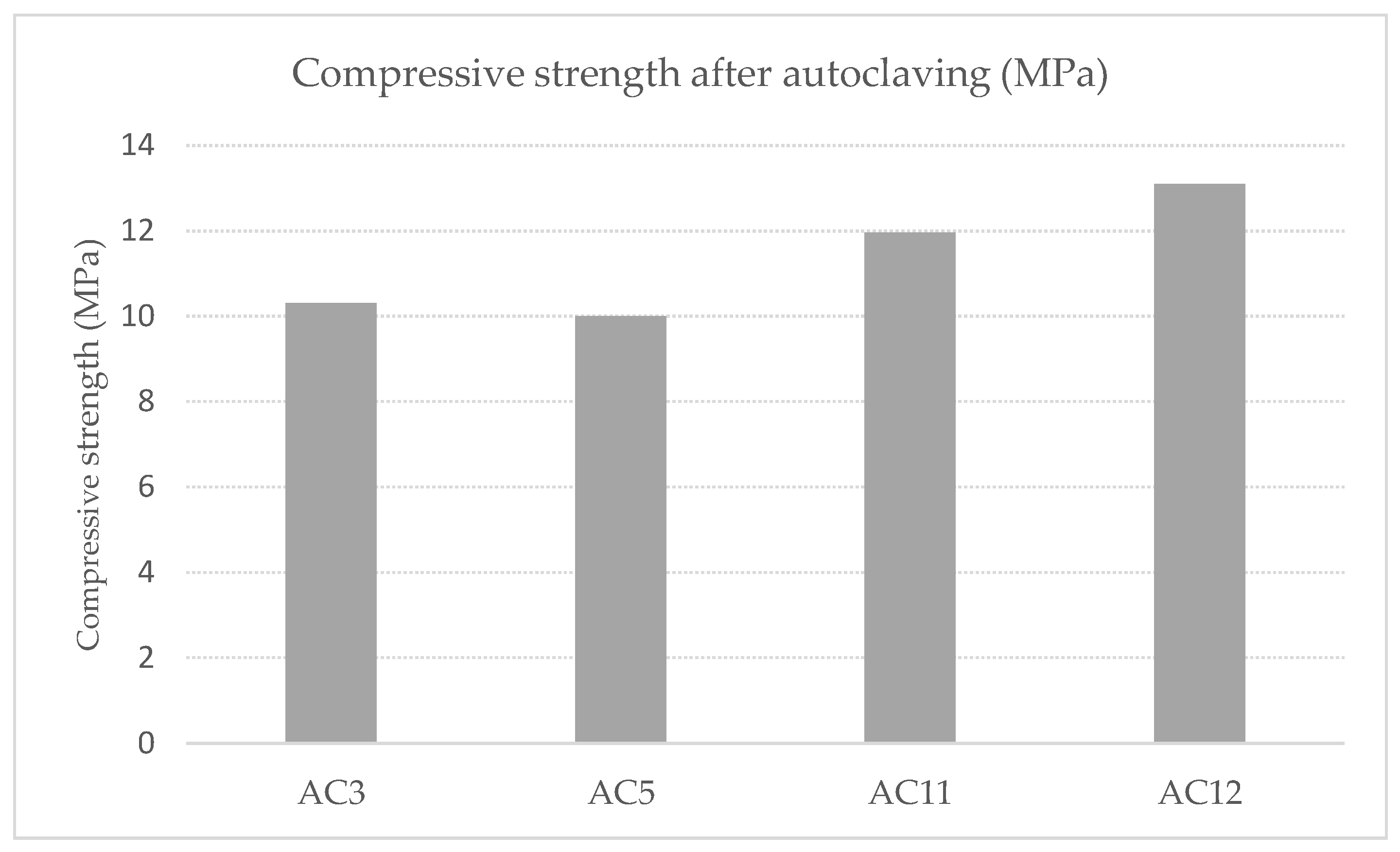
The effect of replacing OPC with BFS C+I was evaluated through partial substitution of 50% OPC by BFS (AC3); total replacement of OPC with lime-activated BFS (AC5); total replacement with lime-activated BFS coupled with a 135% increase in lime content (AC11); and total replacement with lime-activated BFS with a 200% lime increase (AC12). Figure 7 presents the results. Using BFS for partial substitution (AC3) or for total replacement without additional lime (AC5) leads to 21% and 23% losses in compressive strength, respectively, relative to the reference mix AC Control. As discussed above, tobermorite is the principal strength-bearing phase. In AC3 and AC5, the tobermorite contents are 30.00% and 27.98%, respectively, compared with 40.10% in AC Control (Table 3). This is because the pre-cured portlandite contents are much lower than those in AC Control (1.57% and 1.45% versus 9.08% in AC Control-pre), promoting the formation of other phases such as coesite and anhydrite after hydrothermal treatment. A higher portlandite content would promote its reaction with silica to form CSH phases, and the formation of CASH gels with an appropriate Ca/Si ratio, which would subsequently recrystallize into tobermorite.
To compensate for the decrease in free portlandite, additional lime was supplied (AC11 and AC12). As shown in Figure 7, increasing the lime content improves the resulting compressive strength, with AC12 reaching a value comparable to the reference mix, AC Control. These results are consistent with the evolution of tobermorite (Table 3), since AC12 and AC Control exhibit similar tobermorite contents (≈40%). By incorporating additional lime in the BFS C+I mixes, OPC-free formulations can be obtained that achieve compressive strengths and phase assemblages comparable to the reference AC Control.
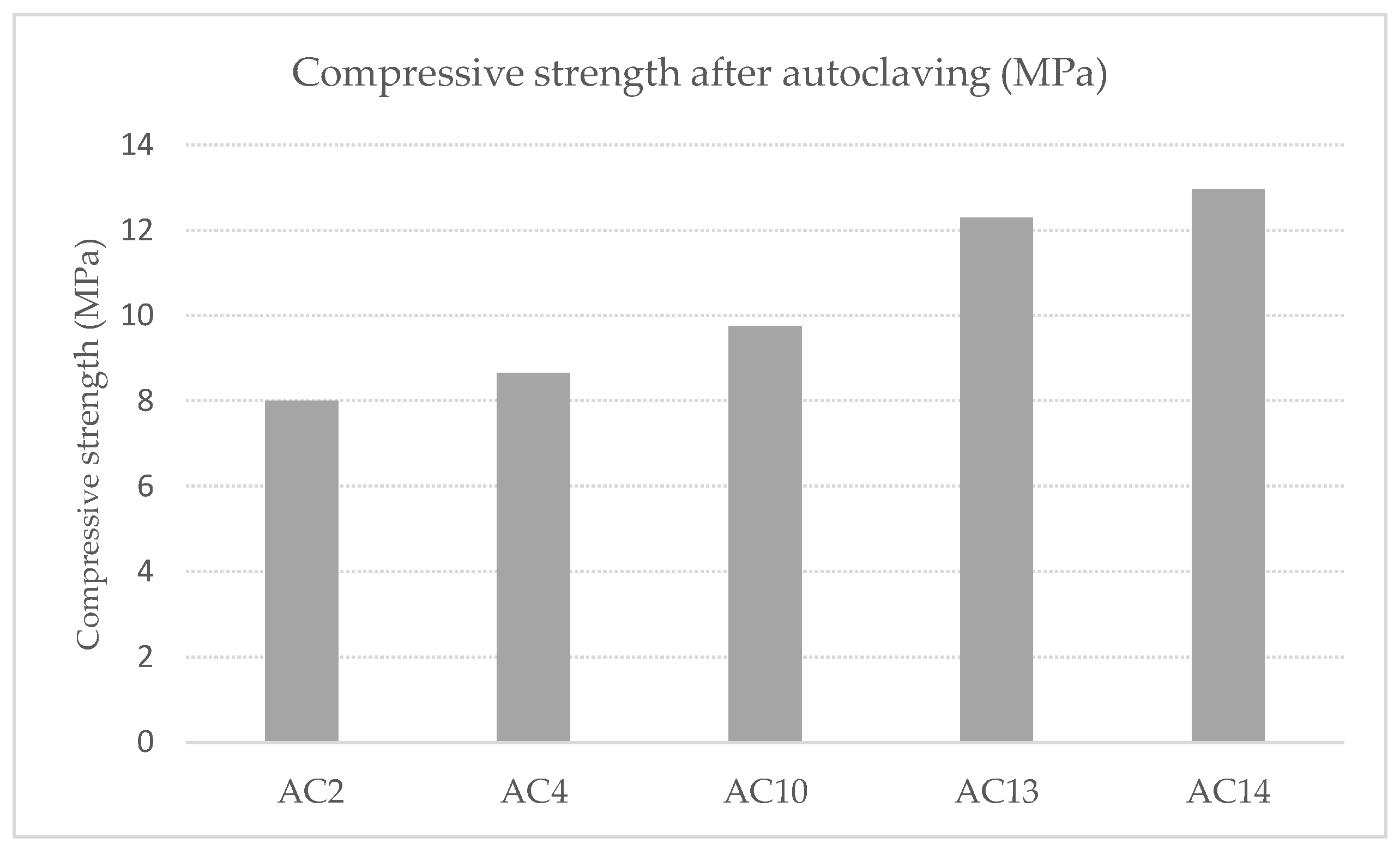
The use of BFS J was also evaluated: partial replacement of 50% OPC by BFS (AC2), total replacement of OPC with lime-activated BFS (AC4), total replacement with lime-activated BFS with a 200% increase in lime content (AC10), total replacement with lime-activated BFS with a 135% lime increase (AC13), and, finally, total replacement of OPC using 50% BFS (lime-activated) with a 180% lime increase (AC14). As shown in Figure 8, similar to the BFS C+I series, when BFS is used without additional lime (AC2, AC4), both the compressive strength and the amount of tobermorite are lower than in the reference (Table 3), due to the low portlandite content and an imbalanced Ca/Si ratio in AC2-pre and AC4-pre.
To raise the portlandite level, the lime content was increased by 200% in AC10. However, relative to AC2 and AC4, the portlandite content in AC10 increased by only 1.23%, and the tobermorite content decreased to 22.56% (vs. 25.57% and 27.58% in AC2 and AC4, respectively). In addition, the amount of free quartz dropped to 10.94%, with a large fraction apparently converted into CASH gels, as indicated by the high amorphous content of AC10 (Table 3). This suggests that, despite the higher lime dosage, the Ca/Si ratio was not appropriate, and tobermorite formation was therefore not favored [39,41].
In this case, although the Ca/Si ratio is difficult to determine precisely because the reactive Ca and Si fractions in the BFS are not known, it can be inferred that the BFS J contains more Ca than BFS C+I, which may lead to an excessively high Ca/Si ratio. To lower this ratio, two new formulations were prepared in which the amount of BFS J was reduced by 50% (AC13, AC14). This adjustment promoted greater tobermorite formation and increased compressive strength to values comparable to AC Control. AC14 exhibits the same compressive strength as the reference and very similar contents of amorphous phases, quartz, and tobermorite relative to AC Control. These results indicate that tobermorite formation in AC14 proceeded from CASH gels and from the reaction between siliceous sand and portlandite, following the same mechanism as in the reference mix.
Finally, the density of all mixtures was determined (Table 4). As in the pre-cured specimens, no significant differences were observed among the mixtures studied. Nor was any change in density detected between specimens before and after the hydrothermal treatment.

3.4. Life Cycle Assessment

In this study, the LCA was carried out in accordance with the Environmental Footprint (EF) 3.1 methodology, covering a wide range of environmental impact categories. The assessment adopted a “cradle-to-gate approach”, considering stages from raw material acquisition through completion of the manufacturing process.
Table 5 presents a summary of the life cycle assessment results for all impact categories and material formulations evaluated: reference mix (AC Control) and the mixes showing the best mechanical performance (AC6, AC7, AC11, AC12, AC13, AC14).
Across nearly all categories, the alternative mixtures exhibit substantial reductions in environmental burdens compared to AC Control. These improvements are mainly attributed to: (i) partial or total replacement of OPC, whose production is the dominant contributor to climate change, acidification, particulate matter, and energy use, and the use of BFS as a precursor in its place; (ii) incorporation of CCS as substitute for lime, which contributes to lowering resource depletion and toxicity-related impact categories.
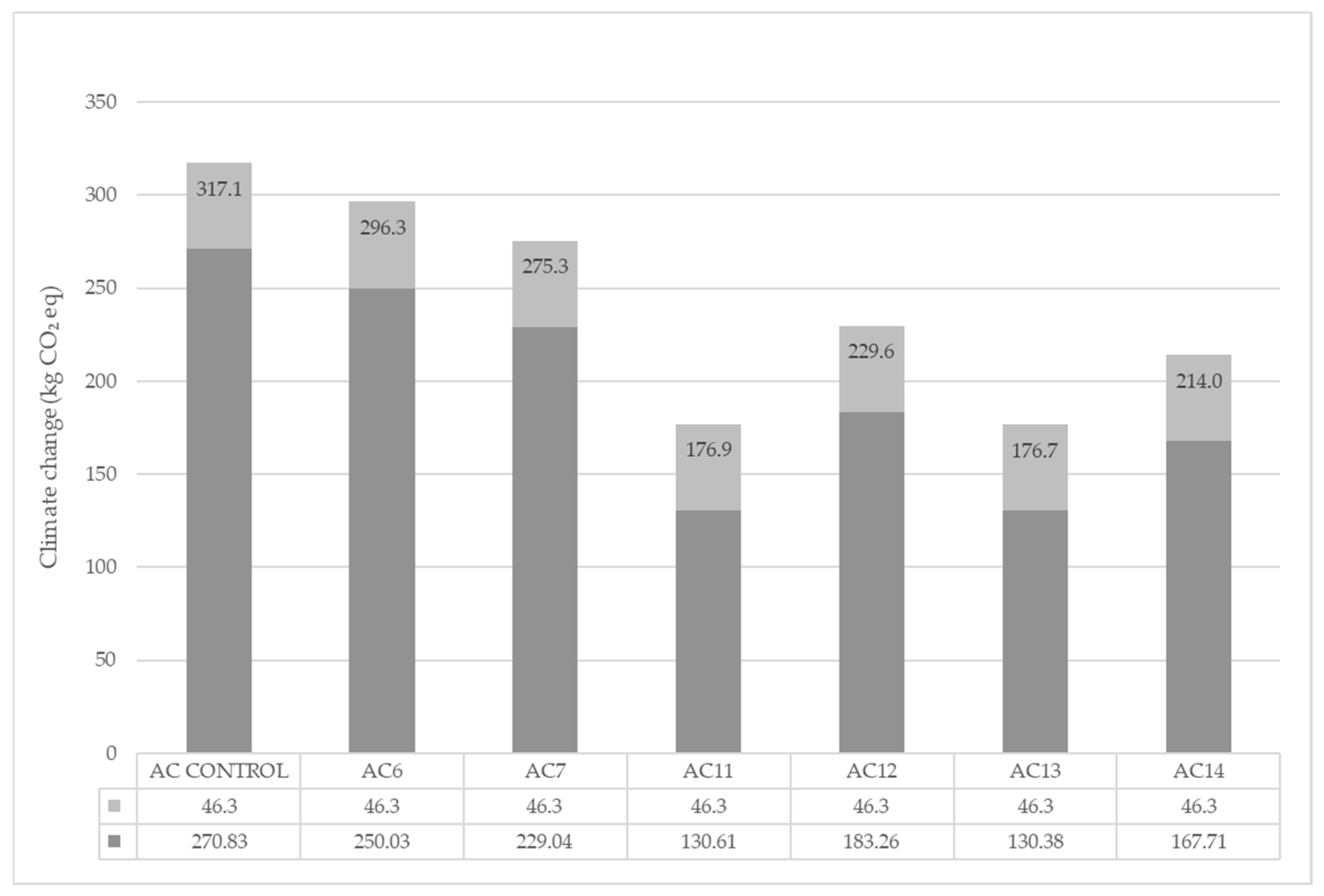
The comparison between the reference mix, AC Control, and the mixes with lime substituted by CCS (AC6 and AC7) shows that the most pronounced reductions occur in climate change, fossil resource depletion, photochemical ozone formation, and human toxicity. Climate-change impact decreases from 317 kg CO2 eq in AC Control to 296–275 kg CO2 eq in AC6 and AC7, while fossil resource depletion falls by approximately 5–9%. Photochemical ozone formation and human toxicity (cancer and non-cancer effects) also exhibit noticeable declines, reflecting lower NOx, SO2, and heavy metal releases. Acidification shows a similar decline (from 0.6628 to 0.6382–0.6134 mol H+ eq). These results show that, even when keeping the OPC content constant (29 wt.%), a partial substitution of lime with CCS already leads to moderate environmental improvements. These trends reflect the high contribution of lime production, linked to energy-intensive calcination and associated emissions, to these impact categories, and confirm that substituting it with a low-burden waste-derived material such as CCS can deliver measurable environmental benefits.
In the cases with BFS (AC11, AC12, AC13, and AC14), climate change shows one of the largest reductions. AC Control reaches 317 kg CO2 eq, whereas the optimized formulations range from 177 to 230 kg CO2 eq, representing reductions of 28–44%. This trend is consistent with fossil resource depletion, where values drop from 2147 MJ in AC Control to 1554–1794 MJ in the studied mixes. The mixes with the lowest CO2 emissions are AC11 and AC13, both exhibiting approximately 44% lower climate impacts, in line with their elimination of OPC and high BFS content. Similar improvements are observed in acidification and eutrophication categories. The AC Control mix (0.6628 mol H+ eq in acidification) contrasts with values as low as 0.3415–0.3868 mol H+ eq for the BFS mixes. Terrestrial eutrophication decreases by more than half in AC11 and AC13. Human toxicity (cancer and non-cancer effects), ionizing radiation, and resource-related categories also improve markedly in the studied mixes. Reductions of about 38–67% are observed for human toxicity, ionizing radiation, and mineral and metal resource depletion, while land-use impacts drop from 680 pt (AC Control) to 510–580 pt. These results can be mainly attributed to the substitution of OPC, as its removal leads to improvements across all impact categories, even when the lime content is increased. Although several formulations incorporate comparable amounts of BFS, the superior environmental performance of AC11 and AC13 is primarily linked to their lower lime content. Indeed, mixes containing the same BFS type present very similar BFS dosages: BFS C+I is used at 25% in AC11 and 23% in AC12, while BFS J is present at 14% in both AC13 and AC14. The key difference between each pair lies in their lime contents: 12% in AC11 and AC13 versus 18% and 16% in AC12 and AC14, respectively. Lime production contributes substantially to greenhouse gas emissions due to the calcination of limestone, which releases significant process CO2, and the high-temperature fuel demand required to reach decomposition temperatures above 900 °C. Consequently, mixes with higher lime dosages exhibit proportionally greater embodied emissions. Since AC11 and AC13 contain the lowest lime contents among the tested formulations, the reduction in this highly carbon-intensive component becomes the main driver of their markedly lower climate-change impacts, surpassing the influence of BFS type or dosage.
Emissions were calculated by separating the system into two stages: raw material extraction and processing, and manufacturing. The discussion then focuses on CO2 emissions, given that this is among the most commonly reported and policy-relevant environmental indicators. Figure 9 presents the climate change impact of the mixes for each stage of their production. The results clearly show that the highest contribution to total emissions originates from the raw material stage. For the AC Control mixture, manufacturing contributes about 15% of total emissions, whereas roughly 85% is associated with the raw materials, with OPC and lime being the dominant sources. This indicates that material selection largely governs overall emissions. In particular, removing OPC alone reduced total emissions by 44%, and the substitution of 6 wt.% of lime with CCS led to a 23% decrease in CO2 emissions. These results are consistent with prior assessments of construction processes, which identify OPC as the principal emissions hotspot [46].
Overall, the LCA results demonstrate that the alkali-activated AC mixes developed in this study can significantly improve the environmental profile of AC production compared with the reference OPC–lime-based formulation. The most relevant reductions are observed in climate change, fossil resource depletion, photochemical ozone formation, human toxicity, and, to a lesser extent, eutrophication-related categories, mainly due to the partial substitution of OPC and lime with BFS and CCS. Although the minimum impacts in each category are reached by different formulations, mixes such as AC11 and AC13 illustrate that combining low lime contents with waste-derived and low-burden precursors is an effective strategy to reduce emissions, resource use, and land occupation while maintaining suitable mechanical performance. These findings confirm the potential of alkali-activated binders as a more sustainable alternative for AC and AAC production within a cradle-to-gate perspective.

4. Conclusions

This study examined eco-efficient low-carbon autoclaved concrete in which OPC and lime were partially or totally replaced with BFS and CCS. The following conclusions can be drawn:
Using BFS with an adequate calcium supply yields pre-curing strengths sufficient to preserve integrity during autoclaving and delivers post-autoclave strengths comparable to conventional AC and AAC (with no foaming agent), without penalizing density. Notably, these formulations achieved tobermorite levels comparable to the reference, evidencing the effectiveness of lime activation and favoring the development of strength-bearing phases.
As in the OPC-based mix, the mechanical performance of the BFS mixes tracks the amount of tobermorite formed during autoclaving. The portlandite available before autoclaving and the Ca/Si ratio are key factors governing tobermorite formation in lime-activated BFS mixes.
Fifty percent replacement of lime with CCS preserves pre-curing strength and mineralogy, whereas full replacement is associated with a decrease in strength, possibly due to the lower CaO content in CCS, which may reduce the amount of available Ca(OH)2. CCS also tends to increase ettringite due to its S and Al.
The use of BFS and CCS provides a viable pathway to reduce the carbon footprint associated with autoclaved concrete production, without diminishing the material’s properties. Reductions of up to 44% were achieved by replacing OPC with BFS, and 13% by lowering the lime content with CCS. Nevertheless, further research on pore structure, morphology, long-term durability, and shrinkage performance is needed in future work.

Author Contributions

C.R., P.G., F.M. and F.F. performed the experiments, M.S. did the LCA, C.R., A.A., F.M., S.S. and P.G. wrote the paper, and it was supervised by M.H. and I.B., with important contributions to the results analysis. The experimental design was carried out in a collaborative way among all authors. All authors have read and agreed to the published version of the manuscript.

Funding

The SNUG consortium is co-funded by the European Commission grant 101123150 and UKRI grant 10087589.

Institutional Review Board Statement

Not applicable.

Informed Consent Statement

Not applicable.

Data Availability Statement

The results of this research will be made publicly available in the SNUG project deliverables https://snugproject.eu/deliverables-and-reports/ (accessed on 21 January 2026). The scientific publications derived from the project can be found at https://snugproject.eu/publications/ (accessed on 21 January 2026).

Acknowledgments

The authors of this study would like to thank the European Commission for financing the project SNUG.

Conflicts of Interest

The authors declare no conflicts of interest.

Abbreviations

The following abbreviations are used in this manuscript:
AACAutoclaved aerated concrete
ACAutoclaved concrete
OPCOrdinary Portland cement
BFSGround granulated blast furnace slag
CCSCalcium carbide slag
LCALife cycle assessment
GAAC-CWGreen autoclaved aerated concrete cutting waste
CASHCalcium aluminosilicate hydrate
AAMsAlkaline-activated materials
CSHCalcium silicate hydrate

References

  1. Nasir, M.; Mahmood, A.H.; Bahraq, A.A. History, recent progress, and future challenges of alkali-activated binders—An overview. Constr. Build. Mater. 2024, 426, 136141. [Google Scholar] [CrossRef]
  2. Flower, D.J.M.; Sanjayan, J.G. Greenhouse Gas Emissions Due to Concrete Manufacture. Handb. Low Carbon Concr. 2017, 12, 1–16. [Google Scholar] [CrossRef]
  3. Mathey, R.G.; Rossiter, W.J.J. A Review of Autoclaved Aerated Concrete Products; NBS Publishtions: Tokyo, Japan, 1988; pp. 1–84. [Google Scholar]
  4. Arif Kamal, M. Analysis of autoclaved aerated concrete (AAC) blocks with reference to its potential and sustainability. J. Build. Mater. Struct. 2020, 7, 76–86. [Google Scholar] [CrossRef]
  5. Schreiner, J.; Jansen, D.; Ectors, D.; Goetz-Neunhoeffer, F.; Neubauer, J.; Volkmann, S. New analytical possibilities for monitoring the phase development during the production of autoclaved aerated concrete. Cem. Concr. Res. 2018, 107, 247–252. [Google Scholar] [CrossRef]
  6. Bernard, V.A.R.; Renuka, S.M.; Avudaiappan, S.; Umarani, C.; Amran, M.; Guindos, P.; Fediuk, R.; Ivanovich Vatin, N. Performance Investigation of the Incorporation of Ground Granulated Blast Furnace Slag with Fly Ash in Autoclaved Aerated Concrete. Crystals 2022, 12, 1024. [Google Scholar] [CrossRef]
  7. Huang, X.Y.; Ni, W.; Cui, W.H.; Wang, Z.J.; Zhu, L.P. Preparation of autoclaved aerated concrete using copper tailings and blast furnace slag. Constr. Build. Mater. 2012, 27, 1–5. [Google Scholar] [CrossRef]
  8. Kurama, H.; Topçu, I.B.; Karakurt, C. Properties of the autoclaved aerated concrete produced from coal bottom ash. J. Mater. Process. Technol. 2009, 209, 767–773. [Google Scholar] [CrossRef]
  9. El-Didamony, H.; Amer, A.A.; Mohammed, M.S.; El-Hakim, M.A. Fabrication and properties of autoclaved aerated concrete containing agriculture and industrial solid wastes. J. Build. Eng. 2019, 22, 528–538. [Google Scholar] [CrossRef]
  10. Güçlüer, K.; Demir, İ. Utilization of Zeolite and Blast Furnace Slag for the Production of Autoclaved Aerated Concrete. Kadir Güçlüer J. Eng. Res. Appl. 2018, 8, 43–46. [Google Scholar] [CrossRef]
  11. Güçlüer, K.; Demir, İ. Utilization of metakaolin and blast furnace slag in autoclaved aerated concrete production. Rev. Rom. Mater. Rom. J. Mater. 2019, 49, 388–393. [Google Scholar]
  12. Yuan, B.; Straub, C.; Segers, S.; Yu, Q.L.; Brouwers, H.J.H. Sodium carbonate activated slag as cement replacement in autoclaved aerated concrete. Ceram. Int. 2017, 43, 6039–6047. [Google Scholar] [CrossRef]
  13. Kim, M.S.; Jun, Y.; Lee, C.; Oh, J.E. Use of CaO as an activator for producing a price-competitive non-cement structural binder using ground granulated blast furnace slag. Cem. Concr. Res. 2013, 54, 208–214. [Google Scholar] [CrossRef]
  14. Rodriguez, C.; Gómez, P.; Martí, F.; Srivastava, S.; Sanchez, M.; Fernandez, F.; Beleña, I.; Hernández, M. Development of Low-Carbon Autoclaved Aerated Concrete Using an Alkali-Activated Ground Granulated Blast Furnace Slag and Calcium Carbide Slag. Appl. Sci. 2025, 15, 9946. [Google Scholar] [CrossRef]
  15. Cai, L.; Tang, T.; Liu, M.; Xie, D. Comparative study of carbide slag autoclaved aerated concrete (AAC) manufactured under thermal oven and microwave pre-curing process: Foaming course, rough body strength and physic-mechanical properties. Constr. Build. Mater. 2020, 236, 117550. [Google Scholar] [CrossRef]
  16. Sun, D.; Yin, F.; Deng, Y.; Liu, K.; Tang, J.; Shen, C.; Sun, Y.; Wang, A.; Huang, N.; Hu, C. Utilization of carbide slag in autoclaved aerated concrete (CS-AAC) and optimization: Foaming, hydration process, and physic-mechanical properties. Case Stud. Constr. Mater. 2023, 19, e02354. [Google Scholar] [CrossRef]
  17. Pol Segura, I.; Ranjbar, N.; Juul Damø, A.; Skaarup Jensen, L.; Canut, M.; Arendt Jensen, P. A review: Alkali-activated cement and concrete production technologies available in the industry. Heliyon 2023, 9, e15718. [Google Scholar] [CrossRef]
  18. Jeong, Y.; Oh, J.E.; Jun, Y.; Park, J.; Ha, J.H.; Sohn, S.G. Influence of four additional activators on hydrated-lime [Ca(OH)2] activated ground granulated blast-furnace slag. Cem. Concr. Compos. 2016, 65, 1–10. [Google Scholar] [CrossRef]
  19. Rossi, L.; de Lima, L.M.; Sun, Y.; Dehn, F.; Provis, J.L.; Ye, G.; De Schutter, G. Future perspectives for alkali-activated materials: From existing standards to structural applications. RILEM Tech. Lett. 2022, 7, 159–177. [Google Scholar] [CrossRef]
  20. Gao, X.; Yao, X.; Wang, C.; Geng, C.; Yang, T. Properties and microstructure of eco-friendly alkali-activated slag cements under hydrothermal conditions relevant to well cementing applications. Constr. Build. Mater. 2022, 318, 125973. [Google Scholar] [CrossRef]
  21. Thomas, R.J.; Peethamparan, S. Alkali-activated concrete: Engineering properties and stress-strain behavior. Constr. Build. Mater. 2015, 93, 49–56. [Google Scholar] [CrossRef]
  22. Torres-Carrasco, M.; Puertas, F. Alkaline activation of different aluminosilicates as an alternative to Portland cement: Alkali activated cements or geopolymers La activación alcalina de diferentes aluminosilicatos como una alternativa al Cemento Portland: Cementos activados alcalinament. Rev. Ing. Constr. 2017, 32, 5–12. [Google Scholar]
  23. Couvidat, J.; Diliberto, C.; Meux, E.; Izoret, L.; Lecomte, A. Greening effect of concrete containing granulated blast-furnace slag composite cement: Is there an environmental impact? Cem. Concr. Compos. 2020, 113, 101467. [Google Scholar] [CrossRef]
  24. Shi, C.; Day, R.L. Some factors affecting early hydration of alkali-slag cements. Cem. Concr. Res. 1996, 26, 439–447. [Google Scholar] [CrossRef]
  25. Yu, S.; He, J.; Sang, G.; Yang, S.; Liu, G. Study on hydration process of alkali-activated slag cement activated by weakly alkaline components. Constr. Build. Mater. 2024, 413, 134716. [Google Scholar] [CrossRef]
  26. Arabi, N.; Chelghoum, N.; Jauberthie, R.; Molez, L. Formation of C-S-H in calcium hydroxide—Blast furnace slag—Quartz—Water system in autoclaving conditions. Adv. Cem. Res. 2016, 27, 153–162. [Google Scholar] [CrossRef]
  27. Puertas, F.; Palacios, M.; Manzano, H.; Dolado, J.S.; Rico, A.; Rodríguez, J. A model for the C-A-S-H gel formed in alkali-activated slag cements. J. Eur. Ceram. Soc. 2011, 31, 2043–2056. [Google Scholar] [CrossRef]
  28. Song, S.; Sohn, D.; Jennings, H.M.; Mason, T.O. Hydration of alkali-activated ground granulated blast furnace slag. J. Mater. Sci. 2000, 35, 249–257. [Google Scholar] [CrossRef]
  29. Park, H.; Jeong, Y.; Jeong, J.H.; Oh, J.E. Strength development and hydration behavior of self-activation of commercial ground granulated blast-furnace slag mixed with purified water. Materials 2016, 9, 185. [Google Scholar] [CrossRef]
  30. Ngo, S.H.; Nguyen, N.T.; Nguyen, X.H. Assessing the Effect of GGBFS Content on Mechanical and Durability Properties of High-Strength Mortars. Civ. Eng. J. 2022, 8, 938–950. [Google Scholar] [CrossRef]
  31. Wang, J.; Wu, X.L.; Wang, J.X.; Liu, C.Z.; Lai, Y.M.; Hong, Z.K.; Zheng, J.P. Hydrothermal synthesis and characterization of alkali-activated slag-fly ash-metakaolin cementitious materials. Microporous Mesoporous Mater. 2012, 155, 186–191. [Google Scholar] [CrossRef]
  32. Kwon, Y.H.; Kang, S.H.; Hong, S.G.; Moon, J. Enhancement of material properties of lime-activated slag mortar from intensified pozzolanic reaction and pore filling effect. Sustainability 2018, 10, 4290. [Google Scholar] [CrossRef]
  33. Murmu, M.; Singh, S.P. Strength characteristics of lime-activated slag cement. Adv. Cem. Res. 2015, 27, 268–277. [Google Scholar] [CrossRef]
  34. U.E. 771-4, UNE EN 771-4; Specification for Masonry Units Part 4: Autoclaved Aerated Concrete Masonry Units. European Standardisation Organisations: Madrid, Spain, 2011.
  35. U.E. 772-1, UNE EN 772-1; Methods of Test for Masonry Units. Part 1: Determination of Compressive Strength. European Standardisation Organisations: Madrid, Spain, 2011.
  36. ISO-14040; Environmental Management—Life Cycle Assessment—Principles and Framework International Organization for Standardization. International Organization for Standardization: Geneva, Switzerland, 1997.
  37. Chen, Y.L.; Chang, J.E.; Lai, Y.C.; Chou, M.I.M. A comprehensive study on the production of autoclaved aerated concrete: Effects of silica-lime-cement composition and autoclaving conditions. Constr. Build. Mater. 2017, 153, 622–629. [Google Scholar] [CrossRef]
  38. Kunchariyakun, K.; Asavapisit, S.; Sombatsompop, K. Properties of autoclaved aerated concrete incorporating rice husk ash as partial replacement for fine aggregate. Cem. Concr. Compos. 2015, 55, 11–16. [Google Scholar] [CrossRef]
  39. Shaw, S.; Clark, S.M.; Henderson, C.M.B. Hydrothermal formation of the calcium silicate hydrates, tobermorite (Ca5Si6O16(OH)2 · 4H2O) and xonotlite (Ca6Si6O17(OH)2): An in situ synchrotron study. Chem. Geol. 2000, 167, 129–140. [Google Scholar] [CrossRef]
  40. Taylor, H.F.W. Cement chemistry. Cem. Concr. Compos. 1998, 20, 335. [Google Scholar] [CrossRef]
  41. Corro-Escorcia, I.A.; Hernández-Ávila, J.; Cerecedo-Sáenz, E.; Barrientos-Hernández, F.R.; Cruz-Hernández, M.; Toro, N.; Gálvez, E.; Gutiérrez-Amador, M.P.; Salinas-Rodríguez, E. Synthesis of tobermorite 11 Å during the formation of autoclaved aerated concrete with the addition of diatomite. Results Mater. 2025, 26, 100725. [Google Scholar] [CrossRef]
  42. Mohsen, A.; Kohail, M.; Abadel, A.A.; Alharbi, Y.R.; Nehdi, M.L.; Ramadan, M. Correlation between porous structure analysis, mechanical efficiency and gamma-ray attenuation power for hydrothermally treated slag-glass waste-based geopolymer. Case Stud. Constr. Mater. 2022, 17, e01505. [Google Scholar] [CrossRef]
  43. Li, L.; Xie, J.; Zhang, B.; Feng, Y.; Yang, J. A state-of-the-art review on the setting behaviours of ground granulated blast furnace slag- and metakaolin-based alkali-activated materials. Constr. Build. Mater. 2023, 368, 130389. [Google Scholar] [CrossRef]
  44. Zhu, X.; Zhang, M.; Yang, K.; Yu, L.; Yang, C. Setting behaviours and early-age microstructures of alkali-activated ground granulated blast furnace slag (GGBS) from different regions in China. Cem. Concr. Compos. 2020, 114, 103782. [Google Scholar] [CrossRef]
  45. Tänzer, R.; Buchwald, A.; Stephan, D. Effect of slag chemistry on the hydration of alkali-activated blast-furnace slag. Mater. Struct. Constr. 2014, 48, 629–641. [Google Scholar] [CrossRef]
  46. Reyes-quijije, M.; Rocha-tamayo, A.; García-troncoso, N.; Baykara, H.; Cornejo, M.H. Preparation, Characterization, and Life Cycle Assessment of Aerated Concrete Blocks: A Case Study in Guayaquil City, Ecuador. Appl. Sci. 2022, 12, 1913. [Google Scholar] [CrossRef]
Figure 1. Particle size distribution of sand, BFS C+I, and BFS J.
Applsci 16 01178 g001
Figure 2. X-ray diffraction pattern of the BFS C+I and BFS J.
Applsci 16 01178 g002
Figure 3. X-ray diffraction pattern of CCS.
Applsci 16 01178 g003
Figure 4. X-ray diffraction pattern of AC Control, AC2, AC3, and AC7 samples before and after the hydrothermal process. T (Tobermorite), P (Portlandite), Q (Quartz).
Applsci 16 01178 g004
Figure 6. Compressive strength of mixtures with CCS after autoclaving.
Applsci 16 01178 g006
Figure 7. Compressive strength of mixtures with BFS C+I after autoclaving.
Applsci 16 01178 g007
Figure 8. Compressive strength of mixtures with BFS J after autoclaving.
Applsci 16 01178 g008
Figure 9. Climate change (kg CO2 eq) results for stages.
Applsci 16 01178 g009
Table 1. XRF chemical composition of OPC, GAAC-CW, CCS, BFS J, and BFS C+I. L.O.I.: loss on ignition.
Oxide (wt.%)BFS JBFS C+IGAAC-CWOPCCCS
SiO230.8335.430.0917.361.71
Al2O313.589.844.034.630.86
Fe2O30.871.042.254.030.1
CaO46.5840.9436.260.6167.67
MgO4.265.850.6491.290.14
Na2O0.170.240.7030.32-
K2O0.350.991.391.06-
SO31.631.174.593.543.97
TiO20.651.63-0.310.02
P2O50.030.020.070.1-
MnO20.161.68-0.13-
ZnO0.01-0.020.04-
Cr2O30.020.02-0.020.01
NiO0.01-0.010.01-
CuO0.010.010.010.020.01
SrO0.070.090.030.050.1
ZrO20.040.050.010.04-
BaO0.060.120.040.030.03
Cl--0.040.040.06
H2O--14.091.2222.4
L.O.I.0.620.455.515.162.87
Table 2. Mixture proportions of the studied autoclaved samples by weight (wt.%).
MixOPC (wt.%)Lime (wt.%)CCS (wt.%)BFS J (wt.%)BFS C+I (wt.%)Sand (wt.%)Gypsum (wt.%)GAAC-CW (wt.%)
AC Control299---44414
With partial replacement of OPC by BFS
AC214.59-14.5-44414
AC314.59--14.544414
With full replacement of OPC by BFS
AC4-9-29-44414
AC5-9--2944414
With partial or full replacement of lime by CCS
AC6296.752.25--44414
AC7294.54.5--44414
AC8292.256.75--44414
AC929-9--44414
With full replacement of OPC by BFS and varying lime contents
AC10-18-23-41414
AC11-12--2545414
AC12-18--2341414
With full replacement of OPC by 50% of BFS J and varying lime contents
AC13-12-14-52517
AC14-16-14-49417
Table 3. Quantification of phases using XRD and the Rietveld refinement method (%).
MixPortlanditeCalciteQuartzCoesiteAlbiteMicroclineEttringiteWollastoniteMeliliteTobermoriteAmorphous
AC Control-pre9.084.4528.81-7.803.261.503.560.86-39.81
AC Control0.105.1616.527.995.820.350.284.662.4540.1016.56
AC2-pre2.9110.0730.65-8.364.078.292.090.31-30.19
AC20.816.7119.195.344.603.160.592.475.1025.5722.90
AC3-pre1.578.8028.84-6.942.686.200.790.42-43.47
AC30.405.0020.004.005.002.001.001.002.0030.0030.00
AC4-pre3.576.4529.32-8.942.027.431.200.37-39.57
AC41.323.9717.183.423.456.200.090.522.5727.5831.27
AC5-pre1.455.5429.65-6.553.768.522.070.59-41.59
AC50.170.9022.144.434.093.850.531.243.0727.9828.26
AC7-pre6.607.9426.65-6.103.077.270.730.41-39.27
AC70.186.0016.003.005.004.000.901.204.0040.0020.00
AC10-pre4.807.2529.93-7.592.517.561.050.43-37.43
AC100.378.5110.947.492.552.87-1.006.2522.5635.86
AC11-pre1.999.0626.63-7.491.736.650.590.83-44.10
AC111.003.0018.403.443.982.840.751.500.1735.9027.70
AC12-pre8.246.5230.93-6.232.525.810.490.46-38.52
AC120.805.0014.001.903.003.000.400.702.1040.0030.00
AC13-pre4.445.8631.74-6.842.736.971.09--39.66
AC130.094.3021.902.324.404.601.021.160.8630.0027.00
AC14-pre6.549.1028.44-8.653.577.210.810.61-34.69
AC140.906.2517.922.425.453.500.681.763.9337.0417.59
Table 4. Density and compressive strength of mixtures.
Sample After Pre-Curing After Autoclaving
Compressive Strength (MPa)Standard DeviationDensity (kg/m3)Compressive Strength (MPa)Standard DeviationDensity (kg/m3)Standard Deviation
AC Control0.320.0192313.000.479328.49
AC20.660.028768.000.1888912.73
AC30.610.0193410.300.5792515.56
AC41.60.318908.650.129047.07
AC50.40.0297510.000.5098514.14
AC60.310.0193112.700.2594518.39
AC70.330.0294312.250.5293421.21
AC80.30.0193410.750.4794322.63
AC90.290.049208.600.1892915.56
AC100.470.069259.750.3591614.14
AC110.330.0189911.950.2389012.73
AC120.410.0288613.100.408957.07
AC130.340.0190712.300.1689812.73
AC140.330.0188812.950.429029.90
Table 5. LCA results for 1 m3 of AC for mixes AC Control, AC6, AC7, AC11, AC12, AC13, and AC14.
Impact Category [EF 3.1]UnitAC ControlAC6AC7AC11AC12AC13AC14
Acidificationmol H+ eq0.660.640.610.340.390.340.39
Water resource depletionm3 world eq. deprived72.2672.0671.8656.5351.4354.6755.20
Ozone depletionkg CFC-11 eq3.16 × 10−63.05 × 10−62.94 × 10−62.65 × 10−62.92 × 10−62.64 × 10−62.84 × 10−6
Fossil resource depletionMJ2146.582046.371945.201557.791793.831553.871734.96
Mineral and metal resource depletionkg Sb eq3.00 × 10−43.00 × 10−42.00 × 10−41.00 × 10−41.00 × 10−41.00 × 10−41.00 × 10−4
Climate change (total)kg CO2 eq317.13296.33275.34176.91229.56176.68214.01
Freshwater ecotoxicity (total)CTUe238.12228.14218.06160.29178.84151.07169.10
Eutrophication, freshwaterkg P eq0.040.040.040.020.020.020.02
Eutrophication, marinekg N eq0.180.170.170.080.090.080.09
Eutrophication, terrestrialmol N eq1.931.871.800.820.940.820.94
Photochemical ozone formation, human healthkg NMVOC eq0.650.620.590.350.410.350.40
Particulate matterDisease incidence5.55 × 10−65.38 × 10−65.21 × 10−63.66 × 10−63.71 × 10−63.67 × 10−63.98 × 10−6
Ionizing radiation, human healthkBq U235 eq12.5912.4612.327.557.857.527.76
Human toxicity, cancer effects (total)CTUh1.70 × 10−71.61× 10−71.52 × 10−76.54 × 10−88.72 × 10−86.49 × 10−88.03 × 10−8
Human toxicity, non-cancer effects (total)CTUh1.53 × 10−61.49 × 10−61.45 × 10−65.07 × 10−75.85 × 10−75.03 × 10−75.71 × 10−7
Land usept (points)679.74663.41646.92540.24509.54549.42579.85
Disclaimer/Publisher’s Note: The statements, opinions and data contained in all publications are solely those of the individual author(s) and contributor(s) and not of MDPI and/or the editor(s). MDPI and/or the editor(s) disclaim responsibility for any injury to people or property resulting from any ideas, methods, instructions or products referred to in the content.