


Abstract
Cross-regional mega infrastructure (CrMI) is vital for sustaining economic vitality and social connectivity but is increasingly threatened by climate extremes and fragmented management. This study develops a targeted and interpretable evaluation system integrating 5 dimensions and 37 indicators. And social network analysis (SNA) with clustering methods is applied to the Hong Kong–Zhuhai–Macao Bridge as a representative case. Key indicators are classified into “Management Focuses,” “Management Challenges,” and “Management Sensitives,” reflecting varying levels of influence, feedback efficiency, and control capacity. The results reveal that the sustainable operation and maintenance management of CrMI should prioritize economic development while simultaneously strengthening resilience and intelligence. However, environmental protection remains a major challenge, and public attention and inter-regional cooperation are critical for management sensitivity. By embedding resilience intelligence into sustainable evaluation, this study advances sustainability theory and offers a more feasible and forward-looking pathway to sustaining CrMI under conditions of accelerating uncertainty.
1. Introduction
Cross-regional mega infrastructure (CrMI) serves as a channel enabling physical goods and information to flow between regions, accelerating the transfer or free flow of people, logistics, capital, and information. This generates a “time–space convergence” effect, which greatly alleviates independence and mismatches between regions and is a powerful means to alleviate regional development imbalance [1]. The operation and maintenance management of CrMI is inherently complex and frequently characterized by inefficiencies, owing to factors such as extensive spatial scale; the traversal of heterogeneous economic, cultural, and social contexts; prolonged construction and operational lifecycles; the involvement of multiple stakeholders; intrinsically localized management arrangements; and entrenched region-specific interest rigidities. China has witnessed the “immediate” effect of large-scale infrastructure construction on the country’s economic growth and social development. However, in recent years, the frequency and intensity of extreme weather events have been increasing, which brings to CrMI the risk of operational interruption, shortened life spans, increased reconstruction costs, and higher maintenance costs, resulting in a rapid increase in the demand and pressure on infrastructure operations and maintenance. The traditional rough development mode that places long-standing emphasis on the incremental effect but ignores its multiple effects—that is, emphasizes scaled expansion construction rather than sustainable operation and maintenance—makes it difficult to achieve true sustainability.
CrMI has a number of unique characteristics, such as physical spatial crossing, economy–culture–society–environment space crossing, long operations and maintenance cycles, multiple stakeholders, inherent localized management, and different regional “interest consolidations”. These all determine the complexity and low efficiency of operations and maintenance management (O&MM) for CrMI, which leads to O&MM pressure being the main conflict facing it. Furthermore, it is becoming a global trend to use emerging technologies to improve these operations in extreme weather conditions. In September 2020, the International Project Management Association, partnered with PwC, released a research report entitled “Impact of Artificial Intelligence AI on Project Management”, which stated that artificial intelligence has significant value in terms of project productivity improvement, decision making, and performance improvement. It was made clear that intelligentization is an important trend for the future development of mega infrastructure. How to break the “interest consolidation” between regions to effectively achieve truly sustainable operation and maintenance management for cross-regional mega infrastructure under extreme climate events, as well as the urgent need for intelligentization driven by the explosion of big data and information technologies, is crucial to sustaining the overall effectiveness of CrMI in terms of promoting coordination and balanced development between different regions.
Therefore, the purpose of this study is to reveal the structural characteristics and action pathways of key factors in the sustainable O&M management of cross-regional mega infrastructure under extreme climate scenarios; to clarify the functional roles and priority levels of different indicators in management decision making; and, thereby, provide theoretical support and decision-making guidance for enhancing the scientific rigor, coordination, and forward-looking capacity of cross-regional infrastructure O&M management. This study is based on the realistic requirements of sustainable O&MM for CrMI, taking into account cross-region complexity and the operation and maintenance stage as the primary entry points. It also takes into consideration the objective resilience of mega infrastructure against multiple natural disasters and extreme climate events, as well as the inevitable need for intelligent O&MM development. Consequently, a sustainable evaluation indicator system was established. To explore its mechanism, a typical case study of CrMI—the Hong Kong–Zhuhai–Macao Bridge—was chosen, and key evaluation indicators were identified and further quantified by using the social network analysis (SNA) method. Lastly, clustering analysis was employed to divide the identified key indicators for further targeted discussion.
This study has two prominent contributions to existing knowledge and practical management. Firstly, this study expands the research dimensions of sustainable evaluation for infrastructure by introducing two new dimensions of resilience and intelligence based on social, economic, and environmental aspects. Additionally, it further emphasizes cross-regional characteristics such as localized management and “interest consolidation” with different regions, as well as operational management that is inherent with multiple cross-spatial, long-cycle stakeholders. As a result, the constructed evaluation system is more targeted and interpretable for practical purposes. Secondly, this study divides recognized key indicators into three categories via clustering analysis: ‘Management Focuses’, ‘Management Challenges’, and ‘Management Sensitives’. Thus, the results from this research are more targeted when it comes to providing guidance for managerial practice with greater operational feasibility.
The remainder of this paper is organized as follows. Section 2 summarizes existing research on the sustainable evaluation of infrastructure, with a focus on evaluation dimensions and indicators. Section 3 provides details of the indicator system construction and indicator analysis model based on social network analysis. Section 4 and Section 5 present an empirical study and the data analysis results, respectively. Section 6 discusses the clustering analysis of key indicators and management implications. Finally, conclusions are drawn in the Section 7.
2. Literature Review
In recent years, the sustainable assessment of mega infrastructure has received increasing attention. Numerous scholars have conducted research at various stages of the full lifecycle of such projects. For example, Jang et al. [2] performed a city infrastructure green-tech assessment for the early planning stage, and Audi et al. [3] studied the infrastructure environmental assessments related to construction, design, and operation stages. Additionally, researchers have enriched and extended the indicator system based on the Triple Bottom Line (TBL) Theory in terms of depth or breadth perspective. For instance, Jia et al. [4] added law and regulation dimensions to form an O&M complexity network for mega transportation projects, while Li et al. [5] constructed a risk recognition model for large infrastructural projects by incorporating the coordination dimension into TBL. In addition, some researchers have investigated interdependent resilience assessment for water and transportation infrastructures [6], vulnerability and recovery assessment of hydrological infrastructure [7], as well as interdependent multi-infrastructure resiliency assessment [8].
In research related to the social dimension, “Human Resources” and “Employment Growth” indicators are often used to assess the social benefits brought by infrastructure [9], while “Social Acceptance” and “Public Willingness” indicators have been demonstrated to be related to risk mitigation during infrastructure operations [10]. Additionally, “Operational Safety” is also given attention [11]. For the economic dimension, “GDP” is employed to evaluate the economic effects of infrastructure [12]. Meanwhile, “Operating Costs” and “Revenue” are connected with the economically sustainable performance of transportation infrastructures [13]; furthermore, “Land Value” also frequently appears in relevant research of the environmentally sustainable performance of transportation infrastructures [12]. In addition, environmental protection is an essential part of research on mega infrastructure. Therefore, indicators such as “Environmentally Friendly Technologies” and “Environmental Protection Fund Support” are utilized for developing sustainability assessment frameworks [14]; furthermore, indicators including “Climate Change” and “Green Investment” are considered in studies about green infrastructure’s effect on the green economy [15].
Sustainable development is an essential requirement for high-quality and long-term development in infrastructure. Research on sustainable development has been updated and improved, yet certain limitations still remain in the current indicator system. In terms of stages, studies mainly focus on early design and pre-construction phases without much attention paid to operational and maintenance phases. Regarding dimensions, existing research tends to concentrate on economic, social and environmental dimensions or the resilience dimension alone, which cannot meet the practical needs of intelligent infrastructure development nor adequately assess the challenges related to infrastructure operations management amidst changes in extreme weather frequency and intensity. Regarding research subjects, researchers have slowly started showing interest in regional (cross-regional) infrastructure such as roads, transportation, and energy. Still, their regional coordination ability—as well as regional economic, institutional, and policy barriers that lead to operational complexity—have not been sufficiently examined.
3. Methodology
This section constructs an evaluation indicator system tailored to the actual needs of the operational phase and the cross-regional characteristics of mega infrastructure, based on existing research results. The SNA model is then used to systematically decompose and quantitatively analyze the indicator system via network density, degree centrality, closeness centrality and betweenness centrality. Ucinet 6.0 software is utilized for data processing.
3.1. Expansion of Sustainable Evaluation Dimensions
Given that the existing evaluation indicators of economic, social, and environmental dimensions are unable to reflect the regional coordination role and operational stage characteristics of CrMI, this study supplements a secondary dimension of “Social Coordination” in terms of society for exploring the impact of regional span [4] on its sustainable O&MM. Additionally, two new indicators were introduced for economic coordination: “Cross-regional Industrial Structure Optimization” [16] and “Cross-regional Sharing and Guarantees of O&MM Costs” [4,13]. Regarding the environment, this study focuses on indicators that have a significant impact on it during the operational phase—namely “Carbon Emissions” and “Air Quality, Water Pollution and Noise Impact” [17,18]—without considering the “Species Protection” [19], “Land Protection” [20], or “Migrant Resettlement” factors that are usually reflected in the infrastructure planning design and construction stages being discussed here. Furthermore, due to its need to withstand multiple natural disasters and climate change while promoting regional economic development and building a harmonious society [21], this study evaluates the mechanism of CrMI resilience on its sustainability from two aspects: “Reliability” and “Adaptability”. Furthermore, given that existing assessment systems lack consideration of trends towards automated operations of infrastructures as well as smartness’s impacts on sustainable development, this research supplements two dimensions, “Technical Support” from “hardware” and “Management Models” from “software”, to evaluate the intelligent degree of O&MM for CrMI in order to comprehensively improve the sustainable assessment system.
3.2. Construction of the Sustainable Evaluation Indicator System
After extensively reviewing and analyzing existing research on the O&MM of mega infrastructure, this study, building upon the existing abundant research results and keeping in mind the objective needs for mega infrastructure to resist extreme weather and natural disasters, as well as the continuing development trend of intelligent infrastructure, summarizes an evaluation indicator system for sustainable O&MM for CrMI. The specific details are shown in Table 1.
Table 1.
Sustainable operations and maintenance evaluation indicator system for CrMI.
3.3. Model Development Based on Social Network Analysis
Social network analysis (SNA) is an analysis method that combines theories of graph, sociology and anthropology to explore the structure of the relationship between nodes and their interactions, which was initially proposed by J. L. Moreno [22]. It has been widely recognized and applied in the research of infrastructures related to lifecycle risk management [40], resilience assessment and management [41], and operations and maintenance management [4], which have a typical characteristic of the complex system. Compared to other methods commonly used for researching quantitative relationships between indicators or factors, such as correlation regression analysis, grey relational analysis, sequential relationship analysis, analytic hierarchy process and Bayesian network, SNA is more suitable for dealing with large-scale indicator network relationships [22,42,43]. It allows for visualizing the network structure of indicator relationships and using nodes and links to quantify mutual relationships among indicators.
Due to the large-scale physical space of the CrMI studied in this study, its various geological environments and geographic conditions, long operations and maintenance cycles, multi-stakeholders, inherent localized management, and different regional “interest consolidation” have led to a variety of factors influencing its sustainable O&MM with complex relationships and a larger network volume. Therefore, SNA is also applicable to this study. SNA consists of two basic components, nodes (or actors) and edges (or relational ties), which together make up networks. In this study, nodes refer to evaluation indicators, while edges signify their relations.
This research adopted SNA as the primary research method to explain and analyze the characteristics of the indicator network and analyzed and deconstructed the significance of nodes in the indicator system, as well as their relationships and influence on the overall indicator network. This study will analyze the mechanism of action for the indicator system from both overall network analysis and individual-centric network analysis.
3.3.1. Overall Network Analysis
This study presents a general network characterization of the cross-regional sustainable evaluation indicator system for CrMI by calculating network density. Network density (D) in binary networks is represented as the ratio between the total number of connections (M) that exist between nodes and the maximum number (m) of connections that can exist, as seen in Formula (1). In this study, the value of network density is used to indicate how tight the evaluation indicator system network is; if network density increases, it indicates that the evaluation indicator system constructed has higher complexity and tighter links among different indicators and a stronger interaction relationship among each indicator.
where M is the total number of connections that exist between nodes and m is the maximum number of connections that can exist.
3.3.2. Individual-Centric Network Analysis
Individual-centric network analysis is used to explore the importance, relative position and correlation of a single indicator in the entire indicator network system. In this study, three variables commonly used for centrality measurement, degree centrality, closeness centrality and betweenness centrality, are used to characterize individual network features.
Degree centrality () represents the number of nodes directly connected to a node in the network. This study uses degree centrality to measure the influence of indicators. The higher the degree centrality, the more other indicators can be directly affected by the indicator so the indicator network can cause significant changes. Among them, out-degree () represents the ability of an indicator to affect other indicators. The higher the out-degree, the stronger the impact of the indicator on the network; in-degree () indicates that an indicator is easily affected by other indicators. A higher in-degree indicates that such an indicator is comparatively passive. The degree difference () is defined as the difference between out-degree and in-degree, representing the net impact capacity of one indicator over others. They are shown in Formula (2), Formula (3), and Formula (4), respectively.
where is the out-degree of node , is the in-degree of node , is the number of connections sent by node , is the number of connections received by node , is the degree difference of node , is the number of nodes.
Closeness centrality () is the reciprocal of the sum of geodesics between a node () and all other nodes in a network, which reflects the degree of closeness between nodes, as described in Equation (5). In this study, the closeness centrality is used to evaluate the feedback efficiency of the indicators; if an indicator has a higher closeness centrality value, it implies that its connection paths with other indicators are shorter and can more quickly reflect changes in the indicator network.
where is the closeness centrality of node ; is the geodesic between node and node .
Betweenness centrality () refers to the proportion of geodesic lines passing through the node in all geodesic lines between node and node , expressed by Formula (6). In this study, betweenness centrality is used to describe the control ability of a certain indicator in the indicator network. If the betweenness centrality of a certain indicator is higher, it means that it has a better “bridge” connection function and can more comprehensively regulate the changes in the whole indicator network.
where is the betweenness centrality of node , is the number of all geodesic lines between node and node , is the number of geodesic lines passing through node in .
4. Empirical Study
4.1. Case Description
The Hong Kong–Zhuhai–Macao Bridge (HZMB), as a super-large-scale cross-sea passage connecting Hong Kong, Zhuhai and Macau, has a total length of 55 km and is a typical CrMI. Within the framework of “one country, two systems,” differences in social, institutional, and economic systems have led Hong Kong, Zhuhai, and Macao to adopt distinct legal regimes, regulatory frameworks, and technical standards, which in turn complicate operation and maintenance management by imposing multiple institutional constraints and coordination challenges.
In terms of O&MM practices, HZMB currently adopts a “self-operated mode”. The main operational management tasks are undertaken by the Hong Kong–Zhuhai–Macao Bridge Authority. At the same time, HZMB also has a data disaster preparation center, monitoring and dispatching center, and emergency command center to prevent sudden accidents. HZMB is gradually promoting the construction of a big data-sharing platform that integrates transportation, border inspection, customs, public security, maritime affairs, traffic police and other industries to realize efficient sharing of management resources and efficient collaboration between multiple government departments. In addition, HZMB is in a special geographical location, important for China’s economic development strategy, and three governments’ interventions in its management led to complex coordination problems in the operational process [44]. Therefore, selecting HZMB as a practical case in this study is of strong practical significance.
4.2. Questionnaire Design and Data Collection
4.2.1. Questionnaire Design
This research mainly adopts a questionnaire survey as the investigation method, consisting of two main parts. The first part is the background information survey of the respondents, including their academic qualifications, years of work experience, professional title, and research or works involved in the Hong Kong–Zhuhai–Macao Bridge project. This part aims to understand the respondents’ understanding of sustainable O&MM for CrMI to enhance the credibility of questionnaire data. The second part is to investigate the influence relationship between evaluation indicators of sustainable operations at HZMB. It also serves as the core part of this questionnaire. The collected data are used to determine the influence relationship between each evaluation indicator and construct an impact network model. The second part of the questionnaire explains 37 indicators first to make sure that respondents fully understand their meanings. Then, a matrix table is composed according to these 37 indicators. Respondents need to score the influence level of the line indicated by the indicator based on their understanding towards sustainable O&MM at HZMB and fill in the corresponding position in the table, such as (i, j) position should fill with influence level from line indicator i towards column indicator j. The influence level is described by numerical values in matrixes, which adopts a five-point Likert Scale (0 = “no influence”, 5 = “strong influence”).
4.2.2. Data Collection
This research was conducted using both paper and electronic versions of the questionnaire. The data collection used expert questionnaire scoring. Seventy-three experts and scholars very familiar with the operation and maintenance of the Hong Kong–Zhuhai–Macao Bridge were invited to fill out the questionnaire, thirty-six of whom actually participated in answering the survey, and thirty-three valid questionnaires were collected, with a recovery rate of 45.21%. All of the invited experts had a bachelor’s degree or higher education, 45.45% had 2–5 years of work experience, 33.33% had 5 years or more experience, and 69.69% held intermediate or high positions. Table 2 gives detailed information about respondents’ background. The obtained response rate of 45.21% with 33 respondents was in accord with the most common ranges used in survey-based research studies related to mega infrastructure [45].
Table 2.
Detailed information of respondents.
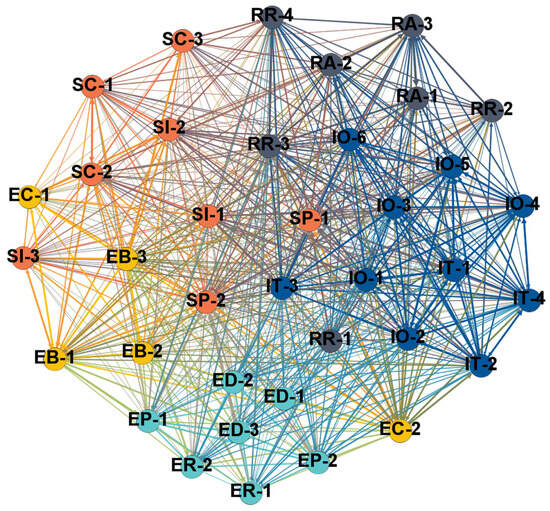
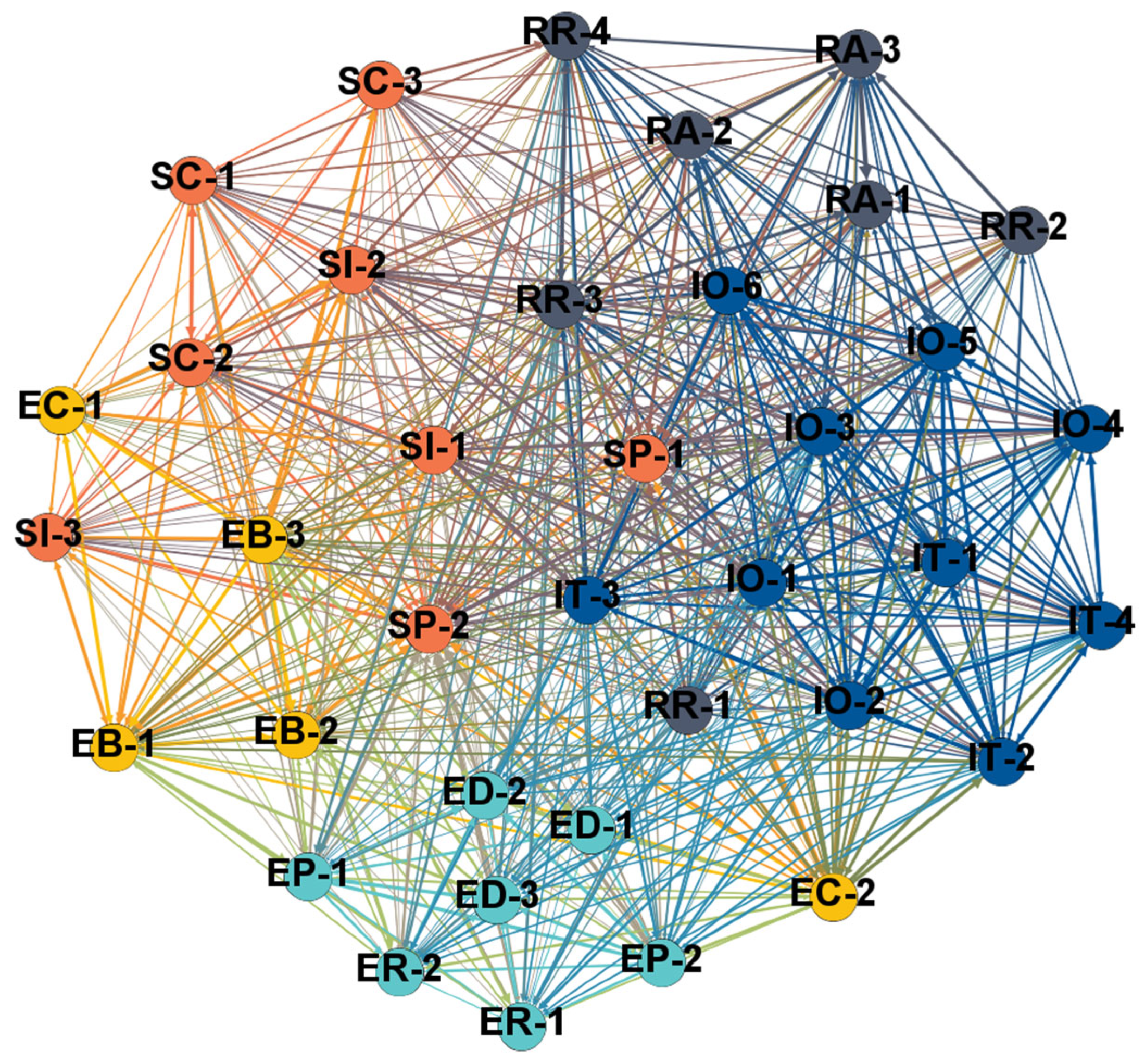
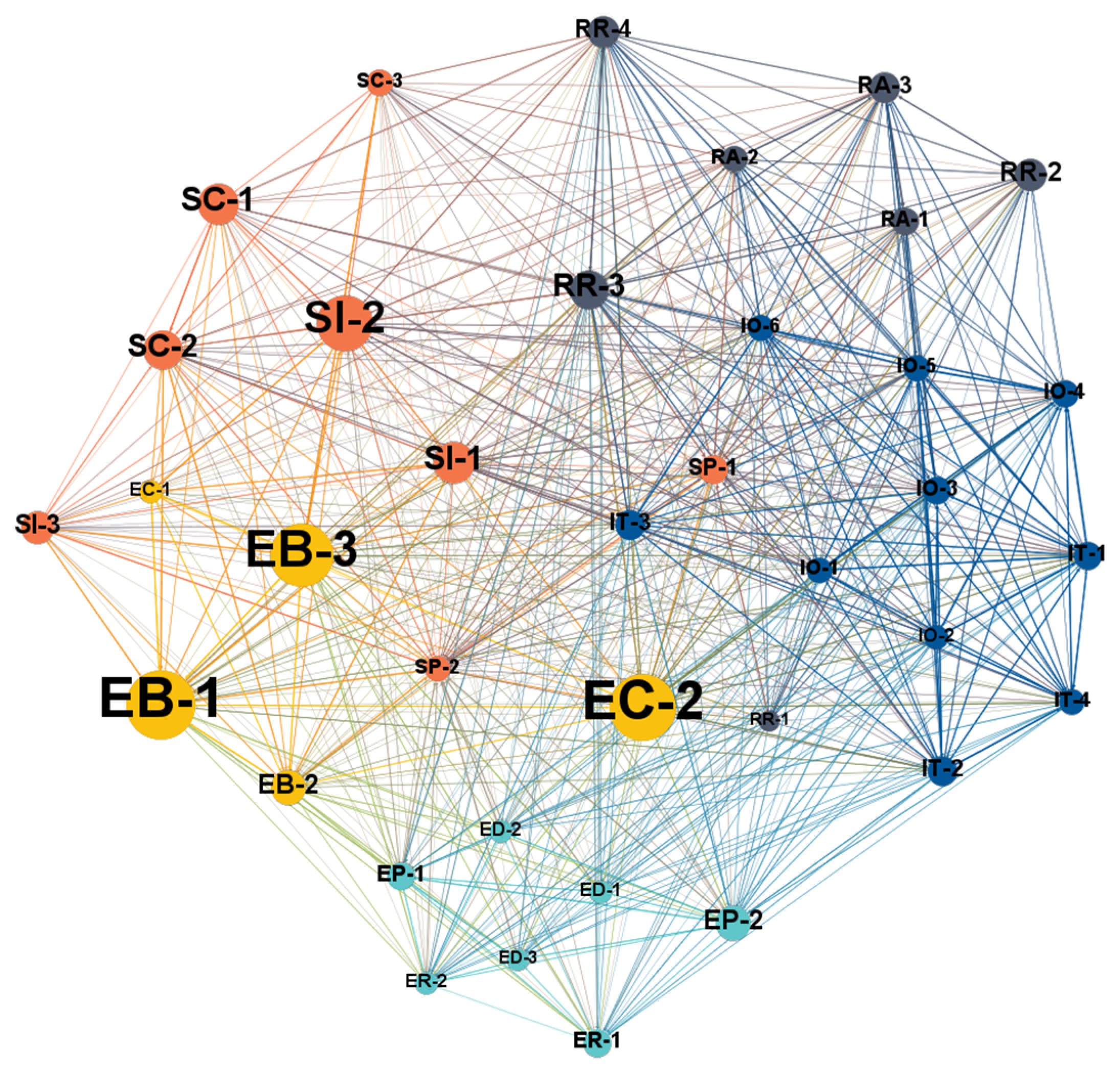
All collected adjacency matrix data were imported into EXCEL 2021 software and initially processed using functions. When the value of cell (i, j) is “0”, if more than half of the experts think that there is no relationship, then the value is taken as “0”; when the value of cell (i, j) is not “0”, the rest of the data are obtained as the mean value of the edge weights of the network, rounded to the nearest integer according to the “rounding” principle. Using these data processing principles, a directional weighted adjacency matrix was constructed to evaluate the intelligent sustainable operations of HZMB. The adjacency matrix and created network diagram obtained after processing can be seen in Table 3 and Figure 1, respectively.
Table 3.
The adjacency matrix between 37 indicators.
Figure 1.
The network diagram of 37 indicators. Note: Nodes (circles) represent evaluation indicators and are color-coded by dimension. Edges (lines) represent relationships (ties) between indicators.
5. Results
5.1. Results of Overall Network Analysis
The measurement results of the overall network density are presented in Table 4. The density of the indicator network constructed in this study is 0.664, indicating that the potential links-to-actual links ratio is 66.4%. This strongly affirms the structural complexity, close relationships, and strong correlations present within the CrMI-based indicator network constructed in this research [46]. These features largely reflect those of CrMI.
Table 4.
Density of network.
5.2. Results of Individual-Centric Network Analysis
5.2.1. The Influence of Indicators on Sustainable O&MM for CrMI
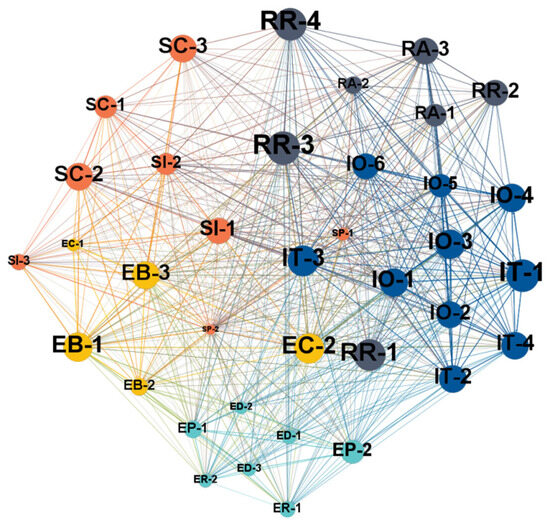
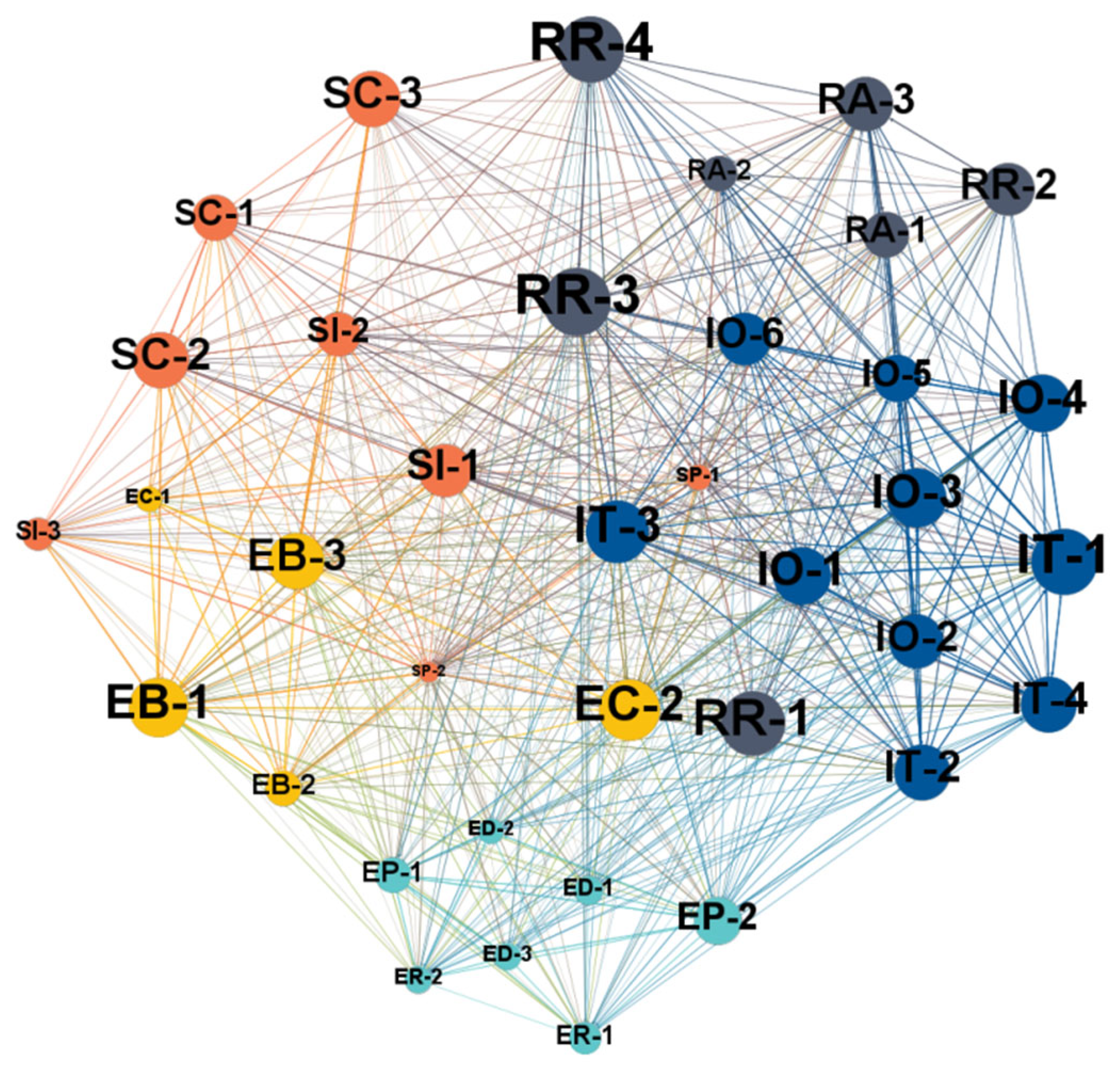
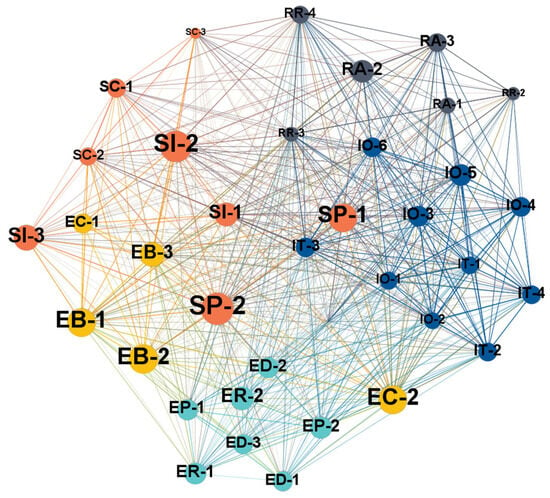
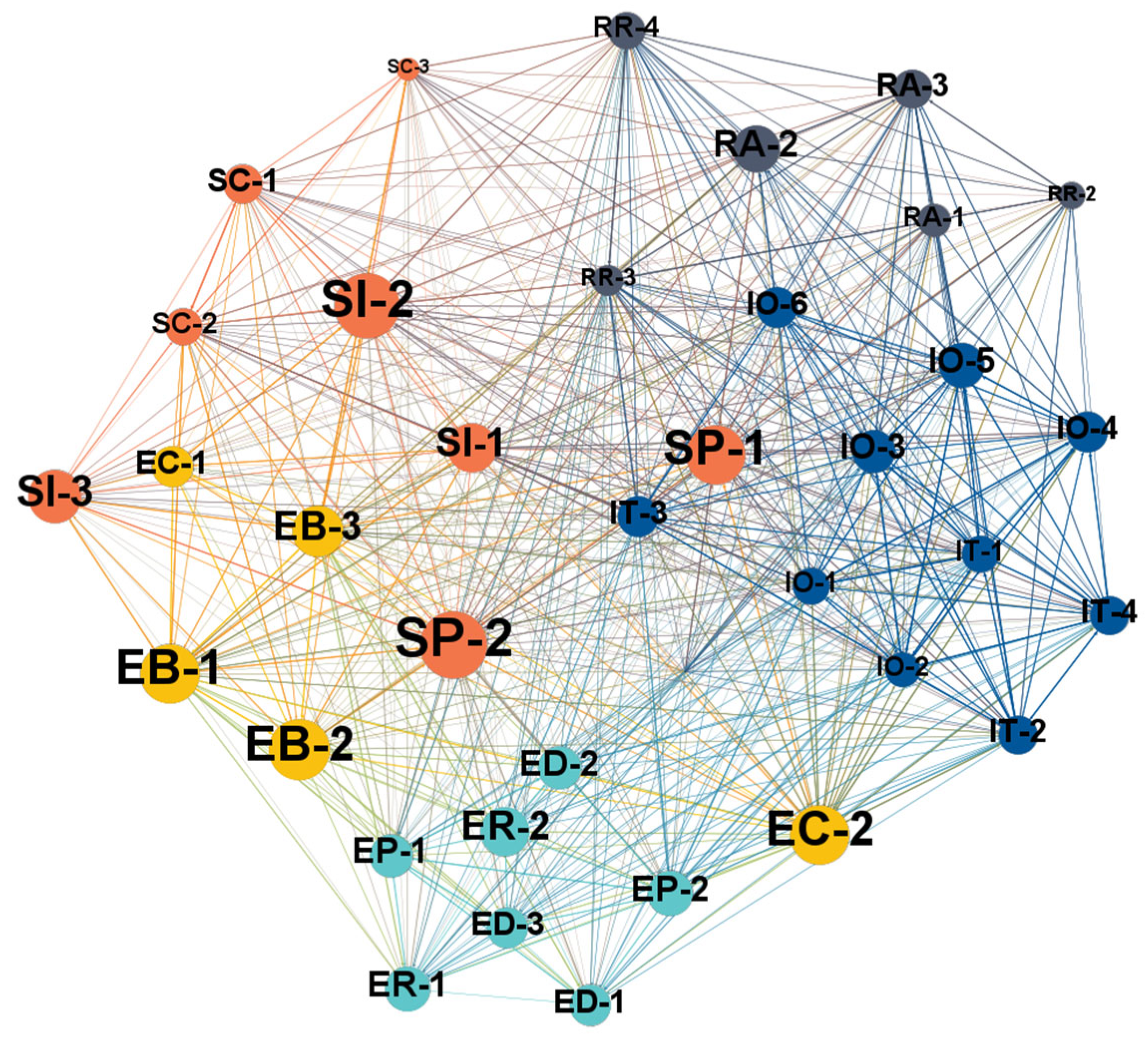
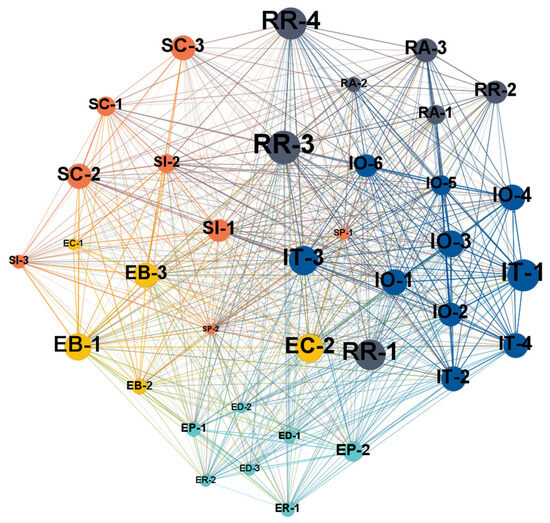
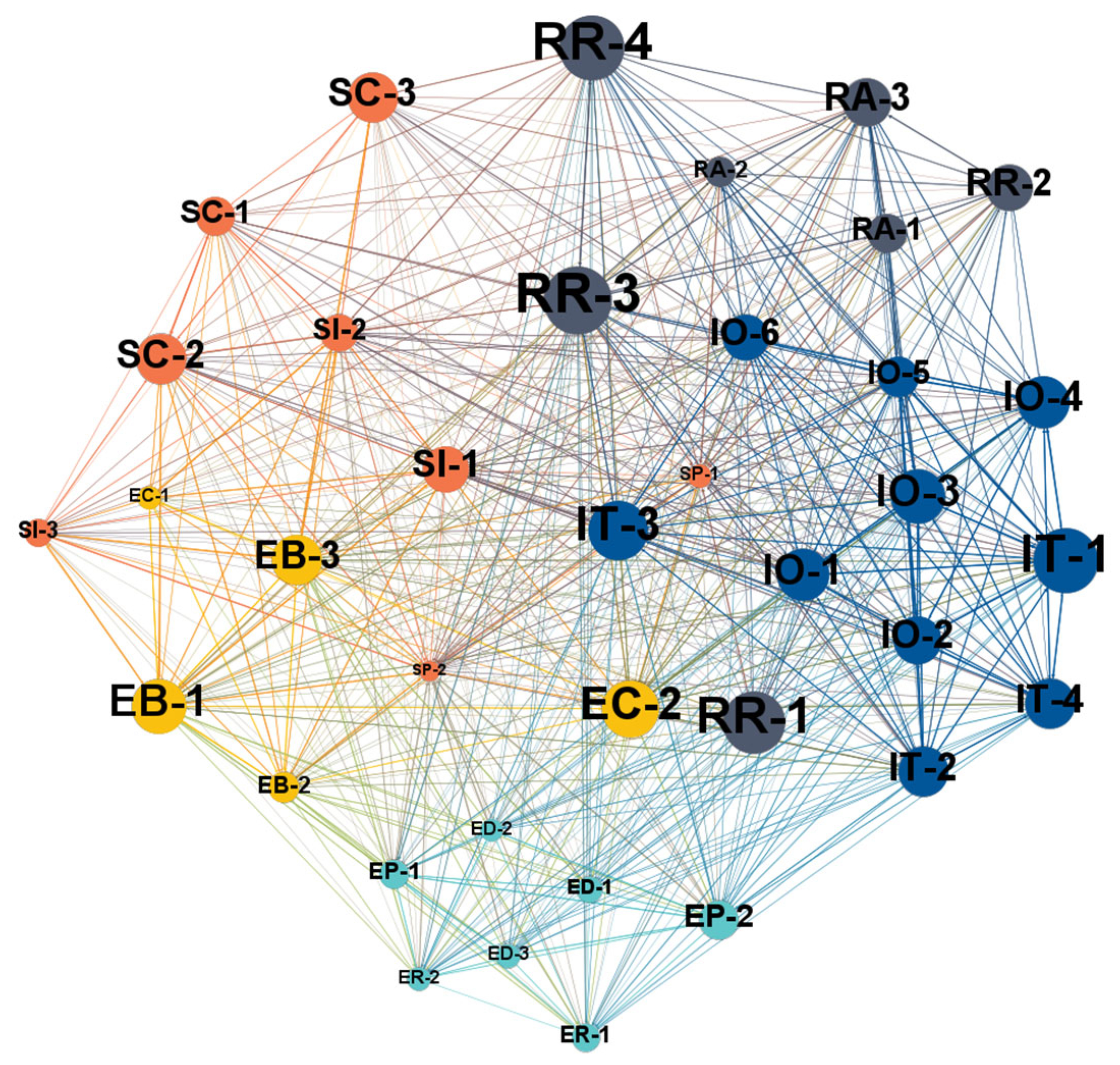
The degree centrality of the indicators is presented in Table 5. Figure 2 and Figure 3 show the influence diagrams of sustainable O&MM evaluation indicators based on out-degree and in-degree. In accordance with the Pareto rule, seven (the top 20%) indicators with the highest degree difference were identified as having the most influential impact on CrMI operations and maintenance sustainability. Therefore, RR-3 Cross-regional Operations & Maintenance Organization Management Level, RR-1 Remaining Design Lifetime, RR-4 Cross-regional Emergency Management Level, IT-3 I Professional and Technical Level of Intelligent O&MM Personnel, EB-3 Operating Income, IT-2 Intelligent O&M Hardware Facilities Equipping Degree, and SC-3 Administrative District Span Degree were selected as key indicators. The following four indicators with the lowest degree difference (all less than −30) were identified as being more likely to be affected by other indicators in management practice, namely EB-2 Land Value Enhancement Along Line, SI-2 Cross-regional Cooperation, SP-1 Operation Safety and SP-2 Public Attention Degree. Therefore, it is suggested that relevant measures are put into place to improve their performance.
Table 5.
Degree centrality of 37 indicators.
Figure 2.
The influence diagram of 37 indicators based on out-degree. Note: Nodes (circles) represent evaluation indicators and are color-coded by dimension. Edges (lines) represent relationships (ties) between indicators.
Figure 3.
The influence diagram of 37 indicators based on in-degree. Note: Nodes (circles) represent evaluation indicators and are color-coded by dimension. Edges (lines) represent relationships (ties) between indicators.
5.2.2. The Feedback Efficiency of Indicators on Sustainable O&MM for CrMI
The closeness centrality of the indicators is shown in Table 6, and Figure 4 presents the feedback efficiency diagram of sustainable O&MM evaluation indicators based on closeness centrality. It can be observed from Table 5 and Figure 4 that SI-2 Cross-regional Cooperation, SP-2 Public Attention Degree, EB-3 Operating Income, EC-2 Cross-regional Sharing and Guarantees of O&MM Costs, RR-3 Cross-regional Operations & Maintenance Organization Management Level, RR-4 Cross-regional Emergency Management Level, IT-1 Digitization Level of Operations & Maintenance Platform, and IT-3 Professional and Technical Level of Intelligent O&MM Personnel have the highest closeness centrality. They were identified as having the highest tightness in the indicator network for efficient feedback conducive to rapid improvement in the sustainability of CrMI operational management. However, ED-1 Noise Pollution during Operational Period, ED-2 Water Pollution during Operational Period, ED-3 Air Pollution during Operational Period, and EC-1 Cross-regional Industrial Structure Optimization are four indicators with the lowest closeness centrality, indicating that they require more time to respond to sustainable O&MM activities and, thereby, need long-term attention in their respective management practice.
Table 6.
Closeness centrality of 37 indicators.
Figure 4.
The feedback efficiency diagram of 37 indicators based on closeness centrality. Note: Nodes (circles) represent evaluation indicators and are color-coded by dimension. Edges (lines) represent relationships (ties) between indicators.
5.2.3. The Control Capacity of Indicators on Sustainable O&MM for CrMI
The betweenness centrality of the indicators is presented in Table 7, and Figure 5 displays the control capacity diagram of sustainable O&MM evaluation indicators based on betweenness centrality. According to the Pareto rule, seven (top 20%) indicators sorted by decreasing order of betweenness centrality were selected as key indicators: EB-1 GDP Contribution Along Line, EC-2 Cross-regional Sharing and Guarantees of O&MM Costs, EB-3 Operating Income, SI-2 Cross-regional Cooperation, SI-1 Talent Attraction, SC-1 Cross-regional Policy Difference, and SC-2 Cross-regional Economic Imbalance. These are considered to have a more significant role in connecting “bridges” within the indicator network system and can act as a “critical trigger” to improve management practices for sustainable O&M across regions. On the other hand, EC-1 Cross-regional Industrial Structure Optimization, ED-2 Water Pollution during Operational Period, ER-2 Solid Waste Generation during Operational Period, ED-1 Noise Pollution during Operational Period, ED-3 Air Pollution during Operational Period, and RR-1 Remaining Design Lifetime all have betweenness centrality lower than 3, indicating that their control capacity over sustainable O&MM is relatively weaker.
Table 7.
Betweenness centrality of 37 indicators.
Figure 5.
The control capacity diagram of 37 indicators based on betweenness centrality. Note: Nodes (circles) represent evaluation indicators and are color-coded by dimension. Edges (lines) represent relationships (ties) between indicators.
6. Discussion and Implications
Based on the above individual-centric network analysis, this study preliminarily summarizes key indicators of sustainable O&MM for CrMI from the perspectives of influenceability, feedback efficiency, and control ability. Further discussion of the impacts and implications that these key indicators have for the theory and practice of sustainable O&MM will then be conducted.
6.1. Cluster Analysis and Discussion
In order to further investigate the form and characteristics of the sustainable operations and maintenance management evaluation indicator network for cross-regional mega infrastructure, this study clustered the indicators according to their numerical size in degree centrality, closeness centrality, and betweenness centrality. The results are divided into three categories: ‘Management Focuses’, ‘Management Challenges’ and ‘Management Sensitives’ (as displayed in Table 8). The indicators that rank first in all three centrality measurements belong to the ‘Management Focuses’ group. This type of indicator has high influential power, fast feedback efficiency, and strong control capacity, which can significantly, efficiently, and completely improve the sustainability of CrMI operation and maintenance. Therefore, it is of the utmost importance and must be focused most on, and thereby these indicators are the core of management practice. The indicators that rank last in all three centrality measurements belong to the ‘Management Challenges’ group. These indicators have difficulty being managed as they tend to be easily influenced by others while taking more time for feedback with comparatively weaker control capacity. Lastly, those falling under the category of ‘Management Sensitives’ have a low degree centrality but high closeness centrality. These types of indicators stand out with their high impact ability power and feedback efficiency; consequently, they are quick to reflect performance in terms of sustainable operations and management activities.
Table 8.
Results of indicator clustering.
6.1.1. Discussion of ‘Management Focuses’
As shown in Table 8, the ‘Management Focuses’ are mainly focused on the economic development dimension, resilience dimension, and intelligent dimension., indicating that to ensure sustainable operation and maintenance management of CrMI, it is still necessary to start with economic development issues while giving increased attention and emphasis to resilience and intelligence. Specifically, from the economic development dimension of the two indicators (i.e., EB-3, EC-2), it is appreciated that income and costs are nevertheless the fundamental guarantees for steady programming of sustainable O&MM for CrMI [4,13]. This is consistent with the research finding of Erdogan [47] that economics still plays an important role in the operation and maintenance management of cross-regional infrastructure. The indicators of the resilience dimension (i.e., RR-3, RR-4) can be deeply interpreted as the complexity of O&MM caused by administrative barriers, system differences, and multi-head management between regions greatly affects the improvement in resilience for sustainable operations of CrMI. Additionally, the indicator identified from the intelligent dimension (i.e., IT-3) signifies that data mining and artificial intelligence technology play an increasingly important role in optimizing decision making for sustaining CrMI’s operations and maintenance management as well as improving the ability to respond to operational complexities. Previous studies have similarly demonstrated that intelligent technologies can bring multiple advantages to the sustainable operation and maintenance of CrMI, which deserves attention [48].
6.1.2. Discussion of ‘Management Challenges’
Based on Table 8, it can be seen that the greatest challenges in realizing sustainable O&M for CrMI lie in environmental development. This demonstrates that environmental protection issues remain a major task, and there is still a long way to go. Moreover, the “spatial spillover effect” and cross-regional differences in economic advancements are special challenges that need to be resolved quickly. Specifically, noise–water–air pollution is the most concerning problem when discussing unsustainable behavior; they require long-term focus regarding relevant infrastructure. Not addressing them will only lead to further complications due to regional spillover effects. Additionally, industrial structure has an effect through its potential to stagnate regional growth if it becomes slow; this could also create greater economic barriers that prevent sustainable development from occurring. Optimizing industrial structure across regions can address the problem of the low economic driving ability of neighboring cities, which is conducive to providing a stable economic environment for the O&MM for cross-regional mega infrastructure [49].
6.1.3. Discussion of ‘Management Sensitives’
Table 8 shows that all management-sensitive indicators are under the dimension of social progress. It can be concluded from the indicators (SI-2, SP-2) that in order to achieve real sustainability of operations and maintenance in CrMI, cooperation among different regions must be paid enough attention. Of course, this is sensitive work in the political system. At the same time, public attention reflects that “people orientation” must be taken into consideration in management practice. This indicates that public attention is also recognized as an important reference point for measuring the sustainability of O&MM for cross-regional mega infrastructure [9]. It is necessary to take into account the demands of grassroots people and pay enough attention to dynamic monitoring and guidance of related public opinion related to the CrMI.
6.2. Managerial Implications and Theoretical Contributions
This section provides feasible recommendations for future sustainable operation and maintenance management based on the above clustering analysis and discussion, combined with the inherent characteristics of CrMI, and also highlights the theoretical contributions of this study.
6.2.1. Theoretical Contributions
(1) Extension of conventional sustainability frameworks
This study goes beyond the traditional social–economic–environmental (SEE) sustainability framework by innovatively incorporating resilience and intelligence into the sustainability evaluation of cross-regional mega infrastructure (CrMI). This extension advances sustainability theory from a static, performance-oriented assessment toward a dynamic perspective that emphasizes adaptive capacity and responsiveness under uncertainty.
(2) Network-based reconceptualization of sustainability governance
By introducing social network analysis and clustering methods, this study conceptualizes sustainability indicators as an interactive system network rather than isolated variables. This network-based perspective reveals the structural characteristics and nonlinear interdependencies among CrMI management factors, thereby deepening the theoretical understanding of the complexity inherent in cross-regional infrastructure governance.
(3) Governance-oriented indicator role differentiation
Based on the identified network structures, this study proposes a novel classification framework distinguishing management priorities, management bottlenecks, and management sensitivities. This framework clarifies the differentiated roles of sustainability indicators in terms of influence, feedback efficiency, and controllability, and establishes a clear theoretical linkage between sustainability evaluation outcomes and governance decision-making logic.
6.2.2. Managerial Implications
(1) Implications from ‘Management Focuses’
In terms of economic development, the operator can cooperate with regional governments to develop a long-term sharing and guarantee mechanism for CrMI’s operations and maintenance. Additionally, they can attempt to develop new revenue sources through the interconnection between regions and by providing high-quality services. As for resilience, operators should focus on emphatically improving the level of regional linkage management and exploring innovative mechanisms such as rights management, project approval and integrated operations. They should also strengthen facilities maintenance and operations monitoring to improve durability and reliability so that the resilience of CrMI is enhanced. Furthermore, when it comes to intelligent operation and maintenance, operators should actively introduce or update new information technology while paying attention to training personnel in related fields and bringing in innovative talents to ensure ongoing updates and iterations regarding management technologies as well as their healthy development [50].
(2) Implications from ‘Management Challenges’
In terms of economic development, the government can make full use of the advantage of the CrMI’s regional radiation effect to promote the flow of people, logistics, capital and information resources across regions, thus forming a regional economic circle and providing resources and opportunities for optimizing the regional industrial structure [51]. Simultaneously, as regards environmental development, the government can strengthen coordination and collaboration between regions in order to form a cross-regional joint prevention and control mechanism for environmental pollution as well as environmental monitoring standards and management measures [52]; operators must share this environmental monitoring data with the government so as to realize the pluralistic co-governance model of environmental problems in cross-regional mega infrastructure operations and maintenance [53].
(3) Implications from ‘Management Sensitives’
In the dimension of social progress, operators can encourage the public to actively participate in the supervision of the CrMI operation service so as to enhance the public attention, recognition, and support for the project to form a positive public opinion effect and further promote its social impact [54]. The government should take advantage of the cross-regional connectivity of mega infrastructure to break down regional barriers and strengthen integrated regional construction, thereby increasing the close relatedness among regions, which encourages regional cooperation [26].
On the whole, in order to achieve truly sustainable operations and maintenance for cross-regional mega infrastructure under extreme climate shocks, its “regional spillover effect” should be fully recognized, valued and maximized. This includes taking operators as the center, combining with appropriate policy support and incentive measures from the government, and breaking down operations and maintenance management barriers across regions so as to strengthen their close relatedness and build a more perfect sustainable operations management system for CrMI.
7. Conclusions
Cross-regional mega infrastructure carries a plethora of economic and social activities from the public, government, and enterprises. It plays an integral part in ensuring human production and living, coping with environmental changes, and resisting natural disasters. Its operations and maintenance management should emphasize sustainable development models with coordination and unification across multiple dimensions. However, existing studies could not adequately meet the current needs for intelligent infrastructure development in recent years, nor could they accurately assess the challenges to its operation and maintenance arising from the frequency of extreme weather with sudden increases in intensity. From the perspective of systemic relational structures, this study elucidates the mechanisms through which key factors function in the sustainable operation and maintenance management of cross-regional mega infrastructure and proposes a novel analytical paradigm for addressing complex governance challenges under extreme weather conditions.
Therefore, this study introduced two new dimensions of resilience and intelligence into the evaluation dimension and selected evaluation indicators that consider cross-regional coordination and the complexity of operational phase management to construct a sustainable evaluation indicator system for CrMI with 5 dimensions and 37 indicators. Then, it takes the Hong Kong–Zhuhai–Macau Bridge as a case study, applying the SNA method to quantify key indicators from three aspects: influence capacity in sustainable operation and maintenance management, feedback efficiency, and control capacity. Following the Pareto principle, the top 20% of indicators are identified as key indicators within each dimension. Specifically, eight indicators with high closeness centrality are identified in the feedback efficiency dimension, while seven indicators with high betweenness centrality are identified in both the influence capacity and control capacity dimensions. Subsequently, these identified key indicators are clustered into three categories for further discussion: ‘Management Focuses’, ‘Management Challenges’, and ‘Management Sensitives’. It was found that for government and operators alike, achieving sustainable O&MM for CrMI should start with economic development issues while enhancing resilience and intelligence. The environmental dimension is mainly reflected in management difficulties; thus, environmental protection problems still remain arduous. ‘Management sensitives’ concentrate on the social dimension; hence, management practices must take into account public voices and requirements as well as dynamic monitoring to guide related public opinion.
There are some limitations in this study, which deserve further attention in the future. The Hong Kong–Zhuhai–Macao Bridge is adopted as a representative case for the quantitative analysis. Although a key objective of this research is to develop a sustainability-oriented evaluation indicator system for the operation and maintenance of cross-regional mega infrastructure with a certain degree of general applicability, the case-based quantitative analysis is primarily intended to validate the credibility and explanatory power of the indicator system developed in Section 3 and to generate operationally feasible practical insights specific to the Hong Kong–Zhuhai–Macao Bridge. Accordingly, the quantitative findings derived from this case are not directly generalizable to all cross-regional mega infrastructure projects and should be interpreted within their particular engineering, institutional, and governance contexts. The principal value of these findings lies in their contextual transferability to mega infrastructure projects with comparable scale characteristics, cross-regional governance arrangements, and operation and maintenance complexities.
Furthermore, the sustainability of operation and maintenance management for cross-regional major infrastructure exhibits pronounced dynamic characteristics. With ongoing technological advancements and continuous changes in natural, social, and institutional environments, both the connotations and relative importance of evaluation indicators may evolve over time. Future research could enhance the general applicability, robustness, and temporal adaptability of the proposed framework by incorporating a larger number of cases, conducting longitudinal analyses, and establishing a dynamically updated evaluation indicator system.
Author Contributions
Conceptualization: X.S., J.C. and J.M.; data curation: Z.J.; funding acquisition: X.S.; investigation: Z.J.; methodology: X.S.; project administration: J.M.; software: Z.J.; supervision: X.S. and J.C.; validation: J.C.; resources: X.S.; writing—original draft: Z.J.; writing—review and editing: X.S., J.C. and J.M. All authors have read and agreed to the published version of the manuscript.
Funding
This study was sponsored by the Guangdong Philosophical and Social Science Program (No. GD22YGL08, GD23YGL29).
Institutional Review Board Statement
Not applicable.
Informed Consent Statement
Not applicable.
Data Availability Statement
The original contributions presented in this study are included in the article. Further inquiries can be directed to the corresponding author.
Conflicts of Interest
The authors declare no conflicts of interest.
References
- Wang, C.; Lim, M.K.; Zhang, X.; Zhao, L.; Lee, P.T.-W. Railway and road infrastructure in the Belt and Road Initiative countries: Estimating the impact of transport infrastructure on economic growth. Transp. Res. Part A Policy Pract. 2020, 134, 288–307. [Google Scholar] [CrossRef] [Scilit]
- Jang, W.; Lee, S.K.; Han, S.H. Sustainable performance index for assessing the green technologies in urban infrastructure projects. J. Manag. Eng. 2018, 34, 04017056. [Google Scholar] [CrossRef] [Scilit]
- Audi, Y.; Jullien, A.; Dauvergne, M.; Feraille, A.; D’Aloia Schwartzentruber, L. Methodology and application for the environmental assessment of underground multimodal tunnels. Transp. Geotech. 2020, 24, 100389. [Google Scholar] [CrossRef] [Scilit]
- Jia, F.; Xiang, P.; Chen, D. Prioritizing the operation and maintenance complexity of mega transportation projects based on systems thinking. J. Constr. Eng. Manag. 2022, 148, 05021014. [Google Scholar] [CrossRef] [Scilit]
- Li, Y.; Xiang, P.; You, K.; Guo, J.; Liu, Z.; Ren, H. Identifying the key risk factors of mega infrastructure projects from an extended sustainable development perspective. Int. J. Environ. Res. Public Health 2021, 18, 7515. [Google Scholar] [CrossRef] [Scilit] [PubMed]
- Rahimi-Golkhandan, A.; Aslani, B.; Mohebbi, S. Predictive resilience of interdependent water and transportation infrastructures: A sociotechnical approach. Socio. Econ. Plan. Sci. 2022, 80, 101166. [Google Scholar] [CrossRef] [Scilit]
- Wang, M.; Zhang, Y.; Zhang, D.; Zheng, Y.; Li, S.; Tan, S.K. Life-cycle cost analysis and resilience consideration for coupled grey infrastructure and low-impact development practices. Sustain. Cities Soc. 2021, 75, 103358. [Google Scholar] [CrossRef] [Scilit]
- Tong, W.; Li, H.X.; Nasirzadeh, F.; Yao, F.; Ji, Y. Resilience of interdependent infrastructure networks: Review and future directions. Int. J. Crit. Infrastruct. Prot. 2025, 51, 100793. [Google Scholar] [CrossRef] [Scilit]
- Liu, B.; Xue, B.; Chen, X. Development of a metric system measuring infrastructure sustainability: Empirical studies of Hong Kong. J. Clean. Prod. 2021, 278, 123904. [Google Scholar] [CrossRef] [Scilit]
- Wang, J.; Deng, Y.; Qalati, S.A.; Qureshi, N.A. Urban resilience and transportation infrastructure level in the Yangtze River Delta. Front. Environ. Sci. 2022, 10, 893964. [Google Scholar] [CrossRef] [Scilit]
- Ji, K.; Wang, G.H.; Choi, I.; Jeon, J.-S. Machine learning-based life prediction of rail tracks using environmental and operational factors. Dev. Built Environ. 2025, 23, 100718. [Google Scholar] [CrossRef] [Scilit]
- Wang, J.; Ren, Y.; Shu, T.; Shen, L.; Liao, X.; Yang, N.; He, H. Economic perspective-based analysis on urban infrastructures carrying capacity: A China study. Environ. Impact Assess. Rev. 2020, 83, 106381. [Google Scholar] [CrossRef] [Scilit]
- Xu, C.; Liu, Z.; Chen, Z.; Zhu, Y.; Yin, D.; Leng, L.; Jia, H.; Zhang, X.; Xia, J.; Fu, G. Environmental and economic benefit comparison between coupled grey–green infrastructure systems and traditional grey infrastructure through a life-cycle perspective. Resour. Conserv. Recycl. 2021, 174, 105804. [Google Scholar] [CrossRef] [Scilit]
- Matthews, E.C.; Sattler, M.; Friedland, C.J. A critical analysis of hazard resilience measures within sustainability assessment frameworks. Environ. Impact Assess. Rev. 2014, 49, 59–69. [Google Scholar] [CrossRef] [Scilit]
- Khoshnava, S.M.; Rostami, R.; Zin, R.M.; Štreimikienė, D.; Yousefpour, A.; Mardani, A.; Alrasheedi, M. Contribution of green infrastructure to the implementation of green economy in the context of sustainable development. Sustain. Dev. 2020, 28, 320–342. [Google Scholar] [CrossRef] [Scilit]
- Qiu, Y.; Chen, H.; Sheng, Z.; Cheng, S. Governance of institutional complexity in megaproject organizations. Int. J. Proj. Manag. 2019, 37, 425–443. [Google Scholar] [CrossRef] [Scilit]
- Wang, L.; Xue, X.; Zhao, Z.; Wang, Z. The impacts of transportation infrastructure on sustainable development: Emerging trends and challenges. Int. J. Environ. Res. Public Health 2018, 15, 1172. [Google Scholar] [CrossRef] [Scilit] [PubMed]
- Pan, M.; Zhao, X.; Li, Z. Diffusion mechanism of green building in industrial clusters: An agent-based modeling approach. Dev. Built Environ. 2024, 19, 100504. [Google Scholar] [CrossRef] [Scilit]
- Fu, M.; Wang, J.; Li, S.; Qin, L.; Li, J.; Jin, S. Utilization patterns and optimization suggestions for wildlife passages in Xinjiang nature reserves. Ecol. Evol. 2025, 15, e70969. [Google Scholar] [CrossRef] [Scilit]
- Guo, N.; Liang, X. Robustness assessment of urban cold island network based on green infrastructure: A case study of Bengbu, China. Ecol. Indic. 2024, 169, 112842. [Google Scholar] [CrossRef] [Scilit]
- Argyroudis, S.A.; Mitoulis, S.A.; Chatzi, E.; Baker, J.W.; Brilakis, I.; Gkoumas, K.; Vousdoukas, M.; Hynes, W.; Carluccio, S.; Keou, O.; et al. Digital technologies can enhance climate resilience of critical infrastructure. Clim. Risk Manag. 2022, 35, 100387. [Google Scholar] [CrossRef] [Scilit]
- Li, W.; Yuan, J.; Ji, C.; Wei, S.; Li, Q. Agent-based simulation model for investigating the evolution of social risk in infrastructure projects in China: A social network perspective. Sustain. Cities Soc. 2021, 73, 103112. [Google Scholar] [CrossRef] [Scilit]
- Chan, A.P.C.; Yang, Y.; Darko, A. Construction accidents in a large-scale public infrastructure project: Severity and prevention. J. Constr. Eng. Manag. 2018, 144, 05018010. [Google Scholar] [CrossRef] [Scilit]
- Xue, J.; Shen, G.Q.; Li, Y.; Wang, J.; Zafar, I. Dynamic stakeholder-associated topic modeling on public concerns in mega infrastructure projects: Case of Hong Kong–Zhuhai–Macao Bridge. J. Manag. Eng. 2020, 36, 04020078. [Google Scholar] [CrossRef] [Scilit]
- Yang, F.; Yu, J.; Li, X.; Qiu, W. An SLCA method-based framework of large-scale transportation infrastructure in China. Environ. Impact Assess. Rev. 2022, 93, 106716. [Google Scholar] [CrossRef] [Scilit]
- Li, Y.; Barrueta Pinto, M.C.; Kumar, D.T. Analyzing sustainability indicators for the Chinese mining sector. Resour. Policy 2023, 80, 103275. [Google Scholar] [CrossRef] [Scilit]
- Xiahou, X.; Tang, L.; Yuan, J.; Zuo, J.; Li, Q. Exploring social impacts of urban rail transit PPP projects: Towards dynamic social change from the stakeholder perspective. Environ. Impact Assess. Rev. 2022, 93, 106700. [Google Scholar] [CrossRef] [Scilit]
- García-Sánchez, M.; Güereca, L.P. Environmental and social life cycle assessment of urban water systems: The case of Mexico City. Sci. Total Environ. 2019, 693, 133464. [Google Scholar] [CrossRef] [Scilit]
- Zhang, M.; Liu, X.; Ding, Y. Assessing the influence of urban transportation infrastructure construction on haze pollution in China: A case study of the Beijing–Tianjin–Hebei region. Environ. Impact Assess. Rev. 2021, 87, 106547. [Google Scholar] [CrossRef] [Scilit]
- Chan, M.; Jin, H.; van Kan, D. Assessment of driving factors for sustainable infrastructure development. Resour. Conserv. Recycl. 2022, 185, 106490. [Google Scholar] [CrossRef] [Scilit]
- Kørnøv, L.; Lyhne, I.; Davila, J.G. Linking the UN SDGs and environmental assessment: Towards a conceptual framework. Environ. Impact Assess. Rev. 2020, 85, 106463. [Google Scholar] [CrossRef] [Scilit]
- Chen, H.; Zhang, L.; Ran, L. Vulnerability modeling and assessment in urban transit systems considering disaster chains: A weighted complex network approach. Int. J. Disaster Risk Reduct. 2021, 54, 102033. [Google Scholar] [CrossRef] [Scilit]
- Hong Kong–Zhuhai–Macao Bridge Authority. Hong Kong–Zhuhai–Macao Bridge Official Website. 2022. Available online: https://www.hyd.gov.hk/en/our_projects/road_projects/hzmb_projects/index.html (accessed on 31 December 2022).
- Yu, F.; Li, X.-Y.; Han, X.-S. Risk response for urban water supply networks using case-based reasoning during natural disasters. Saf. Sci. 2018, 106, 121–139. [Google Scholar] [CrossRef] [Scilit]
- Shen, L.; Li, J.; Suo, W. Risk response for critical infrastructures with multiple interdependent risks: A scenario-based extended CBR approach. Comput. Ind. Eng. 2022, 174, 108766. [Google Scholar] [CrossRef] [Scilit]
- Sun, K.; Zhang, D.; Wang, J.; Mao, W. Data-driven and physically informed power grid dispatch decision-making method. Sustain. Energy Grids Netw. 2025, 42, 101644. [Google Scholar] [CrossRef] [Scilit]
- National Urban Infrastructure Construction Plan for the ‘Fourteenth Five Year Plan’. 2022. Available online: https://www.gov.cn/zhengce/zhengceku/2022-07/31/content_5703690.htm (accessed on 23 December 2022).
- Yu, G.; Wang, Y.; Hu, M.; Shi, L.; Mao, Z.; Sugumaran, V. RIOMS: An intelligent system for operation and maintenance of urban roads using spatio-temporal data in smart cities. Future Gener. Comput. Syst. 2021, 115, 583–609. [Google Scholar] [CrossRef] [Scilit]
- Yu, D.; Tao, Q.; Liu, Q.; Jin, Y.; Sun, Y.; Fu, P. Lifecycle management of urban renewal enabled by internet of things: Development, application, and challenges. Results Eng. 2025, 27, 105706. [Google Scholar] [CrossRef] [Scilit]
- Xu, J.; Ling, R.; Yang, M.; Miao, R.; Zhou, H.; Xiang, H.; Jing, Y.; Ma, R.; Xu, G. A comprehensive risk management framework for NIMBY projects: Integrating social network analysis and risk transmission chains. Ecol. Indic. 2024, 169, 112942. [Google Scholar] [CrossRef] [Scilit]
- Guo, J.; Bian, Y.; Li, M.; Du, J. Assessing resilience through social networks: A case study of flood disaster management in China. Int. J. Disaster Risk Reduct. 2024, 108, 104583. [Google Scholar] [CrossRef] [Scilit]
- Khan Babar, A.H.; Ali, Y. Framework construction for augmentation of resilience in critical infrastructure: Developing countries a case in point. Technol. Soc. 2022, 68, 101809. [Google Scholar] [CrossRef] [Scilit]
- Sen, M.K.; Dutta, S.; Laskar, J.I. A hierarchical Bayesian network model for flood resilience quantification of housing infrastructure systems. ASCE ASME J. Risk Uncertain. Eng. Syst. Part A Civ. Eng. 2021, 7, 04020060. [Google Scholar] [CrossRef] [Scilit]
- Zhu, L.; Cheung, S.O.; Gao, X.; Li, Q.; Liu, G. Success DNA of a record-breaking megaproject. J. Constr. Eng. Manag. 2020, 146, 05020009. [Google Scholar] [CrossRef] [Scilit]
- Abdul Nabi, M.; El-Adaway, I.H. Understanding the key risks affecting cost and schedule performance of modular construction projects. J. Manag. Eng. 2021, 37, 04021023. [Google Scholar] [CrossRef] [Scilit]
- Yip, W.S.; To, S. Identification of stakeholder-related barriers in sustainable manufacturing using social network analysis. Sustain. Prod. Consum. 2021, 27, 1903–1917. [Google Scholar] [CrossRef] [Scilit]
- Erdogan, S. Analyzing the environmental Kuznets curve hypothesis: The role of disaggregated transport infrastructure investments. Sustain. Cities Soc. 2020, 61, 102338. [Google Scholar] [CrossRef] [Scilit]
- Liu, Z.; Xu, C.; Xu, T.; Jia, H.; Zhang, X.; Chen, Z.; Yin, D. Integrating socioecological indexes in multiobjective intelligent optimization of green–grey coupled infrastructures. Resour. Conserv. Recycl. 2021, 174, 105801. [Google Scholar] [CrossRef] [Scilit]
- Ma, G.; Hu, J.; Zhang, R. Spatial-temporal distribution and coupling relationship of high-speed railway and economic networks in metropolitan areas of China. Land 2023, 12, 1193. [Google Scholar] [CrossRef] [Scilit]
- Qiu, S.; Zaheer, Q.; Ali, F.; Wajid, S.; Chen, H.; Ai, C.; Wang, J. Exploring the impact of digital twin technology in infrastructure management: A comprehensive review. J. Civ. Eng. Manag. 2025, 31, 395–417. [Google Scholar] [CrossRef] [Scilit]
- Luo, H.; Qian, Y.; Zeng, J.; Wei, X.; Guang, X. An empirical analysis of logistics corridors and regional economic spatial patterns from the perspective of compressive transportation between urban agglomerations. Land 2022, 11, 726–741. [Google Scholar] [CrossRef] [Scilit]
- Chu, Z.; Bian, C.; Yang, J. Joint prevention and control mechanism for air pollution regulations in China: A policy simulation approach with evolutionary game. Environ. Impact Assess. Rev. 2021, 91, 106668. [Google Scholar] [CrossRef] [Scilit]
- Peng, S.; Liang, S.; Dai, T.; Peng, H. Exploring the mechanisms of regional environmental collaborative legislation in China: Policy effectiveness, practical challenges, and policy suggestions. Sustainability 2024, 16, 3959. [Google Scholar] [CrossRef] [Scilit]
- Luo, Q.; Li, D.; Guo, Y.; Chen, H. Study on factors influencing residents’ participation in public space improvement projects for sustainable built environment. Buildings 2025, 15, 4317. [Google Scholar] [CrossRef] [Scilit]

Disclaimer/Publisher’s Note: The statements, opinions and data contained in all publications are solely those of the individual author(s) and contributor(s) and not of MDPI and/or the editor(s). MDPI and/or the editor(s) disclaim responsibility for any injury to people or property resulting from any ideas, methods, instructions or products referred to in the content. |
© 2026 by the authors. Licensee MDPI, Basel, Switzerland. This article is an open access article distributed under the terms and conditions of the Creative Commons Attribution (CC BY) license.