
Review

Development of Curcumin-Loaded Nanoemulsions for Fortification and Stabilization of Dairy Beverages

1
Department of Pharmacy and Health and Nutritional Sciences, University of Calabria, 87036 Arcavacata di Rende, Italy
2
Department of Agraria, University “Mediterranea” of Reggio Calabria, Salita Melissari, Località Feo di Vito, 89124 Reggio Calabria, Italy
*
Authors to whom correspondence should be addressed.
Appl. Sci. 2026, 16(2), 885; https://doi.org/10.3390/app16020885
Submission received: 16 December 2025 / Revised: 4 January 2026 / Accepted: 12 January 2026 / Published: 15 January 2026
(This article belongs to the Special Issue Antioxidant Compounds in Food Processing: Second Edition)

Featured Application

Oil-in-water nanoemulsions enable the effective incorporation of curcumin into dairy products by enhancing its solubility, stability, and bioavailability. They protect the bioactive compound during processing and storage while preserving its sensory quality. This approach provides a practical, clean-label strategy for developing next-generation functional dairy foods.

Abstract

Curcumin is a polyphenolic compound isolated from Curcuma longa, which is widely recognized for its therapeutic properties: particularly its strong anti-inflammatory and antioxidant activities. However, its practical incorporation into functional foods, especially aqueous dairy beverages, is severely hindered by its extremely low water solubility, poor chemical stability (notably at the near-neutral pH of milk), and very limited oral bioavailability. This review provides a critical synthesis of the literature published in the last two decades, with a focus on the development and application of food-grade oil-in-water (O/W) nanoemulsions to advanced colloidal delivery systems. It covers the fundamental principles of nanoemulsion formulation, including the selection of the oil phase, surfactants, and stabilizers, as well as both high-energy and low-energy fabrication techniques. It further examines the integration of these nano-delivery systems into dairy matrices (milk, yogurt, cheese), highlighting key interactions between nanoemulsion droplets and native dairy constituents such as casein micelles and whey proteins. Critically, findings indicate that nanoencapsulation not only enhances curcumin’s solubility but also protects it from chemical degradation during industrial processes, including pasteurization and sterilization. Moreover, the dairy matrix structure plays a key role in modulating curcumin bioaccessibility, with fortified products frequently exhibiting enhanced stability, shelf life, and sensory attributes. Finally, key technological challenges addressed the heterogeneous global regulatory landscape surrounding biopolymers and future trends: most notably, the growing shift toward “clean-label” biopolymer-based delivery systems.

1. Introduction

The global food industry is undergoing a notable shift driven by increasing consumer demand for functional foods that provide demonstrable health benefits beyond basic nutrition [1,2]. Within this context, dairy beverages—particularly milk-based drinks and yogurt—have emerged as being especially effective carriers for functional ingredients. Their high nutritional value, central role in daily diets, and wide consumer acceptance make them ideal vehicles for delivering bioactive compounds with health-promoting properties [3,4]. Among the various nutraceuticals available, curcumin has attracted substantial scientific interest [5]. Chemically identified as diferuloylmethane, curcumin is the principal polyphenol of Curcuma longa (turmeric) [6,7], and extensive in vitro and pre-clinical studies have highlighted its strong antioxidant, anti-inflammatory, antimicrobial, neuroprotective, and anti-diabetic activities. Despite compelling in vitro evidence, the use of curcumin in functional foods is restricted by the “curcumin paradox,” characterized by poor translation to in vivo efficacy. Several factors contribute to this discrepancy. Curcumin has extremely low water solubility due to its hydrophobic and lipophilic structure, which prevents efficient dispersion in aqueous systems such as milk. In addition, its chemical instability poses a major challenge: curcumin degrades rapidly when exposed to typical processing and storage conditions, including heat, light, oxygen, and neutral to alkaline pH environments [7]. Furthermore, even when ingested in large quantities, curcumin exhibits negligible oral bioavailability because of poor intestinal absorption, rapid first-pass metabolism, and swift systemic elimination. Human clinical trials confirm that multi-gram oral doses of unformulated curcumin result in plasma concentrations in the nanomolar range, which are often barely detectable [8,9]. Nanotechnology offers a promising strategy to address these limitations. Oil-in-water (O/W) nanoemulsion delivery systems encapsulate lipophilic curcumin in an oil core surrounded by emulsifiers, protecting the compound from chemical degradation in aqueous environments and substantially enhancing its bioaccessibility during digestion [10,11]. Although traditional preparations such as “golden milk” or haldi doodh have long combined turmeric with dairy matrices, such artisanal beverages suffer from sedimentation, off flavors, and minimal bioavailability. Nanoemulsion technology represents a scientifically refined evolution of this traditional concept, enabling the development of stable, palatable, and biologically effective fortified dairy products [12]. However, the successful incorporation of nanoemulsions into dairy systems requires more than simply blending them with milk. Dairy beverages are themselves complex colloidal structures, and the behavior of curcumin-loaded nanoemulsions depends heavily on their interactions with endogenous milk components, most notably, casein micelles and whey proteins [13,14]. Understanding these physicochemical interactions is therefore critical for ensuring both product stability and functional performance.
This review provides a critical synthesis of the literature published in the last two decades (2005–present) concerning the formulation and application of curcumin-loaded nanoemulsions in dairy beverages. The temporal keyword co-occurrence network presented in Figure 1 demonstrates the increasing integration of the formulation-, characterization-, and application-oriented research domains within the field of curcumin nanoemulsions. It examines nanoemulsion fabrication techniques, evaluates stability within dairy matrices during processing and storage, and analyzes the resulting functional outcomes, including bioaccessibility and sensory attributes. In addition, it explores key technological challenges, emerging regulatory considerations, and future trends that are likely to guide the development of the next generation of functional dairy products. This review is significant because it connects the holistic approach of making nanoemulsions with how they actually behave inside dairy products. We analyze how natural ingredients in milk, like proteins (casein micelles and globular proteins) affect curcumin, specifically looking at how they help it to stay stable and be absorbed by the body. This work provides a clear and practical guide for researchers and food technologists. This study will guide us to design new, healthier dairy beverages that solve the usual problems associated with consuming curcumin.

2. Curcumin and Its Functional Properties

The unique conformational structure of curcumin, which is scientifically referred to as diferuloylmethane, is essentially the underpinning factor to its diverse applications in a biological and industrial setting [15]. The anatomy of the chemical structure of curcumin shows different functional groups such as phenolic hydroxyl groups, methoxy groups, diketone groups, aromatic rings, and linker chains, which are connected to a seven-carbon network of hydrocarbons [16]. The distinct vibrant yellow-orange color and functional properties of curcumin are characteristic features produced by a highly viable π-electron system by virtue of the arrangement of its structural units [15,16].
Generally, there are three key chemical groups that give curcumin the ability to express its functional versatility by integrating perfectly with other molecules. Phenolic Hydroxyl Groups (-OH) are the primary factors of the antioxidant nature of curcumin [17]. By means of hydrogen atom transfer (HAT) and sequential proton loss electron transfer, these functional groups are useful for trapping and stabilizing free radicals such as 2,2-diphenyl-1-picrylhydrazyl (DPPH) and 2,2′-azino-bis(3-ethylbenzothiazoline-6-sulfonic acid) (ABTS+) (SPLET) [17,18]. This is essential for the anti-inflammatory capacity of curcumin [17].
Ortho-Methoxy Group (-OCH3) molecules are found adjacent to hydroxyl groups that have the inherent nature to maintain a stable phenoxyl radical by means of resonance and an inductive mechanism [17,18]. It is the mechanism of this structural unit of curcumin that underscores its antimicrobial properties [18].
The central β-Diketone/Enol Linker group is key for preventing Fenton-type reactions that produce pro-oxidant hydroxyl reactive radicals that can couple with metal ions such as Cu2+ and Fe2+ to form unstable complexes with the power to trigger a cascade of reactions [18,19]. The metal ions are ‘trapped’ by a chelating effect to mitigate any probable initiation of these reactive complexes. This function allows for curcumin to be utilized in the food and pharmaceutical industries as a stabilizer and therapeutic agent, respectively [19].
The natural lipophilicity of curcumin is contributed by aromatic rings and linker chains, specifically in the presence of casein or β-lactoglobulin. The aromatic ring facilitates the partitioning into lipid membranes and protein pockets [18,19]. The bonding of carbons in the chain also provides the flexibility that enables the molecules to “wrap” and bind at different active sites on the proteins [18].
Curcumin exists in an equilibrate or balance form, primarily as diketo and keto-enol tautomers [20,21]. These forms are hugely affected by their local environment and have an effect on stability and the functional properties. The enol tautomer form occurs most often in the solid state and also in non-polar solvents [19,20]. It has a geometry that alternates between single and double bond conformations, which allows for electrons to delocalize. The delocalization of electrons can then be stabilized by a hydrogen bond and this accounts for the ability of the molecule to absorb light and chelate metal ions [16]. In aqueous mixtures, diketo tautomers are usually characterized by acidic conditions; this structural form is the most abundant part. It also has flexibility around the central methylene bridge that allows it to bend and assume the best spatial orientation [21,22]. Although conformational flexibility is observed, despite the inherent conformational flexibility, diketo moieties present an increased tendency towards degradations. By contrast, their enol counterparts prove to be superiorly stable in the classical biological conditions [20].
Curcumin’s activity at physiological pH (≥7.0) is unstable due to rapid non-enzymatic autoxidation at the β-diketone bridge, which causes the formation of bicyclopentadione rather than vanillin products [23,24]. This instability calls for encapsulation techniques such as nanoemulsions or lipid nanoparticles to be able to guard molecules against the detrimental effects of heat, light, and oxidative species in order to maintain their functional properties [25].

Curcumin: Bioactivity and the Challenge of Delivery

The main curcuminoid in turmeric, curcumin, has the chemical structure 1,7-bis(4-hydroxy-3-methoxyphenyl)-hepta-1,6-diene-3,5-dione. This polyphenolic backbone is responsible not only for the characteristic yellow-orange pigmentation of turmeric but also for the compound’s pronounced biological activity [6].
More than four decades of research have described a wide spectrum of pharmacological properties in pre-clinical models, with numerous studies exploring curcumin’s therapeutic potential [7]. Curcumin has been shown to exert significant anti-inflammatory and antioxidant effects through the modulation of key inflammatory pathways such as NF-κB and the reduction in reactive oxygen species. It also displays antimicrobial activity and has long been used in traditional medicine to support wound healing [26]. In addition, various studies report metabolic and neuroprotective benefits, including improved insulin sensitivity and lipid profiles in type 2 diabetes, as well as protective effects in models of neurological disorders [27].
Despite this robust pre-clinical evidence, a major challenge persists. Many of the promising results observed in vitro and in animal models fail to translate into positive clinical outcomes in humans. This recurrent translational gap does not stem from a lack of inherent efficacy, but rather from the substantial limitations related to curcumin’s delivery and bioavailability [28,29].
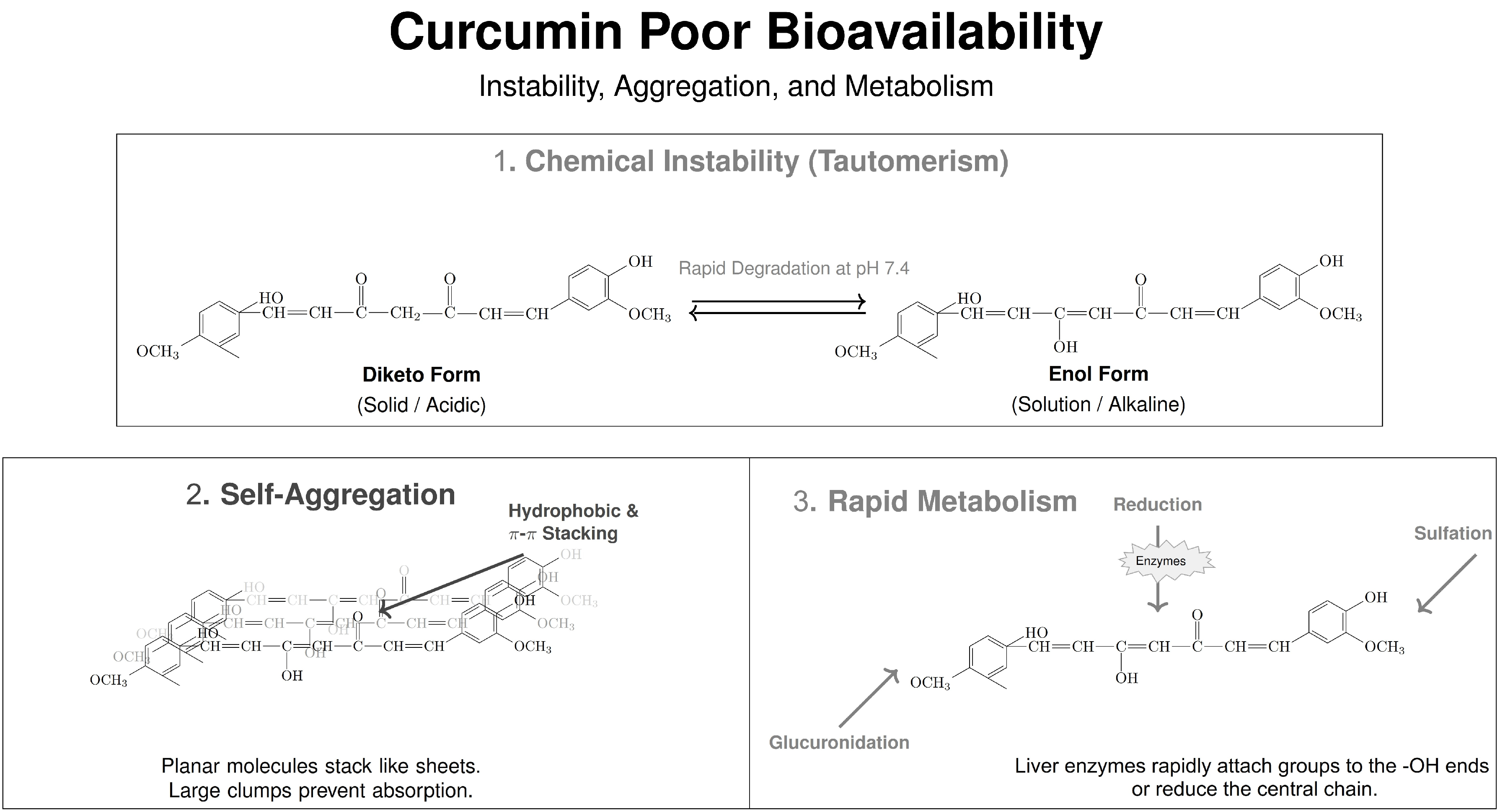
The presence of the polyphenolic backbone forms the basis for the characteristic yellow-orange pigmentation of turmeric, and it is also a contributing factor to the strongly pronounced biological activity of the compound [6]. In bioavailability challenges linked to chemical structure, as depicted in Figure 2(1–3), the poor therapeutic efficacy of native curcumin is directly linked to three specific structural characteristics: aggregation, tautomerism, and susceptibility. Curcumin exists as a tautomeric compound that affects its biological activity. Curcumin has two forms: di-keto (KK) and enol-keto (EK). These forms affect the stability of curcumin in different solutions and in water. The addition of water leads to di-keto tautomerism, and enol-keto tautomers are stable in organic solvents like acetone, alcohol, and acetonitriles. This is highly dependent on pH. At 7.4 pH, the equilibrium of tautomers moves towards the EK form, which can be easily hydrolyzed or susceptible to oxidative degradation; this is why most of the amount of the specific dose degrades before reaching the specific target site or tissue [30].
Curcumin is hydrophobic in nature due to the presence of aromatic rings in its structure. Its solubility is different under different pH conditions. In acidic environments or at a neutral pH, curcumin has low solubility in water (hydroxyl group is protonated) while curcumin is hydrophilic in nature under alkaline conditions (hydroxyl group becomes deprotonated). Due to its hydrophobic nature, multiple molecules join together and become aggregated. This aggregation causes the low solubility of curcumin in water, approximately 11 ng/mL, and deposits it in the gastrointestinal tract prior to absorption [9]. The main reason for the low bioavailability of curcumin is its faster metabolism by the metabolic enzymes present inside the gut and its conversion into various metabolites in the liver and intestine with the help of phenol sulfotransferase and glucuronidase iso-enzymes that convert curcumin into curcumin sulfates and curcumin glucuronides. These metabolites are soluble in water and, due to their water-loving nature, they can be easily excreted from the body through urine and feces [9].
The use of curcumin as a functional food ingredient is limited by a series of severe physicochemical and biopharmaceutical constraints. One of the most critical issues is its very low water solubility. Curcumin is a hydrophobic and lipophilic polyphenol, and its solubility in aqueous systems, particularly at the acidic-to-neutral pH that is typical of most foods, is extremely limited. Consequently, attempting to disperse free curcumin in water-based beverages such as milk results in immediate precipitation and sedimentation [31].
A second major obstacle is its pronounced chemical instability. Curcumin is highly susceptible to degradation during food processing and storage, and factors such as light, heat, oxygen, and especially pH accelerate its breakdown. Although it remains relatively stable under acidic conditions (pH < 7), it undergoes rapid hydrolytic degradation at a neutral or alkaline pH. Milk, with a natural pH of around 6.7, therefore constitutes a chemically hostile environment for unencapsulated curcumin. For this reason, nanoencapsulation becomes not only a strategy to improve bioavailability but a prerequisite for ensuring curcumin stability within dairy matrices, even before considering processing or storage conditions [32,33,34,35].
Even when solubilized and stabilized, curcumin shows extremely poor oral bioavailability. This limitation arises from several interconnected factors: its low bioaccessibility, which restricts dissolution in gastrointestinal fluids and reduces incorporation into the mixed micelles that is necessary for absorption; its extensive metabolism, since curcumin undergoes rapid intestinal and hepatic biotransformation—such as glucuronidation and sulfation—yielding metabolites with lower biological activity that are swiftly excreted; and finally, its rapid systemic elimination, as any fraction that does reach the bloodstream is quickly cleared from circulation [36,37].
Clinical studies consistently confirm these constraints. Even high daily oral doses of unformulated curcumin—for example, 3.6 g—result in plasma concentrations of around 11 nmol/L. This inability to achieve therapeutic levels in vivo has become one of the main scientific and economic motivations driving the development of advanced nano-delivery systems that are designed to enhance curcumin’s solubility, stability, and absorption [38,39,40].

3. Nanoemulsion Systems: A Delivery Solution

3.1. Fundamentals of O/W Nanoemulsions

To overcome the challenges associated with curcumin fortification, oil-in-water (O/W) nanoemulsions have emerged as one of the most effective delivery systems. These are kinetically stable, non-equilibrium colloidal dispersions composed of small oil droplets—typically <200 nm, and often in the 20–100 nm range—dispersed within an aqueous phase such as a beverage [41,42,43].
Nanoemulsions act as highly effective carriers for lipophilic bioactive compounds—such as curcumin, carotenoids, and vitamins A, D, and E—in water-based food products [1,41]. Their advantages derive from several complementary functional properties. First, the oil core provides a high solubilization capacity, allowing for substantial amounts of hydrophobic bioactives to be dissolved and retained within the droplets. In addition, the emulsifier shell and oil phase form a protective barrier around the encapsulated compound, shielding it from degradation caused by pH, light, oxygen, and other environmental stressors [44,45]. Another key benefit is the enhancement of bioavailability: the very small droplet size creates a large interfacial area for lipolysis in the small intestine, thereby improving bioaccessibility and subsequent absorption [10,46]. Finally, nanoemulsions offer favorable optical and textural attributes; because their droplets are smaller than the wavelength of visible light, they form transparent or slightly opalescent systems—an important advantage for beverages—while having a minimal impact on viscosity at low concentrations [47].

3.2. Formulation Components

The formation of a stable nanoemulsion depends on three key components: the oil phase, the aqueous phase that constitutes the beverage itself, and, most importantly, the stabilizers. The oil phase acts as the solvent for curcumin, and its selection is crucial because it determines both the loading capacity of the nanoemulsion and its behavior during digestion, thereby influencing bioavailability. For this reason, food-grade oils with good oxidative stability and rapid digestibility—such as medium-chain triglycerides (MCTs) or long-chain triglycerides (LCTs) like soybean, corn, and sunflower oil are typically preferred [48,49,50].
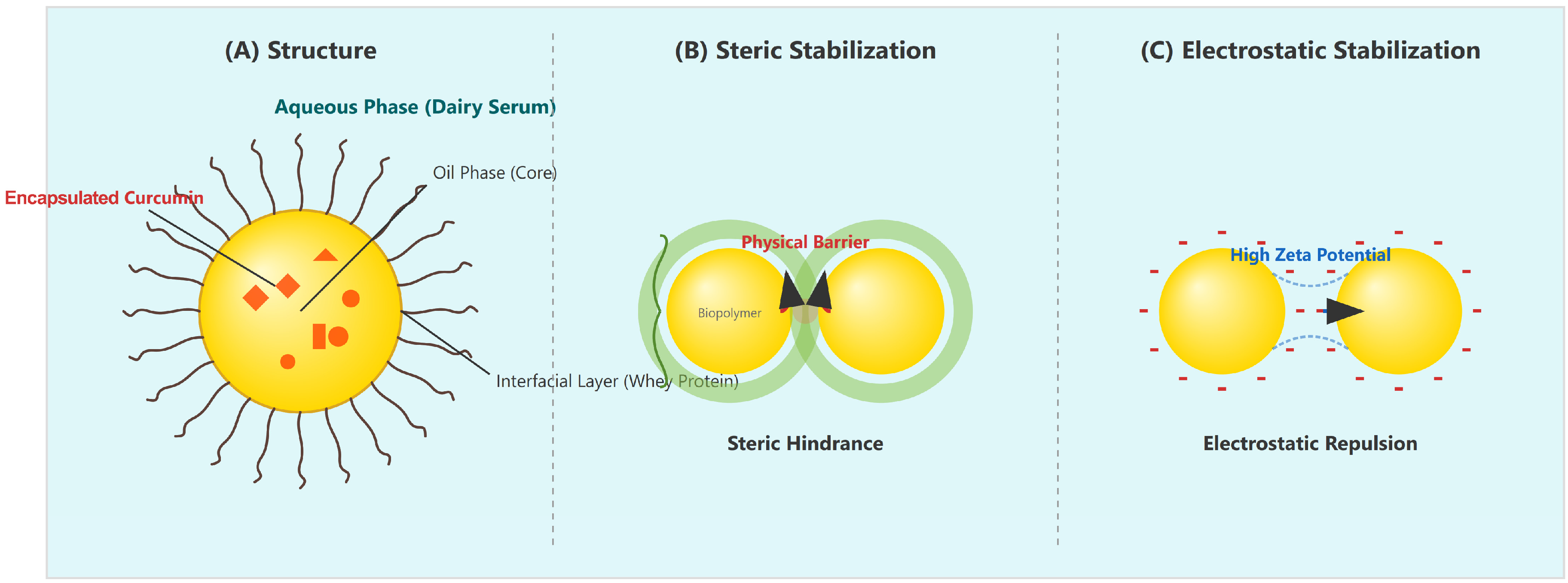
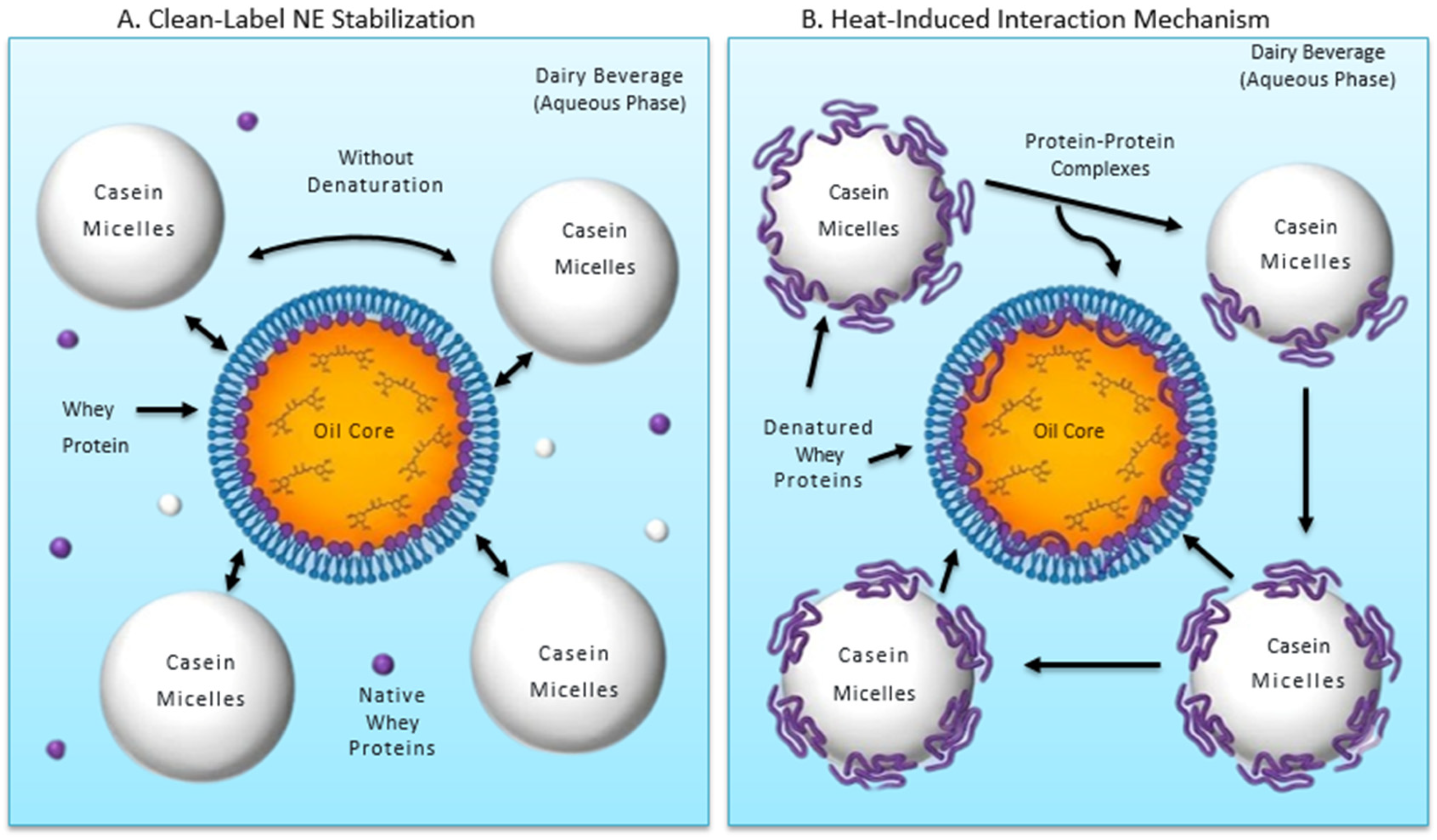
In the oil phase, curcumin-loaded nanoemulsions establish a protective shell along with the lipid, where the water-repelling curcumin will solubilize to protect its hydrolytic degradation in water. To reduce the chance of mixing two phases (O/W phase) and keep the system more stable, different types of stabilizers like proteins and polysaccharides are used, located on the oil and water interface. Two mechanisms are involved in the stabilization of curcumin-loaded nanoemulsions against the merging of elements or flocs. Steric stabilization is a process in which biopolymers make a thick hydrated cover around the droplets of oil to prevent them from joining with other droplets. This mechanism is also useful in dairy, especially in the condition where isolates of whey protein and polysaccharides are used as a clean label. These molecules became absorbed into the oil/water interface and are stuck in the continuous phase by producing a coarse barrier. This type of steric hindrance stops the connection of oil droplets and makes the nanoemulsion more stable, even when the zeta potential is low. Electrostatic repulsion is a process in which the stabilizer obtains a negative charge and the tiny drops repel each other, which keeps them scattered in the beverage matrix. This mechanism focuses on the electrical charge present on the drop, which is assessed as zeta potential. The high value of the zeta potential produces higher repulsion and prevents aggregation by reducing the availability of energy to the aggregate. These mechanisms are essential in the storage of dairy beverages to preserve them in their homogenous state. This stability is based on the type of layer that is formed around the oil drops. The oil core acts as a pool for the lipid-loving curcumin and provides protection against chemical degradation, which can occur as a result of its reaction with water. The use of the stabilizer and fabrication methods have greatly affected these characteristics, while in the high-energy homogenization method, droplets of a much smaller size and very low PDI are preferred for use for lowering the rate of gravitational separation [51,52]. The stability of curcumin-loaded nanoemulsions within the complex colloidal environment of a dairy beverage is governed by the nature of the interfacial layer surrounding the oil droplets, as presented in Figure 3. The oil core acts as a reservoir for the lipophilic curcumin, protecting it from the chemical degradation caused by the interaction with the aqueous phase.
Equally important are the stabilizers, or emulsifiers: amphiphilic molecules that adsorb at the oil–water interface, reducing interfacial tension and forming a protective layer that prevents droplet aggregation through flocculation or coalescence. Their selection requires balancing high colloidal performance with regulatory and market considerations (Table 1). Synthetic small-molecule surfactants such as polysorbates (Tween 80 and Tween 20) remain the most effective in producing very small, uniform, and stable droplets [53,54]. Natural small-molecule alternatives, including phospholipids from soy or egg lecithin and saponins such as Quillaja saponin, offer good emulsifying properties while meeting the growing consumer demand for “natural” ingredients [43,55]. Biopolymers, such as proteins and polysaccharides, provide another class of natural emulsifiers; these form thick, viscoelastic interfacial layers that contribute strong steric stabilization and align well with clean-label formulation trends [56].
In dairy applications, the use of dairy proteins as stabilizers represents a particularly synergistic and commercially attractive strategy. Whey protein isolate (WPI) and caseins (or sodium caseinate) are both high-performance natural emulsifiers and intrinsic components of milk. Incorporating WPI-stabilized nanoemulsions into dairy systems allows for excellent physicochemical compatibility, reduces reliance on synthetic additives, and simplifies the final ingredient label, ultimately aligning functional performance with consumer expectations [57,58,59].

3.3. Preparation Methods (High and Low Energy)

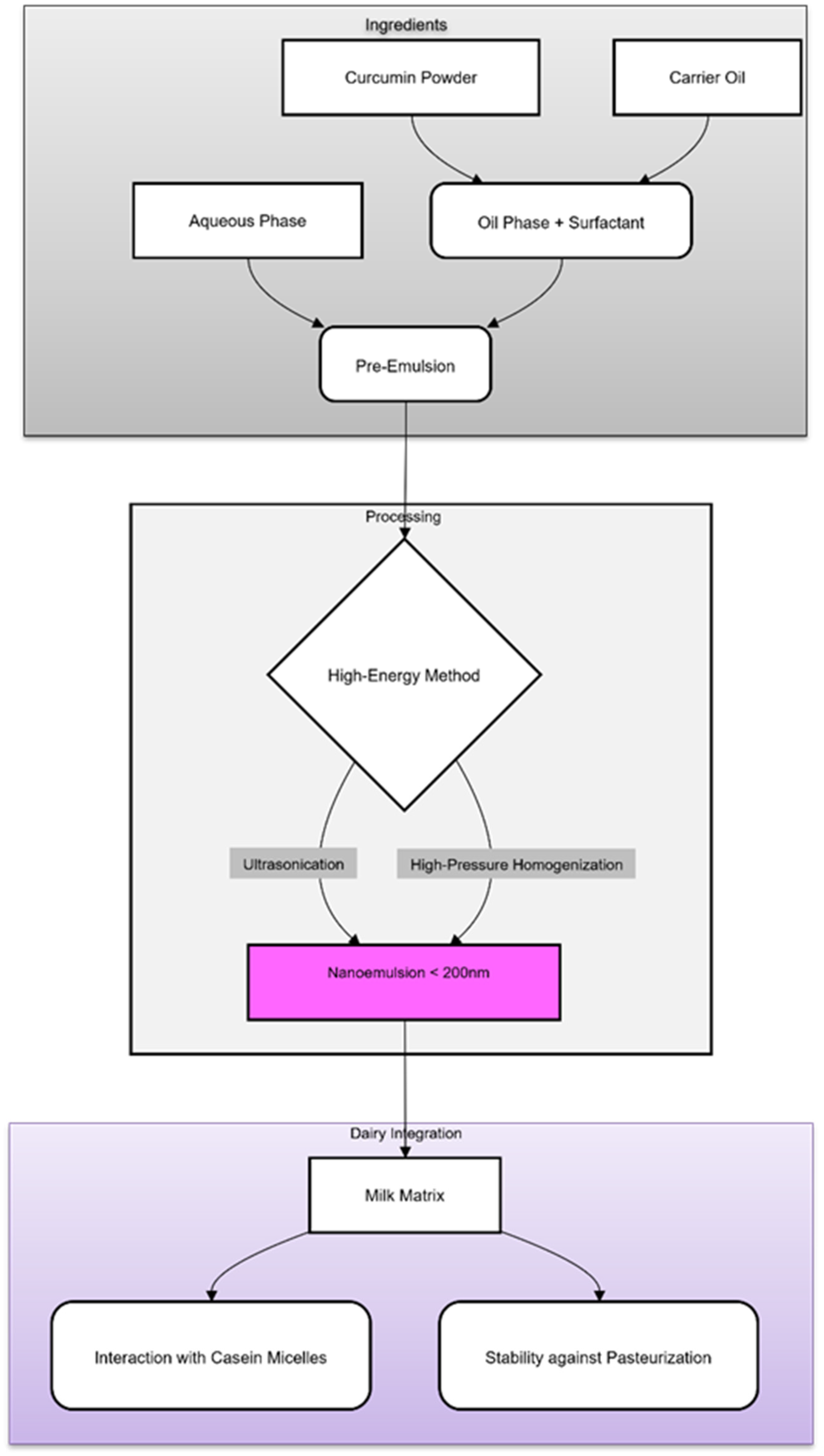
The production of nanoemulsions is the breakdown to nanoscale droplets of large oil and water droplets. A general flowchart for the production and application of curcumin nanoemulsions is presented in Figure 4.
High-energy techniques rely on the application of intense mechanical forces to break oil droplets down to nanoscale dimensions. Among these, high-pressure homogenization (HPH) and microfluidization are the most widely used industrial approaches. In both cases, a coarse emulsion is forced at very high pressures—typically between 50 and 200 MPa—through a narrow valve in the case of HPH, or through microchannels in the case of microfluidization. The combination of extreme shear, turbulence, and cavitation leads to the efficient disruption of droplets. Because HPH is already a standard operation in the dairy sector—for example, in milk homogenization—it offers excellent scalability and is commercially attractive for nanoemulsion production [60,61,62,63]. The cavitation process, which involves spontaneous growth and bursts of microbubbles at an intense speed, contributes significantly to the efficiency of high-energy systems. This mechanism provides the energy needed to overcome the intra- and intermolecular hydrogen forces present in the crystalline structure of curcumin that interferes with its solubility in water [17]. The breakdown of the oil phases into nano-scale droplets by agitation helps to increase the surface area of the particles. Without this process, the bioaccessibility and bioavailability of curcumin in the gut will be hugely affected [22].
Ultrasonication represents another high-energy method, in which a sonotrode transmits high-intensity acoustic waves (above 20 kHz) into a coarse emulsion. These waves generate acoustic cavitation, involving the nucleation, growth, and collapse of microbubbles, which in turn produces localized extreme shear forces that can fragment oil droplets [64]. Although ultrasonication is highly effective at laboratory scale, its industrial-scale application is more difficult. Interestingly, comparative studies have shown that ultrasonication can produce smaller droplets and higher encapsulation efficiencies—for instance, around 90% for curcumin—compared with microfluidization, which typically yields values closer to 75% [65].
In contrast, low-energy methods avoid mechanical disruption and instead exploit the spontaneous self-assembly of formulation components triggered by compositional or thermal shifts. One example is the phase inversion temperature (PIT) method, which is typically used with non-ionic surfactants such as Tweens, whose solubility varies with temperature. When an oil-in-water emulsion is heated, the increased lipophilicity of the surfactant can induce a transition to a water-in-oil system. Rapid cooling reverses this inversion and effectively traps the oil phase within very small droplets, usually between 20 and 100 nm [66,67,68]. Another low-energy technique is spontaneous emulsification, in which an organic phase, comprising oil, surfactant, and often a water-miscible solvent such as ethanol, is slowly added to an aqueous phase. As the solvent diffuses into the water, nanodroplets form spontaneously at the interface without the need for external mechanical input [69,70]. In low-energy systems, the physicochemical properties of curcumin are substantially enhanced because the molecules can undergo spontaneous rearrangement to overcome any inherent limitations [17,71]. By using the phase inversion temperature (PIT) and spontaneous emulsification methods, the apparent encapsulation of curcumin can be achieved, which has brought a notable increase in chemical stability and water dispersibility of curcumin under acidic conditions (pH < 7) [17,72]. Studies suggest that encapsulating curcumin can help to maintain its initial potency by 85% over a period of storage of a month. This can help us to overcome the challenge of rapid crystallization under acidic conditions [72]. On the other hand, high-energy methods offer robustness and excellent scalability but demand significant energy and may expose heat-sensitive compounds to degradation. Low-energy approaches, while more economical and less intensive, are highly dependent on formulation composition and frequently present challenges when translated to the industrial scale [73].
Gelling agents like Carbopol 934 can be integrated with nanoemulsions to form nanoemulgels, which have a better formulation. This model has been used in a comparative study with traditional treatments like betamethasone-17-valerate gel in a psoriatic mouse to investigate their outcome in wound healing [66]. The concept of nanoemulgels is used in the dairy industry to fortify milk with the aim of improving its antioxidant capacity and to reduce changes in color through degradation. This helps to produce quality fortified milk with higher physicochemical properties compared with unfortified milk [74].

4. Characterization of Curcumin-Loaded Nanoemulsions

After fabrication, nanoemulsions must be carefully characterized to ensure that they meet the required quality and stability standards. One of the most important sets of parameters pertains to particle size and the polydispersity index (PDI), both of which are typically measured using dynamic light scattering (DLS). The average particle diameter (Dz) is a critical performance indicator, with optimal formulations generally aiming for values below 200 nm. The PDI provides information on the width of the size distribution; values lower than 0.3 indicate a uniform, monodisperse droplet population, a feature that is essential for long-term stability and resistance to destabilization processes such as Ostwald ripening [75,76,77]. PDI changes due to the change in concentration of the stabilizer, preparation method (Table 2), storage conditions, etc. A PDI value near 0 makes explicit a more homogenized solution, while a value near 1.0 indicates a larger size distribution. Over time, the pH of the solution can affect the PDI value and particle size. Storage for a longer period can increase the particle size as well as the PDI, due to the combination of smaller droplets with larger ones. The PDI value indicates the stability of the solution [22].
Another fundamental parameter is the zeta potential (ZP), which is also measured by DLS and reflects the net surface charge of the droplets. In systems stabilized primarily through electrostatic mechanisms—such as those formulated with lecithin—high absolute zeta potential values (typically greater than 30 mV) generate strong repulsive forces that inhibit flocculation. In contrast, nanoemulsions stabilized with biopolymers like whey protein isolate (WPI) rely mainly on steric hindrance, created by thick interfacial protein layers. These formulations can remain stable even at much lower zeta potentials, including values close to the protein’s isoelectric point [78,79].
ZP is highly affected by heat, pH, and ionic strength. Due to the increase in temperature during boiling, the average size of particles increases gradually due to aggregation and during pasteurization, the average size of the particle undergoes slight changes. ZP changes because the magnitude of charge decreases due to the increase in temperature. pH also impacts the modulation of particle size and zeta potential. At pH 3.0–7.0, ZP is observed and a significant change is observed: particles obtain a positive charge at pH 3.0, compared to pH 7.0. The growth and aggregation of nano-emulsion particles occur at lower or higher pH values. At a lower pH, the electrical charge of particles reduces and lowers the electrostatic repulsion among the particles, which can lead to aggregation. An increased pH causes a negative charge in molecules. Zeta potential is also affected by ions (salt) in the gastrointestinal tract. Salt reduces the functional efficiency of the colloidal delivery system. It reduces the ZP to zero due to the decrease in electrostatic repulsion among nanoemulsion particles by adding salt, and the charge in the molecule is also reduced. Adding salt impairs stabilization and causes the aggregation of molecules [80].
Encapsulation efficiency (EE) is another key indicator of nanoemulsion performance, quantifying the proportion of bioactive compound that is successfully entrapped within the dispersed phase. EE is typically determined by separating the nanoemulsion droplets from the surrounding aqueous medium—often by centrifugation—and measuring the curcumin content in each fraction. Well-designed curcumin-loaded nanoemulsions commonly achieve efficiencies exceeding 90%, reflecting their strong capacity for solubilization and retention of hydrophobic compounds [81,82,83].
Table 2. Comparison of high and low fabrication of curcumin nanoemulsions.
MethodPrinciple of Droplet
Disruption
Typical
Particle Size
AdvantagesDisadvantagesReferences
High-Pressure Homogenization (HPH)/Micro-fluidizationIntense shear, turbulence, and cavitation from forcing emulsion through a narrow valve or micro-channels.<150 nm, monodisperseHighly scalable, industry standard (especially in dairy), reproducible, produces small/uniform droplets.Higher financial and energy cost, can generate significant heat, potential for over-processing.[60,61]
UltrasonicationAcoustic cavitation: high-intensity sound waves create and collapse micro-bubbles, generating localized shear forces.50–200 nmConvenient for lab-scale, high encapsulation efficiency. Can produce very small droplets.Scalability is challenging. Potential for probe contamination, risk of over-processing.[64,65]
Phase Inversion Temperature (PIT)Change in surfactant solubility and curvature with temperature, leading to spontaneous self-assembly upon cooling.20–100 nmLow energy, sophisticated (no mechanical stress), can produce extremely small droplets.Requires non-ionic, temperature-sensitive surfactants; formulation is highly specific; sensitive to temperature control.[66,67]
Spontaneous Emulsification (SE)Spontaneous self-assembly as a water-miscible solvent (e.g., ethanol) containing oil and surfactant diffuses into the aqueous phase.100–300 nmSimplest method, no energy input required.Often produces larger, more polydisperse droplets; requires a (potentially undesirable) organic solvent; limited by surfactant/oil-specific thermodynamics. [69,70]
Protein-Stabilized NanoemulsificationProteins such as whey protein form viscoelastic films at the oil–water interface, offering essential steric and electrostatic stabilization while enhancing bioaccessibility.~80–200 nmNatural, food-grade; good steric and electrostatic stabilization; improved bioaccessibility.Sensitive to pH, ionic strength, and heat.[22,84]
Polysaccharide Stabilized NanoemulsificationPolysaccharides (e.g., pectin, xanthan gum, alginate, Tremella polysaccharides) enhance continuous-phase viscosity while limiting droplet movement and coalescence through steric hindrance and electrostatic repulsion.~100–300 nmClean-label; food-grade; improves physical stability; inhibits droplet aggregation; enhances storage stability.Weak interfacial activity alone; often requires combination with proteins or surfactants to form strong interfacial films.[85,86]
Layer-by-Layer (LbL) Multilayer AssemblySequential deposition of oppositely charged proteins and polysaccharides around droplets forming multilayer interfacial films.~100–250 nmExcellent stability across pH and ionic strength; controlled/sustained release.Multistep process; higher formulation complexity.[87,88]
Pickering Nanoemulsions (Biopolymer Particles)Solid biopolymer particles form a steric barrier at the oil–water interface, effectively preventing coalescence and enhancing emulsion stability.~150–400 nmExceptional physical stability; reduced need for molecular surfactants.Larger particle size required; limited food-grade particle options; many particles need surface modification.[89,90]
Protein–Polysaccharide Complex Coacervation (Bulk Complexation)Electrostatic complexation of oppositely charged proteins and polysaccharides forms a powerful protective layer at the interface.100–250 nmImproved physical and oxidative stability; enhanced encapsulation efficiency; controlled release.Highly pH- and ionic-strength dependent; formulation optimization required.[91,92,93]

5. Application for Dairy Beverages

5.1. The Dairy Matrix: A Complex Colloid

Fortifying dairy products does not simply mean adding a new ingredient; it entails introducing an additional colloidal dispersion into an already delicate, highly structured and polydisperse system. Milk is itself a complex biological fluid comprising an emulsion of native fat globules (in the case of whole milk), a colloidal dispersion of casein micelles, and an aqueous phase. The casein micelles are supramolecular aggregates of α-, β-, and κ-caseins associated with colloidal calcium phosphate. The aqueous phase contains soluble whey proteins, lactose, and dissolved minerals. Any nanoemulsion added to this intricate matrix must be fully compatible with these native components to prevent destabilization and preserve the physicochemical integrity of the final dairy product.

5.2. Interactions with Milk Components

The interactions between the introduced curcumin-loaded nanoemulsion droplets and the endogenous milk proteins play a crucial role in determining the stability and functionality of the final product. Casein micelles, the predominant protein structures in milk, have a well-known affinity for hydrophobic compounds. Fluorescence spectroscopy studies have demonstrated that curcumin is associated with casein micelles primarily through nonspecific hydrophobic interactions (Figure 5). This association is dynamic, rather than static, and its strength can be modulated to enhance binding and improve overall system stability.
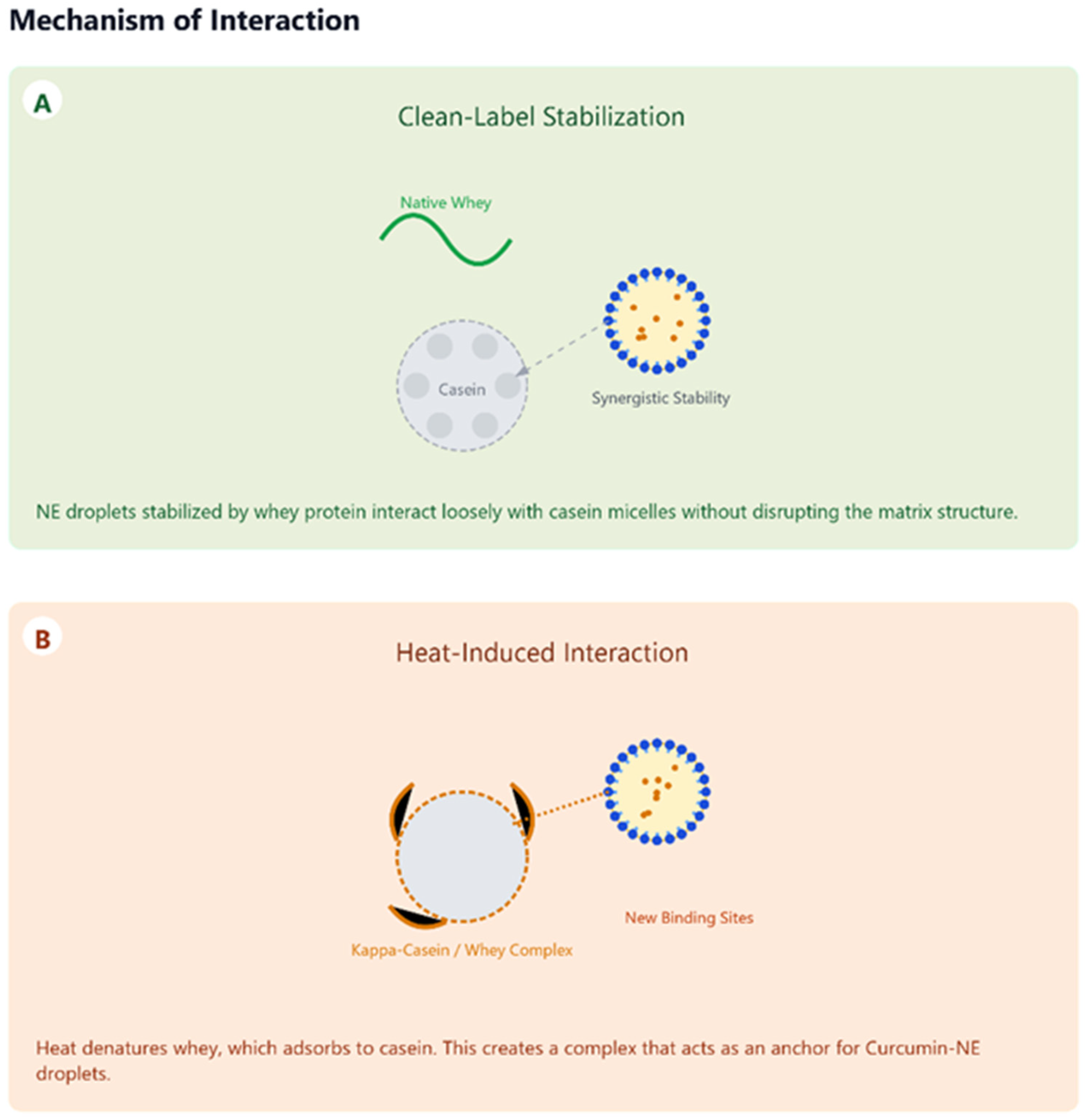
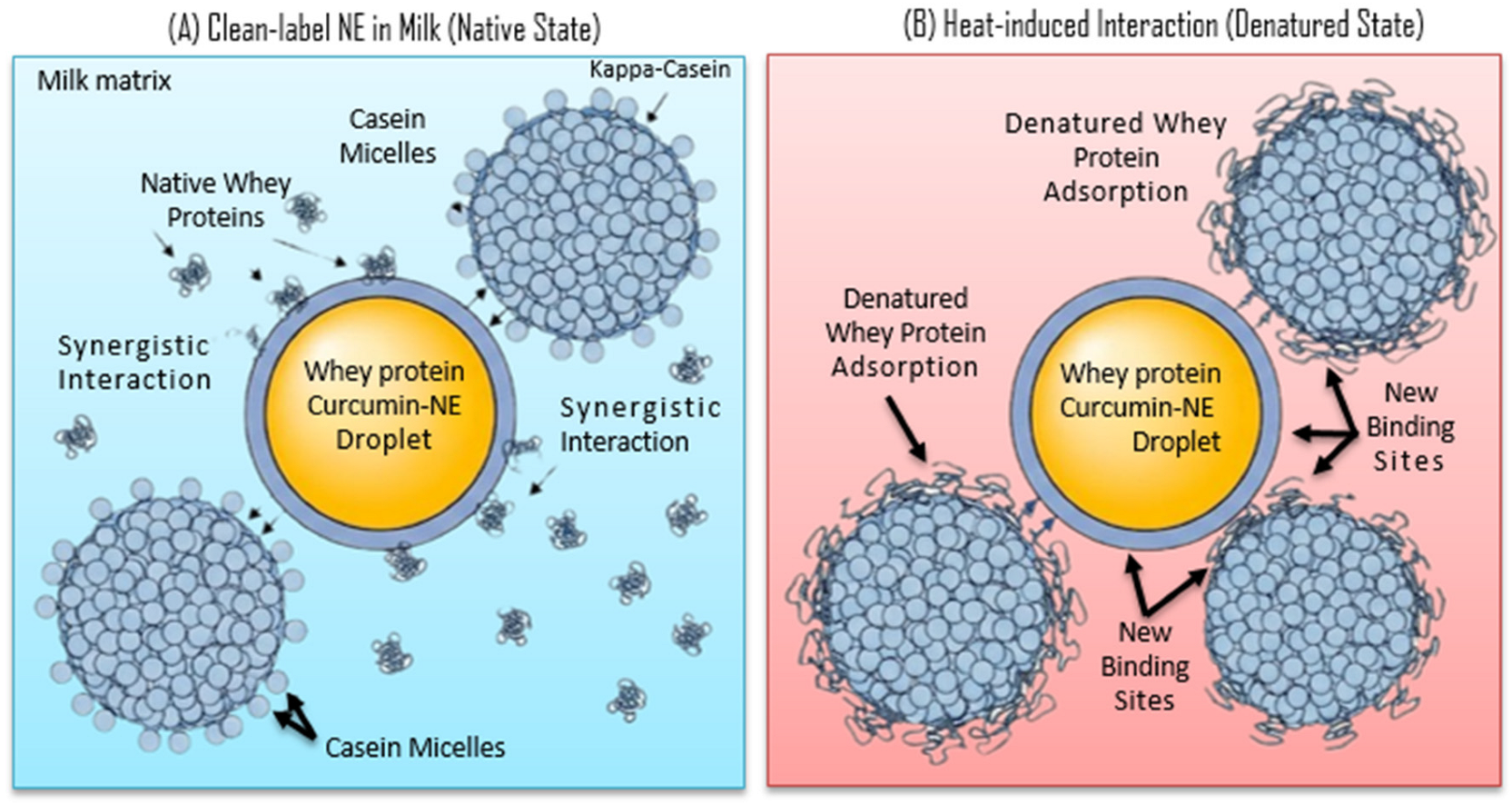
Importantly, heating milk, for example, for 10 min at 80 °C, has been shown to increase the binding capacity of casein micelles for curcumin. This enhancement does not arise from a direct thermal effect on the micelles themselves, but rather from a cascade of heat-induced structural transformations within the milk matrix. The process begins with the denaturation of whey proteins [14,94,95]. Upon unfolding, denatured whey proteins, most notably β-lactoglobulin, adsorb onto the surface of casein micelles, thereby creating additional, nonspecific binding sites that enhance micellar interactions with curcumin, including curcumin-loaded nanoemulsion droplets. Through this sequence of thermally induced events, what would normally be considered an uncontrolled processing variable becomes a deliberate and useful design parameter, enabling improved curcumin retention and enhancing the overall stability of the fortified system (Figure 6) [13,96].
This structural alteration enables technicians to strategically apply thermal processing to immobilize the nano-additive within the milk protein matrix, thereby reducing the likelihood of phase separation. Although the general interaction mechanism is well-established, the precise location of curcumin binding, whether on the micelle surface or within its porous interior, remains an open area of investigation [5].
Moreover, as previously discussed, whey protein isolate (WPI) is an effective natural emulsifier and is considered a preferred “clean label” stabilizer for curcumin nanoemulsions. When a WPI-stabilized nanoemulsion is incorporated into milk, it shows intrinsic compatibility with the native soluble whey protein fraction. This compositional harmony reduces the risk of depletion flocculation and other destabilizing interactions that are more likely to occur with synthetic surfactants [95,97].

6. Case Studies in Dairy Fortification

The literature reports some of the most important case studies that examine the fortification of dairy products.

6.1. Fluid Milk

The primary challenge in fortifying fluid milk with curcumin is its near-neutral pH, which makes encapsulation essential for maintaining curcumin stability within the dairy matrix. Studies [13] on reconstituted skim milk powder (SMP) show that the type of milk powder, defined by its pre-heat treatment level (low-, medium-, or high-heat), has a substantial impact on the digestive behavior of the fortified product.

6.2. Fermented Beverages (Yogurt)

In fermented beverages such as yogurt, the acidic environment (pH 3.0–4.5) inherently improves curcumin stability. However, the key determinant of performance in these systems is the structure of the acid gel [35]. As demonstrated [98], the release of bioactives from acid gels (e.g., yogurt) differs fundamentally from their release from rennet gels (e.g., cheese) during digestion [98].

6.3. Cheese

Curcumin-loaded nanoemulsions (CUNE) have been successfully incorporated into milk for producing soft cheeses and Mexican Manchego–style sheep’s milk cheese. These studies are valuable because they provide insights into the sensory attributes and shelf-life performance of fortified cheeses [99,100].

7. Sensory Impact and Consumer Acceptance

The intense sensory profile of curcumin presents a significant challenge for dairy fortification. In its unencapsulated form, curcumin imparts a strong yellow-orange color and a pungent, sometimes bitter flavor—characteristics that are generally considered undesirable in products such as milk or cheese. For this reason, it would be reasonable to assume that adding curcumin would negatively affect the sensory quality of the final product. Surprisingly, however, several studies investigating cheese fortification have reported outcomes that contradict this expectation. In soft cheese, for instance, the incorporation of curcumin-loaded nanoemulsions led to marked improvements in organoleptic attributes—appearance, flavor, and aroma—with sensory evaluation scores increasing by approximately 150% compared to the control [99]. Similarly, in Manchego-style sheep’s milk cheese, the addition of curcumin nanoemulsions did not compromise consumer acceptability, including flavor and texture [100].
These results point to a dual underlying mechanism. Beyond masking or mitigating curcumin’s inherent sensory intensity, nanoemulsions also confer functional benefits to the cheese matrix. Products fortified with curcumin nanoemulsions exhibit enhanced antioxidant and antimicrobial activity, as well as improved shelf life, when compared with their non-fortified counterparts [40,101]. By slowing lipid oxidation and microbial deterioration—two major contributors to off-flavors, aroma defects, and textural spoilage—nano-encapsulated curcumin effectively preserves freshness. As a result, sensory panelists are not merely evaluating the influence of curcumin itself, but also the advantages of a product that has undergone less quality degradation during storage.
These observations further suggest that curcumin nanoemulsions could partially offset their own cost by acting as natural preservatives while simultaneously improving the product quality. Sensory analyses in these studies are typically carried out by trained panelists and are increasingly complemented by instrumental methods such as electronic noses (E-nose), electronic tongues (E-tongue), and electronic eyes (E-eye), which offer reproducible and objective assessments of aroma, flavor, and color attributes.

8. Functional Performance: Stability and Bioavailability

8.1. Physicochemical Stability

Once curcumin-loaded nanoemulsions (NEs) are incorporated into the dairy matrix, they must remain stable throughout processing and storage. Although nanoemulsions are kinetically stable, they are thermodynamically unstable and therefore susceptible to several destabilization mechanisms, including gravitational separation, flocculation, and coalescence. Gravitational separation encompasses creaming (upward movement of droplets) and sedimentation (downward movement); however, because nano-sized droplets undergo intense Brownian motion, gravitational forces are generally insufficient to induce significant creaming [102]. Flocculation may occur when droplets interact with milk components such as proteins or minerals, compromising the stability of the dispersion (Figure 7) [103]. Coalescence, on the other hand, involves the irreversible merging of droplets into larger ones and is typically triggered by the failure or disruption of the interfacial emulsifier layer [104,105]. The stability of fortified dairy products is commonly evaluated by using optical scanning techniques (e.g., Turbiscan), which monitor changes in backscattering profiles to detect early signs of creaming, sedimentation, or flocculation without altering or destroying the sample.
The fortified product must be able to withstand industrial processing as well as normal storage conditions. Curcumin-loaded nanoemulsions (NEs) have shown strong stability under conventional dairy thermal treatments [22,106]. For example, NEs stabilized with texturized whey protein concentrate (WPC) remained intact during both pasteurization (63 °C for 30 min) and sterilization (95 °C for 10 min), and similar stability has been reported for systems formulated with WPC and Tween-80. Beyond thermal tolerance, pH and ionic stability are equally important to ensure functionality across diverse dairy matrices, ranging from acidic yogurt to neutral milk. NE formulations have demonstrated robustness over a wide pH range (pH 3–7) and at high ionic strengths (0.1–1 M NaCl), indicating a strong suitability for complex food systems [22,54]. The storage stability has also been confirmed: NEs stabilized with high-performance emulsifiers such as Tween-80 and lecithin, as well as WPC-stabilized NEs, maintained their integrity for at least one month under refrigeration (4 °C), performing better than at an ambient temperature (25 °C). Beyond ensuring the physical stability of the droplets, a fundamental function of nanoemulsions is protection of the curcumin molecule itself, which is highly sensitive and prone to degradation [53]. Encapsulation of hydrophobic curcumin in the oil core isolates it from the neutral-to-alkaline aqueous environment of milk and shields it from pro-oxidative stressors such as light, oxygen, and metal ions. By preserving its chemical integrity, nanoemulsion helps maintain curcumin’s antioxidant capacity and, consequently, its biological activity [107].

8.2. In Vitro Digestion and Bioaccessibility

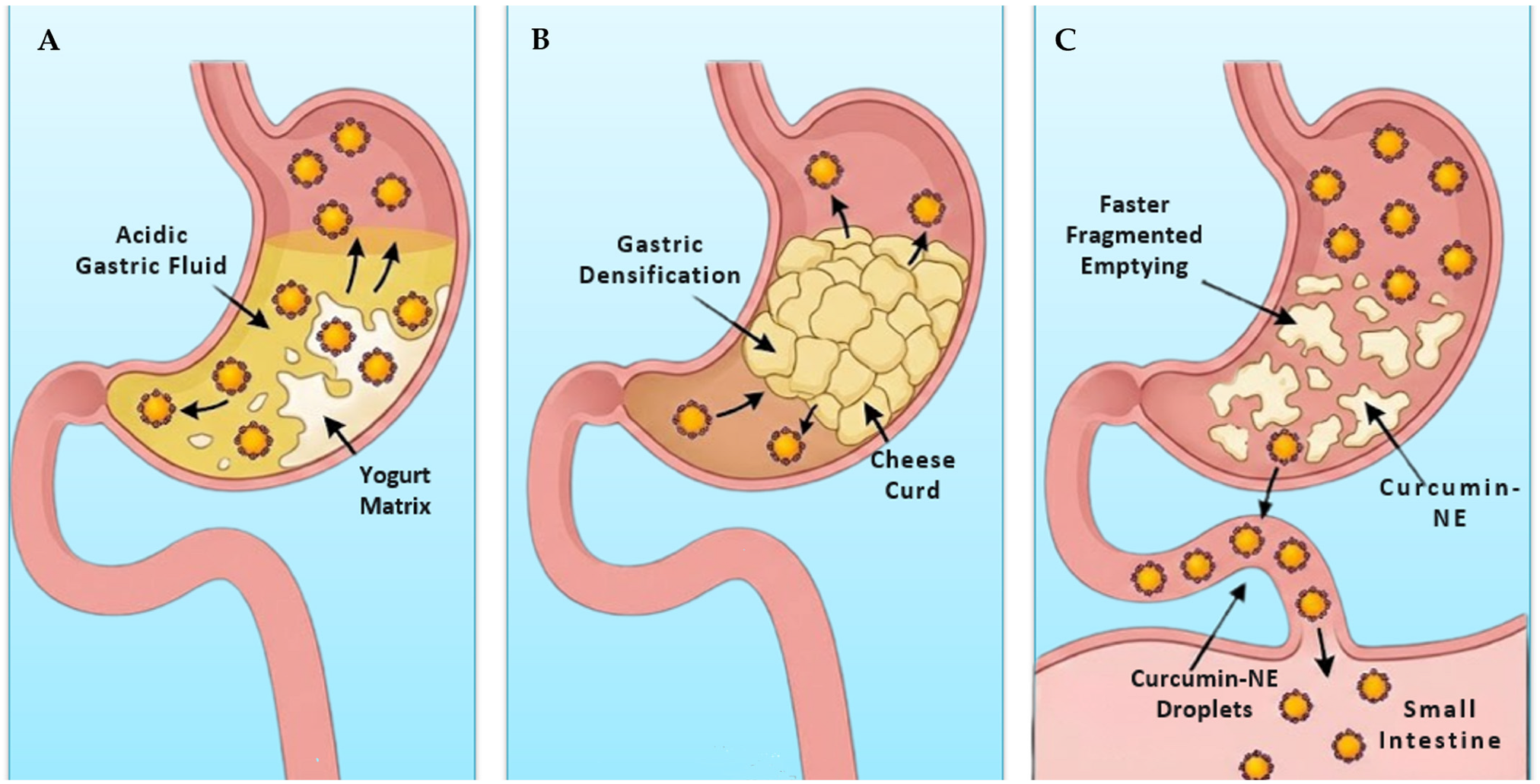
Among all the benefits provided by curcumin-loaded nanoemulsions (CU-NEs), the most critical functional outcome is their enhanced bioavailability. This is typically evaluated by using in vitro simulated gastrointestinal (GIT) digestion models that measure bioaccessibility, defined as the fraction of curcumin released from the food matrix and solubilized in mixed micelles in the small intestine, thereby becoming available for absorption (Figure 8) [108]. Laboratory studies often complement this analysis with transport assays using Caco-2 cell monolayers: a widely accepted model for assessing intestinal permeability. Findings in this field consistently highlight that the macrostructure of dairy foods is not merely a passive carrier; rather, it actively contributes to the delivery of bioactive compounds and plays a co-determining role in shaping their behavior during digestion and absorption [109,110].
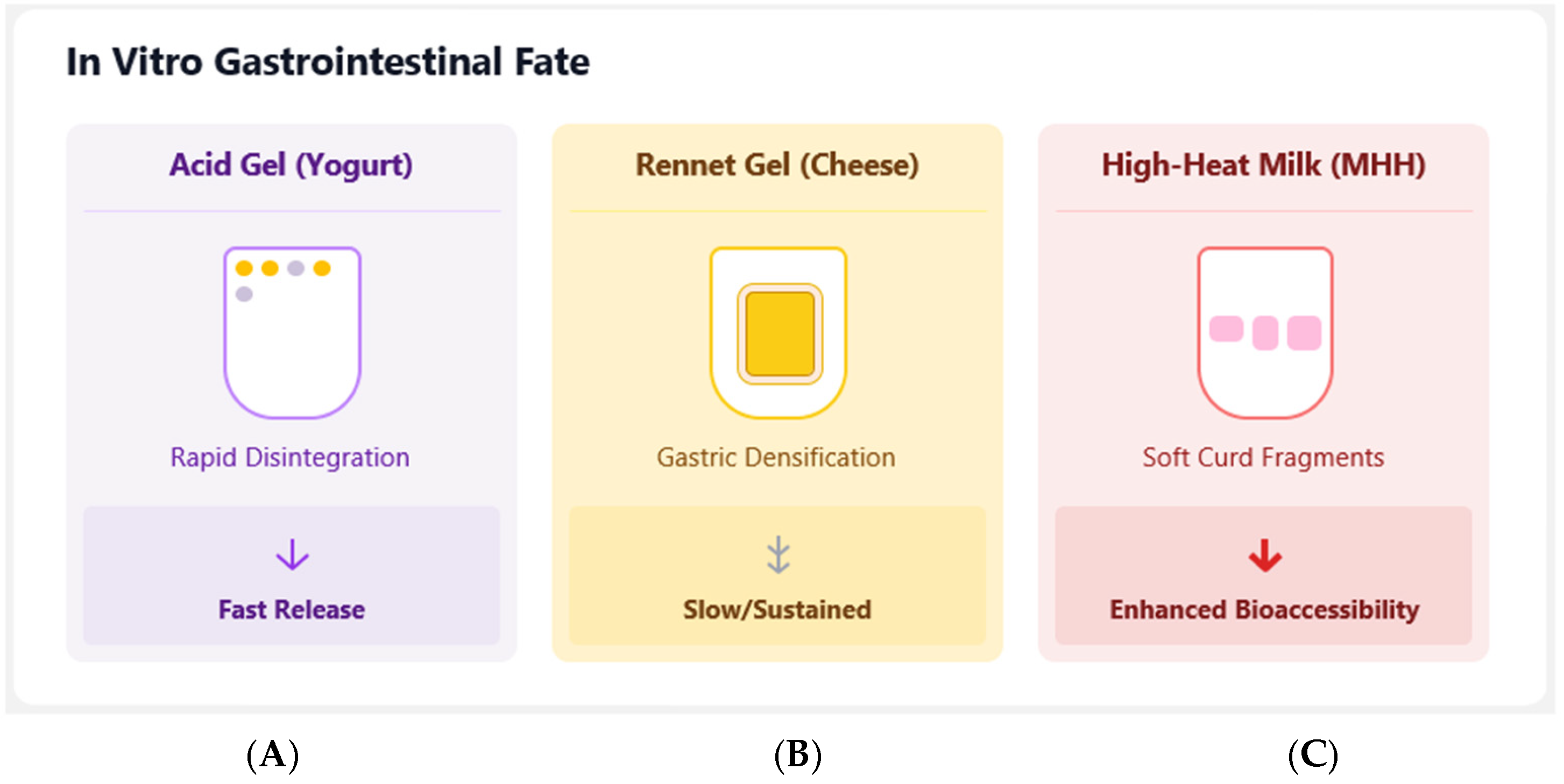
The thermal history of the milk determines the digestive behavior of the milk protein. A study comparing reconstituted skim milk powders (SMPs) found that milk made from high-heat-treated SMP (MHH) made a looser, more soft and fragmented curd in the simulated stomach, unlike the firmer curd seen with low-heat SMP (MLH). The heat-induced casein/whey protein complexes present in the MHH powder led to structural differences, resulting in a faster disintegration and gastric emptying of the curd and encapsulated curcumin-NE. Ultimately, it augmented the curcumin’s bioaccessibility in the intestinal phase (Figure 9) [111].
The type of dairy gel used (e.g., yogurt-, cheese-, or pudding-type gels) strongly influences the product’s stability and overall behavior, making formulation a key controlling factor. A comparative study evaluated the digestive fate of two distinct dairy gel structures: acid gels, which form a yogurt-like texture, and rennet gels, which resemble the denser structure of cheese. The results showed that acid gels underwent rapid protein disintegration under simulated gastric conditions, leading to a fast release of curcumin-loaded nanoemulsion. In contrast, rennet gels containing the nanoemulsion developed a more robust texture during digestion; when exposed to low pH and gastric enzymes, they restructured into an even denser protein network, which slowed the release of the entrapped nanoemulsion. This structural behavior resulted in a prolonged and sustained release profile. Although both gel types ultimately achieved high bioaccessibility (85–91%), their release kinetics differed markedly [112]. These results demonstrate a paradigm shift, indicating that the pharmacokinetic profile (i.e., rapid versus sustained release) of a nutraceutical can be modulated not only through nano-carrier engineering but also through the rational design of the food matrix macrostructure itself. Nonetheless, it can either be by processing (heat treatment) or through formulation (gel type).

8.3. In Vivo Bioavailability and Research Gaps

Despite the highly promising in vitro bioaccessibility results, in vivo confirmation remains the ultimate benchmark for validating efficacy [38]. As previously discussed in this manuscript, a well-known paradox exists: free curcumin performs poorly within the human digestive system, and even multi-gram oral doses typically yield only nanomolar plasma concentrations. In contrast, numerous animal studies (in rats and mice) have demonstrated that curcumin nanoemulsions, particularly those formulated with non-ionic surfactants, dramatically enhance the bioavailability of orally administered curcumin, resulting in substantially higher plasma concentrations compared with free curcumin suspensions [70,112,113]. However, a critical gap in the literature remains. At present, we have the following: (a) in vivo animal data on curcumin nanoemulsions; (b) in vitro digestion data for curcumin-NEs incorporated into dairy matrices; and (c) in vivo human data for free curcumin. What are conspicuously missing are in vivo human clinical trials evaluating the bioavailability of curcumin nanoemulsions when consumed within their final fortified dairy beverage matrix. Addressing this gap represents the essential next step required to fully validate this technological approach and to substantiate its translational potential.
With respect to digestion, curcumin nanoemulsions vary largely in terms of stability and performance; depending on the structure and the dairy product, it is incorporated. In the case of reconstituted fluid milk, the heat treatment history of the milk powder correlates directly with the outcome of the resulting curd in the stomach. The casein or whey complexes formed from high-heat skim milk powder (SMP) are generally soft, fragmented curds that have a higher bioaccessibility. Conversely, low-heat SMP produces relatively dense curds with a slower rate of gastric emptying compared to the curd of high-heat SMP. When curcumin is incorporated into gel-based food systems (e.g., yogurt or cheese), its bioaccessibility is consistently enhanced and is significantly correlated with release kinetics and gastric emptying. The yogurt gel-based system breaks down quickly for a quick release, while the cheese rennet gel undergoes changes in structure and density in the gastric environment, resulting in the entrapment of the nanoemulsions to slow down its release kinetics in a more consistent and gradual manner. These distinct behaviors, along with the processing stability of various dairy formulations, are summarized in Table 3.
Aside from the digestion, WPC-stabilized nanoemulsion in its extruded form offers a great choice as a stabilizer for maintaining the integrity and potency of curcumin during commercial processing. This process can stabilize nanoemulsions and guard them against degradation by high temperature treatment processes such as pasteurization and sterilization, as well as any possible alterations in ions and pH. In some applications, for instance, soft cheese production, these nanoemulsions play a vital role, through their natural antioxidant and antimicrobial properties, in improving the overall sensory characteristics and shelf-life of the product.

9. Technological Challenges and Future Perspectives

9.1. Industrial Scale-Up and Stability

Despite the promising laboratory-scale results, several major challenges remain before curcumin-loaded nanoemulsions can be produced at a commercial scale. Scaling up fabrication from a 100 mL beaker to a 10,000 L industrial system is a significant engineering hurdle. High-pressure homogenization (HPH) is currently the most suitable method, as both the equipment and processing parameters are already well-established within the dairy industry [10,42]. Another key issue concerns achieving long-term kinetic stability. Oil droplets with even minimal solubility in water are susceptible to Ostwald ripening—where molecules diffuse from smaller droplets and re-deposit onto larger ones—ultimately leading to an increase in the average particle size and potential loss of stability [43].
High-energy fabrication methods are also inherently energy-intensive, and the need for purified food-grade surfactants, oils, and bioactives further raises production costs. Moreover, synthetic surfactants such as polysorbates may impart undesirable “soapy” or “metallic” off flavors, which remain one of the major barriers to consumer acceptance of nanoemulsion-based functional dairy products [114].

9.2. Regulatory Landscape

The regulatory framework for nanofoods remains unclear, highly complex, and markedly inconsistent across major markets, creating a fragmented global landscape that poses a significant barrier to commercialization. A central issue is the definition of “nano,” as it is often unclear whether a food-grade nanoemulsion, typically composed of digestible ingredients and frequently exhibiting mean droplet sizes above 100 nm, should be classified as a “nanomaterial,” a designation that triggers substantially higher regulatory scrutiny [115]. In the European Union, the European Food Safety Authority adopts a precautionary stance, requiring extensive physicochemical characterization (e.g., particle size distribution via DLS and microscopy) and a tiered toxicological testing framework for any material considered nanoscale, with nano-fortified foods likely falling under the novel food category and thus facing a multi-year, high-cost authorization process [116]. In contrast, the U.S. Food and Drug Administration follows a product-focused, rather than technology-based, regulatory paradigm; it does not impose specific rules or labeling requirements for “nanotechnology,” and nano-fortified foods are assessed under the same framework as conventional foods unless the nanoscale formulation demonstrably alters the safety, composition, or bioavailability, with the FDA maintaining a case-by-case evaluation approach [117]. This stark regulatory divergence means that a product such as “nano-curcumin yogurt” may face minimal regulatory hurdles in the United States but encounter substantial entry barriers in the European Union, where demanding novel food procedures apply, ultimately shaping the research, development, and commercialization strategies for multinational food companies.

10. Future Trends and Conclusions

In response to the current technological and translational challenges, research on nanoemulsion-based delivery systems for dairy fortification is increasingly converging toward integrated strategies that combine clean-label formulation, enhanced stability, and clinical validation. A dominant trend, driven by the clean-label movement, involves replacing synthetic surfactants (e.g., Tween 80) with naturally derived biopolymers, particularly dairy proteins such as whey protein isolate and casein, alongside plant-based proteins and polysaccharides.
Within this framework, oil-in-water nanoemulsions have emerged as an effective and scalable approach to overcome the intrinsic limitations of curcumin—namely, poor water solubility, chemical instability, and low oral bioavailability—by improving its solubilization, protecting it from degradation, and maintaining physical and chemical stability during key dairy processing operations, including pasteurization, homogenization, and refrigerated storage. Increasing attention is also being directed toward transforming liquid nanoemulsions into solid, powder-based formats via spray-drying or lyophilization, yielding readily redispersible systems with an extended shelf life, reduced transportation costs, and broader industrial applicability, such as use in instant beverages or as functional ingredients in yogurt and cheese manufacturing. Importantly, accumulating evidence indicates that the dairy matrix plays an active role in the performance of nanoemulsion delivery systems: interactions between nanoemulsion droplets and milk components, particularly proteins, as well as the micro- and macrostructure of the final product, critically influence the curcumin retention, gastrointestinal release, and bioaccessibility, underscoring the importance of structure-based formulation design.
Beyond their delivery function, curcumin-loaded nanoemulsions may also act as natural preservatives, contributing to shelf-life extension and potential sensory improvements. Nevertheless, addressing safety concerns requires comprehensive toxicological assessment and, most critically, well-designed human clinical trials to establish whether enhanced in vitro bioaccessibility translates into increased in vivo bioavailability.
In this evolving landscape, a particularly promising formulation concept involves a clean-label, whey-protein-isolate-stabilized curcumin nanoemulsion that is fully compatible with dairy matrices, is subsequently converted into a solid powder to enhance stability and versatility, then incorporated into high-heat-treated milk engineered at the matrix level to optimize digestion, and ultimately developed into products spanning nano- to macrostructural scales to ensure stability, sensory quality, and clinically validated bioavailability.
Supporting the industrial relevance of this approach, substantial patent activity, such as filings on “turmeric whole extract nanoemulsion solid preparation” and “aqueous dispersible turmeric formulation for milk and other dairy products”, demonstrates a strong interest in nanoemulsion-based solutions that are designed to overcome the key limitations of traditional “golden milk,” particularly sedimentation and pungency, by delivering more stable, uniform, and palatable formulations.

Author Contributions

Conceptualization, R.P., M.H. and M.R.L.; data analysis, M.H., S.K.K.B., F.K., R.Y., M.A., Z.A., B.D.-J. and A.A.K.; writing—original draft preparation, R.T., M.H. and R.P.; writing—review and editing, V.S. and M.R.L.; supervision, M.R.L. All authors have read and agreed to the published version of the manuscript.

Funding

This research received no external funding.

Institutional Review Board Statement

Not applicable.

Informed Consent Statement

Not applicable.

Data Availability Statement

Not applicable.

Acknowledgments

Authors are grateful to Mudassar Hussain for technical support.

Conflicts of Interest

The authors declare no conflicts of interest.

References

  1. Islam, F.; Saeed, F.; Afzaal, M.; Hussain, M.; Ikram, A.; Khalid, M.A. Food grade nanoemulsions: Promising delivery systems for functional ingredients. J. Food Sci. Technol. 2023, 60, 1461–1471. [Google Scholar] [CrossRef]
  2. Kaptan, B. Use of Nanoemulsion Technology in Dairy Industry. Turk. J. Agric. Food Sci. Technol. 2024, 12, 2415–2428. [Google Scholar] [CrossRef]
  3. Panghal, A.; Chhikara, N.; Anshid, V.; Sai Charan, M.V.; Surendran, V.; Malik, A.; Dhull, S.B. Nanoemulsions: A Promising Tool for Dairy Sector. In Nanobiotechnology Bioformulations; Prasad, R., Kumar, V., Kumar, M., Choudhary, D., Eds.; Springer International Publishing: Cham, Switzerland, 2019; pp. 99–117. [Google Scholar] [CrossRef]
  4. Otchere, E.; McKay, B.M.; English, M.M.; Aryee, A.N.A. Current trends in nano-delivery systems for functional foods: A systematic review. PeerJ 2023, 11, e14980. [Google Scholar] [CrossRef]
  5. Vijayan, U.K.; Shah, N.N.; Muley, A.B.; Singhal, R.S. Complexation of curcumin using proteins to enhance aqueous solubility and bioaccessibility: Pea protein vis-à-vis whey protein. J. Food Eng. 2021, 292, 110258. [Google Scholar] [CrossRef]
  6. Ayub, H.; Islam, M.; Saeed, M.; Ahmad, H.; Al-Asmari, F.; Ramadan, M.F.; Alissa, M.; Arif, M.A.; Rana, M.U.J.; Subtain, M. On the health effects of curcumin and its derivatives. Food Sci. Nutr. 2024, 12, 8623–8650. [Google Scholar] [CrossRef]
  7. El-Saadony, M.T.; Yang, T.; Korma, S.A.; Sitohy, M.; Abd El-Mageed, T.A.; Selim, S.; Al Jaouni, S.K.; Salem, H.M.; Mahmmod, J.; Soliman, S.M.; et al. Impacts of turmeric and its principal bioactive curcumin on human health: Pharmaceutical, medicinal, and food applications: A comprehensive review. Front. Nutr. 2023, 9, 1040259. [Google Scholar] [CrossRef]
  8. Hegde, M.; Girisa, S.; BharathwajChetty, B.; Vishwa, R.; Kunnumakkara, A.B. Curcumin Formulations for Better Bioavailability: What We Learned from Clinical Trials Thus Far? ACS Omega Am. Chem. Soc. 2023, 8, 10713–10746. [Google Scholar] [CrossRef]
  9. Zheng, B.; McClements, D.J. Formulation of More Efficacious Curcumin Delivery Systems Using Colloid Science: Enhanced Solubility, Stability, and Bioavailability. Molecules 2020, 25, 2791. [Google Scholar] [CrossRef]
  10. de Jesus Cenobio-Galindo, A.; Campos-Montiel, R.G.; Jimenez-Alvarado, R.; Almaraz-Buendia, I.; Medina-Perez, G.; Fern, F. Development and incorporation of nanoemulsions in food. Int. J. Food Stud. 2019, 8, 105–124. [Google Scholar] [CrossRef]
  11. Slika, L.; Patra, D. A short review on chemical properties, stability and nano-technological advances for curcumin delivery. Expert. Opin. Drug Deliv. 2020, 17, 61–75. [Google Scholar] [CrossRef]
  12. Singh, M.D.; Pannu, K.S.S. Turmeric Based Aqueous Dispersible Formulations. 2020. Available online: https://patents.google.com/patent/WO2020240581A1/en (accessed on 30 November 2025).
  13. Qazi, H.J.; Ye, A.; Acevedo-Fani, A.; Singh, H. Impact of Recombined Milk Systems on Gastrointestinal Fate of Curcumin Nanoemulsion. Front. Nutr. 2022, 9, 890876. [Google Scholar] [CrossRef]
  14. Rahimi Yazdi, S.; Corredig, M. Heating of milk alters the binding of curcumin to casein micelles. A fluorescence spectroscopy study. Food Chem. 2012, 132, 1143–1149. [Google Scholar] [CrossRef]
  15. Amalraj, A.; Pius, A.; Gopi, S.; Gopi, S. Biological activities of curcuminoids, other biomolecules from turmeric and their derivatives—A review. J. Tradit. Complement. Med. 2017, 7, 205–233. [Google Scholar] [CrossRef]
  16. Chiorcea-Paquim, A.-M. Electrochemical Sensing of Curcumin: A Review. Antioxidants 2023, 12, 2029. [Google Scholar] [CrossRef]
  17. Chuacharoen, T.; Sabliov, C.M. Comparative effects of curcumin when delivered in a nanoemulsion or nanoparticle form for food applications: Study on stability and lipid oxidation inhibition. LWT Food Sci. Technol. 2019, 113, 108319. [Google Scholar] [CrossRef]
  18. Cui, J.; Li, H.; Zhang, T.; Lin, F.; Chen, M.; Zhang, G.; Feng, Z. Research progress on the mechanism of curcumin anti-oxidative stress based on signaling pathway. Front. Pharmacol. 2025, 16, 1548073. [Google Scholar] [CrossRef]
  19. Ghosh, M.; Sarkar, N. Exploring the World of Curcumin: Photophysics, Photochemistry, and Applications in Nanoscience and Biology. ChemBioChem 2024, 25, e202400335. [Google Scholar] [CrossRef]
  20. Gordon, O.N.; Schneider, C. Vanillin and ferulic acid are not the major degradation products of curcumin. Trends Mol. Med. 2012, 18, 361. [Google Scholar] [CrossRef]
  21. Gupta, S.C.; Prasad, S.; Kim, J.H.; Patchva, S.; Webb, L.J.; Priyadarsini, I.K.; Aggarwal, B.B. Multitargeting by curcumin as revealed by molecular interaction studies. Nat. Prod. Rep. 2011, 28, 1937–1955. [Google Scholar] [CrossRef]
  22. Jafari, M.; Parastouei, K.; Abbaszadeh, S. Development of curcumin-loaded nanoemulsion stabilized with texturized whey protein concentrate: Characterization, stability and in vitro digestibility. Food Sci. Nutr. 2023, 12, 1655–1672. [Google Scholar] [CrossRef]
  23. Grogan, G. Emergent mechanistic diversity of enzyme-catalyzed β-diketone cleavage. Biochem. J. 2005, 388, 721–730. [Google Scholar] [CrossRef] [PubMed]
  24. Rusydi, F.; Susanti, E.D.; Puspitasari, I.; Fadilla, R.N.; Madinah, R.; Mark-Lee, W.F. Probing Curcumin Reactive Conformers in Keto-enol Tautomerization Enhanced by Clustering with t-SNE. J. Mol. Model. 2026, 32, 33. [Google Scholar] [CrossRef]
  25. Sharifi-Rad, J.; Rayess, Y.E.; Rizk, A.A.; Sadaka, C.; Zgheib, R.; Zam, W.; Sestito, S.; Rapposelli, S.; Neffe-Skocińska, K.; Zielińska, D. Turmeric and its major compound curcumin on health: Bioactive effects and safety profiles for food, pharmaceutical, biotechnological and medicinal applications. Front. Pharmacol. 2020, 11, 550909. [Google Scholar] [CrossRef] [PubMed]
  26. Hussain, Y.; Alam, W.; Ullah, H.; Dacrema, M.; Daglia, M.; Khan, H.; Arciola, C.R. Antimicrobial potential of curcumin: Therapeutic potential and challenges to clinical applications. Antibiotics 2022, 11, 322. [Google Scholar] [CrossRef]
  27. Altobelli, E.; Angeletti, P.M.; Marziliano, C.; Mastrodomenico, M.; Giuliani, A.R.; Petrocelli, R. Potential Therapeutic Effects of Curcumin on Glycemic and Lipid Profile in Uncomplicated Type 2 Diabetes—A Meta-Analysis of Randomized Controlled Trial. Nutrients 2021, 13, 404. [Google Scholar] [CrossRef]
  28. Kamal, D.A.M.; Salamt, N.; Yusuf, A.N.M.; Kashim, M.I.A.M.; Mokhtar, M.H. Potential Health Benefits of Curcumin on Female Reproductive Disorders: A Review. Nutrients 2021, 13, 3126. [Google Scholar] [CrossRef] [PubMed]
  29. Zeng, Y.F.; Guo, Q.H.; Wei, X.Y.; Chen, S.Y.; Deng, S.; Liu, J.J.; Yin, N.; Liu, Y.; Zeng, W.J. Cardioprotective effect of curcumin on myocardial ischemia/reperfusion injury: A meta-analysis of preclinical animal studies. Front. Pharmacol. 2023, 14, 1184292. [Google Scholar] [CrossRef]
  30. Kalchevski, D.A.; Kolev, S.K.; Zaharieva, L.; Trifonov, D.; Milenov, T.; Antonov, L. Curcumin tautomers stabilization in water and in methanol–comparing the effect of explicit solvation by using ab initio dynamical simulations. J. Mol. Liq. 2025, 437, 128526. [Google Scholar] [CrossRef]
  31. Omidi, S.; Rafiee, Z.; Kakanejadifard, A. Design and synthesis of curcumin nanostructures: Evaluation of solubility, stability, antibacterial and antioxidant activities. Bioorg. Chem. 2021, 116, 105308. [Google Scholar] [CrossRef]
  32. Banerjee, T.; Sen, K. Liposomal Encapsulation of Different Anticancer Drugs: An Effective Drug Delivery Technique. BioNanoScience 2024, 14, 3476–3495. [Google Scholar] [CrossRef]
  33. Hooda, A.; Mann, B.; Sharma, R.; Tripathi, A.D.; Agarwal, A. Effect of pH variation on physicochemical and morphological properties of Micellar Casein Concentrate and its utilization for nanoencapsulation of curcumin. Int. J. Dairy Technol. 2025, 78, e13162. [Google Scholar] [CrossRef]
  34. Zhu, Y.; Li, J.; Liu, S.; Yang, H.; Lu, F.; Zhu, M. Quinoa Protein/Sodium Alginate Complex-Stabilized Pickering Emulsion for Sustained Release of Curcumin and Enhanced Anticancer Activity Against HeLa Cells. Foods 2025, 14, 2705. [Google Scholar] [CrossRef] [PubMed]
  35. Buniowska-Olejnik, M.; Mykhalevych, A.; Urbański, J.; Berthold-Pluta, A.; Michałowska, D.; Banach, M. The potential of using curcumin in dairy and milk-based products—A review. J. Food Sci. 2024, 89, 5245–5254. [Google Scholar] [CrossRef] [PubMed]
  36. Tabanelli, R.; Brogi, S.; Calderone, V. Improving Curcumin Bioavailability: Current Strategies and Future Perspectives. Pharmaceutics 2021, 13, 1715. [Google Scholar] [CrossRef]
  37. de Albuquerque Mendes, M.K.; dos Santos Oliveira, C.B.; da Silva Medeiros, C.M.; dos Santos, L.R.; Lopes Júnior, C.A.; Vieira, E.C. Challenges and Strategies for Bioavailability of Curcumin. In Curcumin and Neurodegenerative Diseases; Rai, M., Feitosa, C.M., Eds.; Springer Nature: Singapore, 2023; pp. 21–37. [Google Scholar] [CrossRef]
  38. Bertoncini-Silva, C.; Vlad, A.; Ricciarelli, R.; Giacomo Fassini, P.; Suen, V.M.M.; Zingg, J.-M. Enhancing the Bioavailability and Bioactivity of Curcumin for Disease Prevention and Treatment. Antioxidants 2024, 13, 331. [Google Scholar] [CrossRef]
  39. Feng, W.; Wang, H.; Zhang, P.; Gao, C.; Tao, J.; Ge, Z.; Zhu, D.; Bi, Y. Modulation of gut microbiota contributes to curcumin-mediated attenuation of hepatic steatosis in rats. Biochim. Biophys. Acta BBA Gen. Subj. 2017, 1861, 1801–1812. [Google Scholar] [CrossRef]
  40. Sharma, M.; Inbaraj, B.S.; Dikkala, P.K.; Sridhar, K.; Mude, A.N.; Narsaiah, K. Preparation of Curcumin Hydrogel Beads for the Development of Functional Kulfi: A Tailoring Delivery System. Foods 2022, 11, 182. [Google Scholar] [CrossRef]
  41. Choi, S.J.; McClements, D.J. Nanoemulsions as delivery systems for lipophilic nutraceuticals: Strategies for improving their formulation, stability, functionality and bioavailability. Food Sci. Biotechnol. 2020, 29, 149–168. [Google Scholar] [CrossRef]
  42. Kaur, G.; Panigrahi, C.; Agarwal, S.; Khuntia, A.; Sahoo, M. Recent trends and advancements in nanoemulsions: Production methods, functional properties, applications in food sector, safety and toxicological effects. Food Phys. 2024, 1, 100024. [Google Scholar] [CrossRef]
  43. Liu, Q.; Huang, H.; Chen, H.; Lin, J.; Wang, Q. Food-Grade Nanoemulsions: Preparation, Stability and Application in Encapsulation of Bioactive Compounds. Molecules 2019, 24, 4242. [Google Scholar] [CrossRef]
  44. Gonçalves, R.F.S.; Martins, J.T.; Abrunhosa, L.; Vicente, A.A.; Pinheiro, A.C. Nanoemulsions for Enhancement of Curcumin Bioavailability and Their Safety Evaluation: Effect of Emulsifier Type. Nanomaterials 2021, 11, 815. [Google Scholar] [CrossRef] [PubMed]
  45. Gurpreet, K.; Singh, S. Review of nanoemulsion formulation and characterization techniques. Indian J. Pharm. Sci. 2018, 80, 781. [Google Scholar] [CrossRef]
  46. Zhu, Y.; Sun, P.; Duan, C.; Cao, Y.; Kong, B.; Wang, H.; Chen, Q. Improving stability and bioavailability of curcumin by quaternized chitosan coated nanoemulsion. Food Res. Int. 2023, 174, 113634. [Google Scholar] [CrossRef] [PubMed]
  47. Iskandar, B.; Liu, T.-W.; Mei, H.-C.; Kuo, I.-C.; Surboyo, M.D.C.; Lin, H.M.; Lee, C.K. Herbal nanoemulsions in cosmetic science: A comprehensive review of design, preparation, formulation, and characterization. J. Food Drug Anal. 2024, 32, 428–458. [Google Scholar] [CrossRef]
  48. Azami, S.J.; Teimouri, A.; Keshavarz, H.; Amani, A.; Esmaeili, F.; Hasanpour, H.; Elikaee, S.; Salehiniya, H.; Shojaee, S. Curcumin nanoemulsion as a novel chemical for the treatment of acute and chronic toxoplasmosis in mice. Int. J. Nanomed. 2018, 13, 7363–7374. [Google Scholar] [CrossRef]
  49. Đoković, J.B.; Savić, S.M.; Mitrović, J.R.; Nikolic, I.; Marković, B.D.; Randjelović, D.V.; Antic-Stankovic, J.; Božić, D.; Cekić, N.D.; Stevanović, V.; et al. Curcumin Loaded PEGylated Nanoemulsions Designed for Maintained Antioxidant Effects and Improved Bioavailability: A Pilot Study on Rats. Int. J. Mol. Sci. 2021, 22, 7991. [Google Scholar] [CrossRef]
  50. Ochoa, A.; Hernández-Becerra, J.; Cavazos-Garduño, A.; Vernon-Carter, E.; García, H. Preparation and characterization of curcumin nanoemulsions obtained by thin-film hydration emulsification and ultrasonication methods. Rev. Mex. Ing. Quím. 2016, 15, 79–90. [Google Scholar]
  51. Wu, M.-H.; Yan, H.H.; Chen, Z.-Q.; He, M. Effects of emulsifier type and environmental stress on the stability of curcumin emulsion. J. Dispers. Sci. Technol. 2017, 38, 1375–1380. [Google Scholar] [CrossRef]
  52. Zou, L.; Liu, W.; Liu, C.; Xiao, H.; McClements, D.J. Designing excipient emulsions to increase nutraceutical bioavailability: Emulsifier type influences curcumin stability and bioaccessibility by altering gastrointestinal fate. Food Funct. 2015, 6, 2475–2486. [Google Scholar] [CrossRef]
  53. Ma, P.; Zeng, Q.; Tai, K.; He, X.; Yao, Y.; Hong, X.; Yuan, F. Development of stable curcumin nanoemulsions: Effects of emulsifier type and surfactant-to-oil ratios. J. Food Sci. Technol. 2018, 55, 3485–3497. [Google Scholar] [CrossRef]
  54. Mehmood, T.; Ahmed, A. Tween 80 and Soya-Lecithin-Based Food-Grade Nanoemulsions for the Effective Delivery of Vitamin D. Langmuir 2020, 36, 2886–2892. [Google Scholar] [CrossRef] [PubMed]
  55. Schreiner, T.B.; Santamaria-Echart, A.; Peres, A.M.; Dias, M.M.; Pinho, S.P.; Barreiro, M.F. Study of binary mixtures of Tribulus terrestris extract and Quillaja bark saponin as oil-in-water nanoemulsion emulsifiers. J. Surfactants Deterg. 2024, 27, 123–133. [Google Scholar] [CrossRef]
  56. Dammak, I.; do Amaral Sobral, P.J. Curcumin nanoemulsions stabilized with natural plant-based emulsifiers. Food Biosci. 2021, 43, 101335. [Google Scholar] [CrossRef]
  57. Fuentes, K.; Matamala, C.; Martínez, N.; Zúñiga, R.N.; Troncoso, E. Comparative Study of Physicochemical Properties of Nanoemulsions Fabricated with Natural and Synthetic Surfactants. Processes 2021, 9, 2002. [Google Scholar] [CrossRef]
  58. Li, M.; Ma, Y.; Cui, J. Whey-protein-stabilized nanoemulsions as a potential delivery system for water-insoluble curcumin. LWT Food Sci. Technol. 2014, 59, 49–58. [Google Scholar] [CrossRef]
  59. Rout, S.; Dash, P.; Panda, P.K.; Yang, P.-C.; Srivastav, P.P. Interaction of dairy and plant proteins for improving the emulsifying and gelation properties in food matrices: A review. Food Sci. Biotechnol. 2024, 33, 3199–3212. [Google Scholar] [CrossRef]
  60. Chen, W.-T.; Wu, H.-T.; Chang, I.-C.; Chen, H.-W.; Fang, W.-P. Preparation of curcumin-loaded liposome with high bioavailability by a novel method of high-pressure processing. Chem. Phys. Lipids 2022, 244, 105191. [Google Scholar] [CrossRef]
  61. Jusril, N.A.; Abu Bakar, S.I.; Khalil, K.A.; Md Saad, W.M.; Wen, N.K.; Adenan, M.I. Development and Optimization of Nanoemulsion from Ethanolic Extract of Centella asiatica (NanoSECA) Using D-Optimal Mixture Design to Improve Blood-Brain Barrier Permeability. Evid.-Based Complement. Altern. Med. 2022, 2022, 3483511. [Google Scholar] [CrossRef]
  62. Wei, Y.; Wang, C.; Liu, X.; Mackie, A.; Zhang, M.; Dai, L.; Liu, J.; Mao, L.; Yuan, F.; Gao, Y. Co-encapsulation of curcumin and β-carotene in Pickering emulsions stabilized by complex nanoparticles: Effects of microfluidization and thermal treatment. Food Hydrocoll. 2022, 122, 107064. [Google Scholar] [CrossRef]
  63. Wei Chen, H.; Po Fang, W. A novel method for the microencapsulation of curcumin by high-pressure processing for enhancing the stability and preservation. Int. J. Pharm. 2022, 613, 121403. [Google Scholar] [CrossRef]
  64. Algahtani, M.S.; Ahmad, M.Z.; Nourein, I.H.; Albarqi, H.A.; Alyami, H.S.; Alyami, M.H.; Alqahtani, A.A.; Alasiri, A.; Algahtani, T.S.; Mohammed, A.A.; et al. Preparation and Characterization of Curcumin Nanoemulgel Utilizing Ultrasonication Technique for Wound Healing: In Vitro, Ex Vivo, and In Vivo Evaluation. Gels 2021, 7, 213. [Google Scholar] [CrossRef] [PubMed]
  65. Páez-Hernández, G.; Mondragón-Cortez, P.; Espinosa-Andrews, H. Developing curcumin nanoemulsions by high-intensity methods: Impact of ultrasonication and microfluidization parameters. LWT Food Sci. Technol. 2019, 111, 291–300. [Google Scholar] [CrossRef]
  66. Komaiko, J.S.; McClements, D.J. Formation of Food-Grade Nanoemulsions Using Low-Energy Preparation Methods: A Review of Available Methods. Compr. Rev. Food Sci. Food Saf. 2016, 15, 331–352. [Google Scholar] [CrossRef] [PubMed]
  67. Tran, Q.-H.; Le Thi, T.-T.; Nguyen, T.-C.; Tran, T.-V.; Le, Q.-T.; Luu, T.-T.; Dinh, V.-P. Facile synthesis of novel nanocurcuminoids–sacha inchi oil using the phase inversion temperature method: Characterization and antioxidant activity. J. Food Process. Preserv. 2021, 45, e15402. [Google Scholar] [CrossRef]
  68. Tran, Q.-H.; Thanh-Ho Thuy, T.; Thanh-Tu Nguyen, T. Fabrication of a narrow size nano curcuminoid emulsion by combining phase inversion temperature and ultrasonication: Preparation and bioactivity. New J. Chem. 2021, 45, 9658–9667. [Google Scholar] [CrossRef]
  69. Booravilli, J.; Sirisolla, J.D. Spontaneous Emulsification as a Novel Approach for the Preparation and Characterization of Curcumin Nanoemulsion: Advancing Bioavailability and Therapeutic Efficacy. J. Young-Pharm. 2025, 17, 166–175. [Google Scholar] [CrossRef]
  70. Elbaset, M.A.; Nasr, M.; Ibrahim, B.M.M.; Ahmed-Farid, O.A.H.; Bakeer, R.M.; Hassan, N.S.; Ahmed, R.F. Curcumin nanoemulsion counteracts hepatic and cardiac complications associated with high-fat/high-fructose diet in rats. J. Food Biochem. 2022, 46, e14442. [Google Scholar] [CrossRef]
  71. Joung, H.J.; Choi, M.-J.; Kim, J.T.; Park, S.H.; Park, H.J.; Shin, G.H. Development of food-grade curcumin nanoemulsion and its potential application to food beverage system: Antioxidant property and in vitro digestion. J. Food Sci. 2016, 81, N745–N753. [Google Scholar] [CrossRef]
  72. Kharat, M.; Du, Z.; Zhang, G.; McClements, D.J. Physical and chemical stability of curcumin in aqueous solutions and emulsions: Impact of pH, temperature, and molecular environment. J. Agric. Food Chem. 2017, 65, 1525–1532. [Google Scholar] [CrossRef]
  73. Ciuca, M.D.; Racovita, R.C. Curcumin: Overview of Extraction Methods, Health Benefits, and Encapsulation and Delivery Using Microemulsions and Nanoemulsions. Int. J. Mol. Sci. 2023, 24, 8874. [Google Scholar] [CrossRef]
  74. Urošević, M.; Nikolić, L.; Gajić, I.; Nikolić, V.; Dinić, A.; Miljković, V. Curcumin: Biological activities and modern pharmaceutical forms. Antibiotics 2022, 11, 135. [Google Scholar] [CrossRef]
  75. Abdouss, H.; Pourmadadi, M.; Zahedi, P.; Abdouss, M.; Yazdian, F.; Rahdar, A.; Díez-Pascual, A.M. Green synthesis of chitosan/polyacrylic acid/graphitic carbon nitride nanocarrier as a potential pH-sensitive system for curcumin delivery to MCF-7 breast cancer cells. Int. J. Biol. Macromol. 2023, 242, 125134. [Google Scholar] [CrossRef]
  76. Hirpara, D.; Chavda, V.; Hirapara, N.; Kumar, S. Inorganic salt-induced micellar morphologies in deep eutectic solvent: Structure and curcumin solubilization. J. Mol. Liq. 2024, 411, 125761. [Google Scholar] [CrossRef]
  77. Roshan, Z.; Haddadi-Asl, V.; Ahmadi, H.; Moussaei, M. Curcumin-Encapsulated Poly(lactic-co-glycolic acid) Nanoparticles: A Comparison of Drug Release Kinetics from Particles Prepared via Electrospray and Nanoprecipitation. Macromol. Mater. Eng. 2024, 309, 2400040. [Google Scholar] [CrossRef]
  78. Sarmento Valencia, M.; da Silva Júnior, M.F.; Xavier-Júnior, F.H.; de Oliveira Veras, B.; Barbosa Sales de Albuquerque, P.; de Oliveira Borba, E.F.; Gonçalves da Silva, T.; Lansky Xavier, V.; de Souza, M.P.; das Graças Carneiro-da-Cunha, M. Characterization of curcumin-loaded lecithin-chitosan bioactive nanoparticles. Carbohydr. Polym. Technol. Appl. 2021, 2, 100119. [Google Scholar] [CrossRef]
  79. Yan, S.; Wang, Q.; Zhang, S.; Huang, Y.; Zhu, H.; Qi, B.; Li, Y. Oxidized dextran improves the stability and effectively controls the release of curcumin loaded in soybean protein nanocomplexes. Food Chem. 2024, 431, 137089. [Google Scholar] [CrossRef]
  80. Sari, T.P.; Mann, B.; Kumar, R.; Singh, R.R.B.; Sharma, R.; Bhardwaj, M.; Athira, S. Preparation and characterization of nanoemulsion encapsulating curcumin. Food Hydrocoll. 2015, 43, 540–546. [Google Scholar] [CrossRef]
  81. Singh, P.A.; Awasthi, R.; Pandey, R.P.; Kar, S.K. Curcumin-loaded nanoemulsion for acute lung injury treatment via nebulization: Formulation, optimization and in vivo studies. ADMET DMPK 2025, 13, 2661. [Google Scholar] [CrossRef]
  82. Vergara, D.; López, O.; Sanhueza, C.; Chávez-Aravena, C.; Villagra, J.; Bustamante, M.; Acevedo, F. Co-Encapsulation of Curcumin and α-Tocopherol in Bicosome Systems: Physicochemical Properties and Biological Activity. Pharmaceutics 2023, 15, 1912. [Google Scholar] [CrossRef]
  83. Zhang, X.; Wei, Z.; Wang, X.; Wang, Y.; Tang, Q.; Huang, Q.; Xue, C. Fabrication and characterization of core-shell gliadin/tremella polysaccharide nanoparticles for curcumin delivery: Encapsulation efficiency, physicochemical stability and bioaccessibility. Curr. Res. Food Sci. 2022, 5, 288–297. [Google Scholar] [CrossRef]
  84. Raj, N.; Suman, S.; Rai, D.C.; Meena, S.; Duary, R.K.; Meena, K.K.; Mishra, S. Curcumin encapsulation via protein-stabilized emulsions: Comparative formulation and characterization using whey, soy, and pea proteins. Sustain. Food Technol. 2026. [Google Scholar] [CrossRef]
  85. Liu, F.; He, W.; Huang, X.; Yin, J.; Nie, S. The emulsification and stabilization mechanism of an oil-in-water emulsion constructed from tremella polysaccharide and Citrus pectin. Foods 2024, 13, 1545. [Google Scholar] [CrossRef] [PubMed]
  86. Xiao, T.; Ma, X.; Hu, H.; Xiang, F.; Zhang, X.; Zheng, Y.; Dong, H.; Adhikari, B.; Wang, Q.; Shi, A. Advances in emulsion stability: A review on mechanisms, role of emulsifiers, and applications in food. Food Chem. X 2025, 29, 102792. [Google Scholar] [CrossRef] [PubMed]
  87. Zhang, L.; Shao, G.; Jin, Y.; Yang, N.; Xu, X. Applying layer-by-layer deposition to enhance stability and rheological behavior of emulsions: A review. Food Hydrocoll. 2025, 158, 110537. [Google Scholar] [CrossRef]
  88. Shi, Y.; Liu, Y.; Sun, Y.; Zhong, M.; Rashid, A.; Qayum, A.; Liang, Q.; Rehman, A.; Ma, H.; Ren, X. Interfacial multilayer self-assembly of protein and polysaccharides: Ultrasonic regulation, stability and application in delivery lutein. Int. J. Biol. Macromol. 2024, 272, 132880. [Google Scholar] [CrossRef]
  89. Cassani, L.V.; Gomez Zavaglia, A. Pickering emulsions in food and nutraceutical technology: From delivering hydrophobic compounds to cutting-edge food applications. Explor. Foods Foodomics 2024, 2, 408–442. [Google Scholar] [CrossRef]
  90. Zhao, Q.; Fan, L.; Li, J.; Zhong, S. Pickering emulsions stabilized by biopolymer-based nanoparticles or hybrid particles for the development of food packaging films: A review. Food Hydrocoll. 2024, 146, 109185. [Google Scholar] [CrossRef]
  91. Alrosan, M.; Al-Rabadi, N.; Alu’datt, M.H.; Al-Qaisi, A.; Al-Shunnaq, E.E.; Abu-Khalaf, N.; Maghaydah, S.; Assaf, T.; Hidmi, T.; Tan, T.-C.; et al. Complex Coacervation of Plant-Based Proteins and Polysaccharides: Sustainable Encapsulation Techniques for Bioactive Compounds. Food Eng. Rev. 2025, 17, 1059–1082. [Google Scholar] [CrossRef]
  92. Oliyaei, N.; Tanideh, N.; Moosavi-Nasab, M. Fucoidan–ovalbumin protein-based complex coacervates: Preparation, characterization, and encapsulation of fucoxanthin. J. Sci. Food Agric. 2025. Available online: https://scijournals.onlinelibrary.wiley.com/doi/full/10.1002/jsfa.70379 (accessed on 1 January 2026). [CrossRef]
  93. Cao, T.; Wei, Z.; Xue, C. Recent advances in nutraceutical delivery systems constructed by protein–polysaccharide complexes: A systematic review. Compr. Rev. Food Sci. Food Saf. 2025, 24, e70115. [Google Scholar] [CrossRef]
  94. Sadiq, U.; Gill, H.; Chandrapala, J. Casein Micelles as an Emerging Delivery System for Bioactive Food Components. Foods 2021, 10, 1965. [Google Scholar] [CrossRef] [PubMed]
  95. Wu, H.; Qin, J.; Ji, W.; Palupi, N.W.; Yang, M. Interaction between curcumin and ultrafiltered casein micelles or whey protein, and characteristics of their complexes. J. Food Sci. 2024, 89, 1582–1598. [Google Scholar] [CrossRef]
  96. Đoković, J.B.; Demisli, S.; Savić, S.M.; Marković, B.D.; Cekić, N.D.; Randjelovic, D.V.; Mitrović, J.R.; Lunter, D.J.; Papadimitriou, V.; Xenakis, A.; et al. The Impact of the Oil Phase Selection on Physicochemical Properties, Long-Term Stability, In Vitro Performance and Injectability of Curcumin-Loaded PEGylated Nanoemulsions. Pharmaceutics 2022, 14, 1666. [Google Scholar] [CrossRef] [PubMed]
  97. Mahalakshmi, L.; Choudhary, P.; Moses, J.A.; Anandharamakrishnan, C. Emulsion electrospraying and spray drying of whey protein nano and microparticles with curcumin. Food Hydrocoll. Health 2023, 3, 100122. [Google Scholar] [CrossRef]
  98. Gharibzahedi, S.M.T.; Altintas, Z. Transglutaminase-Induced Free-Fat Yogurt Gels Supplemented with Tarragon Essential Oil-Loaded Nanoemulsions: Development, Optimization, Characterization, Bioactivity, and Storability. Gels 2022, 8, 551. [Google Scholar] [CrossRef]
  99. Bagale, U.; Kadi, A.; Abotaleb, M.; Potoroko, I.; Sonawane, S.H. Prospect of Bioactive Curcumin Nanoemulsion as Effective Agency to Improve Milk Based Soft Cheese by Using Ultrasound Encapsulation Approach. Int. J. Mol. Sci. 2023, 24, 2663. [Google Scholar] [CrossRef]
  100. Sardiñas-Valdés, M.; García-Galindo, H.S.; Chay-Canul, A.J.; Velázquez-Martínez, J.R.; Hernández-Becerra, J.A.; Ochoa-Flores, A.A. Ripening Changes of the Chemical Composition, Proteolysis, and Lipolysis of a Hair Sheep Milk Mexican Manchego-Style Cheese: Effect of Nano-Emulsified Curcumin. Foods 2021, 10, 1579. [Google Scholar] [CrossRef]
  101. Cosme, F.; Rocha, T.; Marques, C.; Barroso, J.; Vilela, A. Innovative Approaches in Sensory Food Science: From Digital Tools to Virtual Reality. Appl. Sci. 2025, 15, 4538. [Google Scholar] [CrossRef]
  102. Ahmed, K.; Li, Y.; McClements, D.J.; Xiao, H. Nanoemulsion- and emulsion-based delivery systems for curcumin: Encapsulation and release properties. Food Chem. 2012, 132, 799–807. [Google Scholar] [CrossRef]
  103. Li, S.; Li, D.; Chen, X.; Liang, C.; Yuan, M.; Guo, Y.; Li, J.; Shen, H.; Wu, D. The resistance of BSA-Dex conjugate nanoemulsions to depletion flocculation induced by excessive dextran in Maillard reaction. J. Mol. Liq. 2024, 413, 126056. [Google Scholar] [CrossRef]
  104. Ding, B.; Ahmadi, S.H.; Babak, P.; Bryant, S.L.; Kantzas, A. On the Stability of Pickering and Classical Nanoemulsions: Theory and Experiments. Langmuir 2023, 39, 6975–6991. [Google Scholar] [CrossRef] [PubMed]
  105. Siti Norazilah, M.; Norliza, J.; Suryani, S.; Sariah, S.; Jahurul, M.H.A.; Siti Norliyana, A.R.; Norziana, J. Techniques for nanoemulsion in milk and its application: A review. Int. Food Res. J. 2025, 32, 1–27. [Google Scholar] [CrossRef]
  106. Ye, Q.; Kwon, S.; Gu, Z.; Selomulya, C. Stable nanoemulsions for poorly soluble curcumin: From production to digestion response in vitro. J. Mol. Liq. 2024, 394, 123720. [Google Scholar] [CrossRef]
  107. Li, R.; Fang, Q.; Li, P.; Zhang, C.; Yuan, Y.; Zhuang, H. Effects of Emulsifier Type and Post-Treatment on Stability, Curcumin Protection, and Sterilization Ability of Nanoemulsions. Foods 2021, 10, 149. [Google Scholar] [CrossRef]
  108. Marques, M.; Gonçalves, R.F.S.; Madalena, D.A.; Abrunhosa, L.; Vicente, A.A.; Pinheiro, A.C. Co-encapsulation of vitamin D 3 and curcumin in plant protein-based nanoemulsions: Formulation optimization, characterization, and in vitro digestion. Sustain. Food Technol. 2025, 3, 2204–2214. [Google Scholar] [CrossRef]
  109. Ramírez-Carrasco, P.; Alemán, A.; González, E.; Gómez-Guillén, M.C.; Robert, P.; Giménez, B. Bioaccessibility, Intestinal Absorption and Anti-Inflammatory Activity of Curcuminoids Incorporated in Avocado, Sunflower, and Linseed Beeswax Oleogels. Foods 2024, 13, 373. [Google Scholar] [CrossRef]
  110. Zou, L.; Liu, W.; Liu, C.; Xiao, H.; McClements, D.J. Utilizing Food Matrix Effects To Enhance Nutraceutical Bioavailability: Increase of Curcumin Bioaccessibility Using Excipient Emulsions. J. Agric. Food Chem. 2015, 63, 2052–2062. [Google Scholar] [CrossRef]
  111. Qazi, H.J.; Ye, A.; Acevedo-Fani, A.; Singh, H. In vitro digestion of curcumin-nanoemulsion-enriched dairy protein matrices: Impact of the type of gel structure on the bioaccessibility of curcumin. Food Hydrocoll. 2021, 117, 106692. [Google Scholar] [CrossRef]
  112. Sahebi, K.; Shahsavani, F.; Mehravar, F.; Hatam, G.; Alimi, R.; Radfar, A.; Bahreini, M.S.; Pouryousef, A.; Teimouri, A. In vitro and in vivo anti-parasitic activity of curcumin nanoemulsion on Leishmania major (MRHO/IR/75/ER). BMC Complement. Med. Ther. 2024, 24, 238. [Google Scholar] [CrossRef]
  113. Young, N.A.; Bruss, M.S.; Gardner, M.; Willis, W.L.; Mo, X.; Valiente, G.R.; Cao, Y.; Liu, Z.; Jarjour, W.N.; Wu, L.-C. Oral Administration of Nano-Emulsion Curcumin in Mice Suppresses Inflammatory-Induced NFκB Signaling and Macrophage Migration. PLoS ONE 2014, 9, e111559. [Google Scholar] [CrossRef]
  114. Jena, G.K.; Parhi, R.; Sahoo, S.K. Nanoemulsions in Food Industry. In Application of Nanotechnology in Food Science, Processing and Packaging; Egbuna, C., Jeevanandam, J.C., Patrick-Iwuanyanwu, K.N., Onyeike, E., Eds.; Springer International Publishing: Cham, Switzerland, 2022; pp. 73–91. [Google Scholar] [CrossRef]
  115. Duvall, M.N.; Knight, K. FDA Regulation of Nanotechnology; Beveridge and Diamond P.C.: Washington, DC, USA, 2012. [Google Scholar]
  116. More, S.; Bampidis, V.; Benford, D.; Bragard, C.; Halldorsson, T.; Hernández-Jerez, A.; Hougaard Bennekou, S.; Koutsoumanis, K.; Lambré, C.; Machera, K.; et al. Guidance on risk assessment of nanomaterials to be applied in the food and feed chain: Human and animal health. EFSA J. 2021, 19, e06768. [Google Scholar] [CrossRef]
  117. Rana, S.; Yadav, K.K.; Jha, M. Environmental, legal, regulatory, health, and safety issues of nanoemulsions. Ind. Appl. Nanoemuls. Micro Nano Technol. 2024, 219–247. [Google Scholar] [CrossRef]
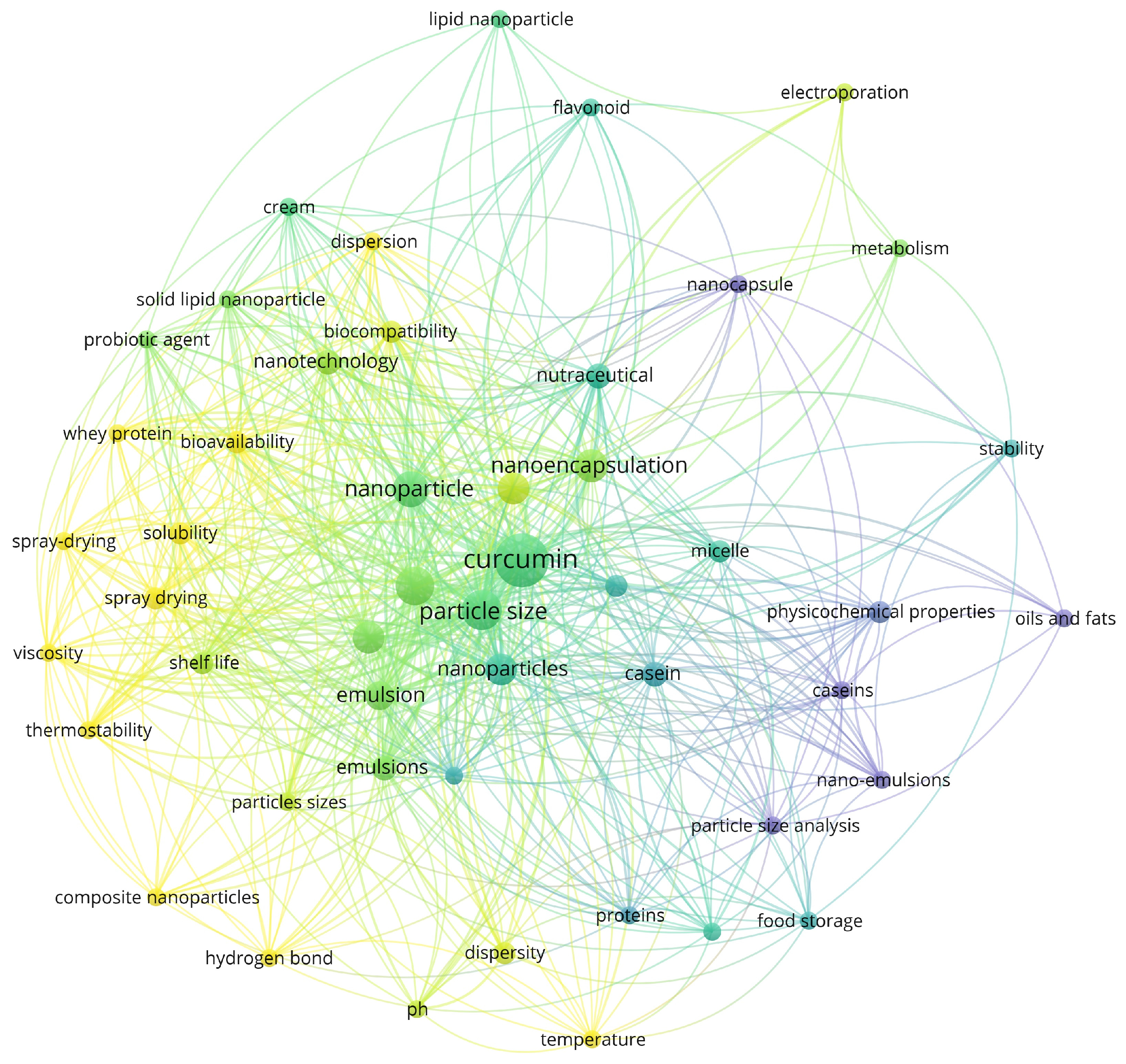
Figure 1. Temporal co-occurrence map of the most frequently cited keywords in curcumin nanoemulsion research.
Applsci 16 00885 g001
Figure 2. Structural limitations linked to the poor bioavailability of curcumin. (1) Self-aggregation, due to its planar structure and hydrophobicity and (2) chemical instability: the shift toward the enol form accelerates rapid hydrolytic degradation. (3) Rapid metabolism: Phenolic -OH groups and the heptadienone chain undergo rapid enzymatic metabolism.
Applsci 16 00885 g002
Figure 3. Stabilization of curcumin-loaded nanoemulsions in dairy matrices. (A) Protein-stabilized oil droplets encapsulate curcumin. (B) Steric barriers from biopolymer layers prevent flocculation. (C) Electrostatic repulsion between charged droplets maintains stability.
Applsci 16 00885 g003
Figure 4. The flowchart for the construction of curcumin nanoemulsions using high-energy methods (ultrasonication and high-pressure homogenization) and integration into the dairy matrix to ensure stability against pasteurization.
Applsci 16 00885 g004
Figure 5. Representation of clean-label stabilization strategies. (A) Synergistic stability, whey-stabilized NE droplets interact loosely with casein and (B) heat-induced interactions, denatured whey-casein complexes bind NE droplets.
Applsci 16 00885 g005
Figure 6. Detailed molecular mechanism of interaction in the dairy matrix. (A) In the native state, NE droplets coexist with casein micelles. (B) Upon heating, denatured whey proteins adsorb onto casein micelles, creating new binding sites that attach the curcumin–NE droplets to the protein matrix.
Applsci 16 00885 g006
Figure 7. Visual representation for stabilization in the dairy matrix. The adsorption of protein complex on the oil droplet surface.
Applsci 16 00885 g007
Figure 8. Comparative gastrointestinal fate of CU-NEs. (A) Acid gels release NEs quickly. (B) Rennet gels form dense clots, slowing release. (C) High-heat treatment creates soft curds, accelerating emptying and bioaccessibility.
Applsci 16 00885 g008
Figure 9. Anatomical visualization of the gastrointestinal digestion of curcumin-NEs. (A) Acid gels (yogurt); (B) rennet gels (cheese)—slow release; and (C) high-heat milk (MHH) soft curd—Enhanced bioaccessibility.
Applsci 16 00885 g009
Table 1. Overview of stabilizers used in O/W nanoemulsions for Curcumin delivery.
CategoryExamplesKey FunctionsAdvantagesClean-Label Restrictions
Synthetic small-molecule surfactantsTween 20, Tween 80Reduce interfacial tension; form small, uniform dropletsVery high efficiency; excellent droplet size control; strong kinetic stabilityPerceived as less “natural”; possible clean-label restrictions
Natural small-molecule surfactantsLecithin (soy, egg), Quillaja saponinInterfacial adsorption and stabilizationNatural origin; good emulsification; clean-label compliantMay form larger droplets; sometimes require co-emulsifiers
Biopolymers (proteins)Whey protein isolate (WPI), caseins, sodium caseinateCreate thick viscoelastic interfacial layers, providing steric stabilizationHighly compatible with dairy matrices; strong long-term stability; clean-labelHeat sensitivity; possible pH- or ion-dependent interactions
Biopolymers (polysaccharides)Gum Arabic, pectin, modified starchIncrease viscosity; contribute to steric/electrostatic stabilizationNatural, label-friendly; support long-term stabilityOften require pairing with proteins or surfactants
Hybrid systemsProtein–polysaccharide complexes; lecithin + Tween blendsCombine multiple stabilization mechanismsTailored functionality; improved robustness during processingMore complex formulations; potential cost increases
Table 3. Stability and bioaccessibility study of curcumin nanoemulsions in various dairy matrices (summary).
Dairy MatrixProcessing/Storage StabilityKey In Vitro
Bioaccessibility Finding
Controlling Mechanism/Insight
Fluid Milk (Reconstituted from High-Heat SMP)_____Higher bioaccessibility than low- or medium-heat SMP milk.Matrix structure: High-heat processing creates casein/whey complexes, leading to a soft, fragmented curd in the stomach.
Fluid Milk (Reconstituted from Low-Heat SMP)_____Lower bioaccessibility than high-heat SMP milk.Matrix structure: Forms a denser curd, slowing gastric emptying of the nanoemulsion.
Yogurt-Like (Acid Gel)_____High (85–91%), with fast-release kinetics.Matrix structure: Rapid protein disintegration in the stomach leads to fast gastric emptying.
Cheese-like (Rennet Gel)_____High (85–91%), with slow, sustained release kinetics.Matrix structure: Gel restructures and densifies in the stomach, physically entrapping the NE and slowing its release.
Fluid Milk (WPC-Stabilized NE)Stable for pasteurization (63 °C/30 min) and sterilization (95 °C/10 min). Stable pH 3–7 and ionic strength (0.1–1 M NaCl). Stable 30 days @ 4 °C._____Stabilizer choice: Texturized WPC provides robust steric stabilization against processing stresses.
Soft Cheese (CUNE)Improved shelf-life; better antioxidant and antimicrobial properties than control._____Dual function: NE acts as a natural preservative, improving sensory scores by preventing spoilage.
Milk (cream emulsion)Micro-fluidization created uniform nano droplets in cream.Bioaccessibility increased by ~30% after in vitro digestion.Microfluidization effectively distributes curcumin in milk’s fat–protein interfaces, boosting antioxidant activity (DPPH, FRAP) and increasing interfacial area for efficient lipid digestion and curcumin bioaccessibility.
Refrigerated Kareish cheeseStable at 40 °C for 4 weeks with consistent droplet size.Increased antioxidant activity (42.31% vs. 19.23% control) and stronger antibacterial efficacy (lower MIC vs. S. aureus and B. cereus).Integrated CRNE into cheese matrix without affecting protein/fat/pH, improving antioxidant and antimicrobial properties while maintaining the dairy matrix stability.
Stirred yogurtNo significant change in pH, acidity, or visual syneresis.Maintained yogurt rheological and gel stability; no adverse texture.SLNs are entrapped in the acid coagulated casein gel network without disrupting its structure, preserving yogurt stability.
Disclaimer/Publisher’s Note: The statements, opinions and data contained in all publications are solely those of the individual author(s) and contributor(s) and not of MDPI and/or the editor(s). MDPI and/or the editor(s) disclaim responsibility for any injury to people or property resulting from any ideas, methods, instructions or products referred to in the content.