Secure and Efficient Authentication Protocol for Underwater Wireless Sensor Network Environments Using PUF

Abstract
1. Introduction
1.1. Related Work and Motivation
- We employ one-way hash functions and XOR operations to reduce computational and communication overhead on resource-constrained sensor nodes.
- We incorporate a physically unclonable function (PUF) to bind node identity to hardware and mitigate cloning risks under physical capture, using a fuzzy extractor to support stable PUF-derived cryptographic material. In particular, we integrate a PUF-based device to achieve the end-to-end lightweight authentication and key agreement workflow for preventing impersonation using a captured node’s stored data.
- A lightweight continuous authentication procedure is introduced to facilitate fast re-authentication under intermittent link disruptions common in underwater communication.
1.2. Organization
2. Preliminaries
2.1. Adversary Model
- can eavesdrop on, intercept, inject, replay, and modify messages transmitted over a public channel [19]. Based on these capabilities, is able to launch attacks such as MITM, replay, and impersonation.
- The adversary can compromise a legitimate sensor node and extract secret credentials stored in its memory by performing a power analysis attack. can steal the legal user’s mobile device or smart device and extract secret credentials stored in the memory by performing the power analysis attack [21].
2.2. Physical Unclonable Function
- Unclonability: For the same input C, no other circuit can generate exactly the same response .
- One-way Evaluability: The output R for the input C can be easily computed, but it should be computationally difficult to infer C or its internal structure in reverse through R.
- Unpredictability: PUF responses cannot be predicted externally in advance.
2.3. Fuzzy Extractor
- : It is a probabilistic algorithm that generates an initial secret. After receiving input , the smart device generates a secret string and a helper string .
- : It is a deterministic algorithm that reproduces the secret by compensating for the noise in input. When the smart device obtains , it compensates for the noise using the helper string and regenerates the original secret .
2.4. System Model
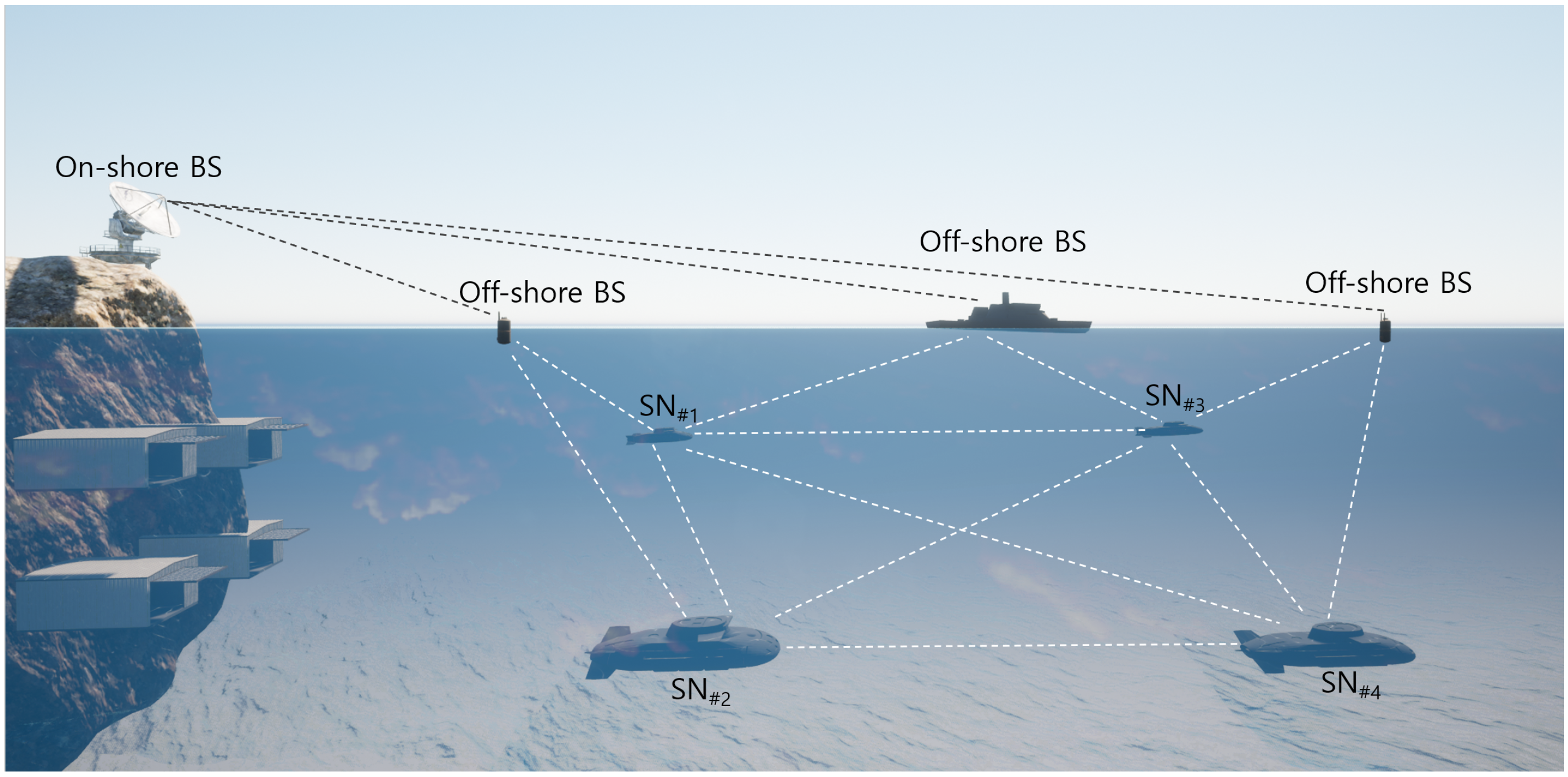
- : The sensor nodes are deployed underwater to collect environmental and operational data. They communicate with neighboring nodes and base stations, ensuring secure data exchange through mutual authentication. Base stations serve as trusted entities that facilitate communication between sensor nodes and central monitoring systems. They also handle the initialization, authentication, and session key generation processes, which are critical for maintaining network security and reliability.
- : The are strategically deployed both on-shore (land-based) and off-shore (marine-based) to facilitate efficient communication and coordination between underwater sensor nodes and central monitoring systems.
3. Jain and Hussain’s Protocol and Vulnerability Analysis
3.1. Review of Jain and Hussain’s Protocol
3.1.1. Initial Phase
3.1.2. Sensor Node Registration Phase
3.1.3. Authentication Phase
3.2. Cryptanalysis of Jain and Hussain’s Protocol
3.2.1. Physical and Cloning Attack
- Step 1:
- Physical capture of the sensor node .
- Step 2:
- Extraction of authentication credentials from memory:
- Step 3:
- Deployment of a clone node and transmission of forged messages, such aswhere denotes symmetric encryption using the compromised key .
3.2.2. Replay Attack
3.2.3. DoS Attack
3.2.4. Mutual Authentication Issue
4. Proposed Protocol
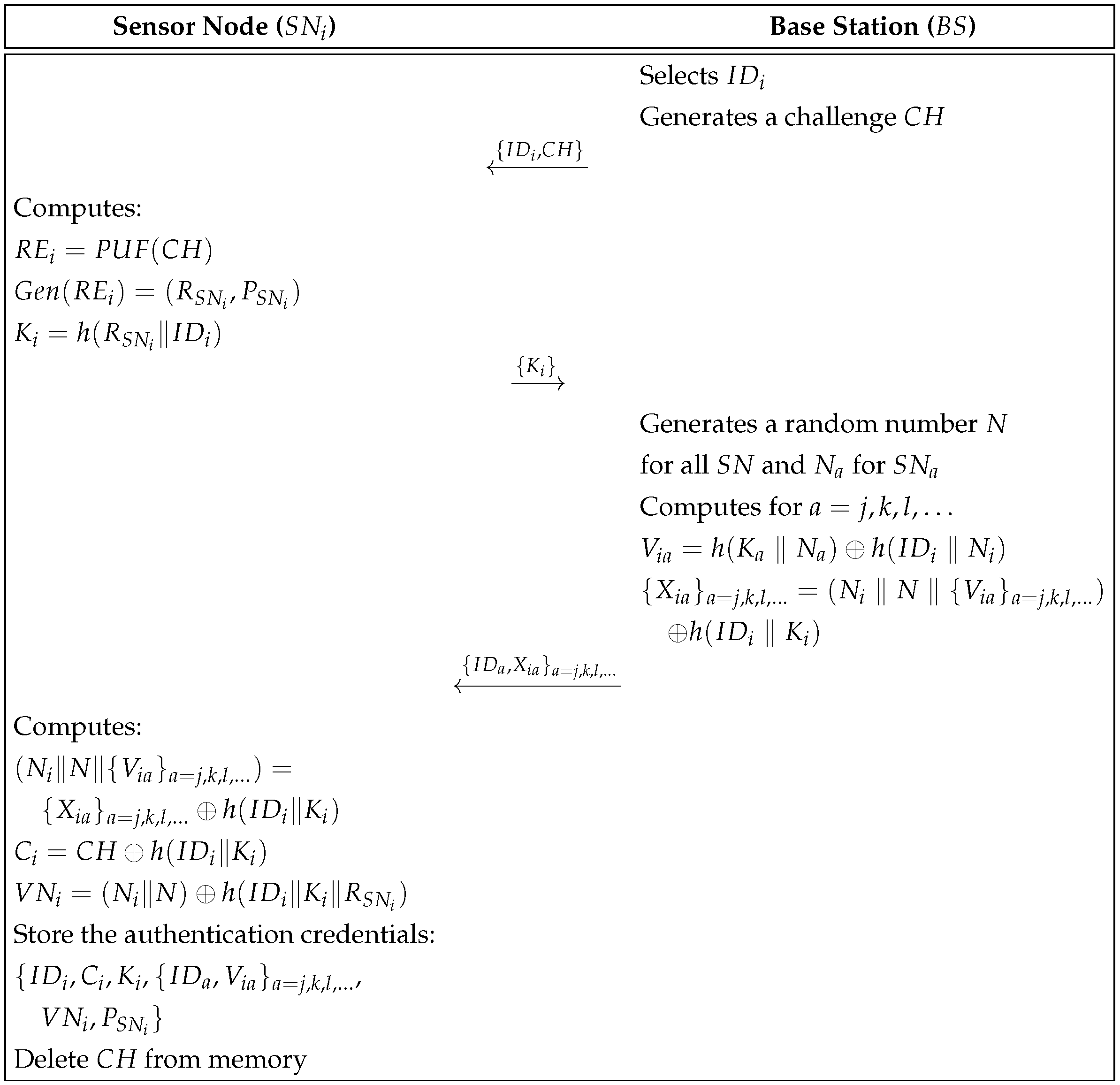
4.1. Registration Phase
- Step 1:
- selects the unique identifier for and generates a random challenge . Then, sends and to through a secure channel.
- Step 2:
- computes , derives , and calculates . Then, sends to .
- Step 3:
- generates a network-wide random value N and additional random values . It computes and . Then, sends to .
- Step 4:
- calculates and . Then, stores and deletes from its memory.
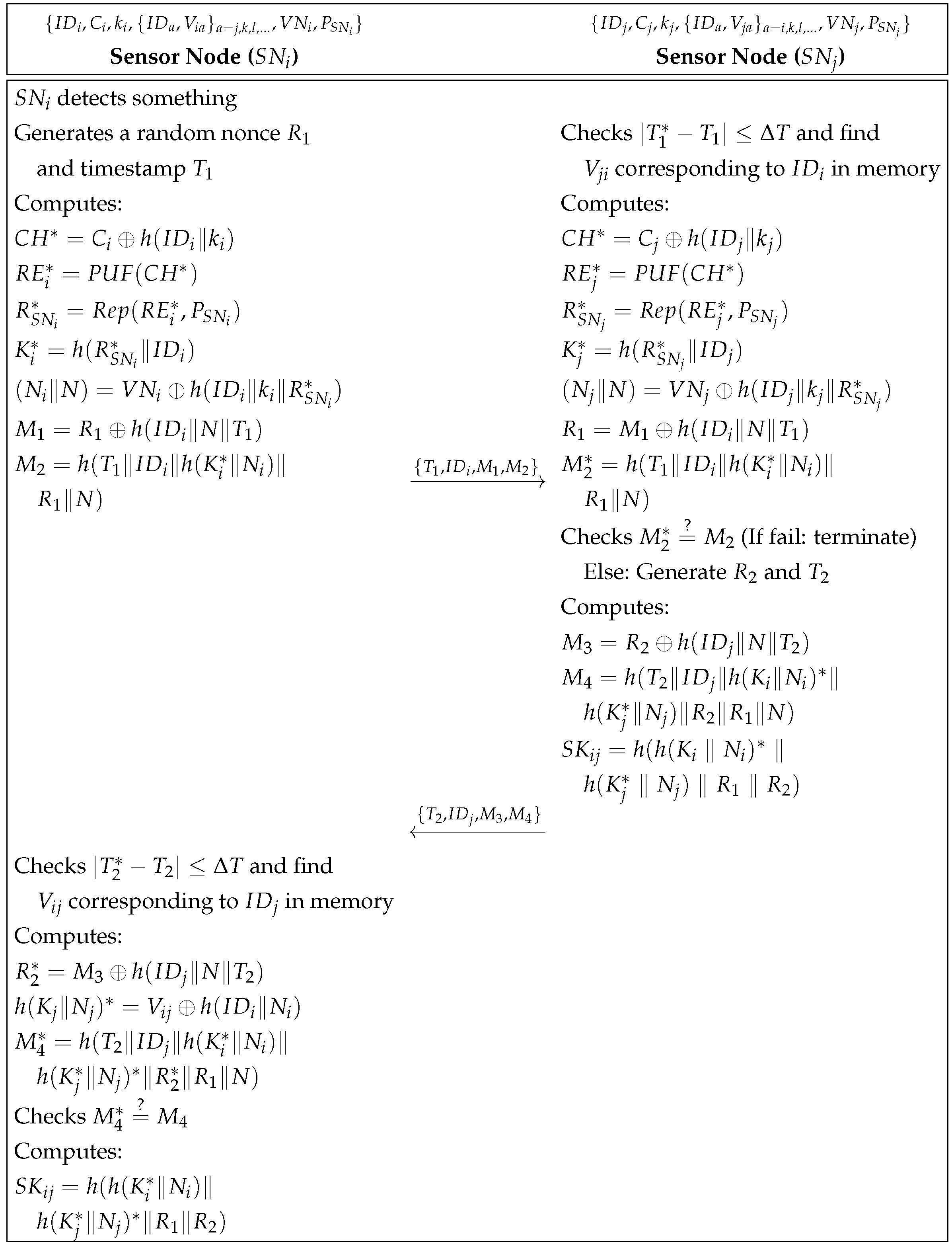
4.2. Authentication Phase
- Step 1:
- detects an event and generates a random nonce and a timestamp . It computes the challenge value , followed by . Using , it reconstructs as , and calculates the secret key as . Then, it retrieves the network values and N from using , and computes and . Finally, sends the message to through the public channel.
- Step 2:
- Upon receiving the message at timestamp , verifies the validity of the timestamp by checking whether . If valid, retrieves corresponding to and computes the challenge value as . It then calculates , reconstructs , and derives the secret key . Using , it retrieves the network values and N as , and calculates . Next, it computes and checks whether . If the check fails, the process is terminated. Otherwise, generates a random nonce and records the timestamp , then calculates and . Finally, sends the message back to through the public channel.
- Step 3:
- Upon receiving the response at timestamp , verifies the validity of the timestamp by checking whether . If valid, calculates and then computes . It then verifies whether . If the check fails, the process is terminated. Otherwise, computes the session key as .
- Step 4:
- computes the same session key using If all computations are successful, mutual authentication is achieved, and a secure session key is established between and .
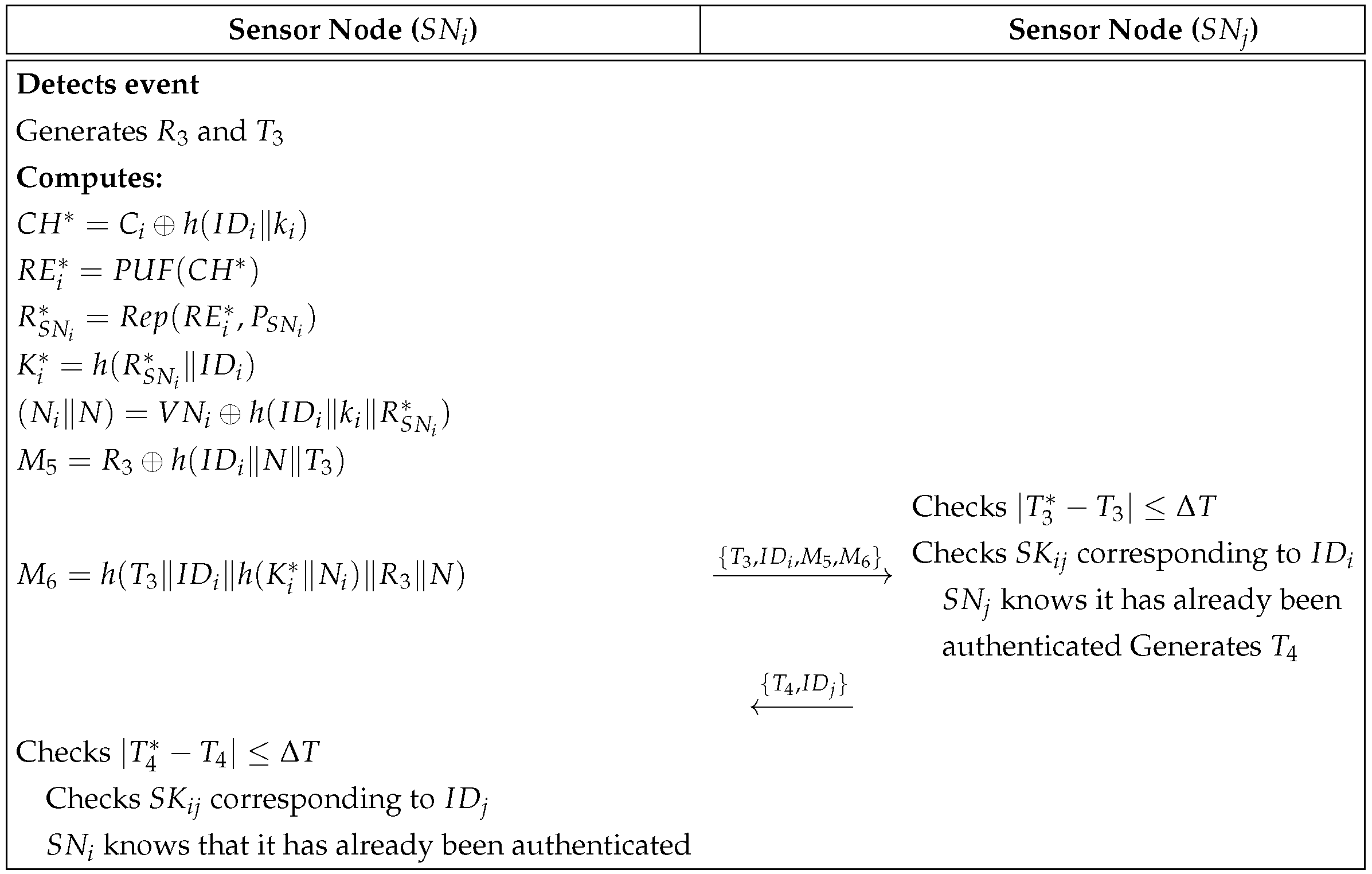
4.3. Continuous Authentication Phase
- Step 1:
- Sensor node detects an event and generates a random nonce along with a timestamp . It calculates the challenge value as and evaluates the PUF response using . Using this, reconstructs as and computes the secret key . The common and unique nonce values are derived as , and subsequently, calculates and . Finally, sends the message to over the public channel.
- Step 2:
- Upon receiving the message at timestamp , verifies the validity of the timestamp by checking . It then checks the existence of the session key corresponding to . If exists, determines that it has already been authenticated. generates a new timestamp and computes the message .
- Step 3:
- Upon receiving the message at timestamp , verifies the validity of the timestamp by checking . It confirms the continued authentication with based on the response, completing the continuous authentication process and ensuring secure and uninterrupted communication between and .
5. Security Analysis
5.1. Informal Analysis
5.1.1. Replay Attacks
5.1.2. MITM Attacks
5.1.3. Impersonation Attacks
5.1.4. Physical and Cloning Attacks
5.1.5. Ephemeral Secret Leakage (ESL) Attacks
5.1.6. DoS Attacks
5.1.7. Mutual Authentication
5.2. BAN Logic
5.2.1. Rules
- Message meaning rule (MMR): MMR is a rule when an entity receives a message encrypted with a shared key, the entity trusts the message.
- Nonce verification rule (NVR): NVR is a rule that believes a message was sent from a sender if the message content is fresh and the sender is sure to have sent it.
- Jurisdiction rule (JR): JR is a rule about permissions, meaning that if you have permission to receive a message, the other party can also receive the message.
- Belief rule (BR): BR is that if an entity believes a tuple, it also believes its elements.
- Freshness rule (FR): FR is a rule that believes that if a message is fresh, then its tuples are also fresh.
5.2.2. Goals
- Goal 1:
- Goal 2:
- Goal 3:
- Goal 4:
5.2.3. Idealized Forms
5.2.4. Assumptions
- :
- :
- :
- :
- :
- :
5.2.5. BAN Logic Proof
- Pr1:
- We get from .:
- Pr2:
- Using , we get from MMR and .:
- Pr3:
- Using , we get from FR and .:
- Pr4:
- Using , we get from NVR and .:
- Pr5:
- We get from .:
- Pr6:
- Using , we get from MMR and .:
- Pr7:
- Using , we get from FR and .:
- Pr8:
- Using , we get from NVR and .:
- Pr9:
- Using , and can compute the session key. Thus, we get and as follows:: (Goal 1): (Goal 4)
- Pr10:
- Using and , we get and from JR as follows:: (Goal 3): (Goal 2)
5.3. ROR Model
- : can eavesdrop messages that are exchanged via public channels. Thus, this query is a passive attack.
- : It is an active attack that can send messages to network participants via public channels.
- : can extract secret parameters of and . Thus, this query is an active attack.
- : In this query, tests the security of the session key by flipping an unbiased coin. After that, obtain the result 1, 0, and . When 1 is obtained, it means that can distinguish the session key. When 0 is obtained, cannot distinguish the session key and random nonce. Otherwise, gets value.
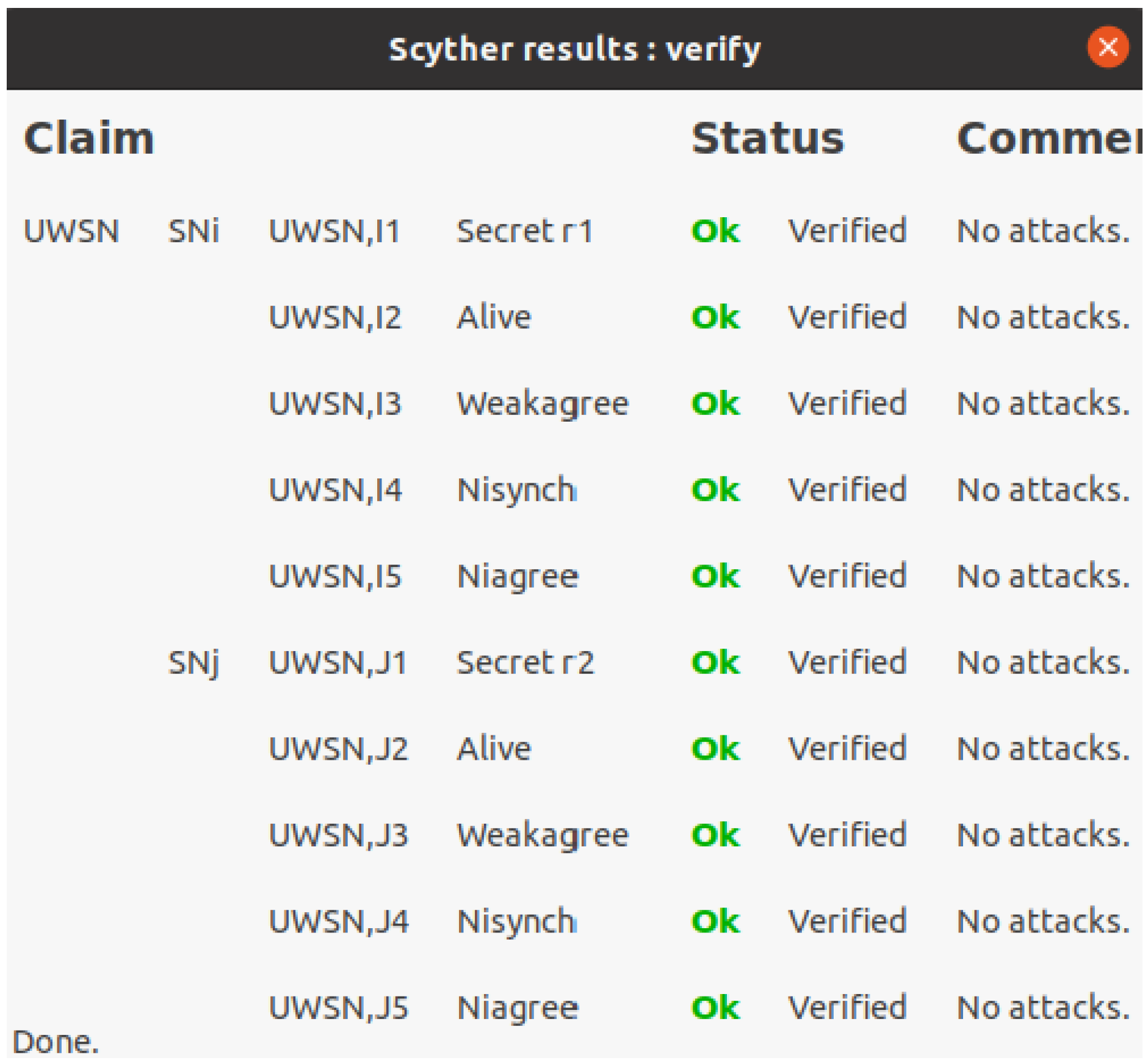
5.4. Security Verification Using Scyther
- Aliveness: The participant ensures that the communication partner actually performs the protocol.
- Weak-agreement: The participant ensures that the communication partner actually performs the protocol and is aware of who they were communicating with.
- Non-injective agreement: The participant ensures that there is a mutual agreement between communication parties and that they share consistent session values.
- Non-injective synchronization: The participant ensures that messages are exchanged in a given order and that the session flow was synchronized.
6. Performance Analysis
6.1. Security Properties
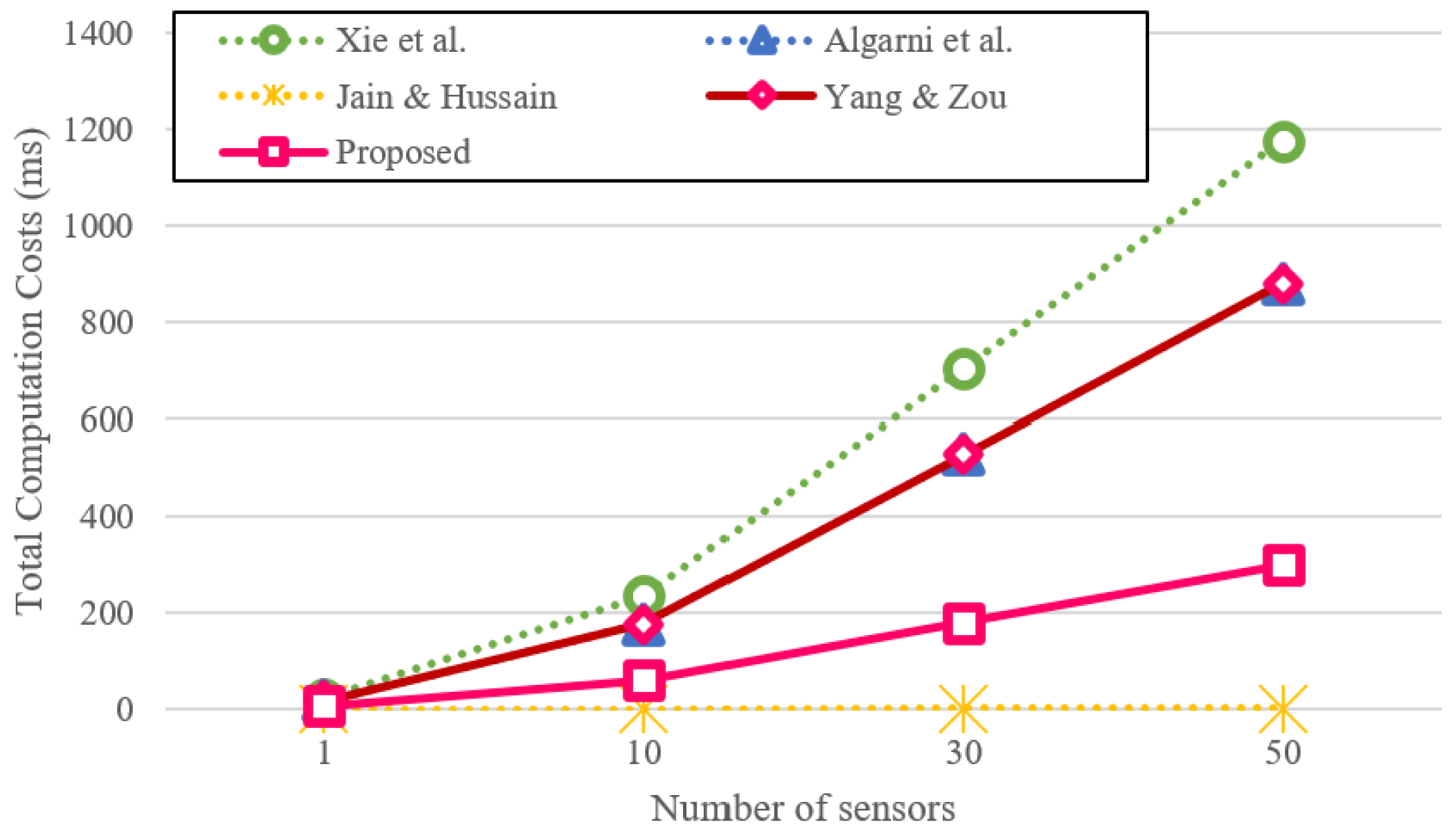
6.2. Computation Costs
- -
- TH: One-way hash function—0.006 ms
- -
- TM: Elliptic curve point multiplication—2.926 ms
- -
- TS: Symmetric key encryption/decryption—0.013 ms
- -
- TF: Fuzzy extractor—2.926 ms
- -
- TE: Modular exponentiation—0.358 ms
6.3. Communication Costs
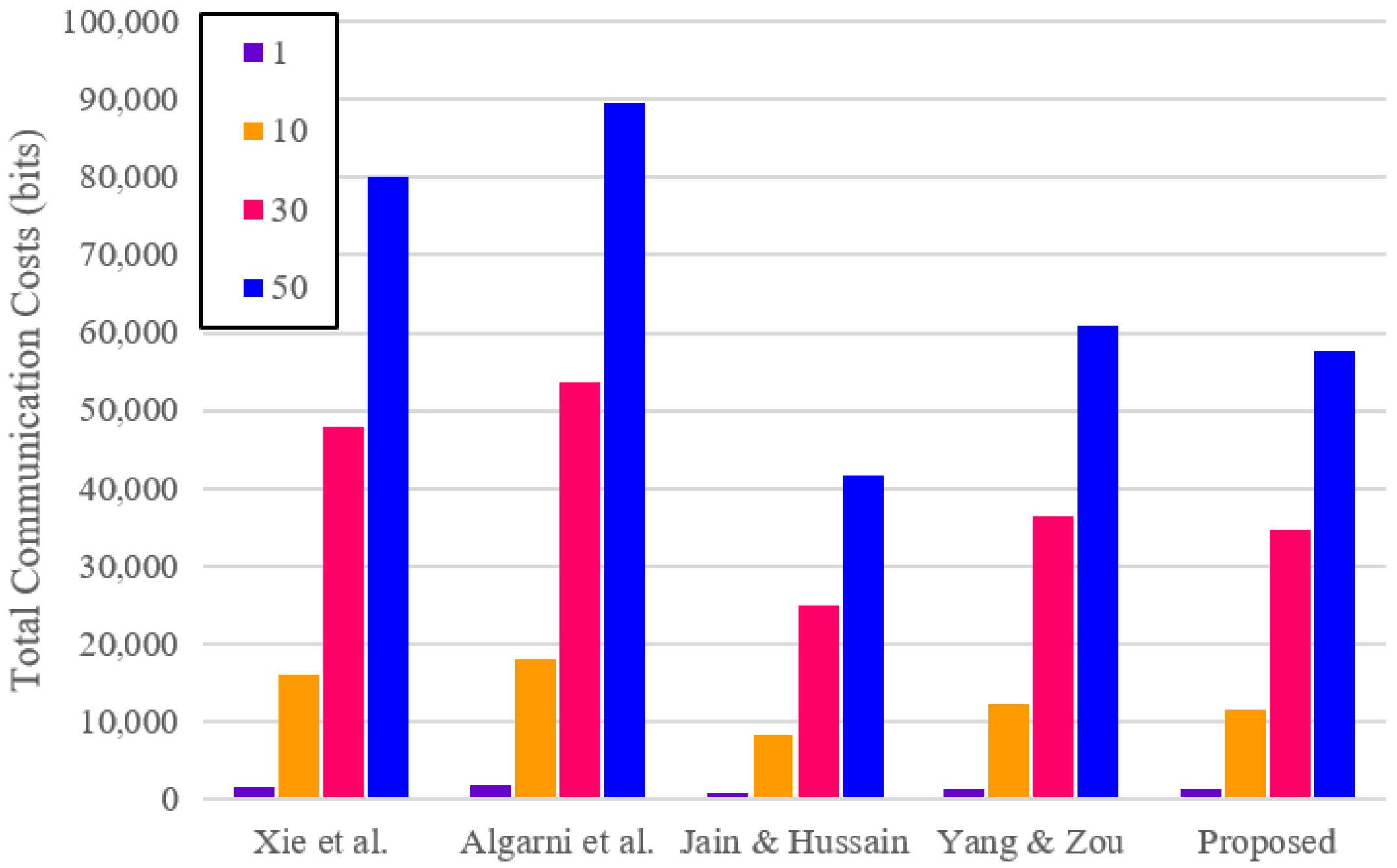
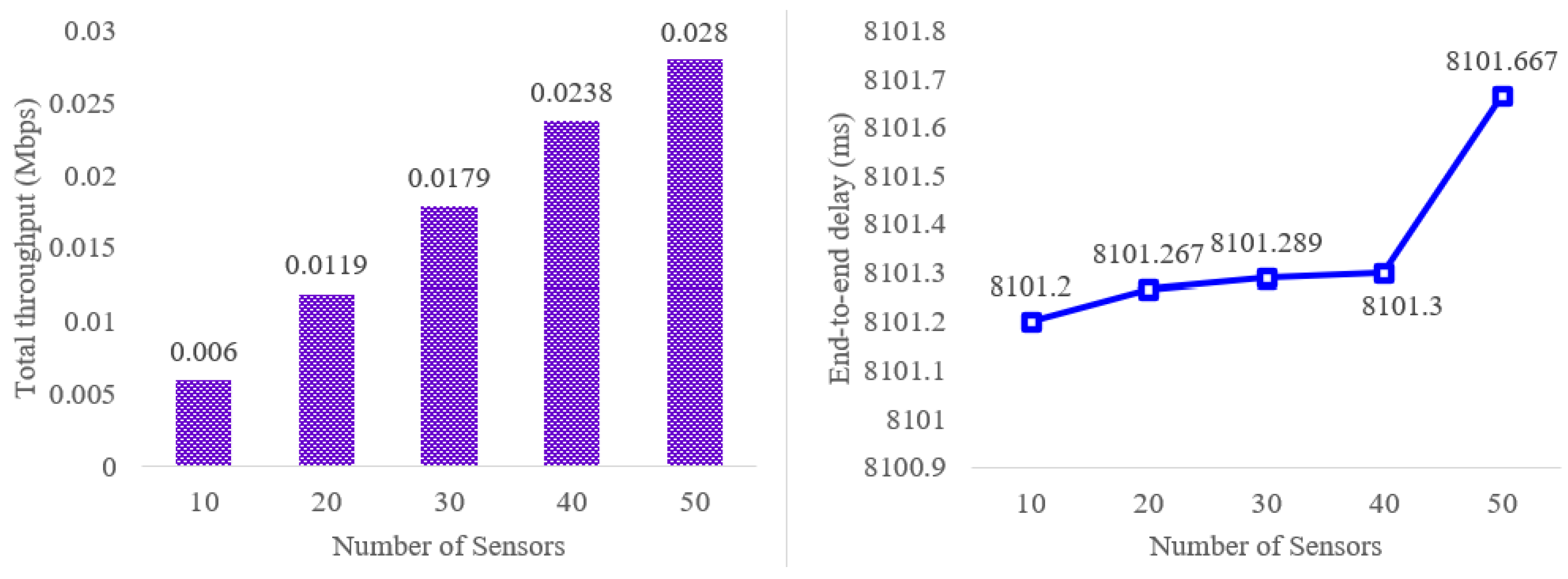
6.4. Simulation Study Using NS-3
- Operation System: Ubuntu 16.04 LTS
- CPU: Intel i9-13900 (13th Gen Intel Core 24 cores/32 threads, up to 5.60 GHz) (Intel, Santa Clara, CA, USA)
- Memory: 8GB RAM
- Simulation Time: 2000 s
- Number of Sensors: 10, 20, 30, 40, 50
- Mobility Model: ConstantPositionMobilityModel
- Underwater Stack: UanChannel and UanMacAloha
7. Conclusions
Author Contributions
Funding
Institutional Review Board Statement
Informed Consent Statement
Data Availability Statement
Conflicts of Interest
References
- Ferri, G.; Munafò, A.; Tesei, A.; Braca, P.; Meyer, F.; Pelekanakis, K.; Petroccia, R.; Alves, J.; Strode, C.; LePage, K. Cooperative robotic networks for underwater surveillance: An overview. IET Radar Sonar Navig. 2017, 11, 1740–1761. [Google Scholar] [CrossRef]
- Heidemann, J.; Stojanovic, M.; Zorzi, M. Underwater sensor networks: Applications, advances and challenges. Philos. Trans. R. Soc. A Math. Phys. Eng. Sci. 2012, 370, 158–175. [Google Scholar] [CrossRef]
- Terracciano, D.S.; Bazzarello, L.; Caiti, A.; Costanzi, R.; Manzari, V. Marine robots for underwater surveillance. Curr. Robot. Rep. 2020, 1, 159–167. [Google Scholar] [CrossRef]
- Ismail, N.-S.N.; Hussein, L.A.; Ariffin, S.H.S. Analyzing the performance of acoustic channel in underwater wireless sensor network (UWSN). In 2010 Fourth Asia International Conference on Mathematical/Analytical Modelling and Computer Simulation; IEEE: Kota Kinabalu, Malaysia, 2010; pp. 550–555. [Google Scholar]
- El-Rabaie, S.; Nabil, D.; Mahmoud, R.; Alsharqawy, M.A. Underwater wireless sensor networks (UWSN), architecture, routing protocols, simulation and modeling tools, localization, security issues and some novel trends. Netw. Commun. Eng. 2015, 7, 335–354. [Google Scholar]
- Haque, K.F.; Kabir, K.H.; Abdelgawad, A. Advancement of routing protocols and applications of underwater wireless sensor network (UWSN)—A survey. J. Sens. Actuator Netw. 2020, 9, 19. [Google Scholar] [CrossRef]
- Islam, A.A.; Taher, K.A. A novel authentication mechanism for securing underwater wireless sensors from Sybil attack. In 2021 5th International Conference on Electrical Engineering and Information Communication Technology (ICEEICT); IEEE: Dhaka, Bangladesh, 2021; pp. 1–6. [Google Scholar]
- Almuhaideb, A.M.; Al-Khulaifi, D.M. An efficient authentication and key agreement scheme for the Internet of Underwater Things (IoUT) environment. IEEE Access 2024, 12, 175773–175789. [Google Scholar] [CrossRef]
- Kapileswar, N.; Phani Kumar, P. Energy efficient routing in IoT based UWSN using bald eagle search algorithm. Trans. Emerg. Telecommun. Technol. 2022, 33, e4399. [Google Scholar] [CrossRef]
- Al Guqhaiman, A.; Akanbi, O.; Aljaedi, A.; Chow, C.E. Lightweight multi-factor authentication for underwater wireless sensor networks. In 2020 International Conference on Computational Science and Computational Intelligence (CSCI); IEEE: Las Vegas, NV, USA, 2020; pp. 188–194. [Google Scholar]
- Kumar, C.M.; Amin, R.; Brindha, M. SafeCom: Robust mutual authentication and session key sharing protocol for underwater wireless sensor networks. J. Syst. Archit. 2022, 130, 102650. [Google Scholar] [CrossRef]
- Khatwani, C.; Roy, S. Security analysis of ECC based authentication protocols. In 2015 International Conference on Computational Intelligence and Communication Networks (CICN); IEEE: Jabalpur, India, 2015; pp. 1167–1172. [Google Scholar]
- Yang, G.; Zou, Z. An authentication and key agreement protocol for whole process open channel in D2D. In Proceedings of the 2025 4th International Symposium on Computer Applications and Information Technology (ISCAIT), Xi’an, China, 21–23 March 2025; IEEE: Piscataway, NJ, USA, 2025; pp. 1475–1481. [Google Scholar]
- Jain, U.; Hussain, M. Security mechanism for maritime territory and frontier surveillance in naval operations using wireless sensor networks. Concurr. Comput. Pract. Exp. 2021, 33, e6300. [Google Scholar] [CrossRef]
- Burrows, M.; Abadi, M.; Needham, R.M. A logic of authentication. ACM Trans. Comput. Syst. 1990, 8, 18–36. [Google Scholar] [CrossRef]
- Abdalla, M.; Fouque, P.A.; Pointcheval, D. Password based authenticated key exchange in the three-party setting. In Public Key Cryptgraphy; Springer: Les Diablerets, Switzerland, 2005; pp. 65–84. [Google Scholar]
- Cremers, C.J. The Scyther Tool: Verification, Falsification, and Analysis of Security Protocols: Tool Paper. In Proceedings of the International Conference on Computer Aided Verification, Princeton, NJ, USA, 7–14 July 2008; pp. 414–418. [Google Scholar]
- Scyther Tool. Available online: https://people.cispa.io/cas.cremers/scyther/ (accessed on 10 November 2025).
- Dolev, D.; Yao, A. On the security of public key protocols. IEEE Trans. Inf. Theory 1983, 29, 198–208. [Google Scholar] [CrossRef]
- Yu, S.; Park, K.; Park, Y. A machine learning attack-resistant PUF-based robust and efficient mutual authentication scheme in fog-enabled IoT environments. IEEE Internet Things J. 2025, 12, 20652–20669. [Google Scholar] [CrossRef]
- Wazid, M.; Bagga, P.; Das, A.K.; Shetty, S.; Rodrigues, J.J.; Park, Y. AKM-IoV: Authenticated key management protocol in fog computing-based Internet of vehicles deployment. IEEE Internet Things J. 2019, 6, 8804–8817. [Google Scholar] [CrossRef]
- Dodis, Y.; Reyzin, L.; Smith, A. Fuzzy extractors: How to generate strong keys from biometrics and other noisy data. In Advances in Cryptology-EUROCRYPT 2004, Proceedings of the International Conference on the Theory and Applications of Cryptographic Techniques, Interlaken, Switzerland, 2–6 May 2004; Springer: Berlin/Heidelberg, Germany, 2004; pp. 523–540. [Google Scholar]
- Heidemann, J.; Ye, W.; Wills, J.; Syed, A.; Li, Y. Research challenges and applications for underwater sensor networking. In IEEE Wireless Communications and Networking Conference (WCNC 2006); IEEE: Las Vegas, NV, USA, 2006; Volume 1, pp. 228–235. [Google Scholar]
- Felemban, E.; Shaikh, F.K.; Qureshi, U.M.; Sheikh, A.A.; Qaisar, S.B. Underwater sensor network applications: A comprehensive survey. Int. J. Distrib. Sens. Netw. 2015, 11, 896832. [Google Scholar] [CrossRef]
- Wang, D.; Cheng, H.; Wang, P.; Huang, X.; Jian, G. Zipf’s law in passwords. IEEE Trans. Inf. Forensics Secur. 2017, 12, 2776–2791. [Google Scholar] [CrossRef]
- Son, S.; Lee, J.; Park, Y.; Park, Y.; Das, A.K. Design of blockchain-based lightweight V2I handover authentication protocol for VANET. IEEE Trans. Netw. Sci. Eng. 2022, 9, 1346–1358. [Google Scholar] [CrossRef]
- Gautam, D.; Thakur, G.; Kumar, P.; Das, A.K.; Park, Y. Blockchain assisted intra-twin and inter-twin authentication scheme for vehicular digital twin system. IEEE Trans. Intell. Transp. Syst. 2024, 25, 15002–15015. [Google Scholar] [CrossRef]
- Ryu, J.; Son, S.; Lee, J.; Park, Y.; Park, Y. Design of secure mutual authentication scheme for metaverse environments using blockchain. IEEE Access 2022, 10, 98944–98958. [Google Scholar] [CrossRef]
- Boyko, V.; MacKenzie, P.; Patel, S. Provably secure password-authenticated key exchange using Diffie-Hellman. In Proceedings of the International Conference on the Theory and Applications of Cryptographic Techniques, Bruges, Belgium, 14–18 May 2000; pp. 156–171. [Google Scholar]
- Xie, Q.; Zhang, J. Lightweight drone-to-ground station and drone-to-drone authentication scheme for Internet of drones. Symmetry 2025, 17, 556–574. [Google Scholar] [CrossRef]
- Algarni, A.D.; Innab, N.; Algarni, F. A verifiably secure and robust authentication protocol for synergistically-assisted IoD deployment drones. PLoS ONE 2025, 20, 314475–314503. [Google Scholar] [CrossRef]
- Kwon, D.; Son, S.; Kim, M.; Lee, J.; Das, A.K.; Park, Y. A secure self-certified broadcast authentication protocol for intelligent transportation systems in UAV-assisted mobile edge computing environments. IEEE Trans. Intell. Transp. Syst. 2024, 25, 19004–19017. [Google Scholar] [CrossRef]
- Bagga, P.; Das, A.K.; Wazid, M.; Rodrigues, J.J.; Choo, K.K.R.; Park, Y. On the design of mutual authentication and key agreement protocol in Internet of Vehicles-enabled intelligent transportation system. IEEE Trans. Veh. Technol. 2021, 70, 1736–1751. [Google Scholar] [CrossRef]
- Network Simulator 3. Available online: https://www.nsnam.org (accessed on 26 December 2025).





| Notation | Description |
|---|---|
| Sensor Node | |
| Base Station | |
| Identity of Sensor Node | |
| Secret key of Sensor Node | |
| Random number of Sensor Node | |
| Session key | |
| One-way hash function | |
| / | Symmetric encryption/decryption |
| T | Timestamp |
| Notation | Description |
|---|---|
| and | Sensor node i and j’s identities, respectively |
| N | Random number for all |
| and | Random number of sensor node i and sensor node j, respectively |
| and | Sensor node i and j’s secret values, respectively |
| Session key between and | |
| One-way hash function | |
| Concatenation operation | |
| ⊕ | XOR operation |
| PUF | |
| / | Generation/Reproduction operation |
| and | Timestamps of i and j, respectively |
| Check for the correctness |
| Notation | Description |
|---|---|
| Principals | |
| Statements | |
| Session key | |
| believes | |
| once said | |
| controls | |
| receives | |
| is fresh | |
| is encrypted with S | |
| and have a shared key S |
| Security Properties | Ref. [13] | Ref. [30] | Ref. [31] | Ref. [14] | Proposed |
|---|---|---|---|---|---|
| Replay attacks | ∘ | ∘ | ∘ | × | ∘ |
| MITM attacks | ∘ | ∘ | ∘ | × | ∘ |
| Impersonation attacks | ∘ | ∘ | ∘ | ∘ | ∘ |
| Physical and cloning attacks | ∘ | ∘ | × | × | ∘ |
| ESL attacks | ∘ | × | ∘ | ∘ | ∘ |
| DoS attacks | ∘ | ∘ | ∘ | × | ∘ |
| Mutual authentication | ∘ | ∘ | ∘ | × | ∘ |
| Continuous authentication | × | × | × | × | ∘ |
Disclaimer/Publisher’s Note: The statements, opinions and data contained in all publications are solely those of the individual author(s) and contributor(s) and not of MDPI and/or the editor(s). MDPI and/or the editor(s) disclaim responsibility for any injury to people or property resulting from any ideas, methods, instructions or products referred to in the content. |
© 2026 by the authors. Licensee MDPI, Basel, Switzerland. This article is an open access article distributed under the terms and conditions of the Creative Commons Attribution (CC BY) license.
Share and Cite
Ahn, J.; Kwon, D.; Park, Y. Secure and Efficient Authentication Protocol for Underwater Wireless Sensor Network Environments Using PUF. Appl. Sci. 2026, 16, 873. https://doi.org/10.3390/app16020873
Ahn J, Kwon D, Park Y. Secure and Efficient Authentication Protocol for Underwater Wireless Sensor Network Environments Using PUF. Applied Sciences. 2026; 16(2):873. https://doi.org/10.3390/app16020873
Chicago/Turabian StyleAhn, Jinsu, Deokkyu Kwon, and Youngho Park. 2026. "Secure and Efficient Authentication Protocol for Underwater Wireless Sensor Network Environments Using PUF" Applied Sciences 16, no. 2: 873. https://doi.org/10.3390/app16020873
APA StyleAhn, J., Kwon, D., & Park, Y. (2026). Secure and Efficient Authentication Protocol for Underwater Wireless Sensor Network Environments Using PUF. Applied Sciences, 16(2), 873. https://doi.org/10.3390/app16020873