Article

Dynamics Parameter Calibration for Performance Enhancement of Heavy-Duty Servo Press

1
School of Mechanical Engineering, Dalian University, Dalian 116622, China
2
China First Heavy Industries (CFHI) Tianjin Heavy Industry Co., Ltd., Tianjin 300300, China
*
Author to whom correspondence should be addressed.
Appl. Sci. 2026, 16(2), 847; https://doi.org/10.3390/app16020847
Submission received: 11 December 2025 / Revised: 11 January 2026 / Accepted: 12 January 2026 / Published: 14 January 2026

Abstract

The accuracy of dynamics parameters in the transmission system is essential for high-performance motion trajectory planning and stable operation of heavy-duty servo presses. To mitigate the performance degradation and potential overload risks caused by deviations between theoretical and actual parameters, this paper proposes a dynamics model accuracy enhancement method that integrates multi-objective global sensitivity analysis and ant colony optimization-based calibration. First, a nonlinear dynamics model of the eight-bar mechanism was constructed based on Lagrange’s equations, which systematically incorporates generalized external force models consistent with actual production, including gravity, friction, balance force, and stamping process load. Subsequently, six key sensitive parameters were identified from 28 system parameters using Sobol global sensitivity analysis, with response functions defined for torque prediction accuracy, transient overload risk, thermal load, and work done. Based on the sensitivity results, a parameter calibration model was formulated to minimize torque prediction error and transient overload risk, and solved by the ant colony algorithm. Experimental validation showed that, after calibration, the root mean square error between predicted and measured torque decreased significantly from 1366.9 N·m to 277.7 N·m (a reduction of 79.7%), the peak error dropped by 72.7%, and the servo motor’s effective torque prediction error was reduced from 7.6% to 1.4%. In an automotive door panel stamping application on a 25,000 kN heavy-duty servo press, the production rate increased from 11.4 to 11.6 strokes per minute, demonstrating enhanced performance without operational safety. This study provides a theoretical foundation and an effective engineering solution for high-precision modeling and performance optimization of heavy-duty servo presses.

1. Introduction

Servo presses, as core equipment in intelligent manufacturing, are heralding a paradigm shift in forming processes across the automotive, aerospace, and rail transportation sectors by virtue of their programmable slide trajectories, inherent process flexibility, and superior energy efficiency [1,2,3,4]. Unlike the conventional mechanical press, the servo press enables precise modulation of slide motion, yielding production rate enhancements of 15–30% while substantially improving part quality and tool life [5,6,7]. In high-end manufacturing, heavy-duty servo presses are tasked with the precision forming of large-scale, complex components (e.g., automotive body panels and aircraft skins), where the accurate characterization of their transmission system dynamics model is an indispensable prerequisite for ensuring machining precision, equipment reliability, and operational energy efficiency [8,9,10]. However, as the servo press continues to advance towards larger sizes, higher speeds, and greater intelligence, the transmission system exhibits increasingly complex dynamic behaviors characterized by pronounced nonlinearities and multi-source disturbance coupling. Dynamics parameters adopted in the design phase—such as friction coefficients, moments of inertia, and transmission efficiencies—are typically derived from idealized assumptions or empirical correlations, and thus often fail to accurately reflect operational uncertainties arising from assembly tolerances, component wear, and lubrication variability [11,12,13]. This discrepancy between theoretical and actual parameters consequently leads to severe deficiencies in the predictive accuracy of dynamics models built upon nominal values, thereby forcing trajectory planning and control strategies to be overly conservative. Such conservatism not only limits the full utilization of equipment capacity but also risks servo motor overload and overheating due to transient load prediction errors [14,15,16]. Therefore, developing a high-precision dynamics model with precisely calibrated parameters is essential for unlocking the full performance potential of servo presses.
The high-precision modeling of heavy-duty servo presses faces dual challenges arising from the pronounced nonlinear dynamics of multi-link mechanisms and the coupling of multi-physics disturbances. To address these challenges, significant progress has been made in the integrated modeling and performance optimization of servo presses. Wang et al. [17] established an electromechanical coupling model for a crank servo press based on Lagrange’s equations, thereby revealing the influence law of motor speed on the dynamic response of the slide. Halicioglu et al. [18] investigated a low-capacity servo press (rated load 500 kN, stroke 200 mm), demonstrating improved motion accuracy through dynamic modeling and parameter optimization. Zhai et al. [19] performed an in-depth analysis of the coupling mechanism between inertial force imbalance and component elastic deformation on the positioning accuracy of the slide in a six-bar linkage press; by optimizing the mass parameters of the links and structural stiffness, the slide positioning error was reduced to ±0.02 mm. Cheng et al. [20] tackled the issue of excessive slide acceleration in a six-bar mechanism by constructing a parametric model and employing sensitivity analysis coupled with multi-objective optimization algorithms, thereby achieving substantial reductions in peak acceleration. Xu et al. [21] developed a multi-domain model encompassing complete stamping mechanics, hydraulic systems, and servo drives, predicting the dynamic response via simulation and mitigating equipment vibration through the design of servo motor speed profiles. However, these studies often rely on idealized assumptions or small-scale prototypes, failing to systematically integrate the coupled effects of slide balance forces, nonlinear joint friction, and realistic process loads. Additionally, a significant gap exists in scale, load-bearing capacity, and dynamic characteristics between experimental setups and industrial production equipment, which impedes the accurate representation of kinetic behavior under actual operating conditions.
In the domain of parameter calibration, although advanced methodologies from other mechanical systems offer valuable insights, targeted research specifically for heavy-duty servo presses remains notably scarce. Jung et al. [22] reduced robotic arm parameter identification time from 5760 min to approximately 20 min using a sequential optimization approach. Montazeri et al. [23] lowered the total relative error of system parameters for a 7-DOF hydraulic manipulator from 13.46% to 5.46% with a multi-objective genetic algorithm. Savaee et al. [24] achieved a 73–96% improvement in the positioning accuracy of a 3-PUS/S spherical parallel manipulator by combining a genetic algorithm with neural network calibration. Gally et al. [25] quantified model uncertainty by integrating parameter identification, optimal experimental design, and hypothesis testing. Although effective in their respective domains, these methods are not directly transferable to heavy-duty servo presses due to marked differences in multi-physics coupling and frequent transient impact characteristics, thus failing to ensure robustness and accuracy under severe operating conditions. The authors’ prior research [26] optimized five key parameters, reducing the average and peak servo motor torque prediction errors from 12.3% to 6.9% and 74.2% to 10.1%, respectively. However, this method relies on simplified torque formulas, neglecting critical dynamic effects (e.g., time-varying inertial forces, Coriolis forces) and nonlinear friction dissipation in kinematic joints, leading to persistent inaccuracies in predicting instantaneous peak torque.
In summary, existing studies have failed to systematically develop a high-precision dynamics model that fully integrates the coupled effects of complex multi-link dynamics, nonlinear friction, and process load. This deficiency results in substantial deviations in servo motor torque prediction, thereby constraining the performance potential of servo presses. To address this gap, this paper proposes a novel parameter calibration framework that integrates multi-objective global sensitivity analysis with an ant colony optimization (ACO) algorithm. The key innovations are as follows:
(1) Developing a comprehensive dynamics model that incorporates gravity, friction, balance force, and process load, thereby establishing a rigorous physical foundation for high-precision parameter calibration.
(2) Employing the Sobol global sensitivity analysis method on four response functions to systematically identify the key parameter subsets that dominantly influence model outputs, thereby significantly enhancing calibration efficiency.
(3) Formulating a bi-objective optimization model to minimize both torque prediction error and peak error, and the parameter identification problem is efficiently solved using the ACO algorithm.
The proposed method was experimentally validated on a 25,000 kN heavy-duty servo press. The results show that the method significantly enhanced the prediction accuracy of the dynamics model. This improvement not only increased the safety and reliability of servo motor operation but also effectively unlocked the dynamic performance potential of the servo press, ultimately increasing the production rate.

2. Dynamic Modeling of Transmission System

2.1. Mechanical Configuration of Servo Press Transmission Mechanism

Heavy-duty servo presses typically employ a mechanical configuration comprising servo motors, reduction gear pairs, multi-link mechanisms, slide, and balance system. The design of this configuration directly determines the stamping quality and production efficiency of automotive body panels. In this study, a self-developed eight-bar mechanism is adopted in the heavy-duty servo press. Through the combination of multiple linkages, this eight-bar mechanism achieves superior motion characteristics compared to the traditional crank-slide mechanism. Specifically, the eight-bar mechanism provides quasi-constant velocity during the working stroke, thereby enhancing forming quality, while exhibiting higher velocity during the return stroke, thus effectively improving production efficiency. Consequently, it is particularly suitable for precision stamping applications demanding both quality and efficiency.
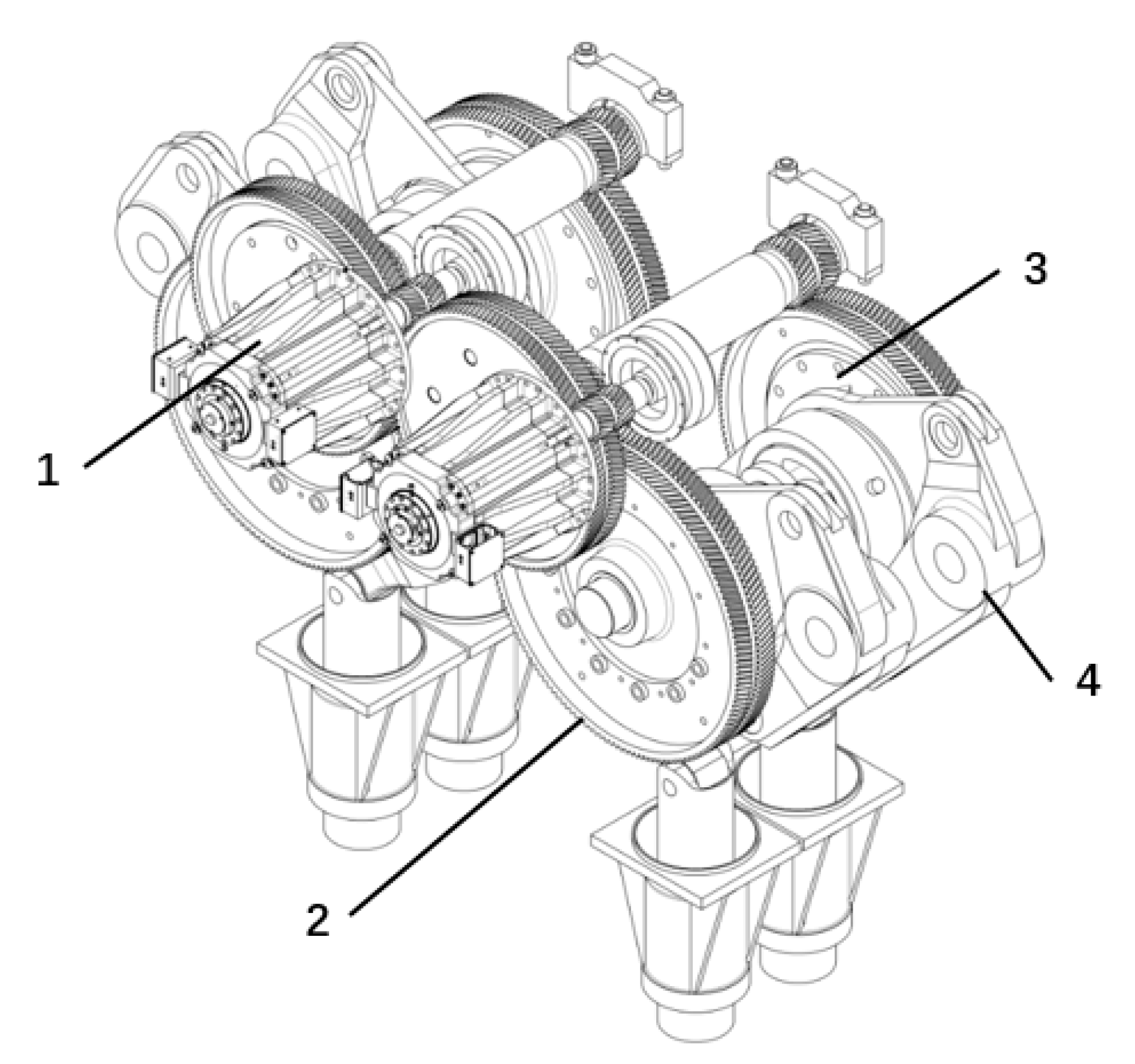
Figure 1 shows the mechanical configuration of the heavy-duty servo press transmission system under investigation, consisting of 1—servo motor, 2—reduction gear pair, 3—eccentric wheel, 4—eight-bar mechanism, 5—slide (connected to the guide pillar, not shown in Figure 1). The operating principle is as follows: Two servo motors (1) synchronously drive a two-stage reduction gear pair (2); the eccentric wheels (3) fixed to the final-stage gear transmit the rotational motion to four sets of eight-bar mechanisms (4). Through kinematic conversion by the linkage system, the rotational motion of servo motor (1) is ultimately transformed into the linear reciprocating motion of slide (5), thereby enabling the stamping operation.
In the transmission system, components such as motor shafts, couplings, reduction gears, and eccentric wheels perform fixed-axis rotational motion. The dynamic characteristics of these components primarily manifest as rotational inertia effects about a fixed axis and can be directly calculated based on moment of inertia, transmission ratio, and friction models. By contrast, the motion of the eight-bar mechanism involves not only significant inertial effects, but also comprehensive influences from multiple complex factors such as joint friction and external loads, exhibiting highly nonlinear and strongly coupled dynamic behaviors. Consequently, developing a high-precision dynamics model of the eight-bar mechanism is essential for optimizing the overall dynamic performance.

2.2. Dynamic Modeling of Eight-Bar Mechanism

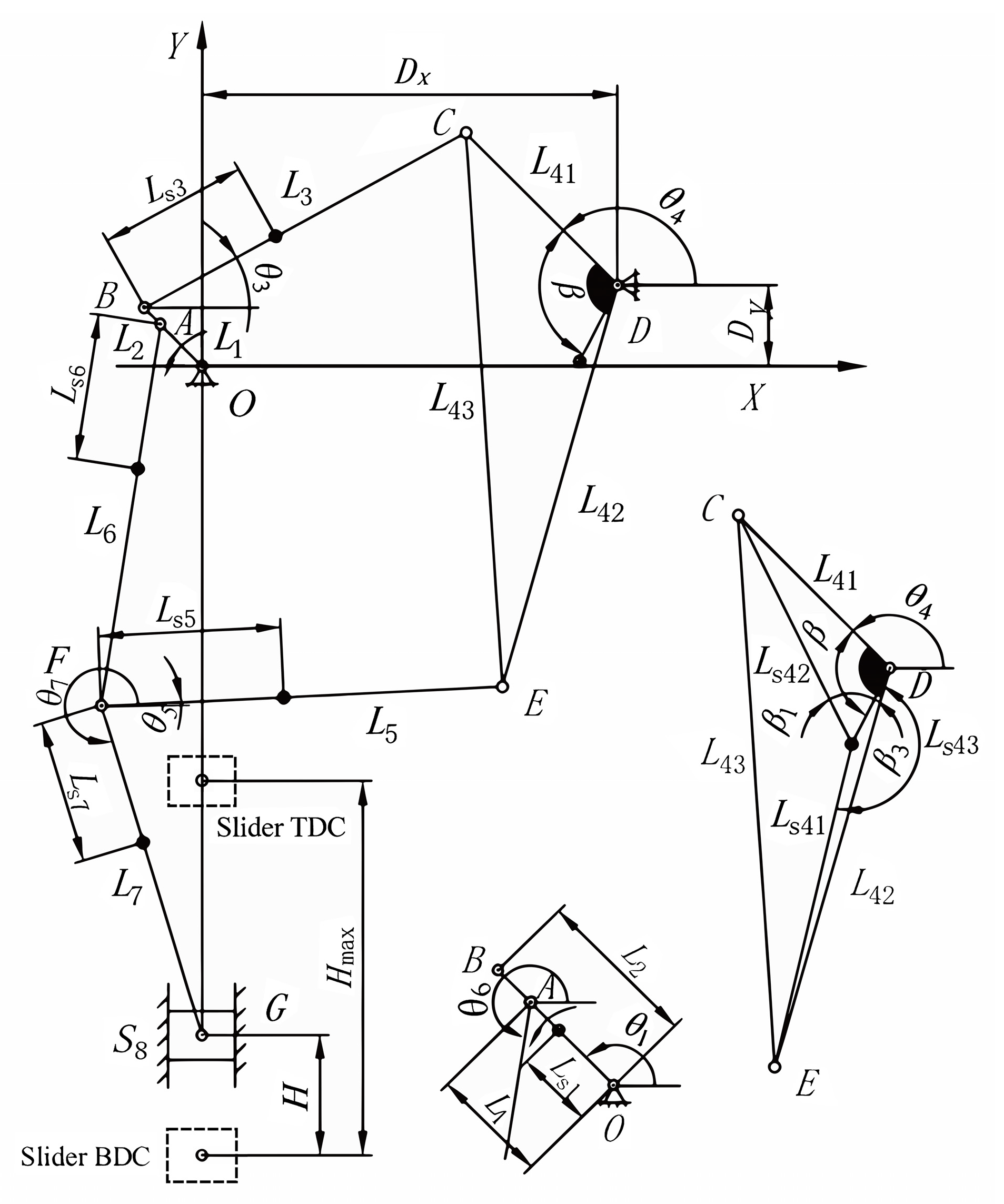
The schematic diagram of the eight-bar mechanism is shown in Figure 2. This mechanism mainly comprises the frame (O and D), crank 1, link 2, link 3, triangular link 4, link 5, link 6, link 7, and slide 8, where crank 1 and link 2 are integrated into a single component, referred to as the eccentric wheel mentioned above. All links are interconnected by nine revolute joints and one prismatic joint, forming a closed kinematic chain. Driven by the servo motor through the input crank, the mechanism realizes a controllable stamping operation through coordinated linkage motion.
A generalized coordinate system for the eight-bar mechanism is established using the reference-point coordinate method, with the center of mass of each moving link selected as the reference point. The coordinates of any point on a link in the generalized coordinate system can be obtained by applying a rotation-matrix transformation to its local coordinates, with the rotation matrix defined as:
R L i n k i = cos θ i sin θ i sin θ i cos θ i
The generalized coordinate vector for each moving link is defined as q i = x i , y i , θ i T , where i L i n k = { 1 , 3 , 4 , 5 , 6 , 7 , 8 } ; x i and y i are the coordinates of the center of mass of i -th link in the generalized coordinates system XOY , respectively; and θ i is the angular displacement of i -th link relative to the positive X-axis, with the counter-clockwise direction defined as positive.
In the dynamics model of the eight-bar mechanism, crank 1 and link 2 are rigidly connected, forming a single integrated body with zero relative degree of freedom. Therefore, independent generalized coordinates for link 2 are omitted from the system’s coordinate vector. Thus, the generalized coordinates of the eight-bar mechanism are
q = x 1 , y 1 , θ 1 , x 3 , y 3 , θ 3 , x 4 , y 4 , θ 4 , x 5 , y 5 , θ 5 , x 6 , y 6 , θ 6 , x 7 , y 7 , θ 7 , x 8 , y 8 , θ 8 T
Employing the geometric constraint formulation and utilizing the coordinate transformation relationship given in Equation (1), a total of 21 position constraint equations can be established based on the topology of nine revolute joints and one prismatic joint, together with one driving constraint. The constraint equations are expressed as follows:
Φ ( q , t ) = x 1 L s 1 cos θ 1 y 1 L s 1 sin θ 1 x 4 L s 43 cos ( θ 4 + β ) D x y 4 L s 43 sin ( θ 4 + β ) D y x 1 + ( L 1 L s 1 ) cos θ 1 x 6 + L s 6 cos θ 6 y 1 + ( L 1 L s 1 ) sin θ 1 y 6 + L s 6 sin θ 6 x 1 + ( L 2 L s 1 ) cos θ 1 x 3 + L s 3 cos θ 3 y 1 + ( L 2 L s 1 ) sin θ 1 y 3 + L s 3 sin θ 3 x 3 + ( L 3 L s 3 ) cos θ 3 x 4 + L s 42 cos β 1 cos ( θ 4 + β ) L s 42 sin β 1 sin ( θ 4 + β ) y 3 + ( L 3 L s 3 ) sin θ 3 y 4 + L s 42 cos β 1 sin ( θ 4 + β ) + L s 42 sin β 1 cos ( θ 4 + β ) x 4 L s 41 cos β 3 cos ( θ 4 + β ) L s 41 sin β 3 sin ( θ 4 + β ) x 5 ( L 5 L s 5 ) cos θ 5 y 4 L s 41 cos β 3 sin ( θ 4 + β ) + L s 41 sin β 3 cos ( θ 4 + β ) y 5 ( L 5 L s 5 ) sin θ 5 x 5 L s 5 cos θ 5 x 6 ( L 6 L s 6 ) cos θ 6 y 5 L s 5 sin θ 5 y 6 ( L 6 L s 6 ) sin θ 6 x 5 L s 5 cos θ 5 x 7 + L s 7 cos θ 7 y 5 L s 5 sin θ 5 y 7 + L s 7 sin θ 7 x 7 + ( L 7 L s 7 ) cos θ 7 x 8 y 7 + ( L 7 L s 7 ) sin θ 7 y 8 x 8 θ 8 θ 1 0.5 π θ c ( t ) = 0
In the equations, L i represents the length of the i -th link; L s i denotes the distance between the center of mass of the i -th link and its reference hinge point; β , β 1 and β 3 are the orientation angles of the triangular link 4, with respect to its center of mass; D x and D y are the coordinate components of the hinge point D; and θ c ( t ) is the prescribed crank angular-displacement function as a function of time t .
Differentiating Equation (3) with respect to time gives the velocity constraint equation:
Φ q q ˙ = Φ t v
where Φ q is the Jacobian matrix of the constraint equations, defined as Φ q = Φ / q ; q ˙ is the generalized velocity vector; and Φ t is the partial derivative of Φ ( q , t ) with respect to time t , given by Φ t = Φ / t = 0 1 × 20 , θ ˙ c ( t ) T .
Differentiating Equation (3) twice with respect to time gives the acceleration constraint equation:
Φ q q ¨ = ( Φ q q q ˙ + Φ q t ) q ˙ Φ t q q ˙ Φ t t γ
In the equation, q ¨ is the acceleration vector; Φ q q is the second partial derivative of the constraint equation Φ ( q , t ) with respect to the generalized coordinates q ; and Φ t t is the second partial derivative of Φ ( q , t ) with respect to time t , given by Φ t t = 0 1 × 20 , θ ¨ c ( t ) T .
In the acceleration constraint equation, the right-hand side of Equation (5) comprehensively accounts for all inertial force effects within the mechanism. Specifically, the term Φ q q reflects the centrifugal inertial forces arising from the rotation of components and the motion of their centers of mass. The combined term ( Φ q / t + Φ t / q ) q ˙ describes the Coriolis forces in the system. Meanwhile, the term Φ t t characterizes the equivalent inertial force generated by the acceleration and deceleration of the servo-motor-driven crank. This term serves as a key element linking the dynamic input of the servo motor to the inertial response of the mechanism, effectively capturing the dynamic behavior of the servo drive system under non-uniform operating conditions.
Based on the Lagrange multiplier method, the rigid-body dynamics equation of the eight-bar mechanism is established as follows:
M q ˙ + Φ q T λ = Q e x t
In this equation, M is the mass matrix of system; λ is the Lagrange multiplier; and Q e x t is the generalized external force for the system.
The system mass matrix M can be expressed as:
M = d i a g m 1 , m 1 , J 1 , m 3 , m 3 , J 3 , m 4 , m 4 , J 4 , m 5 , m 5 , J 5 , m 6 , m 6 , J 6 , m 7 , m 7 , J 7 , m 8 , m 8 , J 8
where m i is the mass of the i -th link, and J i is the rotational inertia of the i -th link.
Combining Equations (5) and (6) and applying the Baumgarte stabilization method, the rigid-body dynamics equation of the eight-bar mechanism is obtained as:
M Φ q T Φ q 0 q ¨ λ = Q e x t γ 2 φ 1 Φ ˙ φ 2 2 Φ
where φ 1 and φ 2 are correction parameters of the Baumgarte stabilization method [27], typically selected as positive real numbers in the range [ 0 , 50 ] ; and Φ ˙ = d Φ / d t = Φ q q ˙ + Φ t , which penalizes the velocity and position constraint violations, respectively, to improve numerical stability during the numerical solution.

2.3. Generalized External Forces and Friction Modeling

In the dynamics model of the heavy-duty servo press eight-bar mechanism, the generalized external forces are the primary factors that drive the system motion and overcome various resistive effects. Accurate modeling of these forces is essential for predicting the system’s dynamic response, energy distribution, and the servo motor torque. During the stamping process, the generalized external forces primarily comprise four components: gravitational forces of links, friction in kinematic joints, the slide balance force, and stamping process loads, which are projected into the generalized coordinate space through the system’s geometric configuration and kinematic relationships, collectively constituting the complete set of generalized external forces acting on the system.

2.3.1. Gravitational Force

The gravitational forces of links can be obtained by differentiating the potential energy function with respect to the generalized coordinates. Since gravity only affects the generalized force components in the Y-direction, the gravitational sub-vector acting on the center of mass of the i-th link can be expressed as:
Q g i = 0 , m i g 0 T
where g is the gravitational acceleration.

2.3.2. Friction Modeling

The frictional forces in the kinematic joints exert significant influence on servo motor torque and cannot be neglected. In this study, the Coulomb-viscous friction model is employed to describe the revolute and prismatic joints in the eight-bar mechanism. For the revolute joints, the friction torque always opposes the relative motion and is expressed as:
τ j = μ r r j N j + c r θ ˙ j sgn θ ˙ j   j W
where τ j is the friction torque at the j -th revolute joint; μ r is the friction coefficient of the revolute joint; r j is the journal radius; N j is the magnitude of the normal constraint force, obtained from the corresponding component of the Lagrange multiplier λ . c r is the viscous damping coefficient of the revolute joint; θ ˙ j is the relative angular velocity between the two connected links at the j -th revolute joint, calculated from the generalized velocity vector q ˙ ; W is the set of revolute joints, W = O , A , B , C , D , E , F 1 , F 2 , G , the revolute joint F connecting three links can be decomposed into two revolute joints F 1 and F 2 ; and sgn ( ) is the sign function.
Based on the principle of virtual work, the friction torques of the revolute joints are mapped into the generalized coordinates to establish the corresponding generalized external force vector Q f r , expressed as follows:
Q f r = j W U j T τ j
where U j represents the Jacobian row vector of j -th revolute joint, U j = θ j / q .
For the prismatic joint formed by the slide and guide rail, the sliding friction force is formulated as:
Q f s = μ s N 8 + c s y ˙ 8 sgn y ˙ 8
where Q f s is the sliding friction force exerted by the guide rail on the slide, acting opposite to slide’s velocity; μ s is the friction coefficient of the prismatic joint; N 8 is the magnitude of the normal constraint force, which also can be obtained from the corresponding component of the Lagrange multiplier λ ; c s is the viscous damping coefficient of the prismatic joint; and y ˙ 8 is the generalized velocity of the slide.

2.3.3. Slide Balance Force

The slide balance force is primarily utilized to counterbalance the gravity of all moving components, including the linkage mechanism, guiding pillar, slide, height adjustment, upper die, and auxiliary devices. It effectively suppresses sudden load variations on the servo motor, reduces impact and wear in the kinematic pairs, and thereby improves the dynamic response and operational reliability of the servo press. This balance force is generated by a pneumatic balance cylinder system, with its direction of action parallel to the slide’s motion and always pointing toward the positive Y-axis. The magnitude of the balance force is a function of the slide displacement, and its theoretical formula is shown in Equation (13).
Q b = z P 0 A b ( 1 + u 1 )
In the formula, the pressure fluctuation coefficient u 1 is determined by the following formulas [28].
u 1 = ( P 0 + 0.1033 ) ( 1 + 1 / u 2 ) 1.4 1 P 0 1 u 2 = ( H max H ) A b V v e s s
In the above formulas, Q b is the balance force acting on the slide; z is the number of balance cylinders; P 0 is the absolute pressure of the air supply; A b is the effective cross-sectional area of a single balance cylinder; u 2 is the compression ratio of the air; H max represents the slide rated stroke; H means the instantaneous slide displacement (with the bottom dead center (BDC), defined as zero); and V v e s s is the volume of the air tank.

2.3.4. Stamping Process Force

The stamping process force is defined as the deformation resistance that must be overcome when the slide causes plastic deformation of the sheet metal through the upper die. This force acts on the slide in the same direction as the balance force, but exhibits a staged characteristic, being generated only within the stamping stroke from die-sheet contact to BDC. The stamping process force can be defined as:
Q p = F ( H ) 0 H H p ,   y ˙ 8 0 0
In the formula, Q p is the stamping process force, and its magnitude is related to the slide displacement H ; and H p is the slide displacement when the die contacts the sheet metal.

2.3.5. Generalized External Force Integration

Following the establishment of the mathematical models for gravity, joint friction, balance force and stamping process force, it is necessary to integrate these models to form a complete system dynamic input vector. Based on the principle of virtual work, all external forces are mapped into the generalized coordinates to develop the generalized external force vector Q e x t , which is defined as the sum of the individual components:
Q e x t = Q g + Q f r + Q f s + Q b + Q p
where Q g is the system gravity, assembled from the gravity sub-vectors Q g i ; Q f s , Q b and Q p are applied directly to the generalized coordinate y 8 of the slide.
This generalized external force completely describes the various external forces acting on the heavy-duty servo press during the stamping process, providing accurate input conditions for system dynamics analysis.

2.4. Servo Motor Drive Torque Modeling

Based on the dynamics model established previously, this section further develops a theoretical formula to predict the servo motor’s output torque, providing a foundation for subsequent parameter identification.
According to the constrained dynamics model established by Lagrange equations, the Lagrange multiplier λ 21 represents the generalized driving torque required to maintain the predefined crank motion θ c ( t ) , and this multiplier is obtained by solving the constrained dynamics equations. Concurrently, the servo motor output torque must also overcome the inertial effects in the reduction gears. By considering the factors, the formula of the servo motor output torque is established as follows:
T m = 1 u g e a r η g e a r sgn ( T m θ ˙ c ) λ 21 + J g e a r u g e a r 2 θ ¨ c
In the formula, T m is the output torque of the servo motor; u g e a r is the reduction gear ratio, u g e a r = 32 ; η g e a r is the total efficiency of the reduction system, which accounts for both the electromagnetic conversion efficiency of the servo motor and the mechanical efficiency of the reduction gear; and J g e a r is the total moment of inertia equivalent to the motor shaft, including the rotational inertia of the servo motor shaft, coupling, two-stage reduction gear pairs, and other rotating components.
Formula (16) establishes a quantitative relationship between the system dynamic response and the servo motor driving torque, wherein the efficiency term η g e a r sgn ( T m θ ˙ c ) represented through a sign function, precisely characterizes the system energy transmission behavior under driving ( T m θ ˙ c > 0 ) and braking ( T m θ ˙ c 0 ) operational states.

3. Sensitivity Analysis and Identification of Dynamics Parameters

3.1. Definition and Classification of Theoretical Design Parameters

The dynamics model of the heavy-duty servo press transmission system established above contains multiple types of parameters. To investigate the dynamic influence of the parameters on the servo motor torque, these parameters are classified into four categories: the reduction gear system parameters, the mechanism dimensions and their mass-inertia parameters, the friction characteristic parameters, and the balance coefficient.
The key parameters of the reduction gear system mainly comprise the equivalent moment of inertia of the reduction gears and the total efficiency. Table 1 presents the theoretically calculated values of the equivalent moment of inertia and total efficiency for the reduction gear system.
The dimensions and mass-inertia parameters of the eight-bar linkage mechanism are shown in Table 2. The link parameters L i , which critically determine slide motion accuracy, have been guaranteed through high-precision machining. The remaining parameters, including the center-of-mass distances, masses, and moments of inertia, are obtained from theoretical calculations based on the components’ 3D models.
As the servo press transmission mechanism operates under heavy-duty conditions with significant forces on each kinematic pair, revolute joints are designed with thin-oil-lubricated plain bearings and prismatic joints (guide rail and slide) with grease lubrication to ensure operational stability and durability. The empirical values of friction characteristic parameters and radius of plain bearings are listed in Table 3.
This study proposes the balance coefficient to optimize energy efficiency and drive load under steady-state operation. Defined as the ratio of counterweight mass to rated load, it is expressed as:
ψ = Q b i L i n k m i
In this formula, the balance coefficient ψ falls within the range of 1.0 to 1.3, with a conventional value of 1.15.

3.2. Sobol Global Sensitivity Analysis and Response Function Definition

3.2.1. Sobol Method for Global Sensitivity

The Sobol method is a variance-based global sensitivity analysis approach, widely used to quantify the contribution of individual input parameters to uncertainty in model output [29,30]. This method calculates the first-order and total-effect indices to reflect the independent influence of individual parameters and the combined effects arising from their interactions with other parameters, respectively. Let the model output be Y = f ( X ) , where X = ( X 1 , X 2 , , X n ) is a vector comprising n input parameters. The model output can then be decomposed as follows:
Y = f 0 + i = 1 n f i ( X i ) + 1 i < j n f i j ( X i , X j ) + + f 1 , 2 , , n ( X 1 , X 2 , , X n )
In this formula, f 0 is the constant term, representing the mean of model output; X i denotes the i-th input parameter; f i ( X i ) is the first-order effect term, representing the variation in model output caused solely by changes in parameter X i ; f i j ( X i , X j ) is the second-order effect term, characterizing the variation in model output resulting from the interaction between parameters X i and X j ; f 1 , 2 , , n ( X 1 , X 2 , , X n ) is the n-th order effect term, encompassing the interactive effects among all n parameters.
Based on this decomposition, the total variance of the model output can be expressed as Equation (19).
V ( Y ) = i = 1 n V i + i = 1 n V i j + + V 1 , 2 , , n
where V ( Y ) denotes the total variance of model output; V i is the variance contributed by the independent effect of parameter; V i j is the variance contributed by the interaction between parameters X i and X j ; and V 1 , 2 , , n is the variance contributed by the total effect of all n parameters.
Subsequently, the first-order effect index S i and the total-effect index S T i are given as follows:
S i = V i V ( Y ) = V X i E X ~ i Y | X i V ( Y )
S T i = E X ~ i V X ~ i Y | X ~ i V ( Y ) = 1 V X ~ i E X i Y | X ~ i V ( Y )
where X ~ i denotes all parameters except X i .

3.2.2. Definition of Response Function

In the servo press transmission mechanism, certain structural parameters, such as the geometric dimensions of components ( L i ( i L i n k ) , D x , D y , β , β 1 , β 3 ) and plain bearing dimensions r i ( i W ) are directly guaranteed by machining precision, their influence on system dynamic performance is negligible; consequently, they are excluded from the sensitivity analysis. This study focuses on 28 parameters determined through theoretical calculation or empirical estimation, including the equivalent moment of inertia of the reduction system J g e a r , the total efficiency of the reduction system η g e a r , distance to the component’s center of mass L s i , the mass of i -th link m i , the rational inertia of i -th link J i , the friction coefficient of the revolute joint μ r , the friction coefficient of the prismatic joint μ s , the viscous damping coefficient of the revolute joint c r , the viscous damping coefficient of the prismatic joint c s , and balance coefficient ψ . These parameters may deviate from the theoretical design values during actual operation, thereby significantly affecting output torque characteristics of the servo motor.
To quantitatively evaluate the influence of each parameter on servo motor torque characteristics, the global sensitivity analysis using the Sobol method is conducted on the 28 parameters. Given that the servo motor output torque response exhibits strong nonlinear characteristics, a single evaluation metric is insufficient to comprehensively capture all parameter effects; therefore, four response functions are defined to construct a multi-dimensional evaluation framework.
The root mean square error (RMSE) function Y R M S E is employed to evaluate the influence of parameters on torque predicting accuracy, as described by the following formula. This function calculates the RMSE between the predicted and reference torque over a complete work cycle to identify critical parameters.
Y R M S E = 1 k j = 1 k T m p r e θ j T m r e f θ j 2
where k is the number of sampling points, taken as k = 360 , i.e., one data point is sampled every 1° in one working cycle; T m p r e ( θ j ) is the value of the predicted torque curve generated with varied parameters at the crank angle θ j ; and T m r e f ( θ j ) is the value of the reference torque curve constructed based on theoretical design parameters at the crank angle θ j .
A transient overload risk index, termed peak ratio (PR), is formulated as a key response function Y P R . This function, by quantifying the relative deviation between predicted and baseline peak torques, is specifically designed to isolate and capture the contribution of each parameter to transient overload risk. Its expression is
Y P R = max T m p r e max T m r e f max T m r e f
To assess the system’s thermal performance, a thermal limit index, termed TL, is formulated as a primary response function Y T L . This metric, which directly correlates with the servo motor’s heat generation, is specifically employed to evaluate the influence of transmission system parameters on the overall thermal loading. Its expression is:
Y T L = 1 t c 0 t c T m p r e 2 d t
where t c is the cycle time.
The work index Y W o r k evaluates the influence of transmission system parameters on energy conversion efficiency by calculating the total work output of the servo motor in one working cycle. Its expression is
Y W o r k = 0 t c u g e a r T m p r e θ ˙ c ( t )
where θ ˙ c ( t ) is the predefined crank angular velocity.

3.2.3. Global Sensitivity Analysis Process and Parameter Settings

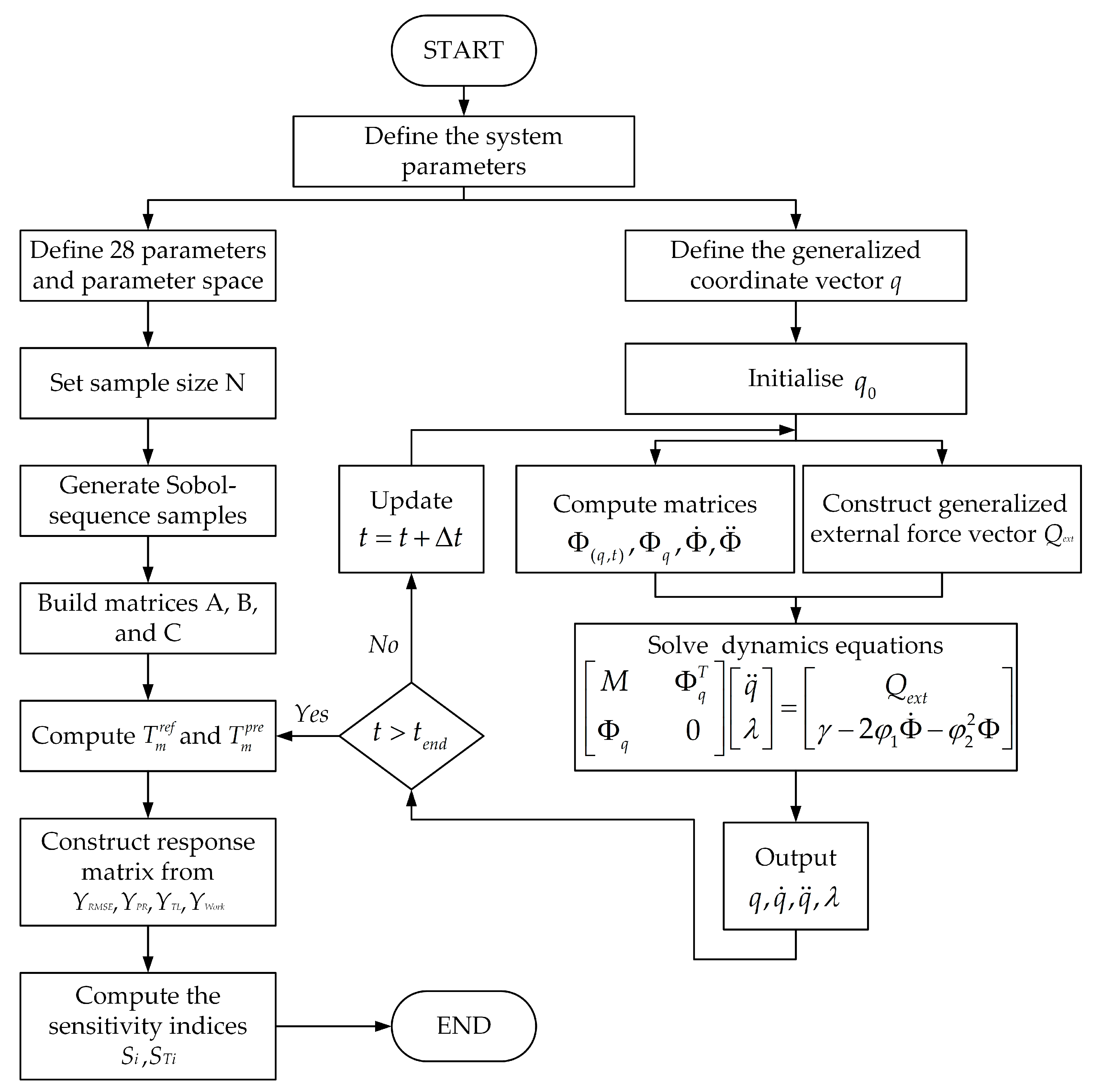
To systematically identify the key parameters in the dynamic model of the heavy-duty servo press that have a decisive influence on its output responses, this section employs the Sobol method for global sensitivity analysis. The complete workflow is illustrated in Figure 3.
The workflow can be summarized into the following three core steps:
Step 1: Parameter space definition and sampling. First, all 28 dynamic parameters to be analyzed are defined, and their reasonable variation ranges (parameter space) are set based on physical meaning and engineering uncertainty. Subsequently, Monte Carlo sampling is performed within the parameter space using the Sobol sequence to generate two independent sample matrices, A and B. Intermediate matrices C are then generated via column permutation to ensure thorough exploration of all parameters and their interactions.
Step 2: Dynamic response calculation for sample points. Each sample point generated in Step 1 (i.e., a specific set of parameter combinations) is input into the multibody dynamic model established in Section 2. By numerically solving Equation (8), the reference torque T m r e f and the predicted torque T m p r e of the servo motor under each sample parameter set are calculated.
Step 3: Response function construction and sensitivity index calculation. Based on the torque curves output from Step 2, four scalar response functions reflecting model prediction performance (e.g., root mean square error Y R M S E , peak ratio Y P R , thermal limit Y T L and work Y W o r k ) are constructed. These response values are calculated for all sample points to form a response matrix. Finally, by decomposing the total variance of the response values, the first-order sensitivity index S i and the total sensitivity index S T i for each parameter are quantified.
The key parameter settings are as follows: To accurately reflect parameter uncertainty, the variation range for most parameters is set from 70% to 130% of their theoretical design values. Specific parameters are assigned ranges based on physical constraints or empirical data, for example, the total efficiency of the reduction system η g e a r 0.7 , 0.99 , the friction coefficient of the revolute joint u r 0.005 , 0.05 , the friction coefficient of the prismatic joint u s 0.02 , 0.2 , and balance coefficient ψ 1.0 , 1.3 . Through sample convergence analysis, a sample size of N = 2000 is determined to ensure the statistical stability of the sensitivity index estimates.

3.3. Sensitivity Analysis Results and Key Parameter Identification

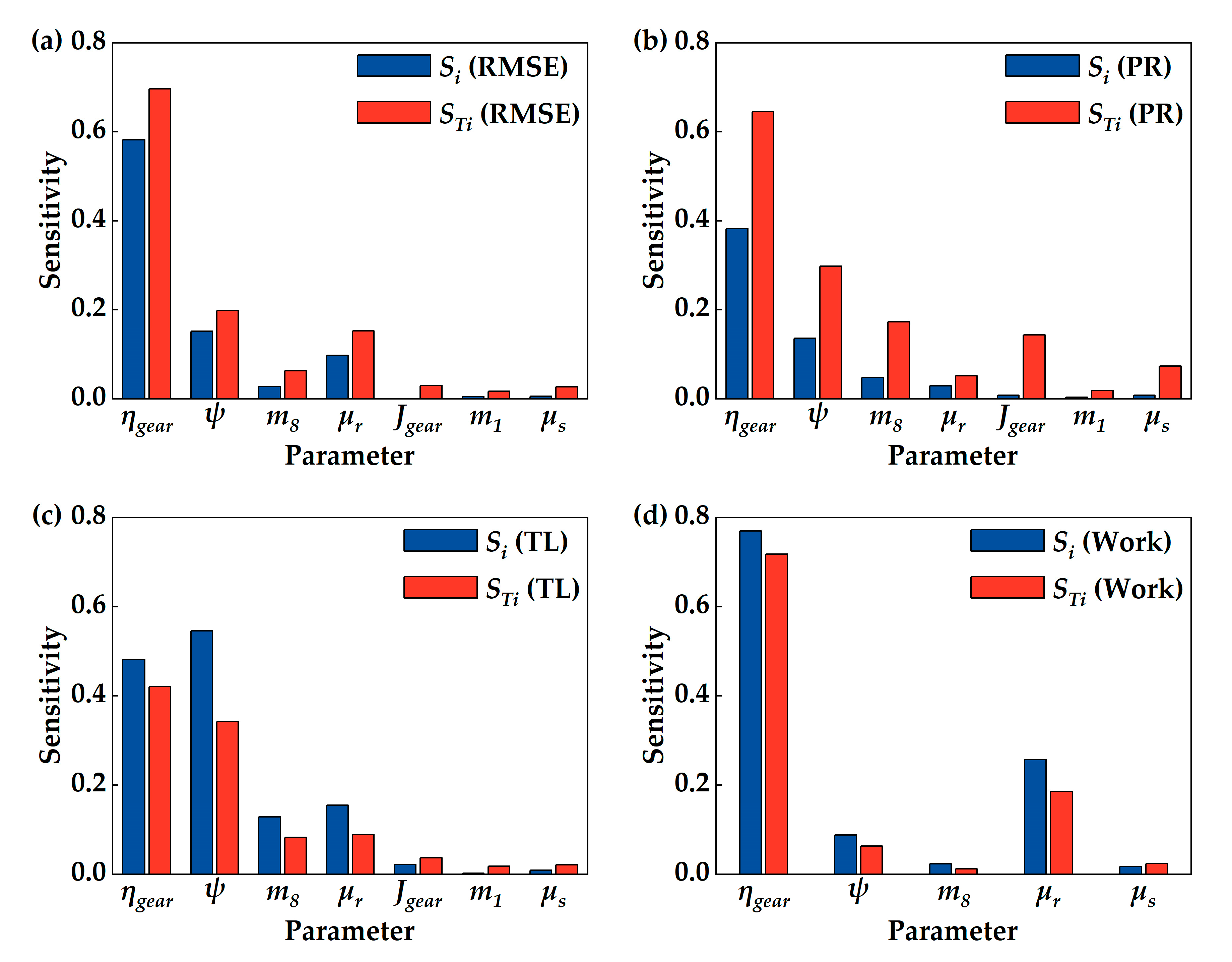
The results of the global sensitivity analysis demonstrate a strong dependence of parameter sensitivity on the selected response function. Among the 28 transmission system parameters considered, only 7 parameters exhibit significant influence across the four response functions, characterized by a total-effect index S T i 0.01 , while the total-effect indices of the remaining 21 parameters are all below 0.01, indicating that their effects on the dynamic behavior of the transmission system can be negligible. As shown in Figure 4a, which includes only parameters with a total-effect index S T i 0.01 , the response function Y R M S E is predominantly governed by a distinct set of parameters. Specifically, the total efficiency of the reduction system η g e a r ( S T i = 0.696 ), the balance coefficient ψ ( S T i = 0.199 ), and the friction coefficient of the revolute joint μ r ( S T i = 0.153 ), constitute the core set of sensitive parameters, with their cumulative contribution accounting for 90.5% of the total-effect indices from all parameters. However, the total-effect index for the slide equivalent mass m 8 is merely 0.063 in this Y R M S E -based analysis. This finding underscores that relying solely on the response function Y R M S E for parameter identification would significantly underestimate the influence of inertial parameters such as parameter m 8 on the system’s dynamic characteristics, which could compromise the model’s predictive capabilities for transient dynamic behavior.
The introduction of the response function Y P R significantly reconfigures the parameter sensitivity spectrum, as illustrated in Figure 4b. Parameters η g e a r ( S T i = 0.645 ) and ψ ( S T i = 0.298 ) remain the two most influential factors in the Y P R -based analysis. Specifically, the total-effect index of η g e a r experiences a slight decrease, whereas that of ψ increases substantially, underscoring its critical role in the formation of peak torque. Compared with the results obtained from the Y R M S E -based analysis, another notable shift is observed for the parameters m 8 and J g e a r (the equivalent moment of inertia of the reduction system). Their total-effect indices increase markedly from 0.063 and 0.03 to 0.173 and 0.144, respectively, thereby establishing them as the third and fourth most influential parameters, subordinate only to parameters η g e a r and ψ . This shift is attributed to the inertia forces and torques generated by parameters m 8 and J g e a r during rapid acceleration and deceleration phases, which scale with the crank angular acceleration and thus dominate the peak load torque. In addition, the total-effect index of the prismatic joint friction coefficient μ s rises from 0.027 to 0.074, enhancing the influence of velocity-dependent friction on torque spike modulation. In contrast, the total-effect index of the parameter μ r decreases significantly from 0.153 in the Y R M S E -based analysis to 0.052 in the Y P R -based analysis. Despite this reduction, parameter μ r continues to exert a relatively strong influence. A direct comparison between Figure 4a,b reveals a fundamental shift in parameter dominance: the Y R M S E -based analysis identifies only three parameters exhibiting strong sensitivity, namely η g e a r ( S T i = 0.696 ), ψ ( S T i = 0.199 ), and μ r ( S T i = 0.153 ), whereas the Y P R -based analysis reveals four influential parameters, namely η g e a r ( S T i = 0.645 ), ψ ( S T i = 0.298 ), m 8 ( S T i = 0.173 ) and J g e a r ( S T i = 0.144 ), with a notable change in the composition of the dominant parameter set. Consequently, the sensitivity analysis omitting the Y P R function may yield a model that accurately predicts average torque but fails to reliably capture transient overload risk. This deficiency could lead to underestimated safety margins for crank acceleration in motion planning, potentially resulting in servo motor overcurrent faults or mechanical shock in the transmission system.
The sensitivity analysis results for the two response functions Y T L and Y W o r k are presented in Figure 4c,d, respectively. As shown in Figure 4c, the Y T L -based analysis identifies a core set of four sensitive parameters: η g e a r ( S T i = 0.421 ), ψ ( S T i = 0.342 ), m 8 ( S T i = 0.083 ) and μ r ( S T i = 0.089 ). This parameter set collectively accounts for 92.5% of the total-effect indices from all parameters. Notably, the first-order sensitivity indices for these four parameters are consistently higher than their corresponding total-effect indices, and their interaction effects are calculated to be negative. This pattern suggests the presence of nonlinear saturation or canceling effects among these parameters concerning Y T L response. In the Y W o r k -based analysis, shown in Figure 4d, the parameter η g e a r exhibits a dominant total-effect index ( S T i = 0.718 ), substantially exceeding that of all other parameters. The parameter μ r ( S T i = 0.186 ) also presents considerable importance for energy consumption, second only to the parameter η g e a r . Together with the prismatic joint friction coefficient μ s ( S T i = 0.024 ), these three parameters contribute 92.5% of the total-effect indices from all parameters, identifying them as the primary dissipation terms for system energy consumption aside from the useful stamping work. Specifically, these energy dissipation terms primarily manifest as frictional losses in the gear pairs of the reduction system, as well as in the revolute and prismatic joints of the linkage mechanism. This analysis thus provides a clear direction for optimizing the system’s mechanical efficiency. In contrast, the parameter ψ , while exhibiting high sensitivity in the other three response functions, shows a markedly reduced total-effect index of 0.063 in the Y W o r k -based analysis, aligns with its theoretical role as a conservative force, which should theoretically yield zero network over one working cycle. The minimal associated energy loss is therefore attributable solely to its coupling with non-conservative friction terms.
To develop a high-precision dynamics model of the transmission system, this study conducted a systematic global sensitivity analysis to evaluate key parameters across four response functions: torque prediction accuracy ( Y R M S E ), transient overload risk assessment ( Y P R ), thermal limit ( Y T L ) and work output ( Y W o r k ). The results of the sensitivity analysis reveal a distinct and complementary distribution of parameter sensitivities. The parameter η g e a r consistently exhibited the highest sensitivity across all four functions, with a minimum total-effect index of 0.421. The parameter ψ ranked as the second most influential in the Y R M S E -based, Y P R -based and Y T L -based analysis. Meanwhile, parameter μ r showed considerable influence in the Y R M S E -based and Y W o r k -based analysis, with total-effect indices exceeding 0.1 in both cases. The effects of parameters m 8 and J g e a r were predominantly concentrated in the Y P R -based analysis, which characterizes transient overload risk, where their indices were substantially higher than those in other functions. Although the parameter μ s displayed relatively low sensitivity in the Y R M S E -based, Y T L -based and Y W o r k -based analysis, it demonstrated notable sensitivity in Y P R -based analysis. Guided by this comprehensive sensitivity profile and aiming to build a high-fidelity model that balances torque prediction accuracy and transient overload risk assessment, Y R M S E and Y P R were selected as the core decision functions. Parameter selection followed a clear two-step criterion: First, a preliminary screening required that a parameter’s total-effect index S T i must be greater than 0.05 in at least one core function. This threshold was determined by analyzing the distribution of S T i values across all parameters, aiming to retain those with a substantial impact (exceeding the average effect level) on any core performance metric. Subsequently, final selection was made by comprehensively evaluating each parameter’s S T i distribution pattern across all four response functions and considering their engineering physical significance:
(1) η g e a r and ψ were identified as globally decisive core parameters mandatory for calibration due to their consistently high sensitivity ( S T i 0.1 ) in three functions.
(2) μ r was selected because its S T i exceeded 0.05 in both core functions and it also contributed significantly to Y W o r k function.
(3) m 8 , J g e a r and μ s were included despite their low sensitivity in other functions because they exhibited exceptionally high sensitivity in the core function Y P R (transient overload), which is critical for equipment safety protection.
Through this standardized screening process, six key parameters with global influence on the system’s dynamic performance were identified for calibration: η g e a r , ψ , μ r , m 8 , J g e a r , and μ s . This parameter set comprehensively covers multidimensional performance objectives, including torque prediction accuracy, transient overload risk, thermal management, and energy efficiency, thereby laying a solid parametric foundation for establishing a high-precision and highly reliable dynamics model of the transmission system.

3.4. Parameter Calibration Model

The results of the global sensitivity analysis presented in Section 3.3 demonstrate that the identified key parameters exert a decisive influence on the dynamic performance of the transmission system. Accurate calibration of these key parameters is therefore essential for constructing a high-precision dynamics model. In this study, the torque prediction accuracy function Y R M S E and the transient overload risk assessment function Y P R are selected as the calibration objectives based on the following rationale: the Y R M S E function serves as a core metric for evaluating the model average torque fidelity in one working cycle, directly determining the fundamental accuracy of the dynamics model; whereas the Y P R function is critical for predicting the dynamic safety boundary of the transmission system under extreme operating conditions, playing an essential role in assessing the transient overload risk of the servo motor. Accordingly, the parameter calibration problem is formulated as a multi-objective optimization problem aimed at simultaneously minimizing these two objectives.
The calibration parameter variables are defined as follows:
P = η g e a r , ψ , μ r , m 8 , J g e a r , μ s
The vector form of this multi-objective optimization problem is expressed as:
min Y ( P ) = Y R M S E ( P ) , Y P R ( P ) subject   to   P l b P P u b
where Y R M S E represents the root mean square error between the predicted and measured torque in one working cycle; Y P R denotes the relative error between the predicted and measured peak torque; P l b , and P u b are the lower and upper bounds of the feasible domain for each calibration parameter, respectively, consistent with the parameter ranges in the global sensitivity analysis.
To reformulate this multi-objective problem as a single-objective formulation, the weighted sum method is employed, yielding the following composite objective function:
min Y ( P ) = w Y R M S E ( P ) Y R M S E , 0 ( P ) + ( 1 w ) Y P R ( P ) Y P R , 0 ( P )                                     subject   to   P l b P P u b
where Y R M S E , 0 ( P ) and Y P R , 0 ( P ) are normalization reference values introduced to eliminate dimensional effects, calculated from Equations (22) and (23) using the predicted torque ( T m p r e ) based on the theoretical design parameters, and the measured torque ( T m r e f ); w is a weighting coefficient, w [ 0 , 1 ] that quantifies the trade-off preference between total accuracy and transient peak accuracy, and w = 0.3 is adopted in this study based on preliminary analyses.
By solving this optimization problem, the optimal parameter set P * can be obtained, thereby significantly improving the accuracy of the servo press dynamics model.

4. Experimental Verification and Engineering Application

4.1. Experiment Design for Model Calibration

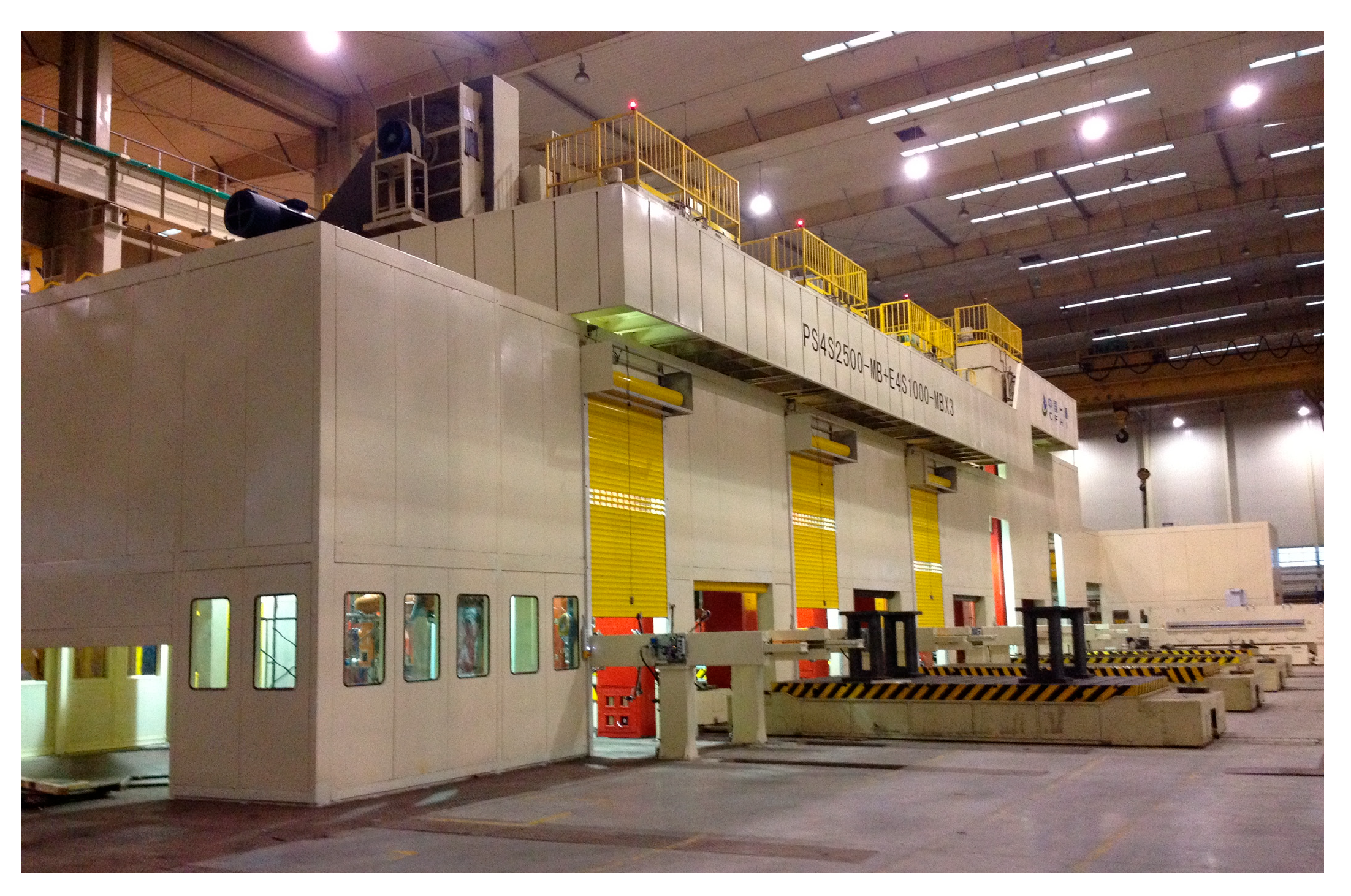
To validate the proposed model and its associated parameter calibration methodology, experiments were conducted on a 25,000 kN heavy-duty servo press (Figure 5), developed by Tianjin Heavy Industry Co., Ltd. of CFHI Group (Tianjin, China). This servo press, integrated with three 10,000 kN mechanical presses, forms an automated stamping line dedicated to the high-precision forming of large automotive panels, such as side outer panels. The stamping line has been successfully deployed in industrial applications for over six months, demonstrating robust and stable performance. Consequently, its stabilized transmission system provides a highly reliable platform for the validation experiments.
In the established dynamics model of the transmission system, the stamping process force, originating from the nonlinear plastic deformation of the sheet metal, exhibits time-varying characteristics and is difficult to measure directly and precisely. Therefore, this study proposes an indirect loading and parameter identification strategy utilizing a CNC servo cushion. This system applies a precisely controlled, constant ejection force to equivalently simulate the actual stamping load on the transmission system. The validity of this approach is justified based on the following considerations: First, the dynamics calculation requires a process force input, while the actual stamping force is intractable to obtain directly. Second, to ensure the identified parameters remain valid under extreme operating conditions, the servo cushion is set to apply a constant ejection force of 5000 kN. The torque generated by this force on the transmission system exceeds that required for stamping the largest parts (e.g., automotive side outer panels) on this press, thereby simulating the maximum operational load. Third, the pre-acceleration function of the servo cushion actively synchronizes with the slide motion, effectively suppressing impact effects at the moment of upper and lower die contact, aligning the experimental conditions more closely with the quasi-static loading assumption of the dynamics model. Finally, during the parameter identification process, transient torque peaks caused by the initial impact are deliberately excluded from the data fitting, and only the load data from the steady-state forming phase are used to ensure the robustness of the calibration.
It is important to acknowledge the limitation of this simplification: the constant force model cannot capture the dynamic fluctuations of the actual stamping force. Therefore, the calibrated model is expected to be most accurate for simulating operations under conditions similar to the calibration experiment, i.e., where steady-state loads dominate. Its prediction accuracy may decrease for processes with significantly different load characteristics (such as high-speed blanking), necessitating further validation or model refinement. The experimental procedure is executed as follows:
(1) Set the ejection force of the servo cushion to 5000 kN and the ejection displacement to 300 mm, simulating the maximum stamping load condition of the servo press;
(2) Based on the preset ejection force and displacement, configure the slide motion trajectory and control the servo press to operate continuously along this trajectory to complete the striking action on the servo cushion;
(3) Synchronously collect the torque data of the servo motor during the actual stamping process;
(4) Use the measured torque as input, and solve the parameter calibration model using an optimization algorithm to inversely identify the true values of the transmission system parameters.
To preliminarily assess the robustness of the calibration methodology under different motion profiles, an additional experimental scenario (denoted as Condition B) was conducted. Condition B employed a distinct slide motion trajectory while maintaining identical servo cushion settings (5000 kN ejection force, 300 mm displacement) as Condition A. The data acquisition procedure remained the same.

4.2. Calibration Results and Analysis

This section uses the ACO algorithm to calibrate six key dynamics parameters ( η g e a r , ψ , μ r , m 8 , J g e a r , μ s ) identified through global sensitivity analysis. The ACO algorithm was selected for its demonstrated superiority in solving complex, nonlinear, and high-dimensional parameter identification problems characterized by limited gradient information availability and multimodal search spaces. Its positive-feedback mechanism based on pheromone trails facilitates effective exploration and exploitation of the parameter space, making it particularly suitable for the calibration of intricate mechanical system models [31]. The algorithm was configured with the following parameters: the number of ants was set to 50, the maximum number of iterations was set to 100, the elite ant quantity coefficient was set to 2, the pheromone importance factor was set to 1.0, the heuristic factor importance was set to 2.0, while the pheromone evaporation coefficient was adaptively regulated within the range of [0.1, 0.9], and the pheromone intensity was set to 100.
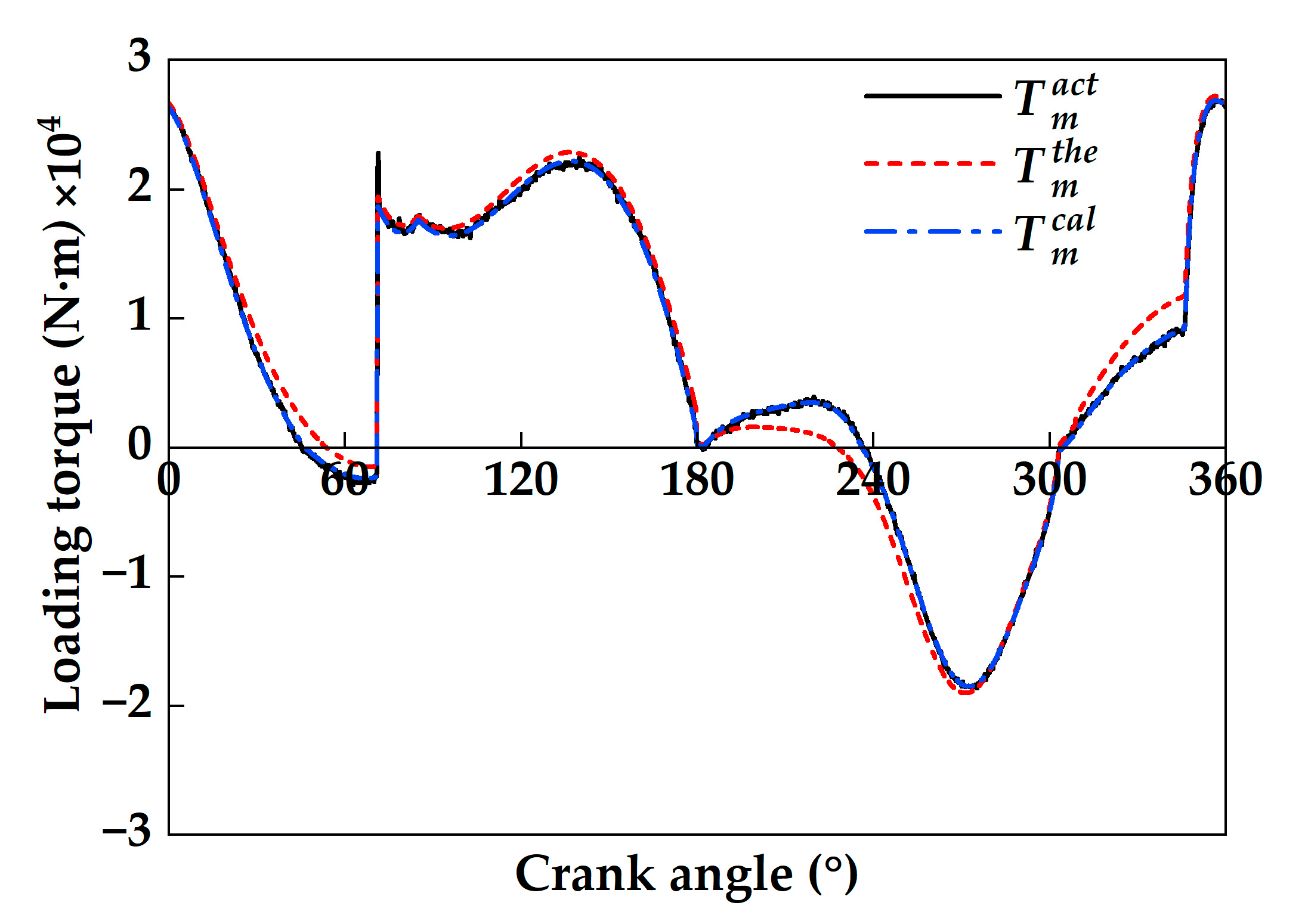
To quantitatively evaluate the improvement in model prediction accuracy after parameter calibration, a comparative analysis was conducted on three characteristic torque curves over one working cycle: the experimentally measured torque ( T m a c t ), the torque predicted by the theoretical design parameters ( T m t h e ), and the torque predicted by the calibrated parameters ( T m c a l ). The results are illustrated in Figure 6.
As illustrated in Figure 6, all three torque curves ( T m a c t , T m t h e , and T m c a l ) exhibit consistent trends throughout the entire working cycle. However, the T m a c t curve demonstrates a prominent sharp-peak torque at the moment of upper–lower die contact (near a crank angle of approximately 71°). This abrupt change is induced by rigid impact, which is an inherent characteristic of the stamping process and does not affect the validity of parameter calibration. Notably, comparative analysis reveals that the agreement between T m a c t and T m c a l is significantly superior to that between T m a c t and T m t h e . To quantitatively characterize this enhancement, the RMSE and peak error of T m t h e and T m c a l relative to T m a c t were calculated separately. The results indicate that the RMSE of T m t h e reaches 1366.9 N·m, with a peak error of 3139.3 N·m; whereas, the RMSE of T m c a l is drastically reduced to 277.7 N·m, and the peak error drops to 856.3 N·m, with the reduction rates being 79.7% and 72.7%, respectively. This demonstrates that the calibrated dynamics model attains substantial improvements in the accuracy of predicting both the mean torque levels and extreme loading conditions.
Table 4 presents a detailed list of the theoretical design parameters, calibrated values and the corresponding relative errors for six key dynamics parameters. It can be observed that varying degrees of discrepancies exist between the theoretical and calibrated values for all parameters, which directly accounts for the previously described deviations in torque prediction accuracy. A closer analysis indicates that friction-related parameters ( η g e a r , μ r , μ s ) exhibit the most significant errors. The total efficiency of the reduction system η g e a r is closely related to the frictional losses within the gear pair. The deviation of its theoretical value (typically manifesting as an overestimation of efficiency) likely originates from simplified assumptions regarding internal friction mechanisms, such as gear meshing and bearing losses, in the initial design. These assumptions failed to adequately reflect energy losses under actual operating conditions. Concurrently, the theoretical values of the friction coefficients for the revolute and prismatic joints are clearly set with larger safety factors, reflecting conservative considerations during the initial design phase regarding frictional uncertainties in actual operation (e.g., lubrication conditions, surface wear, and load variations). Furthermore, the theoretical values of inertia parameters ( m 8 , J g e a r ) are generally underestimated, with relative errors of −7.1% and −10.2%, respectively. This indicates that during the initial design stage’s three-dimensional modeling for calculating mass and rotational inertia, potential model simplifications or a neglect of mass contributions from certain auxiliary components (such as mold connectors, lubrication lines, sensors, and other small rotating or moving parts) might have occurred. The deviation of the balance coefficient ψ (with a relative error of 8.5%) is also associated with the conservative safety factors adopted in the initial design.
To further validate the robustness of the calibrated parameters, the identification procedure was repeated using the experimental dataset from Condition B. The results were compelling: the six key parameters identified under Condition B were highly consistent with those obtained under Condition A, with all relative differences confined within a narrow band of ±1.2%. This consistency across distinct motion profiles strongly suggests that the calibrated values represent the intrinsic physical properties of the transmission system, which are largely unaffected by changes in excitation under the same load level. Consequently, the dynamics model constructed with these parameters also demonstrated high predictive accuracy for Condition B, achieving a reduction in RMSE and peak error comparable to the 70% improvement reported for Condition A.
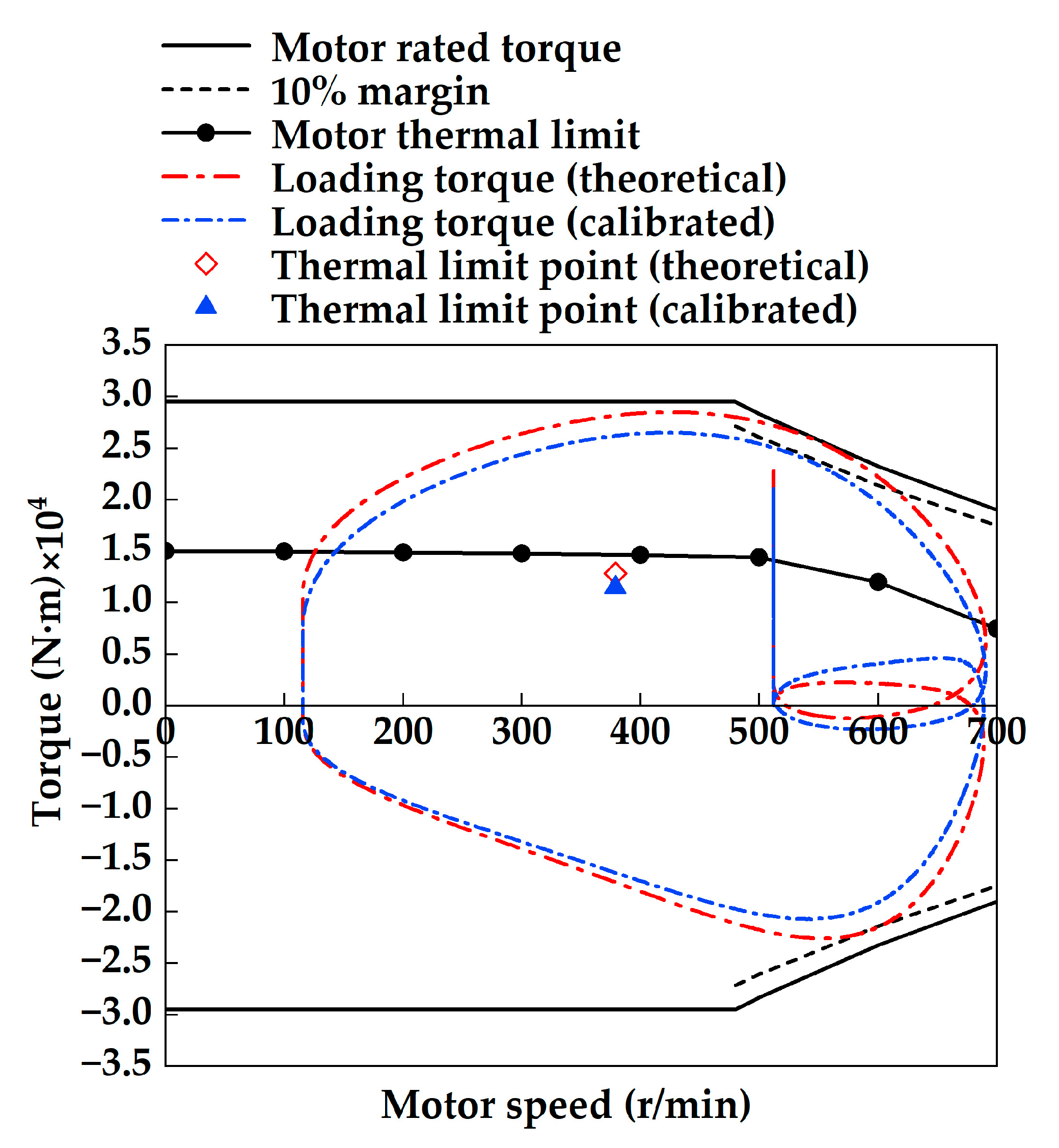
Utilizing Equation (24), the thermal limit values for the torque curves T m t h e , T m c a l , and T m a c t , which represent the effective torque of the servo motor, were determined to be 13,195.4 N·m, 12,432.9 N·m, and 12,265.8 N·m, respectively, where the error of T m t h e relative to T m a c t was 7.6% and the error of T m c a l relative to T m a c t was substantially reduced to 1.4% This significantly enhanced the prediction accuracy of the servo motor’s effective torque, thereby providing a more reliable guarantee for its safe operation.
In summary, this section successfully achieves the calibration of critical dynamics parameters for the transmission system by combining experimental investigations with an optimization algorithm. The results revealed that the initial theoretical design parameters deviated significantly from the actual system, primarily due to conservative safety margins, simplified empirical formulas, and inadequate consideration of ancillary components. After calibration, both the RMSE and peak error of the model’s predicted torque decreased by approximately 70%. Concurrently, the effective torque prediction error of the servo motor decreased from 7.6% to 1.4%. These substantial improvements collectively validated the accuracy and effectiveness of the dynamics model and the parameter calibration method developed in this study, thereby laying a robust foundation for subsequent control optimization, performance evaluation, and system design based on the high-precision dynamics model.

4.3. Engineering Application

This study applies the high-precision dynamics model obtained through experimental calibration to the 25,000 kN heavy-duty servo press to enhance the production rate of automotive body panels. Based on the motion trajectory planning and optimization method for heavy-duty servo presses proposed in studies [32,33], a typical automotive body panel—the door outer panel—is selected as a case study for comparative production rate optimization analysis using both theoretical design parameters and calibrated parameters. Under identical stamping process parameters and predefined motion trajectory, the dynamic load torque curve of the servo motor calculated based on the theoretical parameters exhibits significant peaks during acceleration and deceleration phases, persistently exceeding the motor’s 10% safety margin, as illustrated in Figure 7. To ensure safe operation of the servo motor, a conservative angular acceleration constraint strategy must be adopted, consequently compromising the production rate. In contrast, the torque curve calculated using the calibrated parameters effectively suppresses the overall amplitude, with all operating points stabilizing within the safety margin boundary while simultaneously maximizing utilization of the available margin, indicating more effective exploitation of torque capacity. This substantial reduction in torque demand consequently removes excessive restrictions on acceleration.
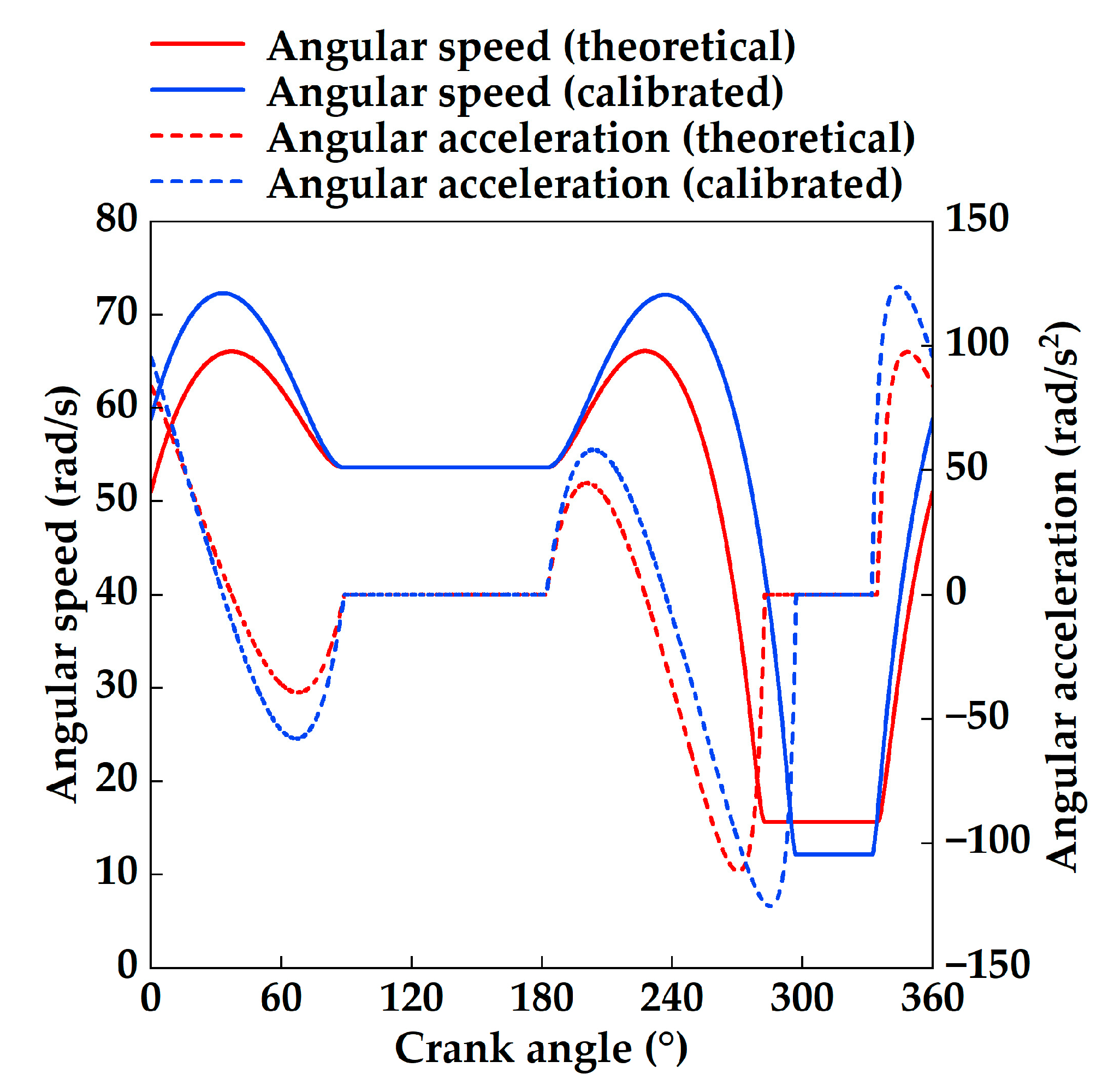
Figure 8 further presents the angular velocity and angular acceleration profiles of the servo motor under both parameter configurations. The results demonstrate that, benefitting from the accurate characterization of actual dynamic behavior by the high-precision dynamic model, the servo motor can execute higher angular accelerations during the idle stroke phases, thereby completing more rapid acceleration-deceleration cycles and fully exploiting the torque potential of the servo motor. Conversely, the motion trajectory based on theoretical design parameters, constrained by conservative load estimations, suffers from suppressed acceleration capability and fails to fully release the servo motor’s performance potential. Ultimately, the enhancement in dynamic performance translates directly into a tangible improvement in production rate. Experiments confirmed that the stamping production rate for the door outer panel increased from 11.4 to 11.6 parts per minute, representing an increase of 1.7%. Based on an annual production schedule of 6000 h, this translates to an additional annual output of 72,000 parts per production line. This technology exhibits excellent portability and can be extended to the entire series of heavy-duty servo presses ranging from 10,000 to 25,000 kN, promising substantial economic benefits. This case study demonstrates that the integration of a high-precision dynamics model into the engineering practice of heavy-duty servo presses not only enables accurate identification of critical dynamics parameters but also effectively unlocks dormant equipment potential by eliminating overly conservative design constraints, thereby establishing a theoretical and engineering foundation for refined performance management of equipment within the context of intelligent manufacturing

5. Conclusions

This study establishes a comprehensive technical framework of dynamic modeling, global sensitivity analysis, parameter calibration, and engineering verification, which systematically addresses the uncertainty in dynamics parameters of heavy-duty servo presses. It achieves simultaneous improvements in both the accuracy of the dynamics model and the production rate, with experimental results validating the effectiveness of the proposed method. The main conclusions are as follows:
(1) A nonlinear dynamics model of the servo press transmission system was developed by integrating multi-physics generalized external forces, systematically incorporating gravity, friction, balance forces, and stamping process loads consistent with actual production conditions. This model accurately captures the coupling mechanisms among various physical fields, providing a reliable dynamics foundation for subsequent parameter calibration.
(2) Based on the Sobol global sensitivity analysis method, a four-dimensional response function system encompassing torque accuracy, transient overload, thermal load, and work output was constructed to reveal the differentiation patterns of parameter sensitivity in multi-dimensional performance space. The results indicate that the total efficiency of the reduction system η g e a r represents the most globally sensitive parameter, the balance coefficient ψ exhibits significant influence across multiple performance dimensions, and the friction coefficients of revolute joints μ r and prismatic joints μ s dominate torque and energy predictions, while the equivalent mass of the slide m 8 and the equivalent moment of inertia of the reduction system J g e a r are predominantly influential in transient overload risk assessment. This framework successfully identified six critical parameters from an original 28-dimensional parameter space, reducing the computational complexity of calibration by two orders of magnitude.
(3) The ACO algorithm was employed to calibrate the key parameter set, significantly enhancing the model’s prediction accuracy. After calibration, the root mean square error of torque prediction decreased from 1366.9 N·m to 277.7 N·m (a reduction of 79.7%), the peak error was reduced by 72.7%, and the prediction error of the servo motor’s effective torque dropped from 7.6% to 1.4%. This verifies the high accuracy and reliability of the model in predicting both average torque and extreme load conditions. The calibration results exhibit strong consistency across two distinct motion profiles (Conditions A and B) under the same load, providing preliminary evidence for the robustness of the proposed method.
(4) The high-precision dynamics model was applied to optimize the production takt of a 25,000 kN servo press for automotive side panel stamping, achieving trajectory optimization based on safety boundary approaching. The production takt increased from 11.4 to 11.6 parts per minute (a 1.7% improvement), resulting in an annual production capacity increase of 72,000 parts per line, thereby demonstrating significant economic benefits. This case study confirms the engineering value of the proposed methodology in unlocking equipment performance potential while ensuring operational safety.
The current conclusions are specifically derived from a dynamics model incorporating a constant cushion force assumption, thus limiting generalized applicability to steady-state loading conditions. Furthermore, the model’s predictive capability lacks experimental validation for processes with significantly different load characteristics, such as high-speed blanking, or for scenarios involving substantial variations in cushion force. The model also does not account for the transient impact response generated during die contact, which may compromise the accurate depiction of transient dynamics and impact behavior. Future work will focus on designing multi-condition experiments to systematically examine the model’s robustness, developing a refined dynamics model that incorporates realistic dynamic impact behavior, and conducting an expanded experimental campaign to provide statistical validation under varied operating scenarios.

Author Contributions

Conceptualization, J.L. and S.M.; methodology, J.L. and T.L.; writing—original draft preparation, J.L.; writing—review and editing, J.L.; supervision, Z.W. and B.L. All authors have read and agreed to the published version of the manuscript.

Funding

This research was funded by the Liaoning Provincial Science and Technology Program Joint Plan (Natural Science Foundation-General Program), grant number 2024-MSLH-007.

Institutional Review Board Statement

Not applicable.

Informed Consent Statement

Not applicable.

Data Availability Statement

The data used to support the findings of this study are included within the article.

Conflicts of Interest

Author Tao Liu was employed by the company China First Heavy Industries (CFHI) Tianjin Heavy Industry Co., Ltd. The remaining authors declare that the research was conducted in the absence of any commercial or financial relationships that could be construed as a potential conflict of interest.

References

  1. Gao, J.Z.; Zhao, S.D.; Jiang, F.; Du, W.; Zheng, Z.H. A novel hollow two-sided output PMSM integrated with mechanical planetary gear: A solution for drive and transmission system of servo press. IEEE-ASME Trans. Mechatron. 2022, 27, 3076–3086. [Google Scholar] [CrossRef]
  2. Li, Q.; Li, H.M.; Gao, J.B.; Xu, Y.L.; Rodriguez, J.; Kennel, R. Nonlinear-disturbance-observer-based model-predictive control for servo press drive. IEEE Trans. Ind. Electron. 2024, 71, 8448–8458. [Google Scholar] [CrossRef]
  3. He, Y.Z.; Luo, X.; Wang, X.S. Research and simulation analysis of fuzzy intelligent control system algorithm for a servo precision press. Appl. Sci. 2024, 14, 6592. [Google Scholar] [CrossRef]
  4. Olaizola, J.; Esteban, E.; Trinidad, J.; Iturrospe, A.; Galdos, L.; Abete, J.M.; De, A.E.S. Integral design and manufacturing methodology of a reduced-scale servo press. IEEE-ASME Trans. Mechatron. 2021, 26, 2418–2428. [Google Scholar] [CrossRef]
  5. Li, Q.; Lv, Y.; Kennel, R.; Rodriguez, J. Semiclosed loop based on predictive current control for spmsm drives during servo stamping. IEEE Trans. Power Electron. 2024, 39, 11430–11440. [Google Scholar] [CrossRef]
  6. Prasad, K.; Gupta, A.; Krishnaswamy, H.; Chakkingal, U.; Banerjee, D.K.; Lee, M.G. Does friction contribute to formability improvement using servo press. Friction 2023, 11, 820–835. [Google Scholar] [CrossRef]
  7. Gao, J.Z.; Zhao, S.D.; Li, J.X.; Jiang, F.; Du, W.; Zheng, Z.H.; Feng, Z.Y. A novel main drive system for the servo press: Combination of integrated motor and symmetrically toggle booster mechanism. Crip J. Manuf. Sci. Technol. 2022, 37, 596–612. [Google Scholar] [CrossRef]
  8. Liu, Y.X.; Shu, Y.W.; Hu, W.T.; Zhao, X.H.; Xu, Z.C. Active vibration control of a mechanical servo high-speed fine-blanking press. Stroj. Vestn. J. Mech. Eng. 2021, 67, 445–457. [Google Scholar] [CrossRef]
  9. Junlapen, K.; Kaewtatip, P.; Koga, N. Reduction in blanking noise using NC servo press machine. Steel Res. Int. 2010, 81, 1042–1045. [Google Scholar]
  10. Halicioglu, R.; Dulger, L.C.; Bozdana, T. Mechanisms, classifications, and applications of servo presses: A review with comparisons. Proc. Inst. Mech. Eng. Part B J. Eng. Manuf. 2016, 230, 1177–1194. [Google Scholar] [CrossRef]
  11. Matsumoto, R.; Jeon, J.Y.; Utsunomiya, H. Shape accuracy in the forming of deep holes with retreat and advance pulse ram motion on a servo press. J. Mater. Process. Technol. 2013, 213, 770–778. [Google Scholar] [CrossRef]
  12. Kitayama, S.; Higuchi, T.; Takano, M.; Kobayashi, A. Determination of back-pressure profile and slide motion of servo press in cold forging using sequential approximate optimization. J. Adv. Mech. Des. Syst. Manuf. 2020, 14, JAMDSM0046. [Google Scholar] [CrossRef]
  13. Righettini, P.; Strade, R.; Tiboni, M.; Cortinovis, F.; Santinelli, J. A systematic management and control methodology for high energy saving in with servo-axes. Control Eng. Pract. 2024, 145, 105847. [Google Scholar] [CrossRef]
  14. Chen, X.L.; Gao, S.; Wang, T. Experimental verification of dynamic behavior for multi-link press mechanism with 2D revolute joint considering dry friction clearances and lubricated clearances. Nonlinear Dyn. 2022, 109, 707–729. [Google Scholar] [CrossRef]
  15. Robert, O.J.; Thomas, R.; Michael, B.; Christian, J.; Friedrich, B. Expanding the forming limits of DP780 by adjusting ram slide motions on a mechanical servo press. Procedia CIRP 2025, 134, 503–507. [Google Scholar] [CrossRef]
  16. Olaizola, J.; Bouganis, C.S.; De, A.E.S.; Iturrospe, A.; Abete, J.M. Real-time servo press force estimation based on dual particle filter. IEEE Trans. Electron. 2020, 67, 4088–4097. [Google Scholar] [CrossRef]
  17. Wang, J.; Wang, Y.; Wu, K.; Ni, J.; Zheng, H.; Sun, Y. Electromechanical coupling dynamic modeling and dynamic response analysis of servo press. Int. J. Non-Linear Mech. 2025, 179, 105234. [Google Scholar] [CrossRef]
  18. Halicioglu, R.; Dulger, L.C.; Bozdana, A.T. Modeling, design, and implementation of a servo press for metal-forming applica-tion. Int. J. Adv. Manuf. Technol. 2017, 91, 2689–2700. [Google Scholar] [CrossRef]
  19. Zhai, H.; Zhang, Y.J.; Song, Z.A.; Zang, C.Y.; Zhang, Q.L.; Lv, P.; Li, J.J. The influence of dynamic characteristics of six-bar linkage mechanical press transmission system on the accuracy of slide. Mater. Res. Proc. 2024, 44, 41–51. [Google Scholar]
  20. Cheng, Y.Y.; Li, W.W.; Chen, M.F.; Chen, Y. Research on optimization design of six-rod main transmission mechanism of Adams warm forging servo press. Forg. Stamp. Technol. 2020, 45, 112–116. [Google Scholar]
  21. Xu, T.; Xia, Q.X.; Long, J.C.; Long, X.B. A study on multi-domain modeling and simulation of precision high-speed servo nu-merical control punching press. Proc. Inst. Mech. Eng. Part I J. Syst. Control. Eng. 2018, 232, 830–844. [Google Scholar]
  22. Jung, D.; Cheong, J.; Park, D.I.; Park, C. Backward sequential approach for dynamic parameter identification of robot manipulators. Int. J. Adv. Robot. Syst. 2018, 15, 1729881418758578. [Google Scholar] [CrossRef]
  23. Montazeri, A.; West, C.; Monk, S.D.; Taylor, C.J. Dynamic modelling and parameter estimation of a hydraulic robot manipulator using a multi-objective genetic algorithm. Int. J. Control 2017, 90, 661–683. [Google Scholar] [CrossRef]
  24. Savaee, E.; Hanzaki, A.R. Error modeling, parameter identification and non-parametric calibration of a 3PUS/S spherical parallel manipulator. Precis. Eng. J. Int. Soc. Precis. Eng. Nanotechnol. 2025, 96, 31–43. [Google Scholar] [CrossRef]
  25. Gally, T.; Groche, P.; Hoppe, F.; Kuttich, A.; Matei, A.; Pfetsch, M.E.; Rakowitsch, M.; Ulbrich, S. Identification of model uncertainty via optimal design of experiments applied to a mechanical press. Optim. Eng. 2022, 23, 579–606. [Google Scholar] [CrossRef]
  26. Li, J.; Wang, Z.; Song, Q.Y. Parameter calibration of main transmission system for heavy-duty servo press. Form. Stamp. Technol. 2022, 12, 148–153. [Google Scholar]
  27. Jiang, S.; Chen, X. Test study and nonlinear dynamic analysis of planar multi-link mechanism with compound clearances. Eur. J. Mech. A Solids 2021, 88, 104260. [Google Scholar] [CrossRef]
  28. Wang, J.X.; Song, Y.J.; Zhou, X.P.; Liu, Z. Design calculations for the pneumatic system of a komatsu-style press. CFHI Technol. 1998, 2, 1–5. [Google Scholar]
  29. Zhou, J.; GoodAll, R.; Ren, L. Influences of car body vertical flexibility on ride quality of passenger railway vehicles. Proc. Inst. Mech. Eng. Part F J. Rail Rapid Transit 2009, 223, 461−471. [Google Scholar] [CrossRef]
  30. Wang, Q.; Li, H.Y.; Lu, L. Global sensitivity analysis of Earth-Moon transfer orbit parameters based on sobol method. Int. J. Aerosp. Eng. 2022, 2022, 6587890. [Google Scholar] [CrossRef]
  31. Wang, X.P.; Xie, L.B.; Jiang, M.; He, K.F.; Chen, Y. Kinematic calibration and feedforward control of a heavy-load manipulator using parameters optimization by an ant colony algorithm. Robotica 2024, 42, 728–756. [Google Scholar] [CrossRef]
  32. Song, Q.Y.; Guo, B.F.; Li, J. Drawing motion profile planning and optimizing for heavy servo press. Int. J. Adv. Manuf. Technol. 2013, 69, 2819–2831. [Google Scholar] [CrossRef]
  33. Guo, W.Z.; He, J.; Yue, Y. A new type of controllable mechanical press: Motion control and experiment validation. J. Manufac. Sci. Eng. Trans. ASME 2005, 127, 731–742. [Google Scholar] [CrossRef]
Figure 1. Mechanical configuration of the servo press transmission system; 1—servo motor, 2—reduction gear pair, 3—eccentric wheel, 4—eight-bar mechanism.
Applsci 16 00847 g001
Figure 2. Schematic diagram of the eight-bar mechanism.
Applsci 16 00847 g002
Figure 3. Coupled flowchart of global sensitivity analysis and dynamic calculation.
Applsci 16 00847 g003
Figure 4. Sobol global sensitivity indices based on the (a) torque prediction root mean square error ( Y R M S E ), (b) transient peak torque ratio ( Y P R ), (c) thermal limit ( Y T L ), and (d) work output ( Y W o r k ).
Applsci 16 00847 g004
Figure 5. An automated stamping line for automotive panels comprising one 25,000 kN heavy-duty servo press and three 10,000 kN mechanical presses.
Applsci 16 00847 g005
Figure 6. Comparison of servo motor torques in one working cycle.
Applsci 16 00847 g006
Figure 7. Comparison of dynamic torque and thermal limit of servo motor based on theoretical and calibrated parameters.
Applsci 16 00847 g007
Figure 8. Angular velocity and angular acceleration profiles of the servo motor under both parameter configurations.
Applsci 16 00847 g008
Table 1. Parameters of the reduction gear system.
ParameterParameter Value
Equivalent moment of inertia J g e a r (kg·m2)54.4
Total efficiency η g e a r 0.917
Table 2. Geometric and mass-inertial parameters of the eight-bar mechanism.
ComponentLength (m)Distance (m)Mass (kg)Moment of Inertia (kg·m2)
Link 1 L 1 = 0.22 L s 1 = 0.1451 m 1 = 4460.7 J 1 = 952.9
Link 2 L 2 = 0.305
Link 3 L 3 = 1.369 L s 3 = 0.5585 m 3 = 743.8 J 3 = 372.9
Link 4 L 41 = 0.8 L s 41 = 1.2425 m 4 = 3526.3 J 4 = 1310.3
L 42 = 1.55 L s 42 = 0.9496
L 43 = 2.064 L s 43 = 0.314
Link 5 L 5 = 1.502 L s 5 = 0.6813 m 5 = 484.1 J 5 = 136.9
Link 6 L 6 = 1.433 L s 6 = 0.5434 m 6 = 2182.2 J 6 = 975.3
Link 7 L 7 = 1.29 L s 7 = 0.5338 m 7 = 1249.9 J 7 = 267.2
Slide 8 m 8 = 30 , 595
Frame D x = 1.55 D y = 0.3
β = 108.95 ° β 1 = 52.82 ° β 3 = 166.92 °
Table 3. Frictional properties of kinematic pairs and radius of plain bearings.
ParameterSymbolParameter Value
Friction coefficient of revolute joint μ r 0.028
Viscous damping coefficient of revolute joint (m·s/rad) c r 2.5
Friction coefficient of slide joint μ s 0.12
Viscous damping coefficient of slide joint (N·s/m) c s 3000
Inner radius of bearing at joint O (m) r O 0.18
Inner radius of bearing at joint A (m) r A 0.4925
Inner radius of bearing at joint B (m) r B 0.595
Inner radius of bearing at joint C (m) r C 0.1
Inner radius of bearing at joint D (m) r D 0.14
Inner radius of bearing at joint E (m) r E 0.09
Inner radius of bearing at joint F1 (m) r F 0.175
Inner radius of bearing at joint F2 (m) r F 0.175
Inner radius of bearing at joint G (m) r G 0.06
Table 4. Calibrated parameters and relative errors of the transmission system.
ParameterTheoretical ValueCalibrated ValueRelative Error (%)
η g e a r 0.9170.8428.9
ψ 1.151.068.5
μ r 0.0280.012133.3
m 8 30,59532,940−7.1
J g e a r 54.460.6−10.2
μ s 0.120.08541.2
Disclaimer/Publisher’s Note: The statements, opinions and data contained in all publications are solely those of the individual author(s) and contributor(s) and not of MDPI and/or the editor(s). MDPI and/or the editor(s) disclaim responsibility for any injury to people or property resulting from any ideas, methods, instructions or products referred to in the content.