Numerical Simulation Study on the Influencing Factors of Water Inflow in Subsea Tunnels

Abstract
1. Introduction
2. Prediction Methods for Water Inflow in Subsea Tunnels at Home and Abroad
2.1. Empirical Analytical Method
- (1)
- Goodman’s formula:
- (2)
- The railway specification empirical formula:
- (3)
- Hirishi Oshima’s empirical equation:
2.2. Numerical Simulation Method
2.2.1. Overview of FLAC3D 7.0 Fluid-Solid Coupling Analysis
2.2.2. Selection of Calculation Scheme
3. Numerical Simulation Calculation of Water Inflow in Subsea Tunnels
3.1. Numerical Model Establishment and Parameter Selection
3.2. Verification of FLAC Numerical Simulation Accuracy
3.3. Numerical Simulation Scheme
3.4. Analysis of Numerical Simulation Results
3.4.1. Boundary Conditions
3.4.2. Seawater Depth
3.4.3. Surrounding Rock Permeability Coefficient
3.4.4. Overburden Thickness
3.4.5. Grouting Ring Parameters
3.4.6. Lining Permeability Coefficient
3.4.7. Influence of Side Pressure Coefficient on Water Inflow
4. Sensitivity Analysis of Parameters by the Grey Correlation Method
4.1. Establishment of Comparison Matrix and Reference Matrix
4.2. Dimensionless Processing
4.3. Calculation of Correlation Coefficients
4.4. Calculation of Correlation Degree
4.5. Sensitivity Evaluation
5. Conclusions
- (1)
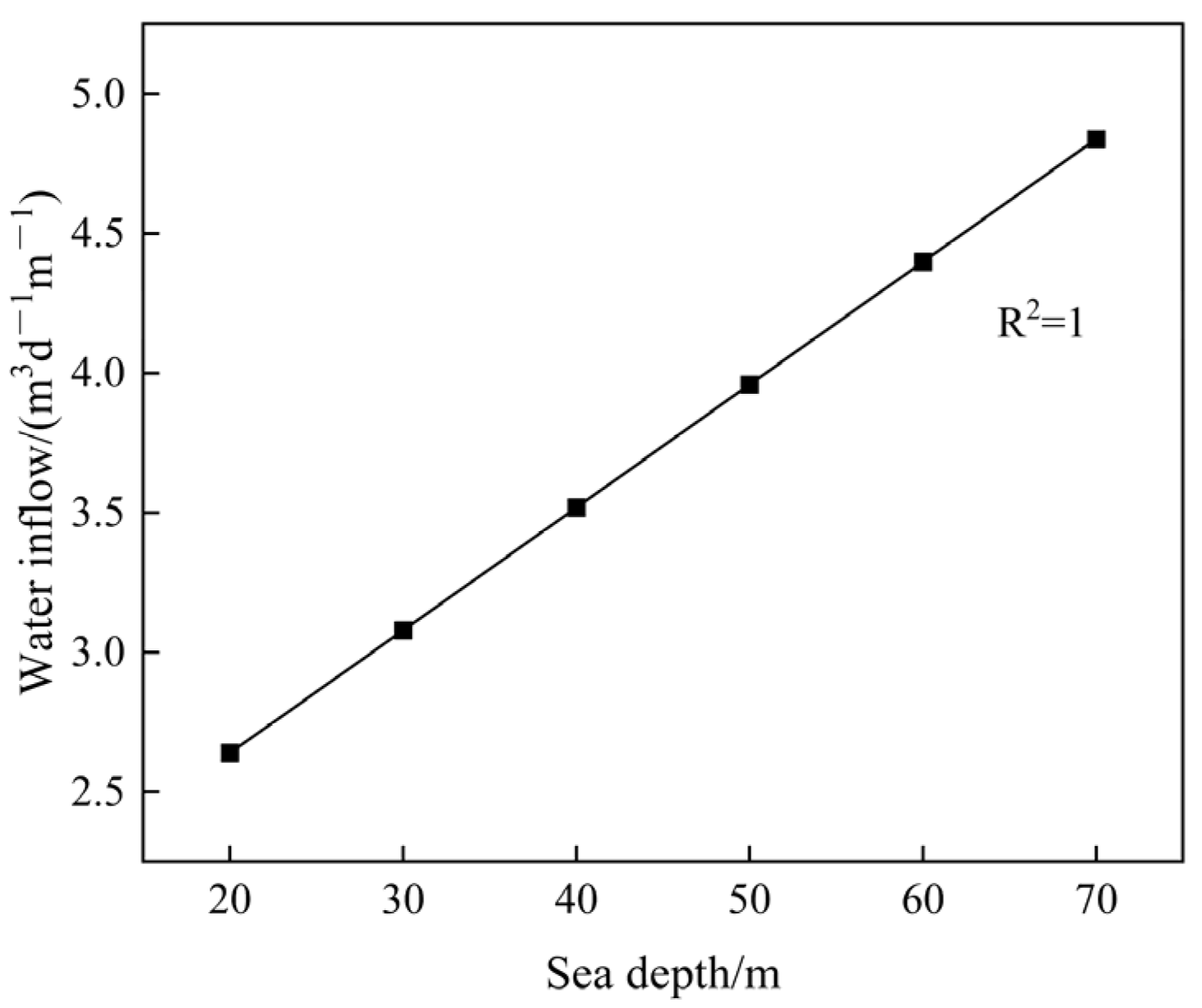
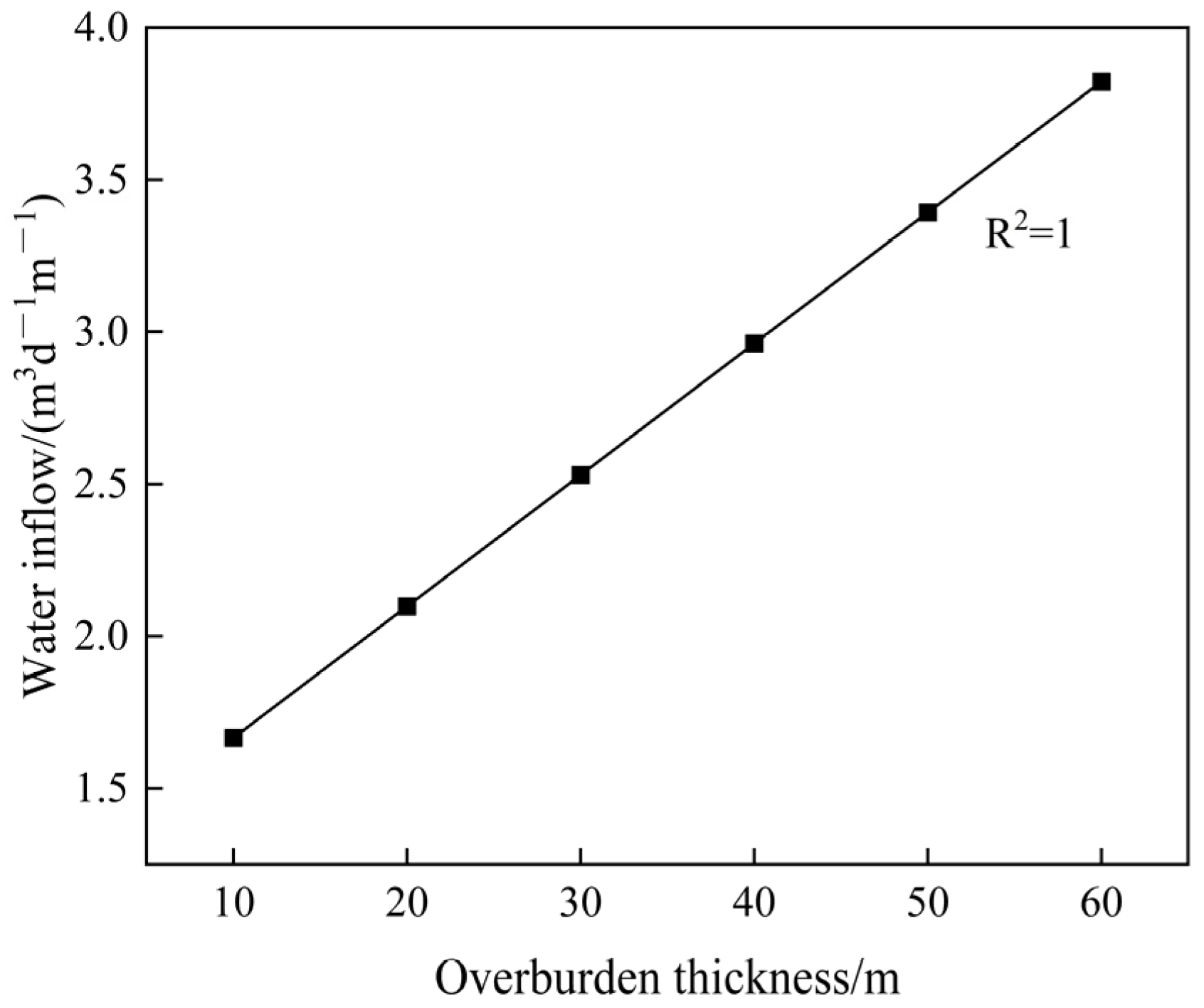
- The water inflow of subsea tunnels has an approximately linear increasing relationship with seawater depth and overburden thickness; the water inflow of subsea tunnels is almost unaffected by the lateral pressure coefficient.
- (2)
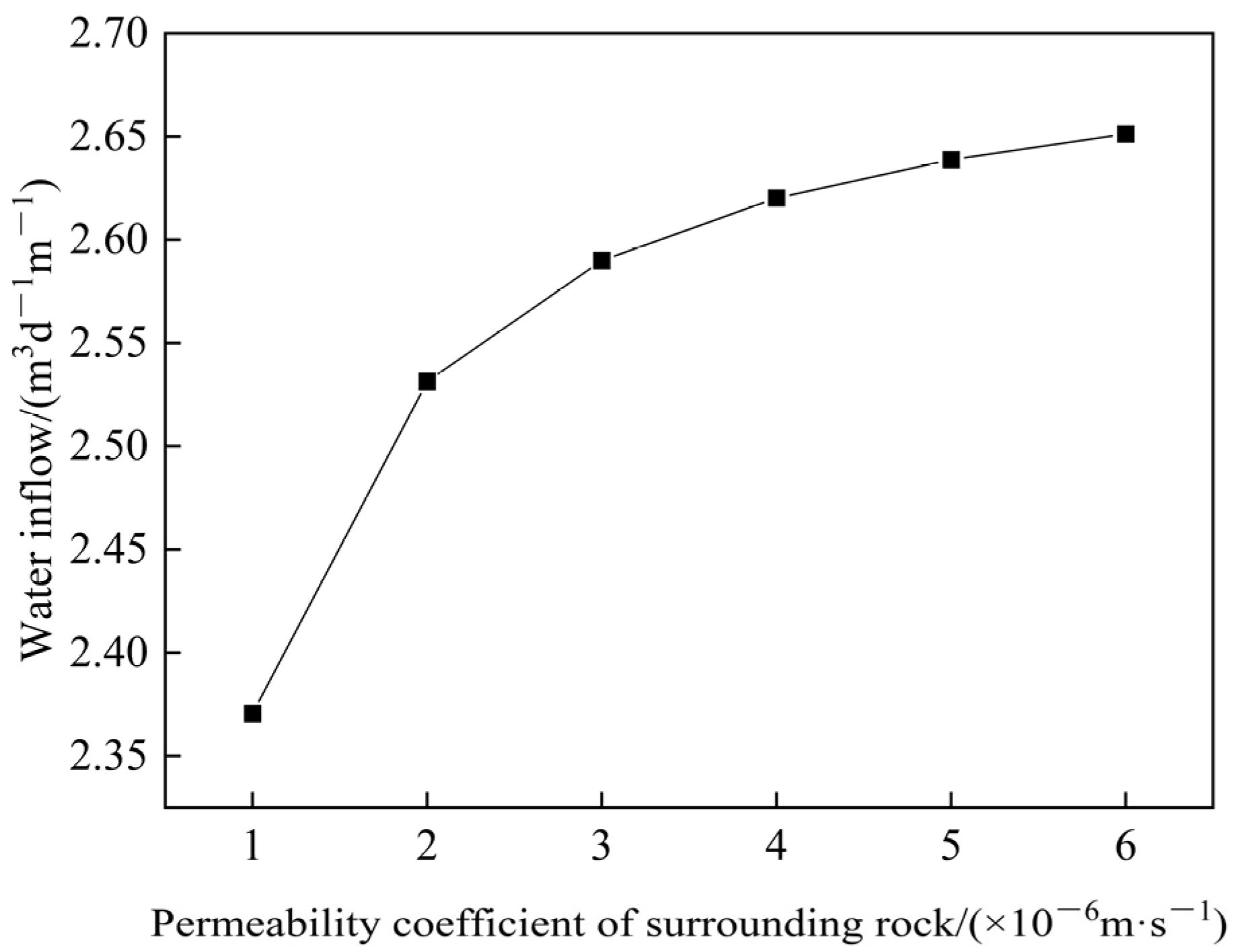
- As the surrounding rock permeability coefficient increases, the water inflow gradually increases, but the rate of growth in water inflow gradually decreases.
- (3)
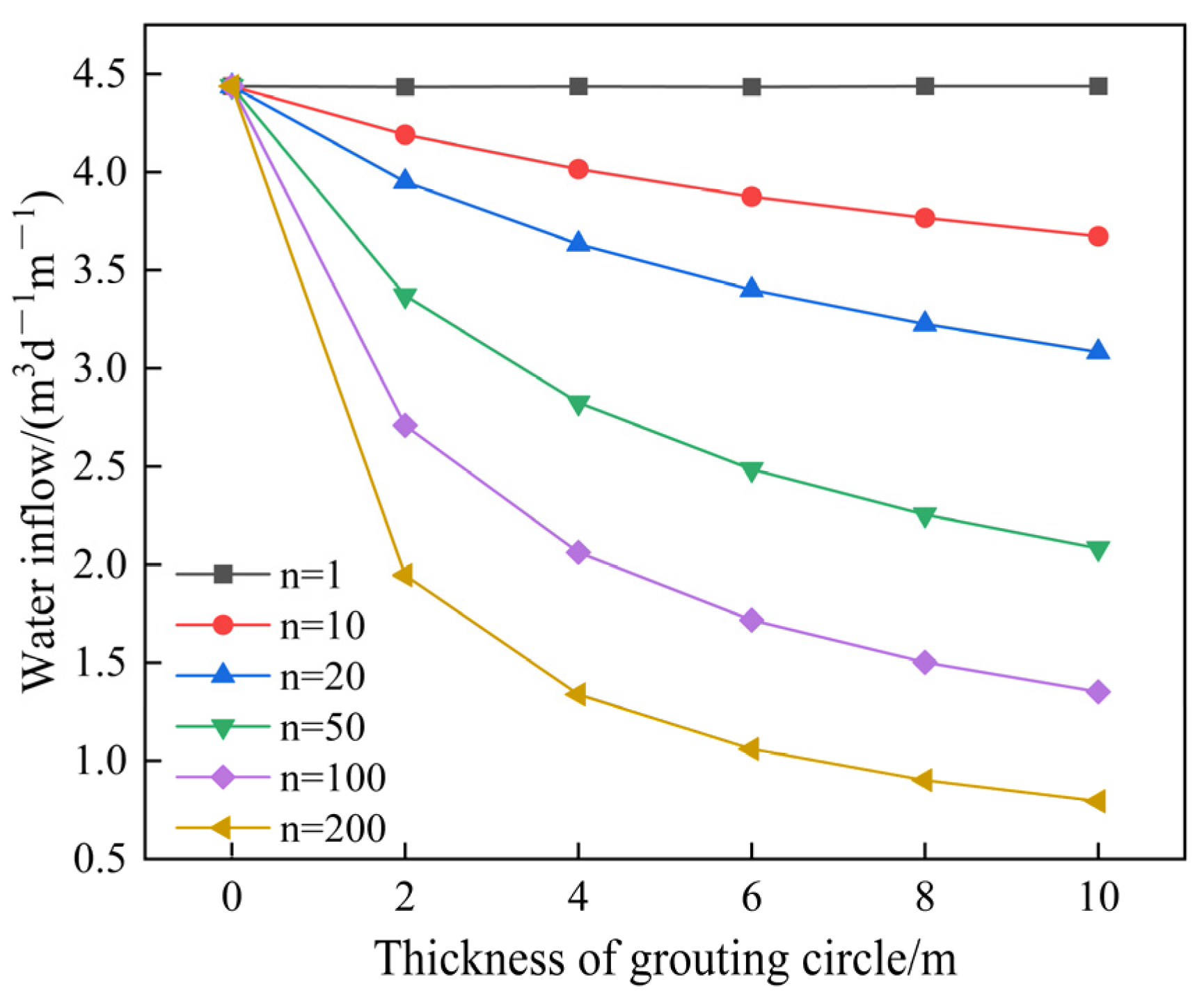
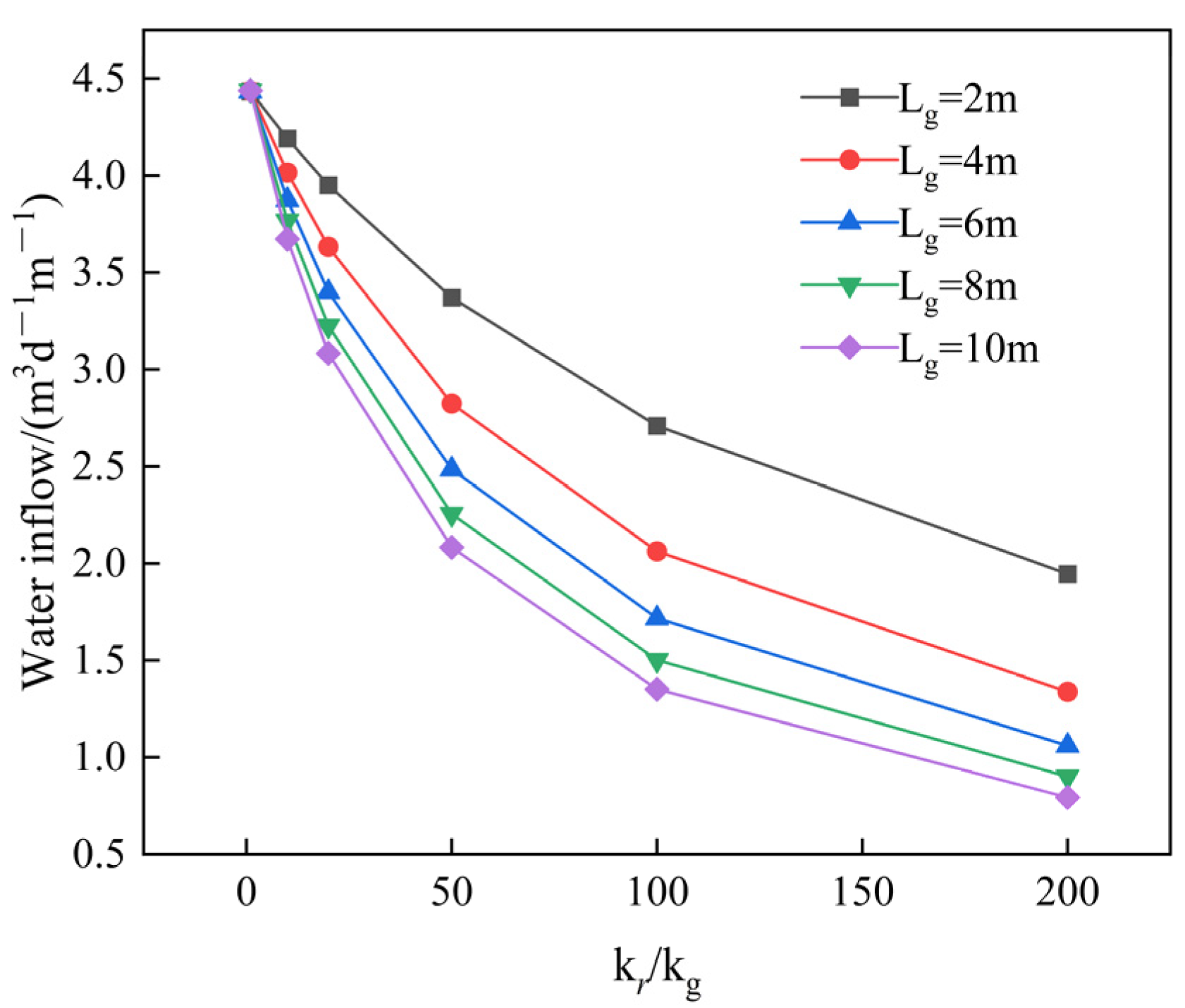
- Increasing the thickness of the grouting ring and reducing its permeability coefficient can both reduce the water inflow; the control effect of tunnel water inflow does not continue to improve with the infinite decrease in the permeability coefficient or the continuous increase in the grouting ring thickness. When the thickness of the grouting ring exceeds 6 m, the marginal benefit of its effect gradually decreases.
- (4)
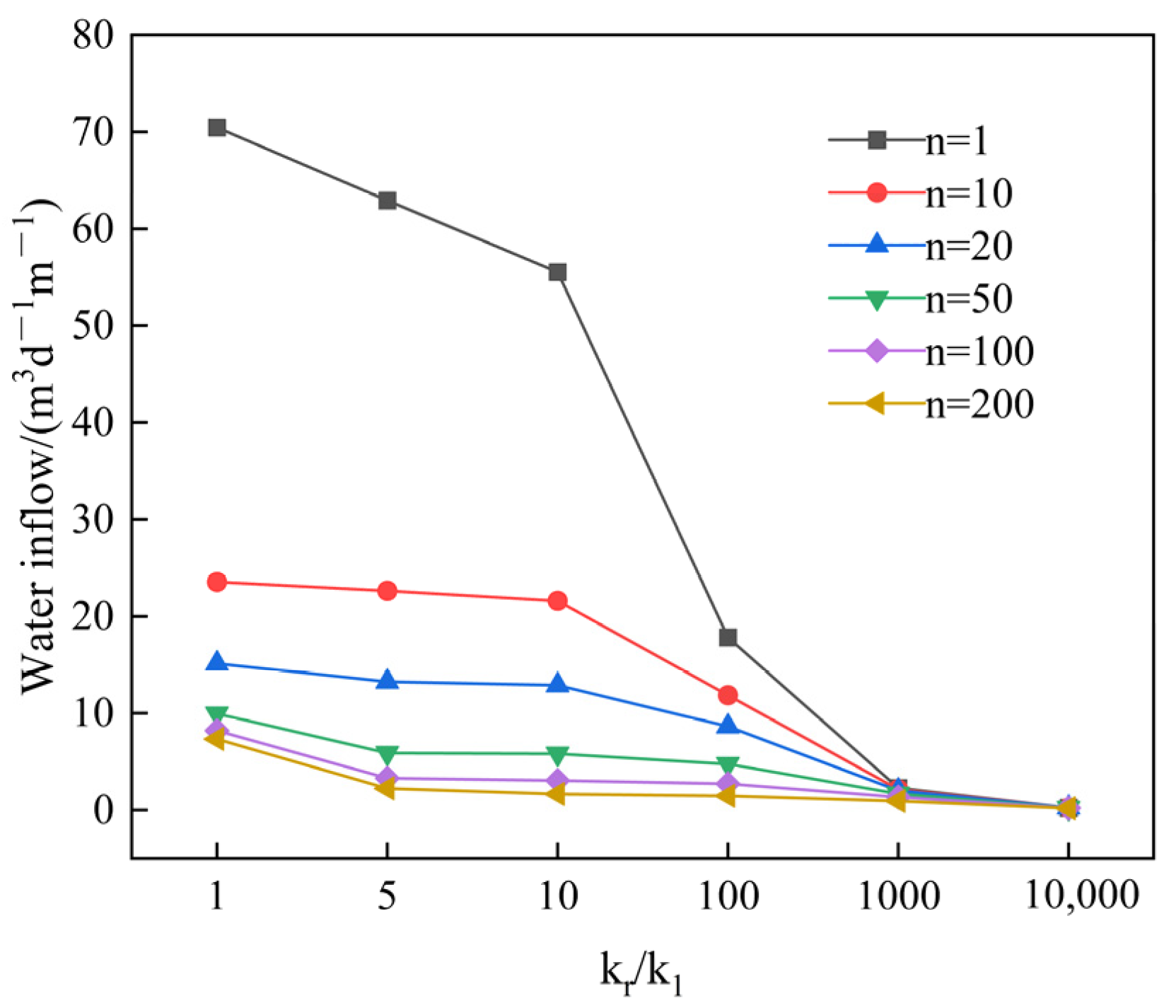
- When the permeability of the grouting ring is constant, the tunnel water inflow decreases continuously with the decrease in lining permeability; the larger the permeability coefficient of the grouting ring, the more obvious the decreasing trend.
- (5)
- The influencing factors of the maximum water inflow in subsea tunnels, ranked by sensitivity from high to low, are seawater depth > overburden thickness > lining permeability coefficient > surrounding rock permeability coefficient > grouting ring permeability coefficient > grouting ring thickness. Seawater depth has the most significant influence on subsea tunnels’ water inflow, and the grouting ring’s thickness has the least influence.
Author Contributions
Funding
Data Availability Statement
Acknowledgments
Conflicts of Interest
References
- Cheng, X.; Zhang, X.; Chen, W.; Xu, W.; Du, X. Stability analysis of a cross-sea tunnel structure under seepage and a bidirectional earthquake. Int. J. Geomech. 2017, 17, 06017008. [Google Scholar] [CrossRef]
- Wu, H.; Zhou, W.; Bao, Z.; Long, W.; Chen, K.; Liu, K. Life cycle assessment of carbon emissions for cross-sea tunnel: A case study of Shenzhen-Zhongshan Bridge and Tunnel in China. Case Stud. Constr. Mater. 2024, 21, e03502. [Google Scholar] [CrossRef]
- Xue, Y.; Zhou, B.; Li, S.; Qiu, D.; Zhang, K.; Gong, H. Deformation rule and mechanical characteristic analysis of subsea tunnel crossing weathered trough. Tunn. Undergr. Space Technol. 2021, 114, 103989. [Google Scholar] [CrossRef]
- Xue, Y.; Qu, C.; Su, M.; Qiu, D.; Li, Z.; Zhang, X.; Ma, X. Subsea tunnel site selection evaluation: A new evaluation model. Mar. Georesour. Geotechnol. 2020, 38, 1187–1198. [Google Scholar] [CrossRef]
- Chen, H.-Y.; Vojinovic, Z.; Lo, W.; Lee, J.-W. Groundwater level prediction with deep learning methods. Water 2023, 15, 3118. [Google Scholar] [CrossRef]
- Hussein, E.A.; Thron, C.; Ghaziasgar, M.; Bagula, A.; Vaccari, M. Groundwater prediction using machine-learning tools. Algorithms 2020, 13, 300. [Google Scholar] [CrossRef]
- Zhang, L.; Zhao, D.; Wu, J.; Yang, W.; Wang, W.; Xin, D. Prediction of water inflow in Tsingtao subsea tunnel based on the superposition principle. Tunn. Undergr. Space Technol. 2020, 97, 103243. [Google Scholar] [CrossRef]
- Pan, Y.; Qi, J.; Zhang, J.; Xia, P.; Peng, Y. Analytical Solution for Water Inflow into Deeply Buried Symmetrical Subsea Tunnels with Excavation Damage Zones. Water 2023, 15, 3556. [Google Scholar] [CrossRef]
- Li, P.; Wang, F.; Long, Y.; Zhao, X. Investigation of steady water inflow into a subsea grouted tunnel. Tunn. Undergr. Space Technol. 2018, 80, 92–102. [Google Scholar] [CrossRef]
- Han, Z.; Yan, K.; Zhu, Z.; Cui, H. Research on a grading evaluation system for water inflow in three-hole parallel subsea tunnels considering inter-tunnel influence. Appl. Sci. 2023, 13, 12761. [Google Scholar] [CrossRef]
- Wang, G.; Luo, J.; Zhang, Z.; Wang, D.; Song, Y.; Li, F. Research on dynamic prediction method of the water inflow in tunnels under complex geological conditions based on the non-darcy flow-energy method. Bull. Eng. Geol. Environ. 2025, 84, 151. [Google Scholar] [CrossRef]
- Guo, Y.; Wang, H.; Jiang, M. An exact analytical approach for determining the seepage field around underwater twin tunnels with linings. Transp. Geotech. 2023, 42, 101050. [Google Scholar] [CrossRef]
- Han, Z.-M.; Yan, K.-Y.; Cui, H.-M.; Liu, Q.-K. Analytical Study on Seepage Field of Three Parallel Submarine Tunnels Based on Equivalent Area Method. Eng. Mech. 2024, 41, 112–116+149. [Google Scholar]
- Chen, L.; Xi, B.; Dong, Y.; He, S.; Shi, Y.; Gao, Q.; Liu, K.; Zhao, N. Study on the stability and seepage characteristics of underwater shield tunnels under high water pressure seepage. Sustainability 2023, 15, 15581. [Google Scholar] [CrossRef]
- Niu, F.; Cai, Y.; Liao, H.; Li, J.; Tang, K.; Wang, Q.; Wang, Z.; Liu, D.; Liu, T.; Liu, C. Unfavorable geology and mitigation measures for water inrush hazard during subsea tunnel construction: A global review. Water 2022, 14, 1592. [Google Scholar] [CrossRef]
- Chen, Z.; Li, Z.; He, C.; Ma, C.; Li, X.; Chen, K.; Zhang, H.; Liu, M. Investigation on seepage field distribution and structural safety performance of small interval tunnel in water-rich region. Tunn. Undergr. Space Technol. 2023, 138, 105172. [Google Scholar] [CrossRef]
- Fan, H.; Zhu, Z.; Song, Y.; Zhang, S.; Zhu, Y.; Gao, X.; Hu, Z.; Guo, J.; Han, Z. Water pressure evolution and structural failure characteristics of tunnel lining under hydrodynamic pressure. Eng. Fail. Anal. 2021, 130, 105747. [Google Scholar] [CrossRef]
- Neuzil, C.E. Groundwater flow in low-permeability environments. Water Resour. Res. 1986, 22, 1163–1195. [Google Scholar] [CrossRef]
- He, X.; Shi, W.; Zhu, Y.; Yan, L.; Zhao, Y.; Wang, S. Coupled effects of fault-related groundwater flow and pore water pressure: Unraveling the mechanisms of deformation and failure in gentle slopes. Arab. J. Sci. Eng. 2025, 50, 15015–15032. [Google Scholar] [CrossRef]
- Zhang, Y.; Tan, F.; Liu, R.; Zhu, H.; Wang, X.; Jiao, Y. Water pressure relief treatment for protecting the initial support of inclined shafts at high water pressures. J. Rock Mech. Geotech. Eng. 2025, 17, 6468–6481. [Google Scholar] [CrossRef]
- Alonso, E.; Berdugo, I.; Ramon, A. Extreme expansive phenomena in anhydritic-gypsiferous claystone: The case of Lilla tunnel. Géotechnique 2013, 63, 584–612. [Google Scholar] [CrossRef]
- Li, Z.; Chen, Z.-Q.; He, C.; Ma, C.-C.; Duan, C.-R. Seepage field distribution and water inflow laws of tunnels in water-rich regions. J. Mt. Sci. 2022, 19, 591–605. [Google Scholar] [CrossRef]
- Peng, H.; Frenelus, W.; Zhang, J. Key factors influencing analytical solutions for predicting groundwater inflows in rock tunnels. Water Supply 2022, 22, 7982–8013. [Google Scholar] [CrossRef]
- Wang, Z.; Shi, W.; Jiang, K.; Yu, F.; Xiong, H.; Ai, X. Coupling analysis of stress field and seepage field in foundation pit dewatering and optimization design of reinjection. Therm. Sci. Eng. Prog. 2024, 54, 102778. [Google Scholar] [CrossRef]
- Gao, C.-L.; Zhou, Z.-Q.; Yang, W.-M.; Lin, C.-J.; Li, L.-P.; Wang, J. Model test and numerical simulation research of water leakage in operating tunnels passing through intersecting faults. Tunn. Undergr. Space Technol. 2019, 94, 103134. [Google Scholar] [CrossRef]
- Hwang, J.-H.; Lu, C.-C. A semi-analytical method for analyzing the tunnel water inflow. Tunn. Undergr. Space Technol. 2007, 22, 39–46. [Google Scholar] [CrossRef]
- Xu, N.; Tian, H.; Kulatilake, P.H.; Duan, Q. Building a three dimensional sealed geological model to use in numerical stress analysis software: A case study for a dam site. Comput. Geotech. 2011, 38, 1022–1030. [Google Scholar] [CrossRef]
- Lei, M.; Luo, S.; Chang, J.; Zhang, R.; Kuang, X.; Jiang, J. Fluid–Solid Coupling Numerical Analysis of Pore Water Pressure and Settlement in Vacuum-Preloaded Soft Foundation Based on FLAC3D. Sustainability 2023, 15, 7841. [Google Scholar] [CrossRef]
- Yang, H.; Wu, W.; Wu, X.; Xu, J.; Li, J.; Qi, Q.; Sun, W. Analysis of Disturbance and Safety Risk Assessment of Shallow-Buried Pressure Pipelines Utilizing the Shield Tunneling Method. Buildings 2025, 15, 2253. [Google Scholar] [CrossRef]
- Han, P.; Zhang, C.; He, X.; Wang, X.; Qiao, Y. DEM fluid–solid coupling method for progressive failure simulation of roadways in a fault structure area with water-rich roofs. Geomech. Geophys. Geo-Energy Geo-Resour. 2022, 8, 194. [Google Scholar] [CrossRef]
- Zhang, D.; Zhang, L.; Tang, H.; Yuan, S.; Wang, H.; Chen, S.N.; Zhao, Y. A novel fluid–solid coupling model for the oil–water flow in the natural fractured reservoirs. Physics of Fluids 2021, 33, 036601. [Google Scholar] [CrossRef]
- Ou, S.; Wang, L.; Wang, P.; Wang, Z.; Huang, J.; Zhou, D. Numerical analysis of seepage flow characteristic of collapse column under the influence of mining. Int. J. Min. Sci. Technol. 2013, 23, 237–244. [Google Scholar] [CrossRef]
- Yang, Z.; You, X.; Jin, H. Study on Numerical Simulation of Surrounding Rock Structure Safety of Urban Underwater Shield Tunnel: A Case in Chongqing. Shock Vib. 2024, 2024, 9285252. [Google Scholar] [CrossRef]
- Li, Y.; Yu, Y.; Li, L.; Guo, J.; Qin, B. Influence Factors and Sensitivity Analysis on Material-Stress-Induced Large Deformation of Deep Underground Engineering in Soft Rockmass. Buildings 2025, 15, 3887. [Google Scholar] [CrossRef]





| Biot Modulus M (Pa) | Permeability Coefficient k (m2·(Pa·Sec)−1) | Characteristic Length Lc (m) | Diffusivity c (m2·Sec−1) | Solid Characteristic Time (s) | Fluid Characteristic Time (s) | Fluid-Solid Stiffness Ratio Rk | Disturbance Type |
|---|---|---|---|---|---|---|---|
| 9.524 × 10⁹ | 5.1 × 10⁻¹⁰ | 1 | 4.857 | 7.752 × 10⁻⁴ | 0.21 | 2.662 | Fluid |
| Mechanical Parameter | |||||
|---|---|---|---|---|---|
| Stratum name | Elastic modulus (GPa) | Poisson’s ratio | Density (kg·m−3) | Cohesion (Mpa) | Internal friction angle (°) |
| Surrounding rock | 2.5 | 0.32 | 2150 | 0.43 | 30 |
| Fluid Parameters | |||||
| Saturation | Fluid density (kg·m−3) | Permeability coefficient (m·s−1) | Porosity | Fluid modulus (GPa) | Biot’s coefficient |
| 1 | 1 × 10³ | 5 × 10⁻⁶ | 0.21 | 0.55 | 1 |
| Serial Number | Influencing Factor | Set Variables |
|---|---|---|
| 1 | Boundary conditions | Permeable boundary, impermeable boundary |
| 2 | Seawater depth H0 | 20, 30, 40, 50, 60, 70 m |
| 3 | Surrounding rock permeability coefficient kr | 1.0, 2.0, 3.0, 4.0, 5.0, 6.0 × 10⁻⁶ m·s−1 |
| 4 | Overburden thickness H1 | 10, 20, 30, 40, 50, 60 m |
| 5 | Grouting ring thickness Lg | 0, 2, 4, 6, 8, 10 m |
| 6 | Grouting ring permeability coefficient kg | kr/kg = 1, 10, 20, 50, 100, 200 |
| 7 | Lining permeability coefficient k1 | kr/k1 = 1, 5, 10, 100, 1000, 10,000 |
| 8 | Lateral pressure coefficient | 0.3, 0.6, 0.9, 1.2, 1.5, 1.8 |
| Working Condition | Upper Boundary | Lower Boundary | Left Boundary | Right Boundary | Water Inflow (m3·d−1·m−1) |
|---|---|---|---|---|---|
| 1 | Y | N | N | N | 2.62 |
| 2 | Y | Y | N | N | 2.64 |
| 3 | Y | Y | Y | N | 2.64 |
| 4 | Y | N | Y | Y | 2.64 |
| 5 | Y | Y | Y | Y | 2.64 |
Disclaimer/Publisher’s Note: The statements, opinions and data contained in all publications are solely those of the individual author(s) and contributor(s) and not of MDPI and/or the editor(s). MDPI and/or the editor(s) disclaim responsibility for any injury to people or property resulting from any ideas, methods, instructions or products referred to in the content. |
© 2026 by the authors. Licensee MDPI, Basel, Switzerland. This article is an open access article distributed under the terms and conditions of the Creative Commons Attribution (CC BY) license.
Share and Cite
Bai, L.; Yu, G.; Geng, H. Numerical Simulation Study on the Influencing Factors of Water Inflow in Subsea Tunnels. Appl. Sci. 2026, 16, 774. https://doi.org/10.3390/app16020774
Bai L, Yu G, Geng H. Numerical Simulation Study on the Influencing Factors of Water Inflow in Subsea Tunnels. Applied Sciences. 2026; 16(2):774. https://doi.org/10.3390/app16020774
Chicago/Turabian StyleBai, Liyang, Guangming Yu, and Hui Geng. 2026. "Numerical Simulation Study on the Influencing Factors of Water Inflow in Subsea Tunnels" Applied Sciences 16, no. 2: 774. https://doi.org/10.3390/app16020774
APA StyleBai, L., Yu, G., & Geng, H. (2026). Numerical Simulation Study on the Influencing Factors of Water Inflow in Subsea Tunnels. Applied Sciences, 16(2), 774. https://doi.org/10.3390/app16020774