1. Introduction
With the rapid development of advanced optics, smart manufacturing, and precision measurement, more and more optical components are being used in many fields, including ophthalmic optics, microscopic imaging, and complex optical structures. As the most common optical element, lenses with different characteristics are used in almost all optical applications, and the focal length is one of the most important and fundamental parameters for evaluating the optical quality of a lens component or system. Technically, the effective focal length is defined as the distance from the lens’s secondary principal point to its rear focal point, which dictates the imaging scale and field of view of the optical system. Since the effective focal length is defined with reference to a principal point that is not easy to find, realizing a direct measurement of it is challenging, especially for lenses with lower numerical apertures (or longer focal lengths) [
1].
In the past decades, researchers around the world have invented a number of different methods for measuring the focal lengths of different types of optical lenses. The proposed methods can be divided into two main categories: classical methods and modern methods. Classical methods such as nodal slide and image magnification typically utilize the imaging properties of a lens system when it is illuminated by a non-coherent light source and may only be suitable for testing imaging lenses with specific dimensions and fields of view, especially short focal length lenses [
2,
3]. Measurements such as the above methods are based on the principle of geometrical optics and are easy to set up and operate; however, their accuracy is severely limited by subjective judgment and operator-induced variations, leading to poor reproducibility [
4,
5,
6]. Many modern measurement methods of focal length have been successively proposed in order to overcome these drawbacks; most of them are mainly derived from the principle of physical optics. These methods include, but are not limited to, the focimeter measurement, diffraction and interferometry measurement, Moiré deflectometry measurement and Talbot interferometry measurement. The focimeter method is widely used for its convenience and ability to obtain accurate measurement results.
However, it is hard to allow for the measurement of all types of lenses, and it is not suitable for bifocal or multifocal lenses. The single-slit diffraction method is also widely used, while the measurement accuracy of the method is limited by the diffraction pattern, including the distance between peaks or the width of individual stripes. Angelis and Nicola et al. [
7] proposed an interferometric technique to measure the focal length of positive and negative lenses using a reflective grating. This method offers higher accuracy than traditional moiré effect-based approaches by precisely comparing fringe density within a fixed aperture. Matsuda et al. [
8] and Kumar et al. [
9] presented a similar technique to measure the focal length of the tested lens using a Fizeau interferometer. The image distance can be obtained interferometrically by setting up certain optical structures to form an interferometric cavity and determining the radius of curvature of the imaging wavefront emerging from the tested lens, and finally, the focal length of the lens can be determined using the Gaussian lens equation. Daniel et al. [
10] proposed an effective focal length measurement method that used the Talbot auto-imaging effect [
11,
12,
13] to produce moiré stripes by placing the lens in a collimated beam. This kind of method is useful for the measurement of both short and long effective focal lengths of lenses, with two axially separated Ronchi rulings located in a collimated beam. In addition, Lau phase interferometry employed the phase shift technique to achieve higher accuracy. It has also been proposed that the focal length of the tested lens be evaluated [
14,
15]. However, the focal length measurement methods mentioned above are either too complicated to set up or process image data, time-consuming and inefficient, or the results are not accurate enough. Furthermore, they are also not suitable for measurement tasks for smaller and more innovative optical lens systems, such as microlens arrays (MLA) and meta-surfaces.
Zhu et al. [
16] described the application of grating shearing interferometry for microlens focal length measurement. A grating was placed out of focus of the first sub-lens, and the focal length of this sub-lens can be obtained by analyzing the shearing interferometry results. Then the focal lengths of the other sub-lenses can be determined through the defocus change between the first sub-lens and the others. Kumar et al. [
17] proposed a focal length measurement method of MLA based on the measurement of transverse displacements of image spots in the focal plane for a change of incidence angle of the plane wavefront. The lateral displacement of the point for each microlens was determined from the recorded intensity distribution. Another common approach for focal length measurement is based on the Shack-Hartmann wavefront principle. For example, Neal and Copland et al. [
18] developed a wavefront reconstruction method using the Zernike decomposition and a Shack-Hartmann wavefront sensor to determine the focal length, pupil plane, and collimation positions of positive lenses. Xu et al. [
1] and Wu et al. [
6] have demonstrated its use for measuring the focal length without knowing the position of the lens’s principal plane and for evaluating chromatic aberration. However, the signal errors of Shack-Hartmann sensors are increased for large-aperture lenses. Despite its utility, the Shack-Hartmann method has inherent limitations. Its reliance on centroid detection makes it sensitive to non-uniform light intensity distribution, which introduces systematic measurement errors. Furthermore, the discrete sampling of the microlens array imposes a trade-off between dynamic range and sensitivity, often resulting in increased signal variations when testing large-aperture lenses.
To address these known drawbacks of Shack-Hartmann sensors, a QWLSI was developed [
19,
20]. By replacing the traditional microlens array with a diffractive grating mask, QWLSI achieves higher resolution, greater stability, and a wider dynamic range [
21]. Due to these advantages, QWLSI has been widely applied in many fields, such as aberration measurement of photolithography objectives, aberration measurement of infrared lenses, face shape measurement of aspherical elements, wavefront sensing of large aperture collocated telescopes, and beam quality measurement of infrared lasers [
22,
23]. In these works [
24,
25,
26], QWLSI serves as the primary metrology tool to provide high-precision wavefront measurement data, which are essential for validating the proposed optical systems.
A high-speed focal length measurement method of single lenses and microlens arrays with a wide range based on the principle of QWLSI is presented in this paper. In this determination, the nature of the optical signal measured is the wavefront phase derivative (or slope) extracted from the interference of sheared beams, rather than simple geometric ray intensity. A purposely built measuring system, consisting of a dedicated hardware platform and a corresponding software package, has been developed to implement this method. This full package affords a fully automated workflow, enabling the real-time transition from raw interferogram acquisition to the final calculation of the focal length. This automatization allows for the robust handling of complex lens arrays and significantly reduces the subjective errors associated with manual operation.
2. Measuring Principle and Methods
2.1. Principle of QWLSI
The proposed precision focus length measurement method is developed based on the principle of QWLSI, and the basic schematic of the measurement equipment is shown in
Figure 1.
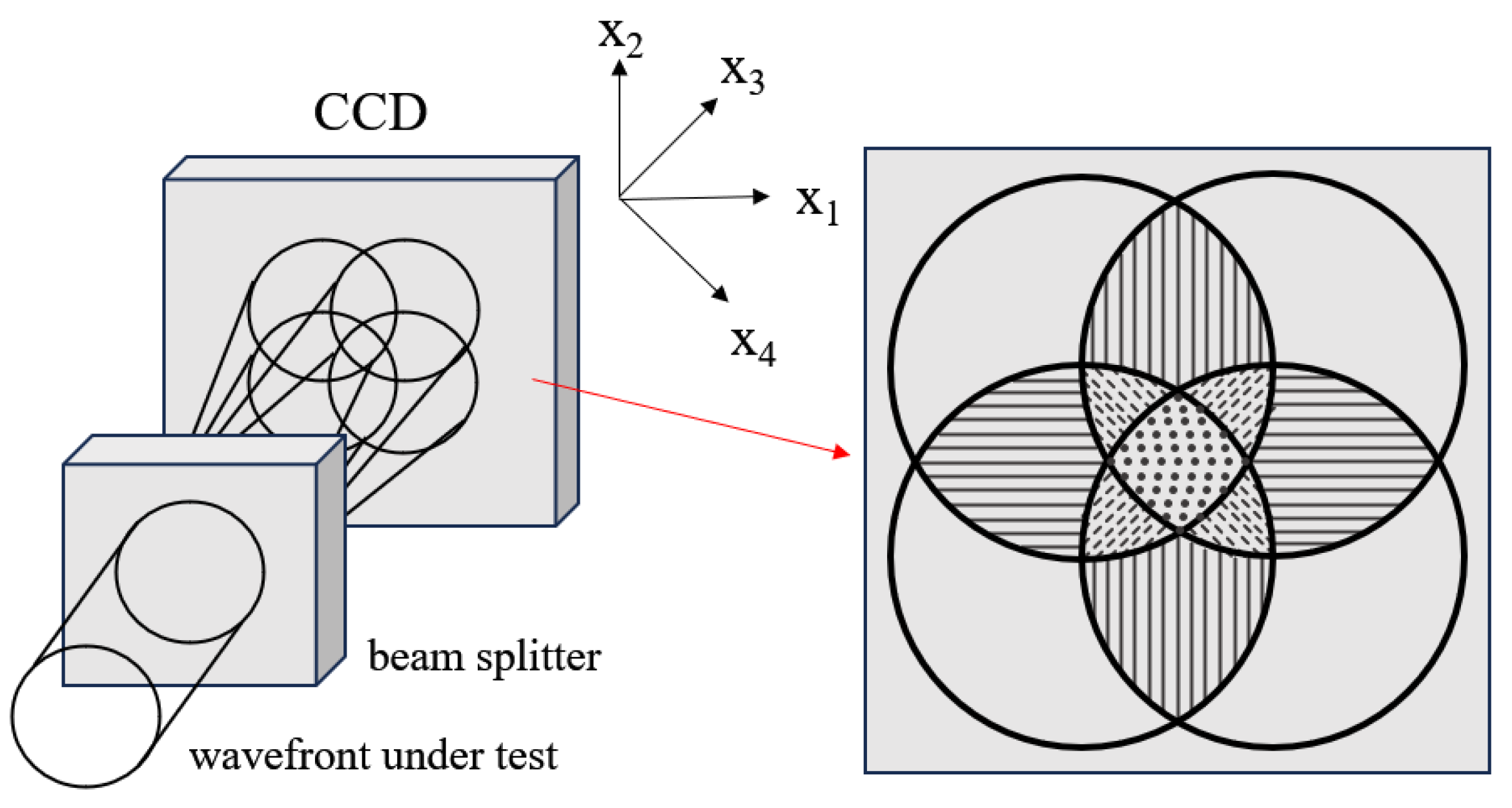
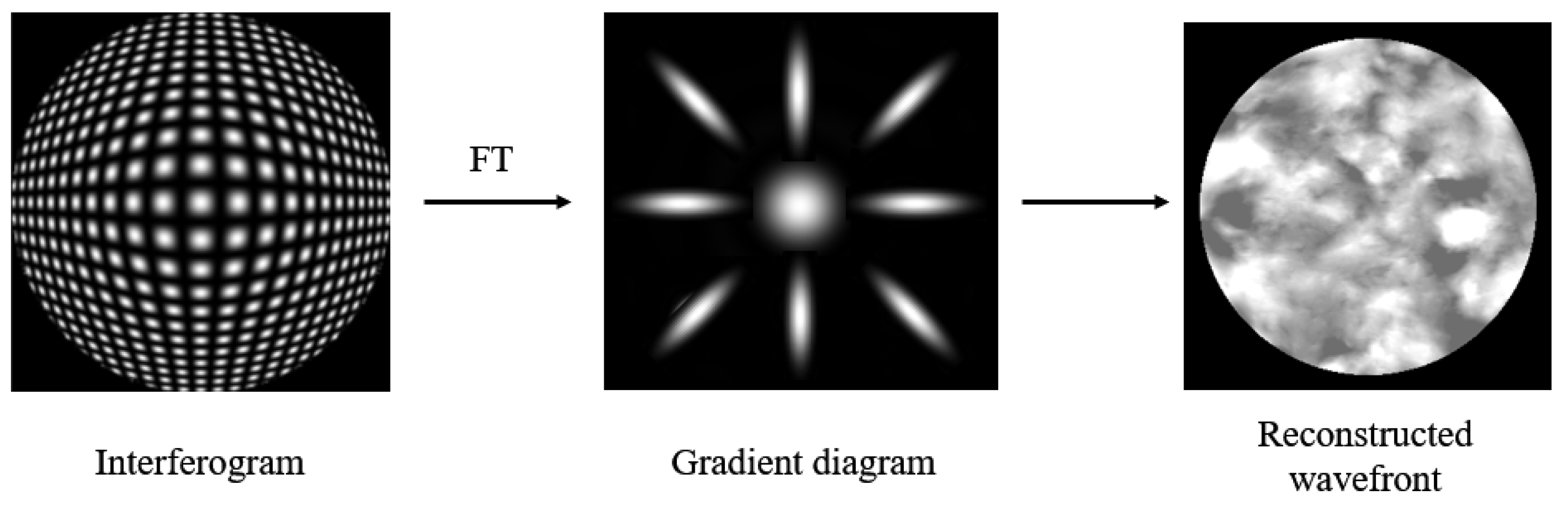
A known standard beam emitted from the light source is distorted by the measured object, leading to a distorted wavefront to be measured. The wavefront under test is fed into the QWLSI system and repeated by the beam splitter into four wavefronts misaligned with different emission angles, and the four wavefronts with the same wavelength and distortion information can then be interfered with each other on the target surface of charge-coupled device (CCD) without the need for any other reference beam. Hence, the produced interferogram is acquired by CCD and processed computationally, while the phase distribution of the wavefront under test can be recovered by the algorithm of wavefront reconstruction, as shown in
Figure 2.
The interferogram acquired by the CCD is transformed by the Fourier transform. After that, the wavefront derivatives in the four directions x1, x2, x3 and x4 can be determined simultaneously by considering the global interference of the four wavefronts. Finally, the wavefront under test can be analyzed and reconstructed by using the four derivatives in the four shearing directions. Obviously, the quality of the four interference wavefronts is crucial to ensure the accuracy of the measurement. As the most important devices in QWLSI, diffraction gratings are used as beam splitters. It is worth noting that only four diffracted beams of ±1 levels are wanted after the wavefront to be measured passes through the grating to form an ideal QWLSI. However, the diffraction grating as a beam splitter inevitably produces some high-level sub-diffraction in addition to the four first-level diffractions, which can introduce noise in the QWLSI and reduce its contrast and measurement accuracy.
Jerôme Primot et al. [
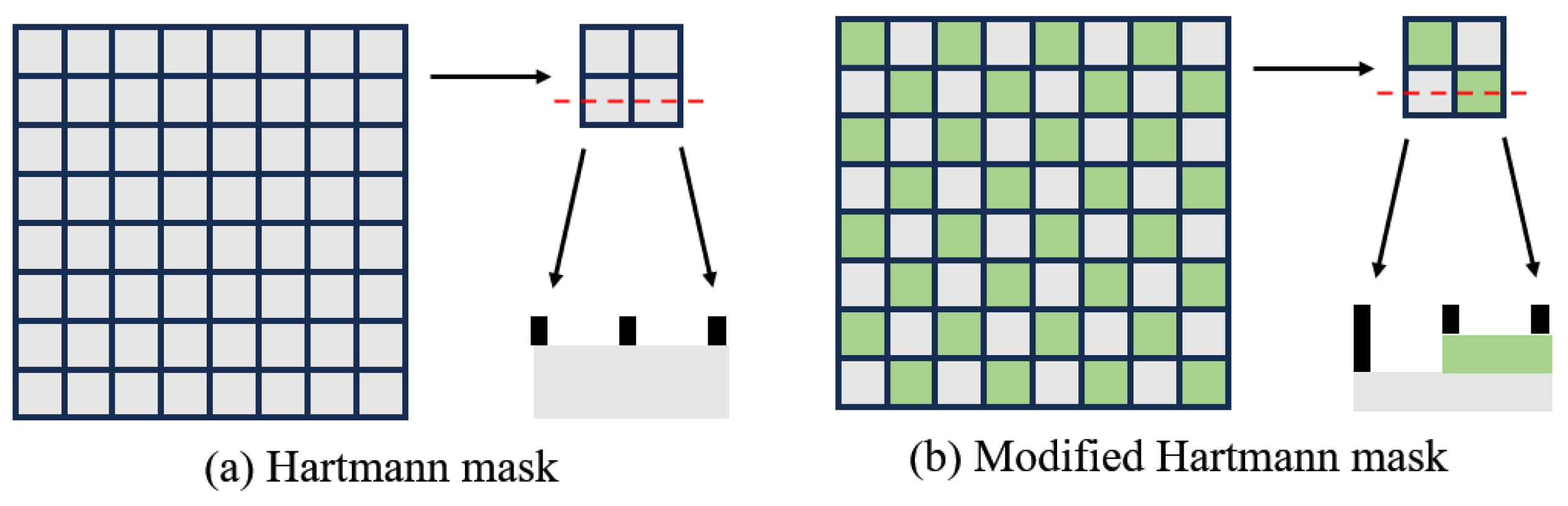
27] proposed a kind of two-dimensional diffraction grating by adding a simultaneous π-shifted phase checkerboard to the Hartmann mask, which is called “modified Hartmann mask” (MHM), as shown in
Figure 3, since the Shack-Hartmann developed by replacing the initial square-hole mask with the microlens array was not well suited for high-resolution measurements. The zero- and even-order subdiffraction can be eliminated by the phase checkerboard, and the diffraction light at integer multiples of 3 can be eliminated by the two-dimensional diffraction grating. It should be noted that the position of the CCD has to be carefully determined behind the grating in order to capture high contrast interference fringes, as high diffraction levels of ±5, ±7, and ±11 are still present.
2.2. Measurement Method of Focal Length
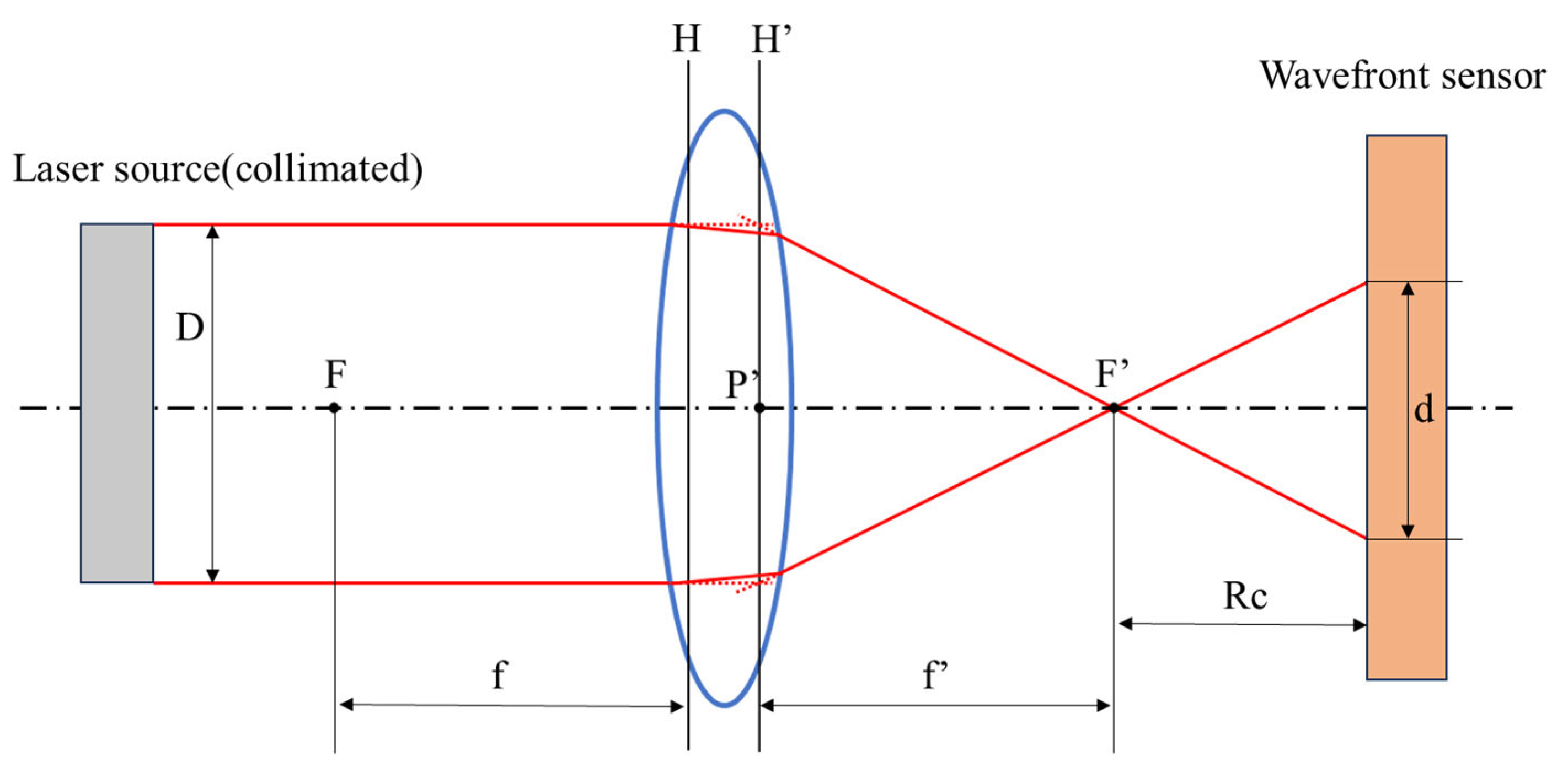
Combining the definition of the focal length of an optical lens with the principle and characteristics of the above QWLSI detective system, a convenient focal length measurement method is presented. Taking a common convex lens as an example, as shown in
Figure 4, the standard plane wavefront, which is formed by collimating the laser beam from the laser source, is incident vertically along the normal direction of the lens under test. The beam is refracted in the lens and then ejected, eventually converging to point
’ on the optical axis, which is called the image focus.
After that, the beam begins to diverge behind the focal point and is received by the CCD of the wavefront sensor at an unknown position. According to the definition of focal length, the inverse extension of the beam intersects with the extension of the initial incident beam in a plane called the principal plane. The intersection of the principal plane and the optical axis is called the principal point, and the distance from the principal point to the focal point (
) is the focal length to be measured. A mathematical model, as shown in Equation (1), can easily be established with geometrical relationships and the QWLSI, which can obtain the parameters of the wavefront to be measured, including the curvature radius.
where
is the initial diameter of the plane laser beam that exits from the laser source,
is the diameter of the beam received by the CCD of the QWLSI,
is the radius of curvature of the wavefront detected by the QWLSI, and
is the focal length to be measured.
According to the characteristics of QWLSI, and can be directly obtained by capturing the different interferograms before and after the lens under test is placed in the optical path and performing the unit conversion between the pixel and distance, separately. is one of the key parameters measured by QWLSI, which represents the radius of curvature of the wavefront received on the CCD surface. The radius is also the distance from the receiving surface of the CCD to the image focus without specifying or measuring the CCD position. As a result, the focal length of the lens to be measured can be determined by Equation (1).
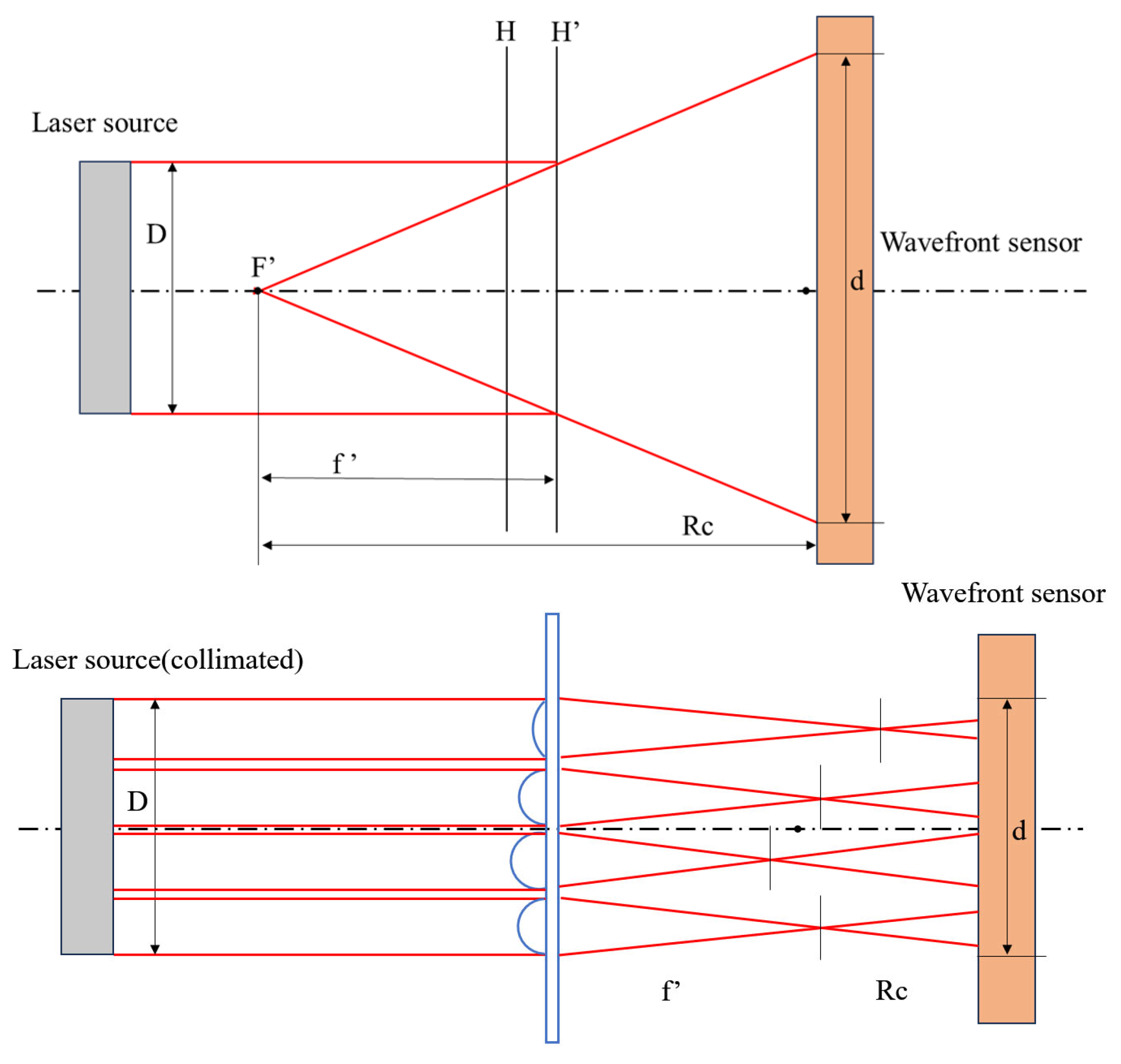
The proposed method takes full advantage of the fact that QWLSI can measure the curvature radius of the wavefront, avoiding complex optical structure setups. More importantly, the method is still applicable to the focal length measurement of a negative lens and even a microlens array with multiple focal points, which cannot be achieved with most of the currently available methods, as shown in
Figure 5. It is also worth noting that the positivity and negativity of the curvature radius directly represent the positional relationship between the CCD and point
, and the focal length is obtained by determining from the other three parameters, thus the measurement accuracy is only related to the ratio of the original beam diameter to the diameter of the received wavefront, and the accuracy of the curvature radius of the reconstructed wavefront by QWLSI.
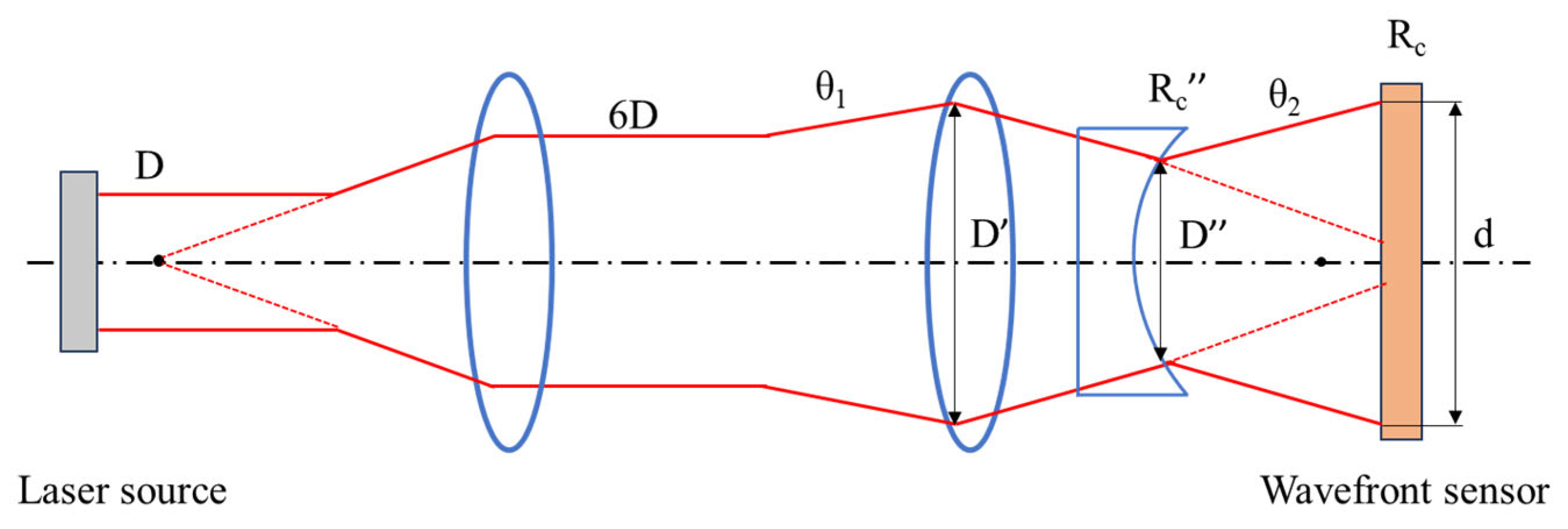
It must be noticed that, due to the diverging effect of the concave lens, the beam incident on the reduction unit is no longer a parallel beam, but a diverging beam with a certain divergence angle (
). Therefore, the final wavefront received by the sensor after passing through the entire optical system is also a diverging wavefront, as shown in
Figure 6.
A simultaneous equation could be obtained according to the Gaussian beam formula and the amplification parameter of the expander, as shown in Equation (2).
where
and
are the diameters of the diverging beams incident on and emitted from the beam reduction unit, respectively.
and
are the divergence angles of the incident and outgoing beams, while
and
are the radius of curvature of the incident and outgoing beams, respectively.
Equation (3) thus can be obtained for the focal length (
) of the concave lens from Equation (1):
In addition, another equation is obtained according to the relationship between the wave emitted by the beam reduction unit and the wave received by the sensor, as shown in Equation (4).
As a result, the mathematical model shown in Equation (1) is still applicable to the measuring system containing the beam expansion and reduction module by coupling Equations (2)–(4).
The ratio of the original beam diameter to the diameter of the received wavefront can be obtained by analyzing the value of pixels corresponding to the two interferometric patterns or some features on it. Appropriate edge detection algorithms and radius of curvature determination algorithms with appropriate parameters have to be selected, which are directly related to the accuracy of the focal length measurement. As for the measurement of complex elements such as microlens arrays containing multiple sublens units, the focal length of each unit can be calculated in the same way, and a diopter map of the entire measurement area can then be plotted, providing a more intuitive representation of the real information of the lens under test.
3. Design of the Measurement System
3.1. Configuration Design of the Measurement System
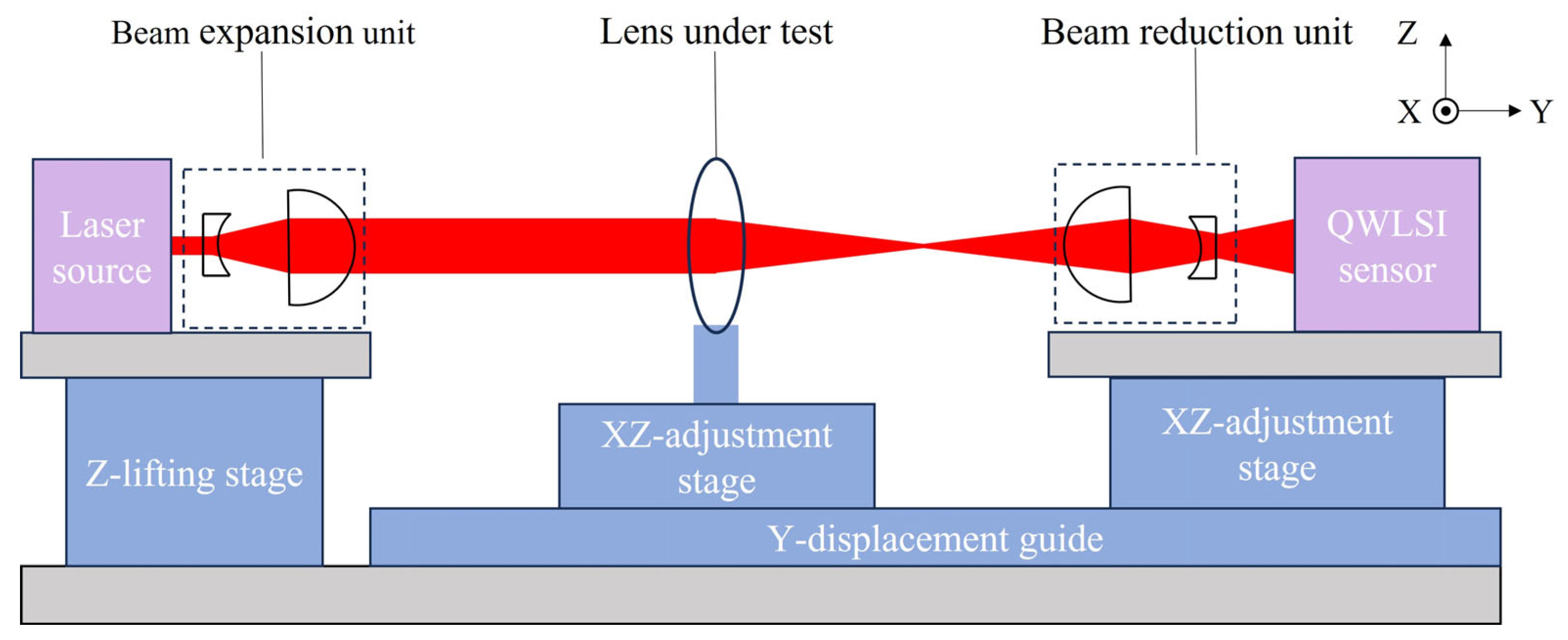
A purposely tailored measurement system is developed for measuring the focal length of different lenses based on the above principle and method, and the configuration of the system is shown in
Figure 7.
The system includes a laser source module, a set of bidirectional beam expansion and reduction modules, a QWLSI sensor module and several auxiliary adjustment mechanisms. The laser source module is composed of a He-Ne laser emitter and a collimator, providing a wavelength-stabilized and collimated parallel beam whose aperture can be adjusted by a diaphragm placed at the exit of the collimator. Two beam expanders with the same parameters can be placed face-to-face in the forward and reverse orientation symmetrically to expand and reduce the laser beam, accommodating optical measurement with a wide range for different kinds of lenses. The QWLSI sensor module is the key facility to be used to obtain and analyze the wavefront exiting from the lens under test, and the radius of curvature of the lens to be measured can thus be determined. Auxiliary adjustment mechanisms are necessary to help adjust the positioning and angular attitude of different modules of the measuring system to ensure the high accuracy and reliability of the optical measurement.
While the use of beam expanders is standard in interferometry [
28], the specific innovation of this optical setup is its modular and reversible design. Unlike conventional fixed-aperture setups, our system allows the beam expansion unit to be inverted into a reduction unit. This modification is crucial for measuring large-aperture diverging lenses, as it enables the sensor to capture the full wavefront that would otherwise diverge beyond the sensor’s physical area. This adaptability represents a significant improvement over static QWLSI configurations reported in previous literature.
3.2. Design of the Measurement System Workflow
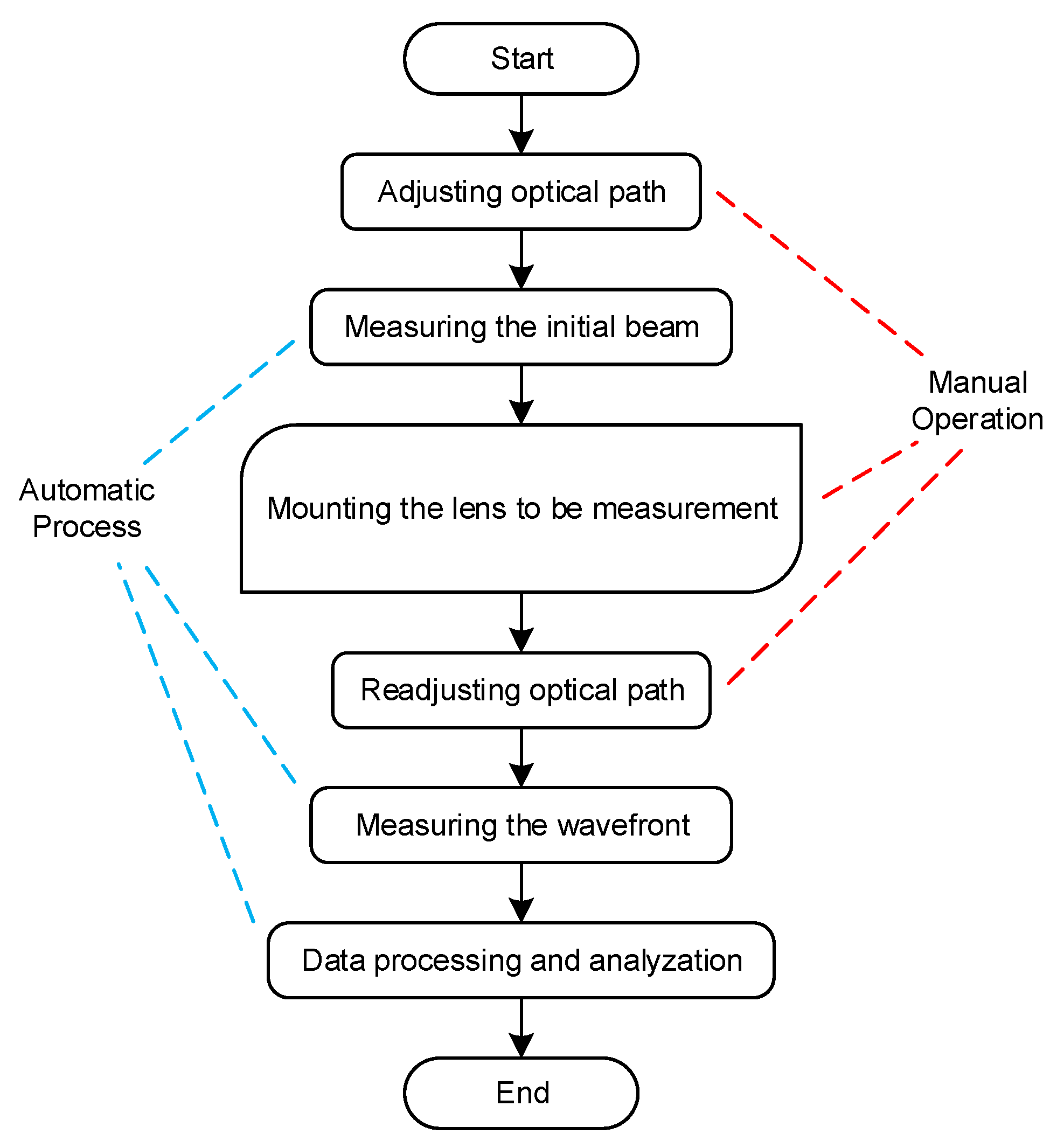
This work designed a tailored and complete workflow for the measurement of the focal length of the lens for the proposed measurement system, which is shown in
Figure 8. The main process includes optical path adjustment, lens mounting, wavefront measurement, data calculation, and result analysis, etc.
The workflow is distinctively divided into manual preparation and automated software execution. In the manual phase, the steps ‘Adjusting optical path’, ‘Mounting the lens’, and ‘Readjusting optical path’ require manual operation to align the hardware components and the lens under test (as shown in
Figure 8).
About the automated phase, the core metrology steps, including ‘Measuring the initial beam’, ‘Measuring the wavefront’, and ‘Data processing and analyzation’, are executed automatically by the software. With a single click from the operator, the software captures the interferogram, performs the Fourier transform reconstruction, automatically detects the lens aperture, and computes the focal length. This automation minimizes operator bias during the quantitative analysis stage.
3.3. Development of the Hardware of the Measuring System
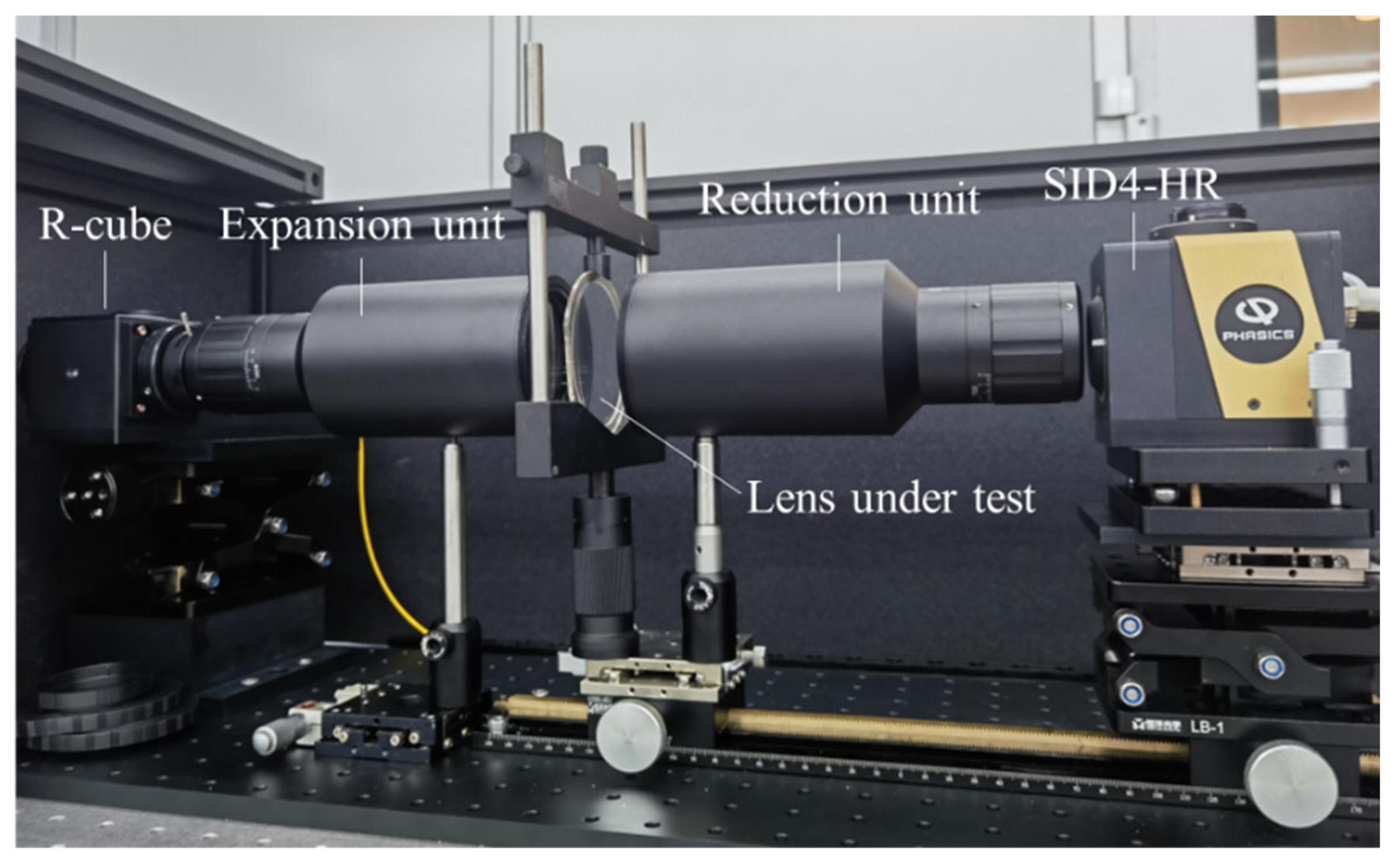
Various components based on the above structure have been selected and designed. The snapshot of the measuring system built is shown in
Figure 9. A power-adjustable He-Ne laser (S1FC635 SM, THORLABS, Newton, NJ, USA) with a wavelength of 635 nm and a power stability of ±0.1 dB/24 h was used to provide a stable and reliable monochromatic laser source for the measuring system. A professional wavefront sensor (SID4-HR) developed by the PHASICS Corporation from France with the advantages of ultra-high resolution, large analysis pupil and high dynamic range was chosen as the QWLSI sensor, and an integrated illumination module (R-Cube, PHASICS Corporation, Boulder, CO, USA) that can be used in conjunction with the sensor was chosen as the collimator, which is easy-to-use and can deliver a collimated beam with a high accuracy and an adjustable aperture within 1 mm to 10 mm for the measurement of the lens. Two large aperture beam expanders (BEF06-A) developed by Lbtek Corporation (Changsha, China) were utilized for the beam expansion and reduction module, whose operating wavelength range is between 400 nm and 700 nm with a fixed magnification of 6× and a maximum incident beam diameter of 10 mm, i.e., a maximum output beam diameter of 60 mm. In addition, the entire measuring system was placed in a closed black box frame to avoid the influence of background stray light on the measurement results.
The focal lengths of different convex and concave lenses can theoretically be measured by the system, even for different units of microlens arrays within a diameter of 60 mm. It is found that there is a difference between the spot diameter of the input beam and the spot diameter of the output beam due to factors including optical path differences, optical system errors and variations in beam characteristics. The positioning and angular attitudes of the two beam expanders must be finely adjusted to minimize the difference, and appropriate compensation should be performed in the calculation of the focal length.
The primary advantage of this hardware configuration, compared to traditional focimeters or standard Shack-Hartmann sensors, is its versatility and high dynamic range. While commercial focimeters (e.g., nodal slide or distinct focimeters) provide high accuracy for standard ophthalmic lenses [
2,
3], they are generally incapable of characterizing complex multi-focal components like Microlens Arrays (MLAs) or lenses with large negative focal lengths. Similarly, while standard Shack-Hartmann wavefront sensors are widely used, their performance is often constrained by the discrete sampling of the microlens array, which creates a trade-off between dynamic range and spatial resolution [
18,
27].
In contrast, the proposed system integrates the high-resolution phase sensing of QWLSI with reversible beam expansion/reduction module, affords a maximal performance flexibility. This allows for the precise measurement of complex MLAs (as demonstrated in
Section 4.3) and large concave lenses (
Section 4.2) within a single platform with high resolution [
19,
20]. It must be noted that the system’s accuracy is partly dependent on the quality of the beam expansion optics. As noted in the experimental design, the auxiliary lenses introduce minor wavefront aberrations that must be calibrated and subtracted from the final measurement. Furthermore, for extremely short focal length microlenses, the diffraction effects at the edges of the sub-apertures may impose a limit on the minimum measurable focal length.
3.4. Development of the Software of the Measuring System
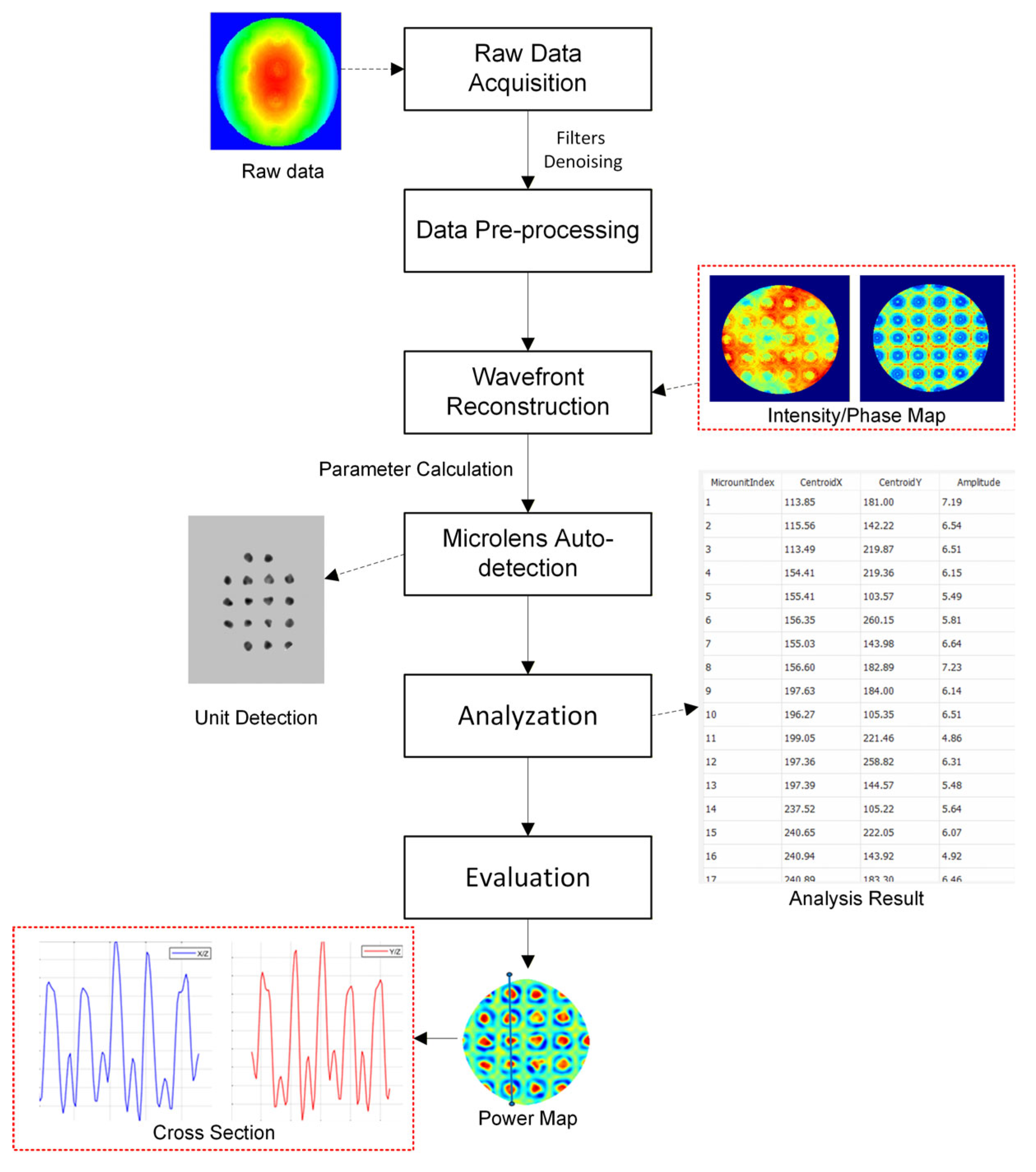
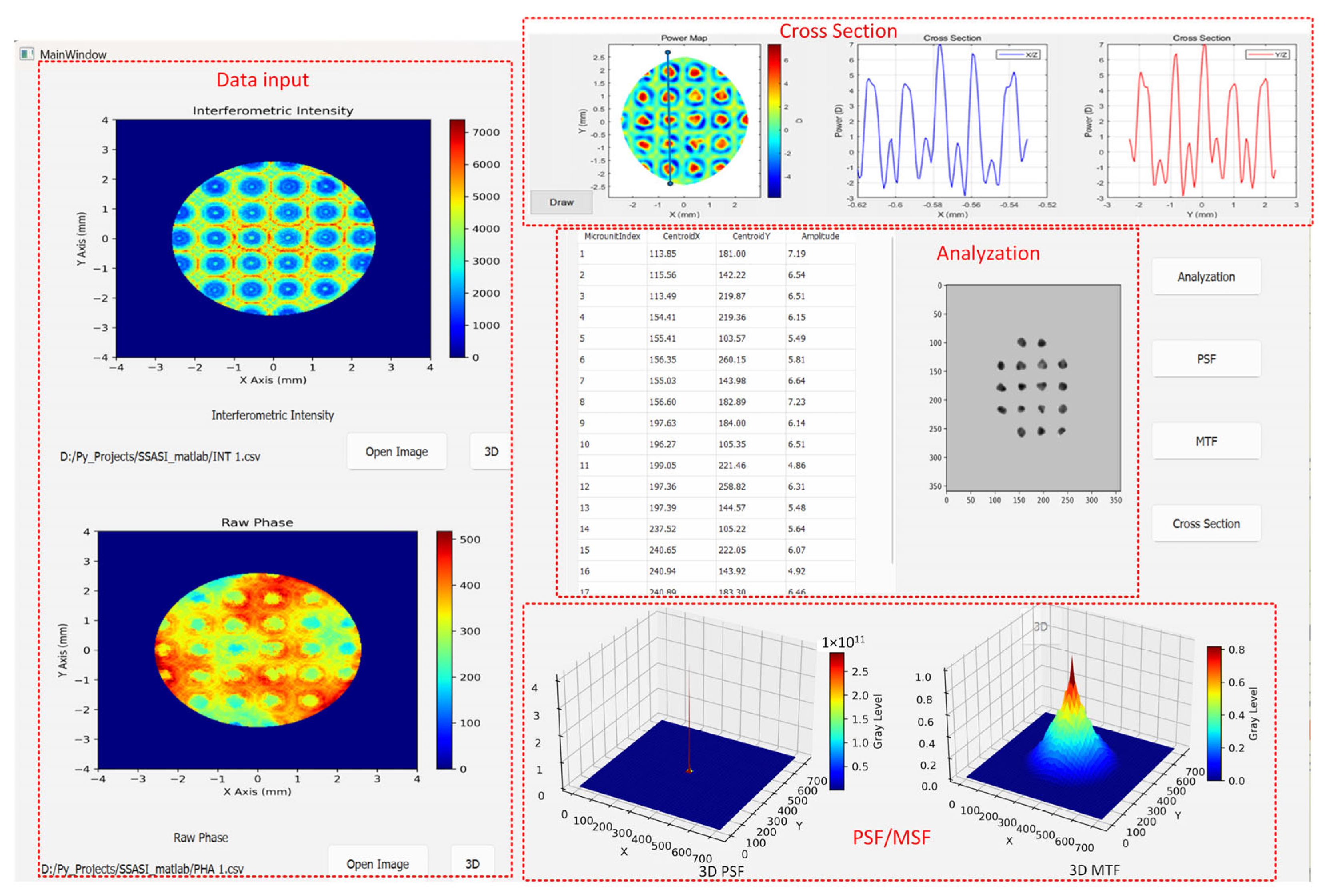
In order to integrate the models and algorithms and to implement the proposed method automatically, an integrated software is developed with Python and the Qt framework, as shown in
Figure 10. The software converts raw data collected from the wavefront sensor to interferometric intensity data and phase data, outputs power data and analysis results.
As
Figure 10 shows, it consists of an analysis module, modulation transfer function (MTF) and point spread function (PSF) calculation modules, a cross-section module, and some functional algorithms. The input data of the software, which is in “.csv” format, is divided into intensity information and phase information, and processed by filters, like Weiner and median. With the intensity and phase information, the power map of the data is calculated. The power map is then stored as matrices and regarded as inputs of functional modules, such as the analyzation module and the cross-section module. To determine the effective beam diameters accurately and automatically, the software employs Otsu’s thresholding method. This algorithm processes the intensity map to calculate an optimal threshold that separates the beam region from the background noise, generating a binary mask of the wavefront. The beam diameter is then derived from the width of this mask, with the measurement accuracy defined by the sensor’s pixel pitch. In the analyzation module, we developed an auto-detection function module to detect and extract each micro-lens in the measurement area. This initial phase yields both the spatial localization and geometric outlines of the individual microlenses. Subsequently, a computational algorithm is applied to ascertain the global geometric/optical center of the entire lens array. For every characterized microlens, the system quantifies and reports its centric coordinates, refractive power, and physical diameter. In the cross-section part, the developed software offers the capability for localized spherical and cylindrical profilometry by analyzing cross-sections at any user-defined position and across any specified segment length on the lens surface.
The software was developed using Python 3.9 for the backend logic and the PyQt5 framework for the graphical user interface (GUI), ensuring cross-platform compatibility. The data processing pipeline integrates several scientific computing libraries: NumPy [
29] is utilized for high-performance tensor operations on the interferometric data; SciPy [
30] is employed for the Zernike polynomial fitting and Fourier transforms required for wavefront reconstruction; and OpenCV [
31] is implemented for the image pre-processing and Otsu’s thresholding algorithms. This modular design allows for the independent updating of the analysis algorithms without disrupting the user interface.
4. Experimental Results and Analysis
A series of focal length measurement experiments were designed and undertaken on different convex lenses, concave lenses and microlens arrays based on the developed measuring system. To evaluate the effectiveness and the convenience of the described measuring system, symmetric biconvex or concave lenses and some asymmetric lenses were measured. Several different kinds of commercially available instruments from different corporations were also used to measure the lenses under test, and the results obtained from the developed measuring system were compared with the results of the commercially available instruments to benchmark the measurement reliability and accuracy.
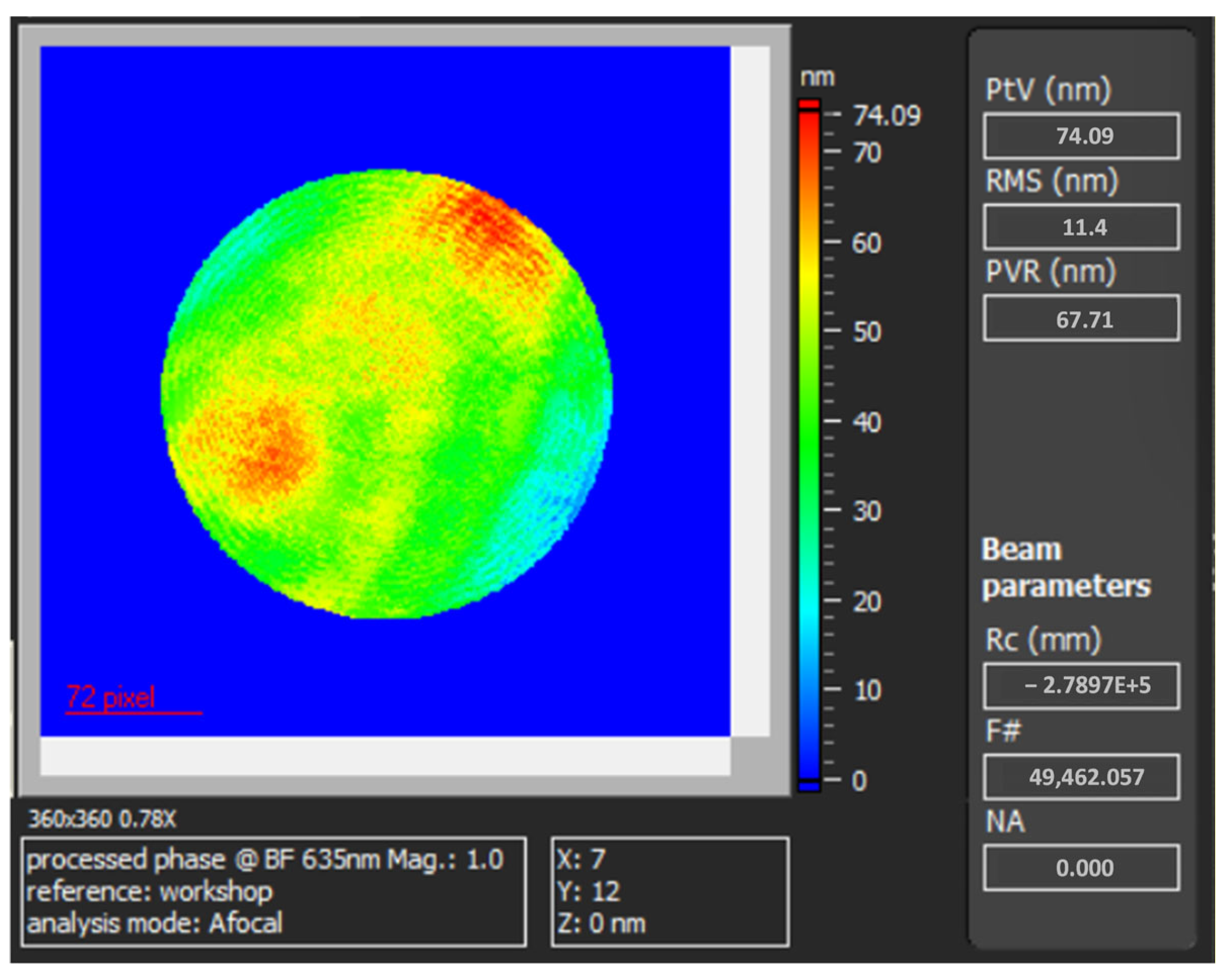
The optical path was aligned before the measurement, without the installation of the beam expansion and reduction module, and the lens to be measured. The wavefront error of the initial source was measured and shown in
Figure 11. The measurement results show that the spot diameter of the initial laser is 10 mm. The radius of curvature
of the wavefront is determined using Zernike polynomial decomposition. The curvature is extracted specifically from the Zernike defocus term, which mathematically isolates the quadratic phase component from higher-order aberrations such as spherical aberration or astigmatism. By observing the central area of the measured wavefront by selecting a suitable analysis mask of the wavefront sensor, the peak-to-peak value of the wavefront residual error is found to be 74.09 nm with an RMS value of 11.4 nm. Moreover, the radius of curvature of the wavefront is about 2.7897 × 10
5 mm, indicating that the beam is highly collimated and approximates a plane wave, making it suitable to serve as a reference parallel laser source for the measuring system.
4.1. Measurement Experiments and Results of the Convex Lens
A convex lens, made of polymethyl methacrylate (PMMA), custom-manufactured in our laboratory with a diameter of 15 mm and a symmetrical structure on both sides, was chosen for our measurement experiments. The measurement results show that the wavefront is a diverging spherical wave, and its radius of curvature can be determined based on the phase distribution and the diameter of the wavefront. After that, the focal length of the lens can be obtained to be 47.50 mm. The experiments were repeated 6 times on the same lens to ensure the reliability of the measurement and the reproducibility of the results; the results are shown in
Table 1.
The results show that the determined focal length is 47.26 ± 0.18 mm (Mean ± Standard Deviation, N = 6). The minor fluctuations in
Table 1 (Standard Deviation σ = 0.18 mm, which is roughly 0.38% of the focal length) are attributed to environmental micro-vibrations and the inherent electronic noise of the sensor during the six measurement runs.
Benchmark experiments were carried out using a commercial focimeter (LensCheckTM) developed by Optikos Corporation (Wakefield, MA, USA) to verify the accuracy of the results of our measuring system. Six groups of repeated experiments were also carried out, and the measurement results are shown in
Table 2.
The results show that the extreme difference between the results measured by the proposed system and the Optikos focimeter is less than 1.25 mm. The fluctuations 1 mm) are larger than our proposed method. These discrepancies are likely due to the noise and the alignment tolerance of the commercial instrument. The standard deviation of the developed system improves by 70%, indicating a significant reduction in variability or dispersion, which proves that the results of the developed system are credible and stable.
Although the mean focal lengths obtained by the two methods are in close agreement (differing by only 0.2%), the sources of the observed discrepancies merit discussion. First, regarding the mean value difference, a primary contributing factor is the wavelength difference between the light sources, combined with the dispersion of the lens material. The proposed QWLSI system utilizes a diode laser at 635 nm, whereas commercial focimeters typically operate at or are calibrated to the standard e-line (546 nm). The lens under test is fabricated from PMMA, a material known for its relatively high dispersion (Abbe number
) [
32]. Consequently, the refractive index of PMMA is measurably lower at 635 nm compared to 546 nm. According to the lensmaker’s equation, this lower refractive index theoretically results in a slightly longer effective focal length. The observed positive shift in our measurement is strictly consistent with this physical phenomenon derived from the material properties of PMMA.
Second, regarding the measurement precision, the proposed system demonstrates a significantly lower standard deviation ( mm) compared to the commercial instrument ( mm). This improvement is attributed to the static nature of the QWLSI optical setup. Unlike traditional nodal-slide or image-based focimeters, which require mechanical translation to locate the focal plane (introducing mechanical backlash and operator sensitivity), the QWLSI method retrieves the curvature radius from a single-shot interferogram without moving parts during the acquisition. Combined with the automated aperture detection algorithm, this setup effectively minimizes both mechanical and operator-induced random errors. The software eliminates operator-induced variations, ensuring consistent measurement criteria across all six trials. This suggests that our QWLSI-based system offers superior measurement precision.
To verify the superiority of the proposed measurement method and system over some other methods in terms of applicability, another convex lens (PMMA, custom-manufactured in our laboratory) with a diameter of 15 mm and an asymmetric structure on two sides (including an optimal shape lens) was chosen for further experiments. It is very difficult to accurately determine the position of the principal point and obtain the focal length for an unknown asymmetric convex lens, which is the main reason that some of the currently available measurement methods are inapplicable. The asymmetric convex lens was clamped in the auxiliary frame in forward and reverse directions, respectively, and other setups were carried out with the same settings. The experiments were repeated 6 times for each direction; the results are shown in
Table 3.
The results show that the measured focal lengths of the asymmetric convex lens are 12.37 ± 0.14 mm and 11.91 ± 0.11 mm for the forward and reverse directions, respectively. The results also show that the developed measuring system can measure the difference between the effective focal length of the front and the effective focal length of the back of asymmetric lenses and has good adaptability and reliability for the measurement of the focal length of unknown lenses with different structures.
4.2. Measurement Experiments and Results of the Concave Lens
Most of the currently available methods or systems (including focimeters) cannot be up to the task of measuring focal lengths of concave lenses, which are needed to determine the focus position or acquire a clear image. As we know, the back focus of the concave lens is in front of the lens, and the image made by a concave lens is an imaginary image. However, there is a diverging wave after a beam passes through a concave lens, which happens to be received by the wavefront sensor we used.
A concave lens, made of PMMA, with a diameter of 50 mm and an asymmetric structure, whose design value of the effective focal length is −101.2229 mm, was also designed and manufactured in our laboratory for the experiments. The actual effective focal length of the manufactured concave lens was measured by a surface profilometer (i.e., Form Talysurf PGI from Taylor-Hobson Corporation, Leicester, UK), which is −101.2330 mm, considered as a benchmark. Six repeated experiments were carried out, and the results are shown in
Table 4.
Measurement experiments were carried out based on a similar method and process described above to measure the focal length of this concave lens. The difference is that the beam expansion and reduction module was added for large area coverage measurements; the corresponding mathematical analysis is discussed in
Section 2.2.
Experimental results show that the measured focal length of the concave lens, based on six repeated measurements, is −101.35 ± 0.12 mm (with a standard deviation of 0.12 mm), while the extreme difference between the experimental results and the benchmark is 0.27 mm. The results also show that the proposed measuring system has good adaptability, convenience, and reliability for focal length measurement of concave lenses, which is highly practical.
4.3. Measurement Experiments and Results of the Microlens Array
Focal length measurements only for single lenses are obviously still limited and cannot fully utilize the measurement capabilities of the QWLSI system. Microlens arrays (MLAs), which are widely used in various kinds of miniaturized or precision optical devices, often contain several microlens units on the same side of the lens, with the advantage of customizable complex structures. The laser beam is divided into several regions by different microlens units after being incident on the MLA, and the beams in each region are operated by the microlens units, either converging or diverging, in order to achieve different functions. In this case, MLAs arranged in matrix form, with each microlens unit identical, are very typical and are also one of the most critical components of the Shack-Hartmann wavefront sensor. A custom-manufactured matrix-type MLA, made of polymethyl methacrylate (PMMA) with unknown parameters, formed on a spherical substrate, was measured in a series of measurement experiments. The workflow of the proposed measurement system for the MLA measurement experiment is shown in
Figure 12.
In
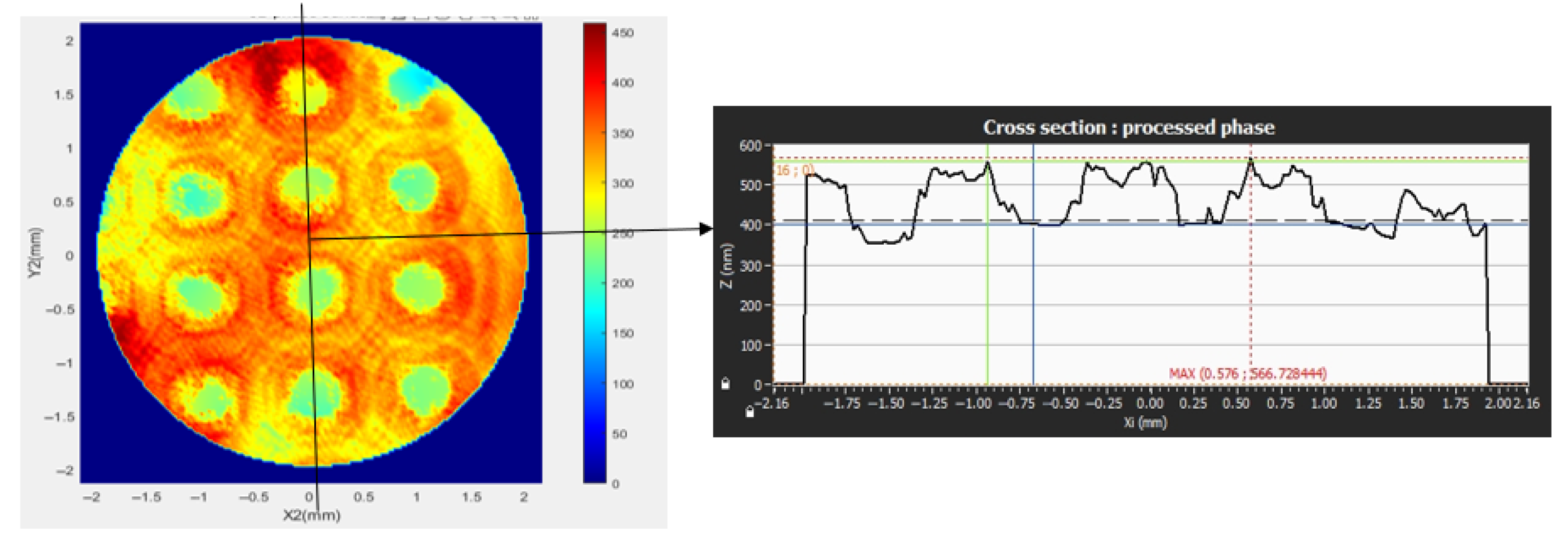
Figure 12, the substrate of the measured MLA is a concave lens, and all the microlens units can be observed as convex lenses after filtering out the effect of the substrate on the wavefront. To better analyze the information contained in the wavefront, the measurement data were processed, and a cross-section was plotted along the middle column of the microlens array, as shown in
Figure 13.
Figure 13 shows that the bow heights of the four depressions in the cross-section are about 155 nm, 160 nm, 160 nm and 155 nm, and the chord lengths are about 0.50 mm, 0.55 mm, 0.50 mm and 0.52 mm, respectively. The radius of curvature of the four depressions is determined to be about 201 mm, 236 mm, 195 mm and 218 mm, respectively. In addition, the entire spot diameters before and after clamping the MLA to be measured are 6.41 mm and 7.16 mm, respectively. As a result, the focal lengths of the four microlens units corresponding to the four depressions can be determined to be 179.9 ± 0.3 mm, 211.0 ± 0.3 mm, 174.5 ± 0.3 mm, and 195.1 ± 0.3 mm, respectively (error bounds represent the expanded uncertainty
of the system).
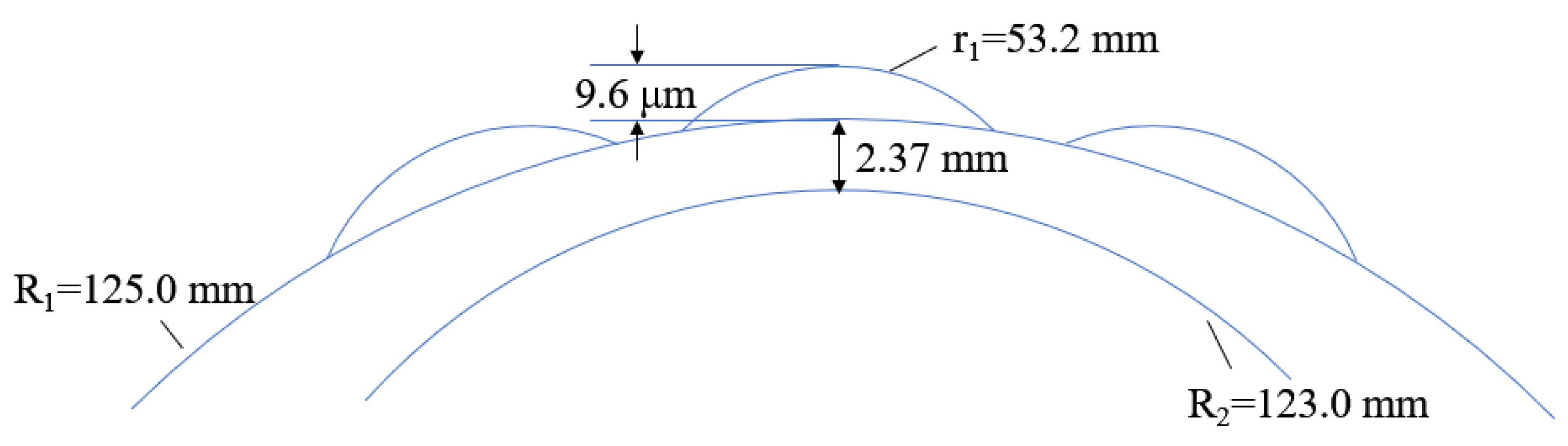
To verify the performance of the proposed measuring system for MLAs, another set of comparative experiments was carried out, measuring the MLA under test on both sides and the microlens unit parameters in the central area of the MLA through a combination of the Taylor PGI surface profilometer and a Zygo surface profiler (i.e., Nexview). The measurement results of different parameters are shown in
Figure 14.
The results show that the radii of curvature of the two surfaces of the substrate are 125.0 mm and 123.0 mm, respectively, while the radius of curvature of the microlens unit measured is 53.2 mm. In addition, the microlens unit and substrate heights are 9.6 μm and 2.37 mm, respectively. Then the microlens focal length, which consists of the microlens unit and the substrate together, can be obtained by the simultaneous equation for the focal length of a seamlessly connected lens, as shown in Equation (5).
where
is the refractive index of the material used for the lens, which is 1.48. Finally, the focal length of the central microlens of the MLA under test can be calculated to be approximately 192.6 mm. Due to the different radii of curvature of the two surfaces of the measured MLA substrate, the focal length of the microlens unit gradually decreases as the unit moves further away from the centre.
A comparison of the measurement results of the developed system with those of commercial surface profilers shows that the developed system can measure the focal lengths of MLAs accurately and reliably within an extreme difference range of approximately ±20 mm. The large error range is due to the optical resolution degradation caused by the beam expansion and reduction module that expands the measurement coverage area, while the accuracy of the data readout, edge recognition and also the signal-to-noise ratio of the phase interferogram directly affect the final measurement accuracy of focal length. Further optimizations and improvements in data processing and analysis will be carried out in the future for higher precision measurements of MLAs.
4.4. Uncertainty Evaluations
According to the analysis above, measurement accuracy is mainly related to two features: the ratio of the original beam diameter to the diameter of the received wavefront and the curvature radius of the reconstructed wavefront, without considering the incorporated data acquisition and processing. The uncertainty components caused by the spatial resolution, repeatability, and measurement accuracy of the SID4 sensor were regarded as the main factors affecting the uncertainty of measurement results. In this part, each component was analyzed and determined.
4.4.1. Evaluation of Input Uncertainties
According to the specifications of the SID4 sensor, the spatial resolution is 29.6 μm, the resolution is 2 nm (RMS), and the accuracy is 15 nm (RMS). Because the focal length is calculated using Equation (1), the tiny error caused by the received beam diameter
might be magnified due to the error propagation. We adopted a standard uncertainty of
and
based on the sensor’s spatial resolution of 29.6 μm (1 pixel) and type B evaluation [
33].
In addition, the repeatability of
can be calculated to be less than 0.2 mm from the data of the repeated measurement experiments given above (
Table 4), using the Bessel formula based on type A evaluation.
4.4.2. Derivation of the Sensitivity Coefficients
These are the partial derivatives of with respect to each variable using experimental values ( mm, mm, mm).
For
(Initial beam diameter):
For
(Received beam diameter):
4.4.3. The Combined Uncertainty
Considering the spatial resolution and resolution conformed to the uniform distribution, the combined standard uncertainty of the measurement results of the proposed measuring system can be determined by Equation (11).
Given a confidence probability of approximately 95% (
, normal distribution), the expanded uncertainty of the results of the measuring system is approximately 0.31 mm.
5. Conclusions
This paper presents a comprehensive ‘full-package’ focal length measurement system based on Quadri-Wave Lateral Shearing Interferometry (QWLSI). By integrating a novel reversible beam expansion/reduction optical path with a custom-developed automated software suite, the system overcomes the dynamic range limitations of traditional wavefront sensors while maintaining high measurement precision. Different sets of measurement experiments were carried out for convex lenses, concave lenses, and even a microlens array to verify the measurement accuracy and reliability. In comparative testing with a commercial Optikos LensCheck instrument, the proposed system achieved a focal length of mm. The significantly lower standard deviation mm vs. mm) highlights the advantage of the QWLSI’s static measurement principle, which eliminates mechanical transmission errors and offers good adaptability, high repeatability, and reliability for measuring the focal length of unknown lenses with different structures and large-aperture lenses. The reduction mode successfully characterized a large-aperture concave lens with a focal length of mm, proving the effectiveness of the modular optical design in expanding the measurement field of view.
By employing automated deterministic algorithms (such as Otsu’s method) for beam diameter extraction, the automated processing pipeline simplifies measurement processes and eliminates the inter-operator variability inherent in manual edge detection, ensuring that the residual uncertainty is limited solely to hardware noise rather than operator inconsistency. The system successfully resolved the sub-aperture focal lengths of a refractive MLA (ranging from 174.5 mm to 211.0 mm), demonstrating high spatial resolution that traditional nodal-slide methods cannot achieve. The expanded uncertainty was also analyzed and determined to be 0.31 mm (, normal distribution). On the whole, the proposed QWLSI measurement system offers a versatile, high-speed, and high-precision solution for the characterization of complex optical components, filling the gap between standard focimeters and high-cost interferometers. Future work will be directed toward enhancing the accuracy and robustness of the proposed auto-detection and analysis methodology. The current approach, while effective, may have limitations in handling significant process noise or unforeseen variations. To address this, we plan to integrate data-driven approaches to automatically extract complex features, leading to a more generalized and robust solution that requires less manual parameter tuning.