A Multi-Data Fusion-Based Bearing Load Prediction Model for Elastically Supported Shafting Systems

Abstract
1. Introduction
2. Method
2.1. Overall Methodology for Model Construction
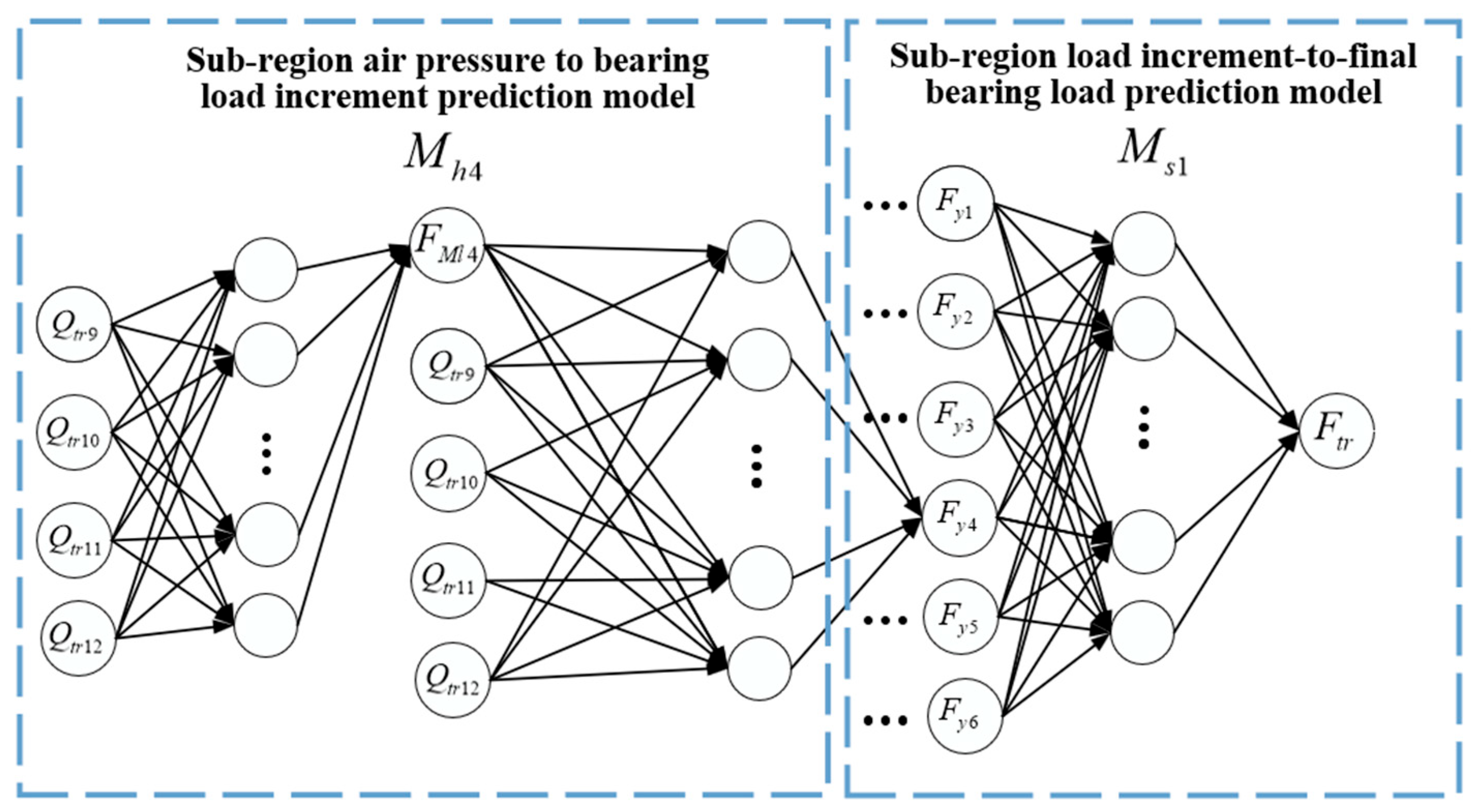
2.2. Transfer Learning-Based Multi-Sub-Region Bearing Load Prediction Model
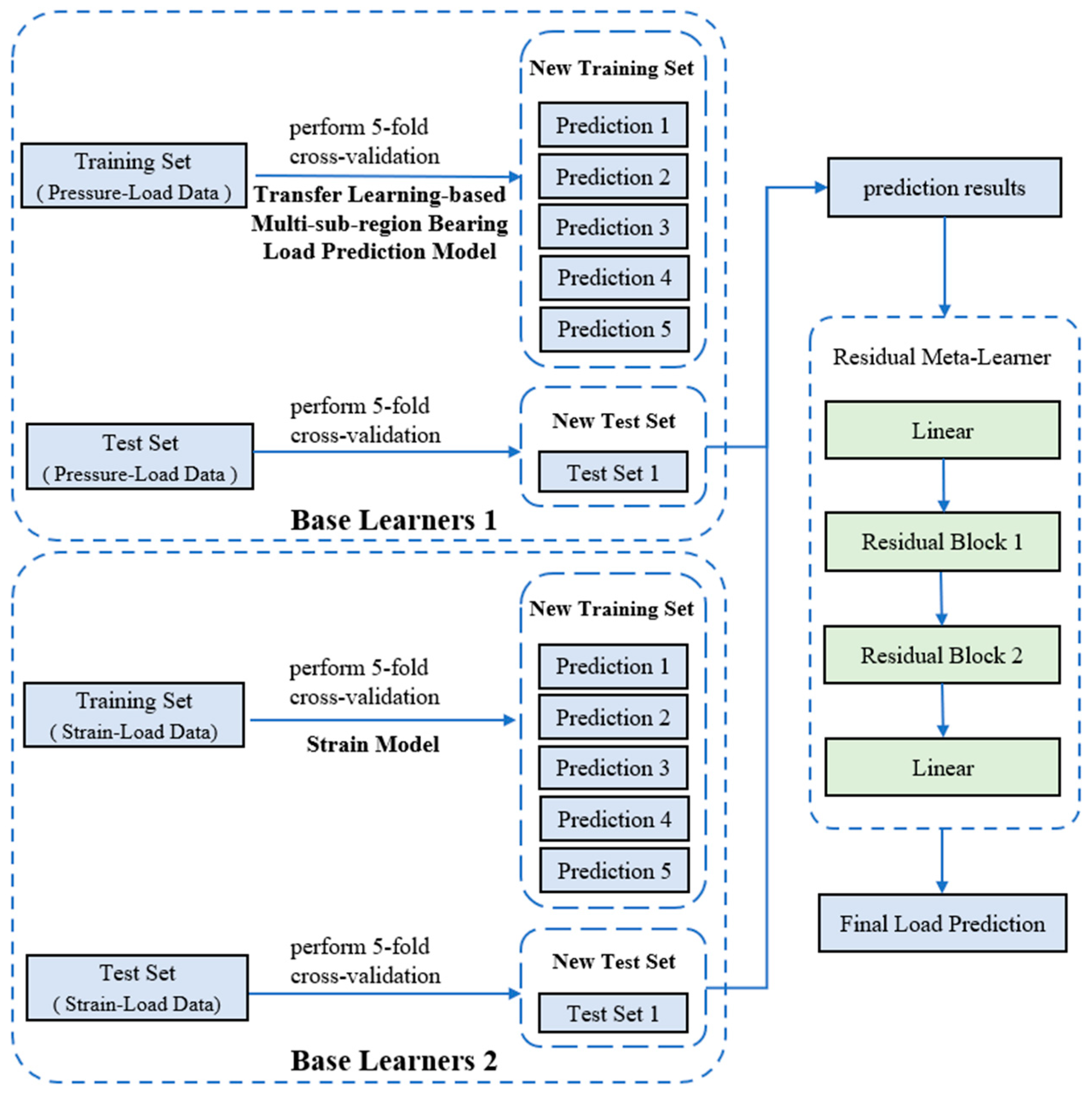
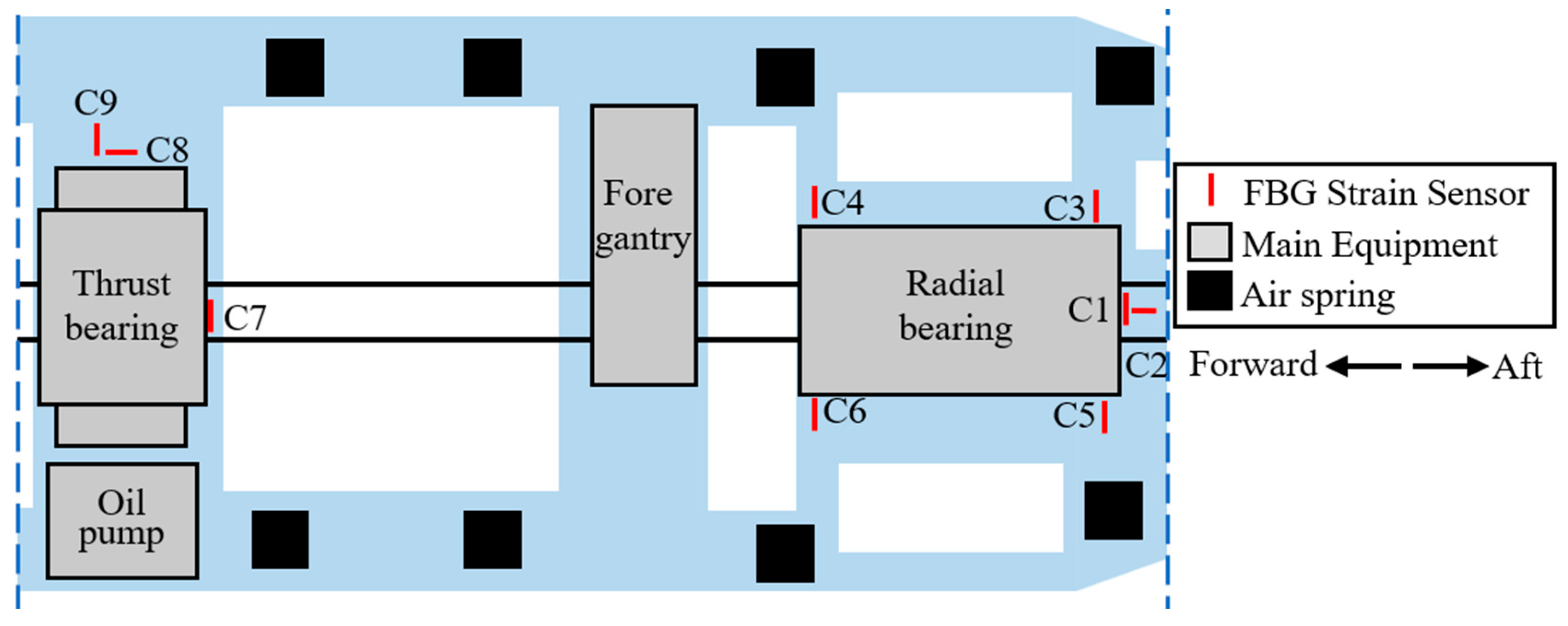
2.3. Stacking Ensemble Learning-Based Model with Multi-Data Fusion for Bearing Load Prediction
- : Local strain (dimensionless)
- : Local stiffness (N/m)
- : Force applied to the local region (N)
- : Characteristic length of the local region in the force direction (m)
- : Local stress (Pa)
- : Effective load-bearing area of the local region (m2)
3. Results and Discussion
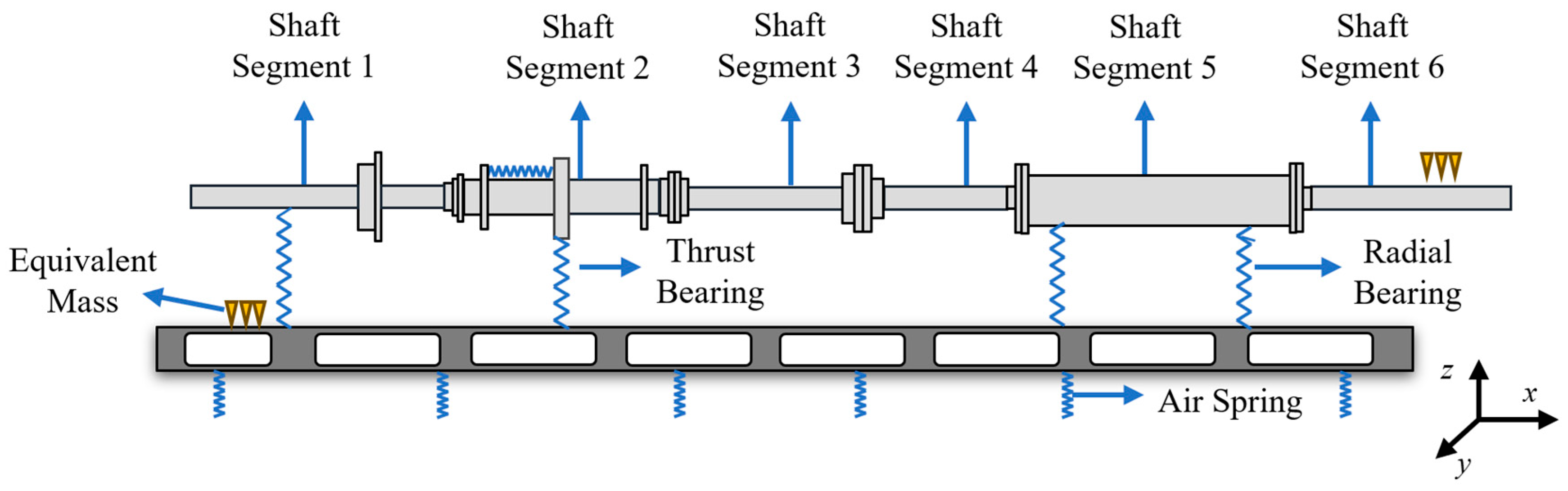
3.1. Simulation Results of Finite Element Model
3.2. Data Acquisition Method and Dataset Establishment
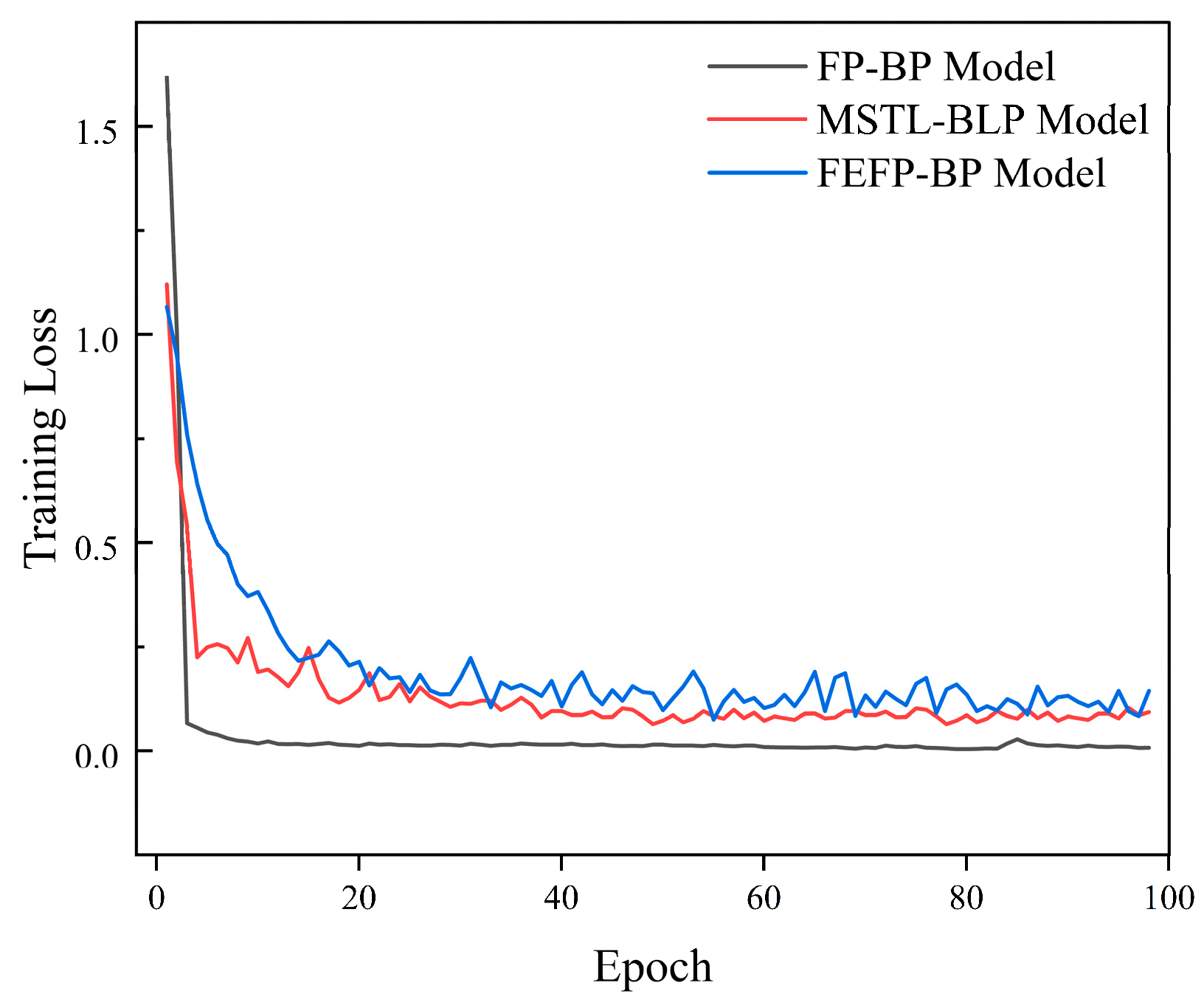
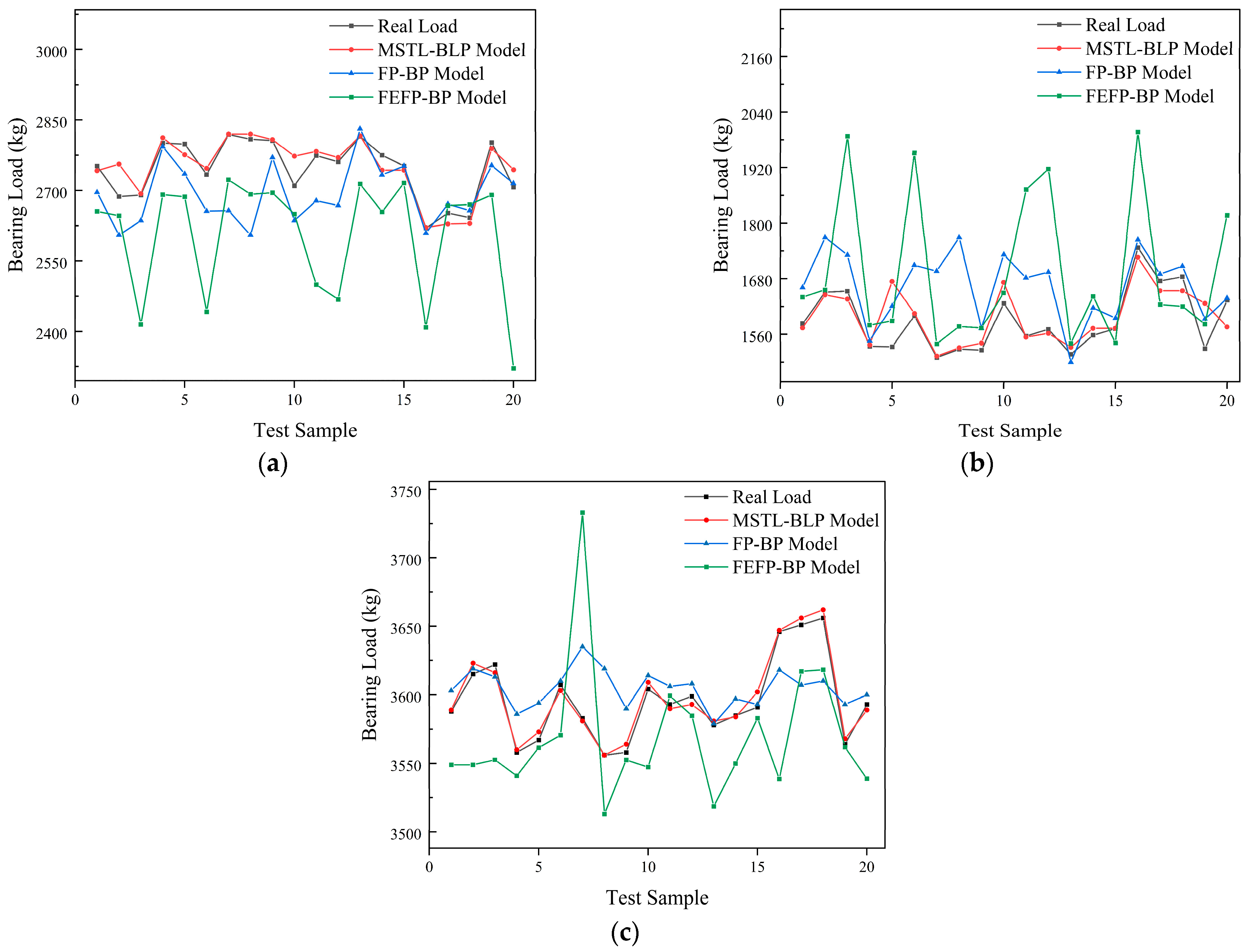
3.3. MSTL-BLP Model Prediction Results
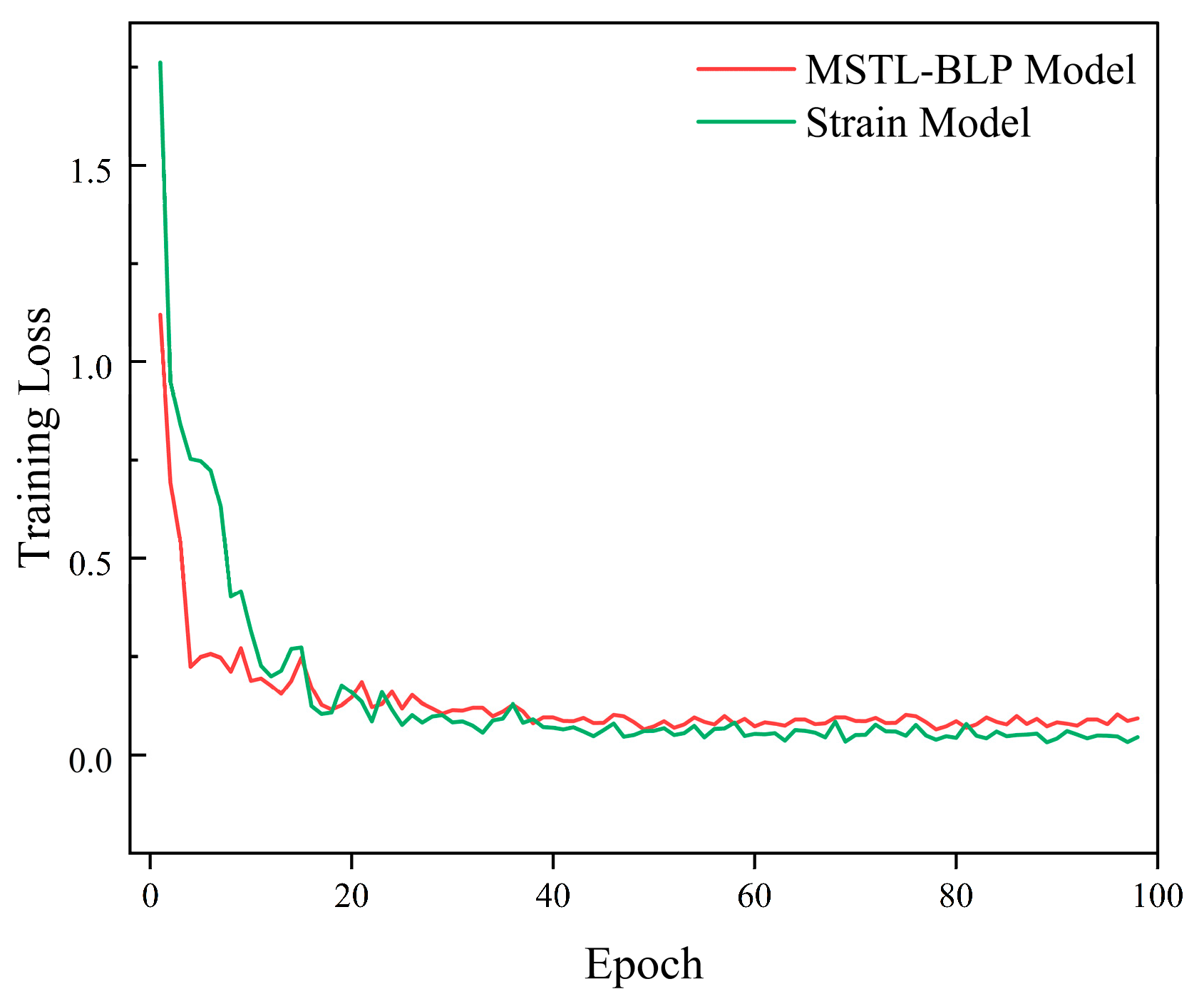
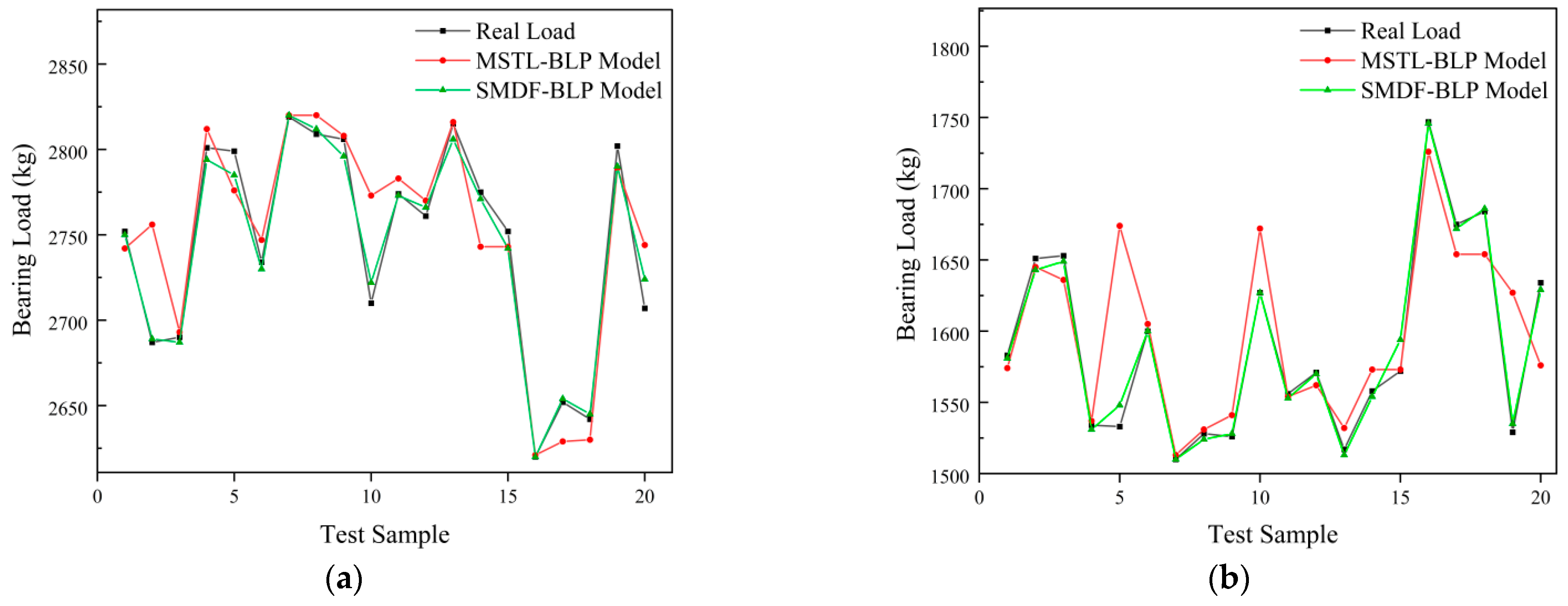
3.4. SMDF-BLP Model
3.5. Discussion
4. Conclusions
- (1)
- The transfer learning-based multi-subdomain bearing load prediction model significantly reduces model complexity through subdomain partitioning compared to the full-parameter FP-BP model. Its high prediction accuracy demonstrates the high fidelity of the hybrid training set generated by correcting low-fidelity simulation data via transfer learning, proving its effectiveness and practicality in handling multi-parameter coupling problems in complex shafting platforms under small-sample conditions, though partial prediction failures remain.
- (2)
- The SMDF-BLP Model, enhanced by incorporating strain information and a Stacking ensemble learning framework, effectively compensates for the limitation of using only air pressure parameters in characterizing complex structural conditions through multi-source information fusion. By utilizing strain data from characteristic regions to correct abrupt changes in bearing loads, it achieves improved predictive performance.
Author Contributions
Funding
Institutional Review Board Statement
Informed Consent Statement
Data Availability Statement
Acknowledgments
Conflicts of Interest
References
- Afolabi, S.O.; Oladapo, B.I.; Ijagbemi, C.O.; Adeoye, A.O.; Kayode, J.F. Design and finite element analysis of a fatigue life prediction for safe and economical machine shaft. J. Mater. Res. Technol. 2019, 8, 105–111. [Google Scholar] [CrossRef]
- Zou, D.; Pan, W.; Wang, L.; Ye, H.; Yang, L.; Hang, W. An Improved Mesh Stiffness Analytical Model Considering Center Distance Variation Caused by Shaft Misalignment. In Proceedings of the International conference on the Efficiency and Performance Engineering Network, Huddersfield, UK, 29 August–1 September 2023; pp. 715–724. [Google Scholar]
- Gang, L.; Yong, S. Fatigue Life Calculation of Shaft System Based on Bend-Torsion Coupling. In Proceedings of the IOP Conference Series: Materials Science and Engineering, Sanya, China, 12–15 November 2019; p. 022008. [Google Scholar]
- Cheng, J.-W.; Bu, W.-J.; Hu, Z.-C.; Fu, J.-Q.; Zhang, H.-R.; Shi, L. Intelligent Alignment Control for Floating Raft Air Spring Mounting System Under Coupled Hull–Raft Deformation. J. Mar. Sci. Eng. 2025, 13, 1664. [Google Scholar] [CrossRef]
- He, L.; Xu, W.; Bu, W.; Shi, L. Dynamic analysis and design of air spring mounting system for marine propulsion system. J. Sound Vib. 2014, 333, 4912–4929. [Google Scholar] [CrossRef]
- Rui, X.; He, B.; Wang, X.; Hao, F.; Chen, Y.; Wang, J.; Cao, H.; Hou, Y. Reduced multibody system transfer matrix method for ship system vibration modeling. In Proceedings of the International Conference on Mechanical System Dynamics, Beijing, China, 1–5 September 2023; pp. 2119–2130. [Google Scholar]
- Zhang, Y.; Xu, W.; Li, Z.; Yin, L. Alignment and safety analysis of marine propulsion shafting using intelligent floating raft system. J. Mar. Sci. Technol. 2021, 26, 323–330. [Google Scholar] [CrossRef]
- Yang, Y.; Ma, J.; Tang, W.-Y.; Che, C.-D.; Zhang, G.-C. Shafting alignment based on hydrodynamics simulation under larger rudder corner conditions. J. Shanghai Jiaotong Univ. (Sci.) 2012, 17, 427–435. [Google Scholar] [CrossRef]
- Liu, G.; Wu, W.; Rao, C.; Chen, R. Numerical calculation of whirling vibration of ship shafts based on transfer matrices method. Chin. J. Ship Res. 2010, 5, 60–63. [Google Scholar]
- Lu, L.; Li, G.; Xing, P.; Gao, H.; Song, Y. A review of stochastic finite element and nonparametric modelling for ship propulsion shaft dynamic alignment. Ocean. Eng. 2023, 286, 115656. [Google Scholar] [CrossRef]
- Zhang, D. Ship shafting alignment technology and hull deformation based on improved genetic algorithm and shipbed calibration. J. Vibroeng. 2024, 26, 948–960. [Google Scholar] [CrossRef]
- Lazakis, I.; Raptodimos, Y.; Varelas, T. Predicting ship machinery system condition through analytical reliability tools and artificial neural networks. Ocean Eng. 2018, 152, 404–415. [Google Scholar] [CrossRef]
- Li, R.; Wang, J.; Chen, Z.; Wang, F.; Liu, Y. Study on the methods of measurement, optimization and forecast of propulsion shaft bearing load of ships. J. Mar. Sci. Eng. 2023, 11, 1324. [Google Scholar] [CrossRef]
- Zhang, Y.; Xu, W.; Li, Z.; He, J. Review of the vibration isolation technology of submarine thrust bearing. In Proceedings of the 2019 25th International Conference on Automation and Computing (ICAC), Lancaster, UK, 5–7 September 2019; pp. 1–6. [Google Scholar]
- Zheng, Y.J.; Yu, S.L.; Song, Q.; Huang, Y.J.; Sheng, W.G.; Chen, S.Y. Co-Evolutionary Fuzzy Deep Transfer Learning for Disaster Relief Demand Forecasting. IEEE Trans. Emerg. Top. Comput. 2022, 10, 1361–1373. [Google Scholar] [CrossRef]
- Candon, M.; Esposito, M.; Fayek, H.; Levinski, O.; Koschel, S.; Joseph, N.; Carrese, R.; Marzocca, P. Advanced multi-input system identification for next generation aircraft loads monitoring using linear regression, neural networks and deep learning. Mech. Syst. Signal Process. 2022, 171, 108809. [Google Scholar] [CrossRef]
- He, W.; Zhang, X.; Feng, Z.; Leng, Q.; Xu, B.; Li, X. Random dynamic load identification with noise for aircraft via attention based 1D-CNN. Aerospace 2022, 10, 16. [Google Scholar] [CrossRef]
- Scarselli, G.; Nicassio, F. Machine Learning for Structural Health Monitoring of Aerospace Structures: A Review. Sensors 2025, 25, 6136. [Google Scholar] [CrossRef] [PubMed]
- Shutin, D.; Bondarenko, M.; Polyakov, R.; Stebakov, I.; Savin, L. Method for on-line remaining useful life and wear prediction for adjustable journal bearings utilizing a combination of physics-based and data-driven models: A numerical investigation. Lubricants 2023, 11, 33. [Google Scholar]
- Cooper, S.B.; DiMaio, D. Static load estimation using artificial neural network: Application on a wing rib. Adv. Eng. Softw. 2018, 125, 113–125. [Google Scholar] [CrossRef]
- Jiang, P.-P.; Hong, L.; Liang, C.-W.; Yue, M. Intelligent Flight Load Prediction Model Based on PCA-GA-BP Artificial Neural Network. J. Nanchang Hangkong Univ. (Nat. Sci. Ed.) 2023, 37, 30–38. [Google Scholar]
- Geng, Z.; Shi, C.; Han, Y. Intelligent small sample defect detection of water walls in power plants using novel deep learning integrating deep convolutional GAN. IEEE Trans. Ind. Inform. 2022, 19, 7489–7497. [Google Scholar] [CrossRef]
- Wasikowski, M.; Chen, X.-w. Combating the Small Sample Class Imbalance Problem Using Feature Selection. IEEE Trans. Knowl. Data Eng. 2010, 22, 1388–1400. [Google Scholar] [CrossRef]
- Deng, Y.; Li, Y.; Zhu, H.; Fan, S. Displacement Values Calculation Method for Ship Multi-Support Shafting Based on Transfer Learning. J. Mar. Sci. Eng. 2024, 12, 36. [Google Scholar] [CrossRef]
- Wei, X.; van der Zwaag, S.; Jia, Z.; Wang, C.; Xu, W. On the use of transfer modeling to design new steels with excellent rotating bending fatigue resistance even in the case of very small calibration datasets. Acta Mater. 2022, 235, 118103. [Google Scholar] [CrossRef]
- Wang, H.; Dai, X.; Shi, L.; Chen, Y. Gearbox Fault Diagnosis Based on Mixed Data-Assisted Multi-Source Domain Transfer Learning under Unbalanced Data. IEEE Sens. J. 2024, 25, 23056–23071. [Google Scholar] [CrossRef]
- Aduwenye, P.; Nutakor, C.; Roininen, L.; Sopanen, J. Parameter-based transfer learning for bearing fault diagnosis using small samples under variable working conditions. IEEE Access 2025, 13, 44214–44230. [Google Scholar] [CrossRef]
- Xu, B.; Liu, W.; Ding, K.; Lu, Y.; Cui, B. PSEO: Optimizing Post-hoc Stacking Ensemble Through Hyperparameter Tuning. arXiv 2025, arXiv:2508.05144. [Google Scholar] [CrossRef]
- Tong, J.; Liu, C.; Pan, H.; Zheng, J. Multisensor feature fusion based rolling bearing fault diagnosis method. Coatings 2022, 12, 866. [Google Scholar] [CrossRef]
- Li, J.; Cheng, J.-H.; Shi, J.-Y.; Huang, F. Brief introduction of back propagation (BP) neural network algorithm and its improvement. In Advances in Computer Science and Information Engineering: Volume 2; Springer: Berlin/Heidelberg, Germany, 2012; pp. 553–558. [Google Scholar]
- Xi, W.-D.; Huang, L.; Wang, C.-D.; Zheng, Y.-Y.; Lai, J. BPAM: Recommendation Based on BP Neural Network with Attention Mechanism. In Proceedings of the IJCAI, Macao, China, 10–16 August 2019; pp. 3905–3911. [Google Scholar]
- Fu, Y.; Liu, Y.; Yang, Y. Multi-sensor GA-BP algorithm based gearbox fault diagnosis. Appl. Sci. 2022, 12, 3106. [Google Scholar] [CrossRef]
- Finn, C.; Abbeel, P.; Levine, S. Model-agnostic meta-learning for fast adaptation of deep networks. In Proceedings of the International conference on machine learning, Sydney, Australia, 6–11 August 2017; pp. 1126–1135. [Google Scholar]
- Tuninetti, V.; Martínez, D.; Narayan, S.; Menacer, B.; Oñate, A. Design Optimization of a Marine Propeller Shaft for Enhanced Fatigue Life: An Integrated Computational Approach. J. Mar. Sci. Eng. 2024, 12, 2227. [Google Scholar] [CrossRef]



| Equivalent Component | Spring Stiffness |
|---|---|
| Air Spring Isolators | X-direction: 700–800 N/mm; Y-direction: 700–800 N/mm; Z-direction: 500–720 N/mm |
| Thrust Bearing | X-direction: 2 × 10⁶ N/mm; Y-direction: 2 × 10⁶ N/mm; Z-direction: 5.6 × 10⁶ N/mm |
| Radial Bearing | Y-direction: 4.8 × 10⁴ N/mm; Z-direction: 4.5 × 10⁵ N/mm |
| No. | Aft Radial Bearing Load (kg) | Forward Radial Bearing Load (kg) | Thrust Bearing Load (kg) | ||||||
|---|---|---|---|---|---|---|---|---|---|
| Measured Data | FEA Results | Error | Measured Data | FEA Results | Error | Measured Data | FEA Results | Error | |
| 1 | 2495 | 2471 | −1.0% | 1842 | 1836 | 0.3% | 3646 | 3675 | −0.8% |
| 2 | 2683 | 2541 | −5.3% | 1758 | 1639 | 7.2% | 3685 | 3604 | 2.2% |
| 3 | 2775 | 2600 | −6.3% | 1660 | 1542 | 7.7% | 3703 | 3574 | 3.6% |
| 4 | 2865 | 2663 | −7.1% | 1567 | 1430 | 9.6% | 3727 | 3543 | 5.2% |
| Name | Data Volume | Purpose |
|---|---|---|
| Dl | 340 | Simulation Dataset |
| Dh | 60 | Measured Correction Dataset |
| Dtr | 40 | Measured Training Dataset |
| Dte | 20 | Test Dataset |
| Model Name | Activation Function | Learning Rate | First Hidden Layer Nodes | Second Hidden Layer Nodes | Training Epochs |
|---|---|---|---|---|---|
| FP-BP Model | ReLU | 0.096 | 50 | 44 | 100 |
| FEFP-BP Model | ReLU | 0.041 | 47 | 25 | 100 |
| MSTL-BLP Model | ReLU | 0.053 | 35 | 20 | 100 |
| Model | Error Type | Aft Radial Bearing | Forward Radial Bearing | Thrust Bearing |
|---|---|---|---|---|
| FEFP-BP Model | MAE (kg) | 99.1 | 165.2 | 42.3 |
| RMSE (kg) | 131.7 | 226.1 | 61.8 | |
| MRE | 3.8% | 10.3% | 1.2% | |
| ME (kg) | 394 | 434.6 | 150 | |
| FP-BP Model | MAE (kg) | 58.4 | 76.6 | 10.7 |
| RMSE (kg) | 65.9 | 84.5 | 13.5 | |
| MRE | 2.1% | 4.9% | 0.3% | |
| ME (kg) | 204 | 239 | 38 | |
| MSTL-BLP Model | MAE (kg) | 17.60 | 25.8 | 4.5 |
| RMSE (kg) | 22.3 | 33.6 | 5.8 | |
| MRE | 0.6% | 1.6% | 0.1% | |
| ME (kg) | 69 | 141 | 15 |
| Model Name | Activation Function | Learning Rate | First Hidden Layer Nodes | Second Hidden Layer Nodes | Training Epochs |
|---|---|---|---|---|---|
| SMDF-BLP Model | ReLU | 0.053 | 35 | 20 | 100 |
| Strain Model | ReLU | 0.048 | 44 | 32 | 100 |
| Model | Error Type | Aft Radial Bearing | Forward Radial Bearing |
|---|---|---|---|
| MSTL-BLP Model | MAE (kg) | 17.60 | 25.8 |
| RMSE (kg) | 22.3 | 33.6 | |
| MRE | 0.6% | 1.6% | |
| ME (kg) | 69 | 141 | |
| SMDF-BLP Model | MAE (kg) | 6.05 | 4.5 |
| RMSE (kg) | 7.88 | 5.9 | |
| MRE | 0.2% | 0.3% | |
| ME (kg) | 14 | 22 |
| Test Sample No. | Pressure Condition Characteristics |
|---|---|
| 3, 6, 12, 16, 20 | In the stern region, air springs V1 and V3 are inflated, while V2 and V4 are in a low-pressure state. All other air springs remain at their normal operating pressure. |
| 11 | In the bow region, air springs V16 and V17 are inflated, while V13–V15 are in a low-pressure state. All other air springs remain at their normal operating pressure. |
Disclaimer/Publisher’s Note: The statements, opinions and data contained in all publications are solely those of the individual author(s) and contributor(s) and not of MDPI and/or the editor(s). MDPI and/or the editor(s) disclaim responsibility for any injury to people or property resulting from any ideas, methods, instructions or products referred to in the content. |
© 2026 by the authors. Licensee MDPI, Basel, Switzerland. This article is an open access article distributed under the terms and conditions of the Creative Commons Attribution (CC BY) license.
Share and Cite
Zheng, Z.; Shi, L.; Cui, L. A Multi-Data Fusion-Based Bearing Load Prediction Model for Elastically Supported Shafting Systems. Appl. Sci. 2026, 16, 733. https://doi.org/10.3390/app16020733
Zheng Z, Shi L, Cui L. A Multi-Data Fusion-Based Bearing Load Prediction Model for Elastically Supported Shafting Systems. Applied Sciences. 2026; 16(2):733. https://doi.org/10.3390/app16020733
Chicago/Turabian StyleZheng, Ziling, Liang Shi, and Liangzhong Cui. 2026. "A Multi-Data Fusion-Based Bearing Load Prediction Model for Elastically Supported Shafting Systems" Applied Sciences 16, no. 2: 733. https://doi.org/10.3390/app16020733
APA StyleZheng, Z., Shi, L., & Cui, L. (2026). A Multi-Data Fusion-Based Bearing Load Prediction Model for Elastically Supported Shafting Systems. Applied Sciences, 16(2), 733. https://doi.org/10.3390/app16020733