1. Introduction
The BTEX compounds benzene, toluene, ethylbenzene, and xylenes represent one of the most significant fractions of volatile organic compounds (VOCs) found in industrial and urban emissions. These aromatic hydrocarbons are associated with both acute and chronic toxicity, and the World Health Organization (WHO) classifies them as human carcinogens. Benzene, in particular, has been extensively documented for its hematotoxic effects [
1]. Several studies have shown that prolonged exposure to VOCs is associated with respiratory disorders, liver damage, neurological impairment, and genotoxic effects in higher organisms [
2,
3]. In addition, their environmental persistence and potential for bioaccumulation heighten ecological risks, affecting both aquatic and terrestrial ecosystems [
4].
Recent studies have emphasized that BTEX emission patterns differ markedly between urban and industrial environments, not only in terms of concentration levels but also in source profiles. Urban monitoring campaigns have reported BTEX dominance associated with vehicular traffic and mixed anthropogenic activities, whereas industrial settings are characterized by point source emissions linked to petrochemical operations [
5,
6]. These findings highlight the continued relevance of BTEX as priority pollutants and reinforce the need for robust and adaptable air-treatment technologies capable of addressing diverse emission scenarios.
Consequently, their effective removal has become a priority challenge for air-treatment systems and atmospheric emission control, demanding sustainable technologies capable of achieving effective degradation while minimizing the transfer of pollutants between phases.
Traditional approaches such as adsorption and thermal incineration, although effective, tend to be costly and may generate additional toxic by-products, underscoring the need to develop more sustainable alternatives for efficient removal [
7,
8]. Biotrickling filters (BTFs) have emerged as a viable alternative due to their low operating cost, sustainability, and ability to treat contaminated gas and liquid streams by relying on living microorganisms to naturally degrade pollutants [
9,
10,
11]. In these systems, bacteria and other microorganisms attach to the packing material, forming an active biofilm that breaks down organic compounds into simpler products such as carbon dioxide and water [
12,
13,
14].
The inoculation and development of biofilms in biotrickling filters are influenced by the physicochemical characteristics of the packing material and by the biodegradability of the target compounds. The structure and surface properties of the support medium may affect microbial attachment and mass transfer processes, while compound-specific properties can shape microbial community composition during acclimation [
15,
16]. These interactions are generally inferred from combined physicochemical observations and community-level analyses rather than from direct functional measurements [
17].
The choice of an appropriate support medium is a critical determinant of BTF performance, as it defines the available surface for microbial attachment and biofilm development, as well as influencing air circulation and moisture retention [
7,
8,
11,
18].
The performance of BTFs depends both on the gas empty bed residence time (EBRT), which governs mass transfer and VOC bioavailability, and on the microbial acclimation period required for the establishment of an active biofilm. In systems that employ inert media such as anthracite or sand, the acclimation phase typically lasts between one and three months before achieving removal efficiencies above 90% under temperatures ranging from 10 to 20 °C. Once this period has passed, the reactor generally operates under steady-state conditions, provided that hydraulic and loading parameters remain stable [
19,
20,
21].
One of the main limitations of biological treatment processes is the uneven generation and distribution of biomass and nutrients [
22,
23]. Nevertheless, several studies have explored strategies to mitigate this issue [
1,
7,
8,
11,
24,
25]. According to the work of Cheng et al. [
26], inorganic packing materials enhance the mass transfer of hydrophobic VOCs from the gas phase to the biofilm by providing higher diffusive conductivity and a more stable gas–solid interface. This, in turn, increases substrate bioavailability for microorganisms and is commonly associated with improved biodegradation performance under controlled conditions [
27].
Experimental studies have shown that large-particle inorganic supports—such as ceramic granules, volcanic rock, inert porous pellets, and certain plastics—promote a more uniform distribution of biomass, thereby preventing the formation of preferential flow channels [
28,
29].
Despite progress in characterizing synthetic and organic media, comprehensive evaluations of inorganic supports that jointly consider structural and mineralogical parameters remain limited and fragmented. To date, few studies have conclusively linked these properties to the biological performance of BTFs [
27,
30,
31,
32]. Other investigations involving materials such as granular activated carbon, perlite, and zeolite have reported that their use as high-density, small-pore BTF media tends to favor compaction, clogging, and increased pressure drop [
33,
34,
35].
To facilitate a systematic comparison among commonly used packing materials,
Table 1 summarizes the key physicochemical properties and reported performance indicators of representative organic and inorganic supports employed in biofilters and biotrickling filters. This comparison highlights differences in surface properties, mechanical stability, and reported BTEX or VOC removal efficiencies, providing a clearer framework for contextualizing the selection of andesite in the present study.
Studies conducted on BTF systems have reported removal efficiencies of up to 95% for benzene and 99% for xylene during the first weeks of operation when volcanic rock and similar materials are used as packing media [
39,
40,
41]. This type of support is among the most extensively investigated, as it provides a stable surface, neutral pH, and a porous structure suitable for microbial attachment, along with optimal moisture and nutrient retention—conditions that promote the microbial growth required for efficient contaminant removal [
25,
42,
43,
44,
45,
46].
Volcanic rocks consist of a large number of mineral particles arranged in an irregular and disordered manner. The voids formed among these particles strongly influence their physical and mechanical properties, including strength, elastic modulus, permeability, thermal conductivity, wave propagation, and surface adsorption—all of which are highly relevant for engineering applications [
47,
48].
The use of advanced characterization techniques—such as X-ray fluorescence (XRF), atomic absorption spectrometry (AAS), X-ray diffraction (XRD), and BET surface analysis—has made it possible to examine the structural and physical properties of support materials. These methods allow the identification of key parameters, including porosity, pore size, and the distribution of mineral phases, all of which directly influence the effectiveness of biofiltration systems [
49,
50].
The characteristics of andesite provide a surface and texture well-suited for microbial attachment and biofilm development under mineral medium irrigation in BTFs. Within this framework, operating with BTEX enables the evaluation of removal performance and the resulting microbial community structure under defined EBRT and feeding conditions, integrating the physicochemical characterization of the support with TD-GC/MS and TIC/TOC measurements.
The degradation dynamics were examined using a Monod-type model, estimating the maximum rate (rmax) and the half-saturation constant (Ks) from outlet concentration curves under a defined EBRT. These parameters were obtained through nonlinear fitting of the TD-GC/MS data and were compared with TIC/TOC measurements to verify the consistency of carbon balances.
The main objective of this study was to commission and operate a laboratory-scale biotrickling filter (BTF) packed with andesite for the removal of BTEX compounds. To this end, the reactor was inoculated with a microbial consortium sourced from an operating biofilter at the Ecoparc del Besós (Barberà del Vallès, Barcelona), allowing the assessment of microbial adaptation and biological performance on an inorganic medium.
Key operational parameters such as pH, bacterial kinetics, and removal efficiency—were determined using electrochemical measurements, gas chromatography–mass spectrometry (GC–MS), and total inorganic carbon (TIC) analyses under controlled conditions.
Although volcanic materials such as pumice, scoria, and lava rocks have been previously investigated as packing media in biofilters and biotrickling filters, these studies have largely focused on general performance metrics or physical stability. The specific performance of andesite, an abundant intermediate volcanic rock, and the potential influence of its mineralogical composition in biotrickling filters treating BTEX have not been systematically evaluated. In particular, integrated assessments combining mineralogical characterization, removal performance, and microbial community structure in andesite-packed biotrickling filters remain scarce.
To the authors’ knowledge, this study represents one of the first systematic evaluations of andesite as an inorganic packing medium in biotrickling filters for BTEX removal. Owing to its wide availability in volcanic regions, low material cost, and high mechanical stability, andesite emerges as a potentially attractive alternative to conventional organic or synthetic packing materials. Under the laboratory-scale conditions investigated, the results indicate that andesite can support stable biofilm development and effective BTEX abatement. Nevertheless, the extrapolation of these findings to long-term or industrial-scale applications requires further investigation under higher loading rates, mixed VOC streams, and extended operational periods.
Accordingly, the present study focuses on experimentally observable performance, physicochemical properties, and microbial community composition, without attempting to establish direct causal metabolic mechanisms.
2. Materials and Methods
2.1. Characterization and Preparation of the Substrate Material
Andesite was used as the substrate material. This intermediate volcanic igneous rock, widely distributed across Andean environments, is mineralogically characterized by a plagioclase-rich matrix (andesine) and variable proportions of ferromagnesian minerals such as hornblende, pyroxene, and biotite. The rocks used in this study were collected from the lower slopes of the Osorno volcano in southern Chile.
The material was crushed, sieved, and washed to obtain a particle size range suitable for use as a packing medium in the biotrickling filter. A particle size corresponding to mesh numbers 7–8 was selected to achieve an adequate balance between void fraction, gas flow distribution, and mechanical stability of the packing bed. This size range is commonly adopted in biotrickling filters employing inert media, as it minimizes excessive pressure drop while maintaining sufficient surface availability for biofilm attachment and development.
Prior to reactor loading and physicochemical characterization, the material was dried at 40 °C. Specific surface area was determined by nitrogen adsorption using the Brunauer–Emmett–Teller (BET) method, while mineralogical composition was analyzed by X-ray diffraction (XRD) and X-ray fluorescence (XRF). Sample masses were determined using an analytical balance.
2.2. Chemical Composition Analysis of the Sample
2.2.1. X-Ray Fluorescence (XRF)
Chemical composition was determined using an XRF spectrometer (HTEX, model H500, China). Prior to analysis, samples were prepared according to the established protocol, and each measurement was performed in triplicate on representative samples of the substrate material.
2.2.2. Atomic Absorption Spectrometry (AAS)
Metal concentrations were analyzed using an Analytik Jena AAS system (model Nova 800, Jena, Germany). Approximately 1 g of each sample was processed in triplicate. Acid digestion was carried out under a fume hood using a mixture of 7 mL HNO3 (65% v/v) and 1 mL H2O2 (30% v/v). The digestion was performed on a hot plate (Labtech, model EH) at 60 °C for 8 h. After digestion, the solutions were diluted to 30 mL with HPLC-grade water. Metal concentrations were quantified by flame AAS (AAS-F), and, when required, by hydride-generation AAS (Analytik Jena, model HS 55), which operates with a 4% NaBH4 solution. Metal standards supplied by Merck (Frankfurter Strasse 250, 64293 Darmstadt, Germany) and analytical-grade reagents were used throughout the procedure.
2.2.3. X-Ray Diffraction (XRD)
Mineralogical composition was assessed using an XRD instrument (BRUKER, model D2 Phaser, Karlsruhe, Germany). Prepared samples were analyzed using a copper anode (Cu), operated at 40 kV and 20 mA. Beam geometry was defined by a 0.6° divergence slit, a 0.6 mm receiving slit, and 1° scatter slits. Data were collected over the 3° < 2θ < 90° range with a step size of 0.02° 2θ. Diffraction patterns were qualitatively analyzed using HIGHSCORE software, version 5.2a.
2.2.4. Brunauer–Emmett–Teller (BET) Analysis
Specific surface area and pore distribution were determined by nitrogen adsorption at 77 K using a physisorption analyzer (Anton Paar Kaomi, Graz, Austria). Samples were degassed under vacuum at 185 °C for 12 h to remove moisture and surface contaminants. Nitrogen adsorption–desorption isotherms were recorded over a relative pressure range of P/P0 = 0.05–0.99. The specific surface area was calculated using the BET equation, while maximum adsorption capacity and pore-size distribution were estimated using the Langmuir and BJH (Barrett–Joyner–Halenda) models. The Kaomi Nova proprietary software (version 1.2) was used to obtain isotherms, total pore volume, and pore-radius distributions from the desorption branch.
2.3. Experimental Design
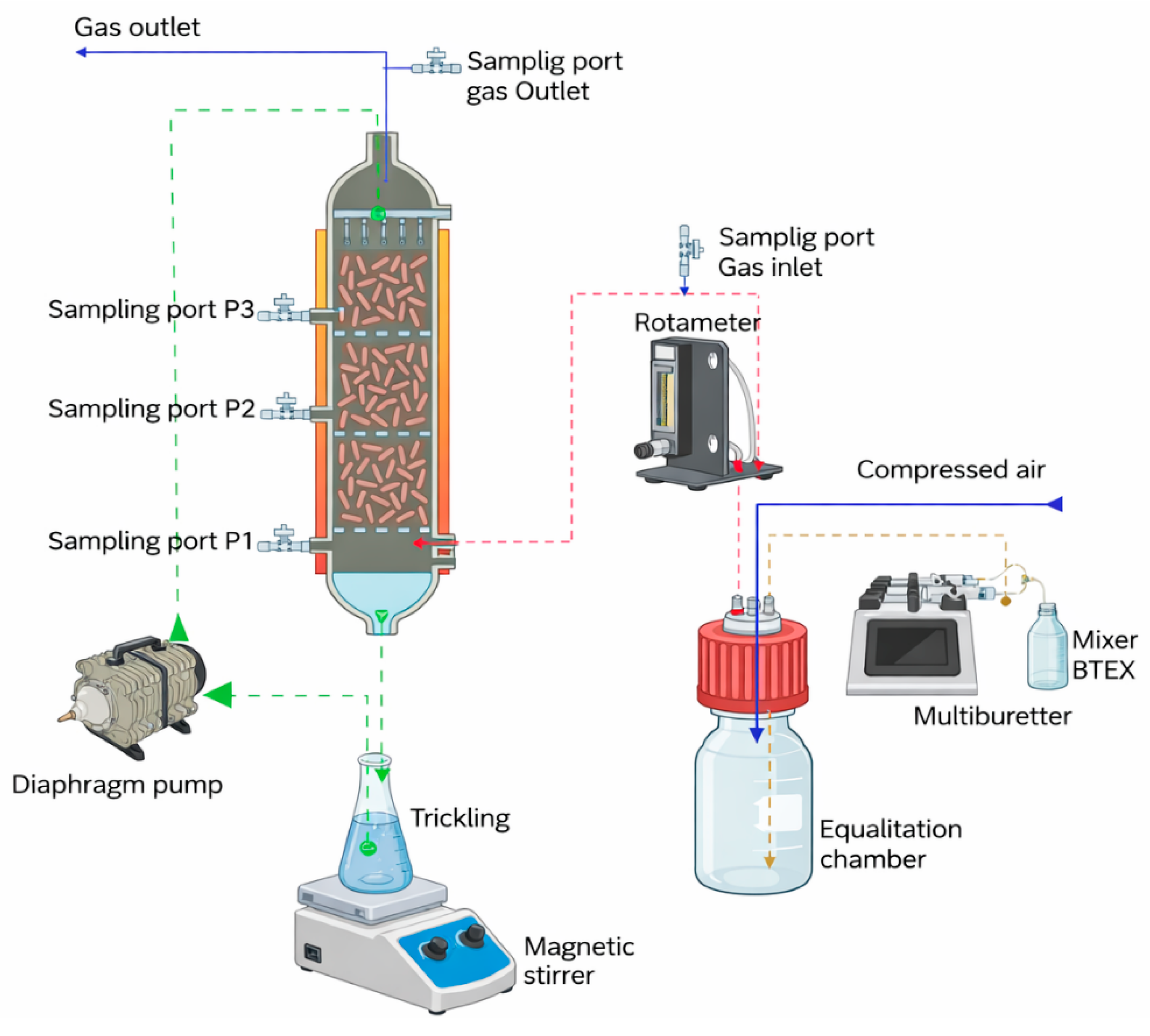
The experimental setup consisted of a bioreactor system divided into three main subsystems. The first subsystem was dedicated to the preparation and homogenization of the gaseous feed stream. In this stage, a controlled BTEX mixture was generated using a microburette (Crison, model Multi-Burette, Barcelona, Spain) connected to a pressurized vessel supplied with instrument-grade compressed air (ISO 8573-1:2010) [
51]. The second subsystem handled the recirculation of the mineral medium. This solution was delivered from the top of the bioreactor and allowed to flow countercurrent to the gas stream. Circulation was maintained using a diaphragm pump (Jesco, model MEMDOS SMART LB, Wedemark, Germany).
The third subsystem corresponded to the bioreactor itself, which contained the packing substrate. Gas flow through the packed bed was regulated using a rotameter (Aalborg Instruments, model P-325, Orangeburg, NY, USA).
2.4. Laboratory-Scale Biotrickling Filter Set-Up
The experiments were carried out in a single laboratory-scale biotrickling filter (BTF) consisting of a column packed with andesite and operated under continuous-flow conditions (
Figure 1). The dataset corresponds to repeated sampling events collected over time from the same reactor, rather than from parallel reactors or independent experimental replicates.
The biotrickling filter (BTF) was packed with andesite rock previously crushed and sieved (mesh 7–8; homogeneous particle-size fraction) to promote gas–solid contact and biofilm formation. The material was placed inside a cylindrical column (internal diameter 130 mm, packed-bed height 300 mm; total reactor height 400 mm), yielding a bed volume of 3982 mL (3.982 L). The packed mass was 2385 g, corresponding to a bulk density of 0.60 g cm−3. Under these conditions, the EBRT was 47.8 s at 300 L·h−1 and 71.7 s at 200 L·h−1 (EBRT = Vbed/Q).
The BTEX feed stream was prepared by dissolving each analyte in high-purity methanol and delivering it via microburette into a vessel supplied with filtered, dry compressed air; the evaporated mixture was then introduced into the reactor inlet flow. Target concentrations were approximately 5 ppmv per compound (19–22 ppmv total BTEX), verified by TD-GC/MS (calibration curves within the operational range, R
2 ≥ 0.995; LOD/LOQ and full methodological details are provided in the
Supplementary Material).
Percolation medium was applied at 0.7 mL·min−1 (mineral medium, pH 7.0 ± 0.2; intermittent mode 5/55 min), ensuring adequate moisture within the packing and monitoring pressure drop per unit bed length.
Under these operational settings, higher removal efficiencies were observed at longer EBRTs, consistent with increased contact time and the stabilization of the microbial community.
During reactor operation, pH and pressure drop were routinely monitored to ensure stable operating conditions. The pH of the recirculating mineral medium was measured three times per week using a calibrated electrochemical pH probe (Crison, Barcelona, Spain), and values were maintained within the range reported in
Table 2 by periodic adjustment of the nutrient solution when required.
Pressure drop across the packed bed (ΔP per unit bed height) was recorded weekly using differential pressure measurements between the reactor inlet and outlet. Additional measurements were performed following changes in gas flow rate or after extended operation periods to detect potential clogging or biomass accumulation. These monitoring procedures allowed the identification of transient operational effects and the assessment of long-term reactor stability.
The inoculum was obtained by washing the packing material of a full-scale biotrickling filter operating at the Ecoparc del Besós (Barberà del Vallès, Barcelona), a municipal waste treatment facility with long-term stable operation. The washing liquid was collected and immediately used for reactor inoculation, without prior microbial enrichment, in order to preserve the native consortium structure.
2.5. BTEX Preparation
To generate a gaseous mixture with a known and reproducible concentration of compounds, a standard BTEX solution comprising benzene, toluene, ethylbenzene, and o-xylene was prepared following the EPA Method 8260C protocol [
52]. Precise volumes of each pure compound were dispensed using calibrated micropipettes, based on their individual densities. The required liquid amounts were: 3.42 µL of benzene (PANREAC, 99.5% purity), 3.46 µL of toluene (ACROS, 99.98% purity), 3.46 µL of ethylbenzene (FLUKA, 99.8% purity), and 3.47 µL of o-xylene (PANREAC, 99.6% purity). These components were dissolved in 200 mL of HPLC-grade methanol (Scharlau, 99.8% purity), yielding a final concentration of 15 µg/mL for each compound. The BTEX stock solution was stored in sealed amber glass vials at 4 °C to minimize evaporation and photodegradation and was used within a maximum period of two weeks after preparation. Fresh solutions were prepared as needed to ensure concentration stability.
For BTF inoculation, the liquid obtained from washing the packing material of operating biotrickling filters was used as a microbial source. This inoculum was characterized by determining total suspended solids (TSS) and volatile suspended solids (VSS). The microbial suspension was then added to the reactor and recirculated for one day as an initial acclimation step. After this period, mineral medium addition began at a rate of 1 L every three days.
2.6. Preparation of Mineral Medium
The mineral medium was prepared in 1 L batches using Milli-Q Plus 185 filtered water (Millipore, Bedford, PA, USA). Various salts and trace minerals were then added to formulate the nutrient solution. Specifically, the following components were dissolved: 0.015 g·L−1 nitrilotriacetic acid (C6H9NO6), 0.001 g·L−1 cobalt(II) chloride hexahydrate (CoCl2·6H2O), 0.65 g·L−1 dipotassium phosphate (K2HPO4), 0.5 g·L−1 sodium nitrate (NaNO3), 0.1 g·L−1 magnesium sulfate heptahydrate (MgSO4·7H2O), 0.00556 g·L−1 iron(II) sulfate heptahydrate (FeSO4·7H2O), 0.5 g·L−1 ammonium sulfate ((NH4)2SO4), 0.005 g·L−1 manganese(II) sulfate monohydrate (MnSO4·H2O), 0.001 g·L−1 calcium chloride (CaCl2), 0.0001 g·L−1 zinc sulfate heptahydrate (ZnSO4·7H2O), 0.0001 g·L−1 copper sulfate pentahydrate (CuSO4·5H2O), 0.0001 g·L−1 boric acid (H3BO3), and 0.0001 g·L−1 sodium molybdate dihydrate (Na2MoO4·2H2O).
The selected concentrations of macronutrients, particularly nitrate (0.5 g·L−1 as NaNO3), were chosen to provide an adequate inorganic nitrogen source for the aerobic growth of BTEX-degrading microorganisms commonly reported in biofiltration systems, such as aerobic BTEX-degrading microorganisms commonly reported in biofiltration systems, while avoiding excessive nutrient loading that could lead to excessive biomass accumulation.
2.7. Experimental Measurements
2.7.1. Quantification of BTEX
To determine BTEX concentrations, gas samples were collected from the reactor inlet, intermediate sampling points, and outlet using FlexFoil sampling bags (brand and model). Representative subsamples were withdrawn from the bags with a suction pump (Markes Easy VOC LP-1200, Eningen unter Achalm, Germany), extracting 100 mL through an adsorbent tube (Markes C2-BAXX-5315, Eningen unter Achalm, Germany), suitable for odor compounds, sulfur species, C6/7–C30 organics, thiols, and mercaptans. Once the gases had been retained on the tube, BTEX compounds were desorbed using a thermal desorption cold trap (Markes Unity-xr, Germany). Samples were desorbed in split mode under a helium flow for 1 min toward the hot trap, programmed at 300 °C, then cooled to 20 °C in the cold trap, and finally heated again to 300 °C for 5 min.
The desorbed BTEX were transferred through a heated line set to 200 °C into a chromatographic column (RESTEK Rtx-5MS, PA, USA; Crossbond 5% diphenyl–95% dimethyl polysiloxane, 30 m × 0.25 mm ID × 0.25 µm df) installed in a TD-GC/MS system (Thermo Fisher Scientific, Trace 1300/ISQ LT, Waltham, MA, USA). The GC oven operated in split mode, with a temperature program ranging from 40 °C to 220 °C, a carrier-gas flow of 1.2 mL/min, and a split ratio of 10. The MS transfer line was maintained at 200 °C, and the ion source temperature was set to 250 °C. Qualitative identification of BTEX compounds was carried out using Chromeleon 7.2 software in conjunction with the NIST library, based on retention times obtained from the chromatograms.
2.7.2. Carbon Measurement in the Mineral Medium
A 10 mL aliquot of the sample was withdrawn using a sterile BD Plastipak® syringe (Becton Drive, Franklin Lakes, NJ 07417, USA). Subsequently, 2 mL were filtered through a Millipore Millex syringe filter (0.22 µm, polyethersulfone, model SLHP033NB). The filtered fraction was then transferred into 2 mL vials with rubber septa and analyzed using a TIC instrument (Analytik Jena, Multi N/C 2100S, Jena, Germany) for the determination of Total Organic Carbon (TOC), Non-Purgeable Organic Carbon (NPOC), Total Carbon (TC), Total Inorganic Carbon (TIC), and Particulate Organic Carbon (POC) in aqueous samples. Both inorganic and organic carbon analyses were performed using this system.
2.7.3. Suspended Solids (TSS/VSS) of the Inoculum
Prior to reactor inoculation, the washing liquid used as a microbial source was characterized in terms of total suspended solids (TSS) and volatile suspended solids (VSS). Measurements were performed following Standard Methods for the Examination of Water and Wastewater (APHA). These parameters were used to estimate the initial biomass load introduced into the biotrickling filter, without implying functional or metabolic characterization of the microbial consortium.
2.7.4. Biomass Characterization
Microbial diversity in samples A and O was characterized using next-generation sequencing at two time points: day 30 (June) and after six months of operation (November). For each sampling event, material from the corresponding containers was combined and homogenized using a sterile mortar and pestle. Genomic DNA was extracted from the homogenized samples following the protocol of the MoBio PowerSoil™ DNA Extraction Kit (MoBio Laboratories, Carlsbad, CA, USA). DNA concentration and purity were assessed with a NanoDrop 1000 spectrophotometer (Thermo Fisher Scientific, USA).
Paired-end sequencing was carried out on an Illumina MiSeq platform by an external sequencing service (Scsie UV, Valencia, Spain). For bacterial community profiling, the V3–V4 hypervariable region of the 16S rRNA gene was amplified using primer pair 341F–806R. Fungal diversity was assessed by amplifying the ITS1 region with the fungus-biased primer set ITS1/ITS4 [
39].
2.8. Kinetic Modeling and Data Analysis
2.8.1. Monod-Type Kinetic Modeling
Monod-type kinetic parameters were estimated by nonlinear regression of outlet concentration profiles obtained during steady operational phases. The parameters were derived from time-series data collected from a single laboratory-scale reactor and are reported as descriptive kinetic indicators. Due to the experimental design, no formal statistical inference or confidence intervals were derived.
The biodegradation kinetics were described using a Monod-type expression, which relates the specific removal rate to the substrate concentration according to;
where
r is the apparent removal rate (mg·m
−3·h
−1) and
C is the outlet BTEX concentration (mg·m
−3). In this formulation, r
max represents the apparent maximum removal rate and K
s the half-saturation constant. The model assumes quasi-steady operating conditions during each fitting interval and negligible external mass-transfer limitations under the selected EBRTs.
Parameter estimation was performed by nonlinear least-squares regression using MATLAB® (MathWorks, Natick, MA, USA). The fitting procedure minimized the residuals between measured and modeled outlet concentrations over selected steady-state periods.
2.8.2. TIC and TOC Simulation
The theoretical simulation of the behavior of total inorganic carbon (TIC) and total organic carbon (TOC) in the recirculating liquid of the bioreactor was performed following procedures commonly applied in modeling studies of biofiltration systems [
14,
40,
49,
53]. It was assumed that BTEX compounds entered the biofilter in the gas phase, and that the carbon fraction removed was partially oxidized to CO
2 (contributing to TIC) and partially assimilated into microbial biomass (contributing to TOC). Data processing and numerical integration of the mass balances were carried out using MATLAB R2023a (MathWorks Inc., Natick, MA, USA).
Calculation assumptions: The model considered an inlet air flow of 300 L·h
−1 with a total BTEX concentration of 20 ppmv (≈7.5 mg/m
3). A progressive removal efficiency was simulated, described by a sigmoidal function increasing from 10% to 95% over 60 days, following approaches previously reported for biofilter kinetics [
41].
The liquid recirculation volume was set at 1 L, with complete medium replacement every 5 days and a continuous supply of mineral salts at 0.5 L·h
−1. Carbon removed from the gas phase was partitioned into 70% as TIC and 30% as TOC, based on metabolic distribution pathways of aromatic hydrocarbons in aerobic biofilm systems [
54,
55,
56].
2.8.3. Biomass Assimilation and TOC
The assimilated carbon fraction was assigned to microbial biomass formation, including proteins, lipids, nucleic acids, extracellular enzymes, and exopolysaccharides. These components remain organically bound within the biofilm or are released as soluble metabolites or cell fragments, and were accounted for as TOC in the recirculating liquid. Concentrations were calculated as cumulative carbon mass divided by the effective recirculation volume, explicitly considering the periodic medium replacements. This approach is consistent with standard interpretations of TOC in aerobic bioreactor systems [
57,
58].
3. Results
The results obtained during the first three weeks of operation showed high removal efficiencies, demonstrating that andesite is a suitable packing material for BTEX treatment in biofiltration systems. This study also evaluated the physicochemical characteristics of the substrate using advanced techniques such as XRF, AAS, XRD, and BET, providing valuable information on its pore structure and mineralogical composition. The reference cost of crushed andesite in Chile is approximately 25–35 USD m−3, whereas granular activated carbon can exceed 300 USD m−3 and natural zeolite ranges between 90 and 150 USD m−3. This positions andesite as an economically viable alternative, particularly for large-scale applications.
3.1. Structural Characterization of the Andesite Substrate
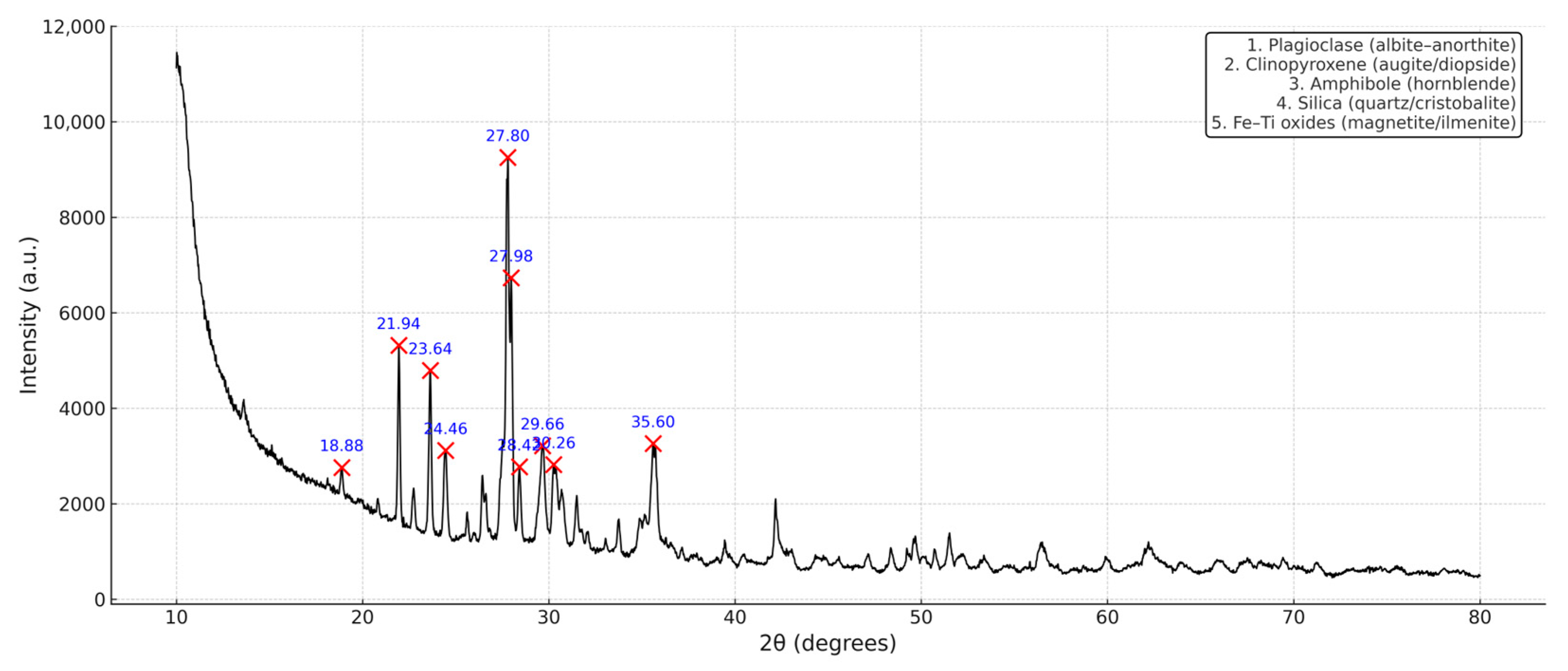
As shown in
Figure 2 shows the X-ray diffraction (XRD) results, which reveal that the volcanic andesite used as packing material in the BTF exhibits a mineralogical assemblage dominated by plagioclase feldspars (albite–anorthite), accompanied by clinopyroxenes (augite/diopside), amphibole (hornblende), silica phases (quartz/cristobalite), and accessory Fe–Ti oxides such as magnetite and ilmenite.
X-ray diffraction (XRD) analysis indicates that the andesite used as packing material exhibits a mineralogical assemblage typical of intermediate volcanic rocks, dominated by plagioclase feldspars (albite–anorthite series), with subordinate clinopyroxenes, amphibole, silica phases (quartz/cristobalite), and accessory Fe–Ti oxides. This assemblage is consistent with andesites reported in volcanic arc environments and confirms the mineralogical representativeness of the substrate employed in this study.
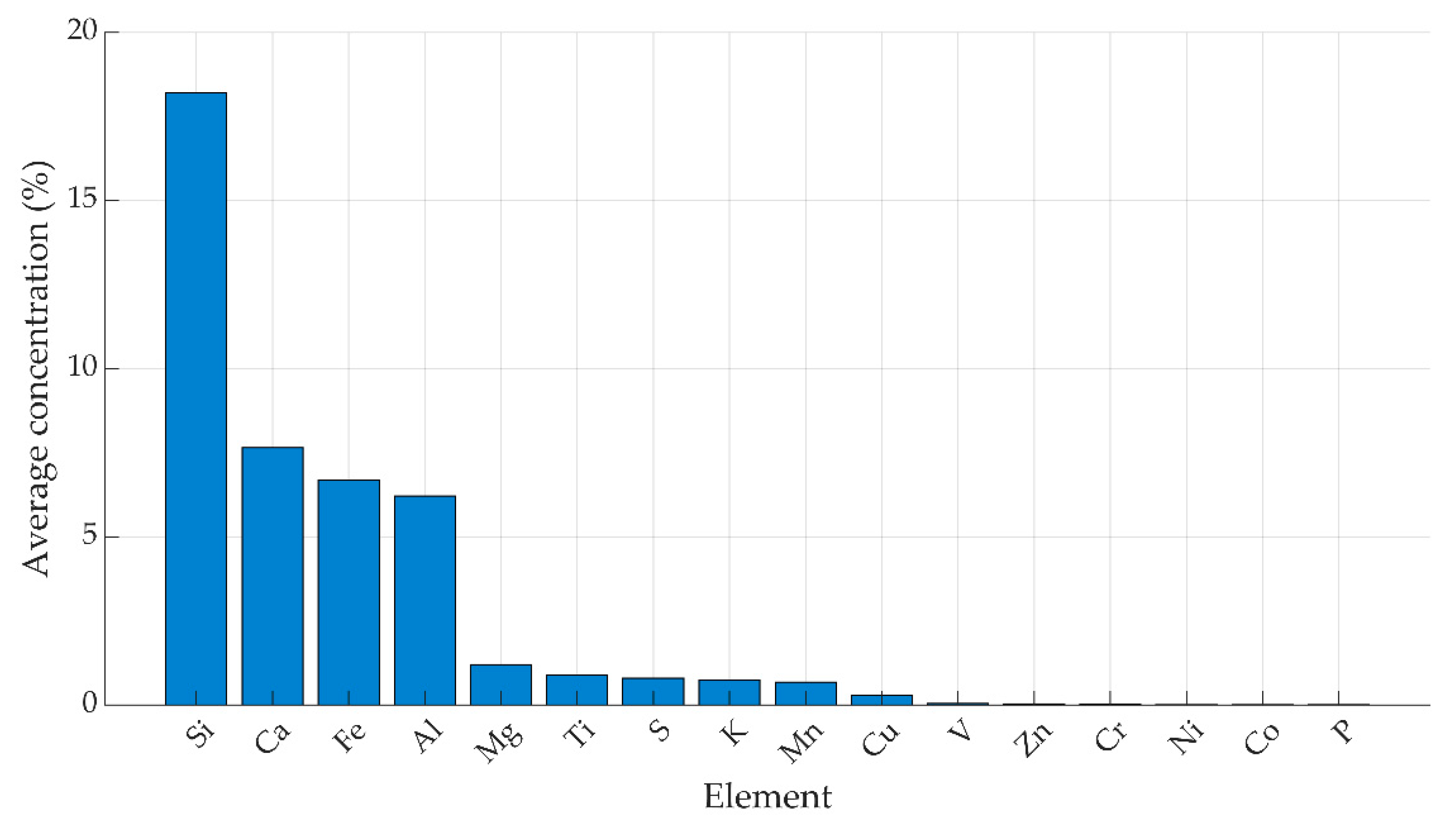
Elemental composition determined by X-ray fluorescence (XRF) and atomic absorption spectrometry (AAS) (
Figure 3 and
Table 3) shows that the material is primarily composed of Si, Al, Ca, and Fe, with minor contributions of Mg, Na, K, and Ti, and trace levels of transition metals within ranges reported for natural andesites. These results support the classification of the material as a chemically stable inorganic support suitable for long-term operation under biofiltration conditions.
From an engineering perspective, the identified mineralogical and elemental characteristics are mainly relevant in terms of mechanical integrity, surface heterogeneity, and resistance to chemical attack. Throughout reactor operation, no evidence of bed collapse, channeling, or significant compaction was observed, indicating that the andesite packing provided a structurally stable porous network capable of sustaining continuous gas and liquid flow.
Although mineral-derived elements such as Fe, Ca, and Mg are known to act as micronutrients or cofactors in microbial systems, no functional, enzymatic, or gene-expression analyses were conducted in this study. Therefore, any potential influence of mineral composition on microbial metabolism or biodegradation pathways should be regarded as hypothetical and is discussed only in the context of previously reported biofiltration studies. The present results demonstrate that andesite acts as a mechanically and chemically robust packing medium, without implying direct causal mechanisms between mineralogy and biological performance.
From an engineering standpoint, these characteristics support the use of andesite as a physically stable and chemically heterogeneous packing material, providing the structural framework required for the performance analysis presented in the following sections.
3.2. BET Analysis of the Andesite Rock
Nitrogen physisorption analysis at 77 K revealed a specific surface area of 4.34 m2/g using the BET model and 4.37 m2/g using the Langmuir method, with a pore-size distribution centered at 1.43 nm according to DFT analysis. The total pore volume was 0.0052 cm3/g, with a substantial contribution from micropores (<2 nm).
Although these surface-area values are substantially lower than those typically reported for activated carbons (>900 m
2·g
−1) or some natural zeolites (>200–300 m
2·g
−1), they fall within the range reported for other inorganic mineral supports successfully applied in biofiltration systems, such as pozzolans and volcanic slags (≈3–25 m
2·g
−1). These materials have been shown to support stable biofilm development despite their limited adsorption capacity [
16,
60].
From a biofiltration perspective, the relatively low specific surface area of andesite suggests that physical adsorption is not the dominant removal mechanism. Instead, the role of the support is primarily structural, providing a stable surface for biofilm attachment and long-term microbial activity. This behavior is consistent with biotrickling filter operation, where biodegradation rather than sorption governs BTEX removal under steady-state conditions [
61].
Compared with other volcanic or mineral materials, andesite occupies an intermediate position in terms of porosity. Unlike pumice or scoria, which are characterized by macroporous vesicular structures, andesite presents a more compact pore network. At the same time, its pore size distribution is larger than the subnanometric channels typical of clinoptilolite-type zeolites. This intermediate pore structure supports moisture retention and biofilm persistence without relying on high internal surface area [
62,
63,
64].
Overall, the BET and pore-structure results indicate that andesite functions as a mechanically stable, low-adsorption inorganic support, appropriate for use in percolated BTF systems where microbial processes dominate contaminant removal.
3.3. Removal Efficiencies by Compound for the Full Experiment
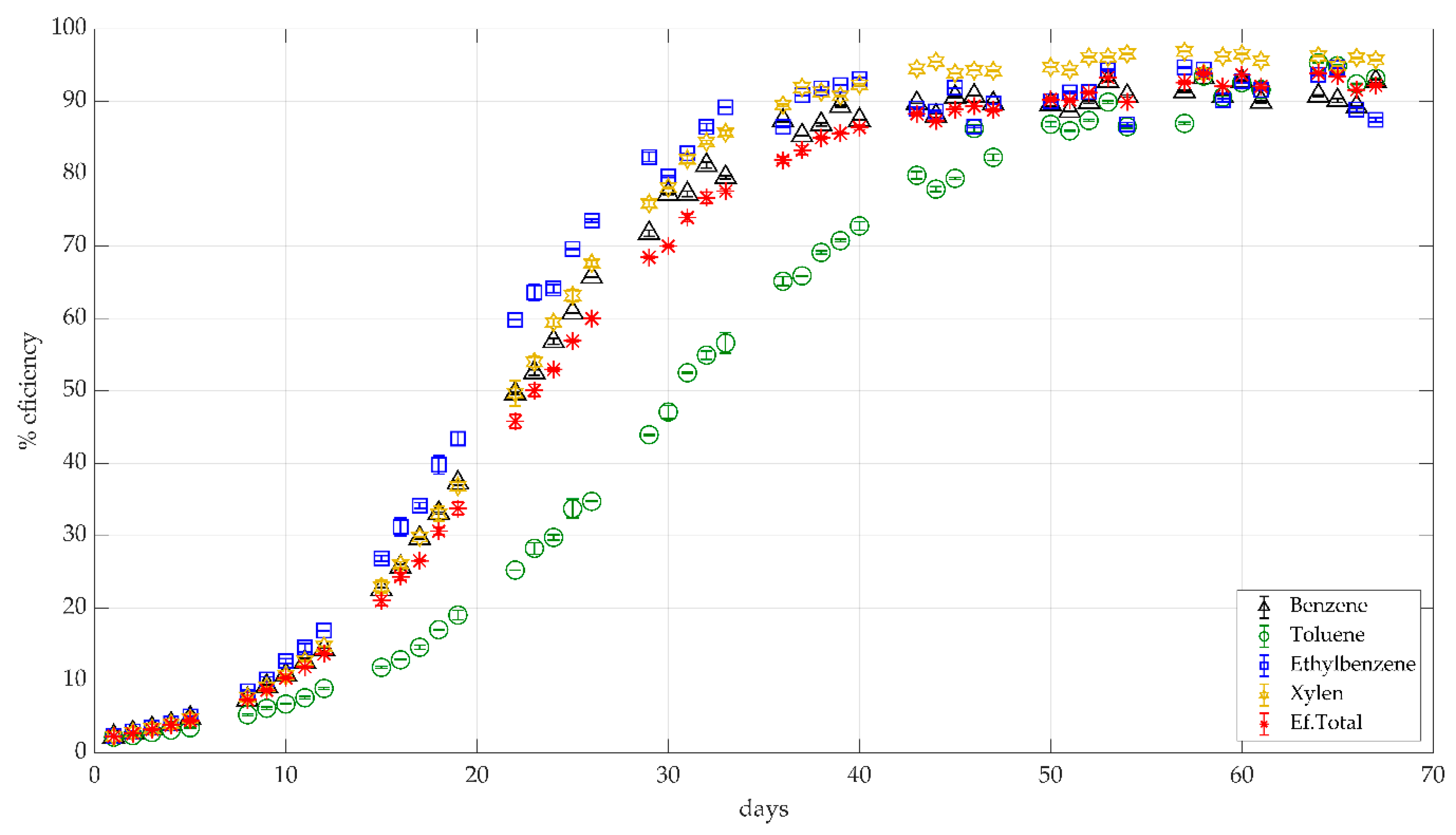
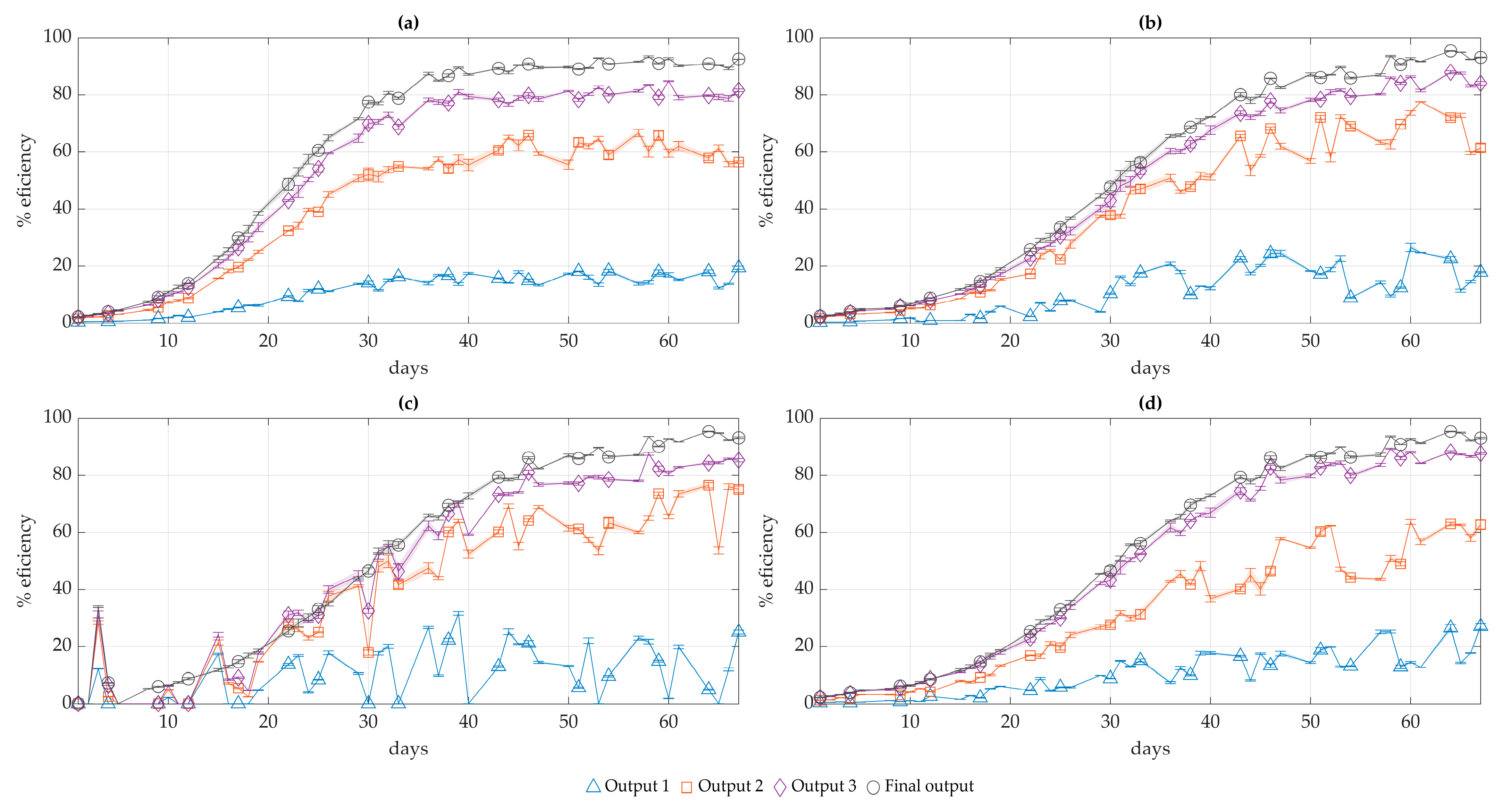
Under the residence times evaluated (20, 30, 40, and 50 s). Under these conditions, xylene consistently exhibited the highest removal efficiencies, followed by ethylbenzene, benzene, and toluene. This order reflects compound-specific differences in removal behavior within the BTF and is consistent with previous reports describing differential biodegradability of BTEX compounds in biofiltration systems.
The inoculum introduced into the BTF presented initial TSS and VSS values of 668 and 544 mg·L−1, respectively, which were used solely to estimate the initial biomass load and not for kinetic or functional correlation analyses. Throughout the experimental period, inlet concentrations remained relatively stable at 5.0 ± 0.4 ppmv per compound (range: 4.7–5.5 ppmv), allowing performance trends to be attributed primarily to biological evolution rather than to variations in loading conditions. Removal efficiencies increased progressively with operational time, indicating the gradual development and stabilization of the biofilm.
Figure 4 summarizes the removal efficiency profiles for each BTEX compound at the reactor outlet, highlighting the distinct temporal responses associated with each compound.
To avoid redundancy, detailed temporal profiles are presented only once.
Figure 5 illustrates the evolution of removal efficiency over time for each compound, showing a transition from an initial low-efficiency period to a stabilized regime with efficiencies exceeding 80–90% during later stages of operation.
Overall, these results indicate that the BTF packed with andesite achieved stable and high BTEX removal under the tested EBRTs, with performance governed primarily by biological processes rather than by physical adsorption.
3.4. Monod Kinetic Analysis of Bacterial Activity
The removal efficiency (ε) of the BTF was calculated according to
where C
in and C
out: are the inlet and outlet BTEX concentrations (mg/m
3), respectively.
The apparent removal rate (r) was calculated as;
where Q is the gas flow rate (m
3 ·h
−1) and V is a bioactive bed volume (m
3).
where r
max is the apparent maximum removal rate (mg·m
−3·h
−1), Ks is the half-saturation constant (mg m
−3), and S represents the outlet substrate concentration.
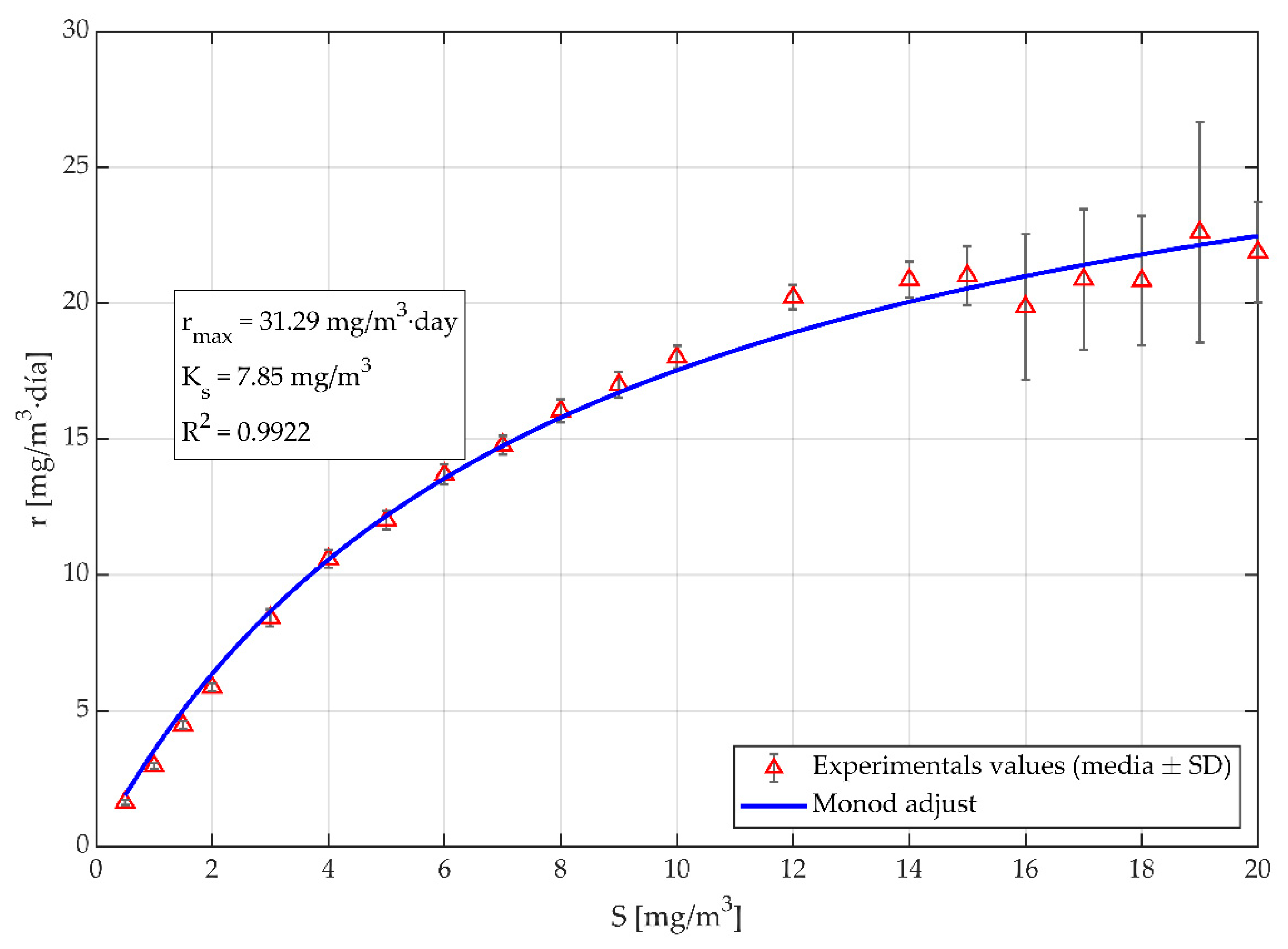
Experimental data were fitted to the Monod model considering three operational phases: an initial phase (days 1–14), a transitional phase (days 15–34), and a steady-state phase (days 35–67). During the initial phase, low removal rates were observed (rₘₐₓ ≈ 1.2 mg m−3·h−1; Kₛ ≈ 10 mg·m−3), indicating limited microbial activity. In the transitional phase, rₘₐₓ increased substantially (≈8.5 mg·m−3·h−1), reflecting microbial adaptation to BTEX exposure. Under steady-state conditions, the system reached an apparent rₘₐₓ of approximately 10.0 mg m−3·h−1 with a reduced Kₛ (≈6.0 mg·m−3), suggesting improved substrate affinity and stabilized biological performance.
Figure 6 shows the fitted Monod curves corresponding to the different operational phases.
It is emphasized that the estimated kinetic parameters are descriptive and derived from time-series data obtained from a single reactor. Consequently, they should be interpreted as indicative indicators of system behavior rather than as statistically generalized kinetic constants.
3.5. Comparative Performance of Andesite-Based BTF with Inorganic Packing Materials
To contextualize the performance of the andesite-packed biotrickling filter, a quantitative comparison was conducted against previously reported BTF systems employing inorganic support materials for BTEX or VOC removal. Key operational indicators including empty bed residence time (EBRT), removal efficiency, and packing material were considered to allow an objective assessment of system performance.
As summarized in
Table 4, the BTF operated in this study achieved BTEX removal efficiencies above 80–90% at EBRTs ranging from 48 to 72 s, which is comparable to, and in some cases better than, values reported for other inorganic media such as lava rock, pozzolans, pumice, ceramic saddles, and natural zeolites. Many studies report similar removal efficiencies only at longer EBRTs (>60 s), or under higher nutrient supplementation and recirculation rates.
Notably, the andesite-based system exhibited stable performance under relatively short EBRTs, suggesting that effective biological degradation can be sustained even when the specific surface area of the packing material is moderate compared to highly porous adsorptive media. This observation is consistent with previous studies indicating that, in percolated BTFs, long-term removal efficiency is governed primarily by biofilm activity and stability rather than by initial adsorption capacity of the support material.
Compared to activated carbon–based systems, which often rely on combined adsorption–biodegradation mechanisms, andesite offers a mechanically robust, low-cost, and chemically inert alternative that avoids early saturation effects. Relative to pumice or scoria, which exhibit high macroporosity but variable mechanical resistance, andesite provides a more uniform structure with sustained pressure-drop behavior over extended operation.
Overall, the results indicate that volcanic andesite performs within the upper range of reported inorganic packing materials for BTEX removal in BTFs, particularly when considering the balance between EBRT, removal efficiency, and operational stability. These findings supports the technical feasibility of andesite under the tested conditions as a competitive inorganic support for biological gas treatment systems, while acknowledging that performance comparisons across studies are influenced by differences in reactor configuration, inlet loads, and microbial consortia.
3.6. TOC/TIC Simulation Results and Interpretation
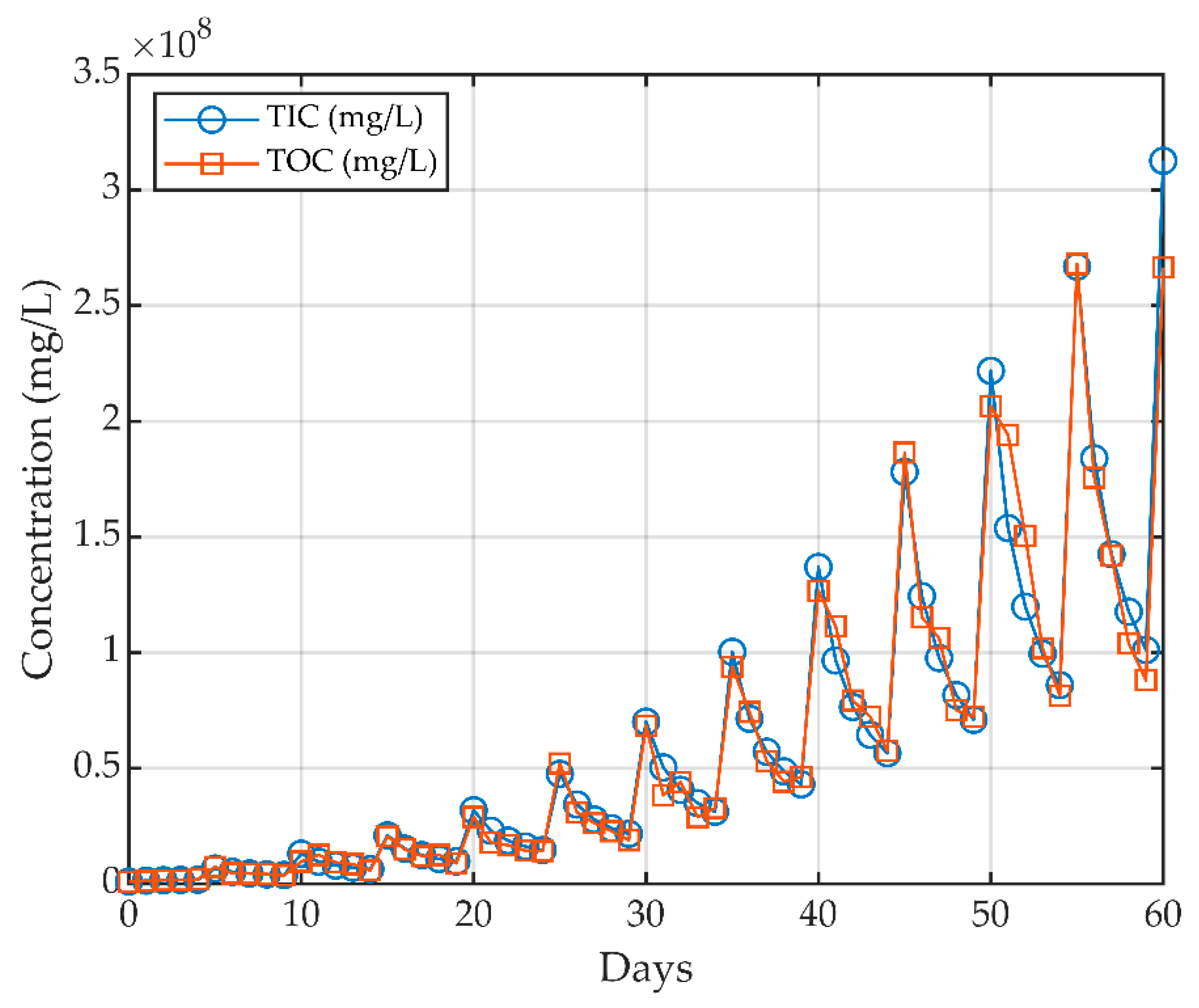
The temporal evolution of total inorganic carbon (TIC) and total organic carbon (TOC) in the recirculating liquid was evaluated through a simplified mass-balance simulation (
Figure 7) in order to support the interpretation of BTEX biodegradation trends observed in the gas phase. This analysis was conceived as a descriptive and exploratory tool, rather than as a fully validated predictive model.
The simulation assumes that the carbon removed from the gas phase is partitioned between mineralization to CO2 (reflected as TIC) and assimilation into microbial biomass and soluble organic products (reflected as TOC). A fixed partitioning ratio was applied throughout the simulation period, based on ranges commonly reported for aerobic biofiltration systems, where 60–80% of the removed carbon is mineralized and the remainder incorporated into biomass or intermediate metabolites. This assumption was not experimentally validated in the present study and therefore represents a key limitation of the model.
Under these assumptions, the simulated TIC and TOC profiles exhibited a gradual increase over time, broadly consistent with the progressive enhancement of BTEX removal efficiency. During the initial operational stage, low TIC and TOC values coincided with limited biodegradation activity. As removal efficiency increased, both parameters rose, reflecting intensified carbon turnover within the biofilm. Periodic deviations observed at specific operational days may be associated with transient changes in biofilm development, liquid replacement events, or short-term operational fluctuations; however, these effects were not explicitly modeled.
Importantly, no formal parameter estimation, uncertainty propagation, or sensitivity analysis was performed. The kinetic and stoichiometric parameters employed were adopted from literature values and implemented to reproduce a representative experimental environment rather than to fit measured TIC/TOC data. Consequently, the reported correspondence between simulated and experimental trends should be interpreted qualitatively and not as a statistical validation of the model.
Despite these limitations, the simulation provides a coherent framework to illustrate how gas-phase BTEX removal can be reflected in liquid-phase carbon accumulation, and highlights the potential of TIC and TOC monitoring as indirect indicators of biofilm metabolic state. Similar qualitative relationships between mineralized carbon, assimilated biomass, and removal efficiency have been reported in previous biofilter and biotrickling filter studies.
Overall, this modeling exercise is intended to complement, not replace, experimental observations. Its contribution is limited to supporting the interpretation of observed biodegradation dynamics and should not be over-weighted in performance assessment or design extrapolation. Future work should incorporate direct TIC/TOC measurements, dynamic carbon partitioning, and sensitivity analysis to strengthen the quantitative robustness of such models.
3.7. Microbial Community Associated with the Andesite-Packed BTF
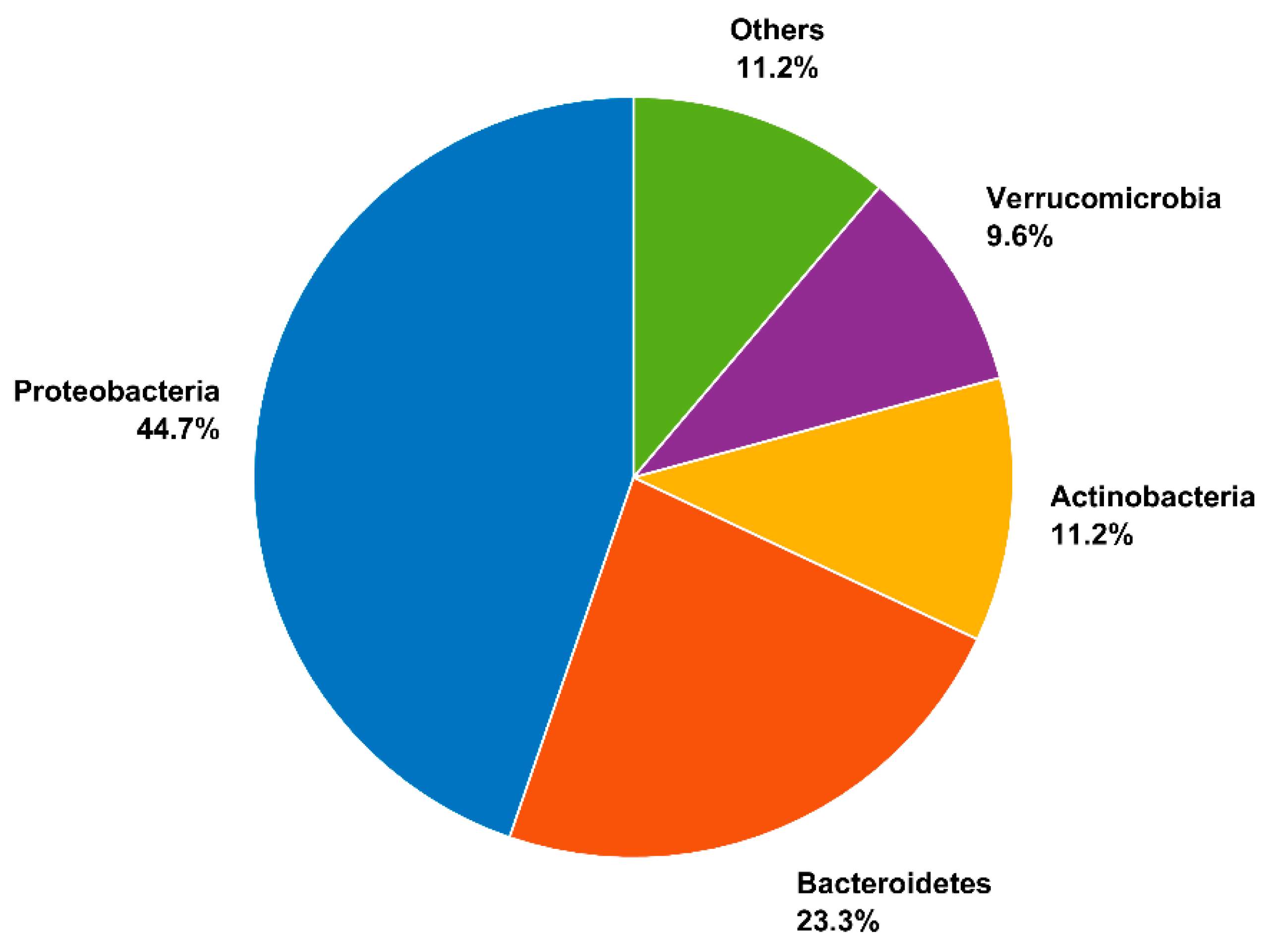
The microbial community developed on the andesite-packed biotrickling filter (BTF) was analyzed by 16S rRNA gene and ITS amplicon sequencing (Illumina MiSeq) to provide a descriptive overview of community structure established under BTEX biodegradation conditions (
Figure 8). This analysis is intended as a qualitative assessment of community composition, rather than a functional or quantitative characterization of microbial activity.
From a total of 105,793 reads, taxonomic assignment reached species-level resolution for 57.2% of the sequences. At the phylum level, the community was dominated by Proteobacteria (44.7%), followed by Bacteroidetes (23.3%), Actinobacteria (11.2%), and Verrucomicrobia (9.6%), with the remaining taxa grouped as Others (11.2)
This distribution is consistent with previous studies of BTFs treating BTEX and other VOCs, where Proteobacteria and Actinobacteria are frequently reported due to their metabolic versatility and association with aromatic hydrocarbon degradation [
25,
65].
At the family and genus levels, Mycobacteriaceae (10.3%) and Methylophilaceae (10.4%) were among the most abundant taxa, with Mycobacterium (10.4%) and Methylophilus (9.9%) as dominant genera. These groups have been repeatedly reported in biofiltration systems treating BTEX, particularly under conditions of low substrate bioavailability and continuous liquid recirculation [
66,
67,
68]. A substantial proportion of sequences (≈60%) remained unclassified at lower taxonomic levels, reflecting limitations of reference databases and the still limited characterization of microbial communities associated with volcanic mineral-based packing materials.
A qualitative microscopic inspection of the recirculating liquid revealed the presence of typical eukaryotic microfauna, including ciliates, rotifers, and nematodes. These organisms were interpreted functionally as indicators of a mature aerobic biofilm rather than being taxonomically resolved. Their presence is consistent with stable operational conditions in biological treatment systems and reflects trophic interactions that may contribute to biomass turnover and biofilm regulation, without implying a direct causal role in BTEX degradation [
69,
70,
71].
Overall, the microbial analysis supports the establishment of a diverse and stable biofilm on the andesite substrate. However, no direct quantitative correlations between taxonomic composition and reactor performance are inferred, and the results are interpreted strictly within a descriptive and contextual framework.
The high proportion of unclassified OTUs highlights the need for future studies combining amplicon sequencing with functional or metagenomic approaches to better resolve the metabolic roles of microbial communities developing on volcanic substrates.
Initial Biomass Characterization of the Inoculum
Prior to reactor inoculation, the washing liquid obtained from the full-scale biotrickling filter was characterized in terms of total suspended solids (TSS) and volatile suspended solids (VSS) to estimate the initial biomass load introduced into the system. The measured values were 668 mg·L−1 (TSS) and 554 mg·L−1 (VSS), corresponding to a volatile fraction of approximately 81%.
These measurements were used exclusively to document the initial biological input to the laboratory-scale BTF and were not intended to quantify active biomass growth or to establish correlations with reactor performance. No further temporal monitoring of suspended solids was conducted during operation.
4. Conclusions
This study evaluated the performance of andesite as an inorganic packing material for a laboratory-scale biotrickling filter (BTF) treating BTEX-contaminated air under controlled conditions. The results demonstrate that andesite provides a mechanically stable and hydraulically suitable support for sustained biofilm development and effective BTEX removal within the operational window explored.
Physicochemical characterization (XRD, XRF, AAS, BET) identified a heterogeneous silicate matrix dominated by plagioclase, ferromagnesian minerals, and Fe–Ti oxides, with moderate microporosity and low specific surface area compared to engineered adsorbents. While these properties do not imply enhanced adsorption capacity, they define a surface chemistry and structural stability that are compatible with microbial attachment and long-term operation in percolated BTF systems.
High BTEX removal efficiencies (>90%) were achieved after the acclimation period and maintained during steady operation. Kinetic analysis using a Monod-type framework captured the progressive maturation of the biological system, reflected by increasing apparent removal rates and decreasing half-saturation constants over time. These kinetic parameters are interpreted as descriptive indicators of system evolution, rather than intrinsic biological constants.
The monitoring of TIC and TOC in the recirculating liquid provided complementary insight into carbon partitioning between mineralization and biomass assimilation. Although the simulation relies on simplified assumptions, the observed trends were consistent with gas-phase removal dynamics and supported the internal coherence of the experimental dataset.
Microbial community analysis revealed the establishment of a diverse biofilm dominated by taxa commonly reported in aerobic BTEX biofiltration systems. This analysis was intentionally interpreted in a descriptive and contextual manner, without inferring functional metabolic mechanisms or direct causal links between mineral composition and microbial activity.
From a practical perspective, the findings indicate that andesite represents a technically viable low-cost packing material for laboratory BTF applications, particularly in regions where volcanic rocks are locally available. However, the conclusions are limited to a single reactor operated at laboratory scale, and no direct extrapolation to industrial performance is intended.
Future research should focus on validating these results under higher and fluctuating organic loading rates, mixed VOC streams, and pilot-scale conditions. The integration of functional microbial analyses, long-term hydrodynamic monitoring, and advanced control strategies would further clarify the role of inorganic volcanic substrates in biological air treatment technologies.




 ,
,