Abstract
The global surge in illicit drug use has intensified the demand for rapid, portable, and reliable on-site detection technologies. Traditional analytical approaches, such as laboratory-based instrumentation and biological sample assays, while accurate, are often constrained by high costs, long processing times, and the need for specialized equipment, rendering them unsuitable for field applications. This review highlights recent progress in chemical sensor technologies designed for the detection of widely misused drugs such as methamphetamine, cocaine, fentanyl, and heroin. Parallel advancements in the detection of environmental contaminants, particularly concerning micro- and nanoplastics, are also discussed. Emerging sensing platforms employing nanoparticle functionalization, graphene nanosheets, MXenes, metal–organic frameworks (MOFs), and supramolecular colorimetric assays demonstrate significant potential for achieving high sensitivity, selectivity, and operational simplicity in portable formats. These innovations enable real-time detection with minimal user expertise, thereby advancing applications in forensic analysis, environmental monitoring, and public health protection. The review also addresses current limitations related to detection accuracy, reagent stability, and matrix interferences and proposes future directions for optimizing sensor robustness and performance under diverse field conditions.
1. Introduction
Recently, the global drug problem has reached a critical level. According to the 2024 World Drug Report released by the United Nations Office on Drugs and Crime (UNODC), nearly 292 million people were exposed to drugs in 2022, and over 64 million suffered from drug use disorders [1]. Illicit drugs can be broadly categorized into two types: natural extracts such as opium, morphine, cannabis, and cocaine, and synthetic drugs primarily composed of amphetamines. The most commonly abused drugs include methamphetamine (MET), marijuana (THC), morphine (MOR), amphetamine (AMP), benzodiazepine (BZO), cocaine (COC), ketamine (KET), and barbiturate (BAR) [2,3]. The social and economic problems arising from various drugs have already reached a serious level, and South Korea can no longer be considered drug-free. According to the Chairman of the Special Committee on National Safety, during the first half of 2017, 197 cases of drug smuggling were detected, resulting in a total loss of 41.3 billion KRW. As of 2016, the number of drug offenders reached 14,214, with the number of domestic drug addicts estimated at over 100,000, and the associated social cost is approximately 2.5 trillion KRW, according to the Supreme Prosecutors’ Office. More than 85% of drug-related crimes were detected after smuggling or usage [4].
Over the past decade, research output on chemical approaches for drug detection technologies has increased substantially. Figure 1 illustrates the increasing research focus on drug detection technologies by presenting the annual number of publications and citations related to gamma-hydroxybutyrate (GHB), COC, fentanyl, and heroin from 2015 to 2024. The data analyzed by Kim et al. reveal a marked rise in fentanyl-related publications since 2020 [5], correlating with its prominent role in overdose mortality. Concurrently, citations for cocaine and heroin research have shown a consistent upward trend, underscoring the critical need for advanced detection methodologies to identify these substances across varied matrices effectively.
Figure 1.
Annual publications (stacked bars) and citations (lines with distinct markers) for GHB, cocaine, fentanyl, and heroin from 2015 to 2024, highlighting the rising research interest in drug detection technologies. Reproduced under the terms of the CC-BY Creative Commons Attribution 3.0 International license from Reference [5]. Copyright 2025, Korean Sensor Society.
Currently used drug detection sensors often require large, heavy equipment, which limits portability and causes delays in analysis, making rapid drug detection difficult. Additionally, methods that use biological samples to confirm drug use require around 70 strands of hair for the analysis of just one type of drug and take approximately 3 to 10 days, making on-site response impractical. Importantly, police officers must be able to detect drugs on-site without complex training. General strategies for field drug detection may include immunoassays based on colorimetric methods, time-resolved fluorescence immunoassay (TRFIA), or molecular spectroscopy (such as Raman spectroscopy or ion mobility spectrometry). On the other hand, detecting environmental toxins presents a parallel challenge, where rapid, on-site analysis is equally critical for both public health and ecological monitoring. Conventional laboratory techniques, including gas chromatography–mass spectrometry and high-performance liquid chromatography, offer excellent sensitivity but are limited by issues of portability, expense, and slow response times. Recent progress in chemical sensor technology [6,7,8,9,10,11,12,13] has led to the development of portable, on-site systems that can identify a diverse range of environmental contaminants, including micro- and nanoplastics (MNPs).
Functionalizing nanoparticles has become a valuable strategy, utilizing their distinct optical and chemical characteristics to improve both the sensitivity and selectivity of drug detection assays. For instance, gold nanoparticles functionalized with specific ligands have been shown to enable highly sensitive detection of opioids through surface-enhanced Raman spectroscopy (SERS) [14]. Graphene nanosheets, owing to their large surface area and superior electrical conductivity, have been incorporated into electrochemical sensors to achieve exact detection of trace levels of psychoactive substances [15]. MXene, a class of two-dimensional transition metal carbides, has garnered attention for its tunable surface chemistry, which enables the development of robust sensors for heroin detection in complex matrices. MOFs offer a versatile platform, with their porous architecture enabling the selective adsorption and fluorescence-based detection of specific target molecules [16].
Similarly, colorimetric methods provide visual and intuitive results through color change or development upon drug reaction, making them suitable for field applications [17]. In forensic science, they are used for preliminary screening of confiscated substances. In particular, paper-based microfluidic devices combined with smartphone analysis offer a low-cost solution for the rapid detection of fentanyl and cocaine [18], playing a vital role in enhancing field responsiveness for investigative agencies and ensuring public health safety. The development of colorimetric methods for drug detection requires further investigation to improve their sensitivity and specificity for detecting substances like GHB, COC, fentanyl, and heroin in complex matrices. Additional research is needed to optimize the chemical reagents used in colorimetric assays, ensuring rapid and reliable visual identification under diverse environmental conditions. Studies should focus on improving the limit of detection for these methods to address trace amounts of illicit drugs, particularly in biological and environmental samples.
In this review, we summarize advances in chemical sensing technologies, including nanoparticle functionalization, graphene nanosheets, MXenes, MOFs, and colorimetric methods, for detecting illicit substances and environmental toxins. We highlight recent research, technological progress, and existing limitations over the past decade, and discuss future developments needed to advance these sensing approaches further.
2. Nanoparticles and Nanotube-Based Methods for Illicit Substance Detection: Array and Surface Functionalization
2.1. Methods for Gold Nanoparticle-Based Detection
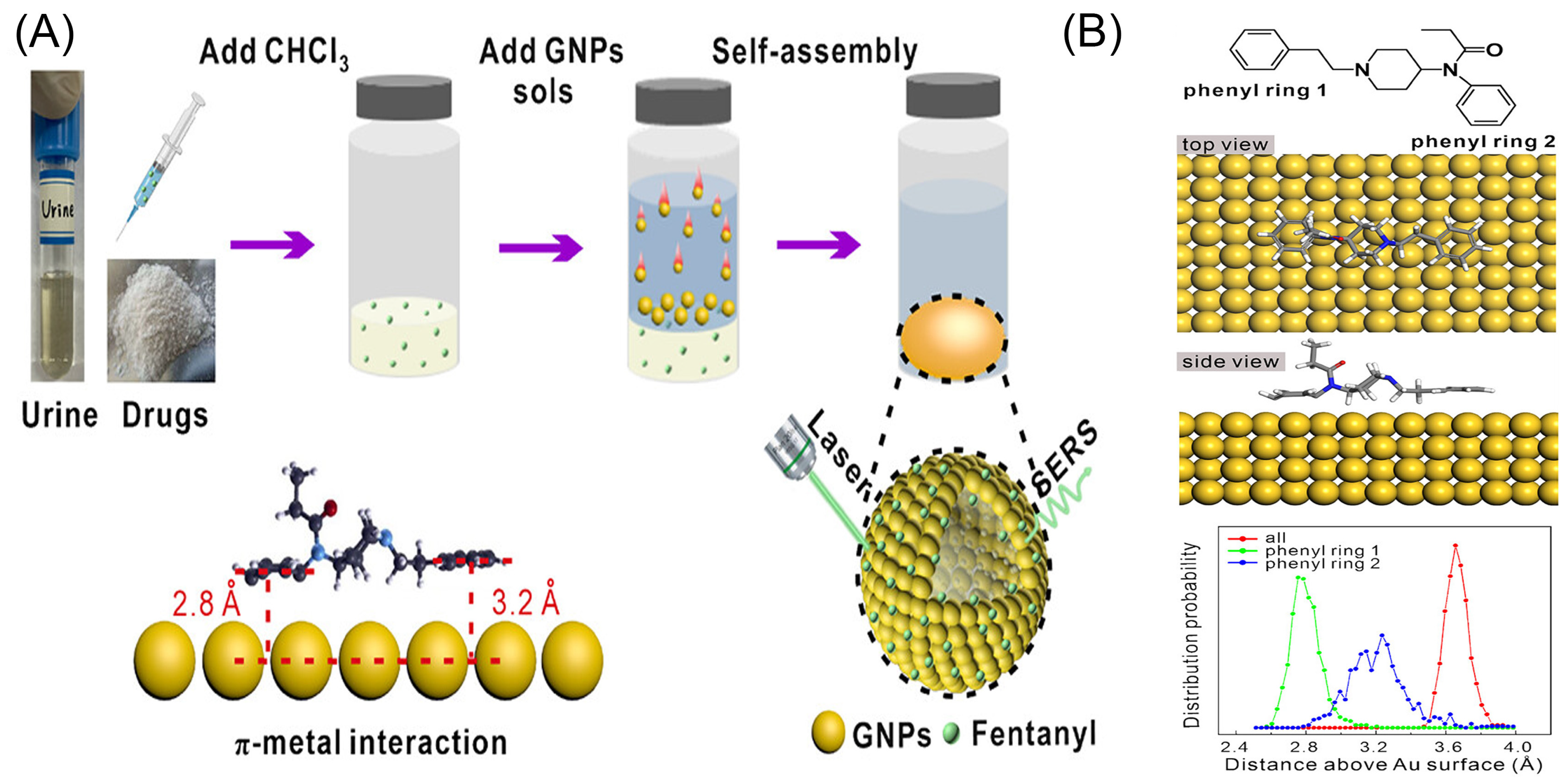
Nanoparticle-based methods have significantly advanced drug detection technologies, providing high sensitivity and selectivity for identifying illicit substances such as GHB, cocaine, fentanyl, and heroin. Gold nanoparticles (AuNPs) and DNA conjugates enable colorimetric detection of cocaine through plasmonic shifts, producing visible color changes at micromolar concentrations [19]. These AuNP systems leverage aggregation-induced spectral changes for rapid, naked-eye assays suitable for field applications [20]. Similarly, AuNPs combined with molecularly imprinted polymers (MIPs) form potentiometric sensors that selectively bind cocaine in complex biological matrices, achieving detection limits of nanomolar sensitivity [21]. MIPs are synthetic polymer materials engineered with selective binding sites that are shaped to recognize and capture specific target molecules, such as drug molecules. However, for fentanyl, AuNP-decorated carbon nanotubes in field-effect transistors (FETs) detect norfentanyl at femtomolar concentrations, aided by machine learning for opioid discrimination [22]. Ding et al. present a portable SERS-based strategy using liquid/liquid interfacial plasmonic arrays for rapid, label-free detection of trace fentanyl in untreated human urine, achieving limits of detection as low as 1 ng/mL in solution and 50 ng/mL in urine [23] (Figure 2).
Figure 2.
Schematic illustration of 3D oil/water interfacial plasmonic array formation for surface-enhanced Raman spectroscopy (SERS) analysis integrated with an intelligent algorithm. (A) Self-assembly of 3D liquid–liquid interfacial plasmonic arrays enables rapid, label-free SERS-based identification, quantification, and classification of ultra-trace fentanyl in complex matrices, including heroin, ketamine, morphine, and untreated human urine. (B) Molecular dynamics simulation of fentanyl on the Au surface, showing its structure, interaction mechanism, and distance distribution. Adapter with permission from Reference [23]. Copyright 2023, American Chemical Society.
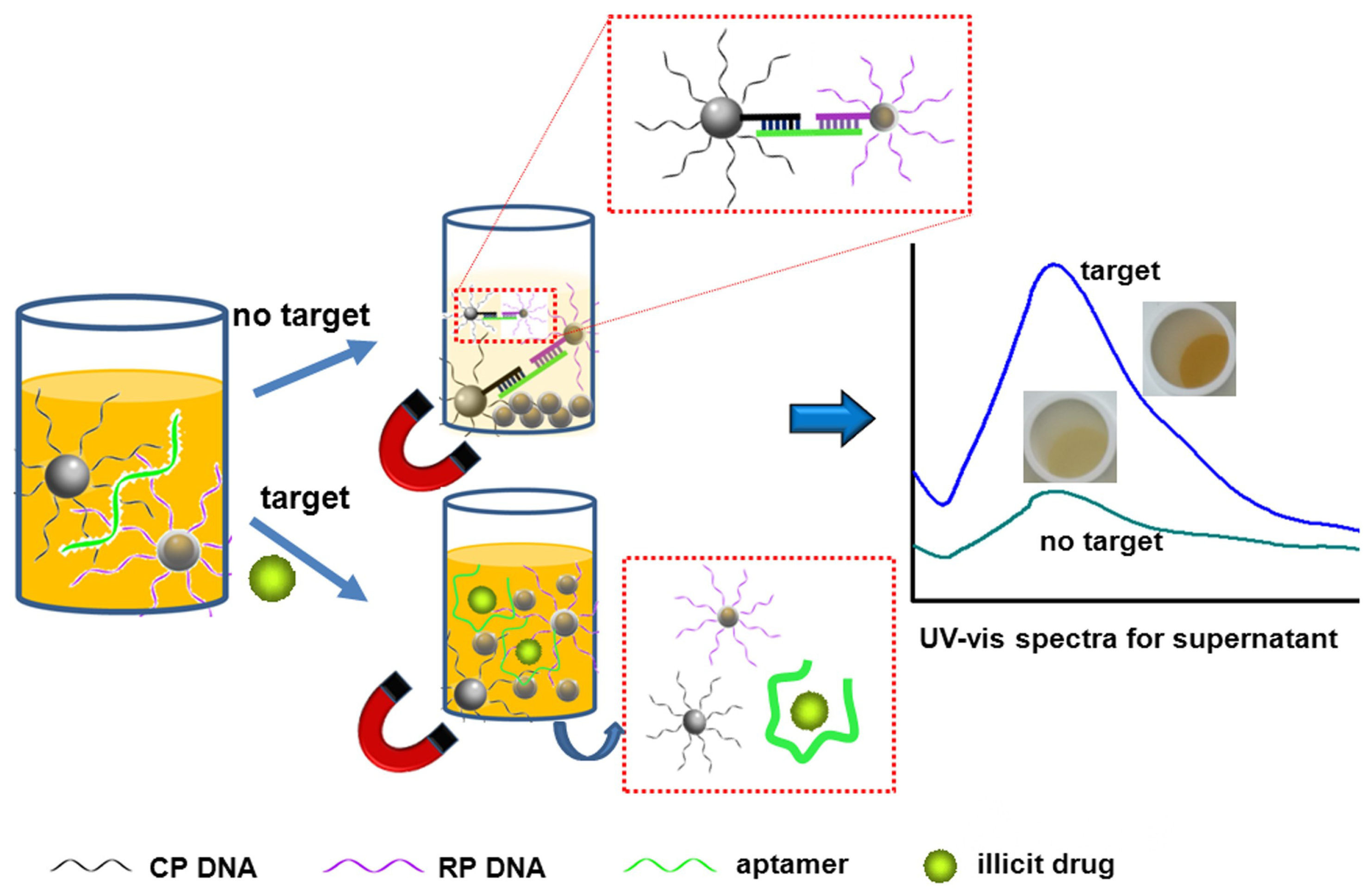
A recent colorimetric sensing method was developed by conjugating specific DNA sequences to AuNPs, allowing for a visible color change in response to the presence of a drug. In this system, aptamers engineered nucleic acid strands with high target specificity were designed to selectively bind methamphetamine, facilitating rapid and label-free detection. In the absence of methamphetamine, the aptamer hybridizes with the DNA strands linked to the nanoparticles, inducing their aggregation. When methamphetamine is present, the aptamer exhibits higher affinity for the target molecule, disrupting the DNA interaction and maintaining nanoparticle dispersion. This shift in aggregation state leads to a distinct color change, as noble metal nanoparticles exhibit visible-spectrum color variations based on their dispersion behavior [24] (Figure 3).
Figure 3.
Schematic illustration of an aptamer-based magnetic separation assay for the detection of illicit drugs. In the absence of target analytes, aptamers remain hybridized with complementary (CP) and reporter (RP) DNA strands, allowing magnetic bead separation and yielding a clear supernatant. Upon target binding, aptamers dissociate from CP and RP strands, altering the supernatant composition and producing a measurable increase in UV–vis absorbance. The dispersion state can be visually confirmed by colorimetric change, enabling rapid and selective detection in complex matrices. Adapter with permission from Reference [24]. Copyright 2017, Elsevier.
2.2. Methods for Gold Nanorod-Based Detection
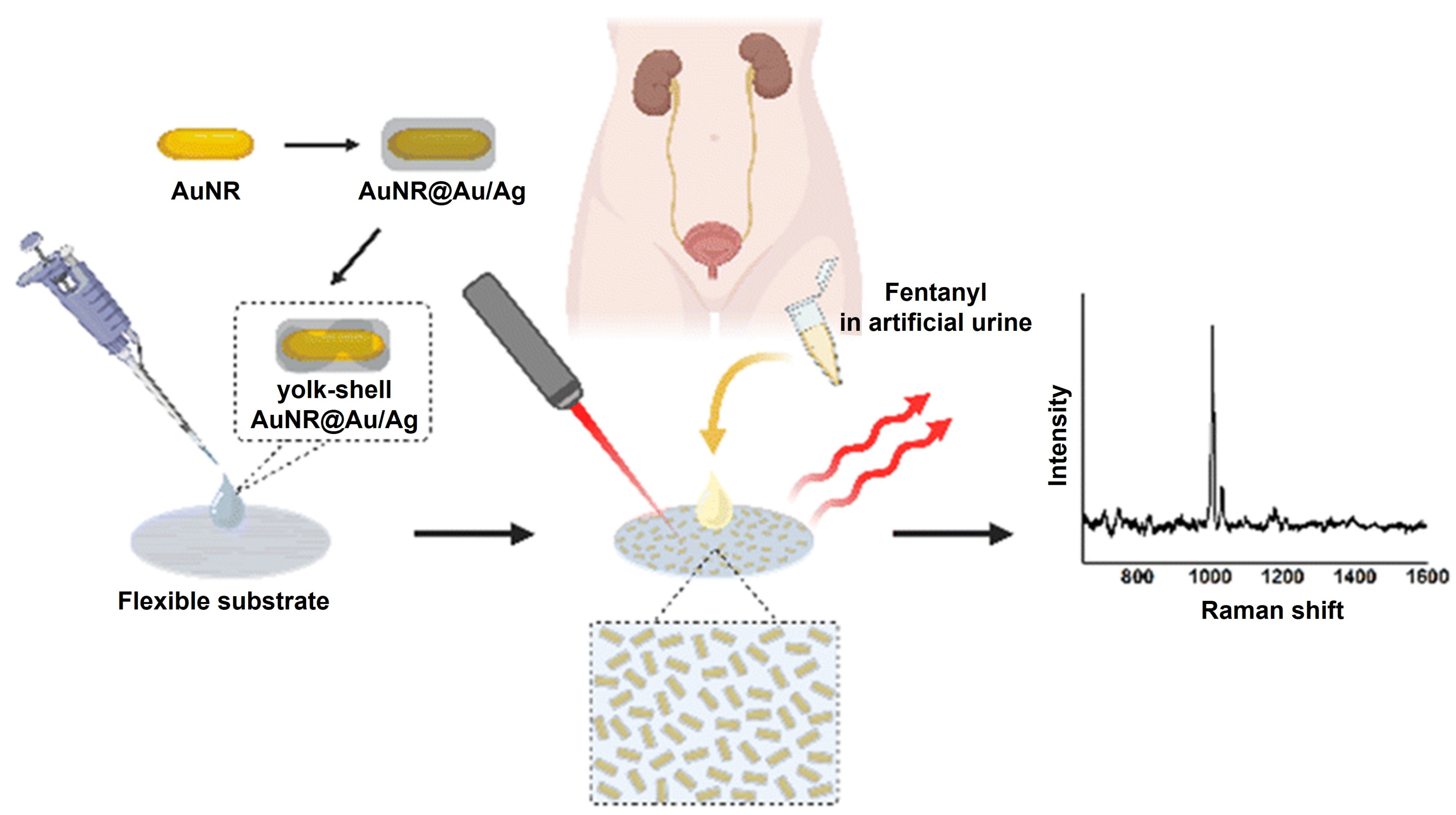
Gold nanorods (AuNRs) are widely employed in SERS due to their tunable longitudinal surface plasmon resonance, which generates a strong electromagnetic field enhancement for highly sensitive molecular detection. Their anisotropic shape and biocompatibility make them ideal for label-free chemical and biodetection in complex environments; however, their stability under high laser power and susceptibility to reshaping can limit reproducibility in certain SERS applications [25,26]. In a recent study, a simple and adaptable method has been presented for producing flexible SERS substrates capable of highly sensitive fentanyl detection. The method integrates yolk–shell plasmonic nanostructures with a flexible cellulose-based support, resulting in a platform that delivers strong analytical performance with a detection limit as low as 4.89 ng/mL for fentanyl [27] (Figure 4). Wang et al. introduced the concept of a “plasmonic nose,” a novel, low-cost sensing platform for detecting, recognizing, and quantifying chemical mixtures. Their method utilizes a paper substrate and a calligraphy-based fabrication technique to produce arrays of SERS-active sensors composed of AuNRs functionalized with macromolecules that confer specific sensitivity and selectivity. This sensor array effectively detects a wide range of chemical species, including single analytes and complex mixtures, with statistical analysis enabling both component identification and estimation of mixing ratios. The strategy demonstrates strong potential for diverse applications, including life sciences, environmental monitoring, and homeland security [28].
Figure 4.
Schematic representation of a flexible SERS platform for fentanyl detection in artificial urine. Gold nanorods (AuNRs) are coated with silver to form AuNR@Au/Ag yolk–shell nanostructures, which are deposited onto a flexible substrate. Upon sample application, Raman spectroscopy enables sensitive detection of fentanyl, as illustrated by the characteristic Raman shift spectrum. Adapter with permission from Reference [27]. Copyright 2024, Royal Society of Chemistry.
2.3. Methods for Carbon Nanotube-Based Detection
Carbon nanotubes (CNTs), including single-walled (SWCNTs) and multi-walled (MWCNTs), have revolutionized the detection of illicit substances due to their exceptional electrical conductivity, high surface area, and tunable surface chemistry. These properties make CNTs ideal for developing sensitive, portable, and rapid sensors for forensic and clinical applications.
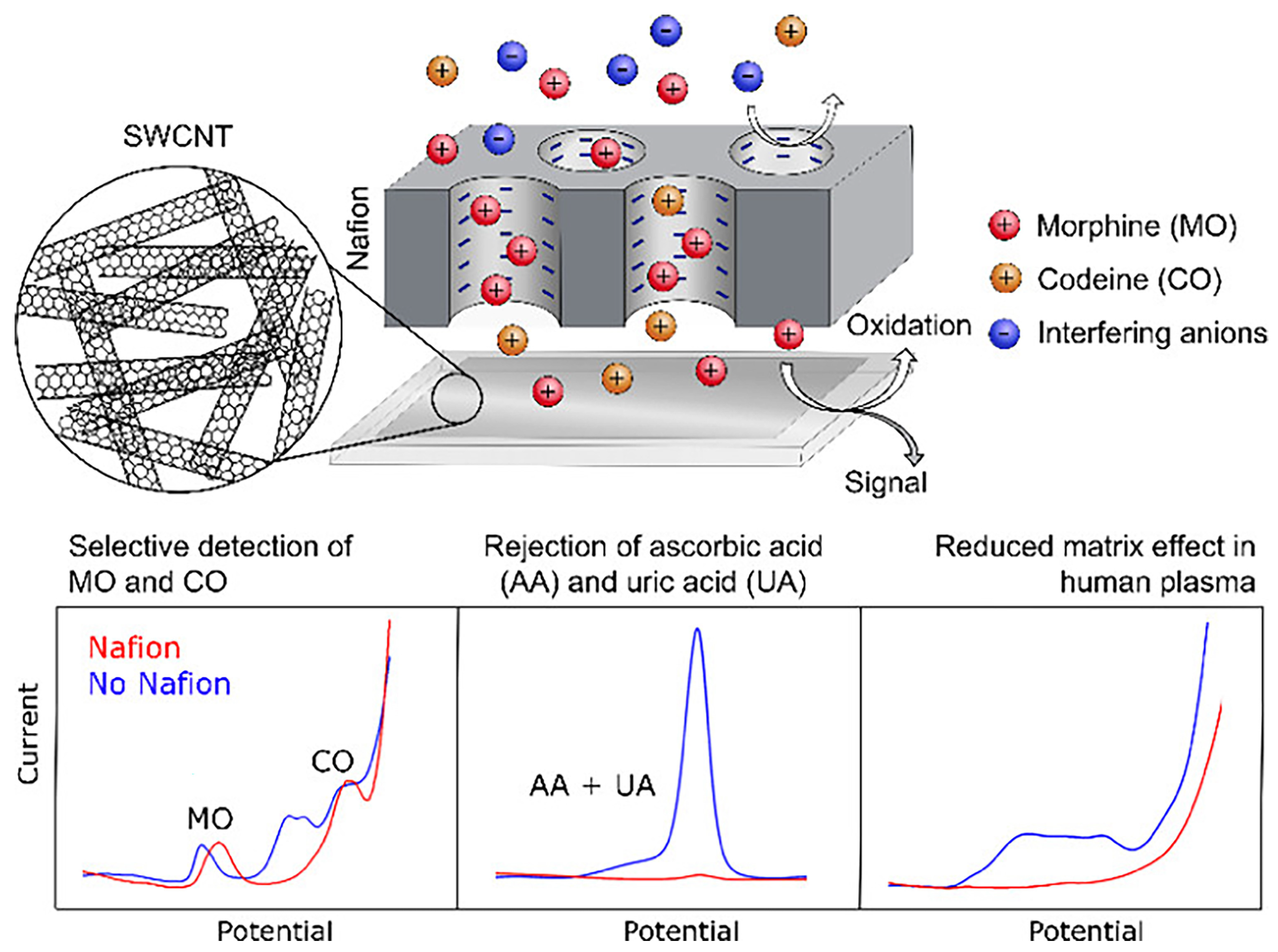
A recent study by Mynttinen and co-workers demonstrated the electrochemical detection of oxycodone and its major metabolites using Nafion-coated SWCNT electrodes. The Nafion layer enhanced selectivity by suppressing interference from coexisting compounds, enabling the sensitive and reliable detection of opioid metabolites in complex matrices, such as wastewater, thereby supporting wastewater-based epidemiology approaches [29]. Additionally, another study introduces a disposable Nafion-coated single-walled carbon nanotube (SWCNT) electrode for the selective and simultaneous electrochemical detection of morphine and codeine in complex biological matrices. The platform demonstrates efficient charge separation, reduced matrix interference, and enables direct voltametric analysis in unprocessed human plasma, achieving linear detection ranges of 0.05–10 μM for morphine and 0.1–50 μM for codeine with a pulse amplitude of 50 mV and scan rate 20 mV/s, even in the presence of high concentrations of ascorbic and uric acid [30] (Figure 5).
Figure 5.
Selective detection of morphine and codeine is achieved using a Nafion-coated SWCNT sensor, which rejects interfering anions such as ascorbic and uric acid and reduces matrix effects in plasma. The graphs show improved selectivity and signal with Nafion treatment. Reproduced under the terms of the CC-BY Creative Commons Attribution 4.0 International license from Reference [30]. Copyright 2019, American Chemical Society.
Similarly, Arvand et al. constructed electrodes using a nanocomposite of MWCNT, hydroxyapatite, and a copper metal–organic framework (MWCNT-HA/Cu-MOF), achieving an exceptionally low LOD of 0.003 µM for fentanyl in both pharmaceutical and illicit samples. These portable electrochemical platforms are especially promising for on-site testing in forensic and field settings [31]. Table 1 provides a comprehensive summary of reported nanoparticle- and nanotube-based approaches employed for illicit substance detection.
Table 1.
Summary of nanoparticles and nanotube-based methods used for illicit substance detection.
3. Nanosheet-Based Methods: Graphene and Borophene
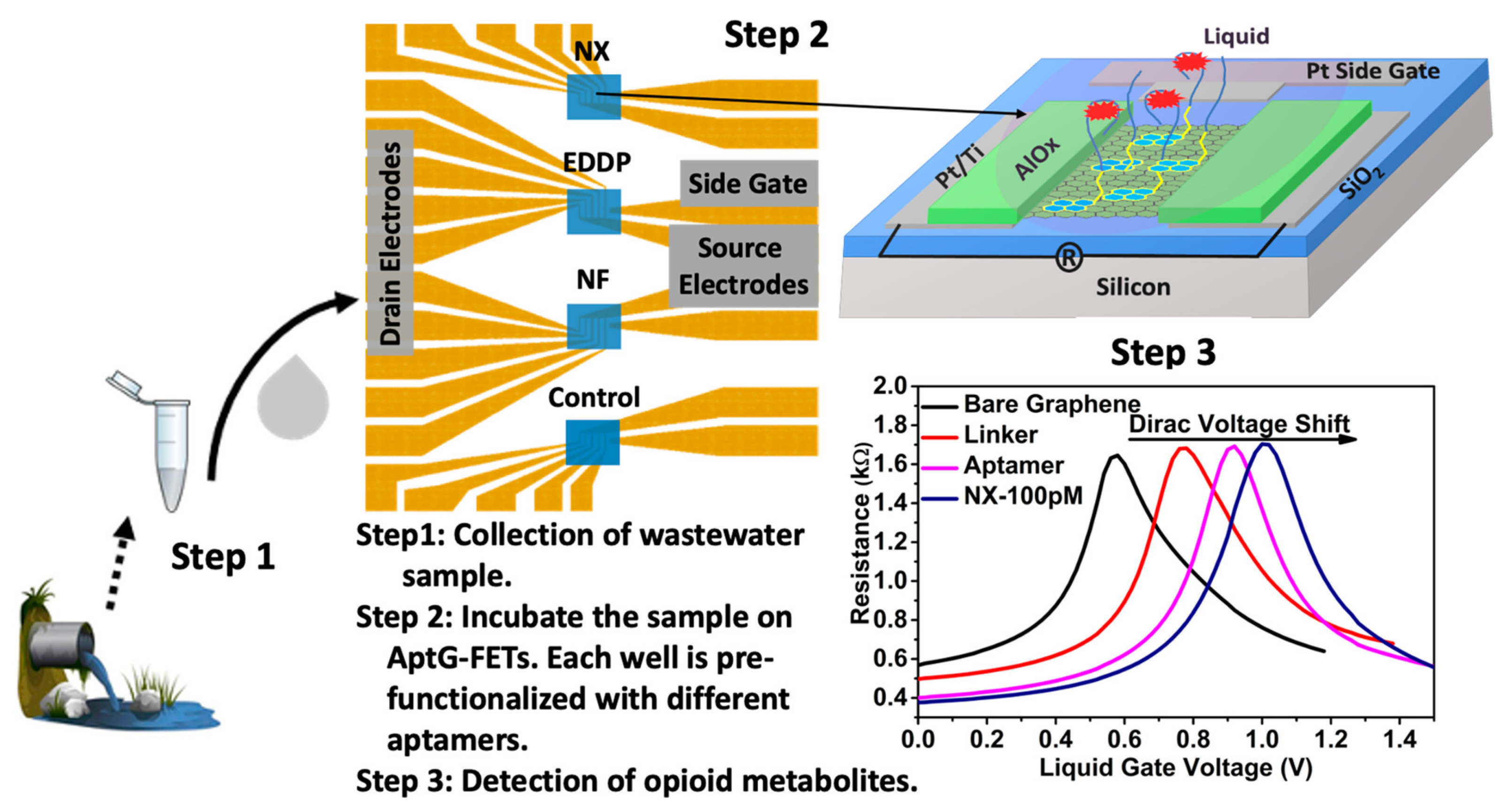
Graphene and its derivatives, such as graphene oxide (GO) and reduced graphene oxide (rGO), are increasingly utilized in sensors for illicit drug detection due to their high surface area, excellent electrical conductivity, and ability to be modified to bind specifically to target analytes. One approach involves modifying electrodes with rGO to enhance electron transfer kinetics; for example, a glassy carbon electrode was modified with electrochemically reduced graphene oxide (ERGO) for sensitive detection of fentanyl and its derivatives [32]. Functionalization via molecularly imprinted polymers (MIPs) on graphene (or rGO) provides recognition sites with shape and chemical specificity for molecules such as fentanyl, giving low limits of detection [33]. Aptamer functionalized graphene field-effect transistors (G-FETs) allow multiplexed, rapid detection of opioid metabolites in wastewater; aptamers are tethered to graphene, and binding of the target molecule causes a change in graphene’s electrical characteristics (Figure 6) [34]. To improve selectivity, graphene surfaces are sometimes functionalized with specific metals or metal oxides, e.g., graphene-oxide decorated or doped with metal nanoparticles to enhance catalytic oxidation of analytes [35]. GO offers a variety of oxygen-containing functional groups (–OH, –COOH, epoxide), which can be exploited for further covalent bonding of recognition elements (such as aptamers, antibodies, or MIPs) [15].
Figure 6.
Schematic workflow for the detection of opioid metabolites in wastewater using aptamer-functionalized field-effect transistors. The process involves sample collection, incubation on aptamer-specific electrode arrays, and electrical readout via Dirac voltage shifts, enabling the selective and label-free detection of target analytes in complex matrices with a maximum 40 min binding time and a limit of detection as low as 27 pg/mL. Adapter with permission from Reference [34]. Copyright 2022, American Chemical Society.
Noncovalent functionalization is also common: π-π stacking (between aromatic parts of drugs and graphene basal planes), hydrophobic interactions, and electrostatic adsorption can assist in immobilizing probes or drugs, sometimes improving response [36]. In some sensors, GO is electrophoretically deposited onto electrodes to form a uniform functional layer; then ERGO is formed by electrochemical reduction, restoring conductivity [32]. Combining graphene with other catalytic materials (e.g., metal oxides, COFs, noble metal nanoparticles) enhances sensitivity by generating higher oxidation currents or better signal-to-noise ratios. For example, a sensor using COF + rGO reached very low detection limits for fentanyl and alfentanil in human serum [37]. Wearable or portable formats are being explored, including screen-printed electrodes modified with graphene, for detecting substances like methamphetamine in seized, tap water, and wastewater samples [38]. Graphene’s mechanical properties and chemical robustness allow repeated use and relatively stable baselines when properly functionalized and stored. But reproducibility across fabrication batches remains a challenge, especially when the functionalization steps are complex. Scalability is also a concern: many lab-scale modifications (e.g., small-scale electrophoretic deposition, bespoke COFs) are not yet easily transferable to mass manufacture. Finally, although graphene-based sensors can achieve very low detection limits, their performance in real, complex matrices (such as urine, blood, and wastewater) often suffers from interferences, fouling, and signal drift, making calibration and sample preparation crucial for reliable detection of illicit substances.
Borophene nanosheets represent a new frontier in electrochemical and biosensing, offering unique opportunities for the detection of illicit substances due to their exceptional electrical conductivity, high carrier mobility, and tunable surface chemistry [39]. Their large electroactive surface and abundance of reactive boron sites facilitate rapid electron transfer and strong analyte adsorption, essential for detecting trace levels of narcotics such as fentanyl or cocaine in biological and environmental samples, such as arsenic from water [40]. Functionalization with aptamers, molecularly MIPs, or metal nanoparticles can impart high molecular selectivity while maintaining borophene’s conductivity for sensitive transduction [41]. For instance, strategies demonstrated in glucose and dopamine (DA) sensing using borophene composites could be readily adapted for illicit drug targets, integrating differential pulse voltammetry (DPV) or EIS for quantitative readout [42]. The material’s mechanical flexibility also supports wearable and portable devices for on-site forensic or wastewater-based epidemiology applications, addressing the need for real-time and field-deployable detection [43]. With advances in surface passivation and controlled synthesis, borophene-based nanosensors could outperform conventional CNT and graphene systems in sensitivity, selectivity, and response time for illicit drug monitoring. Integrating machine learning-assisted signal processing could further enable the automated recognition of complex drug mixtures, providing a robust forensic tool. An overview of nanosheet-based detection strategies is presented in Table 2.
Table 2.
Overview of nanosheet-based sensing approaches for the detection of illicit drug substances.
4. MXene and MOF-Based Illicit Substances Detection

The family of two-dimensional transition-metal carbides and nitrides known as MXenes (general formula Mn+1XnTx) has increasingly attracted attention in sensor research because of its combination of high electrical conductivity, large specific surface area, and rich surface chemistry (terminal groups such as –O, –OH, –F), which provide abundant binding/adsorption sites for analytes and thus excellent transduction potential [44]. Although much of the existing literature has focused on environmental pollutants, biomolecules, and neurotransmitters rather than narcotics, the core sensing attributes of MXenes suggest a strong opportunity for adaptation in illicit-drug detection for forensic and wastewater epidemiology contexts. For instance, the high carrier mobility and conductive pathways in MXenes enable rapid signal generation when a target molecule binds or reacts on the surface—a key requirement when detecting trace-level illicit substances or their metabolites.
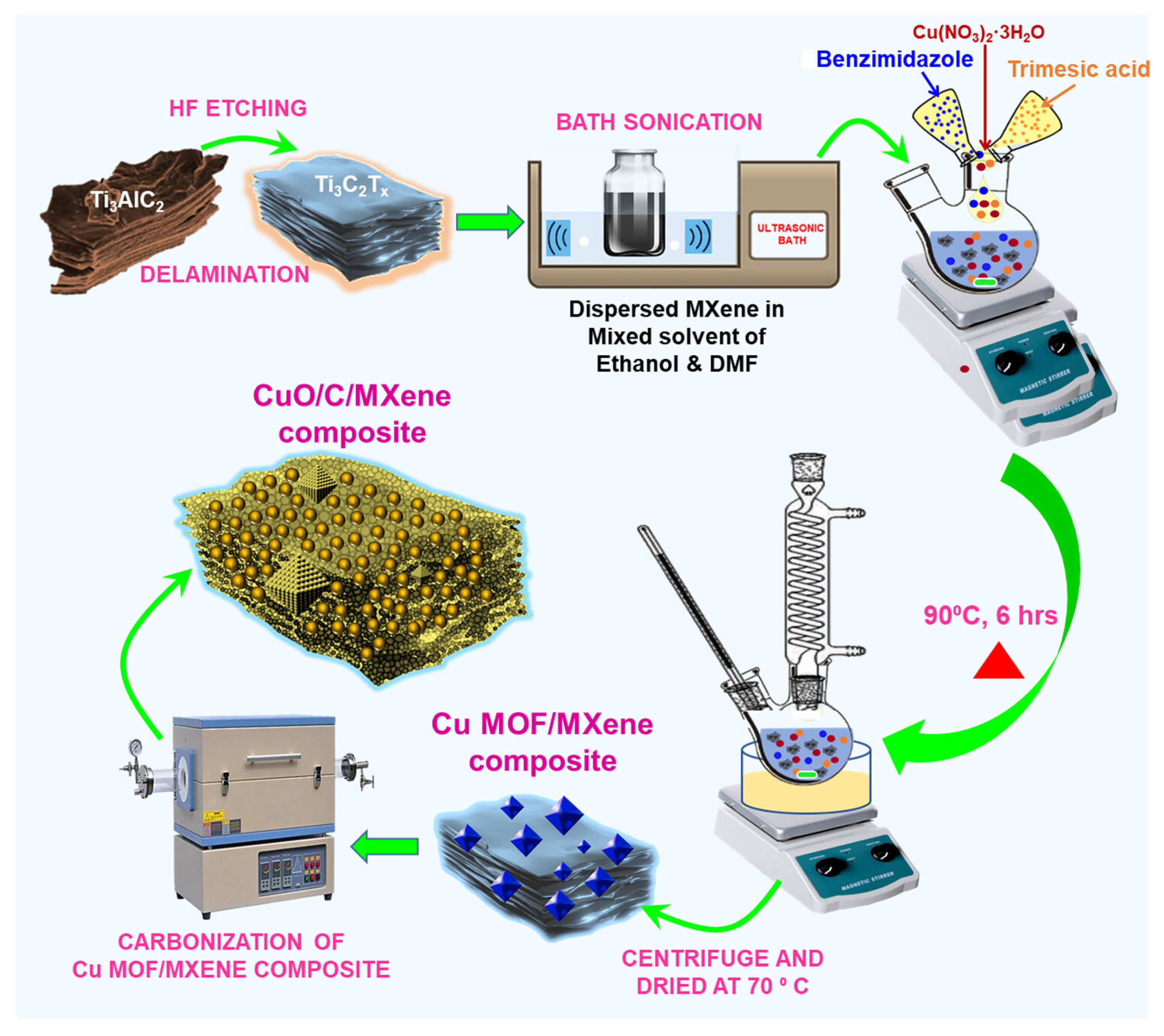
Functionalization of MXene surfaces has been widely applied: composites with metal nanoparticles, conducting polymers, MIPs, or aptamers have been shown to dramatically improve selectivity and lower limits of detection. In the context of illicit-substance sensing, one can envision an MXene-modified electrode (for example, Ti3C2Tx or Nb2CTx) bearing a drug-specific aptamer or MIP layer, such that binding of a target (e.g., an opioid metabolite, cathinone derivative, or designer-stimulant) alters the interfacial charge transfer behavior, which is then transduced via DPV or EIS. MXene composites have already been demonstrated for small-molecule detection in complex matrices: for example, a CuO/C/Ti3C2Tx hybrid achieved detection of DA at 0.01–2960 μM via electrochemical means [45] (Figure 7).
Figure 7.
Schematic representation of the synthesis process for CuO/C/MXene composite. Ti3AlC2 is etched with HF to produce delaminated Ti3C2Tx MXene, which is dispersed in ethanol–DMF via sonication. The mixture is reacted with Cu(NO3)2·3H2O, benzimidazole, and trimesic acid at 90 °C for 6 h to form Cu MOF/MXene, followed by drying and carbonization to yield the final CuO/C/MXene material. Adapter with permission from Reference [45]. Copyright 2025, American Chemical Society.
Despite the absence of published reports explicitly targeting common illicit drugs (such as cocaine, methamphetamine, or fentanyl) with MXene sensors to date, the platform’s advantages (e.g., high surface adsorption, rapid electron transfer, facile functionalization) make the approach compelling. A recent review of “Molecularly Imprinted-MXene” electrochemical sensors covering pharmaceuticals and environmental analytes highlights the translational possibility for drug-of-abuse detection [46]. Key advantages in using MXenes for illicit-substance sensing include: (i) high sensitivity potential because of large interface and conductive pathways; (ii) ability to integrate selective receptors (aptamers/MIPs) thanks to functional surface groups; (iii) compatibility with portable or wearable formats (e.g., screen-printed electrodes, flexible substrates) due to the processability of MXene films.
However, several challenges must be addressed before MXene sensors become practical for detecting illicit substances in forensic applications. One major issue is selectivity: illicit drugs often appear in very complex biological or environmental matrices (urine, saliva, wastewater) containing many interfering substances, so functionalization must ensure strong discrimination. Stability is another concern; many MXenes are prone to oxidation and aggregation, which can degrade performance over time or in aqueous conditions [47]. Although MXenes exhibit excellent conductivity and tunable surface chemistry, their practical use in illicit drug detection is limited by oxidation instability, poor selectivity, and structural restacking, which collectively reduce long-term sensing reliability. These issues have been widely reported in MXene sensor research [48,49]. Moreover, reproducible fabrication and batch-to-batch consistency of MXene films (flake size, terminal chemistry, thickness) are non-trivial, and this must be resolved for robust sensor deployment. The employment of molecular recognition elements (aptamers/MIPs) on MXene surfaces also requires optimized immobilization to maintain binding activity without sacrificing conductivity or introducing fouling.
From an implementation perspective, the adaptation of MXene sensors to illicit-substance detection would likely follow a roadmap: (1) select or evolve a receptor (aptamer or MIP) with high affinity to the target drug or metabolite; (2) deposit or functionalize an MXene film (e.g., on a screen-printed electrode) and stabilize the film (e.g., via polymer encapsulation); (3) demonstrate electrochemical detection (DPV/EIS) of the target in buffer and then in spiked biological/wastewater matrices; (4) benchmark limit of detection (targeting nM to pM levels), specificity (distinguishing structurally similar drugs), response time and reproducibility; (5) integrate into portable/mobile readout (handheld potentiostat or smartphone interface).
Given the pressing need for rapid on-site detection of illicit substances (in forensic screening, border controls, wastewater epidemiology networks), MXene-based sensor platforms hold transformative potential. By achieving ultra-low detection limits, high selectivity, and field-deployable formats, they could complement or ultimately rival existing aptamer-functionalized CNT/graphene platforms.
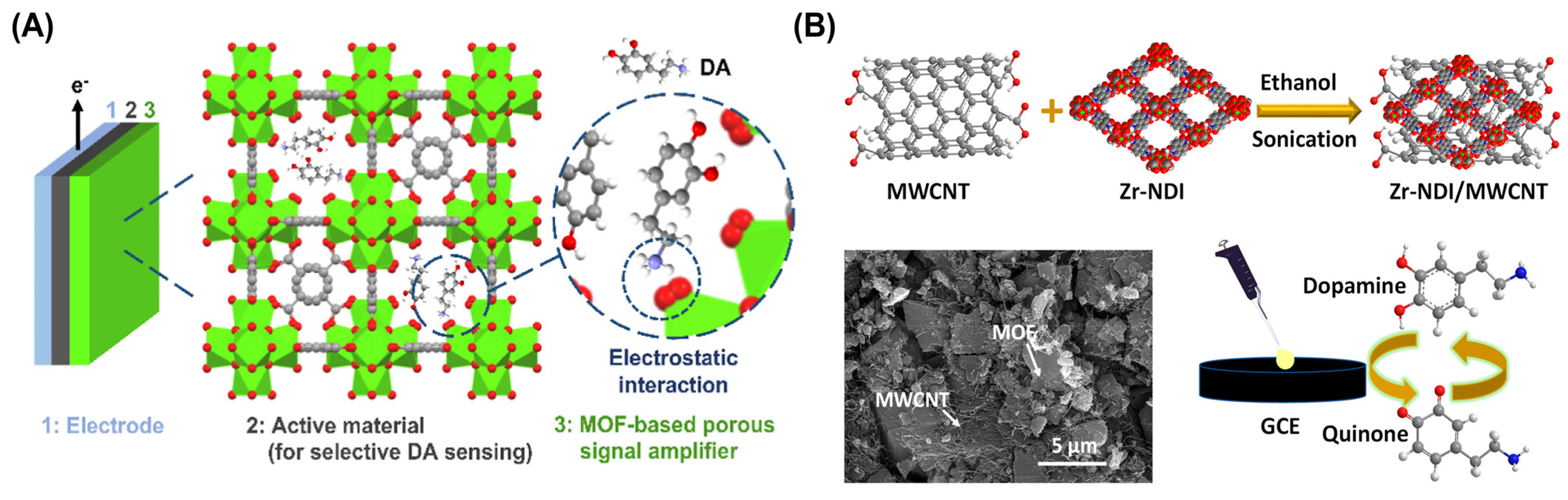
While MXene emphasizes conductive transduction, metal–organic frameworks (MOFs) provide a complementary platform focusing on molecular selectivity and porous interactions. It has shown great potential in illicit substance sensing due to its tunable pore structures, high surface areas, and functionalizable metal–ligand coordination sites that enable selective interaction with drug molecules. A recent book chapter has been critically reviewed, with a focus on the most recent applications of MOF-based drug detection [50]. Fluorescent MOFs such as Zr- and Eu-based systems exhibit rapid “turn-on” or “turn-off” responses toward amphetamine-type stimulants and opioids through photoinduced electron transfer mechanisms [51]. Electrochemical MOF composites integrated with graphene or carbon nanotubes enhance electron transfer, enabling sensitive voltammetric detection of drugs such as fentanyl and morphine [52]. Notably, MOF–graphene composites not only improve electrical conductivity but also enhance structural stability under humid conditions, offering a significant practical advantage for field monitoring [53]. However, on-site detection or point-of-care testing (POCT) of illicit drug use using MOF is not well understood, which could be the future direction for the detection of illicit drug use. A recent study by Chang et al. demonstrates that non-conductive MOFs (UiO-66) can significantly enhance electrochemical sensing performance when used as surface modifiers. For instance, defective UiO-66 thin films, despite being electrochemically inactive, have been shown to amplify DA sensing signals through a hopping-based charge transport mechanism between irreversibly adsorbed DA molecules (Figure 8A). When layered over conductive substrates, such as graphene oxide, these MOF coatings yield improved sensitivity, lower detection limits, and enhanced selectivity against common interferents, including ascorbic acid and uric acid. This approach highlights the potential of defect-engineered MOFs as versatile amplifiers in next-generation electrochemical sensors [54]. An overview of MXene- and MOF-based detection strategies for illicit drug substances is presented in Table 3.
Table 3.
Summary of MXene- and MOF-based methods for the detection of illicit drug substances.
Table 3.
Summary of MXene- and MOF-based methods for the detection of illicit drug substances.
| Materials | Methods | Limit of Detection | Target Drugs | References |
|---|---|---|---|---|
| Zr-MOF | fluorescence sensor | 1.15 nM | amphetamine | [51] |
| Zn(II)-MOF/SPCE | DPV | 0.3 µM | fentanyl | [55] |
| Cu-MOF/CPE | DPV | 0.02 µM | methocarbamol | [56] |
| MOF@MWCNTs/GCE | DPV | 0.0112 µM | codeine | [57] |
MOF: metal–organic framework, DPV: differential pulse voltammetry.
Another study presents a dual-mode dopamine sensor based on a Zr-NDI MOF and its composite with MWCNT, demonstrating high sensitivity and selectivity. The sensor achieved detection limits of 2 μM via fluorescence and 0.6 μM via electrochemical differential pulse voltammetry, exhibiting excellent performance even in the presence of common interferents such as uric and ascorbic acid (Figure 8B). Notably, the composite sensor demonstrated strong stability, recyclability (with 95% retention), and high recovery rates (99–105%) in real urine samples. These findings highlight the potential of MOF-based materials for reliable and sensitive detection of neurotransmitters in complex biological environments [58].
Figure 8.
(A) Schematic representation of the dopamine sensing platform using a Zr-NDI MOF-based porous signal amplifier layered over a selective active material and electrode. The porous MOF structure enhances dopamine capture through electrostatic interactions. (B) Fabrication of the Zr-NDI/MWCNT composite via sonication in ethanol, with SEM imaging revealing the hybrid morphology. The electrochemical sensing mechanism on a glassy carbon electrode (GCE) involves the oxidation of dopamine to quinone, enabling sensitive and selective detection. Adapter with permission from References [54,58]. Copyright, American Chemical Society.
5. Methods for Colorimetric Detection of Illicit Substances
5.1. Principles and Mechanisms of Colorimetric Detection
Colorimetric detection, a type of optical sensing, allows visual confirmation of results by causing color changes or development upon reacting with drugs. The Beer–Lambert law states that the absorbance of light in a solution increases in proportion to both the concentration of the absorbing molecules and the distance the light travels through the medium. This principle underpins one of the most common techniques used in colorimetric detection [59]. The observed color variation is directly linked to the analyte concentration, allowing for both qualitative identification and quantitative measurement. Colorimetric materials include a range of compounds that undergo visible color shifts when interacting with specific analytes. Examples such as organic dyes, azo dyes, anthraquinones, and phthalocyanines display these changes as a result of alterations in their chemical structure or surrounding environment [60,61,62,63].
Metal complexes that include transition metals undergo color changes during ligand binding or redox reactions [64]. Nanomaterials like gold [65] and silver nanoparticles [66] provide high sensitivity due to their size-dependent optical properties, which change color during aggregation or redox processes. Conjugated polymers such as polyaniline and polythiophene [67,68] exhibit colorimetric reactions to oxidation/reduction or interactions with specific analytes, making them useful in detecting gases, ions, or biomolecules. Nanozymes are an emerging topic in this field. Different catalytic materials have been applied in conjunction with 3,3′,5,5′-tetramethylbenzidine (TMB) for colorimetric sensing, with Fe2O3 nanoparticles representing one of the earliest examples [69], but now materials like graphene, MXenes [70], and other two-dimensional materials [71] are being applied.
Supramolecular assemblies such as cyclodextrins, calixarenes, and crown ethers enable selective sensing applications by using host-guest chemistry that causes visible color changes upon binding specific ions or molecules [72]. Colorimetric detection employs a range of mechanisms to detect target analytes in a sample, resulting in a visible color change [73]. These mechanisms include chemical reactions, molecular binding, nanoparticle aggregation/separation, enzyme reactions, and pH indicators. Analytes may react with reagents to form colored compounds [74]. In molecular binding, analytes bind to receptor molecules that undergo color changes upon binding, such as in DNA colorimetric tests [75]. Aggregation and disaggregation mechanisms involve analytes that cause chromophores or nanoparticles to cluster or separate, producing color changes [76]. Enzymatic colorimetric detection uses enzymes to catalyze reactions that result in visible color changes, indicating the presence of a target analyte [77]. Color changes in pH indicators occur when analytes alter the sample’s pH [78]. These mechanisms allow both qualitative and quantitative evaluations. The mechanism used depends on the unique characteristics of the analyte and the required sensitivity and specificity of the detection probe.
However, compared to electrochemical sensors, colorimetric methods generally have lower sensitivity and specificity and are highly vulnerable to environmental factors, requiring consistent experimental conditions.
5.2. POCT and Reagent-Based Colorimetric Detection
Colorimetric sensing is suitable for POCT due to its user-friendliness and rapid analysis. Its ability to detect a wide range of analytes and provide quick results enhances its value in forensic and related fields. Traditionally, the Marquis reagent is used to detect opioids, producing a purple color. However, it also reacts similarly with aspirin, LSD, and other substances, raising issues of false positives. To address this non-specificity, the copper–neocuproine complex was developed [79]. It produces a clear color shift from turquoise to yellow-orange when detecting synthetic cathinones, achieving 95% accuracy across 44 derivatives. It is three times more selective than the traditional Liebermann reagent and shows no cross-reactivity with 36 common cutting agents, making it suitable for field applications.
Eosin Y-based paper sensors selectively bind with tertiary amine compounds, causing distinct color changes. For fentanyl, the sensor recognizes the non-piperidine ring nitrogen as the primary binding site and the piperidine nitrogen as the secondary site. This reaction causes a pink color at pH 7 and purple at pH 5, detecting fentanyl concentrations as low as 1%. However, interference with cocaine remains an issue [80]. A non-contact colorimetric displacement assay was developed using supramolecular hosts, such as cucurbituril (CB). This technique detects fentanyl by displacing ferrocene carboxylic acid, a redox mediator, from the CB cavity. The displaced mediator reacts with an indicator to produce a clear blue color if fentanyl is present or remains pale blue if absent. The method demonstrates high specificity without cross-reactivity with nine other common drugs, including morphine and cocaine. It detects fentanyl within 5 min with a limit of 10 nM [81].
A non-contact colorimetric displacement assay was developed using supramolecular hosts to detect fentanyl in liquid or solid samples. The detection mechanism involves cucurbituril (CB), a supramolecular host, displacing the redox mediator ferrocene carboxylic acid from its cavity when fentanyl is present.
This displacement occurs only when a guest with higher affinity—such as fentanyl—is present. The released redox guest reacts with indicator reagents in solution, producing:
- (i) A distinct blue color if fentanyl is present;
- (ii) A pale blue color if fentanyl is absent.
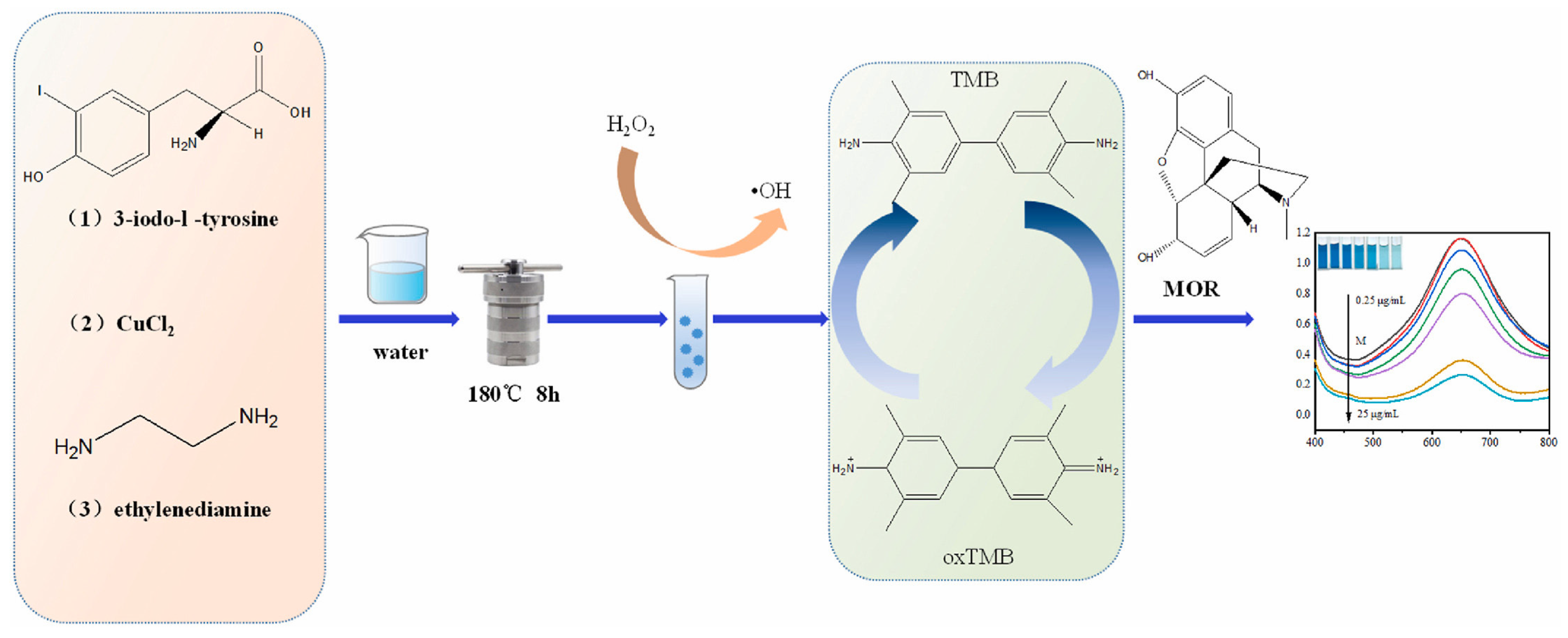
The system demonstrated rapid and specific detection of fentanyl base and derivatives (e.g., acetyl fentanyl, furanyl fentanyl) in under 5 min, without cross-reactivity with nine common drugs (e.g., morphine, cocaine, heroin). The detection limit was 10 nM, and the assay could be performed without direct contact with the sample, significantly improving safety [81]. Research has shown that copper-doped carbon quantum dots, when heated in the presence of morphine, exhibit enzyme-like behavior and trigger a color shift by modifying the structure of TMB. The color intensity varied depending on the morphine concentration, enabling detection down to 64 ng/mL [82] [Figure 9].
Figure 9.
Synthesis of Cu, I-doped carbon dots (TMIB) and their use in colorimetric morphine detection via TMB oxidation. The assay enables rapid, non-enzymatic detection with a limit of 64 ng/mL. Adapter with permission from Reference [82]. Copyright 2023, Elsevier.
5.3. Aptamer-Dye Complex and μPAD-Based Colorimetric Detection
The aptamer-dye complex system is a high-selectivity colorimetric detection platform based on the interaction between oligonucleotide aptamers and dyes. The heroin-specific aptamer HM20 forms a J-aggregate (650 nm) when combined with the MTC dye. In the presence of heroin, the dye is released and converts to a monomer (585 nm), resulting in a visible color change from purple to cyan-green. At a detection limit of 0.5 μM, this change is easily observable to the naked eye. In binary mixture tests with 25 cutting agents (e.g., lactose, lidocaine), the system maintained 95% accuracy and showed 80% better performance than the traditional Marquis reagent when detecting oxycodone tablets [83].
Additionally, a microfluidic paper-based sensor was fabricated using a DIY RepRap 3D printer integrated with a syringe pump and PDMS–hexane solution. This method forms hydrophobic channels on filter paper by applying an optimized PDMS–hexane mixture that penetrates paper pores and acts as a barrier to control fluid flow. The resulting microfluidic chip can simultaneously detect aspirin (purple), paracetamol (blue), and ciprofloxacin (red-yellow) using only microliter volumes, delivering results within 5 min. Channel width standard deviation was within 0.12 mm, demonstrating reproducibility [84]. Table 4 presents a summary of recent colorimetric sensor technologies used for detecting illicit substances.
Table 4.
Summary of the recent colorimetric technologies used for illicit substance detection.
6. Chemical Sensor Technologies for Environmental Toxin Detection
Chemical sensor technologies have evolved significantly to address the growing complexity of environmental toxins. Early efforts focused on detecting heavy metals like lead, mercury, and cadmium using electrochemical sensors based on anodic stripping voltammetry, which offered high sensitivity and portability for field use [88]. With growing concern over organic pollutants, including pesticides, industrial solvents, and emerging contaminants such as microplastics, potentiometric and amperometric sensors have gained prominence. These platforms frequently utilize enzyme inhibition mechanisms to achieve selective and sensitive detection of target analytes in complex environmental matrices [89].
By the early 2020s, attention turned to microplastics, which not only persist in the environment but also act as vectors for other toxins. Initially detected via FTIR and Raman spectroscopy, microplastics posed challenges due to their heterogeneity and low concentrations [90]. Portable optical sensors developed in 2023 enabled on-site analysis based on light scattering and fluorescence, while electrochemical sensors quantified co-contaminants like bisphenol A and phthalates [91]. In 2024, machine learning algorithms were integrated to classify microplastic types and predict toxic payloads, and IoT-enabled sensor networks facilitated real-time pollution mapping [92]. Microplastics are now recognized not only as pollutants but as carriers of heavy metals, persistent organic pollutants, and pharmaceuticals, amplifying their environmental impact. Chemical sensors capable of detecting both the polymer matrix and its adsorbed toxins are essential for comprehensive risk assessment and mitigation strategies. Additionally, MOFs and intermolecular charge transfer mechanisms have been utilized to capture and degrade toxins, such as chemical warfare agents [93], cyanide [94,95], and formaldehyde [96].
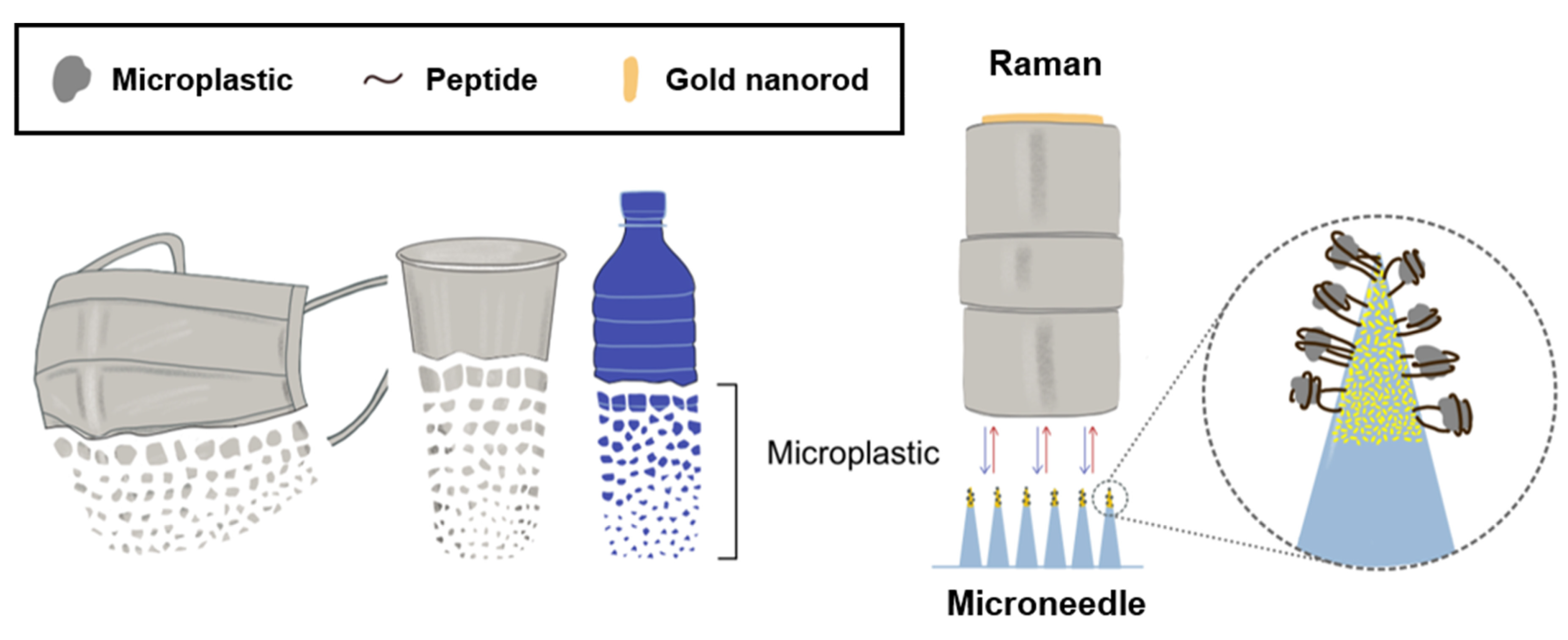
Recent reviews have highlighted the advancements in chemical sensor technologies for environmental monitoring. For instance, a study published recently discusses the recent trends in chemical sensors for detecting toxic materials, focusing on advancements in sensing and signal-transducing elements [10]. Additionally, another review described biosensors based on nanomaterials and their application in environmental monitoring for detecting heavy metals, airborne pollutants, and pesticides [97]. Moreover, another one presents a peptide-functionalized microneedle sensor embedded with gold nanorods for rapid and selective detection of microplastics via Raman spectroscopy, offering a stable and localized analytical platform for diverse environmental applications [98] (Figure 10).
Figure 10.
Peptide-functionalized microneedles with gold nanorods capture microplastics from consumer sources, enabling localized detection via Raman spectroscopy. Reproduced under the terms of the CC-BY Creative Commons Attribution 4.0 International license from Reference [98]. Copyright 2025, MDPI.
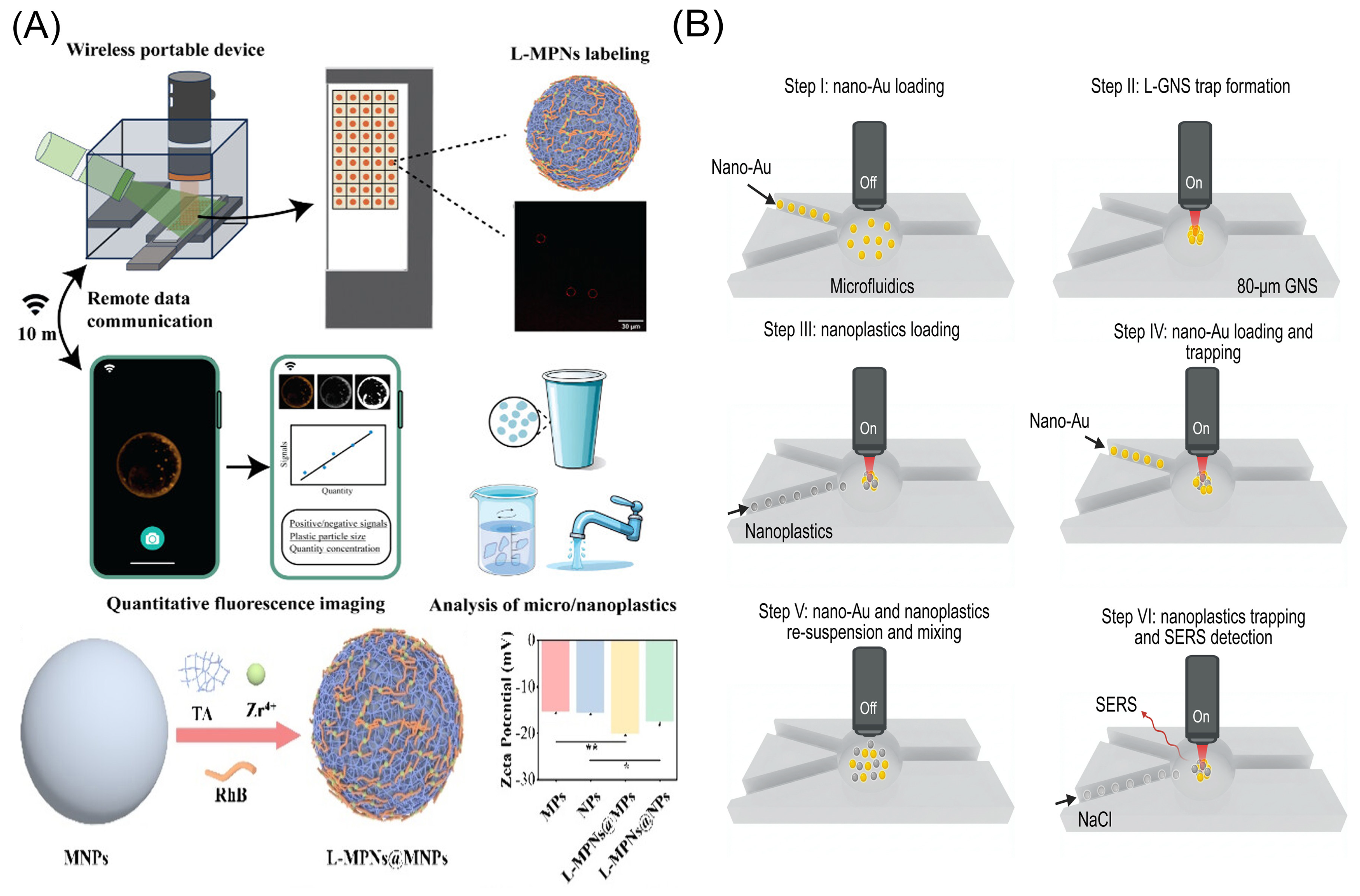
A wireless portable device integrating luminescent metal–phenolic networks composed of zirconium ions, tannic acid, and rhodamine B was developed for rapid and sensitive detection of micro/nanoplastics (MNPs). The system enables fluorescence labeling and quantification of MNPs ranging from 50 nm to 10 μm, with detection limits as low as 330 microplastics and 3.08 × 10⁶ nanoplastics within 20 min (Figure 11A). Remote data processing via a mobile app, utilizing machine learning and a decision tree model, enables efficient analysis, even by untrained personnel. This low-cost, high-throughput platform demonstrates strong potential for environmental monitoring and risk assessment of MNPs in real-world samples [99].
Figure 11.
(A) Schematic illustration of a wireless portable fluorescence-imaging platform for quantitative detection of micro- and nanoplastics, including remote data communication, on-chip fluorescence labeling of L-MPNs, and downstream quantitative image analysis. Adapter with permission from Reference [99]. Copyright, American Chemical Society (B) Microfluidic surface-enhanced Raman spectroscopy workflow showing sequential steps of nano-Au loading, formation of the localized graphene–nanostructure trap, nanoplastic loading and mixing, followed by optical trapping and SERS detection, with representative Raman spectra demonstrating concentration-dependent signal intensities for polystyrene nanoplastics. Redrawn from Reference [100]. Copyright, Springer Nature.
Another study developed a novel optical manipulation–surface-enhanced Raman scattering (OM–SERS) system for the simultaneous enrichment and detection of nanoplastics in aquatic environments. The setup utilizes gold nanoparticle stacks of varying sizes to enable precise manipulation of individual nanoplastics and large-scale enrichment, achieving detection limits as low as 150 ng/L for polystyrene using a microfluidic platform(Figure 11B) [100]. The system effectively eliminates interference from natural organic matter and identifies PS, PMMA, and PET nanoplastics via characteristic Raman peaks. It demonstrated the successful quantification of nanoplastics in real water samples with volumes of ≤7.2 mL, offering a powerful strategy for environmental monitoring. This approach also provides insights into eco-corona formation and the challenges associated with its detection. These contributions underscore the expanding versatility of chemical sensors in addressing both conventional and emerging environmental contaminants.
7. Limitations and Future Directions
Environmental toxin detection and illicit drug detection share similar sensing platforms, such as SERS and nanomaterial-based electrochemical sensors, but the sensor-design challenges diverge sharply when the target matrix shifts from biological fluids to complex environmental samples. Biological matrices like urine are comparatively consistent in composition, whereas seawater, wastewater, and soil contain highly variable mixtures of salts, natural organic matter, heavy metals, microorganisms, and particulates that can cause significant matrix effects, including signal suppression, altered ionization behavior, and nonspecific interactions that complicate detection and quantification [101]. Environmental matrices also exhibit wide variations in pH, ionic strength, and dissolved organic matter that can impact analyte binding and sensor surface chemistry, which are important considerations for both optical and electrochemical platforms. For example, high ionic strength and diverse interfering species in seawater and wastewater can reduce analytical sensitivity, necessitating careful calibration or sample pretreatment. Electrochemical sensors and other nanomaterial-enhanced devices must also contend with complex adsorption phenomena in soil, due to heterogeneous solid matrices comprising clay minerals and organic matter that strongly adsorb target analytes, thereby complicating extraction and decreasing recovery efficiency [102]. Moreover, environmental contaminants are often present at ultra-trace concentrations, requiring preconcentration and advanced amplification strategies to achieve detection limits comparable to those in cleaner biological matrices [103]. These combined factors create fundamentally different engineering constraints compared with biological samples and necessitate specialized sensor designs and sample processing methods for reliable environmental monitoring.
Although aptamers and enzyme-based recognition elements offer high selectivity, their long-term stability under field conditions remains a major barrier to deployment. Aptamers can lose structural integrity through desorption from sensor surfaces or degradation by environmental factors, particularly when immobilization relies on weak physical interactions, leading to signal loss over time [104]. Enzymes are inherently sensitive to environmental conditions, such as temperature, pH, ionic strength, and humidity, and can undergo denaturation, which substantially reduces their catalytic activity. Current studies primarily evaluate stability under controlled laboratory conditions, leaving significant gaps in understanding how these biorecognition elements function during long-term storage, transportation, and exposure to real-world environmental conditions. Addressing these gaps through improved immobilization chemistries (e.g., strong covalent attachment), protective coatings (e.g., antifouling or encapsulating layers), and standardized accelerated-aging tests is essential for developing field-ready sensing platforms [105].
Recent years have witnessed rapid advances in sensing technologies driven by developments in nanomaterials, wearable devices, and artificial intelligence (AI). Emerging AI-assisted platforms such as smart photonic and electrochemical wearables for continuous physiological monitoring demonstrate how data-driven analytics can significantly improve sensitivity, suppress noise, and enable real-time decision-making in complex field environments. For example, AI-enhanced electrochemical sensing systems have been shown to improve signal interpretation and detection performance in food safety and biosensing contexts, highlighting the broader potential of AI-assisted sensors [106].
Wearable nanomaterial-based electrochemical sensors are being developed for continuous biomarker monitoring, illustrating the integration of flexible platforms with high-performance materials [107]. Machine learning techniques, when combined with optical methods such as SERS, have significantly enhanced the ability to analyze complex datasets and improve detection accuracy in environmental applications [108].
When adapted for non-biomedical uses, these technologies hold strong potential for future drug detection and environmental monitoring, where analytes often occur at ultra-trace levels within complex matrices. Machine learning-enhanced SERS has already been explored for trace identification and classification of environmental contaminants, demonstrating adaptability to diverse sensing challenges [109].
Moreover, integrating AI with sensor platforms enables real-time analysis and autonomous decision-making, which is essential for continuous surveillance of illicit drugs in wastewater, as well as pollutants in air and water. The convergence of portable nanomaterials, wearable photonics, and AI algorithms thus represents a promising pathway toward intelligent, field-deployable platforms capable of continuous, autonomous monitoring for both drug use signatures and environmental toxins. These developments underscore the need for comprehensive reviews that bridge traditional analytical strategies with next-generation, data-driven sensor architectures.
8. Conclusions
This review evaluated the recent nanomaterials and colorimetric-based chemical sensor technologies for the detection of illicit drug substances and environmental contaminants. Advancements in nanomaterials such as functionalized nanoparticles, graphene derivatives, MXenes, and metal–organic frameworks have significantly enhanced sensor sensitivity, selectivity, and portability. Likewise, colorimetric and supramolecular assay systems offer simple, visual, and cost-effective alternatives for rapid screening, eliminating the need for complex instrumentation. Despite these advances, challenges remain in ensuring sensor stability, reproducibility, and broad-spectrum detection under diverse field conditions, such as the presence of other contaminants or body fluids. Colorimetric sensing, while highly promising for its simplicity and affordability, still faces limitations in specificity, sensitivity, and standardization, particularly against emerging synthetic drugs. The integration of nanomaterials and biomolecular recognition systems is expected to enhance detection accuracy, stability, and real-time quantification for both illicit drug detection and environmental contamination, such as micro- and nanoplastics. Future research should focus on developing multi-analyte sensing platforms, miniaturized electronics, and data-driven processing to enable autonomous, portable technologies that can detect substances even in the presence of complex environmental contaminations. By bridging the gap between laboratory innovation and real-world deployment, colorimetric and nanomaterial-based sensing technologies are poised to become indispensable tools in forensic, environmental, and public health applications.
Author Contributions
Conceptualization, M.I.H., S.K. and D.K.Y.; writing—original draft preparation, M.I.H.; writing—review and editing, S.K. and D.K.Y.; visualization, M.I.H.; supervision, D.K.Y.; funding acquisition, D.K.Y. All authors have read and agreed to the published version of the manuscript.
Funding
This work was supported by the Korean National Research Foundation (NRF-2021R1F1A-1048388).
Data Availability Statement
No new data were created or analyzed in this study. Data sharing is not applicable to this article.
Conflicts of Interest
The authors declare no conflicts of interest.
References
- United Nations Office on Drugs and Crime. World Drug Report 2024; United Nations Office on Drugs and Crime: Vienna, Austria, 2024. [Google Scholar]
- Siefried, K.J.; Acheson, L.S.; Lintzeris, N.; Ezard, N. Pharmacological Treatment of Methamphetamine/Amphetamine Dependence: A Systematic Review. CNS Drugs 2020, 34, 337–365. [Google Scholar] [CrossRef] [PubMed]
- Khalili, M.; Sadeghirad, B.; Bach, P.; Crabtree, A.; Javadi, S.; Sadeghi, E.; Moradi, S.; Mirzayeh Fashami, F.; Nakhaeizadeh, M.; Salehi, S.; et al. Management of Amphetamine and Methamphetamine Use Disorders: A Systematic Review and Network Meta-analysis of Randomized Trials. Int. J. Ment. Health Addict. 2024, 23, 4768–4786. [Google Scholar] [CrossRef] [PubMed]
- Sung, M.; Rees, V.W.; Lee, H.; Jalali, M.S. Assessment of Epidemiological Data and Surveillance in Korea Substance Use Research: Insights and Future Directions. J. Prev. Med. Public Health 2024, 57, 307–318. [Google Scholar] [CrossRef] [PubMed]
- Kim, H.J.; Hyun, J.U.; Jang, H.W. Drug Sensors for Detecting Illegal Substances: Mechanisms, Materials, and Detection Methods. J. Sens. Sci. Technol. 2025, 34, 240–248. [Google Scholar] [CrossRef]
- Anzar, N.; Suleman, S.; Singh, Y.; Kumari, S.; Parvez, S.; Pilloton, R.; Narang, J. The Evolution of Illicit-Drug Detection: From Conventional Approaches to Cutting-Edge Immunosensors-A Comprehensive Review. Biosensors 2024, 14, 477. [Google Scholar] [CrossRef]
- Buzuk, M. Chemical Sensors for Toxic Chemical Detection. Sensors 2024, 24, 6072. [Google Scholar] [CrossRef]
- Gibi, C.; Liu, C.H.; Anandan, S.; Wu, J.J. Recent Advances on Electrochemical Sensors for Detection of Contaminants of Emerging Concern (CECs). Molecules 2023, 28, 7916. [Google Scholar] [CrossRef]
- Kim, K.; Stoll, S.; Singh, R.; Lee, W.H.; Hwang, J.-H. Recent advances in illicit drug detection sensor technology in water. TrAC Trends Anal. Chem. 2023, 168, 117295. [Google Scholar] [CrossRef]
- Kim, Y.; Jeon, Y.; Na, M.; Hwang, S.J.; Yoon, Y. Recent Trends in Chemical Sensors for Detecting Toxic Materials. Sensors 2024, 24, 431. [Google Scholar] [CrossRef]
- Rosendo, L.M.; Antunes, M.; Simao, A.Y.; Brinca, A.T.; Catarro, G.; Pelixo, R.; Martinho, J.; Pires, B.; Soares, S.; Cascalheira, J.F.; et al. Sensors in the Detection of Abused Substances in Forensic Contexts: A Comprehensive Review. Micromachines 2023, 14, 2249. [Google Scholar] [CrossRef]
- Xu, Q.; Guo, Y.; Niu, G.; Wu, H.; Coulon, F.; Yang, Z. Advances in Biosensor Technology for Illicit Drug Detection Enable Effective Wastewater Surveillance. Chem. Bio Eng. 2025, cbe.4c00188. [Google Scholar] [CrossRef]
- Zhao, Y.; Gan, Y.; Chen, J.; Zheng, H.; Chang, Y.; Lin, C. Recent reports on the sensing strategy and the On-site detection of illegal drugs. RSC Adv. 2024, 14, 6917–6929. [Google Scholar] [CrossRef]
- Yi, J.; You, E.M.; Hu, R.; Wu, D.Y.; Liu, G.K.; Yang, Z.L.; Zhang, H.; Gu, Y.; Wang, Y.H.; Wang, X.; et al. Surface-enhanced Raman spectroscopy: A half-century historical perspective. Chem. Soc. Rev. 2025, 54, 1453–1551. [Google Scholar] [CrossRef] [PubMed]
- Boroujerdi, R.; Paul, R. Graphene-Based Electrochemical Sensors for Psychoactive Drugs. Nanomaterials 2022, 12, 2250. [Google Scholar] [CrossRef]
- Cai, Y.; Dong, T.; Bian, Z.; Liu, H.; Liu, X.; Liu, A. Metal-organic frameworks based fluorescent sensing: Mechanisms and detection applications. Coord. Chem. Rev. 2025, 529, 216470. [Google Scholar] [CrossRef]
- Yang, F.Q.; Ge, L. Colorimetric Sensors: Methods and Applications. Sensors 2023, 23, 9887. [Google Scholar] [CrossRef] [PubMed]
- Loima, T.; Yoon, J.Y.; Kaarj, K. Microfluidic Sensors Integrated with Smartphones for Applications in Forensics, Agriculture, and Environmental Monitoring. Micromachines 2025, 16, 835. [Google Scholar] [CrossRef]
- Zhang, J.; Wang, L.; Pan, D.; Song, S.; Boey, F.Y.C.; Zhang, H.; Fan, C. Visual Cocaine Detection with Gold Nanoparticles and Rationally Engineered Aptamer Structures. Small 2008, 4, 1196–1200. [Google Scholar] [CrossRef]
- Liu, J.; Lu, Y. Fast colorimetric sensing of adenosine and cocaine based on a general sensor design involving aptamers and nanoparticles. Angew. Chem. Int. Ed. Engl. 2005, 45, 90–94. [Google Scholar] [CrossRef]
- Butterworth, A.; Blues, E.; Williamson, P.; Cardona, M.; Gray, L.; Corrigan, D.K. SAM Composition and Electrode Roughness Affect Performance of a DNA Biosensor for Antibiotic Resistance. Biosensors 2019, 9, 22. [Google Scholar] [CrossRef]
- Shao, W.; Sorescu, D.C.; Liu, Z.; Star, A. Machine Learning Discrimination and Ultrasensitive Detection of Fentanyl Using Gold Nanoparticle-Decorated Carbon Nanotube-Based Field-Effect Transistor Sensors. Small 2024, 20, e2311835. [Google Scholar] [CrossRef] [PubMed]
- Ding, Z.; Wang, C.; Song, X.; Li, N.; Zheng, X.; Wang, C.; Su, M.; Liu, H. Strong pi-Metal Interaction Enables Liquid Interfacial Nanoarray-Molecule Co-assembly for Raman Sensing of Ultratrace Fentanyl Doped in Heroin, Ketamine, Morphine, and Real Urine. ACS Appl. Mater. Interfaces 2023, 15, 12570–12579. [Google Scholar] [CrossRef] [PubMed]
- Mao, K.; Yang, Z.; Li, J.; Zhou, X.; Li, X.; Hu, J. A novel colorimetric biosensor based on non-aggregated Au@Ag core-shell nanoparticles for methamphetamine and cocaine detection. Talanta 2017, 175, 338–346. [Google Scholar] [CrossRef] [PubMed]
- Hossain, M.I.; Nanda, S.S.; Cho, S.; Lee, B.; Kim, B.J.; Choi, J.Y.; Yi, D.K. Gold Nanorod Density-Dependent Label-Free Bacteria Sensing on a Flake-like 3D Graphene-Based Device by SERS. Biosensors 2023, 13, 962. [Google Scholar] [CrossRef]
- Schuknecht, F.; Kolataj, K.; Steinberger, M.; Liedl, T.; Lohmueller, T. Accessible hotspots for single-protein SERS in DNA-origami assembled gold nanorod dimers with tip-to-tip alignment. Nat. Commun. 2023, 14, 7192. [Google Scholar] [CrossRef]
- Hsu, Y.T.; Lin, S.H.; Liu, K.K. A flexible plasmonic substrate for sensitive surface-enhanced Raman scattering-based detection of fentanyl. Chem. Commun. 2024, 60, 13903–13906. [Google Scholar] [CrossRef]
- Yilmaz, H.; Bae, S.H.; Cao, S.; Wang, Z.; Raman, B.; Singamaneni, S. Gold-Nanorod-Based Plasmonic Nose for Analysis of Chemical Mixtures. ACS Appl. Nano Mater. 2019, 2, 3897–3905. [Google Scholar] [CrossRef]
- Mynttinen, E.; Wester, N.; Lilius, T.; Kalso, E.; Mikladal, B.; Varjos, I.; Sainio, S.; Jiang, H.; Kauppinen, E.I.; Koskinen, J.; et al. Electrochemical Detection of Oxycodone and Its Main Metabolites with Nafion-Coated Single-Walled Carbon Nanotube Electrodes. Anal. Chem. 2020, 92, 8218–8227. [Google Scholar] [CrossRef]
- Wester, N.; Mynttinen, E.; Etula, J.; Lilius, T.; Kalso, E.; Kauppinen, E.I.; Laurila, T.; Koskinen, J. Simultaneous Detection of Morphine and Codeine in the Presence of Ascorbic Acid and Uric Acid and in Human Plasma at Nafion Single-Walled Carbon Nanotube Thin-Film Electrode. ACS Omega 2019, 4, 17726–17734. [Google Scholar] [CrossRef]
- Akbari, M.; Mohammadnia, M.S.; Ghalkhani, M.; Aghaei, M.; Sohouli, E.; Rahimi-Nasrabadi, M.; Arbabi, M.; Banafshe, H.R.; Sobhani-Nasab, A. Development of an electrochemical fentanyl nanosensor based on MWCNT-HA/Cu-H3BTC nanocomposite. J. Ind. Eng. Chem. 2022, 114, 418–426. [Google Scholar] [CrossRef]
- Jun, D.; Sammis, G.; Rezazadeh-Azar, P.; Ginoux, E.; Bizzotto, D. Development of a Graphene-Oxide-Deposited Carbon Electrode for the Rapid and Low-Level Detection of Fentanyl and Derivatives. Anal. Chem. 2022, 94, 12706–12714. [Google Scholar] [CrossRef] [PubMed]
- Li, M.; Chen, H.; Xu, A.; Duan, S.; Liu, Q.; Zhang, R.; Wang, S.; Bai, H. High-performance fentanyl molecularly imprinted electrochemical sensing platform designed through molecular simulations. Anal. Chim. Acta 2024, 1312, 342686. [Google Scholar] [CrossRef]
- Kumar, N.; Rana, M.; Geiwitz, M.; Khan, N.I.; Catalano, M.; Ortiz-Marquez, J.C.; Kitadai, H.; Weber, A.; Dweik, B.; Ling, X.; et al. Rapid, Multianalyte Detection of Opioid Metabolites in Wastewater. ACS Nano 2022, 16, 3704–3714. [Google Scholar] [CrossRef]
- De Rycke, E.; Stove, C.; Dubruel, P.; De Saeger, S.; Beloglazova, N. Recent developments in electrochemical detection of illicit drugs in diverse matrices. Biosens. Bioelectron. 2020, 169, 112579. [Google Scholar] [CrossRef] [PubMed]
- Glasscott, M.W.; Vannoy, K.J.; Iresh Fernando, P.U.A.; Kosgei, G.K.; Moores, L.C.; Dick, J.E. Electrochemical sensors for the detection of fentanyl and its analogs: Foundations and recent advances. TrAC Trends Anal. Chem. 2020, 132, 116037. [Google Scholar] [CrossRef]
- Li, M.; Duan, S.; Chen, H.; Zou, F.; Zhang, G.; Liu, Q.; Zhang, R.; Zeng, X.; Bai, H. A promising and highly sensitive electrochemical platform for the detection of fentanyl and alfentanil in human serum. Mikrochim. Acta 2023, 190, 414. [Google Scholar] [CrossRef] [PubMed]
- Truta, F.; Dragan, A.M.; Tertis, M.; Parrilla, M.; Slosse, A.; Van Durme, F.; de Wael, K.; Cristea, C. Electrochemical Rapid Detection of Methamphetamine from Confiscated Samples Using a Graphene-Based Printed Platform. Sensors 2023, 23, 6193. [Google Scholar] [CrossRef]
- Gupta, G.H.; Kadakia, S.; Agiwal, D.; Keshari, T.; Kumar, S. Borophene nanomaterials: Synthesis and applications in biosensors. Mater. Adv. 2024, 5, 1803–1816. [Google Scholar] [CrossRef]
- Kaimal, R.; Maridevaru, M.C.; Dube, A.; Wu, J.J.; Sambandam, A.; Ashokkumar, M. Borophene Nanosheet-Based Electrochemical Sensing toward Groundwater Arsenic Detection. Ind. Eng. Chem. Res. 2023, 62, 15418–15427. [Google Scholar] [CrossRef]
- Dube, A.; Malode, S.J.; Alruwaili, M.; Alodhayb, A.N.; Maiyalagan, T.; Shetti, N.P. Borophene and Its Composite-Based Electrochemical Sensors. ChemElectroChem 2025, 12, e202400670. [Google Scholar] [CrossRef]
- Sun, Y.; Ma, J.; Wang, Y.; Qiao, S.; Feng, Y.; Li, Z.; Wang, Z.; Han, Y.; Zhu, Z. A Wearable Patch Sensor for Simultaneous Detection of Dopamine and Glucose in Sweat. Analytica 2023, 4, 170–181. [Google Scholar] [CrossRef]
- Srivastava, A.; Dkhar, D.S.; Singh, N.; Azad, U.P.; Chandra, P. Exploring the Potential Applications of Engineered Borophene in Nanobiosensing and Theranostics. Biosensors 2023, 13, 740. [Google Scholar] [CrossRef] [PubMed]
- Afzal, M.H.; Pervaiz, W.; Asif, M.; Huang, Z.; Dai, J.; Xu, Y.; Zhu, J.; Zhang, T.; Rao, Z.; Li, G.; et al. Engineering MXenes for electrochemical environmental pollutant sensing. Environ. Sci. Nano 2025, 12, 121–149. [Google Scholar] [CrossRef]
- Amarnath, K.; Selvi Gopal, T.; Josephine Malathi, A.C.; Pandiaraj, S.; Alruwaili, M.; Alshammari, A.; Alodhayb, A.N.; Abeykoon, C.; Grace, A.N.; Kumar, V.G. Electrochemical Detection of Dopamine and Uric Acid with Annealed Metal–Organic Framework/MXene (CuO/C/Ti3C2Tx) Nanosheet Composites for Neurotransmitter Sensing. ACS Appl. Nano Mater. 2025, 8, 12661–12675. [Google Scholar] [CrossRef]
- Masekela, D.; Dlamini, L.N. Molecularly imprinted and MXene-based electrochemical sensors for detecting pharmaceuticals and toxic compounds: A concise review. J. Environ. Chem. Eng. 2024, 12, 114569. [Google Scholar] [CrossRef]
- Zhao, Z.; Cao, J.; Zhu, B.; Li, X.; Zhou, L.; Su, B. Recent Advances in MXene-Based Electrochemical Sensors. Biosensors 2025, 15, 107. [Google Scholar] [CrossRef]
- Yao, Y.; Li, X.; Sisican, K.M.; Ramos, R.M.C.; Judicpa, M.; Qin, S.; Zhang, J.; Yao, J.; Razal, J.M.; Usman, K.A.S. Progress towards efficient MXene sensors. Commun. Mater. 2025, 6, 210. [Google Scholar] [CrossRef]
- Cai, Z.; Kim, H. Recent advances in MXene gas sensors: Synthesis, composites, and mechanisms. npj 2D Mater. Appl. 2025, 9, 66. [Google Scholar] [CrossRef]
- Mishra, V.; Mishra, A. Metal-Organic Frameworks for Detection of Drugs of Abuse. In Metal-Organic Frameworks as Forensic Detectors; Mishra, V., Mishra, A., Eds.; Springer Nature: Singapore, 2025; pp. 81–96. [Google Scholar]
- Sun, F.; Liu, H.; Chen, J.; Tufa, L.T.; Yan, X.; Li, R.; Chen, H.; Ogawa, K.; Lee, J.; Hu, X. Ultrafast detection of an amphetamine-type derivative employing benzothiadiazole-based Zr-MOF: Fluorescence enhancement by locking the host molecular torsion. Microchem. J. 2024, 199, 110039. [Google Scholar] [CrossRef]
- Zhao, J.; Kan, Y.; Chen, Z.; Li, H.; Zhang, W. MOFs-Modified Electrochemical Sensors and the Application in the Detection of Opioids. Biosensors 2023, 13, 284. [Google Scholar] [CrossRef]
- Wang, K.; Hui, K.N.; San Hui, K.; Peng, S.; Xu, Y. Recent progress in metal-organic framework/graphene-derived materials for energy storage and conversion: Design, preparation, and application. Chem. Sci. 2021, 12, 5737–5766. [Google Scholar] [CrossRef] [PubMed]
- Chang, Y.-N.; Shen, C.-H.; Huang, C.-W.; Tsai, M.-D.; Kung, C.-W. Defective Metal–Organic Framework Nanocrystals as Signal Amplifiers for Electrochemical Dopamine Sensing. ACS Appl. Nano Mater. 2023, 6, 3675–3684. [Google Scholar] [CrossRef]
- Naghian, E.; Marzi Khosrowshahi, E.; Sohouli, E.; Ahmadi, F.; Rahimi-Nasrabadi, M.; Safarifard, V. A new electrochemical sensor for the detection of fentanyl lethal drug by a screen-printed carbon electrode modified with the open-ended channels of Zn(ii)-MOF. New J. Chem. 2020, 44, 9271–9277. [Google Scholar] [CrossRef]
- Karimi-Harandi, M.-H.; Shabani-Nooshabadi, M.; Darabi, R. Cu-BTC Metal-Organic Frameworks as Catalytic Modifier for Ultrasensitive Electrochemical Determination of Methocarbamol in the Presence of Methadone. J. Electrochem. Soc. 2021, 168, 097507. [Google Scholar] [CrossRef]
- Mousaabadi, K.Z.; Ensafi, A.A.; Rezaei, B. Simultaneous determination of some opioid drugs using Cu-hemin MOF@MWCNTs as an electrochemical sensor. Chemosphere 2022, 303, 135149. [Google Scholar] [CrossRef]
- Radha, G.; Kumar, K.S.; Chappanda, K.N.; Aggarwal, H. Zr-NDI MOF Based Optical and Electrochemical Dual Sensor for Selective Detection of Dopamine. J. Phys. Chem. C 2023, 127, 8864–8872. [Google Scholar] [CrossRef]
- Beer. Bestimmung der Absorption des rothen Lichts in farbigen Flüssigkeiten. Ann. Der Phys. 2006, 162, 78–88. [Google Scholar] [CrossRef]
- Shang, X.S.; Li, D.Y.; Li, N.T.; Liu, P.N. A concise synthesis of tunable fluorescent 1,3-dihydroisobenzofuran derivatives as new fluorophores. Dye. Pigment. 2015, 114, 8–17. [Google Scholar] [CrossRef]
- Fu, G.; Sanjay, S.T.; Zhou, W.; Brekken, R.A.; Kirken, R.A.; Li, X. Exploration of Nanoparticle-Mediated Photothermal Effect of TMB-H2O2 Colorimetric System and Its Application in a Visual Quantitative Photothermal Immunoassay. Anal. Chem. 2018, 90, 5930–5937. [Google Scholar] [CrossRef]
- Goncalves, J.M.; Iglesias, B.A.; Martins, P.R.; Angnes, L. Recent advances in electroanalytical drug detection by porphyrin/phthalocyanine macrocycles: Developments and future perspectives. Analyst 2021, 146, 365–381. [Google Scholar] [CrossRef]
- Pishchalnikov, R.Y.; Chesalin, D.D.; Kurkov, V.A.; Shkirina, U.A.; Laptinskaya, P.K.; Novikov, V.S.; Kuznetsov, S.M.; Razjivin, A.P.; Moskovskiy, M.N.; Dorokhov, A.S.; et al. A Prototype Method for the Detection and Recognition of Pigments in the Environment Based on Optical Property Simulation. Plants 2023, 12, 4178. [Google Scholar] [CrossRef]
- Xue, S.S.; Pan, Y.; Pan, W.; Liu, S.; Li, N.; Tang, B. Bioimaging agents based on redox-active transition metal complexes. Chem. Sci. 2022, 13, 9468–9484. [Google Scholar] [CrossRef] [PubMed]
- Kusuma, S.A.F.; Harmonis, J.A.; Pratiwi, R.; Hasanah, A.N. Gold Nanoparticle-Based Colorimetric Sensors: Properties and Application in Detection of Heavy Metals and Biological Molecules. Sensors 2023, 23, 8172. [Google Scholar] [CrossRef] [PubMed]
- Shellaiah, M.; Sun, K.-W. Review on Anti-Aggregation-Enabled Colorimetric Sensing Applications of Gold and Silver Nanoparticles. Chemosensors 2022, 10, 536. [Google Scholar] [CrossRef]
- Huang, J.; Kaner, R.B. The intrinsic nanofibrillar morphology of polyaniline. Chem. Commun. 2006, 4, 367–376. [Google Scholar] [CrossRef]
- Jia, X.; Chen, Z.; Duan, C.; Wang, Z.; Yin, Q.; Huang, F.; Cao, Y. Polythiophene derivatives compatible with both fullerene and non-fullerene acceptors for polymer solar cells. J. Mater. Chem. C 2019, 7, 314–323. [Google Scholar] [CrossRef]
- Escalona-Villalpando, R.A.; Viveros-Palma, K.; Espinosa-Lagunes, F.I.; Rodriguez-Morales, J.A.; Arriaga, L.G.; Macazo, F.C.; Minteer, S.D.; Ledesma-Garcia, J. Comparative Colorimetric Sensor Based on Bi-Phase gamma-/alpha-Fe2O3 and gamma-/alpha-Fe2O3/ZnO Nanoparticles for Lactate Detection. Biosensors 2022, 12, 1025. [Google Scholar] [CrossRef]
- Sridhar, R.; Lakshminarayanan, R.; Madhaiyan, K.; Amutha Barathi, V.; Lim, K.H.; Ramakrishna, S. Electrosprayed nanoparticles and electrospun nanofibers based on natural materials: Applications in tissue regeneration, drug delivery and pharmaceuticals. Chem. Soc. Rev. 2015, 44, 790–814. [Google Scholar] [CrossRef]
- Kannan, P.K.; Late, D.J.; Morgan, H.; Rout, C.S. Recent developments in 2D layered inorganic nanomaterials for sensing. Nanoscale 2015, 7, 13293–13312. [Google Scholar] [CrossRef]
- Kim Cuc, T.T.; Nhien, P.Q.; Khang, T.M.; Chen, H.Y.; Wu, C.H.; Hue, B.B.; Li, Y.K.; Wu, J.I.; Lin, H.C. Controllable FRET Behaviors of Supramolecular Host-Guest Systems as Ratiometric Aluminum Ion Sensors Manipulated by Tetraphenylethylene-Functionalized Macrocyclic Host Donor and Multistimuli-Responsive Fluorescein-Based Guest Acceptor. ACS Appl. Mater. Interfaces 2021, 13, 20662–20680. [Google Scholar] [CrossRef]
- Ligler, F.S. Fluorescence-Based Optical Biosensors. In Biophotonics; Pavesi, L., Fauchet, P.M., Eds.; Springer: Berlin/Heidelberg, Germany, 2008; pp. 199–215. [Google Scholar]
- Wu, Y.; Feng, J.; Hu, G.; Zhang, E.; Yu, H.H. Colorimetric Sensors for Chemical and Biological Sensing Applications. Sensors 2023, 23, 2749. [Google Scholar] [CrossRef]
- Hua, Y.; Ma, J.; Li, D.; Wang, R. DNA-Based Biosensors for the Biochemical Analysis: A Review. Biosensors 2022, 12, 183. [Google Scholar] [CrossRef] [PubMed]
- Deng, H.H.; Hong, G.L.; Lin, F.L.; Liu, A.L.; Xia, X.H.; Chen, W. Colorimetric detection of urea, urease, and urease inhibitor based on the peroxidase-like activity of gold nanoparticles. Anal. Chim. Acta 2016, 915, 74–80. [Google Scholar] [CrossRef]
- Panferov, V.G.; Liu, J. Optical and Catalytic Properties of Nanozymes for Colorimetric Biosensors: Advantages, Limitations, and Perspectives. Adv. Opt. Mater. 2024, 12, 2401318. [Google Scholar] [CrossRef]
- Jeon, H.J.; Kim, H.S.; Chung, E.; Lee, D.Y. Nanozyme-based colorimetric biosensor with a systemic quantification algorithm for noninvasive glucose monitoring. Theranostics 2022, 12, 6308–6338. [Google Scholar] [CrossRef] [PubMed]
- Philp, M.; Shimmon, R.; Tahtouh, M.; Fu, S. Development and validation of a presumptive color spot test method for the detection of synthetic cathinones in seized illicit materials. Forensic Chem. 2016, 1, 39–50. [Google Scholar] [CrossRef]
- Canfield, J.R.; Agarwal, S.; Fortener, S.K.; Sprague, J.E. Fentanyl Detection Using Eosin Y Paper Assays. J. Forensic Sci. 2020, 65, 1432–1442. [Google Scholar] [CrossRef]
- Mora, A.C.; Vara, M.; Reust, P.; Code, A.; Oliver, P.; Mace, C.R. Colorimetric Detection of Fentanyl Powder on Surfaces Using a Supramolecular Displacement Assay. ACS Sens. 2024, 9, 3198–3204. [Google Scholar] [CrossRef]
- Yin, Q.; Yang, X.; Yang, L.; Yang, D.; Yang, Y.; Zhu, Y. Cu, I-doped carbon dots as simulated nanozymes for the colorimetric detection of morphine in biological samples. Anal. Biochem. 2023, 680, 115313. [Google Scholar] [CrossRef]
- Canoura, J.; Alkhamis, O.; Venzke, M.; Ly, P.T.; Xiao, Y. Developing Aptamer-Based Colorimetric Opioid Tests. JACS Au 2024, 4, 1059–1072. [Google Scholar] [CrossRef]
- Mishra, P.; Navariya, S.; Gupta, P.; Singh, B.P.; Chopra, S.; Shrivastava, S.; Agrawal, V.V. A novel approach to low-cost, rapid and simultaneous colorimetric detection of multiple analytes using 3D printed microfluidic channels. R. Soc. Open Sci. 2024, 11, 231168. [Google Scholar] [CrossRef] [PubMed]
- Rawat, K.A.; Basu, H.; Singhal, R.K.; Kailasa, S.K. Simultaneous colorimetric detection of four drugs in their pharmaceutical formulations using unmodified gold nanoparticles as a probe. RSC Adv. 2015, 5, 19924–19932. [Google Scholar] [CrossRef]
- Adegoke, O.; Zolotovskaya, S.; Abdolvand, A.; Daeid, N.N. Biomimetic graphene oxide-cationic multi-shaped gold nanoparticle-hemin hybrid nanozyme: Tuning enhanced catalytic activity for the rapid colorimetric apta-biosensing of amphetamine-type stimulants. Talanta 2020, 216, 120990. [Google Scholar] [CrossRef] [PubMed]
- Lotfi, A.; Karimi, S.; Hassanzadeh, J. Molecularly imprinted polymers on multi-walled carbon nanotubes as an efficient absorbent for preconcentration of morphine and its chemiluminometric determination. RSC Adv. 2016, 6, 93445–93452. [Google Scholar] [CrossRef]
- Borrill, A.J.; Reily, N.E.; Macpherson, J.V. Addressing the practicalities of anodic stripping voltammetry for heavy metal detection: A tutorial review. Analyst 2019, 144, 6834–6849. [Google Scholar] [CrossRef]
- Meyburg, S.; Goryll, M.; Moers, J.; Ingebrandt, S.; Bocker-Meffert, S.; Luth, H.; Offenhausser, A. N-Channel field-effect transistors with floating gates for extracellular recordings. Biosens. Bioelectron. 2006, 21, 1037–1044. [Google Scholar] [CrossRef]
- Huang, M.; Si, C.; Qiu, C.; Wang, G. Microplastics analysis: From qualitative to quantitative. Environ. Sci. Adv. 2024, 3, 1652–1668. [Google Scholar] [CrossRef]
- Campos-López, M.; Aguilar-Garay, R.; González-Rodriguez, D.E.; Mejía-Lopez, V.I.; Gamboa-Lugo, M.M.; Garibay-Febles, V.; Reyes-Guzmán, M.A.; Gordillo-Sol, Á.; Mendoza-Pérez, J.A. A Portable Optical Sensor for Microplastic Detection: Development and Calibration. Appl. Sci. 2025, 15, 4757. [Google Scholar] [CrossRef]
- Sajan, R.I.; Manchu, M.; Felsy, C.; Joselin Kavitha, M. Microplastic predictive modelling with the integration of Artificial Neural Networks and Hidden Markov Models (ANN-HMM). J. Environ. Health Sci. Eng. 2024, 22, 579–592. [Google Scholar] [CrossRef]
- Irfan, A.; Gandra, U.R.; Jaoudé, M.A.; Qurashi, A.; Price, G.J.; Burrows, A.D.; Mohideen, M.I.H. Advances in synthesis pathways towards metal-organic frameworks-fiber composites for chemical warfare agents and simulants degradation. Coord. Chem. Rev. 2025, 541, 216842. [Google Scholar] [CrossRef]
- Gandra, U.R.; Pandey, R.P.; Palanikumar, L.; Irfan, A.; Magzoub, M.; Belmabkhout, Y.; Hasan, S.W.; Mohideen, M.I.H. Cu-TCPP Metal-Organic Nanosheets Embedded Thin-Film Composite Membranes for Enhanced Cyanide Detection and Removal: A Multifunctional Approach to Water Treatment and Environmental Safety. ACS Appl. Mater. Interfaces 2025, 17, 9563–9574. [Google Scholar] [CrossRef] [PubMed]
- Gandra, U.R.; Lo, R.; Managutti, P.B.; Butt, A.M.; Reddy, P.S.; Qurashi, A.U.H.; Mohamed, S.; Mohideen, M.I.H. ICT-based fluorescent nanoparticles for selective cyanide ion detection and quantification in apple seeds. Analyst 2025, 150, 489–497. [Google Scholar] [CrossRef] [PubMed]
- Chekkaramkodi, D.; Gandra, U.R.; Mettu, S.; Butt, H. Integration of rhodamine-based compounds into 3D-Printed structures for selective formaldehyde detection and food spoilage monitoring. Chemosphere 2025, 391, 144720. [Google Scholar] [CrossRef] [PubMed]
- Sharma, M.; Mahajan, P.; Alsubaie, A.S.; Khanna, V.; Chahal, S.; Thakur, A.; Yadav, A.; Arya, A.; Singh, A.; Singh, G. Next-generation nanomaterials-based biosensors: Real-time biosensing devices for detecting emerging environmental pollutants. Mater. Today Sustain. 2025, 29, 101068. [Google Scholar] [CrossRef]
- Ahn, S.; Kim, N.; Choi, Y.; Kim, J.; Hwang, H.; Kim, C.; Lee, H.Y.; Kim, S.; Kim, J.S.; Lee, H.H.; et al. Peptide-Decorated Microneedles for the Detection of Microplastics. Biosensors 2024, 14, 140. [Google Scholar] [CrossRef]
- Ye, H.; Zheng, X.; Yang, H.; Kowal, M.D.; Seifried, T.M.; Singh, G.P.; Aayush, K.; Gao, G.; Grant, E.; Kitts, D.; et al. Cost-Effective and Wireless Portable Device for Rapid and Sensitive Quantification of Micro/Nanoplastics. ACS Sens. 2024, 9, 4662–4670. [Google Scholar] [CrossRef]
- Shi, X.; Mao, T.; Huang, X.; Shi, H.; Jiang, K.; Lan, R.; Zhao, H.; Ma, J.; Zhao, J.; Xing, B. Capturing, enriching and detecting nanoplastics in water based on optical manipulation, surface-enhanced Raman scattering and microfluidics. Nat. Water 2025, 3, 449–460. [Google Scholar] [CrossRef]
- Menger, R.F.; Funk, E.; Henry, C.S.; Borch, T. Sensors for detecting per- and polyfluoroalkyl substances (PFAS): A critical review of development challenges, current sensors, and commercialization obstacles. Chem. Eng. J. 2021, 417, 129133. [Google Scholar] [CrossRef]
- Omo-Okoro, P.; Ofori, P.; Amalapridman, V.; Dadrasnia, A.; Abbey, L.; Emenike, C. Soil Pollution and Its Interrelation with Interfacial Chemistry. Molecules 2025, 30, 2636. [Google Scholar] [CrossRef]
- Xiao, Y.; Du, Z.; Li, Y.; Cao, L.; Zhu, B.; Kitaguchi, T.; Huang, C. A Review on the Application of Biosensors for Monitoring Emerging Contaminants in the Water Environment. Sensors 2025, 25, 4945. [Google Scholar] [CrossRef]
- Pellitero, M.A.; Arroyo-Curras, N. Study of surface modification strategies to create glassy carbon-supported, aptamer-based sensors for continuous molecular monitoring. Anal. Bioanal. Chem. 2022, 414, 5627–5641. [Google Scholar] [CrossRef]
- Pushparajah, S.; Shafiei, M.; Yu, A. Current Advances in Aptasensors for Pesticide Detection. Top. Curr. Chem. 2025, 383, 17. [Google Scholar] [CrossRef]
- Zhao, Y.; Sun, T.; Zhang, H.; Li, W.; Lian, C.; Jiang, Y.; Qu, M.; Zhao, Z.; Wang, Y.; Sun, Y.; et al. AI-Enhanced Electrochemical Sensing Systems: A Paradigm Shift for Intelligent Food Safety Monitoring. Biosensors 2025, 15, 565. [Google Scholar] [CrossRef]
- Li, X.; Liu, S.; Huang, X.; Yao, C.; Chen, J.; Gao, L.; Zhou, C.; Wu, Y.; Liu, J.; Li, M.; et al. Aptamers-based wearable electrochemical sensors for continuous monitoring of biomarkers in vivo. Microsyst. Nanoeng. 2025, 11, 241. [Google Scholar] [CrossRef]
- Srivastava, S.; Wang, W.; Zhou, W.; Jin, M.; Vikesland, P.J. Machine Learning-Assisted Surface-Enhanced Raman Spectroscopy Detection for Environmental Applications: A Review. Environ. Sci. Technol. 2024, 58, 20830–20848. [Google Scholar] [CrossRef]
- Darwish, M.A.; Abd-Elaziem, W.; Elsheikh, A.; Zayed, A.A. Advancements in nanomaterials for nanosensors: A comprehensive review. Nanoscale Adv. 2024, 6, 4015–4046. [Google Scholar] [CrossRef]
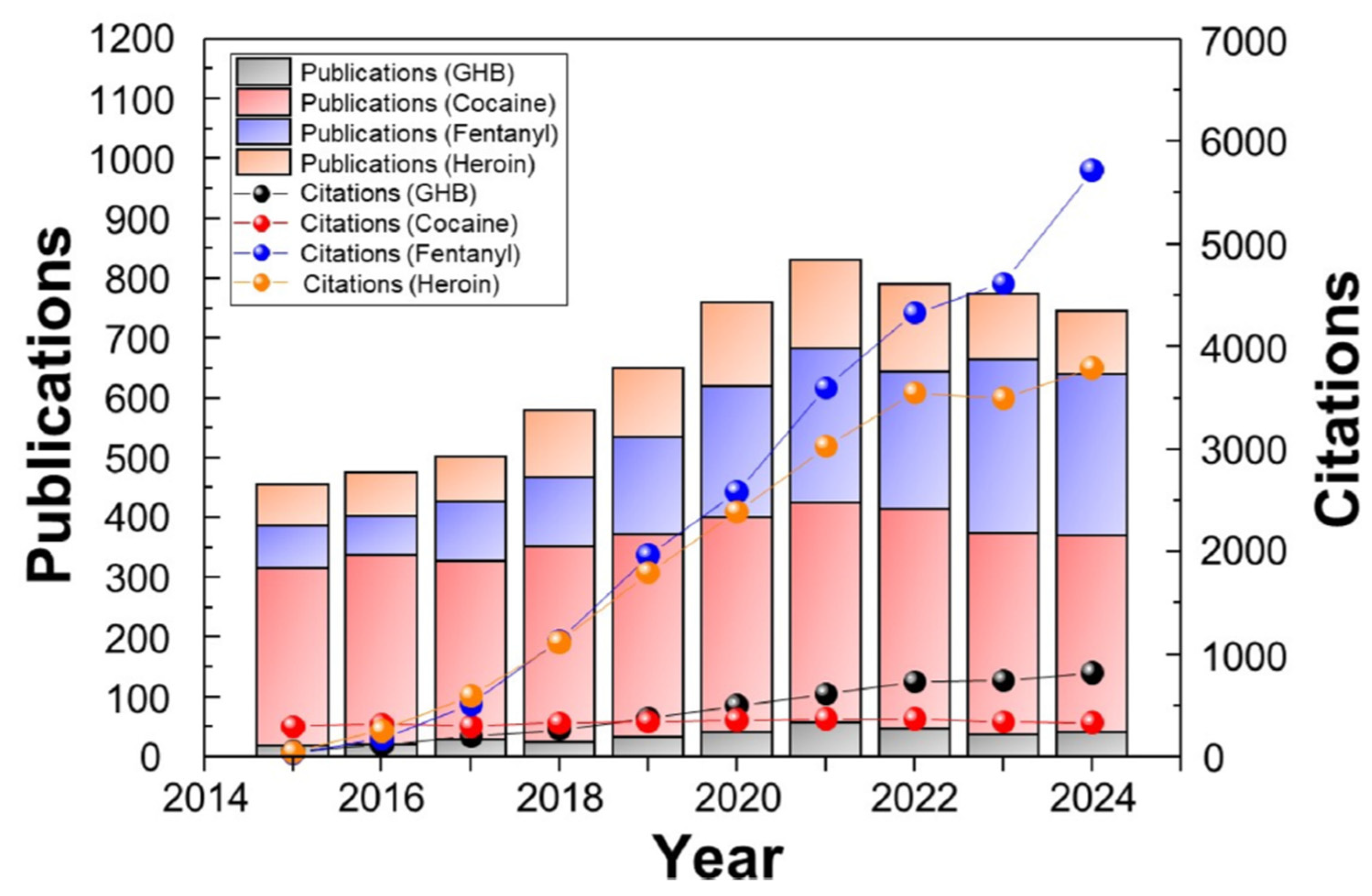
Disclaimer/Publisher’s Note: The statements, opinions and data contained in all publications are solely those of the individual author(s) and contributor(s) and not of MDPI and/or the editor(s). MDPI and/or the editor(s) disclaim responsibility for any injury to people or property resulting from any ideas, methods, instructions or products referred to in the content. |
© 2026 by the authors. Licensee MDPI, Basel, Switzerland. This article is an open access article distributed under the terms and conditions of the Creative Commons Attribution (CC BY) license.