Article

Expression Profile of CEACAM-5, CA125 and HE4 Proteins in Tumor and Corresponding Margin Samples in a Group of Patients with Gastroenteropancreatic Neuroendocrine Tumors (GEP-NET)


by
Agata Świętek
1,*,
Joanna Katarzyna Strzelczyk
1,
Dorota Hudy
1,
Zenon P. Czuba
2,
Karolina Snopek-Miśta
3,
Mariusz Kryj
3,
Katarzyna Kuśnierz
4,
Sławomir Mrowiec
4,
Marcin Zeman
5,
Małgorzata Roś-Mazurczyk
6 and
Janusz Strzelczyk
7
1
Department of Medical and Molecular Biology, Faculty of Medical Sciences in Zabrze, Medical University of Silesia in Katowice, 19 Jordana St., 41-808 Zabrze, Poland
2
Department of Microbiology and Immunology, Faculty of Medical Sciences in Zabrze, Medical University of Silesia in Katowice, 19 Jordana, 41-808 Zabrze, Poland
3
Department of Oncological Surgery, Prof. Kornel Gibiński Independent Public Central Clinical Hospital, Medical University of Silesia in Katowice, 35 Ceglana St., 40-514 Katowice, Poland
4
Department of Gastrointestinal Surgery, Faculty of Medical Sciences in Katowice, Medical University of Silesia in Katowice, 14 Medyków St., 40-752 Katowice, Poland
5
III Department of Oncological Surgery, Maria Sklodowska-Curie National Research Institute of Oncology, Gliwice Branch, 15 Wybrzeże Armii Krajowej Str., 44-100 Gliwice, Poland
6
Center for Translational Research and Molecular Biology of Cancer, Maria Sklodowska-Curie Institute—National Research Institute of Oncology, ul. Wybrzeże Armii Krajowej 15, 44-101 Gliwice, Poland
7
Department of Endocrinology and Neuroendocrine Tumors, Department of Pathophysiology and Endocrinology, Faculty of Medical Sciences in Zabrze, Medical University of Silesia in Katowice, 35 Ceglana St., 40-514 Katowice, Poland
*
Author to whom correspondence should be addressed.
Appl. Sci. 2026, 16(2), 692; https://doi.org/10.3390/app16020692
Submission received: 30 November 2025 / Revised: 29 December 2025 / Accepted: 7 January 2026 / Published: 9 January 2026

Abstract

Biomarkers such as CEACAM-5, CA125 and HE4 have been implicated in tumor progression, invasion, and microenvironment modulation in several cancers, but their protein expression in GEP-NET remains poorly characterized. This study aimed to evaluate CEACAM-5, CA125 and HE4 levels in tumors and matched surgical margin samples from 59 GEP-NET patients and assess correlations with clinical and demographic variables. Total protein concentration was measured spectrophotometrically, and selected cytokines by multiplex immunoassay. No significant differences in CEACAM-5, CA125 and HE4 protein concentrations were found between tumor and margin samples. However, in tumor tissue, CA125 protein levels showed a statistically significant association with T and M status. A significantly higher level of all proteins was observed in ileum or colon tumors compared to pancreas. Analysis of HE4 revealed differences in protein levels between male and female tumor samples. CEACAM-5, CA125 and HE4 proteins showed distinct expression patterns in GEP-NET according to tumor stage, metastasis, primary tumor location, and sex, highlighting their potential as tissue biomarkers of tumor aggressiveness and microenvironmental activity. These findings provide a basis for future studies on their prognostic and therapeutic relevance.

1. Introduction

Gastroenteropancreatic neuroendocrine tumors (GEP-NETs) represent a heterogeneous and biologically intricate category of malignancies originating from neuroendocrine cells dispersed throughout the gastrointestinal tract and the pancreas [1]. Although they comprise only a small fraction of all gastrointestinal cancers, their incidence has risen substantially in recent decades, a trend primarily attributed to advancements in diagnostic modalities and heightened clinical recognition [2,3]. GEP-NETs display considerable variability in hormonal activity, proliferative capacity, and clinical course, spanning from slow-growing, well-differentiated neoplasms to highly aggressive and metastatic tumors [4]. Despite progress in histopathological classification and molecular characterization, accurately predicting disease trajectory and patient prognosis continues to pose a significant clinical challenge [5]. The lack of sensitive and specific biomarkers hampers early detection, risk stratification, and monitoring of disease progression. While established neuroendocrine markers are commonly used, their diagnostic and prognostic performance remains limited in a subset of patients.
Carcinoembryonic antigen-related cell adhesion molecule 5 (CEACAM-5), commonly referred to as carcinoembryonic antigen (CEA), is a cell adhesion glycoprotein involved in intercellular communication, preservation of tissue structure, and modulation of immune processes [6]. Its elevated expression has been correlated with increased tumor invasiveness, metastatic potential, and resistance to apoptosis across multiple cancer types [7,8,9]. Likewise, cancer antigen 125 (CA125, MUC16), a high-molecular-weight mucin encoded by the MUC16 gene, contributes to immune evasion, epithelial–mesenchymal transition (EMT), and peritoneal dissemination [10,11,12,13]. Human epididymis protein 4 (HE4, WFDC2), a member of the whey acidic protein family, is similarly overexpressed in various malignancies and has been implicated in promoting cell proliferation, extracellular matrix remodeling, and chemoresistance via interactions with EGFR- and MAPK-related signaling pathways [14,15,16,17].
CEACAM-5, CA125 and HE4 have been extensively studied in a variety of epithelial malignancies, including colorectal, pancreatic, and ovarian cancers [7,8,9,10,11,12,13,14,15,16,17]. CEACAM-5, CA125, and HE4 were selected because these proteins are well-characterized tumor-associated markers in other malignancies and are linked to key processes relevant to cancer biology, including cell adhesion, tumor–microenvironment interactions, invasive potential, and disease progression. Given the heterogeneity of GEP-NET and the limitations of currently used markers, the assessment of these proteins may provide additional information about this disease entity. Exploring the expression of CEACAM-5, CA125, and HE4 in tumor tissue may therefore help to better characterize inter-tumoral variability and identify subgroups of patients with more aggressive disease features. Moreover, investigating the utility of new proteins represents an exploratory approach aimed at expanding the current biomarker landscape in GEP-NETs and generating hypotheses for future studies focused on risk stratification and personalized disease monitoring.
Furthermore, the differential expression of these biomarkers in tumor tissue compared with adjacent surgical margins has not been systematically investigated. Accordingly, the aim of the present study was to quantify and compare the levels of CEACAM-5, CA125, and HE4 in tumor samples and their corresponding surgical margins obtained from patients with GEP-NETs, and to examine potential relationships between these markers and relevant clinical or demographic characteristics. To the best of our knowledge, this is the first study to evaluate CEACAM-5, CA125, and HE4 concentrations using immunoassay techniques in paired tumor and margin specimens from individuals with GEP-NET.

2. Materials and Methods

2.1. Study Population

Participants were enrolled from the Department of Oncological Surgery, Prof. Kornel Gibiński Independent Public Central Clinical Hospital, Medical University of Silesia in Katowice; the Department of Gastrointestinal Surgery, Faculty of Medical Sciences in Katowice, Medical University of Silesia in Katowice; and the III Department of Oncological Surgery, Maria Sklodowska-Curie National Research Institute of Oncology in Gliwice. In total, 102 tissue samples were obtained and evaluated, comprising 59 GEP-NET tumor specimens and 43 corresponding tumor-free surgical margin samples—since in some cases tumor material was collected without adjacent margin tissue. Tumor samples were histopathologically confirmed as GEP-NETs, whereas margin specimens were verified by a pathologist to contain no malignant cells. Tumor classification and staging were conducted according to the Version 9 American Joint Committee on Cancer Staging System for Gastroenteropancreatic Neuroendocrine Tumors [18].
Eligibility criteria included obtaining written informed consent, patient age above 18 years, and confirmation of either GEP-NET or tumor-free surgical margin status. The study received approval from the Research Ethics Committee (BNW/NWN/0052/KB1/126/I/22/23). All collected specimens were transported to the Laboratory of Medical and Molecular Biology at the Medical University of Silesia in Katowice and stored at −80 °C until subsequent analyses. The demographic characteristics of the study cohort are presented in Table 1.
Most of the tumors 22 (37.29%) were located on the ileum, 15 (25.42%) on small intestine, 12 (20.34%) on pancreas, 5 (8.47%) on colon and 5 (8.47%) in other location (1 stomach, 1 duodenum, 1 rectum, 1 appendix, 1 caecum). A summary of the clinical characteristics of the study group is presented in Table 2.

2.2. Determination of Selected Protein Concentration

Tumor and margin tissues were homogenized in nine volumes of ice-cold phosphate-buffered solution (PBS; EURx, Gdansk, Poland) using a PRO 200 homogenizer (PRO Scientific Inc., Oxford, CT, USA) operating at 10,000 rpm for 60 s, followed by additional disruption through ultrasonic sonication at 100% amplitude, applying three 10 s pulses separated by 20 s intervals on ice between cycles to prevent overheating (UP100, Hilscher, Hattersheim am Main, Germany). The resulting homogenates were subsequently centrifuged at 12,000 rpm for 15 min at 4 °C, and the supernatants were collected for further analysis. Concentrations of CEACAM-5, CA125, and HE4 in the resulting homogenates were quantified with the Human Magnetic Luminex Assay multiplex Kit (R&D Systems, Inc., Minneapolis, MN, USA) in accordance with the manufacturer’s protocol.
A 50 µL of each samples and standards were mixed with 50 µL the microspheres (beads) coated with specific capture antibodies and incubated on horizontal orbital microplate shaker TITRAMAX 100 (Heidolph Instruments GmbH & Co. KG, Schwabach, Germany). In next step biotinylated detection antibodies were added and icubated. In the last step streptavidin–phycoerythrin conjugate was added and incubated. After each step, the microparticles were washed using a magnetic washer ELx 50 (BioTek Instruments, Winooski, VT, USA).
After the final wash step, beads were resuspended in buffer, and fluorescence intensity for each bead population was acquired using the Bio-Plex 3D Suspension Array System, powered by Luminex xMAP Technology, with Luminex xPONENT version 4.3.309.1 for FLEXMAP 3D instrument Luminex Corporation, Austin, TX, USA). Calibration curves for each analyte were established using appropriate recombinant standards. The kit’s intra-assay and inter-assay precision values were reported as <8% and <9.9%, respectively, depending on the analyte. Total protein concentration in the homogenates was assessed spectrophotometrically with an ND-1000 UV/VIS spectrophotometer (NanoDrop Technologies, Wilmington, DE, USA). Total protein concentration was additionally assessed in 15 random samples using the fluorescence method (Accu Orange Protein Quantitation Kit, Biotium, Fremont, CA, USA). Fluorescence intensity was recorded at an excitation wavelength of 480 nm and an emission of 598 nm using a SYNERGY H1 microplate reader (BIOTEK, Winooski, VT, USA) and Gen5 2.06 software. The agreement between the methods was statistically evaluated. No statistically significant differences were found between the two methods of measuring total protein. The concentrations were normalized to total protein and expressed as pg/mg of protein for CEACAM-5 and HE4, or U/mg of protein for CA125.

2.3. Statistical Analysis

All data was tested with Shapiro–Wilk test then U Mann–Whitney test or t Student’s test were used for assessing differences in median or mean between groups. For more than two groups Kruskal–Wallis with Dun–Sidak post hoc were used. Because of multitesting for three studied proteins we used Benjamini—Hochberg method to control the FDR (False Discovery Rate). Correlations were assessed with Spearman’s correlation coefficient. Significance level was set at p-value < 0.05. Data in text are presented as median with quartile range (M (Q1–Q3)) or mean ± standard deviation (M ± SD).

3. Results

3.1. Protein Level of CEACAM-5, CA125 and HE4 and Clinical Parameters

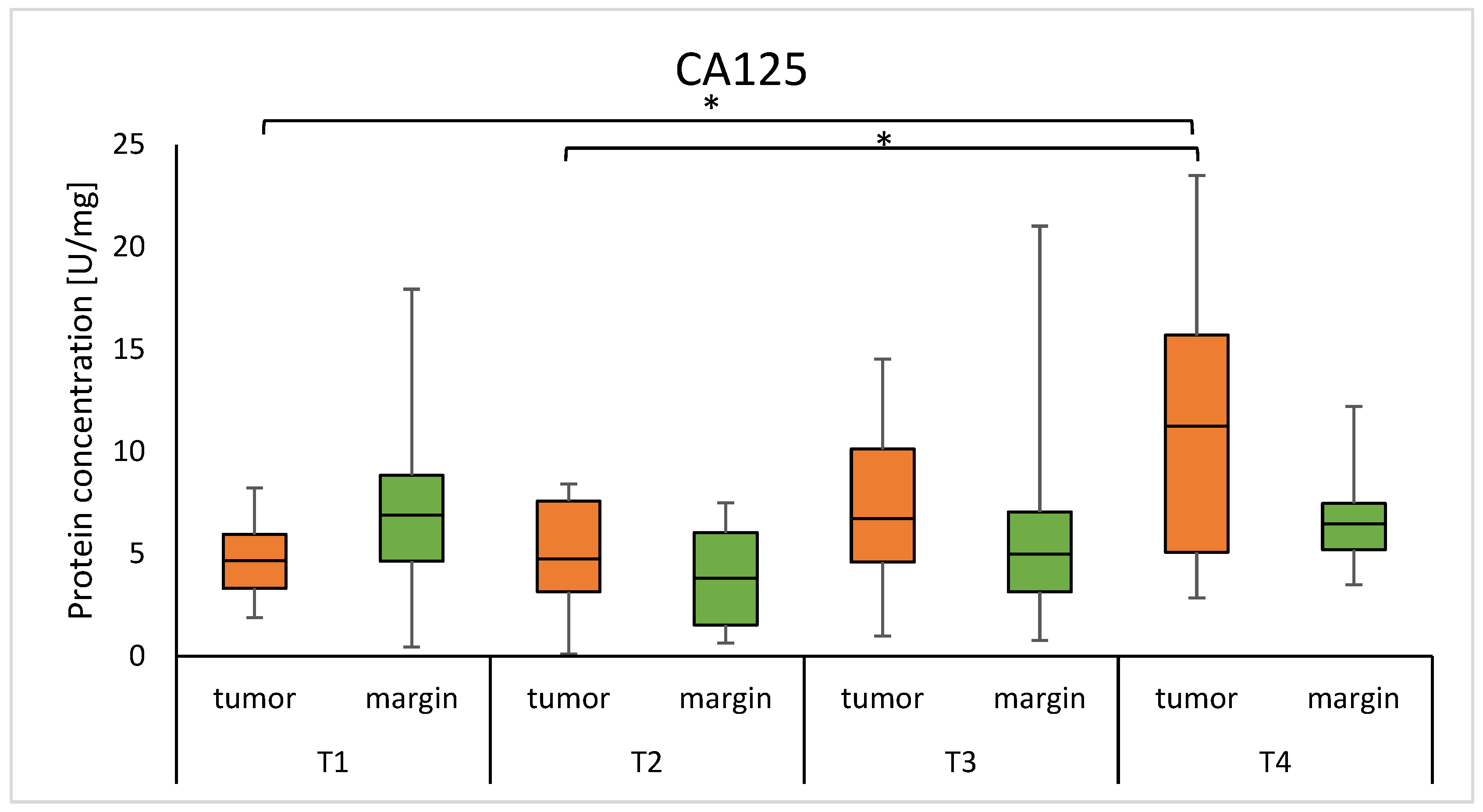
No differences were observed between GEP-NET tumor and margin samples in CEACAM-5, CA125 and HE4 levels. There was significant difference in CA125 concentration in patients with T4 status compared to T1 and T2 status group, higher level was observed in T4 group (T4 vs. T1; 11.24 (5.08–15.69) vs. 4.67 (3.83–6.32); p = 0.0174; T4 vs. T2; 11.24 (5.08–15.69) vs. 4.76 (3.14–7.57); p = 0.0432). The results are presented in Figure 1.
No significant differences between studied proteins with the N status in consideration were obtained.
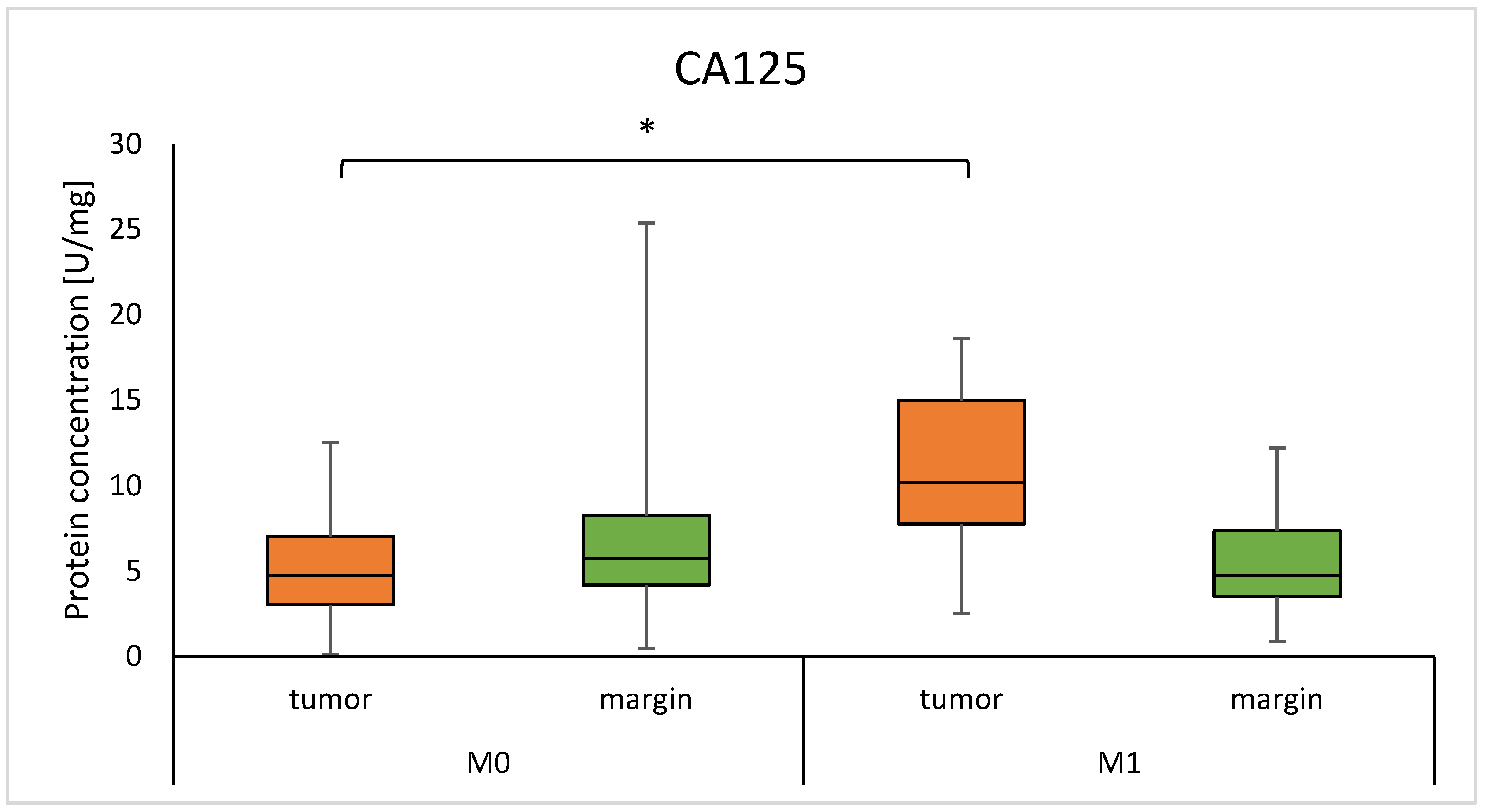
There were observed differences in groups with different M status in CA125 proteins. Group with M1 status had higher level of CA125 protein in tumor samples (M1 vs. M0; 10.19 (7.75–14.96) vs. 4.75 (3.02–7.04); p = 0.00005).
The results are shown in Figure 2.

3.2. Protein Level of CEACAM-5, CA125 and HE4 and the Localization of Tumor

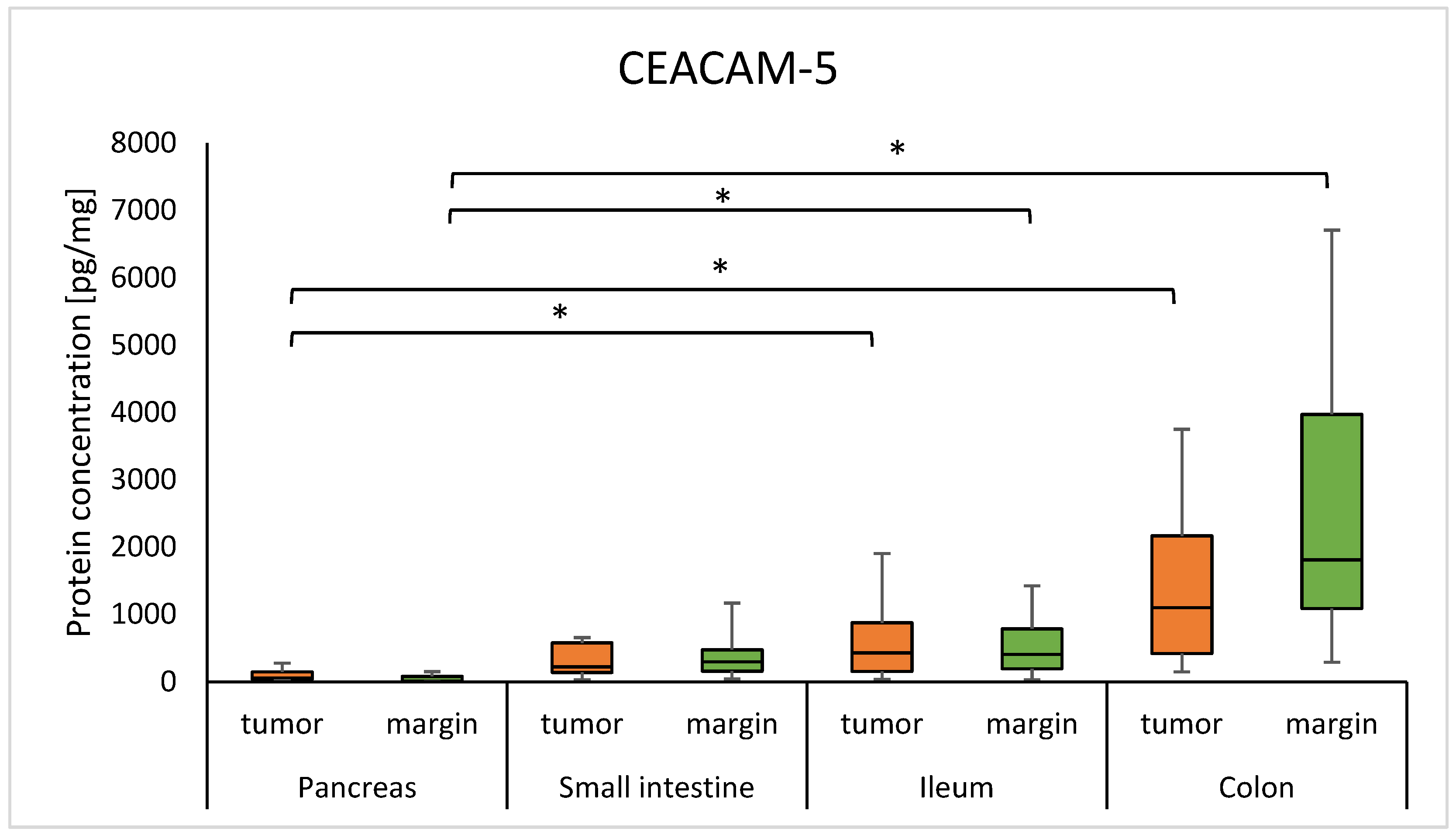
The CEACAM-5 concentration was lower in tumor samples in pancreas than in ileum and colon locations (ileum vs. pancreas: 431.63 (155.58–876.95) vs. 57.58 (35.72–147.03); p = 0.0029; colon vs. pancreas: 1101.40 (418.75–2167.96) vs. 57.58 (35.72–147.03); p = 0.0030). This difference was also observed in margin samples (ileum vs. pancreas: 408.46 (196.02–788.70) vs. 9.24 (5.95–81.41); p = 0.0476; colon vs. pancreas: 1813.44 (1090.09–3973.80) vs. 9.24 (5.95–81.41); p = 0.0011). The results are presented in Figure 3.
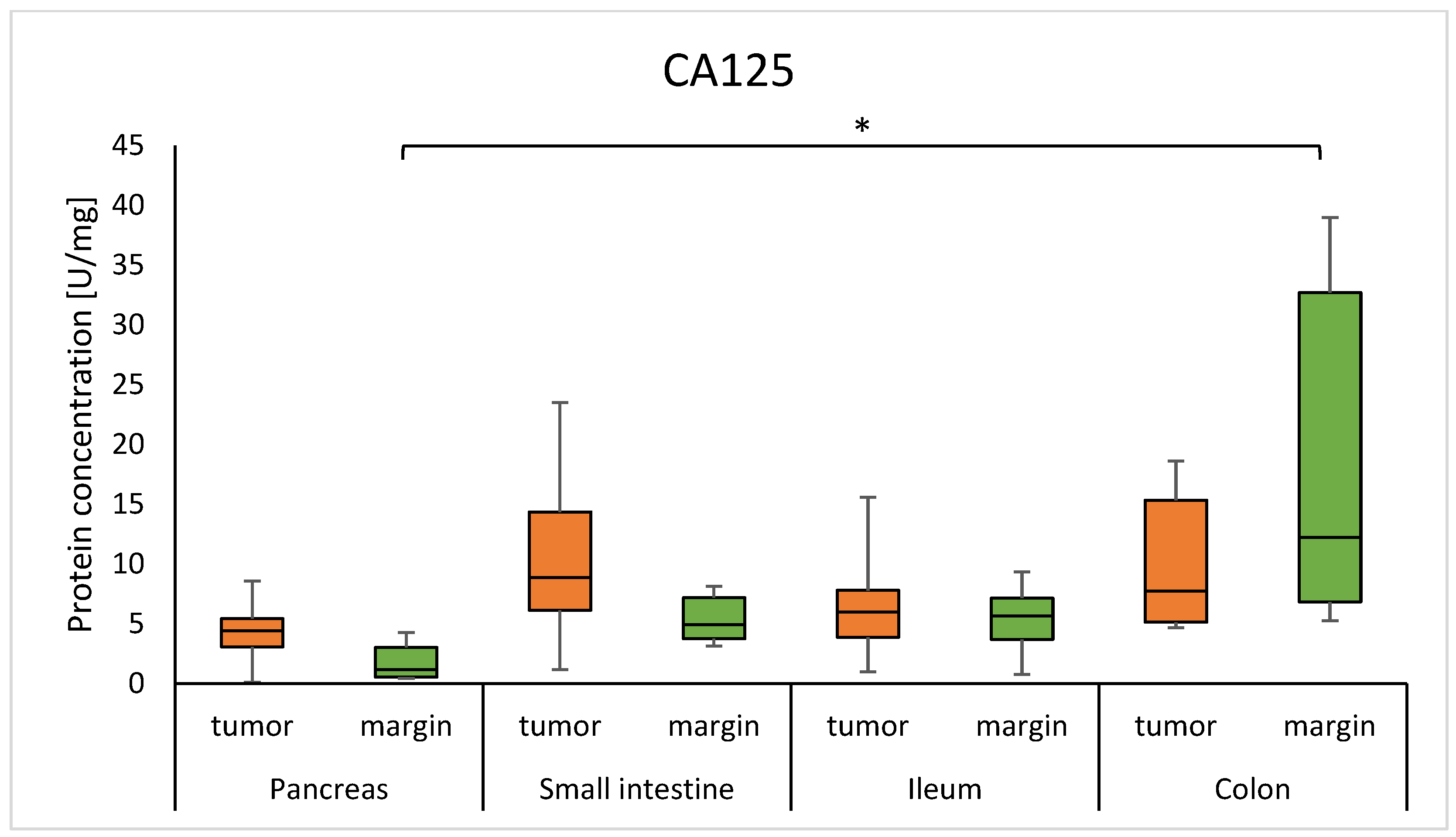
We found that the concentration of CA125 in margin samples was significantly higher in colon, compared to samples from pancreas (colon vs. pancreas: 12.22 (6.84–32.68) vs. 1.189 (0.55–3.02); p = 0.0045), as presented in Figure 4.
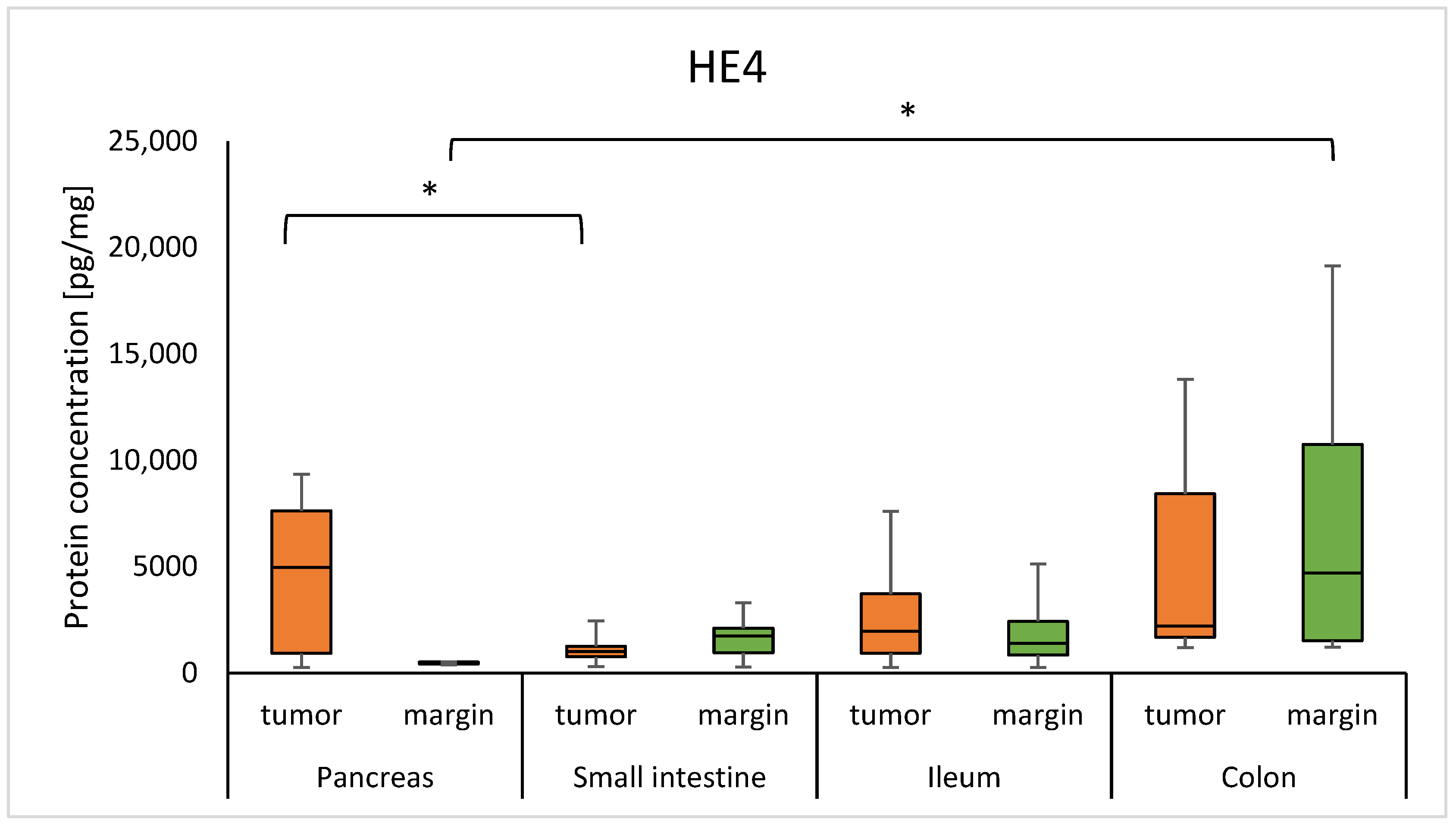
In margin, a significantly higher concentration of HE4 was observed in colon, compared to pancreas (colon vs. pancreas: 4714.28 (1525.41–10,746.91) vs. 495.42 (431.46–527.21); p = 0.0061) and in tumor samples between small intestine and pancreas (small intestine vs. pancreas: 1017.38 (759.74–1260.99) vs. 4960.02 (924.34–7624.70); p = 0.0472). The results are presented in Figure 5.

3.3. Protein Level of CEACAM-5, CA125 and HE4 According to Sex

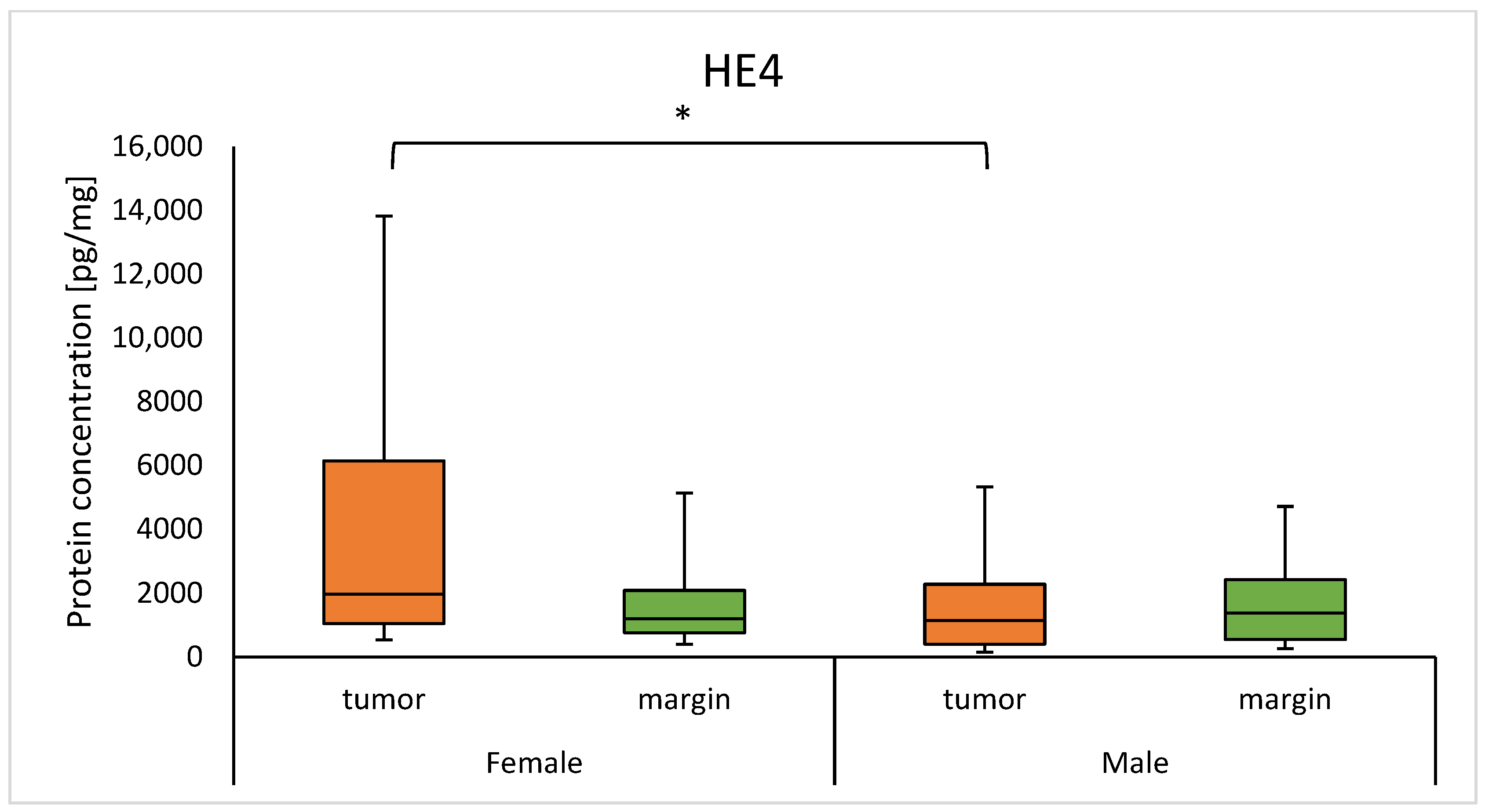
We observed a significant difference between male and female in tumor groups in HE4 level (1961.92 (1042.39–6137.40) vs. 1130.29 (397.24–2268.96); p = 0.0056). The HE4 level was higher in the female group compared with the group of males. The results are given in Figure 6.
We observed no other statistically significant differences between the CEACAM-5, CA125 and HE4 concentration and clinicopathological parameters or sociodemographic parameters (T, N, M, G status, diabetes, hypertension, age, BMI, gender, smoking status, and alcohol consumption status).

4. Discussion

In recent years, there has been growing interest in the search for new biomarkers that could facilitate predictive assessment and progression of GEP-NET tumors. This study analyzed the expression of CEACAM-5, CA125, and HE4 proteins both within the tumor and in the matched tissue margins. Importantly, this is the first study of its kind to use a multiplex immunoassay in tumor and margin tissue homogenates in group of patients with GEP-NET.
In our analysis, the median CA125 protein concentration was markedly elevated in T4 tumors compared with T1 and T2 status. Additionally, patients presenting with distant metastases (M1) exhibited substantially higher CA125 levels than those without metastatic spread (M0).
The observed elevation of CA125 protein levels in locally advanced tumors (T4) and in patients with distant metastases (M1) may reflect not only increased tumor aggressiveness but also specific features of the GEP-NET tumor microenvironment. Previous studies have demonstrated that CA125 (MUC16) is involved in tumor cell adhesion, migration, and invasion, processes that become more pronounced with increasing local tumor advancement and metastatic potential [10,11,12,19,20,21,22,23,24]. These biological functions are closely related to epithelial–mesenchymal transition (EMT), a central mechanism driving tumor progression, local invasiveness, and metastatic dissemination. EMT-related molecular programs enable tumor cells to acquire migratory and invasive properties and are widely recognized as key contributors to aggressive tumor phenotypes [25]. Importantly, CA125 expression is not restricted to malignant epithelial cells. Experimental and clinical studies have shown that CA125 can also be produced by activated stromal components, including fibroblasts, mesothelial cells, and cells involved in inflammatory responses within the tumor microenvironment [5,11,26]. GEP-NETs, particularly at advanced stages, are frequently characterized by marked stromal remodeling, fibrosis, and infiltration of inflammatory cells, all of which may contribute to enhanced local accumulation of CA125 within tumor tissue. In highly invasive tumors (T4), extensive interaction between tumor cells and surrounding tissues may further stimulate stromal activation, inflammatory signaling and EMT-associated pathways, thereby promoting increased local production of CA125. This concept is supported by observations in other malignancies, where CA125 immunoexpression in tumor tissues correlates with aggressive clinical features and invasive behavior [20,21]. Moreover, previous studies have indicated that tissue expression of CA125 may be substantially more frequent than its elevation in serum. For example, in endometrial cancer, positive CA125 immunoexpression was observed in approximately 89% of tumor tissues, whereas elevated serum levels were detected in only about 21% of cases [27]. This suggests that CA125 may accumulate locally within the tumor microenvironment without necessarily being released into the circulation. Taken together, these findings support the hypothesis that increased CA125 concentrations detected in tumor homogenates may primarily reflect EMT-associated tumor progression combined with local microenvironmental changes—such as stromal activation, fibrosis, and inflammatory cell infiltration—rather than systemic secretion alone. This may be particularly relevant in advanced GEP-NETs, where tumor–stroma interactions intensify with disease progression.
In our study, we demonstrated significantly higher CEACAM-5 concentrations in tumor and margin samples from the ileum and colon compared to samples located in the pancreas. It is worth noting that differences between GEP-NET locations in terms of CEACAM-5 expression have been poorly described in the literature to date, as this marker is rarely analyzed in the context of neuroendocrine tumors. The results of our study are consistent with the CEACAM-5 expression profiles described in the literature, indicating that this protein is particularly highly expressed in the intestinal epithelium and in gastrointestinal tumors with a glandular phenotype, especially in colorectal cancer [28,29,30,31]. In addition, the higher concentration of CEACAM-5 observed in the surgical margins of the ileum and colon may suggest the involvement of this protein in the local interaction of cancer cells with the surrounding tissue. CEACAM-5 has been shown to modulate the invasion process by interacting with integrins, regulating cell migration, and influencing extracellular matrix remodeling [7,8,32].
In this study, we also observed significantly higher concentrations of CA125 and HE4 in the surgical margins of tumors located in the colon compared to tumors originating in the pancreas. Moreover we demonstrated significantly higher HE4 concentrations in tumor samples from the pancreas compared to samples located in the small intestine. Numerous studies have shown that CA125 may promote tumor invasion through interactions with mesothelium, integrins, and regulation of the NF-κB pathway. The microenvironment of the large intestine, rich in immune cells, cytokines, and pro-inflammatory factors, may promote the intensification of local CA125 expression in response to the neoplastic process, which may explain the higher CA125 values in the margins of the colon [5,11,25]. HE4 is a protein with properties that modulate extracellular matrix remodeling, fibroblast activation, and inflammatory response regulation [15,16]. HE4 has also been shown to increase the expression of metalloproteinases (MMP-2, MMP-9), supporting the migration and invasion of cancer cells and promoting the creation of a microenvironment that facilitates infiltration, which may exacerbate the local increase in HE4 in response to the presence of a neuroendocrine tumor [33]. Alternatively, the differences may result from the different origins of the cells and microenvironments (pancreas, small intestine and colon), which affect HE4 gene regulation and HE4 protein secretion. This may suggest HE4 as a tumor location-dependent marker [34].
Differences in the concentrations of analyzed proteins in GEP-NET may result from different properties of the tumor microenvironment, which is strongly dependent on the primary location. Spatial molecular profiling analyses have shown that intestinal and pancreatic GEP-NETs differ in the composition of inflammatory cells and the type of proteins regulating tumor-stroma interactions [35]. Single-cell transcriptomics studies have also confirmed significant heterogeneity between neuroendocrine tumors of different locations, suggesting diverse mechanisms of tumor interaction with surrounding tissues [36]. Similarly, comparative studies of pancreatic and extrapancreatic NETs have highlighted significant molecular and biological differences between these tumor groups, indicating that primary location is one of the key factors determining the nature of the microenvironment [37].
In our study, we demonstrated a significant difference in HE4 concentrations in tumor samples depending on gender—the median in women was significantly higher than in men.
The observed sex-related differences in our study might be linked to sex hormone–dependent signaling pathways and sex-specific characteristics of the tumor microenvironment. Population-based analyses of neuroendocrine tumors have consistently shown better survival outcomes in women compared with men, independent of tumor stage and histological characteristics, suggesting a biologically relevant role of sex-specific factors in tumor behavior [38]. Previous studies have indicated that estrogen and progesterone receptors can influence tumor growth, stromal remodeling, and immune responses within the tumor microenvironment [38,39]. These hormone-dependent effects may contribute to differences in extracellular matrix composition, fibroblast activation, and inflammatory cell infiltration between male and female patients, potentially affecting local protein expression patterns. Importantly, HE4 (WFDC2) has been shown to interact with estrogen receptor signaling pathways. Experimental studies have demonstrated that HE4 expression may be regulated through estrogen receptor α (ERα), and that HE4 itself can modulate estrogen-dependent transcriptional activity, suggesting a bidirectional crosstalk between HE4 and estrogen signaling [40]. Although such interactions have been described primarily in hormone-responsive tumors, they may also be relevant in other malignancies exhibiting sex-related biological differences. Additionally, HE4 has been implicated in stromal activation, fibrosis, and the modulation of inflammatory processes within the tumor microenvironment. Since sex hormones are known to influence these processes, they provide a potential mechanistic link between female sex, enhanced stromal or immune interactions, and increased local HE4 expression [39]. Supporting this concept, several clinical studies have reported significant associations between HE4 levels and patient sex across different cancer types, both at the tissue and serum levels [41,42].
The main limitation of our study was the small size of samples. Another limitation was the heterogeneity of tumor locations in the GEP-NET group. The tumors originated from various anatomical sites, including the pancreas, small intestine, ileum, and colon, which may have a significant impact on local cytokine production and tumor-stromal interactions, thereby affecting the measured protein levels independently of the tumor biology. Consequently, some of the observed variability in cytokine and protein concentrations may reflect physiological differences between tissue microenvironments rather than solely tumor-related mechanisms. Therefore, further studies conducted on larger, anatomically divided cohorts are needed to verify the current results.

5. Conclusions

In summary, we have not demonstrated that a change in expression profiles of CA125, CEACAM-5, and HE4 proteins in tumor and margin samples. However in our study, we demonstrated that the profiles of the proteins CA125, CEACAM-5, and HE4 in tumor tissues and surgical margins of patients with GEP-NETs differ depending on the stage of the cancer, metastasis, primary tumor location, and patient gender. Taken together, our results suggest that CA125, CEACAM-5, and HE4 may play a significant role in the biology of GEP-NET, and their analysis in tumor tissues and surgical margins may provide information about tumor aggressiveness, potential risk of metastasis, and biological differences depending on tumor location and patient gender. These data may form the basis for further research into the use of these markers in predicting disease progression and personalizing therapy for patients with GEP-NET.

Author Contributions

Conceptualization, A.Ś., J.K.S. and J.S.; methodology, A.Ś., Z.P.C. and J.K.S.; formal analysis, A.Ś. and D.H.; investigation, A.Ś.; resources, K.S.-M., M.K., K.K., S.M., M.Z., M.R.-M. and J.S.; writing—original draft preparation A.Ś.; writing—review and editing, J.K.S. and J.S.; visualization, A.Ś. and D.H.; supervision, J.K.S. and J.S.; project administration, A.Ś. All authors have read and agreed to the published version of the manuscript.

Funding

This work was supported by funding from the Ministry of Science and Higher Education: BNW-2-004/N/4/O.

Institutional Review Board Statement

The study was conducted according to the guidelines of the Declaration of Helsinki and approved by the Institutional Review Board on Medical Ethics, No. BNW/NWN/0052/KB1/126/I/22/23 dated 4 April 2023.

Informed Consent Statement

Informed consent was obtained from all subjects involved in the study.

Data Availability Statement

The data used to support the findings of this research are available upon request.

Acknowledgments

We thank all our patients for their voluntary participation in this study. We wish to thank Małgorzata Oczko-Wojciechowska, Małgorzata Roś-Mazurczyk and Agata Abramowicz, Maria Sklodowska-Curie National Research Institute of Oncology, Gliwice Branch for biobanking the samples. The research was conducted using the research infrastructure provided by Silesia LabMed: Research and Implementation Center, Medical University of Silesia.

Conflicts of Interest

The authors declare no conflicts of interest. The funders had no role in the design of the study; in the collection, analyses or interpretation of data; in the writing of the manuscript; or in the decision to publish the results.

References

  1. Fernandes, C.J.; Leung, G.; Eads, J.R.; Katona, B.W. Gastroenteropancreatic Neuroendocrine Tumors. Gastroenterol. Clin. N. Am. 2022, 51, 625–647. [Google Scholar] [CrossRef]
  2. Takayanagi, D.; Cho, H.; Machida, E.; Kawamura, A.; Takashima, A.; Wada, S.; Tsunoda, T.; Kohno, T.; Shiraishi, K. Update on Epidemiology, Diagnosis, and Biomarkers in Gastroenteropancreatic Neuroendocrine Neoplasms. Cancers 2022, 14, 1119. [Google Scholar] [CrossRef]
  3. Tan, B.; Zhang, B.; Chen, H. Gastroenteropancreatic Neuroendocrine Neoplasms: Epidemiology, Genetics, and Treatment. Front. Endocrinol. 2024, 15, 1424839. [Google Scholar] [CrossRef]
  4. Sedlack, A.J.H.; Varghese, D.G.; Naimian, A.; Yazdian Anari, P.; Bodei, L.; Hallet, J.; Riechelmann, R.P.; Halfdanarson, T.; Capdevilla, J.; Del Rivero, J. Update in the Management of Gastroenteropancreatic Neuroendocrine Tumors. Cancer 2024, 130, 3090–3105. [Google Scholar] [CrossRef]
  5. Zhang, X.B.; Fan, Y.B.; Jing, R.; Getu, M.A.; Chen, W.Y.; Zhang, W.; Dong, H.X.; Dakal, T.C.; Hayat, A.; Cai, H.J.; et al. Gastroenteropancreatic Neuroendocrine Neoplasms: Current Development, Challenges, and Clinical Perspectives. Mil. Med. Res. 2024, 11, 35. [Google Scholar] [CrossRef]
  6. Thomas, J.; Klebanov, A.; John, S.; Miller, L.S.; Vegesna, A.; Amdur, R.L.; Bhowmick, K.; Mishra, L. CEACAMs 1, 5, and 6 in Disease and Cancer: Interactions with Pathogens. Genes Cancer 2023, 14, 12–29. [Google Scholar] [CrossRef]
  7. Zhou, J.; Fan, X.; Chen, N.; Zhou, F.; Dong, J.; Nie, Y.; Fan, D. Identification of CEACAM5 as a Biomarker for Prewarning and Prognosis in Gastric Cancer. J. Histochem. Cytochem. 2015, 63, 922–930. [Google Scholar] [CrossRef]
  8. Gebauer, F.; Wicklein, D.; Horst, J.; Sundermann, P.; Maar, H.; Streichert, T.; Tachezy, M.; Izbicki, J.R.; Bockhorn, M.; Schumacher, U. Carcinoembryonic Antigen-Related Cell Adhesion Molecules (CEACAM) 1, 5 and 6 as Biomarkers in Pancreatic Cancer. PLoS ONE 2014, 9, e113023. [Google Scholar] [CrossRef]
  9. Zhang, X.; Han, X.; Zuo, P.; Zhang, X.; Xu, H. CEACAM5 Stimulates the Progression of Non-Small-Cell Lung Cancer by Promoting Cell Proliferation and Migration. J. Int. Med. Res. 2020, 48, 300060520959478. [Google Scholar] [CrossRef]
  10. Felder, M.; Kapur, A.; Gonzalez-Bosquet, J.; Horibata, S.; Heintz, J.; Albrecht, R.; Fass, L.; Kaur, J.; Hu, K.; Shojaei, H.; et al. MUC16 (CA125): Tumor Biomarker to Cancer Therapy, a Work in Progress. Mol. Cancer 2014, 13, 129. [Google Scholar] [CrossRef]
  11. Giamougiannis, P.; Martin-Hirsch, P.L.; Martin, F.L. The Evolving Role of MUC16 (CA125) in the Transformation of Ovarian Cells and the Progression of Neoplasia. Carcinogenesis 2021, 42, 327–343. [Google Scholar] [CrossRef] [PubMed]
  12. Kinzler, M.N.; Schulze, F.; Gretser, S.; Abedin, N.; Trojan, J.; Zeuzem, S.; Schnitzbauer, A.A.; Walter, D.; Wild, P.J.; Bankov, K. Expression of MUC16/CA125 Is Associated with Impaired Survival in Patients with Surgically Resected Cholangiocarcinoma. Cancers 2022, 14, 4703. [Google Scholar] [CrossRef] [PubMed]
  13. Zhang, X.Y.; Hong, L.L.; Ling, Z.Q. MUC16/CA125 in Cancer: New Advances. Clin. Chim. Acta 2025, 565, 119981. [Google Scholar] [CrossRef]
  14. Qiu, M.; Zou, S.; Yu, Z.; Nian, X. Clinical Utility of Human Epididymis Protein 4. Crit. Rev. Clin. Lab. Sci. 2025, 62, 510–534. [Google Scholar] [CrossRef]
  15. Li, J.; Chen, H.; Mariani, A.; Chen, D.; Klatt, E.; Podratz, K.; Drapkin, R.; Broaddus, R.; Dowdy, S.; Jiang, S.-W. HE4 (WFDC2) Promotes Tumor Growth in Endometrial Cancer Cell Lines. Int. J. Mol. Sci. 2013, 14, 6026–6043. [Google Scholar] [CrossRef]
  16. Liu, Y.; Liu, B.; Gao, H.; Wang, J.; Duan, J.; Huang, X.; Liu, Y.; Huang, Y.; Liao, W.; Li, R.; et al. HE4 Might Participate in Extracellular Matrix Remodeling in Ovarian Cancer via Activation of Fibroblasts. Oncol. Res. 2025, 34, 18. [Google Scholar] [CrossRef]
  17. Huang, T.; Jiang, S.-W.; Qin, L.; Senkowski, C.; Lyle, C.; Terry, K.; Brower, S.; Chen, H.; Glasgow, W.; Wei, Y.; et al. Expression and Diagnostic Value of HE4 in Pancreatic Adenocarcinoma. Int. J. Mol. Sci. 2015, 16, 2956–2970. [Google Scholar] [CrossRef]
  18. Chauhan, A.; Chan, K.; Halfdanarson, T.R.; Bellizzi, A.M.; Rindi, G.; O’Toole, D.; Ge, P.S.; Jain, D.; Dasari, A.; Anaya, D.A.; et al. Critical Updates in Neuroendocrine Tumors: Version 9 AJCC Staging System for Gastroenteropancreatic Neuroendocrine Tumors. CA Cancer J. Clin. 2024, 74, 359–367. [Google Scholar]
  19. Chen, L.; Zhang, Y.; Chen, M.; Chen, J. Prognostic value of carcinoembryonic antigen, alpha fetoprotein, carbohydrate antigen 125 and carbohydrate antigen 19-9 in gastroenteropancreatic neuroendocrine neoplasms. Zhonghua Wei Chang Wai Ke Za Zhi 2017, 20, 1002–1008. [Google Scholar] [PubMed]
  20. Reinartz, S.; Failer, S.; Schuell, T.; Wagner, U. CA125 (MUC16) Gene Silencing Suppresses Growth Properties of Ovarian and Breast Cancer Cells. Eur. J. Cancer 2012, 48, 1558–1569. [Google Scholar] [CrossRef]
  21. Akita, K.; Tanaka, M.; Tanida, S.; Mori, Y.; Toda, M.; Nakada, H. CA125/MUC16 Interacts with Src Family Kinases, and over-expression of its C-terminal fragment in human epithelial cancer cells reduces cell-cell adhesion. Eur. J. Cell Biol. 2013, 92, 257–263. [Google Scholar] [CrossRef]
  22. Wu, Y.; Liu, Q.; Xie, Y.; Zhu, J.; Zhang, S.; Ge, Y.; Guo, J.; Luo, N.; Huang, W.; Xu, R.; et al. MUC16 Stimulates Neutrophils to an Inflammatory and Immunosuppressive Phenotype in Ovarian Cancer. J. Ovarian Res. 2023, 16, 181. [Google Scholar] [CrossRef]
  23. Chirravuri-Venkata, R.; Dam, V.; Nimmakayala, R.K.; Alsafwani, Z.W.; Bhyravbhatla, N.; Lakshmanan, I.; Ponnusamy, M.P.; Kumar, S.; Jain, M.; Ghersi, D.; et al. MUC16 and TP53 Family Co-Regulate Tumor-Stromal Heterogeneity in Pancreatic Adenocarcinoma. Front. Oncol. 2023, 13, 1073820. [Google Scholar] [CrossRef]
  24. Kato, H.; Hatori, M.; Kokubun, S.; Watanabe, M.; A Smith, R.; Hotta, T.; Ogose, A.; Morita, T.; Murakami, T.; Aiba, S. CA125 Expression in Epithelioid Sarcoma. Jpn. J. Clin. Oncol. 2004, 34, 149–154. [Google Scholar] [CrossRef] [PubMed]
  25. Jiang, L.J.; Guo, S.B.; Zhou, Z.H.; Li, Z.Y.; Zhou, F.J.; Yu, C.P.; Li, M.; Huang, W.J.; Liu, Z.W.; Tian, X.P. Snai2-mediated upregulation of NADSYN1 promotes bladder cancer progression by interacting with PHB. Clin. Transl. Med. 2024, 14, e1555. [Google Scholar] [CrossRef] [PubMed]
  26. Kakimoto, S.; Miyamoto, M.; Einama, T.; Takihata, Y.; Matsuura, H.; Iwahashi, H.; Ishibashi, H.; Sakamoto, T.; Hada, T.; Suminokura, J.; et al. Significance of Mesothelin and CA125 Expression in Endometrial Carcinoma: A Retrospective Analysis. Diagn. Pathol. 2021, 16, 28. [Google Scholar] [CrossRef] [PubMed]
  27. Ginath, S.; Menczer, J.; Fintsi, Y.; Ben-Shem, E.; Glezerman, M.; Avinoach, I. Tissue and Serum CA125 Expression in Endometrial Cancer. Int. J. Gynecol. Cancer 2002, 12, 372–375. [Google Scholar] [CrossRef]
  28. Abd Temur, A.; Aqeel Rashid, F. Irisin and Carcinoembryonic Antigen (CEA) as Diagnostic Biomarkers in Gastric and Colorectal Cancers. Rep. Biochem. Mol. Biol. 2021, 10, 488–494. [Google Scholar] [CrossRef]
  29. Rao, H.; Wu, H.; Huang, Q.; Yu, Z.; Zhong, Z. Clinical Value of Serum CEA, CA24-2 and CA19-9. Clin. Lab. 2021, 67, 4. [Google Scholar] [CrossRef]
  30. Qian, X.; Wang, H.; Ren, Z.; Jin, F.; Pan, S.Y. The value of NLR, FIB, CEA and CA19-9 in colorectal cancer. Zhonghua Yu Fang Yi Xue Za Zhi 2021, 55, 499–505. [Google Scholar] [PubMed]
  31. Chen, Z.; Lin, Z. Prognosis of Carcinoembryonic Antigen (CEA) in Stage I Colorectal Adenocarcinoma and Development of a Prediction Model: A Retrospective Study Based on the SEER Database. J. Cancer Res. Clin. Oncol. 2023, 149, 16623–16633. [Google Scholar] [CrossRef] [PubMed]
  32. Blumenthal, R.D.; Leon, E.; Hansen, H.J.; Goldenberg, D.M. Expression Patterns of CEACAM5 and CEACAM6 in Primary and Metastatic Cancers. BMC Cancer 2007, 7, 2. [Google Scholar] [CrossRef]
  33. Wang, J.; Deng, L.; Zhuang, H.; Liu, J.; Liu, D.; Li, X.; Jin, S.; Zhu, L.; Wang, H.; Lin, B. Interaction of HE4 and ANXA2 Exists in Various Malignant Cells-HE4-ANXA2-MMP2 Protein Complex Promotes Cell Migration. Cancer Cell Int. 2019, 19, 161. [Google Scholar] [CrossRef] [PubMed]
  34. Galgano, M.T.; Hampton, G.M.; Frierson, H.F. Comprehensive Analysis of HE4 Expression. Mod. Pathol. 2006, 19, 847–853. [Google Scholar] [CrossRef]
  35. Duan, S.; Sawyer, T.W.; Witten, B.L.; Song, H.; Else, T.; Merchant, J.L. Spatial Profiling Reveals Tissue-Specific Neuro-Immune Interactions. J. Pathol. 2024, 262, 362–376. [Google Scholar] [CrossRef]
  36. Hoffman, S.E.; Dowrey, T.W.; Villacorta Martin, C.; Bi, K.; Titchen, B.; Johri, S.; DelloStritto, L.; Patel, M.; Mackichan, C.; Inga, S.; et al. Intertumoral lineage diversity and immunosuppressive transcriptional programs in well-differentiated gastroenteropancreatic neuroendocrine tumors. Sci. Adv. 2023, 9, eadd9668. [Google Scholar] [CrossRef] [PubMed]
  37. Halperin, D.M.; Kulke, M.H.; Yao, J.C. A Tale of Two Tumors: Treating Pancreatic and Extrapancreatic Neuroendocrine Tumors. Annu. Rev. Med. 2015, 66, 1–16. [Google Scholar] [CrossRef]
  38. Mortagy, M.; El Asmar, M.L.; Chandrakumaran, K.; Ramage, J. Sex Differences in Survival of Patients with Neuroendocrine Neoplasms: A Comparative Study of Two National Databases. Cancers 2024, 16, 2376. [Google Scholar] [CrossRef]
  39. White, B.E.; Russell, B.; Remmers, S.; Rous, B.; Chandrakumaran, K.; Wong, K.F.; Van Hemelrijck, M.; Srirajaskanthan, R.; Ramage, J.K. Sex Differences in Survival from Neuroendocrine Neoplasia in England 2012–2018: A Retrospective, Population-Based Study. Cancers 2023, 15, 1863. [Google Scholar] [CrossRef]
  40. Lokich, E.; Singh, R.K.; Han, A.; Romano, N.; Yano, N.; Kim, K.; Moore, R.G. HE4 Expression Is Associated with Hormonal Elements and mediated by importin-dependent nuclear translocation. Sci. Rep. 2014, 4, 5500. [Google Scholar] [CrossRef]
  41. Hertlein, L.; Stieber, P.; Kirschenhofer, A.; Fürst, S.; Mayr, D.; Hofmann, K.; Krocker, K.; Nagel, D.; Lenhard, M.; Burges, A. Human Epididymis Protein 4 (HE4) in Benign and Malignant Diseases. Clin. Chem. Lab. Med. 2012, 50, 2181–2188. [Google Scholar] [CrossRef] [PubMed]
  42. Maksimiuk, M.; Budzik, M.P.; Deptała, A.; Badowska-Kozakiewicz, A.M. HE4—Not Only an Ovarian Cancer Biomarker—A brief review. Nowotw. J. Oncol. 2019, 69, 142–145. [Google Scholar] [CrossRef]
Figure 1. The CA125 protein level in the tumor and margin samples in the group of patients with T1, T2, T3 and T4 status. An asterisk indicates p < 0.05.
Applsci 16 00692 g001
Figure 2. The CA125 protein level in the tumor and margin samples in the group of patients with M0 and M1 status. An asterisk indicates p < 0.05.
Applsci 16 00692 g002
Figure 3. The CEACAM-5 protein level in the tumor and margin samples according to the localization of the primary tumor. An asterisk indicates p < 0.05.
Applsci 16 00692 g003
Figure 4. The CA125 protein level in the tumor and margin samples according to the localization of the primary tumor. An asterisk indicates p < 0.05.
Applsci 16 00692 g004
Figure 5. The HE4 protein level in the tumor and margin samples according to the localization of the primary tumor. An asterisk indicates p < 0.05.
Applsci 16 00692 g005
Figure 6. The HE4 protein level in the tumor and margin samples according to sex. An asterisk indicates p < 0.05.
Applsci 16 00692 g006
Table 1. Demographic data of the study group.
N (%)
Average age56.89 ± 12.44
BMI27.64 ± 5.48
Sex
Female36 (61.02)
Male23 (38.98)
Smoking
Yes13 (22.03)
No42 (71.19)
NA *4 (6.78)
Alcohol user
Yes9 (15.25)
No46 (77.97)
NA *4 (6.78)
Concomitant diseases
Diabetes14 (23.72)
Hypertension29 (49.15)
Diabetes and hypertension13 (22.03)
* NA—not assessed.
Table 2. Clinical characteristics of the study group.
N (%)
T parameter
T112 (20.34)
T215 (25.42)
T314 (23.72)
T418 (30.51)
N parameter
N011 (18.64)
N138 (64.41)
N210 (16.95)
M parameter
M039 (66.10)
M120 (33.90)
Histological Grading
NET-G142 (71.19)
NET-G215 (25.42)
NET-G31 (1.69)
NEC 1 (1.69)
Disclaimer/Publisher’s Note: The statements, opinions and data contained in all publications are solely those of the individual author(s) and contributor(s) and not of MDPI and/or the editor(s). MDPI and/or the editor(s) disclaim responsibility for any injury to people or property resulting from any ideas, methods, instructions or products referred to in the content.