Benefits and Concerns Related to the Implementation of Artificial Intelligence Technology in Enterprises Located in the West Pomeranian Voivodeship of Poland

 ,
,  , , , and
Abstract
1. Introduction
- what are the benefits and concerns for specific sectors and types of businesses, particularly those located in the West Pomeranian Voivodeship in Poland?
- what benefits and concerns are most important from the perspective of representatives of companies located in the West Pomeranian Voivodeship in Poland?
2. Literature Review
- little is known about the opinions of representatives of companies located in the West Pomeranian Voivodeship in Poland on the benefits and concerns of implementing artificial intelligence technology.
- findings regarding the impact of aspects such as the status of the market in which the company operates, the type of owner, business sector, duration of company’s operation, and the number of employees on the perception of the benefits and concerns of implementing AI technology remain inconsistent.
3. Methodology
4. Results
5. Conclusions
Author Contributions
Funding
Institutional Review Board Statement
Informed Consent Statement
Data Availability Statement
Acknowledgments
Conflicts of Interest
References
- Spector, L. Evolution of Artificial Intelligence. Artif. Intell. 2006, 170, 1251–1253. [Google Scholar] [CrossRef]
- Kamble, R.; Shah, D. Applications of Artificial Intelligence in Human Life. Int. J. Res. Granthaalayah 2018, 6, 178–188. [Google Scholar] [CrossRef]
- Ghosh, M.; Arunachalam, T. Introduction to Artificial Intelligence. In Artificial Intelligence for Information Management: A Healthcare Perspective; Srinivasa, K.G., Ed.; Studies in Big Data; Springer Nature: Singapore, 2021; Volume 88, pp. 23–44. [Google Scholar] [CrossRef]
- Usage of AI Technologies Increasing in EU Enterprises. Available online: https://ec.europa.eu/eurostat/web/products-eurostat-news/w/ddn-20250123-3 (accessed on 17 July 2025).
- Which Countries Are Leading in AI? Stanford HAI. Available online: https://hai.stanford.edu/ai-index/global-vibrancy-tool (accessed on 17 July 2025).
- Maslej, N. Artificial Intelligence Index Report 2025. arXiv 2025, arXiv:2504.07139. [Google Scholar] [CrossRef]
- KPMG. Monitor Transformacji Cyfrowej Biznesu. In Czy Jesteśmy Gotowi Na AI? Edycja 2025; KPMG: Warszawa, Poland, 2025; Available online: https://kpmg.com/pl/pl/home/insights/2025/05/monitor-transformacji-cyfrowej-biznesu-edycja-2025.html (accessed on 24 November 2025).
- Mazgajczyk, E.; Pietrusewicz, K.; Kujawski, K. Digital Maturity in Mapping the European Digital Innovation Hub Services. Pomiary Autom. Robot. 2024, 28, 125–140. [Google Scholar] [CrossRef]
- Pietrusewicz, K. Metamodelling for Design of Mechatronic and Cyber-Physical Systems. Appl. Sci. 2019, 9, 376. [Google Scholar] [CrossRef]
- Filina-Dawidiwicz, L.; Barczak, A.; Sęk, J.; Trojanowski, P.; Wiktorowska-Jasik, A. Use of Artificial Intelligence Technology in Companies in Poland: A Comparative Analysis of 2023–2024 Period. In Proceedings of the Communications of International Proceedings, Cordoba, Spain, 25–26 October 2025; IEOM Society International: Cordoba, Spain, 2025; Volume 13, pp. 1846–1857. [Google Scholar]
- Główny Urząd Statystyczny. Wykorzystanie Technologii Informacyjno-Komunikacyjnych w Przedsiębiorstwach i Gospodarstwach Domowych w 2023 Roku; Główny Urząd Statystyczny: Warszawa, Poland, 2023.
- CBOS. Sztuczna Inteligencja w Opiniach Polaków; Komunikat z Badań Nr 93/2024; Centrum Badań Opinii Społecznej: Warszawa, Poland, 2024; Available online: https://www.cbos.pl/SPISKOM.POL/2024/K_093_24.PDF (accessed on 24 November 2025).
- Dacko-Pikiewicz, Z.; Szczepańska-Woszczyna, K.; Lis, M. Horyzonty Sztucznej Inteligencji a Przemysł 5.0; WSB University: Dąbrowa Górnicza, Poland, 2025. [Google Scholar]
- Myszak, J.M.; Filina-Dawidowicz, L. Leaders’ Competencies and Skills in the Era of Artificial Intelligence: A Scoping Review. Appl. Sci. 2025, 15, 10271. [Google Scholar] [CrossRef]
- Newman-Griffis, D. AI Thinking: A Framework for Rethinking Artificial Intelligence in Practice. R. Soc. Open Sci. 2025, 12, 241482. [Google Scholar] [CrossRef]
- Spreitzenbarth, J.M.; Bode, C.; Stuckenschmidt, H. Artificial Intelligence and Machine Learning in Purchasing and Supply Management: A Mixed-Methods Review of the State-of-the-Art in Literature and Practice. J. Purch. Supply Manag. 2024, 30, 100896. [Google Scholar] [CrossRef]
- Rogers, E.M. Diffusion of Innovations, 5th ed.; A Division of Simon & Schuster, Inc.: New York, NY, USA, 2003. [Google Scholar]
- Oliveira, T.; Martins, M.F. Literature Review of Information Technology Adoption Models at Firm Level. Electron. J. Inf. Syst. Eval. 2011, 14, 110–121. [Google Scholar]
- Ahmad, R.; Nawaz, M.R.; Ishaq, M.I.; Khan, M.M.; Ashraf, H.A. Social exchange theory: Systematic review and future directions. Front. Psychol. 2023, 13, 1015921. [Google Scholar] [CrossRef] [PubMed]
- Cropanzano, R.; Mitchell, M.S. Social exchange theory: An interdisciplinary review. J. Manag. 2005, 31, 874–900. [Google Scholar] [CrossRef]
- Ward, J.; Daniel, E. Benefits Management: Delivering Value from IS & IT Investments; John Wiley & Sons: Chichester, UK, 2006. [Google Scholar]
- Cambridge Dictionary. Available online: https://dictionary.cambridge.org/dictionary/english/concern (accessed on 15 December 2025).
- Uzun, L. Are Concerns Related to Artificial Intelligence Development and Use Really Necessary: A Philosophical Discussion. Digit. Soc. 2023, 2, 40. [Google Scholar] [CrossRef]
- Saleem, I.; Al-Breiki, N.S.S.; Asad, M. The Nexus of Artificial Intelligence, Frugal Innovation and Business Model Innovation to Nurture Internationalization: A Survey of SME’s Readiness. J. Open Innov. Technol. Mark. Complex. 2024, 10, 100326. [Google Scholar] [CrossRef]
- Mao, H. The Optimization Strategy and Application Practice of Business Management Supply Chain Based on Artificial Intelligence Technology. Procedia Comput. Sci. 2025, 261, 707–715. [Google Scholar] [CrossRef]
- Kulkarni, A.V.; Joseph, S.; Patil, K.P. Artificial Intelligence Technology Readiness for Social Sustainability and Business Ethics: Evidence from MSMEs in Developing Nations. Int. J. Inf. Manag. Data Insights 2024, 4, 100250. [Google Scholar] [CrossRef]
- Islam, M.d.T.; Hasan, M.d.M.; Redwanuzzaman, M.d.; Hossain, M.d.K. Practices of Artificial Intelligence to Improve the Business in Bangladesh. Soc. Sci. Humanit. Open 2024, 9, 100766. [Google Scholar] [CrossRef]
- Sipola, J.; Saunila, M.; Ukko, J. Adopting Artificial Intelligence in Sustainable Business. J. Clean Prod. 2023, 426, 139197. [Google Scholar] [CrossRef]
- Kirova, M.; Boneva, M. Artificial Intelligence: Challenges and Benefits for Business. In New Trends in Contemporary Economics, Business and Management, Proceedings of the 14th International Scientific Conference “Business and Management 2024”, Vilnius, Lithuania, 16–17 May 2024; Vilnius Gediminas Technical University: Vilnius, Lithuania, 2024; pp. 253–260. Available online: https://etalpykla.vilniustech.lt/bitstream/handle/123456789/154652/bm2024_Proceedings.pdf?sequence=4&isAllowed=y (accessed on 24 November 2025).
- Shemshaki, M. The Benefits of Using Artificial Intelligence for Business Success. In Straregies for Innovation, Efficiency, and Growth Business & Economics; Emerald Publishing: Leeds, UK, 2024; Available online: https://books.google.pl/books?hl=pl&lr=&id=STMZEQAAQBAJ&oi=fnd&pg=PA13&dq=artificial+intelligence+benefits+business&ots=Wn5Bd_9ilR&sig=gXWlgfWnK9oBt_l2t7_R17ikUfo&redir_esc=y#v=onepage&q=artificial%20intelligence%20benefits%20business&f=false (accessed on 30 June 2025).
- Fosso Wamba, S.; Queiroz, M.M.; Guthrie, C.; Braganza, A. Industry Experiences of Artificial Intelligence (AI): Benefits and Challenges in Operations and Supply Chain Management. Prod. Plan. Control 2022, 33, 1493–1497. [Google Scholar] [CrossRef]
- Wamba-Taguimdje, S.-L.; Fosso Wamba, S.; Kala Kamdjoug, J.R.; Tchatchouang Wanko, C.E. Influence of Artificial Intelligence (AI) on Firm Performance: The Business Value of AI-Based Transformation Projects. Bus. Process Manag. J. 2020, 26, 1893–1924. [Google Scholar] [CrossRef]
- Ransbotham, S.; Candelon, F.; Kiron, D.; LaFountain, B.; Khodabandeh, S. The Cultural Benefits of Artificial Intelligence in the Enterprise; MIT Sloan Management Review and Boston Consulting Group: Cambridge, MA, USA, 2021; Available online: https://web-assets.bcg.com/85/90/95939185404cbd901aba0d54f1d7/the-cultural-benefits-of-artificial-intelligence-in-the-enterprise-r.pdf (accessed on 24 November 2025).
- Torres, A.; Beirão, G. Artificial Intelligence Technologies: Benefits, Risks, and Challenges for Sustainable Business Models. In Artificial Intelligence Approaches to Sustainable Accounting; Global Scientific Publishing: Hershey, PA, USA, 2024; pp. 229–248. [Google Scholar] [CrossRef]
- Brynjolfsson, E.; McAfee, A. The Business of Artificial Intelligence. What It Can— and Cannot—Do for Your Organization. 2017. Available online: https://hbr.org/2017/07/the-business-of-artificial-intelligence (accessed on 30 June 2025).
- Enholm, I.M.; Papagiannidis, E.; Mikalef, P.; Krogstie, J. Artificial Intelligence and Business Value: A Literature Review. Inf. Syst. Front. 2022, 24, 1709–1734. [Google Scholar] [CrossRef]
- Ahmad, S.; Priyadharshini, L.S.; Shahadat Hosen, M.; Ng, A.; Islam, S.; Manik, J.A. The Impact of Artificial Intelligence on Business & Social Values: Benefits, Challenges, and Future Directions. Educ. Adm. Theory Pract. 2024, 30, 3174–3180. [Google Scholar] [CrossRef]
- Bhalerao, K.; Kumar, A.; Kumar, A.; Pujari, P. A Study of Barriers and Benefits of Artificial Intelligence Adoption in Small and Medium Enterprise. Acad. Mark. Stud. J. 2022, 26, 1–6. Available online: https://www.abacademies.org/articles/A-study-of-barriers-and-benefits-of-artificial-Intelligence-1528-2678-26-1-102.pdf (accessed on 24 November 2025).
- Akerkar, R. Artificial Intelligence for Business; Springer: Cham, Switzerland, 2019. [Google Scholar] [CrossRef]
- Szedlak, C.; Leyendecker, B.; Reinemann, H.; Kschischo, M.; Pötters, P. Risks and Benefits of Artificial Intelligence in Small-and-Medium Sized Enterprises. In Proceedings of the International Conference on Industrial Engineering and Operations Management, Rome, Italy, 2–5 August 2021; IEOM Society International: Rome, Italy, 2021; pp. 195–205. Available online: https://ieomsociety.org/proceedings/2021rome/175.pdf (accessed on 24 November 2025).
- Yurchuk, N.P.; Kiporenko, S.S. Artificial Intelligence in Business: Threats, Benefits, Trends. Colloq. J. Econ. Sci. 2012, 17, 83–91. [Google Scholar] [CrossRef]
- Rossi, F. Artificial Intelligence: Potential Benefits and Ethical Considerations. EPRS Eur. Parliam. Res. Serv. 2016, PE 571.380, 1–7. [Google Scholar] [CrossRef]
- Barsekh-Onji, A.; Torres Hernandez, Z.; Cardoso Espinosa, E.O. Advancing Smart Public Administration: Challenges and Benefits of Artificial Intelligence. Urban Gov. 2025, 5, 279–292. [Google Scholar] [CrossRef]
- Tveita, L.J.; Hustad, E. Benefits and Challenges of Artificial Intelligence in Public Sector: A Literature Review. Procedia Comput. Sci. 2025, 256, 222–229. [Google Scholar] [CrossRef]
- Gonçalves, R.; Domingues, L. Artificial Intelligence Driving Intelligent Logistics: Benefits, Challenges, and Drawbacks. Procedia Comput. Sci. 2025, 256, 665–672. [Google Scholar] [CrossRef]
- Flavián, C.; Casaló, L.V. Artificial Intelligence in Services: Current Trends, Benefits and Challenges. Serv. Ind. J. 2021, 41, 853–859. [Google Scholar] [CrossRef]
- Mende, M.; Scott, M.L.; van Doorn, J.; Grewal, D.; Shanks, I. Service Robots Rising: How Humanoid Robots Influence Service Experiences and Elicit Compensatory Consumer Responses. J. Mark. Res. 2019, 56, 535–556. [Google Scholar] [CrossRef]
- Puntoni, S.; Reczek, R.W.; Giesler, M.; Botti, S. Consumers and Artificial Intelligence: An Experiential Perspective. J. Mark. 2020, 85, 131–151. [Google Scholar] [CrossRef]
- Lee, M.C.M.; Scheepers, H.; Lui, A.K.H.; Ngai, E.W.T. The Implementation of Artificial Intelligence in Organizations: A Systematic Literature Review. Inf. Manag. 2023, 60, 103816. [Google Scholar] [CrossRef]
- Cui, L.; Bulis, A. Drivers and Barriers to AI Adoption in Retail Enterprises: A Systematic Literature Review and Conceptual Framework. Environ. Technol. Resour. Proc. Int. Sci. Pr. Conf. 2025, 2, 65–75. [Google Scholar] [CrossRef]
- Paramesha, M.; Rane, N.; Rane, J. Enhancing Resilience through Generative Artificial Intelligence Such as ChatGPT. SSRN Electron. J. 2024, 4832533. [Google Scholar] [CrossRef]
- Rane, N.; Choudhary, S.P.; Rane, J. Acceptance of Artificial Intelligence Technologies in Business Management, Finance, and e-Commerce: Factors, Challenges, and Strategies. Stud. Econ. Bus. Relat. 2024, 5, 23–44. [Google Scholar] [CrossRef]
- Kar, S.; Kar, A.K.; Gupta, M.P. Modeling Drivers and Barriers of Artificial Intelligence Adoption: Insights from a Strategic Management Perspective. Intell. Syst. Account. Financ. Manag. 2022, 28, 217–238. [Google Scholar] [CrossRef]
- Black, J.S.; van Esch, P. AI-Enabled Recruiting: What is it and how Should a Manager Use it? Bus. Horiz. 2020, 63, 215–226. [Google Scholar] [CrossRef]
- Thesmar, D.; Sraer, D.; Pinheiro, L.; Dadson, N.; Veliche, R.; Greenberg, P. Combining the Power of Artificial Intelligence with the Richness of Healthcare Claims Data: Opportunities and Challenges. PharmacoEconomics 2019, 37, 745–752. [Google Scholar] [CrossRef] [PubMed]
- Urbani, R.; Ferreira, C.; Lam, J. Managerial Framework for Evaluating AI Chatbot Integration: Bridging Organizational Readiness and Technological Challenges. Bus. Horiz. 2024, 67, 595–606. [Google Scholar] [CrossRef]
- Mahmud, H.; Islam, A.K.M.N.; Ahmed, S.I.; Smolander, K. What Influences Algorithmic Decision-Making? A Systematic Literature Review on Algorithm Aversion. Technol. Forecast. Soc. Change 2022, 175, 121390. [Google Scholar] [CrossRef]
- Micu, A.; Micu, A.-E.; Geru, M.; Capatina, A.; Muntean, M.-C. The Impact of Artificial Intelligence Use on the E-Commerce in Romania. Amfiteatru Econ. 2021, 23, 137–154. [Google Scholar] [CrossRef]
- Jan, I.U.; Ji, S.; Kim, C. What (de) Motivates Customers to Use AI-Powered Conversational Agents for Shopping? The Extended Behavioral Reasoning Perspective. J. Retail. Consum. Serv. 2023, 75, 103440. [Google Scholar] [CrossRef]
- Cao, L. Artificial Intelligence in Retail: Applications and Value Creation Logics. Int. J. Retail Distrib. Manag. 2021, 49, 958–976. [Google Scholar] [CrossRef]
- Desouza, K.C.; Dawson, G.S.; Chenok, D. Designing, Developing, and Deploying Artificial Intelligence Systems: Lessons from and for the Public Sector. Bus. Horiz. 2020, 63, 205–213. [Google Scholar] [CrossRef]
- Lee, I.; Shin, Y.J. Machine Learning for Enterprises: Applications, Algorithm Selection, and Challenges. Bus. Horiz. 2020, 63, 157–170. [Google Scholar] [CrossRef]
- Tambe, P.; Cappelli, P.; Yakubovich, V. Artificial Intelligence in Human Resources Management: Challenges and a Path Forward. Calif. Manag. Rev. 2019, 61, 15–42. [Google Scholar] [CrossRef]
- Campion, A.; Gasco-Hernandez, M.; Jankin Mikhaylov, S.; Esteve, M. Overcoming the Challenges of Collaboratively Adopting Artificial Intelligence in the Public Sector. Soc. Sci. Comput. Rev. 2022, 40, 462–477. [Google Scholar] [CrossRef]
- Sun, T.S. Applying Deep Learning to Audit Procedures: An Illustrative Framework. Account. Horiz. 2019, 33, 89–109. [Google Scholar] [CrossRef]
- Munoko, I.; Brown-Liburd, H.L.; Vasarhelyi, M. The Ethical Implications of Using Artificial Intelligence in Auditing. J. Bus. Ethics 2020, 167, 209–234. [Google Scholar] [CrossRef]
- Huang, M.-H.; Rust, R.T. Engaged to a Robot? The Role of AI in Service. J. Serv. Res. 2021, 24, 30–41. [Google Scholar] [CrossRef]
- De Bruyn, A.; Viswanathan, V.; Beh, Y.S.; Brock, J.K.U.; von Wangenheim, F. Artificial Intelligence and Marketing: Pitfalls and Opportunities. J. Interact. Mark. 2022, 51, 91–105. [Google Scholar] [CrossRef]
- Duan, Y.; Edwards, J.S.; Dwivedi, Y.K. Artificial Intelligence for Decision Making in the Era of Big Data—Evolution, Challenges and Research Agenda. Int. J. Inf. Manag. 2019, 48, 63–71. [Google Scholar] [CrossRef]
- Cao, G.; Duan, Y.; Edwards, J.S.; Dwivedi, Y.K. Understanding Managers’ Attitudes and Behavioral Intentions towards Using Artificial Intelligence for Organizational Decision-Making. Technovation 2021, 106, 102312. [Google Scholar] [CrossRef]
- Barenboim, G.; Hirn, J.; Sanz, V. Symmetry Meets AI. SciPost Phys. 2021, 11, 014. [Google Scholar] [CrossRef]
- Kumar, S.; Lim, W.M.; Sivarajah, U.; Kaur, J. Artificial Intelligence and Blockchain Integration in Business: Trends from a Bibliometric-Content Analysis. Inf. Syst. Front. 2022, 25, 871–896. [Google Scholar] [CrossRef]
- Boyd, M.; Wilson, N. Rapid Developments in Artificial Intelligence: How Might the New Zealand Government Respond? Policy Q. 2017, 13, 36–43. [Google Scholar] [CrossRef]
- Davenport, T.; Malone, K. Deployment as a Critical Business Data Science Discipline. Harv. Data Sci. Rev. 2021, 3, 1–11. [Google Scholar] [CrossRef]
- Vărzaru, A.A. Assessing Artificial Intelligence Technology Acceptance in Managerial Accounting. Electronics 2022, 11, 2256. [Google Scholar] [CrossRef]
- Wilson, G.; Johnson, O.; Brown, W. Exploring the Integration of Artificial Intelligence in Retail Operations. Preprints 2024, 2024080012. [Google Scholar] [CrossRef]
- Anica-Popa, I.; Anica-Popa, L.; Radulescu, C.; Vrincianu, M. The Integration of Artificial Intelligence in Retail: Benefits, Challenges and a Dedicated Conceptual Framework. Amfiteatru Econ. 2021, 23, 120–136. [Google Scholar] [CrossRef]
- Geru, M.; Micu, A.-E.; Capatina, A.; Micu, A. Using Artificial Intelligence on Social Media’s User Generated Content for Disruptive Marketing Strategies in ECommerce. Ann. “Dunarea De Jos” Univ. GalatiFascicle I. Econ. Appl. Inform. 2018, 23, 5–11. [Google Scholar] [CrossRef]
- Sajja, S.; Aggarwal, N.; Mukherjee, S.; Manglik, K.; Dwivedi, S.; Raykar, V. Explainable AI Based Interventions for Pre-Season Decision Making in Fashion Retail. In Proceedings of the 3rd ACM India Joint International Conference on Data Science & Management of Data (8th ACM IKDD CODS & 26th COMAD), New York, NY, USA, 2 January 2021; ACM: New York, NY, USA, 2021; pp. 281–289. [Google Scholar] [CrossRef]
- Joshi, A.; Kale, S.; Chandel, S.; Pal, D. Likert Scale: Explored and Explained. Curr. J. Appl. Sci. Technol. 2015, 7, 396–403. [Google Scholar] [CrossRef]
- Abdi, H.; Valentin, D. Multiple Correspondence Analysis. In Encyclopedia of Measurement and Statistics; Salkind, N.J., Ed.; Sage: Thousand Oaks, CA, USA, 2007; pp. 651–657. [Google Scholar]
- Gower, J.; Lubbe, S.; Roux, N. Multiple Correspondence Analysis. In Understanding Biplots; Wiley: Chichester, UK, 2010; pp. 365–403. [Google Scholar] [CrossRef]
- Greenacre, M.; Blasius, J. (Eds.) Multiple Correspondence Analysis and Related Methods; Chapman and Hall/CRC: New York, NY, USA, 2006. [Google Scholar] [CrossRef]
- Hwang, H.; Tomiuk, M.A.; Takane, Y. Correspondence Analysis, Multiple Correspondence Analysis and Recent Developments. In The SAGE Handbook of Quantitative Methods in Psychology; Millsap, R.E., Maydeu-Olivares, A., Eds.; Sage Publications: London, UK, 2009. [Google Scholar] [CrossRef]
- Khangar, N.V.; Kamalja, K.K. Multiple Correspondence Analysis and Its Applications. Electron. J. Appl. Stat. Anal. 2017, 10, 432–462. [Google Scholar] [CrossRef]
- Le Roux, B. What is Multiple Correspondence Analysis. In Proceedings of the ESRC Research Methods Festival, Oxford, UK, 17–20 July 2006; ESRC: Oxford, UK, 2006. [Google Scholar]
- Szopik-Depczyńska, K.; Dembińska, I.; Barczak, A.; Kędzierska-Szczepaniak, A.; Fazio, M.; Ioppolo, G. The impact of crowdsourcing and user-driven innovation on R&D departments’ innovation activity: Application of multivariate correspondence analysis. Equilibrium. Q. J. Econ. Econ. Policy 2024, 19, 171–206. [Google Scholar] [CrossRef]
- Greenacre, M. Correspondence Analysis in Practice, 2nd ed.; Chapman and Hall/CRC: New York, NY, USA, 2007. [Google Scholar] [CrossRef]
- Hair, J.F.; Babin, B.J.; Black, W.C.; Anderson, R.E. Multivariate Data Analysis, 8th ed.; Cengage Learning: Boston, MA, USA, 2019; Available online: https://eli.johogo.com/Class/CCU/SEM/_Multivariate%20Data%20Analysis_Hair.pdf (accessed on 24 November 2025).



| Benefits | Source |
|---|---|
| Operational efficiency and automation | [25,27,30,31,32,38,39,40,45] |
| Innovation and development of business models | [24,29,30,34,36,38,39] |
| Sustainable development and ethics | [26,28,34,37,42] |
| Customer service and consumer experience | [38,46,47,48] |
| Supply chain and logistics | [25,31,45] |
| Business value and company performance | [32,36,41] |
| Organizational culture and change management | [33,35,42] |
| Technological and implementation readiness | [24,26,35,40] |
| Sectoral application (services, public administration, logistics) | [43,44,45,46,47,48] |
| Concerns/Barriers/Challenges | Source |
|---|---|
| Ethical concerns | [49,51,52,53,54,55] |
| AI technologies are not useful in business | [50,56,57] |
| Incompatibility of AI technology with existing hardware, software, or systems | [52,58,59,60] |
| Difficulty accessing data or poor quality of data used by AI technologies and concerns about privacy breaches or data protection used by technologies | [51,52,55,61,62,63,64,65,66,67] |
| Lack of clarity on legal consequences related to the use of AI technology | [61,62,63,65,68,69] |
| Too high costs of implementing AI technology | [51,52,59,70,71,72,73,74] |
| Lack of human resources and knowledge about the use of AI technology | [53,75,76,77,78,79] |
| Question Number | Question Area | Code | Code Description | Value |
|---|---|---|---|---|
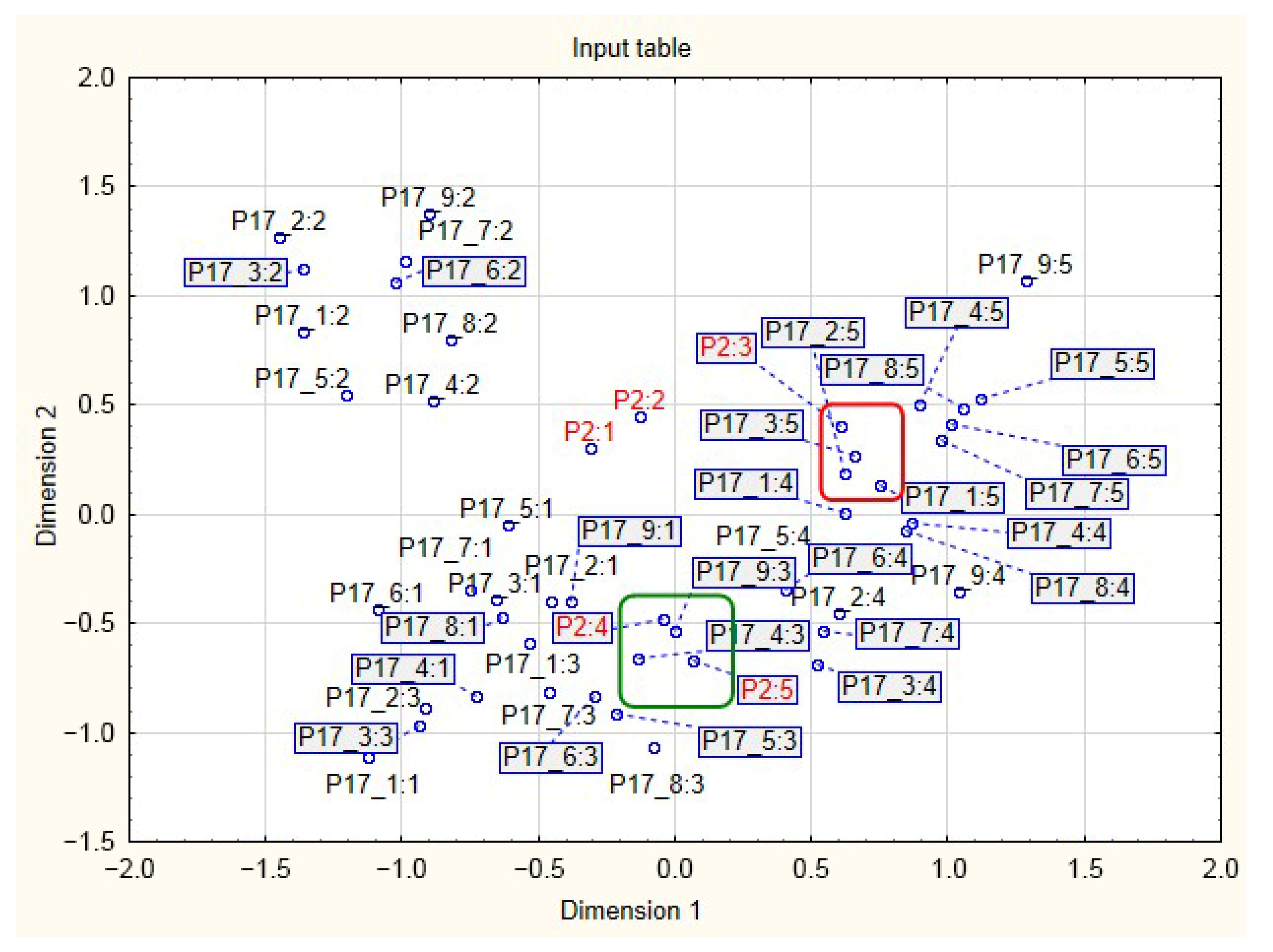
| P2 * | area of business activity | 1 | local market | 15% |
| 2 | regional market | 15% | ||
| 3 | national market | 19% | ||
| 4 | international market | 26% | ||
| 5 | global market | 25% | ||
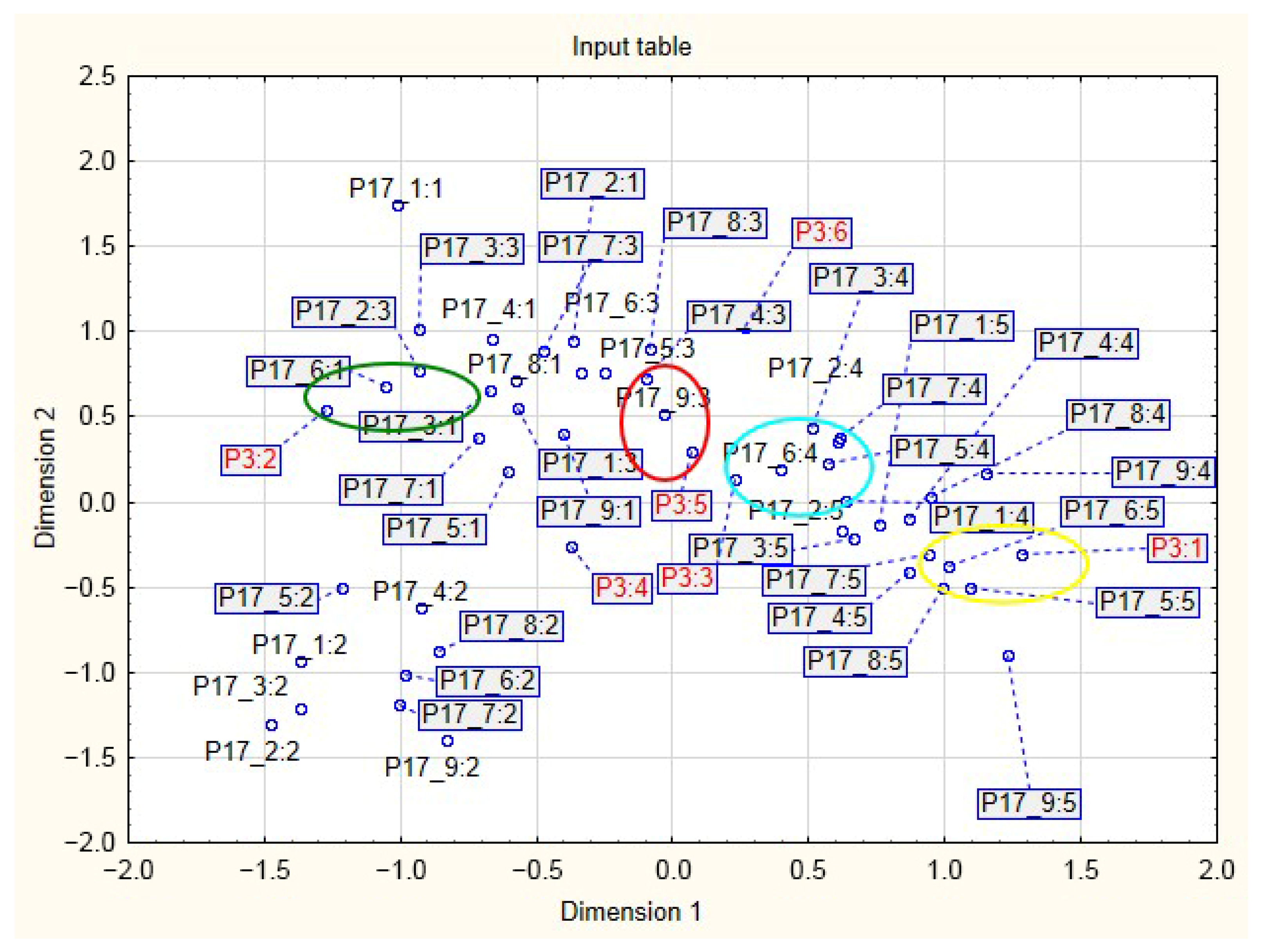
| P3 * | company ownership status | 1 | state-owned (State Treasury) | 6% |
| 2 | municipal (local governments) | 2% | ||
| 3 | private (individuals’ ownership) | 26% | ||
| 4 | company/cooperative | 43% | ||
| 5 | foreign ownership | 21% | ||
| 6 | don’t know/hard to say | 2% | ||
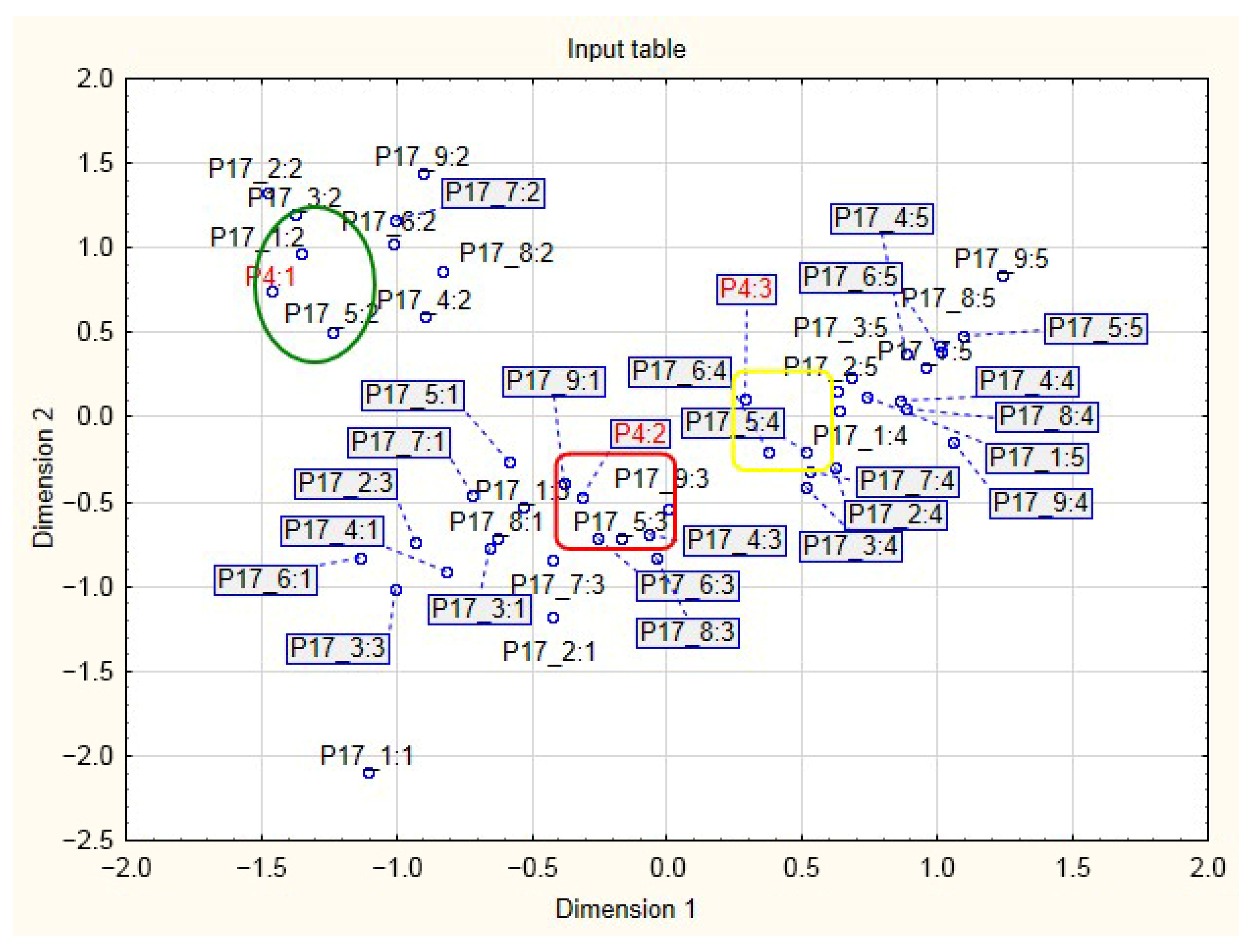
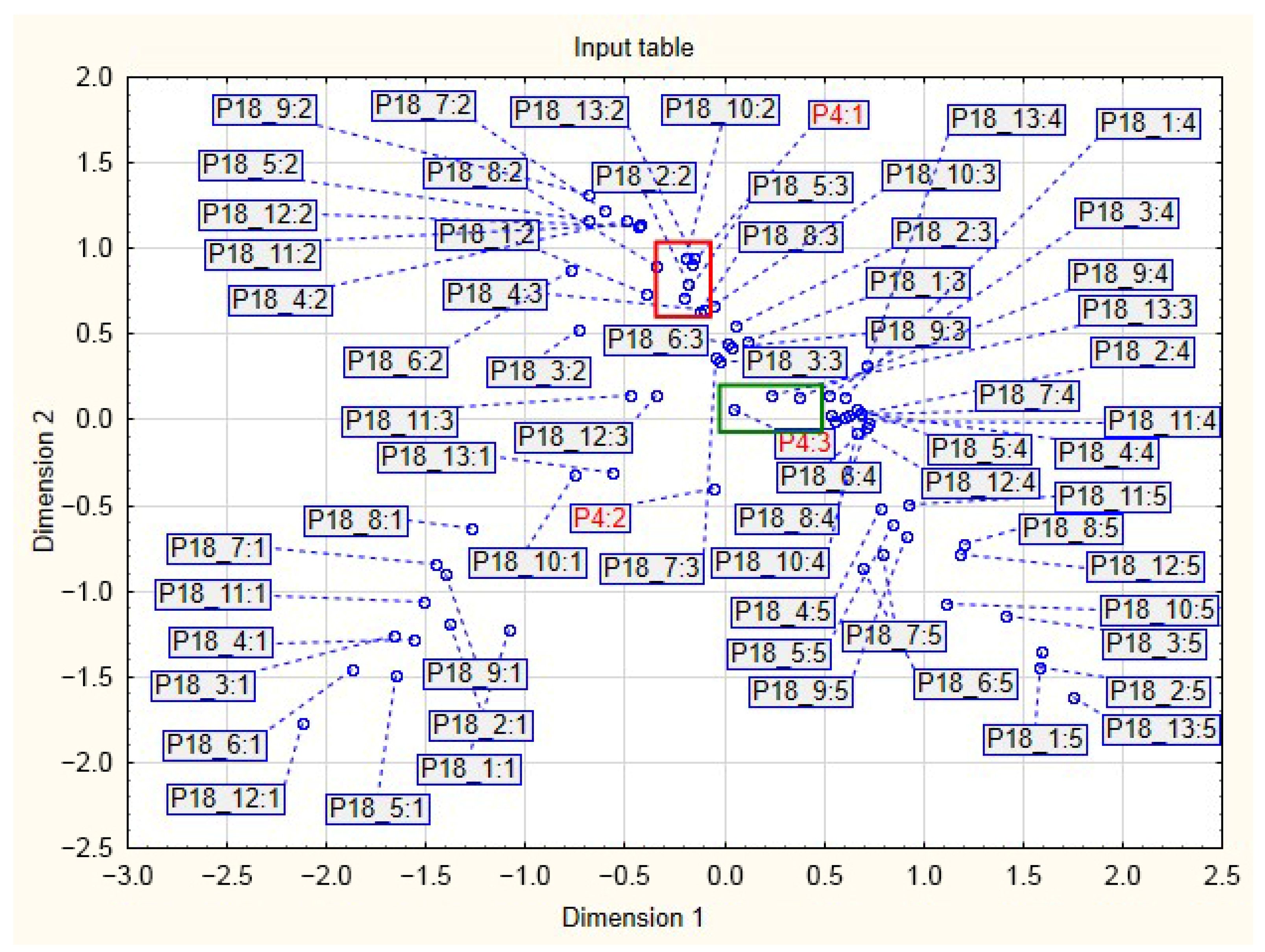
| P4 * | business sector | 1 | agricultural sector—agriculture, forestry, fishing, hunting, and mining | 8% |
| 2 | industrial sector—manufacturing, construction | 26% | ||
| 3 | service sector—trade, transport, communications, municipal services, healthcare, education, tourism, and culture | 66% | ||
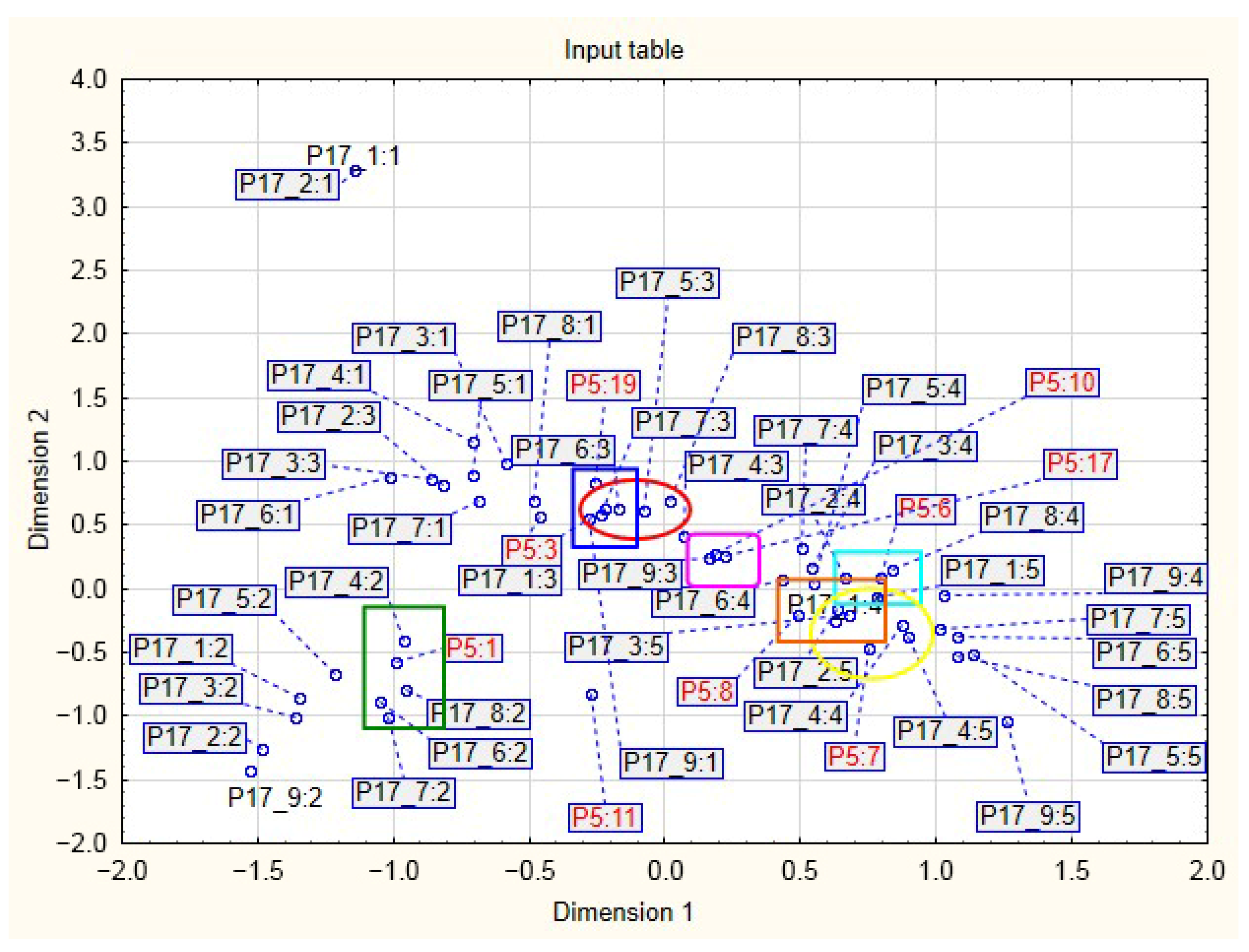
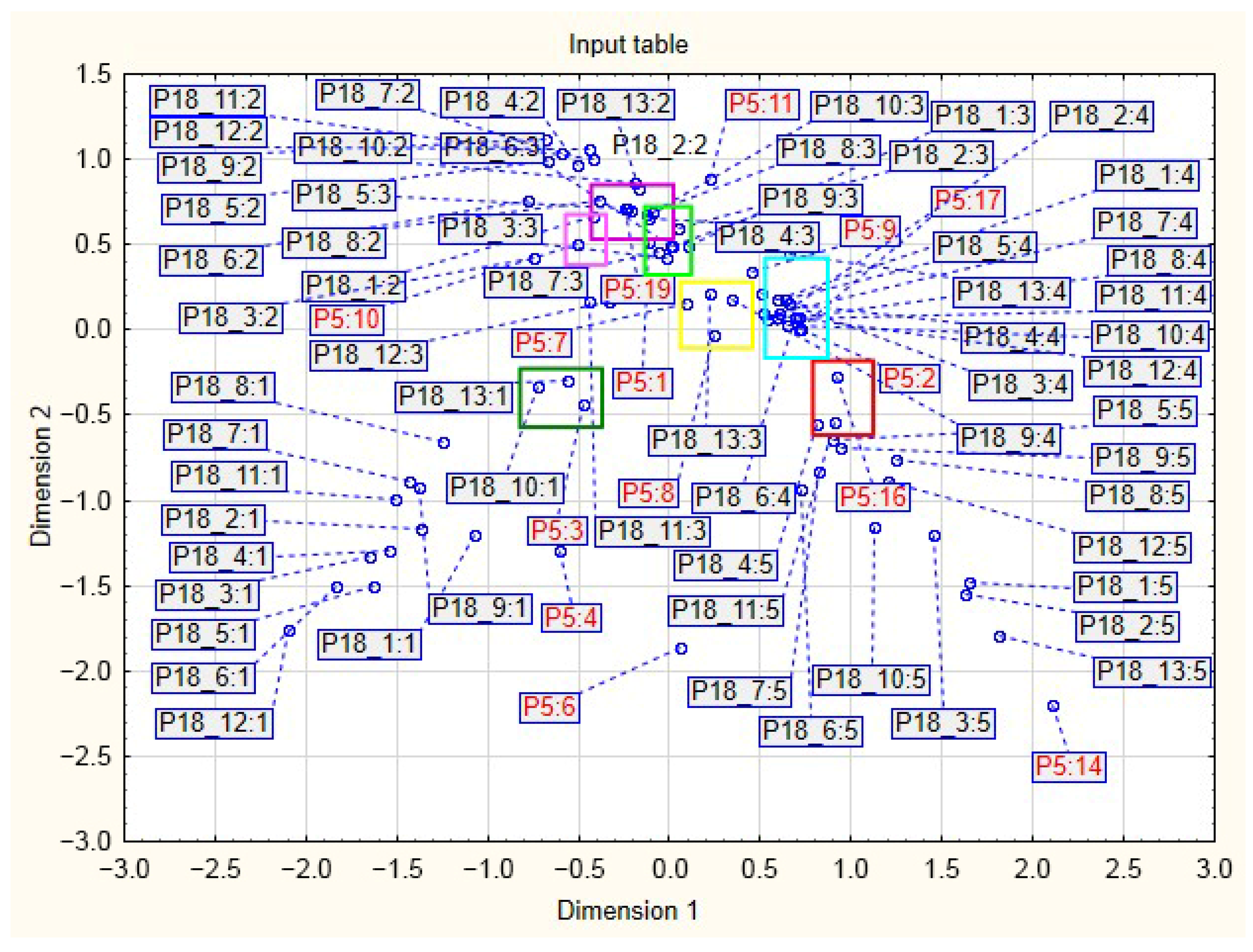
| P5 * | type of economic sector | 1 | agriculture, forestry, fishing | 11% |
| 2 | mining, quarrying | 2% | ||
| 3 | manufacturing | 25% | ||
| 4 | energy supply | 2% | ||
| 5 | water supply, water pollution, waste management | 0% | ||
| 6 | construction | 9% | ||
| 7 | trade, vehicle and motorcycle repair | 9% | ||
| 8 | transport, storage | 25% | ||
| 9 | hospitality, gastronomy | 4% | ||
| 10 | information, communication | 8% | ||
| 11 | financial consulting, insurance | 9% | ||
| 12 | real estate | 2% | ||
| 13 | professional, scientific, and technical activities | 0% | ||
| 14 | administration, services | 4% | ||
| 15 | public administration, defense, mandatory social services | 0% | ||
| 16 | education | 4% | ||
| 17 | public health, social work | 6% | ||
| 18 | arts, entertainment, recreation | 0% | ||
| 19 | other services | 13% | ||
| 20 | household (as employer), production and services for own needs | 0% | ||
| 21 | extraterritorial organizations | 0% | ||
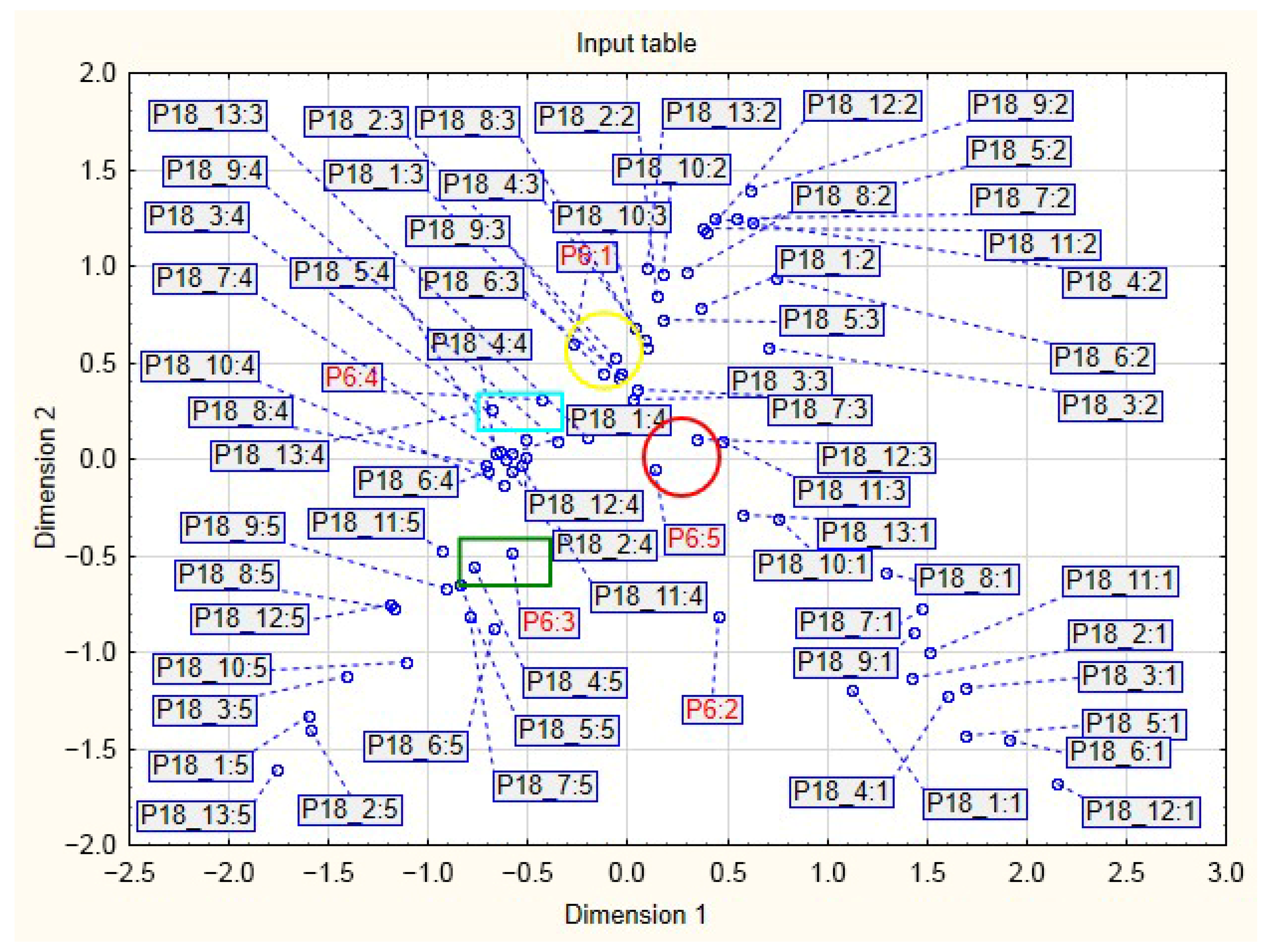
| P6 * | duration of company’s operation | 1 | <2 years | 11% |
| 2 | 2–4 years | 4% | ||
| 3 | 5–6 years | 6% | ||
| 4 | 7–10 years | 11% | ||
| 5 | >10 years | 64% | ||
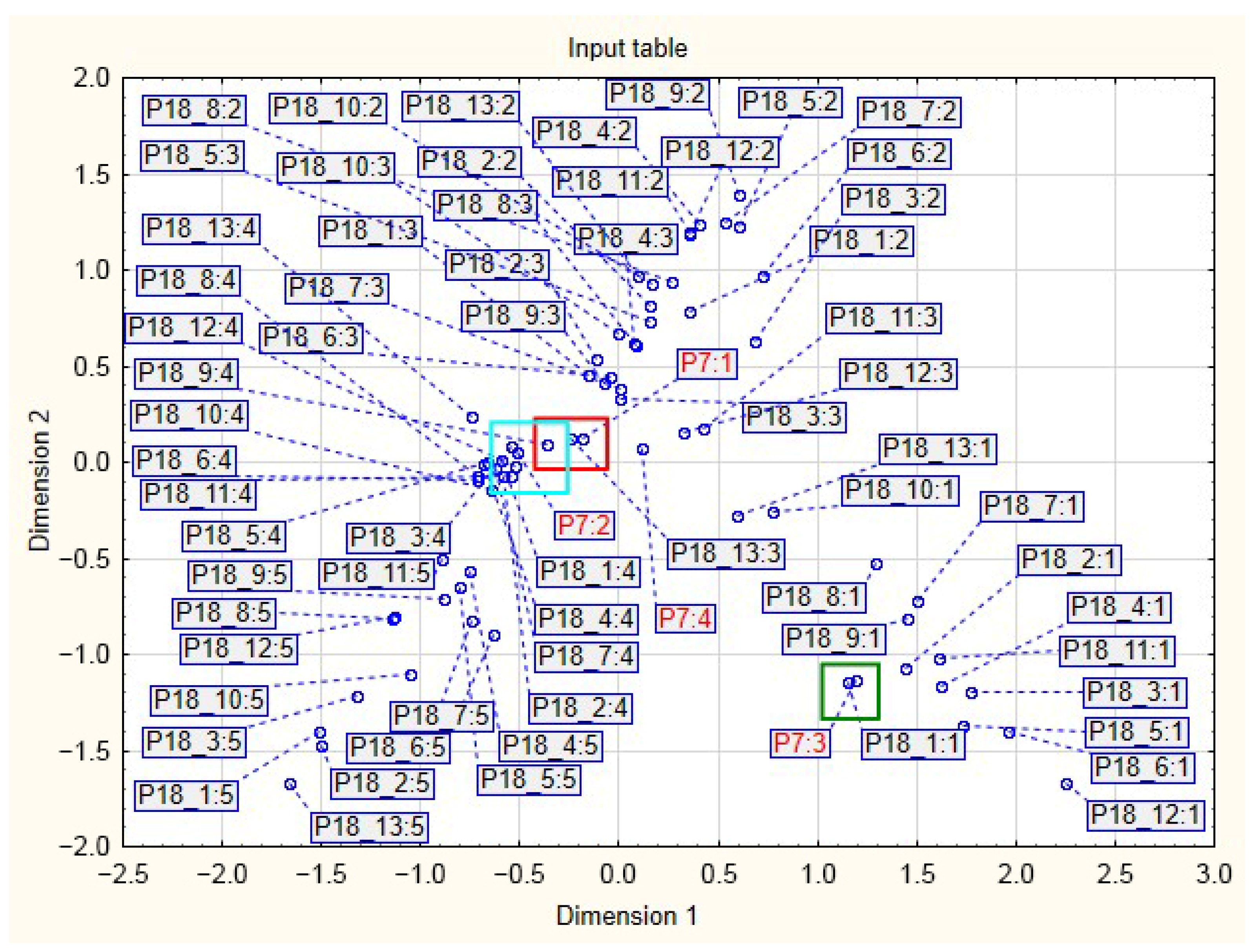
| P7 * | number of employees | 1 | <10 persons | 36% |
| 2 | 10–49 persons | 15% | ||
| 3 | 50–249 persons | 6% | ||
| 4 | >250 persons | 43% | ||
| P17 ** | benefits from implementing AI technology | P17_1 | reduced operational costs | 3.74 |
| P17_2 | shorter task completion time | 3.89 | ||
| P17_3 | error and risk reduction | 3.79 | ||
| P17_4 | increased availability (e.g., 24/7 services) | 3.17 | ||
| P17_5 | personalized services | 3.28 | ||
| P17_6 | decision-making process optimization | 3.40 | ||
| P17_7 | improved company image through innovation | 3.25 | ||
| P17_8 | environmental protection | 2.87 | ||
| P17_9 | other | 2.51 | ||
| P18 ** | concerns related to implementing AI technology | P18_1 | limited access to knowledge | 2.75 |
| P18_2 | limited access to technologies | 2.83 | ||
| P18_3 | need to possess trained staff | 3.15 | ||
| P18_4 | high costs of technology purchase | 3.28 | ||
| P18_5 | high operational costs, including training | 3.34 | ||
| P18_6 | complex decision-making process | 3.28 | ||
| P18_7 | prolonged procurement procedures | 3.23 | ||
| P18_8 | difficulty obtaining external funding | 2.91 | ||
| P18_9 | employee resistance, job loss due to automation | 3.26 | ||
| P18_10 | ethical dilemmas | 2.72 | ||
| P18_11 | privacy and data security risks | 3.38 | ||
| P18_12 | possibility of errors, dependence on technology | 3.38 | ||
| P18_13 | other | 2.30 |
| Criterion | Description |
|---|---|
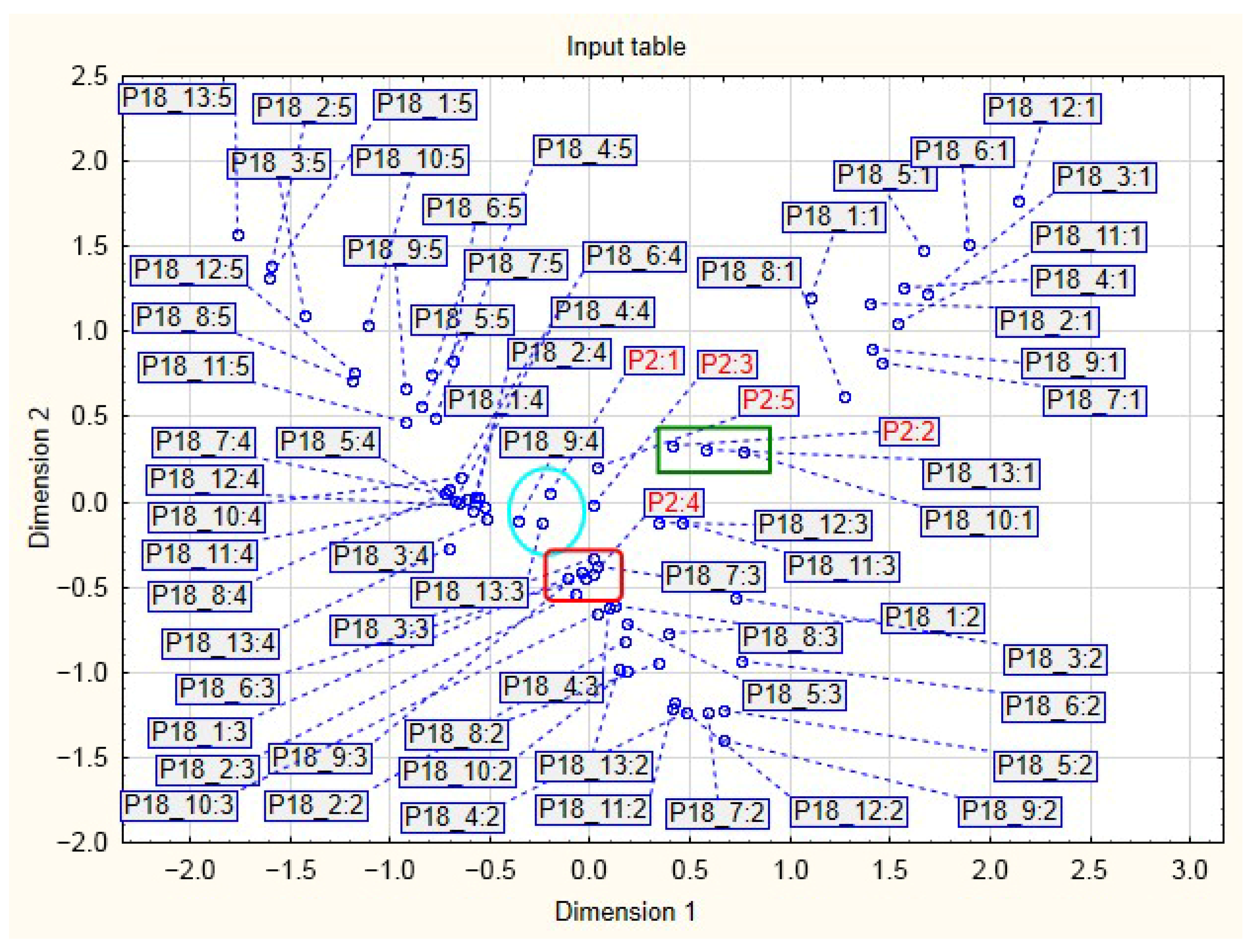
| Market status | In enterprises operating on the domestic market, the benefits of implementing artificial intelligence include error and risk reduction, lower operating costs, and shorter process execution times. Respondents from companies operating in international and global markets primarily emphasize increased enterprise accessibility through process automation and the ability to provide services regardless of time and location. They also point out additional positive effects of technology implementation that were not detailed in the questionnaire, indicating more complex and individualized organizational experiences among these entities. |
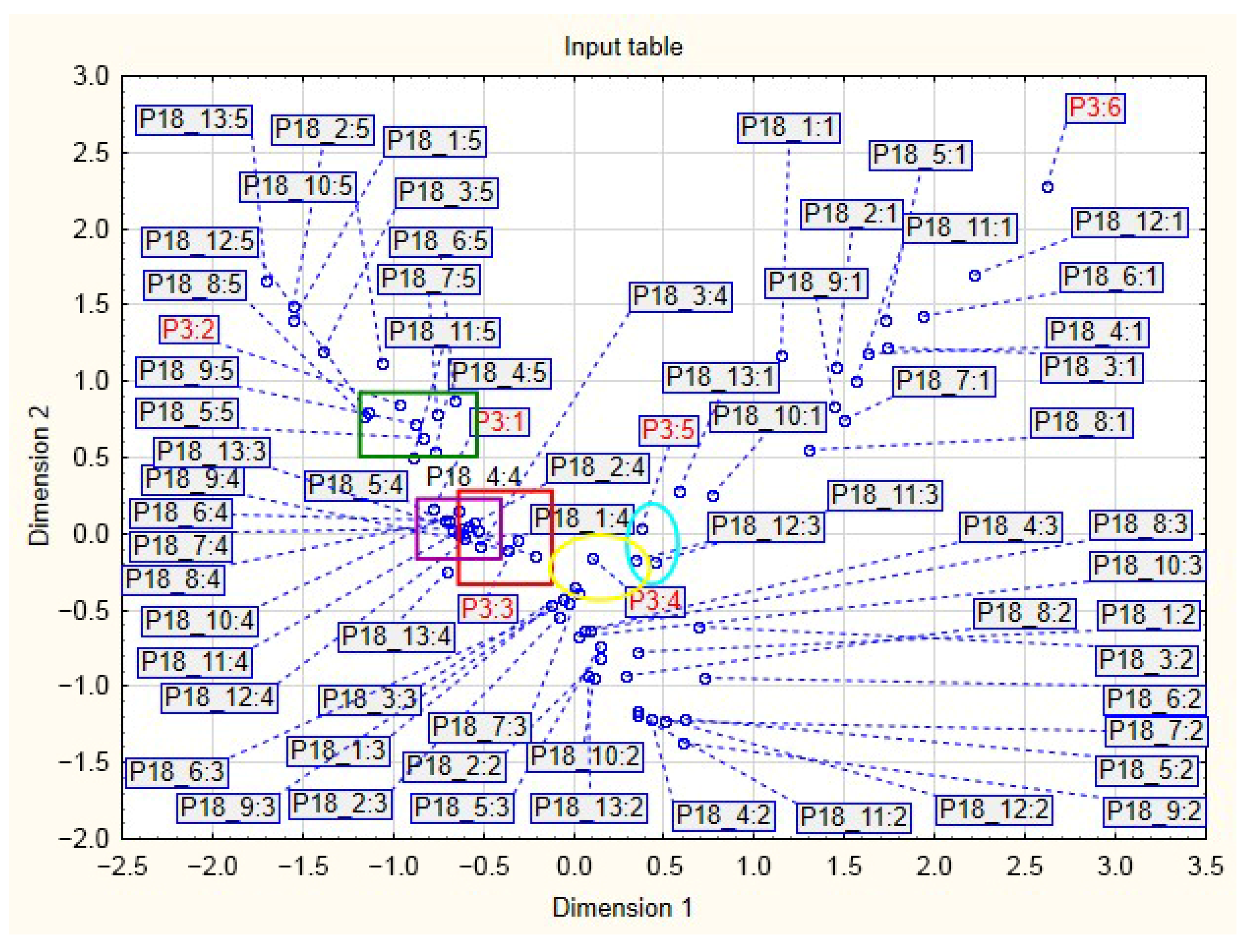
| Type of ownership | Representatives of enterprises owned by the State Treasury indicate four key benefits: the ability to tailor services to customer needs, streamlining decision-making processes, enhancing the organization’s image through innovation, and actions supporting environmental protection. In entities owned by local governments, shortening task completion time is considered important, while improving decision-making processes is seen as less significant. In private companies, artificial intelligence is perceived as a factor that genuinely improves efficiency. Particularly important benefits include reducing working time, minimizing errors, increasing service personalization, supporting decision-making processes, and improving the organization’s image as modern. In enterprises with foreign capital participation, the benefits are assessed as sufficiently significant, including increased service availability and additional positive effects not specified in the study but observable in practice. |
| Business sector | In the agricultural and mining sectors, the benefits of implementing AI are assessed as moderate. Cost reduction, improved process quality, and service customization to meet specific customer needs are observed, but their significance is considered limited. In the industrial sector, artificial intelligence is perceived as a tool that enables greater enterprise accessibility, streamlines decision-making processes, and personalizes offerings. In the service sector, particular emphasis is placed on the ability to tailor services to individual customer needs and improve decision-making processes. Differences in emphasis occur across industries—for example, in construction, economic and environmental benefits are considered particularly important, while in transportation, speed of process execution and error minimization are highlighted. |
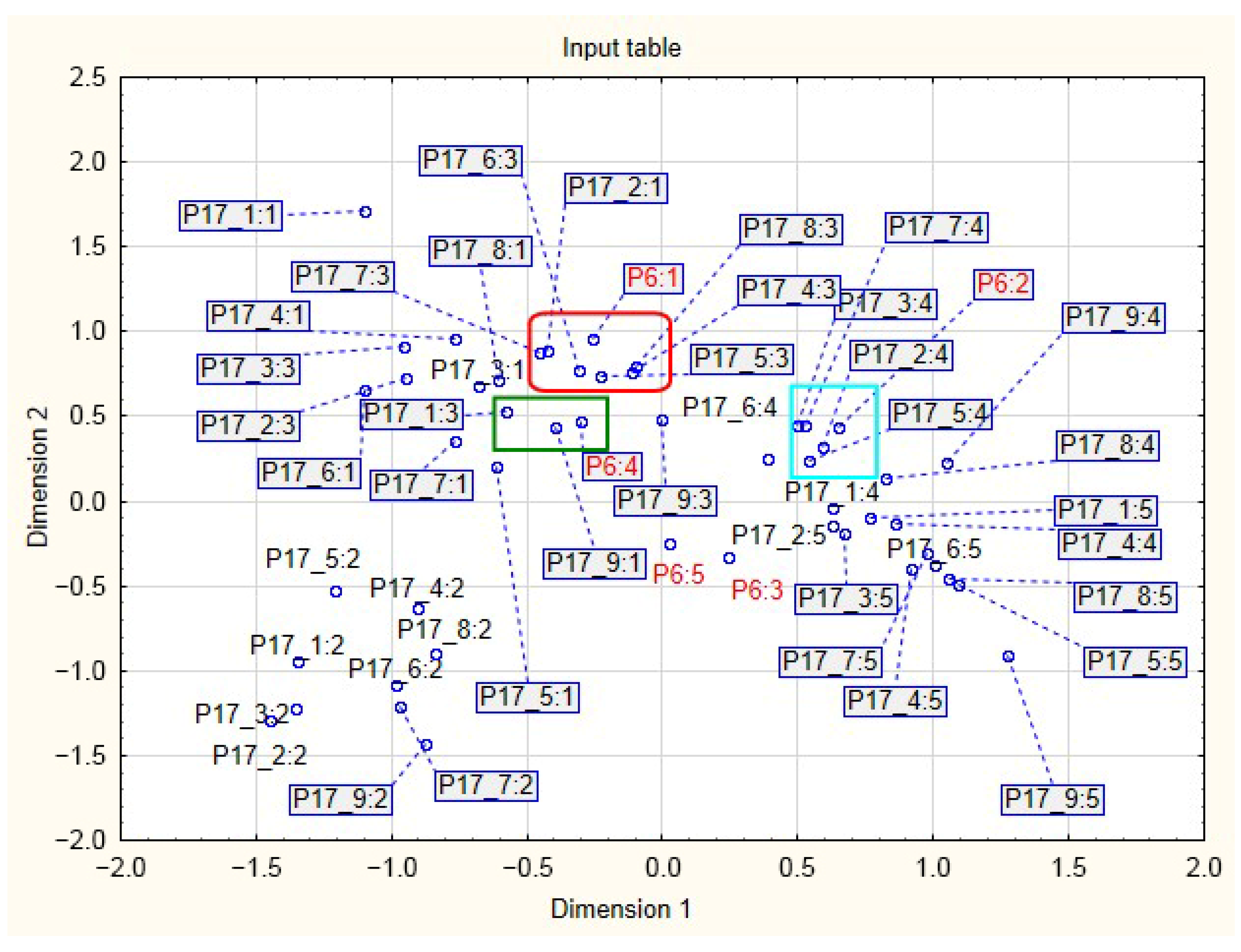
| Duration of company’s operation | In firms operating for less than two years, the benefits are assessed as moderate. Improvements in image, greater service availability, and enhanced organizational efficiency are noted; however, shortening working time is not perceived as a significant factor. In enterprises operating for two to four years, the benefits of AI adoption are clearly positive and include faster task execution, error reduction, greater personalization, and a favorable impact on image. In companies with seven to ten years of experience, respondents consider additional, unspecified benefits to be insignificant, which may indicate process stability but also a more conservative approach to change. |
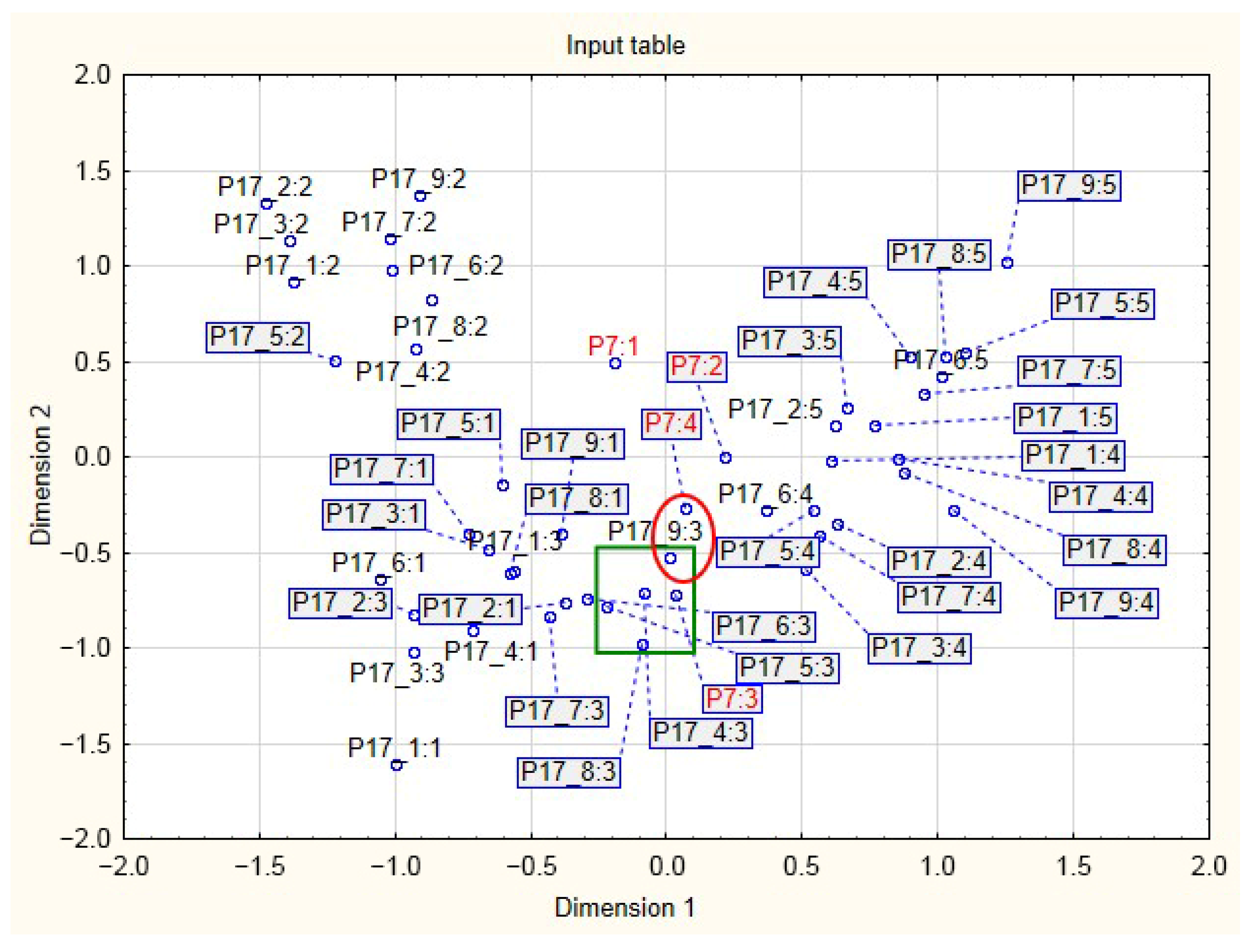
| Number of employees | In medium-sized enterprises (50–249 employees), the benefits of implementing artificial intelligence are perceived as sufficiently significant, including increased accessibility, service personalization, and pro-environmental actions. At the same time, other values resulting from implementation, which were not included in the study, are also observed. A similar perception of benefits occurs in large companies employing more than 250 people, suggesting that larger organizations possess both the awareness and infrastructure necessary for the effective use of advanced technologies. |
| Criterion | Description |
|---|---|
| Market status | In enterprises operating in the local market, the most significant concerns are related primarily to employee resistance stemming from the risk of job loss, as well as issues not included in the questionnaire. For companies functioning in the regional market, ethical dilemmas and additional unspecified factors are perceived as of low importance. In contrast, enterprises operating in the international market report a broad range of concerns, including limited access to knowledge and technology, the need for training, the complexity of decision-making processes and lengthy tender procedures, as well as employee resistance to process automation. |
| Type of ownership | In state-owned enterprises, a very high level of concern is observed, focusing on limited access to knowledge and technology, high implementation and operating costs, complex decision-making and tender procedures, difficulties in obtaining financing, ethical issues, and threats related to data security. Similar concerns occur in municipal entities, where employee resistance and the risk of errors and excessive dependence on technology are additionally emphasized. In the private sector, the most frequently indicated issues include limitations in access to knowledge and technology, the need for training, implementation procedures, employee resistance, and concerns about privacy and technology reliability. In companies and cooperatives, problems related to training and the complexity of procedures dominate, whereas in foreign enterprises, the main concerns are data security and technology reliability. |
| Business sector | In the agriculture and extraction sectors, key concerns relate to technology operating costs and the need for training, as well as the complexity of procedures and employee resistance. In the service sector, the most important issues are the risk of job loss due to automation and concerns not specified in the questionnaire. In the mining, hospitality, and public health sectors, there is a high level of concern regarding access to knowledge and technology, implementation and maintenance costs, administrative procedures, financing, ethical issues, and data security. In manufacturing companies, ethical issues and unspecified concerns are assessed as of low importance. In the education sector, concerns about technology purchase costs and privacy threats are particularly strong. In trade and transport, employee resistance plays a key role. |
| Duration of company’s operation | Companies operating for less than two years are primarily concerned about the lack of knowledge and access to technology. Enterprises functioning for five to six years emphasize the very high costs of implementing and maintaining artificial intelligence. Companies with seven to ten years of experience point to concerns not indicated in the survey form, which may suggest more individualized implementation barriers. In contrast, businesses operating for more than ten years mainly highlight the risk of errors and dependence on technology. |
| Number of employees | In companies employing fewer than ten people, the primary concern is employee resistance and additional, unspecified worries. In enterprises with ten to forty-nine employees, there is a wide range of concerns, including lack of knowledge, limited access to technology, the need for training, complex tender procedures, employee resistance, data security concerns, and the risk of errors. In medium-sized companies employing fifty to two hundred forty-nine people, lack of knowledge about technology is assessed as a minor concern, suggesting that these firms have developed internal competencies enabling the implementation of AI-based solutions. |
| Criterion | Description |
|---|---|
| Market status | Local market enterprises should focus on change management strategies aimed at reducing employee resistance, particularly by emphasizing job transformation rather than job loss. Clear communication and employee involvement in early stages of AI implementation are recommended. Regional market companies may benefit from developing ethical guidelines and monitoring mechanisms, even if these issues are currently perceived as less significant, to prevent future risks. International market enterprises should prioritize investments in knowledge acquisition and technology transfer, supported by structured training programs. Simplifying decision-making and tender procedures, as well as adopting standardized implementation frameworks, could reduce complexity and delays. Addressing employee resistance through reskilling initiatives is also essential. |
| Type of ownership | State-owned enterprises should streamline decision-making and tender procedures and establish centralized support units for AI implementation. Increased access to financing mechanisms and partnerships with research institutions could mitigate knowledge and cost barriers. Strengthening cybersecurity policies and ethical oversight frameworks is strongly recommended. Municipal entities should complement technological investments with targeted training programs and initiatives aimed at reducing employee resistance. Risk management systems should be introduced to limit errors and excessive dependence on technology. Private enterprises are advised to invest in continuous training and knowledge-sharing platforms while ensuring robust data protection and system reliability. Transparent implementation procedures can help reduce uncertainty and resistance. Companies and cooperatives should simplify implementation procedures and focus on developing internal training capabilities to build long-term competencies. Foreign-owned enterprises should prioritize advanced data security solutions and system reliability testing to address their key concerns. |
| Selected business sectors | Agriculture and extraction sectors should seek financial support or subsidies to offset operating costs and invest in practical, sector-specific training programs. Simplification of procedures and participatory implementation approaches may reduce employee resistance. Service sector organizations should address fears of job loss by promoting human–AI collaboration models and redefining job roles rather than eliminating positions. Mining, hospitality, and public health sectors require comprehensive support strategies, including access to expert knowledge, financial instruments, ethical guidelines, and strong data security frameworks. Manufacturing companies should maintain their current approach while monitoring ethical and emerging concerns to ensure long-term sustainability. Education sector institutions should prioritize cost-effective procurement strategies and strengthen data privacy protections to build trust among stakeholders. Trade and transport sectors should focus on change management and employee engagement programs to reduce resistance and improve acceptance of AI solutions. |
| Duration of company’s operation | Companies operating for less than two years should be supported through advisory services, incubators, and partnerships that improve access to knowledge and technology. Enterprises with five to six years of operation should conduct cost–benefit analyses and explore scalable or modular AI solutions to manage high implementation and maintenance costs. Companies operating for seven to ten years should adopt individualized implementation strategies, as their concerns suggest more specific, context-dependent barriers. Organizations with more than ten years of experience should focus on risk mitigation by introducing validation procedures, human oversight mechanisms, and contingency plans to reduce errors and overreliance on technology. |
| Number of employees | Micro-enterprises (fewer than ten employees) should emphasize transparent communication and basic training to reduce employee resistance and uncertainty. Small enterprises (10–49 employees) require comprehensive support, including training programs, simplified procedures, and guidance on data security and risk management. Medium-sized enterprises (50–249 employees) should leverage their existing internal competencies by focusing on advanced AI applications, process optimization, and strategic integration rather than basic knowledge acquisition. |
Disclaimer/Publisher’s Note: The statements, opinions and data contained in all publications are solely those of the individual author(s) and contributor(s) and not of MDPI and/or the editor(s). MDPI and/or the editor(s) disclaim responsibility for any injury to people or property resulting from any ideas, methods, instructions or products referred to in the content. |
© 2026 by the authors. Licensee MDPI, Basel, Switzerland. This article is an open access article distributed under the terms and conditions of the Creative Commons Attribution (CC BY) license.
Share and Cite
Filina-Dawidowicz, L.; Barczak, A.; Sęk, J.; Trojanowski, P.; Wiktorowska-Jasik, A.; Ciesielczyk, D. Benefits and Concerns Related to the Implementation of Artificial Intelligence Technology in Enterprises Located in the West Pomeranian Voivodeship of Poland. Appl. Sci. 2026, 16, 621. https://doi.org/10.3390/app16020621
Filina-Dawidowicz L, Barczak A, Sęk J, Trojanowski P, Wiktorowska-Jasik A, Ciesielczyk D. Benefits and Concerns Related to the Implementation of Artificial Intelligence Technology in Enterprises Located in the West Pomeranian Voivodeship of Poland. Applied Sciences. 2026; 16(2):621. https://doi.org/10.3390/app16020621
Chicago/Turabian StyleFilina-Dawidowicz, Ludmiła, Agnieszka Barczak, Joanna Sęk, Piotr Trojanowski, Anna Wiktorowska-Jasik, and Dorota Ciesielczyk. 2026. "Benefits and Concerns Related to the Implementation of Artificial Intelligence Technology in Enterprises Located in the West Pomeranian Voivodeship of Poland" Applied Sciences 16, no. 2: 621. https://doi.org/10.3390/app16020621
APA StyleFilina-Dawidowicz, L., Barczak, A., Sęk, J., Trojanowski, P., Wiktorowska-Jasik, A., & Ciesielczyk, D. (2026). Benefits and Concerns Related to the Implementation of Artificial Intelligence Technology in Enterprises Located in the West Pomeranian Voivodeship of Poland. Applied Sciences, 16(2), 621. https://doi.org/10.3390/app16020621