Next Article in Journal
KT-NAS: Knowledge Transfer for Efficient Neural Architecture Search
Previous Article in Journal
Benefits and Concerns Related to the Implementation of Artificial Intelligence Technology in Enterprises Located in the West Pomeranian Voivodeship of Poland
error_outline You can access the new MDPI.com website here. Explore and share your feedback with us.
 
 
Article

Multifaceted Characterization of Olive-Associated Endophytic Fungi with Potential Applications in Growth Promotion and Disease Management


by
Tasos-Nektarios Spantidos
1,
Dimitra Douka
1,
Panagiotis Katinakis
1 and
Anastasia Venieraki
2,*
1
Laboratory of General and Agricultural Microbiology, Department of Crop Science, Agricultural University of Athens, Iera Odos 75, 11855 Athens, Greece
2
Laboratory of Plant Pathology, Department of Crop Science, Agricultural University of Athens, Iera Odos 75, 11855 Athens, Greece
*
Author to whom correspondence should be addressed.
Appl. Sci. 2026, 16(2), 624; https://doi.org/10.3390/app16020624
Submission received: 27 October 2025 / Revised: 16 December 2025 / Accepted: 29 December 2025 / Published: 7 January 2026
(This article belongs to the Section Applied Biosciences and Bioengineering)

Abstract

The olive tree hosts diverse endophytic fungi that may contribute to plant protection and growth. In this study, a preliminary screening of olive-associated fungal endophytes was conducted. A total of 67 fungal endophytes were isolated from the leaves and roots of the Greek cultivars Amfissa and Kalamon and identified using morphological and molecular approaches; 28 representative strains were selected for functional evaluation. Dual culture assays revealed substantial antagonistic activity against major phytopathogens, with growth inhibition ranging from 19.05% to 100%. Notably, strains F.KALl.8 and F.AMFr.15 showed the strongest suppression across pathogens. Interaction phenotyping revealed all major interaction types (A, B, C) and subtype C1/C2, with several strains producing pigmentation zone lines or hyphal ridges at contact sites. The assessment of plant growth-related effects using Arabidopsis thaliana as a model system showed that three strains (F.AMFr.15, F.KALr.4, F.KALr.38A) significantly increased seedling biomass (up to ~16% above the control), whereas nine strains caused severe growth reduction and disease symptoms. Beneficial strains also altered root architecture, inhibiting primary root elongation while inducing extensive lateral root formation. Collectively, these findings highlight the functional diversity of olive-associated fungal endophytes and identify promising candidate strains, particularly F.AMFr.15 (identified as Clonostachys sp.), for further host-specific validation as potential biological control and plant growth-promoting agents.

1. Introduction

Plants are not an autonomous entity but interact with a multitude of microorganisms including bacteria, fungi, protozoa, archaea, and viruses [1]. Plant-associated microbes are established and thrive in ecological niches outside the plant (phyllosphere and rhizosphere), as well as in internal plant tissues (endosphere). The term “endophyte” was first introduced by De Bary (1866) and refers to microbes that colonize the internal plant tissues without causing any visible damage to the host [2,3]. Endophytic fungi are a highly biodiverse and versatile microbial community that are integral to plant life. Fossil records indicate that plant–endophytic fungal interactions have existed for over 400 million years, contributing to the evolution of life on land [4,5].
Several studies have documented the beneficial role of plant-associated endophytic fungi on plants [6]. They can produce phytohormones and plant growth regulators, as well as contribute to nutrient availability and uptake for plant growth and development [5,7,8]. Furthermore, they can act as potential biocontrol agents against invading pathogens through multiple modes of action, including the competition for space and nutrients, mycoparasitism, enhancement of the plant’s immune responses, and the production of antimicrobial secondary metabolites [9,10,11].
Εndophytic fungi are a great source of secondary metabolite production with various applications, many of which are considered to be produced by plant hosts [5,12,13]. A typical example is the anticancer substance taxol (paclitaxel), which has been isolated from the plant Taxus brevifolia but is similarly produced by the endophytic fungi Taxomyces andreanae [14] and subsequently by other endophytic species, whereas, as it was observed later, the taxol-producing endophytes release taxol as a defense barrier to plant pathogens [6,15,16].
Relationships between endophytes and hosts are diverse and complex, forming a continuum that spans from beneficial through neutral to harmful interactions [17]. Thus, in the term endophytes, latent pathogens and saprotrophs should be included [18]. Depending on the relationship that they develop with the plant (beneficial or not), endophytes are distinguished into commensals, mutualists, and antagonists [19]. The ‘‘balanced antagonism’’ hypothesis [17,20,21] was initially proposed to explain that the balanced equilibrium between the adverse effects of endophytes (such as the fungal endophytes) associated with plant hosts and the defense response exerted by the plants may lead to a symbiotic relationship. Subsequently, endophytic fungi must maintain a balance of antagonism not only with their host plant but also with the entire microbial community, including both endophytic and pathogenic microbes [22]. Thus, if endophytic fungi overcome the plant host defense, it will lead to plant disease via plant–pathogen interactions [23]. While often overlooked, these fungi can shift from a symptomless endophytic phase to an active pathogenic state, especially under abiotic or biotic stress conditions, compromising plant health and productivity. This dynamic transition between latency and virulence is influenced by a complex interplay of host immunity, microbial community structure, and ecological signals, making the olive tree a compelling model for studying the ecology and pathogenic potential of endophytes. In olives, several fungal genera—such as Colletotrichum, Fusarium, and Botryosphaeria—have been reported as both endophytes and pathogens, illustrating the plasticity of their lifestyles and the challenges in predicting disease emergence. Characterizing the functional traits of endophytic fungi, including their plant growth-promoting potential, antagonistic activity, and possible pathogenicity, is crucial for assessing their suitability as candidate strains for sustainable olive crop management [24,25,26,27,28,29,30].
The composition of the endophyte microbial community is dynamic and depends on various factors related to host plant genotype, age, and the plant tissue in which the endophytes are established. Environmental conditions, geographic location, and the type of soil in which the host is located also play an important role [31,32,33,34]. In addition, agricultural practices, as well as host infection by pathogens, can affect the abundances and diversities of endophytic communities [35,36].
The study of fungal endophyte communities is of great importance since it may help to better understand the roles of fungal endophytes in plant hosts, which include ecological dynamics with pathogenic fungi. The use of culture-based techniques, although widespread, poorly reflects the real diversity of fungi in a niche [37,38], since some of these microorganisms are non-sporulating, non-culturable, or are difficult to be isolated in current laboratory techniques [39]. Thus, further examination is required to evaluate the potential bioprospects of the culturable fungi. Notably, culture-independent DNA-based techniques shed light on the comprehensive study of fungal communities, despite some methodological limitations [39,40,41].
The olive (Olea europaea L.) is a perennial, evergreen species with considerable ecological and socioeconomic importance [26,42] in the Mediterranean basin and especially Greece. To date, more than 2000 olive cultivars are listed worldwide, indicating the diverse genetic background of the tree [42]. The composition of the olive fungal community as well as the factors which it is influenced by have interested previous researchers since they are considered as key determinants in the productivity and health of the plant. Thus, the examination of the fungal community structure should illuminate important aspects in the management of serious pathogens which are difficult to be controlled by conventional means [28,29,30,31,32,33,34,35,36,37,38,39,40,41,42,43,44,45,46,47,48]. Given the increasing interest in environmentally sustainable strategies for managing olive diseases and improving crop performance, there is a pressing need to identify native microbial resources with biocontrol and plant growth-promoting potential. Olive-associated fungal endophytes remain largely understudied, particularly in Greek cultivars of major agricultural and commercial value.
Therefore, the aim of the present study was to systematically explore the functional potential of fungal endophytes inhabiting the asymptomatic tissues of the Greek olive cultivars Amfissa and Kalamon (Kalamata). Specifically, we sought to (i) isolate and taxonomically characterize the endophytic fungal community; (ii) assess their plant growth-promoting traits through targeted biochemical assays and the growth responses of a model plant; (iii) evaluate their antagonistic activity against key olive fungal pathogens; and (iv) investigate the interaction dynamics among endophytes originating from the same tissue niche. By combining taxonomic identification with multi-level functional screening, this study provides novel insights into the diversity, ecological roles, and biotechnological potential of olive endophytic fungi and identifies promising strains for future development as biological control agents in olive cultivation.

2. Materials and Methods

2.1. Plant Material Collection and Isolation of Fungal Isolates

The collection of plant tissues (roots and leaves) was carried out from asymptomatic Greek olive trees, cultivars Amfissa and Kalamon, within the open field of the Agricultural University of Athens, Attica, in the month of March. For each cultivar, tissues were collected from one healthy tree, and multiple root and leaf samples were taken from different parts of the same tree to ensure adequate representation of the endophytic community. The excised plant tissues were surface sterilized according to the protocol of Kusari et al. (2012) [3]; soaking in 70% ethanol for 1 min, washing with 5% (v/v) aqueous washing solution (commercial bleach and 0.1% Tween 20) for 3 min under vigorous shaking, immersing in 70% ethanol for 30 s, and rinsing 3 times in double-distilled water (ddH2O). Sterile segments were immediately aseptically cut into smaller fragments (0.5 cm × 0.5 cm) by using a razor blade. Then, 4–5 fragments from each segment were placed on the surface of the potato dextrose agar medium (PDA, Condalab, Madrid Spain) Petri dishes amended with streptomycin (50 µg/mL) and impressed. The plates were incubated at 25 °C for more than a week and were observed every day for fungal growth from plant tissue. To confirm the success of the disinfection protocol, sterile segment imprints on the surface of the PDA agar were used as controls, as well as the aliquots of the last step of the protocol which were plated on PDA plates, where no microbial growth was observed. Emerging hyphae were isolated and aseptically transferred to fresh PDA plates and incubated at 25 °C in the dark until fungal colony formation. Subculturing of the fungal isolates was continued until a pure culture was obtained. Pure fungal cultures were examined based on colony growth rate and mycelium phenotype. Isolates were grouped into distinct morphotypes, and from each morphotype one to two representatives were selected for further examination to ensure maximal representation of the observed morphological diversity. Cultures of individual endophytic fungal isolates were maintained in PDA plates with streptomycin at 4 °C, and were stored in 2.0 mL cryovials containing 20% glycerol in potato dextrose broth (PDB, Conda) medium at −80 °C.

2.2. PGP Traits of Fungal Isolates

2.2.1. Siderophore Production

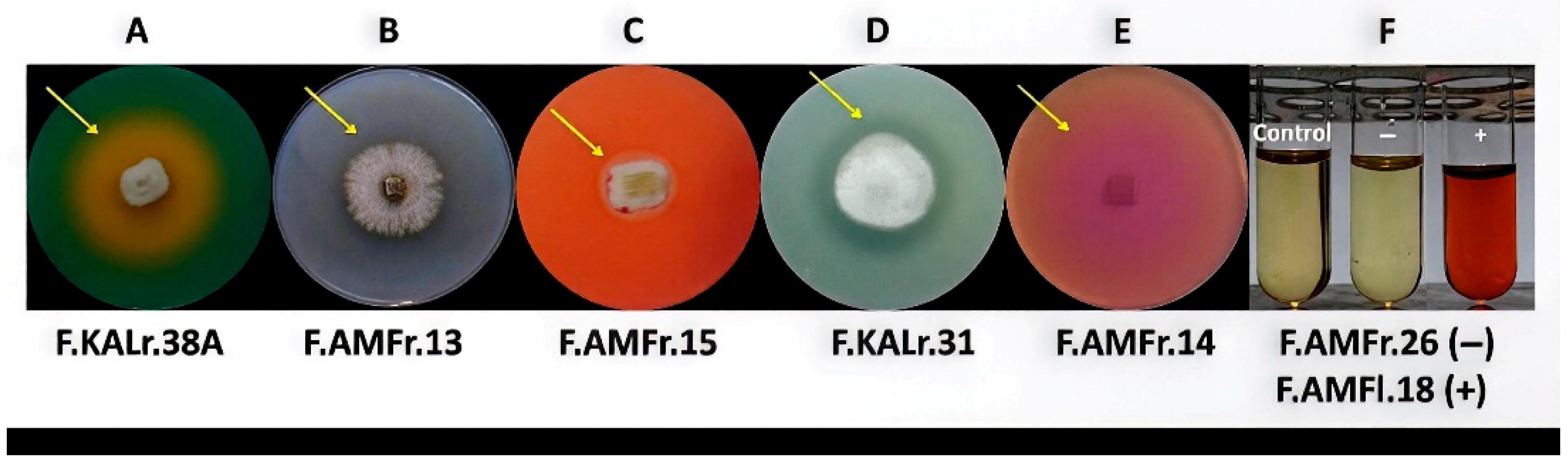
A total of 28 fungal endophyte isolates were evaluated for siderophore production using the Chrome Azurol Sulphonate (CAS) agar assay [49]. An excised mycelium plug (size 0.6 cm) of a 10-day fungal culture on PDA medium was placed on the plate and incubated at 25 °C for 5 days. Positive results were considered the formation of an orange-yellow halo around their growing colony.

2.2.2. Phosphate Solubilization

For phosphate solubilization testing, an excised mycelium plug of a 10-day mycelium plug was placed on Pikovskaya’s (PVK) agar medium [50], and incubated at 25 °C for 7 days. During this test, the fungi capable of solubilizing the precipitated phosphorus exhibits a mainly clear halo around their colony.

2.2.3. Indole-3-acetic Acid (IAA) Production

To detect indole-3-acetic acid production by the fungal strains, the Salkowski method was used [51,52,53], and the supernatant from a 3-day fungal culture in PDB amended with 1% L-Tryptophan (Sigma-Aldrich®, Merk KGaA, Burlington, MA, USA) was mixed with Salkowski reagent (35% HClO4 and 10 mM FeCl3) in a 2:1 ratio, and was incubated in the dark for 30 min. A change in color to orange-red indicated the production of indoleacetic acid.

2.2.4. Cellulase Production

For cellulase production detection, a mycelium plug was placed on CYEA medium (casein, 5 g; yeast extract, 2.5 g; glucose, 1 g; agar, 18 g) amended with 1% CMC (carboxymethyl cellulose).The plates were incubated at 25 °C for 5 days; after that, Congo red dye (0.1% w/v) was added and remained as is for 15 min. Then, the plates were flooded with NaCl solution (1 M) to remove unbound Congo red solution. The formation of a clear halo around the colony indicated a positive result.

2.2.5. Protease Production

Protease production was tested on a CYEA medium amended with skim milk powder (7%) by placing a mycelium plug on the plate. The inoculated plates were incubated at 25 °C for 5 days [54]. A positive result was considered the formation of a clear halo around the colony.

2.2.6. Ureolytic Ability

Urease production was tested by inoculating a mycelium plug on a Urea Base Christensen ISO 6579, ISO 19250 (Conda, Madrid, Spain) medium [55]. Ureolytic ability of the assessed isolates was indicated by the formation of a pink halo around the colony.

2.3. In Vitro Antagonistic Activity of Fungal Isolates

All selected fungal isolates were evaluated using an in vitro dual culture assay against important phytopathogens, including Rhizoctonia solani, Fusarium oxysporum f. sp. radicis-lycopersici (FORL), Colletotrichum acutatum, and Verticillium dahliae. Rhizoctonia solani Kühn (strain BPIC 2531) was isolated from stem lesions of Solanum tuberosum (potato) in Viotia, Greece, and FORL was obtained from diseased roots of greenhouse-grown tomato plants in Attica, Greece. Colletotrichum acutatum J.H. Simmonds (strain BPIC 2705) and Verticillium dahliae Kleb. (strain BPIC 2651) were isolated from symptomatic leaves and wilted branches of Olea europaea in Messinia and Ilia (Greece), respectively. All strains belong to the fungal culture collection of the Laboratory of Plant Pathology, Agricultural University of Athens, and have been previously characterized based on morphological and molecular criteria. R. solani BPIC 2531 and FORL were included because they are highly aggressive soil-borne pathogens of major crops (potato and tomato) and are considered economically important and representative test organisms for the evaluation of biocontrol agents in Mediterranean horticultural systems.
Briefly, a mycelial plug from each endophytic fungus was obtained from a 15-day-old culture and placed 3 cm from the edge of a PDA plate. The plates were incubated at 25 °C in darkness for one day prior to the introduction of V. dahliae, two days prior to C. acutatum, and three days prior to R. solani and FORL. Subsequently, a mycelial plug of each phytopathogenic fungus, derived from a 10-day-old culture, was placed opposite the endophyte at a distance of 3 cm from the plate edge. Co-culture plates were incubated at 25 °C for 10 days for R. solani, FORL, and C. acutatum, and for 15 days for V. dahliae. As positive controls, separate plates were prepared with each phytopathogenic fungus grown alone under the same conditions. The difference in the incubation times was due to the growth rate of each fungal pathogen tested. Finally, the antagonistic activity which was caused by the fungal isolates was assessed after measuring the mycelium radius of the pathogen from its inoculation point with the following formula: A% = [(ρ1 − ρ2)/ρ1] × 100, where A% represents the percent inhibition of mycelial growth of the fungal pathogen, ρ1 represents the mycelium radius of the phytopathogenic fungus (control), and ρ2 the mycelial radius of the phytopathogenic fungus co-cultured with fungal isolate (cm).

2.4. Evaluation of the Fungal Effect on A. thaliana Col-0 Seedlings In Vitro

For this experiment, the modified protocol of Dovana et al. [56] was followed. A. thaliana was selected as a model plant due to its well-characterized genetics, short life cycle, and wide use in studies of plant–microbe interactions. The seeds of A. thaliana Col-0 were washed for 0.5 min in 70% ethanol, immersed for 1.5 min in washing aqueous solution (5% (v/v) of commercial bleach and 0.1% Tween 20 (which acts as a non-ionic surfactant to reduce surface tension and improve the efficiency of surface disinfection), soaked for 30 s in 70% ethanol, and finally rinsed in sterile dH2O. The sterilized seeds were placed on ½ Murashige and Skoog with vitamins (½ MS) (MS0222, Duchefa Biochemie, Haarlem, The Netherlands), amended with 1.5% sucrose and 0.6% agar. Then, all plates (8 × 8 cm) were maintained at 4 °C for 2 days and placed vertically in a growth chamber (22–25 °C, 16 h light: 8 h dark photoperiod), for three days. To evaluate the fungal effect on plant growth, 8 emerged seedlings were transplanted on growth medium (½ MS with vitamins, 1% sucrose and 0.8% agar). The inoculation was conducted by placing 3 excised mycelium plugs from a 10-day fungal culture grown on PDA plates, 5 cm under the root tips. Each strain was tested on 8 seedlings per replicate, and the experiment was performed in two independent replicates. Seedlings without fungal treatment served as controls. All the plates were maintained vertically in the growth chamber with the conditions that we mention above. After 14 days, the aboveground fresh weight was measured, and the length of the primary root and the number of the lateral roots of the plantlets were evaluated using ImageJ software (v.1.8.0).

2.5. In Vitro Assay Using Detached Olive Fruits

To further evaluate the pathogenic potential of the isolates on olive tissues, a detached-fruit inoculation assay was performed. Mature, asymptomatic olive fruits were surface-sterilized (70% ethanol followed by 1% NaOCl), rinsed in sterile distilled water, and air-dried under sterile conditions. Each fruit was wounded at the equatorial region using a sterile needle and inoculated with a 5 mm mycelial plug excised from the margin of a 7-day-old fungal culture. Control fruits received sterile PDA plugs to account for the wounding effect. Inoculated fruits were placed in high-humidity chambers (≥95% RH) and incubated at 25 °C. Symptom development was monitored after seven days and recording the presence of tissue maceration.

2.6. In Vitro Assessment of Interaction Patterns Among Endophytic Fungi

The interactions between endophytic fungi originating from the same tissue were evaluated in vitro to observe interaction patterns and potential relationships formed within the culturable endophytic fungal community. The interactions were assessed using the dual culture method on PDA plates. An excised mycelium plug of each endophytic fungus, obtained from a 15-day-old culture, was placed 3 cm from the edge of the plate. A mycelium plug of a different endophytic fungus was placed opposite at the same distance. Monocultures of each fungus grown on PDA were used as controls. All plates were incubated at 25 °C for 20 days and observed daily. Each interaction was tested in triplicate.

2.7. Phylogenetic Recognition Based on ITS rDNA Sequence Analysis

The DNA was extracted from the mycelium grown on PDA at 25 °C for 15 days using a modified microwave-based DNA extraction method and directly used in polymerase chain reaction (PCR) [57,58]. The primers ITS1 (5′-TCCGTAGGTGAACCTGCGG-3′) and ITS4 (5′-TCCTCCGCTTATTGATATGC-3′) were used to amplify ribosomal internal transcribed spacers (ITS) [59]. The PCR mixture contained 1 μL of each primer (30 μM), 5 μL 10× PCR Buffer, with Mg2+, 1 μL dNTPs, 0.5 μL Hot Start DNA polymerase, 1 μL DNA template (50–100 ng), 2 μL DMSO which enhances PCR performance by reducing secondary structures and improving amplification of GC-rich regions, and a quantity of ddH2O in a final volume of 50 μL. The partial sequences of nucleotides were compared with available sequences from NCBI databases, which were retrieved by Nucleotide Basic Local Alignment Search Tool (BLASTn, NCBI BLAST+ version 2.17.0), National Center for Biotechnology Information, Bethesda, MD, USA; https://blast.ncbi.nlm.nih.gov/Blast.cgi, accessed on 15 September 2025. A phylogenetic analysis was performed based on ITS rDNA gene sequencing of the isolates and type strains of the NCBI database, using Mega software version 12 and a Maximum Likelihood phylogenetic tree (Table S1). The bootstrap value was chosen to be 1000 for the percentage of bootstrap replications supporting the branch.

2.8. Morphological Characterization of Fungal Colonies

Morphological characterization was performed following standard mycological criteria. Colony morphology was recorded after 7 days on PDA at 25 °C, including colony color, texture, margin characteristics, and growth rate. Microscopic structures were examined using light microscopy, focusing on conidiophore architecture, conidial shape and size, septation patterns, and any distinctive reproductive structures. These morphological features were used alongside ITS rDNA sequences to support the taxonomic identification of the isolates.

2.9. Statistical Analysis

Data were statistically analyzed and plotted using GraphPad Prism program version 10.6.0 (GraphPad Software, San Diego, CA, USA). Statistical analysis was performed with ANOVA followed by Dunnett’s test (p < 0.05) to compare fungal treatments to the control values.

3. Results

3.1. Isolation of Endophytic Fungi

A total of 67 endophytic fungi were obtained from the initial incubation plates, of which 28 were from Amfissa (20 from the root and 8 from the leaves) and 39 from Kalamon (24 from the root and 15 from the leaves) (Table S2).
Therefore, from the 67 pure fungal cultures examined, 28 were selected for subsequent experiments.

3.2. Taxonomic Recognition

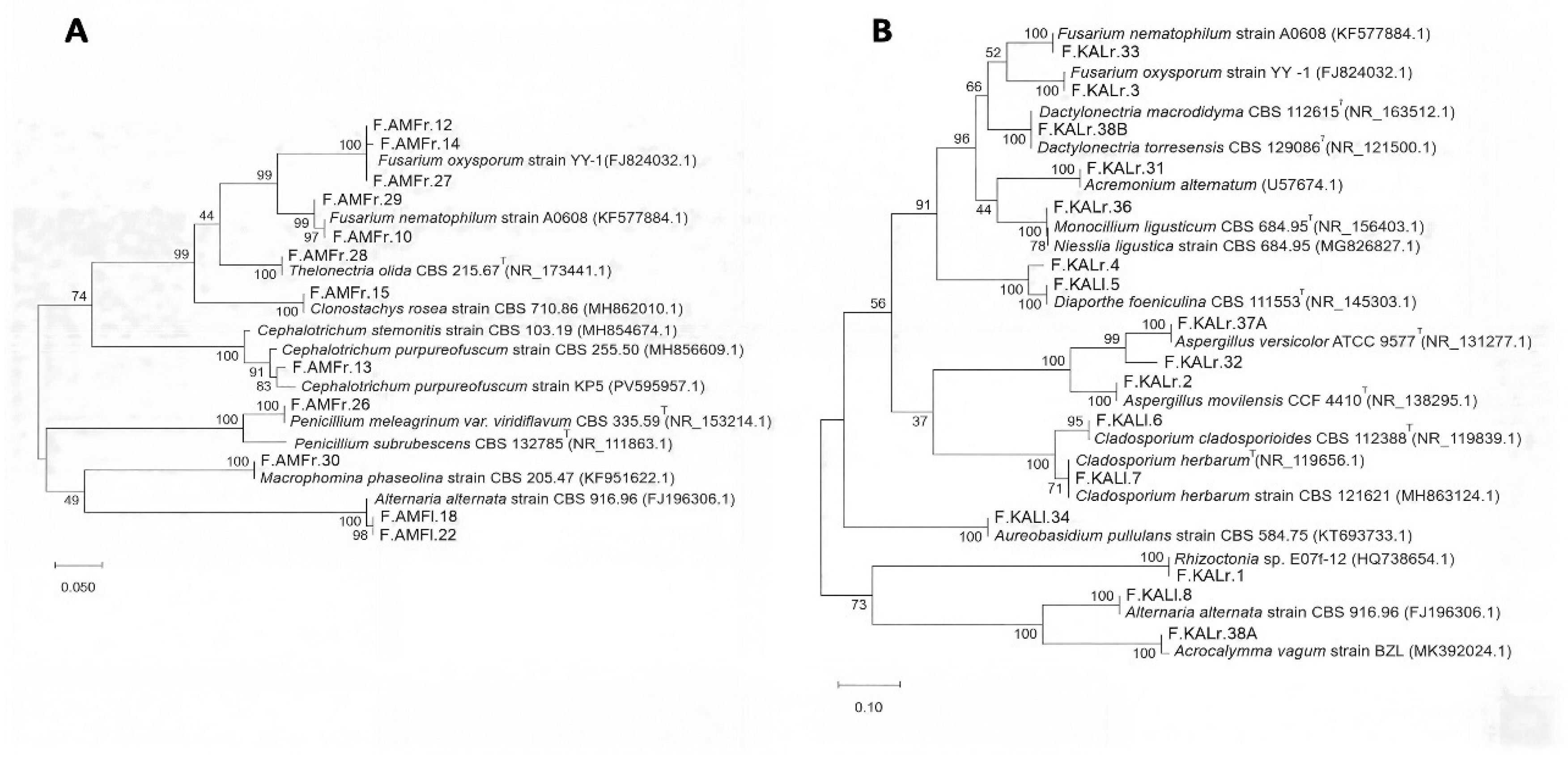
Among the twenty-eight ITS rRNA sequences analyzed using the BLASTN algorithm of the NCBI GenBank database, seven strains (F.AMFr.10, F.AMFr.12, F.AMFr.14, F.AMFr.27, F.AMFr.29, F.KALr.3, and F.KALr.33) were assigned as Fusarium sp., one as Penicillium sp. (F.AMFr.26), two as Cladosporium sp. (F.KALl.6 and F.KALl.7), three as Alternaria sp. (F.AMFl.18, F.AMΦl.22, and F.KALl.8), three as Aspergillus sp. (F.KALr.2, F.KALr.32, and F.KALr.37A), one as Diaporthe (F.KALl.5), one as Phomopsis sp. (F.KALr.4), one as Clonostachys sp. (F.AMFr.15), one as Macrophomina sp. (F.AMFr.30), one as Acrocalymma (F.KALr.38A), one as Aureobasidium sp. (F.KALl.34), one as Niesslia sp. (F.KALr.36), one as Dactylonectria sp. (F.KALr.38B), one as Acremonium sp. (F.KALr.31), one as Cephalotrichum sp. (F.AMFr.13), one as Thelonectria sp. (F.AMFr.28), and one as Rhizoctonia sp. (F.KALr.1) (Figure 1).
Finally, in numerous instances, the observed repeatability of fungal genera was contingent upon the plant tissue type (leaf or root) from which the isolates were derived. Specifically, the genus Fusarium was found to be the most abundant in the roots while the genus Alternaria was isolated only from the leaves. The accession numbers of the endophytes, as well as where the plant tissues are isolated from, are listed in Table S3. Morphological characteristics of endophytic fungal isolates from olive cultivars Amfissa and Kalamon are presented in Table S4.

3.3. Evaluation of Plant Growth-Promoting Traits

Most of the strains (n = 25/28) were revealed to be effective at least in one of the PGP characteristics: siderophore production, phosphate solubilization, and IAA production. Particularly, the strains F.AMFr.12, F.AMFl.18, and F.KALr.4 were marked as both siderophores and IAA producers, while the strains F.AMFr.13 and F.KALr.2 were able to solubilize precipitated phosphate and to produce siderophores, as well. However, three strains (i.e., F.AMFr.28, F.AMFr.30, and F.KALl.5) showed negative results in these traits (Table 1).
Among the isolates, 16 from the 28 exhibited both cellulase and protease activity, which are correlated with a potential mycoparasitic activity, while the strains F.AMFr.30, F.KALr.1, and F.KALr.38A did not show any activity. Lastly, for the urease test we found that 22 out of the 28 isolates possessed urease enzyme activity (Figure 2 and Table 1).

3.4. Antagonistic Activity of the Endophytic Fungi Against Phytopathogenic Fungi

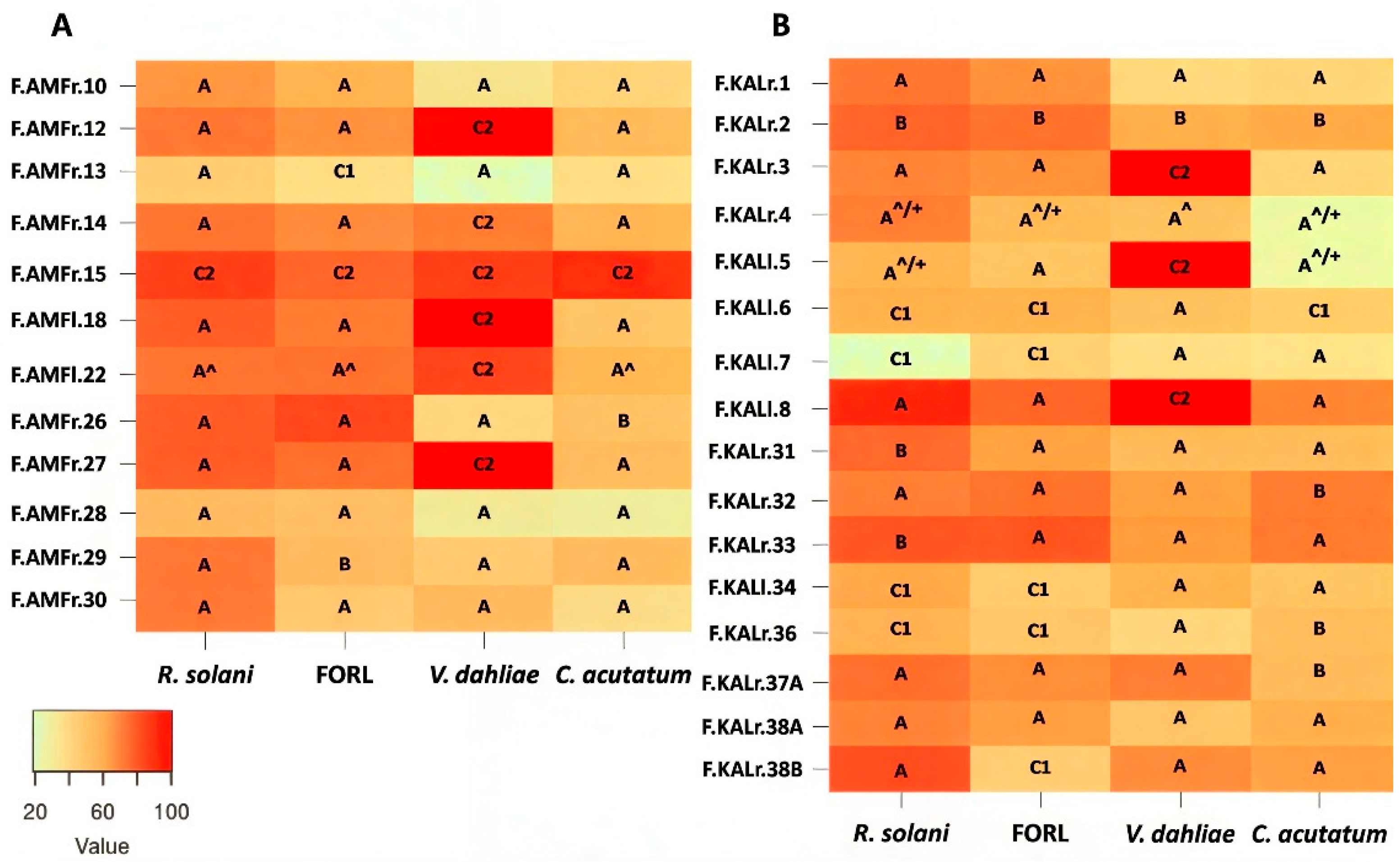
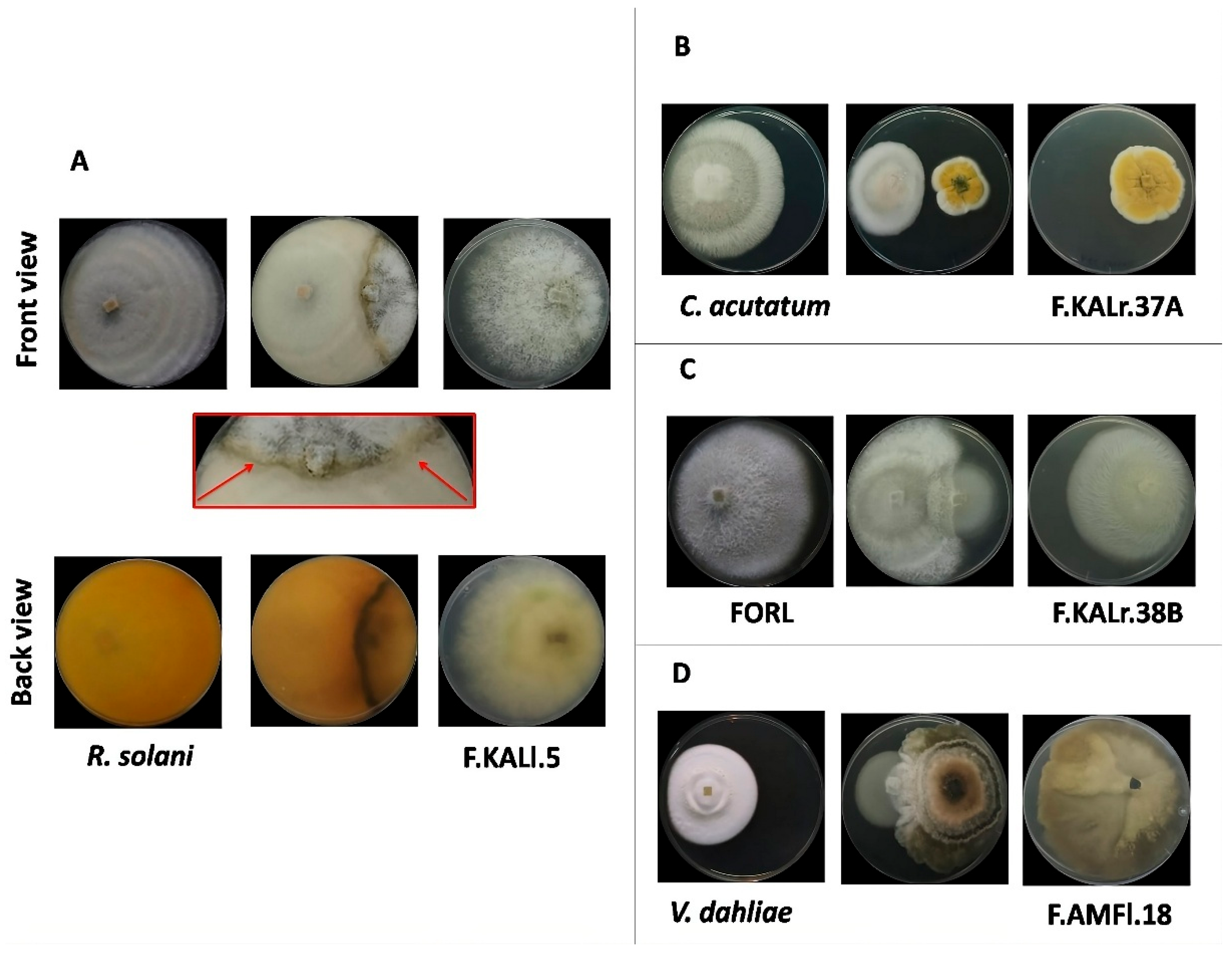
All endophytic strains exhibited variable levels of antagonistic activity against the tested pathogens (R. solani BPIC2531, F. oxysporum f. sp. radicis-lycopersici, V. dahliae BPIC2651, and C. acutatum BPIC2705), as detailed in Table S5. The results revealed that the strains decreased the mycelial expansion from 19.05% to 100%, where the strains F.KALl.8 and F.AMFr.15 emerged as the most effective to compact most of the pathogens (Table S5).
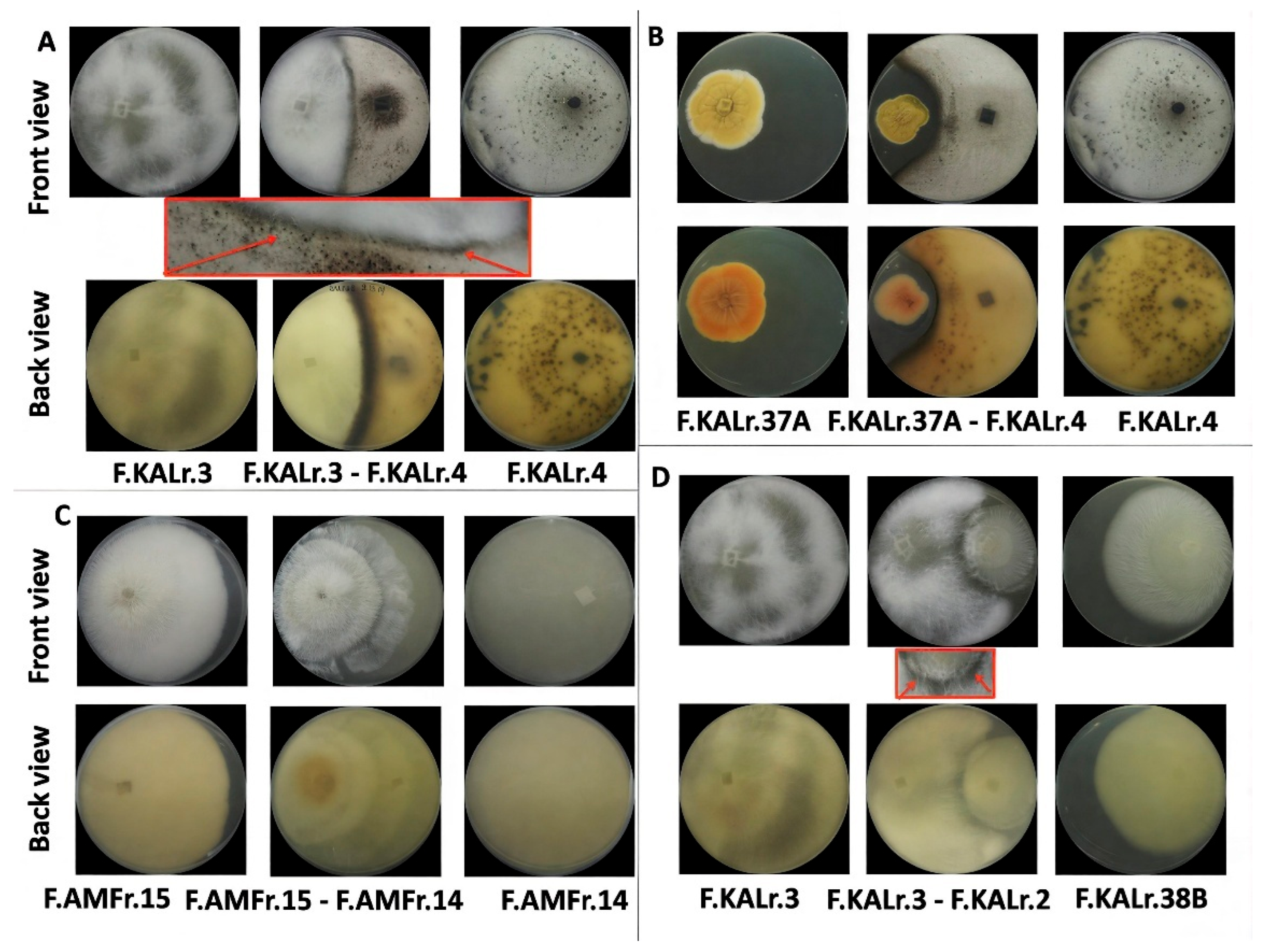
Furthermore, the types of interactions that occurred during the co-culture of the endophytes with the phytopathogenic fungi were characterized. Thus, after macroscopic observation of the plates, three main types of interactions between the fungi were recorded: type A (deadlock at contact), type B (deadlock at distance), and type C (overgrowth). The type C was further divided into subtype C1 (pathogen overgrows endophyte) and subtype C2 (endophyte overgrows pathogen). During the interactions, some additional features were observed. For instance, at the site of the contact between endophytes and pathogens we noticed the formation of a zone pigmentation line. This feature was observed in the interactions of F.AMFr.22 and F.KALl.5 against R. solani and C. acutatum, as well as F.KALr.4 against all fungi examined (Figure 3 and Figure 4). However, in some cases the zone-line formation was accompanied by the lifting of the hyphae at the site of the contact between the fungi (ridge). The existence of both characteristics was detected in the interactions of F.KALr. 4 against R. solani, FORL, and C. acutatum, as well as F.KALl.5 against R. solani and C. acutatum (Figure 3 and Figure 4).

3.5. In Vitro Effect on Arabidopsis thaliana

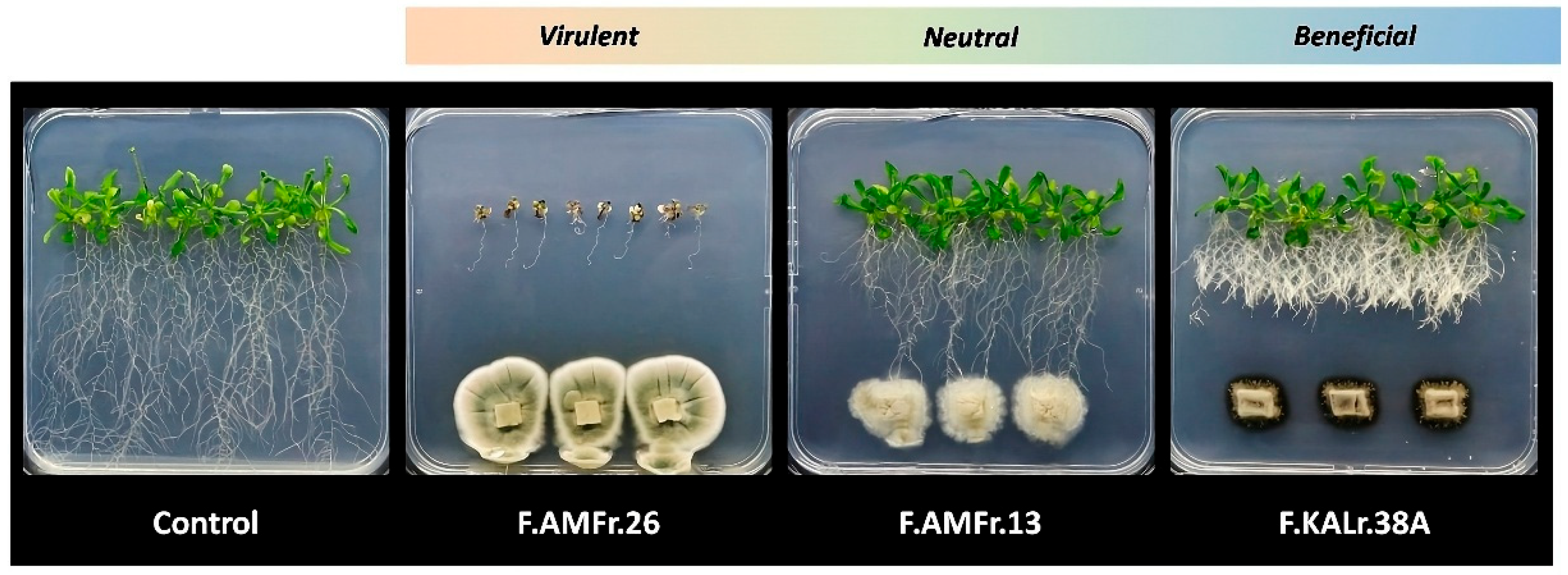
After 14 days of co-culture, three strains (i.e., F.AMFr.15, F.KALr.4, and F.KALr.38A) showed a beneficial effect on the seedlings, exhibiting a statistically significant increase in their fresh weight compared to the control. By contrast, nine strains (i.e., F.AMFr.12, F.AMFr.14, F.AMFr.26, F.AMFr.27, F.AMFr.30, F.KALr.1, F.KALr.3, F.KALl.8, and F.KALr.31) caused a particularly harmful effect on the seedlings, causing a reduction in their fresh weight. Ultimately, these fungi caused disease in the plants, with enhanced rotting of the emerging shoots, leaves, and roots observed at the advanced stages of infection (Figure 5). The remaining 16 strains did not show any statistically significant effect on the seedlings’ plant growth (Table 2).
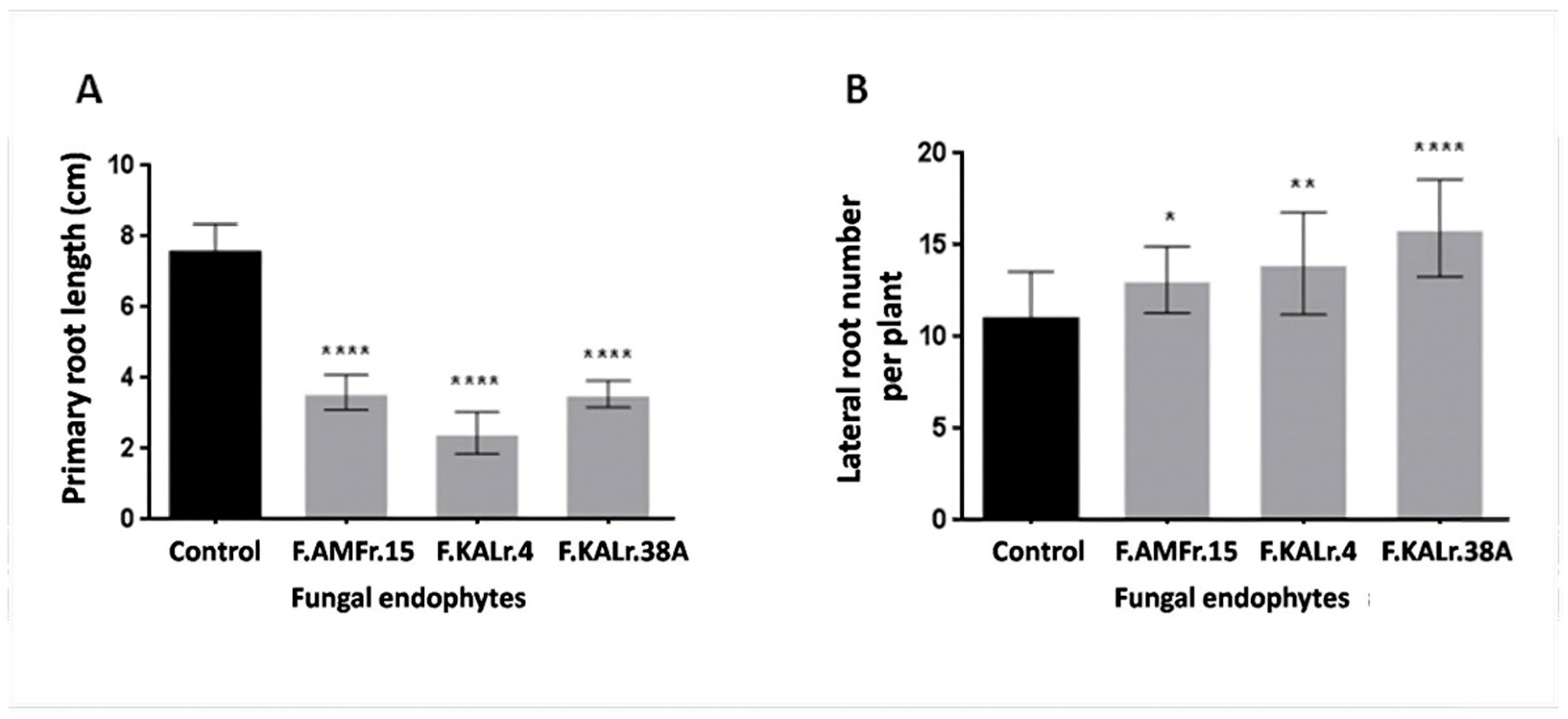
Furthermore, a phenomenon observed during the in vitro effect of the fungi on A. thaliana seedlings was the change in root architecture. Particularly, the fungal strains F.AMFr.15, F.KALr.4, and F.KALr.38A affected the root architecture of A. thaliana plants by causing primary root growth inhibition, accompanied in many cases by the development of a large number of lateral roots (Figure 6).

3.6. Disease Development in the Detached Olive Fruit Assay

All isolates that induced visible disease symptoms on Arabidopsis thaliana produced similar pathogenic effects on detached olive fruits. In these cases, darkening of the inoculation area, necrotic lesion expansion, and localized tissue softening were consistently observed. Lesion diameters differed among isolates but remained reproducible across replicates, indicating stable pathogenic behavior. Conversely, isolates classified as non-pathogenic in the A. thaliana assay did not elicit any detectable symptoms on olive fruits, which remained indistinguishable from the negative controls. No lesions developed on fruits inoculated with sterile PDA, confirming that wounding alone did not trigger decay (Figure S1). Overall, the detached-fruit assay corroborated the pathogenicity patterns observed in the model-host system.

3.7. In Vitro Interactions Between Endophytic Fungi Originating from the Same Tissue

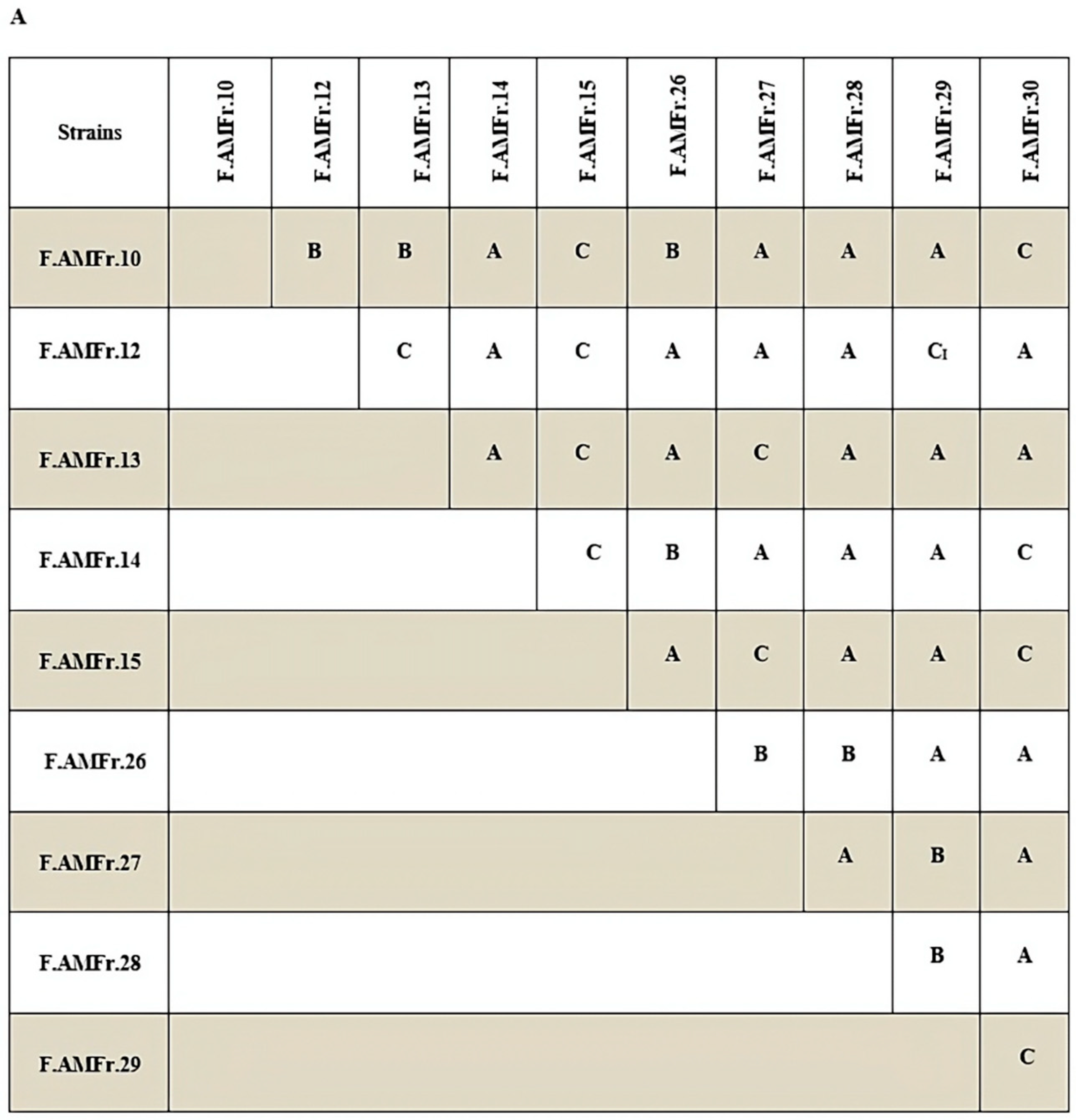
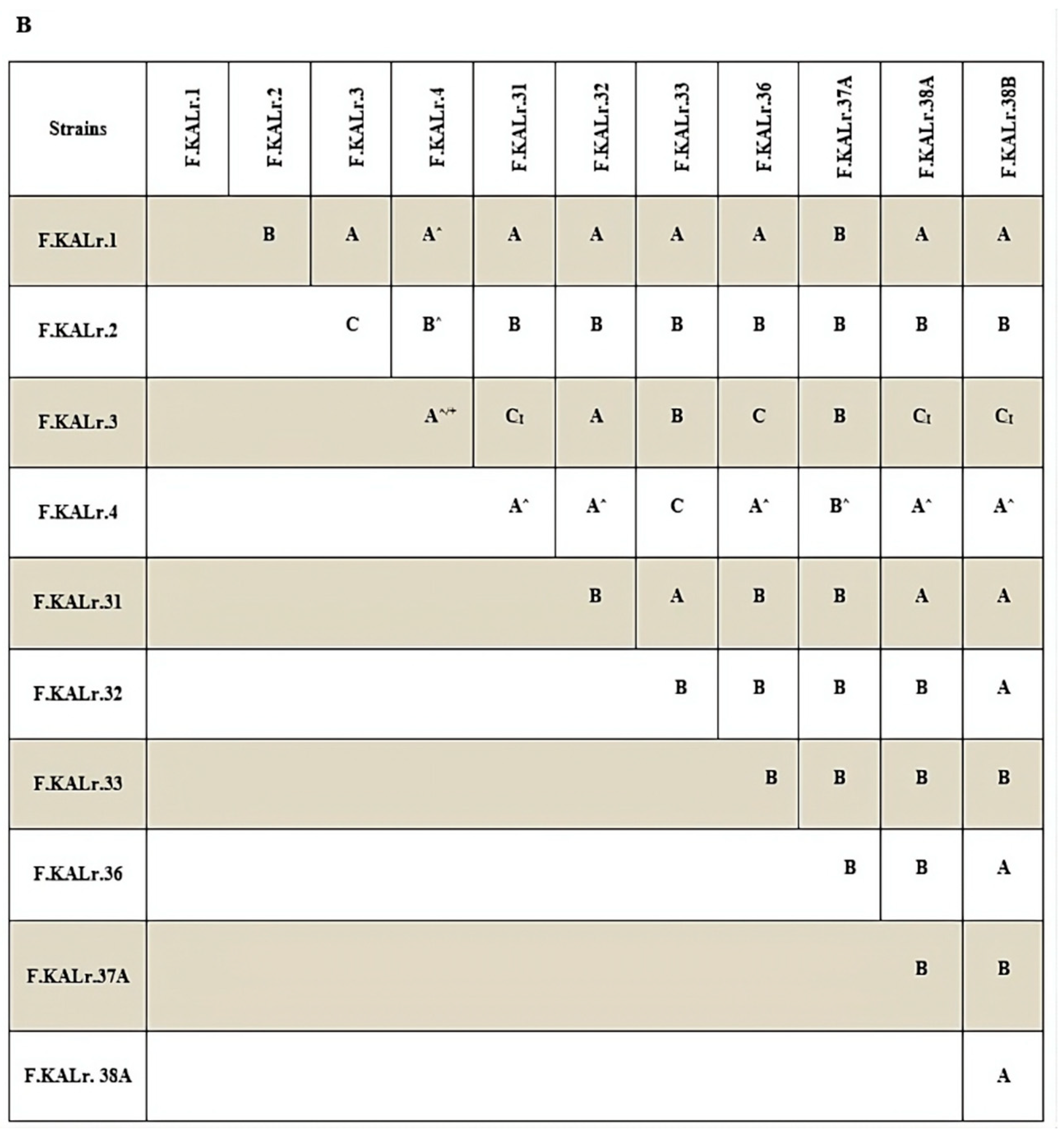
In the co-cultures, several repetitive morphological patterns were observed, in agreement with the classifications previously described by Badalyan et al. (2002) [60] and Bertrand et al. (2013) [61]. After 20 days of incubation, these interactions were categorized into three main types: type A (deadlock at contact), type B (deadlock at distance), and type C (overgrowth) (Figure 7). In addition, an interaction phenotype was recorded in which an initial overgrowth of one fungus on top of another was followed by the development of a deadlock at distance-like pattern; this was designated as subtype CI (Figure 7). To quantify these observations, the interactions among 10 endophytic fungi isolated from root tissues of the Amfissa cultivar and 11 from root tissues of the Kalamon cultivar were analyzed using the dual culture method on PDA, resulting in 45 and 55 combinations, respectively (Figure 8).
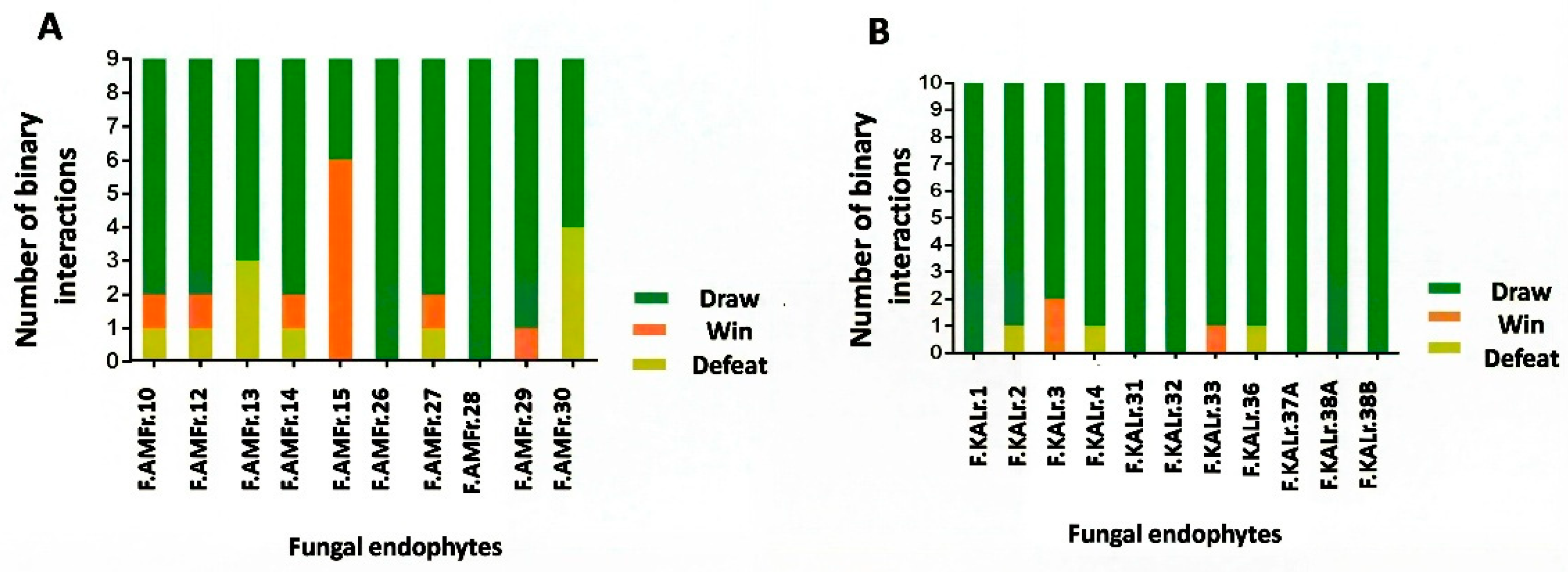
From the set of interactions between endophytic fungi derived from Amfissa olive root tissues, the most frequently occurring type was type A and was detected in 25 of the 45 combinations examined. After type A, type C followed and was observed in 12 of the 45 combinations. Of the 12 combinations, only 1 displayed the CI subtype and was presented when F.AMFr.12 interacted with F.AMFr.29. Type B emerged as the least frequently occurring type because it was only identified in 8 of the 45 combinations (Figure 7A).
Regarding the interactions between endophytic fungi derived from the Kalamon cultivar and according to Figure 7B, the above results differed since the most frequently occurring type was type B (n = 28/55). It is worth emphasizing that the strain F.KALr.37A was the only one that interacted with all fungi and presented type B. The formation of a zone pigmentation line was observed and was noticed in F.KALr.4 when it interacted with the strains F.KALr.37A and F.KALr.2. Type A appeared in 21 of the 55 combinations performed, following type B. Among these 21 combinations, in 7 we observed a zone pigmentation line at the site of mycelial contact. In addition, during the interaction of F.KALr.4 with F.KALr.3, the existence of a ridge was also noticed. Finally, type C was the least frequently occurring type of interaction and was observed in only six combinations. It is worth noting that in three of the six combinations, the CI subtype appeared and was identified in the interactions of F.KALr.3 with the strains F.KALr.38B (Figure 7), F.KALr.31, and F.KALr.38A.
Briefly, when examining the interactions of endophytic fungi from olive root tissues of Amfissa and Kalamon cultivars in 45 and 55 combinations, respectively, all three main types of interactions (A, B, and C) were evident, as well as the CI subtype. Since types A, B, and CI inherently exhibit mutual growth inhibition between both interacting fungi, they are characterized as draw-types. By contrast, in type C, the growth of one fungus is caused at the expense of the other, which results in the predominance of one (win) over the other (defeat). To assess the outcome of each interaction of the above combinations, the following cumulative histograms were created (Figure 9A,B).
From the above data, it can be concluded that of the fungal strains tested of the two sets and in all possible combinations, the most common outcome in the interactions between them was a draw. However, no fungus was found to be competitively dominant or vice versa, as in some cases they could score a win/defeat and in others a draw. A typical example was the F.AMFr.15 strain which turned out to be extremely competitive scoring six wins; despite this, in the remaining three combinations a draw was observed.

4. Discussion

Plants are colonized by many endophytic microorganisms conferring beneficial properties on plant growth and health [62,63]. The relationships are dynamic and are shaped according to the plant tissue, the genetic profile of the host, and the prevailing environmental conditions. Research interest has increasingly focused on documenting the composition and characteristics of endophytic communities across numerous plant species, owing to the advantageous niches these microorganisms occupy [64,65,66]. The endophyte microbiome of the olive tree, due to its centuries-old nature and its continuous exposure to environmental conditions, is an excellent example of studying the composition of the endophyte community and characterizing the endophyte–plant relationships [67,68,69].
In the present study, 68 endophytic fungi were isolated from the roots and leaves of two olive cultivars (Amfissa and Kalamon), collected from the open field of the Agricultural University of Athens. To the best of our knowledge, this is the first report that simultaneously describes the culturable endophytic fungi of these cultivars, evaluates their potential roles in direct and indirect mechanisms of biocontrol, and investigates the relationships among isolates derived from the same plant tissues.
Taxonomic recognition of the selected fungi was performed by amplification of the ITS rDNA region. According to our data, the isolates obtained from the leaves belonged to genera Cladosporium, Alternaria, Diaporthe, and Aureobasidium. Similar results from olive leaves have been reported by other researchers [26,34,43,44,70,71,72,73]. Morphotypes belonging to the genera Fusarium, Cephalotrichum, Clonostachys, Penicillium, Macrophomina, Rhizoctonia, Aspergillus, Acremonium, and Dactylonectria were identified in the root. Most of these genera were also reported by previous researchers [26,74,75,76,77]. In addition, morphotypes belonging to the genera, Cephalotrichum, Thelonectria, Niesslia, and Acrocalymma were first identified in olive trees. However, in the literature the endophytical existence of isolates belonging to Cephalotrichum, Niesslia, and Acrocalymma was also reported [78,79,80].
According to our findings, isolates originating from the Kalamon cultivar were revealed to be more diverse compared to those from the Amfissa cultivar, attributed to the critical role of the host’s genetic profile in the identity of the endophytic community. However, it is worth mentioning that the genera Fusarium and Alternaria were found as the most abundant in root and leave tissues, respectively, and detected in both cultivars.
As a next step of examination, fungal isolates were tested in vitro for their potential properties as biological control agents (BCAs). According to the literature, the evaluation of microorganisms as promising BCAs is carried out in a first stage in vitro, revealing information about the mechanisms of their antagonistic activity that they may possess such as mycoparasitism, competition for space and nutrients, production and secretion of lytic enzymes, and antimicrobial compounds [11,81]. All the fungal isolates examined were able to inhibit the pathogens’ growth from 19.05% to 100% depending on the fungus that they were competing against. Strain F.AMFr.15, isolated for the first time in this study, belongs to the genus Clonostachys. Based on our results, this isolate exhibited strong antagonistic activity against all tested pathogens. Previous studies have reported the antagonistic activity of other Clonostachys isolates against similar pathogens [82,83,84,85]. Antagonistic activity has also been reported for endophytic strains belonging to the genera Alternaria [86], Fusarium [87,88,89], Aspergillus [90,91], Diaporthe [92,93], Acremonium [94,95], and Penicillium [96].
Furthermore, in the dual culture plates, the existence of three patterns was observed which were considered as the main types of interactions (types A, B, and C) [60,61], showcasing that different interactions related to biological control may occur. That kind of interaction named as fungal deadlock refers to a situation where two or more fungal species encounter each other in a co-culture or natural environment and neither gain a competitive advantage, resulting in a standoff. As a result, neither fungus can significantly expand its territory or compete with the other [97,98,99,100]. It was observed that the strains acted competitively, presenting the same or even a different type of interaction. Our results revealed that type A (deadlock at contact) proved to be the most frequently occurring type and was observed in fungi belonging to genera Penicillium, Fusarium, Thelonectria, Macrophomina, Rhizoctonia, Phomopsis, and Acrocalymma. This phenotype is probably attributed to the competition for colonization sites but also to the secretion of extracellular lytic enzymes that hydrolyze the structural components of the cell wall of phytopathogenic fungi [101,102,103]. The majority of endophytic fungi that acted with interaction type A also possessed the ability to produce extracellular enzymes such as proteases and/or cellulases and belonged to genera Fusarium, Acremonium, Cephalotrichum, Aureobasidium, Niesslia, Aspergillus, Clonostachys, Penicillium, and Cladosporium. Similar results have been reported by other researchers regarding the ability to produce proteases and cellulases from Fusarium strains [104,105,106], Acremonium [106,107], Aureobasidium [108,109,110], Aspergillus [106,111], Penicillium [112,113,114,115], and Cladosporium [116,117].
In addition, in type A interactions, additional characteristics were observed such as the formation of a zone pigmentation line, which was often accompanied by the ridge phenomenon. The above characteristics were also observed by Dullah et al. (2021) [100], where the secretion of secondary metabolites produced either by one or both fungi is listed as a possible explanation for the zone pigmentation line. Type B was associated with the appearance of an inhibition zone and was detected only in the strain F.KALr.2 (Aspergillus sp.) when interacting with all fungal pathogens. This phenomenon is probably attributed to the production of antimicrobial compounds, which are diffusible and/or volatile in the medium, resulting in the growth inhibition of both opposing mycelia [118,119,120].
Furthermore, type C was concerned with the growth of one fungus over another and might be attributed to the competition for nutrients/colonization sites [93,121]. Based on our observations, the overgrowth type (type C) appeared from the strain F.AMFr.15 (Clonostachys sp.) against all four phytopathogenic fungi tested.
The effect of microbes with PGP properties is related to the modification of the root-system morphology through the increase in lateral roots and root hairs in order to optimally absorb important nutrients [122,123,124], as well as to make nutrients (such as phosphorus and iron) bioavailable [125,126,127].
Fungal strains of the genera Penicillium and Aspergillus were found to be able to solubilize phosphorus in vitro, which agrees with the previous literature reports [128,129,130]. Furthermore, genera such as Fusarium, Aspergillus [131,132], Rhizoctonia, Penicillium, Alternaria, Cladosporium [133], Acremonium [128], Clonostachys [133,134], Aureobasidium (Pinto et al., 2018) [135], and Penicillium [136] are also reported with the ability to produce siderophores in vitro, as we also noticed.
The endophytic isolates were obtained from asymptomatic tissues, but several fungal species were identified as potential pathogens (such as Cladosporium, Phomopsis, Aspergillus, Rhizoctonia, Fusarium, Alternaria, Macrophomina) [137,138,139,140,141]. However, according to the literature, the manifestation of pathogenicity by endophytes is a complex phenomenon that is difficult to predict and depends on several factors such as the genotype of the host plant and the microbe, as well as important abiotic environmental factors [142]. Therefore, some endophytes that are characterized as harmful to their host may develop a mutualistic or commensal relationship with other host species [143,144,145].
Thus, when the endophytic isolates were applied to A. thaliana plants, cases with symptoms of pathogenicity were found. Particularly, fungal strains of the genus Rhizoctonia, Aspergillus, and Macrophomina negatively affected the seedlings, causing chlorosis and even death. The remaining isolates had weak to highly positive effects on plant growth, with the strains F.AMFr.15 (Clonostachys sp.), F.KALr.4 (Phomopsis sp.), and F.KALr.38A (Acrocalymma sp.) beneficially affecting the growth of A. thaliana plants, compared to non-inoculated seedlings. Similar observations for the potential plant growth effect of the aforementioned genera have been reported [146,147,148]. Furthermore, the application of the above strains provoked an increase in fresh biomass, which was accompanied by the development of a large number of lateral roots and root hairs. Changes in root system morphology have also been reported in previous studies. Casarrubia et al. (2016) [124] observed such alterations in A. thaliana seedlings inoculated with the fungal endophyte O. maius, while Dovana et al. (2015) [56] demonstrated that certain endophytic fungi reduced primary root length and simultaneously promoted the formation of numerous lateral roots. The detached olive fruit assay provided an additional layer of validation for assessing the pathogenic potential of endophytic isolates on their natural host background. Despite being performed on fruits rather than woody tissues, this system is widely considered a suitable proxy for early infection processes and allowed us to evaluate host–fungus interactions under controlled conditions. The strong agreement between the symptoms observed in A. thaliana and those recorded on olive fruits indicates that the model plant reliably predicted pathogenic phenotypes. Importantly, no isolate displayed pathogenicity on olive tissues beyond what was detected in the model host, mitigating concerns regarding latent or opportunistic pathogenicity among the tested endophytes. These results support the safety profile of the candidate strains selected for plant-beneficial applications while acknowledging that future work on olive shoots or seedlings would provide further confirmation.
The increase in plant biomass by PGP microbes may be attributed to the phytohormones (i.e., IAA) as well as the volatile compounds causing changes in the architecture of the root system, resulting in better plant nutrition [122,149,150,151]. Nevertheless, from the strains F.AMFr.15, F.KALr.4, and F.KALr.38A, only the F.KALr.4 strain was found capable of IAA production in vitro, showcasing that the other two strains probably affected the plant growth via volatile emission. Notably, the production of IAA is not only a characteristic of beneficial, but also of many phytopathogenic microbes [152,153], since the strain F.AMFr.12 (Fusarium sp.) which caused a deleterious effect on the seedlings proved capable of IAA production in vitro.
The symbiotic relationship between endophytes and their host plants relies on the ability of endophytes to evade plant defense responses and to maintain a state of “balanced antagonism” with other members of the endophytic community, including latent pathogens that coexist in the same ecological niche. Disruption of this balance can shift the interaction towards pathogenicity for either the host plant or the endophyte itself, depending on environmental conditions and host susceptibility [17,20,22,154,155,156,157,158].
In our study, we attempted to evaluate the relationship between endophytic fungi originating from the same tissue, through interaction-trait in vitro detection. In particular, fungal isolates from the roots of Amfissa and Kalamon were chosen, because a better approach to the subject could be given due to the greater abundance and diversity of the isolates, compared to the rest of the sources of plant material. After 45 and 55 combinations, respectively, of interactions between endophytic fungi, it was found that none of the examined fungi of the two sets was dominant over the others. However, although some strains were more competitive than the others (such as F.AMFr.15), in their interactions with the rest of the fungi, a draw outcome was revealed. A similar conclusion was drawn from previous research by Maynard et al. (2017) [159], where the issue of biodiversity balance was approached through an in vitro model of binary interactions between basidiomycetes, originating from forest soil. In this research, it was found that there is no dominant competitive species, because even the most competitive fungi will have their growth restricted by at least one of the others, leading to a defeat or a draw. In the effort of each fungus of the community to protect the space it occupies, it exhibits antagonistic behavior with characteristics such as increased growth rate [160], densification of hyphae as a natural barrier [161], and the production of secondary metabolites, in order to protect itself from the invasion of other competitors, but also to combat the induced chemical stress [162]. In this regard, in some cases of interactions during the contact of the two mycelia, the lifting of the hyphae (ridge) was observed as well as the existence of a zone pigmentation line which is probably attributed to the production of secondary metabolites such as melanin [163].
The endophytic fungal diversity reported in this study reflects exclusively the cultivable fraction of the community. Although culture-dependent methods enable the recovery of living isolates necessary for the functional characterization and experimental assessment of plant growth promotion and biocontrol traits, they capture only a subset of the total species richness present in planta. Therefore, the number of taxa detected may be influenced by both the sample size and the inherent selectivity of cultivation techniques. Our conclusions regarding diversity patterns should thus be interpreted within the context of these methodological constraints.
High-throughput metabarcoding approaches could provide a more comprehensive overview of endophytic fungal assemblages, including uncultivable or low-abundance taxa that remain undetected by traditional isolation methods. Such analyses, however, were beyond the scope of the present work, which aimed to obtain and functionally assess culturable endophytes with potential agronomic applications. Future studies integrating metabarcoding with culture-based strategies will allow a more complete understanding of the olive mycobiome and its functional potential.

5. Conclusions

In the present study, endophytic fungi were isolated from the roots and leaves of two commercially important Greek olive cultivars, Amfissa and Kalamon, and were classified into 28 morphotypes (12 and 16, respectively). The results highlight the considerable diversity of fungal endophytes associated with olive trees, with several isolates being reported in this host for the first time. This work provides a preliminary overview of the olive endophytic fungal community and its functional variability. The in vitro screening revealed that several isolates exhibit traits associated with antagonistic activity against phytopathogens and plant growth-related effects, underscoring the functional heterogeneity of olive-associated endophytes. However, these observations are derived from in vitro assays and model plant experiments and therefore should be interpreted as indicative rather than definitive evidence of beneficial activity. Among the isolates tested, strain F.AMFr.15, identified as Clonostachys sp. based on ITS rDNA analysis, consistently displayed strong antagonistic performance and positive effects on plant growth parameters, suggesting its potential as a promising candidate strain. Further studies involving species-level resolution, host-specific pathogenicity testing, and validation on olive plants under controlled and field conditions are required before practical applications can be considered. This study establishes a foundation for the systematic screening of olive-associated fungal endophytes and provides a framework for the identification of candidates for future, host-relevant biocontrol and biostimulant development.

Supplementary Materials

The following supporting information can be downloaded at https://www.mdpi.com/article/10.3390/app16020624/s1, Table S1. Fungal reference strains from the NCBI database used in phylogenetic analysis; Table S2. Endophytic fungal isolates of Olea europeae cultivars Amfissa and Kalamon plant tissues (leaves, roots); Table S3. Endophytic fungal strains of Olea europeae cultivars Amfissa and Kalamon plant tissues (leaves, roots) and ITS rDNA gene accession numbers; Table S4. Morphological characteristics of endophytic fungal isolates from olive cultivars Amfissa and Kalamon. These traits were recorded from representative isolates grown on PDA at 25 °C for 7 days; Table S5: Antagonistic activity index of endophytic fungi against the tested pathogens (R. solani BPIC2531, F. oxysporum f. sp. radicis-lycopersici, V. dahliae BPIC2651, and C. acutatum BPIC2705); Figure S1. Representative image of the pathogenicity test of the F.AMFr.15 strain on artificially wounded Amfissa fruits after 5 days of incubation. Control fruits were treated with 20 μL of ddH2O (A), while treated fruits received a fungal suspension of F.AMFr.15 (106 CFU/mL) (B). The results showed that no pathogenicity symptoms were caused by the F.AMFr.15 strain.

Author Contributions

Conceptualization, A.V. and P.K.; methodology, T.-N.S. and A.V.; investigation and formal analysis, T.-N.S. and P.K.; validation: A.V. and P.K.; writing—original draft, T.-N.S. and P.K.; elaborating the research questions, analyzing the data, formal analysis, software, writing and reviewing the article: D.D., T.-N.S., A.V. and P.K.; supervision and funding acquisition, P.K. and A.V. All authors have read and agreed to the published version of the manuscript.

Funding

This research received no external funding.

Data Availability Statement

The ITS rDNA gene sequences’ accession numbers are available in the NCBI database. All accession numbers related to this article are included in Table S3.

Conflicts of Interest

The authors declare no conflicts of interest.

References

  1. Mueller, U.; Sachs, J. Engineering Microbiomes to Improve Plant and Animal Health. Trends Microbiol. 2015, 23, 606–617. [Google Scholar] [CrossRef] [PubMed]
  2. Bacon, C.W.; White, J. Microbial Endophytes; CRC Press: Boca Raton, FL, USA, 2000; p. 500. [Google Scholar]
  3. Kusari, S.; Hertweck, C.; Spiteller, M. Chemical Ecology of Endophytic Fungi: Origins of Secondary Metabolites. Chem. Biol. 2012, 19, 792–798. [Google Scholar] [CrossRef] [PubMed]
  4. Rodriguez, R.J.; White, J.F., Jr.; Arnold, A.E.; Redman, R.S. Fungal endophytes: Diversity and functional roles. New Phytol. 2009, 182, 314–330. [Google Scholar] [CrossRef] [PubMed]
  5. Wen, J.; Okyere, S.K.; Wang, S.; Wang, J.; Xie, L.; Ran, Y.; Hu, Y. Endophytic Fungi: An Effective Alternative Source of Plant-Derived Bioactive Compounds for Pharmacological Studies. J. Fungi 2022, 8, 205. [Google Scholar] [CrossRef]
  6. Tiwari, P.; Bae, H. Endophytic Fungi: Key Insights, Emerging Prospects, and Challenges in Natural Product Drug Discovery. Microorganisms 2022, 10, 360. [Google Scholar] [CrossRef]
  7. García-Latorre, C.; Rodrigo, S.; Marin-Felix, Y.; Stadler, M.; Santamaria, O. Plant-Growth Promoting Activity of Three Fungal Endophytes Isolated from Plants Living in Dehesas and Their Effect on Lolium multiflorum. Sci. Rep. 2023, 13, 7354. [Google Scholar] [CrossRef]
  8. Baron, N.C.; Rigobelo, E.C. Endophytic fungi: A tool for plant growth promotion and sustainable agriculture. Mycology 2022, 13, 39–55. [Google Scholar] [CrossRef]
  9. Adeleke, B.S.; Ayilara, M.S.; Akinola, S.A.; Babalola, O.O. Biocontrol mechanisms of endophytic fungi. Egypt. J. Biol. Pest Control 2022, 32, 46. [Google Scholar] [CrossRef]
  10. Fontana, D.C.; de Paula, S.; Torres, A.G.; de Souza, V.H.M.; Pascholati, S.F.; Schmidt, D.; Dourado Neto, D. Endophytic Fungi: Biological Control and Induced Resistance to Phytopathogens and Abiotic Stresses. Pathogens 2021, 10, 570. [Google Scholar] [CrossRef]
  11. Latz, M.A.C.; Jensen, B.; Collinge, D.B.; Jørgensen, H.J.L. Endophytic Fungi as Biocontrol Agents: Elucidating Mechanisms in Disease Suppression. Plant Ecol. Divers. 2018, 11, 555–567. [Google Scholar] [CrossRef]
  12. Rajamanikyam, M.; Vadlapudi, V.; Upadhyayula, S.M. Endophytic fungi as novel resources of natural therapeutics. Braz. Arch. Biol. Technol. 2017, 60, 2017160542. [Google Scholar] [CrossRef]
  13. Singh, V.K.; Kumar, A. Secondary metabolites from endophytic fungi: Production, methods of analysis, and diverse pharmaceutical potential. Symbiosis 2023, 8, 111–125. [Google Scholar] [CrossRef] [PubMed]
  14. Stierle, A.; Strobel, G.; Stierle, D. Taxol and taxane production by Taxomyces andreanae, an endophytic fungus of Pacific yew. Science 1993, 260, 214–216. [Google Scholar] [CrossRef] [PubMed]
  15. Venieraki, A.; Dimou, M.; Katinakis, P. Endophytic fungi residing in medicinal plants have the ability to produce the same or similar pharmacologically active secondary metabolites as their hosts. Hell. Plant Prot. J. Sci. 2017, 10, 51–66. [Google Scholar] [CrossRef]
  16. Cheng, T.; Kolařík, M.; Quijada, L.; Stadler, M. A re-assessment of Taxomyces andreanae, the alleged taxol-producing fungus, using comparative genomics. IMA Fungus 2022, 26, 17. [Google Scholar] [CrossRef]
  17. Schulz, B.; Boyle, C. The endophytic continuum. Mycol. Res. 2005, 109, 661–686. [Google Scholar] [CrossRef]
  18. Hardoim, P.R.; van Overbeek, L.S.; Berg, G.; Pirttilä, A.M.; Compant, S.; Campisano, A.; Döring, M.; Sessitsch, A. The hidden world within plants: Ecological and evolutionary considerations for defining functioning of microbial endophytes. Microbiol. Mol. Biol. Rev. 2015, 79, 293–320. [Google Scholar] [CrossRef]
  19. Jha, P.; Kaur, T.; Chhabra, I.; Panja, A.; Paul, S.; Kumar, V.; Malik, T. Endophytic Fungi: Hidden Treasure Chest of Antimicrobial Metabolites Interrelationship of Endophytes and Metabolites. Front. Microbiol. 2023, 14, 1227830. [Google Scholar] [CrossRef]
  20. Schulz, B.; Rommert, A.K.; Dammann, U.; Aust, H.J.; Strack, D. The endophyte-host interaction: A balanced antagonism? Mycol. Res. 1999, 103, 1275–1283. [Google Scholar] [CrossRef]
  21. Drage, S.; Mitter, B.; Engelmeier, D.; Chobot, V.; Gorfer, M.; Muchugi, A.; Jamnadass, R.H.; Sessitsch, A.; Hadacek, F. Antimicrobial Drimane Sesquiterpenes Contribute to Balanced Antagonism but Do Not Structure Bacterial and Fungal Endophytes in the African Pepper Bark Tree Warburgia ugandensis. Front. Ecol. Evol. 2017, 5, 138. [Google Scholar] [CrossRef]
  22. Schulz, B.; Haas, S.; Junker, C.; Andrée, N.; Schobert, M. Fungal endophytes are involved in multiple balanced antagonisms. Curr. Sci. 2015, 109, 39–45. [Google Scholar]
  23. Yan, L.; Zhao, H.; Zhao, X.; Xu, X.; Di, Y.; Jiang, C.; Shi, J.; Shao, D. Production of Bioproducts by Endophytic Fungi: Chemical ecology, biotechnological applications, bottlenecks, and solutions. Appl. Microbiol. Biotechnol. 2018, 102, 6279–6298. [Google Scholar] [CrossRef]
  24. Akram, S.; Ahmed, A.; He, P.; He, P.; Liu, Y.; Wu, Y.; Munir, S.; He, Y. Uniting the role of endophytic fungi against plant pathogens and their interaction. J. Fungi 2023, 9, 72. [Google Scholar] [CrossRef] [PubMed]
  25. Abdelfattah, A.; Wisniewski, M.; Li Destri Nicosia, M.G.; Cacciola, S.O.; Schena, L. Metagenomic analysis of fungal diversity on strawberry plants and the effect of management practices on the fungal community structure of aerial organs. PLoS ONE 2016, 11, e0160470. [Google Scholar] [CrossRef] [PubMed]
  26. Martins, F.; Pereira, J.A.; Bota, P.; Bento, A.; Baptista, P. Fungal endophyte communities in above-and belowground olive tree organs and the effect of season and geographic location on their structures. Fungal Ecol. 2016, 20, 193–201. [Google Scholar] [CrossRef]
  27. Petrini, O. Fungal Endophytes of Tree Leaves. In Microbial Ecology of Leaves; Brock/Springer Series in Contemporary Bioscience; Andrews, J.H., Hirano, S.S., Eds.; Springer: New York, NY, USA, 1991; pp. 179–197. [Google Scholar]
  28. Slippers, B.; Wingfield, M.J. Botryosphaeriaceae as endophytes and latent pathogens of woody plants: Diversity, ecology and impact. Fungal Biol. Rev. 2007, 21, 90–106. [Google Scholar] [CrossRef]
  29. Nicoletti, R.; Di Vaio, C.; Cirillo, C. Endophytic fungi of olive tree. Microorganisms 2020, 8, 1321. [Google Scholar] [CrossRef]
  30. Varveri, M.; Papageorgiou, A.G.; Tsitsigiannis, D.I. Evaluation of Biological Plant Protection Products for Their Ability to Induce Olive Innate Immune Mechanisms and Control Colletotrichum acutatum, the Causal Agent of Olive Anthracnose. Plants 2024, 13, 878. [Google Scholar] [CrossRef]
  31. Zihong, S.; Lixiao, D.; Bojun, M.; Wenze, L.; Ruhong, M. Studies on the population and dynamic analysis of peanut endophytes. Acta Phytopathol. Sin. 1999, 26, 309–314. [Google Scholar]
  32. Penuelas, J.; Rico, L.; Ogaya, R.; Jump, A.; Terradas, J.J.P.B. Summer season and long-term drought increase the richness of bacteria and fungi in the foliar phyllosphere of Quercus ilex in a mixed Mediterranean forest. Plant Biol. 2012, 14, 565–575. [Google Scholar] [CrossRef]
  33. Afzal, I.; Shinwari, Z.K.; Sikandar, S.; Shahzad, S. Plant beneficial endophytic bacteria: Mechanisms, diversity, host range and genetic determinants. Microbiol. Res. 2019, 221, 36–49. [Google Scholar] [CrossRef] [PubMed]
  34. Materatski, P.; Varanda, C.; Carvalho, T.; Dias, A.B.; Campos, M.D.; Rei, F.; Félix, M.d.R. Spatial and temporal variation of fungal endophytic richness and diversity associated to the phyllosphere of olive cultivars. Fungal Biol. 2019, 123, 66–76. [Google Scholar] [CrossRef] [PubMed]
  35. Bogas, A.C.; Ferreira, A.J.; Araújo, W.L.; Astolfi-Filho, S.; Kitajima, E.W.; Lacava, P.T.; Azevedo, J.L. Endophytic bacterial diversity in the phyllosphere of Amazon Paullinia cupana associated with asymptomatic and symptomatic anthracnose. Springerplus 2015, 4, 258. [Google Scholar] [CrossRef] [PubMed]
  36. Xia, Y.; Sahib, M.R.; Amna, A.; Opiyo, S.O.; Zhao, Z.; Gao, Y.G. Culturable endophytic fungal communities associated with plants in organic and conventional farming systems and their effects on plant growth. Sci. Rep. 2019, 9, 1669. [Google Scholar] [CrossRef]
  37. Fan, S.; Miao, L.; Li, H.; Lin, A.; Song, F.; Zhang, P. Illumina-based analysis yields new insights into the diversity and composition of endophytic fungi in cultivated Huperzia serrata. PLoS ONE 2020, 15, e0242258. [Google Scholar] [CrossRef]
  38. Lücking, R.; Aime, M.C.; Robbertse, B.; Miller, A.N.; Ariyawansa, H.A.; Aoki, T.; Cardinali, G.; Crous, P.W.; Druzhinina, I.S.; Geiser, D.M.; et al. Unambiguous identification of fungi: Where do we stand and how accurate and precise is fungal DNA barcoding? IMA Fungus 2020, 11, 14. [Google Scholar] [CrossRef]
  39. dos Reis, J.B.A.; Lorenzi, A.S.; do Vale, H.M.M. Methods used for the study of endophytic fungi: A review on methodologies and challenges, and associated tips. Arch. Microbiol. 2022, 204, 675. [Google Scholar] [CrossRef]
  40. Wijayawardene, N.N.; Bahram, M.; Sánchez-Castro, I.; Dai, D.-Q.; Ariyawansa, K.G.S.U.; Jayalal, U.; Suwannarach, N.; Tedersoo, L. Current Insight into Culture-Dependent and Culture-Independent Methods in Discovering Ascomycetous Taxa. J. Fungi 2021, 7, 703. [Google Scholar] [CrossRef]
  41. Bielecka, M.; Pencakowski, B.; Nicoletti, R. Using next-generation sequencing technology to explore genetic pathways in endophytic fungi in the syntheses of plant bioactive metabolites. Agriculture 2022, 12, 187. [Google Scholar] [CrossRef]
  42. Kakagianni, M.; Tsiknia, M.; Feka, M.; Vasileiadis, S.; Leontidou, K.; Kavroulakis, N.; Karamanoli, K.; Karpouzas, D.G.; Ehaliotis, K.; Papadopoulou, K.K. Above- and below-ground microbiome in the annual developmental cycle of two olive tree varieties. FEMS Microbes 2023, 4, xtad001. [Google Scholar] [CrossRef]
  43. Malhadas, C.; Malheiro, R.; Pereira, J.A.; de Pinho, P.G.; Baptista, P. Antimicrobial activity of endophytic fungi from olive tree leaves. World J. Microbiol. Biotechnol. 2017, 33, 46. [Google Scholar] [CrossRef] [PubMed]
  44. Vergine, M.; Meyer, J.B.; Cardinale, M.; Sabella, E.; Hartmann, M.; Cherubini, P.; De Bellis, L.; Luvisi, A. The Xylella fastidiosa-resistant olive cultivar “Leccino” has stable endophytic microbiota during the Olive Quick Decline Syndrome (OQDS). Pathogens 2020, 9, 35. [Google Scholar] [CrossRef] [PubMed]
  45. Martins, F.; Pereira, J.A.; Baptista, P. Olive Anthracnose and Its Management by Fungal Endophytes: An Overview. In Plant Microbe Interface; Springer International Publishing: Cham, Switzerland, 2019; pp. 253–269. [Google Scholar]
  46. Martins, F.; Mina, D.; Pereira, J.A.; Baptista, P. Endophytic fungal community structure in olive orchards with high and low incidence of olive anthracnose. Sci. Rep. 2021, 11, 689. [Google Scholar] [CrossRef] [PubMed]
  47. Gomes, T.; Pereira, J.A.; Moya-Laraño, J.; Poveda, J.; Lino-Neto, T.; Baptista, P. Deciphering plant health status: The link between secondary metabolites, fungal community and disease incidence in olive tree. Front. Plant Sci. 2023, 22, 1048762. [Google Scholar] [CrossRef]
  48. Castro, J.; Costa, D.; Tavares, R.M.; Baptista, P.; Lino-Neto, T. Olive Fungal Epiphytic Communities Are Affected by Their Maturation Stage. Microorganisms 2022, 10, 376. [Google Scholar] [CrossRef]
  49. Schwyn, B.; Neilands, J.B. Universal Chemical Assay for the Detection and Determination of Siderophores. Anal. Biochem. 1987, 160, 47–56. [Google Scholar] [CrossRef]
  50. Pikovskaya, R.I. Mobilization of phosphorus in soil in connection with vital activity of some microbial species. Mikrobiologiya 1948, 17, 362–370. [Google Scholar]
  51. Patel, D.; Patel, A.; Vora, D.; Menon, S.; Vadakan, S.; Acharya, D.; Goswami, D. A resourceful methodology to profile indolic auxins produced by rhizo-fungi using spectrophotometry and HPTLC. 3 Biotech 2018, 8, 413. [Google Scholar] [CrossRef]
  52. Mohite, B. Isolation and characterization of indole acetic acid (IAA) producing bacteria from rhizospheric soil and its effect on plant growth. J. Soil Sci. Plant Nutr. 2013, 13, 638–649. [Google Scholar] [CrossRef]
  53. Patten, C.L.; Glick, B.R. Role of Pseudomonas putida indoleacetic acid in development of the host plant root system. Appl. Environ. Microbiol. 2002, 68, 3795–3801. [Google Scholar] [CrossRef]
  54. Kumar, R.; Ayyadurai, N.; Pandiaraja, P.; Reddy, A.; Venkateswarlu, Y.; Prakash, O.; Sakthivel, N. Characterization of antifungal metabolite produced by a new strain Pseudomonas aeruginosa PUPa3 that exhibits broad-spectrum antifungal activity and biofertilizing traits. J. Appl. Microbiol. 2005, 98, 145–154. [Google Scholar] [CrossRef]
  55. Mobley, H.L.; Hausinger, R.P. Microbial ureases: Significance, regulation, and molecular characterization. Microbiol. Rev. 1989, 53, 85–108. [Google Scholar] [CrossRef] [PubMed]
  56. Dovana, F.; Mucciarelli, M.; Mascarello, M.; Fusconi, A. In vitro morphogenesis of Arabidopsis to search for novel endophytic fungi modulating plant growth. PLoS ONE 2015, 10, e0143353. [Google Scholar] [CrossRef] [PubMed]
  57. Izumitsu, K.; Hatoh, K.; Sumita, T.; Kitade, Y.; Morita, A.; Tanaka, C.; Gafur, A.; Ohta, A.; Kawai, M.; Yamanaka, T.; et al. Rapid and simple preparation of mushroom DNA directly from colonies and fruiting bodies for PCR. Mycoscience 2012, 53, 396–401. [Google Scholar] [CrossRef]
  58. Dörnte, B.; Kües, U. Fast microwave-based DNA extraction from vegetative mycelium and fruiting body tissues of Agaricomycetes for PCR amplification. Curr. Trends Biotechnol. Pharm. 2013, 7, 825–836. [Google Scholar]
  59. Kumar, S.; Stecher, G.; Suleski, M.; Sanderford, M.; Sharma, S.; Tamura, K. MEGA12: Molecular Evolutionary Genetic Analysis version 12 for adaptive and green computing. Mol. Biol. Evol. 2024, 41, msae263. [Google Scholar] [CrossRef]
  60. Badalyan, S.M.; Garibyan, N.G.; Innocenti, G. Antagonistic activity of xylotrophic mushrooms against pathogenic fungi of cereals in dual culture. Antagonistic activity of xylotrophic mushrooms against pathogenic fungi of cereals in dual culture. Phytopathol. Med. 2002, 41, 220–225. [Google Scholar]
  61. Bertrand, S.; Schumpp, O.; Bohni, N.; Bujard, A.; Azzollini, A.; Monod, M.; Gindro, K.; Wolfender, J.L. Detection of metabolite induction in fungal co-cultures on solid media by high-throughput differential ultra-high pressure liquid chromatography-time-of-flight mass spectrometry fingerprinting. J. Chromatogr. A 2013, 1292, 219–228. [Google Scholar] [CrossRef]
  62. Compant, S.; Samad, A.; Faist, H.; Sessitsch, A. A review on the plant microbiome: Ecology, functions, and emerging trends in microbial application. J. Adv. Res. 2019, 19, 29–37. [Google Scholar] [CrossRef]
  63. Mendes, R.; Garbeva, P.; Raaijmakers, J.M. The rhizosphere microbiome: Significance of plant beneficial, plant pathogenic, and human pathogenic microorganisms. FEMS Microbiol. Rev. 2013, 37, 634–663. [Google Scholar] [CrossRef]
  64. White, J.F.; Kingsley, K.L.; Zhang, Q.; Verma, R.; Obi, N.; Dvinskikh, S.; Elmore, M.T.; Verma, S.K.; Gond, S.K.; Kowalski, K.P. Endophytic microbes and their potential applications in crop management. Pest Manag. Sci. 2019, 75, 2558–2565. [Google Scholar] [CrossRef] [PubMed]
  65. Eid, A.M.; Salim, S.S.; Hassan, S.E.-D.; Ismail, M.A.; Fouda, A. Role of Endophytes in Plant Health and Abiotic Stress Management. In Microbiome in Plant Health and Disease: Challenges and Opportunities; Kumar, V., Prasad, R., Kumar, M., Choudhary, D.K., Eds.; Springer: Singapore, 2019; pp. 119–144. [Google Scholar]
  66. Lacava, P.T.; Bogas, A.C.; Cruz, F.d.P.N. Plant Growth Promotion and Biocontrol by Endophytic and Rhizospheric Microorganisms from the Tropics: A Review and Perspectives. Front. Sustain. Food Syst. 2022, 6, 796113. [Google Scholar] [CrossRef]
  67. Bizos, G.; Papatheodorou, E.M.; Chatzistathis, T.; Ntalli, N.; Aschonitis, V.G.; Monokrousos, N. The role of microbial inoculants on plant protection, growth stimulation, and crop productivity of the olive tree (Olea europea L.). Plants 2020, 9, 743. [Google Scholar] [CrossRef]
  68. Müller, H.; Berg, C.; Landa, B.B.; Auerbach, A.; Moissl-Eichinger, C.; Berg, G. Plant Genotype-Specific Archaeal and Bacterial Endophytes but Similar Bacillus Antagonists Colonize Mediterranean Olive Trees. Front. Microbiol. 2015, 6, 138. [Google Scholar] [CrossRef] [PubMed]
  69. de Oliveira, A.A.; Ramalho, M.O.; Moreau, C.S.; Campos, A.E.C.; Harakava, R.; Bueno, O.C. Exploring the diversity and potential interactions of bacterial and fungal endophytes associated with different cultivars of olive (Olea europaea) in Brazil. Microbiol. Res. 2022, 263, 127128. [Google Scholar] [CrossRef] [PubMed]
  70. Abdelfattah, A.; Li Destri Nicosia, M.G.; Cacciola, S.O.; Droby, S.; Schena, L. Metabarcoding Analysis of Fungal Diversity in the Phyllosphere and Carposphere of Olive (Olea europaea). PLoS ONE 2015, 10, e0131069. [Google Scholar] [CrossRef]
  71. Chen, L.H.; Lin, C.H.; Chung, K.R. A nonribosomal peptide synthetase mediates siderophore production and virulence in the citrus fungal pathogen Alternaria alternata. Mol. Plant Pathol. 2013, 14, 497–505. [Google Scholar] [CrossRef]
  72. Landum, M.C.; Félix, M.R.; Alho, J.; Garcia, R.; Cabrita, M.J.; Rei, F.; Varanda, C.M.R. Antagonistic activity of fungi of Olea europaea L. against Colletotrichum acutatum. Microbiol. Res. 2016, 183, 100–108. [Google Scholar] [CrossRef]
  73. Varanda, C.M.R.; Materatski, P.; Landum, M.; Campos, M.D.; Félix, M.R. Fungal communities associated with peacock and Cercospora Leaf Spots in olive. Plants 2019, 8, 169. [Google Scholar] [CrossRef]
  74. Cota, L.V.; Maffia, L.A.; Mizubuti, E.S.G.; Macedo, P.E.F. Biological control by Clonostachys rosea as a key component in the integrated management of strawberry gray mold. Biol. Control 2009, 50, 222–230. [Google Scholar] [CrossRef]
  75. Mady, M.S.; Houssen, W.; Abdou, R.; Haggag, E.G.; El Sayed, K.A. Breast cancer migration and proliferation inhibitory and antibiotic secondary metabolites from the Egyptian olive tree endophytic fungus Penicillium citrinum. J. Adv. Pharm. Res. 2017, 1, 160–170. [Google Scholar] [CrossRef]
  76. Fernández-González, A.J.; Villadas, P.J.; Gómez-Lama Cabanás, C.; Valverde-Corredor, A.; Belaj, A.; Mercado-Blanco, J.; Fernández-López, M. Defining the root endosphere and rhizosphere microbiomes from the World Olive Germplasm Collection. Sci. Rep. 2019, 9, 1–13. [Google Scholar] [CrossRef] [PubMed]
  77. Al-Sadi, A.M.; Kazerooni, E.A. Illumina-MiSeq analysis of fungi in acid lime roots reveals dominance of Fusarium and variation in fungal taxa. Sci. Rep. 2018, 8, 17388. [Google Scholar] [CrossRef] [PubMed]
  78. Noriler, S.A.; Savi, D.C.; Aluizio, R.; Palacio-Cortes, A.M.; Possiede, Y.M.; Glienke, C. Bioprospecting and structure of fungal endophyte communities found in the Brazilian biomes, Pantanal, and Cerrado. Front. Microbiol. 2018, 9, 1526. [Google Scholar] [CrossRef] [PubMed]
  79. Alijanimamaghani, N.; Saremi, H.; Javan-Nikkhah, M.; Sophie, D.R.; Pianta, E.; Tonolla, M. Endophytic Cephalotrichum spp. from Solanum tuberosum (potato) in Iran—A polyphasic analysis. Sydowia 2022, 74, 287–301. [Google Scholar]
  80. Tanney, J.; Stefano, J.; Miller, J.; McMullin, D. Natural products from the Picea foliar endophytes Niesslia endophytica sp. nov. and Strasseria geniculata. Mycol. Prog. 2023, 22, 17. [Google Scholar] [CrossRef]
  81. Thambugala, K.M.; Daranagama, D.A.; Phillips, A.J.L.; Kannangara, S.D.; Promputtha, I. Fungi vs. Fungi in Biocontrol: An Overview of Fungal Antagonists Applied Against Fungal Plant Pathogens. Front. Cell Infect. Microbiol. 2020, 30, 604923. [Google Scholar] [CrossRef]
  82. Alvarez Nordström, S. Endophytic Growth of Clonostachys Rosea in Tomato and Arabidopsis. Master’s Thesis, Swedish University of Agricultural Sciences (SLU) Naturresursprogrammet—Biologi Och Mark Uppsala, Uppsala, Sweden, 2014. [Google Scholar]
  83. Zhang, Q.; Zhang, J.; Yang, L.; Zhang, L.; Jiang, D.; Chen, W.; Li, G. Diversity and biocontrol potential of endophytic fungi in Brassica napus. Biol. Control 2014, 72, 98–108. [Google Scholar] [CrossRef]
  84. Sun, Z.-B.; Li, S.-D.; Ren, Q.; Xu, J.-L.; Lu, X.; Sun, M.-H. Biology and applications of Clonostachys rosea. J. Appl. Microbiol. 2020, 129, 486–495. [Google Scholar] [CrossRef]
  85. Silva-Valderrama, I.; Toapanta, D.; Miccono, M.d.l.A.; Lolas, M.; Díaz, G.A.; Cantu, D.; Castro, A. Biocontrol potential of grapevine endophytic and rhizospheric fungi against trunk pathogens. Front. Microbiol. 2021, 11, 614620. [Google Scholar] [CrossRef]
  86. Khuseib Hamed Al-Rashdi, F.; Al-Sadi, A.M.; Al-Riyamy, B.Z.; Maharachchikumbura, S.S.N.; Khalfan Al-Ruqaishi, H.; Velazhahan, R. Alternaria alternata and Neocosmospora sp. from the medicinal plant Euphorbia larica exhibit antagonistic activity against Fusarium sp., a plant pathogenic fungus. All Life 2020, 13, 223–232. [Google Scholar] [CrossRef]
  87. Estrada, A.E.R.; Jonkers, W.; Kistler, H.C.; May, G. Interactions between Fusarium verticillioides, Ustilago maydis, and Zea mays: An endophyte, a pathogen, and their shared plant host. Fungal Genet. Biol. 2012, 49, 578–587. [Google Scholar] [CrossRef] [PubMed]
  88. Chowdhary, K.; Kaushik, N. Fungal endophyte diversity and bioactivity in the Indian medicinal plant Ocimum sanctum Linn. PLoS ONE 2015, 10, e0141444. [Google Scholar] [CrossRef] [PubMed]
  89. Larran, S.; Simon, M.R.; Moreno, M.V.; Siurana, M.P.S.; Perell, A. Endophytes from wheat as biocontrol agents against tan spot disease. Biol. Control 2016, 92, 17–23. [Google Scholar] [CrossRef]
  90. Singh, G.; Katoch, A.; Razak, M.; Kitchlu, S.; Goswami, A.; Katoch, M. Bioactive and Biocontrol Potential of Endophytic Fungi Associated with Brugmansia aurea Lagerh. FEMS Microbiol. Lett. 2017, 364, 194. [Google Scholar] [CrossRef]
  91. Elazab, N.T. Diversity and Biological Activities of Endophytic Fungi at Al-Qassim Region. J. Mol. Biol. Res. 2019, 9, 160. [Google Scholar] [CrossRef]
  92. Santos, P.J.; Savi, D.C.; Gomes, R.R.; Goulin, E.H.; Da Costa Senkiv, C.; Tanaka, F.A.; Almeida, Á.M.; Galli-Terasawa, L.; Kava, V.; Glienke, C. Diaporthe endophytica and D. terebinthifolii from medicinal plants for biological control of Phyllosticta citricarpa. Microbiol. Res. 2016, 186–187, 153–160. [Google Scholar] [CrossRef]
  93. Sreeja, K.; Anandaraj, M.; Bhai, R. In vitro evaluation of fungal endophytes of black pepper against Phytophthora capsici and Radopholus similis. J. Spices Aromat. Crops 2016, 25, 113–122. [Google Scholar]
  94. Macia-Vicente, J.G.; Jansson, H.-B.; Mendgen, K.; Lopez-Llorca, L.V. Colonization of barley roots by endophytic fungi and their reduction of take-all caused by Gaeumannomyces graminis var. tritici. Can. J. Microbiol. 2008, 54, 600–609. [Google Scholar] [CrossRef]
  95. Choi, G.J.; Kim, J.C.; Jang, K.S.; Nam, M.H.; Lee, S.W.; Kim, H.T. Biocontrol activity of Acremonium strictum BCP against Botrytis diseases. Plant Pathol. J. 2009, 25, 165–171. [Google Scholar] [CrossRef]
  96. Abro, M.A.; Sun, X.; Li, X.; Jatoi, G.H.; Guo, L.D. Biocontrol potential of fungal endophytes against Fusarium oxysporum f. sp. cucumerinum causing wilt in cucumber. Plant Pathol. J. 2019, 35, 598. [Google Scholar] [CrossRef]
  97. Boddy, L. Interspecific combative interactions between wood-decaying basidiomycetes. FEMS Microbiol. Ecol. 2000, 31, 185–194. [Google Scholar] [CrossRef]
  98. Hiscox, J.; Savoury, M.; Müller, C.T.; Lindahl, B.D.; Rogers, H.J.; Boddy, L. Priority effects during fungal community establishment in beech wood. ISME J. 2015, 9, 2246–2260. [Google Scholar] [CrossRef] [PubMed]
  99. Nawrot-Chorabik, K.; Osmenda, M.; Bartnik, C. Interspecies Interactions in Dual Cultures of Selected Fungi Species and Their Influence on the Decomposition of Scots Pine and Norway Spruce Wood Substrates. Drewno. Pr. Nauk. Doniesienia Komun. Wood. Res. Pap. Rep. Announc. 2024, 67, 213. [Google Scholar] [CrossRef]
  100. Dullah, S.; Hazarika, D.J.; Parveen, A.; Kakoti, M.; Borgohain, T.; Gautom, T.; Bhattacharyya, A.; Barooah, M.; Boro, R.C. Fungal interactions induce changes in hyphal morphology and enzyme production. Mycology 2021, 12, 279–295. [Google Scholar] [CrossRef] [PubMed]
  101. Boddy, L. Interactions between Fungi and Other Microbes. In The Fungi, 3rd ed.; Watkinson, S.C., Boddy, L., Money, N., Eds.; Elsevier: Amsterdam, The Netherlands, 2016; pp. 337–360. [Google Scholar]
  102. Hasan, S.; Gupta, G.; Anand, S.; Kaur, H. Lytic enzymes of trichoderma: Their role in plant defense. Int. J. Appl. Res. Stud. 2014, 3, 1–5. [Google Scholar]
  103. Rafiei, V.; Vélëz, H.; Dixelius, C.; Tzelepis, G. Advances in molecular interactions on the Rhizoctonia solani-sugar beet pathosystem. Fungal Biol. Rev. 2023, 44, 100297. [Google Scholar] [CrossRef]
  104. Ahmad, M.S.; Noor, Z.M.; Ariffin, Z.Z. Isolation and identification fibrinolytic protease endophytic fungi from Hibiscus leaves in Shah Alam. Int. J. Agric. Biol. Eng. 2014, 8, 1027–1030. [Google Scholar]
  105. Dar, R.A.; Saba, I.; Shahnawaz, M.; Sangale, M.K.; Ade, A.B.; Rather, S.A.; Qazi, P.H. Isolation, purification and characterization of carboxymethyl cellulase (CMCase) from endophytic Fusarium oxysporum producing podophyllotoxin. Adv. Enzym. Res. 2013, 1, 91–96. [Google Scholar] [CrossRef]
  106. Maria, G.L.; Sridhar, K.R.; Raviraja, N.S. Antimicrobial and enzyme activity of mangrove endophytic fungi of southwest coast of India. J. Agric. Technol. 2005, 1, 67–80. [Google Scholar]
  107. Jain, P.; Aggarwal, V.; Sharma, A.; Pundir, R.K. Isolation, production and partial purification of protease from an endophytic Acremonium sp. J. Agric. Tech. 2012, 8, 1979–1989. [Google Scholar]
  108. Sun, P.F.; Chien, I.A.; Xiao, H.S.; Fang, W.T.; Hsu, C.H.; Chou, J.Y. Intra specific variation in plant growth-promoting traits of Aureobasidium pullulans. Chiang Mai J. Sci. 2019, 46, 15–31. [Google Scholar]
  109. Baldwin, E.L. Enhancing Cellulase Production of Aureobasidium pullulans for Use in Converting Dried Distillers’ Grains with Solubles into a Higher Protein Feed. Master’s Thesis, South Dakota State University, Brookings, SD, USA, 2017. Volume 1728. [Google Scholar]
  110. Vieira, M.M.; Kadoguchi, E.; Segato, F.; da Silva, S.S.; Chandel, A.K. Production of cellulases by Aureobasidium pullulans LB83: Optimization, characterization, and hydrolytic potential for the production of cellulosic sugars. Prep. Biochem. Biotechnol. 2021, 51, 153–163. [Google Scholar] [CrossRef] [PubMed]
  111. Das, S.K.; Mahapatra, S. Isolation and Characterization of Bioactive Compound from Endophytic Fungus of Spoiled Fruits. Int. J. Res. Anal. Rev. 2019, 7, 65–72. [Google Scholar]
  112. Bhadra, F.; Gupta, A.; Vasundhara, M.; Reddy, M.S. Endophytic fungi: A potential source of industrial enzyme producers. 3 Biotech 2022, 12, 86. [Google Scholar] [CrossRef]
  113. Ben Mefteh, F.B.; Frikha, F.; Daoud, A.; Chenari Bouket, A.; Luptakova, L.; Alenezi, F.N.; Al-Anzi, B.S.; Oszako, T.; Gharsallah, N.; Belbahri, L. Response surface methodology optimization of an acidic protease produced by Penicillium bilaiae isolate TDPEF30, a newly recovered endophytic fungus from healthy roots of date palm trees (Phoenix dactylifera L.). Microorganisms 2019, 7, 74. [Google Scholar] [CrossRef]
  114. Syed, S.; Riyaz-Ul-Hassan, S.; Johri, S. A novel cellulase from an endophyte, Penicillium sp. NFCCI 2862. Am. J. Microbiol. Res. 2013, 1, 84–91. [Google Scholar] [CrossRef]
  115. Li, H.; Dou, M.; Wang, X.; Guo, N.; Kou, P.; Jiao, J.; Fu, Y. Optimization of cellulase production by a novel endophytic fungus Penicillium oxalicum R4 isolated from Taxus cuspidata. Sustainability 2021, 13, 6006. [Google Scholar] [CrossRef]
  116. Shubba, J.; Srinivas, C. Diversity and extracellular enzymes of endophytic fungi associated with Cymbidium aloifolium L. Afr. J. Biotechnol. 2017, 16, 2248–2258. [Google Scholar]
  117. Coronado-Ruiz, C.; Avendaño, R.; Escudero-Leyva, E.; Conejo-Barboza, G.; Chaverri, P.; Chavarría, M. Two new cellulolytic fungal species isolated from a 19th-century art collection. Sci. Rep. 2018, 8, 7492. [Google Scholar] [CrossRef]
  118. Lagashetti, A.C.; Dufossé, L.; Singh, S.K.; Singh, P.N. Fungal Pigments and Their Prospects in Different Industries. Microorganisms 2019, 7, 604. [Google Scholar] [CrossRef] [PubMed]
  119. Miles, L.A.; Lopera, C.A.; González, S.; de García, M.C.C.; Franco, A.E.; Restrepo, S. Exploring the biocontrol potential of fungal endophytes from an Andean Colombian Paramo ecosystem. BioControl 2012, 57, 697–710. [Google Scholar] [CrossRef]
  120. Combès, A.; Ndoye, I.; Bance, C.; Bruzaud, J.; Djediat, C.; Dupont, J.; Nay, B.; Prado, S. Chemical communication between the endophytic fungus Paraconiothyrium variabile and the phytopathogen Fusarium oxysporum. PLoS ONE 2012, 7, e47313. [Google Scholar] [CrossRef] [PubMed]
  121. Morón-Ríos, A.; Gómez-Cornelio, S.; Ortega-Morales, B.O.; De la Rosa-García, S.; Partida-Martínez, L.P.; Quintana, P.; Alayón-Gamboa, J.A.; Cappello-García, S.; González-Gómez, S. Interactions between abundant fungal species influence the fungal community assemblage on limestone. PLoS ONE 2017, 12, e0188443. [Google Scholar] [CrossRef]
  122. Baldan, E.; Nigris, S.; Romualdi, C.; D’Alessandro, S.; Clocchiatti, A.; Zottini, M.; Stevanato, P.; Squartini, A.; Baldan, B. Beneficial bacteria isolated from grapevine inner tissues shape Arabidopsis thaliana roots. PLoS ONE 2015, 10, e0140252. [Google Scholar] [CrossRef]
  123. Turan, M.; Arjumend, T.; Argın, S.; Yıldırım, E.; Katırcıoğlu, H.; Gürkan, B.; Bolouri, P. Plant root enhancement by plant growth promoting rhizobacteria. In Plant Roots; Books on Demand: Norderstedt, Germany, 2021. [Google Scholar]
  124. Casarrubia, S.; Sapienza, S.; Fritz, H.; Daghino, S.; Rosenkranz, M.; Schnitzler, J.-P.; Martin, F.; Perotto, S.; Martino, E. Ecologically different fungi affect Arabidopsis development: Contribution of soluble and volatile compounds. PLoS ONE 2016, 11, e0168236. [Google Scholar] [CrossRef]
  125. Bargaz, A.; Elhaissoufi, W.; Khourchi, S.; Benmrid, B.; Borden, K.A.; Rchiad, Z. Benefits of phosphate solubilizing bacteria on belowground crop performance for improved crop acquisition of phosphorus. Microbiol. Res. 2021, 252, 126842. [Google Scholar] [CrossRef]
  126. Mehta, P.; Sharma, R.; Putatunda, C.; Walia, A. Endophytic fungi: Role in phosphate solubilization. In Advances in Endophytic Fungal Research: Present Status and Future Challenges; Springer International Publishing: Berlin/Heidelberg, Germany, 2019; pp. 183–209. [Google Scholar]
  127. Liu, D.; Yang, Q.; Ge, K.; Hu, X.; Qi, G.; Du, B.; Liu, K.; Ding, Y. Promotion of Iron Nutrition and Growth on Peanut by Paenibacillus Illinoisensis and Bacillus sp. Strains in Calcareous Soil. Braz. J. Microbiol. 2017, 48, 656–670. [Google Scholar] [CrossRef]
  128. Potshangbam, M.; Devi, S.I.; Sahoo, D.; Strobel, G.A. Functional Characterization of Endophytic Fungal Community Associated with Oryza sativa L. and Zea mays L. Front. Microbiol. 2017, 8, 325. [Google Scholar] [CrossRef]
  129. Karunasinghe, T.G.; Maharachchikumbura, S.S.N.; Velazhahan, R.; Al-Sadi, A.M. Antagonistic Activity of Endophytic and Rhizosphere Fungi Isolated from Sea Purslane (Sesuvium portulacastrum) Against Pythium Damping off of Cucumber. Plant Dis. 2020, 104, 2158–2167. [Google Scholar] [CrossRef]
  130. Doilom, M.; Guo, J.W.; Phookamsak, R.; Mortimer, P.E.; Karunarathna, S.C.; Dong, W.; Liao, C.F.; Yan, K.; Pem, D.; Suwannarach, N.; et al. Screening of Phosphate-Solubilizing Fungi From Air and Soil in Yunnan, China: Four Novel Species in Aspergillus, Gongronella, Penicillium, and Talaromyces. Front. Microbiol. 2020, 11, 585215. [Google Scholar] [CrossRef] [PubMed]
  131. Bilal, L.; Asaf, S.; Hamayun, M.; Gul, H.; Iqbal, A.; Ullah, I.; Lee, I.-J.; Hussain, A. Plant growth promoting endophytic fungi Asprgillus fumigatus TS1 and Fusarium proliferatum BRL1 produce gibberellins and regulates plant endogenous hormones. Symbiosis 2018, 76, 117–127. [Google Scholar] [CrossRef]
  132. Chowdappa, S.; Jagannath, S.; Konappa, N.; Udayashankar, A.C.; Jogaiah, S. Detection and characterization of antibacterial siderophores secreted by endophytic fungi from Cymbidium aloifolium. Biomolecules 2020, 10, 1412. [Google Scholar] [CrossRef] [PubMed]
  133. Aguirre, K.; Perez, L.M.; Montealegre, J.R. In vitro evaluation of drying supports and adhesive polymers as adjuvants for biocontrol of Diplodia seriata by Trichoderma harzianum and Clonostachys rosea. Phytopathol. Mediterr. 2023, 62, 227–237. [Google Scholar] [CrossRef]
  134. Han, P.; Zhang, X.; Xu, D.; Zhang, B.; Lai, D.; Zhou, L. Metabolites from Clonostachys fungi and their biological activities. J. Fungi 2020, 6, 229. [Google Scholar] [CrossRef]
  135. Pinto, C.; Custódio, V.; Nunes, M.; Songy, A.; Rabenoelina, F.; Courteaux, B.; Clément, C.; Gomes, A.C.; Fontaine, F. Understand the Potential role of Aureobasidium pullulans, a resident microorganism from grapevine, to prevent the infection caused by Diplodia seriata. Front. Microbiol. 2018, 9, 3047. [Google Scholar] [CrossRef]
  136. Javed, A.; Shah, A.H.; Hussain, A.; Khan, S.A.; Khan, S.A.; Hamayun, M.; Hassan, Y.; Jan, S.A. Identification and characterization of Penicillium chrysogenum T8 as potent plant growth promoting endophytic fungi. Fresenius Environ. Bull. 2019, 28, 4896–4902. [Google Scholar]
  137. Thomma, B. Alternaria spp.: From general saprophyte to specific parasite. Mol. Plant Pathol. 2003, 4, 225–236. [Google Scholar] [CrossRef]
  138. Roncero, M.I.G.; Hera, C.; Ruiz-Rubio, M.; Maceira, F.I.G.; Madrid, M.P.; Caracuel, Z.; Calero, F.; Delgado-Jarana, J.; Roldán-Rodríguez, R.; Martínez-Rocha, A.L.; et al. Fusarium as a model for studying virulence in soilborne plant pathogens. Physiol. Mol. Plant Pathol. 2003, 62, 87–98. [Google Scholar] [CrossRef]
  139. Barbosa, M.A.G.; Rehn, K.G.; Menezes, M.; Mariano, R. Antagonism of Trichoderma species on Cladosporium herbarum and their enzimatic characterization. Braz. J. Microbiol. 2001, 32, 98–104. [Google Scholar] [CrossRef]
  140. Udayanga, D.; Liu, X.; McKenzie, E.H.C.; Chukeatirote, E.; Bahkali, A.H.A.; Hyde, K.D. The genus Phomopsis: Biology, applications, species concepts and names of common phytopathogens. Fungal Divers. 2011, 50, 189–225. [Google Scholar] [CrossRef]
  141. Marquez, N.; Giachero, M.L.; Declerck, S.; Ducasse, D.A. Macrophomina phaseolina: General Characteristics of Pathogenicity and Methods of Control. Front. Plant Sci. 2021, 12, 634397. [Google Scholar] [CrossRef] [PubMed]
  142. Brader, G.; Company, S.; Vescio, K.; Mitter, B.; Trognitz, F.; Ma, L.J.; Sessitsch, A. Ecology and genome insights into plant-pathogenic and plant-nonpathogenic endophytes. Annu. Rev. Phytopathol. 2017, 55, 61–83. [Google Scholar] [CrossRef] [PubMed]
  143. Collinge, D.B.; Jørgensen, H.J.L.; Latz, M.A.C.; Manzotti, A.; Ntana, F.; Rojas, E.C.; Jensen, B. Searching for Novel Fungal Biological Control Agents for Plant Disease Control among Endophytes. In Endophytes for a Growing World; Cambridge University Press: Cambridge, UK, 2019; pp. 25–51. ISBN 9781108607667. [Google Scholar]
  144. McGrann, G.; Stavrinides, A.; Russell, J.; Corbitt, M.; Booth, A.; Chartrain, L.; Thomas, W.; Brown, J. A Trade off between mlo Resistance to Powdery Mildew and Increased Susceptibility of Barley to a Newly Important Disease, Ramularia Leaf Spot. J. Exp. Bot. 2014, 65, 1025–1037. [Google Scholar] [CrossRef]
  145. McGrann, G.R.D.; Andongabo, A.; Sjokvist, E.; Trivedi, U.; Dussart, F.; Kaczmarek, M.; Mackenzie, A.; Fountaine, J.M.; Taylor, J.M.G.; Paterson, L.J.; et al. The genome of the emerging barley pathogen Ramularia collo-cygni. BMC Genom. 2016, 17, 584. [Google Scholar] [CrossRef]
  146. Sutton, J.C.; Liu, W.; Ma, J.; Brown, W.G.; Stewart, J.F.; Walker, G.D. Evaluation of the fungal endophyte Clonostachys rosea as an inoculant to enhance growth, fitness, and productivity of crop plants. Acta Hortic. 2006, 782, 279–286. [Google Scholar] [CrossRef]
  147. Liu, Y.; Wei, X. Dark septate endophyte improves the drought-stress resistance of Ormosia hosiei seedlings by altering leaf morphology and photosynthetic characteristics. Plant Ecol. 2021, 222, 761–771. [Google Scholar] [CrossRef]
  148. Zhou, J.; Huang, P.W.; Li, X.; Vaistij, F.E.; Dai, C.C. Generalist endophyte Phomopsis liquidambaris colonization of Oryza sativa L. promotes plant growth under nitrogen starvation. Plant Mol. Biol. 2022, 6, 703–715. [Google Scholar] [CrossRef]
  149. López-Bucio, J.; Campos-Cuevas, J.; Hernández-Calderón, E.; Velásquez-Becerra, C.; Farías-Rodríguez, R.; Macías-Rodríguez, L.; Valencia-Cantero, E. Bacillus megaterium Rhizobacteria Promote Growth and Alter Root-System Architecture Through an Auxin- and Ethylene-Independent Signaling Mechanism in Arabidopsis thaliana. Mol. Plant-Microbe Interact. 2007, 20, 207–217. [Google Scholar] [CrossRef]
  150. Lee, S.; Behringer, G.; Hung, R.; Bennett, J. Effects of fungal volatile organic compounds on Arabidopsis thaliana growth and gene expression. Fungal Ecol. 2019, 37, 1–9. [Google Scholar] [CrossRef]
  151. Dahmani, M.A.; Desrut, A.; Moumen, B.; Verdon, J.; Mermouri, L.; Kacem, M.; Coutos-Thevenot, P.; Kaid-Harche, M.; Berges, T.; Vriet, C. Unearthing the plant growth-promoting traits of Bacillus megaterium RmBm31, an endophytic bacterium isolated from root nodules of Retama monosperma. Front. Plant Sci. 2020, 11, 12. [Google Scholar] [CrossRef]
  152. Tsavkelova, E.A.; Klimova, S.Y.; Cherdyntseva, T.A.; Netrusov, A.I. Microbial producers of plant growth stimulators and their practical use: A review. Appl. Biochem. Microbiol. 2006, 42, 117–126. [Google Scholar] [CrossRef]
  153. Ali, S.; Charles, T.C.; Glick, B.R. Endophytic phytohormones and their role in plant growth promotion. In Functional Importance of the Plant Microbiome: Implications for Agriculture, Forestry and Bioenergy; Springer International Publishing: Berlin/Heidelberg, Germany, 2017; pp. 89–105. [Google Scholar]
  154. Grabka, R.; d’Entremont, T.W.; Adams, S.J.; Walker, A.K.; Tanney, J.B.; Abbasi, P.A.; Ali, S. Fungal endophytes and their role in agricultural plant protection against pests and pathogens. Plants 2022, 11, 384. [Google Scholar] [CrossRef] [PubMed]
  155. Sarsaiya, S.; Shi, J.; Chen, J. A Comprehensive review on fungal endophytes and its dynamics on Orchidaceae plants: Current research, challenges, and future possibilities. Bioengineered 2019, 10, 316–334. [Google Scholar] [CrossRef] [PubMed]
  156. Chen, F.; Ren, C.G.; Zhou, T.; Wei, Y.-J.; Dai, C.-C. A novel exopolysaccharide elicitor from endophytic fungus Gilmaniella sp. AL12 on volatile oils accumulation in Atractylodes lancea. Sci. Rep. 2016, 6, 34735. [Google Scholar] [CrossRef]
  157. Khare, E.; Mishra, J.; Arora, N.K. Multifaceted Interactions Between Endophytes and Plant: Developments and Prospects. Front. Microbiol. 2018, 15, 2732. [Google Scholar] [CrossRef]
  158. Alam, B.; Lǐ, J.; Gě, Q.; Khan, M.A.; Gōng, J.; Mehmood, S.; Yuán, Y.; Gǒng, W. Endophytic Fungi: From Symbiosis to Secondary Metabolite Communications or Vice Versa? Front. Plant Sci. 2021, 17, 791033. [Google Scholar] [CrossRef]
  159. Maynard, D.S.; Crowther, T.W.; Bradford, M.A. Fungal interactions reduce carbon use efficiency. Ecol. Lett. 2017, 20, 1034–1042. [Google Scholar] [CrossRef]
  160. Crowther, T.W.; Maynard, D.S.; Crowther, T.R.; Peccia, J.; Smith, J.R.; Bradford, M.A. Untangling the fungal niche: The trait-based approach. Front. Microbiol. 2014, 5, 579. [Google Scholar] [CrossRef]
  161. El Ariebi, N.; Hiscox, J.; Scriven, S.A.; Müller, C.T.; Boddy, L. Production and effects of volatile organic compounds during interspecific interactions. Fungal Ecol. 2016, 20, 144–154. [Google Scholar] [CrossRef]
  162. Hiscox, J.; Baldrian, P.; Rogers, H.J.; Boddy, L. Changes in Oxidative Enzyme Activity during Interspecific Mycelial Interactions Involving the White-Rot Fungus Trametes Versicolor. Fungal Genet. Biol. 2010, 47, 562–571. [Google Scholar] [CrossRef]
  163. Krause, K.; Jung, E.M.; Lindner, J.; Hardiman, I.; Poetschner, J.; Madhavan, S.; Matthäus, C.; Kai, M.; Menezes, R.C.; Popp, J.; et al. Response of the wood-decay fungus Schizophyllum commune to co-occurring microorganisms. PLoS ONE 2020, 15, e0232145. [Google Scholar]
Figure 1. ITS rDNA sequence-based phylogenetic trees constructed using MEGA 12 software [59] showing the relationship of endophytic fungal isolates from olive trees. (A) Amfissa cultivar and (B) Kalamon cultivar with known sequences in the NCBI GeneBank. Nodes are labeled with Maximum Likelihood bootstrap values after 1000 replications. Accession numbers starting with NR correspond to type material.
Applsci 16 00624 g001
Figure 2. Positive plant growth-promoting (PGP) traits of representative fungal endophytes. (A) Siderophore production on CAS agar, indicated by the formation of a yellow–orange halo around the colony (arrow), resulting from the removal of Fe3+ from the blue CAS complex, (B) phosphate solubilization, shown as a clear halo surrounding the colony (arrow) on PVK medium due to solubilization of inorganic phosphate, (C) cellulase activity, demonstrated by the decolorization zone (arrow) around the colony on CYEA medium, reflecting cellulose degradation, (D) protease activity, indicated by a transparent halo (arrow) on skim milk agar, caused by casein hydrolysis, (E) urease production, shown by a pink–purple color shift (arrow) on Christensen’s urea agar due to ammonia release and consequent pH increase, (F) indoleacetic acid (IAA) production, where the development of a red coloration upon addition of Salkowski reagent indicates IAA presence; F.AMFr.26 shows a negative reaction (−) whereas F.AMFl.18 shows a strong positive (+). Arrows highlight the specific zones of color change or clearing that represent positive enzymatic or metabolic activity.
Applsci 16 00624 g002
Figure 3. Heatmaps of fungal antagonistic activity index against R. solani, FORL, V. dahliae, and C. acutatum. The letters shown in the heatmaps represent the main types of fungal interactions: A, deadlock at contact (colonies grow until contact and then stop, forming a stable interaction line without overgrowth); B, deadlock at distance (colonies stop growing before contact, leaving a clear inhibition zone); C, overgrowth; C1, pathogen overgrows endophyte; C2, endophyte overgrows pathogen. Additional interaction features are indicated by ^, pigmentation zone at the interaction front, and +, formation of a hyphal ridge.
Applsci 16 00624 g003
Figure 4. Biocontrol activity of the fungal endophytes against the phytopathogenic fungi R. solani, FORL, V. dahliae, and C. acutatum through dual culture assay in vitro 10–15 days after inoculation at 25 °C. (A) Example of deadlock at contact (type A), with further occurring characteristics (arrows indicate the pigmentation zone line and ridge); (B) example of deadlock at distance (type B); (C) example of overgrowth, pathogen overgrows endophyte (type C1); and (D) example of overgrowth, endophyte overgrows pathogen (type C2).
Applsci 16 00624 g004
Figure 5. In vitro fungal effect on A. thaliana seedlings spanning from virulent to neutral and beneficial, 14 days post-inoculation. Representative images of three distinct fungal isolates (F.AMFr.26, F.AMFr.13, F.KALr.38A), each showing a differential impact on plant response under identical incubation conditions.
Applsci 16 00624 g005
Figure 6. The beneficial activity of fungal endophytes, F.AMFr.15, F.KALr.4, and F.KALr.38A, on A. thaliana Col-0 seedlings. (A) Primary root length of the seedlings (cm) (n = 16); (B) lateral root number per plant (n = 16). Data represent the mean (SD) of seedlings from one representative experiment. Asterisks indicate statistically significant differences after Dunnett analysis (*, p < 0.5, **, p < 0.01 ****, p < 0.0001).
Applsci 16 00624 g006
Figure 7. Representative pictures of in vitro fungal interactions of the endophytes: (A) example of deadlock at contact (type A), with further occurring characteristics (arrows indicate the pigmentation zone line and ridge); (B) example of deadlock at distance (type B); (C) example of overgrowth (type C); (D) example of an initial growth of one fungus (F. KALr.3) on top of another (F. KALr.38B). Arrows indicate the subsequent appearance of a deadlock at distance-like phenotype (subtype CI).
Applsci 16 00624 g007
Figure 8. Interactions between endophytic fungi in vitro derived from (A) roots of Amfissa cultivar and (B) roots of Kalamon cultivar. The letters represent the main types of interactions between the fungi, where A, deadlock at contact (type A); B, deadlock at distance (type B); C, overgrowth (type C); and CI, an initial growth of one fungus on top of another with the subsequent appearance of a deadlock at distance-like phenotype (subtype CI). Further characteristics: ^ pigmentation zone line, + ridge.
Applsci 16 00624 g008aApplsci 16 00624 g008b
Figure 9. Cumulative histograms depicting the outcomes (draw, win, defeat) of root-derived endophytic fungi in the in vitro dual culture assay of the isolates from (A) Amfissa cultivar and (B) Kalamon cultivar.
Applsci 16 00624 g009
Table 1. Results of the main PGP traits such as siderophore, phosphorus, IAA, protease, cellulase, and urease production where “+” and “−” represent positive and negative results, respectively.
StrainsSiderophore
Production
Phosphate
Solubilization
IAA
Production
Protease
Production
Cellulase
Production
Urease
Production
F.AMFr.10++++
F.AMFr.12+++++
F.AMFr.13+++++
F.AMFr.14++++
F.AMFr.15++++
F.AMFl.18+++
F.AMFl.22++++
F.AMFr.26++++
F.AMFr.27++++
F.AMFr.28++
F.AMFr.29+++
F.AMFr.30
F.KALr.1+
F.KALr.2+++++
F.KALr.3++++
F.KALr.4++
F.KALl.5+
F.KALl.6+++
F.KALl.7++++
F.KALl.8+++
F.KALr.31++++
F.KALr.32++++
F.KALr.33++++
F.KALl.34++++
F.KALr.36++++
F.KALr.37A++++
F.KALr.38A+
F.KALr.38B+++
Table 2. Effect of endophytic fungi on A. thaliana fresh biomass. Data values represent the mean of 16 seedlings ± SD per treatment. Asterisks indicate the statistical difference between control plants and fungi-treated plants after Dunnett analysis (ns, non-significant *, p < 0.5, **, p < 0.01, ****, p < 0.0001).
StrainsFresh Biomass (mg)StrainsFresh Biomass (mg)
Control65.18 ± 11.37F.KALr.354.81 ± 8.23 *
F.AMFr.1067.25 ± 4.39 nsF.KALr.475.75 ± 7.89 *
F.AMFr.1246.81 ± 4.44 ****F.KALl.560.93 ± 10.85 ns
F.AMFr.1371.37 ± 5.61 nsF.KALl.673.25 ± 13.24 ns
F.AMFr.1446.37 ± 13.93 ****F.KALl.770.12 ± 12.52 ns
F.AMFr.1575.87 ± 14.10 *F.KALl.848.81 ± 14.15 ****
F.AMFl.1855.87 ± 15.78 nsF.KALr.3144.18 ± 4.86 ****
F.AMFl.2271.56 ± 11.38 nsF.KALr.3271.5 ± 11.78 ns
F.AMFr.269.18 ± 2.48 ****F.KALr.3372.85 ± 10.61 ns
F.AMFr.2748.12 ± 5.03 ****F.KALl.3472.75 ± 6.22 ns
F.AMFr.2873.37 ± 8.10 nsF.KALr.3671.31 ± 9.92 ns
F.AMFr.2974.56 ± 7.368 nsF.KALr.37A69.68 ± 10.46 ns
F.AMFr.307.18 ± 1.471 ****F.KALr.38A77.62 ± 8.61 **
F.KALr.125.31 ± 2.38 ****F.KALr.38B63.68 ± 11.42 ns
F.KALr.272.06 ± 8.93 ns
Disclaimer/Publisher’s Note: The statements, opinions and data contained in all publications are solely those of the individual author(s) and contributor(s) and not of MDPI and/or the editor(s). MDPI and/or the editor(s) disclaim responsibility for any injury to people or property resulting from any ideas, methods, instructions or products referred to in the content.